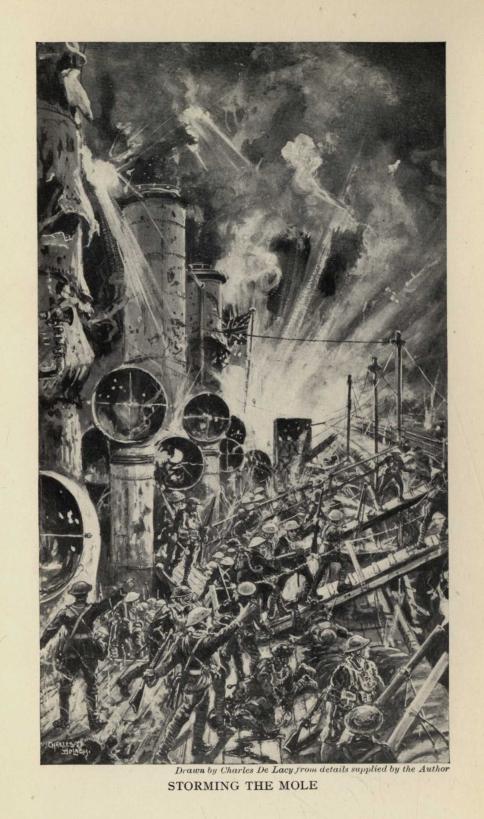
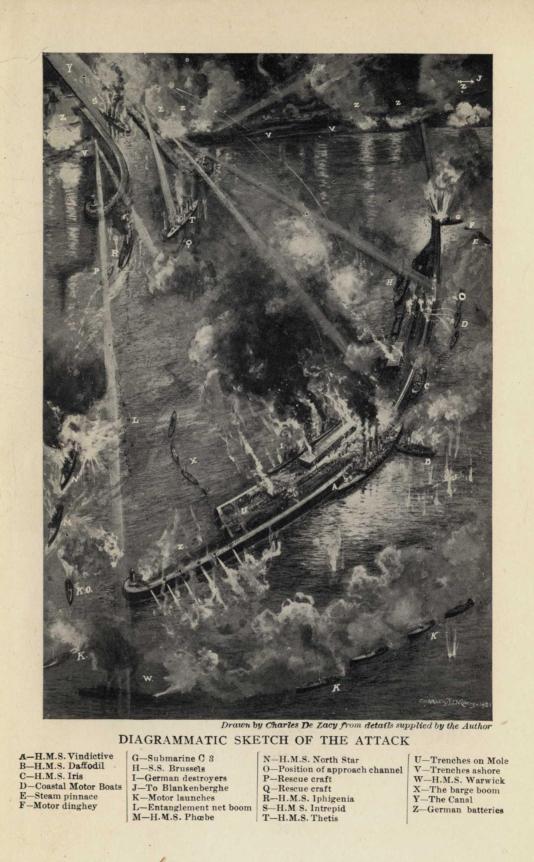
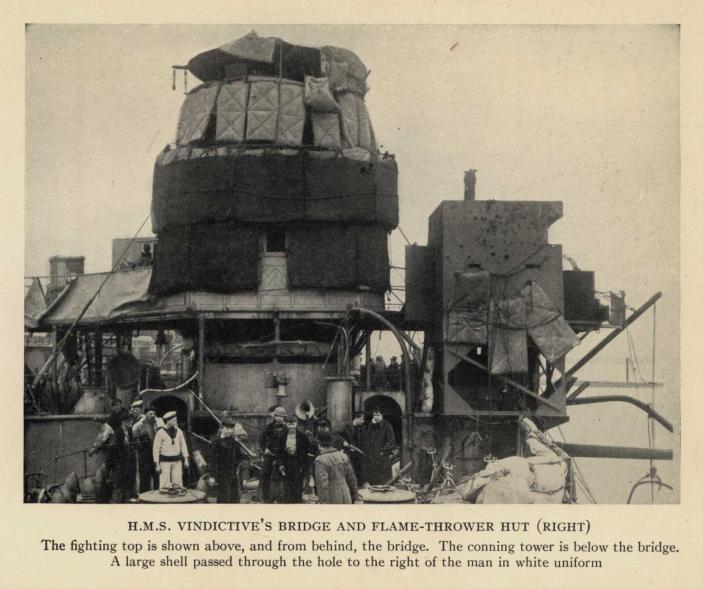
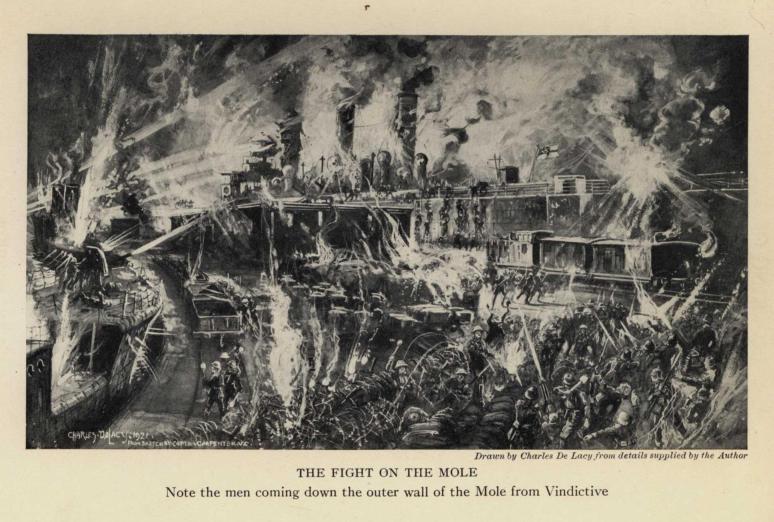
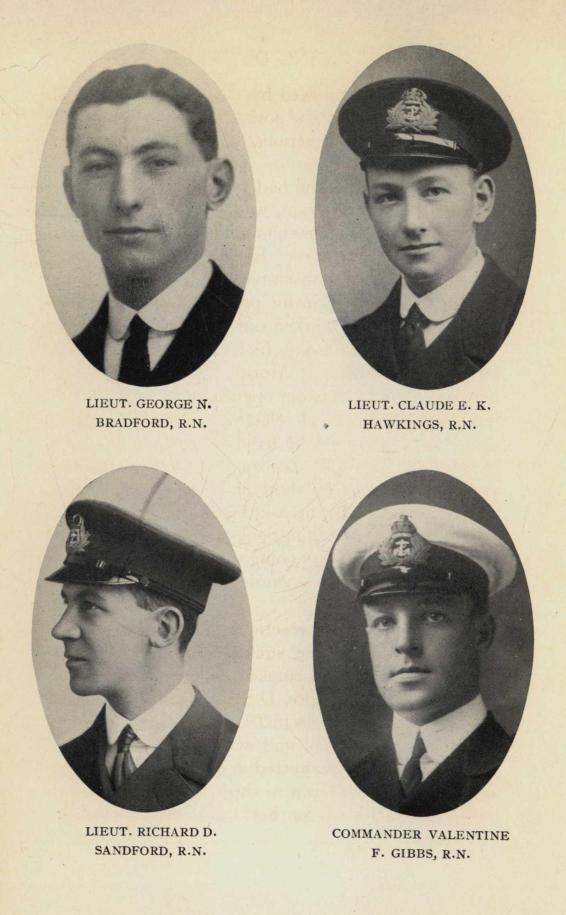
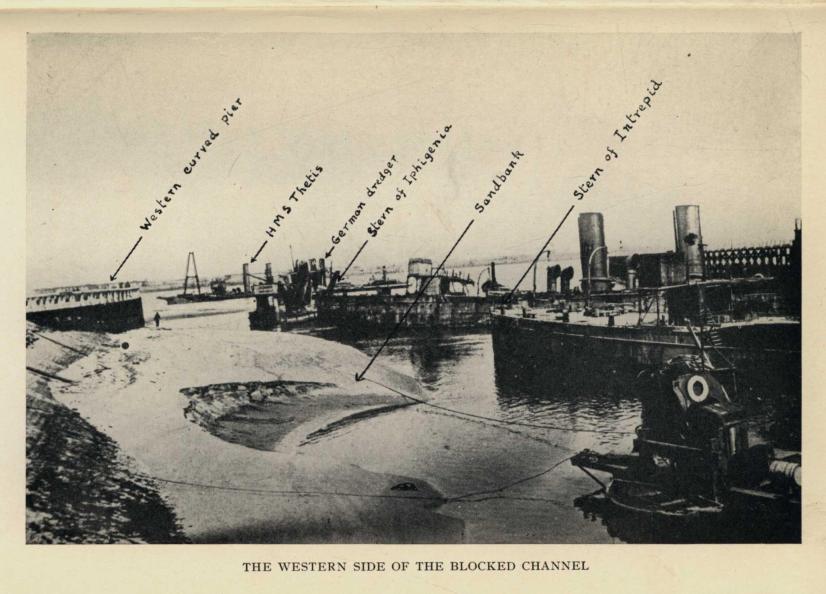
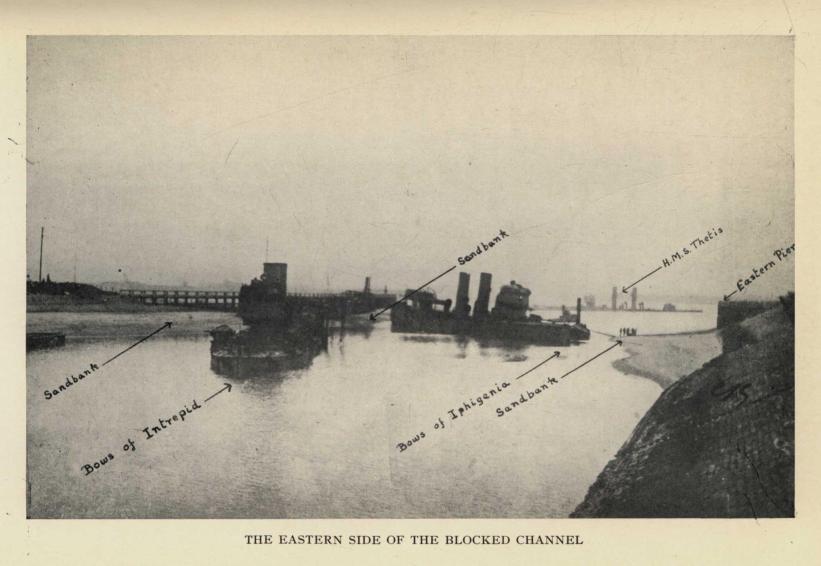
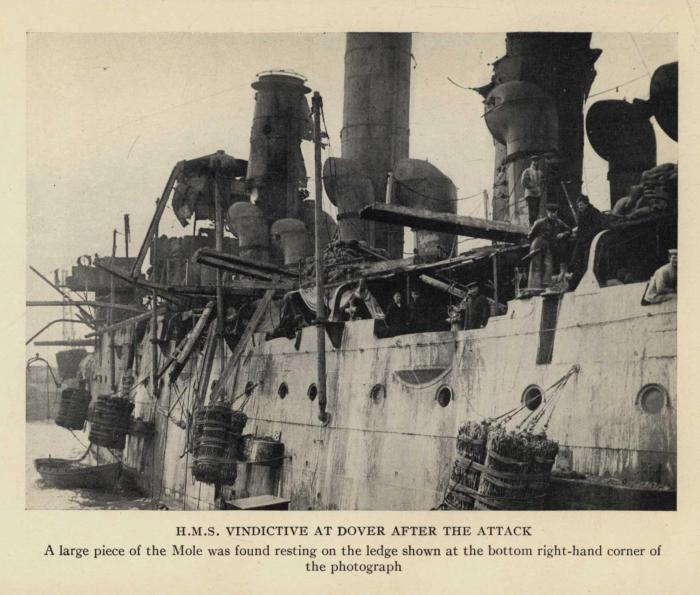
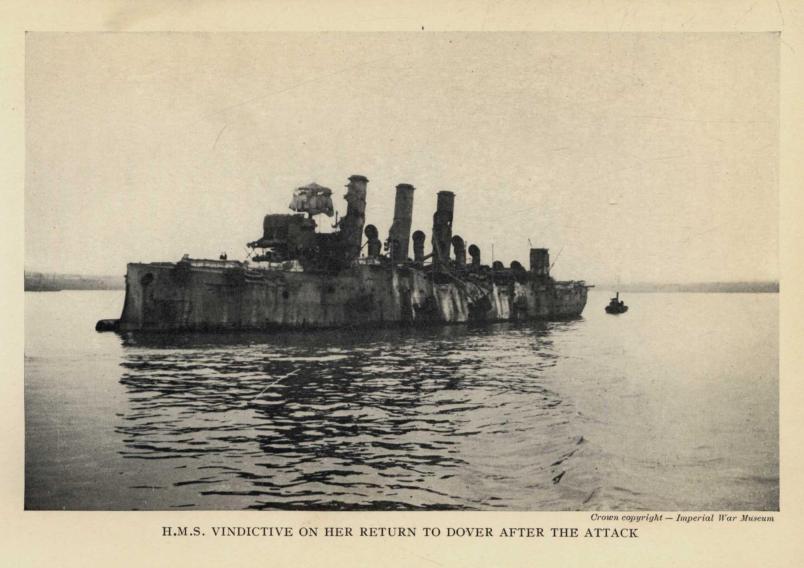
THE BLOCKING
OF ZEEBRUGGE
THE STRATEGICAL SITUATION. THE GERMAN BASES
IN FLANDERS. THE CONCEPTION OF THE PLAN.
The main function of a navy in war is that of
obtaining the command of the sea. The
purpose for which such "command" is desired is
the utilisation of the sea-lines of communication and
the denial of the same to the enemy.
Soon after the commencement of the war in 1914
the sea-lines of communication across the English
Channel assumed considerable, if not paramount,
importance for the transfer of personnel and material
from Britain to the Allied forces in France. It was
equally incumbent on the navy to maintain the
trans-Atlantic and other lines of communication along which
the necessities of life and war were carried to the
Allies in all theatres of war.
The Strategical Situation
The first step towards obtaining "command of the
sea" is the removal of the obstacles which stand in
one's way. In this particular case the main obstacle
(admittedly constructed for the purpose) was the
German High Seas Fleet. Thus the first duty of the
British Grand Fleet was that of destroying the
so-called High Seas Fleet, or, if destruction was found to
be impracticable, of reducing it to inactivity. The
German Fleet was fully alive to that fact, and, almost
throughout the war, hid themselves away in their
naval bases under the protection of their coast
defences. Thus, as events showed, the High Seas Fleet
did not prove to be a very serious obstacle to our
Command of the sea; but, and this fact is easily
forgotten, we could not foresee the continuance of their
ineptitude and lack of spirit. The German
submarines, however, were a formidable obstacle, indeed.
It is unnecessary to reiterate what is already common
knowledge on that point.
Submarines, by their nature, have certain limitations.
Except in the case of the submarine cruisers,
which only materialised in the latter part of the war,
such craft are considerably hampered in their
movements by their comparatively small radius of action.
Owing to the geographical situation of Germany, her
submarines were forced to expend an important
percentage of their fuel during the outward and
homeward voyages between their bases and the trade
routes. This expenditure cannot merely be judged
by the distances which had to be traversed; the
expenditure of fuel in the submarine bears some relation
to the whole circumstances of the voyage.
The endurance of the personnel is another
important factor, and is similarly affected by the
circumstances under which they are employed. For
instance, in waters patrolled by enemy vessels, high
speed must always be readily available and the strain
on the personnel, consequent on the danger of sudden
attack from surface craft, aircraft, or other submarines,
to say nothing of the presence of mine-fields,
is increased. Thus the longer the passage that the
German submarines were forced to undertake in
comparatively narrow and dangerous waters—such
as the North Sea—the less work could they do on
our more important trade routes. That statement is
closely connected with the subject of this book.
It did not require very much intelligence on the
part of the German Admiralty to realise that the
possession of bases on the Flanders coast would
greatly facilitate their submarine campaign owing to
the consequent reduction of the voyages to and from
the trans-Atlantic, or Channel, trade routes. Flanders
was therefore used, as will be explained later in detail,
to provide advanced bases for German submarines.
The coast of Flanders lent itself to other naval uses.
In addition to the guerre-de-course tactics of the
enemy—i.e., the direct attack on Allied merchant
vessels—it was always open to Germany to take
their whole main fleet to sea for the purpose of seeking
advantageous conditions for bringing a portion of our
Grand Fleet to action.
Movements of modern fleets under war conditions
necessitate the use of various types of small craft to
precede them—e.g., mine-sweepers for clearing channels
for the fleet to pass through, destroyers for
supporting the mine-sweepers and for driving back the
enemy's small craft, light cruisers for scouting
purposes, etc. Mine-sweepers and torpedo craft, by
virtue of their small size, are unable to keep the sea for
long periods. It will therefore be realised that, in the
event of the High Seas Fleet putting to sea for operations
in southern waters, the Flanders coast provided
Germany with an advanced base from which their
light craft could operate.
The German torpedo craft based in Flanders,
therefore, would be able to serve a double purpose, viz.,
that already mentioned and that of attacking our
patrol craft, our coast and our merchant vessels when
opportunity offered. The mine-sweepers could also
serve a double purpose in that they were required to
sweep channels for the ingress and egress of
submarines based in Flanders whilst being suitably placed
for sweeping duties in advance of the main fleet.
That Flanders was also suitable for aircraft bases is
as well known as it is obvious; but it may not be
generally understood that such aircraft would also be
of special value to the main fleet under the conditions
stated above. Thus, to sum up, the occupation of the
Flanders coast by the German sea forces would be of
treble value—to provide, firstly, a base for the
submarines employed on commerce destruction; secondly,
a base for the advanced flotillas and aircraft operating
in conjunction with the main fleet in the event of the
latter coming south; and, thirdly, a base from which
to attack our southern coasts or sea-patrols and from
which to indulge in air raids against British and
French territory.
The foregoing consideration of the possible uses of
Flanders to the German Navy shows the inherent
value of an advanced base in that locality; the
intrinsic value obviously depended upon the existence
of suitable harbours for use as bases. Let us now
examine the geographical situation.
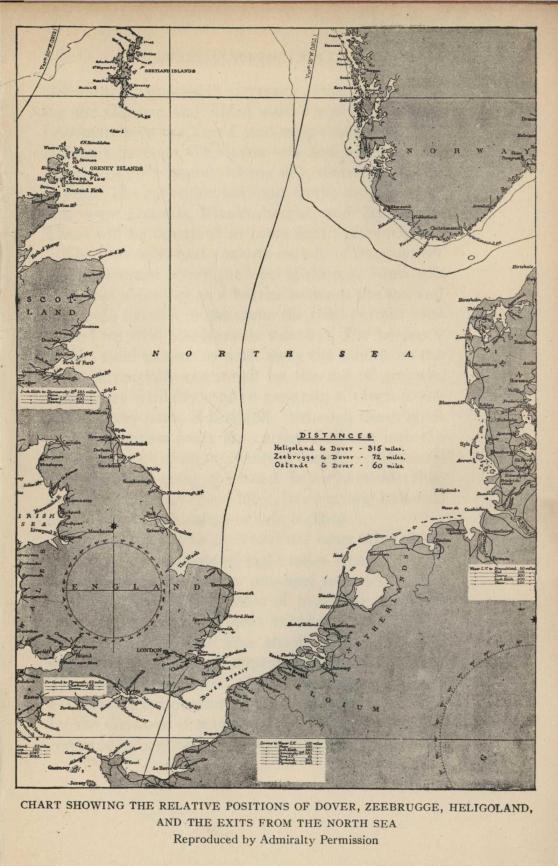
CHART SHOWING THE RELATIVE POSITIONS OF DOVER, ZEEBRUGGE, HELIGOLAND, AND THE EXITS FROM THE NORTH SEA.
In the latter part of 1917 the Flanders coast, as far
westward as Nieuport, was in the possession of the
Germans. The northern extremity of the line
separating the German and Allied armies was situated
approximately on the Yser Canal, which emanates from
Nieuport harbour. The latter was dominated by the
gun-fire of both armies; its use was, therefore, denied
to both. The only other harbours on the coast of
Flanders were Ostende, Blankenberghe, and Zeebrugge.
These will be described in some detail presently.
The Flanders Coast
The Flanders coast consists mainly of flat country
barely elevated above the level of the sea. Sand-hills
along the shore act as a barrier between the sea and
the land. Parallel to the shore the tidal current runs
to and fro with considerable velocity. The tendency
for the tidal current to wash away the sand from the
shore is partially countered by the use of groynes,
such as are similarly used to maintain our own
coastline in many parts of England. Although the groynes
on the Flanders coast are carried well out into the
sea—they are often 100 yards in length—the
movement of sand along the coast is very considerable,
and, as will be explained later, has a strong influence
on the harbour situation in that locality.
The approaches to the coast are beset with shoals
reaching to a distance of eight miles from the land.
These shoals have always provided serious obstacles
to navigation. During times of peace the charts of
this locality had been kept corrected by virtue of
continual surveying. The shoals were frequently
moving and new shoals appeared from time to time.
The channels required almost constant dredging.
For obvious reasons during the occupation of Flanders
by the Germans it was not possible for the Allies to
continue either the surveying or the dredging.
Before the war navigation off this coast required
the use of many facilities such as buoys and
lighthouses. At the best of times buoys are not very
dependable as navigational aids owing to their
tendency to break away in heavy weather or to drag
their anchors along the bottom. Their positions need
to be "fixed" from time to time by means of angles
to shore objects, or by methods of astronomical
observation, and then compared with the positions
shown on the charts. Lighthouses, however, unless
they are of the small type without lighthouse-keepers,
are more efficient aids to the navigator. During the
war the lighthouses east of Nieuport were only used
by the Germans during short periods when specially
required for their own craft; the majority of the
buoys were withdrawn and the remainder were
moved to new positions which were frequently altered
to prevent the Allies from making use of them.
Thus, during the war, the charts available to the
Allies were very soon obsolete; no others were
obtainable. Navigation off the Flanders coast, for
Allied vessels of any size, therefore, became decidedly
hazardous.
The tides on the coasts, in addition to running
alternately eastward and westward with considerable
velocity, also caused large differences in sea-level
amounting to fifteen feet between the highest and
lowest states of the tide.
The Canal System
Mention has already been made that the only harbours
on the coast eastward of Nieuport were situated
at Ostende, Blankenberghe, and Zeebrugge. But
these were not natural harbours. They had been
artificially cut out of the coast-line by means of
dredging. The entrance channels were preserved by
piers built out into the sea and by dredging
operations designed to retain the desired depths of water.
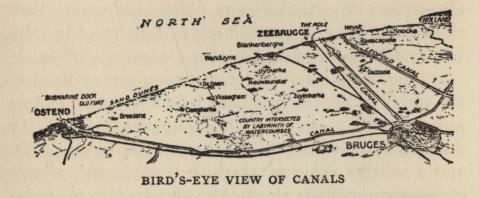
BIRD'S-EYE VIEW OF CANALS
Ostende, before the war, had been much used as
a commercial harbour, and was therefore provided
with numerous wharves, basins, and docks. It was
a suitable harbour for all classes of submarines and
torpedo craft. Blankenberghe was a little harbour
about nine miles east of Ostende and three miles west
of Zeebrugge. Its depth was exceedingly small; it
could, therefore, only be used for shallow draught
vessels such as fishing boats, motor boats, and the
like. It was true that the rise of tide, amounting
to approximately fifteen feet, would enable larger
vessels to enter or leave near the time of high water,
but any naval vessel stationed in a harbour from
which it can only proceed to sea during a limited
portion of the twenty-four hours at once loses much
of its value. Zeebrugge could accommodate vessels
up to a considerable size: the harbour works and
depths will be described in detail presently. Although
these three places provided the only harbours on the
coast, there was a harbour of great importance at
Bruges, about eight miles inland from Zeebrugge.
Bruges harbour was also entirely artificial, consisting
of locks, basins, and waterways built on the canal
system. Bruges was connected to the sea by means
of canals running to Zeebrugge and Ostende, these
canals converging on the waterways of Bruges in such
a manner that vessels of a certain limited size could
pass from Ostende to Zeebrugge, and vice versa,
without actually proceeding into the open sea. A series of
small canals also connected Bruges to Antwerp, via
Ghent, but this canal system, being only constructed
to accommodate barges, did not materially add to the
value of Bruges as a harbour for sea-going vessels.
Of the three canal systems connecting at Bruges,
the canal to Zeebrugge easily held first place in
importance. This canal was built by the Belgians. It
was commenced in 1896 and completed in 1907. Six
and a quarter miles in length, it was almost entirely
straight throughout. It could accommodate torpedo-boat
destroyers or submarines, both of the largest
size, and could, if required, have been used by light
cruisers.
The Harbours in Flanders
At the seaward end of the Ostende and Zeebrugge
canals, locks were constructed so that vessels could
pass from the canals to the sea, or the reverse, at
any state of the tide, without lowering the level of the
water in the canal.
The above-mentioned harbours were used for naval
purposes by Germany as follows. Bruges was chosen
as the main naval base. Shelters for protecting
submarines from aerial attack, floating docks, repair
workshops, all the other facilities which go to make a
modern dockyard for small vessels, and the necessary
stores and ammunition, were to be found there. The
number of naval craft based on Flanders appeared
to vary considerably; but, at the beginning of 1918,
approximately eighteen submarines and twenty-five
destroyers or torpedo-boats would be at Bruges on an
average day. The submarines lay in the special
shelters which were covered by roofs of reënforced
concrete several feet in thickness. Bruges, then, was not
only the dockyard but also the resting-place of
practically all the German naval craft based on Flanders.
The sea exits from Bruges, as already mentioned,
were situated at Ostende and Zeebrugge. There was
some doubt, however, whether the Bruges-Ostende
canal could be used for the passage of anything larger
than very shallow draught vessels such as motor boats
or barges. The Ostende canal was known to be
narrow, tortuous, and shallow; it had been constructed
many years earlier than the Zeebrugge canal.
At Zeebrugge and Ostende a few German craft
were usually stationed for duties of an immediate
nature such as mine-sweeping, patrolling, and duties
connected with the defence of the coast. These
harbours were specially useful as taking-off places for
vessels which had concentrated in readiness for
operations at sea, or as bolt-holes for the same craft
when pursued by our patrol vessels. Both harbours
were open to bombardment from the sea; that reason,
more than any other, probably influenced the
Germans to use Bruges for their main base. Ostende,
being more open to attack from the sea and air than
was Zeebrugge, was the less important harbour of
the two.
Blankenberghe harbour, owing to its small size and
shallow depth, was used as a base for the German
armed motor boats; it is believed that about thirty
were stationed there. This harbour, being unconnected
with the canal system, was not in direct inland
communication with Bruges by water.
In addition to the submarines and torpedo craft
already mentioned, the Germans had a large number
of trawlers based on the various harbours for
mine-sweeping and patrol duties. At Zeebrugge they had
their largest seaplane base in Flanders; another
seaplane base was situated at Ostende.
In due course Flanders had become a veritable
hornet's nest. Let us consider for a few moments to
what extent these hornets could trouble us.
Our Lines of Communication
Across the English Channel, and especially in its
eastern portion, we had established lines of
communication of tremendous importance. It is no
exaggeration to state that, every few minutes of the day
and night, a vessel, of one sort or another, left the
English shore for France with her cargo of personnel,
guns, ammunition, food or fuel, etc. Day after day,
night after night, for months on end, a constant
stream of vessels poured across the Channel in
support of the Allied armies or on the return trip to
English ports with wounded, men to whom a welcome
spell of leave had been granted, empties for refilling,
motor transport vehicles for repair, and the like.
The wounded were carried in hospital ships; but, as
the world knows and can never forget, the Germans
ruthlessly torpedoed them whenever the chance
offered, regardless of the Geneva Convention,
heedless of the damnable inhumanity of the proceeding,
seeking only for opportunities for indulging in the
frightfulness which formed part of their Kultur.
All these vessels were continually open to attack,
not only from submarines but also from the surface
craft and aircraft based in Flanders. At any chosen
moment, preferably at night or during misty days,
these hornets could emanate from Ostende or
Zeebrugge on their deadly missions. Further westward
our trans-Atlantic lines of communication offered
innumerable opportunities for the German submarine
commanders to display their brutality against
comparatively defenceless merchant vessels, or to attack
transports carrying munitions of war and troops from
the American Continent. The passage through the
English Channel afforded the most direct route for
German submarines proceeding to, or returning from,
their hunting-grounds.
The mercantile traffic off the southeast coast of
England and in the entrance to the Thames was also
within easy reach of the German bases in Flanders;
so were our seaside resorts, such as Ramsgate and
Margate, which provided favourable opportunities
for bombardments with resultant casualty lists of
innocent women and children.
Dunkerque and Calais on the French coast were
the nearest seaport objectives to the Flanders coast;
they both experienced frequent aerial attacks and an
occasional bombardment from the sea.
As a counter to the German craft in Flanders the
British Admiralty had established a force known as
the "Dover Patrol." As the name implies, this force
was primarily based on Dover. Their duties were
mainly those of protecting the transports bound
across the English Channel, preventing the German
naval craft from passing through the Straits of
Dover, and watching the exits from Bruges so as to
obtain timely information of concentrated German
forces putting to sea. The story of the Dover Patrol
is of intense interest, but so many pages would be
required to do it even bare justice that I can only
refer the reader to books written especially on that
subject. Suffice it to say here that, day and night,
winter and summer, fair weather and foul, the Dover
force patrolled the sea so successfully that the
German attempts to use their surface craft for attacking
the Allies were few and far between. The difficulties
of preventing the submarines passing through the
Straits of Dover were immense. We must realise that
the maximum portion of a submerged submarine
visible above water amounts to a periscope of a few
inches in diameter. Compare that dimension to the
width of the Strait which at its narrowest part is
twenty miles. A few inches in twenty miles—if I have
calculated aright that means that the visible portion
of the submarine would cover little more than
one-millionth part of the surface between Dover and Cape
Grisnez. And when we also realise that the periscope
would only be raised above water for a few seconds
at long intervals we shall begin to understand the
difficulty of the problem. Yet, as we know now, the
Dover Patrol force, under the direction of
Vice-Admiral Sir Roger Keyes, eventually rendered the
passage through the Straits to all intents and purposes
impossible for a submarine. All honour to the Dover
Patrol!
The Dover Patrol
A point which, until recently, unaccountably
seemed to have escaped notice was that the work of
the Dover Patrol was carried out on behalf of all the
Allies and of the United States. It was not a British
force acting solely in British interests. Though it is
difficult, and perhaps invidious, to apportion the
credit for protecting the Allied lines of communication,
yet there is no shadow of doubt that the troops
from Canada and from the United States of America
owed to the Dover Patrol force a tremendous debt
of gratitude for their safe passage overseas.
Recognition of this fact has since been shown by the
erection at New York, and on the French coast, of
memorials to the Dover Patrol. When the late war
has faded into history, and those of us who took part
have long since "gone west," such memorials will
remain to bear witness to the splendid sacrifice and
unselfish gallantry of those hardy seamen who did
their utmost to uphold the honour of civilisation
and to destroy the forces working for its overthrow.
(This opportunity of acknowledging the success of
their extremely arduous efforts, humble and brief
though the acknowledgment may be, partially
counterbalances my regrets at not having had the chance
of serving with the "Dover Patrol" except on the
occasion which this book is designed to describe.)
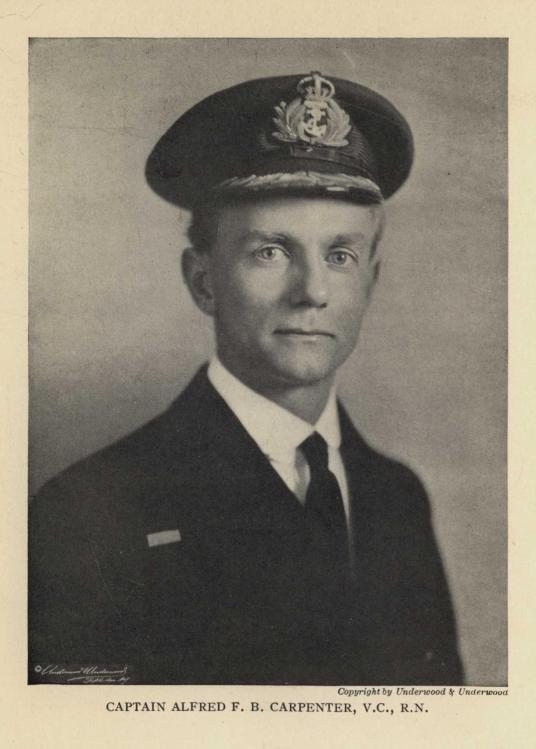
CAPTAIN ALFRED F. B. CARPENTER, V.C., R.N.
The final closing of the Straits, however, was far
from accomplished by the spring of 1918. At that
time we had reason to believe that a large percentage
of the total Allied losses in merchant ships was caused
by the Flanders submarines, and that the percentage
was on the increase.
Now patrol work of the type described above is
essentially defensive in its nature. This statement is
not intended to imply that the Dover Patrol force
were always employed on defensive tactics; such was
by no means the case. Our monitors frequently
bombarded the coast defences and the harbour works at
Ostende and Zeebrugge; our motor boats were
continually patrolling close off the three coast harbours,
watching for opportunities to torpedo any German
vessels which ventured to sea; our mine-laying craft
were employed, night after night, in laying mines to
the detriment of the German submarines. But from
time to time various suggestions had been made that
we should adopt still more offensive measures against
the enemy. It is a very simple matter to make
suggestions, but by no means so simple to accompany
them with a reasoned statement, based on logical
deduction, which will convince the authorities of their
value. Until a particular Plan has been put into
execution it may, in the literal sense, be rightly
designated a "paper scheme." It is both unreasonable
and unfair to attach a derogatory sense to the term.
It is equally unreasonable for authors of schemes
which have not passed the paper stage to belittle
operations when the latter, based on schemes which
differed from their own, have actually taken place
with successful results.
Paper Schemes
Whatever suggestions were made, it is clear that
there could be only two radical methods of attaining
our object. The most satisfactory, of course, would
have been the recapture of the Flanders coast and
of Bruges, with all the hornets in their nests, by
means of military operations. Unfortunately that
was impracticable; the Allied armies were not yet
sufficiently strong. The only alternative to capture
of the craft in their harbours was that of preventing
them putting to sea—i.e., destroying or blocking
their exits. Several schemes for blocking operations
had been proposed. In tactical method they had
varied from blowing up the harbour entrances, as
suggested by the Halifax disaster, to "building in"
the entrances under cover of poison gas. Whether
such methods were considered too risky, too
expensive, or too hopelessly fantastic is more than the
author of this book knows.
An attack on Zeebrugge had been strongly advocated
by an eminent flag officer in November, 1916,
but no details were given by him as to the nature of
the operation. In May, 1917, detailed proposals for
an attack had been submitted to the Admiralty by
another distinguished officer. This attack involved a
landing on the Mole at Zeebrugge, the general idea of
which was not dissimilar from that eventually
followed. This particular scheme had not earned the
approval of Their Lordships, nor was it considered
suitable by the Vice-Admiral then in command at
Dover.
Many months after the blocking of Zeebrugge
had become an accomplished fact two earlier schemes
came to light—these having emanated from the
author of that submitted in May, 1917. In
November, 1917, however, the only previous proposals
which were available for consideration by the
Planning Division of the Staff were those of November,
1916, and May, 1917, mentioned above.
In November, 1917, Admiral Sir John Jellicoe was
First Sea Lord and Chief of the Naval Staff. He had
requested the Director of Plans to consider, amongst
many other things, the possibility of blocking the
Belgian ports.
The Plan was evolved in the Admiralty, being
commenced on November 13th, and laid before Their
Lordships on December 3d. The Plan was accepted
as feasible, and earned Their Lordships' decision to
have it carried out. No previous Plan had reached
that stage. The original edition of the Plan did not
emanate from another country, or from civilian
sources, or from any other source outside the
Admiralty buildings in Whitehall except in so far as the
details of one particular phase of the operation were
the outcome of conversations, at the headquarters
of the Air Force, with an expert on the formation of
artificial fogs.
The Conception of the Plan
The foregoing definite fact has been purposely
inserted to correct other statements which have been
published elsewhere, presumably in error. I shall deal
with the details of the Plan in a subsequent chapter.
Before leaving the consideration of the origin of the
Plan, I should like to emphasise one particular point.
Perhaps this can be most readily illustrated by a
simple simile. An uncorked bottle, containing some
noxious fluid, stands upon the table. You realise the
disagreeable results which will follow on the escape
of its contents. You cork the bottle. Now your action
is so obviously correct that you scarcely give it
another thought. If any credit was due to anybody you
would probably take it to yourself; you would not
apportion any particular merit to that fond parent
who first initiated you into this obvious solution of
the problem. In the case, therefore, of the Blocking of
Zeebrugge one need not apportion credit to the person
who first suggested the mere idea; the credit is entirely
due to the man who, in spite of all the difficulties,
evolved a method of "corking the bottle" and who,
later, overcoming the great obstacles in the way,
carried the method into execution.
Before we pass on to review the difficulties of
blocking the exits from the German bases it would be
advisable to consider the probable effects of such an
operation; this being the logical sequence actually
followed before the details of the Plan were formulated.
The results to be attained by blocking the exits
would probably be as follows. Firstly, there would
be a reduction in the number of Allied vessels sunk by
mine or submarine warfare; secondly, a decrease in
raid activity on the part of the enemy torpedo craft;
thirdly, the loss of a convenient advanced base for
small craft operating in conjunction with certain
movements of the High Seas Fleet; and, fourthly, the
reduction in the number of enemy vessels available
for the purposes mentioned.
The first two results concerned reduction of enemy
activity arising from the longer passages involved by
the use of more distant bases such as Heligoland or
the German rivers from which the small craft could
continue their depredations. The third result speaks
for itself. With regard to the fourth, it has already
been stated that, on an average day, there would be
many torpedo craft or submarines resting and
repairing at Bruges. If the exits were blocked the use of
these craft would be denied to the enemy, just as
effectually as if they were sunk, for as long as the
exits remained unopened. This loss to the enemy,
temporary or permanent, could doubtless be
described in terms of reduction of Allied losses of
merchant tonnage. The Admiralty authorities could
probably have calculated, within fairly correct
estimates, the average loss of merchant tonnage caused to
the Allies by a single enemy submarine or surface
torpedo craft. Our former average loss per given
period would thus be lessened in proportion to the
number of enemy vessels bottled up in the canals
during that period.
Results to be Obtained
There would, of course, be other, less important,
consequences arising from the blocking of these exits;
e.g., the inconveniences caused by the necessary
transfer of fuelling and repair facilities elsewhere, the
extra work thrown on the escorting vessels in the
Bight, and the fact that the craft already at sea and
operating from the Flanders coast would be forced to
curtail their current trips if they desired to arrive at
their new bases with their usual reserves of fuel.
All these material gains to the Allies would be of
considerable importance, but the moral effect was not
unworthy of consideration. The more audacious an
undertaking against an enemy the more intense will
be the victor's enthusiasm consequent on success,
and the greater the despondency and loss of moral to
the vanquished. Attempts to block a hostile port in
the face of carefully prepared defence measures may
certainly be described as audacious, unless the word
"impertinent," which the author is inclined to
allocate to this particular event, is deemed to be more
truly descriptive. If we endeavour to imagine what
our own feelings would be on hearing that enemy
vessels had entered one of our strongly defended
harbours and blocked the entrance, we shall arrive at
some idea as to the probable moral effect produced
by such an enterprise. In spite of the almost entire
absence of activity on the part of the High Seas Fleet,
the Germans had never ceased to sing its praises with
all the bombast of which their waning spirit was
capable. It was not difficult, therefore, to estimate
the dejection and consternation that would spread
throughout Germany when the success of our efforts
became known. The loss of prestige in the German
Navy would be not merely certain but perhaps of vital
consequence later on.
THE LOCAL SITUATION. THE LOCAL DEFENCES.
Zeebrugge Mole
The village of Zeebrugge stands near the
entrance to the Zeebrugge-Bruges canal. At
about half a mile inland from the coast at
Zeebrugge the canal lock was situated. To seaward
of the lock, the entrance channel, being open to the
sea, was tidal. On the eastern side of the entrance
channel, about midway between the lock and the
coast-line, a small tidal harbour had been constructed
for the use of fishing craft. This tidal harbour was of
no special value for naval purposes, owing to its small
depth. From the coast-line the entrance channel was
continued into the sea for a distance of about two
hundred and seventy yards by means of estacades—i.e.,
wooden piers. These piers, curving outwards
from the shore, are conspicuous in the illustrations.
For the purpose of protecting the canal entrance from
rough seas, which might interfere with the passage
of vessels to and from the canal, the famous Zeebrugge
Mole had been constructed for the Belgians.
Semi-circular in shape, it emanated from the shore at a
distance of about half a mile to the westward of the
canal entrance; thence it curved round to the
northward and eastward. This curved Mole protected a
roadstead, of some three hundred acres in extent,
from northerly and westerly gales. Easterly winds
did not cause such heavy seas as those from the
directions already named owing to the protection afforded
by the Netherlands coast.
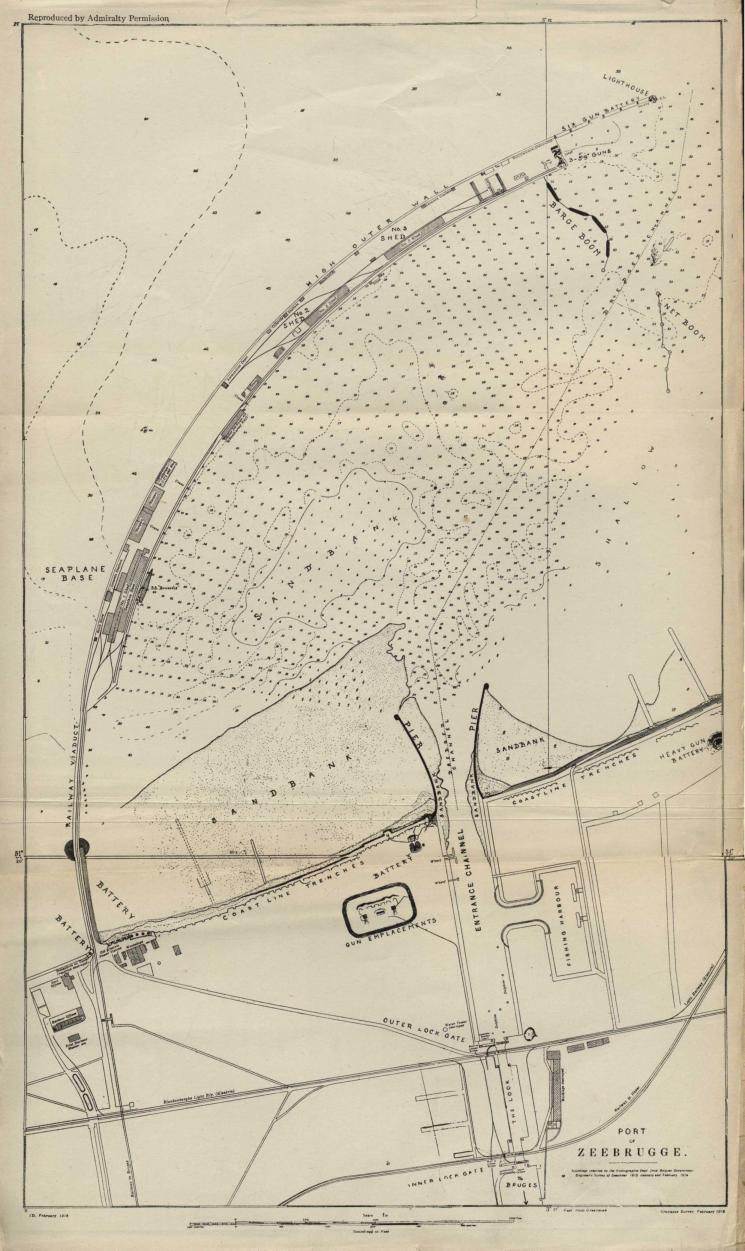
PORT OF ZEEBRUGGE
The construction of the Mole was a colossal task.
There are no similar works of such magnitude in
Great Britain or the United States. When lecturing
in the latter country I always made a point of
emphasising that fact to our American cousins; their
unfailing humour never failed to appreciate this little
friendly "dig."
The total length of the Mole was over one and a
half miles. For purposes of description it may be
divided into four portions. Commencing at the
shoreward end, the first portion of the Mole took the form
of a stone railway pier built into the sea for a distance
of two hundred and fifty yards. This pier was
connected to the second portion, which consisted of an
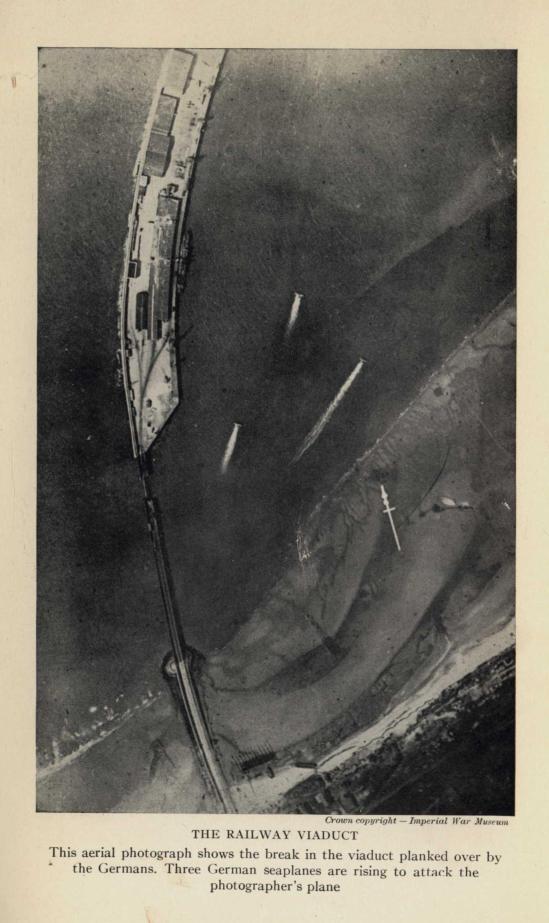
iron-piled railway viaduct three hundred and thirty
yards in length. This, in turn, was connected to the
third portion, which formed the Mole proper. The
latter was built of concrete blocks on its seaward and
shore sides, the central part being filled with gravel
and paved with granite. The width of this portion of
the Mole was no less than eighty-one yards, and its
length about eighteen hundred and seventy-five, or
rather over a land mile. At its northeastern end, the
fourth portion consisted of an extension piece, two
hundred and sixty yards long and fifteen feet broad,
with a lighthouse at its eastern extremity.
If the Mole had been constructed solid throughout
its entire length, the task of keeping the channel,
leading to the canal entrance, or the roadstead, at
a convenient depth would have been impossible
owing to silt.
Silt may be defined as the movement of sand or
mud, according to the nature of the sea bottom in the
locality, due to current. The bottom of the sea in this
locality was sand. The current off the Flanders coast
is caused by tide—it is usually spoken of as tidal
stream. Tidal streams reverse their direction of
movement about every six hours. Now the movement
of sand caused by a tidal stream tends to deposit
that sand in or against any irregularity with
which it meets, whether the latter is a groove on the
sea bed or an obstacle such as a wreck. This deposit
first takes place from one direction, and then, when
the tidal stream reverses, from the opposite direction.
It will therefore be seen that, where a channel is
artificially cut on the floor of the sea, silt will
continually tend to fill that channel again until the
bottom is level once more. And a ship which grounds in
a locality affected by silt will have sand deposited
against her sides much to the detriment of salvage
operations. These facts are well enough known to
seamen and have an important bearing on this narrative.
Concerning Silt
Suppose for a moment that the entire Mole had
been built in solid formation—i.e., that the tidal
stream had no free passage under the viaduct. The
west-going stream would tend to carry sand into the
roadstead between the Mole and the canal entrance,
whereas the east-going stream would be unable to
remove the deposit a few hours later. Thus the
roadstead would soon have become useless, and access to
the canal would have been impracticable.
The sand along the whole Flanders coast was
extremely susceptible to movement. Such tendency
was partially countered by the extensive use of
groynes. These latter, however, could not be carried
very far out into the sea owing to the difficulties of
construction and repair. There were, therefore, no
artificial barriers to prevent the movement of the
sand to the eastward or westward beyond a short
distance from the shore. Hence the necessity for
keeping a portion of the Mole open to allow the tidal
stream to flow in both directions. Even so, a large
shoal had formed in the roadstead, and reduced the
acreage available for anchorage purposes.
When first designed the open viaduct was of shorter
length than that eventually constructed; the
alteration was considered necessary after local experience
of the silt had been obtained. The iron piles, or
pillars, on which the viaduct was supported were of
great strength and much interlaced with steel rods to
allow for severe buffeting in heavy gales and to take
the strain of railway traffic. A portion was actually
demolished by a gale when under construction, and
the completion of the Mole was consequently delayed
for many months.
When making enquiries in search of expert advice
on questions of salvage, I had an interesting
conversation with an individual who had had considerable
experience in salving vessels in other waters. Maybe
this book will remind him of our discussion. In his
opinion salvage work presented no great difficulties.
It was only a matter of obtaining the necessary
apparatus, he thought, and any vessel—concrete-filled
or otherwise—could be removed in a month or so.
"How about silt?" I asked.
"Oh, silt shouldn't make much difference," he
replied, and added, "but we have no silt to speak of in
that part of the world, so I cannot say for certain."
We then discussed the possibilities of salving a
blockship at Zeebrugge, for he had been informed of
the proposed operation. Eventually our conversation
nearly resulted in a wager; that we came to no terms
was perhaps due to the fact that payment might have
necessitated application to a war widow.
The first and second portions of the Mole had not
been materially altered by the Germans during their
occupation.
The Outer Wall and the Parapet
The third portion of the Mole will require detailed
description. In peace days the Mole had been used as
a commercial wharf as well as a breakwater. Ships
used to secure alongside its inner wall. All the
necessary facilities, such as bollards for securing hawsers,
fixed and travelling cranes for loading or unloading
cargo, and arrangements for embarking passengers,
had been provided. A large railway passenger
station, nearly two hundred yards long, was situated
near its southwestern end; a goods station and a coal
shed, both very large buildings, stood further to the
northeastward. The floor level of this portion of the
Mole was about nine feet above the level of high tide.
On the outer (seaward) side a high wall, of great
strength and thickness, had been constructed for the
purpose of preventing rough seas from breaking over
the Mole and damaging the sheds or washing away
the railway. The top of this wall was twenty feet
above the floor level of the Mole and therefore
twenty-nine feet above the level of high tide: at low tide it
towered forty-four feet above the sea.
The fourth portion of the Mole was really formed
by a continuation of the outer wall, which extended
beyond the third portion to the lighthouse.
The appearance of all portions of the outer wall, as
viewed by anybody situated in a boat alongside it,
was exactly similar throughout its entire length from
the lighthouse to the railway viaduct. Thus the
individual in the boat, except in the unlikely event of
being able to see over the top of the wall, would be
unable to tell, at all definitely, whereabouts his boat
was situated relative to objects on the Mole. But this
fact had not been accidentally overlooked by the
designer of the Mole; there was no object in taking it
into consideration, for there was then no idea of any
vessel berthing alongside the outer wall. For instance,
there were no bollards, no cranes, no capstans for
working hawsers, in fact no arrangements whatever
for berthing a ship. I have already stated that this
outer wall was of great thickness, varying from
twenty-five feet on the sea bottom to ten feet in that
portion standing above the floor level of the Mole.
Four feet below the top of the wall there was a
pathway, nine feet broad, running the whole length of the
wall. This pathway was known as the parapet. The
parapet was bounded on its seaward side by the
four-foot wall just mentioned; on its inner side iron
railings, three feet high, were placed to prevent anybody
falling from the pathway to the floor of the Mole
sixteen feet below. Flights of steps led up from the
Mole floor to the parapet, but these flights were very
few and far between.
That portion of the outer wall which formed the
lighthouse extension of the Mole was broadened,
above the sea level, to about seventeen feet throughout
its length. The pathway was similar to that just
described, but fifteen feet in width. This portion of
the Mole was hollow, a tunnel inside it running from
the third portion of the Mole to the base of the lighthouse.
The navigable channel from the open sea to the
canal entrance could only be maintained in an
efficient state by means of continual dredging, owing to
the silt. The channel passed close to the lighthouse at
the end of the Mole, and then in a fairly direct line,
for a distance of three-quarters of a mile, to a position
midway between the extremities of the two piers
marking the canal entrance. Thence the deep water
channel passed slightly to the westward of the central
line between the piers. This latter portion of the
channel had become exceedingly narrow by virtue of
the sandbanks which had formed on either side of it
and which actually uncovered at low water. A vessel
drawing more than twelve feet or so was forced to
keep exactly in the middle of this dredged channel
to avoid grounding. Photographs taken at or near
high tide gave the channel the appearance of extending
from one pier to the other, at least a distance of
one hundred yards; those taken near low water showed
how narrow the channel really was. In the region of
the two piers the silting of the sand was more rapid
than elsewhere: the narrowest part of the channel
was situated near the shore ends of these piers.
Defences on the Mole
The Germans had not rested satisfied with either
the Mole, the canal entrance, or the lock as they
found them. The Mole itself had been transformed
into a fortress, and further defences had been
constructed for the purpose of guarding the canal.
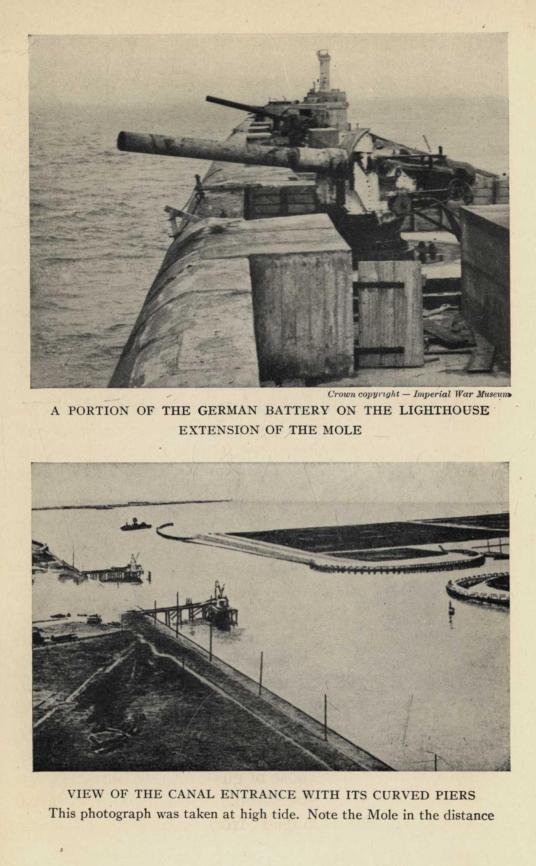
A PORTION OF THE GERMAN BATTERY ON THE LIGHTHOUSE EXTENSION OF THE MOLE.
VIEW OF THE CANAL ENTRANCE WITH ITS CURVED PIERS.
This photograph was taken at high tide. Note the Mole in the distance
Batteries were placed on both sides of the canal
entrance. These ranged from four-inch guns to
twelve-inch guns. Barbed wire entanglements were
erected along the shore line; trenches, containing
machine guns, were dug close behind them. It was
believed that a boom of some sort, capable of being
hauled across the channel or removed at will, was kept
handy to the outer lock gate. The gate itself,
"caisson" is the correct technical term, was withdrawn
into an armoured housing, impervious to shells or
bombs, when the lock was opened to allow vessels to
pass through. The caisson was also provided with an
armoured roof for defence against aerial bombs. The
lights on the wooden piers were only lit when
specially required to guide a German vessel to the
entrance.
On the Mole a very large seaplane base was
established with the original passenger station as its
principal building. Several other buildings for housing
seaplanes, fuel, or bombs, and workshops were erected
by the Germans close by. A merchant steamer, the
Brussels, formerly commanded by the ill-fated
Captain Fryatt, whom the Germans did to death so
abominably, was moored alongside the station, and
was believed to be used as living quarters for the
personnel of the seaplane base.
The broad portion of the Mole was used as a base
for submarines passing through Zeebrugge en route
for Bruges or to the open sea; it was also used for such
torpedo craft and mine-sweepers as were required for
immediate duty in that locality. From the north-eastern
large shed to the lighthouse the Mole had
been turned into a veritable fortress. It was believed
that the lighthouse was used as the Mole signal
station. A battery of six or seven guns was situated on
the lighthouse extension of the Mole. These guns
were at first surmised to be 3.5-inch guns, but it is
probable that they were larger—in fact, up to 5.9-inch
guns firing a shell of approximately one hundred
pounds in weight. It was believed that the guns of
this battery could fire out to sea and could be turned
to fire towards the shore.
Any vessel approaching from seaward and passing
into the dredged channel, en route to the canal, would
be within the danger zone of this battery, from the
latter's extreme range out at sea to the canal lock,
always provided that the state of the visibility
allowed the vessel to be seen. Incidentally, owing to the
situation of the deep channel, the vessel would be
obliged to pass within a few yards of this battery when
rounding the Mole end. A vessel endeavouring to
berth alongside the outer wall would have to approach
close to this battery, i.e., on a westerly course. At
first sight it might appear feasible to approach from
the westward on an easterly course and thus avoid
passing close to the battery, but that is not so. High
tide and slack stream do not coincide on this coast.
For about three hours on each side of high tide the
streams run to the eastward: at other states of the
tide there would be insufficient depths of water for a
vessel to berth alongside. It would therefore be
necessary to approach from the eastward, i.e., to stem
the tidal stream.
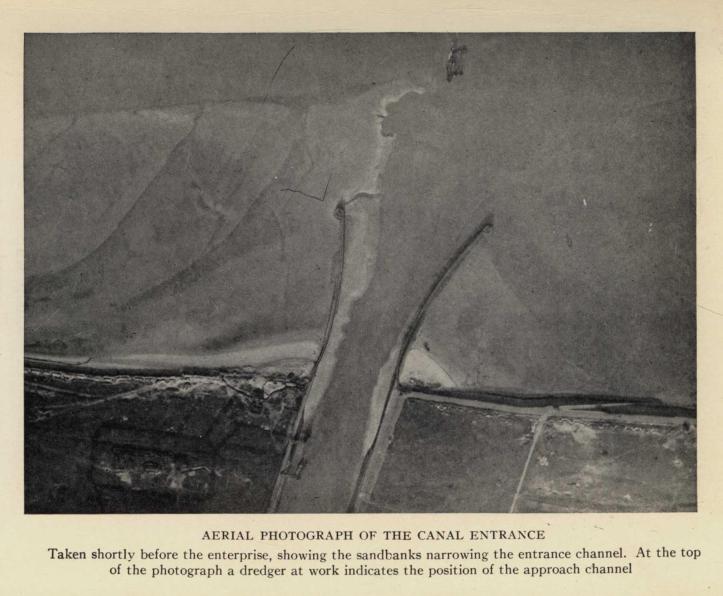
AERIAL PHOTOGRAPH OF THE CANAL ENTRANCE.
Taken shortly before the enterprise, showing the sandbanks narrowing the entrance channel. At the top of the photograph a dredger at work indicates the position of the approach channel
Now let us imagine for a few moments a duel
between this battery and a warship within—say—one
thousand yards. The reader probably knows that
such a distance nowadays comes within the definition
of "point-blank range"; i.e., a range at which a gun
practically cannot miss a ship. Picture, then, an
average-sized vessel of three hundred feet in length.
The guns could hardly miss her—in fact, the gunners
could select which particular portion of her should
serve as their target. The ship's guns would return
the fire. The most vulnerable portions of the battery
ashore are the guns themselves. The muzzle of each
gun showing just above the wall would, as viewed
from the ship, cover barely one square foot in size.
Now at golf we call it a "fluke" when a golfer holes
out from the tee although he has attained his object.
(I apologise for this to non-golfers.) Similarly, if the
ship's gun hits the shore gun we should call it a
"fluke," although that is the object forming the
target. And, as already implied, if the shore gun
misses the ship, that also will be a "fluke." On the
face of it, it certainly does not look as if the ship
would stand much chance, even at a distance of one
thousand yards. But how if she is closer? If a
thousand yards is point-blank range, how shall we
designate a hundred yards?
At the eastern end of the broad part of the Mole,
and on its floor level, the Germans had erected a
battery of three heavy guns. These were so placed that
they could fire on any incoming vessel immediately
she rounded the lighthouse. Woe betide a vessel
attempting to do so in the face of such guns. The latter
were probably of the 5.9-inch type. Under water,
immediately below this battery, we eventually found
some submerged torpedo tubes, but I am not aware
as to whether they were constructed before the
blocking operation or not; their direction of fire was
similar to that of the guns above them.
Close westward of these batteries of heavy guns
and torpedoes, and standing against the high outer
wall, the Germans had constructed a long shed of
reënforced concrete; this shed provided the living
space for the personnel of the Mole garrison.
The total numbers of Germans on the Mole probably
reached not less than a thousand. Although this
number may include the personnel of the seaplane
base yet they would all be available for the defence of
the Mole in case of an attack.
Slightly to the westward of the garrison's quarters,
trenches had been sunk in the floor of the Mole and
surrounded by three complete sets of barbed wire
entanglements. It was believed that the usual
accessories of a coast fort—e.g., searchlights and
range-finders, etc.—were placed on the outer wall
parapet, and that there would probably be some
small guns there also.
The Booms and Torpedo Craft
So much for the Mole itself. Across the channel
the Germans had placed booms. One of these,
consisting of four Rhine barges, was moored between the
eastern end of the broad part of the Mole and a buoy
situated two hundred and seventy yards to the
southward. These barges were filled with stone, had nets
slung beneath them, and were connected together by
wire hawsers. If a surface vessel attempted to pass
between the buoy and the Mole she would be brought
up by this boom and probably damaged by collision
with one of the barges. If a submarine attempted to
dive underneath the barges she would be caught up
in the nets. The other boom consisted of entanglement
nets moored between a series of buoys to the
southeastward of the barges. Any ship attempting
to pass through them would probably have her
propellers entangled, with the result that her engines
would be brought to a complete stop. Thus,
whichever boom was encountered by a ship, the latter
would, at the least, be partially disabled and stopped.
The Mole batteries could then have sunk her at their
leisure by gunfire. The only route by which a vessel
could pass clear of these two booms was that between
the southeastern barge and the northern entanglement
net; i.e., within two hundred and fifty yards of
the heavy gun battery on the Mole. But even if, by
dint of good fortune or special good management, a
vessel managed to pass the Mole batteries and the
booms, she would still have to run the gantlet of
the naval vessels in the anchorage and the batteries
on shore before reaching the canal.
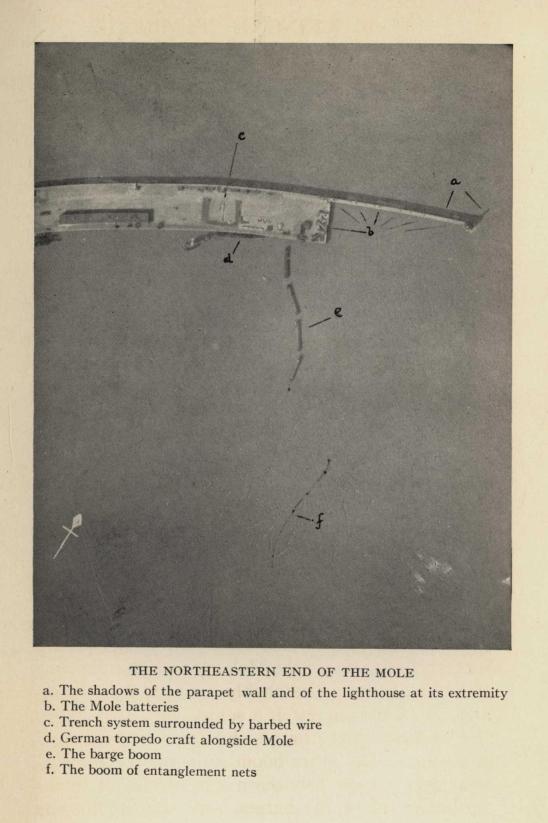
THE NORTHEASTERN END OF THE MOLE
a. The shadows of the parapet wall and of the lighthouse at its extremity
b. The Mole batteries
c. Trench system surrounded by barbed wire
d. German torpedo craft alongside Mole
e. The barge boom
f. The boom of entanglement nets
The German torpedo craft, which were available
for local duty, used to berth alongside the inner side
of the Mole, close to the westward of the barge
boom. By virtue of their guns, torpedoes, and
searchlights, and the fact that they probably kept up
steam in readiness for instant action, these craft
provided a valuable addition to the Mole and canal
defences.
The foregoing description of the local defences at
Zeebrugge has probably been sufficiently detailed to
lead to the conclusion that the Germans were fully
alive to the possibility of attacks on the Mole or canal.
Whether or not they considered that such attacks
would only form part of some more ambitious
operation, such as a military landing on the coast, our
enemies had left practically no stone unturned to
repel them. The defence measures must have
appeared, especially to those on the spot, to be more
than sufficient.
It is well known that, although the possession of
detailed local knowledge will usually be of great
value towards the formation of plans of attack, there
are occasions when local knowledge is apt to make
local difficulties loom extremely large. For instance,
in this particular case, the navigational difficulties
caused by the strong tidal stream, the difficulty of
recognising objects on the low-lying shore during
darkness, the uninviting appearance of the outer
Mole wall as an obstacle to be surmounted, and many
other matters would probably have induced the
belief, in those who were actually acquainted with these
difficulties, that such attacks would have no chance
of success. There is, therefore, reason to believe that,
although they realised an attack might be attempted,
the Germans were perfectly satisfied that the defences
could neither be improved nor penetrated.
The reader will probably have arrived at the
conclusion that the Germans were devilish in their
thoroughness. Yet there was still one joint left in their
armour—and we penetrated it. But I must not
anticipate.
THE OUTLYING OBSTACLES. CONSIDERATIONS OF SALVAGE.
Thus far I have only dealt with the local
defences of Zeebrugge. But there were many
other obstacles in our way—such as the
coast batteries, mines, surface patrol vessels,
submarines, aircraft, and the vagaries of the weather in
addition to the navigational difficulties mentioned in
the first chapter.
The coast-line of Flanders bristled with guns. The
section of the coast from three miles west of Ostende
to six miles east of Zeebrugge, approximately twenty-one
miles in length, was defended by two hundred
and twenty-five guns; one hundred and thirty-six of
these were of the heavy type, i.e., six-inch and above,
up to fifteen-inch guns.
At one period of the war, soon after the Germans
first obtained possession of that locality, the coast
defences had been few and far between. In those days
our ships used to bombard from such short ranges as
ten thousand yards. In course of time heavier guns
were set up on shore so that our vessels were forced to
keep at a more respectful distance. The first
bombardments from ten thousand yards had been
answered by the establishment of German guns having
a range of fifteen thousand yards. When better
weapons became available for bombardment from
twenty thousand yards the Germans replied with guns
firing up to twenty-five thousand yards. And thus the
duel continued. Finally, the ranges increased to
upwards of forty thousand yards (twenty-three land
miles). Monitors were specially constructed for this
purpose and their marksmanship was wonderfully
accurate. This accuracy is borne out by the fact that
scarcely any damage was caused to the residential
quarter, although Ostende was bombarded again and
again; yet works of military importance, such as
docks and railway stations, closely adjoining the
residential quarter, were hit time after time.
In a straightforward gunnery duel between a ship
and a fort, within the effective range of each, the
former stands no chance. In these days, however,
such duels savour little of the old-time broadside
fighting between ships.
Even the largest and most modern coast guns are
of comparatively small avail for defensive purposes
unless the attacking ships are visible, or unless the
firing can be controlled satisfactorily by such indirect
means as the use of aircraft for observational
purposes. At night the attackers must be illuminated by
star-shell, flares, or searchlights. Under the ordinary
fog conditions—i.e., when the whole locality is
obscured by fog—aircraft cannot observe the results
of firing nor can the attacking forces be illuminated.
Under exceptional fog conditions—i.e., when a
fog (natural or artificial) lies between the shore guns
and the attacking vessels, the latter being in clear
weather—good co-operation between the batteries
and aircraft in daylight enables the fire to be directed
so accurately as to ensure destruction to vessels which
remain in the danger zone.
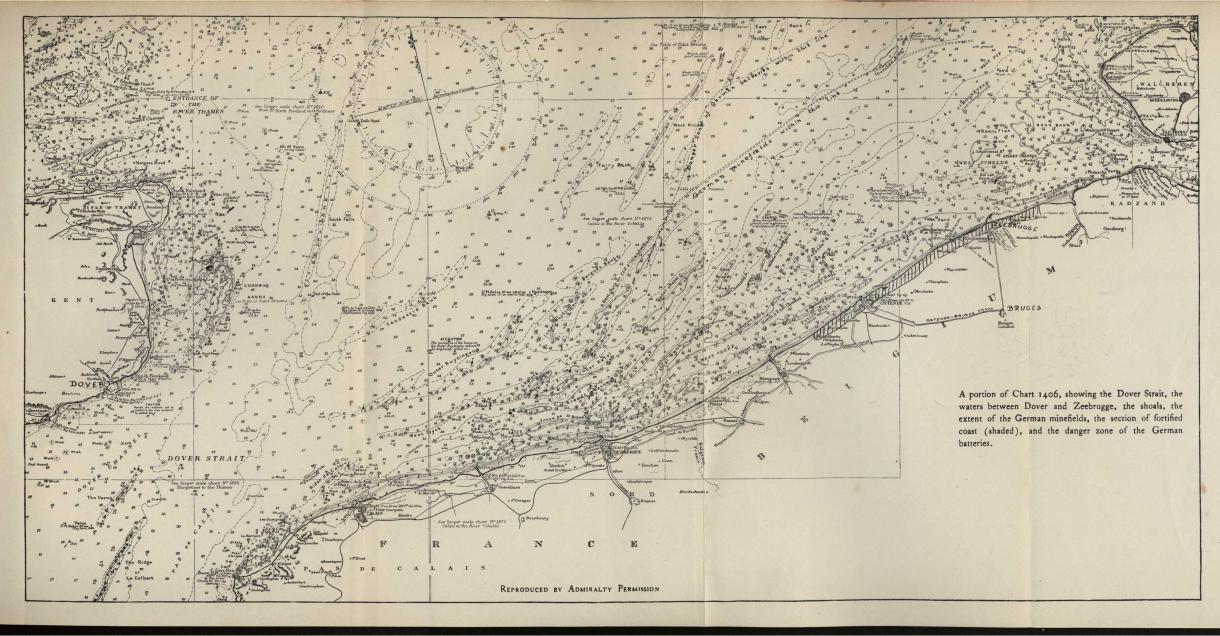
A portion of Chart 1406, showing the Dover Strait, the waters between Dover and Zeebrugge, the shoals, the extent of the German minefields, the section of fortified coast (shaded), and the danger zone of the German batteries.
The only alternative to directed firing is that of
barrage firing, such as is used so greatly in modern
land warfare. The defence guns can establish a shell
barrage, for a limited period, across any zone which
the attacking ship is attempting to penetrate en route
to her objective. The vessel which steams into an
efficient heavy gun barrage from modern guns is
unlikely to survive.
German Coast Defences
I afterwards visited one of the large German
batteries near Ostende, called the Jakobynessen battery,
which mounted fifteen-inch guns and fired projectiles
weighing nearly one ton each—seventeen hundredweight
to be precise. They were mounted in specially
constructed gun-pits amongst the sand-hills close
behind the shore, and were so well hidden that they
could not be seen from a distance of little more than
a single gun's length. The projectiles stood over six
feet high and were murderous-looking instruments of
warfare. These particular guns, and there were others
of a like nature, could probably have ranged up to
sixty thousand yards (over thirty-four land miles).
The whole area off this section of the coast, up to
about twenty miles to seaward, was included in the
danger zone of the coast batteries. No vessel could
maintain her position in that area, under ordinary
conditions of visibility, for more than a few minutes
at the outside limit. The reader may consider,
however, that a ship desiring to attack the coast would
merely have to approach in foggy weather or under
cover of darkness. In foggy weather she would be
unable to locate her objective—so that can be ruled
out. At night she might conceivably arrive within a
few thousand yards without being seen or heard.
But immediately she was located by the defences the
latter would fire their star-shell and switch on their
searchlights. The whole area would thus be illuminated
like daylight. The vessel discovered under such
conditions would probably be blown to pieces within
five minutes.
Thus it is manifest that ships cannot approach a
hostile coast, in the face of modern defences, under the
ordinary conditions of daylight or darkness, or in fog.
We will now consider the mine problem. The
German mine-fields extended to a distance of several
miles from the coast. We had reason to know of their
presence; from time to time, as reported in the press,
our vessels had been blown up.
Mine-fields off one's own coast provide a certain
measure of defence. But they are also an embarrassment
in that one's own vessels cannot pass through
them, when approaching or leaving harbour, unless
safe channels are kept clear for the purpose. This
applied to the mine-fields under review.
The German Mine-fields
The reader may possibly have jumped to the
conclusion that all we had to do was to navigate calmly
through the German safe channels. It certainly
sounds plausible. As a matter of fact, such an idea
borders on the ridiculous. Let us think this matter out
carefully. Our forces could not pass through such
channels unless they possessed information as to the
positions of those channels. But if such information
were received, the chances would be long odds on the
information having been "made in Germany." Far
from such information being correct, therefore, the
positions mentioned would probably be those of the
most dangerous mine-fields. Nevertheless, suppose
we received information which, from the nature of its
source and data, we had every reason to credit; and
suppose we acted on such information. Well, on the
voyage across the sea, or even before we actually
start, the enemy discover that we intend to attack.
What will they do? Their argument would be as
follows: "The British are coming over to attack us; they
may have discovered the positions of our safe
channels; we dare not take any chances so we will mine
our own safe channels immediately." Mine-layers,
kept ready for instant use, would be sent to sea at
once. In a very short space of time, probably an hour
would be more than sufficient, the previous safe
channels would have been converted into areas of the
greatest danger.
There are alternative methods which the attackers
may adopt. Firstly, they may advance to the attack
preceded by a force of mine-sweepers. Now mine-sweeping
is a very slow process if it is to be carried out
thoroughly. It is inconceivable that a large force of
these vessels could steam about, mine-sweeping, near
the enemy's coast for a considerable period without
being discovered. Their discovery would give the
whole show away; the enemy would know that we
were approaching; the whole element of surprise
would be lost.
The other method open to the attackers is that of
proceeding to their objective without mine-sweepers,
after having carefully weighed the probabilities of
danger existing on the various alternative routes, and,
on arriving at the danger area, passing through it and
chancing the result. And that is what we did—we
chanced it! But I am anticipating once more.
Outside the German mine-fields, and in any inshore
areas which were unmined, German patrol craft would
probably be stationed. Patrol craft, in comparatively
narrow waters, are effective for discovering the
approach of surface vessels in clear weather by day or
night. The minimum harm that they could do to the
attacking force would be that of reporting the latter's
approach. A single alarm rocket might be sufficient.
It is, therefore, almost inconceivable that the patrol
vessels could be passed without the alarm being given.
Any gun-firing would, of course, act as an alarm;
ramming, a much more silent method, would be the
best course open to the attacking craft if they
encountered the patrols.
There were two other forms of patrol, however,
which could provide even more serious obstacles.
Submarines, stationed on the route between the
attacker's base and the objective, could patrol at
periscope depth. The passing of the squadrons,
viewed through the periscope of the unseen
submarine would be reported by wireless telegraphy
immediately the submarine could come to the surface.
Thus, long before the attack commenced, the
defenders would be perfectly well aware of the
attacker's approach, whereas the latter would imagine
that their mission was unsuspected. This use of a
submarine, as a lookout, would be of infinitely greater
importance, in such an event as this, than her use as
a torpedo vessel.
Aircraft patrolling off the coast—say at a height
of five thousand feet—would be able to see as far as
the southeast coast of England, provided the
atmosphere were clear. Under average conditions of
visibility there would be no difficulty in discovering a
naval force several miles distant. Such discovery
would be immediately reported to the defences with
the same result as that just described in the case of
the submarine. The Germans had a strong force of
seaplanes based on the Flanders coast. These
machines were generally patrolling the vicinity—provided
the Allied aircraft were not about.
Summary of Obstacles
We have now arrived at the stage where we can
make a summary of the main obstacles in the way of
a blocking enterprise at Zeebrugge. There were (a)
the aerial patrol; (b) outlying submarines; (c) surface
patrol vessels; (d) mines; (e) uncharted shoals; (f)
lack of navigational aids; (g) coast defence batteries
and illuminating apparatus; (h) the guns on the
Mole; (i) the obstruction booms; (j) the harbour
defence craft; (k) the shore batteries defending the
canal; (l) the difficulties of seamanship in a tideway;
and lastly (m) the vagaries of the weather.
In connection with a blocking enterprise at
Ostende the same obstacles applied with the exception of
those resulting from the presence of the Mole.
The list is undoubtedly formidable though not yet
complete. The operation, on the face of it, did not
seem to be altogether simple.
In writing this book I may be taken to task for
concentrating on the operation at Zeebrugge and leaving
the Ostende stories untold.
The latter operations, there were two, would
necessitate a volume to themselves. And—this is the
all-important point—I am not competent to render
a first-hand account of them because I was not in the
position of an eye-witness. Let us hope that the story
will be written some day, so that the splendid work
of poor Godsal,[1] who afterwards lost his life at
Ostende in my old ship, and of his gallant troop may be
properly recorded.
[1] Commander A. E. Godsal.
Owing to the fact that we were uncertain as to the
extent to which Ostende could be utilised as an exit
from Bruges, we naturally decided to assume its
efficiency; i.e., to assume that blocking the craft in at
Bruges would necessitate blocking both Zeebrugge
and Ostende.
The harbour entrance at Ostende was somewhat
similar to the canal entrance at Zeebrugge. There
were two piers flanking the entrance channel, the
whole area being commanded by shore batteries.
The only other comparison between the places which
calls for mention here is as follows. Whereas the
Mole at Zeebrugge provided additional obstacles
against entry, it also acted as a landmark from which
the canal entrance could be found. At Ostende the
defence obstacles would be less complicated, but the
harbour entrance would be more difficult to locate.
Now, the decision to block both exits naturally led
to the conclusion that they should be blocked
simultaneously if practicable. Otherwise the operation at
one place would serve as a warning to the other. For
instance, it would have been rather absurd for us to
block Zeebrugge one night with a view to coming
along on the following night to block Ostende. The
absurdity would have been only slightly less in degree
if we blocked one exit at—say—midnight with the
idea of blocking the other at 2 A.M. For the defence
batteries at the two places would naturally be in
telephonic communication, and even half an hour's notice
at the second exit would be sufficient to prepare a very
warm reception for us. Simultaneous blocking was
our aim; thus the whole operation was directed to that
end, a fact which influenced the events to be related.
It has been suggested that "blocking the exit" was
not the best method of preventing the egress of
German vessels from the Zeebrugge canal. An alternative
method, that of destroying the lock-gate by gun-fire,
was referred to. The idea sounds plausible enough at
first. As a matter of fact, many attempts had been
made, by means of long-range bombardments, to
achieve that end. They had all failed. The lock-gate
appeared to have a charmed life. Huge shell had
burst in its vicinity and yet it still remained intact.
The suggestion was then put forward that the
lock-gate should be bombarded from close range under
cover of smoke or gas. This suggestion was
accompanied by the opinion that an attempt at blocking
the channel would be futile. I am much puzzled at
this idea of close bombardment. For it was as
obvious, as it was known to be a fact, that the Germans
would withdraw the gate into its armoured recess
immediately a bombardment was suspected. This would
have been the work of a few moments; the outer
lock-gate would have been rendered absolutely immune
from destruction.
The argument that there were two lock-gates, outer
and inner, and that the Germans could not withdraw
both, owing to the fear of the canal running dry, also
sounds plausible until it is closely examined. Firstly,
however, it is clear that the canal would only run dry
if both lock-gates were opened at low tide; secondly, an
inshore operation at low tide would preclude the use
of any craft other than those of shallow draught;
thirdly, owing to the presence of the outer wall of the
Mole, whose height would be over forty feet at low
tide, the bombarding vessels could only obtain a
direct line of fire at the lock from a position inside the
Mole where the extensive shoals would allow very
little room for manoeuvring, to say nothing of the
defences on the Mole itself; fourthly, the canal, even
if emptied, would refill from the rising tide within a
few hours, and there was no certainty that the
temporary evacuation of the water would cause serious
damage; and lastly, one may assume, if there was
really any substance in the idea, that the
Vice-Admiral whose many long-range bombardments had failed
to achieve their purpose would have long since
attempted a short-range attack.
So, the decision to block the entrance at Zeebrugge
having been reached, the best position for blocking
had to be considered. It has already been shown that
the narrowest portion of the channel to seaward of
the lock was situated near the shore ends of the
wooden piers. Another position even narrower in size
was that of the lock-gateway itself. But the mere
width of the position chosen was by no means the
only consideration.
The actual sinking of the blockships in position did
not provide the final argument; a point of great
importance concerned the practicability of removing
them out of the channel; it is of little use to block a
channel in such a manner that it can easily be
unblocked. This matter concerns the art of salvage.
Salvage is a highly technical subject, but a few
remarks at this stage are necessary if the reader is to
appreciate the extent to which considerations of
salvage affected the problem under discussion.
Salvage operations must vary according to the
circumstances of each particular case. The size of the
vessel, the damage which she has sustained, the
manner in which she is resting on the bottom of the
sea, the nature of the ground, the tides, the depth of
water, the degree of exposure to rough seas, the
proximity of shelter for salvage craft, and the distance
from the land are all factors of importance, but they
by no means exhaust the list.
One of our main purposes in considering salvage
operations was that of ascertaining the chief obstacles
to salvage, so that we could provide the enemy with
as many of those identical obstacles as lay in our
power.
Another important object, concerning the immediate
problem at Zeebrugge, was that of deciding the
best type and size of vessel to be used in addition to
the question of what particular damage each vessel
should receive, and how she should be fitted to defy
attempts at removal.
There are three principal methods of removing a
sunken ship. First, bodily removal with the aid of
some lifting agent. Second, dispersion by explosive
means. Third, piecemeal removal by cutting away.
Regarding the first-mentioned method, a small
vessel can be lifted by passing hawsers beneath her
and securing the ends to salvage craft on the surface
overhead. The hawsers being hauled taut at low tide,
the vessel will lift off the bottom when the rise of
tide lifts the salvage craft, and can then be
transported bodily elsewhere. Larger vessels can be lifted
by the use of compressed air, or by pumping out the
vessel after closing all holes under water. Provided
the ship is upright the compressed air method can
leave out of account the damage sustained below the
vessel's normal waterline, but the remainder of the
hull must be rendered airtight. Air can then be
pumped into the hull until the vessel is lifted, and she
can be towed away as required.
This method has been used successfully when
removing large vessels, but the practicability of
rendering them airtight chiefly depends on the damage
which they have sustained. The pumping-out method,
comparatively speaking, is the most simple one
to adopt, provided that the damage to the hull is
small. The damaged portion must be repaired by
divers unless the more elaborate method of building
a coffer-dam—i.e., a sort of dock—around the ship, is
pursued. Divers cannot work in a strong tidal current
or in rough weather. The repair of holes under water
is rendered extremely difficult, if not actually
impossible, when the bottom of the ship is badly holed with
the ship resting on the damaged portion. The ship
must be made watertight, or nearly so, below the
surface of the sea before she can be lifted. The word
"watertight" is qualified here because, as a matter of
accuracy, the ship can be pumped out and lifted,
provided that the pumps can eject water at a greater rate
than the latter is flowing in. Before passing on to
consider the next method it may be as well to remark
that special difficulty is experienced when moving
sand—i.e., silt—has access to the holes in the ship.
Dispersion by means of explosive charges may,
under certain circumstances, be a simple operation, but,
on the other hand, there are certain conditions which
put this method outside the pale of choice. For
instance, in the case of a ship sunk in a narrow channel
where much silt is experienced, the explosive method
is almost worse than useless. For every explosion in
a given section of a vessel will tend to shatter that
portion into several pieces. Each piece falls to the
bottom and forms a new obstruction. Silt then
enormously aggravates the situation, for the sand
will collect against the obstruction until it becomes a
miniature sandbank. Such shoals are then difficult to
remove. A bucket-dredger—i.e., a vessel fitted with
an endless chain of buckets for scooping up the
bottom—will break her buckets as soon as they
encounter the steel kernel of the shoal. On the other
hand, a suction dredger—i.e., a vessel designed to
suck up sand off the sea-bottom—cannot raise solid
material. Neither type of dredger can remove the
cause of the shoal; any removal of sand under such
conditions is merely temporary; the sand will
recommence building up the shoal as soon as the dredger
ceases work. Dredging against such obstacles is of
little more use than dredging against rocks.
There remains the third method, namely, piece-meal
removal by means of "cutting away." Cutting
away can be accomplished, in the ordinary course of
events, by means of acetylene gas cutters or by
pneumatic tools. Acetylene gas will cut through steel
with little more effort than a knife cutting through
india-rubber. But acetylene gas cannot be used under
water and cannot cut through large thicknesses of
cement. Pneumatic tools provide a very laborious and
tedious means of cutting large quantities of steel.
Work under water entails the use of divers. Thus, the
removal of a ship by the piecemeal process is an
exceedingly prolonged undertaking, especially as each
piece must be lifted out when cut away; for reasons
already stated the pieces must on no account be
allowed to fall to the sea-bottom.
From the foregoing remarks we arrive at the
following conclusions. The blockships should be too
large to lift off the bottom by the hawser method.
They should be extensively damaged and sunk in such
a manner that they would rest on the damaged
portion of the hull. They should be fitted to counter
"cutting away" tactics, and should be sunk in
positions where silt would render impracticable the
explosive method of dispersion; the damage should be
so situated as to give the silting sand access to the
hull through the holes in the latter.
These general anti-salvage considerations,
however, did not furnish us with all the data required.
They required to be dealt with in greater detail, and
the matter of dimensions was another important factor.
It was essential to render impossible the passage
of the German naval craft out of the canal over the
top of the sunken blockships. The tide at Zeebrugge
rises fifteen feet between its low and high levels.
Allowing six feet as the minimum depth required to
float small naval craft, it will be seen that the upper
portion of each blockship should reach to within six
feet of high tide level, or, at least, nine feet above low
tide level, when resting on the bottom. The height
of the blockship's hull, therefore, would need to be
equal to the depth of the sea at low tide level plus, at
least, nine feet. Now, the choice of vessel is naturally
limited. In the midst of war it is unlikely that a navy
would possess many craft, if any, which were not
already in use for other purposes. Thus, the dimensions
just referred to would have to fall within certain
limits, namely, those corresponding to the dimensions
of the only vessels from which one is likely to be able
to choose. That part of the total height due to the
rise of tide was beyond control; it would be the same
anywhere in the same locality. Thus, the position
chosen for the blocking must necessarily have a low
tide depth of such an amount as would make the total
depth at high water correspond to the total height of
the available hulls.
Then again the number of ships required would
depend on the relation between their horizontal
dimensions and the breadth of the channel to be
blocked. For instance, a single vessel whose beam
dimensions were approximately equal to the breadth
of the lock gateway would be sufficient to block the
latter, provided that the height of her hull also agreed
with the conditions just mentioned above.
Now, it had to be borne in mind that if a vessel was
sunk in the lock gateway the "cutting-away" method
would be greatly facilitated by the erection of cranes
and machinery, within a few feet of the vessel, on
dry land. This position, being so far removed from the
tidal current which runs parallel with the Belgian
coast, was unaffected by silt. Thus, although the lock
gateway, by reason of its small breadth, could be
completely blocked by any suitable vessel sunk
therein, the work of salvage would be very much less
difficult here than elsewhere.
Further out, between the wooden piers at the canal
entrance, the navigable channel was approximately
one hundred and twenty feet in breadth; i.e., slightly
over one-third of the whole distance between the piers.
A vessel of one hundred and twenty feet in length,
therefore, would require to be turned dead across the
navigable channel before sinking if she was to block
every inch of it. Obviously, a vessel of three hundred
feet in length would not require to turn herself to
anything like the same extent. The maximum depth in
this position was believed to be about thirty-six feet
at high tide level. Thus, we arrive at the conclusion
that a blockship sunk between the wooden piers
would need to have a hull whose height was not less
than thirty feet, and to have a length of at least
one hundred and twenty feet.
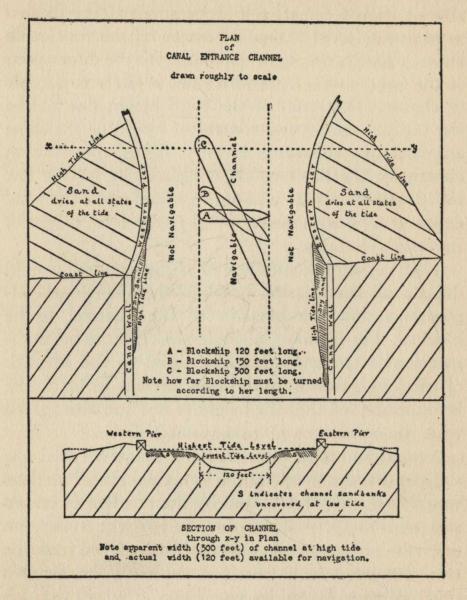
Plan of CANAL ENTRANCE CHANNEL
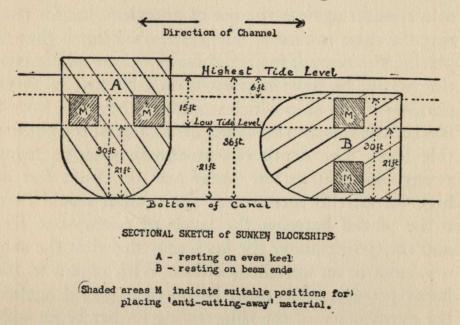
SECTIONAL SKETCH of SUNKEN BLOCKSHIPS
In this position the silt was known to be very
active. That fact, taken in conjunction with the
exposure to rough seas, the presence of the tidal current,
and the impracticability of erecting salvage plant on
the land within easy reach of the vessel, rendered it
obvious that, all things considered, the position
between the wooden piers would be the ideal blocking
position if suitable vessels were available for the
purpose, and if such vessels were damaged and sunk
with due regard to anti-salvage considerations.
It is common knowledge that when vessels are
fitted out as blockships they usually carry a goodly
cargo of cement. The general notion, however, about
the use of this material is that it is merely intended
to make the ships heavier and thus less capable of
being lifted. That is only partially correct. There is
another and more important use for cement, namely,
as a counter against the use of acetylene gas for
cutting the ships to pieces. The general scheme is that of
placing the cement in just those positions where
cutting would be most necessary; in our case, in those
portions of the ship which would be above the lowest
level of the tide and up to within six feet of the highest
tide level. The depth of our chosen position being
twenty-one feet at low water and thirty-six feet at
high water, this meant that the cement would need
to be placed between the levels of twenty-one feet
and thirty feet above the keel, provided that the ship
was sunk in an upright position. With regard to the
latter proviso, steps must be taken to guard against
the eventuality of the ship resting on her beam ends
on the sea-bottom as a result of capsizing when
foundering. This cautionary measure necessitated
placing the cement between the levels of twenty-one
feet and thirty feet from her beam ends at either side
of the vessel as well as between the same vertical
distances from her keel. Nothing should be left to
chance that can be provided for in advance.
It was clear enough that the task of ever getting
the ships into the desired positions for sinking would
be far from simple; having attained that object it
would be the height of stupidity to sink the ships in
such a manner, and so fitted, that their removal
would be comparatively easy.
After the operation had been successfully
completed I could not help being rather amused at a
certain individual who expressed the opinion that "the
Germans are so cute that they'll probably remove the
blockships in a day or two." Why were some people
always so ready to credit the Germans with everything
that's wonderful? The reasons were not far to
seek; such ideas arose partly from natural ignorance
on technical matters and partly because the Germans
never ceased to assure us how marvellous a nation
they were. And some of us believed it! Verb. sap.
With all the difficulties in the way of attainment,
what counter considerations were there to make the
attempt worth the undertaking?
PAST EXPERIENCE. SMOKE SCREENS. THE CHANCES OF SUCCESS.
What were the chances of success?
The lessons of personal experience and of
past history are the chief guides when calculating
the probability of success in any operation.
He who ignores history acts unwisely. He who studies
history and proposes to attempt something which has
always failed hitherto either may be excessively
foolish or may be aware of a new factor affecting the
situation. He may be merely flying in the face of
Providence or basing new proposals on a
well-considered judgment of the new circumstances.
Analogous Operations
Naval history contains a few examples of operations
somewhat analogous to that under investigation.
The more noted are the attacks on Martinique in
1794, on Teneriffe in 1797, the attack on Ostende in
1798, the cutting out of the Hermione from Puerto
Cabello in 1799, the sinking of the American steamer
Merrimac at Santiago de Cuba in 1898, the Japanese
attempts to block the entrance to Port Arthur in
1904, and, during the late war, the attempt to block
the Rufigi River by a British collier in November,
1914.
In none of these cases were the conditions quite
parallel to those at Zeebrugge and Ostende, but some
features of each bore a certain similarity.
The attacks on Martinique and Puerto Cabello
showed the great value of determination and initiative
in the face of powerful shore defences. They also
showed the disadvantage accruing to the defence
force by reason of the latter's ignorance as to the true
nature and object of an attack by sea forces.
The attack on Santa Cruz, Teneriffe, was led by
the immortal Nelson himself. It involved the
storming of the Mole which was defended by the enemy's
batteries. Two attempts were made. The first was
carried out in the face of adverse weather conditions
which rendered "surprise" impossible; the attack
was withdrawn soon after the landing parties had
left their ships. The second attempt, made two days
later, was also a failure, but a glorious failure indeed.
Very few of the boats reached the Mole, which,
however, after a desperate encounter was captured by the
storming parties. The latter were unable to advance
owing to the fire from the hostile batteries. Nelson,
who, it will be remembered, lost his right arm in this
engagement, failed in his object. This failure
provided the outstanding interruption to the long list
of victories gained by our greatest naval hero of all
time; Nelson himself expressed his feelings of
disappointment and physical incapacity with the words
"I go hence and am no more seen."
The attack on Ostende in May, 1798, was directed
against the lock gates for the purpose of interfering
with the concentration of the flotillas destined for
the invasion of England. This attack had originally
included a blocking operation, but that idea was
apparently abandoned. The attack, carried out in the
face of a rather feeble defence, was completely
successful, but a severe gale prevented the
re-embarkation of the forces, with the result that over one
hundred and sixty were killed or wounded and nearly
eleven hundred and fifty were taken prisoners—an
interesting point in view of the fact that only about
half a dozen casualties occurred during the attack
itself. The embodiment of the main principles of
fighting led to success on that occasion as they will
usually do under similar conditions. The moral effect
in England, in spite of the heavy losses, is recorded as
having been most beneficial.
The blocking attempts at Santiago and Port
Arthur, carried through with complete indifference to
danger in each case, were failures.
Main Factors of Difficulty
The main difficulties with which blockships must
contend may be briefly stated as follows:
(a) That of locating the destination in darkness,
increased by the absence of the usual local
navigational aids such as lighthouses, buoys, etc.
(b) That of reaching the destination, when located,
in the face of the enemy's opposition.
(c) That of turning and sinking the vessel, after
reaching the destination, so that the channel
will be efficiently blocked.
Dealing with these difficulties in detail, the reader
is probably aware of the fact that navigation is by no
means an exact science. On the open sea a captain is
usually satisfied if he knows his position to within
three or four miles. When approaching the coast this
wide margin of safety must be considerably reduced—hence
the need of lighthouses, buoys, fog signals,
and so forth. The upkeep of such aids is naturally
in the hands of the power which occupies the coast
concerned. Thus, under war conditions, one aims at
removing all navigational aids, as far as one's own
requirements will allow, which may assist the enemy.
By this means, the enemy when approaching one's
coast, must either trust to the rather inexact methods
used in the open sea or they must establish their own
navigational aids beforehand. The objection to the
latter is manifest; craft sent ahead to lay down buoys,
etc., are apt to give one's intentions away, and it is
open to the enemy to remove such aids as soon as
they are placed.
With regard to the second main difficulty, namely,
that of reaching the destination, when located, in the
face of the enemy's opposition, the difficulty here is
so obvious as to render detailed remarks unnecessary.
With regard to the difficulty of turning and sinking
the vessel satisfactorily, this is largely a matter
of seamanship. With wind and tide both affecting
a vessel it is seldom possible either to keep her
stationary over a particular position or to turn her
through a large angle without such aids as tugs,
hawsers, and anchors, etc.
But a ship does not go down instantaneously, nor
is it a simple matter to sink her in an upright position.
One end of the ship is likely to sink before the other:
most of us have seen photographs of a ship with her
bows or stern standing vertically in the water just
before the vessel makes her final plunge. Whilst the
ship is actually sinking the local current is apt to
move her considerably before she is resting on the
bottom throughout her whole length. Thus the third
difficulty can only be surmounted by a specially fine
display of seamanship, and, in such cases as we are
reviewing, this display must be rendered under the
most trying conditions imaginable.
Now, in the case of the blocking attempt at
Santiago the Merrimac, Lieutenant Hobson of United
States Navy, failed to reach her desired destination
after it had been located. The attempt could scarcely
have been more gallantly made, but the difficulties,
arising from insufficient opportunity to make
complete preparations, almost foredoomed the operation
to failure.
At Port Arthur, the Japanese made three attempts
to block the exit against the egress of the Russian
Fleet. No less than eighteen blockships were used.
In spite of great determination and splendid
self-sacrifice on the part of all concerned no blockship
managed to sink herself in the correct position.
During the late war the difficulty of sinking the
ship satisfactorily, after reaching the desired position,
was made manifest both in the River Tigris and in
the Cameroon River. In each case our enemies, the
Turks and Germans respectively, endeavoured to block
their own channels before we even arrived on the scene.
In the absence of all opposition from an enemy, in
broad daylight, and at their own leisure, they sunk
their ships and failed to block the channels—two clear
illustrations of seamanship difficulties.
All the searchings into past history failed to
discover one single occasion in which a blocking
enterprise of any real similarity to that desired had
succeeded. That fact, taken into conjunction with the
difficulties brought to light by a detailed consideration
of the problem, was neither productive of encouragement
nor conducive to optimism.
The reader will probably admit, at this stage, that
the difficulties of blocking the highly fortified canal
entrances at Zeebrugge and Ostende appeared almost
insuperable.
But where there's a will there's often a way. A way
had to be found. A way was found.
The Use of Artificial Fogs
The factors which combined to make "the game
worth the candle" were as follows: firstly, the use of
smoke screens; secondly, the element of surprise and
the use of diversionary measures; thirdly, detailed
preparation and determination combined with efficiency.
The use of smoke screens provided a factor which
had been absent in previous attempts in history.
Mention has already been made of the great deterrent
afforded by the presence of hostile batteries
and of the varying degrees of efficiency of gun-fire
as a defence against attacks from the sea. If smoke
could be utilised in such a manner as to hide the
attacking force from the batteries without completely
blinding the former, and if at the same time the attack
could be made under cover of darkness so as to
prevent aircraft from assisting those batteries, a set of
conditions less unfavourable to the attackers would
then be forthcoming. Obviously, this necessitated the
smoke drifting shorewards ahead of the approaching
vessels; i.e., the assistance of a wind blowing more or
less directly towards the shore.
It is well here to caution the reader against a
commonly erroneous idea in this connection. It is often
supposed that the use of smoke was a sort of panacea
for all evils, that it provided a counter to all obstacles.
This was very far from being the case, as will now be
explained. Firstly, let us consider the navigational
difficulties. Smoke could not possibly assist the ships
to avoid shoals when approaching the coast. Smoke
could not prevent the vessels from being seen and
reported by surface patrol craft, submarines, or
aircraft during the trip across the sea. The danger from
mines could not be avoided by the use of smoke. It
has already been pointed out that it is quite difficult
enough to locate one's destination on a dark night
when the lighthouses have been extinguished and
other navigational aids withdrawn. Even a landsman
will realise that if, as an addition to such inconvenient
conditions, one places an artificial fog between the
approaching vessels and their destination the
problem is not going to become any more easy to solve.
The utmost that one could gain from the use of smoke
was some measure of protection from the shore
batteries, but, as just shown, such use provided a further
obstacle to be surmounted. Then again there is nothing
so fickle in the life of a sailor as the wind. If the
wind died away or changed to an off-shore direction,
smoke might be practically useless for covering one's
approach.
I have sometimes been asked why we made no use
of poison gas clouds. There were two main reasons.
The last thing we desired was to risk killing those
downtrodden Belgians who were still allowed to
reside in their unhappy country. In addition to that,
the fickleness of the wind might waft the poison gas
in the direction of our own vessels.
Surprise Essential
With regard to the element of surprise and the use
of diversionary measures, one of the principles laid
down by Stonewall Jackson is, "Always mystify,
mislead, and surprise the enemy." The meaning of
surprise is apt to be misconstrued. In an operation of
this kind one could not arrange for the blockships to
arrive suddenly "as a bolt from the blue" at a
moment when the enemy have no suspicions whatever
that any trouble is brewing. Thus, surprise and
mystification had to go hand in hand. The only practical
method in such cases, whether in trench warfare or in
sea fighting, is to give the enemy as much to think
about as one possibly can, to make him wonder what
on earth is going to happen next, to mislead him into
believing the eventuality is very different from that
intended, and, then, as the late war expression so
aptly puts it, "when the enemy has the wind up,"
surprise him by carrying out your main object in view.
Diversionary measures in this particular case were
not difficult to evolve. Many different reasons
obtained for employing our sea forces off the Flanders
coast. To mention a few, there were bombardments
from the sea, landing operations on the shore,
supporting the flank of the military in their land attacks,
mining or mine-sweeping operations, laying submarine
traps, supporting aerial attacks, and so on.
The presence of our vessels might indicate any one
of these objects and each would call for a different
set of defensive measures.
The full development of defensive measures cannot
be attained until one can clearly ascertain the
attacker's object. Even when the latter has been
discovered, the time required to bring all your powers of
defence into action must vary according to how far
you have just previously been misled. Our best
course, therefore, was to ensure that our object would
be discovered so late in the proceedings that it would
be attained before full advantage of the discovery
could be utilised. Initiative usually pertains to the
attacking force. Where the defence is open to several
different forms of attack, the defending commander
is apt to be so apprehensive beforehand, and so
perplexed at the time, that his position will be weakly
defended at all points. As the attack develops and he
receives an apparent indication of its object he will
make haste to concentrate all his defence measures
at the threatened position, and then, if the attackers
have acted wisely, there is considerable likelihood of
his being taken by surprise too late to guard
efficiently against the real blow. Uneasy lies the head of
the commander who is forced to adopt the defensive
role in war.
The diversionary measures actually undertaken
will be described presently.
Attention to Detail
Determination and efficiency are not unknown in
His Majesty's Navy. But efficiency of a particular
description was required, and this would necessitate
special training, which, if practicable, must be
continued until every officer and every man knew
instinctively what to do and how to set about it, no
matter what circumstances might arise, and until
every piece of machinery and every device, however
intricate, had been proved to be satisfactory for the
purpose in hand.
What then were the chances of success? Who could
say? Clearly enough, there must have been a divergence
of opinion on this point. Difficulties loom large.
Optimism, on the other hand, is a very pleasant
encouragement. I believe, however, that even the most
optimistic individual concerned in the enterprise was
not entirely free from qualms as the event drew
nearer. Complete success seemed at times to be so
much to hope for. But Sir David Beatty and Sir
Roger Keyes wouldn't hear of failure, and that alone
did much to ensure success. They did not set
themselves up on pedestals as men who could not fail—they
left no stone unturned to ensure success. It would
be difficult to imagine anything more calculated to
bring about failure than any sign of doubt, or hesitation,
on the part of the leaders of an enterprise. There
must be no failure—that was the long and short of
it—it was the spirit which governed the actions of
the great leaders of the past.
But sentiment alone is insufficient to guarantee
success. It is but a foundation stone on which to
commence the building. Rotten timber erected on the
firmest foundation will not provide adequate protection
against the lightest gale. Nobody realised this
more fully than Vice-Admiral Keyes, who was
determined that every link of the chain should be of
maximum strength commensurate with elasticity and
general handiness. Many were the hours given to the
consideration of the smallest details; without such
work an operation becomes a mere gamble.
PLANNING THE OPERATION. MATTERS AFFECTING
THE PLAN. ATTACKS ON THE MOLE.
A war operation, such as this, passes through
various stages before it can be put into
execution. It emanates originally from a suggestion.
If the suggestion seems to bear further consideration
certain individuals are ordered to appreciate
the situation, that is, to thoroughly thrash out all the
arguments for and against and to weigh the chances
and effects of success and failure. Should the results
of such an appreciation be favourable, the investigation
leads to the formation of a Plan.
Formation of a Plan
Plans are based, to a considerable extent, on the
personnel and material believed to be available. In
like manner the calculations as to future requirements
of personnel and material are based on the types of
operations which are likely to be carried out. But it
is conceivable that a projected plan may be found to
involve the unforeseen use of material to the detriment
of other operations already in view. Thus the
feasibility of putting a naval plan into operation cannot
be judged unless fairly complete details are given as
to the numbers and types of ships, men, and stores
involved. The formulated results of such investigation,
arising out of the original suggestion may be
designated the first edition of the Plan.
The authorities then consider the Plan both from
the view of general outlook and from that of detailed
requirements. Let us suppose that the Plan is
considered to be of value, and that no objections hold good
as to the practicability of execution provided the ships
and men are available. This latter proviso then
requires attention. Many questions have to be
considered. Can the ships be diverted from their present
duties? What special alterations or additions are
necessary? Can the dockyard undertake the work?
If so, to what extent will other work in hand be
interrupted? Will the men require special training? Are
the necessary stores ready at hand? How long will the
preparations take? And so on. A hundred and one
points must be carefully enquired into. It is only
after a great deal of investigation, correspondence
with various departments, and conferences for co-ordinating
the results of enquiries, that the details
can be arranged. A plan served up in the form of a
mosaic is of little more use than the works of a
chronometer contained in half a dozen different boxes.
In course of time decisions are arrived at and orders
are issued for the preparatory work to be taken in
hand. But it is unlikely that all the proposals
contained in the first edition of the plan have been agreed
to. Modifications are almost sure to be necessary.
Perhaps the suggested vessels are required for other
purposes and substitutes must be forthcoming. The
technical experts may decide that different types of
material would lead to improvement. Possibly the
facilities for special training of the personnel are not
available at the moment. The plan must, therefore,
be re-drafted on the basis of the personnel and
material available, and must take into consideration the
dates by which the various phases of the preparatory
work can be completed. All this takes time and serves
as a reminder, indeed, that patience is a virtue. The
second edition of the plan is evolved and the next
stage is reached.
But put aside, for a moment, the question of what
material and personnel are available. When a plan,
conveying a general idea, has come under the critical
examination of the Higher Command to the extent
of being "passed" for the commencement of detailed
preparation, it has then to be gradually built up from
the operational point of view. Additions will almost
always be necessary as the investigation proceeds, and
some time will elapse before the plan can be
considered as complete in every particular.
A further duty then devolves upon the operational
staff. They must produce the orders necessary to
give effect to the plan as detailed in its final edition.
Writing of the Orders
This again is no small affair. The writing of orders
is a high art in itself. Orders must not be too
centralized or too cut-and-dried. Ample allowance must
be made for initiative, while realising that mere
go-as-you-please methods are likely to lead to disaster.
It is usually the unexpected that happens in war. A
single set of orders cannot cover every eventuality.
And even if it could, nobody would have either the
time or inclination to wade through such a
voluminous document. This is clearly enough exemplified in
legal matters. Laws are framed to cover every
possible case, but as often as not they fail to attain such
success. Even so, how many ordinary folk can be
bothered to wade through a legal document? What
with the alternatives, and saving clauses, such
publications are dull to a degree. The marriage laws are
typical of this. A man may not marry his grandmother.
That clause was presumably inserted for the
discomfiture of that unique individual who might
contemplate such a peculiar alliance.
The issue of orders needs careful training and much
experience. Orders must be fool-proof—that is the
guiding axiom. If an order is misunderstood it is ten
chances to one that the fault lies with the man who
gives the order.
If I have sorely tried the patience of the reader it is
because of my endeavour to emphasise the point that
the order "carry on" is not sufficient to put a
suggestion into execution in the matter of a few hours. New
situations have to be met by fresh dispositions, and
this fact has come very much to the fore in these days
of strife.
The operations on the Flanders coast were the
outcome of some months of hard work—mental as well
as manual. A few details of the plan may now be
worthy of consideration.
On December 3, 1917, the plan had emanated from
an Admiralty Department under the direction of
Rear-Admiral Keyes, Director of Plans, to give him
his titles at that time. The nature of the operation
and the customary procedure, having regard to the
locality concerned, would entail its execution coming
under the command of the Vice-Admiral at Dover.
The latter apparently desired to modify the plan and
submitted his proposals on December 18th. He
suggested the idea that an attack on the Mole, not
previously mentioned in the plan, should accompany the
blocking operations. As a diversion (pardon the
anticipation) this idea was eventually embodied after
exhaustive consideration had shown it to be necessary.
Vice-Admiral Keyes
As already stated this particular type of diversion
was somewhat similar to that included in a previous
scheme, referred to on page 17 as having been
forwarded in May, 1917, which at that time was
considered impracticable by the Vice-Admiral at Dover.
The actual method proposed on December 18th by
the latter for giving effect to his idea of a Mole attack
was not followed, for it happened that Rear-Admiral
Keyes took over the Dover Command, with the acting
rank of Vice-Admiral, after his own plan had been
submitted, and nearly four months before it could be
carried out. The coincidence—if it was a
coincidence—was extremely advantageous. An operation
can be so much better worked up by an officer who
has handled the plan from its inception. But in the
ordinary course of events such an arrangement is
impracticable. An admiral or general in active
employment in the face of the enemy, as a general rule,
has not sufficient spare time for the formation of plans
in every detail, nor has he a superabundance of staff
officers for the purpose. No words of mine could ever
do justice to Sir Roger Keyes, so I will not make the
attempt. Suffice it to record that every soul in the
enterprise possessed complete confidence in his
leadership; this fact was half the battle won before we even
started.
Admiral Keyes was given an absolutely free hand
by Their Lordships; all the details, from A to Z, were
worked out under his direction. The "paper scheme"
rapidly developed into practical shape; I will
endeavour to describe the data and arguments from
which its final shape was evolved. Before doing so,
however, it may be as well to put on record a fact
that might escape the notice of the reader. The
responsibility of the Officer in Command of an
operation must necessarily be great, but the responsibility
of the Higher Command, in this case the Board of
Admiralty, which has to either sanction or disallow
the execution of proposed operations, is by no means
small. That they sanctioned it in this case and also
chose the right man to carry it out must never be
forgotten.
Having reached a decision as to our object and
considered the obstacles in the way of attainment, let us
now pass on to the manner in which it was proposed
to overcome the various difficulties. We will
commence with the most important phase of the
operation, namely, the actual blocking and the nature,
requirements, and duties of the blockships.
Reference to the previous description of the locality
and to the principles governing the use of blockships
serves to show that a single vessel of the light-cruiser
class, or above, would suffice as far as dimensions were
concerned. But nothing possesses such a large
element of chance as war; for that reason it was
considered advisable to provide at least three blockships
at Zeebrugge and two at Ostende.
With regard to the requirements of each blockship,
they may be briefly stated as follows. Firstly, she
must have the ability to proceed under her own steam
to her destination. The task of towing a blockship
into position in the face of enemy opposition is quite
impracticable. Secondly, her draught of water must
not be excessive, having due regard to the depth of
the channel. Next, she would require a certain degree
of defensive power; it would be rather heartrending,
after all one's efforts at taking a blockship to within a
short distance of her destination, if any small enemy
craft could approach without hindrance and sink the
ship before her destination was actually reached.
The blockships must also be handy vessels, so that
they would be manageable up to the last moment,
provided they escaped serious damage. It has been
stated previously that these ships must be so fitted
and sunk that their removal would be extremely
difficult. Five old light cruisers which were available,
or rather which could be replaced at their present
duties, were chosen for the purpose. They were
H.M.S. Thetis, Intrepid, Iphigenia, Brilliant, and
Sirius; the first three being destined for Zeebrugge
and the others for Ostende.
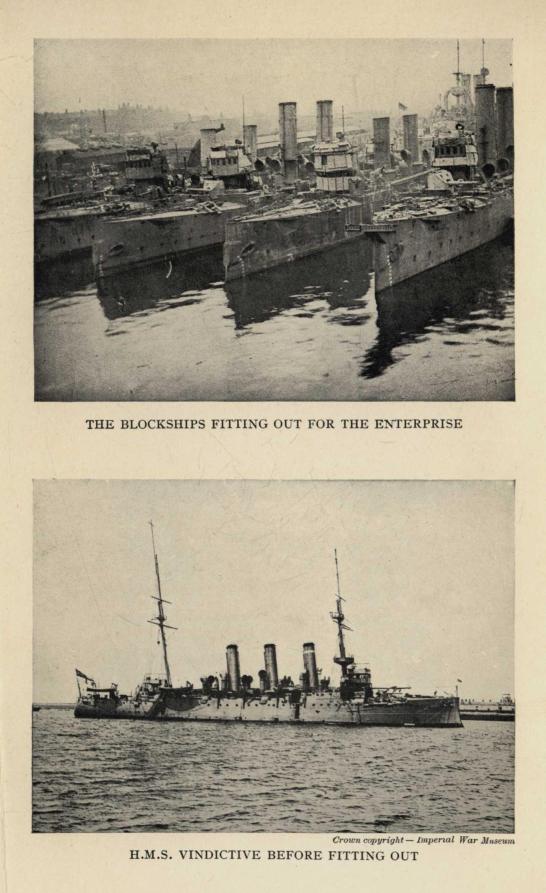
THE BLOCKSHIPS FITTING OUT FOR THE ENTERPRISE.
H.M.S. VINDICTIVE BEFORE FITTING OUT.
A few months previously a couple of steamers had
been fitted out for some such operation under another
Vice-Admiral, but it will be seen that, as a result of
detailed investigation of all the obstacles and factors
affecting the problem, the Plan described herein
differed from its predecessors in that respect; in fact the
arguments against the use of merchant vessels were
considered from the outset to be overwhelming.
Hazards of the Blockships
The work of surmounting such difficulties as escorting
the blockships across the seas and locating their
destinations would require the use of other units, and
will, therefore, be described later. Speaking
generally, the actual tasks of reaching their destinations
when located and of sinking themselves in position,
difficult though they were, could best be left to the
pilotage and seamanship of the blockship officers.
Here again, the author is anxious to lay special
emphasis on the fact that successful results of the
blocking operation—such as had never been attained in
history—were absolutely dependent upon the good
work of the blockship personnel; to them would the
credit be due.
At Ostende, the work of the blockships, with regard
to reaching their destination, was confined to that of
running the gantlet of the shore batteries when once
the entrance had been located, but the latter—i.e.,
the location of the entrance—presented considerable
difficulty.
At Zeebrugge, there would be less difficulty in
finding the entrance if the Mole extremity, three-quarters
of a mile to seaward, could be located. But a serious
factor existed here which was absent at Ostende.
Blockships proceeding into Zeebrugge would have
to risk the fire of the Mole batteries during the first
part of the approach. They would then have to steam
in behind those batteries and run the gantlet of the
batteries ashore. Now this was a pretty big proposition.
In the second chapter it was shown that the
three-gun battery situated on the broad portion of the Mole
at its northeastern extremity, taken in conjunction
with the establishment of the barge boom and
entanglement nets, rendered it extremely hazardous for
the blockships to round the Mole en route to the canal
entrance; in fact it was almost a certainty that they
would be sunk by the Mole guns.
Nevertheless, the canal entrance was our objective.
Somehow, by hook or crook, the blockships were
intended to reach it. Thus, one of the first local
problems requiring solution was that of removing,
temporarily or otherwise, the obstacle afforded by the
three-gun Mole battery. Similarly, though perhaps
in a lesser degree, we had also to take into account the
battery of six smaller guns on the lighthouse extension
of the Mole.
Object of Attacking Mole
Considered in a general manner, there were three
lines of enquiry from which a solution of the problem
might be forthcoming. Firstly, that concerning the
destruction of the guns or their crews, or both, or
diverting their fire, by means of action from a distance.
Secondly, that of attaining a similar result by action
on the spot. Thirdly, that of rendering the blockships
invisible during their passage. These may be dealt
with briefly. The first method entailed the use of
either gun-fire or poison gas. The outcome of a
gun-fire duel between a ship and a battery has already
been described sufficiently to show that the chances of
destroying the battery guns are exceedingly small.
The use of poison gas has been shown to be
inadvisable. The third method—that of rendering the
blockships invisible to the battery—would have
entailed the use of a smoke screen. If such a screen could
have the effect mentioned it is obvious to the meanest
intellect that it would also have the effect of hiding
their destination from the blockships just at the
critical period when it would be absolutely essential to
see exactly where they were going.
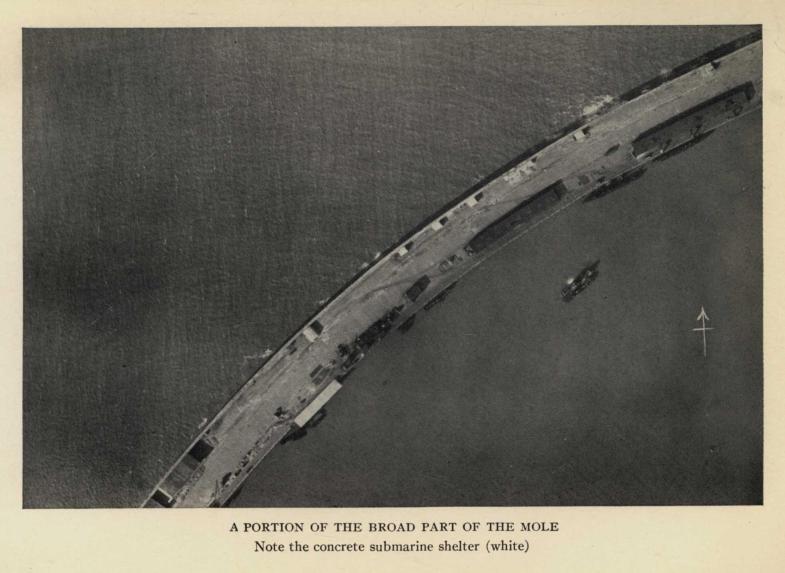
A PORTION OF THE BROAD PART OF THE MOLE.
Note the concrete submarine shelter (white)
And so no method would suffice, except the second
mentioned above, namely, destroying the guns or their
crews, or both, or diverting their fire, by means of
action on the spot. This entailed an attack on the Mole
itself, carried out by vessels actually berthed
alongside. The author, although well aware of the
unpardonable fault of repetition, desires at this stage to lay
great emphasis on the fact that an attack on the Mole
itself could only be designed as a diversionary measure
calculated to directly assist the blockships past one
of the positions of danger. The reader is requested to
pardon anticipation. Subsequent to the operation,
many of the public appeared to have formed the idea
that the attack on the Mole was the main attack, and
that the use of the blockships was a sort of
afterthought. I shall have more to say about this later.
Just as the three-gun battery provided a serious
obstacle to the passage of blockships round the Mole
end, so also would it prevent the similar passage of
other vessels endeavouring to secure alongside the
berthing wharf on the inner side of the Mole
preparatory to attacking the Mole batteries. Thus, if the
Mole was to be stormed, the storming parties must land
on the outer side of the Mole, remembering that the
three-gun battery could not fire to the northward
owing to being twenty feet below the top of the high
outer wall. But the outer wall of the Mole was never
intended for use as a berthing position for vessels, and
probably never had been used by any vessel for such a
purpose—hence the complete absence of all berthing
facilities as described in an earlier chapter. The
development of the argument concerning this projected
attack had led us to the point where we needed to
consider seriously the practicability of getting any
vessel, or vessels, alongside the outer wall, of securing
there, and of landing men thence for attacking the
Mole batteries.
The depth of water, the construction of the Mole,
the rate of the tidal current, and many other matters
required careful examination. The depth was a
doubtful matter; but, the operation being timed to take
place near high tide so that the blockships could enter
the canal, there was every likelihood of its being
sufficient. Breakwaters when also intended as wharfs are
usually built with their inner sides—i.e., the sides
protected from bad weather—vertical like the face of an
ordinary wall, but with their seaward sides formed of
large blocks of material dropped more or less
indiscriminately, one above the other, so that the wall will
be jagged for the purpose of breaking up the waves in
bad weather. In such cases a ship could not possibly
secure to the seaward side without being severely
damaged, and certainly could not remain there. At
Zeebrugge, however, we had reason to believe that
the seaward side of the Mole was nearly vertical and
that no danger would accrue from jagged blocks of
stone or concrete.
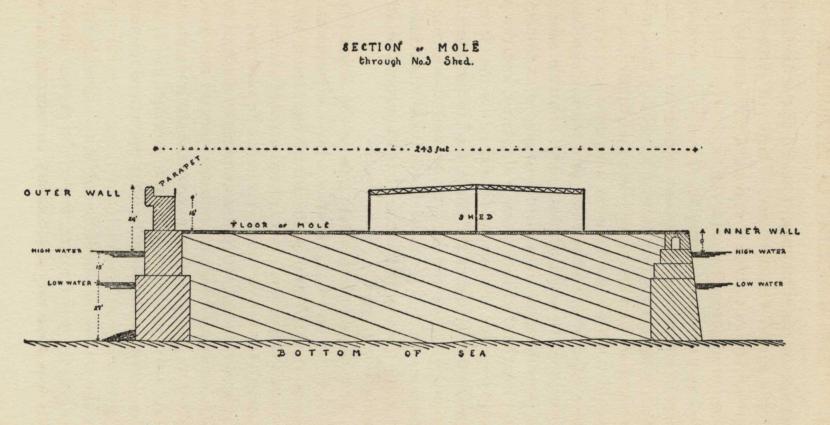
SECTION of MOLE through No. 3 Shed
At high tide the tidal current on the Belgian coast
is flowing at its greatest speed—a phenomenon
nearly always found in comparatively narrow waters—and
its rate was expected to be about three and a
half miles per hour, its direction of flow being to the
eastward. So far, then, the matter of reaching a
position alongside chiefly concerned the art of
seamanship if we leave the enemy's opposition out of account.
Next we had to consider the problem of securing
alongside and of disembarking the storming parties.
The most simple method of berthing alongside a wall,
in the case of a sizable vessel, is to place the vessel
roughly in position and then to use tugs to push her
bodily against the wall, afterwards securing the
hawsers in the usual manner. This led to the idea of
having a second vessel to act as tug and of providing
special means to take the place of the ordinary
hawser-and-bollard method of securing.
The wall on the outer side, as previously described,
rose to a height of twenty-nine feet above the level of
high water. This height was far above that of the
deck of an average vessel. The fact that the landing
would have to be made on a narrow parapet, high
above the level of the Mole proper, was also hardly
calculated to assist matters. The probable existence
of guns on the parapet itself, so placed as to be able
to rake the decks of a vessel alongside, and the
possible presence of obstructions placed by the Germans
on the outer side of the Mole, had to be taken into
account. It has also been mentioned above that the
use of smoke screens necessitated a wind blowing
towards the shore; thus the Mole itself could afford no
protection from the wind or sea.
The Austrian military failure on the River Piave,
during the late war, afforded a good example of the
disabilities resulting from insufficient room to
debouch a force which has crossed an obstacle into the
enemy's territory. Clearly, it might be very awkward
if the storming parties were unable to descend from
the parapet rapidly enough to forestall any enemy
attempts at concentration near the storming point.
All these considerations led to the choice of
H.M.S. Vindictive for carrying the main portion of the
storming parties.
The attack on the Mole might also provide an
opportunity for destroying material thereon. Although
this was obviously a secondary consideration it was
an opportunity not to be missed. The amount of
destructive work which could be done would depend
upon the circumstances of the moment, but it was
decided to have a special demolition party, provided
with the necessary gear, to accompany the primary
attacking forces.
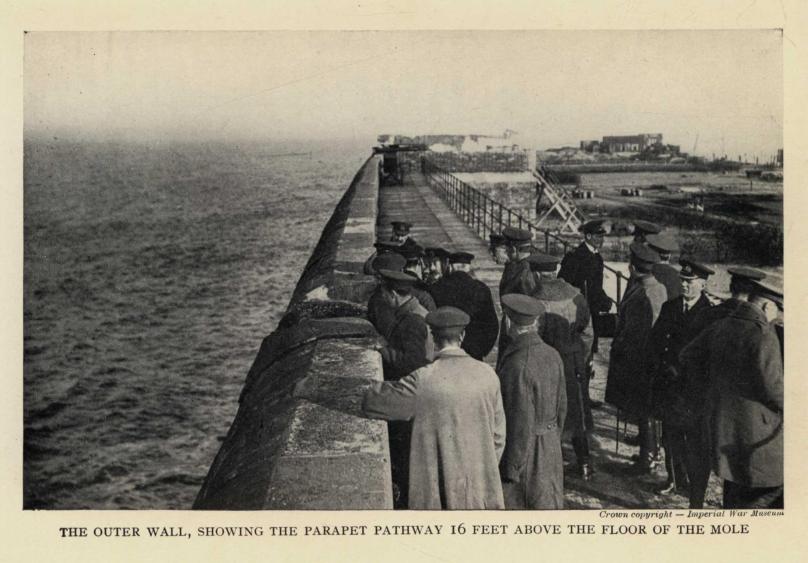
THE OUTER WALL, SHOWING THE PARAPET PATHWAY
16 FEET ABOVE THE FLOOR OF THE MOLE
Clearly enough, it would be somewhat futile if one
only began to consider the work of demolition as soon
as the moment arrived for such work to commence.
With the object of being prepared in all respects
careful consideration, therefore, was given to the different
methods of demolition which would be most suitable
under varying circumstances. Following such
consideration it would be necessary to train one's
demolition parties in this technical pursuit and to provide
a sufficiency of suitable destructive material.
Plans for Demolition
When making preparations for an operation of this,
or similar type, one is apt to allow secondary objects
to loom too large unless great caution is taken to
prevent it. In this particular case, however correct
it might be to fully prepare, down to the smallest
detail, for everything in advance, it was necessary to
bear in mind that demolition on the Mole could
hardly assist the blockships to seal the canal exit and,
even if successful, could not bring us very great
benefit. Thus it was clear that demolition should only be
prepared for and undertaken provided that it did not
hinder the attainment of our main object in the
smallest particular.
H.M.S. Vindictive had to be fitted with a special
deck from which gangways could be extended to
bridge the gulf between the ship and the top of the
twenty-nine-foot wall. For this purpose she was given
a large number of gangways poised at an angle of
about forty-five degrees from the ship's side. The
idea was that on arriving alongside the Mole, the
gangways would be lowered till they rested on the
top of the wall. The storming parties, at a
prearranged signal, should run out along the gangways
and jump down to the parapet pathway four feet
below the wall top. They should then get across the
pathway, over the iron handrails on its inner side,
down to the floor level of the Mole, sixteen feet below,
and then start the work. Now, one cannot expect
men carrying all their accoutrements and paraphernalia,
such as rifles, machine-guns, flame-throwers,
bombs and grenades, rifle and gun ammunition, and
such-like to jump down a drop of sixteen feet on to a
stone surface. So it was arranged that the advanced
storming parties should carry long storming ladders
to place against the wall on its inner side and thus
facilitate access to the floor level. Seamen were to
land first, both for the purpose just stated and for
securing the ship to the Mole after the Vindictive had
been pushed alongside the Mole by another vessel.
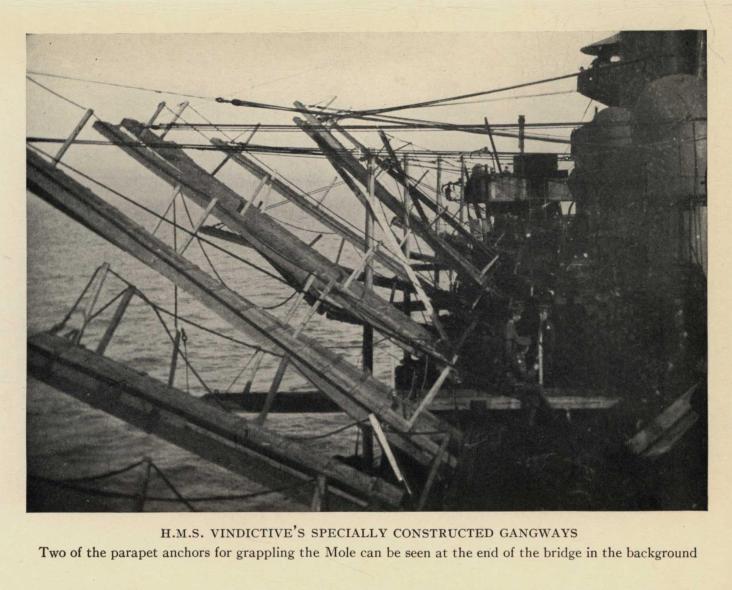
H.M.S. VINDICTIVE'S SPECIALLY CONSTRUCTED GANGWAYS.
Two of the parapet anchors for grappling the Mole can be seen
at the end of the bridge in the background
Fittings in Vindictive
Owing to the absence of bollards for securing
hawsers, special grappling irons, fitted with double
pronged hooks, with hawsers attached to them and
the ship, were designed for the purpose of hooking on
top of the wall. In reality we proposed using the
methods of the good old days when vessels grappled
each other and indulged in hand-to-hand fighting
between their respective storming parties. The weight
of these grappling irons necessitated the use of special
davits for suspending them in a similar manner to that
used for the gangways. Special weapons, such as
bomb-mortars and flame-throwers, to be worked
from the ship, were provided for clearing the Mole
immediately abreast the ship prior to sending the
storming parties over the top. The Vindictive also
carried most of her original gun armament for
engaging enemy vessels en route, for shelling the six-gun
battery on the lighthouse extension of the Mole, and
for defending herself against attacks, when at the
Mole, from enemy vessels in a seaward direction.
Special howitzers were carried for engaging the shore
batteries after the ship was secured, and rapid-firing
guns were placed in the fighting-top of the foremast
for engaging the batteries on the Mole. The wall
being at least twenty-nine feet above the water, no
gun at a less height could fire over it in a downward
direction. Much other special material—peculiar to
the operation in hand—was required, but space does
not admit of describing it all in detail.
The reader will already have realised that the
Vindictive was to be a weird craft indeed—something
very different from the usual run of warships even in
these days.
Now, as regards the storming of the Mole, it would
have been a dangerous policy to put all "our eggs in
one basket." There was no small chance of the
Vindictive being mined en route, owing to her heavy
draught, or of being sunk by gun-fire, owing to the
large target which she would present, before reaching
the Mole. It was, therefore, decided to use two other
vessels in addition to the Vindictive.
The ferry steamers Iris and Daffodil were chosen
for carrying a portion of the storming parties to the
attack. There was considerable difficulty in finding
two vessels suitable to our purpose; time did not
permit of constructing special craft before the projected
date of the operation. It must be remembered that
we could not write round to all the naval and
mercantile ports explaining our requirements. An officer,
sent on a tour for the purpose, unostentatiously
visited the likely places until he found these two
vessels. I often wonder what imaginary yarns he
conjured up for the purpose of stifling curiosity.
Iris and Daffodil
The Iris and Daffodil were both well known to
Liverpool folk, being used for conveying passengers
across the River Mersey many times daily. They
were extremely handy craft, could each carry fifteen
hundred men if required, and drew very little water,
but they possessed two serious disadvantages. Firstly,
their decks were so low as to necessitate the use of
long storming ladders for reaching the parapet.
Secondly, their steaming qualities were comparatively
poor, judged from the point of view of the
operation for which they were required. Just picture
their ordinary daily employment for a moment.
Waiting alongside one of the piers at Liverpool till
their usual quota of passengers had embarked, they
would make the short trip across the river to the
Birkenhead shore and then wait once more. During
this second period of waiting the steam pressure would
be increased in the boilers in readiness for the next
short voyage across the river. Compare that
employment with a trip of nearly one hundred miles across
the open sea. It will then be evident that the task
allotted to these two ferry vessels was by no means
simple from the engineering point of view alone.
All this, however, was carefully thought out, and
it was decided that their advantages outweighed their
disadvantages. Both craft, by nature of their work,
were designed to stand heavy bumping alongside
piers; their draught was small, and, as already stated,
they were easy to handle. After minor alterations
they proceeded to the port of assembly in charge of
their naval crews and adopted the title H.M.S., much
to the amusement of those of us who made their
acquaintance for the first time. It is rumoured that one
of these two vessels arrived at her destination with
her anti-submarine escort in tow, which thus early
showed that proud spirit to which she so justly proved
her right on St. George's Day, 1918.
The first duty of the Daffodil on arrival at the Mole
was to be that of pushing the Vindictive bodily
alongside. The former vessel was to place herself at right
angles to the latter, bows against the latter's side, and
to continue pushing until Vindictive, which would
previously have anchored, was secured by means of
the grapnels. Daffodil was then to drop alongside
Vindictive and her parties were to climb over the latter
and up to the Mole. The Iris was to go alongside the
Mole ahead of Vindictive, to anchor, to grapnel the
parapet, and to land her storming parties by means
of ladders against the wall, her decks being too low
to allow the use of large gangways as carried in
Vindictive.
In the event of Vindictive being sunk, Iris and
Daffodil were to storm the Mole as best they could and
do everything possible to knock out the three-gun
battery or divert its fire from the blockships.
It was believed that the Mole garrison consisted
of about one thousand men. But what of
reënforcements arriving from the shore? Access to the Mole
would entail the crossing of the viaduct by such
reënforcements. Therefore the viaduct must be destroyed.
Consideration on this point led to a decision to utilise
one or more submarines filled with explosives and to
blow them up under the viaduct, so as to cut the
latter in twain.
This particular phase of the operation had not been
included in the original Plan evolved at the
Admiralty. As previously stated the first edition could
not be expected to cover every single investigation of
every point in the problem. The attack on the
viaduct, after a large amount of experimental work
ordered by Vice-Admiral Keyes, took the following
shape.
Two submarines, each carrying several tons of high
explosive, were to accompany the expedition. They
were each to carry a crew of two officers and four men,
who, after securing their craft underneath the
viaduct, were to light the time fuses and then to take to
the boats. Each submarine carried a small
motor-driven dinghey for this latter purpose.
So much, then, for the blockships, storming vessels,
and submarines at present.
THE VESSELS INVOLVED: THEIR DUTIES. THE RESCUE WORK.
In addition to the special vessels mentioned in the
preceding chapter, many other vessels and craft
were required to assist in the operation. One can
imagine the amateur reckoning up the probable
number as follows. Three blockships at Zeebrugge and
two at Ostende, three storming ships and two
submarines at the former place. That makes ten vessels
of sorts. Allow a few more for other purposes—say,
fifteen altogether. As a matter of fact, there were
one hundred and sixty-two. Let us see why so many
were required.
Take the requirements necessitated by the use of
smoke screens. It has already been stated that the
section of coast on which the Germans had established
heavy gun batteries was twenty-one miles in length.
Smoke screens were required to mask those guns so
that the approach of the blockships and storming
vessels should remain undiscovered until the latest
possible moment. This meant that a large number of
craft were necessary for smoke screening alone.
Again, if the smoke screens were to be efficient the
smoke would have to be emitted within a short
distance of the coast; i.e., in comparatively shallow
water. Thus shallow-draught vessels were necessary.
Shallow draught goes hand-in-hand with small
dimensions. The carrying capacity of small craft is very
limited; this constituted an additional reason for
employing large numbers.
Further craft were required for assisting to locate
the destination, for dealing with enemy vessels
putting to sea during the attack, for defending our ships
against other enemy vessels already at sea, for
assisting to tow some of the smaller units across the
seas, for rescuing the crews of the blockships, and for
various diversionary measures. The latter included
long-range bombardments from the sea and subsidiary
attacks on the Mole, the units required being monitors
and their attendant craft and fast motor boats. Other
diversionary measures, not requiring naval vessels
for their accomplishment, were bombing attacks by
aircraft and bombardments from our shore guns.
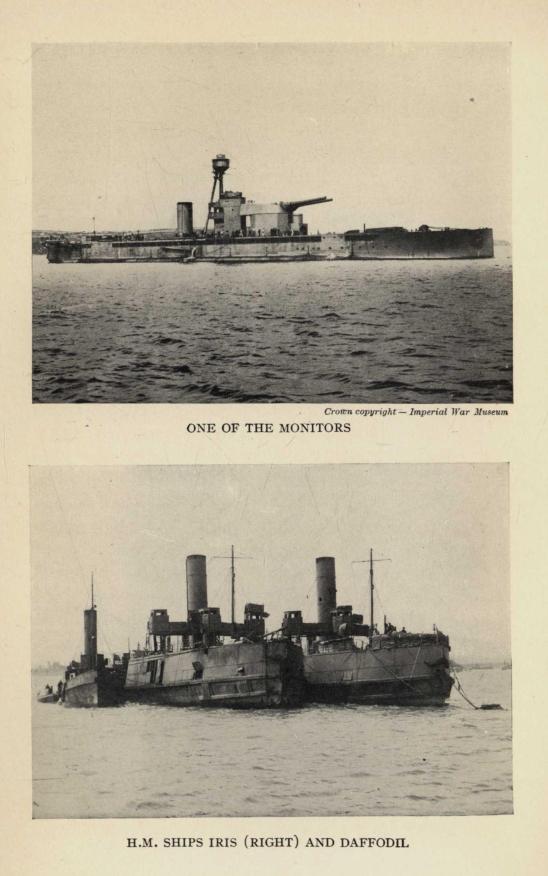
ONE OF THE MONITORS.
H.M. SHIPS IRIS (RIGHT) AND DAFFODIL.
The aircraft were intended to attract the attention
of those on duty in an overhead direction, whilst
encouraging the remainder to keep under cover. The
long-range bombardments would tend to keep the
enemy's larger batteries occupied in expending
ammunition in their endeavour to locate and silence our
guns. Subsidiary attacks, carried out by fast motor
craft against the Mole, and against German vessels
berthed at its inner side, were calculated to confuse
the situation as far as the enemy were concerned. It
was arranged that the R.M.A. siege guns on the
northern flank of the Allied army should bombard for
the purpose of simulating a prelude to a land attack.
The reason for the employment of one hundred and
sixty-two vessels, not including aircraft, will now be
somewhat more clear. The various classes comprised
cruisers, submarines, ferry-boats, monitors, destroyers,
motor launches, small motor boats of a fast type,
and one ordinary ship's steamboat; the latter was to
be used in connection with rescuing the crews of the
submarines.
With the exception of the blockships, storming
vessels, and submarines, the majority of the craft
were drawn from the forces attached to the Dover
Command; these latter, being in full commission
already, did not require new officers and men to be
specially appointed for our purposes. Seven French
torpedo craft and four French motor launches were
included in the operation. The aircraft were drawn
from the 61st and 65th Wings of the Royal Air Force.
Space does not admit of describing the work of all
these units in detail, but it may be of interest to
mention one or two.
Precautions Against Fatigue
Whenever an operation of this description is afoot,
it is extremely advisable that the personnel destined
to take part in the more hectic part of the fighting
should not only be trained to the last ounce, but
quite fresh on arrival. The individual cannot give of
his best when fatigued—a truism exemplified again
and again during the late war. But ships do not cross
the ocean without any effort on the part of their
personnel. It is not a case of merely turning on a tap,
saying, "hey presto," and going to bed. Far from it.
Engines do not revolve merely for the asking. Large
vessels carry large engineering complements, but
always require about half on duty at a time when at sea.
Small craft may have small engines, but their
complements are also small. So, whether the vessel be
large or small, the work below calls for strenuous
duties from the engineering personnel—only those
who have undertaken such duties can realise the
immense effort and the accompanying fatigue which falls
to their lot. Then again the ship cannot navigate
herself. The steering and the lookout duties both call for
great concentration of attention, especially at night
when steaming without lights in the close company of
other vessels, in the vicinity of shoals, and in enemy
waters. Guns' crews must stand by the guns so as to
be ready at a moment's notice.
Now, this expedition would have to steam many
miles across the seas. How then could the crews be
fresh on arrival? This particular problem was solved
as follows. Arrangements were made to provide each
blockship with a number of men, over and above the
minimum required at the climax of the operation, for
the purpose of handling the vessel and its engines
during the passage overseas whilst those men required
for the "final run" would be resting. Extra officers
could not be spared for this purpose.
The Vindictive, Iris, and Daffodil were differently
situated in this respect. It was intended—as I shall
explain presently—to bring these three vessels back
on completion of the operation; the total number of
personnel on board need not be kept down to the
barest minimum. In fact, they were each to carry
two complete sets of personnel, namely, those
remaining in the ship throughout and those landing on
the Mole.
The submarines, motor launches, and fast motor
boats, owing to lack of accommodation, could not
be given extra personnel for the trip across; it was,
therefore, decided to tow all such craft throughout
the greater portion of the passage across the seas.
Even that decision did not relieve the crews of all
duty, but gave them some respite, and, what was
equally important, helped to ensure their arrival in
the vicinity of their place of duty.
Rescue Work
The rescue work required much thought. Bearing
in mind the main object which had to be attained, it
will be understood that all such questions as rescue
work and retirement, however important from the
point of view of humanity, must be relegated to a
comparatively secondary consideration.
One cannot wage war without "breaking eggs." He
who attempts to do so will seldom accomplish
anything worth while. The lives of men are, indeed, a
precious responsibility on the shoulders of their leader,
but his primary duty in action is to obtain the utmost
value from his men rather than to adopt the negative
attitude of merely preventing their lives from being
lost. This does not signify that lives should be thrown
away without a thought. Not one life should be
sacrificed in the execution of superior order unless the
order is absolutely essential to the success of the work
in hand, or, putting it in another way, unless the life
is given so that others may live. The leader,
therefore, has a difficult problem to solve. How far is he
justified in risking failure through the natural desire
to preserve life? The armchair critic, who has never
been faced with such responsibility, who can have no
conception of the different situations which arise in
war, may sneer at the leader who places too great a
store on the lives of his subordinates, or may hurl
accusations of callous indifference at the superior
whose successful operation is accompanied by a long
casualty list. But we can leave any such critic to his
sneers and accusations, knowing, as we do, that he is
least dangerous to the community in war-time if he
remains in his chair.
Each blockship, as already stated, was to carry the
minimum number of personnel which could bring
success. But the minimum number was large.
During the "final run" to their destinations they
would require the engineering and stokehold parties,
lookouts, guns' crews for self-defence, the navigation
party conning and steering the ship, and complete
spare navigation parties for taking over command in
an emergency. These with a few others, such as
signalmen, brought the total in each ship up to no less
than fifty-three.
In the case of the Merrimac at Santiago, during the
Spanish-American war, Lieutenant Hobson was
accompanied by only about half a dozen men. At Port
Arthur the Japanese blockships, at each of their
attempts, also carried very small crews. But it must not
be forgotten that all those attempts failed.
Now, it was decided to give each blockship a large
lifeboat and some life-saving rafts, and also to arrange
for other craft to proceed to the rescue. The chances
of recovering any of the personnel certainly appeared
to be very remote, especially when one realised that
the rescue would have to be effected practically
underneath the enemy's guns, and even behind their
trench defence system on the coast-line.
The chances of rescue must bear some relation to
the numbers to be rescued. For this reason it was
decided to disembark the oversea passage crews from
each blockship before arriving within the danger
zone.
Motor Launches for Rescue Work
When the question arose as to which of the motor
launches should be used for effecting the rescue of the
crews from the blockships, volunteers were asked for.
In spite of the almost incredible difficulties and
tremendous risk involved the number of applications for
this dangerous task was most embarrassing. Eventually
lots were drawn and the winners were greatly
envied by their less fortunate confrères.
The organisation necessary to ensure efficient
co-operation, and co-ordination of effort, was no small
matter. Every vessel, however small, had important
duties to fulfil. At any moment during the operation
success might depend on the action of a single unit:
it would be difficult to conceive any circumstances
where the value of initiative would be more
pronounced. Nothing could be left to chance—any
suggestion of possible failure was unthinkable.
MATTERS AFFECTING THE PASSAGE. THE SUPPORTING
FORCES. THE GERMAN SEA-FORCES. THE PREPARATORY WORK
Safe passage across the seas, especially from the
navigational point of view, provided much food
for thought. The liability of new shoals to form
and of old shoals to move their position, the
consequent lack of dependence on the charts, and the
absence of the usual navigational aids have already been
mentioned.
These navigational difficulties, increased by the
low visibility which obtains at night, combined to
form the first of the three main obstacles to be
encountered in blocking operations of this nature,
namely, the difficulty of locating the destination.
Considerable amusement was caused in naval
circles, subsequent to the operation, when a certain
individual, from another country, published a special
piece of "inside information," to wit, that the method
whereby Vindictive reached Zeebrugge Mole was a
great secret, known only to Captain Carpenter and
one other, involving intricate calculations in
connection with astronomical phenomena. I was extremely
interested in this suggestion for it was the first that I
had heard of it. As a matter of fact the safe
navigation was largely the outcome of a very fine piece of
work by two officers specially lent from the
Hydrographic Department of the Admiralty.[1]
The major portion of the area through which the
various forces were to pass was surveyed under great
difficulties.
Object of Special Survey
The surveying vessels were often forced to remain
within the danger zone of the German batteries, and,
owing to shortness of time, had to utilise every
possible opportunity for fixing positions of buoys, taking
soundings, examining areas where new shoals were
suspected, marking the limits of old shoals, laying
down special marks to assist the passage of the
expedition, and to enable the bombarding vessels to take
up their positions with accuracy. Old obstructions
had to be removed and wrecks had to be correctly
charted. The vagaries of the weather rendered the
task all the more difficult, and interference from the
enemy was experienced on more than one occasion.
Incidentally both these officers were on board
H.M.S. Botha when she rammed and sank the German
torpedo-boat A-19, which was out with a few others on
one of their very infrequent tip-and-run escapades off
Dunkirk; this was a pleasant interlude for these
hard-worked officers. No country in the world can boast
of such an efficient Hydrographic Department as our
own. Their work in the war passed almost
unrecorded, but none the less appreciated by those of us
"who went down to the sea in ships." No praise
could be too great for the work of the surveyors
employed on our behalf.
It will be readily understood that little reliance
could be placed on large conspicuous buoys laid by
us near the enemy's coast. On discovering such
navigational marks the enemy would presumably either
move them a mile or so, for the purpose of interfering
with our navigation, or else remove them altogether.
Buoys, to be of any practical use, must be conspicuous,
hence the likelihood of their being seen by the
enemy unless placed in position at the last possible
moment. This alternative was actually followed; it
does not require much imagination to realise the
difficulties and dangers in placing them in readiness for
the operation and in removing them again on each
occasion when the operation was postponed.
The strong tidal stream in the southern portion of
the North Sea renders navigation rather anxious work
in misty weather, or in darkness, especially as the
normal rate of the current is much influenced by
weather. Naturally, there is less danger of hitting a
shoal which one is endeavouring to avoid, if the ship
is steaming either directly with or against the current;
the error in such cases is confined to the time at which
any particular position will be reached. But when
steaming across the current a small eccentricity on the
part of the latter may make all the difference between
reaching the desired position and missing it altogether.
The current running parallel to the Belgian coast
attains a speed of about three knots under normal
conditions. Should a three-knot allowance be made
when steaming across the tide there would be a
serious error of position at the end of an hour's run
if the tidal stream happened to be running at the rate
of two and three-quarters or three and one-quarter
knots; it must be realised that a ship cannot discover
the rate of the tidal stream in a given area until she
has completed her passage through it; i.e., until she
has already suffered from its eccentricities.
For the purposes of the particular case under review
it was necessary for the expedition to arrive at an
exact position, thus tidal calculations and navigational
aids assumed great importance. But they alone
were insufficient to ensure accurate navigation.
Compasses must be correct, or their errors known, and the
speed of the ship due to its own engines requires to
be carefully gauged. For a given speed of engine the
speed of a ship varies according to her draught and
the state of the ship's hull under water. All these
considerations will serve to show the extreme necessity
for working out courses, speeds, and times beforehand
with the utmost accuracy, for repeatedly checking
them to ensure the absence of clerical error, for
reconsidering allowances for the vagaries of the
elements, and for correcting the results from day to day
according to the tidal differences due to the
ever-changing phases of the moon. The careful navigator
always follows a similar procedure, but, in ordinary
cases, he knows that a fault in position can probably
be remedied in time to avoid untoward incident. In
our movements, however, there would be small
chance of remedy if the blockships failed to find the
canal entrance, or if the submarines were unable to
locate the viaduct, or if the storming vessels missed
the Mole.
Clearing the Mines
Preparation for the passage across the seas
involved yet another matter of considerable
importance. Vast numbers of mines had been laid, both by
ourselves and by the enemy, during the previous three
and a half years, in the areas through which the
expedition must pass before reaching the permanent
German defence mine-fields near the Flanders coast.
Doubtless other mines had dragged with the tide
across our desired route. Special mine-sweeping work
was, therefore, necessary to render the major portion
of the passage even tolerably safe from mines. The
reader can probably appreciate the difficult nature
of that task with its attendant risks and necessity for
thoroughness.
In addition to the one hundred and sixty-two
vessels whose duties have been mentioned, other
supporting squadrons were necessary far out at sea. The
possibility of our intentions having become known to
the enemy had to be borne in mind. In such an event
the enemy would, of course, adopt special measures
to ensure giving the expedition a warm reception on
arrival, but a most important eventuality for us to
guard against was that of meeting a superior
concentrated enemy force already at sea waiting to
intercept us en route. Scouting craft, both aerial and
naval, were therefore required; it was also advisable
that our fighting fleet should be conveniently situated
in case the chance arose of defeating any such counter
to our expedition.
German High Seas Fleet
Whenever we employed our small craft to operate
in enemy waters we had to bear in mind a certain
possibility. The enemy on becoming aware of our
movements, or intentions, and perhaps feeling
unusually courageous, might say, "Here are a number
of small enemy vessels close to our harbours, let us
engage them with the whole strength of our fleet and
thereby achieve a great victory for the Fatherland." And
so, in case the German Fleet left their harbours,
unlikely though it might be, our Grand Fleet was
always "in the offing" at such times ready to meet
the so-called High Seas Fleet and send them down
to the place where they ought to go.
The man-in-the-street must have wondered what
the Grand Fleet was doing at sea so often in view
of the fact that the enemy hid themselves almost
throughout the war. The difficulty lay in the fact that
we could not be perfectly certain that the constitution
of German naval valour would continue to include
ninety-nine per cent of discretion. Time after time
the Grand Fleet hoped against hope that they might
meet the enemy. The operations off the Belgian coast
seemed to hold out yet another slender hope; this,
pardon the anticipation, proved to be as forlorn as
usual. The history of the High Seas Fleet, with
respect to their oft-repeated desire to try conclusions
with the Grand Fleet, can be briefly narrated. In the
four and a quarter years following the outbreak of
war the High Seas Fleet came out once, and once
only, with the express intention of meeting the Grand
Fleet—and that was to surrender! On the one other
occasion when they met our fleet, incidentally by
accident, they concentrated all their efforts at escape
and then claimed the victory. The German Navy
never had any traditions—now they have one less!
The reader may well ask what connection these
remarks have with the subject of the blocking
operation. A very close connection indeed.
Napoleon—perhaps the greatest student of war
and certainly one of the greatest generals that the
world has seen—remarked, and repeated again and
again, that in war "the moral is to the physical as
three is to one." Every great leader understands the
value of morale and every man who has served his
country in war has at least a subconscious realisation
of the moral factor.
Just consider the moral effect of the German
inactivity. In our men the uppermost feelings towards
the enemy were those of contempt. There is small
need to consider the morale of the High Seas Fleet,
for is it not recorded by their own Admiral, von
Scheer, that the men mutinied at the last because
they believed they were being sent out to fight our
fleet? Take the case of our Dover Patrol force. They
knew that the enemy could choose their own time for
dashing out of the Belgian ports to attack our
cross-channel communications. They knew that the chances
of intercepting such enemy under adverse conditions,
such as during darkness or fog, were very small. Yet
month after month passed by and the enemy surface
craft did next to nothing. Sometimes our advanced
patrols came into touch with enemy patrols. On each
occasion, I believe almost without exception, the
enemy craft turned and ran at utmost speed for home.
In the case of our small motor boats there had been
meetings with those of the enemy within a mile or
two of the latter's bases: here again, there is no
recorded instance of one, or even two, of their craft
standing up to one of ours. The reader will
understand the resultant moral effect. Some day perhaps
we shall hear the romantic story of these adventurous
small craft working from the Dover area—how one of
them coolly steamed in underneath Ostende Pier one
night to repair her engine whilst the German sentries
paraded up and down just overhead, how another
ran in behind Zeebrugge Mole in broad daylight and
fired her torpedoes at German vessels berthed alongside,
and so on. Is it difficult to imagine the feeling of
superiority and confidence possessed by our personnel?
German Morale
The morale of the German naval forces in Flanders
concerned us much more closely than that of the
High Seas Fleet. Under ordinary circumstances we
should have been exceedingly apprehensive of any
German torpedo craft at Zeebrugge or in the vicinity,
especially those at Blankenberghe, but experience had
served to show that they were none too ready to
further the "über" portion of "Deutschland über
Alles." Thus we were all the more ready to take
risks which may have seemed to be uncommonly close
to the border-line between "justifiable" and the
reverse.
In recounting the preparations which followed
naturally upon the main considerations connected with
the problem in hand there has been a certain amount
of unavoidable anticipation.
It has already been explained that the conduct of
the operation fell to the Vice-Admiral commanding
the Dover Patrol, and that a very large number of
vessels of various classes and many specially trained
personnel were required. Thus the fitting out of the
vessels, the preparation of material, and the training
of the personnel also came under the direction of the
Vice-Admiral.
It must not be forgotten that the ordinary work of
the Dover Patrol could not be interrupted even for
one day at this period. The lines of communication
across the Channel, important as they had already
been throughout the war, were now of such vital
importance that the Allied situation on the main battle
front depended on the work of the Dover Patrol more
than ever before. During February and March, 1918,
when the preparations for our enterprise were in full
swing, and especially during the latter month, the
Germans were concentrating every possible effort to
break down the Allied resistance. Their final great
"push" was in full swing and the Allied troops were
being hard pressed almost to the point of giving way.
British, Colonial, and American reënforcements were
being poured into France by every available route;
guns, ammunition, and stores were passing across the
Channel in an endless stream of shipping. The situation
was critical to a degree. If the Dover Patrol force
had failed at such a time the war might have had a
very different ending. And in the midst of this
terribly anxious period we were forced to request great
additional effort for the purposes which the author is
endeavouring to describe.
One may be pardoned for thinking that the blocking
operation, with all its complicated requirements,
should have received undivided attention, but such a
thing was impossible. Those were busy days at Dover.
Special material, such as artificial fog apparatus, had
to be constructed and fitted in the craft concerned.
The use of the apparatus had to be practised with a
view to discovering the conditions under which the
best results could be obtained. Neighbouring
commands, such as at Portsmouth and The Nore, were
exceedingly helpful in this latter respect. The use of
howitzers, flame projectors, bomb-mortars, grappling
irons, scaling ladders, and many other fighting
appliances not usually found in men-o'-war had to be
investigated.
Production of Smoke
A special factory was established at Dover under
Wing-Commander Brock—of whom I shall have
much to tell—mainly in connection with the
developments and use of artificial fog, but also to further
the design and production of other material. Sixty
men worked at this factory. Their output, both in
quality and quantity, was most satisfactory in spite
of the many handicaps with which such innovations
have to contend. The difficulty of obtaining special
material, when the output of every large firm in the
country was already earmarked for other purposes,
was not lessened by the fact that our urgent demands
could seldom be supported, owing to the necessity for
secrecy, by explanations as to the purposes in view.
The use of artificial fog in war was by no means
an entirely new idea. The device had already been
utilised by our naval forces off the Belgian coast, and
a quantity of data on the subject was available as a
result of its use in fighting on land. But all forms of
fog screens—and there were many—had hitherto
possessed disadvantages which would militate against
satisfactory results in an enterprise such as we
contemplated. The main difficulty attached to the smoke
apparatus at Dover was that a very visible flame was
emitted; this would have completely given our
presence away as the smoke was intended to hide our
presence and cover our advance. Some attempts had
been made to surmount this difficulty, but
experiments proved the apparatus to be hopelessly unsuited
to our requirements. The reader, however, will not
desire to be introduced to a highly technical treatise
on this subject. Suffice it to say that, as a result of
prolonged experimental work, a new type of fog was
evolved which satisfied all requirements. The trials
were not altogether devoid of humour. It is rumoured
that on one occasion a fog produced in the Dover
Straits refused to dissipate itself for three days, with
the result that mercantile captains said some very
hard things about the clerk of the weather.
The blockships and Vindictive were fitted out at
Chatham. That dockyard was already being taxed
to its utmost. The situation demanded that every
man should strive to exceed his previous utmost
efforts—one of the few points on which our enemies
may congratulate themselves. Secrecy was, of course,
essential. Yet in the case of the ships fitting out at
Chatham the number of men who played an indirect
part in the operation ran into four figures. The same
thing applied at Portsmouth where the Iris, the
Daffodil, and the submarines destined to attack the railway
viaduct at Zeebrugge were fitted out. The director
of Naval Construction, Sir Tennyson D'Eyncourt,
and the Director of Dockyards, Rear-Admiral L. E. Power,
brought all their valuable knowledge, and that
of their respective staffs, to bear on the problem.
Much of the usual formality governing inter-departmental
procedure was waived. Paper work was reduced
to a minimum. The real nature of the operation
was made known to few at that period. The war
had taught men not to ask questions unless the
information was an absolute necessity. Nevertheless
many must have wondered what was afoot; special
steps had to be taken, therefore, to prevent leakage of
information, of which more anon.
THE PERSONNEL. SECRECY. TRAINING. SOME PERSONALITIES.
No naval or military training is necessary to
realise that the success of any war operation
is mainly dependent upon the personnel.
In these days of machinery and munitions,
however, we are apt to become ultra-materialistic in our
imagination. We read of so many million rounds of
ammunition, so many thousand tons of merchant
shipping, such and such new-fangled weapons. But
the necessity for efficient personnel is, after all, the
crux of the whole matter. What use a ship without
a crew, or an aeroplane without a pilot? Truly the
question of personnel is paramount. No belligerent
state ever suffered from a surplus of fighting men in
the midst of a war. How strange it seemed to us in
those critical days that we had ever been content to
rely on an overseas expeditionary force of only 150,000
men.
The ordinary use of warships against the enemy
involves no special requirements of personnel beyond
those which can be foreseen when the ships are
originally designed. Design naturally results from
projected employment whether the design be constructional
or instructional. But for the purposes of this
unusual kind of operation special types of officers and
men were required and special training had to be
arranged for. The operation itself—in official
parlance—was considered to be hazardous. Success
would depend upon the work of the personnel to an
unusual degree. This fact was early recognised.
It is difficult to define the type of men required.
They should be volunteers as far as that was practicable.
They must be "all out for business." In view
of the hazardous nature of their enterprise it was
advisable that they should be unmarried.
In the Grand Fleet alone there were many thousands
of men spoiling for a fight. Nor was this
surprising. During nearly four years of waiting, tuned
up to the last note of efficiency, there had been only
one action in which the major portion of the main
fleet was engaged, and only a few smaller actions in
which opportunities were available for the crews of
our large ships to show their worth. But how many
of the public realised the vastness of its work?—the
incessant patrolling, the continual sweeps up and
down and across the North Sea, with only a glimpse
of an enemy vessel on the rarest occasions, and that
but a momentary vision of her stern disappearing at
the utmost speed as the vessel fled to her nearest port
of refuge. As a blue-jacket was heard to remark, "It's
always tip and run with devilish little of the tip."
The everlasting practices, manoeuvring, and drills,
designed towards the attainment and upkeep of
efficiency, may have been novel enough for the first
few months, but the novelty soon wore off. Not that
the men ever showed any sign of weariness. It was
more a case of hope deferred.
I was in that fleet for three years and three months
and can speak from experience. One marvelled at the
spirit of the men. They were always ready for "the
day"—hungry for it, praying for it. Even the
theatrical entertainments, which they organised in
their spare time, were brimful of topical allusions to
the absent enemy.
Grand Fleet Personnel
The personnel of the Grand Fleet—I especially
allude to those who had served in the Fleet from the
outbreak of war—were, indeed, spoiling for a fight.
They had read from time to time of the splendid
actions fought by their contemporaries in other theatres
of the war; it was only human that they should feel
extremely envious of these others.
It must not be forgotten that the efficiency of our
main fleet at the outbreak of war was mainly due to
the untiring efforts of its personnel. The work of the
fleet in the years immediately preceding the war had
been exceedingly strenuous; very different from the
sea life of a decade earlier. The days of "hurrah"
cruises, when gunnery practices took second place to
festivities, had long since passed. Manoeuvres, firing
exercises with guns and torpedoes, night attacks and
steam trials at sea were alternated with "rests" in
harbour, where evolutions, drills, and instructions of
all sorts, conferences and war games had kept us
pretty well occupied. Admittedly, then, service in
the main fleet required a high state of efficiency; an
individual who fell short of this requirement was not
wanted. Thus, speaking generally, the personnel of
the main fleet at the outbreak of war were only there
because they were considered to be deserving of a
place on the efficiency roll. Yet many of these very
officers and men had not seen an enemy ship since the
outbreak of war. It is not difficult, therefore, to
imagine their envy of those others to whom
opportunities had been vouchsafed to prove their worth in
action.
The choice of the personnel for our particular
enterprise had to be governed, to a certain extent, by those
most readily available. The question thus arose as to
whether the Commander-in-Chief of the Grand Fleet,
Sir David Beatty, would consent to lend any of his
officers and men for the operation. The Vice-Admiral
was anxious that the Grand Fleet should be given a
share in this affair. The Commanders-in-Chief of
the three southern dockyard ports and the
Commandants of the Royal Marine Artillery and Light
Infantry were also consulted; many personnel at
these latter establishments would be awaiting draft
in the ordinary course of events and might, therefore,
be more easily spared than those from the Grand
Fleet.
Selecting the Men
If the German High Seas Fleet had shown any
activity it is a doubtful matter whether Sir David
Beatty would have allowed his officers and men to
leave the fleet. It must be understood that it was not
merely a case of borrowing these men for a day or
two, but for a period of several weeks, so that they
could be specially trained for their somewhat unusual
duties. Sir David Beatty, however, considered that
the risk of rendering his ships temporarily
short-handed was justified in view of the importance of our
expedition. His chief difficulty lay in the matter of
selection. Owing to the necessity of secrecy he could
not issue an ordinary memorandum to all and sundry
stating our object and asking for volunteers. So each
Flag Officer was requested to produce a certain
number of officers and men from his own particular
squadron. Likely individuals were to be asked if they were
prepared to undertake something "hazardous"; no
further intimation as to the nature of the enterprise
was to be promulgated. Similar methods of selection
were adopted at the naval and marine depots. It is
not difficult to imagine the buzz of excitement which
passed through each ship when rumour suggested that
there was something afoot.
If the nature of the operation had been divulged
and volunteers requested, there would have been
twenty thousand names sent in. That was the
Commander-in-Chief's own opinion. But the secret must
be safeguarded. So the selection was made by the
officers—so many men from each ship, seamen,
stokers, and marines. At that stage the selected men
knew nothing except that they were required for
something "hazardous."
Life in the fleet was not altogether free from hazard
in the ordinary course of events. With one's living
space surrounded by the most destructive of high
explosives in close proximity, perhaps a matter of
inches, with the seas either mine-strewn or, in the
absence of mines, containing lurking submarines, with
the ever-present danger of collision between vessels
steaming at high speed without lights on the darkest
night, it cannot be said that naval life in war-time
carries an insignificant insurance premium.
But the coming operation was something different.
It was declared to be "hazardous." If the usual life
at sea as described above carried no such descriptive
title, the word "hazardous" meant much.
Though little enough was known as to the business
ahead, it was sufficient to raise the envy of the great
majority of men who were not fortunate enough to
be selected. One could well imagine the little knots
of men who gathered together in the evening and
discoursed on the injustice of being left behind. The
intense interest with which the special training of the
chosen few was watched could almost be felt. For
boat-pulling, physical drill, and route marching,
commenced immediately, were the order of the day, just
to prepare the men for the more intensive training to
follow.
A good deal of consideration had to be given to the
choice of officers. The question of seniority of the
blockship commanders gave food for thought. Each
of these vessels would also require at least three
executive officers. The chance of the captain being bowled
over early in the proceedings was none too small. So
the conning and steering arrangements and the whole
system of command in each ship was to be triplicated.
Thus each officer must be ready to take over the
responsibility of command at a moment's notice. Similar
considerations affected the choice of officers for the
storming vessels. Still further executive officers were
required for charge of the storming parties. Engineer
officers must be forthcoming for these special vessels.
At first all these officers, just as in the case of the men,
knew nothing of the circumstances under which they
were required, except that it was for a hazardous
business.
The majority of the officers and men for the
blockships and storming vessels were drawn from the Grand
Fleet; most of the remainder were obtained from the
naval depots.
The American Battle Squadron
When visiting the United States of America at the
end of 1918 I was often asked to explain why
American naval personnel were not included in the
enterprise. On more than one occasion there were strong
evidences of disagreeable insinuations having been
circulated through pro-German influences. It was
suggested that relations between the British and
American squadrons in the Grand Fleet left much to
be desired, and that feelings of jealousy had caused
us to decline American assistance for the purposes of
our enterprise. Nothing could be further from the
truth. The American battle squadron was never
referred to as such. They formed the "sixth" battle
squadron of the Grand Fleet. Their ships and ours
constituted one fleet, working for a single end and
guided by common sentiment. For the furtherance
of successful co-operation the Americans had literally
"thrown overboard" everything that could weaken
the combination. Their signalling arrangements,
tactical manoeuvring, and special gunnery methods had
all been brought into line with ours. The unselfishness
and sacrifice involved can only be fully appreciated
by members of our own sea service.
From the day of their arrival the Americans had
been actuated with but one purpose, namely, that of
leaving no stone unturned to enhance their value as
a reënforcement. Admiral Rodman, who commanded
the Sixth Battle Squadron, was ever in close touch
with Admiral Beatty. The genuine friendship
between his squadron and the rest of the fleet will never
be forgotten in our service. There was but one fleet.
But the question of utilising their personnel for our
immediate affair was governed by something more
than cordiality and co-operation. Secrecy had to be
maintained. If we had transferred a few score
American officers and men to Chatham, where there were
no American ships, for special training with our own,
curiosity would have been aroused at once, comment
would have followed and, in a very short while, the
secret might have been public property.
Admiral Beatty and Admiral Rodman had discussed
the whole subject and decided that American
assistance was inadvisable for the reason given. I
was also asked if it was true that an American officer
had come over to Zeebrugge in Vindictive as a
stowaway. It was not true.
Admiral Rodman had previously held an important
post in connection with the Panama Canal, and he
let us have the benefit of his experiences with regard
to questions of salvage. Nearly a year later he was
kind enough to attend a large meeting with the author
in New York, where, in no uncertain language, he
nailed the pro-German insinuations to the board.
Captains of Blockships
Amongst the first officers to leave the Grand Fleet
were those destined to command the blockships; the
fitting out of the latter had already commenced.
The usual custom concerning seniority for command
of light cruisers was waived, these officers, whose
ranks varied from a Commander to a Lieutenant of
less than three years' standing, being selected from
those available mainly by virtue of their character and
capability. Those selected to command Iris and
Daffodil were also sent south as early as practicable.
On arrival at Dover they were told the "secret." It
was probably self-control combined with the somewhat
artificial reserve arising from good discipline
which enabled them to refrain from giving vent to
their feelings of elation. One of them told me that he
had the sensation of being released from prison; the
opportunity of being able to show his worth had come
at last. Each officer read through the "plan" so as
to make himself acquainted with the broad outlines
of the whole enterprise. One of the blockship
commanders expressed the opinion that the blocking of
Ostende would be "easy meat" compared to the
undertaking at Zeebrugge, and he earnestly requested
that he might command a blockship destined for the
latter place. This request was granted. Incidentally
his opinion was wrong. Subsequently, thanks to his
own splendid efforts, he caused his comparison
between the two places to appear all the more erroneous
by assisting to make the blocking of Zeebrugge seem
relatively simple.
The main ideas governing the preparatory work, as
already stated, had been evolved under the direction
of Admiral Keyes. Many questions, however, of a
more local description remained to be decided on the
spot. The blockship officers, therefore, thoroughly
investigated every detail which bore on their duties
and devised many local improvements, especially in
connection with the handling of the vessels.
They left nothing undone to ensure a successful
issue of their efforts. No other subject held any
interest for them in those days. Just how to take their
ships to their allotted positions—that was their one
consideration. The question of being rescued after
their work was completed held a very secondary
place. Perhaps the rescue vessels might be able to do
something towards it. Perhaps not. Anyway, that
mattered nothing in comparison with the crucial
point. And so they schemed and discussed and
organised and tested. And what a grand reward they
obtained for their labours!
I should like to mention in passing that the first
blockship officer to come south was Lieutenant Ivor
B. Franks, in whose hands much of the early work
connected with fitting out the blockships was placed,
with splendid results which reflected great credit on
him. He commanded Iphigenia during the first two
attempts made against Zeebrugge, but, most unluckily
for him, he developed appendicitis just before
the final attempt. It was largely due to his earnest
entreaties that Admiral Keyes gave the command
to the previous second-in-command, who was a
Lieutenant of only one year standing. Once again
Lieutenant Franks, for whom we all felt the greatest
sympathy, had shown the value of his judgment.
During this period the constructive work on the
ships proceeded apace.
The Vindictive rapidly changed her appearance.
Every unessential fitting that could be removed in
the time at our disposal was wafted away. The
foremast was cut off just above the fighting-top. The
mainmast was removed altogether and a large portion
of it was fitted horizontally across the deck, extending
several feet over the port side of the ship, as a
bumpkin designed to prevent the port propeller from
bumping against the Mole at Zeebrugge.
Special fenders were fitted on the ship's side to
prevent damage to the latter when secured to the
Mole, and a fender of colossal proportions was added
to the port side of the forecastle for the express
purpose of bumping the Mole on arrival.
Other alterations and additions have been described
in Chapter V.
H.M.S. Hindustan, Captain A. P. Davidson,
D.S.O., was lent as a depot vessel for our officers and
men who had been concentrated at Chatham. There
was then no living accommodation on board
Vindictive or in the blockships.
Informing the Officers
The Vice-Admiral took an early opportunity of
assembling all the officers and making the whole plan
known to them collectively. The secret was to be
kept from the men until later, in accordance with the
principle of never divulging a secret to anybody
except those to whom the information is indispensable.
The personnel specially required for storming the
Mole at Zeebrugge were divided into three main
parties, viz., Seamen storming parties under the command
of Captain Henry C. Halahan, D.S.O., R.N., Marine
storming parties (drawn from the 4th Battalion)
under the command of Lieutenant-Colonel Bertram
N. Elliot, D.S.O., R.M.L.I., and a demolition party
consisting of both Seamen and Marines under the
command of Lieutenant-Commander Cecil C. Dickinson, R.N.
The Marine Infantrymen were put through intensive
training at one of the southern depots; this
training was arranged and personally supervised by
Lieutenant-Colonel Elliot, whose powers of imagination
and organisation were of a high order and whose
optimism was very encouraging. He was tremendously
enthusiastic from the first moment when he
was let into the secret. As second-in-command of the
Naval Forces in Servia he had previously rendered
splendid service and had been awarded the D.S.O.
After the fall of Belgrade I believe that he had
traversed the entire country on foot in his endeavour to
help his force to safety. I remember a lady telling me
that she and her friends had been much interested on
recent nights in watching a large party of Marines
indulging in peculiar antics on a hill opposite her
house; also that the hill was partly covered with strips
of canvas in a seemingly aimless fashion. I expressed
my astonishment at the strange proceeding. Incidentally
the canvas strips were laid out to represent
different portions of Zeebrugge Mole, though, at that
period, the men believed they represented some
enemy position elsewhere.
Intensive Training
The Marine Artillerymen, destined to man the
howitzers and some other guns in Vindictive, were
trained at another depot.
The seamen were largely trained at Chatham under
military supervision and advice; the excellence of this
training received a well-deserved tribute in the official
despatch. The demolition parties were also trained at
Chatham.
Training in night fighting was the main idea.
Instruction in bombing, bayonet fighting, and all types
of trench raiding was given. The men believed that
they were required for some special service in France;
their enthusiasm was unbounded.
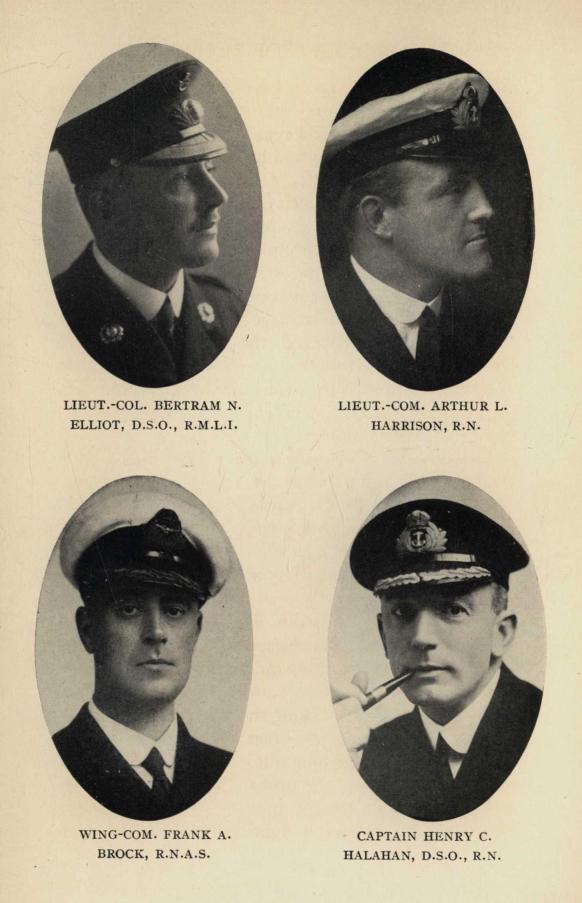
LIEUT.-COL. BERTRAM N. ELLIOT, D.S.O., R.M.L.I., LIEUT.-COM. ARTHUR L. HARRISON, R.N., WING-COM. FRANK A. BROCK, R.N.A.S., CAPTAIN HENRY C. HALAHAN, D.S.O., R.N.
Taking everything into consideration and looking
at the operation of attacking the Mole from a general
point of view, it was not dissimilar to a trench raid
on a large scale. The preparatory bombardment, the
rush "over the top," the probability of encountering
barbed wire, the descent to the main level of the
Mole, the hand-to-hand fighting in the dark, and
finally the clearing of dug-outs, all combined to liken
that phase of the operation to one of the many night
raids with which the military were so well acquainted
on the western front. The senior officers of the
Seamen and Marine storming parties had both gained
much experience of such fighting ashore. It was to
be a raid of the first water, a super-raid. The military
officers were most enthusiastic about our men. They
declared that these men could carry any position.
For they were all picked men; and even so some of
them were weeded out as not quite reaching
high-water mark at the game. It was generally conceded
that the Hun, wherever he was to come to close
quarters with such antagonists, would have an
uncomfortable evening.
It has been mentioned above that special personnel
were not required for the large majority of vessels
which were already in full commission and employed
on active duty in the Dover Command. The personnel
required for the blockships and storming vessels
and for other special purposes amounted to eighty-six
officers and sixteen hundred and ninety-eight men; of
these, seven hundred and fifty, in the aggregate, were
drawn from the Royal Marines.
Having been working in the Plans Department of
the Admiralty when the operation was originally
thought out under Admiral Keyes, my further services
had been lent to him, after he took over the Command
at Dover, in connection with the operational staff
work. Very much to my delight I had then been
offered the billet of navigator of the expedition, and
my duties were to include those of placing Vindictive
alongside the Mole. The Vice-Admiral originally
proposed to direct the operation from on board Vindictive,
but was forced to the conclusion that he could do so
more satisfactorily from a destroyer, thus avoiding
the possibility of being confined to any single position
in the area of the attack. In the Vice-Admiral's
absence Captain Halahan, appointed in command of the
seamen storming parties, became the Senior Executive
Officer in the ship. It was pointed out that that
fact would result in the unusual case of the Senior
Officer on board not being responsible for the handling
of the ship. Captain Halahan would not even listen
to any suggestion of difficulty arising from such a
situation, and, I am anxious to record this fact, he
proposed that his acting rank of Captain should be
transferred from himself to me, so that the officer
responsible for handling the vessel should also be the
Senior Executive Officer on board in accordance with
the usual service custom; in other words that he
should be made junior to myself. This proposal was
typical of Halahan, who, in my opinion, was one of
the finest fellows that our Service ever knew. His
death brought an irreparable loss to the Navy.
Throughout the greater part of the war he had been
in command of the naval guns on the northern front
and within field-gun range of the enemy for no less
than three years. He had fought in most of the great
battles on that part of the Allied lines. A more
efficient, earnest, upright, and altogether large-minded
officer never fought for his country or paid the
supreme sacrifice more readily. The days which we
spent together working at the details of the
enterprise, his wonderful enthusiasm, and his certainty of
success are unforgettable. I feel that I could not
continue this story without recording my unqualified
admiration for this splendid officer.
Needless to say, it was unnecessary to carry his
proposal into effect, for his unselfishness had served
to guarantee that all questions of rank were
immaterial where the only thing that really mattered was
the attainment of our object.
I regret that my lack of literary ability prevents
my doing justice to such men.
Wing-Commander Brock
It would be difficult for anybody to speak too
highly of Wing-Commander Frank A. Brock. He was
a rare personality. An inventive genius, than whom
the country had no better, it was his brain that
differentiated this blocking enterprise from all previous
attempts in history in one most important particular.
The difficulty of reaching the destination in the
face of a strenuous opposition had hitherto brought
failure, but he provided an antidote in the form of
a satisfactory artificial fog designed to protect the
blockships from the enemy's guns during the critical
period of approach. That in itself was a wonderful
achievement, but his inventive mind was not satisfied
therewith. To him we owed the special flares intended
for turning darkness into light.
A special buoy was wanted—one that would
automatically provide its own light on being thrown into
the water. Brock made so little of the problem that
he produced such a buoy, designed, constructed, and
ready for use in less than twenty-four hours. Special
signal lights were required. Brock produced them.
Flame projectors, far exceeding anything hitherto
known, were mooted. Brock produced them also.
No matter what our requirements were Brock was
undefeated. With a highly scientific brain he
possessed extraordinary knowledge of almost any
subject. He had travelled much and could tell you all
that was worth knowing of any country from
Patagonia to Spitzbergen. He was no mean authority on
old prints and books, was also a keen philatelist, and
was blessed with a remarkable memory. Wherever he
went he carried with him a pocket edition of the New
Testament, which was his favourite possession; his
knowledge of the contents was quite unique. And
with it all he was a great shot and an all-round
sportsman. His fine physique was well remembered by
many a Rugby footballer from the days when he
played in the pack of one of the leading club fifteens.
His geniality and humour were hard to beat. But of
all his qualities, optimism perhaps held first place.
At times we, who were far from being pessimistic,
thought his optimism excessive, but it was justified
absolutely with regard to the success of the enterprise.
Sad to relate, the only occasion on which I can
remember his optimism failing to carry him through
was connected with his own personal safety. He had
telephoned up to Halahan in our office and
mentioned having broken a looking-glass. "That means
seven years bad luck," said Halahan, in a jocular
spirit. "Never mind," came the instant reply, "it
shows that I'm going to live for another seven years,
anyway."
Both Brock and Halahan had done so much to
ensure our success, it was indeed sad that they did not
survive long enough to see the results.
My readers will excuse me, I feel sure, for bringing
such personalities to their notice. It is very difficult
to continue the story without writing of many others
to whom we owed so much in the preparatory work.
But there will be a chance of mentioning some of
them later on, when we come to the actual description
of the fight.
THE WAITING PERIOD. THE VOLUNTEERING SPIRIT.
At last all constructive preparations were
completed; the various ships and small craft
were commissioned and concentrated at their
respective starting-points. The blockships and
Vindictive steamed out to the loneliest of anchorages in the
Swin Deep, situated about eight miles south of
Clacton, Essex. It was a curious looking squadron that
steamed down the Medway that day, the blockships
with their funnels looming extra large in the absence
of masts and the Vindictive with her gangways
protruding into mid-air like almonds in the side of a tipsy
cake. The Hindustan looked respectable enough. She
was mother to us all and her captain was a very
tolerant and helpful father.
Embarkation of Marines
The Iris and Daffodil joined us almost
immediately. The Marines embarked a few days later. They
had been sent to a southern port on the understanding
that they were off to France; the officers alone knew
the truth. They duly boarded the waiting transport
with stores, ammunition, and baggage, the latter
labelled to a French port. They must have wondered
where they would sleep that night. The transport
duly left harbour and headed for the French coast,
but presently altered course in a most unusual
manner. Word was passed round that the course was
peculiar; all crowded on deck in their endeavour to
solve the problem. It was a misty day with the rain
coming down in torrents; the land was soon obscured.
The officers chuckled at the general bewilderment,
but held their peace. At last the transport eased
down and finally stopped engines. Out of the mist
loomed the Iris and Daffodil, into which vessels the
Marines were transferred.
A second voyage was then commenced, but it was
not of long duration. Other ships presently hove in
sight, and strange craft they appeared. Cruisers
without masts and another looking like a home for lost
coal-tips. These were the blockships and Vindictive.
Then appeared a recognisable vessel—the Hindustan.
Some of the Marines went to the latter, the
remainder to Vindictive. I can well remember the
astonished look on their faces as these men boarded
my ship. Even the heavy downpour of rain seemed
to be unnoticed. One man remarked as he came on
board, "Well, it's darned good to be aboard a blessed
something, but I'm blowed if I know what she is."
That day and the next were spent in settling down.
On the evening of the second day the men were told
the secret. In Vindictive they all mustered on the
quarter-deck and after bridge. Sunset had long since
been heralded by the time-Honoured bugle call. The
evening twilight was fading rapidly. There was a
stillness in the air which seemed to be reflected from
the tense attitude of the assembled men. One could
have heard the proverbial pin drop. It was my duty
to take them into our confidence. After the nature of
the enterprise had been outlined a few sentences were
sufficient to illustrate the task allotted to the
Vindictive. It seemed advisable to point out that many
other operations of a hectic nature, besides those of
the blockships and storming vessels, were to be
attempted. I emphasised this by mentioning that if,
during our visit to Zeebrugge Mole, they heard a
thunderous explosion they could say to themselves,
"That's one of them." These words came back to me
afterwards, as I shall relate in due course.
As soon as the business in hand had been promulgated
it was considered advisable to exert a very rigid
censorship on outgoing mails. Correspondence was
permitted, but strictly on the understanding that the
letters would be retained at one of the mail offices
until the operation had been completed. This
regulation was modified later owing to the waiting period
being unexpectedly prolonged. Field post-cards were
then issued and could be posted in the ordinary
manner. There were the usual sentences, such as "I am
quite well," "I am not quite well," "I have received
your letter," "I have not received your letter," etc.,
in the style of the French exercise books of one's
youth. Such post-cards were familiar enough amongst
the military, but were a novelty to most of us; they
caused a good deal of amusement, especially when the
sender omitted to delete the sentences which
misrepresented his feelings towards the intended recipient.
All shore leave was stopped; even cases of serious
illness or accident would have to go to Hindustan,
and remain there, instead of to a shore hospital.
Concerning Secrecy
Secrecy was absolutely essential, but not always
easy to ensure. At our anchorage it was
comparatively simple, but elsewhere we had to depend more
upon trust in our fellow men than rigid regulation.
The secret was well kept, and fortunately so. Surprise
is mainly dependent upon secrecy. For if information
of an impending attack becomes known there can be
no hope of taking the enemy unawares.
I wonder how many people realise the necessity for
keeping rumours to themselves during war. Rumours
must be either true or untrue. If untrue they are not
worth passing on. If true, then untold harm may
result from repetition. Suppose for a moment that
the impending operation at Zeebrugge had become a
topic of general conversation. In due course the
information would have reached our enemies and the
expedition would almost certainly have met with
complete disaster. The lives of many picked officers
and men would have been lost, and the whole affair
would have gone down to history as a fiasco. Under
such circumstances each person who had repeated the
rumour on its way to the enemy would have been
morally guilty of manslaughter—surely that is not
an exaggerated deduction.
Alas, human nature is often weak. There is some
modicum of satisfaction in showing superior
knowledge to one's neighbour.
The Japanese, in their war with Russia, set the
world a wonderful example of silence. After losing
a high percentage of their battleship strength not
a word was spoken and the world remained in
ignorance for many months.
A writer—I think it was Chesterton—once suggested
that memorials should be erected in recognition
of negative qualities. If that idea were adopted I
wonder how many tablets would be found to state
that "Here Mr. So-and-so heard a rumour and did not
repeat it to his friends."
When dealing, in Chapter VIII, with the question
of the type of personnel required for an enterprise
of this description, I mentioned that they should be
volunteers as far as that was practicable. The reader
may perhaps consider that the meaning of the word
"volunteer" was being unduly "stretched" if the
men were to be unaware of the real nature of the
operation until they were already trained and actually
standing by to go across. Nevertheless, the men were
volunteers in the true meaning of the word. Let me
explain. It was of great importance that no officer or
man should take part in the enterprise unless he was
"for it," heart and soul. So, as soon as the secret had
been made known and the men were thoroughly
aware of all the difficulties and risks involved, it was
given out that any officers or men who wished to
withdraw could do so. It was fully recognised that they
might have private reasons for wishing to avoid risks
of an unusually high degree. We were not concerned
with the nature of such private reasons and we wished
to make certain that no pressure was brought to bear
for the sake of influencing their decision. They were,
therefore, informed that any individual who desired
to withdraw should merely give in his name and
remain behind. They were further told that no reasons
would be asked and, to make doubly certain, that no
reasons or explanations of any description would be
allowed under any circumstances whatever. That was
fair enough. Not a single officer or man withdrew.
Volunteering Spirit
In Vindictive there were several men, of non-combatant
rating, who, in the ordinary course of events,
were destined to be left behind when the expedition
started. They comprised cooks, stewards, canteen-servers,
and the like. Some of them were not even
naval men, but merely there as representatives of, or
workers for, the firm which provided the canteen.
They naturally knew the secret and they openly
expressed their desire to remain in the ship so as not to
miss the fun. We decided to consider such requests.
Extra men would come in handy for dealing with the
wounded as well as for assisting with the commissariat.
Eventually it was decreed that those who volunteered
to come over with us should give in their names.
As far as I can remember every one of them volunteered.
It must be realised that these were not fighting
men; their sole training had been that of the camp
follower. Small chance of meeting the enemy in
hand-to-hand combat would come their way. The work of
tending wounded between decks—we already had
our full quota of stretcher bearers for working in more
exposed positions—and that of providing the
necessary sustenance carries little glory or excitement.
Nevertheless, these men volunteered and they
afterwards rendered splendid service.
Take another case. When the Vindictive was fitting
out at Chatham there was an officer on board,
remaining from the previous commission, for temporary
duty. He knew nothing definite of the coming
operation, but evidently thought a good deal. His method
of volunteering was to remark: "I don't know, sir,
what the old ship is going to do, but it looks like dirty
work and I should like to be there." It was vulgar,
but expressive. That officer remained with us, and
afterwards covered himself with glory.
In the blockships there were also incidents which
served to illustrate this thirst for dangerous employment.
Owing to the difficulties of rescue work, as has
already been explained, it was decided to send each
blockship to her final destination with the smallest
possible number of crew; the number in each case
amounted to fifty-three. Thirty-four extra men,
however, were required for getting each ship to the
edge of the danger zone, whilst the fifty-three on
whom the final run depended were resting. That
meant that in each ship thirty-four men, who knew
all about the coming event, who had experienced
much hard work and considerable discomfort, were to
be disembarked just when the fight was about to
begin. One can imagine their feelings, but questions
of individual disappointment could not be allowed to
affect the plan of action. The disembarkation of these
"surplus" crews was to be carried out with the aid
of small craft specially detailed for the purpose. In
the Intrepid one day there was a minor edition of a
mutiny. Several men demanded to see their captain.
The latter ordered them to state their business.
"Well, sir," said the spokesman, "me and my mates
understands as how some of the crew have got to
leave the ship on the way across to Zeebruggy. The
'jaunty'[1] says it's us lot and we ain't a-goin' to
leave."
Their captain explained the situation. He pointed
out that there would be too many for one rescue boat
and that overloading might lead to the loss of
everybody. But the men were inclined to be adamant.
Finally their captain decided to take a spare gun's
crew and ordered the "mutineers" to draw lots for the
honour. The sequel is worth recording even if it
necessitates anticipating the main story. When this
particular blockship stopped during the oversea
voyage, the craft detailed to take off her surplus crew
failed to appear alongside—she had broken down.
So the whole crew went to Zeebrugge and, extraordinary
to relate, every soul of them was rescued.
This voluntary spirit was very heartening to all
concerned. I have only mentioned a few specific
cases, but there were many others of a similar
description. It is no exaggeration to say that once the men
knew the secret they were more than mere volunteers—they
were determined to come across with us.
First Waiting Period
It must not be assumed that all was in readiness as
soon as the ships, having been duly fitted out, had
assembled at the Swin and embarked their personnel.
Much remained to be done. Steam trials, gunnery
practices, adjustment of compasses, and tests
of all the special material were indulged in. Handling
the ships from both the main and auxiliary conning
positions, testing communications, manipulating the
grappling irons and Mole gangways, drilling the guns'
crews and ammunition parties, training the stretcher
parties, and giving instruction in first-aid also helped
to keep us fully occupied.
Of course it was impossible to practise sinking
blockships or taking storming vessels alongside
breakwaters. Breakwaters are only to be found in such
public places as Dover, Portland, etc.; it would have
been inadvisable to publish our intentions in such a
manner. Thus, as far as these special vessels were
concerned, the seamanship difficulties could not be
lessened by proper realistic practice. The suggestion
that we might use Hindustan as the Mole did not
appeal to us much, especially as the Vindictive was
originally built for ramming and consequently had a
very large ram; we had no desire to start badly by
sinking one of our own battleships.
The life on board Vindictive, uncomfortable as it
was owing to our numbers greatly exceeding the
normal complement, was not altogether devoid of
humour. As one walked round the ship there would
be a blood-curdling yell and a party of men with fixed
bayonets would charge round a corner and hurl
themselves upon an imaginary foe. The steel helmets, gas
masks, and respirators gave these men a weird
appearance, such as one is unaccustomed to see on board
ship. Some carried knob-kerries—loaded ash sticks;
others grenades, flame projectors, or machine-guns.
There was no half-heartedness about the men.
Clearly enough they meant business; we had no
misgivings about the result. Those days were busy
indeed. When work had finished for the day
opportunities for sports arose, and there were occasional
concerts in the evenings. The tugs-of-war evoked
much friendly rivalry between the various sea
regiments—the seamen, stokers, Marine Light Infantry,
and Marine Artillery. One afternoon a boxing tournament
took place and the fighting augured well for the
near future.
One day, two officers from a blockship paid a call
on the Vindictive. Visiting cards were not required;
we were obviously At Home. But we were quite
mystified when one of the officers produced a small
chunk of iron and remarked that he had brought it
on board in case we ran short of ammunition. He
then explained that, during the passage from his
vessel, some description of explosive missile had burst
within a few yards of his dinghey, and the piece
produced had fallen into the boat. Incidentally he
accused Vindictive of firing the missile, but we pleaded
not guilty or alternatively, as the lawyers say,
asserted that he had no right to cross the firing line!
Apparently it was a portion of a bomb of sorts fired
from one of the ships, fortunately without any other
result than to cause considerable merriment to the
occupants of the dinghey. Such an incident in the
ordinary course of events would have led to very
pertinent enquiries, but we were too much preoccupied
with the business in hand to worry about such trifles.
The thoughts uppermost in our minds concerned
the chances of favourable weather conditions. The
barometers came in for an amount of tapping which
was not calculated to improve the instruments. We
all became weather prophets those days. Many and
varied were the daily forecasts.
One night we rolled unpleasantly in a heavy gale
and soon after midnight a small vessel was seen firing
distress signals. This provided an excellent
opportunity for testing our illuminating rockets, by the
aid of which we observed a tug struggling to grapple
a lighter which was dragging its anchors. The worst
aspect of heavy weather was the consequent expenditure
of fuel which we could ill spare. Thanks to the
Captain of Hindustan our period of waiting was made
as comfortable as we could have hoped. He was
indefatigable in arranging diversions for our amusement
and in keeping us informed of the latest war news.
Each day brought more serious reports from the
battle front in France and made us all the more anxious
to give the enemy a nasty shock whilst cheering up
our own troops. During the late evenings most of us
sought for quiet corners where we could write letters.
I think we all found those letters were very difficult,
but one's feelings at such a time are of too private
a nature to bear analysis.
The Coming Event
Captain Halahan used to discuss every point of
the coming enterprise with me; his insight and
keenness were most marked. We often talked far on into
the night and always came to the conclusion that
however difficult the operation might be for our
forces we would not be in the German's shoes for
anything. We had a plasticine model of the Mole chiefly
constructed from the data obtainable from aerial
photographs. Colonel Elliot, commanding the
Marine storming parties, and his officers often joined us.
We all realised the difficulty of berthing the storming
vessels at exactly the desired position alongside the
Mole and endeavoured to make the storming plan as
elastic as possible. The primary consideration—as
far as that phase of the operation was concerned—appeared
to be that the ships should secure to the
Mole somewhere. The mere presence of the ships,
combined with all the attendant noise and fireworks,
would create a diversion of no mean order. The
actual landing on the Mole and the occurrences that
followed would increase the diversion which had
already commenced. With regard to Vindictive we
originally aimed at securing her alongside the Mole,
heading to the westward, with her stern seventy
yards westward of the three-gun battery. It was
realised that there might be considerable difficulty in
recognising one's exact position alongside the outer
wall relative to objects on the Mole itself. Eventually,
as will be described later, the ship secured to
the westward of the designed position, but, though
the actual fighting on the Mole was affected, the main
object of the diversion was attained.
The blockship officers paid us many visits and we
were all very cheery. No less than four old shipmates
had come down from my late ship in the Grand
Fleet—H.M.S. Emperor of India. It was a curious
fact that all five of us were in the thick of the affair
and all survived. One commanded the Intrepid with
another as one of his officers. One commanded the
Daffodil. One was on board Iris. Their services will
be mentioned later.
One night we had an Emperor of India dinner on
board the Intrepid. A storeroom of sorts did duty for
a mess and I think the sub-lieutenant cooked the
dinner. There was no serious talk that evening and
I don't think we forgot to drink confusion to the
enemy. When we broke up the party we little knew
that we should be conveying that confusion within
twenty-four hours.
I have described our life at the Swin in some detail,
but what of the other one hundred and fifty-four craft
which were not with us? They were busily preparing
too, but, for the most part, were actively engaged in
their ordinary Dover Patrol duties at the same time.
Little peace can have come their way. The aircraft,
too, were very actively employed. Day after day
they brought us back photographs of Ostende and
Zeebrugge, taken at great risk with a fine contempt
for danger. If we wanted the details of any portion
of the Mole it was forthcoming, in the shape of an
aerial photograph, in a few hours. This work was
carried out by the 61st Wing of the Royal Air Force.
Special cameras were used for this purpose; I believe
that they had been designed by the previous
Vice-Admiral at Dover. We studied those photographs
with the aid of stereoscopes and magnifying glasses
by the hour. But photography was not the only thing
required of the aircraft. They had to prepare for the
bombing attacks which would provide further
diversions; preparation required much observational work
both by day and by night. The aircraft detailed for
the bombing attacks were drawn from the 65th Wing
of the Royal Air Force. These flyers were fine fellows
and no less determined to make the affair successful
than the rest of us.
Many of the smaller craft were commanded by
officers of the Royal Naval Reserve and Royal Naval
Volunteer Reserve. I have mentioned elsewhere that
the whole success of the operation might, at a critical
period, depend upon the action of a single unit.
Instructions leaving a high degree of initiative to the
recipient were, therefore, necessary. Clear appreciations
followed by rapid decisions were required. The
Vice-Admiral emphasised that point most strongly.
He trusted his men, whether Reserve or Volunteer or
otherwise. His trust was not misplaced; all these
officers commanding the small craft behaved most
admirably, exactly as was expected by those who
knew their worth.
METEOROLOGICAL AND TIDAL CONDITIONS. VISIBILITY
The periods during which the conditions
would be favourable for our enterprise
depended upon various factors. The extent to
which we could make use of any particular date
during one of those periods depended, in turn, upon
meteorological conditions.
It has been shown elsewhere that, for the purpose
of utilising the artificial fog, we required a wind
blowing more or less toward the Belgian coast from
seaward. It was also necessary for the wind to be light
so that the small craft would not be hampered by
rough seas. Light winds are often accompanied by
fog, especially in the North Sea, and fog would be a
serious obstacle. Rain would be detrimental to the
use of aircraft.
The depths in the entrances to the canals at
Zeebrugge and Ostende were such that the blockships
could only navigate during the period around high
water. It was, therefore, necessary for the vessels to
arrive at about that state of the tide.
Again, it was essential to carry out the operation
during the night for reasons already mentioned. In
this respect, however, the word operation must not
be used too loosely; the periods of approach to the
objectives and of retirement therefrom must both
be included in that term. The approach had to be
undiscovered till the latest possible moment. That
necessitated darkness throughout the approach, which
latter may be considered as comprising the passage
during the last twenty miles of the oversea voyage.
Obviously the greater part of the whole passage
conducted during darkness the less would be the chance
of losing the element of surprise.
Likewise the retirement must be made before
daylight if the concentration of the shore batteries was
to be avoided. I have already stated that the German
guns could make things very uncomfortable for ships
up to a maximum distance of fifteen to twenty miles,
provided that the ships could be seen. The retiring
forces should, therefore, be outside that range before
there was sufficient daylight to see so far; the latter
state of visibility would obtain at least half an hour
before sunrise. Allowing a speed of about ten knots
for retirement, this meant that the ships must leave
the coast about two and a half hours before sunrise
after completing the operation. The attack itself was
expected to continue for about one and a half hours.
The reader does not require to be an advanced
mathematician to realise that the attack must commence
not later than about four hours before sunrise, that is,
during the middle portion of the night. Of course, the
attack was the all-important matter; any question
of safe retirement must be a secondary consideration.
Nevertheless, the question of retirement, similarly to
that of rescuing the blockships' crews, had to be taken
into account.
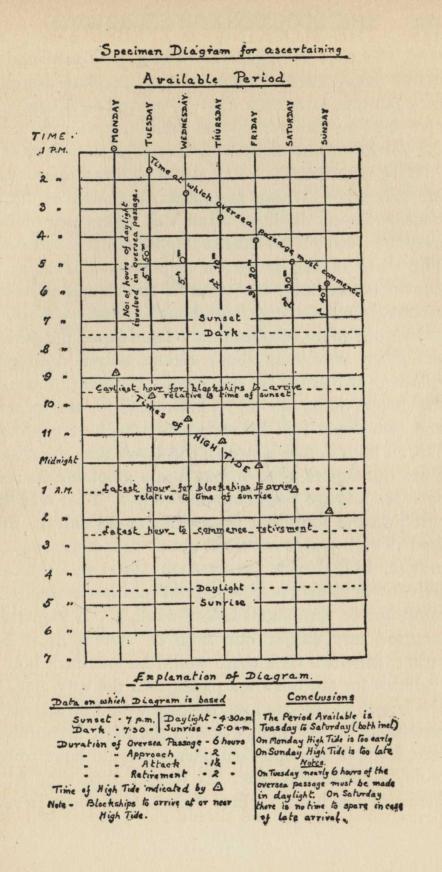
Specimen Diagram for ascertaining Available Period. (Transcriber's note: this diagram occupied page 133 of the source book)
From the foregoing it will be seen that the attack
should be preceded and followed by a considerable
period of darkness, and should more or less coincide
with the time of high tide. The latter only occurs
about every twelve hours and takes place roughly
fifty minutes later each day. The number of
consecutive days on which high tide would occur in the
middle portion of the night was, therefore, very limited.
With regard to visibility, as far as naval operations
are concerned, strong moonlight is almost as
disadvantageous as daylight. Half the nights per month
may be termed moonlight nights in that respect.
The state of the moon on any particular night is
known beforehand, the state of the clouds affecting
moonlight may change from hour to hour.
Just one more calculation. In mid-April the period
sunset to sunrise is about eleven hours in length.
Allowing two hours for the approach-passage through
the danger zone, one and a half hours for the attack,
and two hours for the retirement (to be completed
half an hour before sunrise), it follows that the
maximum number of after-sunset hours available for the
open sea passage would amount to five. That was the
best possible condition for us, but could only be
utilised if high water occurred about four hours before
sunrise. If high tide occurred any later our time of
arrival would necessarily be later and our retirement
could not be completed before daylight. If high tide
occurred any earlier our time of arrival must be
earlier, in which case there would be less dark hours
available for our open sea passage on the way across.
The length of the open sea passage would be
approximately six hours. Thus even on the most favourable
date, some of the open sea passage would have to be
made in broad daylight. Six days before that (the
tide being five hours earlier) the whole of the open sea
passage would have to be made in daylight, only the
approach-passage, i.e., the last two hours of the whole
trip, taking place after sunset.
A rather complicated set of conditions, astronomical,
tidal, and meteorological, was thus required.
It was almost too much to expect that everything
would be favourable during the possible period; it is
practically certain that a commander who refused to
move until all conditions were exactly as desired
would never accomplish anything. Nevertheless we
sincerely hoped that fortune would be kind to us.
Keenness of the Men
The men were kept informed of the chances as
forecast from the current weather conditions; their
eagerness for favourable predictions was manifest.
There is much advantage to be gained by a
commander taking his men into his confidence. In this
particular case the men realised that leakage of
information would entail disaster; that was sufficient
to ensure that the confidence would be respected; the
rigorous censorship was there to make doubly certain.
It is always more irksome for those who wait in
ignorance than for those who know the reasons for
delay. So after prayers each morning the latest
forecast was divulged, other items of interest were made
known, and the keenness of the men was maintained.
THE ORDERS AND INSTRUCTIONS. THE TIME FACTOR
The work of drafting, reproducing, and
distributing the necessary orders and
instructions to the large number of craft concerned
was not so simple as it may sound. The amount of
instructions required in an operation of this sort can
only be appreciated by those who have had experience
of staff work during war. The command to "carry
on" is only applicable when the means have been
provided and the manner of its use has been made
known.
Synchronizing the Events
To mention a few of the items: Separate orders
for the oversea voyage were required for each
squadron destined to make the passage independently of
the remainder. Others were needed for the voyage
of the main force, others to cover the aerial attacks
and the long-range bombardments. The supporting
squadrons must have their instructions. Still further
orders were designed to deal with the period of
"approach." Then there were those for the main attack
on the Mole, for the demolition work, for the destruction
of the railway viaduct, and for the proceedings
of the artificial-fog craft; also those for the blockships
and the rescue work. The retirement required its own
share. Even now we have not mentioned those
designed to meet possible eventualities, such as
encountering enemy vessels en route, or returning to
harbour if postponement of the enterprise was necessary.
Having decided where and how things should be
done, the remaining question was when they should
take place. The operation with its various phases and
diversions could not be carried out on the go-as-you-please
principle. Every item needed to be carefully
fitted in to suit the remainder. The timing of each
event was of paramount importance. A long-range
bombardment or an aerial attack, if delayed, might
destroy our own vessels. The blowing up of the
viaduct was calculated to render hors de combat all human
beings within a certain distance—our own men on
the Mole must not be endangered by it. It would be
useless for the blockships to arrive before the fire of
the Mole batteries had been suitably diverted. Aerial
bombers flying at a hundred miles per hour could not
accompany the ships steaming at about one-tenth of
that speed. The line of fire from the bombarding
vessels could not very well coincide with our approach
course, hence the necessity for the monitors to take
up independent positions. And so on. How could a
satisfactory synchronisation of events be
arranged?—that was the problem.
There were only two methods to consider: firstly,
that of centralised command by signal; secondly, that
of working in accordance with a prearranged time
table.
The former method was obviously impracticable.
Signals passed by either the wireless or visual method,
during the approach, would make our presence known
to the enemy and thus preclude all chance of taking
the latter by surprise. After the attack had
commenced signals would be impracticable for obvious
reasons, chief amongst them being the deafening noise
and the presence of artificial fog. So direction by
signal could be ruled out.
The Timing Question
Recourse was had to the time-table method. A
table was made out showing the exact times (by
clock) that the main force was to pass through various
positions and to arrive at the several destinations.
All other movements were to synchronise according
to plan. The time table naturally varied for each day
according to the projected time of arrival of the
blockships, this, in turn, depending on the time of high tide.
But that was not all. It was necessary to guard
against unexpected delays due to accident, and
against vagaries of the tidal stream. Every unit
should know, at a late stage of the oversea trip, if the
blockships were likely to be late or early, and the
probable difference between actual and projected
time involved.
We would not be satisfied with the degree of
punctuality usually associated with certain railways. A
few minutes out, one way or the other, might be
serious; an error of half an hour would probably be
disastrous. But the oversea passage involved a
journey of approximately a hundred miles for the
blockships and storming vessels, though rather less for the
Dover contingents. That fact, combined with the
usual unwieldiness of a fleet comprising over one
hundred and fifty vessels, was not likely to render
punctuality very easy of attainment. The disadvantages
of daylight made it inadvisable to leave our
bases extra early for the sake of having plenty of time
to spare. Careful calculations were necessary and the
resulting time table was circulated to all concerned.
Before leaving this consideration of the timing
question it may be of interest to mention that the
storming vessels were to be twenty minutes ahead of
the Zeebrugge blockships on arrival in the vicinity of
the Mole. In that twenty minutes we were to get
alongside and land the storming parties; the latter
were to take the necessary steps to put the batteries
out of action as far as the safety of the blockships was
concerned. At the expiration of the twenty minutes
the blockships were to pass round the end of the Mole
and make their dash for the canal entrance. The
reader may wonder why twenty minutes was the
chosen interval. Too long a time might allow the
German defences to recover from the initial surprise;
too short a time might not enable the storming
vessels to complete their work before the blockships were
seen by the enemy. Twenty minutes, short though it
was, was chosen as a compromise.
All this operational staff work was carried out at
Dover under the direction of the Vice-Admiral, who,
as previously stated, was already overloaded with
duties and responsibilities arising from the work of
the Dover Patrol.
The office accommodation was hardly palatial; the
building might certainly have been satisfactory as a
small apartment house in pre-war days, but, as the
Admiral's office of our busiest naval command outside
the Grand Fleet, it was not quite up to standard.
The small staff were pretty busy for a few weeks.
Meals were either bolted down or missed. The night
hours did not bring over-much sleep.
Visits to the Grand Fleet were also necessary; one
grudged the hours spent in the train. Conferences
and discussions, visits to the ships fitting out at the
dockyards, inspection of special material, trials of the
artificial fog, and the above-mentioned expenditure
of stationery helped to keep one occupied. Occasional
aerial trips assisted to clear away the cobwebs
from one's brain; they constituted a first-class tonic.
We had no printing-press. All orders had to be
typed and reproduced by a duplicating machine.
Secrecy was as essential in this work as elsewhere;
information had to be confined to the minimum
number of persons. The ordinary office staff had all the
Dover Patrol work to attend to; that was as heavy as
it was unceasing. It was a new experience to turn the
handle of the duplicator, and, in shirt-sleeve garb, to
clip up the pages. We obtained the assistance of a
civilian clerk from the Admiralty, and I vow that
individual discovered the real meaning of "overtime";
incidentally he was a very rapid and accurate worker
and helped us enormously.
At last the office work was more or less completed.
Improvements were thought out from time to time
and had to be embodied, even up to the eleventh
hour. That was natural enough, seeing that we had
very little previous experience to guide us in the
detailed planning of the Mole attack and blockship
work. It was a great relief when the paper work was
finished; those of us who had other business in hand
could then turn our attention to preparations of a
more material nature, much of which has already
been described.
THE FIRST ATTEMPT. THE RETURN TO HARBOUR
The first period, during which the tidal and
astronomical conditions would be favourable,
approached. The period was limited to about
half a dozen days for the reasons stated in a previous
chapter. The weather looked ominous; none of us
were very hopeful of an early start. Those last few
days of waiting were rather trying. So many things
might happen to prevent the operation from taking
place. Some of us were inclined to be apprehensive,
not of the result if we once came to grips with the
enemy, but of the operation being cancelled, or of its
being indefinitely postponed, which generally means
the same thing. Another great attack on the Belgian
coast had previously been planned and prepared, but
had never come off. I hesitate to think of the effect
on the general morale of the personnel if our
enterprise had suffered the same fate. Disappointment
is hard enough to bear at any time, but on such an
occasion as this it would have just about broken one's
heart.
On the eve of the first day of the first period our
anxiety about the weather was tremendous. The
wind blew hard that night. The morning had nearly
dawned before some of us could make ourselves realise
that looking at the weather would not do any good.
We endeavoured not to offend it by saying unkind
words. We touched wood many times when we gave
vent to our hopes bred of optimism. Patience is a
virtue indeed. But the first day was obviously
unfavourable, so we commenced to wait for the second.
Carry On
At last there was a decided improvement. A state
of readiness was ordered. The wind had fallen very
light and we were as hopeful as we were anxious to be
"up and doing." The order to raise steam was next
received and followed shortly after by the order to
"carry on" as previously laid down in the time table.
All was bustle then. Unnecessary baggage was
transhipped to a harbour vessel against the day when some
of us might require it. In due course the final
arrangements were made and we shortened in our cables.
Then we weighed anchors and started off. The
officers and men of Hindustan cheered us vigorously;
answering cheers were given as we steamed close past
her. Vindictive and the blockships all cheered each
other, enthusiasm was in the air. Thank goodness we
were off at last. Thank goodness, also, that nothing
had occurred to prevent our showing what we could
do. Those were the thoughts uppermost in our minds.
Iris and Daffodil were sent on ahead so that
Vindictive could take them in tow when we were clear
of the shoals. It will be remembered that Iris and
Daffodil did not possess a high degree of steaming
power, either in the way of speed or reliability.
It had, therefore, been decided that Vindictive
should tow both these vessels across the sea until in
the near vicinity of Zeebrugge Mole; that would help
to ensure their arrival. I read afterwards in one
account of this affair that Iris and Daffodil towed
Vindictive into action!
The squadron formed into "line ahead" in the order
Vindictive, Thetis, Intrepid, Iphigenia, Brilliant, and
Sirius. The wind was blowing rather weakly, but
from a favourable direction. The sea was very calm
and, altogether, conditions appeared to be most
promising. There were no glum faces in our little
community just then. As soon as we had cleared the shoals
we all stopped for a few minutes while Vindictive took
Iris and Daffodil in tow; that accomplished, we set
course for Rendezvous A, where we had to meet the
Vice-Admiral and the remaining vessels from Dover.
During our passage through the various channels
between sandbanks we passed a large number of
homeward-bound merchant ships. The contrast
between them and our vessels was not merely confined
to the matter of appearance.
Each of these merchant ships was just completing
a successful operation, namely, that of bringing
necessities of life to this country after running the gantlet
of the enemy submarines and mines. On the other
hand, we were just setting out for the purpose of
reducing such risks in the future. One could not help
realising the fact that these mercantile mariners had
risked their lives over and over again without
ostentation, with small hope of glory, with practically no
reward. Fine fellows indeed! What a debt of
gratitude we all owed them! Some of them, doubtless, had
been torpedoed three and four times, losing all their
effects each time, but here they were again with yet
another voyage to their credit. We overtook a few
vessels outward bound with their troubles to come.
Some of these ships were neutrals. We wondered
what they thought of us and how they would describe
us when they arrived at their destinations. We could
reckon on the enemy having agents at all the neutral
ports with their "ears well trimmed to the wind"
when in the presence of neutral mariners from British
ports. We also wondered if these neutrals could fail
to recognise the difference between British and
German treatment of merchantmen at sea, and whether
such recognition would not make them chary of
talking too much.
Presently we sighted a large number of small craft.
They seemed to be dashing up from every direction,
at first in an apparently aimless fashion, but presently
one recognised the method in their madness. At
schedule time we stopped, heading towards our goal.
The crowd soon sorted themselves out.
The Vice-Admiral with his flag flying in the
destroyer Warwick took up a position of advantage.
Destroyers and blockships took small motor craft
in tow. Other vessels acted as tugs for the submarines.
Motor launches, puffing for all the world as if they
lacked training, thus acting an untruth, assembled
according to their ultimate duties. Somebody
remarked that we resembled a sea-circus, there were so
many turns taking place simultaneously. One hardly
knew which to admire most. The destroyers
throbbing with latent energy, some of them shouting
through their safety valves that they were in a hurry
to get to business. The motor launches, pretending
the sea was rough and often rolling heavily in their
pretence, producing a similar impression to that of a
certain famous automobile which, though cheap,
always "gets there" even if some parts are missing
at the end of the journey. The C.M.B.'s (which,
being interpreted, signifies Coastal Motor Boats, though
the word "coastal" hardly seems appropriate) were
tearing through the water and almost leaping into
the other element as if to emulate the flying-fish.
Perhaps the word "crowd" was most suited to the
appearance of this heterogeneous collection of craft,
but they were very different from a crowd in their
behaviour.
The Signal to Proceed
Punctually at the scheduled hour the signal was
hoisted to proceed. The expedition, making its debut
as such, set course for the eastward. Enthusiasm was
at its highest pitch. Final preparations were then the
order of the day. In Vindictive emergency rations and
field dressings were distributed. Small arms were
inspected, ammunition was stowed ready for use.
Demolition charges were placed in a handy position
for rapid removal to the Mole, gangways were triced
up, bombs were fused, howitzers and flame-throwers
were prepared. Hoses were flaked down for fire
brigade uses, fire extinguishers were provided in
specially dangerous corners, duplicate charts were
placed in the conning tower. To guard against the
eventuality of all the navigating personnel being
rendered hors de combat during the fight or the charts
being destroyed, the retirement courses were painted
up on the armour inside the conning tower. A year
later I found this painting untouched, although the
ship had been in the Germans' hands (after being sunk
by us at Ostende in May, 1918) for many months—I
wondered if they understood its signification. All
the other craft in company were equally busy.
We passed through further rendezvous, B and C
and D, etc., carefully checking our progress at each
so as to ensure working to the time table.
The bombarding and supporting squadrons had
proceeded independently. We were accompanied by
aircraft during the daylight hours of our passage;
their special duty was that of scouting for German
aircraft and preventing those that might have seen
us from giving any warning of our approach.
The wind gradually became very fitful and made us
rather apprehensive of its changing to an unsuitable
direction. Surely we were not to be robbed of our
long-awaited opportunity at the eleventh hour.
Daylight faded into twilight and the latter gave way to
darkness. It was a clear night, but as black as india
ink. Presently a distant flash of light was seen away
to starboard. Then another and another. A compass
bearing laid from our charted position gave evidence
of something happening at Ostende. Then searchlight
beams were seen searching the heavens in an uneasy
manner. What could it mean? A hurried glance at
the time table explained everything.
A Difficult Decision
Our aircraft had opened the ball. The booming of
guns was heard quite plainly and the glare of the
flashes was distinctly visible. Zeebrugge then joined
in the game. In a little while we could make out the
trail of the "flaming onions," rushing heavenwards,
hanging stationary for a few seconds, and then slowly
falling in their curiously serpentine manner, for all
the world like colossal snakes writhing in their death
agony. The firing became more intense and we were
more anxious than ever to get to work. It was obvious
enough that our aircraft—the 65th Wing of the Royal
Air Force from Dunkerque—were setting about
the enemy in determined fashion. Our turn was to
come shortly, according to plan. Alas, "the best laid
schemes of mice and men gang aft agley." We had
stopped to disembark the surplus blockship crews—if
they could be found, and to slip the small craft from
their towing hawsers in readiness to penetrate the
danger zone. The wind seemed to have died away for
a moment and then commenced to blow from a
southerly direction.
Seldom has an admiral been faced with such a
difficult situation. A decision had to be given, and
quickly. The nature of the operation admitted of no
delay. The wind at the moment was hopelessly
unfavourable for our use of artificial fog. The latter was
essential. It would mean sheer slaughter if there were
no cover from the shore batteries during the approach.
On the other hand, the wind might change again.
Here was the whole expedition within a short distance
of our objectives. The major part of the passage had
been completed in spite of all the difficulties and
practically without incident. The aerial attack had
commenced. The monitors were shortly to send their
messages of destruction hurtling on their way to the
enemy. We had been seen by all sorts of neutral
vessels. Most of the conditions were favourable—the
wind alone was seriously against us. Another chance
might never come. He who risks nothing attains
nothing. Discretion is the better part of valour. What
was it to be?
In all the pages of naval history I cannot remember
having come across any occasion where a more difficult
decision had to be made. After Teneriffe Nelson
had realised his mistake of allowing impetuosity to
influence sound reasoning to the extent of attacking
when the conditions were unfavourable. Not only
was that first attack a failure, but it had foredoomed
the second attempt to failure also. The Vice-Admiral
avoided the same mistake—he ordered the operation
to be cancelled for that night. Much has been
written of the attack which eventually took place.
References to the Nelson touch have not been unknown.
But this latter comparison, as I have shown, was
curiously inapt if intended to cover the whole
direction of the enterprise.
There was no time for feelings of disappointment.
We had to return at utmost speed so as to be ready
to start again next day if the conditions allowed. Our
bases lay many miles to the westward, but we were
heading in an easterly direction. "Course West" was
signalled immediately. Vindictive held the honoured
post of "Guide of the Fleet." Complete instructions
had been laid down for turning round at night. It
must be remembered that we had seventy-seven craft
in close, very close, company. We duly turned round,
hoping that all craft had received the signal. Our
hopes were not entirely realised. In a few moments
the close company became too close for comfort.
Small craft shaved across our bows so narrowly that
they left the impression of having gone through us.
Shouts were heard, mingled with the puffing and
spluttering of internal-combustion engines. We
wondered which particular vessel we should sink first.
But out of chaos came some semblance of order and
presently we were homeward bound without any very
serious casualties.
Away in the distance there were occasional gun and
searchlight flashes, but the monitors had received the
cancellation news in time to preserve their silence.
During the turn to the westward one of the small
craft, in imminent danger of collision, had
momentarily switched on her navigation lights. Others
followed suit until our force resembled Brighton
Esplanade indulging in a Venetian fete as viewed from
the sea. "Out Lights" was immediately ordered and
passed from one craft to another by megaphone or
flash-lamp; darkness reigned once more as we sped
homeward. Although we had shown a blaze of lights,
the enemy patrols, we heard afterwards, failed to see
us; this was scarcely a token of their efficiency.
Value of the Attempt
So it was a case of "if at first you don't succeed,
try, try again." This abortive attempt was by no
means without value. We had rehearsed the
concentration and the oversea passage of the main force;
the other vessels had practised reaching their various
destinations; the aircraft had carried out their
attack; the routes and navigational aids had been
severely tested. Naturally enough much valuable
experience had been gained and, after all, no harm had
resulted provided that the enemy remained ignorant
of our efforts and intentions. But certain incidents
had occurred to increase our reliance on the small
craft. During the turn to the westward disentanglement
without serious accident was only achieved as a
result of fine seamanship and initiative on the part of
those in command; these qualities had thus been
evidenced under most realistic and difficult conditions.
We felt that, if they could deal successfully with such
a situation as that, they could be relied upon to tackle
any situation, however difficult or unexpected.
A couple of incidents that occurred may illustrate
the point. During the turning manoeuvre one of the
coastal motor boats received a heavy blow in the
bows from another craft. A hole resulted and the
water commenced to pour through it. She would
probably have sunk in a minute or two but for the
resource of her commanding officer. He ordered one
of the men to sit in the hole. This reduced the inflow
of water, but can hardly have been a comfortable
proceeding for the individual concerned. The boat was
then worked up to high speed. The reader probably
knows that the bow of one of these fast motor boats
gradually raises itself as speed is increased until the
fore part of the boat is completely clear of the water.
In this case the hole was above the sea when
twenty-seven knots had been attained. The man who had
found a new use for his anatomy then withdrew
himself. Whether the commanding officer of the boat
desired to remain with the guide of the fleet out of
sheer friendship or whether he was uncertain of his
geographical position, I know not. But he evidently
decided to remain in company. Vindictive was
steaming at a modest ten knots or so; the motor boat could
not afford to proceed at less than twenty-seven knots;
so he steamed round and round the remaining
seventy-six vessels until daylight, when he was
detached to his base.
A Belated Motor Boat
Another coastal motor boat, soon after leaving
Dover on the outward trip, developed some defect
which put the engines out of action. The young officer
in command obtained the services of a trawler to tow
him back to Dover, where, on arrival, he had the matter
put right. All that took time. He started off again
about five hours late. Now, the occupants of this boat
had no intention of missing the affair for which they
had prepared so long. They decided to get to
Zeebrugge as soon as possible—at full speed they might
yet be in time. So at full speed they went, straight
as a die for their goal, right across nets, mines, and
shoals. The sixty miles were covered in less than two
hours. The aerial attack was in full swing. Searchlight
beams were passing dangerously near them, the
heavens were filled with bursting shell and flaming
onions. Suddenly out of the darkness loomed some
black shapes—"Houses ahead!" shouted somebody.
"Hard-a-starboard and stop her!" As she turned
round to seaward they made out the town of
Blankenberghe; they had escaped running ashore by the
narrowest of margins.
On they went again for Zeebrugge Mole. Things
were quieter now. That was strange in itself. What
had happened to the long-range bombardment? Where
were the smoke screens and why was nothing
happening at the Mole? Our ships must be much overdue.
Whatever could it mean? Presently some strange
craft were seen and a moment later the motor boat
was under fire. So she sheered off and the commanding
officer did some hard thinking. There was only one
possible explanation—the operation must have been
postponed. So the next item on her programme was
to return to Dover. It wouldn't do to be late getting
back, so away they went—hell for leather—straight
across everything once more. And they arrived back
at Dover, after having completed the whole voyage
both ways, before their confrères who were with the
main force!
At dawn we had completed most of the open-sea
passage on the return journey. The force split
up—the various units deconcentrated.
Vindictive and her old friends returned to her home
of the last few weeks. The Hindustan's enthusiasm
of the day before gave place to curiosity. The former
positions in the anchorage were reoccupied. Coaling
was then the order of the day; not a moment was to
be wasted; with luck we might start again before
nightfall.
But it was not to be. The conditions were hopeless
and perhaps that was all for the best. We needed
some rest. As soon as everything was in readiness for
the second attempt, we piped down and then, for the
first time, we had a chance to talk things over.
It would be untrue to say that we were not
disappointed. The fear of indefinite postponement was
now much stronger. But everybody realised to the
full that the chances of success under adverse
conditions were practically nil. Discussion paved the way
to many suggestions of improvement—at any rate,
we intended to derive what benefit we could from the
abortive attempt.
THE SECOND ATTEMPT AND RETURN. PREPARING FOR
THE THIRD ATTEMPT. REWRITING THE ORDERS.
GERMAN OPTIMISM
I will not weary the reader with a repetition of
our life at the Swin—the second edition differed
little from the first. There were still chances of a
new start during the present period. The weather,
however, was most unkind. We summoned up all the
patience that we could muster. The news from the
battle front in France was becoming increasingly
serious. We felt that somehow or other, we didn't
quite know how, a successful operation on our part
might help to stem the German advance. If only we
could get started!
At last our second chance came. The wind had
changed back to a northerly direction. The "stand-by"
order was received. "Carry on" followed. Once
again we started off, as enthusiastic as ever; if our
previous determination had not increased it was
because no increase was possible.
Hindustan cheered us out again, and, in our inmost
thoughts, we thanked them. Soon after we had cleared
the Swin anchorage a destroyer hove in sight and
signalled that she had a letter for Vindictive. We
ordered her to stop a couple of miles ahead of us and
transfer the letter by boat. Commander Brock came
on board with it; we had thought he had been
prevented from joining us. "We must push in to-night,"
that was the tenor of the letter. The message was
passed round the ship and down the line of blockships.
It reflected our own feelings—"We must push in
to-night." Once again we passed many merchant
vessels with their crews crowded on deck to view the
unusual spectacle which we made. The wind had
gradually increased in strength, an uncomfortable sea
was rising. The prospects appeared none too rosy for
the small craft. Some twenty miles had been covered
when the almost inevitable became a certainty—the
operation was once more postponed.
The open sea had become so rough as to render the
use of small craft quite impracticable. There was
nothing for it, back we had to go once more.
Little enough was said on the subject this time;
we were learning to hide disappointment. The
reaction from all our hopeful optimism caused us to
wonder if any other chance would be offered us. Surely
this enterprise was not to be stillborn after all the
signs of life that it had shown. It is advisable,
perhaps, not to analyse our thoughts too fully, but they
tended to breed fatalism. We tried to look upon the
turn of events as a "rub of the green"; we
endeavoured to appear unruffled.
The men were wonderful; their behaviour was
beyond praise. If there was any discontent it was
carefully hidden. The Vice-Admiral visited us at the
earliest opportunity and explained the situation to
the officers and men. That gracious act was
enormously appreciated; we all felt, more than ever, that
if he could not bring off this operation nobody would
ever do so.
The first period of favourable tides was over. The
next period would not commence yet awhile. Drills
and practices were restarted. A second battleship
was sent to the Swin to relieve the congestion in the
Hindustan. Vindictive, Iris, and Daffodil had no
accommodation for the Marine storming parties, which
had to be transferred to the Hindustan and her sister
depot. The waiting period was not wasted.
Lessons of First Attempt
Opportunity now offered for embodying in the
instructions the various suggestions for improvements.
Each was fully discussed and considered from all
points of view. Even further experiments with the
artificial fog were carried out. It was then decided to
rewrite all the previous instructions which required
modification as a result of the experience gained
during the two attempts. This was a welcome change
from the confined life on board. The Admiralty clerk
reappeared at the Admiral's office.
A most important discussion was held concerning
the chances of the secret having leaked out. At first
sight one might have thought that the operation ought
to be cancelled altogether, for had we not been seen,
and almost certainly reported, by a large number of
neutral vessels? Such an eventuality was by no means
outside the pale of probability, and we also had to
reckon with the chances of having been seen by
German aircraft and submarines. Nevertheless, this
obstacle to our future success was imaginary rather
than real. To begin with, what value would have been
placed on such reports? It would naturally depend
upon the source of the information.
Submarines or aircraft might have been mistaken;
anyhow, their reports could hardly provide conclusive
evidence of our intentions. Information received by
the Germans from neutral sources might have been
specially intended to mislead. The probable effect of
such latter "intelligence" depends to a certain extent
on the psychology of the recipient. The Germans
were past-masters at chicanery; the first inclination
of such individuals is to disbelieve others; a
prevaricator always labours under that disadvantage.
There could, therefore, be no certainty that our two
abortive attempts had given birth to a new obstacle.
History relates many failures resulting from the
imagination of difficulties which had no real existence
in fact. One of the best examples, curiously enough,
was connected with the Walcheren expedition, where
the imaginary difficulties had loomed large, only a few
miles to the eastward of Zeebrugge. It is no
exaggeration to state that if we had allowed our imagination
to create half the obstacles which might have existed
we should never have decided upon the enterprise at all.
The drafting, typing, duplication, and distribution
of the new editions of instructions were completed in
two or three days. The dates of the next period were
worked out and a new time table issued.
It has already been shown that the chances of being
discovered en route largely depended upon the number
of daylight hours which would be involved in the
passage of the expedition. Daylight, in itself, does
not necessarily imply a high degree of visibility. If
the weather were sufficiently misty to reduce
visibility, without militating against safe navigation,
daylight would not be so disadvantageous. In making
out the period, therefore, we included an extra day at
its commencement for use if misty weather obtained;
should that day be clear it would be inadvisable to
attempt the enterprise. That decision was strictly
in accordance with the principles on which the
enterprise was based. But principles are intended as
guides; it is a false idea that they may never be
departed from. In an operation of this description,
depending upon a rather delicate combination of
circumstances and conditions, it was necessary to
consider just how far we should be justified in ignoring
one unsuitable condition if all others were favourable.
Once more we summoned up all the patience that
we could muster.
Their Lordships Visit
The First Lord of the Admiralty, Sir Eric Geddes,
accompanied by Sir Rosslyn Wemyss, who had relieved
Lord Jellicoe as First Sea Lord, paid a visit to
Vindictive and some of the blockships; it is probable
that they were exceedingly struck at the optimism of
all concerned.
An incident, illustrating the spirit of the men, may
be worth recording. It came to my ears that certain
of the engine-room personnel did not propose to
remain below whilst the ship was alongside the Mole;
as they put it "they intended to land on the Mole for
a run round." Of course, that would never do, so the
ship's company were informed that, however much
their spirits might actuate their intentions, any man
who left his post during the action would be
summarily dealt with. They knew what that meant. Shortly
afterwards some stokers requested to interview their
officer. The interview was somewhat as follows:
"Me and my mates, sir, understand that we ain't
allowed to leave the stokehold and have a go at the
Hun," said their spokesman. "Of course not,"
interposed the officer; "you would be deserting your post
in action." "Well, sir," continued the stoker, "we
wants to know if we may guard the prisoners in the
stokehold." The request was not granted; it spelt too
much discomfort for the prisoners.
Soon the first possible date drew near.
In view of the eventual results it may be of interest
to recall the fact that on April 19th (three days before
we actually started) Admiral von Capelle, Secretary
for the German Navy, made a speech in which he
said: "Even the greatest pessimist must say that the
position of our opponents is deteriorating rapidly,
and that any doubt regarding the final success of the
U-boat war is unjustified."
I wonder if von Capelle remained an optimist much
longer.
Another German of high culture and position had
previously said, "Questions of right or wrong,
justification or no justification, do not concern us. The
chief thing is that we are the stronger, and that if
anyone questions this fact we should smite him on the
mouth till he grows wiser."
Well, we did question the fact, and not only
questioned it, but we put it to the test.