Ashburton.—Enormous drifts fell at Ashburton
during the blizzard, and most of the roads were completely
blocked. At Holne Turn, half a mile from the
town, there was an enormous drift a quarter of a mile
in extent, and varying in height from eight to twenty
feet. Railway and postal arrangements were pretty well
adjusted by the end of the week, and business began to
proceed as usual. There were some serious losses of
stock by farmers in the neighbourhood, and apple-orchards
were greatly injured. Masses of snow lodged
in the branches of the trees, and broke them down,
many of the younger trees having every branch
broken off close to the stump. In sheltered valleys the
drifts of snow were so great that scarcely a tree escaped
injury. Bakers who supplied country residents were
unable to go out to them with their supplies.
Barnstaple.—The chief town of North Devon had a
very harsh experience. Traffic was for some time
suspended, but the inconvenience in this respect was
not nearly so great as in the south of Devon and in
Cornwall. In the districts around Barnstaple there were
very heavy losses of sheep and lambs. Farmers near
Morthoe were particularly unfortunate, nearly two
hundred sheep and lambs belonging to them having
perished. Through roads and railways being blocked
the markets were greatly interfered with, and this,
besides cutting off from many of the country people
their weekly supplies, was a great loss to the tradespeople
of the town.
Bideford, which has already been referred to, did
not suffer so severely as many other North Devon towns.
Railway communication with Ilfracombe was entirely
suspended throughout Tuesday, the 10th, but as the
weather moderated the line was cleared without any
very great amount of inconvenience having been
experienced.
Bodmin.—In this important western town there was
an almost entire cessation of traffic from Monday afternoon
until the closing days of the week. The telegraphic
and train services were suspended, causing the
usual amount of loss and distress. Business on the
Tuesday was entirely suspended, snow falling heavily all
day, and a large quantity of snow in the street stopped
all vehicular traffic. The drifts were so high that
residents who had driven from the town on Monday
could not return, and great anxiety was naturally felt for
their safety. It was found on the following day, however,
that in all cases, the travellers were safe. Not
infrequently they had been obliged to take the horses
out of their vehicles, leave traps or carriages in the roads—often
under the snow—and seek shelter in the nearest
farm-house. There were very serious losses of sheep in
this district. Among others, losses of this description
were sustained by Mr. Rowse, of Llancarpe, Mr. Glanville,
of Pen Bugle, and Mr. G. Spear, of Bodmin. Many
sheep were rescued, but only after great difficulty. On
Thursday night there was again a heavy snowstorm,
accompanied by a gale of wind, but it was neither so
severe nor of such long duration as the blizzard of
Monday and Tuesday.
Brent.—This moorland town has grown famous
through the snowing up at its gates of the "Zulu" express,
from London, on the memorable Monday night.
Snow fell there from Monday afternoon to Wednesday
morning. A snow-plough with three engines arrived
from Newton Abbott on Thursday morning, but for
some time it was not very effective, the snow being so
high on either side of the line that as soon as the way
was fairly clear the banks in the rear of the plough
toppled over, and the line was once more blocked. The
depth of the snow in the town was so great as to be
frequently above the windows and doors of the houses.
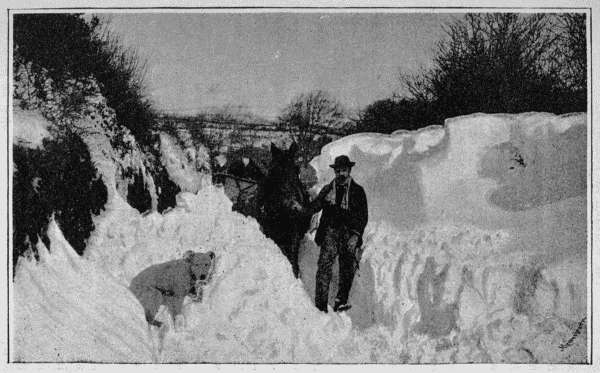
A road cutting scene was photographed at the time by
Mr. Rowe, of Devonport, to whom we are indebted for the
view. The loss of cattle here was very great, nearly every
farmer having suffered. A large number of cattle, sheep
and ponies in the possession of residents of the neighbourhood
grazed upon the adjacent moor, and many of
the former, at all events, perished. Mr. Linerdon, of
Yelland, lost cattle to the value of over £100; Mr.
Pinney, of Diptfort, dug out 100 sheep from the snow;
while Mr. Heath, of Brent Mills, Mr. Vooght, of Lutton,
and Mr. S. Northmore were heavy losers. Mr. Luscombe,
of Hall, Harford, had on the moor 600 Scotch
cattle and 1,200 sheep, a large proportion of which he
has not yet recovered. Mr. J. Smerdon, of Brent, and
Mr. Hurrell, of Bradridge, lost sheep; and Miss
Maunder, Mr. B. Hingston, and Mr. J. Hard lost
ponies. Until Saturday the residents of Binnicknowle,
a village about two miles from Brent, and largely dependent
upon it for supplies of food, were unable to
obtain provisions. On that day, however, a party of
labourers succeeded in cutting a footway and thus communication
was opened up.
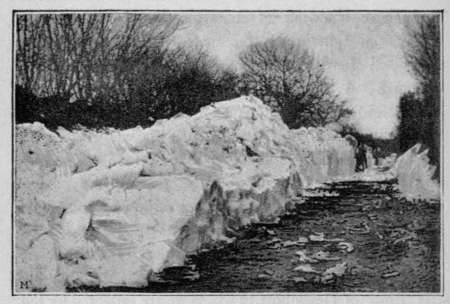
CUTTING A ROAD AT BRENT.
Brixham.—This historic fishing town, which has
before now witnessed some dreadful instances of the
disaster to life and property that furious gales with
blinding snowstorms can bring about, was not on the
occasion of the blizzard of 1891 allowed to pass off very
lightly. There was no loss of life, but some rather
serious injuries happened to the trawlers at their moorings.
At daylight on Tuesday it was seen that many of
these had fouled each other, by dragging their anchors.
In the inner harbour most of the craft had broken adrift,
running against the quays and other places, and doing
themselves all kinds of damage. One trawler, named
the Alice, which broke adrift at high tide, was carried up
to the head of the harbour with her bowsprit eight feet
in over the Strand, close alongside the Prince of Orange
statue. About 200 feet of the breakwater was washed
away, and its pedestal was lost. Timber in large
quantities was washed away from the yards of the
principal shipbuilders, and in addition to the wreck of
the French brig, and others before mentioned, a boat
was driven on the rocks at Fishcombe, and the Seamen's
Orphan Home lifeboat went ashore, and was badly
knocked about. In the town many houses were unroofed,
and slates flew about, serious damage being also
done to a wall and embankment in Higher Street.
Large quantities of glass-roofing were smashed in, and
a good deal of glass was destroyed at Newmarket
Hall. Many farmers lost sheep and lambs in the snow-drifts.
Bude.—The outside world and Bude were not so
thoroughly estranged during the days succeeding the
storm as was the case in some other instances, telegraphic
communication remaining unbroken. All the
other inconveniences of the blizzard—absence of mails,
presence of immense drifts of snow, and similar discomforts—were
freely experienced. There was an anxious
time among the shipping interest in the port, many of
the coasting vessels being at sea at the time the hurricane
was raging. These vessels did not all escape
without calamity, but, on the whole, the damage wrought
to the shipping of Bude was not great.
Calstock.—The mining town of Calstock received
some rough treatment during the Monday and Tuesday
of the storm, and damage was here and there done to
house property, but as far as the town was concerned it
may be safely said to have escaped marvellously well.
Bearing in mind its exposed position on the river bank,
and the many tall chimneys that rear their heads from
the hillside, it is singular that no smash of any magnitude
has to be recorded. This is all the more remarkable
when the tremendous destruction that occurred in
the district, and even close to the town, is considered.
On the opposite side of the river, the tracks leading
through the woods to Buralston Station were rendered
nearly impassable by the number of trees that fell, and
the whole wood through which the path runs was a
complete wreck. Mr. James, at the Passage Inn, from
which the ferry leaves to cross to Calstock, was very
unfortunate, his loss being a severe one. In addition to
great damage to his rose-trees, for which his house has
for many years been famous, the well-known blossom-covered
wicker bower, standing to the left of the house,
was blown bodily away into the orchard, and almost
simultaneously his cherry and apple trees began to fall.
Of these he lost fifty-six.
One curious incident happened at the grounds of Mr.
James, in the apparently narrow escape of a couple
of geese. The geese were sitting behind a barn, with
twenty-two eggs under them. During the storm of Monday,
the barn having been badly knocked about, and the
whole orchard in a state of wreck, the fate of the geese
was not held in much doubt, and the depth of the snow
in the place making salvage operations very difficult, their
place of concealment was not reached until Thursday
after the storm. The snow being cleared from the back
of the barn, however, the geese were found still sitting in
the same position as that in which they had last been
seen. With the exception that they had evidently worked
their heads about, keeping the cavities large enough to
give them breathing room, it was quite clear that they
had not attempted to move. Warm food and hay were at
once given to them, and they were made as comfortable
as possible, and in due course, eleven goslings were
hatched from the twenty-two eggs upon which the parent
geese had sat through such a trying time. The young
geese are now as sturdy as could be desired, and Mr.
James is naturally very proud of them for having seen the
light in spite of such difficulties. The mother geese will
also, in all probability, be preserved as curiosities for some
time to come.
On the other side of the river a shed belonging to
Mr. Goss's shipbuilding yards was blown down, and
cattle-sheds were unroofed and carried great distances
by the force of the gale. At Danescombe Bottom, at the
foot of Kelly Rock, an iron schooner, the Naïad, 250 tons,
owned by Captain Samuels of Calstock, was blown over
on her beam ends. The river banks, against which the
masts of the vessel struck, only prevented her being
turned completely over. After considerable labour she was
righted, but was found to have sustained some damage.
At the Rumleigh Brick-works, and at the yards of
Mr. Roskelly, builder, of Albaston, much injury was occasioned.
The mineral and goods line, the property of the
East Cornwall Mineral Railway Company, running from
Calstock to Kelly Bray, near Callington was blocked with a
drift of snow some eight feet deep, and work was stopped
for two days. At the end of that time it was cleared by
a gang of the company's own men acting under the direction
of Captain W. Sowden. On the same property about
fifty yards of fencing were completely levelled. Honeycomb
House, about two miles from Calstock, was damaged
to the extent of about £100; Mr. Gill, of Tray Hill, lost
over 100 apple trees, and Mr. German 250 fruit trees.
The heaviest damage to trees was at Cotehele Woods, the
property of the Earl of Mount Edgcumbe, and overlooking
Calstock, which would appear to have received the
full fury of the blast. The terrible night passed here, and
the extent of the destruction to timber, will be found
dealt with at length in the chapter on Parks and Forests.
Camborne.—The change at Camborne would appear
to have been an unusually startling one, since a few days
before Monday, butterflies were to be seen flying about.
Snow commenced to fall in the district at two o'clock on
Monday afternoon, and this soon developed into the
blizzard. The storm is described as the greatest and the
most severe known by the oldest residents in the parish.
The telegraph wires were blown down, and, lying across
the streets, threw several horses down. The houses were
so covered with snow as to be almost unrecognizable, and
in many places the drifts were over six feet deep. Ornamental,
and other trees in the town were completely
spoiled, and traffic was suspended. Anxiety was at one
time felt in the town for the safety of four young girls,
dressmakers, of Beacon village, who left the town on the
Monday evening, but it was afterwards learned that they
were all in safety. In Burse-road and Pendarmes-road
the shrubs and trees were broken down, and lay overhanging
and obstructing the footpaths. Passages had to
be cut to get to the houses, half as high as the houses
themselves. A 'bus running between Camborne and
Truro was snowed up near Pool, and left in the road; and
near it was an abandoned organ, the peripatetic performer
on which had been unable to bear it with him to
a place of safety.
At a village about a mile and a half from Camborne
drifts of snow were observed thirty feet deep. In the
town the Board schools were closed for the week. All
communication with surrounding towns was, as a matter
of course, cut off for several days. At Beacon and
Troon, adjoining villages, people were taken from their
bedroom windows by means of ladders; and in one case,
at a funeral, the coffin had to be slid down over a
snowdrift. At Breage a woman was found dead in the
snow. Farmers were busy in every direction rescuing
their cattle and sheep from the exposed positions, but the
losses in the neighbourhood were very great, hundreds of
sheep being buried. Among others who suffered in this
way were Mr. Carter, of Troon, who lost nearly twenty
sheep and lambs; Mr. Hickens, of Tregear; Mr. Glasson,
of Crowan; Mr. Josiah Thomas, of Roskear, Tuckingmill;
and Mr. P. Thomas, of Camborne. Several
donkies and ponies in the district perished. The little
villages of Penponds, Kehelland, and Pengegon, presented
a wretched appearance, and at Penponds especially
it was impossible to distinguish any hedges. Mr. E.
Rogers, who had undertaken to carry out some funeral
arrangements at this village, was obliged to take the
coffin over hedges and ditches in order to get it to the
house. At Pengegon, where the water-supply is solely
obtained from wells and springs, it was found necessary
to use melted snow for domestic purposes. The old
thatched farmhouse of Pengegon, on the Wednesday,
when the sun shone, presented a strikingly beautiful
appearance, and was a prominent feature of the landscape.
The village of Treslothan also shared the effect of the
storm. Trees were damaged and blown down in large
numbers, and even as late as Good Friday snow nearly
a foot deep lay on some of the paths. A large amount
of damage was also done to trees and shrubs at
Reskadirmick, the abode of Captain W. C. Vivian, the
beautiful carriage drive to the house being terribly
disfigured. At the factories and mines business operations
were, for some time, entirely suspended, and it is
calculated that during the week quite a thousand persons
of both sexes were enforcedly idle. Work might have
gone on at the factories, but in many cases the
operatives were unable to leave their homes. At the
mines there was great anxiety, it being feared that the
engines would stop for want of coals. Passages were,
however, in time cut through, and not more than two or
three engines actually ceased working. Cuttings were
made from the railway station to South Condurrow and
Wheal Grenville mines, a distance of more than a mile.
So urgent was the need for coal at West Seaton mine on
Saturday, the 14th, that forty miners were sent to help the
labourers from Portreath to make a road from the railway
to the mine. The Wheal Grenville and Newton mines
were stopped for want of coal for some days. At
Dolcoath, however, considerable difficulty was experienced
on the floors in getting a sufficient supply of water to work
the stamps, owing to the leats being blocked. At the
fire stamps, in particular, both engines for a time ceased
work, and operations were not again renewed until late
on Tuesday afternoon. The openworks suffered considerably,
as it took nearly the whole of the week to
clear away the snow from the frames and huddles. The
miners themselves were greatly inconvenienced owing to
some of their homes being situated at a distance from the
mines, and their being unable to get to their work; while
many who had been working underground during the
afternoon, found, on coming to the surface, that they
could not reach their residences. At Crowan, the Rev.
H. Molesworth St. Aubyn, organized and worked hard
with a body of men to help in opening up communication
with Camborne.
Camelford.—At this place experience, for almost the
entire week, was very bitter. The residents were absolutely
shut in from Monday to Friday. The last sign of
the outer world was when the North Cornwall Coach,
notwithstanding the snow already accumulated on the
moors, passed through on its way from Launceston
to Wadebridge. The market on Thursday was a dead
failure, no live stock being obtainable, and carcases
very scarce. There were many narrow escapes met with,
but no actual loss of life occurred. As the week passed
away provisions became very scarce, and there was a
growing alarm. On Friday, however, four persons on
horseback, unrecognizable from the quantity of snow that
covered them, entered the town in single file. The
party consisted of Mr. George Martyn, late of Trewen,
Manager of the North Cornwall Coach Company, Mr.
Hicks, one of the clerks at Wadebridge, and the coachman
and guard of the coach which had gone through on
Monday. The party, who brought with them a very
welcome copy of the Western Morning News, held an interview
with Mr. Evelyn, the Town Clerk of Camelford,
and subsequently, under the direction of the road-surveyor,
a body of men was organized to cut through the
three miles of snow-covered road between Camelford
and Wadebridge, for the purpose of opening up a means
of obtaining provisions from the latter place. This was
ultimately accomplished, and by Tuesday, March 17th,
the North Cornwall Coach was once more able to run to
Launceston, and the Mail, from Camelford to Boscastle,
also ran. Hundreds of sheep were lost, the drifts of
snow being so high that much time was lost in getting at
those that were buried beneath, and they were taken out
dead in large numbers. Mr. Pethick, Mr. Inch, Mr.
Lobb, and Mr. Greenwood, in addition to many farmers,
suffered severely in this respect.
Cargreen.—At this riverside village, situated on the
banks of the Tamar, the gale of Monday and Tuesday
caused great havoc among the fruit-trees. Mr. E. Elliott,
of Landulph, lost about three hundred apple-trees, many
of which had been planted by himself thirty years
before.
Dartmouth.—At Dartmouth the storm was severe,
and all telegraphic communication was cut off during the
week of the gale, but by the following Sunday a staff of
telegraphic engineers had restored communication with
Exeter by a single wire, and also with Brixham. On
one night during the week a wall gave way at the
Castle churchyard and fell on to the rocks beneath,
carrying with it several tombstones, and disturbing the
coffins in the graves. At the market on Friday morning
buyers arrived in the town by train, from all parts, for
the purpose of buying provisions, but their journey was
fruitless, as the farmers had not been able to get into
the town, the roads being impassable for vehicles.
Railway traffic was only partially suspended, but the
first through communication to Kingsbridge was not
effected until Monday the 16th, when Mr. Sanders,
driver of the Dartmouth coach, managed, with the
assistance of Mr. Cross, of Strete, Mr. Watson, of
Chillington, and a number of volunteers, to get a conveyance
through from Dartmouth. They had to cut
their way through about two miles of snowdrifts, which
in many places, were upwards of six feet deep. When
Mr. Sanders and his party got to Frogmore they invited
the co-operation of the villagers, offering money and beer
for help. This, however, was declined, but the party
arrived in Kingsbridge shortly before three o'clock,
about two hours later than the usual time of the arrival
of the Dartmouth coach. Messrs. Cross and Watson
rendered admirable service. The only papers delivered
between Dartmouth and Kingsbridge since Monday the
9th, were the copies of the Western Morning News and
Western Daily Mercury distributed by Sanders along
the line of route on Thursday and Saturday. Among
other damage enormous destruction was done to the
plantation at Blackpool, almost the whole of the young
trees being spoiled.
Dawlish.—During the progress of the storm at Dawlish
on Tuesday, the Ladies' Bathing Pavilion, which
stood on the beach in front of the Marine Parade, was
carried away by the sea, and almost entirely destroyed.
The pavilion was erected by a limited liability company
in 1880, and the annual income accruing from it had
reached between £70 and £80. The fishermen and
others of this attractive watering-place sustained great
losses by the destruction of fishing and pleasure boats.
At the Coastguard Station the boathouse was partially
unroofed, and large blocks of granite were hurled a great
distance. As on Plymouth Hoe, the iron seats on
the sea-wall were rolled over and broken. Houses in
various parts of the town lost chimney-tops and slates,
and some large trees, standing in the grounds of the
Manor House, were stripped of their branches. At
Dawlish Water, a cow, belonging to Mr. Dufty, was
killed by a falling tree. Discomfort was experienced by
the few passengers who travelled from Exeter to Dawlish
on the night of Tuesday, by the train which should have
reached the latter town by about eight o'clock. On
reaching the boathouse, near Powderham Castle, a block
in the shape of a snow-drift was encountered, and the
passengers made for a hut which was found not far off,
and a fire being got alight, they remained there until five
o'clock on Wednesday morning, when a relief engine and
snow-plough, with a carriage, arriving, they were conveyed
to their destination.
Ermington.—Roads everywhere here were completely
blocked for a week, and neither supplies of provisions,
letters, nor newspapers were received. The farmers were
great sufferers, scores of sheep having been buried in the
snow, which in some places was fifteen feet deep. The
work of digging out the sheep commenced during the
bright weather of Wednesday, when many ewes were
found to be dead, the lambs, in some cases, being found
alive by the side of the dead mothers. Instances were
met with as late as Saturday where sheep got out of the
snow fresh and vigorous, after having been buried since
the Monday. At Kingston, near Ermington, nearly
thirty sheep belonging to one farm were blown into the
sea, and from Ringmore, another village in the same
district, 350 sheep were lost.
Exeter.—In addition to the interference with railway
traffic, and the collapse of telegraphic communication
between the capital of the county and the other portions
of Devon and of Cornwall that has been already briefly
described, great inconveniences were experienced in the
city and all the surrounding villages through the violence
of the wind and the depth of the drifts of snow. Several
accidents to house property, in the way of falling chimneys
and walls, occurred, but nothing of a particularly
serious nature was heard of. Business was partially suspended,
and the streets were almost entirely deserted.
Great interest was felt in connection with the railway
blocks further west, and various exciting rumours were
circulated from time to time, many of them being, fortunately,
without foundation.
Exmouth.—In the outlying districts in the neighbourhood
of Exmouth, a peculiarity in connection with the late
blizzard that also struck observers in many other parts of
Devon and Cornwall, was very noticeable. This singularity
was that localities, commonly regarded as the most
sheltered, suffered most severely. In such situations the
drifts became impassable, and the cottagers were without
fresh supplies of provisions until footways were cleared
across fields. The narrow lanes were filled with snow.
Near the Littleham Church the drift was so deep, that a
tunnel was made sufficiently wide and high for carts to
pass through. At one part of the road leading from
Lympstone to Withycombe, a lane had to be cut for a
considerable distance, the drift being five or six feet deep.
By the end of the week the Exmouth streets were all
clear, and business was going on much as usual.
Falmouth.—Some of the disastrous effects of the
blizzard at this sea-port have already been recounted, but
Falmouth was unfortunate in other respects, besides being
the scene of so many wrecks with attendant loss of life.
The weather has been described by residents as the
heaviest experienced in the district since 1853. Scarcely
a house exposed to the gale escaped injury, and in many
cases property suffered severely. Were there space to
record them, innumerable instances could be given of
roofs being blown off, chimneys having fallen, and
marvellous escapes of residents having occurred during
these accidents. At the well-known "Curiosity Shop"
of Mr. Burton, a slate from some opposite premises went
through a large window, and two vases within, valued at
£85, narrowly escaped destruction. The back premises
of Mr. Webber, jeweller, which overlooked the harbour,
were completely washed away, and all the fowls in the
fowl-house were drowned. In the rope-walk several fine
Cornish elms were uprooted, one of them cutting through
a neighbouring roof. Telegraph wires also were broken
by the falling timber, and many huge limbs of trees were
blown down outside Grove Hill. Between Monday
night and noon on Wednesday no train arrived at or left
Falmouth, and telegraphic communication being cut off
the inhabitants knew nothing of what was transpiring in
other parts. It was not until the Saturday evening that
telegraphic communication was re-established with Truro,
and two hours later a wire was got through to London.
Messrs. Fox & Co., shipping agents, having urgent
telegrams to send to London, despatched them via
France and Spain. The London morning papers despatched
on Tuesday reached Falmouth on Saturday
night, by which time postal affairs were commencing to
be put in order. All along the quays the damage to
small craft of every kind was immense, and the shore
was strewn with wreckage and crowded with damaged
boats. At one spot on the market-strand, between the
King's Arms and the establishment of Mr. Grose, a big
sail boat was driven ashore, followed by a coal hulk belonging
to Messrs. Vivian & Sons, the latter knocking down a
wall. The s.s. Carbon, belonging to the Falmouth Coal
Company, sank at her moorings in the harbour, and the
Harbour Board's steamer, Armenack, had a narrow escape
of being wrecked. About a dozen well-known residents
had trawlers, sailing-boats, and punts damaged or totally
wrecked, but these form only a small proportion of the
losses by the gale. Among the fishermen distress was
great, and, as already stated on another page, a fund for
their relief was inaugurated without loss of time.
Fowey.—At this sea-port very severe weather was
experienced. The whole country round was covered
with snow, and communication by telegraph, except to
Lostwithiel and St. Austell, was impossible. Fowey does
not appear to have experienced much of the effects of the
gale on Monday night and Tuesday, but a strong wind
with snow showers, visited the town on the following
Thursday. There were no casualties, and no great loss
of sheep, as, though many were buried in the snow,
nearly all were recovered.
Grampound Road.—Here snow commenced falling
at about noon on Monday, and continued with only a
few minutes' cessation for twenty-four hours. The
blizzard nature of the storm was most severely felt, and
among other distressing events hundreds of sheep were
lost. All telegraphic communication was completely
stopped. The last up-train from Penzance, due at
Grampound Road at about twenty minutes past eight in
the evening, was blocked by the snow a quarter of a mile
west of the station. The passengers were got out, and,
under the guidance of some of the villagers, made their
way across the fields, and took shelter in the hotels.
Strenuous efforts were made to extricate the train, but it
was not until half-past four on the following morning
that the difficult task was accomplished, and that the
passengers were enabled to proceed on their journey.
The loss of sheep in this district was very great.
Gunnislake.—Throughout the whole of Monday
night the blizzard raged in Gunnislake, and only slightly
abated its force on Tuesday. Havoc was spread on
every hand, and in one case a very serious accident, that
narrowly escaped fatal consequences, occurred. This
was at the house of Mr. Bowhay, surgeon, where a
neighbouring chimney crashed through the roof and fell
into the kitchen. Two servants and an infant child were
in the kitchen at the time, and one of the former was
knocked to the floor, and on being extricated was found
to have had her leg broken. The other servant girl and
Mr. Bowhay's child received cuts. On the opposite
side of the road a chimney fell upon a house named
East View, crushing in the end roof of a house in which,
soon after, and in a room immediately below that into
which the rubbish fell, a child was born. Large trees,
over fifty years' old, were rooted up and thrown across
the main thoroughfares. At Drakewell's Mine serious
damage was done to the roofs, and at Heath Cottage,
adjoining the mine, nine tall Scotch firs, which stood
within fifteen feet of each other, were rooted up, and left
lying in all directions.
Helston.—At Helston, every road leading to other
towns was blocked up. No newspaper arrived, nor were
any mails sent off until Saturday. Telegraph wires and
poles, and innumerable trees were blown down, the
plantations in the district suffering severely.
Hemerdon.—No less than six engines were snowed
up on Monday night in the neighbourhood of Hemerdon,
many of them containing parties despatched from Plymouth
by the Great Western Railway to the relief of the
train that left Millbay Station at 6·50 on Monday night,
and was snowed up on a bridge some distance beyond
the Ivybridge Viaduct. In two cases timely rescues
of drivers were effected by Mr. Harold S. Williams, of
Torridge, the story of which will be found related in
a subsequent chapter. One very sad fatality occurred to
the wife of a miner, named Ann Farley. She left
Plympton on Monday afternoon to visit her father at
Hemerdon village, and setting out for her home in the
evening would appear to have lost her way, as her body
was found on Thursday evening in a field at Lobb Farm,
in about three feet of snow.
Honiton.—In a path field leading from Offwell to
Land Wood, in the Honiton district, on the Sunday
morning following the Monday and Tuesday of the
blizzard, the body of a man named Bidgood was discovered.
It transpired at an inquest subsequently held
that the man was a labourer, who had left work at Gittisham
Hill on Tuesday evening to proceed to his home at
Offwell. After calling at the New Inn, Honiton Hill, he
was not again seen alive. The body was found, lying flat
upon its face, by Mr. F. J. Harford, who was looking for
some sheep. In many places near Honiton the snow
drifts reached to a height of twenty feet, and it was
almost impossible to find the main road. Sheep were
buried in the snow in many parts of the district, and
large trees were rooted up and thrown across the road.
Ilfracombe.—At Ilfracombe, during Monday night, a
strong gale raged, and the brigantine Ethel, of Salcombe,
went ashore at Combemartin early on Tuesday morning,
and became a total wreck, but the crew were all saved.
The schooner Pride of the West, of Padstow, had her
bowsprit carried away, under Hillsborough, and was
towed into Ilfracombe harbour. Considerable damage
was done to property, and business for a day or two was
suspended. Five large trees were blown down in the
churchyard. The last train from Barnstaple to Ilfracombe
on Monday night was brought to a standstill in
the Burrow cutting, where the snow had reached a great
height. The passengers were got safely out, and proceeded
to the Fortescue Hotel at Morthoe.
Ivybridge.—A full share of destruction of every kind
was experienced at Ivybridge during the storm. Trees
fell in all directions, a large one breaking in the roof of
the newly constructed Navvy Mission Room. The
Navvy Missioner, Mr. MacLean, was in the room at the
time, and had a very narrow escape. Over a dozen trees
fell between the station and the village, most of them
being uprooted. For some time provisions in the town
showed serious signs of running short, but by a laudable
system of mutual accommodation between the residents
and tradespeople any actual privation was averted.
Several of the passengers by the 6·50 P.M. snowed-up
train from Plymouth on Monday night, and the down
night train due at Plymouth about 8 P.M. on Monday
night, also blocked at Ivybridge Station, were located in
the village, but some of the passengers, as late as
Thursday evening, were still in search of lodgings. The
railway guards and drivers were also in dire straits, and
Mr. Bohn (the proprietor of the London Hotel), promptly
and generously came to the rescue with free dinners to
the railway servants. Many hundreds of people visited
the scene of the principal block at Langham Bridge,
where the unfortunate train from Plymouth on Monday
night became embedded in a deep snow-drift.
Kingsbridge.—This neighbourhood underwent some
wretched experiences, not only during the blizzard of
Monday and Tuesday, but for fully a fortnight subsequent
to the storm. The roads leading to surrounding
towns were in a terrible condition through the fall of
snow that appears to have exceeded here the fall in any
other part of Devon, and the losses of farm-stock were
very great. The first episode occurred at seven o'clock
on Monday evening, when the mail-cart for Totnes was
snowed up after having proceeded a mile out of Kingsbridge,
and the driver was compelled to return with his
pair of horses, leaving the van in the road. The mail-bags
were brought back to the town on the following
morning. In another case, Mr. Waymouth, of Woolston,
four miles from Kingsbridge, started from the latter place
in his carriage for home on the same evening, but was
stopped by a fallen tree, and he and his coachman were
compelled to take shelter at Coombe Royal, and to
remain there until the following Thursday. There were
the usual instances of damage to house property, and
there was also tremendous destruction to trees, and to
the shrubberies of the various residences in the vicinity
of the town. All communication was cut off from
outside by the destruction of telegraph wires and
posts. The telegraph wires have been described as
presenting a very singular appearance, the coating of
hardened snow in many instances extending to a thickness
as great as six inches in diameter. No communication
with any other town was received or sent for four
whole days, and the post-office was closed for three
days, as no mails could be received or despatched.
Several commercial travellers who got into the town on
Monday were compelled to remain till Friday, when
they escaped from confinement by going to Plymouth by
steamer. The hardships endured in neighbouring villages
for a week were severe, some of the villagers having
been without coals, and, the bakers having run out of
flour, bread in sufficient quantities could not be
obtained. There was considerable injury to some
of the crops, and almost every farmer lost sheep in
the snow. Mr. Hooppell, of Bigbury, lost between
three and four hundred, the greater number of which
were probably blown into the sea. Mr. J. Langworthy,
of East Allington, lost about seventy sheep and lambs,
computed to be worth £300. Mr. S. Square, of Thurlestone,
also lost over 100 valuable sheep and lambs.
One gentleman had the task imposed upon him of
endeavouring to keep alive forty young lambs which
had lost their mothers.
Great havoc was wrought in the grounds of Coombe
Royal, the American garden being laid almost bare.
In the vicarage grounds many of the trees and shrubs
were blown down. Improvised sledges were used
during the second week by residents as well as the local
carriers, these being, indeed, the only vehicles that could
be used with any safety.
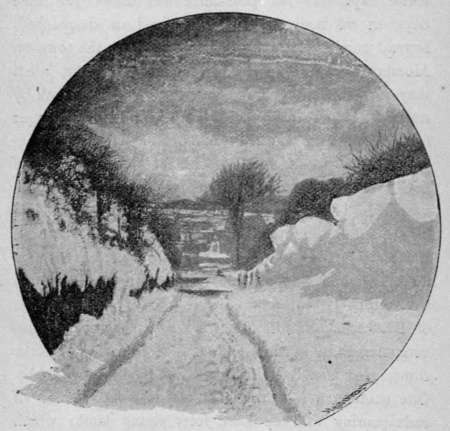
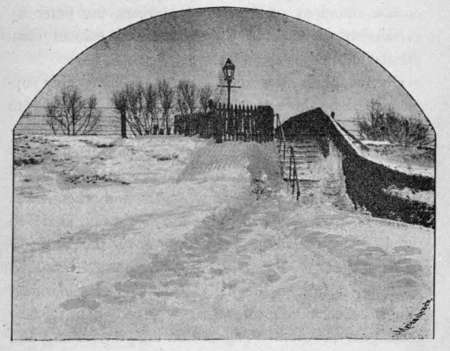
ST. CLEER ROAD, LISKEARD.
Launceston.—Considerable inconvenience was experienced
in Launceston throughout the week of storm,
but scarcely anything more serious. From Tuesday to
Thursday there was a complete cessation of intercourse
with other parts of the country, no mails being
despatched, or papers or news of any kind being
received, and no telegraphic service was available
throughout the week. Some damage was inflicted by
the wind to both glass and trees, and the roofs of houses
were more or less damaged, but altogether Launceston
was much more fortunate than the majority of west-country
towns.
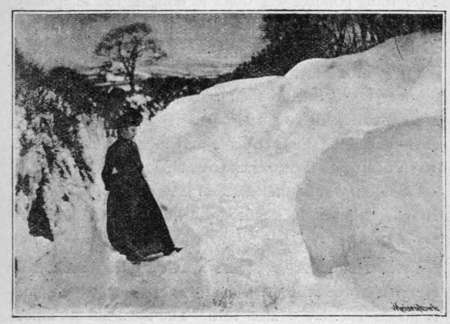
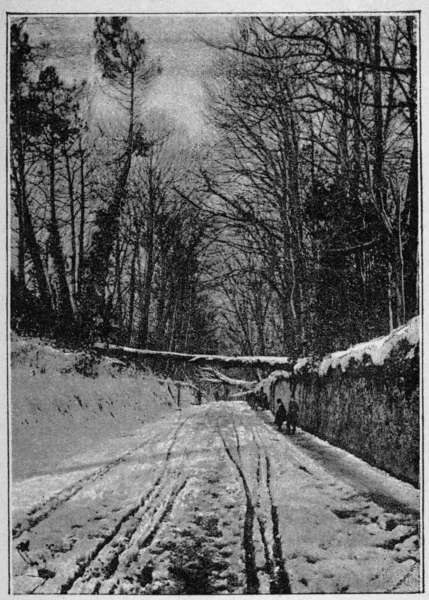
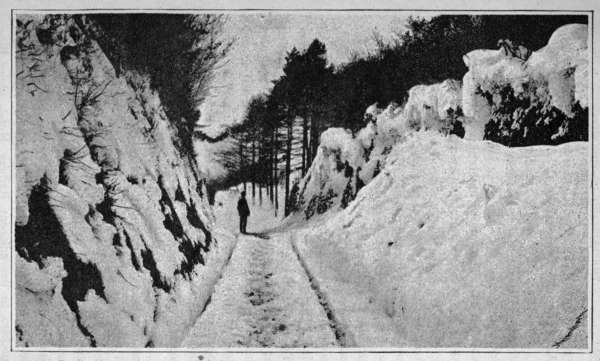
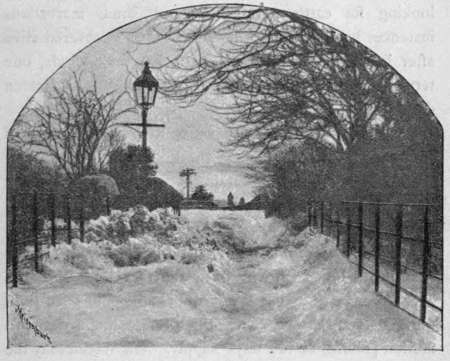
COLDSTILE LANE, LISKEARD.
Liskeard.—The greatest discomforts experienced at
Liskeard were those brought about by the impassable
condition of the roads, and by the blocking of the leat
on Bulland Down, which supplies the town with water.
The reservoirs on St. Cleer Downs were nearly empty
on Wednesday morning, when Mr. Sampson, the inspector
of the water, visited it, and found that an
immense snow-drift was blocking it on the north side of
the down. For nearly twelve hours a gang of men dug
at the drift, and succeeded in freeing the leat and saving
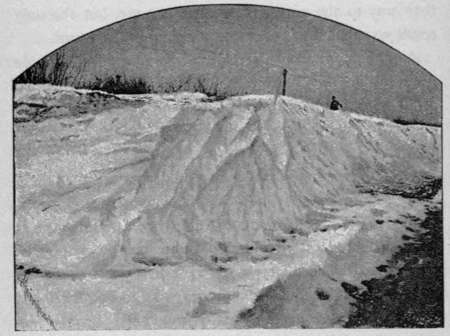
the town from a water famine. The leat was on a very
exposed part of the down, and the height of the snow-drifts
in the locality may be judged from the view we
give of one of these. The illustration is from a photograph
kindly supplied by Mr. A. W. Venning, solicitor,
of Liskeard. A horse and cart had been dug out from
this drift just before the photograph was taken. The
town was completely isolated for several days, and the
distress among the poorer inhabitants was very great.
Everything possible was done to mitigate the temporary
distress, relief committees being formed under the active
superintendence of the Mayor of Liskeard—Mr. T.
Lang. On Friday, after Thursday's snowfall, the rural
postmen could not go their rounds, the height of snow
in the roads being so great. Our view of Coldstile Lane,
near Liskeard (also from a photograph contributed by
Mr. Venning), which was impassable for days, reveals in
a forcible manner the state of this part of Cornwall.
Here, as elsewhere, hundreds of sheep were buried in
the snow.
Lyme Regis.—One of the heaviest snowstorms that
ever visited the south of Dorset was experienced at Lyme
Regis on Tuesday, March 10th. The town lies six miles
from the nearest railway station, and the only communication
is by two well-appointed three-horse 'busses. On
Tuesday the 'bus, with an extra horse, left the town at
nine in the morning, carrying the mails. The conveyance,
with great difficulty, reached the high hill
known as Hunter's Lodge, where, notwithstanding all
efforts, it was found impossible to proceed further. The
one lady passenger walked to the hotel at Hunter's Lodge,
while the driver, Mr. Blake, rode back to Lyme Regis
and obtained assistance. By the time the luggage and
mails had been transferred to a light waggonette the 'bus,
except for the roof, was invisible, and the roof was only
kept clear by the strong wind blowing at the time.
Later on the same night, the driver of the mail cart
from Illminster to Lyme started to do the journey on horseback,
driving being out of the question. On about the
same spot as the 'bus had been buried, the driver lost
his horse, and accomplished the rest of the journey on
foot, arriving at Lyme at one o'clock on Wednesday
morning. Both horse and 'bus were eventually recovered,
and the mail carts resumed running on
March 17th.
Mevagissey.—The gale of Monday and Tuesday raged
with great fury at Mevagissey, blowing from E.S.E.,
accompanied by blinding snow. On Tuesday morning
the parapet of the new breakwater on the southern
side of the harbour was found to have been washed
off for a distance of two hundred feet, and the sea
was rushing through the gap. By the end of the
week the breakwater was in three parts, and it was feared
that the whole structure would have to be taken down.
The damage was estimated at over £10,000. The fishermen
suffered greatly through the loss of herring and
pilchard nets, which were shot at anchor in the bay, and
swept away by the gale.
Modbury.—The blizzard was very destructive in the
Modbury district, and the town was completely isolated
from the Monday to the Saturday. On Monday evening
several farmers who had attended the market and left for
their homes, were driven back, and had to remain in
Modbury several days. The loss of sheep in the neighbourhood
was unusually large, it being estimated that
within the postal district of Modbury nearly one thousand
sheep were lost, besides several head of cattle. Some of
the snow-drifts were immense, and one labourer had his
house completely covered. A boy, who had been sent on
Monday to deliver bread at some neighbouring villages,
was discovered in the evening sitting in the trap almost
insensible from cold, while the trap was nearly buried in
the snow. The horse was released, and the boy taken
to the nearest house, where he soon recovered.
Newquay.—At Newquay there was a great fall of
snow, and many sheep were buried. Mr. T. Cardell
lost over 100, and other farmers as many as forty each.
A man named Ambrose Matthews, a hawker of wild
flowers, was found dead under three feet of snow in a
field near Tower Lane, where he was probably trying to
crawl into a shed for shelter. He was last seen selling
flowers in the town at half-past eight on Monday night.
Newton Abbott.—The greater part of the railway
traffic at Newton Abbott was suspended. The last up-train
that arrived on Monday was the 4·30 P.M. express
from Plymouth; and the Monday evening's mails from
Paddington, and Tuesday morning's Bristol and Newton
Abbott travelling post-office, which arrived several hours
late, were unable to proceed further than this town, and
about one hundred passengers were compelled to remain
in Newton. There was, in the streets, an average depth
of three feet of snow, whilst in some places the drifts
were from ten to twelve feet in height. Considerable
damage was done to the trees and shrubs in the park,
and in the private gardens.
Padstow.—This was another town that suffered very
severely. Great quantities of unexpected snow fell, and
the gale was terrific on Monday night and all day on
Tuesday. People who were out of town on the Monday
night had great difficulty in returning to their homes,
and one woman, named Rebecca Chapman, did not
succeed, but was found buried in the snow on the
following Sunday. Miss Chapman, of about sixty-two
years of age, who resided at Crugmere, about a mile-and-a-half
from Padstow, had been in the latter town on
Monday, and left for home at about seven o'clock in the
evening. At a place named Trethillick she lost her way,
and calling at one of the houses in the village was put
upon the right road. She was never again seen alive.
On perceiving on Tuesday that the woman was not at
home, the neighbours raised an alarm, and search parties
were instituted, but the body was not recovered until the
following week. From the position of the body when
found, it would seem that the unfortunate woman had
mistaken the gate of the field in which she was lying for
that of her own home, and, entering the field, had fallen
exhausted. Her basket, containing the provisions she
had bought in the town, was found lying beside her.
When the storm was at its fiercest, on Monday evening,
the dandy Louisa, of Exeter, in entering Padstow harbour,
ran into the schooner Ballanheigh Castle, and damaged
her galley and bulwarks. A praam, weighing nearly a
ton, which was lying keel upwards on the quay, was
caught during one of the squalls, and carried completely
over the quay. On many farms large numbers of sheep
were buried, but in most cases these were rescued alive.
Paignton.—Great damage was done at Paignton on
Monday night and Tuesday. The roof of one wing of the
house of Sir Thomas Seccombe, K.C.S.I., on Coninence,
was blown in, and crashed through the building, but nobody
was hurt. In the Totnes-road the roof of Miss
Scale's house was blown off, and several trees were blown
down. The landing-stage of the Promenade Pier was
washed away, and the sea-wall front of Redcliff Tower
undermined. The Artillery Volunteer ammunition shed
was completely wrecked. A tall elm at Dr. Goodridge's
residence fell over and nearly crushed the roof. Steam
launches were much injured, and several fishermen lost
their boats.
Penzance.—During Monday night's storm, at Penzance,
there was such a terrific sea running that the
north dock gate was unhung, and much damage was
occasioned to the shipping in the port. Some of the
most beautiful trees in the vicinity were ruined. On the
following Tuesday the storm continued, and business
almost entirely ceased, no shops being opened for the
day. There was a good deal of anxious looking out for
the return of travellers who had left the town before the
commencement of the storm on Monday, but by degrees
they either returned or their whereabouts was ascertained.
At Wheal Vor, Breage, however, a woman,
sixty years of age, perished in the snow. Supplies of
food were almost daily fetched by boat from Penzance
for little fishing villages in the district, and a small coasting
steamer was chartered to take in a stock of provisions
and land it on the sands at Porthcurno, just within sight
of Logan Rock.
Plympton.—At Plympton, matters were very serious.
Hundreds of trees were destroyed, and large numbers of
sheep died from exposure and starvation.
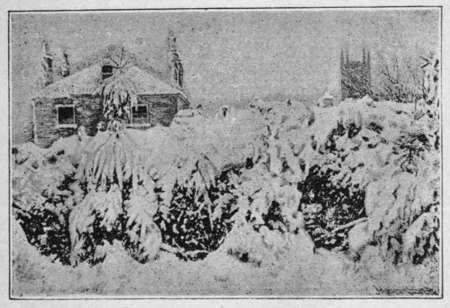
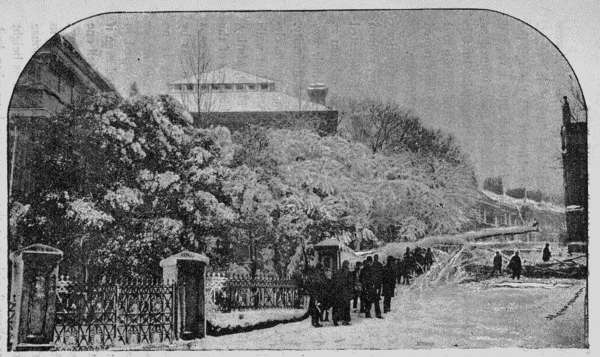
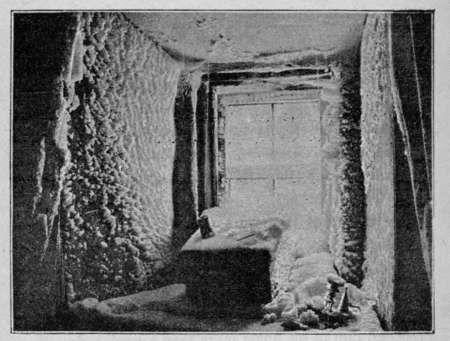
CHURCH, AND CHAPLAIN'S HOUSE, PRINCETOWN, DARTMOOR.
Princetown.—This moorland town passed through
some trying experiences during the storm week. The
roofs of several cattle and sheep-sheds were blown away,
and every house in the neighbourhood suffered considerable
damage. A part of the church roof was unslated,
and the church itself, and the chaplain's house, were
almost buried in the snow. An illustration shows the
condition of these two buildings, for the photographic
views of which, as well as for the picture of the convicts
cutting a road, we have to thank Mr. J. Richards, clerk
of works at the convict establishment, who took a great
number of interesting views of extraordinary scenes to be
met with after the blizzard. At the Prison Officers'
School, some four or five of the moor children had to
be detained all night, fires being lighted and hot
provisions provided. The block on the Princetown
railway line, where the evening train had been snowed
up on Monday evening, was a very serious one, and
it took a gang of fifty men and a snow-plough several
days to work through the accumulated mass. The inhabitants
were without letter, paper, or telegram from Monday
morning until Saturday, when the postmaster, Mr. W.
Tooker, with the rural letter-carrier, and a prison officer,
Mr. Rodway, who accompanied the party as a volunteer,
risked a walk to Yelverton. There they found twenty-five
bags of mails awaiting them. They succeeded in
walking back to Princetown, taking with them fourteen
bags of mails and a small quantity of newspapers, and
were received with much enthusiasm. No fear was felt
that provisions would fail at the prison, as there was a
large stock on hand, but it was deemed advisable to kill
a number of sheep and pigs belonging to the farm. The
roads were cleared after immense labour, some of this
work being carried out by convicts from the prison.
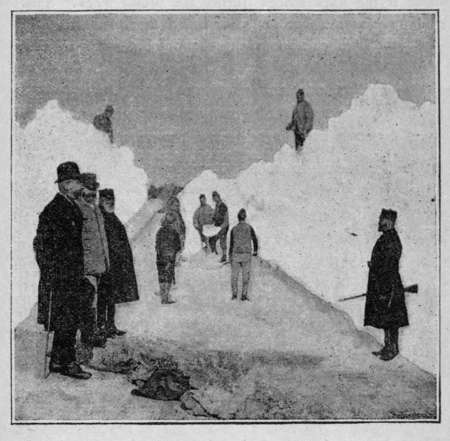
CONVICTS CUTTING A ROAD AT PRINCETOWN, DARTMOOR.
Redruth.—On the Monday and Tuesday at Redruth
there was such a storm as had not been known for thirty-five
years in West Cornwall. It snowed almost incessantly
for twenty-four hours, and left drifts, in some parts,
from ten to twelve feet deep. The trains could not get
into Redruth either from east or west for two days, and
even Camborne could not be reached. Trees in various
parts were much injured. There was little business done,
and the quantity of provisions brought into the town being
so small, the prices were of the most extravagant description.
Milk could hardly be obtained, and what butter
was in the market was sold at the price of 2s. per lb., a
heavy price for Redruth. There was a scarcity of coals
in the neighbourhood, and the stock (of coals) at the
brewery was exhausted before the end of the week.
Most of the roads in the district were impassable, and
it was found impossible as late as Friday to dig out the
vehicles that Monday's storm embedded in the Redruth
highway. Mining operations were greatly impeded,
tunnels in the snow having in some instances to be cut to
enable the miners to get to their work. There were many
rumours of persons missing since the memorable Monday,
and fears for their safety were entertained which in one
unhappy case proved to be only too well grounded. A
boy named Wallace left his work at the Wheal Basset
mine on the afternoon of the storm to walk to his home.
He did not reach it at the usual time, nor at all on that
day, and great anxiety resulted, search parties scouring
the country in all directions. At length, ten days afterwards,
his body was found in a snow-drift between thirty
and forty yards from his home. Another lad had a very
narrow escape. He was missed for some hours, and
was found almost unconscious in an outhouse, where he
had taken refuge under some straw. Not the least serious
inconvenience attending this week of disaster at Redruth
was the unavoidable postponement of a number of
funerals, to make way to the parish church and cemetery
being found impracticable.
St. Columb.—The advent of the blizzard at St.
Columb was sudden and unexpected, and the force of
the wind drifted most of the snow into the roads and
hedges in such a way as to completely stop all vehicular
traffic. In some spots the drifts were fifteen feet high.
No letters or papers arrived in the town from Monday
until Wednesday evening, and among other inconveniences
was the unavoidable postponement of a wedding
which was to have taken place. As this event was
not fixed for any earlier date than the last day of the
week, and could not take place then, some idea of the
condition of the country may be formed. The farmers
were apparently taken by surprise, as most of their
sheep were out, and hundreds were buried beneath the
snow. Many lambs and sheep were found at a depth
of seven or eight feet, and instances occurred of lambs,
who had been born under circumstances such as these,
being found alive and healthy. Buried houses were
by no means an uncommon occurrence. At Winnard's
Perch, about two miles from Redruth, a woman was
snowed in from Monday until Wednesday at noon,
when she was dug out. Great damage was also done
to trees, and for a time business was suspended.
St. Ives.—A tempestuous sea was the chief cause of
suffering at St. Ives. The blizzard blew mainly from
the E.N.E., and caused sad havoc along the coast on
Monday night and Tuesday. Ships in positions of
peril were occasionally observed, and the lifeboat crew,
with rocket apparatus, held themselves in readiness,
and in some cases, endeavoured to get near the endangered
vessels, but the tracks to the shore were impassable.
The window of a cottage on the Warren,
overlooking the sea, was blown in, and the sea rushed in
and partly filled one of the rooms. Slates and chimneypots
were blown about to the imminent danger of the
inhabitants. A man named Metters left St. Ives for
St. Just, with a donkey cart, on Monday, to sell herrings,
and after nearly a week's absence his friends gave him
up for lost, but he returned to his home on the following
Monday, having been snowed up at St. Just for the
entire week.
Sennen.—The Land's End district was altogether cut
off from other parts of the country from Monday to Friday,
and even after that time communication was only
effected with great difficulty. The snow-drifts were
immense, and many sheep and lambs were buried.
Supplies having begun to fail by the end of the week,
a shopkeeper inaugurated a novel expedition which,
grotesque as it was in its make-up and appearance,
succeeded in the object the organizer had in view. He
obtained a number of donkeys, and having placed
baskets upon their backs, formed them into procession,
he leading the way with a shovel, with which he cleared
a path to St. Just. There provisions were obtained, and
the adventurous tradesman, followed by his donkeys,—now
laden with well-filled baskets,—returned triumphant
to St. Sennen. Two cottages near the Land's End were
buried in the snow, and the cottagers had to be dug out.
The Rev. J. Isabell, of St. Sennen, by way of getting
the roads clear, set an admirable example. He headed
a party of some seventy men, all being armed with
shovels, and effected good work in making the parish
roads fit for traffic.
Taunton.—The train due at Taunton at seven
minutes past nine and the "Flying Dutchman" reached
Taunton at about the same time on Monday night, and
were unable to proceed further. Among the passengers
was the Duke of Edinburgh, on his way to Devonport,
who was detained for some few days, after which he was
enabled to reach Exeter, and from thence to proceed
without further mishap to his destination.
Tavistock.—Some account of the devastation caused
in this district by the storm has already been given. The
destruction to timber was especially heavy, but perhaps
the most serious feature of all is the loss of sheep and
cattle. Mr. H. Dingle, of Taviton, had over two hundred
sheep embedded in the snow, and a number of these
were taken out dead. Mr. Perkins, of King-street,
Tavistock, and Mr. Walkem, of Hartshole, also suffered
heavily in this respect. On the estate of the Rev. J.
Hall-Parby there was also a great loss of sheep. Out of
sixteen sheep buried in a drift, nine, belonging to Mr.
Warne, were dug out dead, while in the neighbouring
parish of Walkhampton the loss was still greater. Mr.
Giles, of this parish, dug out 40 dead sheep. Mr. J.
Squire, of the Bedford Hotel, had a flock of sheep and
lambs buried in the snow, on his moorland farm on
Whitchurch Down, but he succeeded in rescuing most of
them.
Teignmouth.—The destruction wrought on the sea-front
of this well-known watering-place and sea-port,
which has been briefly alluded to in earlier pages,
appears to have had the effect of waking up the residents
to a sense of the innumerable natural beauties that belong
to their town, and the advisability of preserving, and,
if possible, improving them. Not many months before
the blizzard of 1891, a gale from the south-east was near
demolishing that portion of the bank above the beach,
that has since fallen before the action of the waves, and
from time to time the dangerous position of the houses
abutting upon it, and standing within a stone's-throw
of the sea, has been pointed out by a large number of
the residents themselves. Nature has now taken the
matter in hand, and the probabilities are that a sea-wall
will be built that will extend from the "Point," or
lighthouse, to the Hole Head tunnel, a distance of over
a mile and a half, and thus the finest sea promenade
in the country will be secured.
Torquay.—The snowstorm was more severe at Torquay
than at any of the surrounding districts, the fall
having been heavier than at either Teignmouth or
Dawlish. Few mishaps occurred, however, and there
was not any really serious damage. Railway communication
with Exeter, London, and the north, was never
interrupted. Some injuries to trees occurred, and a few
telegraph posts were blown down, but, on the whole,
Torquay sustained its reputation as a desirable winter
abode.
Totnes.—Some novel incidents occurred at Totnes
during the week of the storm. The town was for days
completely isolated, the only journey possible in search
of news appearing to have been a perilous one, on foot,
to Brent, where ignorance of the doings of the outside
world was as great, if not greater, than at Totnes itself.
A number of travellers, among them Mr. H. S. Jenkins, of
the Western Morning News (who had gone to the town on
duty on the Monday night), were detained until the end
of the week, and all the inconveniences resulting from
an enforced imprisonment of such an unusual description
were experienced. The first indication of an actual block
on the railway was at about nine o'clock on Monday night,
when the down-train, due at Plymouth at ten o'clock,
arrived at Totnes station, and was not allowed to proceed,
as no communication could be exchanged with stations
further down the line. After hours of waiting, some of the
passengers sheltering themselves in the carriages and others
in the waiting-room (where they were made as comfortable
as circumstances would allow, Miss Inskip keeping
the refreshment-room open until four o'clock on Tuesday
morning), all were compelled to take up their quarters in
the town for what was to them, at that time, a very indefinite
period. There were, in the neighbourhood of
Totnes, great losses among the farming community,
hundreds of sheep being buried in the snow. One
farmer, of Ashprington, dug out a flock of fifty, of which
fifteen were dead. Orchards were completely wrecked,
and many fine forest trees were destroyed. In the town
the damage done to property was not very great, but the
glass roofs of several conservatories were broken in by
the weight of snow. The snow in the streets was three
feet deep, and in the adjacent country roads a depth of
from six to eight feet was recorded.
Truro.—At the cathedral city of Cornwall trade was
at a complete standstill for days, owing to the heavy fall
of snow. Snow lay three feet deep in all the roads outside
the town, and, going farther into the country, the
drifts were from ten to twelve feet deep. Great damage
was done to property, and some accidents, none of them,
however, having a fatal termination, occurred. To make
matters worse for those having business matters to look
after, the train service was altogether disorganised. The
"Dutchman" arrived on Monday night forty minutes late,
and then had to wait the arrival of the train from Falmouth.
This, due at Truro at 7·25, did not arrive until
ten minutes to nine. Its course was blocked by fallen
telegraph poles and wires, which had to be cut away
before the train could proceed, the most serious obstacle
being between Penryn and Perranwell. The "Dutchman"
had to pass by Grampound Road at full speed, or it
would probably have been in danger of being embedded
in the snow. It was only when the end of this memorable
week had been reached that telegraphic and other
communication with neighbouring towns was restored,
and that the city once more returned to its usual condition
of comfort and tranquillity.

 LORAL
LORAL