The bills and accounts quoted a few pages back, and others,
give ample evidence that most colonial smiths could read and
write—although their spelling (like George Washington’s) might
have a way of its own. At least one Williamsburg blacksmith,
Hugh Orr, seems to have been quite a reader; at his death in
1764 he left a library of about forty books. But neither he nor
any other colonial smith sat down to write out and illustrate a
description of the work he did and how he did it.
This is not intended to be a how-to-do-it manual either. A few
pages of text and pictures can hardly substitute for the apprenticeship
of as much as seven years through which a blacksmith
gained mastery of his craft. Only the close daily supervision of
an expert and years of practice will enable a smith to know when
the eye of his fire is large enough—but not too large ... when
the forced draft of his bellows has made the fire hot enough—but
not too hot ... when his iron is red enough—but not too
red ... when his hammer blows fall heavily enough—but not too
heavily to accomplish the particular job at hand.
Readers unfamiliar with the processes and products of a
smithy are likely to be strangers also to many of the smith’s
tools—which makes for something of a problem in trying to
describe them. For this and other reasons it seems wise to start
with what may be the most familiar items today.
Nails. In the early years of the Jamestown colony land was
plentiful and nails were scarce. They, like every other object of
iron—except the “little chissels” mentioned by Captain John
Smith—had to be brought over from England. When the soil
of their tobacco fields was worn out, planters simply took up,
cleared, and planted new land farther west. Sometimes they set
fire to buildings on the abandoned land in order to salvage the
nails for re-use, a practice that was forbidden by law in 1644.
However, nails were not difficult to make if one had a supply
of wrought-iron rods and a few tools. Frontier farmers—which
in eighteenth-century Virginia meant those living one or two
19
hundred miles to the west of Williamsburg—sometimes spent
winter days in nailmaking. The fireplace served as forge, and
even the younger members of the family could wield tongs, hammers,
and cold chisel or man the vise.
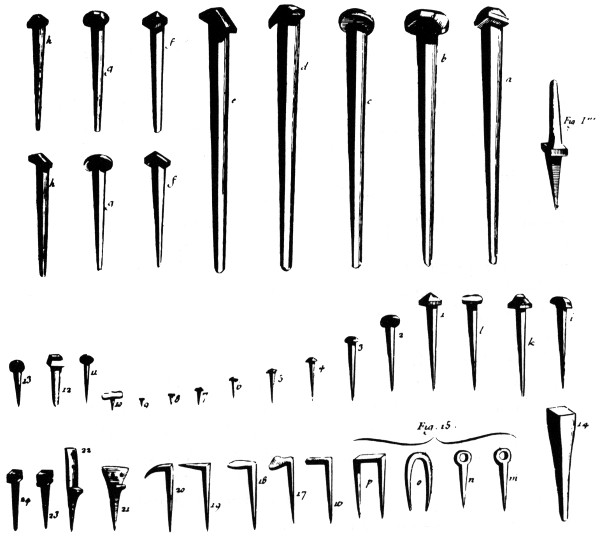
Nails and tacks of various sizes and shapes and for various special uses, from
Diderot’s encyclopedia. Figure 14 at the lower right is a wheel nail, for example.
Where there was a blacksmith, as we have already seen, he—or
more likely his apprentice—made the nails. James Anderson
estimated that eight boys could turn out twenty-five thousand
nails in a week. Isaac Zane, who had an ironworks in the neighborhood
of Winchester, owned “17 nailors tools great & small”
and “2 nailors anvills.” The smith probably started with iron
several feet long, about one-quarter-inch in width and the same
thickness, produced in a slitting mill. His first procedure was to
20
draw them down—and here we come to the first terminological
stumbling block. Drawing down (or drawing out or beating out)
is the smith’s phrase for thinning and lengthening a piece of
metal by heating and hammering it. The contrary process of
thickening—by hammering on the end of a rod—is called upsetting
and is the technique used in making the head of the nail.
Before he did that, though, the smith, having drawn down the
rod to the proper thickness for the nails to be made, cut them
to the desired length. Most likely he did this on a hardie, which
is like a chisel held with the point upward in the square hardie
hole of the anvil.
Horseshoes. Hugh Jones in 1724 wrote that horseshoes were
“seldom used in the lower part of the country, where there are
few stones.” It is true that the soil of tidewater Virginia tends
to be sandy and free of stones, so that horses could and did go
unshod much of the time. Yet there is ample evidence—some
of which we have seen in the accounts excerpted above—that
blacksmiths and farriers worked in the Williamsburg area at
making and mounting horseshoes.
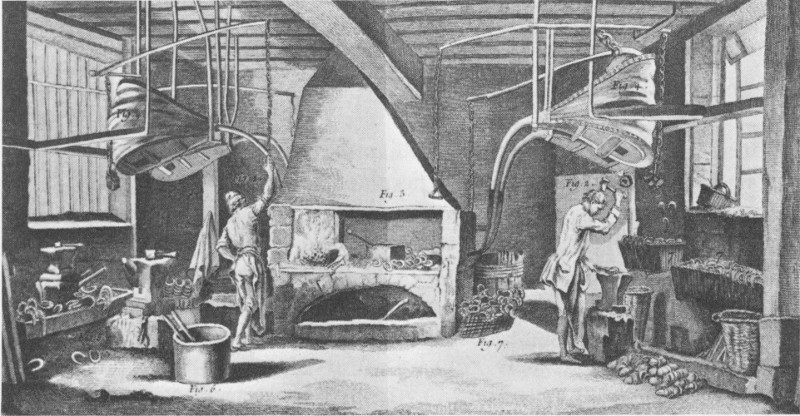
The forge of Master Delafosse, royal farrier, in Paris in the mid-eighteenth
century. From Diderot’s encyclopedia.
21
A smith who made, fitted, and applied shoes to horses, mules,
and oxen was properly called a farrier. The trade demands
knowledge and skill in handling iron, and also knowledge and
skill in handling the animals being shod. Because of his close
familiarity with these animals, his “horse sense,” so to speak,
the farrier often served the function of veterinarian too. More
often, however, it was the blacksmith who also served as farrier.
Horseshoes were made from bar iron, and they were normally
custom made to fit not just a particular horse, but a particular
one of his feet. Each shoe of a set of four will differ in one or
more respects—size, shape, or weight—from its fellows, and each
set may differ from others depending on the type of horse involved—draft,
riding, carriage, etc.—and the condition of surface
on which the shoes are to be used—ice, mud, stone, etc.
In addition, special shoes can correct defects in gait, guard
against lameness, and the like. To describe how a smith made
all of these possible variations is no part of this booklet. Suffice
it to say that in the making of a horseshoe all of the blacksmith’s
basic tools come into use: forge, anvil, tongs, and vise. Some
attention to each of these in turn will help to round out an understanding
of the workings of the smithy.
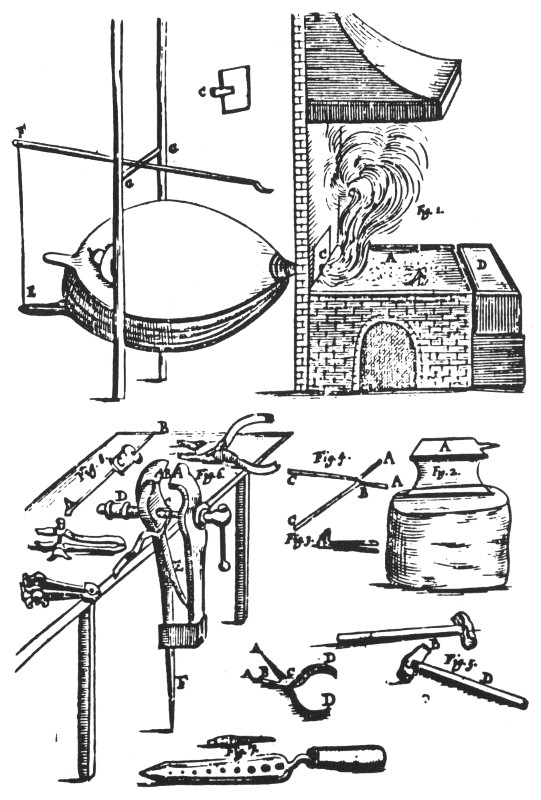
Forge. The blacksmith’s forge, which he sometimes calls his
fire, is the most important feature of his shop. It consists of a
square hearth, usually raised about two and one-half feet and made
of brick, with a bellows at the side or back to blow the fire, a
hood or hovel above to carry smoke and fumes away, and a
trough or tub of water close by in which to quench the iron or
cool the tongs.
The fire itself, of coal rather than charcoal, is always small
and concentrated, a few inches across in the center of a hearth
that may be four or five feet square. Around it lies unburnt fuel
that the smith can handily bring closer when needed. With his
slice—a long-handled, light-weight shovel—his fire-hook—a similarly
long-handled rake—and his washer—a bunch of twigs to
flick water around the fire—he carefully manages the size and
depth of the fire. With the bellows he regulates its intensity.
22
The blacksmith must be able to judge when his stock is hot
enough, and he does it by eye, the right degree of heat for a
particular operation being revealed by the color of the iron.
Blood-red heat is called for when the iron is not to be reshaped
but only the surface to be smoothed. Flame heat or white heat
is necessary when the work is to be hammered to a different
shape, drawn down, or upset. Sparkling heat or welding heat is
used only for the delicate and highly skilled process of welding.
Anvil. This is hardly less important to the smith than the
forge, as he does practically all of his work on it. The common
smith’s anvil, made of cast or wrought iron, may weigh up to
about three hundred pounds. It has had the same basic shape
since ancient times, each of its features being functionally tried
and perfected ages ago. The anvil’s upper surface, called the
face, is flat, smooth, so hard that a file will not cut it, and made
of cast steel welded to the wrought iron body. One end of the
anvil is a cone-shaped projection called the horn (also called beak,
bick, bickern, or pike), used to work curved or rounded pieces
of iron such as rings, links, or shackles. Between the horn and
the face of the anvil is a small square area called the table. Its
surface is not as hard as that of the face, and the smith places
on it any work he wants to cut with a cold chisel. Near the other
end or heel of the anvil are two holes, one round, called the
pritchel hole, and the other square, called the hardie hole. When
the smith intends to punch a hole through a piece of metal, he
positions it over the pritchel hole so that the punch will pass into
the hole rather than strike the face of the anvil. The hardie
hole (also called the swage hole) is designed to take the square
shanks of a variety of special-purpose bottom tools—which make
their impact on the underside of the work when the smith strikes
it from above.
Tongs. Iron being a metal that transmits heat readily, the
blacksmith often cannot hold the piece he is working on, even
with a gloved hand. He needs tongs to do the holding, and because
of the differing shape of different objects being worked,
he needs a variety of tongs of different shapes and sizes. These
23
he ordinarily makes himself. John Brush of Williamsburg, for
instance, owned “7 pair of Smiths Tongs.”
Hammers. It has already been said that the smith’s forge and
anvil are among his essential tools. So is his hammer—or rather
hammers, for he needs several of different shapes and weights,
as well as a sledge or two.
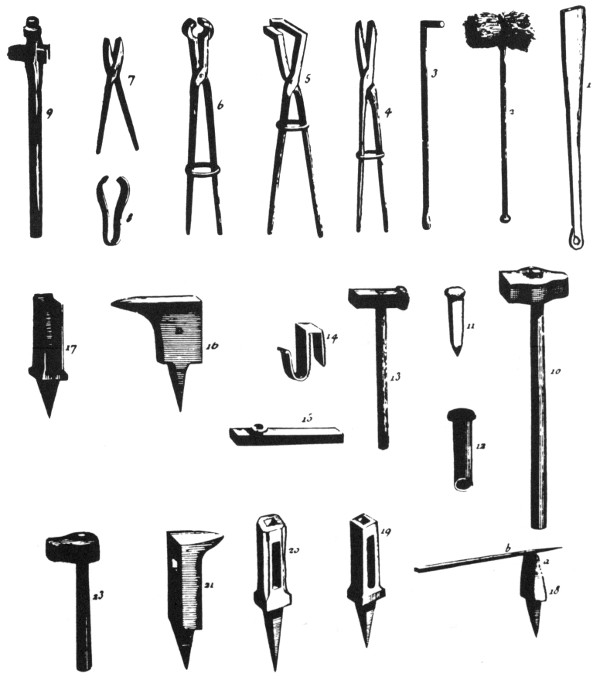
A small selection of tools such as would be found in almost any blacksmith’s
shop: fire tools, tongs, pincer, hammers, chisels, stamps, and stakes or hardies.
From Diderot.
24
Vises. Smiths’ vises are of two types, the large standing vise,
used to hold iron for bending, riveting, filing, or polishing, and
the small or hand vise to hold work of similar size. In both
cases the work will have already undergone the major part of its
forming on the anvil, and the vise comes into use almost solely
for finishing operations.
Other tools that have particular uses may be no less important
to the smith when he has occasion to use them. Among them
may be mentioned drills, swages, swage blocks, hardies, stakes,
punches, cold chisels, files, screw plates, flatter, fuller, header, and
mandrel. It is recommended to the reader who wants to know
the nature and uses of these and other tools in a smithy that he
become an apprentice to the nearest blacksmith; there is no better
way to learn.
Certainly no one can learn to anneal, braze, case-harden, temper,
lay, and weld iron just by reading about it. But we can at
least offer some definitions:
Annealing is the process of softening steel so that it can be
worked by cutting tools. It is done by heating the piece in the
fire to blood-red heat, then allowing it to cool slowly.
Brazing joins together two or more pieces of metal by the use
of a brass solder, called spelter. It is used when the pieces to
be joined are too thin to be welded.
Case hardening is the process of hardening the outer surfaces
of iron or steel, while leaving the core soft and therefore
tougher. According to Joseph Moxon’s Mechanick Exercises
(third edition published in London in 1703) it was to be accomplished
as follows: Cover the iron all over with a cement made
of powdered cow horn or hoof, coarse sea salt, stale urine or
white wine vinegar, and clay, with more clay added to enclose
the whole; when the clay has dried hard, put the whole lump
in the fire and bring it to blood-red heat, no more; then take the
iron out and quench it.
Tempering is the opposite of annealing, in that it slightly
softens and toughens iron or steel. It is accomplished by bringing
the object to the proper heat—which may differ according to the {...}
25
Laying was one of the most frequent operations performed
by colonial smiths. Such implements as axes, hoes, and plows
usually had wooden handles and wrought-iron heads, with a strip
of steel welded on to make the cutting edge or face. When the
last become worn, the process of replacing it was called laying
or steeling.
Welding two pieces of iron is at the same time very simple
in theory and very difficult in fact. At the proper heat the two
pieces placed firmly face to face will—if the faces are clean—stick
together without further ado. But accomplishing this feat
requires great skill with the fire and great quickness with the
hammer so that scale will not form on the surfaces to be welded.
Normally the weld is hammered together on the anvil to refine
the grain of the metal as it cools.
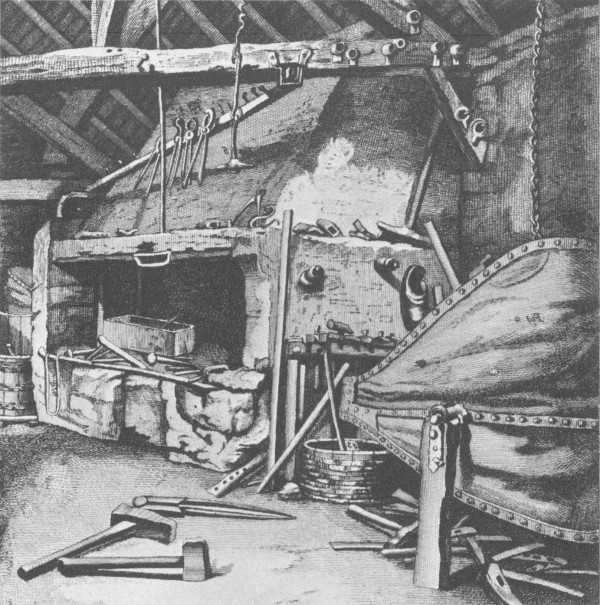
Another farrier’s shop, no doubt drawn on the spot with tools and equipment
just as they were seen by the artist. From Diderot.
26