In the yard of a third-rate inn, in a large
market town of one of the Midland counties,
stood a carrier's cart, ready to start for
home. In large letters on its side was painted
'John Sparks, Carrier to Parker's Due and Stoney
Gates.' Some of the passengers were seated; others
were busy arranging their goods ready for transit;
some were resting on their empty baskets, till the
carrier appeared, talking over the events of the market,
and comparing prices. The landlord was in and
out perpetually, with a glass for one and a joke for
another, looking with anxious (and, of course, benevolent)
solicitude around, lest a customer should escape through
want of care.
'Will John Sparks go to-night?' asked an old
woman peevishly. Her question was not addressed to
any one in particular; but the ostler, who was passing,
answered, 'He's not in the best company for making
haste at this present,' and nodded to a group of men
standing at the entrance of the yard, to which group
the busy landlord had made frequent visits, never
going empty-handed.
A general murmur arose as this speech circulated
among the passengers. 'Go and tell him to come,
granny,' said one; 'he'll mind you; if he stays
drinking there, we shall be upset, depend upon it.'
'And what's the use of my telling him?' replied
the old woman. 'It's hard work I have to make him
mind when he's sober; he'll only sauce me now he's
the worse for liquor.'
'You should get him to take the pledge,' said the
ostler; 'carriers' work is full of temptations, 'specially
if a man's got a taste that way.'
While Granny Sparks was considering how to get
John away from his companions, the thing was done by
the arrival of a fish-basket, followed by a smart-looking
maid-servant.
'Oh, not gone! that's well. Where's Mr. Sparks? I
was kept so long, I was quite afraid of being too late.
Put the fish in under that seat. Things there? oh,
they must come out then; the fish must go in safe.
Where's Mr. Sparks, I say? I should think the fish
for the Hall is to have the proper place.'
It was soon made known to the speaker that Mr. Sparks
was not far off, and, almost as soon, he was
seen hurrying from his companions, with a somewhat
blustering manner, which people are apt to put on when
they expect a deserved rebuke, and want to get out of it.
'We'd a' ought to a' been on the road this half-hour,
John,' muttered his granny.
'We're all right, Mr. Sparks,' cried those from inside.
'You may do what you like with my basket,' said
several, who would not attempt to arrange themselves
till the maid from the Hall had chosen her seat. 'I
hope you will start at once,' said that damsel, who
looked with superiority on those around; 'the fish is
for dinner, and we are never later than eight.'
'Off at once, miss, when you're seated,' said John in
as sober a tone as he could assume, and looking a
thundering look at his granny, who imprudently kept
up a low grumbling remonstrance on his behaviour.
The luggage was soon settled, in defiance of all opposition,
so that the fish had honourable stowage; and the
Hall maiden, declaring, as she stepped jauntily up, that
she could not abide the van, but it was a great
convenience, took the seat at the front, and all was ready.
Sparks, a little steadied, was mounting, and the
horse, which through the whole hurried scene had stood
motionless, his head hanging down, as if dreaming of
his own particular interests and affairs, awoke up and
prepared to step forward. But patience was to be
tried that day. In the entrance of the yard appeared
a tall thin individual, dressed in sober and somewhat
shabby clothes. He had his arms full of packages of
all sorts and sizes, and an urchin followed, bearing a
large basket.
'Deary me!' said Sparks, dropping the reins; 'if
there isn't Shady Eggs. Well, to think of his being so
late! Folks ought to be more considerate.'
'How excessive troublesome!' said the Hall servant,
who had herself wasted so much time in the town that
she had lost the early carrier, and run the risk of being
too late with the fish for the second.
Meantime, 'Shady Eggs' advanced. 'I rejoice,
Mr. Sparks, that you are yet here; be so good as to
accommodate these articles. Young man,' he continued,
to the boy with the basket, 'you can return; there is
a small remuneration for your trouble.' The lad
grinned, pocketed the remuneration, and the basket,
etc., were with some difficulty placed in the van. Miss
from the Hall kept up a continual series of shruggings:
her dress was invaded in some way by every package
that was put in, and there was as much vinegar in her
expression as beer in that of Sparks.
'If you'd a' knowed of coming, Mr. Eggs, it's a pity
you wasn't more for'ard,' she said tartly.
'It is a pity—I sit corrected,' he replied meekly,
trying to put his long legs into the least inconvenient
place.
'Nobody never quarrels with Mr. Eggs,' said the
carrier good-humouredly. The maid looked scornful;
but Shady acknowledged the courtesy by a bland smile.
They had cleared the town, and were advancing at a
reasonable pace up the road, pleasant hedges on either
side, and green fields around and before them, when
again they were brought to a halt. A traveller, who,
sitting on a milestone, was apparently awaiting their
arrival, stood up as they advanced, and cried out,
'Room?'
Sparks looked dubious; the maid said 'No;' but
Shady Eggs, with a complacent look, suggested that
with management room might be found. All the
company, except the one objector, seemed willing to
accommodate; they took their packages on their knees,
and sat closer.
'How excessive awk'ard!' said the angry servant;
'I really cannot carry more than this; I must have
room for this parcel on the seat.'
'Allow me to convey it for you, ma'am,' said the
imperturbable Shady; and, taking it from her as gently
as if it had been a baby, he placed it on his knees and
encompassed it with his arms. It was indeed a fragile
thing—enveloped in paper, like a light-brown cloud,
and bearing a printed declaration that it came from
Mrs. Davy's fashionable millinery establishment.
'It's our cook's bonnet,' condescended the maid,
not vouchsafing to thank Shady any further. Shady
looked affectionately at his delicate burden, as if the
whole van should perish before it should come to grief,
and the stranger was installed a passenger.
It was not very hard to read the characters of his
fellow-passengers. On faces worn by labour and
bronzed by exposure might be chiefly read family
cares—questionings of mind, perchance, as to whether
the 'second-handed shoes' would fit Tommy, or whether
Eliza would like her new place. Some were enjoying
the opportunity of canvassing village matters, and
others slept through all the joggings of the van. Such
as they were, he scrutinized all, and then fixed his
keen grey eyes on Shady. An amused expression
passed over his face as he noticed the grave care he
bestowed on his charge. Turning to the driver, he
began to question him as to the surrounding objects.
Not a building escaped; he would know everything,
and John was as communicative as any questioner
could wish.
'That building in the distance, among trees,' said
the stranger; 'it looks well—what is it?'
'What! you?' said Sparks. 'Why, that's the Jew,
sir; we shall pass it—it's one of my places I stop at.'
'The Jew?' said the stranger.
'The Dew, sir,' interposed Shady, with a look of
benevolent pity for Sparks' ignorance,—'Parker's Dew,
as it is commonly, but erroneously called.' This was
added with solemn importance.
'And what is the proper name?' asked the stranger.
Shady, with a conscious look round the van, that
betrayed his self-satisfaction, replied, rather pompously,
'Par grâce de Dieu, sir, which, if, as I suppose, you are
a French scholar' (another glance at the passengers),
'you are aware means, "By the grace of God."' The
stranger nodded. 'Originally, sir,' continued Shady,
drawing up his back to its full length, 'it was given by
the Norman William to the founder of the family of
De la Mark, in whose possession it has ever since
continued. There were strange ideas of right in those
days, as you, sir, if a student of history, must know,
and that which men got by the violence of the sword
they considered to be theirs by the grace of God. But
whether the name was invented by the Conqueror, or
given to the place by Mark de la Mark, the first lord
of the manor, and founder of the distinguished line, I
have not been able to discover.'
'What! have you ever tried?' said the stranger,
laughing. The laugh was infectious; Sparks laughed,
the Hall maid laughed, with something like scorn, and
all the van grinned, though those at the back had not
heard the conversation. Shady's equanimity was not
broken; he surveyed all with a surprised—perhaps a
little injured—but forgiving air, and was silent.
But the stranger had no wish to silence him. He
plied him with numerous questions as to the place,
its owner, etc., to all of which Shady replied with
perfect good temper, but more reserve.
'You seem to know much about it; you live there,
do you?'
'I have the honour to be a retainer of the family,'
said Shady, with much dignity.
'In what capacity?' said the stranger, looking at
the milliner's address on the package he carried. For
the first time an answer was difficult, for many were
the posts combined in one that Shady occupied.
'Librarian,' he would have said, or 'secretary,' for
these he was; but he feared the van,—for he was well
known to be also serving-man in chief, and figured at
different times as tutor, valet, butler,—and at length he
replied with calmness, 'I execute any commission I
may be honoured with: I superintend the library,
arrange the steward's books, etc.; sometimes I have
the honour of assisting in the studies of my young lady.'
'And you does a bit of dressing for Sir Valary
sometimes, doesn't you, Shady?' asked Sparks, who
thought he might get up a good laugh at him with
impunity, and so obtain the lead in the conversation,
which he was impatient at Shady's engrossing.
The colour rose to the pale face, and an emotion of
pain and reproach agitated it for a moment; but, soon
recovering himself, he replied gently, 'Yes, I am
sometimes so far favoured by Sir Valary, I am proud to
say.'
'A sort of man of all work,' said the maid, with a
sneer.
'Ah, I see,' cried the stranger at the same time;
'you are Sir Valary's right hand—not many either
willing or able to fill so onerous a post. I
congratulate you on being both.'
Gratitude danced in Shady's eyes; he said nothing,
and the stranger now turned to Sparks. He inquired
if he could obtain a lodging at Stoney Gates. Sparks
told him it was only a village, with no house fit for
any but a poor man to live in except the Hall.
'A lodging fit for a poor man will suit me,' said the
stranger, 'if I can get it.'
'Well, sir,' said Sparks, 'then maybe granny might
let you have the parlour; it's got a very handsome
chest o' drawers as makes into a bed. Eh, granny?'
Mrs. Sparks demurred—she was afraid it wouldn't
suit.
'Take me in to-night,' said the stranger; 'to-morrow
I will tell you about it.' And so it was agreed. After
which the maid from the Hall looked with ineffable
contempt on him.
The branch road leading to Parker's Dew now came
in sight, and Shady prepared to alight. He placed
the bonnet tenderly on his vacant seat, and gathered
his many goods from their various hiding-places. 'You
can't carry them all,' said Sparks.
'I expected Robinson to be here,' replied the
librarian.
'I'm here, please,' said a little lad, springing up
from under the hedge.
'That is well, Robinson,' said he, with dignity; and,
having nearly covered him with parcels, he took the
basket, and, bowing courteously to the stranger, with a
somewhat patronizing nod to Sparks, he took his way
to 'the Jew.'
'Isn't he a speciment?' said Sparks to the stranger.
'A most benevolent spirit,' replied the stranger. And
at the same time Biddy Sparks, who now sat next her
grandson, administered a cautioning nudge.
'What are ye poking me for, granny?' he cried out.
'I suppose there's no purtickler harm in that; he is a
speciment, and I maintains it.'
As if in defiance of her, he immediately began a long
description of Shady's life and occupations, to which
the stranger listened with interest.
'Is Sir Valary poor, then, that his man is so
variously employed?' he asked.
'There it is,' replied Sparks; 'there's a deal of talk
about it; he 'adn't a' ought to be poor; but what
becomes of his money there's nobody knows. There's
some as thinks—I tell 'ee what, granny, if you goes
on for to poke me at that rate, you may just drive the
van yourself. Why, how can I help folks talking? I'm
sure I never said no harm of Sir Val'ry. You know,
sir,' turning to the stranger, 'when people has queer
ways they're bound to be called over; and there's a
many as says'—
'John Sparks,' cried his grandmother, 'are you out
of your senses to go and talk of Sir Val'ry in this
way, and him the squire's own brother!' This was
accompanied with a glance at the Hall maiden, intended
to strengthen the warning.
'I meant no offence to the squire,' grumbled he;
'he's a gentleman, and no mistake; there's nobody about
him but looks the better for it, is there, miss?' The
Hall servant did not deign to reply, except with a faint
smile. 'There's nobody at Brimble Hall as looks as
if they'd breakfasted on tin-tacks, is there, miss? I
knows as the squire has his vally, and his butler, and
everything else in proper style, hasn't he, miss? And
he haven't got Steward Bloodworth to rack the tenants,
and pocket the rents neither,' said Sparks, who had
now in this back-handed way delivered himself of the
substance of what his granny had tried to make him
keep in.
'Bloodworth!' said the stranger; 'what a very
unpleasant name!'
'Him as 'as got it's a deal unpleasanter—I'm sure
you'll hold wi' that, granny. Why, we had as pretty a
bit of land, belonging to the Jew, as you'd wish to see,
sir; and if that man didn't turn us out without why
or wherefore, just because'—
'Never mind that,' said Biddy; 'forget and forgive.'
'How can I forget it, when I pass the land every
time I goes to the Jew? and as to forgiving him, he
haven't asked me. Why, sir,' turning to the stranger,
'if it hadn't 'a been that the squire—long life to
him—took pity on us, and set me up in this van, and gave
granny the cottage and garden we live in, she must
'a gone to the Union; we couldn't get a yard of land,
and the stock went at ruin's price; so we had only
enough to pay up rent and our little debts.'
'Then this steward has full power over the estates?
I mean Sir Valary doesn't interfere?'
'You'll excuse me making so bold, sir,' said Biddy,
'but it ain't becoming of John to make free with
anything about Sir Valary. Poor folks like us had best
leave the quality alone; and in the van too,' she once
more whispered to Sparks. The carrier whistled, laid
his whip over his horse's back, and little more was
said in the front of the van till a pair of handsome
bronzed gates opening on a broad avenue appeared.
'Brimble Hall, sir,' said Sparks. 'Now, miss, will
you please to unlight here, or go round?'
'Miss' would go round, for there was not even 'a
Robinson' to help her, and she preferred going in at
the kitchen entrance to carrying the fish.
Sparks now spent all his eloquence on the beauty of
the Hall, and the benevolence of Squire Brimble, who
was, as he said, the very pattern of a squire—such a
landlord, such a master! there wasn't a man or woman
in the neighbourhood but would run at his call. The
remaining passengers, who chiefly lived at Stoney Gates
and around, left the van; and the stranger and miss,
with Spark and his granny, were alone.
Sparks pointed out the stables with great pride to
the stranger, telling him the squire was the man for a
horse. 'It's well worth getting up early to see him
start for the hunt. He's as good a sight as sunrise,'
was his concluding speech as he turned in the direction
of the back premises, and brought the van to the
servants' door. Here he was encountered by the cook.
'A pretty time of night, John Sparks!' she cried.
'Where's the fish? I thought you'd broke down on
the road.'
'Why ever didn't you come by the other van?' she
cried to the maid, who had now dismounted; 'I'm sure
you hadn't so much to do but what you might; and
madam has been wondering at you ever so, for the
young ladies wanted their things; and I'm sure I don't
know what the squire'll say at waiting all this time
for dinner.'
'It's a rale love of a beauty,' said the maid, handing
the bonnet to the angry cook; 'I had to wait while
they finished it.'
'Ah,' said she in a mollified tone, 'those shopkeepers
are so troublesome. I told Phipps to put it to madam
that you were sure to be kept for something;' and,
calling the scullery maid to fetch the fish, she carried
off the bonnet that had wrought so happy a change in
her disposition.
No one noticed the stranger, who, however, quietly
saw and heard everything, and who only left the van to
take possession of his humble lodging at Biddy Sparks.
A shabby portmanteau and a large portfolio made up
his luggage, and, having seen what appliances Biddy
could afford, he speedily dismissed her to procure any
supper at hand, and arranged them himself in
somewhat military order, and, throwing open the window,
told her not to be alarmed if she heard him early in
the morning, for it was his custom to rise with the
dawn.
When the stranger was fairly settled down in
the humble dwelling of Mrs. Sparks, he
seemed well pleased with his quarters.
'He've been brought up hard, granny,' said John;
'that's how he's so contented.'
'I don't believe it, John; he's the rale gentleman,
only he've got the sense to come down to his means.'
At this juncture their lodger appeared, and cut
short the conference. He has been partially described.
To finish the portrait, the reader must add to his
penetrating grey eyes a mouth indicating great decision
of character, a head finely formed, with hair changing
to grey. In the vigour of his expression, carriage, and
manner, you would read his age to be thirty; but the
worn look of his cheek, his furrowed brow, and his
changing hair put many years on him: he might be
forty or forty-five. Leaning over the garden gate with a
paper in his hand, he nodded pleasantly to John, who was
gardening, while his grandmother kept watch lest he
should slip from his work.
'This Parker's Due that you told me of,' he said,
'how shall I find it by walking?'
John and his granny, having almost quarrelled about
the nearest way, gave him a direction at last, as plain
as a Chinese puzzle.
'Bring me a jug of milk, Mrs. Sparks, and some of
your good brown bread; I see I have a long walk
before me, and must be fortified.' Wouldn't he have
some bacon, or wait for her to make a pan pudding
with two or three eggs? No, he would not; he drank
the milk, and putting the bread in his knapsack, took
his iron-ended staff, or spud, and was opening the gate
when two young ladies rode up, and, dismounting, the
younger, who was exceedingly handsome, threw the
bridle with an air of condescension into his hands.
The elder, less beautiful, but pleasant-looking, hesitated
to follow her example, and regarded him inquiringly.
Biddy Sparks came out, calling, 'John, John;' but
John, reckoning on her having a longer talk with her
lodger, and being tired of digging, had escaped to the
Brimble Arms.
'Oh, ladies, I'm never so sorry—please, sir—I beg
a hundred pardons, miss—couldn't I hold the horses,
sir?—where can John be gone? You seen him here
this minute, sir?'
Biddy knew well where he was gone, but did not
hint at it, for fear of injuring his character before the
ladies. The stranger, meantime, quietly tethered the
horses securely to the strong fence, and, raising his cap
to the young ladies, said to Biddy, 'I will find your
grandson, and send him; they will stand quite safely,'
looking at the horses, and then turned towards the inn,
where he expected to see him.
Miss Brimble watched him out of sight; but her
sister Flora scarcely allowed him to be beyond hearing
before she asked who he was, adding, 'I thought it
was one of the farm people.'
'He's my lodger, miss, and quite a gentleman, for
all he's put up here,' said Biddy. 'Please walk in,
ladies. The chickens are all alive, Miss Flora—I'm
proud to say I haven't lost one; you'll please to come
and look at them; and belike Miss Brimble will look
at the beautiful pictures as Mr. Jobson have put up
in the parlour.'
'Beautiful indeed!' said Miss Brimble, standing
before a rough water-colour drawing of an extensive
country scene. 'Oh, Flora, look! how exceedingly
clever!' she exclaimed, and pointed out the merits of
distance, colour, etc. Flora had no doubt it was
all true, but did not examine it with much interest.
While Miss Brimble stood before it in silent admiration,
she went with Biddy to visit her chickens, plying her
with innumerable questions about her lodger.
'Jobson—what a name! poor old man! I daresay
he's some map-maker, or surveyor, or that kind of
thing. And so he plays the flute? Why, how
entertaining he must be! And you don't know where
he came from, nor where he is going, nor what he
wants here, nor how long he is going to stay? Well,
if he had but a better name, he would be delightfully
mysterious; but Jobson—and Matthew Jobson,
too—there's no harmonizing that with mystery.'
Miss Brimble had well surveyed, not only the
drawing described but several others,—some
unintelligible to a common eye, from their roughness,—and
seemed disinclined to leave them, when Flora returned
from her visit to her pet chickens. As they rode
through the long narrow lane that formed with its
overhanging boughs an avenue almost private to the
Hall, Flora upbraided her sister with not having
visited her pets—' the sweetest little creatures in the
world,' she said.
'Who can this person be?' said Miss Brimble,
musingly, and not noticing her sister's reproaches.
'Oh, some poor old broken-down artist—or—or—but
what does it signify? I do believe, Charity, you
are more interested in him than in my little darlings.'
'I wish,' said Miss Brimble, 'I had asked more
questions of Biddy about him.'
'Don't be unhappy,' said Flora; 'I asked every
conceivable question while you were looking at those
things on the wall. His name is Matthew Jobson;
he gets up at some unearthly hour—four or five—after
sleeping on a mat on the floor, miserable man, with
his window open; when the milk comes in, he drinks
one long draught, and eats brown bread, and that's his
breakfast; then he shuts himself up in the parlour,
and makes those smudges and scratches—I should call
them—but of course you know best; then he starts
off with hard-boiled eggs and brown bread, and walks
no one knows where, and doesn't return till evening,
and finishes the day with a solo on the flute, and some
more bread and milk. Well, stop—I haven't done;
he is undoubtedly very poor, but very honest, for he
pays his reckoning every evening, which makes Biddy
afraid he won't stay very long. He gives John the
best advice—he knows everything, and has been
everywhere—there!'
'I wonder if he would give drawing-lessons,' said
Charity.
'Not to me,' said Flora; 'not even to be able to do
those wonderful things that you admire so would I
take lessons of such a sharp-looking old man.'
'Old!' said Miss Brimble; 'he's not old; I was
quite struck with his appearance and manner; I believe
he's a gentleman in reduced circumstances.'
'Gentleman Jobson,' said Flora.
'As for that, I think Jobson quite as good a name
as Brimble.'
'I admit it—how could it be worse? but please to
remember we are not bona fide Brimbles, as papa says;
woe worth the day that turned us out of honourable
"De la Marks" into people so ignoble!'
The ride ended, and the story of the stranger was
soon told to the family. Squire Brimble, who was the
essence of indulgent fathers, promised to see him, and
ascertain if Charity's wish could be accomplished.
Accordingly, the next morning he set off to Stoney
Gates to fulfil his promise. He found Mrs. Sparks at
her wheel before the door, and the stranger leaning
against the large walnut tree, sketching her.
Mr. Brimble advanced with an air of easy kindness.
'Mr. Jobson, I believe.' The stranger, with a half-suppressed
smile, returned his bow. 'My name is Brimble. I
live at yon old red house. My daughters were here
yesterday, and had the pleasure of seeing a drawing of
yours which they admired exceedingly.' Again the
stranger bowed. 'May I have the pleasure of seeing it?'
'By all means, if you will find it a pleasure;' and
they entered the house together. Mr. Brimble walked
to the largest drawing. He had no doubt Charity was
right, and admired it in nearly the same terms in
which she had praised it to him; but he wondered
whether Flora might not be right—smudge and scratch.
'There's something very extraordinary in genius,'
he said. 'It seems to make people forget the ordinary
things of life. You, for instance, are so interested in
your art, that I daresay you are insensible to half that
you are exposed to in this queer place.'
'Queer place!' said the stranger; 'I wish genius
may never fare worse. What can a man enjoy more
than ease and sumptuous abundance?' and he seated
himself carelessly on his portmanteau, while he pushed
the only chair towards Mr. Brimble.
The squire answered with a chuckle. Biddy
Sparks' lodger revelling in ease and sumptuous
abundance! The stranger smiled at his merriment,
and said, 'If you had passed through what some
travellers have,—I speak not of myself,—you would
call this accommodation fit for a prince.'
The tone and manner which accompanied these
words convinced Mr. Brimble that the person before
him was no starved-out son of genius, that fed ill from
an empty pocket; and as the conversation continued
he became more and more impressed with the feeling
that he was a gentleman who wanted no help, and,
moreover, a man of highly gifted and cultivated mind.
A thorough lover of ease in mind and body,
Mr. Brimble enjoyed nothing more than amusement without
the cost of exertion; he was quite elated at the idea
of having found a pleasant companion in so near a
neighbour, whose company could be enjoyed without
the bondage of ceremony. On the other hand, the
stranger, keen in the perception of character, had at a
glance read that of his visitor; kindness and candour
were its leading features: the effect was mutual
satisfaction.
At last, being satisfied that the stranger was
travelling merely from amusement, and lived as he did
from preference, the squire said, with a frank smile, as
he proffered his snuff-box, 'Well, now for the truth.
I came here fancying that you were a poor genius, at
your wits' end for money, and I intended asking you
to give lessons to my daughter; but, as I happen to
be wrong in everything but the genius, instead of that
come and dine with us to-day. We shall be alone,
I believe; but even then we may hope to be as
entertaining as Sparks and his granny.'
The stranger smiled, but shook his head. He
glanced at his dress. 'I have no means of making a
toilet here,' he said, 'and couldn't appear thus before
ladies.'
'Nonsense!' said Mr. Brimble; 'you are fit for
court. Mrs. Brimble and my children are quite
indifferent to such matters; you are an idle man, and
you've no excuse. Walk down with me now, and
make a long day of it.' The stranger, still declaring
that he could not then accept his hospitality, added
that he would gladly walk with him, and they left the
house together.
'This avenue, you see,' said the squire, 'amounts to
a private road. None but our own people intrude on
it; so that my daughters can ride or walk to their
favourite haunts in the village and around it, without
any fear of molestation, without the tediousness of an
attendant. We are all for liberty; it is as much our
delight as if we had been born birds of the air.
Anything like etiquette—when it is constraint—is our
torment. Now you see that little pathway that opens
into a very pretty little wood, where there are all sorts
of rustic gimcracks put together to please the ladies,
who by the way seldom go there,—dove-house,
hermitages, labyrinths, and so on. Over yonder hill
lies the Dew, a fine old place going to ruin; the estate
at one point joins mine, or would, but for a trout
stream. Are you an angler? Capital! then we shall
have some sport together. I preserve, or pretend to
do, but I'm poached on most unmercifully, and can't
help myself. There's the house—"Hall," we call
it—a good place enough. But before we go in, I must
take you round my stables; I have just bought a
hunter, high price—you shall judge him,' etc.
Thus Mr. Brimble talked; while the stranger, when
his turn came, amused and interested the squire with
his anecdotes of persons, places, and things. 'Why,
you've been everywhere,' he cried, 'and know all the
world! Here's my purchase,' as they entered the
stable; and he was soon listening with the deepest
admiration to his companion's strictures on the hunter,
and the peculiarities of the Arab and other horses; but
when a suggestion was made as to an improvement in
ventilating the stables, the squire was rather nettled.
He was sure nothing could be better than his own plan;
he'd no doubt Mr. Jobson might be right as to stables
of other climates; but, etc. And in much vehemence
did he continue the argument, till he found himself
walking under the windows of the room in which
the ladies were accustomed to sit during the
morning.
Suddenly stopping, and forgetting stables and all
connected with them, he pointed to Charity, who was
sitting at one of them, and said, 'There's your pupil
that was to have been. Let us go in.
Mr. Jobson—Mrs. Brimble and my daughters. Ah, Miss Cruden!
I didn't see your carriage. How's the doctor? My
dear, Mr. Jobson is a friend of our old friend General
Topham.'
'Scarcely a friend,' said the stranger, returning the
salutation of the ladies with grave but frank courtesy.
'Well, well, you served with him somewhere, didn't
you? or saw him, or something; I don't remember
exactly what it was. We've been over so much
ground that I've forgotten half the things you told
me.'
The stranger gave a brief but interesting account of
his last interview with the general, whom he incidentally
described so graphically as to leave no doubt of
his acquaintance with him. When this had come to
an end, the squire seemed rather nervous lest the
conversation should flag, and trotted out his new
friend with the most scientific jockeyism, plying him
with questions as to the Levant, America, and every
place on which they had touched during their morning
conversation.
The stranger seemed to suffer this tax upon his
conversational powers rather than to enjoy it; he saw
Mr. Brimble's motive, which was to gain for him the
favour of his family, and, appreciating his kindness,
fell in with his wish. Charity and Flora exchanged
glances; the former looked triumphant—she had been
right in her conjecture. Flora listened to him for a
little time, but very soon joined her mother and Miss
Cruden in the discussion of some new crochet patterns,
giving only an occasional exclamation when any
circumstance of particular interest was narrated.
Mr. Jobson seemed equally ignorant of the indifference of
the trio, and of the deep interest with which Charity
listened to him. The squire was the centre of his
notice, and he was evidently pleased with the
gratification he was affording him. Dame Sparks' criticism,
that he knew everything, seemed nearer the truth than
such criticisms generally are.
At the luncheon, of which he could not with
courtesy refuse to partake, he delighted the squire by
giving him the history of almost every known wine,
and charmed the ladies, one and all, with descriptions
of foreign fruits and flowers. Every object suggested
some fresh ground on which to display his boundless
information, and the ease with which the remarks
passed from topic to topic, and the perfect simplicity
of his manner, so free from conceit, gave a tenfold
charm to all. When he had left,—for he declined
positively to remain the day, sorely to Mr. Brimble's
disappointment,—a discussion concerning him naturally
arose among the ladies, while the squire accompanied
him, as he said, off the grounds.
'Oh, mamma, what a man!' said Flora; 'isn't he
worse than a dictionary? I should get a brain fever
if I heard him talk every day.'
'Where does he come from?' asked Miss Cruden—a
rather elderly lady, with grey hair and gold
spectacles and thin, sharp features.
'That remains to be proved,' said Mrs. Brimble.
'Come from!' cried Flora; 'why, he's like the man
in the fairy tale, that came in at a hundred doors at
once.'
'Mr. Brimble,' said his wife impressively, and
turning with a confidential air to Miss Cruden, 'is so
exceedingly imprudent, so easily deceived, that any one
might take him in—any one that can talk.'
'There's no question about this person being able to
talk,' said Miss Cruden; 'but why do you suppose he
has been taken in now?'
'Tell me what a gentleman fit to be introduced here,
and a friend of General Topham's, should do at Biddy
Sparks'.'
'Biddy Sparks'!' said Miss Cruden, raising her
eyebrows under her spectacles; 'that is indeed a
singular lodging for a gentleman.'
'Oh, but he's a genius, mamma,' said Flora, 'and
lives on bread and milk, and never goes to bed. I
only hope, if papa brings him here again, he'll make
him bring his flute; I should think we had come to
an end of his geography.'
'I hope,' said Mrs. Brimble, 'if your papa does bring
him here again, it will be with a letter of introduction,
without which no one ought to be received here.'
'But, mamma, the man has had an introduction
without a letter,' said Flora; 'and if it pleases papa,
what does it signify? He won't run away with any
of us—certainly not with me. I don't know about
Charity,' she said, suddenly turning round and looking
at her sister, who had not yet spoken. 'She was rather
moonstruck about him this morning; but whether he's
a gentleman or not, Char, I'm positive he's old, and
he's got the most frizzly little whiskers I ever saw;
in fact, to me he is very much like his pictures.'
'And to me too,' said Charity.
'His pictures!' said Miss Cruden; 'pray, what are
they like?'
'Oh, stop, Char!' said Flora; 'do let me tell first.
You know, Miss Cruden, there's a long blue uneven
smudge—that's a "distance;" then there are'—
'Flora,' cried her sister, 'how can you be so
foolish? Miss Cruden is fond of drawing; the best
way would be to ask for her to see them, and judge
for herself; they are full of spirit and feeling.'
'What is his name?' said Miss Cruden; 'I did not
hear.'
'Ah! that's the melancholy part of it,' said Flora.
'Char can't make that better—Jobson, undeniable
Jobson. Here's papa; now, mamma, find out about
the letter of introduction. I should rather enjoy his
turning out an impostor, because Char looks so
triumphant.'
Mr. Brimble had indeed appeared, but he remained
in a hesitating manner on the walk, as if undecided
about rejoining the ladies. The truth was that, upon
reflection, he felt he had committed what his wife
would call a most imprudent action. He hardly
shaped her censure into a definite form; but any form
would be unpleasant enough. He knew her first
question would be, 'credentials,' and none had he to
give; in fact, he had nothing but the stranger's word
as a guarantee for his respectability. Poor Mr. Brimble! he
abhorred a lecture; yet he was always carelessly
exposing himself to one. With the consoling
remembrance that Miss Cruden's presence would break the
force of the attack, he ventured on the enemy.
'Couldn't prevail on him to turn back,' he said
(looking anywhere but at Mrs. Brimble). 'A positive
fellow when he's once made up his mind, I can see;
but he has promised to come when he returns from a
few days' ramble; and, in the meantime, you, Char,
are welcome to any of his sketches that you think
worth copying; he has a large portfolio, which you
may ransack at pleasure during his absence.'
'Did he bring letters of introduction?' asked
Mrs. Brimble, with significant dryness.
'I didn't require any,' said her husband carelessly,
less uneasy at the conflict now he was fairly in for it.
'Your imprudence, Mr. Brimble, does surprise me,
though it ought not to do so, considering my long
experience of it.'
'Imprudence, imprudence! what imprudence?'
inquired the squire quickly; 'am I to welcome no one
to my house who does not bring a certificate? Isn't
it my habit to call on all new-comers?'
'Very few gentlemen would expect to be called on
in this person's circumstances; and I must say'—
'Now, there's your mistake, Mary. You think
you must say; but you mustn't say; for once, my
imprudence will come to no harm, at any rate. He's
a gentleman,—a most agreeable, clever fellow, and a
great acquisition to us in our dull quarters.'
'Don't you remember that account in the paper,'
said Mrs. Brimble, turning to Miss Cruden, 'of a very
clever man, who introduced himself under false
pretences into a family, and an extensive robbery was
the consequence?'
'No, she does not; though she is trying to get up
a reminiscence to accommodate you, I can see. But if
she does, it proves nothing; there's no analogy. To
begin, this man didn't introduce himself; I sought him,
and, to cut it short, Mary, I have indubitable proof
that he is a gentleman.'
Mrs. Brimble looked up for the proof that thus cut
her short; but the squire, feeling he had the advantage
in asserting which he would have lost in proving,—for
his conviction lay only in his innate perception of
gentle birth and high breeding,—kept on high ground,
and, declaring it was not endurable that they should
waste the day in the house during such glorious weather,
invited them to follow him to the shrubberies to look
at his improvements there.
Miss Cruden immediately proceeded to fold into its
proper creases a large square of cambric she was
hemming for the doctor; Mrs. Brimble looked offended,
and disinclined to accede to the proposal. Flora threw
down her work, wondering she could have stayed in
so long; and Charity, as she followed her, questioned
why the stranger should have remembered her and her
love for art. Her sister, as if answering her thoughts,
said carelessly, while adjusting her hat, 'How kind it
was of papa to ask that you might see those things!
for of course he asked, though he is willing that the
credit should lie with "the admirable Jobson." It's
just like him, dear kind heart!' and she hastened after
him into the shrubbery.
It is time to introduce the reader to Parker's
Dew and its inmates. We cannot do this
better than by following Shady Higgs and
his companion on their way from the van.
'Anything occurred in my absence?' asked the
librarian in a tone of condescension.
'No,' said Robinson, rather sullenly; 'only the pigs
has got into the garden and turned up the flowers.'
'Untoward creatures! Have they made much havoc?'
'They's made a plenty of mess; they's been
a-devouring of the cabbages, and Mrs. Gillies were in a
fine way because you never looked after them afore
you went.'
Now Robinson was not often guilty of such direct
violations of duty towards dignity; but his patience
had been tried by long waiting under the hedge, and
Mrs. Gillies had unjustly punished him for the offence
of the marauding pigs. He was, moreover, so laden
with parcels that he was obliged to walk with a
precision ill according with his taste or age, lest some
of them should be dislodged altogether; therefore in
respect of temper he was in a poor way.
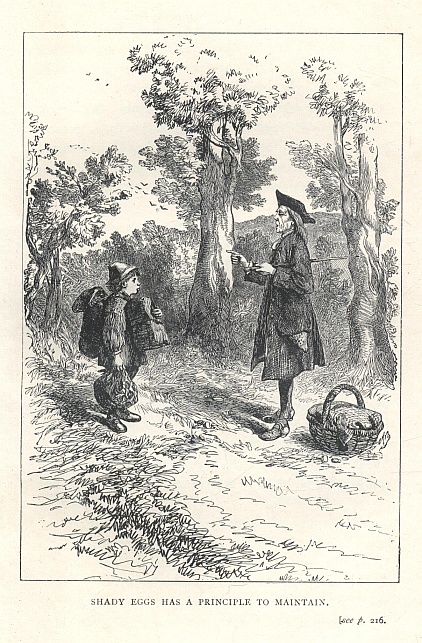
SHADY EGGS HAS A PRINCIPLE TO MAINTAIN.
Shady, whose weak point was sensitiveness in this
particular, was divided in his mind between vexation at
the misbehaviour of the pigs and discomfort at the
republican tone of the lad whom he had long been trying
to improve into a character worthy of the honour of
serving in the family of De la Mark. He determined
to pass by the pigs, and, turning to his companion,
said, 'How often, child, am I to exhort you to remember
the respect due to your superiors, whether in age,
station, or any good conditions?' Perhaps Robinson
was not decided as to the required number of times;
at any rate, he did not answer, nor was his expression
promising. 'Listen,' said the librarian, 'while I
repeat a form of words which would have been a
becoming answer to my question; and in the first
place you should have begun with "No, sir," or "No,
Mr. Higgs;" say that, and remember it is for your own
good that I enforce this principle on you.' Robinson
may not have believed in the philanthropy of his
preceptor, or he was heroically indifferent to his own
interests; he walked on in dogged silence. '"No, sir,"
or "No, Mr. Higgs,"' said the librarian, standing still,
and looking firmly at the young incorrigible; for,
gentle as a lamb at all other times, when Shady had,
as he considered, a principle to maintain, or a duty to
perform, he was a very lion. Robinson saw that he
must give in, and muttered in a low tone, 'No,
Mr. Higgs.' 'It is well,' said the librarian; and,
considering the better part of valour to be discretion, he
conceded the rest of the speech, content with the
conquest gained, adding in a more gentle tone, 'I hope
in time to cure you of the slaughter of the aspirate, so
offensive to a cultivated ear and so general in this
place. It is indeed wonderful how letters are
subverted and substituted for one another by the careless
and ignorant. Take Higgs, for instance: what name
more simple? yet do they indiscriminately render it,
"Eggs and Iggs, Heggs and Higgs."' Robinson interrupted
this meditation by letting fall one of his parcels.
'I fear,' said the librarian, picking it up and laying it
carefully in its place, 'the corners of a book which
I have purchased for you may have been injured,
Robinson.' Robinson looked as if he could bear the
calamity. 'There's a knife in that parcel also,'
continued Shady, 'with many blades, which I intended
for you when your improvement deserved it.'
'Thank'ee, Mr. Higgs, sir,' said Robinson, the knife
going straight to his heart; and, as his hands were not
at liberty to touch his cap or pull his hair, he made
the most deferential nod his circumstances would
permit.
'As to the book,' resumed Shady, 'it is not of a
character to please you as yet; I had a prospective
view in purchasing it, when your mind— But I see
you wish to speak.'
'I was just a-going to ask, Mr. Higgs, sir, how many
blades there was in the knife?'
Rather disconcerted that the knife should engross
the whole of his mind, he gave him first a little lecture
on the superior value of that which he seemed to
disregard, adding at the end, 'There are four blades, a
buttonhook, and a corkscrew.' Oh, how light from
that moment was Robinson's load! not that he had the
least use for a buttonhook or a corkscrew; but to be
the owner of a knife of such multifarious powers was
to him a new idea of happiness. In the fulness of his
gratitude he volunteered much fresh information,
carefully putting 'Mr. Higgs, sir,' whenever an
opportunity occurred.
Mr. Bloodworth had been at the Dew, and had high
words with Miss De la Mark, and Sir Valary had been
very ill, and Mrs. Gillies had wished Mr. Higgs back
again twenty times. Altogether it had been a day of
commotion at the Dew, from Sir Valary down to his
pigs.
'Sacrilegious man!' said Shady, turning whiter with
indignation, as the lad repeated some expressions
dropped by Bloodworth in the courtyard. 'Had
you spoken of this sooner,' he continued, 'we might
have hastened.'
'You see, Mr. Higgs, sir, it's impossible to do
unpossibilities, and I can't hasten with all these things,' said
the lad, whose head came out of his parcels like that of
a tortoise from its shell; ''sides, he's gone now, and
Sir Valary's better, and miss was in the garden quite
comfortable when I came away.'
Shady nevertheless pressed on, in agitated expectation,
until they reached the place. It was a large,
dark, irregular pile, on a thickly-wooded eminence—a
landmark conspicuous for many miles round. All
that remained of the original castle was one tower,
which was called Sir Mark's Tower, in honour of the
founder of the family; the remainder had been raised
by several of his descendants, to repair the decay of
accident and time; and each seemed to have built
according to his own age, without reference to what
had been before him. Sir Mark's Tower, with a part
of one side of the quadrangle, formed the dwelling of
the present possessor; part of the remainder was an
ivy-covered ruin; while a long and dreary-looking
portion, containing the state rooms, portrait gallery,
armoury, and library, was given up to darkness and
silence, being carefully boarded, barred, and bolted.
The great entrance had not been approached for many
years; the stately avenue of limes had interwoven
their branches and formed an extended archway. To
Sir Valary and his daughter was reserved a private
doorway in the tower, while the retainers (as Shady
was pleased to style himself, Mrs. Gillies, the steward,
and Robinson), together with all comers, had ingress
and egress by the outer courtyards and kitchen
entrance. It was not, however, to the kitchen of
former days that Shady now hastened; a small
servitors' hall attached to it better answered the
purposes of their economy.
Mrs. Gillies scarcely waited for his entrance to pour
out a medley of abuse and lamentation concerning her
master, her young lady, and the steward, finishing up
with an angry avowal that Shady was never in the
way when he was wanted. Shady, exhausted with
his day of fasting and fatigue, pained by the
occurrences in his absence, and somewhat discomfited by
the undeserved castigation he was receiving, seated
himself in the corner to wait until the high wind
should have passed.
Nothing tires a passionate temper like letting it
have its way; Shady had often tried the force of
non-resistance, and depended on it now, for staying
the torrent before Robinson's appearance. As at other
times, he was right. Mrs. Gillies, subsiding, passed
from a scolding to a declarative tone, and from that
to one of ordinary talk, which finally warmed into
kindness, as she saw the inoffensive librarian sit
silently fanning himself, with an air of patient
dejection.
'Why, you look as if Bloodworth had blew at you,
and had the best of it too,' she said.
'I have not broken fast since I left, and am weary
and hungry,' replied Shady.
'Then it is high time to eat,' said the housekeeper;
and, quickly unloading Robinson, who had just
appeared, and despatching him with his evening meal to
the ancient kitchen, she hastened to spread the table,
recounting in cooler temper the events of the day.
There was nothing new in substance, for Robinson
had told as much; but of course each fact was given
with particularity.
'It's a strange thing to me, Shady,' she said, 'that
Sir Valary, so high as he is, can bear with Bloodworth.
It's easy to say he's used to him; but if he forgives the
things that man said to-day there's more than use that
he depends on. He was daring to-day beyond what I
ever saw him; if Sir Valary had not fainted when he
did, I believe he would not have left; but he saw
staying was of no use, and he was afraid, too, of Miss
Marjory. She said but a word or two, but he couldn't
stand her looks.'
'Sacrilegious man!' cried Shady, shuddering more
than once. His anxiety was appeased by learning that
Sir Valary had not awoke since he took the
sleeping-draught. Miss De la Mark had been sitting at his
door for the last hour, watching.
'I haven't been able to get her to eat nor drink;
she's as pale as a ghost, and trembles like a leaf; but
I don't think it's fear she shakes with.'
Poor Shady! it was too much for him. Bloodworth
was the only human being he regarded with dislike;
notwithstanding his arrogant assumption, he was well
known to be a man of low origin, who owed all his
fortune to the family he served. If his insolence had
been confined to those of his own rank, it would have
been worthy only of contempt; but the indignation of
the librarian knew no bounds when the dignity of
De la Mark was tarnished by his insolent bearing and
free speech; it was one of the very few subjects that
deprived him of his habitual serenity.
Whatever were his own views as to the secret of
Bloodworth's impunity, he listened without replying to
many of Mrs. Gillies' half-hinted suspicions. 'Time
will reveal all things,' he said. 'And now I must enter
in my books the moneys expended. I must see, too,
that those rebellious animals are properly secured;
and if I can in a measure repair the damage they have
done'—
'Mr. Higgs, sir,' said Robinson, appearing at the
door with his empty cup and platter, 'please, sir, don't
you want me to go and help to look arter them pigs?'
'Ah!' said Shady, smiling benignantly on him; 'I
must leave your lesson to-night, Robinson.'
'It don't signify,' said Robinson cheerfully.
'No?' said Shady.
'Not for once, you know, Mr. Higgs, sir,' said the
lad, who felt he had been too accommodating. Suddenly
recollecting, the librarian guessed his drift, and, placing
the knife in his hands, told him that nothing but
learning was really worth desiring.
A few words are needful concerning Sir
Valary and his daughter. Sir Valary,
known to be as proud as any who had
ever borne his name, lived a life of extraordinary
seclusion and self-denial. For many years he had
banished from his home every sound of mirth,
every vestige of social comfort. His servants, who
had, at the death of Lady De la Mark, been greatly
reduced in number, had gradually become fewer, until
every female office was represented by Mrs. Gillies, a
old and greatly-attached domestic, while Shadrach
Higgs, with his boy Robinson, whom he had pressed
into the service, held the same comprehensive post in
the other sex.
What had caused so great a change—for at one
time Parker's Dew, or Castle De la Mark, as it was
called, was noted for its courtly splendour and
unbounded hospitality—no one knew. Some attributed
it to the early death of Lady De la Mark; others
to the influence of Bloodworth. Squire Brimble, who
seldom allowed himself to speak of his brother, when
he did give an opinion said, 'It's the love of
money—that's enough to account for anything.'
The growing infirmities of Sir Valary had kept him
long a prisoner in his chamber, at the door of which
now, as described by Mrs. Gillies, sat his daughter
Marjory. There was nothing heroine-like in her
appearance. Low in stature and plain in feature, she
owed all her attraction to the force of her character
and the peculiarity of her early training. Indomitable
courage shone in her dark eyes, and patience, the result
of a deeply-exercised spirit, gave a sweet calm to her
face. Her dress was, from necessity, somewhat
singular. For a long period she had been limited to
her mother's wardrobe, and, careless of the fashion in
which the garments were made, she wore them without
change, as her mother had left them.
'He sleeps so long!' said Marjory, her pale face
resting against the chamber door.
'I've known him sleep longer, miss,' said Mrs. Gillies,
peering up the spiral staircase. 'If you'd just
please to taste these fresh cakes that Shady has brought
in, and the chocolate, that's drying up from standing
these hours, I should be thankful;' and she displayed
the cakes, the choice of which had exercised greatly
Shady's discriminating powers. Marjory, prevailed on,
left her to watch. 'You know, miss,' said the faithful
creature, 'if you take ill, we have no power to keep off
that man when he comes; and one way we're all
alike, for the highest can't do without eating and
drinking, no more than the lowest.' Marjory did not
at all, at that moment, feel exalted above the conditions
of humanity. Bloodworth's behaviour had convinced
her that he possessed some secret militating against
her father's honour, and that this was the source of
the power he exercised over him.
The loneliness in which she had been reared had
made her very self-reliant. She had borne much
personal inconvenience in silence; and if it had been
only for herself that she had now to suffer or to do,
she would not have been slow in her plan of acting;
but it seemed necessary that some one, more equal
than she was to cope with the steward, should step in
between him and her father, for whose very life she
trembled, if such excitement as he had that day
suffered should be renewed. Yet, if her suspicions
were correct, how could she, without treading on
dangerous ground, take any one into her counsels? and,
indeed, who was there to whom she could refer?
To her uncle, her natural protector after her father,
she had been a stranger for many years; and she had
grown from childhood to womanhood with no other
companion than her father. One there was, indeed,
and to him she inclined to open her heart, and that
one was Dr. Cruden, the high-minded and skilful
physician, who was the sole visitor of gentle blood at
Parker's Dew.
Filled with painful conflict, she resumed her seat
at the chamber-door. A slight noise was gratefully
heard by her, and, entering, she found the long sleep
had produced its usual effect of refreshing calm. Sir
Valary smiled gently on her, and, as if forgetful of the
distressing occurrences of the morning, received with
pleased readiness all her tender endeavours to restore
and amuse him; and thus passed the evening peacefully
away.
Several days followed in the same calm. Sir
Valary and his daughter seemed with equal care to
avoid the name of Bloodworth, and both were secretly
thankful when the evening closed, without his presence
having embittered the day.
One morning, Marjory, receiving Shady's promise
not to go beyond earshot of her father, prepared for
one of those long rambles in the surrounding woods
which never failed to procure for her rest and
relaxation of mind. Her book-learning was small. In the
great book of nature, that lay before her, she was an
ardent student. Shady, who fondly considered himself,
in some sort, her preceptor, had endeavoured to inspire
her with a love of heraldry, and was never tired of
expatiating on the endless genealogies connected with
the tree of De la Mark. But though she loved to
wander among the portraits of her ancient house,
dimly lighted up by the few sunbeams that could
struggle through a loosened shutter here and there,
her thoughts were wholly given to those people of the
past that looked grimly from the wall, while he was
trying to explore and expound their heraldic bearings.
She knew most of the faces by heart; but her head
was little encumbered with the technicalities of which
he was so proud. Shady had plodded through the
elements of botany, that he might usher her also into
it. She soon learned with avidity all he could teach
her, and, unaided by other help than her own affection
for the pursuit, became well accomplished in it. But
we must follow her in her walk.
Her mind had been too much exercised of late to
allow her to give thought to anything but one reigning
subject. Her case for wild flowers remained unused,
as she passed musingly through the tangled wood.
When at a little distance from the house, she was
arrested once or twice by sounds of rustling amongst
the branches. The once carefully-arranged paths were
now so ill kept that they were in some parts difficult
to penetrate. No stranger ever intruded there. She
supposed it to be some woodman gathering brushwood,
and passed carelessly on; but, coming suddenly on a
cleared space, from which, through an opening in the
trees, appeared a fine and extensive view of the
country around, she saw whence the sounds had proceeded.
The reader does not need a second description—it
was the strange lodger from Stoney Gates. He was
apparently surveying the scene with artistic purpose,
his implements lying on the turf, and he was
arranging a piece of broken timber to form a seat of
convenient height and situation.
The meeting was one of mutual and equal surprise.
Each surveyed the other steadily, and in silence; but
the stranger, soon recovering himself, lifted his cap
with courtly propriety, for he needed nothing to tell
him he was in company with gentle blood. Marjory
returned the salutation, and was passing onward; but
a sense of inhospitality detained her; she lingered,
and said hesitatingly, 'You are a draughtsman?' He
bowed. 'You are going to put down some of our
scenery?' Again he assented. 'Would you not like
to have the Castle De la Mark in your foreground,
with this fine country behind?'
'I have been trying to get that,' he replied; 'but
the house is so surrounded I can find no favourable
standing-ground.'
'I will lead you to one,' she said; and, making
her way with easy rapidity through the thicket, she
emerged on a spot favourable in every way to the
accomplishment of the design. The graceful dexterity
with which she overcame all the obstacles of the
labyrinth struck him with admiration. 'She is worthy
of an American forest,' he thought.
When they stood face to face upon the spot sought
for, a slight exclamation of surprise burst from the
stranger, which was answered with a smile of satisfaction
from Marjory. There was pride in her heart
and triumph in her eye, as she turned exultingly to
the scene before them, upon which they both gazed
silently. Suddenly she asked, 'Who could put this
down?' and looked at him for an answer; but his
eyes were fixed, not on the landscape—they were
busily and intently studying her face. He withdrew
them in some little confusion, and the blood of De la
Mark crimsoning her cheek warned him that to win
patronage he must woo it discreetly. He thanked
her, in most deferential terms, for having given him
the opportunity of trying, but agreed that the subject
was one to mock art. His voice and bearing were so
remote from intrusion or unbecoming forwardness, that
Marjory was willing to believe the look that had
offended her was one of natural and excusable curiosity.
She allowed him, therefore, to make one or two
remarks on various points around before she left him.
As she was turning away, the stranger, still
uncovered, said, 'I have had the honour of speaking to
Miss De la Mark?' She looked assent, and they
parted, he to pursue his task, and she to wonder who,
among the few persons whose faces were familiar to
her, continually floated in her memory while she was
in company with the stranger.
In this short interview, in which so little had been
said, a great advance had been made by each in the
favour of the other. The fire of her eye and the
freedom of her step, her genuine dignity and
self-respect, untinged by affectation, all betokened a
character which had great charms for the stranger,
while his sympathy with her, so evident in those
slight indications of look and bearing which are to be
felt but not described, had won upon her strangely;
so that in truth they were both far more intimate from
this few minutes in the wilderness than months of
drawing-room proprieties would ever have made them.
What a sudden check he had given to the current of
her thoughts! All that had so deeply interested her
fell aside, and, by some inexplicable attraction, he took
its place.
Again the crashing of the distant boughs as she
wandered homeward struck her ear, and it was with
somewhat of disappointment that, after a minute or
two of watching and waiting, she saw the faithful
Shady struggling through the thicket to reach her.
If his young lady would only condescend to walk
in the paths where the trees did not meet right over,
trusting she would pardon him for saying so, it would
be far less perilous for limbs and their coverings to
pursue her. Indeed he made a rueful figure; for
although he had guarded his dress, by turning it up
or turning it down, as circumstances recommended the
precaution, he had met with sundry tears and scratches,
as though he had been at war with all the under-wood
he had encountered. Marjory smiled at his
expostulations and his appearance, but, suddenly
remembering his promise, inquired why he had left
her father.
Shady assured her that Dr. Cruden was with Sir
Valary, and would remain till his return, for he wished
to see Miss De la Mark, and had sent him in pursuit
of her.
'Then,' said Marjory, 'Mr. Higgs, there is a stranger
in the wood; he is drawing on my favourite seat—drawing
the place, you see; and I wish—I should like
you—to—just to say—if he would wish to draw any
of the interior you can lead him through it.'
Shady stared. 'I invite a stranger to the Dew,
madam!' he said slowly.
'No, no,' said Marjory emphatically; 'of course ha
will not be intruded on my father nor on me; he
greatly admires the place, and it seems unkind not to
allow him to enjoy the pleasure fully. It is little we
do in hospitality, Mr. Higgs; we may at least show
this poor favour to strangers; and this is no ordinary
person, but a man of birth and high taste, as you will
see, I am sure.' An appeal on the score of hospitality
could not be made to a more ready ear than that of
Shadrach Higgs. How had he mourned in time past
over the silent halls and untrodden doorways of
Parker's Dew, when his large heart would have
welcomed the whole world! But time and use had
reconciled him to all; and now to introduce a visitor
seemed as strange a work to him as it had once been
to exclude one.
While he was gathering up his thoughts to make a
suitable, respectful protest against the imprudence of
doing what, if Sir Valary heard of it, might give him
umbrage, Marjory had vanished. Shady looked after
her disconsolately. Not having been able to resign
his commission, he felt it imperative on him to fulfil
it, and with troublous cogitations on the matter, and
earnest hopes that the stranger would not fall in with
the invitation, he scrambled on towards the place.
While he was engaged in his contest with the bushes,
he thought only of how best to escape them; but
when he stood in the presence of the stranger, whom
he immediately recognised, a feeling of vexation that
he should appear in a style so inconsistent with the
dignity of De la Mark mingled with it.
On seeing him, the stranger, who seemed to have
been of Marjory's mind, and had thrown aside his
sketch as unsuccessful, accosted him as an old friend.
'What! the librarian! I am fortunate indeed! Are you
seeking your lady? She was here, but left a little ago.'
Shady, in as collected and proper a form as he
could get up for the occasion, told him that he had
met his young lady, and delivered her invitation.
The stranger started up at once. 'We will lose no
time, Mr. Higgs; nothing would give me greater
delight;' and immediately he began, in a manner
which Shady well remembered, a series of questions
as to every part of the dwelling, the order in which
it was kept, and so on. While he endeavoured to
answer these becomingly, an under-current of thought
occupied Shady. Various schemes he devised and
rejected for keeping the stranger out of sight and
hearing of any of the household, without allowing him
to discover that he was there by stealth. Under other
circumstances he could have discoursed with delight
on the wonders and glories of Parker's Dew—to him
an untiring subject. Then again, the incongruities of
ancient grandeur and present meanness forced themselves
upon him, and an uneasy consciousness arose, of
the effect they would have in diminishing the stranger's
reverence for the noble house in whose honour his
heart was bound up.
'Why, it is in ruins!' exclaimed the stranger,
coming abruptly on one side of the quadrangle.
'That portion is,' said Shady; 'the exact reason I
cannot tell, but there is a tradition'—
'It has been in decay for many years,' said the
stranger, not waiting for the tradition; 'this, I
presume, is the chapel?'
'It is;' and now did Shady, with all the formality
of a grave court official, introduce him respectively to
the armoury, the picture gallery, and the library; that
is to say, he pointed to their positions.
The stranger surveyed all with the deepest interest.
'Did I understand,' said he, 'that I was to be allowed
to see the interior of these places?'
'The library,' said Shady, 'being my particular
department, I carry the key of the side entrance; the
other keys are in Sir Valary's room, but I can readily
obtain them. There is no worthier part of the
building, in my humble estimation, than this,' he said,
placing the small key in the lock of a low door, to
enter which they were obliged to stoop.
'Where are we?—in a tomb?' said the stranger.
'No,' said Shady, 'though indeed we are among the
dead; wait, if you please, till I kindle the lantern.'
Familiar as he was with every crevice of
his dearly-loved resort, having closed the
door on the inside, Shady without difficulty
lowered a large lantern, that hung from
the centre of the roof, and lit two of the candles
ranged within it. By degrees the stranger's eyes, at
first dazzled by daylight, were able to discern
something of what was around. The walls, the roof, and
the floor, were all of dark polished oak—the roof
richly carved; books and vellum rolls in antique
cases, all of the same dark wood, left little of the walls
uncovered. Amid objects so sombre, the feeble rays
of the lantern, which Shady had now drawn up, were
of little use.
'I never saw a better effect of darkness,' said the
stranger; 'but is there no possibility of letting
daylight in here? I would rather read some of these
books by the sun than by yonder lantern.'
Shady pointed out to him that the windows, high
and small, were boarded up.
'This,' said his companion, pointing to a library
ladder, 'this would reach one; if I loosened a board I
could easily replace it; may I do so?'
Shady demurred. It would take time; he had
already been too long from his duties—Sir Valary
might require him; not adding his conviction, that
Mrs. Gillies would rate him soundly for not being in
time to carry in the dinner—a service he always
performed.
'Leave me,' said the stranger; 'trust me with this
key, or lock me in; there is much here that I should
like to examine; come to me when you will, when you
can; an hour, or hours hence, will do for me.'
Again there was a conflict in Shady's mind; the
inhospitality of locking him up among paper and
vellum, at a time when his own appetite was reminding
him that nature required support of another kind,
was repugnant to his feelings; yet, to have him so
secured was a convenience of which he saw the value.
After a short pause, he said he would return as quickly
as he could, and, locking the door on the outside, went
somewhat nervously to present himself to the housekeeper.
Happily for him, the lengthened stay of Dr. Cruden
had saved him from wrath on account of his
protracted absence.
'I am glad you are come,' said Mrs. Gillies; 'it is
a long talk the doctor is having to-day, and there's
Robinson been all the time holding his horse, and
nobody to clean a knife, for the little there is to cut.'
Shady quietly began gathering up the knives,
intending to release Robinson from his post, when Dr. Cruden
and Miss de la Mark, in deep conversation, crossed the
courtyard and met him at its entrance. In a moment
of weakness he slipped the knives into his pocket, as
he could, and with a low bow stood deferentially until
they had passed. They had scarcely done so when
the doctor turned suddenly round, saying, 'Why, here
is Higgs; you could not have a better person than
Higgs.'
'How could I forget him?' said Marjory.
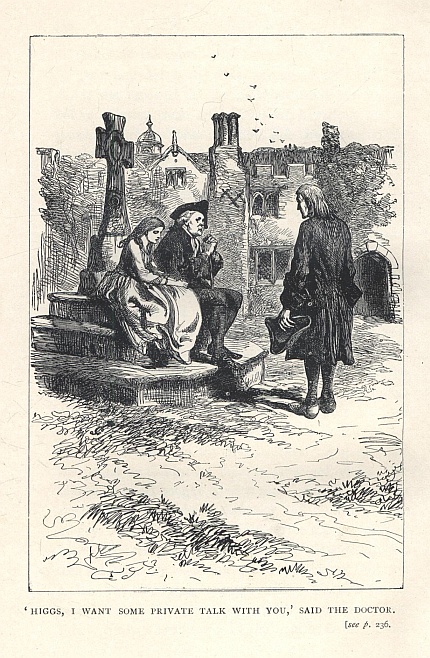
'HIGGS, I WANT SOME PRIVATE TALK WITH YOU,' SAID THE DOCTOR.
'Higgs,' said the doctor, 'I want some private talk
with you; we can neither be overlooked nor overheard
here,' he continued, looking round.
'Entirely secluded, sir, from all observation,' said
Higgs, with another low bow.
'Here, then,' said the doctor, pointing to an ancient
cross, surmounting some broad stone steps, 'let us sit
here;' and placing Miss De la Mark on the higher
step, and seating himself by her side, he pointed to
the lower one, telling Shady to sit down. Shady
preferred standing, for two reasons; one was, that it
seemed little less than treason in him to sit in such a
presence; the other, he had apprehensions as to the
kind of cushion his pocket would afford, with its
present contents.
'You must come close,' said the doctor; 'we don't
want what we say to be caught by the birds of the
air.'
'The library, Dr. Cruden,' said Marjory; 'shall we
go to the library?'
How unfortunate! During the many years that
Shady Higgs had been librarian, he had never received
an order connected with his post that he did not hail
with delight. Now he fell back, and looked almost
reproachfully at Marjory, she having been the means
of bringing them into the dilemma in which he now
stood. But the doctor did not observe his looks.
'By all means, the library,' he said; 'we are sure to
be safe there;' and assisting Marjory down, he led her
with a quick step towards it, Shady following
irresolutely. Opening the door, he expected to hear the
stranger's voice immediately, in salutation; but all was
silent, and the glimmer of the lantern nowhere revealed
a human form. No boards appeared to have been
removed; and as Shady nervously cast his eyes into
the remoter parts, where the shadows were the thickest,
he was equally perplexed and relieved to find nothing
but vacancy. 'He must be in the room,' he thought,
'but where?'
'Now, Higgs,' said the doctor, 'you keep your
favourite haunt lighted: I wish I could hope it was
dusted; we are at any rate safe now. I want you to
answer me some questions. You have a grandmother?'
'Softly,' said Shady, looking round.
'Well, I'm not going to say any harm of her,' said
the doctor; 'so you need not be afraid of her coming.
Where is she?'
Shady looked with an expression of innocent surprise.
'My grandmother Elizabeth?' he asked.
'Yes; commonly called Bet Eggs,' said the doctor.
'Is she not dead?' his large eyes dilating with a
questioning look, which Dr. Cruden could not quite
understand.
'Ay; is she, or is she not? that is the point.'
'I have been given to believe she died,' said Shady,
quite forgetting the stranger, in the interest this
question had excited in him.
'Do you believe it?' asked the doctor.
'Why should I not?'
'No evasions,' said the doctor, rather sharply;
'answer me plainly. Is she living?'
'Sir,' said Shady, glancing at Marjory, 'at another
time I might speak of this—'
'This time—now,' said the doctor; 'the truth is,
Higgs, she is not dead, and you know it, and you know
why her existence is concealed, and you know—'
'Sir,' said Shady drawing himself to his full height,
'pardon me if I am wanting in duty, that I contradict
you. I know nothing of what you have said.'
'Has Bloodworth never spoken to you concerning
her?'
'It is seldom we converse, and never with my will,
excepting on the household business.'
'How many years is it since you saw her?'
'Twenty—when she crossed the sea, to wait on some
noble lady following her husband.'
'How long since you received the report of her
death?'
'I think it may be about a twelvemonth.'
'Well, you have at least reason to doubt the truth
of that report?' He was silent.
'Higgs,' said the doctor, 'you have now an opportunity
of proving the truth of your fidelity and affection
to Sir Valary. It is of the utmost importance to
ascertain, whether your grandmother is alive or dead.
What light can you throw upon the matter?'
'Well, if I offend my young lady's ears in what I
say, the blame be far from me,' he answered, with a
sigh. 'When my grandmother Elizabeth had finished
the work of nursing my young lady, an ill feeling was
raised against her by some means in the breast of my
gracious lady, her honourable mother. I well remember,
though I was then but a youth, her tears and
complaints—yes, and bitter vows of vengeance too, against
the one that had done her this wrong. I grieved for
her, for, though she was harsh and choleric in temper,
she had well supplied the place of parents to me, and
I was grateful. A place was provided for her, and the
disgrace in which she left was unknown to any, save
the few concerned in it. I well remember her words
the last time I saw her.'
'What were they?' said the doctor quickly.
'She told me (my young lady will pardon me), she
had more power to injure than her enemies had power
to injure her; and nothing but her love for my young
lady would have kept her quiet. "If they desert you,"
she said, "I will come back before they expect, and do
right to the wronged."'
'Anything else?'
'Much of the same sort.'
'And how did you get the account of her death?'
'It was reported in the neighbourhood, some time
before a letter came from Dusseldorf, written by the
person in whose house she died, and containing
certificates of her death from the doctor and a Lutheran
minister.'
'Did you credit these reports?'
'I did.'
'But have you had anything since to shake your
confidence in them?'
'Last summer,' said Shady, 'my young lady will
remember the visit of a German pedlar?'
Marjory assented. 'Looking among his wares for
a suitable offering for my young lady for the next New
Year's Day, I found a small purse of beads, bearing on
one side the initials E. H., and on the other side the
crest of De la Mark; the snap and the trimmings
were new; but by the beadwork I recognised it was
no other than a purse given in days of favour by my
Lady De la Mark to my grandmother. I questioned
the pedlar as to how he became possessed of it. He
told me he had bought it, with some other trifles, of an
aged woman who was in difficulty and wanted to raise
money. I then asked him to describe the person, and
how long it was since he had seen her. His description
differed from what she was at our parting—'bent and
feeble' for strong and upright, 'snow-white hair' for
raven black; but years and sorrow may have done
this. He had seen her some ten months back. Since
then, I confess a vague suspicion has crossed my mind
as to the truth of her death.'
'And how was it you did not name this?'
'It never arose to more than suspicion; her things,
no doubt, passed into other hands after her death, if
she died. I love quietness, and would not make
marvels.'
'Do you think Bloodworth had any hand in the
offence taken by Lady De la Mark?'
'Bloodworth is a sacrilegious man,' said Shady;
'his evil deeds known are enough. I would not lay
suspicions at his door.'
'Well, Higgs, I tell you it is of the greatest
consequence that your grandmother, if living, should be
produced; and I believe you are the most likely
person to find her. Will you go over to the place
where she is said to have died, and ascertain for us
the facts, finding out, if possible, the persons who
signed the certificate, and, indeed, all facts necessary
for substantiating either her death or her life? and in
the meantime keep your mission a perfect secret from
every one. I will prepare everything. You will be
sent with a message to me when I am ready for you,
and the cause of your detention must be known to no
one.'
Shady was aghast, and far too much surprised to
answer.
'This is settled, then. So far, so good,' said the
doctor, rising. 'Now, Mr. Shady, let us out of this
black hole.'
Marjory looked doubtingly, as Shady stooped down
to unfasten the door; she felt that Dr. Cruden was
mistaken, and that many things conspired to make
him unfit for the important mission imposed on him.
A book falling at her feet startled her into a slight
cry.
'What! are your books alive, Higgs?' said the doctor,
picking it up, 'flying about the place like bats.'
Shady instantly recollected the stranger. While he
was debating as to the course he should pursue, a voice
from the top of the room, which Marjory recognised,
said, 'Pardon the intrusion of a friend;' and the
stranger descended the ladder. A more curious group
can hardly be imagined than that on which the light
of the lantern now fell; the slight, small form of
Marjory, her face pale with fatigue, anxiety, and now
with something like terror; the parchment-like visage
of Dr. Cruden, his periwig and hat both rather
displaced by stooping for the book; Shady, the very
picture of astonishment and mortification; and the
stranger, the only one of the whole who appeared
noways discomfited by his presence among them.
'Mr. Higgs, don't distress yourself; you have done
good service to the house of De la Mark this day,
though inadvertently,' said the stranger. 'I don't fear
receiving a full pardon from you, madam, and from
you, sir,' bowing to them respectively, 'when I have
disclosed a few facts. Shall we return to the council
table?'
The doctor, putting one hand through the breast of
his waistcoat, and the other under his coat tails, his
favourite attitude in delivering a lecture, surveyed him
from head to foot. Regardless of the scrutiny, he
placed himself at the table, and began thus; 'Elizabeth
Higgs is dead—I saw her burial.'
They looked incredulous, but none spoke.
'I was in Dusseldorf at the time, and knew the
Lutheran minister who attended her. She died in
peace with all men, and fervently desiring a blessing
on the infant she had left,' bowing to Marjory, 'and
praying heartily for her grandson. I happened to be
confined to the house from an accident at the time,
and saw much of her, for we lodged under the same
roof. A little kind sympathy with her sufferings from
a fellow countryman opened her heart, and she
unburdened it to me of every secret that had distressed
her—a revelation I have never confided to human ear,
and will not, until it shall be for the benefit of those
whom it concerns. But rest satisfied; she is dead,
and your mission useless.'
The doctor's surprise at all that he had just heard
had prevented him from interrupting the stranger with
any questions; but now that he saw he had told all
that he meant to tell, he said, 'You will excuse me,
sir; it is possible that all you have advanced may be
perfectly correct; and I am far from wishing to offend
you or any gentleman in so near a point as doubting
veracity; but you will please to remember that the
subject having been so amply discussed in your hearing,
and you being a perfect stranger to us, it is natural
that we should look for something—some confirming
evidence—before trusting implicitly to you; and also,
it would be pleasant to know who our informant is,
and, I may add, how he came to drop upon us so
opportunely.'
The stranger, looking calmly and steadily at him,
replied, 'For my presence here, I refer you to Miss
De la Mark. I am a world-wide wanderer, without
a settled home as yet. I can give you no proof that I
have advanced the truth now. I do not blame you
for being sceptical; but, according to human maxims,
you may believe me, since I have no interest in
deceiving you.'
If he would only trust the doctor with some of Bet
Eggs' revelations. The stranger shook his head. 'In
due time, when I am wanted, you may depend upon
me: it is not whim, but necessity, that keeps me
silent.'
'Answer me one thing,' said the doctor. 'Did the
widow Higgs confine herself to her own history,
or—or—'
'Come, Mr. Higgs,' said the stranger, 'advance—I
shall beg for a night's lodging in yonder gallery.'
'He is impenetrable,' thought the doctor.
'I think the portrait of the nurse is hanging there,
isn't it, carrying an infant?'
His three hearers exchanged glances quickly.
He smiled. 'There,' he said, 'is evidence for you.'
'Strange,' said Dr. Cruden; and Shady advanced to
the door. All attempts on the part of the doctor to
induce the stranger to return to his house and become
his guest were unavailing.
'No,' he replied; 'I will be Sir Valary's guest,
though he shall not know it. My plaid is an excellent
soldier's bed, and I shall sleep soundly among the
shadows of the house of De la Mark.'
'I really believe he is a true man,' said the doctor
to Marjory, as they walked towards the tower, Shady
following to obtain the keys.
'There is a frankness in his manner,' replied
Marjory, 'that quite fascinated me when I first
met him.'
Shady's perplexities were great. How to
account to Mrs. Gillies for his long
absence, without raising her woman's
curiosity, he knew not; and the knives! he
thought, 'Yes, I have the knives,' putting his
hand to his pocket. While the domestic difficulties
were being overcome, we will follow the stranger.
He had told Shady not to hurry himself with the key,
for the fresh air, and a stroll among the ruins, would
better accord with his taste than to be again
immediately immured in dust and semi-darkness. While
examining a curious archway, he heard horse hoofs,
and looking down saw a man dismount, fasten his
horse to a tree, and climb the bank through a place
where the wall was very low, and would permit scaling
easily. He soon cleared the wall, and stood upon the
loose stones within the quadrangle.
The stranger had time to observe him, being hidden
in the shadow of the archway; there was nothing
remarkable in his appearance; his dress was plain, his
age a little more or less than sixty. The stranger,
quitting the archway, advanced to meet him, looking
fixedly upon his face while he spoke.
'Mr. Anthony Bloodworth, I think?' The horseman
started, but replied in the affirmative.
'I am glad,' said the stranger. 'I have long had
this to deliver, and am glad to be rid of it;' and he
placed in his hands a small paper parcel; 'but,' he
said, before he relinquished his hold of it, 'there is
some receipt or acknowledgment that I must have.'
'What is it? what is it?' asked Bloodworth; 'I
must see it before I can give a receipt.'
'The receipt is written out for you—you have but
to sign it.' Bloodworth opened the packet, which
contained two papers, with a letter.
He glanced continually from the paper to the
stranger, and at last, in a husky voice, asked him how
long it had been in his possession.
'I see,' he continued; 'you were acquainted with
my correspondent.'
'Yes,' said the stranger, carelessly, 'I knew him well.'
'Have you been long about here?' asked Bloodworth,
who was beginning to put the papers into his
pocket.
The stranger produced a small ink-horn, saying,
'The receipt, if you please.'
'I don't know,' said Bloodworth; 'I would rather
convey an important document in another way. Why,
if charged with this for me, did you wait to meet me
here, instead of seeking me at my own dwelling?'
The stranger held the ink-horn. 'Sign the receipt,
man,' he said, not deigning to answer the question.
With much reluctance he drew out the papers, and
doing as the stranger bade him, delivered the document
into his hands.
'What brings you here?' he said, looking nervously
at him.
'What brings you here?' said the stranger.
'My business,' answered Bloodworth doggedly.
'And I was brought here by your business and my
pleasure.'
'Had you any message?' asked the steward, cowed
by the stranger's manner.
'No other than I have delivered; but tell me how
long do you mean to pursue this work? Take my
advice; repent, and make a clean breast of it, or you
will be caught in your own toils.'
'Then he has betrayed me,' said Bloodworth, 'and
you know all.'
'I know enough to advise you this.'
At this moment Shady approached with the key;
he made a sort of gesture to the steward, as destitute
of respect or cordiality as it could well be, and, turning
to the stranger, proffered the key and his guidance.
'This gentleman,' said the steward, in a lamb-like
tone, which Shady was greatly surprised to hear, 'is a
friend of mine, Mr. Higgs, and as soon as I have
waited on Sir Valary I shall be glad to show him the
few curiosities we have.' He was continuing his
civil address, when the stranger, laying his hand on
Shady's shoulder, pointed to the gallery, and left him
without reply.
Whatever the papers were that Bloodworth had
received, it was evident they had greatly altered the
state of feeling in which he had crossed the wall. His
leaden eyes were then as quiet as stagnant water—now
his whole visage was agitated; he passed his hand
nervously over his face, went towards the tower, and
returned, as if in uncertainty. He had ridden round in
order to avoid Dr. Cruden, whom he had been told in
the village was at the Dew, little expecting what he
had met with.
Guilt makes a coward; he feared every one he met.
Robinson, who was sitting on the stone steps of the
[** Transcriber's note: missing line of text?]
cross carving devices on a stick with his new knife,
looked with amazement at him, as he saluted him with
kindness, and told him gently where to find his horse.
Entering the kitchen, he spoke in the same tone to
Mrs. Gillies, inquiring with respect and concern after
Sir Valary and his daughter. Mrs. Gillies, to whom
the sight of him was wormwood, could not help being
struck with his altered tone, and put it down to
repentance for his late misbehaviour. He asked for
water, complained of weariness, and altogether stirred
up something less akin to hatred than she was
accustomed to feel for him. 'You have had company
to-day, Mrs. Gillies?' Supposing he meant
Dr. Cruden, Mrs. Gillies nodded.
'I'm afraid you were not prepared for him.'
'As for that,' she said quickly, 'we are not allowed
enough to keep the house going at any time; however,
he is a plain man, and never eats nor drinks.'
'Dr. Cruden, you mean?'
'Who else comes here?' said the housekeeper.
By various indirect questions, he ascertained that,
so far as Mrs. Gillies knew, the only person of the
household to whom the stranger had introduced
himself was Shady Higgs.
'The house ill kept!' said Bloodworth, after a pause.
'Mrs. Gillies, I fear that my good intentions towards
Sir Valary and the well-being of his estate have
gotten me a poor name, that I ill deserve.'
'Well, I hope you don't deserve all that is said of
you,' she answered blandly; 'there's many as say the
money that ought to go for the proper keeping of the
house, as Sir Valary's house ought to be kept, is worse
than sunk in the sea. I know for my part, I'd rather
be the poorest on earth than rich with such gains; and
if it was not for the love to Sir Valary and my young
lady, I'd sooner be in a close cottage, with bread
enough and no care, and nothing expected from me,
than be in a corner of a great place like this, with such
stint allowance. Why, you may believe me, if I
wasn't to contrive and to contrive, and keep us three
down here at a very near rate, I could never make
what I have enough to serve Sir Valary and my young
lady, even as well as I do serve them. The world is
changed a good deal, for the housekeeper of Parker's
Dew to be put to the shifts I am; and since you give
me the liberty to speak, Mr. Bloodworth,' she
continued, growing eloquent on the strength of the steward's
silence, 'I may tell you, that if things go on much
longer, there is them that will look into it, and know
the reason why; and I've heard as much as that, and
a little more too.'
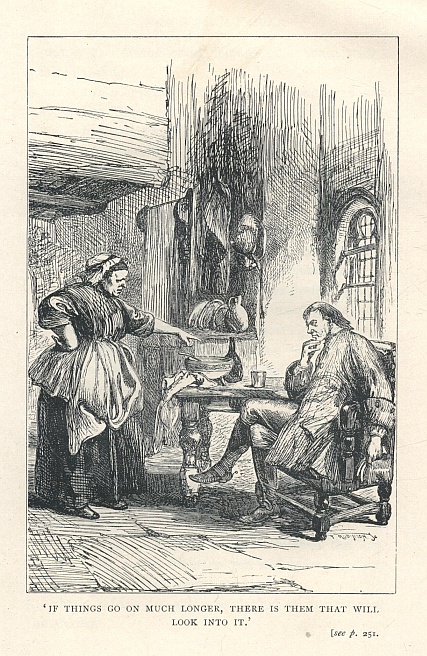
'IF THINGS GO ON MUCH LONGER, THERE IS THEM THAT
WILL LOOK INTO IT.'
Bloodworth sat perfectly silent; he may have heard
all the housekeeper's oration, or he may not; probably
the latter, for he looked abstracted, and, taking his hat,
said, 'I have a little work outside—some one to speak
to—you need not let Sir Valary know that I am here,
until my return; and for the matter of stint,
Mrs. Gillies, you will be pleased to remember that I am but
a servant like yourself; I have not the ordering of Sir
Valary's mind about his money.'
'What has come to the man?' said the housekeeper,
as she watched him through the heavy stone window:
'I never thought to hear him own himself a servant;
something has taken him down since he was last here.'
With his head bent down, and his hands folded behind
his back, he walked slowly towards the spot where he
had left Shady and the stranger. He met the former
advancing towards the tower.
'What have you done with Mr. Vandercroft?' he
said, looking sharply up.
'Mr. ——?' Shady asked, not catching the name.
'My friend, whom I left with you; I wish to see
him.'
'The gentleman is in the portrait gallery,' said
Shadrach, 'and has no desire for company.'
'Not for yours, perhaps.'
'You are correct, Mr. Bloodworth, for he requested
me to go; but I did not take it to be personal, as he
desired to be locked in, that none might intrude.'
'Where's the key?'
'The key?' said Shady, looking at him calmly.
'Yes, the key,' repeated Bloodworth, his natural
fierceness returning; 'I tell you I wish to see
him.'
'You can see him,' said Shady, looking up as if
calculating, 'at eleven o'clock to-morrow, if you will
ride so far.'
Bloodworth could scarcely speak for emotion, but
controlling himself said, 'Shady, my friend, you are
disposed to be pleasant, but do not trifle with me just
now. Let me have the key; I must see this man;
what reason did he give you for saying he would not
see me?'
'I do not know that you were in his thoughts at
all,' said Shady calmly, 'when he said he wanted no
intruders; but I believe I know his reason for seeking
seclusion.'
'You do?' said Bloodworth, his lips growing white,
and his eyes fixed earnestly upon him.
'Yes, he preferred to be alone.'
'Is that all? Then give me the key.'
'I am under promise.'
'Give me the key!' said Bloodworth, choking with
ill-concealed passion.
'Nay, then, if you are bent on it, I must return
with you and explain, and leave the gentleman, whose
name I could not catch, to arrange with you according
as he is affected.'
The cool determination with which Higgs said this
exhausted the remains of the steward's temper, and he
demanded the key in violent language, Shady remaining
perfectly unmoved, though his face became serious,
and expressed as much aversion as he could feel.
'It is better that your venom should fall upon the
unworthy,' he said, with a placidity that only
exasperated the railer. How far the altercation would have
proceeded is doubtful, but, happily for Higgs, it was
suddenly closed by Dr. Cruden.
'Mr. Bloodworth, I was told, when at a short
distance from the house, that you must have entered it
about the time that I left; now I particularly wish to
have some conversation with you, so I turned my
horse. Higgs, it is private business,' he said, nodding
to Shady, who, with an air of much satisfaction, left the
steward with one far better able, as he felt, to cope
with him than himself.
The doctor looked at his watch. 'I have already
spent some hours here, Mr. Bloodworth, and am far
beyond my usual time for dinner; but I am so deeply
interested in the affairs of your master, that I am
determined if possible to come to an understanding
with you as to—that—in fact, pray, Mr. Bloodworth,
what is the meaning of all this? I find Sir Valary
suffering from severe nervous shocks, owing entirely to
your interviews with him. Though known to be one
of the richest men in the county, and possessing as
liberal a heart as a gentleman of his station ought to
have, his household, I find, is limited to bare necessities,
and even the young lady his daughter has no command
of money. What does it all mean, Mr. Bloodworth?
I must tell you in plain English that the whole is laid
at your door.'
All this was said in the heat and rapidity of
indignation, and it was about the last kind of attack that
the doctor had meditated making. He had ridden
back hastily, and had settled as he rode what would
be the wisest way of handling the steward, so as to
get at the secret. 'I must take him quietly,' he said
to himself, 'make no charges, suspect nothing;' and he
had even prepared the opening of his harangue; but
the sight of Bloodworth, his face inflamed with passion,
looking much as Marjory had described him on his
last visit to Sir Valary, had completely thrown him off
his balance, and all his wise resolutions went to the
winds. The steward felt the advantage of his position,
and said somewhat sullenly, if Sir Valary had any
complaint to make of him, he would hear it from
himself; he was answerable to no one else; and with
regard to the expenditure of the household, he was not
responsible for that; but Sir Valary was not the only
rich man in the world that chose rather to live like a
poor one; however, it was not his duty to interfere in
such matters; he supposed Sir Valary had a right to
spend or save without accounting to any one.
'Well, well, well, well,' said the doctor, vexed with
himself for his rashness, 'I spoke hastily; but you
must know, Bloodworth, that you are the talk of the
country, and that people consider you have obtained
such an influence over Sir Valary, that you can get
him to consent to anything, and, therefore, all the hard
measures with tenants, and the penurious way in which
he lives, are ascribed to you.'
Bloodworth shrugged his shoulders. 'I never cared
much for what people said of me,' he answered.
'Very good,' said the doctor; 'it's a fine thing to
have a clear conscience; but what I want to know is,
why latterly your visits have excited him so strangely?'
After a short pause, Bloodworth, who kept his eyes
fixed on the ground all the time, scarcely raising them,
said, 'Sir Valary is very much altered lately; things
that did not fret him fret him now; the business that
I am obliged to tell him makes him furious—that is
no fault of mine.'
'But your own behaviour the last time?' said the
doctor, in a voice which showed that Bloodworth's
words had not been without some effect.
'Well, I was wrong, and I own it; I am a bad
temper; I get ill-will every way; there is not a tenant
that wouldn't shoot me if he could; the people at the
house hate me worse than a dog; the squire has no
name bad enough for me—and all because I follow out
Sir Valary's directions; and then when I go to him to
tell him what I've done, and find him take everything
the wrong way, it puts me off, and I forget myself; I
did last time, I know it, and I am sorry for it.'
He said this with an air of so much candour, with
something so like injured innocence, that he quite won
the doctor, who was a far better adept in detecting the
evil workings of the body than the secret mischiefs of
the mind.
'But,' he said, considerably mollified, 'you have
been in Sir Valary's secrets for many years; can't
you now help us to deliver his mind from some very
oppressive burden—we know not what—that lies on
it? Don't you know of anything which leads him to
this strange way of living, which it would be better
for his friends also to know?'
'Supposing I did, sir,' said Bloodworth, 'have I any
right to betray my master's confidence? But can you
suppose, sir, that he would tell me anything except
about money matters, that he would keep from Miss
De la Mark, or from you?'
What could the doctor say to so much reason? 'It
is really very mysterious,' he said, after a pause.
'Well, as I've undertaken Sir Valary's medical
condition, you cannot wonder that I am in every way
interested for his health; and I assure you I tremble
to think of his having such another attack as the last
one you left him in.'
'You see, sir,' said Bloodworth, very well satisfied
with the victory he had gained, 'I get sore at heart
sometimes; but I promise you to do my best to tell
him as little to vex him as I can; and I hope I'll
learn to keep my own temper as I ought to do; and
if you would be so good as to make my peace with
my young lady, sir, I should be glad;' and so they
parted, the doctor going towards the house with a
mixed feeling.
'The man speaks fair enough; but then, here is this
about Bet Eggs. If I could have asked him about
that—I almost wish I had; it was on the tip of my
tongue; however, it was as well to keep it in. I'll
have a little talk with Marjory, and calm her feelings
towards him.'
Bloodworth meantime stood watching him as he
went. 'If I could dispose of all my troubles as easily
as this,' he thought, 'I shouldn't have much to fear;'
and a bitter and derisive smile for a moment rested on
his features. To obtain the key of the portrait gallery
was now his business. When he returned to the tower
in search of Shady, he found the librarian quietly resting
in one of the deep windows, arranging some plants for
his young lady, while awaiting the call of Sir Valary.
'Higgs, I hope you've come to your senses.'
Shady smiled.
'Come, I've been hindered long enough; let me
have that key.'
Shady immediately produced it. 'You will return
it to me, Mr. Bloodworth, when you have done with it,
as it is my office to lay all the keys on Sir Valary's
table at night.'
'Higgs,' said the steward, as he clutched the key.
'I have been a good friend to you and yours; are you
joining with the rest against me?'
Shady, raising his eyebrows, looked at him without
answering.
'I say, are you going to turn against me?' he
repeated.
'Not that I am aware of,' said Shady.
'You'll all know better some day.'
'That I believe, in most things. For myself, I hope
it sincerely; but in this particular I do not quite see
your meaning.'
'Yes, you do; you don't take me in with your mock
simplicity. You know how I've helped you, and your
grandmother before you.'
'I am no mocker, Mr. Bloodworth,' said Shady with
dignity; 'and I deny that you have ever helped me;
how you helped my grandmother Elizabeth you best
know.'
'Ah! there it is, there's the gratitude I get,' said
Bloodworth, who felt that Shady was in no spirit to be
tampered with. 'I wish I'd never seen one of your
name!' he growled, as he was leaving the apartment.
'Mr. Bloodworth,' said Shady, with a slight cough,
'you'll excuse my calling you back, but I should be
sorry to forget my duty, through any natural rising of
the heart against your very unmerited and unexpected
attack, and therefore, in order to save you unnecessary
trouble, may I ask whether you require that key for
the same purposes which induced you to demand it
before?'
'Of course I do,' said Bloodworth quickly.
'Ah!' said Shady, 'I guessed it might be so; then
permit me to say that the gentleman whose name I
could not catch is no longer there.'
'Not there!'
'No,' said Shady, again turning to his plants;
'having pledged myself to preserve him in privacy,
and concluding that you would again demand the key,
I informed him of my dilemma—which was that I
must fail in respect either to him or to you; upon
which he departed.'
'Which way?' muttered the steward, as soon as he
could control his voice to utter the words.
'I didn't think he would wish to be followed,' said
Shady coolly, 'and therefore did not observe him.'
'Let him go!' said the steward, with an oath,
throwing the key to Shady; 'I'll remember you for
this!'
'And I'll do my best to forget you for this,' said
Shady, rubbing his leg, against which the key had
struck with some force. 'In some way or other, I
fear he is a bad man. How pleasant to turn to these
innocent things!' tenderly looking at the flowers,
'after contention with the rude passions of men—yes,
and even of women,' he mentally added, as
Mrs. Gillies crossed his mind.
'The fact is, Jobson,' said Mr. Brimble,
'there's a skeleton cupboard in every
man's house, and mine hasn't escaped
that ugly piece of furniture.'
The squire was at his dinner-table, which the ladies
had not long left, and at which the stranger had that
day been a guest.
'I married to please myself, and not my father,
and he took an effectual way of showing me that he
had that view of it, by disinheriting me. It did not
happen to be of any consequence, as far as the money
went, for Mrs. Brimble had more than we wanted. I
was obliged to part with my name, and take hers,
before I could lay hold of her property; but as I have
no sons, that is a trifle. When a man gets to grey
hairs, he knows what a name is worth; though I
believe the girls would rather be poor De la Marks
than rich Brimbles—at least they fancy so now;
but money is a vastly comfortable thing, Jobson, and
glory without it is very hungry work.'
'You had another brother?' said the stranger,
moving aside the wine which the squire pushed
towards him.
'I had,' said the squire sorrowfully; 'did you ever
hear of him?'
'Yes; I knew one who was intimate with him
abroad; he was strongly attached to you.'
'Attached!' said the squire, with an agitated voice;
'we had but one heart. He ought now to be at
Parker's Dew; instead of that—there,' said the squire,
emptying his glass; 'I won't say any more, and I
give myself great credit. Come,' he continued
cheerfully, 'who was it that knew Eustace?'
'A stranger to you,' was the reply; 'but,
Mr. Brimble, I knew your brother myself.'
'Hah!' said the squire starting; 'knew him, and
you never told me.'
'No,' said the stranger; 'the truth is, I loved him,
and you reminded me of him so much, when first I
saw you, that I should have found it difficult to
speak of him.'
'They always thought us alike,' said the squire
gently, leaning his head down to hide the tears that
filled his eyes. 'Well'—stretching out his hand—'we
have now indeed a bond of union. Tell me all
you remember about him.'
'All I remember of him?' said the stranger, with a
smile, grasping the proffered hand; 'I cannot do that
to-night; it is now'—
A violent ringing and the sudden entrance of a
servant put a stop to the conversation, 'Dr. Cruden,
sir, has just come from Parker's Dew, and wishes to
see you alone. I have shown him into your room.'
'I am alone,' said the squire; 'tell him I've only a
particular friend with me, and the wine's on the table.
He's one of the best little fellows in the world, the
doctor is,' he said, as the door closed; 'but he's
continually croaking at me about a reconciliation with
that fellow that turned poor Eustace out of his place
to get into it. Every time he starves himself into a
low fever, he comes here telling me he is going to die.
I won't see him alone.'
The servant re-entered, 'Dr. Cruden, sir, cannot
see you in the presence of anybody; his compliments,
and he will not detain you.' And, having received no
answer, the man respectfully closed the door.
'Don't you go to the ladies yet, Jobson,' said the
squire, as he reluctantly followed the servant. 'I shall
soon dispose of the doctor's confab, and send him into
the drawing-room for some music, and then you and I
can finish our wine and our talk together.'
'My dear sir,' said Dr. Cruden, as soon as he saw
him, 'I've something most important to communicate.'
'I'm very sorry for it; people should never talk
of important things at this time of night—it's the
way to get nightmare, and you ought to know that.
Come now, put it off till to-morrow; they are all in
fine order for music in the drawing-room; and there's
your sister, that you haven't seen for this fortnight,
and your bed is ready always. Come now,' laying
his hand upon his shoulder, with a heartiness that
shook the doctor's frame, but not his purpose.
'My good friend,' he said solemnly, 'I do assure
you what I have to say cannot be put off; your
brother is ill, seriously ill.'
'So he has been once a fortnight, regularly, for the
last three years, according to your account.'
'I beg you to be serious,' said the doctor, shaking
his head; 'I question if he will recover this attack.'
'Oh, you are a capital hand at questioning; but
what do you want me to do?'
'I want you'—said the doctor slowly; 'but you
will promise me to be calm?' he said, laying his hand
on the squire's arm, for he could not reach his shoulder.
'Now, don't be impressive,' said the squire, 'but out
with it. I'll forgive him, send him anything, do
anything for him but go there.'
'The very thing I wish you to do,' said the doctor.
'Pshaw, nonsense! What! turn out at this time
of night, to see a man that you kill regularly with
every full moon—not I. Now, doctor, you know I've
no illwill towards him, old screw as he is—and that
is not saying the worst of him. And as to poor
little Marjory, I would do for her as for my own child;
but I haven't forgotten how you served me before. I
said then that while he lived I'd never darken the
doors of Parker's Dew.'
'My dear squire,' said the doctor, 'I can assure
you he was entirely innocent of that; I believe
Bloodworth was at the bottom of it.'
'I wish he were at the bottom of the sea.'
'We can't spare him just yet, to go so far,' said the
doctor drily; 'but now let me tell you, we have
made a little progress into an important discovery.
All Sir Valary's strange conduct, I think, may be
accounted for. There is a mystery which we are
beginning to unravel, and I hope with your help'—
'Come and have some wine,' said the squire. 'I
unravel a mystery! cut it up, that's my advice.'
'Dear, dear,' said the doctor, much vexed, 'you
will spoil everything by your impetuosity. I tell you
the truth; I think Sir Valary will die unless his
mind is relieved. Bloodworth must be discharged from
the stewardship, and we have no means of getting rid
of him.'
'Shoot him!' said the squire angrily.
'Shoot him, and send him to the bottom of the
sea! That would be a severe dismissal.'
'No more than he deserves,' muttered the squire.
'Let us keep to common sense,' said the doctor.
'I feel sure that if you would come to see him, Sir
Valary would hold out to you the right hand of
brotherly fellowship. I do assure you he is a poor,
shattered creature; and if you would but befriend that
poor girl now, by helping him to get rid of Bloodworth,
you would be thankful for having done it all
the days of your life. Come now,' he continued,
seeing that the squire was relenting, 'I have scarcely
been at home for these three days; I have come in
my own chaise now, thinking to save time, to take
you back at once. Every hour is of consequence,' he
said quickly, in answer to the squire's unpromising
look and shrug.
'Come and have a glass of wine, and we'll talk
about it, and I'll introduce you to Jobson; he was
an intimate friend of poor Eustace. We were just
talking about him when you came.'
The doctor made a faint protestation that he wanted
neither wine nor Mr. Jobson; but when once Mr. Brimble
had entered upon action it was not a little
that could stop him; so, with a sigh of regret, he
followed the squire to the dining-room. What
occurred there shall appear in the next chapter.
'Mr. Cruden—Mr. Jobson, an intimate
friend of poor Eu. Now, doctor, draw
to the fire—the nights are getting quite
chilly;' and the squire rang the bell.
'Have the horses taken from the doctor's chaise,
and let them be well attended to.'
'My dear sir, no, no!' urged the doctor, attempting
to stop the order.
'Why, man, you would never disgrace yourself by
taking those poor brutes back again to-night: the
merciful man is kind to his beast.'
'But I must go back,' cried the doctor.
'Well, then, put the greys in when the doctor is
ready. One of our fellows can take yours back
to-morrow—they shan't go away to-night; I'll answer
for it they have done enough for to-day. So, now,
sit down, and tell me your story; but first taste
this claret—it's the king of my cellar at present.
Jobson says it's excellent; but I can't make him
drink any.'
The doctor gave himself up in despair for the time
being, feeling that there was no possibility of stemming
the tide; so he sat down in silence, filled with
chagrin, taking little notice of Mr. Jobson, whose
back was towards the light, obscuring his face. This
circumstance, the difference in his dress, and the
absence of all idea of seeing him there, together with
the perturbation of his spirits, prevented immediate
recognition of the stranger on the part of the doctor.
'So Bloodworth has been at his tricks, has he?
Well, I'm glad there is an idea of ousting him; but
you will never get it done. The best thing that
could be done for Valary would be to bankrupt him,
and send him to the Union; he would live better
there, and so would all his family, than they do in
that grim old place: it has never been the same since
he had it.'
'Come, come,' said the doctor, giving a glance at
the stranger; 'it is neither the time nor the place to
take up old grievances.'
'Not the time? Why, hasn't his gruel disagreed
with him, and made his conscience troublesome, and
sent you to fetch me out to quiet it! I say it's just
the time. As to the place, it's a very comfortable
one, and the only thing to make such an uncomfortable
subject tolerable; so begin at once. Don't wink
towards Jobson,' he added, with a mischievous laugh;
'he may as well know what all the world knows.'
As to being angry with the squire, it was impossible
under the greatest provocation; he managed to keep
all personal ill-feeling at bay; he overcame every one
with a certain frank benevolence that was irresistible.
The doctor and the stranger joined in the laugh,
and for the first time the former looked fairly at the
latter; he was struck with doubt and surprise.
'You'll excuse me,' he said; 'has Mr. Jobson been
long with you?'
The stranger placed himself in the light and bowed,
enjoying the effect of his silent answer.
'Well, this is marvellous,' said the doctor. 'I shall
begin to believe I have been in fairyland.'
'Ha, ha, ha! a bright set of fairies you have been
among,' said the squire. 'Somebody said they had
worn out all their clothes, and Val had made them
take to the old armour. Fancy fairies flying about in
old armour!' and again he laughed. But the doctor's
face grew more and more solemn—a fact which only
increased the squire's merriment.
'Sir,' said the doctor with earnest gravity, 'may I
ask who you are?'
'Now, that's your way of putting a question. I
should have said, "When I have asked, will you tell
me?"' said the squire, not recovered from his laugh.
'Oh, really, squire, this is very ill-timed,' said the
doctor; 'and—and I may say unfeeling. I beg your
pardon, but really it is'—
'As to unfeeling,' said Mr. Brimble, now serious,
'I've told you I don't believe a word about Valary's
dying; he'll outlive us all—the worst always stay till
the last; he will starve his own party out of the
world, and then remain to plague us. You may
shake your head; you are not the only man that
shakes his head when there is nothing in it.'
'I believe I must turn you out of the conference,
and take to Mr. Jobson,' said the doctor
good-humouredly, for gravity, he saw, was of no avail.
'I wish I could starve you into a sober mind.'
'Sober nonsense!—drink some claret: I'm sure you
must want some, for there's nothing but sawdust in
Valary's cellar, I'll answer for it.'
'Well, now, listen to me,' said the doctor. 'I know
I have given some false alarms; but this is no false
alarm; and I promise you, if I am proved an ignoramus
this time, to let things go as they will hereafter
without interfering. As to seeing poor Marjory wither
away without stirring a hand to help, or raising a
voice for her, that man is not a man who could
do it.'
'I honour you. Chivalry for ever! And poor
little Madge, that I haven't spoken to since she was
a few inches long, shall have help, and we'll all go
to their rescue—say to-morrow morning.'
'Ah! that's of no use. Sir Valary had a bad fit
yesterday. If another should come, his mind may not
be clear, and he wishes for reconciliation: he does, I
am convinced.'
'Ah! but you have a happy knack of being convinced
of whatever you happen to wish. Now, I
daresay you were quite convinced that I should return
with you to-night.'
'Till I saw you, I confess,' said the doctor
somewhat ruefully; 'but I might have known better.'
'Of course you might; hasn't he had the same fits
for years, and is his intellect any the worse?'
The stranger interposed. 'You'll excuse my
speaking' (to Mr. Brimble); 'but what if Dr. Cruden
were to give a narrative of the facts that brought
him to-night? If you'd give a patient hearing, you
might judge whether the doctor's anxiety has
magnified the necessity for prompt measures.'
'Capital plan,' said the squire. 'Go on, doctor; I'll
listen. Jobson, pass the wine: it'll be a new story
to you, but an old one to me; but mind, facts—no
mysteries: they're altogether out of my way.'
'Well, there is a mystery now at Parker's Dew,' said
the doctor.
'No doubt, and that is how Valary ever got there,'
said the squire quickly.
'I believe you are right; and, as this gentleman is
a friend of yours, and was the friend of your brother,
perhaps I may speak about that very thing before him?'
The stranger rose to leave the room.
'Sit down,' said the squire, holding his arm. 'Go
on, doctor.'
'The facts, then, are these. A short time since,
Bloodworth went to the Dew and saw Sir Valary,
and whatever passed between them had such an effect
on him that he was placed in a most critical
situation. During his rambling state of mind, when
the violence of the attack was passing, Marjory
noticed that he repeatedly asked for Elizabeth Higgs.
You remember her, squire?'
'Old Bet? of course,' said the squire, with a nod.
'"She is dead, long ago dead, father," said Marjory,
over and over again; but he moaned out, "No, she is
not; she will rob you of everything," or something to
that effect.'
'He ought to be ashamed of himself,' said the
squire; 'old Bet was as honest as the day; but he
fancies every one is like himself and Bloodworth.'
'Pray, don't!' expostulated the doctor. 'Well,
when he was quite well and calm, Marjory told him
of this; he looked vexed, at first, that he had
disclosed so much, but afterwards confessed to her that
there were reasons why the life or death of that
woman was a matter of great importance to him, and
that he had lately heard she was living; and Marjory
gathered that Bloodworth had told him so. The first
time I was alone with Sir Valary after Marjory had
told me this,—which was on the very day that she
met with you, sir,—I gently led the way to the
subject, having first discovered, through the medium
of Mr. Jobson, who knew the old woman, that she
was really dead.'
'What! knew Bet Eggs?' said the squire, 'Why,
Jobson, I shall get quite afraid of you, and begin to
talk about fairies myself.'
'It was not very remarkable, when you know how
the acquaintance was brought about,' said the stranger,
smiling.
'Go on, doctor,' said the squire, who was beginning
to get interested.
'Well, as I said, I led to the subject indirectly—gently.'
'Leave you alone for finessing,' said the squire;
'now, I should have gone straight at him at once.'
'And missed your aim, squire—I knew better.
Very gently I got him to talk of old times, and then
I brought the woman Higgs upon the carpet, and
mentioned, just incidentally, that I had met with a
person who had actually seen her buried—not
assuming, you understand me, that Sir Valary had any
interest in her death, nor even hinting at such a thing.'
'Well,' said the squire, 'go on.'
'Well, he didn't speak at first; he became much
agitated, which I pretended not to notice; and after
I had changed the subject, and he had recovered, he
said, "Are you sure of that woman's death? I heard
lately that she was living." I told him I believed
there was no doubt of it, but if he had any interest
in her, as an old servant, I would get indubitable
proof for him. He said quickly, "I wish you could." Now
this gentleman, my informant, has been the
object of my search ever since, but I could get no
clue to him. I was afraid of making direct inquiry,
lest I should excite suspicion in Bloodworth, who has
been very uneasy and changed in his manner lately.
Yesterday morning he went to the Dew, and had a
long interview with Sir Valary, the result of which
was the severest attack I ever saw him in. I really
can't see what Bloodworth has to do with it; the man
is reasonable enough to speak to; but Sir Valary's
state last night, and the whole of to-day, plainly
indicates that there must be interference—that Sir
Valary must be treated as incapable of conducting his
own affairs, and Bloodworth made accountable to
others, or else altogether ejected.'
'Now, do you see,' said the squire, when the doctor
had finished, 'I have had this story, almost word for
word, except Bet Eggs, over and over again; Valary
quarrels with Bloodworth, gets into a rage, has a fit,
and frightens them all. Well, that is as far as the
play has gone yet. Now comes the second part.
Bloodworth comes, begs pardon, is forgiven, and they
are thicker than ever. I tell you, doctor, I would as
soon interfere between a man and his wife as between
those two.'
'You are hard to convince,' said the doctor. 'Mr. Jobson,
you seem an authority with Mr. Brimble. I
wish you would say a word; at any rate, I wish you
would give me some evidence that Sir Valary will
believe, of the death of that woman.'
The stranger fixed his eyes for a moment on the
fire, then turning to the squire said, 'The death of
that woman is of importance—at least, so Sir Valary
thinks. Bloodworth is a desperate villain, as I have
good reason to know.'
'You!' said the squire, almost breathless.
'Yes, I have known him for many years, though I
never saw him till lately.'
'Well,' said the squire, throwing back his head and
putting his hands in his pockets, 'I give you up.'
'Don't do that; you have shown such generosity in
taking me almost entirely on my own testimony, that
you must not stumble at trifles.'
'You are an odd fellow,' said the squire, looking at
him; 'but I believe in you.'
'Do you know this?' asked the stranger, taking a
miniature from his pocket.
'Know it!' said the squire; 'why, it's Eu; I
remember the case. It was done before he was
married.'
A knock at the door, and the entrance of a servant
with a note, almost made the squire angry. 'What
does this mean?' he said, looking at the address.
'What! —— Vandercroft, Esquire! What did you
bring it here for?'
The servant said it was for the gentleman who
lodged at Biddy Sparks'.
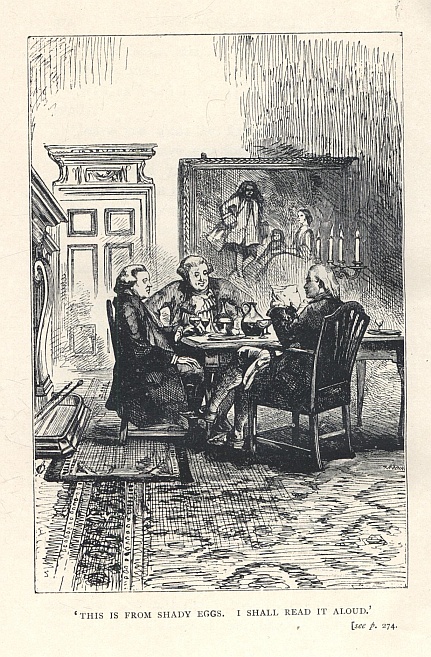
'THIS IS FROM SHADY EGGS. I SHALL READ IT ALOUD.'
Mr. Brimble looked inquiringly at the stranger, who
immediately took the note. 'Leave it with me,' he
said to the servant. 'This,' he continued, 'is from
Shady Eggs. I shall read it aloud.'
'"RESPECTED SIR,—I trust you will excuse the
incorrectness of putting a dash before your name, also
any mistake I may have made in spelling it, should it
be erroneously written. I have to inform you that
Mr. Bloodworth, the steward to Sir Valary de la
Mark, has pertinaciously endeavoured to discover
your address, which I have, to the best of my poor
ability, kept from him. If you desire to avoid an
interview with him, as I divined was the case from
your manner in the portrait gallery, I warn you that
he now knows of your abode; that is, if it continues
to be in the apartments at Mrs. Sparks', which you
bespoke when I had the honour of being with you
in the public vehicle. I do not love to interfere in
other men's matters; and truly, with no malice to
Mr. Bloodworth, but with respectful consideration for
you, I write these few lines,
"And am, your servant to command,
"SHADRACH HIGGS.
'"I send this by a trusty messenger, who will
return it to me if you are not to be found."'
'Higgs all over,' said Dr. Cruden.
'Stop,' said the squire; 'let us begin at the
beginning. What makes him call you Vandercroft?'
'It is not the first name,' said the stranger, 'that
has been gratuitously assigned to me, over and above
that with which my parents honoured me.'
'Then your name is not Vandercroft?' said Dr. Cruden.
'No.'
'Why, then, assume it?'
'I did not; Bloodworth bestowed it on me through
a natural misconstruction of his, and I did not think
it worth while to undeceive him.'
'Capital!' said the squire. 'I'll wager anything
that you are not Jobson.'
The stranger smiled.
'Are you?' asked the squire eagerly.
'According to you and Biddy Sparks I am.'
'According to me! why, you told me it was so.'
'On the contrary, it was you told me.'
'Why,' said the squire, starting from his seat, 'don't
you remember that morning?'—
'Perfectly,' interrupted the stranger,—'when you
addressed me as Mr. Jobson.'
'Well, you never contradicted me.'
'A man hasn't lived to grey hairs,' said the
stranger, with a smile, pointing to the changing colour
of his own, 'without knowing the worth of a name,
as you observed just now; and as you were satisfied
with Jobson, it quite contented me.'
'But how did Biddy get hold of it?'
'Like many others, Biddy is satisfied with slight
evidence; she saw "Matthew Jobson" on the brass
plate of a portmanteau which by an accident I had
exchanged for my own in travelling, and she settled
the matter at once without question.'
Mr. Brimble, holding the miniature in his hand,
looked alternately at it and the stranger, while
Dr. Cruden asked, 'Will you favour us with your true
name?'
The stranger looked at the squire and replied, 'I
think my uncle knows it—Eustace De la Mark.'
'I did know it,' said the squire, almost breathless;
'I did know it—I was sure of it; even while I
called him Jobson I felt drawn to him. My dear
boy, what right have you with grey hairs?' he said,
affectionately grasping both his hands; 'and why have
you served us in this way?'
'I have a very long story to tell,' said Eustace—no
longer 'the stranger'—after the first agitation had
passed; 'but it is of the utmost importance, remember,
that I should not be known to any but yourselves for
the present. My intention was to remain altogether
concealed for some time yet; but I could not
withstand it,' he said, again grasping his uncle's hand.
'You'll let me tell my wife? Up to this moment
she believes you an impostor, and me a dupe.
'Let her think so still; the longer she is deceived
the more complete the triumph will be.'
'Well, I may tell Char, at all events. How delighted
she will be! she has never doubted you a minute.
A smile of satisfaction brightened the face of
Eustace.
'No;' he said; 'let me have the pleasure of telling
her myself, at some future time.'
'Pooh!' said the squire, who hated secrets; 'I
almost wish I didn't know it; I must tell somebody.'
'When you have heard what I have to tell you,
you will see the importance of secrecy; and, to prevent
you from indiscretion, I think, with Dr. Cruden, if
Sir Valary is indeed so very ill, we had better all
three go to Parker's Dew; and on our journey you
shall have a full account of all my history. You know
Sir Valary believes me to be dead?'
'Not a bit of it,' said the squire; 'and I never
believed it.'
'I give you my honour he does,' said Dr. Cruden.
'Have it your own way; but, Eu, is it necessary
to go to-night? why not start the first thing in the
morning? You know they have no beds, no supper;
I doubt if they have even a rushlight.'
'It is growing late,' said Dr. Cruden; 'if we had
gone when I first came'—
'I should not have found my nephew,' said the
squire, looking with beaming affection on Eustace.
'You anticipate me, squire, but not correctly; I
meant we should have had time to go without
alarming them at so unseasonable an hour as we should
now arrive at.'
'All right; then you think it is better to go
to-morrow morning?'
'I am sorry for the delay.'
'Its importance,' said Eustace, 'depends on Sir
Valary's state. Is he expecting my uncle?'
'Oh no; and he has nothing to fear from Bloodworth
to-night. I trust, indeed, he will be kept calm
till morning; and on the whole, perhaps'—
'Beaten, fairly beaten,' said the squire. 'Now that
is settled; so draw close, and, Eustace, begin.'
'Need I remind you,' began Eustace, 'of my
father's high, indomitable spirit?
'No, no,' said the squire hastily; 'he
was the finest'—
'Now, squire,' said Dr. Cruden, laying his hand
gently on his knee, 'let us agree, before Mr. De la
Mark begins, that there shall be no interruptions, or
we shall not finish to-night.'
'Go on,' said the squire.
'He could never brook the stern temper of my
grandfather, and constant contention created serious
disaffection between them.'
'That was all through Bloodworth,' said the squire;
'he was at the bottom of it all; he is a very'—
'Now, do hush,' said the doctor in a deprecating
tone.
'Go on, Eu,' said the squire impatiently.
'He married—that you know—and I was born
before he was twenty-one.'
'Yep, you must be pretty near thirty by this time.'
'I am thirty-five.'
'Why, that makes me fifty-three. How time flies!
Well, lad!'
'You are aware that the discovery of his marriage
was the cause of the final rupture.'
'Ah! Eu was wrong there; I was but a boy then,
and did not understand things, and took his part
through thick and thin; but it was a very foolish
thing to fly in the old man's face that way.'
'Squire, squire,' said the doctor, 'what right have
you to talk?'
'Well, that's true; but I thought he would get
over mine, and Mary's property made it of little
consequence, as far as money went.'
Eustace took the miniature from his uncle, and,
opening the case on the other side, showed the
portrait of a lady. 'That was my mother,' he said
quietly.
'Ay, to the life; yes, she was a lovely creature,
and as good as she was beautiful. Eu was perfectly
right to marry her; but then he should have waited
a little.'
'Bloodworth hurried him into it,' said Eustace, 'by
telling him, in confidence, of another match which Sir
Eustace had determined to effect between him and
some lady distantly connected with his family.'
'Now, Eu,' said the squire, rising in his chair, 'if
you expect me to keep my temper, don't mention
that—pshaw! nonsense!' pushing away the doctor's
hand—'that fellow's name more than you can help.'
'No. My father left his birthplace with a parent's
curse ringing in his ears.'
'Shocking, shocking!' said the squire.
'You know nay mother,' continued Eustace, 'scarcely
outlived my birth.'
'Poor Eu! Poor girl!' sighed the squire.
'At that time my father, as he afterwards told me,
broken down with grief, wrote to Sir Eustace, entreating
a reconciliation and a revocation of his curse.'
'I'll answer for it, my father never had that letter.
I know he was hard, but he could not have stood that.'
'An answer came to it, written by Bloodworth, who
complained bitterly of being made the medium of so
painful a message. It was to the effect that Sir
Eustace would pardon and receive him upon condition
of his marrying again immediately, according to his
choice; and it was couched in such arbitrary terms,
so devoid of all natural feeling, so insulting to my
mother's memory, and casting such unworthy reflections
on my father's motive for making the advance,
that he spurned the thought of replying to it. In
that letter, too, Bloodworth confirmed what he had
often insinuated in his former letters—that his brothers
had helped to embitter the mind of Sir Eustace
against him.'
'Oh, my dear sir,' said the doctor, laying his hand
on Mr. Brimble, 'what is the use of chafing so? Pray,
pray be pacified!'
The squire leant back in his chair in silence.
'I must tell you, my dear uncle, that my father did
not believe it of you,—you were then about seventeen
or eighteen,—and he could not credit that selfish
interest could so have altered your heart, full of
affection as he had left it, in the very bloom of youth.
But, you excepted, he determined to forget all England
and devote himself to me. My mother's slender
fortune, and an estate to which he became entitled
when of age'—
'Yes, Itterdale,' interrupted the squire.
'Left him by old Jasper Honeyman, some fiftieth
cousin of my mother's—this enabled him to live at
ease, though not in affluence. He converted the estate
into money, and, without any settled home, wandered
from country to country as inclination led him.'
'Eu, I could never understand why he did not
write to me,' cried the squire, 'especially as we were
in the same box; he married for love a woman of high
family; I, for something of the sort, a woman of no
particular "family,"'—involuntarily glancing round at
the door,—'and glorious fortune, so we both came
under the ban; he knew it, and I am puzzled to this
day to know why he remained silent.'
'I am afraid of telling you the cause,' said Eustace.
'Go on,' said the squire, clenching his fist, and
flushing with indignation.
'Yes; he was wholly deceived by that man, who
wrote, adjuring him to be patient, entreating him to
communicate all his proceedings to him, mourning
over the conduct of his unnatural relatives, and
promising'—
'Now don't, pray don't!' said the squire; 'if you
love me, don't!'
'At last came the announcement of the death of
Sir Eustace, and of his will, by which you and my
father were disinherited, and Parker's Dew, with all
other property, was left to Sir Valary.'
'Eu,' said the squire, starting up, 'I never believed
in that will. I saw my father not long before his
death; he entirely forgave me, and told me it lay sore
on his heart that he could not see Eu before he closed
his eyes. I gathered from what he said—but he was
too ill to talk much—that he had tried to get at him
for years, but without success. That will was a
forgery!' continued the squire, striking the table with
a vehemence that made the glasses dance.
'My father did not think so. We were in Rome
when we received the news, and he determined on
returning to England, that he might see you and find
the truth of what he had heard. I was then eighteen,
and rejoiced in the prospect of seeing my own country—the
only one in Europe that I had not visited; but
after a three days' illness my father fell a victim to
malaria, and I was so ill as to be reported dead.'
'Of course,' said the squire; 'everybody said you
were.'
'I think I should have justified the report, if it had
not been for an excellent Protestant clergyman, who
felt deeply for me, having just buried his wife in the
same disease; he became a father to me, though I had
no other claim upon his sympathy than needing it.'
'Where is he now?' asked the squire eagerly.
Eustace was silent.
'Ha!' said the squire; 'go on.'
'Like me, he was, as far as human ties go, alone in
the world, and determined to spend the remainder of
his life as a missionary in the East. I resolved to
accompany him; for when we paid our last visit to
the little Protestant burial-place, which contained the
two who had been all to us on earth, it seemed as if
nature and heaven had marked us out for companions.
Eight years we wandered together through the East,
he by his life and preaching teaching Christianity, I
learning it. I cannot pretend to enter now into the
labours and pleasures of those eight years. His health
broke down. He died at Beirut, on our return
westward, and again I was alone. Now my heart
yearned for England. Was I to wander a stranger
through life with mere chance companions? I
embarked on board a vessel bound for Alexandria,
intending to shape my course finally to my own
country; but a doctor from Frankfort, our fellow-traveller
through part of Syria, who had shown great
kindness to my friend in his illness, and had skilfully
soothed his sufferings, being my fellow-passenger now,
won so upon my regard, which was before his, from
gratitude, that I was induced to change my purpose,
and try the Western world, where he designed to settle.
Seven long years I spent in the two Americas, till,
weary of the wide, wide world, I once more determined
on seeking a home in the hearts of some who, strange
to me, yet seemed to beckon me from the distance.
It was you, uncle.'
'Ay, my lad; if I had known your whereabouts, I
should have done more than beckon, I can tell you.'
'It happened, singularly enough, that the Frankfort
doctor and I became again passengers in the same
vessel. He had married an American lady, and was
taking her home to Fatherland, preferring the small
gains he expected to get in Dusseldorf, where he had
a connection, to any amount of money away from it.'
'In the right of it!' said the squire. 'I would
rather live on bread and cheese in England than have
all the treasures of the Great Mogul in any other
country.'
'You never did live on bread and cheese, squire,'
said the doctor, with a smirk.
'Again his importunity overcame me,' continued
Eustace, 'and for a time I deferred coming to England,
and went instead with him to a country, many scenes
in which were familiar to me, all my early education
having been in Germany. Fascinated with old
associations, I wandered about from place to place, as
memory led me, feeling a happier nearness to my
father there than I did when standing beside his grave.
One day the fall of an old house in Dusseldorf, to
which I had for a short time returned, induced me,
with many passers-by, to assist in examining the
ruins, lest any unfortunates should have been buried
under them. Here I met with an accident, and was
too much injured to speak. As a stranger, I was
carried to the nearest hotel, I may call it. As soon
as I could give an account of myself, my friend the
doctor was sent for, and by his advice I was not
moved to his house, but remained there under his care.
Hearing that a pious Lutheran minister was visiting a
sick woman in the same house, I requested to see him.
In the course of conversation he told me he wished he
could understand and speak English well, for the poor
woman he was visiting, he said, was much restrained
by feeling him to be foreign, and his words had less
weight with her than they thought they otherwise
would. "She is much troubled in mind," he said,
"and I would thankfully give her relief."
'I immediately offered, as soon as I should be
sufficiently recovered, to visit her for him; and I did
so. I saw she had not very long to live, and had a
burdened conscience; but I little suspected what she
was about to confide to me. She had been nurse in
the family of Sir Valary, having previously lived for
many years with Sir Eustace. She revealed to me
the whole of Bloodworth's villainy, in which she was
deeply implicated, and gave me all the history of his
contrivance to keep her away—of what she had
suffered in banishment and in leaving Lady De la
Mark and her infant—in fact, she left nothing untold,
her great anxiety being to know if there were any
pardon for sin like hers. She seemed reckless of
exposure, and declared that if she lived she would
willingly receive any punishment, provided she might
have a hope of mercy hereafter. Her gratitude, when
I disclosed to her who I was, was beyond bounds.
She said she thought that having been permitted to
restore me to my rights in so strange a manner was
almost like a merciful assurance that there was pardon
for her.'
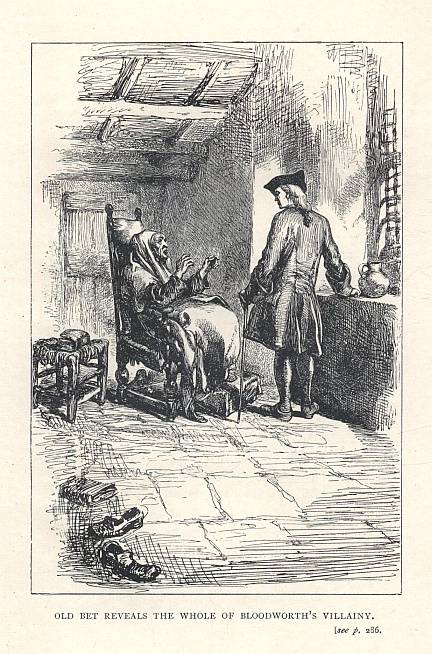
OLD BET REVEALS THE WHOLE OF BLOODWORTH'S VILLAINY.
'Poor old Bet!' said the squire; 'I don't know
what she did, but I'll answer for it, Bloodworth put
her up to it.'
'And what was it?' said the doctor, breathless
with interest.
'That I cannot divulge just now, and it is equally
necessary that Bloodworth knows nothing of me until
I convict him.'
'Let us go to-night,' said the squire.
'Too late, too late now!' said the doctor, shaking his
head. 'Will you let me ask Mr. De la Mark'—
'He is Sir Eustace,' exclaimed the squire, 'and
Valary has no right at Parker's Dew, and I always
said so!'
'It is quite true, uncle; but at present I prefer to
waive the honour; his infirmity, perhaps nearness to
death, and poor Marjory's forlorn condition, have kept
me back from taking any steps for the recovery of my
rights. Of course I have taken legal means; but
they are yet in abeyance. My intention in coming to
England was to see those who would now be forced to
acknowledge me as kin, without apprising them of the
obligation.'
'Then the will is an absolute forgery?' said the
doctor.
'An absolute forgery,' was the reply.
'And Sir Valary knows it?'
'He has known it for many years; but he did not
at the time of taking possession.'
'Well, I'm glad of that, for the honour of the
family,' said the squire huskily.
'And for his conscience' sake,' said the doctor.
'Well, it makes it a shade lighter. Pray, does
Bloodworth know you are living?'
'He is uncertain about it; he has had glimpses of
me now and then, but has not been able to follow me
up.'
'And Valary—does he know it?'
'He also is uncertain. Bloodworth holds me over
him, as nurses frighten children with spectres; and no
doubt the attacks from which he has lately suffered
have been in some way connected with the failure of
their plans to ascertain the fact.'
'How came Bloodworth to call you Mr.—what
was it?' asked the doctor.
'I purposely obtained a draft for him from a person
in Dusseldorf with whom he has invested some of his
ill-gotten gains. I was able to do this through the
information given me by the woman Higgs. Vandercroft
was the name of the person to whom the draft
had been committed, and, not knowing that I was his
substitute, he naturally gave the name to me. He
had never received communications of the kind in so
careless and open a manner, and became alarmed, I
saw at once.'
'My dear,' said Mr. Brimble, 'our being so late
is entirely Mr. Jobson's fault. He has
been telling us such astonishing things
that all we have heard before from him has
vanished into what Char calls, "blue distance." Eh,
Char?' he continued, putting his arm fondly round
her; 'wouldn't you have enjoyed being in my
waistcoat pocket? Miss Cruden,' he added, addressing
that lady, 'your brother has been almost as bad as
Jobson, and I shall turn him over to you for
correction.'
Mrs. Brimble looked stately, so far as her peevishness
would allow her; Mora was half asleep over some
embroidery—Miss Cruden, rather more than half, and
hardly awoke to reply.
'Valary is very ill,' said the squire, advancing to
his wife, 'and we are going in a body to see him
to-morrow morning, first thing.'
'What do you mean by going in a body?'
'Why, I mean Eu and I and the doctor.'
'I?' exclaimed Mrs. Brimble.
'You—no,' said the squire, recollecting himself,
'Jobson I meant.'
'A strange mistake!' said the lady superciliously.
'You said, "you and I and the doctor."'
'Now, Mary,' said the squire in a whisper, 'just
look at him, as he is standing between the two girls;
isn't he a fine, handsome fellow? did you ever see any
one like him?'
'Dear me, Mr. Brimble! I never saw any one like
him but Saunders, our last footman, and he had just
the same kind of nose. I see nothing particular in
him; and I think it very forward of him to talk to the
girls when there is Miss Cruden by.'
The squire laughed; he was afraid of going further;
but Mrs. Brimble had not finished. 'Indeed, Mr. Brimble,
your indiscretion is beyond everything. Here
is a perfect stranger, who, because he happens to be
agreeable to you, and is able to talk, is made quite at
home among us, and we are expected to treat him like
a friend. If you have no regard for your daughters,
I have; it surprises me, after all the cautions I have
given you, and the number of things I have saved you
from, that you will not learn prudence.'
'My dear, you have enough for us all. It's seldom
that more than a fair share of wisdom falls to the lot
of any family, and you have monopolized all that was
intended for the Brimbles. But tell me,' he said,
trying to be grave, though the many mischievous
twinkles of his eye ought to have betrayed him to so
keen a judge of appearances as Mrs. Brimble
considered herself to be,—'tell me, Mary, do you really
look on Jobson as an impostor?'
'Mr. Brimble,' returned the lady, with an impressive
shake of the head, 'I say nothing, but as to proof of the
contrary, why, with me there is none, and there is a
something about him that is very much Like an adventurer.
I may be wrong—I would not be uncharitable;
but'—
'Then you wouldn't advise me to let him visit
here? in short, you would have me cut him?'
'All I desire is caution, Mr. Brimble. He has a
manner I do not admire, and I think I may be allowed
to be a judge of such things.'
'Well, I will be careful. He has rather a designing
look, now I come to examine him,' said the squire,
putting up his eyeglass; 'and he seems to me to be just
now taking the bearings of Bessie Cruden's cap. I
think I must go and put her on scent of danger.'
'Ah! you will be surprised one day, Mr. Brimble,
and then you will remember my words, as you have
often done before.'
'Well, Mary, if I'm wrong this time, you shall
be right without question for ever, and administer
lynch law to your heart's delight; but if I should be
right, what then? It's just possible, though, he may
turn out an adventurous "footman"—some spirited
Saunders, as you fancy.'
'Charity!' said the lady impatiently, as she saw the
object of her suspicion approaching her daughter.
'Mr. Brimble, pray go and entertain your guest, and send
Charity to me—I wish to speak to her.'
The squire obeyed, and so did Charity, very
reluctantly. Florence, having heard from Dr. Cruden of
the intended expedition to Parker's Dew, assailed him
with innumerable questions as to what was the matter—what
would happen if Sir Valary died, where Marjory
would go, etc.; and there was much wonderment
among all the ladies as to the merits of the case, when
they separated for the night.
* * * * *
In a room, dimly lighted by the early sun, streaming
through narrow windows in a heavy wall, sat the sick
man, with Marjory at his side.
'It is growing into day, Marjory,' he said in a feeble
voice, raising himself from his half-recumbent posture.
Marjory, tenderly kissing his forehead, prepared the
draught which Dr. Cruden had left for her father to
take on his awaking.
Poor Marjory! all night she had been watching;
every sound had made her heart beat. It might be
Dr. Cruden; he promised to return—promised to bring
her uncle; but the night had worn away; her father,
sleeping and waking, had on the whole been more
restful, more at ease, than she could have hoped.
'Something has kept him away,' she thought; but
fatigue and anxiety, added to disappointment, had for
the time quelled much of her dauntless spirit.
'Yours has been a dreary life, my child,' said the
old man—old, not by years, but through the ravages
of an embittered spirit; 'your youth buried in this
gloomy place—no companionship'—
'No companionship!' exclaimed Marjory, nearly
letting the medicine fall in her surprise.
More groaning out his feelings than addressing her,
the old man continued, 'I have many sins on my
head—my greatest—my love for you—drove me
to— Alas! what a delusion! I see it now; he was right.
I have been cruelly unjust—I have crushed your
youth.'
'Who is right? who dares to say so? Cruel! are
you not the very life of my heart, my father—my own,
own father?' cried Marjory, closely embracing him.
'It has been delusion—strange delusion—fears for
your future have driven me hither and thither. Oh,
conscience! oh, the wrongs that I have done!
Marjory, I implore you, beware of sin; poverty cannot
make a hell, sin can. If I had resisted the tempter,
I should not have been thus—blighted, cursed!'
Never had Marjory heard words like these from her
father's lips. The suspicions she had allowed herself
in were faint, compared with these vague confessions.
Lost in pain and wonder, she mingled her tears with
his, entreating him to be comforted, and to remember
how precious to her was his love, how burdensome
life would be without it. After a short pause, she said
in a gentle tone, 'Father, dear father, have you any
secret trouble on your mind? will you hide it from
me—from Marjory?'
Sir Valary was long silent; while Marjory fondly
smoothed the long white locks that strayed upon his
shoulder. 'Perhaps, father, while the world counts
you rich, you are poor, or you fear to be so, for my
sake.'
Sir Valary laid his hand upon her head as she
knelt by his side, but made no reply.
'I hear footsteps,' said Marjory, opening the door.
'Mistress Gillies, madam, entreats you so far to
consider your health as to retire for a short time for
refreshment, allowing me to take your place. I should
not have left it till now to proffer my unworthy services,
but I feared disturbing either your or my honoured
master's sleep. I have been some time assuring
myself that I heard your voices.'
Poor Shady had the whole of that night made the
passage his chamber, sitting bolt upright with his back
near his master's door, fearing that Marjory might
require help before it could be rendered, unless he
were a wakeful watcher.
Marjory saw plainly enough that something more
than the request he had made had brought him, and
immediately guessed that the doctor and her uncle had
arrived.
'Where?' she said quietly, as she passed from the
room, Sir Valary having entreated her to obey the
summons of Mrs. Gillies.
'In the hall below,' replied Shady in the same tone.
Much exhausted, she gathered up her spirits, and,
descending the stairs, had her hand upon the door,
when Mrs. Gillies, who was awaiting her, lifted it off
hastily. 'Are they not there?' said Marjory in
surprise.
Instead of answering, the housekeeper laid her finger
on her lips, and, taking Marjory's hand, led her through
the passage that led to the kitchen. She followed
unresistingly, too weary almost for curiosity. When
safe within her own precincts, the housekeeper said,
'My dear young lady, Bloodworth is in the hall; he
has got Shady's books and many papers, and wants to
see Sir Valary as soon as he can; for he says he has
a long journey before him, and has nothing but
pleasant news, and that everything is going well, and
Sir Valary will not be fretted, and many more fine
speeches; so I thought it was better to leave him
quiet, for I knew Dr. Cruden would be as good as his
word, and be here soon, and then his chance of doing
mischief would be over. I have turned the key
outside the door, without his knowing it.'
Mrs. Gillies was so pleased with her own adroitness
that she scarcely noticed the colourless lips and sunken
eyes of Marjory at first. 'Ah!' cried she; 'here am
I chattering, and you too ill to listen.'
Warmth, restoratives, and an hour's rest brought
back some colour, some sign of life, some spirit in the
eye of Marjory, and the first return of power took her
again to the side of her father. His head, a little on
one side, rested on the back of his chair, and his eyes
were closed as though in sleep. Shady had arranged
his pillow, adjusted the room, and, with all the
ingenuity of affection, tried to give an air of
cheerfulness and comfort to the apartment. With his usual
deferential bow he left the room as she entered it,
determined, whatever might come, that if the doctor
did not appear till midnight, Bloodworth should not
have access without him to Sir Valary. Marjory sat
down silently in her old place at her father's feet,
leaning her head upon his knee, having told Shady not to
allow them to be disturbed until Dr. Cruden's arrival.
'It cannot be long,' she said, 'before he comes.'
A gentle sigh escaped the sleeper. 'He is awaking,'
said Marjory, kissing the hand that lay close beside
her cheek; but sleep seemed to return again, no other
sound followed; and, resting her face against him,
while she clasped the hand in her own, overcome with
weariness she slept.
'Take the chaise down to the inn,' said the
squire.
'That is advisable,' said Dr. Cruden.
'I never bring a servant here.'
'I haven't seen poor Shady for a long time,' said
the squire. 'He's a good fellow, but has lived so long
alone that strange faces would scare him; and as to
horses, I would not trust one in such a miserable
wilderness of starvation for the world. How are we
to get in? In my time we went in and out at the
front door like other folks; the last time I came, you
took me through the little door in the tower.'
'I think it would be more prudent if we entered the
kitchen way—Sir Valary is less likely to hear us;'
for the doctor knew perfectly well that when the
squire meant to be exceedingly quiet he carried a
considerable amount of bustle, which seemed as
necessary to him as his breath.
'All right; we might have a worse place than the
kitchen at breakfast-time, and I should think we
must all of us be pretty nearly ready for a second.
What a miserable place it is!' he continued, as they
entered the courtyard; 'doesn't it look as if it had
had the nightmare for the last fifty years? Well,
stone walls are not worth crying about; but I can't
say this is a very promising introduction to the home
of your ancestors, Eu.'
Mrs. Gillies, who had seen their advance, met them,
making her lowest curtsey to the squire, for whom, in
common with all, she entertained a hearty regard.
'What! you haven't forgotten me then!' he said
good-humouredly.
'Forgotten you, sir!' was the reply. A few
questions put them in possession of all they wanted
to know concerning Sir Valary, and of more than
they expected in respect of Bloodworth's opportune
visit.
'Capital! we can settle the whole affair at once; I
like finishing up. Now, how shall we proceed?'
'My advice is that I go in to Sir Valary directly
he awakes, and prepare him for an interview with you.
By degrees we must unfold the cause of our visit as
he is able to bear it, and'—
'And then Eu is to come in. I see.' Shady, who
had been listening at Sir Valary's door for sounds
within and sounds without, heard the squire's voice,
and, gently descending, made his appearance among
them. Bloodshot eyes from a sleepless night had not
increased the vivacity of his countenance.
'Shady,' said the squire, shaking him kindly by the
hand, 'why, what have they been doing to you? I
hope your master does not look as bad as you do.'
'He is tranquilly sleeping,' said Shady, moved to
tears by the squire's kindness. 'I have but now left
his door, and there is not the sound of a breath within;
but Miss De la Mark requested that when Dr. Cruden
arrived he might be taken to the chamber.'
'Good,' said the squire; 'I am glad we are going to
proceed to action. Go, doctor; tell him to cheer up,
and he'll soon come right again.'
The doctor was halfway up-stairs before the squire's
parting charge was over. Mr. Brimble and his nephew
were engaged in such conversation as their
circumstances naturally suggested, questioning Shady on
points on which he could perchance throw light.
The doctor returned, looking exceedingly pale.
'What! back already!' said the squire.
'My dear friend,' he replied, unable to restrain his
tears, 'it is all over; such a scene may I never witness
again!'
Exclamations of shocked surprise burst from Sir
Eustace and his uncle, while Shady stood transfixed
and seemed ready to faint.
'Come,' said the doctor; and he returned, leading
the way to the chamber of death.
Leaning in his chair, his attitude unchanged, his
eyes still closed, rested all that remained of Sir Valary
De la Mark, while Marjory, with the hand still clasped
in hers, slept that heavy sleep which nature sometimes
claims to repair extreme exhaustion.
'This is too much!' said the squire; 'how shall we
get her away?'
'Leave me, leave me,' replied the doctor. 'I will
do it.'
Willingly Mr. Brimble relinquished to him the task,
and the doctor, gently releasing the cold hand from
Marjory's grasp, raised her from her father's side.
'My dear child,' he said tenderly, 'you must not
remain here now. Your uncle is come, and we need
to be alone with—in this room; and you shall lie
down, my dear—Mrs. Gillies—rest on me—this
way;' and he attempted to lead her from the room,
but Marjory was now awake, and resisted the
movement at first. 'Need I leave him?' she whispered.
'I have slept, I am quite strong now, and he must be
better, for he has slept so long.'
Importunity at last prevailed. She consented to
go for a while. 'But let me see him first,' she said;
just one look. He was so calm, so peaceful, when he
first sank into sleep. How could I sleep when I
ought to have been watching him?'
Finding it vain to resist, the doctor yielded, and
she advanced.
Not a cry—not a word—but one long settled look
of horror and despair. She stood motionless before
the body.
* * * * *
'Leave me to deal with him,' said Eustace. 'But
you,' turning to the doctor, 'had better be with me.
We will spare you, my dear uncle; there is no
necessity to arouse your feelings by bringing you in
contact with him.'
'Good!' said the squire, who had been leaning
silently on the window-frame, looking out on the
neglected garden, and living over again the scenes of
his youth. There had never existed any brotherly
affection between him and Sir Valary; entire
contrariety of character, and the treatment of Eustace,
which the squire had always attributed to him, had
early separated them, and the influence of Bloodworth
had succeeded in keeping them apart, even to the end.
It was not grief for the dead, therefore, that gave the
saddened expression to his fine manly countenance.
There were, no doubt, regrets, but they were for Eustace,
whom he had dearly loved. But there were uneasy
thoughts—unwelcome reminders—that he alone
remained of that generation, and that he too must die.
From subjects pointing this way Mr. Brimble ever
studiously turned. He had faced death often in the
pursuit of pleasure, for he was still so fearless a rider
that his escapes while hunting were often the marvel
of the neighbourhood.
Yet to see the destroyer close, in calmness and
quiet, was more than he could bear! indeed, if truth
were told, that ever joyous face was sometimes but a
mask hiding gloomy, heart-sickening misgivings. He
had a deep-seated respect for religion. He fully,
honestly, intended one day to be ready to die, and
hoped, or thought he did, to go to heaven, when he
could no longer live on earth. But that day he put
off as an evil day, and avoided everything that
reminded him of its necessity. It was, therefore, very
acceptable to him to be released from a scene that
was every way adverse to his comfort.
'If I could be of any use,' he said; 'but I am no
man of business, and as to poor Madge, I couldn't see
her yet; I should only make her worse.'
Ah! it is at such times that the truth of human
nature comes out. The squire was benevolent to a
proverb—open-handed as the day, kind as a father—up
to a certain point, in earthly relationships and
dealings, blameless. Yet, after all, his was a most
refined selfishness. He enjoyed the happiness of
others, for it unconsciously helped to make his own,
and this gave the glowing colours to his universally
admired character. But to deny himself, to
suffer with others, to descend into darkness with them,
and bear their sorrows—oh no! Yet this shrinking
from the griefs of others was looked on as a finishing
mark of his great amiability. Thus, even in regard
to his fellow-men, his love was one-sided; and in
regard to the higher love, without which all earthly
excellencies are vain, his heart had it not. Every
mile that took him from Parker's Dew lightened his
spirit, for his constant habit of suppressing all painful
or serious thoughts had made the effort a very easy
one.
The heavy walls and high windows of the apartment
in which Bloodworth had remained forgotten had
prevented him from hearing the hurry and confusion
of the last two or three hours, and he was chafing
with rage against the housekeeper and Shady for their
insolence in thus detaining him, if done purposely,
when the door opened and the doctor and Sir Eustace
entered. Various emotions in turn took the place of
anger, but fear was predominant. He looked with a
cowering, questioning expression, but was silent.
'Mr. Bloodworth,' said Dr. Cruden, 'your accounts
will be required—your late master's affairs'—
The doctor always failed in a set speech: he could
get no further. The shock, compassion for Marjory,
sympathy with the heart-stricken Shady and the
faithful housekeeper, had left him no time to feel;
but now that he came to announce the death of his
friend, whose sickness he had so long anxiously
watched, and for whom he had from boyhood had a
very sincere attachment, he was overcome.
Bloodworth's eyes moved quickly from one to the
other. He was by no means taken by surprise. He
had long expected it. He had intended to make his
final visit to his master that morning, hoping so to
profit by it as to remove all fear and establish his
future fortunes.
'Am I to understand,' he said, 'that Sir Valary'—
'You understand aright,' said Sir Eustace, interrupting
him. 'And now, sir, where is the original will of
Sir Eustace De la Mark? Understand me. By the
original will, I mean that which was set aside to make
way for the instrument that put your late master in
possession of his father's property, to the exclusion of
his brother. Are you prepared to produce it?' he
continued, waving his hand, as he saw that Bloodworth
was about to assert a denial.
'Really,' said the steward, pale with terror, but
trying to recover his effrontery, 'this is very strange
conduct. Sir Valary, whom I have served so faithfully
for so many years, and for whom I have sacrificed my
comfort and earned a bad name, is no longer alive to
protect me, and therefore I am to be attacked with
base charges,—unjust charges,—and that by strangers.
Where is Mr. Brimble? I know that he is executor
to Sir Valary; I always begged that he would make
him so. He is the proper person to inquire into all
the affairs, and I hold myself answerable to him, and
to no one else.'
'You talk beside the mark,' said Sir Eustace coolly;
'you will certainly be called upon to account for your
stewardship. But you know perfectly well that the
estates which Sir Valary was supposed to possess did
not belong to him. We need not waste words; the
will to which you were last a witness was a forgery.
You are now required to produce that for which it was
substituted, and which I know is not destroyed.'
'I will take my oath,' said Bloodworth after a
pause, 'that I saw that will signed by Sir Eustace's
own hand, and that I was a true witness to the
signature. There was indeed a previous will,' he
continued, rather reassured by the silence that followed
this declaration, 'to which I and my fellow-witness
in the last both subscribed also. Sir Eustace suddenly
had another one drawn up, in consequence of certain
reports that reached him concerning his two sons.'
'Who drew up the will?'
'Nicholas Harris, a clerk of mine bred to the law.'
'Where is he to be found?'
'That would be unimportant,' said Bloodworth
carelessly; 'he died, however, shortly afterwards.'
'Bloodworth,' said Sir Eustace, 'the deed was soon
done, and will take little time to confess. Make a
clean breast, and say who signed that second will that
you attested?'
'Sir Eustace De la Mark.'
The three had up to this point been standing;
but Sir Eustace, motioning to Bloodworth
to be seated, beckoned Dr. Cruden to stand
before them; then, placing a pen in the steward's
hand, he guided it with his own, and wrote in large
letters on a piece of blank paper that lay on the
table, 'Eustace De la Mark,' the steward passively
submitting to the movement.
'Whose signature?' he asked, fixing his eyes on
Bloodworth. The steward trembled violently, and was
about to rise, but Sir Eustace held his arm. 'Shall
we make another will and let Sir Valary sign it? A
pen in a dead man's hand has been found a pliant
writer before now.'
There was no answer, for the culprit could not
trust his voice; but an exclamation of horror and
surprise burst from the doctor.
'It was so,' said Sir Eustace; 'I have the
confession in full of the woman Higgs, dictated on her
deathbed, and taken down and witnessed by the
clergyman and surgeon who attended her—a strange
device for quieting conscience and cloaking perjury.
Your partner in crime, every way less guilty than
yourself, saw through the flimsy cheat, and heartily
repented.'
'I never heard of such shocking wickedness!' said
the doctor, holding up his hands; 'oh dear, dear—no
wonder my poor friend—oh, horrible!' he said,
turning his back on Bloodworth. The scornful sneer
with which the steward noticed this movement quickly
gave way to an assumption of boldness.
'I don't know you,' he said fiercely. 'I am not to
be brow-beaten for a crazy woman's ravings—got out
of her, perhaps, by some impostor to get money out
of Sir Valary while he was alive, or out of the son of
him that was disinherited; but the will was proved
and never questioned. Let me pass, I say,' he said,
trying to get towards the door; 'I have much to do.
Mr. Brimble is executor to Sir Valary, and I will
account to him.'
'The business is in the hands of the law,' said Sir
Eustace, 'as you will shortly be. You will have more
help in preparing your papers than you desire.'
'You can't search my house, you have no warrant.
Oh, let me go—I promise—yes, only let me go—I
will indeed'—
'Confess?' asked Sir Eustace. 'It is needless.'
'No, no, explain it, and—and'—
'Give up the will. That may as well be taken
from its hiding-place; the law employs expert seekers.'
'Fool that I have been!' cried the steward, who
now saw his true position—that he was without hope
of escape.
'It is well that you know that,' said Sir Eustace;
'there is hope that you may seek for wisdom.'
But the steward rocked to and fro in his chair, his
violent passions venting themselves in choking
imprecations on his own folly.
Hoping little from him in this state, Sir Eustace
beckoned the doctor to the door, intending to leave
him awhile; but the paroxysm had passed, and,
starting up, he looked fixedly on Sir Eustace.
'Tell me one thing,' he said; 'are you employed
by the son of the last Sir Eustace?' Sir Eustace
nodded assent. 'Then if I were to disclose the truth
of everything'—
'Needless—it is disclosed; have I not told it but
now?'
'Ay! but how it came about, and—and'—
'My dear Sir Eustace,' said the doctor, who thought
his companion looked inflexible, and who was extremely
and anxiously curious to know the particulars of the
wonderful story, 'let him speak; let him tell it all.
I long to have my poor dear friend's memory cleared.
I'm sure he never could have known of such unnatural
wickedness.'
Nothing of this speech came to the ears of
Bloodworth but the title of him who was addressed. He
looked fixedly at him, and then, falling on his knees,
entreated pardon, repeatedly promising to reveal all.
Tenderness for Sir Valary's memory, and the feelings
of his cousin Marjory, who had not shown any sign
of recovery from the shock of his death, with a
natural desire to spare the honour of his name, made
Sir Eustace willing to pass with as little notoriety as
possible through the strange revelations that must be
made in order to put him in possession of his rights.
He saw the importance of having Bloodworth's free
and unconstrained testimony in order to obtain this,
and conditionally promised his pardon.
The long story that followed must be told in few
words. The second will was executed and signed
after death, as described, by Bloodworth's contrivance,
in order that Sir Valary might succeed to the whole
property. His motive was to open to himself a
source of wealth otherwise unattainable. For some
time after Sir Valary's succession he kept the dead
signature an entire secret; when all things were well
established and going smoothly, and a daughter was
born, in whom, after the death of his wife, all his
affections were centred, pretending to be pricked by
conscience, he revealed it. Sir Valary's first impulse
was to seek out his brother's heir and make restoration,
but the steward artfully represented that the
reported death of the young man must be true, or he
would have sought refuge in England when left alone;
again, the portionless state of his infant daughter was
adroitly brought before him, and in a moment of
weakness he relented, and promised to conceal the
strange forgery.
This placed him wholly in Bloodworth's power.
At one time he would work on his gratitude, declaring
it was love for him that led him to the deed; at
another, talk of conscience, and hint at the need of
a public confession, wringing from him some costly
gift, either to repay his service or to calm his
conscience. The death of the widow Higgs, who,
while she lived, was a terror to him, lest she should
turn betrayer, was a great relief to Sir Valary, and
to rob him of this Bloodworth had thrown doubt on
its truth. The malady from which he suffered was
greatly aggravated by the conflicts of his mind, which
became clouded and weakened by the ravages of the
disease. The steward had already obtained large
sums of money, which he had invested in foreign
property, to avoid suspicion, and it was his hope
that morning to obtain the assignment of a valuable
deposit, in return for which he intended to give up
the original will to his master, over whom he had
long held it as a scorpion whip, and quit with his
then sufficient gains a place that would soon be stripped
of its attraction; for with Sir Valary he knew would
die his hope of further fortune. The true will
established, and Sir Eustace De la Mark acknowledged
as the rightful possessor of Parker's Dew, his rule
must be considered as of the past.
Sir Valary's funeral was, according to an urgent
request in his will, private; and to this will, which
was attested by Shady Higgs and Mrs. Gillies, was
appended a desire in his own hand that his tenants,
if any had suffered wrong, should be righted; that
they should be made to understand, in common with
all, that his rigid economy had been occasioned by a
desire to realize an honourable portion for his daughter,
after such sums as had been expended by him out of
the property had been repaid to his brother's son,
whenever he should appear.
'This,' it concluded with saying, 'being the only
way left me to repair a great wrong done, and to blot
out the disgrace that I have unwittingly brought on
the name of De la Mark.'
All the injustice the tenants had suffered, all
extortions, were with one consent laid to Bloodworth's
door, and Sir Valary was heartily forgiven by all,
from his nephew downwards. Great was the rejoicing
that welcomed Sir Eustace. Once more the 'Dew'
would be what the old inhabitants of the place
remembered it. Nay, it promised to surpass its
former grandeur; for, simple and unostentatious as
Sir Eustace was in his personal habits and tastes, he
spared nothing in restoring the home of his ancestors.
It was the delight of the squire to look over his
plans, suggest improvements, and extol those already
made. It seemed as if he had indeed found a son in
Sir Eustace, who was able to interest him in all
things; such subjects, even, as Charity seldom dared
to enter on, came with acceptance from him.
'What shall we do when the Dew is finished?'
said the squire to the ladies, as he looked at the
drawing-room timepiece; 'already, you see, we lose
him day after day; he promised faithfully to be here
by seven.'
'Then he will be here,' said Mrs. Brimble,
confidently; and scarcely had she said so when he
entered. Most heartily was he greeted.
'Where's Char?' said the squire, looking round;
'she was here just now. I want her to see the plan
of the new windows in Sir Mark's Tower. Eu has
brought them to-night.'
'She will, I think,' said Mrs. Brimble, 'spend the
evening with poor Marjory, whom we cannot prevail
on to leave her room.'
'She seems to me to be always chosen,' said the
squire, in a tone of displeasure, as he glanced at Flora.
'Yes, papa dear, she is,' said Flora; 'that's just it.
Marjory likes me very well for five minutes, but at
the end of that time I'm quite sure she neither sees
nor hears me, though she is looking straight at me,
and I am talking as fast as I can. I'm sure I can't
think how Charity manages it—she can amuse her
a whole evening.'
'It is not fair,' said the squire, 'that we should
always lose Char in this way. Couldn't you brush
up a few subjects, Flo?'
'Why, papa, there are so many interdicted, and
they happen to be the very ones that come most
naturally—the improvements at the Dew, and the way
you tease mamma about cousin "Jobson." Of course
one must not say anything about these, for fear of
hurting her feelings, and reminding her; and music
makes her melancholy. I'll go now with pleasure,'
she said, rising, 'and send Char down; but—but—she'll
go to sleep, and so shall I.'
Mrs. Brimble interposed. 'Charity had earnestly
begged to spend the evening with her; and indeed,'
she said, 'strange as it may seem, though Charity is so
serious, she has a wonderful way of making everybody
lively.'
'That is the reason we want her here,' said the
squire.
While Flora Brimble was apparently never so
happy as in the society of her cousin, whom, like her
father, she found a great addition to their family
party, Charity was restrained in her manner towards
him, and seemed tacitly to avoid even speaking of
him, availing herself of the plea of Marjory's preference
for her company to quit the family circle when he
was there.
'Well, Dr. Cruden,' said Mrs. Brimble, 'what
is your opinion of the improvements going
on at the Dew? Mr. Brimble will not
take us till all is complete.'
'The place will be charming, and so transformed
that poor Marjory will not know it. Sir Eustace has
an excellent taste, has he not, squire?'
'He's excellent every way, except that he has a sort
of Saunders look sometimes, Mary thinks.'
'We are none of us infallible, Mr. Brimble; and, so
exposed to mistakes as we have been by your
imprudence, it was necessary I should be cautious.'
'Quite,' said the squire, who was watching with
his eyeglass through a side window something that
attracted him, and he immediately left the room.
'I think Eustace will be a valuable person in that
position, doctor,' continued the lady, looking up from
her work-frame, on which she was embroidering the
arms of De la Mark for a chair for her nephew.
'I feel sure of it,' said the doctor.
'We shall miss him very much when he settles at
the Dew. I hope he will marry well.'
'I don't know any one better able to choose a good
wife, madam, and he is worthy of the best; therefore
his marriage will doubtless give satisfaction.'
'I daresay, like all young men in his position, he
has been married to more young ladies than one by
the country gossips.'
'Not unlikely,' said the doctor.
'I have not heard any reports,' said Mrs. Brimble;
'but of course people would be delicate in speaking
to me.'
'Oh yes, very properly so,' said the doctor, not in
the least divining the lady's tactics.
'I suppose,' said Mrs. Brimble carelessly, looking
very intently on some shades of wool, as if her whole
heart were fixed upon making a right choice, 'you have
never heard anything hinted, doctor?'
'I cannot say I have not. My sister, in her
numerous visits, falls in with such reports, and she
has told me of several; but I think none likely,
though, indeed, one lady that I am not at liberty to
name would shine in married life.'
Mrs. Brimble got quite out of sorts with her wools,
and had to tumble her basket over for some time before
she was calm enough to ask the doctor for the lady's
name, which of course she did not wish to know from
idle curiosity, but out of pure disinterested affection for
her dear nephew.
'I hope I am not doing wrong,' said the doctor, 'in
mentioning the Honourable Amelia Groves.'
'Oh, you need not fear my mentioning it,' said
Mrs. Brimble quickly; 'but that will never come to
anything. I know the kind of girl he ought to
marry—some one with spirit, lively and amusing, and if I
know anything of Eustace, his choice is nearly made,
if not quite.'
'Oh,' said the doctor, 'I am sure you ought to tell
me.'
'If you have not had a guess that way yourself,
doctor, I would rather not.'
The doctor looked up at the ceiling, crossed and
uncrossed his legs, leant his head upon his hand,
rubbed his forehead, and went through all the various
manoeuvres which imply deep thought, finishing the
process by guessing one of the Miss Punters.
'I am a bad hand at guessing,' he said, finding that
Miss Punter was not well received. 'At one time I
thought it not unlikely that poor little Marjory would
be his choice, but I think now he never felt anything
for her but deep pity; and as to her, poor girl, her
heart is buried with her father, whom I fear she will
shortly follow.'
'I thought people never died of grief, doctor.'
'Grief is a strong consumer, madam; but Marjory
inherits from her mother that terrible disease that laid
her in an untimely grave.'
The squire, re-entering, turned the conversation. 'Eu
tells me that he must return to-night, and that you go
with him, and he wants me to go too; he says he has
capital quarters there, so I think of sending one of the
fellows on with some dogs—eh, Mary? only for a day
or so, you know.'
Flora came into the room just in time to hear the
announcement, and protested loudly against it,
denouncing her cousin Eu in no very measured terms
for his unreasonable proposal.
'You little vixen!' said the squire; 'isn't it enough
for your mother to sit there harrowing my heart with
her looks, but I must stand your tongue too? How
would it be if we all went?'
'Oh, lovely!' said Flora; 'how I should like it!'
'Highly incorrect,' said Mrs. Brimble.
'My dear Mary, if you would be so very correct, you
must abide by being uncomfortable. Let us share the
honours; you shall be correct, and Flo and I will be
comfortable. Flo, we'll go—we'll have rooms at the
De la Mark Arms, and we can rough it there for a
night.'
The horror of Mrs. Brimble at such a proposal was
too much for the squire, and, taking the doctor's arm,
with a mischievous laugh he left the room.
'I'm sure papa has got something in his head,' said
Flora; 'see how he's talking, too, in the garden with
Dr. Cruden; he is so delighted! What can it be?'
While Flora and her mother were watching and
wondering, Charity was learning the secret that so
perplexed them. She had been reading to Marjory,
and a gentle tap at the door introduced, to her great
surprise, her cousin Eustace. He so strongly recalled
Marjory's most painful feelings that it was sometimes
beyond her strength to be long in his society. To-day
she felt weaker than usual, and left the room soon
after he entered it.
An awkward silence ensued, then a few remarks as
to her state. At length Eustace, breaking through
the restraint, said, 'Cousin Charity, I fear I have
driven Marjory away, and yet I cannot regret it;
indeed, my purpose was to see you; yes, and to see
you alone—a privilege I have sometimes thought you
studiously avoided giving me. I wanted to ask you
one question. Is the kind feeling with which you
regarded me when I was poor Jobson quite gone?'
Charity was silent; but a glance at her satisfied
Eustace that he had nothing to fear.
About half an hour afterwards Eustace joined his
uncle, telling him that he had received Charity's
consent, for which he had asked permission to plead, and
that there was now no necessity to punish him with a
secret.
The squire shook him warmly by the hand, and lost
no time in taking advantage of his liberty.
'Who's ready for Parker's Dew?' said the
squire, entering the drawing-room. 'Now
is your time to see it, for I have just
heard a grand secret—there is going to be a wedding.'
'Oh, I am so glad!' said Flora. 'Who is it?'
'Well, that is very good-natured,' said the squire,
'considering you have nothing to do with it; and yet
we are all deeply interested in it. Now guess who it
is. I am sure it's worth a guess.'
'Oh, it's cousin Eu, of course,' said Flora.
'Ay, but the lady, Flo, the lady'—
Mrs. Brimble looked up nervously.
'Miss Punter,' and 'the Honourable Amelia Groves,'
died upon her lips.
'What! give it up without a guess?' said the
squire, looking at them both.
'I know whom he ought to have married,' said
Flora, with a little toss of her head.
'You?' said the squire.
'Me!' said Flora; 'he would have despised me
before a month was up, as Marjory does in five
minutes. Oh, no, he is beyond me, besides being
too old.'
After a little more teasing, in which the squire did
not spare Mrs. Brimble's penetration, the secret was
out; and a day of much rejoicing it was at Brimble
Hall.
It was arranged that, on the marriage taking place,
Marjory should occupy rooms fitted up for her at
Parker's Dew, as her own independent home; but she
did not live to see their completion.
'By the grace of God, you know, Shady,' said Sir
Eustace, when fairly settled, 'as you once interpreted
to me, we have all things;' and constantly had Shady
proof that his master knew this. As home steward
and librarian, he reigned supremely happy in his
paradise, but never so happy as when labouring under
Sir Eustace's direction for the improvement of the
poor around.
Mrs. Gillies was now truly the housekeeper of
Parker's Dew, with a goodly retinue of underlings.
Squire Brimble, as years advanced and the influence
of his son-in-law increased, lost the dark clouds that had
at times obscured his sunshine, and enjoyed a far more
solid happiness than he had known in the most joyous
days of his youth.
THE END.
PRINTED BY MORRISON AND GIBB LIMITED, EDINBURGH.