Woody was so depressed after Cindy Lou threw a connecting rod during
the trial runs at the salt lakes that neither Worm nor Steve could do
or say anything to cheer him up. It is possible that Mary Jane might
have been able to remove his depression, for part of it at least
stemmed from the quarrel between them. But if Mary Jane knew anything
of Woody's troubles, she left him severely alone. Woody heard through
Steve that she was going around with Bob Peters, and he wondered at
times whether he ought not to go around to Bob Peters and punch him on
the nose.
"I'd sure feel a lot better," he told Steve, "if I punched him right in
the snoot."
Steve was somewhat undersized, a freckled, sandy-haired youth who was
growing a mustache distinguishable only because it made him look as
though there was something wrong with his upper lip.
"You might feel better right when you punched him," Steve said. "But
one second later you might not feel so good. That Peters is a pretty
big guy."
"Just a sack of hog fat," said Woody savagely. "Coming right here with
my girl so she could see me handing over the ten bucks to him that I
was supposed to take her out with."
"Well, maybe he did," said Steve. "But you gotta admit it was you who
made the deal."
"Say, whose side you on anyway?" Woody asked fiercely.
"Yours, pal," said Steve. "But you won't get anywhere blaming other
people for what you did. Anyway, that's all over. Did you take the head
off Cindy Lou and see how much damage had been done?" For answer Woody
reached up to a shelf above his work bench and threw Steve a piston.
Part of a connecting rod was fastened to it, but it was snapped off in
the middle and twisted like a stick of liquorice.
"Gee," said Steve, deeply impressed. "Sure made a mess of that."
"You should look at the cylinder," said Woody. "There's a hole in the
cylinder wall big enough for an elephant to get through." He led Steve
over to a corner of the garage where the engine block of Cindy Lou lay
on the floor. There was a rent in one of the cylinder walls and deep
score marks on two others.
"What did Worm say caused it?" Steve asked.
"Jeepers, I know what caused it," said Woody. "The connecting rod
snapped in that cylinder, and I busted some rings in those other two.
That's what caused it."
"Don't get sore, pal," said Steve. "I know that's what caused it. Any
kid in the block can tell you that. But why did the connecting rod pop?
What does Worm say?"
"He says it popped because it wasn't according to Davie's Problems and
Principles of Internal Combustion Engines," snarled Woody.
"That's right," said Worm coming up unexpectedly. "There's a sweet
little chapter in there that will tell ye all aboot it. Noo, frae
the look of that I'd say that yere crankshaft was no properly in
balance—just enough to set up a bit of a whip in yon connecting rod.
Though it's possible the metal was a mite tired. Ye're lucky it did'na
go clean through the block and spray ye wi' scalding water and hot oil.
But dinna worrit. Nae doot one day ye'll get another and do the same
foolish thing all over again."
Woody, however, for the time being had had enough of hot rods. Every
time he looked at Cindy Lou or at the engine block lying disconsolate
on the garage floor, he felt sick. In the end, he decided to sell what
he could of her. He'd spent a total of four hundred dollars on the car,
not counting innumerable hours of his own labor. Disposed of piecemeal,
he got back eighty, reselling the carburetor manifold to Bob Peters for
eight dollars. He wasn't very happy when he heard that Bob sold it a
week later for much more.
With the eighty dollars he decided that he'd better try to patch things
up with Mary Jane. The point was, should he buy her a present and call
on her, or should he telephone her and get a date and then turn up with
a present?
He decided to telephone, and it was just as well, because she wasn't
in. She wasn't in when he called the next day either, though her
mother, Mrs. Jackson, sounded encouraging.
"I think she'll be in in a few minutes," she said. "Mary Jane just went
down to the library."
"Gee, is she still reading those swell Huxley books?" asked Woody,
determined to ingratiate himself wherever he might.
"Huxley?" said Mrs. Jackson. "No. It's not Huxley, Woody. The last
book she had was called, I think, The Philosophy of Salesmanship.
She's become very interested in selling lately. Last night she gave
her father quite a questioning on whether he was carrying sufficient
insurance."
"Oh," groaned Woody. "Well, thanks, Mrs. Jackson."
"Shall I tell her you'll call again when she comes in?" Mrs. Jackson
asked.
"No," said Woody. "I don't think I will, Mrs. Jackson."
"All right," said Mrs. Jackson. "I think I understand."
The next day Steve called him up. Steve was worried about Woody's
attitude, which was very gloomy, and had devised a plan that he hoped
would cheer him up.
"Listen," he said. "Got a real good deal for us. There's a tech
inspection for the sports cars for the Torrey Pines race tonight. How
about going along? Lots of cars of all kinds. Ferraris, Maseratis,
Austin Healeys, Jags, TR2's. What d'ya say?"
"Mickey Mouse stuff," was Woody's reply.
"What d'ya mean, Mickey Mouse stuff?" demanded Steve.
"There isn't enough horsepower in any one of them to go over a
cardboard box without changing gears," said Woody scornfully.
"I got news for you," said Steve. "One of the Type D Jags at the Le
Mans race recently developed two hundred and eighty-five horsepower
with a two hundred and ten cubic-inch engine. And it was running on
just plain old gasoline. You know any hot rods can do that?"
Woody admitted that he didn't.
"Well, you want to come and see these little bugs, or aren't you
interested in anything that hasn't got an engine big enough to drive a
tank?"
"I guess I can take a look at them," Woody said grudgingly.
"I was hoping you'd see it that way, on account of I need a ride."
"Just a minute," said Woody. "What kind of a deal is this? I haven't
got any transportation."
"I know you haven't, pal," replied Steve. "But if you're going, you can
talk Worm into taking us there. Tell him every one of these cars was
built by a guy who studied under Davie that wrote the book on internal
combustion engines. S'long."
Worm, however, was strangely hesitant about going to the technical
inspection. He displayed an odd mixture of keenness and reluctance,
as if half of him was excited at the prospect and half of him deeply
disturbed. His long fingers trembled slightly as he lit his cigarette,
and it took him two matches to achieve the task.
"Och," he said finally, looking queerly at Woody, "I wish ye'd said
naething of it tae me."
Woody thought that Worm was merely reluctant to take them there in his
car but, priding himself on the generosity of the Highland Scots, did
not wish to appear stingy.
"Gee, Worm," he said, "if you don't want to take the Dodge, Steve and I
can find some other way of getting there."
"It's nae that, laddie," replied Worm, remarkably serious even for him.
"It's nae that at all. It's something I had put oot of my mind a long
time ago, and I dinna ever want it to come back again. And here it is."
In his distress his Scots brogue grew thicker. Woody couldn't make any
sense at all of what he was saying.
"Skip it," said Woody. "It isn't that important."
"It's nae so easily skipped, laddie," said Worm and went into his
office.
Woody returned to his work of grinding valves, a task that demanded all
his care. By the time he was done, he had all but forgotten his date
with Steve and his strange conversation with Worm. Indeed it was nearly
time to close down the shop, and it was Worm who reminded him of his
appointment.
"Meet me here after dinner," he said. "I'll take ye tae the tech
inspection. It's a thing I must do."
After dinner he was back at the garage to find Worm there dressed in
a clean suit of coveralls. He had a box of tools with him, and Woody
was surprised that he hadn't changed into his ordinary clothing and
should have the tools with him. However, he said nothing to him about
it. On the way, Steve did most of the talking. He explained that the
inspection had two main purposes. The first was to see that all the
sports cars entered for the race were in perfect mechanical condition.
Every feature would be checked for safety, from the seal of the
gas-tank cap to the amount of tread on the tires.
"Man," he said, "they really give them the works on that safety check.
They go over everything with a fine-tooth comb—safety belts, brakes,
brake lights in the rear, steering-wheel play, anything dangling
underneath that might give trouble—they don't miss a thing. I've seen
guys ruled out because their spare tires were a little worn. It's kind
of hard to get tires for some of those foreign jobs in a hurry."
The second purpose of the inspection was to ensure that cars racing
"stock," that is, without any changes from the factory model, hadn't
been secretly souped up in some way to give the driver an advantage
over his rivals.
"You take air filters," he said. "If the factory in England or France
puts a particular kind of air filter on the car, that's the one it's
got to race with. The same kind of filter may be available over here.
Looks the same and does the job no better and no worse. But if it isn't
the factory filter, the car can't race as a stock model."
"Heck," said Woody disgusted, "if they can't soup them up, what fun is
it? Any stock car will turn in about the same performance as another
from the same factory."
"Tuning, driving skill, experience, and guts, that's what makes the
difference," said Steve. "Wait until you see these babies race. It
isn't like Indianapolis, where they just go round in a circle as hard
as they can lick. Once you get into high gear at Indianapolis, you stay
there until the race is over. These boys race on tracks that are full
of hairpin bends, S-bends, and right-angle corners. They have to know
when to shift down and when to shift up. They have to know how to shoot
a blind corner so as to skid round it and still stay on the track. It's
no game for sissies. You get into a hairpin with a cloud of Jags and
Ferraris steaming around you and about three inches to maneuver in, and
you learn how to say your prayers all over again."
It was not hard to find the building in which the technical inspection
was being held. The streets for several blocks around were jammed
with sports cars of every make. It was as if some kind of automobile
carnival was being held. There was a tenseness and excitement in the
air that was infectious. From being slightly scornful of all the
proceedings, Woody found himself increasingly interested in the cars
and the people who drove them, and a little ashamed of his previous
"Mickey Mouse" label.
With Steve he sauntered over to a green MG whose owner was screwing an
air filter in place. He was surprised at the size of the engine. It
didn't look powerful enough to run a lawn mower.
"What will it do?" Woody asked.
"Ninety. Maybe ninety-five when she's wound up real right."
"With that?" asked Woody in surprise, pointing to the little
four-cylinder engine.
"Sure," replied the owner. "Never seen one of these babies before, huh?
What do you drive?"
"Used to drive a hot rod," said Woody.
"Me, too," replied the other. "But when I found out about these I
switched. That little engine there has a displacement of just under
fifteen hundred cc.'s—"
"What's cc.'s?" asked Woody.
"Cubic centimeters. One thousand cc.'s is sixty-one cubic inches. In
other words, with a displacement of around ninety cubic inches, she
develops sixty-five horsepower. That's darn close to three quarters of
a horsepower for every cubic inch of piston displacement. Not bad, huh?"
Woody admitted that it wasn't bad at all.
"Some of the Jags will turn out one point three six hp. per cubic
inch," the MG owner said. "That's on gasoline. That's better than those
Offeuhausers do at Indianapolis using gas, alcohol, and nitro."
"Let's go look at some of the Jags and Ferraris," said Steve. "Say,
what happened to Worm?"
"Probably crawling around under one of these buggies," said Woody.
"I don't think he's ever really happy unless he's got crankcase oil
dripping in his face. He brought his tools along."
"There he is," said Steve. "Talking to that little guy over there."
They pushed their way over through a tangle of cars, drivers, and
mechanics. The cars looked mostly like toys to Woody, but he had an
increasing respect for them. Worm was talking excitedly to the other
man. The two seemed to be old friends, and this surprised Woody, for
he hadn't known that Worm had any close friends, particularly in
sports-car circles.
"Gee," the stranger was saying as they approached, "I haven't clapped
eyes on you in ten years. What are you doing with yourself these days?"
"Running my own shop and service station," said Worm.
"Anything else?" said the other.
"Nae," Worm replied.
The stranger looked at him in silence for a minute. There seemed to be
some understanding between the two of them that Woody could not fathom.
"Like you tae meet me friends," Worm said, catching sight of them and
breaking the awkward silence. "Woody Hartford and Steve Phillips. Meet
Captain Jim Randolph."
"Randy for short," said the stranger, holding out his hand. Randy was
one of the smallest men Woody had ever met. He was slim, fair-haired,
and almost boyish in appearance. There were wrinkles of humor around
his blue eyes, and he sported a mustache that would have done credit
to a guardsman. Woody guessed that he was British—either Canadian or
English.
"You the same Captain Randolph that drove with the Morgan team in the
last Le Mans?" asked Steve.
"That's me," said Randy.
"Boy, you must have got a kick out of that," said Steve.
Randy nodded. "It was a lot of fun," he said quietly.
"What are ye driving noo?" asked Worm. Randy's whole face brightened.
"Something absolutely new," he said. "I was awfully lucky to get it.
It's the only one in the country, and none of them have been raced
before. Come along and take a look." Without waiting for a reply,
he led them down the road to the back of a large building where the
technical inspection was being held. There was a crowd of drivers and
mechanics gathered around a car parked in the rear of the building,
and it was difficult to get through them. When they did, Woody found
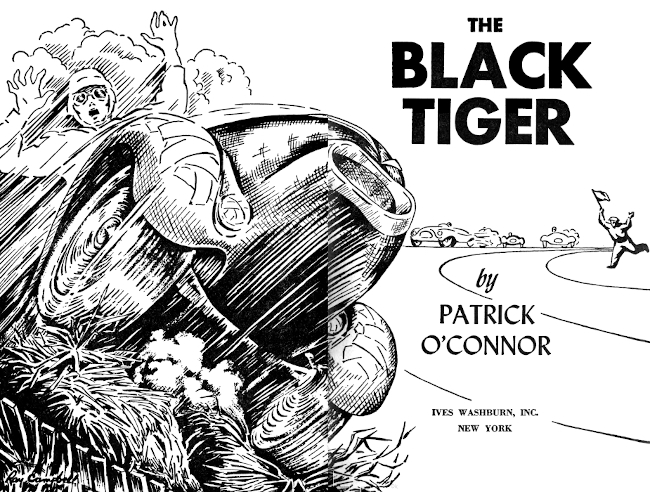
himself looking at an automobile like something out of the next century.
The body was gleaming black, and the hood shaped like the nose of a
shark. There was no radiator, the big wheels had wire spokes, and the
dashboard had so many instruments on it that it looked like the cockpit
of an airplane. Randy pushed his way to the back, the drivers and
mechanics around making room for him, and opened what should have been
the luggage compartment.
"Rear-opposed engine, air cooled, twelve cylinders, four thousand
cc.'s. Develops three hundred horsepower at just under six thousand
revolutions per minute," he said.
"Wow," said Woody. "What do they call her?"
"She's made by Milano of Italy, and she's called the Black Tiger,"
Randy replied.
Woody sighed. Here was a real dream car. No other car could ever take
its place for him. But he would never have anything to do with it, let
alone drive it. The thought left him vaguely unhappy.