Scarcely had the sun risen on the morning following the appearance of
the Black Phantom when the encampment was astir, for each was eager to
discover whether or not he had been selected for the perilous task of
slaying the mysterious visitor. The men stole out of their shelters just
as the rays of the brilliant orb bathed the level sea of green treetops
of the Amazonian jungle with a flood of roseate light, and scanned the
sand in front of their doorways.
Oomah found the symbol, a tuft of snowy, drooping aigrettes that
quivered and glistened at the slightest touch. And he stood reverently
gazing at the sacred object until Choflo’s drum, followed by the sound
of his voice bade the men gather in solemn conclave.
“Upon Oomah has fallen the mission of saving the earth from a terrible
end,” the sorcerer said gravely, “and the selection of the Great Spirit
has been a wise one.”
“But, am I worthy to be entrusted with such a holy undertaking?” Oomah
asked incredulously, holding the plumes in his hand.
“The decision of the Great Spirit has answered that. You must prove
yourself worthy or pay the penalty. Either you will slay the Black
Phantom and bring back evidence of the deed, or you will not return at
all.”
“I question not the wisdom of Choflo who understands the mystic things
that are withheld from the rest of us,” old Yaro meekly protested, “but,
had it not been decided that Oomah was next to be leader of the tribe?
As the coming headman, should not his life be guarded? Should not he be
shielded from peril? If he perish in the attempt to slay the Black
Phantom; or, if he should fail and thus become an exile, we should lose
him forever.”
“If Oomah be lost another will be found to take his place. Wana, son of
my sister, is a promising youth. And besides, there is another reason
why Oomah has been chosen.”
“What is that reason?” Yaro persisted.
“Do you not recall your own words, Yaro, uttered during the last hours
of darkness? 'He who slays a tiger, possessed of an evil spirit though
it be, shall lose his next of kin by another tiger appearing suddenly in
the role of avenger?”
“Yes, it is true.”
“Oomah has no next of kin. He is alone in the world. He has neither
father, mother, sister, brother, wife nor child. Therefore the spirit of
vengeance will be cheated for there is no one to slay. There is no other
man in the tribe without family upon which revenge could fall.”
“As I said before,” Yaro admitted, “Choflo knows all things. He speaks
truly and wisely.” Then turning, he muttered to himself, “But he is
determined to be rid of Oomah so that Wana, son of his sister may become
leader of the people.”
“The magic arrow shall be prepared at once, for only by it can the
Black Phantom be slain; heed well my words, Oomah, and use no other. You
will depart at nightfall. A long trail and a hard one lies before you
with death waiting at the end for the loser.”
All through the day Oomah moved as in a trance. The enormity of the
undertaking dazed him. Not that he feared the jungle or the hardships of
long wandering, for to pursue and to slay the beasts of the wilderness
was a part of his life. But, this was a mission of a different
character. The very existence of the whole tribe depended on him; and
more than that. If he failed, the whole earth, as he knew it, would be
laid waste; Tumwah would never stop his fiery onslaught until the Black
Phantom had been slain. Had not Choflo, who knew all things, said so?
Still, he could not but feel that the sorcerer had been at least to some
extent influenced by personal motives in interpreting the wishes of the
Great Spirit. Did Choflo hope that the quarry would kill him, or at
least elude him? In either event he would be out of the way. The whole
thing seemed very mysterious but he had no alternative but to obey.
Oomah was young, tall and strong. As he walked there was the rippling
play of well-formed muscle under his brown skin. His black eyes, set at
a slight angle somewhat like an Oriental’s, glowed with the fire of
determination from under the heavy shock of hair that covered his head.
The women peeped out of the doorways as he passed, with looks akin to
veneration. Liked by all, the sacred mission on which he was about to
depart enhanced the esteem in which he had been held. And while their
eyes were filled with admiration, their hearts were full of pity and
sadness. For, with the coming of night Oomah would pass from among them
like the fading of a shadow when the sun sets.
Preparations were at once started for the parting feast. Hunters had
gone in quest of game. The women ground yuca roots for fresh cassava
bread. And the children, with tear-stained faces, gathered wood that had
been stranded along the edge of the sandbar. But the youth wandered
about listlessly, barely conscious of the activities that were going on
all around him.
Choflo had gone to the forest early in the forenoon. At mid-day he
returned, carrying a bundle of slender stems in his hand. Looking
neither to right nor to left, he entered his hut and drew a curtain
woven of rushes across the doorway so that none might behold him plying
his sacred calling.
Safe in the seclusion of his abode, he dug a hole in the sandy floor and
buried the stems he had brought so ostentatiously from the forest; then
he took down a bundle of arrows from under the thatched roof and
selected one after a good deal of scrutiny of the lot. It was long—six
feet or more, with a slender, reed shaft and a needle-like point of
tough palmwood fitted and glued into the stem. A short thorn, fastened
to the point with fine twine, formed a barb so that the arrow could not
be withdrawn once it had entered the flesh. On each side of the base was
a split eagle’s feather attached with colored thread. The feathers were
not fastened in a line parallel with the shaft, but curved slightly;
this gave the arrow a rotary motion in flight like that imparted to the
bullet by a rifled gun barrel and made for accuracy in shooting. He now
took a lump of resinous gum from his charm-bag and rubbed it on the point
of the arrow until the latter was covered with a thick, black coat,
resembling old beeswax. A cap of a joint of slender bamboo was fitted
over the end of the missile to prevent the rain from washing away the
supposed poison, and it was ready to be delivered to Oomah.
Choflo had been guilty of treachery of the vilest kind. Instead of the
deadly pua poison contained in the stems of the creepers he had
brought from the forest he had used the harmless gum which so closely
resembled it that the eye could not distinguish between them.
Oomah started on his perilous mission that night, after the feast had
been eaten and all the members of the tribe had bade him a solemn
farewell.
It was a silent group that watched him depart, for they felt that he
would not return; and in their grief they entirely forgot Choflo’s dire
predictions for themselves in the event that Oomah was unsuccessful in
his quest. In their hearts they rebelled at the dictum of their leader
but the long habit of obedience caused them to suppress their
resentment. So they merely looked sad and said nothing.
“Now go,” Choflo said, ceremoniously presenting the magic arrow, “and
return when you have slain the Black Phantom. Bring back the ears, the
claws and the tail so that we may have the proof. And do not return
until your mission has been fulfilled.”
Oomah gathered up his bow, a pack of arrows of various types to use in
procuring game, and a small bag of food, and without a word vanished
into the night. The last thing the watchers saw was the tuft of white
feathers which had been inserted in his head-band.
The youth did not go far. Entering the edge of the forest flanking the
sandbar, country of which he knew each square foot, he went straight to
a giant ceiba tree and took up his station between two of the buttressed
roots to await the coming of daylight. And while the long hours of
darkness dragged their way into eternity Oomah laid his plan of action.
The first thing he did after the sun appeared was to examine minutely
the arrow prepared by Choflo. Certain words whispered into his ear by
old Yaro had had the effect of making him cautious. Besides, there were
his own suspicions to verify or to disprove.
The subject for a test was not hard to find in the form of a spiny rat
that he dug out of a decayed stump and holding the rodent in one hand he
pricked the tender skin with the point of the arrow. The rat struggled
and squeaked, but when he released it a few minutes later it scurried to
cover. Choflo’s treachery had been proven.
Oomah replaced the missile in his pack and started up the river. Two
hours later he halted, started a fire by rubbing together two dry sticks
and placed a forest partridge which he had shot on the way, to roast.
While the meat sputtered on the spit he collected the slender stems of
the same species of creeper that Choflo had gathered and buried in the
floor of his shelter, and prepared the poison of whose deadliness there
was no question.
The process was a simple one. First the stems were crushed to a pulp
between stones and the juice pressed out into a small bowl taken from
his food-bag. The container was placed over the fire; when it had boiled
half an hour its contents had been reduced to a thick, black liquid
which was ready for use. The point of the arrow was dipped into the
concoction and revolved until it was covered with a uniform, heavy
coating. There was now no doubt as to the efficacy of the missile.
Day after day Oomah roamed the forest and the sandbars for some sign of
his quarry, but there was not the slightest trace to be found. Either
the Black Phantom had departed to some distant place or had vanished
from the earth. At night he squatted with his back to some giant
tree-trunk and a blazing fire before him; and between naps he listened
for the roars that never came.
Food had been plentiful but was constantly becoming more difficult to
procure. The turtles had finished their laying and had returned to the
water; their eggs, buried in the hot sand, were now unfit to eat.
However, there was still an occasional partridge, a monkey or a
turkey-like curassow and when one of them was secured Oomah ate
sparingly so that the meat lasted several days.
After a while the long and fruitless tramps and the nightly vigils began
to show their effects on the youth. His stolid nature gave way to a
restlessness that caused him to start in his slumber, and to stop
suddenly in his tracks to listen for sounds that never came. At first he
could not understand the new feeling. And then the truth came upon him
in a flash. Unheard feet were treading in his own footsteps; unseen eyes
were watching his every movement. He was being followed and observed by
an invisible enemy.
Oomah was sure of it, so sure that he swerved out of the forest and
walked along the edge of the bar where the sand was softest and after he
had gone a distance of fifty paces returned to the forest. He continued
along in the deep shadows apparently without concern for the greater
part of an hour. Then he turned and retraced his steps. On the sandbar
he found the confirming evidence. Huge feet had left their imprints
besides those of his own. Some monstrous creature had dogged his every
step, was doubtless even now watching him from a place of concealment in
the dense cover. And of the identity of that creature there was little
question. It could be none other than the Black Phantom.
A thrill came over Oomah—not of fear but of the anticipation of
success. He had at last found his quarry and would lay a neat trap that
the shadowy one would all unsuspectingly enter. His victory was assured.
The youth entered the forest and continued on his way. He walked mile
after mile without turning to look back and then gradually altered his
course so that it took him to the river. Emerging from the wall of
trees he made a wide semi-circle in the sand and returned to the heavy
growth. But now he did not continue his journey; instead, he hurried
back, keeping just inside the fringe of trees until he reached a point
halfway between the tips of the semi-circle. He now crept to the very
border of the jungle where, though hidden from view he could
nevertheless have a clear sweep of his trail across the sand.
Oomah carefully removed the protecting cap from the poisoned arrow and
grasped the missile in his right hand while in his left he held the bow,
ready for instant use, and awaited the appearance of the Black Phantom.
He was trembling with emotion, for the great moment had arrived.
But the black form that he so confidently expected did not appear. The
hours slipped by and just as darkness spread its pall over river and
jungle alike a thunderous roar burst upon the still air from nearby. The
hunter turned quickly in the direction from which the sound came and his
eyes sought to penetrate the undergrowth; but while he gazed at the
mass of stems and leaves the roar was repeated in back of him, exactly
opposite to the direction from which it had come at first.
Oomah, reared in the wilderness though he had been and knowing the
traits of most wild things, for once knew not what to do; it was clear
that the pursued had divined his plan, had sensed his trap, and was
openly defying him. Would he charge next in an overwhelming rush too
swift to be stopped by the arrow’s venomous thrust? Or wait until the
darkest hour of night for a silent stalk and lightning spring! The
latter seemed more probable so Oomah lost no time in seeking the
protection of a great tree-trunk to forestall attack from the rear, and
in building a fire to ward off the onslaught from in front. Between the
two, he felt reasonably secure.
After that it was impossible to tell which was pursuer and which was
pursued. If the man turned back on his trail he always found evidences
that the crafty foe had been shadowing his every move. And the roars
that reverberated through the forest both by day and by night reminded
him of the proximity of the elusive one. When the rumbling voice was
hushed for any length of time Oomah knew that the Black Phantom was on
the hunt for food, or was out to slay, and redoubled his vigilance. Like
his brethren of the more earthy, spotted color, the black monster never
roared while in quest of victims. To do so would be extremely foolish
for it would apprise the prey of his whereabouts and would give them
time to escape to the security of their hiding-places. So the youth was
on his guard during the periods of silence and slept when the roars were
most frequent, for then the danger was least.
With the passing days the drought grew more terrible. If Choflo’s words
were true, and Oomah was to save the earth by slaying the Black Phantom,
he must act soon or Tumwah’s work would be too far advanced for remedy.
He could do no more than he was doing. Yaro had even hinted, in furtive
whispers, that the combat between the Phantom and the God of Drought
was a fabrication of Choflo’s mind, simply another explanation of
something the sorcerer did not understand added to the several he had
already given. Still, he did not know whose words were to be heeded; and
added to his doubt was the lack of understanding of why the Black
Phantom did not attack him. It seemed always to be following him in
accordance with some mysterious design, or to be luring him onward like
a will-o’-the-wisp, further and further into a strange and more hostile
wilderness.
The youth’s disturbed state of mind, coupled with the meager amount of
food now obtainable and the fatigue of the long tramps so undermined his
strength that he fell an easy victim to the dread fever to which, in his
normal, robust condition he was immune.
With throbbing head and blurred eyes he moved painfully through the
forest and over the sandy riverbank. On those rare occasions when he saw
game his arms trembled so violently as he drew the bow that the arrow
went wide and fell far short of the mark.
Choflo had guessed well. He was sure that the Black Phantom would prove
too elusive or too savage for any human pursuer, and that he should
never see Oomah again. In both things he was right. Oomah was destined
to be robbed of his prize and the sorcerer had beheld the youth for the
last time. But despite these facts, the designing purveyor of magic had
been also totally mistaken in his calculations. For, while both of his
hopes were realized they, at the same time, strange as it may seem, were
doomed to failure.
The terrible fever fast gained on the unfortunate hunter, racking his
body and adding physical torture to his mental anguish. Still he
struggled to overcome the insurmountable obstacles in his way. But,
while a firm resolve may do many things there is also a limit to all
things, and there came a day when Oomah could go no further. He had
already wandered far from the country so well known to him. Around him
grew castanha trees with nuts in shells like cannon-balls that hung
high over his head; palms with leaves so enormous that one could
shelter an entire encampment; and birds of species he had never seen
before fluttered among the branches. The air was saturated with the
heavy though not unpleasant odor of vanilla beans. It was indeed a
strange land but Oomah was too ill to take much heed of his
surroundings.
At noon he could go no further. The ground seemed to rise toward his
flushed face and then smote him such a blow that all grew black before
his eyes.
When he awoke the screeching of the cicadas warned him that the day’s
end was at hand. The fever had relented and he felt somewhat refreshed.
His first thought was of fire. Dry wood was not hard to find in the
crackling forest and a few deft twirls of the fire-sticks produced the
spark needed to set a handful of dry leaves aflame. Food there was none
so, with his back to the thick butt of a castanha tree and the blaze in
front Oomah silently and gravely awaited the coming of night.
Hours passed. The moon had disappeared and the glimmer of the stars did
not penetrate the canopy of foliage overhead. Even the goatsuckers,
queer birds that looked like giant whip-poor-wills, had ceased their
wails and in the jungle reigned the darkest hours of night.
Oomah awoke with a start, as if in response to the prod of a rude hand,
and shivered. The blaze had died to a mere flickering tongue of flame
that leapt now and then from the bed of coals. Over the youth came that
nameless feeling that bespoke the proximity of some living thing; seeing
nothing, he nevertheless felt that hidden eyes were boring him through.
Minutes dragged by; the suspense was frightful but his knowledge of the
wilderness bade him feign sleep and he moved not a muscle. Then, with a
suddenness that was appalling, the insane cackle of a woodrail
shattered the silence with its demoniacal cries. The sound, enough to
drive the uninitiated into a frenzy caused even Oomah to turn his head
toward the direction from which it had come, and what he saw were two
points of greenish fire glaring at him out of the blackness not ten
paces away.
Terror lent strength to the faltering arms. The protecting cap was
dashed from the poisoned arrow and the notched base of the shaft flew to
its position in the string. There was the twang of the bow and the
deadly missile whined through the air. A hoarse scream rang out; the
points of greenish fire were gone; a heavy body tore its way through the
undergrowth. Then all was still again.
That effort had cost Oomah his last particle of strength. He shuddered,
swayed, and clapping his hands over his eyes as if to shut out a
frightful dream, sank to the ground.
Nechi, on her way to the fish-traps in the river found the unconscious
youth when the sun was two hours high in the heavens and claimed him for
her own by right of discovery. In other words, to the captor belonged
the choicer tidbits when the captive should be restored to fit condition
for eating.
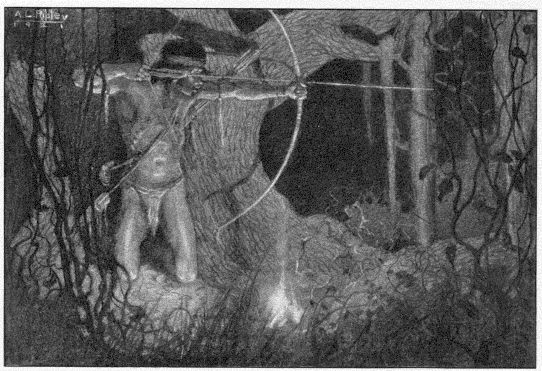 There was the twang of the bow and the deadly missile whined through the air
As she exultantly viewed the prostrate form a pang of fear shot through
her heart. What if he should be dead? She would be cheated out of the
delicacies and also the laurels to which the victor was always entitled.
In haste she knelt by his side and placed one hand over his heart; it
was fluttering weakly. She rushed to the river and brought water in a
folded plantain leaf and dashed it into his face. After that she pried
open his eyelids with her fingers.
Oomah regained his senses with a start and his eyes met the grimaces of
the delighted Nechi.
“Sabana is not dead!” she exclaimed.
“No, the stranger is not dead—not quite dead.”
“You are mine. I will take you to the village; it is less than half a
rest away. I will feed you and cure you of the fever. You are mine.”
Oomah looked again at his discoverer, and closed his eyes.
“I know you,” he said feebly. “You are of the Patocos who have eaten
many of my people.”
“Yes, I am of the Patocos and we have eaten many of the Cantanas. When
you are well and fat again we will eat you too.”
The youth showed no emotion. What mattered it if the girl should make
good her threat, now that his mission had failed?
“I will take you to the village,” Nechi repeated. She left the baskets
she had been carrying on the ground and picking up the youth threw him
over her back. Accustomed as she was to carrying heavy burdens, the
weight was not too great for her strength. A half hour later she reached
the village, a collection of dilapidated shelters nestling under the
protection of the giant palm trees.
The arrival of the girl with her find created great excitement. The men
rushed up with spears and clubs ready to deliver the deathblow but the
girl was not inclined to give up her prisoner so easily.
“He is mine,” she protested; “I found him. You shall not take him from
me. I will feed him and give him chinca bark to cure his fever and
when he is well again and fat—”
“No! No! We must not wait. The prisoner might die and then we should be
cheated out of our feast.”
Nechi had not thought of that.
“Tomorrow,” she relented. “If he shows no signs of improvement by
tomorrow you can prepare for the feast.”
Oomah opened his eyes.
“I came on a sacred mission,” he faltered. “Get me the white feather so
that I may die like a hunter who has not given up the chase. With the
white feather in my hair I can take up the trail of the Black Phantom in
the other world.”
The group that surrounded him hushed their chatter.
“Where is the white feather?” asked one of the older men who seemed to
be in authority.
“There where the woman found me. It must be there for I had it when
sleep overcame me.”
One of the young men was sent immediately to fetch the emblem while the
girl prepared food which Oomah ate with ravenous appetite. Presently the
runner returned; in his hand was the tuft of plumes, now soiled and
frayed from hard usage.
The sight of the sacred object had a telling effect, for among the
savages of the Upper Amazon it was the one inter-tribal flag of truce
likely to be respected, provided the bearer of it could prove his right
to its possession. They stared in silence at the feverish youth as, with
great effort he told them the story of the Black Phantom and of the
heartbreaking weeks he had spent in pursuit of the elusive quarry.
“I shot the magic arrow into the night where the points of green fire
burned, and I know no more. Perhaps it was only a dream or a vision, for
my head was throbbing with fever; I do not know! I do not know!” he
ended wearily and sadly. “Therefore I am an outcast among my people; I
cannot return to them. I have no proof that the Black Phantom is dead or
that I did not fire the arrow at some picture of my reeling brain.”
The leader of the Patocos turned to some of his young hunters.
“Go! Search the forest and the riverbank,” he commanded. “Let nothing
escape your eyes. The words of this youth are queer. How do we know that
he speaks the truth? If there was a phantom the magic arrow could not
fail to strike it dead. And when you find it bring back the evidence of
your eyes so that the name of this man may be honored; but if you find
nothing we shall know that he lied and he shall pay the penalty without
delay.”
Not long after, the hunters filed into the forest and Oomah watched them
go with yearning eyes. A whole week passed before the hunting party
returned. But their hands were empty; they bore no evidence that their
mission had been successful.
As for Warruk, the Jaguar, he had considered his score with Mata
settled. She had been punished for the injury she had inflicted on him.
But the others; they had hurled flaming brands at him and had wounded
him with spears. The day would surely come when they too should pay.
As he lingered in the heavy growth bordering the riverbank he became
aware of the fact that one of the man-creatures was roving in the
forest, detached from the group on the sandbar, and he straightway began
to follow and to watch his actions, being careful, however, always to
remain in the dense cover where he could not be seen. By following and
by watching he could learn many things that would be of value in dealing
with these new enemies when the proper time arrived.
The game continued day after day. It was only when the man laid a trap
for him by making a wide detour on the sandbar that Warruk discovered
that it was he who was being sought by the lone wanderer. After that he
was more cautious than before. He followed the scent only when it was
several hours old. But at night, when his pursuer was asleep, he stole
up noiselessly to look upon him and to ponder, for the blazing fire
prevented an attack; he had not forgotten the stinging brands with which
he had been showered not so long before.
There came the night, however, when the fire died down. The opportunity
had arrived and he crept up for the fatal spring.
It was then that Oomah, awakened by the hideous cackle of the woodrail,
saw the blazing eyes. And before the Jaguar had time to realize that the
man-creature had been aroused from his slumber, he heard a sharp twang
and a fiery pain darted through his shoulder taking him so completely by
surprise that he turned and fled with a scream of terror. Truly, this
new enemy was beyond all understanding. His deadly sting reached out
far, even into the blackness of night. Against it he, the king of the
untrodden wilderness, could not hope to contend.
As he rushed madly through the undergrowth the pain in his shoulder
spread rapidly and a heaviness made itself felt in his limbs. What if
the creature hurling shafts of fire that could wound him so sorely
should pursue? With the intense agony of his hurt, and the first signs
of a coming numbness, he could not hope to give battle or even to escape
further injury. No! At least not until he had had time to recover from
the surprise and the confusion of the onslaught; until he had quenched
his burning thirst, and until the pain had subsided. Then he would even
up the score. No more watching, no more stalking! Hereafter, the mere
sight of man would be the signal for his own destruction.
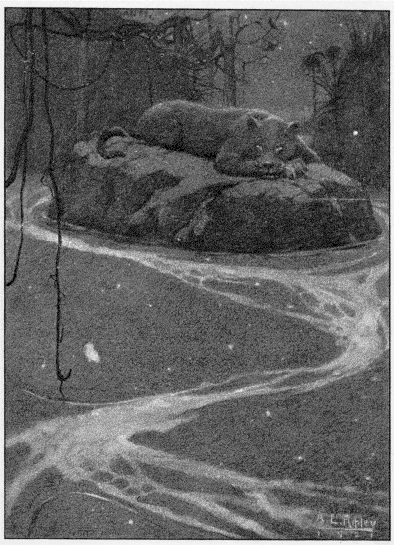
Warruk reached the river’s edge near the rapids where the water rushed
with a seething fury through a narrow channel between the sandy banks.
In the center of the roaring flood was a rock, his rock, where many an
hour had been spent basking in the hot sunshine. It was his only abode,
his one place of safety and to it he would go.
Without hesitation he plunged into the maelstrom. The rushing water
swept him back, again and again, but each time the struggle was renewed
with increased determination; and each effort carried him a few yards
nearer the goal. Just as it seemed the coveted spot had been attained,
the breakers sought with increased fury to drag him down; but he fought
back, inch by inch, and at last one massive foot touched the rough
surface of the stronghold.
With a frantic tenacity that sapped the last vestige of his fast
vanishing strength he dragged his weary body onto the rock and lay down,
cushioning his great head upon his forepaws. Tremor after tremor passed
over him, but they were not from the chill of the night nor from the
drenching of the water. The pain had gone and a drowsiness had taken its
place. Here, where he had rested before, he would sleep again. The
bright stars shimmered overhead; a gentle, lulling breeze fanned his
face; below, the water roared and hissed in impotent rage for he had
conquered it and was out of its reach.
It all spoke of the freedom of the wilderness, and of the joyousness of
life. Not knowing death, Warruk did not fear it. But, knowing sleep as a
reviver of spent energy, he welcomed its coming to relieve the heavy
numbness that was penetrating to his very bones. It came, swiftly; the
deadly poison prepared by Oomah was completing its ghastly work, was
inducing the sleep; but not the normal, restful slumber that comes
between sunset and sunrise but the sleep that is everlasting and without
awakening.
Agoo reached the village of the Patocos after a week’s rapid journey
through the forest. He had been sent by the Cantanas to look for Oomah.
The twigs snapped from the undergrowth by the hunter as he walked along
guided him unfailingly to the last camping site and from there a beaten
trail led to the village.
And Agoo was promptly made prisoner by the fierce enemies of the
Cantanas. There would be a feast indeed, with two captives instead of
one.
The newcomer also carried the flag of truce—the tuft of white
feathers; but the emblem would be of no avail if the report of the
hunters would be unfavorable.
“I would speak to my tribesman,” he said, “here, where all may hear.”
They brought Oomah and formed a circle around the two.
“I am the bearer of a message,” the newcomer greeted the emaciated
youth, “from the fathers of the tribe.”
Oomah grunted. “Why have you come to add to my suffering? I know that I
am an outcast, and I am ready to die.”
“No! You must come back with me. Your work is finished. Your reward will
be great. Choflo’s place shall be yours. That is the message I bear.”
Oomah stared blankly at the speaker.
“How can I return without the evidence? I do not even know that the
Black Phantom is dead. And besides, we are both captives,” he replied.
“We have proof that the sacred mission has been fulfilled. By signs
that cannot be doubted has it been shown that the spectre that brought
desolation to the earth was slain by the magic arrow just seven settings
of the sun past.”
“Seven settings of the sun ago the arrow was sent on its flight into the
darkness; but where it struck I cannot tell.”
“On that night Choflo, who sent you, was slain by a great, spotted
she-tiger which burst into his shelter and fought savagely to retain her
prize even when assailed with spears and firebrands in the hands of
those who would have rescued him. The monster had battled with men
before, and knew their ways, for one ear was lacking, lost in a previous
encounter. The law has been fulfilled. You have no next of kin upon
which vengeance could fall for your deed in slaying the Black Phantom;
therefore, Choflo, who sent you, paid the penalty.”
Agoo did not know it but it was Suma who had avenged her Warruk.
“Speak, Agoo, are these tidings true?” Oomah asked.
“There is even more. Scarcely had Choflo died than a blanket of dark
clouds rolled across the heavens and rain fell throughout the night.
Tumwah had been appeased. We are saved. The earth is saved. And you,
Oomah, shall be rewarded and honored above all men.”
The Patocos stood about in a spell-bound group.
“If this youth speaks truly, why has not the rain fallen here?” one
asked. “Our yuca fields are parched and the animals of the forest are
disappearing. Soon we will die of starvation.”
“I have spoken the truth,” Agoo persisted. Then, pointing to the sky
with both hands, he begged “Tumwah, send the rain-clouds here too. They
do not believe that the Black Phantom has been slain. Why, see,” he
exclaimed suddenly, pointing to the East “even now the sky is overcast
where the sun rises and soon the rain will fall upon you. Look, Oomah!
They can ask for no other proof. Tumwah has come to save you.”
Just then shouts from the forest announced the coming of the hunters and
before long the excited youths had filed into the village and joined the
circle.
“Now tell us what you found,” the headman demanded. “Let your voice be
clear and loud so that all may hear and understand. Did you find
evidence that the first captive spoke the truth? His companion too says
strange things. Either the one is a great hunter who has fulfilled a
sacred mission, or both are spies and shall be dealt with before the
setting of another sun.”
One of the youths who had just returned stepped into the circle.
“These many days we searched the forest and the sandbars, but found
nothing,” he said impressively. “So we returned.”
A hush had fallen upon all. Even the women and children peeping out of
the palm-leaf hovels stopped their chatter and looked with wide-open
eyes.
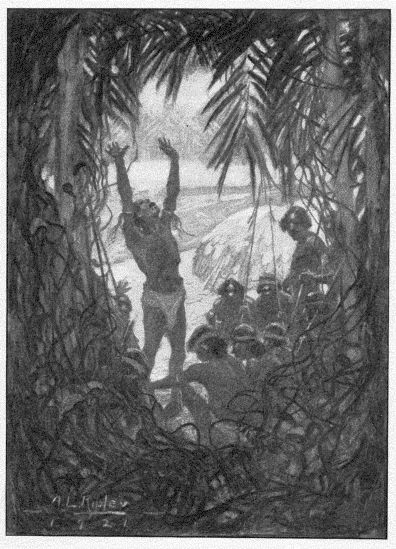 “Tumwah, send the rain-clouds here”
“Build the fires!” the headman ordered. “I suspected treachery from the
very beginning.”
“Wait!” the hunter, continued. “This morning as we rounded the bend in
the river where the banks are set close together and where the water
roars and boils in its haste to pass the terrible place so it may join
the peaceful stretches below, Tupi’s sharp eyes saw the form of a
vulture in the sky. We watched the evil bird and soon discovered other
black specks circling above the gorge. It was there we found the proof,
on a rock in the midst of the raging water; a black tiger of such great
size that it could be none other than the Black Phantom. The broken
shaft of an arrow was still in its shoulder. We could not swim to the
rock; no creature of earth could conquer that angry flood. But there it
is so that all may see yet none may reach except only the loathsome
vultures.”
That night there was a feast in the Patocos’ village. Turtles had been
brought from the corrals and the women made fresh cassava bread. And
long into the night the sound of the celebration rang through the black
forest as war drums boomed and the voices of singers chanted the praises
of the mighty hunter who was among them.
Not until the sharp report of thunder followed by a drenching rain drove
the revellers to shelter did the festivities end.
“Nechi shall go with me,” Oomah said the next morning as he prepared to
depart. “Nechi, who found me dying and whose medicine drove away the
fever. And send one of your hunters also to select a wife from among the
Cantanas. It is my wish that there be blood relationship between us.
Then there will be peace between the Patocos and Cantanas. No more
fighting, no more killing. I speak as headman of my people.”
The older men drew together for a serious discussion that ended in
granting Oomah’s request, and Tupi was selected to go back to the
encampment on the sandbar to be an honored guest and to select a wife.
After that came the leave taking; then the party started on its journey.
The three men, carrying only their bows and arrows, filed into the forest
and Nechi, carrying a heavy basket of food trotted happily after them.