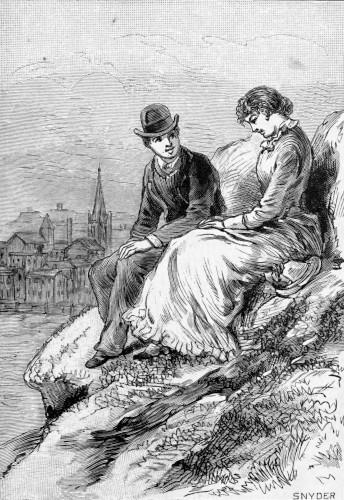
MISS SQUIRE'S NEW SCHOLAR.
About ten o'clock the next evening the door bell of the First Church
parsonage rang with a sharp and prolonged peal, as though pulled by a
vigorous hand. The servant had gone to her room long before; so Mr.
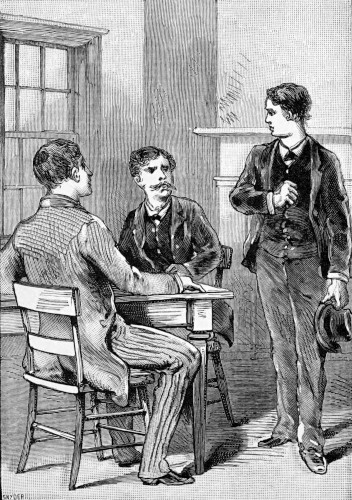
Carleton, who sat in the cozy parlor, reading to his wife, arose and
went to the door. Mrs. Carleton heard him, with surprise manifest in
his tones, say "Good-evening!" The caller, whoever he was, replied at
some length, but in a voice too low for her to understand his words;
then he and Mr. Carleton went up to the study.
It was nearly an hour later when they came down, the visitor going
directly out, while Mr. Carleton, closing and locking the door, came to
the parlor. He seemed surprised to find his wife still waiting for him,
and said:
"Had I known you were sitting up for me, Mary, I would have dismissed
my caller sooner."
"Oh, it was my own choice," she replied, as they entered their room
together. "But who was your visitor?"
"Ray Branford, the boy who stoned me yesterday down at Black Forge
Mills," he answered, with a thoughtful expression still on his face.
"Why, what did he want at this time of night?"
"His mother is dead, and he came for me to attend the funeral service
to-morrow morning."
"To-morrow, Saturday morning! How can you afford the time?"
"I must, even if other things are neglected. You could hardly expect
that people to understand that a minister should always be consulted
before the hour for a funeral service is decided; and just at this time
I am anxious to secure every hold upon them that is possible. It may be
that this funeral will prove to be the entering wedge for giving the
gospel to them. They certainly stand in sad need of it."
"I knew this Mrs. Branford was dead," he went on, "Mr. Bacon having
told me of it last evening; but as they frequently bury their friends
down there without any religious service, he did not know whether I
would be called upon or not. Nor would I have been but for this boy.
His father already lies in a state of beastly intoxication, though the
dead body of the wife and mother still lies in the house; his brothers
are utterly indifferent whether there is a funeral service or not, but
the sisters, through Ray's earnest solicitation, have finally consented
that I should come, though they stipulate that there shall be no
preaching."
"This boy, then, seems to be the most Christianized of the whole lot,"
Mrs. Carleton remarked.
"Possibly in some respects," answered her husband. "Still, he
unhesitatingly says that but for our meeting yesterday, neither would
he have thought of having me. I seem to have quite won his heart by my
method of dealing with him. I could hardly repress a smile to-night
when, with the air of one who has absolute authority down there, he
informed me I need not fear to come and go among that people, as he
had already issued his orders that I was not to be molested under any
circumstances."
Mrs. Carleton laughed heartily. "An able protector you have in him,
surely," she said.
"I am not so sure," Mr. Carleton continued, seriously, "but that he may
prove a valuable helper, if not protector. Mr. Bacon says he has almost
unlimited power over his associates at the mills; is the ringleader
in all their mischief; is wild, daring, and exceedingly profane. On
the other hand, he is strenuously opposed to everything that will
intoxicate, and prides himself on keeping his word. What little I have
seen of him has convinced me that he has in him the material for a
noble Christian manhood, only let the Spirit once begin the work. He
will come to the Bible school next Sunday, and I am hoping it will be
the beginning of better things for him, and for the Black Forge people."
"In whose class will you put him?" Mrs. Carleton asked, with interest.
"Miss Squire's. I have already spoken to her about it; she has rare
tact for holding her boys, and I trust may secure Ray's promise to
attend regularly. Let his word once be given, we shall surely have him
as a permanent scholar with us."
Later in the night Mr. Carleton was aroused by his wife's restlessness,
and asked the cause.
"I cannot get that poor woman at the Black Forge Mills out of my mind,"
she replied. "To think that she should have died there without a single
comfort, and with no Christian hope."
"I meant to have told you," her husband quickly said, "that she was
a Christian, and died happily. She belonged to a Christian family
in an adjoining town, and early in life made a profession of faith.
She afterward married this Branford, much against the wishes of her
friends, and a sad, distressing life has been hers, until her heart
was completely broken by her husband's dissipation and her children's
waywardness. But she never gave up her hope, and when this Ray came to
her side yesterday she sent him for a Bible, and died repeating some of
its blessed promises. The boy was really eloquent as he pictured to me
that death-bed scene, and though he may not realize it, it has already
made a marked impression upon him."
With a sigh of relief Mrs. Carleton settled back upon her pillow, and
was soon asleep.
For the funeral service the following morning, Mr. Carleton, since he
was not to preach, selected several passages of Scripture which, read
in succession, told the old story of man's sin and God's redemption
through Christ; which portrayed the woe of the unbeliever in his
death, and the blessed hope of all who fall asleep in Jesus. He was an
impressive reader, and as God's word, without comment, fell from his
lips, it doubtless went home to the hearts of those who were listening,
with greater power than any mere human words could have done. In his
prayer, moreover, he thanked God for the faith of the departed—a
faith which had survived the most trying experiences of life, and had
enabled her, even when every human comfort was wanting, to find joy and
consolation in her Lord. He prayed also that the faith of the mother
might now become the heritage of her erring children, and be the means
which, by God's blessing, should bring eternal life to their souls.
Then all that remained of that patient, long-suffering, Christian
mother, was borne over to the village cemetery on the hillside, and
laid to rest. Her life had been obscure to human eyes, her prayers had
not been answered, and yet who would dare say of either, "He looked
for fruit, and there was none." "And I heard a voice from heaven
saying unto me, Write, Blessed are the dead which die in the Lord
from henceforth; yea, saith the Spirit, that they may rest from their
labors; and their works do follow them."
Sunday morning dawned bright and beautiful. It was one of those lovely
June mornings when the air is warm and balmy, when everything is green
and flourishing, when the birds twitter from branch to branch or sweep
down into the grass in search of food, and when all nature seems to
praise God, and to invite his praise.
Ray was awakened early by one of his brothers, who said:
"Here, wake up, old fellow; pop and Jake and I are going down the bay
a-fishing, and we want you to go with us."
"Well, that's jolly," replied the boy, sitting up in bed. "How long
before you'll be off?"
"As soon as we can get ready; hurry up!" his brother answered.
"But, you see," said Ray, remembering his promise now, "I can't go."
"Why not, I'd like to know?" asked his brother.
"Because I have promised to be at Sunday-school," answered he, ruefully.
"That's a good one." And the brother sat down on the bed and laughed
loud and long at the very idea of Ray's giving up a fishing trip to go
to a Sunday-school. Catching his breath finally, he suggested: "Tell
the parson you hadn't been in so long, that you forgot what day they
held it." And again he laughed at his own attempt at wit.
Provoked at his mirth, Ray sprang from the bed and began to dress
himself, without saying a word. The brother, taking it for granted
that the boy would soon join them for the trip, left the room. When,
however, he came down to breakfast, with a clean shirt and collar on,
his hair nicely combed, his clothes brushed, and his boots freshly
blacked, the brother, with an oath, asked:
"Ain't you going with us, Ray?"
"Not if I know myself," he coolly replied; "I have a more pressing
engagement." And as neither scorn nor threats moved him in his
decision, the others finally went off without him.
As the hour approached for the morning service, Ray sought his
sister-in-law, whom he in some way felt was most in sympathy with him,
and said:
"Come, Betsy, go up to church and Sunday-school with me to-day. I shall
feel like a fish on dry land up there alone."
"I wish I could," she replied, a wistful look coming into her face.
"But George has gone off, and the girls never will look out for the
children, so I can't go."
He then went to each of his sisters in turn with a similar request, but
in each case met with a scornful refusal, the younger one adding:
"You got your minister off on us yesterday, and we heard Bible and
praying enough then to make us blue for a week. I'd like to see myself
going where he is again."
Ray left the house and walked slowly off up town. He felt all out of
humor with himself, and repeatedly said:
"Catch me making such a fool of myself again, and you'll catch a weasel
asleep."
He reached Main Street just as the First Church bell tolled for
service, and following the people in, took a seat in the gallery. He
could not remember the time when he had been inside of a meeting house
before, and gazed curiously around at the frescoed walls, the memorial
windows, and the large organ and choir.
With the last stroke of the bell the organist struck the keyboard,
and as the melodious sounds pealed forth the boy lost himself in the
service. Organ and song, Scripture and prayer, and sermon, all had a
charm and novelty for him, which were irresistible. Mr. Carleton had
evidently brought with him to the pulpit that morning some of that
power he had felt a few days before on the hilltops, and from the
moment he announced his text until he had finished the discourse, Ray's
eyes were fastened upon him. When he had closed, the boy gave a sigh of
satisfaction, and said to himself:
"He can preach as well as I can throw stones," which, after all, was
not so bad a compliment.
As the congregation was dismissed, Ray followed the others down the
stairs and out of the vestibule, wondering how he should find his way
into the schoolrooms. As he passed out of the doors, however, a hand
was laid upon his shoulder, and Mr. Carleton's voice said:
"I am glad you were here this morning, Ray. If you will wait here on
the steps a minute or two, I will then go with you into the school."
As he stood there Mr. Bacon, the superintendent of the mills, and to
whom he had scarcely ever spoken except in a business way, came to him,
and shook hands cordially with him, saying:
"Did you enjoy the service, Ray? We are glad to have you here; and,
while I think of it, we are going to arrange for a Sunday-school and
preaching service down at the Forge, and we shall look to you to help
us make it a success."
The boy, from amazement, answered not a word, but he straightened
himself up an inch or two taller at the thought that "Boss" Bacon
and some of the other First Church people were going to undertake an
enterprise, and expected him to help. A new idea of usefulness and
responsibility slowly crept into his brain.
Mr. Carleton now joined him, and together they entered the spacious and
tasteful schoolrooms in the rear of the main audience room. Down one of
the long aisles they went, and finally stopped by a class of lads about
his own age.
"Miss Squire," Mr. Carleton said to a dainty, fairy-like lady, in
charge, "this is the new scholar I told you about, and I trust you
and he will get along so nicely together, that we may regard him as a
permanent scholar." Then to Ray: "I have no class of my own, Ray, and
so have decided to put you here with these boys, and this teacher.
Miss Squire, Master Ray Branford." And then he passed on to the
superintendent's desk.
"I am very glad to have you for a scholar," Miss Squire said, in a low,
musical voice; and she laid her daintily-gloved hand in his. "Are you
acquainted with these lads? If not, at the close of the school, I shall
be glad to introduce you. Here, you may take this seat just in front of
me, Ray."
There was something in her manner that relieved the lad of his
awkwardness and embarrassment, and he took the seat she assigned him,
and glanced around at the faces of his companions. There were nine
besides himself, but with the exception of two they were strangers. He
had only a slight acquaintance with these two, moreover, having seen
them but once or twice before at the mills. One was Edward Lawton, the
son of the president of the mill corporation, the other was John Bacon,
the son of the mill superintendent. Their faces showed that they did
not like his entrance to the class, and that they regarded him as an
intruder. This fact, however, instead of disconcerting Ray, only helped
him to regain his self-possession. "They don't want me evidently," he
muttered to himself, "because I work in their fathers' mill. Well,
that's a big inducement to stay." And he settled back in his chair
with an air that said, "I have as much right here as any of you, and I
propose to maintain it."
Miss Squire had been quick to read the faces of the other lads, and
knew the attitude they had assumed toward the new-comer; she had indeed
expected it, and prepared herself for it. She was secretly pleased,
moreover, to notice that Ray, instead of being repulsed by their
attitude, was all the more determined to remain, and she now felt that
she would be able to manage the situation for the good of all.
But the stroke of the bell now called the school to order, and a moment
later four hundred young voices united in singing that beautiful hymn
beginning:
"We come with hearts of gladness,
Our Father and our King!
With brows undimmed by sadness,
Thy wondrous love to sing;
To crave thy Spirit's blessing
Upon this hallowed hour,
With grateful love confessing
Thy wisdom and thy power."
With the second verse a tenor voice rang out so loud and clear and
perfect as to attract attention even amid that chorus of voices. Miss
Squire, herself a fine singer, unconsciously paused to listen to it.
Mr. Carleton heard it, and silently prayed, "O Lord, use that voice in
thy service." The boys in the singer's class heard it, and the most
of them were won over to his side as they listened, feeling after a
boyish fashion that a fellow who could sing like that wasn't so bad,
after all. But the singer, utterly unconscious of the fact that he had
attracted any notice to himself, sang on with his whole heart in it,
and when the hymn was finished, he exclaimed, loud enough to be heard
by all the class: "My! that's worth coming up here for any day. Do you
often sing such pieces as that?"
Repressing the laugh that followed by a single glance, Miss Squire
answered:
"It was fine, Ray. God has given you a wonderful voice, and you should
use it only for him."
The boy gave her a pleased look, and then instinctively bowed his head
as he saw her do, when the prayer was offered. The reading for the day
was one of David's Psalms. And the superintendent briefly spoke of
this, and the circumstances under which it had been written, before
they read it. Ray touched his nearest companion, and with a loud
whisper, asked:
"Was it the same fellow that we are going to study about, and who
killed the giant?"
Miss Squire placed her hand on his arm, saying:
"It was the same one, Ray; but wait until we begin the study of the
lesson, and then ask what questions you choose."
The lesson was soon reached, and after reading the verses with her
class, Miss Squire laid her Bible down on her lap, and said:
"Now, I want each one of you to tell me something about this stripling
David. John, you may commence."
"He was the son of Jesse," he answered.
"He lived at Bethlehem," said another.
"He kept his father's sheep," said a third.
"He had been anointed by Samuel to be king over Israel," added a fourth.
"He was young, and he killed a giant with a stone from his sling," said
Ray, desperately; "that's all I know about him, and Mr. Carleton told
me that."
A general laugh followed.
"Boys," said Miss Squire, earnestly, "if any of you had lived where you
never heard who was president of the United States, would you want to
be laughed at for your ignorance? Ray, unfortunately, has not been as
favored as you, but he is braver than you all in one respect. He is not
ashamed to let us know he is ignorant. In that very fact we have the
assurance that if he has the opportunity he will not refuse to learn."
Then noticing that Ray had neither lesson-leaf nor Bible, she handed
her own Bible—an Oxford Teachers', with flexible covers—over to him,
saying:
"Here, Ray, take this, and use it until you get another."
"Do you mean, take that home with me?" he asked, in astonishment.
"Yes," she replied, "if you will agree to read some in it every
day, and then come here Sundays, and ask me about what you do not
understand."
Ray hesitated for a moment, but those earnest eyes looked with perfect
confidence into his own, as she added:
"I know if you will only promise me that, not one of my boys here will
more surely keep his word."
Then Ray saw his mother on her bed of sickness, and heard her saying
again: "I wish you would go every Sunday, Ray." And reaching out his
hand, he put it into hers, saying, "I promise."
With a ring of gladness almost triumphant in her tones, Miss Squire
went on with the lesson, and Ray could scarcely believe the hour was up
when the bell rang for closing, so interested had he become in David
and the great work he had accomplished. He had asked Miss Squire but
one question. When she spoke of David's faith in the Lord, he asked,
quickly:
"What is faith?"
Her reply was characteristic, and happily illustrated her aptness
to teach. "Ray," she asked, "what made Mr. Carleton willing, last
Thursday, to put his hat back on his head, and let you throw another
stone at it when, had you missed, you might have put out his sight, or
endangered his life?"
"He believed I could hit it," answered the lad, in some confusion at
the thought that she knew of his audacious prank.
"In other words, he had faith in your ability to do just as you said.
And faith in God is believing that he is both able and willing to do
what he has promised."
As Miss Squire met her pastor at the six o'clock prayer and praise
service, he asked:
"Well, what is your impression of the new scholar?"
"That he is worth saving," she quickly replied.
"How much, with the Master's help, did you accomplish toward that end
to-day?" he then inquired.
"I got his promise to read the Bible and to come to Sunday-school
regularly," she answered; and, hesitatingly, "I am almost sure I helped
him to see what it is to have faith in God."
"Well done," he said; "and I am praying with you that the divine seed
of this day may have already taken root in his heart."
Then they parted, each hopeful of the new scholar; and yet so
short-sighted is human faith, that had either of them known where that
scholar was, and what he was doing at that very hour, their hopes would
have gone out in darkness.
After dinner, Ray had gone across the stream at the mills, and into
the woods beyond. Putting his fingers into his mouth, he had given, in
rapid succession, three shrill whistles. In answer, a dozen or more
lads of his own age had joined him. So soon as all were assembled, they
formed a ring about their leader, saying:
"At thy call, chief of the Night Hawks, we come."
"What is it you come for?" Ray asked.
"To do thy bidding, O chief," they answered in chorus.
"Know ye the arch-traitor, Jacob Woodhull?" he asked.
Three groans followed.
"I heard him say last evening," the leader went on, "that he should
begin to pick his strawberries to-morrow."
"Hear, hear!" cried all.
"He told Burnett, the grocer, that he would furnish him with twenty
boxes to-morrow night, and the Night Hawks of Black Forge must see that
he breaks his word."
"Hurrah! hurrah!" all cried, with a smacking of lips.
"Those who want a feast, follow me!" Ray cried, and started off through
the woods, his companions following close behind.
A half mile's walk brought them to a small clearing containing a cabin,
barn, crib, and other out-buildings, owned by Jacob Woodhull, an
eccentric but kind-hearted farmer. He made a specialty of small fruits
on his little farm, finding a ready market for them in the neighboring
village; and, as he had no family, he thus made a comfortable support
for himself. For no good reason the boys at the Black Forge Mills had
taken a dislike to the man, and frequently annoyed him by pilfering his
fruits, tearing down his fences, and destroying his crops.
At a signal from Ray, the squad came to a halt just on the edge of the
woods, and then he said:
"We'll have to wait awhile, boys. The berries are just back of the
barn, but old Woodhull is in the house. By-and-by he will come out
of the house to do his chores, before going up town to the evening
service. He'll go into that crib yonder for grain, and I'll slip up and
shut him in. Then we can pick the berries at our leisure, without fear
of being disturbed. When we get all we want, we'll let the old fellow
out—but hardly in time for him to go up to the meeting to-night."
"Hurrah for our chief!" the boys cried, in a suppressed whisper.
An hour or so later, the door of the house opened, and Mr. Woodhull,
with no thought of the base trick about to be played upon him, came
forth. He had a pail in his hand, and went down to the spring just back
of the cabin for water.
"He'll go to the crib next," Ray whispered to his companions. "You
fellows keep quiet until I have shut him in." And keeping the barn
between himself and the house, he ran for the crib. Crouching down
behind it, he waited.
Five minutes after Mr. Woodhull again appeared, coming directly, as
the boy had predicted, for the granary. Unlocking it, he entered, and
began to fill a measure with meal. Before he had accomplished his task,
however, the door, to his astonishment, was swung to and fastened; then
he heard footsteps hastening away. Soon after he heard many voices out
by the barn, and it at once flashed upon him that a raid was being
made by the factory boys upon his berries. He tried to force open the
door, but it resisted every effort. He looked out of a crevice, but
the barn was between him and the thieves, and he could not see them.
He hallooed, but got only laughter and derision for an answer. The sun
had set, and darkness was fast falling, before his release came, and
even then he got out of the building only in time to see a dark form
escaping to the woods.
Lighting a lantern, he hurried out to his strawberry bed, to find the
plants and unripe berries uninjured, but every ripe berry picked as
clean as if he had done it himself.
"It is that Ray Branford and his crew!" he ejaculated, wrathfully. "I
know it as well as if I'd seen 'em; but it is another thing to prove
it."
The story reached Mr. Carleton and Miss Squire before another Sunday,
and, as they talked it over, they said: "How confident we were that he
was already impressed with a desire to do better! and yet, if it was
he, no good impression can have been made upon him, and he is as far
from the kingdom as ever."
But they only made another mistake, and revealed how little they knew
of God's way of working, after all; for the Holy Spirit was already
striving with that boy, and was leading him surely toward the kingdom.
But the devil never yet gave up a soul without a struggle, and that
thieving exploit was one of his wiles to drown out the Spirit's
pleadings, and, if possible, to tighten his own hold upon the boy's
soul. He, like many of his followers, grows more and more desperate
when he finds he is losing his power.