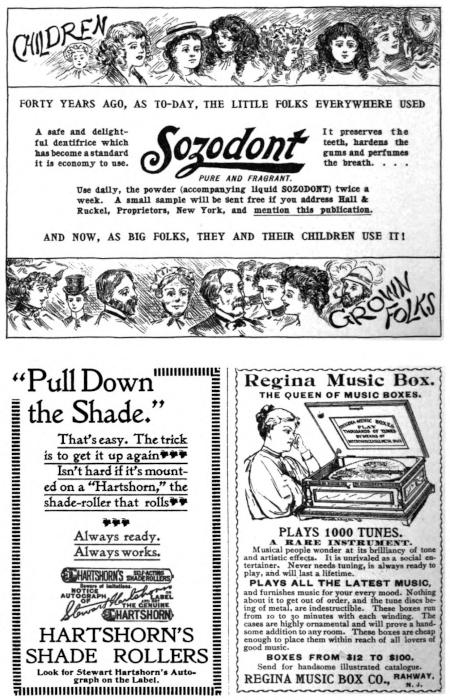
FORTY YEARS AGO, AS TO-DAY, THE LITTLE FOLKS EVERYWHERE USED
Sozodont
A safe and delightful
dentifrice which
has become a standard
it is economy to use.
It preserves the
teeth, hardens the
gums and perfumes
the breath.
PURE AND FRAGRANT.
Use daily, the powder (accompanying liquid SOZODONT) twice a
week. A small sample will be sent free if you address Hall &
Ruckel, Proprietors, New York, and mention this publication.
AND NOW, AS BIG FOLKS, THEY AND THEIR CHILDREN USE IT!
“Pull Down
the Shade.”
That’s easy. The trick
is to get it up again.
Isn’t hard if it’s mounted
on a “Hartshorn,” the
shade-roller that rolls.
Always ready.
Always works.
HARTSHORN’S
SELF-ACTING
SHADE ROLLERS
Beware of imitations
Look for Stewart Hartshorn’s Autograph
on the Label.
Regina Music Box.
THE QUEEN OF MUSIC BOXES.
PLAYS 1000 TUNES.
A RARE INSTRUMENT.
Musical people wonder at its brilliancy of tone
and artistic effects. It is unrivaled as a social entertainer.
Never needs tuning, is always ready to
play, and will last a lifetime.
PLAYS ALL THE LATEST MUSIC,
and furnishes music for your every mood. Nothing
about it to get out of order, and the tune discs being
of metal, are indestructible. These boxes run
from 10 to 30 minutes with each winding. The
cases are highly ornamental and will prove a handsome
addition to any room. These boxes are cheap
enough to place them within reach of all lovers of
good music.
BOXES FROM $12 TO $100.
Send for handsome illustrated catalogue.
REGINA MUSIC BOX CO., RAHWAY, N. J.
The Black Cat
A Monthly Magazine of Original Short Stories.
No. 7.
APRIL, 1896.
5 cents a copy, 50 cents a year.
Entered at the Post-Office at Boston, Mass., as second-class matter.
IMPORTANT.—The entire contents of this magazine are covered by
copyright and publishers everywhere are cautioned against reproducing any
of the stories, either wholly or in part.
Copyright, 1896, by the Shortstory Publishing Company. All rights reserved.
The Mystery of the Thirty Millions.
BY T. F. ANDERSON AND H. D. UMBSTAETTER.
At eight o’clock on the morning of March 14,
1903, the Anglo-American liner, the Oklahoma,
left her dock in North River on her
regular trip to Southampton.
The fact of her departure, ordinarily of
merely local interest, was telegraphed all over
the United States and Canada, and even to London itself; for
there was a significance attached to this particular trip such as
had never before marked the sailing of an ocean steamship from
these shores.
It was not because the great vessel numbered among her crowd
of passengers a well-known English duke and his young bride, the
grand-niece of a world-famous New York railroad magnate, that
her sailing was heralded by such a blowing of trumpets, nor because
she also had upon her lists the names of the august British
ambassador to the United States, returning home on a brief furlough,
the noted French tragedian, fresh from his American
triumphs, and a score of other illustrious personages whose names
were household words in a dozen countries.
The presence of all these notables was merely incidental. What
made this trip of the Oklahoma an event of international interest
was the fact that at this, the apparent climax of the great gold
exporting movement from the United States, now continued until
it had almost drained the national treasury of its precious yellow
hoard, and had precipitated a commercial crisis such as never
before had been experienced, the Oklahoma was taking to the
shores of insatiate John Bull the largest lump amount of gold
ever shipped upon a single vessel within the memory of man.
Not even in the memorable gold exporting year of 1893, ten
years previous, had any such sum as this been sent abroad at one
time.
It was not the usual paltry half million or million dollars that
she was carrying away in her great strong room of steel and teak
wood, but thirty million dollars’ worth of shining eagles and glinting
bars, hastily called across the ocean because of the adverse
“balance of trade” and the temporary mistrust of American securities
by the fickle Europeans.
The mere insurance premium on this vast sum was in itself a
comfortable fortune. Business men wondered why such a large
amount was intrusted to one steamer. Suppose she should collide
in the fog and sink, as one great ship had done only a few weeks
before—what would become of the insurance companies then?
Suppose some daring Napoleon of crime should hatch a startling
conspiracy to seize the steamer, intimidate the crew and
passengers, and possess himself of the huge treasure? “It would
be a stake well worth long risks,” thought some of the police
officials, as they read the headlines in the evening papers.
The Oklahoma was a fast sailer. Her five hundred feet of
length and her twelve thousand tons of displacement were made
light work of by the great clanking, triple-expansion engines
when their combined force of fifteen thousand horse power was
brought to bear upon her twin screws. Under ordinary conditions
she ought to have made port on the other side in time to
let her passengers eat late dinner on the sixth day out. Incoming
steamers reported a brief spell of nasty weather in mid-ocean,
however, and so her failure to reach Southampton on the sixth
and even the seventh day was not particularly remarked.
The great American public had been busy with other weighty
matters in the interim, including a threatened secession of the
silver-producing States; and the departure of this modern argosy
with her precious freight had almost passed into history. For history
in the year 1903 was anything that had happened farther than
a week back—a day, if it was not of overwhelming importance.
If the big ship’s arrival had been cabled on the eighth day, or
even early on the ninth, it would still have found the public in a
comparatively calm state of mind, for the mid-Atlantic storm
would naturally account for a multitude of lost hours; but when
the ninth lapped over onto the tenth and the tenth onto the eleventh
and twelfth, with no tidings of the tardy steamer, surprise
grew into anxiety and anxiety into an international sensation.
Of course all sorts of plausible theories were advanced by the
steamship agents, the newspapers, and other oracles, including
that of the inevitable broken shaft; and these might have sufficed
for a day or two longer had it not been for another and much
more startling theory that suddenly came to the surface and threw
two continents into a fever of trepidation and suspense.
It was the following announcement in a leading New York
morning paper that roused excitement to fever heat: “A new
and most astounding phase has come over the case of the mysteriously
missing Oklahoma. It has just been given out from
police headquarters that ‘Gentleman Jim’ Langwood, the noted
cracksman and forger, whose ten years’ sentence at Sing Sing expired
only a few weeks ago, was in the city several days previous
to the sailing of the Oklahoma and went with her as a passenger,
under an assumed name. Even at that very time the central
office detectives were looking for him, as a tip had been sent
around that he was up to some new deviltry. One of those
clever people whom nothing ever escapes had seen him go aboard
almost at the last minute, and gave an accurate description of his
personal appearance, which was evidently but slightly disguised.
“Langwood is probably the only criminal in the country who
would ever conceive and try to execute such a stupendous undertaking,
and it is something more than a suspicion on the part of
the New York police that he has smuggled on board a couple of
dozen well-armed desperadoes, who could easily hold the entire
crew and passengers in check and make them do their bidding,
for a time, at least. The idea is so replete with thrilling possibilities
that the entire community stands aghast at it.”
It is to be noted that the public always “stands aghast” in
such a case as this; but it is more to the point just now to say
that the article went on, through a column or more, to describe
in minute detail the circumstances attendant upon the departure
of “Gentleman Jim” even to the number and shape of the bundles
he had in his arms. The famous robber was very boyish in appearance,
and one of the last persons in the world whom a chance
acquaintance would think of looking up in the rogues’ gallery.
Evidently he was “out for the stuff,” in most approved stage
villain style, with more millions in the stake than even Colonel
Sellers, of nineteenth century fame, had ever dreamed of. Of
course this theory, which was already accepted as a fact, especially
in police and newspaper circles, was quickly cabled across,
and created such a profound sensation on the other side that
even the London papers had to give it that prominent position
which is usually reserved for American cyclones, crop failures,
and labor outbreaks.
Upon the phlegmatic British government it acted much like an
electric shock and nearly threw the foreign office into a panic;
for was not the British minister plenipotentiary himself a passenger
on the ill-fated Oklahoma, and possibly at that very hour
being butchered in cold blood by a lot of Yankee cut-throats?
The thought was too horrible for a moment’s endurance, and
forthwith the cablegrams began to flash thick and fast between
the foreign office and the British legation at Washington.
The result was that, within a few hours after the appearance of
the paragraph, one of the fastest and most powerful of her majesty’s
cruisers, quickly followed by a second and a third, hastily steamed
from Portsmouth Roads, the three spreading out north, west, and
south, like a great marine fan, as they hurried to the rescue of
the Oklahoma and the British ambassador.
Meanwhile, at the Boston, Brooklyn, and League Island navy
yards three or four of Uncle Sam’s white war dogs were getting
up steam for a similar errand, and a small fleet of ocean-going
steamers, specially chartered by New York, Boston, and Chicago
newspapers to go in search of the absent leviathan, were already
threading their way through the Narrows.
Not for years had there been such world-wide interest in an
ocean expedition. The newspapers commanded an unheard of
sale, for everybody was on the tiptoe of expectation concerning
the fate of the missing steamer, her six hundred passengers and
her thirty millions of gold.
While the public was thus feverishly awaiting the news, certain
discoveries were being made by the New York police, which only
went to confirm their previous suspicions. Four or five other
hardened graduates from state prison were found to be absent
from their accustomed haunts in the East Side slums, although
known to have been in the city just before the Oklahoma sailed,
as was “Gentleman Jim,” himself.
These discoveries had their natural effect upon the public
mind, and the friends of those on board the steamer began to
despair of hearing that even human life had been respected by
the piratical band.
As to the British foreign office, this cumulative evidence threw
it into a perfect frenzy, and it was only by a miracle that a
declaration of war against the United States was averted.
Three days passed by after the departure of the big searching
fleets, during which time all incoming steamers reported that
they had not found a single trace of the Oklahoma either in the
northern or southern route. Vessels from the Mediterranean, the
West Indies, South America, all made the same ominous report.
The tension was terrible. Thousands could not even sleep
on account of the mental strain, and the minds of some of the
weaker actually gave way beneath it. The public by this time
was convinced beyond a reasonable shadow of doubt that the
robbers had successfully carried out their fiendish plan; but
how? and when? and where?
When they opened their newspapers on the morning of the
eighteenth day of suspense, they found the answer to the question,
and the greatest marine mystery of centuries was solved.
In the small hours of the night there had flashed across the
European continent, and under the dark waters of the Atlantic,
this startling message from the representative of the Union Press
Association:—
“Lisbon, April 1.—The missing Oklahoma is disabled at
Fayal, Azores, where she was discovered by the Union Press
special expedition. Many of the half-starved crew and passengers
are on the verge of insanity. The officers tell a most
astounding story of the steamer’s exciting and almost fatal
adventures. On the third night out, the Oklahoma suddenly
came under some mysterious but irresistible influence by which
she was carried rapidly out of her course towards the south.
Every effort was made by the officers to bring the ship back to
her course, but the big liner seemed drifting helplessly at the
mercy of some powerful current. The compasses were useless,
and the wheel no longer exercised the slightest control over the
steamer’s movements.
“Naturally the anxiety of the officers was in no way diminished
when on the morning of the next day, which was then the fourth
day out, another vessel,—a long low-setting craft of shining
steel,—was discovered off the Oklahoma’s starboard bow, about a
mile ahead, but moving in the same direction. By careful observations
it was discovered that the course of the two steamers was
identical. Both were apparently under the same mysterious influence.
Instead of sighting a rescuer, the Oklahoma had, so it
seemed, only discovered another victim of the irresistible current!
“Time and again the Oklahoma attempted to signal the companion
ship, but the latter made no reply. Close observation
revealed that she was built on the whaleback principle, with
nothing above decks save ventilators and signal mast,—but failed
to discover any sign of human being.
“By afternoon their continued failure to bring the liner back
to her course had so wrought upon the minds of her officers that
their anxiety infected the spirits of the passengers, who were now
aroused to the real danger that menaced them.
“When the fifth day dawned, with the Oklahoma hundreds of
miles out of the regular transatlantic course, the gravity of the
situation could no longer be concealed. Distress signals were
kept flying, and all possible steam was put on with the idea of
overhauling the companion ship and giving or receiving aid. To
the amazement of both officers and passengers, however, in spite
of every effort, the Oklahoma failed to gain a single inch on the
other vessel. Before they had time to attempt an explanation of
this remarkable fact, amazement gave way to consternation. For
just a moment a third vessel had appeared on the horizon like a
messenger of hope; but no sooner had she been sighted than with
the swiftness of lightning the mysterious companion craft turned
half around and darted away to the southeast, with the Oklahoma
following as helplessly as though she were in tow.
“In that moment the awful truth was revealed. The steel
vessel was nothing more nor less than a floating loadstone, which
by some mysterious power was dragging the great ocean monster
hither and thither as easily as a magnet draws a toy ship from one
side to the other of a mimic pond!
“Who was she, and what was her motive? Almost before
those on board had asked the question, the answer flashed upon
them. The thirty millions of gold! Beyond a doubt, it was their
capture which she was planning to accomplish, either by luring
the Oklahoma from the regular path of ocean travel, and looting
her and her passengers at leisure, or by compelling her to run
aground upon some remote rock or shoal.
“With this revelation a new horror unveiled itself. Equipped
as they were only with the supplies for a short trip across the
Atlantic, the overwrought minds of many saw starvation looming
up before them. That night not a soul sought his berth. From
time to time consultations were held between the chief officers,
and many-colored rockets spit and blazed their signals of distress
incessantly across the sky.
“At length, soon after dawn of the sixth day, orders were
given to bank fires and hoist sail in the hope that the Oklahoma
as a sailing vessel might free herself from the awful influence that
chained her.
“But the effort was vain. Wind and sail proved as useless as
wheel and compass against the fatal power of that mysterious
craft which drew the Oklahoma after her as irresistibly as though
the two vessels were united by an unseen hawser.
“The steamer had now become a scene of indescribable horror.
Mealtime, bedtime,—all the customary routine was disorganized;
and daily prayer meetings were conducted among the more
emotional of the passengers.
“Finally, seven days after she had left New York, the officers
of the big liner united in one last desperate effort to offset the
magnetic influence of the mysterious ‘pirate.’ The fires were
revived in the engine room, the steam pressure in all the boilers
was run up to the ‘blowing off’ point; then, suddenly, the reversing
mechanism was applied and a shudder ran through the
great floating city as the twin screws began to back water.
“For a few minutes there ensued a titanic tug of war such as
the beholders had never before witnessed. The water astern was
lashed into a lather of foam, and for a brief moment the triumph
of steam over magnetism seemed assured.
“Only for a moment, however, for the cheer that had ascended
from the anxious scores on the deck of the Oklahoma when she
slowly began to back had scarcely died away when with a mighty
crash a vital section of the overtaxed engines gave way, followed
by a hoarse yell of consternation from the excited engineers and
stokers—and both screws were helpless and still.
“With this failure hope was well-nigh extinguished; and the
Oklahoma, with her precious freight and her 643 human souls,
abandoned all active effort to escape. With not a sail of any
kind in sight, she passively rolled and plunged southward for
seven days after her strange and terrible pilot, from which, to add
to the horror of the situation, no human sign had yet been given.
The supply of rockets was now exhausted, and food was doled
out in minute portions as to members of a shipwrecked crew in
order to husband supplies.
“On the afternoon of the fourteenth day, when the exhausted
passengers had reached the verge of distraction, a gleam of hope
appeared on the horizon in the shape of a solitary steamer, bearing
down from the southwest. A glance through the telescope
proved her to be a fast and formidable British cruiser, evidently
en route from South America to England.
“At this news a mighty shudder, half of hope, half of fear,
seized the crowd assembled upon the deck. Would the British
cruiser come to their assistance, and if so, would she, too, become
a victim of the magnetic craft? For a moment their fate hung
in the balance; then from three hundred throats rang out a hoarse
cry of joy as the mysterious craft swerved, turned sharply and
shot away over the surface of the Atlantic due north.
“The spell was broken. The big liner with her six hundred
human souls and thirty millions in gold was freed from the power
that had for so long held her captive. But crippled as she was
by the accident to her machinery she was unable to proceed unaided,
and was taken in tow by the British steamer, the Midlothian,
and a day later was brought safely into port at Fayal.
“The Union Press steamer is the first to bring the thrilling
news. The first officer of the Oklahoma and the saloon passengers,
including Sir Gambrel Roufe, the British ambassador, accompanied
your correspondent to Lisbon. A relief steamer is
urgently needed, as the Oklahoma’s engines are both disabled,
and she will not be able to proceed for several weeks.
“The passenger thought to be ‘Gentleman Jim’ Langwood,
proves to be the Duke of Medfordshire, now on his wedding trip
with his young millionaire American bride.”
Hardly had the excitement caused by this startling intelligence
subsided, when it was once more aroused by a despatch
from Providence, R. I., announcing the capture in the act of robbing
a jewelry store of “Gentleman Jim” Langwood, and a gang
of four other oldtimers, and by the following even more important
cablegram from the Russian representative of the Union
Press:—
“St. Petersburg, April 2.—The identity of the mysterious
craft by which the Oklahoma was drawn from her course has been
established beyond a doubt. The vessel is a Hypnotic Cruiser,
recently completed by a Russian inventor, named Slobodenski,
and possessed of an electric apparatus by which any vessel can
be brought completely under its control.
“Whether the Hypnotic Cruiser’s bedevilment of the Oklahoma
was merely a trial of power, or whether plunder was intended, can
only be surmised. But naval lawyers say that this marvelous
new invention will revolutionize naval warfare and necessitate the
passage of stringent laws to cover a crime for which at present no
penalty exists.”
The Man at Solitaria.
BY GEIK TURNER.
Solitaria will be found indicated on the map
by a circle half as large as that which represents
Chicago. That is Solitaria as it is advertised.
In reality it consists of a side-track and
watering tank on the Great Western Railroad,
and a little wooden box opposite, courteously
called a station, which is inhabited by a man whose aim in life is
to watch the side-track and telegraph along the line how it is occupied
at various hours of the day and night. Just to the east
the Great Western makes its only distinct curve for miles through
a little piece of woods. To the west it stretches straight across
the face of Indiana, mottled with a million half-burned stumps,
and cut into big squares by incalculable miles of rail fence.
The man at Solitaria got to thinking it over—he had a great
deal of time to do this—and he made up his mind that matters
were going all wrong. In the first place, he thought he ought to
be allowed more than twenty-five dollars a month for his services,
and that, considering he had been running Solitaria alone for fifteen
years, they ought to give him an assistant to talk to—to
talk to and to allow him an occasional chance to sleep. These
were, of course, entirely personal matters. But finally he made
up his mind the whole thing was run wrong. It stood to reason;
they never gave it any rest. Day after day and night after
night they had sent freight trains and express trains, and express
trains and freight trains chasing each other along the road till
they had got it so it was all going to break down pretty soon,—the
road, and the cars, and the men, and he himself—especially
he himself; he saw that plainly. They were all going to stop
short, one of these days, and fly to pieces.
Now, take himself, for instance: was it right that they should
have kept running their trains by his door twenty-four hours
out of the day, and 365 days a year, for fifteen years, disturbing
him and depriving him of what little sleep belonged to him?
Yet all night long they persisted in sending their freights jarring
and clanking by and their express trains shrieking and
making up time along the level grade. He got so he knew
those whistles by name—he could hear them shriek for miles
and miles in either direction—coming nearer and nearer, till
the train rushed by in a cloud of yellow light. Then the next
one came. It was bad enough at that, but when they got to
calling him names it was more than he could bear.
Besides, there was the electricity those trains kept making and
storing up in his station, faster than he could ever hope to get rid
of it. It was taking his life away. He went out and watched the
wheels of the freight trains crunching, and grinding, and squealing
by, and he could see it just rolling off and running into the
station. Then nights it came stealing over him, and numbing him,
just as soon as he tried to get a little sleep, which, heaven knew,
he was entitled to. Anybody knows that trains running by like
that, day and night, store up more electricity in a station than a
man can bear, especially if he is all alone. But they paid no attention
to that. He often thought he would write to the division
superintendent, who had been a telegraph operator himself, and
ought to think of such things, and tell him to stop it. But this
plan he never carried out; he had asked for things before.
Now, whatever might be said, no one could accuse the Man at
Solitaria of not giving the matter sufficient thought. For months
during the summer he sat out on the platform of his box, in the
baking sun daytimes, and through the close, airless Indiana
nights, looking down the tracks between train times, and considering
the question. He saw clearly they did not recognize the
power and importance of the man they were wronging. He knew
perfectly well, for instance, that any time he chose he could turn
the switch to the side-track and stand an express train on its head
in the ditch. That would be fascinating, certainly. Indeed, he
considered the proposal seriously for a number of weeks, and
figured carefully on what train he would better take; but finally
thought better of this plan, too. It would only stop one train,
which wasn’t what he wanted at all. The Man at Solitaria felt
the responsibility of his position; he decided to run the whole
railroad himself.
Of course, he recognized that there would be opposition to this
scheme on the part of the president and directors of the road, and
the division superintendent,—especially the superintendent,—the
Man knew the division superintendent. But that railroad must
be run right. As a first step in that direction the Man saved up
money and laid in a large supply of canned meats; he also
secured two forty-four caliber revolvers and half a dozen boxes
of cartridges.
Of course, the management of the Great Western Railroad
didn’t know what was going on in the mind of the Man—especially
as he carried on most of his communication with human
beings by telegraph. It didn’t care much, either, as long as he
kept awake eighteen hours a day and watched the side-track and
told them how it was occupied. Consequently, no one knew of
his intention of operating the road, and no one knew or probably
ever will know why he chose such an unpleasant day for starting
it.
It wasn’t unpleasant in the sense that it was rainy—it was
merely hot. Along down the track the heat rose in great zigzags,
where the yellow sun beat down and baked a crust over the surface
of Indiana. There was not a breeze in the air, not a sound
except the occasional call of a quail from some distant rail fence,
or the cry of a seventeen-year locust in a dead tree. On the
sunny side of the station at Solitaria the thermometer took its
stand at 118 degrees, and refused to be moved, and the air was
a semi-solid mass of cinders.
The Man at Solitaria made up his mind he would shut down
his railroad at six o’clock. He laid in a good supply of water
and loaded up his revolvers; then he shut up the station and
made a kind of barricade of old ties around his telegraph instrument,
and sat down inside and waited.
No. 64, the fast freight from the West, was due at 6.10 o’clock
to draw up on the siding. No. 24, the fast express from the East,
was due at 6.17. At 6.03 the Man telegraphed the station east
that the freight was on the side-track and the main line was clear.
The freight was not yet in sight. At 6.13 it reached the station,
hurrying to make up lost time, and ran off the track; some one
had turned the switch half way. The big engine jumped the
rails, crashed up on the station platform, and stopped, without
being overturned; three cars went off with it. The brakemen
came running up along the train, and the engineer and fireman
climbed down out of the cab, swearing and looking for the operator.
Just then the express could be heard rushing along from
the east, and two brakemen started up the track to head it off, on
the dead run. At 6.16 the train appeared in sight. When she
came around the curve and saw the freight she just stiffened right
out and slid. It wasn’t quite soon enough, however. She struck
the freight cars just before she came to a stop, smashing a cylinder
and nearly jerking the heads off the passengers. All the windows
and doors of the coaches flew open with a slam, and the
train hands and passengers began to swarm out like hornets out
of a hornets’ nest. The trainmen started forward on the run to
see what was the matter and to look up the operator and find
out what he was trying to do.
The Man opened a window in front of the station, with a
revolver in his hand, and told them that what he was trying to do
was none of their business. He was operating this damned road
now, and he wanted them to understand it. Besides, he didn’t
want them on his platform. By way of emphasis, he fired a
couple of shots as close to their feet as he could without hitting
them. They got off, and he shut down the window with a bang.
Somebody went around and tried a window in the rear, and he
fired two shots through the glass. It was just as well they didn’t
try it again, for he would have nailed them the next time.
Then the trainmen went off to a respectful distance and discussed
the situation, and the passengers retreated behind the
coaches. The Man sat down and telegraphed that the express had
gone by, but that No. 64 had a hot box on the side-track, which
might keep it there for some time, so that No. 31, the westbound
freight, had better be sent along. He would hold No. 64
for it. So No. 31 came along. It nearly paralyzed the passengers
of the express train when they heard it on the line, but the brakemen
stopped it all right in time to prevent it from landing on the
back of the coaches.
By this time the station at Solitaria presented an unwonted and
active scene. Three trains were huddled up around the place,
two of them tangled together in a heap. The engine of No.
64 stood up inquiringly on the station platform, like a big dog
waiting to be let in. The trainmen and the passengers still stood
around and discussed ways and means and swore at the Man and
the infernal heat. Several times they had tried to approach the
Man, but the Man at Solitaria was unapproachable. A big passenger
from the West had declared he would go up, anyway, as a
little thing like that had a comparatively mild effect on his nerves,
and a small passenger from the East had tried the effect of kind
words and moral suasion; but the big six-shooters of the Man had
an equally discouraging effect on both.
In fact, the exhilaration of running a railroad was beginning
to exercise a strange fascination on the Man at Solitaria. This
was only natural, after all. The way he ran things was a good
deal like firing railroad trains at a mark, with the certainty of
hitting it, if nobody interfered. He recognized, however, that
there was need of great discretion and intelligence in the matter.
The train despatcher was already making the telegraph instrument
chatter like a sewing-machine, asking the station to the west what
had become of the express, which, of course, the station west
didn’t know.
The Man sent word down the line that a brakeman had come
into the station and said there was a big wreck at a culvert three
miles west. It was a bad wreck, with a great many killed, and
the wrecking train should be sent at once. The train could run
right by his station to the place, as the line was clear. In fifteen
minutes the wrecking train was drawing out of the Centerville
station, seventeen miles east, with all the doctors that could be
raised in the vicinity, and coming down the line sixty miles an
hour in a halo of hot cinders. If it hadn’t been for a line of
brakemen stationed up above the curve, there would have been a
great opening for young doctors in Centerville. As it was, the
train stopped so short on the curve that the front trucks of the
engine ran off and the one passenger coach was jolted full of a
mixture of frightened doctors and medicine vials.
By this time the Man had been operating the road for an hour
and a half, and the excitement of the thing was growing intense,
especially among the disgruntled officials he had superseded.
Trains were beginning to stack up at the stations east and west,
waiting for developments, and the train despatcher was beating
such a devil’s tattoo on his instrument, trying to find out what
was going on, anyhow, that the Man used up a great deal of
patience and ingenuity trying to shoot him. As for the division
superintendent, who had come on the wrecking train, his hair was
rapidly growing white. But, as long as he could not effect a compromise
with the Man, there was nothing he could do. The Man
was engaged at present furnishing information on Solitaria to the
outside world, and it was futile to try to conceive what his rich
imagination would prompt him to do next. On the other hand,
the freight engine on one side and the engine of the wrecker on
the other cooped up the only able engine on the track, and made
advance or retreat impossible as long as the wrecker couldn’t turn
to and haul itself up on the track. But the Man refused to compromise.
The division superintendent finally gave it up and
started overland for the next telegraph station, ten miles away.
In the meanwhile matters were coming to a desperate crisis in
the parade before the station at Solitaria. It was growing dark.
Under the circumstances there was cause for excitement, although
there was a line of brakemen, armed with lanterns, stretched out
half a mile either way. It was generally agreed that the lamps
in the cars should be left unlighted in deference to the opinion of
the women, who thought lights would afford too good a mark,
supposing the Man should decide to turn his attention to a little
target practise. The engineers and express messengers lit theirs,
however, and the headlights on the two middle engines were
started, and threw a yellow glare on the cars before them. The
Man paid no attention to matters of this kind, so long as he saw
they did not interfere with his plans for operating his road.
About this time a couple of brakemen put their heads together
and, getting in back of the tender of the express engine,
began to fire chunks of coal through the window at the Man
when he was telegraphing. They figured that it would make
the Man mad and that he might exhaust his ammunition upon
the tender. It did set him going for awhile, and the sound
of smashing glass, the crack of the revolver, and the spat of
the bullets up against the tender roused considerable interest,
especially among the women. Then the Man made up his mind
not to shoot any more; they couldn’t do him much harm, anyway,
from behind the tender, and he decided to devote no more of his
official time to them. So they knew no more about his supply of
ammunition than before. Besides, the thing was beginning to be
too much for the women in the cars, who got an idea from the
noise that something was going on or was about to, and the conductors
called the brakemen off. They were afraid they might
get the Man too much excited.
As it got darker, however, the ideas of the men on the outside
began to crystalize. About everything possible had been tried
and failed. At 8.30 o’clock a determined minority decided to go
gunning for the Man. It seemed a rather inhuman thing to do,
but there was no knowing what was going to turn up. It was
really a case of self-defense. Accordingly a messenger was sent
across the fields to a farmhouse for a shotgun.
At this time a ridiculous thing happened. The Man went to
sleep. This seems incredible until it is remembered that he had
been up very late the night before arranging the schedule for his
road. As for the men on the outside, they thought at first he
was merely leaning forward over his instrument; then some one
suggested that he might be asleep, but the crowd was against
him, the popular theory being that he was probably playing some
trick. The beams of one of the headlights streamed in the front
window of the station and showed him very plainly. He made
an interesting, if not entirely charming picture in the yellow
light,—especially his white face and his straggly black hair. If
he had made the slightest move the crowd would have seen it;
but he didn’t. So after he had lain perfectly still for ten minutes
many said that they were comfortably sure that he was really
asleep. A young physician who watched him awhile said they
couldn’t wake him with a club,—it was one of the peculiar
symptoms of what ailed him,—and suggested that now was the
golden opportunity for those whose business it was, to gather him
in without the slightest danger to themselves. There was a long
and unanimous silence, during which the theory of subterfuge on
the part of the Man gained ground. Finally the doctor said he
would be one of two men to go in after him; a freight brakeman
said he would be the other. They went to the rear of the station
and opened a catch in a window where a piece of coal had broken
out a light, raised the sash, and crawled in. The crowd kept
watch of the Man, prepared to yell if he stirred. But he didn’t
stir. The two men crawled up behind the barricade, around in
front where the headlight streamed in and jumped. Then the
crowd came through the front windows, and the Man was gathered
in.
Now this is the plain and unvarnished tale of how the Man at
Solitaria ran the Great Western Road. There is no probability
that he will resume the management. Nevertheless he inaugurated
one improvement for which the traveling public should be
grateful. The new Man at Solitaria has an assistant.
The Compass of Fortune.
BY EUGENE SHADE BISBEE.
A few days after his return to New York from
twenty years’ prospecting in South America,
Alfred Leighton found the following letter at
his hotel:—
“Buena Vista, Tarryville-on-the-Hudson,
April 26, 189—.
“Dear Alfred: A moment ago, to my astonishment and delight,
I ran across your name among yesterday’s hotel arrivals.
I won’t waste words in telling you what pleasure this news gives
me, but write at once to ask you to come up here with bag and
baggage, so that we may talk over old times and compare notes
as to how the world has used us since we parted thirty years
ago.
“Telegraph when you are coming, and I will meet you at the
train.
“Yours, as of yore,
“Melville Barrett.”
For a moment after finishing the letter Leighton stood dumfounded,
his mind swiftly gathering up the threads of long-forgotten
experiences and friendships. It was now almost thirty
years since he and Melville Barrett had chummed together at
college, but the letter and the signature were enough to recall
the brilliant, luckless fellow who had been Leighton’s roommate
during the latter’s senior year. As nearly as he could
remember, Barrett, in spite of his mental gifts, had never got on
in the world, and, at last accounts, had gone West where he had
dropped out of sight apparently for good and all. And now,
behold, he had turned up again in the character of a landed proprietor!
Had Barrett at last struck it rich?
Five hours later when, after a drive in a well-appointed landau
through a winding avenue, the carriage stopped at a big colonial
mansion, and Leighton was ushered into an imposing hallway, carpeted
with oriental rugs and decorated with tropical plants and
curios from many lands, his mind recurred to the same question.
And during the dinner that followed, served by well-trained
servants, in a tapestry-hung dining-room, and the hour spent
examining the rare plants in the adjoining conservatory, Leighton
found himself varying the question by the mental inquiry,—“How
had Barrett struck it rich?”
For an answer to this question he had not long to wait. As
the two men sat together before the open fire in the library, over
their Havanas and after-dinner, coffee, reviving the experiences
of years ago, Barrett suddenly exclaimed, turning to his companion:—
“I suppose you are surprised to find me, at last, a property
holder, instead of the luckless, poverty-stricken chap you used
to know. Very likely, you’ve been wondering whether I have
fallen heir to a fortune.” Then, hardly noticing his friend’s
evasive answer, he continued: “I have come into a fortune,
but not through the death of friend or relative. In fact, the
manner in which it was gained was so extraordinary that neither
I nor the friend who shared the adventure have cared to speak
about it. And people simply know that, like so many others, we
struck it rich in the land of gold. But you, who were the companion
of my college days, and so know that I never took any
stock in the supernatural, will, I am sure, believe what I have
to tell you, especially as I hold the proof. If its duplicate can
be produced by human hands, then I am ready to accept any commonplace
explanation that the maker may offer.
“The whole thing is as great a mystery to me to-day as when
it happened, eighteen years ago. My friend Mitchell and I had
been hunting in the mountains of Southern California for a couple
of weeks, and were returning by easy stages to the stock ranch
where we both were employed. One evening, about the third
day of our journey, we made camp in one of the most picturesque
spots in all that beautiful country. A deep green valley stretched
before us, high, snow-crowned mountains on either side, while far
away down the silver stream that flowed through the valley could
be seen the undulating country of the grape and orange—a full
hundred miles away.
“Mitchell had finished his duties as cook, and we had despatched
a delicious supper of broiled venison, potatoes, and coffee, just as
the sun was sinking beyond our vision. The camp fire gave forth
a cheery glow as we sat and smoked our pipes, recounting the
day’s sport; while every now and then the stillness was broken
by the deep howl of a gray mountain wolf,—a blood-chilling
sound even to an old hunter, and thus altogether different from
the bark and yelp of the coyote of the plains. Twenty years
ago the Sierra Nevadas were alive with game, and many a time
have I sat by the ashes of our fire on a morning early, and thrown
stones at an inquisitive black-tail deer, undismayed by his first
sight of man. On this evening, however, after we had finished
our smoke and looked after our horses and pack-mules, we rolled
in our blankets, and, with saddles for pillows and our heavy sombreros
covering our faces, were soon asleep.
“My next conscious thoughts were of warmth on my face, and
I sat up suddenly to find the sun just above the treetops. Giving
Mitchell a rousing slap on the back, I set about getting a fire, at
which task he joined me a moment later. Soon we had started a tiny
blaze, but the dew-damp wood would not catch according to my
fancy and I stooped to blow it. It caught, and I raised my head.
As I did so I saw the strangest figure that ever met my eyes.
“At first Mitchell did not see it, for, though near, it stood just
behind him. But as my look of amazement caught Mitchell’s
eye, with a ‘What the devil is the matter with—?’ he turned
his head; and the words died on his lips. What had so astonished
me was nothing more nor less than the form of a man, but
a man whose like I had never seen nor imagined. In the first
place he seemed to be at the very least seven feet high, and, even
shrouded as he was by the folds of his odd costume, magnificently
proportioned. He was garbed in a flowing gown of white,
wound around by a broad crimson sash, into which were stuck
two daggers and a long curved sword with a handle of gold set
with jewels; while a huge turban of oriental fashion, snow-white
like his gown, crowned his head. Beneath the turban gleamed
two eyes, small, but piercingly brilliant, while the lower part of
the dark oval face was half hidden by his most remarkable
feature, a moustache, jet black, and as long as the horns of a big
steer—a comparison which its graceful curves still further suggested.
What finally riveted our attention, however, was neither
the man’s garb nor his features, but an object that he held in the
curve of his right arm.”
“And that was—?”
“Nothing more nor less than a human skull, of a size that
seemed to indicate a man of even larger stature than the one
before us. All these details flashed upon my mind like an image
on the sensitive plate of a camera, but before I could have counted
twenty with deliberation, he placed the skull upon the ground,
and then, straightening himself up, pointed with one outstretched
hand over my head, as though indicating something in the distance.
Naturally, we both turned in the direction of that gesture, but
seeing nothing unusual in the landscape, faced about again towards
the figure. Then we looked at each other in blank astonishment.
The man had vanished as completely as a soap bubble bursting
in air!”
“Hidden?” said Leighton, laconically.
“Impossible; our camp stood in a perfectly open glade, at least
two hundred yards from the nearest tree, so he could not possibly
have reached a hiding place in the ten seconds our heads had been
turned.
“As we stood there dumfounded, our eyes scrutinizing each
other, the plain, the sky overhead, and finally the ground, Mitchell
gave a cry of astonishment.
“‘Why, there’s the skull!’ he exclaimed. ‘The man was
real after all.’
“Sure enough, there was the skull, lying on the ground scarcely
two yards from where we stood. For a moment neither of us
stirred. Then with a common impulse we rushed forward and
together raised the grewsome souvenir from the ground. At first
it seemed much like any human skull except that it was unusually
large, and polished so that its top glistened like a billiard ball.
As we turned it around, however, a cry of astonishment broke
from both. The eye sockets were not empty, but contained a
pair of the oddest sort of eyes. They were perfect in shape and
expression, and though carved from what seemed to be deep blue
glass, looked almost too lifelike for pleasurable contemplation.
But what added to the uncanny effect of the lidless blue orbs was
the fact that they moved, being evidently set on some sort of
bearing. So weirdly fascinating was the strange object that the
sun was high before we could compose ourselves sufficiently to
sit down to our morning meal; and even then our conversation
was entirely of the skull and of the strange visitor who had come
and gone so mysteriously. In comparing notes we found that our
remembrance of that visitor’s dress and appearance agreed to the
minutest details. Consequently if there had been any delusion it
was one in which both had shared. But if the experience had
been a delusion, how account for the skull? From time to time
we glanced toward the spot where we had placed the uncanny
object, half expecting that, too, would vanish. But no. It remained
just where we had left it, its top glistening in the sun, its lidless
blue eyes gleaming with an almost human expression. As I
looked, for perhaps the twentieth time, at the grewsome thing
I observed that the eyes were turned toward the left, and seemed
gazing fixedly at the hillside above our camp. Seized by a strange
idea I arose and turned the skull in the direction of the hill
towards which the eyes looked. They stared straight ahead. Then
I turned it in the other direction, and, to my astonishment, they
looked towards the right. To make sure, I slowly turned it from
one side to the other, and all the while the eyes kept their gaze
riveted on the same spot. I had called Mitchell to observe the
experiment, and he laughingly suggested that the skull was looking
for the man who brought it there and then deserted it. But I was
more serious. I had an idea concerning this strange phenomenon
and was resolved to test the matter to the end. Holding the skull
in one hand, I walked forward, every now and then turning the
skull, whose eyes always turned in the same direction, as the
needle of a compass points toward the north. I had in this manner
gradually approached the hill, when it seemed as if the eyes
had actually taken on a more intense gaze, and that that gaze was
directed to a particular portion of the rocks which seemed to form
a small recess. I moved forward more rapidly, the eyes continuing
to stare at this place until I had reached the recess itself. The
next moment I found myself within a natural enclosure, surrounded
on three sides by precipitous rock, so steep as to be
almost barren of vegetation, save here and there a clinging vine.
Again I looked at the skull. Beyond a doubt its deep blue eyes
were directed towards a particular portion of the rocky wall
marked by a small depression, shaped like a diamond. Setting
the grewsome thing upon a flat rock, I purposely turned the side
of the jaw toward the point where the eye had been directed, and
breathlessly awaited the result. Slowly, steadily, those lidless
eyes turned until they rested again on the diamond-shaped
depression.”
“And Mitchell?” said his hearer, “did this convince him?”
“Not at first, for he remained near our fire, watching my movements
still with an incredulous smile. The smile faded, however,
when a moment later I called him to my side and saying, ‘Watch
the eyes and tell me what you think,’ began turning the skull
slowly around on the flat rock. The eyes held their focus on
the diamond-shaped incision, and I stood up and confronted my
friend.
“‘Well,’ said he, and this time his accent indicated great agitation,
‘I believe you are right, and there’s some mystery here;
let’s get to the bottom of it. I’ll go to the camp for an axe.’
Ten minutes later he returned with the only available tool we
possessed, and I began hacking feverishly at the rocky wall, keeping
the mark upon which the eyes were riveted as our guide.
Before long we had a big slice of the rocky soil cut away, and
Mitchell had just taken his turn at the work, when his axe suddenly
buried itself in what seemed to be a soft shell of rock, the
momentum throwing him flat on his face. The next moment a
section of the earth, quite six feet each way, gave way, revealing
to our astonished eyes a deep excavation. In the bright light of
the morning sun which shone full upon it, lighting up its interior
to the rear wall, it seemed about fifty feet inward.”
“A sort of cave?” said Leighton.
“Yes, but one made by human hands, as we discovered as soon
as we crossed the threshold. The walls were cut and carved in
many curious devices, while around the three sides ran a shelf cut
in the rock, on which reposed many bones piled in regular heaps.
A glance revealed the fact that they were human bones,—we
were in some prehistoric sarcophagus. Presently, as our eyes became
accustomed to the subdued light, we began to look about us
more closely. I was examining a pile of bones at the end farthest
from the opening, comparing them with the skull in our possession,
when, finding them apparently of the usual size, I tossed a
thigh bone carelessly back on the shelf. It struck the pile with
more force than I had intended, and they all came tumbling to
the floor; but as they fell they revealed what appeared then, and
subsequently proved to be, a crystal casket. It was about eighteen
inches long by six high, and a foot wide; and, as I took hold
of it, it moved with my hand. Carrying it to the opening I set it
down in the light. Then, for the first time, I saw that it was
filled with a blue substance, whose nature I could not clearly
make out, owing to the dust and dirt covering the case. Upon
examining the lid I found that it was not hinged but simply set
on over the top. A quick jerk brought it away, and there before
our staring eyes lay a huge heap of blue stones, all cut, and polished
to a dazzling brilliancy.
“‘Sapphires!’ cried Mitchell, and his eyes bulged from his
head.
“‘Are you certain?’ I asked, almost breathless from amazement.
“‘Absolutely,’ he said. ‘Look at them,’ and he took a handful
of the beautiful stones. ‘You never saw glass like that.’
“I thought as he did, but, being no judge of such things, was
not too ready to let my hopes soar, only to be dashed to earth
again. There must have been at least two pecks of them, ranging
in size from a small pea to stones as big as the end of my
thumb,—and all perfectly cut. Suddenly, as we stood gazing
incredulously at the gleaming stones, my thoughts flew to the
skull, and I ran to fetch it. As I brought it into the light I saw
that its gaze was now riveted on the casket, the lidless blue orbs
seeming actually to gloat over the piles of blue stones. A new
thought flashed through my mind. Could it be—? Yes—undoubtedly—the
eyes that we had thought only bits of blue glass
were themselves sapphires, but larger and finer than any in the
casket.
“Well, Mitchell and I were practical, first of all. As soon as
we had recovered from our amazement we made a thorough search
of the cave. Finding nothing more, however, we took ourselves
and our precious burdens to the camp, and that very night we
started for San Francisco.”
“And the stones proved really sapphires?” said Leighton.
“Sapphires! I should say so. The leading jewelers to whom
we showed a few specimens upon our arrival in San Francisco, two
days later, pronounced them gems of the first water, and gladly
paid us twenty thousand dollars for sixty of the smaller stones.
Upon parting company we divided the sapphires equally between
us, and since then I have visited every capital of Europe, in each
of which the stones have been pronounced flawless.”
“And that’s how you struck it rich?”
“Yes, but so far I have converted less than half of them into
money. The remainder I have placed in the casket in a New
York safe deposit vault, but the skull—”
As he spoke he gestured toward an ebony cabinet just above
his head. There, behind a glass door, stood a huge skull, whose
lidless blue eyes, looking out toward the distant city, seemed to
pierce every obstacle between itself and the casket of sapphires
over which it still kept watch and ward.
A Surgical Love-Cure.
BY JAMES BUCKHAM.
One dull, gray afternoon in November I was
sitting in my office in Raymond Square, deeply
absorbed in an article in my Medical Journal,—the
description of an experiment conducted by
a famous French surgeon for the purpose of
determining whether sight could be restored to
a blind person by engrafting the live nerve of
a dog’s eye upon the shriveled and atrophied nerve of the
patient’s eye. So engrossed was I in the fascinating details of
the experiment that I did not hear the door of my office open,
nor was I aware of the presence of a second person until a
peculiarly deep-toned, rich, and musical voice broke upon my
ear.
“Have I the honor of addressing Doctor Marston?”
I looked up, and saw before me a tall and graceful young man,
smooth-shaven, and dressed in the characteristic clerical garb of
the Church of England. His face was singularly handsome, of
the clear-cut Grecian type, and was lighted by a pair of large,
thoughtful brown eyes. With the exception of the mouth, the
whole face was both intellectual and spiritual; but there was a
certain fulness and sensuous curve of the lips which suggested a
strongly emotive and possibly passionate nature under this calm
and priestly exterior.
“Yes, I am Doctor Marston,” I said, replying to the young
clergyman’s question. “Can I be of any service to you?”
“On one condition—possibly,” replied the young man, taking
the seat which I indicated, and fixing his thoughtful brown eyes
searchingly upon mine. For a moment we sat gazing intently at
each other, and then I said, somewhat abruptly:—
“I beg to know the condition, sir.”
“It is this,” he replied; “that if I entrust my case to you,
you will promise to keep it entirely secret, scientifically or otherwise,
until after my death, should that occur before your own.
And, in any case, you must agree never to reveal my name in
connection with the affair.”
For some moments I sat turning over this peculiar proposition
in my mind, conscious all the while that the brown eyes were
fixed patiently, but anxiously, upon my face. At length I replied:—
“I have never as yet been called upon to undertake a case
guarded by such secrecy as you seem desirous to throw about your
own, and, to be frank, I dislike to commit myself to any transaction
of the sort,—at least, until I know something of the nature of
the trouble and the reasons for suppressing any mention of it.
This much, however, I will agree to do. If you will describe
the nature of your disease, I will then decide whether I ought
to accept the case on the conditions imposed. Whether I accept
or refuse it, I will agree to keep the matter a total secret, except
so far as your own proposition gives me liberty to speak.”
A slight smile flitted over the young clergyman’s face. “Very
well,” he said; “I accept your word of honor, as a gentleman
should, and will proceed at once to describe the malady which
has, perhaps justly, awakened your suspicions. To come at once
to the point, then, know that, impelled by your well-deserved
reputation as an anatomist, I have applied to you to perform a
surgical operation for the cure of love-sickness!”
I started, the suspicion that flitted through my mind mirroring
itself unconsciously in my dilated eyes.
“Ah, no!” exclaimed my companion seriously, reading the
tell-tale revelation of my face. “I am not insane. My mind is
as clear and logical at this moment as it ever was in my life, and
the request which I make, a little reflection will prove to you, is
not only reasonable, but scientific.
“First, however, let me state to you the circumstances which
make me desirous to rid myself of the passion which I have confessed,
thereby anticipating the question which is sure to rise
to your lips. You are aware, of course, that the High Church
movement in this country, as well as in England, has resulted in
the formation of certain brotherhoods of the clergy, bound
together by vows more or less approaching in strictness those
which govern the clergy of the Church of Rome?”
“I was not aware of the fact,” I replied, as the young clergyman
paused for an answer.
“It is indeed so,” he continued. “You will not be surprised,
then, to know that by the vows of the Brotherhood of St.
Michael, to which I consecrated myself soon after the days of my
novitiate, celibacy is as strictly enjoined as upon the priesthood
of the Church of Rome.”
“Indeed!” I exclaimed, carried away by some sudden feeling,
which I cannot even now defend. “The more fools—”
But here I stopped, the great brown eyes with something like a
flash of Olympic lightning piercing and enchaining mine. In
another instant the deep, rich voice proceeded:—
“For ten years I have kept every vow of the brotherhood
referring to woman, without a single spiritual struggle—wearing
these restraints as Samson wore his chains. But something less
than six months ago I met a woman—”
The young clergyman paused, throwing his head back against
the green baize of the easy-chair in which he sat. For a moment
I thought he had fainted, and sprang for a cordial; but, without
taking his slowly opening eyes from the ceiling, he motioned me
back, and continued, while an indescribably sweet and almost
transfiguring smile lit his pale face:—
“A woman, said I? An angel! A vision of transcendent
loveliness! She came into my life as a new star comes across
the disk of an astronomer’s telescope, shedding its undiscovered
light from eternity for him alone. O my Ethel! My angel!
My lips yearn toward yours, my arms grope out to clasp you!—My
God! What am I saying?”
The young priest sprang from his chair and stood trembling
before me. His face was livid with the exercise of some tremendous
mental effort, and I could see that the white nails of his
clenched hands were driven deep into the flesh. For a full minute
he stood thus, and then his strong frame relaxed, and he sank
back into his chair, white as the paper on which I write, and
weak as a babe. This time I pressed the cordial to his lips, and
he did not refuse it. Presently he looked up with a faint smile,
and said, “Now, sir, you see what my malady is. I have no need
to describe it any farther.”
I stepped to the window and gazed up into the gray sky, as if
looking for a solution of my perplexity. But my mind remained
as blank as the dull expanse above the city roofs. Was this man
insane, or was he really, as he said, in his right mind? Could
the force of a mere amorous passion for a beautiful woman so
carry away one of his character unless the man’s mental integrity
was impaired? I turned suddenly, in response to the
young clergyman’s voice. He had risen, and was advancing
towards me.
“Do you believe in phrenology, Doctor Marston?”
“Most assuredly I do not.”
“Will you perform an experiment upon me to test the reasonableness
of your doubt?”
“Do you mean by that, will I assume your case surgically?”
“Exactly.”
I turned to the window again. Here was certainly an opportunity
to contribute something to the discussion of a vexed scientific
question. Are the functions of the brain localized in its
structure? So say Gall, and Spurzheim, and not a few other
eminent anatomists. Well, every practical experiment looking
towards the solution of this question has its value. Here was a
strong, vigorous man, evidently possessed by the amative mania.
It would be an operation of little difficulty and no great degree
of danger to uncover the occipital protuberance at the base of
the brain, where phrenologists claim that the organ of love is situated,
and then—
“Well, will you take the case?”
The clergyman’s hand was on my shoulder. I turned and
looked him squarely in the face. “Is it understood that you
assume all the risk, and that you do not hold me responsible for
the psychological result of an experiment which, so far as I am
concerned, is purely physical in its character?”
“Certainly. We will have it so understood.”
“Then you may call at my office to-morrow morning at eleven.
Eat a light breakfast, and, as far as possible, avoid excitement of
every kind.”
It seemed strange instruction to be giving a clergyman; but
the young man understood and nodded approval. In a few
minutes he took his departure, and I returned to my Medical
Journal—but not to read.
Precisely at eleven o’clock the next morning my singular
patient walked into the office. I at once remarked upon his
changed appearance. His face looked haggard, and there were
heavy, dark rings under his eyes, appearing almost black at the
inner corners of the lids.
“I have seen her,” he explained heavily. “She was at All
Saints Chapel this morning. It was impossible for me to retire,
or I should have done so. I had to fight my desire to look at her,
to speak to her. I had to fight like a wild lion, and it has told on
me, as you can see. But, thank God, it is over now!”
“I hardly think you are in a fit condition to endure a surgical
operation,” I objected.
“For God’s sake, do not put it off any longer, doctor!” exclaimed
the young clergyman, clutching my hand. “I would
rather die than endure another day of such moral agony.”
“Very well,” I said; “I do not consider the experiment a dangerous
one in any case—only exhausting.”
Five minutes later my patient, divested of coat, vest, and
collar, lay stretched on the operating table. In five minutes more
he was under the influence of ether.
My first procedure was to shave the dark, soft, silken hair from
the lower part of the young man’s head. I then made two
V-shaped incisions with a lancet at the base of the skull, where
phrenologists locate the organ of amativeness, and raised the flap
of skin from the skull. The next thing was to get at the
brain itself, and this I accomplished by boring two fine holes
through the skull with the smallest trephine known in surgery.
The portion of the brain thus exposed, I was amazed to find, was
in a highly inflamed condition. Instead of attempting to relieve
the surcharged brain with any instrument, I now placed a leech
at each orifice, and allowed a considerable amount of blood to be
thus withdrawn. I then dressed the wound antiseptically, and
closed it with sutures.
My patient soon came out from under the influence of the
anesthetic, but appeared very weak. I lifted him in my arms and
carried him to the couch in my private room. Enjoining strict
quiet, and, if possible, sleep, I left him alone for a couple of
hours. At the end of that time, considering it safe to permit
him to talk, I reentered the room with considerable curiosity, not
to say agitation, and asked him how he was feeling. To my
astonishment, he grasped my hand warmly, exclaiming that he
would consider me his greatest benefactor as long as he lived.
“For,” he cried, “you have saved my soul from its otherwise certain
ruin. Thank God! I feel now no more emotion at the
thought of that woman than of any other of her sex.”
I brought my patient some refreshment, and at three o’clock he
left my office in high spirits, promising to return again the next
day to report upon his condition.
For three weeks the Rev. Alexander Maeck—as I will call my
clerical patient—haunted my office every day, and we became
fast friends. During all this time he was entirely free from
disturbing sentiments. The flames of love, he declared, were
quenched, and he was supremely happy.
So favorably, I must confess, did this experiment dispose me
towards the neglected science of phrenology that I at once began
to direct my studies in that direction, and soon accumulated a
large number of expensive books on the subject. I also began to
write up the details of my experiment, so as to get the matter
into permanent shape while it was still fresh in my mind.
About six weeks after the occurrences above related, and just
after I had posted an order for several hundred dollars’ worth of
phrenological works, the letter-carrier came into my office and
presented me with a large, square, cream-colored envelope. I
tore it open carelessly, removed the enclosure from the inner
envelope, and bent over two beautifully engraved cards which fell
upon the table. They bore the names of Rev. Alexander Maeck
and Miss Ethel Plympton.
The wedding was a strictly private affair: and perhaps the
most remarkable thing connected with it was the fact that the
would-be annihilator of Cupid was permitted to kiss the bride.
The Williamson Safe Mystery.
BY F. S. HESSELTINE.
One morning in the spring of 1894, the attention
of persons walking along Sudbury Street, Boston,
was attracted to a huge iron safe that was
being put out from the warerooms of a well-known
safe company, which for many years had
done business on that street.
The way was blocked, and all passage by cars and teams prevented
while a number of men, with great effort, by the aid of
blocks, rollers, and windlass, drew the huge mass of iron onto the
platform of a stout dray by which it was to be transported to its
destination.
Of course passers-by wondered and queried as to the purpose
and possible use of a safe of such unusual form and dimension.
But the curiosity of the questioners remained unsatisfied; no one
standing by knew, and the merchant with his employees was too
busy to answer those who ventured to interrupt with their inquiries.
This much, however, was evident: the safe was not new; indeed,
the style and appearance of it indicated that it had been built
many years ago for some special purpose, in which it had doubtless
seen long service. Altogether the appearance of this strange
object so excited my curiosity that, although I was in a hurry to
reach my office, I waited until the thing was finally loaded and
moved slowly off up the street. Then I entered the store of the
safe company, and, being well acquainted with the manager, I
asked if he could give me the old safe’s history.
He replied that there was a strange story connected with it,
known now only to himself. For certain reasons it never had been
known except to two people, and they had been sacredly bound,
one by personal interest and the other by a solemn vow, never to
divulge the secret. “This promise,” he said, “has been faithfully
and sacredly kept; but now all those in any way connected
with or affected by it have passed beyond the dark river. The
safe, which has stood here for many years like a specter, reminding
me of the dead past, has now, to my great relief, vanished
forever, and I know no good reason why the strange story should
not be told. While I may withhold or change names in the
recital, that which I am about to relate is true, and is capable to
some extent of verification.
“More than fifty years ago a stranger of good appearance,
whose speech and manner indicated that he was of English birth,
entered the shop of one Kershaw, a manufacturer on the corner
of Chardon and Green Streets, in this city, inquired for the proprietor,
and stated that he wanted constructed a strong, fire-proof
safe, giving the description and dimensions desired. By his conversation
he appeared familiar with such work, and stated plainly
how he wanted this constructed and the kind of lock required,—the
keyless combination not having then been invented. In answer
to inquiries he said that he was about to open a jewelry
store in Hanover Street, that he did not intend to do a retail business,
but would carry a considerable stock for wholesale, visiting
for trade dealers in neighboring cities. He added, also, that as
he would be absent from his store from time to time, he desired a
safe of large dimensions where his stock could be safely stored
during his absence, as well as at night. He required no shelving
in the safe, and wanted it of unusual depth, that he might put
directly into it the cases and trunks in which he would keep or
carry his stock.
“Being convinced of the stranger’s responsibility by a large
advance deposit, and by the promise of full payment on completion
and delivery, Mr. Kershaw accepted his order, and in due
time the safe was completed and delivered. Soon after a sign was
put up on the store,—‘J. Williamson, Wholesale Dealer in
Watches and Jewelry.’ No great display was made in the window.
Goods were received and shipped by the rear entrance
opening on an alley-way. Apparently, but little business was
done at the store, and frequently Mr. Williamson was absent
visiting his customers or buying additional stock in New York
City. He contracted no indebtedness, paying cash for everything.
He expressed a lack of confidence in banks and bankers, saying
that he had once lost a large sum by the failure of a bank in
which he deposited, and for the future should be his own banker.
“Shortly after he began business he took up his residence on
Sheafe Street in the North End of the city, and attended regularly
the Baldwin Place Baptist Church. No subscription paper
or contribution box ever passed him without a fairly liberal donation.
“In disposition he was quiet and retiring, and rarely spoke except
in response to some inquiry. His earlier life he never
referred to except in reply to one or two persons who ventured
the question, when he briefly stated that he was the second son of
a well-to-do English squire, that at an early age he found that
there was no future for him in the old country, and that when
little more than a boy he came to New York where he acquired
a knowledge of business, and by diligence and economy saved
enough to start in business.
“Within a year after his arrival in Boston Mr. Williamson
sought the hand of the eldest daughter of a respectable merchant,
a deacon in the church which he attended, producing at the same
time letters from New York indorsing his worth and character.
Having thus satisfied her parents, he was accepted and with little
delay married. Very soon after he was received, on profession of
his faith, into the church, and by his quiet, correct life, liberality,
and honest dealing, secured the confidence and respect of all who
knew him.
“About this time a strange epidemic of crime swept over the
Puritanic city of Boston. The houses of the wealthy were entered
and robbed of their valuable contents. Packages of money
were boldly seized within the very enclosures of the bank, the
thief escaping through some passageway or by fastening behind
him the door through which he escaped; the satchels of bank
messengers, filled with valuable contents, were suddenly snatched,
and the robber eluded pursuit. At night persons were garroted
and robbed on the public street. The police force was small and,
although they exercised unusual diligence, every few days some
new and startling crime, committed with wonderful skill and
boldness, was announced. It was thought that a gang of experienced
criminals had made a descent upon the city so long
exempt from crime, and every stranger was under suspicion and
carefully watched.
“One night, not long after his marriage, Mr. Williamson was
found on Charlestown Bridge in a dazed, exhausted condition, and
assisted to his home. When sufficiently recovered he stated that
while crossing the bridge he was suddenly seized from behind,
his throat grasped so that he could not cry out, and his pocketbook,
containing a large sum of money, taken from him. He
struggled to free himself from his unknown assailant until he
gasped for breath, and fell exhausted, unconscious.
“On the following day Mr. Williamson offered a liberal reward
for the arrest of the highwayman, but as he had not seen him he
could give no clue to aid in the detection of the criminal. Some
of the persons robbed, however, who had caught a glimpse of the
thief, described a dark person with heavy black hair, wearing blue
glass spectacles; and, as it was believed that he and the assailant
of Williamson were one, search was made for a person answering
this description.
“One evening the whole city was startled by the news of a
crime just committed, bolder than any that had preceded it. The
store of Davis & Palmer, jewelers on Washington Street, had
been entered between the hours of seven and eight P. M., and
the most valuable part of their stock taken, the trays containing
many valuable watches, diamonds, and jewelry, having all
been emptied. As was customary, the store was closed at seven
o’clock and a night-watchman came on duty within an hour after.
On this evening when the watchman entered he found the cases
stripped of their valuable contents and immediately gave the
alarm. The police were sent for and an investigation began. It
was soon discovered that persons near the store had seen a sleigh
drive up, a man alight, unlock and enter the store. Not long
after he came out bringing two heavily laden bags, one after the
other, which he placed in the sleigh and drove away. At the
time no suspicion had been excited, as there was nothing peculiar
about his manner of entering or leaving the store. From his
course of action the thief was evidently well acquainted with the
fact that there was a brief period between the closing of the
store and the arrival of the watchman; and, having at some time,
doubtless, obtained an impress of the key and made a duplicate,
the task of entering and robbing the store at a time when it was
least expected was an easy one.
“In those days there was no detective force or special police to
investigate crime and capture the criminals. The attention of the
few policemen employed by the city was given wholly to the preservation
of order, and to preventing a breach of the peace. There
was, however, a force of a few constables who served civil processes
and worked as private detectives for a reward, headed by an
old experienced officer, Captain Darius Clapp; and when it was
known that a large reward had been offered for the discovery and
return of the goods irrespective of the arrest and conviction of
the criminal, Clapp devoted himself at once to that object.
As a first step he visited every stage-office, stable, vessel, and
mode of egress from the city, but to no purpose. The owner of
the sleigh was found, but could give no information except that it
had been hired in the afternoon by a dark-haired man wearing
colored glasses, and that late in the evening the team was found
without any driver in Haymarket Square.
“As weeks passed and the mystery seemed no nearer a solution,
the strange robbery became the universal topic of conversation.
Every clue and suspicion was followed up. Strangers were arrested
and obliged to prove their innocence. Everybody became
a detective.
“Some weeks after the robbery, a stranger came to the express
office with a trunk which he wished transported to New York.
Something in the manner of the man, an unnatural, half-disguised
appearance, excited the suspicion of the alert, sharp-eyed express
agent, who had been cautioned by Captain Clapp, and while he
proceeded to make out the receipt he secretly sent a messenger to
the constable. Upon his arrival that official instantly began to
question the stranger, demanding to know the contents of the
trunk. His inquiries were frankly answered with proper explanation,
and the key produced that the captain might verify the same
by examination. The innocent frankness of the stranger disarmed
the constable, and, half apologizing for not accepting his statements
as sufficient, the captain stooped to unlock the trunk, when
suddenly the stranger leaped by him and out through the door,
barring it after him by thrusting a stout cane through the iron
handle. Throwing himself against the door the captain soon
broke the improvised bolt and rushed off in pursuit, following the
fugitive down through Dock Square, Marshall, and Hanover
Streets, into a narrow court leading from the last street, where
the man had disappeared. But though there was no outlet other
than that by which he had entered, a thorough search of this place
a few moments after failed to discover the fugitive, or the way of
his escape. After the houses opening on the court were searched
without discovering any trace of the probable thief, the proprietors
of the stores fronting Hanover Street on each side and having
rear entrances, were sent for. Among these was Mr. Williamson,
but as it was ascertained at his residence that he was absent
from the city, entrance was gained to his store by a side window.
Here, however, as in the other stores, no person or sign of one
was found. The burglar, for such an examination of the trunk
at the express office proved him to be, was never captured, nor
was trace of him discovered, although diligent search of that
neighborhood was made by the whole police force.
“Not long after, the city was again startled, this time
by the announcement in the morning papers of the mysterious
disappearance and probable murder of Mr. Williamson. He
was known to carry large sums of money upon his person,
and as there was no good explanation of his absence, it was
thought most probable that he had been robbed and murdered.
In fact there were some who reported hearing at night cries for
help in the vicinity of his store, and a hat which had been found
one morning on the street near his store, proved to be one worn
by him on the morning when he last left his home.
“Information was sought by advertisement in the newspapers
with promise of liberal reward, but all investigation proved unavailing.
“After some weeks of vain inquiry and search, the general
suspicion that he had been murdered and his body thrown over the
Charlestown Bridge became a settled conviction; but his faithful,
trusting wife refused to believe him dead, and her father finally
proceeded to New York to see what information, if any, could be
gained from those with whom his son-in-law had had dealings in
that city.
“What he ascertained there I do not know, but immediately on
his return he came to my employer for a workman to go to the
store and open in his presence the safe containing the stock stored
therein. After some drilling the bolt was sprung and the door
swung open, disclosing a sight at which I started back affrighted
and amazed, and which so horrified the troubled and anxious
father that he fell like a dead man on the floor. There within
the safe lay the dead body of Mr. Williamson, the trusted and
respected jewelry merchant!
“On recovering consciousness, the good deacon, heartbroken,
implored me for his sake and the fair name of his daughter never
to make known the sight then revealed, and to assist him in concealing
all evidence which would tend to disclose it. To both
these requests I at once consented, and that night I helped him
to carry out the body privately for burial—no matter where.
“An examination of the safe disclosed a hardly discernible
aperture drilled through the back near the top, from which, on
the inside, hung a flexible tube by which respiration was made
possible for a person enclosed, and through which noise from without
could reach the inmate.
“On the inside of the door a hole had been cut so that the
key could be inserted and the bolt thrown. The handle of this
key had broken off, leaving the key in the lock. There were
indications that food and water had been stored in the safe, but
none remained; even the shoes bore marks of the teeth, as if
gnawed for sustenance. A black wig and blue glass spectacles
lay on the floor of the safe. Seeing all this, we soon conjectured
for what purpose this safe was made and used—a temporary
place of quick retreat. We wondered if the key was broken by
accident in the haste to elude that last pursuit, or in attempting
to re-open the door. We thought we knew now, though each
was silent, the mystery of the many recent crimes; but one thing
was certain, they ceased and the author of them was never found
or arrested.”
How Small the World. — I. — II. — III. — IV. — V. — VI. — VII. — VIII. — IX. — X.
BY E. H. MAYDE.
The letter of Mr. Robert Fairfax to the Rev.
Arthur Selbourne, Innasittie, Colorado:
Manchester, July 24, 1892.
Right you are, Old Hoss, and no mistake.
Europe was a great lark—all the better for
having been as unexpected as a wedding fee in
advance. I’m mighty glad I’ve seen it all. I used to be afraid
that foreign scenery would make that of home seem tame in comparison.
It has, on the contrary, been rather enhanced for me,
and New England continues to stir my aged blood as nothing
else does.
I stopped over a day in New York, and dined with Ellis, who
told me about poor Jack Simms. Awfully sad case. Of course
you know he was eager for the operation—it really was the last
hope—and went into it with the greatest amount of pluck and
nerve. Ellis is interne at St. Luke’s hospital, and was with Jack
all the time, and, up to the last day, believed he’d pull through:
but it was no go. Jack’s life was insured for ten thousand dollars,
and his wife’s uncle had just left her thirty thousand dollars. So
he had the comfort of knowing she was provided for. It’s a lucky
thing, for she has weak lungs or something of that sort. It
strikes me that women as a race are pretty delicate in spite of
their modern fad for athletics.
I saw Adams and Lennox Vandewater in Boston. Van looks
rather peaked. Adams says he’s just made his annual proposal
to the girl he’s been in love with for six years (nobody knows
who she is) and she has rejected him again. Van never recuperates
in less than three months, so Adams has consented to go across
with him, and they’re going to bike about England during August
and September. Adams’s legs must be a better match for his head
than they were in college.
I’ve run down here for a week with my mother and sister
who are at the Masconomo. Have strolled along the shore this afternoon,
and wish you were here to enjoy this comfortable ledge of
rock and the strong salt air, and to talk over old times. I put a writing
pad in my pocket, and the faithful fountain permits one side
of a conversation at least. I’m confoundedly sleepy, however,—don’t
grin like a dog when you read that,—and think I’ll stretch
out and take a snooze, in the hope of imparting a little brilliancy
to my style.
Evening. My dear fellow, I am madly in love. Fact, and you
may as well take it seriously. I went to sleep, as I intended to,
and dreamed I was discussing methods of executing criminals with
your wife, when, in reply to some remark of mine, she said, “I
always use a kitchen knife.” Then some one laughed and I woke
up. Then a Voice—such a delicious voice—said, “Don’t grin
like a dog,” and I thought I must be dreaming, for it was all
mixed up with you, and you know I had just written those very
words. Then the Voice went on, “Billy said it was inane, but I
didn’t care, for the result was just as good as his.” Then followed
a most amusing talk, which must have lasted fifteen minutes.
You need not put on a look of professional disapproval at my
eavesdropping. I pledge you my word, I hadn’t the faintest idea
I was doing it until it was too late. You see, I was half asleep
and half awake at first, and when I discovered that I was all
awake I hadn’t the nerve to get up and apologize for being there,
and walk away. It would have been as embarrassing for her as
for me. Besides, though she was talking confidentially to some
woman friend, she hadn’t said a word which there was the slightest
objection to my hearing, so I thought best to lie still. I was completely
hidden by the ledge, though she couldn’t have been six
feet distant. It was immensely amusing. The Voice was relating
her experiences in keeping house for some one she called
Billy on “the ranch”—location unknown. For a long time I
thought “Billy” was her husband, and it seemed to me he ought
to be a happy man, for she called him a saint (not the canonized
kind: she meant a brick), and she said Billy called her a better
cook than his mother. But it turned out that Billy is her brother.
He’s married now, and she apparently dotes on the ‘twins.’ Once
they—i.e., the Voice and Billy—had a Mr. Adams to dine with
them, and as he was from Boston I think it may be our Adams,
and, perhaps, through him I can get a clue to her identity. You
think this is all nonsense, but I assure you I’m in dead earnest.
She’s the most interesting girl I’ve ever seen—or ever haven’t
seen—for I know little enough about her appearance. I looked
over the ledge after they’d gone away (they couldn’t see me) and
saw them walking off towards the road, and she wears tan shoes
and a blue dress. I’m going forth to hunt those articles to-morrow.
Why shouldn’t I be the happy man I supposed Billy to be?
I pity Van more than I did when I began this letter.
If Adams’s reply is favorable, and I find her and she’ll have
me, I’ll send for you to come on and tie the knot. You may impart
this information to your wife (I know you can’t keep it to
yourself), for she once told me that she took comfort in the most
incipient stages of love-making, because there was always the
possibility of a fee ahead. My best regards to that mercenary
woman.
Yours,
Bob.
P. S. What do you suppose she uses a kitchen knife for?
It must be something unusual.
The letter of Mr. Winthrop Adams to Mr. Robert Fairfax,
Manchester-by-the-Sea, Massachusetts.
Boston, July 27, 1892.
Dear Fax:—Sorry enough to hear of your accident. A
sprained ankle is no joke. Thought you were the most surefooted
of men.
I append the memorandum you ask for of all the Williams of
my acquaintance. Are you writing a paper on The Influence of
Christian Names on Christian Character? And, if so, why in
thunder don’t you begin at the other end of the alphabet?
Van and I sail on the second. He’s dumpier than ever before.
What a girl she must be to refuse a million, and Van
thrown in!
Yours,
Winthrop Adams.
Memorandum. (Ages only approximate.) William A. Curtis,
fifty, lawyer, widower, New York; Wm. B. Slater, twenty-six,
physician, bachelor, Iowa; Wm. Thorndike, thirty, merchant,
?, Charleston, S. C.; Wm. Martin, forty, teamster, married,
Boston; Wm. Berkeley Vandewater (our Van’s father); Wm.
(generally called Billy) Posey, (colored), seventy-five, janitor,
Boston; Wm. Winthrop Adams, my three-months’-old nephew,
still unmarried, Boston.
I don’t recall any other Williams whom I have met within the
last two years.
The telegram of the Rev. Arthur Selbourne to Mr. Robert Fairfax,
Manchester-by-the-Sea, Mass.
Innasittie, Col., August 2, 1892.
Probably uses it instead of a fork.
A. Selbourne.
Collect.
The letter of Miss Polly Forsythe to Mrs. Arthur Selbourne,
Innasittie, Col.
Pride’s Crossing, July 24, 1892.
My dearest Lucie:—I have the most delightful and most disgusting
things to tell you. First to the first. Of course you
know all about poor Nannie Simms’s trouble and about her husband’s
death a month ago, at St. Luke’s Hospital. Perhaps you
do not know, however, the only gleam of comfort in the whole
sad affair—that she has a very comfortable fortune. Old Mr.
Dupuy left her thirty thousand dollars, and when poor Jack died
it was found that his life was insured for ten thousand dollars.
It is so fortunate, for she is all alone in the world, and not a bit
strong. Of course she’s perfectly heartbroken, but she’s just as
brave and sweet as you might know she would be. She says she
can never be sufficiently thankful for this year they’ve had together.
You know at one time there was talk of postponing the
marriage for a year, and when Jack was taken ill he reminded
her of that. She sent for me immediately, and Carrie was quite
well, so I came right on. I really think it’s better now that she
and Billy and the babies should be by themselves. They have a
very good servant, and a nice motherly woman for a nurse. But
this is a digression. Jack’s family dote on Nannie, and they all
want her to go and live with them, but she says she couldn’t bear
it just yet, and so she has asked me to be her companion for a
year, until she feels able to decide on her future.
Dr. Ellis, an awfully nice young surgeon, and a college classmate
of Jack’s, has been just as kind as he could be to Nannie.
He says she mustn’t stay North this winter, but we haven’t yet
decided where we are going; perhaps to Florida, and perhaps
abroad. We came down here a week ago, and it is perfectly
enchanting, but we are going away to-morrow on account of the
horridest thing that happened this afternoon. Now, Lucie, before
you read another line you must promise not to breathe a word of
this to Arthur. Well, this afternoon Nannie and I walked down
to the West Manchester rocks. We sat with our backs against
a nice ledge and looked off over the quiet sea and talked for
hours. When we got up to go I had an experience before which
Robinson Crusoe’s footprint on the sand sinks into nothingness.
Right on the other side of the ledge against which we had been
leaning I saw, not a footprint, but a foot. Two feet, in fact, and
attached to them two legs. All, evidently, the property of a man.
I felt as if every drop of blood in my body flew into my face, but
I never said a word to Nannie until we got back to the road.
Then she looked around, very carefully, of course, and there was
that disgusting creature looking over the ledge at us. Did you
ever know anything so horrid? If I’d only his legs to judge by—that
was all of him I saw, because the rest of him was hidden by
a rock—I should have thought him a gentleman, for he wore fine
russet shoes and blue trousers. I never want to see that combination
again as long as I live. But no gentleman could have done
so rude a thing as to listen to a long conversation like ours. I
dare say you will think this is funny, but I’m sure you won’t
laugh when you hear the rest of the story.
What made it so perfectly dreadful was that Lennox has proposed
to me again—for the sixth time, my dear,—and I was telling
Nannie all about it. Of course, Lennox Vandewater’s name is
as well known here as Jay Gould’s or George Washington’s, and
you know how perfectly horrid men are, and how they always
think girls boast of their offers. And you know, too, Lucie, that
you and Nannie are the only living souls that know about that
affair, and that Lennox told Nannie himself. And you, dear
thing, never would have known it at all if you hadn’t overheard
his first proposal, and that ridiculous declaration that he was going
to repeat it annually until I accepted him or married some one
else. Dear me! I never imagined then he’d keep his word. I
do really think the constancy of man is awful.
Of course, now you’ll want to hear how it happened, and I
suppose you might as well know. Lennox had something to do
with the company in which Jack’s life was insured, and he came
to see Nannie several times on business. Of course he saw me,
but somehow his manner was different, and I really thought he
meant to be just nice and friendly. Once or twice I saw him
alone, but he never even looked at me in a way to make me suspicious,
and always before that when we’ve been alone together—well
it has been
“The embrace of pining eyes,”
all the time. The last afternoon he called—with some papers
and things for Nannie—she was in bed with a headache. He
explained the business matters to me, and then we actually talked
politics—not a word of anything else, I assure you—for half an
hour. Then he told me he was going to Boston that night by the
Fall River Line, and bade me good-by. But just as he reached
the door he turned around as if he’d forgotten something, shut
the door, put his back against it, and said, “Polly, will you be my
wife?”
I was utterly taken aback. “Lennox,” I said, “how long do
you mean to keep up this absurd performance?”
“It isn’t a complimentary way of alluding to my offers of
marriage,” he replied calmly, “but I intend to repeat them until
you are engaged.”
“Then,” I said desperately, “I will be engaged to the very
next man that offers himself to me.”
“How good of you,” said he, “to afford me such unexpected
encouragement. I will be that happy man, Polly.” And with
that he dropped on his knees and said, “Polly, will you be my
wife?”
Now, Lucie, of course, this was perfectly ridiculous, and who
could imagine Lennox Vandewater behaving so? I don’t know
what made me do what I did, except that I had been under a
severe strain with Nannie, and was rather unstrung, but instead
of laughing I burst into a fit of hysterical crying. Lennox came
to his senses—and his feet—immediately. When I got myself
pulled together again I thought we might as well “have it out”
then and there, and I prayed that I might say the right thing. I
told him how much I admired him, and valued his friendship, and
that I had really, honestly tried to love him, but I couldn’t—in
that way. I told him about the imaginary scenes I had gone
through with him, in which he announced his proposed departure
to South Africa as a missionary (only I really think Lennox isn’t
an ideal missionary), and that I had always gone through the
parting without a pang. I told him I longed to hear of his marriage;
and I was going on to use further arguments to convince
him that I didn’t love him, but at this point he said, “Well, I
guess you needn’t rub it in any more, Polly,” and I looked up and
saw that his face was quite white. I can’t tell you the rest, but—I
don’t think Lennox will propose to me again, though we—well,
we “parted friends.”
Now, my dear Lucie, THAT was the tale I told to those russet
shoes.... Was ever anything so—oh, words fail!
And Nannie, you know, has always believed I some day would
marry Lennox, so it was about as hard to convince her that I
couldn’t love him as it had been to convince him. Luckily, it
didn’t take six years in her case; though, if it had, those russet
shoes would have starved to death instead of living to tell the
tale. That would have been some comfort. After all this conversation
Nannie was so “low in her mind” about my affairs
that I put forth my best efforts at entertaining her, and actually
made her laugh telling her about Billy’s and my experiences on
the ranch. And then the whole day was spoiled by this awful
discovery. I’m sure I know now exactly how a woman feels
when she finds the long-looked-for man under the bed. This,
my dear, is the end of the tale of woe. And quite time, too. It
will make a hole in my salary to pay the postage.
I’ll send you a postal when we are settled in some secluded
spot where shoes and trousers are unknown—and the wearers of
those articles.
Meantime, I am thinking more about myself than ever before
in my life. Every morning when I unfold the paper I expect to
see in enormous headlines:
Discovery of L—n—x V—d—r’s
Best Girl,
or
Did P—y F—s—e
Refuse Him Six Times or Seven?
Good-by, you dear, sweet, patient, long-suffering woman.
Arthur little imagines how much I’ve contributed towards making
you a model wife.
Your dejected
Polly.
That part of Miss Forsythe’s conversation overheard by Mr.
Robert Fairfax.
To Mrs. Nannie Simms:—I always use a kitchen knife. Don’t
grin like a dog. Billy said it was inane, but I didn’t care, for
the result was just as good as his. You see we had no end of
fun experimenting with all sorts of things. The ranch was twenty
miles from the nearest town, and I ‘got my hand in’ at almost
everything from cooking to carpentering. We even painted the
house in the most artistic style, mixing our own colors. It was
such fun, ladling up little dabs of paint from a circle of cans, and
stirring up the mixture. We were trying to get a red like the
cover of my prayer book. And we did it, too. We had only
one kind of wall paper, and it required ‘treatment.’ It was a
pretty bluish gray, with scraggly daisies on it. We painted one
room in olive green, floors and woodwork, and that killed out all
the blue, and gave us a gray and green apartment. And another
room, painted in dark brown, brought out the blue and gave us a
blue room.
Then the cooking was a great picnic. You see the most I’d
ever done was to stir up the ingredients of cake, according to
Miss Parloa and Mrs. Lincoln, and then—the cook baked them.
What I wanted to learn was how to get a dinner for a hungry
man. Billy was a perfect saint. You can’t imagine what
blunders I made, with no one to give any help. But I’d wade
through it all again to know what I know now, and Billy says
I’m a better cook than mother.
One day we had a narrow escape from a tragedy. An accident
on the railroad had delayed our supplies a week. Meantime
we had to live off the country, and such things as we could get
at ‘the store.’ Well, I was going to have fish-balls for dinner—Billy
loves them. I didn’t know how codfish shrinks, and I
put on what I thought was enough, and when it came out of the
water it had wizzled up into a little worm. However, it made
six fish-balls, and I thought we were all right, but when Billy
walked in,—brotherlike—without warning, with Mr. Adams, of
Boston,—did you know about his coming out to the ranch?—I
had what Mrs. Stearns used to call “an inward spasm.” I
made a mental inventory of the contents of the pantry while I
was expressing my joy at meeting Mr. Adams—it was a joy,
too,—and I thought of “the woman who hesitates.” I went
into the kitchen and put those six fish-balls—they weren’t fried—back
into the bowl, and mixed them all up together. Then
I made them over into nine, just as big round, but thin to the
point of emaciation. In the hen house I found five nice fresh
eggs, and I fried these, and “garnished” the platter of fish-balls.
And we had potatoes, and good bread and butter, and coffee, and
I really believe Mr. Adams thought he had a fine dinner. He
said the meal was a “taste of Boston.” We went hunting the
next day, and Billy shot a wild turkey, and that time we did
have a dinner. Billy was quite proud of my shooting. He
taught me to use a rifle, and we had fine times together. Then
the evenings were delightful, sitting in front of our great fireplace,
and reading aloud; and afterwards music by the firelight.
It was just as nice after Billy married and Carrie came. She
fitted in beautifully, and they are very happy. And the twins are
darlings, the sweetest things. Really, if I begin on them I shall
talk till night, and you must be tired to death now. Let’s walk
towards home.
Oh! I—I turned my foot. It’s all right now. Come along—this
way—there! Give me your hand; that’s it. I was
just going to say that—
Mrs. Arthur Selbourne’s good-night remarks.
To Mrs. Jack Simms.—You are really growing fat, Nannie,
dear. I was sure this Colorado air would build you up. Yes,
it is a lovely country, with a charm that is all its own. Something
of life will come back to you here—if only added strength
to bear its pain. Good-night, dear; sleep well.
To Miss Forsythe.—Yes, Dr. Ellis and Mr. Fairfax are coming
to-morrow. Nannie really seems to look forward with pleasure
to meeting another of Jack’s old friends. You know she has
never met Mr. Fairfax, though she’s heard so much about him.
How much better she seems! You have been the best tonic she
could have had.
I want to caution you about one thing in regard to Mr. Fairfax.
He, of course, only knows your brother as Poindexter, and
he has m—m—m—er—associations with the name of Billy,
so I wouldn’t use it before him if I were you—that is, if you
happen to remember—it isn’t important. Good-night.
To Mr. Selbourne.—I’m glad they’re coming by the afternoon
train, everything is so lovely in that light. And I’m satisfied
about the rooms. Men are always easy to entertain. I wish we
could get that man up from Denver, for the piano is dreadfully in
need of tuning, and I do want to have some good music while
they are here. You know Nannie—Arthur, are you asleep?
Well!
IN THE CANON.
Miss Forsythe and Mr. Fairfax.
Miss Forsythe.—Yes, of course. But ever since the great baseball
game you have been one of Billy’s heroes, and—
Mr. Fairfax.—Billy’s?
Miss Forsythe.—Oh, I beg your pardon. “Poin,” I meant to
say.
Mr. Fairfax.—But why did you say “Billy”? And who is
Billy? And why did you beg my pardon?
Miss Forsythe.—Billy is my pet name for Poin. You know
he went to Williams, and was so fond of it I called him Billy.
Almost all my friends before that were Harvard men.
Mr. Fairfax.—But why did you beg my pardon?
Miss Forsythe.—I—Mr. Fairfax, forgive me if I hurt you,
but I can only explain by telling you frankly that before you
came, Mrs. Selbourne cautioned me—I don’t know why—against
using that name before you. She said it held associations for you—and
I thought—
Mr. Fairfax.—You thought?
Miss Forsythe.—That perhaps there was some one you had
loved—and lost—
Mr. Fairfax.—No; not that. I am inclined to think the associations
are with some one I have loved and found. I will tell
you that story some other day. Meantime, you were saying—?
THE RECTORY DINING-ROOM.
Mrs. Selbourne, Mrs. Simms, Miss Forsythe, Mr. Fairfax, and
Dr. Ellis, all intently regarding a large box that has just been
brought up from the express office.
Mrs. Selbourne.—We can’t open it until Arthur comes home,
for he has the key of the tool-closet in his pocket, and the cover
is screwed on.
Miss Forsythe.—Oh, yes, we can. My screw driver is never
to be found, and I always use a kitchen knife.
Mrs. Selbourne (aside, to Mr. Fairfax, as she passes him on her
way to the kitchen).—This only means that I am a mercenary
woman, and take comfort in the most incipient stages of love-making.
Mr. Fairfax.—To me it means that you are an angel.
“SOME OTHER DAY.”
Mr. Fairfax and Miss Forsythe.
Mr. Fairfax.—And when I woke up you were talking about
Billy and the ranch, and I fell in love then and there with the
sweetest voice and the dearest girl in all the world....
And it was our Adams, after all. He’s abroad now with Vandewater.
I suppose you’ve heard that story about Van, and the
girl he’s proposed to annually for the last six years?
Miss Forsythe.—Yes, I’ve known him all my life.
Mr Fairfax.—Well, can you tell who the girl is?
Miss Forsythe.—No, I can’t.
IN THE CHURCH.
The Rev. Arthur Selbourne.—Forasmuch as Robert and Polly
have consented together in holy wedlock, and have witnessed the
same before God and this company; and, thereto, have given and
pledged their troth each to the other; and have declared the same
by giving and receiving a ring, and by joining hands; I pronounce
that they are man and wife in the name of the Father,
and of the Son, and of the Holy Ghost. Amen.
ADVERTISEMENTS
AYER’S
COMPOUND CONCENTRATED
EXTRACT
OF
SARSAPARILLA
The Only Sarsaparilla
Awarded a medal at the World’s Fair,
Chicago, 1893, was....
Ayer’s Sarsaparilla
The medal medicine is the model medicine. It is
the great blood purifier of the age. Use no other.
COLONIAL HOUSES were built on the
beautiful lines and harmonious, restful proportions
our grandfathers borrowed from the
Greeks. Our ancestors had taste if they did
not have telephones. If you are going to build,
and are tired of the phantasms of sawmills, but
want instead a beautiful, ideal home, send for
Our new ’96 edition of
“Colonial Houses.”
Shows really correct, artistic designs in the
inimitable Colonial Style, but with modern and
complete interiors. Price by mail, $2.
Artistic One-Story Houses.—Showing
Summer Homes costing between $400 and
$4000; price, $2. Low cost Barns and Stables,
50 cents, by mail. Address,
CHILD & De GOLL, Architects, No. 62 New Street, NEW YORK.
“This very readable story is fresh, bright, graphic, deeply pathetic,
eloquent, powerful,” says the New York Times, of
“A Singular Life,”
MISS PHELPS’S wonderful novel which everybody is reading.
Price, $1.25. It can be had of the Booksellers, or sent by the
publishers,
Houghton, Mifflin & Co., Boston, Mass.
The Only Perfectly Seamless Heel
ELASTIC
STOCKINGS
For Varicose
Veins, Weak
Knees and Ankles,
Lame and
Swollen Joints.
Recommended by Physicians over
all other makes.
They Neither RIP NOR CHAFE.
For daily comfort, wear our SEAMLESS HEEL.
We can save
YOU50 per cent.,
by ordering direct from us,
and the goods being newly
made (to your measure) ensures
long wear. Send address
and we will mail to
you diagrams for self-measuring—also
price list.
The best Russet or Patent Leather
Polish in the world, used and recommended
by the best dealers.
Not only polishes but preserves
the shoes. Take no other if you
would save your shoes from cracking.
For both Ladies’ and Gentlemen’s
Shoes. All dealers, or by
mail for 15 cents per box.
C. L. HAUTHAWAY & SONS,
346 Congress St. Boston, Mass.
Columbia
Bicycles
STANDARD
OF THE
WORLD
Pope Manufacturing Co. Makers.
Hartford. Conn.
Burning up fat
A man is all the time burning up fat. This fat has got to be in as constant
supply as the air he breathes.
Every minute of life depends on it. It
has got to come from somewhere;
if it does not come from the food
direct, it comes from the fat stored
up in the body. It gets stolen
without his knowing it; but his
friends tell him of it. They say:
“You are getting thin. You are
not looking well.” They are right;
but they do not recognize the full
significance of what they are saying.
If you are not getting the fat you
need from your usual food you are getting
thin. One can go on losing fat a
little while with no more serious harm
than some discomfort to himself, and
the causing of some anxiety to his friends.
But there is danger ahead. You must
have a food you can get fat from. Cod-liver
oil is that food. It is as truly a food as
if it were nothing more.
Scott’s Emulsion
is cod-liver oil made easy. In it the oil is broken up
into particles finer than water drops in cloud or fog.
The work of digestion partly done beforehand. The
tiny drops of oil slip easily through the wall of
the intestines into the blood.
This is the reason why “Scott’s Emulsion”
produces plumpness when common
food, or even cod-liver oil, is ineffectual.
“Just as good” is not SCOTT’S EMULSION
GET RICH
QUICKLY
A FORTUNE IN AN HOUR
Can be made by inventing something
new. Send for list of
100 INVENTIONS WANTED
And patent book free.
Patents procured through
us sold without charge.
EDGAR TATE & CO.,
Solicitors of United States and Foreign Patents,
Trade Marks, Designs, and Copyrights.
245 Broadway, New York.
Branch Houses in all Countries.
Dr. PARKHURST in the Independent,
Dec. 12, 1895:
“The value of a machine is not in the exquisiteness
or even the antiquity of its build, but in the
amount of good work it will turn out.”
Measured by this Standard, the
Caligraph Typewriter
Is Absolutely without a Peer.
“It Outlasts Them All.”
Our illustrated Catalogue for 1896 will be sent on request.
Ask also for sample book of Typewriter Papers.
American Writing Machine Co., 237 Broadway, N. Y.
Who cares for PUBLIC OPINION!
What we all want is SATISFACTION.
If the Daugherty-Visible Typewriter
suits you, buy one and pay for it, and let some
one else buy any old make simply because “it’s
the oldest made,” or “it claims everything,”
or it shows a cut turned sidewise as “view in
use,” or it’s “Perfection.”
We want you to have a machine on trial.
Be your own judge. Catalogues and machines on
application to The Daugherty Typewriter Company,
of Pittsburg, Penn. Factory at Kittanning, Pa.
Price $75.00
The
Typewriter Exchange.
Send for
Catalogue.
$25.00 to $65.00
REMINGTON,
CALIGRAPH,
HAMMOND,
SMITH PREMIER,
DENSMORE,
YOST, ETC.
Rentals $3.50 to $5.00 per month.
Four Stores: 1½ Barclay St., New York; 156 Adams St., Chicago;
Court Sq., Boston; 818 Wyandotte St., Kansas City.
Consumption
AND ITS CURE
To the Editor:—I have an absolute
remedy for Consumption. By its timely use
thousands of hopeless cases have been already
permanently cured. So proof-positive am I
of its power that I consider it my duty to
send two bottles free to those of your readers,
who have Consumption, Throat, Bronchial or
Lung Trouble, if they will write me their
express and postoffice address. Sincerely,
T. A. SLOCUM, M. C., 183 Pearl St., New York.
In writing please say you saw this in The Black Cat.
IF YOU’RE A
PIPE SMOKER
A TRIAL Will Convince that
Golden Sceptre
IS PERFECTION
NO MATTER HOW GRAY YOUR HAIR IS—OR BLEACHED—OR SPOILED BY DYES—MAKES IT
BEAUTIFUL, NATURAL, HEALTHY.
Restores Gray Hair to the Color of Youth.
Regenerates Bleached Hair.
Gives it new life and vigor, and makes it any color desired.
It is guaranteed by court tests absolutely harmless—and genuine.
There are many worthless imitations. Refuse to take them.
No. 1.—Black.
No. 2.—Dark Brown.
No. 3.—Medium Brown.
No. 4.—Chestnut.
No. 5.—Light Chestnut.
No. 6.—Gold Blonde.
No. 7.—Ash Blonde.
PRICE, $1.50 and $3.00.
Send a sample of your hair, and we will restore its color
free of charge.
IMPERIAL CHEMICAL MFG. CO.
292 Fifth Avenue, New York.
All Druggists and Hairdressers.
THE APEX
OF
Bicycle Perfection
is represented in the Monarch. All the
bicycle goodness that the best bicycle
makers know is incorporated in this
king of wheels. No chronometer could
be made with more care, or with greater
accuracy. Every part of the
Monarch
is in perfect harmony with all other parts.
So perfect is the distribution of weight,
so accurate the adjustment of gear, that
the Monarch will outspeed, outlast, outrival,
any wheel on the market to-day.
Made in 4 models. $80 and $100. For children and adults
who want a lower priced wheel the Defiance is made in 8
models, $40, $50, $60 and $75. Send for the Monarch book.
MONARCH CYCLE MFG. CO., Lake, Halsted & Fulton Sts., CHICAGO.
83 Reade St., New York.
Our Mammoth New 1896 Flower Seed Offer.
A Magnificent Collection of FLOWER SEEDS
Over 300 Varieties FREE
A WHOLE FLOWER GARDEN WITHOUT COST!
An unparalleled Offer by an Old-Established and Reliable Publishing
House!The Ladies’ World is a large, 24-page, 96-column illustrated Magazine for
ladies and the family circle, with elegant cover printed in colors. It is devoted to Stories,
Poems, Ladies’ Fancy Work, Home Decoration, Housekeeping, Fashions, Hygiene,
Juvenile Reading, Etiquette, Out-of-Door Recreations, etc. To introduce this charming
ladies’ magazine into 100,000 homes where it is not already taken, we now make the following
colossal offer: Upon receipt of onlyThirty Centsin silver, stamps or
money order (the regular subscription price), we will sendThe Ladies’ Worldfor theRemainder of this Year(April to December inclusive), and to each
subscriber we will also send, Freeand post-paid, a large and magnificentCollection
of Choice Flower Seeds, over 300 varieties, as follows:
1 Packet Blood Red Castor Bean
(Ricinus Sanguineus). Very large, rapid growing
ornamental foliage plant of tropical appearance.
Stems and leaves deep blood red. Height 6 feet.
1 Packet New Fireball Dianthus.
This beautiful new dwarf Pink is a distinct novelty. The
plants are covered with brilliant, rose-red double flowers
during the summer and through the fall.
1 Packet Venus Looking Glass (Specularia Speculum). The
name of this plant signifies “a mirror,” indicating the unusual shining
brightness of the lovely blue flowers. Grows about 9 inches high.
1 Packet Phlox Drummondii. Lovely, brilliant flowers.
Nothing can surpass them for beds, on account of their richness
and variety of color, profusion and duration of bloom.
1 Packet Poppy, mixed. A grand collection of this popular
favorite, including the Mikado, Cardinal, American Flag, Mephisto,
Flag of Truce and many other rare and beautiful sorts.
1 Packet Comet Aster, mixed. A superb new variety, with
large double flowers, having incurved petals, resembling the finest
Japanese Chrysanthemums. The mixture includes Snow-White,
Rose, Sky-Blue, and many other beautiful colors.
1 Packet Blanket Flower (Gaillardia picta). Very large
flowers, two to three inches across, in beautiful shades of color.
Showy, free-blooming plants, one to two feet high.
1 Packet Rose Queen Convolvulus (Convolvulus tri-color
roseus). Beautiful dwarf variety, of bright rose color, with white
center, fringed purple, and shading toward golden yellow.
1 Packet Lobb’s Nasturtium (Tropæolum Lobbianum). Remarkable
for brilliancy of color and profusion of bloom. The flowers,
lasting from early summer until frost, exhibit every shade,
from creamy-white to fiery scarlet, striped, spotted, etc.
1 Packet Eckford Sweet Peas. Fifty named varieties of
this famous collection, including the most recent introductions,
producing every shade and color of this beautiful flower.
And Three Hundred Other Varieties, including Californian Poppy, Forget-Me-Not,
Love Lies Bleeding, Blue Love Grove, Mourning Bride, Virginian Stock, Nugget of Gold
Marigold, Choice Pansies, Verbenas, Chrysanthemums, Finest Asters, Cypress Vine, Digitalis,
Mignonette, Crimson Flax, Marguerite Carnation, Godetia “The Bride,” Striped
Petunia, Rose of Heaven, Youth and Old Age, etc., etc.
Remember, thirty cents pays for the Magazine for the remainder of this
year (April to December inclusive), and this entire magnificent Collection of
Choice Flower Seeds (310 varieties), put up by a first-class Seed House and
warranted fresh and reliable. No matter how many flower seeds you have
purchased for this season, you cannot afford to miss this wonderful offer.
We guarantee every subscriber many times the value of money sent, and will
refund your money and make you a present of the seeds if you are not entirely
satisfied. This offer is reliable. Do not confound it with the catchpenny
schemes of unscrupulous persons. We have been established over 20 years, and refer to the Commercial Agencies as
to our entire responsibility. Write to-day. Don’t put it off! Six subscriptions and six Seed Collections sent for $1.50.
Address: S. H. MOORE & CO., (Premium Seed Dept.), 27 Park Place, New York.
The Mysterious Card Unveiled!
There will shortly be published in The Black Cat, under the above
title, a sequel to “The Mysterious Card,”—the startling tale which
aroused more universal interest, and caused a greater sensation than any
other story of recent years.
The entire first edition (150,000 copies) of The Black Cat for February,
in which “The Mysterious Card” appeared, was sold out in three
days, and a second edition was also disposed of in less than a week.
The sequel to this marvelous story graphically unveils one of the
darkest mysteries surrounding a human life, and reveals, for the first
time, the contents of the accursed piece of pasteboard which caused
Richard Burwell the loss of friends, fortune, wife, and home.
Buy The Black Cat of your newsdealer
for five cents a copy, or send fifty cents
for a full year’s subscription to the Shortstory
Publishing Company, Boston, Mass.
WaverleyBicycles
ARE THE CHOICE
OF EXPERIENCED RIDERS.
Those who have learned to know the difference between a wheel that actually is high grade, and one that
is simply claimed to be. Others may be good, but the Waverley is the Highest of all High Grades.
REWARD of a new Waverley Scorcher is offered to each person who recovers a stolen ’96 Waverley
during 1896, payable upon presentation to us of satisfactory proof of the facts and the
sentence of the thief. This reward is open to everyone excepting the owner of the
stolen wheel, but is not payable to more than one person in any case.
ART CATALOGUE FREE BY MAIL. INDIANA BICYCLE CO., Indianapolis, Ind.
SUCCESSFUL SPECULATION.
If you want to learn how to make money in Wall Street, send for a copy of my Prospectus on
Co-Operative Speculation; under this plan I have never lost a dollar for a client. It is the only
safe plan to use for those living at a distance, and who are unable to buy stocks outright. Prospectus
and best reference furnished free on application. (Mention this publication.)
E. MORTIMER PINE, Banker and Broker,
Rooms 127, 128, 129, and 130 Manhattan Building, 66 Broadway, New York.
MEMBER NEW YORK MINING EXCHANGE.
Great Innovations 1896
’96 brings to the front many
bicycles having valuable
improvements, born
of experience and demanded by
the cyclist. To keep up with the
times and demand, the manufacturers
of the “Search Light” have
produced for 1896 a Bicycle Lantern
full of innovations which
experience has shown were necessary
to constitute a first-class
lantern and give satisfaction.
The introduction of the patent attachment for
either head or fork—the packed-oil pot whereby
either kerosene or naphtha may be used and
spilling prevented—the protection of the reflectors
from tarnishing or blackening—the addition
of a new and successful device which
absolutely prevents either blowing or jarring
out—makes the 1896 Search Light immeasurably
superior to all others and a comfort to the
user, because it will not betray his confidence.
Sold by all cycle dealers or delivered free
for the price, $5.00.
Bridgeport Brass Co.,
Bridgeport, Ct.
or 19 Murray St., N. Y.
85-87 Pearl St., Boston.
17 No. 7th St., Phila.
Send for Catalogue No. 2.
PABST
MILWAUKEE
Thrice Blessed ...
Is He Who Takes His Own Advice
You’ve got sense. You
know it. You have told
yourself a dozen times you
needed a spring medicine.
Were going to get that
“Best” Tonic. Well, why
in the name of good sense,
don’t you do it. Trot out
now and get it. It may save
doctors’ bills, to say nothing
of a severe sickness.
PABST
Malt Extract
will brace, build. Give vim
and bounce. Get it and thus
take your own advice.
Lafayette, Ind., 8-22,’95.
Ever since your excellent “Best”
Tonic has been placed upon the
market, my family has been a
big consumer of this preparation
and I have found it a grateful
stimulant, appetizer, tissue builder
and tonic. I consider it one of
the very few preparations that
really do all that is claimed for it
and unhesitatingly recommend it
to my patients.
DR. CHAS. HUPE.
SUPREME AWARD WORLDS FAIR
THE ART OF BREWING WAS
DEVELOPED BY THE GERMANS
MILWAUKEE BEER FAMOUS
PABST HAS MADE IT SO
TALLY-HO
The most powerful light and the light
which is thrown the greatest distance
ahead of the bicycle is that from the Tally-Ho Bicycle
Lantern. It will not jar out or blow out. Made of brass, finished in black
japan and nickel like a coach-lamp, or in full nickel. Burns kerosene. It
locks on the head of your bicycle. Try one. Beautifully Illustrated Booklet
of Bicycle Sundries Free.
THE BRIDGEPORT GUN IMPLEMENT CO.
313 & 319 BROADWAY, NEW YORK.
What is the use of Patent Leather?
When I can polish my shoes with
Brown’s French Dressing
SOLD EVERYWHERE
Superior to all others for the following reasons:
1. It gives a superior
Polish.
2. It does not crack
or rub off on the
skirts.
3. Unlike all others,
it does not crack
or hurt the leather,
but on the contrary
acts as a preservative.
4. Has been manufactured over
forty years and always stood
at the head.
Ask your dealer for ...
Brown’s French Dressing
And be sure to accept no other.
To Lovers of Fascinating Tales Cleverly Told.
We will mail, postage
paid, upon receipt of 25
cents, the first five numbers
of The Black Cat,
from Oct., ’95, to Feb.,
’96 (third edition), inclusive,
containing thirty-nine
Stories of Adventure
Stories of Mystery
Stories of Detective Life
Stories of Love
Stories of Pathos
Stories of Humor
All these stories are original, complete, captivating,
and copyrighted,—“the cleverest tales that
genius can produce and money can buy.”
Address, The Shortstory Publishing Co.,
144 High St., Boston, Mass.
The Black Cat
FOR MAY,
Which will contain the following extraordinary stories, all
original, complete, and copyrighted, will be
“The Banner Number.”
For Fame, Money, or Love?—By R. Ottolenghi. The startling
story of a mysterious invention
that threatened the entire destruction of spoken language, and which did
destroy three men’s belief in womankind.
A No Account Niggah.—By Leonard M. Prince, U.S.A. How
a despised coffee-colored mulatto recruit in
the regular army, alone and unaided, intercepted a band of hostile Apaches,
is told in this touching tale by an officer experienced in Indian campaigns.
A Hundred Thousand Dollar Trance.—By Eugene Shade
Bisbee. The thrilling
recital of the most costly and astounding hypnotic experiment ever made,
told just as it happened in the famous Bohemian Club of a well-known city.
The Misfit Gown.—By Elmer Cook Rice. In this strikingly original
and humanly interesting tale are described for
the first time the wire pullings, heart burnings, and white-hot excitement
attending an election in a modern woman’s club.
The Shifting Sand.—By C. C. Van Orsdall. A marvelous treasure-trove,
revealed first by the wind-blown sands of
the Northwest to a man engaged in digging his own grave, but concealed
again for eighteen years by the same agency, forms the pivotal point around
which moves this exciting tale of love and adventure.
The above will positively be
THE GREATEST STORY MAGAZINE
EVER ISSUED
at any time or at any price, and the publishers earnestly invite
a comparison of The Black Cat for May with any
issue of any magazine or volume of short stories ever published,
either in this country or abroad.
As their present facilities for production are limited to
225,000 copies per month, all orders for this “Banner Number”
of The Black Cat should be placed at once with
newsdealers. Those who have no newsdealer should send
five cents in stamps for a copy, or fifty cents for a full year’s
subscription, direct to The Shortstory Publishing Co.,
Boston, Mass.
There is only one best braid.—You will know it by
the clasp—GOFF’S. Sold everywhere or will be
masked to match any goods in color—3 yds. roll 5 cents;
3¼ yds. roll 6 cents.
D. GOFF & SONS, Pawtucket, R. I.
O TO O
Everything
in Carpets, Rugs,
Hangings, and
Upholstery, from
the Oriental to the
Occidental, from
the superb antique
to the attractive
modern, from the
choicest luxury to the plainest
every-day necessity—if
it’s worth having, you’ll find
it among our stock, and at
prices that bring wholesale
and retail buyers from
everywhere. John H. Pray,
Sons & Co., 658 Washington
St., opposite Boylston
St., Boston, Mass.
Ridge’s Food
FOR INFANTS and INVALIDS
THE MOST RELIABLE FOOD IN THE WORLD
FOR INFANTS AND CHILDREN
SOLD BY DRUGGISTS
THE BEST DIET FOR INVALIDS AND OLD PEOPLE
FOUR SIZES
.35 .65 1.25 1.75
Woolrich & Co.
ON EVERY LABEL.
ESSEX
10c.
Feeds 10 Plants 1 year. Ask your dealer for the 10c. package.
If he does not keep it send us
16c.
in stamps, and we will send it by
return mail.
Flower Food
FOR
House Plants
AND
Window Gardens
Latest
Cheapest
Best
Produces Healthy growth and Generous flowering.
Russia Cement Co.
GLOUCESTER, MASS.
Milk-Weed Cream
A SKIN TONIC
A SKIN FOOD
A SKIN CORRECTIVE
A SKIN BEAUTIFIER
The wonders of chemistry have
evolved nothing else to equal its
benign effects upon the complexion.
“As fragrant as the roses,
As harmless as the dew.”
Removes pimples, black-heads,
eruptions, tan, sunburn, and
wrinkles. Price 50c. by mail,
or at druggists. Write for free
sample to
Frederick F. Ingram & Co., Detroit, Mich.
The Orient
For LADIES.
Graceful, Easy Running, Safe
Built like this.
An embodiment of all the most desirable
features.
A Most Desirable Wheel.
WRITE FOR CATALOGUE.
Waltham Mfg. Co.,
240 Broadway, New York, N. Y.
About Lamps
(Something you may not know)
Would you care to have a lamp that you
could sit by without the least uneasiness,
and safely leave in the room for hours without fear
of flame-climbing—a lamp that is odorless—will
not soil table covers—run over in filling—nor
bother you with loose chimney springs?
And would it please you to know about all the latest things in lamps, and
why no one now has any excuse for using old-fashioned Illuminators
when ’tis easy to get modern lamps of brass that are as perfect
as science and skill can make them?
If so, please send for our beautiful Illustrated catalogue, free to all, of
THE “NEW” ROCHESTER LAMP [made at Bridgeport].
Bridgeport Brass Co., Bridgeport, Conn., or 19 Murray St., N. Y.
A lamp such as is described above will be delivered free for $1.20, or with Chimney and Shade $1.75.
Address 19 Murray St., N. Y., 85-87 Pearl St., Boston, 17 No. 7th St., Phila., or Bridgeport, Conn.
BRIDGEPORT BRASS CO.
American People Read Standard Newspapers
That’s why
The Boston Daily Standard
Has the LARGEST CIRCULATION of any REPUBLICAN NEWSPAPER in New England, a
Fact
THAT ANY NEWSDEALER WILL PROVE.
Its CONSTANTLY INCREASING advertising patronage shows for itself how
It Pays
To interest STANDARD readers. If you are not one, WHY NOT?
Send for sample copy.
Stock Buyers and Bankers
Take care of money—subject to check—give
interest on deposits.
Buy and sell for cash or margin ONLY
the securities listed on New York Stock
Exchange
Investors of money
Givers of stock information, by mail or
wire.
A member of our firm always on floor of
Stock Exchange.
Wayland Trask & Co.,
18 Wall St., New York.
Puritana
It Cures from head to foot.
It makes the Weak Strong.
Nature’s
Cure
Puritana cures disease by naturalizing
and vitalizing the Power Producer of
the human system,—the stomach.
PRIZE FORMULA OF
Prof. Dixi Crosby, M.D., LL.D.
DARTMOUTH COLLEGE
It cures case after case, from head to
foot, whether the suffering is due to disordered
Blood, Liver, Stomach, Kidneys,
Lungs, Brain, Nerves, or Skin.
If you are a sufferer get of your druggist this great
disease-conquering discovery, (the price is $1 for the
complete treatment, consisting of one bottle of Puritana,
one bottle of Puritana Pills, and one bottle of Puritana
Tablets), all inclosed in one package, or write to the undersigned,
and you will bless the day when you heard of
Puritana. The Puritana Compound Co., Concord, N. H.
This BLACK CAT
sees itself everywhere
and is surprised at its large number of copies.
Sapolio
brightens
everything—
Floors, Walls,
Tins, Woodwork
Oilcloths, Metals,
All hard surfaces