THE SHORTSTORY PUBLISHING CO. 144 HIGH ST., BOSTON MASS.
No. 6. Copyright, 1895 by The Shortstory Publishing Co.
ADVERTISEMENTS
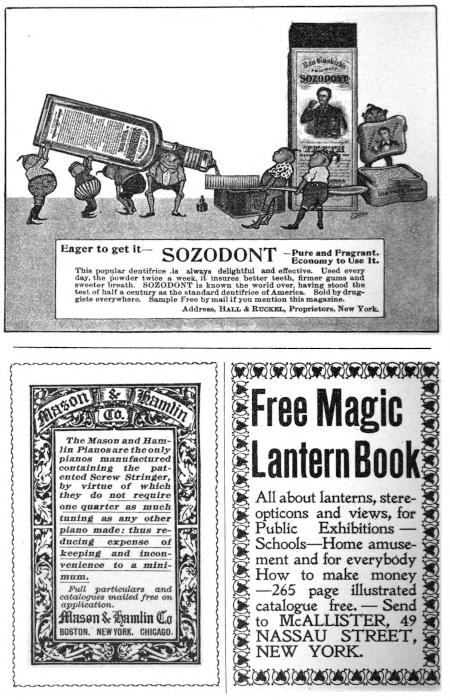
Eager to get It—SOZODONT—Pure and Fragrant. Economy to Use It.
This popular dentifrice is always delightful and effective. Used every
day, the powder twice a week, it insures better teeth, firmer gums and
sweeter breath. SOZODONT is known the world over, having stood the
test of half a century as the standard dentifrice of America. Sold by
druggists everywhere. Sample Free by mail if you mention this magazine.
Address, Hall & Ruckel, Proprietors, New York.
Mason & Hamlin Co.
The Mason and Hamlin Pianos are the only pianos manufactured
containing the patented Screw Stringer, by virtue of which they do not
require one quarter as much tuning as any other piano made: thus reducing
expense of keeping and inconvenience to a minimum.
Full particulars and catalogues mailed free on application.
Mason & Hamlin Co.
BOSTON, NEW YORK, CHICAGO
Free Magic Lantern Book
All about lanterns, stereopticons and views, for Public
Exhibitions—Schools—Home amusement and for everybody How to make
money—265 page illustrated catalogue free.—Send to McALLISTER, 49 NASSAU
STREET, NEW YORK.
The Black Cat
A Monthly Magazine of Original Short Stories.
No. 6.
MARCH, 1896.
5 cents a copy, 50 cents a year.
Entered at the Post-Office at Boston, Mass., as second-class matter.
IMPORTANT.—The entire contents of this magazine are covered by
copyright and publishers everywhere are cautioned against reproducing any
of the stories, either wholly or in part.
Copyright, 1895, by the Shortstory Publishing Company. All rights reserved.
Eleanor Stevens’ Will.
BY ISABEL SCOTT STONE.
When the following notice appeared in the
columns of the daily newspapers, society experienced
an absolutely new sensation. People
who hadn’t known the late Eleanor Stevens immediately
began to inquire into the history of
the woman whose name was coupled with so
singular an announcement. And people who
had known Eleanor Stevens forthwith revived long lists of her
curious fads and fancies, concluding always with the declaration:
“Well, it’s just what you might expect from Eleanor Stevens.”
PERSONAL. The rejected suitors of the late
Miss Eleanor Stevens may hear something to their
advantage by communicating with Willard Pratt,
Counsellor at Law, International Trust Building.
Now, Eleanor Stevens had been by no means either the crotchety
old maid or the rattle-brained young one that these remarks
might imply. On the contrary, she had been a rarely charming
and gifted young woman, well born, well bred, the heiress to an
enormous fortune, in fact, the possessor of beauty, brains, and
money, sufficient to equip half a dozen so-called society belles.
But in spite of these endowments, or, perhaps, because of them,
Eleanor Stevens had been an eccentric, and with every year since
her début her eccentricity had become more marked. At times,
for example, she would dance and golf, pour at teas, and talk
small talk to eligible young men with a persistency and success
that made her for the time the sun of society’s solar system.
Then, suddenly, and with no excuse whatever, she would withdraw
into herself, refuse all invitations, and spend a month or
more in studying Buddhism or in inquiring into the condition
of the poor in great cities. As to her suitors, the most remarkable
reports had existed concerning Miss Stevens’ treatment of those
gentlemen. It had been said by some that each in turn underwent
a period of suspense hung, like Mahomet’s coffin, between
earth and heaven, at the end of which time he was always
lowered to the former element by Miss Stevens’ unqualified refusal.
Certain malicious rivals had even claimed that at times these proposals
were so numerous that Miss Stevens used printed forms of
rejection,—like those sent by publishers with unavailable manuscript,—with
space left blank for the name and date. There
were others who had declared that her drawing-room was always
as crowded with suitors as a fashionable doctor’s waiting-room
with patients. Occasionally, it had occurred to an exceptionally
keen-witted person to connect the girl’s periods of self-exile with
her reputed refusal of some specially manly lover. But each of
these reports was, after all, founded only on surmise. For it was
cited as a crowning instance of Miss Stevens’ eccentricity that she
had looked upon the subject of love and marriage with an old-fashioned
romanticism, and that while she had never found her
special ideal, she yet believed too thoroughly in the honor of her
would-be lovers ever to betray their confidence. In the end, society
had concluded to accept the girl’s vagaries as simply “Eleanor
Stevens’ way.” And this formula had been made to cover a multitude
of oddities, ranging from the wearing of high crowns when
low ones were the fashion, to Miss Stevens’ sudden and mysterious
departure for Europe exactly two days after she had taken apartments
for the summer with a party of friends at a watering-place
hotel. Indeed, when, six months after her abrupt departure, the
notice came of the young heiress’ sudden death—unattended
except by her maid and companion—in some obscure village in
the Black Forest, even her friends could find no phrase that so well
expressed their shocked surprise as: “Well, that was just like
Eleanor Stevens. She couldn’t even die like other people.”
And now, following upon the news of her strange death, had
appeared this still stranger notice.
Eleanor Stevens’ rejected suitors! Who were they? Would
they present themselves according to directions? What were the
advantages they would gain by so doing?
To the last of these questions the public had not long to wait
for an answer. Three days after the extraordinary “personal”
had made its appearance, the announcement was made that
Eleanor Stevens had left a will, and that this will had been probated.
Before this news was twelve hours old, the sensation
caused by the advertisement was completely overshadowed by
that produced by the following clause with which it was discovered
the will ended:
“To each one of my rejected suitors I give and bequeath
twenty-five thousand dollars, to be paid subject to certain sealed
conditions, exactly one year from my death, in the library of my
residence in Beechwood Street, Philadelphia.”
Decidedly, society had never found a more tantalizing subject
for gossip than was furnished by this mysterious will. The
latest scandal, the approaching wedding at St. Peter’s, and the
forthcoming private ball all faded into nothingness beside this
all-absorbing sensation. In the newspapers long accounts of the
dead woman’s life and character, of her house and gowns, ways of
wearing her hair, and such light-throwing investigations were
published daily. A popular preacher referred to the subject
veiledly in his Sunday night sermon. Men who had never seen
Eleanor Stevens quizzed one another about the wide swath they
would cut when they claimed the money due them under her
will. While every masculine being, from an office boy to a gray-haired
clergyman, that rode up in the elevator in the International
Trust Building, where Willard Pratt had his office, was regarded
as a possible applicant, bent on further informing himself concerning
the curious legacy’s conditions. One man only knew
the facts in the case, and that was Eleanor Stevens’ lawyer,
Willard Pratt; but from him neither hints, nor bribes, nor open
question could drag a syllable. As for Mr. Pratt’s office boy,
he reaped a harvest of retainers for worthless tips on the “approaching
race.”
In the end, people decided that the legacy had some connection
with the late Miss Stevens’ romantic ideas concerning her rejected
suitors; and accepted, grudgingly, the necessity of awaiting the
slow coming and going of three hundred and sixty-five days
before they could find out who those suitors had been.
Meantime, Willard Pratt, counsellor-at-law, was deriving from
the administration of Miss Stevens’ will the keenest enjoyment
of his long and varied legal career. Being a shrewd reader of
character, and possessed of a large fund of humor, he had vastly
enjoyed being interviewed by the claimants or the claimants’
friends, and, though they had got nothing out of him, he had,
on the other hand, got a great deal out of them. As one after
another left him the keen jurist invariably chuckled to himself:
“Smart girl to refuse him. He was after the money, that’s
plain. But what in the name of all that’s holy made her give
him twenty-five thousand now?”
But his enjoyment reached its culminating point when, just
one week before the day appointed for the settlement of the will,
society was again startled by this notice in the daily papers:
TO WHOM IT MAY CONCERN.
The rejected suitors of Miss Eleanor Stevens are
requested to meet at her late residence on Beechwood
Street, Philadelphia, on Monday, the 21st
inst., at ten o’clock A. M., with reference to the
legacies due them under her will. WILLARD
PRATT, Executor.
“I think that will reawaken popular interest,” said the old
lawyer dryly.
And so it did. Seven days later, when the hour appointed
for the reception of Miss Stevens’ rejected suitors drew near, the
street in the vicinity of her late residence was lined with an eager
multitude of men and women. From behind the curtains of
every window within a block, unseen spectators awaited the morning’s
developments; while people who would not acknowledge
their curiosity by joining the crowd of confessed sight-seers made
convenient errands which took them through Beechwood Street
at the time appointed for the “show.” The only drawback to
the anticipated enjoyment was the fear that, after all, the suitors
might at the last moment fail to appear.
But no such catastrophe occurred. It is true that as the hour
drew near in which they were to stand confessed as members of
Miss Eleanor’s “army of martyrs” several of the intended
claimants had found themselves weakening in their resolve.
Those, for instance, who had justified their claim solely on the
ground of an admiration felt but never expressed, felt their
courage oozing as the ordeal approached. Others, who were
burning incense at new shrines, seriously considered renouncing
a claim that would decidedly complicate their present prospects.
Still others, who were now happily married, hesitated at opening
the old wound and endangering their domestic bliss, even for
twenty-five thousand dollars; while hardly one but felt some
qualms at the thought of openly profiting by an experience
that most men hide in the deepest recesses of the heart.
It was a question whether pride or profit would win the day.
In the end, however, the almighty dollar had proved its right to
that title.
When Mr. Pratt entered the library of Miss Stevens’ late
residence, at ten o’clock on this eventful morning, he found the
room crowded with a body of men clad in mourning garb and
solemnly waiting in various stages of uneasiness for the approach
of the long-expected moment.
As the lawyer silently took his seat behind a baize-covered
table, the troubled faces grew visibly more troubled; and as he
produced sundry important-looking documents and laid them on
the table, each countenance was stamped with mingled emotions,
eager expectancy in many cases being linked with shame and
avarice.
“Gentlemen,” began the old lawyer, “I must trouble each of
you to give me in writing a concise statement of the time, place,
and circumstances attending your several offers and rejections, in
order that I may have documentary proof that you are entitled to
the legacies left you by the terms of Miss Stevens’ will.
“Documentary proof!” At those unexpected words the
emotion that marked the faces of the strange assembly changed to
unmistakable concern. Was this some disagreeable joke? No,
the old lawyer waited with unmoved face for the fulfilment of
his demand. There was a momentary hesitation. Then, filing
up in due order, the applicants, one by one, seated themselves at
the table before the old attorney and wrote the account demanded.
As the last statement was signed, the portières of the library
were suddenly drawn back, and a tall, heavily veiled figure
advanced slowly into the middle of the room. Then, as she
raised her hand and drew back the thick gauze that masked
her face, a cry of terror echoed through the house.
The woman was Eleanor Stevens!
“Wait,” she commanded. “Don’t be alarmed; I am no ghost.
The Miss Stevens who died a year ago in the Black Forest was
not the Miss Stevens whose loss you are so deeply mourning.
“By a stupid blunder of the peasants with whom I was staying,
an exchange of names occurred between myself and an
invalid girl whom I had befriended; so that when she died, her
death certificate was issued under the name of Eleanor Stevens.
“Some weeks earlier I had been influenced by daily contact
with one whose life was fading rapidly away to draw up my will
in legal form and to send it home to my lawyer.
“When I left so suddenly for Europe a year and a half ago it
was because of a conversation overheard between several of my
seeming admirers which changed all my ideas of manly chivalry
in affairs of the heart, and which drove me abroad, as I supposed,
forever.
“It was that blundering exchange of names that has given me
the opportunity of meeting you under these interesting circumstances.
“Now, gentlemen, my will, in which you have shown so deep
an interest, stipulates that each of my rejected suitors shall
receive twenty-five thousand dollars after my death. That
bequest will be carried out to the letter when I am really dead.
“In the meantime I would gladly read your documentary proofs;
but, as I have never in all my life rejected but two suitors, and as
one of these died six months ago and the other is not here to-day,
I shall be obliged to refer you to my lawyer.”
And with a sweeping courtesy Miss Stevens withdrew from
the room.
“To Let.”
BY ALICE TURNER CURTIS.
On one of the streets leading from the park in the
center of a town near Boston is a very attractive
modern house with a history. It was built
for the occupancy of a Mr. and Mrs. Leslie,
whose mysterious deaths mark the beginning of
this story.
The facts here recorded are just as I heard
them. Indeed I was a resident of the town during the period in
which these strange occurrences took place, and had a personal
acquaintance with the people mentioned.
The Leslies had been married a year, were apparently happy,
and were well and favorably known in the town. One morning
a neighbor noticed that lights were burning in the Leslie house.
He ran up the steps and rang the bell. There was no response,
and after a few hours the neighbors decided that something was
wrong inside, and that an entrance must be made at once. The
front door was accordingly forced open, and as the men went in
they could see into the room beyond the hall, the sitting-room.
Mr. Leslie was sitting with a paper across his knees, apparently
asleep, and on a couch near by lay his wife.
It took but a few moments to ascertain that both had been
dead for some hours. Their faces were peaceful and composed;
there were no signs of disturbance in the house.
Every possible inquiry was made. No trace of poison or of
foul play could be found. Numberless theories were advanced,
and the wonder and excitement over the tragic death of the
young couple grew daily.
After some months their relatives removed the furnishings,
and “To Let” appeared in the cottage windows. The house
was immediately taken by a man from Boston, whose family consisted,
beside himself, of his wife and two little girls. None of
this family had heard the story of the Leslies, nor did they hear
it until they had been in the cottage for some weeks.
One night, after they had occupied the dwelling for over a
week, the man of the family was awakened by a sudden scream.
His wife awoke at the same moment, and exclaimed: “One of
the children must have the nightmare,” but just then the two
little girls rushed into the room, exclaiming, “What’s the matter,
mother? What are you screaming about?” Almost before they
had finished speaking two more screams in quick succession rang
through the house. The place was carefully searched, but no
cause for the disturbance could be found.
The next night at about the same hour like sounds were heard.
After that Mr. Weston made inquiries of the neighbors. None
of them had been disturbed. One suggested that possibly a cat
was shut up somewhere in the house and had made the noises
heard, but a careful search of the entire premises failed to discover
any such commonplace solution of the mysterious sounds.
A week passed without any recurrence of the midnight sounds,
when one night Mrs. Weston awoke from a most terrible dream.
She dreamed that she was lying upon the couch in the sitting-room.
In front of her stood a young man who held a pillow in
his hands. “I shall stifle you,” he said clearly; “it’s no use to
struggle.” Mrs. Weston dreamed that she tried to scream; that
once, twice, three times she endeavored to rise from the couch to
push away the pillow, but could not.
From this dream she awoke suddenly, and, as she lay endeavoring
to overcome its impression, a gasping shriek, quickly followed
by two more, awakened her husband, and again sent the little
girls flying in terror to their mother’s room.
This time Mrs. Weston held herself responsible for the terrible
screams. “I’ve had a dreadful dream, and I suppose I
screamed without knowing it,” she said. She had hardly finished
this explanation when again came the screams, the last dying
away in a stifled moan.
The family was by this time thoroughly terrified. They had
heard the story of the Leslies, and without waiting for further experiences
in the house they moved at once.
Their story got about the town, with the result that the house
was vacant for a year. Then a family, consisting of an
elderly couple, Mr. and Mrs. Walters, and their son, a young
man about twenty-five, moved in. The remainder of the story
was told me by this son, and I will give it in his own words
as nearly as possible:
“I wasn’t afraid of any haunted house. My father was deaf,
so it would take a reasonably loud scream to wake him, and my
mother was a sensible woman. The house just suited us. We got
nicely settled in a few weeks, and my elder brother and his wife
came out from Boston to make us a visit. The first night they
were there I stayed in town for the theater. The train I came
out in left a few minutes after eleven, and I reached the house
at about a quarter before twelve. I was nearly ready for bed
when a shriek like that of a person struggling for his life
sounded through the house. I hurried into the hall, and as I
did so my brother opened his door. Before either of us could
speak a second and a third scream followed. By this time even
father’s deaf ears had been penetrated, and we all sat up talking
the matter over far into the night before we felt like sleep.
“In the end we decided not to mention the occurrence. We
thought of several possible explanations of the noise. The next
morning we made a careful examination of the house and surroundings.
We made inquiries as to late trains, thinking we
might have mistaken the shriek of an engine for a human voice;
but all our conjectures led to nothing. We could find no satisfactory
reason for the disturbance.
“I made inquiries about the Leslies, and found that many people
believed that Leslie had stifled his wife, and then taken some
subtle poison which left no trace; but there was no evidence to
support this theory; no sign of poison had been found, no cause
could be given for such an act, and nothing could explain the
midnight screams. A week passed quietly, when one night my
brother awakened our mother, telling her that his wife was ill.
She had awakened from a bad dream almost suffocated, and my
mother worked over her for some time before she was restored.
She refused to tell her dream, but we were well assured that it
was a repetition of Mrs. Weston’s. The next morning my brother
and his wife went to their home.
“I had one more experience in that house which I shall never
forget. My father was to be out one night until midnight at the
meeting of a society of which he was a member, and my mother
and I decided to wait up for him.
“About eleven o’clock mother lay down on the couch and went
to sleep. The room was brightly lighted, and I sat near the couch
reading.
“Just as I heard my father come in I was startled by a sudden
moan from my mother. I turned quickly toward the couch, and
as I did so I saw plainly that the sofa pillow lay upon her face.
I snatched it away, and awakened her with some little difficulty.
“Meantime my father had come into the room, and as he entered
a scream, terrible in its nearness and intensity, rang out,
thrilling us all with a sickening shock. We left the next day.”
This finished his story. No explanation of these happenings
has ever been given. The Leslies’ death remains a mystery, and
to explain the Presence that occupied this cottage after their death
would be to account for a side of life which we barely touch and
cannot comprehend.
The house is still to let.
Of Course—Of Course Not.
BY HARRY M. PECK.
They sat, side by side, on a big hearth-rug, gazing
into the glowing coals. The one was a
young man, of perhaps twenty-eight, and the
other an old dog, of perhaps ten. That’s not a
criticism on the poverty of the English language.
It simply shows how much more a dog can
“get out,” or perhaps “put into,” ten years than a man.
They sat there, anyway. Young or old. Young and old.
And they gazed into the coals. And the young one blew great
clouds of smoke out of a fragrant briarwood at the old one. But
the old one did not mind. He was acclimated.
It was in the cozy bachelor apartments of Neil Richards. Neil
was a fellow who had succeeded, by dint of presumable study,
money, and late nights, in getting through college in a commendable
manner, seven years before. Since that time he had been
engaged in the financial business. Not exactly as a legitimate
broker; nor as a negotiator of loans; nor again as a pawnbroker;
but in that pleasanter line which on a business letter-head—if he
had owned such a thing—would have been expressed something
like this: “Neil Richards, Income Spender, Pleasant Street, Easyville.”
Anyway, he had been traveling, intermittently, to improve
himself, as the phrase goes, since the day he calmly, and with the
most approved senioric gravity, tucked a sheepskin under his arm
and discarded his cap and gown.
But, after his latest peripatetic streak, he was back again, at
last, in New York, in his old rooms, in his favorite seat on the
hearth-rug, with his dog beside him, and—in love. The fellows
at the club had said for several weeks past, as Richards would
excuse himself, get up, and go out about nine o’clock evenings:
“Funny about Neil, isn’t it? He leaves us every night at nine
o’clock, and goes home, and they say he sits down and talks to
that old dog, General, of his till midnight. Guess he must be in
love.”
And the fellows were right. Neil was hopelessly, fearfully,
and miserably in love. Her name was Dorcas—Dorcas Howland;
not a particularly pretty name, nor a particularly pretty girl; but
a girl with such a wealth of sweetness, tact, common sense, and
intelligence that more would have made her a curiosity. Neil
had seen her at what is known as a large affair one evening, two
months ago; was presented, murmured his platitudes, had a waltz,
and immediately put her on a pedestal. He had seen her a few
times since, once driving, when he received a bow that kept him
absent-minded for a week; and on a few other occasions at the
house of a friend, where he had passed some of the shortest
quarter hours of his existence—talking to her. And that was
as far as he had gone. It isn’t exactly strange, then, is it, that
when a man almost deifies a girl he has known only two months
he should like to sit down on a hearth-rug and talk to an old dog
he has known for ten years? A club, and cocktails, and gossip,
and late hours are no solace at all, under such circumstances.
But we left them on the hearth-rug, gazing into the coals.
“You see, General, it’s like this: I’m in love—desperately in
love—and Miss Howland doesn’t care a rap for me. Probably
thinks I am just like all the rest of them, looking for her money,
when I’m really not. You understand, General, that I’m not.”
The General blinked sympathetically, and looked hard at the
coals. Neil threw an arm affectionately around the dog. “You
see, I like to tell you these things, old boy, because you never
say anything about them.” There was silence for a few moments,
while Richards meditatively pulled away at his pipe and the dog
pensively thought of his puppyhood and its loves. “She’s so
sweet and dainty,” at last continued Neil. “How she would
brighten up a home for us, wouldn’t she, General?” The dog
turned his head, and, looking at his master, reached one great paw
over and laid it on Richards’s knee. “Shake, is it, old man?
Well, here goes. I thought you felt as I did. Now, General,
you and I must scheme how to get her.” The dog thumped his
tail appreciatively on the rug, and they both went to work staring
at the coals again.
And so they sat on,—Neil solemnly meditative, the General
silently sympathetic. It was a good hour later, when Neil’s pipe
had burned out, and the dog’s head had drowsily fallen against
his shoulder, that Richards heard the elevator bell ring, and a
moment after the upward rush of the car. Then, as the elevator
stopped at his landing, he heard the voice of old Barker, the
janitor, saying, “Yes, sir; Mr. Richards is always in nights now,
sir. I am sure you will find him still up. Door to the right,
sir; and do be careful, sir, not to go to the left, as them’s Miss
Stevens’s apartments, sir, and no one is allowed to disturb her,
sir, till I takes her up her cup of tea, and the saucer of milk for
the gray cat, sir, at half after—” but the remainder of the
old man’s loquacity was muffled by the sound of voices.
“Some of the boys, come to drag me out on one of their
infernal midnight romps, I suppose,” said Richards to himself,
with a discontented sigh. “They did that only three nights ago.
Why can’t they let a poor devil smoke his pipe in peace?”
Then, as footsteps approached the door, he arose and surveyed
himself in a long mirror at the end of the room. He did not look
very presentable, he admitted. His hair was mussed, his clothes
were full of tobacco ashes, and he hadn’t, when he sat down, even
taken the trouble to don a lounging jacket; hence was in his
shirt-sleeves. “But who cares?” remarked Richards to himself.
“If these stupid night hawks will come here at such an hour,
they will have to take things as they find them. Suppose they
will have something to drink, however.” As he turned to the
cabinet set in the side of the room, with his back to the door, and
reached for decanters and glasses, a knock sounded, and a cheery
voice shouted, “O Neil, I say, Neil, I’m coming in.”
“Come in, you infernal rounder, if you must,” was the reply.
“Bring them all in; you are never alone. You and your gang
are, without exception, the most unexcelled set of thoughtless,
reveling peace-disturbers I know of. You fellows have been at
this thing for ten years,” continued Neil; “you know you have,
Bob” (still busy with the decanters). “Don’t you ever intend
letting up? Why don’t you fellows say something? This is no
monologue.”
By this time Richards had succeeded in extricating the troublesome
decanters from the mass of bottles and glasses, and, turning
around, faced the door. To his amazement, instead of the crowd
of merry faces he had expected to see peering in at him, he saw
only two. One was that of Bob Cutting, his chum, and the
other—was that—of Miss Dorcas Howland! The door was
wide open. She stood a little in front. Cutting was in the doorway.
The gleam from the dying coals and the ruddy reflection
from a lamp with a big red shade over in the corner brought
out every detail of her face and figure.
And Neil stood, with a decanter in each hand, coatless, and
mussed, and speechless. The silence did not last long, however.
Miss Howland smiled, bowed sweetly to Neil, and stepped into
the room. “Good-evening, Mr. Richards,” she said, and held out
her hand. Neil managed, in a dazed sort of a way, to set down
the decanter that was in his right hand without breaking it, and
accepted the proffered hand. Bob Cutting looked on and smiled.
“Too astounded to speak, Mr. Richards,” remarked the young
woman. “Well, an explanation certainly is due you. Then you
may not think me so utterly indiscreet as appearances would seem
to warrant. Mr. Cutting, will you kindly try to put matters
straight, and, at the same time, assure Mr. Richards that we are
his guests? His accent, as I recollect it, is a pleasing one. For
‘this is no monologue,’ you know,” and she smiled pleasantly at
Neil.
“Yes,” broke in Cutting, as Miss Howland paused, “you see,
Neil, it’s like this. It does look funny, I admit; but I was walking
home with Dorcas—er—Miss Howland, from some working
girls’ club she engineers, and we were chatting about picturesque
bachelor apartments, or, rather, I was describing some of them
to her that I know the best, and I struck yours. I think I must
have grown very eloquent in my description, for Miss Howland
insisted that she must see these famous apartments, of which, by
the way, all the girls have heard. Knowing it would be all right,
as far as you were concerned, I proposed we come over to-night
and make you a call, though”—as he looked ruefully around
the room—“I really didn’t think she’d come.”
Neil, during the recital, had quite recovered himself, and
privately decided that if a man and a girl were willing to take
the social risk he surely could meet them half way. So he
calmly placed the other decanter on a table, and, turning to them,
remarked, “I am very glad to see you. This is a little bit out of
the ordinary, but the unexpected is quite often the pleasantest.
Won’t you sit down, Miss Howland? I am extremely sorry that
your visit to my den couldn’t have been made under more favorable
circumstances; at one of my little teas, for instance. Under other
than the present circumstances I should feel that an apology was
due you for my personal appearance. I am quite aware that I
have no coat on, that my hair is mussed, and that I have a general
and virulent attack of the malady bachelor-at-homeness. However,
I shan’t apologize.” And then the democratic Neil pulled
up two big armchairs, and, having seen his guests cosily seated
before the replenished fire, calmly and coatlessly resumed his
place on the hearth-rug beside the General. Miss Howland
looked surprised, but said nothing. Then she reached over and
patted the silky head of the dog. He took the caress in a dignified
sort of way, but nestled closer, if possible, to Richards.
“What a handsome fellow,” she softly said; “and how much he
thinks of his master,” she added to herself.
The three chatted away together about bachelor dens, people,
and other generalities for some time, when suddenly Miss Howland
rose and, turning to Cutting, said: “I wonder if you’d
mind granting me one more favor. I wish to have a little talk
with Mr. Richards—alone.” She paused a moment. “I know
it’s unconventional, but the rest of this is, also, and I know you
won’t take it amiss, will you?”
“Not at all,” Cutting answered. “Suppose I manipulate the
ivories while you have your talk. Don’t feel that it must be
abbreviated on my account; but when you get through, why, do
as they do in the plays, ring for me, and, like the footman, I’ll
appear. Is it feasible?”
“Quite so, thank you,” answered the girl; “it’s so good of
you.” And, with a pipe in one hand and a tobacco jar in the
other, Bob vanished through the portières; and a moment later
the click of billiard balls announced that he had found occupation.
The girl turned to Richards. He had risen with Cutting and
had now donned a Japanese smoking-jacket, in which, somehow,
he felt better equipped for his strange tête-à-tête. As his eyes
sought hers she looked him frankly in the face, and simply asked:
“Mr. Richards, what do you think of me?” Richards was silent
for a moment, and then, with his eyes on the dog at his feet, said:
“Shall I tell you frankly?”
“Yes, please do,” answered the girl.
He looked up. “I think you have lots of courage, are a bit injudicious,
and, of course, did not come here without reasons.”
She smiled. “You are frank, but don’t you think it rude to
assume the role of inquisitor in your first remark?”
“But you asked me, didn’t you?” he gently replied.
“Yes, I suppose so,” she said.
She stood absently looking down at shaggy General sleeping
peacefully on the hearth-rug. Richards watched her a minute,
and then, stepping forward, said softly, “Please sit down, Miss
Howland, and then you can tell me as much as you wish.”
A grateful look flashed into her face, as she took the big chair
he offered her, and sank into it a little wearily. Leaning back,
she scrutinized the well-cut, thoughtful face of the man. He had
taken his place beside the dog again, and as he sat staring at the
coals in the flickering firelight he seemed even handsomer than
ever.
She looked at him a moment, and, without moving, said: “Mr.
Richards, I’ve come here to-night on a queer mission. I wish
advice. I wish to tell you something about myself, and then I
want you to advise me as to what you think I ought to do. I
have come to you under circumstances peculiar, to say the least,
for these reasons: First, because what I have seen of you has led
me to think you honest, frank, and sincere; second, because your
friends assure me I am right. This has led me to believe you will
be willing to overlook what might be construed as unwomanly,
and, in addition, will be willing to help me in trouble. Am I
right?” she hesitatingly asked.
“Yes, Miss Howland, you are,” he replied; “people who know
anything about you could not misinterpret your actions. Don’t
think circumstances affect me; but just tell me plainly what I
can do for you.”
“I thought you would take it so,” she said in a tone of relief.
“And now I’ll tell you what I wish to, and pray don’t regard it
as a girl’s whim,—as a peculiar girl’s whim,—but simply try to
assume the role of a willing listener and an impartial adviser.
You see,” she continued, “I have no one to go to. I am alone in
the world. My parents are both dead, and I live with an elderly
aunt, who is as good to me as any one could be, but with whom
I have absolutely nothing in common.”
The girl smiled thoughtfully. “She likes her tea and cat, her
Goldsmith and Thackeray, early hours, and to be left alone. I am
different. She is sixty-eight, and that’s the reason, I presume.
Besides, she was never married. And now, Mr. Richards, I have
come to the place where I hardly know what to say. It’s about
my marrying. A funny thing to consult you about, isn’t it?
You see, ever since I was a child it has been taken for granted
that when I grew up I should marry a certain individual. My
parents both seemed to consider it a settled matter, my aunt the
same; and I suppose, as a child, I followed the general example.
That man was Bob Cutting. We played together as children,
living in adjacent houses, and virtually grew up together. I
remember we used to have mock marriage ceremonies, at which he
and I always figured as the principals, with some other youngster
as the clergyman, and we always looked forward to the time when
as ‘grown ups’ our marriage might be made ‘real.’ So matters
drifted along. The children’s play stopped a good many years
ago; but Bob has kept coming to see me just the same.
“And now—well, he wishes to carry out in earnest what
was begun in play. A few nights ago he asked me to be his
wife.”
The girl leaned forward, and absently smoothed the General’s
head, as he lay there watching the coals. Presently she said:—
“Mr. Richards, then, and not till then, did I find I did not love
him. But,” she added, “I did not tell him so. I said only:
‘We’ve been friends since we were children. Come to me next
Sunday night, and I will give you my answer.’”
For a moment she sat without speaking; then she concluded:
“Mr. Richards, you are Bob Cutting’s dearest friend. He hasn’t
but one friend like you. No man has; no man can have; no
man wishes more. I come to you and ask you, who know him so
well, what shall I do? Shall I tell him Sunday night that I’ll
marry him, or shall I say ‘no’? Is it selfish in a girl placed as I
am to think of her own future, or ought I to give it up to him?
He has been good to me; so good to me; I like him, but I do not
love him.”
And then she leaned wearily back in her chair, and fixed her
eyes on Richards. He did not look up. He did not seem to
realize her presence. She watched him, and he watched the red
embers glow, crumble, and fade into ashes. The dog whined in
his sleep. Then, finally, Richards raised his head, and quietly
said:—
“Miss Howland, I think it would be very wrong for you to
marry Bob. As you say, I know him well. He is a fellow with
such a wealth of love for those he cares for that if he finds it is
not reciprocated he is miserable. Think what a lifetime of it
would mean to him. And now, you see, in what I’ve said so far
I’ve considered only Bob. I think you also ought to consider
yourself. Two lives are involved; and why should they both be
ruined? You are both young. If I were you I should tell Bob,
in the kindest possible way, that I did not love him. He will
grieve at first, but I think when he finds out you were not for him
he will see that it’s for the best, and afterward will thank you.
And, as for yourself, Miss Howland, when you’ve done this, you
can say, ‘I’ve done my duty; I’ve done right.’ And some day”—the
man hesitated—“and some day perhaps some other good
man will come along, and ask you to marry him, and perhaps
you’ll find you care a great deal for him; and the past, with its
Bob, and its trouble,” and again he hesitated, “and its visit to
Richards and the General will be a ghostly vision, which happiness
and sunshine will soon wipe away.”
At this point he was interrupted suddenly by the General, who,
as though scenting some vague trouble, started up with a sleepy
“Wuff!”
The sound relieved the tension of the situation. Both laughed,
and Miss Howland, rising, reached out her hand to Richards, who
now stood facing her. “Thank you,” she said cordially. “You’ve
been very good. You’ll return my visit some time, won’t you?
And now, suppose we ‘ring the bell’ for Bob,” nodding towards
an Oriental gong that hung suspended near the mantel.
Richards took her hand and, holding it a moment, said quietly:
“I thank you; I will come. But, before you go, I want to ask
you just one question. Don’t answer it unless you wish to. You
told me that you don’t love Bob; is it—is it because there’s some
one else?”
They say that a man’s life, and hopes, and ambitions can be
snuffed out by a woman’s reply. And they also say that a man’s
future can be made all sunshine and promise if hope can only
enter in. And that sometimes comes from a woman’s reply, also.
She waited a moment, and then replied firmly:
“No; there’s no one else.”
A moment later Cutting joined them in response to Richards’
summons. As he stood before the fire, pulling on his gloves, he
looked at each good-humoredly, and said: “I’m awfully glad
that you have become better acquainted; but I hope you haven’t
been engaged in the pleasing occupation of damning a mutual
friend. I see you’ve made friends with General, also, Miss Howland,”
he concluded. For the dog stood beside the girl, watching
and waiting for a caress.
“Yes,” she replied; “General and I are the best of friends,”
and she leaned over and softly patted the handsome head. “And
General’s master and I are going to be, too, are we not, Mr.
Richards?”
“Yes, we are going to be—that is, I hope so,” Richards said
slowly.
The next moment the door closed, and she was gone. And
Richards picked up a pipe, and lit it, and, turning to the dog,
thoughtfully remarked:
“And so endeth the first lesson.”
Of course it’s obvious. Love does not need to be diagramed.
And, of course, a year later, when the big brownstone had its
awning, and its carpeted steps, and its music, and its flowers, all
was quite as it should be. And of course their friends heard
the Mendelssohn march, and threw rice, and wished them joy.
And Bob Cutting was best man? Of course not. And did the
Mother Grundies shrug their white shoulders, and say: “What a
beautiful bride! but I wonder how she could have done it; they
say she was engaged to another?” Of course they did. And
that is love, and about the way it generally turns out. Of
course.
The Marchburn Mystery.
BY A. MAURICE LOW.
As Walter Brixton, chief of United States secret
service agents in New York City, stepped off
the Washington Limited in the Jersey City
depot, the newsboys were calling, “Extra,
extra, all about the murder; extra!” Brixton
bought a paper. As he settled himself in
the “L” car he read, under flaming head-lines, the following
account, written in the short, paragraphic style which usually
denotes that “copy” has been prepared in a newspaper office in a
rush:
“Shortly after six o’clock this evening, Bridget Martin, one of
the cleaners employed in the Empire Building, discovered the
dead body of Lawrence Marchburn in his private office.
“The screams of the frightened woman brought to her assistance
the janitor and some of the tenants, although nearly all of
them had left the building for the day.
“A hasty examination showed that Mr. Marchburn had been
shot.
“When found he was sitting at his desk, his head dropped
forward and resting on his left arm, his hand clutching the receiver
of the telephone with the death grip. This would seem to
indicate that Mr. Marchburn had been shot in the very act of
using the telephone, which was affixed to his desk. The body
was still warm, but life was quite extinct.
“The murder must have been committed within an hour of the
time of discovery.
“A small wound just above the heart indicated that death had
probably been instantaneous.
“The police were immediately notified, and an officer appeared
upon the scene. He questioned the janitor and his assistants, but
learned nothing additional to the above facts. A search was
made for the pistol, but it could not be found, which proves conclusively
that it is a case of murder and not suicide.
“None of the persons had heard the sound of a pistol shot, but
the woman, Martin, said she heard shortly after five o’clock what
sounded like the violent slamming of a door. At that time she
was on the seventh floor, and paid no attention to the noise. Mr.
Marchburn’s office was on the eleventh floor.
“At this time the police have not the slightest clue on which
to proceed. At the central telephone station no one remembers
having been asked to connect 1611 Courtland, which was Marchburn’s
number. As no record is kept of the thousands of daily
calls, the telephone office can throw no light on the murder.
There is no known motive for the crime, as Mr. Marchburn was
not supposed to have an enemy, and was highly respected in
business and social circles. The inquest to-morrow is expected to
throw some light upon the awful crime.
“Mr. Marchburn was president of the International Bank Note
and Engraving Company, whose offices are on the eleventh story
of the Empire Building, their factory being in New Jersey.
“He came to New York about five years ago from the West,
and started the Bank Note Company, which has been remarkably
successful. He was a member of the Central League, the Cosmopolitan,
and the Hudson Bay Clubs.
“Deceased was a director in the Seventeenth National Bank
and other financial institutions, and was a member of the Jackson
Avenue Presbyterian Church. He leaves a daughter, his only
child, and, his wife having died several years ago, the sole heir to
his vast wealth, which is estimated at millions.”
Like all detectives, Brixton was interested in any story of
crime; but just now a case of his own engrossed the larger part
of his attention. For some months past the country had been
flooded with counterfeit notes, and, although the entire secret
service force and the police of all the leading cities had been
hunting the counterfeiters, they had made little progress. The
bills were so nearly perfect, they so closely copied the genuine
article, both as to the work of the engraver and the paper upon
which they were printed, that only an expert was able to discriminate
between them. People began to be thoroughly alarmed.
Many got rid of their paper money as quickly as possible, and exchanged
it for gold and silver so as to avoid risk. The newspapers
denounced the Secretary of the Treasury for not being able
to capture the criminals.
The newspapers next morning contained long accounts of the
murder of Mr. Marchburn; but they were able to add little to the
reports printed in the extras of the evening before. The murder
of a wealthy business man in practically broad daylight, in a building
on one of the most frequented streets of the city, caused a
tremendous sensation, and in business circles the tragedy was
more eagerly discussed than the course of the market. The
coroner’s inquest brought out these facts:
Mr. Marchburn had spent the day at the factory, and returned
to his office about five o’clock. The clerks had not expected him
back that evening, and some of them had left. To his chief clerk
he said he had stopped in on his way up town to fetch some
papers which he wanted to look over at his house, and that while
in the office he would write some personal letters. No one need
wait for him, as he would latch the outer door after him. Then
Mr. Marchburn threw open his desk, the chief clerk wished him
good-evening, and in a few minutes, except for the president, the
offices appeared to be vacant.
It was explained to the jury that the company occupied five
rooms, all of which opened into the main corridor. Mr. Marchburn’s
private room was at the extreme end of the suite. The
company employed seven clerks, two of them girls. One of the
girls and Mr. Marchburn’s private secretary had left before
the return of that gentleman, and the other clerks testified that
no stranger was in any of the rooms when they left. The last
persons to leave were John Rogers, the chief clerk, and the
cashier, William Harding. Rogers swore that while he was waiting
for Harding to close the safe Mr. Marchburn came into the general
office from his room, and asked if a certain account had been paid.
Both men were positive that nobody could have been secreted in
the rooms at that time, and at the close of the short conversation
Mr. Marchburn again said “Good-night,” and returned to his
room. Rogers put down the spring latch and tried the door from
the outside. It was safely locked. They walked across the hall
to the elevator, and while waiting for the car met the janitor, who
inquired if the offices were empty. Rogers told him that Mr.
Marchburn was in his room and would be busy for a short time.
The janitor told a straight enough story. After leaving Rogers
and Harding he had worked on the other side of the building, and
then went to the first floor. He was on the third story at the
time when Bridget Martin’s screams alarmed him, and he hastily
ran to the elevator and told the conductor to take him upstairs.
At that time he did not know whence the outcry proceeded, but
as the elevator went rushing up some one shouted that Mr. Marchburn
had been hurt. When he reached the eleventh story and
entered the company’s rooms he found the Martin woman and
three or four other persons, tenants of the building. His evidence
as to the finding of the body was merely corroborative of that of
the other witnesses.
There are four elevators in the Empire Building. The conductor
of No. 4 elevator, Richard Wright, testified as follows:
“I have been employed only two days at the Empire Building.
It is the rule to close down two of the elevators at half past five;
at six o’clock the third is closed, and the other half an hour
later. I am ‘late man’ this week. Just as six o’clock was
striking and elevator No. 3 was making its last downward trip,
the annunciator in my car dropped for the tenth story. I ran my
car up and took in a young man. I do not remember to have
seen him before. He stepped into the car, and as I pulled the
rope to go down I noticed that he had a handkerchief wrapped
round his right hand and he was holding it with his left, as
though it hurt him. I said to him: ‘Have you hurt your hand?’
He replied: ‘Yes, I squeezed it in the door.’
“I looked at his hand again and noticed that there was blood
upon the handkerchief, and I said: ‘It’s bleeding.’ The young
fellow looked dreadfully scared, and I thought he was going to
drop, but he said something I couldn’t hear, and as soon as the
car stopped he walked away quickly.”
This testimony produced a profound sensation, and every eye
was turned upon Wright.
“Why did you not mention this circumstance to the police last
night?” asked the coroner.
Wright shifted about uneasily and said: “When I heard the
screams upstairs and was told that Mr. Marchburn had been
murdered I was scared half out of my life and clean forgot all
about it until I got home. It was then too late to tell any one,
and I thought I would wait until I came here.”
“Can you describe this man?” asked a juror.
“He was a young fellow; I should think about twenty-four.
I didn’t notice his face particularly, except when I told him his
hand was bloody, and then I saw how white he looked. I never
should have thought much of it if it hadn’t been for the murder.”
“How was he dressed?”
“He had on a brown overcoat; but I don’t remember anything
else.”
That was all the light Wright could throw upon the affair.
Coroner and jurymen plied him with questions; but he could tell
them nothing. He did not know the color of the man’s eyes,
whether he wore a beard, what kind of hat he wore; in fact, he
could furnish nothing which would serve as an identification.
He thought he might know the man if he were to see him again;
but he was not absolutely sure as to that. There was no reason
to think that Wright was not telling the truth, and it was almost
impossible that he could have committed the murder, but the jury,
in rendering their verdict of wilful murder against some person
or persons unknown, censured Wright for having remained silent
for more than twelve hours, and the coroner privately suggested
to the police that they keep an eye upon Wright.
As soon as the verdict had been rendered, Detective Sergeants
Johnson and Richardson, who had been detailed by Superintendent
of Police Walton to attend the inquest, reported to him for further
instructions. They briefly repeated the testimony and especially
the startling evidence of Wright. When they had finished the
chief said:
“What do you make of it?”
“The man in the brown overcoat is the murderer,” said Johnson.
“The man in the brown overcoat had nothing to do with it;
but Wright knows a great deal more than he has told,” was Richardson’s
analysis.
Walton looked out of the window a couple of minutes without
speaking. “The person who committed the murder,” he said, as
if he were talking to himself more than to his listeners, and without
looking at either, “was expected to call at the office that
evening by Marchburn, who came back about the time the clerks
were preparing to leave, on purpose to keep his appointment. All
the doors were locked. Either the visitor must have had a duplicate
key, or else Marchburn left one of the doors open, or they had
a private signal. Any one of a dozen persons might have been
able to open the door with a duplicate key; but I don’t see anything
to point in that direction. Marchburn would hardly be
likely to leave the door open for his expected visitor, so it is evident
the doors were kept locked, and when the prearranged signal
was given Marchburn opened the door to his murderer. Who was
the murderer and what was the motive? It was not money, because
no valuables were taken, and the clerks say that neither
papers nor anything else were disturbed. The murder was either
the result of a sudden burst of passion, or else it was premeditated,
and something forced the murderer to do then what had
long been contemplated. There was a very strong motive. Find
the motive and you find the—”
“The murderer,” interrupted Richardson.
“The murderess,” continued the chief as calmly as if he had
not heard the interruption.
“A woman?” cried his listeners simultaneously.
“Certainly, a woman; it is a woman’s crime. From the time
when Rogers and Harding left until the discovery of the body
was a scant hour. To avoid all possible risks of interruption,
Marchburn did not arrange the interview until after five, so that
between that hour and six he was shot. At six he was dead, and
the doctor testified he must have been dead between fifteen and
thirty minutes when he was called in. So that fixes the time
of the shooting between half past five and six. Marchburn expected
a woman to call upon him that night, because he would
not have made such careful preparations for secrecy if his visitor
had been a man. He did not want his clerks to see his caller.
The time between her calling and the shooting was too short for
them to have quarreled; but it was long enough for her to have
made her demand and to have been refused by Marchburn.
Then she shot him.”
“But the young man in the brown overcoat?” asked Johnson.
“If the coroner had the slightest sense,” sneered the chief, “he
would have asked Wright if the ‘young man’ looked as if ‘he’
were disguised, and Wright’s answer would have shown whether
he is merely a thick-skulled idiot or whether he has a hand in
this affair. But I’m glad the question was not asked, as the
woman will think her disguise has shielded her. But Wright
has given himself away by his answers. He says ‘the young
man’ had a handkerchief wrapped around his right hand, and
was holding it with his left, as if it hurt him. Isn’t that a woman’s
attitude? A man would have shoved his hand in his
pocket and held it there—at any rate, until he was in the street,
where no one would have noticed it or paid any attention to him.
But the woman doesn’t know how to use her pockets; her hand
hurts her, and she holds it out in full view, instead of hiding it,
as a man would have done. I’ll stake my reputation that the
young man in the brown overcoat is a woman, and that the woman
is the murderer of Mr. Marchburn.”
The superintendent rapidly outlined his plans. “I want you,”
he said to Richardson, “to look up Marchburn’s past record in
the West. Look for the woman there, or for the chapter in his
life in which the woman figures. It’s there, although it may be
difficult to find. Johnson, you look up his record from the time
he came to New York to the day of his death. See if there is
any woman entanglement here. Keep your eye upon Wright. I
can’t quite size that man up. Look for the brown overcoat.
Now, Richardson, you’d better start right in, and wire me just as
soon as you strike anything.”
In a few moments Johnson went back. “There is one thing I
don’t understand,” he said. “Why did the woman get in the
elevator at the tenth instead of the eleventh story?”
“Easy enough to explain, and another indication that we are
dealing with a woman and not a man. When she left the office
her natural impulse was to walk down the stairs, to avoid meeting
any one, instead of courting observation, as a man would have done
under the circumstances. She walked down one flight; she
heard the cleaners moving about and dreaded meeting them, and
rang for the elevator as being less dangerous. Remember we are
dealing with a woman of no ordinary caliber,—one who is not a
seasoned criminal, and who thinks quickly.”
From Johnson’s report next morning the superintendent learned
that Marchburn had moved to New York from the West five years
before his murder; that his only child, Lucille, was twenty years
old; that father and daughter were very much attached to one
another. Marchburn’s tastes were all domestic; he seldom stayed
out late at night, unless in company with his daughter; he was a
regular church attendant, and contributed liberally to its support
and to charities. His business was extremely profitable, his fortune
being considered very large.
Walton read the report through and felt annoyed. It was not
what he wanted. He felt that he was right in charging a woman
with the crime; but how was he to find a woman who left no
traces behind her? Besides, the papers were growing impatient,
clamoring for an arrest, and indulging in satirical flings at the
impotence of the police. Suddenly an idea occurred to him. “I
ought to have thought of that before,” he said to himself.
“Rogers or Harding might know,” and the superintendent, once
more the cold, impassive man of affairs, walked quietly out of
his office.
Superintendent Walton went briskly down town, thinking
deeply as he walked, and yet noticing everything that went on
around him. As he turned the corner of Silver Lane his eye fell
upon a portly, well-groomed man who was walking in front of
him. Walton was noted for never forgetting a man or woman
he had once known, and there was something about this man
which seemed familiar. Quickening his pace a little, the detective
pushed ahead until he came opposite a money-changer’s window,
and appeared to be intently gazing at the piles of gold and silver;
but out of the corner of one of his eyes he was carefully watching
for the man whom he hoped would soon pass. The superintendent
looked up and saw a well-preserved man of about sixty, with
florid complexion and carefully trimmed whiskers. He looked
like any one of hundreds of prosperous business men. Still trying
to fit the face to a name, Walton followed the man into Wall
Street, and as he passed the sub-treasury he saw Brixton coming
down the steps. The sight of the government agent was like a
flash in the dark, and the object he was groping for was instantly
made plain. The superintendent determined to take desperate
chances. “By gad,” he muttered, “I’ll risk it. If he’s the man
his voice will give him away.” Quickening his walk, he stepped
up to the man, and, tapping him on the shoulder, said very quietly:
“I want you, John Marsh.”
With perfect composure he began, “Excuse me, sir, I do not
know you—” but in the first three words his deep voice broke
into a theatrical falsetto.
Walton smiled triumphantly. “Perhaps not; but I know you,
Marsh,” he said, with his hand still on the man’s arm.
“This is the second time you have called me by that name.
My name is not Marsh. Pardon me if I say good-morning,” said
the other in perfectly modulated tones, and made a movement as
if to continue on his way.
But Walton was not to be shaken off so lightly. “Wait a
minute,” he said, and his voice was as pleasant and his manner
as polite as that of the man whom he was addressing. “Perhaps
when I tell you that I am Superintendent of Police Walton, who
was chief of the detective bureau when we last met, you may
remember me.”
“My dear sir, this is incomprehensible. I never had the
pleasure of meeting you before, and, as I have to attend a very
important meeting of the directors of my bank I must beg to be
excused. If you really are the chief of police, I think, instead of
wasting your time with reputable business men, you could better
afford to devote a little of your leisure to finding the murderer
of my dear old friend, Lawrence Marchburn.”
“You were acquainted with Mr. Marchburn?”
“Sir, I decline to submit to this impertinence any longer. If
you attempt to stop me further I shall call an officer.”
“I think not,” said Walton, with a smile. “You are going
with me to headquarters, or I will accompany you to your bank;
which do you prefer?”
“In two minutes I could show you what a fool you are making
of yourself; but I prefer to teach you a lesson. I submit to this
indignity in the interest of good government.”
“All right, Marsh; I see you are the same old Chesterfield,—just
as smooth as ever. You’ve no objection if we ride, I suppose?”
and Walton hailed a passing cab. As they jogged up
town both men remained silent. Turning a corner, the cab gave
a sudden lurch, the superintendent’s hand in some mysterious
manner caught in his prisoner’s whiskers, and they came away
from his face. The two men looked one another squarely in the
eye. Marsh was the first to speak. “You’re a nervy one, superintendent,”
he said. “What do you want me for? I’m living
straight.”
“I’m glad to hear it, but I want to have a quiet little talk with
you; besides, I heard you were dead.”
Marsh smiled. The loss of his whiskers showed him to be a
man of about forty, with a firm jaw, a keen blue eye, and a high
forehead. “I wish to God I was dead,” he said. “When a man
tries to live straight he gets snagged and is disgraced.”
The cab drew up at the big building on Mulberry Street, and
the superintendent, pushing his prisoner before him, led the way
to his private room. “Now, Marsh, you say you have been living
straight. Prove it and I’ll release you.”
The man eyed his captor sullenly. “Not till I’ve seen a
lawyer,” he said.
Walton touched an electric button. “Lock this man up,” he
said to the officer who appeared. As Marsh was led away the
chief pushed another button. “Bring me,” he said to the messenger,
“Convictions, letter M, ’84.”
Hastily turning the pages, Walton read: “Marsh, John, alias
Gentleman John, generally known as Chesterfield, because of his
manners and politeness, born at Sodaville, Mich. All round
crook; specialty, counterfeiting United States notes. One of the
most dangerous men in his line. Convicted of counterfeiting and
sentenced to Albany for five years in 1870; sent to Jackson,
Mich., for three years for forgery in 1878; last conviction, Joliet,
counterfeiting, 1884, five years. See page 756.” Turning to
the page indicated, Walton read: “Escaped from Joliet and committed
suicide.”
“So he didn’t commit suicide,” mused the chief. “Well, I
always had my doubts about it. I have an idea he had a hand in
this counterfeiting business, and if that’s so it’s a pretty good
morning’s work—almost as good as finding the Marchburn woman.
I had better let Brixton know about this; it may give
him a pointer.”
A clerk brought in a telegram and handed it to the superintendent.
Walton read:
“Sodaville, Mich., Jan. 24.—Can you mail me at once portrait
of Chesterfield Marsh, escaped Joliet, and committed suicide
about 1884?
“Richardson.”
“By Jove,” said the superintendent, “that’s curious. I wonder
what he’s struck now. Well, I guess I’ll hang onto Chesterfield
for a few days, anyway.” Then he telephoned to Brixton,
who was now working night and day on the counterfeit money
case, which divided public attention with the Marchburn mystery.
To the police these cases had proved two of the most remarkable
criminal problems they had ever been called upon to solve.
Congress had added to the excitement by adopting the recommendation
of the Secretary of the Treasury and offering a reward
of fifty thousand dollars for the arrest and conviction of the
counterfeiters.
Brixton came in dejectedly in answer to the summons. To
Walton, who was an old friend, he admitted that he was
beaten.
“Brace up, old man,” said Walton; “I’ve got something good
for you,” and he at once told him of the arrest of Marsh and
Richardson’s telegram.
A gleam of excitement blazed from the secret service man’s
eyes. He jumped from his chair and paced the room a couple of
times before he could control himself; then, leaning over his
friend’s desk, he talked rapidly. “By jove, Walton, you’ve got
our man. There is only one man in the country who could have
done the job, and that’s Marsh. I have thought about him a
dozen times since I’ve been at work on the case, but always supposed
him to be dead. What a confounded idiot I am not to have
investigated that suicide story; yet I never had reason to doubt
it.”
Both men felt certain that they were at last hot on the right
trail, and that Marsh was still engaged in his old business of
counterfeiting. While discussing the next move to be made
Brixton suddenly said: “What does Richardson’s telegram
mean?”
The words produced a peculiar effect upon Walton, which was
reflected in Brixton’s face. Both men scrutinized each other for
a brief space of time without speaking. It was as if they were
grappling with the same thought, and yet both were afraid to
frame in words what was passing through their minds. It was
Walton who at last broke the silence and in a nervous sort of way
said:—
“That is absurd.”
“What is?”
“What you are thinking about.”
It was curious that neither man had openly expressed his
thoughts, and yet each knew what was in the other’s mind just as
well as if the words had been uttered.
“I don’t know about that. Of course it looks ridiculous to commence
with, but not any more so than that West Virginia case.”
“I don’t remember that,” said Walton.
“It was one of my most interesting jobs. For months we had
been trying to break up a gang of counterfeiters working in West
Virginia, and had failed, just as in the present instance. The
thing looked pretty bad, and the merchants of the State were so
worked up about the ‘queer’ that a bill was introduced in the
legislature authorizing the governor to employ private detectives,
as the government secret service men had shown their incompetence.
Before the bill was acted upon we arrested some of the
gang, and on the day when the bill came up for action we
obtained conclusive evidence that the member of the legislature
who introduced the bill was the brains of the gang. I went to
the capitol and listened to this man’s speech in support of his
measure, and after the bill had passed I arrested him and found
in his pockets some of the money made by his gang. I sent him
over the road.”
“You think, then,” said Walton, “that Marchburn had some
connection with the counterfeiting gang.”
“I do.”
“Did Marsh murder Marchburn?”
“I don’t know about that. I rather think not, because
Chesterfield, from what we know about him, is a coward and not
the man to kill; but he probably knows who did. There’s a connection
between the murder and the counterfeiting, and when we
pull the right string both knots will come untied.”
Walton told his associate of his theory as to the murderer
being a woman.
Brixton doubted it. “But it’s of no consequence,” he said.
“Whoever fired the shot was a member of the gang; Marchburn
knew him and expected him to call that evening. When we
land our man we shall have the murderer and the counterfeiter
as well.”
How was Marsh to be made to confess? Numerous plans
were discussed and rejected. Finally Brixton made this suggestion:
“Make Chesterfield understand that he is suspected of the
murder and that you have the dots on him. You’ll have to
sweat him and put him through the third degree. Don’t say a
word about the counterfeiting. When he’s charged with the
murder, and things begin to look black, he will squeal to save
his neck. He’ll give his pals away dead sure and tell all he
knows about the counterfeiting. I believe the scheme will
work.”
Walton agreed with him and proceeded without delay in putting
his prisoner through the sweating process. Early in the
morning he had read the papers in his cell, and a detective who
secretly watched him noticed that he devoured every line printed
about the Marchburn murder. Later, the superintendent had him
brought to his office and there subjected him to a rigorous cross-examination,
and no man knew better than he how to worm the
truth out of a criminal. But in Marsh he found more than a
match. He either dodged every question or else declined to
answer, and neither threats nor promises elicited anything of importance.
For more than an hour the man submitted to being
worried by his inquisitor, when at last he said:
“Chief, what are you trying to make against me?”
Walton had not taxed him with the murder, as he hoped his
prisoner would make some incautious admission which would tell
him what he wanted to find out. But Marsh’s question seemed
to have made the time ripe for the great stroke. Looking him
steadily in the eye, the chief said: “For the murder of Lawrence
Marchburn.”
The prisoner gave a short, nervous laugh. “You’re clean off,”
he said. “I didn’t murder him and I had nothing to do with it;
but I know the man who did.”
Walton had counted upon his declaration producing a confession,
or at least some signs of weakness, but this answer astounded
him.
The man never flinched. “It’s God’s truth. I can tell you
who committed the murder,” he repeated.
“Very well; who did it?”
But Marsh was too old a bird to be caught with chaff. “What
do I get if I tell?” he asked.
“I think they would like to have you back in Joliet,” the chief
answered, “and that means five years to commence with. If you
give me the name of the man, and it is proven that you had
nothing to do with the murder, I will see that you are not
troubled.”
Marsh appeared to be thinking deeply. “Shall I have to
appear as a witness?” he asked.
“Not unless it is necessary; I won’t put you on the stand if I
can make the case without you.”
“Will you release me as soon as you are satisfied you have the
right man?”
“Yes.”
“Then arrest Frank Richald, who was Mr. Marchburn’s stenographer.
He’s your man.”
“How do you know?”
“I won’t tell; but see if I am not right.”
Walton ordered Marsh back to his cell, somewhat puzzled by
the result of the interview. He did not believe all that Marsh
had told him; but the mention of Richald’s name indicated that he
was getting down to the man’s confederates. There was only
one thing to do. The superintendent ordered Johnson to arrest
Richald. He took his arrest quietly. Brought before Walton, he
said, without waiting to be questioned: “I am innocent; but circumstances
are against me.”
With a quick, sudden movement, Walton seized hold of the
corner of the skirt of Richald’s brown overcoat and intently
examined a dark spot on the front. “Marchburn’s blood,” he
said tersely.
“I know it,” was all the prisoner said.
“Why did you murder him?” asked Walton.
“I did not murder him,” he said firmly. “When I reached
the office on the night of the murder Mr. Marchburn was lying
dead on his desk. I was stunned and horrified. I know now I
should have given the alarm; but there were so many strange
things in connection with my being there at that hour that I foolishly
imagined my safety lay in flight. Some of Mr. Marchburn’s
blood was on my hand, and I bound my handkerchief around it
to escape observation. To avoid meeting any one I started to
walk down the stairs; then I was afraid the janitor might see me
and think it strange I was walking, so I called the elevator on
the floor below our office and rode down.”
“What brought you back to the office that evening?” Walton
asked.
“That I cannot tell you.”
Walton ordered the young man to a cell.
Next day the papers told of the arrest. They also added
something about the man who stood charged with the crime.
Richald was the son of a once former wealthy New York merchant,
whom every one respected. At his death it was found that
his estate was badly involved, and all that was left to his widow
and his two children was a small estate. On the interest of this
Mrs. Richald lived, her son contributing generously of his wages
to her support. Two years before the murder Frank had secured
a position with the Bank Note Company as Mr. Marchburn’s
stenographer.
Walton now bent all his energies to securing a fuller confession
from his prisoner, to ascertaining what had become of the pistol,
and the motive for the crime. His best men were set to work
raking over nearly every hour of Richald’s past life. Meanwhile,
at the earnest request of Brixton, Walton had decided to hold
onto Marsh. Walton was pretty well convinced that, while Marsh
did not commit the murder, he had some connection with it, and
was not going to let that elusive individual get out of his clutches
so long as there was a possibility of proving it. Brixton, on his
side, was certain that Marsh was in some way implicated in the
counterfeiting, and proposed to keep his eye upon him until he
could charge him with the crime or bring it home to some one else.
The capture of Marsh seemed like a lucky find.
On the morning of the second day after Richald’s appearance in
court a carriage drew up in front of the police headquarters, from
which a stately looking elderly gentleman and a tall young woman
alighted. The gentleman asked to see the superintendent.
Walton did not need to look at the card to know his caller,
Phineas Yarrow, one of the noted lawyers of the city.
The woman was dressed all in black, and was so slight that
she seemed unusually tall when standing alone. She remained
closely veiled.
“This young lady is a friend of Mr. Richald’s,” said the lawyer.
“She is very anxious to speak with the prisoner. I am willing to
vouch for all she says or does.”
Walton shot a keen glance at the girl. “This is rather unusual,”
he said; “but I will accede to your request, provided, of
course, the interview takes place in my presence.”
Shortly afterward Richald entered the room, and as he caught
sight of the girl he trembled and appeared dazed. For a moment
she hesitated, then, with a cry which touched the hearts of the
older men, she rapidly crossed the room, threw her arms about the
young man’s neck, and kissed him passionately.
Whether they were sweetheart and lover, husband and wife, or
brother and sister, Walton had no means for knowing; but that the
girl played an important part in the case he felt certain. Hurriedly
writing a line, he handed it to an officer, and from that time Frank
Richald’s visitor was under the shadow of the law.
For several minutes the prisoner and his visitor conversed in
anxious whispers; then, going to the lawyer, the young woman
said: “After you have shown me to the carriage Mr. Richald has
something important to say to you. He will tell you everything.”
“Now tell me all,” said the lawyer, seating himself by the side
of Richald. In eager whispers he told his story. When he
had finished the old lawyer paced up and down the room, showing
that he was laboring under intense excitement. Stopping suddenly,
he said: “You must repeat this to the superintendent,
here and now.”
Without hesitating, Richald in a firm voice commenced his
recital—Yarrow an excited listener, and the superintendent coolly
indifferent; but Richald had spoken for only a few moments
when Walton’s studied indifference gave way and he was soon
closely following every word. When the young man had finished
the superintendent leaned across his desk, and, clasping his hand,
said, “I believe you.”
“But there is no time to be lost,” he continued. Pushing
several of the electric buttons on his desk, he gave his orders to
the officers who appeared. Then, turning, he said, “Mr. Yarrow,
will you come back at six o’clock this evening? And, Mr. Richald,
I shall still have to subject you to my hospitality.”
That evening the lawyer once more entered the superintendent’s
room. He found Walton and Richald busily engaged in
conversation, and with them was Brixton. “Now we will get
to business,” said the superintendent, seating himself at his desk.
Into this company Marsh was called. “In the first place,”
said the superintendent, “it may be well to explain that Lawrence
Marchburn and the prisoner were brothers.” Turning to Marsh,
he said, “Now tell us your story.”
“You know all about me, superintendent,” the man commenced,
and his eyes were fixed upon Walton, as if he alone were
present, “and that I have always been a counterfeiter and a crook.
I went crooked very young. My father was a man of considerable
means, and my brother Lawrence, who was always of a
jealous and grasping disposition, worked upon him so that he
refused to have anything to do with me. When he died he left
all his money to Lawrence and cut me off without a penny.
When I escaped from Joliet I determined to make a last appeal
to my brother for help. I reached his house late one night and
he received me in his library. At first he told me never to enter
his house again, but during our conversation he changed his mind,
and after he had given me food he said:
“‘Jack, they tell me you are one of the cleverest counterfeiters
in the country.’
“I answered that I believed I had that unenviable reputation.
“‘Then here’s a scheme. I’m in a pretty tight hole. I have
lost a good deal of money lately in speculation, and I have used
some belonging to an estate. I am going to start a factory to
make counterfeits. I shall have an office in New York and a
factory in New Jersey, where we can work undisturbed and everything
will look straight. I have money enough to start the
factory and buy all the machinery. After a year we can retire
with two fortunes and become respectable. If you have any
scruples of conscience I’ll pay your fare back to Joliet.’
“Of course I consented. There was nothing else I could do.
“I fell in love with and married the daughter of my landlady,
and when the baby came she was the happiest woman in the
world, and I—” Marsh passed his hand across his face and there
was a catch in his voice which showed the struggle he was making
to remain calm.
“Well, I was determined to quit the whole business and live
straight. I told this to Lawrence, and that I wanted my share
of the money he was keeping for me. We had a dispute, but
settled it by my agreeing to remain another six months.
“Just before the time was up he went to my wife and told her
I was an escaped convict, but that he was trying to get things
fixed so I need not fear arrest. He warned her not to allow me
to go away, as that would be dangerous. She told me all. Then
I resolved to end the matter at once. When he next came to the
factory he told me that Richald, his stenographer, had discovered
what we were doing, and would give the snap away. He said
something must be done to close Richald’s mouth until he could
close up the factory and clear out. He pretended to be fully as
frightened as I was, and I was badly scared, for I did not at
last want to be lagged. So I agreed to do whatever he thought
best.
“He sent for me to come to New York. It had been arranged
that I should go to his office, knock three times on the door, and
if the clerks were all gone my brother would open it. After he
had done so, he said, in the most cold-blooded way, that Richald
would be there in a quarter of an hour; that we must get him to
go to the factory, and on the way there, in a lonely spot, shoot
him. He would make it appear that Richald had stolen some
bonds, and when his body was found it would look like suicide.
I told him that, whatever had been my past life, I would not commit
murder. He cursed me for a coward, and said he would have
me sent back to jail. I defied and left him.”
“Now,” said the superintendent, turning to Richald, “will you
tell your story?”
“Two years ago,” began Richald, who was trembling with excitement,
caused by Marsh’s recital, “I was engaged as stenographer
by Mr. Marchburn, and shortly after became engaged to his
daughter, the young lady who was here to-day. A few months
ago we were secretly married, and about that time I accidentally
overheard a conversation between Mr. Marchburn and his brother,
which put me in possession of the colossal plot to swindle the
government. I was in doubt as to my duty in the matter, but
finally concluded to tell Mr. Marchburn what I knew. He declared
that Marsh was the real head of the conspiracy, but, owing
to circumstances, he had been unable to extricate himself from
his clutches; he would, however, close up the factory as soon as
possible. On the day of the murder Mr. Marchburn made an appointment
for me at his office. Before leaving for New Jersey he
handed me a package which he said contained several thousand
dollars in negotiable securities, which he intended to have taken
to his bank, but had forgotten to do so, and requested that I bring
it back to the office later.
“I was a few minutes late in keeping my appointment, and
when I entered Mr. Marchburn’s room I found him dead. It
flashed across my mind that I might be accused of the murder;
that it would be difficult for me to account for the securities, and
in explaining my presence in the office I should have to reveal
the conspiracy, which, for the sake of Mr. Marchburn’s daughter,
I was reluctant to do. Yielding to a sudden impulse, I left the
office, without raising an alarm. And—”
Just then an electric bell rang and the superintendent put his
ear to a tube that hung above his chair. As he listened his face
flushed. He looked up and, with an accent of conviction that
caused Marsh to move uneasily in his chair, exclaimed: “Gentlemen,
at last the missing link is at hand!”
The next moment the door was thrown open and an officer
ushered in a middle-aged man with a traveling-bag in his hand.
Stooping over the superintendent’s chair, the officer engaged him
in a whispered conversation. As he proceeded, a look of triumph
shone in the superintendent’s eyes. Swinging around suddenly
in his chair toward Marsh, he asked abruptly: “Marsh, did you
ever see this man before?” For several moments the prisoner,
with eager curiosity, eyed the new-comer from head to foot.
Then, turning to the superintendent, he said, with attempted
composure, but with that tell-tale falsetto break in his voice, “No, I
never saw him—”
“That’s the man!” cried the stranger, advancing and pointing
excitedly to the prisoner. “I could tell his voice among a million.”
Then, turning to Walton, he continued breathlessly, “Mr.
Superintendent, on the evening of the murder I was in my insurance
office in Temple Court. I had just been called to the bedside
of my sick wife in Florida and rang up the sleeping-car
office in Jersey City to engage a berth. I couldn’t get the connection,
as the wires were crossed. I rang again and again, but,
instead of getting a reply from the central office, I heard a
violent quarrel going on between two men. One of them threatened
to call the police, and the other shouted, ‘If you do that I’ll
shoot you.’ Indeed, I did hear what sounded like the muffled
report of a pistol. At that moment I was connected by the
central office, and thought no more of the matter until I was
seated in the cars an hour later. Then, in recalling the affair, it
occurred to me that possibly I had overheard a scrap of a theatrical
rehearsal, because the voice of the man who threatened to shoot
had a stagy sort of falsetto break in it. And it wasn’t until I was
overtaken three days ago by New York papers containing full
accounts of the Marchburn murder that I knew that I held the
clue to the mystery. An hour later I was on the way to New
York and came directly here from the train.
“Gentlemen,” said the stranger, pausing impressively and
pointing to the cowering figure of the prisoner, “that is the man
whose voice I heard over the telephone. I heard him speak. I
heard him threaten. I heard him rush across the floor. I heard
him fire the fatal shot. It was he who murdered Lawrence
Marchburn!”
Four months later the jury gave the same verdict.
Their Colonial Villa.
BY CHARLES BARNARD.
The right to dramatize is reserved by the author.
“It is very inconvenient to be obliged to live in
one place all the time. If we had two houses,
we could spend part of the time in one and
part of the time in the other.”
Young Mrs. Arburton was one of those fortunate
brides who are able to set up housekeeping
immediately on the return from the wedding journey.
Young Mr. Arburton thought it best to build or buy a small
house and to furnish and occupy it as soon as possible.
“Of course, my love, I see how important it is that the house
should be close down by the river bank near your office, so that
you can come home to lunch, and I do so enjoy seeing the steamboats
pass on the river.”
“Good idea. I must be handy to business.”
“And at the same time, you must see, John, that I’ve always
lived at the court end of the town, on the bluff overlooking the
river and near the shops and the homes of the best people. That’s
why I think it would be so nice if we could have two houses, one
down by the river near your office, and one in town, on the
Heights and near the churches and all the nice people. We
could live every other week in each house.”
They were staying at her mother’s on the Heights, pending
the purchase or erection of the new house. Mrs. Arburton had advanced
this happy thought of having two homes at the breakfast
table. The idea pleased her mother greatly, and she remarked
to her son-in-law that, in her opinion, it was an excellent arrangement.
She would gladly live in the uptown house and
take care of it while they were spending the week in the other
house down by the river.
“My love, we must do it. We never need move anything, for
you could keep a suit of clothes in each house. I’m sure I shall
never be happy to live down on the riverside. There’s really nobody
living there, and still I never, never can be happy if you are
not able to come home to lunch.”
Young Mr. Arburton quite agreed with his wife and her
mother. It would be very desirable to live on the bluff, two
hundred feet above the river, and very desirable to live immediately
below, down by the boat landing and near the office. It
would be very convenient to live in two places at the same time.
How to do it was the problem.
Immediately after breakfast young Mr. Arburton started off to
business. To reach the lower level of the city, where his office
and his great lumber yards stood close by the river, and almost
immediately under the lofty bluff on which the new or upper
town was built, he was obliged to take a trolley car that slid
swiftly down a long iron viaduct or inclined plane. There had
been at one time, before the days of the trolley, a more direct,
but much slower method of reaching the lower town. This was
a sort of huge hoist or elevator, upon which the horse-cars were
slowly dragged up and down by means of a cable. At present,
this route was seldom used, as it was, in the opinion of the general
public, altogether too dilatory transit.
Business was quiet that day, and Mr. Arburton had ample opportunity
to consider the problem of keeping house in two places
at the same time. He felt sure he must gratify his wife’s natural
desire to live in town, and he was equally sure he must reside
in the immediate neighborhood of his yard and its great interests.
It was very like the ancient question as to what would happen if
a body, moving with perfectly irresistible momentum, were to
meet a perfectly immovable body.
He returned home that night quite radiant. He had solved
the question.
“It is all right, my love. It can be done.”
“Oh! I felt sure you would see that my idea was admirable.
Which house shall you build first—the one on the Heights or
the house down by the river?”
“Both can be built at the same time.”
“Well, dear, of course, you see the house up here in this
fashionable quarter must lie much larger and nicer than the house
down by those horrid lumber yards. I shan’t mind if the lower
house is a plain little box. No one will ever call there, and
any simple, inexpensive, wooden cottage will answer. Besides,
while we are staying down there I shall not receive at all, and
I shall have my cards marked with our uptown address.”
“Very well,” remarked Mr. Arburton; “I’ll see the architect.
I dare say it can be fixed.”
Mrs. Arburton and her mother were delighted, and when Mr.
Arburton suggested that he wished the new house—
“You mean the new houses, dear.”
“We’ll waive that—it’s only a detail—our future domiciles
are to be a surprise.”
“How lovely in you, dear. You mean you intend to build and
furnish them complete without letting me see them?”
“That’s about the idea. Leave it all to me.”
“Then, my love, mother and I will visit Aunt Sarah in New
York for a month.”
Mr. Arburton was hardly prepared for this. To lose his
young wife for two months was not a wholly pleasant prospect.
However, he expressed himself as resigned; for he would be
very busy building and furnishing the new house.
“You mean our new houses, dear. I declare it is an inspiration.
We can spend every other week in society and have the other week
to rest in peace and be by ourselves, quite out of the world.”
The next day young Mrs. Arburton and her mother started for
New York, and young Mr. Arburton went to the office of the
defunct horse railroad company to see about a house lot, it being
reported that they had real estate to sell—cheap.
Thirty-two days later young Mrs. Arburton and her mother
returned. It was dark when they arrived, and of course they
went at once to their former home. Naturally the return of the
young wife had a most happy effect upon the young husband.
He was lively, was merry, and seemed to be immensely amused
over the prospect of moving at once into the new house.
“Is it all done?” cried both ladies, “and so soon?”
“Oh, it don’t take long to knock up a house in these days.
We can move in to-night. Everything is ready for you.”
“Which house shall we live in first?”
“Take your choice.”
“Then I’ll spend the first week in the uptown house.”
“All right. I thought so. As soon as you have had supper
we’ll go over there.”
“Is it far from here?”
“No. Only a short walk. I thought you might like to be
near your mother.”
“My love, you are an angel!”
This remark clearly indicated an unstable frame of mind, and
further reports of the conversation may be cheerfully omitted.
About nine o’clock the young couple started, satchels in hand,
to take possession of their new home on the Heights. Mrs.
Arburton was charmed. It was just what she wanted, a pretty
two-story colonial villa at the end of a broad avenue, and close
to the edge of the bluff overlooking the river. The parlor was
small, but exquisite, the dining-room cozy, the kitchen perfection.
“Oh, and the view from the chamber window! Isn’t it grand?
Why, the house must be on the very edge of the bluff. My
love, you have made me perfectly happy. It is such a pretty
house, and right in the very best neighborhood.”
The next morning, immediately after breakfast, Mr. Arburton
remarked that he would come home to lunch.
“Oh, no, dear. I wouldn’t think of it. It’s too far to come
way up here just for lunch. I’ll put up a little basket for you.”
“It will not take me two minutes to run over here from the
office. I’ll come home at noon.”
This he said as they stood at the kitchen door.
“What on earth are you talking about—”
She would have said more, but just at that moment her husband
opened the back door and stepped out into the dusty road
that led to his lumber yard. Mrs. Arburton stood by the door,
looking up and down the commonplace road, at the towering
piles of lumber across the way, at the tall stacks of a passing
steamboat, just visible over the lumber heaps.
She kissed her husband in a mechanical way, and then closed
the door and went to her chamber and sat down by the window.
Clearly this was the lower town. There had been some mistake.
She finished her morning household duties and dressed to go out.
Leaving the house by the most convenient way, she crossed the
street, and, turning back, looked at the house. It was a plain,
three-story wooden house, and in every way suitable for such a
commonplace business neighborhood.
“I must have been dreaming about that colonial villa. I’ll go
and call on mother.”
She took the trolley car up the great incline to the upper town
and went to her mother’s house. The moment she arrived her
mother began to ask about the new house.
“Oh, it’s just a plain, three-story, wooden affair down by the
lumber yard.”
“I thought you were to occupy the uptown house first.”
“Yes, I thought so, too; but we stayed last night in the lower
town.”
Promptly at noon, just as the big whistle roared its hoarse summons
to rest, Mrs. Arburton returned to her humble dwelling in
the lower town. Lunch was served at once, and then her husband
returned to business, leaving his wife alone in the new house.
She explored it thoroughly, and felt sure that the parlor and dining-room
were the same as she had dreamed about the night
before. At six o’clock Mr. Arburton returned to dinner, and
after that he proposed that they make a few calls on friends in
the upper town.
“Oh, no, not to-night. It’s too far and we shall be so late
getting back again.”
“Nonsense, my dear. Put on your things and I’ll be ready in
two minutes.”
Five minutes later young Mrs. Arburton appeared arrayed in
her best.
“I suppose the nearest way is to go out the back door.”
“What’s the use of a front door if we do not use it?” said her
husband. So saying, he opened the front door and led her out
into the brilliantly lighted avenue in the upper town.
Mrs. Arburton was perplexed. She took her husband’s arm
and walked on for a few steps in silence. Then she stopped and
looked back at the house. It was the colonial villa of her dream.
Was it a dream? She wanted to ask questions, but wisely said
nothing. The young couple spent the evening in calling, and then
returned to their home.
Early the next morning Mrs. Arburton drew up the curtains of
her room and looked out. There, far below, were the river and
the lower town. It was not a dream.
Then for a week nothing in particular happened. Mrs. Arburton
was entirely happy in her charming colonial villa. Her mother
called and admired everything.
“I suppose next week you will bury yourselves in the lower
town. Of course your other house cannot be equal to this
lovely place.”
“I don’t know, I’m sure. I haven’t seen it yet.”
“Why, my child, you told me it was a plain three-story affair.
You said you stayed there that first night.”
“Did I? I must have been dreaming.”
The next morning young Mrs. Arburton began to wonder if
her mind had given way. She was awakened by the hoarse boom
of the lumber yard whistle. She drew up her curtain and pulled
it down, again quickly. The street was full of teams. She
pinched her arm. She looked at the mantel clock. No; she was
awake. Being a wise woman, she said nothing, and after breakfast
she bade her husband good-by at the back door.
“I’ll run over to lunch, dear.”
“Very well, Mr. Arburton.”
He looked at her with a peculiar smile.
“What’s the matter, love? Are you offended?”
“Oh, dear, no! I’m a little—a little confused, that’s all. I’ll
go and call on mother. I’ll feel better—for a walk.”
“Yes, do. Take the trolley back to town.”
She did, and the moment she reached the broad avenues of the
upper city she left the car and stood irresolute on the sidewalk.
“I wish I had been more observing. Let me see. There was
a row of trees on each side, and the houses were all of Milwaukee
brick.”
She wandered up and down several streets and avenues looking
for the colonial villa.
“It was so stupid in me not to know the street and number of
our own house. If I knew that I could ask a policeman. I
declare, I was never so turned round in my life. This looks like
the neighborhood—and yet—”
She gave it up in despair and took the trolley back to her
home in the lower town. Then for several days nothing happened.
Mrs. Arburton tried to be happy and failed miserably.
Her husband, of course, observed it, and said at the dinner
table:
“My love, I fear you do not enjoy being down here among
these lumber yards and shops. After dinner we’ll go up town.”
She was delighted. When she reached the Heights she would
ask him to take her to the other house. Immediately after dinner
she went to her room to put on her hat. When she came
down again she found her husband calmly reading in the drawing-room.
“I thought we were going to the Heights, dear.”
He looked up in some surprise, and, instead of replying, asked
if she wished to go out.
“Yes. I do. I—I want to go to mother’s.”
“Certainly, my love. I’ll go with you.”
A moment later he was ready, and calmly opened the front
door and led her out into the broad, familiar avenue in the upper
town.
She stood bewildered on the stoop, and looked at the street,
at the lemon-colored houses opposite, and at the colonial villa behind
her.
“What are you waiting for, dear?”
“Oh, nothing. I was just wondering where we live.”
“Why, how absent you are, dear. This is our uptown house.”
It was all right. The other house was the dream. They
spent a pleasant evening with her mother, and then they returned
home. It was indeed all right, and just as it should be. She
had certainly eaten something that was not best for her, or she
would not have dreamed three times about the house by the
river. Under the assurance of a stable residence in one place
Mrs. Arburton’s spirits rose, and her health visibly improved.
She resolved never to mention her absurd dream about the other
house. She felt sure that it had never been built—and yet!
Oh! she would not think about it any more. She would enjoy
the happy present in her lovely colonial villa in the fashionable
quarter of the town.
Mr. Arburton never came home to lunch now. He started off
very early every morning, and was always late to dinner. It was
not in young Mrs. Arburton’s nature to ignore this long.
“My love,” she said one stormy night when he came home
tired, cold, and hungry, “My love, if the other house is finished
we might go there and stay till this stormy weather is over. I
miss you dreadfully at lunch, and it’s such a pity to let you travel
so far in the rain.”
“All right, my dear. It would be better to go back again.”
“Back again!” Then it was not a dream.
The next morning young Mrs. Arburton was convinced that her
mind was entirely unhinged. She did not dare to mention it to
her husband. She went about her morning duties mechanically.
They were in the lower town house. She knew the smell of the
lumber yards only too well.
The thing was unbearable. She would settle the matter or
perish in the attempt. The moment her husband had gone to his
office she put on her things, took the trolley, and went up to the
Heights. She found the avenue without the slightest difficulty.
The colonial villa had totally disappeared. She asked a policeman
if he had seen a white villa in the neighborhood. The man
grinned broadly and said he guessed it was off duty.
She turned away indignant. What did the insolent creature
mean? Nothing was to be gained by waiting there, and she took
the trolley back home. On reaching the lower town she lost her
way for the first time in her life. She wandered past several
lumber yards, looking for that three-story house, and could not
find it. Once she felt sure she had reached the spot—the house
was not there. Thoroughly alarmed at what she regarded as her
serious mental condition, she went at once to her husband’s
office.
“Mr. Arburton is here?”
“No, ma’am. He started to go up to the Heights on business,
and said he should stay to lunch at his house.”
That explained everything. The house by the lumber yards
was simply a fancy of her disordered brain. She would go at
once to their villa-home on the Heights. On arriving there she
was not able to find it. Now thoroughly alarmed, she decided to
go to her mother’s. Both her homes had disappeared, perhaps
forever. She put her hand to her fevered brow. It was icy cold.
She trembled as if chilled with terror.
“To think that beautiful home was all a wild fancy—to think
I’ve lost that dear, homely, lovely, hideous house by the lumber
yards. I fairly loved it. I’ll never stir out of it again—not
even to find that colonial villa. And my husband, too,—he may
be a fancy—a mere phantom—”
She looked at her wedding ring.
“No. I suppose he is real—”
She stood silent and tearful, looking off over the vast prospect
spread out below her. The avenue ended at the very edge of
the bluff and gave a magnificent view over the river and valley
below—the very view she had dreamed she saw from that
chamber window—
Suddenly a picturesque chimney appeared above the edge of
the bluff. Then two pretty finials of wrought iron. Then a red
roof appeared. Was she dreaming—or—? A number of
people on the sidewalk stopped to view the remarkable spectacle.
She heard a policeman remark aloud:
“The quare house is going on duty agin.”
The colonial villa stood before her. The front door opened
and her husband appeared.
“Lunch is ready, love. Come in as soon as you can, as I want
to move back to the lower town.”
“My dear! Am I crazy—?”
“Guess not. Where have you been all this time?”
“But, love!” she cried, “is my mind unbalanced?”
“Guess not. You seem reasonable.”
“Is this our uptown house?”
“Certainly, dear. Do come in to lunch.”
“Then where is—the other house?”
“Right here. Do come into the house, dear. The elevator
boy is in a hurry to move her back again, as he can’t go to dinner
till we are safe at the bottom of the hill.”
Young Mrs. Arburton entered her uptown house and closed
the door. When in the privacy of her colonial dining-room she
kissed her husband with enthusiasm.
“My love! It is distinctly great. How does it work?”
“Touch the button in the kitchen once, and the elevator boy
will move her up. Touch twice and he will let her down again.
You see, dear, I found it was not convenient to live in two houses
at the same time, so I bought the old horse-car elevator and put a
house in the car.”
“But, my love—the colonial villa and the cheap three-story
frame house.”
“Oh! That’s all right. The front is early colonial, the back
is recent American, as befits the two landings on the elevator.”
“How perfectly lovely. When I don’t want to be at home to
the people on the Heights I live below, and when I’m tired of the
lumber yard people I’ll live at the top.”
“Yes. And when we don’t want to see anybody, we can stop
her half way. Come. Let’s have lunch while she slides down.”
ADVERTISEMENTS
Mrs. Jack Frost doesn’t mind the cold, not a bit!
Why should she when her skirt and coat are lined with SPONGE
CRÉPON which makes her so stylish to look upon, and keeps her as warm
as a toast? She uses the “Red Selvedge” brand of Sponge Crépon with the
famous linen net interweaving that makes it so light that you wouldn’t
know it was there if it wasn’t for the beauty and comfort it gives.
Copyright ap’d for.
We’ll send our booklet, “France—the Mother of Fashions,” and free
samples, if you’ll write.
Sponge Cloth Mfg. Co., P. O. Box 160, Lockport, N. Y., Makers.
Gilbert Mfg. Co., Dept. W., 514-516 Broadway, New York, Sole Agents.
When writing please mention The Black Cat.
AYER’S
The blossom of beauty roots in the blood.
The blemishes of beauty,—pimples, blotches, eruptions,—can be removed by
purifying the blood with
AYER’S SARSAPARILLA.
Curebook No. 1 tells about it. Free.
J.C. Ayer Co., Lowell, Mass.
THE BOSTON HERALD.
New England’s Greatest Newspaper.
The New England advertising field is the best on this continent.
In this great field The Boston Herald stands supreme. Its circulation,
character, and influence make it the ideal newspaper.
Its Purchasing Power is Unequalled.
10 times out of 10
The New York Journal recently offered ten bicycles to the ten winners in
a guessing contest, leaving the choice of machine to each.
ALL OF THEM CHOSE
Columbia Bicycles
STANDARD OF THE WORLD
Nine immediately, and one after he had looked at others. And the Journal
bought Ten Columbias. Paid $100 each for them.
On even terms a Columbia will be chosen
TEN times out of TEN
POPE MANUFACTURING CO.
HARTFORD, CONN.
1896 Art Catalogue free from the Columbia agent; by mail for two 2-cent
stamps.
Consumption
AND ITS CURE
To the Editor:—I have an absolute remedy for Consumption. By its
timely use, thousands of hopeless cases have been already permanently
cured. So proof-positive am I of its power that I consider it my duty
to send two bottles free to those of your readers who have
Consumption, Throat, Bronchial or Lung Trouble, if they will write me
their express and postoffice address. Sincerely,
T. A. SLOCUM, M. C., 183 Pearl St., New York.
In writing please say you saw this in The Black Cat.
IF YOU’RE A
PIPE SMOKER
A TRIAL Will Convince that
Golden Sceptre
IS PERFECTION
NO MATTER HOW GRAY YOUR HAIR IS—OR BLEACHED—OR SPOILED BY DYES—MAKES IT
BEAUTIFUL, NATURAL, HEALTHY.
Restores Gray Hair to its Original Color.
Regenerates Bleached Hair.
Gives it new life and vigor, and makes it any color desired.
It is guaranteed by court tests absolutely harmless—and genuine. There
are many substitutes. Refuse to take them.
No. 1.—Black.
No. 2.—Dark Brown.
No. 3.—Medium Brown.
No. 4.—Chestnut.
No. 5.—Light Chestnut.
No. 6.—Gold Blonde.
No. 7.—Ash Blonde.
PRICE, $1.50 and $3.00.
Send a sample of your hair, and we will restore its color free of charge.
IMPERIAL CHEMICAL MFG. CO.
292 Fifth Avenue, New York.
Between 30th and 31st Streets. Take Elevator.
Guaranteed Circulation.
On the proof-slip of every advertisement set in the Composing Room of
the
Boston Post
appears this
GUARANTEE:
This advertisement is accepted on the distinct guarantee that the
regular actual, bona fide sales of the Daily Post in Boston and
vicinity, Each Morning, are greater than those of the
Herald and Globe combined.
FIRST IN MORNING SALES.
SLIP FROM THE
Boston Post.
December Circulation.
Daily Average
86,753
Sunday Average
96,160
Puritana
It Cures from head to foot.
Trade-Mark.
It makes the Weak Strong.
Nature’s Cure
Puritana cures disease by naturalizing and vitalizing the Power Producer
of the human system,—the stomach.
PRIZE FORMULA OF
Prof. Dixi Crosby, M.D., LL.D.
DARTMOUTH COLLEGE
It cures case after case, from head to foot, whether the suffering
is due to disordered Blood, Liver, Stomach, Kidneys, Lungs, Brain,
Nerves, or Skin.
If you are a sufferer get of your druggist this great disease-conquering
discovery, (the price is $1 for the complete treatment, consisting of
one bottle of Puritana, one bottle of Puritana Pills, and one bottle
of Puritana Tablets), all enclosed in one package, or write to the
undersigned, and you will bless the day when you heard of Puritana. The
Puritana Compound Co., Concord, N. H.
RUB IT IN that....
The Orient
(Built like this.)
Is the FINEST Wheel of ’96.
Branches:
Chicago
Boston
Brooklyn
New York
Detroit
Omaha
Waltham
Features:
Big Balls
Big Hubs
Big Tubing
Pneumatic Saddles
Orient Fork
Adjustable Pedals
The
Waltham Mfg. Co.
241 Broadway,
New York, N. Y.
Write for Cat.
IF YOU WANT THE BEST GARDEN
in your neighborhood this season
PLANT OUR FAMOUS
Seeds and Plants
all of which are described and illustrated in our beautiful and entirely
New Catalogue for 1896. A new feature this season is the
Free delivery of Seeds at Catalogue prices to any Post Office.
This “New Catalogue” we will mail on receipt of a 2-cent stamp, or
to those who will state where they saw this advertisement, the Catalogue
will be mailed Free!
PETER HENDERSON & CO.
35 & 37 Cortlandt St., New York.
“My Boy—
Le PAGE’S LIQUID GLUE
will not mend broken bones but I don’t know anything else it won’t
mend—and mend it so that ’twill stay mended, too.”
HAIR CLOTH
“Survival of the Fittest.”
Send for Samples.
For Interlinings—Lasts Forever
AMERICAN
HAIR CLOTH COMPANY
Pawtucket, R. I.
American People Read Standard Newspapers
That’s why
The Boston Daily Standard
Has the LARGEST CIRCULATION of any REPUBLICAN NEWSPAPER in New England, a
Fact
THAT ANY NEWSDEALER WILL PROVE.
Its CONSTANTLY INCREASING advertising patronage shows for itself how
It Pays
To interest STANDARD readers. If you are not one, WHY NOT?
Send for sample copy.
ESSEX
10c.
Feeds 10 Plants 1 year. Ask your dealer for the 10c. package.
If he does not keep it send us
16c.
in stamps, and we will send it by
return mail.
Flower Food
FOR
House Plants
AND
Window Gardens
Latest
Cheapest
Best
Produces Healthy growth and Generous flowering.
Russia Cement Co.
GLOUCESTER, MASS.
WaverleyBicycles.
ARE THE CHOICE OF EXPERIENCED RIDERS,
Those who have learned to know the difference between a wheel that
actually is high grade, and one that is simply claimed to be. Others
may be good, but the Waverley is the Highest of all High Grades.
REWARD of a new Waverley Scorcher is offered to each person who
recovers a stolen ’96 Waverley during 1896, payable upon presentation to
us of satisfactory proof of the facts and the sentence of the thief. This
reward is open to every one excepting the owner of the stolen wheel, but
is not payable to more than one person in any case.
ART CATALOGUE FREE BY MAIL. INDIANA BICYCLE CO., Indianapolis, Ind.
The Black Cat
FOR
April, 1896,
Will contain the following
Stories THAT ARE Stories.
All original, all copyrighted, all complete, all “captivating tales
cleverly told,” and
ALL FOR 5 CENTS.
The Mystery of the Thirty Millions.—By T. F. Anderson and H.
D. Umbstaetter. A startling recital of the unparalleled adventures
of the ocean steamer, Oklahoma, whose disappearance with 643 human
souls and thirty millions of gold, threw two continents into a fever of
excitement.
The Man at Solitaria.—By Geik Turner. A realistic account of
how the Man at Solitaria, single-handed and alone, ran the Great Western
Railroad System to suit himself.
The Compass of Fortune.—By Eugene Shade Bisbee. The weirdly
impressive tale of a man guided by sightless eyes to an independent
fortune.
A Surgical Love Cure.—By James Buckham. An up-to-date remedy for
the love fever, and its unexpected results.
The Williamson Safe Mystery.—By Col. F. S. Hesseltine. In this
absorbing tale is presented for the first time, the solution of one of
the most daring and inexplicable series of burglaries ever conceived.
How Small the World.—By E. H. Mayde. A triangular love story in
which, by means of a common confidant, two young people who hate each
other in Massachusetts are brought to love each other in Colorado.
The Black Cat is sold by Newsdealers. If yours hasn’t it, and won’t get
it for you, get another newsdealer. If you haven’t a dealer, send
us fifty cents and we will mail you for a whole year, The Black Cat,
postpaid. The Shortstory Publishing Co., Boston, Mass.
THE APEX OF Bicycle Perfection
is represented in the Monarch. All the bicycle goodness that the
best bicycle makers know is incorporated in this king of wheels. No
chronometer could be made with more care, or with greater accuracy.
Every part of the Monarch is in perfect harmony with all other parts.
So perfect is the distribution of weight, so accurate the adjustment of
gear, that the Monarch will outspeed, outlast, outrival, any wheel on the
market to-day.
Made in 4 models. $80 and $100. For children and adults
who want a lower priced wheel the Defiance is made in 8 models,
$40, $50, $60 and $75. Send for the Monarch
book.
MONARCH CYCLE MFG. CO., Lake, Halsted & Fulton Sts., CHICAGO.
83 Reade St., New York.
A Roll of Braid
is a little thing, but there is a place in the world where they make a
good many million rolls every year. It’s a small place—its biggest boast
being two capitals and the greatest braid factory on the earth. In fact,
to say “Rhode Island,” is to think “Goff’s Braids.” No matter what part
of the land you visit, there you find Goff’s Dress Braids. Face
your dress skirts with GOFF’S BRAID, which is the best made.
Sample roll, any shade, for four 2-cent stamps.
D. GOFF & SONS, Pawtucket, R. I.
Ridge’s Food
FOR
INFANTS and INVALIDS
THE MOST RELIABLE FOOD IN THE WORLD FOR INFANTS AND CHILDREN
SOLD BY DRUGGISTS
THE BEST DIET FOR INVALIDS AND OLD PEOPLE
FOUR SIZES .35 .65 1.25 1.75
Woolrich & Co. ON EVERY LABEL
Wheeling at night
With the “Search Light”
—Is a Pleasure.
SEARCH LIGHT for ’96.
The Flame Cannot Jar Out.—The new patent method of attaching the Lantern
to the wheel makes this an impossibility.
Burns either Kerosene or Benzine, and the packed reservoir prevents the
spilling of oil.
The Polished Reflectors are so protected that they cannot become
blackened or tarnished.
A Combination of Lenses makes most intense and penetrating light.
THE ONLY strictly First Class Bicycle Lantern on the market.
WE LEAD, all others follow; compare all other Bicycle Lanterns with
the “Search Light,” and you will agree that They Are All Behind.
Of all Cycle Dealers or delivered free for price, $5.00.
Bridgeport Brass Company, BRIDGEPORT, CONN.,
or, 19 Murray Street, N. Y.
The Traveler
Is the Only Boston Member of the Associated Press....
It Publishes
More News, More Pictures, More Stories, More Special
Features, More Advertisements, and has More Push, More Independence, and
More Growth than any other Boston One Cent Newspaper.
A Modern Newspaper At a Modern Price.
One Year’s Growth
The Traveler’s Circulation Gain
139 Per Cent.
The Traveler’s Advertising Gain
145 Per Cent.
The Traveler’s Gain in Number of Advts.
363 Per Cent.
Are You Reading It?
Eight to Sixteen Pages. One Cent a Copy, Six Cents a Week, Twenty-five
Cents a Month, Three Dollars a Year.
CLIMBING METEOR.
GREATEST OF ALL NEW ROSES.
CLIMBING METEOR, now offered for the first time, is really a
Perpetual Blooming Climbing General Jacqueminot. Though a sport
from that finest of all Hybrid Teas, Meteor, it is much larger and of a
deeper, richer color, equalled only by the peerless Jacqueminot, and will
produce twenty blossoms to Jacqueminot’s one. It is a Rose which will
make 10 to 15 feet of growth in a season and show a profusion of bloom
every day. Foliage strong, healthy and luxuriant. Buds exquisite: flowers
large, beautifully shaped, and of that rich, dark, velvety crimson color
seen only in the Jacqueminot. We do not hesitate to pronounce it the
finest Rose in existence for summer blooming, as it will make a large
growth and is loaded with its glorious blossoms from May until November.
For winter blooming it has no equal in beauty or profusion. Just the Rose
to train up in a conservatory or bay-window, where its exquisite blossoms
will show to wonderful advantage every day, summer or winter. Quite
hardy, and will produce more flowers than a dozen ordinary Roses.
PRICE: Strong, well rooted, healthy plants, for abundant blooming
at once, 30c. each; four for $1.00; nine for $2.00. By mail,
postpaid, guaranteed to arrive in good order.
6 EXQUISITE NOVELTIES for 20c., postpaid, as follows: Cupid Dwarf Sweet
Pea, Scarlet Pansies, Weeping Palm, Margaret Carnation, Giant White
Scented Verbena, and Dwarf Flowering Canna.
1 LITTLE GEM DWARF CALLA, grows only 8 inches high; perpetual bloomer;
most exquisite pot plant, postpaid, for 25c.; 3 for 50c.
12 LOVELY NAMED GLADIOLUS for only 25c. postpaid; each bulb correctly
labeled, fine colors, white, pink, yellow, scarlet, blush, blotched,
striped.
1 JAPANESE GOLDEN MAYBERRY, grows 6 to 8 feet high, hardy, branching
like a tree; bears great golden berries of luscious quality, which ripen
earlier than Strawberries. 25c.; 3 for 50c.; postpaid.
Or everything above offered, including Rose, for 75c., postpaid. Order
Now.
Our Great Catalogue of Flower and Vegetable Seeds, Bulbs, Plants
and Rare New Fruits is the finest ever issued; 136 pages, profusely
illustrated with elegant cuts and colored plates. We offer the choicest
standard sorts and finest Novelties. We are headquarters for all that
is New, Rare and Beautiful. Do not miss Rudbeckia Golden Glow, Giant
Imperial Japanese Morning Glories, New Cannas, Chrysanthemums, Mayberry,
Tree Strawberry, and other great Novelties. Mailed for 10 Cents,
or FREE if you order any of the above articles. Address
JOHN LEWIS CHILDS, Floral Park, N. Y.
For Flowers Indoors.
Bowker’s Flower Food.
A rich, concentrated fertilizer, odorless, made from chemicals; applied
in solution once or twice a month makes house plants grow vigorously and
blossom profusely.
A small spoonful for a 2 inch pot.
A larger spoonful for a 4 inch pot.
Enough for 30 plants, 3 months, 25c.
For a whole year, 50c.
We pay the postage and send a book on “Window Gardening” free with each
package.