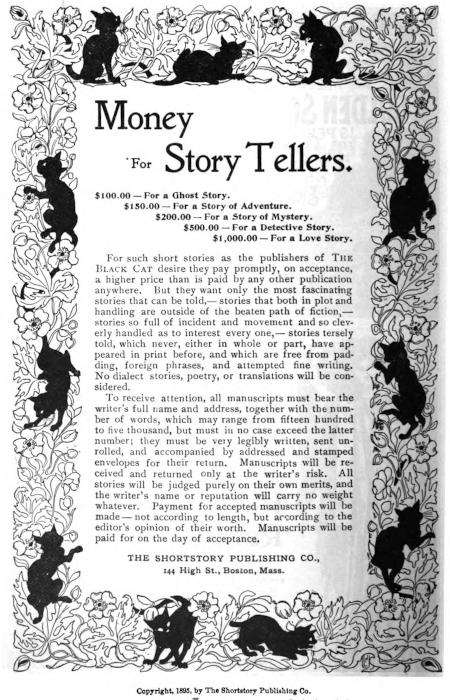
THE SHORTSTORY PUBLISHING CO. 144 HIGH ST., BOSTON, MASS.
No. 5. Copyright 1895 by The Shortstory Publishing Co.
ADVERTISEMENTS
Mason & Hamlin Co.
The Mason and Hamlin Pianos are the only pianos manufactured
containing the patented Screw Stringer, by virtue of which they do not
require one quarter as much tuning as any other piano made: thus reducing
expense of keeping and inconvenience to a minimum.
Full particulars and catalogues mailed free on application.
Mason & Hamlin Co.
BOSTON. NEW YORK. CHICAGO.
Free Magic Lantern Book
All about lanterns, stereopticons and views, for Public
Exhibitions—Schools—Home amusement and for everybody How to make
money—265 page illustrated catalogue free.—Send to McALLISTER, 49 NASSAU
STREET, NEW YORK.
The 20th Century Head-Light
IS A GOOD THING.
PUSH IT ALONG
on your
Bicycles and Runabouts.
Betts Patent Head-Light Co., 10 Warren St., N. Y.
Stock Buyers and Bankers
Take care of money—subject to check—give interest on deposits.
Buy and sell for cash or margin ONLY the securities listed on New York
Stock Exchange
Investors of money
Givers of stock information, by mail or wire.
A member of our firm always on floor of Stock Exchange.
Wayland Trask & Co.,
18 Wall St., New York.
The Black Cat
A Monthly Magazine of Original Short Stories.
No. 5.
FEBRUARY, 1896.
5 cents a copy, 50 cents a year.
Entered at the Post-Office at Boston, Mass., as second-class matter.
IMPORTANT.—The entire contents of this magazine are covered by
copyright and publishers everywhere are cautioned against reproducing any
of the stories, either wholly or in part.
Copyright, 1895, by the Shortstory Publishing Company. All rights reserved.
The Mysterious Card.
BY CLEVELAND MOFFETT.
Richard Burwell, of New York, will never
cease to regret that the French language was
not made a part of his education.
This is why:
On the second evening after Burwell arrived
in Paris, feeling lonely without his wife
and daughter, who were still visiting a friend in London, his mind
naturally turned to the theater. So, after consulting the daily
amusement calendar, he decided to visit the Folies Bergère, which
he had heard of as one of the notable sights. During an intermission
he went into the beautiful garden, where gay crowds were
strolling among the flowers, and lights, and fountains. He had
just seated himself at a little three-legged table, with a view to
enjoying the novel scene, when his attention was attracted by a
lovely woman, gowned strikingly, though in perfect taste, who
passed near him, leaning on the arm of a gentleman. The only
thing that he noticed about this gentleman was that he wore eye-glasses.
Now Burwell had never posed as a captivator of the fair sex,
and could scarcely credit his eyes when the lady left the side of
her escort and, turning back as if she had forgotten something,
passed close by him, and deftly placed a card on his table. The
card bore some French words written in purple ink, but, not knowing
that language, he was unable to make out their meaning. The
lady paid no further heed to him, but, rejoining the gentleman
with the eye-glasses, swept out of the place with the grace and
dignity of a princess. Burwell remained staring at the card.
Needless to say, he thought no more of the performance or of
the other attractions about him. Everything seemed flat and
tawdry compared with the radiant vision that had appeared and
disappeared so mysteriously. His one desire now was to discover
the meaning of the words written on the card.
Calling a fiacre, he drove to the Hotel Continental, where he
was staying. Proceeding directly to the office and taking the
manager aside, Burwell asked if he would be kind enough to
translate a few words of French into English. There were no
more than twenty words in all.
“Why, certainly,” said the manager, with French politeness,
and cast his eyes over the card. As he read, his face grew rigid
with astonishment, and, looking at his questioner sharply, he
exclaimed: “Where did you get this, monsieur?”
Burwell started to explain, but was interrupted by: “That
will do, that will do. You must leave the hotel.”
“What do you mean?” asked the man from New York, in
amazement.
“You must leave the hotel now—to-night—without fail,”
commanded the manager excitedly.
Now it was Burwell’s turn to grow angry, and he declared
heatedly that if he wasn’t wanted in this hotel there were plenty
of others in Paris where he would be welcome. And, with an
assumption of dignity, but piqued at heart, he settled his bill, sent
for his belongings, and drove up the Rue de la Paix to the Hotel
Bellevue, where he spent the night.
The next morning he met the proprietor, who seemed to be a
good fellow, and, being inclined now to view the incident of the
previous evening from its ridiculous side, Burwell explained what
had befallen him, and was pleased to find a sympathetic listener.
“Why, the man was a fool,” declared the proprietor. “Let me
see the card; I will tell you what it means.” But as he read, his
face and manner changed instantly.
“This is a serious matter,” he said sternly. “Now I understand
why my confrère refused to entertain you. I regret,
monsieur, but I shall be obliged to do as he did.”
“What do you mean?”
“Simply that you cannot remain here.”
With that he turned on his heel, and the indignant guest could
not prevail upon him to give any explanation.
“We’ll see about this,” said Burwell, thoroughly angered.
It was now nearly noon, and the New Yorker remembered an
engagement to lunch with a friend from Boston, who, with his
family, was stopping at the Hotel de l’Alma. With his luggage
on the carriage, he ordered the cocher to drive directly there,
determined to take counsel with his countryman before selecting
new quarters. His friend was highly indignant when he heard
the story—a fact that gave Burwell no little comfort, knowing,
as he did, that the man was accustomed to foreign ways from
long residence abroad.
“It is some silly mistake, my dear fellow; I wouldn’t pay any
attention to it. Just have your luggage taken down and stay
here. It is a nice, homelike place, and it will be very jolly, all
being together. But, first, let me prepare a little ‘nerve settler’
for you.”
After the two had lingered a moment over their Manhattan
cocktails, Burwell’s friend excused himself to call the ladies. He
had proceeded only two or three steps when he turned, and said:
“Let’s see that mysterious card that has raised all this row.”
He had scarcely withdrawn it from Burwell’s hand when he
started back, and exclaimed:—
“Great God, man! Do you mean to say—this is simply—”
Then, with a sudden movement of his hand to his head, he left
the room.
He was gone perhaps five minutes, and when he returned his
face was white.
“I am awfully sorry,” he said nervously; “but the ladies tell
me they—that is, my wife—she has a frightful headache. You
will have to excuse us from the lunch.”
Instantly realizing that this was only a flimsy pretense, and
deeply hurt by his friend’s behavior, the mystified man arose at
once and left without another word. He was now determined to
solve this mystery at any cost. What could be the meaning of
the words on that infernal piece of pasteboard?
Profiting by his humiliating experiences, he took good care not
to show the card to any one at the hotel where he now established
himself,—a comfortable little place near the Grand Opera
House.
All through the afternoon he thought of nothing but the card,
and turned over in his mind various ways of learning its meaning
without getting himself into further trouble. That evening he
went again to the Folies Bergère in the hope of finding the
mysterious woman, for he was now more than ever anxious to
discover who she was. It even occurred to him that she might
be one of those beautiful Nihilist conspirators, or, perhaps, a
Russian spy, such as he had read of in novels. But he failed to
find her, either then or on the three subsequent evenings which he
passed in the same place. Meanwhile the card was burning in
his pocket like a hot coal. He dreaded the thought of meeting
any one that he knew, while this horrible cloud hung over him.
He bought a French-English dictionary and tried to pick out the
meaning word by word, but failed. It was all Greek to him.
For the first time in his life, Burwell regretted that he had not
studied French at college.
After various vain attempts to either solve or forget the torturing
riddle, he saw no other course than to lay the problem before a
detective agency. He accordingly put his case in the hands of an
agent de la sureté who was recommended as a competent and
trustworthy man. They had a talk together in a private room,
and, of course, Burwell showed the card. To his relief, his
adviser at least showed no sign of taking offense. Only he did
not and would not explain what the words meant.
“It is better,” he said, “that monsieur should not know the
nature of this document for the present. I will do myself the
honor to call upon monsieur to-morrow at his hotel, and then
monsieur shall know everything.”
“Then it is really serious?” asked the unfortunate man.
“Very serious,” was the answer.
The next twenty-four hours Burwell passed in a fever of
anxiety. As his mind conjured up one fearful possibility after
another he deeply regretted that he had not torn up the miserable
card at the start. He even seized it,—prepared to strip it into
fragments, and so end the whole affair. And then his Yankee
stubbornness again asserted itself, and he determined to see the
thing out, come what might.
“After all,” he reasoned, “it is no crime for a man to pick up
a card that a lady drops on his table.”
Crime or no crime, however, it looked very much as if he had
committed some grave offense when, the next day, his detective
drove up in a carriage, accompanied by a uniformed official, and
requested the astounded American to accompany them to the
police headquarters.
“What for?” he asked.
“It is only a formality,” said the detective; and when Burwell
still protested the man in uniform remarked: “You’d better
come quietly, monsieur; you will have to come, anyway.”
An hour later, after severe cross-examination by another official,
who demanded many facts about the New Yorker’s age, place of
birth, residence, occupation, etc., the bewildered man found
himself in the Conciergerie prison. Why he was there or what
was about to befall him Burwell had no means of knowing; but
before the day was over he succeeded in having a message sent
to the American Legation, where he demanded immediate protection
as a citizen of the United States. It was not until
evening, however, that the Secretary of Legation, a consequential
person, called at the prison. There followed a stormy interview,
in which the prisoner used some strong language, the French
officers gesticulated violently and talked very fast, and the Secretary
calmly listened to both sides, said little, and smoked a good
cigar.
“I will lay your case before the American minister,” he said
as he rose to go, “and let you know the result to-morrow.”
“But this is an outrage. Do you mean to say—”Before he
could finish, however, the Secretary, with a strangely suspicious
glance, turned and left the room.
That night Burwell slept in a cell.
The next morning he received another visit from the non-committal
Secretary, who informed him that matters had been
arranged, and that he would be set at liberty forthwith.
“I must tell you, though,” he said, “that I have had great
difficulty in accomplishing this, and your liberty is granted only
on condition that you leave the country within twenty-four hours,
and never under any conditions return.”
Burwell stormed, raged, and pleaded; but it availed nothing.
The Secretary was inexorable, and yet he positively refused to
throw any light upon the causes of this monstrous injustice.
“Here is your card,” he said, handing him a large envelope
closed with the seal of Legation. “I advise you to burn it and
never refer to the matter again.”
That night the ill-fated man took the train for London,
his heart consumed by hatred for the whole French nation,
together with a burning desire for vengeance. He wired his wife
to meet him at the station, and for a long time debated with
himself whether he should at once tell her the sickening truth.
In the end he decided that it was better to keep silent. No
sooner, however, had she seen him than her woman’s instinct told
her that he was laboring under some mental strain. And he saw
in a moment that to withhold from her his burning secret was
impossible, especially when she began to talk of the trip they had
planned through France. Of course no trivial reason would
satisfy her for his refusal to make this trip, since they had been
looking forward to it for years; and yet it was impossible now
for him to set foot on French soil.
So he finally told her the whole story, she laughing and weeping
in turn. To her, as to him, it seemed incredible that such
overwhelming disasters could have grown out of so small a cause,
and, being a fluent French scholar, she demanded a sight of the
fatal piece of pasteboard. In vain her husband tried to divert her
by proposing a trip through Italy. She would consent to nothing
until she had seen the mysterious card which Burwell was now
convinced he ought long ago to have destroyed. After refusing
for awhile to let her see it, he finally yielded. But, although he
had learned to dread the consequences of showing that cursed
card, he was little prepared for what followed. She read it,
turned pale, gasped for breath, and nearly fell to the floor.
“I told you not to read it,” he said; and then, growing tender
at the sight of her distress, he took her hand in his and begged
her to be calm. “At least tell me what the thing means,” he
said. “We can bear it together; you surely can trust me.”
But she, as if stung by rage, pushed him from her and declared,
in a tone such as he had never heard from her before, that never,
never again would she live with him. “You are a monster!”
she exclaimed. And those were the last words he heard from
her lips.
Failing utterly in all efforts at reconciliation, the half-crazed man
took the first steamer for New York, having suffered in scarcely
a fortnight more than in all his previous life. His whole pleasure
trip had been ruined, he had failed to consummate important
business arrangements, and now he saw his home broken up and
his happiness ruined. During the voyage he scarcely left his
stateroom, but lay there prostrated with agony. In this black
despondency the one thing that sustained him was the thought of
meeting his partner, Jack Evelyth, the friend of his boyhood, the
sharer of his success, the bravest, most loyal fellow in the world.
In the face of even the most damning circumstances, he felt that
Evelyth’s rugged common sense would evolve some way of escape
from this hideous nightmare. Upon landing at New York he
hardly waited for the gang-plank to be lowered before he rushed
on shore and grasped the hand of his partner, who was waiting
on the wharf.
“Jack,” was his first word, “I am in dreadful trouble, and you
are the only man in the world who can help me.”
An hour later Burwell sat at his friend’s dinner table, talking
over the situation.
Evelyth was all kindness, and several times as he listened to
Burwell’s story his eyes filled with tears.
“It does not seem possible, Richard,” he said, “that such things
can be; but I will stand by you; we will fight it out together.
But we cannot strike in the dark. Let me see this card.”
“There is the damned thing,” Burwell said, throwing it on the
table.
Evelyth opened the envelope, took out the card, and fixed his
eyes on the sprawling purple characters.
“Can you read it?” Burwell asked excitedly.
“Perfectly,” his partner said. The next moment he turned
pale, and his voice broke. Then he clasped the tortured man’s
hand in his with a strong grip. “Richard,” he said slowly, “if my
only child had been brought here dead it would not have caused
me more sorrow than this does. You have brought me the worst
news one man could bring another.”
His agitation and genuine suffering affected Burwell like a
death sentence.
“Speak, man,” he cried; “do not spare me. I can bear anything
rather than this awful uncertainty. Tell me what the card means.”
Evelyth took a swallow of brandy and sat with head bent on
his clasped hands.
“No, I can’t do it; there are some things a man must not do.”
Then he was silent again, his brows knitted. Finally he said
solemnly:—
“No, I can’t see any other way out of it. We have been true
to each other all our lives; we have worked together and looked
forward to never separating. I would rather fail and die than
see this happen. But we have got to separate, old friend; we
have got to separate.”
They sat there talking until late into the night. But nothing
that Burwell could do or say availed against his friend’s decision.
There was nothing for it but that Evelyth should buy his partner’s
share of the business or that Burwell buy out the other. The
man was more than fair in the financial proposition he made; he
was generous, as he always had been, but his determination was
inflexible; the two must separate. And they did.
With his old partner’s desertion, it seemed to Burwell that the
world was leagued against him. It was only three weeks from
the day on which he had received the mysterious card; yet in
that time he had lost all that he valued in the world,—wife,
friends, and business. What next to do with the fatal card was
the sickening problem that now possessed him.
He dared not show it; yet he dared not destroy it. He loathed
it; yet he could not let it go from his possession. Upon returning
to his house he locked the accursed thing away in his safe as if it
had been a package of dynamite or a bottle of deadly poison.
Yet not a day passed that he did not open the drawer where the
thing was kept and scan with loathing the mysterious purple
scrawl.
In desperation he finally made up his mind to take up the study
of the language in which the hateful thing was written. And
still he dreaded the approach of the day when he should decipher
its awful meaning.
One afternoon, less than a week after his arrival in New York,
as he was crossing Twenty-third Street on the way to his French
teacher, he saw a carriage rolling up Broadway. In the carriage
was a face that caught his attention like a flash. As he looked
again he recognized the woman who had been the cause of his
undoing. Instantly he sprang into another cab and ordered the
driver to follow after. He found the house where she was living.
He called there several times; but always received the same reply,
that she was too much engaged to see any one. Next he was
told that she was ill, and on the following day the servant said
she was much worse. Three physicians had been summoned in
consultation. He sought out one of these and told him it was a
matter of life or death that he see this woman. The doctor was
a kindly man and promised to assist him. Through his influence,
it came about that on that very night Burwell stood by the bedside
of this mysterious woman. She was beautiful still, though
her face was worn with illness.
“Do you recognize me?” he asked tremblingly, as he leaned
over the bed, clutching in one hand an envelope containing the
mysterious card. “Do you remember seeing me at the Folies
Bergère a month ago?”
“Yes,” she murmured, after a moment’s study of his face; and
he noted with relief that she spoke English.
“Then, for God’s sake, tell me, what does it all mean?” he
gasped, quivering with excitement.
“I gave you the card because I wanted you to—to—”
Here a terrible spasm of coughing shook her whole body, and
she fell back exhausted.
An agonizing despair tugged at Burwell’s heart. Frantically
snatching the card from its envelope, he held it close to the
woman’s face.
“Tell me! Tell me!”
With a supreme effort, the pale figure slowly raised itself on the
pillow, its fingers clutching at the counterpane.
Then the sunken eyes fluttered—forced themselves open—and
stared in stony amazement upon the fatal card, while the
trembling lips moved noiselessly, as if in an attempt to speak.
As Burwell, choking with eagerness, bent his head slowly to hers,
a suggestion of a smile flickered across the woman’s face. Again
the mouth quivered, the man’s head bent nearer and nearer to
hers, his eyes riveted upon the lips. Then, as if to aid her in
deciphering the mystery, he turned his eyes to the card.
With a cry of horror he sprang to his feet, his eyeballs starting
from their sockets. Almost at the same moment the woman
fell heavily upon the pillow.
Every vestige of the writing had faded! The card was blank!
The woman lay there dead.
Tang-u.
BY LAWRENCE E. ADAMS.
Among the most interesting souvenirs that
Marston, the naval officer, brought from the
Orient was a curious portrait, evidently the
work of a native artist, painted in brilliant
colors on a panel of foreign wood. More
striking than the workmanship of the portrait,
however, was its subject, a small Chinese
boy, apparently not more than ten or twelve years of age, but
wearing the uniform of a high Japanese naval officer, and adorned
with a whole string of jeweled decorations.
Here is the history of the portrait:
When the Japanese flagship steamed out of the harbor of
Canton on the day that war was formally declared between Japan
and China, it carried one human being whose name was not on
the ship’s rolls,—and he belonged to the enemy. He became a
passenger under the following circumstances: Just before the
ship weighed anchor a small steam launch was sent back for the
commander and superior officers, who had been detained until
late. Among these officers were three Americans, all graduates
of the Annapolis academy, who had been engaged by the Japanese
government as advisers during the coming hostilities. As
the little launch wormed its way through the maze of picturesque
craft and sampans,—the curious little Chinese house-boats,—which
crowded the bay, the eyes of the American officers were
riveted by a curious sight. To the top of a wooden stake to
which a sampan was moored a little Chinese boy clung, swaying
to and fro, eyeing delightedly the steam launch as it shot
through the water. In his anxiety to see the fun, however, he
had disregarded the weakness of this reedlike support, which,
when a passing sampan collided with it, suddenly broke off short,
plunging the little chap into the water. At first the launch’s
passengers paid slight attention to the accident, knowing that
these little natives are as much at home in the water as on shore.
Indifference, however, gave way to concern when the child’s
shrill cry for help rang through the air, followed by the mad
efforts of every sampan-man within sight to get away from the
drowning boy, instead of to him. It was now evident that the
little fellow had become entangled in a floating coil of rope, and
that his drowning was a matter of a few seconds; yet not one of
the Chinese boatmen but watched from a distance and in silence
the small hero’s frantic struggles for life. Indeed, the little
Mongolian was already disappearing in the waters of the bay
when the steam launch, at the signal of the commander, veered in
its course, and a strong arm snatched the little body from the
waves. As for the sampan-men, they watched the rescue with
cries of amazement. This was because of the curious law existing
in certain provinces of China that whosoever saves a life, the
rescued one may lawfully look to the rescuer for support forever
after. It is plain that this barbaric edict virtually puts a premium
on death; but the explanation lies in the fatalistic religion,
which holds that whenever a man falls into peril it is by the
express wish and will of the gods, and that to rescue him is to
obstruct their just decrees.
Meantime the officers, who had arrived on shipboard with their
protégé before it had occurred to them to plan for his disposal,
were examining their find as though he had been a new and
curious toy. To send him back to shore was impossible, as they
were already steaming out of the harbor. The only course, then,
was to keep him on board, at least during the voyage to Japan, a
plan rendered all the easier by the fact that the little heathen
was, according to his broken Japanese, both homeless and friendless.
But if the boy had seemed a nuisance in prospect, he was anything
but that in reality. Shrewd as any Bowery ragamuffin, the
little fellow’s alert ways and quick wits were the unfailing delight
of the three American officers. More imitative, even, than the
Japanese, he picked up their language and customs with such incredible
ease that in a few days he was more Japanese than any
subject of the Mikado. Indeed, before many weeks had passed,
the entire crew was accustomed to the curious spectacle of one of
the enemy enjoying the most marked attention and hospitality
that the ship could afford.
But, besides his imitativeness and shrewdness, the little Mongolian
had one accomplishment that gained the awe-struck
admiration of his Oriental friends. That was the power of discovering
objects at incredible distances as easily by night as by
day, a power due partly to inheritance, and partly to his profession.
The lad was an interesting specimen of the Oriental class
of beings known as rat-catchers. This means more than the word
implies. They are not rat-catchers by vocation alone, but,
strangely enough, they are born to the trade. In addition to
many other talents which he had inherited from a long line of
rat-catching ancestry, little Tang-u,—the “rat,”—as the boy was
called, had the power of seeing his way clearly in almost the
dead blackness of night. Sometimes, indeed, it seemed as though
he was endowed with a sixth sense in this matter, being able to
walk straight into a dungeon-like room and to bring forth any
object without the least hesitancy. Courage, also, he had developed
to a rare degree, for the rats in the docks of China, and in
the underground passages from warehouse cellar to cellar, and
sewer to sewer, where he plied his trade, are the fattest and most
savage of the rodent tribe the world over; so large, indeed, that
the skins of two of them will make a pair of gloves, and the
carcass will supply a family with dried fillet de rodent for a week.
These rat-catchers spend days and weeks in the underground
passages, and day and night are almost the same to them.
Now that he could no longer exercise his strange gift in his
accustomed way, Tang-u would often amuse himself by standing
for hours on the deck, peering out through the mist or the darkness
in search of things hidden to common eyes. Indeed, among
the Americans he soon became known as the “kid with the telescopic
eye,” while the commander, on various occasions, allowed
him to accompany the men in the lookout, where he discovered
objects often in advance of the field-glass. Even the dark waters
of the ocean were not proof against the vision of the little heathen,
whose bright eyes would detect curious fish as they swam around
the ship, many feet below the surface; while a fog that blinded
the ordinary eye proved no obstacle to his keen sight. Before
long every one came to the conclusion that a boy whose eye was
equal to a combined field-glass and search-light was a valuable
addition to a modern warship; and on more than one occasion
during the months of the war the little Chinaman’s discernment
was appealed to as gravely as though he had been thirty years
old and a Japanese officer, instead of a ten-year-old Chinaman.
On one occasion, indeed, Tang-u’s sixth sense made him for
five minutes the ship’s commander.
It was late in the evening before the memorable engagement of
Port Arthur. The flagship, which, having passed unscathed
through months of war, had been recently ordered to this stronghold,
had just anchored in the harbor, and preparations were
making for the night’s defense. The torpedo net had not yet
been lowered, but the whole ship resounded with the bustle and
hurry of preparations for what every one felt would be the most
decisive battle of the war. Meantime Tang-u stood alone near
the bow, peering out through the darkness, as was his custom
upon arriving in a strange place, in search of some new and interesting
sight. Suddenly, above the confusion, there rang out a
shrill little scream, and Tang-u, with his eyes bulging from his
head, rushed towards the admiral, and, pointing out to sea, frantically
shrieked: “Tor-pee-to! tor-pee-to!!”
Instantly every eye followed the direction of the tiny finger.
The sea looked unruffled. Not a soul on the deck, even by straining
his vision to the utmost, could verify Tang-u’s cry. Yet so
accustomed had they become to relying upon the little fellow’s
keen sight that the admiral gave instant orders to lower the net.
In a moment there was a sound of hurrying feet, a hundred hands
were raised to the ropes, and the great net fell into place. Before
the splash of the falling net had died away, there was a thundering
explosion, and a tremendous upheaval of water, like that of a
mighty geyser, shook the huge ship from bow to stern. It was
indeed a torpedo that Tang-u’s keen eyes had detected far away
through the approaching night. But swiftly as it came, the boy’s
marvelous vision had been swifter. The well-aimed missile of
destruction, that in a moment more would have destroyed the
flower of the Japanese navy, had, in coming in contact with the
netting, exploded harmlessly, flooding the deck with water. The
great warship with over three hundred souls had been saved from
annihilation,—and by one of the enemy.
A few months later, when Tang-u’s exploit was brought to the
notice of the Mikado, that dignitary conferred upon the little
Chinese rat-catcher the rank of honorary admiral in the Japanese
navy.
And it was in this way that a heathen nation furnished the
youngest naval hero in existence.
The Little Brown Mole.
BY CLARICE IRENE CLINGHAN.
Three years ago, while spending a few weeks in
New York, I was invited to the home of Paul
Fancourt, the famous naval architect, whose
family residence is on the shore of the Hudson,
and but a short distance from the city.
I found my old college friend, whom I had
not seen for several years, busily engaged with
a set of drawings; but, notwithstanding his enthusiasm in his
work, he looked worn, haggard, and unhappy. On the afternoon
of the last day of my visit I pinned him down to a serious talk,
in the course of which I begged him not to undermine his health
by too close application to his favorite pursuit.
With a flitting smile he exclaimed: “Why, it’s all that keeps
me alive!” After a moment’s thought he added: “Of late
years I have been weighed down by the memory of a dark spot
in my life—an unwritten chapter—until at times it seems as
though I must make a confidant of some one.”
Upon my assurance that I would be a most willing listener, he
related the following history:
“Twelve years ago,” he said, “when I was twenty-three, I met
a singularly handsome girl, a débutante enjoying the triumphs of
her first season. It does not speak well for the good sense of
either of us, but I am compelled to admit that within six weeks
we had met, loved, married, quarreled, and separated.
“The trouble between us was incompatibility of temper. This
sounds insignificant, but there was certainly an enormous lot of
incompatibility and much temper! We were very unhappy—at
least, I was. We both said things that could never be forgiven or
forgotten. Before the honeymoon was over I left my wife in this
house, with a corps of servants and a handsome balance at my
banker’s, and started on a trip around the world.
“I was absent five years. During that time there was no communication
between my wife and myself, although I frequently
heard of her through correspondence with friends. Her conduct
during my absence was most exemplary. She remained in the
place where I left her, but gave up society. She studied art,
making much progress, and I was informed that her pictures and
illustrations were selling for extravagant sums. She seemed to
have struck a popular art note and was playing upon it.
“These bits of information neither entertained nor amused me.
Indeed, I thought myself beyond the point where anything she
might say or do could interest me. Not that I had learned to
care for any one else, but simply because our short association had
utterly destroyed my early boyish affection. Before I had been
absent a year her very image seemed effaced from my memory.
“On my arrival in New York, however, I was irritated to learn
that not a penny of the money I had left at her disposal had been
touched. I believed she had done this for the purpose of annoying
me and causing me to look mean in the eyes of the world,—she,
meanwhile, earning her livelihood by her art. Being abundantly
able, I wished to make a settlement upon her; but, as she
absolutely refused to talk with the lawyer I sent to her, I was
compelled, repugnant as the idea was, to seek a personal interview.
To this end I telegraphed Mrs. Fancourt on the third morning
after my arrival, asking if she would receive me at five o’clock
that afternoon on an urgent business matter.
“In less than an hour the reply reached me. I tore open the
envelope and read the one word which comprised the answer,
standing alone, naked of punctuation, on the yellow sheet:
‘Come.’
“‘That means war to the knife,’ I thought, tossing the paper
on my dressing-table. ‘No words wasted.’
“As I made preparations for the trip I caught myself glancing
at the letter now and then. ‘Come!’ After all, it had a certain
charm of its own, that word. Like all affirmative expressions, it
possessed drawing power. The more I looked at it, the more
alluring it appeared. Then I examined the signature. It was
simply ‘Leila.’ Really, it was almost coaxing.
“Arriving in this village just at nightfall, I hurried towards
the house which had been the scene of so much unhappiness. To
my surprise, it gleamed with lights, as if for some festivity. As
I sprang up the steps and laid my hand upon the bell the door
was suddenly opened by a maid-servant whose face was strange
to me.
“‘Where is madame—Mrs. Fancourt?’ I asked.
“‘In the drawing-room, sir,’ she answered, and then discreetly
disappeared.
“As you know, the drawing-room in this house is connected
with the front hall by an arch, hung with portières. These were
drawn. Pushing them aside, I entered, and suddenly found
myself in the warm glow of a big wood fire which had been
lighted in the fireplace. This crackling, cheery blaze and the
waning light of the October day were all that lighted the room.
There in the center she stood, clad in an exquisite gown of palest
yellow, and, as I moved towards her, I saw two hands, instead of
one, outstretched. The next moment I was holding them both,
the cool, soft fingers clinging to mine while she whispered:
‘Paul!’
“For a few seconds we looked at each other silently, breathlessly;
then, obeying that irresistible law that causes the needle
to be drawn towards the magnet, I bent and kissed her.
“All this took place as I have described it; but it would be
impossible for me to account for the feelings that actuated me.
I know only that all my bitterness towards my wife, all my
dislike for her, in one revulsion of mind changed to the most
passionate admiration and affection from the instant her lips
touched mine. Dazed, astonished, I could not find voice to
speak, but Leila chatted quite naturally as she led me to a big
armchair on one side of the fireplace, while she threw herself on
a low divan piled with cushions on the other side, putting out a
slim little yellow-slippered foot to the blaze.
“‘It’s such a sorry day that I ordered this big fire, so your
home would seem pleasant after your long absence,’ said she, in
her mellow, vibrating voice. Then, looking at me across the fire,
with a winning smile, she added: ‘Besides, it was so good of
you to come out to see me.’
“I looked at her, still amazed. I now saw that she was much
changed. Perhaps she was not so handsome as she had been in
her early womanhood; but what she had gained more than made
up for that which she had lost. She was thinner; her face had
grown ethereal, luminous, spirituelle. Surely, she had suffered,
this fiery, savage-tempered girl, for the hardness and selfishness
had melted away from her face and left it softened, lovely, and
changefully brilliant. At first I thought her eyes were darker;
but I soon made up my mind that it was because the pupils were
so dilated. Then I knew she, too, was under the tension of
strong nervous excitement. Her manner, however, gave no suggestion
of this. She talked rapidly and almost continually,
saying, apparently, whatever first came into her mind.
“‘I suppose it seems frightfully dull to be here again. The
merry-go-round has stopped, and here you are at the place from
which you started. The curtain has dropped, has it not, dear?
You’ve been everywhere and seen so much; and now everything
is at a standstill and you feel a bit giddy from sudden lack of
motion. It’s much the same with me, only my merry-go-round
isn’t so merry and not so far around. I’ve just rotated between
here and the New York art schools, and lived very quietly. But
I believe I’m doing all the talking. Would you like to say anything—just
a little word? Well, I won’t let you, for I know
two things. You are tired, and no man feels like talking before
he has dined. So not a word until after dinner.’
“In the dining-room another surprise awaited me. A miniature
banquet had been prepared, evidently in my honor, for I was
the only guest. The room was adorned with palms and vines,
and the table was gracefully decorated with roses and ferns, among
which gleamed the silver and china. Over all was the soft, almost
moonlight effect of wax tapers. The only objection I could make
to anything was the flowers on the table, which partially concealed
the face which I was now hungry to look upon. It
was what I believe is termed the Celtic type of beauty, quite
common among Anglo-Saxons,—dark brown hair approaching
black, gray eyes, and a complexion of creamy fairness.
“We were long at dinner, talking of everything but the subject
I came to introduce. I became reminiscent of travel; she
was easily entertained and was herself brilliant, serious, and
amusing in turn. As we walked back to the drawing-room at
the close of the meal, I whispered, like a lover:
“‘Leila, I came to scoff, but I remain to pray. Can you forget
the past?’
“She promptly put her hand over my mouth. ‘The past must
remain a sealed book,’ she commanded.
“And, so it did.
“In the hour that followed, spent before the open fire, I inadvertently
referred more than once to the forbidden subject. But
each time I was stopped by a warning gesture and an impressive,
‘Remember, not a word. We begin life anew from this hour.’
“With every moment my desire for a reconciliation grew
stronger. But when at length she yielded, it was only on two
conditions: first, that I would never refer to the past; and,
second, that our future be consecrated by a ceremony of marriage.
“I readily agreed to the first condition and took the solemn
vow required; but at the second stipulation I laughed. But she
said, very seriously, that she could be reconciled to me under no
other circumstances. So, yielding to her whim, I ordered a carriage
and we drove to the house of an elderly clergyman in the
village whom we well knew, who, on hearing our story, willingly
agreed to repeat the ceremony; and, lightly, almost laughingly,
the words of five years before were once more said.
“Then followed five months of the most absolute happiness
that was ever accorded, it seemed to me, to human beings. It
was an atmosphere of love, joy, and ineffable content. The
beauty of my wife, her changed nature, and fine intuitions grew
upon me day by day. There never was, I am sure, a woman like
her. I lived in her love; and yet I lost it forever on account of
a thing of such infinitesimal importance that it drives me nearly
mad to think of it. This object was no more nor less than a little
brown mole on my wife’s neck, just below her left ear.
“It came about in the following manner: One day, having
returned from the city on an earlier train than I had anticipated,
I went to Leila’s room and found her lying on a couch, fast
asleep, her hands clasped behind her head, and one slippered foot
crossed over the other—in fact, the posture in which Du Maurier’s
famous Duchess was wont to ‘dream true.’ Knowing she was a
sound sleeper it occurred to me to softly kiss the little brown
mole to which I have just referred—something I had not thought
of since the days of our first short honeymoon so long ago.
“Carefully I pushed aside the masses of tumbled hair that lay
across her soft white throat, and bent over her. No—the other
side—but, surely—what did it mean? Her round neck of
infantile whiteness and smoothness lay before me, but the little
beauty spot was missing! Nor was there the slightest evidence
that it had ever existed.
“I went downstairs and smoked a pipe on the piazza to think
over this mystery. But the longer I thought, the less I understood
it.
“That evening I said to my wife: ‘Sweetheart, where is the
little brown mole that was just under your left ear?’
“For a moment she looked at me; then she said softly, but with
a certain power in her voice: ‘Have you forgotten your vow?’
“I stared a moment; then recalled my promise never to allude
to the past. Somehow, it impressed me differently now than
when I had first taken it. To be sure, I laughingly begged
Leila’s pardon, assuring her there would be no more lapses from
rectitude in that direction. But from that moment a strange
restlessness took possession of me. I felt something impending.
In the morning I would wake with a singular sense of oppression,
which when traced to its cause always arrived at the same starting-point,—the
little brown mole which should have been on my
wife’s soft white throat, but was not.
“It was about this time that I noticed that there was not a
likeness of Leila in the whole house. When I went away there
were many scattered about,—water-color sketches, paintings in
oil, photographs, and etchings, for Leila had always been proud of
her beauty. Now not one remained; even the oil-painting that
had been finished, as companion to mine, just, after our first marriage,
had been removed, though mine hung in its accustomed
place. I was about to call attention to this fact and ask the
reason, when I remembered that this circumstance, also, belonged
to the past, concerning which I had promised never to question,
and was silent.
“My mind had now become so perturbed that it continually
demanded something on which to focus its attention. For this
reason, I turned my thoughts to my favorite pursuit,—naval
architecture,—which had been neglected for months. Before my
trip abroad I had left in a sandal-wood box in the library some
unfinished plans, which I now decided to complete. But as the
box was missing and the servants knew nothing of its whereabouts,
I climbed to the attic to look for it myself.
“After an hour spent in a fruitless search I was turning to
leave, when my eye fell upon a large picture lying on its face
among a heap of papers in the darkest corner. I knew the frame,
and the first glance at the picture told me I had happened on what
I was not looking for, but had wished for,—a portrait of my wife.
It was the one that had been painted directly after our marriage.
“Dragging it from its hiding-place, I carried it to the long,
low window, and, propping it up against an old dressing-table in
a position that would catch a good light, I carefully wiped off the
dust and cobwebs and stood back to view it.
“As I looked I became as a man stricken with death! The
face on the canvas was not the face of the woman I loved and
worshiped as my wife!
“How long I stood benumbed by this discovery I do not know.
After the first shock lessened and my senses began to act, I
fell to studying the portrait and comparing it with its living
double.
“That there was a remarkable resemblance between the two it
is unnecessary to say; but at the same time there were so many
points of difference that I was amazed that I could have been so
easily deceived. There was, in fact, what might be termed a
‘family’ resemblance such as often exists between two sisters,
who, when together, are not thought to be remarkably alike, but
when seen apart are often mistaken for one another. In the picture
the ears were larger, the mouth smaller, the chin less decided,
the forehead a trifle narrower, and the eyebrows heavier.
“While I stood revolving in my mind this terrible mystery I
heard the sound of hurried footsteps. My wife had returned from
her afternoon walk. I went downstairs, arriving in the lower hall
just as she entered. She came sweeping in with her usual vivacity,
her eyes bright, a faint rose tint on her cheeks, enveloped in
that atmosphere of exhilaration that was like a breath of ozone,
and which gave her a charm above ordinary women.
“Something in my appearance must have startled her, for she
paused at sight of me and waited for me to approach. I went to
her, kissed her, and then, clasping her gloved wrists in mine,
looked steadfastly at her and said, ‘Dear, where is Leila?’
“In a moment her brilliant color faded. Her eyes fell. Then,
suddenly wrenching herself free from me, she moved unsteadily
towards the staircase, pausing with her hand on the banister only
long enough to say, ‘You have broken your pledge. Leave me
alone until to-morrow. Then you shall know everything.’
“Then I heard the sound of her garments on the stairs, presently
the closing of her door, and the key turning in the lock.
“All that night I restlessly walked the floor of my room, trying
to bring order out of the chaos of my mind. Fear, love, trust,
suspicion, all by turns possessed me; but in the end my belief in
the goodness of the woman I loved conquered. At early dawn I
knocked at my wife’s door. There was no response. I tried the
knob; it yielded and I entered. There was a dim light in the
room; but she was gone. On her dressing-table was a letter
which told me all.
“The first few paragraphs are sacred to me alone. I will begin
her letter where she commenced her own history.
“‘My name,’ she wrote, ‘is Olive Berkeley. I was born in
England, the only child of a retired naval officer. My father had
a moderate fortune, and for eighteen years I lived a quiet, carefree
life in a Devonshire country-house. During my nineteenth
year my father’s income was so much reduced by unlucky investments
that we moved to London that I might study art, with a
view to supporting myself. Two years later my father, who was
my only near relative, died suddenly, leaving me less than a hundred
pounds clear of debt. By this time, however, I felt confident
of success in my profession, and, thinking America offered a
better field than England for a self-supporting woman, I came to
New York. Here I took a studio with the intention of giving
lessons in drawing and painting.
“‘But the pupils did not come; my pictures failed to catch the
popular fancy; my money was soon spent. Overwork and worry
culminated in illness, and I soon found myself deeply in debt
without a friend in the world to whom I could apply for aid. In
this extremity I accepted the first work I could obtain—a situation
as companion to Mrs. Paul Fancourt.
“‘This woman, whose violent temper and moody disposition
had driven her husband to foreign countries before the honeymoon
was over, was the terror of her household. She, I believe, took a
dislike to me from the first on account of a singular resemblance
between us, and also because she saw I was her equal by birth
and education. At any rate, she delighted in humiliating me
in every way, as well as in making my duties as laborious as
possible. I hated to touch a morsel of food under her roof, but
my unmet obligations made it impossible for me to resign my position,
as I did not know where else I could obtain remunerative
work, and I had a horror of debt. But, though I outwardly kept
my temper, a volcano of hurt pride and misery burned within
me.
“‘One Wednesday night I went to my room more than usually
worn and enraged by Mrs. Fancourt’s caprices. It had been one
of her stormiest days, culminating in the discharge of her butler,
and the bitterest invectives against the other servants. I had
just retired, and had hardly fallen asleep, when the bell over my
head rang violently. Springing up, I slipped on a dressing-gown
and went downstairs. Mrs. Fancourt was sitting in an
easy-chair reading a novel. The hands of the clock on the mantel
pointed to eleven. Without looking at me, she motioned to a
table not three yards away, saying insolently, “Bring me that
paper-knife.”
“‘“Never,” I answered passionately.
“‘With this she rose and came towards me, striking me full in
the face with the paper-covered novel in her hand.
“‘Then it was as if all my pent-up self-control snapped. I
sprang toward her, seized her by the shoulders, shook her until
my strength was spent, and flung her from me.
“‘She fell heavily, striking her temple upon a sharp corner of
the fender, where she lay quite still. I hurried forward and
spoke to her. There was no response and I lifted her face to
the firelight. To my horror I found that she was dead.
“‘And what was to become of me? I had killed her in a fit
of passion, I could not deny, though it was by accident. How
could I prove my innocence? I was without friends or money.
When my debts were brought to light, might not theft and the
fear of discovery be advanced as the motive for the crime? If
not the scaffold, I saw, at least, prison bars before me.
“‘Instinctively looking around for something to wrap about
me, I caught up a satin-lined garment of Mrs. Fancourt, and,
slipping it on, rang the bell. Wishing to spare the one who
answered it a shock, I met the housekeeper in the hall.
“‘“What is it, Mrs. Fancourt?” asked the woman very respectfully,
evidently mistaking me for her mistress.
“‘In that instant there flashed into my half-crazed brain the
wild idea that I might personify Mrs. Fancourt for the time being.
The death of the poor, unknown English girl could be of little
moment, while the announcement of the death of Mrs. Fancourt
would cause much more comment.
“‘With this idea, I told the housekeeper to come to me in
half an hour; then, with the courage of desperation, I clothed the
dead body in one of my dresses, arrayed myself in one of Mrs.
Fancourt’s gowns, darkened my eyebrows to simulate hers, and
let my hair fall about my face in confusion.
“‘Meantime, I had determined to insure myself against detection
by the three remaining servants by getting rid of them at
once, a plan rendered all the easier by the fact that it simply
carried out Mrs. Fancourt’s mood of the day. In fact, it had
been her custom to vent her feelings by discharging her entire
corps of servants in a body and with no warning; and their comings
and goings caused not the slightest comment.
“‘The scheme succeeded to perfection. The other servants,
terrified by the catastrophe, gladly left the house at once, especially
as each was provided with two weeks’ wages in advance.
Mrs. Fancourt’s only sister and near relative was traveling
in Europe; her husband was at the antipodes. Of course
there was a coroner’s inquest; but, as nothing was proven to
the contrary, a verdict of death by accident was brought in. The
whole matter passed off very quietly; few outside the household
knew that Mrs. Fancourt had an English companion or that she
had died. Those who did thought it very kind of Mrs. Fancourt
to give the companion burial in her own family lot.
“‘Then I fell sick, and for weeks raved with brain fever.
When I recovered I was but the ghost of my former self, and
friends of the dead woman who came to call after my recovery
said they never would have known me.
“‘As soon as I was able I devoted myself to art, which now,
by a freak of fortune, brought me large returns. I not only paid
the debts of my “deceased English companion,” but supported
myself comfortably without touching the fund left at the disposal
of Mrs. Fancourt by her husband. That I never could have done.
I should have been happy but for the grief I felt at having—though
unwittingly—caused the death of another. There has
never been a moment when I would not have willingly yielded up
my life, could it have restored that of my victim. The fact that
I usurped her name and position was due to a momentary cowardice.
There was only one thing belonging to the dead woman that
I coveted, and that was her husband!—and not even him until
that night of nights when he came into my monotonous life and
kissed me with that quiet air of ownership and dominion!
“‘I had dreaded your coming, fearing you, above all others,
would discover the fraud. And when your message reached me,
and, on the impulse of the moment, I sent that fatal answer,
“Come,” it had hardly left my hand before I regretted it. For
at once it flashed upon me how impossible it would be to account
for all or to conceal all. But from the instant that you stood before
me I was conquered by another feeling than that of dread,—I
loved you. Love and not fear held me to the lie. And it was
my respect for you and for myself that made me insist upon that
marriage ceremony.
“‘I always knew that should you discover the deceit I should
leave you—not because I felt guilty of crime—for of that I have
always felt morally innocent—but because I won and married
you under false pretenses. I cannot bear to lose one iota of your
respect and remain where I can miss it.’”
Here Paul Fancourt closed his story. I heard the high wind
lashing the trees; darkness was growing dense; the early November
evening was closing in.
“It was seven years ago to-night that I first met her in this
house,” went on Fancourt.
“Surely you have taken measures to find her?”
“I have done everything under heaven. Once in awhile I
grow desperate and try everything over again. But it is useless.
And yet I have a feeling that she will return, and that if she
does it will be to this house. So I am just waiting here, waiting—
“Well, John?”
“A lady to see you, sir,” said the butler at the door.
“Who is she?”
“I don’t know, sir; she wouldn’t give any name.”
Fancourt rose and went towards the door; but before he reached
it his visitor pushed past the servant and stood,—a tall, veiled
figure in black,—clutching nervously at the drapery at the door.
Then she threw back her veil. I caught a glimpse of a marvelous
face and hair sprinkled with snow about the temples, of two dark,
beautiful eyes fixed on Paul.
“I—I couldn’t stay away—any longer,” she whispered huskily.
Fancourt rushed towards her with an inarticulate cry. Then,
with hands outstretched, “My wife,” he gasped, “I—”
But what followed I shall never know; for the next moment I
had retreated into the library, where for half an hour I sat diligently
reading a book held upside down.
What I do know, however, is this: All that I have told happened
three years ago; and up to the present time Paul Fancourt’s
third experiment in matrimony has proved a triumphant
success.
A Telepathic Wooing.
BY JAMES BUCKHAM.
Dr. Amsden was utterly and hopelessly in love
with beautiful Miriam Foote. But, in spite of
his six feet of splendid manhood—or, perhaps,
because of them—the young doctor was so timid
in the presence of the fair sex, and particularly
in the presence of the fascinating Miriam, that
he could no more bring himself to utter a syllable
of sentiment to that young woman than he could walk up to
the venerable and dignified president of the State Medical Association
and tweak his nose! The two things seemed equally
preposterous and impossible.
At this juncture of affairs, curiously enough, there fell into the
hands of Dr. Amsden a book that offered a magical solution of
the problem that perplexed him,—viz., how to make love to the
woman who had ensnared his heart, without being conscious of
doing it. This book was called “The Law of Psychic Phenomena,”
and its central theory was that the “subjective mind,” or
soul, of any person, by a process of auto-suggestion, may enter
into communication with the subjective mind of another person,
at any distance whatsoever. A condition of sleep, either cataleptic
or natural, is induced by the agent in himself; but previously
to falling to sleep he must concentrate his whole mental
energy and will-power upon the determination to convey a certain
image, or message, or both to the subjective mind of the person
with whom he wishes to communicate. Then away goes his spirit—his
phantasm—while he is buried in unconscious slumber,
appears in his very image to the person designated, and delivers
the message with his very voice and manner. Truly, a marvelous
theory, and of untold significance to timid lover’s and bashful
solicitors of every kind.
According to this theory, Dr. Amsden, in order to make telepathic
love to Miriam Foote, need simply drop to sleep, on a
certain night, with a strong determination to send his phantasm
to the young woman with an eloquent plea of affection. That
was all. It was not even necessary for him to furnish the general
substance, introduction, or any portion of this glowing address.
He need simply specify that it should be passionate and rich in
verbal color,—ordering a proposal much as he would a dinner at
a first-class hotel, with perfect confidence that at the proper time
it would be served in proper form. To be sure, this method of
wooing was not in strict accordance with the traditional etiquette
of such affairs. It might even be considered that this proposal
by a sort of phantasmal proxy was hardly fair to the object of
the experiment. A ghost is, after all, but a ghost, whether it be
attached to a bodily tenement or be simply a spirit at large, and even
the most heavenly minded young woman might cherish a prejudice
in favor of a fleshly lover. On the other hand, however, the
choice lay not between two methods of wooing, but between this
and none at all; and how easy, how delightful a method of
making a proposal of marriage. It could all be performed, like a
painful surgical operation, during merciful sleep. Then the lover
when next he met the lady in his every-day person would know
by her manner whether she had accepted or rejected him. The
more Dr. Amsden considered this fascinating project the more
trivial seemed his scruples against its fulfilment. Indeed, he asked
himself judicially, was it not a fundamental doctrine of metaphysics
that only the soul was real, and so-called matter was
simply the shadow cast by the spirit? This being the case, his
vulgarly named ghost was in reality no ghost at all, while his
bodily presence was the real phantasm.
Having arrived at this comfortable, though to the lay mind
slightly abstruse, conclusion, Amsden wavered no longer. “I
will do it,” he said, jumping to his feet. “I will do it to-night—or—no,
a few days must be given to subduing the flesh and
concentrating the energies of the subjective mind. On Saturday
evening, at the time of my regular weekly call, I will make an
end to this painful uncertainty. Though I cannot but hope that
she looks upon my suit with favor, I shall never dare to broach
the subject of love openly in the flesh. My ghost—or, at least,
what is vulgarly known as a ghost—shall speak, and I will abide
by the result.”
On his return from dinner that evening Dr. Amsden locked
all the doors and darkened all the windows of his apartments.
Then, after smoking a meditative cigar, he went to bed. It was
barely eight o’clock in the evening when his head touched the
pillow, but, as he had planned to send his image to Miss Foote at
precisely nine o’clock, before that young lady should have retired
to her chamber, he wished to have ample time to get himself to
sleep. Besides, he was really tired and drowsy, which was certainly
a favorable condition for his experiment. He had feared
that he would be excited and nervous; but already the suggestion
of sleep which he had been constantly reiterating for the
past hour was beginning to tell upon his brain. The formula, “I
am about to go to sleep, I am becoming sleepy, I sleep,” was
having a most magical effect.
Dr. Amsden dropped into the misty chasm of slumber in less
than fifteen minutes after getting to bed. But that fifteen
minutes had been spent in strenuous command, on the part of the
objective mind, that the subjective mind should go, at precisely
nine o’clock, to the home of Miss Foote, present itself in the
exact and correct image of the lover, and make an ardent appeal
to the affections of the lady.
In about two hours Amsden awoke, bathed in perspiration, and
feeling thoroughly exhausted. He was not conscious of having
dreamed at all, and yet it seemed to him as if he had just shaken
off a most horrible nightmare. He arose, lit the gas, and consulted
his watch. It was just ten o’clock. “Thank heaven,”
he cried, “I did not wake before the time!” He went back to
bed, and fell instantly into the deep slumber of complete exhaustion,
from which he did not wake until late the next morning.
For two days he did not see Miss Foote. Then he summoned
up courage to call upon her. She came downstairs looking pale
and anxious, and the moment that Amsden’s eyes fell upon her his
heart began to throb with suffocating violence. Undoubtedly his
experiment had succeeded as far as the proposal was concerned—but
should his attitude be that of the accepted or rejected lover?
Hardly noticing his stammering expressions of solicitude for
her altered looks, Miriam led the way into the drawing-room, and,
motioning him to a chair, seated herself in a dim corner at the
other side of the room. Then, with her blue eyes lowered and
her fingers twisting nervously, she said:—
“Dr. Amsden, I owe you an apology. When you called two
nights ago and asked me to be your wife I was too much agitated
to answer you. To tell the truth,” she continued, reddening a
little, “the eloquence of your words, their poetry and melody, so
surprised and overcame me that I could not answer as you
deserved. When I left you and walked to the other side of the
room it was only that I might gain possession of myself, and
when I looked up and found you gone—”
“Gone!” exclaimed Amsden, groaning audibly.
“Yes, gone like a spirit (here Miss Foote paused, while
Amsden clutched at his chair, feeling as though his whole body
were turning to sand and dribbling down upon the floor) without
a word of good-bye, I feared that I had mortally offended you
and that you would never come back to—”
“Then you were not angry because my ghost—because I left
like a ghost? You wanted me to come back? But why?”
“I—I think you ought to know,” said the girl, blushing.
And the next moment Dr. Amsden was kneeling at her feet.
“I did it in a dream—no, I don’t mean that—I mean this is
a dream. I ought to explain.”
“No, don’t try. I understand,” said Miriam softly.
The girl’s head sank forward on his shoulder. She was crying
a little, but she suffered her lover’s arms to slip around her waist,
and into his trembling hand she pressed her own.
It was done, the impossible, the inconceivable! And even
Amsden felt in his heaving heart that he had never done anything
so easy and so utterly delightful in his whole life.
It was true that Miriam did not understand, but Amsden felt that
at such a juncture any explanations would be not merely out of
place, but even indelicate.
To his credit be it said, however, that on one occasion before
his marriage he attempted to confess to Miriam all the circumstances
of his proposal; but while he was still struggling with
his introduction she stopped him with a peremptory gesture.
“I don’t understand a word about subjective and objective
minds,” she said, in a wounded voice. “All I know is that you
made me the most beautiful proposal I had ever heard—I mean
imagined—but of course if you want to take it back by saying
that you were not responsible at the time—”
Whereupon Amsden was obliged to consume two delightful
hours in assuring his sweetheart that he was a blundering fool,
and that his metaphysical nonsense, translated, meant that it was
his best self that had made that eloquent proposal, and that he
was only afraid his every-day self was not one tenth good enough
for her.
The Prince Ward.
BY CLAUDE M. GIRARDEAU.
The hospital was almost finished, but, as there
were several wards still unendowed, the board
of managers gave a reception. Ostensibly, to
enable a curious public to inspect the building;
in reality, to obtain benefactions. Among
the visitors was a Mr. Prince, a Southerner,
and reputed wealthy. He seemed greatly interested
in the hospital, and selected for endowment a single
ward on the second floor, department of surgery. It was at once
completed at his expense and christened with his name.
Its first occupant was his wife. She looked like a dying
woman to the superintendent, but he entered her case on the new
books without comment, and she was examined by the surgeons
in charge. They advised an immediate operation as the only
hope—and that a slight one—of saving her life. In fact, they
knew she could not recover either with or without it; but the
operation would be an interesting one.
“I did not think I was so ill,” said Mrs. Prince pathetically,
as the nurse took her back to her room.
“Guess she hasn’t looked in a glass lately,” was the attendant’s
unspoken comment.
“She looks for all the world like a starved cat,” she said to
another nurse, later on, “with her big green eyes and her black
hair. Won’t I have a sweet time combing all that hair? It’s
about two yards long. She’s more hair than anything else.”
The morning of the operation found Mrs. Prince cold with
nervous terror.
“Do you think I will suffer much?” she inquired of the nurse
tremulously.
“Oh, no, indeed,” replied that functionary, with professional
cheerfulness, plaiting away at the endless lengths of hair. “If
I was you, I’d have about half of this cut off.”
Mrs. Prince looked at the long, heavy plaits, then up at the
nurse, her gray eyes darkening.
“If you cannot take care of it,” she said quietly, “I will tell
the superintendent to send me another woman.”
The nurse colored.
“Oh, I don’t mind,” she said awkwardly.
When the toilet of the condemned was completed Mr. Prince
came in with a huge handful of roses, smiling genially as his eyes
fell on his wife.
“Why, P’tite, you look like John Chinaman in that funny
shirt.”
She smiled in return, but wanly.
“I suppose I do look absurd.” She held out her arms; he filled
them with the roses, and sat down by the narrow bed. She
turned aside her head to hide the sudden tears. He drew her
plaits of hair from neck to heel and bent to kiss her cheek as the
doctors came in to administer ether.
“Madame Kanaris is here,” he said softly, “and begs to see
you. May she come in?”
“Madame Kanaris!” She stared up at him with dilating eyes.
“When did she come to B⸺? What is she doing here?”
“The nurse said I might come in for one little moment,” said
an exquisitely melodious voice at the door directly facing the
sick woman.
The men all looked up. A woman, young, beautiful as the
day, stood on the threshold, her tender deep blue eyes fixed upon
the patient with an expression of the liveliest emotion.
Her radiant hair, her dazzling complexion, her superb figure
enveloped in furs, and the indescribable grace of her attitude made
the sick woman appear grotesquely skeleton-like and ghastly.
It was Life confronting Death. Death raised itself upon an
emaciated arm, and spoke to Life:—
“I cannot see you now, madame. The physicians have just
come in, as you see. I beg that you will go away.”
Prince sprang to his feet and approached the visitor.
“I did not know the physicians would be here,” he murmured.
“Shall I take you downstairs? Will you wait for me in the
parlors?”
While he was speaking to Madame Kanaris his wife motioned
to a surgeon. “I am ready. But, O doctor, are you sure
it will make me quite dead? Are you sure I shall not be just iced
over, with a frightful consciousness underneath? Are you sure?”
“Quite sure,” said the surgeon pityingly, stealing a glance at
the figures in the doorway. “You will be blotted out of existence
during the operation. Do not be afraid.”
He took her cold hand into a warm, compassionate palm. In
a few seconds she was carried past her husband and Madame
Kanaris, who were still talking in the corridor.
Prince was startled as the procession of doctors and nurses came
out of the room.
His companion glanced at them, and her brilliant color faded.
“Do not leave me,” she gasped, holding him by the arm.
“Take me away. I should not have come.”
Prince hesitated. The stretcher was being carried into the
elevator. He turned to the beautiful, agitated woman beside
him, drew her hand through his arm, and they went downstairs
together.
The operation was long, difficult, and dangerous, taxing both
nerve and skill. The operating-room was very hot. One of the
nurses fainted, and a young doctor, sick at heart and stomach,
helped her away, glad to get out himself.
The operating surgeon, a keen, self-possessed practitioner,
looked at the patient when all was over, with a deep breath of
relief.
“The very worst case of its kind I ever saw,” he remarked to
a colleague. “It will be a miracle if she recovers, although I
would give one of my ears to make it possible.”
After three days of delirium and torture the woman died.
It was the twenty-eighth day of February.
Madame Kanaris came into the ward alone, and stood for a few
moments looking down at the face on the narrow pillow.
“She could never have recovered in any event?” she said questioningly
to the nurse.
“I don’t see how she could,” was the calm reply.
Madame put out a flashing hand.
“May I see?” she said with delicate curiosity.
The nurse lifted a layer of batting.
The beautiful visitor gave a cry of dismay and clapped the
hand to her face.
“I thought it would make you sick,” said the nurse quietly.
“I guess you had better go to the window.”
Madame stood with her lace handkerchief pressed to her lips
and gazed upon the ice and snow without.
Presently she said:—
“Mr. Prince desires the hair of his wife. Will you kindly cut
off the plaits close to the head.”
“It does seem a pity,” observed the nurse, snipping at the
plaits stolidly, “to take the only thing from her she seemed to
care much about. I guess they can bury my hair with me.”
“She is not to be buried,” replied madame softly, still gazing
upon the whiteness without. “It would be a pity to burn such
splendid hair, would it not?”
“Oh!” said the nurse, “I see. Going to send her to the new
crematory?”
“Are you a New Englander?” gently inquired the lady, turning
her dark blue eyes upon the inquisitive attendant.
“I guess I am. Why?”
“I have always heard that New Englanders asked a great
many questions.”
The nurse colored and snapped the scissors vigorously through
the last strands of hair. The thick, short locks stuck out stiffly
behind the dead woman’s ears. The nurse held out the snakelike
braids to Madame Kanaris, who drew back a little.
“Please put them in this box for me,” she said quickly. “Mr.
Prince will send for it.”
In leaving the room she touched the dead forehead lightly with
a finger, crossed herself, and murmured something in a strange
tongue.
“Catholic, I guess,” sniffed the nurse, watching her as she
went down the corridor, with that mingling of envy and unwilling
admiration that the beautiful Greek always succeeded in implanting
in the bosoms of her less-favored sisters.
In a few days’ time Prince and Madame Kanaris returned to
the hospital with a picture they desired hung in the ward. It
might have been an idealized portrait of Mrs. Prince,—the face
of a saint against a background of sunset, or the head of a
martyr dark against flame, as the imagination of the beholder
should suggest.
The frame was oval with an inscription below the head. It
was also heavy, of plaited bronze, with a boxlike backing. It
was the work of a finished artist, however, and, being idealized,
the portrait was beautiful. It was hung above the bed, as the
other wall spaces were occupied with cheerful landscapes.
Madame Kanaris laid a loose bunch of pomegranate flowers on
the pillow beneath it, and she and Prince left B⸺ the next
day—as they thought—forever.
The new hospital was a popular one, but for some reason the
Prince Ward remained vacant. There was nothing mysterious
about this; it had been bespoken many times for patients, but
a change of mind would occur so naturally that at first nothing
was thought of it. In a year or so, however, the continued
vacancy began to be a subject of remark among the nurses. But
they were too busy and too practical to regard it in any other
light than that of a provoking pecuniary loss to the establishment.
One night in January the night nurse of the second floor, at
one end of which was the Prince Ward, sat drowsily waiting for
medicine periods or the sound of bells from the various rooms.
It was the last night of her watch, and she was worn out from
a month’s sleeplessness.
Toward midnight the tinkle of a bell roused her. She went
from door to door trying to place it. As she neared the Prince
Ward it sounded again.
She paused at the door.
“Very strange,” she thought; “surely there is no one in
here?”
But to make sure she went in. The room was icy cold.
A low moan came from the narrow bed.
“Water!” murmured a voice inarticulately. “Water!”
“Wait until I turn on the light,” said the nurse, going towards
the chimney-place. She stepped on something, tripped, would
have fallen; caught at the bed and grasped a long thick rope of
hair. She lifted it and laid it alongside the figure it evidently
belonged to.
“Water, water!” moaned the inarticulate voice again, close
to her ear. The nurse went out, much puzzled, and returned
with a glass. Two icy hands touched hers as she held it to the
lips.
“How cold you are!” she exclaimed, “and this room is like a
frozen—frozen tomb,” she added. “You must get warm.”
“No, no!” said the voice, ending in a low, wailing moan.
The nurse looked curiously down at the face on the pillow.
Scarcely anything was visible but two large dark eyes and two
immensely long snake-like plaits of hair.
“Did you come in to-night? Are you waiting for an operation?”
asked the perplexed nurse.
“Yes.” The voice was inarticulate again.
“How strange the day nurse or the head nurse did not tell
me. I don’t know what to make of it, at all. You are sure you
do not want any light or heat?”
The reply was so inarticulate that she bent down to listen. A
faint odor turned her quite sick. She went out hastily into the
corridor, leaving the door ajar. She was worried; nay, more,
she was conscious of a feeling a trained nurse has no excuse for.
She had a crawly sensation along her spine.
“I must be dreaming,” she said to herself angrily.
She went back to her chair and table, and, in spite of heaviness
and sleepiness, listened for the bells with a qualm of absolute
fright whenever the sound came from the end of the corridor.
At last, just before daybreak, the bell she was straining her
ears for, rang again.
She plunged her head into cold water, took a glass in her
hand, and approached the Prince Ward. For a second she paused
at the door; a wild impulse to dash down the glass of water and
rush shrieking through the corridor almost overpowered her for
a heart-beat. Then her training reasserted itself; she smiled
satirically in her own face and went in, leaving, nevertheless, the
door wide open behind her. She paused beside the bed.
“Thirsty again? I have brought some water for you.”
She slid a hand to lift the head. She bent over the pillow
with a steady glass.
The bed was empty. It was not even made up. There were
no sheets on it, no pillow-slip.
The room was like a frozen tomb. The glass dropped from
her hand, deluging the mattress with its contents.
She rushed from the room. Fortunately, her felt slippers made
no sound. The door swung to noiselessly behind her. She fled
up the corridor, and flattened her back against the wall at its
furthest end, shaking as with a mortal chill.
There she remained until the gray light of a snowy day crept
through the window at her side.
When the day nurse, rosy and refreshed, came to relieve her,
she said, eying the night nurse a little curiously:
“I guess you’d better tumble into bed as soon as you can, Miss
Evans. You look as if your month’s work had about finished
you.”
The nurse whose turn came next was the one who had been
with Mrs. Prince. The last night of her watch was the twenty-seventh
of February. She had had an unusually hard month’s
work, and was exceedingly tired and not a little cross when, at
midnight, a bell rang which she could not locate.
“Some plaguey wire out of gear again,” she said, provoked,
after a second, fruitless search for the elusive tinkle. She had turned
at the end of the corridor, and stood just by the Prince Ward.
The bell rang sharply.
“Well, I want to know!” she said aloud. “If it isn’t in this
ward!”
She went in immediately and would have turned on the light,
when she was stopped by a curiously familiar, though indistinct,
voice.
“Water—water!”
“For the land’s sake,” ejaculated the Down-Easter, going toward
the bed. “What’s this?”
Her foot slipped on something; she tripped and came near
falling. She stooped and lifted from the floor a long, heavy
plait of black hair. She stood stupidly, holding it in her hands,
staring down at the bed.
“If I was you,” she said mechanically, “I’d have about half
of this cut off.”
Two large dark eyes stared up at her.
“Why!” she stammered, too stupid to know when she was
frightened, too trained a nurse to understand, “Why, you died!”
A low laugh echoed in the room.
“How cold you are in here,” the nurse went on. “What will
you have?”
“Water,” said the thick voice inarticulately.
The nurse went out. As she closed the door behind her she
was seized with a sudden cold shaking.
She went to the room of the head nurse and woke her.
“Say, Mrs. Waxe, who’s the patient in the Prince Ward?
Why wasn’t I told about her?” Mrs. Waxe was wide awake
instantly.
“Prince Ward? There’s nobody in the Prince Ward, Miss
Hall.”
“Yes, there is, too. I’ve just seen her and spoke to her.
Seems to me I’ve seen the woman before. But the one I knew
died after the operation.”
“What?” asked Mrs. Waxe keenly. She had been in the hospital
only six months, but she was a personal friend of Miss
Evans. “Who was she?” Miss Hall gave a brief account of
the case.
“What was her name?” inquired Mrs. Waxe, sitting up, large
and alert.
“Why, it was Prince,” said the night nurse. “She was the
wife of the man who endowed the ward.”
Mrs. Waxe gazed for a moment into the stolid face before her.
“I think you have had a dream,” she said calmly.
“I don’t sleep on duty, whatever the others may do,” retorted
Miss Hall.
Mrs. Waxe lumbered out of bed, untying her cap strings.
“Go back to the floor,” she said quietly. “I’ll be coming to
you after a bit.”
She dressed quickly and presently waddled into the corridor.
“Now, you go and get to sleep in my room, Miss Hall, and I’ll
be taking your place to-night.”
The hospital was filled to overflowing with grippe cases. The
epidemic was raging in the city, and the Prince Ward was the
only vacant spot in the place. Its defective register had prevented
its use. It could be but insufficiently heated from the
fireplace.
Mrs. Waxe went to it at once and turned on the electric light.
She then stripped the bed of everything except the springs,
carried the small table to the other side of the room, put out the
light, took up the hand bell, and locked the door as she went
out.
She then sat down at the table in the corridor, opened a Bible,
and began to read.
She had read perhaps fifteen minutes when a bell tinkled. Her
long experience enabled her to locate it almost immediately. She
went to the ward adjoining the Prince.
No; the patient there had not rung for her, but was awake and
sure the bell next her on the right was the one. It had rung
before.
The Prince Ward was on the right. As Mrs. Waxe stepped
into the corridor the bell sounded again.
It was in the Prince Ward. The Englishwoman was convinced
that an ugly trick was being played.
Thoroughly indignant, she unlocked the door and stepped
within. A low moaning and a peculiar unpleasant odor arrested
her progress towards the electric button. The first turned her ruddiness
pale; the second made her sick. Her foot slipped; she
stumbled, twisted her ankle, and, being a heavy woman, she fell
on her knees, catching at the bed-rail. A hand crept upon her
shoulder, striking cold through her gingham dress.
“Water!” breathed a hoarse voice at her ear inarticulately.
“Water!”
In spite of the strained ankle, the head nurse got upon her feet.
She staggered out of the room, followed by the moaning cry of
“Water—water.”
She shut the door behind her and crept along the corridor, holding
to the wall; then called one of the private nurses and bade her
light up the Prince Ward. The woman did so, remained in the
room a few moments, then came back leisurely.
“Well?” said Mrs. Waxe.
“Well,” returned the nurse, “I opened the window. Did not
know the ward had been used lately. Pretty bad case, wasn’t it?”
“Bad case?” repeated Mrs. Waxe, a light shining through her
nostrils to her brain. “Yes; perhaps.”
“Perhaps?” repeated the private nurse satirically. “I guess I
ought to know by this time. I should say there hadn’t been much
left of that case to put under ground.”
She went back to her case, wondering at the stupidity of the
English generally and in particular.
Mrs. Waxe put her aching foot into hot water and meditated.
The twenty-eighth of February dawned dark, for a blizzard
from the northwest was blowing. It was the worst storm of the
last half of the century.
Men were lost and frozen to death in the streets while going
from their business houses to their homes.
A lady attempting to alight from a carriage at one of the railroad
stations, in order to make an outgoing train, slipped, or was
blown down upon the icy pavement. She was taken up insensible
and carried to the nearest hospital.
“I do not think we have even a corner vacant,” said the superintendent;
“but of course she cannot leave the building now.”
She sent for Mrs. Waxe.
“The Prince Ward is unoccupied?”
The head nurse glanced at the stretcher and hesitated.
“Yes; but it is next to impossible to heat it, you know,
doctor.”
“Do the best you can,” replied the superintendent. “The
woman should have been taken to the Emergency, but you see
what the weather is.”
Mrs. Waxe divested the traveler of her velvet and furs, her
lace and linen, the bag of diamonds secreted in her bosom, her
long perfumed gloves, her silk underwear, her jeweled garters
and hairpins. She left nothing on her but the black pearls in her
ears and the magnificent rings on her fingers; then slipped a hospital
shirt on her fair body, and tucked her shining curls into a cap.
The fall had fractured the bone of one leg and several ribs.
The ward surgeon, entering, started at the sight of the beautiful
face on the narrow pillow. Instantly the scene of two years
before renewed its living colors on the sensitive film of memory.
He even recalled the name of the woman before him, so deeply
had that scene and her beauty impressed him.
“It is Madame Kanaris,” he said.
The patient opened her dark blue eyes.
“I am Mrs. Prince,” she corrected; “I wish to send a telegram
to New York at once.”
She turned white; fainted again. The broken bones were
attended to with expedition.
Before night the telegram was sent. There had been some
delay of letters, some misunderstanding that had sent Mrs. Prince
to B⸺ by mistake.
That lady’s brilliant eyes examined her surroundings.
“I am in the ⸺ Hospital, in the Prince Ward?” she said
presently.
“Yes,” said Mrs. Waxe, disturbed by the coincidence of
names.
“I selected the fittings and furniture for it,” Mrs. Prince went
on softly. “But I did not think, at the time, of myself.” She
looked at the picture above the bed.
“You must have that picture taken down for me, Mrs. Waxe.
I do not like to have anything ‘hanging over me,’ even if it is the
counterfeit presentment of a saint.”
An ugly sneer disfigured her delicate lips for a moment.
“I will have it taken down as soon as possible,” said the head
nurse; “but it cannot be done immediately, my dear. We have
sent out all the nurses we can spare, and extra beds have been
put in nearly every ward. I am too heavy to risk myself on a
ladder, but I will see the superintendent about it after a bit. It
is well fastened up, I assure you.”
Towards night, not hearing from Mr. Prince, madame grew
nervous, then feverish.
In a sick-bed for the first time in her life, strapped immovably
to its narrow confines, her head beginning to throb with agony,
she lay suffocating with impatience, suspense, and apprehension,
she,—the spoiled darling of every good fortune.
The raging storm shrieked unceasingly about the House of
Pain like a legion of infernal spirits.
There were so many others more critically ill than herself, and
the number of nurses was so reduced, that she was of necessity
left alone much of the time.
Just before midnight Mrs. Waxe came in, weary, but the embodiment
of strength and kindness.
“I think,” she said coaxingly, “you must try and get to sleep.
I shall give you something to quiet you, and then turn off the
light, and I hope you will soon drop off. I shall be near you in
the corridor. If you want anything just tinkle the bell. Close
to hand, you see, my dear.”
She administered a draught, straightened the pillow, then bent
down impulsively and kissed the lovely, disquieted face maternally.
Two beautiful arms closed about her ample neck, and the
patient was sobbing on her generous bosom.
“Come, come, you must be brave. They did not want me to
tell you, but a telegram came half an hour since for you. Your
husband will be here sometime toward morning. Will you go
to sleep now, like a good child? Ah! I thought so.”
She turned off the light and went out, leaving the door half
open. After making the round of the corridor she dropped into
a chair. Her head fell forward on the table before her. In all
her experience as a nurse she had never done such a thing before,—she
fell asleep at her post.
She was roused by the sharp, continued ringing of a bell. She
sat up, dazed, rubbing her eyes.
The superintendent, the resident physician, and a stranger were
coming up the wide staircase. The bell had never ceased its imperious,
insistent summons.
Without stopping to think, the head nurse ran, ponderously
but swiftly, to the Prince Ward. As she stepped within the
threshold the bell suddenly ceased, but the air was vibrating.
She ran to the mantelpiece, reached up, and turned on the light.
The three men were at the door, the fur-clad stranger, a tall
and handsome apparition, carrying a huge handful of roses. They
all stared at the figure of the head nurse.
Petrified in position, her fingers on the key of the electric
bulb, she stood with her usually florid face, now paper white,
turned over her shoulder, her starting eyes fixed upon the bed.
Mr. Prince entered quickly, then drew back with a loud cry of
fear and horror. The roses fell from his hands upon the edge of
the bed and over the floor.
The heavy picture had dropped like a stone from its anchor in
the cornice. Its edge had struck the sick woman on breast and
forehead, but it had fallen painting upward. From beneath it
uncoiled on either side two immensely long, ropelike plaits of
black hair, between which the painted face smiled upon the white
faces by the bedside.
The superintendent was the first to recover his wits. He
sprang forward, lifted the picture, wondering at its weight. As
he did so, the back, loosened by the fall, fell to pieces; a heavy
bronze jar rolled from the face on the pillow, scattering a thin,
fine, dust-like ashes that powdered the luxuriant curls, and floated
above the stiff, stripped figure in a fine, impalpable cloud.
Then the ashes settled slowly upon the lifeless body, upon the
scattered roses on the floor, and upon the splendid furs of the
man who shrank against the wall and put up his hands against
the dreadful sight.
A Meeting of Royalty.
BY MARGARET DODGE.
It was not according to the schedule that the
special train, consisting of a locomotive, an
empty baggage car, and the regally equipped
private car, Priscilla, should stop for three quarters
of an hour at Mayville Junction. Indeed,
in his instructions, the Great Man who was
the car’s sole occupant had provided for a wait of only five
minutes. It is a matter of record, however, that for forty-five
minutes the official train waited at the lonesome little station on
the Indiana prairie. What happened in those forty-five minutes
is now for the first time given to the public.
After the Great Man—who was no other than the president
of the A. M. & P. Trunk Line, which joins the Atlantic Ocean
with the Great Lakes—after the Great Man had taken a perfunctory
turn about the little station and had asked a few stereotyped
questions of the station agent, he went back to his seat in
the Priscilla’s white-and-gold drawing-room, and sat down to a
game of solitaire. Being a very young president—not over
forty—the Great Man was not specially fond of solitaire. But
he was still less fond of the thoughts engendered by a two weeks’
solitary tour of inspection through the flat, drab, malarial country
of the middle West. After prolonging his luncheon to the latest
possible hour, and extracting all the comfort to be obtained from
a single mild cigar, he found himself longing to exchange his
gold-and-white grandeur for even the plebeian red velvet of a
day coach, where he could observe the vagaries of country bridal
couples, and invite the confidence of smudgy small boys with
prize packages of magenta lozenges.
It was while the Great Man was indulging in these vain
visions, much to the detriment of his success at solitaire, that he
was startled by these words, spoken in a shrill little voice,
apparently just at his back:
“If you please, sir, are you the king?”
The moment that elapsed before the Great Man could whirl
about in the direction of the voice was long enough for several
detached bits of “Alice in Wonderland” to flit through his brain.
What he saw, however, when faced around, was simply a very
solemn, very pale little girl who stood with one thin hand on the
door knob, and one small scarlet-stockinged leg well advanced,
while her hazel eyes gleamed at him anxiously from under a fuzzy
brown hat.
“Really,” said the Great Man, good humoredly, “I don’t
know—why, yes, now that you speak of it—I suppose I am a
sort of king. At least, I believe newspapers call me a railroad
king. Won’t you come here and sit down?”
The small girl shut the door and slid to his side in a gait that
combined a hop and a glide. “I suppose it isn’t just the thing to
sit down in—in the presence of royalty,” she said, as she perched
on the edge of a big tapestry-cushioned Turkish chair. “But,
you see, I am a princess myself—a fairy princess,”—she added,
with an emphatic shake of her fluffy yellow locks.
“Indeed.” The “Alice in Wonderland” memories suddenly
revived. “That’s very interesting, and I don’t like to doubt
the word of a lady. But all the fairy princesses of my
acquaintance have had wings and spangles, and carried star-tipped
wands—and—and all that,” concluded the Great Man
vaguely.
“But that was because you saw them during the performance,”
said the small girl, clasping her thin little fingers over one scarlet-stockinged
knee. “I wear wings and spangles and carry a wand
myself, in the evenings, and at the Wednesday and Saturday
matinées. I’m the Princess Iris,” she explained, “in the Golden
Crown Opera Company; and if I wore my fairy clothes all the
time my wings would fade and the spangles would wear off.
“But you know,” said the small girl, “you don’t look a
bit like the kings of my acquaintance. They all wear gilt crowns
and velvet and ermine robes, and carry scepters. And, besides,
you are a great deal too young.”
The Great Man laughed. “I am afraid you have me there;
at least, I mean, I suppose you are right,” said he, leaning back in
his chair and regarding the Princess Iris with twinkling eyes.
“I don’t look my part. But, then, I am not performing now myself.
We are in the same boat—that is—”
“Oh, you needn’t bother to explain,” said the small girl, “I
understand slang. Only I don’t talk it myself, now, except when
I forget, because the Queen doesn’t like it.”
“So there is a queen, too, is there?” said the Great Man, the
merry lines around his blue eyes growing deeper. “Dear me,
we shall soon have the entire royal family.”
“Yes, there is a queen, and she is not to be laughed at,” said
the child gravely. “In fact, it’s partly about her I’ve come. I—I
wanted an audience.”
“Well, really,” said the man nervously, “I should like to
accommodate you, but”—looking at his watch—“my train
leaves in about one minute, and I don’t see exactly how I can.”
“Oh, my!” said the small girl, “can’t you even make your
own train wait while a princess talks to you?”
“Well, since you put it that way, I suppose I can,” said the
Great Man, pressing an electric button. Then, as the black
porter appeared, listened deferentially to his whispered order and
glided out again, the royal personage continued:
“Very likely I don’t get half the fun out of being a king that
I might. You see, I sometimes forget the extent of my power.”
“Ah! yes, that’s the very thing I’ve come to speak to you
about,” said the child. “I—I hope you will excuse me if I
hurt your feelings,” she went on gently, “but sometimes it’s
necessary, you know.”
Upon her hearer’s assurance that he would endeavor to bear up
under censure, the small girl continued:
“It’s like this: I s’pose you’ve such a big kingdom you don’t
get a chance to straighten out all the things that go wrong.”
“And something has gone wrong, now, has it?”
“Yes, as wrong as can be. But,” reassuringly, “of course I
understand you couldn’t have known about it. It’s the train to
Washita. It was put down on the time-table, you know, to go at
four this afternoon, and we all came down to the station to get it.
And now they say it may be two hours before it arrives; so, instead
of getting to Washita at half-past six, it will be long after
nine, and we’ll be too late to give our performance. And that
will be a very d-r-eadful loss to the Queen.”
“How’s that?” said the Great Man. “One night can’t make
very much difference.”
“Oh, but this is Saturday night, and the whole house was
sold long ago. Washita’s the best show town in the State, you
know, and the Queen was counting on the money.
“You see, it’s been a dreadfully poor season in the profession,
and even the Queen has lost heaps. And just now when she
found out we’d be late, her face got all white, and she hung onto
my hand, oh, so hard, and said—”
Here the child stopped suddenly and, digging her little fists
into the chair, blinked very fast and caught her breath. Then,
“It quite upsets me to think of it,” she said in a muffled
little voice. “The Queen said that she was afraid that the
company would have to disband now, and the season’s hardly
begun.”
Two great tears rolled down the white little face.
The man stirred uneasily. There was a deep line between his
eyebrows.
“That is hard luck!” he exclaimed. “But, then,” with an
affected hardihood, “after all she’s only a play queen, you know,
and I presume she’s—well—roughed it before. Anyway, you’ll
probably all find nice engagements soon, and be just as well off as
you are now.”
“How can you say that?” the child flashed out. “Of course
we can’t be so happy with any one else. There never was any one
half so sweet, and kind, and beautiful as she is. And we all love
her dearly. And, besides, if the rest are make-believes, she isn’t;
she is a real queen all the time!”
The child had risen. Her shabby hat had fallen to the floor
and her big hazel eyes blazed angrily out of her pale little face.
The next moment, with a shame-faced lowering of her head, she
slid nearer to the Great Man’s side.
“I—you must excuse me if I hurt your feelings,” she said
humbly. “The Queen wouldn’t like it if she thought I’d done
that, and on her account, too; but, you see, I really couldn’t bear
to have her called a make-believe. And now,” she continued, “I
think I’ll go back to the station. My auntie and the Queen will
be wondering where I am.”
“Wait a minute,” said the man, drawing the child to his side.
“I want to know more about this real Queen. You know they
say all the royal families are connected, and she may be a relative
of mine.”
“No, she isn’t,” said the small girl, leaning a little shyly
against the royal shoulder; “because she told me once that she
had no relations left since her father died. You see, she used to
live in a big palace in New York in the winter and a stone castle
in Newport in the summer, and she had horses, and carriages, and
diamonds, and—and all those things. But she wasn’t a queen
because she had them, you know, but they belonged to her
because she was a queen.
“Well, one day her father died, and they found he’d lost all
his money, and some that belonged to other people besides, so the
Queen had to go on the stage and get some money to take care of
herself and to pay back what he—he borrowed, you know. And
that was four years ago, and now she’s paid back all Mr. Denbigh’s
debts except two thousand dollars—”
“Mr. Denbigh!”
“Why, what’s the matter?” said the child half turning. “Ain’t
you feeling well? Your arm trembles so.”
“Oh, yes; quite well. Only I felt so sorry for your Queen.”
“I knew you would,” said the child enthusiastically. “Well,
as I told you, she paid it all back except just that two thousand
dollars, and this season she expected to finish it. And that made
her so happy, because she doesn’t like being a make-believe queen,
and it was only on her father’s account she did it.”
“You’re sure it was only that? She didn’t care to be famous,
after all?” said the Great Man, clutching the tiny hand hard.
“Why, how queer your voice sounds,” said the little girl in a
motherly tone. “I’m sure you can’t be feeling well or you
wouldn’t say such things. I should think that being a king
yourself you’d know that when a person’s been a real queen once
she wouldn’t care about being a make-believe one.”
“But that’s just like men; they never do understand. Now
there was one that the Queen knew. She told me just a little
about him one day when things seemed very make-believey to
her. She put it in a kind of story, you know, but I liked her
so much I knew who it was about.
“Do you know, he thought just what you did, because she
wouldn’t marry him instead of going off for what he called a—a
‘career’? And he’d known her ever since she was a little girl,
too, and ought to have known better, oughtn’t he?”
“Yes,” said the Great Man huskily, “I suppose he ought.
But you see the Queen didn’t tell him about—about the money
she was paying back. And she was a great deal younger than
he, and beautiful, with a voice that people said would make her
famous, and he thought that she really cared more to be a stage
queen than anything else.
“Tell me, dear, has she still the ring that he gave her when
she was a little girl?”
“The teenty little forget-me-not ring that she wears on a chain
and often kis— But—how did you know?” stammered the child,
twisting around and staring up into his face. “I never told you
the rest, and your eyes are so strange—”
But the Great Man had risen and was striding rapidly up and
down the car. “And Alice really cared for me—she cares for
me still,” he murmured. “While I, who ought to have stood
by her have only hindered her. And now she needs help, and I
with all my money haven’t the right to help her. It’s too late—I
can never make up for the time I’ve lost—”
“I hope you don’t mind,” said the small girl who stood as if
petrified just where he had left her; “but you spoke so loud
I couldn’t help hearing the last. And if you mean the train to
Washita, it isn’t too late. If you could get it here in fifteen
minutes—and I s’pose that’s easy, for a king—we could give the
performance, even if the curtain did ring up late.”
“Train to Washita,” murmured the Great Man—“Why,
yes; of course! How stupid of me,” as he pressed the electric
button. “Let’s see, how many are there of you?”
“Twenty-two now,” said the child, “but I don’t quite—”
“And you haven’t had the best of fare in the hotels?”
“Well, it hasn’t been very bad, but yesterday and to-day we’ve
pretended we didn’t want any lunch, because we knew how
things were with—”
“Never mind,” said the man with something like a groan, “I
only wanted to know on account of the orders.”
Then, to the porter, “Ask the conductor to step here.”
“The Golden Crown Opera Company have been delayed
here,” he said, when that official appeared, “and I want them to
take this special train to Washita. Put the whole party in my
private car. Tell the engineer he must make extra time to get
them there at six-thirty. Telegraph ahead for a clear track, and
to Casstown for supplies, so that dinner may be served in this
car. When the train is ready to start step over to the station
and tell the company that the train for Washita is waiting. And
be sure that everything is done to make them comfortable. I will
follow on the regular express.”
As the conductor withdrew, the Great Man found himself suddenly
caught in the embrace of what seemed a small-sized tornado.
“You really mean it?” cried the child, half sobbing.
“We’re not going to disband, after all! Oh, I was sure from the
beginning that you were a really, truly king, even if you didn’t
wear a crown and velvet robes. But,” with a sudden clouding
of her face, “you won’t go away just when the Queen’s coming?”
“Well, you see, the fact is,” said the Great Man, setting the
Princess carefully in the depths of the Turkish chair, “these
meetings with royalty are so unusual for me that I feel hardly
prepared for another one the same day. So I think I’ll follow in
a common car. And in the morning I’ll ask for a private audience
with the Queen.”
ADVERTISEMENTS
Ayer’s Cherry Pectoral
CURES
Coughs, Colds, and Diseases of Throat and Lungs.
Gold Medal at World’s Fair.
FIFTY YEARS OF CURES.
Pears’
“And fast by hangs this pendant to the world”—It’s Pears’—The soap
that, like a rich jewel, brightens even beauty’s charms—Matchless for the
Complexion—Luxurious for the bath—and cheapest, for it lasts longest.
All sorts of people use it. All sorts of stores sell it.
Thousands
OF SUFFERERS from KIDNEY, LIVER, and URINARY TROUBLES have
Lost Their Lives
because they failed to use the only medicine which will positively cure
these disorders, and which for
Over 40 Years
has been recommended by the foremost doctors, has been used in the
leading hospitals, and has SAVED LIVES in every part of the globe. That
medicine is
HUNT’S REMEDY
Correspondence with our Consulting Physicians (free of charge and
confidential), solicited.
HUNT’S REMEDY CO.,
PROVIDENCE, R.I.
Au Chat Noir.
“A Black Cat in the House Means Money.”—New England Tales.
A Daugherty-Visible Typewriter
In the Office Means Money Saved.
PRICE $75.00.
Rapid, Durable, Efficient. Not as Old as Many, but Better than
Any.
To the Editor:—I have an absolute remedy for Consumption. By
its timely use thousands of hopeless cases have been already permanently
cured. So proof-positive am I of its power that I consider it my duty
to send two bottles free to those of your readers who have
Consumption, Throat, Bronchial or Lung Trouble, if they will write me
their express and postoffice address. Sincerely,
T. A. SLOCUM, M. C., 183 Pearl St., New York.
In writing please say you saw this in The Black Cat.
The Imperial Hair Regenerator
NO MATTER HOW GRAY YOUR HAIR IS—OR BLEACHED—OR SPOILED BY DYES—MAKES IT
BEAUTIFUL, NATURAL, HEALTHY.
Restores Gray Hair to its Original Color.
Regenerates Bleached Hair.
Gives it new life and vigor, and makes it any color desired.
It is guaranteed by court tests absolutely harmless—and genuine. There
are many substitutes. Refuse to take them.
No. 1.—Black.
No. 2.—Dark Brown.
No. 3.—Medium Brown.
No. 4.—Chestnut.
No. 5.—Light Chestnut.
No. 6.—Gold Blonde.
No. 7.—Ash Blonde.
PRICE, $1.50 and $3.00.
Send a sample of your hair, and we will restore its color free of charge.
IMPERIAL CHEMICAL MFG. CO.
292 Fifth Avenue, New York.
Between 30th and 31st Streets. Take Elevator.
Money For Story Tellers.
$100.00—For a Ghost Story.
$150.00—For a Story of Adventure.
$200.00—For a Story of Mystery.
$500.00—For a Detective Story.
$1,000.00—For a Love Story.
For such short stories as the publishers of The Black Cat
desire they pay promptly, on acceptance, a higher price than is paid by
any other publication anywhere. But they want only the most fascinating
stories that can be told,—stories that both in plot and handling are
outside of the beaten path of fiction,—stories so full of incident and
movement and so cleverly handled as to interest every one,—stories
tersely told, which never, either in whole or part, have appeared in
print before, and which are free from padding, foreign phrases, and
attempted fine writing. No dialect stories, poetry, or translations will
be considered.
To receive attention, all manuscripts must bear the writer’s full name
and address, together with the number of words, which may range from
fifteen hundred to five thousand, but must in no case exceed the latter
number; they must be very legibly written, sent unrolled, and accompanied
by addressed and stamped envelopes for their return. Manuscripts will
be received and returned only at the writer’s risk. All stories will be
judged purely on their own merits, and the writer’s name or reputation
will carry no weight whatever. Payment for accepted manuscripts will be
made—not according to length, but according to the editor’s opinion of
their worth. Manuscripts will be paid for on the day of acceptance.
THE SHORTSTORY PUBLISHING CO.,
144 High St., Boston, Mass.
Copyright, 1895, by The Shortstory Publishing Co.
Columbia Bicycles
Nearer Perfection THAN EVER.
Would you know all the delight of silent gliding bicycle motion? Then
secure one of the 1896 Columbias. The price is $100 to all alike.
Standard bicycle, standard price.
Beautiful Art Catalogue of Columbia and Hartford Bicycles is free if you
call upon any Columbia agent; by mail from us for two 2-cent stamps.
The Columbia Desk Calendar should be in the possession of every busy man
or woman. By mail for five 2-cent stamps. Address Calendar Department.
POPE MANUFACTURING CO.
Factories and General Offices, Hartford, Conn.
Branch Stores and Agencies in almost every city and town. If Columbias
are not properly represented in your vicinity let us know.
THE DIFFERENCE.
One agrees with even the weakest stomach, digests your food,
nourishes your nerves, and feeds your blood—that’s Heather Blossom Pure
Old Malt.
The others excite even the strongest stomach into an unnatural
appetite, hinder digestion, starve your nerves, poison your blood—these
are the hundred and one other kinds of whiskey.
THE REASON
Heather Blossom Pure Old Malt differs from all other whiskeys as flour
differs from sand. It is made under different conditions. It is made by a
different process. It tastes different. Its effects are different.
THE RESULT.
The result is that all physicians who have tested and analyzed it use and
recommend Heather Blossom Pure Old Malt.
Our pamphlet, “Whiskey Wisdom,” contains “Facts about the Drink
that Kills and the Drink that Cures.” which every man and woman ought to
know. A copy free by mail to all who write for it.
If your dealer won’t supply you with Heather Blossom Pure Old
Malt, let us know and well see that you get it.
B. H. R. DISTILLING CO.,
No. 451 South Main Street,
Providence, R. I.
Cameras at Half Price
All new and in perfect condition. Send for Special Bargain Price Lists.
The number is limited.
The Scovill & Adams Co., of N. Y. ...
60 & 62 East 11th Street,
NEW YORK.
Send 35 cents for a copy of The Photographic Times, containing
about 100 handsome illustrations.
IF YOU WANT THE BEST GARDEN
in your neighborhood this season
PLANT OUR FAMOUS
Seeds and Plants
all of which are described and illustrated in our beautiful and entirely
New Catalogue for 1896. A new feature this season is the
Free delivery of Seeds at Catalogue prices to any Post Office.
This “New Catalogue” we will mail on receipt of a 2-cent stamp, or
to those who will state where they saw this advertisement, the Catalogue
will be mailed Free!
PETER HENDERSON & CO.
35 & 37 Cortlandt St., New York.
Every reader of “The Black Cat” should read the very remarkable Novel,
A SINGULAR LIFE,
the Last and the Greatest Story by ELIZABETH STUART PHELPS, author of
“The Gates Ajar,” “Jack the Fisherman,” etc.
Miss Lilian Whiting says: “No American novel since ‘Uncle Tom’s Cabin’
has approached ‘A Singular Life.’”
Price, $1.25. Sold by all Booksellers. Sent, postpaid, by
HOUGHTON, MIFFLIN & CO.,
4 Park St., Boston, Mass.
Send for a circular containing what the Press says about this wonderful story.
A Thrilling Detective Story!
THE MARCHBURN MYSTERY. By A. Maurice Low.
A Startling Society Story!
ELEANOR STEVENS’ WILL. By Isabel Scott Stone.
An Up-To-Date Ghost Story!
TO LET. By Alice Turner Curtis.
A Love Story Without Diagrams!
OF COURSE—OF COURSE NOT. By Harry Peck.
The above stories and other stories that ARE stories,—all original,
all complete, all fascinating, and all for five cents,—will appear in
The Black Cat for March, 1896.
The Black Cat is sold by newsdealers everywhere at five cents a copy. If
yours hasn’t it, and won’t get it for you, get another newsdealer.
If you haven’t a dealer, send us five cents for specimen copy or fifty
cents for a full year’s subscription.
The Shortstory Publishing Company, Boston, Mass.
40 VALUABLE BOOKS FREE!
Read this Gigantic Offer by an Old-Established and Reliable Publishing
House!
Two Dollars’ Worth of Splendid Books Absolutely Free to All!
During the next three months we are determined to double the circulation
of our large and handsome illustrated literary and family paper,
Good Literature, and to accomplish this object, regardless
of expense, we now make to the reading public of America the most
astounding offer ever made by any reliable publishing house in the
world. Good Literature is one of the most charming family papers
published. Each number consists of 16 large pages, 64 columns, of the
most delightful reading matter and beautiful illustrations; it is
filled with charming Serial and Short Stories, Sketches and Poems by
the most popular authors. Useful Miscellany, Fancy Work, Household,
Humorous and Juvenile Departments, etc., etc. Everybody is delighted
with Good Literature, and those who are once subscribers are
always subscribers, hence for the purpose of introducing this charming
periodical into new homes we can afford to lose money upon each
subscription at the outset. To secure, therefore, immediately, 200,000
new subscribers to Good Literature, we now make the following
special, limited and extraordinary offer: Upon receipt of onlyTwenty-five Centsin postage stamps, silver or money order,
we will sendGood LiteratureforSix Months,
and to every subscriber we will also send, Freeand
post-paid, Forty Valuable Books, as follows:
How to Make and Save Money on the Farm. A valuable compilation of useful facts, hints and suggestions for farmers and gardeners.
Wonders of the Sea. A description of the many wonderful and beautiful things found at the bottom of the ocean. Illustrated.
Manual of Etiquette for Ladies and Gentlemen. A guide to politeness, giving the rules of modern etiquette for all occasions.
Winter Evening Recreations, a large collection of Acting Charades, Tableaux, Games, Puzzles, etc., for social gatherings and evenings at home. Illustrated.
The Road to Wealth. A practical work, pointing out a way by which all may make money, easily, rapidly and honestly.
Famous Detective Stories. A collection of thrilling narratives of Detective experience and adventures.
Humorous Sketches, by Josiah Allen’s Wife. Comprises some of the most laughable sketches ever written by this popular author.
The Home Cook Book and Family Physician. Containing hundreds of excellent cooking recipes and hints to housekeepers; also telling how to cure all common ailments.
Guide to Needle Work, Knitting and Crochet. Containing designs for all kinds of Fancy Needle Work. Illustrated.
Dialogues, Recitations and Readings, a large and choice collection for school exhibitions, public and private entertainments.
What Gold Cannot Buy. A Novel. By Mrs. Alexander.
Missing—a Young Girl. A Novel. By Florence Warden.
Maiwa’s Revenge. A Novel. By H. Rider Haggard.
A Troublesome Girl. A Novel. By “The Duchess.”
Moat Grange. A Novel. By Mrs. Henry Wood.
The Story of a Wedding Ring. A Novel. By Charlotte M. Braeme, author of “Dora Thorne.”
Her Manifest Destiny. A Novel. By Amanda M. Douglas.
Clouds and Sunshine. A Novel. By Charles Reade.
The Lawyer’s Secret. A Novel. By Miss M. E. Braddon.
The Romantic Adventures of a Milkmaid. A Novel. By Hardy.
Two Kisses. A Novel. By Charlotte M. Braeme.
The Sorrow of a Secret. A Novel. By Mary Cecil Hay.
Sir Noel’s Heir. A Novel. By Mrs. May Agnes Fleming.
The Pearl of the Orient. A Novel. By Sylvanus Cobb, Jr.
From the Earth to the Moon. A Novel. By Jules Verne.
Mildred Trevanion. A Novel. By “The Duchess.”
An Island Pearl. A Novel. By B. L. Farjeon.
Wall Flowers. A Novel. By Marion Harland.
The Last of the Ruthvens. A Novel. By Miss Mulock.
The Strange Case of Dr. Jekyll and Mr. Hyde. A Novel. By Robert Louis Stevenson.
Falsely Accused. A Novel. By Mrs. Ann S. Stephens.
A False Scent. A Novel. By Mrs. Alexander.
A Modern Cinderella. A Novel. By Charlotte M. Braeme.
The Dream Woman. A Novel. By Wilkie Collins.
Caramel Cottage. A Novel. By Mrs. Henry Wood.
The Poison of Asps. A Novel. By Florence Marryat.
The Little Old Man of the Batignolles. A Novel. By Gaborian.
Under the Lilacs. A Novel. By Charlotte M. Braeme.
Her Last Throw. A Novel. By “The Duchess.”
Hollow Ash Hall. A Novel. By Margaret Blount.
The above books are published in neat pamphlet form, many of them
handsomely illustrated, and they are printed from clear, bold, readable
type on good paper. Each book contains a complete, first-class novel or
other work by a well-known and popular author, published in the handiest
and most convenient form for reading and preservation. It is not a large
number of novels or stories bound together in one book, but forty
separate and distinct books. And we agree to send to you—not one, or
five, or ten, but the whole forty splendid books absolutely free,
by mail post-paid, if you send us twenty-five cents for a six months’
subscription to GOOD LITERATURE. Our regular price for these books is
five cents each, or two dollars for the set of forty. In the
catalogues of any of the popular “Libraries” or “Series” you will find
the same books listed at 25 cents each. But taking them at our own low
price we actually give you, absolutely free, two dollars’ worth of
splendid books to induce you to become a trial subscriber to GOOD
LITERATURE. This is the most gigantic, the most startling offer ever made
by any responsible and reliable publishing house in the world. We lose
money on every subscription, but this we are willing to do, because we
believe that those who take advantage of this offer will become permanent
subscribers to GOOD LITERATURE, and our profit will come in the future.
This offer comes to you from one of the leading publishing houses in the
United States—a house that has been established over twenty years, and
has a national reputation for honesty and reliability. It must not be
compared with the fraudulent offers of irresponsible parties. We refer
to the Mercantile Agencies and to all the leading newspapers as to our
reliability. We guarantee perfect and entire satisfaction to every one
who shall take advantage of this offer—more than that, we guarantee
that if you can conscientiously say that you are not perfectly and
entirely satisfied, we will return your money and make you a present
of both books and paper. This is a special limited offer, good
only until May 1st, 1896; take advantage of it before that date. For
one dollar we will send five subscriptions, with the forty books free
to each; therefore by getting four of your neighbors to subscribe you
will get your own subscription and books free. Address: F. M. LUPTON,
Publisher, 106 and 108 Reade Street, New York.
The
Terrific Struggle
to meet the requirements of modern civilization
is attested by strikes, failures, robberies.
To be honest, faithful, easy, successful, the
nerves should be balanced to a hair. Brain
steadiness, calm judgment equipoise, win the
battle. In the midst of the contest gain
strength by taking
Pabst Malt Extract
The “Best” Tonic....
You will have mental acuteness, good memory, keen wit, power, will and
ruddy health. At druggists.
MILWAUKEE BEER IS FAMOUS
PABST HAS MADE IT SO
GOLD MEDAL AND DIPLOMA, CONSTITUTING HIGHEST AWARD, MUNICH INTERNATIONAL
EXPOSITION, 1895. AN UNPARALLELED VICTORY IN THE VERY HOME OF BREWING.
THE ART OF BREWING WAS DEVELOPED BY THE GERMANS
SUPREME AWARD WORLD’S FAIR
Houghton, Mifflin & Co.’s HOLIDAY BOOKS.
Works of John Burroughs.—A beautiful edition of Mr.
Burroughs’ writings, in nine volumes. Printed on cream-tinted laid paper,
and bound in a simple, elegant style. With several portraits of Mr.
Burroughs, and engraved title-pages. Limited to 1000 sets. Price, $13.50
net per set.
Standish of Standish.—By Jane G. Austin. With
twenty exquisite full-page illustrations by F. T. Merrill.
Carefully printed and bound. Two volumes. 12mo, $5.00.
The most popular of Mrs. Austin’s historical novels of the Old Plymouth
Colony, admirably illustrated.
Mrs. Jameson’s Works on Art.—In five volumes, crown 8vo,
finely printed from new plates. With nearly one hundred illustrations to
each volume, and portrait of Mrs. Jameson, and biographical sketch by
Miss Estelle M. Hurll, the editor. Price, $3.00 each; $15.00 the
set.
A Victorian Anthology.—Representative Poems by the authors
discussed in “Victorian Poets.” Selected and edited by E. C.
Stedman. With brief biographies of the authors, a fine portrait of
Queen Victoria, and a vignette of the Poets’ Corner in Westminster Abbey.
Large crown 8vo, $2.50; full gilt, $3.00; half calf, $4.50; full levant,
$6.00.
Robert Browning’s Complete Poetic and Dramatic
Works.—Cambridge Edition, like the Cambridge Editions
of Longfellow and Whittier. With biographical sketch and notes, a new
portrait, and vignette of “Asolo.” A wonderful piece of book-making that
compresses all of Browning into a single volume, printed from clear type,
on firm, opaque paper, and bound strongly yet flexibly. Crown 8vo, $3.00;
half calf, $5.00; tree calf, or full levant, $7.00.
Complete Poetical Works of Oliver Wendell
Holmes.—Cambridge Edition, Printed from large type, with a
portrait and vignette of the “Gambrel-roofed House,” biographical sketch,
and notes. Crown 8vo, $2.00.
The Last Poems of James Russell Lowell.—An artistic volume,
with new portrait, rubricated title and initials. Exquisitely bound in
polished buckram. 12mo, $1.25.
Later Lyrics.—Selected from the latest volumes of poetry
by Thomas Bailey Aldrich. A gem of a book, like Mr. Aldrich’s
XXXVI. Lyrics and XII. Sonnets, and Friar Jerome’s Beautiful Book. 18mo,
vellum or cloth, $1.00.
Mr. Rabbit at Home.—A sequel to “Little Mr. Thimblefinger
and His Queer Country.” By Joel Chandler Harris, author of
the “Uncle Remus” Books. With twenty-five illustrations by Oliver
Herford. Square 8vo, $2.00.
Sold by Booksellers. Sent, postpaid, by
HOUGHTON, MIFFLIN & CO., BOSTON.
It cures from head to foot.
Puritana
Trade Mark Registered.
Nature’s Cure
For diseases of the
Stomach
Liver
Blood
Kidneys
And for
Weak Lungs
Starved Nerves
Fagged Brain
It cures after everything else has failed. It cures cases that have been
given up as hopeless. It cures pleasantly. It cures positively. It cures
permanently.
It cures from head to foot.
Puritana is the prize formula of Prof. Dixi Crosby, M.D., LL.D., for over
30 years at the head of Dartmouth Medical College.
If you are a sufferer, get of your druggist this great disease-conquering
discovery (the price is $1 for the complete treatment, consisting of one
bottle of Puritana Compound, one bottle of Puritana Pills, and one bottle
of Puritana Tablets), or write to the undersigned, and you will bless the
day when you heard of Puritana. The Puritana Compound Co. Concord, N. H.
The Story of Puritana.
Prof. Dixi Crosby, M. D., LL. D., who for thirty-two years was at
the head of Dartmouth Medical College, belonged to the famous Crosby
family of physicians, which for several generations has furnished more
distinguished medical men than any other family in America. His father
was Dr. Asa Crosby, of Dartmouth, who procured the charter of the State
medical society, of which he was for thirty years a conspicuous member;
one brother, Dr. Josiah Crosby, invented the invalid bed and the method
of making extensions of fractured limbs by adhesive strips; another
brother, Dr. Thos. R. Crosby, was chief surgeon in Columbian College
Hospital during the war, and later professor of animal and vegetable
physiology at Dartmouth College; while Dr. Dixi Crosby himself was the
inventor and discoverer of various important improvements in medicine and
surgery, including a new and unique mode of reducing metacarpophalangeal
dislocation, opening of abscess at hip-joint, etc., etc.
At the early age of twenty-four his extraordinary skill and success in
overcoming disease had already attracted the attention of medical men
throughout the world, and won for him the highest honors. His greatest
achievement was the discovery of an original method for perfecting
and compounding in permanent form what has become known as his “prize
formula,” and which, under the name of Puritana, is legally protected.
The foundation of this remarkable medical discovery consists of simple
New England roots and herbs, and the original family recipe for it has
descended to the long line of Crosby physicians from their Puritan
ancestors. Its peculiar vegetable composition rendered it necessary to
brew it whenever needed in the early days of its history, and after
the scattering of the Puritan families to remote localities, where the
necessary ingredients were not to be found, many attempts were made to
put it up in permanent form, all of which failed until Dr. Dixi Crosby
discovered means and methods, the result of which is: Nature’s Cure
compounded in the laboratory of Common Sense.