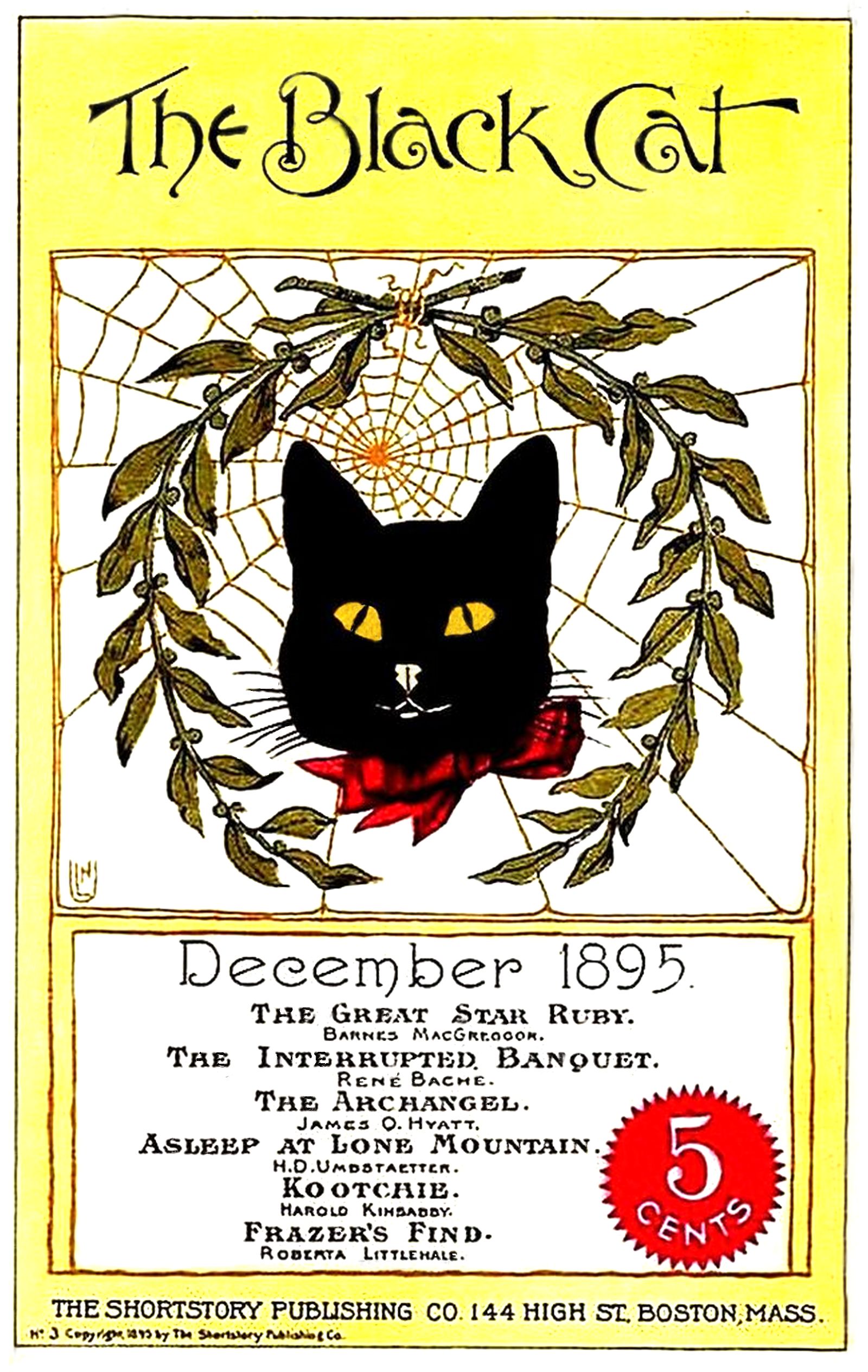
December
1895The Great Star Ruby. Barnes MacGreggor.
The Interrupted Banquet. René Bache.
The Archangel. James Q. Hyatt.
Asleep at Lone Mountain. H. D. Umbstaetter.
Kootchie. Harold Kinsabby.
Frazer's Find. Roberta Littlehale.
5
CENTS
THE SHORTSTORY PUBLISHING CO. 144 HIGH ST., BOSTON, MASS.
No. 3. Copyright 1895 by The Shortstory Publishing Co.
Mason & Hamlin
Co.
The Mason and Hamlin Pianos are the only pianos
manufactured containing the patented Screw Stringer, by virtue of
which they do not require one quarter as
much tuning as any other piano made: thus reducing expense of keeping
and inconvenience to a minimum.
Full particulars and
catalogues mailed free on
application.
Mason & Hamlin Co. BOSTON. NEW YORK. CHICAGO.
High Grade Salad for High Grade People
Book about real Olive Oil—Nature's
best refined—appreciated
by folks of educated taste—free
if you mail us your calling
card—we don't want postal
card folks—A. G. Belden & Co.,
145 Maiden Lane, New York.
Importers.
Lablache Face Powder The Queen of Toilet Powders.
THE purest and most
perfect Face Powder
that science and skill
can produce. Makes the
skin soft and beautiful
and removes Sun-burn, Tan, Freckles, and
all shiny appearance. Invisible on closest
inspection. Absolutely harmless. We invite
chemical analysis and the closest search for
injurious ingredients. It is used and indorsed
by the most prominent society and
professional ladies in Europe and America.
Insist upon having Lablache Powder; or risk
the consequences produced by cheap powders.
Flesh, White, Pink, and Cream Tints.
Price, 50c. per box.
Of all druggists, or by mail.
BEN. LEVY & CO., French Perfumers, 34 WEST STREET, BOSTON, MASS., U. S. A.
O
TO
O
Everything in Carpets, Rugs, Hangings, and Upholstery, from
the Oriental to the Occidental, from the superb antique to the
attractive modern, from the choicest luxury to the plainest every-day
necessity—if it's worth having, you'll find it among our stock,
and at prices that bring wholesale and retail buyers from everywhere.
John H. Pray, Sons & Co., 658 Washington St., opposite Boylston
St., Boston, Mass.
The Black Cat (Vol. I, No. 3) — CONTENTS
A Monthly Magazine of Original Short Stories.
No. 3.DECEMBER, 1895.5 cents a copy. 50 cents a year.
Entered at the Post-Office at Boston, Mass., as second-class matter.
Copyright, 1895, by The Shortstory Publishing Company. All rights reserved.
IT was late in the evening of Melbourne Cup
Day. In one of the dining-rooms of the
Victoria Club three men sat smoking and
talking earnestly together. Certainly the
events of the last sixteen hours furnished
ample subject for conversation. Melbourne
Cup Day means to the Australian all that Derby Day does to the
Englishman. It means, also, many things that even the greatest
sporting event of the English year cannot mean to the inhabitants
of the compact little island, provided with so many other facilities
for amusement and intercourse. In this land of tremendous distances—where
four million people occupy an area equal to that
of the United States,—in this island continent of opposites—where
Christmas comes in midsummer and Fourth of July in
midwinter, where swans are black and birds are songless,—this
is the one day when all classes and conditions assemble at one
place and take their pleasures as a unit.
From Victoria and New South Wales, from North, South, and
West Australia, from Queensland, even from Tasmania and the
sister colony of New Zealand, separated from the continent by
miles of water, visitors of all kind and degree had flocked by the
thousands. When the starting flag fell that morning there were
assembled about the track picturesque miners and rugged bushmen,
self-made capitalists, book-makers, and millionaire wool
growers, charming women and well-groomed men, to the number
of almost a quarter of a million. To all of these the occasion
was one anticipated and planned for during twelve months
past. It was the occasion when their long pent Anglo-Saxon
sporting taste—for nine out of every ten Australians are of
English ancestry—intensified by the free, out-of-door life, and by
the absence of the outlets furnished in a more concentrated state
of civilization, found exuberant expression. To each it carried,
besides, some special significance, according to his rank and occupation.
To the betting man it meant that a single firm of book-makers
had on deposit in the banks of Melbourne and Sidney
wagers to the amount of over one hundred thousand pounds sterling;
for, like the English Derby, this is a "classical" event,
upon which bets are often made for the coming year the very day
after the preceding race has been run. Among the women it
meant triumphs of millinery, gowns that had been ordered from
London and Paris many months or even a year in advance, the
fashionable display of Goodwood, the Derby, and the Ascot all
compressed into a single day.
Among the mine owners and wool growers it meant journeys
by rail, boat, or private coach, extending over hundreds, sometimes
thousands of miles, and lasting for days and weeks, even
months. Australia has well been called "The Land of the
Golden Fleece." Its flocks of sheep are the largest, its gold
mines and coal mines the richest in the world. Its flocks are
counted not merely by hundreds or thousands, but by hundreds
of thousands; and a single sheep station often extends over a
hundred thousand acres. But with this immensity of interests
there is linked the familiar loneliness of grandeur. The greater a
country gentleman's possessions, the farther he is removed from
society, until the largest proprietors are often separated by forty
or fifty miles from their nearest neighbors. For this solitude the
one outlet is the journey to Melbourne for the annual cup
races.
Upon this particular day the fashionable parade had eclipsed
in size and splendor that of any previous year. In addition to
the races, there had been the notable first night of the Grand
Opera House, opened now for the first time to the public; and
the day had culminated in an evening of such brilliancy and distinction
that the three men who sat talking at the Victoria Club
found superlatives too weak to express their enthusiasm.
"Rather than miss this day, I would have lost five years of my
life," said one of the group. Then, turning to beckon the waiter,
in order that he might emphasize his words by some refreshment,
he observed a guest of the club—evidently a stranger—sitting
alone at an adjoining table. With the exuberant new-world
hospitality of a man who had evidently not been a loser in the
day's exchange of wealth, he stretched out a welcoming hand,
with, "Stranger, won't you join us?"
Without waiting for further formality, the solitary man strode
up to the group and seated himself at their table.
"Gentlemen," he began, "I couldn't help overhearing what
you said. I, too, would have given a good deal to have been a
spectator. In fact, I had been looking forward to this event for
a whole year, and, as luck would have it, missed it by the delay
of an hour. If the steamer from Calcutta had reached Sydney
half an hour before sundown yesterday, instead of half an hour
after, I should have been in Melbourne early this morning, instead
of late to-night. As it is, I arrived only ten minutes ago, and,
having a card to your club from the Wanderer's in London, I
came here to take the edge off my disappointment. The next
best thing to being on the scene of action is to hear about it from
an eye-witness. So I depend upon you to give me an account of
the affair. At any rate, I only hope the races aren't finished."
"Oh, of course there will be more races," said the spokesman
of the party; "but such a sight as the opening of the Opera
House Melbourne isn't likely to see again. There were stars, of
course, but no one noticed what was going on on the stage, you
understand; the real show was in the house, which was simply
packed. Such women! Such stunning gowns! And the jewels—why,
it looked as though half the kingdoms of Europe had lent
their crown jewels for the occasion.
"In all that gorgeousness it was mighty hard to pick out the
handsomest face or the finest ornaments. But of course there was
one woman here, just as there is everywhere, who carried off the
palm. It wasn't only that she was beautiful, though in her dark,
stately fashion she was far and away the handsomest woman present;
and it wasn't only that she sat where she did in the front
of the stage box, with her solitary escort in the background, when
every other box in the theater was crammed; but upon the
bodice of her gown—it was a gorgeous gold and white brocaded
and lace-trimmed affair, so I heard it whispered among the women—she
wore the most striking and gorgeous ornament in the entire
audience. This was a jockey-cap made entirely of precious
stones; the peak was a solid mass of diamonds, the band a row of
sapphires, while the crown consisted of an enormous ruby. 'Twas
rather showy, of course, but so appropriate for this particular race
night that no woman could have resisted wearing it. Of course
it stood out wonderfully—it was as big as a half-crown piece, you
understand,—and it wasn't long before every glass in the house
was fixed upon that pin and the beautiful woman that wore it.
"I turned my glass on it with the rest," he added, laughing,
"and that's how I got such a good photograph of it."
"Speaking of precious stones," said the stranger, who so far
had listened without comment, "reminds me of a fifty-thousand-pound
ruby that once involved a daring young Englishman in a
series of strange adventures."
"Give us the adventures," said the spokesman of the party,
scenting at once a stirring tale that would make a fitting wind-up
to the day's varied excitements. "A jewel always serves as a
magnet for romance, especially if the jewel is a fifty-thousand-pound
ruby."
"To begin with," said the strange man, apparently unmoved
by his host's last remarks, "you must understand that, while
there are millions of rubies mined every year, a really first-class
stone is one of the rarest as well as the most valuable gems in
the world. In Ceylon, where some of the largest ruby mines in
the world are located, the Moormen, who have a monopoly of the
gem trade, often bring down from the north country bullock cartloads
of uncut rubies, but probably in handling ten million gems
not one will be found of the desired fineness and of flawless
purity and luster. These Moormen are the shrewdest, with a
few exceptions the most unscrupulous, and always the most
wonderful judges of gems in the world, and they are without exception
rich. They have parceled out the gem-fields in the
Tamil districts, and the natives whom they hire to hunt gems
along the river bottoms, where the finest are found, are subjected
to the most rigid scrutiny and daily search; for, though the
diggers are always naked, they often attempt to conceal gems in
their ears, nostrils, armpits, or elsewhere, with the end in view
of disposing of them to rival Moormen. For, though these
Moormen are openly fair dealers among themselves, they cannot
resist buying gems smuggled from their neighbors' fields. Consequently,
a complete detective service is attached to each one of
these diggings, and woe to the Tamil who is caught attempting
to smuggle gems across the lines! He simply disappears, that's
all. No one is ever called to account, and the awful secrecy of
his captors and the mystery surrounding his end appal his
fellows, keeping them in a subjection that is all but slavery, and
in some respects infinitely worse.
"But these Tamil diggers are very wise, and they know when
they happen upon a grand uncut gem. Perhaps they will bury
it again and spend a whole year maneuvering to get the jewel
over the lines to the rival buyers, finally giving it up, and turning
it over to the owners of the fields. As the really fine ones
are rarely larger than a hazelnut, and each is worth from twenty
to one hundred times as much as a diamond of the same size, it
is worth the digger's while to make a lifelong study of the relative
values, and then profit thereby.
"Now, this young Englishman had a curious hobby. For years
he had desired to possess one of these almost priceless rubies, and
it was partly with the hope of obtaining one that he visited
Ceylon, where he had left orders with the Moormen gem dealers
to reserve for him the finest and largest stone that could be found.
"Meantime he headed an exploring party, whose way lay
through the jungles about a hundred miles north of Kandy,
toward the ancient Buddhist city Anarajapoora, the throne of the
famous King Tissa, the shrine of the oldest tree in the world,—the
sacred Bo. It was a long and tedious march. The travelers
usually halted at mid-morning, slept till the shadows cooled the
air a little, then resumed the journey as far into the night as
possible, sometimes continuing till the next mid-morning, when
the sun's heat again brought them to a standstill. On this particular
daybreak they had halted beside a swift stream, doubtful
at which point to attempt to ford it. The leader had sent men
both up and down the stream to search for a suitable spot, and
wandered along its banks, more occupied with the glories of the
tropic sunrise, the sparkle of the dew on the giant spider-threads
stretched from limb to limb, the stir of rare birds and animals
with which the jungle was more than alive, than with the problem
of fording the stream. Upon reaching an inviting nook, he
sat down to roll a cigarette, first taking care to search for any
jungle enemies in ambush which might make him legitimate prey.
Suddenly he heard a great crashing of branches in the thicket on
the opposite side of the river. Then, like a flash of lightning, a
naked Tamil, red with blood, a look of desperation and hopeless
despair on his face, plunged out of the avalanche of green beyond,
and, leaping headlong into the water, struck out across the stream.
The traveler had risen to his feet, and stood watching amazedly
the course of the swimmer, which was aimless, like that of a
desperate man wandering through a totally unfamiliar country.
His head was shaven closely, though the natives usually wear
their hair long. He swam with great effort. Indeed, the watcher
on the bank saw that it was ten to one against the swimmer's
success, and instinctively his heart went out in pity. The unfortunate
wretch was now being carried rapidly down stream and
toward the man on the bank, who could see the straining of every
fiber in the Tamil's body, even the look of despair in his bloodshot
eyes. Suddenly, just as success seemed assured, the swimmer
threw up his hands, uttered a strange moan, and went down.
The man on the bank rushed down the stream, stopped at a point
where a huge banyan tree spread its branches far over the swollen
waters, and climbed out on a thick limb. A moment later he
saw the body of the Tamil rise almost directly beneath him.
Clinging with one hand to the tree, he lowered himself over the
treacherous torrent, and with a mighty effort seized the drowning
man by the ankle and so dragged him to the shore.
"Back into ambush he half carried the poor wreck, and, laying
him on the sod, began the task of reviving him. In less than ten
minutes the Tamil opened his eyes, discharged a gallon of water,
then gasped, struggled up into a half-sitting posture, and looked
about him. When he saw the Englishman bending over him, and
comprehended, he uttered the most pitiful wails of gratitude imaginable,
groveling in the dust, kissing his preserver's feet.
The water had washed the blood from him, but he was a mass of
wounds, scars, bruises, lash marks, and bullet cuts. How he ever
managed to go as far as he must have gone, leaving a trail of
blood behind him, was a mystery. But what specially attracted
the Englishman's attention was a blood-stained bandage around the
fugitive's leg, midway between the knee and thigh, which was
the only rag on the poor fellow's body. He was about to question
him, by signs and syllables, for his knowledge of the Tamil patois
was very limited, when he heard another great crashing of the
thicket across the stream, accompanied by the sound of voices.
Instantly, there flashed across the poor creature's face a look of
unspeakable terror, as he panted out in hoarse gutturals, 'Sa-ya-ta!
Sa-ya-ta!' an appeal for salvation which would have moved
a heart of stone. Motioning to him to remain quiet—an unnecessary
precaution, since he was scarcely able to lift his head from
the marshy ground—his preserver gave him brandy; then, by a
circuitous route, ran up stream, coming out directly opposite four
mounted Moormen who were ranting up and down the shore.
"Upon his appearance, the horsemen approached, and asked if
he had seen any one go by. They were on the track, they explained,
of a Tamil gem-digger, who was smuggling a ruby worth
fifty thousand pounds over the lines of the Bakook-Khan gem-fields,
and with the owner of the fields had chased him sixty
miles. The man could be recognized, they said, because his head
was shaven, and he was quite naked, except for a bandage tied
around one leg, in which he had cut a hole and buried the ruby.
"To all of this the Englishman answered that he had seen such
a man leap from the jungle and plunge into the river only a few
moments ago, adding that they would better wait until the flood
went down before searching the river bottom, as it would be impossible
to find even an elephant in that muddy water. At this
the Moormen set up a howl of rage, and, after an angry consultation,
passed on down the stream, scanning the river bank. The
traveler was about to return to the Tamil, realizing the man's
immediate danger, when another crowd burst through the jungle
opposite, and at the sight of the Englishman approached him with
much the same story as had the first, except that, according to
their tale, the gem-digger had been smuggling from the Sabat-
Keel fields. To them he made the same reply, adding that
another party had just been there from the Bakook-Khan fields,
making a similar claim. At this the spokesman set up a terrific
wail, denouncing them as rogues, thieves, impostors, and heaven
knows what not. But just in the midst of his tirade he was cut
short by the approach of still another band of claimants, and immediately
the three groups of angry Moormen were in the midst
of a wrangle over the ownership of the disputed gem.
"In their absorption the Englishman saw his chance to escape.
With an occasional glance backward to make sure that he was not
observed, he made his way stealthily to that spot in the ambush
where he had left the wounded Tamil.
"The man was gone!
"For a moment his rescuer stood nonplussed. Then, as he
looked first one way and then the other, his eye caught the gleam,
a few yards away, of the silver top of the brandy flask that he had
left with his patient by way of a comforter. As he stooped to
recover it, he detected a fresh blood stain on the grass, and farther
on still another. Evidently the Tamil, overcome by his fear of
capture, had attempted flight,—an undertaking that in his enfeebled
state meant certain and early death. Without stopping to
consider the danger of following his ill-fated protégé alone into
the unknown depths of the jungle, the Englishman started in
pursuit. Before he had gone five steps, however, he realized his
peril. Beyond him, creeping along on all fours, he saw the blood-stained
fugitive, moving, unconscious of his peril, into the very
jaws of a huge tiger, crouched ready to spring upon his prey."
"And the Tamil was killed?" cried the party.
"No," said the stranger; "the Tamil was saved from this
horrible death, though only after his rescuer had passed through
a hand-to-hand struggle with the tiger, in which he was almost
killed. As it was, he lost the use of his right arm for the rest of
his life. But, in spite of all that he could do, the fugitive died a
few hours later, overcome by fright and fatigue."
"And the ruby?"
"The ruby, of course, fell into the hands of the Englishman,
who, convinced that, owing to the multiplicity of claimants, it
would be impossible ever to ascertain the stone's rightful owner,
concealed it in his tobacco pouch before he was joined by his
party. These, he learned when he was brought to his senses, had
returned several hours ago from the other side of the river, to
which they had retired, frightened by the many outcries of the
mounted Moormen, and had found their leader only after a long
search, which would have been hopeless except for the blood trail
left by the wounded Tamil.
"For a few days after his return to their camp, wounded as he
was, and weakened by his encounter with the tiger, he gave little
thought to the stone that had fallen into his hands, as if from the
sky. But with his earliest convalescence, his jewel mania returned,
intensified by the actual possession of a ruby that it afterwards
proved was, no doubt, the finest in the world. By the time that
he reached Amsterdam, to which he had taken passage at his
earliest opportunity, with the idea of having his treasure cut by
an expert, this mania had reached such a pitch that it was only
with the greatest effort that he could finally make up his mind to
leave it in the hands of a jewel cutter; and from the moment that
it was out of his possession he began to suspect every person that
he met, the jewel cutter included, of a desire to rob him of his
treasure. What gave color to his suspicions was the fact that at
the shop where he left the ruby delay followed delay, and postponement
succeeded postponement, the dealer putting him off
each time with vague excuses and never-fulfilled promises. At
length, after five weeks of these mysterious delays and excuses,
almost crazed by wearing anxiety, he confided his secret to one of
a firm of private detectives, a man whom he employed to watch
and investigate the movements of the jewel cutter.
"On the very night of the day in which he had taken this step,
the jewel was returned to him; it had proved to be a stone not
only magnificent in size and color, but curiously ribbed with white
rays,—that is, a star ruby, pronounced to be the finest in existence.
But the reaction from his fright and anxiety, joined with the
effect of his recent adventure, from which he had not yet fully
recovered, cut short his joy. He was seized with brain fever, and
for days lay unconscious in the room of his lodging-house,
unattended except by his doctor and landlady. When he finally
returned to his senses he found that the jewel was gone. At a
time when his life was despaired of, the detective employed to
protect his interests called at his lodging, and, thinking the man
as good as dead, stole the gem, and—"
Suddenly the eyes of the listeners turned to the door behind
the speaker. There was a rustle of skirts and the whispered
exclamation: "There she is now."
The story teller started, flushing at the interruption, but only
for an instant. Then he faced about, leaped to his feet, and,
rushing forward like a maniac, tore from the breast of the mysterious
beauty of the opera the glittering ornament upon which, an
hour before, had been focused the attention of an entire audience.
"Here," he cried, brandishing a handful of lace and satin from
which gleamed the jeweled jockey-cap, "is the stolen star ruby!—and
there," pointing to a man's figure that appeared in the doorway,
"is the cowardly wretch that stole it!"
It was not until then that his companions observed that the
stranger's right arm hung useless at his side.
The Interrupted Banquet.
BY RENÉ BACHE.
THOUGH quite familiar with the street, I could
not remember having seen that particular house
before. My recollection had been that there
was a vacant lot just there. But I must have
been mistaken, for the dwelling before me was
substantial enough, though old-fashioned, with
high front steps and large windows. A trifle out of repair it
looked, by the way, and I even noticed that two or three panes
of glass were gone. On the whole, the mansion presented a
somewhat mournful appearance, as if fallen from an old-time
respectability into a condition of decay and decrepitude.
I am sure that it would never have occurred to me to enter,
had it not been that the young lady who accompanied me turned
and deliberately mounted the steps towards the front door. Of
course I followed. She did not ring the bell; for, in truth, there
seemed to be no bell to pull. But the portal was noiselessly thrown
wide from within, and we entered. I looked in vain for the servant
who, I supposed, would receive our cards; but, to my surprise,
Mabel walked straight ahead through the wide hall, without hesitation,
appearing quite familiar with the place. There should
have been a light, I thought, though it was only two o'clock in
the afternoon; for the interior of this strange mansion was very
dark, and I could only make out in an indistinct sort of way the
faces that looked down upon me from some old portraits, obviously
fine works of art, as I passed.
Mabel had introduced me to most of her friends, for we had
been engaged for six months and were to be married very soon;
but she had never spoken to me of these people, who, perhaps,
were rather out of the fashion and had been forgotten. As these
reflections passed through my mind, we ascended a broad staircase
to the second floor, and then it was that I heard a sound of revelry
which came from a room which I correctly judged to be the dining-room
of the house. The heavy oaken doors of the room were
slightly ajar, and through them was cast a strong beam of light
that fell full upon an object which startled me for an instant. It
was a headless human figure. A second later I smiled at my own
alarm, inasmuch as the figure was nothing but a suit of old armor
without the helmet.
If I had had a chance, I should have questioned Mabel, in order
to make sure that our unannounced entrance was not an intrusion;
also, I might have asked why, after starting out for a day's yachting
trip, we had returned so early and for so strange an entertainment.
But either query would have been out of place just then. Very
likely, I thought, she had some surprise in store for me,—a lunch
party, maybe, arranged by some friends in our honor; for quite
a series of dinners and other entertainments had been given to us
in celebration of our engagement. Moreover, all that I have
related took place within less than a minute and a half, and in
another moment I found myself in the large and brilliantly lighted
dining-room. If the rest of the mansion was dark, there was no
lack of illumination here. I was fairly dazzled by the numerous
lights, clusters of which, arranged in silver candelabra, helped to
adorn a long table, at which twenty-five or thirty people were
seated. There were flowers in profusion, with a great display of
silver and cut glass.
To my astonishment, not one of the people present seemed to
take the slightest notice of our entrance. Near one end of the
table were two vacant chairs together. Mabel quietly took one of
them, and I, deeming the time hardly proper for an explanation,
seated myself in the other. Soup was immediately placed before
us—evidently we were not very late—and I took two or three
spoonsful of it. It struck me as being singularly tasteless.
The courses followed each other in the usual mechanical fashion.
What there was to eat I do not remember with any distinctness,
for I was so absorbed in wonder and in studying the other
guests that I took little notice of the viands. Opposite me was a
funny-looking old lady in white silk, cut low at the neck to such
a degree, I thought, as would have been more appropriate to a
younger and plumper person. I particularly recall the fact that
she wore camellias in her hair—a fashion which I had heard of
as belonging to a generation ago. It was palpable, too, that her
front hair was false. Withal she was most agreeable and amiably
disposed, as I presently discovered from her conversation. She
was the first person who addressed any remark to me, abruptly
making some inquiry about my grandfather, and stating in the
same breath that she was from Philadelphia.
At her left sat a gentleman of rather more than middle age, as
I judged, with a remarkably pink nose and a great expanse of
shirt-front, who was devoting himself so assiduously to his plate
that not a word escaped his lips. On the other side of the old
lady with the camellias was an extremely thin man, with a
peaked countenance, who so strongly reminded me of an undertaker
that I felt almost tempted to ask him a question or two about
the state of the market in respect to coffins and other funeral
equipments. His necktie was black and likewise his hair, while
his expression was one of extreme solemnity. Mabel was seated
at my right, while on my other hand was a buxom matron of
forty or so, who manipulated knife and fork with an activity that
suggested a most excellent digestion.
Among the guests these were the first whom I noticed particularly.
As I looked along the table, I was rather surprised to find
that not a face was known to me. There was a cadaverous-looking
young man with a prematurely bald head whom I pointed
out to Mabel, asking who he was; for I had noticed that a sign of
recognition passed between them.
"My brother," she replied quietly and, as I imagined, sadly.
Now this was a surprise, for I did not know that Mabel had a
brother. Perhaps, I thought, he was not an especially estimable
youth, and so was ignored by her family. If that were so, why
should he be present on this occasion? Here was another puzzle,
to be solved when a suitable opportunity offered for questioning
my fianceé.
On the left of Mabel's brother was a remarkably pretty, though
very pale young lady, who wore in her hair, oddly enough, what
looked to me like a bridal wreath. But the handsomest woman
present was she whom I supposed to be our hostess. She was of
regal presence, and, with her velvety eyes and coronet of black
braids, resembled a Spanish señorita. Though I had never seen her
before, I took it for granted that she must know who I was, and
repeatedly I tried to catch a glance from her; but it was in vain,
for her conversation and attention were addressed almost exclusively
to an elderly man on her right, apparently a foreign diplomat,
as half a dozen orders glittered upon his breast. At the
other end of the festive board sat a gentleman with a huge gray
moustache, presumably our host. I heard no remarks from him,
save now and then a request to "pass the decanter," addressed to
one or another of the guests near him. I had no opportunity for
speech with him, inasmuch as Mabel and I were divided from him
by almost the length of the table.
On the whole, the affair struck me as entirely extraordinary.
Here we were, myself completely a stranger, at a banquet in a
house which I had never visited before! Indeed, had it not been
for Mabel's assurance of welcome and the two seats apparently
reserved for us, I should have supposed that we had made some
mistake. Mabel herself was singularly silent, though ordinarily
quite talkative and even jolly, and offered no explanation of the
situation. But perhaps what astonished me more than anything else
was my discovery, some time after we were seated at the table, of
a young man, some distance away, who bore a striking resemblance
to my chum at college. Upon my word, I was on the point of
shouting at him across the board. In fact, the words, "Why,
Bill, old man, how did you get here?" were on my lips, when I
checked myself in time, owing to a remembrance of the fact that
Bill had been dead for eight years, having met a most untimely
fate in a railway disaster.
While engaged in wondering whether the young man could be
a near relation of my former chum's, I was startled at seeing a
telegram in the familiar Western Union envelope laid beside my
plate. Some people, notably stock brokers and newspaper men,
are accustomed to telegrams, and for that reason are not alarmed
by them. But habit had not rendered me thus callous, and with
some haste I tore open the envelope and glanced over the contents.
It read:—
"Mabel died this morning of acute congestion of the lungs.
"Amelia Parker."
I declare that I trembled as if I had a chill. If Mabel had not
been by my side, I should have been overcome by the shock.
Holding the telegram before Mabel's eyes, I exclaimed in a voice
that trembled with conflicting emotions of horror and anger:
"This is carrying a practical joke too far. Here, some brainless
wretch telegraphs me in your mother's name that you are
dead."
Careless of the almost frenzied energy with which I spoke, I
looked around upon the faces of my fellow-guests as one does who
is confident of sympathy. To my amazement, in response to my
speech, there arose a cackle of laughter which was presently
transformed into a general ripple of mirth. And such mirth!
The like of it I had never heard before, and, please heaven, I
hope I never may again. It was not like real laughter, but rather
the empty and strident cachinnation of beings lost to the feelings
of humanity.
Pale with anger, I rose to my feet and, steadying myself with
one hand on the back of my chair, exclaimed:
"What does this mean?"
Dead silence was the only response. Conversation had ceased,
but I felt that every eye was fixed upon me. Aghast, I looked
at Mabel, but she did not return my gaze. At length, the old
woman with the camellias in her hair, who sat opposite, addressed
me, saying:
"Why do you think that Mabel is not dead?"
"Good God!" I replied. "Here she is. Don't you see her?
What do these people mean?"
The old woman grinned and waved her feather fan at me, playfully,
saying:
"Ask her if she isn't dead?"
I turned to Mabel in wonderment, but she only shook her head
sadly.
"Why, of course she's dead!" said the old woman. "Don't
you know that all of us here are dead?"
"Indeed, yes; we are all dead," cried the other guests in general
chorus.
"This is getting beyond patience!" I exclaimed. "You, too,
are pleased to joke with me, but I tell you frankly that I fail to
see the fun of it. Perhaps, since you possess such a fund of
humor, you will be telling me next that I am dead, also."
Then came that laugh again. I never shall forget it. Beginning
with a cackling titter, it spread until the whole table was in a
roar, making my very flesh creep. Then all at once it ceased, and
again there was dead silence.
"Certainly you are dead," said the old lady with the camellias.
"She's dead, and all of us are dead. She died this morning of
acute congestion of the lungs, but I have been dead for these
twenty years, and he, too," indicating with her fan the elderly
gentleman with the pink nose. "My own complaint was cerebrospinal
meningitis."
My legs gave way under me and I sank into my chair. As I
did so my hand touched Mabel's, and I grasped hers tightly. It
was cold as ice. Leaning toward me, she whispered in my ear:
"Don't make a scene! It is all quite true. You were run
over an hour ago by a trolley car."
Not daring to believe my senses, I replied:
"And this house—?"
"Sh—h!" said Mabel. "It is only the ghost of a house,—the
phantasmal reproduction of an old mansion that used to stand
on this spot, where there has been an empty lot for fifteen years
past."
"I—I think I understand," I gasped. Then, though my
brain swam, I made a tremendous effort to summon up my courage
and face composedly this dreadful situation. Addressing myself
to the old woman opposite, I said:
"Perchance you were acquainted with the former occupants of
this dwelling?"
"Oh, yes," she answered pleasantly. "I am somewhat distantly
related to our host and hostess of this evening. They
were drowned—lost on the ill-fated Ville de Paris. This house
belonged to them, and not very long afterwards it was torn
down."
"But suppose that the present owner of the lot were to build
upon it?" I suggested. "It would be necessary to hold these
charming entertainments elsewhere?"
"Not at all," she said, laughing and waving her fan. "The
occupancy of the site by a real house would not interfere. It
frequently happens, of course, that a building is put up on ground
previously occupied by another dwelling. You must understand,
though I might have supposed you knew it, that, while the
material parts of a tenement may be removed at any time, its
astral shell remains in perpetuity. Thus the ghosts of half a
dozen or more dwellings may remain on the site occupied by a
new and substantial structure. They are none the less real for
being invisible to living eyes. The most remarkable instances of
haunted houses that you have heard about are due to conditions
of that sort,—several families of phantasms, perhaps, tenanting
premises topographically coincident with a mansion which affords
physical accommodation to people in the flesh. I trust I make
myself clear?"
"Quite so," I replied politely.
This conversation was interrupted by the elderly gentleman
with the pink nose, who seemed to be dissatisfied with something.
Having poured out a water goblet half full of sherry from a
decanter, he called for brandy, and with those strong spirits filled
it to the brim. Then he took a caster of red pepper and sprinkled
its contents liberally on the surface of the mixture. Raising the
goblet to his lips, he drained its contents to the last drop and set
it down with a sigh.
"Ah!" he exclaimed, "it has no strength. If only I could get
a schooner of real beer."
The old lady regarded this performance attentively, with a
lorgnette held to her nose. Said she sympathetically:
"That is the way with all pleasures in the after world. They
seem to have no savor. Even the milk is chalk and water."
"I suppose that is why this mince pie tastes so insipid," I
responded, toying absently with a bit of pastry on my plate.
"Of course it is," she said. "Don't you see it is only the
ghost of a mince pie."
"Then it seems that—"
But at this point the banquet was suddenly interrupted by a
convulsive swaying and creaking of timbers. The table rocked,
the lights in the silver candelabra flickered, and all was darkness.
Then, through a ray of brilliant sunlight, I saw the strange dining-hall,
the gleaming table, the ghostly banqueters all fade into the
distance. Another moment of utter darkness, of creaking and
swaying, during which I made a desperate effort to grasp and
steady Mabel's chair. To my bewilderment, my hand touched a
coil of rope. I heard familiar voices. There was a burst of sunlight.
I sat propped up by cushions on the deck of the pleasure
yacht Undine, surrounded by solicitous friends. Mabel, with her
warm hand reassuringly clasped in mine, told me of my half hour's
unconsciousness. I had fallen overboard in my attempt to recover
her hat, and had been rescued only after sinking for the third time.
Not until I had heard all this, could I banish from my mind my
horrible experience in the house of the dead.
The Archangel.
BY JAMES Q. HYATT.
CRAWFORD and I had gone up into the foot-hills
of the Sierras to shoot. It was autumn;
yet the sun unscrewed us so immediately
when we walked abroad that we were forced
to seek the shelter of pines and dusty scrub
oaks, as often as they fell across our path.
We were lying, one afternoon, under a row
of young firs on the crest of a ridge, when the gaunt figure of an
old man labored up the slope toward us.
"If all the world'd lay about in the shade like you 'uns and
me—not interferin' with Nature—she'd get her hand in again
on her own hook," he said, throwing himself down beside us.
What he may have looked like when his features were normal
we never knew. At this advanced period he wore so inflated a
nose of such eccentric modeling that his eyes couldn't count for
much, and his mouth was only suggested under a flippant gray
beard.
"I'm the Archangel," he said sweetly, and smiled at us.
Crawford shrugged himself a trifle nearer his gun and smiled
back again.
"There's no crack," he assured us immediately. "That's been
my title for three years. I got it because I held my hand from
gorin' a man under false provocation."
"Tell us about it," we said.
He found a stone to rest his back against, and threw open his
shirt at the throat.
"These hot summer days sizzle just as they did then—crisp
your throat like coals curl bacon. I'd mined all this country in
the gold days, and held my own with the dizziest dog of 'em all
in findin' the color and epicuring the liquids. I run a drinking
fountain in opposition to the Dead Falls, up Mokelumne way, and
counted on Joaquin and his band for makin' a pot for me regular
once a week—but t'aint what I started out to say."
The old man fell into a reverie. He seemed to see only the
ends of his toes.
"About the Archangel," Crawford prodded.
"Yes—the Archangel. That's a matter of three short years
aback."
This gentle old man stood up, and hitched savagely at his
trouser band before he sat down again.
"Adolphe—his name'd tell you, wouldn't it? Chin beard—juicy
voice—and hands a-curvin' through the air. Well,
Adolphe and me set up backin' and minin' together five years
aback. I stayed on and on with him because his bread'd make you
hungry in your sleep.
"'Twas flour for that very bread that I went a-ridin' into town
for, one summer day. There was a real estate dude'd come up.
'Socks' we called him. Actual—he went round in wormy-lookin'
things held up by garters! Well, Socks, he tucked a
folded newspaper under my saddle-flap, just as I was tightening
up to go home.
"'Read that,' says he. 'It's time all you fellers settled down
to raisin' families, so's we could have a population, and school
districts, and churches, and sich. Never no hope of doin' anything
with a lot of bachelors.'
"Well, d'you know, it struck me like wisdom from the mouth
of babes? I rode along a-tryin' of my best to read that paper.
Not bein' over profuse in acquaintance with learnin', and the sun
strikin' the white clay like a lookin'-glass, I tucked it away and
whistled till the barkin' of the dog realized me I was home.
"Later, when the smoke went out of the chimney, curlin'
through the trees, Adolphe and me sat out on the saw-bucks a-readin'
of that paper,—the Matrimonial Messenger.
"By your names, sirs, there was three pages of 'um saying how
enchantin' they was!
"Tall women and short women, and young women and old
women, women with children and women without, women that
could work, and sew, and cook, and women that could sing, and
dance, and talk. Every blamed one of 'em willin' to send their
photograph, swearin' their faces was their fortunes all their
life!
"'Twasn't long before we'd settled between two of 'em, but
Adolphe, he was for one, and me for the other.
"'What's it to you?' sez I. 'You aint marryin' of her, are
you?'
"He couldn't but admit the fact.
"'Still—there's my livin' round her,' he says.
"'Twas a widder, I remember, Adolphe was set on. She'd
raven locks, and what she'd most pride in was her cookin', and her
sewin', and her lovin' heart. I argued long. I needed him
favorable, if it was to be peaceful-like. I remember tellin' of him
that we didn't need cookin' and sewin', being used all our lives to
managin' these. What we wanted was somethin' amusin' and up
in learnin', so's we could feel spiritual proud, you know. I asked
him if we'd ever strike it rich, what'd we do with a wife that
couldn't go dance and talk with the best of 'em.
"Anyway, seein' it was my business, and I was set like a jumper
on a claim, Adolphe, he give in. The woman what made my
heart feel empty said she was eighteen. She was decorated with
yellow hair and eyes like copper-ore. She could talk French, and
understood German, and could play the pianner. She'd marry a
man that wanted a companion and not a cook.
"Sez I to myself continual: 'That's you, Daniel.'
"Well, Adolphe and me, we talked this thing, wakin' and
sleepin'. I'd more plans than a cow has capers.
"We got up a letter'd melt snow, and then we waited.
"First, nuthin' was said to the boys, but when they caught on
to my hangin' round the post-office they began to josh. I always
stepped up gallant to the post-mistress, sirs—I've turned the
cheeks of most women pink in my day—and I said, said I:
"'Letter, please?' with a doffin' of my hat, and a risin' inflection
very polite but understandin'. It got to be so that when
there never was anythin' handed out the boys'd take to coughin'
down a laugh.
"After awhile it grew so's none of 'em turned up or paid any
attention. Even Adolphe—he took to goin' to sleep when I
talked her.
"Then a whole year ran out to summer again, and I couldn't
unthrone her that reigned in my heart.
"One day I said to Adolphe, a-workin' away:
"'Blamed if I can forget her, the ornamint,' I said.
"Adolphe he went in for grub that day and came out late,
a-holdin' of a envelope.
"'Here's your letter,' he called.
"Sure enough! I went out on the saw-buck and read it alone.
Then he sat down by me and we read it over again.
"'Twas only that she'd arrive on the afternoon train on the
fifth, and to have a Methodist minister.
"Well, sirs, it meant a good deal for me to supply the
necessaries for a sparklin' jewel—let alone the settlin' down for
her to sparkle on! but luck come my way. There'd been a milliner
up from San Francisco and fitted her a elegant place. She'd
failed, and quick's a winkin' I bought her lookin'-glass and red
plush easy-chair. You'd ought to seen that cabin! There hung the
thing opposite the stove, all shinin' an' smilin' and gildin'. Right
in front of it my red plush chair, so's you could set down and put
your feet up on another an' see how you'd look in heaven.
"On the fourth, Adolphe revealed he'd business in a little
town a mile up the railway. He suffered a crampy kind of desperation
not to be on hand to support me, he said, but he'd come
in with the girl. Then he baked up bread and a cake and rode
away.
"Sun come up on the fifth like a bull's-eye lantern. I'd set up
all the night before, not to disturb anythin', and there was the
mornin' for me to shave and git into my riggin'. A calf-skin
vest, with the hair on, aint a thing to slight, sirs, ceremonies or
no ceremonies.
"When I rode my mule up to the depot the boys was out, to
the puniest scrub of 'em all. They give me cheers that'd blast
rock.
"And there was an arch, sirs—all flowered! My legs wanted
to sit down more than me!
"The train whistled in the distance. There was no slaknin'
off round the corner, for the boys braced me everywhere.
"Out she stepped, sirs, and whether she was the sorriest or the
likeliest lookin' critter, I couldn't 'a' told for the flunk I was
in!
"After the blackness I see her long yellow hair and red cheeks.
All the conquerin' of my youth rose up within me, and I up and
held her to me for a kiss.
"By the great snake mine, but women don't shave beards off
and drink whisky!
"I dropped her like a nettle, but she went forward with the
crowd, smilin' an' smirkin' through the cheerin' an' the uproar.
"'To the parson's,' the boys yelled.
"I was forced off my feet, but out came my gun.
"'Halt!' I cried, in a voice that brought 'em all on their
haunches and still as colts raised on the spur.
"'I mean to shoot the wig off your head and the paint off your
face, Adolphe Lefevre, and leave you for the slimiest viper that
crawls without legs.'
"The sight of my gun lay between his eyes an' the crowd was
as still as the barrel.
"Of a sudden came a voice in my ear. To this day God only
knows from where.
"'Be like unto the archangels.'
"My arm fell to my side. They lifted me onto their shoulders.
"'The Archangel,' they sent out a-echoin' in the hills.
"And it stuck, sirs, from that day to this, though I've lived
alone, sirs, ever since."
Asleep at Lone Mountain.
BY H. D. UMBSTAETTER.
IT occurred nearly fourteen years ago, yet I never
enter a sleeping-car without being confronted
by that innocent face. It clings to me all the
more because I have always looked upon partings
and leave-takings as mile-posts of sorrow
in the journeys of life. I dislike good-bys.
I hate farewells.
I had just returned from Australia and was about to start on
my journey across the continent. In company with two old
friends who had crossed the ferry from San Francisco to Oakland
to see me off, I sat chatting in my sleeper, when two Sisters of
Mercy hurriedly entered the car.
Just what it was in the appearance of the newcomers that
arrested the attention of the earlier arrivals—whether it was
their humble yet characteristic attire, so suggestive of charity the
whole world over, the apparent anxiety betrayed by their manner,
or the fact that a sleeping child, clasped tenderly in the arms of
one, was their sole companion—whether it was any or all of these
things that caused a sudden reign of respectful silence in the car, I
am unable to say. Certain it is, however, that their coming was not
unnoticed; neither was the circumstance that the only visible
baggage of the trio consisted of a small square bundle neatly done
up in a gray shawl.
Upon being shown to seats in the section directly opposite the
one occupied by myself and friends, they at once entered into
earnest conversation with the sleeping-car conductor. At the first
few whispered words the man's manner showed unmistakable surprise.
He appeared either unable or unwilling to comply with
some request they had made. Although the nature of the request
was not apparent, the occupants of neighboring seats could not
fail to note from the conversation, which now and then became
quite audible, that it bore some important relation to the sleeping
member of the party. The evident fact that the sisters felt much
concerned respecting the safety and welfare of their youthful
companion served only to increase the mystery of the situation.
After patiently listening for some minutes to appeals first from
one and then the other, and after glancing over a railroad ticket
and letter they had handed him, the conductor consented to meet
their wishes, declining, however, to accept a sum of money they
repeatedly tendered him. Before leaving them the man spoke a
few words of reassurance and encouragement, which were cut
short by the shrill whistle of the locomotive announcing the train's
departure. The sisters arose instantly, hastily expressed their
earnest thanks to the conductor, and then, sinking upon their
knees before the child, which had been aroused from its slumbers
and sat innocently gazing about, first one and then the other
clasped the infant in fond embrace, and, amid sobs and kisses,
showered upon the little being the most fervent blessings and
tender farewells. Then, covering their tearful faces with their
hands, they arose, still weeping as though their hearts would
break, and hurriedly left the car, which was already moving slowly
out of the station.
No sooner had they gone than all eyes were directed towards
the diminutive stranger who had caused the scene just witnessed.
Too young to realize what was going on, he sat motionless, as
though spellbound by fear or astonishment at his strange surroundings.
In an instant the child became an object of intense
curiosity. More than that, its extreme youth and utter helplessness
aroused, on the part of its fellow-travelers, feelings of genuine
sympathy and pity—feelings which the heroic silence maintained
by the little innocent, in spite of the now swiftly moving train,
only served to intensify.
Neither memory nor imagination can suggest to me a more
touching picture than the one presented by that plainly clad
handful of human loneliness, as it sat there in meek silence, its
tiny hand timidly resting on the little bundle by its side, while
its eyes remained intently fixed on the door which, a few moments
before, had closed upon its late companions. Whose child was
this? Who was to care for it? What was to become of it?
Was one of the nuns a relative? Was the younger, perhaps, its
sister? Or was either neither? These and similar questions
could be easily read on the countenances of the wondering passengers.
Some minutes elapsed before the conductor again made his
appearance, when he was at once besieged with questions concerning
the mysterious stranger. And, as if determined that not a
word should escape their ears, each of the twelve or fifteen occupants
of the car crowded about him as he seated himself beside
the lonely child.
The story they heard was brief and pathetic. The little boy
was as much of a stranger to the conductor as he was to the
passengers. His mother was dead. His home was in one of the
smaller manufacturing towns of New England, where his father,
who was to meet him on the arrival of our train at Omaha, lived
in humble circumstances. The conductor had promised the sisters
to protect and care for the child during the five days' journey.
It was, however, not the little fellow's first trip across the plains,
as nearly a year and a half ago, when but a few weeks old he
had come to California with his invalid mother. The latter had
survived the long journey but a very short time, and died among
strangers in one of the foot-hill towns near San Francisco. The
Sisters of Mercy of that city had by correspondence arranged with
the father to adopt, or, rather, to provide a temporary home for
the little waif, until he should be old enough to make the long
return journey. And now, although the boy had reached but the
tender age of eighteen months, the distant parent, craving for his
presence, had begged the sister to enlist in his behalf the sympathies
and care of some kind-hearted East-bound passenger or railway
employee. Their repeated efforts in the former direction
having failed, they had at last applied to the conductor.
In relating the child's sad history, the sisters had, the conductor
continued, so feelingly solicited his kindly offices and paid such
glowing tribute to the almost angelic disposition and exceptional
bravery of the infant that, however disinclined he had been to
assume the responsibility, a persistent refusal of their unusual
request seemed almost inhuman. He had therefore undertaken
the strange charge, and trusted, he said, that the passengers would
in no wise be inconvenienced thereby. From that moment on,
every one who had less than half an hour before witnessed the
scene of sorrowful parting, which had so touchingly told how completely
the little fellow had walked into the hearts of his benefactors,—from
that time on, every one felt a personal responsibility
for the comfort and safety of the boy. Introduced under circumstances
that rendered him a hero at the outset, at the end of the
first day he had already become the pet of the passengers and the
object of their kindliest attentions.
While the claim that this child was remarkable for beauty and
cleverness might lend sentiment and romance to my simple narrative,
the fact is that he was neither handsome nor bright. In
appearance he was simply a plain, plump, red-cheeked, flaxen-haired
baby boy, with apparently little to be proud of, save his
evident good health and a pair of large blue eyes that seemed
frankness itself. His accomplishments were few, indeed. He
was still, as the sisters had said, learning to walk. His vocabulary
included but three or four imperfectly spoken words, and he was
conspicuously deficient in that parrot-like precociousness so
common and frequently so highly prized in little children. But
what our youthful companion lacked in attractive outwardness
was more than made up by the true inwardness of one accomplishment
he did possess. That was silence. This virtue he practised
to a degree that soon won for him the admiration and affection
of all. Though exhibiting no sign of embarrassment at the
friendly advances of the passengers, and while not unmoved by
their tender attentions, he maintained through that long journey
a humble air of mute contentment that lost its balance on but
three occasions.
His quiet ways were a theme of constant comment, while his
presence proved not only a source of increasing pleasure to our
small band of tourists, but did much to relieve the monotony of
the tedious journey.
One important detail in the boy's eventful history was missing.
Cared for by strangers from earliest infancy, deprived of his
mother's love and father's care, he had thus far not even received
that all-important parental gift,—a Christian name. To the
sisters he had been known simply as "Baby." By that infantile
appellation he had passed from their gentle mercies to the conductor's
care. And only as "Baby homeward bound" was he spoken
of in their letter addressed to his father.
Before he had spent a day among us it was suggested that his
exemplary conduct entitled him to a more dignified name—at
least during the period of our companionship. And this suggestion
led to one of many amusing incidents. By what name
should the boy be known? After the question had been eagerly
answered a dozen times in as many different ways, with apparently
little hope of a unanimous choice—for every one felt that his or
her preference was peculiarly appropriate—a quiet old man,
whose appearance was strongly suggestive of the pioneer days,
offered a happy solution of the difficulty. He proposed that, in
view of the humble circumstances of the child, the privilege of
naming him for the trip be sold at auction among the passengers
of our car, adding, by way of explanation, that the sum thus
realized might "give the little fellow a start in life."
The average overland tourist is never slow to adopt any
expedient to relieve the tedium of the journey; and here was,
as one chap expressed it, "A chance for an auction on wheels,
and one for charity's sake, at that." So the proposition was no
sooner stated than acted upon. The auctioneer found himself
unanimously elected, and, placing himself in the center of the
car, heard the bidding, prompted by every generous impulse that
enthusiasm and sympathy can give, rise rapidly in sums of one,
two, and three dollars until thirty-five was called. There it
halted, but only for a moment. The situation had become exciting.
The auctioneer himself now took a hand in the competition; and
a round of applause greeted his bid, made in the name of his
native State, "Ohio bids fifty dollars." It was regarded as a
matter of course that this sum would secure the coveted privilege.
But no! Some one remarks that yet another county remains to
be heard from. The voice of the weather-worn pioneer,—the
suggester of the scheme,—has not yet been heard in the bidding.
He has been a silent looker-on, biding his time. Now it has
come. As he rises slowly in his seat he is intently watched by
every eye, for somehow the impression prevails that he hails from
"the coast," and that consequently there can be nothing small in
anything he does; In this no one is disappointed. The heart
and purse of the gray-haired veteran are in the cause. Besides,
his "pride is up" for the State he worships, almost idolizes. As
his clear voice rings out with: "California sees Ohio's fifty, and
goes fifty better," he is greeted by a storm of cheers that he
will remember as long as he lives. And when the auctioneer
announces: "California pays one hundred dollars and secures the
privilege of naming the boy; what name shall it be?" the
answer comes back quick as a flash:
"Grit! That sounds well and seems to fit well."
The passengers thought so, too, and very plainly showed their
approval by overwhelming the man with congratulations and good
wishes.
Reports of our proceedings were not slow in reaching the passengers
in other parts of the train, whose curiosity or compassion
led to numerous daily visits, while thoughtful sympathy found
expression in liberal gifts of fruit, photographs, and a variety of
Indian toys, as curious as they were welcome. To the old Californian,
whose great liberality had secured for him a place in the
respect and good-will of the entire party which was second only to
that held by Grit himself, these continued attentions proved a
source of special delight. Though he bore his honors with becoming
modesty, he found early opportunity of proposing the
health of the boy, who, as he aptly expressed it, "had been rocked
in the cradle of misfortune, but had at last struck the color."
Equally happy was his reply to a party of jolly cowboys, whom
curiosity had led to solicit "a peep at the silent kid," while the
train was delayed at one of the eating stations along the road.
Their request having been granted, one of their number felt so
highly elated upon receiving a handshake from Grit that he insisted
upon presenting him with his huge cowboy spurs as a
keepsake, proclaiming as he did so—with a trifle more enthusiasm
than reverence—that in "paying a hundred to nominate the cute
little kid, 'old California' carved his own name upon the Rock of
Ages."
"Bless his little heart," replied the grizzled miner; "I'd give
ten thousand more to own him, now that he has won his spurs."
Among the recollections of my personal experiences with Grit,
the second night of the journey stands out with especial clearness.
At that time we were passing through the famous snowshed
section on the eastern slope of the Sierra Nevada, our train running
at a high rate of speed in order to make up lost time. It
was here that the bravery of our little hero was put to a cruel
test. Some time after midnight I was awakened by a child's
frantic screams, that rose loud above the train's thundering noise.
And, though up to this time there had not been a single tearful
outbreak on the part of the young Trojan, there could be no mistaking
the source of the piercing shrieks that now met my ears.
I lost no time in hastening to his assistance, for I knew that, by
way of experiment, he had been quartered in a "section" entirely
by himself, the previous night having been a sleepless one to
both the conductor and his charge. Furthermore, it was evident
from his agonizing cries that I was the first to hear him. Finding
the car in total darkness, the lights on both ends having
gone out, I met with some delay in feeling my way to the terrified
child, calling to him as I went; and at the first touch
of my hand the trembling, feverish little form drew close to
me, its chubby arms closed wildly about my neck, while loud,
hysterical sobs told more plainly than words can express the
agony that the child had endured. Only one who is familiar with
sleeping-car travel over mountainous country, who has found
himself suddenly aroused by the terrific roaring and swaying of a
swiftly running train, and who, unconscious for the instant of his
surroundings, has felt his flesh creep and his heart stand still, as
he imagined himself engulfed by a mighty torrent or hurled over
some awful precipice, only such an one can realize the position of
this terror-stricken child.
Arousing the porter, who had gone to sleep while blacking the
passengers' boots, I carried Grit to my own berth, where my
endeavors to soothe his disturbed feelings proved so highly successful
that the re-lighting of the car was greeted by him with
loud laughter, through the still lingering tears. But go to sleep
again he would not. No matter how often I tucked him beneath
the blankets and settled myself to pretended slumbers, he would
as often extricate himself, and, in a sitting posture, silently contemplate
his surroundings. Fearing to doze off under the circumstances,
I finally concluded to sit up with the little fellow
until sleep should overcome him. Making his way to my side as
I sat on the edge of the berth, and placing his face close to mine,
he imparted the cause of his persistent wakefulness by a gently
uttered "dwink!"—repeating the word with more emphasis
after a moment's pause. Happily, ample provisions had been
made to meet his wants in this direction, and, procuring from the
porter's "baby's bakery," as the well-provided lunch basket we had
presented him at Sacramento had come to be known, I helped
him to a glass of milk, after drinking which he fell quickly to
sleep.
After that night's experience, Grit singled me out as his particular
friend; and, as a consequence, he was nightly permitted
to share my section with me. In these closer relations I found
him the gentlest, most loving, and best-behaved child I ever met.
It seemed as though he knew and felt that he stood sadly alone
in the world, and that the less trouble he gave to others the
better he would get on. His spirit of contentment and faculty
of self-entertainment were phenomenal. While cards, books,
conversation, and sleep served as a means of passing away time
among the other passengers, he would for hours at a time remain
in sole possession of a favorite corner seat, silently musing over
some simple Indian toy. Again, an illustrated time-table or railway
map would absorb his entire attention, until he had apparently
mastered every detail of the intricate document. To
watch the little toddling figure, after these prolonged periods of
self-amusement, as, clad in a long, loose, gray gown, it quietly
made its way along the car on a tour of inspection, proved an
appealing study. Finding his arrival at my seat unnoticed at
times—by reason of my absorption in a book or game of cards—he
would announce his presence by a series of steady pulls at my
coat, and make known his wants by a sweetly mumbled "Mum-mum."
Repeated falls, incurred during these excursions, never
caused him to falter in his purpose, nor did these, at any time,
result in any other than good-natured demonstrations.
On but one occasion, aside from that already alluded to, was he
moved to tears—an unlucky incident that happened while our
party was taking breakfast at Cheyenne, sadly upsetting the
remarkable tranquillity of his mind. We had scarcely seated ourselves
at the table, with the boy, as usual, perched in a baby chair
in the midst of the party, when, espying an orange that a little
girl next to him had placed beside her plate, Grit, innocently
unmindful of its ownership, proceeded to help himself to the
inviting fruit. No sooner had he grasped it than a sharp slap
from his fair neighbor's hand sent it rolling along the floor. The
child started, trembled; keenly hurt in more ways than one by
what was, no doubt, the first punishment he had ever received, he
burst into heart-rending tears.
Turning to me with outstretched arms, his piteously spoken
"Mum-mum" cast a shadow over the festive occasion, and to
some of us, at least, placed the further discussion of the meal
beyond desire. Taking him back to the car, we were quickly
joined by the conductor and our friend from the coast, who, after
denouncing the "outrage" with frontier fluency, insisted that he
should demand an apology from the offender, who was "plenty old
enough to know better," and whose indignity to Grit, "right before
a lot of strangers, was nothing short of an insult to our entire
party." He "would rather," he continued, "fast a whole month"
than sit by and again witness such conduct from one whose "sex
and insignificance prevented a man from even drawing his gun in
defense of the most helpless and innocent little creature on earth."
Something in the old man's manner, as he uttered these words,
left little doubt in the minds of the passengers, now returning
from the hurriedly finished meal, that, had Grit's tormentor been
unfortunate enough to belong to the sterner sex, the novel experience
of serving on a coroner's jury in the cowboy country
would doubtless have been afforded us. This tension of feeling
was happily relieved, however, by the appearance of the offender
in person, who, accompanied by her mother, tearfully presented,
not only her humble apology, but that bone of contention, the
tropical product itself, which she insisted should be accepted as a
peace offering.
As the journey progressed, each day brought to our party
frequent reminders of their constantly increasing attachment, not
only for the little hero, but for each other. And it became more
and more apparent, now that the Rockies had already been left
behind, and our thoughts turned to the inevitable breaking up of
the happy band, that Grit's presence had been the unconscious
means of forming among his companions a strong bond of friendship
and good-fellowship—one that could not be severed without
sincere mutual regrets.
The morning of the last day found us still speeding over the
seemingly endless cattle plains, where the frequent spectacle of
immense grazing herds, guarded by picturesque bands of frolicking
cowboys, added novelty and interest to the monotony of the scene.
It was in the early part of the afternoon of that day, while
Grit was enjoying his customary mid-day nap, and the final games
of whist and euchre so completely enlisted our interest as to
render unnoticed the locomotive's shrill notes of warning to trespassing
cattle, that a sudden terrific crash, followed by violent
jolting and swaying of the car, breaking of windows, and pitching
about of passengers and baggage, caused a scene of consternation
and suffering.
Mingled with shouts of "Collision!" from men, and the screams
of panic-stricken women, came the engineer's piercing signal for
"Down brakes!" and before the car had fairly regained its balance
upon the rails and the occupants had time to extricate themselves
or realize what had happened, the train had come to a standstill.
More frightened than hurt, people instantly began bolting
frantically for the doors, questioning and shouting to one another
as they went. In the midst of the wild confusion arose cries of
"Save Grit! Look out for the baby!" The words sent a shock
to the heart of every hearer. Fear vanished. Personal peril was
forgotten for the moment. Not a soul left the car! Though
women had fainted and men lay motionless as if paralyzed, but
one thought filled the minds of those who had heard the appeal:
Was Grit safe?
In a moment the answer to this unasked question fell from the
lips of one whose intense affection for the boy he had so appropriately
named needed no appeal to carry him to his side in
time of peril. "The child is hurt! Somebody go and see if there
is a doctor on the train!" In willing response, several men rushed
out among the excited throng that poured from the other cars.
Before us, on a pillowed seat, to which he had just borne him
,
lay Grit, half unconscious, pale, limp, and breathing with painful
difficulty. The sudden shock which had almost overturned the
car had rudely thrown him from his bed to the floor. There, between
two unoccupied seats on the opposite side of the car, we
had found him, convulsively gasping for breath, one little hand
still grasping tightly the Indian doll-baby that for days had been
his cherished companion. Though an examination of his body revealed
no marks of violence, he was evidently in great pain.
Applying such restoratives as were at hand, we gradually revived
consciousness. Every attempt, however, to lift him or change his
reclining position visibly increased his suffering.
Word soon came back that no physician could be found, that
the accident was caused by the train coming into collision with a
band of stray cattle. So far as could be hastily ascertained, one
man had been fatally injured, while many persons had sustained
serious bruises and strains. From the train conductor it was
further learned that neither the locomotive nor any of the cars
had been sufficiently damaged to prevent our proceeding to
Omaha—still some five or six hours distant.
After a brief stop for the purpose of a careful examination of all
parts of the train, we were again under way; the engineer having
orders, in view of the injured passengers, to make the run in the
fastest time possible.
The remainder of the journey was, even to the most fortunate,
associated with sadness. But whatever the suffering on that ill-fated
train, memory carries me back to but one sorrowful scene,—the
bedside about which lingered the friends of the little stranger
whom we had learned to love so well. In the presence of his
suffering our own lesser injuries were forgotten, and all efforts
were bent upon securing for the little sufferer every comfort possible
under the adverse circumstances. With a view to lessening
the painful effect of the constant jarring and shaking motion, a
swinging bed was speedily improvised in the middle of the car,
and here, surrounded by his sorrowing companions, lay Grit,
enduring in silence the pains that his pale, sadly troubled face so
keenly expressed.
Late in the evening the train reached its destination, without
further mishap.
It had not yet come to a standstill in the station when, accompanied
by the sleeping-car conductor, the father of Grit entered
the car. Early in the day it had been resolved by the passengers
that three of their number should meet the father upon his arrival,
for the purpose of exonerating the conductor from any carelessness,
and also for offering their assistance in caring for the child
during the night. Now, however, reminded of their former happy
anticipation of the meeting between parent and child, a shudder
of sadness caused them irresistibly to shrink from a scene of welcome
more deeply sad, even, than that sorrowful parting which
they had witnessed on entering upon their journey a few days
before.
As the stranger, deeply agitated, anxiously made his way to
the central group, however, earnest sympathy found ready expression;
and ere his eye had met the object of its search a friendly
voice checked and bade him be calm and hopeful. "Your
child, sir," continued the speaker reassuringly, "has not entirely
recovered from the rough shaking-up we got a little while ago.
He had a lucky escape, but now needs rest and quiet, and—you
and I had perhaps better go for a doctor, while our friends here
convey the boy to the hotel, where we shall join them shortly."
And as the uneasy parent bends over the little bed and with
inquiring look seeks from the calm blue eyes some token of recognition
or sign of hope, the voice, more urgent—as though suddenly
stirred by memories of an eventful past—again breaks in:
"Let us lose no time in making the child more comfortable."
A few moments later Grit's friends stood around his bed at the
neighboring hotel, listening to the verdict of the physician hastily
summoned by the big-hearted pioneer. Internal injury of an
extent unknown, but whose nature would probably develop before
morning, was the verdict given after a careful examination. Alleviating
measures, however, were suggested, which the distracted
father hastened to put into effect. It was during one of his
absences from the room that the big-hearted pioneer, drawing the
doctor to one side, appealed to him in faltering tones to save the
child "at any sacrifice or any cost."
But the appeal, though touching, was unnecessary. Higher
considerations than those of personal gain prompted the kind
doctor to exercise his utmost skill. After his first visit not an
hour passed but what his footsteps brought to the watchers reassuring
proof of his deep interest in the case. And finally, yielding
apparently to the soothing remedies, Grit fell into slumber
that brought encouragement to his friends, none of whom could
be induced, however, to forsake his bedside.
During the vigils of the night the father was repeatedly moved
to speak of the sorrows of his life; of the sudden, fatal illness of
his loving young wife; and of her ardent assurance that her last
thoughts were solely of himself "and baby," coupled with the
fervent wish that the two might "some day find a home in California,
where in their final rest all three might once again be
side by side."
Towards morning the boy grew suddenly restive, and violent
coughing spells brought back the condition of semi-unconsciousness
of the previous day. The doctor, evidently expecting a
crisis, now remained constantly at his side.
The change came at last.
Just after dawn a beam of light broke softly over the little
face, and new hope came to the anxious watchers. But, mistaking
the silent messenger's approach for the herald of returning
health, they had hoped in vain. The peaceful smile lingered but
a moment, then returned once again, as though the beckoning
spirit
"Was loth to quit its hold,"
and Grit had fallen asleep.
As a token of affection for her child, and in compliance with
the dying mother's wish, the friends of Grit secured for the
husband and father—chiefly through the generosity of one
whose deeds shall outlive the recollection of his name—a permanent
home in California; while the boy sleeps by her side,
where the peaceful silence be so sweetly symbolized is never
broken save by the weird lullaby of the waves that gently rise
and fall over the distant shadows of Lone Mountain.
Kootchie.
BY HAROLD KINSABBY.
THE east wind had failed to put in an appearance
that evening, and the thermometer registered
ninety-five under the stately elms of the
Boston Common.
The family had gone away for the summer,
and Buttons and the butler were out for an
airing. Both were so well fed and so little exercised that they
needed something to stir their blood.
Buttons was a sleek, fat pug, with a knowing eye and oily
manner. They called him Buttons because the harness he wore
about his forequarters was studded with shining ornaments.
His companion was likewise sleek and fat, and the amount of
lofty dignity he stored under his bobtailed jacket and broadcloth
trousers told everybody that he was the butler. He carried a
wicked little cane with a loaded head, and seemed to own the
greater part of the earth.
As the two strolled proudly through the Beacon Street Mall,
fate favored Buttons and the butler. There was a cat on the
Common,—a pet cat without an escort. This cat belonged to
one of the wealthy families who at the tail end of winter board
up their city residences and go to the country to spend the summer
and save their taxes. The owners of this particular cat had
speeded missionaries to the four corners of the globe to evangelize
the heathen, but their pet puss they had turned into the streets
of the modern Athens to seek its own salvation. With no home
or visible means of support, but with true Christian fortitude, the
dumb creature now haunted the doorstep of the deserted mansion
and grew thin. Hunger had at last driven her to the Common in
the hope that she might surprise an erring sparrow, or, perchance,
purloin a forgetful frog from the pond.
The instant Buttons spied her he gave chase and drove her for
refuge into a small tree. Then he stood below and barked furiously,
until the sympathizing butler shook the tree and gave him
another chance. This time the cat barely succeeded in reaching
a low perch on the iron fence, from which with terrified gaze she
watched her tormentor.
"Why do you torture that cat?" angrily asked a quiet gentleman
who sat on one of the shady benches holding a yellow-haired
little girl on his knee.
"Oh, me and Buttons is having a little fun," answered the butler.
"Buttons is death on cats."
The quiet man said nothing, but got up, helped the frightened
cat to escape to a safe hiding-place, and then resumed his seat.
That night puss went to bed without a supper, while her owner
presided at the one hundred and eleventh seaside anniversary of
the Society for the Prevention of Cruelty to Animals, and punctuated
the courses of a fish dinner with rare vintages of missionary
port.
The next evening the same heat hung heavily over the Beacon
Street Mall, and Buttons and the butler were again taking an
airing and looking for fun.
As Buttons neared the scene of his former encounter, he pricked
up his ears, and sniffed the air for the scent of game. Presently
his anxious eye was attracted by something his pug nose had
failed to detect. On a bench near by sat the quiet gentleman
whose acquaintance Buttons and the butler had made on the previous
evening. The same yellow-haired little girl was seated near
him, intently watching the rings of cigar smoke he puffed high
into the evening air. Between the two a huge inflated paper bag
was surging to and fro. It was this paper bag that had caught
the eye of Buttons. It interested him. Drawing himself all up
in a heap, he proceeded with cautious, measured step to satisfy his
curiosity. As he slowly approached the curious object, his low,
fretful growls seemed to rouse it to renewed gymnastics. This
frightened Buttons and caused him to turn tail and flee. His
curiosity had, however, got the better of him, and, returning to
what he deemed a safe distance, he began barking furiously.
"Cat, Buttons, where's the cat?" came from the butler, who
was leisurely bringing up in the rear, unconscious of Buttons's find.
With renewed courage, the pug rushed towards the paper bag.
He had almost reached it when the quiet gentleman gave the bag
an opening twist, and, as a furry head with a pair of fiery eyes
shot out, he exclaimed:
"Hi, hi, Kootchie!"
The earnestness with which Kootchie hi, hied became instantly
apparent by the piteous howls that rose from out of the murderous
clawing, snarling mass of flying fur and silver ornaments.
And the speed with which Buttons's companion hastened to the
rescue with his loaded cane proved that even a Boston butler can
get a move on. Before he could interfere, however, the quiet
gentleman took a hand in the game.
"Stand back," he demanded, in tones that showed he would
brook no interference. "Buttons is death on cats. Kootchie is
death on pugs. You like fun. I like fair play."
In less than twenty seconds a crowd of loungers, newsboys,
nurse-girls, and pedestrians hurried to the scene. In the confusion
somebody thoughtfully told a policeman to ring for the
"hurry-up" wagon. But before it arrived the butler was permitted
to carry home in his arms what there was left of Buttons.
"Cheese it, der cop!" shouted a newsboy, as the butler picked
up his limp and disfigured companion. And, as the crowd scattered,
every one was amused to see a fine, gray, stumpy-tailed cat
make its way to the yellow-haired little maid on the bench.
As the latter lovingly stroked her shining coat she remarked
proudly, "Kootchie is my little pussy tat. Papa say,'Kootchie,
put Buttons to sleep.'"
And the policeman winked with ghoulish satisfaction when the
father spoke up, "Kootchie is a regular California cyclone. She
is a young wild cat a friend in Tiger Valley sent me. I'm fond
of pets, you know, and as she felt a bit homesick this evening I
brought her out here to give her a picnic."
Frazer's Find
BY ROBERTA LITTLEHALE.
THE midnight stars glowed through the broken
blackness of a winter's sky down upon the
roof of a house where a man sat alone with
his arms stretched over an empty bed. Such
of his thoughts as were within his control were
focused on the life and the death of his past.
The bare branches of the willows scraped to
and fro on the shingles, and the water in the reservoir lapped
softly against the piles of the foundation. There was no light in
the room to show the already hopeless untidiness of inanimate
things, and the quiet figure of the aging man seemed carved out
of rock.
To the youth of him, physical and mental, he returned, and
remembered that he had been modeled on lines which made people
expect the things for which they willingly yielded him affection
and consideration in advance. It was in the tempered pain of the
hope of fulfilment that his family and friends had speeded him
from New England to the practise of his profession of law in a
Southern city. It was in their early triumph at having counted
on him truly that the fever of the California gold days got into
his veins. It had been no struggle to him to throw everything
over and make for the life that beat fastest and fullest in incident.
The struggle had lain in separation from a woman whose saneness
and spirit he felt he could not live without. But in the end he
had disregarded her opposition for the sake of the beckoning
fortunes and joined an ox-train caravan over the plains. The
dragging slowness with which the days went by had been broken
only by the alertness of his own fancy, until the discovery, one
blistering Arizona night, of the loss of his money-belt. He had
bathed only five miles farther back, and he had no memory of
having restrapped the hot and heavy buckskin about his waist.
Ignoring the danger of Indian attack, he rode over again in the
starlight the miles to the little creek in the wilderness. It had
been so much of a relief to find it safe. He stood strapping it
about him, and he could hear as distinctly now as then the sound
that fell on his ears. It was the hot and hopeless sobbing of a
human voice. He had stood immovable, conscious that a group
of cacti on his right sheltered a prostrate body. Then he had
hurried over and found a slender boy, a slight, nervous, black-eyed
Mexican, with a sunburned fairness of skin revealing his mixture
of Castilian blood.
He had raised the boy quietly, and the child had hung about
his neck, frenzied and fainting. The weakness of his condition
made anything impossible beyond literally riding with him in his
arms back again to camp. The boy's clothes were torn and dirty
and his flesh was bleeding, but his delicate Southern beauty was
none the less strongly in evidence.
Frazer remembered the interest and assistance of his comrades.
They had hovered in the silence of men's earnestness until the
boy was able to make himself coherent. His father, and mother,
and brothers had been seized by the Indians, and only the accident
of his having been sent after a straying mare had saved his life, by
enabling him to hide himself successfully from the raiders.
His extravagant affection for Frazer made a shadow the only
simile of his constant presence with him. The boy's nervous
timidity and gentleness had found its chief outlet in the watchfullest
care of him and the things he cared for. He had seemed
wholly lacking in the lore of his class regarding life in the open.
He had never gone among the horses or cared to use a gun, but
had taken upon himself the cooking and domestic duties of camp
life.
The men, in their vigorous courage and spirit, had found the
boy monotonous except in the satisfaction he picturesquely afforded,
and Frazer had accepted his homage with a mind so absorbed
in his own affairs as to be little short of indifferent to the
lad's presence.
As they had traveled heavily on over the Texas plains and
slept under the Texas stars, Frazer could remember the softness
of the small hand that had wakened him from sleep in its searching
for the comfort of his presence. And one night the child
had crept close to him.
"Señor——"
Frazer had wanted to sleep; he had answered nothing.
"Señor!" The boy's hand lingered this time in an earnest
pressure upon his own.
"Yes?" he had said.
"It is only—may I stay always with you?"
It had seemed a simple thing to promise to keep him with
him, and Frazer had gone to sleep in the very midst of the passionate
little torrent of Mexican gratitude.
In the excitement of his early months in California the boy
had seemed vastly a nuisance in transportation. Frazer had
stayed only long enough in San Francisco to acquire an outfit and
vocabulary, and hurried off to the southern mines. The boy rode
closely by his side, indifferent to fatigue, his cheerfulness clouded
by the fear that he might be overlooked and left behind.
Those months of feverish toil, and exaltation, and depression!
As they lengthened into years, with the pot of gold still at the inaccessible
end of the rainbow, and the blunt unloveliness of the
frontier life rusting the vigor of his finer fiber, Frazer remembered
his sense of restless resentment because the woman whom
he loved and had left would not make any acknowledgment of
his mistake or his failure. The impersonal tone of her early
letters had been easier to bear than the silence she was beginning
to make him endure. It seemed to him the tensity of his resolve
to wrest the success of yellow gold through the clustering difficulties
had only taken its firmest hold of him before the illness
came that had hastened a revelation perhaps unfortunately delayed.
He remembered through the first hours before unconsciousness
had come to him how glad he had been to feel that the boy was
with him. They were living in the roughest of cliff cabins, alone,
and he had ordered him off to camp for a doctor. The boy had
given him whisky, and then had stood in so irresolute a fright
and suffering that Frazer had sworn him into action.
He knew now that he had lain four weeks near death; but
when he opened his eyes upon that mellow October twilight, long
ago, he was unconscious of anything but a pair of dimming Mexican
eyes that dropped tears on his gaunt face, and an intense
feminine sobbing mingled with expressions of love for him shaken
out of the abyss of a suffering woman's heart. The hot cheeks
that rested on his own were those he was used to in the boy.
The clothes on her limbs in all their pitiful poverty were the
masculine ones he had liked to see so picturesquely carried, but
the strain in the voice and the music of its words were new, and
amazing, and appalling.
In the silence of weakness he listened, and over and over again
he heard the reiteration of her resolve.
"There is nothing, beloved, that can drive me from you but the
death from your hand which will not kill."
And after awhile he had said to her:
"Little one, why did you do it?"
But he had known it was the wisdom of the wisest before she
had answered him, that for a girl this life offered greater perils as
well as fewer chances.
She did not light their candle, but remained on her knees by the
bed, getting his medicine at intervals by the lingering light that
came in from the window.
"It will be just the same," she had whispered; "it need make
no difference, señor."
And Frazer had lain there, facing the fact of the very great
difference, in a regret that could fancy no arrangement not death-doing
to this woman who had nursed him, and had loved him, and
had told him so.
"The woman at the hotel—the landlady," he had said to her
in his weak, thin voice, "she would care for you if I paid her, or
you might go East. You might go to school."
But the helpless poverty of his present condition had forced a
wan smile on his dry lips, and the girl was writhing as with actual
physical pain and would not listen.
In his weakened condition he could not concentrate himself
sufficiently to adopt any decisive measure. He had felt the
tumult of her emotions gradually still itself as he laid his hand on
her short, black hair, and when her breathing was even and quiet
he had asked her, feeling a revolt within him, "The doctor, and
the boys—have they guessed it?"
But how had he expected her to know anything of any man
but the one she loved? She did not know, she had answered
him; she had not thought to think of it.
And she had not slept through the long night hours, nor had
he, and in the morning the fever was high again.
In the dragging feebleness of his convalescence both had
avoided any reference to the revelation that night. Things went
on as before, but the humble devotion and care of Frazer's Mexican
protégée was as properly interpreted by the quick camp instinct
as it was immediately acquiesced in and forgotten.
From this time Frazer had little communication with the civilization
he had deserted, and none whatever with the woman who
waited in the South in silence and the suffering of doubt. He
remembered the utter emptiness of his life and his hope as the
following years of his toil and alertness yielded him only bitterer
disappointments. There came children now, little dark miniatures
of their stout, faded mother, whose heart was as full of reverence
and love for him as was her girl's heart, and who seemed not to
know that the hours which he lived with her were lost hours.
It was on his way home to her one night, in the gentleness
which masked his hideous unrest, that his eye discovered the
ledge of quartz which had more than laid the foundation of that
success he had early strived for. It had not taken long to form
a company, and before the year was out gold came to his pocket
in as unsweated for a fashion as the air to his lungs.
The men, his partners, had thrown back their shoulders and
inflated their chests. The blood ran in their veins to more composite
measure, and they planned diversion and further manipulation
after their different natures. Three of them were for the
East and the world again—and, O God! but the frenzy in his
own brain. They had come to him seriously as man to man and
explained their sense of his absolute insanity in throwing up the
entire future of his career by life in this place, tied down in his
fashion. Other men,—they themselves,—were under obligation,
but not so deeply that money would not bridge it and—damn it!—friends
and family must have some consideration in successful
men's lives.
That night had been another so strongly accented that its impression
would, never fade. He had sat at the oilclothed table,
in the little cabin, and tried to sufficiently detach himself from
the children and himself to get an unbiased view-point. He
could see only the light of her love in her eyes, the child-love in
theirs, and, through their gentle subjection, their genuine faith in
and dependence on him. The shabbiness of his environment she
did not permit to become slovenly, but the common vulgarity of
it all surged through his eyes like light. He had sent the children
from him and gone out into the pines, until the vast, sweet
silence of their majesty laid more on him than he could bear.
As he came in the door she had handed him a letter left by a
miner on his way from camp. She had lighted two candles, and
pulled up his chair, and hushed the talking of the children in
their bed. She had sat near and searched his face for what the
actual possession of the letter could not have given her, and felt
only misunderstanding because she had never seen a struggle between
the spirit's life and death.
Frazer had read, "Whatever the mistake, we can yet outlive
the pain of it. I am waiting for you." She had signed the name
he had made for her, and he could not look at it twice for the
blinding tears under his lids.
Geraldine was waiting for him!
Geraldine's mouth, which drooped at the corners and created
the dimples she hated, when it fell a-smiling, was ready to yield
to him!
Geraldine's face, and beauty, and spirit were true to him!
He could not tell how long it was before he got possession of
himself. The candles were dripping low in their tin sockets, and
one of the women who loved him was still in her chair near his
elbow, frightened, and quiet, and intense.
He had held out a hand to her and she had come over and knelt
at his side.
"Little one," he had said, "this life is not right for our children.
To-morrow we must get the priest and be married. There
is money now, and they must be taught to live more cleverly than
their father and their mother."
He had left her perplexed in her relief, while he threw himself
on the bed for the sleep of utter exhaustion.
The burden of life would be doubly worse with the material
leisure money could bring, but Frazer had never stopped toiling
all his days. He could not.
Money in the helpless hands of his wife meant only unwelcome
care for her, and their exclusion in a larger, isolated home was in
no sense different from life in their cabin.
Frazer held himself aloof from the movement of the growing
towns and cities, and watched the weak physical fiber of his children,
marked by their unambitious Southern strain. Energy for
acquirement of any sort was not theirs, and for his family his
money meant only the material supply of food and clothes.
From this very home on the reservoir banks he had gone to his
mines with a regularity interrupted only when it was necessary
to follow the coffin of one of his children to the rocky, shrub-dotted
cemetery on the hills. There had been three of them, and
none of the apparently sturdy children had escaped the fatal collapse
of consumption.
That morning he had driven there the fourth time. The body
of his wife was laid under the ground after her thirty years of
faithful care, according to her light. And Frazer was alone with
his money, and his love, and the suffering he had made it his
business to bear.
ADVERTISEMENTS.
℞ Drink Londonderry
Copyright, 1895, by Londonderry Lithia Spring Water Co., Nashua, N. H.
GOFF'S BRAID IS THE BEST MADE
"For ... Dress Binding ... it is ... Unequaled."
This is the opinion
of experienced Dressmakers
who have tried
so-called substitutes
during the past thirty
years.
Red Spool, five yards,
mailed for 8 cents, or Black Spool, three and
one quarter yards, 6 cents
(stamps may be used), if
you cannot find the proper
shade where you trade.
D. Goff & Sons, PAWTUCKET, R. I.
You?
Twitching of the eyelids or eyebrows.
Noises in the head.
Despondency.
Unnatural thirst.
Weak back or knees.
Nervousness.
Capricious appetite.
Deranged digestion.
A dull pain in the back.
Swelled feet.
Weak feeling.
Uncertain sleep.
Any one of these may be the only warning
it gives of its presence, and its presence
means Death, unless the only remedy
yet discovered is used.
Besides the above, there are other
symptoms of Bright's Disease, but there
is only one cure for this and other kidney
diseases, and that cure is Hunt's Remedy.
If you have any of these symptoms, do
not delay. Arrest disease and make the
kidneys healthy.
Write Us,
and we will advise with you free of cost.
Hunt's Remedy Co., Providence, R.I.
WHEN YOU SEE COMING DOWN
THE ROAD AMONG A LOT OF LITTLE
LIGHTS ONE THAT LOOKS
LIKE A RUNAWAY BONFIRE THAT'S
THE 20TH CENTURY HEADLIGHT
and if the wind doth blow
or the road be rough and you
see the lesser lights go out one
by one until only one big light
remains. THATS THE SAME
THE 20TH CENTURY HEADLIGHT
THE BETTS PATENT HEADLIGHT CO. 10 WARREN ST. NEW YORK
The Baby's Life
Depends on the food it gets;
this is true in more ways than one.
Insufficient nourishment is the cause of much of the fatality among infants.
Improper food brings on indigestion, which brings all sorts of troubles. If
the digestion is good, summer complaint need not be feared, and teething is
easy. If the food is right, the digestion will be good.
If a little study, and care, and trouble are necessary to secure the right
food, it really saves trouble in the end—serious, painful trouble, in which
remorse plays no little part.
RIDGE'S FOOD requires special preparation.
It has to be boiled, a matter of three minutes' time, and you have to
take some care of it; but it is the best food in the whole world for infants.
There's nothing "just as good" or "nearly as good." The best is none too
good for little babies, and a mother who will risk her baby's health and life,
just to save a little care, either does not truly understand the case, or else is
a very queer mother.
RIDGE'S FOOD is the only perfect substitute for mother's milk. It is
a complete food by itself, and does not depend wholly on milk to make it
nutritious and wholesome. It is readily assimilated and is neutral in its
effect on the bowels, thereby avoiding many troublesome complications.
It produces sound, solid, healthy flesh, and helps baby grow up into a strong
and useful man or woman. RIDGE'S FOOD is sold and used wherever the
English language is spoken. A better food is impossible—so far none has
been produced that can compare with it.
If you care to know of actual experience with Ridge's Food please send
for voluntary testimonials to
Ridge's food . . Used for 30 Years, Still Unexcelled.
WOOLRICH & CO., Sole Mfrs.,
Palmer, Mass.
The Imperial Hair Regenerator
NO MATTER HOW GRAY YOUR HAIR IS—OR BLEACHED—OR
FADED—MAKES IT BEAUTIFUL, NATURAL, HEALTHY
LOOKING—IT
RESTORES
Gray Hair to its Original Color.
REGENERATES Bleached Hair.
Gives it new life and vigor, and makes it any color desired. By the use of
the REGENERATOR once in every few months, the hair is always glossy,
beautiful, and natural.
It is guaranteed by court tests absolutely harmless—and genuine. There
are many substitutes. Refuse to take them.
By Elizabeth Stuart Phelps, author of "The Gates Ajar", etc. 16mo, $1.25.
A story of remarkable power and significance, depicting the heroic career of a singularly
conscientious minister among fishermen, and the sublime success he achieved.
A Gentleman Vagabond,
And Some Others. By F. Hopkinson Smith, author of
"Colonel Carter of Cartersville", "A Day at Laguerre's", etc. 16mo, $1.25.
A book of short stories by a man who always has exceptionally interesting stories to tell, and
who tells them wonderfully well.
The Life of Nancy.
By Sarah Orne Jewett, author of "Deephaven", "A Native of Winby", etc. 16mo, $1.25.
A book of short stories as good as Miss Jewett has ever written, and who has written better?
The Village Watchtower.
By Mrs. Wiggin, author of "The Birds' Christmas Carol", etc. 16mo, $1.00.
Several short stories containing admirable studies of New England village life—bright, witty,
extremely readable.
The Wise Woman.
By Mrs. Burnham, author of "Sweet Clover", "Miss Bagg's Secretary", etc. 16mo, $1.25.
The aim of this charming story is to promote a more
sincere social life.
The Coming of Theodora.
By Eliza Orne White, author of "Winterborough", "When Molly Was Six". 16mo, $1.25.
The scene is a semi-rural neighborhood, the characters
true to life, the incidents natural, and the narrative fresh and attractive.
Clarence.
By Bret Harte. 16mo, $1.25.
In a Hollow of the Hills.
By Bret Harte. 16mo, $1.25.
"Clarence" is a story of wartime, and introduces President Lincoln.
"In a Hollow of the Hills" is a story of far Western life, in which
figure robbers, a mysterious lady, a lonely young girl. The incidents
are highly dramatic, and the story is told as only Bret Harte can tell
such a story.
The Mystery of Witch-face Mountain.
By Charles Egbert Craddock, author of
"The Prophet of the Great Smoky Mountains", etc. 16mo, $1.25.
A book of several powerful stories of the region and characters which Miss Murfree knows
so well and plays so effectively.
A Question of Faith.
By LILY DOUGALL, author of "Beggars All", etc. 16mo, $1.25.
An English story, which a religious speculation makes very interesting.
Sold by Booksellers. Sent, postpaid, by
HOUGHTON, MIFFLIN & CO., Boston.
When the wild waves of ocean break upon the sounding shore,
Or when the choicest china breaks upon the kitchen floor,
Faint not, fair heart, nor leave these wrecks this stainless
strand to strew;
But quickly join the pieces with Le Page's Liquid Glue.
Wood, Glass, China, Marble, Ivory, Fancy-work, Toys, Books, even
leather,—they're all mended to STAY with Le Page's Liquid Glue. Isn't
that what you need?
It is beyond all for strength. It is free from acid, and never injures
the most delicate fabrics. It is ready without any heating. A lady can
use it without calling on the man of the house. Take no substitute.
LE PAGE'SLIQUID READY FOR USEGLUE
BOTTLES, 10 CENTS.
SOLD EVERYWHERE.
CANS WITH PATENT COVERS FOR MECHANICS.
Stock Buyers and Bankers
Take care of money—subject to check—give
interest on deposits.
Buy and sell for cash or margin ONLY
the securities listed on New York
Stock Exchange
Investors of money
Givers of stock information, by mail or
wire.
A member of our firm always on floor of
Stock Exchange.
Wayland Trask & Co.,
18 Wall St., New York.
Hyacinths
Tulips
ELEGANT FLOWERING
BULBS.
Sent by Mail, postpaid, at the
following special prices.
3 named HYACINTHS, different colors, fine, for
10c.
5 " TULIPS ,
lovely sorts, all different, "
10c.
4 " NARCISSUS,
"
"
"
"
10c.
3 JAPAN LILIES,
"
"
"
"
10c.
10 CROCUS, 5 sorts, named,
- -
- "
10c.
10 FREESIAS, fine mixed sorts,
-
-
"
10c.
1 BLACK CALLA, new, from Palestine
-
"
10c.
or the whole 36 Bulbs, postpaid, for 50 cents.
Our Catalogue,
ELEGANTLY ILLUSTRATED, of all kinds of Plants and Bulbs, for
Fall Planting and Winter Blooming, also new Fruits, Shrubs, etc., is
now ready, and will be mailed FREE to all who apply. Choicest
Hyacinths, Tulips, Narcissus, and other Bulbs, at greatly reduced
prices. Write for it at once. Address
JOHN LEWIS CHILDS, FLORAL PARK, N. Y.
Free Magic
Lantern Book
All about lanterns, stereopticons
and views, for Public Exhibitions—
Schools—Home amusement and for
everybody. How to make money—
265 page illustrated catalogue free.—
Send to McALLISTER, 49 NASSAU STREET, NEW YORK.
The Barta Press Printers of The Black Cat.
Artistic, Original, and Unique
Typography.
Boston, Mass.
Copyright, 1895, by The Shortstory Publishing Co.
The Black Cat
FOR
January, 1896,
Will contain the seven following original stories. All for Five Cents.
These stories are all complete, all interesting from beginning to end, and
all "fascinating tales, cleverly told." They are neither translations, borrowings,
nor stealings, and represent the best money's worth ever offered
by any magazine at any price.
In Solomon's Caverns.
By Charles Edward Barns.
The astounding experience of a man lost for many days in the ancient cave
under the city of Jerusalem.
An Angel of Tenderfoot Hill.
By Frederick Bradford.
Being interesting chapters in the career of Mr. James Hewson, of Blackhawk.
In Miggles' Alley.
By Herman Brownson.
A dramatic episode of a tenement housetop.
The Missing Link.
By James Buckham.
A series of startling events connected with a mysterious donation of twenty-five
thousand dollars.
Unchallenged.
By Katharine Morrow.
The amusing account of a real midnight ride by which two California girls won
a wager of a twelve-mule threshing machine.
Aidu.
By Hero Despard.
A beautiful Hindoo waif adopted into the family of a medical missionary in
India is the heroine of this mystical love story.
Mrs. Emory's Boarder.
By C. Marie Mott.
The affecting romance of a maiden dressmaker.
The Black Cat is sold by newsdealers at five cents a copy. If yours hasn't
it and won't get it for you, get another newsdealer. But if you haven't a newsdealer,
send fifty cents to the undersigned, and you will receive The Black
Cat, postage paid, for one year.
The Shortstory Publishing Company,
Boston, Mass.
To give you some
idea how entirely different the
Bridgeport
"New" Rochester
is from all other lamps, we
give the No. 2 burner photographed
exact size; are these
draft holes likely to get filled up
to endanger your life?
We cannot tell you here why
there is no climbing of the
flame, no soiling table covers,
no breaking of chimney
springs, no running over in
filling, etc.; but our new Catalogue
will—and give other important
information which every
lamp user ought to know—free
for the asking—but mention
this publication.
Don't jeopardize the life
of your family, as we can supply
new fonts to fit your old unsatisfactory
and unsafe lamps.
Don't mistake and think weare advertising a burner; thisillustration shows that partonly of the central draftBridgeport "New" Rochester
Lamps—the Catalogueexplains everything you wantto know; send for it now, please.
Bridgeport Brass Co. Bridgeport, Conn.,
or 19 Murray St., N. Y.
If you are thinking about advertising
in any newspaper, magazine,
or program anywhere, send to
Dodd's Advertising & Checking Agency
{916, 915, 914}
{909, 903, 902} Carter Building,
Cor. Washington and Water Sts.,
Boston.
Directly opposite the old location.
We write and illustrate
advertisements for our clients.
Reliable Dealing. Careful Service.Low Estimates.
It cures from head to foot. Puritana
Trade Mark Registered.
Nature's
Cure
For diseases of the
Stomach
Liver
Blood
Kidneys
And for
Weak Lungs
Starved Nerves
Fagged Brain
It cures after everything else has failed. It cures
cases that have been given up as hopeless. It cures
pleasantly. It cures positively. It cures permanently.
It cures from head to foot.
Puritana is the prize formula of
Prof. Dixi Crosby, M.D., LL.D., for
over 30 years at the head of Dartmouth
Medical College.
If you are a sufferer, get of your druggist this
great disease-conquering discovery (the price is $1 for the complete
treatment, consisting of one bottle of Puritana Compound, one bottle of
Puritana Pills, and one bottle of Puritana Tablets), or write to the
undersigned, and you will bless the day when you heard of Puritana. The
Puritana Compound Co., Concord, N. H.
The Story of Puritana.
Prof. Dixi Crosby, M. D., LL. D., who for thirty-two years was at
the head of Dartmouth Medical College, belonged to the famous Crosby
family of physicians, which for several generations has furnished more
distinguished medical men than any other family in America. His father
was Dr. Asa Crosby, of Dartmouth, who procured the charter of the State
medical society, of which he was for thirty years a conspicuous member;
one brother, Dr. Josiah Crosby, invented the invalid bed and the method
of making extensions of fractured limbs by adhesive strips; another
brother, Dr. Thos. R. Crosby, was chief surgeon in Columbian College
Hospital during the war, and later professor of animal and vegetable
physiology at Dartmouth College; while Dr. Dixi Crosby himself was
the inventor and discoverer of various important improvements in
medicine and surgery, including a new and unique mode of reducing
metacarpophalangeal dislocation, opening of abscess at hip-joint, etc.,
etc.
At the early age of twenty-four his extraordinary skill and success in
overcoming disease had already attracted the attention of medical men
throughout the world, and won for him the highest honors. His greatest
achievement was the discovery of an original method for perfecting
and compounding in permanent form what has become known as his "prize
formula," and which, under the name of Puritana, is legally protected.
The foundation of this remarkable medical discovery consists of simple
New England roots and herbs, and the original family recipe for it has
descended to the long line of Crosby physicians from their Puritan
ancestors. Its peculiar vegetable composition rendered it necessary to
brew it whenever needed in the early days of its history, and after
the scattering of the Puritan families to remote localities, where the
necessary ingredients were not to be found, many attempts were made to
put it up in permanent form, all of which failed until Dr. Dixi Crosby
discovered means and methods, the result of which is: Nature's Cure
compounded in the laboratory of Common Sense.
Hair Cloth Crinoline,
NOTWITHSTANDING
the great number of imitations and substitutes advertised to be twice
as wide and twice as cheap, has a hold upon the fashionable dressmakers
and fashionable women that cannot be shaken. It was only a matter
of time for the old adage, "The best is the cheapest," to be
proven, and now the demand for the genuine Hair Cloth Crinoline, of
which every strand of the weft is pure hair, promises to exceed
the output. Experience has also taught the best manner of using it, and
the fault of shrinking or cockling, which by the unthinking ones has
sometimes been attributed to hair cloth, without for a moment looking
for the real cause, that of putting two fabrics of different nature
together, either of which may shrink a little, has been overcome
by scientific methods of interlining. Shrinking, ironing, and binding
hair cloth before putting into a dress has also produced satisfactory
results, more than compensating for the little extra trouble in so
doing. To make certain of the genuine hair cloth take out a few strands
of the weft, pull them, and if found to be elastic it is hair cloth,
otherwise imitation.
It is quite easily understood why hair cloth is so elastic and
resilient if one will only stop to think that, no matter how many ways
human hair is combed, whether twisted, curled, braided, crimped or
frizzled, wet or oiled, it will resume its natural position, and, so,
too, will Hair Cloth Crinoline, having a weft of pure hair,
resume its normal condition.
Such Hair Cloth Crinoline as above
referred to is made by the American Hair Cloth Company, of Pawtucket,
R. I., the largest hair cloth manufacturers in the world, whose goods
are recognized as the leaders throughout the country, and are superior
to any foreign or domestic make. They manufacture several grades,
suitable for skirts and sleeves, for both day and evening dresses;
10/4, 14/4, 10/5, 200/4, 98/3,
usually sold for Skirts; 84/3, 146/3, 170/3,
200/4 for Sleeves.
American Hair Cloth Company. Pawtucket, R.I. Charles E. Pervear, Agent.
"GOLD MEDAL AND DIPLOMA, CONSTITUTING HIGHEST AWARD,
MUNICH INTERNATIONAL EXPOSITION, 1895.
AN UNPARALLELED VICTORY IN THE VERY HOME OF BREWING."
THE HISTORY OF BREWING BEGINS WITH EGYPT
PABST
MILWAUKEE
SUPREME AWARD
WORLD'S FAIR
Life's ...Struggle
Becomes more and more intense as the Nineteenth Century advances.
Mentally and physically we must conserve our energies, build up our
strength, and equip ourselves for the contest. We must have sleep, good
digestion, steady nerves, bone and muscle, clear minds. These can be
secured, maintained and enhanced by the use of
Pabst...
MALT EXTRACT
The "Best" Tonic
MILWAUKEE BEER IS FAMOUS
PABST HAS MADE IT SO.
Copyright, 1895 by The Shortstory Publishing Co.
The climax of the story-telling art.—Boston Herald.
Entirely original, interesting, thrilling,—nothing borrowed and
nothing stolen.—Chicago Times-Herald.
A new departure in story telling. Unique, fascinating, attractive,
original.—New York Tribune.
Its fascinating inwardness consists of complete original stories,
every one of which is a gem.—Rochester Herald.
More entertaining fiction for five cents than a whole year's
subscription to other magazines secures.—Manchester Union.
The Black Cat
The sale within three weeks of the entire edition of one hundred
thousand copies of the first number of The Black
Cat is entirely unprecedented in the history of periodical
publication.
No other magazine ever published anywhere at any
price has met with so flattering a reception. This
immediate bound into popular favor shows that the
public appreciates A REAL STORY MAGAZINE
devoted exclusively to FASCINATING STORIES
CLEVERLY TOLD,—stories told on their own
merits, not floated on the reputation of writers.
The January issue of The Black Cat will be made
up of as clever and original complete tales as story-telling
genius can devise and money can buy. As the
edition will be limited to two hundred thousand, every
one desiring a copy should place his order in advance
of publication.
The Black Cat is sold by newsdealers at five cents a copy. If yours
hasn't it and won't get it for you, get another newsdealer. But if you
haven't a newsdealer, send fifty cents to the undersigned, and you will receive
The Black Cat, postage paid, for one year.
The Shortstory Publishing Company,
Boston, Mass.
Queen Victoria
Was ordered to cease drinking claret, champagne, etc., by the celebrated
physician, Sir William Jenner, who prescribed pure whisky and water—four
parts of water to one of whisky—and the greatest benefit resulted
from so doing.
The reason is that the saccharine of the champagne, the acid of
claret, and the alkaline properties of ale, beer, and porter are injurious,
especially to ladies, elderly people, dyspeptics, and invalids. The only
absolutely pure whisky is Heather Blossom Pure Old Malt. Taken
with water, as above, and a lump of sugar, it is the finest tonic in the
world.
"Heather Blossom" differs from all other whiskies in the following
vital points:—
1. It is made of different materials.
2. It is made by an entirely original process.
3. It contains no fusel oil or other poison.
4. It tastes different.
5. Its effects are different.
The analyses of the foremost chemists, the experiments of the ablest
physicians, and the personal experiences of thousands of men and
women prove this.
Our pamphlet:
Whisky Wisdom,
contains "Facts about the Drink that Kills and the Drink that Cures,"
which every one ought to know.
A copy free by mail to all who write for it.
If your dealer won't supply you with HEATHER
BLOSSOM PURE OLD MALT let us know
and we'll see that you get it....
B. H. R. Distillery Co.,
PROVIDENCE, R. I.
COASTING
IN THE DARK
IS SAFE
IF YOU HAVE A SEARCH
LIGHT
The only Bicycle Lantern
that does what you want it to do. Use it once you
will use it always. Burns unmixed kerosene ten
hours. Insist on having the "Search Light":
if your dealer can't supply you, we will prepay delivery
charges for list price, $5. Send for circular.
Bridgeport Brass Co., Bridgeport, Conn.,
or 19 Murray St. N. Y. City.
Every Description of Printing Plates made by us, by every
process.
Special Designs and Drawings made to order. References in all parts of the United States.
Story Tellers
Will simply waste time and postage in sending us manuscripts
which do not in every particular meet the following requirements:—
We can use only such stories as, both in plot and handling,
are of striking originality and universal interest, stories which
never, either in whole or part, have appeared in print before,
and which are free from padding, commonplace and attempted
fine writing. No dialect stories, poetry, or translations will be
considered. The Black Cat will give space only to
Fascinating Tales, Cleverly Told.
To receive attention, all manuscripts must bear the writer's
full name and address, together with the number of words, which
may range from fifteen hundred to five thousand, but must in no
case exceed the latter number; they must be very legibly written,
sent unfolded, and accompanied by sufficient stamps for their
return. Manuscripts will be received and returned only at the
contributor's risk. All stories will be judged purely on their
own merits, and the writer's name or reputation will carry no
weight whatever. Payment for accepted manuscripts will be
made not according to length, but according to the editor's
opinion of their worth. Manuscripts will be paid for on the day
of acceptance.
THE SHORTSTORY PUBLISHING CO., 144 High St., Boston, Mass.
Specimen pages, etc.,
sent on application.
The Best Christmas Gift
or the best addition to one's own library is WEBSTER'S INTERNATIONAL DICTIONARY
Successor of the "Unabridged."
Standard of the
U.S. Gov't Printing
Office, the U.S. Supreme
Court, and
of nearly all the
Schoolbooks.
Warmly commended
by State
Superintendents of
Schools, and other
Educators almost
without number.
THE BEST FOR EVERYBODY
It is easy to find the word wanted. Words are given their correct alphabetical places,
each one beginning a paragraph.
It is easy to ascertain the pronunciation. The pronunciation is shown by the ordinary diacritically
marked letters used in the schoolbooks.
It is easy to trace the growth of a word. The etymologies are full, and the different meanings
are given in the order of their development.
It is easy to learn what a word means. The definitions are clear, explicit, and full, and
each is contained in a separate paragraph.
G. & C. MERRIAM CO., Publishers, Springfield, Mass., U.S.A.
"Dandruff neglectedEnds in Baldness."
Eminent physicians
tell us that:
"The chief requirement
of the hair is cleanliness—thorough
shampooing
for women once a
fortnight, and for men
once a week." And that: "The best agents for
the purpose are 'pure,' 'mild,' 'antiseptic' soap
and water. Packer's Tar Soap comprehends
these qualities."
Packer's Tar
Soap is a pure, mild,
antiseptic and delightful
shampooing
agent for cleansing
the scalp and maintaining
the strength of the
hair, and is a constant
protection against contagion.
Hair-dressers use it. Physicians recommend
it for its valuable antiseptic and remedial
qualities in treatment of Dandruff and Baldness.
Sold by Druggist.
The Hook
That's
Flat
The Hook that shows isn't so good as the Hook that doesn't. There's no
show to the Singer Hook and Eye. Sold everywhere.
Singer Safety Hook & Eye Co., Grand Rapids, Mich.
The Ink used in
printing The Black Cat
is manufactured
by Geo. H. Morrill & Co., Boston, Mass.
It cures from head to foot. Puritana
Nature's Cure
OFFICIAL.
Seal of New Hampshire.
The cures effected in this State by Dr. Dixi Crosby's prize formula
Puritana are so astonishing and the results with which we personally
have used this remarkable medical discovery are so entirely
satisfactory that we deem it our duty to accord it our public
indorsement and private recommendation.
Signature of the Governor of New Hampshire.
Signature of the Ex-Governor of New Hampshire.
Signature of the Secretary of State.
Signature of the R. R. Commissioner.
Signature of the Mayor of Concord.
Signature of the Sec'y Board of Agriculture.
Signature of the County Solicitor.
Signature of the Insurance Commissioner.
Signature of the Cashier Merrimac Co. Bank.
Signature of the Practising Physician.
Signature of the Treas. Loan and Trust Savings Bank.
Puritana has cured case after case that had been given up
as hopeless.
It has cured case after case from head to foot, whether the
suffering was due to disordered Blood, Liver, Stomach, Kidneys,
Lungs, Brain, Nerves, or Skin. A trial proves its worth.
If you are a sufferer get of your druggist this great
disease-conquering discovery (the price is $1, for the complete
treatment, consisting of one bottle of Puritana Compound, one bottle of
Puritana Pills, and one bottle of Puritana Tablets), or write to the
undersigned, and you will bless the day when you heard of Puritana. The
Puritana Compound Co., Concord, N. H.
USE IT
EVERY
DAY IN THE WEEK & THEN REST ON SUNDAY.