Megan slept out the rest of the afternoon until
well after dark. At about nine o'clock she ate
again and while she was eating the General's
orderly brought her a note.
"My dear Miss Davis [she read], will you
not join us in a little game of cards, with
which we are trying to pass the evening
hours?"
She was about to refuse but thought that perhaps
over the friendly relaxation of cards she might go
far toward winning the confidence of the General
and Mah-li.
She followed the orderly into the outer room
and across the court into a room where at a table
under a light sat the General, Captain Li, Mah-li
and a man she had not seen before. He got up as
Megan came in and walked around the table to
shake hands with her. He was a stout man, with
a red face merging into a bald head; his eyes were
clear, childlike, blue, and when he smiled at her
his teeth were the most dazzling and regular she
had ever seen. His smile gave a sudden
ingenuousness to a face gross and inexpressive. His
clothes of an American business man were light
gray, lately pressed and foppish.
"I am very pleased to meet you, Miss Davis. I
am the General's financial adviser, Mr. Shultz.
I've already heard a lot about you from the
General." He looked steadily at her as he spoke and
there was a not too faint insolence in his look.
Megan, a little dazed, murmured:
"How do you do."
The General said:
"Good evening, Miss Davis. We are playing
poker; as it's an American game I thought you
might like to join us."
"No, thank you, I'll look on," said Megan. "I
don't play poker. And besides I have no money."
"I'll be glad to carry you," suggested Mr. Shultz.
His voice was a fine tenor, marred by the
looseness and indecision of his accent.
"It's just a little friendly game," he added, "the
kind of friendly game where you gotta lose to the
General. Captain Li and I'll be out a few
thousand before the evening is over."
"I think I'll watch."
Megan sat down in a vacant chair by Mah-li,
who was delicately dealing the cards.
"But do you play?" she asked her.
Mr. Shultz had sat down opposite them.
"Sure she plays," he said. "All these girls
play and Mah-li is a terror. She is the only one
here dares get money off the General."
Megan watched them. Beside the delicate small-boned
Chinese faces, with their shallow shadows,
the face of Mr. Shultz was as unformed as a lump
of baking-dough. There was a glass of whisky and
soda beside him and he handled this and his cards
with the clumsiness, the surety of a derrick hoisting
a load of gravel. His stubby nails were highly
manicured and he wore a large diamond ring. The
game progressed, punctuated by a few
ejaculations. Every now and then Mr. Shultz looked up
at Megan with a cold curiosity, unquickened by any
sympathy. It was obvious that he did not approve
of her being here, and whatever the circumstances
that brought her, she should certainly have
managed to avoid them. Megan read this opinion
definitely in one of his slow glances and she met
his judgment with an equally visible scorn. She
did not in her turn approve of his being here. The
financial adviser to a Chinese general indeed!
Perhaps he was one reason why the finances of the
province were shrouded in such disrepute. It
seemed to her a bitter irony that the General
should have rejected a man like Doctor Strike only
to fall into the hands of Mr. Shultz. She saw the
General looking from one to the other of them with
a faint smile. It had perhaps amused him to bring
them together, capable of discerning, as he
certainly was, some of the differences that must lie
between them, in spite of their common tongue.
His amusement became so apparent on his face
that Mr. Shultz, looking up, saw it. His blue eyes
hardened and for a moment this lump of flesh,
without having made a movement, became
formidable. The General's smile grew abstracted.
"Well, Miss Davis," said Mr. Shultz in a more
friendly tone, "you're a newcomer here I take it."
"Yes, indeed."
"How long you been in China?"
"Several days only."
"Several days! Well, this is a strange situation,
finding yourself in a place like this."
"Is it? Yet I'm sure plenty of missionaries have
found themselves from time to time in Chinese families."
"Missionaries! Maybe. But then they do lots
of things a lady like you wouldn't think of."
"They are much more courageous than I, if that
is what you mean."
"Well, that isn't exactly what I mean. Sweeten
up here everybody, sweeten up."
He began to deal the cards out heavily and
surely. The General sat back in his chair watching
him as if he had been a juggler hired for the evening.
"I used to be in the Customs," said Mr. Shultz,
"the outdoor Customs. I was inspecting a ship
once sailing for Amoy and way down in the hold,
among all the Chinese passengers, was a
black-haired girl, lying on a bunk reading a Chinese
book. She was the best-looking girl I ever saw
anywhere in my life. Her hair was all slicked
down and she had on trousers and a little coat.
Her feet were large but I didn't notice that then.
I leaned against the bulkhead and looked hard at
her, but she only went on turning the pages very
carefully, till finally I couldn't stand it any longer.
I said, 'Honey, who belong your master?' Well,
the moment she looked up I saw I was wrong, but
before I could get away she said loud and clear,
'Christ is my master,' so I said, 'Then I beg your
pardon,' and shoved off. But I certainly couldn't
approve of that girl, traveling in Chinese quarters
in Chinese clothes and all. Missionary, of course.
They always used to dress and live Chinese."
"What an extraordinary anecdote," said the
General, and not the hard look which Mr. Shultz
gave him could quite banish the delighted smile
from his face, "and it proves that in reality you
are only capable of being attracted by what is
familiar to you."
"Oh, I know what you mean," said Mr. Shultz
negligently. "But I am very broad-minded just
the same. I know you've got your good points
same as we have."
"I also am broad-minded," said the General.
"I also am willing to admire. For instance, just
at present I am suffering from a toothache, so I
admire in you a dazzling monument to the efficacy
of your nation. I refer, Shultz, to your teeth."
Mr. Shultz smiled, revealed the teeth and said,
"Well, have another whisky soda then. Scotch is
the best thing I know for toothache."
"And you, Miss Davis," said the General.
"What do American ladies drink ordinarily?
What would you like? May I offer you some
champagne?"
"Nothing, thank you. Unless perhaps a glass of
cold water."
"Better not," said Mr. Shultz. "I can have the
boy bring some of my chow water if you like. But
you'd better try White Rock or Perrier."
"Cold water! White Rock!" said the General.
"Is that the stuff by which great civilizations are
nourished!"
But Megan interrupted him. His levity made
her uneasy though she could not quite tell why.
Perhaps it was because the presence of
Mr. Shultz, far from simplifying her situation,
seemed to have complicated it. She did not want
Mr. Shultz to feel that he had to protect her from
anything, because that would cast a cloud over her
relations with the General. Mr. Shultz's presence
made an even more delicate balance necessary and
the General's boisterousness might inadvertently
upset it.
"Have you lived here long, Mr. Shultz?" she
asked coolly.
"Longer than you've lived anywhere," he replied.
Then he gave his attention to his hand for
a moment. As the three cards he called for were
dealt him he held them tightly against his chest,
moving them only enough to see the edge of their
marking. "Yes, longer than you've lived
anywhere," he repeated and laying them face down
on the table he pushed a stack of chips forward.
"I'll raise that fifty," he said, and after having
called the General's three queens, he remarked,
"Well, sometimes it pays to believe them. Yes,
Miss Davis, I know China well. I guess I know
all their bad points and their good points too."
"What are some of their good points?"
"We've always known how to build walls,"
said the General, raking in chips with his delicate
fingers.
"Ah, yes, walls. To keep people out, I suppose?"
"A lot of good that did you," said Mr. Shultz.
"You never kept 'em out. What you ought to have
done was to grow a little hair on your chests."
"Would that have kept them out!" exclaimed
the General.
Megan felt an even more complete disgust with
Mr. Shultz. It wiped out any repulsion or antagonism
she had felt for the General, which after all
had been largely physical and as she believed
unimportant. Now she felt sorry for him in the
hands of this terrible Shultz, convinced that there
was nothing in him capable of resistance to such a
brutal vulgarity. She felt she ought to make an
attempt to defend him herself. Mr. Shultz leaned
back in his chair and took from his vest pocket a
fat cigar. He held it up to his nose and smelled it
meditatively.
"The best point the Chinese've got," he said, "is
humor. And there is only one time it fails them.
That is on a question of face. They can't stand
their dignity trod on. Never. But they can laugh
at each other like nothing you ever saw. That so,
General? Oh, the General here has got the keenest
sense of humor of the lot. By and by I'll tell you
a little incident to illustrate just how far he can
go in laughing at the other fellow."
"I hope," said the General, "you will confine
yourself to anecdotes about yourself. Another
episode like that of your inadvertent assault on
the honor of your fellow countrywoman."
Megan again interrupted with determination.
"You are the General's financial adviser, aren't
you? Just what does that mean, Mr. Shultz?"
"It means I can get more money out of this
province than any man alive. Right now I've got
nine hundred thousand taels in a box-car on a
siding ready to ship anywhere. But it doesn't mean
that the General follows my advice on what to do
with it. Not so you'd notice it. He keeps me so he
can do what I tell him not to."
"What do you spend it on, General? I'm
interested to know how a province is run. Nine
hundred thousand taels in a box-car seems a huge
sum to me!"
"Depends on what you're used to," said Mr. Shultz.
"The Missions wouldn't think much of it."
"One thing I spend it on," said the General, "is
my arsenal. I am proud of that. It is my pet. You
know we invented gunpowder long before it was
known in Europe, but only used it for fireworks.
I am forced now by circumstances to turn out
arms; we produce a trench mortar the equal of
any made in Europe, but if peace ever comes to
my province long enough I shall spend my time in
inventing and producing the most delicious and the
strangest varieties of fireworks."
"Hm," said Mr. Shultz, "I doubt it."
"And what else do you do with it?" asked Megan.
"Oh, I don't think it would interest you, Miss
Davis. It is all very dull. Upkeep of my troops,
of roads and government buildings, propaganda."
"Propaganda?"
"Yes, a great amount of my revenue goes into
that. Foreign and local, especially local. I can
only govern by force and the good opinion people
have of me. I have to buy both of them, and I
find that good opinion is much the more expensive."
"I believe in the local propaganda all right,"
said Mr. Shultz. "A few pamphlets around to the
soldiers. They can't read them and they respect
any one that can shower them with information
that's a mystery to them. But not this foreign
propaganda. No one cares in Europe or the States
what a bunch of Chinese are doing. 'Don't get us
in on it,' that is all they say. No, you overdo it.
Enough's enough."
"No," said the General, "you are wrong;
enough is seldom enough. A small surplus is
generally necessary." He turned to Megan. "You'll
admit, Miss Davis, that in a country like yours,
where nearly every man can read, it is of the
utmost importance that he read the truth?"
"Don't make me laugh," said Mr. Shultz. "There
isn't such a thing as truth, the way you mean it."
"You are clever to see the way I mean it," said
the General.
"Sure I'm clever," admitted Mr. Shultz. "Say,
is this poker we're playing or lotto? How about a
few royalties here, ladies and gentlemen, how
about a few royalties?"
He bit the end off his cigar, spitting it into the
corner of the room. The General offered his
briquet. Captain Li, looking politely aloof, sipped
hot tea with a sucking noise.
"Yes, I guess I'm clever enough," Mr. Shultz
said, "but I'm a child alongside you, General. I'll
admit that. I'll tell you that little incident I spoke
of, Miss Davis; it'll illustrate what I mean about
the General's sense of humor."
He looked around on them with his shining
white smile. His teeth, so regular, so efficient,
were made to chew things into small bits. He
looked greedy. The General gave a slight
exclamation, probably of annoyance, and made with his
hand holding a cigarette a gesture of sudden
surrender. Megan wondered that he allowed this
Mr. Shultz to go on as he did. Surely there was
something he could do about the insolence of a man
who was in his employ. He was himself presumably
a despot, yet that momentary gesture of his
hand, a gesture of an almost touching beauty,
revealed the secret weakness of one who was
peculiarly susceptible to disgust and fear.
"Well, it was like this," said Mr. Shultz. "A
while back the General decided that the Nationalists
were pretty sure to win out here in China and
he thought he'd better accept some of their secret
offers of negotiation. But at the same time the
feeling here was strong against them, especially
among the men who were backing him. He was in
a delicate situation. Any other man would have
sent the best older politician he could lay hands
on to negotiate for him. But not the General. If
the Nationalists met any serious defeat, if
anything went wrong here at home, it was important
that he be able to back out quickly and no older
man was going to be his goat for him, see? So he
sends a young man, one of those idealistic scholar
chaps, fine family, father great friend of his and
all. This lad goes off thinking it is all for the good
of China. But the trouble with all this was that
the negotiations were premature. The Nationalists
couldn't back up their promises at the time,
and it was no go. But this boy was so full of
enthusiasm for the Nationalists' aims that he couldn't
bear to have the turn-over fall through. He began
to reproach the General, to talk right and left.
The General was beginning to be in wrong all
around, with his own crowd and with the Nationalists.
Every one knew that the boy had got from
the Nationalists a proposition to sell out for so
much, and then that the General had refused to
accept the offer. It wouldn't look to you or I as
though there was much could be done about this,
because this boy's father was a great supporter of
the General and an old personal friend. Captain
Li here is a cousin of the boy and they say his
intimate friend. They say Li is a scholar too.
Well, this is what the General did: he went through
all the motions of being shocked beyond words,
claimed the boy had been carried away by false
doctrines and tried to sell out on his own. And
when he heard this the boy lost his nerve and ran.
He didn't seem to have confidence in the General
like he ought, because the General wasn't intending
to harm him at all. He's got too much humor
for that."
Megan looked at the General but his face
showed only a conventional and rather absent
smile of politeness. He was intent on the game
which was progressing during Shultz's recital.
Shultz paused in fact long enough to call a hand
of Mah-li's and having, as usual, lost, remarked:
"Interesting but expensive." Then, looking at
Megan, he went on: "Well, of course they caught
this young man easily enough. It seems he was
passing for a cart coolie and he had got him a
brand-new cart. One day he hid in a farm in a
little outshed where they store vegetables, but he
left this cart outside and the soldiers spotted it
right away as being too new-looking. So they went
in. He resisted them, but they got him. And Here's
where the General's cleverness comes in. Did he
execute him? Not a bit of it. If he'd done that
every one would have believed he had double-crossed
him and was obliged to get rid of him to
keep him from squealing and this boy's family
would have got some revenge on him. No, he
pardons him after allowing himself to be persuaded
a bit by all the relatives and all the prominent
men of the province. That way they think
he is straight, and besides, he gets a great
reputation for being magnanimous. Everything
O.K. I call that humor."
Megan looked quickly at the General and at
Captain Li. They made no comment.
"Li don't speak English," said Mr. Shultz.
Megan sat in silence. She was not inclined to
believe anything Mr. Shultz, an obvious
adventurer, an extremely repulsive personality,
might say. Nevertheless the story struck a memory
of what Doctor Strike had suggested about the
General's capacity for treachery. She looked at
the General; she remembered the gesture of
helplessness he had made a moment before, and she
decided they must both be wrong, deceived by
what was perhaps an external necessity and had
no bearing on any integral part of the General's
character.
"What became of the young man?" she asked,
saying to herself that it really did not matter what
Mr. Shultz told her.
"Oh, him? Well, he got badly mauled when
they were taking him out of the farm. Some say
they hamstrung him but I'm not sure. Anyway, it
don't matter because he shot himself. He had lost face."
This of course was so obviously an attempt to
pile on horror that it justified her disbelief of the
whole story. The General had leaned back and
was looking at the ceiling.
"What do you say about it?" said Megan.
"I? Why, I say he is lying grossly of course.
He is trying to entertain you. I thought you would
recognize that."
Megan felt relieved.
"Then it is not true?"
"It is not true. It is based on a real incident of
course. But there is no single motive in it that is
correctly stated."
"Oh, it's the truth, all right," said Mr. Shultz
easily. "But what's the use of being upset? I
don't want you to think badly of the General. He
is a little hard on his enemies, and even on his
friends, but he believes we are in this life to get
what there is out of it. He knows we've only got
one life to live. Everybody is after the bacon and
he might as well be the one to get it. Yes, sir, to
bring home the bacon every time, that's the
General's philosophy."
"See here," said the General, "I don't mind
your lying about my actions, but I will not have
you explaining my philosophy."
And the General smiled, but a bit uneasily.
Mr. Shultz also smiled, his smile of white teeth and
clear eyes, all candor and arrogance.
"Why, don't I know you like I know my own
self?" he demanded. "Ain't you and I thick as
thieves?"
He leaned over and clapped the General on the
shoulder. The General shrank from him and
began to deal, but Mr. Shultz held up two fingers
close together and waved them before his face, to
show how little separated his sympathies from
those of the General.
"Don't you tell me everything?" he continued.
"And if you don't, don't I know where to find out
anyway?"
"I don't know. Do you?"
Mr. Shultz leaned his elbows on the table and,
as his cards came, turned the edges up just enough
to peep under.
"Sure I do. Like to hear, Miss Davis, how I
find out what I want to know about the General,
that is, when he hasn't confidence enough to tell me
himself? Well, this is how. I give fifty dollars to
his body-guard."
Megan looked at the General but he did not
seem to be very disconcerted by this news.
Perhaps he felt that his body-guard would not be in
possession of any very valuable information. And
he had also just drawn a pair to three of a kind.
"You give too much," he said.
"Oh, sometimes I give more than that," said
Mr. Shultz. And when the hand was finished he
repeated, "Yes, it becomes an expensive business.
If fifty isn't enough, why, I give two hundred and
fifty to Captain Li here. Yes, sir! And if it is
something I really have to know, five hundred will
do it. Five hundred Mex to Captain Li."
The captain, recognizing his name, looked
inquiringly about the table. The General's face
seemed to have shrunk under his smile.
"And how does Captain Li know?"
Megan felt at once by the tone of his voice that
he was excited, and evidently Mr. Shultz recognized
it too. He pushed his chair back and got up.
"You'd better ask him that," he said.
But the General did not ask. He sat counting
chips from one hand to the other and back again.
He was looking down at them, and over one eye a
small nerve pulsed visibly. Mr. Shultz walked
around the table and as he passed behind the
General he looked at Mah-li and his teeth flashed
in a smile.
In the corner of the room was a phonograph.
He went over to that, and turned on a record. It
was E lucevan le stelle, sung by Caruso. The
voice poured out so familiar and European that
Megan was startled. Mr. Shultz stood listening
a moment, then he came back and sat down, resting
his elbows on the table. The General appeared
also to listen.
"Is that good music?" he asked.
"No," said Megan.
"That's the stuff," said Mr. Shultz, his eyes
dreamy with satisfaction. "That's the greatest
voice the world has ever known."
"Is it a love-song?" Mah-li asked Megan in a low
voice, but Mr. Shultz heard and answered for her.
"That's what it is, Mah-li. Red-hot too. You
ought to know."
Megan got up and went over to the phonograph,
which was near a window. The window was open
and a light rain was falling on the flags of the
court outside. The dwarfed yellow plum, which
some one about the yamen seemed to have placed
in every room, bloomed in its dark glazed bowl, on
a table piled high with records. Megan, leaning
over to smell it, saw herself in her yellow robe
dimly reflected in the glaze. The plum had a
powdery pollen smell that made her think of the
dust on the wings of moths and butterflies. The
perfect voice continued to flood the room with tones
that, despite the banality of the air, held nobility
and glamour. Megan watched the General as he
appeared to listen intently, wondering how it was
striking him. Surely this simple insistence on
desire and death must be apparent even to him, even
in its unfamiliar medium. Was he thinking of
Mah-li she wondered? What would a Chinese
love-song be like? The music of the wedding
procession she had heard in the afternoon came
suddenly back to her, not as remembered sound, but
as a depression of spirit.
The General was frowning. "I don't know your
good music from your bad," he said. "A music
house in Shanghai sends me catalogues and I order
every seventh name on the list."
Megan came back slowly and sat down by
Mah-li. The game had stopped. Mah-li sat with
her hands clasped on the table and Megan saw the
jade rings she wore.
"How pretty," she said, touching one lightly
with her finger.
Mah-li spread her hands out fanwise, and the
General leaned over and looked down also at
Mah-li's hands.
"Do you know jade?" he asked, and bent closer
to examine the rings.
"I know no more of it than you do of music. It
does interest me however. I believe it is a very
esoteric taste, isn't it?"
"Do you like it?" He seemed to her unduly
persistent. "Look at them closely," he said.
Mah-li stripped off the rings and Megan, a little
embarrassed, examined them. The jade was set in
diamonds on gold bands. She did not like the
settings. The color of the jade was deep and
translucent but it aroused no special emotion in her;
she was not fond of jewels.
"Valuable as diamonds, gem jade like that,"
said Mr. Shultz with satisfaction, "and these
people would rather have it."
It seemed that he meant even this to be offensive.
Megan started to hand back the rings.
"Yes, I can see they are lovely," she said politely.
The General suddenly caught her hand and
closed it firmly about the rings.
"I want you to keep them," he said, "they are yours."
Megan shook his hand off and dropped the
rings as if they had been hot coals.
"They are yours," the General insisted, "put
them on and wear them."
"That is simply preposterous, I wouldn't think
of it. I don't want them."
Megan was stammering with indignation, but
more from his peremptory touch and command
than from what he implied. She had not realized
that yet. She turned to look at Mah-li and saw
by the fixity of her eyes, looking directly ahead of
her, that she was deeply troubled. The young
captain took a sip of tea with a sucking sound, set
down his cup and politely hiccoughed.
"You must take them," the General repeated.
"I assure you they are mine to give. The money
which bought them came from me. Or so I am
told," he looked around at all of them and added
with finality, "so now I give them to you."
"This is too disgusting!" Megan started to get
up, but Mah-li suddenly put out her fragile hand
and touched her arm. There was the urgency of
the suppliant in the pressure of her fingers.
"Please take them," she whispered.
Megan turned and looked at her. Then she gave
a final exclamation.
"I'll take them," she said, looking at Mah-li and
ignoring the others, "but I'll return them to you
in the morning."
She gathered them loosely in one hand and sat
staring angrily ahead of her.
Mr. Shultz burst into a roar of melodious laughter,
and under cover of it Mah-li said something in
Chinese to the General. He nodded indifferently
and she slipped from her chair and left the room.
When the door had shut behind her, Megan said:
"I hate you both for humiliating her like that.
It was disgusting." But she did not look at the
General, she looked straight at Mr. Shultz. She
got up. "I'm going now."
The General pushed his chair back abruptly. He
said nothing, but he looked at her with an
expression of such despair that she did not know
whether it was genuine or assumed to play the
buffoon and to disarm her. As she stood surprised,
he took her gently by the arm and pushed her back
into her chair.
"Don't go, please," he said. "Have another
cigarette, let me offer you something to drink."
She shook her head. But she decided not to
leave as long as she was angry.
Mr. Shultz poured himself another drink and
puffed at his cigar. Then holding it between his
teeth he began to count up the chips.
"Nice girl, Mah-li," he said, "well-mannered,
raised in a Mission school she tells me." He
winked at Megan.
"She is altogether charming," said Megan icily;
"she is pretty and quiet and modest, and I am quite
sure she is good."
"Well, that's an idea!" laughed Mr. Shultz.
"Why shouldn't she be quiet and modest?" said
the General. "You must understand that she belongs
to a class so accepted that it is not necessary
for her to put forth any lures whatsoever. She
does not have to exert herself. For five thousand
years it has all been done for her. She has only
to apply rouge and jewels, to conduct herself in
a certain way, and fifty centuries of seduction act
for her. You must admit, Miss Davis, we make
life easy for women in China."
"Isn't he the ladder?" said Mr. Shultz. "I told
you he had humor."
Megan rested her head on her hands, covering
her ears to shut out Mr. Shultz's words.
"I really want to go. I can't stand this sort of
stuff you both talk, it is so artificial and confusing
and it doesn't mean anything. I am tired of it."
"Perhaps I'd better go," said Mr. Shultz, getting
slowly to his feet. He looked Megan over as he
ground his cigar into the ash-tray. Without another
word he finished counting the chips, those of
Mah-li, of the Captain and the General, then he
took out a paper and pencil, made a note and
handed it to the General.
"Settle up to-morrow," he said. "Good night,
Miss Davis. Now you and the General can have a
little heart-to-heart talk." He strolled with a
curious lightness of step over to the door and once
more turned to look at her, a ponderous man with
a heavy turtle-neck, but his eyes were youthful and
insolent. "Don't forget your rings, Miss Davis,"
he drawled.
When he had gone, Megan said to the General,
"How did you ever get hold of him?"
"Oh," said the General with the air of being
suddenly confidential, "he came to me with a
letter from a good friend of mine. He is a
remarkable man. He does everything. He understands
thoroughly all Western business methods because
he has been connected at one time or another with
various firms, and while he is not actually a
graduate engineer he has had enough experience (he was
with a company making some sort of quartz light
and with one making radios) so that now he manages
my arsenal and does it extremely well. I should
say the prosperity of my province is largely due to
his efficiency. I am very attached to him."
"He is ill-bred," said Megan, "and he has no
ideals; he is a thoroughly unscrupulous
adventurer. If you knew the West better you would
recognize that at once. Don't let his efficiency blind
you."
"He has two virtues besides his efficiency," said
the General, "that are even more indispensable to
me. He is courageous and he is loyal."
"Loyal! And yet he talks about you as you
heard him talk to-night!"
"You don't understand. He was calling my
attention to a betrayal. He was reminding me first
how disliked I am in certain quarters, how great
a bribe might be given, and to whom. He wanted
to focus my distrust on a person whom it would not
be possible for him to accuse directly."
"Maybe so. But I still wish you would get rid of
him. That he should represent all you want to
accept from the West is pitiful. I can't imagine a
man like you rejecting Doctor Strike and accepting
Mr. Shultz. Doctor Strike also has courage,
and he also is loyal——"
"But not to me," the General interrupted.
"Doctor Strike's first loyalty would always be
elsewhere. He would probably say to his God. And
a man who has dedicated himself to the service of
any god is unreliable as a friend."
"Mr. Shultz seems to me to be dedicated to himself,
first, last and always."
"That is just it. That is why he is loyal to me.
He is a thoroughly reasonable man. I am his best
chance. My interests are his interests. As long as
that remains so I can count on him absolutely."
"But you yourself told me it did not occur to
Doctor Strike to betray you to the authorities to
get his safe-conduct pass."
"The motive was not strong enough. He would
betray me to please his God any time. The
difference is I can control the loyalty of Shultz. I
can make it always to his advantage to serve me.
When I cannot do that any longer I can expect to
lose him. But how can I possibly foresee what
Doctor Strike will do! On one occasion he actually
tried to persuade me to save a young man's life, at
the expense of my own. When I would not do so he
turned against me. No, no, Shultz has all I want
of the West. Doctor Strike has nothing."
The finality of these words silenced Megan. The
General sat looking at her, and Megan, who was
never self-conscious, looked back at him, thinking
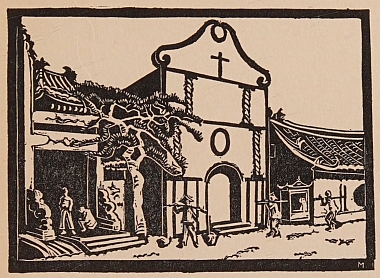
not of him but of the Jesuit church in the Chinese
city, of the first attempt, simple, gracious and even
courtly, to bring the word of God. Yet after several
hundred years during which the attempt had
increased in volume and complicated itself
immeasurably, China, which had accepted so many
other things, still felt no need of the Word. It
accepted Mr. Shultz. It rejected Doctor Strike.
Megan sighed as if she herself had partaken in
the long struggle. She looked at her watch. It was
eleven-thirty.
"I must be going. I want to say just one more
thing. You won't be hard on little Mah-li, will
you? Whatever Captain Li has done I am sure she
is quite innocent. I am going to return these rings
to her to-morrow. Unless you would return them
yourself?" She held them out tentatively but the
General did not answer. "Well, then I will. Good
night, General Yen."
The General stood up and bowed as she passed him.
"Good night, Miss Davis."