The cover image was created by the transcriber and is placed in the public domain.
THE BITTER CRY OF THE CHILDREN
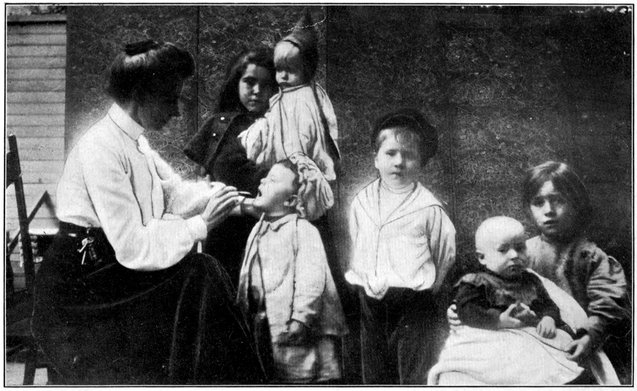
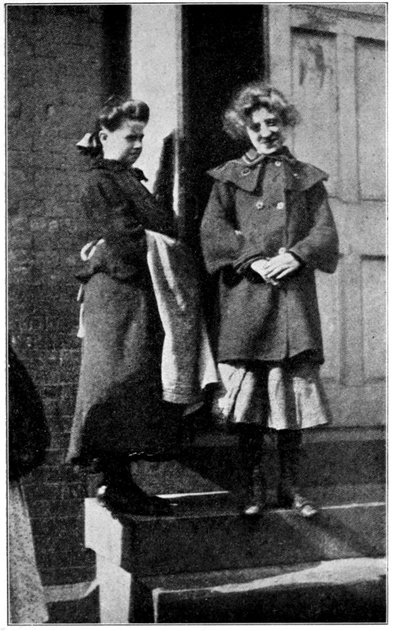
A TYPICAL SCENE
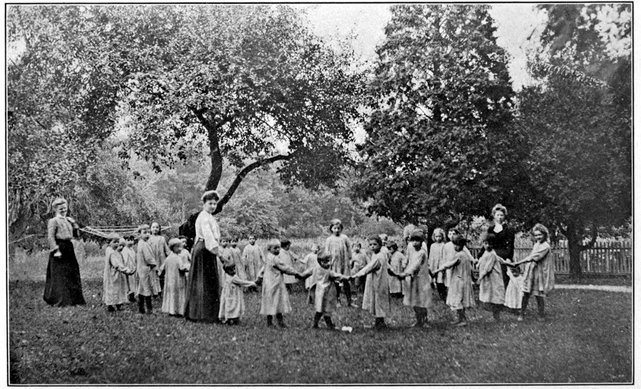
The matron of a Day Nursery examining a child’s throat. The two “Little Mothers” are typical.
BY
JOHN SPARGO
WITH AN INTRODUCTION BY
ROBERT HUNTER
AUTHOR OF “POVERTY”
New York
THE MACMILLAN COMPANY
LONDON: MACMILLAN & CO., Ltd.
1906
All rights reserved
Copyright, 1906,
By THE MACMILLAN COMPANY.
Set up and electrotyped. Published February, 1906.
Norwood Press
J. S. Cushing & Co.—Berwick & Smith Co.
Norwood, Mass., U.S.A.
TO MY FRIEND
MRS. WILLIAM SHARMAN
Fide et Amore
INTRODUCTION
vii
I count myself fortunate in having had a hand in
bringing this remarkable and invaluable volume into
existence. Quite incidentally in my book Poverty I
made an estimate of the number of underfed children in
New York City. If our experts or our general reading
public had been at all familiar with the subject, my
estimate would probably have passed without comment,
and, in any case, it would not have been considered
unreasonable. But the public did not seem
to realize that this was merely another way of stating
the volume of distress, and, consequently, for several
days the newspapers throughout the country discussed
the statement and in some instances severely
criticised it. One prominent charitable organization,
thinking that my estimate referred to starving
children, undertook, without delay, to provide meals
for the children. In the midst of the excitement
Mr. Spargo kindly volunteered to investigate the
facts at first hand. His inquiry was so searching
and impartial and the data he gathered so interesting
and valuable that I urged him to put his material
in some permanent form. The following admirable
study of this problem is the result of that suggestion.
viiiI am safe in saying that this book is a truly powerful
one, destined, I believe, to become a mighty factor
in awakening all classes of our people to the necessity
of undertaking measures to remedy the conditions
which exist. The appeal of adults in poverty
is an old appeal, so old indeed that we have become
in a measure hardened to its pathos and insensitive
to its tragedy. But this book represents the cry of
the child in distress, and it will touch every human
heart and even arouse to action the stolid and apathetic.
The originality of the book lies in the mass
of proof which the author brings before the reader
showing that it is not alone, as most of our charitable
experts believe, the misery of the neglected or the
actively maltreated child that should receive attention.
Even more important is the misery of that
one whose whole future is darkened and perhaps
blasted by reason of the fact that during his early
years of helplessness he has not received those elements
of nutritious food which are necessary to a
wholesome physical life.
Few of us sufficiently realize the powerful effect
upon life of adequate nutritious food. Few of us
ever think of how much it is responsible for our
physical and mental advancement or what a force
it has been in forwarding our civilized life. Mr.
Spargo does not attempt in this book to make us
realize how much the more favored classes owe to the
ixfact that they have been able to obtain proper nutrition.
His effort here is to show the fearful devastating
effect upon a certain portion of our population
of an inadequate and improper food supply. He
shows the relation of the lack of food to poverty.
The child of poverty is brought before us. His
weaknesses, his mental and physical inferiority, his
failure, his sickness, his death, are shown in their
relation to improper and inadequate food. He first
proves to our satisfaction that this child of misery
is born into the world with powerful potentialities,
and he then shows, with tragic power, how the lack
of proper food during infancy makes it inevitable
that this child become, if he lives at all, an incompetent,
physical weakling. It is perhaps unnecessary
to point out that the problem of poverty is
largely summed up in the fate of this child, and when
the author deals with this subject he is in reality
treating of poverty in the germ.
There have been many books written about the
children of the poor, but, in my opinion, none of them
give us so impressive a statement as is contained
here of the most important and powerful cause of
poverty. Among many reasons which may be found
for the existence of distress, the author has taken one
which seems to be more fundamental than the others.
But, while this is true, there is no dogmatic treatment
of the problem, for the author realizes that the
xcauses of poverty in this country of abundance are
numerous. Indeed, wherever one looks, one may
see conditions which are fertile in producing it.
Students of the poor find some of these causes in the
conditions surrounding the poor. Students of finance
and of modern industry find causes of poverty in the
methods and constitution of this portion of our
society. The causes, therefore, of poverty cannot
be gone into fully in any partial study of modern
society. It is even maintained, and not without
reason, that if all men were sober, competent, and industrious,
there would be no less poverty in the world.
But however that may be, one thing is certain, and
that is that as the race as a whole could not have
advanced beyond savagery without a fortuitous
provision of material necessities, so it is not possible
for the children of the poor to overcome their poverty
until they are assured in their childhood of the physical
necessities of life. We should have no civilization
to-day, our entire race would still be a wild
horde of brutalized savages, but for the meat and
milk diet or the grain diet assured to our earliest
forefathers. And it should not be forgotten that
as this is true of the life of the race, so is it true
of that portion of our community which lives in
poverty unable to procure proper food to give its
children. This is the great fundamental fact which
lies at the base of the problem of poverty and which
xiis the theme of this book. It is a fact which should
be best known to the men and women who work
in the field of our philanthropies, and yet it must be
said that it is a fact which has heretofore been almost
entirely ignored by this class of workers.
For this reason I welcome this volume. I am convinced
that it will mark the beginning of an epoch
of deeper study and of sounder philanthropy. I look
to see in the near future some effort made to establish
a standard of physical well-being for the children.
I expect to see the community insisting that some
provision shall be made whereby every child born
into the world will receive sufficient food to enable
him to possess enough vitality to overcome unnecessary
and preventable disease and to grow into a
manhood physically capable of satisfactorily competing
in industrial or intellectual pursuits. I do
not believe that this is a dream impossible of realization.
About a hundred years ago our forefathers
decided that there should be a universal standard
of literacy. To bring this about the following generations
of men established a free school system
which was meant to assure to every child a certain
minimum of education. If that can be done for the
mind, the other thing can be done for the body. And
when it is done for the body, we shall make another
striking advance in civilization not unlike that recorded
in the history of mankind when the free
xiipeople of this American continent established a system
of free and universal education.
If such a momentous thing should follow the publication
of this book, and similar studies which will
without doubt subsequently be made, its publication
would indeed mark an epoch. But, of course,
it must be said that before any far-reaching result
can come, the general public must be acquainted
with the conditions which exist. It is for this reason
that I hope Mr. Spargo’s book will be read by hundreds
of thousands of people, and that it will awaken in them
a determination to respond wisely and justly to the
bitter cry of the children of the poor.
ROBERT HUNTER.
PREFACE
xiii
The purpose of this volume is to state the problem
of poverty as it affects childhood. Years of careful
study and investigation have convinced me that the
evils inflicted upon children by poverty are responsible
for many of the worst features of that hideous
phantasmagoria of hunger, disease, vice, crime,
and despair which we call the Social Problem. I
have tried to visualize some of the principal phases
of the problem—the measure in which poverty is
responsible for the excessive infantile disease and
mortality; the tragedy and folly of attempting to
educate the hungry, ill-fed school child; the terrible
burdens borne by the working child in our modern
industrial system.
In the main the book is frankly based upon personal
experience and observation. It is essentially
a record of what I have myself felt and seen. But
I have freely availed myself of the experience and
writings of others, as reference to the book itself
will show. I have tried to be impartial and unbiassed
in my researches, and have not “winnowed
the facts till only the pleasing ones remained.” At
times, indeed, I have found it necessary, while writing
xivthis book, to abandon ideas which I had held
and promulgated for years. That is an experience
not uncommon to those who submit opinions formed
as a result of general observation to strict scientific
scrutiny. I had long believed and had promulgated
the opinion that the great mass of the children of
the poor were blighted before they were born. The
evidence given before the British Interdepartmental
Committee, by recognized leaders of the medical profession
in England, pointed to a fundamentally different
view. According to that evidence, the number of
children born healthy and strong is not greater among
the well-to-do classes than among the very poorest.
The testimony seemed so conclusive, and the corroboration
received from many obstetrical experts in this
country was so general, that I was forced to abandon
as untenable the theory of antenatal degeneration.
In view of the foregoing, I need hardly say that
I do not claim any originality for the view that
Nature starts all her children, rich and poor, physically
equal, and that each generation gets practically
a fresh start, unhampered by the diseased and degenerate
past.[A] The tremendous sociological significance
of this truth—if truth it be—will, I think,
be generally recognized. Readers of Ruskin’s Fors
Clavigera will remember the story of the dressmaker
xvwith a broken thigh, who was told by the doctors
in St. Thomas’s Hospital, London, that her bones
were in all probability brittle because her mother’s
grandfather had been employed in the manufacture
of sulphur. If this theory of antenatal degeneration
is wrong, and we have not to reckon with
grandfathers and great-grandfathers, the solution
of the problem of arresting and repairing the deterioration
of the race is made so much easier. It may
be thought by some readers that I have accepted
the brighter, more hopeful view too readily, and
with too much confidence. I can only say that I
have read all the available evidence upon the other
side, and found myself at last obliged to accept the
brighter view. I cannot but feel that the actual
experience of obstetricians dealing with thousands
of natural human births every year is far more valuable
and conclusive than any number of artificial
experiments upon guinea pigs, mice, or other animals.
The part of the book devoted to the discussion of
remedial measures will probably attract more criticism
than any other. I expect, and am prepared for,
criticism from those, on the one hand, who will accuse
me of being too radical and revolutionary, and, on
the other hand, those who will say I have ignored
almost all radical measures. I have purposely refrained
from considering any of the far-reaching
speculations of the “schools,” and confined myself
xvientirely to those measures which have been tried
in various places with sufficient success to warrant
their general adoption, and which do not involve
any revolutionary change in our social system. I
have tried, in other words, to formulate a programme
of practical measures, all of which have been subjected
to the test of experience.
A word of personal explanation may not be out
of place here. I have been privileged to know something
of the leisure and luxury of wealth, and more
of the toil and hardship of poverty. When I write
of hunger I write of what I have experienced—not
the enviable hunger of health, but the sickening
hunger of destitution. So, too, when I write of
child labor. I know that nothing I have written
of the toil of little boys and girls, terrible as it may
seem to some readers, approaches the real truth in its
horror. I have not tried to write a sensational book,
but to present a careful and candid statement of facts
which seem to me to be of vital social significance.
As far as possible, I have freely acknowledged
my indebtedness to other writers, either in the text
or in the list of authorities at the end of the book. It
was, however, impossible thus to acknowledge all
the help received from so many willing friends in
this and other countries. Hundreds of school principals
and teachers, physicians, nurses, settlement
workers, public officials, and others, in this country
xviiand in Europe, have aided me. It is impossible to
name them all, and I can only hope that they will
find themselves rewarded, in a measure, by the work
to which they have contributed so much.
I take this opportunity, however, of expressing
my sincere thanks to Mr. Robert Hunter; to Mr.
Owen R. Lovejoy, of the National Child Labor
Committee; to Dr. George W. Goler, of Rochester,
N.Y.; to Dr. S. E. Getty, of St. John’s Riverside
Hospital, Yonkers, N.Y.; to Dr. Louis Lichtschein, of
New York City; to Dr. George W. Galvin, of Boston,
Mass.; and to Professor G. Stanley Hall, of Clark University,
for many valuable suggestions and criticisms.
To Mr. Fernando Linderberg, of Copenhagen; to his
Excellency, Baron Mayor des Planches, the Italian
Ambassador at Washington; and to Professor Emile
Vinck, of Brussels, I am indebted for assistance in
securing valuable reports which would otherwise
have been inaccessible. I am also indebted to my
colleague, Miss C. E. A. Carman, of Prospect House;
and especially to Mr. W. J. Ghent for his expert
assistance in preparing the book for the press. Finally,
I am indebted to my wife, whose practical
knowledge of factory conditions, especially as they
relate to women and children, has been of immense
service to me.
J. S.
Prospect House, Yonkers, N.Y.
December, 1905.
A. For the necessary qualifications of this broad generalization
see the illustrative material in Appendix C, I.
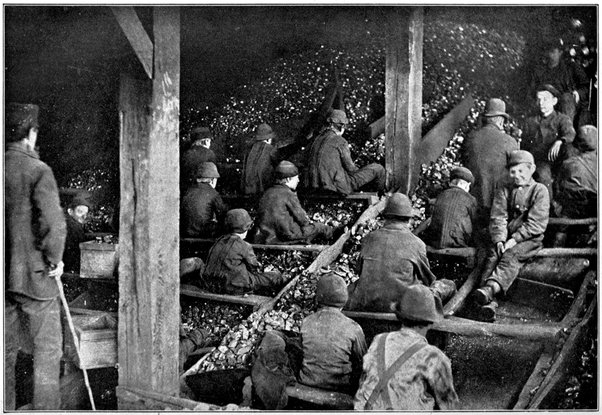
Note.—I am indebted to Miss Marjory Hall of New York for
the pictures of day nurseries and crèches; to Dr. G. W. Goler of
Rochester, N.Y., for permission to use several illustrations of his
work; to the Rev. Peter Roberts for the excellent illustration,
“Breaker Boys at Work”; and to the Pennsylvania Child Labor
Committee for several other illustrations of working children.—J. S.
LIST OF STATISTICAL TABLES AND DIAGRAMS
xxiii
PAGES
1.
Diagram showing Relative Death-rates per 100,000 Persons in Different Classes
I THE BLIGHTING OF THE BABIES — I — II — III — IV — V — VI — VII — VIII — IX — X — XI
1
“Oh, room for the lamb in the meadow,
And room for the bird on the tree!
But here, in stern poverty’s shadow,
No room, hapless baby! for thee.”
—E. M. Milne.
The burden and blight of poverty fall most heavily
upon the child. No more responsible for its poverty
than for its birth, the helplessness and innocence
of the victim add infinite horror to its suffering,
for the centuries have not made tolerable the idea
that the weakness or wrongdoing of its parents or
others should be expiated by the suffering of the
child. Poverty, the poverty of civilized man, which
is everywhere coexistent with unbounded wealth
and luxury, is always ugly, repellent, and terrible
either to see or to experience; but when it assails
the cradle it assumes its most hideous form. Underfed,
or badly fed, neglected, badly housed, and improperly
clad, the child of poverty is terribly handicapped
at the very start; it has not an even chance
2to begin life with. While still in its cradle a yoke
is laid upon its after years, and it is doomed either
to die in infancy, or, worse still, to live and grow up
puny, weak, both in body and in mind, inefficient
and unfitted for the battle of life. And it is the
consciousness of this, the knowledge that poverty
in childhood blights the whole of life, which makes
it the most appalling of all the phases of the poverty
problem.
Biologically, the first years of life are supremely
important. They are the foundation years; and just
as the stability of a building must depend largely
upon the skill and care with which its foundations
are laid, so life and character depend in large measure
upon the years of childhood and the care bestowed
upon them. For millions of children the whole of
life is conditioned by the first few years. The period
of infancy is a time of extreme plasticity. Proper
care and nutrition at this period of life are of vital
importance, for the evils arising from neglect, insufficient
food, or food that is unsuitable, can never be
wholly remedied. “The problem of the child is
the problem of the race,”[1] and more and more emphatically
science declares that almost all the problems
of physical, mental, and moral degeneracy
originate with the child. The physician traces the
weakness and disease of the adult to defective nutrition
in early childhood; the penologist traces moral
3perversion to the same cause; the pedagogue finds
the same explanation for his failures. Thanks to
the many notable investigations made in recent
years, especially in European countries, sociological
science is being revolutionized. Hitherto we have
not studied the great and pressing problems of pauperism
and criminology from the child-end; we have
concerned ourselves almost entirely with results while
ignoring causes. The new spirit aims at prevention.
To the child as to the adult the principal evils of
poverty are material ones,—lack of nourishing food,
of suitable clothing, and of healthy home surroundings.
These are the fundamental evils from which
all others arise. The younger children are spared the
anxiety, shame, and despair felt by their parents and
by their older brothers and sisters, but they suffer
terribly from neglect when, as so often happens, their
mothers are forced to abandon the most important
functions of motherhood to become wage-earners.
The cry of a child for food which its mother is powerless
to give it is the most awful cry the ages have
known. Even the sound of battle, the mingled
shrieks of wounded man and beast, and the roar of
guns, cannot vie with it in horror. Yet that cry
goes up incessantly: in the world’s richest cities the
child’s hunger-cry rises above the din of the mart.
Fortunate indeed is the child whose lips have never
uttered that cry, who has never gone breakfastless
4to play or supperless to bed. For periods of destitution
come sooner or later to a majority of the proletarian
class. Practically all the unskilled laborers
and hundreds of thousands engaged in the skilled
trades are so entirely dependent upon their weekly
wages, that a month’s sickness or unemployment
brings them to hunger and temporary dependence.
Not long ago, in the course of an address before the
members of a labor union, I asked all those present
who had ever had to go hungry, or to see their children
hungry, as a result of sickness, accident, or
unemployment to raise their hands. No less than
one hundred and eighty-four hands were raised out
of a total attendance of two hundred and nineteen
present, yet these were all skilled workers protected
in a measure by their organization.
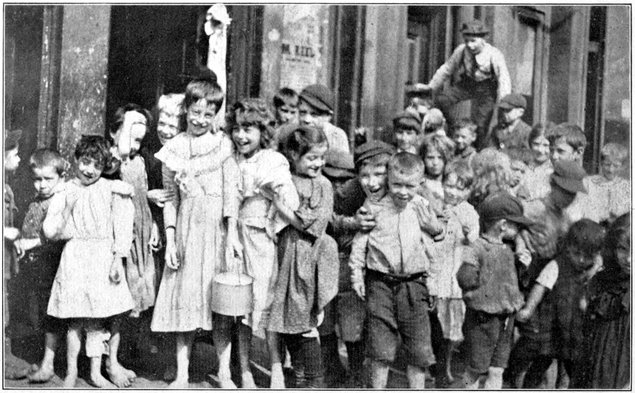
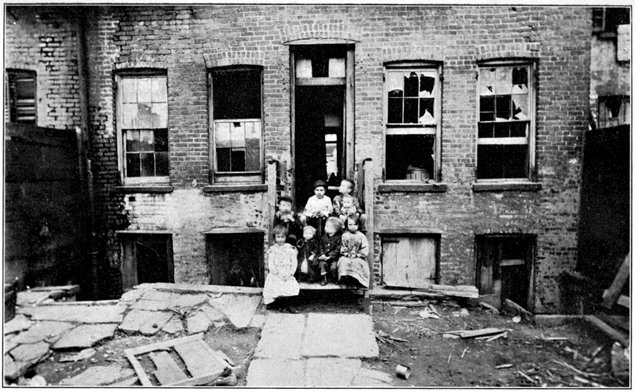
A GROUP OF “LUNG BLOCK” CHILDREN
The white symbol of a child’s death hangs on a door in the background.
It is not, however, the occasional hunger, the loss
of a few meals now and then in such periods of distress,
that is of most importance; it is the chronic underfeeding
day after day, month after month, year after
year. Even where lack of all food is rarely or never
experienced, there is often chronic underfeeding.
There may be food sufficient as to quantity, but
qualitatively poor and almost wholly lacking in
nutritive value, and such is the tragic fate of those
dependent upon it that they do not even know that
they are underfed in the most literal sense of the
word. They live and struggle and go down to their
5graves without realizing the fact of their disinheritance.
A plant uprooted and left lying upon the
ground withers quickly and dies; planted in dry,
lifeless, arid soil it would wither and die, too, less
quickly perhaps but as surely. It dies when there
is no soil about its roots and it dies when there is
soil in abundance, but no nourishing qualities in the
soil. As the plant is, so is the life of a child; where
there is no food, starvation is swift, mercifully swift,
and complete; when there is only poor food lacking
in nutritive qualities starvation is partial, slower, and
less merciful. The thousands of rickety infants
to be seen in all our large cities and towns, the anæmic,
languid-looking children one sees everywhere in
working-class districts, and the striking contrast
presented by the appearance of the children of the
well-to-do bear eloquent witness to the widespread
prevalence of underfeeding.
Poverty and Death are grim companions. Wherever
there is much poverty the death-rate is high and
rises higher with every rise of the tide of want and
misery. In London, Bethnal Green’s death-rate is
nearly double that of Belgravia;[2] in Paris, the poverty-stricken
district of Ménilmontant has a death-rate
twice as high as that of the Elysée;[3] in Chicago, the
death-rate varies from about twelve per thousand in
the wards where the well-to-do reside to thirty-seven
per thousand in the tenement wards.[4] The ill-developed
6bodies of the poor, underfed and overburdened
with toil, have not the powers of resistance to
disease possessed by the bodies of the more fortunate.
As fire rages most fiercely and with greatest devastation
among the ill-built, crowded tenements, so
do the fierce flames of disease consume most readily
the ill-built, fragile bodies which the tenements
shelter. As we ascend the social scale the span of
life lengthens and the death-rate gradually diminishes,
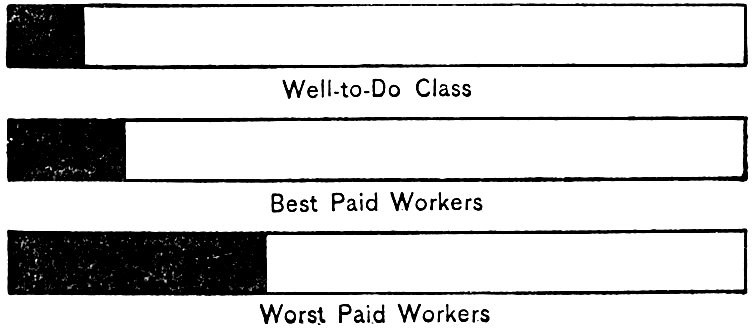
the death-rate of the poorest class of workers being
three and a half times as great as that of the well-to-do.
It is estimated that among 10,000,000 persons of the
latter class the annual deaths do not number more
than 100,000, among the best paid of the working-class
the number is not less than 150,000, while among
the poorest workers the number is at least 350,000.[5]
The following diagram illustrates these figures
clearly and needs no further comment:—
DIAGRAM
Showing Relative Death-rates per 100,000 Persons in Different Classes.
7This difference in the death-rates of the various
social classes is even more strongly marked in the
case of infants. Mortality in the first year of life
differs enormously according to the circumstances
of the parents and the amount of intelligent care
bestowed upon the infants. In Boston’s “Back
Bay” district the death-rate at all ages last year
was 13.45 per thousand as compared with 18.45 in
the Thirteenth Ward, which is a typical working-class
district, and of the total number of deaths the
percentage under one year was 9.44 in the former as
against 25.21 in the latter. Wolf, in his classic
studies based upon the vital statistics of Erfurt for
a period of twenty years, found that for every 1000
children born in working-class families 505 died in
the first year; among the middle classes 173, and
among the higher classes only 89. Of every 1000
illegitimate children registered—almost entirely of
the poorer classes—352 died before the end of the
first year.[6] Dr. Charles R. Drysdale, Senior Physician
of the Metropolitan Free Hospital, London,
declared some years ago that the death-rate of infants
among the rich was not more than 8 per cent,
while among the very poor it was often as high as
40 per cent.[7] Dr. Playfair says that 18 per cent
of the children of the upper classes, 36 per cent of
the tradesman class, and 55 per cent of those of the
working-class die under the age of five years.[8]
8And yet the experts say that the baby of the tenement
is born physically equal to the baby of the
mansion.[9] For countless years men have sung of
the Democracy of Death, but it is only recently
that science has brought us the more inspiring message
of the Democracy of Birth. It is not only in
the tomb that we are equal, where there is neither
rich nor poor, bond nor free, but also in the womb
of our mothers. At birth class distinctions are
unknown. For long the hope-crushing thought of
prenatal hunger, the thought that the mother’s
hunger was shared by the unborn child, and that
poverty began its blighting work on the child even
before its birth, held us in its thrall. The thought
that past generations have innocently conspired
against the well-being of the child of to-day, and
that this generation in its turn conspires against
the child of the future, is surcharged with the pessimism
which mocks every ideal and stifles every
hope born in the soul. Nothing more horrible ever
cast its shadow over the hearts of those who would
labor for the world’s redemption from poverty than
this spectre of prenatal privation and inherited
debility. But science comes to dispel the gloom
and bid us hope. Over and over again it was stated
before the Interdepartmental Committee by the
leading obstetrical authorities of the English medical
profession that the proportion of children born
9healthy and strong is not greater among the rich
than among the poor.[10] The differences appear after
birth. Wise, patient Mother Nature provides with
each succeeding generation opportunity to overcome
the evils of ages of ignorance and wrong, with each
generation the world starts afresh and unhampered,
physically, at least, by the dead past.
“The world’s great age begins anew,
The golden years return.”
And herein lies the greatest hope of the race; we
are not handicapped from the start; we can begin
with the child of to-day to make certain a brighter
and nobler to-morrow as though there had never
been a yesterday of woe and wrong.[B]
In England the high infantile mortality has occasioned
much alarm and called forth much agitation.
There is a world of pathos and rebuke in the grim
truth that the knowledge that it is becoming increasingly
difficult to get suitable recruits for the army
and navy has stirred the nation in a way that the
fate of the children themselves and their inability to
become good and useful citizens could not do.[11]10Alarmed by the decline of its industrial and commercial
supremacy, and the physical inferiority of its soldiers
so manifest in the South African war, a most
rigorous investigation of the causes of physical deterioration
has been made, with the result that on all
sides it is agreed that poverty in childhood is the
main cause. Greater attention than ever before has
been directed to the excessive mortality of infants
and young children. Of a total of 587,830 deaths
in England and Wales in 1900 no less than 142,912,
or more than 24 per cent of the whole, were infants
under one year, and 35.76 per cent were under five
years of age. That this death-rate is excessive and
that the excess is due to essentially preventable
causes is admitted, many of the leading medical
authorities contending that under proper social
conditions it might be reduced by at least one-half.
If that be true, and there is no good reason for doubting
it, the present death-rate means that more than
70,000 little baby lives are needlessly sacrificed each
year.
No figures can adequately represent the meaning
of this phase of the problem which has been so picturesquely
named “race suicide.” Only by gathering
them all into one vast throng would it be possible
to conceive vividly the immensity of this annual
slaughter of the babies of a Christian land. If some
awful great child plague came and swept away every
11child under a year old in the states of Massachusetts,
Idaho, and New Mexico, not a babe escaping, the
loss would be less than those that are believed to be
needlessly lost each year in England and Wales. Or,
to put it in another form, the total number of these
infants believed to have died from causes essentially
preventable in the year 1900 was greater than the
total number of infants of the same age living in the
following six states,—Connecticut, Maine, Delaware,
Florida, Colorado, and Idaho. Even if the
estimate of the sacrifice be regarded as being excessive,
and we reduce it by half, it still remains an
awful sum.
Unfortunately, there is no reason to suppose that
the infantile death-rate in the United States is nearly
so far below that of England as is generally supposed.
The general death-rate is given in the census returns
as 16.3 per thousand, or about two per thousand less
than in England. But owing to a variety of causes,
chief of which is the defective system of registration
in several states, these figures are not very reliable,
and it is generally agreed that the mortality for the
whole country cannot be less than for the “Registration
Area,” 17.8 per thousand. Similarly, the
difference in the infantile death-rate of the two
countries is much less than the following crude
figures contained in the census reports appear at first
to indicate:—
12
United States
England and Wales
Deaths at all ages,
1,039,094
Deaths at all ages,
587,830
Deaths under 1 year,
199,325
Deaths under 1 year,
142,912
Deaths under 5 years,
317,532
Deaths under 5 years,
209,960
In the English returns the death of every child
having had a separate existence is counted, even
though it lived only a few seconds, but in this country
there is no uniform rule in this respect. In
Chicago, for instance, “no account is taken of deaths
occurring within twenty-four hours after birth,”[12]
and in Philadelphia a similar custom prevailed until
1904.[13] Such facts seriously vitiate comparisons of
the infantile death-rates of the two countries which
are based upon the crude statistics of census returns.
But while the difference is much less than the
figures given would indicate, it is still safe to assume
that the infantile death-rate is lower in this country
than in England. Such a condition might reasonably
be expected for numerous reasons. We have
a larger rural population with a higher economic
status; new virile blood is being constantly infused
by the immigration of the strongest and most aggressive
elements of the population of other lands; our
people, especially our women, are more temperate.
All these factors would tend naturally to a lower
death-rate at all ages, but especially of infants.
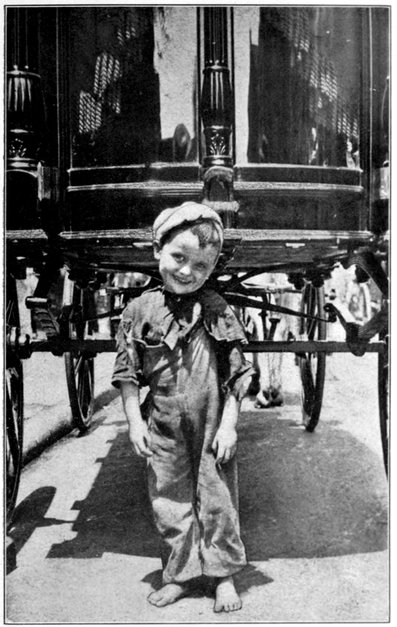
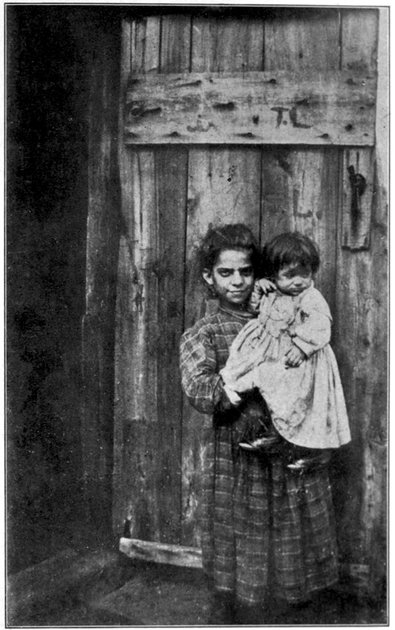
Danny’s Best Smile
Rickety, Ill fed, and Neglected
RACHITIC TYPES
13That with all these favorable conditions our infantile
mortality should so nearly approximate that of
England, that of every thousand deaths 307.8 should
be of children under five years of age—according
to the crude figures of the census, more if a correct
registration upon the same basis as the English
figures could be had—is a matter of grave national
concern. If we make an arbitrary allowance of 20
per cent, to account for the slight improvement
shown by the death-rates and for other differences,
and regard 30 per cent of the infantile death-rate as
being due to socially preventable causes, instead of
50 per cent, as in the case of England, we have an
appalling total of more than 95,000 unnecessary deaths
in a single year.
And of these “socially preventable” causes there
can be no doubt that the various phases of poverty
represent fully 85 per cent, giving an annual sacrifice
to poverty of practically 80,000 baby lives. If
some modern Herod had caused the death of every
male child under twelve months of age in the state
of New York in the year 1900, not a single child
escaping, the number thus brutally slaughtered would
have been practically identical with this sacrifice.
Poverty is the Herod of modern civilization, and
Justice the warning angel calling upon society to
“arise and take the young child” out of the reach of
the monster’s wrath.
14
If our vital statistics were specially designed to
that end, they could not hide the relation of poverty
to disease and death more effectually than they do
now. It is impossible to tell from any of the elaborate
tables compiled by the census authorities what proportion
of the total number of infant deaths were due
to defective nutrition or other conditions primarily
associated with poverty. No one who has studied the
question doubts that the proportion is very great, but
it is impossible to present the matter statistically,
except in the form of a crude estimate. There is
much of value in our great collections of statistics,
but the most vital facts of all are rarely included
in them.
In the great dispensary a little girl of tender years
stands holding up a baby not yet able to walk. She
is a “little mother,” that most pathetic of all poverty’s
victims, her childhood taken away and the
burden of womanly cares thrust upon her. “Please,
doctor, do somethin’ fer baby!” she pleads. Baby
is sick unto death, but she does not realize it. Its
breath comes in short, wheezy gasps; its skin burns,
and its little eyes glow with the brightness that
doctors and nurses dread. One glance is all the
doctor needs; in that brief glance he sees the ill-shaped
head and the bent and twisted legs that tell
15of rickets. Helpless, with the pathetically perfunctory
manner long grown familiar to him he gives
the child some soothing medicine for her tiny charge’s
bronchial trouble and enters another case of “bronchitis”
upon the register. “And if it wasn’t bronchitis,
’twould be something else, and death soon,
anyhow,” he says. Death does come soon, the
white symbol of its presence hangs upon the street
door of the crowded tenement, and to the long
death-roll of the nation another victim of bronchitis
is added—one of the eleven thousand so registered
under five years of age. The record gives no hint
that back of the bronchitis was rickets and back of
the rickets poverty and hunger. But the doctor
knows—he knows that little Tad’s case is typical
of thousands who are statistically recorded as dying
from bronchitis or some other specific disease when
the real cause, the inducing cause of the disease, is
malnutrition. Even as the Great White Plague
recruits its victims from the haunts of poverty, so
bronchitis preys there and gathers most of its victims
from the ranks of the children whose lives are spent
either in the foul and stuffy atmosphere of overcrowded
and ill-ventilated homes, or on the streets,
underfed, imperfectly clad, and exposed to all sorts
of weather.
For nearly half a century rachitis, or “rickets,”
has been known as the disease of the children of the
16poor. It has been so called ever since Sir William
Jenner noticed that after the first two births, the
children of the poor began to get rickety, and careful
investigation showed that the cause was poverty,
the mothers being generally too poor to get proper
nourishment while nursing them.[14] It is perhaps
the commonest disease from which children of the
working-classes suffer. A large proportion of the
children in the public schools and on the streets of
the poorest quarters of our cities, and a majority of
those treated at the dispensaries or admitted into
the children’s hospitals, are unmistakably victims
of this disease. One sees them everywhere in the
poor neighborhoods. The misshapen heads and the
legs bent and twisted awry are unmistakable signs,
and the scanty clothing covers pitiful little “pigeon-breasts.”
The small chests are narrowed and flattened
from side to side, and the breast-bones are
forced unnaturally forward and outward. Tens
of thousands of children suffer from this disease,
which is due almost wholly to poor and inadequate
food. Here again statistical records hide and imprison
the soul of truth, failing to yield the faintest
idea of the ravages of this disease. The number of
deaths credited to it in 1900 was only 351 for the
whole of the United States, whereas 10,000 would
not have been too high a figure.
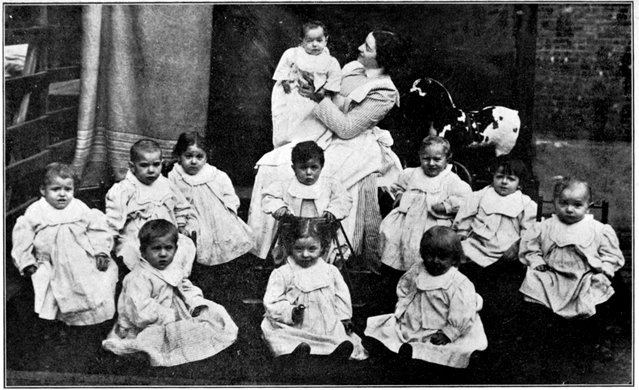
BABIES WHOSE MOTHERS WORK—THEY ARE CARED FOR IN A DAY NURSERY
Seldom, if ever, fatal by itself, rickets is indirectly
17responsible for a tremendous quota of the infantile
death-rate.[15] In epidemics of such infectious diseases
as measles, whooping-cough, and others, the
rickety child falls an easy victim. In these diseases,
as well as in bronchitis, pneumonia, convulsions,
diarrhœa, and many other disorders, the mortality
is far higher among rickety children than among
others. Nor do the evils of rachitis cease with childhood,
but in later life they are unquestionably important
and severe. There is no escape for the victim
even though the storms of childhood be successfully
weathered, but like some cruel, relentless Nemesis
the consequences pursue the adult. The weakening
of the constitution in infancy through poverty
and underfeeding cannot be remedied, and epilepsy
and tuberculosis find easy prey among those whose
childhood had laid upon it the curse of poverty in
the form of rickets.
An epidemic of measles spreads over the great
city. Silently and mysteriously it enters and, unseen,
touches a single child in the street or the school,
and the result is as the touch of the blazing torch
to dry stubble and straw; only it is not stubble but
the nation’s heart, its future citizenry, that is attacked.
From child to child, home to home, street
to street, the epidemic spreads; mansion and tenement
are alike stricken, and the city is engaged in
a fierce battle against the foe which assails its children.
18In the tenement districts doctors and nurses
hurry through the sun-scorched streets and wearily
climb the long flights of stairs hour after hour, day
after day; in the districts where the rich live, doctors
drive in their carriages to the mansions, and nurses
tread noiselessly in and out of the sick rooms. Rich
and poor alike struggle against the foe, but it is only
in the homes of the poor that there is no hope in the
struggle; only there that the doctors can say no comforting
words of assurance. When the battle is over
and the victims are numbered, there is rejoicing in
the mansion and bitter, poignant sorrow in the tenement.
For poor children are practically the only
ones ever to die from measles. Nature starts all
her children equally, rich and poor, but the evil conditions
of poverty create and foster vast inequalities
of opportunity to live and flourish.
Dr. Henry Ashby, an eminent authority upon
children’s diseases, says: “In healthy children among
the well-to-do class the mortality (from measles) is
practically nil, in the tubercular and wasted children
to be found in workhouses, hospitals, and among the
lower classes, the mortality is enormous, no disease
more certainly being attended with a fatal result. William
Squires places it in crowded wards at 20 to
30 per cent of those attacked. Among dispensary
patients the mortality generally amounts to 9 or 10
per cent. In our own dispensary, during the six
19years, 1880–1885, 1395 cases were treated with 128
deaths, making a mortality of 9 per cent. Of the
fatal cases 73 per cent were under two years of age
and 9 per cent under six months of age.”[16]
These are terrible words coming as they do from a
great physician and teacher of physicians. Upon
any less authority one would scarcely dare quote
them, so terrible are they. They mean that practically
the whole 8645 infant deaths recorded from
measles in the United States in the year 1900 were
due to poverty—to the measureless inequality of
opportunity to live and grow which human ignorance
and greed have made. Moreover, the full significance
of this impressive statement will not be realized
if we think only of its relation to one disease.
The same might be said of many other diseases of
childhood which blight and destroy the lives of babies
as mercilessly as the sharp frosts blight and kill the
first tender blossoms of spring. The same writer
says: “It may be taken for granted that no healthy
infants suffer from convulsions; those who do are
either rickety or the children of neurotic parents.”[17]
And there were no less than 14,288 infant deaths
from convulsions in the United States in the census
year. It would probably be a considerable underestimate
to regard 10,000 of these deaths, or 70 per
cent of the whole, as due to poverty.
It is not my intention to attempt the impossible
20task of sifting the death returns so as to measure the
sum of infantile mortality due to poverty. These
figures and the table which follows are not introduced
for that purpose; I have taken only a few of the
diseases more conspicuously associated with defective
nutrition and other conditions comprehended
by the term poverty, and, supported by a strong
body of medical testimony, made certain more or
less arbitrary allowances for poverty’s influence upon
the sum of mortality from each cause. Some of the
estimates may perhaps be criticised as being too high,—no
man knows,—but I am convinced that upon the
whole the table is a conservative one. No competent
judge will dispute the statement that some of
the estimates are very low, and when it is remembered
that only a few of the many causes of infantile
mortality are included and that there are many
others not enumerated in which poverty plays an
important part, I think it can safely be said that in
this country, the richest and greatest country in the
world’s history, poverty is responsible for at least
80,000 infant lives every year—more than two
hundred every day in the year, more than eight
lives each hour, day by day, night by night throughout
the year. It is impossible for us to realize fully
the immensity of this annual sacrifice of baby lives.
Think what it means in five years—in a decade—in
a quarter of a century.
21
Table showing Infantile Mortality from Eleven Given Causes and the Estimated Influence of Poverty thereon
Disease
No. of Deaths under Five Years
Est. Per Cent Due to Bad Conditions
Est. No. of Deaths Due to Bad Conditions—Poverty
Measles
8,465
85
7,195
Inanition
10,687
90
9,618
Convulsions
14,288
70
10,000
Consumption
4,454
60
2,648
Pneumonia
37,206
45
14,340
Bronchitis
10,900
50
5,450
Croup
10,897
45
4,900
Debility and Atrophy
12,130
75
9,397
Cholera Infantum
25,563
45
11,502
Diarrhœa
3,962
45
1,782
Cholera Morbus
3,180
45
1,431
151,732
51.57
78,263
There are doubtless many persons, lay and medical,
who will think that the foregoing figures exaggerate
the evil. But I would remind them that I
have only ascribed 30 per cent of the infantile death-rate
to “socially preventable causes,” and only 85
per cent of that number to poverty in the broadest
sense of that word.[C] I have purposely set my estimate
22much lower than I am convinced it should be.
All the facts point irresistibly to the conclusion that
even 50 per cent would be a conservative estimate.
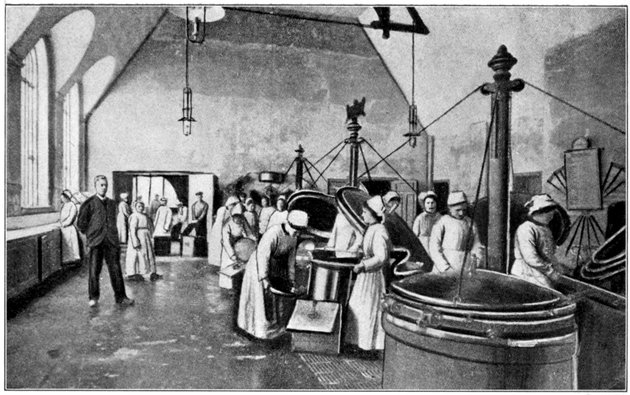
In connection with the New York Foundling Asylum
on Randall’s Island, it was decided some few
years ago to introduce the Straus system of Pasteurizing
the milk given to the babies. The year before
the system was introduced there were 1181 babies
in the asylum, of which number 524, or 44.36 per
cent, died. In the year following, during which
the system was in operation, the number of children
was 1284 and the number of deaths only 255, or 19.80
per cent. In other words, there were 8.03 per cent
more children and 48.66 per cent fewer deaths.[18]
Even more important is the testimony furnished
by the Municipal “Clean Milk” depots of Rochester,
New York. Some years ago the Health Officer, Dr.
George W. Goler, called the attention of the city
authorities to the high infantile mortality occurring
over a period of several years during the months of
July and August. After thorough investigation it
was fairly established that impure milk was one very
important reason for this high death-rate among
children under five years of age. Accordingly the
Pasteurization system was introduced. Depots were
opened in the poorest parts of the city and placed in
charge of trained nurses. After three years it was
decided that instead of Pasteurizing the milk obtained
from all sorts of places, with all its contained bacteria
and dirt, a central depot on a farm should be established
and all energies should be devoted to the
insuring of a pure, clean, and wholesome supply by
keeping dirt and germs out of the milk and sterilizing
all bottles and utensils. Strict control is also exercised
in this way over the farmer with whom the
contract for supplying the milk is made.
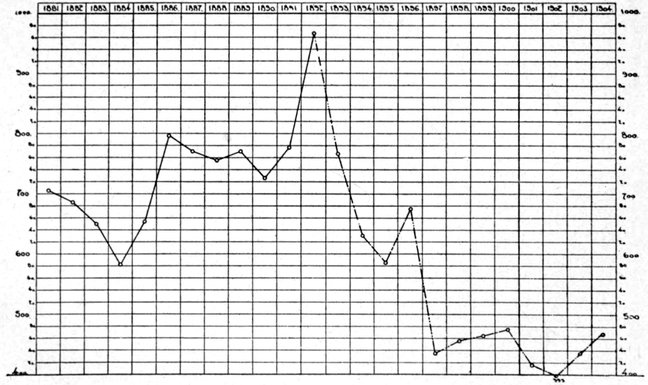
CITY OF ROCHESTER, N.Y.
Deaths in Children Under 5 Years of Age
1892 Began Efficient Milk Inspection.
1897 Municipal Milk Stations Established.
1900 Established A Municipal Standard of 100000 Bacteria per c.c.
23Some idea of the important effects of this scientific
attention by the Board of Health to the staple diet
of the vast majority of children may be gathered
from the following figures, which do not, however,
tell the whole story. In the months of July and
August during the eight years, 1889–1896, prior to
the establishment of the Municipal Milk Stations,
there were 1744 deaths under five years of age from
all causes; in the same months during eight following
years, 1897–1904, there were only 864 deaths under
five years of age from all causes, a decrease of 50.46
per cent, despite a progressive increase of population.[19]
It can hardly be questioned, I think, that
these figures suggest that my estimate is altogether
conservative.
The yearly loss of these priceless baby lives does
not, however, represent the full measure of the awful
cost of the poverty which surrounds the cradle. It
is not only that 75,000 or 80,000 die, but that as
many more of those who survive are irreparably
24weakened and injured. Not graves alone but hospitals
and prisons are filled with the victims of childhood
poverty. They who survive go to school, but
are weak, nervous, dull, and backward in their studies.
Discouraged, they become morose and defiant, and
soon find their way into the “reformatories,” for
truancy or other juvenile delinquencies. Later they
fill the prisons, for the ranks of the vagrant and the
criminal are recruited from the truant and juvenile
offender. Or if happily they do not become vicious,
they fail in the struggle for existence, the relentless
competition of the crowded labor mart, and sink into
the abysmal depths of pauperism. Weakened and impaired
by the privations of their early years, they
cannot resist the attacks of disease, and constant
sickness brings them to the lowest level of that condition
which the French call la misère.
However interesting and sociologically valuable
such an analysis might be, the separation of the
different features of poverty so as to determine their
relative influence upon the sum of mortality and
sickness is manifestly impossible. We cannot say
that bad housing accounts for so many deaths, poor
clothing for so many, and hunger for so many more.
These and other evils are regularly associated in
cases of poverty, the underfed being almost invariably
25poorly clad, and housed in the least healthy
homes. We cannot regard them as distinct problems;
they are only different phases of the same
problem of poverty,—a problem which does not
lend itself to dissection at the hands of the investigator.
Still, notwithstanding that for many years
all efforts to reduce the rate of mortality among
infants have dealt only with questions of bad housing
and of unhygienic conditions in general,—on
the assumption that these are the most important
factors making for a high rate of infant mortality,—it
is now generally admitted that, important as they are
in themselves, these are relatively unimportant factors
in the infant death-rate. “Sanitary conditions do
not make any real difference at all,” and “It is food
and food alone,” was the testimony of Dr. Vincent
before the British Interdepartmental Committee,[20]
and he was supported by some of the most eminent
of his colleagues in that position. That the evils
of underfeeding are intensified when there is an unhygienic
environment is true, but it is equally true
that defect in the diet is the prime and essential
cause of an excessive prevalence of infantile diseases
and of a high death-rate.
Perhaps no part of the population of our great
cities suffers so much upon the whole from overcrowding
and bad housing as the poorest class of
Jews, yet the mortality of infants among them is
26much less than among the poor of other nationalities,
as, for instance, among the Irish and the Italians. Dr.
S. A. Knopf, one of our foremost authorities upon
the subject of tuberculosis, places underfeeding and
improper feeding first, and bad housing and insanitary
conditions in general second as factors in the
causation of children’s diseases. In Birmingham,
England, an elaborate study of the vital statistics
of nineteen years showed that there had been a large
decrease in the general death-rate, due, apparently,
to no other cause than the extensive sanitary improvements
made in that period, but the rate of infantile
mortality remained absolutely unchanged. The
average general death-rate for the nine years,
1873–1881, was 23.5 per thousand; in the ten years,
1882–1891, it was only 20.6. But the infantile
death-rate was not affected, and remained at 169
per thousand during both periods. There had been
a reduction of 12 per cent in the general death-rate,
while that for infants showed no reduction. Had
this been decreased in like degree, the infantile mortality
would have fallen from 169 to 148 per thousand.[21]
Extensive inquiries in the various children’s hospitals
and dispensaries in New York, and among
physicians of large practice in the poorer quarters of
several cities, point with striking unanimity to the
same general conclusion. The Superintendents of
six large dispensaries, at which more than 25,000
27children are treated annually, were asked what proportion
of the cases treated could be ascribed, on a
conservative estimate, primarily to inadequate nutrition,
and the average of their replies was 45 per cent.
In one case the Registrar in a cursory examination
of the register for a single day pointed
out eleven cases out of a total of seventeen, due almost
beyond question entirely to undernutrition.
The Superintendent of the New York Babies’ Hospital,
Miss Marianna Wheeler, kindly copied from the
admission book particulars of sixteen consecutive
cases. The list shows malnutrition as the most
prominent feature of 75 per cent of the cases. Miss
Wheeler says: “The large majority of our cases are
similar to these given; in fact, if I kept on right
down the admission book, would find the same facts
in case after case.”
As in all human problems, ignorance plays an important
rôle in this great problem of childhood’s suffering
and misery. The tragedy of the infant’s
position is its helplessness; not only must it suffer on
account of the misfortunes of its parents, but it must
suffer from their vices and from their ignorance as
well. Nurses, sick visitors, dispensary doctors, and
those in charge of babies’ hospitals tell pitiful stories
of almost incredible ignorance of which babies are the
victims. A child was given cabbage by its mother
28when it was three weeks old; another, seven weeks
old, was fed for several days in succession on sausage
and bread with pickles! Both died of gastritis,
victims of ignorance. In another New York tenement
home a baby less than nine weeks old was fed
on sardines with vinegar and bread by its mother.
Even more pathetic is the case of the baby, barely
six weeks old, found by a district nurse in
Boston in the family clothes-basket which formed
its cradle, sucking a long strip of salt, greasy bacon
and with a bottle containing beer by its side. Though
rescued from immediate death, this child will probably
never recover wholly from the severe intestinal disorder
induced by the ignorance of its mother. Yet,
after all, it is doubtful whether the beer and bacon
were worse for it than many of the patent “infant
foods” of the cheaper kinds commonly given in good
faith to the children of the poor. If medical opinion
goes for anything, many of these “foods” are little
better than slow poisons.[22] Tennyson’s awful
charge is still true, that:—
“The spirit of murder works in the very means of life.”
Nor is the work of this spirit of murder confined to
the concoction of “patent foods” which are in reality
patent poisons. The adulteration of milk with
formaldehyde and other base adulterants is responsible
for a great deal of infant mortality, and its
29ravages are chiefly confined to the poor. It is little
short of alarming that in New York City, out of 3970
samples of milk taken from dealers for analysis during
1902, no less than 2095, or 52.77 per cent, should
have been found to be adulterated.[23] Mr. Nathan
Straus, the philanthropist whose Pasteurized milk
depots have saved many thousands of baby lives
during the past twelve years, has not hesitated to
call this adulteration by its proper name, child-murder.
He says:—
“If I should hire Madison Square Garden and
announce that at eight o’clock on a certain evening
I would publicly strangle a child, what excitement
there would be!
“If I walked out into the ring to carry out my
threat, a thousand men would stop me and kill me—and
everybody would applaud them for doing so.
“But every day children are actually murdered
by neglect or by poisonous milk. The murders are
as real as the murder would be if I should choke a
child to death before the eyes of a crowd.
“It is hard to interest the people in what they
don’t see.”[24]
Ignorance is indeed a grave and important phase
of the problem, and the most difficult of all to deal
with. Education is the remedy, of course, but how
shall we accomplish it? It is not easy to educate
after the natural days of education are passed. Mrs.
30Havelock Ellis has advocated “a noviciate for marriage,”
a period of probation and of preparation and
equipment for marriage and maternity.[25] But such a
proposal is too far removed from the sphere of practicality
to have more than an academic interest at present.
Simply worded letters to mothers upon the care
and feeding of their infants, supplemented by personal
visits from well-trained women visitors, would help,
as similar methods have helped, in the campaign
against tuberculosis. Many foreign municipalities
have adopted this plan, notably Huddersfield, England,
and several American cities have followed
their example with marked success. There should
be no great difficulty about its adoption generally.
One great obstacle to be overcome is the resentment
of the mothers whom it is most necessary to reach,
as many of those engaged in philanthropic work
know all too well. One poor woman, whose little
child was ailing, became very irate when a lady visitor
ventured to offer her some advice concerning
the child’s clothing and food, and soundly berated
her would-be adviser. “You talk to me about how
to look after my baby!” she cried. “Why, I guess
I know more about it than you do. I’ve buried
nine already!” It is not the naïve humor of the
poor woman’s wrath that is most significant, but the
grim, tragic pathos back of it. Those four words,
“I’ve buried nine already!” tell more eloquently
31than could a hundred learned essays or polished
orations the vastness of civilization’s failure. For,
surely, we may not regard it as anything but failure
so long as women who have borne eleven children
into the world, as had this one, can say, “I’ve buried
nine already!”
But circular letters and lady visitors will not solve
the problem of maternal ignorance; such methods
can only skim the surface of the evil. This ignorance
on the part of mothers, of which the babies are victims,
is deeply rooted in the soil of those economic
conditions which constitute poverty in the broadest
sense of the term, though there may be no destitution
or absolute want. It is not poverty in the narrow
sense of a lack of the material necessities of life, but
rather a condition in which these are obtainable
only by the concentrated effort of all members
of the family able to contribute anything and to the
exclusion of all else in life. Young girls who go to
work in shops and factories as soon as they are old
enough to obtain employment frequently continue
working up to within a few days of marriage, and not
infrequently return to work for some time after
marriage. Especially is this true of girls employed
in mills and factories; their male acquaintances are
for the most part fellow-workers, and marriages
between them are numerous. Where many women
are employed men’s wages are, as a consequence,
32almost invariably low, with the result that after
marriage it is as necessary that the woman should
work as it was before.
When the years which under more favored conditions
would have been spent at home in preparation
for the duties of wifehood and motherhood are
spent behind the counter, at the bench, or amid the
whirl of machinery in the factory, it is scarcely to
be wondered at that the knowledge of domestic
economy is scant among them, and that so many
utterly fail as wives and mothers. Deprived of the
opportunities of helping their mothers with the
housework and cooking and the care of the younger
children, marriage finds them ill-equipped; too often
they are slaves to the frying-pan, or to the stores
where cooked food may be bought in small quantities.
Bad cooking, extravagance, and mismanagement are
incidental to our modern industrial conditions.
But there is a great deal of improper feeding of
infants which, apparently due to ignorance, is in
reality due to other causes, and the same is true of
what appears to be neglect. In every large city
there are hundreds of married women and mothers
who must work to keep the family income up to the
level of sufficiency for the maintenance of its members.
According to the census of 1900 there were 769,477
33married women “gainfully employed” in the United
States, but there is every reason to believe that the
actual number was much greater, for it is a well-known
fact that married women, especially in factories,
often represent themselves as being single,
for the reason, possibly, that it is considered more
or less of a disgrace to have to continue working
after marriage. Moreover, it is certain that many
thousands of women who work irregularly, a day or
two a week, or, as in many cases, only at intervals
during the sickness or unemployment of their husbands,
were omitted. A million would probably
be well within the mark as an estimate of the number
of married women workers, the census figures
notwithstanding. These working mothers may be
conveniently divided into two classes, the home
workers, such as dressmakers, “finishers” employed
in the clothing trades, and many others; and the
many thousands who are employed away from their
homes in cigar-making, cap-making, the textile
industries, laundry work, and a score of other occupations
including domestic service.
The proportion of married women having small
children is probably larger among those employed
in the home industries than in those which are
carried on outside of the homes. Out of 748 female
home “finishers” in New York, for instance, 658
were married and 557 had from one to seven children
34each.[26] The percentage could hardly equal that in
the outside industries. While there are exceptional
cases, as a rule no married woman, especially if she
has young children, will go out to work unless forced
to do so by sheer necessity. Dr. Annie S. Daniel,
in a most interesting study of the conditions in 515
families where the wives worked as finishers, found
that no less than 448, or 86.78 per cent of the whole,
were obliged to work by reason of poverty arising
from low wages, frequent unemployment, or sickness
of their husbands. Of the other 67 cases, 45 of
the women were widows, 15 had been deserted, and
7 had husbands who were intemperate and shiftless.
Of all causes low wages was the most common, the
average weekly income of the men being only $3.81.
The average of the combined weekly earnings of
man and wife was $4.85, and rent, which averaged
$8.99 per month, absorbed almost one-half of this.
In addition to the earnings of the men and women,
there were other smaller sources of income, such as
children’s wages and money received from lodgers,
which brought the average income per family of
4½ persons up to $5.69 per week.[27]
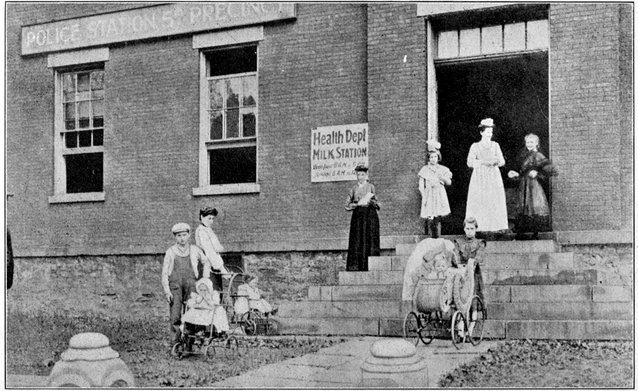
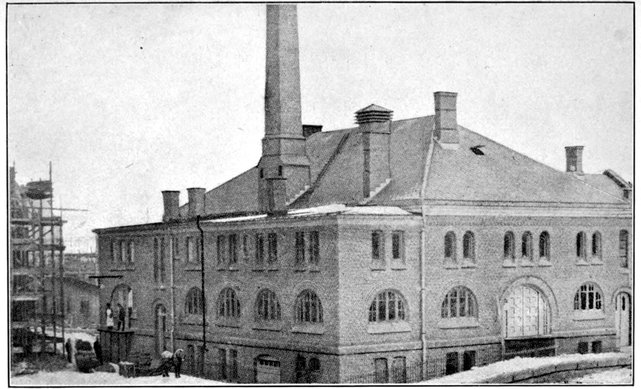
POLICE STATION USED AS A “CLEAN MILK” DEPOT, ROCHESTER, N.Y.
Nothing could be further from the truth than the
comfortable delusion under which so many excellent
people live, that so long as the work is done at home
the children will not be neglected nor suffer. While
it is doubtless true that home employment of the
35mother is somewhat less disadvantageous to the
child than if she were employed away from home,—though
more injurious from the point of view of the
mother herself,—the fact is that such employment
is in every way prejudicial to the child. Even if
the joint income of both parents raises the family
above want, the conditions under which that income
is earned must involve serious neglect of the child.
The mother is taken away from her household duties
and the care of her children; her time is given an
economic value which makes it too precious to be
spent upon anything but the most important thing
of all,—provision for their material needs. She has
no time for cooking and little for eating; the children
must shift for themselves.
Thus the employment of the mother is responsible
for numerous evils of underfeeding, improper feeding,
and neglect. She works from early morn till
night, pausing only twice or thrice a day to snatch
a hasty meal of bread and coffee with the children.
Her pay varies with the kind of work she does, from
one-and-a-half to ten cents an hour. Ordinarily
she will work from twelve to fourteen hours daily,
but sometimes, when the work has to be finished and
delivered by a fixed time, she may work sixteen,
eighteen, or even twenty hours at a stretch. And
then there are the “waiting days” when work is
slack, and hunger, or the fear of hunger, weighs
36heavily upon her and crushes her down. Hard is
her lot, for when she works there is food, but little
time for eating and none for cooking or the care of
her children; when there is no work there is time
enough, but little food.
In Brooklyn, in a rear tenement in the heart of
that huge labyrinth of bricks and mortar near the
Great Bridge, such a mother lives and struggles
against poverty and the Great White Plague. She
is an American, born of American parents, and her
husband is also native-born but of Scotch parentage.
He is a laborer and when at work earns $1.75 per
day, but partly owing to frequently recurring sickness
and partly also to the difficulty of obtaining
employment, it is doubtful whether his wages average
$6 a week the year through. Of six children
born only two are living, their ages being seven
years and two-and-a-half years respectively. Both
are rickety and weak and stunted in appearance.
As she sat upon her bed sewing, only pausing to cough
when the plague seemed to choke her, she told her
story: “It’s awful,” she said, “but I must work else
we shall get nothing to eat and be turned into the
street besides. I have no time for anything but
work. I must work, work, work, and work. Often
we go to our beds as we left them when I haven’t
time or strength to shake them up, and Joe, my
husband, is too tired or sick to do it. Cooking?
37Oh, I cook nothing, for I haven’t time; I must work.
I send the little girl out to the store across the way
and she gets what she can,—crackers, cake, cheese,
anything she can get—and I’m thankful if I can
only make some fresh tea.” Neither of this woman’s
two little children has ever known the experience
of being decently fed, and their weak, rickety bodies
tell the results. From a bare account of their diet it
might be inferred that the mother must be ignorant
or neglectful, but she is, on the contrary, a most intelligent
woman and devoted to her children. Under
better conditions she would perhaps have been a
model housewife and mother, but it is not within
the possibilities of her toil-worn, hunger-wasted body
to be these and at the same time a wage-earner. So,
without attempting to minimize the part which
ignorance plays, it is well to emphasize the fact, so
often lost sight of and forgotten, that what appears
to be ignorance or neglect is very frequently only
poverty in one of its many disguises.
As a contributory cause of excessive mortality
and sickness among young children, the employment
of mothers away from their homes is even more important.
There is no longer any serious dispute
upon that point, though twenty-five years ago it
was the subject of a good deal of vigorous controversy
38on both sides of the Atlantic.[28] Professor
Jevons thoroughly established his claim that the
employment of mothers and the ensuing neglect of
their infants is a serious cause of infantile mortality
and disease. So important did he consider the
question to be that he strenuously advocated the
enactment of legislation forbidding the employment
of mothers until their youngest children were at least
three years old.[29] When one who is familiar with
the facts considers all that the employment of mothers
involves, it is difficult to imagine how its evil effects
upon the children could ever have been questioned.
In too many cases the toil continues through the
most critical periods of pregnancy; the infants are
weaned early in order that the mother may return
to her employment, and placed in charge of some
other person—often a mere child, inexperienced
and ignorant. These “little mothers” have been
much praised and idealized until we have become
prone to forget that their very existence is
a great social menace and crime. It is true that
many of them show a wonderful amount of courage
and precocity in dealing with the babies intrusted
to their care. But in praising these qualities we
must not forget that they are still children, necessarily
unfitted for the responsibilities thus placed
upon them. Moreover, they themselves are the
victims of a great social crime when their childhood
is taken away and the cares of life which belong to
grown men and women are thrust upon them.
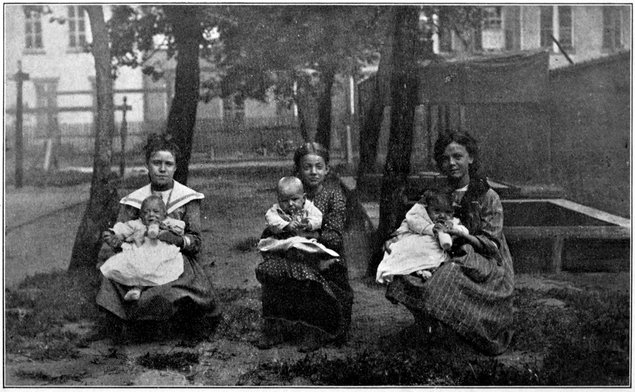
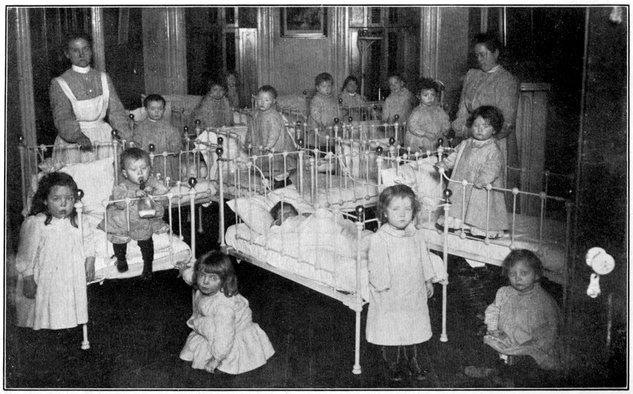
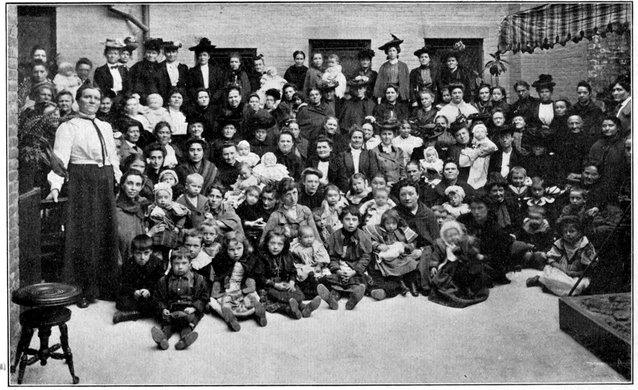
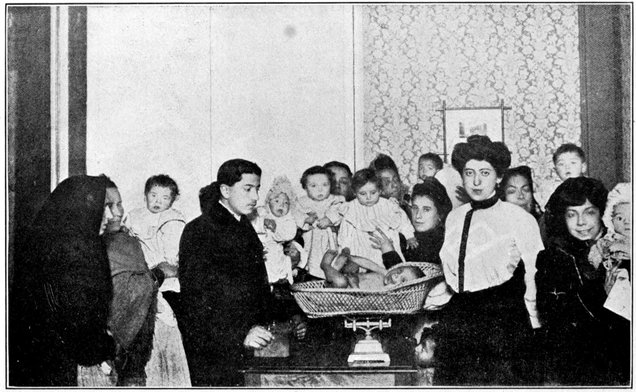
BABIES OF A NEW YORK DAY NURSERY
The mothers of all these babies work away from their homes.
39In a personal letter to the writer, Mr. Roscoe
Doble, Clerk to the Health Board of Lawrence,
Massachusetts, says: “Relative to the high infantile
mortality, I can only say that ignorance in the
preparation of food, illy ventilated tenements, and,
in many cases, unavoidable neglect occasioned by
the mothers being obliged to work away from the
homes, often leaving their babies in the care of other
children, seem to be the prime factors in the high
mortality among children.” Similar testimony has
been given by physicians and nurses wherever I have
made inquiries, indicating a general consensus of
opinion among experts upon the subject. A striking
instance of the ignorance of these little girls to
whom infants are intrusted was observed in Hamilton
Fish Park when one of them gave a baby, apparently
not more than four or five months old, soda
water, banana, ice cream, and chewed cracker—all
inside of twenty minutes.
In several factory towns I made careful investigations
of the home conditions of a number of families
where the mothers were employed away from their
homes, noting particularly the rates of infantile mortality
among them. The following typical schedule
relates to five cases noted in the course of a single
day in one of the small towns of New York:—
40Schedule
Name
Age
Average Weekly Earnings
Husband’s Work, Wages, etc.
Total number of Children Born
No. of Children having Died
No. of Children now Alive
Nationality of the Parents
Age of Youngest Child
How Children are cared for while Mother Works
General Remarks
Mrs. M.
43
$7.00
Mill laborer. Wages $9.00 week but is often sick. Drinks heavily.
5
5
Mother, Irish; Father, Scotch.
All five died under 18 months of age; three of them under 6 months. All the children were cared for by other children while mother worked. Three died of convulsions, two of diarrhœa.
Mrs. K.
38
$6.50
Laborer. Often unemployed. Average wage the year round not more than $7.00 a week.
7
5
2
Mother, Irish American; Father, Swede.
10 months.
By girl, aged 9 years.
All five that died were under 12 months of age. Two of them died of convulsions, one of acute gastritis, two of measles. The baby is a puny little thing.
41Mrs. C.
34
$7.00
Deserted wife.
6
4
2
Mother, German; Father, Austrian.
18 months.
By oldest girl, aged 9 years.
One child was scalded to death while mother was at work; one died of convulsions and two of bronchitis.
Mrs. S.
29
$6.00
Sick two years and unable to work. Was a laborer formerly.
6
3
3
Mother English; Father, American.
2 years.
By father and girl of 7 years.
The first two children and the last born are alive; the third, fourth, and fifth are dead, each of them dying within the first year. Mother says they were poor, puny babies. Causes Of death: Debility, 2; convulsions, 1.
Mrs. H.
41
$6.00
Dead 6 months. Was a laborer, often sick and unemployed. Widow does not think he earned $6.00 a week the year round.
8
5
3
Mother, American; Father (deceased), French-Canadian.
20 months.
By oldest girl, 11 years old.
The first two and the eighth born are alive; the five intervening are dead. Four of these died within the first year. Causes of death: Debility, 2; intestinal dyspepsia, 2; bronchitis, 1.
42It will be observed that out of a total of 32 children
born only 10 were alive at the time of the inquiry,
and that of the number dead no less than 18 were
under one year of age, the cause of death in most
cases being associated with neglect and defective
diet. Of the ten children surviving, six were decidedly
weak, and the mothers said that they were
“generally sick” and that somehow it seemed as if
they “took” every sort of disease, a well-known
condition of the undernourished child.
In the same town the case of a poor Hungarian
mother was brought to my attention by one perfectly
familiar with all the details, a witness of unassailable
veracity. This poor Hungarian child-wife and mother
was barely fifteen when her baby was born, but she
had been working fully three years in the mill. When
the child was born the father disappeared. “He
was afraid he could never pay the cost,” the wife
said in his defence. On the ninth day after her
confinement she returned to her work, leaving the
baby in charge of a girl nine years old.
A GROUP OF CHILDREN WHOSE MOTHERS ARE EMPLOYED AWAY FROM THEIR HOMES
Upon the day the baby was two weeks old, word
came to the mother while at work that it had been
taken suddenly ill and imploring her to return to it
at once. Terrified, she sought the foreman of her
department and begged to be allowed to go home.
“Ma chil seek! Ma chil die!” she cried. But the
foreman needed her and scowled; they were “rushed”
43in the winding-room. And so he refused to grant
her the permission she sought—refused with foul
objurgations. Heartbroken, she went to another,
superior, foreman and in broken English begged to
be allowed to go to her sick babe. “Ma chil seek!
Ma chil die!” she cried incessantly. This foreman
also refused at first to let her go. Perhaps it was
because he thought of his own daughter that he relented
at last and gave her permission to go home—permission
to give a mother’s care to the child
born of her travail! Eye-witnesses say that she
sank down upon her knees and, with hysterical gratitude,
kissed the foreman’s rough, dirty hands. “You
good man! You good man!” she shrieked, then fled
from the mill with frenzied haste.
But when she reached her little tenement home in
“Hunk’s town” the baby was already dead, and there
was only a lifeless form for her to clasp in her arms.
The life of an infant child is too frail a thing, and too
uncertain, to permit us to say that a mother’s care
would have sufficed to save that babe. But the doctor
said neglect was the cause of death, and the poor
mother has moaned daily these many months, “If I
no work, ma chil die not. I work an’ kill ma chil!”
Thirty-five years ago Paris was besieged by Germany’s
vast army. For months the war raged with
terrible cost to invader and invaded; industry was
paralyzed and factories were closed down, with the
44result that there was the most frightful poverty due
to unemployment. But, because the mothers were
forced to stay at home, and were thus enabled to
give their children their personal care and attention
instead of trusting them to the “little mothers,”
the mortality of infants decreased by 40 per cent. No
other explanation of that striking fact, so far as I
am aware, has ever been attempted.[30] Very similar
was the effect upon the infantile death-rate during
the great cotton famine in Lancashire as a result of
the prolonged unemployment of so many hundreds
of mothers. Notwithstanding the immense increase
in poverty, the fact that the mothers could personally
care for their infants more than compensated for it
and lowered the rate of mortality in a most striking
manner.[31] These examples of a profound social
fact are sufficient for our present purpose, though,
were it necessary, they might be indefinitely multiplied.
Perhaps the employment of mothers too close to
the time of childbirth, both before and after, is
almost as important as the subsequent neglect and
intrusting of children to the tender mercies of ignorant
and irresponsible caretakers. Élie Reclus tells
us that among savages it is the universal custom to
exempt their women from toil during stated periods
prior to and following childbirth,[32] and in most
45countries legislation has been enacted forbidding
the employment of women within a certain given
period from the birth of a child. In Switzerland
the employment of mothers is prohibited for two
months before confinement and the same period
afterwards.[33] At present the English law forbids
the employment of a mother within four weeks after
she has given birth to a child, and the trend of public
opinion seems to be in favor of the extension of the
period of exemption to the standard set by the Swiss
law.[34] So far as I am aware there exists no legislation
of this kind in the United States, in which respect
we stand alone among the great nations, and behind
the savage of all lands and ages.
Wherever women are employed in large numbers,
as, for example, in the textile industries and in cigar-making,
the need for such legislation has presented
itself, and it is impossible, unfortunately, to think
that the absence of it in this country indicates a like
absence of need for it. Cases in which women endure
the agony of parturition amid the roar and whirl of
machinery, and the bed of childbirth is the factory
floor, are by no means uncommon. From a large
mill, less than twenty miles from New York City,
four such cases were reported to me in less than
three months. Careful personal investigation in
each case revealed the fact that the unfortunate
women had begged in vain that they might be allowed
46to go home. One such case occurred on the
morning of June 27 of this year, and was reported
to me that same evening by letter. The writer of
the letter is well known to me and his testimony
unimpeachable.
A poor Slav woman, little more than a child in
years, begged for permission to go home because she
felt ill and unable to stand. Notwithstanding that
her condition was perfectly evident, her appeal was
denied with most brutal oaths. Cowering with fear
she shrank away back to her loom with tears of shame
and physical agony. Soon afterward her shrieks
were heard above the din of the mill and there, in
the presence of scores of workers of both sexes,—many
of whom were girls of fourteen years of age,—her
child was born. Perhaps it is fortunate that
the child did not live to be a constant reminder to the
poor woman of that hour of unspeakable shame and
suffering! The young daughter of my correspondent
was one of the witnesses of this shameful,
inhuman thing. Subsequently I secured ample corroboration
of the story from the local Slav priest
who knew the poor woman and visited her soon after
the occurrence. When I showed the letter of my
informant to a local physician, he acknowledged that
he had heard of other similar cases occurring and
begged me to see one of the principal owners of the
mill and secure the discharge of the foreman whose
name was given. As if that could do any good!
What good would be accomplished by securing the
discharge of the man, and possibly bringing him and
his family to poverty? That it would salve the conscience
of the mill owner is probable. That it would
be a well-deserved rebuke of the foreman’s inhumanity
is likewise true. But it would not contribute in
any way to the solution of the problem of which the
case in question was but one of many examples.
A SAMPLE REPORT
Careful investigation showed this report to be absolutely correct except for the fact that the birth was normal and not “premature.”
47Not long ago, in one of the largest cigar factories
in New York, a woman left her bench with a cry of
agony and sank down in a corner of the factory,
where, in the presence of scores of workers of both
sexes, whose gay laughter and chatter her shrieks had
stilled, she became a mother. The poor woman
afterwards confessed that she had feared that it
might happen so, but said she “wanted to get in
another day so as to have a full week’s pay and money
for the doctor.” Within two weeks she was back
again at her trade, but in another shop, her baby
being left in the care of an old woman of seventy
who supports herself by caring for little children at
a charge of five cents per day. In another factory
a woman returned to work on the seventh day after
her confinement, but was sent back by the foreman.
This woman, a Bohemian, explained that she did not
feel well enough to work but feared that she might
lose her place if she remained longer away. The
48dread prospect of unemployment and hunger had
forced her from her bed to face the awful perils attendant
upon premature exertion and exposure. Had
she been a “savage heathen” in the kraal of some
Kaffir tribe in Africa she would have been shielded,
protected, and spared this peril, but she was in a
civilized country, in the richest city of the world, and
therefore unprotected!
In many factories, probably a majority, women
in whom the signs of approaching motherhood are
conspicuous are discharged. “It don’t take two
people to run this loom,” or “Two can’t work at one
job,” are typically brutal examples of the language
employed by bosses of a certain type upon such occasions.
The fear of being discharged causes many
a poor woman to adopt the most pitiful means to
hide her condition from the boss. “It wouldn’t be
so bad if we were only laid off for a few weeks, but
it’s getting fired and the trouble of finding a new
job that hurts,” they say. But the consequences
are too serious alike to mother and child, to justify
legislative neglect or the dependence upon the wisdom
or humanity of employers or foremen. In
many cases, doubtless, sympathy for the women
themselves and the knowledge that discharge, or
even suspension for a few weeks, would mean increased
poverty and hardship, induces foremen to allow them
to remain at work as long as they can stand. But
49in many other instances the condition of business and
the needs of the employer at the moment determine
the question. If the mill or factory is busy and in
need of hands, the pregnant woman is rarely discharged;
if there is difficulty in obtaining workers
in certain unpopular departments, like the winding-room
of a textile mill, for instance, such a woman
will frequently be given the option of ceasing work
or going into the less popular department, generally
at less wages.
The evil is apparent, but the remedy is not so obvious.
That no woman should be permitted to
work during a period of six or eight weeks immediately
before and after childbirth may be agreed, but then
the necessity arises for some adequate means of
securing her proper maintenance during her necessary
and enforced idleness. To forbid her employment
without making provision for her needs would
possibly be an even greater evil than now cries for
remedy. The question really resolves itself into
this: Is civilized man equal to the task which the
savage everywhere fulfils? Private philanthropy
has occasionally grappled with this problem and the
results have been highly significant of what might
be accomplished if what has been done as a matter
of charity in a few cases could be done generally as a
matter of justice and right. Of these private experiments
perhaps the most famous of all are those
50of the celebrated Alsatian manufacturer, M. Jean
Dolphus, and the Messrs. Fox Brothers, of Wellington,
Somerset, England.
M. Dolphus found that in his factory at Mülhausen,
where a large number of married women were employed,
the mothers lost over 40 per cent of their
babies in the first year, though the average at that
age for the whole district was only 18 per cent. He
noticed, moreover, that the mortality was greatest
in the first three months of life, and that set him thinking
of a remedy. He decided therefore to require
all mothers to remain away from their work for a
period of six weeks after childbirth, during which
time he undertook to pay them their wages in full.
The results were astonishing, the decrease in infantile
mortality in the first year being from more than
40 to less than 18 per cent.[35] Other employers followed
with similarly beneficent results, among these
being the firm of Fox Brothers, who employed considerably
over one thousand persons, more than
half of whom were women. They paid wages for
three weeks only, but provided excellent crèches
with competent matrons in charge for the care of
the infants whose mothers were at work. There, also,
the infantile death-rate was very materially reduced,
though, owing to the fact that no statistics showing
the rate among children whose mothers were employed
by the firm prior to the introduction of the plan exist,
51it cannot be statistically represented. Mr. Charles
H. Fox, head of the firm, is authority for the statement
that the reduction was extensive.[36] The importance
of these experiments, especially in conjunction
with the experiences of Paris in the great
siege and Lancashire in the cotton famine, cannot
easily be overestimated. They clearly show that
not only hunger, but that other aspect of poverty
hardly less important, the neglect of infants through
industrial conditions which force the mothers to
neglect them, are responsible for an alarming sacrifice
of life year by year, and that it is possible to
reduce materially the rate of infant mortality by
improving the economic circumstances of the parents.
No study of this problem can be regarded as satisfactory
which ignores the question of poverty and
its relation to the number of still-births, yet we can
only touch briefly upon it. No brutal Malthusian
cynicism, but a calm view of such facts as those cited,
leaves the impression that, however it might be under
other and more humane social conditions, still-birth
means very often a child’s escape from a life
of suffering and misery. It is surely better that a
babe should be strangled in the process of delivery
from its mother’s womb, never to utter a cry, than
that it should live to cry of hunger which its mother
52cannot appease, or from the torture of food unsuited
to its little stomach! When a mother suffers all
the pain and anxiety caused by the struggling life
within her, and in her travail goes down to the brink
of the grave, only to be mocked at last by a lifeless
thing, she suffers the supreme anguish of her kind.
Last year there were more than 6000 such tragedies
in the city of New York alone, and the number in
the whole country was probably not less than 80,000.
Some of the best authorities upon the subject of
vital statistics insist that still-births should be included
in the death-rates, and in many foreign cities,
notably Berlin,[37] they are so included. If such a
method were adopted in this country, it is easy to
see how important the effects would be upon the
tables of mortality. Whatever opinions they may
hold upon the moot question of regarding still-births
as deaths in all enumerations, all authorities appear
to agree that the circumstances of the mothers influence
the numbers of the still-born as surely as
they do the actual infantile death-rates. Six physicians
of large obstetrical experience were asked to
estimate what percentage of the still-born should
be ascribed to the influence of poverty, and the average
of their replies was 60 per cent.
BABIES WHOSE MOTHERS WORK CARED FOR IN A CRÈCHE
That may be an overestimate, or it may be, and
probably is, an underestimate. If we assume it to
be fairly correct, it means that in one city something
53like 3700 mothers needlessly endured the supreme
agony, and as many lives were sacrificed to poverty.
It means that to the 80,000 babies annually devoured
by the wolf of poverty must be added another 45,000
killed by the same cruel foe in the passage of the race
from the womb of dependence to a separate existence.
Whatever the number may be, it is certain that many
are still-born because of the fatigue and overexertion
of the mothers in the critical periods of pregnancy
and that many more are suffocated in the passage
from the womb because of the employment of untrained
and unskilled midwives—especially, as often
is the case, when the “midwife” is only a kindly
neighbor called in because of the poverty of the family
to which the child comes. And it may be added, incidentally,
that still-birth is not by any means the
only danger from this source, nor the most lamentable.
Many accidents of a non-fatal character occur at
birth which seriously affect the whole of life. Carelessness,
inexperience, and ignorance may cause the
suffocation of the child, or by pressure upon some
delicate nerve centre irreparable injury may be
caused to it, such as paralysis for life or hopeless
imbecility.[38]
It is a strange fact of social psychology that people
in the mass, whether nations or smaller communities,
or crowds, have much less feeling and conscience
54than the same people have as individuals. People
whose souls would cry out against such conditions
as we have described coming under their notice in a
specific case, en masse are unmoved. As individuals
we fully recognize that charity can never take the
place of justice, but collectively, as citizens, we are
prone to solace ourselves with the thought that
charity, organized and unorganized, somehow meets
the problem, and we blind ourselves to the contrary
evidences which everywhere confront us. But it is
only too true that charity—“that damnably cold
thing called charity”—fails utterly to meet the
problem of poverty in general and childhood’s poverty
in particular. Nothing could be more pathetic
than the method employed by so many charitable
persons and societies of attempting to solve the latter
problem by finding employment for the mother, as
if that were not the worst phase of all from any sane
view of the child’s interest. Charity degrades and
demoralizes, and there is little or no compensating
effective help. In the vast majority of cases it fails
to reach the suffering in time to save them from becoming
chronic dependents. More and more the
heart and brain of the world are coming to a recognition
of the fact that charity, however well organized,
cannot solve the problems which the gigantic
and blind forces inhering in the laws of social development
have called into being.
55While the causes of poverty remain active in the
forces which govern their lives, it is impossible to
reclaim the victims. Were nothing but charity
possible, consideration of this and other phases of
our growing social misery might well plunge us into
the deepest and blackest pessimism. But surely
we may see in those experiments in the work of social
reconstruction, which wise and enlightened municipalities
have undertaken, a widening sense of social
responsibility and the rays of the hope-light for which
men have waited through the years. Such social
efforts as the municipal milk depots of Europe and this
country, based upon the Gouttes de Lait of France;[39]
the provision of free, well-regulated crèches[40] and
the extension of free medical service at the public
cost, have been attended with important beneficial
results and point the way to further efforts in the
same direction. Experience points clearly to the need
of some provision to enable the mother to remain
with her infant child instead of leaving it to the care
of others while she joins the great machine, and
becomes part of it, in the interests of that world-supremacy
in commerce and industry which is our
boast and dream, and for which we are paying too
terrible a price.
It is, of course, true that even these measures will
not banish poverty from the world. They can only
palliate the evils, not eradicate them. Eradication
56can only be accomplished by greater, foundational
changes which will make it possible for every child
to flourish as befits the inheritors of the ages of strife
and suffering which the world is slowly coming to
regard as so many experiences and lessons in the art
of life. Between the present wrong and that ideal
there must come golden years of opportunity for
enlightened social statesmanship consecrated to the
rescue of the nation’s children from the curse and
thrall of cruel and relentless poverty, which otherwise
must be bequeathed again to the generations
yet unborn to damn their lives. In the child’s cry
of to-day wisdom will hear the nation of to-morrow
pleading that it may be saved from the blight and
decay of a poverty which our vast resources and
treasuries of wealth declare to be as needless as it
is shameful and wrong.
B. For a contrary view of this question, see Dr. Paton’s article on
“The Influence of Diet in Pregnancy on the Weight of the Offspring,”
Lancet, July 4, 1903; and Dr. Ballantyne’s “Antenatal
Pathology and Hygiene.”
C. Drs. Baillestre and Gillette have estimated that three-fourths
of the infantile death-rate of France are due to avoidable causes.
Five years of ignorance, they say, has cost France 220,000 lives—equal
to the loss of an army corps of 45,000 men annually.—Lancet,
February 2, 1901.
II THE SCHOOL CHILD — I — II — III — IV — V — VI — VII — VIII — IX — X — XI
57
“‘It is good when it happens,’ say the children,
‘That we die before our time.’”
—Mrs. Browning.
In a New York kindergarten one winter’s morning
a frail, dark-eyed girl stood by the radiator warming
her tiny blue and benumbed hands. She was
poorly and scantily clad, and her wan, pinched face
was unutterably sad with the sadness that shadows
the children of poverty and comes from cares which
only maturer years should know. When she had
warmed her little hands back to life again, the child
looked wistfully up into the teacher’s face and
asked:—
“Teacher, do you love God?”
“Why, yes, dearie, of course I love God,” answered
the wondering teacher.
“Well, I don’t—I hate Him!” was the fierce
rejoinder. “He makes the wind blow, and I haven’t
any warm clothes—He makes it snow, and my
shoes have holes in them—He makes it cold, and
we haven’t any fire at home—He makes us hungry,
58and mamma hadn’t any bread for our breakfast—Oh,
I hate Him!”[41]
This story, widely published in the newspapers
two or three years ago and vouched for by the teacher,
is remarkable no less for its graphic description of
the thing called poverty than for the child’s passionate
revolt against the supposed author of her
misery. Poor, scanty clothing, cheerless homes,
hunger day by day,—these are the main characteristics
of that heritage of poverty to which so many
thousands of children are born. Tens of thousands
of baby lives are extinguished by its blasts every
year as though they were so many candles swept by
angry winds. But their fate is far more merciful
and enviable than the fate of those who survive.
For the children who survive the struggle with
poverty in their infant years, and those who do not
encounter that struggle until they have reached
school age, not only feel the anguish and shame
which comes with developed consciousness, but
society imposes upon them the added burden of mental
effort. Regarding education as the only safe
anchorage for a Democracy, we make it compulsory
and boast that it is one of the fundamental principles
of our economy that every child shall be given a certain
amount of elementary instruction. This is our
safeguard against those evils which other generations
regarded as being inherent in popular, representative
59government. The modern public school,
with its splendid equipment devised to promote the
mental and physical development of our future
citizens, is based upon motives and instincts of self-preservation
as distinct and clearly defined as those
underlying our systems of naval and military defences
against armed invasion, or the systems of public
sanitation and hygiene through which we seek to
protect ourselves from devastating plagues within.
The past fifty or sixty years have been attended
with a wonderful development of the science of education,
as remarkable and important in its way as
anything of which we may boast. We are proud,
and justly so, of the admirable machinery of instruction
which we have created, the fine buildings,
laboratories, curricula, highly trained teachers, and
so on, but there is a growing conviction that all this
represents only so much mechanical, rather than
human, progress. We have created a vast network
of means, there is no lack of equipment, but we have
largely neglected the human and most important
factor, the child.[42] The futility of expecting efficient
education when the teacher is handicapped by poor
and inadequate means is generally recognized, but
not so as yet the futility of expecting it when the
teacher has poor material to work upon in the form
of chronically underfed children, too weak in mind
and body to do the work required of them. We are
60forever seeking the explanation of the large percentage
of educational failures in the machinery of instruction
rather than in the human material, the children
themselves.
The nervous, irritable, half-ill children to be found
in such large numbers in our public schools represent
poor material. They are largely drawn from the
homes of poverty, and constitute an overwhelming
majority of those children for whom we have found
it necessary to make special provision,—the backward,
dull pupils found year after year in the same
grades with much younger children. In a measure
the relation of a child’s educability to its physical
health and comfort has been recognized by the correlation
of physical and mental exercises in most
up-to-date schools, but its larger social and economic
significance has been almost wholly ignored. And
yet it is quite certain that poverty exercises the same
retarding influences upon the physical training as
upon mental education. There are certain conditions
precedent to successful education, whether
physical or mental. Chief of these are a reasonable
amount of good, nourishing food and a healthy home.
Deprived of these, physical or mental development
must necessarily be hindered. And poverty means
just that to the child. It denies its victim these
very necessities with the inevitable result, physical
and mental weakness and inefficiency.
A “LUNG BLOCK” CHILD IN A TRAGICALLY SUGGESTIVE POSITION
61
In a careful analysis of the principal data available,
Mr. Robert Hunter has attempted the difficult task
of estimating the measure of privation, and his conclusion
is that in normal times there are at least
10,000,000 persons in the United States in poverty.[43]
That is to say, there are so many persons underfed,
poorly housed, underclad, and having no security
in the means of life. As an incidental condition he
has observed that poverty’s misery falls most heavily
upon the children, and that there are probably not
less than from 60,000 to 70,000 children in New
York city alone “who often arrive at school hungry
and unfitted to do well the work required.”[44]
By a section of the press that statement was garbled
into something very different, that 70,000
children in New York city go “breakfastless” to
school every day. In that form the statement was
naturally and very justly criticised, for, of course,
nothing like that number of children go absolutely
without breakfast. It is not, however, a question of
children going without breakfast, but of children
who are underfed, and the latter word would have
been better fitted to express the real meaning of the
original statement than the word “hungry.” Many
thousands of little children go breakfastless to school
at times, but the real problem is much more extensive
62than that and embraces that much more numerous
class of children who are chronically underfed, either
because their food is insufficient in quantity, or, what
is the same thing in the end, poor in quality and lacking
in nutriment.
It is noteworthy that no serious criticism of the
estimate that there are 10,000,000 in poverty has
been attempted. Some of the most experienced
philanthropic workers in the country have indeed
urged that it is altogether too low. I am myself
convinced that the estimate is a most conservative one.
It would be warranted alone by the figures of unemployment,
which show that in 1900, a year of fairly
normal industrial conditions, 2,000,000 male wage-earners
were unemployed for from four to six months.
But to these figures Mr. Hunter adds a mass of corroborative
facts which suggest that the only just
criticism which can be made of his estimate is
that it is an understatement. And, if there are
10,000,000 persons in poverty in the United States,
there must be at least 3,300,000 of that number
under fourteen years of age.
To test the accuracy of the statistics of unemployment,
low wages, sickness, charitable relief, etc.,
by detailed investigation would be an impossible task
for any private investigator. No such test could be
effectively carried out in a single great city by private
agencies. But, while they are open to the criticisms
63which all such statistics are subject to, those given
by Mr. Hunter represent the most reliable data
available. They justify, I believe, the conclusion
that in normal times there are not less than 3,300,000
children under fourteen years of age in poverty, and
a considerably greater number in periods of unusual
depression. If we divide this number into two age
groups, those under five and those from five to fourteen,
we shall find that there are 1,455,000 in the
former group and 1,845,000 in the latter. It is a
well-known fact, however, that poverty is far more
prevalent among children over five years of age than
among younger children, and it is safe to assume that
of the total number of children estimated to be in
poverty, there are fully 2,000,000 between the ages
of five and fourteen years, nearly 12 per cent of the
total number of children living in that age period.
The importance of this from an educational point of
view is apparent when it is remembered that from
five to fourteen years is the principal period of school
attendance.
This problem of poverty in its relation to childhood
and education is, to us in America, quite new. We
have not studied it as it has been studied in England
and other European countries where, for many years,
it has been the subject of much investigation and experiment.
When it was suggested that 60,000 or 70,000
64children go to school in our greatest city in an underfed
condition, and when Dr. W. H. Maxwell, superintendent
of the Board of Education of New York
City, declared in a public address that there are hundreds
of thousands of children in the public schools
of the nation unable to study or learn because of their
hunger,[45] something of a sensation was caused from
one end of the land to the other. But in England,
where for more than twenty years investigators have
been studying the problem and experimenting,
and have built up a considerable literature upon the
subject, which has become one of the most pressing
political problems of the time, they have become so
conversant with the facts that no fresh recital, however
eloquent, can create anything like a sensation.
And what is true of England is true of almost every
other country in Europe. Only we in the United
States have ignored this terrible problem of child
hunger. We have so long been used to express our
commiseration with the Old World on account of the
heavy burden of pauperism beneath which it groans,
and to boast of our greater prosperity and happiness,
that we have hardly observed the ominous signs that
similar causes at work among us are fast producing
similar results. Now we have awakened to the fact
that here, too, are two nations within the nation,—the
nation of the rich and the nation of the poor,—and
that Fourier’s terrible prophecy of “poverty through
65plethora,” has found fulfilment in the land where he
fondly dreamed that his Utopia might be realized.
The poverty problem is to-day the supreme challenge
to our national conscience and instincts of self-preservation,
and its saddest and most alarming feature is
the suffering and doom it imposes upon the children.
Such investigations as have been made by Mr.
Hunter, myself, and others in New York and other
large cities, meagre as they have been, tend to the
conclusion that the extent of the evil of underfeeding
has not been exaggerated. It is true that the Board
of Education of New York City appointed a special
committee to investigate the subject and that their
report, based upon the testimony of a number of
school principals and teachers, would indicate that
only a very small number of children in our public
schools suffer from underfeeding. Many persons
who regarded that report as the conclusive answer of
the expert were at once satisfied. In order that the
reader may better understand the investigations
herein summarized and view them without prejudice,
it may be well to digress somewhat to discuss that
very optimistic report.
At a very early period of the agitation upon the
subject, and before the Board of Education had discussed
it, I undertook a series of investigations with
a view to testing as far as possible Mr. Hunter’s
estimate. My investigations included personal observation
66and inquiry in a number of public schools in
various parts of the city having a total attendance of
something more than 28,000 children. When the
Board of Education took action upon the matter
and appointed its special committee, I was already
far advanced in that work. Realizing that the value
of such an inquiry as the Board of Education had
decided upon must depend entirely upon the methods
adopted, I turned my attention to the task of watching
carefully the “investigation.” It was a case of
investigating an investigation. When the special
committee met I laid before the members certain
evidence of the utter worthlessness of the reports they
had received from the schools, as well as some of the
information I had gathered concerning the extent
of the evil of underfeeding, in the hope that the committee
might be induced to undertake a careful and
extensive investigation of the whole subject by a body
of experts.
In the first place, the official inquiry had been confined
to the number of “breakfastless” children, and,
secondly, the principals had no instructions as to the
manner in which their inquiries should be conducted.
The various District Superintendents merely requested
the principals to “carefully investigate”
and report the number of children attending school
without breakfast, in some cases forty-eight hours
being allowed and in many others only twenty-four
67hours. The result of this lack of method and
system was most deplorable, many of the principals
adopting methods of investigation which not only
proved quite futile, but, what is more important,
effectually destroyed all chances of proper investigation
for the time being. From the statements submitted
to the committee, I quote two examples as
showing the character of the “evidence” upon which
its report was based.
The principal of a large school on the West Side
reported that “after careful inquiries” he had found
only one little girl who came to school without breakfast,
and she did so from choice, saying, “Because I
never used to have any breakfast in Germany, sir,
and didn’t want any.” There were also two boys,
Syrians, who said that they had three meals each day
but could never get enough to eat. The little girl
insisted that she “always had a good lunch.” Here,
then, was a big school with over two thousand pupils,
representing twenty different nationalities, in which
there were only three possible cases of underfeeding,
the element of doubt being strong in each case!
Every one who has had the least experience of work
amongst the poor knows perfectly well that it would
be absolutely impossible to gather together 2000
children from the tenements of any city without
including many more cases of undoubted hardship
68and suffering. And the neighborhood of this school
is a particularly poor one. Close to the school are
some of the foulest tenements to be found in the whole
city. The crowding of two families in one room
is common, and poverty and squalor are abundantly
evidenced on every hand.
After the principal had told me of his report I
went over the district with the Captain of the neighboring
Slum Post of the Salvation Army. The Captain
knew personally several children attending the
school who were literally half starved. Out of
26 children, boys and girls, at the free breakfast
one morning there were 22 from the school, and their
hunger and misery were beyond question. One
little boy was barely seven years old, and a more
woful appearance than he presented cannot well be
imagined. He had come to the breakfast station two
days before the date of our visit, the Captain said,
literally famishing, filthy, and covered with sores.
The good woman had fed and cleaned the poor little
waif and bandaged his feet and legs. “It was an
awful job,” she said, “for he was so dirty. It took
four changes of water to get him well cleaned. Then
I bandaged him and got some old but clean clothes
for him.” Even so, after two days of such feeding
and care as he had never known before, the poor
child looked forlorn, weak, and inexpressibly miserable.
Little Mike’s case was doubtless exceptionally
69bad, but it is not too much to say that the whole district
is a wen of terrible poverty. Yet from the principal’s
report it would seem that the children bear no
share of its hardships and privations. And this is
impossible. It is the children who suffer most of all.
To account for the principal’s roseate and obviously
misleading report, it is only necessary to understand
how the inquiry was made upon which the report was
based. Asked to explain how he had made his investigation,
the principal said, “I went to every
class and asked all those children who had had no
breakfast to stand up.” When it is remembered
that children are naturally very sensitive about their
poverty, regarding it as being something in the nature
of a personal degradation, nothing need be said to
show the futility of such a method of inquiry. I
have frequently known children on the verge of
exhaustion to deny that they were hungry, so keenly
do they feel that poverty is a disgrace. I saw the
little girl and the two Syrian boys in the presence of
the principal upon the occasion of my second visit
to the school and questioned them. The two boys
said, through an interpreter, that they had bread and
coffee for every meal and vigorously denied having
had butter, jam, milk, eggs, or meat of any kind.
They certainly looked anæmic, weak, and underfed.
The little girl’s story, which I could get only by dint
of careful and sympathetic questioning, epitomizes
70the whole problem of underfeeding as it affects thousands
of children. She gave at first practically the
same answer as she had given the principal, saying
that she did not have breakfast because she was not
accustomed to it and didn’t need it, and that she
always had a good lunch.
But her full story revealed a very different condition
from what these innocent replies would indicate.
Both her parents go out to work, leaving home
soon after five o’clock in the morning. The father
is a laborer employed at the docks, and the mother
works in the kitchen of a cheap restaurant. They
go away leaving the little girl in bed, and when she
rises there is generally some cold coffee and bread
for her. But there is no clock, and she does not
know the time and is afraid of being late to school
and does not stay to eat. “Sometimes, when papa
has no work, there is no food left for me to eat,”
she said. Then she told of her “good lunch.” Generally
there is five cents left upon the table for her
to buy lunch with. “Only when papa is not working
is there no money left.” On the day of my interview
with her she had spent her five cents for a cup of
coffee with nothing at all to eat, as she had done for
two or three successive days. Asked why she had not
bought something to eat, or a glass of milk, instead
of coffee, she answered, “Because coffee is hot, sir,
and I was so cold.” Her father returns home at
71six o’clock in the evening and sends her to the delicatessen
store to buy something—generally bologna
sausage—for their evening meal. The mother,
who eats at the restaurant, does not return until
about two hours later. From this fuller story of the
little girl’s life it is seen that her “good lunch” day
after day consists of a cup of coffee without a morsel
of food, and that she fasts frequently, almost constantly,
from the evening of one day to the evening
of the next.
Such tactlessness on the part of the principal of a
great public school seems almost incredible. But
it is a fact that most teachers seem to have no other
method of finding out anything from their children
than by calling upon them to “show hands,” notwithstanding
that experience proves it to be a most
unreliable one. Children not only shrink from confessing
their poverty and hunger, but they are also
quick to give the answers desired by the teacher,
even though the teacher’s feelings are only manifested
by a slight inflection of voice. Public examination
of the children is a useless as well as most
cruel method to adopt. But it was generally adopted,
and I could cite case after case from my notes. One
other case, however, must suffice. The principal of
one of the smallest schools in the city, situated on the
East Side in a poor Italian district, assured me that
there were practically no hungry or underfed children
72in the school. Asked to estimate the number of such
children, she said that they were “less than 1 per
cent of the attendance.” She had found 9 cases
of destitution just previously as a result of an inquiry
made through the teachers, which, as was pointed out
to her, meant fully 2 per cent of the attendance.
For the total enrolment in this school is less than 500
and the average attendance not more than 450.
Asked how the 9 cases had been discovered, the principal
replied, “Why, I simply went to each class and
asked, ‘What little boy or girl did not have breakfast
to-day, or not enough breakfast? Please show
hands.’” There was, she said, no doubt whatever
that the 9 children were the victims of great poverty.
That as many as 2 per cent of the children
should, under the circumstances, confess their poverty
is undoubtedly a most serious fact and indicates
a much larger number of actual victims.
How such a method of examination intimidates the
children and fails to elicit the truth, the following
incident, related as nearly as possible in the principal’s
own words, will show. It relates to a little
boy whom we will call Tony:—
“I went to a classroom and asked: ‘How many
children had no breakfast to-day? Show hands!’
Not a single hand went up. Then the teacher said,
‘Why, I am sure that boy, Tony, looks as if he were
half starved.’ And he really did, so I told him to
stand up and questioned him. ‘Did you have any
breakfast this morning, Tony?’ I asked. He hung
his head for a minute and then said, ‘No, mum.’
A TYPICAL “LITTLE MOTHER”
73“‘Now, Tony, wouldn’t you like to have a good
breakfast every morning,—some hot coffee and nice
rolls?’
“‘Yes, mum.’
“‘Well, do you know the Salvation Army where
they give breakfasts to little boys who need them?’
“‘Yes, mum.’
“‘Well, if I get you a ticket, won’t you go there to-morrow
and get your breakfast?’
“The little fellow’s eyes flashed and he looked
straight at me and said, ‘No, mum, I don’t want it.’
Really, I admired his spirit. Poor as he was, he did
not want charity.”
Better than any argument the principal’s own
words show the cruel, inquisitorial method and its
effectiveness in suppressing the truth. I repeat,
that was the method of inquiry generally adopted,
and it was upon reports based upon the results of such
examinations that the special committee of the Board
of Education based its report.
Of course, not all teachers are so tactless. A very
large number are merely unobservant, possibly because
they have become inured to the pitiful appearance
74of the children and their painfully low physical
development. It is common to hear teachers in poor
districts say: “When I first came to this school my
heart used to ache with pity on account of the poverty-stricken
appearance of many of the children
and the sad tales they sometimes tell. But now I
have grown used to it all.” That, in many cases,
tells the whole secret—they have grown accustomed
to the sight of stunted bodies and wan, pinched faces.
There are teachers, earnest men and women devoted
to their profession, and consecrating it by an almost
religious passion, who study the home life and social
environment of the children intrusted to their care;
but they are, unhappily, exceptions. The number
of teachers having no idea of how a healthy child
should look is astonishingly large. The hectic flush
of disease is often mistaken by teachers and principals
for the bloom of health.
In one large school the principal, in the course of
a personally conducted visit to the different classrooms,
singled out a little Italian girl, and asked
with a note of pride in his voice: “Wouldn’t you call
this a healthy child? I do. Look at her round, full
face.” There were a great many signs of ill health
in that little girl’s appearance which the good principal
did not recognize. I pointed out some of the
signs of grave nervous disorder, due, as I afterward
learned, almost beyond question, to malnutrition.
75Her cheeks were well rounded, but her pitifully
thin arms indicated a very ill-developed body. I
pointed out her nervous hand, the baggy fulness under
her eyes, and the abrasions at the corners of her
twitching mouth,[46] and asked that the teacher might
be consulted as to the girl’s school record. “She is
not a very bright child,” said the teacher, “and what
to do with her is a problem. She is very nervous,
irritable, and excitable. She seems to get exhausted
very soon, and it is impossible for her to apply herself
properly to her work. I think very likely that
she is underfed, for she comes from a very poor home.”
Subsequent investigation at her home, on Mott
Street, showed that her father, who is a consumptive,
earns from sixty cents to a dollar a day peddling laces,
needles, and other small articles, the rest of the income
supporting the family of seven persons being
derived from the mother’s labor. They occupy one
small room, and the only means of cooking they have
is a small gas “ring” such as is sold for ten cents in
the cheap stores.
Where principals and teachers declined to assist, it
was impossible to make inquiries in the schools, and
it was useless to make them in schools where the
children had already been openly questioned. Wherever
it was possible to secure the coöperation of principals
or teachers, I got them to question the children
privately and sympathetically. In 16 schools, 12,800
76children were thus privately examined, and of that
number 987, or 7.71 per cent, were reported as having
had no breakfast upon the day of the inquiry, and
1963, or 15.32 per cent, as having had altogether too
little. Teachers were asked to exclude as far as possible
all cases of an obviously accidental nature from
the returns, as, for instance, when a child known to
be in fairly comfortable circumstances had come to
school without breakfast merely because of lack of
appetite. They were also requested to regard as
having had inadequate breakfasts only children who
had had bread only (with or without tea or coffee),
or such things as crackers or crullers in place of
bread, but without milk, cereals, cake, butter, jam,
eggs, fruit, fish, or meat of any kind. That this
standard was altogether too low will probably be
admitted without question, but there was no way of
examining the actual meals of the children, and some
sort of arbitrary rule was necessary. The figures
given are therefore based on a very low standard,
and most certainly do not include all cases either of
the unfed or underfed. It is more than probable
that some children who had gone without breakfasts
refused to admit the fact, and there were several
instances in which children known to be desperately
poor, and who, the teachers felt, were certainly underfed,
gave the most surprising accounts—which must
have been drawn from their imaginations[47]—of
77elaborate breakfasts. Out of 12,800 children, then,
2950, or more than 23 per cent, were found either
wholly breakfastless or having had such miserably
poor breakfasts as described. And that is certainly
an understatement of the evil of underfeeding in those
schools.
One of the most notable of these school investigations
was undertaken by the principal of a large school
to “prove conclusively that really there is no such
thing as a serious problem of underfeeding among
our school children.” The principal is a devoted
believer in the theory of the survival of the fittest,
and in the elimination of the weak by competition
and struggle. “If you attempt to take hardship and
suffering out of their lives by smoothing the pathway
of life for these children, you weaken their character,
and, by so doing, you sin against the children themselves
and, through them, against society,” he
said. With the view of Huxley and others that
the real interest and duty of society is to make as
many as possible fit to survive, he expressed himself
as having no sympathy, on the ground that it conflicts
with nature’s immutable law of struggle. But,
as often happens, his deeds frequently run counter
to his merciless creed, and he is one of the most generous
and compassionate of men. The children trust
him, and the sense of an intimate friendship between
him and them is the most delightful impression the
78visitor receives. There is no absence of real, effective
discipline, but it is discipline based upon sympathy,
friendship, and trust. The principal declared that
he did not believe that 5 children could be found
in the whole school of 1500 who could be described
as badly underfed, or who came to school breakfastless.
The district in which this school is situated is one
of the poorest in the city, the population consisting
almost exclusively of Italians. Most of the men are
unskilled laborers working for very low wages and
irregularly employed. Many of them are recent
immigrants and subject to the vicious padrone system.
Every fresh batch of immigrants intensifies the already
keen and brutal competition, and to maintain
even the low standard of living to which they are
accustomed, the wives frequently work as wage-earners.
The people are housed in vile tenements, and
the crowding of two families into one small room is
by no means uncommon. “Little mothers” and
their rickety infant charges crowd the pavements.
In the early morning, even during the winter months,
groups of shivering children gather outside the school
waiting for admission hours before the time of opening,
and at lunch time instead of going to their homes
they hasten away with their pennies and nickels
to buy ice cream, pickles, peppers, or cream puffs
for their midday meal. Knowing these to be the
79conditions existing in the neighborhood, it was impossible
to accept the optimistic views of the principal
without serious questioning, and it was to convince
me that he was right that he undertook to have the
investigation made while we went over the school.
The teachers were requested to examine every
child privately, and to report the number of children
having had no breakfast that morning and the number
having had inadequate breakfasts. Some of the
teachers absolutely refused to ask the children “such
questions,” and two or three sent in obstinately
stupid reports such as “nobody underfed but the
teacher.” Reports were received from 19 classes
with an actual attendance of 865 children, of which
number 104 were reported as having had no breakfast
and 54 as having had too little. Not all the
reports were of equal value, I afterward found, some
of the teachers having ignored the rule and regarded
coffee and bread as sufficient. In one case there were
three children who declared that they had only cold
coffee without any food. They should have been
reported as breakfastless, but in fact they were not
reported in either column. So that it is probable
that in this case also the figures given are an understatement
of actual conditions. In one class of 43
children 13 were reported as having had no breakfast
and 12 as having had insufficient, and when the report
was sent back with instructions that the teacher try
80to find out why the 13 children had no breakfast, it
was returned with the postscript in the teacher’s
handwriting, “There was no food for them to eat.”
In another class out of 65 children no less than 30
were reported as having had no breakfast, but of these
12 had had either tea or coffee. As they did not have
food of any kind other than the tea or coffee, the
teacher reported them as breakfastless. Making all
allowances for discrepancies and differences of value
in the teachers’ reports, it is surely most serious that
no less than 17.81 per cent of the children examined
should be reported as either breakfastless or very
inadequately fed that day. It should be said that
this inquiry took place in the winter, the season when
there is most unemployment among unskilled laborers,
and it is not probable that the same amount of poverty
would be found all the year round.
One incident in connection with the investigation
in this school is worthy of record. A lad of about
13 or 14 years of age in one of the highest grades,
who had been reported as having had no breakfast,
was seen in the principal’s office at noon. He seemed
to be quite rugged and healthy, and the principal
said that he was “the brightest boy in the school,
and a good lad, too.” He showed us his lunch—a
roll of bread and two small pieces of almost transparent
cheese. “Isn’t that enough for a boy?” asked
the principal, laughingly. The boy responded: “Yes,
81but I had no breakfast, and this has to do me all day.
I don’t have any breakfast most times, and sometimes
no lunch or supper. You know that Mr. B—— used
to give me some very often.” And the principal confirmed
this part of the lad’s story with a tender,
“Yes, I know, sonny.” The boy told us a saddening
story of a mother cowed down by a brutal husband,
and of the latter’s vice. He is a cook and has often
beaten his wife, who works in an embroidery factory.
A year or so ago he went to Italy, leaving his wife
here. Soon afterward he wrote to her for money to
pay his passage back. She was penniless, but, the
lad quaintly said, “she made a debt of a hundred
dollars” to send to him. “Then she had to pay every
week, and there wasn’t much food.” The rest of his
tale of shame—shame of a father’s sin—need not
be told. It is too horrible. “Why doesn’t your
mother leave him and just take you with her? You
are the only child, aren’t you?” asked the principal.
“Yes, I’m the only one, but there are ten dead,” was
the boy’s startling reply. It was, unconsciously, a
significant comment upon the good principal’s theory
of the survival of the fittest.
In another school the principal told me that she
had reported to the District Superintendent that of
1000 children on the register at least 100 were badly
underfed. She told of children fainting in school
or in the yard from lack of food, and of others suffering
82from disorders of the bowels due to the same cause.
Many of these children were pointed out in the course
of several visits to the school. “Ignorance plays
a large part in the problem,” said the principal,
“but I think it is mostly poverty. When work is
hard to get, or there is sickness in the family, or when
there is a strike, then the children suffer most, and
that shows that it is poverty in most cases.” Upon
one of my visits to this school, I encountered one of
those pathetic incidents of which I have gathered
so many in the course of these investigations. Little
Patsey, the American-born child of Irish parents,
had for some days been ailing and unable to attend
properly to his lessons. The teacher suspected that
improper food was the cause, and Patsey’s account
of his diet confirmed her in that opinion. So she
advised Patsey to tell his mother that oatmeal would
be better for him. “Get oatmeal, Patsey, it’s better—and
very cheap, too.” There were tears in the
principal’s eyes as she told how, that very morning,
the teacher had found what she supposed to be powdered
chalk upon the floor and was about to scold
the culprit, when she discovered that it was Patsey’s
oatmeal! Poor little Patsey had for three days been
spending his daily lunch allowance of three cents upon
oatmeal and eating it dry. Teacher had said that it
was better! Only the thought of the teacher’s influence,
and the hope that through the medium of
83such influence as hers it may be possible to dispel
much of the ignorance of which so many children are
the victims, relieves the pathos of the incident and
brightens it.
Soon after the foregoing investigations were made,
Dr. H. M. Lechstrecker, of the New York State
Board of Charities, conducted an examination of
10,707 children in the Industrial Schools of New York
City. He found that 439, or 4.10 per cent, had had
no breakfast on the date of the inquiry, while 998,
or 9.32 per cent, exhibited anæmic conditions apparently
due to lack of proper nourishment. Upon investigation
the teachers found that the breakfasts
of each of the 998 consisted either of coffee only, or
of coffee with bread only. Only 1855, or 17.32 per
cent, started the day with what Dr. Lechstrecker
considered to be an adequate meal.[48] Other independent
inquiries in several cities show that the problem
is by no means peculiar to New York.
In Buffalo the principal of one large school, Mr.
Charles L. Ryan, is reported as saying that of the
1500 children in his school at least one-tenth come to
school in the morning without breakfast. In 8
schools in Buffalo, having a total average attendance
of 7500 pupils, the principals estimated that 350,
or 4.46 per cent, have no breakfasts at all, and that
800 more have too little to insure effective work. No
84less than 5105 of the 7500 children were reported as
having tea or coffee with bread only.[49] It is rather
difficult to analyze these figures satisfactorily, but
it would appear that no less than 17.33 per cent of
the total number of children in these 8 schools
are believed by the principals and teachers to be
appreciably handicapped by defective nutrition, and
that only 16.80 per cent are adequately and satisfactorily
fed.
In Chicago several independent investigations have
been made. Mr. William Hornbaker, principal of the
Oliver Goldsmith school, says: “We have here 1100
children in a district which is so crowded that all
our pupils come from an area comprising only about
twenty acres. When I began work here, I discovered
that many of the pupils remained all day without
food. A great majority of the parents in this district,
as well as the older children, are at work from
dawn to dusk, and have no time to care for the little
ones. Such children have no place to go when dismissed
at noon.”[50] At this school a lunch room has
been established, and two meals a day are provided
for about 50 of the most necessitous children. At
first these meals were sold at a penny per meal, but
it was found that even pennies were too hard to
obtain. Mr. Hornbaker points out that the pride
of the larger children restrains them, and it is most
difficult to get them to admit their hunger, but the
85younger children are not so sensitive. He says that
“unquestionably a majority of the children are improperly
fed, especially in the lower grades.” Out
of a total attendance of 5150 children in 5 Chicago
schools 122 were reported as breakfastless, 1464 as
having only bread with coffee or tea, a total of 30.79
per cent.[51]
In Philadelphia several inquiries were made, with
the result that of 4589 children 189 were reported as
going generally or often without breakfast of any
kind, while 2504 began the day on coffee or tea and
bread, a total of 58.52 per cent.[52] In Cleveland,
Boston, and Los Angeles, among many other cities,
teachers and others declare that the evil is quite as
extensive.
Massing the figures given from New York, Philadelphia,
Buffalo, and Chicago, we get a total of 40,746
children examined, of which number 14,121, or
34.65 per cent, either went breakfastless to school or
got miserably poor breakfasts of bread and tea or
coffee. At least bread and tea must prove to be a
poor diet, wholly insufficient to meet the demands of
a growing human body, and the difficulty of obtaining
good, wholesome bread in our cities intensifies the
evil. The wholesale adulteration of food is indeed a
most serious menace to life and health to which the
poor are constantly subjected.
These figures are not put forward as being in any
86sense a statistical measure of the problem. The
investigations described, and others of a like nature,
afford no adequate basis for scientific estimates.
They are all confined to the one morning meal, and
the standard adopted for judging of the adequateness
of the meals given to the children is necessarily crude
and lacking in scientific precision. It cannot be too
strongly emphasized that it is not a question of
whether so many children go without breakfast occasionally,
but whether they are underfed, either through
missing meals more or less frequently or through
feeding day by day and week by week upon food that
is poor in quality, unsuitable, and of small nutritive
value, and whether in consequence the children suffer
physically or mentally, or both. Only a comprehensive
examination by experts of a large number of
children in different parts of the country, a careful
inquiry into their diet and their physical and mental
development, would afford a satisfactory basis for
any statistical measure of the problem which could
be accepted as even approximately correct. Yet
such inquiries as those described cannot be ignored;
in the absence of more comprehensive and scientific
investigations they are of great value, on account
of the mass of observed facts which they give; and
the results certainly tend to show that the estimate
that fully 2,000,000 children of school age in the
United States are badly underfed is not exaggerated.
87
As stated, all the investigations described were confined
to the breakfast meal. There has been practically
no effort made, so far as I am aware, to determine
how many children there are who go without
lunches back to their lessons, or, what is quite as
important, how many there are to whom are given
small sums of money to procure lunches for themselves;
and what kind of lunches they buy. Even in
Europe most of the investigations made have been
confined to the morning meal. Yet this lunch question
is probably even more important than the other.
There are doubtless many more children who go
without lunch than without breakfast. Thousands
of children who get some sort of breakfast, even if
it is only coffee and bread, get nothing at all for lunch,
and a still larger number—in some schools I have
found as many as 20 per cent—get small sums of
money, ranging from one to five cents, to buy lunches
for themselves. And in most cases the condition of
these is just as deplorable as if they had nothing at
all, if not much worse. Their tragedy lies in the fact
that in most cases the money they spend would be
quite sufficient to provide decent, nourishing meals
if it were wisely spent, instead of which they get
what is positively injurious.
When a child of eight or nine years of age whose
88breakfast consists of tea and bread lunches day after
day upon pickles, its digestive system must of necessity
be impaired. Wise discrimination cannot be expected
from young children, and the temptation of
the candy stores and of the push carts laden with
ice cream or fruit is great. Often the fact that children
in the very poorest districts spend so many pence
is urged as evidence that no serious problem of poverty
exists, but that is a wholly unwarranted assumption.
There may not be absolute destitution; the
family income may be sufficient to keep its members
above the line of primary poverty, but the conditions
under which it is earned, necessitating the employment
of the mother, involve the suffering of the children.
The mother is taken away from her legitimate
work, the care of her home and children, and they are
left to their own resources. In the course of these
investigations I have found hundreds of children going
back to their lessons without having had any lunch,
and hundreds more of the class just described. In
one class of 40 in an East Side school I found 11 with
pennies to buy their own lunches. These children were
all between the ages of eight and ten years. In another
school the principal said that there were 50
such children known to her out of a total of less
than 500. In 4 other schools, with an attendance
of 4500, the principals’ estimates of the number of
such children aggregated 521, or 11.51 per cent.
89This phase of the problem of child hunger is not
peculiar to New York. The reports of teachers in
many cities and towns and my own observations
show that this evil is invariably associated with poverty;
and European investigations all support that
view.[53] It is probable that in some of the smaller
manufacturing towns it prevails to a larger proportional
extent than in cities like New York, Boston,
Cleveland, Chicago, and St. Louis, but of that matter
there are no data. The answers of teachers and others
to inquiries as to what such children buy have been
monotonously alike. They buy candy, cream puffs,
ice cream, fruit (very often damaged, decayed, or
unripe), pickles, and other unwholesome things.
One cold day last winter I visited the neighborhood
of a large school with an idea that it might be possible
to ascertain just exactly what a number of children
would buy for lunch. Any one who has ever watched
the outpouring of children from a large school will
realize how utterly impossible it is to keep any considerable
number of them under observation. Like
a great river that has broken its banks the human
torrent rushes through the streets and crowds them
awhile, then spreads far and wide. I found 14 children
in a delicatessen store, 8 boys and 6 girls.
Seven of them bought pickles and bread; 4 bought
pickles only; 2 bought bologna sausage and rye
bread, and 1 bought pickled fish and bread. In a
90neighboring street I made similar observations one
day during the summer. Out of 19 children 8
bought pickles, 2 of them with bread, the others
without; 6 bought ice cream, 2 bought bananas,
and 3 others bought candy. For the children of the
poor there seems to be some strange fascination about
pickles. One lad of ten said that he always bought
pickles with his three cents. “I must have pickles,”
he said. It would seem that the chronic underfeeding
creates a nervous craving for some kind of a stimulant
which the child finds in pickles. The adult resorts
to whiskey very often for much the same reason.
There is every reason to believe that this malnutrition
lays the foundation for inebriety in later years.
The custom of giving the children money instead of
prepared lunches is also responsible for a good deal
of gambling, especially among the boys. Little Tony
plays “craps” and loses his lunch, and the boy who
wins gets a particularly big unwholesome “blow
out,” or adds a packet of cigarettes to his meal of
pickles or cream puffs.
In one large school on the West Side the principal
confidently declared that 10 per cent would be altogether
too low an estimate of the number of badly
underfed children in that school. “If you mean only
the breakfastless ones,” she said, “why, it is too
high, but if you include those whose breakfasts are
totally inadequate, and those who have no lunches,
91those whose lunches at home are as inadequate as
their breakfasts, and those who get only the bad things
they buy for lunch—in a word, if you include all
who suffer on account of defective, low nutrition,
the estimate of 10 per cent is too low for this school.
There are whole blocks in this district from which
we scarcely get a child who is not, at some time or
other in the course of a year, in want of food. The
worst cases are in the primary grades, for many of
the older children drop out. The boys find odd jobs
to do, and the girls are needed at home to care for
the smaller children.” The population of this district
is largely Irish and most of the men belong to that
class of unskilled laborers which, more than any other
industrial class, suffers from irregularity of employment.
Many are longshoremen, others are truck-men,
builders’ laborers, and so on. No other class
of workers suffers so much from what may be called
accidental causes as this. A war in some far-away
land may for a while seriously divert the stream of
commerce, and the longshoreman of New York
suffers unemployment and its attendant poverty;
a strike of bricklayers or carpenters will throw the
laborers and their families into the maws of all-devouring
misery, or a week of bad weather may cause
inexpressible hardship. When employment is steady
the wages they receive are in most cases only sufficient
to keep their families just above the line of
92poverty; when there is sickness or unemployment,
even for a couple of weeks, there is privation and the
growth of a burden of debt which remains to crush
them downward when wages begin to come in again.
Want actually continues in such cases through what,
judged by the wage standard, appears to be a time
of normal prosperity. It is hardly to be wondered
at that there is a good deal of intemperance and
improvidence. These conditions are the economic
soil in which intemperance, thriftlessness, and irresponsibility
flourish.
In this district, with the coöperation of a well-trained
and experienced woman investigator, a careful
investigation of the condition of 50 families represented
in the school was made. The number of
children attending school from the 50 families was
79. Of that number there were 24 who had no breakfast
of any kind on the days they were visited, while
of the 55 more fortunate ones no less than 30 had only
bread with tea or coffee. Only 35 of the children had
any lunch, or money with which to procure any,
44 missing that meal entirely. Terrible as they
are, these figures do not tell the whole story. It
is impossible to appreciate what going without lunch
means to these children unless we take into account
the fact that those who go without lunch, and those
who eat only the deleterious things they buy, are in
most cases the same children who either go breakfastless
93or have only bread and coffee day after day.
And their evening meal is very often a repetition of
the morning meal, bread and coffee or tea. From
the schedule showing the actual dietary of the children
in question contained in the report of my co-investigator
I give, in the following table, the particulars
relating to 6 families. They are perfectly typical
cases and demonstrate very clearly the woful inadequacy
of diet common to children of the poor.
Family
No. of School Children
Breakfast
Lunch
Supper
1
2
Bread and tea only.
None.
Bread and tea.
2
1
None.
Soup from charity.
Coffee and bread.
3
1
Coffee and rolls (no butter or jam).
Coffee and bread.
Tea and bread.
4
3
Bread and tea only.
None.
Bread and tea only.
5
2
None.
Soup with the soup-meat.
Piece of bread.
6
1
Bread and jam with coffee.
None.
Tea and bread with jam.
It is a horrible fact that many of these children
whose diet is so unwholesome cannot eat decent food,
even when they are most hungry. It is not merely
a question of appetite, but of stomachs too weak
by reason of chronic hunger and malnutrition to
94stand good and nutritious food. This has been frequently
observed in connection with Fresh Air Outings
for poor children in the tenement districts.
I have known scores of instances. Very often these
children have to be patiently taught to eat. Sometimes
it takes several days to induce them to take
milk and eggs. They crave for their accustomed
food—coffee and bread, or pickles. The same fact
has been observed in connection with adults in the
hospitals. When the Salvation Army started its
free breakfast stations in New York, the newspapers
made a good deal of the fact that the children refused
to eat the good soup and milk porridge at first provided.
That was regarded as conclusive evidence
that they were not hungry, for a hungry child is
supposed to eat almost anything. That is true in a
measure of children who are merely hungry, but these
children are more than hungry. They are weak and
unhealthy as the result of chronic underfeeding.
I myself saw many children at the Salvation Army
free breakfast depots whose hunger was only too
apparent try bravely to eat the soup until they actually
vomited. They would beg for a piece of bread, and
when it was given them eat it ravenously. In an
uptown school a little English boy fainted one morning
while at his lessons. He had fainted the day
before in the school yard, but the teacher thought
that it was due to overexertion while at play. When
he fainted the second time she took him to the principal’s
office, and they discovered that he had not
eaten anything that day, and only a piece of bread
the day before. The principal sent for some milk,
and when it was warmed in the school kitchen she
gave it to the lad with a couple of dainty chicken
sandwiches from her own lunch, expecting him to
enjoy a rare treat. But he didn’t. He took only
a bite or two and a sup of milk, then began to vomit.
He could not be induced to eat any more nor even
to drink the milk. Presently, however, he said to
the teacher, “I think I could eat some bread, teacher,”
and when they sent out for some rolls and coffee he ate
as though he had seen no food for a week. Very few
people, it may be added, incidentally, realize how
much the teachers and principals of schools in the
poorest districts give out of their slender incomes
to provide children with food, clothing, and shoes.
But how little it all amounts to in the way of solving
the problem is best expressed in the words of one
principal, “What I can give in that way to the
worst cases only lessens the evil in just the same
degree as a handful of sands taken from the seashore
lessens the number of grains.”
A COSMOPOLITAN GROUP OF “FRESH AIR FUND” CHILDREN
95
The physical effects of such underfeeding cannot
be easily overestimated. No fact has been more
96thoroughly established than the physical superiority
of the children of the well-to-do classes over their
less fortunate fellows. In Moscow, N.V. Zark, a
famous Russian authority, found that at all ages the
boys attending the Real schools and the Classical
Gymnasium are superior in height and weight to
peasant boys.[54] In Leipzic, children paying 18
marks school fees are superior in height and weight
to those paying only 9, and gymnasium boys are
superior to those of the lower Real and Burger
schools.[55] Studies in Stockholm and Turin show
the same general results, the poorer children being
invariably shorter, lighter, and smaller of chest.
The British Anthropometric Committee found that
English boys at ten in the Industrial Schools were
3.31 inches shorter and 10.64 pounds lighter than children
of the well-to-do classes, while at fourteen years
the differences in height and weight were 6.65 inches
and 21.85 pounds, respectively.[56] Dr. Charles W.
Roberts gives some striking results of the examination
of 19,846 English boys and men.[57] Of these, 5915
belong to the non-laboring classes of the English
population, namely, public school boys, naval and
military cadets, medical and university students.
The remaining 13,931 belong to the artisan class.
The difference in height, weight, and chest girth,
from thirteen to sixteen years of age, is as follows:—
97
Average Height in Inches
Age
13
14
15
16
Non-laboring class
58.79
61.11
63.47
66.40
Artisan class
55.93
57.76
60.58
62.93
Difference
2.66
3.35
2.89
3.47
Average Weight in Pounds
Age
13
14
15
16
Non-laboring class
88.60
99.21
110.42
128.34
Artisan class
78.27
84.61
96.79
108.70
Difference
10.33
14.60
13.63
19.64
Average Chest Girth in Inches
Age
13
14
15
16
Non-laboring class
28.41
29.65
30.72
33.08
Artisan class
25.24
26.28
27.51
28.97
Difference
3.17
3.37
3.21
4.11
It will be seen, therefore, that the children of the
non-laboring class at thirteen years of age exceed those
of the artisan class in height almost three inches, in
weight almost ten and a half pounds, and in chest
girth almost three and a quarter inches. And these
figures by no means represent fully the contrast in
physique which exists between the very poorest and
98well-to-do children. The difference between the
children of the best-paid artisans and the poorest-paid
of the same class is nearly as great. Mr. Rowntree
found that in York, England, the boys of the
poorest section of the working-class were on an average
three and one-half inches shorter than the boys
of the better-paid section of the working-class. As
regards weight Mr. Rowntree found the difference to
be eleven pounds in favor of the child of the best-paid
artisan.[58]
Dr. W.W. Keen quotes the figures of Roberts with
approval as applying almost equally to this country,[59]
and all the studies yet made by American investigators
seem to justify that opinion. There exists
a somewhat voluminous, but scattered, American
literature tending to the same general conclusions as
the European. The classic studies of Dr. Bowditch,[60]
in Boston, and Dr. Porter,[61] in St. Louis, showed very
distinctly that the children of the poorer classes in
those cities were decidedly behind those of the well-to-do
classes in both height and weight. The more
recent investigations of Dr. Hrdlicka[62] fully bear
out the results of these earlier studies.
The Report on Physical Training (Scotland) calls
attention once more to the fact that children in the
pauper, reformatory, and industrial schools are
superior in physique to the children in the ordinary
elementary schools. Says the report: “The contrast
99between the condition of such children as are seen in
the poor day schools and the children of parents who
have altogether failed in their duty is both marked
and painful.”[63] Commenting upon which an English
Socialist writer says: “The obvious deduction is that
if you are doing your duty ... and your children
are brought up in the way they should go, they will
not be half as well off as if they were truants or thieves.
Therefore, ... the best thing you can do for them
... is to turn your children into little criminals.”[64]
Without accepting these cynical deductions, the fact
remains that in a great many instances those children
who, by reason of the criminality of their parents
or their complete failure to provide for their offspring,
find their way into such institutions, are far better
off, physically, than their fellows in the ordinary
schools whose parents are careful and industrious.
But for the taint of institutional life, and the crushing
out of individuality which almost invariably
accompanies it, they would be far better equipped
for the battle of life.
The real significance of this physical superiority
is not so obvious as the writer quoted appears to
assume. The fact is that these children are generally
below the average even of their own class when they
are admitted to these institutions. Their superior
physique shows the regeneration which proper food
and hygienic conditions produce in the worst cases.
100
More than two thousand years ago Aristotle pointed
out that physical health was the basis of mental
health, and the importance of a sound physical development
as an essential condition of successful
education. “First the body must be trained and
then the understanding,” declared the great Stagirite.
The “new spirit” of modern education is admirably
expressed in the Aristotelian maxim. This new spirit
is a protest against the practice, futile from the standpoint
of society, and brutal from the standpoint of
the child, of attempting to educate hungry, physically
weak, and ill-developed children who are unfitted
to bear the strain and effort involved in the educational
process. No one who has studied the matter
at all can doubt that the physical deterioration which
accompanies the impoverishment of the workers is
of tremendous significance educationally. All the
evidence gathered upon the subject in Europe and
this country tends to the conclusion that physical
weakness and underdevelopment account for a very
large percentage of our educational failures. The
studies of Porter, in St. Louis, Smedley and Christopher,
in Chicago, and of Professor Beyer, who is
perhaps our greatest authority, all tend to confirm
the results of European investigations, that children
of superior physique make the best pupils. Dull,
101backward pupils are generally inferior in physical
development.[65]
The number of dull and backward children in our
public schools is so great that a study from this
physiological point of view would seem to be quite
as desirable and important as the many exhaustive
and valuable psychological studies with which the
literature of Child Study abounds. For many years
special tutorial methods and institutions have existed
for idiot and feeble-minded children and such other
classes of distinctly defective children as epileptics,
the blind, the deaf, and the dumb. But it is only
in recent years that any effort has been made to deal
with that far larger class of children distinguished
equally from these distinctly defective classes and
from normal, typical children. These pseudo-atypical
children, as Dr. Groszmann terms them, are much
more numerous than is generally supposed. Professor
Monroe, of Stanford University, gathered particulars
relating to 10,000 children in the public schools of
California and found that 3 per cent of the children
were feeble-minded and not less than 10 per cent
backward and mentally dull, needing special care and
attention.[66] These children who “skirt the borderland
of abnormity” cannot properly be dealt with in
the ordinary classes, and it has been found necessary
in most cities to establish special classes for their
benefit. While some of these classes have children
102whose backwardness is more apparent than real,
the children of foreign immigrants, for example,
whose difficulties with the language cause them to be
placed in grades with much younger children, the
problem is still serious when all possible allowance
has been made for these. In districts where the
number of foreign-born children is very small the
percentage of backward children is very great. The
percentage found in the schools of California by
Professor Monroe is probably not too high for the
country as a whole. In a general way it corroborates
the findings of European investigators, and a number
of educators to whom I submitted the question have
given estimates based upon their personal observations
ranging from 10 to 15 per cent.
If we accept the California figures and apply them
to the whole country, we get a total of about 1,500,000
such children enrolled in the public schools, for not
more than one-fourth of whom has any special provision
been made or attempted. The seriousness of
this aspect of the problem will be apparent to teachers
and others familiar with school work who know how
seriously 1 or 2 such children in a class of 40 or 50
will impair the efficiency of the teacher’s efforts.
By reason of their dulness and slow mental action
such children absorb too much of the teacher’s time,
which might more profitably be spent upon other
children, and thus act as a drag upon all the members
of the class.
103Moreover, they become discouraged by their
failures, and, hardened by constant rebuke and the
taunts of their brighter companions, finally careless,
defiant, and altogether incorrigible. In many cases
they leave school before they are of the legal age,
their leaving welcomed, and often suggested, by the
teachers, who not unnaturally tire of the hindrance
to their work. Yet they are the very children who
can least of all afford to miss whatever education they
are capable of. They, more than any others, need
the training and development of their minds to fit
them for the battle of life. How can they otherwise
be expected to earn their daily bread in the competitive
labor market, where dulness of brain must
inevitably prove a serious handicap? And unless
they can stand the test of that competition, they must
become paupers. Many of these children are taken
away from school and sent to work, because, their
parents say, “they can’t learn and are better helping
to pay the rent than wasting their time in school.”
In connection with the movement for the prevention
of child labor, we have come across hundreds of instances
of this kind. Factory inspectors and physicians
in industrial centres where child labor is prevalent
have frequently pointed out that a very large
number of child workers are quite unfit for work.
They were sick and backward in school, and instead
of that special care being given them which their
104condition demanded in order that they might be
equipped for the struggle for existence, they were
removed altogether from the school’s influences and
subjected to conditions which tend to further deterioration,
physical, mental, and moral.[67]
So that the problem is not merely one of economic
waste represented by a fruitless and vain expenditure
for the education of children who are not capable of
benefiting by it. It is not merely a question of
economic waste added to educational failure and the
peril to society which that failure must involve in
the crime which ignorance breeds and fosters. All
these things are involved, and, in addition to them,
is involved the terrible fact that we turn them adrift
in the world, unfit for its service and unable to adjust
themselves to its needs. In the very nature of things,
because they are ill developed of body and mind,
they must become industrially inefficient. They sink
from depth to depth in the industrial abyss,
“To endure wrongs darker than death or night.”
Where giant machines, inventors’ brains, and ambitious
immigrants in countless numbers all conspire
to narrow the labor market, they are ruthlessly
thrust aside. They are not only unemployed but
unemployable. They become paupers, driven into
the morass of pauperism by forces that are practically,
for them, irresistible. Thus is the problem of
105pauperism perpetuating itself. And to the economic
waste represented by the expenditure upon them in
the schools must be added the further cost of their
support as dependants and paupers. It is a vicious
circle.
That these same conditions are a fruitful source of
criminality is unquestionable. All our studies of
juvenile delinquency point to the fact that a very
large proportion of the children who become truants,
moral perverts, and criminals are drawn from this
same class of physically degenerate children. It is
commonplace nowadays to say that many of our
criminals are not really criminals at all, but the victims
of physical or mental abnormalities, often directly
traceable to low nutrition. In observing a number
of juvenile delinquents the proportion of ill-developed
children is generally noticeable. Professor G. Stanley
Hall says, “Juvenile criminals, as a class, are
inferior in body and mind to normal children, and
... their social environment is no less inferior.”[68]
Professor Dawson found among boys and girls in
reformatory institutions a tendency to lighter weight,
shorter stature, and less strength of grip; 16 per
cent of them being “clearly sufferers from low nutrition.”[69]
Professor Kline has shown the same general
condition in a striking study, and concludes that
“low nutrition breeds discontent and a tendency to
106run away.”[70] A mass of very similar testimony
might be cited from the records of the most competent
investigators in this and other countries. It is the
universal experience that a low standard of physical
development is almost invariably associated with
low mental and moral standards.
It is no mere coincidence that inferiority of physique
should be thus universally and inseparably
associated with inferiority of economic condition. It
is not a mere coincidence that superiority of physique
should be generally associated with mental
superiority. Nor will the suggestion of coincidence
suffice to explain the universal association of low
physical and mental development with criminal
propensities. These facts possess a very definite,
and very obvious, relation as cause and effect. The
three main divisions of degeneracy, physical, mental,
and moral, are inseparable and spring from the same
causes. From the investigations which have been
made in this country and from the voluminous literature
upon the subject which similar investigations
in European countries have produced, I am satisfied
that poor, defective nutrition lies at the root of the
physical degeneration of the poor; and a priori
reasoning would justify the conclusion that the mental
degeneracy evidenced by the enormous number of
backward children, educational failures, and the moral
degeneracy evidenced by increasing juvenile delinquency
107and crime, are due to the same fundamental
cause. From those data alone we might, with ample
justification, adopt the words of a famous authority
and say, “Defective nutrition lies at the base of all
forms of degeneracy.”[71] We need not, however,
rely upon this method, for there is no lack of direct
testimony to show that low nutrition is the prime
and most fruitful cause of mental dulness and its
attendant evils.
I do not wish to be understood as contending that
physical, mental, or moral defects never exist except
as a result of defective nutrition, or that malnutrition
never exists except as a result of poverty. I know,
for instance, that a great many children are backward
in their studies because they are handicapped
by defects of vision or hearing, adenoid growths, and
the like. These are often easily curable, and the
fitting of proper glasses, or the removal of adenoid
growths by slight surgical operations, suffice to bring
such children up to the standard of normality. In
an examination of over 7000 children in New York
public schools one-third were found to have “defects
of vision, interfering with the proper pursuit of their
studies.”[72] In such cases malnutrition may or may
not be the initial cause. That defective vision is
often attributable to low and improper nutrition is
beyond question. My contention is that the vast
majority of dull and backward children, whose number
108makes a serious pedagogical problem, and a still
more serious social problem in that so many of them
become either inefficient and dependent, or criminal,
are dull and backward as a result of physical inferiority
directly traceable to poor and inadequate feeding.
A striking evidence of the association of underfeeding
and mental dulness is afforded by the coincidence
of numbers in the two classes wherever careful,
expert investigations have been made. More
than twenty years ago, as a result of some discussion
upon the subject in the House of Commons, Dr.
Crichton-Browne, the famous English authority upon
mental diseases, prepared, at the request of the then
vice-president of the Committee of Council on Education,
Mr. Mundella, a report upon the physical and
mental condition of the children in the elementary
schools of London.[73] In that report Dr. Crichton-Browne
pointed out that dulness, “sudden failure
of intellect and languor of manner,” so prevalent
among poorer children, were generally associated
with hunger and semi-starvation. Later, the British
Medical Association appointed a committee consisting
of Drs. Hack Tuke, D. E. Shuttleworth, Fletcher
Beach, and Francis Warner. They visited 14 schools
scattered over a wide area and having a total enrolment
of about 5000 children. For the purposes of
examination 809 children were selected, of which
number 231 were classed in the report as being mentally
109dull, and 184 as showing evident signs of defective
nutrition. The report adds, “We do not suppose
that we noted defective nutrition in all cases in
which it may have been present.” Very often the
conditions noted are coexistent, so a careful analysis
of the figures was made, with the result that of the
cases of mental dulness 28.50 per cent were found to
be among those reported as suffering from defective
nutrition, and the same proportion of mentally dull
included in the cases of defective nutrition.[74] In the
examination of the 7000 New York public school
children already referred to, Dr. Cronin found 650
cases of “bad mentality” and 632 cases of “bad nutrition.”
Similar investigations in several European
cities, notably Turin, Christiania, and Paris, show
very similar results.
More conclusive still is the testimony of experience
in cases where school meals have been introduced.
In 1883 Mr. Mundella, M.P., introducing the education
estimates in the House of Commons, described
an experiment which was being carried on in the
elementary schools at Rousden by Sir Henry Peek
in the way of providing a cheap, wholesome, and nutritious
midday meal for the children. The cost of
the meals was, according to Mr. Mundella, who spoke
from a statement furnished by Sir Henry Peek himself,
less than two and a half cents per meal, five meals
costing twelve cents. The school inspectors testified
110that the results had been eminently satisfactory
“both from a physical and educational point of view.”
The meals proved to be an incentive to more regular
attendance and, by providing the children with
the requisite stamina, increased their mental efficiency,
the result being an increased average of passes in the
government examination upon which the governmental
grants-in-aid were based.[75] In the following
year, 1884, Mr. Jonathan Taylor, a prominent member
of the Social Democratic Federation, induced
the Sheffield School Board to introduce a system of
providing cheap school dinners. It was found that
a good, substantial meal, which Mr. Taylor describes
as “sufficient in quantity and excellent in quality, and
forming such a dinner as satisfies myself, and which
the teachers in the schools are in the habit of partaking
of along with the children,” could be provided
at a cost of less than two cents per capita, that sum
including the cost of fuel, cook’s wages, and other
working expenses. While, as the committee in charge
reported to the school board, it was soon found that
there were a large number of children who could not
afford even two cents for a meal, the results of the
experiment speedily manifested themselves in a
marked physical and mental improvement in the children.
It was particularly demonstrated that children
who were formerly dull and backward showed
much improvement in their work after they had partaken
111regularly of the school dinners for a short time.[76]
During the twenty years which have elapsed since
these initial experiments were made, many similar
schemes have been introduced in British schools,
and in every case so far as I have been able to ascertain
the facts, there has been a marked improvement
in the physical and mental condition of the children
affected.
Mrs. Humphry Ward has given a most interesting
account of an experiment in a “Special School for
Defectives” at Tavistock Place, London, the pioneer
school of its kind in London. That it is a special
school for physically defective children does not detract
from the importance of the results noted.
For some time there had been an arrangement
whereby the children were provided with a midday
meal for which their parents were charged three cents
a day, the deficit being met by the managers from the
school fund. Complaint was made by some of the
visitors interested in the experiment that the meals
were not good enough, not sufficiently nourishing
for children of that class, and the managers were prevailed
upon to improve the dietary to a considerable
extent. Mrs. Ward says: “The experiment of a
more liberal and varied diet was tried. More hot
meat, more eggs, milk, cream, vegetables, and fruit
were given. In consequence the children’s appetites
largely increased, and the expense naturally increased
112with them. The children’s pence in May amounted
to £3 13s. 6d. ($17.64), and the cost of the food was
£4 7s. 2d. ($20.92); in June, after the more liberal
scale had been adopted, the children’s payments were
still £3 13s. 10d. ($17.72), but the expenses had
risen to £5 7s. 8d. ($25.84). Meanwhile the physical
and mental results of the increased expenditure are
already unmistakable. Partially paralyzed children
have been recovering strength in hands and limbs
with greater rapidity than before.... The effect,
indeed, is startling to those who have watched the
experiment. Meanwhile, the teachers have entered
in the log-book of the school their testimony to the
increased power of work that the children have been
showing since the new feeding has been adopted.
Hardly any child now wants to lie down during school
time, whereas applications to lie down used to be
common; and the children both learn and remember
better.”[77]
In Birmingham, England, a voluntary organization
started by the chairman of the School Board,
Mr. George Dixon, provides meals during the winter
months for something like 2500 children. This
committee provides a dinner, absolutely free of cost
to the child, consisting principally of lentil soup and
bread and jam. The cost to the organization, according
to Dr. Airy, H.M.I., who gave testimony before
the Inter-Departmental Committee,[78] is less than one
113cent per meal inclusive, the manager’s present salary
being $500 per year. Formerly it was $750, but he
voluntarily accepted the reduction to $500 when subscriptions
began to fall off. Dr. Airy explained to
the committee that the 2500 children thus fed by
this charity constitute about 2½ per cent of the
child population of the entire city. No attempt
whatever is made to deal with any children except
those who are known to be “practically starving,”
the far larger number of children who, while being
underfed and seriously so, still get some sort of food,
enough to keep them from absolute destitution, being
in no way provided for. One reason for the low
standard of meals given is the desire of the committee
to make them as unattractive as possible, so that few
children will eat the dinners except absolutely forced
by sheer hunger. Another reason I give in full from
the “minutes of evidence” because of its bearing
upon a phase of the problem already noted. Dr.
Airy was asked concerning the lentil soup, “Is there
any animal stock in it?” and replied: “Yes, there is
a certain amount, but not very much. It has been
found by incessant experiment—because this is an
experimental business year by year—that lentil soup
was the best. A starving child cannot take anything
good; its stomach rejects it at once. We gave far too
good soup at first. It had to be found out by experiment
what they would stand.”[79] There is another
114charity in Birmingham which provides breakfasts
of bread and cocoa and milk to practically the same
class of destitute children. Several teachers and
others connected with educational work in Birmingham
have, in response to my inquiries, assured me
that notwithstanding the fact that the quality of
meals given is so poor, and that only the very lowest
class of children is touched by the charity, there has
been a marked improvement in the mental capacity
of the children. One of the teachers, in a personal
letter, says: “Of course, I have no means of proving
it statistically for you; our facilities for child study
do not include any system of individual record books,
by which method alone, it seems to me, could statistical
data be gathered. But I know personally several
children who have been in my own class in whom
the mental improvement consequent upon their
improved diet has been most marked. If observation
counts for anything at all, and I suppose it does,
I have no hesitation in saying that the mental improvement
in a large number of children has been
simply marvellous.”
In Norway it has been for several years the custom
of the school authorities in several municipalities to
provide, free of charge, a good dinner for all school
children who care to avail themselves of it. The
dinners are prepared in a central kitchen-station and
sent out in boxes to the various schools, special
115appliances being used to keep the meals hot. The
dinners consist usually of soup, porridge, meat,
vegetables, and bread for the ordinary children, and
a special dietary for weak, sick, or defective children.[80]
This system of free dinners was introduced as a result
of a series of experiments made in Christiania. It
was found that the number of backward, dull children
who came from the poorer districts was much
higher than elsewhere, and that they were, as a rule,
inferior in physical development. So great was the
progress made by the children in several classes in
which the experiment of giving them one good meal
each day was tried that the school authorities were
induced to introduce the system generally into the
schools. A member of the Municipal Council of
Trondhjem says, speaking of the free school dinner
system, “Norway now interprets civilization to mean
that society must conspire to save its children from
the hostile forces of unequal economic conditions,
and to secure for them equal opportunities and helpful
conditions for the development of their highest
and best gifts.”
As a result of a careful study of the problem of
how best to deal with the backward child, and a comparison
of her own observations with those of
teachers and others in Norway and France (where
the cantines scolaires have been attended with results
very similar to those attained in Norway), a New
116York teacher in charge of a large class of such children
decided to try the experiment of feeding them.[81]
“To build up their intellects is the task we have to
accomplish,” she said to the writer, “and I have
found that that can best be done through building
up their bodies first and so securing a decent physical
basis to work upon.” The children contribute a cent
each per day to a fund administered by the teacher,
who provides each child with a cup of warm milk
every morning in the middle of the session. Should
any child for any reason be unable to contribute its
share, it is not deprived of the milk on that account,
the small deficit being made up out of the teacher’s
own purse. In addition to the milk the children
get such of the products of the cooking classes as are
suitable for them, three days a week. It is a small
experiment, too small indeed to justify any sweeping
generalization from it, but it is nevertheless important
in that it confirms fully the experience of foreign
investigators that a very large proportion of the
children who are mentally dull need only to be properly
fed in order to enable their minds to develop
normally.
“FRESH AIR FUND” CHILDREN FROM CITY TENEMENTS ENJOYING LIFE IN THE COUNTRY
A somewhat similar method of feeding the children
has been tried for three years at Speyer School, the
practice and experimental school of Teachers College,
Columbia University.[82] The children of the
lower grades are supplied with milk and crackers at
117ten o’clock in the morning, and “the teachers are
unanimous in the statement that the children are
all happier and more able to work” in consequence
of being fed. These various experiments demonstrate
beyond question that underfeeding is responsible
for much of the mental degeneracy among
school children and the resulting failure of so many
of them to profit by the education which we provide
for them. More than that, they point unerringly
to the remedy.
Summarizing, briefly, the results of this investigation,
the problem of poverty as it affects school children
may be stated in a few lines. All the data available
tend to show that not less than 2,000,000 children
of school age in the United States are the victims
of poverty which denies them common necessities,
particularly adequate nourishment. As a result of
this privation they are far inferior in physical development
to their more fortunate fellows. This inferiority
of physique, in turn, is responsible for much
mental and moral degeneration. Such children are
in very many cases incapable of successful mental
effort, and much of our national expenditure for
education is in consequence an absolute waste. With
their enfeebled bodies and minds we turn these
children adrift unfitted for the struggle of life, which
tends to become keener with every advance in our
118industrial development, and because of their lack
of physical and mental training they are found to
be inefficient industrially and dangerous socially.
They become dependent, paupers, and the procreators
of a pauper and dependent race.
Here, then, is a problem of awful magnitude. In
the richest country on earth hundreds of thousands
of children are literally damned to lifelong, helpless,
and debasing poverty. They are plunged in the
earliest and most important years of character formation
into that terrible maelstrom of poverty which
casts so many thousands, ay, millions, of physical,
mental, and moral wrecks upon the shores of our
social life. For them there is little or no hope of
escape from the blight and curse of pauperism unless
the nation, pursuing a policy of enlightened self-interest
and protection, decides to save them. In the
main, this vast sum of poverty is due to causes of
a purely impersonal nature which the victims cannot
control, such as sickness, accident, low wages, and
unemployment. Personal causes, such as ignorance,
thriftlessness, gambling, intemperance, indolence,
wife-desertion, and other vices or weaknesses, are
also responsible for a good deal of poverty, though
by no means most of it as is sometimes urged by
superficial observers. There are many thousands
of temperate and industrious workers who are
miserably poor, and many of those who are thriftless
119or intemperate are the victims of poverty’s degenerating
influences.[83] But whether a child’s hunger
and privation is due to some fault of its parents or to
causes beyond their control, the fact of its suffering
remains, and its impaired physical and mental
strength tends almost irresistibly to make it inefficient
as a citizen. Whatever the cause, therefore,
of its privation, society must, as a measure of self-protection,
take upon itself the responsibility of
caring for the child.
There can be no compromise upon this vital point.
Those who say that society should refuse to do anything
for those children who are the victims of their
parents’ vices or weaknesses adopt a singularly
indefensible attitude. In the first place it is barbarously
unjust to allow the sins of the parents to
bring punishment and suffering upon the child, to
damn the innocent and unoffending. No more
vicious doctrine than this, which so many excellent
and well-intentioned persons are fond of preaching,
has ever been formulated by human perversity.
Carried to its logical end, it would destroy all legislation
for the protection of children from cruel
parents or guardians. It is strange that the doctrinaire
advocates of this brutal gospel should overlook
its practical consequences. If discrimination
were to be made at all, it should be in favor of, rather
than against, the children of drunken and profligate
120parents. For these children have a special claim
upon society for protection from wrongs in the shape
of influences injurious to their physical and moral
well-being, and tending to lead them into evil and
degrading ways. The half-starved child of the inebriate
is not less entitled to the protection of society
than the victim of inhuman physical torture.
Should these children be excluded from any system
of feeding adopted by the state upon the ground
that their parents have not fulfilled their parental
responsibilities, society joins in a conspiracy against
their very lives. And that conspiracy ultimately
and inevitably involves retribution. In the interests
and name of a beguiling economy, fearful that if it
assumes responsibility for the care of the child of
inebriate parents, it will foster and encourage their
inebriety and neglect, society leaves the children
surrounded by circumstances which practically force
them to become drunkards, physical and moral
wrecks, and procreators of a like degenerate progeny.
Then it is forced to accept the responsibility of their
support, either as paupers or criminals. That is the
stern Nemesis of retribution. Where an enlightened
system of child saving has been followed, this principle
has been clearly recognized. In Minnesota,
for example, the state assumes the responsibility
for the care of such children as a matter of self-protection.
To quote the language of a report of the
121State Public School at Owatonna: “It is for economic
as well as for humane reasons that this work is
done. The state is thus protecting itself from dangers
to which it would be exposed in a very few years if
these children were reared in the conditions which
so injuriously affect them.”[84] Whatever steps may
be taken to punish, or make responsible to the state,
those parents who by their vice and neglect bring
suffering and want upon their children, the children
themselves should be saved.
To the contention that society, having assumed
the responsibility of insisting that every child shall
be educated, and providing the means of education,
is necessarily bound to assume the responsibility of
seeing that they are made fit to receive that education,
so far as possible, there does not seem to be any convincing
answer. It will be objected that for society
to do this would mean the destruction of the responsibility
of the parents. That is obviously true. But
it is equally true of education itself, the responsibility
for which society has assumed. Some individualists
there are who contend that society is
wrong in doing this, and their opposition to the proposal
that it should undertake to provide the children
with food is far more logical than that of those who
believe that society should assume the responsibility
of educating the child, but not that of equipping it
with the necessary physical basis for that education.
122The fact is that society insists upon the education
of the children, not, primarily, in their interests nor
in the interests of the parents, but in its own. All
legislation upon child labor, education, child guardianship
in general, is based upon a denial of proprietary
rights to children by their parents. The
child belongs to society rather than to its parents.
Further, private charity, which is the only alternative
suggestion offered for the solution of this
problem, equally removes responsibility from the
parents and is open to other weightier objections.
In the first place, where it succeeds, it is far more
demoralizing than such a system of public support
provided at the public cost, as the child’s birthright,
could possibly be. Still more important is the fact
that private charity does not succeed in the vast
majority of instances. To their credit, it must be
remembered that the poor as a class refuse to beg or
to parade their poverty. They suffer in silence and
never seek alms. Pride and the shame of begging
seal their lips. Here, too, the question of the children
of inebriate, dissolute, worthless parents enters.
Every one who has had the least experience of charitable
work knows that these are the persons who
are most relieved by charity. They do not hesitate
to plead for charity. “I have not strength to dig;
to beg I am ashamed,” is the motto of the self-respecting,
silent, suffering poor. The failure of
123charity is incontestable. As some witty Frenchman
has well said, “Charity creates one-half the misery
she relieves, but cannot relieve one-half the misery
she creates.”
It is impossible to enter here into a discussion of
the question of cost, but the argument that society
could not afford to undertake this further responsibility
must be briefly considered. In view of our
well-nigh boundless resources there is small reason
for the belief that we cannot provide for the needs of
all our children. If it were true that we could not
provide for their necessities, then wholesale death
would be merciful and desirable. At any rate, it
would be far better to feed them first, neglecting
their education altogether, than to waste our substance
in the brutally senseless endeavor to educate
them while they starve and pine for bread. There
can be little doubt that the economic waste involved
in fruitless charity, and the still vaster waste involved
in the maintenance of the dependent and
criminal classes whose degeneracy is mainly attributable
to underfeeding in childhood, amount to a
sum far exceeding the cost of providing adequate
nutrition for every child. It is essentially a question
of the proper adjustment of our means to our
needs. Otherwise we must admit the utter failure
of our civilization and confess that, in the language
of Sophocles, it is
III THE WORKING CHILD — I — II — III — IV — V — VI — VII — VIII — IX — X — XI — XII
125
“In this boasted land of freedom there are bonded baby slaves,
And the busy world goes by and does not heed.
They are driven to the mill, just to glut and overfill
Bursting coffers of the mighty monarch, Greed.
When they perish we are told it is God’s will,
Oh, the roaring of the mill, of the mill!”
—Ella Wheeler Wilcox.
It is a startling and suggestive fact that the very
force which Aristotle, the profoundest thinker of
antiquity, regarded as the only agency through which
the abolition of slavery might be made possible,
served, when at last it was evolved, not to destroy
slavery, but to extend it; to enslave in a new form
of bondage those who hitherto had been free. Aristotle
regarded slavery as a basic institution and saw
no possible means whereby it might ever be dispensed
with, “except perhaps by the aid of machines.”
He said, “If every tool ... could do the work
that befits it, just as the creations of Dædalus
moved of themselves, or the tripods of Hephæstos
went of their own accord; if the weavers’ shuttles
were to weave of themselves, then there would be
126no need of apprentices for the master workers, or
slaves for the lords.”[85] When more than two thousand
years had passed, a machine, a wonderful, complex
tool, almost literally fulfilling his conditions,
was invented.
We speak of the power-loom as Cartwright’s invention,
but in truth it was the joint production of
numberless inventors, most of them unknown to
history, and some of whom lived and labored long
before Aristotle sat at Plato’s feet in the great school
at Athens. Looking at a modern power-loom in
one of our great factories not long ago, I asked the
name of the inventor, which was readily enough
given. But as I watched the marvellous mechanism
with its many wheels, levers, and springs, I wondered
how much of it could be said to have had its origin
in the brain of the inventor in question. Who invented
the wheel, the lever, the spring? Who invented
the first rude loom, reproduced, in principle,
in the wonderful looms of the twentieth century?
No man knows. We do not know the name of the
inventor of the loom figured in all its details upon the
tomb of the ancient Egyptian at Beni Hassan;[86]
we do not know who invented the loom which the
Greek vase of 400 B.C. depicts,—a loom which, so
William Morris tells us, is in all respects like those in
use in Iceland and the Faroe Islands in the latter
half of the nineteenth century.[87] Many thousands of
127years ago, in the simple tribal communism of primitive
man, the great bed-rock inventions were evolved.
Thousands of years of human experience led up to
the ribbon-loom which, in the early part of the sixteenth
century, brought sentence of death upon the
poor inventor of Danzig[88] whose very name has been
forgotten. This ribbon-loom was a near approach
to the wonderful tool of which Aristotle dreamed
as the liberator of enslaved man.
The work of improvement went on, and the power-loom
came; “weavers’ shuttles were to weave of
themselves” in a well-nigh literal sense. The great
machine tool became an accomplished fact. It had
been forged upon the anvil of human necessity
through countless centuries. But the revolution
it wrought, or, rather, the revolution of which it
was the expression, was not a revolution of liberation.
A hundred and twenty years have elapsed since then,
and still the prophecy of freedom has not been fulfilled;
there are still “slaves for the lords.”
“Fast and faster, our iron master,
The thing we made, for ever drives,
Bids us grind treasure and fashion pleasure,
For other hopes and other lives.”
Children have always worked, but it is only since
the reign of the machine that their work has been
synonymous with slavery. Under the old form
of simple, domestic industry even the very young
128children were assigned their share of the work in the
family. But this form of child labor was a good
and wholesome thing. There may have been abuses;
children may have suffered from the ignorance,
cupidity, and brutality of fathers and mothers, but
in the main the child’s share in the work of the family
was a good thing. In the first place, the child
was associated in its work with one or both of its
parents, and thus kept under all those influences
which we deem of most worth, the influences of home
and parental care. Secondly, the work of the child
constituted a major part of its education. And it
was no mean education, either, which gave the world
generation after generation of glorious craftsmen.
The seventeenth-century glass-blower of Venice or
Murano, for instance, learned his craft from his
father in this manner, and in turn taught it to his
son. There was a bond of interest between them;
a parental pride and interest on the part of the father
infinitely greater and more potent for good than any
commercial relation would have allowed. On the
part of the child, too, there was a filial pride and
devotion which found its expression in a spirit of
emulation, the spirit out of which all the rich
glory of that wonderfully rich craft was born. So,
too, it was with the potters of ancient Greece, and
with the tapestry weavers of fourteenth-century
France. In the golden age of the craftsman, child
129labor was child training in the noblest and best sense.
The training of hand and heart and brain was the
end achieved, even where it was not the sole purpose
of the child’s labor.
But with the coming of the machine age all this
was changed. The craftsman was supplanted by
the tireless, soulless machine. The child still worked,
but in a great factory throbbing with the vibration
of swift, intricate machines. In place of parental
interest and affection there was the harsh, pitiless
authority of an employer or his agent, looking, not
to the child’s well-being and skill as an artificer, but
to the supplying of a great, ever widening market
for cash gain.
It is not without its significance that the ribbon-loom
which in the latter part of the seventeenth
century caused the workmen of England to riot, the
same machine which, later, was publicly burnt in
Hamburg by order of the Senate, should have been
described as “enabling a totally inexperienced boy”
to set the whole loom with all its shuttles in motion,
“by simply moving a rod backwards and forwards.”[89]
It was as though the new mechanical invention had
been designed with the express purpose of laying
the burden of the world’s work upon child shoulders;
as though some evil genius had deliberately contrived
that the nation of progress should
“—Stand, to move the world, on a child’s heart.”
130
There is no more terrible page in history than that
which records the enslavement of mere babies by
the industrial revolution of the eighteenth century
in England. Not even the crucifixion of twenty
thousand slaves along the highways by Scipio excels
it in horror.
Writing in 1795, Dr. Aikin gives a vivid account
of the evils which had already been introduced in
the factory districts by the new system of manufacture.[90]
He mentions the destruction of the best
features of home life, the spread of filth, thriftlessness,
poverty, and disease, and says that the demand
for “children for the cotton mills” had become
very great. To get children for the cotton mills
was not easy at first. Parental love and pride were
ranged against the new system, denying its demands.
Accustomed to the old domestic system, the association
of all the members of the family in manufacture
as part of the domestic life, they regarded the new
industrial forms with repugnance. It was considered
a degradation for a child to be sent into the factories,
especially for a girl, whose whole life would be blasted
thereby. The term “factory girl” was an insulting
epithet, and the young woman who bore it could not
hope for other, better employment, nor yet for
marriage with any but the very lowest and despised
131of men. Not till they were forced by sheer hunger
and misery, through the reduction of wages to the
level of starvation, could the respectable workers be
induced to send their children into the factories. In
the meantime they made war upon the “iron men,”
as the machines were called, but of course in vain. To
such a conflict there could be only one end,—human
beings of flesh and blood could not prevail against
the iron monsters, their competitors.
But the manufacturers wanted children, and they
got them from the workhouses. It was not difficult
to persuade Bumbledom to get rid of its pauper
children, especially when its conscience was salved
by the specious pretext that the children were to be
taught new trades, as apprentices. “Alfred,” the
anonymous author of the History of the Factory
Movement,[91] gives a thrilling description of the horrible
inhumanity and wickedness of this practice of
sending parish apprentices, “without remorse or
inquiry, to be used up as the cheapest raw material
in the market.” The mill owners would first communicate
with the overseers of the poor, and the
latter would fix suitable dates for the manufacturers
or their agents to examine the children. Those
chosen were then conveyed to their destination,
closely packed in wagons or canal-boats. Thenceforth
they were doomed to the most miserable slavery.
A class of “traffickers” in child slaves arose.
132These men made a profitable business of supplying
children to the manufacturers. They deposited
their victims in dark, dank cellars, where the sales
to the manufacturers or their agents were made.
“The mill owners, by the light of lanterns being able
to examine the children, their limbs and stature
having undergone the necessary scrutiny, the bargain
was struck, and these poor innocents were
conveyed to the mills.” Their plight was appalling.
They received no wages, and they were so cheap,
their places so easily filled, that the mill owners did
not even take the trouble to give them decent food
or clothing. “In stench, in heated rooms, amid the
whirling of a thousand wheels, little fingers and little
feet were kept in ceaseless action, forced into unnatural
activity by blows from the heavy hands and
feet of the merciless overlooker, and the infliction
of bodily pain by instruments of punishment invented
by the sharpened ingenuity of insatiable selfishness.”
NEW YORK CELLAR PRISONERS
These children were found by Settlement Workers in New York City. Illegally employed, they were never allowed to go out of doors, their only recreation being taken in a dark, filthy cellar.
Robert Blincoe, himself an apprentice who, at
seven years of age, was sent from a London workhouse
to a cotton mill near Nottingham, gives a
harrowing but well-authenticated account of actual
experience.[92] He tells how the apprentices used to
be fed upon the same coarse food as that given to
the master’s pigs, and how he and his fellow-victims
used joyfully to say when they saw the swine being
fed, “The pigs are served; it will be our turn next.”
133... “When the swine were hungry,” he says,
“they used to grunt so loud, they obtained the wash
first to quiet them. The apprentices could be intimidated,
and made to keep still.” Blincoe describes
how, for fattening, the pigs were often given meat
balls, or dumplings, in their wash, and how he and
the other apprentices who were kept near the pigsties
used to slip away and slyly steal as many of
these dumplings from the pigs as possible, hastening
away with them to a hiding-place, where they were
greedily devoured. “The pigs ... learned from
experience to guard their food by various expedients.
Made wise by repeated losses, they kept a sharp
lookout, and the moment they ascertained the approach
of the half-famished apprentices, they set
up so loud a chorus of snorts and grunts, it was heard
in the kitchen, when out rushed the swineherd, armed
with a whip, from which combined means of protection
for the swine this accidental source of obtaining
a good dinner was soon lost. Such was the contest
carried on for some time at Litton Mill between the
half-famished apprentices and the well-fed swine.”
The children were worked sixteen hours at a stretch,
by day and by night. They slept by turns and relays
in beds that were never allowed to cool, one set being
sent to bed as soon as the others had gone to their
toil. Children of both sexes and all ages, from five
years upward, were indiscriminately herded together,
134with the result that vice and disease flourished.
Sometimes the unfortunate victims would try to run
away, and to prevent this all who were suspected of
such a tendency had irons riveted on their ankles
with long links reaching up to their hips. In these
chains they were compelled to work and sleep, young
women and girls as well as boys. Many children
contrived to commit suicide, some were unquestionably
beaten to death; the death-rate became so
great that it became the custom to bury the bodies
at night, secretly, lest a popular uprising be provoked.[93]
Worse still, the cupidity of British Bumbledom
was aroused, and it became the custom for overseers
of the poor to insist that one imbecile child at least
should be taken by the mill owner, or the trafficker,
with every batch of twenty children. In this manner
the parish got rid of the expense of maintaining its
idiot children. What became of these unhappy
idiots will probably never be known, but from the
cruel fate of the children who were sane, we may judge
how awful that of the poor imbeciles must have
been.
Even in the one factory of the time which was
heralded as a model for the manufacturers to copy,
the mill at New Lanark, Scotland, owned by Mr.
David Dale and afterward made famous by the great
and good Robert Owen, his son-in-law, conditions
were, from a twentieth-century point of view, simply
135shocking, despite the fact that it was the subject of
glowing praise in the Annual Register for 1792, and
that, like some of our modern factories, it had become
generally regarded as a semi-philanthropic
establishment. Robert Owen tells us in his autobiography
that “children were received as early as
six years old, the pauper authorities declining to send
them at any later age.” These little children worked
from six in the morning till seven in the evening, and
after that they were supposed to be educated! “The
poor children hated their slavery; many absconded;
... at thirteen or fifteen years old, when their apprenticeship
expired, they commonly went off to
Edinburgh or Glasgow, ... altogether admirably
trained for swelling the mass of vice and misery in
the towns.[94] And all this while British philanthropists
were agitating the question of negro emancipation,
and raising funds for that object!”
Thanks, mainly, to the agitation of Owen, a movement
was begun to endeavor to improve the lot of
these little child slaves. This movement received
a tremendous impetus from the fearful epidemic
which, in 1799–1800, spread through the factory
districts of Manchester and the surrounding country.
An inquiry into the causes of this epidemic ascribed
it to overwork, scant and poor food, wretched clothing,
bad ventilation, and overcrowding, especially
among the children.[95] As a result the first act for
136the protection of child workers was passed through
the parliamentary exertions of Sir Robert Peel,
himself a master manufacturer. It was a very small
measure of relief which this act afforded, but it is
nevertheless a most important statute to students of
industrial legislation as the “first definitely in restraint
of modern factory labor and in general opposition
to the laissez-faire policy in industry.”[96] It
was the first factory act ever passed by the British
Parliament. It placed no limit upon the age at which
children might be employed; it applied only to
apprentices, and not to children “under the supervision
of their parents;” it reduced the hours of
labor to twelve per day, and provided for the clothing,
instruction, and religious training of the children.
These provisions were clearly a survival of an industrial
system based upon paternal interest and authority.
One immediate effect of the act of 1802 was the
practical break-up of the pauper apprentice system.
But it must be remembered that this system was
already outworn, and it is extremely improbable
that it would have continued to any great extent,
even if the act of 1802 had not been passed. It had
served its purpose, but was no longer essential to the
manufacturers.[97] Notwithstanding that it introduced
a revolutionary principle, as we have seen,
the act excited no opposition from the manufacturers.
137The reason for this is not difficult to determine.
Wages had been forced down to the starvation level
through the competition of the pauper apprentices
with free, adult labor, with the result that poverty
abounded. Parents were ready now to send their
children into the mills. Hunger had conquered their
prejudices—the iron man had triumphed over
human flesh and blood.
It is not my purpose to trace the growth of English
legislation against child labor. This brief historical
sketch is introduced for quite another purpose, to
wit, to show the origin of our modern problem of
child slavery and degradation. Suffice it to say,
then, that the “free” children who went into the mills
by their parents’ “consent” were almost as badly
off as the pauper apprentices had been. They were
treated just as brutally. Even in 1830, before a
meeting of philanthropists and clergy in Bradford,
Richard Oastler, the “King of the Factory Children,”
could hold up an overseer’s whip, saying, “This
was hard at work in this town last week.”[98] And
on the 16th of March, 1832, Michael Sadler, M.P.,
in moving the second reading of his Ten Hours
Bill in the House of Commons, could say: “Sir,
children are beaten with thongs prepared for the
purpose. Yes, the females of this country, no matter
whether children or grown up, I hardly know which
is the more disgusting outrage, are beaten upon the
138arms, face, and bosom—beaten in your ‘free market’
of labour, as you term it, like slaves....
These are the instruments!” (Here, says the report
in Hansard’s Parliamentary Debates, the honorable
member exhibited some black, heavy leathern thongs,
one of them fixed in a sort of handle, the smack of
which, when struck upon the table, resounded through
the House.) “They are quite equal to breaking an
arm, but the bones of the young ... are pliant. The
marks, however, are long visible, and the poor wretch
is flogged, I say, like a dog, by the tyrant overlooker.
We speak with execration of the cart-whip of the
West Indies, but let us see this night an equal feeling
against the factory thong of England.”[99] In some
memorable verses this noble parliamentary leader
of the movement for factory legislation has described
such a whipping scene. The poem is too long to
quote in its entirety:—
A Committee of the House of Commons was appointed
to investigate the grounds of Sadler’s demand
for the Ten Hours Bill. From the mass of evidence
of almost unspeakable cruelty, I quote only one brief
passage from the testimony of one Jonathan Downe,
himself a mill hand: “Provided a child should be
drowsy (there were plenty working at six years of
age), the overlooker walks around the room with a
stick in his hand, and he touches the child on the
shoulder, and says, ‘Come here!’ In the corner of
the room is an iron cistern; it is filled with water;
he takes this boy, and holding him up by his legs,
dips him overhead in the cistern, and sends him to
his task for the remainder of the day; and that boy
is to stand dripping as he is at his work—he has no
chance of drying himself.”[101]
Such, then, was child labor at its worst; such the
immediate effects of the introduction of great mechanical
inventions which the wisest of the ancients
believed would liberate men from all forms of bondage
and destroy every vestige of slavery,—a hope which
140for many of us has not been shattered, even by a
century and a quarter of disappointment. Happily,
we in the United States have been practically
free from some of the worst evils of England’s experience,
yet it is only too true that we have to-day
a child-labor problem of terrible magnitude, challenging
the heart and brain of the nation to find a
solution. We, too, are permitting the giant “iron
men” to enslave our babies. The machine is our
modern Moloch, and we feed it with precious child
lives.
I am not unmindful of the fact that the presentation
of the darkest side of England’s experience may
have the effect of inducing in some minds a certain
spirit of content,—a pharisaical thanksgiving that
we are “not as other men” have been in a past that
is not very remote. I accept, gladly, the issue
implied in that attitude. It is no part of my purpose
to discount the social and ethical gains which have
resulted from the struggle against child labor, or to
paint in unduly dark colors the problem as it presents
itself to us in the United States to-day. No good
purpose is served by exaggeration; progress is not
quickened by denying the progress that has been
made.
LITTLE TENEMENT TOILERS
With the exception of the infant in arms these are all working children. They were called away from the photographer to go on with their work!
The inferno of child torture which the records of
nineteenth-century England picture so vividly has
141more than historical interest for us. It was the
result of a policy of laissez faire on the part of the
government, and that policy has its advocates in
the United States to-day. In our legislative assemblies,
and through the press, able and earnest men—some
of them earnest only in their devotion to Mammon—are
advocating that policy and forever crying
out, in the words of the old physiocrats, “Let alone;
the world revolves of itself.” When that cry of
laissez faire is raised, despite the fact that children
of four years are found at work in the canning factories
of New York State,[102] and little girls of five
and six years are found working by night in Southern
cotton mills,[103] it is not too much to assume that only
a vigilant and constantly protesting public conscience
protects us from conditions as revolting as any of
those experienced in the black night of England’s
orgy of greed. Capital has neither morals nor ideals;
its interests are always and everywhere expressible
in terms of cash profits. Capital in the United States
in the twentieth century calls for children as loudly
as it called in England a century ago.
Whatever advance has been made in the direction
of the legislative protection of children from the
awful consequences of premature exploitation, has
been made in the face of bitter opposition from the
exploiters. In the New York Legislature, during
the session of 1903, the owners of the canning factories
142of the state used their utmost power to have
their industry exempted from the humane but inadequate
provisions of the Child Labor Law, notwithstanding
that babies four years old were known to
be working in their factories. The Northern owners
of Alabama cotton mills secured the repeal of the
law passed in that state in 1887 prohibiting the employment
of children under fourteen years of age for
more than eight hours in a day; and when, later, the
Alabama Child Labor Committee sought to secure
legislative protection for children up to twelve years
of age, paid agents of the mill owners appeared before
the legislature and persistently opposed their efforts.[104]
Similar testimony might be given from practically
every state where any attempt has been made to
legislate against the evil of child labor. Even such
a responsible organ of capitalist opinion as the Manufacturers’
Record editorially denounces all child-labor
legislation as wrong and immoral![105] There are, of
course, honorable exceptions, but as a class the employers
of labor are persistent in their opposition to
all such legislation.
According to the census of 1900 there were, in the
United States in that year, 1,752,187 children under
sixteen years of age employed in gainful occupations.
Of itself that is a terrible sum, but all authorities are
agreed that it does not fully represent the magnitude
of the child-labor problem. It is well known that
143many thousands of children are working under the
protection of certificates in which they are falsely
represented as being of the legal age for employment.
When a child of twelve gets a certificate declaring
its age to be fifteen, it needs only to work a year, to
be in reality thirteen years old, in order to be classed
as an adult over sixteen years of age. Such certificates
have been, and in many cases still are, ridiculously
easy to obtain, it being only necessary for one
of the parents or guardians of a child to swear before
a notary that the child has reached the minimum age
required by law. The result has been the promotion
of child slavery and illiteracy through the wholesale
perjury of parents and guardians.[106] I have known
scores of instances in which children ten or eleven
years old were employed through the possession of
certificates stating that they were thirteen or fourteen.
I remember asking one little lad his age, in
Pittston, Pennsylvania, during the anthracite coal
strike of 1902. He certainly did not look more than
ten years old, but he answered boldly, “I’m thirteen,
sir.” When I asked him how long he had been at
work, he replied, “More’n a year gone, sir.” Afterward
I met his father at one of the strikers’ meetings,
and he told me that the lad was only a few days over
eleven years of age, and that he went to work as a
“breaker boy” before he was ten. “We’m a big
fam’ly,” he said in excuse. “There’s six kids an’
144th’ missis an’ me. Wi’ me pay so small, I was glad
to give a quarter to have the papers (certificate)
filled out so’s he could bring in a trifle like other boys.”
Afterward I came across several similar cases.
That is only one of many reasons for supposing
that the census figures do not adequately represent
the extent to which child labor prevails. Another
is the tremendous number of children of school
age, and below the age at which they may be
legally employed, who do not attend school. In
New York State, for instance, there were more than
76,000 children between the ages of ten and fourteen
years who were out of school during the
whole of the twelve months covered by the census
of 1900, and nearly 16,000 more in the same age
period who attended school less than five months
in the year.[107] Careful investigation in Philadelphia
showed that in one year, “after deducting
those physically unable to attend school, 16,100
children, between the ages of eight and thirteen,”
were out of school, and a similar condition is reported
to exist throughout the whole of Pennsylvania.[108]
The Child Labor Committee of Pennsylvania gives
a list of nearly one hundred different kinds of work
at which children between the ages of eight and
thirteen were found to be employed in Philadelphia
alone. In practically every industrial centre this
margin of children of school age and below the
145legal age for employment, who do not attend school,
exists. It is impossible for any one who is at all
conversant with the facts to resist the conclusion
that, after making all possible allowances for other
causes, by far the larger part of these absentees
are at work. Thousands find employment in factories
and stores; others find employment in some
of the many street trades, selling newspapers, peddling,
running errands for small storekeepers, and the
like. Many others are not “employed” in the
strict sense of the word at all, because they work
in their homes, assisting their parents. Their condition
is generally much worse than that of the
children regularly employed in factories and workshops.
In excluding them the census figures omit
a very large class of child workers who are the victims
of the worst conditions of all. I am convinced
that the number of children under fifteen years of
age who work is much larger than the official figures
give, notwithstanding that these are supposed to
give the number of all workers under sixteen years
of age. It would, I think, be quite within the mark
to say that the number of child workers under fifteen
is at least 2,250,000.
From the point of view of the sociologist an accurate
statistical measure of the child-labor problem
would be a most valuable gain, but to most people
such figures mean very little. If they could only
146see the human units represented by the figures, it
would be different. If they could only see in one
vast, suffering throng as many children as there
are men, women, and children in the state of New
Jersey, they would be able to appreciate some of
the meaning of the census figures. Even so, they
would have only a vivid sense of the magnitude of
such a number as 1,752,000; they would still have
no idea of the awful physical, mental, and moral
wreckage hidden in the lifeless and dumb figures.
If it were only possible to take the consumptive
cough of one child textile worker with lint-clogged
lungs, and to multiply its volume by tens of thousands;
to gather into one single compass the fevers
that burn in thousands of child toilers’ bodies, so
that we might visualize the Great White Plague’s
relation to child labor, the nation would surely rise
as one man and put an end to the destruction of
children for profit. If all the people of this great
republic could see little Anetta Fachini, four years
old, working with her mother making artificial flowers,
as I saw her in her squalid tenement home at
eleven o’clock at night, I think the impression upon
their hearts and minds would be far deeper and
more lasting than any that whole pages of figures
could make. The frail little thing was winding green
paper around wires to make stems for artificial
flowers to decorate ladies’ hats. Every few minutes
her head would droop and her weary eyelids close,
but her little fingers still kept moving—uselessly,
helplessly, mechanically moving. Then the mother
would shake her gently, saying: “Non dormire,
Anetta! Solamente pochi altri—solamente pochi altri.”
(“Sleep not, Anetta! Only a few more—only a
few more.”)
JUVENILE TEXTILE WORKERS ON STRIKE IN PHILADELPHIA
147And the little eyes would open slowly and the
tired fingers once more move with intelligent direction
and purpose.
Some years ago, in one of the mean streets of
Paris, I saw, in a dingy window, a picture that
stamped itself indelibly upon my memory. It was
not, judged by artistic canons, a great picture; on
the contrary, it was crude and ill drawn and might
almost have been the work of a child. Torn, I think,
from the pages of the Anarchist paper La Revolté,
it was, perchance, a protest drawn from the very
soul of some indignant worker. A woman, haggard
and fierce of visage, representing France, was seated
upon a heap of child skulls and bones. In her
gnarled and knotted hands she held the writhing
form of a helpless babe whose flesh she was gnawing
with her teeth. Underneath, in red ink, was written
in rude characters, “The wretch! She devours her
own children!” My mind goes back to that picture:
it is literally true to-day, that this great nation in
its commercial madness devours its babes.
148
The textile industries rank first in the enslavement
of children. In the cotton trade, for example,
13.3 per cent of all persons employed throughout
the United States are under sixteen years of age.[109]
In the Southern states, where the evil appears at
its worst, so far as the textile trades are concerned,
the proportion of employees under sixteen years
of age in 1900 was 25.1 per cent, in Alabama the
proportion was nearly 30 per cent. A careful estimate
made in 1902 placed the number of cotton-mill
operatives under sixteen years of age in the
Southern states at 50,000. At the beginning of
1903 a very conservative estimate placed the number
of children under fourteen employed in the cotton
mills of the South at 30,000, no less than 20,000 of
them being under twelve.[110] If this latter estimate
of 20,000 children under twelve is to be relied upon,
it is evident that the total number under fourteen
must have been much larger than 30,000. According
to Mr. McKelway, one of the most competent
authorities in the country, there are at the present
time not less than 60,000 children under fourteen
employed in the cotton mills of the Southern states.[111]
Miss Jane Addams tells of finding a child of five
years working by night in a South Carolina mill;[112]
Mr. Edward Gardner Murphy has photographed little
149children of six and seven years who were at work
for twelve and thirteen hours a day in Alabama
mills.[113] In Columbia, S.C., and Montgomery, Ala.,
I have seen hundreds of children, who did not appear
to be more than nine or ten years of age, at work
in the mills, by night as well as by day.
The industrial revival in the South from the stagnation
consequent upon the Civil War has been
attended by the growth of a system of child slavery
almost as bad as that which attended the industrial
revolution in England a century ago. From
1880 to 1900 the value of the products of Southern
manufactures increased from less than $458,000,000
to $1,463,000,000—an increase of 220 per cent.
Many factors contributed to that immense industrial
development of the South, but, according to a well-known
expert,[114] it is due “chiefly to her supplies
of tractable and cheap labor.” During the same
period of twenty years in the cotton mills outside
of the South, the proportion of workers under sixteen
years of age decreased from 15.6 per cent to
7.7 per cent, but in the South it remained at approximately
25 per cent. It is true that the terrible
pauper apprentice system which forms such a tragic
chapter in the history of the English factory movement
has not been introduced; yet the fate of the
children of the poor families from the hill districts
who have been drawn into the vortex of this industrial
150development is almost as bad as that of the
English pauper children. These “poor whites,”
as they are expressively called, even by their negro
neighbors, have for many years eked out a scanty
living upon their farms, all the members of the family
uniting in the struggle against niggardly nature.
Drawn into the current of the new industrial order,
they do not realize that, even though the children
worked harder upon the farms than they do in the
mills, there is an immense difference between the
dust-laden air of a factory and the pure air of a farm;
between the varied tasks of farm life with the endless
opportunities for change and individual initiative,
and the strained attention and monotonous
tasks of mill life. The lot of the pauper children
driven into the mills by the ignorance and avarice
of British Bumbledom was little worse than that
of these poor children, who work while their fathers
loaf. During the long, weary nights many children
have to be kept awake by having cold water dashed
on their faces, and when morning comes they throw
themselves upon their beds—often still warm from
the bodies of their brothers and sisters—without
taking off their clothing. “When I works nights,
I’se too tired to undress when I gits home, an’ so
I goes to bed wif me clo’s on me,” lisped one little
girl in Augusta, Ga.
There are more than 80,000 children employed
151in the textile industries of the United States, according
to the very incomplete census returns,
most of them being little girls. In these industries
conditions are undoubtedly worse in the
Southern states than elsewhere, though I have
witnessed many pitiable cases of child slavery in
Northern mills which equalled almost anything I
have ever seen in the South. During the Philadelphia
textile workers’ strike in 1903, I saw at least a
score of children ranging from eight to ten years of
age who had been working in the mills prior to the
strike. One little girl of nine I saw in the Kensington
Labor Lyceum. She had been working for
almost a year before the strike began, she said, and
careful inquiry proved her story to be true. When
“Mother” Mary Jones started with her little “army”
of child toilers to march to Oyster Bay, in order
that the President of the United States might see
for himself some of the little ones who had actually
been employed in the mills of Philadelphia, I happened
to be engaged in assisting the strikers. For
two days I accompanied the little “army” on its
march, and thus had an excellent opportunity of
studying the children. Amongst them were several
from eight to eleven years of age, and I remember
one little girl who was not quite eleven telling me
with pride that she had “worked two years and
never missed a day.”
152One evening, not long ago, I stood outside of a
large flax mill in Paterson, N.J., while it disgorged
its crowd of men, women, and children employees.
All the afternoon, as I lingered in the tenement
district near the mills, the comparative silence of
the streets oppressed me. There were many babies
and very small children, but the older children, whose
boisterous play one expects in such streets, were
wanting. “If thow’lt bide till th’ mills shut for th’
day, thow’lt see plenty on ’em—big kids as plenty
as small taties,” said one old woman to whom I
spoke about it. She was right. At six o’clock the
whistles shrieked, and the streets were suddenly
filled with people, many of them mere children. Of
all the crowd of tired, pallid, and languid-looking
children I could only get speech with one, a little
girl who claimed thirteen years, though she was
smaller than many a child of ten. Indeed, as I
think of her now, I doubt whether she would have
come up to the standard of normal physical development
either in weight or stature for a child of ten.
One learns, however, not to judge the ages of working
children by their physical appearance, for they are
usually behind other children in height, weight, and
girth of chest,—often as much as two or three
years. If my little Paterson friend was thirteen,
perhaps the nature of her employment will explain
her puny, stunted body. She works in the “steaming
153room” of the flax mill. All day long, in a room
filled with clouds of steam, she has to stand barefooted
in pools of water twisting coils of wet hemp.
When I saw her she was dripping wet, though she
said that she had worn a rubber apron all day. In
the coldest evenings of winter little Marie, and hundreds
of other little girls, must go out from the super-heated
steaming rooms into the bitter cold in just
that condition. No wonder that such children are
stunted and underdeveloped!
In textile mill towns like Biddeford, Me., Manchester,
N.H., Fall River and Lawrence, Mass.,
I have seen many such children, who, if they were
twelve or fourteen according to their certificates
and the companies’ registers, were not more than
ten or twelve in reality. I have watched them hurrying
into and away from the mills, “those receptacles,
in too many instances, for living human
skeletons, almost disrobed of intellect,” as Robert
Owen’s burning phrase describes them.[115] I do not
doubt that, upon the whole, conditions in the textile
industries are better in the North than in the
South, but they are nevertheless too bad to permit
of self-righteous boasting and complacency. And
in several other departments of industry conditions
are no whit better in the North than in the
South. The child-labor problem is not sectional,
but national.
154
Of the fifteen divisions of the manufacturing
industries, the glass factories rank next to the textile
factories in the number of children they employ.
In the year 1900, according to the census returns,
the average number of workers employed in glass
manufacture was 52,818, of which number 3529,
or 6.88 per cent, were women, and 7116, or 13.45
per cent, were children under sixteen years of age.
It will be noticed that the percentage of children
employed is about the same as in the textile trades.
There are glass factories in many states, but the
bulk of the industry is centred in Pennsylvania,
Indiana, New Jersey, and Ohio. The total value
of the products of the glass industry in the United
States in 1900 was $56,539,712, of which amount
the four states named contributed $46,209,918, or
82.91 per cent of the entire value.[116] After careful
investigation in a majority of the places where glass
is manufactured in these four states, I am confident
that the number of children employed is much larger
than the census figures indicate.
Perhaps in none of the great industries is the
failure to enforce the child-labor laws more general
or complete than in the glass trade. There are
several reasons for this, the most important, perhaps,
being the distribution of the factories in small
155towns and rural districts, and the shifting nature
of the industry itself. Fuel is the most important
item in the cost of materials in the manufacture of
glass, and the aim of the manufacturers is always
to locate in districts where fuel is cheap and abundant.
For this reason Pennsylvania has always
ranked first in the list of glass-manufacturing states.
Owing, mainly, to the discoveries of new supplies
of natural gas in Indiana, the glass products of that
state increased fourfold in value from 1890 to
1900.[117] When the supply of gas in a certain locality
becomes exhausted, it is customary to remove the
factories to more favorable places. A few rough
wooden sheds are hastily built in the neighborhood
of some good gas supplies, only to be torn down
again as soon as these fail. Hence it happens that
glass factories bring new industrial life into small
towns and villages, which soon become to a very
large extent dependent upon them. Almost unconsciously
a feeling is developed that, “for the good
of the town,” it will scarcely do to antagonize the
glass manufacturers. I have heard this sentiment
voiced by business men and others in several places.
On the other hand, the manufacturers feel the
strength of their position and constantly threaten
to remove their plants if they are interfered with
and prevented from getting boys.
I shall never forget my first visit to a glass factory
156at night. It was a big wooden structure, so loosely
built that it afforded little protection from draughts,
surrounded by a high fence with several rows of
barbed wire stretched across the top. I went with
the foreman of the factory and he explained to me
the reason for the stockade-like fence. “It keeps
the young imps inside once we’ve got ’em for the
night shift,” he said. The “young imps” were,
of course, the boys employed, about forty in number,
at least ten of whom were less than twelve years of
age. It was a cheap bottle factory, and the proportion
of boys to men was larger than is usual in
the higher grades of manufacture. Cheapness and
child labor go together,—the cheaper the grade of
manufacture, as a rule, the cheaper the labor employed.
The hours of labor for the “night shift”
were from 5.30 P.M. to 3.30 A.M. I stayed and
watched the boys at their work for several hours,
and when their tasks were done saw them disappear
into the darkness and storm of the night. That
night, for the first time, I realized the tragic significance
of cheap bottles. One might well paraphrase
Hood’s lines and say:—
“They are not bottles you idly break,
But human creatures’ lives!”
In the middle of the room was a large round furnace
with a number of small doors, three or four
feet from the ground, forming a sort of belt around
157the furnace. In front of these doors the glass-blowers
were working. With long wrought-iron
blowpipes the blowers deftly took from the furnace
little wads of waxlike molten “metal” which they
blew into balls and then rolled on their rolling boards.
These elongated rolls they dropped into moulds
and then blew again, harder than before, to force
the half-shaped mass into its proper form. With
a sharp, clicking sound they broke their pipes away
and repeated the whole process. There was not,
of course, the fascination about their work that the
more artistic forms of glass-blowing possess. There
was none of that twirling of the blowpipes till they
looked like so many magic wands which for centuries
has made the glass-blower’s art a delightful, half-mysterious
thing to watch. But it was still wonderful
to see the exactness of each man’s “dip,” and
the deftness with which they manipulated the balls
before casting them into the moulds.
Then began the work of the boys. By the side
of each mould sat a “take-out boy,” who, with tongs,
took the half-finished bottles—not yet provided
with necks—out of the moulds. Then other boys,
called “snapper-ups,” took these bodies of bottles
in their tongs and put the small ends into gas-heated
moulds till they were red hot. Then the boys took
them out with almost incredible quickness and
passed them to other men, “finishers,” who shaped
158the necks of the bottles into their final form. Then
the “carrying-in boys,” sometimes called “carrier
pigeons,” took the red-hot bottles from the benches,
three or four at a time, upon big asbestos shovels
to the annealing oven, where they are gradually
cooled off to insure even contraction and to prevent
breaking in consequence of too rapid cooling.
The work of these “carrying-in boys,” several of
whom were less than twelve years old, was by far
the hardest of all. They were kept on a slow run all
the time from the benches to the annealing oven
and back again. I can readily believe what many
manufacturers assert, that it is difficult to get men
to do this work, because men cannot stand the pace
and get tired too quickly. It is a fact, however,
that in many factories men are employed to do this
work, especially at night. In other, more up-to-date
factories it is done by automatic machinery.
I did not measure the distance from the benches
to the annealing oven, nor did I count the number
of trips made by the boys, but my friend, Mr. Owen
R. Lovejoy, has done so in a typical factory and
very kindly furnished me with the results of
his calculation.[118] The distance to the annealing
oven in the factory in question was one hundred
feet, and the boys made seventy-two trips per hour,
making the distance travelled in eight hours nearly
twenty-two miles. Over half of this distance the
boys were carrying their hot loads to the oven. The
pay of these boys varies from sixty cents to a dollar
for eight hours’ work. About a year ago I gathered
particulars of the pay of 257 boys in New Jersey
and Pennsylvania; the lowest pay was forty cents
per night and the highest a dollar and ten cents,
while the average was seventy-two cents.
NIGHT SHIFT IN A GLASS FACTORY
159In New Jersey, since 1903, the employment of
boys under fourteen years of age is forbidden, but
there is no restriction as to night work for boys
of that age. In Pennsylvania boys of fourteen
may work by night. In Ohio night work is prohibited
for all under sixteen years of age, but so
far as my personal observations, and the testimony
of competent and reliable observers, enable me to
judge, the law is not very effectively enforced in
this respect in the glass factories. In Indiana
the employment of children under fourteen in factories
is forbidden. Women and girls are not permitted
to work between the hours of 10 P.M. and
6 A.M., but there is no restriction placed upon the
employment of boys fourteen years of age or over
by night.[119]
The effects of the employment of young boys in
glass factories, especially by night, are injurious
from every possible point of view. The constant
facing of the glare of the furnaces and the red-hot
bottles causes serious injury to the sight; minor
160accidents from burning are common. “Severe burns
and the loss of sight are regular risks of the trade
in glass-bottle making,” says Mrs. Florence Kelley.[120]
Even more serious than the accidents are those
physical disorders induced by the conditions of employment.
Boys who work at night do not as a
rule get sufficient or satisfactory rest by day. Very
often they cannot sleep because of the noises made
by younger children in and around the house; more
often, perhaps, they prefer to play rather than to
sleep. Indeed, most boys seem to prefer night work,
for the reason that it gives them the chance to play
during the daytime. Even where the mothers are
careful and solicitous, they find it practically impossible
to control boys who are wage-earners and feel
themselves to be independent. This lack of proper
rest, added to the heat and strain of their work,
produces nervous dyspepsia. From working in
draughty sheds where they are often, as one boy
said to me in Zanesville, O., “burning on the side
against the furnace and pretty near freezing on the
other,” they are frequently subject to rheumatism.
Going from the heated factories to their homes,
often a mile or so distant, perspiring and improperly
clad, with their vitality at its lowest ebb, they fall
ready victims to pneumonia and to its heir, the
Great White Plague. In almost every instance
when I have asked local physicians for their experience,
161they have named these as the commonest
physical results. Of the fearful moral consequences
there can be no question. The glass-blowers themselves
realize this and, even more than the physical
deterioration, it prevents them from taking their
own children into the glass houses. One practically
never finds the son of a glass-blower employed as
a “snapper-up,” or “carrying-in boy,” unless the
father is dead or incapacitated by reason of sickness.
“I’d sooner see my boy dead than working here.
You might as well give a boy to the devil at once as
send him to a glass factory,” said one blower to me
in Glassborough, N.J.; and that is the spirit in
which most of the men regard the matter.
So great is the demand for boys that it is possible
at almost any time for a boy to get employment
for a single night. Indeed, “one shifters” are so
common in some districts that the employers have
found it necessary to institute a system of bonuses
for those boys who work every night in a week.
Out of this readiness to employ boys for a single
night has grown a terrible evil,—boys attending
school all day and then working in the factories by
night. Many such cases have been reported to me,
and Mrs. Van Der Vaart declares that “it is customary
in Indiana for the school boys to work
Thursday and Friday nights and attend school
during the day.”[121] Mr. Lovejoy found the same
162practice in Steubenville, O., and other places.[122]
Teachers in glass-manufacturing centres have repeatedly
told me that among the older boys were
some who, because of their employment by night
in the factories, were drowsy and unable to receive
any benefits from their attendance at school.
In some districts, especially in New Jersey, it has
long been the custom to import boys from certain
orphan asylums and “reformatories” to supply the
demand of the manufacturers. These boys are
placed in laborers’ families, and their board paid
for by the employers, who deduct it from the boys’
wages. Thus a veritable system of child slavery
has developed, remarkably like the old English
pauper-apprentice system. “These imported boys
are under no restraint by day or night,” says Mrs.
Kelley, “and are wholly without control during
the idle hours. They are in the streets in gangs,
in and out of the police courts and the jails, a burden
to themselves and to the community imposed by
the demand of this boy-destroying industry.”[123]
It is perhaps only indicative of the universal readiness
of men to concern themselves with the mote
in their brothers’ eyes without considering the
beam in their own, that I should have attended a
meeting in New Jersey where the child labor of the
South was bitterly condemned, but no word was
said of the appalling nature of the problem in the
state of New Jersey itself.
163
According to the census of 1900, there were 25,000
boys under sixteen years of age employed in and
around the mines and quarries of the United States.
In the state of Pennsylvania alone,—the state which
enslaves more children than any other,—there are
thousands of little “breaker boys” employed, many of
them not more than nine or ten years old. The law
forbids the employment of children under fourteen,
and the records of the mines generally show that the
law is “obeyed.” Yet in May, 1905, an investigation
by the National Child Labor Committee showed that
in one small borough of 7000 population, among the
boys employed in breakers 35 were nine years old, 40
were ten, 45 were eleven, and 45 were twelve—over
150 boys illegally employed in one section of boy
labor in one small town! During the anthracite coal
strike of 1902, I attended the Labor Day demonstration
at Pittston and witnessed the parade of another
at Wilkesbarre. In each case there were hundreds of
boys marching, all of them wearing their “working
buttons,” testifying to the fact that they were bona
fide workers. Scores of them were less than ten
years of age, others were eleven or twelve.
Work in the coal breakers is exceedingly hard and
dangerous. Crouched over the chutes, the boys sit
hour after hour, picking out the pieces of slate and
164other refuse from the coal as it rushes past to the
washers. From the cramped position they have to
assume, most of them become more or less deformed
and bent-backed like old men. When a boy has been
working for some time and begins to get round-shouldered,
his fellows say that “He’s got his boy to
carry round wherever he goes.” The coal is hard,
and accidents to the hands, such as cut, broken, or
crushed fingers, are common among the boys. Sometimes
there is a worse accident: a terrified shriek is
heard, and a boy is mangled and torn in the machinery,
or disappears in the chute to be picked out later
smothered and dead.[124] Clouds of dust fill the breakers
and are inhaled by the boys, laying the foundations
for asthma and miners’ consumption. I once
stood in a breaker for half an hour and tried to do
the work a twelve-year-old boy was doing day after
day, for ten hours at a stretch, for sixty cents a day.
The gloom of the breaker appalled me. Outside the
sun shone brightly, the air was pellucid, and the birds
sang in chorus with the trees and the rivers. Within
the breaker there was blackness, clouds of deadly
dust enfolded everything, the harsh, grinding roar
of the machinery and the ceaseless rushing of coal
through the chutes filled the ears. I tried to pick
out the pieces of slate from the hurrying stream of
coal, often missing them; my hands were bruised and
cut in a few minutes; I was covered from head to
foot with coal dust, and for many hours afterwards
I was expectorating some of the small particles of
anthracite I had swallowed.
BREAKER BOYS AT WORK
165I could not do that work and live, but there were
boys of ten and twelve years of age doing it for fifty
and sixty cents a day. Some of them had never been
inside of a school; few of them could read a child’s
primer. True, some of them attended the night
schools, but after working ten hours in the breaker
the educational results from attending school were
practically nil. “We goes fer a good time, an’ we
keeps de guys wots dere hoppin’ all de time,” said
little Owen Jones, whose work I had been trying to
do. How strange that barbaric patois sounded to
me as I remembered the rich, musical language I had
so often heard other little Owen Joneses speak in far-away
Wales. As I stood in that breaker I thought
of the reply of the small boy to Robert Owen. Visiting
an English coal-mine one day, Owen asked a
twelve-year-old lad if he knew God. The boy stared
vacantly at his questioner: “God?” he said, “God?
No, I don’t. He must work in some other mine.”
It was hard to realize amid the danger and din and
blackness of that Pennsylvania breaker that such a
thing as belief in a great All-good God existed.
From the breakers the boys graduate to the mine
depths, where they become door tenders, switch-boys,
or mule-drivers. Here, far below the surface
166work is still more dangerous. At fourteen or fifteen
the boys assume the same risks as the men, and are
surrounded by the same perils. Nor is it in Pennsylvania
only that these conditions exist. In the bituminous
mines of West Virginia, boys of nine or ten
are frequently employed. I met one little fellow ten
years old in Mt. Carbon, W. Va., last year, who was
employed as a “trap boy.” Think of what it means
to be a trap boy at ten years of age. It means to sit
alone in a dark mine passage hour after hour, with no
human soul near; to see no living creature except the
mules as they pass with their loads, or a rat or two
seeking to share one’s meal; to stand in water or
mud that covers the ankles, chilled to the marrow
by the cold draughts that rush in when you open the
trap-door for the mules to pass through; to work
for fourteen hours—waiting—opening and shutting a
door—then waiting again—for sixty cents; to reach
the surface when all is wrapped in the mantle of night,
and to fall to the earth exhausted and have to be
carried away to the nearest “shack” to be revived
before it is possible to walk to the farther shack
called “home.”
Boys twelve years of age may be legally employed in
the mines of West Virginia, by day or by night, and
for as many hours as the employers care to make
them toil or their bodies will stand the strain. Where
the disregard of child life is such that this may be
167done openly and with legal sanction, it is easy to
believe what miners have again and again told me—that
there are hundreds of little boys of nine and ten
years of age employed in the coal-mines of this state.
It is not my purpose to deal specifically with all
the various forms of child labor. That would require
a much larger volume than this to be devoted
exclusively to the subject. Children are employed
at a tender age in hundreds of occupations. In addition
to those already enumerated, there were in 1900,
according to the census, nearly 12,000 workers under
sixteen years of age employed in the manufacture of
tobacco and cigars, and it is certain that the number
actually employed in that most unhealthful occupation
was much greater. In New Jersey and Pennsylvania,
I have seen hundreds of children, boys and
girls, between the ages of ten and twelve years, at
work in the factories belonging to the “Cigar Trust.”
Some of these factories are known as “kindergartens”
on account of the large number of small children
employed in them.[125] It is by no means a rare occurrence
for children in these factories to faint or to fall
asleep over their work, and I have heard a foreman
in one of them say that it was “enough for one man
to do just to keep the kids awake.” In the domestic
manufacture of cheap cigars, many very young
168children are employed. Often the “factories” are
poorly lighted, ill-ventilated tenements in which
work, whether for children or adults, ought to be
absolutely prohibited. Children work often as many
as fourteen or even sixteen hours in these little “home
factories,” and in cities like Pittsburg, Pa., it is not
unusual for them, after attending school all day, to
work from 4 P.M. to 12.30 A.M., making “tobies” or
“stogies,” for which they receive from eight to ten
cents per hundred.
In the wood-working industries, more than 10,000
children were reported to be employed in the census
year, almost half of them in saw-mills, where accidents
are of almost daily occurrence, and where clouds
of fine sawdust fill the lungs of the workers. Of the
remaining 50 per cent, it is probable that more than
half were working at or near dangerous machines,
such as steam planers and lathes. Over 7000 children,
mostly girls, were employed in laundries; 2000
in bakeries; 138,000 as servants and waiters in restaurants
and hotels; 42,000 boys as messengers; and
20,000 boys and girls in stores. In all these instances
there is every reason to suppose that the actual number
employed was much larger than the official figures
show.
In the canning and preservation of fish, fruit, and
vegetables mere babies are employed during the busy
season. In more than one canning factory in New
169York State, I have seen children of six and seven years
of age working at two o’clock in the morning. In
Oneida, Mr. William English Walling, formerly a factory
inspector of Illinois, found one child four years
old, who earned nineteen cents in an afternoon stringing
beans, and other children from seven to ten years
of age.[126] There are over 500 canning factories in New
York State, but the census of 1900 gives the number of
children employed under sixteen years of age as 219.
This is merely another illustration of the deceptiveness
of the statistics which are gathered at so much
expense. The agent of the New York Child Labor
Committee was told by the foreman of one factory
that there were 300 children under fourteen years of
age in that one factory! In Syracuse it was a matter
of complaint, in the season of 1904, on the part of
the children, that “The factories will not take you
unless you are eight years old.”[127]
In Maryland there are absolutely no restrictions
placed upon the employment of children in canneries.
They may be employed at any age, by day or
night, for as many hours as the employers choose,
or the children can stand and keep awake. In Oxford,
Md., I saw a tiny girl, seven years old, who had
worked for twelve hours in an oyster-canning factory,
and I was told that such cases were common. There
were 290 canning establishments in the state of Maryland
in 1900, all of them employing young children
170absolutely without legal restriction. And I fear that
it must be added with little or no moral restriction
either. Where regard for child life does not express
itself in humane laws for its preservation, it may
generally be presumed to be non-existent.
In Maine the age limit for employment is twelve
years. Children of that age may be employed by day
or night, provided that girls under eighteen and boys
under sixteen are not permitted to work more than ten
hours in the twenty-four or sixty hours in a week. In
1900 there were 117 establishments engaged in the
preservation and canning of fish. Small herrings are
canned and placed upon the market as “sardines.”[128]
This industry is principally confined to the Atlantic
coast towns,—Lubec and Eastport, in Washington
County, being the main centres. I cannot speak of
this industry from personal investigation, but information
received from competent and trustworthy sources
gives me the impression that child slavery nowhere assumes
a worse form than in the “sardine” canneries of
Maine. Says one of my correspondents in a private
letter: “In the rush season, fathers, mothers, older
children, and babies work from early morn till night—from
dawn till dark, in fact. You will scarcely believe
me, perhaps, when I say ‘and babies,’ but it is
literally true. I’ve seen them in the present season,
no more than four or five years old, working hard and
beaten when they lagged. As you may suppose, being
171out here, far away from the centre of the state, we
are not much troubled by factory inspection. I have
read about the conditions in the Southern mills, but
nothing I have read equals for sheer brutality what
I see right here in Washington County.”
In the sweatshops and, more particularly, the
poorly paid home industries, the kindergartens are
robbed to provide baby slaves. I am perfectly well
aware that many persons will smile incredulously at
the thought of infants from three to five years old
working. “What can such little babies do?” they
ask. Well, take the case of little Anetta Fachini, for
example. The work she was doing when I saw her,
wrapping paper around pieces of wire, was very similar
to the play of better-favored children. As play,
to be put aside whenever her childish fancy wandered
to something else, it would have been a very good
thing for little Anetta to do. She was compelled,
however, to do it from early morning till late at
night and even denied the right to sleep. For her,
therefore, what might be play for some other child
became the most awful bondage and cruelty. What
can four-year-old babies do? Go into the nursery
and watch the rich man’s four-year-old child, seated
upon the rug, sorting many-colored beads and fascinated
by the occupation for half an hour or so. That
is play—good and wholesome for the child. In the
public kindergarten, other four-year-old children are
172doing the same thing with zest and laughing delight.
But go into the dim tenement yonder; another four-year-old
child is sorting beads, but not in play.
Her eyes do not sparkle with childish glee; she does
not shout with delight at finding a prize among the
beads. With tragic seriousness she picks out the
beads and lays them before her mother, who is a
slipper-beader—that is, she sews the beaded designs
upon ladies’ fancy slippers. She works from morn
till night, and all the while the child is seated by her
side, straining her little eyes in the dim light, sorting
the beads or stringing them on pieces of thread.
In the “Help Wanted” columns of the morning
papers, advertisements frequently appear such as the
following, taken from one of the leading New York
dailies:—
WANTED.—Beaders on slippers; good pay; steady home
work. M. B——, West —— Street.
In the tenement districts women may be seen staggering
along with sack loads of slippers to be trimmed
with beadwork, and children of four years of age and
upward are pressed into service to provide cheap,
dainty slippers for dainty ladies. What can four-year-old
babies do? A hundred things, when they
are driven to it. “They are pulling basting threads
so that you and I may wear cheap garments; they
are arranging the petals of artificial flowers; they
are sorting beads; they are pasting boxes. They do
more than that. I know of a room where a dozen or
more little children are seated on the floor, surrounded
by barrels, and in those barrels is found human hair,
matted, tangled, and blood-stained—you can imagine
the condition, for it is not my hair or yours that
is cut off in the hour of death.”[129]
HOME “FINISHERS”: A CONSUMPTIVE MOTHER AND HER TWO CHILDREN
Both of the children work and sleep with the mother.
173There are more than 23,000 licensed “home factories”
in New York City alone, 23,000 groups of
workers in the tenements licensed to manufacture
goods. How difficult it is to protect children employed
in these tenement factories can best be judged
by the following incident: Two small Italian children,
a boy of five and his sister aged four, left a
West-side kindergarten and were promptly followed up
by their kindergartner, who found that the children
were working and could not, in the opinion of their
mother, be spared to attend the kindergarten. They
were both helping to make artificial flowers. The
truant officer was first applied to and asked whether
the compulsory education law could not be used to
free them, part of the time at least, from their unnatural
toil. But attendance at school is not compulsory
before the eighth year, so that was a useless
appeal. Then the factory inspector was applied to,
and he showed that the work of the children was entirely
legal; they received no wages and were, therefore,
not “employed” in the technical sense of that
term. They were working in their own family. The
174room was not dirty or excessively overcrowded.
No law was broken, and there was no legal means
whereby the enslavement of those little children
might be prevented.[130]
This kind of child labor, be it remembered, is very
different from that wholesome employment of children
in the domestic industry which preceded the
advent of the system of machine production. Then
there was hope in the work and joy in the leisure
which followed the work. Then competition was
based on human qualities; man against man, hand
against hand, eye against eye, brain against brain.
To-day the competition is between man and the machine,
the child and the man,—and even the child
and the machine. Children are employed in the textile
mills because their labor is cheaper than that of
adults; boys are employed in the glass factories at
night because their labor is cheaper to buy than machinery;
children in the tenements paste the fancy
boxes in which we get our candies and chocolate
bonbons for the same reason. Such child labor has
no other objective than the increase of employers’
profits; it has nothing to do with training the child
for the work of life. On the contrary, it saps the
constitution of the child, robs it of hope, and unfits it
for life’s struggle. Such child labor is not educative
or wholesome, but blighting to body, mind, and
spirit.
175
There has been no extensive, systematic investigation
in this country of the physical condition of
working children. In 1893–1894 volunteer physicians
examined and made measurements of some 200 children,
taken from the factories and workshops of
Chicago.[131] These records show a startling proportion
of undersized, rachitic, and consumptive children,
but they are too limited to be of more than suggestive
value. So far as they go, however, they bear
out the results obtained in more extensive investigations
in European countries. It is the consensus of
opinion among those having the best opportunities
for careful observation that physical deterioration
quickly follows a child’s employment in a factory or
workshop.
It is a sorry but indisputable fact that where children
are employed, the most unhealthful work is generally
given them.[132] In the spinning and carding
rooms of cotton and woollen mills, where large numbers
of children are employed, clouds of lint-dust fill
the lungs and menace the health. The children have
often a distressing cough, caused by the irritation of
the throat, and many are hoarse from the same
cause. In bottle factories and other branches of
glass manufacture, the atmosphere is constantly
charged with microscopic particles of glass. In the
176wood-working industries, such as the manufacture of
cheap furniture and wooden boxes, and packing cases,
the air is laden with fine sawdust. Children employed
in soap and soap-powder factories work, many
of them, in clouds of alkaline dust which inflames
the eyelids and nostrils. Boys employed in filling
boxes of soap-powder work all day long with handkerchiefs
tied over their mouths. In the coal-mines
the breaker boys breathe air that is heavy and thick
with particles of coal, and their lungs become black
in consequence. In the manufacture of felt hats,
little girls are often employed at the machines which
tear the fur from the skins of rabbits and other
animals. Recently, I stood and watched a young
girl working at such a machine; she wore a newspaper
pinned over her head and a handkerchief tied
over her mouth. She was white with dust from head
to feet, and when she stooped to pick anything from
the floor the dust would fall from her paper head-covering
in little heaps. About seven feet from the
mouth of the machine was a window through which
poured thick volumes of dust as it was belched out
from the machine. I placed a sheet of paper on the
inner sill of the window and in twenty minutes it
was covered with a layer of fine dust, half an inch
deep. Yet that girl works midway between the window
and the machine, in the very centre of the volume
of dust, sixty hours a week. These are a few of
177the occupations in which the dangers arise from the
forced inhalation of dust.
In some occupations, such as silk-winding, flax-spinning,
and various processes in the manufacture
of felt hats, it is necessary, or believed to be necessary,
to keep the atmosphere quite moist. The result of
working in a close, heated factory, where the air is
artificially moistened, in summer time, can be better
imagined than described. So long as enough girls
can be kept working, and only a few of them faint,
the mills are kept going; but when faintings are so
many and so frequent that it does not pay to keep
going, the mills are closed. The children who work
in the dye rooms and print-shops of textile factories,
and the color rooms of factories where the materials
for making artificial flowers are manufactured, are
subject to contact with poisonous dyes, and the results
are often terrible. Very frequently they are
dyed in parts of their bodies as literally as the fabrics
are dyed. One little fellow, who was employed in a
Pennsylvania carpet factory, opened his shirt one
day and showed me his chest and stomach dyed a
deep, rich crimson. I mentioned the incident to a
local physician, and was told that such cases were
common. “They are simply saturated with the dye,”
he said. “The results are extremely severe, though
very often slow and, for a long time, almost imperceptible.
If they should cut or scratch themselves
178where they are so thoroughly dyed, it might mean
death.” In Yonkers, N.Y., are some of the largest
carpet factories in the United States, and many
children are employed in them. Some of the smallest
children are employed in the “drum room,” or
print-shop, where the yarns are “printed” or dyed.
Small boys, mostly Slavs and Hungarians, push the
trucks containing boxes of liquid dye from place to
place, and get it all over their clothing. They can
be seen coming out of the mills at night literally
soaked to the skin with dye of various colors. In the
winter time, after a fall of snow, it is possible to track
them to their homes, not only by their colored footprints,
but by the drippings from their clothing.
The snow becomes dotted with red, blue, and green,
as though some one had sprinkled the colors for the
sake of the variegated effect.
Children employed as varnishers in cheap furniture
factories inhale poisonous fumes all day long
and suffer from a variety of intestinal troubles in
consequence. The gilding of picture frames produces
a stiffening of the fingers. The children who
are employed in the manufacture of wall papers and
poisonous paints suffer from slow poisoning. The
naphtha fumes in the manufacture of rubber goods
produce paralysis and premature decay. Children
employed in morocco leather works are often nauseated
and fall easy victims to consumption. The
179little boys who make matches, and the little girls
who pack them in boxes, suffer from phosphorous
necrosis, or “phossy-jaw,” a gangrene of the lower
jaw due to phosphor poisoning. Boys employed in
type foundries and stereotyping establishments are
employed on the most dangerous part of the work,
namely, rubbing the type and the plates, and lead
poisoning is excessively prevalent among them as a
result. Little girls who work in the hosiery mills
and carry heavy baskets from one floor to another,
and their sisters who run machines by foot-power,
suffer all through their after life as a result of their
employment. Girls who work in factories where
caramels and other kinds of candies are made are
constantly passing from the refrigerating department,
where the temperature is perhaps 20 degrees
Fahr., to other departments with temperatures as
high as 80 or 90 degrees. As a result, they suffer
from bronchial troubles.
These are only a few of the many occupations of
children that are inherently unhealthful and should be
prohibited entirely for children and all young persons
under eighteen years of age. In a few instances it
might be sufficient to fix the minimum age for employment
at sixteen, if certain improvements in the conditions
of employment were insisted upon. Other
dangers to health, such as the quick transition from
the heat of the factory to the cold outside air, have
180already been noted. They are highly important
causes of disease, though not inherent in the occupation
itself in most cases. A careful study of the child-labor
problem from this largely neglected point of view
would be most valuable. When to the many dangers
to health are added the dangers to life and limb from
accidents, far more numerous among child workers
than adults,[133] the price we pay for the altogether unnecessary
and uneconomic service of children would,
in the Boer patriot’s phrase, “stagger humanity,” if
it could be comprehended.
No combination of figures can give any idea of that
price. Statistics cannot express the withering of
child lips in the poisoned air of factories; the tired,
strained look of child eyes that never dance to the
glad music of souls tuned to Nature’s symphonies;
the binding to wheels of industry the little bodies and
souls that should be free, as the stars are free to shine
and the flowers are free to drink the evening dews.
Statistics may be perfected to the extent of giving the
number of child workers with accuracy, the number
maimed by dangerous machines, and the number who
die year by year, but they can never give the spiritual
loss, if I may use that word in its secular, scientific
sense. Who shall tally the deaths of childhood’s
hopes, ambitions, and dreams? How shall figures
show the silent atrophy of potential genius, the brutalizing
of potential love, the corruption of potential
181purity? In what arithmetical terms shall we state
the loss of shame, and the development of that less
than brute view of life, which enables us to watch
with unconcern the toil of infants side by side with
the idleness of men?
The moral ills resulting from child labor are numerous
and far-reaching. When children become wage-earners
and are thrown into constant association with
adult workers, they develop prematurely an adult
consciousness and view of life. About the first consequence
of their employment is that they cease
almost at once to be children. They lose their respect
for parental authority, in many cases, and
become arrogant, wayward, and defiant. There is
always a tendency in their homes to regard them as
men and women as soon as they become wage-earners.
Discipline is at once relaxed, at the very time when it
is most necessary. When children who have just entered
upon that most critical period of life, adolescence,
are associated with adults in factories, are
driven to their tasks with curses, and hear continually
the unrestrained conversation, often coarse and
foul, of the adults, the psychological effect cannot be
other than bad. The mothers and fathers who read
this book need only to know that children, little boys
and girls, in mills and factories where men and women
are employed, must frequently see women at work in
182whom the signs of a developing life within are evident,
and hear them made the butt of the coarsest taunts
and jests, to realize how great the moral peril to the
adolescent boy or girl must be.
No writer dare write, and no publisher dare publish,
a truthful description of the moral atmosphere of
hundreds of places where children are employed,—a
description truthful in the sense of telling the whole
truth. No publisher would dare print the language
current in an average factory. Our most “realistic”
writers must exercise stern artistic reticence, and tone
down or evade the truth. No normal boy or girl
would think of repeating to father or mother the language
heard in the mill—language which the children
begin before long to use occasionally, to think
oftener still. I have known a girl of thirteen or fourteen,
just an average American girl, whose parents,
intelligent and honest folk, had given her a moral
training above rather than below the average, mock
a pregnant woman worker and unblushingly attempt
to caricature her condition by stuffing rags beneath
her apron. I do not make any charge against the
tens of thousands of women who have worked and
are working in factories. Heaven forbid that I
should seek to brand as impure these women of my
own class! But I do say that for the plastic and
impressionable mind of a child the moral atmosphere
of the average factory is exceedingly bad, and I know
183that none will more readily agree with me than the
men and women who work, or who have worked, in
mills and factories.
I know a woman, and she is one of many, who has
worked in textile factories for more than thirty years.
She began to work as a child before she was ten years
old, and is now past forty. She has never married,
though many men have sought her in marriage.
She is not an abnormal woman, indifferent to marriage,
but just a normal, healthy, intelligent woman
who has yearned hundreds of times for a man’s affection
and companionship. To her more intimate
friends she confesses that she chose to remain lonely
and unwed, chose to stifle her longings for affection,
rather than to marry and bring children into the
world and live to see them enter the mills for employment
before they became men and women. When I
say that the moral atmosphere of factory life is contaminated
and bad, and that the employment of children
in mills and factories subjects them to grave
moral perils, I am confident that I shall be supported,
not, perhaps, by the owners of the mills and factories,
but by the vast majority of intelligent men and women
employed in them.
In a report upon the physical conditions of child
workers in Pennsylvania, the Rev. Peter Roberts has
discussed at some length the moral dangers of factory
employment for children. He quotes an Allentown
184physician as saying, “No vice was unknown to many
of the girls of fifteen working in the factories of the
city;” and another physician in the same city said,
“There are more unhappy homes, ruined lives, blasted
hopes, and diseased bodies in Allentown than any
other city of its size, because of the factories there.”
Another physician, in Lancaster, is quoted as saying
that he had “treated boys of ten years old and upwards
for venereal affections which they had contracted.”[134]
In upwards of a score of factory towns
I have had very similar testimony given to me by
physicians and others. The proprietor of a large
drug store in a New England factory town told me
that he had never known a place where the demand
for cheap remedies for venereal diseases was so great,
and that many of those who bought them were boys
under fifteen.
Nor is it only in factories that these grosser forms
of immorality flourish. They are even more prevalent
among the children of the street trades, newsboys,
bootblacks, messengers, and the like. The
proportion of newsboys who suffer from venereal
diseases is alarmingly great. The Superintendent of
the John Worthy School of Chicago, Mr. Sloan, asserts
that “One-third of all the newsboys who come
to the John Worthy School have venereal disease,
and that 10 per cent of the remaining newsboys at
present in the Bridewell are, according to the physicians’
diagnosis, suffering from similar diseases.”[135]
The newsboys who come to the school are, according
to Mr. Sloan, on an average one-third below the ordinary
standard of physical development, a condition
which will be readily understood by those who know
the ways of the newsboys of our great cities—their
irregular habits, scant feeding, sexual excesses, secret
vices, sleeping in hallways, basements, stables, and
quiet corners. With such a low physical standard
the ravages of venereal diseases are tremendously
increased.
SILK MILL GIRLS AFTER TWO YEARS OF FACTORY LIFE
185The messenger boys and the American District
Telegraph boys are frequently found in the worst
resorts of the “red-light” districts of our cities. In
New York there are hundreds of such boys, ranging
in age from twelve to fifteen, who know many of the
prostitutes of the Tenderloin by name. Sad to relate,
boys like to be employed in the “red-light” districts.
They like it, not because they are bad or depraved,
but for the very natural reason that they make more
money there, receiving larger and more numerous
tips. They are called upon for many services by the
habitués of these haunts of the vicious and the profligate.
They are sent out to place bets; to take notes
to and from houses of ill-fame; or to buy liquor,
cigarettes, candy, and even gloves, shoes, corsets,
and other articles of wearing apparel for the “ladies.”
Not only are tips abundant, but there are many opportunities
186for graft of which the boys avail themselves.
A lad is sent, for instance, for a bottle of whiskey.
He is told to get a certain brand at a neighboring
hotel, but he knows where he can get the same brand
for 50 per cent of the hotel price, and, naturally, he
goes there for it and pockets the difference in price.
That is one form of messengers’ graft. Another is
overcharging for his services and pocketing the surplus,
or keeping the change from a “ten-spot” or a
“fiver,” when, as often happens, the “sports” are
either too reckless to bother about such trifles or too
drunk to remember. From sources such as these
the messenger boy in a district like the Tenderloin
will often make several dollars a day.[136]
A whole series of temptations confronts the messenger
boy. He smokes, drinks, gambles, and, very
often, patronizes the lowest class of cheap brothels.
In answering calls from houses of ill-repute messengers
cannot avoid being witnesses of scenes of licentiousness
more or less frequently. By presents of
money, fruit, candy, cigarettes, and even liquor, the
women make friends of the boys, who quickly learn
all the foul slang of the brothels.[137] The conversation
of a group of messengers in such a district will
often reveal the most astounding intimacy with the
grossest things of the underworld. That in their
adolescence, the transition from boyhood to manhood,
fraught as it is with its own inherent perils,
187they should be thrown into such an environment and
exposed to such temptations is an evil which cannot
possibly be overemphasized. The penal code of New
York declares the sending of minors to carry messages
to or from a house of ill-fame to be a misdemeanor,
but the law is a dead letter. It cannot possibly be
enforced, and its repeal would probably be a good
thing. While it may be urged that the mere existence
of such a law has a certain moral value as a condemnation
of such a dangerous employment for boys,
it is exceedingly doubtful if that good is sufficient to
counterbalance the harm which comes from the non-enforcement
of the law.
I have dwelt mainly upon the grosser vices associated
with street employment, as with employment
in factories and mines, because it is a phase of the
subject about which too little is known. I need
scarcely say, however, that these vices are not the
only ones to which serious attention should be given.
Crime naturally results from such conditions. Of 600
boys committed to the New York Juvenile Asylum by
the courts, 125 were newsboys who had been committed
for various offences ranging from ungovernableness
and disorderly conduct to grand larceny.[138]
Mr. Nibecker, Superintendent of the House of Refuge
at Glen Mills, near Philadelphia, was asked, “Have
you, in disproportionate numbers, boys who formerly
were engaged in some one particular occupation?”
188He replied promptly, “Yes, district messengers.”[139]
It seems to be the almost unanimous opinion of probation
officers and other competent authorities in
our large cities that messenger boys and newsboys
furnish an exceedingly large proportion of cases of
juvenile delinquency. I wrote to six probation officers
in as many large cities asking them to give me
their opinions as to the classes of occupation which
seem to have the largest number of juvenile delinquents.
Their replies are summarized in the following
schedule:—
Occupations of Juvenile Delinquents in Six Large Cities, showing the Relative Number of Each Occupation
Report
A
B
C
D
1
Messenger boys
Newsboys
Factory boys
Miscellaneous
2
Newsboys
Messenger boys
Factory boys
Truants
3
Newsboys
Messenger boys
Truants
Factory boys
4
Messenger boys
Factory boys
Newsboys
Miscellaneous
5
Messenger boys
Newsboys
Truants
Miscellaneous
6
Factory boys
Truants
Messenger boys
Newsboys
In six smaller cities, where the number of factory
workers is much larger in proportion than in the great
cities, and the number of newsboys and messengers
is much smaller, the results were somewhat different.
The following schedule is interesting as a summary
of the replies received from these towns:—
189
Occupations of Juvenile Delinquents in Six Towns of Less than 100,000 Inhabitants, showing the Relative Number of Each Occupation[E]
Report
A
B
C
D
1
Mine boys
Truants
Messenger boys
Miscellaneous
2
Glass-house boys
Other factory boys
Miscellaneous
Truants
3
Mill boys
Messenger boys
Truants
Miscellaneous
4
Mill boys
Mine boys
Truants
Miscellaneous
5
Mill boys
Truants
Newsboys
Miscellaneous
6
Mine boys
Messenger boys
Miscellaneous
Truants
These facts, and other facts of a like nature, are
only indicative of the ill effects of child labor upon
the morals of the children. In some cases the moral
peril lies in the nature of the work itself, while in
others it lies, not in the work, but in the conditions
by which it is surrounded. In the Chicago Stock
Yards, for example, judging by what I saw there,
I should say that in most, if not all, of the departments
the work itself is degrading and brutalizing,
and that no person under eighteen years of age
ought to be permitted to work in them. In large
laundries little girls are very commonly employed
as “sorters.” Their work is to sort out the soiled
clothes as they come in and to classify them. While
such work must be disagreeable and unwholesome
for a young girl, there is nothing necessarily demoralizing
190about it. But when such little girls are compelled
to work with men and women of the coarsest
and most illiterate type, as they frequently are, and
to listen to constant conversation charged with foul
suggestions, it becomes a soul-destroying occupation.
At its best, even when all possible efforts are made to
keep the place of employment pure and above reproach—and
I know that there are many such
places—still the whole tendency of child labor is
in the direction of a lower moral standard. The
feeling of independence caused by the ability to earn
wages, the relaxation of parental authority, with
the result that the children roam the streets at night
or frequent places of amusement of questionable
character; the ruthless destruction of the bloom of
youthful innocence and the forced consciousness of
life properly belonging to adult years—these are
inevitably associated with child labor.
These are some of the ills which child labor inflicts
upon the children themselves, ills which do not end
with their childhood days but curse and blight all
their after years. The child who is forced to be a
man too soon, forced too early to enter the industrial
strife of the world, ceases to be a man too soon, ceases
to be fit for the industrial strife. When the strength
is sapped in childhood there is an absence of strength
191in manhood and womanhood; Ruskin’s words are
profoundly true, that “to be a man too soon is to
be a small man.” We are to-day using up the vitality
of children; soon they will be men and women, without
the vitality and strength necessary to maintain
themselves and their dependants. When we exploit
the immature strength of little children, we prepare
recruits for the miserable army of the unfit and unemployable,
whose lot is a shameful and debasing
poverty.
This wrong to helpless childhood carries with it,
therefore, a certain and dreadful retribution. It
is not possible to injure a child without injuring
society. Whatever burden society lays, or permits
to be laid, upon the shoulders of its children, it must
ultimately bear upon its own. Society’s interest
in the child may be well expressed in a slight paraphrase
of the words of Jesus, “Whatsoever is done
to one of the least of these little ones is done unto
me.” It is in that spirit that the advocates of child-labor
legislation would have the nation forbid the
exploitation, literally the exhaustion, of children
by self-interested employers. For the abuse of childhood
by individual antisocial interests, society as a
whole must pay the penalty. If we neglect the children
of to-day, and sap their strength so that they
become weaklings, we must bear the burden of their
failures when they fail and fall:—
192“There is a sacred Something on all ways—
Something that watches through the Universe;
One that remembers, reckons and repays,
Giving us love for love, and curse for curse.”
It is a well-known fact that the competition of
children with their elders entails serious consequences
of a twofold nature,—first, in the displacement of
adults, and, second, in the lowering of their wage
standards. There are few things more tragic in the
modern industrial system than the sight of children
working while their fathers can find no other employment
than to carry dinners to them. I know that
many persons are always ready to suggest that the
fathers like this unnatural arrangement, that they
prefer to live upon the earnings of their little ones,
and there are, no doubt, cases in which this is true.
But in the majority of cases it is not true. Every
one who is at all familiar with the lives of the workers
must realize that when applied indiscriminately to
the mass of those who find themselves in that condition
of dependence upon their children’s labor, this
view is a gross libel. Some months ago, I stood outside
of a large clothing factory in Rochester, N.Y.
Upon the front of the building, as upon several others
in the street, there hung a painted sign, such as I
have seen there many times, bearing the inscription,
“Small Girls Wanted.” While I stood there two men
passed by and I heard one of them say to the other:
193“That’s fourteen places we’ve seen they want kids
to-day, Bill, but we’ve tramped round all week an’
never got sight of a job.” I have known many
earnest, industrious men to be weeks at a time seeking
employment while their children could get places
without difficulty. The displacement of adult
workers by their children is a stern and sad feature
of the competition of the labor market, which no
amount of cynicism can dispose of.
A brief study of the returns published in the bulletins
and reports of the various bureaus of labor and
the labor unions will show that child labor tends to
lower the wages of adult workers. Where the competition
of children is a factor wages are invariably
lowest. Two or three years ago I was associated in
a small way with an agitation carried on by the
members of the Cigarmakers’ Union in Pennsylvania
against the “Cigar Trust.” One of the principal
issues in that agitation was the employment of young
children. The labor unions have always opposed child
labor, for the reason that they know from experience
how its employment tends to displace adult labor
and to reduce wages. In the case of the cigarmakers’
agitation the chief grievance was the fact that children
were making for $2 and $2.50 per thousand the
same class of cigars as the men were paid from $7.50
to $8 per thousand for making.[140] The men worked
under fairly decent, human conditions, but the conditions
194under which the children worked were positively
inhuman. That such competition as that, if extensive,
must result in the gradual displacement of men
and the employment of children, accompanied by the
reduction of the wages of the men fortunate enough
to be allowed to remain at work, is, I think, self-evident.
In their turn the unemployment of adults
and the lowering of wages are fruitful sources of poverty,
and force the employment of many children.
These are some of the most obvious immediate
economic consequences of child labor, simple facts
which we can readily grasp. But there are other,
subtler and less obvious, economic consequences of
even greater importance, so vast that their magnitude
cannot be measured nor even guessed. It is impossible
to conceive how much we lose through the
lessened productive capacity of those who have been
prematurely exploited, and even if that were possible,
we should still have to face the stupendous problem
of determining how much of our expenditure for the
relief of poverty, caring for the diseased and crippled,
and the expensive maintenance of a large criminal
class in prisons and reformatories, has been rendered
necessary by that same fundamental cause. It is
an awful, bewildering problem, this ultimate economic
cost of child labor to society. If it were proposed to
saddle the bulk of these expenditures for the relief
of the necessitous and the maintenance of the diseased,
195maimed, and criminal classes upon the industries
in which their energies were used up, their bodies
maimed, or their moral natures perverted and destroyed,
there would be a great outcry. Yet, it
would be much more reasonable and just than the
present system, which permits the physical, mental,
and moral ruin to be carried on in the selfish and sordid
interests of a class, and the imposition of the resulting
burden of misery and failure upon the shoulders of
society as a whole.
What are the reasons for the employment of children?
It is almost needless to argue that child labor
is socially unnecessary, that the labor of little boys
and girls is not required in order that wealth sufficient
for the needs of society may be produced. If such
a claim were made, it would be an all-sufficing reply
to point to the great army of unemployed men in our
midst, and to say that the last man must be employed
before the employment of the first child can be justified.
When there is not an unemployed man, when
there is not a man employed in useless, unproductive,
and wasteful labor, if there is then a shortage of the
things necessary for social maintenance, child labor
may be necessary and justifiable. Under any other
conditions than these it is unjustifiable and brutally
wrong. In the primitive struggle with the hostile
forces of nature, such struggles as pioneers have had
196in all lands before the deserts could be made to yield
harvests of fruit and grain, the labor of wives and children
has been necessary to supplement that of husbands
and fathers. But what would be thought of
the men, under such conditions, if they forced their
wives and children to work while they idled, ate,
and slept? Yet that is, essentially, the practice of
modern industrial society. Here is a great country
with natural resources unparalleled in human experience
for their richness and variety; here labor is so
productive, and inventive genius so highly developed,
that wealth overflows our granaries and warehouses,
and forces us to seek foreign markets for its disposal.
The children employed in our factories are not employed
because it would otherwise be impossible to
produce the necessities of life for the nation. The
little five-year-old girl seen by Miss Addams working
at night in a Southern cotton mill was not so employed
because it was necessary in order that the
American people might have enough cotton goods to
supply their needs. On the contrary, she was making
sheeting for the Chinese Army![141] Not that she or
those by whom she was employed had any interest
in the Chinese Army, but because there was a prospective
profit for the manufacturer in the making of
sheeting for sale to China for the use of her soldiers.
The manufacturer would just as readily have sacrificed
little American girls in the manufacture of beads
for Hottentots, or gilt idols for poor Hindoo ryots,
if the profit were equal.
A “KINDERGARTEN” TOBACCO FACTORY IN PHILADELPHIA
197That is the root of the child-labor evil; it has no
social justification and exists only for the sordid gain
of profit-seekers. It is not difficult, therefore, to
understand the manufacturers’ interest in child labor,
or their opposition to all efforts to legislate against
it. Cheap production is the maxim of success in
industry, and a plentiful supply of cheap labor is a
powerful contributor to that end. The principal
items in productive cost are the raw material and the
labor necessary, the relative importance of each depending
upon the nature of the industry itself. Now,
it is obviously to the interest of the manufacturer,
as manufacturer, to get both raw material and labor-power
as cheaply as possible, whether the industry
in which he is interested is governed by competitive,
or monopolistic, or any intermediate conditions.
If competition rules, cheapness is vitally important
to him, since if he can get an advantage over his competitors
in that respect he can undersell them, while
if he fails to get his supplies of labor and raw material
as cheaply as his competitors, he will be undersold.
If, on the other hand, monopoly conditions prevail,
it is still an important interest to secure them as
cheaply as possible, thereby increasing his profit.
It is an axiom of commercial economy that supply
follows demand, and it is certain that the constant
198demand for the cheap, tractable labor of children has
had much to do with the creation of the supply. At
bottom the employers, or, rather, the system of production
for profit, must be held responsible for child
labor. There are evidences of this on every hand.
We see manufacturers in New Jersey and Pennsylvania
getting children from orphan asylums, regardless
of their physical, mental, and moral ruin, merely
because it pays them. When the glass-blowers of
Minotola, N.J., went on strike, in 1902, the child-labor
question was one of their most important issues.
The exposures made of the frightful enslavement of
little children attracted widespread attention. There
is very little in the history of the English factory system
which excels in horror the conditions which existed
in that little South Jersey town at the beginning
of the twentieth century.[142] When the proprietor of
the factory was asked about the employment of young
boys ten and eleven years of age, many of whom
often fell asleep and were awakened by the men pouring
water over them, and at least two of whom died
from overexhaustion, he said: “If two men apply
to me for work and one has one or two or three children
and the other has none, I take the man with
children. I need the boys.” In actual practice
this meant that no man could get work as a glass-blower
unless he was able to bring boys with him.
A regular padrone system was developed in consequence
199of this: the glass-blowers, determined to keep
their own boys out of the factories if possible, secured
children from orphan asylums, or took the little boys
of Italian immigrants, boarded them, and paid the
parents a regular weekly sum.
In the mills of the South it is frequently made a
condition of the employment of married men or
women that all their children shall be bound to work
in the same mills. The following is one of the rules
posted in a South Carolina cotton mill:—
“All children, members of a family, above twelve years of
age, shall work regularly in the mill, and shall not be excused
from service therein without the consent of the superintendent
for good cause.”[143]
Many times I have heard fathers and mothers—in
the North as well as in the South—say that they did
not want their children to work, that they could have
done without the children’s wages and kept them at
school a little longer, or apprenticed them to better
employment, but that they were compelled to send
them into the mills to work, or lose their own places.
Even more eloquent as evidencing the keen demand of
the manufacturers for child labor is the fact to which
Mr. McKelway calls attention, that, in response to
their demand, cotton-mill machinery is being made
with adjustable legs to suit small child workers.
Mr. McKelway rightly contrasts this with the experience
in India when the first cotton mills were erected
200there. Then, for the first time, it was found necessary
to manufacture spinning frames high enough
from the floor to accommodate adult workers.[144]
With such facts as these before us, it is easy to see
that the urgency of the employers’ demands for child
labor is an important factor in the problem. Underlying
all other causes is the fundamental fact that
the exploitation of the children is in the interests of
the employing class. It may be urged that it is
necessary for children to begin work at an early age
because the work they do cannot be done by men or
women, but the contention is wholly unsupported by
facts. There is no work done by boys in the glass
factories which men could not do; no skill or training
is required to enable one to do the work done by
breaker boys in the coal-mines; the work done by children
in the textile mills could be done equally well
by adults. The fact that in some cases adults are
employed to do the work which in other cases is done
by children, is sufficient proof that child labor is not
resorted to because it is inevitable and necessary, but
on account of its cheapness.
It does not, of course, necessarily follow that low-priced
labor is really cheap labor; it may prove to be
just as uneconomical to employ such labor as to buy
poor raw materials merely because they are low-priced.
The quantitative measure is no more satisfactory
as a standard of value when applied to labor
201than when applied to other things. Thomas Brassey,
the famous English engineer and contractor, used to
declare that the cost of carrying out great works
in different countries did not vary according to the
wages paid, and that his experience had been that in
countries where wages were highest the rate of profit
was also highest. Very similar testimony has been
given by many large employers of labor, and the point
seems to be fairly well established. It is said, for
instance, that the cost of erecting large buildings
does not differ very much in the great capitals of the
world, though the rate of wages differs enormously,
and that in America, where wages in the building
trades are much higher than anywhere else in the
world, the labor cost is really less than elsewhere.[145]
In view of this economic fact, it has been urged that
child labor is not cheap labor, except in a false and
uneconomic sense, that it is inefficient, and that it
would be to the interest of the employers themselves
to employ adult labor instead.
Doubtless this argument has been used in the true
propagandist spirit of appealing to as many interests
as possible, and proving the sweet reasonableness of
the demand for the abolition of child labor, but I
am inclined to doubt its value. We may, I think,
trust the employers to look after their own interests.
It is true that if you put an underpaid and underfed
Italian laborer at a dollar a day to work, and alongside
202put a decently fed American laborer at double
that wage, you will probably find the labor of the latter
the more profitable; just as cheap, miserably paid
coolie labor is the most expensive of all. But I do
not think it follows that adult labor would be cheaper
than child labor to the employer. Most child labor
is made possible by machinery and conditioned by it,
and adult labor would be conditioned by it in the same
manner. There is very little scope for individual
differences to manifest themselves where the machine
is the controlling power. In other industries, such
as glass manufacture, where machinery plays a
relatively unimportant part as yet, the labor of the
boys is conditioned by the speed of the men they
serve. The men, urged on by the piecework system,
work at their utmost limit of speed, and the boys
must keep pace with them. It is unlikely that if
men were employed to do the work now done by the
“snappers-up,” they would be able to increase the
speed of the glass-blowers, the only way in which their
labor could prove cheaper. On the contrary, there
is every reason to suppose that men would not consent
to be driven as boys are driven. I have gathered
from glass-blowers themselves that they are very
often as much opposed to the introduction of adult
helpers as are their employers, for the reason that they
believe adults would not serve them with the same
speed as boys. For these reasons, and many others
203into which it is impossible to enter here, I am convinced
that little good will result from a propaganda
aiming to show the employers that their economic
interests would be best served by the abolition of
child labor.
In a similar way it has been urged, with ample
evidence of its truth, that the employment of children
retards the introduction of mechanical devices and
their fullest development.[146] This is perfectly true,
not only of child labor, but of almost all forms of
labor that are unhealthful or degrading. There is
absolutely no need of human street sweepers, exposed
in all weathers and constantly inhaling foul, disease-laden
dust, any more than there is need of little boys
working in the glass factories, carrying red-hot bottles
to the ovens. In each case machinery has been
invented to do the work, and it is used to a small
extent. If these occupations, and scores of others,
were absolutely prohibited, and the prohibitory law
rigidly enforced, streets would still be swept, but by
mechanical sweepers, and bottles would still be taken
to the annealing ovens, but by mechanical means.
The world will probably, let us hope, never become
the paradise dreamed of by the German dreamer,
Etzler, who believed that all the work of the world
would be done by machinery in the future, and human
labor become altogether unnecessary.[147] But there
is no doubt that much of the work which to-day
204degrades body, brain, and soul could be done just
as well by mechanical agents. Not, however, through
sermonizing or appealing to the employers will these
mechanical devices be generally adopted to take
the place of the life-destroying labor of boys and girls;
but by making it increasingly difficult, and finally
impossible, for them to employ child labor at all.
Not long ago I was in a glass factory where the
“carrying-in boys” had been displaced by automatic
machinery. As I watched the machine doing the
work I had been accustomed to seeing little boys perform,
I asked the manager of the factory why it
had been introduced. His answer was simple and
direct, “Why, because it had become too difficult
to get boys.” A few days later I went into another
factory where boys were, as usual, employed in doing
the work. I asked the owner of the factory why
he did not use machinery instead of employing boys.
“Because it is not practicable,” he replied. “We
must have boys and can’t do without them.” When
I told him that I had seen the work done by machinery
with perfect satisfaction, he laughed. “Yes, that is
true, but I still say that it is not a practicable proposal,”
he rejoined. “I mean that it is not a practical
business proposition. I am not interested in
machinery, as machinery, and if I can get all the boys
I want, at wages making their labor no more expensive
than the cost of running machinery, why should I
tie up two or three thousand dollars of my capital
to install machines? So long as I can get boys
enough, I don’t want to bother with machines.”
Then I asked: “What would you do if you could not
get boys—if their employment was forbidden, and
the law strictly enforced?” His reply was suggestive.
“Why, then machinery would be the only thing; then
it would be a practical business proposition,” he said.
A GLASS FACTORY AT NIGHT
205I have given this manufacturer’s opinion, as nearly
as possible in his own words, because it is an admirably
clear statement of what I believe to be the
natural attitude of the employing class upon a grave
question. All that stands in the way of a general
use of machinery to do the work now performed at
such an enormous cost in human life and happiness,
is the temporary inconvenience of the employers
from having to tie up some of their capital. Just
as the woollen manufacturers in England, as soon as
they were debarred from employing children, adopted
the piecing machine,[148] so the employers of America
to-day would have no difficulty about securing machinery,
much of it already invented, if the employment
of children should be forbidden. But, generally
speaking, they will not of themselves make the change.
It is less easy to understand the problem of child
labor in its relation to parental responsibility. It is
206continually asked: “Why do parents send their
little ones to work at such an early age? Is it possible
that there are so many parents who are so indifferent
to the welfare of their children that they send
them to work, and surround them with perils and evil
influences, or are there other, deeper reasons? Are
the parents helpless to save their little ones?” These
are questions which have never yet been satisfactorily
answered; they deal with a phase of the problem
which has never been fully investigated, notwithstanding
that it is of vital importance.
As already noted, when the manufacturers of England
sought first to get child workers for the cotton
and woollen mills, they found the parents arrayed
against them, defending their children. For a long
time no self-respecting father or mother would allow
a child to go to the factories to work, and it remained
for many years a brand of social disgrace to have one’s
children so employed. Not until their pride was conquered
by poverty, not until they were subjugated
by hunger and compelled to surrender and accept
the inevitable, did the parents send their children
into the factories. It was poverty, bitter poverty,
which led the first “free” child into the mills to
economic servitude, and I am disposed to think that
poverty is still the main reason why parents send their
children to body-and-soul-destroying toil.
Many of those whose work for the enactment of
207legislation to protect the children from the ills of premature
labor entitles them to lasting honor and gratitude,
have shown an inclination to minimize the extent
to which poverty is responsible for child labor. The
opponents of child-labor legislation have so strongly
insisted upon the hardships which would follow if
parents were deprived of their children’s earnings,
and have so eloquently pleaded the cause of the “poor
widowed mothers,” as almost to make the employment
of children appear as a philanthropic enterprise.
Very often, it seems to me, the advocates of
child-labor legislation, in their eagerness to refute
their critics, have resorted to arguments which rest
upon exceedingly slight foundations of fact, and, in
this case especially, laid insufficient stress upon the
logical answer. The more closely the problem is
scrutinized and investigated, the larger the influence
of poverty will appear, I think. At the same time,
it is well to remember that poverty is not the only
cause by any means. There are many other causes,
some closely associated with poverty, others only
remotely or not at all. Ignorance, cupidity, indifference,
feverish ambition to “get on,”—these are a
few of the many other causes which might be named.
It is declared, then, that actual inquiry has shown
that the claim that the earnings of the children are
necessary to the support of the family, and that widows
and others would suffer serious poverty if their
208children under fifteen were not permitted to work,
is “rarely if ever justified.” Mrs. Frederick Nathan,
of the Consumers’ League of the City of New York,
whose splendid devotion to the cause of social righteousness
lends weight to her words, expresses this
view with admirable clearness. She says: “Whenever
preventive measures for child labor are enacted
or enforced, there is always a wail heard to the effect
that the child’s labor is absolutely requisite for the
living expenses of the family. Yet, upon investigation,
this statement is rarely corroborated. In
Illinois, there was recently enacted a law prohibiting
children under sixteen from working more than eight
hours a day, or after 7 P.M. Thousands of diminutive
toilers were discharged. Then a cry of hardship
went up in behalf of hundreds of families. Philanthropic
women undertook an investigation, supposing
they would find a number of cases in which the wages
of the working child were absolutely necessary to the
family income. To their amazement they found only
three families in Chicago, and five in the remainder
of the state, where this was true. In every other
case it was discovered that either the parent or older
children could support the family, or some relative
was willing to assist until the child reached the legal
age.”[149]
Where there are so many coöperating causes, it
would be easy to overestimate the importance of any
209one, and correspondingly easy to underestimate it.
How the investigations in Illinois were conducted,
what standards were adopted by the investigators,
I do not know, and cannot, therefore, in the absence
of specified data, express an opinion upon
the validity of the conclusions drawn. Frankly, however,
I distrust them. Not long since I heard of
a case in which a “philanthropic lady investigator”
decided that the wages of a child of thirteen were not
necessary to the maintenance of the family, because
she “had a father in regular employment.” It did
not, apparently, occur to her that $9 a week was too
little to support decently a family of six persons.
Whatever the nature of the Illinois investigation,
I am certain that in my own experience the proportion
of cases in which there is actual dependence
upon what the children earn is very much larger.
It must not be forgotten in discussing this question
that although a child may earn only $1.50 a week,
that sum may mean a great deal to the family. It
may mean the difference between living in a comparatively
good house on a decent street and going to a
foul tenement in a bad neighborhood. It may
mean the difference between coal and no coal in
winter, or ice and no ice in summer. As a poor woman
said to me quite recently, “Joe only earns thirty
cents a day, but that thirty cents means supper
for all five in the family.” The investigations of
210Mr. Nichols in the coal-mining and textile-manufacturing
towns,[150] of Mr. Kellogg Durland,[151] and, particularly,
the inquiries made in New Jersey concerning the
immediate effects of the Child Labor Law of 1904,[152]
all tend to show that the dependence of families upon
children’s earnings is much greater than the Illinois
figures would indicate. I venture the opinion that
there is not a Settlement worker in America who has
studied this problem whose experience would confirm
the optimism of the Illinois investigators. I am certain
that within a radius of three blocks from the
little Settlement in which this is written, and with
which I am at present most familiar, there are more
families known to be absolutely dependent upon the
earnings of young children than were found in the
whole State of Illinois, according to the report quoted.
I know of at least twice as many such families as
were found in Illinois living in this little city with its
population of about sixty thousand as against the
nearly 5,000,000 in Illinois. Settlement workers in
various parts of the country have, without exception,
declared the Illinois report to be absolutely at variance
with their experience.
In the hope that I might be able to gather sufficient
accurate data to warrant some fairly definite conclusions
upon this point, I spent several weeks making
careful personal investigations into the matter in
four states, New York, New Jersey, Pennsylvania,
211and Massachusetts. I made inquiries into 213 cases,
first getting the children’s stories and then carefully
investigating them. The results are clearly set forth
in the accompanying schedule, but explanation of a
few points may be helpful to the reader.
In choosing a wage standard to represent the primary
poverty line, I somewhat arbitrarily fixed upon
$10 per week. In either of the four states named,
such a wage must mean poverty and lead to the employment
of children at the earliest possible moment.
Intemperance appears in four cases, but
that does not mean that it did not enter into other
cases at all. In the four cases noted the fathers were
earning from $12 to $18 per week, and while it is possible
that with such wages they might be honestly
and honorably poor, since even $18 is not a very
princely wage, it is a fact that their expenditures
upon drink constituted the real cause of the poverty
which forced their children to work. On the other
hand, I do not suppose that all the cases of child labor
due to the primary poverty of their families are noted.
In the last column several cases are given of children
who were “sick when attending school,” or who
“could not get on at school.” For reasons given in
an earlier chapter, I am inclined to believe that these
cases would have to be transferred to the other
column if it were only possible to investigate them
more fully.
212
Table showing Reasons for the Employment of 213 Children
Children working to keep father who is able to work but won’t
2
Father dead
2
Father unemployed
1
Father in prison
1
Not determined
6
Boys,
23.
Textile mill workers.
Wages of father less than $10 per week
14
Tired of school
13
Girls,
57.
Father unemployed
6
Discouraged by being “put back” at school every time family moved
6
Father dead
5
Parents saving the money
5
Father sick or injured
6
Because companions went to work
9
Father deserted family
2
To get better clothes
4
Father drunkard
1
Not determined
9
Boys,
33.
Cigarette, cigar, and tobacco workers.
Father’s wage less than $10 per week
14
Because friends worked
6
Girls,
22.
Father dead
3
Tired of school
5
Father sick or injured
4
Parents saving money
4
Father unemployed
4
To get better clothes
3
Father drunkard
3
Sick while at school
2
Not determined
7
Boys,
18.
Delivery wagon boys
4
Wages of father less than $10 per week
15
Couldn’t get on at school
6
Girls,
26.
Match packers
12
Father dead
2
To get better clothes
4
Candy factory girls
10
Father sick or injured
4
Because friends went to work
3
Wire factory workers
7
Father unemployed
2
Sick while at school
3
Rubber factory workers
11
Father deserted family
2
Not determined
3
213Boys,
108.
Low wages
52
School difficulties
30
Girls,
105.
Unemployment
13
Because friends went to work
18
Father’s death
12
To get better clothes
11
Father’s sickness
19
To enable parents to save
17
Father’s desertion of family
4
Sickness of child while at school
5
Father’s intemperance
4
Father’s laziness
2
Father in prison
1
Not determined
25
Total,
213.
Total, 105 = 49.30%
Total, 108 = 50.70%
I do not offer this table as conclusive testimony
upon the point under discussion. The number of
cases investigated is too small to give the results
more than suggestive value. Personally, I believe
that the cases given are fairly typical, and that is
the opinion also of some of the leading authorities
upon the subject to whom I have submitted the table.
No private investigator can ever hope to investigate
a sufficient number of cases to establish anything
conclusively in this connection. What is needed most
of all is a coöperative investigation under the direction
of the leading sociological students of the country
until such extensive returns are gathered as will
justify more positive conclusions. In the meantime
such tables as this can at best only serve to call attention
to what may be a general fact.
The table shows more than mere poverty. First
214of all there is the senseless, feverish, natural ambition
of the immigrant to save money, to be rich. “Ma
boy getta much mona—I get richa man,” said one
of the Italians included in the first line of the fourth
column of the foregoing table. How often I have
heard that speech! Not always in the broken music
of Italian-English, but in the many-toned, curious
English of Bohemian, Lithuanian, Scandinavian,
Russian, Pole, and Greek—all drawn by the same
powerful magnet of wealth—all sacrificing, ignorantly
and blindly, the lives of themselves and their
children in their fevered quest. In this, as in so
many other problems of the republic, the immigration
of hundreds of thousands of people of alien races,
customs, and speech enters. Whether their admission
is wise or unwise is a subject outside the scope of this
discussion, but one thing is certain, and as vital as
it is true, namely, that hospitality has its obligations
and duties. If the nation is to receive these immigrants,
the nation must accept the responsibility
of protecting them and itself. It must protect the
immigrants from the dangers which their ignorance
does not permit them to see, and protect itself
from having to bear in the near future an Atlantean
load; an economic burden which must come to it
if these “strangers within the gates” in their ignorance
are allowed to barter the manhood of their sons
and the womanhood of their daughters for gold.
215The virtual breakdown of our school system is one
of the gravest problems indicated by the table and
enforced by general observation. The children who
go to work in factories and mines because they are
“tired of school,” or “because they could not learn,”
are, it is to be feared, not always but too often, the
victims of undernutrition. The school spends all
its energies in the vain attempt to educate wasting
minds in starving bodies, and then the child, already
physically and mentally ruined, goes to the mine or
the factory, there to linger on as half-starved plants
in arid soil sometimes linger, or to fade away as a
summer flower fades in a day. Poverty began the
ruin of the child by denying it proper nourishment,
and ignorance and greed combine to complete the ruin
by sending the child in its weakness forth to labor.
The other reasons for the employment of children
shown in the table cannot be discussed separately.
The moral contagion of poverty and ignorance,
evidenced by the number of those who work, not from
necessity, but because their friends work, is not new
to those who have studied this and kindred problems.
The influence of a single family in lowering the moral
and economic standards of a whole street, especially
in our smaller towns, is notorious. The pathos of
the mothers of families who are worse than widows,
with their drunken, dissolute husbands, and the tragedy
of little child lives crushed by brutal, selfish,
216indolent fathers who place the responsibility of maintaining
the family upon their young shoulders, are
familiar phases of the problem of child labor.
It is a solemn responsibility which the presence of
this menacing evil of child labor places upon the
nation. It is not only the interests of the children
themselves that are menaced; even more important
and terrible is the thought that civilization itself is
imperilled when children are dwarfed physically,
mentally, and morally by hunger, heavy toil, and unwholesome
surroundings. If one of the forts along
our far-stretching coasts were attacked by an enemy,
or if a single square mile of our immense territory
were invaded, the nation would rise in patriotic unison,
and there would be no lack either of men or money
for the defence. Surely, it is not too much to hope
that, before long, the nation will realize in the destruction
of its future citizens by greed and ignorance a far
more serious attack upon the republic than any that
could be made by fleets or armed legions. To sap
the strength and weaken the moral fibres of the
children is to grind the seed corn, to wreck the future
for to-day’s fleeting gain.
A great Frenchman once said of the alphabet,
“These twenty-six letters contain all the good things
that ever were, or ever can be, said,—only they
need to be arranged.” To complete the truth of
this aphorism, he should have included all the bad
217things as well. And so it is with the children of a
nation. Capable of expressing all the good or evil
the world has known or may know, it is essentially
a matter of arrangement, opportunity, environment.
Whether the children of to-day become physical,
mental, and moral cretins, or strong men and women,
fathers and mothers of virile sons and daughters,
depends upon the decision of the nation. If the
responsibility of this is fully recognized, and the
employment of children under fifteen years of age
is forbidden throughout the length and breadth
of this great country; if the nation realizes that
the demand for the protection of the children is the
highest patriotism, and enfolds every child within
its strong, protecting arms, then and not till then
will it be possible to look with confidence toward
the future, unashamed and unafraid.
E. “Messenger boys” includes errand boys in stores.
F. No inquiry was made among mine workers because, on account
of the large number of boys whose fathers have been killed or permanently
disabled, the data would be less representative. (See Roberts’
Anthracite Coal Communities, p. 176.)
G. Mostly foreign born or the children of foreign-born parents, Slavs
and Italians. The entire absence of reference to school matters is suggestive.
Most of them never entered a school.
IV REMEDIAL MEASURES — I — II — III — IV — V — VI — VII — VIII — IX — X — XI — XII
218
“But pity will not right the wrong,
Nor doles return the stolen youth;
When tasks are done without a song
And bargains wrung at cost of truth,
’Tis mockery to talk of ruth.”
—David Lowe.
Having stated the problem of poverty, as it
bears upon the child, as plainly and comprehensively
as possible, I would fain leave it without further
comment, feeling with Whewell that, “Rightly to
propose a problem is no inconsiderable step towards
its solution,” and believing that once the facts are
known, and their significance understood, reform
cannot be long delayed. Beyond the measures
briefly suggested in the preceding pages, I would
gladly leave the whole subject of remedial action
untouched, regarding the purpose of this book as
fulfilled in the statement of the problem itself. But
when I have submitted the substance of the evidence
herein presented to those whose knowledge
and experience entitle them to be regarded as experts,
or to popular audiences in the form of lectures,
219they have, with scarcely an exception, expressed the
view that the statement of such a problem should
be accompanied by some suggestions as to its solution;
some indication of social and individual duty,
lest the result be heaviness of heart and blackness
of despair.
Whoever has seriously contemplated the misery
and suffering which, like a poisonous cloud, encompasses
modern society, must have experienced
doubts and fears for the future, and, like the chastened
patriarch of Uz, felt his hope “plucked up like a
tree.” So many of the beacons that have shone
out over the rough, perilous path of Humanity’s
pilgrimage have turned out to be false lights, like
the swinging lantern-lights of the old Cornubian
wreckers, which lured trusting mariners to head
their vessels to destruction upon the rocks, that we
sometimes lose faith and despair of the visions of
world-ecstasy, the “passionate prefigurings of a
world revivified,” with which the seers of the race
have beckoned us onward. And such despair blights
and starves the soul of progress. When men cease
to yearn for, and to believe in, justice, when they
no longer aspire to social perfection, when old men
cease to dream dreams, and young men to see visions
of a nobler world than this economic anarchy, there
can be no progress. Beautiful ideals seem to mock
us at times, but it is doubtful if ever a beautiful
220ideal found lodgment in the heart of the humblest
man without enriching the world.
If I were asked wherein the hope of the future
lies, I should adopt for answer the message of a great
rock. Travelling along the Yellowstone River, in
the autumn of 1904, I saw an immense rock column,
a veritable landmark for many miles, upon which
some enthusiast had painted in large red letters,
“Socialism is the Hope of the World.” Doubtless
some ranchman, dreaming of a future world-righteousness,
had conceived the idea of making that great
natural obelisk a missionary for the faith he held,
just as other enthusiasts had pasted the similar
legends I had seen along the trails of the North Dakota
prairies. I share that faith and hope, and
believe that nothing short of the socialization of
the means of life will ever fully and finally solve the
problems inhering in our present industrial system,
resulting in strife, bitterness, and the denial of human
brotherhood. But long, weary years of suffering
and struggle stretch between the present and that
ideal state of the future. Socialism will, it is to be
devoutly hoped, save the world from red ruin and
anarchy and make possible a sweeter, nobler heritage
for the generations yet unborn. But the most
sanguine Socialist must see that it is little short of
mockery to talk of the future triumph of his ideal
in connection with the problem of relieving present
221misery and distress, to answer the hunger-cry of
to-day with the promise of a coöperative commonwealth
in far-off years. All the Socialist parties
of the world, with the exception of a few minor
and unimportant factions, frankly recognize this and
have formulated programmes of palliative measures
for the amelioration of present evils. So far as I
am aware, no non-Socialist political party has ever
included in its programme demands for such measures
as the abolition of child labor, the feeding of school
children by the municipality, and the maintenance
of municipal crèches—demands which are included
in practically all Socialist programmes. In suggesting
only such remedial measures as may be taken by
society or individuals within the present social
state, and involving no fundamental change in the
social structure, I do so, therefore, as one believing
in the ultimate necessity of such change, and the
right of every child born into the world to equal
opportunity and equal share in all the gifts and
resources of civilization.
In view of all the difficulties by which the problem
is surrounded, the uncertain results which have attended
some of the most intelligent and sincere
efforts in that direction, he would be foolish indeed
who ventured to dogmatize upon the reduction of
222the infantile death-rate, or the best methods to be
adopted toward that end. There are, however,
certain well-established facts, certain verities, upon
which I would insist. It is perfectly obvious, for
instance, that every child should be ushered into
the world with loving tenderness, and with all the
skill and care possible. The slightest blunder of
an incompetent, unskilled midwife may involve
fatal consequences to mother or child, or such injuries
as are irreparable.[153] So that the very first
principle upon which everybody agrees, theoretically
at least, involves the need of important legislative
reform providing for the supervision of midwives,
and the establishment of a system of training and
education without which no midwife should be
allowed to practise. That such a law would have
the effect of materially lowering the rate of infant
mortality, as well as that of mothers, no one who
has ever given the matter serious consideration
can doubt. From personal observation, and the
testimony of gynecologists and obstetricians of
large experience, I am satisfied that this reform alone
would save many hundreds of lives each year, alike
of mothers and infants. It is appalling to think of
the large number of ignorant women who are practising
as midwives. Many of them have no conception
of the importance of their work; they are often
dirty and careless, as well as ignorant of the first
223principles of obstetrical science. Knowing nothing
of the need or value of antiseptic precautions, they
are responsible for thousands of cases of blood-poisoning
every year, and because they are ignorant of the
methods of restoring asphyxiated infants they kill
thousands of babes in the passage from the wombs
of their suffering mothers.[154]
In most states there is very little supervision of
midwives; in some cases practically none at all.
New York, always rather prone to take pride in its
record upon such matters, has regulations which
are wofully inadequate. All that is necessary to
enable a woman to practise as a midwife is: (1) a
certificate or diploma from some school of midwifery,
native or foreign, or (2) signed statements as to
her fitness and character from two physicians. No
inquiry whatever is made into the bona fides or
character of the school granting the certificate, nor
are the physicians held responsible in any way for
the women they recommend.[155] So long as the applicant
meets either of the foregoing slight requirements,
the authorities must issue her a permit to practise
as a midwife. She becomes a “registered midwife,”
and the title creates an altogether unwarranted confidence
in the minds of the people. It is not only
the poor, illiterate immigrants who are thus deceived,
but many very intelligent citizens are under the
impression that a “registered midwife” has had
224some sort of training. Immigrants coming from
countries like Germany, where all midwives have to
undergo a thorough training, are naturally unsuspicious
of the fact that here we have nothing of the
kind. It is impossible to present the evil results
of the employment of untrained and incompetent
midwives statistically, or even to estimate them.
Some idea may be gathered from the fact that,
while the physicians of the New York Lying-in
Hospital, in 1904, attended over four thousand
confinements, 2766 of them in the tenement districts
among the very poor, with only three deaths,[156] one midwife,
in a very similar tenement district, showed me
a list of sixty-two cases she had attended with five
deaths. And she spoke proudly of her “good record”!
A FREE INFANTS’ MILK DEPOT (MUNICIPAL), BRUSSELS
In Germany for some years midwives have had to
pass a regular examination. In England, under the
Midwife Act of 1902, they are placed under a much
stricter supervision than ever before, and are made
responsible for the cleanliness and care of mother
and child during the lying-in period of ten days.
While it is felt that this law is inadequate, it is believed
that its enforcement tends to improve conditions
materially. For years the New York County
Medical Association and other medical societies of
standing, supported by Boards of Health and the
leaders of the medical profession, have tried to get
legislation enacted providing for the establishment
225of a standard of education and training for midwives.
In every state legislation of a uniform character
should be enacted providing that no person
shall practise as a midwife or accoucheur without
having first undergone a thorough training and
passed an examination set by the State Board of
Regents or some similar authority. They should
be held responsible for malpractice, incompetence,
or neglect, just as physicians are held responsible.
While it is true that such a reform would inflict a
certain amount of hardship and suffering upon
many women, on the other hand, it would raise
midwifery to the dignity of a profession, and provide
lucrative avocations for many other women.
In any case, it is a most tragic folly to set the hardship
involved against the enormous gain to society.
It is probable that such trained midwives would
command a much higher rate of remuneration for
their services than many of the incompetent women
who now act in that capacity, and that many poor
mothers would be unable to afford to employ them.
Even now there are thousands of women who cannot
afford attendance of any kind at their lying-in, and
doctors tell of children, little girls ten years old,[157]
for instance, caring for their mothers through the
pain and peril of parturition and for the newly
born children. The remedy for such a condition
lies, not in the employment of incompetent midwives
226licensed to destroy life because they are willing
to do it “cheaply,” but in the extension of free
medical service, maternity hospitals, and properly
trained midwives as part of our district nursing
services. This subject of the extension of our public
medical service is a most important one. There
is a tendency in some quarters to decry everything
of this nature, and to magnify unduly the extent
to which such services are abused. That they are
sometimes abused, if by that term is understood
their use by those who could afford to pay for such
services, is undoubtedly true, though it would be
easy to overestimate the extent of such abuses. On
the other hand, it is certain that in many of our
cities we have scarcely begun to make provision
for the needs of the suffering poor. It is astonishing
to find a manufacturing city of more than sixty
thousand inhabitants, with a tenement-house problem
as distressing as that of New York City, and
with the most appalling poverty, having no city
physician upon whom the suffering poor can call by
right. I do not know if there are many other cities
in the United States so utterly indifferent to the claims
of the sick poor as Yonkers, the “city of beautiful
homes and great industries” upon the Hudson, but
I do know that there are many cities in which there
is a sad and shameful failure to provide proper
medical care and attention for the needy.
227
In order that the child may be surrounded at its
birth with all possible care and skill, it must be born
somewhere else than upon the floor of a factory.
Notwithstanding all that may be said in its favor,
it is little likely that the Jevonian proposal to forbid
the employment of any mother within a period of
three years from the date of the birth of her youngest
child will be adopted for many years to come, if
ever at all. Among the foremost opponents of such
a proposal would be many of the advocates and
defenders of “women’s rights,” begging the whole
question of children’s rights, and ignoring the question
whether it can ever be “right” for mothers to
leave their babies and enter the factory, displacing
men, or, what is finally the same thing, lowering
their wages. It would be difficult, however, to
imagine any such opposition to the proposal that
the employment of women should be forbidden
within a period of six weeks or two months prior
to and following childbirth. Decency and humanity
alike suggest that such a law should be embodied
in the factory legislation of every industrial state,
as is the case in most countries at the present time.
With our cosmopolitan population it is certain
that the enforcement of such a law would be no easy
matter.[158] Little difficulty would seem to be necessarily
228involved in the enforcement of the period
of rest after confinement; all that would be necessary
would be to insist upon a copy of the birth certificate
of the youngest child, accompanied by the
sworn statement of the mother. If the whole onus
of responsibility were placed upon the employer,
and penalties were imposed in a few cases, there
is no reason to suppose that the law in this respect
would be less effective than other laws relating to
employment. That it would not be perfectly successful
is no more an argument against its enactment than
the partial failure of child-labor laws, for example,
is an argument for their repeal. But the period of
exemption prior to childbirth is a much more delicate
and difficult matter. It has not, I believe, been
found possible in European countries to enforce the
law in this direction with as much success as in the
other, but the results have been sufficiently successful,
nevertheless, to warrant continued effort. In
actual practice such a law would have a tendency,
doubtless, to discourage the employment of married
women in factories, since employers as a rule would
not care to take the trouble, or to assume the risks,
thus involved in their employment.
But, as already noted, if working mothers are to
be forced into prolonged periods of idleness, in the
interests of their offspring and the future of society,
some means must be provided whereby they may
229be maintained and secured against want. The
philanthropic experiments noted in an earlier chapter
owed all their success to such provisions. While
it would perhaps be too Utopian to advocate as a
measure for immediate adoption state pensions for
childhood and youth as well as old age, as Mr. C.
Hanford Henderson does in his wonderfully suggestive
and stimulating book, Education and the
Larger Life, it is not, it seems to me, too much to
demand that the state shall (1) allow no mother
to imperil her own life and that of her offspring
by working too close to the period of parturition,
nor (2) allow any mother to suffer want because she
is prevented from, or of her own free will and intelligence
avoids, such work. If the right of the child
to be well born, to be ushered into the world with
loving care and all the skill possible, is to be anything
but a mere cant phrase, the safeguards thus briefly
sketched cannot, it seems to me, be lightly denied.
Recently I visited the stables of a friend interested
in the breeding of horses. I saw that he had taken
great care and pains to secure a well-trained veterinary
surgeon, that the brood mares were patiently
and lovingly cared for and tended, both before and
after foaling. No humane and intelligent breeder
of animals would deny them the protection and care
here suggested for human beings. Until the state
is willing to care for its children, at least as well
230as enlightened individuals care for their horses, or
their dogs, it is mockery to speak of it as being
“civilized”!
The foregoing proposals relate only to the conditions
surrounding the child at birth, but it is equally
the duty of society to safeguard the whole period
of childhood. In its own interest, no less than in
the interest of the child, the state should protect
every child from all that menaces its life and well-being.
Before the British Interdepartmental Committee
many witnesses, some of them factory surgeons
of long experience, testified to the harm
resulting from the employment of mothers and the
leaving of infants in the care of children or old persons
utterly incompetent to care for them. It was
proposed that the employment of married women
in factories should be forbidden, except in cases
where there are children “absolutely dependent
on their wages.” In all such cases “the municipality
must make provision for the care of the child
while the mother is at work.”[159] As a minimum,
this is a good and practicable proposal, though it
falls far short of the ideal. Much more commendable
for its humane good sense is the method adopted
in some of the Socialist municipalities of France.
In the case of widows and others with children absolutely
dependent upon their earnings, these municipalities
pay the mothers a weekly or monthly pension,
thus enabling them to stay at home with their
children.[160] With characteristic good sense and courage,
Mr. Homer Folks has proposed a similar system
of pensions to widows and others dependent upon
the wages of children, on the principle that the poverty
of its parents ought not to be allowed to despoil
a child’s life and rob it of opportunities of healthful
physical and mental development.[161] That is a perfectly
sound principle, it seems to me, which applies
with equal force to the working mother; for it is
surely just as important to insist that poverty shall
not be allowed to rob the child of its mother’s
care.
A GROUP OF WORKING MOTHERS
Photograph taken in the yard of a Day Nursery, where the babies are left during their mothers’ absence at work.
231Wherever possible, then, I believe that the effort
of society should be to keep the mother in the home
with her children, and where pensions are necessary
in order that this result may be attained, they should
be given, not as a charity, but as a right. It would
be a very good investment for society, much more
profitable than many things upon which immense
sums are lavished year by year. In the meantime,
much good might be accomplished by the establishment
of municipal crèches or day nurseries in
all our industrial centres, so that babies and young
children could be properly cared for during the
absence of their mothers at work. Something is
already being done in this direction by private philanthropy
232in many cities, but it is exceedingly little
when compared with the magnitude of the need.
In saying that these institutions should be provided
by the municipality, or by the state, I do not
mean that any attempt should be made to prohibit
private philanthropic effort in this direction, nor
that such effort should be in any way lessened; but
that the municipality or the state should accept
final responsibility in the matter, and provide them
wherever the failure of philanthropy makes such a
course necessary. In all our great cities, as well
as in many of the smaller manufacturing towns,
there should be such a crèche or nursery in the neighborhood
of almost every primary school, until it
is found possible to enable the mothers to remain
with their little ones instead of going to work. With
trained nurses in charge of such institutions, it would
be easy to control the dietary of the infants and to
see that they were not given pickles, candy, or other
unwholesome things. Yet such a system, no matter
how perfected, can only be regarded as a makeshift,
a rather uneconomical substitute for the humane
system of keeping the mother with her child.
The heavy death-rate in most foundling hospitals,
despite all scientific care and the most elaborate
equipment, have been accounted for by the lack
of maternal interest and affection. In the splendidly
appointed Infants’ Hospital on Randall’s Island
233New York City, little lonely, mother-sick foundlings
pined away at an alarming rate and died like
flies until the Joint Committee of the Association
for Improving the Condition of the Poor, and the
State Charity Aid Association, investigated the
matter. The Joint Committee wisely decided that
every one of the bits of human driftwood was entitled
to one pair of mother’s arms, and that no institutional
ingenuity could ever take the place of the maternal
instinct. They instituted a system of placing-out
the children with foster mothers, and the results
have been highly gratifying.[162] That is the human
way, answering to the universal child-instinct for
a mother’s love and presence. The same objection
applies to crèches as to foundling hospitals; the
difference is only one of degree. These institutions
are far better for the children than the neglect or
the ignorant handling of “little mothers” from which
they now suffer, but they can never compare in
efficiency with the personal attention of the mother.
There are few mothers, be they ever so ignorant,
who would not attend their own children with greater
efficiency than any institution nurses could do. In
the ultimate result I am convinced that the pensioning
of mothers to care for their children adopted
by the French municipalities where the Socialists
have obtained control is much more economical
and effective.
234
The importance of impure milk as a contributing
cause of infant mortality is now pretty generally
recognized. The splendid work of Mr. Nathan
Straus has done much more, perhaps, than anything
else, to emphasize this fact. In view of some rather
caustic criticisms of charity in the preceding pages,
it may be well if I embrace this opportunity to explain
my position somewhat more fully. No one,
I think, recognizes more fully than I do the important
experimental work which has been done by philanthropic
enterprise. Such work, of which that of
Mr. Straus is a conspicuous example, has blazed
the path for much municipal and state enterprise.
It would be impossible to overestimate the value
of the work done by social settlements and such
bodies. For the charity which denies justice and
seeks to fill its place, I have no sympathy, but for
the charity which adopts as its motto the fine phrase
adopted by the ablest journal of philanthropy in
America,[H]—“Charity to-day may be Justice to-morrow,”—I
have nothing but praise.
A “CLEAN MILK” DISTRIBUTING CENTRE IN A BAKER’S SHOP, ROCHESTER, N.Y.
I have long held the opinion that the milk
supply of every city should be made a matter of
municipal responsibility. Some ten years ago, while
residing in England, where the subject was then beginning
235to be discussed and agitated, I devoted a
good deal of time to the propaganda of the movement
for the municipalization of the milk supply.
In view of the splendid achievement of the gouttes de
lait in France, it was natural that we should have
attached much importance to the sterilization of
the milk, and I remember with what enthusiasm
some of us hailed the introduction of the system
into St. Helen’s, Lancashire, the first English city
to adopt it. I am convinced now that sterilization
is unnecessary and a grave mistake. Undoubtedly
it is well that dirty or impure milk should be sterilized,
but it would be still better to have clean, pure
milk which needed no sterilization. The testimony
of Dr. Ralph M. Vincent before the British Interdepartmental
Committee[163] and, more emphatically
still, the splendid results of the Rochester experiment
under the leadership of Dr. Goler[164] show that
this can be attained. Every municipality in America
could adopt, and should adopt, the plan. “Now
that the way has been shown, upon ‘city fathers’
indifferent to the childhood of their cities, upon
health officers and departments warped into unbudgeable
routine, upon near-sighted charity workers
and unknowing givers who care for the suffering,
but do not get at causes, will rest the responsibility
for the continuance of a part of that fearful tally
of dead babies which each summer’s week jots down
236on a town’s death-roll—your town and ours.” In
these direct, unequivocal words Charities sums up
the whole question of responsibility.
The purely experimental work of such philanthropic
efforts as that of Mr. Straus has been done.
The practicability and value of municipal control
of the milk supply has been abundantly proven,
and there is no longer need of private charitable
effort and experiment. There lurks a danger in
leaving this important public service to philanthropy,
a danger well-nigh as great as in leaving it to private
commercial enterprise. The dangers arising from
the amateurish meddling of “near-sighted charity
workers and unknowing givers” is much greater
than is generally recognized. Many of these charitable
societies drag out a precarious existence, their
usefulness and success depending upon the measure
of success attending the efforts of the “begging
committees.” Generally speaking, they are less
economical, and, what is more important, less effective,
than municipal enterprises, besides being based
upon a fatally unsound and demoralizing principle.
I know of one large city in which a number of public-spirited
citizens have for some years interested themselves
in the supply of sterilized milk for infants.
Notwithstanding that they receive each year in subscriptions
a much larger amount of money, in proportion
to the milk supplied, than Rochester’s deficit,
237they charge the parents more than twice as much as
the latter city for the milk.
Nor is this all; there are other, weightier objections
than this. There are no regular depots for the distribution
of the milk, under the direct supervision
of the Committee, but it is handled by drug-store
keepers and others. No sort of control is exercised
over the sale. Any child can go into the store and
buy a bottle of milk. This is what happens: small
children, sometimes not more than four or five years
old, are sent by their parents to buy the milk. These
little children are, naturally, ignorant of the importance
which the medical advisers of the charity attach
to the subject of modifications of the milk to suit
the age of the child to whom it is to be given, with
the result that babies less than three months old
are given milk intended for babies eighteen months
old, while the latter are half starved upon the modified
milk intended for the former. Another evil, not,
I am told, peculiar to this particular charitable society,
is the selling of milk irregularly and in single
bottles. When the mothers have the money, or when
they are not too busy to go for the Pasteurized milk,
they buy a single bottle, but at other times they send
out to the grocery store for cheaper milk, or else feed
the babies upon ordinary table foods. Of course,
there should be a system of registration adopted;
every child’s name should be enrolled, together with
238the date of its birth, and no less than a full day’s
supply should be sold. That is the custom where the
matter has been taken up by the municipal authorities.
The result is that the children can be weighed
and examined more or less regularly; facilities are
offered for the periodical visiting of the homes of the
infants and their inspection; mothers can be taught
how to care for their little ones; and, instead of
leaving it to chance, or depending upon the word of
an ignorant mother, or a child, the attendants in
charge are able to regulate the supply so that at the
proper time each child gets milk of the proper
strength and richness. How far the abuses I have
named are prevalent in philanthropic experiments
of this kind, I do not know, but I am convinced that
there should be no room for such well-intentioned
but disastrous muddling. The whole milk supply of
every city should be the subject of municipal management
and control, and special arrangements should
be made for dealing with the milk intended for infant
consumption. Personally, I should like to see
the principles of the Rochester system extended to
cover the entire milk supply of the city, and, in some
one of our great cities, the further experiment of a
municipal farm dairy for the supply of all milk necessary
for hospitals and similar institutions upon
the most hygienic principles possible. This has been
done to some extent in Europe with success.
239
It is a delightful and scientifically correct principle
which those Utopia builders have embodied
in their schemes of world-making who have advocated
the restriction of matrimony to those women who
have undergone a thorough course of education
and training in eugenics and household economy.
Most persons will agree that such a system of education
for maternal and wifely duties would be a great
boon, if practicable. But so long as hearts are swayed
by passion, and the subtle currents of human love
remain uncontrolled by law, such proposals must
remain dreams. Even the modest suggestion of
Mrs. Parsons that a “matrimonial white list” be
created by establishing continuation schools for
training young women in the domestic arts and the
principles of child-rearing and giving them certificates
or diplomas, as well as certificates of health,[165]
is so far in advance of anything yet attempted that
it sounds almost Utopian. Still, there is nothing
fanciful or impossible in the proposal itself.
The preservation of child life must depend largely
upon the dissipation of maternal ignorance. Until
mothers are enlightened, the infantile death-rate
must remain needlessly and unnaturally heavy. And
so long as industrial occupations absorb our young
girls in the very years which should be spent at home
240in practical training for the responsibilities of wifehood
and motherhood, there must continue to be a
very large number of marriages productive of poverty,
misery, and disease, because of the ignorance and inefficiency
of the wives. So the fight against maternal
ignorance, the ignorance which breeds disease and
poverty, appears as an almost Sisyphean task. So
long as such industrial conditions prevail, ignorance
will continue to sap the foundations of family life and
mock our efforts at reform. In such important matters
of domestic economy as knowledge of food values
and how to spend the family income to the best advantage,
what but failure can be expected when a
young woman worker graduates from mill labor to
wifehood? Even where such a young woman, or girl
growing into womanhood, feels the need of training
in these important matters of domestic economy, she
is prevented by the fact that the family cooking and
buying are necessarily done during the hours she is
at work. By the time she returns home after her
day’s labor, little or nothing remains to be done except
washing the dishes. Even were it otherwise,
she would in most cases be too tired to help. After
confinement in a shop or factory for ten or twelve
hours, at monotonous tasks entirely devoid of interest
or attractiveness, it is natural and right that she
should seek recreation and pleasure. Further confinement,
either in the home or a school, is extremely
liable to prove injurious.
PACKING BOTTLES OF “CLEAN MILK” IN ICE BEFORE SENDING THEM TO THE CITY, ROCHESTER, N.Y.
241For these reasons, and others obvious to the reader,
I am not very sanguine that much can ever be accomplished
by evening classes for working girls. The
British Interdepartmental Committee suggests that
“continuation classes for domestic instruction” should
be formed, and attendance at them, twice each week
during certain months of the year, made obligatory,
only those employed in domestic service being exempted
from compulsory attendance. Realizing that
it would be an injury to the girls to impose this attendance
and study upon them in addition to their
already too long hours of employment, the committee
very properly suggests that some modification of the
hours of work would have to be introduced, so that
in fact the hours of instruction would have to be taken
out of their ordinary working time.[166] With such a
provision as this, a system of compulsory instruction
in domestic science might very well be adopted. It
is probable, however, that the principal effect would
be a considerable diminishing of the employment of
girls and young women within the ages prescribed for
compulsory attendance at the continuation classes.
The suggested curriculum for such classes is interesting.
“The courses of instruction at such classes
should cover every branch of domestic hygiene, including
the preparation of food, the practice of household
cleanliness, the tendance and feeding of young
children, the proper requirements of a family as to
242clothing—everything, in short, that would equip a
young girl for the duties of a housewife.”[167] The
further suggestion is made that the members of these
continuation classes should visit from time to time
the municipal crèches—the establishment of which
is strongly recommended—and receive there practical
instruction in the management of infants. This
is such a comprehensive and courageous proposal
that one would like to see it given a fair trial.
The efficient work done by the school nurses in
New York City, and elsewhere, though sadly restricted
in its scope, suggests far wider possibilities. If nurses
were appointed in far greater numbers, at least one
to each large school, their functions might be enlarged.
If, as has been suggested, they were to receive special
social training, possibly at the expense of part of their
present medical training, they might attend to the
needs of those below school age as well as of those
enrolled at school. Above all, they might be made a
potent means of educating the mothers. It has been
found that visiting nurses attached to the schools
receive cordial welcome as a rule, are not viewed with
suspicion as other officials or philanthropic visitors
are, and have a correspondingly greater influence.
The weak point in such a proposal lies in the fact
that the school nurse would not, if her work was
243based upon the school registration, reach those families
not represented in the schools. Thus the most
important cases of all, educationally, young mothers
with their first babies, would not be reached.
Elsewhere I have referred to the efforts made in
some cities to educate mothers by the distribution of
leaflets and pamphlets upon the subject of infant
feeding and general care. Some of these leaflets and
pamphlets which I have seen are models of concise
lucidity, and their wide distribution among mothers
intelligent enough to profit by them would be of
great value. One of the first difficulties presented
when this plan is attempted upon a large scale is the
efficient distribution of the literature. To accomplish
anything at all, the literature must be printed
in the various languages represented in the city’s industrial
population, and it is no easy matter to see
that each mother gets literature in her own language.
Quite recently, I heard of a tenement in which there
were families representing no less than fourteen nationalities,
and in which lived Mrs. O’Hara, a German,
speaking little English! Added to this difficulty is
the expense of distribution. If sent by mail,—and
in large cities no other method seems possible,—the
cost is enormous. To send a single circular to the
registered voters of New York City, for instance, requires
an expenditure of upwards of $60,000 for postage
alone.[168] There would seem to be no good reason
244why the Federal Government should not authorize
the Health Boards to send all such educational matter
through the mails free of cost. Why should the
Health Department of a city not have the privilege
of a local frank? Nothing could well be more foolish
than the system under which the city, while performing
a national service, must pay the national post-office
for doing its share of the work.
Many of the mothers, especially of our immigrant
population, are quite unable to read, and literature is
wasted upon them. It will be seen, therefore, that the
propaganda of health by literature is subject to several
important restrictions. While admirably adapted
to simple, homogeneous communities in which there
is a small percentage of illiteracy, it fails to meet
the needs of our great cosmopolitan cities. If it
were possible to have all births reported at once to
the Health Department by telephone, in order that
each case might be visited by special maternity nurses,
it would be comparatively easy to give special, personal
attention to those cases in which literature would
be worthless. This plan has been adopted in Australia
with conspicuous success. The State Children’s
Department appoints women inspectors to visit the
children of the poor. These nurse inspectors have to
report, not only upon the condition of the homes, but
of the children. The mothers are furnished with
printed instructions as to the kind of food to be given,
the proper quantities, methods of preparation, and
times of feeding. If the child does not thrive satisfactorily,
the nurse inspector calls in one of the physicians
of the department. If milk cannot be properly
assimilated, something else is tried. In short, all
that skill and care can do to protect the lives of the
infants is done, with the result that the infantile
death-rate has been reduced from 15 per cent to 8 per
cent.[169]
A MAKESHIFT: HAMMOCKS SWUNG BETWEEN THE COTS IN AN OVERCROWDED DAY NURSERY
245
I would not leave this subject without insisting
upon the urgent need of State or Federal supervision
of the manufacture and sale of patent infant foods.
The mortality from this one cause alone is enormous.
There has been no satisfactory or comprehensive inquiry
into this important matter in this country, and
it is therefore impossible to get reliable figures. In
Germany, where the law requires that the death certificate
of an infant under one year of age must state
what the mode of feeding has been as well as the cause
of death,—a wise provision which might with advantage
be adopted in this country,—it is possible
to ascertain approximately the extent of the evil.
The records show that of children fed on artificial
food 51 per cent die during the first year, while only
8 per cent of the children exclusively nursed by their
mothers die during the same period.[170] No one familiar
with the work of our infants’ hospitals can fail to
246be impressed by the large number of cases of illness
and death in which artificial feeding appears as a
primary or contributing cause. I have gone over the
record books of many such hospitals in different parts
of the country, with the almost invariable result that
artificial foods appeared to be the source of trouble in
many cases. Most of the patent foods, one might
almost go farther and say all of them,[171] are unhealthful
because of the starch they contain, which the
little infant stomachs cannot digest. Many of the
cheaper kinds of patent infant foods upon the market
are, as previously stated, little better than poisons.
The testimony of the greatest authorities upon the
subject of infant feeding, backed by the grim eloquence
of hospital records and the death-rates, points
irresistibly to the need of some strict supervision of
the production and sale of artificial foods for children.
Whether this should be done by the establishment of
certain standard formulæ, or by compelling the makers
to submit certified samples for official analysis, is
a question which only a body of experts should decide.
The question of reducing the rate of infant mortality
is, it will be seen from the foregoing, most complicated.
It is not without reluctance and misgiving
that I have ventured upon this detailed discussion of
measures to that end, and in doing so I have kept
from speculation and theory, confining myself almost
entirely to those measures which have been tested
247by experience and found beneficial. If Berlin has
been able to reduce its infantile death-rate from 200
per thousand to 80 per thousand, Australia to reduce
its rate from 15 per cent to 8 per cent; if Rochester
can reduce its summer death-rate of infants by 50 per
cent, it is surely evident that, given the determination
to do so, we can at least hope to save one-half of the
babies who, under present conditions, are perishing
each year. In other words, it is possible to save
almost 100,000 babies annually from perishing in the
first year of life. No greater, worthier task than
this ever challenged the attention of a great nation.
When all the evidence is piled up, we are irresistibly
driven to the conclusion that no attempt to educate
hungry, ill-fed children can be successful or ought to
be attempted. Danton’s fine phrase rings eternally
true, “After bread, education is the first need of a
people.” That education is a social necessity is no
longer seriously questioned. But the other idea of
Danton’s saying, that education must come after
bread,—that it is alike foolish and cruel to attempt
to educate a hungry child,—is often lost sight of.
In the early days of the public agitation for free and
compulsory education, it was not infrequently urged
that before the state should undertake to compel a
child to attend its schools and receive its instruction,
248it ought to provide for the adequate feeding of the
child. That argument, happily, did not prevent the
establishment and development of public education,
but now that the latter system has been firmly rooted
in the soil of our social system, there is an increasing
belief in the inherent wisdom and justice of the claim
that the state has no right to attempt to educate an
unfed or underfed child.[172]
There is something attractive about such elemental
simplicity as that of the Czar who drew a straight
line across the map from St. Petersburg to Moscow,
when his counsellors asked him what course he wished
a railroad between the two cities to follow, and said,
“Let it be straight, like that.” I suppose that every
worker for social improvement has felt oppressed at
times by the complexity of our social problems, and
wished that they could be solved in some such simple
and direct manner. But social progress is not made
along straight lines in general. What seems to the
agitator axiomatic, simple, and easy, appears to the
constructive statesman doubtful, complex, and difficult.
There is at least one European municipality,
however, which has solved this problem of the feeding
of school children in a delightfully direct and
simple way. The city of Vercelli, Italy, has made
feeding as compulsory as education![I] Every child,
rich or poor, is compelled to attend the school dinners
249provided by the municipality, just as it is compelled
to attend the school lessons. Not only food, but
medical care and attention, are provided for every
child, as a right, on the principle that it is absurd and
wrong to attempt to develop the mind of a child while
neglecting its body. It is a mocking judgment of
our civilization that such a natural, intelligent solution
of a pressing problem should be impossible for
our greatest and richest cities, though attained by a
little Italian city like Vercelli.
I do not suppose that it will be found possible to
apply such a principle generally until many years
have passed and our social system has been modified
considerably. In the meantime, some less thorough
and comprehensive system, like that of the French
Cantines Scolaires, for instance, will probably be
adopted. It is not, however, my intention here to
advocate any particular scheme. I can only reiterate
that the feeding of school children is an imperative,
urgent, and vital necessity, and emphasize certain
principles. Elsewhere I have given a résumé of
the methods adopted in several other countries,[J] and
I need not, therefore, go over that ground. Whatever
is done should be free from the taint of charity.
There must be no resorting to the pernicious principle,
sometimes advocated by our so-called “practical
reformers,” of subsidizing charitable societies to undertake
250the work. There must be no discrimination
against the child whose parents have failed to do their
duty. The child of the inebriate, the idler, or the
criminal must not be made to suffer for his parent’s
sin. The state has no right to join with the sins of
the fathers in a conspiracy to damn the children’s
lives, and only a perverted sense of the relation of the
child to the state could have made it possible for
such a proposal to be made. Upon the principle that
every child born into the world has a right to a full
and free supply of the necessities of life during the
whole period of its helplessness and training for the
work of the world, so far as the resources of the world
make that possible, the state should proceed until in
all schools where children attend compulsorily, free,
wholesome, and nutritious meals are provided for all
children as a common right.
Of course, the cry will be raised that such a system
would result in wholesale pauperization. I am not
afraid of that cry—it has become too familiar.
When I first went to school in the West of England,
I used to carry my school fees—six cents a week—each
Monday morning. Under that system it was
necessary for the school authorities to employ officers
to see that the fees were paid, and frequently defaulting
parents were summoned. The children of poor
parents were exempted from paying the school fees,
but they had to present big cards to be marked by the
251teacher, and were thus made conspicuous. I remember
very well that when it was proposed to make the
schools free to all, the same bogey of pauperization
was raised.[173] The school fees were abolished, however,
and the objection was heard no more. In the
early days of the Free Libraries movement, a similar
outcry was heard, but one never hears it nowadays,
nor does anybody consider that he is pauperized when
he takes home a book from the city library to read.
And so one might go on, through a long list of things
which were opposed upon the same grounds by many
earnest people, but are now commonly enjoyed. If,
moreover, the alternative to pauperization is slow
starvation and suffering, I unhesitatingly prefer pauperization.
Next to the feeding of school children in importance
is the need of a much more efficient and thorough
system of medical inspections in all our schools. In
most of our cities something is already done in this
direction, but it is very little. As a rule, the medical
inspections now made are most perfunctory and superficial.
With a few honorable exceptions, the practice
is to look only for cases of contagious and infectious
disease or verminous heads. The excessive
prevalence of “granular lids,” or trachoma, which is
an acquired disease,[174] has led to a good deal of attention
being given of late to the whole subject of defective
252vision. But practically no effort at all has been
made to combine remedial treatment with inspection.
Children suffering from infectious diseases are simply
excluded from the schools, and those found to be
suffering from defective vision are given notes asking
their parents to provide them with suitable glasses.
In a very large proportion of cases, probably a majority,
the requests are ignored. I have had children
pointed out to me who were suffering from such serious
defects of vision as materially to handicap them in
their school work, whose parents had taken no notice
whatever of repeated notices and warnings from the
school doctors. Many parents are too poor to buy
glasses, many more are too ignorant to understand
the importance of complying with the request. I
know many parents of this type. On the other hand,
I know many cases in which it would be just as reasonable
to ask the parents to make glasses for their
children as to buy them. For instance, I know of
one public school in which the teachers have repeatedly
reported upon the number of children with defective
vision, but without appreciable effect. I
spoke to the priest to whose church a majority of the
children’s parents belong about it, and he replied:
“What can they do? They cannot afford to buy
glasses. Of the 300 families belonging to my church,
I am in a position to say that there are not more
than 10 in which the father earns more than $9 a
week. Many of them earn only six or seven. They
have all they can do to get food; glasses are impossible.”
Now, while it is true that in many of these
families there will be supplementary wages from the
children or the mothers, it is perfectly obvious that
there must be many unable to procure glasses for
their children.
INTERIOR OF THE COMMUNAL SCHOOL KITCHEN, CHRISTIANIA, NORWAY
253Little or no attention has been given as yet to the
ears, teeth, nervous and respiratory systems, and the
general health of our school children. The inspections
conducted by Dr. Cronin and his assistants in
New York City are by far the most important yet
made in the United States, and show the importance
of this largely neglected subject. When I have stood
in some of our American public schools and observed
the way in which the medical inspections were made,—as
many as 2000 children being “inspected” in
ten or twelve minutes,—I have with shame contrasted
the farcical proceeding with the thorough, systematic
work done in several European countries. In this,
as in so many other matters, the United States and
England are far behind countries like Belgium, France,
Germany, Italy, Norway, and Switzerland.[175]
In Brussels every child in the public elementary
schools is medically examined once every ten days.
“Its eyes, teeth, ears, and general physical condition
are overhauled. If it looks weak and puny, they
give it cod-liver oil or some suitable tonic. At midday
254it gets a square meal ... and the greatest care is
taken to see that no child goes ill shod, ill clad, or
ill fed.”[176] In Norway there is a very similar system.
Sickly children are put upon a special dietary and
given special individual medical care. There are
sanatoria and convalescent homes in connection with
the schools.[177] In Switzerland again poor children are
fed and frequently clothed or shod at the public expense.
Day homes are provided for the very young
children. Every child is medically examined before
being admitted to the schools, and periodically thereafter.
Sick children are sent to the school sanatoria
and convalescent homes for treatment. “Holiday
Colonies” are provided, to which hundreds of children
are sent each year for a period of twenty-five days
each. The cost of this is partly borne by the city,
out of the “Alcoholzehntel”; partly by private contributions
to the “school fund,” and partly by the payments
received from parents. The “Alcoholzehntel” is
perhaps worthy of explanation. It originates in this
manner,—the manufacture of spirits is a federal
monopoly, and yields a handsome profit. This is
divided among the various cantons, which are bound
to spend one-tenth of the sum so received to combat
the effects of alcohol.[178]
Very similar to the Swiss Holiday Colonies are the
Colonies Scolaires of France. These “School Colonies”
take two forms. In one case the arrondissement
255hires or borrows a boarding-school in the country for
the summer months, to which it sends several hundred
children. In the other case, it acquires a former
château in the country, to which it despatches relays
of children during the year. The ordinary stay for
each child is three weeks, and the effect upon the
physique of the children is remarkable.[179] Berlin and,
I believe, several other German cities, not only provide
for the regular, thorough medical examination
of every child, but weak, sickly children, especially
those who are predisposed to tuberculosis, are sent
to school homes in the country, not far from the city,
where, amid the most healthful surroundings, they
are given special medical and tutorial care until they
are entirely well and strong.[180]
In view of such facts as these, which might be multiplied
almost indefinitely, it will be seen that there
is nothing impracticable or Utopian in the proposal
that there should be a regular medical examination
of every child, both before its admission to the school,
and at stated, frequent periods during the whole of
its school life. In fact, there should be two inspections,
one medical, the other dental.[181] Every school
should have a well-equipped dispensary connected
with it, and a dental laboratory, so that the children
could get prompt treatment. Provision should also
be made to remove physically weak and sick children
from the crowded city schools to more favorable surroundings
256with a view to preventing their degeneration,
and restoring them to health and vigor. While
the responsibility for these things should rest upon
and be accepted by the municipality, with, possibly,
some subvention from the state, there seems to be no
good reason why some of our puzzled millionaires,
who find the wise bestowal of their wealth an increasingly
difficult problem, should not contribute to the
city treasuries for that special purpose.
When we come to deal with the child-labor problem,
or, rather, with the problem of its repression by
legislative enactment, we are at once confronted with
a great difficulty that arises out of our political system
rather than out of industrial conditions. The
child-labor problem is a national one, but when we
face the question of its solution, we are handicapped
by the division of the country into forty odd states, a
division which makes it almost impossible to deal
with any of our great social and industrial problems
nationally upon uniform principles. The same difficulty
exists, of course, in connection with all our
social and industrial problems. We have legislation
in the various states of a conflicting character, adding
to the complexity of the problem the legislators
meant to solve. But because this is conspicuously
so in the case of child-labor legislation,—every advance
made in the Northern states serving as a
premium upon reaction and delay in the Southern
states,—I have chosen to deal with it in this
connection.
WEIGHING BABIES AT THE MUNICIPAL INFANTS’ MILK DEPOTS (GOTA DE LECHE), MADRID
257Up to the present time, the advocates of child-labor
legislation have, apparently, shrunk from making any
definite proposals upon this important question, while
fully recognizing its tremendous importance. Sooner
or later, if ever our greatest social problems are to be
intelligently dealt with, the question of state rights
will have to be fought out and the paramountcy of
the nation in all such matters established, and I can
imagine no better issue for raising that question than
the legislative protection of children. Here, again,
we must turn for guidance and suggestion to the Old
World. In Germany they have had to face a similar
problem, the difference being one of degree only, and
they have found a solution which might well be
adopted in the United States. Child labor in Germany
is regulated partly by the ordinances of the
federal council and partly by the legislation of the
different states of the Empire. The federal enactments
establish a minimum standard for the whole
Empire, and it is specifically provided that each state
may enact more stringent measures as it may desire.[182]
It is difficult to see why this principle could not be
applied to the problem here in the United States,
giving us a uniform minimum standard of legislation
258throughout the whole country. Such a law should
prohibit the employment of any child under fifteen
years of age at any employment whatsoever, and the
employment of any child or young person under eighteen
years of age in all “dangerous occupations” specified
by a federal commission. It would be well, also, to
insist upon a certain educational test up to eighteen
years, the test to be made in all cases by the school
authorities.[183]
Coming to details for legislation within the states,
it is perfectly obvious that legislation necessary for,
and suited to, big cities would be useless and unsuited
to the small towns and rural communities. In the
case of messengers and newsboys, for example, in a
town of 10,000 inhabitants, conditions are entirely
different from those existing in a city of 50,000 or
100,000. What would be a perfectly harmless and
unobjectionable occupation in the former city becomes
in the latter a serious menace to health and
morals. In the smaller community, the boy is under
the supervision of his parents, his employers, and
many of the citizens who know him personally. His
paper business is not of the kind which takes him out
upon the streets as early as four or five o’clock in the
morning and as late as midnight, or after. The New
York legislature, in April, 1903, amended the law
relating to children employed in the streets and public
places in cities of the first class, of which there are
259two—New York and Buffalo. The amendment
provided “that no male child under ten and no girl
under sixteen shall, in any city of the first class, sell
or expose for sale newspapers in any street or public
place. No male child actually or apparently under
fourteen years of age shall sell or expose for sale unless
provided with a permit and a badge. No child to
whom such a permit and badge are issued shall sell
papers after ten o’clock at night.” Such a law as that
might, I think, be applied to the smallest town in the
country without injustice to any one, but it is almost
ridiculously inadequate to a great city. The city ordinance
of Boston is a good deal better, though it is also
inadequate to the needs of a great city. The ordinance
provides that no child shall work as a bootblack or
newsboy unless he is over ten years of age, nor sell any
other article unless he is over twelve years of age. No
minor under fourteen years of age is allowed to sell or
expose for sale, in any street or public place, any
books, newspapers, pamphlets, fuel, fruit, or provisions,
unless he has a minor’s license. These minors’
licenses are only granted upon the recommendation
of the principal of the school, or school district to
which the child belongs. Of this law, again, I should
say that it might very well be adopted as applying
to all towns and villages in the United States up to
a certain size, but that, in view of the terrible menace
to the health and morals accompanying these
260occupations in our great cities, they should be absolutely
forbidden for children or young persons under
eighteen years of age. It should be borne in mind
that the usual objection urged against child-labor
legislation—that it would inflict hardship upon the
parents—scarcely applies at all to these boys of the
streets in our large cities. Most of them, it has been
shown over and over again, are not at all subject to
parental control, and contribute little or nothing at
all to the support of their families.[184]
It seems to me important also that, in the larger
cities at least, and perhaps generally, the present
system of allowing boys and girls to work during the
vacation period should be abolished. The system
not only robs the child of the rest the vacation was
intended to give it, but it is a fruitful source of child
labor. Many of those who go to work during the
vacation periods never return to school again. The
parents become dependent upon the extra earnings
of the children in a surprisingly short time, and the
children themselves are naturally unwilling to lose
their newly acquired freedom and the extra pocket
money which their labor entitles them to. The ideal
system would be to establish summer school camps,
something like the school colonies of Europe, in the
country, where recreation amid healthful surroundings
could be combined with a certain amount of
instruction.
FIVE O’CLOCK TEA IN THE COUNTRY
“Fresh Air Fund” children from tenement homes.
261
In this brief sketch of suggested remedial measures,
I have confined myself entirely to those measures
which have been successfully tried elsewhere.
I have simply tried to correlate the constructive
work in child saving which has thus far been accomplished
into something like a definite and comprehensive
policy. Discussion by earnest men and
women who have given the matters dealt with careful
and patient study will, doubtless, show the need
of many changes, both in the direction of modification
and of extension. The important thing at the present
time is to secure an intelligent discussion of the
whole problem of the duty of society to the child,
and I venture to hope that the foregoing may help
in that direction. While I have insisted mainly upon
the legislative aspect of the problem, I am not insensible
of the importance of individual responsibility
and effort. Much of the child labor of to-day, for
example, is due to the carelessness and indifference of
purchasers’ forever demanding “cheap” goods; and
a recognition on their part of all the monstrous
wrong and tragedy hidden in that word “cheap”
would do much to diminish the evil.
We need in our modern life something of that spirit
which prompted David to pour out upon the ground
the precious cooling draught his brave followers, at
262the risk of their lives, brought him from the well by
Bethlehem’s gate. The water had been obtained at
too great a cost, the risking of human lives, and
David could not drink it.[185] We need that spirit to
be applied to our social relations. Those things
which are cheap only by reason of the sacrifice, or
risk of sacrifice, of human life and happiness are too
costly for human use. While it is to a large extent
true that there is no problem which depends more
completely upon collective action, through the channels
of government, it is also true that there is abundant
room for well-directed private effort. The coöperation
of all the constructive forces in society,
private and public, is necessary if the children are to
be saved from the evils by which they are surrounded,
and the future well-being of the race made possible
and certain. Here is the real reconstruction of society—the
building of healthy bodies and brains to
insure a citizenship free from physical and moral
decay, worthy of liberty and aspiring to brotherhood.
There is an affinity between children and flowers.
To me the sight of a blossom often suggests a baby,
and the sight of a baby often suggests a favorite
flower.
Many a mother singing lullabies to the baby at her
breast calls it her “blossom.”
And children, healthy children, are fond of flowers.
I once saw a boy of ten who didn’t know what a
flower was. He knew what each card in a pack was,
and he wasn’t afraid of a policeman. But he was
afraid of a grassy and daisy-spangled field. London
had destroyed for him all sense of kinship with Nature.
But most children, even city children, love flowers.
The country child loves familiarly as it loves its own
mother, but the city child loves and worships. Yesterday
I saw a group of little girls with their noses
pressed flat against a florist’s window. “My, ain’t
they sweet!” they cried in chorus.
If only the flowers could know!
264Some sympathetic and leisured ladies have formed
themselves into a guild to give such children as I saw
at the florist’s window growing flowers to tend and
love. I do not know the ladies. We live in the same
city, but in a different world.
And yet we have some things in common, these
good ladies and I. Perhaps many things, but chief
of all a love for children and flowers. In our different
worlds, so little alike, this love flourishes with
equal freedom. My wife loves blossoms and babies,
too, but she is not a member of the guild. Its meetings
are not held in our world.
The guild got together 10,000 little children from
the tenements of this great city of New York. To
each child a potted plant was given, in the hope that
its presence would brighten the home, and its care
“refine” and “spiritualize” the child.
Good, generous ladies of the guild!
And from each child was exacted the promise that
upon a given date at the end of a full year, the plant
should be brought back and placed upon exhibition.
Ribbons were promised as prizes to those children
whose plants should be in the most flourishing condition.
The year passed. The day of the exhibition arrived.
Richly gowned women, calling themselves
“patronesses,” were there. They went in luxuriously
equipped automobiles to smile and be condescending
265toward children who went in rags and were
hungry.
But not all the children to whom the year before
they had given flowers were there. Some of them
had drooped during the summer and died like flowers
in parched ground.
And many of the plants were withered and dead, too.
What an exhibition, to be sure! Geraniums without
fragrance. Geraniums which a year ago bore
deep, rich, green leaves and bright scarlet blossoms,
were now straggling and wretched, with pale-green—almost
white—stems, with poor, sickly-looking
little leaves and with no flowers. And many a pot
containing only a withered and rotted stick, with
maybe a little note, “Please, ma’am, it died because
our rooms is dark.”
Some of the richly gowned women wept as they
looked at the long rows of pitiful flowers, and at the
long rows of withered and dead flowers.
Wept? I wonder why.
I wonder if they wept because they began to appreciate
faintly how poverty withers and oppresses all
life; or only because the sight of so many dead
flowers, and flowers worse than dead, overwhelmed
them? Or had they heard the flowers tell their sad
little histories?
For every one of the flowers had a story to tell to
understanding hearts.
266Yes, madam, that tall, withered geranium stick,
which made you weep as you remembered how beautiful
its scarlet blossoms had looked the year before,
when you gave it to little crippled Polly with the
flaxen hair, could unfold a story, if you could but
understand it. But it is a story of the tenement,
not of your world. And you cannot understand.
But little Polly (who doesn’t understand either)
can tell you enough to give you cause for tears.
Real tears. Human tears.
I could tell you, for I know the tenement. It is in
my world. But let Polly tell.
“When youse gived us th’ prutty flow’r, leddy, I
put ’er in our winder so’s all th’ kids ’ud see from
th’ street. An’ mamma wus so proud! An’ me little
baby bruver jes’ went wild, leddy. An’ when mamma
wus washin’, he’d stay so good and call out, so pert-like,
‘Putty! putty!’ An’ mamma said ‘twus a
blessin’, ’cause she wus able to do th’ washin’ when
baby wus playin’.
“But when winter comed, leddy, yer flow’r an’ th’
leaves wus all dead like, an’ comed off. An’ me
mamma said ’twus th’ cold. An’ when I put ’er by
th’ airshaft she said ’twus too dark. An’ so yer
flow’r jes’ died like, an’ mamma wus so cut up washin’
days, for me bruver wus teethin’ an’ there warn’t no
flow’r.
267“But mamma said yer flow’r ’ud come up in th’
summer. So I jes’ kep’ waterin’, an’ when th’ fine
days comed I put ’er in our winder again. An’ it
growed a bit, leddy, an’ mamma an’ me wus so glad!
But ’twus allus growin’ a bit an’ then dyin’ like,
’cause, mamma said, we didn’t git no sun in our
rooms. An’ I used to cry in th’ nights ’bout that
flow’r, leddy!
“An’ when summer comed an’ folks wus sleepin’
’pon their fire-’scapes, I put yer flow’r outside an’
watered ’er ev’ry day. But when me little bruver
wus sick, an’ th’ doctor said he mus’ go to th’ country
somewheres, yer flow’r jes’ died an’ dried up like a
stick, leddy. Me little bruver died, too, an’ th’ doctor
said he’d ’a’ lived if he’d gone into th’ country.
“I’m sorry, leddy, fur yer flow’r. P’raps ’twus
’cause it never went to no country place. I tried me
best, leddy, but—”
No, don’t reproach yourself, madam. You didn’t
know. How could you know, living in another
world? It was really good of you to think of the
tenement children, and to give them your flowers.
Poor little children of the tenements! It was good
of you to think of them. Their homes are squalid,
and flowers do make the home brighter. And their
little lives do need the refining and spiritualizing influence
of flowers.
268But neither the babies nor the blossoms can flourish
there. They pine and droop and die together. True,
some of them live—babies and blossoms—but how?
You are a woman and you love children and
flowers. Tell me, did not the pale, sickly children
and the pale, sickly plants impress you as even more
saddening than the dead plants—the constant
reminders of dead children?
Their slow, prolonged dying is more terrible than
death to me. And I love them both, children and
flowers.
I honor your tears. They proclaim you to be possessed
of a human heart. But you are a misfit in
your sphere. Your place is in our world.
You mean well, but your guild is only a toy. The
problem is not to be solved so easily. If you would
help solve it, you must give something more than
plants. You must give yourself.
And this is the work which calls for your service and
sacrifice:—
To bring blossoms and babies together where both
can thrive. To restore the child-sense of kinship
with Nature, that to every child may come the joy of
understanding Nature’s eternal harmonies. To bring
the freedom and beauty and companionship of beast
and bird, flower and tree, mountain and ocean, stream
and star, into the life of every child.
A LITTLE FISHERMAN
“Fresh Air Fund” child from a crowded tenement district.
It is a big task, madam; flower shows and ribbons
269and tears will not fulfil it. If you are serious, you will
find more serviceable things to do.
Some there are, the despised builders of Humanity’s
temples, who are laboring to give this vast heritage to the
children of all the world. They build patiently, for they
have faith in their work.
And this is their faith—that the power of the world
springs from the common labor and strife and conquest
of the countless ages of human life and struggle; that not
for a few was that labor and that struggle, but for all.
And the common labor of the race for the common good
and the common joy will give blossoms and babies the
fulness of life which sordid greed with its blight makes
impossible.
Are you of the faith of the builders? Are you a
builder?
APPENDIX A HOW FOREIGN MUNICIPALITIES FEED THEIR SCHOOL CHILDREN
271
The problem of the underfeeding of children and its
relation to the many and complex problems of health,
education, and morality has long been the subject of
careful study and experiment on the part of the most
progressive municipalities of several European countries.
At the present time it is one of the most vital issues
in English politics. When, in the early eighties, Mr.
H. M. Hyndman and his few Social-Democratic colleagues
advocated the enactment of legislation compelling
the municipal authorities to undertake the
feeding of the many thousands of children in the public
schools, the proposal was derided as “visionary.”
To-day, however, it has the earnest support of some
of the ablest and most influential members of the House
of Commons. Men like Sir John Gorst, ex-cabinet
minister, on the Conservative side, and Mr. Herbert
Gladstone, on the Liberal side, are united in the advocacy
of the Socialistic proposal.
Inquiries made by a Royal Commission, a Special
Inter-Departmental Committee, and several local investigating
committees in cities like London, Birmingham,
272Glasgow, Dundee, and Aberdeen, have revealed
a most alarming state of affairs. In London, it has
been estimated by the leading authority, Dr. Eichholz,
there are over 100,000 children of school age who are
chronically underfed. The reports from the other
cities named are equally serious. Public sentiment
has been aroused to such an extent that there seems
to be little room for doubting that in the very near
future, Parliament will be compelled to enact some
measure providing for the feeding of children in the
public schools. In the meantime, many thousands
of children are being fed by charitable organizations,
working in conjunction with the school authorities.
In most cases the meals are sold to the children at one
cent per meal, with the understanding that if they are
too poor to pay, the meals will be given free of charge.
It is astonishing to learn that many thousands of the
children are found, after careful investigation, to be
too poor to raise even one cent.
The experiment which has for some time been tried
in Birmingham has attracted widespread attention in
sociological circles, not only in England, but throughout
Europe. This charity makes no effort whatever
to deal with any but the most destitute children, those
that, in the words of the Committee, are “practically
starving.” The meals are kept scanty and unattractive
in order that no child will accept them unless compelled
to by sheer hunger. In addition to this safeguard,
careful investigations of the circumstances of the
children are from time to time made. The meals are
273given free of charge to the children, and the cost to
the committee is less than one cent per meal,—including
the manager’s salary of $500 a year. Yet,
despite all the restrictions by which it is surrounded,
his charity is to-day feeding 2½ per cent of the total
child population of the city.
The results of this feeding, poor and insufficient as
it is, have been most beneficial, both from a physical
and mental point of view. Educationally, I am informed
by experienced teachers, the results have been most
inspiring. The children both learn and remember
better than before. But it is felt upon all sides, that
this charity, admirable as it is in many ways, only
touches the fringe of the problem, and the demand is
made for definite municipal action, upon a much more
generous basis, to take the place of private philanthropy.
It is difficult, in fact, practically impossible, to form
any idea of the extent of such private philanthropy
throughout the country. Almost every industrial
centre has its “Free Dinner Association,” and in almost
every case the authorities find that private effort is
inadequate, and that there are many children who
cannot afford to pay even one cent for a meal. If the
cent is insisted upon, they must go hungry. This is
important to us in America, because it has been the
experience wherever similar experiments have been
tried here. In Chicago, for instance, at the Oliver
Goldsmith School, free dinners have been provided
for a large number of children for some time past.
Here, as in England, it was found that a number of
274children could no more afford a penny for a meal than
they could afford to dine at the Auditorium Hotel.
In Berlin, and several other German cities, children
are fed in the public schools upon a plan which provides
that those must pay who can, while those who
cannot are given their meals free of charge at the public
expense. As a rule, however, these German experiments
are confined to schools situated in the poorest
districts. As yet, the German authorities have not gone
so far as to provide meals for all children, irrespective
of their circumstances.
Much the same plan is followed in Reggia Emilia,
San Remo, and some other Italian cities, though the
movement is more widespread in Italy than in Germany.
There is one Italian city, however, which has for some
time past gone very much farther than any other city
that I know of, though his Excellency, the Italian Ambassador
at Washington, informs me that there are
other Italian cities which have adopted the same plan.
Vercelli is a city of about 25,000 inhabitants in the
province of Novara, Piedmont. Its fame chiefly rests
upon its fine library, which contains a wonderful collection
of ancient manuscripts, some of them of fabulous
value. In this little municipality, then, the city fathers
have for a long time provided free meals for every child
attending the public schools, and made attendance at
the meals absolutely compulsory as to the school itself!
Every child must attend school and partake of the
meals, unless provided with a doctor’s certificate to
the effect that to attend the classes, or to partake of
275the school meals, would be injurious to its health.
Further, medical inspection is also compulsory, and is
accompanied by free medical attendance. The results
appear to have been most beneficial physically, and
the educational gains resulting from this intelligent,
ordered, and regular feeding have been enormous.
It is unlikely, however, that such a system will be
adopted in the United States for many years to come,
notwithstanding its many undoubted advantages.
In Christiania, Trondhjem, and a number of other
Norwegian cities, the municipality provides all children
who desire to avail themselves of it with a nutritious
midday meal, irrespective of their ability to pay. The
entire cost of the system is met by taxation. This has
been felt by the Norwegian authorities to be the simplest
and best method of dealing with a grave problem.
It avoids the difficulties which inevitably arise when
there is a distinct class of beneficiaries created. “Where
all are equally welcome none are paupers,” they say.
With its simple, homogeneous population, this direct
method is admirably adapted to Norway, however
little suited it might be to the needs of a cosmopolitan
nation like ours. The free dinner is a part of
Norway’s admirable educational system, which abounds
with features well worthy of being copied. One of these
is an arrangement whereby the school children from
the cities are taken, twice a month in winter, and
three or four times a month in the summer, on excursions
into the country. The children from the country
districts are, in the same manner, taken into the cities.
276The railroads have to carry the children at a purely
nominal cost, which is also met out of the public
funds.
When I applied to one of the members of the Municipal
Council of Trondhjem for information as to the
working of the school-meals system, he replied: “You
can best judge that, perhaps, from the fact that although
the scheme was bitterly opposed when first
it was proposed by a small group of radicals and Socialists,
it is now unanimously supported by all sections.
There is now no demand whatever for its curtailment
or abandonment. Educationally, we have found that
it pays. It is possible now to educate children
who before could not be educated because they were
undernourished. The percentage of ‘backward children’
has been greatly reduced, notwithstanding that
the test is more severe and searching. Economically,
we believe that we can see in the system the gradual
conquest of pauperism made possible.”
In Brussels, and other Belgian cities, good midday
meals are provided for all children who care to partake
of them. A small fee, equal to about two cents,
is charged for each meal, but those children who cannot
afford to pay are given their meals just the same.
There is also an excellent system of medical inspection
in connection with the schools. Every child is medically
examined at least once every ten days. Its eyes,
ears, and general physical condition are overhauled.
If it looks weak and puny, they give it doses of cod-liver
oil, or some suitable tonic. The greatest care
277is taken to see that no child goes ill shod, ill clad, or
ill fed. There is also a regular dental examination in
connection with every school at regular periods.
In several Swiss towns the authorities for a long time
granted substantial subsidies to private philanthropic
bodies, leaving to them the organization of systems
for providing school meals and the whole administration
of the funds. But this method proved to be very
unsatisfactory. It led to abuses of various kinds, and
sectarian jealousies were aroused. Moreover, it proved
to be a most extravagant method, the cost being disproportionate
to the results. Consequently, the practice
has been very generally abandoned, and most of
the municipalities have adopted the direct management
of the school meals as a distinct part of the school
system. The plan generally followed is that of Germany.
Those who can must pay, but those who cannot
pay must be fed.
But it is to France that we must turn for the most
extensive and successful system of school meals. Those
who, particularly since the publication of Mr. Robert
Hunter’s book, Poverty, have advocated the introduction
of some system of school dinners in this country,
have with practical unanimity pointed to the French
Cantines Scolaires as the model to be copied. For that
reason, and not less for its own interest, it may be
worth while giving a somewhat fuller account of the
French system and its history.
The school-canteen idea is a development of an old
and interesting custom, borrowed by the French from
278Switzerland, the little land of so many valuable experiments
and ideals. The custom still obtains in
Switzerland to some extent, though not so extensively
as formerly, of newly married couples giving a small
gift of money, immediately after the wedding ceremony,
to the school funds as a sort of thanksgiving for
their education. These funds are used to provide
shoes and clothing for poor scholars who would otherwise
be unable to attend school.
In 1849, the time of the Second Republic, the mayor
of the second Arrondissement of Paris conceived the
idea of introducing this Swiss custom into Paris. Accordingly
a fund was created, called the Swiss Benevolent
Fund. Before long the name fell into disuse, and
we find the caisse des écoles, or school funds, spoken
of with no reference to their Swiss origin or to their
benevolent purpose. In the latter days of the Second
Empire, in April, 1867, the Chamber of Deputies passed
a Primary Instruction Law, which was drafted by M.
Duruy, the Minister of Public Instruction, providing
that any municipal council might, subject to the approval
of the Prefect, create in the school districts
under its jurisdiction a “school fund.” The object
of these school funds was to be the encouragement of
regular attendance at school, either by a system of
rewards to successful students, or material help in the
shape of food, clothing, or shoes to necessitous ones.
These funds were to be raised by (1) voluntary contributions;
(2) subventions by the school authorities,
the city, or the state. Where deemed advisable,
279several school districts might unite in the creation of
a joint fund for their common benefit.
But the law of 1867, so far at least as the school
funds were concerned, was little more than a pious
expression of opinion in favor of an idea. Three years
later the Franco-Prussian war broke out with its fury
and devastation, and, as war always does, set back
all reforms. Not till 1874, three years after the terrible
bloodshed of the Paris Commune, was anything done.
Then the district of Montmartre and one or two others
raised funds. Montmartre is a district of some 200,000
inhabitants, which has always been characterized by
a strong radical or socialistic sentiment. From a pamphlet
issued by the managers of the school fund in that
district, soon after its establishment in 1874, it appears
that they paid little attention to the subject of giving
prizes, deeming it of more importance to provide good
strong shoes and warm clothing for the poorer children.
Next, it seems, they undertook to provide outfits for
some girls who had won scholarships at the École Normale
(Normal School), but were too poor to dress themselves
well enough to attend that institution. So,
from the very first, the idea of using the school funds
to provide children with the necessities of life prevailed.
As a result there was soon developed a nucleus of bodies
dealing with poverty as it presented itself in the area
of educational effort, and, what is equally important,
public opinion was being educated and accustomed to
the idea. It was, therefore, an easy transition to compulsory
provision for the feeding of children. In 1882
280a law was passed compelling the establishment of school
funds in all parts of France, but leaving the application
of such funds still at the discretion of the authorities.
So it happens that the caisse des écoles are universal
in France, but the cantines scolaires are by no means
so. The latter are, however, quite common throughout
France, and by no means confined to Paris. There
is no official record of the number of districts in which
canteens have been established, because the districts
are not obliged to make returns showing how their
school funds are expended.
Since the state now makes education compulsory,
and itself provides the means of enforcing the law,
the managers of the school funds do not have to devise
schemes to induce a regular attendance at school.
They are therefore free to use their funds in such manner
as seems to them best calculated to promote the health
of the children. This they do mainly by the following
means: (1) Free meals, or meals provided at cost;
(2) provision of shoes and clothing where necessary;
(3) free medical attendance; (4) sending weak, debilitated,
and sick children to the sea-side or the
country, homes being maintained, or in some cases
subsidized for the purpose.
This last-mentioned feature of the French plan is
most interesting. It appears to have been adopted
as a result of favorable reports upon the working of
a similar plan in Switzerland. The managers of the
Montmartre fund, for instance, purchased a great mansion
with a magnificent park, and to this delightful
281spot, not many miles from Paris, the children are sent
in batches and kept for two or three weeks at a time,
much to their physical betterment. There are several
of these “school colonies” maintained by the various
school funds of Paris, and the City Government subsidizes
them to the extent of about $40,000 a year.
The custom of providing a special grant, or subsidy,
in aid of these colonies is quite common throughout
the whole of France. The importance of these health-building
institutions and the provisions made for the
medical care of sick children cannot be overestimated.
To give an idea of what is meant by medical care
alone, it is only necessary to refer to a recent inspection
in the New York public schools. Out of 7000
children examined, fully one-third were found to be
suffering from defective eyesight, while more than
17 per cent suffered from defects so serious as to
interfere with their chances of ever earning a living,
as well as with their general health. A similar investigation
in the public schools of Minnesota recently
showed that there were 70,000 children with defective
vision of the most serious nature, less than 10 per
cent of whom were provided with glasses. In a very
large number of cases the parents are simply too poor
to buy glasses. Such children would, in Paris, be
provided with the necessary glasses and oculist’s
care out of the school funds. And there would be no
suggestion of pauperism about it, no humiliation; it
is the child’s right. Medical inspection is thorough,
and the American witnessing it is very apt to feel
282ashamed of the farcical “inspections” so common in
his great and wealthy country.
For a long time, whenever food was given the managers
of the school funds simply issued coupons, or orders
upon some restaurant, entitling the holder to so many
meals at a given cost. Usually some teacher or charitable
worker was deputed to accompany the child to
see that it actually got what it was intended to get.
There was no system. But in 1877 the Prefect of the
Seine appointed a commission to study the question,
raised by some Socialists, of how good a warm meal
might be provided in the schools at a low cost. Most
of the managers of the school funds treated the matter
in a very lukewarm, indifferent sort of way, and the
commissioners reported that all they had been able
to ascertain was that good meals could be provided
at an average cost of twenty-five centimes (five cents)
each. So the matter dropped and was not again heard of
until the trying winter of 1881. Then it was suggested
that, purely as an experiment, the children of school
age whose parents were receiving poor relief should be
fed. The managers of the Montmartre school fund at
once volunteered to undertake the experiment, and
their example was soon followed by others. They
did not long confine the meals to the children of pauper
parents, but at an early stage of the experiment extended
it so as to include all children. The example
of Montmartre was very soon followed, and within a
year there were fifteen canteens which had served
between them 1,110,827 “portions.” One-third of
283these “portions” were meat, each weighing twenty
grammes, one-third were bowls of soup, and the other
third portions of vegetables, these varying with the
season. The number of portions paid for by the children
was 736,526, and the number given to children
too poor to pay, 374,301. It should be said, perhaps,
that a most searching investigation was made to make
sure of the inability of children’s parents to pay. The
total cost of the meals was 59,264 francs, of which amount
the children paid 36,776 francs. After a while, when
they had gathered experience in the management of
the canteens, the managers found that it was possible
to increase the size of the portions of meat and, at the
same time, to cut down expenses by nearly 50 per
cent.
Nowadays the cost of a meal, consisting of a bowl
of good soup, a plate of meat, two kinds of vegetables,
and bread ad libitum, is fifteen centimes (three
cents). That is the sum paid by the children, and I
have been assured over and over again by those in
charge of various canteens that it is more than sufficient
to pay the cost. There would be a not inconsiderable
profit if all children paid for their meals, but that
is not by any means the case. When a child’s parents
are too poor to pay the full price, and that fact has been
ascertained by the investigators, they are permitted
to pay less, even as little as two and a half centimes,
or half a cent. The policy is to encourage as many as
possible to pay the full price, or such sums as they can
muster. But the very poor are never turned away,
284and in the poorer quarters thousands of children are
fed gratuitously, especially in winter, when in Paris,
as elsewhere, there is more distress due to sickness and
interrupted employment. In the poor quarter of
Eppinette the children’s fees amount to only about
20 per cent of the cost, while in the wealthier quarters
they amount to 75 or even 85 per cent. In an ordinary
industrial district, like Batignolles, the children pay
about 45 per cent on a yearly average.
The Municipal Council of Paris makes an annual
subsidy to cover the natural deficit of the canteens.
These deficits vary from year to year, but the total
subsidies required for the three years, 1901–1903,
amounted to $200,000. In connection with this question
of financial management there are two items worth
noticing. One is the fact that private subscriptions
to the school funds show a great falling off now that in
practice they have become incorporated in the municipal
government. It has not been found that citizens
are willing to contribute to the funds now that the city
has assumed responsibility for them. The other fact
is that the expenditure in poor relief on account of
children is very much less. Children have always
served as the best of all reasons why poor relief should
be given. Now, when that plea is made by an applicant
for relief, he or she is referred to the school canteens,
where the children are sure of being fed.
I fancy that I can hear some good reader’s mocking
sneer at the idea of being fed at a “common, socialistic
trough.” Well, I can only say that, having eaten
285meals in two or three of the schools, I much preferred
them to an average American restaurant “Regular
Dinner” at twenty-five cents. Everything is as neat
and clean as it could possibly be, and the cooking—well,
it bears out the reputation of the French as the
master-cooks of the world. There is, apparently, no
“graft,” and that is probably due in large part to the
fact that the meals are not confined to pauper children,
who might, alas! be badly served with impunity. From
the first it has been one of the chief aims of the authorities
to keep the canteens free from the taint of pauperism.
The children of the well-to-do are encouraged
to attend—not, indeed, by direct solicitation, but by
making the meals and the surroundings as attractive
as possible. And the plan succeeds very well. No
child knows whether the child next it has paid for its
dinner or not. Small tickets are issued, each child
going through a little box-office, which only permits of
one being in at a time. If a little boy or girl claims to
be too poor to pay for a meal ticket, no questions are
asked, the ticket is issued, and the child’s name and
address noted. By next day, or at most in two days,
inquiries have been made. If it is found that the
parents can afford it, they are compelled to pay the
full price and to refund whatever sum may be due to
the canteen for the meals their child has had. If they
are found to be really too poor to pay, tickets are issued
to the child for as long as it may be necessary. In
such cases the account is not charged against the
parents. No distinction is made between the tickets
286of those who pay and those who do not, and it is thus
practically impossible for the child who has paid for
its meal to jeer at its less fortunate, dependent comrade.
Thus the self-respect of the poorest children
is preserved,—a most important fact, as every one who
has studied the problems of charitable relief knows.
Another highly important factor is the presence of
the teachers at the meals. Fully 90 per cent of
the teachers use the canteens more or less regularly,
though there is absolutely no compulsion in the matter.
They prefer to do so on account of the cheapness and
wholesome character of the meals. I have myself
sat down to a three-cent dinner in the company of a
well-known member of the Chamber of Deputies, a
Professor of Languages, and several teachers, each one
of us having gone through the little box-office and
bought his ticket in exactly the same manner as the most
ragged urchin. All the children are provided with
cheap paper napkins, and the presence of the teachers
is a sort of practical education in table manners. The
canteen serves, therefore, as a great educational and
ethical force as well as a remedy for one of the worst
evils arising out of the national poverty problem. The
cantine scolaire is a great institution, well worthy of
careful study.
If, as the evidence gathered by Mr. Hunter seems to
show, we have at least two million underfed children
in the public schools of the United States, victims of
physical and mental deterioration, the time must come,
and the sooner the better, when we must deal with the
287problem. Some of the Utopians among us would
doubtless like to see the all-embracing compulsory
system of Vercelli adopted, but it is most likely that
we shall find the French methods better suited to our
needs.
Note.—I am indebted to the publishers of my Underfed School
Children—The Problem and the Remedy, Charles H. Kerr and
Company, of Chicago, for permission to reproduce the foregoing
paper in this volume.
APPENDIX B LETTER TO THE ROYAL ITALIAN AMBASSADOR AT WASHINGTON FROM THE CHIEF OF THE BOARD OF EDUCATION OF THE MUNICIPALITY OF VERCELLI, ITALY, DESCRIBING THE SCHOOL-MEALS SYSTEM
288
Note.—I am indebted to the Italian Ambassador at Washington,
his Excellency Mayor des Planches, for permission to use the following
letter. The translation was made for me by Mr. Teofilo
Petriella, of Cleveland, Ohio, an Italian journalist.—J. S.
Vercelli, September 13, 1905.
The school year, 1904–1905, just over, was the fifth
since the school lunch (refezione scolastica) was introduced
in our City Elementary Schools, at the complete
expense of the Municipality.
The school lunch is distributed every day during the
whole school year. Limited, at the beginning, only to
the city schools, it has been extended, since the school
year 1901–1902, to the suburban and rural schools.
To-day, therefore, all the male and female pupils of
all the classes of all the elementary schools, in both city
and suburbs, take part in the lunch. There are 65
schools with 91 classes, attended by an average of 2500
boys and girls.
The lunch consists of bread with another victual (pane
e companatico). Each pupil gets a very good loaf of
289first quality wheat bread, weighing 140 grammes for the
IV and V classes;[K] 120 grammes for the III class; and
100 grammes for the first two classes.
The victuals served with the bread are: On meat days,
raw salt meat (salame crudo) in rations of 14 grammes,
alternated with cooked salt meat (salame cotto) in rations
of 20 grammes.[L] On fish days, cheese (either Bernesa
or Fontina alternated) in rations of 20 grammes. All is
of first quality, and this is daily ascertained by an inspection
on the part of the Steward and the Officer of the
Board of Health.
Each ration costs from seven to eight cents of a
franc.[M]
Every school morning each teacher, within 15 minutes
of the commencement of school (from 9 to 9.15), ascertains
the number present by roll-call, fills out an order
in three copies, keeping for himself the one attached to
the stub and sending, by the ushers, the other two to
the City Steward.
The Steward keeps one of these duplicate copies for
the office accounts and registrations, while sending the
other back to the teacher, along with the requested
rations in a closed basket.
The office of the Steward, after having received all the
290requests from all the teachers, as above said, and after
having classified same by degree, locality, and number,
sends the orders of purchase to the different supply-contractors.
At 10 o’clock, in a suitable place, under the direction
and supervision of the City Steward, the baskets are
made up, one for each class. The baskets, once ready,
are automatically padlocked—the teacher having the
necessary key—and forwarded by proper servants to
the several suburbs, while others take the rest, on pushcarts,
to the city school buildings.
The School Trustees of the respective boroughs, the
Principal and the Steward in the City School, visit the
different classes to make sure of the regular and exact
proceeding of the beneficent institutions.
So much, answering your favor of August 15th.
Truly yours,
The Mayor, per the Chief of the Board of Education, Cero Lucca.
K. Twenty-eight grammes equal one ounce avoirdupois. The
children in classes IV and V get loaves, therefore, weighing five
ounces each.
L. Salame, here translated “salt meat,” is really the best kind of
salted dry sausage made of pork sirloin.
M. One U. S. dollar equals about 492 francs; 100 Italian cents
equal one franc, so that one cent of a franc equals about one-fifth
of an American cent.
APPENDIX C — I THE QUESTION OF HEREDITY — II MALNUTRITION — III MIDWIFERY AND DEATH — IV MUNICIPALIZATION OF THE MILK SUPPLY AND THE DANGERS OF STERILIZATION — V A COMMISSIONER OF CHARITIES ON CHILD LABOR
291
In his testimony before the British Interdepartmental
Committee on Physical Deterioration, Dr. Alfred Eichholz,
one of H. M. Inspectors of Schools, a Doctor of
Medicine, and formerly Fellow and Lecturer of Emmanuel
College, Cambridge, said:—
“I have drawn a broad distinction between physical
degeneracy and hereditary deterioration. The object of
my evidence is to demonstrate the range and the depth
of degeneracy among the poorer population, and to show
that it is capable of great improvement—I say improvement
purposely even within the areas of the towns—and
to show that there is a lack of any real evidence of any
hereditary taint or strain of deterioration even among the
poor populations of our cities. The point which I desire
to emphasize is that our physical degeneracy is produced
afresh by each generation, and that there is every chance
under reasonable measures of amelioration of restoring
our poorest population to a condition of normal physique.
“I draw a clear distinction between physical degeneracy
on the one hand and inherited retrogressive deterioration
on the other. With regard to physical degeneracy,
292the children frequenting the poorer schools of London
and the large towns betray a most serious condition of
affairs, calling for ameliorative and arrestive measures,
the most impressive features being the apathy of parents
as regards the school, the lack of parental care of children,
the poor physique, powers of endurance, and
educational attainments of the children.... While
there are, unfortunately, very abundant signs of physical
defect traceable to neglect, poverty, and ignorance, it is not
possible to obtain any satisfactory or conclusive evidence of
hereditary physical deterioration—that is to say, deterioration
of a gradual retrogressive permanent nature,
affecting one generation more acutely than the previous.
There is little, if anything, in fact, to justify the conclusion
that neglect, poverty, and parental ignorance,
serious as their results are, possess any marked hereditary
effect, or that heredity plays any significant part
in establishing the physical degeneracy of the poorer
population. In every case of alleged progressive hereditary
deterioration among the children frequenting an
elementary school, it is found that the neighborhood
has suffered by the migration of the better artisan class,
or by the influx of worse population from elsewhere.
Other than the well-known specifically hereditary diseases
which affect poor and well-to-do alike, there appears to be
very little real evidence on the prenatal side to account
for the widespread physical degeneracy among the poorer
population. There is, accordingly, every reason to
anticipate RAPID amelioration of physique so soon as
improvement occurs in external conditions, particularly
293as regards food, clothing, overcrowding, cleanliness,
drunkenness, and the spread of common practical knowledge
of home management. In fact, all evidence points
to active, rapid improvement, bodily and mental, in the
worst districts, so soon as they are exposed to better circumstances,
even the weaker children recovering at a
later age from the evil effects of infant life. (P. 20.)
“To discuss more closely the question of heredity may
I in the first instance recall a medical factor of the greatest
importance: the small percentage of unhealthy
births among the poor—even down to the very poorest.
The number of children born healthy is even in the worst
districts very great. The exact number has never been
the subject of investigation, owing largely to the certainty
which exists on the point in the minds of medical
men—but it would seem to be not less than 90 per
cent.
“I have sought confirmation of my view with medical
colleagues in public work, e.g. public health, poor law,
factory acts, education, and in private practice in poor
areas, and I have also consulted large maternity charities
and have always been strengthened in this view.
In no single case has it ever been asserted that ill-nourished
or unhealthy babies are more frequent at the time of birth
among the poor than among the rich, or that hereditary diseases
affect the new-born of the rich and the poor unequally.
The poorest and most ill-nurtured women bring forth
as hale and strong-looking babies as those in the very
best conditions. In fact, it almost appears as though
the unborn child fights strenuously for its own health
294at the expense of the mother, and arrives in the world
with a full chance of living a normal physical existence....
The interpretation would seem to be that Nature
gives every generation a fresh start.”
[Q. 558. There is a fresh chance of getting rid of
rickets with every generation?]
“Yes; rickets, malnutrition, low height, poor weight,
anæmia, and all the other circumstances of neglected
existence. It is from the moment of birth that the sad
history begins,—the large infant mortality, the systematic
neglect, the impoverishment of the constitution,—the
resulting puny material which is handed over to
the school to be educated.
“... It seems clear that every generation receives its
chance of living a good physical life, and when to the
fact of the large proportion of healthy new births we
couple the evidence of improving health and physique
in children who pass up the poorer elementary schools,
it seems clear that we are not dealing with a hereditary condition
at all, but with a systematic postnatal neglect by ignorant
parents, and that heredity, if it makes for anything,
makes for recuperation, and so do the other social forces
which are brought into play in dealing with the poorer
population.” (P. 31.)—Report of the Committee,
Vol. II.
Dr. Edward Malins, M.D., President of the Obstetrical
Society of London and Professor of Midwifery in the
University of Birmingham, was examined upon the same
subject. From the Report of the Committee (Vol. II,
p. 136), the following extracts are taken:—
295“3124. You have been good enough to attend here
in consequence of certain evidence that we received the
other day in which it was stated by Dr. Eichholz, on
the authority of other medical men, that if people are
going to have children, they will have healthy children
as though Nature were giving every generation a fresh
start, and he went on to say that healthy births were
about 90 per cent in the poor neighborhoods, and he
suggested that we should go to the London Obstetrical
Societies to ascertain how far their experience bore out
this statement. What are you able to say on this
point?—What I have to say at the present time is
more a matter of observation and of opinion. We have
not the figures at present to prove the accuracy of it, but I
think the testimony of experienced observers would be in
accordance with the views expressed by Dr. Eichholz, though
perhaps not to such a large extent. I should say that
from 80 to 85 per cent of children are born physically
healthy.
“3125. Whatever the condition of the parents may
be? Whatever the condition of the mother may be
antecedently.
“3126. And you think the deterioration sets in later?—I
do, materially so. The weight of children at birth as
far as I know—and I have weighed a great many—is
generally not below the average; the average keeps up very
much no matter what the physical condition of the mother
may be for the time. Since receiving this information
we have instituted at the Obstetrical Society of London,
in connection with Lying-in Charities and Hospitals in
296London, a tabulated form for ascertaining these facts—what
the weight of children is at birth; their physical
condition, and whether there is an increase or otherwise
during the time a woman is under observation. That
time is not very long, not more than 10 days or a fortnight
generally.
“3127. Will you be able to furnish us with these
facts when collected?—Certainly. I will give the information
later on, but I think there is a general consensus
of opinion, at all events irrespective of figures,
which I am not able to give, that the average is kept up
no matter what the condition of the mother may be.
“3128. That proves what you say in your précis,—that
Nature intends all to have a fair start?—Yes.”
“One of the most striking things about children suffering
from malnutrition is their vulnerability. They
‘take’ everything. Catarrhal processes in the nose
(adenoids), pharynx, and bronchi are readily excited,
and, once begun, tend to run a protracted course. There
is but little resistance to any acute infectious disease
which the child may contract. One illness often follows
another, so that these children are frequently sick
for almost an entire season. Their muscular development
is poor, they tire readily, are able to take but little
exercise, and their circulation is sluggish. Mentally,
they are usually bright, often precocious. Many would
297be called nervous children.”—The Diseases of Infancy
and Childhood, by L. Emmet Holt, M.D., LL.D.,
p. 231.
“General malnutrition is the commonest pathological
feature of infant life. Probably 50 per cent of all infants
in this country (England) suffer from a greater or
less degree, and this large proportion is caused undoubtedly
by the extremely unsatisfactory methods of substitute
feeding at present in vogue. Illness, in the usually
accepted sense of the word, is not present. No specific
disease can be diagnosed, and unless the indications are
realized, the degeneration is allowed to proceed until
marasmus or some acute disorder supervenes....
“Marasmus represents the extreme result of gradual
and long-continued malnutrition. Extreme wasting is
the cardinal, and indeed only, specific symptom. The
term is not applicable to those cases where the wasting
is the result of exhaustion due to the incidence of specific
disease, such, for instance, as tuberculosis....
“The most striking and perhaps the commonest result
of impaired nutrition is the disease generally known by
the name of rickets. Though some of its most obvious
features are those associated with changes in the osseous
system, those are by no means the only effects of the
disease. Rachitis is the expression of profound pathological
changes occurring in practically all the tissues of
the body.
“No other disease illustrates so completely the effects
of inadequate nutrition. An infant nursed by its
mother and receiving from her a sufficient supply of adequate
298food, never contracts the disease, however disadvantageous
its environment may be in other respects.
“Defect in the diet is the prime and essential cause
of rachitis; while, as might be expected, the most advanced
forms of the disease are to be seen when the
effects of inadequate food are intensified by unhygienic
environment....
“The effects of rachitis on the general constitution are
extremely severe. The relationship between the nutrition
of the infant and the condition of the child and
adult has received but little attention. But there can
be no doubt that the defects of nutrition occurring in
infancy are of paramount importance in regard to the
development of the adult. The cases of retarded physical
and mental development in the child and the adult
are numerous at the present time, and it is probable that
their chief cause lies in defective nutrition during the
period of infancy.
“Rachitis is a disease attended with a high mortality
with which it is never credited, for the disease itself is
seldom, if ever, fatal. In consequence of the cachectic
condition and the extreme debility associated with advanced
rachitis, the specific infectious diseases, such as
measles, pertussis, and others, are associated with a
much higher mortality in these cases than in others.
Associated more or less closely with rachitis is a large
class of disorders, such as bronchitis, diarrhœa, laryngismus
stridulous, convulsions; these are attended with
many fatal issues.”—The Nutrition of the Infant, by
Ralph M. Vincent, M.D., pp. 226 et seq.
299
Dr. Thomas Darlington, President of the New York
Board of Health, says: Any movement for a proper
regulation of midwives has my earnest support. Under
the laws of New York as they now exist there is no adequate
regulation. It is very easy for a woman to become
a midwife in this city. She is required, it is true,
to come to the department of health with a certificate
from some school of midwifery, here or abroad, or to
present statements from two physicians as to her fitness
and character, but the status of the school does not enter
into the consideration, and that it is not difficult to obtain
the indorsement from the two doctors is indicated
by the great degree of incompetency and carelessness to
be found in the ranks of the 800 midwives of New York
City. Under the laws now existing we have no right to
demand further proof of qualification. If the applicant
meets the slight requirements, we must put her down as
a “registered midwife.” She brings this phrase prominently
into use in her solicitations for business in her
neighborhood, and it inspires confidence—a good deal
more confidence than it should. Thus are the people
deceived by the laxity of the law. A measure was introduced
in the legislature, providing for a much stricter
supervision of midwives than is now the case. The bill
had the support of this department and of the medical
societies of standing, and yet, because of ignorance and
indifference concerning the evils of the practice, it failed
300to reach a place on the statute books. My own opinion
is that the midwife should, before being allowed to practise,
undergo a schooling at least as long and as careful
as that of the trained nurse.
Dr. Henry C. Coe, Professor of Gynecology at Bellevue
Hospital, New York, and Chief Surgeon of Gynecology
and Obstetrics at the General Memorial Hospital, New
York, says: Midwives are responsible for the majority
of cases sent to public hospitals. It is a sad commentary
on the mediæval customs of obstetrics that such facts,
known to all doctors, should be ignored by coroners.
The remedy is plain,—to have educated midwives, as
in Germany.
Dr. J. Clarence Webster, of the Rush Medical College,
Chicago, says: The midwives are, as a class, uneducated
and untrained. They are responsible for the great
majority of maternal deaths. Every gynecologist who
works in a large charity hospital can give evidence of the
morbidity among poor women resulting from infection
where the attendant was a midwife. The splendid results
obtained by the lying-in hospitals and dispensaries,
where women are attended by skilled physicians and
trained nurses, are chiefly due to a rigid technique, the
essential feature of which is cleanliness. It is a disgrace
to every city that the benefits of such institutions cannot
be extended to all poor women. Any surgeon who
would dare to operate under the conditions observed by
midwives would be denounced not only by the medical
profession, but also by the enlightened laity. Yet the
latter are apparently indifferent to the work of the midwife,
301and allow her to carry on her dangerous career
uncensured. The extension of the benefits of scientific
obstetrics is chiefly due to the persistence and self-sacrifice
of the medical profession, but the doctors are
unable, unaided, to do what remains to be done.
Dr. Francis Quinlin, President of the New York
County Medical Association, says: All reputable
physicians who have given the matter the slightest
consideration are of one mind in regard to the menace
to life in the ignorant work of the great majority of
midwives. The New York County Medical Association
has let slip no opportunity to throw the weight of
its influence on the side of remedial measures. That
little has been accomplished so far is due to the fact
that the midwife, as she exists to-day, is a time-honored
institution, difficult to uproot. Most midwives have
apparently no conception of the scientific cleanliness
which is rightly regarded by physicians as being of prime
importance. The most ordinary antiseptic precautions
are ignored, with the result that, every day, women who
have been attended by midwives are brought to hospitals
suffering from blood-poisoning. In their habits of
carelessness the midwives also carry from one house to
another the germs of infectious diseases. In the interest
of a host of poor mothers and of children whose lives
are valuable to the nation, I say that the practice of
midwifery should come under a much closer scrutiny of
the law than is now the case.
Dr. Eleanor B. Kilham, Head of the Maternity Department
of the Women’s Infirmary, New York City,
302says: That much injury results to mothers and children
from the unrestrained practice of midwives there
can be no doubt in the mind of any physician who has
been brought in contact with the conditions. There is
an opportunity here for an important reform, and I am
very glad to know that something is being done in this
direction.
(These letters are quoted from Success, April, 1905.)
“The real solution of the milk problem is not the supply
of sterilized milk of doubtful purity, but rather the
supply of clean milk from sources above all suspicion.
The transport of milk from long distances under present
conditions, as to cooling, transit, etc., may render sterilization
all important, but the necessity for sterilization
indicates the presence of avoidable organic impurity,
and to obtain a naturally pure milk supply is the really
important thing....
“If we municipalize water because the public health
aspect is of such vital importance, then from the same
standpoint we should municipalize the milk supply.
We nearly all need milk—many live on it exclusively;
its supply is as regular as the water supply, and its distribution
demands even greater care for a longer time.
The milkman calls more regularly than the postman
and the milk bill comes in as regularly as the rate card.
303Like the liquor trade, the milk trade is a simple one, and
the dividends of modern dairy companies show that it
is profitable....
“We should bear in mind that, although under present
conditions of supply any stringent enforcement of
the most thorough sanitary regulations on farmers, or
any distinct raising of the legal minimum of fat in milk,
would certainly tend to raise the price of milk to the
consumer, and any rise in price would be most unfortunate,
yet a high standard of production and distribution
is essential. The only way to get both low
price and a better article is by means of the enormous
economies in distribution, cartage, etc., which would
at once result from municipal ownership....
“Finally, it has been shown that all successful attempts
to solve the question have been those in which
the aim has been other than the ordinary commercial
one, and those organizing the supply have been interested
in the public health, and in which there has been
thorough organization on a large scale both in supply
and distribution. These facts alone show that the only
solution possible under modern conditions is that suggested
by the municipal ownership and control of the
milk supply.”—F. Lawson Dodd, M.R.C.S., L.R.C.P.,
L.D.S., Eng., D.P.H., London, in The Problem of the
Milk Supply.
Sir Richard Douglas Powell, in his lecture to the Congress
of the Sanitary Institute at Glasgow, in July, 1904,
said: “There can be no doubt that scientifically conducted
dairy farms on a large scale, with urban depots
304for the reception and dispensing of pure milk in clean
bottles at a fair price to the poor, would pay, and would
be a most laudable employment of the municipal enterprise
that is often devoted to matters of much less
urgent public interest and importance. Apart from the
primary benefit of affording a pure milk supply at a
fair price, the object lesson to mothers and families in
food cleanliness would be beyond price.”
Mrs. Watt Smith, an expert employed by the British
Medical Journal, author of The Milk Supply in Large
Towns, in her evidence before the Interdepartmental
Committee on Physical Deterioration, condemned the
policy of the English Infants’ Milk Depots, saying:
“The milk comes from an uninspected source; they get
it from a local dealer.... Then they sterilize that milk
to make it safe. It is like purifying sewage to make it
into clean water. It is not right.” Dr. Ralph M. Vincent
also condemned the sterilization process for the
same reason, and, in addition, insisted that sterilization
impaired the nutritive value of the milk, causing at least
one specific disease, scorbutus.—Report of the Committee,
Vol. II, Minutes of Evidence.
Dr. George W. Goler, whose work in Rochester has
been so much referred to, says: “For two more years
the milk was Pasteurized, though considerable trouble
was had with sour milk and in finding a man to furnish
reasonably clean milk. After the first year four stations
in all were required for the needs of four quarters
of the city. Then, in 1899, we established our central
station on a farm, and instead of Pasteurizing milk, with
305all its contained filth and bacteria, we strove to keep dirt
and germs out of the milk, and began to sterilize all of the
utensils, bottles, etc., and to put out milk that was clean.
Clean milk, or milk approximately clean, having no
more than 20,000 bacteria per cubic centimeter needs
no application of heat to render it fit food for babies.
Heat applied to milk alters it, makes its curd tougher and
more difficult to digest, often gives rise to indigestion,
diarrhœa, or constipation in the infant, and, further, the
application of heat to milk in the operation of Pasteurizing
or sterilizing leads people to think they may cure
a condition that is more easily prevented by care in
the handling of milk used for food.”—“But a Thousand
a Year,” reprinted from Charities, August 5, 1905.
“The objection that is offered most frequently, and
perhaps with most effect, to further restriction of child
labor, is the alleged fact that in a great many instances
the earnings of these little children are needed to supplement
the incomes of widows, of families in which the husband
and wage-earner may be either temporarily or permanently
or partially disabled, and that without the
small addition which the earnings of these little boys
and girls can bring in, there would be suffering and distress.
It would be easy, I think, to overestimate the
extent to which that is true.... So we should not
306admit that that side is more serious than it is, but do let
us cheerfully, frankly, gladly add that there would be
many cases in which the proposed legislation (for the
restriction of child labor) would deprive many families
of earnings from their children, and that we propose ourselves
to step into the breach and provide that relief in good
hard cash that passes in the market.... If larger means
are necessary to support these children so that they need
not depend on their own labor, by all means let us put
up the money and not push the children for a part of
their support before the time when they should naturally
furnish a part of their support.... In the long run
it is never cheap to be cruel or hard. It is never wise to
drive a hard bargain with childhood.”—Extract from an
address by Homer Folks, Commissioner of Charities,
New York.
NOTES AND AUTHORITIES — I. The Blighting of the Babies — II. The School Child — III. The Working Child — IV. Remedial Measures
307
1. The Theory and Practice of Infant Feeding, by
Henry Dwight Chapin, A.M., M.D.
18. Figures quoted from a newspaper report of an
interview with Mr. Straus.
19. See the Article, But a Thousand a Year, in Charities,
August 5, 1905; Infants’ Milk Depots and
Infant Mortality, by Dr. G. F. McCleary; The
Problem of the Milk Supply, by Dr. Lawson
Dodd, etc.
20. Report Interdepartmental Committee, vol. ii, p.
442; Vincent, op. cit., pp. 268 et seq.
21. Report of the Health of the City of Birmingham,
1902, by Dr. Alfred Hill. Quoted by Vincent,
op. cit., p. 272.
22. Vincent, op. cit. Also Testimony before the Interdepartmental
Committee contained in the Report
Evidence.
28. 309See, e.g., the Fortnightly Review for 1876, the Contemporary
Review for 1882, and the various
Transactions of the National Society for the
Promotion of Social Science.
30. Report of the Proceedings of the Third International
Congress for the Welfare and Protection
of Children,—Speech of Mr. Hartley, B. N.
Mothersole, M.A., LL.D., p. 166.
37. Statistisches Jahrbuch für das Deutsche Reich, 1904.
38. Diseases of Children, by Ashby and Wright, pp.
14 et seq.
39. See, e.g., Infants’ Milk Depots and Infant Mortality,
by G. F. McCleary.
40. Report on Les Crèches, by Dr. Eugène Deschamps,
Congrès International d’Hygiene et de Démographie
à Paris, 1900.
310Other works consulted include: How the Other
Half Lives, by Jacob A. Riis; The Battle
with the Slum, by the same author; The
Diseases of Infancy and Childhood, by L.
Emmet Holt, M.D., LL.D.
System of Medicine, edited by Clifford Allbutt.
Antenatal Pathology, by J. W. Ballantyne, M.D.
The Study of Children, by Francis Warner,
M.D., London, F.R.C.S., F.R.C.P.
The Nervous System of the Child, by the same
author.
In the preparation of the text free use has also
been made of the files of the following journals:
British Journal of Children’s Diseases; British
Medical Journal; New York Medical
Journal, Archives of Pediatrics; Lancet, Journal
of the American Medical Association, etc.
41. The Handwriting on the Wall, by J. C. Cooper,
p. 222.
42. Education and the Larger Life, by C. Hanford
Henderson, p. 85.
See also Mr. Hunter’s article, The Heritage of
the Hungry, in the Reader Magazine, September,
1905.
45. Address to the National Educational Association,
September 24, 1904, as reported in the newspapers.
46. 311See Dr. Warner’s excellent little books, Mental
Faculty; The Study of Children; The Nervous
System of the Child, for a discussion of nervous
signs and the whole subject of child health.
47. The tendency of children to give such answers has
been frequently noted and pointed out by foreign
investigators. In general, I think it can safely
be said that children are prone to hide their poverty
and to exaggerate in an opposite direction.
48. Report to State Board of Charities.
R. Hunter, The Heritage of the Hungry.
49. The Hunger Problem in the Public Schools—What
the Canvass of Six Big Cities Reveals.
Special correspondence in the Philadelphia North
American, May 21, 1905.
53. Testimony before the Interdepartmental Committee
on Physical Deterioration, the Royal
Commission on Physical Training (Scotland),
Reports of the London School Board on Underfed
Children, etc.
56. Final Report (1882–1883) of the Anthropometric
Committee appointed by the British Association
in 1875.
57. 312The figures quoted are taken from an excellent
little pamphlet, The Cost of Child Labor,—A
Study of Diseased and Disabled Children, published
by the Child Labor Committee of
Pennsylvania.
80. Beretning om Kristiania folkeskolevæsen,—various
yearly reports.
81. School Luncheons in the Special Classes of the
Public Schools—A Suggestive Experiment, by
Elizabeth Farrell, in Charities, March 11, 1905.
Undernourished School Children, by Lillian Wald,
a letter in Charities, March 25, 1905.
82. Hungry Children in New York Public Schools,
by E. Stagg Whitin, in the Commons, May,
1905.
Hungry Children are Poor Scholars, an unsigned
article in the Official Journal of the Brotherhood
of Painters, Decorators, and Paperhangers of
America, May, 1905.
83. See American Charities, by Professor Warner,
for a careful statement of this point.
84. Sixth Biennial Report of the Board of Control and
Superintendent of the Minnesota State Public
School for Dependent and Neglected Children.
314Other works consulted include: Mentally Deficient
Children: Their Care and Training, by
George E. Shuttleworth; The History of the
Treatment of the Feeble-minded, by Walter
E. Fernald; After Bread, Education, by Hubert
Bland, 1905; Official Report of the National
Labor Conference on the State Maintenance of
Children, held at the Guildhall, London, Friday,
January 20, 1905, Sir John Gorst, M.P., Presiding;
Report of Investigations into Social Conditions
in Dundee, Scotland—The Medical Inspection
of School Children; Report to the Municipal
Council of Paris on the Annual Expenditures
in Connection with the Cantines Scolaires; Various
Reports of the U. S. Commissioner of Education;
Reports of the Department of Education
in many American and Foreign Cities.
The Pedagogical Seminary.
Special Reports on Educational Subjects, issued
by the Board of Education (England).
90. A Description of the Country from Thirty to Forty
Miles round Manchester, by Dr. Aikin. Quoted
by R. W. Cooke-Taylor, The Factory System
and the Factory Acts, p. 17.
91. Cooke-Taylor, op. cit., gives the real name of
“Alfred” as Samuel Kydd, a barrister-at-law.
118. Report (unpublished) to the Child Labor Committee,
by Owen R. Lovejoy.
119. Child Labor Legislation. Schedules of Existing
Legislation. Handbook of National Consumers’
League, compiled by J. C. Goldmark and Madeline
Wallin Sikes.
120. The Needless Destruction of Boys, by Florence
Kelley, Charities, June 3, 1905.
121. Boys in the Glass Industry, by Harriet M. Van
Der Vaart, the Churchman, May 6, 1905.
128. U. S. Census, vol. viii, Manufactures, Part II.
129. From a press report of a lecture at Plymouth
Church, Brooklyn, N.Y., by Margaret Dreier
(Mrs. Raymond Robins).
130. From an address by Mrs. Florence Kelley, delivered
at the Annual Meeting of the Consumers’ League,
January, 1904. Published in the Report of
the Consumers’ League of New York for the
year ending December, 1903.
131. Transactions Illinois Child Study Association,
vol. i, No. 1.
132. Labor Problems, by Thomas Sewall Adams, Ph.D.,
and Helen L. Sumner, A.B., pp. 62 et seq.
133. “In a recent investigation made by the Minnesota
Bureau of Labor, it was found that, of the few
wage-earners considered, the boys under sixteen
had twice as many accidents as the adults, and
the girls under sixteen thirty-three times as many
accidents as the women.”—Adams and Sumner,
op. cit., p. 63.
134. The Cost of Child Labor—pamphlet issued by
the Child Labor Committee of Pennsylvania, p. 31.
135. 318Children in American Street Trades, by Myron
E. Adams, in the Annals of the American Academy,
May, 1905.
158. 320Hygiène de la Femme Enceinte. De la Puericulture
Intrauterine, par Dr. A. Pinard. Xe
Congrès International d’Hygiène, etc., Paris,
1900, p. 417.
Factory Employment and Childbirth, by Adelaide
M. Anderson, in Dangerous Trades, edited
by Professor Thomas Oliver.
Is the High Infantile Death-rate due to the Occupation
of Married Women? by Mrs. F. J. Greenwood,
Sanitary Inspector for Sheffield. Reprinted
from the Englishwoman’s Review, 1901.
In Germany, it is worth remembering, the working
woman who is compelled to cease work owing
to the birth of a child receives a sum equal to
half her weekly wage.—See Infant Mortality and
Factory Labor, by Dr. George Reid, in Dangerous
Trades, p. 89.
159. Report of the Interdepartmental Committee on
Physical Deterioration.
160. The Social Unrest, by John Graham Brooks, p. 292.
161. Vide leaflet issued by the Child Labor Committee
of New York.
162. How to Save the Babies of the Tenements, by
Virginia M. Walker, in Charities, August 5, 1905.
163. Report of the Interdepartmental Committee on
Physical Deterioration, vol. ii, pp. 442–450.
The Nutrition of the Infant, by Ralph M. Vincent,
M.D.
The Problem of the Milk Supply, by F. Lawson
Dodd, M.R.C.S.
Infantile Mortality and Infants’ Milk Depots, by
G. F. McCleary, M.D.
164. 321Projet pour le Contrôle Hygiènique de l’Approvisionnement
du Lait Municipal, by George W.
Goler, M.D.
But a Thousand a Year, by George W. Goler,
M.D., reprinted from Charities.
165. The School Child, the School Nurse, and the Local
School Board, by Elsie Clews Parsons, Charities,
September 23, 1905.
166. Report of the Interdepartmental Committee on
Physical Deterioration, vol. i, p. 47.
168. The figures are quoted from a speech by Mr. Homer
Folks, at the first annual meeting of the Association
for the Study and Prevention of Tuberculosis,
held at Washington, D.C., May 18–19, 1905.
171. Ralph M. Vincent, M.D., op. cit., also evidence
given before the Interdepartmental Committee
on Physical Deterioration.
Virginia M. Walker, op. cit.
172. This paragraph is taken, with slight changes, from
my paper on The Problem of the Underfed
Children in our Public Schools, in the Independent,
May 11, 1905.
173. See the Official Report of the National Labor
Conference on the State Maintenance of Children,
Held at the Guildhall, London, etc.
174. 322See, for instance, the evidence given by Mr. John
Tweedy, F.R.C.S. and L.R.C.P., President of
the Royal College of Surgeons and of the Ophthalmological
Society of the United Kingdom,
before the Interdepartmental Committee.
175. Physical Efficiency in Children, by Sir James
Crichton Browne, in the Report of the International
Congress for the Welfare and Protection
of Children, London, 1902.
See also the Reports of the Interdepartmental
Committee and the Royal Commission on Physical
Training (Scotland), for descriptions of the
systems adopted in various European cities.
The Medical Inspection of School Children, by W.
L. Mackenzie, M.A., M.D.
For a very suggestive, but technical, account of
a system of medical inspection adopted in Dundee,
Scotland, see the Report of Investigation
into Social Conditions, published by the Dundee
Social Union,—Part I, The Medical Inspection
of School Children.
176. The Heritage of the Hungry, by Robert Hunter.
177. Special Reports on Educational Subjects, issued
by the (English) Board of Education.
178. Royal Commission on Physical Training (Scotland),
Report.
181. The importance of attending to the teeth of school
children has been sadly overlooked in the United
States. In some of our cities, notably Rochester,
N.Y., the attention of the medical inspectors
of the schools has been specially directed to the
teeth, with important results. See, for instance,
the paper by Dr. Goler on Some General Tuberculosis
Problems, in the New York State Journal
of Medicine, August, 1905.
182. 323Bulletin of the U. S. Bureau of Labor, No. 59, p. 309.
183. The Field before the National Child Labor Committee,
by Homer Folks, in Charities, October 1,
1904.
Child Labor and the Schools, by Florence Lucas
Sanville, in Charities, August 26, 1905.
Illiterate Children in the Great Industrial States,
by Florence Kelley, reprinted from Charities.
Children in American Street Trades, by Myron
E. Adams, in the Annals of the American Academy,
May, 1905.
The Employment of Children, with Special Reference
to Street Trading, by Robert Peacock,
Chief Constable of Manchester (England). A
Paper read at the Third International Congress
for the Welfare and Protection of Children,
London, 1902.—Report, pp. 191–202.
See also the evidence given by various witnesses
before the Royal Commission on Physical Training
(Scotland).
185. Education and the Larger Life, by C. Hanford
Henderson, p. 142.