A near-sighted German music teacher crossed
his legs at an inopportune moment, and this
trivial action led directly to the startling incidents
of the following narrative, with their momentous
effects upon several lives.
This singular occurrence took place on a railway train
in England, a boat train with passengers from Paris,
three of these, a strangely assorted trio, being brought
together by fate within the respectable cushioned walls
of a first-class carriage. On one side sat an English
bishop, in formal black garments, talking with evident
interest and a certain deference to a very pretty and
smartly dressed American girl, whose fresh views and
charming lack of reverence seemed to delight the rather
heavy-minded but well-meaning prelate.
Small wonder that the ecclesiastical gaze was held in
rapt attention, for Miss Betty Thompson (of New York
and recently of Paris) was not only fair to look upon
with her teasing blue eyes, her long curling lashes, her
auburn hair shot through with golden lights and her
adorable mouth upturned at the corners, but she added
to these the fatal gift of unexpectedness. So the bishop
looked and listened and marveled, while the tired lines
faded from his face and he reflected that, after all, the
ride from Dover to London was very short, amazingly
short.
The other one of this trio, whose meeting here was
to have such far-reaching consequences, was a quietly
attired young woman, traveling alone, her black hair
and warm ivory coloring seeming to indicate a Latin
origin. She, too, was a girl of striking beauty, but there
was something of sadness and yearning in the depths
of her lustrous dark eyes. As if weary with the journey,
she dozed from time to time or seemed to doze, her
thick lashes lifting occasionally for a languid glance at
her companions and then drooping again, while a faint,
half-wistful smile played about her full red lips.
"An interesting face," whispered the bishop to his
young friend. "A singularly interesting face. Wouldn't
you say so, Miss Thompson?"
Betty studied the sleeping girl a moment and nodded
thoughtfully. "A sort of wild beauty. I've been looking
at her and wondering if—" She paused in perplexity.
"You think she is a fellow countrywoman?" suggested
the bishop.
"I'm not sure, but—I think she's unhappy and—" as
the stranger stirred uneasily, "did you ever see anything
so deliciously green as these hedges?"
The dark-eyed girl was far away in her reveries,
living over again fragments of her life that seemed to
flash by in lurid memory pictures, just as this rushing
English landscape flashed before her half-closed eyes.
Now ... the great halls of Monte Carlo, hushed
groups around green-covered tables, worshiping groups,
one would say, with tense, eager faces—and the clink of
gold. Stupid people! Bound to lose their money
anyway, so—what did it matter?
Now ... the blue of the moon-kissed Mediterranean
and a sighing orchestra playing on the marble
terrace. And that most ridiculously careless South
American general with his gold cigarette case! Fancy
having real rubies and emeralds set in a cigarette case!
What did the man expect?
Now ... the pigeons at Mentone, circling in
frightened sweep over the lazy gardens while a Russian
countess suns herself by the beds of chrysanthemums.
What a fool to carry all that jewelry in a handbag!
Now ... Paris, a nice enough town and they could
have it. All very fine driving in the bois and sipping
tea at the Continental, but American secret service men
were nosing about and—it's a pity if a girl can't speak
a friendly word to an old lady from Grand Rapids,
Michigan, without getting called down for it. Time to
move on, Hester Storm, especially as you have eight
hundred dollars in good coin tucked away and the jewelry.
So one ticket, please, to Manhattan Island, for a
girl who is going home and—wants to look her sister
Rosalie in the eyes and—is just a little sorry for certain
things and—anyhow, she's going to keep straight, yes,
straight for the rest of her natural life.
At this moment, by some perversity of chance, a
phrase in the droning talk opposite caught Hester's ear
and brought her to alert attention.
"Five thousand pounds, my dear: not a penny less,"
the bishop declared impressively.
The Storm girl tingled with sudden interest, yet
managed to keep her eyes closed. Then, gradually and
cautiously, she lifted her heavy lashes and peeped through
them. The bishop was fussing with a handbag, searching
for something, taking something out, a purse of brown
leather, a fat purse with a heavy elastic band around it.
And, in his bland, pompous way he was telling Miss
Thompson about his recent and most successful visit to
America in the interest of the Progressive Mothers'
Society. The Americans had been so kind to him, so
generous; their contributions, together with those of
Americans in Paris, amounted to this splendid sum that he was
now carrying back to London.
Five thousand pounds! And he explained the extraordinary
combination of circumstances that had prevented
him, at the last moment, just as he was leaving Paris,
from depositing this money with his bankers.
Five thousand pounds! It was evidently wiser,
unquestionably safer, to remove so large a sum from his
careless handbag to the shelter of his ecclesiastical coat,
the inside pocket—there! And straightway the transfer
was effected with a benignant smile, while the stranger
sized up the situation very much as a professional golf
player would study a difficult shot.
Not that Hester had any personal interest in this fat
brown leather pocketbook or any designs upon it. No,
no! She was done with that sort of thing, quite done
with it, but from the detached standpoint of a former
expert she could not help reflecting that here was an
opportunity, a most unusual opportunity, if one could just
see the right way of handling it.
Then she thought of the very large sum involved. Five
thousand pounds! Twenty-five thousand dollars! How
small it made her poor little eight hundred seem!
Twenty-five thousand dollars! A fortune—all one could
ever need! And there it was for the taking. There
in the loosely hung black coat of an absent-minded
bishop! Dear, dear, if this wonderful chance
had only come sooner—before she made her good
resolutions!
However, she had made them and would hold to them.
She had given her promise to Rosalie, her promise true,
and come what might she was going to keep straight.
The bishop's purse was perfectly safe so far as she was
concerned. Besides, with only three of them in the
carriage, she couldn't get the purse if she wanted to. There
must be other passengers, two or three others, so that
the coppers would have some one besides her to put
the blame on when the big squeal came. There must be
at least two other passengers.
As Hester reached this purely academic conclusion the
train drew up at a small station and the guard ushered in
a near-sighted German music teacher, followed by a
friend, who proved to be a trombone player, a very irascible
person, and these two straightway fell into a heated
discussion of the poisonous and non-poisonous qualities
of mushrooms.
The dark-eyed dreamer smiled at the coincidence of
their arrival, but remained unshaken in her resolve to
leave the bishop's purse alone and all other purses
likewise. Too well she remembered that little affair at the
Élysêe Palace Hotel. Ugh! When Grimes fixed his cold
gray eyes on her! Grimes from Scotland Yard, who
happened to be in Paris on a case. Stupid man, who
couldn't understand how easily a girl might mistake
another woman's cloak for her own! What if it was of
costly Russian sable? What did that prove? It was most
annoying, and, having wriggled out of this
misadventure, Hester did not propose ever again to risk another
one.
Besides, it would take more than these two chattering
musicians to help her. There must be a mob to shove
and jostle. His nobs in the knee breeches must be
standing up and somebody must push him against her or trip
him up, so that in the scuffle she could sneak the leather.
And now, suddenly, as Hester was fortifying herself
in this prudent and virtuous decision, there came one of
those trifling happenings that change the course of lives
and empires—the near-sighted German music teacher
crossed his legs. Whereupon the Bishop of Bunchester,
who was just starting for the door, as the train drew
into Chatham Junction, stumbled over the extended
member and was thrown with some violence into Hester's
corner, more precisely into Hester's lap, losing his glasses
in transit, and was only rescued from this embarrassing
position and brought again to a dignified perpendicular
after much confusion with assistance and profuse apologies
from the two Germans, which apologies the bishop
gallantly passed on to the young woman upon whom he
had so abruptly descended.
At Chatham Junction there was a stop of ten minutes,
during which time the bishop and Miss Thompson walked
briskly up and down the platform, but Hester kept her
place by the window, looking out with the same odd
little smile and wistful glance that had so interested Betty
and her venerable friend. When these two returned to
their seats the German musicians were gone and as the
train resumed its journey to London, the fateful three
were once more alone in the carriage.
The bishop and his young friend were now in gay
spirits, laughing over something which Betty, apparently,
had been describing with delicious drollery. In the
self-absorption of their camaraderie, in their utter indifference
to Hester's presence, they seemed to her brooding mind,
to exclude her as completely from their social atmosphere
as if she were a servant. And for some strange
reason, the psychic meaning of which she was to understand
later, the girl found herself hurt and irritated by
this attitude of unconscious superiority.
The Storm girl stirred uneasily. Her wistful smile
hardened into a bitter twist of the lips and through
half-shut, envious eyes she studied this other American girl,
this fortunate being whose every gesture, every tone of
voice and every exquisite detail of costume bore witness
to the background of culture and wealth that had always
been hers. Why should this piece of pink-and-white
prettiness be given all the good gifts, money, social
position, friends, while she, Hester Storm, had none of these
and never would have? It was all unfair! This whole
scheme of life was a—it was a crooked game, where the
cards were stacked against some people all their lives.
What would this spoiled darling over there, with her
clothes and her swell ways—what would she have done if
she'd been born in a rotten tenement and—had a sick
sister that she loved—a sister she'd die for—like Rosalie?
Would she have done any better? Would she?
In the midst of her self-justification, Hester's attention
was arrested by a sudden eager interest shown by Miss
Thompson in the bishop's talk, which now concerned a
man named Hiram Baxter, Betty's guardian, who had, it
appeared, crossed on the steamer with the bishop the
week before.
"Such a picturesque character, Miss Thompson; so
generous and—er—self-reliant and—er——"
"Careful now," warned Betty playfully. "You know
Mr. Baxter is very dear to me. Father and he were
partners and—he's been like a father to me."
"I know, my child. I only said he was a picturesque
character."
"But you were thinking of his slips in grammar and
his funny little ways of talking—I just love them."
There was a thrill of almost passionate loyalty in
Betty's voice. The bishop, glancing at her eager, flushed
face, thought that he had never seen anything lovelier
than this ardent championship of Hiram Baxter's foibles.
"I assure you, my dear," he said, hastening to correct
her suspicion that he was making fun of Hiram, "I honor
Mr. Baxter for the rare qualities of mind and heart that
have made him the great man that he is, for the splendid
traits that have lifted him to fortune and success
from—shall I say so humble a beginning?"
Betty's beautiful eyes kindled with a glow of fondness.
"Did he tell you about that? Isn't it splendid the
way he fought his way to the top?" Then she added,
with a teasing glance, "You see, Guardy has managed his
life on the American plan."
"Which abounds in surprises, Miss Thompson, as you
may discover."
Betty turned quickly. "What do you mean by that?
Did Guardy tell you something?"
The bishop smiled mysteriously. "Mr. Baxter told
me a number of things. We walked the deck for hours.
We smoked together in the evenings, and—really, I never
enjoyed a voyage more."
"Yes, but what did he tell you? Please?" She leaned
forward eagerly. "Does it—does it concern me?"
"In a way, but—it's more the general idea. A most
extraordinary, a most amusing idea. 'Mr. Baxter,' I said
to him when he told me, 'upon my soul, I never met a
man like you.'"
"But what was it? Please tell me."
"And Baxter said to me"—the prelate's ample body
shook with suppressed merriment—"'Bish,' he said—you
know he always calls me 'Bish'—I wish I could
remember the speech he made, it was so—so deliciously
American. 'Bish,' he said, with that slow drawl of his,
'I'll bet ye four dollars and a quarter'—now what was
the rest of it?"
"Never mind the rest of it," interrupted Betty. "Tell
me what Guardy's idea is. I must know."
The bishop hesitated while Betty pouted her pretty lips
and played petulantly with the strap of her golf bag that
stood near. "I suppose he's going to scold me for being
extravagant. Is that it?"
The bishop was about to reply when he started in
sudden alarm, and, clapping his hand to his coat pocket,
exclaimed: "Bless my soul! My purse!"
"Your purse? Why—what?"
The prelate made no answer, but rising quickly, he
searched through his garments with grave concern, then,
looking at Betty in dismay, he said slowly: "It's gone.
I put it in this pocket—you saw me put it there, my
dear, and—it's gone."
For some moments neither spoke. Then, by a common
impulse, they turned and looked at the stranger
whose innocent dark eyes met them with friendly
interest and concern.
"I beg your pardon," said the bishop awkwardly. "You
haven't by any chance seen a—a purse of mine?"
"A purse," repeated Hester sweetly.
"I may have dropped it," he explained, searching the
carriage floor in perplexity. Then he squinted upward
at the luggage racks as if expecting to find the purse
there.
"You couldn't have dropped it," said Betty. "I saw
you put it in your pocket; your inside pocket. It's most
extraordinary."
"It's an extremely serious matter," fumed the bishop,
and glancing out of the window he saw that they were
running into a station.
"I'm sorry," Hester said in a low, sympathetic voice.
"Hadn't you better call the guard?"
At this moment Betty sprang up with a cry of
understanding. "I have it! Those two Germans! Don't you
remember, Bishop, when they jostled against you? You
remember?" she turned to Hester.
"Yes, I remember," nodded the dark-eyed girl.
"I wonder—" reflected the prelate.
"There's no doubt of it," pursued Betty. "That's
how pickpockets work—two or three together."
As the train stopped the guard was summoned, and
for some minutes there was greater excitement in the
little station of Farmingdale than had been known there
for years. The Bishop of Bunchester robbed of five
thousand pounds! Robbed in a railway carriage in
broad daylight! The news spread like wildfire, and
presently the station master, the guard and the one officer
on duty, were in low-voiced conclave at the carriage
door, while wondering groups gathered on the platform.
Five thousand pounds!
A careful search of the carriage having revealed nothing,
it was decided that the three travelers must alight
with their luggage so that the robbery could be
further investigated while the train proceeded to London.
"I'll have to ask you to come this way, young lady,"
said the officer presently, to Hester. "Don't get excited.
I'm not saying you took it, but you were in the carriage
and—we've got to be on the safe side. How about her,
your lordship?" He looked at Betty.
The bishop drew himself up to his full official dignity.
"This is Miss Thompson, my friend, who is traveling
with me."
"Oh! Beg pardon, miss. We have to know these
things." He touched his hat apologetically to Betty.
Then turning to the Storm girl: "Now then, it will only
take a few minutes"; but his whispered instructions to
the station master's wife were that the search must be
thorough. The station master's wife nodded grimly and
beckoned the girl to follow her into a private room,
which Hester did with such an air of simple innocence,
showing neither fear nor bravado, that she made a most
favorable impression.
"I'm sure she had nothing to do with it," declared
Betty. And the bishop agreed that it must have been
the Germans.
"We have telegraphed the Chatham police to arrest
them, your lordship," said the officer.
A little later the station master's wife reappeared, with
mollified visage, and reported that she had searched
Hester with the greatest care and had found no sign
of the purse nor anything that was in the least suspicious.
Furthermore, the girl's frank, honest manner had
convinced her that she was innocent.
"Of course she is!" cried Betty, taking the stranger's
two hands in hers with quick sympathy. "I knew you
didn't take it."
Hester's eyes filled with tears at this proof of
confidence. She hesitated a moment as if scarcely able to
speak, and then: "Thank you, thank you," she murmured.
It was now decided that the Bishop of Bunchester
must return at once to Chatham for the purpose of
identifying the suspected Germans. There was a train
going back shortly.
"You will pardon me, my dear Miss Thompson, for
not escorting you to London, as I promised Mr. Baxter,
but you see the seriousness, the urgency——"
"Don't think of me. I'll get to London all right.
Thank you for your kindness, and I do hope you'll find
the purse." Betty gave the bishop her slim gloved hand,
and as he looked into her lovely face, so genuinely
sympathetic, he could not help reflecting that in his whole
episcopal experience he had never met a more charming, a
more fascinating young woman than Betty Thompson.
Thus it came about that Betty, on a later train, made
the last half hour of her journey to London without
the bishop's companionship; but not alone, for she
insisted that Hester go with her and sit beside her. To this
the station authorities consented, after carefully recording
the girl's name (she gave it as Jenny Regan of New
York City) and other essential facts concerning her.
The purse was certainly not on the girl's person nor in
her luggage, and, all things considered, there was no
justification for holding an American citizen against
whom there appeared to be not a shadow of evidence.
So once more it happened that these two young women,
so sharply contrasted in character and in physical
beauty, sat together in a first-class railway carriage, quite
by themselves this time. There was something about
Hester Storm (alias Jenny Regan) that interested Betty
strangely, something different. She felt that here was
a girl worth studying, and she wished to make amends, if
possible, for that humiliating search.
They talked of various things. Betty tactful, sympathetic,
vaguely puzzled. Hester equally tactful, equally
sympathetic and keenly on her guard, for the truth is
that the Storm girl's good resolutions had not been proof
against an untoward combination of circumstances; and
when the Bishop of Bunchester was rudely tumbled
against her, she had yielded to temptation, and with one
swift, skillful movement had withdrawn the purse from
the episcopal pocket; in other words, Hester Storm had
stolen the five thousand pounds!
It must now be revealed (since this is a straightforward
tale) that the stolen five thousand pounds
was all this time snugly reposing in a most unlikely
hiding place which Hester, with quick resourcefulness,
had hit upon when she saw the guard approaching. At
that moment the purse was hidden in her dress, but she
knew she could not keep it there; a search would
certainly be made, and—where could she hide it? What
could she do with it?
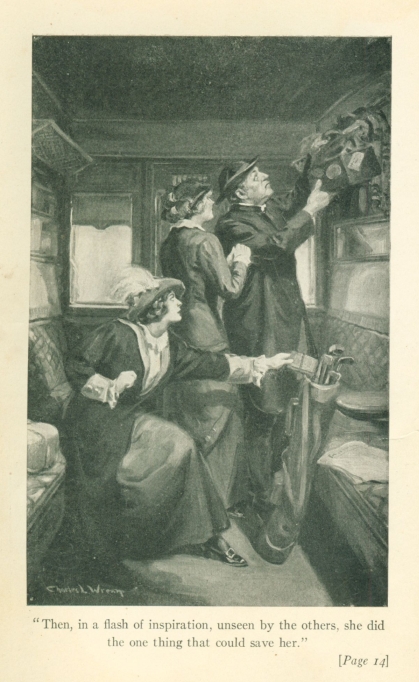
The guard turned the handle of the carriage door and
there came for Hester a moment of sickening despair as
she realized her desperate peril; then, in a flash of
inspiration, unseen by the others, she did the one thing
that could save her: she dropped the bishop's purse into
the open mouth of Betty Thompson's golf bag.
Now the bottom of a golf bag is about the last spot
on earth where anyone would expect to find a missing
purse; yet, as devotees of this sport will agree, a more
admirable place of concealment could scarcely be
imagined. Far down in a jumble of heavy clubs the purse
lies unseen by the keenest eye and beyond reach of the
longest arm. To search the bottom of a golf bag would
involve taking out all the clubs and turning the bag
upside down, but who would do that? Who would go
exploring for stolen treasure in so battered and so
innocently open a receptacle?
All of which, in the first emergency, favored Hester,
but now, with the danger past, made it difficult for her
to carry out her plan. How was she to get the purse?
There it was, almost within reach of her fingers, yet
tantalizingly out of reach. It was maddening to think
that, with so great a prize so nearly won; she might still
lose everything simply because a stupid, flimsy barrier
of canvas and leather stood in her way.
The Storm girl concentrated all her faculties on this
new problem, and thrilled with the exhilaration of a
brilliant coup almost accomplished. There was no more
question of scruples or regrets. She had made the break
and must see the thing through. A rather neat piece of
work so far, but the hardest part remained. The crisis
would come when the train reached London. Good old
Charing Cross Station!
As she studied the situation, searching desperately for
some master move, Hester talked to Betty, letting the
conversation drift as the latter pleased and keeping
sweetly to her attitude of virtue injured but resigned;
also showing the most touching, almost tearful, gratitude
(not all assumed) for Betty's kindness. Glibly she
spun a hard-luck story of loneliness and friendlessness
and the disappointing result of her efforts to be a
nursery governess. Betty was deeply interested, very sorry,
and finally offered her protegé five pounds, which Hester
at first refused, but finally, rather shamefacedly, accepted,
thinking it more in character to do so. She would
certainly send back that five pounds and fifty with it, once
she had gotten safely away with the five thousand.
Yes, but that was the point. How was she going to
do it? How could she get the purse? If she could only
think of something. She must think of something.
There was not a moment to lose. Even now they were
roaring into London city, and—suddenly the inspiration
came—it was a chance, the only chance, and Hester
took it.
Rising from their seats they gathered up their belongings.
The dark-eyed girl slipped over her shoulders a
brilliant red cloak, the red being of so striking a shade
that Betty remembered it afterward. Then very simply
and naturally Hester turned to her benefactress. "Let
me help you with your things. I have only this little
bundle. There!" and without more ado she took the
golf bag.
"Thanks!" smiled Betty. "You must come to see me
while you are in England. I'll give you my card. Well,
here we are!"
With grinding wheels the train drew up in Charing
Cross station, and amid a great slamming of doors the
passengers swarmed out and made their way briskly
down the long platform. Betty went first, explaining to
her friend that, in all probability, no one would meet
her, owing to their change of train, yet searching in the
crowd for some familiar face. Hester searched faces,
too, for she knew that word of the robbery must have
been telegraphed ahead to London, and as they passed
through narrow gates in the iron barrier that separated
the tracks from the station proper her heart was pounding
furiously, although her face showed only a sweet and
trusting smile. No one stopped them here, and with a
sigh of relief Hester followed on, trying to quiet the
rattle of the golf clubs and gradually lagging behind her
eager friend.
Now, just before them, rose the circle of a wide
newsstand, beyond which were two exits, one on either side
of the station. Betty was moving toward the left-hand
exit and here, in a second, Hester saw her opportunity.
Sheltered by the newsstand, she had only to steer quickly
toward the right-hand exit and then, before Betty could
even suspect that she was missing, make her getaway
into the myriad streets of London. It was too easy and
the girl was already gloating over the trick as finally
turned when her heart froze within her, for there at the
corner of the newsstand were the cold gray eyes she
knew so well fixed pitilessly on her. Grimes of
Scotland Yard!
It was a critical moment for Hester. Had she weakened
by the quiver of an eyelash, had she started ever
so slightly, the detective would have taken her there
and then, for he remembered her well and the suspicious
circumstances of that sable cloak episode. But she,
schooled in self-control, swept on serenely without a sign
of recognition. Grimes turned and followed her.
"Caught with the goods," muttered the girl, and faint
with fear but unfaltering, she swung back to the left
in Betty's wake, for here now was her only hope of
safety. Grimes was close behind.
As they reached the street, Betty nodded for a taxicab
and gave her things to a chauffeur, who came forward
eagerly. Then, seating herself on the cushions, she
turned pleasantly to Hester.
"It was good of you to carry that heavy bag. I'll
take it in here—that's right. Remember I'm at the
Savoy for a day or two with Mr. Hiram Baxter. And
here is our address in Surrey. There." And, smiling
most cordially, she gave Hester her card.
"Hiram Baxter! The American millionaire!" reflected
Grimes, puzzled, but still confident.
"You'll come to see me, won't you?" called the fair
young woman as the taxicab rolled away.
"Yes," answered Hester, her dark eyes glowing on the
ravished golf bag. "I'll come."
Then, with quiet self-possession, she turned and her
eyes met Grimes.
"Ah, little one!" he chuckled, roughly familiar.
"How dare you speak to me!" she protested with such
an air of well-bred anger that he drew back, hesitating.
"Excuse me, but—haven't I seen you before?" he
stammered.
Hester swept him with a scornful glance. "I thought
an American lady was safe from insult in the streets of
London," she said, and before he had recovered from
his astonishment she had entered a waiting hansom and
was gone.
Hiram Baxter, whose hidden purposes were
responsible for Betty's sudden and momentous
journey to London, was, in this year of the
first flying machine, one of the few really interesting
self-made men to be found in New York City, where such
sturdy and picturesque types are rapidly disappearing.
At fifty-five Baxter was a big, grizzled fellow, with a
pair of straight shoulders, a friendly smile and a way
of using the English language that was absolutely and
delightfully his own.
"This grammar business ain't much of a trick," he
would declare, with his slow characteristic drawl. "I
could swing it any time I wanted to, but where's the
sense o' wearin' high collars and patent leather boots if
yer neck and yer feet ain't comf'table in 'em? Suppose
I say to you, 'I like them peaches'? You say those
peaches. I say, no, them peaches. You say it's wrong.
I say it don't make a hang o' difference, it don't hurt you
an' it don't hurt me an' it don't hurt the peaches."
Baxter invariably dressed in simple black garments,
including a wide-brimmed soft black hat, that gave him
in repose, with his ruddy, rugged visage, somewhat the
look of an English bishop, as had been more than once
remarked by his episcopal friend of Bunchester.
"It ain't because I like it that I wear black," Hiram
sometimes explained, "and it ain't because I'm sad. The
fact is black's the only safe color fer me if I want a
happy home. Why, if I ever let myself go on colored
vests an' striped pants, an' fancy neckties, my wife'd
start fer a divorce the next mornin'. Yes, sir."
When Hiram laughed his blue eyes twinkled at you
under shaggy black brows and his strong teeth gleamed
at you beneath his white mustache; then, perhaps, he
resembled a bluff German statesman. But as soon
as he spoke you knew he was American through
and through, and, somehow, you thought none the less
of him for his quaint lapses in speech. Not all the rules
of prosody and syntax could alter the fact that Hiram
Baxter was a figure of compelling power, a strongly
original and lovable man, who inspired immediate
confidence in his wonderful resourcefulness.
It was during his recent voyage on the Lusitania, in
the course of a brisk walk on the upper deck, that
Baxter took the Bishop of Bunchester into his confidence
regarding certain serious personal matters. Hiram's
friendship with the bishop was of long standing, for the
American some twenty-eight years before, at the outset
of his varied career, had married an English lady, a
distant connection of the prelate's, and it had long been
the Baxters' custom to divide their year between a
comfortable home in Washington Square, New York, and
a country place in Surrey, about two hours out of
London, where Mrs. Baxter entertained numerous relatives
and friends with lavish hospitality.
"I tell ye, Bish," Hiram broke out abruptly, "it ain't
by a man's successes that ye can size up his character.
No, sir. It's by the mistakes he makes an' the way he
faces 'em and gets out of 'em. Why, I know a doctor
up in New Hampshire—homeliest feller I ever seen—he
got rich makin' cough medicine out o' shingles."
"Bless my soul! Shingles!" the bishop exclaimed.
"Yes, sir; shingles. Good pine shingles. A whole
lumber yard full of 'em. He got 'em in foreclosure
proceedings—hadn't the first notion what to do with them
shingles until he happened to think of cough medicine.
That turned the trick. Ever heard of 'Peck's Peerless
Pectoral'? It was his invention—stewed it out o' them
shingles, every bottle of it; and say, Bish, it's great stuff.
Which is what I call makin' the best of yer mistakes, for
it ain't every country doctor could see his way to snatchin'
victory out of a lot o' discredited pine shingles."
This bit of homely philosophy was received by the
distinguished churchman with amused approval.
"Very true, my dear Baxter, but I don't see how this
applies to you."
"I'll show ye," chortled Hiram. "Ever hear o' the
feller that used to wear detachable cuffs and then went
broke because he bought a shirt that had cuffs sewed on?
No? It's a fact. Ye see he had to get a swell suit to
match the shirt, and a swell fur overcoat to match the
suit, and a swell automobile to match the fur overcoat,
and the first thing he knew he was such a swell he blew
up an' busted."
"What an extraordinary fancy!" exclaimed the bishop,
laughing immoderately.
"Fancy nothing. It's a fact," declared Baxter. "And
I want to tell you I've been a little that way myself.
I've been tryin' to live up to the standards o' my wife
an' my wife's relations. That's where I've made my
mistake. Yes, sir. I'm only a rough feller, Bish,
but—well, I married Eleanor and—you know what she is.
Swell English family and—grand ideas, and—you
understand. D'ye think I'm stuck on havin' a country place
in England? Asbury Park 'd suit me a lot better, but
Eleanor wanted it. She said it was the proper thing
and—so I took Ipping House, with its ancestral
towers and its dungeons and a lot o' blamed foolishness.
Excuse me, Bish, but that's what it is. And as fer
relatives—" he paused with a grim tightening of the lips.
"My dear Baxter," put in the prelate, "you surely do
not regret the old-fashioned English hospitality that you
and your excellent wife have been practicing?"
"Well," drawled Hiram, "if old-fashioned English
hospitality consists in bein' worked in every conceivable
way by a lot of impecunious third cousins that never did
a day's work in their lives, then I say it's time
old-fashioned English hospitality got inoculated with some
new-fashioned American common sense. Why, with Lionel
Fitz Brown, my wife's third cousin, and Kate Clendennin,
the Countess Kate, and the two Merles and various
others, my house is about as much like a home as a
Narragansett hotel. Now take Merle."
"Horatio Merle?" interjected the bishop. "You don't
mean——"
"Yes, I do," continued Baxter, "the Rev. Horatio
Merle, my wife's second cousin once removed. As good
a man as ever thumped a Bible—you know what I mean,
Bish," Hiram added quickly, mistaking for a sign of
disapproval the cough which the reverend auditor had
substituted for a chuckle. "Yes, sir, for a downright,
pure-hearted Christian you might go through the British Isles
with a fine-tooth comb and not find another like Horatio
Merle; but what good does that do him? He's lost five
preachin' jobs in three years, and for the last six months
the only flocks that have had the benefit of his pulpit
oratory have been the birds and butterflies at Bainbridge
Manor. I tell you, Bish, he missed his vocation. He
ought to have been one of them nature sharps."
"I believe you are right," assented the bishop. "Horatio
Merle would have made his mark as a naturalist. I
never knew a man in whom the love of nature was more
beautifully developed. He is a sort of modern
St. Francis."
"Modern St. Francis," snorted Hiram. "I don't know
who he was, but if he could beat Horatio Merle——"
he broke off with a broad grin. "Say, Bish, did ye hear
how Horatio lost his last preachin' job?"
"Why, no. How was that?"
"Seems he was goin' to church one Sunday mornin',
and passin' by the canal he saw some boys tryin' to
drown a kitten. They'd just hitched a stone around its
neck when Merle caught sight of 'em.
"'You young rascals,' he called out, but he was too
late, and the next minute the poor little thing splashed
into the water. Well, sir, that was too much for
Horatio. He knew the church folks were waitin' for him,
but he couldn't help it. He just waded into that canal,
black clothes and all, and fished out the kitten. Then he
went ahead with his religious duties while the water
dripped down under his robes and the congregation
made up their minds that he was plumb crazy."
"Poor Merle!" reflected the bishop. "And what
became of the kitten?"
"Why, he's got him yet. A big black cat now. Martin
Luther's his name, and wherever Merle goes there's
Martin Luther taggin' after him like Mary's little lamb.
Understand, Bish, I like Merle; I like to have him
'round. As far as that goes I like the rest of 'em,
but——" Here his face clouded.
"My dear Baxter," said the bishop sympathetically,
"I understand these little family annoyances, but after
all you're a rich man and——"
"Yes," cut in Hiram, "I'm a rich man, and if I don't
look out I'll wake up some fine morning and find
myself"—here the fighting spirit flashed in Hiram's honest
blue eyes, and with a swing of his powerful shoulders—"no,
I won't, either," he added. "I'll beat those Wall
Street devils yet; I'll beat 'em at their own game."
Then Baxter, in strict confidence, explained to the
bishop the nature of the difficulties in which he
innocently found himself, difficulties that put in jeopardy
every dollar of his fortune and with it the happiness and
welfare of his family.
The prelate followed this narrative with sympathetic
interest and concern, and then listened with growing
astonishment while Baxter outlined briefly his
programme, which, after all, was based on a very simple
idea, yet was so unusual that the average person would
have at once rejected it as impossible.
Thus the bishop at once objected: "But, my good
friend, this is out of the question, quite out of the
question."
"Why is it?" persisted Hiram.
"For one thing your wife will never consent."
"Won't she? You wait and see."
"For another thing I feel obliged to say——"
"You feel obliged to say," chuckled Baxter, "that it's
a crazy notion. Bet ye four dollars and a quarter that's
what ye think. But listen to me, Bish. I've made my
fortune doin' crazy things. Once I bought three
thousand plug hats at auction in Chicago fer eight hundred
dollars, an' I sold 'em at dollar apiece in Denver for a
political parade. I've bought busted railroads and
watched 'em come up to par. I've bought played-out
oil wells an' made 'em spout gold. Why, I even bought
an old church once with a haunted graveyard and got
square on the marble in it, with all the land as velvet."
"Dear, dear, dear! A haunted graveyard?" murmured
the bishop.
"Yes, sir; and I'll put this thing through the same as
I did that, because it's a good idea. A big, sound,
American idea. Now you just watch me."
One immediate consequence of the golf-bag-purse-vanishing
episode narrated above, was a delay
of two hours in Betty Thompson's arrival in
London, which delay meant that Hiram Baxter and his
wife, having waited vainly at Charing Cross station for
the expected traveler, had now returned, quite out of
sorts, especially Mrs. Baxter, to their rooms at the Savoy
Hotel.
"I think it's very inconsiderate of Betty to be so careless
about her trains. You wired her, didn't you?" said
the wife as she stood before a cheval glass preparatory
to removing a new and very large green velvet picture
hat, with gold-brown plumes and drooping brim. Beneath
this effective covering her hair was discreetly shadowed,
her eyes, if they were calculating, seemed only
pensive, and the pouting of her mouth was transformed
to an expression of winsome pleading—so much for the
wizardry of a woman's hat.
As she stood before the mirror Mrs. Baxter's half-turned
face wore that sidelong, disquieted look with
which a woman always regards her newest hat, half
pleasure of possession and half regret for that other
hat, the one in the shop that she did not buy and whose
fetching colors and enticing lines have ever since haunted
her. A pleasing panel picture she made in the black
framed oval of the cheval glass, a harmony in green and
golden brown. Boldini might have painted that mirror
picture of Eleanor Baxter. She was a harmony of
insincerities, a woman who seemed to have youth and
height and slenderness, but who really had none of these.
This, however, was a secret between Mrs. Baxter and
her looking-glass.
"I wired her all right," answered Hiram.
"It quite upsets my plans," complained Eleanor. "Of
course I was glad to come to town yesterday, dear, to
meet you when you arrived from the steamer, but it's
most annoying to be kept in London now. All the
relatives are expecting you, Hiram."
"Are, eh? How many of 'em?"
"Only Cousin Harriet and Cousin Horatio and Cousin
Lionel and the countess. The dear baroness left
yesterday. I'm sorry she couldn't stay to see you."
"Yes, it's a pity the dear baroness couldn't stay to see
me," said Hiram dryly.
"I'm glad we won't miss the bazaar to-morrow afternoon,"
Eleanor rattled on; "the Progressive Mothers'
bazaar. You know Cousin Horatio delivers the address,
and I want you particularly to be there, Hiram."
Baxter nodded thoughtfully. "I suppose so." Then
his face gradually broke into a smile. "Progressive
Mothers! Say, can ye beat that? I always thought
old-fashioned mothers were about right, but the Bish
says——"
"Hiram! Please do be more careful of your
language!" Eleanor's voice was petulant.
"Oh, I see! It ain't the thing to call old Bunchester,
Bish. All right, dearie. What I started to say was that
his Lordship o' Bunchester tells me we ain't begun to
hear the last word yet in the matter o' raisin' children.
He got five hundred out o' me—I mean dollars."
By this time Mrs. Baxter had composed herself in a
comfortable arm-chair, and, having nothing else to do,
was studying her husband critically.
"You look tired, Hiram," she decided.
"I'm tired, all right," he nodded.
"You look worried, too."
The big fellow reflected a moment and then said
slowly: "Well, I admit I'll feel better when I see
Independent Copper about twenty points higher."
Mrs. Baxter eyed him keenly. "Nothing has happened?
Nothing is wrong?" she asked with growing
alarm.
For a few moments Hiram sat silent, then closing his
lips with decision, he answered kindly: "Eleanor, I
guess ye'll have to know exactly how things are. Since
we've been married, and that's a good many years, I've
done my best to make ye happy. I've tried to give ye
everything ye wanted. I never thought the time would
come, dearie, when I'd have to ask ye to economize,
but——"
He hesitated while she listened with widening, startled
eyes.
"Hiram!" she gasped.
He bowed with a slow impressiveness that struck terror
into her worldly soul. "I'm awful sorry, but the time
has come."
"Economize!" repeated Eleanor in a daze. "It isn't
possible."
Again Hiram nodded. "Yes, it is. I'm pretty well
tied up with the obligations I've undertaken, and—dearie,
we've got to economize."
"Oh, if you had only kept out of this copper speculation!"
she lamented.
"I couldn't keep out. You knew I couldn't. Bryce
Thompson was my partner, my friend, and—he's dead.
I ain't goin' to have any slur on his memory. I've
paid his debts, dollar fer dollar, and I'm carryin' his
copper stock. Bryce made a mistake, but he meant well.
He did it fer his daughter, Betty, and"—here Baxter's
voice grew tender as he saw Eleanor's distress—"don't
you worry, little woman, we'll come out o' this copper
fight on top."
These comforting words seemed only to arouse a
sharper resentment in Mrs. Baxter, who turned on her
husband angrily. "Meantime, our whole household must
be upset, and—we must economize. I suppose you're
going to discharge some of the servants?"
Hiram answered with his most winning smile: "Say,
ye guessed it the first time. We've got a dozen servants
up at Ipping House, and I believe five could do the
work just as well—or better."
"Absurd!"
"Bet ye seven dollars and a quarter five servants could
do the work if we cut out some o' your relatives."
"You needn't say they're all my relatives. How about
Betty Thompson? She's more extravagant than any of
the others."
"Bet ye she'll be the first one to take her coat off and
hustle—when she knows."
Eleanor's lips tightened for another indignant outburst,
but, by a great effort, she controlled herself and
spoke with her most irritating manner of lofty
disapproval: "Hiram! I wish you wouldn't use that vulgar
American word."
Baxter stroked his chin thoughtfully under his white
mustache. "Think it's vulgar, eh? The English aristocracy
think it's vulgar to hustle, but tell me where the
English aristocracy would be if it wasn't for the dollars
that American fellers like me have hustled for?"
At this juncture Eleanor's maid appeared with word
that Miss Betty Thompson had arrived and had gone to
her apartment, which, it appeared, did not please her.
She wanted a sitting-room overlooking the Thames,
whereas this one opened on a court-yard.
"Tell Miss Thompson I'll see her in a moment," said
Mrs. Baxter. Then, when the maid had gone: "There!
You see Mistress Betty must have the most expensive
rooms in the hotel."
"Well, why not?" retorted Baxter. "She thinks she's
a rich girl and can afford 'em." He sat looking thoughtfully
at his big strong hands while Eleanor rose to go.
"I hate to tell her, but—I s'pose I must."
"Of course you must tell her. You should have told
her long ago."
"Perhaps. But—remember, Eleanor, not a word about
her father's speculations." He spoke with sudden
authority.
"I don't see why Betty Thompson shouldn't know the
truth about her father. Why should she be spared any
more than the rest of us?"
"Because I say so," answered Baxter, with a glance
from under his heavy brows that his wife had rarely
seen. "It would make her unhappy and it wouldn't do
any good." Then in a low tone and with sudden
tenderness he added: "Ye know who Betty makes me think
of, dearie? Of our little sunshine girl that's—that's
gone. She's got the same eyes and—the same pretty
ways, and—say, I wish ye'd send Betty in here, I want
to talk to her."
Eleanor looked at her husband without replying, and
something changed in her face—something beyond the
wizardry of any picture hat to conceal. Then, quietly,
she gathered up her things and left the room. And a
few minutes later Betty Thompson appeared, a radiant
vision of youth and sweetness that brought joy to old
Baxter's heart.
"Why, Betty!" he exclaimed, stretching out both his
hands, and she came to him quickly, her eyes shining
with fondness.
"Dear Guardy! I'm so glad to see you," she murmured,
as he held her in his strong arms and deepened
the roses of her cheeks with two vigorous and
affectionate smacks.
"Ain't too big fer an old fellow like me to kiss, are
ye?"
Then he held her off at arm's length and admired her
lovely, eager face, and her slender, lithe figure in its
garb of Paris finery. "Well, well! Yer the real thing,
ain't ye?"
Betty's eyes danced with pleasure. "Do you like this
frock, Guardy?"
With wise nods of wondering approval Hiram studied
Paquin's exquisitely suave creation of amethyst gray
velvet, with its narrow trimming of black fox. Thrown
carelessly over the girl's shoulders was a chiffon scarf of
cobweb thinness, marvelously shaded from jonquil yellow
to rosy pomegranate. And Betty's burnished brown
hair melted glowingly into the purple lining of her white
brimmed leghorn hat, with its knot of pale mauve pansies
and its tossing topaz plume.
Hiram nodded in approval. "Like the frock and like
the girl inside it. Sit down and tell me about things.
How d'ye come to be so late? Miss yer train, or—what?"
"Why, we had an adventure," laughed Betty, "a most
exciting adventure. Everything went well until we
reached Chatham Junction. The bishop was perfectly
lovely. He talked of all sorts of things, especially golf.
I happened to have my golf bag with me and—you know,
he's a great golfer."
"I know," said Baxter. "It gets me how many o'
these brainy men like to waste time battin' them foolish
little balls around a field. Guess I'll have to tackle it
myself one o' these days. Well, what was the adventure?"
Betty's face grew serious, and she described, as clearly
as she could, the bishop's misfortune on the train.
"Five thousand pounds!" exclaimed Hiram. "Well,
well! Poor old Bish! Ain't that a shame?"
"There was a young woman in the carriage with us,"
went on Betty, "such an interesting face—rather foreign
looking, and, when the bishop found that his purse was
gone, he called the guard and the guard called the police
and—they insisted on searching this young woman. I
was so sorry. I knew she was innocent, and sure enough
she was."
"How d'ye know she was innocent?"
"I could see it. She had large, dark eyes, so appealing
and—she told me a most pathetic story afterward—and—why
do you smile, Guardy?"
"I s'pose ye gave her all the money ye had with ye?"
chuckled Baxter.
"I couldn't give her very much. I only had five
pounds," answered the young American, her dignity
somewhat ruffled.
"Hm! And ye gave her that?"
"Why, yes. I'm going to send her more. I take a
great interest in that girl."
"Do, eh? Well, I wouldn't send her any more money.
I wouldn't do it, Betty."
There was something in her guardian's tone that made
Miss Thompson look at him in surprise and vague
apprehension.
"Why not?" she asked.
"I guess you an' me'd better have a little talk, Betty,"
said Baxter kindly. "Ye remember I wrote ye a couple
o' times about yer expenses in Paris and ye sent me
back some pretty sharp opinions, the gist of it bein' that
ye wanted to spend yer money accordin' to yer own
ideas."
"Why shouldn't I? Father left me the money and I'm
spending it in a way that he would approve of."
A sharp note sounded in her voice, but Hiram
answered with unchanging gentleness. "I know, Betty,
Bryce Thompson would have approved of your goin' to
the South Pole to pick strawberries, if ye wanted to.
He couldn't refuse ye a thing, he never did refuse ye;
but I've been left your guardian, Betty, and it's my
duty to tell ye that our present state o' finances don't
justify givin' away five-pound notes to strange women
ye meet on railway trains."
"I'd rather give my money to unfortunate girls who've
never had a chance," retorted Betty with increasing
spirit, "than—than to gamble it away in Wall Street!"
"Is that a little friendly jab at me?"
Betty tried vainly to control her emotion. "You've
always been so good to me, Guardy, so considerate that
I hate to say anything unkind, but I read the papers
and—I understand more than you think about business."
"Do, eh? Such as—what?"
"I know there's a fight going on between two copper
companies and—and you're in it, aren't you?"
Baxter smiled grimly. "I guess I'm in it, all right."
"And one company or the other may be ruined. Isn't
that true?"
"Well," drawled her guardian, "I guess one comp'ny
or the other's liable to find out that the thing they've
been monkeyin' with ain't precisely a Sunday school
picnic."
Betty's face was tense now with the earnestness of
her convictions. "You may think me foolish, and perhaps
I shouldn't say this, but Guardy, I don't approve
of your using father's money like that."
"Don't, eh?" grunted Hiram, then rising from his
chair, he walked back and forth with frowns and queer
little nods of his massive head. Presently his face
cleared and, stopping before Betty, he laid an affectionate
hand on her shoulder.
"Child, it looks as if I'll have to explain a few things
to you," he said, "that I didn't mean to talk about. You
say ye don't approve of speculatin' in Wall Street.
Neither do I. I got into this copper campaign because—well,
it ain't exactly my fault and—anyhow, there are
times when a man's got to fight fer his life. It's that
way with me just now. As to usin' yer father's
money——" He hesitated before the steady challenge of
her waiting eyes. "Bryce Thompson and I were partners
in business for twenty-five years. He was my best
friend and—ye know I wouldn't breathe a word against
his memory?"
"I know," said the girl. "Go on."
"Betty, yer father didn't leave any money." He spoke
tenderly but firmly.
In a dull way she repeated the words. "He—he didn't
leave any—money." Her voice trailed off into sickening
silence.
"Ye know how generous yer father was and—he
made unfortunate investments and—when his estate was
settled up there wasn't anything left."
"Nothing left!" she murmured, then rousing herself
as a new thought came. "But—all this money that
you've been sending me?"
"I was glad to do it, Betty."
"It wasn't my money? I had no right to it? Oh!" She
stared at him helplessly as the full realization broke
upon her.
"I'd never have mentioned it, only——"
"You should have told me long ago. I'm so—sorry
and ashamed."
"There, now! It's all right!" He took her two slim
hands in his and patted them kindly.
"You've sent me thousands of dollars. I can never
pay it back."
"Ye don't have to pay it back."
"But—why did you do it? Why?"
"I'll tell ye why," answered Hiram thoughtfully. "Because
I loved yer father, that's one reason, and another
is I—I've always loved you, Betty, ever since ye was
little."
"Guardy!" she whispered tenderly. "But you must see
that——"
"Wait, Betty! The bookkeepin' of life is a queer
thing. Ye don't have to make the deservin' column and
the lovin' column balance. When ye love ye don't give
things because ye owe 'em; ye don't use a scale or a
measurin' cup, ye just give and give, and ye can't give
enough—because ye love."
The girl's eyes filled with tears; she tried to speak,
but the words choked in her throat.
"It ain't only because yer a sweet, plucky girl that I've
loved ye," he went on. "It's because ye make me think
of——" there was a break in his voice. "Ye know,
we had a little girl once and—we lost her. She
was only three years old when she—went away. That
ain't very old, is it? But, say, she had the cinches
around our hearts all right! I can see her now, in
her blue dress, with her little hands full o' flowers.
She had eyes like yours, Betty, and a pretty way—like
yours and——" the grim, old fellow stopped and
wiped his eyes. "Well, I guess ye understand now
why I'd do 'most anything in the world to make you
happy."
"I've been so foolish, so extravagant," she murmured
in distressed self-reproach.
"Not a bit! All I want ye to do is to ease up a few
notches until——"
"And you've been hard pressed for money. Oh, if I
could only help you! I will help you. I'll work. Yes,
I mean it. I can earn money with my singing and—besides,
I'm practical. I can use a typewriter—I could
be your secretary, Guardy. I'm sure I could. Would
you let me try? Please let me."
"Holy cats!" exclaimed Baxter. "Is there anything an
American girl won't think of? I'm proud of ye, Betty,
fer wantin' to do it, but it ain't necessary. You just
stay with us like one of the family."
"No, no! There are too many staying with you like
one of the family. I'm going to be your secretary, that
is," her face fell, "unless you have one already?"
"I had one in New York, but I didn't bring her over
because—the fact is, there was a leak in the office
and—I fired her."
"Then you need some one to help you?" cried Betty
eagerly. "And I do know about business—at least I
can learn and—I can do what I'm told. Please, Guardy."
Betty's whole soul was in the words and, for many
a day, Hiram Baxter remembered the loving radiance
that illumined her face as she held out her hands in a
sweet impulse to help.
"Yer a little thoroughbred, all right," he reflected.
"And I could trust ye. That's a whole lot more'n I can
say of the last one. Hm!"
He reflected a moment, and then, holding out his hand
with a cheery smile: "Betty, yer my kind! Yer Bryce
Thompson's daughter! There! I don't mind tellin' ye
this fits in with a plan I had and—yes, ye can try it. Ye
can be my secretary. Say, won't that shame the relatives?"
Thus they settled upon an arrangement that was destined
to have important consequences.
This night they spent in town for the pleasure of a
theatre, and the next morning Betty passed in a flutter
of hurried preparations, for she suddenly realized that
one of her Paquin gowns was not the most suitable
garment for a serious-minded secretary to be wearing when
she arrived at the scene of her duties. There was no
reason why she should give Mrs. Baxter's relatives (who
did not know her, thank heaven) the satisfaction of
realizing, by any outward sign, how complete was the
downfall of poor Betty Thompson. So she hurried into
her plainest black frock, a very chic creation,
nevertheless, and was waiting demurely in the taxicab when
Hiram and his wife appeared.
And now, just as they were starting for the station,
there came a long distance telephone message for
Baxter, something important, the operator said.
"Who d'ye s'pose it was, Eleanor?" beamed Hiram a
few moments later, as he hurried back. "Ye'll have to
get a move on, friend," he warned the driver, as they
shot away.
"The Baroness Dunwoodie?" guessed Mrs. Baxter.
"The Bishop of Bunchester?" guessed Betty.
"Wrong, both of ye." Then he turned to his wife with
a happy smile. "Dearie, it's Bob."
"Bob!" exclaimed the mother.
"Bob Baxter, sure as guns!"
"But Bob is in New York? You left him there?"
"I left him there, but he didn't stay there. He jumped
on the Lusitania the day after I sailed on the Olympic
and they nearly beat us in. He came right across from
Liverpool and he's up at Ipping House this minute.
Wanted to know if he should come to town and I said
we were on our way back and to wait where he was."
"My boy!" murmured Mrs. Baxter, and not all the
picture hats in Piccadilly could give her the look of joy
that her face wore now.
"Seems Bob found trouble in the office that he couldn't
write about, so he just came over." The old fellow
turned to Betty. "I told ye there was a leak in that
New York office."
It was not until they were seated in the train that
Eleanor was enlightened as to Miss Thompson's new
purpose.
"Mr. Baxter's secretary? It's absurd!" she declared.
"Please don't say that, Mrs. Baxter," pleaded Betty.
"I've only just found out about—Father and—I couldn't
respect myself if I just did nothing and let Mr. Baxter
support me."
"There's the American spirit for ye," approved Hiram.
The train rushed on and presently, as happens in
railway journeys, the three lapsed into silence. Hiram
thought of his business worries and of his plan for
solving the problem of the relatives; Eleanor thought of her
son, and Betty thought of various things. Poor child,
she had enough to think of! What a sad awakening
after all her bright dreams! She wondered who would
live now in her lovely Paris apartment that would never
be hers again. Who would stand of summer evenings,
as she had stood so often, on the balcony outside her
bedroom and watch the swallows circling over the chestnut
trees on the Champs Élysêes? Perhaps she would
never see Paris again!
Then she thought of Bob Baxter, the playmate of her
childhood, whom she had not seen for years and years,
not since she was a little thing with yellow braids down
her back and freckles on her nose. A homely little thing,
they always said. She wondered if Bob remembered her
as a homely little thing. Perhaps he did not remember
her at all.
She turned toward the fleeing landscape and, in the
window, caught the reflection of her own lovely face.
Miss Betty Thompson, if you please, a poor dependent,
a drudging secretary! It was sickening, maddening; she
could not bear it. And then, through the torture of her
thoughts, came tripping brightly a whimsical fancy that
brought back the laughter to her eyes. And the laughing
eyes in the window seemed to say: "How could he possibly
remember you?"
"Guardy," she asked softly, "would you do something
for me?"
"Sure I would," said Hiram.
"Even if it seems silly—just to make me happy?"
Baxter nodded his big head slowly. "Try me, little
girl."
"You said it would shame the relatives—what I am
going to do?"
"It will—you bet it will—when they know."
"But I don't want them to know. That's the point.
It isn't any snobbish reason. I'm not ashamed of
working, but——" She threw all her feminine power into
one swift, bewitching appeal. "Guardy, I don't want
them to know that I am Betty Thompson. I don't want
anyone to know it except you and Mrs. Baxter. Please
let me have my way. Let me just be your new
secretary, Miss—er—I'll take some other name."
"No, no, I won't stand fer any fake name. Take yer
own name. I'll introduce ye as Miss Thompson, my new
secretary. They'll never suspect that yer Betty
Thompson."
"But some of the relatives will be sure to know you,"
objected Eleanor.
"The relatives have never seen me," said Betty.
"Bob has seen you."
"Not since I was ten years old—that's eleven years
ago. Was I terribly homely, Mrs. Baxter?"
"Well, my dear, you were by no means a beauty."
"You certainly have changed," put in Hiram admiringly.
"Thank you, Guardy. Then it's all settled. I'm to
be the new secretary, Miss Thompson? Not Miss
Thompson, the new secretary—you see, there's a difference.
Is it a bargain?" she asked, giving them her two
hands, while a mischievous light danced in her eyes. "Is
it? You don't mind, do you? I'll work, I'll do anything,
but I want your promise that I'm going to be the new
secretary, Miss Thompson."
"I give ye my promise," said Baxter, and he held out
his big hand, which she first patted affectionately and
then hugged in her warm, white palms.
"And you?" Betty turned to Eleanor. "Please! Perhaps
we'll only keep it up for a few days?"
"What a tease!" laughed Eleanor. "Very well, Miss
Thompson, I give my promise."
And so it was arranged.
It was half-past four when they reached the little station,
where guests for Ipping House left the train. Betty's
heart beat with excitement and surprise as a splendid
looking young fellow, tall and broad-shouldered, came
forward to meet them.
"Bob!" "Mother!" "Dad!" came the quick, happy
cries and then, after an awkward moment, the young
American was presented to Betty.
"Bob, I want ye to know my new secretary, Miss
Thompson," said Hiram, in a matter-of-fact tone.
"Miss Thompson!"
"Mr. Baxter!"
Their eyes met and that first quick scrutiny brought
an impression, a swift sensation that neither ever forgot.
After seeing the ladies comfortably disposed in the
tonneau, Hiram climbed into the front seat beside his
son and the car, after a preliminary fit of monstrous
ague, leaped forward with a dragon-like snort and
swiftly rounded the grass-bordered flower-bed where the
ambitious station master had spelled the name of
Ippingford in sprawling and almost illegible nasturtiums.
A blur of whitish gray varied with deep green and
momentary splashes of every possible rose color was all
Betty saw of the village street. For a fraction of a
second her eyes caught and held the fantastic image of
a cat on a swinging sign—A Blue Cat—with golden
feet, or were they golden boots? Before her mind had
pieced the picture together the little tavern was left far
behind. Now they were gliding swiftly and silently,
save for the murmur of the motor, through a shimmering
twilight of moss-grown beeches and ivy-covered
oaks, where high hawthorn hedges shadowed miniature
jungles of interlacing leaves and ferns and nestling
flowers. Like a blue-green tapestry it shut them in on either
side. Only as the car slowed for an instant when rounding
a corner could one make out a detail of harebell,
foxglove, wild rose, or honeysuckle. It was Betty's first
sight of a rambling English lane, and her mind flew
back to the stolid French country roads lined with staid,
orderly poplars.
"This is mad, quite mad, by comparison," she said to
herself, "but exquisitely mad like Ophelia." Then aloud
to Mrs. Baxter, as she leaned back: "How cozy they
are, these English lanes!"
Now they were speeding down a narrow green alley,
where the hawthorn hedges met overhead and the sound
was as if they were going through a tunnel. Mrs. Baxter
did not hear, but she nodded and smiled to save
Betty from the necessity of shouting.
Betty sat directly behind Mr. Baxter at the other side
of the car from Bob, and, though she could study him
unobserved, she had, after the first shock of meeting,
avoided looking at him. She had wanted to be alone—quite,
quite alone. She wanted to think it all over, to
reconstruct herself, as it were, to adjust herself to this
new, this totally unexpected edition of her old playmate.
So she had welcomed the distraction of this intoxicating
beauty that swam past her in the golden midsummer
haze.
If it did not leave her to herself, at least it took her
away from this Bob, this disturbing giant, with his broad
shoulders bent forward easily in the business of steering,
and who now, at last, held her eyes and would not let
them go. Not even the wild roses could drag her glance
away, and they continued their mad backward race with
the foxgloves and ferns and harebells and honeysuckle,
all unobserved by Miss Betty Thompson.
And presently she found herself waiting for the
moment when he would turn again to speak to his father,
when she would once more see his profile. Something
Hiram Baxter had just said caused Bob to laugh as he
lifted his head, and Betty laughed aloud for sheer
sympathy. A moment before Bob had been frowning and,
with the heavy Baxter eyebrows and pugnacious jaw,
unrelieved by the regularly modeled features of his
handsome father, Bob's face in repose only just missed being
plain, just missed it, Betty thought, by that miss that is
as good as a mile. And now when he laughed every
feature, every line of his honest face seemed to
collaborate in the expression of irresistible mirth.
They were turning in at the park gate of Ipping House.
For a moment the car came to a standstill, chuttering
impatiently while a small, apple-faced child, a little girl
with reddish hair and wondering eyes, who had watched
their approach from the steps of the lodge, swung the
iron gate slowly open.
As the car lunged forward again Betty gave a backward
look along the shaded roadway. The figure of a
young woman in a scarlet cloak, slim, dark, foreign
looking, a gypsy, perhaps, was standing in the shadow at a
turn of the road watching them intently. The next
instant she had disappeared among the trees. It happened
so quickly that, as the iron gate clanged behind them,
the scarlet of the girl's cloak was all that Betty's mind
retained of the instantaneous picture. It was a peculiar
shade of scarlet. Where had she seen it before?
In order to make it clear how Hester of the scarlet
cloak (for it was she) happened to be waiting at
the lodge gate on the evening of Betty Thompson's
arrival, we must go back a little and consider the
activities of the Reverend Horatio Merle during the previous
twenty-four hours.
It was on the morning of the day preceding Hiram
Baxter's return and the curate and his wife were lingering
over their matutinal repast in the sunny breakfast
room of Ipping House. A nice little clerical man,
a pink and puffy little woman; he with finely drawn
features and thin side whiskers, she with alert, almost
domineering, eyes.
"Good gracious!" cried Mrs. Merle, looking up from
the newspaper. "Just listen to this, Horatio!"
"I am listening, my dear," said Horatio, carefully
replacing in its Dresden cup the egg which had been doing
preliminary duty as a hand warmer, clasped between his
devotional palms.
But Harriet Merle with the self-absorption of newspaper
monopolists was now reading rapidly half aloud
half to herself with tantalizing incoherence—"first-class
carriage—inside pocket—five thousand pounds—progressive
mothers—thoroughly searched—Bishop of Bunchester."
"That accounts for it," she said at last, laying down
the newspaper. "That explains it," repeated Harriet.
"Explains what? What is it all about?" queried her
husband, nervously adjusting his eyeglasses, which magnified
to an almost goblin intensity the note of interrogation
in his pale blue eyes.
Harriet briefly recapitulated the startling news of the
stolen purse, to a running accompaniment of "Tut
tut!"—"Bless my soul!"—"Well, I never!" from her
astonished spouse, who straightway begged to see the
newspaper for himself and, with fascinated interest, studied
the details of the robbery.
"Clever piece of work," the curate muttered. "Looks
like a high-class crook." And his eyes went off into
space.
"A crook? Horatio! What do you mean?"
"Nothing, my dear! Nothing!" he assured her with
a guilty look, for the truth was this mild-mannered
clergyman adored detective mysteries and in his secret
chamber had devoured numbers of them.
"Now you see, Horatio, the bishop will be detained in
London over Friday, and as Dr. Dibble is laid up with
his throat, that is why the Progressive Mothers have
asked you to deliver the address at the opening of the
bazaar."
"Dear, dear!" sighed Horatio, ignoring the all-important
matter of the address. "Such a large sum, such
an incredible sum! Fancy losing anything so huge as
five thousand pounds!" he smiled at the thought. "It's
like—it's like the musician who lost a bass drum in a
hansom cab. Now if it were five shillings, or even five
pounds, I could really sympathize; and, speaking of
sympathy, Harriet, I think I will go to the rectory this
morning and see if there is anything I can do for poor
Dr. Dibble."
"You'll do nothing of the kind." Harriet had finished
her breakfast and now rose majestically to her full
height of five feet three inches (including her marceled
pompadour and military heels). "You'll go straight to
your room and write your Progressive Mothers' address.
You may make light of our poverty and the humiliating
dependence it entails on the hospitality of my cousin,
Hiram——"
"Second cousin-in-law," gently corrected Horatio.
She swept the interruption aside. "You may even
scoff at my relationship to Cousin Eleanor, but you
shall not make light of this opportunity. It is not
only an honor, Horatio, but there is also a——" Harriet
hesitated.
"Honorarium?" suggested her husband.
She nodded. "I don't know how much, but we cannot
afford to ignore it, and, besides, there is no knowing
what it may lead to. Poor, dear Dr. Dibble must be in
his eighties, and another of these attacks——"
Horatio raised a hand in protest. "My dear, I beg
of you not to impute such mercenary motives to my
anxiety about Dr. Dibble's health."
But Harriet was not listening, she was gazing with an
expression of horror at Horatio's outstretched hand.
"Horatio!" she exclaimed.
He examined the back of his two hands, then turned
them over and held them out with the air of a schoolboy
expecting to be scolded.
"I assure you, my dear, I scrubbed them with all my
might, but the water was so cold, so very cold," he
shivered at the recollection.
Harriet shook her head. "It isn't that," she said.
"Then what is it, my dear? This suspense is killing
me."
"Your cuffs, Horatio."
Her voice had in it a note of anguish. For the moment
all the pitiful makeshifts of the last few months,
ever since Horatio resigned from his last pulpit, and
their present dependence on the bounty of a distant
relative, seemed to find concentrated expression on Horatio's
frayed cuffs. Harriet was on the verge of tears.
"Come to your room," she said. "I will get my scissors."
They paused at the first landing of the long oak staircase,
Harriet for breath, Horatio for Harriet.
"I wish you thought more of your appearance, Horatio,"
she panted. "Cousin Hiram, though he is only an
American, is so particular about his shirts."
"If I had Cousin Hiram's money I might——"
"No, you wouldn't, Horatio. You'd spend it all on
charities and Angora cats and—mechanical toys," she
added indignantly.
"And real lace dresses for my old Dutch," laughed
Horatio, putting his arm around her, "and satin slippers
like the Countess Kate's."
"The countess!" snapped Harriet.
Horatio felt her shrug of aversion at the mention of
Kate Clendennin's name. He knew what Harriet was
thinking, knew what she would say if she spoke. Kate
had something no woman of forty-nine can forgive: she
had youth. Kate had other things equally unforgivable,
things that went with youth and satin slippers, and a
title—a title after all is a title even if it is only a German
title, and Harriet classed German titles in a vague
category with German silver, German measles, cousins
German, and—Germans!
"They're coming now," said Horatio, interrupting her
thoughts.
"What? Who?"
"The satin slippers," he repeated in a stage whisper
and pointed upward. His choice of words moved even
Harriet to reluctant mirth, for the countess had put on
heavy walking boots, and the sound of them now descending
the uncarpeted oak stairs was anything but satin.
Kate Clendennin paused a moment in her downward
flight to exchange the usual morning insincerities. She
was a splendid specimen of British young womanhood,
with her dark, well-behaved hair and gray-green eyes,
capitally set off by a gray tweed walking suit. Harriet
regarded her resentfully. What right had Kate to the
complexion of an early riser when she always breakfasted
in bed, and to the figure of Artemis when she never set
foot to the ground if there were a horse or an automobile
in sight?
"Ah! I hope you slept well," said Mrs. Merle.
The countess smothered a yawn with a tan glove. "I
really don't know; I'm not awake yet." She was thinking,
"What an odd little couple they are, these two, this
pink-and-white cockatoo lady in the faded purple morning
gown, and this little gray mouse in the black velvet
coat."
"Is Mr. Fitz Brown down yet?" they heard her call to
Parker a moment later, as she disappeared into the
breakfast room. "Tell Anton we shall want the motor."
"It's perfectly shameful the way those two abuse dear
Cousin Hiram's kindness," grumbled Harriet. "They've
had the car every day this week."
The Merles were now standing in Horatio's study near
a window overlooking the conservatory. For a moment
there was silence, broken only by the gnashing of the
tiny scissors. The operation of cuff trimming is a
delicate one, requiring skill and steadiness of hand. The
deviation of a thread's breadth by those sharp little
scissors might be fatal to the cuff, might even endanger
the life of the shirt.
"I have always maintained," the curate remarked, "that
surgery is a science for which women are by nature
peculiarly——"
"The other hand, please," interrupted Harriet shortly.
She was annoyed by Horatio's avoidance of her pet
subject of discussion. It was his cue here to say: "If
Lionel and Kate abuse Cousin Hiram's hospitality, why,
so do we." To which she would reply: "That is different,
Horatio; we are relatives of Eleanor Baxter." And
he would say: "So are they, Harriet." And she
would answer, contemptuously: "They are third
cousins." Then Horatio would say: "Yes?" He had a
particularly irritating way of saying "Yes?" And, if
Harriet weathered this irritation sufficiently to answer
she would generally sweep out of the discussion with,
"You know perfectly well, Horatio, that people like the
Baxters consider being second cousins to such a family
as mine a very close relationship."
In her secret heart Harriet knew that Horatio was
right, but she had never admitted it and never would.
There was no knowing how Horatio would follow up
such a victory. Suppose he insisted on their bringing
their visit to an end. It was not to be thought of!
Their money was all gone, they had no other relatives.
What would become of them?
"There!" she said at length, surveying the completed
cuff. "That's better. Now you must get to work on the
address."
Harriet replaced the scissors in a silver sheath that
hung from her chatelaine at her side. At the door she
turned with a look the curate knew well. "You will find
everything you need, Horatio, and I will see that you
are not disturbed."
The door closed with a subdued but ominous after-click.
Horatio stood listening until the sound of his wife's
footsteps had died away, then, tiptoeing quietly across
the floor, he turned the knob cautiously and pulled. Alas!
There was no mistake. Harriet had locked him in. He
was a prisoner in his own room.
"Strange," he reflected, "that the change of only a
quarter of an inch in the position of a minute piece of
metal in a door should transform into a gloomy dungeon
cell what, only one moment before, was a comfortable
study, with its inviting easy chair, its reposeful sofa,
and——"
He looked quickly, smitten by a sudden dread. It was
as he feared—the easy chair was gone, the sofa, too, had
been taken away, and there, grimly awaiting him on the
table, were a solemn row of dark policeman-like books,
Cruden's "Concordance," Roget's "Thesaurus," the
"Dictionary of Phrase and Fable," Philpot's "Elements of
Rhetoric" and Veighley's "Mythology." In the shadow
of these and other cheerful volumes stood a bronze
inkstand of mournful Egyptian architecture, and exactly at
right angles to this lay a quire of blue ruled sermon
paper. Parallel to the paper rested a pen of shiny black
and, as Horatio soon ascertained, evil tasting wood.
"Pththt!" he exclaimed suddenly, after some minutes
of violent concentration on the subject of Progressive
Mothers. "Why doesn't Edison invent a penholder of
some edible material?"
And now the curate's thoughts wandered back to the
mystery of the bishop's purse. Who could have taken it?
There were two women in the railway carriage and two
musicians. Horatio much preferred crimes with a
woman at the bottom and he disliked musicians, so he
decided that one of these fair travelers—of course, they
were fair—had turned the trick. He loved the crisp
vulgarity of that expression—turned the trick. And,
forthwith, he loosed his fancy over the paths of fearless
adventure that he loved to tread. Now he was a great
detective, on the track of a desperate criminal, and his
gentle soul thrilled in the conflict of plot and counter-plot.
In all literature and theology there was nothing
that stirred Horatio Merle like these imaginings.
Half an hour later, Harriet, listening at the study
door, heard a faint scratching sound and smiled in
satisfaction.
"He's writing," she said to herself and stole swiftly
away. She had an errand in the village and could leave
now with a clear conscience.
The scratching sound continued. It came, however,
not from the writing table, but from the window
casement, which presently swung open, apparently of its
own accord. Whereupon Horatio came back, with a
start, from his heroic wanderings, back to the world of
drab reality and looked blinkingly about him. There,
on the window ledge, sharply silhouetted against the
wistaria leaves, stood Martin Luther. His tail swayed
swiftly from side to side like the ebony baton of a chef
d'orchestre. His staring eyes were like two circular
holes through which you saw the green of the leafy
background. He held his head proudly, he was carrying
something. Horatio shut his eyes quickly. There were
moments when he hated Martin Luther.
When he looked again the cat was standing by his
chair purring noisily to attract attention to something
that lay on the floor. It was a field mouse, just such a
one as he had watched in the cornfield the day before
and had scolded Martin Luther for frightening. Perhaps
it was the same field mouse.
"You little murderer!" cried Merle. "It would serve
you right if I had left you to drown in the canal!"
He pushed the cat away roughly and picked up the
unconscious little creature. The field mouse stirred in
his hand. Merle examined it tenderly and was surprised
to find it apparently quite uninjured. He stroked it
gently with his finger. Suddenly the mouse sat up and
began preening itself with an incredibly rapid whirring
movement of its tiny hands. Then just as suddenly the
movements stopped, the little head drooped, and the eyes
closed.
"Poor little thing!" said Horatio. "The shock was
too much for it."
He had scarcely uttered these words when the mouse
opened its eyes again and went on preening itself as
if nothing had happened.
"You're sleepy, that's what's the matter with you,"
decided Merle, after watching several repetitions of this
performance. "I'm going to take you home and put you
to bed. As for you, Martin Luther," he turned severely
to the cat, "you are a disgrace to the family and deserve
to be excommunicated."
Martin Luther, after a stare of pained incredulity,
walked stiffly to the farthest corner of the room and,
turning his back on the curate, signified with silent and
elaborate symbolism that he washed his hands and feet
of the whole matter.
And now the Reverend Horatio, mindless of difficulties
and dangers, set about keeping his rash promise to return
the field mouse to its sorrowing relatives. First he
tried the door in the vain hope that Harriet had secretly
relented and unlocked it. No such luck. The window
was his only means of exit. Very well, he would exit
by the window. The thought of failing to keep his
word never entered his head.
Looking out of the window, the kindly gentleman
studied the situation with scientific mind. Three feet
below was the glass roof of the conservatory, which was
not more than eight feet wide at this point and curved
downward like the brink of a glass waterfall. At its
outer edge there was a drop of perhaps six feet to the
driveway.
One thing the curate, leaning out, noted with joy.
A little to the right, just where the conservatory rounded
the corner of the house and the supporting girder was
of a greater width the wistaria took an unexpected turn
and spanned the dome of glass with a network of rope-like
branches that covered it in some places to the width
of a foot. It was as if the friendly tree had miraculously
gone out of its way to help him. To Merle's imagination
this seemed like a sign of providential approval.
There still remained the disposition of the field mouse,
but this offered only a momentary difficulty. The
solution was found in a bag cleverly improvised from the
curate's silk handkerchief, the ends gathered together,
dumpling-wise, and secured by the string of his eyeglass
detached for the purpose. And, thus enveloped, the
little creature was safely and comfortably suspended
(like a princess swung in a Sedan chair) from the top
button of Horatio's black coat. This arrangement left
the curate's hands free for climbing.
Having assured himself that the combined strength of
the branches and the glass would bear his weight, Horatio
proceeded with the descent and found this perfectly
easy; but just as he had reached the jumping-off place,
the curate was brought to a palpitating halt by the sound
of steps in the conservatory beneath him. Parting the
wistaria leaves and peering downward through the glass
he saw Anton, the chauffeur, moving among the plants
from the direction of the library.
"What's he doing there, I wonder?" thought Merle.
"What business has Anton in the conservatory?"
As he came directly underneath the spot where Horatio
was crouching, the chauffeur stood still and looked
about him cautiously. Apparently satisfied that he was
unobserved, he pulled a blue-and-white envelope from his
pocket, and, skillfully loosening the flap, took out a paper
which, as he held it scarcely two feet below him, Merle
could see was a cablegram. After a glance at the
contents, Anton replaced the paper in its envelope and
quickly retraced his steps toward the library.
It all happened so quickly that, even had Merle tried
to read the cable, he could not have done so. Some
figures and the word "Gramercy" caught his eye. Then,
as he looked away, the humorous appropriateness of the
term eavesdropper to his position on the roof caused him
to laugh aloud. It was fortunate for the Reverend
Horatio that Anton was out of hearing, more fortunate
than the gentle curate dreamed.
Great was the rejoicing in the home of the
field mouse on the return of the prodigal.
Merle, happy in the success of his mission,
watched the little fellow scamper off among the barley
stalks and made no attempt to follow his course or
intrude upon the welcoming festivities.
His errand of mercy accomplished, the curate's path
of duty now led directly back to Ipping House, back
to the prison cell where Roget and Cruden and all the
police platoon of beetle-colored books and the funereal
inkstand and the penholder of evil tasting wood grimly
awaited him. A straight and narrow path between the
high hedge and cornfields, over the meadow, across the
old stone bridge, down the lane to the park gate on the
Ippingford road—all to be drearily retraced. In the
opposite direction lay a new and untrod path, a woodland
way that whispered invitingly with mysterious
darknesses and possibilities of adventure.
The process of reasoning by which the Reverend Horatio
Merle convinced himself that a woodland path, starting
in exactly the opposite direction was a short cut to
Ipping House was anything but satisfactory when he
afterward attempted to reveal it to Mrs. Merle. Indeed,
but for the ready tact of Martin Luther on this occasion,
he would have been left entirely without an audience,
as, in the middle of his explanation, the door was
slammed indignantly by the departing Harriet.
"In any case," he told himself, as he turned his back
upon the cornfield, "I can think about Progressive
Mothers just as well in this wood as I can shut up in my
study."
Strange to relate, that was the last thought on the
subject of Progressive Mothers that visited the curate
for many hours. It was as if the spirit of the wood had
overheard his rash boast and summoned all its forces to
teach Horatio a lesson. Never was there such a conspiracy.
With one accord birds, trees, flowers, butterflies,
and all the creeping things of the wood united to
compass the downfall of Horatio Merle. His
surrender was complete and, from the moment of his
entrance into the wood, the all-important matter of the
address passed completely from the clergyman's mind.
The Bishop of Bunchester was right when he said that
Merle was a born naturalist.
At the end of two hours Horatio sat down to rest on
the bank of a rocky brook, tired and happy, without the
least idea where he was. His hat was gone, his feet
were wet through, owing to the treachery of a
moss-covered stone, and his coat was torn and smeared with
leaf mold. Earlier in his wanderings the joyful curate
had fallen into a deep saw-pit concealed by tall bracken
and he bore upon his person the marks of his struggles
to extricate himself.
Merle looked at his watch. The hands pointed to a
quarter past one, indicating to Horatio that it was
exactly five minutes to two. The original walk from
Ipping House to the cornfield had taken him fifteen
minutes, and this was the short cut home!
What would Harriet think? The thought of what
Harriet would think brought Harriet's husband to his
feet and approximately to his senses. The first rational
idea since his unhappy inspiration of the short cut now
came to him. He would follow the brook. "A brook
can't go round in a circle, so it must lead somewhere,"
he reasoned, "and anywhere is better than nowhere."
Comforted by this logic, Horatio followed the course
of the brook. If it did not go in a circle, there were
times when Merle was not sure whether it was the same
brook or another one going in the opposite direction.
"It must go somewhere," he repeated firmly when, for
the second time, he passed the chimney of a ruined paper
mill he had left behind several minutes before. And,
sure enough, another turn of the brook brought him
to the edge of the wood. Here the brook surpassed all
its previous feats of contortion and doubled back,
growling and grumbling, as if to say it had come miles out
of its way and missed an appointment with a most
important river, all on account of an absent-minded
curate.
Emerging from the wood and descending a steep bank,
Merle found himself in a narrow lane which he
recognized as a tributary of the Ippingford road. On the
other side of the lane at the top of the bank was a thick
hedge which formed one of the boundaries of the
Millbrook golf course. Here the wanderer had a choice of
two ways. The lane, though a trifle the longer, was
easier walking than the golf course. On the other hand,
it was the more frequented, the golf course at this
season being often quite deserted, which was an important
consideration in Horatio's hatless and earth-stained
condition.
The sound of a distant auto horn decided the wavering
curate and he scrambled up the bank, trusting to
luck to find an opening in the hedge. The only opening
provided by the playful goblin who was conducting
Merle's fortunes was scarcely more than a thinness, but
Horatio plunged into it, appalled by the thought that
Harriet might be in the approaching vehicle. She sometimes
went for a ride with the Winkles in their big car,
and if Harriet should see him now, if anyone should see
him now!
As the automobile shot past, Merle crouched motionless,
safely obliterated by the hedge whose color scheme
matched his own. Then, as he tried to push on through
the branches, he was suddenly restrained, not by ordinary
thorns, but by the uncompromising pull of a rope
of barbed wire that formed an extra barrier along the
top of the hedge and that now had hooked itself firmly
into Horatio's coat. Squirm and struggle as he would,
the agitated naturalist could not free himself, and, to
make matters worse, as he reached his left leg forward
and tried to brace himself for a better pull by digging
his boot into the turf of the golf course, he felt his toe
violently caught in a fierce grip and so powerfully held
that he was now literally anchored in the middle of the
hedge, unable to move a single inch forward by reason
of the cruel barbed wire or a single inch backward on
account of whatever savage creature had seized his
extended toe—a most painful and embarrassing position
for this kindly Christian gentleman!
Horatio's first effort was to get rid of the animal that
was holding his left foot. It must be a dog, he reasoned,
yet it was strange that he had heard no growl. What
else but a dog could it be? He peered through the
branches, but could distinguish nothing except the green
of the turf.
"Whoa, doggy! Good boy!" he called out caressingly,
at the same time trying discreetly to withdraw his leg;
but the grip held firmly.
"A most extraordinarily steady dog," reflected Merle.
"And a silent dog." He wondered if it was possible that
he had been bitten by a canine deaf mute. There was
no question that he had been bitten by something, for
he could feel the teeth on the toe of his boot.
At this moment Horatio was conscious of footsteps
approaching along the path outside the hedge and,
screwing his head around, he made out the figure of a
woman in a brilliant red cloak. There was no longer any
question of concealment. He must get out of this painful
position and, in his most conciliatory tone, he
addressed the lady from the depths of the hedge.
"My dear madam, I regret exceedingly the necessity
that compels me——"
"Oh!" cried the lady, and Merle observed that the
scarlet cloak had stopped, while a pair of lustrous, dark
eyes gazed suspiciously in his direction. "Don't be
alarmed, my friend," he begged. "I wish you no harm.
On the contrary, I need help. The fact is, some animal,
a dog, I think, has hold of my left foot."
"A dog!" exclaimed the other, stepping back.
"He won't hurt you," said Merle reassuringly. "He's
on the other side of the hedge. Can you see him, my
dear?"
Encouraged by these words, the lady, now seen by
Merle to be young and dark and decidedly good looking
(although plainly dressed), drew nearer to the mysterious
voice and was presently searching among the leaves
and branches for an explanation of this singular
summons.
"I don't see anything," she said.
"Perhaps if you threw a stone, or—could you go
through the hedge? You see, I am caught on this barbed
wire."
"Wait! It's your coat sleeve," exclaimed the young
woman. "There!" and with a quick turn of her hand
she released the impaled garment.
"Thank you," he murmured. "Be careful of the dog!
I'm going at him now. Hey, there! Good heaven!"
As he spoke Horatio, loosed from the restraining wire,
stumbled on through the hedge, while the young woman
stared apprehensively after him. There was a clank of
metal, a few muttered words, and then Merle came struggling
back, scratched, torn, and panting, but full of eager
interest.
"What do you suppose had hold of my toe?" he burst out.
For a moment Hester (for it was she) surveyed him
in silence, then she let herself go in a fit of uncontrollable
laughter, while Merle looked at her in pained surprise.
"But it's true," he insisted, "something did have hold
of my toe. It wasn't a dog, but—look! You can see
where its tooth went through my boot. It's lucky I wear
long ones, isn't it? Otherwise it might have gone
through my foot. Do you see?"
"Yes, sir, I see," answered the girl, checking her
hilarity as she recognized, in spite of his battered
condition, a wearer of the cloth. And, sure enough, there in
the toe of his left boot was a small, round hole to which
the curate pointed proudly.
"You couldn't possibly guess what made that hole," he
declared, "not in a hundred guesses, so I'll tell you. It
was a mole trap. Fancy that! You know, they set them
on the golf course and I poked my toe right into one.
A mole trap, of all things!" Then, glancing anxiously
at his watch, "Half past three! Bless my soul! I can't
possibly get back to Ipping House before four o'clock."
At the mention of Ipping House the Storm girl looked
at him with startled interest and forthwith her whole
manner changed.
"Is that where you live?" she asked.
"That's where I am visiting," answered Merle, and his
face clouded as he thought of Harriet. "Ah, well, we
must make the best of it," he sighed. "That little field
mouse is happy and—my dear young lady, I cannot
express to you my gratitude for the admirable way in
which you came to my rescue."
"Oh, that's all right."
"Allow me to present myself. I am the Reverend
Horatio Merle. I judge by your appearance
and—er—accent that you are a stranger in this region?"
"Yes," answered Hester, with a quiver of hesitation,
"I—I just got off the train."
Horatio was immediately interested. "The train from
London?"
"Yes. I was never here before and——" the pathetic
note sounded in her rich, low voice, "I'll be very
grateful, sir, if you will advise me where to go."
"Why—haven't you friends in Ippingford?" asked
Horatio in surprise.
The girl shook her head and her dark eyes rested on
the curate with such an expression of sadness and sweet
resignation that he felt inexpressibly touched.
"My dear young lady," he said in ready sympathy,
"my dear Miss—er——" he paused to give her an
opportunity to tell him her name, but this was precisely
what the adroit young woman was not yet prepared to
do. She was not sure what name to give him.
Miss Thompson knew her as Jenny Regan, the name
she had given to the police, and it was in pursuit of Miss
Thompson (and her golf bag) that she had come to
Ippingford. On the other hand, various newspapers had
chronicled the fact that a young woman named Jenny
Regan was implicated in the robbery of the bishop's
purse, and to give that name here might make trouble
for her. And yet if she gave her real name, Hester
Storm, what would Miss Thompson think?
"I have had such a hard time, especially this last year,"
she murmured, avoiding the difficulty.
"You must tell me all about it," said the curate kindly.
"Come—as we walk along—all about it."
So it befell that Hester Storm, having started out
aimlessly along a country road, her mind filled with schemes
for getting at Miss Elizabeth Thompson, had, by a lucky
chance, fallen in with this guileless and amiable party
who actually lived at Ipping House and who might be
of the greatest use to her.
As they strolled on, side by side, the girl elaborated
for Horatio's benefit the same hard luck story that she
had invented for Betty on the train, the same nursery
governess struggles, the same disappointments and
humiliations, only she did the thing much better for Horatio,
having had more practice, and, as she finished, the
curate's eyes were filled with tears.
"My dear young lady, I am inexpressibly touched by
your misfortunes, believe me, I am deeply affected."
The intensity of his emotion, as he spoke these words,
caused the reverend gentleman to open his pale blue eyes
very wide (and his powerful glasses magnified them
still farther) so that Hester thought of him suddenly
as a strange, blue-eyed owl bending over her and, to hide
her merriment, was forced to turn away.
"Look at that queer old girl coming down the road,"
she tittered, feeling that she must laugh at something.
"Queer old girl!" repeated Horatio, focusing his
vision in this new direction. "Why, bless my soul, it's
Harriet!"
A moment later Mrs. Merle joined them, stern of
aspect, a female inquisitioner, with power of life or death,
her husband felt, over wayward though well meaning
naturalists.
"Horatio!" breathed the lady, and that one word held
such depths of scorn and menace that the curate never
again doubted the possibility of eternal punishment.
"My dear Harriet," he began weakly, but she cut him
short.
"Who is this person?" she demanded, with a freezing
glance at Hester.
Then came Horatio's great moment when, inspired
with the courage of despair, he rallied against the
breaking storm and, for once in his life, as Hiram Baxter
would have expressed it, played Harriet to a standstill.
Not one instant did he give his wife to press her attack,
not one word of explanation or apology did he vouchsafe,
but, by a masterly use of the feminine method, he put the
astounded lady at once on the defensive, then held her
there with admirable strategy, then drove her back, point
by point, until she was utterly and ignominiously
vanquished.
"I have just been in great peril, my dear," he
answered gravely. "In my stained and disordered
garments you may see evidence of the—er—struggle."
"The struggle? Horatio? You have been attacked?"
his wife cried in alarm.
Realizing the value of this suggestion and gaining
confidence with every word, the curate continued, facing
Harriet almost sternly now.
"You may see for yourself, my dear, where the weapon
penetrated."
"The weapon? Oh, Horatio!" She trembled.
With accusing forefinger, as if Harriet herself were
to blame, the curate pointed to the sinister hole in his
boot. "There!" he said. "And if this young lady had
not rushed to my assistance with a courage and
resourcefulness that I have rarely seen equaled——" he paused
to control his emotion, while Mrs. Merle wrung her
hands in distress.
"I have been so hasty, so inconsiderate," she wailed.
"I shall never forgive myself. And you, my dear young
lady," she turned her brimming eyes to Hester, whose
face was averted, "what must you think of me? Horatio,
introduce us," she whispered.
"Certainly, my dear, this is my young friend,
Miss—er——"
Then the adventuress decided. "Miss Hester Storm,"
she said simply and, with her wonderful, wistful smile,
she held out her hand to Mrs. Merle.
"I'm sure I'm very grateful for what you've done,
Miss Storm," said Harriet graciously.
And presently these three, such was the effectiveness
of Merle's new diplomacy, were walking on most amicably
toward Ipping House, the subject of conversation
being the wrongs suffered by Hester in a thankless world
and the obligation of the Merles to now, in some
measure, relieve these wrongs. It may be added that never,
to the end of her days, did Harriet Merle fully
and clearly grasp the details of the terrible danger
from which this dark-eyed damsel had saved her husband.
As a turn in the road brought into view the tiny gable
of the gray stone lodge of Ipping House, Harriet saw
an opportunity to prove the genuineness of her penitence
and gratitude.
"I have it," she exclaimed with a pleased look. "The
very thing, Horatio!"
"What, my dear?"
"Old Mrs. Pottle!"
"You mean——" he glanced benevolently at Hester.
"I mean that Miss Storm has no place to go in Ippingford,
no friends except ourselves and—there are two
spare rooms at the lodge. I am sure Cousin Hiram
would have no objections, and poor Mrs. Pottle needs
some one to help her. Would you mind helping at the
lodge, my dear?"
"No, indeed," answered Hester sweetly. "I am only
too glad to help. It's so kind of you and your husband
to give me the opportunity."
Thus it came about that, on the following evening,
Hester of the scarlet cloak was watching eagerly near
the lodge when Hiram Baxter's big automobile swung in
through the gate and moved swiftly up the drive with
a musical murmur of its smooth running engine. On
the back seat was Miss Elizabeth Thompson, and Hester
thrilled with excitement as she recognized the fair
American, the lady of the golf bag. Here was her chance, her
great chance, but—she had one misgiving. Miss Thompson
knew her as Jenny Regan, and now she had
given the curate and his wife her real name, Hester
Storm.
Hester's problem was exceedingly simple; she
wanted two or three minutes alone with Miss
Thompson's golf bag. That was all she asked
of fortune, two or three minutes; and, for the
accomplishment of this purpose she had summoned all her wits
and all her daring. Easy enough to talk about keeping
straight, but if you happened to be a girl who knew
where $25,000 was lying in wait for some one to pick it
up and were the only person in the world who had a
line on this pleasant bunch of money—say, what was the
use of arguing? She had made the break and would
see the thing through. It wasn't every well-meaning
citizen who could land a fortune by putting in a little
time chasing a golf bag!
Meantime, while this dark-eyed schemer waited for a
chance to ravish the beautiful bank notes from their
unsuspected hiding place, Betty Thompson, all unconscious
of Hester's presence, was going through agitated
hours in the little mezzanine chamber opening off the
library that she had chosen for her bedroom, partly on
account of its appropriate situation for a secretary and
chiefly because of its quaint unusualness. At the first
glance her fancy had been taken by the odd little staircase
that curved up in a corner of the big room to a narrow
door high in the paneled oak wall. For the rest it
was a plain, convent-like chamber with whitewashed
walls and one small window opening, like that of
Horatio's study, over the roof of the conservatory.
Little it mattered to Betty whether her room was large
or small and whether its furnishings were sumptuous or
simple. She had more important things to think of,
poor child, and a problem to face that required all her
fortitude. Here were the hopes and dreams of her life
rudely shattered and her whole outlook changed in a
moment. Instead of being rich, as she had always
thought herself, with a fortune that meant freedom,
pleasure, everything, it now appeared that she was a
poor girl with a burden of debt and must work for her
living. She who had never learned to work and who
hated drudgery, who had often asked herself how shop
girls and office girls could possibly endure their dull
existence, now she must work for her living! No wonder
Miss Betty Thompson tossed sleepless and wretched and
tearful through most of this first night at Ipping House,
after a forlorn dinner sent to her room, under plea of
headache, and then scarcely touched.
It was late the next morning when Mrs. Baxter
knocked at Betty's door and entered with brisk
salutations. Was the headache better? Yes, thanks, it was.
And would the new secretary have breakfast in bed?
The new secretary laughed and admitted that, for this
once, she would very much enjoy some coffee and toast
in bed, nothing else, please; and she assured Mrs. Baxter
that never again would she be so neglectful of her
duties. What must Mr. Baxter think of her?
"Mr. Baxter went into town on the early train,"
answered Eleanor reassuringly, "so don't disturb yourself.
I think he left some papers for you with Bob."
"Oh!" said Betty, and she recalled, with a thrill of
pleasure, the tall, clean-cut, young American who had
met them at the station. Nice eyes had little Bobby, who
was now big Bobby! Very nice eyes! And rather good
shoulders! Extremely good shoulders! Must have
been an athlete at college—rowed on the crew and that
sort of thing. She would ask him. Stop, she would do
nothing of the sort! She mustn't ask personal questions
or think of him as Bobby. He was Mr. Robert Baxter,
a very serious person with papers for her to copy, and
she was—she was the new secretary!
Strange to say, this thought that in the night had
brought such gloom came now to Betty as a matter of
amused contemplation. Mr. Robert Baxter! Ahem!
And more than once, while she carefully dressed, the
American girl flashed mischievous and approving smiles
into the glass out of her deep, blue eyes and, when,
shortly after ten, she descended to the library by her
little winding stairs, she was as fresh and lovely a vision
of a fair young woman as one would wish to see, quite
in spirit with the pleasant sunshine flooding the park and
the blackbirds rejoicing in the beeches. Miss Thompson's
buoyant youth and sense of humor had come to the
rescue.
A glance showed her that the library was empty and
she spent some moments enjoying the dignity of this
long, spacious room that was to be the scene of her
labors. Those old carved oak panels of the napkin
pattern, how she loved them! And the Elizabethan ceiling
and the tall, deep windows opening on the conservatory!
Surely the very last place where one would expect to
find the desk of a hustling American man of business.
Yet there it was, waiting for Betty to begin, not a
roll-top desk, thank heaven, but an antique piece of curious
design and richly inlaid standing near one of the great
windows and now heaped with a pile of mail for Hiram
Baxter that had accumulated since his sailing from New
York.
At a little distance from this desk was a long, narrow
table, also carved, but of a later period, with a standard
telephone at one end and a typewriter at the other, while
between these were rows of neatly arranged papers,
pamphlets, and reports. On top of the typewriter lay a
large sheet of paper, on which the new secretary read a
blue-penciled message to herself:
"Dear Miss Thompson," began the message. "Father
has gone to town. You will find some correspondence
on the other desk that he wants you to look over. Please
make a little abstract of who wrote the letters and what
they are about. I'll be in shortly and explain. Yours
truly, R. BAXTER."
It was with mingled emotions that Betty read this note.
"Dear Miss Thompson!" There it was in black and
white! And, having seen it, she did not particularly
like it. Nor the cool way in which Bobby Baxter gave
her orders! He would be back shortly to explain.
Indeed! R. Baxter would be back shortly. Very well!
When R. Baxter came back she would show R. Baxter
that she could be just as stiff and business-like as he was.
Seating herself at the desk, Betty began with the letters,
looking up from time to time to enjoy the changing
greens of the conservatory that shimmered in through the
leaded window panes. And presently she smiled at her
foolish annoyance. Why shouldn't Bob be stiff and
business-like? It was all her doing and it was too late
now to draw back and——. Here was a task that she
had given herself, a sort of penance that would show
how deeply she realized her great obligation to Hiram
Baxter. She had set out to be the new secretary, and, in
spite of R. Baxter, with his eyes and his shoulders, in
spite of annoyances or humiliations, she would be the
new secretary.
Thus resolved, Betty threw herself zealously into her
work and presently brought such a spirit of intensely
modern activity into this ancient and solemn room that
the row of ancestors in their dull frames above the
paneling looked down in faded astonishment at this vivid,
self-reliant, American girl bending busily over her desk
by the window.
So absorbed was the new secretary in these duties that
she did not hear a quick step in the conservatory nor
the opening of the farther French window as Bob Baxter,
glowing with health after a brisk walk, stepped into
the library. He paused at the sight of Betty and waited,
smiling, for her to look up, which she presently did with
a startled "Oh!"
"I beg your pardon," he said presently. "I see you're
on the job, Miss Thompson."
"Yes," she said briefly, wondering if this was a
sarcastic reference to her late appearance.
"I've just been for a walk around the pond. They
call it a lake, I'm told." He settled himself comfortably
on a fat blue davenport that offered its ample hospitality
just beyond the typewriter.
"Do they?" she replied, scarcely looking up.
"Why, yes."
She faced him now and decided that he had not meant
to be sarcastic. And he was good looking. How could
she have thought him plain the night before? It was
such a relief to see a man clean shaven after those
hideous mustaches and scraggly beards in Paris!
Then she resumed her work, while the object of her
approval picked up a newspaper listlessly, and for
several minutes there was no sound in the library save the
rustle of sheets. Then suddenly Bob's expression
changed to one of absorbed interest.
"Great Scott!" he exclaimed. "Robbery in a railway
carriage!! Five thousand pounds! That's $25,000!
Why, he's a friend of father's! He visited us in New
York!"
Betty looked up quickly. "You mean the Bishop of
Bunchester?"
"Oh, you've read it?"
"No, no—that is, I mean it happened two days ago.
Are there any developments?"
"It seems they have a new clew." Then he read aloud:
"Among papers left by the suspected woman, Jenny
Regan, at her lodgings on Fulham Road, was the visiting
card of a young American lady whose name——" he
paused to turn over the page.
"Yes?" she asked eagerly.
"Whose name," he went on, "is withheld by the police
in the hope that it may aid in discovering the criminal."
"How could it aid in discovering the criminal?" she
questioned.
"Oh, they have detectives on the case."
"Detectives! Really!" and, with a thrill of excitement,
Betty once more busied herself with her work, while Bob
continued his reading, glancing from time to time in the
direction of the new secretary. What an interesting
face! And such hands! A lady's hands! An artist's
hands! Where in the world had the old gentleman
discovered this girl?
"I suppose my father found you in London?" he asked
presently.
"Yes," she replied, and he noticed her low pleasant
voice and admired the rippling mass of her glossy brown
hair as it lifted from her white neck. Here was a
stenographer, he reflected, with the well-groomed look
of a thoroughbred. The old gentleman certainly was a
wonder!
Bob wanted to keep her talking, but could think of
nothing in particular to say. Queer how this girl put
him ill at ease. And why should he wish to keep her
talking, anyway? His dealings with stenographers had
always been on a basis of calmest and most business-like
indifference, but somehow this one affected him
strangely; she "rattled" him.
"Do you take rapid dictation, Miss Thompson?" he
finally ventured.
Betty hesitated a moment and her heart sank as she
thought of her limitations at the machine. When she
had told Hiram Baxter that she could work a typewriter
she was speaking from the standpoint of an amateur who
had taken the thing up largely as a diversion.
"You mean in shorthand? No, I don't; I'm not a
stenographer."
Young Baxter looked at her in surprise. "Not a
stenographer?"
"I take dictation direct to the machine," she explained.
"Mr. Baxter thinks there are qualities in a private
secretary that may be more important than the ability to take
rapid dictation."
Bob nodded wisely. "I see. I guess Father told you
about the—er—trouble he had with his last secretary?"
"You mean the leak in the New York office?" said
Betty quickly.
Bob lowered his voice. "That's what I mean. You'll
have to be very careful in this position, Miss Thompson.
We're in a fight with the big copper trust and Father
has enemies, people who are watching every move he
makes and are doing their best to ruin him. That's why
Dad went to town this morning. That's why I jumped
on a quick steamer the day after he sailed from New
York. I heard of things that——" he looked about him
cautiously, "that I wouldn't trust in the mails."
"You suspect some one—here?" she whispered.
"I don't know, but—I want you to keep your eyes
open. The market has been strong lately and we've
been buying Independent copper all the way up the line.
Ten points more will let us out even, but——" he stopped
short as a man's figure passed through the conservatory.
It was Anton, the chauffeur.
"What is it, Anton?" he called.
A man with a twisted nose and a shock of black hair
appeared at the French window and touched his cap
politely. "Looking for a wrench, sir. I'm fixing up the
runabout."
"Where's the car?"
"The countess and Mr. Fitz-Brown are out in the car,
sir."
"Oh!" said Bob, whereupon the chauffeur, with
another salute and a keen glance at the new secretary,
withdrew.
"Mr. Baxter," inquired Betty, "isn't there a great risk
in buying stock when you don't really pay for it?"
"You mean on a margin? Of course there's a risk.
That's what keeps us worried."
"Then—why do you do it?"
"We can't help it."
"Why?"
"You see, Father inherited this fight from his partner.
He's dead. It's a long story. Dad will be sure to tell
you some day."
Betty burned with eagerness to hear this story, to
know more about her father, yet she dared not press her
questions, and suddenly Bob became silent. Then, as if
restless, he rose from the davenport and strolled over to
one of the windows, then turned again, toying with a
cigarette case.
"Do you mind?" he asked politely, indicating the silver
box.
"No, I like it," she said. It was evident that he had
no intention of going and she must begin this copying if
she was ever to get it finished. The time had come when
she must demonstrate her ability to use the keys. So,
gathering up a pile of letters, she moved resolutely over
to the typewriter.
"This machine is very dusty," she decided, after a
preliminary examination. "Here's a brush to clean the
keys, but—do you suppose I could have a little olive
oil?" she asked.
"Why, certainly, I'll get you some," and he hurried off,
thus giving Betty a few minutes for preliminary practice.
Fortunately, the keyboard was the one she knew already
and she soon found, to her great relief, that she could
do the work fairly well.
When Bob returned with the oil Betty thanked him
sweetly and then, while she fussed with the levers,
managed tactfully to turn the conversation back to
Mr. Baxter's partner. And presently she learned the
sickening truth that Hiram Baxter's present difficulties were
entirely due to the fact that her father had been led into
speculation.
"It was the old story, Miss Thompson; he thought he
could pull a fortune out of the market, but——" Bob
shrugged his shoulders.
"He lost?"
"Lost his money and a lot of Father's. They had been
partners for twenty-odd years, did a nice conservative
banking business until this thing happened."
"Oh! Oh!!" murmured the unhappy girl. "Why did
he do it?"
"The same old reason. They always lived in a rather
large way. The old man had a daughter, an only
child, and—he just worshiped her, lavished things on
her. I'd have done the same, for she's a corking fine
girl, Betty is, only—it took a lot of money and—Betty
wanted to live in Paris and—oh, well, you understand."
"You mean she was extravagant?"
"Generous—extravagant—it comes to the same thing,
and the old gentleman wanted to leave her so she could
live as she pleased, but—he didn't do it."
Bob had risen again and stood leaning against one of
the stiff-backed chairs, blowing cigarette smoke
thoughtfully toward the conservatory. For a few moments
Betty could scarcely trust herself to speak.
"And the girl—Betty—what became of her?" she
asked presently.
"Oh, she's over in Paris, I believe. She doesn't know
a word of this. I'm only telling you as Father's private
secretary and—you understand this is absolutely
confidential, Miss Thompson?"
"Of course."
"It would break Betty all up if she knew it."
"But—don't you think——" hesitated the girl and,
despite her bravest efforts, her eyes betrayed her deep
distress.
Bob looked at her fixedly. "I say, you have a tender
heart, Miss Thompson. What were you going to say?"
"I only meant—it seems unfair to—to—the girl,"
stammered Betty. "It puts her in a false position.
Perhaps she has been spending a lot of money that she
thought was hers."
"That's all right," declared Bob cheerfully. "Father
and I will stand for it. We're pretty keen about Betty
and—she's going to have everything she wants. So
remember, if she shows up here, which she's apt to do, not
a word about this, Miss Thompson."
"I'll remember," answered Betty, with a deeper meaning
than her companion suspected.
Then there was silence again, broken only by the
clicking of the machine.
"It's odd about Betty," Bob went on, half to himself.
"I haven't seen her since she was a little tot about eleven.
She was sailing for Europe."
Betty faced him with brightening eyes. "Really? You
haven't seen her since then?"
He shook his head. "The last I saw of Betty was a
little figure in a gray ulster and a Tam o' Shanter
waving an American flag to me from the deck of a big
steamer that was getting smaller every minute, while the
lump in my throat was getting bigger."
The agitated girl bent closer over the keyboard to hide
her mantling color, while Bob continued, all unconscious
of the effect he was producing. "That was twelve years
ago. Betty must be twenty-three—think of that!"
"Do you think you'd know her if you saw her now?"
"Know her? Know Betty!" he exclaimed. "Of
course I'd know her. I'd know her anywhere."
"Is she—er—pretty?"
Bob thought a moment, stroking his chin wisely. "Um—er—well,
no, you couldn't call Betty pretty. Sort of
lanky, long-legged girl, with freckles, but she had an air
about her, even at eleven. I've no use for these
magazine-cover sirens, anyway."
"Does she—does she ever write to you?"
He settled himself on the arm of an easy chair. "We
used to write, but it dwindled. I haven't heard from
Betty in a long time. You see, I've been hustling in
New York, and—she's been studying singing in Paris.
She thinks she has a voice, poor child!"
Betty smiled and bit her lip.
"I don't know why I'm telling you this. It can't
interest you much," he said.
"Oh, but it does," she insisted. "I like to know about
the people I am to meet. I suppose Miss Betty Thompson
will visit here?"
"She's sure to some time, but you never can tell when.
These singing people are all more or less crazy."
"Yes? I should think you'd write and tell her you're
here. That would surely bring her."
"Ah! You're teasing now, but—by Jove, that isn't a
bad idea! I believe I will write to her."
"Shall I take it down for you?" She looked at him
quite seriously and then put a fresh sheet in the machine
as if awaiting his dictation.
"What? On the typewriter? What would Betty
think?"
"That depends. Do you owe her a letter?"
"Owe her? It's the other way around. She owes me
a whole bunch of letters."
"Well, then, I should think——" she began, but Bob
interrupted with a burst of laughter. "Ha, ha, ha! I'll
do it. I'll be very stiff and formal. It will puzzle her
anyway, but—have you time?"
"Yes, Mr. Baxter," she said, with exceeding amiability.
"I am ready."
Thus it came about that Betty's first duty as private
secretary was to take down a letter to her own sweet self
from a man who seemed to like Betty Thompson, not
only as he remembered her eleven years ago, but as he
saw her now without knowing it, which struck the fair
secretary as decidedly amusing.
"My dearest Betty—" Bob began, then strode about
the room in search of further inspiration. "Have you
got that?"
"My dearest Betty," repeated Miss Thompson.
"That doesn't sound very stiff and formal, does it?"
laughed Bob. "You wait a minute. Now, then." And
he went on with suppressed merriment, "What in
the world has become of you? I would have written
oftener only I've been having such a lively time
that I haven't had a moment. That'll make her sit up,
eh?"
"Perhaps!" answered Betty demurely, as she clicked
off the words.
"I met a dream of a girl in New York," he continued,
"a brunette, and another on the steamer, a blonde—that
makes two dreams—but they weren't either of them in
your class, Betty, dear?" Bob smiled complacently.
"How's that, Miss Thompson?"
"Is it true?" asked Betty.
"About not being in her class? Well, I should say so.
She's the finest, gamest, bulliest little sport you ever saw.
Come to think of it, I don't believe I'll tell her about
those other two girls I met. What's the use?"
"Do you think she would care?"
"Maybe not, but it sounds a little fresh and I wouldn't
hurt Betty's feelings for the world. We'll cut the letter
out, Miss Thompson. I'll write one by hand."
"Very well," obeyed the other, and drawing the sheet
from the machine, she crumpled it up and threw it into
the waste basket.
"It's funny how that letter brings her back to me,"
mused Bob. "What a loyal little sport she was! Always
getting herself into scrapes to help other people out of
them! And generous! Why, she'd give you her last
dollar! She'd give you the coat off her back; yes, she
would, Miss Thompson."
"She must be a perfect angel," smiled the girl.
"Not she. She's got a temper all right. I wouldn't
give a hang for a girl who hadn't a bit of temper. We
used to have regular fights. Ha, ha, ha! I remember
when we broke Father's glasses in one of our scuffles.
I did it, but Betty took the blame, or she tried to. Dad
gave me an awful scolding and made me spend three
dollars of my money for a new pair. Three dollars is
a lot for a little fellow; it was all I had in the world
and Betty was so sorry for me that—what do you suppose
that little monkey did?"
"What?" questioned the secretary, and there was a
quiver in her voice.
"She had no money of her own; Betty never had any
money, so she took her new club skates and her bicycle,
mind you, she just loved that bicycle, and she sold 'em
both to a boy named Cohen for three dollars."
An indignant look flashed in Betty's eyes. "Sammy
Cohen! Little Shylock!"
Bob looked at her sharply. "How did you know his
name was Sammy?"
"Why—didn't you say Sammy Cohen?" she answered
in confusion.
"Did I? Well, anyway, Betty stuffed that three dollars
into my savings bank because she knew I wouldn't
take it. Can you beat that?"
At this moment their conversation was interrupted
by the entrance of Parker, the butler, who came to say,
with mysterious nods and a grim tightening of the lips,
that Mr. Fitz-Brown and the countess had got in trouble
with the car at the foot of the hill and that Anton had
gone to their assistance. Whereupon Bob Baxter
hurried off to see what was the matter and Parker
hurried after him, if Parker could ever be said to
hurry.
Betty was glad to be alone, and for some minutes she
sat thinking—thinking—while a perplexed smile played
about her sweet mouth and a new gladness shone in her
eyes, a gladness that kept coming back and would not
be denied, try as she would to frown it away. There
were difficulties and sorrows attending Miss Elizabeth
Thompson, but one great cheering fact rose above them
and made life seem worth living after all, the eternally
blessed fact that, when youth hears the call of love, then
nothing else in the world matters very much. She rose
suddenly from her chair and, searching eagerly in the
waste basket, drew forth a crumpled sheet and, smoothing
it out, gazed at it with quickening pulses.
"My dearest Betty," she murmured, and her lovely
face was radiant with a great happiness. "My dearest
Betty! My dearest Betty!" She spoke the words softly,
over and over again. And, yielding to the cry of her
heart, she pressed the precious paper to her lips, then
proudly, joyously thrust it into her bosom.
Shortly before one o'clock the chiming gong for
luncheon resounded pleasantly through the big
house and Mrs. Baxter, with thoughtful consideration,
came to the library for Betty, who, owing to
her secluded dinner the evening before and her
breakfast in bed, had not yet met the relatives.
"Don't you think, my dear," began Eleanor, "that we
had better stop this foolishness before it goes any
farther? Really, now?"
"It's not foolishness, it's very far from foolishness,"
declared the girl. "You promised to respect my wishes,
Mrs. Baxter." Her eyes were so serious that the other
yielded forthwith and, leading the way to the dining
room, presented Mr. Baxter's new secretary, Miss
Thompson, to the assembled guests; and, suddenly, by
their indifferent civility, Betty realized how, by a word,
she had reduced her importance in the world of Ipping
House to about that of a nursery governess.
Very much on her dignity, the new secretary began her
meal, seated between Harriet Merle and Lionel
Fitz-Brown and directly opposite the Countess Clendennin,
whom she studied with alert feminine interest, partly
because Kate was obviously a pretty woman of the
dashing, showy kind that all other women regard as natural
enemies (especially if they happen to be widows under
thirty) and chiefly because the countess had Bob Baxter
on her right and seemed disposed to make the most of
this proximity. "She isn't losing any time," thought
Betty, giving Lionel the "listening look," while she noted
the breezy unconcern of Kate Clendennin's attack.
"She'll be calling him 'old top' in another minute," she
said to herself, and Kate, in the next breath, actually
did say "my dear boy." Betty laughed aloud, causing
Lionel to beam with the happy consciousness of having
scored a hit.
Some deprecating references to a Hollandaise sauce
served with the turbot drew from Eleanor an apology
for the inefficiency of a new cook. There was trouble
in the kitchen, she explained, owing to the fact that
Mr. Baxter had discharged the housekeeper, Mrs. Edge.
This was the first thing he had done the previous evening.
He thought Mrs. Edge extravagant and no doubt she
was, and, of course, Mr. Baxter must do as he thought
best, but it did seem a pity to upset the household.
This indication of Hiram's attitude toward extravagance
cast a momentary gloom over the company, which
was dissipated by the countess, who pointed out amusingly,
and with surprising culinary knowledge, exactly
what was wrong with the Hollandaise and added that
the late count, her husband, had been an invalid for
years before his death, during which time Kate had
personally seen to the preparation of his meals.
"I say, Miss Thompson," chuckled Fitz-Brown, in a
whisper, "she probably poisoned the old boy. Eh,
what?" This genial fancy threw the gentleman into a paroxysm
of suppressed laughter.
Betty turned to scrutinize her neighbor and the sight
of his jolly, wholesome countenance, as he put forth this
singular suggestion, brought her back to complete good
humor. England has produced various types of great
men, great fighters on land and sea, great writers, great
orators, and so have other countries, but England has
undisputed preëminence in one variety of masculine
product, that is the amiable, monocled, haw-haw, dear
old chap, well-meaning, silly ass creation that blooms
extensively in London clubs and drawing-rooms.
Such was Lionel Fitz-Brown, who had not been at
Betty's side for five minutes before he had given her
detailed information as to his dear old uncle in Upper
Tooting, who had the title, don't you know, that would
come to him one of these days if something would only
happen to his cousin in Wormwood Scrubs, who stood
between and was disgustingly healthy.
"Can't you get him to go in for flying machines?"
suggested Betty mirthfully.
"I say! that's an idea, Miss Thompson," exclaimed
Lionel, readjusting his eyeglass. "By Jove, that's an
idea! What an awfully jolly thing if I could get one of
those airmen or birdmen to give my uncle a few
lessons!" And again he burst into roars of laughter.
Betty's attention was now drawn to some remarks of
Harriet Merle touching the Progressive Mothers' bazaar
that was to be opened this afternoon in St. Timothy's
parish house. Harriet dwelt with pride on the fact that
her husband, the Reverend Horatio, was to deliver the
address. The Reverend Horatio, she said, was at present
resting in his room in preparation for his oratorical
flights and Harriet would bring him up a light luncheon
on a tray. Horatio found it necessary to be very
abstemious at these periods of intense mental concentration.
At which Lionel again exploded softly for Betty's
particular benefit. "Haw, haw, haw! I'll tell you about this
intellectual concentration," he confided. "There's a jolly
good reason why the Reverend Horatio isn't sittin' in
that chair next to the countess puttin' down this beastly
sauce and all the rest of it."
"Tell me," laughed Betty.
"Bend over so she can't hear. Now! It's because she
jolly well locks Horatio in his room and leaves him there
until he gets his work done."
Betty's eyes danced. "Doesn't he like to work?" she
whispered.
"Like to work! Why, Mrs. Horatio nailed up the
blinds yesterday in the Reverend Horatio's room so he
couldn't climb out through the window. Haw, haw,
haw! Intense intellectual cat!"
Whether this last was meant as a slur on Harriet or a
compliment to Martin Luther Betty never discovered,
for at this moment the luncheon came to an end with a
murmur of talk as to afternoon plans. The countess,
having flashed her fascinations on young Baxter, now
carried him off with a suggestion of cigarettes.
Mrs. Baxter proposed a drive and offered to drop the Merles
at St. Timothy's, which offer Harriet accepted for
herself alone, explaining that the walk would do Horatio
good and would allow him to continue his oratorical
meditations uninterrupted. This proved to be an
unfortunate decision.
Betty returned to her work in the library, where she
was glad to be alone, away from the chatter and the
trivialities, alone with her thoughts; yet not alone, for
every corner of this great room seemed alive with
memories of the morning, memories of him. What a very
great difference a few hours had made! How
extraordinary that this vigorous young American, whom she had
not seen for years, should have suddenly—without
intending to do it, without dreaming that he had done
it—should have—well, what had he done? What was the
truth about her feeling for this playmate of her
childhood, Bob Baxter?
Does a woman ever admit, even to herself, that a man
has won her heart until she has good reason to believe
that she has won his? Does a pretty woman, a young
and charming woman, ever admit such a thing? Probably
not, and Betty was no exception to this rule of
feminine reserve. But there were two significant
indications in her thoughts, one that she did not in the least
enjoy the Countess Kate's flirtatious tendencies with Bob
and the other a decision that now she could not break her
incognito, even if she would. Her pride forbade it. To
let Bob know that she was his old friend, Betty
Thompson, would be a confession of weakness, as if she
admitted that she was not charming or pretty enough to
attract him simply as Miss Thompson. No, decidedly
she would not tell him.
Betty had just arrived at this self-respecting conclusion
when there came a step outside and the curate entered.
"I beg your pardon," he began timidly. "I am the
Reverend Horatio Merle, one of the relatives. I believe
you are Miss Thompson, the new secretary?"
"Yes," said Betty.
Horatio consulted his watch and paused as if making
an arithmetical calculation.
"Let me see, the bazaar opens at half past three. My
watch says five minutes past three, which means that it
is really a quarter past two. I like to keep my watch
fifty-five minutes ahead of time, Miss Thompson," he
explained, with a bright smile.
"Why not an hour ahead?" she laughed.
"No, no! An hour would be too much. Fifty-five
minutes gives me exactly time to dress and shave and—I
beg your pardon for going into these details. The
point is I had just started for the bazaar—you see I like
to go leisurely—and I was passing the lodge when I met
a young woman, a fellow country-woman of yours—my
wife mentioned to me, Miss Thompson, that you are an
American?"
"Yes, I'm an American."
"Ah! Very fortunate! Extremely fortunate!" He
stood twisting his long fingers together in great
satisfaction. "The young woman I speak of is also an
American, a most deserving person, but—er—she has met with
reverses and—er—Mrs. Baxter has been kind enough to
let her stay at the lodge and do what she can
to—er—assist."
"I see," nodded the girl.
"Her name is Hester Storm, and, as she naturally
feels lonely here, being an American, I thought that you
would speak to her and—er—perhaps encourage her?"
"Of course I would."
"I may add that Miss Storm rendered me an
important service the other day when I was sore beset
in—er—I'll explain that later on. She is outside now, in
fact, she seems anxious to meet you and—er—may I?"
"Certainly," said Betty, with cordial sympathy and
following the curate toward the conservatory she made
out the figure of a woman in a red cloak, a strangely
familiar red cloak, sharply contrasted against the foliage,
and as the woman turned and came forward Betty saw,
with a start of recognition, that it was her companion on
the train, Jenny Regan.
"This is the young woman—Miss Hester Storm," said
the curate.
"Miss Hester Storm?" repeated Betty, in surprise,
while the other threw her a beseeching glance for silence.
"Yes. An interesting name, is it not?" chattered
Merle, quite oblivious to the rapid pantomime that was
passing between the two women. "She has been traveling
with a Russian princess, but the princess drank—it
was very unfortunate and—Hester will tell you about
it—won't you, my dear?"
"I'll tell her all about it," answered the dark-eyed girl,
and she managed, with the pleading of her eyes, to give
the words a double meaning.
This being arranged, Horatio took a hurried departure,
announcing that he must have time to compose his mind
before the Progressive Mothers' address.
"Well?" questioned Betty, when the two women were
alone.
"Don't blame me, Miss Thompson, until you've heard
what I have to say," begged Hester.
"He called you Hester Storm."
"I know, but——"
"Your name is Jenny Regan—isn't it?"
"Please let me speak. I couldn't give my real name—after
what happened on the train. It's been printed in
the papers and—don't you see, nobody here would have
trusted me? It's terrible to be suspected of a thing
when—when you're innocent."
Betty pondered this. "I suppose that is true," she
agreed, and Hester breathed more easily. At least she
was to have a chance to tell her story, some story, and
her inventive faculties had never failed her yet. It was
a pity if she couldn't cook up a tale that would satisfy
this rich girl's curiosity without arousing her suspicion.
"You want to know how I happen to be here?"
anticipated Hester.
Betty admitted that she would like to know this and
straightway the other began her extemporization, the
general lines of which, it must be said, had been planned
in advance, for she realized that her benefactress was no
fool. It was simply a plausible continuation of her hard
luck story as outlined on the train, with a vivid
insistence on the shock she had suffered through being
unjustly suspected. This was the last straw and it had
broken her spirit. No one would believe in her or help
her, and she hadn't the courage to struggle any longer.
She didn't care what happened to her, she didn't want
to live and—just as she was in this wicked spirit, she
had thought of Betty, and it had seemed as if she heard a
voice telling her to go to this gentle lady who had
befriended her and—trusted her and——
At this point, as Hester was working up to an effective
climax of sighs and tears, Parker entered and addressed
Betty in his most haughty manner.
"Mr. Robert Baxter gave me these 'ere letters. He
said I was to give 'em to the new secretary."
"Very well," said Betty, and she took the papers, while
the dark girl stared in amazement. The tables were
suddenly turned.
"The new secretary?" questioned Hester, when the
butler had gone. "He called you the new secretary?" Her
eyes were on Betty steadily now, and they were no
longer pleading, submissive eyes, but had suddenly
become hard and suspicious.
"Why—er—I can explain that," Betty hesitated.
Hester nodded shrewdly. "It'll take a lot of explaining,
if you ask me. On the level, are you a lady or—what?"
"I've been doing Mr. Baxter's secretarial work——"
She felt the color flaming in her cheeks under Hester's
bold scrutiny. "It's a—a sort of a joke."
"A joke? You pound that typewriter—for a joke?"
"Why—er—I do it to help Mr. Baxter."
Hester studied Betty silently, then, in a cold, even tone,
"Say, lady, you'll have to show me. I'm in bad myself
and—I want to know about you. Ain't this Mr. Baxter
that you're tryin' to help, ain't he a rich man?"
"Yes, but—Mr. Baxter has had losses in business
and—he has enemies and—— Oh, you wouldn't
understand! You can't understand!"
Hester turned away and walked toward the conservatory.
She must think. After all it was none of her
business why Elizabeth Thompson was doing Baxter's
secretary work. Hester was at Ipping House for the
golf bag and for nothing else, and straightway she
returned to her original plan of propitiating Miss Thompson
and thus establishing herself in the Baxter household.
"All right, lady," she said, softening her tone, "I'll
take your word for it, but—if you've had troubles
yourself you know how I feel and—all I ask is a chance to
work and—make a living."
"What kind of work can you do?"
"Sewing, all kinds of sewing and—I can trim hats.
I make all my own things. I made this dress and this
cloak."
"Really! I think your cloak is very smart," and Hester
reflected that it might well be, seeing that she had
paid five hundred francs for it on the Rue de la Paix.
"I suppose I could recommend you to Mrs. Baxter and
the other ladies," hesitated Betty, "for sewing and
mending, only—there's our meeting on the train—it's very
awkward."
"Why is it? We don't have to tell them about the
train, do we? I'm here anyway. The Reverend Merle
got me here. All I ask you to do is to let me fix over
some dresses and shirtwaists."
"Very well," decided the secretary. "I'll do that."
"Say, will you let me begin right away? Will you?
So I can satisfy that she dragon down at the lodge?"
"Mrs. Pottle?"
Hester nodded, with expressive pantomime indicating
the nature of the dragon. "If that old thing knows I'm
sewing for the ladies here she'll let up on the scrubbing
talk. Why should I scrub when I can sew?"
This sounded reasonable and Betty began to feel that
she had been not quite kind to Hester.
"It's a good time now," she said, with increasing
friendliness. "I've nearly finished this work and, if you
don't mind going to my room, we'll see what we can
find."
The Storm girl gave a little gasp of joy. Was there
ever anything as easy as this? Would she mind going
to Miss Thompson's room! Would she mind taking
$25,000 on a gold spoon? Oh, dear! Oh, dear!
But she simply answered with a grateful, innocent
look, "I'll be glad to go."
So they climbed the winding stair, Hester thrilling
with expectation. She had no doubt the bishop's purse
was still in the golf bag's depths where she had dropped
it, and the golf bag itself was probably in this very room
where they were going; or, if not there, it must be
knocking about in some odd corner or dusty closet,
where she would quickly find it, now that she had the
run of the house, and, having found it——
"Oh!" she cried suddenly and stopped short at the
open door, unable to speak or to move, for there, in
plainest sight, resting against a tall chest of drawers,
was the coveted object, the treasure-holding golf bag.
"What is it?" asked Betty.
"Nothing, lady. I—I was a little out of breath,"
stammered the girl, recovering herself quickly. Here was
her golden opportunity and she must not spoil it by any
queer behavior.
And now Hester's luck attended her, for not only was
Betty quite oblivious to her protégée's agitation, but,
after some perfunctory wardrobe investigation, she
remembered, with misgivings, those letters that Bob had
sent to be copied, and she fell in readily with an artful
suggestion that the sewing girl be left here in the
chamber to repair a torn skirt while Betty descended to her
duties in the library. It really was too easy!
As soon as she was alone Hester moved swiftly toward
the golf bag, then paused and glanced cautiously
about her. Every moment was precious, but she must
make no mistakes. A chance like this wouldn't come
twice to a girl and—what was that?
She listened intently, afraid of her own breathing.
Silence! It must have been a creaking timber. Absolute
silence! Ah, there was the typewriter clicking! A
good thing Miss Thompson had left the little door ajar!
She could hear any slightest sound from the library, any
step on the stair.
Very carefully Hester lifted the golf bag by its
supporting strap. She remembered how the clubs had
rattled that day in Charing Cross station. They rattled a
little now. Should she take them out or try to reach
down into the bag? Better see where the purse was first.
No, she couldn't see. There were too many clubs packed
in close together and—it was all dark—down at the bottom.
Perhaps she could see better by the window or—ah! the
electric light! There by the dressing table! She
could hold the bag right under it.
A moment later, with a smothered click, the lamp gave
forth its yellow glare, and, quivering with excitement,
Hester looked down among the clubs. One glance was
enough. There at the very bottom, nestling comfortably
between a niblick and a cleek, lay the fat brown purse
held tight in its elastic band, the bishop's purse, with its
incredible hoard of banknotes. The thing was done!
The trick was turned! She had only to lay the bag
softly on Betty's bed—there, and reach her arm in
and—what was that?
With a swift, instinctive movement Hester stood the
golf bag back in its corner, then turned slowly, and, as
her eyes swept the mirror, she saw that she was deathly
pale. What was that creaking noise? A step? She
strained her ears, but there was no sound save the steady
typewriter murmur from below. Then, still looking in
the mirror, she gazed, fascinated, at a door on the farther
side of the chamber, not the door to the library stair,
but another door, a green door, and, as she looked, this
door opened slightly and she saw distinctly the reflection
of a man's face, a man with a slightly twisted nose and
a shock of black hair. He was standing there in the
green door staring at her, and it seemed to Hester that
she had seen this man somewhere before.
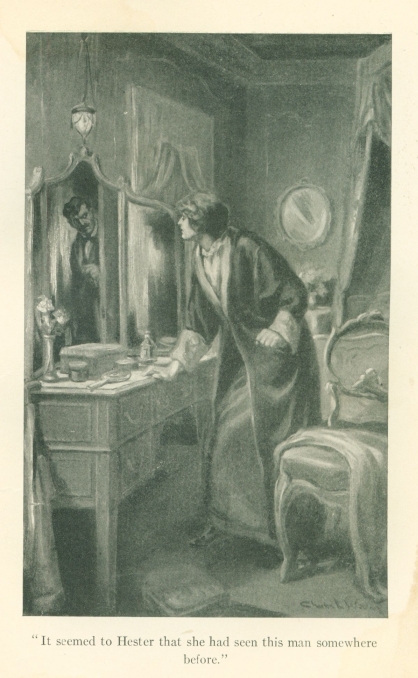
"It seemed to Hester that she had seen this man somewhere
before."
The man opened the green door and came forward
slowly into the chamber, but he came in a shambling,
apologetic way, and Hester realized that
he was not there in any aggressive or accusing spirit.
On the contrary, he looked at her almost pleadingly out
of small, shifty eyes. Where had she seen those eyes
before?
"Who are you? What do you want?" she demanded.
He stood still, working his lips nervously under his
little black mustache.
"I am Anton, the chauffeur," he said glibly. "There's
a pane of glass broken in the roof of the conservatory
and Mr. Baxter asked me to fix it. I was going out
through that window. I didn't know any one was here,
Miss—er—" he looked at her inquiringly.
"He got away with that all right," she reflected.
Where had she seen this man? Was it in Paris? In
Monte Carlo? In New York? And suddenly, by one
of those quick intuitions that had often guided her, she
decided to take the aggressive.
"Don't you remember me?" she smiled. "Hester Storm?"
"Hester Storm?" he reflected. "No, I—I can't say
that I do."
He lifted a hand to his forehead, then ran his fingers
back through his thick hair, and Hester noticed a single
white lock threading the black mass just above the
temple. Where had she seen a white lock like that?
Again he ran his fingers through his hair and paused,
with arm lifted and elbow forward, while his hand
grasped the back of his head. It was an awkward
position and—she had seen it before—she had seen a man
somewhere—hold his head like that and—look straight
before him the way this man was looking.
"I must have been mistaken," she said quietly. She
began to wonder if Anton suspected her. Could he
know anything? How long had he been standing at
that green door before she saw him? "Why are you
staring at me like that?" she asked.
"Just to make sure, but—no, I don't know you; I've
never seen you." He put down his arm and listened a
moment to the reassuring sound of the typewriter.
"What are you doing here, anyway?"
"I'm doing sewing for Miss Thompson," she answered
innocently. She spoke in a low tone, and she noticed
that he spoke in a low tone.
"What made you think I knew you?" he continued.
"Why I—I don't know. It was just an idea."
"Do you know me? I mean have you ever seen me before?"
She shook her head. "I thought I had, but—I've got
you mixed with somebody else. No harm, is there?"
she added, with a little laugh that parted her red lips
while her dark eyes glowed on him alluringly.
"Not a bit. Say, you look like an Italian, but you talk
like an American."
"I am an American."
"From New York?"
"From New York."
The chauffeur studied her admiringly for a moment.
"That's my town. Good old Manhattan Island! Say,
Miss Storm, why were you so pale just now?"
"Pale? Was I pale?" she trembled.
"You sure were; you looked as if you'd seen a ghost.
And now that I think of it—say, that's funny!" He
stopped short, his two hands on his hips, and eyed her
with a keen sidelong glance.
"What is funny?"
"Why, when I come in you gave me the haughty look—like
this," he struck the attitude of a tragedy queen.
"Who are you? What do you want?" he mimicked her.
"Then a minute later you're all smiles and friendly and
ask if I don't remember you? How is that, Miss Hester
Storm?"
"I don't see anything strange about it," she began
uneasily. "I thought—er."
"You thought you knew me," he interrupted. "And
if you knew me who did you think I was? That's what
I want to know." There was a note of menace in his
tone, as if he felt that he had the best of the situation.
"I've told you I was mistaken," answered Hester
sharply. "I don't care to talk about this any more.
You'd better fix that pane of glass—if there is any pane
to fix."
It was a chance shot, but it went home. "What do
you mean by—by that?" stammered Anton.
"Oh, nothing."
He took a step nearer and she saw that he was white
with anger. "You'd better not take that smarty tone
with me, young lady. I've got something on you, all
right. You weren't doing much sewing when I opened
that door. Oh, I saw you! Some time before you saw
me. Say, what was there so very partic'larly interesting
about that golf bag?"
It was a critical moment for Hester and she rose to
it finely.
"Ha, ha, ha!" she laughed carelessly, although terror
was clutching her heart. "Do you want to know why I
was looking in that golf bag, Mr. Anton?"
"Yes, I do," he answered roughly, "and I'm going to
know right now."
He strode toward the golf bag and seized it by the
strap.
"You'd make a good detective, Mr. Chauffeur," she
tittered. "I dropped my scissors into that bag and I'll
be much obliged if you'll fish them out for me."
So natural was her tone and so convincing her air of
good-natured derision that Anton turned, hesitating,
while one hand rested on the golf bag. Then, as before,
he ran the fingers of his other hand through his mane of
hair and clasped the back of his head in perplexity. It
must have been this characteristic attitude that brought
the flash of memory.
"Ah!" cried Hester, in sudden inspiration. "Now I
know where I saw you."
The thrill of exultation in her voice convinced the
wavering chauffeur and he came toward her in alarm,
leaving the golf bag.
"Where?" he demanded.
She half closed her eyes as if looking at a distant
picture.
"In a rathskeller—on Forty-second Street—near
Broadway—one night," she answered in broken
sentences.
"Well?"
"You were sitting at a table with a man who looked
like a Tenderloin sport or—a Bowery tough. He had a
blue handkerchief around his head—so. He had lost a
piece of his ear."
Anton listened, fascinated.
"How do you know he had?"
"I heard him tell you. He said the top of it had been
bitten off. That's why I noticed him. Remember?"
"You're crazy. I never was in a rathskeller on Forty-second
Street. And I don't know any man who's had his
ear bitten off." He paused and again moistened his lips
with the tip of his tongue. "What was the man's name?"
"I don't know his name," answered Hester, "but I
heard some sweet things he said and a few that you said
and——" she laughed at him tauntingly. "You have a
nice, elegant line of friends, Mr. Anton."
"I tell you it wasn't me," he blustered.
"Oh, yes, it was. I know you by that white lock in
your hair and—see here, I know you by another thing.
I'll prove it. Let's see you smile."
"Smile? Why should I smile?" He tightened his
lips into a grim line.
"Because you'd look much better, for one thing.
You're not pretty that way, Mr. Anton. And if you
smile, you'll show a gold tooth on—let me see—on this
side, a big, shiny gold tooth. Come, now, smile."
It is a matter of conjecture whether Anton, thus
challenged, would or would not have revealed the treasures
of his bicuspid region. At any rate he did not do so on
this occasion owing to the fact that developments were
suddenly interrupted by the sound of voices in the library
below, followed by a light, quick step on the winding
stair. Whereupon Anton, without smiling, without
explaining, and without any further sign of interest in the
damaged conservatory, faded away as he had come,
through the green door, and with the same cringing,
apologetic manner. The honors of this brief but spirited
engagement were easily with Hester.
Swiftly the adventuress caught up the skirt she was
supposed to be mending and, seating herself, began some
movements of measurement, while her face took on an
expression of diligent interest. A moment later Betty
Thompson swept into the chamber and, to the absolute
astonishment of the sewing girl, went straight to the golf
bag.
White-faced, Hester rose to her feet. She could feel
her hands and her lips getting cold. Was this the end
of the game?
"Can I—can I do anything?" she managed to ask.
"No, no," said Betty cheerfully. "Don't get up.
Mrs. Baxter wants to play golf and I'm going to lend her my
bag. There!"
She caught up the bag and disappeared with it down
the stair, while Hester, stunned by this sudden change
of fortune, listened to the mocking rattle of the clubs.
A charity bazaar, generally speaking, is an
invention designed to mitigate the sufferings of
the rich during the painful operation of removing
a small portion of their superfluous wealth for the
benefit of the poor.
Charity, however, to appeal successfully to the taste
feminine, must come in various shades and styles, and
each of the ladies of St. Timothy's parish had her pet
shade. So it happened that the date of this bazaar had
been fixed and most of the arrangements completed long
before the good ladies had agreed upon the charity to be
benefited.
It was only after several stormy meetings that, for the
sake of peace, it was agreed to leave Charity out of the
question. And then it was that the Bishop of
Bunchester, by a happy inspiration, suggested starting a
branch of the Progressive Mothers' Society at Ippingford
and, as the expenses of stationery, stamps and the
salary of a secretary must be met, the object of the
bazaar settled itself without further discussion.
Thanks to the untiring energy and unfailing tact of
Mr. Ferdinand Spooner, secretary of the Progressive
Mothers' Society, the ladies of the committee were not
only on actual speaking terms with each other, but were
working harmoniously together for the great cause.
Each of these ladies was happy in the consciousness that
she had obtained, not through undue favor, but in
recognition of her peculiar social preëminence, the table
occupying the very best position in the hall. This also,
it may be noted, was due entirely to the unfailing tact of
Mr. Ferdinand Spooner.
Whenever Mr. Ferdinand Spooner was asked to admire
any particular table, he praised it without stint, but
he was ever careful to add that each of the tables was
quite perfect in its own way, and, in the minutes of a
subsequent meeting of the Progressive Mothers' Society,
the resolution proposing that a vote of thanks be tendered
to Mr. Ferdinand Spooner, for his untiring energy and
unfailing tact, was moved, seconded and carried unanimously.
The bazaar had been advertised to open at half past
three o'clock, and keenest interest had been aroused by
the announcement that, on account of the indisposition
of Dr. Dibble, the address would be delivered by the
Reverend Horatio Merle. Almost every one in the
parish knew Horatio Merle by sight. More often than
not the curate and his wife were the only occupants of
the Baxter pew, but such was his shrinking from grown
up human society and so retired his walks that very few
knew him personally. Harriet, too, for reasons of her
own, worldly reasons, of which she was secretly
ashamed, had responded meagerly to the friendly
advances of the ladies of St. Timothy's. Nor, in this
respect, were the Merles any exception in the Baxter
household. Hiram, who with his son spent most of his
time in America, regarded English society very much as
he regarded the English climate and English business
methods, and Eleanor preferred to share his seclusion
to braving the leveled lorgnettes and monocled stares at
Hiram's homely American speech and manners.
As for Lionel Fitz-Brown and Kate Clendennin, they
were sufficiently occupied with each other and dismissed
the entire parish as a "beastly bore."
From her chair at the back of the hall Harriet Merle
watched the clock anxiously. The hands now pointed
exactly to half past three, the time fixed for the opening
address. For twenty-seven hours Harriet had waited
for this moment, had mentally rehearsed the scene to its
minutest detail—the expectant hush that would follow
the introductory remarks by the harmless but necessary
Spooner—then Horatio, solemn, transfigured, in the
black surplice that Harriet had only the morning before
shaken from its long camphorous sleep, would slowly
mount the steps to the platform, looking neither to the
right nor to the left—and, when the hush had become
absolutely unbearable, he would cough nervously and——
In sudden panic Harriet looked at the clock. It was
five minutes past the time. The decorous applause that
had followed the secretary's remarks on the duties of
Progressive Mothers (a Progressive Mother must be
progressive, she must nurse her babies—progressively,
she must bathe them—progressively, she must punish
them—progressively, etc.) had died away a long minute
ago. The expectant hush was becoming unbearable.
Where was Horatio? Why didn't he come? What had
happened?
Ferdinand Spooner tiptoed importantly from one to
another of the ladies of the committee. People were
beginning to whisper. Harriet shrank into her meager
feather boa. She clasped her hands till they hurt in her
effort to keep from crying. Tears came into her eyes and
dropped upon the white gloves that she had worked so
hard to clean for the occasion. Oh, why didn't he come?
She had sat up half the night with him and made coffee
to keep him awake till the address was written.
She thought of the money that Horatio would have
received—one pound, perhaps even two pounds—and
how she needed that money. Now there would be
nothing.
What was the secretary saying? He feared that
Mr. Merle had been unavoidably detained and the committee
had decided that the address should be omitted, and
he now declared the bazaar formally opened, and he
asked them all to join in singing the national anthem.
As the harmonium groaned the first bar of "God Save
the King" and every one stood up, Harriet, grateful for
the cover afforded by this ancient custom, but, for the
moment, past all caring whether his majesty was saved
or not, made her way to the door without attracting
attention. Her only thought was to get out, out into the
air and away from people—away from the sound of
singing.
* * * * * * *
During this time Horatio, rejoicing in the thought
that he was leaving his young protégée, Hester Storm, in
a peaceful and sheltered haven, had turned down the
shady drive on his way to the Progressive Mothers'
bazaar.
At the first bend of the road the curate came to a
standstill. Here a little green lane, leading to the woods,
sidled off alluringly to the right. Merle shook his head.
"No, thank you; no short cuts for me to-day," he said
aloud, and quickly turned his back on the green temptress.
As Horatio resumed his walk a small, plaintive voice
close behind him caused him to look round. "Why,
Martin Luther!" he exclaimed, pointing sternly down
the lane. "You go straight home!" Then as Martin
Luther rubbed coaxingly against his legs: "It's no use,
you can't come. In the first place you've not been invited
and in the second place it's a very mixed party. You
wouldn't like them," he whispered consolingly as he
lifted Martin Luther to his shoulder.
Fortunately it was only a couple of minutes' walk
back to the lodge and there the cat could be left in the
care of Mrs. Pottle or little An Petronia Pottle until
his master was well out of range. Mrs. Pottle was properly
shocked at the tale of Martin Luther's behavior—she
had never seen the like of it, such a forward cat;
she would think shame before trying to go where she
wasn't invited, and what for would he be wanting to be
mixing himself up with the likes of the Progressive
Mothers—my word!
Martin Luther could listen respectfully to Merle for
various reasons, one being that Merle was of his own
authoritative sex, but Mrs. Pottle's theatricals only bored
him and he retired to the square cave under the stone
chimney seat which he assumed had been built for his
exclusive use when he condescended to visit the lodge.
Mrs. Pottle followed the curate to the porch. "How
about this Storm girl?" she asked.
"What do you mean? Don't you like her, Mrs. Pottle?" There
was real concern in the clergyman's voice.
Mrs. Pottle folded her arms; her whole attitude was
an answer to his question.
"I'm not saying if I likes the girl or don't like her,"
she went on; "but there's one thing I do say: She's
never been taught how to make a bed, nor yet how to dust
a room. And what's more," here Mrs. Pottle fumbled in
her pocket, "I found this on her table." She held out
a rabbit's foot, tinged at the end with pink powder.
"Bless my soul! The foot of a rabbit!" exclaimed
Merle, in genuine surprise. "Dear me! This is most
astonishing. Perhaps Miss Storm is interested in natural
history."
"Natural 'istory?" cried Mrs. Pottle derisively.
"Unnatural 'istory I calls it; that's what she powders her
face with."
"You don't say!" said the curate gravely, returning the
rabbit's foot to Mrs. Pottle. "I should never have known
it. How does my little friend An Petronia like her?"
"An Petronia?" The old woman shook her head.
"There's no telling," she said. "It'll take a better head
nor what I have to say what that child's thinkin' on.
She's that deep and only eight years old come Michaelmas.
She takes up with such funny people——" Mrs. Pottle
stopped, confused and reddening at Merle's amused
smile of acknowledgment. "Oh, Lor', sir; I beg your
pardon, sir. I didn't mean——"
"That's all right, Mrs. Pottle," said the curate kindly.
"What do you think? Your grandchild confided to me
the other day that she is writing a book."
"Petronia writing a book! Well, I never!" exclaimed
the astonished Mrs. Pottle. "It must be in her blood.
And now I think of it, sir, her stepfather once kept a
little stationery shop down Millbrook way—so it does
come natural to her, doesn't it, sir?"
Merle laughed. "But you mustn't tell any one,
Mrs. Pottle. It's a secret. No one knows about it but
Petronia and you and me." He looked at his watch.
"Half-past two; I must be going. The bazaar opens at half
past three; there's plenty of time, I know, but I fear to
take any chances."
As the wicket gate closed behind the curate Mrs. Pottle
ran down the path. "If you're going by the road,
sir," she called after him, "you'll be meeting Petronia.
She walked to the village over an hour ago with the
little Royse girl and Freddy Nichol. It's Freddy's birthday
and he's got a bright new threepenny bit to spend,
and they're going to——"
Horatio, taking advantage of a compulsory pause for
breath on the part of Mrs. Pottle, thanked her hurriedly
and set off at a brisk pace toward Ippingford, and,
so steadfastly did the good man set his face against the
temptations of the wayside, that in less than half an
hour he had passed the main street of the village and
was within five minutes' walk of St. Timothy's parish
house.
Then, to his great relief, the curate found by his
watch that he had almost half an hour to spare. It was
a welcome reprieve, such was Horatio's dread of this
sudden plunge back into public life. Every moment was
precious—what should he do?
"What a pity I did not meet An Petronia," he said to
himself. She was a great friend of Horatio's, this
strange little maid with gold-red hair and questioning
deep-set eyes and that odd smile. Many were the walks
and talks they had together, Petronia holding on by the
curate's forefinger, asking questions. Such questions!
How many buttercups full of rain can a mouse drink?
Telling him tremendous secrets and confiding to him all
her troubles, what mountains of troubles! And yet
Merle had never heard Petronia cry, not even the time
when she was bitten by the frightened squirrel, whose
foot she freed from the weasel trap, did An Petronia
cry. Once when she had been disobedient and Mrs. Pottle
had felt it necessary to whip her granddaughter,
the child had not uttered a sound, which so frightened
the old lady that she had never lifted a hand to the child
since and never would.
The sound of children laughing startled Horatio from
his reverie. He was passing the little sweetshop at the
end of the village street, kept by one Mrs. Beadle, and
behold, there was An Petronia surrounded by a mob
of laughing, chattering playmates. They were looking
in at the window and playing some game of Petronia's
invention, in which the objects displayed in the shop
window played an important part.
"Freddy Nichol, that's not fair! Peppermints doesn't
gwow on twees," Petronia was saying in her odd,
low-pitched voice as Merle came up to the group.
Instantly she was at her old friend's side and looking
up in his face. "Does they, Daddy Merle?" she asked.
"Does what, my dear?" said Merle, taking her hand.
He had not heard An Petronia's assertion.
"Does peppermints gwow on twees?"
"I didn't say peppermints, I said pepper," put in
Freddy.
At this there was a perfect hubbub of "he dids" and
"he didn'ts," as the children took sides, all but Petronia,
who, having started the row, now stood tightly holding
the curate's hand and watching the conflict with wide,
fascinated eyes.
When things had arrived at the hair-pulling and slapping
stage, Merle, feeling Petronia's hand tighten round
his finger, had a sudden inspiration. Clapping his hands
to attract attention, he called out suddenly in the most
thrilling tones at his command, "Who wants to know a
secret?"
In an instant the clash of battle ceased, for a moment
there was perfect silence, tiny tears were brushed away
by grimy little fists, touzled hair was smoothed or tied
back as the case might be, little girl arms stole around
little girl waists and little boy elbows around little boy
shoulders and then there burst forth a chorus of voices
clamoring as one child, "Tell us the secret! Tell us the
secret!"
"Children!" said the curate, when silence was
restored, "I'm going to show you a peppermint tree!"
"A weally twuely peppermint twee, Daddy Merle?"
said An Petronia, her eyes filled with wonder.
"A peppermint tree!" echoed the others.
"Yes," said Horatio, "a really truly peppermint tree
with really truly peppermints on it, and I'm going to
shake the tree and you shall catch the peppermints as
they come down."
"Are we going to see it now?" asked An Petronia.
"Where is it?" eagerly chorused the others.
"It is only a little way from here," said the curate, as
the plan formed itself in his mind, "but before we start
I must go into the shop and see Mrs. Beadle. I am not
quite sure just which tree is the peppermint tree, and, as
Mrs. Beadle is so fond of peppermints, she will be able
to tell me exactly how to find it. You had better wait
for me at the corner," he added, "I shall only be a
moment or two."
As the children trooped across the street, chirping and
chattering, the curate, full of his happy little scheme and
all oblivious of the flight of time, stepped into the shop.
A few moments later he reappeared and, if in the
interim Mrs. Beadle's stock of peppermints had appreciably
diminished, no corresponding increase of bulk was
apparent in the region of Horatio Merle's pockets, so
artfully had the sweets been bestowed about his clerical
person.
At the corner of the lane the children awaited him in
expectant silence. Without a word An Petronia slipped
her little hand in his and down the lane they went, this
strange hushed processional led by the gray-haired curate
hand in hand with little An Petronia.
"Here it is!" cried Merle at last, pointing to a small
acacia, a toy-like tree with slender trunk and bushy top
that stood on the very edge of the wood. An unmistakable
peppermint tree, thought An Petronia.
Following the clergyman's directions, the children
formed a ring around the tree, while he stood in the
middle clasping the thin trunk in both his hands.
"Now," said Merle, "I'm going to sing something and
you must listen and sing it after me." He thought a
moment and then sang:
"Tree, tree, Peppermint Tree!
Let some peppermints fall on me!"
"Now, then, children, all together!"
They needed no rehearsal. Children have their own
little notes like birds and cherubim, and, as for the
tempo, the author and composer took care of that.
"Splendid!" cried the curate at the end of the first
repetition. "Now, once more! And this time, children,
you must keep your eyes fixed on the ground, and,
when I shake the tree, if you are very careful not to look
up, the peppermints will be sure to fall."
Once more the cherub chorus rang through the wood
and this time the branches of the peppermint tree were
heard to swish and shiver and shake in the most exciting
manner. Then all of a sudden the swishing and shivering
and shaking stopped and down came a terrific shower
of peppermints like big round sugar pennies, skipping
and rolling on the grass at the children's feet.
"Here they come!" cried Merle, flushed with the success
of his invention. "Fresh from the tree, pink peppermints!
White peppermints! All ready to eat—fresh
from the—" his voice stopped suddenly, the flush died
on his face, leaving it a white mirthless mask of laughter.
He was staring at the footpath only a few strides away,
staring in consternation, for there stood Harriet with a
look on her face that Horatio would remember to the end
of his days. He called her name imploringly, he knew
that she must have heard him, but she made no answer,
she turned away and walked straight on.
The clock of St. Timothy's was striking. One—two—no
need to count, he knew it was four o'clock. Harriet's
look had told him everything. He had failed in his duty,
he was disgraced—before everybody—and Harriet—how
she must have suffered!
Close by, the children shouted and laughed and scrambled
for peppermints. How little they knew the cost of
their laughter. Their voices grew fainter as Horatio
ran, ran despairingly, to overtake his wife. A moment
later he was by her side breathless, pleading.
"Harriet—I forgot the time—I—— Don't leave me
like this——"
Her only answer was to quicken her pace. He tried to
take her hand, but she snatched it away quickly,
contemptuously.
Horatio stood still. Dazed, stupefied, he watched his
wife until she was out of sight, then, with unsteady steps,
he turned into the shadow of the quiet, questionless
woods and sank face downward among the ferns. Presently
there was a sound of something moving through
the ferns and bushes. Nearer and nearer it came until it
was quite close to him, then a warm little hand, a
pepperminty hand, stroked his wet cheek and a tear-shaken
voice, the voice of An Petronia, quavered close to his
ear, "Don't cwy, Daddy Merle."
Neither Lionel Fitz-Brown nor Kate Clendennin
knew the precise degree of cousinship that
constituted the bond of relationship between
them. That such a bond existed had been the natural
inference from their common relationship to Mrs. Baxter,
since, to paraphrase Euclid, cousins that are related
to the same cousin must be related to one another.
But when Cousin Lionel attempted to solve the
genealogical problem with a proposition beginning "If your
greatuncle, who was second cousin to Mrs. Baxter's
grandmother, was a first cousin once removed to my
aunt——" Kate put her hands to her ears and fled from
the room. And when a few days later he attempted it
again she threw a book at him.
On the third occasion (by this time they had dropped
the "cousin" and were just Lionel and Kate) she
suppressed him by putting her hand over his mouth, which
only goes to show that relationship, if sufficiently remote,
is no bar to friendly intimacy.
Lionel's frame of mind after meeting the new secretary
at luncheon was a perplexing one. He retired to the
billiard room to think it over, under cover of the noisy
osculation of compulsory billiard balls. Lionel had never
made claim to cleverness; indeed, he regarded it as rather
stupid to be clever and downright bad form to be brilliant.
"If a chap is a good shot and isn't afraid of a
hedge with a barb wire in it, and knows how to fasten
his tie, what more does he want?"
But this American girl—strange a girl like that should
be a secretary!—had discovered to him unsuspected
possibilities in himself. He had actually talked, he had
even gone so far as to say one or two rather good
things—that about aeroplanes, for instance—no, come to think
of it, it was she who said that—what was it he had said?
Anyhow, it had made the American girl laugh, so it
must have been rather good. Extraordinary people, these
Americans; how they sharpen one's wits! On the whole,
he was rather pleased with himself. He wondered if
Kate had noticed it.
As he thought of Kate, there rushed through his
brain a succession of pictures of the countess and
Robert Baxter at the luncheon table, mental snapshots
forgotten at the moment, now vividly developed....
Kate with her head thrown back, laughing at something
Baxter had said and incidentally displaying a curve of
throat that would humiliate the most conceited lily petal....
Kate, leaning forward on her elbow, her chin
slightly elevated on the palm of her hand, with an
expression of rapt attention that is well worth while for
a girl whose eyelids have such a delicious downward
sweep.... Kate, in profile perdu, showing the pink
lobe of an exquisite ear and her "jolly well brushed
tan-colored hair" curving smoothly up from the nape of
her neck.... Kate, with her upturned palm resting
on the hand of Robert Baxter—confound him!
The billiard balls were in tempting position and Lionel,
sighting for a follow shot, found his gaze irresistibly
prolonged to the stretch of sunlit lawn, backed by dark
firs, to which the window opposite formed a frame. At
the same moment two figures crossed his line of vision,
walking slowly and apparently quite oblivious to their
surroundings. With cue drawn back for the stroke,
Lionel watched them pass slowly out of the picture.
It was Kate Clendennin and Robert Baxter!
The next instant an osculatory outbreak of earsplitting
intensity echoed through the billiard room, and the
red and white affinities went spinning round the table,
as Lionel slammed his cue into the rack and stormed
out of the room. A few minutes later (when Kate came
in to look for him) there was no sign of Lionel, and
the demeanor of the billiard balls was as frigid and
standoffish as if they had never been introduced—or
were lately married.
At the evening meal, called supper by Hiram, Lionel
did not appear, to the keen disappointment of Kate, who
had descended into the kitchen in the loneliness of the
late afternoon and prepared a crême renversée for his
especial benefit.
It was late dusk when Fitz-Brown returned, by the
golf course, from a ten-mile ramble over Ippingford
downs. All his rancor, jealousy, if you will, had
disappeared. He had clarified his mind by a physical process,
a process at once primitively simple and profoundly
scientific. For, if it is true that a physical ailment may
be healed by a mental process, it is equally true that a
mental ailment can be cured by a physical process. All
Lionel did was to walk and walk and walk and allow the
fresh summer wind, bounding over miles of gorse and
heather, to sweep the fog from his brain. So that, by
the time he emerged upon the Millbrook golf course he
was able to see himself quite clearly and his
self-appraisement was not flattering. He stood on the top of
a high bunker and took a long breath as he delivered
this ultimatum: "I'm a beastly ass," he said
to himself. "Kate would be a fool to marry a duffer like
me."
He broke off suddenly as he caught sight of the
countess, bareheaded and clad in a dinner gown, putting
pensively in the twilight.
Kate had already caught a glimpse of him as his tall
figure stood for an instant silhouetted against the fading
sky, and, divining his intention to take her by surprise,
she addressed herself to the business of putting with
convincing absorption.
As the ball for a breathless moment hesitated at the
rim of the cup, then, Curtius-like, plunged into the
dark abyss, a cheery "Bravo! Kate!" directly behind her
caused a genuine start as perfect as any imitation she
could have given.
"Gad! How you startled me!" There was an alchemy
in Kate's personality that transmuted the sounding
brass of profanity into the gold of pure speech. She
swung round as she spoke.
"Sorry, old girl," said Lionel, "it's not like you to be
so jumpy. I say, that was a ripping putt, almost in the
dark, too."
Kate laughed. "That's just it. I couldn't see to
miss it."
"Couldn't see to miss it?" mused Lionel; then brightening
suddenly, "I say, that's rather good!" he laughed
for sheer delight at having seen the point so quickly.
"Good boy!" said Kate, patting him on the back.
"You're improving."
Lionel stopped laughing. "Am I? By Jove! then
you've noticed it, too. Most extraordinary how it
sharpens one's wits, rubbing up against Americans! Did
you see me at lunch?" he inquired eagerly.
"Rubbing up against Americans?" Kate opened her
eyes in feigned astonishment.
"Really, Kate, I wish you'd heard me," he went on
earnestly. "I said one or two rather good things."
"To Mrs. Merle?"
"Oh, come, I say!" protested Lionel. "You know
who I mean, the American girl—Miss—Miss——"
"Oh, the secretary," Kate stifled a yawn. "Sorry I
didn't notice her. What's she like?"
A Machiavellian suggestion entered Lionel's artless
mind. "Awfully jolly sort!" he exclaimed with enthusiasm.
"Devilish pretty eyes—and fluffy hair—I wish I
could remember it," he frowned.
"You've just said it was fluffy."
"I don't mean her hair; of course I couldn't forget
that. I was trying to remember something I said to
her."
"How unfortunate," purred Kate. "You should have
written it down."
"It really wasn't bad," he went on. "Anyway it made
her laugh, but—she wouldn't look at a duffer like me." He
sighed athletically. "She's much too clever; half
the time you don't know what she's driving at, but you
can bally well believe what she says."
It was nearly dark and they had drifted toward a
semi-circular rustic bench at the foot of a towering
horse-chestnut. Lionel lighted his briar and sank, in
sack-like ease, into the uncomfortable seat, lulled by the
incense man burns only to himself, the envy of the
watching gods who invented eating and drinking and
fighting and loving, and created the tobacco plant, but
never thought of smoking.
Kate lighted a cigarette. But rustic seats with tree
trunks for backs are not made for women. After
picking some pieces of bark from her hair and attempting
to fish others from the back of her neck, only to push
them hopelessly out of reach, she jumped up impatiently
and fell to pacing the soft turf behind the tree,
the wavering light of her cigarette swaying hither and
thither in the deepening gloom like a dissipated firefly.
"How very funny," she said at length, pausing in
her walk to break the smoke silence, "that she can make
you believe everything she says when you don't know
what she's driving at. It sounds like mind reading."
Lionel watched a ball of gray smoke unravel itself
and trail swiftly into the darkness above. "What's
funny about mind reading?" he asked. "It strikes me
it isn't any funnier than palm reading." Then after
a contemplative pause, "That Baxter chap seemed to
find your palm very interesting. Did he tell you
anything exciting?"
"Very exciting," her voice came from the other side
of the tree.
"I say, mayn't I know?"
"Oh, it wouldn't interest you."
"I hope it was something good. I'll punch Baxter's
head if it wasn't."
"Then you do believe in palmistry?"
"What's that got to do with it? I say, Kate, what
did he tell you?"
"Why do you want to know?"
"Because"—he hesitated—"because I——" He
stopped abruptly to listen. The blackness above them
was stirring. A tremor ran through the great tree.
The darkness high overhead swayed with a sound like
the sigh of rain on a lake. Unseen branches moved
heavily and then were still. Mysteriously as it came, the
wind died away. It was now quite dark under the tree.
For a time neither spoke.
A fear he could not explain had come upon Lionel
and stopped his speech. A few moments ago his only
word for palmistry was tommyrot and now the writing
on Kate's hand was to him the most momentous thing
on earth.
Suddenly, out of the darkness came a strange sound——the
sound of laughter, viewless laughter, that died
away, leaving an uncanny silence.
"Kate! What is it? Where are you?"
There was no answer. He circled the tree swiftly
with outstretched hand, guiding himself by the edge
of the seat.
"Kate! For God's sake. What's the matter? Where
are you?"
The next instant his free hand touched something and
his arms closed around her. It was as if, in the space
of a minute, he had lost this woman forever and suddenly
found her again. And now he, Lionel Fitz-Brown,
was holding Kate Clendennin in his arms. If the stone
Diana in the sunken garden had turned to flesh and
blood and found her way into his embrace it would not
have been more astonishing, incredible. Here she was
resting limply against him, her lovely head on his
shoulder. He could feel her hair against his cheek.
"By Jove! She must have fainted," he muttered.
Carefully he placed Kate beside him on the rustic
seat, supporting her tenderly with his arm, her head on
his shoulder, her cheek touching his. How feverish
it felt! He began to be alarmed.
"Kate!" he said in a low tone.
"Yes? What is it?" she whispered.
"How do you feel?"
"Pretty comfy." She nestled closer.
Lionel was astonished. "Didn't you faint?" he asked
anxiously.
"Faint?" Kate sat up suddenly. "Is that what you
thought?"
"What were you up to just now when I—when I
found you?" stammered Lionel.
"I was—giving you the slip," said Kate.
"Giving me the slip? What for?"
"I wanted to get away before I—before I made a
bally fool of myself and now—and now I've done it.
Are you aware," she demanded abruptly, "that it's
horribly late?"
Lionel struck his repeater. The tiny chimes clinged
the hours and quarters against his right and Kate's left
ear. They counted nine and three-quarters.
Kate straightened up and began smoothing her hair.
"We must be getting back," she said.
Then an inspiration came to Lionel, born of romantic
literature. "I say, Kate, I—er—I wish we could count
all our hours that way."
There was an agonizing pause.
"It would be economical," she mused, "to make one
watch do for two people."
"Oh, I say, you know what I mean, Kate," he went
on desperately, "get married and all that sort of thing.
I know an awfully jolly little farm down in Kent, only
forty pounds a year."
"Yes? And what would we live on?"
"Why, we'd keep a cow—and a hen—and a bee—and
all that sort of thing."
"A bee?" Kate burst out laughing, then, suddenly,
dropping her bantering tone, she cuddled her firm white
hands into Lionel's big brown ones.
"Lionel," she reasoned, "I don't think I've ever really
been in love in my life and you're the only man I ever
met that made me want to—no, no! Please, Lionel,
listen to me," she held him gently away from her—"made
me want to run away. Now I'm going to tell
you what the palm-reader said," she continued,
purposely avoiding the name of Robert Baxter.
"You don't really believe that tommyrot?"
"I do this time because what he told me is going to
come true." She placed her hands on his shoulders with
an affectionate movement. "He told me I'm going to
have heaps and heaps of money! Lionel, aren't you
glad?"
There was something far from gladness in Kate's
own voice and Lionel's heart sank in utter desolation.
His thoughts flew back to the day of their first meeting
three months ago—to the first time she had called
him "Cousin Lionel"—to the time when somehow or
other they had dropped the "cousin" and were Lionel
and Kate to one another—three milestones on the road
that led to—where might it not lead to? And now she
was turning back. Where? He reflected that he knew
nothing of Kate's world before she had come to Ipping
House. From time to time there had been letters for
her with German or Swiss postage stamps. That
was all.
"So you see," Kate was going on, "it's a case of
Hobson's choice. There's nothing else to be done. My
money's all gone. Old Baxter has behaved like a brick,
but I can't bank on him forever, and now if I—if I
marry Bob——" she broke off with the sound of a
laugh.
Lionel shivered. He seized her hand which showed
dimly white at his side. It was like ice. It slipped from
him upward and his ear caught the multitudinous whisper
of chiffons.
"Come on," she said.
He rose stupidly and followed her in the darkness.
Half an hour later, as they approached Ipping House,
Kate saw what seemed like a shadowy figure that glided
past the conservatory and disappeared.
"What was that?" She clutched his arm.
"I didn't see anything," answered Lionel.
The shadowy form seen by Kate Clendennin near
the conservatory was no phantom born of
emotional excitement, but a flesh-and-blood creature,
a keenly alert sentinel, stealthily waiting and
watching for a specific and serious purpose.
For more than one of the dwellers at Ipping House
this had been an important day. To Betty Thompson
it had brought, the suddenly revealed glory of a deep
love, to Lionel and Kate the first delicious whisperings
of mutual passion and the pain of renunciation, to
Horatio Merle it had brought humiliation and self-abasement,
and to this poor, soul-stifled girl, Hester Storm, it had
brought the opportunity to steal $25,000.
With her own eyes Hester had seen the purse; it was
there in the golf bag, she had almost had it in her hands.
Almost! If that tumble-haired, shifty-eyed chauffeur
had kept away she would have had the money. And if
Mrs. Baxter hadn't borrowed the golf bag, just at the
wrong moment, she would have had it. Hard luck
twice. Well, the third time would be different, and she
would land the goods. In the whole world she was
the only person who knew where this purse was, so all
she had to do was to watch the golf bag and wait for
another chance.
Through the long afternoon Hester watched and
waited in Betty Thompson's chamber, showing an
industry and zeal in her sewing that Betty thought most
commendable. All this time the girl was eyeing the
clock, wondering if, before she finished her work,
Mrs. Baxter would return the golf bag. But no Mrs. Baxter
appeared and at six o'clock she was obliged to go. Miss
Thompson wished to dress for dinner and—no, she did
not need a maid.
Hester walked slowly back to the lodge considering
what her next move should be. Evidently she must act
quickly or someone else might see the purse. Someone
might already have seen it. Some caddy boy! Or
Mrs. Baxter herself. There it lay, down among the
clubs, quite unguarded except by the darkness in the
bottom of the bag. Hester's hope lay in that little
layer of darkness and in the unlikelihood that any one
would search there.
What would Mrs. Baxter do with the golf bag after
she had finished using it? She would naturally return
it to Miss Thompson. She would return it this
evening and Miss Thompson would naturally put it in
her chamber, just where it was this afternoon, there in
the corner by the dressing-table.
And then what? The Storm girl's face darkened and
her hands shut tight. This was no time for trifling with
fortune. The opportunity was hers now, this night,
but it might be gone to-morrow. She must act at once.
At once! Before she reached the lodge this decision
had taken form vaguely in her mind, and, before she
had finished her supper, it was clearly crystallized: she
must do something before morning. Something! But
what!
At a quarter before seven Hester heard the panting
of an automobile near the lodge gate and, hurrying to
the window, she watched Mrs. Baxter and Robert as
they swept past in the big, closed car, the young man
driving. Stare as she would the agitated girl was
unable to catch sight of the golf bag, but she knew it
was inside the car, it must be there; in a few moments
it would be back in Ipping House, where she might get
it—if she only could think how—later in the night.
Later in the night! That meant entering the big
house secretly and lying in wait until she could make
her search. She could look in the library, in the hall,
in the hall closet under the stairs. That would be easy,
but suppose the golf bag were not there? What if Mrs.
Baxter had brought it to her own bedroom or to Miss
Thompson's bedroom? Then what?
Hester finished her supper soon after seven and
immediately went to her room—to be alone—to think. She
felt impelled to do this thing, but she must plan every
move with the utmost caution. No one, better than
she, knew how dearly she might have to pay for one
mistake.
At nine o'clock the girl stole softly out into the park.
Old Mrs. Pottle had gone to bed early and the lodge
was still. An Petronia, with her four beloved
"Pottles" ranged beside her, was dreaming of "Reginal" and
his misfortunes. Over the beeches and the dim, gray
mass of the manor a purple darkness was settling and
the little creatures of the night were pulsing their
strange chorus. The air was warm and the girl went
forth, bareheaded, gliding among the shadows like one
of them. There were several small objects in her trunk
that she might have taken to help her on this sinister
expedition, several objects that she was impelled to
take, but, on reflection, she left them behind, all but one.
For a long time Hester hovered about the manor
watching the lights, listening to the sounds, rehearsing
over and over again in her mind the details of the night's
effort, as she thought it would work out. Mr. Baxter
was in London. Mrs. Baxter had gone to her room,
there was her light, burning brightly, one flight up under
the gray stone tower. And there was Mr. Robert's
light, two flights up over the far end of the conservatory.
The golf bag would not be in his room, that was sure.
What about Miss Thompson? For nearly an hour
her little chamber had been dark. She must have gone
to bed early. Sound asleep by now. Hello! There goes
Mr. Robert's light. And there sound the stable chimes.
Ten o'clock! All dark downstairs except a light in the
big front hall.
And now two dim figures approached across the lawn,
Fitz-Brown and the Countess, and Hester shrank away
among the shadows. Lionel took down a key from a
nail outside the conservatory (where he often left it
when he came in late) and, opening the door, bowed
Kate in, then followed, closing the door, but quite
forgetting to lock it. Thus fortune favored the young
adventuress, as it had before many times.
With the illumination of a match held by Lionel, the
tardy pair passed through the dark conservatory, then
on through the library and out into the spacious hall,
where each took a silver candlestick from a table where
a row of these were placed in shining readiness every
evening.
Very cautiously Hester opened the conservatory door
and stepped inside, closing the door silently after her.
Motionless, almost breathless, she listened as the others
parted at the stairs. Queer lovers! Was that the best
they could do?
"Good-night, Kate."
"Good-night, old chap."
Lionel extinguished the hall light and, with flaring
candle-shadows dancing behind them, these two climbed
the stairs. Then came the closing of distant bedroom
doors and Ipping House, dark and silent, settled down
to slumber, while the adventuress waited.
Eleven! Twelve! One o'clock! to the slow, soothing
voice of the bells. Those who prowl by night under
strange roofs must learn patience and, while these hours
passed, Hester scarcely stirred, except from chair to
bench, then back again from bench to chair, noiselessly,
for she wore sneakers with rubber soles. She played
odd little games with the moon-beams, making bets with
herself as to how long, measured in heart beats, it would
take a certain little flickering yellow fellow with a funny
tail to creep from one crack to another. And she
found that she could make her heart beat slower by
taking long, deep breaths, which sometimes helped her
to win.
At half-past one Hester turned the switch of a tiny
electric lantern that hung from a cord around her neck.
A beam of concentrated light flashed across the room
and instantly vanished as the switch went back. The
storage battery was working well. It was time to
start.
Throwing her spot of light here and there, the girl
made a round of the conservatory, scrutinizing every
corner. The golf bag might be here, one never could be
sure. Then, finding nothing, she passed into the library
and repeated her search, then on into the great shadowy
hall, all to no purpose. The golf bag was not there.
This was only what Hester had expected. It was
altogether likely that Mrs. Baxter had done one of two
things with the bag: either she had returned it to Miss
Thompson, in which case it was now in Betty's chamber,
or, possibly, she had taken it to her own bedroom.
And the conclusion was, if she was going on with her
search, that the girl must now, in the dead of night,
enter two rooms where defenseless women were sleeping.
This was a serious matter; it meant years in prison
if she were caught.
For several minutes Hester pondered this, while
disconnected memories of her troubled life came and went
through her mind, like pictures, memories of when she
was little and of her sister Rosalie. It seemed as if
now, in the darkness, she could see Rosalie's sad, tired
face and loving eyes fixed on her. Well, she was doing
this for Rosalie, she wanted the money for Rosalie
and—she had gone pretty far already, why not go a little
farther?
In this resolve the intruder moved back into the library
and, without giving herself time for further hesitation,
she cautiously ascended the winding stair that led to
Betty Thompson's room. If the worst came, she did
not believe this kind-eyed girl, her fellow country-woman,
would betray her. Besides, why should there
be any trouble? It was only a matter of silently
turning the knob. The noiseless creeping light would do
the rest. If she saw the golf bag, there by the
dressing-table, she could get it without a sound. And, anyway,
Betty must be in her deepest sleep. It would take more
than the squeak of a board or the crack of a too tense
knee-joint to rouse her. None of which reasoning
availed, for now, when Hester turned the knob and
pressed, she found an unyielding barrier against her;
the door was locked.
So that was settled. If the golf bag was in Betty
Thompson's chamber it must stay there. She would
take no risks of picking a lock and—perhaps this wasn't
her lucky night. Perhaps she had better fade away
before anything went wrong.
Crouching on the lower step of the stair, Hester
heard the chimes ring out the third quarter before two.
Only fifteen minutes since she began her search!
Should she make one more effort? Should she try
Mrs. Baxter's room and, if nothing came of that, then stop
for the night? It wasn't likely both women would lock
their doors.
The girl was perfect in the geography of the house.
Mrs. Baxter's room was one flight up by the main
staircase, the second door on the right going down the
hall. It was easy enough to go to this door and—very
well, she would go there and then decide. No great
harm could come from listening at a door. Alas! One
never knows how harm may come!
Swiftly and silently the restless searcher glided
through the great hall, then up the massive stairs of
heavy polished oak, finding her way through the darkness
by the guiding flashes of her lamp. But when she
reached the head of the stairs and turned cautiously
down the corridor, she stopped with a frightened gasp,
for there, beyond her, spreading under the second door,
Mrs. Baxter's door, was a band of light. And even
as she stood, hesitating, her fears were increased by
the sound of footsteps in the bedroom. Not only was
Mrs. Baxter awake, she was coming toward the door.
Like a flash and noiselessly, the Storm girl darted on
and vanished into the black depths of the corridor
beyond. If the mistress of the house had heard her on
the stairs, it was toward the stairs that she would go
now, so the safest place was away from the stairs.
Trembling and breathless the girl shrank behind some
heavy curtains at the end of the hall and waited.
A moment later the door opened and Mrs. Baxter
appeared in a long loose garment and carrying a candle.
The light was full on her face, which was deathly white
and bore, Hester thought, a look of terror. And, as the
lady moved down the corridor, holding her flickering
taper, she seemed to shrink away from the black shadows
around her. And when she reached the stairs she
hurried down with furtive glances behind, as if she felt
herself pursued. What trouble or mystery was here?
The girl listened until Mrs. Baxter's footsteps sounded
in the hall below, then she followed softly and, leaning
over the railing, watched the movements of the candle.
It disappeared into the library and presently there came
the sound of an opening door. Mrs. Baxter had gone
through into the conservatory. What could she want in
the conservatory at this time of night? Could she
suspect there was an intruder in the house? Was it this
that caused her fears? Impossible! No woman would
leave her room to meet a hidden burglar. She would
scream: she would alarm the house; she would do
anything but face the dangers lurking in a shadowy
conservatory.
Then what was the explanation? Why had Mrs. Baxter,
with pallid face and haunted eyes, gone down those
stairs? She must be searching for something that she
needed very much. Strange, that there should be two
women in this house searching for something that they
needed very much! And, suddenly, Hester realized
that here was her chance to look into Mrs. Baxter's
bedroom. The door was ajar, the light was still
burning. One quick glance would tell her what she so
much wanted to know.
There! The door opened noiselessly as she pressed
it back. Not a sound from below. Now, then! The
girl stepped into the chamber and looked about her.
On a small table at the head of the rumpled bed lay a
book, face downward, by a shaded lamp. Mrs. Baxter
had evidently been trying to read herself to sleep. Some
exciting story, no doubt, that had made her wider
awake than ever.
Hester moved softly about the room, looking in
every corner, flashing her light into closet and bathroom,
then she came out softly into the hall. The golf
bag was not there.
Well, this finished her effort for the night. She had
had no luck and—the best thing she could do was to
get out of the house. What could that woman be doing
down in the conservatory?
Again Hester listened at the stairs, but her straining
ears caught no sound nor could her eyes perceive the
faintest glow from Mrs. Baxter's candle. Absolute
darkness! Absolute silence!
And now, with infinite precautions, the girl descended
the stairs, feeling her way, for she dared not use her
light. She was taking a risk, but she might be taking
a greater risk by staying upstairs. She had a vague
feeling that something was about to happen in this vast,
gloomy house or that something already had happened.
She felt herself stifling. At any cost she must escape
from these confining walls, she must get out under the
open stars where she could breathe. And she remembered,
with a clutch of fear, that old Mrs. Pottle had
spoken of a haunted room in Ipping House whence a
gray lady came forth at night and wandered through the
halls, a gray lady whose coming was attended by clanking
chains and sounds as of a heavy body dragging.
Even as these gruesome thoughts chilled her heart
the girl's foot touched the lowest stair and a moment
later, as she stepped out gropingly into the black hall,
she felt herself held from behind, as by a hand,
whereupon, in a burst of terror, she tore herself violently
free. At the same instant there resounded through the
house a great clanking of metal and the crash of a
heavy body falling. Then silence again, while Hester
stood still frozen with fear. And now, from the direction
of the conservatory, there came a piercing, agonized shriek.
It was an emergency to daunt the stoutest heart, but
Hester rose to it, conquering her panic, because she
realized that she must conquer it. Everything depended
upon what she did in the next few minutes: her
happiness, her freedom, her whole existence depended upon
her getting out of this house immediately. Some
frightful thing had happened that would presently throw the
whole establishment into tumult.
Another shriek rang through the house, a pitiful cry
of distress and call for help. What could be happening?
Hester herself was moved to bring succor to this
poor lady, but she checked her impulse as the sense of
her own danger came to her with the quick opening of a
door overhead and the sound of heavy footsteps on the
stairs. It was Robert Baxter, hurrying down from the
second floor, and calling as he came:
"Mother! Where are you? What is it?" he cried,
and Hester heard him turn down the corridor on the
first floor. He was going to his mother's room. There!
He had found it empty. He was rushing back to the
stairs.
"Mother!" he shouted again. "Where are you?"
Huddled in the hall below, Hester thought of the
front door, but she knew it was chained and bolted.
There was no time to escape that way. Already Robert
was on the stairs, descending slowly in the darkness.
It was lucky he had not stopped to get a candle.
Swiftly the Storm girl retreated into the library. Her
case was desperate. Mrs. Baxter was in the conservatory,
so her escape that way was blocked. To hide
in the house now would be madness. It was only a
matter of minutes when the whole household would be
aroused, when lights would be blazing in every room
and——
Then came the inspiration. It was a wild, last
chance, but she must take it. A few moments before she
had noticed a motor veil left by some one on the davenport.
She snatched this up and, moving silently toward
the conservatory, draped it over her face and figure.
The veil was of elastic, filmy material, long and wide.
It covered the girl from head to foot, shrouding her in
silver gray.
At the open door leading into the conservatory Hester
paused and, settling her ghostly draperies about her,
stood still. Through the crack of the door she could see
Mrs. Baxter in the conservatory, rigid with fright, still
holding her candle and staring wide-eyed before her.
"Mother!" called the young man for the third time.
"Speak to me! Where are you?" He was stumbling
about in the dark hall.
This time Eleanor heard the comforting voice of
her son and tried to answer.
"Bob!" she cried faintly, and staggered toward the
library door. "Bob!" she called, louder, and took a
step into the shadowy room. Then, as the candle light
flamed forward, she came, suddenly, face to face with
a still figure, a shrouded, sinister woman in gray. It
was too much. It was more than Eleanor Baxter could
bear. With a stifled moan she sank down on the library
floor and was conscious of nothing more until she
opened her eyes weakly and found Bob bending over her.
As regards the gray lady whose seeming apparition
had spread such wide alarm, anyone curious
to know something of the ghostly Ladye
Ysobel Ippynge (she was believed to have been poisoned
by her husband, Sir Gyles Ippynge, Knight, and first
earl of Ippingford in the early part of the twelfth
century) will find a true account of her pious life and
tragic death in a volume entitled, "Kronicon Uxorium,"
in the Bodleian library of Oxford, written by the monk
Abel of Ipswich and printed in London in 1529.
The pious Lady Ysobel would have been sore
distressed had she known what a fearful pother her
counterfeit presentment (by Hester Storm) would one day
cause. What had really happened was perfectly simple,
although the consequences were complicated and
far-reaching. When Hester came to the bottom of the
stairs she had turned out of her way in the darkness
and passed close to a pedestal supporting a suit of armor
that kept impressive guard there in the ancestral hall.
So close had she passed that the cord of her electric
lamp had caught on one of the links in the coat of mail,
whereupon, in her plunge away from this ghostly
restraint, she had toppled over the grim warrior, pedestal
and all, with a crash and rattle of his various resounding
parts that had alarmed the entire establishment.
And this uproar had terrified Mrs. Baxter all the more
because she was already quivering with superstitious
dread after reading that creepy tale of Bulwer Lytton's,
"A Strange Story"; in fact, it was to seek relief from
this obsession that the agitated lady had gone downstairs
for some sulphonal sleeping tablets that she had
left in the conservatory. And the silent, silver-draped
apparition, looming suddenly in the shadows, had done
the rest.
For the Storm girl it was an incredibly narrow escape.
A mere matter of seconds decided her fate. If young
Baxter had carried a candle she would have been discovered.
If Mrs. Baxter's candle had not been extinguished
by that lady's fall she would also have been discovered.
As it was, Hester had time to flee across the
dark conservatory and out into the park (by the
unlocked door) before Bob, blundering and stumbling
through the hall and library, had reached his fainting
mother.
It may be added that Hester's quick impersonation of
the gray lady was not entirely inspirational. She had
heard old Mrs. Pottle refer to the specter that haunted
Ipping House that very evening; and, while she watched
at the lodge for the Baxter automobile, her thoughts had
turned to the shivery legend when she heard An Petronia,
with motherly tenderness, putting to bed the four
"Pottles" (who seemed wakeful) and assuring them
that "the dray lady would tum and det them," if they
didn't go to sleep.
It must not be supposed, however, that either the
gray lady or her understudy, Hester Storm, was
responsible for the series of happenings at Ipping House
that ended in converting that comfortably appointed
English home into as uncompromising a wilderness, as
far as the relatives were concerned, as the most
resourceful Swiss Family Robinson could hope to be
wrecked upon. There was another agency at work;
to-wit, Parker.
Parker, at this particular time, was the only indoors
man at Ipping House, his rank being that of butler,
footman, and valet combined. For sympathetic and
politic reasons, Parker had given notice on the very same
day that Mrs. Edge had received her congé from Mr. Baxter.
In appearance Parker was of the candle-complexioned,
patent-leather-haired type that nature seems to
have distributed impartially between the pulpits and
pantries of Great Britain. Parker's greatest personal
asset was a subtle fluidity of temperament which caused
visitors at a house where he had been engaged only the
week before to believe that he was an old family
retainer. It was to this priceless gift that Parker owed
his success in New York, where he had spent ten profitable
years and adorned many expensive houses, seldom
staying long in any one place as new accessories to
social elegance outbid each other for his services. It
was in New York that Parker's face took on its
expression of impeccable superiority, the envy of more
than one bishop, an expression acquired through his
practice of combining with his office of butler (for an
extra charge, of course) that of private tutor of social
usages to his employers.
In the eyes of Mrs. Edge, and to quote her own
words, Parker was the "cream of gentlemen." Between
Mrs. Edge and the "cream of gentlemen" there was an
understanding. When the Baxters returned to New
York in the autumn and the house would be closed for
the winter, a small but desirable hotel at Inwich (the
next village beyond Millbrook) would be reopened
under the management of Mr. and Mrs. Parker.
Hiram Baxter, in spite of his homely American
speech, which grated painfully on the butler's fine
cockney ear, somehow commanded the respect of this "cream
of gentlemen," who felt that there was good material
in him. He would like to have taken Baxter in hand.
He longed to tell him that detachable cuffs and collars
were not permissible; that a black bow tie, if one must
wear such a thing in the daytime, should not have its
ends tucked under the flaps of the collar. Twice Parker
had deliberately hidden the silver clasps with which
Hiram suspended his serviette to the lapels of his coat.
"It's fortunate they don't have no English visitors,
leastways none that matters," had been Parker's
reflection. Had it been otherwise his sense of fastidious
shame would have compelled him to give notice. Not
even that '66 brandy, upon the question of whose merits
Parker and Anton were in such perfect accord, could
have induced him to stay.
And now he was turning his back on these liquid
joys and two months' wages into the bargain. To be
separated from Mrs. Edge was out of the question.
She was his fiancée, also the lease of the "Golden
Horseshoe" was in her name. The wily Parker, however,
saw in the ghost incident a way of visiting his resentment
on the Baxter household, and he set about it at
once.
At the time of the night alarm Parker had been the
first to reach the hall from the servants' wing, and,
striking a match, had discovered the figure in armor
lying on its face. With an instinctive alacrity, born of
former kindly and remunerative ministrations to elderly
gentlemen who had "dined," Parker lifted the helpless
dummy to his feet and replaced the helmet, which had
rolled some distance along the oak floor.
A moment later, when Bob appeared, supporting his
mother to the stairs, the butler heard Mrs. Baxter
exclaim with hysterical triumph: "There, you can see
for yourself, Bob, it wasn't the armor; it's standing
up—it never fell down at all——"
Bob raised his candle to inspect the warrior. "Did
you pick up the armor, Parker?" he asked.
"No, Mr. Robert; it was standing up just like it is
now, sir."
"You can go back to bed, Parker. I'll take a turn
round the house myself. Good-night."
"Good-night, sir; thank you, sir."
The next day at noon the cook and the first and second
housemaids gave three days' notice. It was thought
advisable not to tell Eleanor, and, after a consultation
with Hiram, Betty engaged a new cook and one housemaid
by telephone from a London agency.
That afternoon the cook confided to the laundress, in
a frightened whisper, that she had been told in strict
secrecy by Parker, who got it from Gibson, Mrs. Baxter's
maid, that Mrs. Baxter had a white mark on her
forehead she would carry to her grave, made by the
icy fingers of the Gray Lady. The story spread among
the servants like an epidemic.
As night came on the last remnant of courage
accumulated in the daylight oozed away, the frightened
females refused to be separated and passed the night
on sofas and chairs in the servants' parlor.
As for Mrs. Baxter, the shock she had received was
no mean tribute to Hester's histrionic power. Nothing
could remove from Eleanor's mind the conviction that
she had actually beheld the supernatural shape of Lady
Ysobel Ippynge, dead and buried these hundreds of
years.
Mingled with her physical distress, there was a childish
sense of outrage in that, having survived a unique
and painful adventure, she should, by its belittlement,
be robbed of the distinction she felt to be her due.
"If," reasoned the aggrieved lady, "the shock to my
nerves isn't proof enough that I have really seen a
ghost, then it is because of my great self-control; and
all the thanks you get for self-control is to be told that
you have nothing the matter with you."
Very well, she would cease to cast this pearl of
self-control before the swine of unsympathy. She would let
them know how really ill she was. And so, aggravated
by the well-meant but irritating optimism of her family,
Eleanor Baxter's "nerves" grew daily worse until, on
the afternoon of her third day in bed, Hiram telephoned
to a nerve specialist in London, who took the
first train for Ippingford and informed the suffering
lady, after a careful examination, that she was on the
verge of complete nervous prostration. This was the
first sensible remark Eleanor had heard for a week.
"Don't give yourself a moment's worry, Mr. Baxter,"
said the doctor, as Hiram put him aboard the train. "All
your wife really needs is a change of air. Better take
her down to Brighton."
"Hm! Brighton! Swell place by the sea, ain't it?"
"It's quite a fashionable resort, just what Mrs. Baxter
needs."
"No ghosts there?" chuckled the big fellow.
"No ghosts," laughed the doctor, as he waved farewell.
Hiram sent Bob back in the automobile and walked
home. With this mention of Brighton there had come
to him an idea that he wanted to work out, an idea
having to do with his general plan of reducing expenses.
If a stay at the seashore was what Eleanor needed, why
not give her enough of it, say a fortnight or a month?
And, if they were going to be away a month, why not
close Ipping House and get rid of a raft of servants?
And why not—— then frowning he thought of
his relatives and of his favorite purpose regarding
them as he had outlined it to the Bishop of
Bunchester, and then he thought apprehensively of
Eleanor.
"Holy cats!" he muttered. "It's goin' to be a job,
but I'll do it."
That evening, after dinner, he went to his wife's
room and asked her carelessly how she would like to
go down to Brighton for a week or two. Eleanor
beamed. She would love it. Was he really going to
take her? How soon? Could they stay a whole
fortnight in Brighton?
Hiram assured her most considerately that they could
stay a whole month in Brighton, if she wished. And
they would start the next day. She had been through
a great strain. It was no joke to see a ghost, he
understood that. They ought to have known better than to
take a house that had a ghost in it. And then, as
tactfully as he could, the old boy came around to his point
that it might be just as well to close Ipping House
and—and give the ghost a rest.
Eleanor's eyes narrowed dangerously as she watched
him from her lace pillow.
"Close Ipping House?" she repeated in a cold, even
tone. "Do you realize what you are saying?"
Hiram took off his glasses and polished them with
his handkerchief, first blowing on them deliberately.
"Sure I do; that's why I'm sayin' it. If we shut this
house we can fire the servants, all of 'em; then, when
we come back we can get new ones, half as many and
twice as good. Don't look at me that way, dearie. I
hate like everything to disappoint you, but——" he
reached over and stroked her white hand tenderly, "you
know what I said about expenses? Well, I meant it
then and I mean it now. We've got to economize."
"What about my relatives? Our guests?" the wife
demanded angrily.
"I guess your relatives'll have to take their chances
in a new deal, Eleanor. I'm goin' to have a little talk
with 'em to-morrow morning. I told 'em at dinner.
Don't worry, I ain't goin' to say a thing but what's for
their good. Bet ye three dollars and a half, when ye
hear my little speech—
"Hear your speech?" she blazed. "Do you think anything
could induce me to be present while you humiliate
members of my family? I think it's abominable."
"Hold on! There ain't anything humiliating in a
little honest work."
"Work?" she gasped. "Hiram, you don't mean—you're
not going to put my relatives—to work?"
Hiram shifted his legs with exasperating calmness,
pulled at his short, gray mustache, and was about to reply,
when Robert strolled in cheerily and went at once to
Eleanor's bedside.
"How's the little mother to-night?" he asked
affectionately. Whereupon, to his surprise and to Hiram's
great discomfiture, the lady burst into a flood of tears.
"I'm so unhappy," she wailed. "Your father is
treating me most—unkindly and—and——" her words
were lost in hysterical sobbing.
Whereupon Baxter stalked out of the room like a
rumpled Newfoundland dog, leaving Bob to administer
filial comfort and smelling salts, the result being that
Eleanor was presently able to give her a son a tearful
version of Hiram's iconoclastic purposes. Bob listened
with an amused and incredulous smile.
"Don't you know, Mother," he reasoned, "that Dad's
bark is always worse than his bite? He won't close
Ipping House! not a bit of it. I'll talk to him
and—what you need is sleep, especially if you're going to
Brighton to-morrow."
"I suppose you're right," sighed Eleanor. "You're a
dear boy, Bob. Send Gibson here. Tell her to bring
a hot water bag and my sulphonal tablets. And do speak
to your father. Tell him I can't bear it if he closes
Ipping House."
"I'll tell him. Good-night, little Mother. There! It's
going to be all right." He kissed her lovingly and stole
out of the room.
A few moments later young Baxter joined his father
in the library, where the old man was frowning over
important papers that he had brought up from town
with him that evening. Things were going badly, the
news from America was most unsatisfactory, and the
father and son, weary and troubled, sat discussing it
until long after midnight.
"There's some deviltry behind all this," declared the
grizzled old fellow, pounding his fist on the table.
"There's crooked work in this copper campaign. Why,
that Henderson outfit seems to know what we're
doing every day, just as if they had eyes in this room.
I tell you there's a leak, Bob, but——" he glowered
about the spacious walls under his heavy, black brows.
"Are you sure of this new secretary?" whispered the
son.
Hiram's eyes softened, as they rested on the winding
stair. "Am I sure of her? Sure of her?" Then with
a chuckle: "Say, what do you think of my new secretary?"
Bob answered quite seriously: "She seems to be a
nice girl, but she's too pretty."
"Think so?"
"I don't believe in very pretty girls for business
positions."
"Don't, eh? Well, you can take it from me, my boy,
that this partic'lar pretty girl is all right."
Bob glanced at his watch, then rose and stretched
himself.
"Half-past two! We can't do any more to-night,
Dad. By the way," he suddenly remembered his promise
to his mother, "you're not thinking of closing Ipping
House?"
Hiram was silent a moment, then, slipping his thumbs
into the arm-holes of his waistcoat, he spoke with a
wise drawl.
"Bob, after you've been married a while you'll find
that a man thinks a lot o' things and then, when his
wife gets at him with the water-works, why he just
takes it out in thinkin'."
"Then Ipping House stays open—just as it is."
"There may be some modifications in the 'just as it
is' part of it, but—well, yes, Ipping House stays open."
"I'm glad of that. And the relatives? You're not
really going to put the relatives to work, are you?"
Hiram closed his jaws with a vigorous snap. "Am
I? You just show up in this library to-morrow morning
right after breakfast and watch me give the English
aristocracy a little of Hiram Baxter's first aid to the
injured. Good-night, Son."
There was fluttering anticipation among the
relatives as they gathered in the breakfast room
the next morning and dallied with broiled kidneys
and anchovy toast while awaiting Baxter's summons.
Which came presently when Hiram, red-faced
and genial of visage, opened the door.
"If you folks don't mind," he said, "I wish you'd
join me in the library for a little friendly talk."
At last the great moment had come, and, one by one,
the relatives passed through the hall into the room
beyond, each showing in face and manner an overbubbling
delight at the thought of the benefits they expected to
receive from Cousin Hiram. And, one by one, they
seated themselves in the stiff, high-backed chairs that
were ranged along the wall. Baxter settled himself on
the corner of the davenport and faced them. His eyes
were cheerful, his smile was cordial; there was not the
least indication of what was coming.
"Make yourselves comfortable, friends," began Hiram.
"I've got a few things to say, and ye might as
well take it easy."
There was a shifting of positions, a little expectant
coughing, and then, just as Baxter was about to begin,
Harriet Merle prodded Horatio, who was staring
absentmindedly before him.
"Horatio!" she whispered.
The curate came to himself with a start, blinked
rapidly behind his glasses, and then, remembering the duty
his wife had put upon him, rose solemnly to his feet
and, in his most clerical manner, addressed Hiram
Baxter.
"Ahem! Mr. Baxter! In the name of the relatives
gathered here, allow me to extend to you our most
cordial welcome on this occasion of your return to
England, together with the expression of our gratitude for
your large and unfailing generosity in the past
and—er—ahem!"
"Hear, hear!" applauded Lionel.
But Hiram lifted a hand for silence. "One moment,
Brother Horatio," he drawled. "Before ye wind up yer
speech, ye'd better let me make a few remarks. Ye
may want to change yer peroration."
"How delightful!" murmured Harriet.
"Go on, Cousin Hiram," urged Kate.
"Hear, hear!" repeated Lionel.
"Ahem!" coughed the curate and sat down.
"I've called you people in here," continued Baxter,
"to tell ye something that I've been thinkin' about fer
quite a while. We're goin' to Brighton to-day, Eleanor
and me, fer a couple o' weeks—this ghost business has
broke Eleanor up a good deal—and I want to get this
thing off my chest before I leave. Yer all good friends
o' mine and yer all more or less in hard luck. Seems
like things naturally go wrong with ye—it's been so fer
years, ever since I've had the honor o' belongin' to this
family. Well, a man hates to see his wife's relations
suffer and I've tried to do what I could, but—I'm here
to tell ye now that I don't feel as if I've ever done the
right thing by ye. No, sir. All these years I've tried
to help ye out of yer troubles, but I've never turned the
trick."
"Oh, I say!" protested Lionel.
"You've been splendid," Kate declared.
"We wouldn't have you any different, dear Cousin
Hiram," beamed Harriet.
Baxter paused a moment and adjusted his spectacles.
"Think I'm a pretty good feller, don't ye? Well, yer
wrong. Look at my friend, Fitz-Brown, my wife's
second cousin once removed. Up to his ears in
debt—always has been. Ain't that a shame! My wife's
second cousin once removed!"
The old boy leaned forward earnestly, his big, strong
chin on his big, strong hand and in his kindly, homely
way addressed the gentleman in question who was pulling
fiercely at his yellow mustache.
"Now, friend Lionel, I'm goin' to show ye how ye
can always have money enough and never have any
more debts or bother."
This roused the monocled one to genuine enthusiasm.
"I say, I'll be awfully pleased," he responded.
"I'll do it. And I'm goin' to show you," Hiram
Baxter turned sharply to the curate, "how you can cure
that tired feelin' and hold a preachin' job for more'n
five consecutive minutes."
"Oh, thank you, sir," murmured Horatio.
"And I'm goin' to show you ladies how to be happy.
Yes, sir. Trouble with you is yer bored to death. That's
why ye want to go kitin' around to Monte Carlo and
Jerusalem. I'll fix it so ye can't ever be bored."
"I wish you could," laughed Kate.
"My dear Countess," reproved Harriet, "if Cousin
Hiram agrees to do a thing you can depend upon him
absolutely."
"It ain't necessary to go into details, but each one
of you knows what ye've had from me straight and regular
every year for the last five years. It makes quite
a total, ten thousand pounds or more, fifty thousand
dollars that I've spent tryin' to get you people on yer feet,
and I ain't ever been able to do it. Each year yer in
worse'n the year before, and it's all my fault. Want to
know why? Because I've been tryin' to help ye on the
European plan, which ain't worth shucks; but I've had
my eyes opened, and now I'm goin' to change and help
ye on the good old-fashioned American plan, warranted
never to fail."
"Yes?"
"Tell us!"
"Please tell us!"
"Hear, hear!" buzzed the eager chorus.
Then came the first intimation of the truth, slowly and
smilingly delivered, but bringing shattering disillusion,
nevertheless, to the trusting relatives: "The American
plan of helpin' people consists in showin' 'em how they
can help themselves."
The effect came gradually in a movement of general
surprise and consternation.
"Oh, I say!"
"But——"
"You don't mean—you surely don't mean——"
"Tell ye exactly what I mean. Yer all nice people,
but ye've been trained wrong. Your idea is to sit in the
sunshine and let somebody shake plums into yer lap,
which is all right if ye can find a feller to do it, but
I'm tired o' shakin' plums and the tree's pretty well
skinned, so——" Here he turned to the countess and
Harriet with his most ingratiating smile: "Ladies, I
want to ask you a question. Suppose you were on a
desert island and were gettin' terribly hungry, and
suppose ye looked up and saw some nice, ripe cocoanuts
waitin' to be picked. You'd say to yourselves: 'Them
cocoanuts look awful good,' and ye'd ring like fury
for the butler and the maid to come and pick 'em and
make 'em into cocoanut pies. But the butler and the
maid wouldn't show up, because yer on a desert
island—uninhabited. See? So after a while ye'd get tired
o' ringin' and ye'd say to the countess——" here he
beamed on Mrs. Merle, "'Countess,' ye'd say, 'it ain't
according to Hoyle fer ladies to climb cocoanut trees,
but this is a case of hustle or starve, so we'll flip up a
cent to see which one of us boosts the other into them
branches.'"
"Never," declared the curate's wife, scandalized.
"Yes, ye would!" pursued Hiram. "And before night
ye'd be eatin' the finest cocoanut pie ye ever tasted,
for——" he paused and then added with his most
impressive drawl: "Take it from me, ladies, there ain't
no pie in the world like a self-made pie."
This statement was received in silence, in thin-lipped,
despairing silence. Slowly but surely the relatives were
beginning to get dear Cousin Hiram's idea.
"Ahem! Mr. Baxter!" coughed Horatio, rising again.
"In the name of the relatives gathered here, allow me
to thank you for the beautiful—shall I say touching—parable
of the cocoanut pie. I think, however, that I
voice the desire of the relatives gathered here in asking
you to make your ideas a little clearer in their—shall I
say in their immediate application?"
"All right, Brother Horatio," smiled Hiram, as the
curate resumed his seat. "I'll come down to cases.
We're members o' the same family and we've got to
stand together."
"Ah!" approved Harriet.
"Just now it happens that I need your help. I've
got big resources, but I'm in a hard campaign. I've
got my back to the wall fighting for my life and—well,
we'll come through all right and you'll benefit with
me, but for a while we've got to cut down on expenses
and—er—you people'll have to—er——"
The bolt was about to fall, the words were on Hiram's
lips: "You people'll have to do some work," but as he
looked into the faces before him, pathetic, incredulous,
the old fellow weakened. "You people'll have to—er—give
this thing your—er—serious consideration," he
substituted.
But the countess understood, and, with a little laugh
and a shrug of her shapely shoulders, she came straight
to the point. "You mean we'll have to—have to—work?"
Hiram nodded slowly.
"Understand, there's no hurry about this. I want to
treat ye right. I want to help ye. I want to see yer
faces bright and yer needs provided for, but I can tell
ye this, from a long experience, that the thing in my
life that's made me happiest is the honest work I've
done. Remember, things go on here in Ipping House
just the same, whatever you folks decide. If ye can't
think of anything practical to do, why, never mind.
I'll stand by ye as well as I can; but if ye could think
o' something that yer fitted to do and could put yer
heart in, why it would solve your problems and it'd
help solve mine. You'll be sore on me for a while, like
the kid that sputters and kicks and swallers a quart of
water when you chuck him in a pond to learn him to
swim."
Harriet's face was a study in horror. "Good heavens,
you're not going to——"
"Chuck us in a pond? Eh, what?" gasped Lionel.
"No, no. I mean work is like swimmin'. Ye hate it
until ye learn how and then yer crazy about it. Why,
you people'll feel just fine when ye've cut out this bluff
and fake business. Do ye know what a little useful
work'll do? It'll make men and women of ye."
"But what work can we do?" protested the countess.
"Jolly good point, that," echoed Lionel.
Hiram reflected a moment.
"I suppose there are things you folks could do, if
ye had to, plenty o' things. Maybe I'm mistaken,
maybe it's a crazy idea, but——"
Here suddenly the curate spoke. "I think Mr. Baxter
is quite right," he began in a low tone vibrant with
feeling.
"Horatio!" glared Mrs. Merle, but the little man
faced her calmly.
"My dear, I beg you not to interrupt." Then, turning
to the master of the house: "Speaking for myself,"
he continued, "and not for the relatives gathered here,
I wish to say that, in view of your great past kindness,
my dear Mr. Baxter, I feel that you are justified, fully
justified, in asking us to help you meet the serious and,
let us hope, temporary difficulties that beset you. And
I would remind the relatives gathered here of King
Solomon's beautiful and impressive words: 'Whoso keepeth
the fig trees shall eat the fruit thereof, and whoso
waiteth on his master shall be honored.'"
There was a moment of uncomfortable silence.
Disapproving as they were, and bitterly disappointed, the
relatives, in spite of themselves, were impressed by a
certain unsuspected moral strength in this gentle
utterance.
"King Solomon cert'ly knew his business," approved
Hiram, as much surprised as the others at this turn
of affairs.
"And I beg to suggest," proceeded Merle, appealing
to the astonished group, "as the least important
and the least worthy person here, yet one who has
sincerely at heart the welfare of all, I venture to suggest
that, before any hasty words are spoken or any irrevocable
action is taken by the relatives gathered here,
I would suggest, I say, that the relatives withdraw to
their rooms or elsewhere for a little—er—thought
and—shall I say self-examination?"
"Good idea! Fine idea!" nodded Baxter, and a moment
later, with a quizzical look in his cheery blue eyes,
he watched the relatives file out silently, one by one, a
mighty sore bunch, he reflected, mouths down and noses
up, Horatio going last and bowing respectfully to Hiram
as he closed the door behind him.
For some moments the old man sat in the corner of
the davenport, smiling at this latest development. Who
would have thought of it? The Reverend Merle a
champion of honest labor! Standin' up like a little
bantam rooster against them relatives!
Presently Bob entered, eager for news.
"Well?" inquired the son.
"Bob," drawled the big fellow, "I'll bet ye four
dollars and a quarter King Solomon wrote them proverbs
o' his after he'd been worked by relatives. Say, with
a thousand wives he must have had an everlasting lot
of 'em!"
An hour later the luggage cart appeared for the three
large boxes, the two steamer trunks and the assortment
of Gladstone bags, hold-alls, and dress-suit cases
that Eleanor had caused to be packed for their brief and
simple sojourn in Brighton. Some of these things, it is
true, belonged to Betty, whose services were required by
Mr. Baxter, and who now appeared, ready for the journey,
a radiant summer vision all in white except for a
bunch of pansies at her waist and a graceful, pale-blue
plume in the wide-brimmed straw hat that becomingly
shaded her eyes.
The car drew up at the door, coughing and sputtering,
with Bob Baxter at the wheel. Hiram sat in front
beside his son, Eleanor and Betty on the seat behind. And,
just as they were starting, Kate Clendennin tripped down
the steps and, declining to squeeze in among the bags
and bundles, leaped lightly upon the footboard at Bob's
side and remained there, despite Eleanor's protest, all
the way to the station.
Poor Betty! There was a moment's delay in starting
the train, after the guard had given the signal and
slammed the doors, and the banished secretary, looking
backward through the window, caught a glimpse of the
departing motor as it rounded the nasturtium bed. Kate
was on the front seat next to Bob, and they both looked
back, the countess laughing and waving her hand. Then
the car turned a wooded corner, and that was the last
picture—Kate and Bob together, close together, gliding
swiftly, perhaps slowly, through those leaf-arched lanes
and delicious lonesome glades of the forest. They had
taken the longer way home, but there was time
enough—there was not the slightest need for Kate and Bob
to hurry.
Kate and Harriet went straight to their bedrooms,
Harriet to rehearse her part in the forthcoming
scene with Horatio; Kate, in an angry
fever, to ring for Gibson to pack her boxes without a
moment's delay. She rang several times before a
housemaid appeared and informed her ladyship that Gibson
was nowhere to be found. There was a suppressed
eagerness about the girl, as if she had something further
to disclose, something unusual, but Kate did not question
her, and she left the room, closing the door
reluctantly behind her.
On the table near the bed lay a yellow, paper-backed
book, open and face downward, in unseemly straddle,
as Kate had left it the day before to keep the place.
It was a collection of stories by a new French author.
She picked it up and began slowly turning the pages.
Still reading, she sat down on the bed. In a little
while she lifted her feet and lay back without taking
her eyes from the book. Half an hour later the yellow
book lay on the floor where Kate had flung it. How
could anyone write such trash!
Alone in her room Harriet waited for Horatio. Since
the tragedy of the afternoon before, the husband and
wife had scarcely spoken, and Harriet welcomed a storm
to relieve the charged atmosphere. She was ready with
her opening speech and she knew what Horatio must
inevitably reply, and she had prepared a crushing
rejoinder. But Horatio did not come.
In the mournful exodus from the library the gentle
curate had been the last, holding the door open for the
others, and, after softly closing it behind him,
without lifting his eyes from the ground, he had passed,
unseeing and unseen, through the hall and out into the
sunlit garden.
Scarcely noticing and caring not at all where he went,
Horatio found himself in the lane, and now, while Harriet
listened in vain for his shuffling steps on the stair,
the curate was a good mile and a half away in the very
heart of the Millbrook woods. He had followed at
random any path that offered; if there were a choice,
taking the one with the darkling look that might lead
to the witches' hut or the cave of the gnomes.
And now, when he was beginning to feel the creepy
joy of being lost, that he had never quite outgrown, the
curate came suddenly upon a bright grassy hollow
among the dark trees, guarded from view on all sides
by high ferns. The dark old beeches gathered round it
and stretched their great elbows over it as if to keep
its existence secret from all the world but one little girl.
Even the sun, who was invited everywhere, was only
allowed to take furtive peeps through the green fingers
of the jealous old beeches. It was as if they said: "Go
away! This little golden maid is all the sunshine we
need, thank you!" For there, in a green velvet chair
formed by the twisting mossy root of an immense beech
tree, sat An Petronia.
The curate stood still in the shadow among the tall
ferns, fearing to startle her. She was listening with
shut eyes and parted lips. Twice through the green
solitude sounded the long, intensely solemn note of a
wood thrush, then it was gone, leaving behind it an
echo-haunted stillness.
An Petronia opened her eyes and caught sight of
the curate.
"Daddy Merle!" she called to him. "Did you hear
the thrush? I wonder what he said, Daddy Merle?"
"He said, 'I wonder who that little girl is that sits
all alone by herself in my private wood?'" intoned the
curate. "Aren't you afraid of getting lost?" he said,
as he descended the ferny slope to where she sat.
"I isn't losted. I tan't det losted. I has four Pottles."
She pointed to four dolls, in various stages of dilapidation,
sitting stiffly in a row in front of her, their eight
feet immersed in a trickle of water that seemed to come
from nowhere and disappeared magically among the
ferns, chuckling to itself at the success of its vanishing
trick.
"Dear me," said Merle, inspecting the dolls with a
profound show of interest, "I had no idea you had so
many children. What are their names?" he inquired.
"They're not children," said An Petronia, "they're
Pottles. Their names are Maffew, Mart, Loot, and this
one," she picked up the least favored in appearance of
the four, "this one is Don." She caressed him tenderly.
It was plain that Don was the one she loved best,
perhaps because of his great misfortune. Don was
headless.
"He had real hair once, but I losted his head," An
Petronia sighed deeply. "I wish I had all the Pottles,
Daddy Merle."
"Then there are more?" asked the curate, wondering
whither the child's strange fancy was leading
her.
"Of torse there is. I had a picture of them. Don't
you know the twelve Pottles, Daddy Merle?" She
opened her blue eyes in pained surprise at the woeful
ignorance of this otherwise perfect old gentleman.
Then a great light burst upon Horatio Merle. "Why,
to be sure, my dear! Of course I know the twelve
apos—I should say Pottles. I have known the twelve
Pottles ever since I can remember, my child. Dear
me! dear me!" His face fairly beamed with pleasure at this
lucky intuition. The curate's happiness at having
reinstated himself in the estimation of his little friend was
only equaled by An Petronia's joy at the recovery of her
so nearly lost ideal.
"I just knew you knew, Daddy Merle!" she cried,
and pressed her little palms together in an ecstasy of
childish delight.
"But aren't you afraid they'll catch cold?" said the
curate presently, in a tone of proper concern, as An
Petronia was returning the headless John to his place
beside Matthew, Mark, and Luke, who still sat stoically
with their feet in the water.
She shook her head gravely, almost reprovingly.
"Oh, no! The Pottles is having their feet washed.
They tan't tach told." Then, after a moment of
pondering: "Would you like to see the picture, Daddy
Merle?"
Before he could answer she had jumped up and disappeared
behind the great beech tree. She had only been
gone a moment when out of the stillness came a small
voice: "Tum and see my little house, Daddy Merle!" It
was the voice of An Petronia, but strangely muffled
and far away.
Full of curiosity, Merle scrambled to his feet and
peered round the tree. An Petronia was nowhere to
be seen. What had become of her? Another step and
the mystery was explained.
Between two of the buttresslike roots on the other
side of the ancient beech was a dark fissure extending
from the ground upward for three or four feet and
just wide enough to form a doorway for little An
Petronia. A practical woodman viewing the hollow tree
that An Petronia called her "little house" would have
had no thought beyond the loss of so many cubic feet
of good timber and whether the tree was worth chopping
down. To the gentle curate waiting in the green
silence, here was a magic door through which at any
moment might issue a laughing faun or a wistful dryad.
As for Brother Beech, after all the only one vitally
concerned, there was no tree specialist to tell him (for
a substantial consideration) that he had only a very few
years more to live and must avoid strong sunshine as
much as possible and give up rain in excess, and above
all be careful not to expose himself unnecessarily to the
September blasts. And so the reckless little leaves in
their gold-green finery laughed and sang and danced
and feasted summer after summer just as if they were
going to live forever and there were no such things as
September gales.
From the inside of the tree came small, whispery,
squirrel-like noises, and presently through the
moss-rimmed opening stretched the hand of An Petronia,
holding out a faded green, oblong package, bulging with
papers and tied with white tape.
"Please, Daddy Merle, will you hold it for me?"
Relieved of their burden, the hands disappeared.
Merle examined the package with interest. It was the
back of an old exercise book converted into a portfolio
and was full of papers. He turned it over curiously.
On the other side was a white label. The curate
smiled as he read the inscription in childish capitals,
"The Misforchins of Reginal," by An Petronia Pottle.
An Petronia's novel! It so happened that this was
the first time Merle had beheld the little novelist's
autograph. "What a funny way to spell Anne!" he said
half-aloud.
"That's the way I always spell it, Daddy Merle." He
started at the sound of An Petronia's voice. He had
not heard her as she slipped out of the tree. Now she
was standing close beside him and in her hands was
something small wrapped in white tissue paper.
There was a timid challenge in the child's voice, the
first hint of the future conflict between artist and critic.
"'An' is the very first word in my spelling-book," she
hurried on, "A N—an. It's the same name, Daddy
Merle, only in the speller it's An Apple and I'm An
Pottle."
There was no disputing such logic as this, accompanied
as it was by a rainy look that must be instantly
kissed away from An Petronia's wide blue eyes.
"My dear," he said, and if the truth must be told
there was a hint of rain in the curate's own eyes, "An
is your very own name and the way you spell it is the
sweetest and dearest way in all the world, and you must
never spell it any other way," which was the first, last
and only concession to the "Dire Heresy of Spelling
Reform" ever made by the Reverend Horatio Merle.
They were seated once more on the soft moss by the
side of the four evangelists, who greeted them with
undiminished apostolic serenity. An Petronia had undone
the tape that bound her portfolio and was turning over
the contents, pieces of paper in various sizes, from half
sheets of note to torn scraps of wrapping paper, covered
on both sides with the large, irregular handwriting
of the budding novelist. By her side sat the curate, his
gray head bent over the picture which An Petronia, after
unfolding its tissue paper wrappings, had with
heroically suppressed misgivings intrusted to his hands.
It was her most precious possession, a photograph in
a tarnished gilt frame from a painting of Christ washing
the feet of the apostles. Below the picture was
printed a text from the Gospel of Saint John, xiii., 15:
FOR I HAVE GIVEN YOU AN
EXAMPLE, THAT YE SHOULD
DO AS I HAVE DONE TO
YOU.
The curate stared at the familiar words. Once he
had preached a sermon from that very text. He smiled
sadly as he recalled that sermon.
"What do these words mean?" he had asked. "Could
it be possible they were ever meant to be obeyed literally?
Was it not rather a piece of oriental symbolism, a
parable without words teaching the lesson of
humility............" If only he had ended his discourse
there. If some angel of discretion had barred the way
to that fateful peroration; "Not the mock humility of
the imperial blasphemer who once a year descends from
his throne to wash the feet of twelve disinfected
beggars......." How should he, Horatio Merle,
have known that the crotchety old Rector of Deepmold
not only had decided views on the sanctity of kings,
but was a relation by marriage of a certain quasi-ecclesiastical
person in high favor in the Austrian Emperor's
household?
"You would have said it just the same, Horatio!"
Harriet had declared in a burst of indignant tears as
she crumpled up the rector's letter accepting Horatio's
resignation. Perhaps he would—who knows?
Merle sighed regretfully as he thought of that cosy
little cottage at Deepmold—the little terrace with the
mossy steps—his rose garden, where he used to smoke
his pipe (smoking destroyed the pernicious aphidas) and
think about his sermon. There was an old sundial on
the terrace and round its stone dial Horatio had
chiselled with his own hands a verse of Omar Khayyam:
"The moving finger writes and, having writ,
Moves on; nor all your piety nor wit
Can lure it back to cancel half a line,
Nor all your tears wash out a word of it."
Somewhere deep down in Horatio Merle was a soul
stratum of fatalism, not the wine-instilled bravado of
Omar; rather the inspired fatalism of one who said:
"Take no thought of the morrow."
And now, in the afternoon silence of the woods, the
curate pondered on the fate that had seemed to shape
his ends so unprofitably. Was there ever anyone in the
world less fitted to be a clergyman than he?
Why has the silence of the summer woods been so
often likened to the silence of a cathedral? They have
nothing in common. The silence of the cathedral is the
silence of great stones frozen together by Fear. The
silence of the woods is the stillness of innumerable
sounds blended, as all the colors of the rainbow are
blended, into the white light which is invisible.
"Daddy Merle, how do you spell enjoyed?" An Petronia
looked up from her writing.
He spelled it for her slowly and she said it after
him.
"Thank you, Daddy Merle."
Again he found himself staring at the picture of the
apostles. It fascinated him. It seemed to Merle as if
the painter's self were speaking to him across the
centuries.
"Do they look as if they were acting a play, these
holy men that I have painted? Has the spirit of
Christianity so changed that the sacred commands of the
Master must be explained away with strange words?
Has the flock strayed so far that the shepherd's crook
has come to be only a symbol and the shears of the
shearer a metaphor and the sheepfold a figure of speech?
Have I painted my picture in vain?"
And now the printed words of the text before him
seemed to speak aloud, to call to him:
"For I have given you an example, that ye should
do as I have done to you."
There was no mistake about the meaning. It was a
command, a command to be obeyed literally. If the
church thought otherwise, then he must part company
with the church. He could not serve two masters. He
had made his choice, he would obey the call. The
humbler the service he found to do, the more gladly would
he do it. Was not that what Hiram Baxter himself
had tried to tell them in his homely way? "It will
make men and women of you," that's what he had
said. Hiram Baxter was right.
And then a great resolve formed itself in the heart
of Horatio Merle. He would take Hiram Baxter at
his word, he would tell him he wanted to work. He
was willing to do anything so long as it was work, so
long as it was helpful. He had been blind, and in his
blindness he had tried to lead others as blind as himself.
"I have lost my way," he said aloud. He had risen
to his feet and stood with head bowed and hands
extended in an attitude that would have been theatrical if
it had not been so utterly unconscious.
"You isn't losted, Daddy Merle." He felt the clasp
of her little hand. "Tum with me, I know the way."
Together they walked through the high ferns, in some
places over An Petronia's head, and through dim,
winding woodland passages and secret stairways of mossy
rocks behind the tapestry of ivy and convolvulus known
only to An Petronia, until they came out on the Millbrook
lane just in time to see the last flicker of sunlight
through the hawthorn hedge.
The night before the departure of the Baxters for
Brighton the spectacle of a huge pile of packed
boxes and the report that the family were fleeing
from the doomed mansion, never to return, had
caused a fresh outbreak of hysterical panic among the
remaining servants. And scarcely was the car out of
sight bearing the Baxter party to the station when a
deputation from the servants' hall, hatted, coated and
handbagged and headed by Parker, waited on Mrs. Merle,
as the senior representative of the family, and
told her that they were very sorry, but nothing would
induce them to spend another hour in the house. Only
out of consideration for poor Mrs. Baxter had they
remained until her departure.
For the first time in her life Harriet, confronted by
an emergency, totally lost the power of speech. When
at length she recovered her breath and words were ready
to flow, she found herself alone; the deputation had left
the room, closing the door quietly behind itself.
Half an hour later the station-master at Ippingford
telephoned to say that two servants who had arrived on
the early train from London, on learning, at the station,
the cause of the vacancy they were required to fill, had
taken the first train back to town.
As Harriet put up the receiver, she heard the
diminishing hish of wheels on the damp gravel outside. The
sound died away and a sudden quiet came upon Ipping
House, a stillness that smote Harriet's nerves like the
stillness that awakens the passengers on an ocean liner
when the engines stop working in the night. To tell
the truth, the situation was much the same, for with
the exception of Anton, the chauffeur, Hester, the new
sewing girl, and Mrs. Pottle at the lodge, there was not
a single servant left at Ipping House.
"What will Horatio say?" thought Harriet.
To Harriet's utter amazement, Horatio, when told
what had happened, remained perfectly calm; he even
smiled. She stared at him open-mouthed.
"Horatio! Have you heard a single word I've been
telling you?"
"Yes, my dear."
"Is that all you have to say?" She spoke sharply.
Horatio was removing his galoshes, muddy from a
long walk. This operation had to be performed standing,
as the only two chairs in the room were occupied,
one by the agitated Harriet, the other by the slumbering
Martin Luther.
As the curate looked up, clasping one foot in his two
hands and hopping absurdly on the other to keep his
balance, he resembled some fantastic bird of the crane
family. At any other time Harriet might have smiled;
now she was too angry. Her white pompadour bristled
and her eyes blinked rapidly as if making ready to leap
at him.
"It is incomprehensible," he said at length, after
depositing the galoshes neatly beneath Martin Luther's
chair. "It is incomprehensible, my dear, in this age of
aeroplanes and cinematographs and popular education,
that anyone should still believe in supernatural
phenomena."
Only by shutting her lips tightly and gripping the
arms of her chair did Harriet restrain herself from
violent interruption. When she spoke it was an
explosion.
"Horatio! are you crazy? Don't you understand?
There isn't a servant in this house. There's no one to
cook our luncheon, and, if there were, there is no one
to serve it, no one to do anything, and you stand there
and talk about aeroplanes!"
There was a quiet about Horatio that, exasperating
as it was, somehow disconcerted Harriet. She watched
him silently, resentfully, as he picked up the cushion
on which Martin Luther was reposing and deposited it
carefully on the floor without waking the cat. Sleepily
conscious of the proximity of a sympathetic hand,
Martin Luther stretched his paws and extended his neck to
be scratched, then curled up to sleep again without
having once opened his eyes.
Seating himself in the cushionless chair, Horatio
leaned his head against its tall straight back. "No
one to serve, no one to do anything." He was echoing
Harriet's words; his eyes were resting on hers, yet his
thoughts were far away, fixed on something invisible
to Harriet, a faded picture in a tarnished gilt frame.
A dim, arched room, a group of uncouth, dark-haired
men seated sideways about a long table on which were
strangely fashioned tankards and curious goblets. At
the feet of one of these men was One who kneeled upon
the stone floor. His eyes were sorrowful, His smooth
hair fell heavily about his bent shoulders and, above
His bowed head, there wavered a thin pale circle of
blue-white light. And this One who kneeled upon the
stone floor was washing the feet of that other who was
seated at the table.
There was a look in her husband's face that carried
Harriet's thoughts far away from the present, back to
the first time she had seen that look and believed that
Horatio was different from any other man, believed that,
with her at his side, he was destined to do great things
and to help make the world a wonderful place. And
what had he done? What had she done? Who was to
blame for the failure, for the poverty, for the pitiful
dependence? She wondered what was to become of them.
How could they stay on here after the way Cousin Hiram
had talked? To be sure, Cousin Eleanor had been
kindness itself. She had kissed her quite tearfully that
morning and hoped she and Horatio would stay with them as
long as they kept the house open. She had even hinted
at their visiting them in New York.
The sound of a motor below coming round the drive
brought Harriet to her feet. She ran to the window.
"It's Cousin Robert and Kate Clendennin," she
exclaimed. "They ought to have been back hours ago.
Robert will make everything all right. I will speak
to him at once about getting servants."
She moved quickly and was already half out of the
room when the sound of Horatio's voice halted her like
an electric shock.
"Harriet!"
There was a tone in Horatio's voice that drew Harriet
back into the room as if by physical force.
"What is it, Horatio? You frightened me." She
pressed the palm of her hand against her side.
He was standing before her; and the pinkness had
gone out of his face. He took her hand and led her
gently back to the chair.
"Sit down, Harriet." He seated himself in the other
chair. "I'm sorry I frightened you, love, but you must
not speak to Robert Baxter about the servants."
"Why not, Horatio?"
"Because—because——" He looked at her dumbly,
his underlip shook and tears came into his eyes.
Harriet began to be really frightened. What had
happened? Why didn't he speak?
"Harriet," he went on at last, "I implore you not to
speak to Mr. Baxter. I beseech you to do nothing in
this matter."
"But Horatio!"
"I mean it, Harriet. What has happened in this house
to-day is an answer to my prayer."
"You're going mad, Horatio!" She tried to rise, but
he drew her gently back.
"If you do anything, Harriet, if you do not leave
things as they are now in this house, it will be as if
Christ came to the door and you slammed the door in
His face."
He was terribly in earnest, his voice was steady and
his blue eyes met hers calmly; in them shone a light she
had loved him for in the long gone days—a light that
rarely visited them now.
"Do you mean," she asked at length, "that you want
us to do without any servants?"
He put his answer in the form of a question.
"Harriet, do you remember the happiest year of our
life, when we had no servant at all except the
charwoman who came once a week, when you made the
beds and the bread and washed the dishes and I dried
them, when you were the cook and four housemaids
in one and I was the butler and the footman and the
man of all work? I opened the bottle of wine when we
had one; I made the fires, except when the coal bill was
overdue and there weren't any fires to make; I was the
boots, too, and I cleaned the knives and polished our
two or three bits of silver. And, when I'd nothing else
to do, I wrote my sermons."
The color came into Harriet's face and her eyes shone
at the recollection.
"You generally composed your sermon on the way
to church. How you used to frighten me, Horatio!
I thought every service would be your last! Do you
remember the first time I locked you up on a Saturday
morning to write your sermon?" she added, smiling.
"You can laugh about it now, but it was no laughing
matter at the time," said Horatio. "I made up my mind
I would open the Bible at random and take the first
text my eye fell upon—and what a text it was! 'Can'st
thou draw out leviathan with an hook?' Do you remember?"
"It was the best sermon you ever wrote," said Harriet,
warming to the remembrance, "though perhaps, dear,
it was a mistake to dwell on the impossibility of a
whale's swallowing anything larger than a sardine."
"Well, it is true, isn't it?" argued Horatio.
"That's what you told the vicar when he took you
to task for it after the service," laughed Harriet, "and
what was it he said?"
Horatio puckered his face into a frown. "He informed
me, Harriet, that it was the business of a curate
to preach the Gospel and not to lecture on natural
history."
The curate rose and held out his hand. "Come on,
Harriet." He drew her to him and put his arm round
her affectionately. "Let's play we're back in the old
stone cottage at Chale, and you go down into the larder
and see if there's anything for lunch and I'll go into the
dining-room and lay the cloth."
For answer Harriet, conscious of the moisture in her
eyes, gave Horatio a swift sidelong peck which was to
a kiss what the shorthand symbol is to a written word,
and, together, they descended the echoing stairs of the
deserted house.
In the meantime Robert Baxter and Kate Clendennin,
returning from the railway station by what the Reverend
Horatio Merle might have called a short cut of about
twenty miles, took no account of the flight of time. Now
they raced madly down a narrow lane whose hawthorn
hedges interlaced thickly overhead. Now, as the road
passed between thrush-haunted woods, they went very
slowly, sometimes standing still for minutes at a time
to listen to the notes of the wood birds. Once when
a spotted fawn trotted out of the thicket and ambled
in front of the motor, they went at half speed for nearly
a mile before the frightened creature decided to take
to the woods again.
In the last four or five days Kate had seen a good
deal of Bob, since her confession to Lionel on the
Millbrook links, and she had not over-estimated her powers.
Each day he sought her company more eagerly, and
while at first she had, without appearing to do so, given
him opportunities, now, as far as could be, with a young
man who had to give a part of his time to business in
London, his movements had come to be coincidental with
her own.
But Kate knew that the time had come when she must,
to put it baldly, either take him or leave him. She had
told Lionel that she was going to marry Robert Baxter.
That, however, was several days ago. Then her
decision was not irrevocable. Now, as she sat beside
Robert Baxter in the motor, Kate realized that any
day, any hour, any moment it might become irrevocable.
She spoke suddenly. "We'd better be hurrying," she
said. "It's getting late. I'm getting hungry, aren't
you?"
On the way home Kate kept him busy with the high
speed lever, declaring that if they weren't back inside
of half an hour she would certainly starve to death. In
less than ten minutes Bob had passed the golf links,
and in three minutes more they were whizzing through
the lodge gates.
Kate felt it the moment they entered the house.
"What is it?" she asked, looking round curiously.
"What's what?" said Bob, as he followed her into
the hall.
"It's so beastly quiet—there's something wrong. I
wonder where Lionel is," she said.
They passed into the library. Kate pulled a bell, once,
twice, and once again. No one answered.
"Perhaps it didn't ring," suggested Bob.
They tried one in the conservatory, and getting no
response, they descended to the regions of the kitchen
to see what was the matter. With the exception of
Martin Luther, fast asleep on a seat by the range, there
was not a living soul to be found anywhere.
Bob took out his cigarette case, and Kate seated
herself on the dresser, with her feet on a chair.
"We're marooned!" she said; the words came out of
a violet smoke-cloud.
"Looks like it," said Bob as he lighted his cigarette
from hers.
"I say, can you cook?" asked the voice from the cloud.
"I can make a Welsh rarebit."
"Well, I'll thank you not to." Kate volplaned from her
perch on the dresser. "Let's see what there is. There's
sure to be something cold, and, if there are eggs enough,
I'll make an omelette a mile wide."
There were cold meats of various kinds, also cold
boiled potatoes. These Kate cut up and placed in a
frying pan, while Bob made a fire in the range, and,
under Kate's direction, put the plates and dishes for the
omelette and the potatoes in the oven to warm.
When everything was ready, Kate sent Bob upstairs
to set the table and ring the gong for luncheon. As he
hurried through the servants' corridor he met Mrs. Merle.
"Oh, Mr. Baxter!" she cried. "Did you ever see anything
like it! I am just going down to see if I can find
anything for lunch."
Bob smiled sweetly as he held the door open and
ushered Mrs. Merle into the kitchen.
"Well, I never!" exclaimed Harriet when she had
recovered from the first shock of surprise at seeing Kate.
"If I'd known sooner I might have been some help.
My husband is laying the cloth."
"Splendid!" answered Kate, as if it were the most
natural thing in the world. "Now, Bob, you can help us
with the trays."
Bob led the way with a large tray on which were a
cold ham and a platter of sliced cold chicken. Kate
carried the omelette and a "sweet" she had made at the
last minute of fried bread and strawberry jam. Mrs. Merle
brought up the rear with the dish of fried potatoes
and a jar of potted shrimps.
Horatio had just finished setting the table when the
procession of three entered the dining room. His back
was turned. He was making a last round, massaging
with gentle finger tips the few remaining wrinkles in
the white cloth.
In an instantaneous conspiracy of silence they watched
him as he slowly circumnavigated the snow and crystal
continent. Arrived at the antipodes, Horatio looked up
quietly and met the eyes in the doorway. As they looked
at him a change came over his face. He stood very
straight, looking almost tall. It was happening, the
miracle he had prayed for!
"For I have given you an example that ye should do
as I have done to you."
Perhaps they didn't know it. Perhaps they thought
it was all a joke. But he knew better. It was part of
the Great Design, just as the departure of the frightened
servants were part of the same Design.
Here they came, laughing, joking, but all lending a
hand, all serving. Some one was crying: "Hooray for
the new butler! Speech! Speech!" It was Lionel
Fitz-Brown. Returning from a ramble on the moor at the
last minute, he had seen what was up, and, not wishing
to be out of it, had dashed into the kitchen garden and
returned, the flushed and joyous bearer of an egregious
lettuce on a lordly dish.
All tongues were loosed now as they followed each
other into the dining room and deposited their viands on
the table.
There was a sudden hush. All were seated but
Harriet and Horatio. Harriet went quickly to her
accustomed place and sat down. Only the Reverend Horatio
Merle remained standing. The curate had always said
grace at Ipping House, sounding forth the stereotyped
words with a certain glib solemnity as if he was repeating
a worn out social formula. Now on his lowered face
there was a deep reverence, and his clasped hands were
joined in real supplication.
"For what we are about to receive may the Lord
make us truly thankful." There was a tremor in his
voice, but it held out to the end.
With still lowered head Horatio moved to the head of
the table, and, standing by the side of Mr. Robert Baxter,
lifted the cover from Kate Clendennin's omelette and
placed it on the sideboard.
Long established usage on desert islands has
ordered that the first duty of the shipwrecked,
after locating the crystal spring and ascertaining
that the cocoanuts are ripe and the mango (or bread
fruit tree) abounds, is to signal for help. Accordingly,
at this first meal after the desolation of Ipping House
the sole topic of conversation concerned ways and means
of obtaining new servants without delay. But the Merles
took no part in the discussion.
From the outset the Reverend Horatio's domestic
ministrations had been accepted, in the picnickian spirit of
the occasion, as the whim of an eccentric parson and
quickly forgotten by all but Harriet in the absorbing
topic of the moment.
Harriet watched him now as he moved quietly to and
fro, carrying the large silver platter, bending gravely
as he held it in turn for each of the chatterers at the
table. "Heathens" she reflected bitterly. "They are
raging about menials, heedless that they are being served
by an angel!"
A rare partisan was Harriet Merle. With her on his
side, Horatio might well liken himself to a hero of old
armed with an invincible spear. Harriet gloried in
opposition, and it was only when opposing forces were equal
that there was any doubt in her husband's mind which
side she would take. At such times something totally
unexpected, weighing with the infinitesimal preponderance
of a hair, would sway the balance. So it had been
this morning when Horatio had spoken of long ago days
and the look of long ago had shone in Horatio's eyes.
An hour before, if the priestly Ezekiel himself had
appeared to the curate's wife and prophesied that she
would soon be abetting her husband in this, the maddest
of his mad ideas, Harriet would in all probability have
shown the presentient son of Buzi to the door. (Hiram
Baxter would have told him he was talking through his
halo.) Yet now that very thing was actually happening,
and the strangest part of it was that it did not seem
strange to her.
As Horatio stood, with his back to the room, occupied
with things on the sideboard, there was to Harriet
something solemnly familiar about his attitude, his quiet
movements. Nor was the good churchwoman shocked when
she realized what it recalled to her mind. It was but an
added proof, if such were needed, that to Horatio this
was indeed a ritual, and no common service he was
performing.
At last, it seemed an age to Harriet, every one had
been served. The Spanish omelette, a martyr to its own
perfection was no more. Robert Baxter, after paying
the highest compliment possible for a mere man to pay
to a Spanish omelette, rose from the table and, deputing
the countess to act with Mrs. Merle in the matter of
engaging servants, excused himself on the plea of letters
that must catch the afternoon post.
A moment later Horatio, steeling himself against Harriet's
imploring glance and the appeal of his untouched
plate, left the room. As one on the brink of a journey,
the thought of food repelled him. Also he remembered
that Martin Luther had not breakfasted. He would
come back later and help Harriet clear away the things.
Kate had lighted a cigarette and was leaning back in
her chair watching the sinuous veil dance of the dissolving
vapor. Lionel's whole being was concentrated on the
ordeal by fire of a perfecto bequeathed to him by the
departing Robert.
"By Jove! Where's Mr. Merle?" he asked.
The countess, immediately alert, gave a quick glance
round the table. "Go after him, Lionel. He's had
nothing to eat!" she cried.
Lionel pushed back his chair and strode out of the
room. Some minutes passed before he returned, entering
by the French window from the conservatory. He
looked flustered.
"I can't find him anywhere," he said quickly, in answer
to exclamations from Harriet and Kate. "I've looked
all over the beastly house and I'm blest if I know where
he can have got to."
"He must have gone out," suggested the countess.
"That's the first thing I thought of. He hadn't two
minutes' start of me, and I ran all round the house."
"Did you go to the lodge?" queried Harriet.
"Yes, I went there twice. No one has been through
the gate since this morning. By the way," he added,
"Mrs. Pottle says she'll come around and see what she
can do to help, she and that girl she has there, jolly
looking girl,—eyes like a—like a fox terrier——" He
stopped abruptly. Kate and Harriet had not waited for
particulars about the Storm girl's eyes—the one was
speeding toward the kitchen, the other was already half
way up stairs.
Search as they would, the Reverend Horatio was
nowhere to be found and his black wideawake hat was
missing!
"Horatio never went out like that without speaking
to me," lamented Harriet.
The afternoon hours dragged by and when dinner
time came Horatio was still absent. The long oak dining
table had been reduced to the comparatively small circle
of its primordial unit. The curtains had not been drawn
and, through the tall windows at the end of the room,
the ghost of the departed day stared solemnly at the
candles that were usurping its place. But the candles
only shrugged their flames superciliously—their silver
candelabra had once belonged to Charles I. "Anyway,"
they reflected, "it's better to be a live candle than a dead
sun!" A remark which, to be strictly truthful, was not
original, having been handed down in the candle family
for generations.
The continued absence of the beloved curate cast a
damper on the spirits of the diners and made conversation
a burden. Even the all important servant question
was for the time being forgotten.
"I don't see why we're worrying so," said Kate, after
a longer pause than usual. "He's probably lost his way
in the woods and is trying to find his way home by that
ridiculous compass on his watch chain; he showed it to
me once." She smiled at the recollection. "It has no
more sense of direction than poor, dear Mr. Merle himself
has. I give you my word the wretched thing never
pointed twice to the same place. The dear man likes
nothing better than to get lost in the woods. He told
me so himself," she added, but her voice belied the
optimism of her words.
In the silence that followed Hester Storm entered
bearing a chocolate blanc-mange, a dark, marble-like
edifice of mortuary design imbedded in a snowdrift of
whipped cream.
"By Jove, Kate!" cried Lionel, eager to change the
subject, "is that the thing you were making when you
chucked me out of the kitchen this afternoon?"
Kate was assaulting the quaking monument with a
desperate spoon. "It's Mr. Merle's favorite pudding,"
she said shortly.
Lionel subsided. What was the use? No matter what
topic was started, it invariably led to Merle.
The fate of the chocolate blanc-mange hung in the
balance for a brief moment. If to eat it would seem to
be a slight to the curate, to leave it would be
a slight to the countess. The outcome was a compromise
in which the honors and the blanc-mange were
evenly divided.
Hester was glad when the meal drew to a close. Waiting
on the table had been a nerve racking experience for
her. Only the thought that she might pick up some
chance clue as to the golf bag's whereabouts had nerved
her to the undertaking.
Now it was over and nothing had come of it—not a
single word about golf or golf bags. All the talk had
been about the old parson who was late for dinner.
Probably he had fallen into another mole trap or caught
his whiskers in a bramble bush!
Hester was startled from these irreverent reflections
by the utterance of the very word she had been listening
for. The coffee cup she was in the act of handing to
the countess shook perilously on its tiny saucer.
"A golf bag is a funny thing for a secretary to be
carting about," Robert Baxter was saying, "but there it
was, and the day Mother borrowed it——"
"By Jove!" interrupted Lionel, checking his half-raised
arm. "That's where the old boy went!"
He drained his cup quickly and put it down. It was
coming out in exasperating driblets like a magazine story
and Hester, suddenly busy at the sideboard, waited
breathlessly for the next instalment.
"I heard Miss Thompson call out to him from the
motor," went on Lionel, "just as they were starting this
morning, that if he cared to get her golf bag he could
use the clubs all he wanted."
There was another maddening pause. Hester had
reached the limit of her endurance; she couldn't go on
rearranging the silver on the sideboard forever. She
had an insane impulse to shriek. Then, suddenly, the
suspense was over. Robert supplied the missing link.
"Cousin Horatio could hardly get lost on his way to
the club house," he reflected, pushing back his chair as
Kate started to rise, "but I'll run round in the car and
inquire if he was there this afternoon. Why don't you
have a look round the lake?" he turned to Lionel.
They passed into the hall and out through the front
door. It was almost dark. Through the moist, warm air
came the scent of pale night flowers dimly white against
the dark ivy.
"I must be off," said Bob, "or the golf club will be
shut. Any one want to go along?"
"I don't think Mrs. Merle should be left alone," said
Kate. "I'll try to make her eat something."
Bob started toward the garage as the other two
re-entered the dark house. None of the hall lamps had
been lighted. In the dining room the candles were
burning low, their impish flames casting jerky shadows on
the disordered table. The empty chairs, pushed back,
had the unquiet stillness of arrested movement. Kate
shivered.
"Get some candles," she said. "Quick before these go out!"
On the table was the depressing litter of stained coffee
cups, together with sundry plates and glasses overlooked
by Hester. The countess began gathering the plates and
cups together and piling them on the sideboard. Lionel
watched her in silence. Now only the cloth remained.
"Take the other end," she commanded.
Lionel obeyed and together they folded it into its
original creases.
"I say, Kate," he said presently. "What about
servants—did you telephone?"
The countess was leaving the room to "rout out Mrs. Merle,"
as she expressed it. She stopped short and came
back to Lionel. There was a look on her face that
startled him.
"No," she said at length, "I haven't telephoned. I
haven't done a thing about it, and what's more, Lionel,
I don't believe I will."
"Kate! Do you mean that?"
It was her turn to be startled. She had expected
consternation, at the very least disapproval. Lionel's tone
was one of joyous relief.
"By Jove, Kate, if that's the way you feel, then I
know I'm right. I've been turning it over in my mind
ever since this morning," he went on eagerly, "and when
I heard the servants had all bolted I said to myself:
'Now's the chance to show that old blighter Baxter that
an English Johnny who dates back to the Conqueror—and
all that rot—is just as good, when it comes to the
scratch, as a self-made American who's only just invented
himself and thinks he's the only Johnny on earth
that ever did an honest day's work.'"
As he paused for breath his face became suddenly
luminous with a new idea. "I say! This must be what
the old boy calls 'chucking us into a pond.'"
"Lionel! You don't mean—you can't mean that he
dismissed the servants himself?"
"Who? Old Baxter? Not he! He doesn't know a
thing about it, that I'll swear to, but——"
"But what?"
Lionel hesitated, then went on quickly. "I got a tip
yesterday, and if it wasn't straight from the horse's
mouth it was jolly well the next thing to it."
"Well?"
He leaned forward and lowered his voice. "If it
hadn't been for us four relatives being here Cousin Hiram
would have shut up the house when they went to
Brighton."
For a moment there was dead silence. Then Lionel
went on. "That means the old boy really is in a tight
place, otherwise he'd never have thought of it—and,
by Jove, Kate, I'd like to do something to help him if
it's only picking cabbages or—blacking boots—there's
something I can do." Lionel's face shone with a joyous
recollection. "Once I blacked the boots of six people for
two weeks."
"You did!" Kate laughed incredulously.
Lionel nodded. "A caravan party in Devonshire, two
married women, one flapper just out of school, two
husbands, another chap and me. The flapper was the
hardest——"
"The hardest?"
"I mean her boots. I couldn't get my hand into
them—had to hold 'em by the heel."
"That settles it!" decided the countess. "It's perfectly
simple. We'll go on just as we are. I'm cook, you're
kitchen boy and boots, and cousin Harriet can be
upstairs girl." Kate laughed nervously, then, suddenly her
whole manner changed. "Lionel," she said, "I want to
tell you something. Ever since luncheon I have been
haunted by the picture of that darling old man waiting
on the table. There was something in his face that went
right through me—I can't tell you what it was, but
every time I looked at him I wanted to run and put my
arms round his neck and have a good cry. I never felt
like such a good for nothing rotter in my life. And
when I looked up and found he'd gone——" She stopped
speaking and got up quickly. "There! I must go to
Mrs. Merle."
Lionel struck his repeater. "By Jove! It's nine
o'clock! I must go to the lake."
All this time Harriet remained in her room,
pacing up and down the floor, pausing at every
sound to listen at the window. Perched on
the window-sill, Martin Luther mewed insistently, his
head pressed against the leaded glass. Why did he mew
like that?
Suddenly it seemed to Harriet that Martin Luther
had been mewing for an infinite period of time. She
opened the window, and the cat, half way through, hesitated,
as if considering whether it was really advisable
to go out, after all. Then, sliding softly downward to
the roof of the conservatory he disappeared round the
angle of the house.
Where had the cat gone? Harriet had an inherent
aversion to cats, her toleration of Martin Luther being
a strong testimonial to her love for Horatio, but she
had moments of believing, as he did, that cats possess
a fearful knowledge not shared by men. Why had
Martin Luther acted so strangely? Where had he gone?
It was terribly quiet now, and, as the curate's wife
turned away from the window the darkness of the room,
deepened by contrast, filled her with sudden panic. She
hurried from the house, and her groping flight was like
the progress of a nightmare.
Out of doors the dew-cooled air pressed Harriet's
forehead like the hand of a nurse. The velvet blending
of darkness and light, silence and sound, was infinitely
soothing. To and fro she paced the darkening lawn,
each time venturing a little further. Behind the lodge
it was quite black under the cedars. Out in the lane
the shadows were terrifying.
The hours passed.
Some one was coming. Harriet listened fearfully,
leaning back against the steep bank among the pungent
ferns, her heart beating painfully. As the steps came
nearer and she recognized Lionel, her relief from the
terror of a strange man turned to despair. Horatio was
not with him.
"Lionel, is that you?"
At the sudden apparition of Harriet Lionel stopped
short, and, turning at the same instant, almost lost his
balance. A small, dark object fell to the ground,
something he had been carrying under his arm. Harriet
clutched his wrist.
"What's that?"
Without answering Lionel picked up from the ground
what seemed like a piece of the darkness.
"You'd better take my arm, Mrs. Merle, the road's
quite rough here." He offered his arm with an
awkward movement.
"What is it? What have you got there?"
She snatched the thing from under his arm; she
needed no one to tell her whose it was, this soft, black
felt hat.
"Where did you get it? It's wet—it's dripping wet!"
He felt her nails in his wrist.
"I—I found it—I found it——"
"Where? Where did you find it?" she shrieked.
"By the lake," faltered Lionel.
The curate's wife neither fainted nor lost her head.
Her fingers relaxed and she became strangely, terribly
calm.
"A lantern—quick! There's one at the lodge."
Lionel had to run to keep pace with her.
They found the little gothic house quite dark and the
door locked. Their knocking brought no response. The
only sign of life was Martin Luther, whose plaintive
cries, louder every second, indicated that he was running
to meet them.
"Try the back door," said Harriet. "We must get a
lantern."
Lionel plunged through the blackness of the rhododendrons,
not stopping to find the path. Harriet, leaning
against the door, kept up a ceaseless pounding on
the iron knocker. Martin Luther continued to mew.
Never before had the curate's wife heard a cat mew
in that way—short, sharp cries, changing to long, mournful
wails as he pushed against her in the dark or clawed
at her dress. Then his voice died away as with an
incredible rushing noise he dashed down the steps and
across the gravel, only to return the next moment with
the same sound of scrambling feet and flying pebbles.
At last her ear caught the swish of parted bushes and
the tread of human feet, and Lionel's voice came from
close by.
"It's locked."
"Try the windows."
"They're all fastened. What's that?" he cried.
"It's the cat," gasped Harriet. "He's going mad—we
can't wait." Her words seemed to force their way
between heartbeats.
Lionel guided her down the scarcely visible steps, and
together they started up the drive. Martin Luther
trotted between, rubbing against one and the other in
turn. His plaintive mew had given place to an excited,
cooing tremolo. Suddenly from somewhere at the right
came again the sharp, wailing cries they had heard at
first.
They stood stock still, and as they harkened the same
strange impulse came to them both. Without a word
they turned sharply from the gravel, and, mounting the
soft turf of the bank, scrambled through the laurel bushes
and ran in the direction of the sound.
It was a forlorn hope, but they followed it, followed
it desperately. Now the mewing sounded near, now
faint and far off. At one time they lost it altogether,
then, all at once, it seemed to come from somewhere
below their feet.
"I say! Look out!" cried Lionel, catching Harriet's
arm. "You nearly went over!"
They were standing close to the edge of a dark
declivity, in reality not very steep, yet of sufficient depth
to be dangerous to any one coming upon it unawares.
This last remnant of the ancient moat, for such it was,
lay only a few yards from the oldest wing of the house,
yet so artfully was it screened on two sides by dense
shrubbery and on the third by a crumbling, ivy-covered
wall, once part of the old tower, that its presence was
known to only two people at Ipping House—the curate
and little An Petronia.
Harriet, straining her ears, became suddenly conscious
that Martin Luther had stopped mewing! And,
as she listened fearfully there came a faint, pulsating
sound, vibrant, velvety, the most comfortable of nature's
voices, whose very name is the synonym for curled
contentment; Martin Luther was purring!
Whereupon there crept into Harriet's heart the dawn
of hope she had thought gone forever. And presently
there came, seemingly from the very center of the earth,
a familiar voice, faint but lifelike:
"Poor pussy! Poor old puss! Good Martin Luther!"
"Horatio!" she screamed at the top of her voice.
Once more came the voice of Horatio, this time a
little louder: "Is that you, my dear?"
"Of course it's me! How can you ask? Where are
you, Horatio? What are you doing? Are you hurt?
Why don't you speak?"
"I'm all right, my dear," was the faint yet cheerful
response, "but I can't get out—the door's locked."
The door? What did he mean? A door out there
in the open park?
Harriet was seized by a new terror. Horatio's mind
was unhinged. He had always been eccentric, not a bit
like other people—and now—now it had come!
In her sudden access of woe Harriet Merle did the
nearest thing to fainting she knew. She sat down. That
is to say, Harriet started to sit down. The invisible
precipice at her feet and the law of gravitation did the
rest.
As the curate's wife half slid, half rolled down the
steep, grassy incline her ear, keyed to the highest pitch
of dreadful expectancy, caught the sound of a scratching
match. Lionel was striking a light.
"Wait, Lionel!" she screamed with all the breath she
had to spare, and even as she did so her indecorous
revolutions ceased gently on the level turf at the bottom
of the incline.
In an instant she was on her feet and had shaken
her disordered plumage into the hen-like seemliness
befitting a curate's wife.
"Now strike a match, Lionel!" she called.
Then it was that Lionel performed a deed of heroism
that only an Englishman can appreciate. Unopened in
his pocket, just as it had come in that morning's mail,
was the last number of a sporting journal known as
The Pink Un, so called from the roseate tint of the
paper, attributed by the fanciful to an inherent sense
of shame in the pages themselves in no wise shared by
their editors. This was the only thing in the way of
paper Lionel could find in his pockets, and his match
box was almost empty.
Without a moment's hesitation he unfolded the precious
sheet, and, tearing page after page into remorseless
strips, folded them quickly into long spills. Then,
striking a match, with the utmost care, he lighted the
first of his paper torches.
The flame leaped up, and Harriet saw that she stood
in a grassy, bath-shaped hollow, at least two heads higher
than herself, but how long it was impossible to say.
Lionel quickly joined her, lighting a fresh torch as he
came, and giving her the remainder of the precious paper
to hold in reserve.
As they moved forward cautiously the darkness in
front of them resolved itself into a glistening barrier of
ivy extending straight upward into the immense blackness
above. This, as Harriet afterward learned, was
the other side of the ivy-covered ruin whose forgotten
origin had been a perpetual source of speculation to
Horatio and herself ever since they came to Ipping
House.
"Horatio!" she cried, pressing her face against the
damp leaves. She heard his familiar little cough.
"My dear Harriet, there must be a heavy dew. I
hope you remembered your galoshes." His voice seemed
to come from the depths of the ivy.
Reassuring as it was, the curate's calmness, his very
solicitude was indescribably irritating to the overwrought
nerves of his wife.
"How can you talk like that," she cried, "after all I've
been through, Horatio, thinking you were drowned in
the lake—and you sit there like a—like a mole and talk
about galoshes!"
Suddenly her hand, pushing through a foot's thickness
of ivy, encountered cold stone. Her anger turned
instantly to fear.
"Where are you, Horatio? Why don't you come out?
You must come out! Oh, I can't bear it!" she sobbed
convulsively.
"My dear Harriet," began Horatio—but he got no
further. Whatever consolation the gentle curate had to
offer was cut short by a joyful shout from Lionel.
"By Jove! I've found the door!" His cry was
accompanied by a sound of rustling leaves.
As Lionel forced his way through the ivy tangle his
paper torch went out. Lighting a fresh one at the
sacrifice of a precious match, he found himself in a
low, chimney-like chamber about the width of his
outspread arms, half buried in earth and smelling of
decayed wood and fungus. The damp stone sides slanted
sharply inward to where, scarcely a yard away, gray
with mould and studded with rusty iron bolts, loomed
the upper half of an ancient wooden door. Only one
hinge, huge, rusty, and fantastically wrought, was visible
above the earth. Curled close against the door, blinking
yellowly and purring like an automobile, sat Martin
Luther.
Again the torch went out, but Lionel had seen enough.
The door opened inward, that is to say, away from
him, and in the grotesque scrollwork of the great hinge
were three empty nail holes, leaving only two entire
nails.
He leaned forward and spoke in a low voice.
"Is the ground clear on your side, Mr. Merle? The
beastly door opens inward, you know."
"You don't say," came from the curate. "It's pitch
dark here. I have a candle, a perfectly splendid candle,
but no matches."
"I have some perfectly splendid matches and no
candle," laughed Lionel.
Merle joined in the laugh, and Harriet wondered,
fearfully, if the two men had gone mad.
A minute later a crash of rending wood and cringing
metal caused her heart to stand still. At the same
instant came a triumphant shout from Lionel and a sound
of Horatio's voice close by, and, before she fully realized
what had happened, Harriet Merle was sobbing, laughing,
and scolding in her husband's arms.
Lionel had kicked in the door.
Martin Luther led the way back, his tail at the proud
perpendicular of conscious rectitude. He had done a
good evening's work and that, too, under most trying
conditions. Human beings, he reflected, were all very
well in their way—unquestionably they had their uses,
at times they were even necessary (when one falls into
a canal, for instance), but their deplorable ignorance of
mewing, beyond such elementary phrases as "Please give
me some milk," or "Oblige me by opening this door,"
was excessively annoying.
Lionel had raced ahead to carry the joyful news to
the countess. Tucked safely away in his pocket was
a remnant, snatched from the burning of the sinful pink
newspaper, not, it is to be feared, the portion least
deserving of fiery punishment.
And now Horatio, arriving at the bank which Harriet
had descended with such unpremeditated energy a short
time before, placed the candle upon the ground to assist
his wife up the steep incline. Here his eye fell upon
an oblong piece of paper lying on the grass close to
the candle-stick and glistening in the yellow light. As
he picked it up the word "Reginal" caught his eye. It
was a page of An Petronia's novel, the "Misforchins of
Reginal." The curate put the paper in his pocket to
return to the little girl, and, in another minute, he had
forgotten all about it.
Robert Baxter was the first to hear the good
news, and, being a young man of few words,
he lighted a candle and made straight for the
wine cellar. In a few moments he returned empty
handed.
"It's mighty funny," he said to Lionel. "There was
a whole case last week—all but one quart, and it's
disappeared, case and all! And what's more, that '66
brandy is gone, too. I'm certain there were at least half
a dozen left. What do you make of it?"
Lionel tugged at his mustache.
"Well, if you ask me, old chap, I don't mind telling
you I never did like the cut of Parker's sidewhiskers."
"Parker!" exclaimed Bob. "It doesn't seem possible.
You never saw such references as he brought. There
were two bishops and a prime minister. It's queer,
though," he added, as he relocked the cellar door.
At the supper table, much to the Storm girl's relief,
her services were not required. There were no more
secrets to be learned and to-morrow she would offer to
call at the club for the golf bag. No, that would look
suspicious—well, she would think out a plan, she would
manage it some way.
In a great chair at Horatio's side sat little An Petronia,
who, at the curate's request, had been allowed to join
the happy gathering. Clasped in her hand was a priceless
nectarine (too marvelous for human food) and her
watchful eyes were fixed on the door fearful each
moment of the apparition of a beckoning grandmother and
the End of Things.
And now every one was eager to hear the curate's
story, all but Martin Luther, who showed not the slightest
interest. It was enough for him that his dear friend
was safe and sound. What more could anybody want?
In recognition of his conspicuous services, Martin Luther
had been awarded a special fish, which now existed only
in a beautiful dream as Martin lay fast asleep in the lap
of An Petronia.
The curate's story did not take long to tell. When
he walked out of the dining room this morning to
vanish so strangely, his only thought was to get out
of doors and, snatching his hat from the antlers in the
hall, he passed quickly through the open front door.
Then, remembering that Martin Luther had not had
any luncheon, he changed his mind and went straight
to the kitchen, entering by the outside door instead of
returning to the house, which accounted for Lionel's
not seeing him.
As Horatio was about to enter the kitchen, he was
startled by the sound of steps. He stood still with his
hand on the knob and listened. Who could be in the
kitchen? Every one was upstairs in the dining room,
every one who had any right in the house.
He opened the door quietly. No one was there. Again
he listened. There was somebody in the passage, the
dark stone passage that led to the wine cellar and to
the well room further on. Horatio tiptoed across the
kitchen and peered through the archway. There was
a faint yellow flicker in the gloom at the turn of the
passage. The curate wondered what anybody could be
doing in the well room. The servants never went near
it. For one thing it had no window and there was
something frightening about the black oblong of the well
in the middle of the stone floor. It reminded Horatio of
a picture by Doré in Dante's "Inferno," and, according
to Parker (who claimed to have read it in a book) it
was in that very well that the pious Lady Ysobel had
been drowned. Once he had seen the Gray Lady sitting
on the edge of the well wringing her hands and "weeping
and wailing most orful." It had given him the
"willys" for a week.
Keeping close to the wall, the curate crept cautiously
along the passage. The well room door was almost
closed. Fearful lest it should creak, he opened it slowly
toward him, inch by inch. At this point in the story
the curate paused to relieve his throat with a glass of
water.
"Weren't you frightened, Daddy Merle?" squeaked An
Petronia, thrilling with delicious terror.
"Yes, my dear," said Horatio. "When I opened that
door and saw where that light came from I am compelled
to admit that I was frightened."
Again the curate paused, this time to wipe his lips
with the napkin. Martin Luther opened his eyes and
yawned, stretching his fore paws straight out in front
of him, the very image of a sleepy sphinx. "Isn't that
story finished yet?" he mewed, then raising himself
slowly to his feet he stepped over the arm of An
Petronia's chair and curled up to sleep in the curate's
lap.
"Well, my dear?" queried Harriet impatiently.
"I say!" cried Lionel, "what about the light?"
"The light came from the well," replied the curate.
Then he related how, as he stared at the well, half
expecting to see the Gray Lady rise slowly out of its
depths, there appeared, instead, a human hand holding—"What
do you think it was holding?" he asked looking
at each in turn.
"A dagger, of course," laughed Kate.
"A golden key," came timidly from An Petronia.
"If it wasn't an umbrella, I give it up," said Lionel.
"Go on! Tell us!" urged Harriet.
Robert Baxter had just achieved a perfect smoke ring.
He watched it soar upward and melt away, then
questioned quietly. "A bottle of champagne?"
"My dear Mr. Baxter, that's exactly what it was,"
said the curate.
Lionel slapped his knee vigorously. "Parker! By
Jove! Five to one it was Parker!"
The curate's eyes blinked with amazement. "Bless my
soul! How did you know that?"
"Oh, I just put two and two together," drawled Lionel,
"and it made Parker."
"Fortunately Parker didn't see me," continued Horatio,
"and as he reached down for another bottle I slipped
back into the passage and behind the door. It was a
dreadful moment. You may not believe it, I suppose I
was a little unstrung, but I had an uncontrollable desire
to laugh. I pressed my hands over my mouth, but I
fear that only made it worse—it was like new wine in
an old bottle—I simply exploded."
"Horatio! You didn't laugh?" exclaimed Harriet.
"My dear Harriet, it burst through my fingers. You
have often complained of my laugh, Harriet, but this
was much worse. It must have sounded like that strange
cry of the American natives."
Bob looked up, puzzled. "American natives?"
"I take it so," replied Horatio. "I heard it once at
Earl's Court at the Wild West Show. It is apparently
produced by a rapid oscillation of the palm of the hand
against the mouth while enunciating with great force
the sound of the fifth vowel."
Bob laughed uproariously. "Oh, yes, of course! That's
the sound the squaws make when they go shopping on
Broadway."
"Dear me," exclaimed the curate, "what an interesting
custom! Harriet, love," he turned to his wife, "remind
me to make a note of what Mr. Baxter has just told
us about the squaws going shopping on Broadway."
Bob's laugh took on a doubtful ring—he was never
quite sure with Horatio whether the joke was on himself
or on the curate.
"Whatever it sounded like," continued Merle, "the
effect was most astonishing. I could see through the
hinge-crack. Parker shot out of that well like a
Jack-in-the-box and flew up the steps and along the passage
as if Beelzebub himself were after him. I don't
suppose he stopped this side of Ippingford."
"Except to pick up your hat," put in Lionel.
"Dear me! Perhaps he did, I left it on the kitchen
dresser. Well I hope it will be a lesson to the man."
And now why on earth did he go back to that wretched
cellar? Parker's candle would have burned itself out
in the well and the wine was safe for the time being
anyway. It seemed to Horatio, as if some irresistible
force had dragged him down those steps against his
will, right to the brink of the well. There at the bottom
was the candle burning cheerfully among the bottles, at
least a dozen of champagne and various others. The
curate had no trouble in letting himself down and was
already pondering on the best way to climb out again
without soiling his clothes, when his attention was
caught by a peculiarity in the construction of the well.
Two sides and one end were built of small stones about
six or eight inches square. The remaining end was
quite different; there were small stones at the top and
bottom and, in the middle, one large stone about three
feet square.
Horatio picked up the candle and carefully examined
this stone. In the lower right hand corner was a half
obliterated Latin inscription:
  N H L    T NGE
  O NIA    D SCE
  A O        1360
He spelled it out slowly. The first word, allowing
for the space, could only be Nihil. The missing "A"
of Tange was also quite evident, so was the "M" of
Omnia. He puzzled over the last word for some time
till the light of the candle, held a little to one side and
very close to the stone, showed that what he had taken
for the letter "I" was really the letter "D". Then it
was easy, and now Horatio had the motto complete:
NIHIL TANGE OMNIA DISCE it now read: "Touch
nothing, know everything."
When a thing sounds so utterly senseless as that, he
reflected, it generally turns out to mean something very
wise, especially if it is chiseled in stone.
He held the candle close to the date: Anno 1360.
Here was something peculiar. The last figure, the zero,
was cut very deep into the stone—much deeper than
any other figure or letter in the whole inscription. The
difference was too marked to be accidental. That figure
"nought," he reasoned, must have some relation to the
inscription. But what? What was there in the inscription
about a zero? Then in a flash it came to him.
Touch nothing—Learn everything. Now it was plain.
That figure "nought" was the key to the mystery. It
must be touched, pressed with the finger. The candlestick
shook in his hand, he set it down on the floor beside
him. Then Horatio pressed one finger firmly on the
center of the figure "nought" in the corner of the big
stone.
Nothing happened.
He pressed harder, still harder, still with no effect.
Then, as he relaxed the pressure, there came a sharp
metallic twang from some hidden place, and, with a
strangely animate whine, the stone swung slowly away
from him revealing a dark aperture.
Carefully guarding the flame of the candle, the curate
stepped through the opening and found himself at the
top of a short flight of stone steps. Before going any
further, he placed one of the champagne bottles on the
top step in such a way that its neck prevented the door
from closing.
At the foot of the steps Horatio found himself in a
passage which, from its position, he judged must lead
toward the ivy covered ruin that formed the outer end
of the kitchen garden.
In another moment he knew he was right. Directly
overhead, at the further end of the gallery, was an
irregular fissure scarcely a foot in width. The crack
continued upward for a little way, and through the
opening Horatio could see far above him a mountain of
jagged stones over which poured a torrent of ivy.
Beyond this was a triangle of blue across which flashed
the blackness of a bird's wing.
As the curate was about to return, a sudden draught
extinguished his candle. Moving cautiously, he probed
the treacherous blackness, with outstretched hands,
trusting to his sense of direction. Suddenly he stumbled
against the steps and plunged heavily forward with his
whole weight upon the partly open stone door.
Through the crunch and gurgle of the decapitated
champagne bottle and the thud of the door, Merle heard
the sharp metallic twang of a hidden lock.
"Go on," said the curate's wife.
"My dear Harriet, I worked over that door in the
pitch darkness for two blessed hours."
"I thought you had a candle, Daddy Merle," piped
An Petronia sleepily.
"I had, my dear, but no matches, not a single match!"
He pushed back his chair.
"I say! Let's all go and kick the life out of that
beastly door!" cried Lionel.
The curate smiled. "I believe I shall sleep better when
I know how it works."
"I should think you'd excommunicate it," said Kate.
Whereupon Martin Luther jumped to the floor and
walked stiffly out of the room. It was exactly as if he
said: "I consider that remark in very bad taste," and
everybody laughed. Harriet, however, refused to
countenance such folly as going into the cellar at that time
of the night, and as for An Petronia, the child ought
to have been in bed hours ago!
Ten minutes later when the Reverend Horatio Merle
was removing various articles from his coat pockets,
preparatory to folding the garment for the night, he
came across the forgotten page of An Petronia's novel.
As he glanced at it he was astonished to find, instead
of the large childish writing he had seen there, the small
neat hand of a grown person. It was a piece of a torn
letter, and An Petronia had made use of the blank side.
Nothing very surprising in that.
He laid it down on the dressing table so that he would
remember to give it to the little girl in the morning.
As he did so, Horatio's eye caught a startling sentence
written across the upper corner of the page.
"Remember, please, not to address me as Jenny Regan,
but as Hester Storm."
"Jenny Regan! Hester Storm!" he reflected. "Strange!
What can that girl be doing with two names?"
Then Horatio blew out the candle.
The first thing in the curate's thoughts the next
morning was this perplexing fragment of a
letter. He examined it carefully, reading, first,
the words in An Petronia's childish scrawl written on
what had been the blank side of a castaway sheet:
chapter nine
reginals mother died six months before he was born
and ever since Mr peabody had injoyed very dilicat
health.
Horatio smiled at this tragically complicated picture
of Reginald's entrance upon the scene of life. Then
he turned the sheet and studied what was left of the
original letter, a letter evidently written by his protégée,
Hester Storm. Lengthwise and crosswise of this sheet
ran sharp creases where the letter had been folded, and
on either side the edges were torn symmetrically,
leaving half-finished words and sentences. About half the
letter was missing.
The letter began, "Dearest sist—" and five lines
farther down the curate came upon "darling Rosalie." Then,
after broken lines in which he made out "pull off
something," there were six complete lines on what had
been the last pages, that read:
"...so wonderful in the next few days that I
can keep straight always after this the way you want
me to, darling, and you and I can go out west where
the air is fine or into the Adirondacks or anywhere you
like, dearest sister, and you'll never have to work
any..." Then there was a blot and a tear.
Most important of all was a postscript in the upper
corner that read, "Remember, please, to address me as
Hester Storm, not as Jenny Regan."
Horatio read and reread this with absorbed interest.
He turned it this way and that, squinted at it, sniffed
at it, rubbed his glasses, and tugged at his thin side
whiskers, the total result being that his excitement and
astonishment were presently at fever heat as he realized
that he was on the verge of a momentous discovery.
Ordinarily his conscience would have pricked the gentle
curate at reading a letter not meant for his eyes, but
this was an exceptional case, a matter to be immediately
investigated for the common good. It was a critical
moment. He was on the track of something serious,
possibly a crime, and his mind buzzed with the possibilities
held by this scrap of paper. What would a great
detective do with such a clue? What would Horatio
Merle do with it?
Tingling with a growing sense of his importance, the
little man studied the paper again with a penetrating
frown. An extraordinary document! A fascinating
puzzle! To "pull off something" was, he knew, a locution
familiar in the United States, and meaning to "make
a coup" or to carry through a purpose; this he had
gathered from his reading of adventure stories in the cheap
magazines. So something was to be "pulled off!" Something
involving "thousands of dollars!" Something that
had delayed a sailing to America and brought to Ippingford
this unfortunate girl, Jenny Regan, alias Hester
Storm, on some desperate errand involving a rich reward.
There was her plain statement, "You'll never have to
work again!" How simple she must have thought him
that day at the golf course! A gullible fool, believing
every word she told him! It was pitiful!
And straightway Horatio resolved that in the present
emergency, he would act a sterner part; he would be
hard as adamant and would push this investigation
through to a relentless finish. That was clearly his duty
in view of the peril to which he had exposed the dwellers
at Ipping House. This girl must be baffled in her wicked
purpose, and, having sinned, she must now suffer.
But there was need of caution; he must have his facts
well in hand before making any accusation or showing
any suspicion; in short, he must dissemble—detectives
invariably did dissemble, and already Horatio felt
himself a detective. He had the analytical mind and
intuitive insight, he knew it, always had known it, and,
although these qualities had hitherto lain dormant, he
would use them now, and by one supreme effort, he
would not only make amends for past remissness and
render a signal service to the Baxter household, but he
would give himself the exhilarating joy of running down
a real criminal.
His first step was evidently to learn from An Petronia
where and when she had found this important fragment,
so he went straight to the lodge and inquired for
his little friend. Mrs. Pottle informed him, with a shrug
of displeasure, that the child was playing somewhere
about the grounds, and, after a careful search, the curate
found her in the sunken gardens giving a spelling lesson
to a forlorn wooden dolly sprawling on a marble bench.
An Petronia was delighted to recover the missing
page from her novel. Her memory about it was perfectly
distinct. She had picked it out of the fireplace
in the new lady's room at the lodge. The new lady being
Hester Storm? Yes, Hester Storm. Was An Petronia
accustomed to use scraps of paper out of fireplaces for
her novel? Well, yes; because she had no other paper.
Besides, this was such a pretty shade. Didn't Daddy
Merle think so? Daddy Merle shrewdly agreed that
it was a pretty shade, a beautiful shade. Did An
Petronia think the new lady had any more paper like this?
Oh, yes, a whole box full. Indeed! Was Hester at the
lodge now? No, she was at the big house sewing. Oh!
Well, would An Petronia mind, for a very particular
reason, a secret—going to Hester's room and getting
a sheet of this pretty paper, just one sheet?
At this suggestion the child opened her blue eyes and
her sweet, red lips in wide astonishment, but being
assured by Daddy Merle (who must know) that it was all
right, she danced happily away, while the curate followed
on, not quite reconciled to this necessity of setting his
eager little friend to pilfering. Still he saw the value as
evidence of a sheet of paper from the sewing girl's
room, and when the youthful novelist presently returned
with the desired article (the paper was obviously
identical), the good man merely patted the golden red curls
with a solemn warning that not a word of their secret
be breathed to the new lady. And he borrowed
overnight the incriminating page from An Petronia's romance.
The next thing was to have a talk with Hester Storm
herself, and here Horatio saw the importance of clever
management. An experienced detective would draw
from the girl, without arousing her suspicion, as much
damaging testimony as possible, and then, having
involved her in a network of lies, he would turn suddenly
and overwhelm her with the evidence of her own written
words. That would be the method, the curate felt sure,
of M. Lecoq or Mr. Sherlock Holmes, and, with a sigh
of regret, he resigned himself to the painful necessity
of following their example. He disliked exceedingly
resorting to subterfuge and—er—dissimulation; but
there was no choice, the thing must be done and—very
well, he would do it. He would be firm, he would be
relentless, he would immediately find out what it was
that his unworthy protégée was trying to "pull off."
Merle's first move was to exercise his patience for an
hour and a half, strolling about among the shrubs and
beeches, watching for the appearance of Hester Storm.
He knew the girl would come forth presently from the
manor, after her task, and he planned to intercept her
on her way to the lodge. A detective must always be
ready to wait, so Horatio waited.
The chiming clock in the stable tower, with pompous
deliberation, had just sounded the third quarter after
four o'clock when the curate espied a familiar scarlet
cloak coming down the graveled walk.
"Enfin!" he breathed in relief, and a moment later he
was walking at Hester's side, marveling at the innocence
and candor of her beautiful dark eyes.
"My dear child," he began kindly, "I have something
important to say to you. Would you mind strolling over
toward the lake? I know a quiet seat where we may
talk—shall I say without interruption?"
The girl looked at him in surprise.
"I will do whatever you wish, sir," she said simply.
"You have been so good to me! I hope I have done
nothing to displease you."
"Of course not, my child, that is to say, why—er—of
course not," he replied, remembering with difficulty
that it was his duty to dissemble.
They came presently to Horatio's favorite retreat by
the lake, a low, broad bench between two friendly fir
trees, and here, looking out over the placid surface, with
its heavy shade lines following the shores, they had a
memorable interview. It was characteristic of Merle that
he chose this spot of soothing beauty, where nature
seemed to reveal her tenderest moods, for the hard
business of criminal investigation.
"The point is, Hester," he began, "I have been
thinking over the matter of your arrival at Ipping House
and your establishment here, and, while I have the
deepest sympathy for you, my friend, I feel that I should
have shown a greater interest in your family and—er—antecedents;
in short, I should have asked you to tell me
a little more about yourself."
"I'll be glad to tell you anything you want to know,"
the girl said with an air of perfect truthfulness, while
the curate continued to marvel.
"How did you happen to come to so small and unimportant
a place as Ippingford? As I understand it, you
knew no one here and—er—why did you buy a ticket
to Ippingford?"
"I didn't," answered Hester with ready invention. "I
bought a ticket to York and I—I got off here because,"
she hesitated, and her eyes, wandering over the lake,
rested on a company of swans that were drifting down
the cove in stately squadron. In an instant she had
her explanation.
"Yes?" said Merle encouragingly.
"I got off here because it was so beautiful. I wanted
to be in the country—away from noise and smoke and—you
see I've always lived in cities, and I've been unhappy
there; I've had no luck there, and when I saw this lake
and the hills and green things it seemed like a voice
calling me, and I—I just got off the train. I couldn't
help it."
There was a quiver in her voice that stirred Horatio's
sympathy, but he hardened his heart.
"Then you had no specific purpose in coming to Ippingford?"
"Oh, no! I did not even know the name of the
town."
"And suppose you had found no friends here, no
employment? What would you have done?"
"I should have gone on to some other place. And I
should never have forgotten the flowers and hedges and
that lovely walk I took the day I met you—when you
were so kind to me."
Her sweet, low tones moved him strangely, but he kept
to his task.
"That was only natural, my dear, after you had come
to my assistance. But tell me, are you contented here?
Do you plan to stay with us, now that we have made
a place for you?"
Hester looked at him sharply. How came he to put
that question? What was he driving at?
"Why, yes," she assured him. "I want to stay, if you
are satisfied with me."
"You have no intention of going away? No thought
of returning to America?"
"No," she said, disturbed by his persistence. "Why
do you ask me that?"
"I thought perhaps your family in America—or your
friends——"
She shook her head sadly. "I have no family. No
friends. I am all alone."
"You have no father or mother? No brother? No
sister?"
Again she shook her head. There was no particular
reason why she should lie about Rosalie, except that her
sister was too sacred a thing in Hester's life to be
mentioned lightly. And she failed to see what difference it
could possibly make to this queer little man whether she
said that she had a sister or had no sister.
But it made a great difference to Horatio, for Hester's
denial of Rosalie came as a crushing culmination to her
other falsehoods. She had lied in declaring that she
had no special purpose in visiting Ippingford. She had
lied in saying she was not planning a return to America.
And now she had lied about her sister. The moment had
come for Merle to strike. His trap was ready, his victim
helpless and defenseless; he had only to touch the spring,
or, more precisely, to produce the accusing letter.
Horatio sat silent, looking out over the lake now
bathed in its full summer splendor. What a glory of
color! What a profusion of life and joy of life! The
birds, the insects, the myriad creatures of field and wood
and lake, all happy in their several ways! There were
the thrushes calling!
Horatio sighed. Why should not men and women
be as carefree as these songsters of the air? Why
all this sadness in a world that God had made so
beautiful? Why all this sorrow and sin?
Horatio turned to the girl beside him, and there was
a wonderful light in his eyes, the light of humility and
spiritual love. She lifted her eyes to his, then dropped
them, then lifted them again, then dropped them again.
A strange thing had happened. The curate's heart was
so filled with the spirit of kindness and pity that there
was no resisting it, either by him or by her. His well
planned attack and her watchful defense were alike
unavailing against the spirit of kindness and pity!
Tears came suddenly into Horatio's eyes, and when he
tried to speak there was a catch in his voice. He looked
at this young woman. God's fair creature, and it seemed
as if he read into her soul and understood. Then he
reached out impulsively and took her two hands in his.
"My poor child! My poor child!" he murmured.
The gentle curate was far off the track of approved
detective procedure. He was neither master of himself
nor of the situation. His analytical mind had failed
him, his intuitive insight also, leaving only the treasure
of his heart as an available asset. Quite forgotten was
his carefully set trap! And the girl's letter! And her
lies! Just one fact remained, that here was a soul in
distress, a sister pilgrim on life's hard highway who
needed succor.
"You have suffered! You have suffered! I—I am
sorry!" he added.
In Hester's whole life this was a unique moment. For
years she had broken the law and had grown skilful in
defending herself, after the fashion of law breakers.
Had Merle sprung his trap it is doubtful if he would
have caught her. Had he challenged her with the letter
it is more than likely she would have found some way
of explaining it. Had he pointed out her lies she would
have saved herself by other lies. That was the sort of
thing she knew how to do, but she had never learned
to defend herself against love; she didn't know the
answering move to pity—and when he looked at her like
that—as Rosalie had looked—and told her he was sorry,
why—it got right through her guard, it was more than
she could bear, and, before either of them knew it, that
world-old miracle, the power of simple goodness, had
been shown again, and one more starved soul had heard
and answered the silent voice.
Hester's bosom began to heave, her breath came in
quick, sharp gulps, she clenched her hands and tried to
fight this thing that was happening, but it was too strong
for her.
"Wh—what is it?" she gasped, her eyes on him in
desperate pleading.
"It is God calling you, my child. It is God calling,"
the curate whispered.
Then the storm broke in convulsive, hysterical weeping.
And Horatio waited, without speaking, without
trying to stem the flood.
"I—I've told you what isn't true," she confessed in
broken tones. "I have no right to be here. I—I'm no
good," and the storm broke again.
"Listen to me, my dear," said Merle soothingly. "We
are all of us weak and sinful. I'm sure I don't know
why, but it seems to be our fate to——"
"Wait!" sobbed the girl. "You don't know—what I
am. You don't know—what I have done."
"I know you are sorry," he answered gently.
"Sorry," she repeated. "Oh, yes, I'm sorry, but that
isn't enough. I'm going to tell you everything, and——"
"Stop! I don't want to know what you have done. I
can help you better if I only know that you are sorry.
Whatever your sins, they will be forgiven—if you ask
God for forgiveness. You understand, my child?"
"I—I understand."
"If you see any way to make amends for any wrong
act you must take that way."
The girl's head was bowed as if in prayer. "I will,"
she said.
"And in the future you must try—with all your heart
and soul—— Say those words, my child."
He laid his hand tenderly on her glossy black hair.
"I will try in the future—with all my heart and soul,"
she murmured.
"To be honest, to be kind," he continued.
"To be honest, to be kind," she repeated.
"I will ask God every day to give me strength against
temptation."
"I will ask God every day—to give me strength against
temptation."
"For Jesus' sake. Amen."
"For Jesus' sake. Amen."
In less than forty-eight hours after her arrival in
Brighton, Mrs. Baxter had completely recovered
from the shock of her midnight encounter with
the Gray Lady. On the afternoon of the second day she
sat in the window of her fifth floor suite at the Metropole
watching the fluttering, swaying, glittering procession
on the promenade below, a frolic of glad colors that
might have sworn at each other in a ballroom the night
before now mingling happily together in the golden
urbanity of the sunshine. Some such thought must have
formed itself in Eleanor's mind as she suddenly
exclaimed. "You can really wear any color on a day like
this!"
Mrs. Baxter called to the maid who was moving about
in an adjoining bedroom, "Oh, Gibson, did I bring my
sapphire voile with the duchesse lace? Thank you—I
was afraid it had been left."
"And the cerise foulard?—Oh—good!"
On the lower promenade the people looked like colored
beads, and still further away, on the dazzling white of
the sands, they were minute dark specks. Low against
the blue wall of sky hung the ocean like an indigo
blackboard on which figures in white chalk wrote and rewrote
and rubbed themselves out with magical monotony.
The wind blowing whither it listed raised an edge of
the muslin curtain and drew it softly across Eleanor's
cheek and in the ocean of femininity below her window
a bright colored wave swelled and tossed and broke in
lawny froth.
"What a windy place!" Eleanor drew a deep breath
and inwardly exulted as she recalled the lavender scented
contents of the largest and lightest of her trunks.
Meanwhile Betty was taking a lonely walk on the gayly
crowded upper promenade. Her sense of desolation
was intensified by the hubbub of voices about her, the
laughter, the shrieks of distant bathers, the throb of a
far off brass band, the cry of a man selling shrimps
somewhere below.
It would have been hard to devise a program less
pleasing to Mr. Baxter's secretary, than this trip to
Brighton. Ipping House was, at this moment, the one
and only place on earth where she wished to be. At
Ipping House she could, at least, have kept an eye on
Kate Clendennin. There was no mistaking the countess'
designs on Bob. Betty's hatred of the countess
was temperamental, the hatred of the tendril haired
blonde for the straight haired blonde.
Elizabeth Thompson clenched her fingers as she
thought of her old playmate helpless in the toils of that
unscrupulous woman. There was no question in Betty's
mind about Kate's power of attraction, yet at this
moment the only thing she envied the countess was her
unique gift for what is sometimes called "language." She
was sorely tempted to borrow a few tonic words
from Kate Clendennin's vocabulary.
There was a surprise in store for Betty on her return
to the hotel.
"Read that," said Eleanor, full of elation, handing
her an open telegram. "Read it aloud," she added
laughing, "I can't hear it too often."
It was from Bob in London to say that his father
was letting him off for two or three days and he would
be with them in time for seven o'clock dinner.
Betty read it aloud, conscious, through her lowered
eyelids, of Eleanor Baxter's searching gaze. If
Mrs. Baxter expected any revelation from Betty, she was
disappointed.
"I'm so glad, Mrs. Baxter; that's just the one thing
you need," the girl said calmly and went on with
exasperating inconsequence. "It must be nearly five. Do
you want tea?"
"No, I don't want tea, I want Bob," pouted Eleanor
with an imitation of baby petulance.
"I want Bob," echoed a still small voice from the
inmost heart of Betty, but her face betrayed nothing.
"My dear child," said Eleanor after watching her in
silence for a while, "I wish you would drop that
nonsense about being a secretary. The only way I can
keep from letting it out to Bob is by not speaking your
name at all. If I did I should be certain to call you
Betty and that would be the end of it."
Miss Thompson was sorely tempted, her resolution
was breaking down, but pride came to her rescue.
"Please, please don't," she entreated so earnestly that
once again Mrs. Baxter yielded.
Bob arrived early enough for a good half hour alone
with his mother before dressing. Betty in her own room
was taking an unprecedented time in the choice of a
dinner toilet.
"You oughtn't to look too fine for a secretary," she
reflected to herself in the glass, and her self in the glass
reflected back rebelliously as if to say, "Oh, oughtn't I?
Well, just to show you, I'll put on my frosted rose satin
with the silver fringe." And she did.
Bob had less difficulty than he expected in withholding
from his mother, as he had promised, the unusual state
of affairs at Ipping House. Beyond a few perfunctory
inquiries as to the welfare of the relatives, Eleanor asked
no embarrassing questions. The mere mention of anything
associated with her nocturnal adventure was distressing
to her, and she felt grateful to her son for not
pursuing the subject. There were plenty of other things
to talk about; then, too, there was dinner to be ordered.
Hitherto the meals had been sent up and the selection
of dishes had been left to Betty, but this evening they
were dining to music in the palmy splendor of the public
dining room and the choice of a menu was reserved for
the superior masculine intelligence of Robert Baxter.
Meanwhile in her own room in another part of the
hotel Betty was standing with her back to the mirror.
Something had happened. A coolness had sprung up
between Elizabeth Thompson and her reflection; they
were no longer on speaking terms. At the very last
minute Betty, with sudden determination, had taken off
the Parisian masterpiece which now hung across a chair,
a toy Niagara of shimmering rose and silver spray, while
the bewildered chambermaid hurriedly hooked her into
the plainest gown she possessed, a simple black chiffon
dinner frock.
"Quite good enough for a secretary," Betty remarked,
as she turned her back on the mirror. There was no
mistake about it, Miss Thompson and her reflection were
not on speaking terms.
"I wonder what's keeping Betty," said Mrs. Baxter to
her son, as they waited for the lift in the crimson
carpeted hall.
She was conscious of her slip the moment she had
spoken. Bob was watching the slow-moving machinery
of the lift. A moment before he had quoted a remark
of his father's about English elevators.
"It looks to me like you fellers use molasses instead
of water to work your darned elevators," Hiram had
said, and the Britisher's patronizing, "Oh, I say, that
would be too expensive," had made Eleanor laugh.
Now at the mention of Betty's name Bob turned
sharply.
"Betty?" he echoed. "You don't mean to say Betty's
here! When did she come? Why didn't you tell me
before?" He looked at his mother in amazement.
"Why, what's the matter, Mother?"
Eleanor was trying desperately to cover her confusion.
"Did I say Betty? How funny! I mean Miss
Thompson—Mr. Baxter's secretary—she's dressing for dinner.
I wonder why she doesn't come," Eleanor coughed nervously.
Bob continued to watch her, his surprise gradually
giving place to a strange suspicion. It was as if a mental
picture puzzle were fitting itself together in his brain.
Only one piece was lacking to make it complete.
"What is Miss Thompson's Christian name, Mother?"
he asked very quietly.
"Miss Thompson's first name?—her Christian name?—let
me see—why, it's—it's——" Eleanor tried heroically
to fib, but it was no use. Do what she would there
was only one name in the whole world she could think
of. She fluttered like a caught bird, then gave it up.
"It's Betty, Bob."
In a flash Bob's puzzle picture was complete. "Betty
Thompson! Well, I have been a fool!"
His words, addressed to the ceiling, were received
with a solemn plaster imitation of Olympian indifference.
Not so Eleanor. "There! I've broken my promise!"
she cried excitedly. "I knew I would!"
At the same instant she became aware that Betty was
hurrying along the passage toward them. She lowered
her voice and spoke rapidly, "You mustn't tell her you
know it! Betty would never forgive me. Promise me
you won't tell—promise, Bob!"
Bob promised with his eyes—it was too late to speak.
Never had Miss Elizabeth Thompson looked less like
the ugly duckling of her freckled childhood. The
renunciation of her Paris finery was more than compensated
for by the sparkle of her eyes and the flush of
self-victory in her cheeks. At the last minute, partly as a
concession to her vanquished self, partly as a precaution
against draughts, she had thrown round her shoulders a
web of transparent net, sparkling with embroidered flowers,
effecting in her plain black frock a transformation
that would have done credit to Cinderella's fairy
godmother herself.
Breathless and apologetic Betty joined the others just
as the elevator doors opened and Bob's dignified greeting
and his mother's make-believe chidings were quickly
submerged in the mysterious hush that descends upon
even the most loquacious people on entering an elevator.
A table had been reserved not too near the orchestra,
and its highly decorated appearance, due to an over-liberal
interpretation on the manager's part, of Bob's
order for a centerpiece of roses and two bunches of
gardenias, had created a speculative interest in the little
party in advance of its arrival. In the language of the
theater, it had "prepared an entrance."
As the three took their places (amid critical feminine
and enthusiastic masculine stares at Betty, and critical
masculine and enthusiastic feminine stares at Bob),
Mrs. Baxter, who had, perhaps, the least to do with the
attention they attracted, was the only one of the three who
really enjoyed it. Betty felt a flush of annoyance, not
so much at the attention itself—Paris had accustomed her
to being stared at—but it was one thing to attract
attention and quite another to bid for it, and that monstrous
floral centerpiece, those unnecessarily large corsage
bouquets, fairly clamored for notice. Her quick ear caught
the words "Awful Americans"—"Nouveau Riche," in a
high pitched feminine hiss close behind her, and at
another table a monocled lout in faultless evening dress
was saying in a bulky whisper, "Musical comedy, I
fancy." Betty would like to have asked him to which
branch of the peerage he referred, the Gaiety or the
Alhambra. Anyway, she was thankful she had saved
herself from the pink and silver Niagara.
As for Robert Baxter, concentrate as he would on
the amiable duties of host, he could not forget his
hurt—perhaps only a scratch to his vanity, perhaps something
deeper. Whenever during that uncomfortable dinner
he looked at the lovely girl sitting opposite and thought
of the trick she had played him, he felt the hurt afresh. He
recalled the first and only long talk he had had with "the
secretary" at Ipping House. What fun she must have
had with him!—and that letter—that fatuous letter! His
face burned as he thought of it. But now the tables
were turned. He had found out her secret and she did
not know he knew. Now was his chance to pay her
back. Bob smiled in spite of himself. It was so like
one of their childhood fights, when Betty had a tremendous
secret she wouldn't tell Bob, and Bob invented a
more tremendous secret he wouldn't tell Betty. For a
whole afternoon, perhaps, they would not be on speaking
terms. Then there would come a crisis, followed
by an explosion, and they would say terribly personal
things to each other. Then all at once Betty's eyes would
fill with tears and Bob would be seized with a strange
sensation, as if he had suddenly become an entirely
different boy and that other boy would put his arms around
little Betty, and then, and then—yes, they would kiss
and make friends.
Robert Baxter looked across the table. Betty looked
up at the same instant, and for the fraction of a second
their eyes became entangled, and for just that wonderful
fraction of a second Robert Baxter felt the strange
sensation of being the other boy. Only for an instant.
"No," he said to himself. "She's made a fool of me
and she's got to be sorry for it. Now I have her just
where she had me, and I'll make her sorry—very, very
sorry."
Mrs. Baxter was pushing back her chair; she would
have her coffee and her cigarette upstairs. Eleanor had
never got used to the English lady's custom of smoking
in public. If Bob would take her to the elevator he might
return and have his cigar in comfort at the table.
Perhaps Miss Thompson would show him the promenade.
Betty got up quickly.
"No, no, Miss Thompson, I sha'n't need you. I really
sha'n't," Eleanor insisted. "I have my book, and I shall
be asleep before I've read a page."
Her son accompanied her to the lift. At the door he
kissed her. "This isn't good night, little mother," he
said affectionately. "I shall be up in a few minutes."
He watched the slow-rising lift disappear past the
top of the door and returned through the almost
deserted dining-room to the table where Betty was waiting
for him. She was pouring black coffee into two small
Sevres cups from a miniature silver coffee urn.
Bob settled himself in his chair and lighted a cigar.
The dinner had been a wretched failure, and he felt
quite in the mood to give Miss Elizabeth Thompson
her lesson.
"Two lumps, please," he said, as Betty prepared to
hand him his cup.
The secretary smiled. "That's just what I gave you,
Mr. Baxter."
"You have a telepathic mind, Miss Thompson."
Something in his tone caused her to look up quickly.
"Have I? How?"
"How else could you know that I took two lumps?"
"You seem to forget," she replied, "that I have
enjoyed the privilege of observing some of your habits
at Ipping House. Perhaps you don't remember," she
added maliciously; "you were very much occupied."
"That's unkind, Miss Thompson," answered Bob. "I
recall you quite distinctly. You wrote a letter for me in
the morning after I met you."
"Do you mean the letter to the brunette you met on
the boat?" said Betty quietly.
"Girl I met on the boat?" he frowned, as if consulting
a mental passenger list. "Oh, no, it was to a girl I
once saw off on a steamer—quite a little girl—that is
to say, she was a little girl then. It was a long time
ago. She must be—well, she must be getting along."
"An old maid?"
He pursed his lips and nodded.
"I thought you said she had a voice—was going to
be a singer or something of that sort?"
"She thinks she has a voice," he corrected. "Perhaps
she had one once. It's astonishing, though, how long a
voice will last, Miss Thompson. They say Patti sang
when she was over seventy."
Betty suddenly became intensely preoccupied in the
business of refilling her cup. For a time she seemed
to forget the young man's presence altogether.
"So you think," she said at length, having exhausted
the possibilities of the coffee cup, "that having no voice,
your friend is only wasting her time in—where did you
say she was studying?"
"In Paris. I may be wrong, Miss Thompson," he continued,
"but the probabilities are against her. In every
branch of art there are at least a hundred who fail for
one that succeeds."
"May I ask what you consider a test of success?" she
queried, in spite of her desire to drop the discussion
before Bob's disloyalty drove her to downright hatred of
him.
"Why, public opinion, of course," he said shortly.
"Has your friend ever had an appearance?" She was
beginning to hate him already.
"An appearance?"
"Has she ever sung in opera?" Betty kept control
of her voice, and her tightly clasped hands were hidden
in her lap.
He shook his head. "Oh, no, but I once read an
announcement that she was to appear at the Theatre
Parnasse. I forget what it was—quite a good role, I
believe."
Betty picked up the neglected gardenias and pressed
their cool petals against her hot cheek.
"Go on," she said.
Bob hesitated; he was beginning to wish he had never
started on this tack. He had no idea Betty took her
voice so seriously.
"Well, to tell the truth——" He pulled nervously at
his cigar, and, discovering it to be out, knocked off the
ash and relighted it with unusual care. He felt that this
business of chastening Betty was a failure from every
point of view. The desire to "get even" had completely
gone from him; he would be glad now to surrender on
any terms, but Betty's waiting eyes offered him no
quarter.
"I didn't hear the particulars," he blundered on. "All
I know is, it never came to anything."
"And you've no idea of the reason?" Her flushed
face was hidden in the gardenias. Their sensitive petals
felt what the man could not see.
Bob threw his cigar out of the window. He wished
he could throw himself after it.
"Oh, well, every one can't sing in opera. Poor girl,
I suppose her voice wasn't equal to it."
This was perhaps the most unfortunate speech Robert
Baxter ever made. Had he known (and he never did
know) the true story of that unfilled engagement, he
would have died rather than say what he had just
said to Betty. If, by some miracle, Robert Baxter, then
in New York, had happened into Betty Thompson's little
apartment on the Champs Élysêes that afternoon two
years ago, when M. Peletier of the Theatre Parnasse
called with the contract for Mlle. Elizabeth Thompson
to sign, it might have proved the saddest, if not the last,
day of M. Peletier's existence. The very recollection
of that afternoon brought again to Betty's beautiful face
the white-hot flame of anger that, like a sword of fire,
drove the satyr-faced impresario screeching in the fear of
death from her apartment, down the headlong stairway,
across the crowded boulevard, and into the nearest café,
where, over a nerve-fortifying petit verre, he wrote the
brief note informing Mlle. Elizabeth Thompson, with
regrets of the most profound, that he must cancel
immediately the engagement of mademoiselle for the Theatre
Parnasse, having, after mature deliberation, decided that
the voice of mademoiselle, though of the most charming,
was not equal to the demands of grand opera.
And now, when Betty pushed back her chair with such
violence as to shake the glasses on the table, Bob
wondered what was the matter. As she rose the yellowing
gardenias dropped to the floor, and it was as if in
that moment all their whiteness had gone into Betty's
face.
He was on his feet in an instant. She looked as if
she were going to faint. His eye went from table to
table—except for a waiter or two drifting about at the
far end of the great room they were quite alone.
"Betty!" he cried. "Are you ill? For God's sake,
what's the matter?"
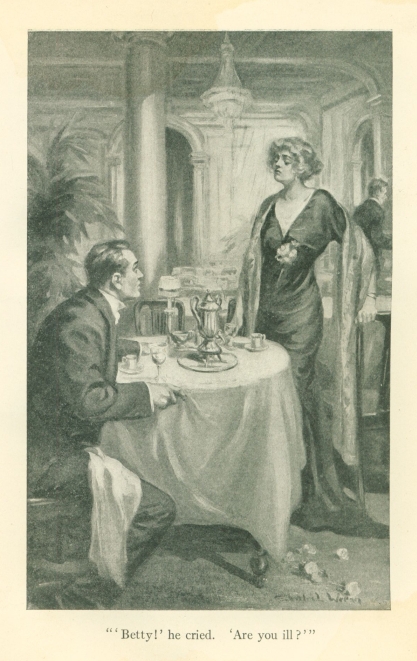
"'Betty!' he cried. 'Are you ill?'"
As he spoke her name the eyes rounded with amazement,
then slowly narrowed to an expression that sent
a chill through Bob's heart. It was no more like Betty,
that look, than the voice that accompanied it.
"So you knew all the time who I was, and yet you
spoke to me like that—pretending you didn't know."
Bob tried to speak, but she went on in a low, monotonous,
terrible voice, only just raised above a whisper.
"You are a coward, and what you have been saying is
a lie—a mean, contemptible, cowardly lie. Now I'm
going. I sha'n't see you again."
Her lips were beginning to quiver. She could not
trust herself to say another word.
Bob, utterly crushed, bewildered and silenced, walked
beside her for appearance's sake to the door of the lift.
Without a word, without a look, she stepped inside and
the bronze door clanged between them.
Alone in the writing-room, Bob tore up sheet after
sheet of the hotel paper in fevered attempts to compose
a note to Betty. As he crumpled them up one after
another, he stuffed them into his pocket, not stopping to
tear them up. The moments were slipping by. At last
in desperation, he wrote:
"Betty—For God's sake see me, if only for a moment
before I go. My train leaves in half an hour. Bob."
He rang for a waiter and without stopping to reread
it, slipped the note into an envelope, directed and sealed
it up, and gave it to the man to take to Miss Thompson's
room.
After an interminable quarter of an hour the waiter
returned. Bob gave him a shilling and snatched the
envelope from the tray. He turned it over eagerly—it
was his own note, unopened.
The curate walked back to Ipping House with a
lighter heart than he had known for days. It
was true he had not carried out his spectacular
purpose of running down a criminal, nor had he proved
himself a very wonderful detective; in fact, he was still
in darkness touching the nature of Hester Storm's
wrongdoing; but it had been his privilege to help this
girl at a critical moment, and to turn her from evil ways
to sincere repentance. As to any future problems or
complications, Horatio had no fear, for he knew the good
seed was growing in Hester's heart and, if the heart was
right, everything else must be right. And he took great
satisfaction in immediately destroying the incriminating
letter, rending it into small pieces and scattering these
toward the lake as he strode buoyantly along the shore
path.
Meantime the girl herself, the object of Merle's loving
solicitude, sat motionless on the broad, low bench
between the friendly fir trees. Dazed, frightened, yet full
of a strange joy, Hester was thinking of this extraordinary,
this unbelievable thing that had happened. A meek
little man, with amusing side whiskers, had spoken to
her, had looked into her eyes and, suddenly, her whole
life was changed, absolutely and irrevocably changed.
She was not and never again would be the girl she had
been. That was sure. The words she had spoken with
bended head were graven on her memory. She had
given her promise to God and to Rosalie, and nothing in
the world could make her break it, still——
She gazed out over the lake where the swans were
drifting idly, and a smile, half plaintive, half mischievous,
formed about her warm, red lips, as she reflected that
here was Hester Storm, known on Manhattan Island as
a cold-blooded proposition, little Hester, who had gone
up against hard games in various cities and gotten away
with them—not so bad, her bluffing Grimes with the
haughty stare in Charing Cross station—here she was
with a big bunch of money right in her hands, you might
say, and letting it go, letting the whole thing go and
starting all over again because—because she wanted to.
Now her thoughts went back to the minister's program:
To be honest, to be kind, to make amends, if
she could, for any wrong act—there it was. Well, as
to making amends, she would give back the purse. She
had stolen it, and she would give it back. That was
easy!
No! Not so easy as it seemed, for the purse was in
Betty Thompson's golf bag, which was in one of the
lockers at the country club, where Mrs. Baxter had left
it. And this locker was secured by a key kept in
Mrs. Baxter's bureau drawer—also locked. There were
infinite complications here. Suppose she were found
picking one of these locks?
The penitent laughed ruefully as she reflected that it
was just as difficult and dangerous to get the purse now
for a good purpose (to return it to the bishop) as it was
before to get it for a wicked purpose. Yet the purse
must be returned; it must be returned immediately, for
any day or hour might bring the discovery of that
ill-guarded money, through the blundering luck of some
caddy boy or club cleaner or hanger-on about the locker
room. And such a discovery would inevitably provoke
a new investigation, and that must not be. Hester was
sorry for her wrongdoing, but she had no wish to go to
jail.
Here, then, was a delicate problem: to steal virtuously
a purse already stolen, and give it back to the owner so
that he would have no idea (Scotland Yard ditto)
whence it came or where it had been or who had turned
the trick. Hester pondered this for a long time with the
old, keen look in her half-shut eyes.
"It can't be done," she finally decided. "I'd just get
in deeper and deeper, and—the first thing I knew I'd
be——"
Then, like an inspiration, the solution came. It was
perfectly simple, perfectly safe, the bishop should have
his property within twenty-four hours, and nobody would
be the wiser.
"Sure!" the girl reflected. "That does it. I'll tell her,
I'll tell her the whole thing. She'll be sorry to know
I'm that kind, but she'll be glad I'm on the level now,
and—she'll keep my secret and—she can give back the
purse."
With a sigh of relief Hester rose from the bench, and,
drawing her cloak about her, started down the path. The
thing was settled and there was no reason for delay. On
the contrary, the sooner she found Miss Thompson and
told her the truth the sooner this trouble would be ended,
and she would be free to go away. A train to London,
a call at the steamship agency—why, she might be on the
ocean in two or three days, hurrying back to Rosalie!
Not with a fortune, to be sure, but she knew that Rosalie
would be happier to have her sister back and to hear
the great news of her cutting out certain things, happier
than if she brought ten fortunes—in the other way.
The girl stopped suddenly as she turned the point
beyond the cove. There was the boat landing and the
little footbridge leading to the summer house. And
there, on a bench beyond the summer house, was Anton,
the chauffeur, and she remembered, with a vague feeling
of alarm, that he was waiting for her!
Since their strange meeting in Betty Thompson's
chamber, the shock-headed chauffeur had made it
plain to the pretty sewing-girl that he was deeply
smitten with her charms. The fact that she had seen him
in New York and remembered a gold tooth, also the
injured ear of his friend with the blue handkerchief,
amounted to nothing, for, after this single flash, her
memory had failed her and, anyway, what if he had
taken a glass of beer with Red Leary in a Forty-second
street rathskeller!
The point was that Anton was now ardently and
aggressively in love with Hester. Twice he had put his
arm around her, once he had tried to kiss her, and daily
he had urged her to meet him some evening at the
garage for a joy ride. He had a sixty-horsepower car
at his disposal during various odd hours and he saw no
reason why pleasant reciprocity relations should not be
established between himself and this alluring young
woman.
"You're a peach, kid," he had whispered one afternoon
in the conservatory; "you've got me going all kinds of
ways with your eyes and your red lips and—say, come
down to the garage after supper for a little whirl. Do
you get me?"
Hester had laughed and shaken her head; then she had
half consented to his teasing, knowing well she would
not come.
The next day Anton brought her a splendid bunch of
roses and continued his pleading. He was crazy about
her; she had the dandiest shape and—he would treat her
right if she'd only come down and—then he tried to kiss
her.
There were two reasons why Hester had not altogether
discouraged these advances: she could not deny
herself the feminine satisfaction of exasperating an
over-zealous suitor by making promises which she had no
intention of keeping, and she did not wish to incur Anton's
enmity. She distrusted this man partly through that
vague memory in the rathskeller, partly on general
principles. And after the second broken appointment she
sent him a civil note pretexting a headache.
The next day he had begged her, almost with tears
in his eyes, to meet him that afternoon at five o'clock in
the summer house by the lake—for a few minutes. And
she had promised faithfully to come. Anton felt sure
she would really come this time, and in her honor had
donned his best gray suit and a new straw hat with red
and black band, which, with his light malacca cane, gave
him quite a smart appearance.
"This is where I land her," he said to himself, as he
strolled across the foot-bridge, sharp on the stroke of
five.
But alas for the hopes of lovers! Half an hour passed,
three-quarters of an hour and no Hester.
"She's thrown me down!" he muttered angrily and,
leaving the summer house, he strode along the path,
switching the ground savagely with his cane. There was
no doubt about it, she was giving him the big laugh.
Little devil! If he only had something on her so he could
make her come!
And now a singular thing happened, one of those odd
coincidences that give to trifles the importance of great
events. A gentle breeze was blowing down the lake and,
borne by this, there came fluttering along what seemed
to be a small white butterfly and it lighted directly in
Anton's path. The chauffeur switched at it with his
cane and missed it, switched at it again and missed it
again. Then he saw that it was not a butterfly at all,
but a small square of white paper no bigger than a
postage stamp and he wondered how it was that this
floating fragment had come to rest balanced exactly on its
edge. It certainly was strange! What kept it poised
there quivering on that moss bank? Why did it not
fall over on one side or the other?
Anton stooped and picked up the piece of paper and,
seeing some writing, he glanced at it carelessly. Good
Lord! What was this! He stopped short and stared
at the words, then, lifting his hat, he ran his fingers
through his hair and for some minutes stood absorbed
in thought.
"By the holy jumping Christopher Columbus!" he said
slowly. "I believe I've got it." And sitting down on a
bench he continued to study the paper. Presently he
took out a gold cigarette case and a moment later he
was blowing out toward the peaceful lake the fragrance
of Turkish tobacco with little nods and chuckles of
extreme satisfaction.
It was at this moment that Hester, hastening on her
search for Betty Thompson, appeared at the turn of the
path and found herself face to face with Anton.
"Ah! Little one!" he exclaimed, rising and going
forward smilingly to meet her. "So you thought you'd
show up after all!"
Hester made no effort to hide her annoyance.
"I didn't come here to see you. I had forgotten all
about you," she said coldly.
"Don't say so," he sneered. "Pretty poor memory
you've got, kid. Better take something for it."
She noticed a change in this man. Before this, with
all his slangy, bantering ways, Anton had always been a
suppliant for her favor, eager to please and ready to
obey, but now she recognized in his tone a certain swaggering
assurance, as if he felt himself master of the situation.
"He's trying to bluff me," she thought. Then aloud
"You'll have to excuse me. I'm in a hurry," and she
started on.
"Oh, I don't know," he laughed. "Perhaps you can
give me a little time—say an hour or two."
She flashed a scornful look at him.
"If you wait until I spend an hour with you you'll
wait a long time, Mr. Anton."
"Oh, no! Not so long, Miss—er—what did you say
your name is?"
She faced him unflinchingly. "What do you mean by
talking to me like this?" she demanded.
The chauffeur took a pull at his cigarette, then blew
out the smoke slowly.
"I'll tell you, girl, what I mean," he answered, eyeing
her keenly through half-shut lids. "I mean that from
now on we quit fooling and you take orders from me.
Understand?"
She tossed her head defiantly. "Oh, I guess not!"
"I guess yes and I'll begin right now. I want you to
be at the garage to-morrow morning at ten o'clock."
"No."
"Yes. You'll be at the garage to-morrow morning at
ten o'clock because I say so, Miss Jenny Regan—I beg
your pardon, I should say Miss Hester Storm!"
In spite of her indignant protests and her contrary
plans, Hester appeared at the garage the next
morning shortly before ten. There seemed nothing
else for her to do. Hour after hour through the night
the troubled girl had sought for some different course
and had found nothing. Somehow this chauffeur had
discovered her other name, the name she had given to
the police, Jenny Regan, and she could not make any
move until she found out how much more he knew. She
could not carry out her plan of restitution nor confide
in Betty Thompson until she learned what was back of
Anton's ugly, threatening attitude. He was not
bluffing, she felt sure of that.
The chauffeur received her with a business-like nod.
He was cleaning the big car.
"Hello, little one! I took the old man to the station
this morning. I'll be through in a minute. Sit
down." And she watched him give the last skillful touches to
the shining machine.
"Now, then, just a second to wash these paws of mine.
There! And another to light a cigarette. Have
one?" He offered her the open case.
"Thanks, I don't smoke."
He shrugged his shoulders. "You don't have to be
so careful. We're alone."
She tried to hide her uneasiness under a careless tone.
"You're rather fresh this morning, Mr. Anton."
He drew up a wooden chair and seated himself so
close to her that their knees were almost touching.
"Now listen," he said, and his eyes were on her keenly.
"We're going to talk straight. I'll tell you how we stand
and—first I'll tell you this. I like you, girlie, but I'm
onto you."
"Onto me?" she echoed.
"Don't give me the baby stare. I know you've got
pretty eyes, but you're a crook, kiddo, with a record in
New York City, and you stole that bishop's purse!"
"You don't say!" she laughed scornfully. "Anything
else?"
"Yes. I want to be in on the game. I figure that
something went wrong after you swiped the leather that
day on the train—you slipped a cog somehow, and—you
came up here. I don't know why you came, but—you're
going to tell me."
"Indeed!" she mocked.
"You may not find it so funny in a minute."
There was something sinister in his tone that filled her
with terror.
"You—you say you like me and—then you accuse me
of frightful things," she faltered.
"Nothing frightful about it! You got away with five
thousand pounds. Fine! I read about it in the
newspapers. Here!" He drew a folded clipping from his
pocket. "'One occupant of the carriage was Miss Jenny
Regan, an American lady, who succeeded in convincing
the police that she had nothing to do with the robbery.' Oh,
no, nothing! Clever girl, Miss Jenny Regan, but
now she'll have to show me."
The chauffeur laughed with cynical satisfaction, and
his gold tooth gleamed. How Hester hated him!
"Then you think I am this American woman, Miss
Jenny—what was her name?"
"Regan. Yes, I know you are."
"How do you know it?"
He searched in his breast pocket, then in his side
pockets, and finally in his cigarette case.
"Ah! Here it is. I put it in the cigarette case to
protect it." He produced a small square of white paper,
and held it before her eyes with a smile of triumph.
"Ever see this before, kiddo?"
Hester's face went white, and all the strength seemed
to go out of her body as she read the postscript of her
own letter to Rosalie, the fateful letter that she had torn
in two and thrown into the fireplace. By some whim of
fate the fluttering fragment that had sailed to Anton's
feet, after the curate's well-meant scattering of the
pieces, was a portion of this letter, and contained, in
the girl's own handwriting, the most damaging words of
the epistle: "Please remember not to address me as
Jenny Regan, but as Hester Storm!"
"Rather jars you, don't it?" he said as he watched her.
"I suppose you'll say it isn't your writing? Want me
to compare it with the note you sent me?"
"It is my writing," she admitted, "it's from a letter I
wrote to my sister, but that doesn't make me a thief."
"Ah, it's your writing! Then you go under two names?"
"I may have had a reason for—taking another name."
"I'll bet you had a reason! And you were in the railway
carriage when this purse was stolen?"
"I—I didn't say so."
"Well, were you? I want to know."
She hesitated a moment, then flung him a look of defiance.
"Yes, I was. What of it? You read what the paper
said. I had nothing to do with the robbery."
Anton smiled. "Excuse me, girlie, the paper said you
succeeded in convincing the police that you had nothing
to do with it. Which isn't the same thing. Now don't
get snappy." He patted her playfully on the knee.
The hot blood mounted to Hester's cheeks.
"Keep your hands off me," she warned him. "And,
if you think yourself cleverer than the police you'd better
offer them your services."
The words were hastily spoken and immediately
regretted. If there was one thing in the world Hester
wished to avoid it was any entanglement with Scotland
Yard. The very name made her shiver.
"Not a bad idea!" reflected the chauffeur. "I may
try it, if I can't fix up a deal with you." Here he lighted
another cigarette. "But don't you worry, we'll make
a deal all right."
"What kind of a deal?"
"I'll help you out of the tangle you're in and we'll
whack up on the five thousand."
"You still think I took that purse?"
"Sure, you took it."
"If I had five thousand pounds would I be sewing in
a place like this? Would I?"
He thought a moment, frowning. "I know, that's a
good line of talk, but—I tell you there was a kink in the
job, and—see here, what was it? What ever brought
you to this Godforsaken place?"
"What ever brought you here?"
"I have to earn my living."
"Well, are you the only one?"
"Besides, I was working for Baxter; I came with him,
but you dropped down out of nowhere—with a fake
name."
"That name seems to worry you, Mr. Anton."
"Jenny Regan? Just a little. I happen to know who
the lady is. One of the slickest thieves we've turned
out. And she don't have to do sewing for a living,
either. I guess not. Come, kiddo, do we make the
deal?"
"No!" she answered fiercely.
"Little spitfire! I'll tame you yet."
"Try it," she said.
The chauffeur rose quietly and went to a shelf, where
he took down a box of paper.
"Just to show you how easy it is," he continued,
returning to the girl. "I take this sheet of paper—so,
and this pencil—so, and I write to Scotland Yard that
Jenny Regan, who was mixed up in the bishop's purse
affair, is not an American lady, the way they thought,
but an American pickpocket, well known at Police
Headquarters in New York City."
"It's a lie!"
"You must be pretty well known for me to have heard
of you. Then I tell 'em this dangerous crook is hiding
in Ippingford under the name of Hester Storm. How
about it? Think that will help your game any?"
"You—you wouldn't do that?" trembled the girl.
"I wouldn't?" He felt that her courage was breaking,
and he pushed his advantage. "Let me tell you this,
little one, that letter will be written and sent to-day
if you don't come off your haughty perch. Now, then?"
She saw herself beaten; this man was relentless, he
would stop at nothing, and—she must make the best
terms she could.
"How do I know you'll—play fair?" she hesitated.
"There's a reward offered for information about that
purse and——"
"A reward of a hundred pounds! What's a hundred
pounds with five thousand to divide? Do you take me
for a fool?"
"No."
"Well?"
Hester was accustomed to quick decisions. She had
learned in a hard school to judge men, and she knew
this scoundrel was acting only in a spirit of greed.
There was no danger of his betraying her.
"All right," she yielded in a low tone, "I—I'll come
down."
"Good girl!"
"I took the purse from the bishop but his nobs
squealed before I could make my getaway, and when the
coppers came in I was very near caught with the goods,
only——"
"Only what?"
"Only there was a lady in the carriage, a friend of
the bishop's, and—she had a golf bag with her, and—say,
boy, I worked a new stunt." Unconsciously Hester
was dropping back into the Tenderloin vernacular.
Anton pulled excitedly at his short mustache, and his
lips worked nervously.
"Say, kid, you don't mean——"
She nodded slowly. "It was all I could do. They
searched me, and if I hadn't dropped the leather into
that golf bag——"
He looked at her sharply.
"You're telling me you hid this purse in a golf bag
that belonged to another party?"
"Sure I did. I'd have been pinched if I hadn't."
"Who was she—this lady?"
"Miss Thompson, Baxter's secretary."
"What?"
"That's right. That's why I'm here. Now you know
the whole thing."
He stared at her in half suspicion.
"You young devil! Are you lying to me?" Then,
suddenly, he remembered. "No, by Jimminy, you're not!
You had her golf bag in your hands that day—by the
looking-glass!"
Hester nodded. "In two more minutes I'd have had
the purse out, if you'd left me alone."
"Then—then you saw the purse?" he questioned
eagerly. "It's there—in the bag?"
Hester nodded again. "It was there."
"Five thousand pounds knocking around in a golf
bag!" His small eyes burned with covetous fire. "And
she knows nothing about it—this secretary?"
"Nothing."
Anton sat silent, running his fingers back through his
hair over the white lock.
"I've got him worrying now," reflected the girl.
"And—where is the golf bag—now?" he asked.
"Mrs. Baxter borrowed it and left it at the club house."
"You found that out?"
"Yes."
"Where—in the club house?"
"In one of the lockers—Mrs. Baxter's locker."
"I see." He was silent again. "That was four days ago?"
"Yes."
"How many times has the bag been used?"
"How do I know?"
"Haven't you watched it? Haven't you tried to get
it?"
"You make me tired! How could I watch it—or get
it—out in the club house?"
The chauffeur looked at her pityingly.
"It's just as well you've got a man in this game, girlie.
It won't take me long to get that bag out of the club
house. See that clock?" He pointed to a timepiece
ticking noisily on the wall. "It's half-past ten. Bet you
twenty dollars against two smooth kisses that I have
the bag here within an hour."
Hester laughed, half coquettishly. "I don't bet my
kisses."
"No?" He leaned forward eagerly and caught one
of her hands. "What do you do with them?"
"I—I keep them," she said with a teasing glance.
He held her hand a moment, her soft, warm hand,
then pushed it from him roughly.
"We'll see about that later on. Now it's business.
Come, kid!" He pointed to the car.
"You're not going to——?"
"We're going to the country club. Quick!"
"Suppose some one sees us?"
"There's nobody here that counts except Mr. Robert.
We'll take a chance on him. If he says anything you tell
him Mrs. Baxter left orders for you to bring back Miss
Thompson's golf bag from the club. Get me?"
"Good work!" she nodded.
"Didn't think of that, did you, girlie?" He opened
the polished door. "In you go—behind!"
Without further protest Hester seated herself on the
comfortable leather cushions, and a moment later they
were speeding down the drive.
"Oh! Stop at the lodge," she remembered. "I want
to get my cloak."
Anton halted the car at the big gate and amused
himself for a few moments making faces at An Petronia
who was playing in the roadway. Then he asked her
preposterous questions about her dollies. Could they
swim? Did she let them go to moving picture shows?
Were they allowed to smoke Turkish cigarettes? One
of the chauffeur's favorite diversions was teasing An
Petronia.
"Say, you took your time!" he remarked presently,
when Hester reappeared arrayed in her familiar scarlet
garment.
"Go on! I'll tell you why," she said in a low tone
Then, when they were on the main road, "I thought I'd
make sure there aren't any more letters lying around in
my room that might make trouble."
He nodded his approval of this precaution. And now
they were silent for two or three minutes, while the
machine flew over a smooth mile leading to the country
club.
"Do you know how you're going to work this boy?"
she questioned anxiously, as they swung into the
beautifully kept grounds of the Ippingford golf course.
"Sure! Mrs. Baxter has sent her maid, that's you,
to get her golf bag. She wants the bag down at
Brighton. And the bag's in Mrs. Baxter's locker."
"How about the key?"
"Mrs. Baxter has mislaid the key. The woman in
charge of the locker room will open the locker for you.
See?"
"I see," answered Hester, and as the car drew up
under the white columned porch of the club house she
hopped out nimbly. "I won't be a minute." Then she
started eagerly for the door.
"Wait!" called Anton, with a flash of distrust. "Come
back! I'll get the bag myself." And, passing her, he
disappeared within the house just as a party of smartly
dressed ladies came out and stood chatting and laughing
on the broad piazza.
Hester climbed back into the auto and waited, biting
her lips. And presently a hard-featured woman
appeared, followed by the chauffeur carrying a golf bag.
One glance showed the girl that it was the golf
bag—there was no doubt about it.
"Are you Mrs. Baxter's maid?" demanded the woman
in a shrill voice, while the ladies stared.
"Yes."
"Your chauffeur says Mrs. Baxter told him to get this
golf bag?"
"That's right," smiled Hester pleasantly.
The locker woman still seemed dissatisfied. "It's
queer," she grumbled. "Mrs. Baxter told me to be
careful of this bag because she had borrowed it."
"Exactly," smiled Hester, "and now Mrs. Baxter
wants to return it. In here, please. Thank you." She
placed the bag on the seat beside her and handed the
woman a two-shilling piece. Then to Anton with a grand
air, "Home, please. Mrs. Baxter is waiting."
Anton touched his cap respectfully, but did not move.
"I'll have to ask you to sit on the front seat, miss;
one of the back springs is broken. Let me take this
for you." And he placed the golf bag close to the
steering wheel. With a movement of annoyance Hester
followed the bag and seated herself next to the driver.
Thus, side by side and mutually distrustful, they shot
out of the grounds with Betty Thompson's much-coveted
golf bag between them.
"We've turned the trick—we've got the goods," Anton
whispered exultingly. Then, slowing up the machine, he
peered down among the golf clubs. "Can you see it,
kid?"
"Lean the bag toward me. That's right." She pushed
open the clubs and gave a cry of satisfaction. "Ah!
There! Way down at the bottom! Don't you see?"
The chauffeur looked again, and this time made out
distinctly the fat, brown wallet, clasped by its elastic
band, that was still lying safe in its singular hiding-place.
"Holy spoons," he muttered. "We've got it! You
see what a little nerve will do."
"Didn't I help you out with the cranky dame?"
"You sure did. You were great, girlie." He gripped
the wheel tighter as they passed an automobile. "We'd
better turn off through the woods. Too many people
here—and—we've got to talk things over."
"Talk what over?" she asked innocently.
He looked at her and was silent, his eyes drinking
in the loveliness of her face and figure.
"Say, you certainly are a little beauty! You've got the
reddest lips and the sweetest shape!" He slipped his left
arm around the girl's lithe waist and drew her toward
him. They were running slowly along the woodland
road, through a grove of trees.
Hester only resisted slightly, but there was a
tremor of unhappiness in her voice as she said:
"You must think a lot of me when you wouldn't
even trust me to go into the club house for the golf
bag."
"Ah! You noticed that," he smiled complacently.
"Did I?" She nestled closer. "And you wouldn't let
me have the bag on the back seat."
"Would you have left me alone with it—on the back
seat? I'll bet you wouldn't. You're the sweetest kid
I ever saw, Jenny, and I'm going to love you to death—yes,
I am, but—wait!" He brought the car to a standstill
in a deeply shaded spot by the road-side. Then,
without further preliminaries, he caught her in his arms
and tried to kiss her, while she struggled against him,
turning away her face.
"No, I won't," she panted. "If you don't trust me
enough to——"
"Trust you? Why should I trust you? You're a
crook! And you're sore on me. Don't you suppose I
know it? Hold on! Keep those two little hands where
I can see 'em."
She looked at him indignantly. "Do you think I'd be
silly enough to—try any funny work—here?"
"Do I think so? Don't make me laugh. There's a
fortune in that golf bag and—come now! Put those two
hands outside your cloak, one on top of the other. That's
right. Now leave 'em there. I'm not taking any chances
with you."
"This is a fine way to win a girl," she protested, but
as if frightened, she left her neatly gloved hands crossed
obediently before her.
"Don't you worry about the winning part," he laughed.
She faced him angrily. "You'll never have a chance
to——"
But he did not let her finish. Clasping her again in
his arms, he held her, struggling desperately, and, as he
saw an opening, pressed his lips to her flaming cheeks,
to her white forehead, and, finally, as his strength
conquered hers, to her unwilling red mouth.
"There! I told you I would," he triumphed. "A man
don't have to trust a girl to kiss her. We'll watch
each other, Jenny, when we're doing business, but,
say, this is pleasure, and—once more—God, I like your
lips!"
He held her, unresisting now, his mouth crushed down
upon hers, and, even as he feasted on her sweetness, he
was sufficiently master of himself to note that her two
hands were still crossed before her on her cloak.
A moment later, the long, hoarse whistle of the new
paper mill in Ippingford warned him that time was
passing.
"What! Twelve o'clock!" He listened. "This won't
do. We must get a move on. I'll just fish this out, and
then we'll hustle back."
He started to reach down into the golf bag, but Hester
stopped him.
"Wait!" she ordered. "You say we'll watch each
other. You're dead right, we will. And I want to know
who's going to keep that purse if you take it out of
the bag?"
"Don't be a fool! We'll divide the money and you can
keep the purse for a souvenir."
"When will we divide the money?"
"As soon as we get to the garage."
"Why not now?"
He shook his head impatiently. "Because I'm late.
Didn't you hear that whistle? Do you want to get me
in bad with Baxter?"
She hesitated, watching him keenly. "Don't try to
get gay with me, boy, for I'll do you up, sure. You
know I've got something on you now."
He turned with a movement of alarm. "What?"
"If there's any trouble and it comes to a show down,"
she answered in a cold, even tone, "just remember that
you're in this thing as deep as I am. You told that
locker woman that Mrs. Baxter sent you for the golf
bag, all those ladies heard it, and they saw you take
the bag!"
"That's all right," he answered carelessly. "There
won't be any trouble, if you do what I say."
"Go ahead, take the purse, but, remember, boy, if you
wait one minute at the garage before dividing that
money," she leaned close to him, and her black eyes
blazed so fiercely that he started in alarm, "if you wait
one minute, or try any flimflam game on me, Mr. Anton,
you'll be sorry for it. That's all."
At this moment, just as Anton was about to brave her
objections and transfer the purse from the bag to his
pocket, the course of events was changed by the appearance
of a barefooted small boy, who emerged unexpectedly
from the woods and stood staring at them with a
sort of dull impudence.
"That settles it," muttered the exasperated chauffeur.
"We'll wait till we get to the garage." Then, stepping
out, he cranked up the machine, and in a moment they
were off at top speed.
Five minutes later they were back at Ipping House,
and, as they passed the lodge, An Petronia called out
shrilly to Anton that Mr. Robert Baxter was looking
for him.
"I told you," frowned the chauffeur.
"Don't worry, boy. Get busy," urged Hester, as they
stopped at the garage.
Leaving the car, they quickly entered the low building
and closed the door behind them. Anton carried the
golf bag, and, without further parley, laid it down on a
work bench, and, reaching in his arm, drew forth the
purse.
"Now I just want to say one thing, girlie, before we
divide this money."
"Wait!" she warned him, lifting a hand. There was
a quick step outside, then a click of the lock, and Anton
had barely time to thrust the purse into his coat pocket
when the door opened and Robert Baxter entered.
"What's going on here? Where have you been with
the car?" the young man asked in sharp displeasure.
"Mrs. Baxter told Hester to get this golf bag, sir,"
answered the chauffeur. "Mrs. Baxter borrowed it
from Miss Thompson, and she left it at the country
club."
"Oh!" He turned to Hester. "You'd better take the
bag to Miss Thompson's room."
"Yes, sir."
Hester picked up the golf bag and moved slowly
toward the door, her eyes sending desperate messages
to Anton. To which, as she passed out, he answered
with a reassuring nod.
"I've been wanting the car myself," said Robert.
"I'm sorry, sir. We were delayed by a loose bolt in
the rear frame. I must put in a new one."
"How long will it take?"
"I'll have to take the frame apart, sir. I'm afraid it
will take me an hour."
"Very well. Bring up the car in an hour."
Anton touched his cap as young Baxter strolled off,
leaving the garage door open.
The chauffeur waited a minute or so, looked about
him cautiously, and then went back into a small storeroom
in the rear, where he was sure of being alone and
unobserved. He closed the door of the storeroom, locked
it, and, at last, with a thrill of excitement, drew the
bishop's purse from his pocket. He held it a moment in
delicious expectation, then stripped off the elastic band
and looked inside.
"Damnation!" he cried, and his face, was black with
rage.
Then, dashing the empty purse to the ground, he flung
open the door and strode angrily across the lawn in
pursuit of Hester.
Meantime Hester had crossed the lawn and
entered the conservatory. She carried the golf
bag by its supporting strap and walked quickly.
She knew that the conservatory opened directly into the
library where the Reverend Horatio Merle was reading
the morning paper and her idea was to go straight to
the curate and tell him the whole truth. In the absence
of Miss Thompson this was the only thing to do. If
Anton followed her, as might happen, Mr. Merle would
be a protection, for, in his presence, the chauffeur would
not dare make trouble. He would wait to get Hester
alone, never suspecting that she would be capable, in her
wildest dreams, of giving back this great sum of money.
The girl paused to enjoy the warm fragrance of the
lilies. It reminded her of something way back—something
sad and strange. What was it? Oh, yes! Now
she knew. It was the funeral of Billy Connor—"Diamond
Billy," the confidence man, over in Brooklyn. She
had gone with Maggie Connor and Rosalie. Poor old
Billy. He drank himself to death after they shut down
on horse-racing in New York State. How she cried
when the organ played and they all knelt down! That
was the only time she had ever been in a church or tried
to pray.
"To be honest, to be kind.... To make amends for
any wrong act. To ask God for strength against temptation."
Now, in her need, these words that the curate had
taught her came back to her mind and comforted her.
This had been a hard fight with Anton and she had won
out. She had rescued the money and would give it back,
as she had promised—that was something.
Hester smiled as she pictured Anton's face when he
opened the purse. The nerve of the man to think he
could get the best of her at a game like that, her own
game! "Now put your two little hands outside your
cloak and keep 'em there!" Silly Anton! Didn't he
know that Hester Storm had worked that trick when she
was a twelve-year-old kid sneaking leathers from shopping
guys on Sixth avenue cars? Two little hands outside
your cloak! Ha! Two little gloved hands—very
innocent—and one of them a fake, joined onto a fake
arm and the whole thing strapped from the shoulder!
Then if the man gets gay and hugs you in the automobile,
and pretty soon gets crazy and kisses you, while
you wriggle and twist and keep him busy—and then get
busy yourself with your real arm down in the golf bag—why,
it was too easy! It was a wonder Anton didn't
get wise when she stopped so long at the lodge. Those
shoulder straps take time to fasten on.
With a thrill of professional pride and a sigh of half
regret, Hester pressed her hand to the bosom of her
dress, where the bundle of crisp banknotes crackled
alluringly. Five thousand pounds! Twenty-five thousand
dollars! And it must be given back! No fiddling
around, either! It was not good for a girl like her to
have twenty-five thousand dollars that belonged to
somebody else in her clothes. Not good at all!
She walked straight to the wide double doors with
their green portieres that separated the conservatory from
the library, and, bracing herself for this ordeal with the
Reverend Merle, she turned the knob.
"Rosalie will be glad," she thought, as she pressed
against the door. To her surprise nothing moved or
yielded, and the girl realized, with a sudden sinking of
the heart, that the library door was locked.
Hester tapped lightly on the panel, then louder, but
no one came. She listened, with her ear close to the
door, but there was no sound from the adjoining room.
Strange! Mr. Merle must have gone out. Ordinarily
there would have been nothing alarming in this, but now
to the agitated girl it assumed the proportions of a
disaster. She had counted on giving this money
immediately to the clergyman, but, with the clergyman
absent——
Seized with alarm, Hester darted back to the door of
the conservatory, the door, in the ground glass wall that
led in from the lawn. She opened this door just a
crack and looked out, then instantly closed it and turned
the key. Not a hundred yards distant, Anton was hurrying
toward this very spot.
In the presence of danger Hester's mind acted quickly.
The essential thing now was to hide this money. But
where? She looked wildly about her. In the center of
the conservatory stood a small, low table covered with
potted plants. There was a drawer in this table. Hester
put down the golf bag and pulled the drawer open.
Lengths of twine and wire, some gardener's tools and a
lot of seed catalogues. She shook her head and pushed
the drawer shut. Anton would look there at once. She
must find, some simple place that he would not think of.
Perhaps she could bury the money in one of these big
tubs that held the palm trees, but no, there wasn't time.
It was maddening!
In this emergency the girl's eyes fell upon a small
standard rose bush growing in a gilt basket. It was a
plant that Lionel and the countess had purchased at
the Progressive Mothers' bazaar. Hester bent down
eagerly to see if there was a space between the basket
and the flower pot and, in trying to move the latter, she
caught the stem of the rose-bush, whereupon to her
surprise the bush itself, with the earth about its roots,
detached itself from the flower pot so that she was able
to lift the plant and a cylinder of dry earth entirely out
of the pot. Ah! This might do. And a moment later
she had laid the banknotes in the bottom of the pot and
replaced the cylinder of earth above them. To the
casual glance there was not the slightest indication that
the rose-bush had been tampered with.
Now, in desperate haste, Hester flung off her scarlet
cloak and, with a few deft movements, loosened the
shoulder straps that held the false arm in place. Anton
might search her and, if he found this—There! it was
off! And none too soon, for at that very moment the
loose-jointed figure of the chauffeur appeared, silhouetted
in sinister black, against the ground glass wall of
the conservatory. A moment later he was trying to open
the door, clicking savagely at the lock.
Where could she hide the false arm? Anton would
be here in a second. There was another door at the end
of the conservatory where he could come in. She dared
not lock this other door, for then he would know that
she was guilty. But the false arm? High up along the
wall, higher up than she could reach, ran a wide shelf
ranged with tin cans and packages of seed and coils of
rubber hose. It was the best she could do, and, with a
quick movement, Hester flung the false member upward
so that it touched the ceiling and then fell out of sight
behind a rusty watering pot. As she did so she saw
Anton's shadow nearing the other door. Well, she was
ready for him. Wait! Her cloak! There!
And now, partly to hide her agitation, partly with a
feminine idea of taking the aggressive in a bad cause,
Hester stepped to a telephone fixed against the wall near
the library door. What was the telephone number on
that card she had picked up in the garage? Ah, yes!
And in the very last second before the chauffeur
entered she took up the receiver, placing her hand so that
the little finger, unperceived, held down the hook and
there was no communication.
Thus, when the chauffeur burst in, boiling with anger,
Hester Storm, attired in her scarlet cloak and perfectly
calm, was talking in a natural and business-like way to
the unresponsive green-painted wall of the conservatory.
"Hello! Yes, Mr. Henderson," she was saying,
apparently absorbed in her telephoning and quite
unconscious that Anton was present. "I understand. I'll
report to-morrow as usual. What? You don't want me
to call up 724 Chelsea? Oh, I see."
As she pretended to listen, the girl held the transmitter
so that she could watch her adversary's face in the
nickel-plate surface. It was evident that his surprise
and alarm were genuine.
"Very well, Mr. Henderson," she concluded. "I will
telephone to the house. Good-by, sir." And, hanging
up the receiver, she turned innocently toward Anton.
"Oh!" she exclaimed. "When did you come?"
He strode toward her with an ugly look. "Who were
you telephoning to?"
"No one in particular, a—a friend of mine," she
answered with simulated embarrassment.
"A friend named Henderson?" he demanded.
She shook her head. "You've got your wires twisted.
I don't know anyone by that name."
"You called up 724 Chelsea. I heard you."
"Well, what of it?"
"You said you were going to report there to-morrow?
What do you mean by that?"
Hester looked him steadily in the eyes, then, going
close to him, she spoke with a semblance of concentrated
anger.
"If you think you can run me off on a side-track like
this, little chauffeur boy, let me tell you you've got
another guess coming. I want to know where is my part
of that money?"
He swore violently. "You know —— —— well where
it is."
"What?"
"You took the money, my share and yours."
"So that's your game! That's the kind of a cheap
skate you are!" She seemed to tremble with rage.
"Remember what I told you. You can't flimflam me. I—I
won't stand for it."
Her bosom heaved, her nostrils dilated and her Spanish
eyes burned on him so fiercely that the chauffeur
hesitated. Was it possible she was on the level? Had
someone else taken the money?
"There was nothing in that purse," he said sullenly.
"You mean there is nothing in it," she sneered. "I
suppose you'll show it to me—empty? Ha!"
"It is empty and it was empty. You got away with
the stuff and I know it."
"How did I get away with it? You wouldn't let me
touch the bag or move my hands. I suppose I took it
with my feet?"
Anton scowled and was silent. "I don't know how
you got it, but——"
Suddenly he caught her arm and drew her sharply to
him.
"Leave me alone," she struggled.
He held her in his powerful grip and, with business-like
thoroughness, proceeded to press his hands over her
garments until he had satisfied himself that the
banknotes were not concealed about her person.
"Little devil! You've hidden it somewhere," and he
pushed her from him savagely, glaring at her.
"You—you——" she tried to brave him again, but her
words failed her. He had hurt her and shamed her with
his rough handling, and, frightened now, she sheltered
herself in a woman's last defense, she burst into tears.
Whereupon, Anton, man-like, began to weaken. After
all, he did not know that she had taken the money from
the purse. He had followed her quickly and found her
telephoning—telephoning to Henderson. That was
another queer thing, but, anyway, it always took him three
or four minutes to get Henderson, so she wouldn't have
had time to hide the money. Besides, how did she get it?
He had watched her like a hawk, even while he was
kissing her. And it was true the golf bag had been four
days at the club house. Many things may happen to a
golf bag in four days.
"Say, kid, don't cry," he relented. "I'm sore about
the money, but—maybe you didn't take it."
Hester wept on inconsolable.
"Maybe somebody got away with it at the club house,"
he continued.
"You—you don't believe anything I say," she sobbed.
"Well, you don't believe anything I say, do you? You
think I took the stuff myself, don't you?" he retorted.
This seemed to Hester the moment for a more
conciliatory attitude and she agreed, still sniffing and
dabbing at her eyes with her handkerchief, that it was barely
possible someone at the club had stolen the money.
"But there's one thing I want to know, girlie, and I
want it straight," the chauffeur insisted. "How did you
happen to be telephoning Henderson just now?"
Hester dried her tears and smiled faintly. Now she
was the victim of her own mystification. What plausible
reason could she invent for telephoning to a man about
whom she knew absolutely nothing?
"What do you care about Henderson?" she laughed.
"I care a good deal. Come, now!" It was plain that
Anton took this telephone incident very seriously.
"Henderson is a—a party I'm working for," she ventured.
"Then you do know someone by that name? You
just said you didn't."
She looked at him reproachfully. "I don't have to
know him personally to work for him, do I?"
"What kind of work do you do?"
She hesitated, biting her lips, first the lower, then the
full upper one, until they were red like cherries, and all
the time trying to imagine what kind of work it could be
that she was doing for Henderson. If she only had
some faint idea who Henderson was! What a fool she
had been to get herself into this tangle!
"You know what the work is, boy, or you can come
pretty near to guessing," she answered, with a wise
dropping of the eyelids.
"You're making reports to Henderson? Is that it?
Don't lie. I heard you on the phone."
Hester clutched at this guiding straw. "Well, what
of it? When I came to Ippingford I—I didn't know
you and—it was a—a chance to pick up some easy
money." She was feeling her way, wondering where
this glib improvisation would lead her.
"You didn't know me?" he scowled. "What's that
got to do with it?"
She leaned forward and patted his hand playfully.
"Now don't you be cross, Anton. You know the little
fat man with the brown derby hat?"
"No."
"Yes, you do. The one who does business for
Henderson, the one who stutters."
"Never saw him."
"You didn't? Well, I saw him. The day after I came
here he got hold of me at the lodge and—we had a walk
and—he said there was a party named Henderson who
wanted to get a line on Baxter's chauffeur—that's
you—and—the end of it was I agreed to telephone 724 Chelsea
every day."
"The devil you did!" Anton was so disturbed by this
that he thrust both hands into his mane of black hair
and sat silent.
A moment later an electric bell echoed through the
house.
"Someone at the front door, some caller," muttered
Anton. Then, looking at his watch. "I've got to get
out of here. Young Baxter wants the car."
"And I must take this golf bag to Miss Thompson's
room," she remembered.
"No hurry about that. Leave it in the library. We
don't care what becomes of the old bag now." Anton
walked slowly toward the door, biting at his mustache.
"All right, boy."
He stepped out on the lawn, but turned back. "Oh!
About Henderson! If it's all the same to you——"
"I know what you want," she anticipated. "I'll talk
to you before I telephone him again, and—buck up, boy,
I'll give him reports after this that'll boost your game.
See?"
"Good girl!" And with a wave of his hand, the
chauffeur disappeared.
Hester drew a long sigh of relief. Talk about
excitement! And now what should she do with the money?
It was out of the question to leave five thousand pounds
in the bottom of a flower pot without even a purse to
protect it. The golf bag was better than that, but—
She started at the sound of voices and footsteps in
the library. Presently there came a rattling at the door
and the turning of a key in the lock and a moment later
the Reverend Horatio Merle appeared, followed by
Ferdinand Spooner, secretary of the Progressive Mothers'
Society.
"My dear Mr. Spooner, I'm extremely sorry. I
thought they might be in the conservatory," said the
curate, peering about. "Ah, my child!" he beamed, as
he saw Hester, who, on the instant, had caught up the
golf bag.
"Mr. Robert Baxter told me to put this bag away," the
girl explained. "It belongs to Miss Thompson."
"Quite so," approved Mr. Merle. "And would you
see if you can find the Countess Clendennin and
Mr. Fitz-Brown. Say to them that Mr. Spooner has called."
"Mr. Ferdinand Spooner, secretary of the Progressive
Mothers' Society," put in the latter, puffing out his red
cheeks and blowing himself up with stiff self-importance.
"You may add that I have called in regard to various
articles purchased by Mr. Fitz-Brown and the Countess
Clendennin at the recent fair given by the Progressive
Mothers. Ah, there is one of the articles!" He pointed
to the rose bush. "That beautiful rose bush in the gilt
basket. Is it not exquisite, Mr. Merle?"
"Exquisite!" murmured Merle, rubbing his hands
devotionally. "Hurry, my child! Tell them Mr. Ferdinand
Spooner has called in regard to the rose bush and
the other articles."
Hester stared for a moment in dismay and then went
slowly from the room.
Never did Horatio Merle show more sweetly
the spirit of Christian humility than during this
brief encounter with Ferdinand Spooner. The
very sight of Spooner was abhorrent to the gentle curate,
the name of Spooner he detested, and all memories of
Spooner filled the little man with inexpressible pain, for
it was Spooner who was chiefly connected in his mind
with that lamentable afternoon at St. Timothy's when
Horatio had failed to put in an appearance. It was
Spooner who had made the opening address on this
occasion and it was Spooner who afterward spread through
the parish the pitiful story of the peppermint tree. Yet
now Horatio showed himself most friendly and listened
with a flush of pink interest while Ferdinand dilated on
his own successful efforts in furthering the interests of
the Progressive Mothers.
"Just to prove my point, Mr. Merle," concluded the
pompous visitor, "I will mention a great and perhaps
deserved honor that the Progressive Mothers have recently
extended to me in recognition of my services in their
behalf."
"Horatio!" called a shrill feminine voice at this moment.
"Yes, love," answered Merle, hurrying to the library
door. "It is my wife. Will you excuse me, my dear
Mr. Spooner? I am sure Mr. Fitz-Brown and the Countess
will be here in a moment." And he almost ran from
the room so eager was he not to hear about the honor
that had been extended to Ferdinand Spooner.
Left to himself, the distinguished representative of the
Progressive Mothers walked about the conservatory for
some minutes, sniffing at the flowers, and finally,
becoming impatient, looked out over the lawn.
"Very singular why no one comes!" he reflected; then
his eyes fell on Lionel, who, at this moment, emerged
from the shrubbery in a wide-brimmed straw hat and
carrying a watering-pot. His trousers were mud-stained,
his hands were red and roughened with toil, but his face
radiated the shining brightness of one who is conscious
of his own well-doing.
"One moment, please!" called Ferdinand Spooner, with
an air of authority.
Lionel came forward slowly, still carrying his
watering-pot. "Do you want to see me?" he asked.
"Well—er—not exactly, but—er—I am Mr. Spooner,
Mr. Ferdinand Spooner, of the Progressive Mothers."
"Oh, I say, are you one of the Progressive Mothers?"
Spooner stared haughtily at this. "I am the secretary
of the Progressive Mothers' Society and I desire
to see Mr. Lionel Fitz-Brown. Will you give him my
card, there's a good man?"
"Is it anything important?" drawled Lionel. "I don't
think Mr. Fitz-Brown is up yet."
"Not up yet? Why, it's nearly one o'clock."
"I mean to say he's taking his afternoon bawth. He's
very particular about his afternoon bawth, Mr. Lionel
Fitz-Brown is. Can't you tell me your business?" Then,
very confidentially, "I'm the gardener, you know."
The newcomer thought a moment. "Could you say
that Mr. Ferdinand Spooner has called in regard to
certain articles purchased by Mr. Fitz-Brown at the
Progressive Mothers' bazaar? It's a small matter, only
fourteen pounds, but—tell Mr. Fitz-Brown that we would
like very much to have his check."
"Oh, I say!" exclaimed Lionel. "Mr. Fitz-Brown's
check won't help the Progressive Mothers very much."
"Why not?"
"Because his bank account is always overdrawn."
"Dear, dear!" murmured Spooner.
"In fact, if you want my opinion," here the gardener
surprised his listener by a burst of unseemly merriment,
"if you really want my opinion, Mr. Lionel Fitz-Brown
is—haw, haw, he's a regular piker."
At this moment the countess appeared in the conservatory
door. Her skirts were pinned up, a handkerchief
was tied around her head, and her eyes were dancing
with mischief. At the sight of her, Lionel's merriment
redoubled.
"I was just telling this gentleman," he chuckled, "that
Lionel Fitz-Brown is a regular piker. Isn't he, Kate?
Excuse me, this lady is—the cook, Mr. Ferdinand
Spooner."
Kate courtesied demurely.
"Thank you, I don't care for the opinion of the cook,"
replied Spooner with dignity. "And I may add that it
is most extraordinary for a gardener to speak in this
way of his employer. Will you please tell Mr. Fitz-Brown
that I am waiting?"
"Beg pardon, sir," put in Kate, "but I think it was the
Countess Clendennin who purchased the articles from the
Progressive Mothers. Isn't that so?" She winked at
her confederate.
"You're right, it was the countess who bought the
articles," agreed Lionel.
Ferdinand frowned in perplexity. "In that case, my
girl, you will take a message to the countess."
"Couldn't do it, sir. The countess is having her hair
dyed. Besides, you'll never get anything out of her.
She never paid a bill in her life. Did she?" with another
wink at Lionel.
"Not she," testified the gardener. "She uses her bills
for curl papers."
"I am shocked at these statements," grieved Ferdinand
Spooner, wiping his brow with a heavily scented
handkerchief. "Perhaps, under the circumstances, I had
better take back the articles. Ah! An idea!" He
searched in his trousers pocket and produced a silver
piece. "Don't mention this, but—if you can get the
articles for me, quietly, you understand, I shall be glad to
compensate you." He offered the coin to Lionel.
"Half a crown?" shrugged the gardener. "That's not
much, is it, cook?"
"It's worth ten shillings," declared Kate.
"Very well," agreed Spooner with a pained look. "Get
the articles at once."
"I'll get them," said Lionel and he disappeared into
the library.
"I am astonished to hear that the Countess Clendennin
dyes her hair," reflected Ferdinand.
"That's nothing," giggled Kate. "You ought to hear
her swear. And she smokes like a fish."
"Dear me! This is very sad. Did you say she smokes
like—a fish?"
"Like a fish," repeated the cook solemnly.
The visitor's reflections were interrupted here by the
return of Lionel carrying a pink work basket, a yellow
embroidered tea cosey, a green and red sofa pillow and
an immense Jack Horner pie covered with white crinkly
paper.
"Here are the articles," said the gardener, and he
proceeded to load them, as best he could, upon the portly
person of Ferdinand Spooner.
"It's fortunate I came in a carriage," puffed the latter.
"You're forgetting the rose bush," said Kate.
Spooner glanced dubiously at the rather dejected
flower in its tinsel basket.
"It isn't so very wonderful, is it? Ah! An idea! Will
you present this rose bush to the Countess Clendennin
with the compliments of Mr. Spooner, Mr. Ferdinand
Spooner. Don't forget." He moved awkwardly toward
the conservatory door. "Oh, I forgot the ten shillings." He
looked down helplessly at his bulky treasures. "It's
rather difficult for me to—er——"
But Lionel cut him short with a patronizing wave of
the hand.
"Don't bother about that, old top."
"Old top!" snorted Spooner.
By this time the countess was laughing hysterically.
"Please present the ten shillings to the Progressive
Mothers," she managed to say, "with the compliments of
the gardener and the cook."
"The gardener and the cook!" stormed the disgusted
visitor.
"Haw, haw, haw!" roared Lionel, as Ferdinand
Spooner vanished across the lawn like a disgruntled Santa
Claus.
"What an appalling little bounder!" Kate's face
was expressive as she fanned the air with
her apron.
Lionel shut his eyes and sniffed. "I can smell his
handkerchief yet."
"Don't!" she implored. "I'm trying to forget it."
Fitz-Brown turned his attention to the rose bush. The
flowers hung their heads dejectedly, as if conscious of
their guilty secret.
"How about the 'floral offering'?" he asked.
"I'll make you a present of it," said the countess.
"Thanks, awfully. I say, Kate," Lionel went on, "I
don't mind telling you I had all I could do to keep my
hands off that half crown. I give you my word if the
fellow had brought out a half sovereign I should have
snatched it before he knew where he was."
"Don't be too sure," laughed Kate. "I was nearer
to him than you were, and I have a good long reach,
too! See if I haven't."
She stretched out her arm, bare to the elbow, in
bantering challenge. As they faced each other the creamy
curve of her forearm lay close along his flanneled biceps,
and her slender finger-tips pressed lightly against his
neck. Lionel's hand, like a bronze epaulette, closed over
her shoulder, and she felt the heat of his palm through
the thin muslin, as, with gentle strength, he held her
immovable.
Ever since that unforgettable night on the golf links,
over a week ago, Lionel had kept his resolution to be
no obstacle to Kate Clendennin's prospects. To his
idolatrous mind, Kate's ultimatum that she was going to
marry Robert Baxter settled the matter. To put her
altogether out of his thoughts, out of his dreams, was an
impossibility, but he had kept away from her as much
as possible; he had even "funked" the morning and
evening handshake whenever he could. And now the
curve of her warm shoulder in the hollow of his hand,
the touch of her finger-tips, the white curve of her wrist
so near his lips, stirring a forbidden memory with its
subtle fragrance, this was more than Lionel had
bargained for. It brought to bear on his resolution a
pressure "beyond its guaranteed capacity." And, inasmuch
as when a steam boiler explodes it is the engineer and
not the boiler that is held to blame, so Lionel must not
be censured for what was beyond his control.
Kate, with the supersentience of her sex, felt it
coming before Lionel had the least idea of it, and as she
waited second by second for the moment when her lover
would press his lips passionately to her wrist, all power to
draw away left her. She felt his kisses on her bare arm,
up and up, and still she did not move, and when at
last his lips came to hers, and for a moment he held her
unresisting in his arms, Lionel had no disturbing delusion,
as on a former occasion, that Kate Clendennin had
fainted.
When Kate, by the exercise of that mysterious power
of unreasoning possessed only by women, had made
Lionel desperately ashamed of having done just what she
had wanted him to do, and when Lionel had sufficiently
humbled himself, she lifted him to a second best heaven
by allowing herself (much against her will) to be
persuaded not to renounce him forever. Then, discovering
that the air was stifling in the conservatory, she
announced her intention of taking a walk. No! On no
account would she let Lionel accompany her. He might
go anywhere in the world except with her. She was
going down by the lake, and she wanted to be alone.
Lionel watched her dejectedly as she crossed the lawn
and disappeared through the firs. For ten minutes,
fifteen minutes he waited, and then, unable to endure it
any longer, and choosing to brave her displeasure rather
than remain away from her another minute, Lionel
followed the path Kate had taken, and found her sitting
in the summer house at the end of the little
rustic pier.
"I say, Kate," he plunged right in, "I can't stand this.
I'll have to clear out. I thought I could go through
with it a week ago, but it's too much for me. When I
acted like a brute just now and—and kissed you it was
because I was such a beastly ass as to think a chap like
me could make you happy on nothing a year, love in
a cottage and all that. But that's what I'm going to do,
Kate, only without the love—just plain cottage."
"Yes?"
"The fact is," he floundered on, "I've begun to feel
differently about things, about money and all that. Old
Baxter's right. Work is the only thing, and—I've made
up my mind I'm going to take up farming. You know
that place I told you of, Kate. I can get it for next to
nothing. It belongs to that uncle I told you about at
Wormwood Scrubbs—the disgustingly rich one—you
know. You see I'm his favorite nephew—I mean to say
his only nephew—which comes to the same thing, doesn't
it? At all events he's my favorite uncle, and he's bound
to leave me his money sometime, as that's the only way I
could ever have enough to pay him back."
"Isn't he the aeroplane uncle?" asked Kate. Her
voice sounded listless, and her eyes were fixed on the
further shore of the little lake.
"That's the one. He goes in for biplanes. I had
rather hoped he'd get a monoplane—not that I bear the
dear old chap any ill will, don't you know." He paused
and then went on more cheerfully: "But, after all, an
uncle is an uncle, isn't he, Kate?"
Lionel had a way of stating great truths that carried
his hearers off their feet.
"I believe he is, now that you speak of it," Kate
assented. There was a slight twinkle in her eye, but she
looked away before Lionel caught it, "What will you do
on a farm?"
"Oh, I'm going in for vegetables, potatoes, you know,
and all that sort of thing. You get the names out of a
catalogue. I'm told the catalogues are free—that's one
of the things that decided me—and they contain photographs
of all the vegetables—regular family album, don't
you know." Lionel laughed for the first time since his
downfall. "All you have to do is to compare the
photographs with the things, as soon as they come up, and
that's how you know which is which. It sounds hard,
but really it's perfectly simple when you get the hang
of it."
"What if you failed to recognize a vegetable from its
photograph?" questioned Kate in a serious voice.
"Photographs are sometimes very flattering, you know,
especially in catalogues. Suppose you mistook a lettuce for
a cabbage?"
"Ah, there you have me. I believe it's almost impossible
to tell them apart, that is, until they are ripe, but
there's no use burning your bridge—I mean spoiling
your cabbage until you come to it—is there, Kate? Of
course," he continued, "I shall begin with potatoes. I
shall feel perfectly at home with a potato."
Kate turned her head away quickly.
"Did you see that swan?" she cried. "He turned a
perfect somersault in the water."
Lionel adjusted his monocle and stared at the
unruffled surface of the lake. "He must have dived
and come up on the other side of the island," he
suggested.
"Please go on," she said. "What will be your
attitude toward a—toward a—po—po——" She was afraid
to trust her voice.
"A potato? My dear girl, it's the simplest thing in
the world. Once plant the seeds and put the sticks
in——"
"The sticks?" interrupted Kate.
Lionel permitted himself the smile of superior knowledge.
"Of course, for the little beggars to climb up.
I say, Kate, didn't you know that the potato is a creeper?
Some of the catalogues call it a vine, but that's confusing,
because a vine, don't you know, bears grapes, and a
potato only bears potatoes. A chap might easily go
wrong on that, mightn't he? Gardening is full of
pitfalls, but so is every other profession when it comes to
that, and I fancy I'll muddle through somehow, and if
I don't, well, there you are!"
Lionel leaned back in the rustic seat and blew out a
triumphant cloud of smoke. Kate watched him in
silence.
Presently, in response to a pair of lifted eyebrows and
an outstretched palm, Lionel fumbled for his cigarette
case. Kate selected one, and, poising it delicately
between her lips, tipped her face toward his for a light.
Lionel hastily removed his cigarette and handed it to
her. She took it silently, with a look that missed its
mark.
After lighting her cigarette the countess tossed
Lionel's into the lake with an exclamation that caused him
to look round.
"How stupid of me!" she said. "Take mine."
He was feeling for the case. Kate wondered if he
had heard. She watched him with a curious expression
as he took a fresh one, then as he was feeling for a
match she quickly leaned her face toward his, steadying
her cigarette with her slender fingers. There was no
evading it this time. To complicate matters, her hand
shook ever so slightly, but enough to necessitate Lionel's
holding it close against his.
"Thanks, awfully," said Lionel, puffing vigorously
as he withdrew from the danger zone.
Kate watched the struggling spark with a look of
half-amused suspense.
"Thanks! I have it," he added, a moment later, as
he leaned back and exhaled an immense cloud of smoke.
Suddenly he jumped to his feet. "I must be getting
back to my 'chores,' as old Baxter calls them."
Kate remained seated. "How soon do you go?" she
asked in a tone of elaborate unconcern, made perfect
by the preoccupation of dusting an imaginary cigarette
ash from her knee.
"Go?" queried Lionel.
"To the farm?"
"Oh, yes, of course, the farm. I shall write to
Uncle Cyril to-night. By Jove, won't he be surprised
to hear I'm going in for farming and all that sort of
thing? I'm afraid the old boy'll think I'm pulling his
leg, but I'm not, Kate, upon my word, I'm in dead
earnest. This working game has made another man
of me. I never felt fitter in my life. I feel better every
way, physically and," he hesitated, "yes, by Jove,
morally." He paused breathless on this pinnacle of thought.
"And how about me?" She had turned away and
was looking out over the lake, her chin resting on her
hand. "I suppose you think it has made no difference
to me. You don't think I'm worth making over. If I
get up every morning at six and go to bed at nine,
after working all day in the kitchen, it's just a joke.
And as for my morals—whatever you mean by
morals——"
Lionel had tried several times to get in a word, but
Kate, never once taking her eyes off the lake, had kept
on in a low voice, as if no one were there. It sounded
to Lionel like some one talking in sleep. Now, as she
paused and turned toward him, he broke in.
"Kate!" he cried. "For God's sake don't talk like
that. How can you say those things? You know better.
You know I don't mean that you—that you——"
he stopped for want of words and went on disjointedly.
"There's not another woman on earth to compare with
you—physically or morally or any other way. If I
thought I was such a beastly ass as not to think so I'd
kick myself into that lake there and lie down. The
beastly lake isn't deep enough to drown standing up in.
There isn't another woman like you anywhere—I don't
care who she is. You're the best pal a chap ever had,
and I'd back your say so on a polo pony against
anyone I know." He had reached another thought
pinnacle, and again he paused for breath.
Kate got up and came to him. "It's all right, Lionel.
I know you didn't mean to hurt me, but I want to tell
you something. It has made a difference to me—every
way, just as it has to you, Lionel—and I stand for every
word Cousin Hiram said—I didn't at the time, I admit." She
smiled at the recollection. "A week ago yesterday
I went up to my room and packed my boxes, all by
myself, too. I just threw things in anyhow, higglety
pigglety. You never saw such a job as I made of it."
"By Jove!" exclaimed Lionel. "I did the same
identical thing."
"I made up my mind," continued Kate, "I would go
right out of that house and never come back."
"So did I," said Lionel; "upon my word I did. I
say, Kate," he went on, "what made you change your
mind?"
"The best reason in the world. I didn't know where
to go."
"No more did I," admitted Lionel.
They both laughed, and the countess went on in a
serious tone.
"I've learned a lot of things this last week, Lionel,"
she said, "and I didn't get them all out of Mrs. Beeton's
Family Cookery Book. One is that the best imitation
of happiness consists in——"
"Oh, come, I say," interrupted Lionel.
"In self-forgetfulness," continued Kate. "And the
best receipt for forgetfulness is good, hard work."
Lionel gave her a stare of glassy bewilderment. "I
may be a silly ass, I've been told so often enough by
chaps who ought to know, but I'm dashed if I see what
you want with imitation happiness. There's no
imitation about you, Kate." He looked down. There was
something he had to say and every meeting of their
eyes made it harder. "Either you'll be happy or you
won't be happy," he went on. "Whichever it is, it
won't be an imitation. It will be the real thing and I
hope—I hope——" He took a long breath, as if to
pull himself together, and hurried on, still without
looking at her. "It may sound a bit thick from a chap
feeling the way I do, but I mean it, upon my word, I do.
I hope you'll be happy, Kate, I hope to God he'll make
you happy."
The countess was leaning back against the rustic
doorway and her two bare arms made a glowing worshipful
"V" as they flowed downward, with the gentle
undulation of her body, to the slender link of her
drooping hands.
On the third finger of her left hand Lionel now saw
for the first time, what at first he took for a plain gold
ring, but a second look discovered a widening at one
side that betrayed a setting of some sort turned inward
for concealment. As he looked up, Lionel knew by
the quick tightening of her mouth that Kate had been
smiling, yet, in her eyes, there was something very far
from laughter.
"Why didn't you tell me, Kate?"
She put her hands behind her.
"Tell you what?"
"That it was all settled—your engagement, I mean."
"My engagement? But I'm not engaged—that is, I
mean I haven't accepted him."
"You haven't accepted him?"
There was a tremendous knocking of Hope at the
door of Lionel's heart.
"Not yet," she answered. "It is ten days since he
asked me and I have given him no answer."
Lionel stared at her in blank amazement. Ten days
ago! That was the day when he had met Kate on the
golf course and had held her in his arms and thought
she had fainted.
"That day? Kate, you don't mean it? You can't
mean—do you know what day that was?"
Suddenly she caught both of his hands in hers.
"Yes, of course I know, Lionel. It was there on the
golf links—under the chestnut tree—in the dark—that
he asked me to marry him—the man I love and—and
I'm waiting to answer him here—now—this very
minute! Now do you understand?"
For a moment Lionel was quite dazed. It was as if
he had bumped his head against a rainbow.
"I say, Kate," he faltered, "this isn't a joke, is it?
Do you know what you're saying? Are you going to
be my wife?"
Kate pulled the ring off her third finger, the one and
only ring she had on, and placed it on Lionel's little
finger. It was a signet ring with a small engraved seal
of chrysophrase.
"It belonged to my grandmother, dear! Look," she
said, pointing to the pale green stone. And there, cut
in minute script were the words, "Qui me négligé, me
perde."
Following the adventure with the rose bush
in its tinsel basket, there came three days of
tortured conflict for Hester Storm, conflict with
red-lipped, sinister-eyed Anton, who pursued her
ceaselessly; conflict also with herself, for now the imps of
greed seemed to dance about her day and night, urging
her to take this hidden treasure and escape with it.
In the zeal of her first repentant impulse it would have
been easy for the girl to give back the money to Miss
Thompson and then go; she was equal to that single
act of renunciation, but to stay here wearily through
days of useless waiting, unable to do anything or
confide in anyone, and all the time to have, burning in her
breast, the knowledge of those wonderful banknotes
there in the bottom of the flower-pot, all unsuspected,
and hers for the easy taking—this was too much for
Hester Storm.
Through sleepless night hours she sought some way
of deliverance. Should she take the money and carry
it to Miss Thompson in Brighton? No, no! She dared
not trust herself, she dared not touch the money, not
even to hide it in a securer place. The very sight of
that fortune might be too strong a temptation for her;
indeed, whenever her duties required her to pass through
the conservatory, the troubled girl found herself hurrying
away with hands clenched and face averted from that
beckoning rose bush. Once she stopped and almost
yielded; she was actually reaching toward the basket
when the words that Merle had taught her sounded
in her ears. "To be honest, to be kind. To ask God
every day to give me strength against temptation. For
Jesus' sake. Amen." And she staggered on out of the
room.
To banish these wicked thoughts Hester threw herself
with feverish zeal into her household duties. She
helped the countess in the kitchen, she helped Lionel
in the garden, she helped Merle in the dining room. She
made the beds, she scrubbed the floors, she welcomed
the humblest drudgery, anything to fill her mind and
fight back the devils that were tempting her.
On the evening of the third day she realized that the
situation was intolerable. Not only was she doubtful
of her own strength, but she lived in growing terror of
Anton, whose looks and whispered words made it all
too clear what his intentions were. Thus far she had
avoided being alone with him, but she saw that he
would not be put off any longer.
"See here, kid," he had threatened that afternoon as
Hester passed him on the drive, "if you think you can
play tag with me any longer you've got another guess
coming. Either you come to the garage to-night after
supper, or——" The leer on his evil face was so full
of menace that she shrank away trembling.
"I'll come to the garage," she said.
"At nine o'clock?"
She nodded slowly. "At nine o'clock."
Then she hurried to her room to think. She must
leave this place at once, that was certain. She could
hardly bear to wait another day. And as Betty
Thompson was the only person to whom she could give this
money, the only person she could trust—yes, that was
it, as she could not go to Betty, Betty must come to her,
Betty must come back from Brighton, she must come
back immediately. And straightway Hester sat down
and wrote the following letter:
"MY DEAR MISS THOMPSON:
"Please start for Bainbridge Manor as soon as you get
this letter, which will be to-morrow morning. Take the
first train and don't let anything stop you from coming.
And don't tell anyone why you are coming. Say you
must get some clothes or make up any excuse. I am
only a poor girl, but take my word that there will be
big trouble if you don't come and nobody else will do.
I never gave you the right reason why I came here, but
you will be glad to hear this secret and it will do a lot
of good if you come at once. I'm absolutely on the level
now, but I don't know if I can hold out another day,
and then it will be too late.
"Respectfully yours,
"HESTER STORM."
Having addressed this urgent summons to the Grand
Hotel in Brighton, where the Baxters were stopping,
Hester carefully stamped the envelope and gave it
personally to the postman when he passed. Then, with a
long sigh, she came down to her supper, confident that
relief would be there within twenty-four hours. Alas,
how many things may happen within twenty-four hours!
At nine o'clock the girl went to the garage to keep
her appointment with Anton. She longed to stay away,
but dared not, feeling that he was capable of some
desperate act if she trifled with him further. Besides, she
had managed this man before and now she trusted to
her wits to manage him again.
When Hester entered the garage she found the chauffeur
bending over a table absorbed in something that
seemed to require close attention. As he heard her
step he rose and came forward with a sort of mock
politeness that frightened her more than his usual
rough aggressiveness.
"Ah, Miss Storm! It's good of you to keep your
little date with me—for a change. If you'll make yourself
comfortable, Miss Storm, I'll tell you a few things
that may interest you."
Keenly watchful, the girl sat down. On the table
before Anton were a pair of shears, a paste pot and a
sheet of paper on which he had, apparently, been
pasting words and letters cut from a newspaper. She
noticed also a bottle of whiskey and a thick glass.
"Go on," she said quietly.
"I have been attending to my correspondence, Miss
Storm," he continued in the same facetious way. "Here
is something that may amuse you." He handed her an
envelope on which she read, in large, black letters of
uneven size, cut from a printed page, the name in all
the world that she dreaded most:
SCotLAnd yARd
LOnDoN
"Not such a wonderful job of pasting, Miss Storm,
but I guess it will get there."
With a great effort she fought back her weakness, her
terror, and asked quietly. "What is it you—you want?"
"Ah!" he smiled, and his gold tooth gleamed. "You
have a logical mind. You came straight to the point.
What do I want?" He poured some whiskey into the
glass and gulped it down. "What do you think I want?
If you'll run your beautiful dark eyes over the letter
inside that envelope you may get an idea of what I want,
friend Hester."
She lifted the flap of the envelope and was about to
draw forth the letter when he leaned forward and
added, with a queer, twisted smile, "and please get one
thing into your head, little lady: it ain't a question of
what I want, but of what I'm going to have. Now
read it."
With a sickening sense of helplessness Hester opened
the sheet and read the following message, also made up
of ill-assorted words and letters cut from a newspaper:
"SCOTLAND YARD,
"LONDON.
"If you want a line on the party who stole five thousand
pounds from the bishop of Bunchester, you can get
it by sending a man to Ipping House, Ippingford,
Surrey."
As the Storm girl read these words her cheeks
blanched like the paper before her.
"You—you're going to send that?"
He nodded. "I'm going to send it to-night unless you
deliver the goods. Mind this, it isn't a case of 'perhaps'
or 'meet me to-morrow in the summer house' or any
other fool fake excuse. I've had enough of that and
I've waited all I'm going to. Either you deliver the
goods right now or——" He pointed in grim menace
to the letter.
"What goods are you talking about? What is it you
want delivered?" she asked.
"My share of that money, my half. Don't say you
didn't get it. I know you did. I've found out things,
little Hester, since you played me for a sucker the other
day."
She faced him steadily now. If she could only draw
him into an argument. She didn't believe the man was
born that she couldn't get the best of in a talking match.
"What have you found out? Go on, tell me."
"About Henderson, for one thing. You said you
reported to him every day over the telephone."
"Well?"
"It was a lie. You never reported to Henderson. And
you said there was a little man in a brown derby
hat—who stuttered. Remember?"
"What of it?"
"You said he employed you to spy on me. That was
another lie. There wasn't any little man."
Hester's mind worked quickly. It was likely Anton
had discovered her deception, but she mustn't
acknowledge it.
"I suppose they told you that at Henderson's office?"
she laughed. "Of course they wouldn't spy on you. Oh,
no! Say, you're easy, boy."
"It wasn't at Henderson's they told me. It was at
the Ippingford telephone office. There are no records
of any calls for 724 Chelsea except my calls."
The girl started to speak, but he cut her short. "Wait!
If you'll let me finish you can get up a better lie. Just
take a look at this—Exhibit B." He opened the table
drawer and produced the false arm that Hester had hidden
on the high shelf of the conservatory. "I found this
where you threw it on that very busy day. Ha! Now,
then, what has the dear, innocent child got to say?"
Hester sat silent for a moment, looking him straight
in the eyes; then, slowly, a smile began to play about
her mouth and presently she burst into a half mischievous,
half impudent laugh.
"I tried to do you up, Anton," she acknowledged, "but
I didn't get away with it."
"You went through the purse while I was kissing you
in the car?"
"Sure I did, but the purse was empty."
"Was, eh? We'll see if it was. And you lied about
Henderson?"
She shrugged her shoulders carelessly. "Oh, I was
stringing you about Henderson!"
Anton looked at her almost admiringly. "You're a
wonder, kid; but—you're in awful bad with me. It don't
make any difference what you say—after this. I'll
believe what I see. And I'm going to have what I told
you, I'm going to have the goods—right now—the goods
or the girl—do you get me?"
The Storm girl sprang to her feet, eyes blazing, hands
clenched.
"If you dare——" she defied him, but he waved aside
her immediate alarm with a reassuring gesture.
"You can cork up the sky rockets, kid. I'm not going
to touch you or—kiss you or—anything, unless you want
me to."
"Want you to?" she stared at him. "Well, of all the
conceited——"
"No, no," he interrupted, "I don't mean that you're
stuck on me, girlie. I know how you feel, but if it's a
question between going to jail and—er——" now he
leered at her disgustingly, "giving me a sort of—er—half
interest in your tender young beauty——"
"You beast! You coward!" she cried, her cheeks flaming.
He rose slowly and faced her with hard, narrowing
eyes, but he kept his distance.
"It's that or the money," he answered, "you can take
your choice."
"I tell you I haven't got the money."
"What you tell me doesn't cut any ice, kid; it's what
I tell you, and that is—now listen—this is your last
chance—either you give me what I want—you understand—or
I walk straight out of here and put that letter
in the postoffice. Now, then."
He stood before her, insolent, pitiless, holding the
letter addressed to Scotland Yard.
Hester moistened her lips and began to speak in a low
voice. She realized that the crisis had come. This was,
perhaps, the most important moment of her life.
"I admit I've done wrong, Anton," she said. "I didn't
play fair with you, but—I had a reason that——" she
looked at his cruel mouth and cynical eyes and turned
away in despair. "I guess you wouldn't understand the
reason."
"I understand the reason, all right," he sneered; "you
thought you could get away with my share of the coin
and you fell down."
"No, that wasn't the reason. I meant to keep straight,
Anton. When I got on that train from Paris I had
cut out crooked work, I swear I had. I was going back
to New York to see my sister Rosalie. She's sick
and——"
"Never mind your sister Rosalie. You stole that
purse." He poured out another drink of whiskey and
tossed it down, while she pleaded dumbly with her
beautiful dark eyes. "And you've lied to me all along." He
wiped his mouth on the back of his hand. "You're a
smooth article, Hester. You say you didn't land that
money. Maybe you didn't. The chances are you did,
but suppose you didn't? Then where do I come in? I
get the grand laugh all around, is that it? No, no, girlie,
if I don't get my half of that five thousand pounds, then,
as sure as you're standing there, I get you."
"You'll never get me." She shrank away in disgust
and defiance.
Anton walked slowly to the wall and took down his
cap from a nail.
"Is that what you mean?"
"Yes," she flung back.
With a look of grim purpose he moved to the door,
opened it and turned, holding the letter.
"Is that your last word, kid?"
For a second she hesitated, then all the strength of
her nature, all the pride of her outraged young
womanhood rose in fierce revolt.
"Yes," she cried. "You can post your letter; you can
do what you please. You're a coward and a beast. A
coward and a beast. Now, go! Go!"
In this crisis, as in many another, the deciding
influence was a pale yellow liquid poured out of a
dark brown bottle—whiskey, in short—without
which (several stiff drinks of it) Anton would never
have posted that letter to Scotland Yard. He would have
realized that such an act could only destroy his chances
with Hester, while it might easily react dangerously
against himself, for, after all, so far as intention went,
he was as deeply involved in the crime as she was. If a
detective should come to Ippingford and discover the
truth it might be difficult for the chauffeur to explain
how he happened to be the person who removed Miss
Thompson's golf bag from the country club.
"I have done a crazy thing," he muttered as he strode
away from the postoffice through the darkness, breathing
deep the cool night air that calmed his passion and
cleared his brain. "I have done a fool thing and it's too
late to change it."
Meantime Hester, tingling with wrath after this hard
encounter, had gone back to her room with a new problem
that held her anxious thoughts far into the night.
Had she made a mistake in defying this man? Should
she have controlled her anger and somehow gained a
little time? Perhaps a day would have been enough.
If Miss Thompson came at once by the morning train
she would be at Ipping House soon after luncheon, and
an hour later Hester Storm might have been free, speeding
toward London and New York, with all this trouble
left behind.
Whereas, now what would happen? Suppose Anton
had carried out his threat and posted the letter to
Scotland Yard? He was just fool enough and drunk enough
to do it—perhaps. And perhaps not. It might have been
all a bluff, the letter and his talk. Anyway, she was glad
she had called him down. He was a beast, all right.
But suppose he had posted the letter? Suppose a
detective came prowling around? Suppose it was Grimes,
who had seen her in Charing Cross station that day of
the robbery, and who knew all about the Storm girl's
record? Then what?
In snatches of tortured sleep Hester dreamed that she
was trying to escape from a room with two doors, at
one of which she met the cold gray eyes of Grimes, and
at the other the twisted smile of Anton. She rose soon
after daybreak, unrefreshed, and, having dressed, she
spent an hour packing her things, so that if the chance
came she could leave at a moment's notice. Then she
knelt down at her bedside and said the prayer that Merle
had taught her.
A few minutes later Hester's attention was caught by
sounds from below, the unbolting of heavy doors, then
an echo of footsteps and low voices. She looked at her
watch and saw that it was a quarter past six. Anton
was opening the house. It was Friday morning. The
great day, with its promise of momentous happenings,
had begun. And the sun was shining.
Lightly the Storm girl descended the stairs, and pausing
at the first landing, listened to the chauffeur, who
was talking to a telegraph boy.
"Yes, this is Mr. Baxter's house. Let me have it,"
he was saying.
Whereupon the boy searched in his cap and produced
the familiar yellow envelope of a telegram or a
cablegram.
"There!" grumbled the chauffeur as he signed the
boy's book. "Here's a sixpence for you."
"Thanks, guv'nor," and the youth went off whistling,
while Anton stared at the sealed message.
Hester leaned over the railing and watched her
adversary, who evidently thought himself quite alone.
With a few careful movements he opened the envelope
and drew forth a yellow sheet.
"In cipher!" she heard him mutter. Then he moved
into the library, while she, cautious and silent, followed
him.
Anton went directly to Betty Thompson's desk, and,
taking from his pocket a bunch of keys, he proceeded
to unlock the upper left-hand drawer and drew out
a small, red, leather-covered book, in which he searched
eagerly, consulting the cablegram from time to time
as he did so. It was Hiram Baxter's private cable code
book.
With absorbed interest the chauffeur continued his
work of translation, writing down the words hastily as
he deciphered them. And, presently, Hester saw by his
face that the cablegram must contain news of the utmost
importance.
"Good God!" he exclaimed, frowning and looking
about him doubtfully. He glanced at his watch, took a
few steps toward the door, and listened intently, then he
went quickly to the telephone.
"Hello! Give me the Ritz-Carlton Hotel, London.
In a great hurry—please." He spoke in a low tone and
drummed nervously on the desk while he waited.
"Hello! The Ritz-Carlton? I want Mr. Henderson,
room 147. Yes, Henderson. Quick, please."
And presently, with a sort of unconscious cringing,
"Hello! Is that you, Mr. Henderson? This is Anton
Busch. I'm sorry to disturb you, sir, but it's urgent. A
cablegram has just come for Mr. B. It will pretty well
spoil everything if he gets it. I know he's in Brighton,
sir, but Mr. Robert is here. Yes, it came in cipher. I've
just translated it. Shall I read it, sir?"
He held before him the paper on which he had written,
and was about to repeat it when the creaking of Hester's
shoe, as she leaned forward near the door, caused
him to turn suspiciously. "I'll have to be quick,
Mr. Henderson. I'm in the library. Yes, I'm using the
house telephone. If I'm interrupted, sir, you'll understand.
Don't ring up. I'll call you later. All right, sir,
here's the cablegram."
Slowly and distinctly he read into the telephone from
the sheet before him:
"HIRAM BAXTER, Ippingford, Surrey: Have advance
news highest authority that Supreme Court decision
copper suit will be announced to-morrow, Friday, and
will be unfavorable. Prices sure to break violently as
soon as decision is known. This is our one chance to
save everything and close out with a profit. Ask your
authority to sell fifty thousand shares Independent
Copper. Vital importance to act before exchange opens this
morning.
"GRAMERCY.
"Did you get that, sir?"
There was a long pause while the chauffeur listened,
nodding respectfully and occasionally murmuring, "Yes,
sir." Then he answered: "I understand, sir. Five
hours will do the trick. If Baxter hasn't acted by
twelve it's all off." He looked at his watch. "It isn't
seven yet. I'll see that Mr. Robert doesn't get this
cablegram until after luncheon. Good-by, sir."
With a gesture of relief he hung up the receiver, and,
folding together the cablegram and the code translation,
he put these carefully in his breast pocket.
Meantime Hester had been doing some quick thinking.
Here was the haughty Anton caught in a piece of crooked
work. He was betraying his employer, he was keeping
back a message that evidently involved a fortune and
that must be acted upon before twelve o'clock. There
was no need of understanding Wall Street operations or
Supreme Court decisions to see the importance of getting
hold of this cablegram that Anton had just stuffed into
his pocket. That was in her line, getting things out of
people's pockets, and—perhaps this piece of yellow paper
might help her play her own game. Anyhow, she was
going after it.
Thus resolved, Hester flew back silently up the stairs,
one flight, two flights, and, turning, came clattering down
again with deliberate noisiness, as if for her first
appearance, and, entering the library, greeted the chauffeur
with a look of well-acted surprise.
"Oh!" she said coldly.
Anton thrust his hands deep into his pockets and
stared at her, biting his mustache nervously. Then,
without speaking, he moved toward her slowly, until he
stood about a yard away. She faced him steadily.
"You little devil!" he said hoarsely. "I've got a
notion to—to——" He began to breathe quickly through
dilating nostrils, while his beady eyes burned on her.
"To what?" she challenged him.
He reached forward quickly and caught her by the arm.
"See here, now, I'm going to talk to you—straight." He
drew her close to him, so close that he could feel
every line of her lithe, slim figure. "You know what I
said last night, kid. Well, I meant it. I'm crazy about
you, and, by God, I'm going to get something out of
this." He held her, struggling against him, and pressed
his mouth down upon her unwilling lips.
"Wait!" she panted. "Did you—did you post that
letter to Scotland Yard?"
"Why—er—no," he answered, and she knew that he
was lying by the way his eyes shifted.
Once more, mad with desire, the chauffeur tried to
kiss her, but with a sudden effort Hester freed herself
and darted toward the door.
"I guess you've made trouble enough for one day,
Mr. Anton," she laughed mockingly. "And remember, boy,
if a Scotland Yard detective shows up here to-day it's
you he'll take away, not me."
It was an empty threat, but she made it bravely as
she tripped away, and, somehow, her words filled Anton
with a vague foreboding.
"Damn that girl!" he muttered as he strode toward
the garage. And presently his anger changed to black
rage when, on searching his pocket for Baxter's
important cablegram, he found that it was gone. Little
liar! She had tricked him again. She had let him kiss
her with the deliberate purpose of stealing those papers,
and then she had laughed at him. Very well; he would
show her. He was glad now he had notified Scotland
Yard. He hoped they did send a man, and he
swore this Storm girl should pay for what she had done.
He would certainly make her pay.
Through the morning hours that followed Hester busied
herself, as usual, with the housework and the kitchen
work, trying to be diligent and good tempered, and putting
from her resolutely the temptation to flee from this
place that might soon be full of peril for her. But as
noon approached she eyed the clock anxiously, and at
every sound of wheels hurried to the window. There
was a train from London at twenty minutes to twelve.
Would Betty Thompson be on it? Would a man from
Scotland Yard be on it? Would one of these two arrive
before the other, and, if so, which one?
Then she wondered what would happen if a detective
did come. After all, Anton's letter gave only a vague
clue. No name was signed and no names were
mentioned. Robert Baxter could tell nothing about the
robbery, because he knew nothing. And the Reverend Merle
could tell nothing for the same reason. There was only
Anton to be feared, and Anton wasn't going to put himself
under the cold, investigating eye of an officer of the
law, not if the Storm girl sized him up right, and she
thought she did. On the whole, the situation might be
worse, still——
Twelve o'clock! Half past twelve! And no arrival!
Perhaps Miss Thompson wasn't coming. Perhaps she
didn't believe the thing was important. And straight-way
the imps of darkness whispered that this was fate.
Hester had done her best, she had written the letter to
Miss Thompson, and now, if no one would help her, if
no one would take the money when she was trying to
give it up—why she had better—she had better——
At this perilous moment a carriage came crunching
up the drive, and, glancing out, Hester recognized Betty
Thompson on the back seat.
Well, that settled it. The hour had come for the
testing of Hester Storm. She must go to Miss Thompson
now and make her confession. She must tell this sweet
young woman who had trusted her and befriended her
that she was a thief, that she had stolen the bishop's
purse. She had better go quickly, while she had the
courage.
It was twenty minutes later when the Storm girl,
white-lipped, entered the library where the secretary
was arranging in a dull green vase some yellow roses
that she had just picked in the conservatory. She
looked up brightly and came forward with extended
hand.
"Well, Hester," she smiled, "you see that I believe in
you. Your letter came this morning at half-past eight,
and at half-past nine I was on the train. Poor child, you
look—why, you look ill?"
"Do I? Well, I—I am not feeling any too good."
"What is it? What has happened? Come over here." With
kind concern Betty led her troubled friend to the
davenport. "You know I'll be glad to do whatever I
can to help you. Now then?"
Hester sighed wearily. "You can't help me, lady,
except to—believe what I say—wish me luck when I've
gone."
"You're going away?"
The girl nodded. "Just as soon as I can—this afternoon."
"Oh! I'm sorry to hear that. I take a great interest
in you. I—I like you, Hester."
The genuine friendliness of her tone went straight to
the heart of this poor wanderer. The Storm girl fixed
her dark eyes yearningly on Betty.
"I'm in trouble, lady, and—say, on the level, do
you—like me?"
"Indeed I do. I liked you the first time I saw you."
"Why?"
"Why?" repeated Betty, disconcerted by the girl's
strange earnestness. "Oh, I liked you because you
are—different and—you're pretty and—I thought it was a
shame when they accused you of stealing that purse."
There was a moment's silence while Hester braced
herself for the great ordeal.
"There's one thing about that purse that you don't
know," she began in a low tone. But at that moment
the door opened and Horatio entered, carrying a card
on a tray. He wore a long, blue apron.
"A gentleman to see Mr. Robert Baxter," he said
quietly.
Betty looked at Horatio in surprise. "Why, Mr. Merle!
How queer you look! Are you taking Parker's
place?"
Horatio bowed respectfully. "Yes, Miss Thompson,
I am."
Betty laughed. It never occurred to her that Merle
was speaking seriously. She picked up the card and
glanced at it. "Mr. Grimes," she read, and Hester's face
went white. "From Scotland Yard," she continued,
studying the card. "Scotland Yard? Isn't that the place
where they——"
"I think he's a detective," murmured Horatio, the brilliance
of his eyes revealing his intense interest in the
matter.
"A detective! Indeed! Is Mr. Robert Baxter out?"
Horatio inclined his head gravely. "Mr. Robert Baxter
is out with the car. I told Mr. Grimes and he asked
to see Mr. Baxter's secretary. He says it's important."
Miss Thompson frowned impatiently. "It's most
annoying. I'm engaged in a serious matter, and—— Oh!
Very well! Show him in."
But now the tortured penitent broke out in an agonized
cry: "No! You mustn't see him. Let me speak
to you—alone."
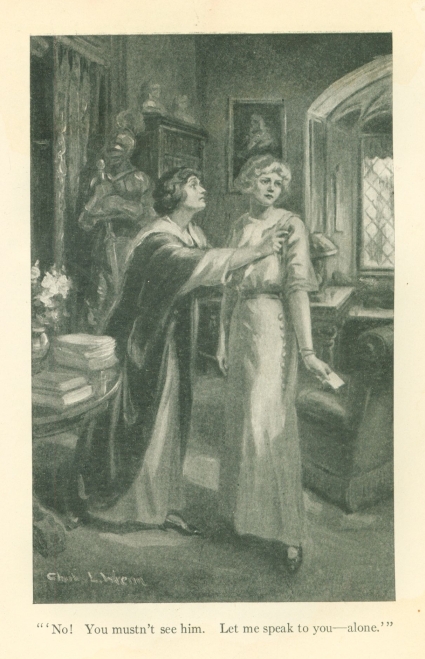
"'No! You mustn't see him. Let me speak to you—alone.'"
At the sight of Hester's pallid face and entreating
eyes Betty's heart softened.
"Please ask Mr. Grimes to wait," she said to Merle,
as he withdrew discreetly, and then to the trembling
girl: "My poor friend! You're all unstrung. Now
tell me, why don't you want me to see this detective?"
"Because I—I lied to you that day—about the purse."
"Lied to me?"
"Yes, I—I did steal the purse."
At Hester's startling avowal, Betty shrank away in
involuntary aversion.
"Oh!" she cried, and her truthful eyes judged
the girl sternly.
The culprit faced her in pleading appeal. She had
played her last card recklessly, impulsively, risking
everything. She never understood afterward what had
impelled her to this dangerous unnecessary confession.
Was it fear or calculation? She knew that if Betty
betrayed her it was all up with little Hester, and she had
no reason to believe that Miss Thompson would condone
or tolerate an act of flagrant wickedness. Yet she had
told her.
"A thief!" shivered Betty.
"Yes, a thief," flung out the other, in half defiance.
"You don't think I'm good enough to touch, do ye?
Maybe I'm not, but—say, do you want to know what
made me steal—the first time? Do you want to
know?" The words tumbled out in a fierce tumult, and Betty,
fascinated, watched this strange girl as her dark eyes
blazed and her nostrils quivered.
"Tell me," said Betty gently, "sit here—tell me
everything." And, leading the way to the davenport, she
placed Hester beside her. "Now!"
"I was only a kid—about twelve," panted the penitent.
"We lived on Orchard street."
"New York?"
"Yes. In a rotten tenement and—my sister Rosalie—she
was seventeen—she took care of us, me and my little
brother."
"Wait!" interposed Betty. "Is this true? You
mustn't try to work on my feelings. You must tell me
the truth. You know you haven't—Hester—at other
times."
The Storm girl sat biting her red lips and twisting her
fingers nervously. "I've been crooked," she said,
speaking low, "but, lady, I hope God will strike me dead
if——"
"Hush! Don't say that."
"I do say it. I mean it. I want you to believe me.
Nobody's ever believed me or—been kind to me—except
you and——" she was sobbing now, "if you're going
back on me—I don't care—for anything." She sprang
up suddenly with a fierce gesture, and pointed to the
door. "Go on! Call in Grimes! Give me up!"
"I don't want to give you up," soothed Betty; "but—I
must do what is right. Sit down! Tell me the rest.
What about Rosalie?"
At the mention of her sister, Hester's face softened.
"Say, she was the finest girl, the prettiest girl, you
ever saw. That's why I liked you, because you—honest
you did—you made me think of Rosalie."
"Yes?"
"But she wasn't strong. She worked thirteen hours
a day at a sewing machine, a damned heavy thing that'd
break your back and—she never went to the country
and—she never had a pretty dress."
"What a wicked shame!"
"Every cent she made she spent on us. Then she got
sick and—she coughed a lot and—she couldn't work the
machine. There she'd lie on the bed, in a little back
room, with her face all flushed and I'd hear her say,
'Please, God, take care of Hester and Jamie, and let me
see the green fields—just once.' Say, lady, what would
you have done, if you'd been me?"
"I—I don't know," murmured Betty, wiping her eyes.
"S'pose ye didn't have a dollar in the world?" pursued
Hester eagerly, "and the agent came for the rent,
a red-faced devil with a big diamond pin, and s'pose he
tried to kiss ye and ye knew that pin might save Rosalie,
say, would ye have pinched the pin?"
"You mustn't ask a—question like that," replied the
other, trying vainly to keep back her tears.
"Yer cryin'! Then—then ye don't despise me?"
"I'm sorry for you, so sorry, but—Hester, you must
make amends for what you've done, you must give back
the purse."
"I will."
"Where is it?"
"You'll stand by me? You won't let them take me?"
"I'll do the best I can for you. Where is it?"
"You won't tell Grimes that you were in the railway
carriage?"
"I must tell him, if he asks me. I can't remain in a
false position."
Hester's eyes filled with tears. "Then that settles me.
He'll get the truth out of you; he'll twist you around his
fingers. My God! They'll send me away for ten years!"
"Be quiet. Let me think."
Distressed and perplexed, Miss Thompson walked back
and forth trying to decide what she should do. And
Hester in wide-eyed supplication watched her, knowing
well that her fate was trembling in the balance. If she
could only think of something—something that would
influence this fine, high-toned girl, whose soul could not
be reached by any base appeal, she realized that.
At this moment there sounded beyond the conservatory
the sharp call of a whistle, low and sinister.
"What's that?" started Betty.
Hester listened in tense alarm. "It's Grimes. He's
got a man outside. Say," she quivered, "what are ye
goin' to do with me?"
"What can I do?"
"Hide me somewhere until Grimes has gone. Will
ye?" she begged.
As Miss Thompson studied the wretched girl she felt
like an avenging angel who, without quite understanding
how, had been changing into a benevolent fairy. Here,
cowering before her, was a fugitive from justice who
should, no doubt, be given up, but somehow, Betty could
not do it.
"Hester," she said. "I'm doing wrong, but I can't
help believing there is good in you and—I can't send you
to prison. You can stay in my little room—there!" She
pointed to the mezzanine door.
"Oh, lady, ye'll do that for me?" Hester seized
Betty's two hands and pressed them to her lips.
"Wait! It's understood that you give back the
money—the stolen money."
"Sure! I'll tell ye where it is and you can give it
back yourself."
"I'll give it to the bishop. He's on his way here now."
"The bishop? He don't know I'm here?"
"He knows nothing. I'll tell him that—I'll say that
the person who took the money is sorry and—I'll save
you somehow."
"You give me your promise—your promise true?"
"I give you my promise—true," repeated Betty firmly.
"Where is it—the money?"
Now, briefly and humbly, Hester told the truth about
the bishop's purse, acknowledging her own wrongdoing,
and tracing the treasure from her capture of it on the
train up to the moment of its hiding under the rose
bush.
"I see," said Betty. "You dropped the purse in my
golf bag when they came to search you on the train?"
"Yes," confessed the other.
"And—and—oh, it's all clear! It was to get the
money out of my golf bag that you came here. Was
it?" she demanded.
"Yes."
"And now this five thousand pounds is there in the
conservatory—hidden in a flower pot?"
"Yes. You'll find it there. I wouldn't touch it. I
hate it. But, lady," she pleaded, "don't take the money
out until Grimes has gone. He's watching everywhere,
and—he's liable to see you and—that would queer me.
Promise ye won't take the money until Grimes has gone?"
This seemed reasonable. "Very well, I won't take
the money until Grimes has gone," agreed Miss
Thompson. "Now come! I'll show you the way."
Betty started for the winding stair, but Hester caught
her arm with an eager movement.
"See here!" she said and her eyes were warm with
gratitude. "You've been good to me and—I know
something that'll make a lot of difference to Mr. Baxter. A
cablegram came for him this morning."
"A cablegram?"
"Yes. And if he don't get it before twelve o'clock,
it's all up with him."
"Before twelve o'clock? How do you know that?"
"I stood at that door while Anton was on the phone
talking to a man named Henderson."
"Mr. Baxter's enemy!"
"That's what. Anton's a crook in Henderson's pay.
He got this cablegram and held it back. If you don't
believe me"—swiftly she drew the paper from her
dress—"there!"
"Heavens! When did this come?"
Hester studied the yellow form. "Must have left
New York at ten o'clock last night. See? Must have
got here before anybody was up—except Anton."
"The scoundrel!" Betty hurried to her desk and rapidly
deciphered the message. "This is terrible! There
isn't a moment to lose. If something isn't done before
twelve o'clock, Mr. Baxter will be ruined. I must think.
Come to my room."
A moment later the two women disappeared into Betty's
chamber, and, scarcely had the door closed softly
after them, when Grimes entered. He had a round, red
face, a stubbly, reddish mustache, and small, peering
eyes. He wore a checked suit and was smoking a large
black cigar. Altogether he looked the typical American
detective familiar in farce; but Grimes was not a farcical
person; on the contrary, he was one of the most
formidable men connected with Scotland Yard, a silent man,
and it was considered bad business for the criminal who
had Grimes on his track.
The detective glanced carelessly about the big room,
moved here and there, picked up the red-covered code
book that Betty had left on her desk and was frowning
at its mysteries when Betty herself appeared on the
landing above the winding stair.
"I beg your pardon," she said with challenging
directness. "May I ask what you are doing there?"
"I was going to ask you the same question," answered
Grimes quietly. "What are you doing—there?"
"I'm attending to my duties as Mr. Baxter's secretary,"
she said coming down the stair and trying not
to seem ruffled.
"I see. That's an interesting little door." He pointed
to the mezzanine chamber.
"Yes. Are you an architect?"
"No. I'm an officer from Scotland Yard—Mr. Grimes.
Just looking around a little while I wait for
Mr. Baxter. Don't let me disturb you."
He strolled off toward the conservatory, but turned at
one of the French windows. "Oh! May I ask your
name?"
Betty glanced up from the code book which she was
consulting in nervous haste.
"I told you I am Mr. Baxter's secretary."
"Yes, but—your name?"
The girl drew herself up to her full height and,
looking the man straight in the eyes, said simply, "Miss
Thompson. Really, Mr. Grimes, you must excuse me
now."
The detective gave her a keen glance that seemed to
take in every detail of her face and person. "Certainly,"
he said, then, bowing politely, "I'll see you later, Miss
Thompson."
Without losing an instant Betty flew to the
telephone.
"Hello! Hello!" she called impatiently, but
there was no response. She worked the lever, shook
the receiver, tapped her foot, and winked her long
eyelashes rapidly, all to no avail. The instrument seemed
dead, there was no familiar buzzing of the wires and it
presently occurred to her that this was no ordinary
delay of a heedless operator; there was something wrong
with the telephone itself.
"Oh, dear!" she cried. "What shall I do?" And,
hurrying to the conservatory window, she looked out
despairingly among the palms and lilies. Then her face
lighted as she saw Lionel coming slowly across the lawn.
In one hand he carried his inevitable watering pot and
in the other he held an open book that he seemed to be
studying.
"Mr. Fitz-Brown! Come here—please—quick," she called.
"Right-o!" answered the amateur gardener and blissful
lover, and leaving his watering pot, but clinging to
his book, Lionel presently joined the young lady in the
library.
"I say, I'm awfully pleased you called me," he beamed.
"You know you're an awfully intelligent girl, Miss
Thompson, and all that sort of thing and—do you
happen to know anything about—er—bugs?"
"Bugs?" gasped Betty.
"Isn't that what you Americans call them? We call
the little beggars beetles. This is an American book,
'Brown's Compendium of Familiar Bugs.' Rather good,
that? They are familiar. Er, what?"
"Please, Mr. Fitz-Brown," she protested, but there
was no stopping him.
"Potato bugs and spinach bugs and cauliflower bugs,"
he rattled on. "I say, do you know how to tell a spinach
bug, Miss Thompson?"
"No, but——"
"Ah, I was sure you wouldn't," continued the delighted
agriculturist. "Spinach bugs have red backs and
green whiskers. Say it over to yourself—red backs and
green whiskers."
"My dear Mr. Fitz-Brown, I really can't——"
"Oh, yes, you can," insisted Lionel. "It's perfectly
easy except cauliflower bugs. Let me see! Cauliflower
bugs," he paused to consult the book.
"You must put the book away and help me. I've got
to send a cablegram. There isn't a minute to lose."
The gardener's face clouded with visions of charges at
a shilling a word. "A cablegram! By Jove! I'll see,
but——" he began to search through his pockets.
"It isn't that," said Betty. "I have the money. It's
to get it there in time. The cable office is a mile away
and we've only twenty minutes. I tried to telephone it,
but the thing doesn't work. I'm afraid Anton has
tampered with the wires."
"Oh, I say!"
"And, knowing what I do of Anton, I daren't send
him with the car. Oh, it's maddening!"
"I can drive a car, Miss Thompson, if that's all you
want."
"Really? Oh, splendid! Just a second while I write
the cablegram."
She started for the desk, but stopped midway with a
look of despair.
"It's no use! I had forgotten. Mr. Robert Baxter is
out with the car; there's nothing to be done." She
sank hopelessly into a chair.
Lionel Fitz-Brown stroked his mustache, adjusted his
eyeglass and then, with a flutter of the ancestral spirit,
rose to the situation.
"But, my dear Miss Thompson," he drawled, "if we
have twenty minutes, I don't mind telling you that I can
do my mile in ten."
Betty sprang to her feet. "You can?"
The gardener screwed up his eyeglass and nodded.
"Sprinting is one of the things I do rather well."
"Then sprint—for your life," cried the girl excitedly.
"If you get this message off before twelve
o'clock—wait—where are those cable forms? Ah, here!"
And, snatching up one of the yellow blanks, she began
to write with feverish haste. "Pontifex, New York.
Can you read that?"
"Pontifex? I say, it sounds like a potato bug,"
chuckled Lionel, peering over her shoulder.
"That's the cable address. Now, the rest of it—no
time to put it into the code."
Then she wrote rapidly: "Authorize you to sell for my
account 50,000 shares Independent Copper. Act
immediately. Gramercy."
"Gramercy?" questioned Fitz-Brown.
"That's Mr. Baxter's code signature. Here! And
here's the money." She handed him the cablegram and
some gold pieces, then anxiously looked at her watch.
"Sixteen minutes. Can you make it?"
"Four to one I can make it, but, Miss Thompson, don't
you think we ought to—er—I know you're a deucedly
clever girl and all that sort of thing, but I really
think——"
"Don't think! Run as you never ran before."
"Right-o! I'm going. Now watch me," and, dropping
his precious book on bugs, Lionel Fitz-Brown
darted out through the conservatory and a moment later
this amiable descendant of the crusaders might have
been seen, in gardener's costume, his eyeglass firmly in
place, rushing madly along the dusty highway in a manner
that would certainly have astonished his exquisite
friends in Mayfair.
Long after the luncheon gong had sounded Betty
Thompson sat at her desk in the library, too
agitated to think of eating, too anxious about
the outcome of things to take her mind off the tense
situation. Whichever way she turned perplexities
confronted her. There in the conservatory was the stolen
money, but she had promised not to touch it until this
wretched detective had gone. When would he go? And
there in her little chamber was this unfortunate girl,
Hester Storm, whom she must save somehow, but how?
And, wandering about the village of Ippingford—what
could be keeping him?—was Lionel Fitz-Brown, bearer
of that desperate cable message that might save Hiram
Baxter or—or it might ruin him. Oh, dear, why didn't
Lionel come back?
When Horatio entered presently with some food on a
tray, a little cold meat and a salad, Betty shook her head
sadly. She had no appetite, she really could not eat.
"You seem troubled, my dear," said Merle with kindly
concern. "Is there anything I can do?"
"No, thank you," she answered wearily.
The clergyman put down the tray, looked about him
cautiously, and then, tiptoeing close to Betty, he
whispered: "Miss Thompson—that man—the detective?"
"Yes?"
Horatio lifted his chin wisely, and, with a tragic
thumb, pointed to the library door.
"He's still waiting. He seems to be everywhere at
once. In the words of King Solomon, he lieth in wait
at every corner. I wish he would go away."
"I wish he would," she sighed.
"He acts as if he thought we were sheltering a fugitive
in this house."
Betty started. "Is that such a dreadful thing to—shelter
a fugitive?"
"My dear," said the curate earnestly, "I am speaking
of a fugitive from justice, a malefactor, and to shelter
such a person is tantamount to becoming a partner in his
crime. It is a grave offense in the eyes of the law; it
means imprisonment; it means——"
"Mr. Merle," interrupted the girl indignantly, "do you
mean to tell me that if a repentant sinner came to you
for help and protection you, as a Christian, would refuse
to shelter him?"
Horatio stroked his side whiskers and opened and
closed his mouth several times with clerical deliberation.
"This is one of those delicate questions, Miss Thompson,
one of those delicate questions that—that——"
But Betty would not be put aside with pompous
generalities.
"Mr. Merle," she asked earnestly, "suppose you had
made a promise to shield some one, to save her from a
terrible disgrace?"
"Some one who had done wrong?"
"Yes, she has done wrong, but—she is sorry for it—she
has made amends."
"Then, my dear, your duty is plain. If she truly
repents of her sin, and if you have given your
promise——"
"But suppose keeping my promise to save this
person—suppose it means—telling a lie?"
"Ah," replied the clergyman, solemnly lifting two
scandalized palms, "it is my duty to forbid you, my child,
under any circumstances to tell an untruth—even to save
another from destruction."
As he uttered these words he blinked uneasily behind
his powerful glasses, and immediately added with nervous
haste: "I say that as a minister of the church,
but—er—as a man——"
"Yes? As a man?" she questioned eagerly.
It is impossible to know how Horatio would have
extricated himself from this dilemma, for, just as he
was searching for some theological barrier against the
girl's persistence, the telephone rang sharply.
Betty took up the receiver. "Yes?" she answered,
while the curate wiped his brow and observed this fair
American with wondering interest. What a country
America must be, he reflected, if so charming and clever
a young lady was a specimen of its secretaries! What
must its leisure class be? Then he remembered that
Hiram Baxter had once assured him that plumbers and
gasfitters were the only leisure class in America. He
had asked Harriet to make a note of the fact. Extraordinary,
this American aristocracy of plumbers and gas-fitters!
The secretary, meantime, was listening, with brightening
eyes and a flush of pleasure, to the telephone message.
"Don't you know who it is?" she smiled. "Miss
Thompson. Yes, I was in Brighton, but I came up here
this morning for—for some things."
Then there was a pause of listening, while the girl's
face took on a startled expression. "The Bishop of
Bunchester? Oh! I see. Very well, I'll tell
Mr. Merle." And she hung up the instrument.
"It was Mr. Robert Baxter," she explained to Merle.
"He is on his way here in the motor with a friend of
yours."
"A friend of mine?"
"I suppose he's a friend of yours—the Bishop of Bunchester."
"Bless my soul!" exclaimed the curate. "The Bishop
of Bunchester!" He took off his glasses and rubbed
them nervously.
"They will be here shortly and Mr. Robert wanted
me to ask you," her eyes twinkled mischievously, "I
don't understand what you have to do with it, Mr. Merle,
perhaps he meant Mrs. Merle, but he asked if you would
please see about one of the guest rooms."
"Quite right, my child," answered the clergyman
gravely. "I will take great pleasure in arranging
everything for his lordship. You see, I am—I am one of the
servants in the house."
With a sort of humble dignity Horatio took up the
tray while Betty stared at him in puzzled interest.
"Oh, Mr. Merle!" she said. "If you don't mind leaving
that tray, perhaps I might eat a little—later."
"Certainly. I'll leave it here. By the way, my dear,"
he paused at the door, "the difficult question—that was
troubling you?"
"Yes?"
"Why don't you put it to the bishop?"
"Perhaps I will," said Betty, and, long after the curate
had gone, she sat still at her desk, thinking. Nor could
all her worries and perplexities silence the glad thought
that very soon she would see the man whose voice had
just thrilled her over the telephone, the man who,
without knowing it, had made her suffer, and who now,
without knowing it, had made her happy.
Following a sudden joyous impulse, Betty took a key
from her bag and, opening the top drawer of her desk,
drew out, with loving touch, a small book beautifully
bound in dark green leather. It was a little volume of
the thoughts of Marcus Aurelius. And her eyes fell
upon one of her favorite marked passages:
"It is in thy power, whenever thou shalt choose, to
retire into thyself. For nowhere, either with more quiet
or freedom from trouble, does a man retire than into his
own soul, particularly when he has within him such
thoughts that, by looking into them, he is immediately
in perfect tranquillity; and I affirm that tranquillity is
nothing else than the good ordering of the mind."
She pondered these comforting words, then, shyly,
with a little gasp of pleasure, turned back to the flexible
cover, where a flap of silk formed a thin pocket for some
few sacred things, a picture of her mother, a faded and
flat-pressed flower and four-leaf clover that once had
been important, and, with these, the typewritten letter
that Bob Baxter had dictated to her in this very room,
the letter beginning "My dearest Betty" that she had
shamefacedly saved from rumpled oblivion in the scrap
basket, and ever since had treasured among her precious
possessions.
Once again Betty read over this wonderful epistle, and
she recalled all the nice loyal things Bob Baxter had
said that day about his little pal of olden times. Did
he mean them then? Had he forgotten them now? She
sighed. He couldn't have meant them very much and
be carrying on as he was with Kate Clendennin. Poor
little pal of olden times!
And now a singular thing happened. As Betty looked
fondly at the typewritten words she suddenly had an
uncomfortable feeling that some one had entered the
room and was looking at her. There had been neither
sound nor word, but she knew that a person was standing
there. And, glancing up, she saw Hester Storm at
the half-open door of the mezzanine chamber, her dark
eyes fixed on her benefactress in silent supplication.
"Oh!" cried Betty, in quick self-reproach.
Hester touched a warning finger to her lips and
disappeared into the chamber. Whereupon Miss Thompson,
dreading some new development, moved swiftly
toward the little stair. On the way she stopped, in an
impulse of kindness, and took up the tray of food.
"Poor girl! She's had nothing to eat," she thought,
and, a moment later, she joined Hester in the bedroom.
Thus it came about that when Robert Baxter, in brilliant
color and fine spirit, burst into the library a few
minutes later, eager to see Betty Thompson, he found
the big room empty. But there on the davenport were
signs of a recent feminine occupation, suede gloves, a
smart traveling hat and veil, and a lizard skin bag with
silver monogram. Betty was evidently somewhere about,
and the young fellow settled himself down to wait. He
must talk to Betty, he must explain that he hadn't meant
to hurt her feelings the other day at Brighton. He was
only having a joke with her—why, he wouldn't hurt her
feelings for the world.
As the young man glanced about the library his eyes
fell on the little volume of Marcus Aurelius, and, taking
it up carelessly, he came upon the letter shut within its
pages. He had no thought of prying, indeed, he had no
idea to whom the book belonged, and, before he realized
what he was doing, he had read his own letter.
"By the Lord Harry!" he muttered, and the hot blood
rushed to his face as he understood what this meant.
That dear girl! His Betty! To think that she had kept
that letter! He remembered seeing her crumple it up
and throw it in the waste basket. She must have stooped
down and picked it out again—and smoothed it—and
folded it—and kept it. His plucky little pal! His
Betty!
Bob rose and strode unhappily about the room. What
a fool he had been not to recognize Betty! Couldn't he
have seen that she was no ordinary secretary? My God!
A child would have understood. And the worst of it
was he had liked her all the time, he had looked at
her and wondered about her, and—and then he had gone
and made a silly idiot of himself with Kate Clendennin.
It was sickening.
Bob had just brought himself to this state of righteous
penitence and self-abasement when the door from Betty's
chamber opened, and Betty herself appeared. She was
stronger and happier now from having cheered and
strengthened a disheartened sister woman. She was
resolved to give Hester Storm this one last chance that she
begged for to make good. She would try to save the
girl from prison. She would hide her for a few hours,
until Grimes had gone. This much she had promised
sacredly to the pleading penitent, and she would keep her
word.
At the sight of Betty, Bob went toward her eagerly,
holding out his hands.
"Betty! Betty!" was all he could say.
"There!" she said, smiling happily and giving him
her hand. "It's all right, Bob; it's all right."
"No, no, it's all wrong," he insisted.
She loved his nice naughty child penitence. Nor did
she object to his masterful way as he drew up chairs.
"I've a lot to tell you," he went on, "but——"
Her dimple deepened at his embarrassment, and she
reflected that he certainly needed a woman to help him
pick out his cravats.
"I'm listening," she said demurely.
"This is the first chance I've had to speak to you since
that day at Brighton—when you—
"I'm sorry I—I lost my temper, Bob," she whispered.
"Sorry," he burst out. "Why should you be sorry?
You did the right thing. You called me down,
but—you didn't say enough—not half enough."
"I didn't?"
He caught the mischief of her eyes, and, suddenly, as
they remembered Betty's slashing outburst, they both
were seized with a wild desire to laugh.
"My little pal! Betty Thompson!" he exclaimed in the
old cordial way. "Say, why didn't you tell me about
this—secretary business?" He tried to take one of her
hands in his, but she drew it away gently. "Why didn't
you, Betty?"
"I—I didn't want to," she answered in a low tone.
"That's no answer. I don't see why you did it."
"You don't? Bob, you must see why I wanted to
help Guardy when he's been so good to me, and—he had
no secretary, and—I've been so extravagant. Think of
all the money Guardy has given me, and I—I supposed
it was mine, I thought it was money father left me,
but—he really left nothing. He—he left nothing."
"Nothing? He left the finest, pluckiest girl in the
world. And, anyway, I don't see why you had to hide
your name. Why didn't you say you were Betty Thompson
and not just any old Miss Thompson? I mean any
young Miss Thompson," he added, laughing.
She hesitated before answering.
"Bob, you may not believe me, you think musicians are
crazy people—yes, you do, you said so, but—I've worked
hard at my singing, and—I have a voice, a fine voice.
I've sung in concerts, and—I'm going to make a name
for myself, not like Melba or Emma Eames, but—well,
you'll hear of Elizabeth Thompson some day, and it
won't be as a secretary pounding on a typewriter, either;
it will be as a singer. So there!" She drew herself up
with a flash of the eye and a lift of the chin that made
Bob thrill as he watched her. "Now you see why I'm
just plain Miss Thompson."
"Betty, you know you've been talking nonsense; you
know you've not given me the right reason."
Betty dropped her eyes in confusion. "If there was
another reason it was a—foolish reason, and——"
suddenly she drew back, and, with a start of remembrance,
changed the subject. "How stupid! We're forgetting
the bishop."
"Hang the bishop! He's lying down. He says we're
going to have a storm—says he aches all over—that's
how he knows."
"How interesting! I believe we are going to have
a storm. Look, Bob." She pointed to a line of heavy
clouds advancing formidably in purple black masses.
He shook his head. "I don't want to talk about the
storm, Betty, or about the bishop or about any other old
thing. I want to talk about you. Tell me about that
foolish reason. I love foolish reasons."
"Well, I—I thought it would be—amusing to—see
if—you would know me." She doled the words out teasingly,
then, with a laugh of half triumph, half reproach:
"And you didn't, you didn't!"
"How do you know I didn't? I knew you all right
the other day at Brighton."
"Yes, but your mother told you. Oh, you needn't
look so innocent. I'm sure she did. Why, you didn't
even remember the little keepsake you gave me."
"What keepsake?"
"Ah! I told you! And I've kept it all these years."
She opened her lizard skin bag and produced a silver
pencil with a whistle at the end.
"There! I suppose you've even forgotten the whistle." She
blew shrilly on the little plaything.
Bob looked at her out of straightforward loyal eyes.
"I own up, Betty, I had forgotten. I didn't know you
until Mother gave the thing away, but I'll say this, you
made me think of Betty. I never knew how it was,
but—now I know." He leaned toward her eagerly.
"There's only one Betty in the world; there couldn't
be two and——"
"It really is going to storm, Bob," she said, rising
nervously. "Just hear that wind. And see how dark
it's getting."
She felt caressing shivers running up and down her
back as she caught the unsteadiness of his voice.
"Sit down, Bob. I'm going to sing for you. I'm
going to sing my favorite song."
He tossed his big shoulders impatiently, and she flung
him a pouting reproof.
"Oh, well, if you don't care to hear my favorite song."
"I do care, Betty. I'm crazy to hear it, but—hello!" He
paused as a pompous cough and ponderous tread
resounded through the hall.
"It's the bishop," said Betty, and the words were
scarcely spoken when his lordship entered, his benignant
smile relieving the formidable impressiveness of his
ecclesiastical coat and buckled knee breeches.
"Ah, my young friends," was his sonorous greeting as
he peered among the shadowed spaces of the great room.
"Ah, here you are! Quite a charming twilight picture!" He
took their hands in a hearty grasp, then, turning
slyly to Bob, "I don't think I need apologize for keeping
you waiting."
Young Baxter gave a little self-conscious laugh, but
Betty immediately became dignified.
"We were talking about—about music."
"Yes," added Bob. "You know Betty has been studying
singing in Paris—she has a splendid voice."
"I should very much enjoy hearing Miss Thompson
sing." The bishop bowed gallantly.
"You're just in time. Miss Thompson has promised
to sing her favorite song, and—er—I was saying it would
be rather nice to have it in the dark with—er—the organ
accompaniment."
Betty opened her eyes at the glibness of Bob's invention.
"To be sure," approved his lordship. "In the dark,
by all means, with the storm raging outside. Bless my
soul! Look at that rain!"
The water was coming down in sheets and torrents,
lashing the library windows and seething over the glass
roof of the conservatory.
"It sounds like a Belasco melodrama," laughed Bob.
"Yes, yes, quite so," murmured the bishop, not
understanding in the least this allusion. "And what is your
favorite song, my dear?" he asked Betty.
"Oh, I would never have the courage to sing before
you," she declared.
"Besides, it's so much more interesting to talk. We'll
have some lights and some tea, and—you must tell us
what brings you to this part of the world?"
"Why, don't you know? Didn't you tell her?" The
churchman turned to Bob in surprise.
"I—er—I thought I did," stammered the latter, but
Betty shook her head.
"It's quite a mystery, my dear," the prelate explained.
"It's in connection with that unfortunate affair in the
train—you remember?"
"The purse?"
"Exactly. I received a telegram this morning from
Scotland Yard—the police headquarters."
"Yes?"
"Perhaps you don't know it, but they have sent a
detective here, a man named Grimes."
Betty could feel her lips getting white, but she kept
her self-possession.
"I know," she said quietly, "I saw him."
"I had a few words with him myself just now. He
seems like a straightforward fellow—says he has a clew,
but—he isn't quite ready to make his report."
"How can he have a clew in this house?" objected
Bob. "The servants have all left, and—I guess it's a
false alarm."
"I'm afraid so," sighed the prelate. "We have had so
many false alarms. You remember those German
musicians, Miss Thompson?"
"I remember."
"They were innocent, it appears, quite innocent. Ah,
well, I suppose we must be patient," the prelate
continued in a tone of resignation, "and, for the moment,
my dear, nothing could be more delightful than the song
you were speaking of—in the dark, please."
Betty looked out into the park, where the swaying
pines, tortured in the strength of the tempest, were
hurling their branches to and fro like huge black hands.
She listened to the shrieking of the gale as it rose and
fell, then, without speaking, she went to the old organ,
and, seating herself at its yellow keyboard, in the
paneled recess, began to play softly a tender prelude
of minor chords. As her courage grew she swelled into
a braver ascending movement with danger notes sounding
here and there, and, finally, improvising through a
rapid procession of major chords, she swung into a
triumphant crashing finale with the full strength of the
organ, a storm within and a storm without that stirred
old Bunchester to the depths of his tired soul and gave
Betty Thompson new courage for the task that was
before her.
Suddenly she stopped. There was a moment of tense
silence, then her sweet voice lifted in an inspired melody,
and, with all the tenderness of her nature, she sang
"Annie Laurie."
"Wonderful! Admirable!" exclaimed the bishop when
the last note of the haunting words had died away. "You
have an exquisite voice, my dear. Really, I—I don't
know when I have been more genuinely touched."
Betty herself was so deeply moved that she could
scarcely trust herself to speak.
"Bob," she called softly, "will you get my handkerchief?
It's there by you—in my desk—the top drawer."
She spoke as if she thought Bob was sitting near her
desk, but he rose from the opposite corner of the room.
"Certainly," he said, crossing over. "Wait, I'll turn
up the lights," and he did so, touching a button in the
wall.
As the electrics flashed out Betty looked about her in
surprise.
"Why, how strange!" she cried.
"What?" asked the bishop.
"Surely you—you haven't been sitting there all the
time—while I was singing?"
"My dear young lady, I haven't moved from this
chair," declared his lordship.
"But you must have moved. Some one moved across
this room," she insisted. Then she turned earnestly to
Baxter.
"Bob, was it you? Did you move? I couldn't see in
the dark, but—I thought it was you."
Her voice was almost pleading now.
"Nobody moved," Bob assured her. "We were too
much taken up with your singing. Say, Betty, it was
great. I never heard anything like it, never. I knew
you could sing, but—by George, I didn't know you were
an artist."
The girl's eyes were still troubled.
"You'll think me silly," she said with a strange
impressiveness, "but—I know some one passed through this
room while I was singing."
Half an hour before this, in the little mezzanine
chamber, Hester Storm, with a sigh of relief,
had sat down to the tray of food that Betty
had left for her. At any rate, the worst was over. She
had confessed her sin and had renounced all interest in
the stolen money except to give it back. Miss Thompson
would intercede for her with the bishop, and he, having
the funds once more, would see that the police investigation
was dropped. So she need not worry about Grimes.
He would be taken off the case within twenty-four hours
and—— What was that?
Above the tumult of the storm she had heard distinctly
the click of a latch and, glancing up from her place,
Hester fixed her eyes on the green door at the other
end of the room and, presently she saw this open slowly
and noiselessly, as she had seen it open once before. A
moment later Anton entered, his eyes cruel, his face set
with wicked determination.
The chauffeur closed the door behind him and locked
it. Then, without a word, he went to the other door
that opened on the library stairs and, putting this an
inch or two ajar, he stood listening. Hester listened also
and could hear Bob Baxter speaking tenderly to Betty.
"Spooning!" nodded the intruder. "Good business!
He'll keep her for a while, but——" he turned the key in
the lock, "I'll make sure just the same."
Hester started to her feet.
"Why do you lock that door?" Her bent shoulders
and staring eyes betrayed her sudden terror.
"You'll find out," he whispered hoarsely.
She cowered away as the man strode toward her.
"Worked your little game all right this morning, eh,
kid?" he sneered. "Got the cablegram out of my
pocket?"
She half shut her eyes, watching him keenly.
"Yes, I got it."
"What'd'ye do with it?" he demanded.
She tossed her head with a flash of impudence.
"That's my business. See here, you keep your hands
off me or——"
"Or what?"
With a scowl of anger he caught her in his powerful
arms, and held her helpless. "Little fool! I had you
this morning—in the library and I—let you go." His
voice was thick with passion. "But if you get away
now—— Good Lord, hear that!"
He turned to the window as the shrieking tempest
made the whole house tremble.
Like a desperate hunted thing Hester drew back
stealthily. It was in her mind to make a dash for one of
the doors and escape before Anton could seize her again.
He had left the keys in the locks and—the room was
almost dark, but——
The chauffeur turned as if anticipating her thoughts.
"Come here," he ordered and slowly she obeyed.
"Why should I keep my hands off you?"
She stood white-faced before him, searching vainly;
for some way of escape.
"You're a crook—wanted by the police. There's a
man in this house from Scotland Yard. Did you know
that?"
"Yes, I know it."
Anton caught her by the wrist and drew her to him
roughly.
"You're hurting me," she cried.
"He'll hurt you more than that, if he gets you—he'll
hurt you with irons."
The chauffeur leaned closer, leering horribly and it
seemed to Hester that all the strength was going out of
her body.
"Let me go!" she panted.
"Ha! Let you go!"
Again he caught her in his arms and pressed her
fiercely against him. She felt his hot breath. She saw
the veins swelling in his red neck. She struggled and
turned her head from side to side, but he buried his face
in her neck, in her hair, with little snorts and cries like
an animal; then he kissed her furiously on the cheeks, on
the forehead and at last full and long on the mouth!
"Ha! Let you go!" he breathed with smothered violence.
"I'll let you go when—stop that!" he cried. "You
will! You'll bite me?"
With a twinge of pain he drew back for a second, but
instantly rushed after her as she sprang away.
And now, in her extreme and imminent peril, Hester
took the last chance that remained. Before the madman
could get his hands on her again, she screamed with all
the power of her lungs—then screamed again.
Anton stood still, his eyes filled with sudden fear, his
nostrils dilated. That wild cry had stirred the coward
within the beast. And, while he waited, stunned and
stupid, Hester's quick wits took control of the situation.
"Listen! I hear a step," she warned him, but, in her
sinking heart, she knew that there was no step. No one
had heard her. The shrieking of the storm had covered
everything. She was as helpless as before.
And while Anton listened in alarm, not yet realizing
his advantage, the Storm girl's mind leaped forward to
study the next move in the desperate game she was playing.
In a moment he would see that there was no
danger—no one was coming, no one would come. And then,
in gloating reaction, he would come back to his infernal
purpose and—God! she must turn him from that before
the beast was roused again.
"Anton," she said with swift decision, "I—I did take
the money out of the purse."
He stared at her doubtfully.
"You did?"
"Yes—I—I hid it."
"Where?"
"In the conservatory. Don't look at me like that. I'm
not lying. You've played me to a standstill and—I
quit."
"You mean you'll give me my share of the money?"
"Yes."
"Five thousand pounds? I get half of it?"
"Yes."
Anton moistened his red lips with the tip of his
tongue. He ran his fingers back through his thick hair.
This was a new problem.
"You little devil!" he said almost admiringly. Then
with suspicion, "You say you hid this money in the
conservatory. Where in the conservatory? Where? And
no more funny business—— I won't stand for it," he
threatened, as he saw her hesitate.
"If I tell you where it is will you let me get it?" she
asked.
"Let you get it? And then get away with it? I
should say not. I'll get it myself."
She shook her head stubbornly.
"No. We'll get it together. You can stand over me,
you can watch every move I make, but——I take the
bills out and divide 'em. Don't make any mistake about
that."
He frowned at this ultimatum, but she saw the spirit
of greed shining in his eyes. Thank God, the other
danger was past.
"You can divide the bills. Come on."
Anton went to the green door and turned the key.
"You go first. And remember, kid, if you try any
crafty work, I'm right at your back and—if I don't get
that money, the police get you."
She nodded indifferently and led the way along a
dark passage, then down a narrow servants' staircase
that ended in a door opening into the conservatory. As
they moved on cautiously Anton kept his hand firmly on
the girl's shoulder and, somehow, Hester was glad of
this, for the half-darkness and the violence of the storm
frightened her. She had no thought any longer of escaping.
She had done her best and failed. She had played
her last card and lost.
This man had forced her to choose between being a
thief and a wanton and—well, she had been a thief
before. To save her body from prison and—a worse fate,
she was ready to give Anton half of this stolen money,
she must give it to him, she had no choice, and the other
half, her half, she would return this to the bishop. That
was all she could do.
Hester opened the door at the foot of the stairs and
stepped forward into the fragrant atmosphere of the
plants and blooms. Anton was close behind her. She
could feel his clutching hand. It was very dark within
the conservatory and outside the storm was raging
fearfully.
Suddenly the organ in the library began to play softly.
Hester Storm stood still, listening at first in fear, and
then, as the music wove its spell about her, with a kind
of strange pleasure. Who could be playing so beautifully
and tenderly there in the dark while she was here in
such trouble?
A menacing pressure from the hand on her shoulder
urged the girl to action. Stepping forward, Hester came
to the rose bush in its gilded basket. A quick movement
with one hand lifted the cylinder from its pot, then a
search with the other brought her fingers in contact with
the banknotes. There! She had them! Fifty hundred-pound
notes! She had only to count off twenty-five and
give them to Anton. That would silence him, but—would
he take her word, in the darkness, that the count
was straight?
She turned toward the chauffeur and, at this moment,
became conscious that there was no longer any pressure
on her shoulder. Anton had taken away his hand. She
peered through the shadows, but could discern nothing
save the vague outlines of a giant palm. She stretched
forth her hand, but could feel nothing. The man had
gone. At the moment of grasping a fortune he had
gone. Why? What had happened?
In her concentration on the rose bush Hester had not
seen the dull glow of a cigar burning in sinister
watchfulness, there, in the far corner of the conservatory; but
Anton had seen it and had drawn back stealthily, his
heart pounding. It was Grimes lurking in the darkness,
Grimes waiting for his prey.
And now, as Hester wondered at this strange disappearance
of her persecutor, the organ stopped and a
beautiful voice sounded from the library in a song that
none can resist.
Gave me her promise true,
Which ne'er forgot shall he,
And for bonnie Annie Laurie,
I'd lay down and dee.
"Her promise true!" These words went straight to
the soul of this poor transgressor. It was like a voice
speaking to her, a voice singing to her, a wonderful
voice through the shadows of fear carrying its message
of steadfastness and hope.
"Her promise true!" What had she promised? To
be honest, to be kind. That meant giving back the
money—and letting Anton hand her over to Grimes.
Anton would do it, too, the cur. Then Grimes would
send her up and—she'd never see Rosalie again
and—she'd never be able to do anything for Rosalie.
Strange how this thought of Rosalie gave Hester
strength to do the thing that would surely separate her
from Rosalie, to do the thing that was right, whatever
the cost! As she listened, breathless and motionless,
reveling in that enthralling melody, it seemed as if she
saw her sister's loving eyes, gazing at her tenderly.
It was Rosalie, the pure soul of Rosalie, speaking to
her, pleading with her in golden song, bidding her be
brave and—keep her promise and—give the money
back—not half of it, but all of it.
Inspired with this simple faith, the girl moved swiftly
toward the wide glass door that led into the library. In
her hand she held the banknotes. She was going to give
them back. Anton and Grimes might do what they
pleased. If punishment and shame must come, then let
them come. She was going to return the money she
had stolen and—do what her dear sister Rosalie would
wish and—keep "her promise true."
With her hand on the door Hester paused. She remembered
that Miss Thompson's desk stood at this side
of the room, not more than ten feet distant. It was
possible that, under cover of darkness and the music, she
could reach this desk without attracting attention. If
she could, then—then she might slip the money into one
of the drawers and—and make her getaway through the
park before Anton could be sure that she had thrown
him down. He wouldn't tell Grimes until he was
absolutely sure. She might have time to stop at the lodge
for her things and—she could square old Mrs. Pottle
somehow. There was just a chance, in this storm, that
she could be off on a train to London before Anton
would even tumble that she had started. He was a good
deal of a fool, Anton, and a coward besides.
Well, she would take the chance. It meant liberty,
everything and—this was playing fair. She had promised
to give the money back, but—that didn't mean walking
meekly into jail. To be honest, to be kind—there
was nothing else to it. She had a perfect right to keep
out of jail, if she could.
Lightly and swiftly Hester entered the library and
glided across the room toward Miss Thompson's desk.
Betty was still singing, but the Storm girl listened no
longer. All her faculties were centered on the last
desperate adventure. If she could only get away with this!
If the kind God—Merle's God—Rosalie's God—would
only let her get away with this!
Groping before her in the obscurity of the room, her
hand touched the desk and, running her fingers over it,
she came upon a partly open drawer. There was
something white in it. A handkerchief! It was the top
drawer on the left-hand side. She would remember that
and wire Betty to-night—no, write her. The top drawer
on the left-hand side, under the handkerchief. There!
She crowded the banknotes back into the drawer with a
farewell tap and cautiously pressed the drawer shut.
The spring-lock clicked. She had kept her promise.
She had returned the Bishop of Bunchester's five thousand
pounds, while the bishop himself, all unconscious of
this, sat, lost in pleasant reverie, not three yards away.
Swiftly and silently, as before, Hester left the room.
Thus far fortune and the darkness and the music had
favored her. It only remained to cross the conservatory,
to open the outside door and then venture forth into the
storm. Where was Anton? Where was Grimes?
With a supreme effort the girl conquered her fears
and crossed the few feet that separated her from the
tumult inside. And, close behind her in a dull red line,
came the watchful cigar—and Grimes.
The Storm girl grasped the latch of the outside door
and, at the same moment, a heavy hand descended on
her shoulder.
"Anton!" she started.
"Guess again, little one," answered a voice that made
her knees sink under her. "We've got you with the
goods this time. Eh, Jenny Regan?"
"It may interest you young people to know," the
bishop was saying in the library, "that Annie
Laurie—you know she was the daughter of Sir
Robert Laurie of Maxwellton, and—er—she married an
ancestor of mine."
"Really! Tell us about her," exclaimed Betty, leaning
forward eagerly.
"I'm afraid there isn't much to tell except that she
did not marry the poor young man—what was his
name?—who wrote those tender verses about her?"
"She didn't?" frowned Bob, while Miss Thompson
watched him with a roguish smile.
"No. She married my ancestor. I have always had
the deepest sympathy for that unappreciated poet."
Young Baxter nodded wisely.
"Perhaps he'd have been more appreciated if he hadn't
been so much of a poet. While he was making rhymes
to Annie your ancestor got busy with the girl, and the
first thing Mr. Poet knew the other fellow had landed
her."
"Ha, ha, ha!" chuckled the prelate. "That sounds
like one of your father's remarks."
"Speaking of Father," Bob glanced at his watch, "I'm
expecting him up from town on this next train. I hope
nothing detains him."
"I hope not," said the churchman earnestly. "I have
been looking forward to seeing my dear old friend
and—er—I wanted him to be present in case this detective
reports anything that seems—er—important."
"Exactly," agreed the young man.
At this moment Merle entered, looking pale and
anxious, and, bowing respectfully to the bishop, he
went close to Baxter and said something in a
low tone.
"Oh! All right. I'll see him," nodded Bob. Then
to Betty and his lordship: "If you'll excuse me,
I—er—there's a little matter I must attend to." And he
hurried off, followed by Horatio.
"Oh, Mr. Merle! May I speak to you a moment?"
called the bishop.
Horatio turned and a faint flush spread over the ashen
gray of his thin face.
"Yes, your lordship."
Bunchester's eyes rested on the curate in kindly
solicitude, then with a ruddy smile he turned to Betty.
"I must tell you, Miss Thompson, that Horatio Merle
and I are friends of long standing, and naturally, when
he came to my bedroom this afternoon with a tray of
tea and toast—exquisitely served, I must say—I was
somewhat surprised and—er—after a little talk, I became
acquainted with the unusual and—er—interesting
position that Mr. Merle has chosen to occupy in this
household."
As the prelate went on his manner became more and
more serious until now, turning to the astonished and
abashed Horatio, he addressed him with all the
impressiveness of his sonorous voice and his full episcopal
dignity.
"Mr. Merle, you probably do not realize how deeply
I was affected by what you told me this afternoon. I
wish to shake hands with you, sir, and say, both as your
bishop and as a fellow man, that I respect you and
honor you for the fine simplicity and manliness you have
shown here at Ipping House in accepting, I may say in
seeking, a rather—er—humiliating position. I doubt,
sir, if there is another clergyman in my diocese who
would be capable of such an act of Christian self-effacement."
"I—I thank your lordship," murmured Horatio,
retreating awkwardly toward the door.
"Wait! I haven't finished. Mr. Merle, you have
builded better than you knew. It happens that my old
friend, Dr. Dibble, the rector of St. Timothy's in
Ippingford, has become so infirm that we are about to retire
him on a pension. The living is in my hands and it is
my intention, sir, in fact, it is my absolute decision, to
offer it to you."
Horatio was so overcome by this extraordinary good
news that for some moments he could not speak a word.
Was it possible? He, a poor curate, who had made a
failure of everything, suddenly lifted to this splendid
height? He, the rector of St. Timothy's? He, Horatio
Merle?
"Oh, your lordship!" he stammered.
"There is a fine old rectory with five or six acres of
land and the prettiest rose garden in Kent. I am sure
you and your wife will be happy there."
"Your lordship, I—I thank your lordship. I—I would
add——"
Horatio stood quite still, holding a few strands of his
side whiskers between an agitated thumb and forefinger.
He opened and closed his mouth several times and then,
in a tumult of suppressed feeling, he hurried from the
room.
Just as he was closing the door Betty flew after him.
"Oh, Mr. Merle, I am so happy! I congratulate you
with all my heart."
She clasped his hand impulsively with such sweetness
and genuineness that the good man's confusion was
made more complete, if that were possible.
"Thank you, Miss Thompson—thank you. Please
don't say any more. I—I must go. I—must tell my
wife."
Horatio hastened away, his eyes shining with tears
of joy.
And now there came a bad quarter of an hour for
Elizabeth Thompson. It was evidently her duty to
tell the bishop immediately, without losing a moment,
about the stolen money. This was her opportunity to
tell him; she was alone with him and—she must tell him.
And yet she could not speak. She had promised Hester
Storm to say nothing until after Grimes had gone. She
had promised faithfully, and—for the moment her lips
were sealed.
"Bishop," she began, and in her eyes there was the
shadow of impending trouble.
"Yes, my dear. Sit down." He made room for her
beside him on the davenport.
"There's something I've wanted to speak to you
about—that is——"
"I understand, my dear," he anticipated. "You have
reference to that unfortunate affair on the train? You
know I came here to-day for the express purpose of—er—that
is to say, I shall be glad to obtain, in fact, the
detective urged me to get from you, any information
you can give regarding that painful occurrence."
"But—I wanted to ask you——"
She paused, biting her lips, and the prelate went on
serenely.
"I have been told of your very great kindness to the
suspected young woman who was in the carriage with
us. I feel sure you acted in a sweet, pitying spirit, but
you can hardly realize, my child, as one in my position
does, the unwisdom of accepting too readily the unconfirmed
statements of—er—shall I say plausible strangers.
By the way do you happen to know what has become of
this Jenny Regan?"
"Why—she told me—she spoke of living in New
York, and—I think she was—going back there."
Betty's distress of mind was so evident that the bishop
must surely have noticed it had it not been for the
sudden entrance of Bob Baxter, whose pale face and
disturbed manner showed that something serious had
happened.
"I've been talking to the detective," he explained,
"and—I want to apologize to both of you in advance, and
especially to you, Betty, for what the man is going to
say. He insists on coming in here, and—if I had my
way I'd chuck him out of the house, but—he comes as
an officer of the law, and I suppose I have no choice but
to let him do what he considers his duty."
"Quite right," nodded the bishop. "We must respect
the law."
Betty stared, white faced, before her while young
Baxter went to the door and showed in the detective.
Grimes had left his cigar outside.
"All right. Go ahead," said Bob with a contemptuous
glance at the newcomer. "Only, please make it as short
as possible."
"I'm not in the habit of wasting words, Mr. Baxter,"
answered Grimes curtly.
"You mustn't mind, Betty," continued the young fellow,
"if he asks you some rather impertinent questions.
It's only a formality, and it's part of his business. Now,
sir!"
Quietly ignoring this high-handed manner, the detective
seated himself, and, facing the troubled secretary,
went straight at the business in hand.
"You remember Jenny Regan, the girl who was in
the railway carriage when the Bishop of Bunchester
discovered that his purse had been stolen?"
"Yes, I remember her," answered Betty.
"You took a great interest in this young woman, did
you not? You offered her money, gave her your card,
although she was a stranger. How was that?"
"I was sorry for her. She had had a hard struggle,
and I wanted to help her."
"Fine!" exclaimed Bob, and Grimes flashed him a
sharp glance from under his thick eyebrows.
"You had no idea she was a professional pickpocket?"
"No."
"No idea that she stole the bishop's purse?"
"Certainly not."
"You believed her to be an innocent and deserving
person?"
"I did."
"Miss Thompson, are you still of that opinion?"
"I am sure she is a deserving person," was the firm
reply.
"Who is?" asked Grimes quickly.
"Why, Hest—Jenny Regan," stammered Betty, and
the detective smiled, but he paid no attention to this slip.
"You say deserving, but not innocent. Do you still
think Jenny Regan innocent of stealing the bishop's
purse?"
The crisis had come. Should Betty speak or keep
silent? To speak would bring inevitable ruin upon this
unfortunate girl, who had trusted her. Yet how could
she not speak?
While she hesitated Bob spoke for her. "How can
Miss Thompson possibly know whether Jenny Regan
stole the bishop's purse or not?" he demanded.
"Miss Thompson has the best reason in the world for
knowing that," Grimes answered, and there was a note
of cold menace in his voice.
"See here," retorted the young fellow. "I won't stand
for this. Either you make good your words or——"
"Keep still, my friend. I'll make my words good." Then,
turning to the bishop, "I beg your lordship to
believe that I am not speaking lightly." He drew from
his pocket a brown leather purse clasped by an elastic
band. "Does your lordship recognize this?"
"Bless my soul! My purse!" exclaimed the bishop.
"Where did you find it?"
"With your lordship's permission I'll explain that—a
little later."
Old Bunchester coughed impressively. "And the
money?" he asked. "The five thousand pounds? Is
it—in the purse?"
The detective shook his head. "Not a penny of it.
The purse is empty. There!" He handed the lean
wallet to its owner.
"Quite true," sighed the bishop. "It is empty."
"Do I understand that you found this purse somewhere
about here—I mean about this house?" demanded
Bob.
"Yes," said the detective.
"And you have no idea where the money is?" inquired
Bunchester anxiously.
"I have a very distinct idea where the money is,"
answered Grimes slowly, "and this young lady——" he
faced Betty accusingly, "she also has a very distinct idea
where the money is."
At this Baxter's eyes blazed fiercely. "You dare
to——"
"Wait, Bob!" The girl laid a restraining hand upon
his arm. Then, lifting her head proudly, she challenged
Grimes. "You mean to insinuate that I took the money
from this purse?"
"Impossible!" murmured the bishop.
A hard smile played about the detective's mouth.
"You mean to deny that you know where the money is?"
She hesitated. "Why—er——"
"Where is it?" he demanded.
"I—I can't tell you."
"You refuse to answer?"
"I—must refuse." She thought of her promise to
Hester.
"My dear child," interposed Bunchester kindly. "I'm
sure you are actuated by the most honorable motives,
but this is a case where the whole truth must be told."
"Go ahead, Betty; tell what you know," urged Bob.
"I—I——" she began weakly, but rallied with a flash
of anger. "I'll not be questioned like this." Her pride
and fighting spirit were stirred now. The idea that she
was actually accused of stealing this money or of being
an accomplice in the theft—it was outrageous, preposterous.
Very well, if they thought her guilty they could
keep on thinking so.
"I have made a serious charge here," Grimes proceeded
quietly, "and I propose to prove it." He turned
sharply to the girl. "Whose desk is that?"
"My desk," she answered.
The detective examined the drawers carefully. They
were all unlocked except the top one on the left-hand
side.
"You keep this drawer locked?"
"Usually."
"You have the key?"
"Yes. It's in my bag." She opened her bag and
produced a flat key. "Here it is."
"Has anyone else a key to this drawer?"
"No."
Grimes looked at the key critically. "H'm! A spring
lock. Do you mind opening this drawer?"
"Why should I open it? It's my private drawer." Betty
thought of her Marcus Aurelius and Bob's precious
letter. Why should these sacred things be dragged out
by this vulgar detective?
"Oh, it's your private drawer, is it? Just the same,
I must ask you to open it, Miss Thompson."
"Very well," yielded the girl. "There!" She put the
key in the lock and turned it while Grimes watched her
keenly.
"Now if your lordship will look in this drawer?" he
said.
"Certainly," bowed the prelate, and he pulled out the
drawer to its full length, then started back with a cry
of amazement. "Good heavens!" He drew forth a
bundle of folded banknotes. "It's the stolen money," he
declared. "The exact amount! The identical notes!
Five thousand pounds!"
Betty started in bewilderment. "But—I don't
understand," she said.
Old Bunchester turned to the girl in deep concern.
"My dear Miss Thompson, this is exceedingly painful,
exceedingly compromising. I beg you most earnestly, in
the interest of everyone, in your own interest, to tell us
how it comes that this money is found in your desk.
You must explain this mystery, indeed you must."
"Hold on!" cried Bob, springing forward, his whole
face transfigured, and here it was, in the words of
Hiram Baxter, that the boy showed himself a thoroughbred
and took the five-bar gate in one clean leap. "Don't
say a word, Betty. Don't explain anything. You're the
finest, pluckiest girl I ever knew, and right now,
without any explanation, I ask you to be my wife."
"Bob!" she cried, and her whole soul was in her eyes.
"It's all right, dear." He stood close beside her and
drew her to him protectingly. "There are two of us
now." Then, turning to Grimes: "Go ahead with your
silly little game."
"All very pretty," sniffed the detective, while the
bishop looked on in purple amazement, "but, before we
get through with our silly little game you may not find
it as silly as you think."
He strode across the library to the foot of the little
stair and pointed to the mezzanine door. "If Miss
Thompson was so confident that Jenny Regan was a
deserving person why did she hide her in that room this
morning?"
"What?" cried Bob.
Grimes fixed his hard gaze on Betty. "Do you deny
that you hid Hester Storm, otherwise known as Jenny
Regan, in that room?"
The girl eyed him steadily. "It's true," she said;
"but—I can explain it."
Young Baxter started to his feet. "It isn't possible
this Storm girl who's been working here is—Jenny Regan?"
Grimes nodded. "Jenny Regan is one of her aliases.
It's a matter of police record. You knew this, didn't
you?" He turned to Betty, whose cheeks were aflame
with anger.
"Yes, I knew it," she flung back, "and what is
more——"
"You knew she was a thief and a pickpocket?" he
added.
With an effort the girl checked herself and stood
panting.
"If your lordship will give me a few moments," she
said in a low tone, "I can make everything clear. You
don't mind, Bob? Just a few moments?"
Baxter bowed to her wish. "Of course I don't mind.
Come on," he said to Grimes.
"Not I," refused the latter. "Miss Thompson says she
can make things clear to his lordship. So can I. His
lordship's purse was stolen by Hester Storm, alias Jenny
Regan, but this young woman," he swept Betty with a
cruel look, "was an accessory after the fact."
"You miserable hound!" roared Bob.
And the bishop said solemnly: "My dear sir, you are
making an incredible accusation. Miss Thompson is a
lady—a friend of mine. I knew her estimable father."
"I can only lay the facts before your lordship,"
shrugged the detective. He went to the library door,
and, motioning quickly, returned followed by Hester
Storm, who looked neither to the right nor the left, but
held her eyes straight down before her, as if studying
the yellowish pattern in the carpet. Betty watched her
in surprise.
"There," Grimes pointed to Hester, "is my answer to
your lordship's doubts. What is this woman doing here?
She is a notorious thief and a pickpocket. Why did
she come to Ipping House? Why did your lordship's
friend, Miss Thompson, shelter her in that bedroom
and try to prevent me from arresting her? The
answer is easy. It was because Miss Thompson
proposed to share the money this Storm girl had stolen
from your lordship."
"That's a lie!" rang out Betty's swift denial. "Tell
them it's a lie. You must tell them," she appealed
frantically to Hester.
But the Storm girl never moved; she never spoke; she
never lifted her eyes from the carpet.
And Grimes went on relentlessly: "If Miss Thompson
was innocent of this crime why did she not tell the
whole truth about it when she was alone with your
lordship not half an hour ago?"
"I wanted to tell the truth," insisted Betty, "but I
had promised this poor girl that I would do nothing
until—until the detective had gone." Again she
appealed to Hester. "You know that is true. Tell them
it's true."
But the Storm girl stood there like a frozen image,
her lips closed, her eyes cast down. And a sickening
terror filled Betty's breast.
"Your lordship must see that there is a strong case
against this young woman." Grimes moved toward
Betty with a grim tightening of the lips. "You'll have
to come with me." He laid a hand on her arm.
Instantly Bob Baxter stepped forward, his face as
white as Betty's.
"Take your hands off that lady."
"Oh, I don't know," retorted Grimes. "I'm an officer
of the law and——"
"My dear Mr. Baxter," reasoned the bishop, interposing
his portly and venerable presence between the excited
adversaries, "believe me, we must respect the
majesty of the law."
"Majesty nothing," stormed Bob. "I tell you——"
"I tell you to step back," ordered the detective. "And
you——" he faced Miss Thompson, "consider yourself
under arrest. If you have anything to get ready you'd
better do it. We start in——" he glanced at his watch,
"in ten minutes."
"Start?" cried Baxter, aghast.
The seriousness of the situation was now clear to
everyone.
"See here," the young man appealed to Grimes after
a moment's thought, "there's some horrible mistake.
Miss Thompson had nothing to do with stealing that
money. She couldn't steal. Look at her, man! You
know she couldn't. I'll be responsible anyway, or my
father will, for the money and everything else. You
can't drag her off like this and disgrace her. By God, I
won't let you."
"I'm sorry, sir, but I've no choice. A crime has been
committed, and—there's evidence enough to hold her on
if she was a cousin of the queen."
"Under arrest!" murmured Betty twining her fingers
together piteously and fixing her eyes on Hester.
At this moment the sound of carriage wheels was
heard outside. Bob went quickly to the window.
"It's Father," he said with a movement of relief.
"Cheer up, Betty. Dad will think of something."
A moment later Hiram Baxter entered the room. His
face was ashen gray. He looked broken and ill, but a
flicker of the old bright smile spread over his rugged
face as he glanced about the room.
"Hello, everybody! Why, hello, Bish!" He tapped
Bunchester playfully on the shoulder. "I'm awful glad
to see you, Bish." Then, as he noticed the universal
gloom, "Say, it strikes me you folks are a little frappay.
What's wrong? What are you doing here?" he asked
Grimes.
The detective started to explain, but Bob cut in
eagerly.
"One moment! Father, did you leave twenty-five
thousand dollars in the drawer of that desk?"
"Twenty-five thousand dollars! Say, boy, is this a
joke? If it is, I tell ye straight I don't like it."
"No, Father, it's not a joke; it's very far from a joke.
Did you leave it there?"
"Twenty-five thousand dollars in that desk? Say, if
you knew what I've been through to-day! I've been
scratchin' around down where the avenues are paved
with red-hot bricks, lookin' for twenty-five thousand
dollars. And I didn't find it, either. No, sir, I left no
money in that desk. It ain't my desk, anyway; it's
Betty's desk."
"Ah!" smiled Grimes.
"Say, who are you, anyway?"
"I'm Grimes from Scotland Yard."
"Let me explain," put in Betty. "I—I'm in great
trouble, Guardy."
"I'll tell him, dear," said Bob. "Father, I—I've asked
Betty to be my wife."
"Well, it ain't that that's makin' ye look like a funeral,
is it?" drawled Hiram. "Go on, now; let me have it."
Betty and Bob spoke at the same time, both pointing
scornful fingers at Grimes.
"He says that I——"
"He dares to say that Betty——"
"Easy now! Not all at once. Say, Bish, you'd better
tell it."
Bunchester coughed impressively. "My dear friend,
it seems incredible, but the fact is Mr. Grimes thinks
that Miss Thompson was concerned in the—er—misappropriation
of that five thousand pounds."
"That was stolen from you? Betty Thompson? No,
no, no!" thundered the old man.
"That is how we all feel, but, with the utmost regret
I am forced to bear witness that this exact sum and, I
believe, the identical banknotes were found in Miss
Thompson's desk—there."
"Five thousand pounds? What does this mean, Betty?
How did that money get in your desk?"
"I—I don't know," the unhappy girl answered.
Grimes looked at his watch again. "No use of any
more talk," he said gruffly. "It's time to start
and——" motioning to Betty, "you'll have to come with me."
"You don't mean——" Hiram's eyes burned savagely.
"I mean that these two women are under arrest, sir,
charged with grand larceny, and I'm going to take 'em
to London by the next train."
"But—I won't have it."
"Better not interfere, sir. I've men outside to help
me, and—I'm going to take 'em. Come now." He
caught Betty by the arm and marched her, half fainting,
toward the door.
At this moment Hester Storm lifted her eyes, opened
her lips, and spoke in a strange, low tone:
"Wait! You mustn't take her. She didn't steal the
money. She had nothing to do with it. I stole the
money. I put it in that desk. I'm the one to take."
"Hester!" cried Betty. "You—you put that money
in my desk?" repeated Betty slowly.
"Yes. I meant to steal it or—I meant to steal half of
it, but—when you sang that song about—her promise
true, why—I thought how you'd been good to me,
and—trusted me, and—I sneaked in here and left the money.
The drawer was open, and I snapped it shut. Then,
when I made my getaway he pinched me." She turned
to Grimes.
The detective lowered his head as if he was studying
the girl through his eyebrows.
"You told me a different story just now?" he said.
"Sure I did. I lied. You know I lied. You don't
think I'm stuck on gettin' sent away for ten years, do
ye? But if it's got to be her or me, well, I won't have
her sent away when all she's done is to treat me right
and try to save me. You can take that from Hester
Storm."
"This is a rare and beautiful instance of gratitude
and devotion," commented Bunchester.
"That's all right, Bish; but I want to know more
about this." Hiram turned to Hester, who was standing
with bowed head and clasped hands. "Well, fer a girl
who talks about stealin'—I guess some o' the honest
folks could take lessons from you. Say, I didn't quite
get that about how you planned to steal half o' this
money? Where did the half come in? Why didn't ye
plan to steal all of it?"
Then, little by little, with questions from Grimes and
more questions from Hiram the Storm girl told her
story, sometimes in broken words, as her feelings
overpowered her, but in the main simply and bravely and
truthfully, as one who is strengthened by some higher
power. She went back to her childhood and spoke of
her sister Rosalie. She told of her wanderings and
waywardness, then of her visit to Ippingford and her
meeting with Horatio Merle. Then, finally, of her
efforts to return the money and of the persecution she
had suffered at the hands of Anton. She kept nothing
back, and she made no excuse for herself. She had
sinned and it was right that she should suffer.
As Hester finished her confession every heart went
out to her in genuine sympathy, and Grimes was seen to
wipe his eyes.
"I want to say," he remarked, "that I've seen some
strange cases in my time, but when it comes to a woman
trying to steal money over again that she's stolen once
so as to give it back—why, that's a new one on me."
"Ye can't ever tell what a woman's goin' to do,"
nodded Baxter.
"Anyway, I owe you an apology, Miss Thompson,"
the detective went on, and there was a little catch in his
voice as he met Betty's grave, beautiful eyes. "Things
certainly did look black against you, but—all I can say
is, I'm sorry, Miss, I'm sorry."
"It's all right, old man," said Bob.
Whereupon the Bishop of Bunchester, clearing his
throat ponderously, addressed these comforting words
to Hester Storm: "My dear young friend, I am
inexpressively touched by this story of your struggles and
temptations and your splendid moral victory. It is a
most meritorious case and one that the Society of
Progressive Mothers will take up with enthusiasm. As for
the outcome of this affair, speaking for the Progressive
Mothers' Society and for myself, as bishop of this
diocese, I can assure you that there will be no unpleasant
consequences, so far as you are concerned. The money
has been returned. You have truly repented of your
sin and you have given an illustration of spiritual
regeneration that will long be treasured in the annals of the
Progressive Mothers' Society.
"And now, my dear Miss Thompson, how shall I
express my great joy——" The bishop turned to Betty,
and was about to launch forth into another sounding
period when Hiram Baxter interrupted him.
"Excuse me, Bish, fer breakin' in on yer speech,
but—I've had a bad day in town, and—if you don't mind
takin' the detective into the next room and finishin' up
the details of this purse business with him, why——"
Baxter leaned back in his chair with signs of physical
distress—"ye see, I'm just about all in."
"Why, certainly, my dear friend. Let us come in
here." And, motioning to Grimes and Hester, he led
the way into the conservatory and carefully closed the
door behind him.
"Father! Is anything wrong?" asked Bob in concern.
"Guardy, you're ill?"
With anxious faces the young lovers stood beside the
old man, who smiled at them wearily.
"Children, I've got bad news fer ye, awful bad news
for ye," he said. "I've made the best fight I could, but
that Henderson bunch, they've done me up. Independent
Copper broke twenty points to-day in the New
York market, and—I was long of the stock. My man
cabled me the tip to sell, but I never got it. I never got
it. That cable was held up." He bent forward, resting
his big grizzled head on his hands in an attitude of utter
despair. "It's all off, children. It's all off."
Betty's heart was pounding violently as she listened.
Things had happened so rapidly in the last few hours
that she had scarcely thought of Lionel and his wild
sprint for the cable office. Had he failed to get there
in time? Had he made some mistake? What could have
happened to Lionel?
"Excuse me a moment," she said, and hurrying toward
the conservatory, she threw open the door and looked
about her.
One glance showed that something had happened, for
her eyes fell on a murmuring group gathered about
Anton and the detective. And there in the group, calmly
smoking a cigarette, was Lionel Fitz-Brown.
"Lionel!" Betty called, addressing him by his Christian
name for the first time in her life. "Please come
here—quick." And then, when he stood before her, very
indignantly: "The idea of your not coming to tell me!"
"Tell you about what?" he asked blankly.
"About the cable. Did you—were you in time?"
Fitz-Brown adjusted his monocle with great care, then,
gradually, a smile spread over his face. "Oh, I say!
The cable! You see, I got so beastly wet in the storm,
Miss Thompson, that I—well, the fact is, I had on thin
flannel trousers and they jolly well shrunk up to my
knees and—haw, haw, haw!" He exploded into
uproarious merriment.
"Oh, Mr. Fitz-Brown," she wrung her hands beseechingly,
"please tell me if you got the cable off by twelve?"
Lionel laid a reflective forefinger along his nose. "By
twelve? No. No, I didn't."
"You didn't?" Betty's heart sank.
"I go it off five minutes before twelve. Haw, haw,
haw!" He fairly doubled up in his enjoyment of this
witticism.
Like a flash, Betty darted back to Hiram, thrilling
with this good news. And at the same moment Grimes
entered, holding a cablegram in his hand.
"Beg your pardon, sir," he said respectfully to
Baxter, "I've just arrested your chauffeur, Anton Busch.
He's a crook, Slippery Jake, sneak thief and confidence
man, wanted by the police in half dozen cities. He's
been working some deviltry here, sir. I've just found
this cablegram on him. It's addressed to you."
"Thank you," said Hiram with a look of inexpressible
sadness in his eyes. "It's come too late."
"I'm sorry, sir. I—I'll wait outside," and Grimes
withdrew, his hard face softened by a look of deep pity
for the shattered old warrior.
Baxter sat still, looking at the yellow envelope. "Too
late!" he muttered. "Oh, if I'd only got this cablegram
in time!"
"Guardy, I want to tell you something," Betty began,
but Hiram paid no attention.
"Nothing matters now," he went on bitterly. "I
mustn't say that. I'm happy about you two. Betty!
Bob!" He joined their hands and held them
strongly. "It's what I've always dreamed of, but—I
wanted to leave ye well fixed and now——" The tears
were coursing down his grizzled cheeks. "We're
ruined—ruined."
"No, no! We're not ruined. You mustn't say that,
Guardy." The girl dared not promise anything, for she
did not know the result of her effort, but she pointed
hopefully to the unopened cablegram. "Why don't you
open this? Why don't you read it?"
He shook his head despairingly. "I know what it is.
It's the notice that I've been sold out and—everything's
gone. God! If I'd only known! If I could
only have given the order to sell—even a few thousand
shares."
With a listless movement Hiram ripped open the cable
envelope and drew out the yellow sheet. Betty thought
her heart would stop beating as she watched his face.
Slowly the look of amazement came. He rubbed his
eyes and read the message again. Then he sprang to
his feet with a great cry.
"What! It ain't possible! Listen to this!" In his
excitement, Hiram almost shouted the words written
there before him. "'Congratulate you on your splendid
nerve. Executed order at once. Sold fifty thousand
shares at top of market and closed out with twenty
points profit. Gramercy.' You hear that, Bob? Read
it! Am I crazy or—— No, no! There's something
wrong. I didn't show any splendid nerve. I didn't
cable any order to sell fifty thousand shares. There's
some mistake."
"There's no mistake," cried Betty. "I cabled the order
to sell."
"You?" stared Bob.
"You?" gasped Hiram. "You cabled the order to sell
fifty thousand shares of Independent Copper stock for
my account? Fifty thousand shares?"
It was several moments before Betty could speak, and
then, laughing and crying hysterically, she told what she
and Lionel had done.
"I should say it was splendid nerve," said Bob. And
folding his big, strong arms around her, "Betty, you
darling!" he whispered.
She lay there happy in his arms and, looking up into
his eyes with all the fondness of her soul, answered
shyly and sweetly, "Bob, my love."
And Hiram Baxter, wiping away his tears of joy, muttered
to himself (since no one else was paying any attention),
"Holy cats! Is there anything a woman won't do?"
THE END