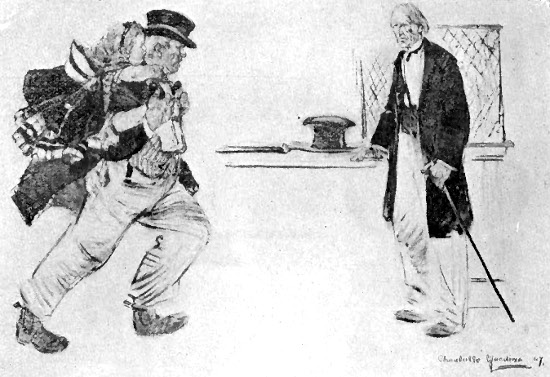
When the gales of peace shall scatter
War's wild, red rubbish like chaff,
When the mills shall renew their clatter
Then all the people will laugh.
—Tunison's Industrial Hymns.
Randall celebrated his release by retiring to Lucindy's house, where he
shut himself in and remained for more than an hour. He filled the little
room with thanksgiving in the shape of song and prayer, all of which
could be heard for a considerable distance. A great burden had been
lifted from his simple mind, and he celebrated the fact in a simple and
natural way. Lucindy understood his feelings, for she shared them. While
Randall was praying and singing in her house, she was in the kitchen
with Adelaide. Even while the tears of gratitude and thankfulness were
running down her cheeks, and threatening to fall in the things she was
cooking (as the child saw), she made light of the whole matter. "I
dunner what he mean by gwine 'way off dat-a-way, an' holdin' a
pray'r-meetin' by hisself. He'll have de whole town a-stan'in' 'roun' in
de yard ef he keep on doin' like dat."
"Well, Mammy Lucindy, you are crying yourself."
"My eyes weak, honey, an' dey feels like I done stuck a splinter in bofe
un um. You des wait. When you git ol' ez what I is, I lay yo' eyes will
run water, too."
The idea of Adelaide growing old! Nobody would have thought of such a
thing but Lucindy, and the thought only came to her as a means of hiding
her own feelings. But it is a fact that the child was about to grow
older. For shortly after Randall's trouble, all of us took the road for
Eighteen-Hundred-and-Eighty-Five. We thought it was a long road, too,
and yet, somehow, it was neither long nor rough. But it was a very
peculiar thoroughfare. For though all of us tried to walk side by side,
it seemed that some of us were toiling up-hill, while others were
walking down-hill. It was so peculiar that on several occasions, I was
on the point of asking Adelaide what she thought of a road that could be
up-hill and down-hill in the same place, and at the same time; but the
child had so many quaint and beautiful thoughts of her own that I
hesitated to disturb her mind.
Moreover, she was growing so fast, and getting along so well, that I had
no real desire to put new ideas in her head. Mr. Sanders declared that
she was running up like a weed. This attracted the attention of old
Jonas, who fixed his small glittering eyes on the old humourist.
"Like a weed, Sanders?" Mr. Whipple inquired.
"Well," replied Mr. Sanders, "call the weed a sunflower, ef it suits
you; but I dunner what's the matter with a weed—the Lord made it."
Old Jonas, looking off into space, nodded his head, with "Yes, I reckon
maybe He did."
As we went along this road I have been telling you of, I thought that
perhaps old Jonas would stop to rest in a fence corner, but the further
we went, we found that he was as lively as any of the rest, though
perhaps not so nimble. As for Adelaide, she simply grew; there was no
other change in her. She carried her child nature along with her, and
she carried Cally-Lou. Not much was said of Cally-Lou, but all of us
felt that she was in hiding in that wide, clear space that is just an
inch or so beyond the short reach of our vision; and, somehow, we were
all glad to have the company of the little dream-child who was "not
quite white." I think she kept Adelaide from taking on the airs and
poses of growing girls. And this was just as well. Adelaide took in
knowledge, as though she had learned it somewhere before. When she began
to study at school (as we went along) she declared that the books caused
her to remember things that she had forgotten. Mr. Sanders said that
there never was such a scholar, and Mr. Tidwell agreed with him. Old
Jonas said nothing; his face simply wore a satisfied frown.
None of us forgot Randall, or could afford to forget him, for we were
journeying along together. His evolution was out of the usual order.
Adelaide merely fulfilled the promises of her childhood, and the
expectations of those who were in love with her; whereas, Randall outran
prophecy itself. The Boogerman developed into a full-fledged minister of
the Methodist Church, and, in the course of that development, became a
complete engine of modern industry. He went so far and so fast that he
had an abundance of time to devote to the religious enthusiasm that kept
him inwardly inflamed; and such was the power of his rude eloquence that
he attracted the admiration of whites as well as blacks. He was
ignorant, but he had a gift that education has never been able to
produce in a human being—he had the gift of eloquence. When he was in
the pulpit his rough words, his simple gestures, the play of his
features, the poise of his body, his whole attitude, were as far beyond
the compass of education as it is possible for the mind to conceive.
This gift, or power, became so well known that he had a real taste of
what is called reputation in this world. He was a pattern, a model, for
the men of his race, and, indeed, for the men of any race, for there
never was a moment when he was idle after he discovered that an honest
and industrious man can make and save money. All that he made, he gave
to old Jonas Whipple to keep for him. The more Randall worked the more
he learned how to work, so that in the course of a year or two, there
was nothing in the way of work that he couldn't do well. His credit at
the little bank was as good as that of most white men, and his simple
word was as good as a bond.
The men of his race watched him with a curious kind of awe. When one of
them asked him how he managed to accomplish the results that were plain
to every one, his reply was: "Good gracious, man! I jest goes ahead and
does it, that's how." He had a great knack of meeting opportunity before
she knocked at his door—of meeting her and hitching her to his shack of
a buggy, where she served the purpose of a family horse. He had the
confidence and sympathy of all the white people who knew him. He began
to buy tracts of land, and one of his purchases included High Falls,
where the children and grown people had their picnic grounds. Many
thought this a wild investment, especially old Jonas, who rated him
soundly for throwing away his hard-earned money; but Mr. Sanders, who,
with all his humour and nonsense, was by all odds the shrewdest business
man in all that region, declared that the time would come when the money
that Randall had paid for it would be smothered by the money he could
sell it for. Randall explained to old Jonas the reason why he had bought
this remarkable water-power; it was because the water came so free and
fell so far.
All this, by the way, as we were journeying along. We began to try to
forget Eighteen-Hundred-and-Sixty-Eight; we knew right were it was, but,
as we got farther and farther away from it, it seemed to lose some of
its importance; and, sometimes, when we couldn't help but remember it,
it came back to us as though it was the memory of a bad dream. People
began to look up and stir about, Progress, hand-in-hand with Better
Conditions, crawled out of the woods, where they had been hiding, and
began to pay visits to their old friends. Mr. Sanders said it gave him a
kind of Christmas feeling to see the hard times vanishing. Old Jonas
felt better, too. At any rate, he seemed to take more interest in
Adelaide, who, by this time, had developed into a wonderfully charming
young woman—just how charming, I leave you to imagine; for she was a
young woman and still a child. It is given to few people in this world
to have this combination and to be able to manage it as it should be
managed. I don't know whether to call it the art of living, or the
instinct that makes Everybody feel as though he were Somebody. I never
could understand the secret of it, and, indeed, I never tried, until one
day a scientist came along peddling his ideas and theories. He declared
that there was an explanation somewhere in one of his books, but so far,
I have been unable to find it. There was nothing in his dull books about
Adelaide and her individuality. It should be borne in mind that Adelaide
had, in the course of seventeen years, developed into Something that was
quite beyond art and education. Her inimitable personality, which was
hers from the first, and quite beyond the contingencies of chance or
change, continued to be inimitable. She had received all the advantages
that money could buy; but this fact only emphasised her native charm.
She was a child as well as a young woman, with the sweet unconsciousness
of the one and the dazzling loveliness of the other.
Mean as he was said to be, it was a well-known fact that old Jonas's
money would go as far as that of any man; and when it came to a question
of Adelaide, it was as free as the money of some of our modern
millionaires when they desire to advertise their benevolence. He was
determined, he said, that his niece should have all the polish the
schools could furnish. He called it polish for the reason that he had
many a hot argument with Mr. Sanders and Lawyer Tidwell with respect to
the benefits of education—the education furnished by our modern system
of public schools. He didn't believe in it; there was always too much
for some people, and not enough for others; there was no discrimination
in the scheme. Moreover, it put false ideas in some people's heads, and
made them lazy and vicious. But he had never said a word in opposition
to polish, and when he sent Adelaide to one of the most expensive
schools, it was not to educate her, he said, but to give her the
"polish" that would elevate her above ordinary people.
Adelaide received the polish, but refused to be elevated, and when she
returned home, unchanged and unspoiled, old Jonas Whipple said to
himself that his money had been spent in vain. He wanted to see her put
on airs and hold herself above people, but this she never did; and she
would have laughed heartily at old Jonas's thoughts if she had known
what they were. Mr. Whipple seemed to have an idea that culture and
refinement are things that you can put your fingers on and feel of, and
he was sure that dignity and personal pride are their accompaniments.
Yet he gave no outward sign of his disappointment if he really had any,
and he swallowed such regrets as possessed him with a straight face; for
he saw, with a secret pride and pleasure that no one suspected, that
Adelaide was the most charming young girl in all that neighbourhood. It
filled him with pride for which he could not account when he observed
that she could hold her own in any company, and that, wherever she went,
she was the centre of admiration and interest.
Now, it was not long before the promoters of a railway line from Atlanta
to Malvern came knocking at the doors of Shady Dale. Mr. Sanders and a
number of others were inclined to be more than hospitable to the
enterprise, but old Jonas Whipple was opposed to it tooth-and-nail. His
arguments in opposition to the enterprise will be thought amusing and
ridiculous in this day and time, but it is notorious, the world over,
that any man with money can have a substantial following without
resorting to bribery, and there were many in Shady Dale, who, basing
their admiration on the fact that he had been very successful as a
money-maker, in the face of the most adverse conditions, were ready to
endorse anything that old Jonas said; he was an oracle because he knew
how to make money, though it is well known that the making of money does
not depend on a very high order of intelligence. Old Jonas's objections
to a railway were not amenable to reason or argument; it was sufficient
that they were satisfactory to him. He had them all catalogued and
numbered. There were six of them, and they ran about as follows:
1. A railroad would add to the racket and riot of the neighbourhood,
when, even as things were, it was a difficult matter for decent people
to sleep in peace. 2. (This objection was impressive on account of its
originality; no one had ever thought of it). The passing of railway
trains would produce concussion, and this concussion, repeated at
regular intervals, would cause the blossoms of the fruit trees to drop
untimely off, and would no doubt have a disastrous effect on garden
vegetables. 3. The railroad would not stop in Shady Dale, but would go
on to Atlanta, thus making the little town a way-station, and drain the
whole county of its labour at a time when everybody was trying to adjust
himself to the new conditions. 4. Instead of patronising home industries
and enterprises, people would scramble for seats on the cars, and go
gadding about, spending anywhere but at home the little money they had.
5. Every business and all forms of industry in the whole section
adjacent to the line would be at the mercy of the road and its managers;
and, 6. What did people want with railroads, when a majority of the
loudest talkers had earned no more than three dollars apiece since the
war?
Mr. Sanders tried hard to destroy these objections by means of timely
and appropriate jokes. But jokes had no effect on Mr. Whipple. Moreover,
there was one fact that no jokes could change: a great body of land
belonging to old Jonas lay right across the face of the railway survey,
and there was no way to avoid it except by making a detour so wide that
Shady Dale would be left far to one side. You would think, of course,
that it was an easy matter to condemn a right of way through old Jonas's
land, and so it would have been but for one fact that could not be
ignored. There was a bitter controversy going on between the people and
the roads, and the managers were trying to be as polite as they could be
under the circumstances. The controversy referred to finally resulted in
the passage of the railway laws that are now on the statute books of the
state. The promoters of the line to Shady Dale had no desire to arouse
the serious opposition of Mr. Whipple and his friends; they had no idea
of making a serious contest in view of the state of public opinion, and
they had made up their minds that if they failed to secure the right of
way through old Jonas's lands by fair words, they would leave Shady Dale
out of their plans altogether. They had already surveyed another line
that would run six or seven miles north of the town, and work on this
would have begun promptly but for the representations of Mr. Sanders and
other substantial citizens, who declared that only a short delay would
be necessary to bring old Jonas to terms. But that result, by the
interposition of Providence, as it were, was left for others to
accomplish.
Of the contest going on between the old-fashioned, unprogressive
faction, headed by her uncle, and the spirited element of which Mr.
Sanders was the leader, Adelaide had no particular knowledge. She knew
in a general way that some question in regard to the new railroad was in
dispute. She had heard the matter discussed, and she had laughed at some
of the comments of Mr. Sanders on the obstinacy of her uncle, but the
whole matter was outside the circle of her serious thoughts and
interests until, at last, it was brought home to her in a way that the
novel writers would call romantic, though for some time it was decidedly
embarrassing.
Blushing and laughing, she told Mr. Sanders about it afterward. That
genial citizen regarded it as a good joke, and, as such, he made the
most of it. She was walking about in the garden one day, thinking of
childish things, and remembering what fine times she and Mr. Sanders had
had when she was a tiny bit of a girl. She was very old now—quite
seventeen—but her childhood was still fresh in her remembrance, and she
was quite a child in her freshness and innocence. The corn-patch was in
a new place now, but to her it was still the Whish-Whish Woods. In the
days when she brought down the Boogerman with her cornstalk gun, the
corn was growing in the garden next to a side street on which there was
very little passing to and fro; but now the corn-patch was next to a
thoroughfare that was much frequented. Remembering how delighted she had
been when Randall, the Boogerman, responded so completely to her
pretence of shooting him with her cornstalk gun, she was seized by a
whim that gave her an almost uncontrollable desire to repeat the
performance.
By a gesture which, whether magical or not, admirably served its
purpose, Adelaide became a child again. Her beautiful hair, unloosed,
fell below her waist, and her face had the same little pucker of
earnestness that it wore when, as a child, she was intent on her
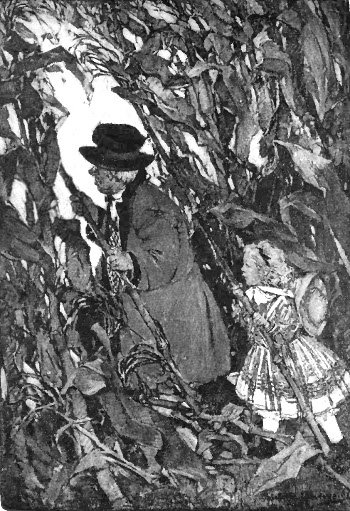
business of make-believe. She found a cornstalk that suited her purpose,
stripped off the blades, and concealed herself in the Whish-Whish Woods,
holding her gun in readiness to make a victim of the first person that
passed along the street. As Providence would have it, she was not kept
waiting, for almost before she could conceal herself, she heard the
sound of feet. Whoever it was had no idea of the danger that awaited
him, for he was walking along, whistling softly to himself, showing that
he was either in high feather, or seriously uneasy with respect to
certain plans he had in his head. As he came to the ambush, Adelaide
promptly thrust her cornstalk gun forward, with a loud cry of "bang!"
The result was as surprising as, and far more embarrassing than, when
she made-believe to shoot Randall. This time the victim, instead of
falling on the ground and writhing, as a man should do if he is
seriously wounded, nearly jumped out of his skin, crying, "Good
gracious!"
The voice was strange to Adelaide's ears, and when she was in a position
to see her intended victim, she discovered that her innocent joke had
been played at the expense of a young man whom she had never seen
before; he was an utter stranger. The young man, glancing back to see
who had waylaid him, caught a glimpse of Adelaide, and politely raised
his hat. Adelaide, frightened at what seemed to be her boldness, could
hardly articulate clearly, but she managed to say, in the midst of her
confusion and embarrassment, "Oh, excuse me! I thought—" but there she
paused.
"So did I," said the young man, with a laugh, "and you are quite
excusable." Adelaide said to herself that he was making fun of her, but
she did not fail to see, in the midst of her vexation and confusion,
that he was very pleasant looking. In short he had a clear eye and a
strong face. Having seen this much, she gathered her skirts free of her
feet, and went running to the house. She couldn't resist the temptation
to stop in the kitchen and give Lucindy the story of her exciting
adventure, and in the midst of it, she paused to say how handsome the
young man was. When the narrative was concluded, Adelaide asked Lucindy
what she thought of it all. The old negro woman must have had very deep
thoughts, judging from her silence. She asked no questions and merely
nodded her head while Adelaide was talking; and then, while the excited
young woman was waiting for her to make some comment, the little-used
knocker on the front door fell with a tremendous whack.
"Whosomever it mought be," remarked Lucindy, "it look like dey er
bleedze ter git in, kaze dey er breakin' de door down!"
"Oh, I believe it's the young man I tried to shoot!" cried Adelaide in
distress, "and I wouldn't meet him again for the world! I wonder where
Uncle Jonas is—and why he don't have a bell placed on the door?" Then
the young woman asked with some indignation, "Mammy Lucindy, do you
suppose that young man is knocking at the door because I made a goose of
myself in the garden?"
"Lawsy, honey," said Lucindy, soothingly, "don't git ter frettin'; I'm
gwine ter de door—yit I lay ef you had been up ter yo' neck in de
flour-bairl, I wouldn't let you run ter de front door an' grin at
whomsomever mought be dar! I lay dat much."
"But, Mammy! I'm afraid the person at the door is the young man I was
rude to when he was passing the garden. Oh, I wish Uncle Jonas would
hire a housemaid; I can't be running to the front door all the time."
"I ain't seed you run much, honey, kaze dat's de fust time dat
door-knocker is bangded in many's de long day. You want a house-gal,
does you? Well, you better not fetch no gal in dis house fer ter make
moufs at me right 'fo' my face. She sho' won't last long; I tell you dat
right now!"
Lucindy prepared to answer the summons, but before she could wipe the
flour from her hands, Adelaide changed her mind. She said she would
answer the knock herself, and, as she went into the house, Randall came
around the corner and went into the kitchen. He was somewhat excited,
and Lucindy inquired if he was ill. "Mammy," he said, "does you know who
that is knockin' at the door? Well, it aint nobody in the roun' worl'
but ol' Marster's grandson; it's Miss Betty's boy. Of all people on top
of the ground, that's who it is."
Lucindy leaned on the kitchen table, and gazed at Randall in speechless
surprise. "De Lord he'p my soul!" she exclaimed when she could find her
voice. "What he been up ter dat he ain't never is been here befo'? He
sholy can't be much mo' dan knee-high ter a puddle-duck." She persisted
in thinking of her young mistress as she had known her a quarter of a
century before. Randall could tell her little beyond the fact that he
had "know'd the favour," and had spoken to the young man on the street,
asking if he were not kin to the Bowdens.
This simple question developed into a long conversation, with the result
that Randall was as enthusiastic about Miss Betty's boy as he was about
Miss Betty, who had saved his life. "He sho' have got the blood in 'im.
He don't look strong, like all de balance of the Bowdens, but he's got
their ways. He walks an' holds his head jest like Miss Betty."
When Adelaide opened the door, and saw standing there the young man at
whom she had aimed her cornstalk gun, she was surprised to find that she
was not at all embarrassed. She had no idea that this particular meeting
had been arranged and provided for long ages ago. But she wondered why
she should feel so cool and collected, when she should be confused and
blushing. This is the way young women act in story books, and Adelaide
had often longed for the opportunity to stammer and blush when a strange
but noble young man appeared before her; but now that the young man had
come, she felt as if she had known him a long, long time. He was the
embarrassed one, while she observed that he had nice brown eyes, to
light up his handsome countenance, and these brown eyes seemed to be
trying to apologise for something or other; and all the time the young
man was thinking that he had never seen such beautiful blue eyes as
those that were shyly glancing at him from under their long lashes. It
was a desperate moment for all concerned, but Providence was there, and
laid its calm, cool hand on the situation. The young man asked for Mr.
Whipple, but Providence had been before him, and Mr. Whipple was not to
be found in the house, though Adelaide tried hard to find him, not
knowing that if her uncle could have been found just at that particular
time, a great many possibilities would have been destroyed. Adelaide
inquired if the brown eyes wouldn't come in and wait for Uncle Jonas,
who was to be expected at any moment, and the brown eyes softly admitted
that nothing would please them better if such an arrangement were
perfectly agreeable to everybody, otherwise not for the world would they
intrude—and then, as a matter of course, the blue eyes were compelled
to see to it that the time of waiting would be made perfectly pleasant.
After awhile the sound of footsteps was heard on the veranda, and
Adelaide, with a secret regret, declared that Uncle Jonas must be
coming. But Providence was looking out for the interests of the young
fellow with a keener eye, for the footsteps they heard were those of Mr.
Sanders. He came in without knocking, as usual, and Adelaide ran to meet
him, just as she always did. "You look as flustrated as ef you had man
company," Mr. Sanders remarked, as she greeted him. She slapped him
lightly on the arm by way of warning and rebuke. "An' I'll lay I kin
guess his name: it's Winters." Adelaide was very red in the face as she
shook her head. "Then it's Somers," he declared; "I know'd it was one of
the seasons that had dropped in on you out'n season. But it happens to
be the very chap I'm arter." He stalked in to the sitting-room, and
shook hands with young Somers, calling him Jonah, though his name was
John.
Then he casually inquired as to the whereabouts of Mr. Jonas Whipple, in
spite of the fact that he already knew. "You see how it is," he remarked
to the young man; "you thought you wanted to see Jonas, but it wasn't
Jonas you wanted to see at all." Mr. Sanders pursed his mouth, and
stared at the ceiling. The remark he had made was interpreted by
Adelaide in a way he had not intended, but she was quite equal to the
emergency.
"Well, Mr. Sanders," she inquired with great dignity, "whom did Mr.
Somers desire to see?"
He turned a bland and child-like smile upon her. "Why, he wanted to see
me, of course. Who else could it 'a' been?" Adelaide's dignity was not
made of the strongest stuff, and she was compelled to laugh. "I
understood him to inquire for Uncle Jonas," she said simply, "but I may
have been mistaken."
"No; I really want to see Mr. Whipple," the young man insisted. "That is
my business here."
Mr. Sanders beamed upon him with a smile that was as broad and sweet as
a slice of pie. "I've allers took notice," he remarked, "that wimmen an'
children, an' young folks in gener'l, will ax for the identical things
they ought not to have. They're made that-a-way, I reckon."
In a little while the young man bowed himself out, followed by Mr.
Sanders. "You young fellers worry me no little," remarked the Sage of
Shady Dale, as they went along the street together. "I happen to know
about the business that fetched you here, an' I mighty nigh swallered my
goozle when I seed you makin' for Jonas's."
"Well, I really thought Mr. Whipple was the proper person to see. I was
told that he held the key to the situation," young Somers replied.
Mr. Sanders smiled benignly. "Old Jonas has been seed an' he's been
saw'd," said the elder man so drolly that Somers laughed outright. "I
reckon you've been to college, ain't you? I 'lowed as much. The trainin'
is all right, but you'll have to fergit a heap you've l'arned ef you
want travellin' for to be easy. Old as I am, I wish I had some of your
knowledge, but if you was to put it all in a hamper basket an' gi' me
the right to paw it over, you'd be surprised at what I'd pick out. My
experience is that when a feller gits through college, an' begins for to
face the hard propositions that he ain't never thought about, he allers
takes a notion that somethin's wrong somewhar.
"I reckon maybe you've got the idee that argyment, ef it's got all the
facts behind it, is the thing that's bound for to win, an' you'll have
to git bumped by a barnyard full of billy-goats before you find out that
nineteen-hundred squar' miles on 'em ain't wuth one little inch of
persuasion. It's all right in the books, whar they l'arn you how to
think an' put up a nice article of argyment, but it don't work in reel
life. You can't carry none of your p'ints wi'out doin' some mighty purty
dancin' on t'other side of the line. Now I've saved you from one of the
wust bumpin's that a young feller ever had, and the beauty about it is
you'll never have a suspicion of it ontel you're old enough for to have
grandchildren. It'll not hurt you for to hit some of the rough places as
you go slidin' through this vale of tears, but it'll never do you any
reel good for to climb four flights of sta'rs an' then jump out'n the
top window when you want to come down."
"I should think that even a fool would know that," the young man
declared.
"Well, some on 'em don't," responded Mr. Sanders. "Thar's diffunt kinds
of fools, an' diffunt kinds of houses, an' heap higher jumps, an' you'd
'a' had the experience of it ef you'd 'a' found old Jonas at home. The
next time you go thar don't ax for him. Call for Adelaide—call for
Lucindy the cook (she use' to belong to your Gran'daddy Bowden)—call
for Randall—call for any an' ever'body but old Jonas."
"But what am I to do?" the young man inquired somewhat impatiently. "It
seems that I may as well go back to Malvern or Atlanta; and when I do
that, I'll have to hunt for another job."
Mr. Sanders hummed a tune, and apparently paid no attention to the young
man's last remark. "Old Jonas is mighty quar'," he said after a pause.
"When his sister died up thar in Atlanta, you couldn't 'a' told from the
motions he made that he'd hearn the mournful news; but sence he's had
for to take keer of Adelaide, her daughter, his gizzard has kinder
softened up. Why, that man thinks that the sun rises an' sets whar
Adelaide lives at."
"Well," said the young fellow, "she certainly is charming; I don't think
I ever met a young lady that so impressed me."
"Forty years from now you'll be able for to say the same thing,"
remarked Mr. Sanders. "Well, as I was a-tellin' you, old Jonas ain't
nigh as mean as he looks to be, but when I found out that he reely had a
heart, you mought 'a' knocked me down wi' a feather. It was the time
your gran'daddy died. Why, Jonas walked the floor all night long. That
much I know bekaze I seed it wi' my own eyes. An' then thar's that
nigger Randall—thar ain't no tellin' how much Jonas has done for him,
nor how much he will do. But when it comes to makin' a fuss, Jonas ain't
in it. He's too hard-headed for to let people know him as he is. Now,
don't think I'm doin' any obiturary work, bekaze the fact is old Jonas
ain't a bit better than he ought to be. I reckon, he is too hard-headed
for to let people know him as he is, but the fact is that old Jonas is
human; he ain't a bit better than the rest on us—an' he may be wuss in
some spots. Ef you've ever took notice, the people between the best man
in the world an' the wust, make a purty fa'r average. I reckon," Mr.
Sanders went on, regarding Somers with a child-like smile, "I reckon you
ain't never played poker as a habit?"
"Not as a habit," replied the young man, laughing.
"Well, the hand I've dealt to you is known as a royal straight flush,
an' it sweeps ever'thing before it. Look it over when you git time, an'
ef anybody calls you, jes spread out the kyards on the table, an' ax 'em
what they think of the lay-out."
"I don't think I know what you mean," said the young man, with some show
of embarrassment.
"Maybe not," replied Mr. Sanders, "but I leave it to you ef that's my
fault; I've dealt you the hand, an' ef you dunno how to play it, you
can't blame me. I see Tidwell across yander, an' I want to have a talk
wi' him; maybe he'll loan me his pocket-han'kcher. So-long!"
Young Somers went to his room in the tavern and pondered long over the
problem that Mr. Sanders had presented with confident smiles. He tried
to think it out, but, somehow, he could think of nothing but a laughing
face, dimpled and sweet, blue eyes and golden hair, and lovely white
hands lifted in eloquent gesture. He could concentrate all the powers of
his mind on these, and he could think a little, just a little, of the
wonderful personality of Mr. Sanders, who had persisted in remaining a
boy, in spite of his years and large experience, but so far as puzzles
and problems were concerned, his mind refused to work.
It was the same the next day, and the next. He walked about the little
town by way of recreation, but by far the largest part of his time was
spent in his room at the tavern. On the morning of the third day of his
stay in Shady Dale, he concluded to visit the old place where his
grandfather had lived, and where his mother was born. Of the whereabouts
of the place he had not the slightest idea, though he knew it was about
a mile from the centre of the town. While he was debating whether or no
he should wander about and try to find it for himself, or whether he
should make inquiries as to the direction, he heard the rustle of skirts
behind him. Turning he beheld his vision of blue eyes and golden hair.
This, however, was the reality. The young fellow had a queer notion,
momentary but vivid, that somewhere or somehow, in some dim, mysterious
region under the stars, he had come suddenly upon this same experience,
under precisely the same conditions—and the thought gave him a thrill
the like of which he had never felt before—the kind of thrill that, as
Mr. Sanders once suggested, makes you think that you've clerked in a
dry-goods store in some other world.
Blue eyes and dimples were very gracious. "You left too soon the other
day," they declared; "Uncle Jonas came in shortly after you went away,
and you were hardly out of the house before one of your mother's old
servants came in to see you. It was Mammy Lucindy, our cook, and she was
very much disappointed to find you had gone."
"I'm sorry," the young fellow said, and he was so emphatic, and so
serious, that Adelaide laughed. "I have heard my mother speak of Lucindy
and her son Randall."
"When Uncle Jonas came in," remarked Adelaide, "I told him you had
called. He frowned and said he supposed you wanted to see him on
business; but I suggested that perhaps you had called because you were
Judge Bowden's grandson. He declared you had never thought of such a
thing; but the possibility that you might have had such a thought
pleased him greatly. I don't know when I have seen him in such high good
humour."
They were walking along as they talked, and the young man made a mental
note of old Jonas's pleasure. The sun was shining brightly, the air was
fresh and cool, the jay-birds in the China trees were hilarious, and,
somehow or other, the two young people felt very happy as they walked
along. They had no particular reason for their happiness, but they
seemed to be in the atmosphere in which happiness arises like the
sparkling dew of early morning. A deaf old lady sitting on her piazza,
on the opposite side of the street, smiled sweetly at Adelaide, and held
her trumpet to her ear, as if, by means of its echoing depths, she could
hear what the laughing young woman was saying. Adelaide did have
something to say, evidently—something that an ear-trumpet could not
interpret across the wide street, for she made a little gesture with her
head, which her companion failed to see, and she sent some signal
whirling through the air by means of a fluttering white hand. This
signal he did see, but he was unfamiliar with the code that prevails
among women-kind the world over: yet he had no difficulty in taking it
to be an ordinary salutation, especially as the smiling old lady waved
the trumpet around her head with an air of triumph. Still there was
something in it all that seemed to be a trifle beyond him—and from the
feminine point of view it was a neat and pretty piece of work.
He had small opportunity to give the matter any thought, for Adelaide,
laughing, turned toward him, and began to speak of the affection her
Uncle Jonas had felt for Judge Bowden, and the high esteem in which he
held the judge's memory. She acknowledged that it was very queer that a
man long dead should play a living part in her uncle's thoughts, but she
explained that people had wrong ideas about her uncle. "They seem to
think," she declared, "that Uncle Jonas is very mean and stingy, and
hard-hearted; but if they knew him as well as I do, they would think
differently."
The young fellow would have protested, but Adelaide stopped him with a
dignified wave of her versatile white hand. "I know what people say,"
she insisted. "Mr. Sanders tells me, and so does Randall, whose life was
saved by your mother; they tell me everything that is said about Uncle
Jonas. And I always tell him about it, but he doesn't seem to care; he
laughs as if it were a good joke, and declares that people have more
sense than he has been willing to credit them with. Really, I believe he
likes it, but it is not at all agreeable to me."
Young Somers hardly knew what to say; he had heard old Jonas described
as the meanest man in twenty states, and the promoters of the railway
enterprise who had sent him to Shady Dale were not at all backward in
expressing their opinion of the man who was causing them so much
unnecessary trouble and delay. So he walked on in silence for awhile.
Then: "Speaking of my grandfather, I was just on the point of inquiring
about the old place, but when you made your appearance just now,
dropping out of the sky, I forgot all about it. I should like very much
to see the home where my mother was born, and where my grandfather was
born and died. I have heard my mother talk about Shady Dale and about
the old home-place ever since I could understand what she said. I
remember, when I was a child, that I had a queer idea that the town was
shaped like a bowl or saucer; all the good people that chanced to come
by stumbled and fell in, there to remain, and all the bad people crawled
over the rim and fell out; and I couldn't help having a feeling of
disappointment when I found that Shady Dale is very much like other
towns."
"Now, don't say that!" protested Adelaide. "I have seen a great many
towns, but never one like this—not one as pretty."
"Why, in North Carolina——" the young fellow began, but Adelaide
interrupted him with a laugh so genuine and unaffected that it was
delightful to hear. Yet, in spite of the fact that he enjoyed the
rippling sound, he felt his face turning red. "You think North Carolina
is a joke," he went on, "but you would be surprised to know what a great
state it is."
"I was laughing at one of Mr. Sanders's jokes," said Adelaide, still
smiling. "Once there was a tobacco peddler came here driving a big
covered waggon. Mr. Sanders discovered he was from North Carolina, and
shook hands with him very cordially, and asked about a great many people
he never heard of. The tobacco man said they must have moved away, but
Mr. Sanders said he thought not, for the reason that the only three
North Carolinians he ever saw that were able to settle at the toll-gates
and ferries, made their way straight to Alabama, and formed a business
firm. He said the name of this firm was 'Tar, Pitch, and
Turkentime'—that's the way he pronounced the names. The tobacco man
didn't get angry; he laughed as loudly as anybody, and Uncle Jonas says
that was because he wasn't conceited."
Here Adelaide paused; she had come to the house of the friend she
proposed to visit, and from the gate she pointed out the trees that grew
so abundantly on the Bowden place, and her attitude seemed to say to the
young man that should he get lost, he would be safe so long as she was
within calling distance. He had been used to more dignity and less charm
on the part of most of the young women he knew, and he rather preferred
the variety which he had now come in contact with for the first time.
And yet, when he came to the old homestead, where his grandfather lived
and died, and where his mother was born, he was attacked by none of the
emotions that would have seized upon the soul of his mother. He had been
educated in a different environment, and he was essentially modern in
his sense of the importance of business affairs. As he read the friendly
inscription on the tomb of his grandfather—the family burying-ground
being not far from the picturesquely simple old house—he was conscious
of a strong desire to know whether failure or success would crown his
negotiations with Mr. Jonas Whipple.
The vagrant winds blew through the tops of trees more than two centuries
old, the house frowned grimly over the reminiscences of past
hospitality, and the whole scene appealed strongly to sentiments that
are now said not to be strictly scientific. But it must not be supposed
that the young man had no poetry in his soul, or that his nature was
free from emotions of a sentimental character. He lived entirely in the
present, and the past had no meaning for him save that which was coldly
historical. He found his inspiration in the rhythmical clatter and
cackle of intricate machinery; he was stirred by the interweaving and
interlacing business problems, and the whole movement, shape, and
pattern of huge commercial enterprises.
Nor was this a misfortune. Being modern and practical, he was wholly
free from the entanglements and misconceptions of prejudices that had
outlived the issues that gave rise to them; and he went about his
business with a mind at once clear, clean, and cheerful, bearing the
signal of hope on his forehead. As he walked about the old place, it was
characteristic of him, that he should be seeking the solution of the
puzzle which Mr. Sanders had placed before him in the shape of a "royal
straight flush," but in a matter of this kind, his mathematics availing
him nothing: nor did it occur to him that the solution was to be found
somewhere in the region from which the nations of the world draw their
not over-abundant supplies of poetical metaphor. After an interval which
he deemed seemly and proper, he turned his steps in the direction whence
he had come. The street being straight as well as wide, afforded a fine
perspective of sun and shade, to say nothing of the sand. As he went on,
he walked more and more rapidly, so that he could have been accused of
fleeing from the ghosts of his ancestors; but the propelling influence
was the sight of Adelaide, who, having completed her morning call, was
emerging from the gate-way that led to the house of her friend. She was
for moving on, but seemed suddenly to remember about the young man.
Turning, she saw him coming, and waited, sauntering slowly, her mind
full of a swarm of thoughts that had been fighting for its possession
since she first saw him.
"The sight of your mother's old home doesn't seem to have saddened you,"
she remarked, as he came up.
"No," he replied, "but that is because I have no refreshing memory of
the old place. All my ideas about it are second hand; and besides, it
seems to be a very cheerful place. I imagine that the soil round about
is still fertile."
"I never thought of that," she answered; "but men are always more
practical than women. In your place, I should have searched over the old
homestead for the favourite walks of my grandfather; and I should have
known, before I came away, where my mother ran, and hid herself when her
feelings were hurt; and where she played with her dolls, and just how
she did when she was a little bit of a girl."
The young man had an uneasy idea that Adelaide was poking fun at him,
but her face was so grave that he dismissed the idea, and it was then
that he felt himself stirred by a dim conception of the region in which
the thoughts of this beautiful young woman wandered and ranged.
"What I was really thinking of all the time," he said, with a laugh that
somehow conveyed a regret that his thoughts were on a plane so much
lower than hers, "was how I shall prevail on your uncle to convey to the
railway company a right of way through his land. It means a great deal
to me."
"Oh, that is why you are here!" exclaimed Adelaide. "Well, I was
wondering." She regarded him very seriously for a moment and he felt
that he had fallen a notch in her estimation. "If you'll take my
advice," she said, "you will leave the whole affair to Randall."
"But how can I? Randall is a negro. I'm sure I don't understand what you
mean!" His pride, his self-esteem, had been wounded to the very core,
and his face was very red.
"Yes, leave it to Randall and Mr. Sanders," Adelaide replied, "and you'd
not lose anything if you could manage to introduce the ghost of your
grandfather." This was said airily, but it had far more meaning that
young Somers was able to read into it.
"I never saw just such a place as this is," he remarked somewhat
petulantly, "where the people can only help you along by means of
riddles and parables and jokes. Mr. Sanders tells me to say nothing to
your uncle about the business on which I have been sent. And then he
says that I already have a royal straight flush in my hand. What am I to
infer from that?"
Young Somers, without intending it, revealed the essential boyishness of
his nature, and Adelaide relished it immensely. "You are to infer just
what he intended you should," she declared. "The jokes of Mr. Sanders
mean a great deal more than another man's wisdom. You'll discover that
for yourself when you come to know him well."
"But you can't do business by means of jokes," the young fellow
protested.
"That's the way Mr. Sanders transacts his business," Adelaide responded,
"and he's a very prosperous man. As for your grandfather's ghost, Uncle
Jonas will raise it if you give him half an opportunity. You'll learn a
great deal from Mr. Sanders and Uncle Jonas if you stay here long
enough." The expression of her face was demureness itself, but the blue
eyes sparkled with humour.
Now, young Somers was neither slow nor dull, but the peculiar atmosphere
he found at Shady Dale was something new in his experience, and he was
compelled to tunnel through it before he could clearly understand it.
His business training, as far as it had gone, and all his business
associations, had accustomed him to methods of procedure that were not
only direct, but blunt. He never went around obstacles but through or
over them. But he knew, after giving the matter some consideration, and
after discovering that the ordinary commercial and cold-blooded methods
would be useless here, that he would have to enter into the spirit of
the place. He was a very attractive young man when at his best, and he
made himself more attractive than ever by acquiring a quick sympathy for
the things that interested the sincere and simple people about him.
He had several long talks with Mr. Sanders, during which he never once
mentioned business nor anything relating thereto. Instead, he seemed to
be very much interested in Adelaide and her personality, her nature and
individuality. On this subject Mr. Sanders was eloquent. He could
discourse on it for hours, and was only humorous when he wanted to make
people believe he was in earnest. He told Somers all about Cally-Lou,
and asked the young man what he thought about the child that was a
little more than make-believe, and yet remained on the very verge of
visibility. Now, the young man was very practical; circumstances had
made him so. His spirit had had so little exercise, his dreams remained
so persistently on the hither side of concrete things, he was so
completely invested with the cold and critical views that were the
result of his education, that his mind never ventured much beyond his
material interests, and he never tried to peep around the many corners
that life presents to a curious and sincere observer. Consequently, he
was all at sea, as the saying is, when Mr. Sanders told him about
Cally-Lou. He thought it was some form of a new joke, and he would have
had a hearty laugh had the old philosopher given him the wink.
But the wink was not forthcoming. On the contrary, much to the young
man's surprise, Mr. Sanders appeared to be very serious. But the young
man was as frank as it is possible for a youngster to be. "I'll be
honest with you, Mr. Sanders," he said. "I don't know a thing about such
matters. If I were not in Shady Dale, where everything seems to be so
different, I would say at once that you are talking nonsense—that you
are trying to play some kind of a practical joke—but, as it is, I don't
know what to think."
When the young man said that everything is different in Shady Dale, he
meant that Adelaide was different, and Mr. Sanders knew it; so he said,
"When you git so that you kin mighty nigh see Cally-Lou, you'll be wuth
lookin' at twice."
Somers took this more seriously than he would have taken it twenty-four
hours previously—and he carried it to the tavern with him, and thought
it over a long time; and then, as if that were not sufficient, he
carried it to the Bowden place in the dusk of the evening, and worried
with it until he had no difficulty in discovering where his grandfather
had walked, and where his mother had hid herself when her feelings were
hurt, and where she had played with her dolls.
The experience helped him in many ways, so much that when Adelaide saw
him only a few hours later she exclaimed, "Why, how well you are
looking! Our climate must be fine to make such a change in you." And Mr.
Sanders—"Well, well! ef you stay here long, you'll turn out to be a
purty nice lookin' chap. The home air is mighty good for folks, so I've
been told." And, somehow or other, without further explanation, the
young fellow knew what Mr. Sanders had meant by his talk about the
"royal straight flush." When he called on old Jonas, he went as the
grandson of Judge Bowden, and not as the agent of the promoter of the
new railway, and endeavoured to learn everything that the old man knew
about his grandfather.
Mr. Sanders joined the two before they had been conversing very long,
and he was surprised, as well as pleased, to find how completely old
Jonas had thawed out. There was not a frown on his face, and, on
occasion, he laughed heartily over some incident that his memory drew
from the past. And, presently, Adelaide glided in from the innermost
recesses of the house, and sat near her uncle. She was a charming
addition, and a most interesting one, for she was able to remind old
Jonas of many things he had told her about the dead judge. Mr. Sanders,
not to be outdone, contributed some of his own reminiscences, so that
the evening became a sort of memorial of a good man who had long passed
away.
When the visitors were going away, Adelaide accompanied them to the
door, and went with them on the veranda. Before Mr. Sanders could say
good-bye, she caught him by his sleeve—"Do you remember what I told you
the other day? Well, she has returned."
"What did she say?" he inquired, his finger on his chin. Adelaide
blushed, but no one could see her embarrassment. "Why, she says that
everything looks a great deal better by lamplight."
Young Somers heard the conversation, but kept on moving away. "Did you
hear that?" inquired Mr. Sanders, as he overtook the other. "She was
talking about Cally-Lou. It seems she run away the day you showed your
face here, and now she's come back." And further than that, the Sage of
Shady Dale said not a word. But the next day, he met the young fellow on
the street, and gave him a congratulatory slap on the back. "You showed
up purty strong, sonny; an' now that you've diskiver'd for yourself that
thar's a whole lot of ingineerin' that's nuther civil nor mechanical,
an' that aint got a thing in the world to do wi' figgers, you'll manage
to git along ruther better than you thought—in fact, mighty nigh
fustrate.
"But don't fergit Cally-Lou!"
And the young fellow did get along first-rate in more ways than one. The
railroad was allowed to run right through old Jonas's land, and when it
was completed there was nothing to do but to celebrate the event by a
marriage, in which the young man was aided and abetted by Adelaide. Then
when everything had settled down, he took hold of Randall's water-power
and furnished lights for the town, and power for two or three mills in
which Mr. Sanders was interested. I think this is all, but if you are in
doubt about it, and want to find out something more, just enclose a
stamp to William H. Sanders, Esq., Shady Dale, Georgia.