Utterly unconscious of the mine about to be
sprung under his feet, Captain Smith mustered all
his forces for effective work in the planting season.
He probably gave no thought to affairs in
England; he had plenty of trouble with his enemies
at home.
The traitor Dutchmen continued to live with
Powhatan and to instruct his people in the use
of powder, shot, swords, and tools, which they
constantly obtained through their confederates
in the fort. The rendezvous of the thieves was a
building in the woods which had been erected as
a house for the manufacture of glass, and seems
now to have been abandoned. There the thieves
"lay in Ambuscades," together with forty men
sent by Powhatan under the guidance of "Francis,"
one of the Dutchmen, with instructions to
waylay, capture, or kill Captain Smith and seize
firearms and tools. The latter heard of these
visitors, and with twenty men set out to destroy
them. But upon arriving at the glass house they
found the conspirators fled. The Captain's men
pursued them to drive them out of the peninsula,
while he returned alone to Jamestown. To his
surprise he met in the woods his old acquaintance
Wochinchopunck, king of the Paspaheghs, who
had piped a welcome at the coming of the English.
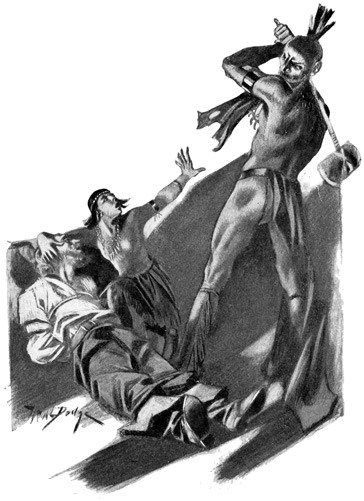
The king now saluted with an arrow-shot, and
Captain Smith, grappling with him, was drawn
unto the water. There the Captain held the
savage by the throat and was about to cut off his
head (he was an expert in this!) when the savage
begged so piteously for his life that Smith pitied
him and hesitated. Just then two of the Polish
potash-boilers ran up, and helped him draw the
savage out of the water and conduct him to the
fort and lock him up.
Francis was soon brought in by the other party.
He had a plausible story to relate in broken English:
he and his comrades were detained by Powhatan
against their will, he had escaped at great
hazard, and was on his way home. Hungry and
weary he had paused in the wood to gather
a few walnuts. He was not believed, but "went
by the heeles" (was put in irons), the Paspaheghan
king also fettered, and held until the return of all
the Dutchmen who had run away to the enemy.
Wochinchopunck's relatives and friends came
daily with presents entreating his release, and
were sent to Powhatan with the captors' terms—the
surrender of the Dutchmen. To this the old
gentleman with the "sour look" returned churlish
replies: what cared he for the Dutchmen?
they might go and welcome; he had told them
so again and again, but they refused to stir.
What more could he do? Could he put them on
the backs of his men and send them? His men
were unable to carry those heavy Dutchmen on
their backs fifty miles from Orapakes! It was
quite clear the captive king had nothing to hope
from his emperor. He settled the matter by
keeping awake while his jailers slept and made
good his escape; whereupon George Percy and
Captain Winne were sent out to recapture him.
They burned the king's houses, and took two
prisoners, Kemps and another. The savages
became exceedingly insolent and aggressive, and
the matter ended by Smith's wholesale assault
upon their town, burning their houses, taking
their boats and all their fishing-weirs, and planting
the latter in the waters around Jamestown.
This is one of the incidents of "cruel and inhuman
treatment of the Naturells" which helped to
swell the long lists which his enemies in London
arrayed against him: ignoring the fact that he
could protect the lives of the colonists only by
swift and sharp retaliation for every Indian outrage
or breach of faith.
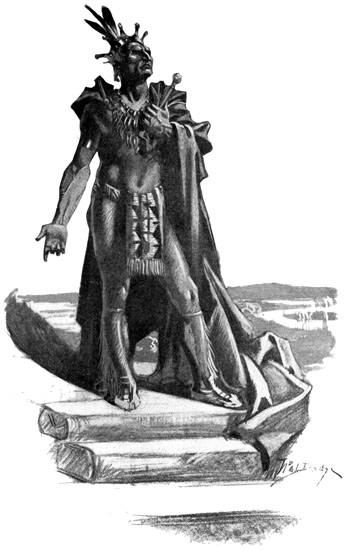
The native eloquence of the Indian has often
been noted. In his translated speech, as the
interpreters render it, there was a marvellous
dignity, and excellence of expression. As Smith
was returning from the raid, a party of the
Paspaheghs overtook him and threw down their
arms: and one, a stout young man called Ocanininge,
thus addressed him, according to the
interpreter:—
"Captain Smith my master (the King) is here
present in this company thinking it Captain
Winn and not you; and of him he intended to
have been revenged, having never offended him.
If he have offended you in escaping your imprisonment,
the fishes swim, the fowls fly, and the
very beasts strive to escape the snare and live;
then blame not him being a man. He would
entreat you remember your being a prisoner
what pains he took to save your life. If since,
he hath injured you, he was compelled to it, but
however you have revenged it to our too great
loss. We perceive and well know you intend to
destroy us, that are here to entreat and desire
your friendship, and to enjoy our houses and
plant our fields, of whose fruit you shall participate;
otherwise you will have the worst by
our absence. For we can plant anywhere, though
with more labour: and we know you cannot live
if you want our harvest, and that relief we bring
you. If you promise us peace we will believe you;
if you proceed in revenge we will abandon the
country." Upon these terms the Captain promised
them peace until they did some injury, upon condition
they should bring in provision. So all departed
good friends and so continued until he left
the country. After he left, Wochinchopunck,
again found hanging around Jamestown, was
"thrust twice through the body with an arming
sword."
Smith now addressed himself with all his might
to the defences of the colony. Although he had
inspired the Indians with a wholesome fear of
offending him, he knew their servile obedience
to Powhatan, and that monarch had forfeited all
claim to his confidence and respect. Powhatan's
one dominant desire was to obtain the arms of
the colonists, and with these arms drive them from
the country. A fortunate circumstance changed
the attitude for the present, even of that implacable
enemy. A pistol was stolen from the fort,
and an Indian arrested, to be hanged unless the
pistol was returned. The prisoner was committed
to the "dungeon." The night was bitterly cold,
and Captain Smith pitied the poor savage and
sent him a good supper and charcoal for a fire.
At midnight his brother brought back the pistol,
but upon opening the door of the dungeon the
prisoner was found, stifled by the fumes of the
charcoal, badly burned and apparently dead.
His brother's lamentations touched the Captain's
heart and he promised to make him alive again.
Accordingly, with aqua vitæ and vinegar, he was
restored, his burns dressed, and he was sent home
after being well rested and refreshed.
The whole country rang with the wonderful
news that the Englishman could raise the dead,
and henceforth there was, during his administration,
no trouble from the Indians. They frequently
brought presents to the colonists of game
and fruits, and no doubt Pocahontas visited them
as of yore. It is expressly stated that she came
as freely to the fort as to her father's house.
Another party was soon sent into the interior to
the country of the Mangoags, in search of Raleigh's
lost colony, and returned with "no newes except
that they were all dead." Sicklemore, who had
been despatched to Chowanock, returned after a
similar fruitless search. He found the Chowan
River not large, the country overgrown with pines.
As to the "pemminaw," the silk grass growing
like hemp, there was but little, only a few tufts
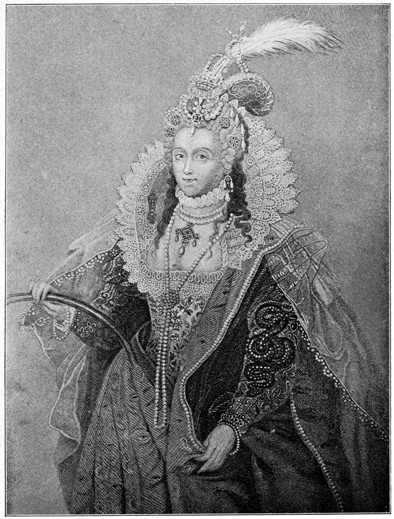
here and there. Queen Anne was not yet to have
a gown of Virginia grass-linen. Elizabeth's robe
had been woven from North Carolina grass, and
was probably a present from Sir Walter Raleigh.
A marginal note in Purchas's "His Pilgrimes"
distinctly states that Powhatan confessed he had
been cognizant of the massacre of Raleigh's
men: also that the Indian king had in his
treasure-house articles that had belonged to them.
Strachey, writing in 1610-1611, asserted that
Powhatan himself was their murderer. Expeditions
were sent out, for several years, in search of
them. No clew was ever found to their fate.
Indians are good keepers of secrets, as was proven
by the great massacre of 1622.
In March, 1609, a few months only remained
of Smith's residence in Virginia. Had he known
them to be his last, he could not have worked with
more energy and efficiency. He "dug a well of
most excellent sweet water," he built block-houses
in various places—one at Hog Island to protect
his fast-growing herd there. He built the "fort
for retreat neere a convenient river, easie to be
defended, and hard to be assalted," around which
in the next century clustered the "Legends of
the Stone House." But scarcity of food constrained
him to abandon the work of defence
and address himself to the ever recurring struggle
for bread. There were two hundred men
behind the palisades, and only thirty who were
willing to work. He issued a stern threat that
every idler would be sent across the river to
shift for himself. No empty porringer would be
filled from the common kettle unless the owner
were sick, or had earned his meal. He was beset
with disloyal, unmanly complainers, who were
clamorous that the tools, arms, nay, the very
houses should be bartered for corn. Newport had
brought them a terrible, warlike colony of rats,
"thousands on thousands," which destroyed all
the contents of his casks of grain, and baffled the
colonists' efforts to exterminate them. It was
supposed that Newport introduced them into Virginia—they
had come originally to England
from the "poisonous East"—but in the early
descriptions of the dress of a savage he is represented
as clothing himself with skins, and then
adorning his garment with the dead hand of an
enemy or paw of a beast, while a dead rat hung
from his ear, through which the tail was thrust.
This rat was, however, evidently scarce—a rare
gem—and not in common use for an ear-ring
like a living green and yellow serpent. I think
we shall have to thank Captain Newport for our
rats, as we thank England for our colonists, and
the Dutch for the negroes, who arrived in 1619.
The early spring before the ripening of fruits
and berries was always the scarce season. Captain
Smith sent some of his people to feed on
Lynnhaven Bay oysters: and others were billeted
with the savages, who treated them kindly.
Roots and acorns were gathered for food. Smith
perceived the folly of keeping the colony crowded
into the narrow limits of the Jamestown peninsula,
and projected a settlement in Nansemond, a fort
at Point Comfort, and yet another on the high
ground near the present city of Richmond. But
his ardour was soon to be chilled. With the
summer came Captain Argall in his trading-ship,
who brought the astounding intelligence that the
present charter and government had been overthrown,
everything reorganized, and President
Smith removed.
The reasons for his disgrace were known to
Argall. He had been accused of cruelty to the
"Naturells," and of suffering the ships to return
unfreighted. No allowance had been made for
Indian outrages, for sickness, or for any of the
difficulties of which I have written.
The seven vessels, shattered by storm and having
lost the greater portion of their supplies, and
many passengers by sickness, reached Jamestown
in August, 1609. They brought back the
old ringleaders:[58] "Ratcliffe the mutineer, Wingfield
the imbecile, Newport the tale-bearer, Archer
an agitator, Martin a cat's-paw." They had wrangled
through the early days of 1607 and 1608,
been opposed by the hard workers and fighters,
and crushed. They had, in England, effected by
intrigue what they had failed to effect by force.
They had their revenge! Ratcliffe, whose epitaph
Hamor wrote in a few pithy words, "He was
not worth remembering but to his dishonour,"
had gained the willing ear of the disappointed
London Company, and had laid the blame of the
failure in Virginia wholly and solely upon John
Smith. The "Rude Answer" of the honest
fighting man had offended the Right Honourables,
and so they rid themselves of him.
Now, upon landing, Ratcliffe claimed authority.
Smith refused to allow it, until the charter and
leaders, who were in the Sea Venture, should
arrive. Ratcliffe declared they were lost at sea.
All Jamestown was in an uproar. Ratcliffe and
his followers paraded the town denouncing
Smith. His men "drank deep and uttered
threats and curses," and their leader nursed the
storm and inflamed them more and more against
the tyrant. Chaos had come again.[59] Those
"unruly gallants would dispose and determine of
the government sometimes to one, sometimes to
another: to-day the old commission must rule;
to-morrow the new; the next day neither; in
fine they would rule all or ruin all. Yet in
charity," continues our early historian, "we must
endure them thus sent to destroy us; or by correcting
their follies bring the world's censure
upon us to be guilty of their blood. Happy had
we been had they never arrived, and we forever
abandoned, and as we were left to our fortunes:
for on earth, for their number, was never more
confusion, or misery than their factions occasioned.
"The President seeing the desire of these
Braves to rule; seeing how his authority was so
unexpectedly changed, would willingly have left
all and have returned for England. It would be
too tedious, too strange and almost incredible
should I particularly relate the infinite dangers,
plots and practises he daily escaped amongst
this factious crew: the chief whereof he quickly
laid by the heels. Master Percy had his request
granted to return to England, being very sick;
Master West with an hundred and twenty of the
best he could choose, he sent to the Falles;
Martin with near as many to Nansemond."
These were to establish new settlements according
to a previous plan.
As the term of Smith's presidency was about to
expire, he made Martin President, but the latter
soon proved his cowardly incompetency, for,
growing alarmed at the attitude of the Indians at
Nansemond, he ran away and "left his company
to their fortunes."
Captain West, returning to Jamestown, after
seating his men at the Falls (near the present site
of Richmond), the President concluded to look
after matters there, and found the colony planted
on low marshy ground subject to the river's inundation
and other inconveniences.
He had taken with him the bright boy, Henry
Spelman, whom (according to the latter) he now
sold to Powhatan in part payment of the place
then (and now) called Powhatan. The rest of
the payment he proposed to make in a promise
to aid Powhatan in his wars against the
Monacans, and a "proportion of Copper," with
sundry provision for future supplies. But, lo
and behold, the colony at Powhatan rebelled
against these terms and scornfully rejected the
scheme! It is supposed they had already built
their huts on the marshy ground and objected
to the additional labour of moving them. Smith
regarded them as mutineers, and with five men
landed among them and arrested the ringleaders;
but they overpowered him, and forced him to
retire on board of a vessel lying in the river.
He set sail for Jamestown, but his vessel ran
aground; and to his surprise the mutineers
thronged him with appeals for protection, for
the Indians had fallen upon them as soon as
Smith left, and had slain many of West's party.
Accordingly the Captain again arrested the
ringleaders, and, returning to Powhatan, settled
the colony there in the purchased palisade fort,
which was well fortified and contained good dry
cabins and ground ready to be planted. Smith
named it "Nonsuch" after a royal residence of
that name in England.
This incident concluded his relations with the
Indian emperor. He was nevermore to see him;
indeed, he had transacted his present business
through agents.
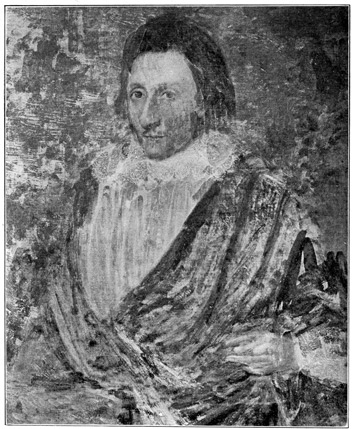
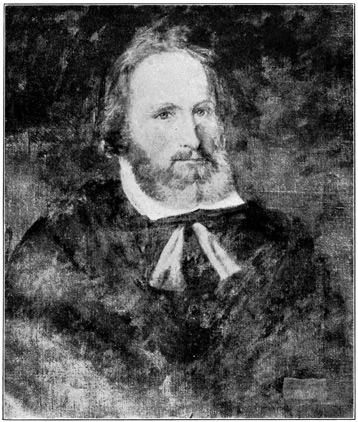
Captain George Percy.
Copyright, 1906, by Jamestown Official Photo. Corp'n.
Our brave Captain's career was over in Virginia.
He fell asleep on his return voyage to Jamestown
with his match lighted, and a bag of powder in his
pocket was ignited, "burning him very shrewdly,"
says the quaint narrator. His agony was great,
and there were no surgeons in Jamestown. He
lay that night in the fort, and there an attempt
was made to murder him, which failed. The
murderer looked at him in his delirium, and the
"steel dropped from his nerveless hand." His
faithful soldiers flatly refused to submit to Ratcliffe,
Archer, and their confederates, and George
Percy was prevailed upon to surrender his hope
of returning to England, and consented to remain
as the President of the colony until news of
the Sea Venture could be had.
At Michaelmas, 1609, the stern soldier and
strong writer and true patriot set sail for England.
He had brought only his sword to Virginia,
and he took thence nothing more. Not an inch
of the ground he had dug nor a plank of the
houses he had built belonged to him.
"What shall I say,"[60] writes the old historian,
"but thus we lost him, that in all his proceedings
made Justice his first guide, and experience his
second, ever hating basenesse, sloath, pride, and
indignitie more than any dangers; that never
allowed more for himselfe than his soldiers with
him; that upon no danger would send them where
he would not lead himselfe; that would never see
us want, what he either had or by any means
could get us; that would rather want than borrow
or starve than not pay; that loved action
more than words, and hated falsehood and covetousness
worse than death; whose adventures
were our lives and whose losse our deaths."
Nobody denies the services John Smith rendered
to the infant colony—and yet such was
his arrogance, his boastfulness, his intolerant,
dogmatic temper, that men took offence, and
grudgingly yielded him the honour which was his
due. It is true he never failed to put himself
well to the fore, and never omitted an opportunity
to record his fine achievements. For this
men hated him. Diligent as were his enemies,
they could not crush him utterly. He filled
positions of trust after he left Virginia, visited
the northern colony, was allowed to name it "New
England," gave the name to Boston and other
places on the coast; and thus proved that his
colonial career was highly esteemed at home.
Whether he deserves it or not, he still holds the
foremost place in the early history of Virginia.
With all his hauteur and arrogance, he knew
how to be gracious and winning, especially to
women. We know of the supreme moment between
the raising and falling of the club to beat
out his brains when
"An angel knelt in human form
And breathed a prayer for him."
But there were others—one indeed in every
crisis, in every country he visited—"Princesses
and Madams," who befriended or saved him, and
we cannot but suppose that with them his personality
possessed the charm of fascination. But
in regard to his soldierly qualities nothing is left
to inference or supposition. We know him to have
been beyond compare brave, enduring, capable
of bearing extreme misery and danger with noble
fortitude. He was pitiful to the sick and weak,
tender to children, watchful of the comfort and
rights of the unfortunate. His writings sound a
clear, high note of patriotism and devout aspiration.
They bear the impress of the rough
mariner and soldier, but nobler writing I know of
nowhere. "The rude sentences rise to the height
of eloquence, as he exhorts his contemporaries in
noble words to noble achievements." We give
a few of them.
"Seeing we are not born for ourselves, but each
to help the other," he writes, "and our abilities
are much alike at the hour of our birth and the
minute of our death; seeing our good deeds or
our bad, by faith in Christ's merits, is all we
have to carry our souls to heaven or hell, ... let
us imitate the virtues of our ancestors to be
worthily their successors."
"Who would live at home idly or think in himself
any worth, to live only to eat, drink and
sleep, and so die?"
"Who can desire more content that hath small
means or but merits to advance his fortunes than
to tread and plant the ground he hath purchased
by the hazard of his life? If he have but the taste
of virtue and magnanimity, what to such a mind
can be more pleasant than planting and building
a foundation for his posterity, got from the rude
earth by God's blessing and his own industry
without prejudice to any?"
"What so truly suits with honour and honesty
as the discovering things unknown, erecting towns,
peopling countries, informing the ignorant, reforming
things unjust, teaching virtue and gain
to our native mother country:—so far from
wronging any as to cause posterity to remember
thee, and, remembering thee, ever honour that
remembrance with praise?"
"What can a man with faith in religion do
more agreeable to God than to seek to convert
these poor savages to Christ and humanity?"
These are the words of a Christian soldier.
Men of his temperament, however, are never regarded
with indifference. They are loved devotedly
or hated relentlessly. One writer of his
day calls him a "dear noble captain and loyal
heart"; another, "a wonder of nature, mirror of
our clime"; "a soldier of valorous policy and
judgment"; another says of him:—
"I never knew a warrior but thee
From wine, tobacco, debts, dice, oaths so free."
On the other hand, his contemporaries brand him
as "tyrant and conspirator"; "full of the exaggerations
and self-assertions of an adventurer";
"a Gascon and a beggar." The adverse opinions,
for some mysterious reason, have crystallized
around the Pocahontas incident, and so eager
are his critics to disprove the assertion that she
saved John Smith's life, they would like to
believe she never existed at all! The simple
truth is that in the first two of his letters he
omitted the fact, in the third he related it.
This inconsistency was observed in 1866 by
Dr. Charles Deane of Massachusetts. Until then
no one had doubted the truth of the story.
Of course the party that had all along questioned
the marvellous Transylvanian adventures eagerly
welcomed the new ally to their ranks. A warfare
of words had been going on for more than two
hundred years. It was now given fresh impulse.
Boastfulness and arrogance are unpleasant foibles;
lying is a sin. He had been disliked for his
foibles, he was now despised for his sins. Candid,
able historians, like Dr. Doyle of England
and Alexander Brown of Virginia, honestly wrote
against him; James Grahame, Dr. Edward Arber
of England, and all the Virginia historians except
Brown defended him. The charges remain on the
pages of history "not proven." To those pages
(on both sides sincere) I commend the interested
reader. Old Thomas Fuller, however, is not much
read by latter-day folk, and although his opinion
of the prisoner at the bar differs from my own,
his ill-concealed sarcasm is expressed in words
so delightfully quaint that I venture to quote
him. He certainly gave the key-note to all the
critics that lived after him, for he wrote only
thirty years after our captain's death:—
"John Smith, Captain, was born in Cheshire, as
Master Arthur Smith, his kinsman and my schoolmaster,
did inform me. He spent most of his life
in foreign parts. First in Hungary, under the
emperor, fighting against the Turks; three of
which he himself killed in single duel; and
therefore (so it is writ over his tomb) was authorised
by Sigismund King of Hungary to bear
three Turk's heads as augmentation to his arms.
Here he gave intelligence to a besieged city in
the night, by significant fire-works formed in the
air, in legible characters, with many strange performances,
the scene whereof is laid at such a
distance, they are cheaper credited than confuted.
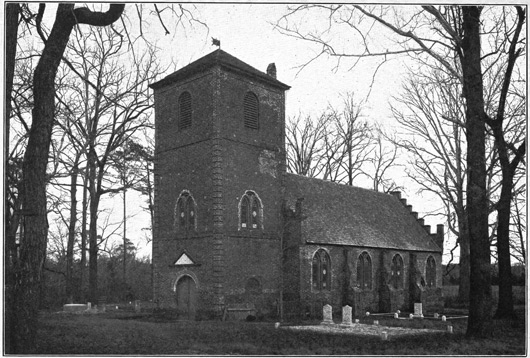
St. Luke's, near Smithfield, built in 1623. The Oldest Protestant Church in America.
Copyright, 1906, by Jamestown Official Photo. Corp'n.
"From the Turks in Europe he passed to the
pagans in America where towards the latter end
of the reign of Queen Elizabeth (!) such his perils,
preservations, dangers, deliverances, they seem
to most men above belief, to some beyond truth.
Yet have we two witnesses to attest them, the
prose and the pictures, both in his own book;
and it soundeth much to the diminution of his
deeds, that he alone is the herald to publish and
proclaim them.
"Two captains being at dinner one of them
fell into a large relation of his own achievements,
concluding his discourse with this question to his
fellow: 'And pray, Sir, what service have you
done?' To whom he answered: 'Other men can
tell that.' However, moderate men must allow
Captain Smith to have been very instrumental
in settling the plantation in Virginia whereof he
was Governor, as also admiral of New England.
"He led his old age in London, where his having
a prince's mind imprisoned in a poor man's purse,
rendered him to the contempt of such who were
not ingenuous. Yet he efforted his spirits with the
remembrance and relation of what formerly had
been and what he had done. He was buried in
Sepulchre's Church choir, on the south side thereof,
having a ranting epitaph inscribed in a table over
him, too long to transcribe. Only we will insert
the first and last verses, the rather because the
one may fit Alexander's life for his valour, the
other his death for his religion:—
"'Here lies one conquered who hath conquered kings!'
'Oh, may his soul in sweet Elysium sleep!'
The orthography, piety, history, and divinity
are much alike."
As to his feelings with regard to Pocahontas, I
can do no better than quote the words of his contemporaries:—
"Some propheticall spirits calculated that hee
had the savages in such subjection, hee would
have made himselfe a king by marrying Pocahontas,
Powhatan's daughter. It is true she was
the very nonpareil of his Kingdome and at most
not past 13 yeares of age. Very oft shee came to
our fort, with what shee could get for Captaine
Smith; that ever loved and used the Countrie
well, but her especially he ever much respected:
and so well she requited it, that when her father
intended to have surprized him, shee by stealth
in the darke night came through the wild woods
and told him of it.
"But her marriage could no way have entitled
him by any right to the kingdome, nor was it ever
suspected hee had ever such a thought; or more
regarded her of any of them than in honest reason
and discreation he might. If he would, he might
have married her, or have done what him listed;
for there was none that could have hindred his
determination."[61]
The Indians[62] eagerly courted intermarriage
with the white man, and were painfully stung by
the disdain with which the English receded from
their advances and declined to be the husbands
of Indian women. The colonists forgot that they
had inflicted this mortification; but it was remembered
by the Indians, who sacredly embalmed
the memory of every affront in lasting,
stern, silent, and implacable resentment. We
have seen how often "wives" were offered to
John Smith, and Powhatan eagerly hastened his
daughter's marriage to John Rolfe. Her engagement
was no sooner announced than her old
uncle appeared at Jamestown to witness the
marriage ceremony.
Captain Smith never returned to Virginia, but
after the massacre of 1622 he offered his services
as commander of a company to drive the Indians
out of the country. For some unexplained reason
this offer was declined. The king thought it
unnecessary! He indeed offered a few of the
rusty arms in the Tower to be sent to the survivors—this
much and only this was he willing
to do.
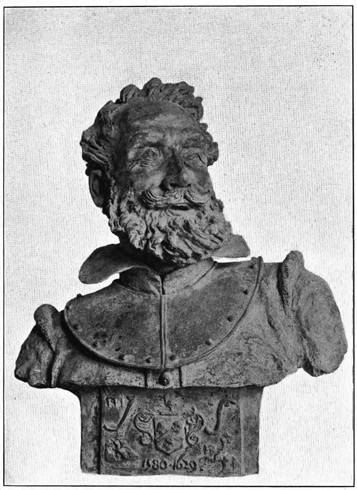
Captain John Smith.
From the bust by Baden-Powell.
Copyright, 1906, by Jamestown Official Photo. Corp'n.
The "old age" of which Thomas Fuller speaks
would be now thought the noonday of manhood.
The captain died the 21st day of June, 1631,
about fifty-five years old. The tablet which
so offended Fuller has long ago disappeared.
Americans do not need it. American pilgrims
visit St. Sepulchre, sweep the dust from
the plate bearing the three Turks' heads, and
render the homage of grateful hearts to the
English soldier who served them so unselfishly
in their darkest hour, and then came home to
give
"His body to that pleasant country's earth
And his pure soul unto his captain Christ,
Under whose colours he had fought so long."