From the infancy of mankind no tribe
of living creatures has awakened
more sympathy in the human heart than
the Birds of the Air. Their pairing, their
nesting, their sedulous care of their young,
their arrival in spring and disappearance in
autumn, the endless variety of their notes,
and the manifold diversity of their habits
and dispositions, often so suggestive of
analogies with those of human nature,
have arrested the attention of even the
most unobservant men. This wide range
of attraction, appealing so directly to the
poetic instincts of humanity, has called
forth hearty recognition in the literature
of every age and of every tongue. In our
own literature this recognition has been
more especially ample. Chaucer, the illustrious
Father of English Poetry, struck the
keynote of that passionate love of Nature
which has been maintained among us
with ever-growing devotion. “Nature,
the vicar of the Almighty Lord,” to use
his own expression, filled his soul with a
deep, reverential and joyous delight in the
endless beauty and charm of the outer
world. This pleasure included an ardent
appreciation of bird-life, which finds vent
continually in simple but enthusiastic language
all through his writings. Chaucer
was undoubtedly a bookish man, much
attached to his favourite authors and to
meditation upon them. Yet, as he himself
confesses, there were times when the
open country, with all its varied sights and
sounds, and especially with its exuberant
life in plants and animals, had for him
even greater attraction. He tells that
Chaucer’s Love of Nature
On bokes for to rede I me delyte,
And to hem yeve I feyth and ful credence,
And in myn herte have hem in reverence
So hertely, that there is game noon,
That fro my bokes maketh me to goon,
But hit be other upon the haly-day,
Or elles in the Ioly tyme of May
Whan that I here the smale foules singe
And that the floures gynne for to springe—
Farwel my studie, as lasting that sesoun!
[1]
In his vivid descriptions of scenes in spring
and summer, the carols of the birds are
always a prominent feature. Thus, at the
very beginning of his Canterbury Tales, the
mere thought of April, with its sweet
showers and tender leafage “in every bolt
and heath,” recalls to him how the
Smale foules maken melodye
That slepen al the night with open yë.
[2]
His poem on The Parlement of Foules
represents the various birds of the air
coming in a crowded throng from all
quarters to choose their mates. As he
enumerates our familiar birds he couples
with their names epithets that express the
popular estimation of them. The scene
is laid in a garden where
On every bough the briddes herde I singe
With voys of aungel in hir armonye.
[3]
Again, in his quaint and humorous verses
on the Cuckow and the Nightingale, the
poet transports us into the very heart
of the woods to hear a discourse between
these two harbingers of summer. For the
nightingale he had a fondness which is
lovingly expressed in the Flower and the
Leaf, where we find the picture of a
woodland of oaks whose new leaves
Sprongen out ayein the sonne shene,
Some very rede, and some a glad light grene;
Which, as me thought, was right a plesaunt sight,
And eek the briddes songes for to here
Would have rejoised any erthly wight;
And I, that couth not yet, in no manere,
Here the Nightingale of al the yeare,
Ful busily herkned with herte and ere,
If I her voice perceive coud any-where.
[4]
This simple delight in the voices of the
birds, so prominent in the poems of the
author of the Canterbury Tales, was maintained
among his successors in English
poetry. By Elizabethan times, however,
it had become enlarged and enriched by
the growth of a more observant and contemplative
habit. The spontaneous and
irresistible joy of the human soul in the
varied beauty of Nature, and not least in
the bird-music of the fields and woods, is as
marked in Shakespeare’s works as it was in
those of Chaucer; but it is now combined
with more thought and reflection. The appreciation
of life in all its divers forms has
grown closer, more sympathetic and more
intimately linked with human experience.
Surroundings of his Boyhood
Shakespeare had the good fortune to be
born in one of the pleasantest and most
varied districts of England, in the midst of
fields and gardens, as well as wide tracts of
woodland and heath, among sturdy farmer-folk,
and simple peasantry. The face of
open Nature lay spread out around him,
and his earliest poems bear witness to the
range and acuteness of his faculty of
observation amid the fields and forests, the
beasts and birds of his home. The extent
and accuracy of his acquaintance with law
have been claimed as proof that he had
passed through some legal training. There
is sounder evidence that his remarkable
familiarity with objects of natural history
could not have been derived at secondhand
from books, but was acquired from
his own personal observation. His youthful
surroundings in Warwickshire furnished
him with ample opportunity of acquiring
and cultivating this knowledge. Nor
should it be forgotten that the London in
which he spent the active years of his
middle life, was a comparatively small
town. Open country lay within a short
walking distance from any part of it.
Heaths and woodlands, with all their riches
of animal life, extended almost up to its
outskirts. So that even in the height of
his busy theatrical career the dramatist
could easily, at any interval of leisure,
renew his acquaintance with the face of
Nature which he dearly loved.
An attentive study of Shakespeare’s
dramas supplies probable indications of
some of his early observations among
natural history objects. When, for instance,
he makes Benedick assert that
Claudio had committed
the flat transgression of a school-boy, who, being
overjoyed with finding a bird’s nest, shows it his
companion, and he steals it,[5]
he probably could remember incidents of
that kind among the boys at the grammar
school of Stratford. At all events, that
he himself had known the excitements of
bird-nesting may be fairly inferred from
the following passage:
Unreasonable creatures feed their young;
And though man’s face be fearful to their eyes,
Yet, in protection of their tender ones,
Who hath not seen them, even with those wings
Which sometime they have used with fearful flight,
Make war with him that climb’d unto their nest,
Offering their own lives in their young’s defence?
[6]
As a concomitant of his love of outdoor
life it was natural and almost inevitable
that the future dramatist should become a
sportsman. There does not appear to be
any good reason to question the truth of
the tradition that in his youth he joined
his Stratford companions in poaching Sir
Thomas Lucy’s deer in Charlecote Park.
When he wrote the following lines we can
well imagine that he had some of his own
escapades in mind:
What, hast not thou full often struck a doe,
And borne her cleanly by the keeper’s nose?
[7]
Bird-Capture
Both the Poems and the Plays show him
to have been well-versed in all the arts
then in vogue for the capture of birds
dead or alive—the use of bird-lime for the
smaller kinds, the fixing of springes and
gins, the spreading of nets, the employment
of decoys in the shape of caged birds
or of painted fruit and flowers, as well
as the ordinary weapons for shooting—birding-pieces,
bows and arrows, and crossbows
and bolts. More especially does he
appear to have mastered the whole craft
of falconry, then so much in vogue; for
his writings are full of the vocabulary of
its technical terms. The frequency and
detail of the poet’s allusions to the various
methods of bird-capture suggest the
experience of one who speaks from
personal practice. He is fond of introducing
these allusions in illustration of the
plots and wiles of man with regard to his
fellow-men. So many of these methods
of capture have gone out of fashion that
the modern reader is apt to be surprised at
the constant recurrence of references to
them in Shakespeare’s writings, and to
forget how much more they would appeal
to the imagination in the days of Elizabeth
than they can do now. A few illustrations
may be quoted here. Thus Lady
Macduff, musing on the future of her
little son, but all unsuspicious of the fate
immediately impending on him, tells him
Poor bird! thou’ldst never fear the net, nor lime,
The pitfall, nor the gin.
[8]
Again, the Duke of Suffolk, having to
inform the Queen of King Henry VI.
regarding the steps which he has taken
about the Duchess of Gloucester, conveys
his news in the language of the bird-catcher:
Madam, myself have limed a bush for her,
And placed a quire of such enticing birds,
That she will light to listen to the lays,
And never mount to trouble you again.
[9]
Similes from Bird-Capture
The King in Hamlet, torn with compunction
for his crime, exclaims
O wretched state! O bosom black as death!
O limed soul, that struggling to be free
The supposed experience of a bird that
has once been nearly caught is transferred
by the poet to the human heart. King
Henry VI. laments his fate in this wise:
The bird that hath been limed in a bush,
With trembling wings misdoubteth every bush;
And I, the hapless male to one sweet bird,
Have now the fatal object in my eye
Where my poor young was limed, was caught and kill’d.
[11]
On the other hand, the innocent assurance
of a blameless soul is likened to that
of a bird that has never known the
treacherous arts of the fowler.
For unstain’d thoughts do seldom dream on evil;
Birds never limed no secret bushes fear.
[12]
We find reference to “poor birds deceived
with painted grapes,” and to “poor
birds that helpless berries saw.”[13] There
is a graphic force in the exclamation
Look how a bird lies tangl’d in a net,[14]
and in the simile applied to Lucrece,
Like a new-kill’d bird she trembling lies.[15]
But it is from the sport of falconry that
Shakespeare draws most frequently his
allusions to bird-capture. Some of these
I shall quote in connection with his
references to hawks and hawking. The
poet does not confine his similes to birds
in the wild state, but draws them also with
effect from birds in confinement, as where
he represents King Henry VI. thanking
the Lieutenant of the Tower for courtesy
shown to him during his imprisonment:
I’ll well requite thy kindness,
For that it made my imprisonment a pleasure;
Ay, such a pleasure as incaged birds
Conceive, when after many moody thoughts,
At last, by notes of household harmony,
They quite forget their loss of liberty.
[16]
His feeling for Nature
It will be remembered, also, how touchingly
the same comparison appears in the
scene wherein Cordelia and Lear are led
off the stage guarded. When she asks
her father, “Shall we not see these
daughters and these sisters?” Lear impatiently
answers,
No, no, no, no. Come, let’s away to prison:
We two alone will sing like birds i’ the cage;
When thou dost ask me the blessing, I’ll kneel down
And ask of thee forgiveness: so we’ll live,
And pray, and sing, and tell old tales, and laugh
At gilded butterflies, …
And take upon’s the mystery of things.
[17]
Shakespeare’s feeling for Nature and love
of outdoor life are nowhere more fully and
admirably expressed than in his delightful
Play of As You Like It. Pervaded by the
very breath of the country and the charms
of rural life and sylvan peace, the chief
scenes of this drama are laid in a landscape
that was doubtless based on recollections
of his youthful home, and he appropriately
named it after his own “Forest of Arden”
in Warwickshire. He transports us to a
green woodland, interspersed with copses
of hawthorns and brambles, revealing
grassy glades among venerable trees, where
flocks of sheep and goats are pasturing,
while here and there we catch sight of a
quiet herd of deer. We meet, too, with
shepherds and foresters, and come upon a
cottage near the rank osiers by a murmuring
stream. Now and then our attention
is drawn to some specially picturesque
feature in the timber of the forest, such as
“an oak whose antique root peeps out
upon the brook that brawls along the
wood.”[18] Or we are halted
Under an oak, whose boughs were moss’d with age,
And high top bald with dry antiquity.
[19]
And there are smooth-stemmed beech-trees,
on the massive trunks of which a
love-sick swain may carve the name of
his beloved.
His picture of English Landscape
Into this essentially English scenery
the poet introduces a fence of olive-trees
around the sheep-cote, likewise “a green
and gilded snake,” together with a
“hungry lioness” that lies crouching on
the ground, ready to spring upon a man
when he awakes from sleep. But these
productions of other climes were, from the
dramatist’s point of view, no more out of
place in his forest, than was the presence
of a banished duke with his company of
lords and attendants. He had created an
ideal landscape out of his own Forest of
Arden, and he might clothe it with such
vegetation and people it with such beings
as he thought that the claims of his art
allowed.
Among the first sounds that greet our
ears after we enter this land of enchantment
are those of an invitation to hear
the bird-music:
Under the greenwood tree
Who loves to lie with me,
And turn his merry note
Unto the sweet bird’s throat,
Come hither, come hither, come hither.
Here shall he see
No enemy
But winter and rough weather.
[20]
And in nearly the last strains that reach
us before the drama closes, the carol of
the birds comes in again:
In the spring time, the only pretty ring time,
When birds do sing, hey ding a ding, ding:
Sweet lovers love the spring.
[21]
It will be remembered that the contemplation
of the woodland peace and
happiness of the Forest of Arden inspired
the poet with one of the most pregnant
passages to be found in his works. Though
the quotation has become rather hackneyed
from constant use, it deserves to be
treasured in the heart of everyone to whom
the study of Nature is dear:
And this our life, exempt from public haunt,
Finds tongues in trees, books in the running brooks,
Sermons in stones, and good in everything.
[22]
His Sympathy with Life
In this pastoral drama, and throughout
his Poems and Plays, Shakespeare manifests
the keen pleasure with which the face of
Nature filled his soul. The beauty and
fragrancy of flowers and woods, the movements
and music of birds were a joy to
him. But he combined with this enjoyment
a feeling of pity for the frailty and
suffering of living things. A recent and
most able writer on Shakespeare has stated
as his opinion that “the wild creatures of
the fields and woods, because they have
never run the risk of familiarity with man,
are outside the circle of Shakespeare’s
sympathetic observation.” I venture to
think that a more mistaken judgement
could hardly have been pronounced.
Shakespeare was not a man of science, but
he obviously had some of the best qualities
of a naturalist—quickness and accuracy of
eye and sympathy with life, not of man
only, but of every creature that lives and
feels. This sympathy shows itself in his
allusions to birds, but is displayed also in
his references to animals both higher and
lower in the scale of being, which “have
never run the risk of familiarity with
man.” In the remarkable Play which we
have just been considering it is conspicuously
prominent. The banished Duke in
the Forest of Arden asks his companions
if they will go with him to kill some
venison, but before their answer comes, he
immediately adds, on reflection:
And yet it irks me the poor dappled fools,
Being native burghers of this desert city,
Should in their own confines with forked heads
Have their round haunches gored.
[23]
This commiseration is expressed much
more forcibly by one of his “co-mates
and brothers in exile,” the melancholy
Jaques, who had been overheard, as he lay
under an oak near the brook, lamenting the
fate of a wounded stag that had come to
languish at the same spot. As he watched
the creature
The Wounded Deer
weeping into the needless stream;
‘Poor deer,’ quoth he, ‘thou makest a testament
As worldlings do, giving thy sum of more
To that which had too much;’ then, being there alone,
Left and abandon’d of his velvet friends;
‘’Tis right,’ quoth he; ‘thus misery doth part
The flux of company:’ anon, a careless herd,
Full of the pasture, jumps along by him
And never stays to greet him; ‘Ay,’ quoth Jaques,
‘Sweep on, you fat and greasy citizens;
’Tis just the fashion: wherefore do you look
Upon that poor and broken bankrupt there?’
Thus most invectively he pierceth through
The body of the country, city, court,
Yea, and of this our life; swearing that we
Are mere usurpers, tyrants and what’s worse,
To fright the animals and to kill them up
In their assign’d and native dwelling-place.
[24]
More detailed and even more full of
commiseration is the poet’s vivid description
of the hunting of “the purblind
hare.”
Mark the poor wretch, to overshoot his troubles,
How he outruns the wind, and with what care
He cranks and crosses with a thousand doubles.
[25]
When he has for a little succeeded in
throwing the hounds off the scent,
Poor Wat, far off upon a hill,
Stands on his hinder legs, with listening ear,
To hearken if his foes pursue him still:
Anon their loud alarums he doth hear,
Then shalt thou see the dew-bedabbled wretch
Turn, and return, indenting with the way;
Each envious brier his weary legs doth scratch,
Each shadow makes him stop, each murmur stay.
[26]
The poet’s feeling of pity descends even
to small and fragile forms of living things,
to which most people are indifferent or
even hostile. Perhaps he may sometimes
have credited these feeble creatures with
greater sensitiveness to pain than a modern
naturalist would allow, as where Isabella in
Measure for Measure tells her brother that
The poor beetle, that we tread upon,
In corporal sufferance finds a pang as great
As when a giant dies.
[27]
Pity for the humblest Creatures
Shakespeare elsewhere alludes to our
prevalent insensibility towards the insect
world, from our youth upward.
As flies to wanton boys, are we to the gods;
They kill us for their sport.
[28]
In maturer life men will do “a thousand
dreadful things as willingly as one would
kill a fly.”[29] But the poet’s pity extended
even to the fly. In a spirited picture of a
superb charger he tells how the animal
proudly “stamps and bites the poor flies
in his fume.”[30] The most detailed and remarkable
expression of this commiseration
in the whole of Shakespeare’s works, however,
is to be found in the unpleasing
tragedy of Titus Andronicus, which, though
printed among his dramas, is doubtless
mainly the work of another writer. Yet
it contains passages of great power and
beauty which are not unworthy of Shakespeare
and probably came from his pen.
Among these passages I would include the
singular scene in which Titus is sitting at
table with his brother Marcus, who strikes
the dish with his knife, whereupon the
following dialogue ensues:
Titus. What dost thou strike at, Marcus, with thy knife?
Marc. At that that I have kill’d, my lord—a fly.
Tit. Out on thee, murderer! thou kill’st my heart;
A deed of death done on the innocent
Becomes not Titus’ brother: get thee gone;
I see thou art not for my company.
Marc. Alas! my lord, I have but kill’d a fly.
Tit. ‘But’! How if that fly had a father and mother?
How would he hang his slender gilded wings
And buzz lamenting doings in the air!
Poor harmless fly!
That, with his pretty buzzing melody
Came here to make us merry! and thou hast kill’d him.
Marc. Pardon me, sir; it was a black ill-favour’d fly
Like to the Empress’ Moor; therefore I kill’d him.
Tit. O, O, O.
Then pardon me for reprehending thee,
For thou hast done a charitable deed.
* * * * * * *
I think we are not brought so low,
But that between us we can kill a fly
That comes in likeness of a coal-black Moor.[31]
“The poor harmless Fly”
The mind of Titus, broken down by a
succession of crushing calamities, had by
this time become unhinged, and the extravagance
of his language is doubtless
designed to show this derangement, though
it may perhaps also express the poet’s own
underlying pity with even “the poor harmless
fly.” Modern science, however, has
recently discovered that the house-fly is
far from harmless, and that its ruthless
extirpation from human habitations, as a
dangerous carrier of disease, should be
regarded as really what Titus called “a
charitable deed.”
Not less effectively than his forerunner
Chaucer, does Shakespeare enliven his
pictures of day and night and of the
seasons of the year by introducing the
voices of the birds. He loves the
summer bird
Which ever in the haunch of winter sings
The lifting up of day.
[32]
He tells how “The birds chant melody on
every bush,”[33] and recounts where
As it fell upon a day
In the merry month of May,
Sitting in a pleasant shade
Which a grove of myrtles made,
Beasts did leap and birds did sing,
Trees did grow and plants did spring;
Everything did banish moan.
[34]
He leads us where we may
See the shepherds feed their flocks
By shallow rivers, by whose falls
Melodious birds sing madrigals.
[35]
The movement of spring and the renewal
of the activity of the birds are well
pictured in the song at the end of Love’s
Labour’s Lost:
When shepherds pipe on oaten straws,
And merry larks are ploughmen’s clocks,
When turtles tread, and rooks, and daws,
And maidens bleach their summer smocks.
The sadness and silence of the woods in
autumn when the birds are dumb, are
recorded in these musical lines:
In Winter and Storm
That time of year thou mayst in me behold
When yellow leaves, or none, or few, do hang
Upon those boughs which shake against the cold,
Bare ruin’d choirs, where late the sweet birds sang.
[36]
Again, in a song from which I have just
quoted, a graphic picture of winter shows
the changed aspect of the birds at that
season:
When all aloud the wind doth blow,
And coughing drowns the parson’s saw,
And birds sit brooding in the snow,
And Marian’s nose looks red and raw.
[37]
Or we are presented with a storm in
which we see
A flight of fowl
Scattered by winds and high tempestuous gusts.
[38]
In many passages, to some of which I
shall presently allude, the poet heightens
the gloom of night by allusion to the
nocturnal birds which screech or moan in
the dark, or he lightens its eeriness with
the pensive melody of the nightingale.
Shakespeare was keenly alive to the
strong contrasts so continually placed in
juxtaposition by Nature—what he calls
Melodious discord, heavenly tune harsh-sounding,
Ear’s deep-sweet music, and heart’s deep-sore wounding.
[39]
He recognised contrasts of this kind both
in the animate and the inanimate creation,
and not least where the birds are involved:
Unruly blasts wait on the tender spring;
Unwholesome weeds take root with precious flowers;
The adder hisses where the sweet birds sing,
What virtue breeds iniquity devours.
[40]
He makes the Bishop of Ely account for
the reformation of the Prince of Wales by
calling attention to the association in Nature
of what is baneful with what is profitable.
The strawberry grows underneath the nettle,
And wholesome berries thrive and ripen best
Neighbour’d by fruit of baser quality:
And so the Prince obscured his contemplation
Under the veil of wildness; which, no doubt,
Grew like the summer grass, fastest by night,
Unseen, yet crescive in his faculty.
[41]
Contrasts in Nature
The co-existence of pleasure and pain, of
joy and sorrow, met the poet even among the
tender creatures in whose songs he delighted.
He saw that the grief or suffering of one
single songster in no perceptible degree
quieted the carolling of the rest of the choir.
All thy fellow-birds do sing,
Careless of thy sorrowing:
Even so, poor bird, like thee,
None alive will pity me.
[42]
He realised, as many another poet has also
found, that there are times in which the
joyous songs of birds may even sound
harshly to human ears when the heart is
bowed down with affliction. Thus he
wrote of Lucrece:
The little birds that tune their morning’s joy
Make her moans mad with their sweet melody:
For mirth doth search the bottom of annoy.
* * * * * * *
‘You mocking birds,’ quoth she, ‘your tunes entomb
Within your hollow-swelling feather’d breasts,
And in my hearing be you mute and dumb:
My restless discord loves no stops nor rests;
A woeful hostess brooks not merry guests.’
[43]
While Shakespeare, like his poetical
predecessors and contemporaries, regarded
the whole tribe of birds as a great
vocal assemblage, a delightful section of
animated Nature, that gives life and charm
to the countryside, his Poems and Plays
stand apart for the remarkable extent to
which he singles out individual birds by
name, often with such detailed reference
to their habits as to show that he well
knew them in their native haunts. The
birds thus distinguished by him amount
to some fifty in number, as given in the
following list:
Birds mentioned by Him
- Eagle
- Falcon
- Kestrel
- Sparrowhawk
- Buzzard
- Kite
- Osprey
- Vulture
- Parrot
- Ostrich
- Cormorant
- Pelican
- Loon
- Owl
- Cuckoo
- Woodcock
- Pheasant
- Partridge
- Snipe
- Quail
- Lapwing
- Wild Duck
- Dabchick
- Raven
- Crow
- Rook
- Chough
- Jackdaw
- Magpie
- Jay
- Starling
- Domestic Cock
- Goose
- Turkey-cock
- Swan
- Peacock
- Dove and Pigeon
- Turtle-dove
- Lark
- Blackbird
- Thrush
- Wren
- Wagtail
- Bunting
- Redbreast
- Finch
- Halcyon or Kingfisher
- Hedge-Sparrow
- House-Sparrow
- Swallow
- House-Martin
- Nightingale.
Of a few of them he makes only a single
mention, but most of them are more
frequently cited, in some cases, indeed, as
often as forty or fifty times. Recognising
in these creatures traits that remind him
of the feelings and actions of mankind,
he makes varied and effective use of them
as symbols and illustrations with which
to enrich his vivid picture of the great
drama of human life. The naturalist,
interested in noting the attitude of the
greatest poet of all time towards living
creatures, feels no surprise that Shakespeare’s
knowledge of natural history is
sometimes inaccurate, or that he should
have taken on trust some of the fabulous
legends in that subject, which were
current in his day. The scientific study
of Nature had not yet been seriously
undertaken.
I propose to enumerate here the birds
individually selected by Shakespeare for
special comment, and to cite a few passages
from his works in illustration of the various
ways in which he makes use of each
of them. It will be convenient to take
them in groups.
We may begin with Birds of Prey,
following the precedent set by Chaucer,
who in his long list tells that “the fowles
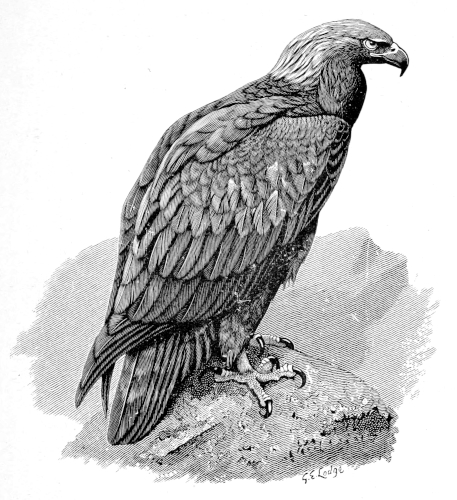
of ravine were hyest sette.” The EAGLE
is cited some forty times. The two birds
of this kind native to Britain, the Golden
Eagle, and the White-tailed or Sea-eagle,
now so restricted in number, were doubtless
more abundant in his day. He may
have occasionally seen examples of each of
them on the wing, though his allusions
hardly suggest any personal familiarity
with the birds. Recognising the lofty
rank of the eagle and its acknowledged
dignity above the other birds of prey, he
makes the birds themselves, in the arrangements
for the obsequies of the Phoenix
and Turtle, admit this supremacy.
From this session interdict
Every fowl of tyrant wing,
Save the eagle, feather’d King.
[44]
The powerful vision which from time
immemorial has been ascribed to the
eagle[45] is often referred to by the poet,
who makes one of his personages even
claim that kings of men have eyes like
the king of birds. As Richard II. stood
on the battlements of Flint Castle the
Duke of York pointing to him, exclaimed,
Yet looks he like a king; behold! his eye,
As bright as is the eagle’s, lightens forth
The future King Edward IV. was taunted
by his brother Richard thus:
Nay, if thou be that princely eagle’s bird,
Show thy descent by gazing ’gainst the sun.
[47]
With delightful hyperbole, Biron, in Love’s
Labour’s Lost, discovers a power of vision
beyond that of an eagle, when he is persuading
himself and his friends to abjure
their foolish vow “to fast, to study, and
to see no woman.” Enlarging on the
potency of “love first learned in a lady’s
eyes” he declares that it
Gives to every power a double power,
Above their functions and their offices.
It adds a precious seeing to the eye:
A lover’s eyes will gaze an eagle blind;
A lover’s ear will hear the lowest sound,
When the suspicious head of theft is stopp’d.
[48]
Again, in the same Play, the comparison
becomes even more grotesquely exaggerated,
for the same lover in praising
his lady-love demands to know
What peremptory eagle-sighted eye
Dares look upon the heaven of her brow,
That is not blinded by her majesty?
[49]
The Eagle
The eagle was credited not only with a
wonderful strength of vision, but also with
a remarkable length of life. This belief
is alluded to by the churlish philosopher
who demands of Timon
Will these moss’d trees,
That have outlived the eagle, page thy heels,
And skip where thou point’st out?
[50]
Shakespeare, when he likens the orders
of human society to the various grades
among the birds, compares the leaders
to eagles, and the commonalty to birds
of a less reputable kind. The haughty
Coriolanus stigmatises the Roman plebs as
a rabble that
Will in time
Break ope the locks o’ the Senate, and bring in
The crows to peck the eagles.
[51]
Pandarus, not less contemptuous of the
populace of Troy, affirms that “the eagles
are gone,” and that there are left only
“crows and daws, crows and daws.”[52] The
same kind of similitude is applied to the
political condition of England. The future
Richard III. asserts:
I cannot tell: the world is grown so bad
That wrens make prey where eagles dare not perch.
[53]
And Hastings in the same Play remarks
More pity that the eagle should be mew’d
While kites and buzzards prey at liberty.
[54]
Among Shakespeare’s political allusions in
which the eagle appears there is one of
some interest as a reminiscence of a far-off
unhappy time in our history when the
southern half of the island could be likened
to the king of birds, while the northern
portion was compared to a destructive
kind of vermin.
Once the eagle, England, being in prey,
To her unguarded nest the weasel Scot
Comes sneaking, and so sucks her princely eggs,
Playing the mouse, in absence of the cat,
To tear and havoc more than she can eat.
[55]
The contemplation of the various misfortunes
that may befall even the king of
birds leads to the reflection:
Often, to our comfort, shall we find
The sharded beetle in a safer hold
Than is the full-wing’d eagle.
[56]
The last line of this quotation recalls
another passage in which, as if the writer
had watched the bird on the wing, the
majestic sweep of its flight is pictured:
The course I hold
Flies an eagle flight, bold and forth on,
Leaving no tract behind.
[57]
The eagle has been credited with a nobility
of nature in keeping with his regal rank:
The eagle suffers little birds to sing,
And is not careful what they mean thereby,
Knowing that with the shadow of his wings
He can at pleasure stint their melody.
[58]
Shakespeare may have seen an eagle in
confinement, for his description of its
manner of feeding seems as if drawn from
actual observation:
Even as an empty eagle, sharp by fast,
Tires with her beak on feathers, flesh and bone,
Shaking her wings, devouring all in haste,
Till either gorge be stuff’d or prey be gone.
[59]
Whether in captivity or in stuffed specimens,
the dramatist had evidently set eyes
on the bird close at hand, so as to be able
to put so whimsical a comparison into
Falstaff’s mouth:
My own knee! When I was about thy
years, Hal, I was not an eagle’s talon in the
waist; I could have crept into any alderman’s
thumb-ring.[60]
Shakespeare’s acquaintance with the
family of HAWKS was manifestly of the
most intimate kind. These birds were
common natives of the country, and in
great request for the sport of falconry.
His writings prove him to have had a
detailed knowledge of the terminology of
this sport, and he was probably himself a
keen falconer in his early years, if not
throughout his life. His Plays are full of
the technical language of hawking, which
he employs by way of similitude in matters
of a wholly different nature. As an example
of this habit no better illustration
can be given than Petruchio’s description
of the method he meant to employ to
tame his ill-tempered wife. In the approved
lingo of the practical falconer he
remarks to himself:
Thus have I politicly begun my reign,
And ’tis my hope to end successfully.
My falcon now is sharp and passing empty;
And till she stoop she must not be full-gorged,
For then she never looks upon her lure.
Another way I have to man my haggard,
To make her come and know her keeper’s call,
That is, to watch her, as we watch these kites
That bate and beat and will not be obedient.
She eat no meat to-day, nor none shall eat;
Last night she slept not, nor to-night she shall not;
As with the meat, some undeserved fault
I’ll find about the making of the bed;
And here I’ll fling the pillow, there the bolster,
This way the coverlet, another way the sheets:
Ay, and amid this hurly I intend
That all is done in reverend care of her.
[61]
The extent to which falconry and its
language had taken hold of the society of
Elizabeth’s time is well illustrated in the
scene in Capulet’s garden where Romeo
and Juliet make their declaration of mutual
attachment. She has twice retired, but
again returns to the window for one last
word. He has slowly and reluctantly crept
back into the darkness, but a voice from
above recalls him:
Hist! Romeo, hist! O, for a falconer’s voice
To lure this tassel-gentle back again!
Bondage is hoarse and may not speak aloud.
[62]
The actual array of hawking is brought
before us in the gay scene in the second
part of King Henry VI. where the King
and Queen, with their company and
falconers halloing, appear on the stage
after a morning’s sport.
Queen. Believe me, lords, for flying at the brook,
I saw not better sport these seven years’ day:
Yet, by your leave, the wind was very high;
And, ten to one, old Joan had not gone out.
King. But what a point, my lord, your falcon made,
And what a pitch she flew above the rest!
To see how God in all His creatures works!
Yea, man and birds are fain of climbing high.
Suffolk. No marvel, an it like your majesty,
My lord Protector’s hawks do tower so well;
They know their master loves to be aloft,
And bears his thoughts above his falcon’s pitch.
Gloucester. My lord, ’tis but a base ignoble mind
That mounts no higher than a bird can soar.
Cardinal. … Believe me, cousin Gloucester,
Had not your man put up the fowl so suddenly
We had had more sport.[63]
Under the general designation of Hawks
most of our larger birds of prey were employed
for purposes of sport, and it is
mainly with reference to this use of them
that they are mentioned by Shakespeare.
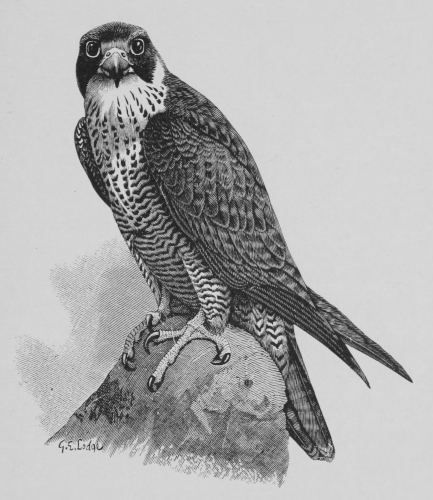
Falcon, the name most frequently used by
him, may include several distinct species.[64]
He evidently admired their flight. He
speaks of
A falcon towering in her pride of place.
[65]
Again, he makes Bolingbroke boast that
he would fight Mowbray
As confident as is the falcon’s flight
He notes how
A falcon towering in the skies,
Coucheth the fowl below with his wings’ shade,
Whose crooked beak threats if he mount he dies.
[67]
The falcon generally employed in hawking
was the female Peregrine, which was
held to be more adapted for the purposes
of sport than the male. The KESTREL is
referred to by Shakespeare, under the local
name of Staniel in the scene in Twelfth
Night, where Malvolio, gulled by Maria,
picks up and begins to guess at the
meaning of the clever letter, Sir Toby and
Fabian watching in concealment:
The Peregrine Falcon
Malvolio. ‘M. O. A. I. doth sway my life.’ Nay but
first, let me see, let me see, let me see.
Fabian. With what dish o’ poison has she dressed
him!
Sir Toby. And with what wing the staniel checks
at it![68]
The Sparrow-Hawk
The sparrow-hawk (Musket) is only
once alluded to in the Plays, and then as a
kind of pet name applied by Mrs. Ford to
little Robin, the page:
How now, my eyas-musket! what news with you?[69]
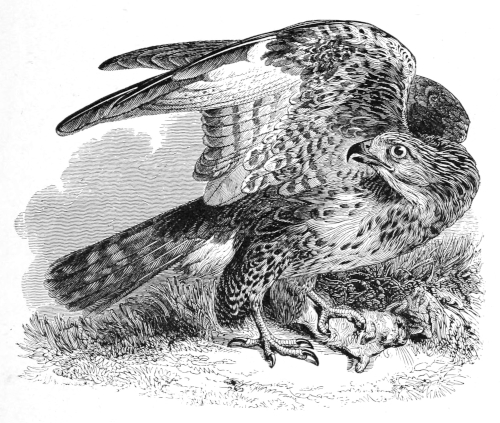
The buzzard is mentioned several times
by Shakespeare, and always in a more or
less depreciatory sense. It is a large handsome
bird, but compared with the falcon
is slow and heavy in flight. So in the
encounter of wits between Petruchio and
Katharine, he in his characteristic falconer’s
language asks her:
O slow-winged turtle, shall a buzzard take thee?
[70]
In a passage already cited the buzzards
are coupled with the disreputable kites.
Professor Newton remarks that “in the old
days of falconry, buzzards were regarded
with infinite scorn, and hence in common
English to call a man a ‘buzzard’ is to
denounce him as stupid.”[71]
The Common Buzzard
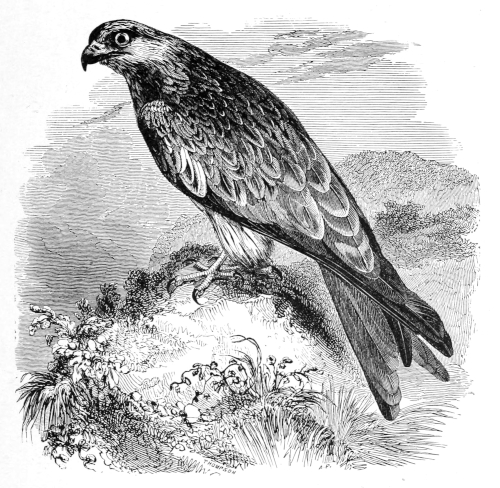
In the time of Elizabeth the kite (or
Puttock), now one of the rarest of our
birds, was quite common in this country.
It was particularly abundant in London,
where it fed on the garbage of the streets,
and even of the Thames, and where,
together with the raven, it was protected
by law as a useful scavenger without pay.
The frequency of Shakespeare’s allusions
to this bird is good evidence of how
familiar it must then have been. It is
always referred to in some disparaging
way. The “hungry kite” did not scruple
to carry off any living creature it could
overcome even from the very farm-yard.
When Warwick mentions to the Queen
his suspicions of foul play in Duke
Humphrey’s death, he tells her:
Who finds the partridge in the puttock’s nest
But may imagine how the bird was dead,
Although the kite soar with unbloodied beak?
Even so suspicious is this tragedy.
[72]
In an earlier part of the same Play York
asks:
Were’t not all one, an empty eagle were set
To guard the chicken from a hungry kite,
As place Duke Humphrey for the King’s protector?
to which the Queen replies:—“So the
poor chicken should be sure of death.”[73]
In Winter’s Tale, when Antigonus is sent
on his task to carry the child to some
distant desolate spot, he takes it up,
saying:
Come on, poor babe:
Some powerful spirit instruct the kites and ravens
To be thy nurses! Wolves and bears, they say,
Casting their savageness aside, have done
Like offices of pity.
[74]
But it was more especially as feeders on
carrion or on weakly animals that the kites
were held in disrepute. Cassius, before
the battle of Philippi, recognises the forerunners
of carnage in the foul birds that
hovered above him:
Ravens, crows and kites
Fly o’er our heads and downward look on us,
As we were sickly prey: their shadows seem
A canopy most fatal, under which
Our army lies, ready to give up the ghost.
[75]
At the battle of St. Albans York declares that
The deadly-handed Clifford slew my steed;
But match to match I have encounter’d him,
And made a prey for carrion kites and crows
Even of the bonny beast he loved so well.
[76]
The thievish propensities of the kite when
building its nest led it to plunder all sorts
of garments that might be bleaching on
the hedge,—pieces of rag, old hats, and
bits of paper. This habit is sympathetically
referred to by Autolycus, who was
himself, as he confesses, another “snapper-up
of unconsidered trifles.”—“My traffic
is sheets; when the kite builds, look to
lesser linen.”[77] The very name of kite
became an epithet of contempt and hatred.
When Goneril announced to her father in
peremptory terms that he must “disquantity
his train,” poor old Lear’s indignation
was in response hurled at her in these
words, “Detested kite.”[78]
The osprey, now almost extirpated as a
native of these islands, was probably not
uncommon in the time of Elizabeth. It is
once mentioned by Shakespeare. Aufidius,
the General of the Volscians, alluding to
the regard of the Roman people for the
banished Coriolanus, reluctantly confesses:
I think he’ll be to Rome
As is the osprey to the fish, who takes it
By sovereignty of nature.
[79]
It would almost seem that the poet had
himself watched the bird plunge into some
clear lake or pond in southern England,
and, with unerring stroke, seize in its talons
the unsuspecting fish which its keen eyes
had detected from aloft.
The Kite
The vulture, not infrequently mentioned
by Shakespeare, is not a British
bird, though at rare intervals it has appeared
as a migrant in this country. The poet
most likely never saw one, his allusions to it
being obviously based on its reputation for
voracity, and partly also on the legend of
Prometheus and the eagle. In one passage
a speaker asserts “there cannot be that vulture
in you to devour so many.”[80] The expressions
“vulture thought” and “vulture
folly” are used in the Poems.[81] A favourite
observation of the braggart Pistol was “let
vultures vile seize on his lungs.” Sir
William Lucy speaks of “the vulture of
sedition that feeds in the bosom of great
commanders.”[82] “The gnawing vulture
of the mind” is referred to in Titus
Andronicus. But the most touching allusion
in which this bird is used is that
where King Lear, wounded to the quick
by Goneril’s unkindness, exclaims to her
sister, as he raises his hand to his heart,
O Regan, she hath tied
Sharp-tooth’d unkindness like a vulture here.
[83]
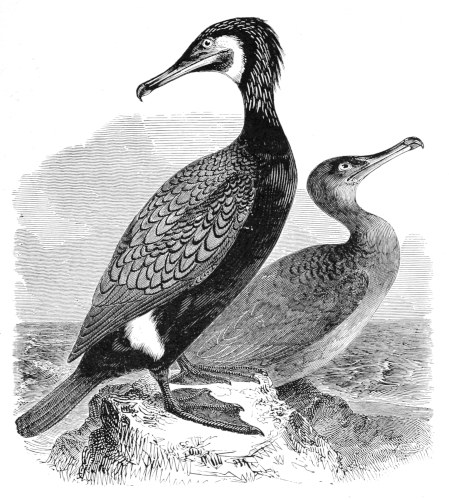
The Cormorant
Reference may be made to two other
exotic birds mentioned by Shakespeare—the
Parrot and the Ostrich. As one result
of the many voyages of discovery in his
day, both in the Old and the New World,
the PARROT had become a familiar bird in
England. Its loud and harsh clamour,
its docility, its clever imitation of human
speech, but at the best, the paucity of
its vocabulary, are duly noted by our
dramatist. In one scene we are told how
Falstaff was pleased to have “his poll
clawed like a parrot,”[84] in another, a lady
declares that in her jealousy she will be
“more clamorous than a parrot against
rain.”[85] Again we hear of
Some that will evermore peep through their eyes
And laugh like parrots at a bagpiper;
[86]
also of an indiscreet officer who in his tipsy
fits would “speak parrot, and squabble,
swagger, swear and discourse fustian with
his own shadow.”[87] Nor must we forget
the drawer at the Boar’s Head Tavern in
Eastcheap who had only two words of
reply to any call, and of who the merry
Prince remarked, with a sly hit at the fair
sex: “That ever this fellow should have
fewer words than a parrot, and yet the son
of a woman!”[88] The parrot was also
known by the name of popinjay, a word
sometimes applied to a foppish dandy.
It is used in this sense by Hotspur with
reference to
A certain lord, neat and trimly dress’d
Fresh as a bridegroom; and his chin new-reap’d
Show’d like a stubble-land at harvest-home.
* * * * * * *
I then, all smarting with my wounds being cold,
To be so pester’d with a popinjay,
Answer’d neglectingly I know not what.
[89]
The same word was used of the stuffed
bird or other mark set up to be shot at in
a competition of marksmanship. This
kind of sport in archery continues to be
kept up in Scotland, or was only recently
abandoned. It has been described by
Scott in Old Mortality. I have myself
attended the summer festival of the
“Papingo” at Kilwinning where it is said
to have been held ever since 1488. The
stuffed bird is there suspended from the
end of a pole fastened on the steeple at a
height of 100 feet from the ground.
The OSTRICH or ESTRIDGE was doubtless
an unfamiliar bird in England in the reign
of Elizabeth, though its feathers were in
repute. When Hotspur asked after “the
nimble-footed, madcap Prince of Wales”
and his comrades, he was told by Sir
Richard Vernon that they were
All furnished, all in arms;
All plumed, like estridges that with the wind
Baited like eagles having lately bathed,
Glittering in golden coats, like images.
[90]
Among the marvels told of this bird, it
had the credit of digesting iron for the
sake of its health. This reputation is
alluded to in Jack Cade’s defiance in Iden’s
garden, when he vowed to the honest
owner that
I’ll make thee eat iron like an ostrich, and
swallow my sword like a great pin, ere thou and
I part.[91]
The Cormorant and Pelican
Three large water-birds, the Cormorant,
Pelican and Loon are disparagingly noticed
by Shakespeare. The cormorant, so well-known
along all our rocky shores, was
described by Chaucer as “full of glotonye,”
and by the dramatist as the symbol of a
rapacious voracity. Thus, vanity is described
as an “insatiate cormorant”; we
are told of “cormorant devouring Time,”
of the “cormorant belly” and of
Wounds, friends, and what else dear that is consumed
In hot digestion of this cormorant war.
[92]
The pelican is alluded to in the
Shakespearian drama in connection with
a popular fable that this bird nourishes
its young with its own blood. Laertes in
Hamlet affirms that to his father’s friends
Thus wide I’ll ope my arms,
And, like the kind life-rendering pelican,
Repast them with my blood.
[93]
When Lear, in the storm on the open
heath, sees the disguised Edgar at the
entrance of the hovel, he will not be
persuaded that the poor man could have
been so beggared save by his unkind
daughters, and he asks Kent
Is it the fashion that discarded fathers
Should have thus little mercy on their flesh?
Judicious punishment! ’twas this flesh begot
Those pelican daughters.
[94]
The word “Loon” or “Lown” is
employed by the poet to denote a rogue
or low fellow. A messenger of evil tidings
is called by Macbeth a “cream-faced
loon.”[95] In the play of Pericles we hear
of a company that would include “both
lord and lown”;[96] and in Othello Iago
sings part of a north-country ballad in
which the same word occurs:
The Loon
King Stephen was a worthy peer,
His breeches cost him but a crown;
He held them sixpence all too dear,
With that he called the tailor lown.
[97]
The name of Loon or Loom is a popular
appellation which includes three distinct
families of water-birds, all remarkable for
their clumsy gait on land. Whether this
name was applied to them after it had
first been in use as an uncomplimentary
epithet for a man, or was originally their
own common designation which came
eventually to acquire a human application,
remains in doubt. More probably the
bird was first owner, and the word may
belong to the group of bird-names like
goose, snipe, kite, hawk and others which
have become disparaging epithets for
human subjects. In Lincolnshire the
word is in use as the common name of
the Great Crested Grebe. Though now
obsolete in conversational English as an
epithet for a rogue it is still in common
use in Scotland in that sense.[98]
The owl plays a large part in Shakespeare’s
references to bird-life. He does
not discriminate between the different
members of the large family probably
included under this name, though he distinguishes
some of their respective cries.
He heightens the feeling of the eeriness
of night by introducing the remarkable
sound of the owl’s voice, and most
effectively when some deed of villainy is
on foot, or as one of the signs popularly
supposed to portend coming disaster. He
includes the owl also in that fairy world
which he has made so real. It will be
enough to cite a few examples of these
different usages in his works.
Traces are said still to linger in Gloucestershire
of a legend that had become
long ago attached to the owl, and which
was known to the great dramatist. He
makes use of it in the scene where
Ophelia appears distraught from her
father’s death. In her incoherent talk she
exclaims “they say the owl was a baker’s
daughter.”[99] The tradition ran that our
Lord one day entered a baker’s shop and
asked for bread, which was grudgingly
and sparingly given by the baker’s
daughter who was thereupon turned by
Christ into an owl. There has long been
a popular feeling that something specially
uncanny and mysterious hangs about this
bird.
In the Poems night is pictured in these
words:
Look, the world’s comforter, with weary gait,
His day’s hot task hath ended in the west;
The owl, night’s herald, shrieks, ’tis very late;
The sheep are gone to fold, birds to their nest.
[100]
The time chosen by Bolingbroke for the incantation
scene in Gloucester’s garden was
Deep night, dark night, the silent of the night,
The time when screech-owls cry, and ban-dogs howl,
And spirits walk, and ghosts break up their graves.
[101]
In a view of winter the owl is made to
play its part:
When icicles hang by the wall,
And Dick the shepherd blows his nail,
And Tom bears logs into the hall,
And milk comes frozen home in pail,
When blood is nipp’d and ways be foul,
Then nightly sings the staring owl,
Tu-whit;
Tu-who, a merry note,
While greasy Joan doth keel the pot.
[102]
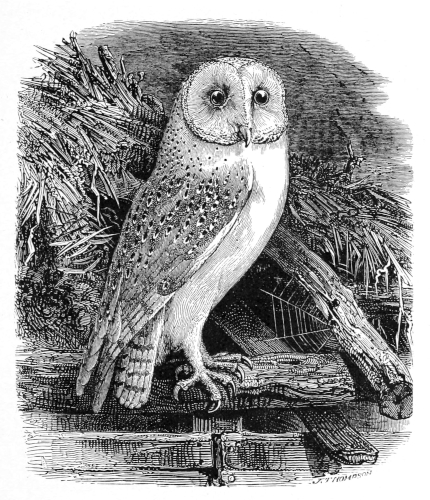
The Barn-Owl
The poet has noted “the night owl’s lazy
flight,”[103] and the predatory habits of the
“mousing owl.”[104] He has increased the
glamour of the night-scenes in the tragedy
of Macbeth by the introduction of this
bird. When Lady Macbeth, alone and
on the alert for the perpetration of the
murder, hears a sound, she exclaims in
anxious suspense:
Hark!—Peace!
It was the owl that shriek’d, the fatal bellman
Which gives the stern’st good-night.
[105]
Her husband, too, after he has done the
deed, emerges to her with the eager question
“Didst thou not hear a noise?”; to
which she replies, “I heard the owl scream
and the crickets cry.” Next morning before
the fatal news had become known it was reported
that, through the midst of a storm,
The obscure bird
Clamour’d the livelong night.
[106]
The appearance of the owl by day was
unusual enough to be considered an evil
omen. Among the portents that preceded
the assassination of Julius Caesar it
was reported that
The bird of night did sit,
Even at noon-day, upon the market-place
Hooting and shrieking.
[107]
When Richard II. realises the machinations
of his enemies, and is asked to come
down to the base-court to meet Bolingbroke,
he exclaims
In the base-court? Come down? Down, court! Down, king!
For night-owls shriek where mounting larks should sing.
[108]
The hooting or screeching of the owl
was often looked upon as a foreboding of
death. Among the nocturnal sounds recounted
by fairy Puck, he tells that
Now the wasted brands do glow,
Whilst the screech-owl, screeching loud,
Puts the wretch that lies in woe
In remembrance of a shroud.
[109]
Even at a babe’s nativity the sound of
this bird’s note might be taken as a bad
omen. King Henry VI. tells Gloucester:
The owl shriek’d at thy birth—an evil sign:
The night-crow cried, aboding luckless time.
[110]
Among its mysterious relationships, the
owl was believed to be connected with
some of the machinations of witchcraft.
It will be remembered that the miscellaneous
ingredients which went to the
making of the hell-broth of Macbeth’s
“midnight hags” included “a lizard’s leg
and howlet’s wing.”[111]
Shakespeare’s introduction of the owl
into his fairy-land was a dexterous artistic
stroke, for it connected a well-known
but somewhat mysterious bird
with his world of sprites, and gave to
that world a further touch of realism.
Alike in the Tempest and the Merry
Wives this conjunction may be seen.
The “dainty Ariel,” Prospero’s “tricksy
spirit,” sings:
Where the bee sucks, there suck I,
In a cowslip’s bell I lie;
There I couch when owls do cry.
[112]
Titania, the Queen of the fairies, when she
disperses her train on their several quests,
bids
Some keep back
The clamorous owl, that nightly hoots and wonders
At our quaint spirits.
[113]
The popular association of owls with
supernatural beings is again noted in the
Comedy of Errors, where poor Dromio of
Syracuse, utterly bamboozled by the confusion
of Dromios and Antonios, exclaims:
This is the fairy-land: O land of spites!
We talk with goblins, owls and sprites;
If we obey them not, this will ensue,
They’ll suck our breath, or pinch us black and blue.
[114]
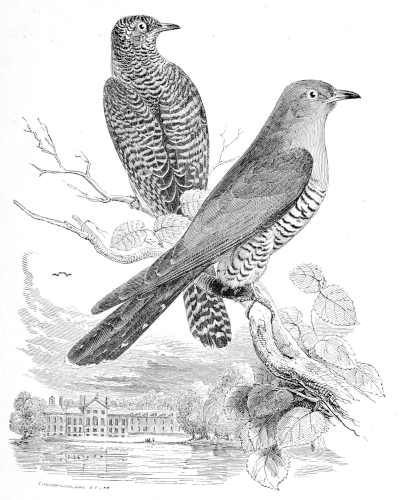
The Cuckoo
The Cuckoo
The CUCKOO receives nearly as much
notice from Shakespeare as the Owl. In
the bright song at the end of Love’s
Labour’s Lost both birds appear as symbolical,
the one of spring, the other of
winter.
When daisies pied and violets blue,
And lady-smocks all silver-white,
And cuckoo-buds of yellow hue
Do paint the meadows with delight:
The cuckoo then, on every tree,
Mocks married men; for thus sings he
Cuckoo, cuckoo, cuckoo.
[115]
In Bottom’s song in Midsummer Night’s
Dream the bird is styled “the plain-song
cuckoo gray,” as if its music were as dull
as the colour of its coat. When Portia
comes back from her memorable trip to
Venice and re-enters her home, Lorenzo,
who is eagerly expecting her return, says
to Jessica:
That is the voice,
Or I am much deceived, of Portia.
Whereupon Portia, overhearing him, remarks
to Nerissa:
He knows me, as the blind man knows the cuckoo,
As summer advances, the cuckoo’s note,
having grown familiar, no longer attracts
the notice of the country-folk, as it did
when the bird first appeared in April. King
Henry IV. avails himself of this common
observation when he lectures his son on
his misdoings, and compares the Prince’s
career to that of “the skipping king” of
the previous reign, who lost the respect of
the people, and
Was but as the cuckoo is in June,
The habit of this bird to lay its egg in
another’s nest is naturally made much of
in the Plays. We are told that “the
cuckoo builds not for himself,”[118] and the
poet puts questions which still await
an answer:
Why should the worm intrude the maiden bud?
Or hateful cuckoos hatch in sparrows’ nests?
[119]
The very name of the bird could be used
as a term of reproach, as where Falstaff, in
retort to the repeated gibes of the Prince
of Wales, calls him, “Ye cuckoo.”[120]
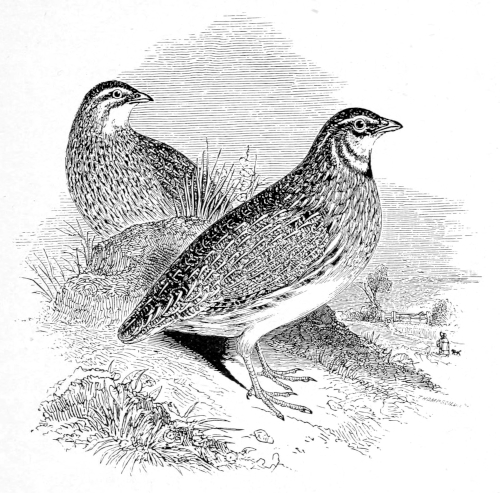
The Quail
The Woodcock
As might be anticipated, the birds
which are treated as game take their place
in the Shakespearian dramas, as well as
the birds of prey that hunted them. The
WOODCOCK, for example, is referred to by
name nine times, generally in connection
with the gin or springe with which in
those days it was taken, and in reference
to some trick or contrivance by which
somebody is caught or deceived. When,
for instance, the Duke of York, seized by
Queen Margaret and her lords, struggles
to free himself from their hands, he is
taunted by two of the lords, who both
make use of the language of sport. Clifford
tells him:
Ay, ay, so strives the woodcock with the gin;
to which Northumberland, with equal
sarcasm, adds:
So doth the cony struggle in the net.
[121]
Ophelia, when cross-questioned by her
father as to the attentions paid to her by
Hamlet, answers how the Prince
Hath given countenance to his speech
With almost all the holy vows of heaven;
whereupon Polonius abruptly breaks in
with the unfeeling comment:
Ay, springes to catch woodcocks; I do know.
[122]
Again, in the tricking of Malvolio, as
the steward picks up the letter, Fabian,
from the lurking-place where Sir Toby
and he are watching every movement,
exclaims
Now is the woodcock near the gin.
[123]
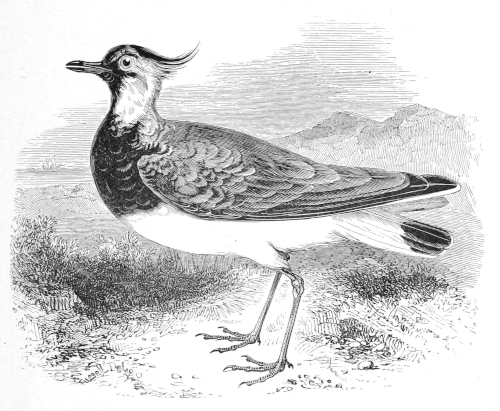
The Lapwing
The Pheasant and Partridge
The PHEASANT is only once mentioned
by Shakespeare, and in a ludicrous way.
When the Shepherd and the Clown in
The Winter’s Tale are accosted by Autolycus
on their errand to the king, the
following conversation ensues:
Aut. I command thee to open thy affair.
Shep. My business, sir, is to the king.
Aut. What advocate hast thou to him?
Shep. I know not, an’t like you.
Clown [aside] Advocate’s the court-word for a pheasant: say you have none—
Shep. None, sir; I have no pheasant, cock nor hen.
Aut. How blessed are we that are not simple men!
Yet nature might have made me as these are;
Therefore I will not disdain.[124]
We find the PARTRIDGE referred to
twice in the dramas, once as part of
the game in a puttock’s nest, in the
passage already cited, and the second
time in the encounter of wit between
Beatrice and Benedick at the masked
ball when she, pretending not to recognise
him, heaps all manner of ridicule
upon him, ending with the taunt that if
he should hear what she has been saying
about him,
He’ll but break a comparison or two on me;
which peradventure not marked or not laughed
at, strikes him into melancholy; and there’s a
partridge wing saved, for the fool will eat no
supper that night.[125]
The SNIPE is only once mentioned and
the name is used as a contemptuous
epithet. Iago, as he soliloquises after
an interview with the “gulled gentleman”
Rodrigo, affirms
I mine own gain’d knowledge should profane
If I would time expend with such a snipe,
But for my sport and profit.
[126]
The QUAIL is likewise referred to in
two of the Plays dealing with Greek and
Roman history. Antony, comparing his
chances in life with Octavius Caesar’s,
confesses to himself
The very dice obey him: if we draw lots he speeds;
His cocks do win the battle still of mine;
His quails ever beat mine, inhoop’d, at odds.
[127]
Thersites speaks thus slightingly of a great
warrior:
Here’s Agamemnon, an honest fellow enough,
and one that loves quails; but he has not so much
brain as ear-wax.[128]
In both these quotations the reference
seems to be to a practice of training quails
to fight after the manner of cock-fighting.
The allusions to the LAPWING indicate
that the dramatist was acquainted with
some of the characteristics of the bird.
The tactics of the male bird to entice a
passer-by away from his nest are expressed
in the line
Far from her nest the lapwing cries away.[129]
When the plot is laid to get Beatrice to
accept Benedick as her lover, and the
plotters see her “couched in the woodbine
coverture,” Hero urges:
Now begin;
For look where Beatrice, like a lapwing, runs
Close by the ground, to hear our conference.
[130]
Lucio, the Euphuist, in Measure for Measure,
confesses
’Tis my familiar sin,
With maids to seem the lapwing, and to jest,
Tongue far from heart.
[131]
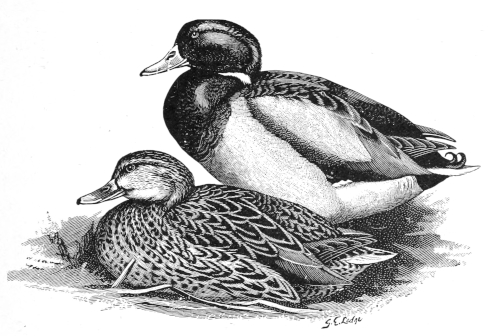
The WILD DUCK or MALLARD is taken
by Shakespeare as a symbol of cowardice
and uxoriousness. Falstaff, after robbing
the travellers on the highway, without the
help of the two chief members of the
gang, declares,
An the Prince and Poins be not two arrant
cowards, there’s no equity stirring: there’s no
more valour in that Poins than in a wild duck.[132]
In the description of the flight of Cleopatra
from the battle of Actium, the conduct of
her Roman lover is thus given:
The noble ruin of her magic, Antony,
Claps on his sea-wing, and like a doting mallard,
Leaving the fight in height, flies after her.
[133]
The DABCHICK, DIVE-DAPPER or LITTLE
GREBE is portrayed in a dainty little vignette
in the Venus and Adonis, which brings
the bird before our eyes, as it may be seen
on many a stream or lake in this country
and even on artificial waters, such as those of
St. James’s Park. The passage represents
Venus vowing to her unresponsive mortal
“by her fair immortal hand”:
Upon this promise did he raise his chin
Like a dive-dapper peering through a wave
Who, being look’d on, ducks as quickly in.
[134]
The birds of the CROW family are well
represented in Shakespeare’s works. Chief
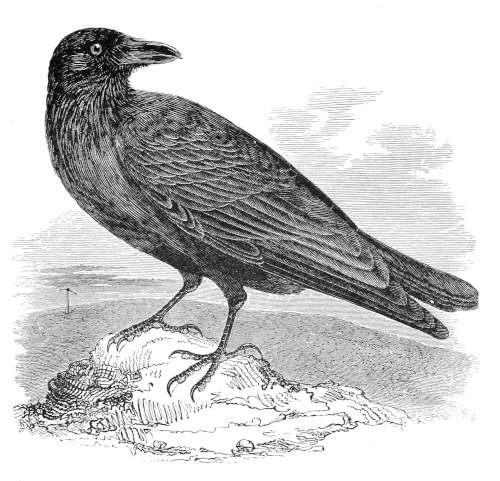
among them comes the RAVEN, to which
frequent and effective allusion is made.
The remarkably dark hue of the bird, including
even his bill and his feet, has made
his name proverbial as a type of the deepest
blackness in Nature. In one of the
Sonnets it is said that
In the old age black was not counted fair,
Or if it were, it bore not beauty’s name;
But now is black beauty’s successive heir:
* * * * * * *
Therefore my mistress’ eyes are raven black.
[135]
With pardonable exaggeration, Juliet, as
she stood alone in the orchard awaiting
her lover, gave vent thus to her longing:
Come, night; come, Romeo; come, thou day in night;
For thou wilt lie upon the wings of night
Whiter than new snow on a raven’s back.
[136]
The blackness of this bird in contrast
to the pure whiteness of a dove, supplies
an image to Lysander, mistakenly bewitched
by the mischievous Puck:
Not Hermia but Helena I love:
Who will not change a raven for a dove?
[137]
The Raven
The Raven has long had the evil reputation
of not only killing the smaller wild
animals but, in common with the crows
and kites, of watching for and attacking
those of larger size that look enfeebled by
disease or accident. Thus we read that
Vast confusion waits,
As doth a raven on a sick-fallen beast,
The imminent decay of wrested pomp.
[138]
With less justice, the bird has also been
credited with savageness of disposition—a
character which Shakespeare has sometimes
attributed to persons who may outwardly
seem to be gentle and kindly. These
are said to have “a raven’s heart within a
dove.”[139] Juliet expands the simile—
Beautiful tyrant! fiend angelical!
Dove-feather’d raven! wolvish-ravening lamb!
Just opposite to what thou justly seem’st.
[140]
Yet there was a belief that the Raven can
show a wholly different nature:
Some say that ravens foster forlorn children,
The whilst their own birds famish in their nests.
[141]
The Raven comes into one of the
Scriptural allusions in the Plays where
the faithful old Adam, pressing upon
Orlando the thrifty savings of his lifetime,
consoles himself with the prayer
He that doth the ravens feed,
Yea, providently caters for the sparrow,
Be comfort to my age!
[142]
But the most frequent reference made by
Shakespeare to this bird has regard to
its supposed boding power. It is called
the “fatal raven.” A messenger of ill
news is said to “sing a raven’s note.”
When Othello has the first suspicions
craftily suggested to him by Iago, he
exclaims
O, it comes o’er my memory,
As doth the raven o’er the infected house,
Again, when the king is approaching the
Castle at Inverness, we hear from Lady
Macbeth the ominous words:
The raven himself is hoarse
That croaks the fatal entrance of Duncan
Under my battlements.
[144]
The Mallard
Under the general name of CROWS
Shakespeare seems to group the Carrion
Crow, the Hooded Crow and the Rook,
though the last-named is plainly distinguished
in the description of evening
when Macbeth tells his wife
Light thickens, and the crow
Makes wing to the rocky wood.
[145]
Like the Raven, the Crows are often
contrasted with something pure and
white. Thus, in a striking simile, we
learn that
The ornament of beauty is suspect,
A crow that flies in heaven’s sweetest air.
[146]
The simile is sometimes reversed, as where
Romeo, on seeing Juliet for the first time,
exclaims:
Beauty too rich for use, for earth too dear!
So shows a snowy dove trooping with crows,
As yonder lady o’er her fellows shows.
[147]
Although it is usually with the dove that
the contrast is drawn, another bird is
sometimes chosen:
The crow may bathe his coal-black wings in mire,
And unperceiv’d fly with the filth away;
But if the like the snow-white swan desire,
The stain upon his silver down will stay.
[148]
Again, when Benvolio presses Romeo to
come with him to Capulet’s feast, where
he will see his Rosaline among the
admired beauties of Verona, he challenges
him, “with unattainted eye,” to
Compare her face with some that I shall show
And I will make thee think thy swan a crow.
[149]
The Raven
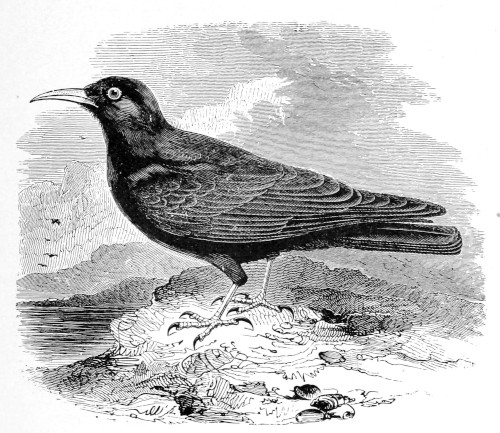
In Shakespeare’s day the CHOUGH must
have been a much commoner bird in our
islands than it is now. At present it is
not known to breed on the south coast of
England further east than the cliffs of
Dorset. Three hundred years ago, however,
it seems to have been abundant about
the chalk headlands of Kent. That it
was a familiar English bird may be
inferred from various passages in our
poet’s writings. The most striking scene
depicted by him, wherein this bird plays
a conspicuous part, is his picture of Dover
cliffs, drawn so vividly, as from an actual
visit to the place:
How fearful
And dizzy ’tis to east one’s eyes so low!
The crows and choughs that wing the midway air
Show scarce so gross as beetles: half way down
Hangs one that gathers samphire, dreadful trade!
Methinks he seems no bigger than his head:
The fishermen that walk upon the beach
Appear like mice; and yond tall anchoring bark
Diminish’d to her cock; her cock, a buoy
Almost too small for sight: the murmuring surge,
That on the unnumber’d idle pebbles chafes,
Cannot be heard so high.
[150]
It is interesting to notice that while
birds are here taken as a help to the eye
in estimating the height of the precipice
as seen from the summit, a bird is again
used as a guide to gauge the height as
seen from below:
Look up a-height; the shrill-gorged lark so far
Cannot be seen or heard.
[151]
The habits of the chough were not
unknown to the poet, since he chose the
bird as a symbol for a certain courtier of
whom it was said that “it was a vice
to know him”:
’Tis a chough, but, as I say, spacious in the
possession of dirt.[152]
The chough’s continuous and unmusical
chatter is more than once contemptuously
invoked to describe the talk of some men.
When Antonio in The Tempest tempts
Sebastian to assassinate the honest old
Counsellor Gonzalo, he speaks of
Lords that can prate
As amply and unnecessarily
As this Gonzalo; I myself could make
A chough of as deep chat.
[153]
In a passage in All’s Well that Ends Well
where the ambush party are concocting
some sort of gibberish to deceive the
vainglorious Parolles, they agree to talk
“Choughs’ language, gabble enough and
good enough.”[154] When Puck recounts to
Oberon what happened to the rustics
when Bottom reappeared among them
wearing the ass’s head, he gives an excellent
description of the effect of the
discharge of a fowling-piece at a bird-haunted
cliff:
When they him spy,
As russet-pated choughs, many in sort,
Rising and cawing at the gun’s report,
Sever themselves and madly sweep the sky:
So, at his sight, away his fellows fly.
[155]
The Chough together with the other
members of the Crow family was thought
to have a supernatural prophetic gift,
and a faculty of revealing hidden deeds.
Macbeth’s evil conscience was troubled
with the thought that
Stones have been known to move and trees to speak;
Augures and understood relations have
By maggot-pies and choughs and rooks brought forth
The secret’st man of blood.
[156]
The Chough
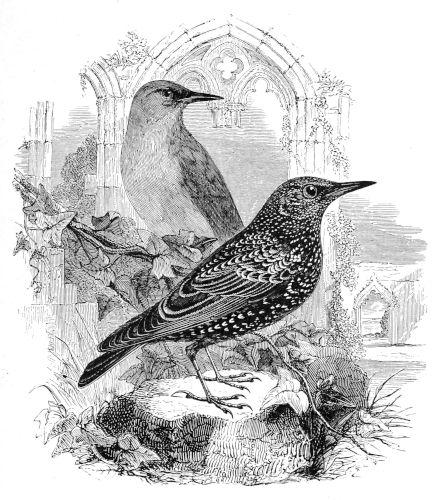
The STARLING is mentioned only once by
Shakespeare, in a passage which shows
that in his time this bird, which has so
remarkable a power of imitation, was
taught to say some words. The fiery
Hotspur declares that although the King
had forbidden him to speak of Mortimer
he would find his Majesty
When he lies asleep,
And in his ear I’ll holla ‘Mortimer!’
Nay,
I’ll have a starling shall be taught to speak
Nothing but ‘Mortimer,’ and give it him,
To keep his anger still in motion.
[157]
The JACKDAW appears occasionally in the
dramas as obviously a familiar bird, but no
outstanding characters are assigned to it,
except that it was common and looked
upon as somewhat stupid. Reference has
already been made to the comparison of
the lower orders of society to “crows and
daws.” When, in the Temple Garden,
the Earl of Warwick was asked to decide
a legal point between the supporters of the
White Rose and those of the Red Rose, he
replied, that if the question had been one
of hawks, sword-blades, horses or merry-eyed
girls,
I have perhaps some shallow spirit of judgement;
But in these nice sharp quillets of the law,
Good faith, I am no wiser than a daw.
[158]
The MAGPIE or Maggot-pie has already
been alluded to. Macbeth associates it with
choughs and rocks as a prophet or discoverer
of evil. It is named by King Henry
VI. among the boding portents that attended
the birth of his murderer Gloucester:
Dogs howl’d, and hideous tempest shook down trees;
The raven rook’d her on the chimney’s top,
And chattering pies in dismal discords sung.
[159]
The JAY is referred to five times by
Shakespeare. In the enchanted isle Caliban
offers to guide the drunken Trinculo and
Sebastian to some of the dainties of the
place:
I with my long nails will dig thee pig-nuts:
Show thee a jay’s nest, and instruct thee how
To snare the nimble marmoset.
[160]
The Starling
The name of the bird is used as an uncomplimentary
epithet for some women, as
where Mrs. Ford, in reference to Falstaff’s
addresses, declares “we’ll teach him to
know turtles from jays,”[161] and where
Imogen affirmed, “Some jay of Italy hath
betrayed him.”[162] But perhaps the most
interesting appearance of the bird in the
Plays occurs in the scene of the Taming
of the Shrew, where after the tailor has
been sent about his business, taking with
him the cap and gown which had been
ordered for Katharine, and with which she
was well pleased, her husband addresses her
thus:
Well, come, my Kate; we will unto your father’s
Even in these honest mean habiliments:
Our purses shall be proud, our garments poor;
For ’tis the mind that makes the body rich;
And as the sun breaks through the darkest clouds,
So honour peereth in the meanest habit.
What is the jay more precious than the lark
Because his feathers are more beautiful?
Or is the adder better than the eel,
Because his painted skin contents the eye?
[163]
The various Birds of the Farm-yard
have received due attention from the great
dramatist. Chief among them, the cock
is frequently cited, especially as a recognised
chronometer of the morning hours,
for in Elizabethan days this mode of
indicating time had not gone out of
popular use. We all remember the unhappy
experience of the carrier in the
inn at Rochester “since the first cock.”[164]
We also recall how Capulet, bustling
among his household, gave them a three-fold
indication of the time:
Come, stir, stir, stir! the second cock hath crow’d,
The curfew-bell hath rung, ’tis three o’clock.
[165]
Shakespeare brings the cock’s shrill clarion
even into his fairyland, for Ariel’s song
breaks off at this signal:
Hark, hark! I hear
The strain of strutting chanticleer
Cry, Cock-a-diddle-dow.
[166]
But the most detailed and impressive
reference to this familiar bird occurs in
the memorable scene on the platform
before the Castle of Elsinore. The ghost
had just appeared to Hamlet’s friends and
The Cock and Goose
Was about to speak when the cock crew.
And then it started like a guilty thing
Upon a fearful summons. I have heard,
The cock, that is the trumpet to the morn,
Doth with his lofty and shrill-sounding throat
Awake the god of day, and at his warning,
Whether in sea or fire, in earth or air,
The extravagant and erring spirit hies
To his confine: and of the truth herein
This present object made probation:
It faded on the crowing of the cock.
Some say that ever ’gainst that season comes
Wherein our Saviour’s birth is celebrated,
The bird of dawning singeth all night long:
And then, they say, no spirit dare stir abroad,
The nights are wholesome, then no planets strike,
No fairy takes, nor witch hath power to charm;
So hallowed and so gracious is the time.
[167]
The GOOSE, so frequently alluded to in
the Plays, usually appears there as the
recognised symbol of human stupidity and
cowardice. How far this character, if
really deserved by the bird, is the result
of domestication and association with man
for many centuries, is a question for
ornithological psychologists. There can
be no doubt that the wild-goose does not
deserve the reputation attributed to his
degenerate kinsman in the farm-yard.
Shakespeare was aware how active and
vigilant that bird was among the fens
which it haunted. He refers to the sudden
uprise and flight of
The wild geese that the creeping fowler eye,[168]
and to the autumnal movement of these
fowl to the larger waters, a fact known
even to Lear’s fool, who remarks:
The winter’s not gone yet if the wild geese fly
that way.[169]
The rapidity with which these birds disappear
when they take wing was likewise
familiar knowledge. The melancholy
Jaques claims that if a man whom he
censures does not deserve reproof,
Why then my taxing, like a wild goose, flies,
Unclaim’d of any man.
[170]
The difficulty of circumventing the bird
is conveyed in the proverbial expression
“a wild-goose chase,” which was well
known in the time of Elizabeth. Mercutio
retorts to Romeo:
Nay, if thy wits run the wild-goose chase, I
have done; for thou hast more of the wild-goose
in one of thy wits than, I am sure, I have in my
whole five.[171]
The Swan
The SWAN, perhaps in Shakespeare’s day
more abundant in this country than it is
now, was then regarded as a “Bird
Royal” which nobody could keep without
a licence from the Crown, and
provision for making a certain mark on
the bird’s bill to denote its ownership.
Our Sovereigns still maintain the Royal
Swans on the Thames, and the young
birds are regularly taken up in summer
to receive the mark. To this bird full recognition
has been paid by our dramatist.
He places it before us in its usual watery
domain, where its nest serves as a symbol
of Britain set in the midst of the sea, “like a
swan’s nest in a great pool.”[172] He lets us see
The swan her downy cygnets save,
Keeping them prisoner underneath her wings.
[173]
We watch the bird’s ungainly gait on land
and are told that
All the water in the ocean
Can never turn the swan’s black legs to white,
Although she lave them hourly in the flood.
[174]
The perfect stillness of the surface of a
sheet of water is marked by
The swan’s down-feather,
That stands upon the swell at full of tide
And neither way inclines.
[175]
Again, we watch
A swan
With bootless labour swim against the tide
And spend her strength with overmatching waves.
[176]
The time-honoured legend that the
“death-divining swan” utters a musical
note or wail at the time of dying is repeatedly
alluded to by the poet, and sometimes
as if it were a reality. Lucrece, at
her approaching death, like a
Pale swan in her watery nest,
Begins the sad dirge of her certain ending.
[177]
Prince Henry, son of King John, when
told that his dying father had been singing,
muses thus:
’Tis strange that death should sing:
I am the cygnet to this pale faint swan
Who chants a doleful hymn to his own death.
[178]
In the scene wherein Othello discovers the
double-dyed villainy of Iago, a touching
incident is the wandering language of the
faithful dying Emilia, whose mind goes
back to her beloved mistress:
What did thy song bode, lady?
Hark, canst thou hear me? I will play the swan,
And die in music. [
Singing] Willow, willow, willow.
[179]
More cheerful is the use of the legend
by Portia when Bassanio stands before the
caskets, and she, deeply interested in the
result, commands
Let music sound while he doth make his choice;
Then, if he lose, he makes a swan-like end,
The Turkey-cock and Peacock
The TURKEY-COCK, introduced into Europe
from the New World in the early part of
the sixteenth century, had become quite
naturalised in the farm-yards of England
by the time of Elizabeth. It is several
times alluded to by Shakespeare, sometimes
as a symbol of conceited ostentation,
and also as an article of food. When
in King Henry V. Gower sees Pistol
approaching, he exclaims to Fluellen
“Here he comes, swelling like a turkey-cock,”
to which the Welshman, who
had resolved to make the braggart eat
the leek, replies, “’Tis no matter for
his swellings nor his turkey-cocks.”[181]
Not less appropriately is the comparison
used of Malvolio, who, as Maria said,
had been “yonder i’ the sun practising
behaviour to his own shadow this
half hour.” As the three concealed
onlookers watch him strutting down
the walk, talking to himself, they can
scarcely restrain themselves. Fabian entreats
silence:
O, peace! Contemplation makes a rare turkey-cock
of him: how he jets under his advanced
plumes.[182]
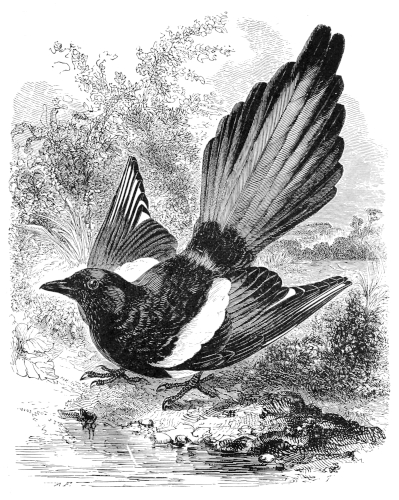
The Magpie
It will be remembered that among the
produce on its way to London in the carts
of the two carriers at the Rochester inn
there was a pannier of live turkeys.[183]
The PEACOCK is alluded to several times
in the Plays as the accepted personification
of pride. Joan of Arc is represented as
counselling the Princes:
Let frantic Talbot triumph for a while
And like a peacock sweep along his tail;
We’ll pull his plumes and take away his train.
[184]
Thersites says of Ajax that he “goes up
and down the field asking for himself; he
stalks up and down like a peacock—a stride
and a stand.”[185] When King Henry V.
mingles incognito among his soldiers in
France, one of them tells him:
That’s a perilous shot out of an elder-gun,
that a poor and a private displeasure can do
against a monarch! you may as well go about to
turn the sun to ice with fanning in his face with
a peacock’s feather.[186]
“‘Fly pride,’ says the peacock,” is a pithy
proverb put into the mouth of Dromio of
Syracuse.[187]
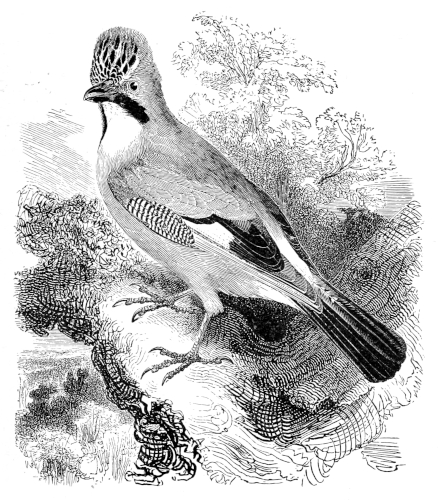
The Jay
The DOVE and the PIGEON are often mentioned
in Shakespeare’s writings, without
any essential distinction being drawn
between them. Thus, we read in one
passage that “Venus yokes her silver
doves,”[188] while in another place the birds
appear as “Venus’ pigeons.”[189] Again, in
a less poetical sphere, they are even interchanged
as articles of food. On the one
hand we find Justice Shallow ordering
“some pigeons” and any other “pretty
little tiny kickshaws” for the entertainment
of Falstaff,[190] and on the other hand, we note
that old Gobbo, when he wanted Bassanio
to take his son into service, presents to
that gentleman “a dish of doves.”[191]
The Dove is typically pure white, and
stands as the recognised emblem of gentleness,
purity and innocence. Yet in direst
emergencies this timid bird may show fight
in defence of its young. We are told that
The smallest worm will turn being trodden on,
And doves will peck in safeguard of their brood.
[192]
It was believed that when “frighted out
of fear” the dove would peck the ostrich,[193]
and it had probably been actually observed
in hawking experience, that as
Cowards fight when they can fly no further
So doves do peck the falcon’s piercing talons.
[194]
The TURTLE-DOVE, long the accepted
symbol of conjugal affection and loving
tenderness, has an honoured place in
Shakespeare’s pages.[195] We there read of
“a pair of loving turtle-doves that could
not live asunder day or night.”[196] Florizel
takes Perdita’s hand in Winter’s Tale, with
the significant assertion:
So turtles pair
That never mean to part.
[197]
And at the end of the same Play, the
widowed Paulina, when all around her has
at last ended happily, desires to retire into
solitude:
I, an old turtle,
Will wing me to some wither’d bough and there
My mate, that’s never to be found again,
Lament till I am lost.
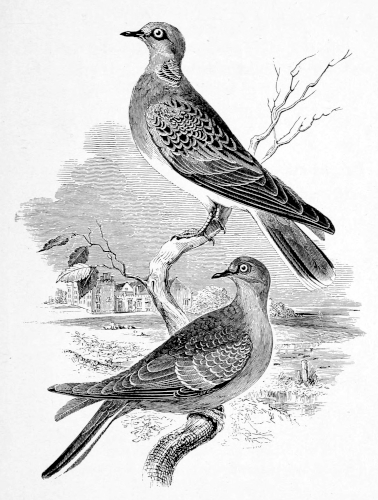
The Turtle-Dove
The Pigeon is not only presented as
an article of food; but is sometimes
slightingly alluded to, with reflections
on its mode of feeding and its timidity.
Of the “honey-tongued Boyet” it was
remarked
This fellow pecks up wit as pigeons pease
And utters it again when God doth please.
[198]
And Hamlet, reflecting on his slowness to
avenge his father’s murder, reproaches himself
as “pigeon-liver’d and lacking gall.”[199]
I have reserved for the last section of
this Essay the smaller birds, including the
songsters, as these are noticed in Shakespeare’s
Poems and Dramas. A number
of them are grouped together by Bottom
in the ditty, singing which he wakes the
sleeping Fairy Queen:
The ousel-cock so black of hue,
With orange-tawny bill,
The throstle with his note so true,
The wren with little quill;
The finch, the sparrow, and the lark,
The plain-song cuckoo gray,
Whose note full many a man doth mark
And dares not answer nay.
[200]
The Lark
Of the birds recounted in this song,
Shakespeare’s favourite, if we may judge
from the frequency and appreciation with
which he mentions it, was the LARK. He
makes this bird a rival to Chanticleer
in the honour of setting the day agoing.
He calls it “the morning lark,” “the
herald of the morn,” specially associated
with the brightness and glory of dawn.
Lo, here the gentle lark, weary of rest,
From his moist cabinet mounts up on high,
And wakes the morning, from whose silver breast
The sun ariseth in his majesty.
[201]
Again
The busy day,
Waked by the lark, hath roused the ribald crows.
[202]
The blithe sound of the bird’s carol is
commemorated in the line
The merry larks are ploughmen’s clocks.
How joyfully does this feeling find expression
in the exquisite song in Cymbeline:
Hark, hark! the lark at heaven’s gate sings,
And Phoebus ’gins arise,
His steeds to water at those springs
On chaliced flowers that lies;
And winking Mary-buds begin
To ope their golden eyes;
With every thing that pretty is,
My lady sweet arise:
The bird-melodies of night and morning
were never more delicately commingled than
in the garden scene where Juliet, from her
window above, would fain persuade her lingering
lover that it was not yet near day:
Jul. Wilt thou be gone? it is not yet near day:
It was the nightingale, and not the lark,
That pierced the fearful hollow of thine ear;
Nightly she sings on yond pomegranate-tree:
Believe me, love, it was the nightingale.
Rom. It was the lark, the herald of the morn,
No nightingale; look, love, what envious streaks
Do lace the severing clouds in yonder east:
Night’s candles are burnt out, and jocund day
Stands tiptoe on the misty mountain-tops:
I must be gone and live, or stay and die.
Jul. Yond light is not day-light, I know it, I:
It is some meteor that the sun exhales,
To be to thee this night a torch-bearer,
And light thee on thy way to Mantua:
Therefore stay yet; thou needst not to be gone.
Rom. Let me be ta’en, let me be put to death;
I am content, so thou wilt have it so.
I’ll say yon grey is not the morning’s eye,
’Tis but the pale reflex of Cynthia’s brow.
Nor that is not the lark, whose notes do beat
The vaulty heaven so high above our heads:
How is’t my soul? let’s talk: it is not day.
Jul. It is, it is: hie hence, be gone, away!
It is the lark that sings so out of tune.
* * * * * * *
Some say the lark and loathed toad change eyes;
O, now I would they had changed voices too![204]
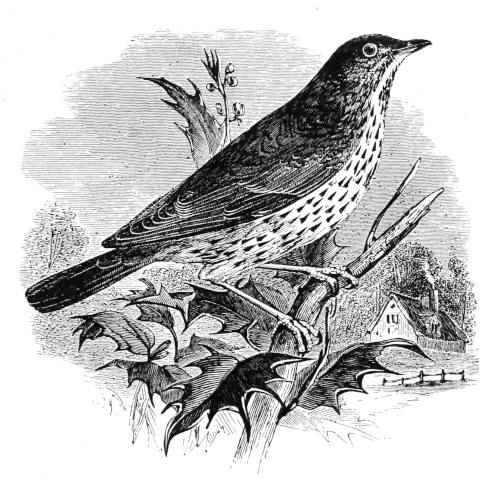
The Song-Thrush
The BLACKBIRD or OUZEL, depicted in
Bottom’s song as “so black of hue, with
orange-tawny bill,” though one of our
most melodious songsters, receives no
commendation from Shakespeare. It is
only once again mentioned by him, when
its name is used with a rather uncomplimentary
meaning. When Justice Shallow
enquires of his brother magistrate regarding
his god-daughter, Silence replies, “Alas, a
black ousel, cousin Shallow.”[205] It is a pity
that the old and distinctive name ouzel for
this bird has become obsolete, though it
may still be heard in use in Scotland. On
the other side of the Tweed, also, where so
many linguistic relics of the old alliance with
France still remain, the blackbird is likewise
known by its French name of merle,
while the common name of the thrush is
mavis, likewise from the French mauvis.
The THRUSH or THROSTLE, another of
our most musical warblers, is cited
thrice by Shakespeare without any further
comment on his voice than the compliment
in Bottom’s song—“with his note
so true.” The bird comes into one of
Autolycus’ songs:
The lark, that tirra-lyra chants,
With heigh! with heigh! the thrush and the jay,
Are summer songs for me and my aunts,
While we lie tumbling in the hay.
[206]
Our great dramatist refers to the WREN
no fewer than nine times in his different
Plays. Its small size is noticed, and the
bird is credited with an amount of courage
disproportionate to its stature. When
Macduff flees to England his wife bitterly
complains that he should have left her and
his children without his protection:
He loves us not;
He wants the natural touch; for the poor wren,
The most diminutive of birds, will fight,
Her young ones in her nest, against the owl.
[207]
When Imogen, recovering in the cave,
hardly knows where she is, she muses
With herself and prays:
I tremble still with fear: but if there be
Yet left in heaven as small a drop of pity
As a wren’s eye, fear’d gods, a part of it!
[208]
Shakespeare hardly does justice to the
notes of the wren, which are louder,
sweeter and more varied than might have
been looked for in so tiny a bird. Portia
thought that if the nightingale sang by
day it would be thought no better than
the wren.[209] And, in another passage,
words of consolation “from a hollow
breast” are likened to “the chirping of
a wren.”[210]
The WAGTAIL is alluded to once by the
poet, when its name is used in contempt
by Kent towards Goneril’s steward:
Thou zed! thou unnecessary letter! I will
tread this unbolted villain into mortar. Spare my
gray beard?—you wagtail![211]
There is one reference by Shakespeare
to the BUNTING, probably the common
corn-bunting or bunting-lark, which is
not unlike the lark, and further resembles
that bird in nesting on the ground. In
All’s Well that Ends Well, the old lord
Lafeu, when assured by Bertram that he had
mistaken the character of Parolles, remarks;
“Then my dial goes not true; I took this
lark for a bunting.”[212]
The REDBREAST or RUDDOCK is most
fully referred to in Cymbeline. Arviragus
enters, bearing in his arms Imogen, seemingly
dead, and as he lays the body down
he thus addresses it:
With fairest flowers,
Whilst summer lasts, and I live here, Fidele,
I’ll sweeten thy sad grave: thou shalt not lack
The flower that’s like thy face, pale primrose, nor
The azured harebell, like thy veins; no, nor
The leaf of eglantine, whom not to slander
Out-sweetened not thy breath: the ruddock would
With charitable bill,—O bill, sore shaming
Those rich-left heirs that let their fathers lie
Without a monument!—bring thee all this;
Yea, and furr’d moss besides, when flowers are none,
To winter-ground thy corse.
[213]
The list of signs whereby Speed knows
that his master Valentine is in love begins
thus: “first, you have learned, like Sir
Proteus, to wreathe your arms, like a
male-content; to relish a love-song, like
a robin-redbreast; to walk alone, like one
that had the pestilence.”[214] When Hotspur
presses his wife to sing and she twice
refuses, his only remark is, “’Tis the next
way to turn tailor, or be redbreast-teacher.”[215]
The Hedge-sparrow and Finch
The only allusion to the HEDGE-SPARROW
occurs in King Lear. When Goneril has
gone some way in her recrimination of
her father, the Fool, who had just before
called the old king “a shealed peascod,”
breaks into the conversation with these lines:
The hedge-sparrow fed the cuckoo so long
That it had it head bit off by it young.
[216]
The FINCH, included in Bottom’s song,
is not elsewhere mentioned by the poet,
though the epithet “finch-egg,” as a term
of reproach, is hurled by Thersites at
Patroclus.[217] Of the various English finches
we may suppose that the bird intended
was the common chaffinch.
The familiar HOUSE-SPARROW, though
often mentioned by Shakespeare, receives
little commendation from him. He twice
connects it with evidence of the care of
Providence, in obvious allusion to passages
in Holy Writ. Hamlet observes that
“there is special providence in the fall of
a sparrow.”[218] Reference has already been
made to the trust expressed by Orlando’s
faithful old Adam in Him “that providently
caters for the sparrow.”[219] The
bird comes also into the presentation of
classical deities in The Tempest, where Iris
tells how Venus’
Waspish-headed son has broke his arrows,
Swears he will shoot no more, but play with sparrows
And be a boy right out.
[220]
Thersites, who had been soundly thrashed
by Ajax, takes his own method of revenge
by declaring
I have bobbed his brain more than he has beat
my bones; I will buy nine sparrows for a penny,
and his pin mater is not worth the ninth part of a
sparrow.[221]
The SWALLOW is cited in the Plays for
the swiftness of its flight, and for its annual
migration.[222] When Richmond gives the
order to march for Bosworth Field, he
adds,
True hope is swift, and flies with swallow’s wings;
Kings it makes gods, and meaner creatures kings.
[223]
The rapidity with which this bird can
pursue its course, even close to the ground,
had not escaped the poet’s notice. Titus,
in praise of his stud, affirms
I have horse will follow where the game
Makes way, and run like swallows o’er the plain.
[224]
When Falstaff was rebuked for his dilatory
journey to the field of battle, he justified
himself thus:
I never knew yet but rebuke and check was
the reward of valour. Do you think me a
swallow, an arrow, or a bullet? Have I, in my
poor and old motion, the expedition of thought?
I have speeded hither with the very extremest inch
of possibility.[225]
The arrival of the swallow with spring
is charmingly brought before us in this
little picture of vernal flowers:
Daffodils,
That come before the swallow dares, and take
The winds of March with beauty; violets dim,
But sweeter than the lids of Juno’s eyes
Or Cytherea’s breath; pale primroses,
That die unmarried, ere they can behold
Bright Phœbus in his strength, a malady
Most incident to maids; bold oxlips and
The crown imperial; lilies of all kinds.
[226]
The regular disappearance of the bird
on the approach of autumn is taken as a
symbol of human constancy. Timon of
Athens is assured by his associates:—“The
swallow follows not summer more
willing than we your lordship.”[227]
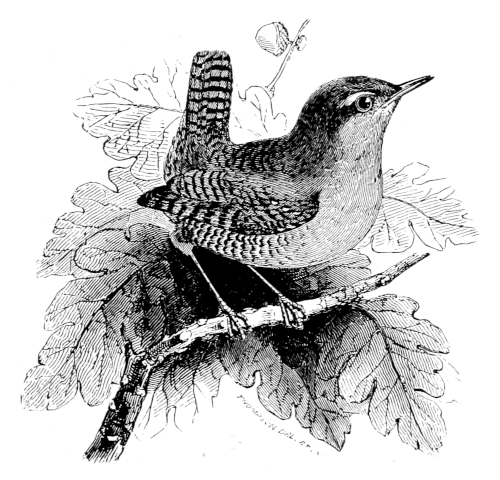
The Wren
For the HOUSE-MARTIN or MARTLET
Shakespeare seems to have had a special
regard. He had noted the courageous
way in which the bird places its nest, and
the social instinct which leads it to build
in companies where it can find convenient
settlements. In one passage we are told:
The martlet
Builds in the weather on the outward wall,
Even in the force and road of casualty.
[228]
When King Duncan arrives at the Castle
of Inverness, and is delighted with the
situation of the building and the pleasantness
of the air, Banquo calls his attention
to the numerous nests of the house-martin
as evidence of the salubrity of the climate:
This guest of summer,
The temple-haunting martlet, does approve,
By his loved mansionry, that the heaven’s breath
Smells wooingly here: no jutty, frieze,
Buttress, nor coign of vantage, but this bird
Hath made his pendent bed and procreant cradle:
Where they most breed and haunt, I have observed
The air is delicate.
[229]
I have reserved for the last place in the
list of Shakespeare’s birds his references
to the NIGHTINGALE. These are numerous
and may be divided into two groups. In
one of them the style is somewhat artificial
in tone, reflecting not the poet’s
own experience of the bird, but the
legendary interpretation of its song that
had been handed down from remote
antiquity. In the other group, the
nightingale takes its natural place as one
of our familiar English songsters. There
was a Greek myth that Philomela, the
daughter of an Attic King, after being
cruelly treated by her brother Tereus, was
compassionately changed by the gods into
a nightingale, and that thereafter she
spent her life among woods lamenting in
mournful notes the fate that had befallen
her. Her name came to be given to the
bird. Shakespeare, following this legend,
introduces the bird as Philomel into his
separate Poems and into the lyrics included
in his dramas. In the ordinary
dialogue of the Plays, however, dropping
the Greek name and legend, he uses the
common English appellation of the bird,
and, like ancient and modern poets, speaks
of the bird as feminine, although it is the
male alone that sings.
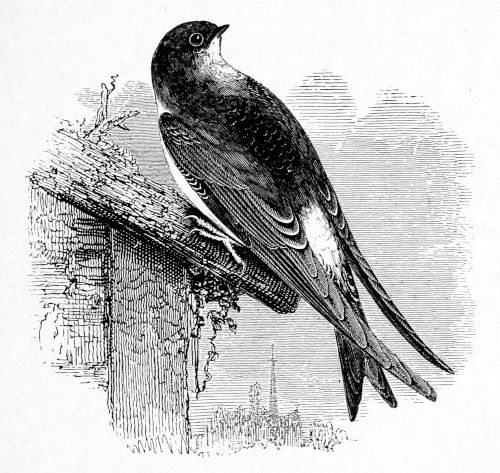
The House-Martin
Along with the ancient myth about
Philomela he intertwined another and
probably much more recent, but equally
unfounded belief that the nightingale,
when it sings, leans against a thorn that
pierces its breast. This combination of
ignorant fancies is most fully expressed in
the following passage:
Every thing did banish moan,
Save the nightingale alone:
She, poor bird, as all forlorn,
Lean’d her breast up-till a thorn,
And there sung the dolefull’st ditty,
That to hear it was great pity:
‘Fie, fie, fie,’ now would she cry;
‘Tereu, tereu!’ by and by;
That to hear her so complain,
Scarce I could from tears refrain;
For her griefs, so lively shown,
Made me think upon my own.
[230]
The same artificial note of sadness runs
through the other allusions to Philomel.
In Lucrece we read:
By this, lamenting Philomel had ended
The well-tuned warble of her nightly sorrow.
[231]
Again in the Sonnets:
As Philomel in summer’s front doth sing,
And stops her pipe in growth of riper days:
Not that the summer is less pleasant now
Than when her mournful hymns did hush the night,
But that wild music burthens every bough,
And sweets grown common lose their dear delight.
[232]
The poet has brought Philomel into his
fairy-land, and has for the moment left out
any reference to the alleged mournfulness
of her music:
Philomel, with melody
Sing in our sweet lullaby;
Lulla, lulla, lullaby, lulla, lulla, lullaby:
Never harm,
Nor spell, nor charm,
Come our lovely lady nigh;
So, good night, with lullaby.
[233]
In the Plays it is pleasant to find the bird
with its English name and in natural surroundings.
When Valentine, one of the
Two Gentlemen of Verona, was banished
from Milan and from the lady of his love,
he pictured to himself among the woes
that lay in front of him:
Except I be by Silvia in the night
There is no music in the nightingale.
And when afterwards, through stress of
circumstances, he found himself compelled
to become the captain of a band
of outlaws, he found consolation in this
wise:
How use doth breed a habit in a man!
This shadowy desert, unfrequented woods,
I better brook than flourishing peopled towns:
Here can I sit alone, unseen of any,
And to the nightingale’s complaining notes
Tune my distresses and record my woes.
[234]
It will be recollected that among the
tantalising tricks played off by the lord
and his servants upon Christopher Sly, he
was asked
Wilt thou have music? Hark! Apollo plays
And twenty caged nightingales do sing.
[235]
Nor can we forget the magnanimous offer
of Bottom when he wanted to play the
part of the lion, and the danger of his
frightening the duchess and the ladies was
pointed out to him:
But I will aggravate my voice so, that I will
roar you as gently as any sucking dove; I will
roar you an ’twere any nightingale.[236]
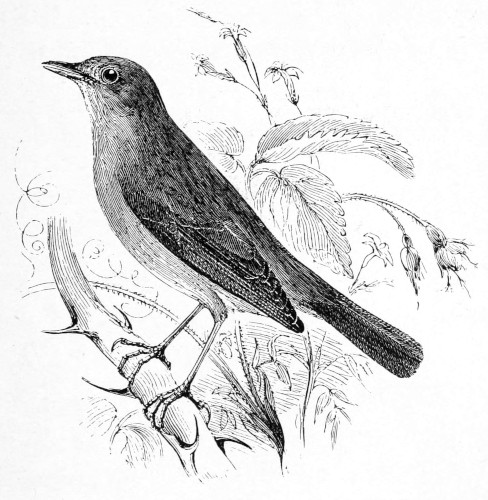
The Nightingale
The romance of the nightingale’s song
was never more thoroughly discarded than
by Portia when she returned from her
memorable trip to Venice and found a light
and music in her hall. She remarked to
Nerissa that by night music sounds much
sweeter than by day, and received in reply
the explanation that “Silence bestows that
virtue on it, madam.” Portia, however,
with her ingenuity of a barrister, insisted
in a passage already referred to:
The crow doth sing as sweetly as the lark,
When neither is attended; and I think
The nightingale, if she should sing by day,
When every goose is cackling, would be thought
No better a musician than the wren.
[237]
Progress of English Poetry
The lapse of two centuries from the
time of Chaucer witnessed a change in
the mood of English poetry in regard to
its treatment of birds. The simple and
unaffected joy in the voices of the grove,
so conspicuous in the poems of the author
of the Canterbury Tales, had not become
less, but it had been accompanied by
the growth of a more observant and contemplative
spirit. While bird-music was
as much appreciated as ever, a much wider
field of interest in the feathered tribes had
been entered upon. Greater familiarity
with bird-life had been attained, and much
more was known about the habits of birds.
Of this knowledge use was made by way
of simile and illustration in regard to
human life. How often and how vividly,
for instance, does Shakespeare, by means
of an analogy from the world of birds,
portray the depth of man’s feelings,—his
joy, his sorrow and his suffering!
Birds in later Poetry
The law of evolution, which has been
so supreme in the history of organised life
on the globe, does not leave the human
mind outside of its influence. If there
was proof of progress in poetic insight
between the days of Chaucer and those of
Shakespeare, we may expect to find on
examination that other two centuries did
not pass without leaving some evidence of
change in the tone of our poetry. To
test this inference, some typical examples
may be taken from the poetry of the
nineteenth century where it deals with
birds, for comparison with the quotations
which have been cited from our great
dramatist. The subject is obviously far
too wide to be fully entered upon here;
but it may be briefly illustrated by selecting
three well-known poems by three of
the most illustrious of the English poets
of the nineteenth century—the “Ode to
the Cuckoo” of Wordsworth, the “Ode
to the Nightingale” of Keats, and the
“Ode to the Skylark” of Shelley.
Coming anew to these poems from a
prolonged perusal of Shakespeare, we are
first struck by the fact that although
so distinct from each other in thought
as well as in music, they are akin in
being not mere references to the birds,
but actual addresses to particular members
of the feathered tribes. In each
case the ode is no cold description, but
a monologue, glowing with appreciation
and love, and spoken as it were
directly to the subject itself. The birds
are recognised as, like ourselves, “travellers
between life and death.” Instead of being
regarded as “unreasonable,” that is, devoid
of any reasoning faculty, and gifted only
with what is called “instinct,” they are
felt to be linked with us by the possession
of many qualities that are closely akin to
some of the purest virtues of humanity.
And they are acknowledged to be fellow-creatures,
partners with us in the great
mystery of life. They are communed
with as if man’s longings could be made
known to them, and as if they in turn
might be brought to feel the reality and
depth of his affectionate interest in them,
or even perhaps be induced to reveal to
him the secret of their careless happiness.
The poets in their mystic rapture idealise
these songsters until they almost seem
to cease to be corporeal beings. Thus
Wordsworth:
O Cuckoo! shall I call thee Bird,
Or but a wandering voice?
* * * * * * *
Even yet thou art to me
No bird, but an invisible thing,
A voice, a mystery.
Shelley’s ethereal melody becomes even
more ecstatic in his address to the
Skylark:
Wordsworth, Shelley and Keats
Hail to thee, blithe spirit—
Bird thou never wert—
* * * * * * *
Teach us, sprite or bird,
What sweet thoughts are thine.
To the modern poet the voices of the
birds seem to express more directly and
simply than any other kind of music
the pure joie de vivre. Shelley wrote of
his Skylark:
Sound of vernal showers
On the twinkling grass,
Rain-awakened flowers,—
All that ever was,
Joyous and clear and fresh,—thy music doth surpass.
* * * * * * *
Yet, if we could scorn
Hate and pride and fear,
If we were things born
Not to shed a tear,
I know not how thy joy we ever should come near.
Keats recognised the same joyous feeling
in his Nightingale:
’Tis not through envy of thy happy lot,
But being too happy in thy happiness,—
That thou, light-winged Dryad of the trees,
In some melodious plot
Of beechen green, and shadows numberless,
Singest of summer in full-throated ease.
Each poet seeks to interpret for himself
the meaning of the song of the bird and
the sources of its inspiration. To Wordsworth
the Cuckoo seems to be
Babbling to the vale
Of sunshine and of flowers.
To Keats the Nightingale was singing of
“summer.” Shelley asks the Skylark:
What objects are the fountains
Of thy happy strain?
What fields, or waves, or mountains?
What shapes of sky or plain?
What love of thine own kind? What ignorance of pain?
Again, to the poet’s ear the bird-music
awakens memories of the past. To Wordsworth
the notes of the Cuckoo brought
“a tale of visionary hours” in his boyhood
when, in his endeavour to set eyes upon
the bird, he would
Often rove
Through woods and on the green;
And thou were still a hope, a love;
Still longed for, never seen.
To Keats the vista unfolded of the past
reached far beyond his own time:
The voice I hear this passing night was heard
In ancient days by emperor and clown;
Perhaps the self-same song that found a path
Through the sad heart of Ruth, when sick for home,
She stood in tears amid the alien corn;
The same that oft-times hath
Charmed magic easements, opening on the foam
Of perilous seas, in faery lands forlorn.
The modern poet finds in the varied notes
of the birds not the bodings and portents,
superstitiously associated in the olden time
with such cries as those of the raven and
the owl, but high and solemn thoughts of
death and the hereafter. Shelley wrote of
his Skylark:
Waking or asleep,
Thou of death must deem
Things more true and deep
Than we mortals dream,
Or how could thy notes flow in such a crystal stream?
And Keats found his heart attuned by the
voice of the Nightingale to the contemplation
of his own dissolution:
Darkling I listen; and for many a time
I have been half in love with easeful Death,
Call’d him soft names in many a mused rhyme,
To take into the air my quiet breath;
Now more than ever seems it rich to die,
To cease upon the midnight with no pain,
While thou art pouring forth thy soul abroad
In such an ecstasy!
Still wouldst thou sing, and I have ears in vain—
To thy high requiem become a sod.
What the future course of English
Poetry will be in this same domain
cannot be confidently predicted. Already,
after the lapse of another century since
the three poems appeared which we have
been considering, a certain change in the
poetic mood with regard to living Nature
can be more or less distinctly perceived.
With such a splendid past to contemplate,
we may be well assured that our Poetry
will continue to be radiant with sympathy
for all living things. The birds will not
fail to retain their “pride of place” in
the affections of each generation of poets,
and their voices, in the future as in the
past, will abide with man as the source
of some of the purest pleasure that can
solace his heart.
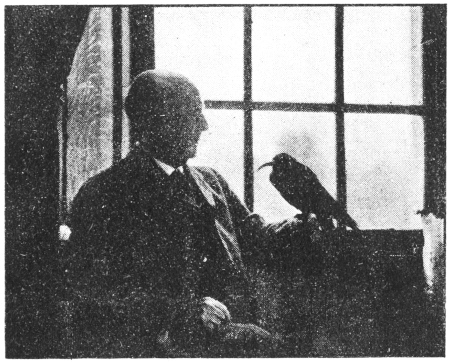
A Friendly Chough