efore the earliest Ruggles could wake and toot his five-cent tin horn,
Mrs. Ruggles was up and stirring about the house, for it was a gala day
in the family. Gala day! I should think so! Were not her nine "childern"
invited to a dinner-party at the great house, and weren't they going to
sit down free and equal with the mightiest in the land? She had been
preparing for this grand occasion ever since the receipt of Carol Bird's
invitation, which, by the way, had been speedily enshrined in an old
photograph frame and hung under the looking-glass in the most prominent
place in the kitchen, where it stared the occasional visitor directly in
the eye, and made him livid with envy:—
Birds' Nest, December 17, 188-.
Dear Mrs. Ruggles,—I am going to have a dinner-party on Christmas
Day, and would like to have all your children come. I want them
every one, please, from Sarah Maud to Baby Larry. Mamma says
dinner will be at half past five, and the Christmas tree at seven;
so you may expect them home at nine o'clock. Wishing you a Merry
Christmas and a Happy New Year, I am
Yours truly,
Carol Bird.
Breakfast was on the table promptly at seven o'clock, and there was very
little of it, too; for it was an excellent day for short rations, though
Mrs. Ruggles heaved a sigh as she reflected that the boys, with their
India-rubber stomachs, would be just as hungry the day after the
dinner-party as if they had never had any at all.
As soon as the scanty meal was over, she announced the plan of the
campaign: "Now, Susan, you an' Kitty wash up the dishes; an' Peter,
can't yer spread up the beds, so't I can git ter cuttin' out Larry's new
suit? I ain't satisfied with his clo'es, an' I thought in the night of a
way to make him a dress out o' my old red plaid shawl—kind o' Scotch
style, yer know, with the fringe 't the bottom.—Eily, you go find the
comb and take the snarls out the fringe, that's a lady! You little young
ones clear out from under foot! Clem, you and Con hop into bed with
Larry while I wash yer underflannins; 'twon't take long to dry
'em.—Yes, I know it's bothersome, buy yer can't go int' s'ciety 'thout
takin' some trouble, 'n' anyhow I couldn't git round to 'em last
night.—Sarah Maud, I think 'twould be perfeckly han'som' if you ripped
them brass buttons off yer uncle's policeman's coat 'n' sewed 'em in a
row up the front o' yer green skirt. Susan, you must iron out yours 'n'
Kitty's apurns; 'n' there, I come mighty near forgettin' Peory's
stockin's! I counted the whole lot last night when I was washin' of 'em,
'n' there ain't but nineteen anyhow yer fix 'em, 'n' no nine pairs mates
nohow; 'n' I ain't goin' ter have my childern wear odd stockin's to a
dinner-comp'ny, fetched up as I was!—Eily, can't you run out and ask
Mis' Cullen ter lend me a pair o' stockin's for Peory, 'n' tell her if
she will, Peory'll give Jim half her candy when she gets home. Won't
yer, Peory?"
Peoria was young and greedy, and thought the remedy so out of all
proportion to the disease, that she set up a deafening howl at the
projected bargain—a howl so rebellious and so entirely out of season
that her mother started in her direction with flashing eye and uplifted
hand; but she let it fall suddenly, saying, "No, I vow I won't lick ye
Christmas Day, if yer drive me crazy; but speak up smart, now, 'n' say
whether yer'd ruther give Jim Cullen half yer candy or go bare-legged
ter the party?" The matter being put so plainly, Peoria collected her
faculties, dried her tears, and chose the lesser evil, Clem having
hastened the decision by an affectionate wink, that meant he'd go halves
with her on his candy.
"That's a lady!" cried her mother. "Now, you young ones that ain't doin'
nothin', play all yer want ter before noontime, for after ye git through
eatin' at twelve o'clock me 'n' Sarah Maud's goin' ter give yer sech a
washin' 'n' combin' 'n' dressin' as yer never had before 'n' never will
agin likely, 'n' then I'm goin' to set yer down 'n' give yer two solid
hours trainin' in manners; 'n' 'twon't be no foolin' neither."
"All we've got ter do's go eat!" grumbled Peter.
"Well, that's enough," responded his mother; "there's more'n one way of
eatin', let me tell yer, 'n' you've got a heap ter learn about it, Peter
Ruggles. Land sakes, I wish you childern could see the way I was fetched
up to eat. I never took a meal o' vittles in the kitchen before I
married Ruggles; but yer can't keep up that style with nine young ones
'n' yer Pa always off ter sea."
The big Ruggleses worked so well, and the little Ruggleses kept from
"under foot" so successfully, that by one o'clock nine complete toilets
were laid out in solemn grandeur on the beds. I say, "complete;" but I
do not know whether they would be called so in the best society. The law
of compensation had been well applied: he that had necktie had no cuffs;
she that had sash had no handkerchief, and vice versa; but they all
had shoes and a certain amount of clothing, such as it was, the outside
layer being in every case quite above criticism.
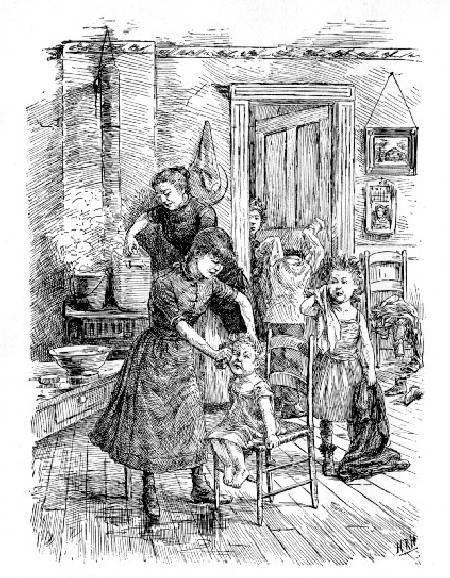
"Now, Sarah Maud," said Mrs. Ruggles, her face shining with excitement,
"everything's red up an' we can begin. I've got a boiler 'n' a kettle
'n' a pot o' hot water. Peter, you go into the back bedroom, 'n' I'll
take Susan, Kitty, Peory, 'n' Cornelius; 'n' Sarah Maud, you take Clem,
'n' Eily, 'n' Larry, one to a time. Scrub 'em 'n' rinse 'em, or 't any
rate git's fur's yer can with 'em, and then I'll finish 'em off while
you do yerself."
Sarah Maud couldn't have scrubbed with any more decision and force if
she had been doing floors, and the little Ruggleses bore it bravely, not
from natural heroism, but for the joy that was set before them. Not
being satisfied, however, with the "tone" of their complexions, and
feeling that the number of freckles to the square inch was too many to
be tolerated in the highest social circles, she wound up operations by
applying a little Bristol brick from the knife-board, which served as
the proverbial "last straw," from under which the little Ruggleses
issued rather red and raw and out of temper. When the clock struck four
they were all clothed, and most of them in their right minds, ready for
those last touches that always take the most time.
Kitty's red hair was curled in thirty-four ringlets, Sarah Maud's was
braided in one pig-tail, and Susan's and Eily's in two braids apiece,
while Peoria's resisted all advances in the shape of hair oils and stuck
out straight on all sides, like that of the Circassian girl of the
circus—so Clem said; and he was sent into the bedroom for it, too, from
whence he was dragged out forgivingly, by Peoria herself, five minutes
later. Then, exciting moment, came linen collars for some and neckties
and bows for others,—a magnificent green glass breastpin was sewed into
Peter's purple necktie,—and Eureka! the Ruggleses were dressed, and
Solomon in all his glory was not arrayed like one of these!
A row of seats was then formed directly through the middle of the
kitchen. Of course, there were not quite chairs enough for ten, since
the family had rarely wanted to sit down all at once, somebody always
being out or in bed, or otherwise engaged, but the wood-box and the
coal-hod finished out the line nicely, and nobody thought of grumbling.
The children took their places according to age, Sarah Maud at the head
and Larry on the coal-hod, and Mrs. Ruggles seated herself in front,
surveying them proudly as she wiped the sweat of honest toil from her
brow.
"Well," she exclaimed, "if I do say so as shouldn't, I never see a
cleaner, more stylish mess o' childern in my life! I do wish Ruggles
could look at ye for a minute!—Larry Ruggles, how many times have I got
ter tell yer not ter keep pullin' at yer sash? Haven't I told yer if it
comes ontied, yer waist 'n' skirt'll part comp'ny in the middle, 'n'
then where'll yer be?—Now look me in the eye, all of yer! I've of'en
told yer what kind of a family the McGrills was. I've got reason to be
proud, goodness knows! Your uncle is on the police force o' New York
city; you can take up the paper most any day an' see his name printed
right out—James McGrill,—'n' I can't have my children fetched up
common, like some folks'; when they go out they've got to have clo'es,
and learn to act decent! Now I want ter see how yer goin' to behave when
yer git there to-night. 'Tain't so awful easy as you think 'tis. Let's
start in at the beginnin' 'n' act out the whole business.
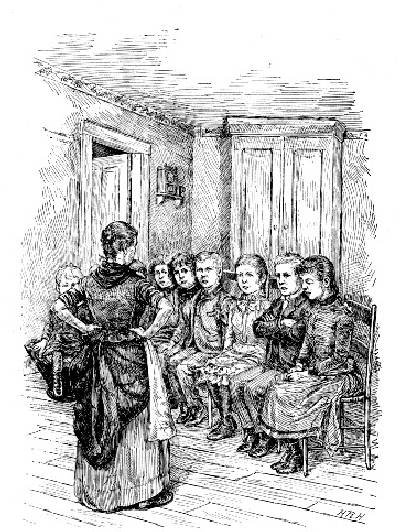 "I WANT TER SEE HOW YER GOIN' TER BEHAVE"
Pile into the bedroom, there, every last one o' ye, 'n'
show me how yer goin' to go int' the parlor. This'll be the parlor, 'n'
I'll be Mis' Bird."
The youngsters hustled into the next room in high glee, and Mrs. Ruggles
drew herself up in the chair with an infinitely haughty and purse-proud
expression that much better suited a descendant of the McGrills than
modest Mrs. Bird.
The bedroom was small, and there presently ensued such a clatter that
you would have thought a herd of wild cattle had broken loose. The door
opened, and they straggled in, all the younger ones giggling, with Sarah
Maud at the head, looking as if she had been caught in the act of
stealing sheep; while Larry, being last in line, seemed to think the
door a sort of gate of heaven which would be shut in his face if he
didn't get there in time; accordingly he struggled ahead of his elders
and disgraced himself by tumbling in head foremost.
Mrs. Ruggles looked severe. "There, I knew yer'd do it in some sech fool
way! Now go in there and try it over again, every last one o' ye, 'n' if
Larry can't come in on two legs he can stay ter home,—d' yer hear?"
The matter began to assume a graver aspect; the little Ruggleses stopped
giggling and backed into the bedroom, issuing presently with lock step,
Indian file, a scared and hunted expression on every countenance.
"No, no, no!" cried Mrs. Ruggles, in despair. "That's worse yet; yer
look for all the world like a gang o' pris'ners! There ain't no style
ter that: spread out more, can't yer, 'n' act kind o'
careless-like—nobody's goin' ter kill ye! That ain't what a
dinner-party is!"
The third time brought deserved success, and the pupils took their seats
in the row. "Now, yer know," said Mrs. Ruggles impressively, "there
ain't enough decent hats to go round, 'n' if there was I don' know's I'd
let yer wear 'em, for the boys would never think to take 'em off when
they got inside, for they never do—but anyhow, there ain't enough good
ones. Now, look me in the eye. You're only goin' jest round the corner;
you needn't wear no hats, none of yer, 'n' when yer get int' the parlor,
'n' they ask yer ter lay off yer hats, Sarah Maud must speak up 'n' say
it was sech a pleasant evenin' 'n' sech a short walk that yer left yer
hats to home. Now, can yer remember?"
All the little Ruggleses shouted, "Yes, marm!" in chorus.
"What have you got ter do with it?" demanded their mother; "did I
tell you to say it? Warn't I talkin' ter Sarah Maud?"
The little Ruggleses hung their diminished heads. "Yes, marm," they
piped, more discreetly.
"Now we won't leave nothin' to chance; git up, all of ye, an' try
it.—Speak up, Sarah Maud."
Sarah Maud's tongue clove to the roof of her mouth.
"Quick!"
"Ma thought—it was—sech a pleasant hat that we'd—we'd better leave
our short walk to home," recited Sarah Maud, in an agony of mental
effort.
This was too much for the boys. An earthquake of suppressed giggles
swept all along the line.
"Oh, whatever shall I do with yer?" moaned the unhappy mother; "I s'pose
I've got to learn it to yer!"—which she did, word for word, until Sarah
Maud thought she could stand on her head and say it backwards.
"Now, Cornelius, what are you goin' ter say ter make yerself good
comp'ny?"
"Do? Me? Dunno!" said Cornelius, turning pale, with unexpected
responsibility.
"Well, ye ain't goin' to set there like a bump on a log 'thout sayin' a
word ter pay for yer vittles, air ye? Ask Mis' Bird how she's feelin'
this evenin', or if Mr. Bird's hevin' a busy season, or how this kind
o' weather agrees with him, or somethin' like that.—Now we'll make
b'lieve we've got ter the dinner—that won't be so hard, 'cause yer'll
have somethin' to do—it's awful bothersome to stan' round an' act
stylish.—If they have napkins, Sarah Maud down to Peory may put 'em in
their laps, 'n' the rest of ye can tuck 'em in yer necks. Don't eat with
yer fingers—don't grab no vittles off one 'nother's plates; don't reach
out for nothin', but wait till yer asked, 'n' if you never git asked
don't git up and grab it.—Don't spill nothin' on the tablecloth, or
like's not Mis' Bird'll send yer away from the table—'n' I hope she
will if yer do! (Susan! keep your handkerchief in your lap where Peory
can borry it if she needs it, 'n' I hope she'll know when she does need
it, though I don't expect it.) Now we'll try a few things ter see how
they'll go! Mr. Clement, do you eat cramb'ry sarse?"
"Bet yer life!" cried Clem, who in the excitement of the moment had not
taken in the idea exactly and had mistaken this for an ordinary
bosom-of-the-family question.
"Clement McGrill Ruggles, do you mean to tell me that you'd say that to
a dinner-party? I'll give ye one more chance. Mr. Clement, will you take
some of the cramb'ry?"
"Yes, marm, thank ye kindly, if you happen ter have any handy."
"Very good, indeed! But they won't give yer two tries to-night,—yer
just remember that!—Miss Peory, do you speak for white or dark meat?"
"I ain't perticler as ter color,—anything that nobody else wants will
suit me," answered Peory with her best air.
"First-rate! Nobody could speak more genteel than that. Miss Kitty, will
you have hard or soft sarse with your pudden?"
"Hard or soft? Oh! A little of both, if you please, an' I'm much
obliged," said Kitty, bowing with decided ease and grace; at which all
the other Ruggleses pointed the finger of shame at her, and Peter
grunted expressively, that their meaning might not be mistaken.
"You just stop your gruntin', Peter Ruggles; that warn't greedy, that
was all right. I wish I could git it inter your heads that it ain't so
much what yer say, as the way you say it. And don't keep starin'
cross-eyed at your necktie pin, or I'll take it out 'n' sew it on to
Clem or Cornelius: Sarah Maud'll keep her eye on it, 'n' if it turns
broken side out she'll tell yer. Gracious! I shouldn't think you'd ever
seen nor worn no jool'ry in your life.—Eily, you an' Larry's too
little to train, so you just look at the rest an' do's they do, 'n' the
Lord have mercy on ye 'n' help ye to act decent! Now, is there anything
more ye'd like to practice?"
"If yer tell me one more thing, I can't set up an' eat," said Peter
gloomily; "I'm so cram full o' manners now I'm ready ter bust, 'thout no
dinner at all."
"Me too," chimed in Cornelius.
"Well, I'm sorry for yer both," rejoined Mrs. Ruggles sarcastically; "if
the 'mount o' manners yer've got on hand now troubles ye, you're
dreadful easy hurt! Now, Sarah Maud, after dinner, about once in so
often, you must git up 'n' say, 'I guess we'd better be goin';' 'n' if
they say, 'Oh, no, set a while longer,' yer can set; but if they don't
say nothin' you've got ter get up 'n' go.—Now hev yer got that int' yer
head?"
"About once in so often!" Could any words in the language be fraught
with more terrible and wearing uncertainty?
"Well," answered Sarah Maud mournfully, "seems as if this whole
dinner-party set right square on top o' me! Mebbe I could manage my own
manners, but to manage nine mannerses is worse 'n staying to home!"
"Oh, don't fret," said her mother, good-naturedly, now that the lesson
was over; "I guess you'll git along. I wouldn't mind if folks would only
say, 'Oh, childern will be childern;' but they won't. They'll say, 'Land
o' Goodness, who fetched them childern up?'—It's quarter past five, 'n'
yer can go now:—remember 'bout the hats,—don't all talk ter
once,—Susan, lend yer han'k'chief ter Peory,—Peter, don't keep
screwin' yer scarf-pin,—Cornelius, hold yer head up straight,—Sarah
Maud, don't take yer eyes off o' Larry, 'n' Larry you keep holt o' Sarah
Maud 'n' do jest as she says,—'n' whatever you do, all of yer, never
forget for one second that yer mother was a McGrill."
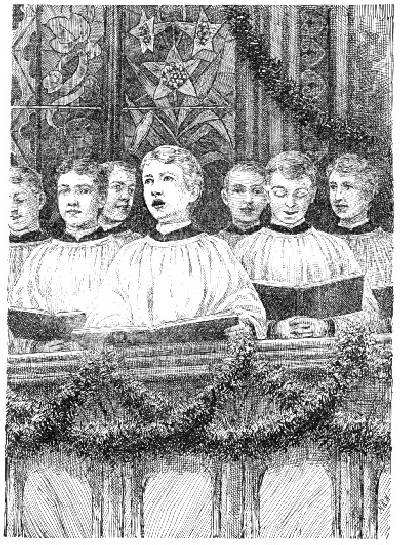
"WHEN THE PIE WAS OPENED,
THE BIRDS BEGAN TO SING!"
he children went out of the back door quietly, and were presently lost
to sight, Sarah Maud slipping and stumbling along absent-mindedly, as
she recited rapidly under her breath,
"Itwassuchapleasantevenin'n'suchashortwalk, that
wethoughtwe'dleaveourhatstohome.—Itwassucha
pleasantevenin'n'suchashortwalk,thatwethoughtwe'd leaveourhatstohome."
Peter rang the door-bell, and presently a servant admitted them, and,
whispering something in Sarah's ear, drew her downstairs into the
kitchen. The other Ruggleses stood in horror-stricken groups as the door
closed behind their commanding officer; but there was no time for
reflection, for a voice from above was heard, saying, "Come right up
stairs, please!"
"Theirs not to make reply,
Theirs not to reason why,
Theirs but to do or die."
Accordingly they walked upstairs, and Elfrida, the nurse, ushered them
into a room more splendid than anything they had ever seen. But, oh woe!
where was Sarah Maud! and was it Fate that Mrs. Bird should say, at
once, "Did you lay your hats in the hall?" Peter felt himself elected by
circumstance the head of the family, and, casting one imploring look at
tongue-tied Susan, standing next him, said huskily, "It was so very
pleasant—that—that"——"That we hadn't good hats enough to go 'round,"
put in little Susan, bravely, to help him out, and then froze with
horror that the ill-fated words had slipped off her tongue.
However, Mrs. Bird said, pleasantly, "Of course you wouldn't wear hats
such a short distance—I forgot when I asked. Now will you come right in
to Miss Carol's room? She is so anxious to see you."
Just then Sarah Maud came up the back stairs, so radiant with joy from
her secret interview with the cook that Peter could have pinched her
with a clear conscience; and Carol gave them a joyful welcome. "But
where is Baby Larry?" she cried, looking over the group with searching
eye. "Didn't he come?"
"Larry! Larry!" Good gracious, where was Larry? They were all sure that
he had come in with them, for Susan remembered scolding him for tripping
over the door-mat. Uncle Jack went into convulsions of laughter. "Are
you sure there were nine of you?" he asked, merrily.
"I think so, sir," said Peoria, timidly; "but anyhow, there was Larry;"
and she showed signs of weeping.
"Oh, well, cheer up!" cried Uncle Jack. "Probably he's not lost—only
mislaid. I'll go and find him before you can say Jack Robinson!"
"I'll go, too, if you please, sir," said Sarah Maud, "for it was my
place to mind him, an' if he's lost I can't relish my vittles!"
The other Ruggleses stood rooted to the floor. Was this a dinner-party,
forsooth; and if so, why were such things ever spoken of as festive
occasions?
Sarah Maud went out through the hall, calling, "Larry! Larry!" and
without any interval of suspense a thin voice piped up from below, "Here
I be!"
The truth was that Larry, being deserted by his natural guardian,
dropped behind the rest, and wriggled into the hat-tree to wait for her,
having no notion of walking unprotected into the jaws of a fashionable
entertainment. Finding that she did not come, he tried to crawl from his
refuge and call somebody, when—dark and dreadful ending to a tragic
day—he found that he was too much intertwined with umbrellas and canes
to move a single step. He was afraid to yell (when I have said this of
Larry Ruggles I have pictured a state of helpless terror that ought to
wring tears from every eye); and the sound of Sarah Maud's beloved
voice, some seconds later, was like a strain of angel music in his ears.
Uncle Jack dried his tears, carried him upstairs, and soon had him in
breathless fits of laughter, while Carol so made the other Ruggleses
forget themselves that they were presently talking like accomplished
diners-out.
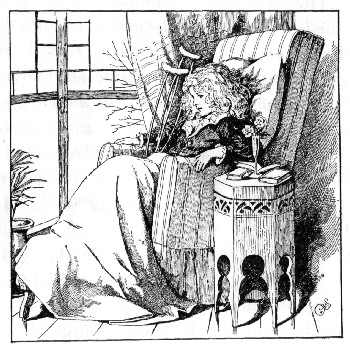
Carol's bed had been moved into the farthest corner of the room, and she
was lying on the outside, dressed in a wonderful dressing-gown that
looked like a fleecy cloud. Her golden hair fell in fluffy curls over
her white forehead and neck, her cheeks flushed delicately, her eyes
beamed with joy, and the children told their mother, afterwards, that
she looked as beautiful as the angels in the picture books.
There was a great bustle behind a huge screen in another part of the
room, and at half past five this was taken away, and the Christmas
dinner-table stood revealed. What a wonderful sight it was to the poor
little Ruggles children, who ate their sometimes scanty meals on the
kitchen table! It blazed with tall colored candles, it gleamed with
glass and silver, it blushed with flowers, it groaned with good things
to eat; so it was not strange that the Ruggleses, forgetting altogether
that their mother was a McGrill, shrieked in admiration of the fairy
spectacle. But Larry's behavior was the most disgraceful, for he stood
not upon the order of his going, but went at once for a high chair that
pointed unmistakably to him, climbed up like a squirrel, gave a
comprehensive look at the turkey, clapped his hands in ecstasy, rested
his fat arms on the table, and cried with joy, "I beat the hull lot o'
yer!" Carol laughed until she cried, giving orders, meanwhile,—"Uncle
Jack, please sit at the head, Sarah Maud at the foot, and that will
leave four on each side; Mamma is going to help Elfrida, so that the
children need not look after each other, but just have a good time."
A sprig of holly lay by each plate, and nothing would do but each little
Ruggles must leave his seat and have it pinned on by Carol, and as each
course was served, one of them pleaded to take something to her. There
was hurrying to and fro, I can assure you, for it is quite a difficult
matter to serve a Christmas dinner on the third floor of a great city
house; but if it had been necessary to carry every dish up a rope ladder
the servants would gladly have done so. There were turkey and chicken,
with delicious gravy and stuffing, and there were half a dozen
vegetables, with cranberry jelly, and celery, and pickles; and as for
the way these delicacies were served, the Ruggleses never forgot it as
long as they lived.
Peter nudged Kitty, who sat next him, and said, "Look, will yer, ev'ry
feller's got his own partic'lar butter; I s'pose that's to show you can
eat that 'n' no more. No, it ain't either, for that pig of a Peory's
just gettin' another helpin'!"
"Yes," whispered Kitty, "an' the napkins is marked with big red letters!
I wonder if that's so nobody'll nip 'em; an' oh, Peter, look at the
pictures stickin' right on ter the dishes! Did yee ever?"
"The plums is all took out o' my cramb'ry sarse an' it's friz to a stiff
jell'!" whispered Peoria, in wild excitement.
"Hi—yah! I got a wish-bone!" sang Larry, regardless of Sarah Maud's
frown; after which she asked to have his seat changed, giving as excuse
that he "gen'ally set beside her, an' would feel strange;" the true
reason being that she desired to kick him gently, under the table,
whenever he passed what might be termed "the McGrill line."
"I declare to goodness," murmured Susan, on the other side, "there's so
much to look at I can't scarcely eat nothin'!"
"Bet yer life I can!" said Peter, who had kept one servant busily
employed ever since he sat down; for, luckily, no one was asked by Uncle
Jack whether he would have a second helping, but the dishes were quietly
passed under their noses, and not a single Ruggles refused anything that
was offered him, even unto the seventh time.
Then, when Carol and Uncle Jack perceived that more turkey was a
physical impossibility, the meats were taken off and the dessert was
brought in—a dessert that would have frightened a strong man after such
a dinner as had preceded it. Not so the Ruggleses—for a strong man is
nothing to a small boy—and they kindled to the dessert as if the turkey
had been a dream and the six vegetables an optical delusion. There were
plum-pudding, mince-pie, and ice-cream; and there were nuts, and
raisins, and oranges. Kitty chose ice-cream, explaining that she knew
it "by sight, though she hadn't never tasted none;" but all the rest
took the entire variety, without any regard to consequences.
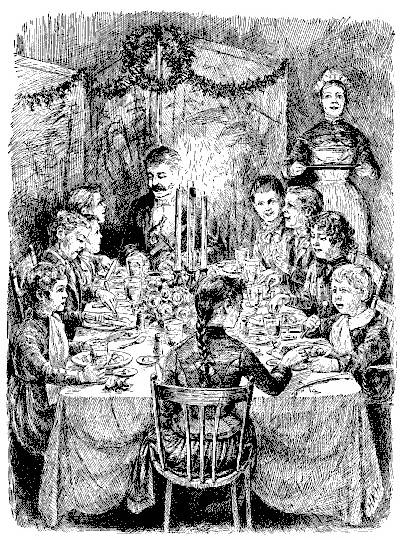 "THE RUGGLESES NEVER FORGOT IT"
"My dear child," whispered Uncle Jack, as he took Carol an orange,
"there is no doubt about the necessity of this feast, but I do advise
you after this to have them twice a year, or quarterly perhaps, for the
way these children eat is positively dangerous; I assure you I tremble
for that terrible Peoria. I'm going to run races with her after dinner."
"Never mind," laughed Carol; "let them have enough for once; it does my
heart good to see them, and they shall come oftener next year."
The feast being over, the Ruggleses lay back in their chairs languidly,
like little gorged boa-constrictors, and the table was cleared in a
trice. Then a door was opened into the next room, and there, in a corner
facing Carol's bed, which had been wheeled as close as possible, stood
the brilliantly lighted Christmas tree, glittering with gilded walnuts
and tiny silver balloons, and wreathed with snowy chains of pop-corn.
The presents had been bought mostly with Carol's story-money, and were
selected after long consultations with Mrs. Bird. Each girl had a blue
knitted hood, and each boy a red crocheted comforter, all made by Mamma,
Carol, and Elfrida. ("Because if you buy everything, it doesn't show so
much love," said Carol.) Then every girl had a pretty plaid dress of a
different color, and every boy a warm coat of the right size. Here the
useful presents stopped, and they were quite enough; but Carol had
pleaded to give them something "for fun." "I know they need the
clothes," she had said, when they were talking over the matter just
after Thanksgiving, "but they don't care much for them, after all. Now,
Papa, won't you please let me go without part of my presents this
year, and give me the money they would cost, to buy something to amuse
the Ruggleses?"
"You can have both," said Mr. Bird, promptly; "is there any need of my
little girl's going without her own Christmas, I should like to know?
Spend all the money you like."
"But that isn't the thing," objected Carol, nestling close to her
father; "it wouldn't be mine. What is the use? Haven't I almost
everything already, and am I not the happiest girl in the world this
year, with Uncle Jack and Donald at home? You know very well it is more
blessed to give than to receive; so why won't you let me do it? You
never look half as happy when you are getting your presents as when you
are giving us ours. Now, Papa, submit, or I shall have to be very firm
and disagreeable with you!"
"Very well, your Highness, I surrender."
"That's a dear Papa! Now what were you going to give me? Confess!"
"A bronze figure of Santa Claus; and in the 'little round belly that
shakes when he laughs like a bowlful of jelly,' is a wonderful
clock—oh, you would never give it up if you could see it!"
"Nonsense," laughed Carol; "as I never have to get up to breakfast, nor
go to bed, nor catch trains, I think my old clock will do very well!
Now, Mamma, what were you going to give me?"
"Oh, I hadn't decided. A few more books, and a gold thimble, and a
smelling-bottle, and a music-box, perhaps."
"Poor Carol," laughed the child, merrily, "she can afford to give up
these lovely things, for there will still be left Uncle Jack, and
Donald, and Paul, and Hugh, and Uncle Rob, and Aunt Elsie, and a dozen
other people to fill her Christmas stocking!"
So Carol had her way, as she generally did; but it was usually a good
way, which was fortunate, under the circumstances; and Sarah Maud had a
set of Miss Alcott's books, and Peter a modest silver watch, Cornelius
a tool-chest, Clement a dog-house for his lame puppy, Larry a
magnificent Noah's ark, and each of the younger girls a beautiful doll.
You can well believe that everybody was very merry and very thankful.
All the family, from Mr. Bird down to the cook, said that they had never
seen so much happiness in the space of three hours; but it had to end,
as all things do. The candles flickered and went out, the tree was left
alone with its gilded ornaments, and Mrs. Bird sent the children
downstairs at half past eight, thinking that Carol looked tired.
"Now, my darling, you have done quite enough for one day," said Mrs.
Bird, getting Carol into her little nightgown. "I'm afraid you will feel
worse tomorrow, and that would be a sad ending to such a charming
evening."
"Oh, wasn't it a lovely, lovely time," sighed Carol. "From first to
last, everything was just right. I shall never forget Larry's face when
he looked at the turkey; nor Peter's when he saw his watch; nor that
sweet, sweet Kitty's smile when she kissed her dolly; nor the tears in
poor, dull Sarah Maud's eyes when she thanked me for her books; nor"—
"But we mustn't talk any longer about it tonight," said Mrs. Bird,
anxiously; "you are too tired, dear."
"I am not so very tired, Mamma. I have felt well all day; not a bit of
pain anywhere. Perhaps this has done me good."
"Perhaps; I hope so. There was no noise or confusion; it was just a
merry time. Now, may I close the door and leave you alone, dear? Papa
and I will steal in softly by and by to see if you are all right; but I
think you need to be very quiet."
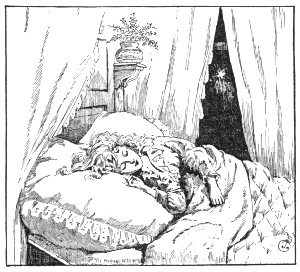
"Oh, I'm willing to stay by myself; but I am not sleepy yet, and I am
going to hear the music, you know."
"Yes, I have opened the window a little, and put the screen in front of
it, so that you won't feel the air."
"Can I have the shutters open? and won't you turn my bed, please? This
morning I woke ever so early, and one bright, beautiful star shone in
that eastern window. I never noticed it before, and I thought of the
Star in the East, that guided the wise men to the place where the baby
Jesus was. Good-night, Mamma. Such a happy, happy day!"
"Good-night, my precious Christmas Carol—mother's blessed Christmas
child."
"Bend your head a minute, mother dear," whispered Carol, calling her
mother back. "Mamma, dear, I do think that we have kept Christ's
birthday this time just as He would like it. Don't you?"
"I am sure of it," said Mrs. Bird, softly.
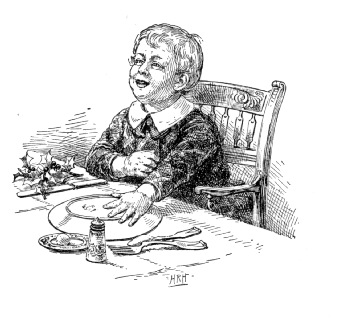 "I BEAT THE HULL LOT O' YER!"