CHAPTER I. “BIRDS OF A FEATHER.”
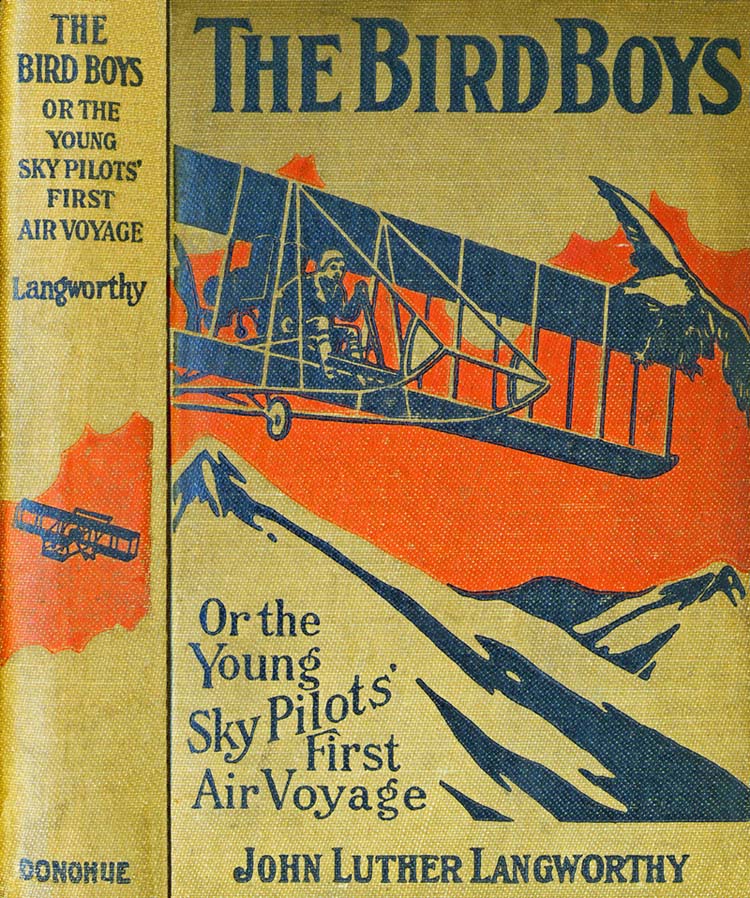
The Bird Boys;
or
The Young Sky Pilots’ First Air Voyage
“What are you frowning so much about,
Andy?”
“And look at him shake his head, Frank;
just for all the world like he’s gone and lost
his best friend!”
“Well, perhaps he has fellows,” laughed
Frank Bird, promptly. “At any rate, my
poor cousin’s heart is nearly broken into
flinders, just because he can’t for the life of
him remember what he did with that wonderful
little tool he invented.”
“Oh! say, is that what it’s all about?” cried
Larry Geohegan; “I guess now, you mean the
handy aluminum monkey wrench that always
kept its jaws locked after you set ’em? Too
bad, Andy. Wish you luck in finding it
again.”
“Yes, that’s it, fellows!” exclaimed the sorrowful
one, quickly. “Tell me, have either of
you set eyes on the little jewel since—well, say
last Saturday noon?”
“Huh! just why do you go and pick out that
day, of all the blessed week?” demanded “Elephant”
Small, a boy who had been given this
nickname in derision, since he was anything
but ponderous; and who at home chanced to
be called Fenimore Cooper.
“I’ll tell you,” replied Andy Bird,
promptly; “honestly then, because that’s the
last time I can remember handling the same.
I was tightening up a nut that had come loose
on my bike—perhaps you may have seen me
do it.”
“Oh! yes,” remarked Larry, the fourth
member of the group, “that was the day we
took that long spin on our wheels, and Frank
cooked us a bully good camp dinner when we
rested on the side of Thunder Top mountain,
wasn’t it?”
“Sure it was,” responded Andy. “And just
before we got ready to start off again I
fastened that bolt. Then it was goodbye to
my dandy little wrench, that I always expected
to make a bushel of money patenting some
fine day.”
“Well, I’ve got an idea, and a bright one
too!” observed Elephant, calmly.
“Then it’ll be the first you ever had,” declared
Larry, derisively.
“Don’t hold your breath till you forget it,
Elephant. Let’s hear the wonderful stunt
that’s struck you!” suggested the broken-hearted
loser, looking interested.
Elephant never hurried. Perhaps after all
it was because of his slowness that his name
had been changed so radically.
“Why, you see, it occurred to me that the
old bald-headed eagle we watched circling
around and around that noon, may have
dodged down when nobody was looking, and
carried the cute little wrench away in his
talons.”
This was not a joke on Elephant’s part. He
was never known to show genuine humor
himself, although his chums frequently found
cause for hilarious laughter in some of the
numerous suggestions he put forward. But
Elephant himself really believed in them all,
marvelous though they may have been.
“Well, now that is a clever idea,” observed
Frank, always ready to lead the other on, in
order to enjoy a laugh. “I tell you, that old
king of the upper air must have heard Andy
boasting how he meant to follow in his father’s
wake, and be an aeronaut for keeps?”
He winked at the others while speaking;
but Elephant of course failed to see anything
of this side show.
“That’s the ticket!” cried the originator of
the idea vigorously, happy in the belief that
for once he must have actually hit upon a
bright thought; “the measly old pirate just
made up his mind that he’d cripple Andy in
the start, and stop all work on your wonderful
monoplane. No competition allowed, understand,
Andy! So he hooked the wrench;
and that ties up the whole business.”
“Oh! shucks! You give me a pain, Elephant,”
grunted Larry, pretending to double
up as a boy might in the green apple season.
“Huh! it’s easy to pick flaws,” sniffed the
other, contemptuously. “But if you don’t like
my clever thought, Larry Geohegan, just suppose
you give us a better one. Now, none of
your hedging, but out with it!”
“That’s as simple as falling off a log,”
sneered the bantered boy, as he thrust his
thumbs into the upper pockets of his coat, and
assumed the air of consequence with which he
loved to tantalize Elephant.
“Talk’s cheap; do something, can’t you?”
demanded his competitor.
“Listen,” said Larry, impressively. “It
seems to me that something happened to Andy
on last Saturday, P. M. How about that little
episode of the quicksand you got stuck in, old
fellow? Didn’t we have to run and get a fence
rail to pry you out, wheel and all.”
The two Bird cousins exchanged quick
looks.
“Now you’re talking, Larry; because that
was just what did happen to me, for a dead
certainty!” admitted Andy, readily.
“Looks like Larry had struck a warm
trail,” ventured Frank, nodding his head encouragingly.
“Hear further, fellows,” the originator of
the newest clue went on saying. “I remember
right now that after we pried Andy loose, he
had to draw himself up by means of the limb
of a tree. Also, that he straddled the same
limb, so that his head hung down for a little
while.”
“Sure. That was when I was trying to get
the rope I had tied to my wheel, over the limb,
so you could pull her out of the mire,” admitted
Andy.
“All right,” remarked Larry. “That was
just the time the wrench must have dropped
out of your pocket, and went souse in the mud,
to sink to China. Some day you may hear of
an enterprising pigtail man over there taking
out a patent on a nice little wrench, warranted
never to slip while you work.”
“Did you see it drop?” demanded the other.
“Nixey, I did not; still, it stands to reason——”
began Larry, obstinately.
“Did you hear it drop?” Andy continued,
positively.
“Well, seeing that you were shedding gallons
of water about that time, not to mention
hunks of mud, it wouldn’t be funny if we
failed to hear such a little thing fall into the
sucker hole,” grumbled Larry, driven to bay,
yet not willing to change his mind.
“All the same then,” declared Andy, “I
don’t believe it fell into that muck you call a
quicksand. I’ve just gone and misplaced it,
that’s all. And some minute, when I get my
mind on it, I expect to remember what I did
with that little beauty.”
“Meanwhile,” remarked his cousin, with a
smile, “we can makeshift to get along at our
work with the big monkey wrench. After all,
it isn’t the tools that really count, but the
ability to do things when you’re left high and
dry. Hello! Going to leave us, fellows?” as
Elephant and Larry stopped at a cross roads.
“I promised to do a job in our yard today,
and it’s going to take me the rest of the time
to get through,” announced Larry, with a
shrug of his shoulders.
“And me to the woodpile for a little more
muscle. So-long, boys; and don’t you believe
that old bald-headed thief of the air didn’t
understand how you meant to snatch his
honors away from him. Look to his nest up
on Thunder Top for your monkey wrench,
Andy.” And Elephant solemnly shook his
head as he walked slowly away.
“What shall we do now, Frank?” asked
Andy, when they found themselves alone.
“Had we better go and tackle a little more
work on our machine, while we wait for that
cylinder to arrive?”
“You know we can do mighty little now
until we install that. And I’ve somehow got
a hunch it’s about due to arrive. So what say
we meander down to the station and find out?”
suggested the other.
“A bully idea; so come along!” declared
Andy, usually only too willing to play second
fiddle when in the company of his energetic
cousin.
Both were healthy looking boys. Frank’s
father was the leading doctor in the town of
Bloomsbury, which fronted on Sunrise Lake,
a sheet of water some seventeen miles in
length, and with innumerable coves along its
crooked shores.
Because the boy’s mother had died in his
infancy with a suddenly developed lung
trouble, the worthy doctor had always been
unusually solicitous about Frank; and urged
upon him the necessity for securing all the
outdoor life he could. Nobody else dreamed
that Frank looked delicate; but his father saw
suspicious signs in every little “bark” he gave
utterance to.
The result was that just now Frank was to
be kept out of school for a whole year. His
father, being a self-made man, had always
believed that an education could be more practically
attained from observation and travel
than by study of books.
Andy, on the other hand, was an orphan.
His father had been quite a well known man
of science, and a professor in college. Having
a leaning toward aeronautics, he finally took
up the fascinating pursuit, after his wife died.
A year before the time when we make the
acquaintance of the boys, he had vanished
utterly from the sight of mortal man, having
been carried away in a severe gale while in a
balloon, crossing over the line of the partly
finished Panama canal.
No word had ever come back, and it was of
course fully believed that the daring navigator
of the upper currents had perished at sea, or
in the wilds of that tropical country to the
south.
So Andy found himself left in charge of a
jolly old gentleman named Colonel Josiah
Whympers, mentioned in the will as his
guardian. There was ample money in the
estate, and every month Andy received many
times more than any lad in all Bloomsbury.
But he had no bad habits, and spent his money
for good purposes; much of it going toward
building a monoplane, which he and Frank
expected to utilize in taking little flights
around the vicinity.
So far as Andy was concerned, he certainly
came by his great love for aviation honestly;
since his father had been infatuated with the
science of flying.
“Besides,” Andy was accustomed to remarking,
when any one challenged his wisdom
in choosing such a dangerous calling; “A Bird
ought to take to the air just as naturally as
a duck does to water. My father had to give
in to the call of the upper wild; and I just
guess I’ve inherited the longing to soar
through the clouds from him.”
Andy was a merry lad, with twinkling blue
eyes, and full of the joy of living. His cousin
Frank happened to be more serious-minded
as a rule; and so they made a most congenial
pair of chums, who were yet to have their first
quarrel.
Colonel Josiah was supposed to be a rather
gruff old party; but that was pretty much a
blind; for at heart he was the most amiable
gentleman within twenty miles of the home
town. Andy could just wind him around his
little finger. Having become a cripple some
years back, the colonel could no longer roam
the world, looking on strange sights, as had
been his custom all his life. Consequently, he
had to take his enjoyment in reading of the
exploits of others, and in encouraging the
boys of Bloomsbury to become athletes.
At many a hotly contested baseball game the
old traveler could be seen waving his crutch
and his cane in the air as he rooted loyally for
the home team. And when he learned how
Andy aspired to follow in the footsteps of his
gifted father, with a sturdy intention to conquer
the problems of aviation, instead of
throwing obstacles in the way, the old man
actually applauded his choice, and offered to
assist by any reasonable means in his power.
For more than two months now the Bird
boys had been industriously at work upon a
model of a monoplane fashioned very much
after the style of the Bleriot which they had
seen do wonderful stunts on the day they
traveled down to the trying-out grounds on
Long Island.
A great advance had been made in securing
a new Kinkaid engine, said to be three times
as light as the best hitherto made. Both boys
anticipated great things when they had completed
their task. Several times they had
undone certain parts of the work, to go about
it another way that promised better results.
And now they only waited for the cylinder
which had been sent for, to get their little
machine into practical use.
It was far from being a toy. Both boys
had gone deeply into the subject. They talked
of little else, read everything that came their
way, consulted every authority attainable, experimented,
and planned their way carefully.
As yet the wonderful monoplane was something
of a mystery. It was housed in a long,
low building they were pleased to call a
“hangar,” and which was kept scrupulously
locked at all times, whether the toilers were
within or absent. This odd-looking building
was situated in a field back of Colonel Whympers’
house, which also belonged to the
crippled traveler. And frequently he would
limp out to where he could look toward the
shack, to talk to himself, nod his head, and
smile, as though he expected great things some
day when “his boys” had completed their task.
Walking down through the town on this
July day, rather cool for the season, the
cousins talked as usual of little else save the
chances of their flying machine proving all
that they expected of it.
“I’m willing to stake my future reputation
on her being a hustler from the word go!” declared
Andy, energetically, as they drew near
the railroad yards.
“And I’m going to risk my precious life on
her ability to stay up, once she gets away from
the ground. That’s as much as any fellow
could say!” echoed Frank; who knew only too
well what faithful labor had been put into
every part of the monoplane, built for two.
“Don’t I hope we’ll find our cylinder has
come to hand, though?” said Andy, as he
began to cast his eyes around, to immediately
add excitedly: “Look there, that seems to be
about the size of the package we’re expecting.
Yes, and here’s the name of the aeroplane
dealer we wrote to. It’s a cylinder, as sure as
you live. Go and hunt up the clerk, Frank,
and settle with him. Meantime I’ll be ripping
off this cover, so we can carry home the beauty
easier.”
So Frank immediately strode away toward
the little freight office, to pay the bill, and
settle matters. Andy, left alone, started to
make use of his knife in cutting away the
burlap that had been sewed around the object
with heavy twine.
He was just well into this pleasant task,
whistling merrily meanwhile, as was his wont,
when he heard a hoarse cry of anger from
some point close by.
“Hey! hold on there, you! What in
thunder are you tearing open my freight for?
I’ve got a good notion to have you arrested as
a thief!” cried a voice.
And Andy, looking up in startled surprise,
saw two figures bearing down under full sail,
in whom he recognized his particular detestation,
Percy Carberry, backed up by his shadow
and crony, “Sandy” Hollingshead.
CHAPTER II. RIVALS IN THE FIELD.
“Did you ever see such nerve, Puss, in all
your life?” gasped Sandy, as the two newcomers
brought up alongside the astonished
Andy.
“Look at the vandal, would you, ripping
the cover off our cylinder just as cool as you
please! Hey! Sandy, see anything of the
yard watchman around? We ought to have
him pinch this thief straight away!” snapped
the Carberry boy, as he glared at the stooping
figure.
“Ain’t he the bird, though?” went on
Sandy, pretending to be surprised in turn;
“And as sure as you live, Puss, it’s the tail
end of that wonderful Bird combination that’s
going to do such stunning stunts one of these
fine days. Oh! me! oh! my! What a loss
there’ll be when he is shut up in the cooler!”
“Looky here, just explain what right you’ve
got cutting open our freight, that’s the
ticket!” blustered Percy, shaking his clenched
hand in front of Andy’s nose.
“Take that away! I don’t like it. And
what the dickens do you mean saying this
thing is your freight?” demanded the threatened
one, beginning to gain his feet; for he
did not just fancy kneeling so close to a fellow
like Percy Hollingshead, whose reputation for
treachery was well known.
“Because it is our freight. Go back to
school and learn to read, you lunkhead!” the
other went on, seeming to get more and more
angry—because they were two to one, and the
freight yard was a usually sequestered place,
where no one would be apt to interfere, if so
be they chose to administer a drubbing to the
offensive investigator.
“But it’s certainly a cylinder for an airship!”
declared Andy, casting a quick glance
down toward his feet, where the partly uncovered
object lay.
“Who said it wasn’t, tell me that? Did you
hear either of us whisper anything to that
effect?” demanded Percy, aggressively.
“Must think you’ve got just a monopoly of
the flying business!” sneered Sandy, puffing
out his chest like a pigeon strutting along the
barn roof. “Time you woke up and learned
a few things, one of which is that with all your
bluster and brag the firm of Bird and Bird is
soon going to be a back number. Back to the
junk heap for yours, Andy. Your name
should be spelled Mud!”
“Oh! that’s it, is it!” exclaimed the other,
more than a little surprised; for these fellows
had up to now kept their intentions secret.
“Let me take a peep at the tag then. Didn’t
occur to me to think of doing that before, because
neither of us ever dreamed that anybody
else in Bloomsbury but us could be getting a
cylinder for an aeroplane.”
One glance convinced him, for the name of
Percy Carberry was plainly printed on the big
stout tag.
“Say, I’m sorry about this,” Andy declared
instantly. “Wouldn’t have had it happen for
a good deal. But you can see how we fell into
such a blunder, fellows! I guess no harm has
been done. I’ll fasten up this burlap again if
you say so.”
It was as manly an apology as any boy
would expect, and should have been met in the
same frank spirit that it was given. But that
was not the Carberry and Hollingshead way.
They exchanged looks. Then they laughed
sneeringly.
“Listen to the sneak crawl, would you?” exclaimed
Sandy, with an expressive and insulting
shrug of the shoulders.
“Just the Bird way, always trying to creep
out of trouble. Caught in the act, he pretends
it was all a mistake. But you don’t pull the
wool over our eyes, Andy Bird. We’re on to
your curves all right, ain’t we, Sandy?”
“Sure we are. A clear case of professional
jealousy. Heard that we were going to have
a biplane that would cut circles all around
your old top, and just couldn’t resist the
temptation to spy on us. Hey! Puss, I
wouldn’t put it past him to throw some strong
acid on this fine cylinder of ours, so as to
make it weak, and bust, some time when we
happened to be sailing around up there among
the clouds!”
“You’re crazy, that’s what!” burst out the
indignant Andy, aroused by this mean taunt
and insinuation, as nothing else could have
stirred his blood. “Nobody in all Bloomsbury
would ever think of such a ridiculous thing but
you! Why, your mind’s just crammed with
vile tricks like that, Sandy Hollingshead.
Now, just put that in your pipe and smoke it!”
The one addressed scowled, and turned a
quick, interrogative look toward his companion.
“Hear that, do you, Puss?” he gritted between
his teeth. “The sneak wants to pick a
fuss with us. It ain’t enough for him to be
caught in the act; he tries to holler ‘stop thief’
just like them clever pick-pockets do down in
New York, when they snatch a purse and run.
What say, ought we to trim him, now that
we’ve got the chance?”
Percy looked willing. Indeed, if there was
one person in all Bloomsbury whom he would
like to thrash better than Andy, it was his
cousin, Frank.
Their manner was pugnacious and aggressive
as they began to close in on the object of
their regard. Andy believed he was in for a
peck of trouble. He knew he could never hope
to hold his own against the precious pair; and
the worst of it all was that he had unwittingly
given them a good cause for attacking him,
owing to his carelessness in meddling with the
wrapper of the steel cylinder before examining
the label.
But Andy was game. He had a never-say-die
spirit, even if not as clever a fighter as his
cousin. No one could ever force him to give
up so long as he had a single breath left with
which to resist.
So he closed his hands, and assumed an attitude
of defense. At this Sandy actually
broke out into a roar.
“Look at that, would you, Puss!” he cried.
“The beggar means to object to taking his
medicine like a little man! All right; we’ll
just have to make him open his beak and swallow
the bitter pill. You give him the first
dose, Puss. I’ll take care he don’t skeedaddle
in a hurry!”
“Hold on a minute, fellows,” said Andy, as
though striving to gain time.
“What you got to say now, hey?” demanded
the Hollingshead boy. “Get it off your system
in a big hurry, for we ain’t got any time to
waste with you.”
“I’m going to prove what I said, and that
we believed this was our cylinder, or else we
wouldn’t have touched it,” declared Andy,
who had an eye beyond the figure of Sandy,
though the other did not realize the fact.
“Are, hey? Well, all I can say is that
you’re going to have a mighty big job convincing
us you’re innocent. Hurry up!” snarled
Percy, anxious to start operations, and wipe
out some little matters that burned in his
brain, and which had to do with certain defeats
in the past at the hand of a Bird boy.
“All right. While I dropped down here to
remove this burlap, just to have something to
do, and feast my eyes on the lovely cylinder we
wanted so much, Frank went to see the yard
clerk, and settle the bill.”
“Frank?” exclaimed Percy, uneasily.
“Was he along with you?”
“Sure,” sang out Andy, knowing that the
anticipated rupture was all off. “And if you
turn your wise old head right now you’ll see
his well known figure sprinting this way, with
the clerk following after him!”
Whereupon the other pair shot a quick
glance in the direction indicated; and what
they discovered somehow caused them to no
longer keep their hands doubled up in that
aggressive manner.
“Oh! well, in that case, perhaps there was a
mistake made,” Sandy hastened to say; for
he saw that Frank was jumping toward them
in a fashion that somehow did not appeal to
his fancy—for Sandy had more or less knowledge
of the excellent manner in which the tall
lad could use his fists on occasion, when forced
to fight.
“Yes, and next time just be a little more
careful how you dig into other people’s things,
if you please!” said Percy, also anxious to
cast oil on the troubled waters before the other
Bird arrived on the scene.
“What’s the matter?” asked Frank as he
reached the side of his cousin, and turned a
look of contempt on the precious pair.
“Oh!” laughed Andy, carelessly, so lightly
did such things affect him, “they were just
complaining that I’d gone and meddled with
their freight, and didn’t want to accept my
humble apologies. But I guess it’s all right
now, Frank. Has our cylinder come?”
“Sure, but hasn’t been taken from the car
yet. Come, we’ll go with Sam Harrington
here, and claim it. He says we can easily
carry it home with us.”
Frank never gave the two standing there a
single word. He understood how matters had
probably been at the time of his opportune
arrival.
“They didn’t dare a lay a finger on you,
did they, Andy?” he asked, while they walked
after the yard clerk toward a certain car near
by.
“Well, no,” admitted the other, quickly,
“but the storm was just going to break when
you showed up. But what do you think of
their nerve in getting a biplane ready to show
us up? Say, things look like they might be
getting warm around old Bloomsbury pretty
soon. I can see the time coming when the
town will be a regular aviation center, with
aerodromes and hangars dotting the landscape.
And we’re the pioneers of the great
uplift movement!”
“That sounds pretty good—uplift movement
when applied to aeroplanes and dirigible
balloons is fine! But don’t let your imagination
run away with you, Andy. Perhaps we
may get dropped out of our aircraft the first
shot, and that squash would put a dampener
on all flying in this section. Even Percy’s
easy going mother will cut off the spending
money. And that aviation field you have in
your mind’s eye can never crop up.”
“Well, anyway, there’s our cylinder; and
just now that’s what ought to interest us more
than anything else. A biplane, he said!
Think of that, Frank. Just like Puss Carberry
to want to outdo everybody else. He
knew ours was going to be equipped with a
single pair of planes; and of course he falls
into the error of believing he can beat us by
doubling up. His old game, Frank; but when
did it work?”
“Not very often, for a fact,” replied the
other, as he bent down to lift one end of the
package the clerk pointed out to them.
Presently the freight bill having been settled
the two boys walked off bearing between
them the precious piece of machinery that was
needed to complete their labors of two months.
With that placed in its proper position, and
several minor things adjusted, they believed
the monoplane would be ready for testing.
And what a great day it would be for the
Bird boys when they were able to take their
first little flight near the ground. Andy
thrilled as he talked of the glorious prospect
ahead, and now attainable, since the last difficulty
seemed to have been smoothed away.
They took their time in walking back to the
Whympers place. Several boys whom they
chanced to meet, asked questions concerning
the time when they expected to try out the new
flying machine. But to these the cousins gave
noncommittal answers.
“Think we want a crowd of fellows gaping,
and bothering right at that critical time?”
declared Andy, as they left a group of comrades
on the road. “I just can’t get that old
story of Darius Green and his flying machine
out of my head. Gee! I hope we don’t come
a cropper like he did, and smash everything!
But here we are at the road that leads down to
the field where our hangar stands. Turn in,
Frank.”
Passing alongside the garden, they presently
struck the gate that opened into the
broad field which they expected to use for their
circling, once they got the monoplane to working.
“Here, drop her while I find my key,” said
Andy, suiting the action to the word. “Three
to one it’s up at the house, in my other clothes
that I had on last night when we were working
here. Ain’t that just a blooming shame
now, that a fellow has to sprint all the way
there and back?”
“Hold on!” exclaimed Frank, suddenly,
and there was that in the tone of his voice to
startle his cousin, who stopped still, while in
the act of hurrying away.
“What’s the matter?” he demanded. “Did
I happen to give you the key now?”
“Not that I remember. But you needn’t
run to the house. We can get in without any
key this time, I guess,” said Frank, with an
angry gleam in his dark eyes.
He pointed to the door, and looking, Andy
saw that the staple holding the padlock had
been drawn, so that it could be pulled with the
slightest effort!
CHAPTER III. TRYING OUT THE ENGINE.
“Oh! Frank!”
Andy had turned white, and looked weak. A
dreadful foreboding seemed to have suddenly
seized upon him. It was as though a cold
hand had been brought in direct contact with
his wildly beating heart, stilling its pulsations.
But Frank was not affected in the same
way. His face flushed with anger. They had,
as if by mutual consent, lowered their burden
to the ground upon making this startling discovery.
Frank was therefore free to act; and
his first movement was toward throwing open
the unfastened double door of the shed, to
plunge inside. Whatever there was to discover,
Frank meant to know the worst immediately.
There upon the floor was the precious monoplane,
so nearly finished that it looked as
though it might be ready to start the engine
at a minute’s notice.
But there was something wrong about it.
Andy had followed his cousin into the place,
and his horrified eyes quickly discovered what
had been done by the vandal hands of those
who had found entrance during the preceding
night.
“The planes have been cut into ribbons!
Oh! what a shame! All our work just ruined
by some sneak and coward! Frank, ain’t it
awful?” he exclaimed, clenching his hands in
a manner that told of great excitement.
“Hold on,” said the cooler one, raising his
hand; “it’s true that the canvas of the planes
has been spoiled utterly; but if that was the
whole thing I wouldn’t care so much. Let me
examine the engine first.”
Eagerly he removed the canvas covering the
motor. Andy went and opened the great
doors wider, so that he could have an abundance
of light. Then, with his heart in his
throat, so to speak, Andy hovered near, waiting
for the dread verdict.
Presently Frank looked up.
“Oh!” cried the other, as he saw that his
cousin was smiling, “tell me nothing vital has
happened, Frank! They didn’t dare hurt
that little darling Kinkaid engine, did they?
No, your beaming face tells me so. Is that all
the damage they did?” and he pointed to the
cut canvas of the two planes.
Frank nodded his head.
“I can’t find anything more, old fellow,”
he said, cheerily, the cloud dissipated from
his brow that had a minute before been so
threatening.
“But how did that come, d’ye think?” demanded
Andy. “Seems to me I can give a
right good guess who did this dirty job, even
if they covered up their tracks like they always
do; but why would they stop at smashing our
planes, when they could put our engine on the
blink so easy?”
“Well,” observed Frank, thoughtfully, “we
happen to know that some people I won’t mention
have more than their share of caution.
While we mightn’t make much fuss about the
planes, if the engine had been tampered with
we’d be apt to complain to the chief of Bloomsbury
police, Mr. Waller, and have him investigate.”
“But what could have been their object?”
Andy complained, as he looked closer at the
slashed material covering the framework of the
planes.
“Just malicious deviltry, I guess,” replied
Frank, gloomily. “They were curious to see
what we were doing with our monoplane, and
forced the lock last night. Then the temptation
was too great to be resisted. They just
had to do something to satisfy that craving
for ugliness. Besides, don’t you see, it would
delay us; and that would allow them to steal
some of our thunder.”
“Sure enough,” cried Andy, “I never
thought about that. Everybody knows that
we expect to give our little trap a trail soon.
And what a feather it would be in the cap of
Puss and Sandy if, instead of the Bird boys,
they sailed over Bloomsbury first! Oh! what
schemers they are! Always jealous of everybody
else, and wanting everything to come
their way!”
“Well, after all, there’s really no damage
done,” laughed his cousin.
“Ain’t, eh? How d’ye make that out?”
asked Andy, ruefully handling the tattered
material of the planes.
“Why,” said Frank, “have you forgotten
what we decided about this stuff—that it was
a bit too flimsy, and not to be depended on,
when a fellow was risking so much? And
didn’t I go and order another lot through
Spencer’s drygoods store last week? They
ought to have it in by tomorrow, or the next
day at most; when we can get busy, and cover
these wings with canvas that will hold.”
Andy had his turn to laugh, which he did
most heartily, as usual.
“What d’ye think of that, now? After all,
they only helped us cut the old stuff away, to
make ready for the new. Of course, they don’t
happen to know about your order. And they
think we’ll have to wait a week before we can
get anything worth using. And come to think
of it, that’s the way the schemes engineered
by Puss Carberry generally do turn out. They
kick at the wrong end, like a gun that isn’t
pushed up against the shoulder. Well, this is
a joke on them, after all.”
“All the same, their intentions were bad
enough!” declared Frank, sternly.
“Sure they were,” Andy echoed. “In the
first place they busted open our locked doors,
and looked our machine over. That was
treachery of the first water. Then they tried
to hold us back, so they could show the town
people that the Bird boys weren’t the only
smart chaps in Bloomsbury. That was about
the way Sandy bragged. And Frank, what
d’ye think he accused me of wanting to do?”
“Stealing his freight, you said,” returned
the other.
“Huh! worse than that,” grumbled the
other. “He declared he believed I meant to
throw some acid on their cylinder, so that it
would eat in, and make the blooming thing
crack, just when they were up in the clouds,
boring for altitude.”
“Just like the mean skunk. Those sort of
things are always in his mind; and so he suspects
others are just as nasty about doing
such stunts,” said Frank with an expression
of disgust.
“Just about what I told him to his face,”
Andy observed, quickly. “And as sure as you
live, here’s the evidence of it right before us.
Ten to one Sandy slashed these planes with
his knife. Wish he’d happened to drop it
here; wouldn’t I like to pick it up, and tell
him where I found it?”
As he spoke, Andy started to look around
the shop. His comrade presently heard him
give utterance to a sudden exclamation, as he
stooped over.
“Found any knife?” asked Frank, humorously.
“Well, no; not a knife; but I have raised a
knave of spades. Look here, neither of us
ever had a pack of cards in this shanty, did
we? Then what is this doing here, tell me?”
and Andy excitedly held up what he had
found.
Frank thought enough of it to take the card
from his cousin’s hand, and look it over.
Then he laughed.
“Same old story,” he said, nodding. “Did
Puss Carberry ever try any dodge without
having it backfire? Now, I would be willing
to take my affidavit that there was no such
card lying around loose here yesterday when
we worked at our monoplane. So it goes to
show that it must have been pulled from the
pocket of one of our midnight visitors, perhaps
when he was getting out his handkerchief
or a knife.”
“But can we prove it on them?” asked
Andy, hungrily, as he glanced once more at
the cut planes.
“Perhaps we can,” replied Frank, thoughtfully,
wrinkling his brow as he reflected. “In
the first place, we must try and learn whether
either of those fellows own a pack of cards
marked on the back like this. You see it is an
Indian figure, and underneath are the words
‘The Red Hunter.’ I don’t know for certain,
but I’ve got a hunch that Puss brought this
pack back with him, when he came from the
city last.”
“Yes. Go on,” said Andy, deeply interested.
“All right. Then in some public place,
where there are a number of people present,
we must make sure Puss has the cards with
him; after which we will accuse him, and make
him show whether this one card is missing
from his pack.”
“Gee! you know how to show up these
things all right, Frank!” exclaimed, the delighted
Andy. “Suppose you get that brain-box
of yours busy on another little mystery
we know of now. Honestly, I have a hunch
that if you would only try you could discover
what became of my darling little monkey
wrench. I’m like the baby and the soap you
see advertised—I’ll never be happy till I get
it.”
“I don’t believe you’ll give me any rest till
you do remember where you put that plagued
little tool,” declared the other, laughing.
“Hold on, don’t you go to calling it names,”
said Andy, aggressively; “because it’s no
fault of the wrench that it’s missing. I’m the
one to blame, I reckon. But I’ll never give up
trying to recollect where I put the thing away
so safe that I’ve even forgotten the combination.”
“Yes,” smiled his cousin, “I’ve known people
to do that before. Perhaps I may have
done it myself. But if it comes to the worst,
I suppose you can have a duplicate made that
will answer just as well?”
“Oh! I reckon so,” replied Andy. “But
think of the time and worry that thing cost
me, not to mention the expense. Besides, I
just don’t know how we’re ever going to make
that first ascent minus that invaluable tool.”
“Well, forget it just now. We’ve sure got
all the trouble we want to install this important
part of our machine. I’ll drop in at
Spencer’s place the first time I’m in town today,
and see if the bolt of stuff has arrived.
It would be great good luck if I found it had,
Andy.”
Throwing off their coats, the two boys got
to work. And presently they were as busy as
beavers, crawling about the apparently clumsy
object which occupied so much of the shed’s
interior.
Colonel Whympers had had the place constructed
especially for the purpose of furthering
their plan. There never was a guardian
more indulgent than this old traveler, now
reduced to hobbling around with a crutch and
cane. And Andy never tired of letting the old
chap know how much he appreciated his
generous heart.
Of course the structure was flimsily built,
as most hangars are, being intended merely as
temporary resting places for air craft. Many
times Frank and his cousin knew that the
town boys had come out of their way to peer
through the crack in order to gratify their
natural curiosity. But up to now no one had
ever attempted to injure anything connected
with the monoplane, or its shelter.
Several hours passed away. The engine
was now complete, and Frank had even given
it a trial spin. The sound of its humming
was pleasant music in the ears of these aeroplane
boys, for they had a severe case of the
up-to-date disease. Andy came by his naturally,
inheriting it from his father; but with
Frank it was acquired from his reading,
backed by a desire to see strange places of the
great world, hitherto inaccessible to ordinary
travelers.
“Say, that’s great!” cried Andy, as he stood
and watched the easy play of the lightest little
engine ever invented.
“Works like a charm,” said the proud
Frank, standing there, adjusting the automatic
oiler, ready to drop a little lubricant
wherever the friction came sharpest. “And
even now I’ve only got half the power turned
on. Tomorrow we’ll place the bicycle wheels
under the framework; or if we happen to feel
like it, that might be done tonight.”
“Tonight?” echoed the other. “Sounds
like you expected to camp out alongside the
little charmer.”
Frank turned upon him, and his dark eyes
gleamed as he replied.
“And that’s just what we’re going to do,
my boy—stick by our machine day and night
until we make our first flight. I’d never feel
safe in bed after seeing how easy it would be
for those savages to injure her. What if they
were mean enough to file partly through a
wire support of the planes, and we never
noticed it? It would hold out till we put extra
pressure on it, and that might be five hundred
feet up in the air. No, one of us must be here
all the time!”
“You’re right, Frank. I’ll bring over
blankets from the house, and we can just bunk
out here. Won’t be the first time either that
we’ve kept house together, not by a long shot.
But you figured that card business down fine.
Only wish you would turn that genius on the
puzzle that’s bothering me.”
“Oh! rats. Suppose you let that thing sleep
for a while, Andy. You said yourself you’d
be sure to remember some minute what you
did with the wrench. Now, let’s figure how
we’re going to get any grub while here.”
CHAPTER IV. A MIDNIGHT ALARM.
“I tell you what,” suggested Andy; “let’s
cook our supper here. What’s to hinder, when
we’ve got a stove handy, and there’s no great
amount of gasolene around? I’m just hungry
enough to want to see you throw things about
and wrestle with a regular camp dinner.
What say, Frank?”
His cousin seemed to reflect.
“Oh! well, I don’t mind,” he presently
replied. “Nobody ever knew me to refuse a
chance to do my own cooking. But only this
once, Andy, remember. We’ll be too busy tomorrow
to spend time over a fire. All that
will come in time, when we’re off on some of
the bully little trips we expect to take, when
we get used to piloting our flying machine
through the clouds.”
“All right. In the morning we can get
breakfast at the house, one at a time, while
the other stands guard. After all I guess the
only danger is leaving things alone at night.
There’s a good moon tonight, too. But since
you agree to my game, I’m off to get some
grub, and that dandy aluminum camp outfit
the colonel gave me on my birthday. Just the
chance to break it in. What will I fetch along
to eat, Frank?”
“Oh, anything you can grab,” laughed the
other, knowing that Andy, being a good feeder,
the real difficulty would be in his gathering
enough for half a dozen fair meals. “A beefsteak
wouldn’t go bad, with some spuds and
beans from the garden. And don’t forget the
tea, on your life!”
“Listen to him, would you?” jeered Andy,
stopping in the doorway to answer. “Why, to
hear him talk you’d think he was an old maid.
Shall I fetch the cat for you to rub as we sit
before the fire? If I had my way it’d be coffee
every meal. But I suppose I’ll have to give in
like I always do,” and he ran off laughing.
When he came back later he was fairly
loaded down with numerous packages, while
over his back he seemed to have a little bag
thrown.
“Take some of these traps, will you, Frank?
That’s the little aluminum cooking outfit in the
sack. It nests in a mighty small space, you see,
but answers for two persons. But you’ve seen
it before and admired it without stint. Just
the thing to carry up in an aeroplane, where
every ounce of extra weight counts. And I’m
pleased to know that you’re going to be the one
to take the new shine off my birthday present
from the best of guardians, Colonel Josiah
Whympers.”
Andy generally pronounced the full name of
his guardian. Somehow, he seemed to feel that
the old gentleman rather liked to hear it. And
besides, it gave an added spice to what he was
saying.
Whatever Andy did was right, according to
that indulgent party. There might be a limit
to his belief in the boy’s capabilities; but if so,
it had never as yet been reached.
So, while Frank was once more looking with
admiring eyes on the frying pan that could
shed its handle, the neat little shiny kettles
nesting within each other, the utensils for coffee
making, and tea, too, if wanted, not to
mention cups and platters, all made of the
strongest aluminum, Andy jogged back to the
house for another load.
“Here, hold on,” said Frank, looking up
when the other had deposited the second assortment
of stuff, “d’ye want to swamp us outright?
I declare if you haven’t gone and
brought out enough for half a dozen already.
Look at the steak! How in the dickens are
we going to make way with all that, not to
speak of cooking it?”
“Oh, I forgot to tell you we’re going to have
company,” said Andy, wickedly, as he made
ready to shoot off again.
“Colonel Josiah Whympers’ coming to join
us in our frugal repast?” asked Frank, a look
of pleasure on his face.
“Just that. When he heard what we meant
to do he got fidgetty at once, and finally threw
out such broad hints that I had to ask him to
join us. Besides,” added Andy, with a look of
what his cousin called “soft sawder,” and
which was meant as oil is used to allay friction;
“he’s been complaining a good deal lately
because he never had a chance to taste your
cooking, after me bragging about it so.”
“Ah, get along with you,” laughed Frank,
pretending to throw something; “but I say,
Andy, while you’re about it just borrow the
family frying pan from the cook, because this
little one would never do for such a gigantic
steak, especially since I see you brought a
lot of onions along and want them fried, too.”
“O.K., boss! All shall be done as you order,
after being so kind as to not kick over the
traces because I’ve invited a guest. But such
a guest! They destroyed the pattern after
Josiah Whympers was made, I reckon. I’m
going to get blankets this turn and that blessed
frying pan ditto,” after which he shot off on
a run.
Andy did things with a rush, in which he
was ever a marvel to his slow friend, Elephant
Small, whose failing seemed to be just the
other extreme, as he crawled along after the
style of a snail.
Frank always carried out everything he attempted
well. If he worked at machinery he
was conscientious about every trifling bolt and
nut. If he played baseball he did it with his
whole soul and made as near a success of his
work as was possible. And now, when he was
elected “chief cook and bottle washer,” as
Andy called it, of the supper that was to be
prepared, he set about the job just as an experienced
cook would have done.
Evening had come. Already the July sun
was hovering close to the horizon. The day
had been singularly cool for a summer spell,
though doubtless it would grow hot again by
the morrow.
At any rate it was not a serious task standing
over a fire and looking after the various
vessels that simmered and bubbled. Then the
fine steak was slapped on a pan that had already
been well heated, which was Frank’s
way of cooking such a delicious morsel. It
immediately began throwing off a most appetizing
odor that kept Andy groaning and wondering
how long he could stand it.
The onions, too, had a scent all their own.
And as if this were not enough, Frank, in
honor of the expected guest, had allowed Andy
to have coffee, so that there was another fragrant
smell added to the lot.
Pretty soon a thumping announced that
Colonel Josiah had arrived, and Andy jumped
up to welcome the old man. He came in, sniffing
the air vigorously and manifesting the
most intense delight.
“Reminds me of many a scene in my checkered
past, lads,” said the old gentleman, who
was a smooth-shaven party, with long white
hair, and eyes that had not lost the fire of
their younger days. “And I’m glad I held
off until the feast was nearly ready, because
I just couldn’t stand that long. This looks
homelike. Glad to be with you, my lads. It was
nice of you to ask an old codger like me. Perhaps
I can repay you by relating a number
of events this reminds me of.”
That was his one weak point. His past had
really been so filled with adventures without
number that everything served to bring some
striking scene to his mind. But boys with red
blood in their veins never tire of hearing about
such things. And these two lads were built
along such lines, for they deemed it a treat
whenever they had a chance to listen to his
thrilling recitals.
And the colonel never forgot to impress a
moral to his tales. Old age was beginning to
give him a different view of life from what
he may have entertained at the time these
scenes he mentioned were being enacted.
They sat there for nearly two hours talking.
From his own past experiences the old man
deftly turned the conversation in line with
their aspirations, and asked many questions
concerning what they expected to do when they
found they could manage their aeroplane,
which he had examined with considerable curiosity,
and not a few words of praise.
Finally he announced that he had better be
returning to the house. Andy would not let
him go alone, though the moon was shining
brilliantly.
When he came back later he found his comrade
deep in the job of cleaning up.
“Oh, what’s the use doing that tonight?”
asked Andy, prone to want to put off things to
another day that ought to be done now.
Frank knew his little weakness only too
well.
“Not much,” he said, decisively. “We’ll
find enough to do in the morning. Here, you
get a towel and start in to wiping these things.
And with such a dandy outfit I do hope you
take a little pride in keeping things clean and
bright.”
“Huh!” grunted Andy, “thought that was
the best thing about aluminum—that a fellow
never needed to clean it up.”
“Listen to him, will you?” laughed his cousin;
“perhaps you had a sneaking notion, too,
that it might get the spuds peeled and do all
sorts of stunts. Make up your mind, my boy,
nothing is ever gained without some work.
Give that dish another rub while you’re about
it, Andy, and then set it back on the stove to
warm up. Soon be through here and then, if
we feel like it, we can get at those bike wheels
that are to go under our framework, according
to the design we’re following after.”
Although possibly Andy may have confessed
to being somewhat tired, still, the fever was
rioting through his veins, and he could not
say no, when Frank proposed anything connected
with the completion of that wonderful
monoplane that haunted his very dreams, so
much was it in his mind during his waking
hours.
Accordingly they set to work. Frank had
arranged his plans and knew just how this
thing and that must be managed in order to
secure the greatest amount of success.
“Now she looks like the real thing!” declared
Andy, enthusiastically, when the little
wonder had been duly elevated and fitted with
the wheels that were to prove so useful in
starting off and in landing.
“Watch how the engine works again in this
new position,” said Frank, as with a few deft
turns of his hand he set things in motion.
The quick pulsations of the motor thrilled
them. Small wonder then that these enthusiastic
novices of the air navigation idea could
hardly tear themselves away from a contemplation
of their prized aeroplane and think of
such an ordinary thing as securing some sleep.
“Come, look here, it’s going on midnight,”
declared Frank, finally; “and we must get
our bunks ready to turn in. I’m going to
tumble over on this pile of planks here. Nothing
like the soft side of a board for a bed,
they say.”
“And since I went and fetched this cot out,
thinking you’d accept it, why, sooner than see
it lie idle, I’ll dump my blanket in there and
curl up. Got the bar across the door, Frank?”
asked Andy, as he started to yawn again.
“Sure,” replied the other, “and the little
window partly open, to give us air, for it’s
close in here. Now turn in and don’t let me
hear a yawp from you till morning.”
“Oh, I’ll sleep as sound as a nut; always
do. That is, if I don’t get to dreaming something
about that darling little——” but as
Frank threw a block of wood across the shed
and made the speaker duck his head, he did
not finish his sentence.
Presently all was quiet within the long shed,
save the regular breathing of the two boys.
The moonlight sifted in through the open window
and lighted up the queer workshop after
a fashion, so that the great batlike object occupying
so much space could be dimly made out.
Perhaps an hour had gone by. From without
there came only such sounds as one might
expect to hear on a July night in the country,
for the place of Colonel Whympers was outside
of Bloomsbury and really surrounded by
fields and woods.
Something suddenly aroused Frank. He
hardly knew himself what it could have been,
but as he sat upright in his blanket he believed
he heard loud voices somewhere outside.
Then something that seemed to be very
heavy came down with a loud impact that
awoke even that hard sleeper, Andy.
“What was that?” he exclaimed, sitting bolt
upright.
Frank, quick to act, was already out of his
warm nest and making a bee line for the window,
which happened to be in a quarter that
could be reached without his stumbling over
the monoplane occupying the middle of the
place.
Of course, not to be outdone, Andy tumbled
off his cot, climbed to his feet and as the doors
happened to be more convenient to him, he
was quickly throwing the heavy bar aside.
This done, the impulsive Andy rushed straight
outside, clad only in his pajamas as he was.
CHAPTER V. A MESSAGE FROM THE SKY.
When Andy thus wildly rushed out of doors
he fell over some object which he did not
chance to see. Perhaps in his excitement he
even imagined some one had given him a clip
alongside the head with a club, for he struck
the ground with a bang that must have made
him see stars.
“Frank! Frank! Come here, quick!” he
shouted.
The other, who had been thrusting his head
out of the window of the hangar, immediately
made a break for the door. Doubtless he half
expected to see his cousin wrestling with some
daring intruder, whom he had caught in the
act of setting fire to the shed or some such
caper.
“Where are you? What’s going on here?”
Calling in this strain Frank arrived in time
to see Andy still on his hands and knees just
as he had fallen. He seemed to be staring
up at the starry heavens as though he had
taken a sudden intense interest in the planets
of the universe.
“Did you see anything?” he questioned, as
he managed to clamber to his feet and clutch
hold of the other.
“Not a thing!” came the ready reply; “but
it seemed to me I heard shouts. And they
seemed to be getting fainter and fainter, as
if the fellows were running away.”
“That’s it, Frank, voices that sounded like
they were sailing along overhead!” exclaimed
Andy, excitedly.
“What’s that?” demanded the other, turning
upon him; “overhead, you say? Ginger!
Now that you mention it, seems to me there
might be something in that. But how could
anybody get above us, when there isn’t a single
tree in this big field?”
“Frank,” Andy went on, earnestly, “I saw
something just disappearing over yonder,
where the woods begin to poke up in the east.
And I give you my word that was where the
voices came from!”
“Disappearing? Do you mean over the
tree-tops, Andy?” cried the other, just as if
the announcement he listened to nearly took
his breath away.
Andy nodded his head several times, while
his face, seen in the moonlight, appeared to
be covered with an eager grin.
“Yep, went over the tops of those same trees
just like a bird—poof! and it was gone. I
couldn’t make head or tail out of it, because,
you see, I was nearly standing on my own
head just then. But it wasn’t a bird, I’ll take
my affidavit on that! It sure must have been
some sort of flying machine, Frank!”
His listener whistled to express his surprise.
“Here, let’s go and get some clothes on over
these zebra stripes,” he suggested. “Then we
can come out and look into this thing a little
closer.”
In less than three minutes they issued forth
again, better able to stand the chilly air of the
night.
“Did you hear anything more than the
shouts?” asked Andy, as they emerged.
“Why, yes; some sort of racket woke me
up. Don’t just know what it was, but I
thought somebody might be banging on the
side of the shack, and I jumped. I guess that’s
what woke you, too,” continued the taller lad.
“But Frank,” declared Andy, impressively,
“I couldn’t say for certain, and yet it seemed
to me as I lay here, after tumbling over that
wooden bucket I forgot to carry indoors, I
heard some sort of sounds that made me think
of the popping of a little motor!”
“A motor!” cried the other, “and up there
in the air, too!”
They stared hard at each other. Some startling
thought must have instinctively lodged
in each brain, for almost immediately Andy
went on sadly, saying:
“Just to think, they’ve beaten us a mile!
And after all the talking we’ve gone and done,
too. However will we hold our heads up after
this?”
“See here, you don’t mean that those fellows
have got their biplane rigged up already and
are soaring around in the moonlight?” demanded
Frank.
“Well,” Andy continued, “it looks like it,
don’t it? Something that can fly and carry
passengers certainly passed over our hangar
just then. And not only that, but they let
loose at us, no doubt intending to smash in
our roof with a great big dornick.”
“Hold on, you’re jumping too far ahead,
Andy. Let’s go slow and not get off the track
so easy. If you were on the witness stand
could you swear that you saw a biplane just
disappearing over the trees yonder?”
“Well, no; perhaps not exactly,” said the
other; “but I saw something that was moving
along just as neat as you please.”
“Yes, and the moonlight is mighty deceiving,
I know,” remarked Frank. “But we’ll
say that you did see something, that might
have been a flying machine or a cloud. Will
you declare that you heard the popping of a
motor?”
“I think I did, but perhaps it may have been
the blood rushing through my brain, for I
came down pretty solid. Still, it wouldn’t surprise
me if we learned, after all, that it was
a motor in an aeroplane. Then think what
they tried to do to us, will you?”
“There you go, Andy. Don’t be a false
alarm all your life. We’re going to investigate
that same noise presently, when we’ve
threshed this other thing dry. It may be that
they’ve gone and done it. But if two greenhorns
can start up in an aeroplane by moonlight
and sail around just as they please, flying
must be easier than I ever dreamed of,
that’s all.”
Frank did look puzzled. He could not bring
himself to believe such a wonderful thing had
happened. Knowing both Percy and his
crony as he did, he doubted their ability to
accomplish the feat in broad daylight, let alone
night, with its deceptive moonlight.
And that was why he frowned as he tried
to figure the thing out.
“We both heard the big row,” he mused.
“Then Andy here declares he saw something
floating off above the trees yonder; he can’t
say for sure whether it was an airship or a
nighthawk. And he kind of thinks he heard
something like the crackling of an aeroplane
motor! Now, what happened? That’s what
we’ve just got to find out.”
He looked around him.
“Yes,” he continued, as if speaking to himself,
“I’m nearly sure that crash came from
over yonder to the west. It seemed to reach
me by way of the window, and that was why
I made for that opening in such a hurry.
Thought some fellow might be trying to climb
in there and had fallen back.”
Again he cast his eyes upward, then slowly
described a half circle.
“Andy says it disappeared over that clump
of trees, which is almost due east of here. And
I thought I heard the crash over at the other
side of the shack, making it almost west. Now,
that sounds reasonable. If they dropped something,
meaning to hit the roof of the hangar,
and undershot the mark, it would have fallen
to the ground to the west of the building!”
“Yes,” said Andy, who had been listening
eagerly, “and you remember, there’s a little
pile of lumber lying there, which we meant to
use if we had to enlarge the house. It must
have struck those boards, Frank!”
“That’s a clever thought,” admitted the
other, “and one I didn’t clutch myself. Let’s
meander over that way and take a little observation.
What say?”
“I’m with you every time,” declared Andy,
quickly. “I never could stand having two
mysteries bothering me at once. It’s enough
to be always wondering where that blessed
little monkey wrench could have vanished to.”
“Come on and drop that, if you please. Life
is too short to be everlastingly whining about
lost opportunities and monkey wrenches and
such things,” said Frank, leading off as he
spoke.
“Oh, splash! You haven’t got a grain of
sentiment about you, Frank. Everything is
too practical, according to your way of thinking.
Now to my mind, there’s nothing prettier
in the world than a cleverly constructed
wrench that knows its business and refuses to
get out of joint just when you need it to hold
most.”
But Frank had declined to listen to his
“chaff,” as Andy would have called it himself.
Already the other had advanced toward
the opposite side of the structure. Here, in
the fairly bright moonlight, they could see the
pile of planks that had been left in the expectation
that the building might have to be enlarged
sooner or later.
Straight toward these Frank strode. The
nearer he came to the pile the stronger grew
his impression that they must be near a plausible
solution of the mysterious racket.
“It came from somewhere about here, I
should say,” he remarked, as he halted by the
heap of boards to glance around.
“Yes, but so far as I can see there’s no big
stone lying on top of the pile. Guess after all
it was a mistake. We must have dreamed it,”
said Andy, ready to give up.
But Frank was very stubborn. Once he had
set his mind on a thing it was hard indeed to
change him. And somehow he believed more
than ever that if they looked close enough they
would find the explanation of the queer noise
in this quarter.
“Strange!” he muttered, evidently chagrined
because he did not seem to discover
what he had expected as soon as he had
thought would be the case.
“No big stone here, that’s sure!” declared
Andy, picking himself up from the ground.
“What was that you stumbled over?” asked
his cousin quickly.
“That? Oh, only a bag of sand that swift
bunch of masons who laid the foundations of
our shack forgot to carry away with them.
They’re a punk lot. Might have knocked my
nose that time and started the claret to running,”
and he gave the object of his disgust
a vicious kick with his toe, after which he
immediately began a war dance around the
spot, for he had quite forgotten that he was
wearing a pair of deerskin moccasins just
then and had stubbed his toe against the hard
contents of the bag.
“What are you giving me?” demanded
Frank. “A bag of sand! Why, you know very
well those masons never brought their sand in
bags. It came in a load and was dumped right
over at the other side of the shack.”
“All right. This is a bag, I tell you. Perhaps
it’s got gold dust in it, for all I know.
Feels hard enough for that. I’ll put you wise,
Frank. Just you try giving it a good kick,
if you want to see,” grumbled Andy, nursing
his injured toe.
“A sandbag! Whew! I wonder——”
Frank did not finish what he had on his
mind, and his companion looked his surprise
at seeing him drop down alongside the object
in question, which he began to handle eagerly.
Then, to the utter amazement of Andy, he
made to pick the heavy bag up and start away
with it.
“Hey, come back here!” called the other,
trailing and limping after him; “what under
the sun are you going to do with that thing?
Want it for a pillow? Maybe you think we
can make a breakfast off it? Why, what ails
the fellow? He acts like he’d struck a prize,
that’s what!”
“Come along inside and I’ll show you something,”
called the other over his shoulder,
which, of course, only added new fuel to the
fire of curiosity that was already raging in
Andy’s soul.
When he got inside he found Frank in the
act of scratching a match, which he immediately
applied to a lamp, one of those by which
they were wont to work of nights.
There upon a rude table where they planed
and sawed Andy saw a small, stoutly made canvas
bag that had what seemed to be a handle
on one side.
“Well, I declare, it’s got a label of some
sort tied to it! Nice, pleasant fellows these,
trying to smash in the roof of our hangar
and then sending their compliments along with
it!” Andy exclaimed, for like a flash it had
come to him that the sandbag had been hurled
down from above!
“Here, listen while I read what it says!”
exclaimed Frank.
“Balloon ‘Monarch.’
“DeGraw, Pilot.
“Launched at St. Louis July 4. Sixty-seven hours up. Last
bag ballast but two. Please notify committee through New York
newspapers.”
“Butt in; I’m listening, Frank!”
Then the two boys stood there and stared
at each other, as though hardly able to grasp
what the whole thing meant, but the one positive
fact that stood out was that this sandbag
must have come down from a passing
balloon!
CHAPTER VI. BLOOMSBURY IS BOOKED FOR FAME.
“Please pinch me, Frank!” said Andy,
weakly.
“What for? Do you think you’re asleep?”
asked the other, himself hardly able to believe
what his eyes had read.
“It seems like a dream. I just can’t understand
it all. Yet there’s the message all right
that dropped down from the clouds. And we
sure heard voices. Tell me I’m not seeing
things that don’t exist, Frank. Say something,
for goodness sake!”
Frank did manage to arouse himself at last.
“Well,” said he, slowly and seriously; “let’s
look at this thing a bit closer. We were waked
up by a big bang. Then we thought we heard
voices that gradually grew fainter. You got
the notion in your head you glimpsed some
sort of flying thing that disappeared over the
tree tops to the east. Finally, we picked up
this sandbag, made just like those we saw with
that balloon that was down at the aviation
meet on Long Island. That about covers the
business, I reckon.”
“Covers it, yes!” cried Andy, now growing
excited; “but it gives me a creep just to think
how that balloon, drifting all the way from
St. Louis, happened to pass straight over our
heads! And then what a streak of luck to have
the pilot drop his message at the door of our
hangar. Why, it was just like he knew there
were a pair of aeroplane boys here ready to
grab his message as they would a gold nugget.”
“Right you are, Andy,” observed his cousin.
“And do you know I take this as a sign that
we’re going to have good luck with our aeroplane.
Things are coming our way.”
“I should say they were. First some fellow
sneaks in here and cuts the wings of our bird
to flinders. Then these balloon racers get the
notion that our camp would be a rattling good
place to drop a message to their committee.
Do we carry out their suggestion, Frank?”
“Do we?” echoed the other, instantly;
“well, what would you think of our chances
among the profession if we declined to assist
fellow aviators hustling the news along? Why,
I’d get up out of a warm bed any time of
night and wheel twenty miles to carry such a
message as that.”
“Then you’ll go to town with it and send
to the papers in New York?” demanded Andy.
“Yes, right away; so they can have the news
in the morning issues, if it isn’t too late. I’ll
hunt up Casper Dunbar. You know he has
some sort of connection with the Herald, and
never fear but that he’ll find a way to tell the whole story.”
Frank was nothing if not energetic. Even
while he was speaking he began to hurriedly
dress himself.
“I suppose,” ventured the other, cautiously,
as if an idea had suddenly come to him,
“our names will have to be mentioned in the
telegram?”
“We’ll leave that to Casper. Ten to one
he’ll make it a point to say that the boys who
had the message left at their door are known
as local aeronauts,” replied Frank, secretly
chuckling, for he could guess what was
coming.
“Well,” said the other, presently, “would
you mind asking Casper if he seems bent on
mentioning us in his dispatch that he get my
name as Andy and not Andrew? You know
nobody but the dominie calls me that, and I’ve
always detested the name. It belonged to an
uncle who after all turned out bad. Spell it
for him, Frank—just plain Andy Bird.”
“All right, just as you say. But there’s
no need of you sitting up to wait for me. I
may be gone quite a while, because you see
Casper would want to hear all the particulars.
Go back to your cot, Andy.”
“Perhaps I will,” replied the other, who
was, however, evidently in no frame of mind
to woo the gentle goddess of sleep, for he continued
to shake his head from time to time
and mutter words covering his astonishment
over the “miracle.”
“Say,” he finally burst forth with, “we are
lucky and that’s a fact. Suppose now that
pilot of the Monarch had just knocked at the
door of the Carberry home instead of here,
wouldn’t that have queered us? Well, anyway,
he knew a real bird-boy had his nesting
place where he saw the roof of our hangar.
I’m going to let Mr. DeGraw know some day
that I consider him a mighty far-sighted
gentleman.”
“Shucks! It was just an accident, pure and
simple,” laughed Frank, “and we’ll let it go
at that. I’m ready to skip off now. Is your
wheel in condition, Andy?”
“Plugged that rear tire only yesterday and
made a cracking good job. Yep, she is holding
like a house afire. Good luck to you,
Frank. And be sure that you spell the whole
name out for Casper. I’d hate to see it Byrd
or Budd or something like that.”
“You certainly take the cake, Andy. Don’t
you know that a bird by any other name would
fly just as high? But I’ll impress on Casper
the enormous crime he’ll be committing if he
gets a single letter wrong. By-by!”
Wheeling the bicycle out of doors, Frank
threw himself into the saddle after the manner
of an accomplished rider and was off.
The moon still rode high in the clear summer
sky, so that, after a fashion, it was almost
as light as day. Frank quickly found himself
on the road. Then it was an easy dash
into town and out along the other road, which
would speedily bring him to the home of Casper
Dunbar.
Left alone in the shed, Andy did return to
his cot, for it was rather cool at that uncanny
hour of the night. Sleep, however, was the
very last thing he considered as he lay there,
a thousand thoughts flying riotously through
his excited brain.
The strange passing of that balloon racer,
which had covered something like a thousand
miles in its long drift across country, filled his
mind with awe.
If a mere bag of gas, the sport of every
shifting wind, could be guided thus far by the
skill of its pilot, in rising and falling in order
to continue a direct easterly course, what ought
not a genuine aeroplane, equipped with the
lightest and most complete engine ever constructed,
be capable of doing?
In imagination the sanguine bird-boy saw
himself and comrade sailing over tracts of
wild country never before looked upon by mortal
eye, learning the strange secrets that Nature
had hidden from mankind all these thousands
of years.
“Why,” said Andy, talking to himself in
lieu of any better audience, “there can be nothing
beyond the reach of a flying machine properly
constructed and run by experienced birdmen.
It can pass over burning deserts, where
caravans have perished. It might even sail
to the South Pole and beat Peary at his own
game. And of all the pursuits in the world,
to my mind that of an aeronaut is the finest.
No wonder my poor father was drawn to take
it up by his studies. And nothing shall ever
keep me from following the same profession,
unless I meet with a knockout in the start,
which I hope won’t be the case.”
After what seemed to be a long time he
fancied he heard Frank returning. But as
more minutes passed and no one knocked at
the door, across which he had drawn the protecting
bar, after the instructions of his mate,
Andy concluded he must have been mistaken.
“But it did sound like the tire of a wheel
had hit the side of the shack. May have been
a squirrel playing about, because I’ve seen
lots of ’em,” he muttered as he sat up, leaning
on his elbow.
Perhaps it was, but all the same, when the
little jar came again, Andy was impelled to
climb out of his simple bed and move over to
the window.
Possibly he could not wholly forget that on
the preceding night some persons had paid a
secret visit to the home of the new monoplane
and shown a vandal spirit in cutting the wings
to shreds.
What if they meant to come again on this
night? Andy’s imagination was doubtless
pretty well fired after this strange visit from
the racing balloon. He also knew the character
of the two rival aviators and to what
low depths they had often sunk in order to get
even with those they chanced to be at odds
with.
But all seemed well. The moon hung there
like a great silver shield. An owl in a neighboring
tree whinnied like a horse, calling to
his mate. Everything seemed peaceful enough
and with not a sign of intruders anywhere.
Ah, something certainly moved over yonder.
Andy had a thrill as he looked with his whole
energy. How deceitful that bright moonlight
was after all! Why, he could see to read almost,
and yet at fifty feet away it would be
next to impossible to decide whether the black
object he saw were a stump or a cow lying
down.
Yes, the thing was moving and coming
straight toward the hangar, too. What if it
turned out to be either Percy or his shadow,
Sandy Hollingshead? Would they dare attempt
another mean trick similar to that which
was played on the preceding night?
Andy was gritting his teeth and trying to
decide whether he ought to shout to let them
know their presence was known, when he
heard a low signal whistle.
Then after all it was Frank coming back.
The two Bird boys had studied telegraphy together,
as well as “wigwagging” and the use
of the heliograph, as used by the signal corps
of the United States army. They had arranged
a code after the manner of Morse, by
means of which they could communicate with
each other, no matter what the distance separating
them.
“Hello, Frank, that you?” Andy now asked,
softly.
“What’s left of me after banging along the
road on a flat tire,” came the immediate answer.
“Gee! did that plagued plug let go after all
my pains to set it?” said Andy, regretfully,
for he did not like his cousin to deem him an
indifferent workman.
“It sure did before I’d gone two hundred
feet along the road. But then I wasn’t going
to let a little thing like that keep me back,”
replied the other, as he came in through the
door Andy opened.
“Did you manage to wake him up? I tried
once, I remember, and it was a healthy old
job. Casper sleeps like a log,” Andy went on.
“Well,” replied Frank, smiling, “it was no
easy task; but I pounded on his door with a
club till I made such a racket a neighbor called
out to know if anybody happened to be dead.
I told him I was afraid Casper must be. But
just then he poked his head out of a window
and told me not to worry, that he had only
been napping.”
“Wow! he sure is the limit;” declared Andy.
“And then, when he heard what news you
brought, did he dress and come down?”
“I guess he did, and was tickled to know that
Bloomsbury was going to be on the map again.
He asked me a heap of questions, not alone
about the message and the dropping of the
sand bag, but about our monoplane, and what
we expected to do after we got it ready. Why,
Casper even remembered that your father had
been the well known aviator and balloonist,
Professor Bird, once of Cornell.”
“Oh! did he mention that?” breathed Andy,
who was always visibly stirred whenever any
one spoke of his father. “And Frank, I do
hope he gets the name straight. I’d hate so
much to see it misspelled; more than ever if
he means to mention that I come by my craze
naturally.”
“I impressed it upon him good and hard;
and Casper promised to print it in big capitals,
so that there would be no mixup. And now
I’m going to turn in again. It’s a long while
to dawn, and what’s the use of our staying
up?”
Frank was as good as his word. In ten
minutes the shed was wrapped in silence; nor
did anything else occur to arouse the boys until
the sun, peeping in at some crack, chanced to
fall upon the face of Frank, and aroused him.
Andy went in to breakfast, and after he returned
to the hangar Frank followed suit; for
that was the arrangement, since they did not
mean to leave the precious machine alone if it
could be helped.
Then they started to work again, for numerous
little things remained to be done ere the
aeroplane could be deemed in absolutely perfect
condition, with every wire taut as a piano
string, and the engine working smoothly.
It must have been along about eleven in the
morning, when Andy, who had been bending
over holding some parts that Frank was adjusting
raised his head.
“Somebody coming,” he said, “and it sounds
like the rat-tat of Colonel Josiah’s crutch and
cane. Say, he’s certainly making speed, all
right, like he wanted to see us in a hurry.
Wonder what can have happened now,
Frank?”
The other immediately crawled out from
under the engine of the aeroplane, and hurried
to the door, which he opened; to discover
that it was the crippled veteran traveler sure
enough, and that he was showing signs of some
great excitement.
CHAPTER VII. A SENSATION FOR OLD HOME WEEK.
“Hurrah! Great news, lads!” shouted the
colonel, as he waved a paper over his head,
when he could stop his forward movement for
a second or two.
“Oh, what if it is about father?” gasped
Andy, turning pale, for the unrevealed fate
of the daring aviator had always borne heavily
on the poor lad’s mind, and in the silent
watches of the night he often allowed himself
to think of the great joy that would come to
him should his parent ever be found again.
Frank turned to him quickly.
“Don’t allow yourself to think it can be that,
Chum Andy,” he said, softly, for he knew
what the dream was that his cousin kept nurturing
deep down in his heart, and also how
impossible of fulfillment it must ever be; “I
have an idea it’s only something connected
with our little adventure of last night. But
here’s Colonel Josiah at hand and we shall
soon know the worst.”
“Bully news for you, my bold young aviators!”
cried the old man as he came hobbling
along, his smooth face aglow and his long
white hair floating over his shoulders. “And
I made ’em do it, too! When they heard about
that balloon dropping that message and how
Bloomsbury was destined to become famous as
the center of aeronautic doings, they just
couldn’t hold back. And so they had the
printer strike off fifty of these circulars, and
they’re going to be posted all around the
county.”
“What did I tell you?” said Frank, smiling,
but nevertheless he reached for the paper
the old man extended with a hand that shook a
little.
“Why,” he said, “it’s issued by the Committee
on Sports for the Old Home week of
this month, when they expect to have all sorts
of athletic stunts going on to interest the
crowds of people who will flock to Bloomsbury.”
“Just so,” observed the old man, with a
broad smile. “And I finally showed ’em what
a tremendous thing it would be to have an
aviation meet at the same time.”
“An aviation meet!” ejaculated Andy, his
eyes almost popping out of his head with new
interest.
“And we talked it over,” went on the old
man, “with the result that a prize is to be
offered to any one who first plants an American
flag on Old Thunder Top, landing on the
little plateau where the foot of man has never
yet trod, from an aeroplane built in Bloomsbury
and piloted by Bloomsbury boys!”
“Whoop! It’s great! And did you originate
that clever stunt, Colonel Josiah?”
shouted Andy, wringing his guardian’s hand
as though it were a pump handle.
“To be sure I did,” replied the veteran,
proudly. “I’ve had it in my mind for some
little time now, and what you told me this
morning about that other machine being constructed
here just capped the climax, as I may
say. But she’s all fixed now, lads. The prize
is to be a silver cup. And unless I miss my
guess, that trophy is bound to be kept in the
Bird family, to be handed down to future generations
of bird boys.”
He did not mention the fact, but Frank suspected
it on the spot and afterwards discovered
it to be true, that his money had gone to
purchase the said trophy and have it suitably
engraved.
“When is this great day to be?” demanded
the excited Andy, leaning over, the better to
scan the little poster that told in as few words
as possible what the several conditions of the
contest would be.
“July fourteenth, and at two p. m. the word
will be given to go,” replied Frank.
“Whew! That gives us a scant five days
to get ready and one of them Sunday, too,
when there’s nothing doing. Can we get the
machine in trim and master her by that time,
Frank?” asked his cousin, anxiously.
“We certainly can and will!” came the
steady reply from the boy who believed in
his own powers to accomplish things. “Besides,
you must remember that our only competitors
are likely to be Puss Carberry and
his crony Sandy, who know far less than we
do about running an aeroplane.”
“That’s right,” agreed Andy, his confidence
returning again, as it always did after being
bolstered up by his chum’s unwavering determination
and faith. “With only those two
against us seems to me we ought to have a
walk-over.”
“Now, don’t jump to the other extreme and
underrate the enemy,” warned Frank. “You
know that’s always a dangerous business. Besides,
Percy has a certain amount of perseverance
and cunning that often carries him
along. He’s in dead earnest about this aviation
business and bent on making a success
of it. I never knew him to show so much
interest in anything before. And it strikes
me as funny, now that I look back, how neither
of us ever suspected that he was up to
beating us at our own game. He’s a sly one,
all right.”
“Yes,” Andy went on, “and we might still
be as much in the dark as ever if it hadn’t
been for my silly blunder in starting to open
his package of freight, without examining the
tag first. That gave the secret away and put
us on to their slick game.”
“Perhaps,” replied his cousin; “not that it
would make much difference in the end,
though, for they couldn’t have kept their secret
much longer. But I’m going over to town now
and see if that canvas has arrived at Spencer’s
Emporium.”
“This time,” said Andy, “my wheel ought
to hold out, for you put the plug in yourself,
and I humbly confess that I’m far from a success
as a mechanic. My jobs look well, but
hang the luck, they don’t just seem to hold
good.”
Frank was quickly off. He never felt so
happy before in all his life. Everything
seemed to be as fine as the weather. Their
little monoplane was about ready for its trial
spin, once they fastened the new canvas to the
planes. There was this competition, which
pleased him more than words could tell. And
then the indefinite future beckoned beyond,
holding all sorts of wonderful possibilities for
a couple of bold spirits, fully devoted to solving
the secrets of the upper air.
“I only hope the weather is just like this
on that same Old Home day,” he was saying
to himself, as he pushed on the pedals and
went spinning along the road to town. “Not a
breath of air stirring around and just a few
clouds lazily floating up yonder above the
crown of Old Thunder Top.”
He turned to cast a glance toward the peak
that hung over the waters of peaceful Lake
Sunrise, and memory carried him back to several
occasions when he had been baffled in trying
to scale the upper tier of frowning cliffs,
that up to now had made the top of the peak
inaccessible to climbers.
It was a positive fact that so far as was
known to the oldest inhabitant of Bloomsbury
no one had ever attained that summit, though
many had tried. The upper cliffs made a complete
circle around the crown and were something
like eighty feet in height.
It had long been the one desire of Frank’s
boyish heart to find out some method of surmounting
the difficulties that had thus far
debarred any one from planting a flag up on
that lofty summit.
And to think that the idea had also come to
Old Colonel Josiah, who possibly in his
younger years may have climbed the Matterhorn
or scaled some of those awful peaks in
the northern Himalayas.
It would indeed be a proud day for Frank
if he were ever allowed to put foot on that
elevated plateau of solid rock, up to now only
the lonely eyrie for the eagles that sailed
through the blue vault of heaven.
And strangely enough at about that same
moment Andy was standing outside the shed
that sheltered the idol of their hopes, with
his eyes also glued upon the indistinct crown
of Old Thunder Top.
In imagination doubtless the sanguine bird-boy
was seeing their monoplane gently dropping
like a feather on that hitherto inaccessible
rocky fortress, soon to yield its secrets
to modern, up-to-date methods of exploration.
And again would the honored name which
his late father bore be crowned with a measure
of success.
“I’d just be as happy as a clam at high
tide,” muttered Andy, “if it wasn’t for that
measly monkey wrench getting away from me.
Never had such a sad thing happen. And just
when I had saved enough money to get out a
patent, too. But, as Frank says, there’s no
use crying over spilt milk. I can make another
model if given time. And then who
knows but what it might pop up again in
some unexpected place. Sometimes I am a bit
careless, I admit. But better that than to
believe it went in that mud to land in China,
as Larry Geohegan said.”
From the contemplation of the mountain
peak he allowed his thoughts to slip off to that
other subject which was never long out of his
mind.
“If we can drop down on that plateau so
easy,” he said to himself, Colonel Josiah having
betaken himself back to the house and his
book, “what’s to hinder our scouring the whole
range of the Andes in the hope of finding some
trace of any one who might have been lost
there? I haven’t said much to Frank about
that, but it’s the dream of my life. If I only
could know how he died—oh, if I could only
learn where his poor body lies! That uncertainty
is what hangs like a load on my soul.
But some day, please Heaven, I mean to go
down there were he was last seen and devote
my whole energies to solving the riddle.”
When Frank came back, which was shortly,
he found his cousin tinkering at the planes and
getting the last remnant of old canvas off in
readiness for the new material soon to be fastened
there.
“I see you got it all right, Frank,” remarked
Andy, cheerily, for it was not in his
nature to remain for any length of time in the
dumps.
“Yes, it came in yesterday after all. But
then we haven’t really lost any time, you know.
And by tomorrow morning I calculate we’ll
be in good trim to make the first real test of
our ship in her natural element, the air. I
tell you, Andy, the prospect looks mighty good
to me.”
“And to me,” promptly said the one addressed.
“Given two days to make little
flights around our field here, and we ought
to be able to rise to higher things.”
“Well, I learned something just now that
rather took my breath away,” Frank went on
saying.
“What was that?” asked the other, curiously.
“You remember that Puss was off somewhere
a week ago. I heard that he was down
in the city, but no one knew what for. And
now it develops that he spent two days around
the aviation field over on Long Island, watching
the way they ran the aeroplanes. And it
is said that he went up several times with Curtiss
in one of his biplanes, so as to learn how to
handle the wheel!”
“You don’t say?” ejaculated Andy, his eyebrows
denoting the most intense astonishment.
“Well, in that case he has got the bulge on
us, for a fact. Why, if he had such an experienced
aviator for a teacher Puss must be in
the swim right now. And we’ve just got to
dig for all we’re worth to get on even terms
with him.”
“Don’t worry,” said Frank, composedly.
“In the first place I don’t believe the story.
If he went up with any one it was a man
less famous than Curtiss, who certainly
wouldn’t bother taking a boy up with him
while exhibiting his machine and what tricks
it could do. Even if Puss did go up, that
doesn’t make him an aviator. We’re going
to learn our little lesson by slow degrees and
without the help of any outsider, too.”
They were soon busily employed in cutting
out the wings and starting to secure them to the
planes. It was a particular job, for upon those
essential parts of the monoplane almost as
much depended as on the engine itself. If
the latter broke down while in flight or stopped
while “banking” the aeronaut could save himself
by volplaning down toward the earth; but
should his planes suddenly give way, he would
drop like a plummet!
Frank was a cautious lad, who never forgot
that a chain is only as strong as its weakest
link. And he would certainly omit nothing
that could add to the safety of himself
and his chum.
They had just concluded it must be time for
dinner, when Andy, who had started for the
house to wash up and be the first to partake,
uttered a loud cry that brought his companion
hurriedly forth.
“I guess it’s all true, Frank,” the other was
crying, as he pointed his finger at some unwieldy
object that seemed to be moving unsteadily
along just over the tops of the trees
where the balloon had vanished; “because
there’s Puss and Sandy in their new biplane,
starting out to make their first little flight.
Oh, my! look at that dip, would you? I thought
it was going to smash that time, but they lifted
her all right. You see, Frank, they’ve got us
beat a mile in being first afloat!”
CHAPTER VIII. THE NOVICE FLIGHT OF THE BIPLANE.
There no longer existed the slightest doubt
in the mind of Frank Bird that their rivals
had indeed stolen a march on them and were
the first of the Bloomsbury brand of aviators
to mount upward in the realms of space.
“It’s Puss Carberry beyond a question, and
he’s flying all right,” he said.
Naturally there was a trace of disappointment
in his voice, for he had never dreamed,
while working at the monoplane, but what he
and his cousin would be the pioneers along
these lines in that part of the state.
Still, Frank was a good loser. He knew how
to fight down that feeling when it threatened
to grip him.
“They certainly deserve a lot of credit,” he
continued.
“What for—stealing our thunder?” demanded
the indignant Andy.
“Oh!” Frank remarked, laughingly, “I
guess they had as much right as any one to
build an aeroplane. And if they managed to
keep the secret it was to their credit. Perhaps
we’ve been doing a little too much talking.
And it looks as if Puss did pick up some
points down at the aviation field. He seems
to be managing the biplane fairly well for a
new beginner.”
“Well,” admitted Andy, grudgingly, “he is
going around after a fashion; but lots of
times it makes a swoop down at the ground
like it meant to whack them into a cocked hat.
But somehow the fellow at the wheel, which
I reckon must be Puss, manages to recover
just in time.”
“And he’s doing better all the while,”
Frank pursued, still watching. “When he gets
used to it that fellow will run an aircraft decently,
and we’d better make up our minds to
that. I only hope we come out as well when
our turn arrives to make the trial spin.”
Indeed, the biplane seemed to be behaving
quite handsomely. Its evolutions, as it was
sent around the field where Puss must have
taken it for a trial, were by degrees assuming
a more positive form. It no longer dodged
and shot sideways, but acted more like a wild
colt that has recognized the hand on the bridle
rein.
So deeply interested were the Bird boys in
watching that they even forgot how the lunch
hour had arrived. The ringing of a bell from
the back stoop of the Whympers domicile
aroused them, and Andy, with a look of disappointment
on his face, trotted off to eat first,
since they would not leave the hangar together.
“I wonder,” said Frank to himself, noticing
his cousin’s downcast appearance,
“whether that boy is really disappointed because
we’re not the first in the aviation field
here at Bloomsbury, or if he feels a bit sore
because the Carberry biplane failed to get in
trouble on its novice flight. But I’d better get
to work on those planes. We must have our
machine ready today and if tomorrow looks
good, try it out.”
So he went energetically to work, trying to
put the other aeroplane out of mind for the
time being. And yet it might have been noticed
that several times Frank found an excuse
to issue forth from the shed on some errand,
and that on every occasion his eyes naturally
sought that region where the strange bird
had been so lately soaring.
On his last trip it had vanished and he supposed
that the boys, satisfied with having
shown what they could do, had alighted again.
Just then Andy came hurrying forth, devouring
a wedge of pie as he advanced and
crooking his neck in the vain endeavor to
locate the biplane.
“Where did she go to?” he exclaimed.
“Don’t tell me they took a cropper and that
it’s all off? That would be a big disappointment,
for I’ve made up my mind that I don’t
want to see Puss and Sandy get hurt. Because,
in that case there couldn’t be any race
on Old Home day. And I’ve just set my heart
on beating ’em to the top of the mountain.”
Frank laughed.
“I must say your heart has become mighty
tender of late, Andy,” he remarked, as he
washed his hands at the tin basin they kept
at the shed. “But make your mind easy, for
I reckon they only dropped down to get dinner.
You’ll see them enough this afternoon.
And ten to one they fly over us here, just to
laugh.”
“I’ll make sure to be inside then,” grumbled
Andy, dejectedly. “But get along with
you, Frank. Colonel Josiah is dying to ask
you a whole lot of questions. He tired me
out, and besides, I wasn’t feeling like explaining
just how we came to play second fiddle to
those sneaks.”
Evidently Andy felt pretty “sore,” as he
expressed it. When Frank later on came out
of the house he found that Elephant Small had
arrived, being deeply interested in the construction
of the monoplane.
Elephant had, of course, seen the biplane in
the air. He had even increased his customary
snail’s pace in order to reach the field of the
flight before the boys came down.
Andy had evidently been pumping him for
all he was worth, because just as Frank arrived
the newcomer was saying:
“Why, yes; they did come down with something
of a bump, but nobody was hurt, and
Puss said he’d know how better next time.
She’s a dandy, too, boys, I tell you. Of course,
not any finer looking than the one you’ve got
here, but built along entirely different lines.
Ginger! I’d be tempted to go into this flying
business myself, only I’m afraid the pace
would be a little too hot for me.”
Those who knew Elephant’s slow ways and
habits of procrastination would have certainly
agreed with him. He could never keep up
with the procession. Aviators must necessarily
be built on the order of athletes, for their
very lives may depend on instantaneous action
and speedy thought that springs from intuition.
It is not the profession for a lazy or
clumsy individual.
Soon the two were hard at work, with Elephant
looking on, crouched in his favorite attitude
of sitting on his haunches and encircling
his knees with both arms.
The talk, of course, soon turned upon the
great race of such aircraft as had been fashioned
by enterprising sons of Bloomsbury.
“It’s going to be a pretty race,” ventured
Elephant.
“Huh!” grunted Andy, without looking up,
“that remains to be seen. I’ve got a hunch
right now that it will be a clean walkaway;
if a fellow can say that about an aeroplane
that makes circles around another aircraft.”
“I was just thinking, Andy,” continued the
other, reflectively and soberly, as if he really
meant every word, “that when you do make
that landing up on the little plateau crowning
Old Thunder Top, you can satisfy yourself
of one thing anyhow.”
Andy did raise his head at that.
“Now, what in the dickens do you mean,
Elephant?” he asked.
“Why,” went on the other, to the secret
amusement of the listening Frank, “don’t you
recollect what I said yesterday when we were
talking about your missing that cute little
aluminum monkey wrench you invented—and
how I believed that old robber of a bald eagle
might have grabbed it, because it was shiny.
Well, you know that pair have a nest somewhere
on the cliffs up on Thunder Top. What’s
to hinder you taking a peek to see if I wasn’t
right?”
“Oh, rats!” said Andy, with a shrug of his
shoulders. “You know I don’t take any stock
in that yarn, Elephant. I’m only afraid Larry
hit closer when he said I might have dropped
that jewel out of my pocket at the time I was
hanging from that limb over the sink hole.”
Frank put down his knife which he had
been using.
“Now that the subject has come up again,”
he said, quietly, “I might mention something
that occurred to me while you were in at dinner,
Andy.”
“About my lost wrench?” demanded the
other, quickly.
“That’s it. Stop and think now—do you
remember laughing at me for trying my big
tool on that tiny nut that holds the main guy
of the rudder?”
“Sure I do,” replied the other, promptly.
“And you did the job like a charm with
your little wrench, for I complimented you on
the way it worked. You remember that, of
course?” Frank went on.
“Sure I do,” repeated Andy, his eyes beginning
to glow with anticipation.
“Well,” Frank continued, “it wasn’t last
Friday that happened, nor yet Saturday. I’m
positive it was on Monday of this week, just
the day before the glorious Fourth, and if you
doubt it I can prove the same.”
Andy sprang up, cracked his heels together,
and gave a shout.
“You’re right, Frank; it was Monday!” he
cried.
“Say, what’s all this row about?” demanded
Elephant, looking puzzled. “I don’t see what
difference it makes whether it was Friday or
Monday, so long as the little wizard wrench is
lost, dead sure.”
“Why, you slow coach!” cried Andy, “don’t
you understand that if I sure had it right here
in the shop on Monday it never could have
been lost on Saturday. So both you and Larry
guessed off the hook. It didn’t drop from my
pocket into that blessed old muck hole.”
“And then the old eagle couldn’t have lifted
it either!” observed Elephant, with a look of
disappointment on his face, as he saw the one
bright idea of his life vanishing in smoke.
“And if I had it here it ought to be around
somewhere!” observed Andy; whereupon he
started overturning everything that chanced
to be lying on table or floor, until Frank
begged him to desist or else they would find
themselves in a peck of trouble regarding
other things that could not be found.
“But hope has revived, anyhow,” asserted
Andy, doggedly, “and I’m never going to give
over the hunt. That invaluable little tool has
just got to be found. And I’m the Peary that
will get there sooner or later.”
“All right,” said Frank; “but I can see
Larry coming whooping along the road out
yonder on his wheel, and he looks as if he had
something to tell us. Yes, whenever Larry
grins like that all over his face he is bursting
with information. So get ready to be surprised,
fellows.”
CHAPTER IX. THE NEWS LARRY BROUGHT.
“Don’t you take too much stock in Larry
bringing news,” observed Andy, still letting
his eyes rove all around the walls of the shed,
as though striving to discover somewhere the
object of his dearest wish.
“Oh, come!” said Frank, “you’re going to
run him down just because his guess about
your wrench falling in that mudhole turned
out bad. Why, at the time I thought it must
be the truth.”
“But Larry is always a false alarm,” declared
Andy. “Like as not now he thinks we
don’t know a thing about that plagued old
biplane, and he’s just bursting with importance.”
The object of this conversation now came
wheeling up to the door of the shed. He did
seem to be trembling from some cause or other.
It might have been his rapid pedaling over
the road from town or else the immensity of
the news he was bearing.
“Hey, fellows!” he cried, as he came puffing
inside, “don’t suppose you’ve heard about it.”
“Punk! You’re a back number, Larry,”
exclaimed Andy, quickly. “Why, we watched
’em circle around the field from here; and
Elephant saw ’em come down. You can’t tell
us anything new about Puss Carberry’s new
biplane, I guess!”
Larry looked surprised.
“Why,” he said, “I hadn’t heard anything
about that. Do you mean to tell me they’ve
been and beat you up? And actually got back
to solid earth again without breaking their
necks? Well, that is news!”
“But look here,” said Frank, “you were
going to tell us something. Has there been
another prize offered? Perhaps there may
have cropped up a dozen other aeroplanes that
are being built for the competition. Seems
to be the rage around Bloomsbury just now.
What is it all about, Larry?”
“Oh! what I had to tell don’t seem to have
any connection at all with airships,” said
Larry. “The funny thing about it is how
they ever managed to keep it a secret all
morning, up to noon. And Chief Waller has
been working hard all the time. Possibly now,
you may have seen some of his men passing
along the road here, mounted on motorcycles?
They’re scouring the whole blessed county for
the rogues!”
“Rogues!” exclaimed the impetuous Andy;
“now you have got us wondering to beat the
band! What’s going on in Bloomsbury?
Sure the old town is waking out of her Rip
Van Winkle sleep with a rush.”
“You just bet she is,” affirmed Larry, with
a grin. “And when Old Home Week comes
along, everybody in the whole U. S. will be
talking of the great doings here.”
“But get along with you, Larry. Sure,
you’re slower than molasses in winter. Do
you want to have us drop in a fit? Can’t you
see we’re just trembling with anxiety? No
more chaff now, but put us wise!” and Andy
shook the newcomer, as though really believing
he ought to be aroused from a trance.
“There was a robbery last night!” began
the other.
“What! in Bloomsbury?” asked Frank,
surprised, for such a thing was seldom known
in connection with the town on Lake Sunrise.
“Leffingwell’s jewelry store was entered,
and cleaned out! They say the thieves must
have taken thousands of dollars’ worth of
stuff. They carried it off in two suit-cases, too;
though I don’t know just how the police found
that out. It was kept quiet up to noon in the
hope that the rascals might be apprehended.
Every neighboring town has been informed by
’phone or wire. Police are on the lookout
everywhere, trains are being watched, and it
is believed that the thieves are still hiding
somewhere near Bloomsbury, waiting till the
chase cools down to make their escape.”
Larry got this off much after the manner of
a small boy at school. He had evidently rehearsed
his speech while booming along on his
wheel.
The three boys stared at each other.
“Why,” remarked Frank, “seems to me
they’re beginning early. We had warning
that the chances were there would be a raft of
thieves wander this way next week, on account
of the big crowds expected. Everybody was
told not to leave things around loose, and to
lock their houses when out on the streets. But
these sly fellows knew enough to slip in ahead
of time, when folks were napping.”
“My! but they must have made a great
haul,” observed Elephant. “I’ve often looked
in at that window display of diamonds and
bracelets and watches, thinking that it must
be worth a heap. And do you mean to say
they’re all gone up the flue?”
“Cleaned the safe out. They were experienced
crooks too, because they knew how to
open that big safe without the police hearing
the explosion!” Larry went on.
“Explosion!” echoed Andy, his mouth
opening in astonishment.
“Sure. They blew the doors off with dynamite,
covering the safe with blankets in the
most up-to-date style. Must have timed it to
go off just when that freight puffs up the hill,
and makes such a big row. It’s waked me
many a night.”
“I know,” declared Andy, “it goes along at
half-past two in the morning. Then it must
have been at that time the job was pulled off.
And there isn’t any train until six. Are they
sure the robbers didn’t go on that?”
“Yes,” Larry continued, “because Chief
Waller happened to be at the station then, and
nobody got on that he didn’t know. Besides,
they have found out several other things.”
“Tell us what they were, please?” asked
Elephant, edging closer.
“Well, a little runabout of an auto was
found broken down and abandoned not more
than half a mile away from here. It was
headed out of town. No owner has turned up
for it as yet. And the Chief says he is sure it
must have belonged to the two robbers. Something
happened just when they were leaving
town with their boodle; and they had to duck
into the woods to hide.”
“Well, I only hope they find ’em then,”
said Andy. “Because I don’t just like the
idea of having such fellows hanging around.
Makes you have a queer feeling if you happen
to be out late on the road. Ugh! guess I’ll
stick close till they get some news about that
bunch.”
“I heard the Chief had a clue that may
turn out valuable,” Larry went on. “On the
floor of the back room where the safe was
located they picked up a crumpled paper. It
didn’t belong to anybody in Leffingwell’s, and
is believed to have fallen out of the pocket of
one of the robbers while at work. You know
that could happen, boys.”
Whereupon the Bird cousins exchanged
glances, and smiled; for they remembered
the card which had been found on the floor of
the shed, and which they felt positive had
been carelessly dropped by one of those vandals
to whom they owed the destruction of the
canvas covers of the planes.
“But what was the paper?” questioned
practical Frank.
“Oh! yes,” Larry replied, “and that ought
to interest you boys, because, you see, it was
a pilot’s license, granted by some French
Society of Aviators to a Jules Garrone. So
it looks like the owner might have been
reduced to robbing a store. Of course, when
they find out who he is, and where he stays,
he’ll have to explain how his license happens
to be lying around loose in a place that has
been robbed.”
“What beastly luck,” grunted Andy.
“Here we’re just breaking into the honored
ranks of air navigators, when some scamp has
to go and disgrace his calling. Don’t I hope
they get him, though, and send him up for a
good term.”
“You blood-thirsty chap,” laughed Frank.
“Just as if it had anything to do with the
honor of the calling we’ve adopted as our own.
Every profession has its black sheep—ministers,
lawyers, doctors, all alike. All we
have to do is to make good, and leave the rest.
But let’s get busy, Andy. If we expect to
have everything in apple-pie trim by tonight,
we have little time to lose discussing things,
even if they are thrilling.”
Frank seemed to be a trifle more thoughtful
than ordinary as he continued his interrupted
labors. Andy kept up a running fire
of comment with the other boys as long as
they remained. Finally both Elephant and
Larry went away, and the cousins were left to
their work.
Although they stepped outside about every
half hour religiously during the afternoon,
and each time scanned the tree-tops over in
the quarter where the biplane had appeared
just before noon, they saw no more of the
flier.
Frank was of the opinion that, having
tested it out, Percy Carberry had discovered
certain weak stays that needed strengthening;
and that the owners of the new air craft were
putting in their time doing this.
Andy showed his gratification plainly.
“I was afraid they’d just come hovering
over us here,” he said, as the sun drew closer
down toward the horizon, and the biplane had
not been sighted. “And it would have
badgered me some to have the guys mocking
us, and taunting us. Now they can’t go up,
because there’s too much wind for greenhorns
to buck against. And by tomorrow we’re just
going to be on the map ourselves, mark me.”
“We certainly are,” added Frank, “if
nothing happens to prevent it.”
“Why,” said the other, “what could happen
to break us up?”
“Oh! I don’t know, but there’s many a slip
between the cup and the lip.” And that was
all he would say; but Andy felt that his
cousin must be thinking of something definite,
to have spoken as he did.
Evening arrived. As before the boys took
turns going in to meals. This time Andy insisted
that his cousin be the first to break his
fast.
“I’m as hungry as a wolf,” he admitted,
“but all the same you’ve just got to go in first
this time. We’ve got gasolene in the tank,
the planes are finished, and if it was tomorrow,
there’s nothing to prevent our shoving the
little beauty out into the open right now, and
taking a slant off over the field. However
will I manage to sleep tonight, I don’t know.”
Frank, knowing the stubborn nature of his
cousin, did not waste time in trying to combat
his wish, but started for the house at once.
CHAPTER X. SIGNS OF TROUBLE.
“I just knew how it would be!” said Andy,
as he came in an hour later, after having eaten
his dinner at the house.
Frank, who was still pottering around the
aeroplane, though careful about having the
lamp anywhere close to the gasolene tank
attached to it, looked up.
“What’s ailing you now?” he demanded.
“Got a line on that disappearing monkey
wrench yet?”
“Shucks! I only wish I had,” replied his
cousin. “But I was referring to what Larry
told us about those bold, bad men, who cleaned
out poor Leffingwell. You know he said they
must be hanging around somewhere not many
miles from Bloomsbury, and that the police
were hunting everywhere for traces of their
hangout?”
“Why, yes, I believe he did say something
like that,” Frank went on. “But what’s that
worrying you for? Have you got an idea you
know where they’re hiding? If so, why not
call police headquarters up on the phone, and
let the Chief know? I’m sure he’d thank you,
Andy.”
“It wasn’t that at all, you see,” explained
the other. “But what Larry said has got on
my nerves, just as I expected. I’m seeing
things, that’s what!”
“Things that don’t happen to exist, you
mean, I reckon?” asked Frank.
“Well, I suppose so. That’s always the way
with me when I get anything on my mind. I
just imagine I see it everywhere. Now, would
you believe it, when I was coming across the
field just now in the dark, for the old moon is
just peeping up over the trees, I thought I
glimpsed a figure that scuttled out of sight.”
“You did, eh?” said the other, eyeing him
closely.
“Sure,” replied Andy. “Of course it was
an optical delusion, as Professor Jarvey at
high school would say, and there wasn’t anything
there at all. But it gave me some start
all the same. Hope I don’t dream about those
desperate chaps tonight. If I wake you up by
shouting, you’ll know it’s only a mild attack
of nightmare. Just douse me with the contents
of that water pail, and I’ll come out of
it all right. I always do.”
“I’ll remember,” grinned Frank. “And as
the bucket is nearly full just now, make up
your mind, my boy, that you’re in for a jolly
good swim if I’m compelled to upset it over
you. I’d advise you to go slow about dreaming
such things.”
“I will,” remarked Andy. “You give me
cold feet already; but that isn’t a circumstance
to what a beaut of a chill I’ll get if you douse
me tonight.”
“But see here, perhaps you did see something?”
observed the other, seriously.
“Nope,” said Andy. “The more I think of
it the more I’m inclined to believe it was just
my imagination that made me think I saw a
fellow duck down behind that fence corner.”
“Did you go over to investigate?” continued
Frank.
“Nixey. That would have been your way,
I know, old fellow; but I don’t happen to be
built along the same plan. If it was one of
those crooks I didn’t want to meet up with
him; and if my brain was only working overtime
why, what was the use bothering.”
“You can argue yourself out of any hole,
Andy. But I think I’ll just take a little walk
out, to see if I can glimpse anything,” and
Frank picked up his cap.
“Be careful, Frank,” said the other, a little
alarmed. “Just remember Larry said the
Chief called them desperate characters. So if
you do run up against the precious pair, let
’em have the better part of the road. We’re
not looking for any share in that reward, you
know.”
“Oh! I’ll take care,” smiled the other, as
he passed out.
Left alone, Andy grew nervous. He would
go to the door and listen every minute or so;
for he had taken the pains to close the means
of entrance, and put up the long heavy bar
that secured it from the inside.
Finally, unable to stand the suspense any
longer he picked up the big monkey wrench.
“I think I’d better step out myself,” he
muttered. “Perhaps Frank may run across
those scoundrels, and need help. There, was
that a call? Did he mean to signal to me
then?”
His heart beating wildly, Andy halted just
back of the doors. If there came a repetition
of the sound he meant to throw them open and
rush out, regardless of everything.
Instead there came a faint tapping, just
as though some little woodpecker were getting
in his work, boring holes in which to hide
grains of corn. Andy listened.
“It’s our code,” he whispered, with a sense
of relief. “Frank is there, and he wants me
to open up. Yep, there it goes again—‘open
the door!’ Hello! Frank, is that you, and are
you coming in?”
“It’s all right, so open the door, Andy,”
came the voice of his chum.
“Did you find anything?” demanded the
keeper of the fort, as Frank glided in
through the opening.
“No, not exactly,” replied Frank, dropping
into a seat.
“But you say that as if you weren’t quite
sure,” expostulated his cousin.
“I went over to the place you mentioned.
There was certainly nobody there,” continued
the late scout, positively.
“Just as I said,” declared Andy, “it was
one of my freaks. I’ll just have to put a
brake on that imagination of mine. It’ll get
me in trouble one of these days.”
“But the grass seemed trampled down, and
in one place I found where it looked as if
somebody might have been stretched out looking
through between the bars of the fence. I
struck a match, and picked up this thing.”
Frank held up a partly burned cigarette.
“Which shows,” he went on, “that after all
perhaps some one was hiding in that corner,
watching the hangar. And when you stopped
to look, it alarmed him, so that he scurried
off.”
“A cigarette, eh? Well, we know who uses
that sort of thing all the time. And his name
is spelled Sandwith Hollingshead, too,”
Andy declared emphatically.
“Perhaps,” admitted Frank; and he would
not continue the discussion further.
Andy knew from the signs that his chum
must be thinking about something connected
with this matter; but if so, Frank kept his
suspicions to himself. He really had nothing
sound on which to base them, and did not wish
to alarm Andy unnecessarily. Andy was an
explosive sort of fellow, and at times only a
spark was needed to set the magazine off.
Both the boys expressed their intention of
getting to bed early, being tired, and not
having slept any too well on the preceding
night.
Frank took to his board pile again, though
Andy had fetched out more blankets so that
he could stack a lot beneath him to relieve
the hardness.
He heard the regular breathing of his
cousin close by, long before he could get to
sleep himself. The moon had begun to mount
quite high, and sent more or less light through
the little window. Frank several times raised
himself on an elbow, and looked around the
dim shop; but nothing seemed amiss.
Finally he must have dropped off, nor could
he imagine how long he had slept, when he
opened his eyes suddenly. It was no loud
bang, as on the preceding night, that aroused
him this time. Indeed, he did not believe he
could have heard any sound at all, and that it
was only some intuition that made him
awaken.
He seemed to just be possessed with a conviction
that some sort of danger was hovering
over them. There was no tangible reason
why he should believe this; but the fact seemed
to be impressed upon his sub-consciousness as
he lay there and listened, almost holding his
breath with suspense.
Had there come no sound, doubtless, after
lying there for five minutes, Frank must have
become sleepy again, and laughing at his
fears, turned over on his rude bed to drop off
again.
But he did hear something. It sounded like
a whisper, too, and positively came from over
toward the doors. Frank looked closely, but
so far as he could see, they were closed and
barred, just as the boys had left them.
There it was again. Could it be Andy murmuring
in his sleep? He was sometimes
given to talking at such times; but Frank felt
sure the sound did not come from the cot at
all.
He slipped quietly off his bed. Fortunately
the night was warm, and not like the preceding
one, when they had shivered in their
pajamas. So he crept over toward the double
doors.
As Frank bent his head close to the rough
wood in order to listen he felt the door quiver.
It went through him like a shock of electricity
that some one was trying to see if the entrance
to the hangar was kept locked, since there
was nothing in sight outside to indicate the
fact.
Could it be Puss Carberry and his shadow,
coming back again to attempt further destruction?
Frank had another suspicion flash
through his brain that gave him more of a
shock than this first thought. The two robbers
who were said to be in hiding somewhere
close by—might they not have conceived the
idea of stealing the completed aeroplane of
the Bird boys, and in this fashion making an
escape, outwitting the officers of justice, who
would never dream of a flight through the air?
He listened further. They seemed to be
whispering together again, though he was
quite unable to catch a single word of what
was said. But he fully believed that if his last
thought proved to be the truth these desperate
men would not give up a cherished scheme
because of such a little obstacle as a barred
door.
Then his first duty must be to arouse Andy,
and without making any noise, if it could be
accomplished. After that they would have to
adapt their movements to circumstances.
So Frank cautiously made his way back to
the cot where his cousin was peacefully slumbering,
possibly dreaming of future triumphs
that would fall to the portion of the Bird
boys when they became masters of the air.
CHAPTER XI. THE AEROPLANE THIEVES.
“Sh!”
Andy would have undoubtedly cried out on
being so suddenly aroused by a shake, only
that Frank hissed in his ear; and also held
a hand over his mouth, so that he could not
utter a sound.
He immediately put out a hand and touched
Frank on the arm. It was intended to reassure
the other, and convince him that the
sleeper understood.
“What is it?” whispered Andy, as soon as
the hand was removed from his mouth.
“Keep still! There are some persons outside.
They tried the door, and I believe they’ll
soon find the open window.”
Frank said this so close to Andy’s ear that
any one five feet away could never have
caught a sound.
“Oh!” gasped the other, as he began to get
up. “Whatever will we do, Frank?”
“Sh! don’t speak again. Listen to me.
We must try and hide behind something, or
under the work bench. Come, there’s no time
to lose, and be careful not to stumble.”
Frank drew his cousin on. Still, Andy had
sense enough to stoop over and lift the big
monkey wrench from the place where he had
carefully deposited it before taking to his cot.
They crawled across the shed to the work
bench, avoiding the extended wings of the
aeroplane.
Just as they gained the shelter of the bench,
and were pushing under it, there came a
crackling noise from the further end of the
rough building. Frank instantly knew what
it meant. As the shed had only been intended
as a cover from the elements, in the building
no great pains had been taken, so that there
were many cracks, each fully an inch in
diameter.
Some one had taken pains to insert an iron
rod, possibly, through one of those apertures,
and was now engaged in prying off a board.
Once that was accomplished it would be easy
to gain an entrance.
Frank wondered what the intruders might
think when they found evidences to the effect
that some one had been sleeping there? And
the bar across the wide double doors must
also tell them the same fact. Would they look
around to find the hidden lads, and injure
them in some way; or might their desire for a
hurried departure cause them to ignore the
facts?
Again came that crackling noise.
“What are they doing?” whispered Andy.
“Breaking in by ripping off a board,” came
the answer, accompanied by a warning pressure
on the arm.
“Then I don’t believe it’s Puss and
Sandy!” said the other, positively.
Frank did not attempt to convince him
otherwise, for truth to tell his mind had been
made up on that same score several minutes
before. Those who were going to all this
trouble to effect an entrance to the hangar,
must have some more important reason urging
them on than a mere desire to do mischief.
What had they better do? Frank could not
decide on the spur of the moment. Afterwards
he realized that their best course would
have been to set up a great shouting, and
make all the noise they could, which would
have undoubtedly frightened off the marauders,
who shunned publicity above all things.
And before Frank could collect his thoughts
enough to decide upon any course, he knew
that the board had yielded to the efforts of
those who wielded the object that was being
used as a crowbar.
Then he could hear some party crawling in
through the opening. Andy too understood.
He was quivering at a tremendous rate, so
that Frank actually feared lest he might set
the bench to rattling, and betray their hiding-place.
So he kept nudging him, in the hope
of bolstering up his courage.
Whoever it was creeping along over the
littered floor of the shed, he kept advancing.
Presently they heard him mutter to himself.
Then there came a scratching sound that told
of a match being struck.
A faint light sprang up. The two lads,
crouching there under the work bench, and
clad only in their pajamas, saw the figure of
a man kneeling not twelve feet away from
them.
He happened to be in a position where the
side of his face only could be seen; but Frank
knew instantly that the intruder was an utter
stranger to him.
Apparently the man had eyes only for the
precious monoplane; for bending forward he
stared at it eagerly, the while saying low
words to himself that seemed to be expressions
of exceeding rapture.
Evidently the sight of the air craft quite
tickled him. Perhaps it reminded him of old
times. Frank might have felt complimented
that his work was appreciated so highly; but
the only sensation he really experienced was
alarm lest the result of all their labor be
stolen.
The match went out. About the same time
there came a low call from beyond the doors.
The man outside was getting impatient, and
wanted his comrade to open up. Undoubtedly
he had seen the light through the cracks, and
knew his pal was safely inside. And he may
also have had a glimpse of the aeroplane that
was, of course, the main object of their
regard.
Frank felt a new thrill. He had caught
some of the low words, and while they were
as so much Greek to him, he knew that the
speaker must be a Frenchman! Like a flash
he remembered what Larry had said about
the aviator license which was found on the
floor of the looted jewelry establishment
being granted by a French society.
Then, this was Jules Garrone and his fellow
desperado. All doubt was settled by that
voice speaking in a foreign tongue.
Now the man inside was creeping over to
where he knew the doors lay. Frank heard
him fumbling with the bar. Surely he must
guess from this that the shed was not untenanted.
The boy’s wandering hand had
come in contact with a piece of wood, and
almost unconsciously he gripped it. If the
worst came, they might put up some sort of
fight, meanwhile trying to hold on to the
precious aeroplane, and balk the wicked designs
of these law-breakers.
Then the doors opened, and were shoved
far back. This alone must have told what the
designs of the two intruders were. They
needed room to wheel the monoplane out of
the hangar; and the wide doors had been
fashioned to admit of its passage when
necessary.
More whispering followed. Then a second
match was struck, and discovering a lantern
hanging from a hook, it was eagerly seized
upon by the smaller of the two.
They seemed to be deeply interested in the
machine, and walked around, closely examining
its construction, and exchanging eager
sentences, as though becoming more and more
pleased the further they looked.
Twice they were so close to the hidden lads
that Frank could have stretched out a hand,
and gripped one of their legs. It need hardly
be said, however, that he did nothing of the
kind. Larry had declared that according to
the police chief the two jewelry robbers were
desperate criminals; and if this were so it
would be folly for two unarmed boys to think
of grappling with them in the hope of detaining
them until help came.
The two intruders seemed to have arrived
at a satisfactory conclusion with regard to
the monoplane. Frank had heard them talking
now in English, and could understand
what was being said.
“It ees very good indeed,” said the smaller
man, with a laugh. “Zese boys, zey haf made
one clever job. I believe it will go, and carry
us both.”
“Then the sooner we make a start the
better I am pleased, Jules. At any minute
right now we might be detected and stopped.
Shall I get the things, and strap them on the
machine?” asked the other, anxiously—he
had been moving over and looking out of the
doors several times, as though afraid of an
interruption.
“Oui! It ees just as well,” replied his companion.
“Once we get up in ze air we can
give zem all ze laugh. It haf please me exceedingly.
I am much oblige to zese boys. I
shall pleasure take in renewing my acquaintance
with a Bleriot monoplane. It is like old
times quite.”
Jules, then, was the aviator who had won
his spurs across the water. Why he had
deserted such a profitable calling to become a
common thief doubtless had a story back of it.
Presently the second man came back after
going outside. He carried some object with
either hand. Frank held his very breath when
he saw what these were. Nothing more nor
less than a couple of suit-cases, just as the
Chief had declared had been used in the
jewelry robbery.
It afterwards developed that these were the
property of the cashier, and one of the salesmen
in the establishment. They were in the
habit of carrying their laundry to town in this
fashion; and at the time of the robbery the
two bags had been in the store. As they were
missing in the morning, it was plain that the
thieves had appropriated them in order to
accommodate their plunder. And this was
how Chief Waller had known the fact.
Frank realized that he was within reaching
distance of all the proceeds of the late robbery.
How he would have liked jumping out
and snatching those suit-cases away from the
taller man. But Frank was too discreet a boy
to think of attempting such a foolhardy thing.
Besides, he must be concerned principally
now in saving his beloved aeroplane from
sharing the fate of the jewelry.
The bags were being fastened to the skeleton
framework of the monoplane, so as not to
interfere with the working of the motor, or
the steering apparatus.
“Make zem tight, Jean. It would be a
catastrophe, should we escape, but drop our
prizes,” said the smaller man; who was standing
close to the propeller of the aeroplane,
and giving it a few trial spins.
“It is fixed,” the other replied, as he came
back to where his companion stood. “And
now, shall we not push it out in the open.”
“Zat will not be hard,” replied Jules, bending
his shoulders to the task.
The aeroplane had been nicely balanced on
the three bicycle wheels, and upon being
started immediately began to pass out of the
hangar.
Frank could feel Andy quivering with indignation
and resentment, and knew that the
other was almost on the point of an explosion.
Unless he were checked, he was apt to rush
out, and try, single-handed, to hold the
robbers back.
CHAPTER XII. HELD BACK.
“Hush! Don’t make a sound yet!” was
what Frank whispered.
“But look at them, Frank! The skunks
are stealing our neat little trick! They mean
to fly away in her!” answered Andy. And
perhaps his husky voice might have been
heard only that just then Jules happened to
have started the engine, and the noise of
its throbbing pulsations drowned all other
sounds.
Evidently the skilled aviator was bent on
making sure that everything was correct before
starting aloft. It was dangerous business
under even the best of conditions; and
certainly when they were about to risk their
lives in a craft made by a couple of green-horn
lads.
Still, Jules was voicing his surprise and
gratification. He had certainly never expected
to find a machine so nearly perfect as
the result of inexperienced lads.
“Marvelous! superb! excellent!” he was
saying with his French extravagance of
speech. “I take off my cap to zese boys. Zey
are surely bound to make zare mark in ze
profession. Jean, it ees no longer a chance
we take. It ees a certainty. We sall laugh at
ze gendarmes as we soar over zere heads in
ze sky. Pouf! a turn of ze hand, and ze propeller
it will buzz. Zen we are off wiz a rush.
Get aboard, Jean!”
The taller man did not seem to have quite
so much confidence as Jules. Doubtless he
feared that they would be accepting unusual
risks in thus trusting their lives and fortunes
to a contraption made by mere boys. Still,
the situation was such that he had to yield to
the opinion of his comrade. And if all went
well, it was an ideal method of giving their
enemies the slip.
So, after giving a last look around him,
with somewhat of a sigh he started to attach
himself in the position which Jules had
pointed out.
The new monoplane had been built especially
for two. Frank and his cousin had that
in mind when starting in to construct the machine;
since neither of them wished to cruise
through the air alone.
Hence, there was a place for the second
man, where he would just balance matters
nicely. And Jules had himself marked out
where the two heavy suit-cases should be tied
fast. In this, his former experience stood
him well, since he was aware of all the little
tricks developed by gliding aeroplanes when
at work.
“You stay inside here, and when you hear
me shout just whoop it up at the top of your
voice. I’m going out to see if I can play a
trick on them, and prevent an ascent,”
whispered Frank.
Immediately he was gone, and Andy, feeling
mighty shaky, as he afterwards frankly
confessed, succeeded in crawling out from
under the work bench. Still clutching his
wrench weapon he tiptoed over to the vicinity
of the open doors, where he stood almost holding
his breath in his desire to have a full
supply in his lungs when the signal came to
let loose.
Frank had meanwhile crept softly outside.
The shadow cast by the hangar served to hide
him more or less. And besides, both men
seemed to be completely taken up with what
they were doing, for they certainly failed to
look his way.
It was apparent that Frank had conceived
some sort of idea. These things often came
to him like a flash of light. It was fortunate
in the present instance, for time was of considerable
value. At any moment now, Jules,
finding that his companion had settled himself,
was apt to switch the power on to the
shaft, and start the propeller to whirling
around.
When that occurred it would be too late for
any one to think of stopping the monoplane,
which must begin to move off on its wheeled
base, increasing in momentum with each yard
of progress, until finally it would take gradually
to the air, if all went well, in a graceful
upward curve.
Frank had picked up the padlock belonging
to the doors, and which was hanging, open, on
a convenient nail. He knew that just outside
there was a long and stout chain, which had
been used somehow with the lumber brought
from the yard, and forgotten when the wagon
pulled out.
It was in connection with that same chain
that his thoughts ran just now. And he had
faith to believe that, if given just half a
minute of time, he could fix it so that the bold
thieves would find some difficulty in breaking
away from old Mother Earth when Jules
chose to set that propeller whizzing.
Again was Frank indebted to the noise of
the churning engine, for it effectually deadened
what clanking sounds the chain made
when he took hold of its ends, and crept
forward.
He kept as low down as he could. Even the
moon seemed to be in full sympathy with the
boy’s mission. She had very conveniently
hidden her smiling disc behind quite a dark
cloud just then, and brought a shadow across
the face of the land. Perhaps Jules had
noticed this fact. Perhaps he was waiting
until it grew light again, so he could see what
lay ahead of them. This ascending from an
unknown field must have all sorts of dangers
attached to it, which an experienced aviator
understood.
And so Frank was allowed to reach the rear
of the aeroplane without being detected. His
perfect knowledge concerning the build of
the machine served him well at this crisis, for
he knew just where to go in order to find what
he sought.
Fortune favored him to a most remarkable
degree. Why, if he had the ordering of the
whole affair he could hardly have improved
upon the arrangements. They had pushed
the aeroplane out possibly a score of feet beyond
the doors of the hangar. And in so
doing the wheels just avoided a weighty
object which Frank had had dumped there,
intending to use the same as an anchor, to
which the monoplane could be fastened when
they came to trying her propeller at full
speed.
This was a large iron post, that must have
weighed all of three hundred pounds. It had
a large ring attached. Once upon a time it
stood in front of the Whympers domicile, and
horses were tied to the ring; but lately it had
come to be a nuisance, so that the colonel had
ordered it uprooted, and taken to the dump
in the rear, from which the young aviators
had rescued it.
And through that same ring Frank now
slipped his chain. His purpose was plain.
Instead of keeping restive horses from taking
to their heels, the old post was now intended
to act as a restraining power to a steed
of the upper air currents, and curb the ambition
of the monoplane when the propeller
started to turning.
When Frank had managed to pass his chain
through the frame of the rudder he brought
the two ends together, and snapped the padlock
shut. Its jaws held the ends of the chain
fast, forming an effectual brake.
Satisfied that he had managed to anchor
the aeroplane to the ground, the boy next
crept back toward the shed. He knew that
the explosion must come in a brief time now,
and wished to be as far away from the two
robbers at that critical moment as possible.
Andy saw some one creeping toward him.
The moon was still behind the cloud, although
just about to appear again, having given
Frank all the time he needed. At first Andy
thought it must be one of the robbers coming
back to finish him, or else get something that
had been forgotten. And he had even mechanically
half raised the big monkey wrench
before he caught a low sign that told him the
truth.
What Frank had done he could not even
guess; but he had faith in the other, no matter
what the circumstances might be, and believed
now that in some way his chum must have
managed to block the game of grab.
“Did you fix it?” he whispered, as the
other joined him.
“Watch and see what happens,” came the
low reply. “And when I let go, shout like a
house afire. If there’s a policeman inside of
half a mile he’ll come here on the tear.”
The face of the moon began to appear
beyond the dark curtain. That was to be the
signal for the start. Jules was bending over
even now.
“Hold tight, Jean! It ees to go!” they
heard him say, in a thrilling tone.
“I am ready. Let loose!” answered the
other, recklessly, as he clung to the upright,
close to which he had taken his position.
Andy held his breath. Both boys were
staring hard at their beloved monoplane, seen
there in the moonlight. How brave she
looked; and to think that two rascally law-breakers
were occupying the seats they had
fondly hoped should be their portion when
the maiden flight was taken.
The engine still worked steadily, with a
series of little explosions that denoted an
expenditure of only a part of its capacity.
Suddenly the propeller commenced to turn
swiftly around. Jules had made the shift!
The monoplane began to move forward on
its padded bicycle wheels; and Andy could not
repress a cry of chagrin, as he saw his darling
machine start off.
But his outburst was as nothing compared
to the startled exclamations and angry shouts
that arose from the two occupants of the
monoplane, when, after going a dozen feet, it
suddenly brought up with a round turn that
almost sent them backwards from their seats.
And with propeller whizzing aimlessly, and
engine working steadily, the trapped aeroplane
refused to budge another foot, being
held fast by the lumber chain, and the ground
anchor that had once been a massive hitching
post!
CHAPTER XIII. THE BIRD BOYS IN LUCK.
It was certainly an exciting moment all
around.
Even the usually cool Frank felt a thrill
pass over him, as he contemplated the frantic
efforts of the aeroplane to leave its anchorage,
and take a maiden spin through the balmy
atmosphere of that July night.
Both the Frenchmen were spluttering with
dismay and rage. One of them believed that
something must have happened to the machinery
of the monoplane, and his outcries were
hurled against the “fool boys” who had believed
they could produce a flier capable of
making good.
But Jules, who had had much experience
with such things, knew differently. He easily
recognized in those tugs and jerks a willingness
on the part of the little air craft to
mount upward, if given a fair chance.
So Jules, having shut off the futile power,
was now climbing down from his seat bent
upon investigation. Of course he must
speedily discover the smart trick that had
been played upon them, whereby the “sky-lofter”
had been pinned down to earth by a
mere lumber chain, and a castoff hitching
post.
What then? Would he endeavor to break
loose from the anchor; or on the other hand
might they expect that he would dash toward
the shed where two boys were giving tongue
by now at the top of their strong voices,
calling for help?
Andy still gripped that big monkey wrench.
In a pinch he believed it would not prove a
bad thing to cling to, and might make an
effective weapon of defense. And Frank had
groped around until he once more found the
billet of wood which he had laid down upon
issuing forth upon his recent errand.
They saw Jules finally land upon the
ground. Thanks to the moon for being so
accommodating, there was now an abundance
of light, and they could see everything.
So could Jules. He immediately discovered
just why the sturdy little engine of the aeroplane,
which had excited his ardent admiration
a short time before, proved unable to
break away from the near vicinity of the
hangar.
He was evidently so excited, and “flustrated,”
as Andy afterwards termed it, that
he came near having a fit. The boys indeed
thought he was choking, from the many
strange sounds that broke forth from his
throat; but this was only Jules’ way of trying
to jumble every expletive he could think of
into one solid mass.
No need to tell him to whom they owed this
failure of their brilliant scheme for slipping
away from those who were searching far and
wide to find them. The series of outcries
from the open doors of the hangar gave the
secret away.
The second robber had by this time managed
to release himself from his seat; for
being in fear lest he should topple out of the
reeling aeroplane Jean had apparently fastened
himself in by means of a handy rope.
He, too, showed signs of tremendous excitement,
nor could he be blamed, since by this
time there were symptoms to indicate that the
entire community had been aroused by the
whoops of the two boys. Lights flashed in
various windows of the nearest houses, and
the hoarse voices of men could be heard
calling to each other.
Apparently, unless Jules and his companion
made haste to vanish, they were apt to be
surrounded, and their escape cut off.
A light that had been moving speedily
along the road suddenly made a swerve, and
turned into the field at the gate. It had the
brilliancy of electricity, and was undoubtedly
the acetylene searchlight on a motorcycle.
“The police are coming!” shouted Frank
several times, at the top of his voice. Of
course this was only a mere guess on his part,
but he thought it would do no harm to add to
the alarm of the two rogues, and confuse them
more than ever. There was no longer a possibility
that they would attack the boys, for
the time would not allow of such a thing.
Nor could they by any means manage to detach
the coveted monoplane from its secure
anchorage. Hence, the only thing left was
for them to run while the chance remained.
The man on the motorcycle was coming
straight toward the shed. Though possibly
his machine wobbled more or less on the far
from smooth field, he knew how to keep his
seat. More than that, he even managed to
discharge a pistol in the air, for the purpose
of assuring those who called for help that
assistance was near at hand.
That finished the panicky condition of
Jules and his confederate. They knew now
that it was indeed an officer of the law who
had happened, so fortunately for the owners
of the aeroplane, to be passing when the
alarm was given. Doubtless, in their excited
imagination, they could picture a dozen similar
guardians of the peace surrounding the
field; and they may even have believed that
they had walked into a trap, of which the
wonderful little airship was the bait.
Everything was forgotten but the fact of
their peril. Jules shouted in a voice as shrill
as a siren that his comrade was to take to his
heels, and run for all he was worth. And so
they made off, running like a pair of foxes
with a pack of hounds in full cry.
As if by some prearranged system they
separated in making their flight. Doubtless
this was done to confuse pursuit; and they
could meet again, if lucky enough to get clean
away, at some appointed rendezvous.
Frank stopped shouting. There was quite
enough racket already, he thought, and the
one aim of their combined chorus had been
attained, since the thieves were in full flight.
Besides, he was rather short of breath.
“Shucks! they’ve got away!” declared
Andy, visibly chagrined; as if he had begun
to cherish a hope that the pair of precious
rascals might be captured through a combination
of all forces, some of the glory falling to
the Bird boys.
“Yes, but the police will be hot on the track
after this exposure,” said Frank. “You see,
they will know now just where to take up the
trail. If they had a pair of good dogs they
could easily run those fellows down now.”
“What’s all this racket mean?” asked the
man on the motorcycle, as he jumped out of
his saddle, and leaned forward to stare at the
two boys, who must have presented rather a
strange picture just then, seeing that they
were clad only in their striped pajamas, and
barefooted.
“It was those two robbers who cleaned out
Leffingwell’s place!” replied Andy, with his
usual impetuosity. “They wanted to steal
our new aeroplane in order to escape. One of
them is Jules, the French aviator, who knows
all about airships, and can tell a good one
when he sees it.”
By this time other men were beginning to
come panting to the spot. They were neighbors
of Colonel Josiah’s, hastily clad, and
bearing all manner of arms, from an old
double-barrel shotgun to an up-to-date Marlin
repeating rifle. A stableman even carried a
two-pronged hay fork, with which he was
making wicked lunges in the air, as in imagination
he speared desperate foes.
“Don’t you know us, Joe Green?” asked
Frank, recognizing the officer.
“Why, bless my soul,” said the man, “if it
ain’t Frank Bird, and Andy, too! Is this
your aeroplane, boys? And you say those
slippery rascals were trying to get away with
it, meanin’ to slip out of the county by the air
route? No use chasing after ’em now, because
they’ve disappeared from sight. But
I’ll get in touch with the Chief over the
phone, and have him come out here with more
men.”
Even Colonel Josiah put in an appearance,
clad in a wonderful Japanese dressing gown
of gorgeous colors, and waving in one hand a
tremendous sixshooter that no doubt had a
history of its own.
“What happened?” he cried, as he limped,
crutch and all, into the little circle surrounding
the two boys. “Let me get a chance at
the rogues, and I’ll settle their hash! Who
are they, and what have they been trying to
do, Andy, my lad?”
Half a dozen voices tried to explain at once.
“Stop!” shouted the old man, waving his
crutch like the baton of a band master. “Let
Andy speak. He was on the spot, and ought
to know. We don’t want hearsay evidence in
this court. Now, lad, what’s all the blooming
row?”
So Andy had to once more tell how they
had been aroused by the sounds of some one
trying to get into the shed; how they crouched
under the workbench while the two bold robbers
examined the monoplane, and determined
to sail away in it, so as to leave no trail
behind that could be followed—and finally
how Frank had conceived his brilliant scheme
for balking this evil intention.
Every eye was of course turned upon the
chain and anchor, and men began to even
chuckle when the full force of Frank’s design
was understood.
“A clever dodge, my lad,” said Colonel
Josiah, after he had bent down and examined
the novel method of holding a runaway monoplane.
“I never knew a smarter trick to be
turned on the spur of the moment. It does
you credit, hanged if it doesn’t. And are you
sure they did no harm to your machine?”
“I am confident that they had no time to
think of that, sir,” replied Frank, who was
now beginning to think of getting more
clothes on him, if this audience were to be
prolonged.
“That’s lucky, yes, deuced lucky,” declared
the anxious colonel, who seemed to be about as
much concerned over the safety of the monoplane
as the builders themselves. “But what
is this you’ve got here, boys? All ready to
make a journey, were you, and take your grips
along?”
Frank and Andy sprang forward. Apparently
up to now they had quite forgotten a
very important fact, until it was thus forcibly
brought to their attention by the words of the
veteran traveler.
One look they gave into the body of the air
craft. Then they reached out their right
hands, as if governed by some mutual inspiration.
“Shake!” said Frank, with a laugh; “sure
we’re in great luck after all, cousin!”
So they were; for in their great haste to
depart to safer regions the two robbers had
quite forgotten to carry off the suit-cases containing
their plunder!
CHAPTER XIV. A GOOD NIGHT’S WORK.
“Ain’t this the greatest thing ever?” cried
Andy, as with trembling fingers he started to
unfasten the cords by which the suit-cases had
been secured, so they might not drop out,
should the sailing aircraft wobble in space.
“It certainly does takes the cake for dumb
luck!” observed Frank, hardly less excited
himself and forgetting all about his lack of
clothes.
“Suppose you explain then?” suggested a
neighbor. “We’d like to join in congratulations
if we only knew what it was all about.”
“Why, you see,” began Andy, “these ain’t
our bags at all.”
“They belong to the two gentlemen who
thought to borrow our machine for a little
moonlight spin across lots to the next county,”
Frank went on, his face covered with a wide
grin, as he hefted one of the suit-cases, and
found it mighty solid.
“What!” exclaimed Joe Green, the officer,
as though suddenly waking up.
“Feel the weight of that bag, Joe!” remarked
Frank. “Strike you it’s quite hefty for
a lot of soiled linen? Well, it’s strapped nice
and secure, and we’ll let it stay so till Chief
Waller comes to take charge, but I rather
guess these two bags hold all the stuff that was
grabbed out of Leffingwell’s jewelry store!”
His word produced another spasm of excitement.
Men crowded around to gaze at the suit-cases
and exchange remarks.
“It’s so, I reckon,” remarked one; “’cause
here’s the letters A. N. S. on the end of this
bag, and they stand for Arthur Nelson Sage,
the cashier of Leffingwell’s store. Did you
ever hear of such luck? Sure these boys are
in clover!”
“I should remark they were,” observed another,
enviously. “With a reward of five hundred
falling to ’em for the recovery of the
stuff. Some people just tumble head over
heels into luck. I never struck such a juicy
thing in all my life.”
“Well, they deserve it, all right,” declared
Colonel Josiah, defiantly. “What d’ye think
of boys who could build such a trump outfit
as that ere? And then stick by it through
thick and thin? And wasn’t that a cute dodge,
holdin’ the aeroplane back with a hog chain
and my old hitching post? Why, Si Clapp,
you’d never have thought up such a game as
that in a thousand years, let alone in ten seconds.
So I say again they deserve it. What
they get they’ve won fair. Ain’t it so, neighbors?”
A rousing cheer answered him. And leaving
the two bags in charge of Colonel Josiah,
the Bird boys scurried inside to pick up a few
more clothes and get shoes on their feet, since
it was apparent that they were in for a couple
of hours’ siege.
Andy’s teeth fairly rattled with excitement.
Had he been in a freezing atmosphere he could
not have shivered at a greater rate.
“Say, Frank, looks like this being broke up
in our sleep was going to be a regular thing,”
he remarked, while dressing.
“That’s right,” replied his cousin, laughing.
“One night it’s a sandbag from a passing
balloon that lands with a smash on our
pile of boards. Then we are awakened by a
couple of prowlers, who want to steal our
dandy little airship. Wonder what it will be
the next time?”
“Yes,” said Andy, quickly; “but you forget
that two nights ago we had visitors here, even
if we didn’t know it at the time. That makes
three in succession. The first may have been
along the order of an accident. The second
was what Professor Gregg would call a coincidence.
But I declare the third time makes
it a habit!”
“Well, Andy, we’ll get used to it in time,
perhaps. Though if this thing keeps going
we’ll have to take a nap in the daytime to make
up for lost sleep. Did Joe go with Mr. McGovern
to ’phone headquarters?”
“Yes, that was what he said he meant to
do,” replied the other, as he finished lacing
his second shoe. “And so I reckon we’ll have
a squad of the police out here as soon as they
can get the patrol wagon moving to take charge
of those bags and ask all sorts of fool questions.
Do you think they’ll find Jules and
his pal?”
“Not unless they show more smartness than
they have up to now,” replied Frank. “Of
course, the two men will be as mad as hops
to think they allowed the bags to stay. But
since the whole county is aroused by now and
every day makes it harder for them to get
away, they’ll be thinking only of escape. And
you know there are plenty of fine hiding
places in the woods bordering the lake, where
they can stay for a week if they only find some
way to get grub.”
By this time the boys were dressed. Upon
going out again they found that the group had
been increased by the arrival of several more
belated neighbors, who, having heard of the
row, could not resist the temptation to get out
and investigate.
All sorts of questions were asked and the
boys replied good naturedly. Indeed, they had
reason for feeling genial just then. Fortune
had been very kind to them, since not only had
they been able to save their valuable aeroplane
without its suffering the slightest damage, but
here the alarmed rascals had actually presented
them with their bags of plunder.
Presently a wagon was heard coming furiously
along the road. Of course this was the
police, headed by the chief himself, clad in a
resplendent uniform, with a glittering silver
star on his broad and manly chest to designate
his official importance.
“Oh, say! Do we have to go over all this
stuff again?” groaned Andy.
“Well, you see, they have to know how we
came by this loot,” laughed Frank. “Otherwise
we might get pulled in for receiving
stolen property. So make up your mind to
stick to the statements you’ve already given.
After they’ve taken the plunder away perhaps
we can shoo these good people off, trip our
machine back in the shed and once more try to
get a little nap before another day comes.”
So when the chief came up, asking questions
and examining the suit-cases, both of
the boys were ready to tell all they know.
Chief Waller was a big man, in point of
size; and, according to his own mind, a brainy
one in addition. He had a self-important air
about him, but that never deceived Frank an
iota. The boy knew that just now the chief
envied them their good fortune and was only
too willing to share, even in a small degree,
the glory that must come in connection with
the recovery of the stolen property.
“You boys are justly entitled to the reward,”
he said, pompously, after a time.
“And I’ll see that you get it. I can appreciate
the clever nature of the game you played,
Frank, for that is exactly what I would have
done under similar circumstances.”
Neither of the boys allowed even a smile to
flicker across their faces, though it was almost
ludicrous, the idea of Chief Waller ever having
a brilliant idea. He had been at the head
of the force three years or more, and while he
did his duty decently and impressed tramps
with a fitting sense of the majesty of the law,
no one had ever known him to make a clever
play.
The boys were only too glad to see the
patrol wagon depart, bearing the two recovered
suit-cases, filled with plunder, and the
several officers.
“We’ll get to work in the morning,” the
chief had promised ere departing; “and run
the rascals to earth. They’re in the last ditch
now, and the hour is not far away when they’ll
be in the clutches of the law!”
But Frank and Andy had their own opinion
about that. They chanced to believe that if
the matter depended solely upon the smartness
of the police head, Jules and his confederate
would prove too cunning to fall into any trap.
“Come, let’s push the aeroplane back into
its quarters,” said Frank.
“That’s the ticket,” remarked Andy,
promptly. “Just unlock that chain and give
us a chance. Hi, careful there, Phil! Don’t
knock up against that plane again that way.
They don’t like rough handling, even if they
are keyed up with stanch wire cables. Now,
push easy like. Away she goes back. Take
care of that left plane against the door jamb!
Here we are, and thank you all. And now to
get a little snooze before day comes. Why,
Frank, it’s two o’clock!”
Taking the hint, those who had remained to
give a hand and stare a little longer at the
strange machine, the likes of which few had
ever before set eyes on, betook themselves off,
returning to their several homes.
So the two Bird boys, finding the coast clear,
closed the doors of the hangar once more and
secured them with the bar.
Frank had managed to replace the board
that had been taken off the end of the shed
at the time Jules made his entrance.
“Say, you don’t think now for a minute
those chaps will come sneaking around here
again tonight, in hopes of getting this little
daisy of a cruiser, do you?” Andy asked, as
they prepared to retire once more.
“Well,” replied his cousin, “I don’t believe
they’ve got the nerve. They know the police
have been here and will expect that some of
the men in blue are hanging around still, in
hopes of picking them up. Oh, no! This is
the last spot about Bloomsbury they want to
visit. Make your mind easy on that score,
Andy.”
“How d’ye suppose they picked out our machine,
Frank, rather than the other? The
biplane has been up in the air and tried out,
you know.”
“They may never have known there was another.
By some accident they discovered our
hangar here. The thing that puzzles me most
is how they came to believe the shed was deserted,
when they saw a light here and you
coming. But perhaps the one who watched
supposed you would return to the house later.
And being in a hurry to get back to his pal
and tell the good news, he didn’t investigate
further. Anyhow,” Frank went on, as he
yawned and stretched, “I’m just too sleepy
right now to bother my head any more about
the whole business. Ready? Then out goes
the lantern. Me to hit the pillow hard and
get rested up.”
And after that silence reigned profound in
the shed that covered the aeroplane.
CHAPTER XV. “IT IS FINE!”
“Wake up, Andy! It’s long past sun-up!”
“How’s the weather out there?” asked a
sleepy voice from under the blanket that covered
the cot.
“Fair enough, but from the little fleecy
white clouds I see I’m afraid we’re going to
have a lot more breeze than yesterday,” replied
Frank, who was washing his face in the
tin basin outside.
“Shucks! that would be too mean for anything,
just when we’ve got everything tuned
up for our great trial spin,” and the grumbler
rolled out of his bed, after which he disentangled
himself from the blankets and made
for the door, to take an observation on his own
account.
“It’s quiet enough just now to go up,” he
announced, eagerly.
“All right, suppose you make the try.
Reckon you’d wish you had some more clothes
on before you got very high. This traveling
through the air is hardly suited to pajamas
as a regular thing,” jeered Frank.
“Oh, well!” Andy went on, his natural good
nature coming to the rescue; “there’ll be
plenty of chances for our first voyage over the
fields. And meanwhile I’ll have an opportunity
to look in several places I’ve thought of.”
“For that wrench, I suppose you mean?”
said Frank. “Well, I hope you find it soon
or there’ll be no living with you. I never saw
such a fellow to harp on one tune. You must
have been dreaming about it.”
“I have,” replied the other, promptly and
unblushingly. “That’s what gave me an idea.
It wouldn’t be the first lost thing that was
found through the medium of a dream, either.
I was reading only the other day——”
But just then he had to duck, when Andy
tossed the contents of the basin in his direction,
so it was never really known what strange
thing he had read.
After they had partaken of breakfast the
two boys pottered around. Frank’s prediction
had proven only too true. With the advancing
sun had come a breeze that, while at no time
bordering on the character of a hurricane, still
dampened the ardor of the young aeronauts.
An experienced aviator might have found
little trouble in guiding his machine while such
a wind was in evidence, but it would be next
to foolhardy in novices taking such chances.
Bold though he could be on occasion, as he
had proven when he fastened that chain to
the monoplane in which the two scoundrels
were seated, ready to fly away, at the same
time Frank could show wonderful discretion.
It was just as well that this were so, for it
balanced the team. Andy was an impetuous
fellow and apt to rush things without ceremony.
“Don’t you think we might take the
chances?” he had said several times during
the morning, as he looked up anxiously into
the heavens like a bird that longed to be soaring
aloft.
“Not at all,” answered the other, decisively.
“I’ve got a hunch that along about noon
there’ll come something of a change, and this
wind die down. Then will be our chance.
Think how silly we’d feel if we made the try
now, broke some of the parts of the aeroplane,
even if we didn’t our precious necks in the
bargain, and then when helpless, saw a dead
calm settle down.”
“Well, I suppose it can’t be helped. But
it’s tough waiting. Oh, yes! There was that
drawer in the work bench; I dreamed I found
my wrench in there,” and he hurried back into
the shed, filled with new zeal.
As he once more reappeared five minutes
later, scratching his head, and with a look of
gloom on his usually merry face, Frank decided
that the great puzzle had not yet been
solved. Dreams, then, were not always to be
relied upon when searching for things that had
gone astray.
It was about eleven o’clock and the breeze
certainly did show some signs of going down,
when Frank heard his cousin give utterance
to an exclamation.
“There! you see some people don’t seem to
be afraid to take chances!” Andy was saying,
with a touch of discontent in his voice.
Looking up, Frank saw the biplane rising
above the trees again. Both boys were plainly
noticeable and it was Puss who was piloting
the aircraft.
The biplane made several furious dashes
this way and that, as slants of wind caught
her extended planes. Puss lacked the experience
of a skilled aviator and apparently hardly
knew how to avoid the full force of those
gusts. Again and again Frank caught his
breath, fully believing that the biplane was
doomed to make an ignominious plunge back
to the earth, for the gyrations through which
it went seemed to point that way.
“Good for Puss!” he said, after one of these
wild exhibitions, from which the airship managed
to recover and move along fairly decently.
“He’s learning, all right. But I tell you,
Andy, they’re taking big chances. I’d rather
go a little slow in the start until I’d learned
the ropes. Oh, look at that dip, would you?
That was a near call. I hope nothing happens
to them. I’d hate, for lots of reasons, to
see them spilled out or the biplane wrecked so
soon.”
“Well, so would I,” declared Andy. “And
after all I guess you’re right about taking unnecessary
chances. I don’t think I’d like to
be in that craft right now.”
But the wind kept falling and as Puss Carberry
learned better how to meet each puff of
air he manipulated his machine with more
success.
“Look, Frank, he’s heading this way! I
honestly believe they’re going to fly over our
heads! It would be just like Puss and his
impudence. I feel like going inside and cheating
him out of his laugh.”
But nevertheless Andy did nothing of the
kind. His curiosity had been too highly excited,
and he was also bent on watching all the
crooks and turns made by the advancing biplane,
with a view to profiting by the experience
of others.
There could be no longer any doubt concerning
the design of the two young aviators. The
machine was heading straight for the field
where Andy had had his hangar built. And
presently the biplane was directly over their
heads. They could hear the engine humming
merrily, while the popping of the unused muffler
sounded like the miniature explosion of
musketry on a battlefield.
“Hello! caught you napping this time,
didn’t we?” called Puss Carberry, as he looked
down from his perch, fully eighty feet above
their heads.
“Come on up; the sailing’s fine!” mocked
Sandy, waving his hand derisively at the two
rivals standing there with uptilted heads.
Frank was not possessed of a small nature.
He waved back and shouted:
“Fine work, Puss! You’re doing nobly so
far; keep it up! We’re going to make a try
when the wind goes down. Your biplane looks
immense and seems to work in great shape,
Bully!”
But Andy said never a word. Truth to tell,
he was eating his heart out with envy as he
stood there and gaped. For it had been the
ambition of his soul that their airship should
be the very first ever built in Bloomsbury to
navigate the region of the upper currents.
And here were the precious pair whom he detested,
actually making himself and Frank
look like back numbers.
So, having no words to express his disgust,
he dodged into the shed again, and Frank
heard him throwing things around at a great
rate, as he once more tried to get some trace
of the mysterious missing tool.
Noon came at last.
The biplane had descended some little time
before and apparently with success, from what
Frank, who was watching eagerly, could judge.
“Puss is getting a good grip,” he said. “I
can see a big difference already in the way he
manages. And that is what every air pilot
must have—experience with all kinds of conditions.”
“Even when the wind blows!” suggested
Andy, a bit maliciously.
“Sure, after he learns his business some,”
replied Frank. “And now let’s get lunch over
with as soon as possible. Then we will be in
condition to make our ascent when the conditions
are right. You go in first, Andy. My
people will think I’ve taken up boarding with
you over here, I reckon; it’s so long since I’ve
eaten a meal at home. But you’ve got a boss
cook, all right.”
At one o’clock both of them had finished
the midday meal. Colonel Josiah, having
learned that there was a good chance of a flight
that afternoon, had hobbled out to the “aviation
field,” as he was pleased to call his property
now.
“Wouldn’t miss it for a big lot, lads,” he
remarked, as they got him a box to sit down
on where he could see everything that took
place.
“There’s that biplane bobbing up again
away over yonder, colonel,” remarked Frank,
about half an hour later.
Of course, the old veteran was intensely interested
in the movements of the rival machine.
He could not help admire it, even though loyal
to the workmanship of his two boys.
“Huh! he’s doing pretty well, I admit,” he
said, grumblingly. “But wait till you get
going and then he’ll just have to take a back
seat. I believe a monoplane is more like a real
bird than any of the other types. Ain’t it nigh
time, Frank, for you to get a move on? I don’t
reckon I can stand this much longer.”
Frank smiled. With two against one it began
to look as though he must speedily capitulate.
There was Andy keeping a pair of hungry eyes
glued upon him and with a look of mute entreaty
in his blue eyes.
Frank raised his hand to feel the air, gave
one more look all around, drew in a long breath
and then turning to his comrade he nodded his
head.
“Do we start?” demanded the other,
eagerly.
“It is time!” was Frank’s simple reply, as
he stepped over to where the little monoplane
awaited the coming of its makers.
CHAPTER XVI. SEVEN TIMES AROUND THE CIRCLE.
Frank knew full well that he was about to
start upon the most risky thing that he had
ever undertaken thus far in his whole life.
Many a skilled aviator would hesitate to
take up a second person with him in a monoplane.
True, in building the machine they had
figured on this matter. And there was now
a dead calm, which made matters easier for
the novice. Then again, Frank was perfectly
cool and not apt to lose his head under the
most trying conditions.
He had studied these things closely. He had
visited the aviation field more than once. And
while thus far he had kept the matter a dead
secret, even from his chum, Frank had himself
been up in an aeroplane for a little swing
around the field at the time of his visit to
Long Island. So that if it was true that Puss
Carberry had passed through this experience
he was but following in the wake of his rival.
Frank knew what must be done. He saw
that Andy was fixed in his seat and gave him
last words of advice. Everything was now
ready for the start. And Frank was secretly
glad that the biplane had dropped out of sight
again, because he did not wish to have his
attention distracted from the work in managing
his eccentric steed of the air.
The colonel had insisted upon having a hand
in the start, nor would he be denied, so Frank
had instructed him just what to do in giving
the propeller an initial swing. Several boys
were hurrying into the field, possibly Elephant
and Larry, anxious to be present at the launching
of the new craft intended to soar among
the clouds.
“Ready!” cried Frank, presently, as he
took a firm grip on the steering wheel and
prepared to start the engine.
“Ready!” answered the old man from the
rear.
“Then go!”
The engine began humming musically and as
the propeller whipped around, the monoplane
started to glide away on the three bicycle
wheels designed for this purpose.
Imagine the thrill that was passing over
those two lads, seated there, as their pace increased
quickly until they were really speeding
along. But that was nothing compared
to the delicious excitement that came upon
them when Frank altered the position of the
rudder so that the rapidly moving machine
began to actually leave the ground and ascend
in a graceful upward curve.
“Oh!” gasped Andy, whose face was white,
but more through sheer excitement than anything
in the shape of fear.
If they should live to the century mark neither
of those lads would ever forget the
strange sensation that nearly overwhelmed
them upon feeling themselves moving through
the air for the first time, with no solid earth
to depend upon—only that rapidly throbbing
engine and the broad pinions that extended
out on either side to keep them from being
dashed to the ground.
As in a dream they heard the shouts from
Colonel Josiah and the boys. The one grand
thing that impressed them was the fact that
their initial start had been a splendid success,
and that they were now launched on the sea
of adventure in the wide domain of the upper
air as full-fledged aviators!
“Ain’t it just grand?” exclaimed Andy,
when they had ascended to possibly a height
of fifty feet or more and Frank had brought
the airship on an even keel, so that they began
to circle around the field on a level with some
of the tree-tops.
“The finest ever,” replied the pilot of the
craft, shortly, for he did not mean to have his
attention diverted from his business thus early
in the game.
Later on, when sailing the monoplane became
second nature to them, doubtless they
could take their eyes off the front of the machine
and look around.
Frank remembered his experience in learning
to ride a bicycle, and he believed he was
even now passing through just such a similar
episode. It seemed as though the slightest
movement on the part of either Andy or
himself caused the delicate airship to wobble
frightfully, so that his heart stood still with
dread. But by degrees he found that it instantly
righted. And the faster they moved
through space the less chance there seemed to
be of these eccentric antics.
They had already made two complete circuits
of the field. Frank now managed to actually
tear his eyes away from his wheel and the
fore part of the aeroplane long enough to shoot
a glance downward.
How strange things looked, although they
were but such a short distance up! And how
queer the earth must appear to a flier who
sails thousands of feet aloft, with the rivers
and hills marked below him as on a map!
“There comes the biplane again!” remarked
Andy, in some excitement.
Frank took the alarm at once.
“Keep quiet!” he urged. “Don’t twist your
neck around so, Andy! And even if they do
come, we want nothing to do with them today.
This is no time for racing or any monkey-shines.”
“Or monkey wrenches, either,” complained
the other, instantly. “But they’re headed this
way, all right, Frank. They mean to watch
and see what we do.”
“Let ’em,” replied Frank, promptly, as he
continued to keep the monoplane curving in
that one big circle. “The air is free to all,
and so long as they let us alone you bet I’m
not aching to bother with them. Now keep
quiet, can’t you?”
“But what if they bump us, eh?” urged
Andy, uneasily.
“Rats! Not much danger of that, because
both machines would go down in a mess. And
Puss is too much like a cat to take such big
chances. Never mind them, I tell you. Just
watch how we are doing and pick up points.
Ha! there’s Colonel Josiah waving his crutch
and shouting. He’ll be as hoarse as a crow
soon.”
“They’re mounting up higher and higher,
Frank. I bet they want to show off and look
down on us,” grumbled Andy.
“Let ’em, then. They won’t have the chance
much longer, once I get the hang of this
thing,” commented the other.
“How does it work, Frank? And does she
mind her helm all right?”
“Like magic,” came the pleased reply.
“Why, the slightest touch changes the course
up or down or sideways. You see, that’s the
advantage of air travel. A ship can only go
on a level, no matter how you point her nose,
but an aeroplane has the choice of ascending
or descending.”
“Yes, sometimes descending too fast,” said
Andy.
“Perhaps; but we won’t talk of that. Are
they still coming this way, Andy?”
“Huh! they’re almost over our heads right
now,” declared the other, stretching his neck.
“Don’t you hear their motor fussing to beat
the band? It would be just like one of those
sneaks to try and drop something down on us
and claim it was an accident.”
“Oh, punk! Let up on that. That would
spoil their chance for a race; and don’t you
see Puss is just dying to beat us in that silver
cup run?” said Frank.
“Hey! Hello, down there!” came a hail
from almost directly above.
“Hello yourself!” answered Frank, without
looking up.
“Managed to get a move on, did you?” pursued
Puss, as he held in his biplane so that
he could sail along not fifty feet away from
the other aircraft.
No doubt he was eagerly sizing the monoplane
up the while and making a mental calculation
as to what chances there would be of
her giving him a stiff race.
“Why don’t you get up where you can see
something?” called out Sandy, when neither
of the others had replied to the remark of his
companion.
“Oh, this is good enough for us the first
time. When we get used to the feeling you’ll
see us climb!” said Frank, pleasantly.
“Huh! guess you’re afraid, that’s what,”
jeered Sandy.
“Perhaps you’re right Sandy,” replied
Frank. “This is a queer business for a green-horn,
and I’m not anxious to break my neck
in the start. Give us a little time and we’ll
show you what this machine can do.”
“Well, by-by then,” called Puss. “We can’t
bother with such a slow coach. But if you
don’t get along better than that the race is
sure going to be a walk-over.”
“You just wait and see. The fellow laughs
loudest who laughs last!” shouted Andy, who
could hold in no longer.
Floating back on the slight breeze that had
started to blow again came the disdainful
laugh of the two reckless young aviators. Puss
had opened his throttle and the biplane was
now sweeping onward like the wind.
“My, they’re going some!” declared Andy,
a bit awed by the venturesome act of the rival
crew. “Do you think we could hit up a pace
like that, Frank?”
“Don’t doubt it in the least,” replied the
other. “But nothing doing today, my boy.
I’m satisfied to move around here in a steady
fashion. We’re learning all the while. I want
to know this little machine’s ways like a book.
I want to feel that I’m just a part of the outfit
and understand her whims and capers.
After that I’ll be ready to do stunts in the
way of speed and lofting, not before.”
And in his heart Andy knew that his chum
was right. An aeroplane is the last means of
transportation in the world to trifle with, because
of the peril that is ever hanging over
the head or lying in wait from a fall.
Seven times had they circled the field now.
The engine had thus far worked with clock-like
fidelity, never missing a stroke. Frank
was really charmed with its performance, for
he had anticipated that until the newness wore
off and the parts got smoothed from use he
might have more or less engine trouble.
He was even thinking that it might be well
enough to call the flight off and see how successful
a landing they could make, when, without
the slightest warning, the engine ceased
working.
Something had occurred to stop the machine,
whether his fault or not he could not say, and
they had already commenced to drop toward
the earth!
CHAPTER XVII. WHEN THE MONOPLANE FELL.
“Oh!”
Of course it was Andy who gave utterance
to this startled exclamation. He had noticed
the abrupt stoppage of the engine and realized
what that must mean.
Frank never lost his head in this emergency.
He had a faculty for thinking out all these
sort of things and planning his move in case
he ever found himself up against such a crisis.
It is one thing to deliberately stop the motive
power of an aeroplane and quite another to
have it suddenly cease working.
The monoplane continued to move forward,
under the impetus that had been given while
the propeller still swirled around. But they
were also descending and in a few seconds they
would be apt to drop faster than ever, unless
something were done to relieve the situation.
The planes were holding firmly and their
expanse would serve to keep the little aircraft
from going down like a plummet. But Frank
knew there was a means for quickly altering
the position of his deflecting rudder, so that
the monoplane would glide gently toward the
earth in what from a higher altitude would be
called volplaning.
He had seen experienced aviators do the
stunt again and again, and sometimes under
circumstances that called for considerable
nerve. So like a flash he made the move and
the little craft seemed to feel the effect at once,
floating softly down until presently the rubbered
tires of the two fore wheels came in contact
with the ground, along which they trundled
for perhaps fifty feet.
Then the monoplane came to a full stop.
Andy broke loose with an ear splitting yell
that was taken up by the others nearby, who
believed that this must all have been intentional
on the part of the novice air pilot.
Frank himself was satisfied and even
pleased. He realized how easily one could
hold the reins with such a novel craft, if he
only did not lose his head in an emergency.
There were ways to meet each sudden difficulty,
it seemed.
“That was a mighty fine idea of yours,
Frank; but it needed a lot of nerve to attempt
it,” said Andy, as he climbed out and stretched
himself.
“Did, eh?” smiled Frank. “What would
you think if I told you that I never had any
idea of coming down that way, just then, at
any rate?”
The other stared.
“Say, you don’t mean to tell me that it was
all an accident?” Andy asked, his face growing
grave again.
“It certainly was, so far as I know. I never
intended to cut off the power. The engine
simply stopped dead. And I knew that we
would come down with a bump unless I did
something that I’ve seen aviators do many the
time. In a little way that was what they call
volplaning, Andy.”
“Gee! I bet those two guys stared like their
eyes would jump out. That’s something they
haven’t dared try yet, bold as they are,” observed
the other, looking up toward the biplane,
which had wheeled and was coming
back.
“And I wouldn’t have dared either,”
laughed Frank; “only it was a case of have
to with me. But now that it’s over I’m glad
it happened, for I’ve learned something that’s
going to be pretty valuable to us from now
on. We can always alight that way. But I’ll
be sorry if our dandy little engine has gone
back on us.”
He bent over to examine and immediately
uttered a snort.
“Found something?” asked Andy, while the
other two boys drew alongside and the limping
colonel drew rapidly near.
“A fool play on my part, after all. The
power is shut off! I must have done it accidentally
when I turned a trifle to watch the
biplane.”
Andy threw the propeller gears into neutral
and then started the engine. It began
working with an earnestness that was charming.
“That’s one on me,” said Frank. “And I
give you my word I’ll fix it so that it can
never happen again.”
“There comes the biplane bothering
around,” said Andy, who seemed to have conceived
a sudden violent dislike for the other
aeroplane.
The machine piloted by Puss was indeed
circling and dropping to a lower strata, so
that presently the voice of Sandy Hollingshead
could be heard calling.
“Bet you couldn’t do that again in a thousand
years, Frank!” he said, as though he had
just received an unpleasant shock after witnessing
the feat of bringing the monoplane
successfully to earth after the engine had
stopped short.
After a while he would realize that it was
only a common way of alighting. Puss had
managed thus far in a clumsy fashion, avoiding
accidents more through good luck than
management. For no aeroplane ever could
make a landing with the engine running full.
“Thought you were in for a smash!” Puss
admitted.
“Oh, well, you see I didn’t intend to shut
off power so suddenly. My sleeve caught in
the lever and I thought something had broken.
But it was easy after all,” Frank sang out,
not wishing to accept laurels he had not
earned.
“Huh! thought it was an accident. You
fellows will trust to luck once too often, mark
my words!” Sandy called back as the biplane
sailed away.
Andy would have willingly gone up again,
but his more prudent chum advised that they
let well enough alone.
“I want to do some little fixing to the engine,”
he said, “and I reckon you can think
up a few more places to hunt for your pet
tool.”
And secretly Andy had something to ponder
over. He realized more than ever that he
would never be fitted to follow in the footsteps
of his father, insofar as this matter of
aerial navigation went, unless he put a sharp
curb on his impatience.
Frank was the right kind of fellow to attempt
these things. He had a remedy for any
trouble, and on the instant. The more Andy
thought of that incident and the clever way in
which his chum had grappled with the threatened
disaster the greater his admiration for
Frank grew.
Elephant, Larry and the old man were
watching Frank tinker with the little engine
out there on the field just where they had
alighted. Of course, they talked the while, for
boys can never keep silent any more than girls.
“I saw you swing to the left as you came
down, Frank; why did you do that?” asked
Larry, who had keen eyes that few things
escaped.
“I did it because I knew we needed plenty
of room ahead after we landed, so the machine
could run along the ground a bit, for I haven’t
yet quite got the hang of the brake,” replied
the pilot, modestly.
“But how could you think of all that in a
second and figure it out just how you wanted
to land?” persisted the other.
“I didn’t,” Frank answered, promptly,
after his usual candid fashion. “It must have
been what you’d call instinct that made me
swerve. I realized it all just like you get an
inspiration, in a tenth of a second, they say.
And my brain must have wigwagged it down
to my hand, for the thing was done in a flash.”
“Gee! that’s what an airship pilot has to do,
does he?” observed Elephant, shaking his head
sadly. “Then I guess I’m not in the running.
Somehow the telegraph line between
my brain and my fingers gets out of working
order right along. Then the news has to be
relayed, sometimes by way of another fellow.
This here bully old earth is going to be good
enough for a fellow of my size for some time
yet.”
“Yes, Elephant,” said Larry, “if he makes
a little blunder here he doesn’t drop a few
thousand feet, turning over and over, and
landing with a sickening thud, as they say in
the newspaper accounts.”
“Ah! let up on that, won’t you?” cried
Andy. “You can’t scare us and there’s no
use trying. My father took the chances before
me and it’s sure in the blood. No matter what
you say about risks, I’ve just got to be an
aviator. And I’ve laid out a trip that some
day I hope to take.”
Frank could give a guess as to what he
meant when he said this, for that yearning
look came upon Andy’s face, just as it always
did every time he was thinking about the father
who had so mysteriously vanished from
the eyes of the known world so many months
ago, when with his balloon he started to cross
the isthmus of Panama and was seen no more.
“Anyway,” asserted Larry, with an expression
of genuine pleasure; “I’m satisfied now
that you fellows mean to have a look-in when
that silver cup is raced for. I had my doubts
before, but after seeing the clever stunt Frank
just pulled off I’m not worrying any more.”
“Thank you, Larry,” said Frank; “it makes
a fellow feel good to have his friends express
confidence in him. We mean to practice hard
and learn all the ropes we can. Then, if our
fine little engine can develop the speed I think
she will, we’ll show a clean pair of heels to
our rivals on that big day of the race.”
“Oh, I forgot something!” exclaimed Elephant
just then, and he straightway began
fumbling at his pocket as though trying to
get a grip on an object concealed there. “I
found some property belonging to you, Andy,
and in the funniest place you ever heard of.
Perhaps you remember losing it?”
Andy turned pale, then rosy red and expectant.
“My little aluminum monkey wrench?” he
exclaimed, eagerly.
Even Frank looked up, waiting to see what
happened. But Elephant shook his head in a
disappointing fashion.
“Shucks, no!” he said; “but that tennis ball
you lost last year, you know, over in the lot
back of our court. We hunted high and low
for it and gave the thing up. Well, would
you believe it, if I didn’t come on the ball
stuck tight in a crotch of a tree, and here it
is, hardly worth anything, but I thought you’d
like to see it again.”
But Andy groaned and waved him away.
CHAPTER XVIII. A SCOUT, AND A DISCOVERY.
Several days passed.
With the exception of Sunday, the two wide-awake
Bird boys put in all the time possible
in learning the ropes. Whenever the weather
was favorable they might be seen careering
around the aviation field in their gallant little
Bleriot monoplane, now rising to greater
heights than they had ever dared venture before,
and anon coming down in some daring
“spiral” that evoked loud cheers from those
who, from below, witnessed the new maneuver.
The biplane was also in evidence during
these times. Puss Carberry was wise in his
day and generation, however. He had awakened
to the fact that in Frank and Andy Bird
he had competitors worthy of his best steel,
and that if he hoped to outgeneral them as
rivals on the day of the race he must get busy.
So he and Sandy, instead of soaring aimlessly
about, enjoying themselves, began to
study the humor of their airy steed. They
found plenty to do, for the vagaries of an aeroplane
are numerous indeed.
Each pair of aviators had its particular little
group of backers in the shape of boys, who
stared and cheered as they watched the evolutions
and stunts which were successfully engineered.
Frank was taking no unnecessary risks.
There were numerous things which of necessity
they must learn, since at any moment during
a flight such knowledge might be the means
of saving their lives. And he went about the
task of understanding just how volplaning
down, boring up and such maneuvers are successfully
accomplished by expert airmen, just
as he did everything else he undertook, determined
to be a master of the science before he
finished.
It was now Tuesday. The great day was to
be Friday, when on account of the attractive
program laid out, it was believed there would
be a greater crowd present in Bloomsbury than
at any other time during Old Home Week.
By degrees the Bird boys had succeeded in
mastering their machine, so that now even
Andy could run it successfully. He was proud
of the fact, and yet it might be noticed that he
did not go around boasting.
Truth to tell, Andy had serious thoughts
these days. In his mind he was perhaps picturing
the time when he hoped to be able to
scour the country down in that tangled wilderness
of the isthmus, where his father’s balloon
had vanished from the sight of mortal man.
It was a solemn duty with Andy, and while
he said very little about it, even to his chum,
Frank could tell pretty well what was engrossing
his thoughts.
On this afternoon the breeze had died out
altogether, as is often the case in July. Although
it was pretty hot, still the day was an
ideal one for flying.
They had been working on the monoplane
most of the morning, installing a searchlight,
arranging a barometer close to the thermometer,
so that the pilot could observe the action
of the mercury without turning his head, and
even fixing a new barograph in place. This
last instrument Frank had sent for lately and
was much interested in.
“Pretty soon we’ll want to know how high
we are flying, and this will register the top
notch,” he said, as they examined the instrument
with interest.
“Makes me think of the self-registering
thermometers I’ve seen,” declared Andy.
“You put one out over night and the mercury
pushes down to a certain degree, which is
marked as the limit. Then you can look at it
any old time and know, after which you set
the register again for another shy.”
“Well,” said Frank, “this does its work on
the same principle, in that it registers the
highest point reached. When there is a contest
on for height, I believe these registers
are placed so there can be no tampering with
them, and afterwards they are taken in charge
by the committee and examined.”
“Say, why not take advantage of this afternoon
to make a little trip over in the direction
of Old Thunder Top?” suggested Andy,
eagerly.
Frank shook his head as he remarked:
“You forget that one of the conditions of
entry to that race is that each contestant
agreed not to go within a quarter of a mile
of the mountaintop before the time set for the
trial. The idea is that the one who succeeds
may be the actual first person known to have
ever set foot on the summit of the mountain.”
“Oh, shucks! I haven’t forgotten that!”
exclaimed Andy, impatiently. “But we’ve
stuck to our old field here, rising and circling,
till I’m sick of seeing it. To tell the truth,
I hunger and thirst for new pastures. There’s
nothing to hinder us from taking a lively spin
of twenty miles, if we want, so long as we keep
away from that plateau up yonder. Say yes,
Frank!”
Of course the idea appealed to his cousin
with equal force and he could not resist Andy’s
plea.
“All right, then. I suppose it would be a
good idea to take a little spin somewhere,” he
said. “We’ve mastered the machine pretty
well for novices.”
“Yes,” continued Andy, with a sly grin,
“and it ain’t any harder off there in the forest,
in case we fall from five hundred feet, than
here in the open. Fact is, we might have a
better chance by lighting in the branches of
a big oak or a chestnut.”
“Well, let’s get ready to make the venture,”
said Frank, rising to his feet; “but I hope all
the same that we may not have to try that
drop you joke about. One thing we can do
is to climb up so as to get a line on how high
Old Thunder Top really is. There’s always
been a hot dispute about that, you know.”
“That’s so,” observed the other, scurrying
around in search of things. “I’ve heard a high
school teacher say it was not over seven hundred
feet, as distance was so deceptive. And
on the other hand, a surveyor who was used to
judging distance told me he felt sure it would
go much beyond a thousand feet. Now we’ll
get a line on it, and the day of the race the
facts will be known to a dead certainty.”
In a short time both air boys were ready
for the flight.
“Put on your coat, Andy,” advised Frank,
on seeing that his chum was about to take his
place in his shirt sleeves. “While it’s oppressively
hot down here, don’t you know that five
hundred feet up the air will be chilly. And
if we are moving at the rate of a mile a minute,
you’ll be wishing you had your sweater
on, mark my words.”
Andy smiled, but all the same he donned his
coat. Frank knew, for there was precious little
that escaped him. And Andy, as a rule,
was quite satisfied to take pattern by his wide-awake
cousin.
There were a few fellows hanging around.
It was holiday time and on such a hot day
they cared precious little for baseball or any
other sport requiring exertion. In their minds
it was much finer watching what the Bird boys
would do next, for by now all of juvenile
Bloomsbury had been seized with a severe attack
of what Andy called “aviatus,” and numerous
projects for building aircraft were being
discussed in homes and on the commons.
As usual there was a whoop of pure delight
from the gathered boys when the little monoplane
started upward. None of them had been
taken into the secret of what new stunts were
to be undertaken, but they anticipated that
Frank and Andy must have something up their
sleeves—they looked so mysterious after that
conference.
The aeroplane rose with not the slightest
hitch. They were getting so accustomed to
handling the machine by now that it seemed
second nature to accomplish a successful rise.
Indeed, as yet there had not been the slightest
serious accident to alarm them, since the
engine was cut off so suddenly on that first
day.
After circling the field a few times at furious
speed, “just to get his hand in,” as Frank
said, the pilot turned the nose of the little
flier straightaway in an easterly direction.
To their ears was borne the faint whoops
from the cluster of envious boys left on the
aviation field, as they realized what sort of
new program the young aviators had on tap.
“How high are we now?” asked Andy, as
he craned his neck and looked down upon the
country that lay far below, and which was
spread out for miles in all directions around
them.
Frank laughed.
“Why,” said he, “you seem to forget that
it isn’t necessary any longer to depend on
guesswork, when you’ve got that hunky little
barograph almost under your nose. Suppose
you just take a squint and inform me.”
“Sure, pop!” exclaimed Andy, radiantly.
“I had just forgotten all about that new contrivance.
Hey! what d’ye think Frank, we’re
sailing along right now about seven hundred
feet up. Phew! that’s going some for new
beginners, eh?”
“It’s fine. I don’t think we’d better go any
further just now, but drop down to within a
couple of hundred, and see how the lake and
the woods look up this way.”
“But before you begin to go down, Frank,
I want you to take a squint over toward Old
Thunder Top. Just notice, will you, that
while we’re now up seven hundred, that summit
is still higher—several hundred feet, I
reckon.”
“Which shows how little that teacher
knew,” Frank observed. “Why, we’ve been
up to the foot of that big cliff many a time
and if we’d only had this little business along
we’d soon found out that it was close on a
thousand there. Now sit close, for I’m going
to spiral down a bit.”
They began to move around in circles in
dropping, as the engine was throttled down.
By now Frank had this little trick down to a
science, though he refused to try and show
off at any time and thus take unnecessary
risks.
When the aeroplane had reached a level of
about two hundred feet from the earth, the
engine was once more accelerated and they
resumed their steady onward progress.
“It’s sure a treat to look down on the lake
like this. Beats the view from up on the side
of the mountain all hollow,” presently remarked
Andy.
“Why, yes,” said his companion, as he
swerved just a trifle to follow the contour of
the water lying below; “because in this way we
can see the shore line all around.”
“And now, as we’re at the head of the lake,
which way shall we return, Frank?”
“Let’s veer off and cover a few miles of
country beyond the mountain,” the pilot ventured.
“It’s wild up here and as a rule none
of us know much about it. Look at the woods,
how thick they are, with only a little opening
here and there. I remember once how we came
up here to camp and the snakes were so bad
we soon tired of it.”
“That’s so!” Andy exploded. “I hate
snakes worse than I do skunks. Looky here!
if that ain’t our old friend Baldy, skating
around to take a squint at the new-fangled
bird that’s invaded his exclusive territory.
Hey! won’t he be surprised, though, when we
land up there on Old Thunder Top Friday?
Perhaps the old chap may tackle us; we’d
better take a gun along to be prepared.”
But Frank laughed at the idea.
“That would hardly be according to the
rules of the race. If we want to make fast
time we don’t want to load ourselves down
with all sorts of traps, Andy.”
“I guess you’re on,” the other remarked.
“But say, this country is pretty rough, all
right. I was just thinking what a splendid
thing an aeroplane must be in wartimes.
A fellow could soar over the enemy
and learn everything that was going on. I
can see a big change in our ways of fighting
when the next war comes along.”
“Oh!”
“What ails you, Frank?” demanded Andy,
as he heard his companion give vent to this
exclamation, for naturally his nerves were all
on edge with excitement.
“I saw something just then, that’s all.
When you look down don’t bend over and give
the fact away that you’re looking. We’re just
passing over a little opening in the dense
woods. I remember that it is close to that old
dilapidated cabin we found when camping up
here. Used to be occupied by charcoal burners
once on a time. They had a scrap and one
man was badly hurt, while the other disappeared.”
“Sure, I remember,” said Andy; “but what
of that, Frank?”
“Look in that glade and you’ll get a glimpse
of two fellows hiding. They dropped down
in the grass at sight of the airship and are
watching us,” said Frank, quickly.
“I declare that’s so; but who are they, and
why do you act that way?” asked the puzzled
Andy.
“Now we’ve passed over. Don’t turn your
head back for anything, because, Andy, that
was Jules and his pal, the robbers Chief Waller
has been hunting high and low for so
long!”
CHAPTER XIX. HELPING OUT THE CHIEF.
“Wow! that’s some news, Frank!” cried
Andy, doubtless thrilled by what the pilot of
the monoplane had just said.
“I’m positive about it,” the other went on.
“Of course, it would be hard to tell a fellow
standing up when you were sailing over his
head and two hundred feet high, but in this
case these fellows were lying down. And I
saw their faces, too.”
“Well, why not?” remarked his cousin,
thoughtfully. “We’ve believed all along they
must be hiding out somewhere in the woods.
And Frank, what better place could they find
than that old cabin? It’s lonely enough, goodness
knows. And there are farms not more
than two miles away, where they might forage
for chickens, eggs and such things.”
“Just what they’re doing, I guess,” remarked
Frank.
“And say, didn’t I just hit it right when I
remarked about the value of aeroplanes in
wartime?” observed the passenger, with a self-satisfied
chuckle.
“You certainly did; but then, that has been
recognized as a fact for some time now.
They’re even using flying machines down on
the Mexican border to locate the doings of the
hostile forces. Our government has a regular
aeroplane corps, you know, Andy. And after
this no nation dare go without, for that would
be putting them at a terrible disadvantage.”
“And so those rascals have been bunking in
that old cabin all this time?” mused Andy.
“Like as not they went there right after missing
our airship that night. But if they’re
hanging around here, Frank, don’t you think
they mean to make another try for this craft?
Some fine night they’ll break in again and
give us a scare for our money.”
“Well,” said Frank, quietly, “you know
since that time I’ve never failed to fix it every
night so that the engine could not be run. It’s
easy as falling off a log to hide some important
little part and render the whole thing useless.
But now that we’ve got a hunch about their
hiding place, we must let Chief Waller know.
He can come up here this very night and grab
the precious pair.”
“I agree with you,” Andy hastened to say.
“To tell the honest truth, Pard Frank, I’ll
never be easy till Jules and Jean are safely
in the cooler. I’m afraid they’ve got it in
for a couple of fellows I know. And if they
crept in on us some night they’d just make
you tell where you had put that missing part
of the engine, even if they had to torture us.
I know the breed. They’re a cruel, cold-blooded
lot, and I want to see ’em caged!”
“Oh, well,” Frank continued, “it’ll be up
to the chief. Unless he makes a foozle of the
whole business he ought to gather them in easy.
But let’s turn now.”
“Are you going back the same way?” asked
the other, burning with eagerness.
“I think not, Andy. That might make them
suspect we had glimpsed something and were
coming to make sure. We’d better fight shy
of that glade and take a wide sweep around.
Besides, it’s a farming country over yonder
and worth looking down at.”
“Yes,” said his cousin, quickly, “and it’s
sure a sight to see the rustics breaking their
blessed necks looking up. Everybody runs out
of the house like it was afire. I only hope we
don’t come across such a fool as one I read
about the other day.”
“Why, what did he do?” queried Frank.
“Hanged if he didn’t blaze away with a
shotgun at a poor aviator. Lucky the man
happened to be up too high, or he’d have been
filled full of bird shot. There’s no telling what
some of these jay fools might do. They think
it’s a big hawk, perhaps one of those giant
roc birds old Sindbad the Sailor used to ride
on. But look down, Frank; there’s the first
farm. See the men in the field shaking their
fists at us! Now, what in the dickens are they
doing that for, d’ye suppose?”
Frank laughed as he replied:
“I’ve an idea that perhaps they’ve been
missing poultry of late and take it for granted
we’re the up-to-date thieves. They believe anything
bad of people who ride in automobiles
or fly in new-fangled airships, you know.”
“Oh, you mean that Jules and his pal have
been doing their little stunt around here?”
said Andy, jumping at conclusions. “And
now we’ve got to shoulder the blame of that
bad business? Well, it’s one consolation, then,
that after the pair have been jugged we can
drop down and tell this family all about it.
I’d like to clear my skirts of any such nasty
reputation.”
Frank gradually veered the course until
they were heading for the home field.
“All told,” he said, “I think our little excursion
was a success.”
“A howling success,” grinned Andy; “especially
the last part, where the farmer and his
family gave us a tongue lashing which was
all a jumble to us.”
“By the way, I don’t think we’d better say
anything about those two men while the boys
are around. A little later, Andy, we can get
on our wheels and take a spin to town, where
we will tell the chief all about it.”
“Just as you say,” returned Andy. “I was
thinking myself that one of the boys might
happen to leak and some friend of the fellows
get wind of it. Then he’d warn them and the
police would have all their trouble for their
pains. But you really do believe they’re camping
out in the old Badger shack, don’t you?”
“Looks like it,” was all Frank would say.
Presently they came in sight of the field and
the hangar. The boys were still on deck to
receive them and ask a myriad of questions.
“There goes the biplane off,” remarked
Andy, as they started to wheel their little airship
back into its snug quarters, after Frank
had closely examined every part, machinery
and framework, to make sure it was in “apple-pie”
trim.
“Yes,” returned his cousin, pausing to look,
“and they’re going to take something of the
same trip we made. Puss evidently don’t want
the Bird boys to get ahead of him, if he can
help it. And I must say he’s doing far better
handling that biplane of his than I ever
dreamed he could.”
Ten minutes later they fastened the doors of
the shed.
“Elephant says he’ll hang around while we
go to town,” remarked Andy, who did not
want to miss the treat of seeing the pompous
chief, when he learned that after all his labor
in trying to locate the hiding rascals it was
the two Bird boys who had found out where
they were in concealment.
“That’s all right,” Frank went on. “I was
a trifle uneasy about leaving things alone here,
though, of course, it’s ridiculous to think any
harm could come to the shed in broad daylight.”
“Well,” remarked the doubting Andy,
“there’s a crowd that has little use for us,
you know, and some of them are thick with
Sandy and Puss. I feel dead sure there are
one or two among the lot so low down, that
if they had the chance they’d just like to throw
a lighted match in our shed and watch things
burn from the woods over yonder. I hate to
say it, but that’s a fact.”
“Well, I’m not disputing you, because I’ve
known them to do some mighty mean things
myself. But get your wheel, Andy. I’m glad
now you brought mine over yesterday when
you dropped in to carry my message to father.
He thinks it just the boss thing for me to be
sleeping outdoors every night. You know his
fad, though; and it’s pie for me.”
It took them but a short time to arrive in
the heart of the town. Dropping off at police
headquarters they entered the building. The
chief was there luckily, and at sight of the
Bird boys he showed sudden signs of interest.
Somehow, people had of late awakened to the
fact that things were generally moving when
Frank and Andy were around. There was
“something doing,” so to speak. And so people
began to expect more or less of them.
“Glad to see you, boys,” said Chief Waller,
unbending his dignity enough to extend a hand
to each and even smile. “Dropped in to have
a talk about those clever rascals who tried to
do you out of your new aeroplane? Sorry I
can’t say they’re in the cooler. My men have
several clues they’re running down, and we
hope to be able to report something soon.”
It was always “something doing soon” with
the chief. He had a way of forever being on
the point of making a grand coup, but singular
to relate, no one could remember of past successes
that had rewarded his vigilance. Still,
he was useful in his way and had a pull with
the town fathers that kept him his job year
after year.
“Oh!” burst out the impulsive Andy, “we
just dropped in to say that we believe we know
where those bad men are hiding!”
“Have chairs,” exclaimed the chief. “Sit
down and tell me all about it, please.”
“Why,” Andy went on, Frank having motioned
to him to do the talking, “this afternoon,
as we were taking a spin in our aeroplane,
we happened to pass over the woods up
near that old Badger shack, and we saw two
men lying down in the grass, trying to hide so
we wouldn’t notice ’em. It was Jules and
Jean, as sure as shooting, and we believe
they’re camping in that cabin!”
The police head showed signs of sudden
animation.
“Why, boys,” he said, slapping his hand
down on his knee, “would you believe it, now.
I was just thinking of that old shack when
you came in. See, here’s a chart of the whole
county and that’s one of the places I had my
eye on. But all the same, I’m real glad you
came to tell me, boys. Now I’ll feel positive
and we can surround the place. Would you
like to go along with us tonight, Frank?”
But Frank shook his head in the negative
as he replied:
“Thanks, but I guess we’ve got all the work
cut out for us we can handle, chief. We believed
you’d want to keep it a secret, for fear
that they had some friends in town who might
carry a warning. But we’ll move on now.
Hope you have success and make a haul.
Come on, Andy, let’s get back home!”
CHAPTER XX. THE AEROPLANE RACE.
“Frank, we’re in great luck!”
“I think so myself, Andy,” replied the taller
of the cousins, as he coolly bent down to adjust
some little thing about the engine of the monoplane.
“Here it’s past noon on the great day! Six
thousand good people have gathered on the
field here and on the neighboring fences just
to see us fly, and there isn’t a mite of wind.
I say it’s the greatest luck ever,” and Andy,
who was bubbling all over with enthusiasm,
turned to look around at the vast throngs.
The two aeroplanes had been taken to the
field where the sports of the wonderful Old
Home Week at Bloomsbury were being carried
out.
All through the morning there had been
foot racing, athletic games, and a host of similar
amusements that gave the people many
thrills and made them glad that they were in
the home town at such a time. But the greatest
event of the whole week was scheduled for
that afternoon at two, when, wind and weather
permitting, two home-manufactured aeroplanes,
piloted by boys of Bloomsbury, expected
to compete for a silver cup, supposed
to have been offered by the committee, but
which we happen to know had been purchased
by genial old Colonel Josiah Whympers,
guardian of our hero, Andy Bird.
The conditions of the race were well understood.
They had even been printed, so that
no one might rest in ignorance concerning
their nature.
Both aeroplanes were to be started at the
same time, so there would be no advantage
on either side. Then the first to successfully
land on the summit of Old Thunder Top mountain
and plant an American flag where the
foot of man had, up to now, never touched,
was to be declared the winner.
There was to be no jockeying or trickery.
The committee, again inspired by the colonel,
who understood the ways of boys and especially
of the Puss Carberry stripe, had made
it plain that any attempt to interfere, outside
of an accident, would disqualify the guilty
party from receiving the fine prize.
Of course, there were few among the vast
throng who had ever set eyes on an airship,
save as they may have seen either of the contestants
flying about Bloomsbury while trying
out their machines.
The enthusiasm was intense. Everywhere
people gathered in clusters to compare notes.
Of course, there were adherents of both contestants.
Sometimes this came through personal
feeling, each pilot having his circle
of champions among the boys of the town,
although four out of five favored Frank, on
account of his fine, manly disposition.
Nevertheless, there were many who believed
that a biplane could easily outdistance a monoplane
in a race, and it was laughable to hear
these people, who were in reality so densely
ignorant on the subject, standing up staunchly
for what they believed to be the better type
of air flier.
A rope had been stretched around the space
where the two aeroplanes rested and no one
was allowed within this enclosure, unless at
the wish of the contestants. Chief Waller had
all his force on the ground and a number of
temporary policemen had been taken on for
the week of hilarity, so that the crowds were
handled fairly well.
At a quarter to two the people were to be
pressed back all along the line, for when the
word was given the contesting air craft would
require a certain space in which to flash over
the field before taking wings and soaring aloft.
No wonder Andy trembled with excitement
as he gazed upon the sea of upturned and
expectant faces that centered on the enclosure
as the time drew near for the start.
“It’s only wanting ten minutes now,
Frank!” he remarked, trying to keep his voice
steady.
“Brace up, Andy,” said the other, with a
frown. “You mustn’t allow yourself to get
in that shape. Remember all you’ve learned
and how you managed to keep your head cool
yesterday in a trying time. Make up your
mind we’re just going to get up on that old
mountain before the other fellows have a
chance to beat us. There’s Puss, just as excited
as you, but he never shows it. Don’t let
them see that you are trembling all over. It
weakens our chances!”
Somehow it seemed to give Andy’s heart a
new impetus to know that he was not the only
one who was in a quake.
“All right, Frank, I’ll be in trim once we
get a decent start. But I’m in a funk now
for fear something will go wrong with the
glide-off. If they get a start of us we’re going
to be in the soup!” he said, anxiously.
“Oh, rats! Don’t you know they’re just as
possible to have trouble in making the start
as we are? Just make up your mind both of
us are going to get away as neatly as we usually
do, and that the race is going to be to the
swift.”
“But I’ve heard lots of people sing the
praises of that Gnome engine they’ve got in
the biplane. It does its work with a rush!”
observed Andy.
“All right. We simply believe we’ve got a
much better one in the new and light little
Kinkaid. And we’re just going to prove it!”
continued Frank, positively.
“Well, it hasn’t failed us even once so far,
for a fact,” admitted Andy; “and I guess I’m
a fool for doubting it now. I’m hoping that
later on that same motor will be buzzing away
down in a country where there won’t be any
crowd to watch how we get along. Five minutes
now, Frank!”
“Get in your place then and be ready. Seconds
may count with us and we don’t ever
want to be caught unprepared!” said the pilot
of the monoplane, as he cast a last look over
everything that would have to do with the
success or failure of the flight.
That was always Frank Bird’s slogan—be
prepared! He hit the nail on the head when
he declared that readiness was almost half the
battle. That was what won the war for Germany,
when France started operations so suddenly
away back in 1870. The army north of
the Rhine was a vast machine and every single
member of it knew just what was expected of
him when the time came!
So wise Frank had carefully sized up the
present situation. He had mapped out in his
mind just what sort of emergencies were liable
to occur in a race of this kind, and settled in
advance how he could best meet, and grapple
with them in case of need.
He knew just how the wind was apt to
strike them after they had risen to a certain
height, and also what sort of clever maneuvers
would best counteract the effect of a head
breeze, that must increase as they neared the
mountain crest.
On the other hand, Puss Carberry never
bothered his head about such trifles. He expected
the superior speeding capacity of his
big biplane to carry him to victory, regardless
of anything his rival might attempt in the way
of aerial strategy.
Possibly, ere the competition came to a close,
Puss might have learned a lesson he would not
be apt to soon forget—that often these same
trifles may win or lose a battle, whether on the
field of war, or in an aeroplane competition for
a prize.
The five minutes was gradually growing
less, and of course the excitement increased in
consequence, until it was at fever heat. Heads
were craned, and people pushed hither and
thither, seeking new points of advantage. For
while they readily understood that both airships
could be easily watched, once they rose
from the ground, everybody wanted to witness
with their own eyes the curious and interesting
dash along the field that would be a necessary
forerunner of the flight.
All sorts of instruments had been fetched
along, which might prove useful when the contestants
were nearing the summit of Old Thunder
Top. Here a lady had a pair of pearl-mounted
opera glasses, that perhaps had once
been leveled at a Patti, perhaps dating back
even to a Jenny Lind. Beside her would be a
farmer, who had a telescope of brass, one of
the ancient kind used on board ships many
decades back, and which was undoubtedly an
heirloom in his family.
Then there were numerous up-to-date field
and marine glasses; while others depended on
their clear eyesight to tell them which aeroplane
touched first the up-to-now never explored
crown of the grim old mountain, with
its range of cliffs rebuffing would-be climbers.
Two minutes more!
A great hush had fallen on the throng.
Every eye doubtless was glued on the little enclosure,
and the two distinct groups collected
about the rival air craft.
The master of ceremonies had assumed
charge. He warned both contestants once
more to play the game fairly, telling them that
the danger was great enough without either
taking unnecessary risks in making a foul.
Signals had been arranged whereby the discharge
of cannon were to serve as a warning
against interference. One shot would direct
Frank to steer clear, while a double report
meant that the biplane was cutting dangerously
across the path of its rival, and must
sheer off under penalty of being disqualified.
They knew Puss in Bloomsbury. His reputation
as a lover of clean sport was none too
good. There were many who anticipated that
if he saw that his chances in the race were
practically hopeless, Puss Carberry would not
hesitate to do some mean trick, and stoutly
claim that it was an accident—that his steering
apparatus had fouled, causing him to collide
with the slighter monoplane.
Of course this was a most foolhardy thing
to dream of doing, since a foul in midair
might not only send his rivals down to death,
but imperil his own life. And yet there were
those among his own chums who winked knowingly
as they talked over things in low voices,
and assured each other that Puss was bound to
win, or know the reason why.
Frank had his own private opinion on this
subject. He had long made Puss Carberry a
study, and believed he had the other pretty
well sized up. He was a peculiar combination
of a boy, bold at times almost to rashness;
and again cautious beyond imagination. And
Frank knew that there was constant war
within him between the good and the bad,
though on nearly all occasions the latter predominated.
He had made up his mind that Puss was too
shrewd to risk such a thing as a collision in
midair. If he attempted any of his customary
dirty work it would come in an altogether
different way.
All who were not to have a part in the starting
of the aeroplanes had been pressed beyond
the ropes. To have no advantage on either
side, and make the start exactly fair, a certain
number had been limited as assistants.
“Are you ready for the start?”
It was the master of ceremonies who called
this out in a loud voice.
“Silence! silence!” went from lip to lip;
and several groups of giggling girls felt the
rebuke enough to subside.
“Ready!” called out Frank, promptly,
while Andy took a big breath, and gripped
the upright beside him nervously.
Both of them had their eyes on the course
in front. Frank saw that it was practically
clear of people, so that the chances of any
trouble were reduced to a minimum. He was
glad of this, because if the contestants were
recalled to try for another start the strain
would be almost unbearable.
He heard Puss answer “all ready, Judge,”
after a trifling delay, as though he might have
thought of some slight change at the very last
second.
Then came a brief period of suspense.
Perhaps it was only a few seconds, while the
starter glanced to right and left to make sure
that everything was as it should be, and the
track clear. But to poor Andy it seemed as
though the delays were interminable, and that
an hour must have elapsed.
He was impelled to turn his head, and see
what the Judge could be doing; but remembering
the positive instructions given by his
cousin, he resolutely shut his jaws, and refrained.
Would the signal never come? Those who
were to assist in launching the aerial craft
had assumed an attitude of expectancy. Their
muscles were set, and they stood ready to give
the initial push as the propellers started
whirling.
Suddenly the loud voice of the starter rang
out, sharp and clear:
“Then go!”
CHAPTER XXI. HEADED FOR THE SUMMIT OF OLD THUNDER TOP.
Instantly, as it seemed, there were loud exclamations,
accompanied by all signs of bustle
and excitement. The engines began to snap,
and both aeroplanes started down the slight
descent, which had been selected as best suited
for their initial forward movement.
Whether the boys who handled the biplane
were more alert, or it was really true that
they started a fraction of a second before the
signal was given, as some afterward affirmed—no
matter, the one result was that Puss and
Sandy left the ground just a trifle in advance
of their competitors.
Perhaps this trifling advantage might prove
of great benefit to them ere the end of the
race came—no one dared prophesy just then.
But now both airships were rapidly rising,
and heading in almost a direct line for the
distant mountain. A roar of shouts arose
from all over the wide territory, where thousands
of intensely interested people clustered.
Hats and handkerchiefs were wildly waved
in the air, and some of the more enthusiastic
boys threw their head gear as high as they
could.
There was no answer from either of the
whizzing air craft. Those who navigated the
upper regions of space had learned long before
now that under no circumstances must
they allow their attention to be diverted for
even a second from the business in hand.
Even Andy had his duties to perform.
Frank had exercised his inventive genius,
and arranged some sort of pendulum contrivance
underneath the body of the monoplane,
that in a measure did away with the dizzy
rolling motion of which his companion had
formerly complained. It had been tested on
the preceding day, and appeared to work
well; so that Andy was now able to attend
strictly to business, and not spend most of his
time trying to keep an equilibrium.
The biplane had kept on rising, even after
Frank brought his craft on an even keel. He
wondered what the meaning of this movement
could be. At the moment all he could think
of was that Puss believed he would be able
to make better direct time if he kept just fifty
feet above the line of flight adopted by his
rival.
The shouts became dimmer as they left the
aviation field further in their wake. Still
they knew that every eye was focused on
their movements, and hundreds of glasses
brought into use to note every little movement
of the two rival craft.
Frank seemed just as calm and collected as
though he had been going off on an ordinary
little trip, to give the engine a warming-up.
From where he sat he could watch the working
of the wonderful little Kinkaid engine;
for in a monoplane it is always secured before
the pilot. Some aviators incline to call this
an advantage, because with a biplane the
engine must of necessity be back of the
navigator.
He and Andy could converse without
trouble, should the spirit move them. True,
with the little engine doing its liveliest, and
the muffler not throttled in the least, there
arose a necessity for raising the voice a trifle
in order to be heard even a foot away; but
Andy had good lungs.
“Frank, they’re holding the advantage!”
he exclaimed, when they had been moving
along for another minute, and heading almost
straight for the summit of the high mountain.
Looking down, Andy could see the trees of
the forest far below. A thousand feet, yes,
possibly twelve hundred, they had risen without
making use of the usual method of “boring”
for altitude. It was really higher than
as yet they had dared venture. Still, strange
to say, Andy did not feel the least particle
of fear in connection with any possible
tumble.
His anxiety was concentrated upon the
chances of the biplane leading them all the
way along the journey, just as though it were
a procession, and Puss the grand marshal.
“I know it,” replied Frank, without showing
any concern.
“But we must break into their pace better
than this, if we hope to win!” declared Andy,
who had taken a look upward, to see the grinning
face of Sandy Hollingshead turned down
toward them, just as though he already
scented victory in the air.
“Don’t you worry, Andy!” Frank simply
said.
“Are you holding back anything?” demanded
the other, eagerly.
“A little. We can do better. Just wait,
and trust me!”
Andy breathed more easily. When Frank
spoke like that it always gave him a new lease
on hope. That came of knowing his cousin so
well, and having such perfect confidence in
his sterling abilities. When Frank Bird said
“Have faith, and trust me to pull through,”
Andy was ready to believe almost anything
could happen.
So he once more turned his eyes on the cap
of the great mountain which they were
approaching at a rapid rate.
Old Thunder Top was indeed an imposing
spectacle as seen from a level. Of course, in
the eyes of real mountaineers, the elevation
would have been a trifle, and they might have
spoken of it as a mere “foothill”; but to all
loyal Bloomsbury boys it was always referred
to with respect, as the “Mountain”! Perhaps
the fact of those queer cliffs preventing any
one from reaching the summit added to the
admiration with which it was gazed upon.
Had the boys been accustomed to picnicking
upon that top whenever they pleased, it must
have lost much of its grandeur.
Frank had judged wisely.
“We are on a direct line with the top, don’t
you think?” he asked presently.
“As near as I can say, we are,” replied the
other, as the monoplane veered just a trifle
when a gust of wind, coming from beyond the
peak, met her, and Frank manipulated his
aerial steed after a clever fashion he had inaugurated.
“If anything, a little higher,” continued
Frank.
“Yes, that’s a fact,” assented Andy, with
another keen look.
“That’s what I wanted. Sure you’ve got
that flag handy, are you?” went on the pilot
of the speeding monoplane.
“Just you get there, and you’ll see how
soon I jump out and wave it!” declared Andy,
with a vim.
Frank looked up.
The biplane still led, though by a narrow
margin. At the same time, if the relative
distance were maintained to the close of the
race, Puss and Sandy would be able to land
on the level plateau of the mountain top a
few seconds before them, and that would win
out.
And Frank had now to decide in his active
mind whether the vital second had not arrived
when he meant to release the little extra speed
he had been so jealously husbanding ever since
they started.
He believed that Puss had opened his
throttle to its widest extent from the beginning,
and would not have any reserve force
left. Knowing the reckless nature of his
rival gave him this idea. If it proved true,
there was nothing to be feared, and they could
outdistance the biplane without difficulty.
The mountain top was now near enough for
them to see the formation of the rock. It was
a matter of considerable moment whether
there was a level space large enough to allow
of a landing in safety; for an aeroplane cannot
stop in twenty feet of clear ground when
going at speed.
The sun was now starting down its western
journey, and unfortunately it interfered to
some extent with a clear view. Frank had
even thought of this. It was of tremendous
importance to him that he knew just what he
had to expect when he attempted to land on
top of that pile of rock; and in order to assist
his eyesight he had fastened a pair of good
field glasses, so that he could glue his eyes to
them for a couple of seconds, while the monoplane
was shooting along in a direct course.
The result satisfied him that his little
scheme had paid, for he made a mental photograph
of the plateau, and noted just which
side offered the better advantage in the way
of a landing place.
But now the decisive second was at hand
when he must release his little reserve speed,
and send the monoplane on a trifle faster.
Much depended on the result. If Puss had
been wise enough to do the same thing he
would be able to retain the advantage which
he now possessed, perhaps even add to the
gap between them.
And so it was with more or less trepidation
that Frank gave his throttle its very last push.
“Oh!” exclaimed Andy, who of course felt
the little jump which this new impetus gave
the already drumming motor.
Of course the ever watchful Sandy, from
his eyrie above, would immediately discover
this maneuver on the part of the rival aeroplane,
and communicate the news to his companion.
What then? Would the pilot of the biplane
simply follow suit, and thus increase the
speed of his craft? That would be the logical
deduction, if only Puss had any surplus in
reserve.
Andy was on the watch, for that was a part
of his business. Having little else to do, since
Frank managed the engine and the tail rudder
entirely, he was expected to discover, and report,
everything that might bear in the least
on their chances.
And Andy immediately gave utterance to a
low cry of delight. Even had he not spoken
a single word Frank would have known full
well that they were now rapidly closing the
little gap that up to now had stood between
the monoplane and its larger rival.
“We’re going to run past them, Frank!”
exclaimed Andy, doubtless quivering with concentrated
nervousness and delight. “Already
we’ve cut their lead down by half! Oh! don’t
poor old Sandy looked scared now! We’ve
got them on the run, Frank, as sure as you
live!”
But Frank made no answer. Perhaps a
slight smile, as of pleasure, may have crossed
his set face. Only too well did he know that
when Puss Carberry was concerned, a fellow
could never be positive of having won until
the line were actually crossed; and even then
it was his favorite stunt to claim “foul!”
To tell the truth, Frank would be very much
easier in his mind when once they were clear
of that hovering biplane, whose Gnome engine
was banging away just above them as though
scores of guns were being discharged in rapid
succession.
The suspicion that had flashed athwart his
mind earlier in the race now returned in
double force; he feared lest those reckless
rivals, ready to take the most desperate
chances rather than confess to defeat, would
attempt one of their customary mean tricks.
That may have been why, in the very beginning,
Puss had insisted upon keeping at a
higher level than the other aeroplane! It gave
him the privilege of seeing how his rival
might be coming on, without craning his neck.
It also opened up an opportunity for something
to drop, of course accidentally, just
when the smaller air craft was forging ahead!
Frank drew a long breath. He knew that
the crisis of the race was now upon him. The
speed of the biplane had not increased by even
a fraction, which fact proved plainly that
Puss had not held anything in reserve.
Then it looked very much as though Puss
and his chum were bound to be beaten, unless
they adopted some underhand tactics, trusting
to the distance, and the little haze encountered
at this height, to screen their
despicable action from the eyes of those who
looked through all those glasses.
And Andy too must have feared something
of the sort, for he was keeping his eyes
fastened on the biplane, now almost directly
overhead. Frank knew that he must meet the
sudden emergency, if one arose, with quickness,
if he meant to prevent a catastrophe.
He was resolutely determined not to slow
down, and allow the others to gain a victory
they had not earned; that was not Frank
Bird’s way.
“Oh! he’s going to drop something on us,
Frank!” cried Andy, suddenly.
“Who is—Sandy?” demanded the other.
“Give me a push as it leaves his hand!”
Andy did not understand, but he was in the
habit of minding what Frank said; and three
seconds later he brought his elbow sharply
against the pilot’s side.
Sandy had let go above, allowing the bulky
object to fall through space!
CHAPTER XXII. WELL WON!
Instantly Frank closed the throttle, and
shut off all power!
It was taking a big chance; but there was
nothing else to be done. No matter what it
was Sandy had let slip, expecting that it would
fall upon the monoplane, to at least cause
consternation, and in some way lessen the
speed of the smaller craft, Frank did not
mean that it should strike them, if he knew it.
Of course their speed instantly slackened;
not much, perhaps, but just enough to allow
of a miss in the calculations of the unscrupulous
Sandy.
Some object whizzed past, just in advance
of the now descending monoplane. Immediately
it went by, Frank, under the belief that
the danger was now over, once more carefully
opened the throttle.
Joy! the faithful little Kinkaid answered
to the call, and began to renew its former volleying.
Once more they were going along
swiftly, though a bit lower than when the
sudden emergency had caused such prompt
work on the part of the wide-awake pilot.
Frank shot a look upward.
The biplane had not diminished its speed
an iota all this while. Puss was attending to
his part of the business, leaving all other
matters in the care of his well groomed
assistant.
Both of them were leaning forward, staring
down and backward at the monoplane. Even
at that distance Frank could see that their
faces were as white as chalk, as though the
enormity of what they had done now burst
upon them. Perhaps they may even have felt
a spasm of relief at that moment, because the
sand bag which had been dropped had missed
its intended target, thanks to Frank’s ready
wit.
Now the monoplane seemed to be pushing
forward with more speed than ever, as if bent
on making up for lost time. And Frank was
rising, too, for he knew he must of necessity
find himself above the crown of the mountain,
when ready to alight.
“What was that they dropped?” he asked
of Andy.
“Looked like a sand bag,” replied the
other; “but whatever would they be doing
with such a thing in a biplane?”
“That was what I wanted to know,” replied
Frank, “when I saw it tied there with a cord;
and Puss explained that he and Sandy were
not quite heavy enough. Said their experiments
had proved the biplane could make
faster time with a little more weight!”
“He just lied!” burst out the indignant
Andy. “A hundred to one they took that sand
bag up with them on purpose to drop it on us
if we tried to pass. And look how he kept
hovering up there. That gives him away, I
tell you!”
“Perhaps he got the idea from hearing how
that other sand bag came down on our lumber
pile, nearly squashing us while we slept!”
observed Frank.
“Well, he only had one, didn’t he?” questioned
Andy, showing considerable nervousness;
for they were now once more directly
under the biplane.
“Only one, so the trick can’t be duplicated,”
answered Frank, confidently.
“I wouldn’t put it past that sneak Sandy,
to let a monkey wrench drop on us, if he
could lay hands on one,” cried Andy; and
then raising his voice he shouted: “Hey! don’t
you dare try that trick again! Accidents
don’t happen twice in succession; and they’ll
hang you for murder if anything knocks us
out. They can see everything that goes on up
here!”
Possibly this was stretching it pretty lively;
but all the same Andy meant to frighten
Sandy, so that he would not dream of following
up a blunder by a second miserable
attempt.
“It’s too late, anyhow!” said Frank, with
a vibration in his voice that might be caused
by anticipated triumph.
“Yes, we’re passing them, as sure as you
live! Look at the poor old biplane dropping
out of the race, Frank! Why, it might just
as well stand still as try to keep up with this
dandy little airship, once you pull the throttle
wide open! We’ve got ’em beat to a frazzle,
I tell you! Goodbye, fellows. We’ll wait for
you on top of old Blitzen and Thunder!
Sorry, but somebody’s got to eat the drumsticks
of the turkey!”
Andy was feeling immensely relieved. The
monoplane no longer ranged under its larger
opponent. Superior speed, backed by careful
management, had given them the lead. And
as Andy declared, it looked as though the
race might end in a real Garrison finish, the
one behind shooting to the front when on the
home stretch.
No matter what they would have liked to do,
Puss and Sandy were now helpless to hinder
the triumphal arrival of their rivals on top
of the mountain. Everything depended on
the success that might attend Frank, when
making his drop. Should he make a bad job
of it, and shoot beyond the other edge of the
plateau, possibly after all the others might be
the first to land. It was their only hope.
Frank knew what he had before him. He
was keenly alive to the chances of making a
poor landing. And like a wise general he had
anticipated all such things before now, even
practicing stopping within a certain limited
space when going at full speed.
“We’re high enough, all right, Frank!”
cried Andy reassuringly, as they swooped
down toward the top of the ominous cliffs that
had always barred their gaining lodgment on
the crown of Old Thunder Top.
“Yes, no doubt about that, Andy,” returned
the other, confidently. “Now, be ready for
your part. Remember, not to blunder, or we
may lose out yet. They are coming hotfooted
after us, you know!”
“I’ll remember. You can trust me,
Frank!”
Really, Andy was showing commendable
grit and steadiness as the termination of the
fierce race through the upper currents of the
air drew nearer and nearer its termination.
There was hope that in time he might conquer
that nervousness of his, and play his
part as a worthy successor to his famous
father, the professor.
Like a great bird they sailed straight for
the plateau marking the flat top of the elevation.
Frank could even see the nest of sticks
and grass that marked the home of the two
great kings of the air, the bald eagles, now
circling around overhead, and evidently
greatly excited at the coming of these astonishing
creatures, with their loud crackling
voices.
“Say, you don’t think they’ll tackle us, and
knock us off the rocks?” cried Andy, who had
also been taking notice of the wheeling birds,
now swooping down, and anon rising higher
on outspread pinions.
“Keep an eye on ’em!” was all Frank could
say; for just then they were close to the outer
edge of the plateau, and his entire attention
had to be focused upon what was before him,
since one little misjudgment might bring
about the ruination of his plans, however admirably
fashioned.
Andy had already clutched the little pole to
which the National emblem was fastened, so
that not a second might be lost in giving it to
the breeze, once his feet touched the plateau.
But his anxiety was sufficient to cause him to
reach to the tool box, and extract a rather
long alligator-jaw wrench, which he had in
his mind as the most suitable weapon of defense,
in case of an emergency, in which one
of those old pirates of the air figured.
Angry shouts came from the rear. Of
course it was the very last despicable little
scheme of the baffled plotters, by which they
hoped to disconcert Frank enough to cause
him to make a bad landing, so that they might
come swinging along in time to fly the flag
first.
But Frank was not built that way. It
would have to be something much greater
than a few harmless hoots, to cause him to
lose his head, especially when so very important
a result depended on his nice judgment.
He had calculated to a fraction of a foot
just how far above the plateau the monoplane
was situated, so that when he shut off the
engine they would drop lightly just where he
figured.
And Andy knew how to apply the drag
brake, so as to haul up in a short distance.
All the same it must have been a moment
of extreme anxiety to both of the daring
young aviators. They had victory within
their grasp, and in another few seconds it
would be clinched and riveted, when their
flag flew from the crown of the now conquered
Old Thunder Top, that had so long defied all
attempts at mastery.
Just as Frank had figured the monoplane
glided down after the engine was stopped,
and touched the rocks as gently as ever he
had come to earth, running along on the three
bicycle wheels, jolting over the rough surface,
yet gradually coming to a standstill, as the
brake got in its work.
Indeed, the aeroplane had not actually come
to a stop before Andy was out of his seat, and
wildly flaunting the flag that had been given
him by the head of the sports committee. He
knew that every eye far away was riveted on
the spot, and that since the biplane was still
afloat, those who had glasses could readily see
how the other air craft had landed first, and
hence won the race.
Of course Andy shouted like a young cowboy;
he would hardly have been human not to
have found some such outlet for the pent-up
emotions that were threatening to suffocate
him.
And naturally enough, those victorious
whoops must have been so like gall and worm-wood
to the disheartened pair just about to
alight on the plateau, a quarter of a minute
after the victors had taken possession.
Frank knew too that there must be the
added consciousness of having attempted a
nasty trick, and failed! There is possibly no
meaner feeling that can overwhelm a boy than
to realize that he has tried to down a rival
through trickery, that must have been apparent
to many eyes, and failed.
But Frank’s was a generous nature. Even
then he was resolved not to press the charge
against his defeated rivals. No harm had
resulted from the contemptible endeavor to
delay or injure them; and doubtless already
Puss must regret that he had ever allowed
himself to conspire with Sandy to carry it
out. Surely he could not have realized what
a terrible thing it was they had attempted.
Let it go as an accident then; but all the same
Frank was bound to make sure that he did
not again sail the upper currents under any
sort of an air craft which either Puss Carberry
or Sandy Hollingshead piloted.
The others managed to alight on the plateau,
though their momentum was enough to have
carried them over the other edge had not
Frank, who had left his own machine, laid
hold and held the biplane back.
Puss looked white and confused. Sandy,
on the other hand, scowled, and clenched his
hands menacingly, as though so sore over his
defeat that he was almost tempted to rush on
the cheering bearer of the flag, and have it
out with him there on the very apex of Old
Thunder Top.
Possibly the sight of that long alligator-jaw
wrench which Andy still clutched in his
right hand may have deterred the belligerent
Sandy, though his face continued to work
spasmodically, as though he might be saying
things not at all complimentary to the object
of his aversion.
Suddenly Frank gave utterance to a shout.
Faintly on the air came the uproarious cheering
of the tremendous throng, away down
yonder on the aviation field, as they saw the
humiliation of the once proud Thunder Top;
but it was not in connection with this that
Frank gave tongue.
“Look out!” he cried, “the eagle!”
Sandy Hollingshead happened to be the
one picked out by the angry bird, upon whom
to first try his claws and beak. The boy
turned at Frank’s cry, and just managed to
throw his arm up to screen his face from the
attack. But the heavy bird struck him with
tremendous force so that Sandy was hurled
over upon the rocks, and more or less bruised
and cut.
Andy ran toward him, bent on defending
the prostrate lad from any further attack on
the part of the enraged feathered king of the
air. Then he stopped short, gaped at something
that lay there on the rocks, having
fallen undoubtedly from one of Sandy’s coat
pockets when he was sent sprawling; and
with a shrill laugh Andy snatched the object
up in his hand.
“Frank, looky here would you! Just think
of me finding it up on Old Thunder Top!”
And Frank stared, as well he might, for his
chum was holding up the missing little aluminum
monkey wrench for which he had so
long searched everywhere.
CHAPTER XXIII. PROVEN GUILTY—CONCLUSION.
“Hurrah! found at last! Didn’t I tell you
I’d run it down sooner or later, Frank? And
just to think that this sneak had it all the
while; grabbed it some time when perhaps it
fell out of my pocket. It’s the greatest thing
ever! I’m glad I came up here!”
So Andy kept on crying, to the secret
amusement of his cousin. Evidently the other
found more real joy in the sudden and unexpected
recovery of his missing monkey
wrench, than in the great victory which the
little monoplane had won.
“Look out! There come both of them,
Andy! Drop flat!” he yelled, as he saw the
circling eagles start to swoop down again.
Andy just saved himself by following directions,
for one of the eagles barely missed him.
Sandy was sitting up, and rubbing the back
of his head, where it had come in contact with
the hard rock. He appeared half dazed, and
evidently there was little use demanding any
explanation as to how the precious tool
chanced to be in his possession. Truth to tell,
Andy never did find out, and had to jump at
conclusions.
The great birds continued to wheel and dart
at the intruders, so that all of the boys were
soon engaged in defending themselves.
“They think we mean to rob their nest of
the two eaglets you can see there,” was
Frank’s explanation. “Perhaps if we go
over to the other side of the plateau they may
haul off, and let us embark again. I wouldn’t
like to hurt them, boys.”
“And I’d kill the whole outfit, if I had my
way,” grumbled Sandy, whose clothes were
torn and marked with blood, where the sharp
talons of the furious bird had clawed along
his person.
“Oh! well, we’ll leave you here to clean ’em
out, if you say so,” remarked Puss, who was
himself anxious to get down from that dizzy
height as soon as possible, and feeling ugly
toward all creation, as fellows who make a
bad mess of things usually are.
“Not much you don’t,” said Sandy quickly.
“I’m going when you get good and ready, bet
your life on it. Wouldn’t ketch me staying
up here alone. Wow! even if I had a rope
long enough to reach down, I’d be afraid to
chance it. Come along, Puss, we ain’t got no
call to stay here any longer. Let’s vamose.”
The biplane was the first to start off, and
Frank was a little nervous as to whether the
thing could be successfully navigated in so
short a space. But nothing went wrong, and
presently those who manned the other aeroplane
also took their places and made the trial.
The flag had been left fluttering in the
breeze, Andy having fixed the short pole in a
crevice of the rocks, where he could wedge it
fast. With the aid of any fairly decent glasses
it could be seen from town; and would doubtless
serve to stimulate many boys in the endeavor
to accomplish some similar feat of
daring.
The eagles were still soaring in great circles,
now rising, and again swooping down on their
broad pinions. Frank even feared that they
might take a notion to strike the strange bird
that had dared invade their eyrie home; but
evidently the eagles had come to the wise conclusion
that they need fear nothing from the
visit of the two aeroplanes, for they followed
them but a short distance, to return, and
perching on a crag give utterance to what
might be called a victorious scream.
“Say, what d’ye think of that?” demanded
Andy, laughing as the sound floated to them
while speeding along. “They reckon they’ve
licked us, good and plenty.”
“Well,” said Frank, quickly, “so they have
in one sense, for we gave up the field to them.
But looks to me as though Puss and Sandy
somehow don’t want to return to the aviation
field. They’re veering off as if they meant to
go home.”
“Humph! guess that’s the best thing they
could do anyhow, after what happened!”
grunted Andy.
“Meaning that sand bag they let drop?”
remarked his cousin. “If I were you, Andy,
I wouldn’t say anything about that, unless
asked. Perhaps it was an accident, and they
didn’t mean to do us any harm.”
“Accident! You know just as well as I do,
Frank Bird, that it was meant, every time,”
exploded the impulsive Andy. “It’s just the
kind of dirty trick Puss and his cowardly
shadow are always playing on those they don’t
like.”
“Well, could you swear to it?” asked
Frank.
“On general principles, yes I could,” answered
the other, shaking his head in an
obstinate fashion.
“Then you saw Sandy unfasten the cord, or
cut it loose?” Frank went on.
“No—no, I can hardly go as far as that.
He seemed to be handling the bag, and I just
guessed what he had in mind,” Andy admitted.
“Well, since we couldn’t prove our assertion
it would be better to keep mum on the
subject. They’ll hatch up a story, and swear
they were just going to cast the bag over-board,
thinking they might hit up a faster
pace, and didn’t see us below. You ought to
know Puss Carberry by this time; did you
ever see him wanting a good excuse for anything
he did? And he can put on such an
innocent face, too. Let it drop, Andy. We
won, and can afford to be generous, you
know.”
Andy could never stand out against this
convincing tone of Frank’s.
“Oh! all right, if you say so, Frank, though
I think you’re by long odds too easy on the
skunks. Why, if that bag had struck us in a
certain way, we might be as dead as herrings
long before now. Makes me shiver every time
I look down. And after a fall of more than
a thousand feet, a fellow wouldn’t look good
at his own funeral. But since you say forget
it, I’ll try to.”
When they hovered over the big field there
was a whirlwind of shouts that must have
been pleasant music to these two young victorious
air voyagers returning from their recent
exploit.
The next half hour was filled with plenty
of excitement all around. Frank had to guard
his precious little monoplane from the crowds
of curious and applauding people who had
witnessed their plucky race.
And the silver cup was indeed a beauty,
well worth all the effort they had put into
their work. No one was more extravagant
in praise than Colonel Josiah Whympers,
who toddled around with crutch and cane,
telling everybody he met what wonderful
things Andy and Frank were going to do some
day. While most people were of the opinion
that he “put the cart before the horse” when
using those two names in that fashion, still
they could forgive him, because Andy was
naturally everything to the doting old man.
Of course after that it was demanded that
the Bird boys give a few exhibition flights,
just to let the gaping crowd see to what an
astonishing degree the modern aviator could
guide his novel craft through the air.
So Frank ascended to a height of nearly
fifteen hundred feet, boring his way upward
after a fashion much in vogue among these
pilots who lead the world in aerial navigation;
after which he descended in spirals, being
averse to attempting the risky stunt known
as volplaning, until he had learned the ropes
better.
But it was all a grand circus for the thousands
who viewed these wonderful feats for
the first time. And great was the uproarious
applause that greeted the young aviators after
they had landed again.
Before evening came the Bird boys once
more went up, and headed for the home field,
tired but satisfied.
Dr. Bird had insisted that Frank come
home for the night, since he had been away so
very long now.
“I guess there’s no danger about the monoplane,”
Frank remarked, as they locked the
doors, and Andy for the twentieth time drew
out his recovered little monkey wrench to
examine it carefully. “You know Chief Waller
nabbed those two men, Jules and Jean,
and has them locked up tight. Besides, now
that the race is over, Puss and Sandy will
have no reason to want to injure our machine.”
“Perhaps not,” said Andy, “but Colonel
Josiah ain’t going to take any risks. He told
me he had hired a watchman to sleep here in
the shed every night, just as long as we want.
I’m going to hang around and wait for him.
I don’t trust Puss or his crony one little bit.”
“Well,” said Frank, as he prepared to
depart on his wheel, “we’ve had a grand day
of it, old fellow; and I doubt if we ever see
such a great time again.”
“Just what I was thinking,” replied Andy,
half regretfully, as though he felt badly because
all pleasant things must have an end.
“There’ll be no more races for us to win, and
things will get mighty humdrum, unless something
turns up shortly.”
Little did either of the Bird boys, fresh
from their victory of the air, dream of the
astonishing adventures that were soon to fall
to their portion, beside which those they had
experienced, as narrated between the covers
of this book, would appear almost insignificant.
In good time the reader may be taken
into our confidence, and allowed to share in
the knowledge of those stirring times that is
in our possession.
A few days later Frank and Andy happened
to be among a group of boys gathered
on the campus in front of the high school
building. Although school had long since
been dismissed for the summer vacation, still
the boys often congregated here by the famous
Bloomsbury school fence, to talk over things
in general, such as interested lads in a
country town.
Baseball matters were being discussed, and
the possibilities of a good football season in
the Fall. Frank and Andy were not so deeply
interested in these matters as usual though
they did not see fit to tell their friends just
why.
Frank had been watching for an opportunity
to carry out a little scheme he had in
mind, and which he had talked over with
Andy, Elephant Small, Larry Geohegan, and
one or two other good fellows.
“Here he comes, Frank!” said Andy finally,
as Puss Carberry and his eternal shadow,
Sandy Hollingshead, were seen approaching
from the direction of town.
Just as they were passing Larry stepped
forward.
“I say, Puss, does this belong to you?” and
he held out a card—none other than the one
which had been found in the hangar of the
monoplane the day after that trick of cutting
the canvas of the planes had been accomplished.
Puss was for once taken off his guard.
“Why, yes, I believe it does, Larry,” he
said, immediately pulling out a pack of fine
cards. “You know I brought these up with
me from the city. See, it has the Indian on
the back, and the words ‘Red Hunter.’ I’ll
run them over, and see if the jack of spades
is missing.”
He did so in an adept manner that told how
accustomed he was to handling such things.
“You see, it is missing,” he said triumphantly,
“so I’ll thank you for returning my
black jack to me. Where did you pick it up,
Larry?”
“Oh! you’re not indebted to me for its
return,” declared Larry, turning up his nose
in disgust. “Frank here found it; he can tell
you just where.”
And Puss grew fairly scarlet, he hardly
knew why himself, as he turned his gaze upon
the accusing face on the one whom he had
done so much to injure.
“You dropped it out of your pocket the
night you visited our hangar, and cut the canvas
of our monoplane wings to flinders. I
have been saving it for you. Thank you,
Puss, for admitting that you were the author
of that dirty trick,” and Frank turned his
back on the confused rogue.
Unable to frame a reply, Puss and his
crony walked hastily away. And before night
the whole of Bloomsbury knew of what they
had been guilty; because Larry and Elephant
refused to keep it to themselves.
But it was not to be expected that this
would cause such fellows as Puss Carberry
or Sandy Hollingshead to see the error of their
ways. On the contrary, it was only apt to
make them the more bitter against the Bird
boys; and in time to come they would wish
more than ever that they could find some way
by means of which they might injure those
who had so skillfully guided their little air
craft to victory in the race to the crest of Old
Thunder Top.
Whether that opportunity would ever come,
as well as many other things in the line of
adventure which were fated to befall the Bird
boys, must be left to another volume, which
the reader, who has followed our venturesome
young aviators thus far, will be pleased to
know has already been issued under the title
of “The Bird Boys on the Wing; or, Aeroplane
Chums in the Tropics.”
The End.