Sir Rudolf von Slatin,
Inspector-General of the Soudan, who possesses an unrivalled
experience of the country, reports that ‘the whole situation in the
country is very satisfactory. Everywhere I went, from north to
south and from east to west, I found that villages and cultivation
had increased. The population is larger and wealthier; flocks and
herds are more numerous; security prevails, and general
satisfaction is expressed with the present rule.’ Once more, or,
rather, nearly for the first time, life and property are safe.
Relieved from the scourge of war and tyranny, people are everywhere
resuming their old occupations. They have even recovered from the
shock of finding themselves under just and settled government, and
are no longer content merely to exist. New wants are being felt,
and with the advance of material prosperity trade and commerce are
springing up.
There are, however, considerable obstacles to the development of
trade. First of all there is a lack of labour. Partly this is due
to lack of population, but partly also to other causes. Slavery has
left its mark, and many of the Arabs are too proud and too lazy to
take part in manual labour; in laziness, though not in pride, many of the negro
tribes are fully their equals. Secondly, there is the difficulty of
communications in so vast a country, and the lack of transport.
Thirdly, the Soudan is very poor, and capital is wanting. Still,
every year shows an improvement in these respects.
The population is steadily growing, partly by natural increase,
and partly by immigration from neighbouring countries of people who
had fled during the rebellion. Attempts have also been made to
assist the increase by colonization. A number of old soldiers from
the Soudanese battalions, who are enlisted for life, were permitted
to retire, and with their wives and children were established in
villages on the Nile and at Kassala. The villages were organized on
a more or less military basis, with a well-known non-commissioned
officer as chief. Each colonist was allotted two or three acres of
good rain or pasture land, or an acre of Nile foreshore. He was
given grain for sowing, besides a quantity of dhurra sufficient to
support him until his crops grew. Markets were also started.
Unfortunately, the experiments were generally unsuccessful. The
colonies at Dongola and Berber failed altogether. It was found that
the black when released from the strict discipline of the regiment
was more anxious to enjoy doing nothing, after the manner of his
ancestors, than to work, and if he saw a chance of living by
begging or stealing he was apt to leave his cultivation alone, and
go off to some town.
At Hellet Abbas, on the White Nile, it was found that if the
rains were good the colonists would prepare the ground and sow the
crop, but if it came to artificial irrigation and shadoof work they
soon tired of this
heavier labour and left the crops to wither. Happily, a much better
account comes from Kassala. The Mudir of that province
reported:
‘The colony of blacks established at Kassala continues to
thrive, and in every way justifies its existence. They have a
well-laid-out village, and are eager to cultivate along the Gash,
and have also a fair amount of rain crops. Labourers can nearly
always be obtained from amongst them for public works, and there
are some very fair masons who are permanently employed. I wish we
had the means of teaching some of them carpentry and blacksmith’s
work as well. They have acquired a good deal of small stock.
‘Those of Gedaref are not so thrifty, and are lazy; they do not
cultivate so much or so well, but I hope for improvement.’
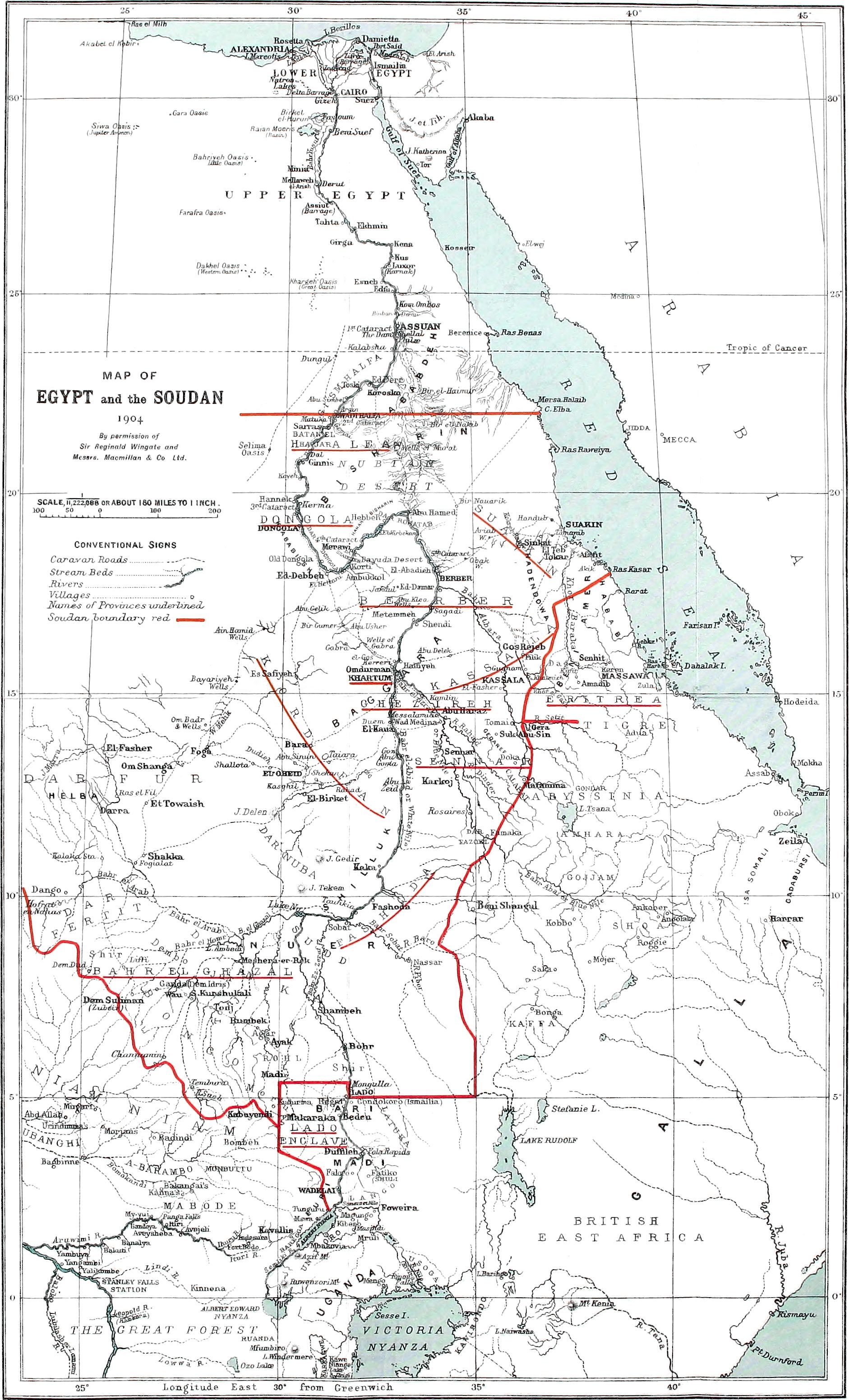
Transport and communications are indeed vastly better than they
were in Egyptian days. The railway from Halfa to Khartoum makes an
all-important difference. It has already given an immense stimulus
to the export trade; without it there would have been quite another
tale to tell of the last five years. But except in the province of
Berber it does not tap any local resources. Great part of it lies
in an uninhabited desert. Every train leaving Halfa has to carry
with it 1,520 cubic feet of water. And there are 200 miles of river
between Halfa and the outer world at Assouan, and then 700 miles
more to the sea. Carriage of goods over such a mileage, with its
necessary transhipments, is a long and costly business, nearly
prohibitive for bulky articles. Coal, for example, is seldom less
than £4 a ton at Khartoum, and often nearer £6. No one who had to
build a railway in the Soudan for commercial purposes only would
think of crossing the desert to Halfa; his first thought would be to
connect Khartoum with the sea-board at Suakin.
There is also the railway from Halfa to Kerma, thirty miles from
Dongola. But this, too, was laid down in haste for military
purposes. It is laid so badly, with such sharp curves and such
steep gradients, owing to the nature of the country, that no heavy
trains can run on it, and with the present rolling-stock an engine
has sometimes to make three or four starts before it can master an
ascent. It is worked at a loss of about £20,000 a year, and it has
become a serious problem whether the money so spent could not be
employed much more advantageously elsewhere, so many are the claims
on the Soudan Exchequer. It would be far better to take up the
whole line, and relay it from Dongola to connect with the main-line
at Abu Hamed. For not only is this a much easier country, but the
southern part of the province, which is the richer, and inhabited
by a more industrious and hard-working population, would be opened
up. But at present no money is forthcoming either for this or for
the complete repair of the existing line. So poor Dongola is in the
tantalizing position of having a railway, and yet not being able to
take full benefit of it. It is actually suffering from a surplus of
foodstuffs, and is a year behindhand in its exports.
The province is famous for its dates; not only is it a great
exporter of the ordinary fruit, but it also produces a golden date,
which is said to be the best in the world, better, even, than the
Algerine date, so well known in Europe. It has also abundance of
irrigable land as good as Upper Egypt, which it very much resembles
in general climatic conditions. As its numerous and interesting
antiquities show, it once supported a very large population; but now a great
deal of land is lying waste, and the population, though increasing
very fast, is still not more than about 100,000. With better
communications its prospects are very good. When Egypt becomes
overcrowded, as it must in time if the present rate of increase is
maintained, Dongola will offer a fair field to Egyptian
immigration. The conditions of life are so similar to those in
Egypt that it cannot fail to be the most attractive part of the
Soudan. Even as things are, owing to the partial advantage afforded
by the railway and facilities of transport by boat-carriage on the
Nile, the trade of the province is increasing. Cotton goods and
luxuries like tea, sugar, coffee, and perfumeries, are the
principal imports, and cereals are exported as well as dates. The
people are wealthier, and anxious to buy such goods as cutlery,
crockery, soap, agricultural implements, and hardware, but
well-to-do traders have not as yet exploited the field, as they
would do if the railway difficulty were solved.
Once Khartoum is connected with the sea by railway, the
principal obstacle in the way of trade will have been removed, and,
fortunately, this is no longer a mere vision of hopeful men.
Practically the railway has already been begun. It will strike
across the desert to the Atbara, crossing the mountains near
Sinkat, and then run along it to join the main-line near where it
crosses that river. If the railway does not come to Berber itself,
Berber will probably travel up the Nile to meet it. Arab towns are
not very difficult to shift. The whole route has been carefully
surveyed, and a good deal has been spent in improving the port of
Suakin. Materials are being rapidly collected. This time careful
preparations are
being made; there will be none of those kaleidoscopic changes of
policy which were so fatal in 1885. It may confidently be expected
that in two or three years’ time there will be something to show
very much more substantial than a tennis-court at Dover built of
much-travelled material, the only result of our former exertions.
For the construction of the line the Government will be its own
contractor. The Soudan Railway Department has a very capable staff,
and they will be able to do the work as efficiently as any outside
contractor, and much more cheaply. It is hoped that as far as
possible native labour may be made use of. It is a hopeful
indication of a change of spirit among the Arabs that the local
sheikhs have agreed to bring their tribesmen to work; the
experiment is worth trying even if it fails. No such thing has ever
happened in the Soudan before.
Meantime Suakin is looking eagerly forward. Its inhabitants have
naturally suffered by the complete diversion of trade to the Nile
Valley route. Very few of them can even afford to repair their
houses, and the town shows signs of decay. Most of the people are
unemployed, and labour is very cheap. There was formerly a good
deal of trade with India and the Red Sea ports, but most of this
has fallen away, and nearly all the Indian merchants who formerly
had their headquarters there have left. But now that the desert
which shuts off the Soudan from the sea is really to be bridged
over, there will be a great change. The one seaport of these
immense territories cannot fail to be a busy and prosperous
place.
Once the new line is completed, the distance from Khartoum to
the sea will be reduced by about two-thirds, to some 450 miles, with a proportionate
reduction in expense of carriage, and it will then be possible to
think of building other feeder lines in various parts of the
Soudan. A branch line to Kassala and on to Gedaref and Gallabat
along the Abyssinian frontier will tap a very rich district and
open up the Abyssinian trade. Possibly in the distant future such a
line may be continued southwards so as to connect with Uganda. In
the recent agreement with Abyssinia, powers have been taken to
build in Abyssinian territory for this purpose. But this is still a
long way outside practical politics. Of far more importance for the
immediate development of the country would be a light railway from
Omdurman or Duem to El Obeid, or across the rich Ghezireh from Duem
to Wad Medani on the Blue Nile, or, again, from near Wad Medani to
Gedaref. Easy communication with the sea will render it possible to
bring the necessary plant into the country at a reasonable cost,
and the experience gained as to material and labour in building the
Suakin line will also be invaluable.
Meanwhile the provincial Governors are doing all they can to
improve the caravan routes and roads. In great part of the Soudan
this is simply a question of increasing the number of wells;
metalled roads are scarcely necessary as yet, outside a few towns.
Wheel traffic is almost non-existent; the camel and the ass are the
great public carriers. It is rather strange that the camel has not
been more used for pulling wheel transport than he has. One camel
can pull three or four times as much as he can carry. All the heavy
machinery of the Nile Valley Gold Mining Company, working in Nubia,
has been transported in this way from the river, a distance of
sixty miles. Rarely a camel may be seen hauling a plough in Egypt.
But there are limits to the use of camels. They cannot breed
successfully south of parallel 13°, and in all the country south of
this the serut fly makes it almost impossible for either them or
horses to live at certain seasons of the year.
Above all, access to the sea will greatly stimulate the use made
of water carriage within the country. In the Nile and its
tributaries the Soudan possesses a system of natural trade-routes
unequalled in Africa for internal commerce. The river traffic,
though already growing, is merely in its infancy. The Government
has a considerable fleet of steam and sailing vessels between Wadi
Halfa and Assouan, and also on the Blue and White Niles. They are
also encouraging an English company which has placed some steamers
and steam-barges on both rivers. On the Blue Nile there is regular
steamer communication with Rosaires, 426 miles from Khartoum,
during high Nile, about six months in the year, and even in low
Nile most of the river is navigable by native boats. On the White
Nile, now that the sudd has been cleared, steamers and native boats
can ply the whole year round up to Gondokoro. In time the Sobat may
prove a very good route for trade with Abyssinia. And the Bahr el
Ghazal, with its network of waters, is in this respect the most
fortunate of all the provinces. Many of its waterways are still
blocked by sudd, but every year the navigation is improving. A
serviceable channel is now available on the Jur River as far as
Wau, and large steamers will eventually be able to get up even much
further than this. The other rivers will in time be opened up. In a country where at
present everything has to be carried on men’s heads, this will be
an extraordinary benefit from every point of view, and if the
province answers at all to its old reputation as one of the most
fertile spots of Africa, it will do very well, in spite of
mosquitoes, serut flies, malaria, guinea worm, and all its other
plagues.
As for the lack of capital both for private enterprise and
public works, that, like the lack of population, can only be cured
by time. Overhasty development could only do harm, even if it were
possible. As trade improves and agriculture develops, the people
will become more wealthy, and the two will react upon each other.
That large sums will be invested by private capitalists or firms is
not to be expected for years to come. But even now an Englishman is
erecting flour-mills at Wad Medani, and if his venture succeeds it
may be followed by others. The Government is doing all in its power
to encourage agriculture by small loans for the purchase of seeds,
water-wheels, and cattle to work them. Perhaps some form of
State-supported Agricultural Bank will be established.
The Soudan is an agricultural country; in that direction alone
can real progress be made, and the progress depends mainly upon
irrigation. Between the Atbara and the Blue Nile, and between the
Blue Nile and the White Nile, there is, as has been pointed out, a
great field for irrigation works on a large scale, but the amount
of crops now grown by direct irrigation is very small. Along the
Blue Nile water-wheels are numerous for the first ten miles above
Khartoum. There used to be 3,000 between Khartoum and Berber, but
in 1898 there were no more than seventy; and though the number
has increased, it has yet nothing like reached the old level. The
same is true of the rest of Berber Province and of Dongola. There
is also a certain amount of irrigation on islands in the White Nile
above Khartoum. When the river is falling, large mud flats appear
in the centre of the stream. To these the people transport their
cattle and belongings; they sow their seed in the mud, build
themselves huts, and set up shadoofs to water the growing crops of
wheat, barley, dhurra, and onions. They begin operations towards
the end of January, and in good soil the crops are harvested by
May.
What perennial irrigation can do is shown by the gardens at
Khartoum, where lemons, figs, oranges, pomegranates, bananas,
vines, and all kinds of vegetables, grow in profusion all the year
round. But at present nearly all the crops are rain crops. The
height to which water has to be raised out of the Blue Nile is too
great for extended irrigation by mere lift. For the first 150 miles
from Khartoum the banks are 26 to 30 feet over the summer level,
and further south 33 to 39 feet, the difference between summer and
flood level being about 23 feet. The soil of the Ghezireh is a rich
alluvial deposit sometimes 150 feet deep. The inhabitants build
small dykes across the general slope of the country so as to
prevent the rain running off too quickly, and sow their seed as
soon as the rain has fallen. The result as described by Sir R.
Wingate a year or two ago is as follows:
‘I recently rode from Wad Medani on the Blue Nile to opposite
Duem on the White Nile, eighty miles across a perfectly flat plain
sown almost throughout its entire length with dhurra, which was standing 6 to
8 feet high. As there is only one crop sown during the short rainy
season, and as this is planted and harvested within a period of
sixty to eighty days, it follows that, if a system of irrigation
were possible in the Ghezireh it would become a huge granary
capable of supplying, not only the whole Soudan, but other
countries as well.’
But, of course, any schemes for utilizing the waters of the Nile
have always to be considered in reference to the prior claims of
Egypt. It is only to Egypt that the Soudan can look for the money
necessary to carry out great works, and, naturally, Egypt would not
allow irrigation to be developed in the Soudan unless her own needs
were amply safeguarded. Whenever Egypt undertakes the great works
contemplated on the Upper Nile, the Soudan will share in the
benefit. That will not be for a long time to come, and meanwhile
the Soudan has opportunity to develop her resources and her
population so as to be able to seize the chance when it comes.
There seems to be no reason, however, why works on a small scale
should not be undertaken, subject always to the question of
expense, to utilize in the Soudan, by means of basin irrigation on
the Blue Nile or the Atbara, some of the flood-water during July,
August and September, which is only an embarrassment to Egypt now
that perennial irrigation is adopted so universally in that
country. It is only in the preceding summer months, when the Nile
is low, that Egypt is forced to watch the proceedings of her
neighbour with such a jealous eye. It would be rash to prophesy
exactly when irrigation works will be undertaken, or what form they
will take; but it is certain that they will come, and when they do,
their effect upon the Soudan will be immense. The subject is of peculiar
interest to England; the lands in question are capable of producing
other crops than cereals, and, as will presently be shown, for none
are they more suitable than for cotton.
Quite apart from any such speculations upon the future, the
external trade of the Soudan is capable of great expansion under
present conditions. An examination of the returns of imports and
exports during the last years before the rebellion is a very useful
guide to the capacities of the country. The figures are taken from
Colonel Stewart’s report.
There are no returns of imports except for the port of Suakin,
but these embrace practically the whole. Of course, a certain
amount came in by the Nile Valley route, just as now a certain
amount comes in by Suakin instead of by the railway. The position
has been practically reversed, and for purposes of comparison it is
fair to take the imports formerly entering the port of Suakin and
those now carried by the railway. The most important item was
cotton goods, which amounted to about 25,000 to 30,000 kantars
annually. Linens were about 200 to 300 kantars, and woollens 100 to
300 kantars. There was also a certain amount of silks and silk
thread and sewing cotton. The Indian trade brought in a good deal
of grain and tobacco. In 1881 the import of Indian rice amounted to
20,000 kantars. Petroleum (6,000 kantars), oil, zinc, copper, and
iron, appear in the list, as well as flour and provisions of
various kinds in large quantities, and candles, boots, and clothes.
The peculiar tastes of the Soudanese in luxuries are reflected in
the large imports of sandal-wood, and scents and perfumery,
especially fish-scent (700 tons, or 15,400 kantars, a year). Both men and women are
particularly fond of strong, greasy scents. In all native
festivities and entertainments these scents are a very prominent
feature, and a native marriage can be smelt a very long way off.
Last, but not least, comes a very peculiar item: in one year no
less than 11,000 dozen umbrellas were imported. There is certainly
enough sunshine in the Soudan, and in parts of it rain also, to
justify a large number of umbrellas, but it is difficult to believe
that 132,000 umbrellas would find a ready sale in the Soudan
to-day. Perhaps the Khalifa particularly disliked the
umbrella-carrying class.
In 1901 the imports of cotton goods had already reached their
former level, amounting to about 28,000 kantars. But the trade is
growing rapidly: in 1902 the imports had risen to 38,000 kantars.
Considering that the population is no more than a third of what it
was in 1881, this is striking testimony of the good effects
produced by just government and a railway. The imports from India
have, of course, fallen away. Scents are far below their former
figure, but the imports of flour and rice have risen; 343 tons of
flour and 43 tons of rice were carried in 1901, and 733 tons of
flour and 108 tons of rice in 1902. Tobacco, oil, and petroleum are
also increasing. There is also a very important article of import
which reflects both the improved purchasing power of the Soudan and
the increased production in Egypt; this is sugar. The railway
carried 1,700 tons in 1901, and nearly 3,000 tons in 1902. Soap,
likewise of Egyptian manufacture, also appears in the returns to
the extent of some 140 tons a year.
As for imports so for exports Suakin was the chief channel of
trade before the rebellion. But a good deal also went by Korosko and the
Nile, principally gum, senna, coffee, and ostrich feathers. An
inappreciable amount, probably, also filtered through to Egypt by
Assouan or Assiout. Far the biggest item of the recorded trade was
gum. The export for three years was—
|
|
Kantars.
|
| 1879 |
144,706 |
| 1880 |
135,646 |
| 1881 |
150,861 |
Next came cotton, cleaned and uncleaned, averaging about 20,000
kantars per annum. Coffee amounted to about 7,000 kantars,
principally from Kassala and the Abyssinian frontier. The Soudan is
a land of strange diseases, but it is also a land of medicines.
Besides tamarinds, as much as 3,300 kantars of senna was exported
in 1880. Ostrich feathers from Kordofan and Darfur came to about
200 kantars, and there was also about half that amount of
guttapercha from the Bahr el Ghazal. Miscellaneous exports included
skins and hides, mother-of-pearl from the coast, mats from Kassala,
and ivory.
To-day gum-arabic is still easily first among the exports. The
best kind of gum is the white gum produced from the gray-barked
acacia, called hashab; there are also inferior kinds called talh,
or latch, produced from the red-barked acacia. The gum is used for
giving a glaze to linens and other woven fabrics, for stiffening
cotton-stuffs and calicoes, and for making sweets and chewing
mixtures. Kordofan is the home of the gum trade; a good deal, but
chiefly the inferior kinds, comes from the forests of Sennar and
Kassala, but nearly all the best white gum comes from Kordofan,
especially the part round Taiara between Duem and El Obeid. Here there are
limitless forests of hashab. The taking of the gum does not
permanently injure the tree, and the only obstacles to its
gathering are the distances to be travelled without water, and the
lack of labour. Every new well means a fresh productive area, and
people migrate temporarily from other parts of the Soudan for the
gum harvest. Most of it is brought down by boat from Duem, some
directly on camels from El Obeid to Khartoum, where it is sorted on
the beach. Of this first-rate white gum the Soudan has practically
a monopoly, and when the Soudan was closed to trade its price went
up enormously. This naturally brought out substitutes: inferior gum
from West Africa came into use, and glucose also took its place.
Still, there was a good demand for it after the re-occupation of
the Soudan, and in 1900 the price was still 65s. per cwt. Since
then the production has gone up by leaps and bounds, but,
unfortunately, this has been accompanied by a great fall in prices,
at one time as low as 27s. 6d. per cwt. The figures of the export
trade are:
|
|
Kantars.
|
| 1899 |
41,963 |
| 1900 |
60,912 |
| 1901 |
170,781 |
| 1902 |
220,000 |
The trade has now far outstripped its former limits. To a young
country, a profit of some £200,000 a year divided between the
merchants and producers on the one side and the Government on the
other by means of royalties and railway receipts is no mean
advantage.
As for the other former exports, the trade in ostrich feathers from Kordofan
and Darfur has begun again, and there seems no reason why it should
not be developed. Ostriches are farmed successfully in Egypt near
Cairo, and the conditions are even more favourable for their
establishment in the Soudan. Nor is it unlikely that the Soudan
will be able to supply a part of her own tobacco and sugar, which
now bulks so largely in the imports. In former days the sugar-cane
was cultivated largely in Dongola and along the Nile in Berber
Province. The fertile plains around Kassala bore crops both of
sugar-cane and tobacco. The district of Fazokhl, beyond Rosaires on
the Blue Nile, used to produce 1,000 kantars of tobacco per year.
It is also found in Fashoda; and in the south-western part of
Kordofan, where the soil is the richest in the province, both
tobacco and sugar-cane grow easily wherever there is water, to say
nothing of the Bahr el Ghazal. The coffee came principally from
that part of the country which has since been taken over by Italy
or Abyssinia, and, though it is grown in Kassala, the trade in it
is not likely to come to very much. This coffee, however, which is
of the Abyssinian kind, and not a first-class coffee, is still
quoted in the London market at about 50s. per cwt.
But the most promising feature in the old returns is the 20,000
kantars of cotton, even though as yet the trade has not revived.
Though the figure is in itself insignificant, it is a proof that
the thing can be done. Cotton is indigenous in the Soudan. It grows
wild in Fashoda, although the native Shilluks seem never to have
taken advantage of this circumstance, preferring to go completely
naked. Most of the former cotton export came from Kassala. The Khor
Gash, a tributary
of the Atbara, comes down in flood during July and August, and
partly inundates the plain, leaving behind a rich alluvial
deposit—splendid cotton soil. There was formerly a cotton factory
in Kassala town. In the districts of Gallabat and Gedaref cotton is
now actually being grown, and it is proving the foundation of
increasing trade with Abyssinia. Abyssinian merchants eagerly buy
up all that can be grown. Further south, in Sennar Province, the
valleys of the Dinder and the Rahad were once very famous for
cotton, which was also largely imported into Abyssinia. Here, too,
the cultivation is increasing as the people settle down. The
district of Tokar, near Suakin, along the Khor Baraka, produces,
perhaps, the best quality of all the cotton in the Soudan. It, too,
in former days produced very much more than now. While along the
Nile itself, in the neighbourhood of Khartoum and in Berber and
Dongola Provinces, enough cotton is grown to supply small local
industries, in which a rough white cloth is woven, one of the few
local manufactures in the Soudan. Beyond a doubt, not only is there
a great deal of land admirably suited to grow cotton in the Soudan,
but also the climatic conditions, given only water, are peculiarly
favourable.
Cotton and its culture are thus no novelties to the inhabitants
of the Soudan. The point is the water; it all comes back to water
and irrigation. If the Soudan is to be of any real interest to the
cotton-spinners of Lancashire, its export must be counted not by a
few paltry tens of thousands of kantars, but by hundreds of
thousands, perhaps by millions. And for that there must be
irrigation works on a large scale. The soil is there in the
Ghezireh and elsewhere, the climate is there, the water is there,
and the irrigation works will come. But once again, there is no
need for hurry. The interests of the whole Valley of the Nile have
to be considered. The undertaking is too large to be gone into
without the utmost care and patient deliberation.
It is eminently satisfactory that the Government is fully alive
to all the possibilities. They have started an experimental farm at
Shendi, where trials are being made of different sorts of cotton,
of different methods of culture, and of different periods of
sowing, as well as calculations of the cost of production and of
carriage to the ginning factories in Egypt. Already some most
interesting and important results have been obtained. It has been
definitely shown that the cotton which is sown in June and July
promises better, both in quality and quantity, than that sown in
the autumn or in March and April. At that time the heat is not so
great, and the river is rising, so that the cultivator gets his
water during the most necessary time at the least cost, because
with the least effort. If this is confirmed, it is extremely
important, for the water will be taken at a time when the Nile is
high, and when, therefore, Egypt can afford to allow it to be used
without suffering in the least degree, apart altogether from new
Reservoir works.
As regards quality, it appears that the cotton grown, if not so
good as the very best kinds of Delta cotton, is at least as good
as, or better than, the best American, both in colour and staple.
It is calculated that at the present time 1 acre producing 4
kantars will produce gross receipts of 1,060 piastres, against an
expenditure of 1,000 piastres, showing a profit of 60 piastres, or
12s. 6d. per acre. But when the new railway has reduced the cost of
fuel for the pumps, and also the cost of carriage, the expenses
will be no more than 700 piastres, showing a profit of 360 piastres
per acre, or 75s. It is estimated that the new railway will reduce
the cost of freight by 50 piastres per kantar, and, wherever the
Soudan has its own ginning factories, the profits will, of course,
be all the greater, because only the prepared product will be
carried. There is at present sufficient local demand for cotton to
make it generally more profitable to sell it on the spot than to
carry it to Egypt, but as the production increases it will soon
outstrip the local demand. Any private capitalist investing money
in cotton in the Soudan would be able to buy and clear land on the
river in Berber or Dongola at from £5 to £6 per acre, so that he
would get a very reasonable return on his investment. He would have
the further advantage that in the Soudan two of the worst cotton
diseases, ‘worm’ and ‘hog,’ are unknown.
Cotton and corn are the two great foundations on which the hopes
of commercial prosperity in the Soudan are founded. The Negro
Soudan is still comparatively unexplored, and its resources cannot
be estimated. There is, however, a chance that the Bahr el Ghazal
will do great things in rubber. Rubber-trees are known to be
plentiful; rubber has already been produced in small quantities,
and specimens of absolutely first-class quality have been obtained.
But it has yet to be shown that the best kind of creepers are
numerous, and also that they can be successfully tapped without
killing the plants. So far, it does not seem likely that the Soudan
has any great sources of wealth underground. Iron is found and
worked in small quantities in the Bahr el Ghazal, and at
least two ore beds
are known in Kordofan, but there is no fuel to work them, and no
means of transporting the ore. As for gold and the precious metals,
several prospecting licenses have been issued and search is being
eagerly made, but, except the copper mines of Hofrat-en-Nahas,
nothing has been discovered at present. The only known gold-bearing
district, the Beni-Shangul, is now included within the territories
of Abyssinia. Gold was formerly worked in this district by the
Egyptians, not at a profit, and perhaps, in any case, it is no
great loss to the Soudan (even if it had not already been occupied
by the Abyssinians), for that gold may not be discovered in the
Soudan is the earnest prayer of every official in the country. The
true wealth of the Soudan, such as it is, lies in its water and its
soil. A find of coal would be a very different matter, and much
more valuable than gold, but, though discoveries are constantly
being rumoured, coal is not yet.
No account of the commerce of the Soudan would be complete
without a mention of those wonderful people the Greek traders.
It is well known how, on the day after the Battle of Omdurman, a
Greek arrived in the town and opened a store with all kinds of
goods brought somehow from Suakin. This man is now a prosperous and
wealthy merchant, with large shops in Khartoum and Halfa, and a
finger in every sort of commercial undertaking. He is no longer
alone in the field. Whether it be true or not that trade follows
the flag, undoubtedly the Greek trader follows the British flag.
They are said to be principally Ionian Islanders, so perhaps they
have a hereditary liking for it. Just as from Alexandria to Halfa
every town in Egypt
has its Greek traders, carrying on business as storekeepers,
dealers, and innkeepers, so, from Halfa to Gondokoro, from Suakin
to El Obeid, every town in the Soudan has its Greeks. They are
ubiquitous; in Khartoum and Omdurman alone they number about 800.
One wonders what they were all doing before the Soudan was open.
Some of them, no doubt, stayed on right through the Khalifa’s
time.
As a vulture scents carrion from afar, so the Greek scents any
possible opening for trade with the natives. The gum trade, the
feather trade, the corn trade, all are in his hands. There is
nothing that a native wants, however humble, from beads and
kerosene-tins to silver, that he will not sell, exactly in the form
required. Naturally a gambler, there is no speculation that he will
not undertake, no risk he will not run. He can stand any climate,
he can live in native huts, and eat native food. He may be
unscrupulous in his dealings, and he has to be sharply watched by
those in authority, but as a trade pioneer in a new country he is
invaluable, and his enterprise contributes largely to make life
possible for more exacting Europeans in desolate places. Some day,
perhaps, when the Arab has mastered his methods of trade, he will
find his match, but at present he holds the field.