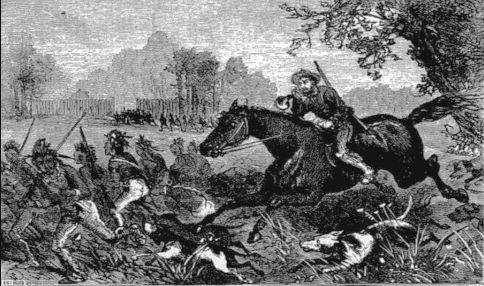
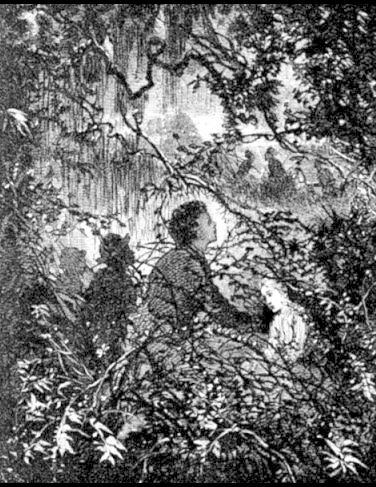
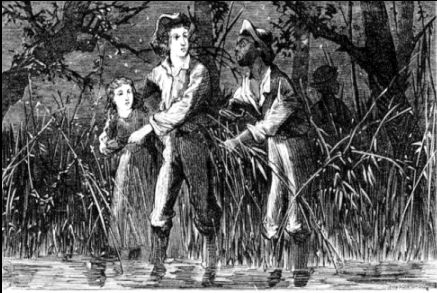
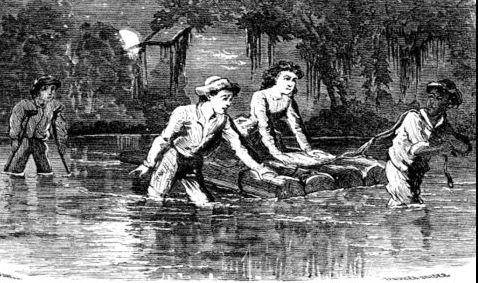
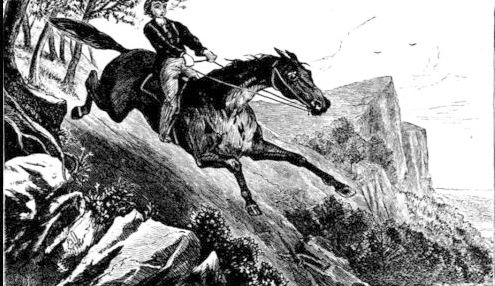
THE BOYS ARE DRIVEN OUT OF THE ROOT FORTRESS.
Sam was only partially conscious during the battle around his
habitation. The fever, which now rose and fell at intervals, was usually
highest during the forenoon, abating somewhat later in the day. When it
was highest he was always in either an unconscious stupor, or a wild
delirium. When the fever abated, however, his consciousness returned,
and he was capable of talking and of understanding all that was said. In
these lucid intervals, he insisted upon knowing all that had happened,
so that he might tell the boys what was best to do. On this day Tom had
a story of more than ordinary interest to tell him, about the battle and
the chance of rescue which had so narrowly passed them. Sam was
interested in it all as a matter of course, but he was still more
deeply interested, it seemed, in the condition of the sand near the
place where he was lying. He had dug a little hole with his hand, and
feeling of the sand found it decidedly wet. Turning to Tom, he said:
"The river is rising rapidly, isn't it?"
"Yes; but how did you find it out?"
"By the sand. I've been watching it a good deal since the fall rains set
in, as I'm afraid the river will drive us out of here. You see, the
water works easily through the sand, and you can always tell what the
level of the river is, if its banks are sandy, by digging down to where
the sand is wet."
"Yes," said Tom, "but the river isn't within a hundred feet of us yet."
"You are mistaken. It is within six inches of us," said Sam.
"How's that?"
"Well, this bank is almost exactly level, and when the river gets above
its edge it spreads at once all over it. Now the sand is wet within six
inches of the top, and the river is within six inches of the edge of the
bank. When it rises six or eight inches more, it'll be in here, and I'm
afraid it will rise that much before morning. At any rate we must be
ready for it."
"What can we do?" asked Tom in alarm. "There's no place to hide on the
upper bank."
"We mustn't quit this bank, and we mustn't quit the drift-pile either,"
replied Sam. "You must find a good place, high up in the drift where, by
pulling out sticks, you and Joe can make a place for us to stay in."
"But, Sam, what if the water gets to us there?"
"It won't get to us there."
"How do you know?"
"Because the biggest freshets always come in the spring, and the top of
this drift-pile was put where it is by the biggest freshets, so the
river won't go near the top in November. You see, as the drift floated
on top of the water to its present place, the top of the pile must be
the highest point, or very nearly the highest, that the water ever
reaches. If you can find a good place therefore in the upper part of the
drift-pile, we shall be safe there. But you'd better see about it at
once, as the water may be in here before morning, and at any rate we
mustn't allow ourselves to be taken by surprise. You'd better go to the
river and set a stake first so you can tell how fast the water rises and
know when to move into the new place."
Tom set his stake at the water's edge and then selected the most
available place he could find for the new abode. He and Joe went
diligently to work, rearranging the loose sticks of drift-wood and even
carrying many of them clear out of the pile, so as to enlarge the hole
they had found and make it as habitable as possible.
"The trouble is," said Tom when they had nearly completed their task,
"that we can't make a smooth floor, and it's going to be rather
uncomfortable lying on loose logs and big round sticks that run every
which way."
"That's my business," said Judie looking in at the entrance. "I'm the
housekeeper, you know, and I've thought of all that."
And sure enough the little woman had brought a great pile of small,
leafy, tree branches and bush tops, with which she speedily filled up
the low places between the timbers, and covered the timbers themselves
to a depth of three or four inches, making a soft as well as a level
floor. She had foreseen the difficulty, and borrowing Sam's knife, had
worked with all her might to provide in advance against it. But the
bushes and leaves were not all that she had brought. She had collected
also a large quantity of gray moss with which to make a carpet for the
springy floor.
"Now please don't tell brother Sam," she said when the boys praised her
thoughtfulness and ingenuity. "I want to surprise him when he comes."
Tom and Joe promised, and Tom said they would have to call her their
"little housekeeper" hereafter.
The river was still rising, but more slowly, it appeared, than it had
done before. By Tom's calculations it was coming up at the rate of an
inch in three hours, wherefore Sam thought they might safely remain
where they were until morning at least, while if the water should come
to a stand during the night, they would have no occasion to move at all,
as a fall would rapidly follow, if the weather should remain clear.
Joe had worked faithfully at the task of preparing the new place of
refuge, but he was not at all satisfied with the arrangement.
"I tell you, Mas' Tom," he said, "wood'll float, 'thout 'tis live oak,
an' dis here drif'-pile 'll jest raise up an' float away, you'll see if
it don't."
"Why hasn't it floated away long ago, then, Joe?" asked Tom.
"May be it has. How you know dis drif' didn't all on it come here las'
time de river was up?"
"Well, there's too much of it for that, and besides, Sam says this place
is safe, and you know he is always right about things when he speaks
positively about them."
"Mas' Tom, don' you know Mas' Sam done been a-talkin' nonsense for two
weeks now?"
"Yes; but that's only when he's out of his head."
"How you know when he's outen his head an' when he ain't?"
"We know he's out of his head when he talks nonsense."
"Well, maybe dis here 's nonsense. I jest knows it is, and dat's how I
know Mas' Sam was outen his head when he said it."
Tom saw that Joe was not to be convinced, and so he contented himself
with saying,
"Well, we'll see."
"Yes, dat's jest it. We will see, and feel too, when we all gets
drownded in de water."
The water came to a stand about midnight, and was falling slowly the
next morning. But when morning came it was raining hard, and the rain
was evidently not a local but a general one, wherefore, Tom feared that
the fall would shortly be changed into a rise, and that the bank would
soon be covered. He watched his stake carefully, visiting it every half
hour. At nine o'clock the river had fallen three inches, and was about
eight inches below the bank. From nine to ten it fell only about half an
inch. Between ten and eleven the fall was not more than a quarter of an
inch. Between eleven and twelve no fall at all was perceptible. From
twelve to one there was a slight rise. Between one and two it rose
nearly an inch. The next hour brought with it a rise of two inches. By
five o'clock the level of the water was barely two inches below the
edge of the bank, and as it was rising at the rate of two or three
inches an hour, Sam thought it time to remove from their old to their
new quarters. The change was of advantage to the sick boy, who was now
getting somewhat better at any rate, and when he found himself in the
new place the interest he showed in examining all the details of its
arrangements, was the best possible evidence of improvement.
"Come here, little woman," he said to Judie, "and give an account of
yourself. You borrowed my knife yesterday, and somebody has been using
it in cutting bush tops to make a smooth floor with, and the idea was a
very good one. Can you tell me who it was?"
"Maybe it was Tom," she replied mischievously.
"No, it was not Tom," Sam answered. "He's too much of a great awkward
boy to think of anything so comfortable. You must guess again."
"Joe, then," she said.
"No, it wasn't Joe, either," said Sam. "Joe can sleep on the edge of a
fence rail as well as anywhere else, and he never would have thought of
making our floor soft and smooth. Guess again."
"Maybe it was brother Sam," said Judie.
"Oh, certainly. It must have been I," replied Sam. "I must have done it.
I'm so strong and active now-a-days. Yes, on reflection, I presume I did
it, and the man in the moon helped me. Now I think it was a very
thoughtful and helpful thing for anybody to do, so you ought to kiss me
for doing it, and when the weather gets clear you must throw a kiss to
the man in the moon, too, for his share." And with that he kissed the
little housekeeper, and she felt herself abundantly repaid for her work
and for the thoughtfulness she had shown. She was never so happy as when
Sam praised her, "because he's such a splendid big brother," she would
explain.
Tom, seeing that Sam was getting better at last, began to hope for his
complete recovery, and the hope made him buoyant of spirit again. Judie,
too, who watched and weighed every symptom in Sam's case, discovered to
her delight that he was decidedly better, and the discovery made her as
happy as a healthy girl well can be. Poor Joe seemed to be the only
miserable one in the party. He said almost nothing, answering questions
with a simple "yes" or "no," and sitting moodily in his corner, when he
stayed inside the "drift cavern"—which was Sam's name for the new
abode—at all. He spent most of his time, however, on top of the pile,
where he watched the water and the clouds. The rain had ceased, but the
river, which was now creeping over the broad bank, continued to rise.
"What is the matter with Joe?" asked Sam after the boy had gone out for
the twentieth time.
"I think he's afraid we're all going to be drowned," said Tom.
"Drowned? How?"
"Well, he says wood will float, and so he thinks when the water comes up
under the drift-pile, it will all float away."
"What nonsense!" exclaimed Sam. "Why didn't you tell him better, Tom?"
"I did; but he sticks to it, and—"
"Well, couldn't you explain it so that he would understand it and not
have to trust to your judgment for it?"
"No, I couldn't. The fact is, I don't quite understand it myself. There
isn't a stick in this whole pile that won't float, and I don't quite
understand why the pile won't. But I don't doubt you're right about it,
Sam. You always are right whether I understand how things are or not."
"Let me explain it to you, then. Do you know why some things float and
others don't?"
"Yes, of course. Because the things that float are lighter than the
things that sink."
"Not exactly. That log there is too heavy for you to lift, while you can
carry a bullet between your thumb and finger. The log is many hundred
times heavier than a bullet, but the log will float while the bullet
will sink always."
"That's so," said Tom, "and I don't know what does make some things
float and other things sink."
"Did you ever set a teacup in the water and see it float?"
"Yes, many a time."
"But if you fill it with water it will sink, won't it?"
"Yes, of course."
"Well, now I can explain the thing to you, I think. If a thing is
heavier,—the whole thing I mean, than the amount of water it
displaces,—that is, if it is heavier than exactly its own bulk of
water, it will sink; but if it is lighter than its own bulk of water it
will float."
"Oh, yes, I see."
"Now a bullet weighs a good deal more than its own bulk of water, and so
it sinks. A log weighs less than its own bulk of water, and so it
floats. An empty teacup weighs less than a solid body of water equal to
it in size, and it therefore floats. If you fill it with water, however,
you increase its weight without adding anything to the amount of water
it displaces,—or rather, as you let water into all the hollow space,
you lessen by that much the amount of water it must displace in sinking
without taking away anything from its weight, and so it sinks; or, if
you break the teacup you lessen the amount of water it must displace
without lessening its weight, and so it sinks in that case, too. Do you
understand that?"
"Yes, I think I do," said Tom; "but I don't exactly see how it applies
to the drift-pile."
"I'll explain that presently. I want to make it plain first that the
ability of a thing to float depends not on its weight, but on its weight
as compared with that of a like bulk of water. This comparative or
relative weight is called specific gravity, and in measuring the
specific gravity of substances water is taken as the standard usually,
though sometimes gold is used for that purpose. Now to come to the
drift-pile. When the water rises say two or three feet, it will be above
the level of the lower logs, and these would float away, if they were
free, because their specific gravity is less than that of water. But
there is twenty feet of other timber on top of them, and its weight must
be added to theirs. The water displaced is exactly equal to their bulk,
while the weight is many hundred times greater than theirs. Do you
understand?"
"Yes, I think I do. You mean that the water must come high enough to
pretty nearly cover the whole drift-pile before any of it can float."
"Yes. The pile must be considered as a whole, and it won't float until
there is water enough to float the whole. The bottom logs can't float
while those above them are clear out of water, if their weight rests on
the bottom logs, as it does in the drift-pile. You see when you put
anything into the water, it sinks until it has displaced a bulk of water
equal to its own weight, and then stops sinking. In other words, that
part of the floating thing which goes under the water is exactly the
size of a body of water equal in weight to the whole thing. If a log
floats with just half of itself above water, you know that the log
weighs exactly the same as half its own bulk of water, or, in other
words, that its specific gravity is just half that of water. Water two
inches deep won't float a great saw-log, because a great saw-log weighs
more than the amount of water it takes to cover its lower part two or
three inches deep; and water two or three feet deep won't float a
drift-pile twenty feet high, because such a drift-pile weighs a good
deal more than a body of water two or three feet deep, of its own length
and width. But even if the water were to rise to the top of the hammock,
the pile wouldn't float away. It would float, of course, and some of the
wood near its edges would be carried away, but the main pile would
remain here, because it is all tangled together and can't go away except
in one great mass. It is so firmly lodged against the trees as to
prevent that, and as a freshet big enough to cover, or nearly cover it,
would bring down a great quantity of new drift and deposit it here, the
pile would grow bigger rather than smaller. But the river won't get very
high at this season, or at any rate it won't rise to anywhere near the
top of the hammock, as I have already explained to you, because it is
evidently only the biggest freshets that ever come near the top, and the
biggest freshets never come in the fall, but always in the spring. It
isn't rising fast enough either. It isn't rising nearly so fast now as
it was before it got over the bank."
"Why, how do you know that, Sam? You haven't been to look."
"No, but I know it, nevertheless, simply because I know that water, left
to itself, will find its level."
"I don't see what that's got to do with it," said Tom.
"Perhaps not, but it has something to do with it for all that," replied
Sam; "and I can make you see how, too."
He paused, to think the matter over and determine how to present it to
Tom's comprehension.
"You see," he then resumed, "that the river inside its banks is about
four hundred yards wide. When it rises above the banks, however, it
spreads out over the level ground, and becomes, in some places, many
miles wide, averaging a mile at least in width. Now there is only a
certain amount of water coming into the river every hour. The rain has
stopped, but the soil is full of water, and so there is about as much
running into the river now as there was while the rain lasted. But the
surface of the stream is now many times greater than it was, and as
water finds its level, all that comes into the river spreads out over
its whole surface, and of course doesn't raise its level nearly so much
as the same quantity did while the stream was still within its banks. Do
you understand now?"
"What a great big brother you are, Sam, anyhow!" was all the reply Tom
made.