You all know Theodore. I have come to strew some flowers upon his grave,
praying heaven that the earth may touch him lightly.
These two familiar phrases will tell you plainly that I am about to
consecrate some pages to him as an obituary notice or funeral oration.
It is twenty years since Theodore retired from the world, to work or to
be idle: which of the two was a great secret. He dreamed, and no one
knew what he dreamed about. He passed his life surrounded by books, and
occupied himself with nothing else, which gave some people the idea that
he was writing a book which would supersede all other books; but they
were evidently mistaken.
Theodore had studied too much not to know that this book had been
written three hundred years ago. It was the thirteenth chapter of the
first book of Rabelais.
Theodore no longer talked, nor laughed, neither played cards or gambled,
nor ate, no longer went to balls or to the theatre. The women whom he
had loved in his youth no longer attracted him, or at most he looked
only at their feet; and when some elegant and brilliantly colored
footgear caught his attention, alas! he would say, heaving a sigh from
the depths of his chest, there is a great waste of good morocco! He had
formerly followed the fashions. Those who remember the time, tell us
that he was the first to tie his cravat on the left side,
notwithstanding the dictum of Garat, who tied his on the right, and in
spite of the common herd, who still continue to tie theirs in the
middle.
Theodore was no longer worried by the fashions. He had only one dispute
with his tailor during twenty years: “Sir,” he said to him one day, “it
will be the last coat I shall take from you, if you again forget to make
my pockets in quarto.”
Politics, by whose vagaries so many fools have made their fortunes, had
never tempted him from his reveries for more than a moment. Politics
put him in a bad temper. After Napoleon’s futile enterprise in the
North, which raised the price of russia leather, he welcomed the French
intervention in the Spanish revolution. “This,” he said, “is a good
chance to bring chivalric romances and the Cancioneros from the
Peninsula.” But the expeditionary army did not think of it, and he was
vexed. When any one said Trocadero to him, he would reply ironically,
Romancero, which made him pass for a Liberal.
M. de Bourmont’s campaign on the African coast transported him with joy.
“Thank heaven!” he said, rubbing his hands; “we shall have cheap levant
morocco.” This made him pass for a Carlist.
He was walking one summer’s day in a crowded street, collating a book,
when some men, who were coming with a staggering gait from a saloon,
commanded him, knife at throat, to cry in the name
of liberty, “Long live the Poles!” “I ask nothing better,” said
Theodore, whose perpetual thought was an eternal cry in favor of the
human race; “but may I ask why?” “Because we declare war against
Holland, who oppresses Poland under the pretext that they do not like
the Jesuits,” replied the friend of light, who was a rude geographer and
a fearless logician. “God forgive us!” muttered our friend, crossing his
hands piteously. “Shall we not in this case be obliged to use M.
Montgolfier’s imitation Holland paper?”
The product of modern civilization answered by breaking Theodore’s leg
with a blow of his stick.
Theodore stayed in his bed for three months, examining book-catalogues.
Always disposed to carry his feelings to extremes, this reading fevered
his blood.
Even in his convalescence his sleep was horribly uneasy. One night his
wife roused him from the tortures of the nightmare. “You came just in
time,” he said, embracing her, “to save me from dying of grief and fear.
I was surrounded by monsters who would give me no quarter.”
“What monsters do you dread, my dear?” she said,—“you who have never
injured any one.”
“It was, if I remember rightly, the ghost of Purgold whose fatal shears
devoured an inch and a half of the margins of my uncut Aldus, while the
shade of Heudier pitilessly plunged my most beautiful editio princeps
into a devouring acid, withdrawing it entirely bleached; but I have
good reason to think that they are at least both in purgatory.”
His wife thought that he was talking Greek, because he knew a little
Greek, and as a proof of his knowledge three shelves in his library were
filled with Greek books with uncut leaves. He never opened them either,
but was satisfied to show them by the side or back to his most intimate
acquaintances, telling with calm assurance the place where they were
printed, the date, and the printer’s name. The simple-minded considered
him a sorcerer. But about this there is a difference of opinion.
As he was wasting away under their very eyes, his family called in a
physician, who was both a philosopher and a man of intelligence.
You will discover if this was the case. This physician saw that
congestion of the brain was imminent, and made an elaborate report of
this disease in the “Journal des Sciences Médicales,” where it figures
under the name of morocco monomania or bibliomaniac’s typhus; but it was
not a question for the Academy of Sciences, because the illness was in
conjunction with cholera morbus.
They advised him to take exercise; and, as the idea amused him, we
started out early one day, for I could not trust him to go a step alone.
We turned toward the quays, and I was rejoicing because I thought that
the sight of the river would revive him; but he never took his eyes from
the level of the parapets. They were as free from show-cases as if they
had been visited early in the morning by the public censor, who in
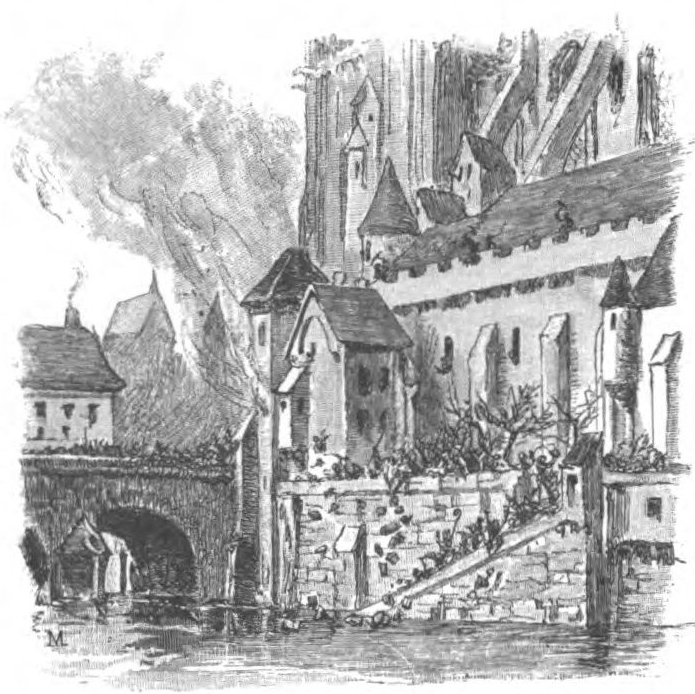
February had sent the archiepiscopal library in swimming.[4] We were
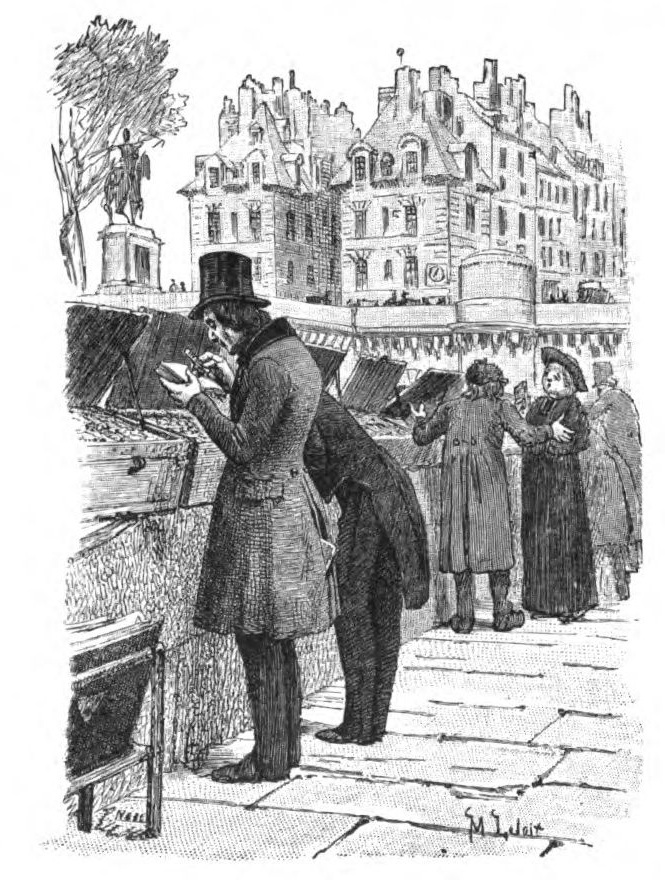
more fortunate at the Quai aux Fleurs, where books were in profusion.
But what books! All the works which the newspapers had puffed during the
last month, and which had gone from the
publisher’s office, or the bookseller, into the ten-cent box. Authors of
every kind and sort, philosophers, historians, poets, novelists, who
could not be wafted to immortality by the most alluring advertisements,
and whose works go unheeded from the shelves of the store to the banks
of the Seine, a deep Lethe, where they contemplate, while decaying, the
certain end of their presumptive flight. I turned over there the pages
of some of my octavos, which were placed between those of five or six of
my friends.
Theodore sighed, but it was not because he saw the works of my brain
exposed to the rain, owing to the scanty protection of an oil-cloth
cover.
“What has become of the golden age of the outdoor venders of old books?
It was here, certainly, that my famous friend Barbier collected his
treasures until he was able to make a precise bibliography of several
thousand items. It was here that Monmerqué, on his way to the Palais,
and wise Labouderie, while leaving the city, walked for hours with
instruction and profit. It was from here that old Boulard carried away
daily a yard of rarities, measuring them with his surveyor’s
cane,—volumes for which there was no place reserved in his six houses
stuffed with books. How often on such occasions had he desired the
modest angulus[5] of Horace, or the elastic cover of the fairies’
tent, which if necessary could shield the whole army of Xerxes, and
which might be carried as easily in one’s belt as the knife-sheath of
Jeannot’s grandfather. Now, more’s the pity, you see only fragments of
modern literature which will never become ancient, whose life will have
evaporated in twenty-four hours, like that of the flies of the river
Hypanis: a literature worthy in truth of the charcoal ink and pulp paper
used by mercenary printers, who are almost as foolish as the books. It
is profaning the name of books to give it to these black-blotted rags,
whose destinies have not even changed in leaving the basket on the
rag-picker’s shoulders. The quays henceforth are the morgue for
contemporary celebrities.”
He sighed again, and I sighed too, but it was for a different reason.
I was in a hurry to lead him away, because his increasing excitement
seemed to threaten him at any moment with a fatal attack. It must have
been an unlucky day, for everything combined to increase his melancholy.
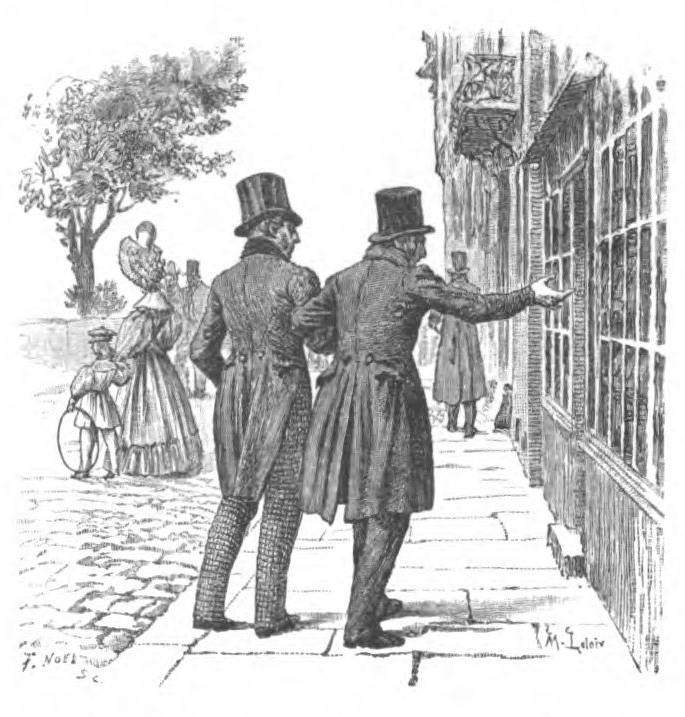
“See,” he said, in passing the showy shop-front of Ladvocat, “the
Galliot du Pré[6] of the debased literature of the nineteenth
century; a liberal, industrious bookseller, who deserved to have been
born in a better time, but whose deplorable activity has cruelly
multiplied new books, to the everlasting injury of the old; an
unpardonable patron of cotton-made paper, of incorrect spelling, and of
stilted illustrations; a fatal protector of academic prose and
fashionable poetry: as if France had produced any poetry since Ronsard,
or any prose after Montaigne! This bookseller’s palace is like the
Trojan horse that held the thieves of the Palladium—like Pandora’s box,
which let loose all the evils of the earth. But yet I like this
cannibal, and I shall be a chapter in his book, but I shall not see him
again!”
“Look,” he continued, “there is Crozet’s store with the green walls. He
is the most agreeable of our young booksellers, the man of all Paris who
can best distinguish between a binding by Derome the elder and Derome
the younger, and the last hope of a passing generation of amateurs, if
the cult of old books should return in the midst of our barbarity. But I
shall not enjoy his conversation to-day, even though I always learn
something from it. He is in England, where he is competing, by the right
of retaliation, with the greedy usurers of Soho Square and Fleet Street
for the precious fragments of the monuments of our beautiful language
which have been forgotten for two centuries on the ungrateful soil that
produced them. Macte animo, generoso puer!...”
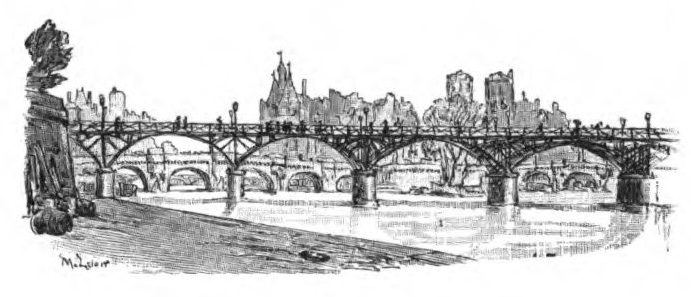
“Here,” he said, retracing his steps,—“here is the Pont-des-Arts, with
its useless side-rails only a few centimeters wide, affording no support
for the noble folios of three centuries, majestic volumes with pigskin
covers and bronze clasps, which have delighted the eyes of ten
generations. This is truly an emblematic bridge, leading from the Palais
to the Institute by a path which is not the path of science. I do not
know whether I am mistaken, but the invention of a bridge of this kind
should be a startling illustration to the erudite of the decadence of
good literature.”
“There,” said Theodore, passing the white sign of an active and
ingenious bookseller in the Place du Louvre, “that sign has made my
heart palpitate for a long time; but I no longer see it without a
sensation of pain, since Techener has reprinted with Tastu’s characters,
on showy paper, and under an enticing cover, the gothic marvels of Jehan
Bonfons of Paris, Jehan Mareschal of Lyons, and Jehan de Chaney of
Avignon, unobtainable trifles until he produced them in delightful
facsimile. Snow-white paper fills me with horror, my friend; and there
is nothing that I like less, except this same paper when it has received
from the stroke of a cruel pressman, the deplorable imprint of the
visions and idiocies of this iron age.”
Theodore sighed more frequently, and was rapidly growing worse.
We thus came in the Rue des Bons-Enfants, to the literary bazaar where
Silvestre held his auction sales. It was a place honored by learned men,
which has seen more priceless curios during a quarter of a century than
the library of the Ptolemies ever held (which library perhaps was not
burned by Omar, whatever our twaddling historians may say). I had never
seen so many splendid books on exhibition.
“Unfortunate people who have to sell them,” I said to Theodore.
“They are dead,” he said, “or it would kill them.”
But the hall was empty. No one was to be seen except the indefatigable
M. Thour, who was patiently cataloguing upon cards the titles of the
books which had escaped his notice the previous day. The happiest among
all men is he who has at his command, and accurately arranged, a
faithful transcription of the title-pages of all known books. It is
nothing to him if all the productions of printing are destroyed in the
next revolution which the perfection of progress promises us. He can
leave to posterity the complete catalogue of the universal library. He
would have admirable forethought in seeing from afar the necessity for
compiling this inventory of civilization. A few years more, and
civilization will be no longer spoken about.
“God forgive me, Theodore,” said Silvestre; “you have mistaken the day.
Those books that you see were sold yesterday in the last session, and
are waiting for the porter to deliver them.” Theodore reeled and turned
pale. His face assumed the tint of old citron morocco. I felt the blow
that had struck him, to the bottom of my own heart.
“It is no matter,” he said, with an altered manner. “I recognize only my
usual ill luck in this bad news. But to whom do these things belong,
these pearls and diamonds, these wonderful riches in which the
libraries of de Thou and Grolier would have gloried?”
“As usual, sir,” Silvestre answered, “these original editions of the
classics, these perfect old copies with the autographs of celebrated
scholars, these piquant philological curiosities, of which academy and
university have never heard, rightfully revert to Richard Heber.[7] It
is the British lion’s share, to whom we are willing to surrender, with
good grace, the Greek and Latin classics which we have ceased to
understand. These fine collections of natural history, these
masterpieces of workmanship and pictorial art, belong to Prince ——, who
uses his studious tastes to still further enhance his great fortune.
These mysteries of the middle ages, these phœnix-like precepts whose
counterpart[8] is no longer in existence, these curious dramatic
attempts of our ancestors, will swell the model library of M. de
Soleine. These well-preserved facetiæ, so strikingly subtle and
enjoyable, have been purchased by your friend M. Aimé-Martin. I need not
tell you to whom these fresh, brilliant morocco bindings belong, with
the triple fillets, wide dentelle, and sumptuous panels. He is the
Shakespeare among the minor collectors, the Corneille of melodrama, the
graceful and often eloquent interpreter of the feelings and virtues of
the populace, who, after having depreciated the value of books in the
morning, bought them for their weight in gold in the evening, not,
however, without grinding his teeth like a mortally wounded boar, and
turning a tragic eye, veiled by black eyebrows, upon his rivals.”
Theodore had ceased to listen. He was handling a beautiful volume that
he
hurriedly measured with his Elzevirometer, a six-inch measure divided
almost to infinity, by which he regulated the price, and, alas! the
intrinsic merit also, of his books. He measured the accursed book ten
times and as many times verified the troublesome calculation, muttered
some words that I did not understand, finally changed color, and
fainted in my arms. I had great difficulty in getting him into a passing
carriage.
For a long time my attempts to learn the cause of his sudden grief were
futile. He did not speak. He did not hear my words. It is the typhus
fever, I thought, and the crisis of the fever.
I held him in my arms. I continued to question him. At last he spoke.
“You see in me,” he said, “the most unhappy of men. That book is the
1676 Virgil, on large paper, of which I thought that I had the best
example known, and yet this is taller than mine, by the third of a
line.[9] Prejudiced or spiteful minds might even call it half a line. A
third of a line, good God!”
I was confounded. I saw that the delirium was increasing.
“A third of a line,” he repeated, shaking his fist furiously in the air
like Ajax or Capaneus. All my limbs trembled.
He gradually fell into a state of deep depression.
The poor man lived only to suffer. He repeated from time to time, “The
third of a line!” and wrung his hands, while I kept saying, in an
undertone, “Confusion to books and typhus fever!”
“Calm yourself, my friend,” I whispered gently in his ear, each time the
paroxysm was renewed. “A third of a line is not much, even in the most
particular things of life.”
“Not much?” he cried; “a third of a line in the 1676 Virgil! It was the
third of a line that raised the price of the Nerli Homer at M. de
Cotte’s[10] a hundred louis. A third of a line! Ah! would you count the
third of a line nothing in the length of a dagger that pierced your
heart?”
His expression again wholly changed, his arms became rigid, his legs
were seized with cramps as in a vise. The typhus was visibly reaching
the extremities. I did not desire to lengthen by even the third of a
line the short distance that separated us from the house.
At last we arrived there.
“A third of a line,” he said to the concierge.
“A third of a line,” he said to the cook, who opened the door.
“A third of a line,” he said to his wife, with a flood of tears.
“My parrot has flown away!” cried his little girl, likewise weeping.
“Why did you leave the cage open?” replied Theodore. “A third of a
line!”
“There is an uprising in the South and in the Rue du Cadran,” said the
old aunt, who was reading the evening paper.
“What the devil are the people meddling with?” answered Theodore. “A
third of a line!”
“Your farm at la Beauce has been burned,” said his servant in putting
him to bed.
“It must be rebuilt,” said Theodore, “if it is worth the trouble. A
third of a line!”
“Do you think that this is serious?” the nurse asked me.
“Your question proves, my good woman, that you have not read the
‘Journal des Sciences Médicales.’ Why do you delay in getting a priest?”
Happily at that minute the curé came in to converse, as was his custom,
about the thousand and one literary and bibliographical trifles from
which his breviary had not wholly distracted him; but he forgot them all
when he felt Theodore’s pulse.
“Alas! my child,” he said, “the life of man is only a journey, and even
the world itself is not set upon everlasting foundations. It must end
like everything that has a beginning.”
“Have you read, on this subject,” said Theodore, “the ‘Treatise on the
World, its Origin and its Antiquity’?”
“I learned all that I know from the book of Genesis,” said the
conservative pastor; “but I have heard it said that M. de Mirabeau, a
sophist of the last century, had written a book upon this subject.”
“Sub judice lis est,” Theodore interrupted brusquely. “I have proved
in my ‘Stromates’ that the first two parts of ‘Le Monde’ were by that
dreadfully pedantic Mirabeau, and the third was by the Abbé Lemascrier.”
“Ah! my goodness,” said the old aunt, taking off her spectacles; “then
who was it that made America?”
“This is not the question now,” continued the abbé. “Do you believe in
the Trinity?”
“How could I disbelieve the famous volume of Servetus, ‘De Trinitate,’”
said Theodore, half raising himself on his pillow, “when I have seen an
example go, ipsissimis oculis, for the trifling sum of two hundred and
fifteen francs at the MacCarthy sale, while at the dispersal of the La
Vallière collection it brought seven hundred?”[11]
“We are straying from the point,” exclaimed the priest, a little
disconcerted. “I wish to know, my son, what you think of the divinity of
Jesus Christ.”
“Well!” said Theodore, “it depends upon what you mean by it. I shall
maintain against every one that the ‘Toldos-Jeschu,’ which was written
by that ignorant railler Voltaire, who wasted on it a lot of foolish
fables worthy of the ‘Thousand and One Nights,’ is nothing but evil
rabbinesque nonsense, unworthy to be placed in the library of a
scholar.”
“That is well!” sighed the worthy ecclesiastic.
“At least,” Theodore continued, “unless some one should discover the
large-paper copy, of which there is a hint, if my memory serves me, in
the bibliographic jumble of David Clement.”[12]
The curé groaned audibly, and, rising from his chair, bent over Theodore
to make him clearly understand, without ambiguity or equivocation, that
he was in the last stage of the bibliomaniac’s typhus which is spoken of
in the “Journal des Sciences Médicales,” and that he should not think of
anything but his salvation.
Theodore had never intrenched himself behind that insolent negation of
unbelievers which is the science of fools; but the dear man had pushed
the useless study of the letter, in books, too far to comprehend the
spirit. In a perfect state of health a doctrine of any kind would give
him a fever, or a dogma induce lockjaw. In a theological matter he would
have lowered his colors before a Saint-Simonian. He turned his face to
the wall.
A long time passed without a word, and we should have thought that he
was dead, except as I bent close to him I heard him murmur feebly, “A
third of a line! God of goodness and justice! but where will you give me
back that third of a line, and how far can your omnipotence retrieve the
irreparable error of that binder?”
One of his friends, a bibliophile, came in a minute later. They told him
that Theodore was in the last agony; that he was delirious to the point
of thinking that the Abbé Lemascrier had made the third part of the
world; and that he had lost his power of speech a quarter of an hour
before.
“I am going to make sure of it,” said the amateur. “By what mistake in
pagination do we recognize the genuine 1635 Elzevir edition of Cæsar?”
he asked Theodore.
“153 for 149.”
“Very good. And of the Terence of the same year?”
“108 for 104.”
“The devil!” I said; “the Elzevirs played in bad luck with their figures
that year. They were wise not to choose it for the printing of their
logarithms.”
“Wonderful!” continued Theodore’s friend. “If I had listened to these
people here, I should have believed that you were at the point of
death.”
“A third of a line,” replied Theodore, whose voice was failing by
degrees.
“I know your story, but it is nothing in comparison with mine. Think
what I lost, eight days ago, in one of those bastard, nameless sales
which are advertised only by a placard on the door,—a Boccaccio of
1527,[13] as beautiful as your own, the binding of Venetian vellum,
with the pointed a’s proved throughout, and not a leaf repaired.”
All Theodore’s faculties concentrated in one idea.
“Are you very sure that the a’s were pointed?”
“As pointed as the iron tip of a lancer’s halberd.”
“It was then, doubtless, the ‘Vintisettine’ itself.”
“Its very self. We had a jolly dinner that day: charming women, fresh
oysters, intelligent people, and champagne. I reached the sale three
minutes after the hammer fell.”
“Sir,” cried Theodore in a fury, “when the ‘Vintisettine’ is to be sold,
one does not dine!”
His vitality, which had been sustained by the excitement of the
conversation, as the bellows revives a dying spark, was exhausted by
his last effort. His lips muttered once more, “A third of a line!” but
they were his last words.
At the time that we gave up all hope of his recovery, we moved his bed
near to his book-shelves, from which we took down, one by one, every
book for which he seemed to ask with his eyes, letting him look the
longest at those that we thought would please him the most.
He died at midnight, lying between a Du Seuil and a Padeloup, his hands
lovingly clasping a Thouvenin.
The next day we followed his hearse, at the head of a great crowd of
sorrowful morocco-finishers, and we sealed his tomb with a stone bearing
the following inscription, which he had parodied for himself from
Franklin’s epitaph:
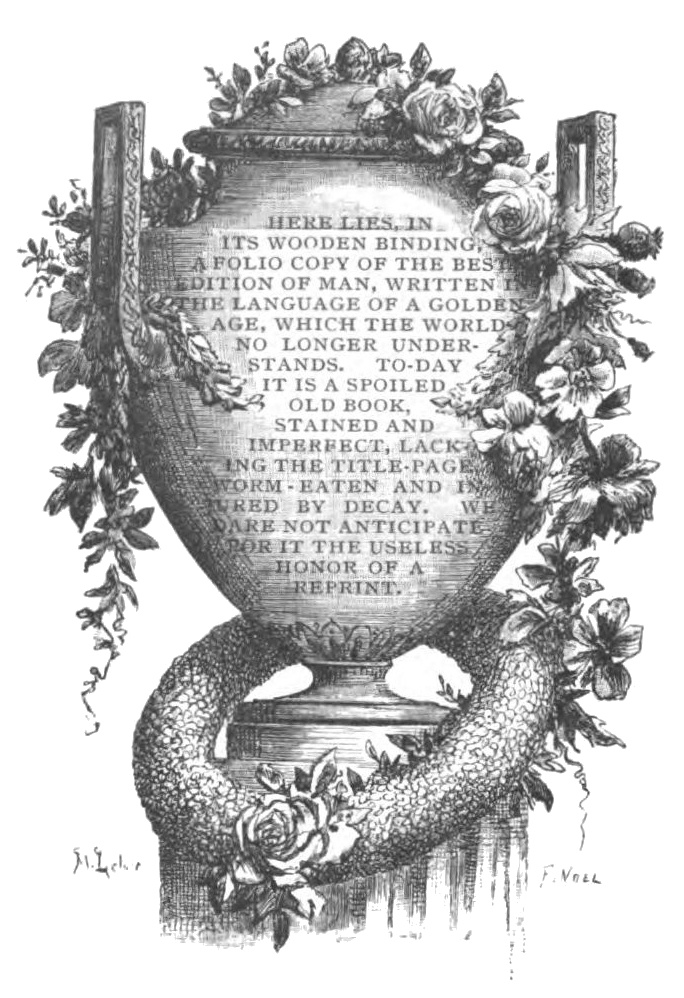
HERE LIES, IN
ITS WOODEN BINDING,
A FOLIO COPY OF THE BEST
EDITION OF MAN, WRITTEN IN
THE LANGUAGE OF A GOLDEN
AGE, WHICH THE WORLD
NO LONGER UNDERSTANDS.
TO-DAY
IT IS A SPOILED
OLD BOOK,
STAINED AND
IMPERFECT, LACKING THE TITLE-PAGE,
WORM-EATEN AND INJURED
BY DECAY. WE
DARE NOT ANTICIPATE
FOR IT THE USELESS
HONOR OF A
REPRINT.