Engraving is one of the fine arts, and in this
beautiful family has been the especial handmaiden
of painting. Another sister is now coming forward to
join this service, lending to it the charm of color. If, in
our day, the "chromo" can do more than engraving, it
cannot impair the value of the early masters. With them
there is no rivalry or competition. Historically, as well
as æsthetically, they will be masters always.
Everybody knows something of engraving, as of printing,
with which it was associated in origin. School-books,
illustrated papers, and shop windows are the ordinary opportunities
open to all. But while creating a transient
interest, or, perhaps, quickening the taste, they furnish
little with regard to the art itself, especially in other days.
And yet, looking at an engraving, like looking at a book,
may be the beginning of a new pleasure and a new study.
Each person has his own story. Mine is simple. Suffering
from continued prostration, disabling me from the
ordinary activities of life, I turned to engravings for employment
and pastime. With the invaluable assistance
of that devoted connoisseur, the late Dr. Thies, I went
through the Gray collection at Cambridge, enjoying it like
a picture-gallery. Other collections in our country were
examined also. Then, in Paris, while undergoing severe
medical treatment, my daily medicine for weeks was the
vast cabinet of engravings, then called Imperial, now National,
counted by the million, where was everything to
please or instruct. Thinking of those kindly portfolios, I
make this record of gratitude, as to benefactors. Perhaps
some other invalid, seeking occupation without burden,
may find in them the solace that I did. Happily, it
is not necessary to visit Paris for the purpose. Other collections,
on a smaller scale, will furnish the same remedy.
In any considerable collection, portraits occupy an important
place. Their multitude may be inferred when I
mention that, in one series of portfolios, in the Paris cabinet,
I counted no less than forty-seven portraits of Franklin
and forty-three of Lafayette, with an equal number of
Washington, while all the early Presidents were numerously
represented. But, in this large company, there are
very few possessing artistic value. The great portraits of
modern times constitute a very short list, like the great
poems or histories, and it is the same with engravings as
with pictures. Sir Joshua Reynolds, explaining the difference
between an historical painter and a portrait-painter,
remarks that the former "paints men in general, a portrait-painter
a particular man, and consequently a defective
model."[1] A portrait, therefore, may be an accurate
presentment of its subject without æsthetic value.
But here, as in other things, genius exercises its accustomed
sway without limitation. Even the difficulties of a
"defective model" did not prevent Raffaelle, Titian, Rembrandt,
Rubens, Velasquez, or Vandyck from producing
portraits precious in the history of art. It would be easy
to mention heads by Raffaelle, yielding in value to only
two or three of his larger masterpieces, like the Dresden
Madonna. Charles the Fifth stooped to pick up the pencil
of Titian, saying "it becomes Cæsar to serve Titian!"
True enough; but this unprecedented compliment from
the imperial successor of Charlemagne attests the glory of
the portrait-painter. The female figures of Titian, so much
admired under the names of Flora, La Bella, his daughter,
his mistress, and even his Venus, were portraits from life.
Rembrandt turned from his great triumphs in his own
peculiar school to portraits of unwonted power; so also
did Rubens, showing that in this department his universality
of conquest was not arrested. To these must be
added Velasquez and Vandyck, each of infinite genius, who
won fame especially as portrait-painters. And what other
title has Sir Joshua himself?
Historical pictures are often collections of portraits
arranged so as to illustrate an important event. Such is
the famous Peace of Münster, by Terburg, just presentedSuyderhoef.
by a liberal Englishman to the National Gallery at London.
Here are the plenipotentiaries of Holland, Spain,
and Austria, uniting in the great treaty which constitutes
an epoch in the Law of Nations. The engraving by Suyderhoef
is rare and interesting. Similar in character is
the Death of Chatham, by Copley, where the illustrious
statesman is surrounded by the peers he had been addressing—every
one a portrait. To this list must be added
the pictures by Trumbull in the Rotunda of the Capitol
at Washington, especially the Declaration of Independence,
in which Thackeray took a sincere interest. Standing
before these, the author and artist said to me, "These
are the best pictures in the country," and he proceeded to
remark on their honesty and fidelity; but doubtless their
real value is in their portraits.
Unquestionably the finest assemblage of portraits anywhere
is that of the artists occupying two halls in the gallery
at Florence, being autographs contributed by the
masters themselves. Here is Raffaelle, with chestnut-brown
hair, and dark eyes full of sensibility, painted when
he was twenty-three, and known by the engraving of
Forster—Julio Romano, in black and red chalk on paper,—Massaccio,
called the father of painting, much admired—Leonardo
da Vinci, beautiful and grand,—Titian,
rich and splendid,—Pietro Perugino, remarkable
for execution and expression,—Albert Dürer, rigid but
masterly,—Gerhard Dow, finished according to his own
exacting style,—and Reynolds, with fresh English face;
but these are only examples of this incomparable collection,
which was begun as far back as the Cardinal Leopold
de Medici, and has been happily continued to the present
time. Here are the lions, painted by themselves, except,
perhaps, the foremost of all, Michael Angelo, whose
portrait seems the work of another. The impression
from this collection is confirmed by that of any group of
historic artists. Their portraits excel those of statesmen,
soldiers, or divines, as is easily seen by engravings accessible
to all. The engraved heads in Arnold Houbraken's
biographies of the Dutch and Flemish painters, in three
volumes, are a family of rare beauty.[2]
The relation of engraving to painting is often discussed;
but nobody has treated it with more knowledge or sentiment
than the consummate engraver Longhi in his interesting
work, La Calcografia.[3] Dwelling on the general
aid it renders to the lovers of art, he claims for it greater
merit in "publishing and immortalizing the portraits of
eminent men for the example of the present and future
generations;" and, "better than any other art, serving as
the vehicle for the most extended and remote propagation
of deserved celebrity." Even great monuments in porphyry
and bronze are less durable than these light and
fragile impressions subject to all the chances of wind,
water, and fire, but prevailing by their numbers where the
mass succumbs. In other words, it is with engravings as
with books; nor is this the only resemblance between
them. According to Longhi, an engraving is not a copy
or imitation, as is sometimes insisted, but a translation.
The engraver translates into another language, where light
and shade supply the place of colors. The duplication of
a book in the same language is a copy, and so is the
duplication of a picture in the same material. Evidently
an engraving is not a copy; it does not reproduce the
original picture, except in drawing and expression; nor is
it a mere imitation, but, as Bryant's Homer and Longfellow's
Dante are presentations of the great originals in
another language, so is the engraving a presentation of
painting in another material which is like another language.
Thus does the engraver vindicate his art. But nobody
can examine a choice print without feeling that it has a
merit of its own different from any picture, and inferior
only to a good picture. A work of Raffaelle, or any of
the great masters, is better in an engraving of Longhi or
Morghen than in any ordinary copy, and would probably
cost more in the market. A good engraving is an undoubted
work of art, but this cannot be said of many
pictures, which, like Peter Pindar's razors, seem made
to sell.
Much that belongs to the painter belongs also to the
engraver, who must have the same knowledge of contours,
the same power of expression, the same sense of beauty,
and the same ability in drawing with sureness of sight as
if, according to Michael Angelo, he had "a pair of compasses
in his eyes." These qualities in a high degree
make the artist, whether painter or engraver, naturally
excelling in portraits. But choice portraits are less numerous
in engraving than in painting, for the reason, that
painting does not always find a successful translator.
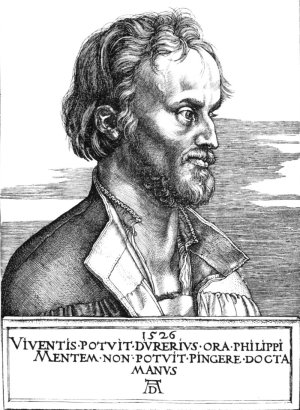
PHILIP MELANCTHON.
(Engraved by Albert Dürer from his own Design.)
The earliest engraved portraits which attract attention
are by Albert Dürer, who engraved his own work, translating
himself. His eminence as painter was continued asDürer.
engraver. Here he surpassed his predecessors, Martin
Schoen in Germany, and Mantegna in Italy, so that Longhi
does not hesitate to say that he was the first who carried
the art from infancy in which he found it to a condition
not far from flourishing adolescence. But, while recognizing
his great place in the history of engraving, it is
impossible not to see that he is often hard and constrained,
if not unfinished. His portrait of Erasmus is justly
famous, and is conspicuous among the prints exhibited
in the British Museum. It is dated 1526, two years before
the death of Dürer, and has helped to extend the
fame of the universal scholar and approved man of letters,
who in his own age filled a sphere not unlike that of
Voltaire in a later century. There is another portrait of
Erasmus by Holbein, often repeated, so that two great
artists have contributed to his renown. That by Dürer
is admired. The general fineness of touch, with the accessories
of books and flowers, shows the care in its execution;
but it wants expression, and the hands are far
from graceful.
Another most interesting portrait by Dürer, executed
in the same year with the Erasmus, is Philip Melancthon,
the St. John of the Reformation, sometimes called the
teacher of Germany. Luther, while speaking of himself
as rough, boisterous, stormy, and altogether warlike, says,
"but Master Philippus comes along softly and gently,
sowing and watering with joy according to the rich gifts
which God has bestowed upon him." At the date of the
print he was twenty-nine years of age, and the countenance
shows the mild reformer.
Agostino Caracci, of the Bolognese family, memorable
in art, added to considerable success as painter undoubted
triumphs as engraver. His prints are numerous, and manyCaracci.
are regarded with favor; but out of the long list not one
is so sure of that longevity allotted to art as his portrait of
Titian, which bears date 1587, eleven years after the death
of the latter. Over it is the inscription, Titiani Vicellii
Pictoris celeberrimi ac famosissimi vera effigies, to which
is added beneath, Cujus nomen orbis continere non valet!
Although founded on originals by Titian himself, it was
probably designed by the remarkable engraver. It is very
like, and yet unlike the familiar portrait of which we have
a recent engraving by Mandel, from a repetition in the
gallery of Berlin. Looking at it, we are reminded of the
terms by which Vasari described the great painter, guidicioso,
bello e stupendo. Such a head, with such visible
power, justifies these words, or at least makes us believe
them entirely applicable. It is bold, broad, strong, and
instinct with life.
This print, like the Erasmus of Dürer, is among those
selected for exhibition at the British Museum, and it deserves
the honor. Though only paper with black lines,
it is, by the genius of the artist, as good as a picture. In
all engraving nothing is better.
Contemporary with Caracci was Hendrik Goltzius, at
Harlem, excellent as painter, but, like the Italian, pre-eminent
as engraver. His prints show mastery of the art,Goltzius.
making something like an epoch in its history. His unwearied
skill in the use of the burin appears in a tradition
gathered by Longhi from Wille, that, having commenced
a line, he carried it to the end without once stopping,
while the long and bright threads of copper turned up
were brushed aside by his flowing beard, which at the end
of a day's labor so shone in the light of a candle that his
companions nicknamed him "the man with the golden
beard." There are prints by him which shine more than
his beard. Among his masterpieces is the portrait of his
instructor, Theodore Coernhert, engraver, poet, musician,
and vindicator of his country, and author of the
national air, "William of Orange," whose passion for
liberty did not prevent him from giving to the world
translations of Cicero's Offices and Seneca's Treatise on
Beneficence. But that of the ENGRAVER HIMSELF, as large
as life, is one of the most important in the art. Among
the numerous prints by Goltzius, these two will always be
conspicuous.
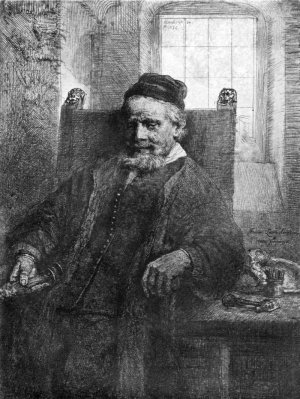
JAN LUTMA.
(Etched by Rembrandt from his own Design.)
In Holland Goltzius had eminent successors. Among
these were Paul Pontius, designer and engraver, whose
portrait of Rubens is of great life and beauty, and Rembrandt,Pontius.
who was not less masterly in engraving than in
painting, as appears sufficiently in his portraits of the Burgomaster
Six, the two Coppenols, the Advocate Tolling,Rembrandt.
the goldsmith Lutma, all showing singular facility and
originality. Contemporary with Rembrandt was Cornelis
Visscher, also designer and engraver, whose portraits wereVisscher.
unsurpassed in boldness and picturesque effect. At least
one authority has accorded to this artist the palm of engraving,
hailing him as Corypheus of the art. Among
his successful portraits is that of a Cat; but all yield to
what are known as the Great Beards, being the portraits
of William de Ryck, an ophthalmist at Amsterdam, and
of Gellius de Bouma, the Zutphen ecclesiastic. The latter
is especially famous. In harmony with the beard is
the heavy face, seventy-seven years old, showing the fulness
of long-continued potation, and hands like the face,
original and powerful, if not beautiful.
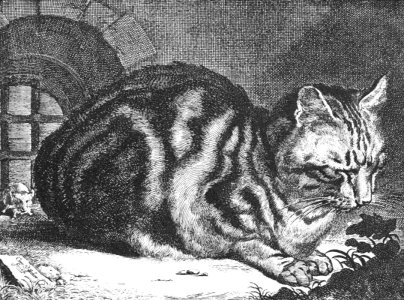
THE SLEEPING CAT.
(Engraved by Cornelis Visscher from his own Design.)
In contrast with Visscher was his companion Vandyck,
who painted portraits with constant beauty and carried
into etching the same Virgilian taste and skill. His aquafortisVandyck.
was not less gentle than his pencil. Among his
etched portraits I would select that of Snyders, the animal
painter, as extremely beautiful. M. Renouvier, in his
learned and elaborate work, Des Types et des Maniéres
des Maîtres Graveurs, though usually moderate in praise,
speaks of these sketches as "possessing a boldness and
delicacy which charm, being taken, at the height of his
genius, by the painter who knew the best how to idealize
the painting of portraits."
Such are illustrative instances from Germany, Italy, and
Holland. As yet, power rather than beauty presided,
unless in the etchings of Vandyck. But the reign of
Louis XIV. was beginning to assert a supremacy in engraving
as in literature. The great school of French engravers
which appeared at this time brought the art to a
splendid perfection, which many think has not been
equalled since, so that Masson, Nanteuil, Edelinck, and
Drevet may claim fellowship in genius with their immortal
contemporaries, Corneille, Racine, La Fontaine,
and Molière.
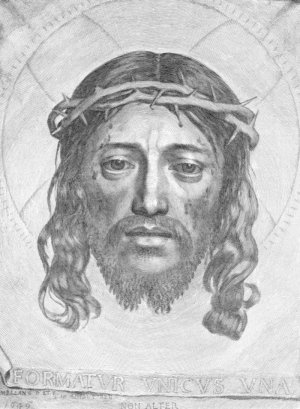
THE SUDARIUM OF ST. VERONICA.
(Engraved by Claude Mellan from his own Design.)
The school was opened by Claude Mellan, more known
as engraver than painter, and also author of most of the
designs he engraved. His life, beginning with the sixteenthMellan.
century, was protracted beyond ninety years, not without
signal honor, for his name appears among the "Illustrious
Men" of France, in the beautiful volumes of Perrault,
which is also a homage to the art he practiced. One of
his works, for a long time much admired, was described
by this author:
"It is a Christ's head, designed and shaded, with his crown of thorns and
the blood that gushes forth from all parts, by one single stroke, which, beginning
at the tip of the nose, and so still circling on, forms most exactly everything
that is represented in this plate, only by the different thickness of the
stroke, which, according as it is more or less swelling, makes the eyes, nose,
mouth, cheeks, hair, blood, and thorns; the whole so well represented and with
such expressions of pain and affliction, that nothing is more dolorous or touching."[4]
This print is known as the Sudarium of St. Veronica.
Longhi records that it was thought at the time "inimitable,"
and was praised "to the skies;" but people think differently
now. At best it is a curiosity among portraits. A
traveler reported some time ago that it was the sole print
on the walls of the room occupied by the director of the
Imperial Cabinet of Engravings at St. Petersburgh.
Morin was a contemporary of Mellan, and less famous
at the time. His style of engraving was peculiar, being a
mixture of strokes and dots, but so harmonized as to produceMorin.
a pleasing effect. One of the best engraved portraits
in the history of the art is his Cardinal Bentivoglio; but
here he translated Vandyck, whose picture is among his
best. A fine impression of this print is a choice possession.
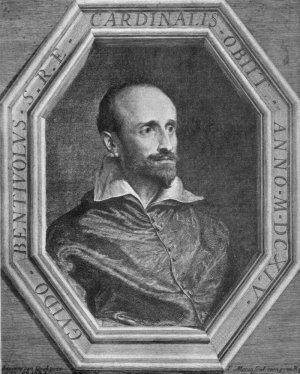
CARDINAL BENTIVOGLIO.
(Painted by Anthony Van Dyck, and Engraved by Jean Morin.)
Among French masters Antoine Masson is conspicuous
for brilliant hardihood of style, which, though failing in
taste, is powerful in effect. Metal, armor, velvet, feather,Masson.
seem as if painted. He is also most successful in the
treatment of hair. His immense skill made him welcome
difficulties, as if to show his ability in overcoming them.
His print of Henri de Lorraine, Comte d'Harcourt,
known as Cadet à la Perle, from the pearl in the ear, with
the date 1667, is often placed at the head of engraved portraits,
although not particularly pleasing or interesting. The
vigorous countenance is aided by the gleam and sheen of
the various substances entering into the costume. Less
powerful, but having a charm of its own, is that of Brisacier,
known as the Gray-haired Man, executed in 1664.
The remarkable representation of hair in this print has
been a model for artists, especially for Longhi, who recounts
that he copied it in his head of Washington. Somewhat
similar is the head of Charrier, the criminal judge at Lyons.
Though inferior in hair, it surpasses the other in expression.
Nanteuil was an artist of different character, being to
Masson as Vandyck to Visscher, with less of vigor than
beauty. His original genius was refined by classical studies,Nanteuil.
and quickened by diligence. Though dying at the age of
forty-eight, he had executed as many as two hundred and
eighty plates, nearly all portraits. The favor he enjoyed
during life was not diminished with time. His works illustrate
the reign of Louis XIV., and are still admired.
Among these are portraits of the King, Annie of Austria,
John Baptiste van Steenberghen, the Advocate-General
of Holland, a heavy Dutchman, François de la Motte
Le Vayer, a fine and delicate work, Turenne, Colbert,
Lamoignon, the poet Loret, Maridat de Serrière, Louise-Marie
de Gonzague, Louis Hesselin, Christine of Sweden—all
masterpieces; but above these is the Pompone de
Bellièvre, foremost among his masterpieces, and a chief
masterpiece of art, being, in the judgment of more than
one connoisseur, the most beautiful engraved portrait that
exists. That excellent authority, Dr. Thies, who knew engraving
more thoroughly and sympathetically than any
person I remember in our country, said in a letter to myself,
as long ago as March, 1858:
"When I call Nanteuil's Pompone the handsomest engraved portrait, I express
a conviction to which I came when I studied all the remarkable engraved portraits
at the royal cabinet of engravings at Dresden, and at the large and exquisite collection
there of the late King of Saxony, and in which I was confirmed or perhaps,
to which I was led, by the director of the two establishments, the late Professor
Frenzel."
And after describing this head, the learned connoisseur
proceeds:—
"There is an air of refinement, vornehmheit, round the mouth and nose as in
no other engraving. Color and life shine through the skin, and the lips appear
red."
It is bold, perhaps, thus to exalt a single portrait, giving
to it the palm of Venus; nor do I know that it is entirely
proper to classify portraits according to beauty. In
disputing about beauty, we are too often lost in the variety
of individual tastes, and yet each person knows when he
is touched. In proportion as multitudes are touched,
there must be merit. As in music a simple heart-melody
is often more effective than any triumph over difficulties,
or bravura of manner, so in engraving the sense of the
beautiful may prevail over all else, and this is the case with
the Pompone, although there are portraits by others showing
higher art.
No doubt there have been as handsome men, whose
portraits were engraved, but not so well. I know not if
Pompone was what would be called a handsome man,
although his air is noble and his countenance bright. But
among portraits more boldly, delicately, or elaborately
engraved, there are very few to contest the palm of beauty.
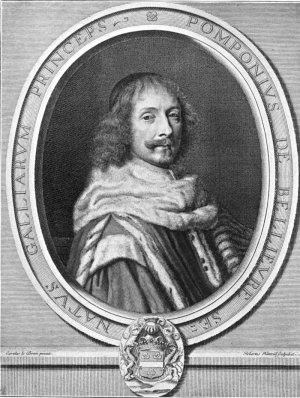
POMPONE DE BELLIÈVRE.
(Painted by Charles Le Brun, and Engraved by Robert Nanteuil.)
And who is this handsome man to whom the engraver
has given a lease of fame? Son, nephew, and grandson of
eminent magistrates, high in the nobility of the robe, with
two grandfathers chancellors of France, himself at the
head of the magistry of France, first President of Parliament
according to inscription on the engraving, Senatus
Franciæ Princeps, ambassador to Italy, Holland, and England,
charged in the latter country by Cardinal Mazarin
with the impossible duty of making peace between the
Long Parliament and Charles the First, and at his death,
great benefactor of the General Hospital of Paris, bestowing
upon it riches and the very bed on which he died.
Such is the simple catalogue, and yet it is all forgotten.
A Funeral Panegyric pronounced at his death, now before
me in the original pamphlet of the time,[5] testifies to
more than family or office. In himself he was much, and
not of those who, according to the saying of St. Bernard,
give out smoke rather than light. Pure glory and innocent
riches were his, which were more precious in the sight
of good men, and he showed himself incorruptible, and
not to be bought at any price. It were easy for him to
have turned a deluge of wealth into his house; but he
knew that gifts insensibly corrupt,—that the specious pretext
of gratitude is the snare in which the greatest souls
allow themselves to be caught,—that a man covered with
favors has difficulty in setting himself against injustice in
all its forms, and that a magistrate divided between a
sense of obligations received and the care of the public
interest, which he ought always to promote, is a paralytic
magistrate, a magistrate deprived of a moiety of himself.
So spoke the preacher, while he portrayed a charity tender
and prompt for the wretched, a vehemence just and inflexible
to the dishonest and wicked, with a sweetness noble
and beneficent for all; dwelling also on his countenance,
which had not that severe and sour austerity that
renders justice to the good only with regret, and to the
guilty only with anger; then on his pleasant and gracious
address, his intellectual and charming conversation, his
ready and judicious replies, his agreeable and intelligent
silence, his refusals, which were well received and obliging;
while, amidst all the pomp and splendor accompanying
him, there shone in his eyes a certain air of humanity and
majesty, which secured for him, and for justice itself, love
as well as respect. His benefactions were constant. Not
content with giving only his own, he gave with a beautiful
manner still more rare. He could not abide beauty of
intelligence without goodness of soul, and he preferred
always the poor, having for them not only compassion but
a sort of reverence. He knew that the way to take the
poison from riches was to make them tasted by those
who had them not. The sentiment of Christian charity
for the poor, who were to him in the place of children,
was his last thought, as witness especially the General
Hospital endowed by him, and presented by the preacher
as the greatest and most illustrious work ever undertaken
by charity the most heroic.
Thus lived and died the splendid Pompone de Bellièvre,
with no other children than his works. Celebrated at the
time by a Funeral Panegyric now forgotten, and placed
among the Illustrious Men of France in a work remembered
only for its engraved portraits, his famous life
shrinks, in the voluminous Biographie Universelle of
Michaud, to the seventh part of a single page, and in the
later Biographie Généralle of Didot disappears entirely.
History forgets to mention him. But the lofty magistrate,
ambassador, and benefactor, founder of a great
hospital, cannot be entirely lost from sight so long as his
portrait by Nanteuil holds a place in art.
Younger than Nanteuil by ten years, Gérard Edelinck
excelled him in genuine mastery. Born at Antwerp, he
became French by adoption, occupying apartments in theEdelinck.
Gobelins, and enjoying a pension from Louis XIV.
Longhi says that he is the engraver whose works, not only
according to his own judgment, but that of the most
intelligent, deserve the first place among exemplars, and
he attributes to him all perfections in highest degree, design,
chiaro-oscuro, ærial perspective, local tints, softness,
lightness, variety, in short everything which can enter into
the most exact representation of the true and beautiful
without the aid of color. Others may have surpassed him
in particular things, but, according to the Italian teacher,
he remains by common consent "the prince of engraving."
Another critic calls him "king."
It requires no remarkable knowledge to recognize his
great merits. Evidently he is a master, exercising sway
with absolute art, and without attempts to bribe the eye
by special effects of light, as on metal or satin. Among
his conspicuous productions is the Tent of Darius, a large
engraving on two sheets, after Le Brun, where the family
of the Persian monarch prostrate themselves before Alexander,
who approaches with Hephæstion. There is also
a Holy Family, after Raffaelle, and the Battle of the
Standard, after Leonardo da Vinci; but these are less interesting
than his numerous portraits, among which that
of Philippe de Champaigne is the chief masterpiece; but
there are others of signal merit, including especially that
of Madame Heliot, or La Belle Religieuse, a beautiful
French coquette praying before a crucifix; Martin van
der Bogaert, a sculptor; Frederic Léonard, printer to
the king; Mouton, the Lute-player; Martinus Dilgerus,
with a venerable beard white with age; Jules Hardouin
Mansart, the architect; also a portrait of Pompone de
Bellièvre which will be found among the prints of Perrault's
Illustrious Men.
The Philippe de Champaigne is the head of that eminent
French artist after a painting by himself, and it contests
the palm with the Pompone. Mr. Marsh, who is an
authority, prefers it. Dr. Thies, who places the latter
first in beauty, is constrained to allow that the other is
"superior as a work of the graver," being executed with
all the resources of the art in its chastest form. The enthusiasm
of Longhi finds expression in unusual praise:
"The work which goes the most to my blood, and with regard to which Edelinck,
with good reason, congratulated himself, is the portrait of Champaigne. I shall die before
I cease to contemplate it with wonder always new. Here is seen how he was equally
great as designer and engraver."[6]
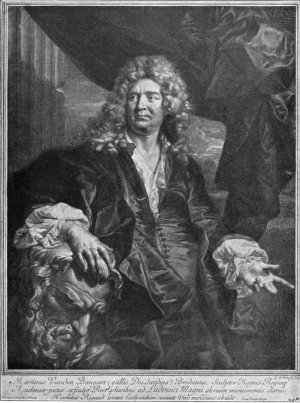
MARTIN VAN DER BOGAERT.
(Painted by Hyacinthe Rigaud, and Engraved by Gérard Edelinck.)
And he then dwells on various details; the skin, the
flesh, the eyes living and seeing, the moistened lips, the
chin covered with a beard unshaven for a few days, and
the hair in all its forms.
Between the rival portraits by Nanteuil and Edelinck
it is unnecessary to decide. Each is beautiful. In looking
at them we recognize anew the transient honors of public
service. The present fame of Champaigne surpasses that
of Pompone. The artist outlives the magistrate. But
does not the poet tell us that "the artist never dies?"
As Edelinck passed from the scene, the family of
Drevet appeared, especially the son, Pierre Imbert Drevet,
born in 1697, who developed a rare excellence, improvingDrevet.
even upon the technics of his predecessor, and gilding his
refined gold. The son was born engraver, for at the age
of thirteen he produced an engraving of exceeding merit.
He manifested a singular skill in rendering different substances,
like Masson, by the effect of light, and at the
same time gave to flesh a softness and transparency which
remain unsurpassed. To these he added great richness in
picturing costumes and drapery, especially in lace.
He was eminently a portrait engraver, which I must insist
is the highest form of the art, as the human face is
the most important object for its exercise. Less clear and
simple than Nanteuil, and less severe than Edelinck, he
gave to the face individuality of character, and made his
works conspicuous in art. If there was excess in the accessories,
it was before the age of Sartor Resartus, and he
only followed the prevailing style in the popular paintings
of Hyacinthe Rigaud. Art in all its forms had become
florid, if not meretricious, and Drevet was a representative
of his age.
Among his works are important masterpieces. I name
only Bossuet, the famed eagle of Meaux; Samuel Bernard,
the rich Councillor of State; Fénelon, the persuasive
teacher and writer; Cardinal Dubois, the unprincipled
minister, and the favorite of the Regent of France;
and Adrienne Le Couvreur, the beautiful and unfortunate
actress, linked in love with the Marshal Saxe. The portrait
of Bossuet has everything to attract and charm. There
stands the powerful defender of the Catholic Church,
master of French style, and most renowned pulpit orator
of France, in episcopal robes, with abundant lace, which is
the perpetual envy of the fair who look at this transcendent
effort. The ermine of Dubois is exquisite, but the
general effect of this portrait does not compare with the
Bossuet, next to which, in fascination, I put the Adrienne.
At her death the actress could not be buried in consecrated
ground; but through art she has the perpetual companionship
of the greatest bishop of France.
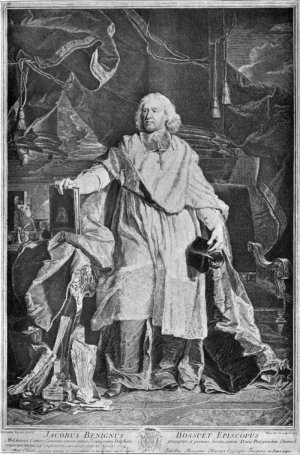
JACQUES BÉNIGNE BOSSUET, BISHOP OF MEAUX.
(Painted by Hyacinthe Rigaud, and Engraved by Pierre Imbert Drevet.)
With the younger Drevet closed the classical period of
portraits in engraving, as just before had closed the Augustan
age of French literature. Louis XIV. decreedBalechou.
engraving a fine art, and established an academy for its
cultivation. Pride and ostentation in the king and theBeauvarlet.
great aristocracy created a demand which the genius of the
age supplied. The heights that had been reached could
not be maintained. There were eminent engravers still;
but the zenith had been passed. Balechou, who belonged
to the reign of Louis XV., and Beauvarlet, whose life was
protracted beyond the reign of terror, both produced portraits
of merit. The former is noted for a certain clearness
and brilliancy, but with a hardness, as of brass or marble,
and without entire accuracy of design; the latter has much
softness of manner. They were the best artists of France
at the time; but none of their portraits are famous. To
these may be added another contemporary artist, without
predecessor or successor, Stephen Ficquet, unduly disparagedFicquet.
in one of the dictionaries as "a reputable French
engraver," but undoubtedly remarkable for small portraits,
not unlike miniatures, of exquisite finish. Among these
the rarest and most admired are La Fontaine, Madame
de Maintenon, Rubens and Vandyck.
Two other engravers belong to this intermediate period,
though not French in origin: Georg F. Schmidt, born
at Berlin, 1712, and Johann Georg Wille, born in the smallSchmidt.
town of Königsberg, in the Grand Duchy of Hesse-Darmstadt,
1717, but attracted to Paris, they became the greatest
engravers of the time. Their work is French, andWille.
they are the natural development of that classical school.
Schmidt was the son of a poor weaver, and lost six
precious years as a soldier in the artillery at Berlin. Owing
to the smallness of his size he was at length dismissed,Schmidt.
when he surrendered to a natural talent for engraving.
Arriving at Strasburg, on his way to Paris, he fell in with
Wille, a wandering gunsmith, who joined him in his journey,
and eventually, in his studies. The productions of
Schmidt show ability, originality, and variety, rather than
taste. His numerous portraits are excellent, being free
and life-like, while the accessories of embroidery and
drapery are rendered with effect. As an etcher he ranks
next after Rembrandt. Of his portraits executed with the
graver, that of the Empress Elizabeth of Russia is usually
called the most important, perhaps on account of the imperial
theme, and next those of Count Rassamowsky,
Count Esterhazy, and De Mounsey, which he engraved
while in St. Petersburgh, where he was called by the
Empress, founding there the Academy of Engraving. But
his real masterpieces are unquestionably Pierre Mignard
and Latour, French painters, the latter represented laughing.
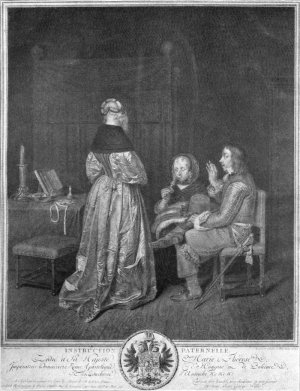
L'INSTRUCTION PATERNELLE, (THE "SATIN GOWN.")
(Painted by Gerard Terburg, and Engraved by Johann Georg Wille.)
Wille lived to old age, not dying till 1808. During
this long life he was active in the art to which he inclined
naturally. His mastership of the graver was perfect,Wille.
lending itself especially to the representation of satin and
metal, although less happy with flesh. His Satin Gown,
or L'Instruction Paternelle, after Terburg, and Les Musiciens
Ambulans, after Dietrich, are always admired.
Nothing of the kind in engraving is finer. His style was
adapted to pictures of the Dutch school, and to portraits
with rich surroundings. Of the latter the principal are
Comte de Saint-Florentin, Poisson Marquis de Marigny,
John de Boullongne, and the Cardinal de Tencin.
Especially eminent was Wille as a teacher. Under his
influence the art assumed a new life, so that he became
father of the modern school. His scholars spread everywhere,Bervic.
and among them are acknowledged masters. He
was teacher of Bervic, whose portrait of Louis XVI. in hisToschi.
coronation robes is of a high order, himself teacher of the
Italian Toschi, who, after an eminent career, died as late
as 1858; also teacher of Tardieu, himself teacher of the
brilliant Desnoyers, whose portrait of the Emperor Napoleon
in his Coronation Robes is the fit complement toDesnoyers.
that of Louis XVI.; also teacher of the German, J. G.
von Müller, himself father and teacher of J. Frederick vonMüller.
Müller, engraver of the Sistine Madonna, in a plate whose
great fame is not above its merit; also teacher of the ItalianVangelisti.
Vangelisti, himself teacher of the unsurpassed Longhi,
in whose school were Anderloni and Jesi. Thus not onlyAnderloni
and Jesi.
by his works, but by his famous scholars, did the humble
gunsmith gain sway in art.
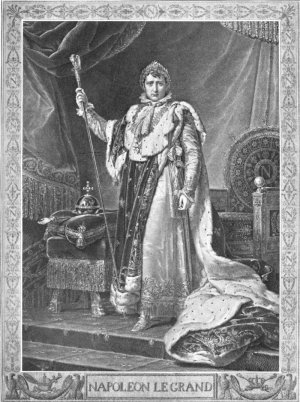
NAPOLEON I.
(Painted by François Gérard, and Engraved by Auguste Boucher Desnoyers.)
Among portraits by this school deserving especial mention
is that of King Jerome of Westphalia, brother of Napoleon,
by the two Müllers, where the genius of the artist
is most conspicuous, although the subject contributes
little. As in the case of the Palace of the Sun, described
by Ovid, Materiam superabat opus. This work is a beautiful
example of skill in representation of fur and lace, not
yielding even to Drevet.
Longhi was a universal master, and his portraits are
only parts of his work. That of Washington, which is
rare, is evidently founded on Stuart's painting, but afterLonghi.
a design of his own, which is now in the possession of the
Swiss Consul at Venice. The artist felicitated himself on
the hair, which is modelled after the French masters.[7]
The portraits of Michael Angelo, and of Dandolo, the
venerable Doge of Venice, are admired; so also is the
Napoleon, as King of Italy, with the iron crown and
finest lace. But his chief portrait is that of Eugene
Beauharnais, Viceroy of Italy, full length, remarkable
for plume in the cap, which is finished with surpassing
skill.
Contemporary with Longhi was another Italian engraver
of widely extended fame, who was not the product
of the French school, Raffaelle Morghen, born at FlorenceMorghen.
in 1758. His works have enjoyed a popularity beyond
those of other masters, partly from the interest of their
subjects, and partly from their soft and captivating style,
although they do not possess the graceful power of Nanteuil
and Edelinck, and are without variety. He was
scholar and son-in-law of Volpato, of Rome; himself
scholar of Wagner, of Venice, whose homely round faces
were not high models in art. The Aurora, of Guido, and
the Last Supper, of Leonardo da Vinci, stand high in engraving,
especially the latter, which occupied Morghen
three years. Of his two hundred and one works, no less
than seventy-three are portraits, among which are the Italian
poets Dante, Petrarch, Ariosto, Tasso, also Boccaccio,
and a head called Raffaelle, but supposed to be that
of Bendo Altoviti, the great painter's friend, and especially
the Duke of Mencada on horseback, after Vandyck, which
has received warm praise. But none of his portraits is
calculated to give greater pleasure than that of Leonardo
da Vinci, which may vie in beauty even with the famous
Pompone. Here is the beauty of years and of serene intelligence.
Looking at that tranquil countenance, it is
easy to imagine the large and various capacities which
made him not only painter, but sculptor, architect, musician,
poet, discoverer, philosopher, even predecessor of
Galileo and Bacon. Such a character deserves the immortality
of art. Happily an old Venetian engraving
reproduced in our day,[8] enables us to see this same
countenance at an earlier period of life, with sparkle in
the eye.
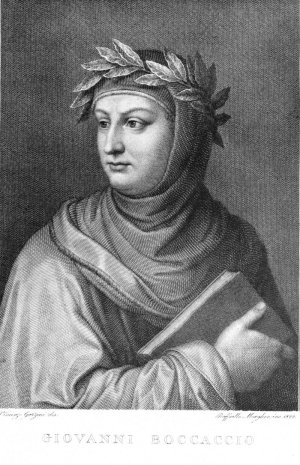
GIOVANNI BOCCACCIO
Firenze presso Luigi Bardi e C'Borgo degli Albizzi No 460
Raffaelle Morghen left no scholars who have followed
him in portraits; but his own works are still regarded,
and a monument in Santa Croce, the Westminster Abbey
of Florence, places him among the mighty dead of
Italy.
Thus far nothing has been said of English engravers.
Here, as in art generally, England seems removed from
the rest of the world; Et penitus toto divisos orbe Britannos.
But though beyond the sphere of Continental art, the
island of Shakespeare was not inhospitable to some of its
representatives. Vandyck, Rubens, Sir Peter Lely, and
Sir Godfrey Kneller, all Dutch artists, painted the portraits
of Englishmen, and engraving was first illustrated by foreigners.
Jacob Houbraken, another Dutch artist, born in
1698, was employed to execute portraits for Birch's
"Heads of Illustrious Persons of Great Britain," publishedHoubraken
at London in 1743, and in these works may be seen
the æsthetic taste inherited from his father, author of the
biography of Dutch artists, and improved by study of the
French masters. Although without great force or originality
of manner, many of these have positive beauty. I
would name especially the Sir Walter Raleigh and John
Dryden.
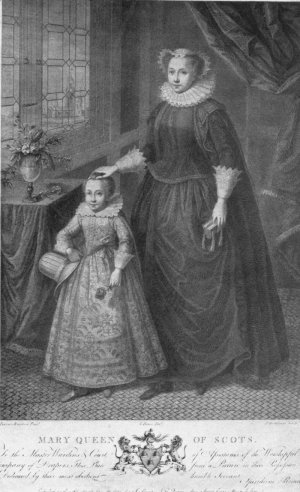
MARY QUEEN OF SCOTS.
(Painted by Federigo Zuccaro, and Engraved by Francesco Bartolozzi.)
Different in style was Bartolozzi, the Italian, who made
his home in England for forty years, ending in 1807, when
he removed to Lisbon. The considerable genius which heBartolozzi.
possessed was spoilt by haste in execution, superseding
that care which is an essential condition of art. Hence
sameness in his work and indifference to the picture he
copied. Longhi speaks of him as "most unfaithful to
his archetypes," and, "whatever the originals, being always
Bartolozzi." Among his portraits of especial interest
are several old "wigs," as Mansfield and Thurlow;
also the Death of Chatham, after the picture of Copley
in the Vernon Gallery. But his prettiest piece undoubtedly
is Mary Queen of Scots, with her little son James I.,
after what Mrs. Jameson calls "the lovely picture of Zuccaro
at Chiswick." In the same style are his vignettes,
which are of acknowledged beauty.
Meanwhile a Scotchman honorable in art comes upon
the scene—Sir Robert Strange, born in the distant
Orkneys in 1721, who abandoned the law for engraving.Strange.
As a youthful Jacobite he joined the Pretender in 1745,
sharing the disaster of Culloden, and owing his safety
from pursuers to a young lady dressed in the ample
costume of the period, whom he afterwards married in
gratitude, and they were both happy. He has a style of
his own, rich, soft, and especially charming in the tints of
flesh, making him a natural translator of Titian. His
most celebrated engravings are doubtless the Venus and
the Danaë after the great Venetian colorist, but the Cleopatra,
though less famous, is not inferior in merit. His
acknowledged masterpiece is the Madonna of St. Jerome
called The Day, after the picture by Correggio, in the gallery
of Parma, but his portraits after Vandyck are not less
fine, while they are more interesting—as Charles First,
with a large hat, by the side of his horse, which the Marquis
of Hamilton is holding, and that of the same
Monarch standing in his ermine robes; also the Three
Royal Children with two King Charles spaniels at their
feet, also Henrietta Maria, the Queen of Charles. That
with the ermine robes is supposed to have been studied
by Raffaelle Morghen, called sometimes an imitator of
Strange.[9] To these I would add the rare autograph Portrait
of the Engraver, being a small head after Greuze,
which is simple and beautiful.
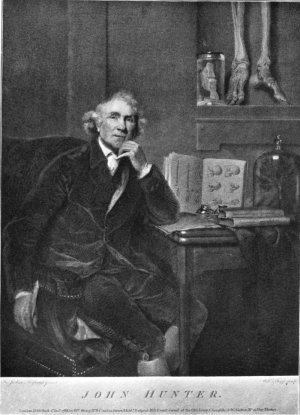
JOHN HUNTER
(Painted by Sir Joshua Reynolds, and Engraved by William Sharp.)
One other name will close this catalogue. It is that of
William Sharp, who was born at London in 1746, and
died there in 1824. Though last in order, this engraverSharp.
may claim kindred with the best. His first essays were
the embellishment of pewter pots, from which he ascended
to the heights of art, showing a power rarely equalled.
Without any instance of peculiar beauty, his works are
constant in character and expression, with every possible
excellence of execution; face, form, drapery—all are as
in nature. His splendid qualities appear in the Doctors
of the Church, which has taken its place as the first of
English engravings. It is after the picture of Guido,
once belonging to the Houghton gallery, which in an evil
hour for English taste was allowed to enrich the collection
of the Hermitage at St. Petersburgh; and I remember
well that this engraving by Sharp was one of the few ornaments
in the drawing-room of Macaulay when I last saw
him, shortly before his lamented death. Next to the
Doctors of the Church is his Lear in the Storm, after the
picture by West, now in the Boston Athenæum, and his
Sortie from Gibraltar, after the picture by Trumbull,
also in the Boston Athenæum. Thus, through at least
two of his masterpieces whose originals are among us, is
our country associated with this great artist.
It is of portraits especially that I write, and here Sharp
is truly eminent. All that he did was well done; but two
were models; that of Mr. Boulton, a strong, well-developed
country gentleman, admirably executed, and of John
Hunter, the eminent surgeon, after the painting by Sir
Joshua Reynolds, in the London College of Surgeons,
unquestionably the foremost portrait in English art, and
the coequal companion of the great portraits in the past;
but here the engraver united his rare gifts with those of
the painter.
In closing these sketches I would have it observed that
this is no attempt to treat of engraving generally, or of
prints in their mass or types. The present subject isMandel.
simply of portraits, and I stop now just as we arrive at
contemporary examples, abroad and at home, with the gentle
genius of Mandel beginning to ascend the sky, and our
own engravers appearing on the horizon. There is also a
new and kindred art, infinite in value, where the sun himself
becomes artist, with works which mark an epoch.
CHARLES SUMNER.
Washington, 11th Dec., 1871.