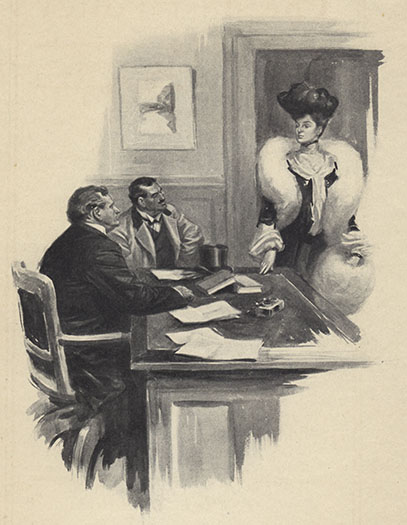
“It’s mighty awkward,” said Owen Ross, the insurance
solicitor.
“It is,” admitted Dave Murray.
“I’ve been after him for over six months,” persisted
Ross, “and now, after urging him persistently to take
out a policy, I have got to tell him that we won’t give
him one. That would be hard enough if he had sought
us out, and it’s ten times as hard when we have sought
him. Why, it looks as if we were playing a heartless
practical joke on him.”
“But it can’t be helped,” said Murray. “It’s one of
the disagreeable features of the business. We convince
a man that it’s to his interest to carry life insurance,
and then we tell him he can’t have any. Naturally,
from his prejudiced viewpoint, we seem to be contemptibly
insincere and deceitful.”
“Of course, we are in no sense shortening his life,”
remarked Ross, “but it seems like pronouncing a sentence
of death, just the same. He is sure to make an
awful row about it.”
124
“One man,” said Murray reminiscently, “fell dead
in this office when his application was refused. The
shock killed him, but there was no way to avoid giving
him the shock. However, that was an exceptional case:
I never knew of another to succumb, although it must
be admitted that the news that one is destined not to
live long is distressing and depressing.”
“What’s the reason for refusing Tucker?” asked
Ross.
“There are several reasons,” replied Murray. “The
physician reports heart murmur, which indicates some
latent trouble that is almost certain to develop into a
serious affection.”
“May not the physician be wrong?”
“He is paid to be right, but, of course, we are all
liable to make mistakes, and it can’t be denied that
heart murmur is deceptive. I’ve known men to be the
subject of unfavorable reports at one hour of the day
and most favorable ones at another. The occupation
immediately preceding the examination may develop
symptoms that are normally absent. However, I would
not feel justified in accepting this application, even if
the report were favorable.”
“Why not?” demanded Ross.
“The amount of insurance he wishes to carry would
make him worth more dead than alive, which is a condition
125
of affairs that an insurance company dislikes.”
Murray became reminiscent again. “I recall one such
risk,” he went on. “The man found the premiums a
greater burden than he could carry, so he died.”
“Suicide!” exclaimed Ross.
“Oh, no,” replied Murray, with a peculiar smile;
“merely a mistake. But, if you will put yourself in
that man’s place, you will see how the mistake could
happen. He was carrying twenty-five thousand dollars
of insurance, and he wasn’t worth twenty-five cents
at the time, owing to some recent reverses. He was ill,
but was not considered dangerously ill. Still, he was
depressed, believing apparently that he would not recover
and knowing that he had not the money for the
next premium. If he died before a certain date there
would be twenty-five thousand dollars for his wife and
children; if he died after that date there would be
comparatively little. Now, in imagination, just assume
the problem that confronted that man on a certain
night: twenty-four hours of life for him meant a
future of privation for his wife, if he did not recover
and prosper, while immediate death for him meant
comfort for those he loved. Picture yourself contemplating
that prospect while lying weak and discouraged
in the sick-room, with various bottles—one
labeled ‘Poison’—within reach. A poison may have
126
medicinal value when properly used, you know, but
what more natural than that you should make a mistake
in the gloom of the night while the tired nurse is
dozing? It is so easy to get the wrong bottle—to take
the poison instead of the tonic—and it solves a most
distressing problem. A drop of the poison is beneficial;
a teaspoonful is death; and the tonic is to be taken in
large doses.” Murray paused a moment to let the terrible
nature of the situation impress itself on Ross.
Then he added quietly: “We paid the insurance, although
the timeliness of the accident did not escape
comment. The same mistake twenty-four hours later
would not have had the same financial result. Now, do
you understand why I would not care to put fifty thousand
dollars on the life of Tucker, even if he were
physically satisfactory? Unexpected reverses may
make any man worth more dead than alive, but we seldom
contribute knowingly to such a condition of affairs.
It isn’t prudent. While the average man is not
disposed to shorten his life to beat an insurance company,
it isn’t wise to put the temptation in his way
unless you are very sure of your man.”
“Well, we needn’t explain that to Tucker,” said
Ross.
“No,” returned Murray. “We can put the whole
thing on the basis of the physician’s report.”
127
“I wish you would break the news to him,” urged
Ross. “You can do it with better grace, for you were
not instrumental in getting him to put in his application.
He’ll be up here to-day.”
“Oh, very well,” returned Murray. “I’ll see him
when he comes.”
Though the task was far from pleasant, Murray
had been long enough in the business to take matters
philosophically. One must accustom oneself to the
disagreeable features of any occupation, for there is
none that is entirely pleasurable.
Tucker, however, did not make this interview disagreeable
in the way that was expected: instead of
becoming discouraged and depressed, he became indignant.
“What’s that?” he cried. “You don’t consider me a
good risk?”
“I am sorry to say,” returned Murray, “that our
physician does not report favorably on you.”
“Oh, he doesn’t!” exclaimed Tucker. “Well, that’s
a good joke on the doctor, isn’t it?”
“What!”
“You’d better discharge him and get a man with
some sense.”
“I thought,” said Murray dubiously, “that it might
seem rather hard on you.”
128
“Hard on me!” ejaculated Tucker. “Hard on the
company, you mean! You’re letting a little two-by-four
doctor steer you away from a good thing. Why,
say! I’m good for as long a life as an elephant!”
“I’m sure I hope so.”
“It’s robbery—plain robbery—for that doctor to
take a fee from you for making such a report on me.
I’ll show him up!”
“How?” asked Murray curiously.
“By living!” declared Tucker. “It’s going to give
me infinite pleasure to report to you from time to time
and show you one of the healthiest men that ever was
turned down by an insurance company. He can’t scare
me into a decline—not any! And, say! he looks to me
like a young man.”
“He is.”
“A young man in fine physical condition.”
“He is.”
“Well, I’ll go to his funeral, and I’ll be in prime
condition when he’s put away! You tell him that, will
you? I’ll be walking when he has to be carried.”
Now, this was rather annoying to Murray. It was
preferable to the despair that overwhelmed some men
in similar circumstances, but it seemed to him that
Tucker was overdoing it.
“Anyhow,” said Murray resentfully, “we would not
129
care to put fifty thousand dollars on your life, for it’s
more than a man in your position ought to carry.
You’ll never be worth as much alive as you would be
dead, with that insurance.”
“Oh, I won’t!” retorted Tucker sarcastically. “Well,
now, instead of making the girl I am to marry a present
of a policy on my life, I’ll just make her a present
of your whole blamed company in a few years. You
watch what I do with the money you might have had!”
“You are about to marry?” asked Murray with interest.
“It’s a serious matter, in view of the physician’s
report.”
“Marriage is always a serious matter,” asserted
Tucker. “I don’t have to have a doctor tell me that.
But he can’t scare me out with flubdub about heart
murmur, for I know the heart was murmuring, and
the prospective Mrs. Tucker does, too. She’ll interpret
that murmur for him any time he wants a little enlightenment.”
Murray laughed when Tucker had gone. The man’s
indignation had been momentarily irritating, but there
was something amusing about it, too.
“He’s going to live to a green old age, just to spite
the company,” mused Murray. “It’s a matter of no
great personal interest to him, but he’d like to make
the company feel bad. If a man could order his life
130
as he can his business affairs, there would be mighty
little chance for us.”
Meanwhile, Tucker was hastening to the home of
Miss Frances Greer.
“I’ve come to release you,” he announced cheerfully.
“But I don’t want to be released,” she returned.
“Of course not,” he said. “I didn’t suppose you
would. But you might just as well know that you’re
getting a poor risk.”
“What do you mean?” she asked.
“Why, I wanted to put fifty thousand dollars on my
life, as a precaution for the future, and the fool of an
insurance doctor turned me down.”
“What do I care about the doctor!” she exclaimed.
“Not a thing, of course.”
“Or insurance!”
“Still less.”
“And,” she said happily, “you’re a good enough
risk for me.”
Then they went into executive session and decided
that insurance doctors didn’t know anything, anyway.
But they did not forget Dave Murray, and they did
not let Dave Murray forget them: he heard from them
indirectly in the most annoying ways. His wife informed
him less than a week later that she had met
Miss Greer at a reception.
131
“A most extraordinary girl!” his wife remarked.
“I can’t understand her at all. She asked me in a most
ingenuous way if I ever had noticed any indications of
heart murmur about you.
“‘Never,’ said I.
“‘Not even in the engagement days when he was
making love?’ she insisted.
“‘Not even then,’ I answered, bewildered.
“‘He couldn’t have been much of a lover,’ she remarked.”
Murray laughed and explained the situation to his
wife. But Murray would have been better pleased if
the two women had not met, for he had no desire to
have this case perpetually present in the more intimate
associations of life. However, he had to make the best
of it, even when he was invited to the wedding, to which
his wife insisted that he should go. She had discovered
that the bride was related to an intimate friend of her
own girlhood days, and the bride further showed flattering
gratification in this discovery. She was especially
gracious to Murray.
“I want to ask you a question,” she told him.
Thereupon Murray made heroic efforts to escape
before she could find a suitable opportunity, but she
beckoned him back whenever he got near the door.
“Mama,” she said finally, for this happened during
132
the wedding reception, and her mother stood near
her, “I wish you would take charge of Mr. Murray
and see that he doesn’t run away. I have something
very important to say to him before Ralph and I
leave.”
Thus the unhappy Murray was held until the bride
and groom were ready to depart, when the bride finally
succeeded in getting him alone for a minute.
“I wanted to ask you, as a particular favor to me,”
she said appealingly, “to let Ralph live a little while—that
is, if your doctor won’t make too big a row
about it.”
Then she laughed merrily. There could be no doubt
at all that Mrs. Ralph Tucker refused absolutely to
worry about the health of Mr. Ralph Tucker; she had
simply put the doctor down as an ignoramus. And
Mr. Ralph Tucker’s appearance certainly was not that
of a man in poor physical condition. However, Murray
knew how deceptive appearances may be, and,
while no physician is infallible, it is necessary to
rely on their judgment. Nor was it a joking matter,
in his opinion. He was glad that the young people
could look at the future without misgivings, but a
really serious matter ought not to be treated so lightly.
It was about a week later that a note came to Murray
from Mrs. Tucker.
133
“So grateful to you for sparing Ralph so long,” it
read.
Murray crumpled it up and, with some rather warm
remarks, threw it in the waste-basket.
“Why did I relieve Ross of his disagreeable task?”
he grumbled.
Then he began to count the days that would precede
their return from the bridal trip, for he was sure they
would call on him. There could be no doubt that Mrs.
Tucker had deliberately planned to make things as
uncomfortable for him as possible, and there was every
reason to believe that Tucker himself was aiding and
abetting her.
“It isn’t fair,” he muttered, “to make it appear that
this is a personal matter with me. The Lord knows I
haven’t anything to do with his lease of life.”
This was just after he had received a telegram to
the effect that “the patient is doing as well as can be
expected,” and Ross, who happened in the office at the
time, noticed that his chief looked at him reproachfully.
“What’s the matter?” asked Ross.
“Hereafter,” returned Murray morosely, “my solicitors
have got to carry their own burdens. If Tucker
and his wife put me in an insane asylum, the administrator
of my estate will surely sue you for big damages. I
134
never thought I was getting a life sentence
when I let you unload on me.”
The physician also noticed a growing coolness and
was moved to ask what was wrong.
“Didn’t you make a mistake in the Tucker case?”
Murray inquired by way of reply. “I don’t wish
Tucker any harm, but I’m doomed to an early death
if he isn’t.”
“I don’t see what his life has to do with yours,” retorted
the doctor.
“That’s because you don’t know Mrs. Tucker,” replied
Murray.
“He was an impossible risk,” asserted the doctor.
“The indications of serious trouble may entirely disappear,
under favorable conditions of life, but they
were there when I made the examination. Ours is not
yet an exact science, and the human system frequently
fools us. You recall the Denton case, don’t you?”
“Yes.”
“At twenty the doctors, including his family physician,
gave him not more than two or three years to
live, and at twenty-five he was considered a good risk
for any insurance company. He is nearly thirty-five
now, has one policy in this company, and we would be
glad to let him have another.”
“Oh, you’re all right, Doctor, of course,” returned
135
Murray. “We must be careful to err on the safe side,
if we err at all, in this business. But I wish the Tuckers
would transfer their attentions to you. I’ll be
tempted to jump out of the window when I see them
coming in the door.”
The Tuckers, however, were not to be escaped.
After an interval of about three weeks they sent him
another telegram, which read: “If we retire to a ranch,
will you lengthen the lease of life a little?” Then they
came back and called on him.
“So kind of you to let us have this trip,” said Mrs.
Tucker with every evidence of deep gratitude. “Poor
Ralph appreciates it.”
Poor Ralph was looking as big and strong and
happy as it was possible for a man to look, and Murray
was correspondingly uncomfortable.
“The premiums on fifty thousand dollars would have
been pretty heavy,” remarked Tucker with a cheerful
grin.
“Yes,” admitted Murray weakly.
“I had a tidy little sum put aside to care for them,”
Tucker explained. “We thought it would interest
your company to know that we put that money into a
small ranch out west, so it is entirely out of reach
now. You don’t mind my choosing a restful place for
my early demise, do you?”
136
“Now, see here!” cried Murray, but Mrs. Tucker
interrupted him.
“Oh, he wouldn’t be so cruel as that!” she exclaimed.
“Show him what the doctor said, Ralph.”
Tucker spread a sheet of paper on the desk before
Murray, and the latter read: “This is to certify that
I have made a careful examination of Ralph Tucker,
and I believe him to be in excellent physical condition.
I attach slight importance to the indications of incipient
heart trouble, which, with reasonable care and
proper treatment, should disappear entirely.” This
was signed by a noted specialist.
“And the next,” said Mrs. Tucker.
Thereupon Tucker laid this before Murray: “The
heart murmur noted I believe to be due to temporary
causes and not to any permanent affection. On the occasion
of one examination there were no indications of
it at all.” This also was signed by a well-known physician.
“Poor Ralph!” sighed Mrs. Tucker, and Murray
felt that the burden of this case was greater than he
could bear.
“They don’t agree entirely,” he asserted aggressively.
“No,” admitted Tucker, “but I understand that’s
not unusual in such cases.”
137
“And they don’t agree with your doctor at all,”
added Mrs. Tucker. “But, of course, your doctor is
right. Poor Ralph!”
“Please don’t do that,” pleaded Murray.
“Poor Ralph!” sighed Mrs. Tucker again. “The
doctors don’t think he’ll live more than a lifetime.”
“Put in another application and take another examination,”
urged Murray in despair. “The doctor
may have been misled by some trifling temporary
trouble.”
“What would be the use?” asked Tucker. “I’ve already
invested the premium money in a small ranch.”
“It’s too bad,” remarked Mrs. Tucker lugubriously.
“That money would have done the company so much
good.”
“This has ceased to be a joke!” declared Murray
earnestly.
“A joke!” exclaimed Mrs. Tucker. “Has it ever
been a joke with you?”
“No, it hasn’t,” said Murray.
“I didn’t think you could be so heartless,” asserted
Mrs. Tucker. “One has only to look at poor Ralph—”
“Don’t, don’t!” cried Murray. “On what terms will
you quit this?”
“Oh, if you want to get down to business,” put in
Tucker, “I’d like to begin delivering this company to
138
Frances. You know I said I was going to do it. I
don’t care for policies, but I might take some stock.”
“You said you had no money.”
“No premium money,” corrected Tucker. “I invested
that in the ranch, but I was notified this morning
of a legacy from a bachelor uncle that will give
me some ready cash.”
“The stock of this company gets on the market very
seldom,” explained Murray. “I have a little myself,
but I don’t care to part with it.”
“Oh, very well,” replied Tucker in careless tones;
“it’s quite immaterial to us for the moment. In fact,
I’d be in no hurry about it at all if I only had a longer
time to live.”
“Poor Ralph!” sighed Mrs. Tucker, as they departed.
When they had gone, Murray rang for his office-boy.
“You tell Mr. Ross,” he said to the boy, “to keep
out of my way for a few days. I’m not in a mental
condition to stand the sight of the man who loaded this
trouble on me.”
For the next three days Murray saw as little of his
office as he possibly could, fearing another call from
Mr. and Mrs. Tucker. Then he learned that they had
left again for the West, and he breathed more freely.
139
But, shortly thereafter, a stock-broker called upon
him.
“I am commissioned,” said the broker, “to buy some
stock in your company, and I thought possibly you
might know of some that is for sale.”
“I do not,” replied Murray. “As you know, it is
not a speculative stock, but is held, for the most part,
by conservative investors. A little gets on the market
occasionally, when some estate is being settled or some
holder becomes financially embarrassed, but that is
about your only chance.”
“So my client informed me,” said the broker, “but
he also informed me that he was sure he could get some
himself, and he wished me to use every effort to add to
his prospective holdings.”
“Mr. Tucker, your client, tried to buy some from
me before he left for the West,” said Murray, for he
had no doubt as to the identity of the man who wanted
the stock.
“Indeed!” returned the broker. “I didn’t know that.
He explained his anxiety for prompt action by the
rather extraordinary statement that he wished to get
the stock before somebody foreclosed on his life!”
“By thunder!” cried Murray, “somebody will foreclose
on his life, and take the Limited west to do it, if
he keeps this thing up!”
140
In some amazement, the broker apologized and retired,
and Murray began to wonder what would happen
to him if Mrs. Tucker ever did get enough of the
stock to make her influence felt. Of course, there was
little chance of that, but even a small stock-holder
could be annoying when so disposed. He began to
dream about the Tucker case, and an incidental mention
of it in the office would make the atmosphere unpleasant
for the day. Every clerk and solicitor understood
that it was a dangerous topic. Once the name
“Tucker” was mentioned in the ordinary course of
business, and Murray had things at a fever heat before
it could be explained to him that it was another
Tucker. Then came a letter from the West, with a
Tucker return card on the envelop. A council of war
was held before it was delivered to Murray, and even
then a time was chosen when he was absent to lay it
on his desk. It was very brief—just an announcement
that “the patient” had rallied splendidly after the
fatigue of the journey and exhibited “really wonderful
vitality for a sick man.” No one cared to go near
Murray all the rest of that day.
Soon after the first of the following month another
missive arrived—a mere formal affidavit, headed “Certificate
of Life,” and solemnly averring that “Ralph
Tucker’s heart has not ceased to murmur along in the
141
land of the living.” This was followed a month later
by a certificate from a physician to the effect that “a
restful ranch life is especially conducive to longevity,
and Mr. Tucker’s health continues to show all the
improvement that can be expected in a man who had
nothing the matter with him in the first place.”
These facetious reports continued to arrive at
monthly intervals for a period of nearly a year. Usually
they were brief, but occasionally the doctor, who
seemed to enter into the spirit of the affair, would go
into such details as weight, endurance, appetite, lifting
power, respiration and—heart murmur. “The
heart,” he wrote at one time, “seems to be too well
satisfied to murmur now, and the patient was able to
sit up and eat a large steak to-day, after which a little
gentle exercise—about twenty miles on horseback—seemed
to do him some good.”
Murray promptly turned this over to the company
doctor, and the latter sighed. Almost the only satisfaction
in life that Murray had during this time arose
from his ability to make the doctor miserable.
“He was not a good risk when I examined him,” the
doctor insisted, “but he may be a good one now. We
can’t be certain of results in such a case, and the law
of probabilities frequently works out wrong. He could
not have done a better thing, under the circumstances,
142
than to go in for a simple, outdoor life. The basis
of trouble was there, in my judgment, but it may
have been overcome.”
“The basis of trouble is still there,” declared Murray;
“not only the basis of trouble, but the whole
blame structure, and it’s resting on us. I can feel the
weight.”
“So can I,” replied the doctor disconsolately.
Less than a week after this Tucker telegraphed to
know if Murray had changed his mind about disposing
of any stock.
“No,” was the reply sent back.
“All right,” Tucker answered. “I just wanted to
give Mrs. Tucker another slice of your company. She
has a little of it already.”
Investigation showed that the broker had succeeded
in picking up a few shares, but hardly enough to exert
any considerable influence. Still, it was disquieting to
find the Tuckers so persistent.
“I’ll bet,” said Murray, “that mental worry has put
me where you wouldn’t pass me for a risk.”
“If your wife,” returned the doctor, “is anything
like Mrs. Tucker I’d pass you for any kind of risk
rather than incur her displeasure. They’ll begin to
take a stock-holder’s interest in the affairs of this particular
office pretty soon.”
143
“The affairs are in good shape,” declared Murray.
“But a real determined stock-holder can stir up a
devil of a rumpus over nothing,” asserted the doctor.
“If she should send all those physicians’ reports to
headquarters, they would rather offset my report on
which he was turned down, and the company would
feel that it had lost a good thing. The company will
not stop to think that my report may have been justified
by conditions at the time.”
“And the risk that I thought too big for him then
may not seem too big for him now,” commented Murray
ruefully.
“I’d like to examine him again,” said the doctor.
“I don’t think it would be safe,” returned Murray,
“unless you were searched for weapons first.”
So the doctor and Murray settled down to await,
with some anxiety, the next move in the game, and
their patience was rewarded by the receipt of five certificates
of health from as many different physicians,
each certificate having a message of some sort scribbled
across the top. “The patient had to ride a hundred
miles to get these,” Mrs. Tucker had written on the
first. “There were a few shares of this stock in my late
lamented uncle’s estate,” appeared in Tucker’s handwriting
on the second. “The president of your company
is rusticating a few miles from here,” Mrs.
144
Tucker asserted on the third. “Better come out here
for a few days,” Tucker urged on the fourth. “Poor
Ralph!” was Mrs. Tucker’s comment on the fifth.
“Poor Dave Murray!” grumbled Murray, and he
and the doctor started West the next day. “Might as
well get this thing settled,” he said. “You and I have
got to be on harmonious terms with the stock-holders.
Besides, there’s an early grave yawning for me if I
don’t succeed in making peace with Mrs. Tucker. I
tell you, Doctor, when a woman decides to make things
uncomfortable for a man,—well, the man might just
as well resign himself to being perpetually uncomfortable.”
And yet, no one could have greeted them more graciously
than did Mrs. Tucker.
“I’m so glad you’ve come,” she said, “and brought
the doctor. It is particularly pleasing to have the doctor
here, for I want him to see if something can’t be
done for poor Ralph. I’m sure I don’t know what’s
going to become of the poor fellow. He doesn’t sleep
any better than a baby, and he can’t ride over a hundred
miles without getting tired. His muscles aren’t
a bit harder than iron, either, and his heart beats all
the time.”
“Mrs. Tucker,” said Murray appealingly, “what
can we do to make peace with you?”
145
“Without even seeing your husband again,” added
the doctor, “I am willing to concede that he will live
to be three thousand years old.”
“We are beaten,” asserted Murray. “You have
humbled our business and professional pride. We give
Mr. Tucker none of the credit; it all belongs to you.
We claim to be the equals of any man, but of no
woman. Now, on what terms can we have peace?”
“I did want your insurance company for a sort of
belated wedding present,” said Mrs. Tucker thoughtfully.
“I’d give it to you if I could,” said Murray with
the utmost sincerity. “I assure you, that company
has been nothing but an annoyance to me ever since
you cast longing eyes on the stock.”
“Oh, I’ve become more modest in my expectations,”
replied Mrs. Tucker cheerfully. “I don’t expect much
more than we’ve got now.”
“How much have you got?” asked Murray.
“Well, our broker picked up a few shares, and there
were some more in the estate of Ralph’s uncle, and the
president of the company kindly arranged it so that
we could get a little more. Such a delightful man he
is, too! It was when I heard he had a place in this vicinity,
where he came for an outing every year, that I
insisted upon Ralph’s buying this ranch. I thought it
146
would be nice to be near him—and it was. We’re great
friends now, although he’s only here for a little while
in the spring and fall.”
“Did—did you tell him about the insurance?” asked
Murray.
“What insurance?” asked Mrs. Tucker blandly.
“We haven’t any insurance. Poor Ralph—”
“Mrs. Tucker,” interrupted Murray, “if you say
‘Poor Ralph’ again, you will see a driveling idiot
making streaks across the prairie. I have reached the
limit of endurance. All I want is peace, peace, peace,
and I’ll pay the price for it. Do you want some of
my stock?”
“Oh, dear, no,” she replied. “We’ve got it fixed now
so that Ralph is pretty sure to be a director next year.
We talked it over with the president.”
“Does Mr. Tucker still want a policy?” asked
Murray.
“Certainly not,” said Mrs. Tucker. “If he’s going
to die so soon, it would be beating the company, and
we’re part of the company now, so we—”
“Stop it! stop it!” pleaded Murray. “I’ll bet you
couldn’t kill him with an ax!”
“Sir!”
“I beg your pardon, but this is the climax of a year
of torment that I didn’t suppose was possible this side
147
of the infernal regions,” explained Murray dismally,
“and I’m just naturally wondering why you brought
me out here.”
“Oh, I didn’t tell you that, did I?” returned Mrs.
Tucker ingenuously. “I just wanted to tell you that,
now that we’re stock-holders to a reasonable amount—Ralph
retained a few shares, you know, and holds a
proxy for mine—we look at the matter from an entirely
different viewpoint, and we think that every
reasonable precaution should be taken to avoid poor
risks, as you call them. We are highly gratified by
the evidence of caution that has inadvertently come
under our notice, even if there was an incidental error
that baffled human foresight.”
The sudden and startling changes of position by
this young woman were too much for both Murray and
the doctor; they could only look at her in amazement
as she calmly commended their course.
“You have brought us all this distance to tell us
that!” ejaculated Murray at last.
“Yes.”
“Well, it’s worth the trip!” he announced, as he recalled
the events of the last year.
Then Tucker appeared, big, strong, bronzed,
hearty, and shook hands with them. Never a weakling
in appearance, his year of outdoor life had made him
148
the embodiment of health. He beamed upon his guests
with hearty good nature as he gave them each a grip
that made them wince. His wife regarded him critically
for a moment.
“Poor Ralph!” she said mischievously, and then she
hastily assured them that this was really the last of
the joke.