I
CARRINGTON folded the document
and thoughtfully balanced
it on his palm. What an ironical
old world it was! There was a perpendicular
wrinkle about his nose, and his
lips had thinned into a mere line which
drooped at the corners. The drone of a
type-writer in the adjoining room sounded
above the rattle-tattle of the street
below. Through the opened windows
came a vague breath of summer redolent
of flowers and grasses; for it was but
eleven o'clock of the morning, and the
smell of sun-baked brick and asphalt had
not yet risen through the air. Far beyond
the smoking, ragged sky-line Carrington
could see the shifting, glittering river and
the great ships going down to the sea.
Presently the ashes from his dead cigar
fell in a gray cascade down his coat and
tumbled across his knees, but he gave no
heed.
Ironical old world indeed! Here, suddenly
and unexpectedly, he found himself
upon the battle-field of love and duty,
where all honest men find themselves,
sooner or later. To pit the heart against
the conscience, impulse against calculation!
Heigh-ho! Duty is an implacable
goddess, and those who serve her most
loyally are most ruthlessly driven. She
buffets us into this corner and into that,
digs pitfalls for the hesitant foot, and
crushes the vacillating.
As all men will, Carrington set about
to argue down his conscience; the heart is
so insistent a counselor. Why should he
give up the woman he loved, simply because
duty demanded he should? After
all, was not duty merely social obligation?
What was it to him that the sheep were
sheared? Was it right that he, of all men,
should divide the house, throw the black
pall of dishonesty over it, destroy his own
happiness and hers, when so simple a
thing as a match would crumble into
nothingness this monument to one man's
greed and selfishness? The survival of
the fittest; if he put aside Self, who would
thank him? Few, and many would call
him a fool or a meddler. So many voices
spoke that he seemed to hear none distinctly.
He alone had made these astonishing
discoveries; he alone had followed the
cunningly hidden trail of the serpent. He
could stop where he was and none would
be the wiser. To be sure, it was only a
question of time when the scandal would
become public through other channels;
but in that event he would not be held
responsible for bringing about the catastrophe.
Besides, the ways of the serpent
are devious and many, and other
investigators might not come so close to
the trail.
He had gone about his investigations
without the least idea where they would
lead him. At the beginning he had believed
that the guilty ones were none
higher than petty officials; but presently
he found himself going over their heads,
higher and higher, until, behold! he was
at the lair of the old serpent himself. A
client had carelessly dropped a bit of information,
and it had taken seed with
this surprising result. Henry Cavenaugh,
millionaire promoter, financier, trust
magnate, director in a hundred money-gathering
concerns; Henry Cavenaugh,
the father of the girl he loved and who
loved him! Could it be he, indeed? It
seemed incredible.
It was not a case of misappropriation
of funds, such as a man may be guilty of
when temporarily hard pressed. It was
a bold and fraudulent passing of dividends
that rightfully belonged to the
investors; of wrongfully issuing statements
of bolstered expenses, lack of
markets, long strikes (promoted by Cavenaugh
and his associates!), insufficient
means of transportation. An annual dividend
of seven per cent. on many millions
had been dishonestly passed over.
The reports that there would be no dividends
encouraged a slump in the listed
price of the stock, and many had sold
under par value, thereby netting to Cavenaugh
and others several millions. And
the proof of all this lay in his hand!
It had been a keen hunt. Many and
many a blind trail had he followed, only
to come back to the start again. All that
now remained for him to do was to pass
this document on to the hands of the intrepid
district attorney, and justice would
be meted out to the guilty.
Her father! The picture of him rose
suddenly and distinctly in his mind. Tall,
powerfully built, a hooked nose, keen
blue eyes, an aggressive chin, a repellent
mouth, Henry Cavenaugh was the personification
of the modern Crœsus. Immutable
in purpose, dogged in perseverance,
a relentless enemy, a Jesuit in that
the end always justified the means, he
stood a pillar in the world of finance,
where there is sometimes justice but never
any mercy. Thirty-five years before he
had been a messenger in a stock-broker's
office. Of his antecedents nothing was
known until he broke one of the famous
gold corners in the seventies, when a
handsome, ruddy-cheeked little Irishman
bobbed up serenely from nowhere in particular
and claimed to be the great Cavenaugh's
father. But his proofs were not
convincing, and when the son showed a
decided contempt for him, he gently subsided
into oblivion and was heard of no
more. From time to time Carrington
gathered a small crumb of information
regarding his sweetheart's grandfather;
but whenever he broached the subject,
however tactfully, everybody concerned
headed the conversation for a different
port.
Carrington had never laid eyes on the
old gentleman, and, for all he knew to the
contrary, he might be a myth. He reasoned
that in all probability the grandfather
was illiterate, uncouth, and rather
an awkward piece of family furniture to
handle, when the family proper were ingratiating
themselves into the Chippendales
of society. Unfortunately, Mother
Cavenaugh, good-hearted and amiable in
her way, had been stung by the bee of the
climbers, and her one ambition was to
establish herself and daughters in society;
and had not he, Carrington, come of an
aristocratic family (poor, it is true), the
doors of the Cavenaugh manor would
never have opened to his knock. Even as
it was, he was persona non grata to the
millionaire, who was mad for a duke in
the family. Besides, Cavenaugh had his
suspicions of any lawyer who grubbed
outside the breastworks.
Some doves circled above a church-spire
a few streets over the way, breaking
the sunbeams against their polished
wings. Finally they settled on the slate
roof and fell to strutting and waddling
and swelling their breasts pompously.
Carrington opened and refolded the document,
but he did not take his eyes from
the doves. What should he do? What ill
wind had blown this thing into his doorway?
Nothing had warned him of the
impending tangle. Until two days ago
Cavenaugh was at the other end of the
world, so far as his investigations at that
time were concerned.
He struck a match. The sliver of pine
flared palely in the sunshine, writhed
and dropped, black and charred, to the
floor. He shrugged his shoulders. Chivalry
of this sort was not the order of the
day. There was something stronger than
the voice of duty, something stronger
than the voice of the heart; it was the
voice of pity, which urged its appeal for
the hundreds of men and women who
had invested their all in the Cavenaugh
concerns. The thought of their ultimate
ruin, should Cavenaugh be permitted to
pursue his course unchecked, bore heavily
upon him. No, he could not do it.
He must fight, even if he lost his all in
the battle. It is a fine thing to right a
wrong. All the great victories in the
world have been won for others than the
victors. That Cavenaugh was the father
of the girl he loved must have no weight
on the scales of justice.
Resolutely he thrust the document into
his coat pocket, closed his desk and relighted
his cigar. In that moment he had
mapped out his plan of action. That very
night he would lay the whole thing very
clearly before the girl herself, and whatever
decision she made, he would stand or
fall by it, for he knew her to be the soul
of honor.
Poor girl! It was a heart-breaking
business. How in the world should he
begin, and where should he stop? Ah,
that was it! He would lay the matter before
her in a manner that would conceal
the vital nearness of the case, as if it were
some client of his who was unknown to
her. And when she had judged the case,
he would speak the bald truth. It would
be a cruel blow, but nevertheless he must
deal it. She loved her father, and after
his own peculiar fashion her father loved
her. She was the only one in the family
who could wheedle him out of a purpose;
to the rest of the family his word was law
immutable. It was very hard, sighed Carrington.
For the father he had neither
pity nor sympathy; there were many ugly
tales about his financial dealings; but his
whole heart went out unreservedly to the
girl.
When Carrington had gone to Cavenaugh,
his heart in his throat, to speak to
him relative to his daughter's hand, he
unwittingly knocked off the top of a volcano.
"Marry my daughter?" Cavenaugh
roared, emphasizing his wrath and disapproval
with a bang of fist upon palm.
"My daughter shall marry only among
her equals, not among her inferiors. A
king is not good enough for my Kate."
There was another bang of the fist, decided
and final. "A lawyer? Not if I
know myself. I wouldn't trust a lawyer
out of sight," bluntly. "Kate shall marry
a duke or a prince, if I can find one suitable."
Carrington would have smiled had the
moment been less serious.
"No man can possibly appreciate her
worth more readily than I, sir," he replied,
"or love her more dearly."
"Love?" with a snort. "Twaddle out
of story-books!"
"But you yourself love her."
"I'm her father," Cavenaugh returned
complacently, adding a gesture which
had the effect of describing the fact that
it was perfectly logical for a father to
love his daughter, but that it wasn't logical
at all for any other male biped to
love her.
"I am sorry," said the disheartened
suitor, rising. "I suppose that after this
unpleasant interview ..."
"Oh, you're a decent sort," interrupted
Cavenaugh generously; "and if you are
of a mind to behave yourself hereafter,
you will always find a chair at my table.
But my daughter is not for you, sir, emphatically
not. That is all, sir;" and
Cavenaugh picked up his evening paper.
After such a rebuff, most young men
would have given up; but Carrington
never gave up till there was no possibility
of winning. Immediately after the interview
he went to the higher court with his
appeal.
"Let us have patience," the girl whispered.
"I'll undertake to bring him to
reason."
But Carrington went home that night
without his love for the father increasing
any.
And so the matter stood at the present
time. The affair had gone neither forward
nor backward.
Ah, were he less honest, how easily he
could bring the old curmudgeon to terms!
There was that in his pocket which would
open the way to the altar, quickly enough.
But Carrington was manly and honest to
the core, and to him blackmail stood
among the basest of crimes. Many times
during the past forty-eight hours the
tempter had whispered in his ear that
here was a way out of his difficulties; but
the young man had listened unmoved.
During the summer and autumn
months of the year the Cavenaughs lived
at their country place over in New Jersey,
and there Carrington spent the week-ends.
There were horses to ride, golf and tennis,
and a Saturday night dance at the Country
Club. To be with the girl you love,
even if you can't have her, is some compensation.
Cavenaugh never joined the
fêtes and sports of the summer colonists,
but he offered no objections to the feminine
members of his household for selecting
Carrington as their escort for the
week-ends. Indeed, by now he began to
consider Carrington as a harmless, sensible,
well-groomed young man, who relieved
him of all the painful duties to the
frivolous. If the colonists insisted on
coupling his daughter's name with Carrington's,
let them do so; when the proper
moment came he would disillusionize
them. For himself, he always had some
good old crony down to while away the
dull Sundays; and together they consummated
plans that gave the coup de grâce
to many a noble business galleon. This
particular summer there were no dukes
or princes floating around unattached,
and Cavenaugh agreed that it was a commendable
time to lay devices by which to
ambush the winter money.
There were nights when Cavenaugh
did not sleep very well; but of this, more
anon.
Shortly after his determination to tell
Kate half a truth, Carrington left the office
and made an early train into New
Jersey. All the way over to the Cavenaugh
station he was restless and uneasy.
The fatal papers still reposed in his
pocket. He had not dared to leave them
in the office safe; his partner, who had
had no hand in the investigation, might
stumble across them, and that was the last
thing in the world he desired. He knew
not exactly what to do with them; for
they burned like fire in his pocket, and
seemed to scorch his fingers whenever he
touched them to learn if they were still
there. A thousand and one absurd suppositions
assailed him. Supposing, for
instance, there should be a wreck; supposing
he should be robbed; supposing he
should leave his vest on the links; and so
forth and so forth. It was very depressing.
If only he stood in the open, unhandicapped;
if only he might throw the gauntlet
at Cavenaugh's feet the moment they
met!
Ah, if he had only attended to his own
affairs! But he hadn't; and his inquisitiveness
had plunged him into a Chinese
tangle from which there seemed to be no
exit. But there was an exit; only, if at
that moment Cassandra had whispered
the secret into his ear, it would have appealed
to him as the most improbable
thing under the sun. However, there are
no trustworthy Cassandras these sordid
days; a single look into the future costs
a dollar; and as for Greek choruses, they
trundle push-carts on the East Side.
He had broken bread and eaten salt at
Cavenaugh's table; and now it was decreed
that he must betray him. It was not
a pleasant thought. And still less pleasant
was the thought of telling Kate (in
a roundabout fashion, it is true) that her
father was not an honest man. According
to financial ethics, what Cavenaugh did
was simply keen business instinct; nothing
more. If you or I should happen to
bend an odd cornice of the majestic pillar
of law, we'd be haled off to the county
jail forthwith; but if we possessed the
skill to smash the whole fabric or rather,
to continue the metaphor, the whole pillar,
the great world would sit up and admire
us. What are old laws for, anyhow?
Build you never so wisely your law, there
will always be some one to come along
and tack on a nice little amendment,
subtly undoing in a moment what it took
years of labor to accomplish. In this instance,
Cavenaugh had been careless; he
had forgotten to introduce his amendment.
An infinitesimal grain of sand will
stop the best regulated clock. The infallible
invariably die on the heels of
their first victory.
On leaving the train, Carrington espied
the Cavenaugh station carriage. The
coachman was talking to a little wiry old
man, whose gray eyes twinkled and whose
complexion was mottled and withered
like a wind-fall apple. Seeing Carrington
draw nigh, the coachman touched his
hat respectfully, while the little old man,
who was rather shabbily dressed, stepped
quickly around the corner of the platform.
Evidently he did not wish to be inspected
at close range. Carrington threw
his suit-case and golf-bag into the carriage,
and followed them. Thereupon the
coachman touched the horses lightly, and
they started westward at a brisk trot.
"Who's your friend?" asked Carrington,
who, though never familiar, was always
friendly toward his inferiors.
"He's no friend of mine, sir," answered
the coachman, with well-bred contempt.
"Miss Cavenaugh directed me to drive
you straight to the club, sir."
"Very well," replied Carrington, lighting
a cigar and settling back among the
cushions.
Immediately he forgot all about the
shabby old man, and began to inventory
his troubles. He must hide the papers
somewhere. All the evidence he had, together
with the names of the witnesses,
was on his person; for in making the
whole he had prudently destroyed the
numerous scraps. If this document fell
into alien hands, the trouble would double
itself. He puffed quickly, and the heat of
the cigar put a smart on his tongue. He
had nothing to do but wait.
On the steps of the club's porte-cochère
he was greeted by Miss Cavenaugh, who
was simply and tastefully dressed in
white. If there was a sudden cardiac disturbance
in Carrington's breast, the girl's
tender beauty certainly justified it. The
fresh color on her cheeks and lips, the
shining black hair that arched a white
forehead, the darkly fringed blue eyes,
the slender, rounded figure, the small feet
and shapely hands, all combined to produce
a picture of feminine loveliness
warranted to charm any masculine eye.
Let the curious question Cavenaugh's antecedents,
if they were so inclined,
thought Carrington; here was abundant
evidence of what a certain old poet called
the splendid corpuscle of aristocracy.
Her sister went by the sonorous name
of Norah. She was seventeen, a bit of a
tomboy, but of the same build and elegant
carriage that distinguished Kate
from ordinary mortals; only Norah's eyes
were hazel-tinted and her hair was that
warm brown of the heart of a chestnut-bur.
She was of merry temperament,
quick to like or to dislike, and like her
sister, loyal to those she loved. Both girls
possessed that uncommon gift in women,
the perfect sense of justice. You never
heard them gossiping about anybody; and
when a veranda conversation drifted toward
scandal, the Cavenaugh girls invariably
drifted toward the farther end
of the veranda. All the men admired
them; they were such good fellows.
The mother of the girls was, as I have
remarked, good-natured and amiable, inclined
toward stoutness, and a willing
listener to all that was going on. She considered
it her bounden duty to keep informed
regarding the doings of her intimate
friends, but with total lack of
malice. At this moment she occupied her
favorite corner on the club veranda, and
was engaged in animated tittle-tattle. She
nodded and smiled at Carrington.
Norah was playing tennis. She waved
her racket at the new arrival. Carrington
was her beau-ideal.
He hurried into the dressing-room and
shortly returned in his golf flannels. He
was a sturdy chap, not at all handsome,
but possessing a countenance full of strong
lines. He inspired your trust and confidence,
which is far better than inspiring
your admiration.
"I am not going to play to-day," said
Kate, "so I'll follow over the course and
watch you play. I haven't seen you for a
whole week; and I can't talk and play,
too," smiling.
"Forward, then!" cried Carrington,
beckoning to his caddy.
He played a nervous, fidgety game that
afternoon. Every time he teed his ball the
document spoke from his pocket with an
ominous crackle. There was not one brilliant
stroke to his credit. This puzzled
the girl, for only the previous week he
had been runner-up in the annual tournament
for crack amateurs. He made the
ninth hole indifferently, then turned to
the girl, smiling whimsically.
"You are not playing up to your form
to-day, John," she observed.
"I admit it," he replied, tossing his club
to the caddy, who, well versed in worldly
affairs, serenely shouldered the bag and
made off toward the club house. "My
heart isn't in the game, Kate. The fact is,
I'm in a peck of trouble." He determined
to tell her at once. There might not be
another opportunity like this.
"Why, John!" reproachfully.
"Oh, it came only yesterday. I haven't
been hiding it. I'm in a kind of pocket,
and can't exactly see my way out. I want
your advice; and you must be the jury and
judge rolled into one."
They were standing on a hill, and far
away they could see the pale line where
the shimmering summer sea met the turquoise
bowl of heaven.
"Tell me what your difficulty is, John,
and I will judge it the best I know how."
He never knew what a simple, beautiful
name John was till it fell from the
lips of this girl. Many called him Jack;
but only his mother and this girl called
him John. He motioned toward the sandbox,
and they sat down. The other players
were well scattered about, out of hearing.
He made out his case skilfully
enough, giving his plaintiff and defendant
fictitious names. The thing grew so
real to him, as he went on, that toward
the end he rose to the dramatics. The girl
listened, but with never a glance at him.
Rather her gaze roved over the dancing
gray waters and followed the lonely white
sail that stood out to sea. And when he
reached the climax, silence of some duration
fell upon them.
"Should this man be punished?" he
asked at length.
"He is guilty; he has broken two laws,
the civic and human. Oh, the poor people!"
pathetically. "They are never at
peace; the wolf harries them, and the
jackal; they are robbed, beaten and
spurned. They are like sheep, not knowing
how to fight. They arrest a man for
his poverty; they applaud him for his
greed. It is all very wrong."
The sail fell under the shadow of a
cloud, and they both watched it till it
flashed into the sunlight again.
"A woman's intuition is sometimes abnormally
keen. You are strong enough
to fight such things without the advice of
a woman. Is there not something vital to
me in all this? Is it not ... is it not
my father, John?"
II
CARRINGTON faced her swiftly.
He had not expected this. There
was something in her handsome
eyes that barred the way to subterfuge.
The lie died unspoken, and he dropped
his gaze and began to dig up the turf
with the toe of his shoe.
"Is it my father, John?"
"Yes. Oh, Kate," with a despairing
gesture, "I'm the most miserable fellow
alive! To think that this should fall into
my hands, of all hands in the world!"
"Perhaps it is better so," quietly.
"Nothing is without purpose. It might
have come to test your honesty. But you
are sure, John; it is not guess-work?"
"All the evidence is in my pocket. Say
the word, and the wind shall carry it
down to the sea. Say the word, heart o'
mine!"
He made a quick movement toward his
pocket, but she caught his arm.
"Do nothing foolish or hasty, John.
Tearing up the evidence would not undo
what is done. Sooner or later murder
will out. If my father is culpable, if in
his thoughtless greed for money he has
robbed the poor, he must be made to restore
what he has taken. I know my father;
what he has done appears perfectly
legitimate to him. Can he be put in
prison?"
"It all depends upon how well he defends
himself," evasively.
She went on. "I have been dreading
something like this; so it is no great surprise
to me. He is money-mad, money-mad;
and he hears, sees, thinks nothing
but money. But it hurts, John; I am a
proud woman. My grandfather...."
Her lips shut suddenly. "Money!" with
a passionate wave of the hand. "How I
hate the name of it, the sound of it, the
thought of it! I love my father," with a
defiant pride; "he has always been tender
and kind to me; and I should not be
of his flesh and blood had I not the desire
to shield and protect him."
"The remedy is simple and close at
hand," suggested Carrington gently.
"Simple, but worthy of neither of us.
I abhor anything that is not wholly honest.
It is one of those strange freaks of
nature (who holds herself accountable to
no one) to give to me honesty that is the
sum total of what should have been evenly
distributed among my ancestors. If I
were to tell all I know, all I have kept
locked in my heart...."
"Don't do it, girl; it wouldn't matter
in the least. You are you; and that is all
there is to love. Why, I could not love
you less if your great-great-grandfather
was a pirate," lightly. "Love asks no
questions; and ancestors worry me not at
all; they are all comfortably dead."
"Not always. But if my perception of
honor were less keen, I should laugh at
what you call your evidence."
"Laugh?"
"Yes, indeed. I very well understand
the tremendous power of money."
"Not more than I," sadly.
She laughed brokenly. "More than
you. I can picture to you just what will
happen." She rose. "There will, of
course, be a great newspaper clamor; the
interstate commissioners will put their
heads together; there will be investigations
by the government. That will be
the attack. The keenest lawyers are on the
side of corporations; that is because the
state is niggard with her pay. Let me outline
the defense. Father will resign from
his high office, to be reëlected later when
the public cools off! A new directorate
will fill the place of the present one. Suddenly
falsified entries will be discovered;
the head bookkeeper will have disappeared.
All fingers will point to him. He
will be in South America, having been
paid several thousand to go there. All
this will make the passing of the dividend
perfectly logical. The matter will never
be tried in court. Money will do all this."
"My dear little woman, you reason like
Pythagoras; but," Carrington added
gravely, "when I undertook to untangle
this affair, I realized its huge proportions.
For every redoubt your father has, I have
an assault, for every wall a catapult, for
every gate a petard. But, as I said before,
you have only to say the word, and for the
present nobody will be any the wiser."
"If I permitted you to do this, I should
destroy my faith in both of us. It would
erect a barrier which would be insurmountable.
That is not the way out."
"I have weighed all these things," discouragedly.
He took the document from his pocket
and caught it in a way that indicated how
easily it might be ripped into halves, the
halves into quarters, the quarters into infinitesimal
squares of meaningless letters.
"Once more, shall I, Kate?"
"No, John. That would only make our
difficulties greater. But I do ask this one
favor; put your evidence into the hands
of a strange attorney, have nothing to do
with the prosecution; for my sake."
"I must have the night to think it over.
Most of my attacks are not herein written;
I dared keep them only in my head."
"I am very unhappy," said the girl.
He took her hand and kissed it reverently.
He longed to console her, but no
words he had in mind seemed adequate.
"Fore!" came lazily over the knoll.
They were no longer alone. So together
they wandered slowly back to the club-house.
Tea was being served, and Carrington
drank his abstractedly. From
time to time he joined the conversation,
but without any heart. Some of the busier
ladies whispered that it looked this time
as though Kate had given the young man
his congé.
On the way home Norah, with her humorous
comment on the weekly budget
of gossip, saved the situation from any
possible contretemps. Mrs. Cavenaugh
was easy-going, but for all that she possessed
remarkably observant eyes; and her
eldest daughter was glad that they were
occupied elsewhere.
Kate was very unhappy; her father was
not honest, and the man she loved had
come into the knowledge of the fact. Ah,
how quickly shadow can darken sunshine!
"What did you make it in to-day, Mr.
Carrington?" asked Norah.
"Make what?" he counter-questioned
absently.
"The course, Mr. Goose! What did
you think I meant?"
"Oh," lamely, "I made a bad play at
the beginning, and gave it up."
By this time they had arrived at the
gates, and everybody was thankful; Mrs.
Cavenaugh, because her nose smarted
with sunburn; Norah, because the gown
she was to wear at the dance that night
was new; Kate, because she wanted to be
alone; and Carrington, because he wanted
to learn whether the Angel threw Jacob
or Jacob threw the Angel. The driver
and the horses were glad to arrive because
they were hungry.
It took the young lawyer some time to
dress for dinner that night. His usually
direct mind vacillated between right and
wrong, wrong and right; and he floated
from one to the other like an unattached
cork. He made a dozen annoying blunders
in dressing. And when finally the
pier-glass reflected an irreproachable
and finished picture, he searched his cast-off
vest for his growing monster and
transferred it to the pocket of his coat.
Monster! Here was no story-monster,
like the creature of a Frankenstein; it
was genuine, and was like to turn upon
him at any moment and rend him. He
shrugged and proceeded down the stairs.
There are soliloquies that sometimes leave
an unpleasant taste behind. So he pinned
his faith to the banner of the late genial
and hopeful Micawber: something might
turn up for the benefit of all concerned.
The hall and living-room at the Cavenaugh
manor were one and the same.
There were bookcases ranging along the
walls, window-seats, a reading-table and
an ancient chimney-seat. As Carrington
turned the first landing he stopped.
"Father, I think it positively dreadful
the way you treat poor grandpa." This
was Norah.
There was a crackle of a newspaper.
"Never mind, Norah, darling; your
grandpa is used to it. It doesn't matter
at all."
It was the sight of the last speaker that
brought Carrington to a stand. Norah's
grandpa was no less a person than the
shabbily dressed old man he had seen at
the station that afternoon. What kind of
family skeleton in the closet was he that
they kept him en camera? He coughed
and went on.
Norah was plucky, whole-hearted,
frank and encouraging.
"Mr. Carrington," she said immediately,
"this is my grandpa."
Carrington did not hesitate a moment,
but smiled and thrust out his hand, which
the other grasped with a questioning air
of diffidence.
"Glad to meet you, sir," said Carrington.
Cavenaugh fils glanced over the top of
his paper, scowled, and resumed his reading.
Kate hadn't come down yet, so she
missed this scene. When she did appear,
there was no visible sign of any previous
agitation. She and Norah were thoroughbreds.
"Why, grandpa!" she cried, extending
her hand.
The old man bowed over it and kissed
it, and his action was lacking neither in
grace nor gallantry.
"I happened to be down this way on
business," said the old man with a covert
glance at his son, "and thought I'd drop
in."
"Dinner is served," said the splendid
butler, as he slid back the doors to the
dining-room.
The old man looked about him questioningly,
and Norah slipped her arm
through his. "You'll have to take me in,
grandpa," she laughed.
The old man's eyes shone for a moment,
and he patted her hand.
"I'm as proud as a king, Norah."
Now, Carrington could read between
the lines. It was manifestly plain that
grandpa was not welcome to Cavenaugh.
But why? Mrs. Cavenaugh scarcely tolerated
him. While the girls seldom if
ever spoke of him, it was evident that both
held him in their affections. There were
many strange things going on in the
Cavenaugh manor; and Carrington entered
the dining-room in a subdued state
of mind.
By degrees Norah succeeded in drawing
the pariah out of himself. Carrington
was soon listening to an amazing
range of adventures. The old man had
seen Cuba in the filibusters' time, he had
fought the Canadian constabulary as a
Fenian, he had been a sailor, and had
touched the shores of many strange lands.
Grandpa Cavenaugh was anything but illiterate.
Quite often there was a flash of
wit, a well-turned phrase, a quotation.
He had, besides, a comprehensive grasp
of the politics of all countries.
Carrington saw at once that his half-formed
opinion was a house of cards.
There was no reason in the world why
they should be ashamed of him, shunt
him off into the side-track of obscurity,
and begrudge him a plate at the table.
Carrington realized that he was very close
to some peculiar mystery, and that the old
man's bitterest enemy was his son.
Throughout the meal the millionaire
preserved a repelling silence. From time
to time, when there was laughter, he
scowled. Once or twice Mrs. Cavenaugh
essayed to pass an observation across the
table to him, but a curt nod was all she
received for her pains. Presently Cavenaugh
dropped his knife on his plate, and
the pariah retreated meekly into his shell.
In fact, he looked frightened, as if the
thought had come to him that he had
made an irreparable blunder in warming
under his grandchildren's smiles.
"Carrington," said Midas, balling his
napkin and tossing it on the table, "your
particular branch is corporation law, isn't
it?"
"Yes. The firm has some reputation in
that branch." Carrington glanced curiously
at his host. What was coming now?
Was it possible that Cavenaugh had in
some way learned of his discoveries and
was about to placate him?
"I believe you handled successfully the
D. & M. railroad deal?"
"We won in three courts."
"Well," continued Cavenaugh, "I've
been thinking of you to-day. The P. & O.
counsel has had to give up on account of
poor health, and Matthewson spoke to
me yesterday, asking if I knew a man
who could fill his place. It pays seventeen
thousand the year." He paused as if
to let this magnificent salary sink into the
deepest crevice of Carrington's soul.
"What would you say to a permanent
berth like that?" Cavenaugh positively
beamed.
Kate stared at her father in astonishment.
Was it possible that he was beginning
to look favorably upon Carrington?
Her glance traveled to Carrington. His
expression she found puzzling.
"Seventeen thousand!" murmured the
pariah, rubbing his hands, while his eyes
sparkled.
Carrington deliberated for a space.
He was hard put. He did not want to
refuse this peace-offering, but nothing
would make him accept it.
"This is very fine of you. Two years
ago I should have jumped at the chance.
But my agreement with my partner makes
it impossible. I can not honestly break
my contract within five years." He
waited for the storm to burst, for Cavenaugh
was not a patient man.
"Are you mad?" whispered Kate. A
flush of anger swept over her at the
thought of Carrington's lightly casting
aside this evident olive-branch.
"Would you have me accept it?" he returned,
in a whisper lower than hers.
She paled. "I had forgotten," she said,
with the pain of quick recollection.
The dinner came to its end, and everybody
rose gratefully, for there seemed to
be something tense in the air.
"Seventeen thousand honest dollars!"
murmured the pariah, tagging along at
the millionaire's heels.
Carrington threw him a swift penetrating
glance; but the old man was looking
ecstatically at the tinted angels on the ceiling.
The old man might be perfectly
guileless; but Carrington scented the
faintly bitter aroma of irony.
Just before the carriage arrived to convey
Carrington and the ladies to the club
dance, grandpa appeared, hat in hand and
a humble smile on his face. It was a very
attractive face, weather-beaten though it
was, penciled by the onset of seventy
years.
"You are not going, are you, grandpa?"
asked Norah.
"Yes, my child. I should be very lonesome
here alone with your estimable father.
I'll drop in to-morrow for Sunday
dinner; that is, if you are not going to
have company. I am glad that I met you,
Mr. Carrington."
"Poor old grandpa!" sighed Norah,
when the door closed upon him. "He has
the ridiculous idea that he isn't wanted."
Nobody pursued the subject and Norah
began to preen herself.
An idea came to Carrington. He
wanted to be rid of his document. He
spoke to Kate, who nodded comprehensively.
She led him into the dining-room.
In one corner, protected by a low screen,
was a small safe. This she threw open,
and Carrington put the envelope into one
of the pigeon-holes. The safe was absolutely
empty, a fact which puzzled him
not a little.
"We seldom use this," said the girl,
reading the vague unspoken question in
his eyes. "The jewel safe is up-stairs in
my room."
"It doesn't matter in the least," he replied,
smiling, "so long as I may safely
rid myself of these obnoxious papers.
And if you do not mind, I'll leave them
there till Monday morning. I've thought
it all out, Kate. A man's only human,
after all. I could never prosecute the case
myself; I'd be thinking of you and the
bread I have eaten. I'll turn the matter
over to Challoner, and let him do as he
thinks best. Of course, I shall be called
as a witness when the case comes up in
court, if it ever does."
She did not reply, but shut the door of
the safe and rose from her knees.
The south side of the dining-room was
made up of long colonial windows that
opened directly upon the lawn. They
were more like doors than windows. She
locked each one carefully and drew the
curtain.
"Norah is probably growing impatient
for us," she said.
With an indescribable impulse he suddenly
drew her into his arms and kissed
her. It might be the last he could ever
claim.
"John!" she murmured, gently disengaging
herself.
"I love you," he said, "and I could not
help it. Everything looks so dark."
The clock in the hall chimed the quarter
hour after eleven. Cavenaugh was in
his den. His desk was littered with sheets
of paper, upon which were formidable
columns of figures and dollar signs. He
sat back in his chair and listened. He
thought he heard a door or window close;
he wasn't certain. It was probably one of
the servants. He bit off the end of a fresh
cigar and resumed his work. Let the
young people play golf, if they wanted to,
and dance and frivol away the precious
hours; they would never know the joy of
seeing one become two, two become four,
and so on, till the adding grew into the
ransoms of many kings. Ay, this was to
live. Oh, the beautiful numerals! Brigade
after brigade, corps after corps, they
marched at a sign from him; an army
greater than that of kings. To sit in a little
room, as in a puppet-booth, and juggle
the policies of the nations! Yes, Kate
should have a duke and Norah a prince;
he would show them all some day. Recollecting
Carrington, he frowned. Did the
fellow know anything, that he felt the
power to refuse an offer such as he had
made at the dinner-table? Bah! It would
be like crushing some insect. He determined
that this should be Carrington's
last visit. His pen moved once more, and
presently he became lost in his dreams
of calculation.
But Cavenaugh's ears had not deceived
him, however, for he had heard the sound
of a closing window. A window had been
closed, but none of the servants had been
at hand.
At precisely eleven a man came swiftly
but cautiously across the lawn. When he
reached the long windows of the dining-room
he paused, but not irresolutely.
There was a sharp rasping sound, followed
by the uncertain glare that makes
the light of a dark-lantern separate and
individual, and a window swung noiselessly
inward. The room was in total
darkness. The man wore a short mask, a
soft felt hat well down over his eyes. He
cupped his hand to his ear and strained
to catch any sound. Silence. Then he
dropped behind the screen, consulted a
slip of paper by the light of his lantern,
and with a few quick turns of the combination-knob
opened the door of the safe.
He extracted the envelope and thrust it
into his pocket, without so much as a
glance at its contents. In making his exit,
the window stuck on the sill. In pressing
it the lock snapped loudly. This was the
sound Cavenaugh heard. The burglar ran
lightly across the lawn and disappeared
beyond the hedges. And none too soon.
The Cavenaugh drag rolled over the
hill and went clattering up to the porte-cochère.
On the way home Carrington, his mind
still wavering between this expedient and
that, decided that, after all, he would take
charge of the papers himself. It didn't
seem quite fair that Cavenaugh's safe
should protect his ultimate disgrace. So,
upon entering the house, he confided his
desire to Kate, who threw aside her wraps
and led him into the dining-room. She
had her own reasons for wishing the papers
out of the safe. She turned on the
lights and swirled the combination-knob.
At this moment Norah came in.
"What are you doing?" she asked.
"Mr. Carrington left some valuable papers
in the safe, and he wants them."
Carrington wondered why Norah
gazed from him to her sister with so wild
an expression.
"Papers?" she murmured.
Kate opened the door. She sprang to
her feet in terror and dismay.
"What is it?" cried Carrington, who
saw by her expression that something extraordinary
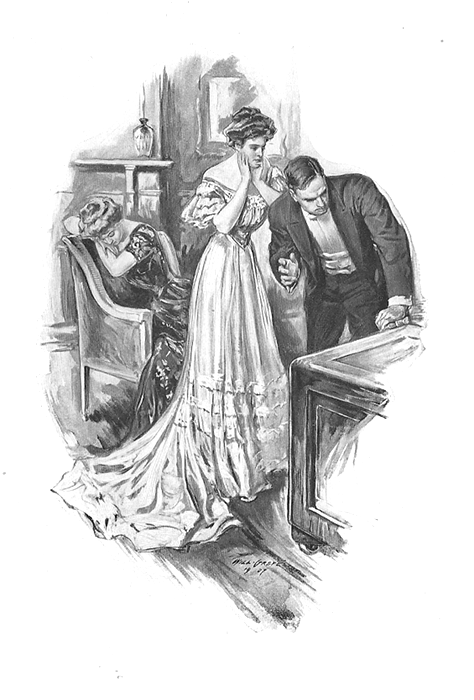
had happened.
"They ... it is not there!"
Norah sat down and hid her face on
her arms.
Carrington rushed over to the safe,
stooped and made a hasty examination.
It had been opened by some one who
knew the combination! He stood up, a
cold chill wrinkling his spine. He saw
it all distinctly. Cavenaugh knew. He
had known all along. Cavenaugh had
overheard him speak to Kate, and had
opened the safe after their departure for
the club. It was all very cleverly done.
He knew that Kate was utterly blameless.
Then it dawned upon him that, they appeared
as though they accepted the catastrophe
as not wholly unexpected! To
what did this labyrinth lead?
A rattle of the curtain-rings wheeled
them about. They beheld Cavenaugh
himself standing in the doorway.
"What's the trouble?" he asked, eying
Carrington suspiciously.
Carrington answered him icily. "I left
some legal documents of great value in
this safe; they are no longer there."
Cavenaugh's jaw dropped. He stared
at Kate, then at Norah. If ever there was
written on a face unfeigned dismay and
astonishment, it was on the millionaire's.
A moment before Carrington would have
sworn that he was guilty; now he knew
not what to believe. He grew bewildered.
There had certainly been a burglar; but
who was he?
"Mr. Carrington," said Cavenaugh,
pulling himself together with an effort,
"you need have no worry whatever. I
will undertake to restore your documents.
I offer you no explanations." He left
them abruptly.
The young lawyer concluded to grope
no longer. Somebody else would have to
lead him out of this labyrinthine maze.
All at once there came to him a sense of
infinite relief. Providence had kindly
taken the matter out of his hands.
"Never mind, Kate," he said. "For my
part, I should be entirely satisfied if I
never saw the miserable thing again."
"Father will find it for you." Her eyes
were dim with tears of shame.
"What is it, girl?"
"Nothing that I can explain to you,
John. Good night."
When he had gone to his room, Norah
turned to her sister and sobbed on her
breast.
"Oh, Kate!"
"What is the matter, child?"
"I told grandpa the combination!"
III
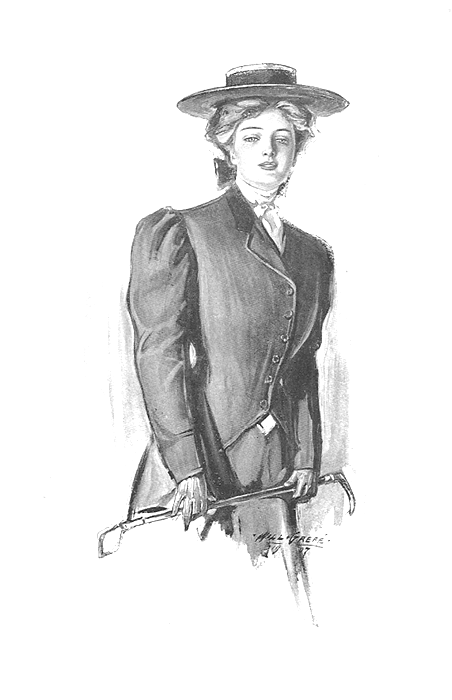
CARRINGTON tumbled out of
bed at six and threw out the old-fashioned
green blinds. A warm,
golden summer morning greeted his eyes,
and the peaceful calm of Sunday lay upon
the land. A robin piped in an apple-tree,
an oriole flashed across the flower-beds,
and a bee buzzed just outside the sill. A
brave day! He stepped into his tub,
bathed, and dressed in his riding-clothes,
for there was to be a canter down to the
sea and return before breakfast. From
the window he could see the groom walking
the beautiful thoroughbreds up and
down the driveway. There were only two
this morning; evidently Norah was not
going.
The Cavenaugh girls had created almost
a scandal and a revolution when
they first appeared at Glenwood. People
had read and talked about women riding
like men, they had even seen pictures of
them, but to find them close at hand was
something of a shock. Yet, when they
saw with what ease the Cavenaugh girls
took the hedges, ditches and fences, how
their mounts never suffered from saddle-galls,
and, above all, how the two always
kept even pace with the best men riders,
opinion veered; and several ladies
changed their habits.
Norah, who saw the droll side of things,
once said that the accepted riding habit
for women reminded her of a kimono for
a harp.
Carrington stole gently down to the
horses. He had great affection for the
sleek thoroughbreds. Their ears went
forward when they saw him, and they
whinnied softly. He rubbed their velvet
noses and in turn they nozzled him for
sugar-loaves. Had it not been for the
night and the attendant mysteries, his happiness
would have been complete. People
waste many precious moments in useless
retrospection; so Carrington resolutely
forced the subject from his mind. One
thing was certain, the Cavenaughs knew
who the burglar was; and there was something
strange in the idea of an empty safe
in a millionaire's home. Pshaw! He took
out the expected sugar-loaves and extended
them on both palms. The pair
lipped his hand and crunched the sweets
with evident relish.
"How are they to-day, James?"
"Fit for twenty miles, straight away or
'cross-lots, sir. Your mount is feeling his
oats this morning; he hasn't been out for
a run since Thursday, sir. I've put the
curb on him in case he takes it into his
head to cut up shines. Here comes Miss
Kate, sir."
Carrington's pulse rose. Kate was approaching
them. She was pale but serene.
She smiled a good morning, which took
in the gentleman and the groom.
"I hope I haven't kept you waiting."
"Not a moment; I only just got down
myself," said Carrington.
She mounted without assistance and adjusted
her skirts. The filly began to waltz,
impatient to be off.
"To the beach?" Carrington asked,
swinging into his saddle.
She nodded, and they started off toward
the highway at a smart trot. Once
there, the animals broke into an easy canter,
which they maintained for a mile or
more. Then Kate drew down to a walk.
"What a day!" said he, waving his hand
toward the sea-line.
There was color a-plenty on her cheeks
now, and her eyes shone like precious
stones. There is no exhilaration quite like
it. She flicked the elders with her crop,
and once or twice reached up for a ripening
apple. In the air there was the strange
sea-smell, mingled with the warm scent of
clover.
"I'll race you to the beach!" she cried
suddenly.
"Done! I'll give you to the sixth tree."
He laughed. There was really nothing at
all in the world but this beautiful girl,
the horses, and the white road that wound
in and out to the sea.
She trotted her mount to the sixth tree,
turned, and then gave the signal. Away
they went, the horses every bit as eager as
their riders. With their ears laid back,
their nostrils wide, their feet drumming,
they thundered down the road. Carrington
gained, but slowly, and he had to hold
his right arm as a shield for his eyes, as
the filly's heels threw back a steady rain
of sand and gravel. Faster and faster; a
milk-wagon veered out just in time; foolish
chickens scampered to the wrong side
of the road, and the stray pigs in the orchards
squealed and bolted inland. It was
all very fine. And when they struck deep
tawny sand the animals were neck and
neck. It was now no easy task to bring
them to a stop. Carrington's hunter had
made up his mind to win, and the lithe
filly was equally determined. As an expedient,
they finally guided the animals
toward the hull of an ancient wreck;
nothing else would have stopped them.
"How I love it!" said Kate breathlessly,
as she slid from the saddle. "Beauty, you
beat him, didn't you!" patting the dripping
neck of her favorite.
They tethered the horses presently, and
sat down in the shade of the hull.
"Nothing like it, is there, girl?"
"I hate automobiles," she answered irrelevantly.
The old, old sea quarreled murmurously
at their feet, and the white gulls
sailed hither and thither, sometimes
breasting the rollers just as they were
about to topple over into running creamy
foam. The man and the girl seemed perfectly
content to remain voiceless. There
was no sound but the song of the sea: the
girl dreamed, and the man wondered
what her dream was. Presently he
glanced at his watch. He stood up, brushing
the sand from his clothes.
"Half an hour between us and breakfast,
Kate. All aboard!"
The night before might have been only
an idle dream.
So they took the road back. Only the
sea and the gulls saw the tender kiss.
The pariah sauntered in at two o'clock
that afternoon, just as the family were
sitting down to luncheon. He was a revelation.
There was nothing shabby about
him now. He wore a new suit, spats, a
new straw hat, and twirled a light bamboo.
There was something jaunty and
confident in his air, a bubbling in his eyes;
altogether, he was in fine fettle about
something. He cast aside his hat and cane
with a flourish.
"Aha! just in time," he said. "Another
chair, William."
The butler sent a dubious glance at his
master; there was the usual curt nod and
the frown. So grandpa sat down beside
Norah, whose usual effervescence had
strangely subsided; he pinched her cheek,
and deliberated between the cold ham and
chicken.
"A fine day! A beautiful day! A day
of days!" he cried, surrendering to the
appetitious lure of both meats.
Nobody replied to this outburst of exuberance;
nobody had the power to. A
strange calm settled over every one. This
was altogether a new kind of grandpa.
There was nothing timid or hesitant here,
nothing meek and humble; neither was
there that insufferable self-assurance and
arrogance of a disagreeable man. Grandpa's
attitude was simply that of an equal,
of a man of the world, of one who is confident
of the power he holds in reserve;
that was all. But for all that, he was a sensation
of some magnitude. Carrington
was seized with a wild desire to laugh.
The truth came to him like an illumination;
but he wisely held his peace.
"There is something in the air to-day
that renews youth in old age; eh, my
son?" with a sly wink at Cavenaugh.
Cavenaugh's expression of wonder began
to freeze and remained frozen to the
end of the meal. So all the honors of conversation
fell to grandpa, who seemed to
relish this new privilege.
"Father," said Cavenaugh, holding
back his accumulated wrath, "I want to
see you in my study."
"Immediately, my son. I was just about
to make that same request." Grandpa
looked at Kate, then at Carrington. "I
suppose you young persons will invite
poor old grandpa to the wedding?"
"Father!" This was altogether too
much for patrician blood. Cavenaugh's
face reddened and his fists closed ominously.
"You will do me the honor, father,
not to meddle with my private
affairs. Kate is my daughter, and she shall
marry the man it pleases me to accept."
Carrington felt this cut dart over
grandpa's shoulder. He stirred uneasily.
"Oh, if that's the way you look at it!"
with a comical deprecatory shrug.
Grandpa touched Carrington on the arm.
"Young man, do you love this girl? No
false modesty, now; the truth, and nothing
but the truth. Do you love her?"
"With all my heart!" Carrington felt
the impulse occult. Something whispered
that his whole future depended upon his
answer.
"And you, Kate?"
"I love him, grandpa," bravely.
"That's all I want to know," said
grandpa.
Cavenaugh released one of his fists; it
fell upon the table and rattled things generally.
"Am I in my own house?" he bawled.
"That depends," answered grandpa
suavely. "You've got to behave yourself.
Now, then, let us repair to the secret
chamber of finance. It is the day of settlement,"
grimly.
Mrs. Cavenaugh was gently weeping.
The dread moment had come, come when
she had been lulled into the belief that it
would never come. Kate understood, and
longed to go to her and comfort her; and
she trembled for her father, who knew
nothing of the pit that lay at his feet.
Carrington dallied with his fork; he
wished he was anywhere in the world but
at the Cavenaugh table. The desire to
laugh recurred to him, but he realized
that the inclination was only hysterical.
Cavenaugh was already heading for the
study. He was in a fine rage. Grandpa
was close on his heels. At the threshold
he turned once more to Carrington.
"You know your Tempest, young man,
I'm sure," he said. "Well, this is the
revolt of Caliban—Caliban uplifted, as it
were."
The door closed behind them, and father
and son faced each other.
"I'll trouble you for those papers you
took from the safe last night," said the
son heavily.
"Ah, indeed!" said grandpa.
"At once; I have reached the limit of
my patience."
"So have I," returned grandpa. "Perhaps
you know what these papers are
about?"
"I know nothing whatever, save that
they belong to Mr. Carrington. Hand
them over."
Grandpa helped himself to a cigar and
sat down. He puffed two or three times,
eyed the lighted end, and sighed with
satisfaction.
"If you but knew what they were about,
these papers, you would pay a cool million
for their possession. My word, it is
a droll situation; reads like the fourth act
in a play. If you have a duke picked out
for Kate, forget him."
"She will never marry Carrington!"
Cavenaugh's voice rose in spite of his effort
to control it.
"My son, they will hear you," the pariah
warned. He blew a cloud of smoke
into the air and sniffed it. "You never
offered me this particular brand," reproachfully.
"Enjoy it," snapped the other, "for it is
the last you will ever smoke in any house
of mine."
"You don't tell me!"
"Those papers, instantly!"
"'Be it known by these presents, et
cetera, et cetera,'" said the old man. He
rose suddenly, the banter leaving his lips
and eyes, and his jaw setting hard. "You
had better get your check-book handy,
my son, for when I'm through with you,
you'll be only too glad to fill out a blank
for fifty thousand. I consider myself
quite moderate. This young Carrington
is a mighty shrewd fellow; and I'd rather
have him as a friend than an enemy. He
has made out his case so strongly that it
will cost you a pretty penny to escape with
a whole skin."
"What are you talking about?"
"The case of the people versus Cavenaugh
et al. It concerns the clever way
in which you and your partners slid under
the seven per cent. dividend due your
investors; which caused a slump in the
price of the shares, forcing thousands to
sell their stock; which you bought back
at a handsome profit. Moloch! The millions
you have are not enough; you must
have more. There are about twelve of
you in all, not one of you worth less than
three millions. What a beautiful chance
for blackmail!"
Cavenaugh stepped back, and his legs,
striking a chair, toppled him into it. His
father had become Medusa's head!
"Aha! That jars you some," chuckled
grandpa.
It took Cavenaugh some time to recover
his voice, and when he did it was faint
and unnatural.
"Is this true?" he gasped.
"It is so true that I'll trouble you for
the check now."
"Come, father, this is no time for nonsense."
Cavenaugh waved his hand impatiently.
"Let me see the document."
"Hardly. But the moment you place
the check in my hands, I shall be pleased
to do so. But there must be no reservation
to have payment stopped."
"I will not give you a single penny!"
The mere suggestion of giving up so
large a sum without a struggle seemed
preposterous. "Not a penny! And furthermore,
I am through with you for
good and all. Shift for yourself hereafter.
Fifty thousand! You make me
laugh!"
"I shall make you laugh, my son; but
not on the humorous side." The old man
reached out his hand and struck the bell.
"What do you want?" asked Cavenaugh,
mystified.
"I want the author of the document. I
propose to take the family skeleton out of
the closet and dangle it up and down before
the young man's eyes. You will
laugh, I dare say."
Cavenaugh fell back in his chair again.
The door opened and William looked in.
"You rang, sir?" to Cavenaugh fils.
"No, William," said Cavenaugh père
affably; "I rang. Call Mr. Carrington."
The butler disappeared. "It is my turn,
Henry, and I have waited a long time, as
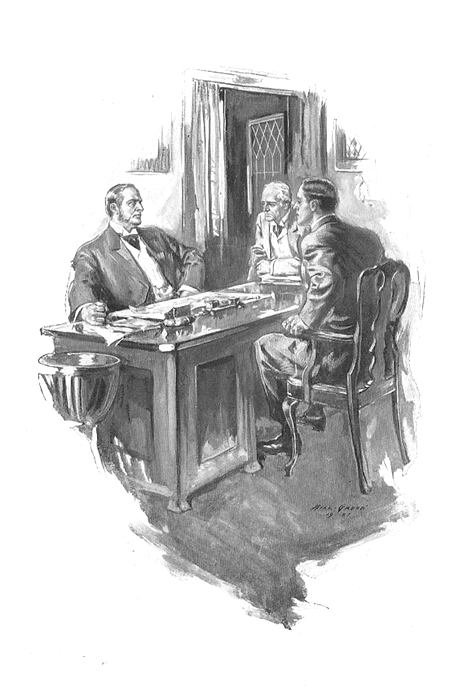
you very well know. Ha! Sit down, Mr.
Carrington, sit down."
Carrington, who had entered, obeyed
readily.
"You left some papers in the dining-room
safe last night," began grandpa.
"I was about to ask you to return them,"
replied Carrington, with assumed pleasantry.
The two Cavenaughs looked at each
other blankly. Finally grandpa laughed.
"I told you he was clever!"
"It is true, then," snarled the millionaire,
"that you have been meddling with
affairs that in no wise concern you. I
warn you that your case in court will not
have a leg to stand on."
"I prefer not to discuss the merits of the
case," said Carrington quietly.
"I have been your host, sir; you have
eaten at my table." Cavenaugh, as he
spoke, was not without a certain dignity.
"All of which, recognizing the present
situation, I profoundly regret."
"Good!" said grandpa. "Henry, if you
had been the general they give you credit
for, you would have offered Mr. Carrington
that seventeen thousand two or three
years ago. There is nothing so menacing
to dishonesty as the free lance. Now, listen
to me for a space. We'll come to the
documentary evidence all in good time.
I spoke of Caliban uplifted," ironically.
"For years I have been treated as a pariah,
as a beast of burden, as a messenger
boy, as a go-between to take tricks that
might have soiled my son's delicate hands.
Father and son, yes; but in name only.
Blood is thicker than water only when
riches and ambition are not touched in
the quick. This dutiful son of mine could
easily have elevated me along with himself;
but he would not do so. He was
afraid that people might learn something
of my past, which would greatly hinder
his advancement. He prospered, he grew
rich and arrogant; he put his heel on my
neck, and I dared not revolt. You
wouldn't believe it, would you, Mr. Carrington,
that I was graduated with honors
from Oxford University. I speak
three tongues fluently, and have a smattering
of a dozen others; am a doctor of
philosophy, an Egyptologist. But I was
indolent and loved good times, and so, you
see, it came about that I fell into evil
ways. Formerly, I was a burglar by profession."
He stopped, eying Carrington's stupefaction.
The son gnawed his lips impotently.
"I was a master, after a fashion," resumed
the old man, satisfied with his
dénouement. "I committed a dozen splendid
burglaries. I never left a trail behind.
The police sought for me, but did
not know me either by name or by sight.
This was the sword my son kept over my
neck. The slightest rebellion, and he
threatened to expose me. Oh, I know the
boy well enough; he would have done it
in those days. Once extradited to England,
thirty years ago, no one would have
connected our names. Yet he was afraid
of me; he wasn't sure that at any time the
old desire would spring up renewed. I
robbed to gratify my craving for excitement
rather than to fill my purse. I made
an unhappy marriage; something Kate
nor Norah shall do while I live. Henry
was clever. He made me an allowance of
two hundred a month. And how do you
suppose he arranged the payment? On
the first day of the month he placed the
cash in a safe in the house, and changed
the combination. If I got the money without
being caught it was mine; otherwise
I went hungry. Ingenious idea, wasn't
it? For I had all the excitement, and none
of the peril of a real burglary. Henry
forgot, yesterday, that it was the first of
the month."
The millionaire found it impossible to
remain seated. He rose and paced the
floor, his brows knit, his hands clenched.
He was at bay. Carrington felt as if he
were in the midst of some mad dream.
"Sometimes I succeeded in opening
the safe; and sometimes, when luck went
against me for two or three months,
Norah tipped me the combination. She
dared not do it too often. So the months
went on. Once a month I was permitted
to visit my grandchildren. My son grew
richer and richer; for myself, I remained
in the valley of humiliation. I
had no chance. I had never met any of
my son's friends; he took good care that
I did not; so they were in total darkness
as to my existence. But the ball and chain
were knocked off last night. Your papers
are, after all, only an incident. Caliban
revolts. Mr. Carrington, my son! Oh, I
am proud of him. I believed the genius
for robbery was mine. I am a veritable
tyro beside Henry. Half a dozen millions
from the pockets of the poor at one
fell swoop! Where's your Robin Hood
and his ilk? But it isn't called robbery; it
is called high finance."
He applied a match to his dead cigar
and thoughtfully eyed his son.
"And there is a good joke on me, weaving
in and out of all this. I regularly invested
half my allowance in buying
shares in my son's company, to insure my
old age. It jarred me when I read the
truth last night. I hate to be outwitted.
Henry, sit down; you make me nervous."
"Well, what are you going to do?"
asked the son. As he faced his father
there was something lion-like in his expression.
"Sit down, my son, and I will tell you,"
answered the old man quietly. He knew
that his son was a fighter, and that to win
he would have to strike quick and hard.
Cavenaugh flung himself into his chair.
At that moment he did not know which
he hated the most, his father or Carrington.
"First, you will write out that check
for fifty thousand."
"Blackmail!"
"Nothing of the sort. For twenty years
you have kept your heel on my neck. I
could do nothing; opportunities came
and I dared not grasp them; my genuine
ability was allowed to rust. It is simply
compensation. Blackmail? I think not.
I could easily force a million from you.
But I am and have been for years an
honest man. And heaven knows how well
I have paid for my early transgression,"
bitterly. "This hour is mine, and I propose
to use it."
"What guaranty have I of your good
faith?" fiercely.
"My word," calmly. "I have never yet
broken it."
Carrington gazed longingly toward the
door. It was horribly embarrassing. He
began to realize that Kate's father would
hate him bitterly indeed, and that his own
happiness looked very remote.
Cavenaugh turned to his desk, filled
out the blank, and passed it to his father,
who, with scarcely a glance at it, passed it
back with a negative shake of the head.
"The official certifying stamp lies on
your desk; use it."
There was no getting around this keen-eyed
old man. He knew every point in
the game.
"You will live to regret this," said
Cavenaugh, his eyes sparkling with
venom.
"I have many things to regret; principally
that fate made me a father." The
old man passed the check over to Carrington.
"You're a lawyer; does that look
legal to you?"
Carrington signified that it did.
"Now, then, Henry, you will write
down on official paper your resignation
as president and director of the General
Trust Company of America. You will
give orders for the restitution of the millions
that were fraudulently added to
your capital. I am not the least interested
in what manner the restitutions are made,
so long as they are made. I am now representing
the investors. As for your partners,
it will be easy for you to impress
them with the necessity of the action."
"And if I refuse?"
"Nothing less than the attorney-general.
I intend to make this business as
complete as possible."
Cavenaugh turned again to his desk.
He knew his father even as his father
knew him. He wrote hurriedly, the pen
sputtering angrily.
"What else?" with a cold fury.
Again the old man gave Carrington
the paper.
"It is perfectly intelligible," he said.
He began to feel a bit sorry for Cavenaugh
junior.
"Now, those papers," said Cavenaugh
sharply.
"I believe they belong to me," interposed
Carrington.
Grandpa smiled. "It all depends."
"I could easily force you," suggestively.
Grandpa smiled again. "Of that I
haven't the least doubt. Of course, what
I have is only a copy?"
"It is the only copy in existence," replied
Carrington anxiously. And then a
flush of shame mantled his cheeks.
Where was his legal cunning?
"Ah!" The ejaculation came from
Cavenaugh junior.
"There is but one thing more," said
grandpa urbanely. "I am determined
that Kate shall be happy. She shall marry
Mr. Carrington before the snow flies.
It is an excellent policy to keep valuable
secrets in the family."
"Give your papers to the attorney-general.
I'll see you all hanged before
I'll give my consent!" Cavenaugh roared
out these words. His patience had truly
reached the limit of endurance.
"Softly, softly!" murmured grandpa.
"I mean it!" con agitata.
"Ah, well; what will be, will be. Son,
I came down here yesterday with altogether
a different piece of business in
mind. The documents I discovered last
night changed these plans. You own
rich oil lands in Texas; or, rather, you
did own them before you sold out to the
company. The land you sold was not,
and never had been, legally yours; you
owned not a single tuft of grass. Government
land-grab, I believe they call it. It
is not now a question of refunding money;
it is a question of avoiding prison. The
supreme court at Washington can not be
purchased. It cost me five hundred,
which I could ill afford, to get a copy of
the original transfer. The real owner mistook
me for you, son; that is how I
learned. Your consent to this marriage;
or, my word for it, I'll put you where you
would have put me, had you dared.
Quick! My patience is quite as tense as
yours."
The collapse of Cavenaugh was total.
He saw the futility of further struggle.
Ah! and he had believed all these transgressions
securely hidden and forgotten,
that the fortress of his millions would
protect him from all attack. Too late he
realized that he had gone too far with
his father. There was no mercy in the old
man's eyes, and Cavenaugh knew in his
heart that he deserved none.
"Very sensible," said the retired burglar.
He folded the check and put it in
his wallet, while his son covered his face
with his hands. "Murder will out, even
among the most pious. I know that what
has passed between us will be forgotten
by Mr. Carrington. For myself, I shall
return to England. I have always had a
horror of dying in this country. Like
father, like son; the parable reads truly.
It was in the blood, Mr. Carrington; it
was in the blood. But Henry here went
about it in a more genteel manner." He
struck the bell. "William, send Miss
Kate here."
William bowed. He recognized the
change; grandpa's voice was full of confident
authority.
Kate entered the study shortly after.
She had been weeping; her eyes were red.
Seeing her father's bowed head, she
sprang to his side like a lioness.
"What have they been doing to you,
father?"
"Nothing but what is just," softly answered
her parent. The little dukes and
princes faded away as a dream fades.
"Grandpa ..." she began.
"Child, it is all settled. The hatchet is
buried in frozen ground. Your father
consents to your marriage with Mr. Carrington.
It has been a heated argument,
but he has come around to my way of
thinking. 'All's right with the world,' as
Browning says. Bless you, my children,
bless you!" with tender irony.
"And now, my papers," said Carrington,
smiling up at the girl reassuringly.
"And you still wish to marry me?"
asked the girl, her face burning and her
eyes moist.
"I'd marry you if your grandpa was
Beelzebub himself!"
"Here's your papers, young man," said
grandpa. He passed the envelope across
the table.
"What's this?" cried Carrington.
"It means, my boy," said grandpa,
"that blood is thicker than water, and
that I really intended no harm to Henry.
And then, besides, I like to win when all
the odds are against me."
Carrington gently turned the envelope
upside down. Nothing but burnt paper
fluttered upon the table.
![The BEST MAN by HAROLD MACGRATH Author of The Man on the Box, Hearts and Masks, Half a Rogue, Etc. With Illustrations by Will Grefé. Decorations by Franklin Booth. [Illustration] NEW YORK A. L. BURT COMPANY PUBLISHERS](https://openoldbooks.sgp1.digitaloceanspaces.com/books/the-best-man/images/title.png "The BEST MAN by HAROLD MACGRATH Author of The Man on the Box, Hearts and Masks, Half a Rogue, Etc. With Illustrations by Will Grefé. Decorations by Franklin Booth. [Illustration] NEW YORK A. L. BURT COMPANY PUBLISHERS")