Since being separated from Massasoit years before in Plymouth harbor,
Tasquanto, whose name the English had shortened to "Squanto," had known
nothing of the fate of his fellow-captive beyond that he had been sold
as a slave in London. In the mean time he had been received into the
household of Sir Ferdinando Gorges, Governor of Plymouth, who had large
interests in the New World, and had been taught to speak English. Then
he was sent on trading-vessels to act as interpreter between whites and
Indians. In this capacity he had made several voyages to America, but
always so closely guarded that never until now had he been allowed to
set foot on his native shores.
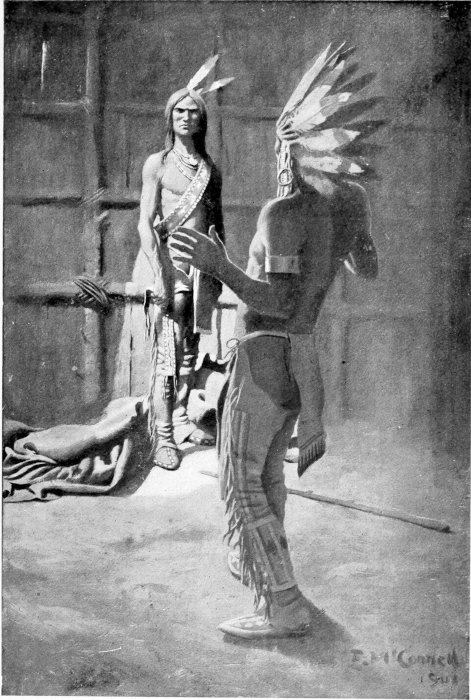
Tasquanto was so overcome at finding in the great sachem Massasoit,
concerning whom he had heard much, his own long-lost friend that
for a few moments he was speechless with joyful amazement. When he
had succeeded in partially expressing this, he related briefly how
he happened to be in his present situation, and added that the cruel
taskmaster from whom he had just escaped was the same Captain Dermer
who had formerly betrayed them into slavery.
"I knew it when first I saw him this morning," replied Massasoit,
grimly, "for his evil face has ever been pictured in my heart. For that
reason have I spared his worthless life until I could consult with
thee, my brother, as to how we may best deal with him."
"Did you, then, know me also?" asked Tasquanto.
"The moment I set eyes on thee. Those white dogs had been slain an hour
sooner but for thy presence among them and a fear of doing thee harm.
Now, what say you? Shall this man be delivered to the tormentors, or
shall he be killed where he lies? It is certain that his punishment
must be great, for he has earned all that may be given. Also I do not
care that he should recognize me and spread the report that I was once
his slave, for that would shame me in the eyes of my people. Thou, too,
must ever keep secret the matter of my having crossed the salt waters."
"I will remember," replied Tasquanto. "As for this white man, I would
crop his ears with the same brand of ownership that he has placed upon
many an Indian captured and sold into slavery. Then would I let him
sail away in his own ship as a warning to all other white men. Death he
deserves, since he has treated many of our people to death and worse,
but to him the shame of cropped ears will be even more bitter than
death."
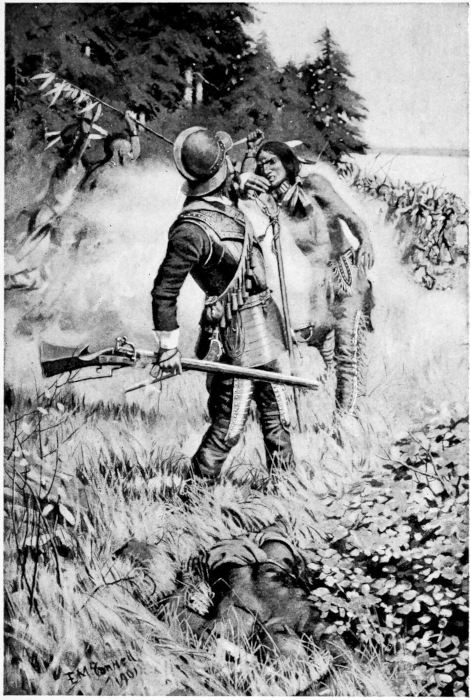
So favorably was Massasoit impressed with this idea that he ordered it
carried out at once. Thus, half an hour later, the brutal Dermer, who
had done so much to cause the name of Englishman to be hated in the
New World, was set adrift in a canoe, minus both his ears, and allowed
to depart to his own ship. It is recorded in history that he reached
Virginia, where he soon afterwards died from wounds received at the
hands of New England savages.
Having thus satisfactorily concluded one part of his undertaking,
Massasoit next turned his attention to the rebel Narragansetts.
Moving his entire force against their stronghold, he demanded that all
goods received from the English should be delivered up, and also that
Miantinomo should come to his camp, bringing a chief's belt in token
of submission. Massasoit swore that, in case his demands were refused,
he would not depart from that place until every rebel in the fort was
destroyed. So mild were these terms in comparison with what had been
expected that they were instantly accepted, and a cruel war between
neighbors was averted.
With peace thus restored, the authority of Massasoit over the great
territory, already named New England by Captain John Smith, was so
firmly established that until the day of his death it was never again
questioned.
But if one of his two chief causes for anxiety was thus removed, the
other was looming ominously near. Some six months after Tasquanto's
escape from his long captivity a little English ship, buffeted by
winter gales of the North Atlantic, was slowly approaching the American
coast. Although only of one hundred and fifty tons' burden, or about
the size of a small coasting schooner of to-day, she carried one
hundred passengers besides her crew and an immense quantity of freight.
For three months had her passengers—men, women, and children—been on
board the overcrowded little craft, and they were sick for a sight of
land. Their destination was the mouth of the Shatemuc or Hudson River,
but their first landfall, made under a cold December sky, was the bluff
headland, stretching far out to sea like a beckoning finger, that
Gosnold, some twenty years earlier, had named the Cape of Cods. From
here the ship was headed southward towards her destination, but soon
became involved in a labyrinth of shoals covered with roaring breakers.
Also she was beaten by adverse gales until her weary company hailed
with joy her captain's decision to run back to the safe shelter of Cape
Cod. Here, in what is now the harbor of Provincetown, the sea-worn
strangers disembarked, so profoundly happy at finding themselves once
more on land that the wooded wilderness seemed a paradise.
They had come to establish homes in the New World, and though
disappointed at not gaining the more southerly latitude for which they
had set out, they now determined to remain where they were, since it
was too late in the season for further explorations. Still, they spent
two weeks in examination of the country close at hand, and finally
selected a site for settlement across the bay enclosed by Cape Cod.
Here was a good harbor, plenty of fresh water, and much land already
cleared of forest growth by its former Indian occupants.
They named this place "Plymouth" after the last English port from which
they had sailed, and on Christmas day began the work of building houses.
During that winter half of these stout-hearted settlers died, so that
in the early spring only fifty persons, enfeebled by the sickness from
which but seven had wholly escaped, remained to make good their claim
to the land they had thus seized.
During all this time the colonists had not encountered any of the
native owners of the soil, though they had caught occasional glimpses
of vanishing forms, and often saw signal-fires or smokes that denoted
the presence of watchful observers.
In spite of these things they did not hesitate to appropriate Indian
property wherever they found it. Thus, when they discovered hidden
stores of corn and parched acorns, laid by for winter use, they
promptly removed them to Plymouth. Also whenever they ran across an
Indian lodge, they took from it everything that seemed to them of
value. They even robbed Indian graves of their sacred relics, and these
things were reported to Massasoit by his scouts.
From the first appearance of the Mayflower on the stormy horizon he
had known of all its movements. He had been relieved when it started
southward, and was greatly disturbed by its return to Cape Cod. He
was also much puzzled to account for the doings of its company, since
evidently they were neither traders nor fishermen. Why had they brought
women and children with them? Also why had they in the first place
attempted to sail to the southward, if his country was the place
they were seeking? He finally decided that they must be bound for the
Virginia settlement of white men, and were only waiting until the
winter storms were over before resuming their voyage to the country of
Powhatan.
This decision eased Massasoit's mind, for, while he was determined that
no whites should settle within his boundaries, he was also averse to
unnecessary bloodshed. So he awaited patiently the departure that he
believed the strangers would make with the coming of warmer weather.
If they did not so depart, he knew that he could wipe them out of
existence as easily as he could crush a worm that came in his path.
Thus forbearing to disturb them, he waited and watched, receiving
almost daily reports from his scouts, who at all times lurked in the
vicinity of the feeble settlement. He heard with grim satisfaction of
their rapid decrease in numbers, and grew wroth at their violation of
Indian graves and their appropriation of unguarded Indian property.
Still he forbore to molest them, but as spring drew near he sent
Samoset to learn how soon they intended to depart.
To his dismay this messenger brought back word that the English had no
intention of ever again leaving the place where they had established
themselves.
"Then must I remind them that I have no desire for their presence,"
quoth Massasoit, and at once he sent out runners to gather a large
force of warriors in the vicinity of Plymouth. Accompanied by a
body-guard of sixty men, the sachem himself hastened to the place of
rendezvous and established a camp, from which he sent Tasquanto among
the whites to learn in detail their strength and intentions.
With his ready command of English and his knowledge of white men's
customs, gained by painful experience, Tasquanto or "Squanto," as he
now called himself, found no difficulty in gaining all the information
he desired from the strangers. He even learned their names and the
relative rank held by their leading men.
When Tasquanto returned and reported these things, he mentioned one
name that caused Massasoit to start and betray symptoms of great
agitation.
"Art thou certain that one among them is so called?" he asked.
"I am certain," replied Tasquanto.
"Then go quickly and ask that man, as he values his own life and that
of his people, to meet me alone by the big pine that looks down upon
his lodges. I will be there unaccompanied. Stay! Take to him this belt
that it may be to him a token of safe-conduct and true speaking."
With this Massasoit removed from his own person the great Belt of Seven
Totems and handed it to Tasquanto. He also instructed the latter to
withdraw beyond earshot when he had conducted the white man to the
place of meeting.
Half an hour later Massasoit, with unpainted face and simply clad,
stood alone at the foot of the great pine, looking down on the group
of poor little huts that sheltered the feeble English remnant. Within
a mile of the place were gathered five hundred warriors awaiting but a
signal from him to utterly destroy the helpless settlement.
Then to him came an Englishman, young, sturdy, and heavily bearded.
As he approached within a few paces he halted and examined the Indian
curiously, for he had been told that he was to meet a sachem who was
ruler of many tribes.
On the other hand, Massasoit gazed into the bearded face of the white
man with an eagerness that was almost disconcerting. Then, as though
satisfied with his scrutiny, he extended a hand, exclaiming as he did
so,—
"Winslow! My frien' Winslow!"
For a moment the other hesitated, then his face lighted joyously as he
grasped the proffered hand in both of his, crying,—
"Massasoit? They told me the name of the mighty chieftain was
Massasoit, but never did I suspect that he was the friend whom I had
found and lost in London."
For an hour the two, thus strangely brought together after years of
distant wanderings, held converse with each other while the fate of the
New World hung upon their words. When their conversation was finally
ended, Winslow had promised never to reveal the fact that the proud
sachem had once been bought and sold as a slave in England. He had also
promised that the colony to which he belonged should never commit an
act of aggression against the people of Massasoit, but that his friends
should be their friends and his enemies their enemies.
On his part, and out of an abounding gratitude for the only friendship
shown him at a time when he stood most in need of friends, Massasoit
agreed that the poor little English settlement should be allowed to
exist, and, moreover, promised to protect it from its enemies to the
full extent of his power.
Then the two parted, the one to go back to his wondering warriors
and dismiss them to their homes, the other to carry the glad news
into Plymouth that the great Massasoit was ready to make a treaty of
friendly alliance with his English neighbors.
So on the morrow Governor Carver, accompanied by Winslow, sturdy Myles
Standish, and others of his principal men, met Massasoit. Then, after
much feasting and an exchange of courtesies, they mutually signed a
treaty of friendship that remained unbroken for upward of half a
century from that memorable date.
Thus was the crumb of bread once cast upon troubled waters by Edward
Winslow returned to him again with a thousand-fold of increase after
many days.
Thus also did Nahma, son of Longfeather, now become Massasoit, wearer
of the Belt of Seven Totems, make possible and establish forever the
white man's settlement of New England.
* * * * * *
N. B. When the good ship Mayflower returned to England from that her
most memorable voyage to the New World she bore in her cargo a packet
of richest furs, together with many specimens of dainty beadwork,
consigned to Lady Betty Effingham, who dwelt near to Bristol, England,
with goodly wishes from her friend and humble servant, Massasoit.
Transcriber's Note:
Obvious typographic errors have been corrected.