§ 2. The study of beginnings
At the outset it should be said that the
importance of this study of beginnings is
in every science quite out of proportion
to the importance of the objects studied.
Beginnings are by nature small. The
highest and best things are by nature the
most complex and latest, but the study of
the earliest and simplest libraries, like the
study of the simplest cell life, is not only
useful from several points of view but
vital to a right understanding of the more
complex. The great vice of technical
education of all sorts is its tendency to
fix attention on the latest and best only.
It is true of course that man’s ideas and
methods are an evolution—just as his
body is. The fact of the accumulation of
human experience is the central significant
fact of human civilization. It is the glory
of libraries that by reason of this fact
they are an indispensable tool of progress
in civilization. On the whole, by and
large, the latest ideas are in fact best, for
they tend to sum up in themselves the total
of the useful variations of all preceding
ideas, and the main time and attention
of a course of education must of necessity
therefore be given to the latest and best
experience, because it does sum up all that
has gone before. This does not, however,
lessen the value of the study of earlier
ideas on any subject back to the very beginnings,
for at any given time and place,
the latest idea or method in any field is
not necessarily the best. It might be the
best: it is in position to build on all previous
experience and so become best. We
all know, however, that the latest book on
a subject is not always the best book. So
it is, too, of individual ideas or methods.
This frequent failure of the latest to
be best comes chiefly from lack of knowledge
of previous experience. Every year
sees library methods put in operation
which were tried and found wholly wanting
in the last century or it may be, two,
three or even five thousand years ago.
On the other hand again, every now and
then we find that some method or idea,
discovered long ago but neglected meantime,
is far better than those in common
use. This has often been true of great
scientific ideas and we have in Mendelism
a striking recent example. One must
needs therefore study earlier ideas in any
field, both in order to be sure that so-called
new ideas are not exploded old ones
and in order to find whether common
practice in any field at a given time is not
really the development of an inferior line
of evolution.
And, again, from the point of view of
science, this study of earlier stages is useful
because the simple things are often the
best interpreters of more complex, the
early of the late, and it is the vision of
the whole in perspective to the very beginning
which gives the clue to the real
meaning of the latest. “Students have
come to realize,” says Professor Stewart
Paton (in the Popular Science Magazine
8,1912,166), “that in the ... amoeba,
jelly-fish, crab or fish, is to be found the
key that will eventually open the book
... (of) the most complex psychic
manifestations.” This is true also of libraries—the
oldest, smallest and rudest
give a clue to the more complex, and it
may be added, parenthetically, the library
is itself in fact the most complex psychic
manifestation in the objective Universe.
Beginnings thus, though small, are the
roots of the matter. This is so well recognized
in the field of science as to have
become an axiom, and in the study of
any class of things nowadays the aim is
to trace each kind of thing—plant, animal,
idea or social institution back to its
beginning. Evolution has taught us to
expect a genealogical series back and back
to very simple forms and the method of
all science has become what is called historical
or genetic. Natural science is not
satisfied until the most complex animals
and plants have been traced back through
all their complexities to single cell origins,
and, if Browning may be believed, the
aim of humane and ethical science too
does not rest short of the same effort “to
trace love’s faint beginnings in mankind”.
This study of the beginnings is, moreover,
not only at the bottom of the method
of modern science but of the method of
modern teaching. Every man, it is said,
in his life history retraces the history of
his race, and the race history of man is
above all things a history of developing
ideas. This has two aspects significant
for the method of teaching. As investigating
science must trace every complex
idea back to its simplest beginnings, so
teaching traces the idea forward from
those beginnings to its latest form. The
law by which man in his individual development
of ideas must retrace the history
of the race applies to every idea or
group of ideas and it is doubtful therefore
if any one ever learns anything rightly in
life unless he patiently follows the idea of
it from its simplest beginnings to its latest
form—the path being sometimes a steady
growth in value, sometimes a rise and fall
again towards extinction. The historical
method of teaching, therefore, is the only
method which can be called natural.
The other teaching aspect of this matter
is the very significant fact in child
psychology that the general development
of the child’s mind, like the development
of its body, does in fact repeat the history
of its ancestors as they passed from gestures
and cries to articulate speech and
writing and through these from the simplest
knowledge to the most complex. The
child must therefore, in short, be taken
along “the paths upon which in a very
real sense every human being has come in
person” and the natural method of child
teaching must consequently be deduced
particularly from a study of the beginnings
of speech and writing, books and
book collections. In a sense, and in a
very real sense, the key to the scientific
pedagogy of the future lies in the group
of studies summed up as library science,
for the library is the late and complex
object which sums up in itself the sciences
of the book, the word, and all simpler elements
of human expression and record,
if there be any such. A fourth reason for
the study of beginnings is, therefore, that
it is the natural method of study and
teaching.
Finally and closely connected with the
preceding reasons is the fact that the purpose
of all science is prophecy. We learn
not so much that we may teach, as the
motto says, but we learn that we may
foretell. The object of all science is to
understand from what has been the relation
of cause and effect in the past, what
is likely to be the result of any given set
of circumstances in the future. Physics,
e.g. has proved a very sure prophetic
guide. An engineer can tell with precision
that a bridge constructed in a certain
way will break if loaded beyond a certain
point. Load it to that point and his
prophecy becomes true. In the same way,
with somewhat less precision perhaps, the
biologist can prophesy results in the
breeding of plants and animals, the physician
can prophesy that quinine will help
malaria, the farmer that planted seed under
certain conditions will or will not on
the average produce certain results, and
so on through every branch of human activity.
We study in order that we may
know the conditions which will be
brought about in the future by one or
another set of circumstances and so that
we may be able to produce the circumstances
if we wish the result. The preparation
for foretelling may, therefore, be
labeled the fifth reason for historical
study.
§ 3. Definition of the Library
In approaching the actual study of
primitive libraries it is necessary to touch
a little on definition and method. Both
these matters, essential to the approach
of any topic scientifically, doubly need
some attention at this point, because library
history has heretofore not troubled
itself much about primitive libraries at all
or indeed about libraries for the first two
thousand years after they had left their
more primitive stages. The very method,
therefore, lies chiefly outside the experience
of library history, being gathered
mainly from primitive art and anthropology,
and definition must needs consider
what the essential nature of these primitive
libraries is that links them with the
great libraries of modern times. Discussion
of definition is the more necessary in
that the already contradictory usage has
been still farther confused in the matter
of the earlier historical libraries by those
who, wishing to distinguish the collection
of purely business records, public or private,
from the collection of purely literary
works by calling the former an archive,
have yet applied the term archive, incorrectly,
under their own definition, to
mixed collections of business and other
records.
Many answers have been given to this
question: What is a library? All of
these imply a book or books, a place of
keeping and somebody to do the keeping—books,
building and librarian—but
some definitions emphasize the books,
some the place and some the keeping. Far
the commonest words used have been the
Greek bibliotheke and the Latin libraria
and their derivatives. The one rather
emphasizes the place and the other the
books but both were used sometimes for
both library and bookshop. When modern
languages succeeded to the Latin the
Romance languages kept bibliotheca for
library and libraria for bookshop. Germanic
languages on the other hand kept
both words for library, although in the
course of time German has nearly dropped
librerei for bibliothek, and English has
quite deserted bibliotheke for library.
Both English and German call “book
shop”, or “book business”, what French,
Italian and Spanish call “library”.
Library is thus the common modern
word in English for a certain something
which the German calls Bibliothek, the
Frenchman bibliothèque and the Italian,
Spaniard, Scandinavian and Slav call by
some similar name. This something in
its last analysis is a book or books kept
for use rather than kept for sale or for
the paper mill. A library is thus a book
or books kept for use.
Among the many definitions of the library
which do not recognize use as the
library’s chief distinction, the commonest
are perhaps those which adopt plurality or
collection as the distinguishing factor.
Many however adopt the building as chief
factor. Typically, of course, the modern
library does include many books, a whole
separate building and a librarian, but even
if the books are few, the place only a
room, a chest, a bookcase, or a single
shelf, and even if it is only the owner
who is at the same time the keeper, it is
still recognized to be a library if the
books are kept for use and not for sale.
Quantity does not matter: the point which
divides is the matter of use or sale. Even
a one book library is, in fact, a library
just as much as a one cell plant is plant
or a one cell animal is animal. A one
book library is a very insignificant affair
compared with the New York Public Library
with its many books and many
branches, but it is just as truly a library—or
else you must find some other word.
In point of fact “library” in English, or
some derivative of bibliotheca in most
other languages, is the word which in
practice stands to the book-for-use as the
word animal or plant does in biology for
the living thing whether it is a single cell
or a cell complex.
Some definitions again try to limit the
library to printed books or bound books
or literary works as distinguished from
official or business documents, and these
definitions have, as before said, sometimes
led to a good deal of misunderstanding.
Even if “archive” is assumed
to be the right name for a collection of
business documents, still such a collection
is simply one kind of a library. Every
one recognizes this when the collection of
business documents is one of printed and
bound public documents (U. S. public
documents e.g.), and if the documents
are tablets, rolls or folded documents, the
case does not differ. If books are kept
for use it makes no difference whether
they are of wood, stone, metal, clay, vellum,
or paper, whether they are folded
documents, rolls or codexes, whether they
are literary works, government or business
documents: if intended for use they
form a something for which some word
must be found which will apply equally to
all kinds of records for use and to a
one-book-for-use library as well as to the
New York Public Library. The right
word in the English language seems to be
this word “library”. The “business
documents” in active current use in the
registry or the counting house are perhaps
the farthest away from the “library”
of common speech but they are equally
far from “archives” in the scientific sense,
and curiously these have retained one of
the very simplest and oldest names of the
true library, “the books”, and of librarianship
“book keeping”.
But the definition of a library as a book
or books kept for use only brings us up
against the farther question, What is a
book? To this it may be answered that
a book is any record of thought in words.
Here again neither size, form, nor material
matters; even a one word record may
be a book and that book a library. This
leads again however to still another question:
What is a word? Without stopping
to elaborate or to discuss definitions in
detail, we may take the next step and
define a word as “any sign for any
thing”, and again explain the sign as anything
which points to something other
than itself. This is not an arbitrary definition
but one founded in modern psychology
and philology and to be found in
sundry stout volumes by Marty, Leroy,
Wundt, Dittrich, van Ginneken, Gabelentz,
and others. The sign may be a sound, a
color, a gesture, a mark or an object. In
some stenographic systems a single dot
stands for a whole word.
The most insignificant object, therefore,
kept to suggest something not itself
may be a library. A single word book is
of course a very insignificant book indeed,
and the single letter, single word, single
book library a still more insignificant library,
but, unless you invent other words
for them, they are truly book and library,
and there is no more reason to invent another
word for book or library in this
case, than another word for animal when
it is intended to include both the amoeba
and man. The very simplest library consists
therefore of a single recorded sign
kept for use. It is the feeble faint beginning
of a library but just as much a
library as the New York Public Library,
the Library of Congress, the British Museum,
or the Bibliothèque Nationale—and
the beginning of library wisdom is to seek
out diligently the nature of these rudimentary
libraries.
§ 6. Libraries of the gods
The oldest of all alleged libraries are
the libraries of the gods.
Almost all the great god families, Indian,
Egyptian, Babylonian, Persian,
Greek, and Scandinavian, had their own
book-collections, so it is said. According
to several religions there were book-collections
before the creation of man; the
Talmud has it that there was one before
the creation of the world, the Vedas say
that collections existed before even the
Creator created himself, and the Koran
maintains that such a collection co-existed
from eternity with the uncreated God. It
is obviously idle to try to trace libraries
back farther than this.
Brahma, Odin, Thoth, and substantially
all the creator gods who are described in
terms of knowledge or words, are each
sometimes in effect looked on by the
mythologists as himself an incarnate library
and sometimes even the books of
which he is composed are specified.
On the other hand, by many all creation
was looked on as a library. To the ancient
Babylonians the stars of heaven
were themselves books in which could be
read the secrets of heaven and earth and
the destiny of mankind. The whole
firmament was thus a library of celestial
tablets—tablets of destiny or tablets of
wisdom from the “house of wisdom”,
which was before creation, or carried upon
the breast of the world ruler. “The
Zodiac forms the Book of Revelation
proper ... the fixed stars ... the commentary
on the margin” (cf. Jeremias.
Art. Book of Life, in: Hastings ERE.)
This belief, developed into the so-called
science of astrology, had a prodigious influence
even on the political history of
mankind through its effect on the decisions
and acts of kings. The conviction
that the will of the gods as to future
events was here written down, stored up
and might be read, was at times the controlling
factor in the shaping of human
events.
Two of the most famous libraries of
the gods are those of Brahma and of
Odin. The books of Thoth, equally or
more famous, belong to a somewhat different
class. Brahma’s library contained
or was the Vedas—themselves in fact a
large collection of various works. These
were, it is alleged, preserved in the memory
of the omniscient Brahma and at the
beginning of this present age they were,
in the modern language of an ancient
Sanskrit writer, Kalkuka Bhatta “drawn
out”. Attention has been called to the
fact that this library was represented as
a classified library with notation founded
on the points of the compass!
“From the eastern mouth of Brahma
... issued ... the rich verses....
From his southern mouth ... the yajash
verses.... From the western mouth
... the saman verses and the metics....
From the northern mouth of Vedas
(Brahma) was manifested the entire
Atharvana” (Muir. 3:12). This library
was, it should be noticed, quite up to date
in having the special collections kept in
separate rooms with separate exits. It
was also, it appears, not a mere reference
library but books were issued for outside
use.
Brahma’s library was represented in
various other forms e.g., as the milk of
the cow goddess or the juice of the Soma
plant, and in the same way Odin’s collection
of words or knowledge is represented
in various forms e.g., as the milk of the
goat Heidrun, the water of the fountain
of memory, the apples of Iduna, which
were the fruit of the tree of knowledge
and the blood of the wise Kvaser.
That which best identifies the mead,
which is the source of the immortality of
the gods themselves and without which
they languish and die, with books, is the
story of Kvaser. Kvaser was the wisest
of all the gods (Fooling of Gylfe 54).
The dwarfs put him to death and gave
out that he had drowned himself in his
own wisdom, but in fact they slew him
for this wisdom, which was his blood.
This was drawn off into a kettle called
Odrörer (“that which moves the mind”)
and mixed with honey was most carefully
kept in jars. Drinking out of these jars
makes an ordinary man “a poet and man
of knowledge” but the mead is most jealously
kept to renew the life of gods and
poets (Brage’s talk 3 sq.) and grudged
to mortals. Once Odin, hard pressed in
flight, let fall a few drops of this essence
of knowledge, and this scanty supply
eagerly caught up by mortals produced
the rabble of bad poets.
This collection of jar-fulls of knowledge
was an obvious library and recalls
the fact that almost all the mythologers
represent books or knowledge as food
or drink, kept in jars. It is not wholly
excluded that this great series of myths
came from the earliest practice of keeping
clay tablets or papyrus rolls in clay jars,
precisely similar to the jars in which
wine, oil and grain were kept in some
treasure houses. But however that may
be the soma of India, the haoma of Persia,
as well as the Scandinavian mead and the
ambrosia and nectar of classical times,
were all looked on as concrete knowledge
and as such the food and drink of the
spiritual or immortal life—a very reasonable
philosophy.
These libraries of the gods should not
be confused with real collections of books
of alleged superhuman authorship like the
books of the Old Testament, which are
not claimed by any to have been written
before 1200 or 1500 B.C., or the collections
of actual oracles delivered at Delphis,
Dodona or other shrines, or even
with the forged oracles of Greece, or the
apocryphal Jewish and Christian books.
All these were actual historical book collections
and the question whether authorship
was really superhuman or not is
indifferent at this point which has to do
with the libraries which the gods are alleged
to have had for themselves before
man was.
§ 9. Adamite and Patriarchal libraries before the Flood
The very considerable literature on
Antediluvian libraries which has been already
mentioned is, in general, confined
chiefly to the line of the patriarchs, whom
the various writers on the Preadamites
often describe as Adamites to distinguish
thus the patriarchal or Caucasian line
from its Mongolian and negro contemporaries—Adam,
Cain, Abel, Seth, Noah,
Ham, etc.
According to some of these veracious
historians, on the seventh day of the first
month of the first year Jehovah wrote a
work on the creation in several volumes,
primarily to teach Adam the alphabet, and
secondarily, to preserve the record of the
creation. This seems to have formed
Adam’s entire library, until the fall. After
this, however, Jehovah published a
new edition of this work in one volume
on stone, and added another work on another
stone. These were placed by him
in a “Beth” or “House” on a mount east
of the Garden of Eden, where were also
the Cherubim. This was according to
them the first library building, and by inference
the Cherubim were the first librarians.
This library was bequeathed by
Adam to Seth and by Seth to Enoch. It
formed a part of the library of Noah, and
was consulted by Moses, who incorporated,
it is alleged, from it the Elohistic
and Jehovistic documents into Genesis.
The libraries of Cain, Seth, Enoch and
Ham were also famous among these old
chroniclers—Seth’s for its astrological
and astronomical works, and Ham’s for
the heretical works, which he was not allowed
to take into the ark with him.
Far the most famous however of all
these libraries is the library of Noah. It
contained that of Adam, with very many
additions. At the time of the flood Noah
was commanded to bury his books—“the
earliest, middle, and recent”—in a pit dug
at Sippara—and from this it appears that
the library must have been very large
since there was room in the ark for all
kinds of animals, but not enough for the
books.
After the flood this library was dug up
by Noah, and preserved in his Beth at
Nisibis, or, according to Berosus, was dug
up by the sons of Noah, after their father
had been translated, and formed the
nucleus of the Babylonian libraries. A
legend of the digging up of the library
still exists, it is said, on the spot, where
re-excavations are now going on.
The Hindu account of this library (Sir
William Jones’ works. I, 288) has an interesting
variation. It states that the
flood came because, the sacred books having
been stolen away, men had become
wicked. After the deluge Vishnu slew
the thief, and restored the books to Noah.
If Cassianus may be believed, however,
these buried books were not all of Noah’s
library since he took with him into the
Ark at least a select collection, presumably
for use on the voyage.
Nor were these the only libraries supposed
to have been in existence when the
flood came, for the Egyptian priests told
Solon of many libraries which were destroyed
by it. One rather wonders at
this too, for in those days of course they
were apt to make their books fire and
water proof (rather than the buildings as
now) and the flood should not have hurt
them, but if they were in fact destroyed
it simply shows that they were made of
papyrus, leather or unbaked clay!
These writers not only tell us in detail
about many of the books which Noah
must have had in his library, but even in
some cases give us a list of the books
themselves. We find thus e.g. that the library
must have contained the following
works at least by Adam (a) “De nominibus
animantium”, (b) a census report of
the Garden of Eden, which included all
living things, (c) The 92d psalm, (d) A
poem on the creation of Eve, and various
other works, all, it is to be presumed,
written after the fall; for the very same
authentic chroniclers who ascribe these
works to Adam declare that he was born
at three o’clock, sinned at eleven, was
“damnatus” at twelve of one day and
driven out of Eden early next morning—which
left little time for literary work on
his part, one may suppose, while in Eden.
The library must have contained also,
if our sources are correct, works by Eve
(“conversation with the serpent”), Cain,
Seth, Enos, Enoch, Methuselah and
others, and various works by Noah himself,
including his history of the world
to his own time, written before the flood
and published in two editions, one on
wood and one on stone.
The surviving samples of these alleged
works are not calculated to make one regret
anything about the deluge so much
as its failure to be more thorough. Take
e.g. Adam’s poems on the creation of Eve.
Imagine Noah’s sons, “In the Springtime,
when a young man’s fancy lightly
turns to thought of love”, drawing out
a tablet or two of this poem for inspiration
and reading how calmly the new
bride is invited by Adam to “shake hands
and kiss him”!
The efforts to date the library of Adam
have been various. A terminus ad quem
is offered by Berosus, who asserts that
the capital of the world before the Flood
was named “The Library” or the “Book
All”. He puts this at 250,000 years B.C.,
but this of course implies considerable
development between Adam and the time
when the world was populous enough to
need a capital at all. There is, therefore,
no necessary conflict between the veracious
Berosus and the veracious modern
historians of science, who place the terminus
a quo at sixty million years ago.
There is, however, considerable discrepancy
between even the later of these two
on the one hand and the very earliest of
the one hundred and forty different dates
between 3483 and 6984 B.C. actually assigned
by more timid historians of the
beginnings of Adamic civilization. As
sober historians are bound to confess that
at best the historical evidence for some
243,016 years on the one hand and 59,748,087
or so years on the other of
Berosus’ date is not wholly continuous
and 6984 B.C. may be regarded as about
the earliest exact date known to have been
ventured for Adamite libraries.
It hardly needs to be added that all
these alleged patriarchal books and libraries
are apocryphal although many of
them have a respectable antiquity of more
than two thousand years and most of them
belong either to pre-Christian, early
Christian or Mohammedan times. They
have been by no means without their influence
on human thought and on the
actions of those who believed their statements
to be historical truth. They are
therefore not to be ignored in reckoning
the influences which have shaped library
development.
§ 10. Prehistoric and historic libraries
Leaving aside, however, all kinds of
imaginary libraries, mythological, fabulous,
legendary or apocryphal, we still
have for real human libraries a very
respectable historical and prehistorical
antiquity.
This long period may be divided into
prehistoric and historic or beginnings and
later history—the prehistoric period or
period of beginnings being understood to
be the time before chronological record
by years, or before the time of abundant
and decipherable hand-written records.
On the whole, the term “beginnings”,
is better for the early periods than the
term “prehistoric period”. “Beginnings”
in this point of view differs from “prehistoric
period” simply in overlapping a
very little the shifting and uncertain
borderland between the old prehistoric
and historic, carrying over just far enough
onto the firm land of annual chronological
history to insure a safe footing in the field
where written records begin to abound.
In the case of books and libraries this
line of division is most clearly made at
the invention of phonetic writing, and
this seems to correspond pretty well in
time with the point of abundant written
sources and of definite chronological data
in the general history of mankind.
In terms of relative chronology this line
corresponds fairly with the first dynasty
of Egypt. No doubt in its real beginnings
it shades back far beyond its distinguishable
first appearance at this time,
but in broad terms it begins for Egyptians
and Sumerians about this time, and
even if this was not the earliest point of
its appearance, it is the point at which
the earliest abundant well dated and understood
phonetic records are found.
What time we shall count this to be in
terms of annual chronology depends altogether
by about 1000 years on whether
we accept the views of the school of
chronology illustrated by Breasted’s History
or that for which Flinders Petrie is
champion and in the same way with the
Sumerian where King stands for the reduced
chronology. When doctors disagree,
prudent conservatism suggests the
acceptance of that minimum amount on
which both agree, in this case about 3400
years of the pre-Christian era. Without
prejudice, therefore, to the possibility
that Flinders Petrie may be right in putting
the first dynasty a thousand years or
so earlier, and remembering that even
Breasted accepts a predynastic historic
period extending to 4500 B.C. with a
strictly historic period from “the earliest
fixed date in the history of the world” in
4241 B.C., the division between phonetic
records and earlier forms of written documents
may be taken as falling at about
3400 B.C. At this time the invention of
alphabetic writing was still perhaps two
thousand years in the future but writing
of some kind, mnemonic and picture writing,
had already been practised for perhaps
two thousand years or even much
more. The beginnings, or the prehistoric,
prephonetic and predynastic period of libraries,
lie therefore back of the phonetic
writing of 3400 B.C.—in picture book
libraries, mnemonic libraries, object and
memory libraries.
§ 11. The evolution of record keeping
These four classes of libraries, memory
libraries, pictorial object libraries, “mnemonic”
libraries, and picture book libraries,
form thus the field. All of them
existed before what may be called historical
libraries; all are found among uncivilized
peoples of all times; all have
their faint remainders in popular custom
among modern civilized nations, and
suggestions of all may be found in child-study.
Three of these classes, memory
libraries, mnemonic libraries and picture
book libraries, correspond to well recognized
book forms. The term “mnemonic”,
which is commonly used to include quipus,
message sticks, wampum, and similar records,
is itself not a very exact term, since
all outward symbols, whether representative
or conventional, are mnemonic. Moreover,
what is generally meant by the term
is the use as symbols of objects which do
not represent or directly suggest their
meaning—in short, of object signs with
conventional rather than pictured meaning
but as a matter of fact image signs with
conventional meaning i.e. all ideograms
or phonograms are equally “mnemonic”
with conventional objects. A better distinction
is therefore into the memory libraries,
object libraries (including both
representative, or pictorial, object sign
collections and conventional object sign
collections) and image libraries (including
also both representative or pictorial
images and arbitrary or conventional
signs). For practical purposes, however,
we may perhaps use the terms, memory,
object, mnemonic, and picture, understanding
by object, pictorial object, by
mnemonic, mnemonic object and by picture,
pictorial image, as distinguished
from the mnemonic or conventionalized
images known as ideograms and phonograms.
To avoid confusion in this matter
it must be kept clearly in mind that writing
is not picture writing because its symbols
are pictures, but because they picture
something. If an ox’s head or its image
(aleph or alpha) stands for an ox it is
pictorial writing but if it stands for
“divinity” it is ideographic and if, as it
usually does, it stands for the sound “a”
it is phonetic-alphabetic writing: It is
pictorial writing only when it suggests its
own meaning.
Again it must be said that pictorial
writing is not confined to image writing
as is usually implied by the phrase “picture
writing” but applies just as well to objects.
A real ox’s head and horns may mean
“ox” or “divinity” or “a” just as well as
a painting, drawing or sculpture of it.
Yet again it should be noted that the
picture of an ox’s head is itself an object
as truly as the head itself. The two kinds
of objects might be called real or original
objects and image objects but for short
“objects” (originals) and “images” serve
well enough. Again it should be remembered
that an object is not a real object
because it is in three dimensions or pictures
necessarily drawings or paintings.
A petroglyph is as suitable for “picture”
writing as a painting (indeed most hieroglyphics
are sculptured not drawn or
painted). On the other hand a petroglyph
is no more an “object” than a painting or
drawing is.
With these distinctions in mind the following
table of the kinds of symbols used
in ancient records will make clear the
kinds of primitive libraries.
(A) Objects
(1) Pictorial
(2) Conventional (Mnemonic)
(a) Ideographic (eye images)
(b) Phonetic (ear images)
(aa) verbal
(bb) syllabic
(cc) (consonantal)
(dd) alphabetic
(B) Images
(1) Pictorial
(2) Conventional (Mnemonic)
(a) Ideographic
(b) Phonetic
(aa) verbal
(bb) syllabic
(cc) (consonantal)
(dd) alphabetic
For each of these kinds of “written”
records there is a corresponding kind of
library or record collection.
The question of the order of evolution
among these various kinds of record collections
is closely bound up with that of
the evolution of language and handwriting,
the very invention of handwriting
probably implying a feeling of need for
kept records.
The commonly recognized ways of human
utterance are gesture and oral
speech—the one appealing to the eye, the
other to the ear, and each leaving its record
probably at different points and in
different molecular form in the brain.
Hand gesture came in course of time to
be the highest type of gesture language,
evolving as it did into a highly complex
and adaptable type of language, and modern
hand writing is simply a form of hand
gesture which, by means of ink or lead
or chisel, or some other material or instrument,
leaves a trail of the hand movement
in permanent record.
The question whether gesture language
preceded sound language may perhaps be
settled by the answer to the question
whether in the evolution of living beings
the eye preceded the ear. If in the age
of reptiles one saw the other glide or the
grass move before he heard a swish or
hiss, and if he himself first stayed still in
order to escape being seen rather than
heard, then doubtless gesture language
began before sound language, and doubtless
again also language began among
men with simple gestures rather than simple
cries. The biologists say in fact that reaction
to light came earlier than reaction
to sound, eye before ear, and if this is
true, gesture language doubtless preceded
oral speech. But, however it may be
about simple utterance, when it comes to
the matter of permanent external documentary
record of utterance, it is clear
enough that the records of gesture preceded
the records of sound, and for some
six thousand or eight thousand years,
more or less up to yesterday, the only
permanent records, or records in external
material, were gesture records. Even
phonetic writing, so called, is not sound
record but a record of sounds translated
into gestures; writing is a gesture sign
which stands for a sound, not a record
of sound. It is only within our own generation
that, through the invention of the
phonograph, oral or other sound utterance
has been recorded in permanent material
and libraries of sound records made
possible.
The written recording of even signs
for sounds did, however, in the evolution
of record keeping mark a very decided
advance over all previous methods. It
was as great an advance perhaps as articulate
speech itself is over gesture language
or pantomime, and even greater
than the next great step in human evolution,
the invention of alphabetic writing.
It was certainly a longer step in time from
the very first beginnings up to this point
than from here to the alphabet, perhaps
longer than from 3400 B.C. to 1913 A.D.,
and the period of premnemonic record
collections, therefore, it may be said in
all seriousness, is perhaps longer than all
later periods of library history put
together.
The very first rudiments of record
keeping were doubtless developed in the
animal mind long before it learned expression
to other animals and are to be
found in the results recorded in its very
structure, of its reactions to its environment.
Certainly they began at the point
where any experience, say of contact with
an obstacle, left such record that on the
next occasion action was taken in view of
the previous experience.
The first attempt at expression or the
effort of one individual to communicate
an idea to another by signs may have been
a mere movement to attract the attention
of the other to the simple fact of its existence,
and the first record of expression
may have been the simple memory of this
movement in the other’s mind.
However this may be, in the course of
time and among human beings memory
was the first record and as long as life
was so simple that a man’s memory was
sufficient for his own record uses and he
felt no need of communicating to a distance,
whether in space or time, the necessity
of external records was not felt.
As soon, however, as the number of a
man’s cattle or cocoanut trees, or the contents
of his hunting bag got beyond his
count (perhaps beyond the number of his
fingers and toes) or he felt the need of
sending a message of defiance, peace, or
ransom to a neighboring tribe, or from
a hunting party back to the cave or wigwam,
he began to make visible records—objects,
specimens, images, and conventional
signs of one sort or another. As
the art progressed and became more and
more complex, pictures of objects and
pictures of gestures became the usual
form of record until finally these pictures
were recognized as standing for certain
groups of sounds and phonetic writing
had been invented.
Very soon after the introduction of
phonetic writing documents began to
abound and the chances of survival, therefore,
to multiply. The Palermo stone
seems to show that actual records by reign
and by year of reign began in Egypt as
early as the first king of the first dynasty.
However that may be, within a few centuries
of this time records and collections
of records in Egypt had become abundant
and varied, and these contained economic
records, records of political and religious
events, laws, censuses, etc., at least. In
Babylonia too, long before 3200 B.C.,
there had been collections of laws, and a
great variety of economic and religious
documents.
In brief it may be said therefore that
about 3400, or at least 3200 B.C., the vast
number of documents, the firm establishment
of phonetic record, the pains taken
to insure permanence and the suggestions
of methodical arrangement and custody
point to the beginning of a strictly
historic period.
§ 12. Memory libraries
The earliest form of library was, it is
to be supposed, the memory library. This
term is not fanciful and does not in any
sense attempt figuratively to identify the
human memory as such with the library.
A few years ago this could have been done
in an interesting way because a favorite
analogy for conceiving the human brain
was the system of pigeon-holes with different
sorts of ideas classified and put
away in their respective compartments
furnishing a very exact analogy to a classified
library. This analogy is now found
less useful than terms of brain paths or
other figures, although the actual geometrical
location of each word in brain tissue
in the case of memory is still not excluded
and this possibility must have its bearing
on the psychological study of memory
libraries.
What is meant here by the memory library
refers to the modern psychological
study of inward speech and inward handwriting.
This accounts for the existence
of inward books and collections of books,
and a collection of inward books is obviously
a real library. It makes little difference
where or how these are kept in
the brain. They doubtless imply a library
economy at least as different from that
of printed and bound books as the books
themselves are different from papyrus
rolls, clay tablets, or phonographic records,
but it is a real collection of books
and the psychological study of the place
and manner of their housing and the
method of their arrangement and prompt
service to the owner for his use is not a
matter of analogy or figure of speech.
The essence of the book is a fixed form
of words. The point is that a certain
form of words worked into a unity is
preserved in exactly that form. The
author looks at it as a whole, prunes, corrects,
substitutes better words for inferior
ones, and generally works over it as a man
works over a painting or statue. At the
end of the process when the book is finished
it is a fixed form of words, a new
creation, an individuality. The ordinary
habit of thought and conversation does
not reach this point of fixed forms of
words although in the case of very retentive
memories, where the complete verbal
form of conversation is remembered, it
approaches it. In general men seldom remember
the exact phraseology when they
listen to a sermon or a story. On the
other hand, however, the actor or the professional
story teller can summon at will
the exact verbal form of a great number
of works and each of these works is properly
a book. This permanent fixing of
form undoubtedly implies some substance
in which the words are recorded, but if
that substance is the human brain the result
is no less a book, a real record in the
real substance, than if recorded in outward
substance such as stone or ink.
The practice of keeping such inward
records of exact fixed forms of words is
not only the oldest form of record keeping
and one extensively practised in illiterate
periods, but it is commonly practised
in modern life by orators who speak
without notes, and as a method for the
teaching of children before they learn to
read (“memorizing”) as well as afterwards
in the schools.
Among savage peoples the medicine
man is often a library of tribal tradition
although the modern ethnologists agree
that he was by no means the only professional
repository of tribal records. The
ancient Mexicans, for example, seem to
have had special secular chroniclers whose
business it was to memorize public events,
and to be a sort of walking public records
office, memorizing public accounts of all
sorts as well as the story of events. According
to many critics of the Old Testament
this primitive method continued the
chief or only method of transmitting records
in Palestine for 2000 years after it
had given place to writing in Egypt and
Babylonia. They hold that the Pentateuch
was formed and transmitted by
such oral verbal tradition. The Vedic
books were, it used to be alleged, gathered
and handed down by a rigorous organized
system of memorizing, and this
has a certain counterpart in modern times
in that memorizing of the Confucian
books and of the Koran which forms a
chief part of the system of education in
the respective cases. The strictness with
which this method of transmission of
memory books has been carried out to the
point of fixing every word and even letter
is perhaps best illustrated from the
Jewish oral tradition as to the sounds of
the vowels which apparently continued
oral for centuries before they were represented
by the vowel point signs.
Whether blind Homer composed his
songs and recited them throughout
Greece without reducing to writing or
not, he might have done so and would
have done as many another before him in
doing so. As a matter of fact the excavations
of the last dozen years show pretty
clearly a pre-Homeric Greek writing, and
Homer himself indeed once refers to the
written tablet. But however that may be,
the race of minstrels began long before
Homer and still exists. In the Middle
Ages they were each a walking library,
often with a very large repertory, and
the same is often true to-day among their
successors the actors, reciters and the
lecturers. The learning of poems and
declamations by school children often results
in an inward collection of definite
verbal forms in considerable numbers.
A more complex form of memory library
is that of certain ancients who are
alleged to have organized their slaves
into a system, each of the slaves being assigned
a certain number of works in a
certain class to learn by heart and kept
ready on call to recite when any one of
these should be desired.
These inward or memory libraries may
be distinguished into two chief kinds. As
a matter of fact there are almost as many
different kinds of inward books as there
are outward books, but as the two chief
ways of expression are voice and gesture,
so the records of oral speech and gesture
language, received by eye, ear, or touch,
and inwardly recorded, are the chief kinds
of memory books. These are quite distinct
as to their processes of reception and
record, and very possibly occupy different
areas of the brain. These differences may
in part be realized from common observation,
but one must take pains to guard
against the assumption that the inward
record is a photograph. It is entirely possible
that the brain record of the sound
“man” differs as much from a picture of
a man as the thread of a phonographic
record does. The same is true as to the
inward record of a picture word or alphabetical
handwritten word. The inward
record may no more be a microscopic picture
than the stenographic sign is.
Nevertheless it is not hard to realize that
there is somehow within a series of recorded
impressions which may be called
images, some of which recall sounds and
others objects or gestures. The inward
language may or may not have to do with
sounds. Modern pantomime and the sign
language of deaf-mutes and Indians are
languages, and it is entirely possible to
store in one’s mind an exact series of
signs telling a story in gesture language,
just as it is possible to store the symbols
for sounds or oral speech.
One of the most interesting chapters in
the antiquities of ancient nations and of
modern savage tribes is the story of liturgical
rites, sacred dances, symbolic processions,
and the like. Savage dances e.g.
sometimes rehearse events of the hunt or
war or domestic scenes. In many of these
cases what may be called historic events
are represented and the whole ceremony is
a rehearsal of these events, although
wholly in gesture expression, with gesture
or object symbols and without speech. It
is the recital of visually memorized records
in visual symbols, but the records are
just as truly definite accounts of events,
or records, or books if you like, as if they
were oral words remembered and expressed
by voice or in writing. In religious
dances and dramatic religious
ceremonies, the traditional representations
were of ideas rather than events—the
nature of the world and man, the
future world and the means of attaining
this,—and these formed groups and sequences
of transmitted ideas quite as definite
to the initiated as if expressed orally
or in writing.
In the ceremonial processions of the
Egyptians and in the Greek mysteries,
these representations often become very
elaborate and were, apparently, in the
secret mysteries, often accompanied by
oral explanations by the exegete. It is
possible that in the case of both Greek
and Egyptian mysteries the transmission
had even ceased to be exclusive memory
transmission, and that written records, or
at least mnemonic tokens of some elaborateness,
were preserved in the various
chests or baskets carried in the ceremonies.
However that may be, these
were at least the more elaborate historical
successors of symbolic dances and other
ceremonies, transmitted among primitive
men through visual and muscular sense
memory, just as poems were preserved in
auditory images and transmitted by oral
utterance.
The significant point is that whether
the ritual used in the mysteries was transmitted
in auditory or visual images, and
whether these symbols were external and
kept in the basket or chest, which was carried
about in the procession, or merely
kept in memory, they were, so far as they
were separate, complete and stable image-forms,
real words, books, and libraries.
§ 13. Pictorial object libraries
The simplest and presumably earliest
form of outward record is the pictorial
object record i.e. an object “in which a
picture of the thing is given, whereby at
a glance it tells its own story” as Clodd
(p. 35) says of the corresponding image
signs which form what is commonly
thought of as “picture writing”. These
pictorial objects are distinguished from
mnemonic objects (quipu, abacus, etc.) as
pictographic image writing is from ideographic
and phonetic writing, by the fact
that in themselves they suggest somehow
the things meant while mnemonic objects
or images require previous agreement or
explanation.
The pictorial objects used for writing
may be whole objects or parts of objects
and they may stand for individuals or for
classes of things, e.g. a goat’s head may
stand for a certain wild goat killed on a
certain hunting trip or, with numbers attached,
it may stand for a herd of
domestic goats.
The earliest records were no doubt
whole object records of individuals.
When the hunter first brought home his
quarry this had in it most of the essential
elements of handwriting (those left behind
could read in it the record of the
trip) and when he brought useless quarry,
simply to show his prowess, it had in it
all the elements of the record, as has in
fact the bringing by a dog of a woodchuck
to his master or the bringing home
by a modern boy of a uneatable string of
fish to “show”. The bringing home from
war of living captives to be slain, or dead
bodies to be hung from the ship’s prow
or nailed on the city gates, has the same
motive and the same record character. So
too the hanging of criminals on gibbets
has the character both of the record-book
and the instruction book. In these cases
the very object itself is kept and exhibited—the
whole object (though without life).
Perhaps the nearest approach to the whole
object library, in the sense of a permanent
collection of records, was when all
the permanent spoils of a campaign were
“devoted” or “laid up” and kept together
for memorial rather than economic purposes
in the treasury of the temple.
A strict modern illustration of this case
is a collection of battle flags taken or carried
in a certain war, campaign or battle.
Or again if a modern hunter should have
all the spoils of a certain hunt stuffed and
mounted as a record of the hunt, this
would be of the same nature—a whole
object record collection with an object to
stand for every individual.
The sample or specimen whole object
record as distinguished from the individual
record is in modern times extensively
known and used in the sale of goods by
travelling salesmen. In its rudiments as
a means of visible communication of ideas
it was doubtless as old and perhaps older
even than the keeping of trophies for record.
If e.g. man was herbivorous before
he was carnivorous then doubtless primitive
man scouting for food would bring
back specimens for his family just as a
modern boy may bring in specimens of
the wild grapes or berries that he has
found for information of the folks at
home. The best modern illustration of
the sample or specimen whole object is
in museums, menageries, zoological and
botanical gardens, and the like, where
specimens of various kinds of objects are
gathered to stand for classes, without any
special regard to the number in the class.
Museums in general illustrate object
record. The historical museums generally
and collections of historical relics
large and small, together with mineral,
plant or animal collections of rare objects,
otherwise unknown, or species otherwise
extinct (e.g. the American bison) are of
the nature of individual whole object records,
while all museums come so close to
the idea of the library, either in the matter
of record or in the purpose of message or
information, that one is tempted to describe
museums as rudimentary libraries,
and libraries as more complex museums.
Art museums are in this aspect a sort
of transition between the museum proper
or whole object library and the library
proper or the image-symbol-record
collection.
Whole object record is, however, evidently
cumbersome, and man, observing
this, early learned a fact very significant
for the history of handwriting i.e. that
for record, reminder, or information, a
part of an object may serve just as well
as a whole object. This principle of the
abbreviation of signs for the sake of
economy is perhaps the most striking and
consistent principle in the whole history
of handwriting. It is the principle which
led not only from the whole to the part
and sample but from the part object to the
mnemonic object, from object to image,
from image to ideogram, and which prevails
throughout the whole farther development
of phonetic handwriting, during
which picture phonetic signs became more
and more conventionalized, through syllabic
writing into alphabetic, and it is the
law which has produced the numerous
variations in the numberless historical alphabets,
issuing also finally in numberless
systems of stenography. This abbreviation
is very early found in war trophies
and in hunting trophies. In war it was
found that the heads, hands, ears or scalps
of enemies or even the left hand or right
hand or ear, as conventionally agreed
upon, was just as good an evidence of
prowess and much more transportable
than whole bodies—and Borneo and
Filipino head hunters and American Indian
scalpers have practised this discovery
in very recent times.
In the case of hunting trophies the history
was the same. Actual bodies brought
back from a hunting trip were not altogether
a permanent record, but after the
tribal feast or sacrifice (commonly perhaps
in earliest times both in one) the
head and skin remained and formed a potentially
more permanent record. Even
in modern times such skins may be kept as
wholes—stuffed for museum purposes or
as hunting trophies, and they are, indeed,
often mounted as rugs with both head and
tail attached. In this stage they form
what may be still counted as whole object
records but from this stage object abbreviation
followed as rapidly as in war
trophies. If the skin was separated from
head and horns for economic reasons,
either was found to serve the purposes of
record. A man’s collection of pelts e.g.
is obviously a collection of hunting records
as well as a collection of wealth. The
Egyptian determinative for quadruped is,
as a matter of fact, the picture not of a
whole animal but of a skin with tail and
without head. On the other hand, head
and horns served equally as well for
record as skin and tail, whether the purpose
was a mere record of exploits or a
record of sacrifices. This precise stage is
amply represented in the modern hunting
lodge with its heads of moose or other
animals, and it is possible that the expression
so many “head of cattle” is a relic
of this stage.
In each of these cases the principle of
the characteristic part obtains i.e. the abbreviation
is not beyond the point where
the object can be recognized at sight as
standing for a certain animal.
The principle of the characteristic part
once established, the tendency to abbreviation
for the sake of economy in transportation,
storage, or exhibition, led rapidly
to the use of the very simplest unmistakable
part showing the individual and then
to the simplest unmistakable part showing
kind. In the case of war-trophies head
was reduced to scalp, and this was conventionalized
again so that the trophy
scalp consisted of a very small portion
from a particular point on the head. In
the case of hunting trophies, the head
was reduced to perhaps ears or horns,
tusks or teeth. The process is found definitely
illustrated in the Cretan history in
the reduction of the ox’s head to simple
horns in ritual use, and vestiges of this are
probably also to be found in the symbolic
use of horns on altars, horns on men as
a symbol of power, and the like. On the
other hand the skin and tail separated
from the horns followed the same law
of progressive economy and was reduced
perhaps to the tail only (the fox’s
brush) or the claws (the primitive claw
necklaces).
The modern bounty on wolf scalps contains
the whole principle of characteristic
part abbreviation up to this point in a
nutshell. It is the smallest unmistakable
readily recognized and nonduplicable
part. It is important for individual record
that it should not be possible to collect
two bounties on one wolf or to boast
of two fish caught or two dead enemies,
where there has been but one.
It is thus not fancy or jest to say the
scalp belt of an American Indian chief
(albeit this did not play such a part in
the Indian world as is commonly imagined),
or the tiger-tooth necklace of the
African chief, is a collection of records
representing a rather advanced stage of
evolution.
Abbreviations in the case of sample
records may be carried one step farther
still, for a single eagle’s feather or a very
small piece of fur shows kind just as
well as a head or tail or a whole skin.
Perhaps the best examples of collections
of record objects in the most abbreviated
forms are, for individual records, the collections
of trophies worn on the person,
and for specimen records the medicine
bag of West Africa.
Individual trophy collections are common
to all primitive peoples and everywhere
tended towards abbreviated trophies
which could be worn. It would be
more than rash to trace the use of clothing
and all personal adornment to the
wearing of trophies as there is some slight
temptation to do, but trophy necklaces,
feather bonnets, and the like, were certainly
worn in many tribes and without
very much other clothing, either of protective
or ornamental character. The
leopard’s tooth necklace of the African
chief, recording the number of leopards
slain by his tribe, and the feather bonnet
of the American Indian, are true record
collections. In general all objects of
personal adornment among primitive peoples
are symbolic, that is, they have meaning
and are of the nature of writing.
They are kept for record rather than as
objects of beauty or for the enhancement
of personal beauty. Labrets, for example,
are a sign of aristocratic birth, and even
if the objects worn are ritual rather than
trophy in character, still each one has its
symbolic meaning, and the expert may
read in each collection a tale of events or
of specific religious ideas almost as clearly
as in the phonetic words of a printed
book.
The West African medicine bag, like
other medicine bags, contained a collection
of so called fetish objects of all sorts—bits
of fur, feathers, claws, hair, twigs,
bark, etc., etc.—but the use of these objects
was not for medicine or magical
purposes as commonly understood. They
formed obviously an object record collection
quite in the nature of a collection of
books. As each object was drawn out of
the bag, the keeper of the bag recited
some appropriate tale or formula for
which the object stood.
This probably casts light on many
other so-called fetish collections of primitive
people, as for example those of the
North American Indians. “Mooney says,
in describing the fetish, that it may be a
bone, a feather, a carved or painted stick,
a stone arrowhead, a curious fossil or
concretion, a tuft of hair, a necklace of
red berries, the stuffed skin of a lizard,
the dried hand of an enemy, a small bag
of pounded charcoal mixed with human
blood—anything, in fact ... no matter
how uncouth or unaccountable, provided
it be easily portable and attachable. The
fetish might be ... even a trophy taken
from a slain enemy, or a bird, animal, or
reptile.” (Hodge. HandbAmInd 1:458.)
These fetishes might be kept in the
medicine sack (the Chippewa pindikosan)
or “It might be fastened to the scalp-lock
as a pendant, attached to some part of
the dress, hung from the bridle bit, concealed
between the covers of a shield, or
guarded in a special repository in the
dwelling. Mothers sometimes tied the
fetish to the child’s cradle.” (Hodge.
HandbAmInd 1:458.)
These fetishes represent not only events
but ideas (a vision, a dream, a thought,
or an action). They represent not only
religious and mythological ideas and
tribal records, but individual exploits in
war or hunting and other individual records.
In short, the medicine bag the
world over is a collection of recorded
ideas, both of historical and mythological
character if not also of an economic
character.
So far as the “fetish” objects are not
trophy objects, but stand for ideas, they
form a transition to the mnemonic object,
but so long as the object is such as to
suggest to the keeper and expounder the
idea of the particular form of words or
ideas which he relates, it is still to be
counted as object rather than mnemonic
writing e.g. if a bit of fox fur suggests
a story of a fox, it is still to be counted a
pictorial object rather than a mnemonic
object.
If twenty eagle feathers, e.g. stand for
twenty eagles, or twenty small bits of fur
for twenty reindeer, these sample objects
are still used pictorially, but if a feather
head-dress is made of eagle’s feathers,
each feather symbolizing some particular
exploit, the matter has passed over from
the pictorial to the mnemonic stage.
§ 14. Mnemonic object libraries
Mnemonic writing, as it is generally
treated in the textbooks, includes all sorts
of simple memory aids, and is generally,
and probably rightly, regarded by writers
of palaeography as preceding picture writing,
although there is an element of abstractness
even in the tally or knotted
cord or pebble as compared with the actual
imitation or representation of the
picture, and in the evolution of human
thinking, other things being equal, the
abstract necessarily follows the concrete
in time and in the order of evolution.
The most familiar examples of mnemonic
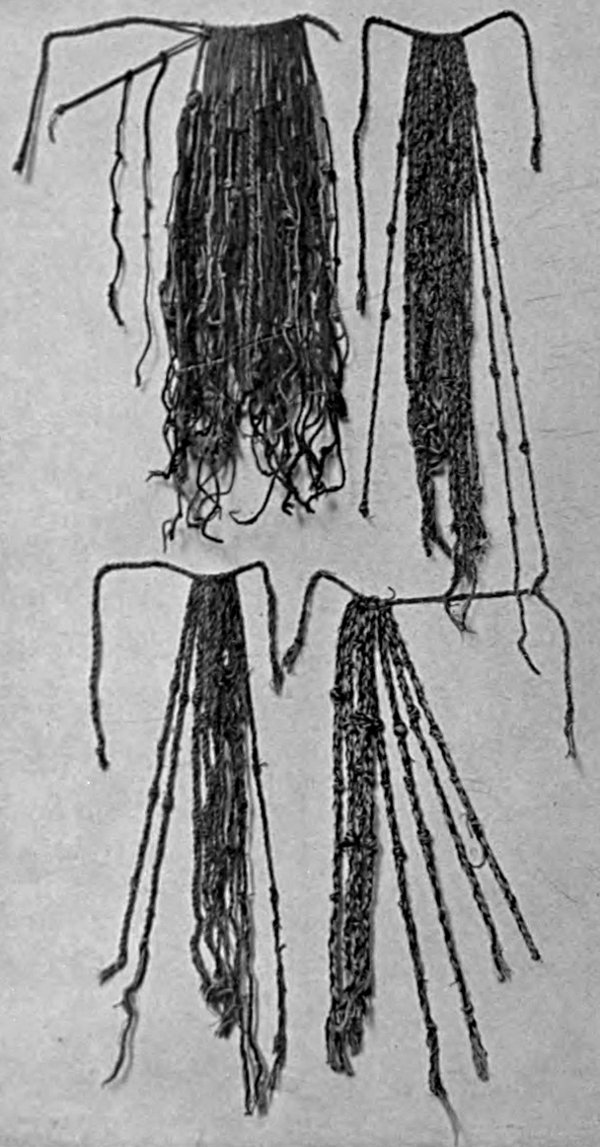
books are the quipus or knotted
cord books, the notch books, which include
tallies and message sticks, the wampum
belts of American Indians, and the
abacus. Collections of any of these kept
in the medicine tent or temple, or even
the counting house, are, of course, true
libraries, or at least true collections of
written documents as generally understood
by the historians of writing.
The knotted cord is best known under
the name of quipu, which was the name
for the Peruvian knot record. At bottom
the idea does not differ from the
simple tying of knots in a handkerchief
as a reminder, or the sailor’s log line. It
has been most commonly used for numerical
records, but in many cases it preserved
and transmitted very extensive historical
records. One very simple use was the
noting on different colored cords by knots
the number of the different animals taken
to market for sale, and again the price received
for these at market.
It is still used among the Indians of
Peru and some North American Indians,
also in Hawaii and among various African
tribes, and all over Eastern Asia and
the Pacific.
It was the traditional method in China
before the use of written characters, and
the written characters themselves were,
it is alleged, made up out of these combined
with the pictures of bird tracks.
Among the ancient civilizations there
are many remains or reminiscences of
these knot books. They are found among
the ancient Egyptian hieroglyphics (as in
the sign for amulet and perhaps in several
other signs); they appear also in the mnemonic
knotted fringes to garments in the
Jewish antiquities and, as Herodotus tells
us, Darius made use of such knots to guide
certain Ionians who remained behind to
guard a bridge as to when it should be
time for them to sail away. In 1680 the
Pueblo Indians of North America marked
the days to their uprising in the same
way.
This use of the knotted cord for amulets
is among the most widespread of
uses, being found among the medicine
men of nearly all primitive peoples. Juno
wore such an amulet, and Ulysses carried
one.
Among the ancient Peruvians and
Mexicans there were many collections of
quipus in charge of official recorders.
Traces of ancient use survive in the
knots of a cardinal’s hat and perhaps
most interestingly of all in the nautical
knot used in casting the log or sounding.
We may still travel so many knots an
hour or sink mayhap so many fathoms
deep. The knotted measuring line with
fathom marks is probably the direct historical
descendant of the Egyptian measuring
line and by the same token probably
of the Egyptian sign for one hundred,
the fathom like one of the Egyptian units
being at bottom the stretch of a man’s
arm.
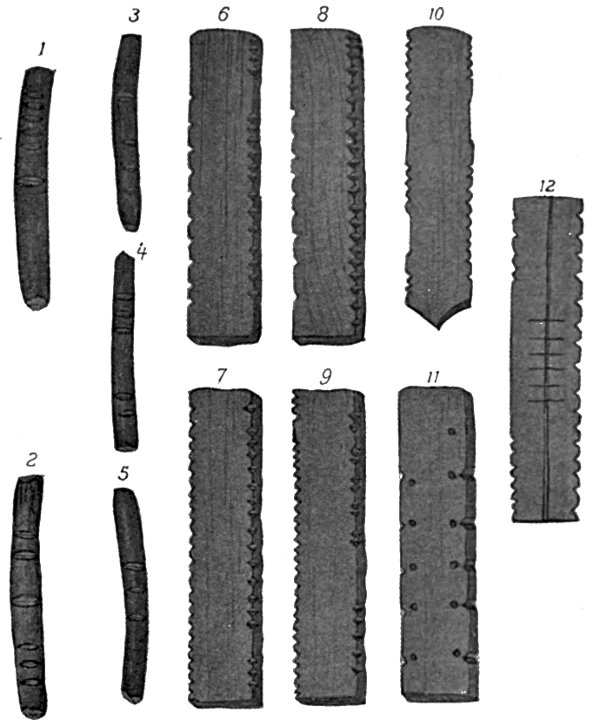
A Collection of Message Sticks
From Howitt. Native Tribes of S. E. Australia,
p. 704
Most of the extant quipus have been
found in graves. There is a “very extensive
collection” of these in the American
Museum of Natural History in New
York, and a recent study of these (by
L. L. Locke) concludes that they were
used purely for numerical purposes and
not for counting but for record keeping.
The best known notch books are the
message sticks used in Australia and
Africa and the tally used in the British
Exchequer up to a recent date for the
keeping of accounts. This is the method,
famous in fiction for the recording on
their knife-hilts by Indians and superhuman
white scouts of the number of
scalps taken in war. It is the essence of
the so-called Clog Almanac, the nick-stick,
and other ways of notching up accounts
still often found in rural communities.
The memory of it survives in the use of
the word score or so many tallies, used until
recently of the runs made in baseball.
Collections of notch records are found
at least among the Australian aborigines—and
it will be remembered that it was
the burning of the huge collection of tallies
in the early part of the last century
which resulted in the setting fire to and
burning up of the parliament houses.
It is possible that the notch method
was preceded by a system of stripping off
leaves or twigs from a branch, leaving a
certain number. The early pictures of Seshait,
goddess of writing among the
Egyptians, who records the years of a
king’s reign, suggests possibly this method,
and in this case perhaps also the Egyptian
sign for year with its single projection
may refer to this method.
Wampum is one of the best known and
most picturesque forms of mnemonic object
writing. It was used by the American
Indians for treaties, title deeds,
memorials of events, etc., and considerable
collections of these tribal records
were not uncommon. Although in itself
a later and more complex style, in essence
it stands for a style still older than the
knot writing which it resembles. Existing
examples of wampum leave the simple
mnemonic knot or notch far behind and
have progressed even to figures or pictures
often of an advanced or symbolic
type, made in the beads, but the beads
themselves stand for what may perhaps
be the very earliest form of mnemonic
record—that is the object record where
each object is represented not by a pictorial
object but by some sample object
like a pebble or a twig. The heap of pebbles
used for counting was possibly the
very earliest mnemonic record.
An extremely interesting modern example
of calculation in pebbles and the
representation by them even of sums in
addition, multiplication, and subtraction,
turns up among the psychological investigations
in the matter of mathematical
prodigies. It appears that most of the
famous lightning calculators have been
the children of peasants, and a large part
of these Italian shepherd boys, who apparently
used pebbles for the counting of
their sheep and amused themselves by
making a plaything of these. Other
lightning calculators (Ampère e.g.) used
pebbles, and Bidder a bag of shot, while
others have taught themselves by the use
of marbles, peas, or the use of their
fingers. (Bruce in McClure v. 39, 1912,
pp. 593-4.) The counting by pebble
heaps is found indeed generally in the
playing of children. When it comes to
transporting or making more permanent
collections this was done by means of a
pouch in the case of pebbles—one of the
earliest forms of record holder and one of
the most ancient forms even of phonetic
writings, or tying together in bundles as
in the case of twig bundles found among
primitive peoples, or by stringing together
as in trophy necklaces or some forms of
the abacus.
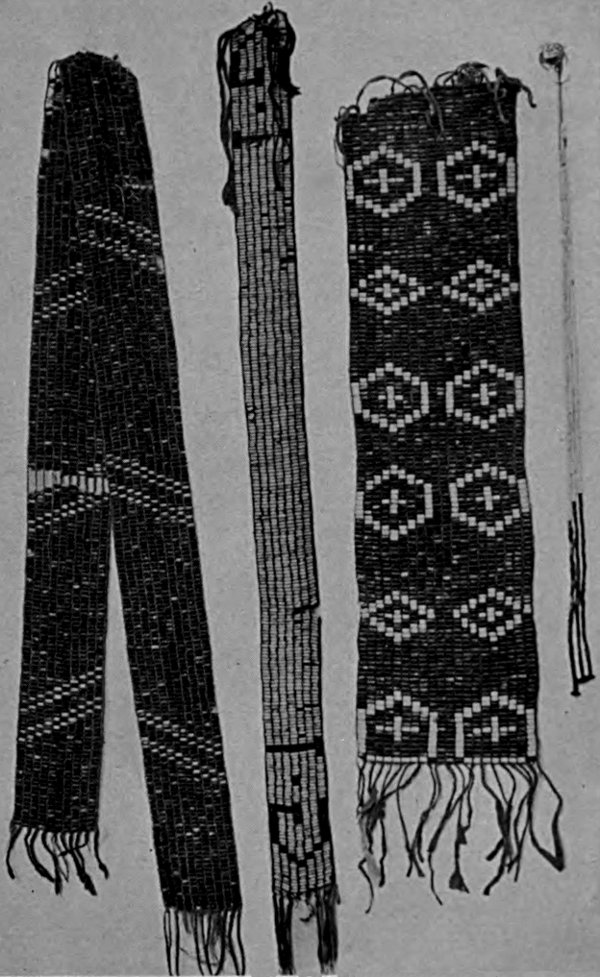
A Collection of Wampum
American Museum of Natural History, N. Y.
Nos. 150.1/1945, 1579 A.D. 50/2287, 2902
With these mnemonic object writings
is perhaps also to be classed the symbols
formed with bits of wood used in the
Indian game of cañute described by J. P.
Harrington. “The San Ildefonso cañute
figures present a symbolism so highly conventionalized
and so complex that the
term language might well be applied—a
symbolism not essentially different in
origin or practice from human speech,
gesture language, African drum language,
conventionalized graphic designs that have
a commonly understood meaning, or
writing whether executed in pictograms,
ideograms, phonograms, or phonetic symbols”
(AmAnthropol n.s. 14, 1912, p.
265). “These figures are, it is said, made
much in the same fashion as children
graphically represent certain ideas by
arranging small objects.”
§ 15. Picture book libraries
Savage tribes in general have not
progressed beyond the image stage of
writing or at most beyond a sort of syllabic
stage which corresponds to what we
know as the rebus. This picture writing
is the known origin however of all the
oldest historical writing systems. As we
all know, children too read their picture
books long before they read print or writing.
Picture writing and picture books
have always survived among cultured nations
and have a great vogue to-day, especially
through the introduction of
pictures into newspapers and through
moving pictures.
The earliest existing picture writing of
the Stone Age includes many images of
domestic animals in the caves of the Pyrenees
with apparently conventional signs
sometimes accompanying them. Prehistoric
picture writing in the Mediterranean
regions includes also pottery marks,
figures of animals or parts of animals
used to distinguish ships and having their
modern counterpart in the ship’s figurehead,
also the seals, milk-stones of Crete,
the rock carvings of Liguria and the like.
The very first beginnings of picture
writing are perhaps to be found in natural
object images. The Chinese ascribed the
origin of their written characters to bird
tracks, and many primitive peoples used
stones which accidentally resembled animals
as images of them.
Perhaps the most natural and earliest
reading of records is the reading of footprints
of hunted birds and animals. From
these tracks the expert woodsman may
read the kind and number of individuals
passing, the direction that they are taking,
and many other details. This fact is familiar
with all hunting, and it is famous
in the trailing of both men and animals
by American Indians and by primitive
people generally. The method is still
much used in the tracking of criminals by
footprints, and more especially and scientifically
in these days by finger-print
records. These records are actual images
of parts of individuals, and it is not incredible,
even if not evidenced, that the
earliest use of writing by the Chinese
should have been the imitation of birds’
tracks in clay by some hunter in order to
describe the kind of birds that he had
seen.
It has been mentioned at various points
in this paper that the record of number
is near, if not at, the beginning of permanent
records, and Gow, in his History
of Greek mathematics, has a theory that
the record of numbers above ten began by
impressing the ten fingers in the moist
earth.
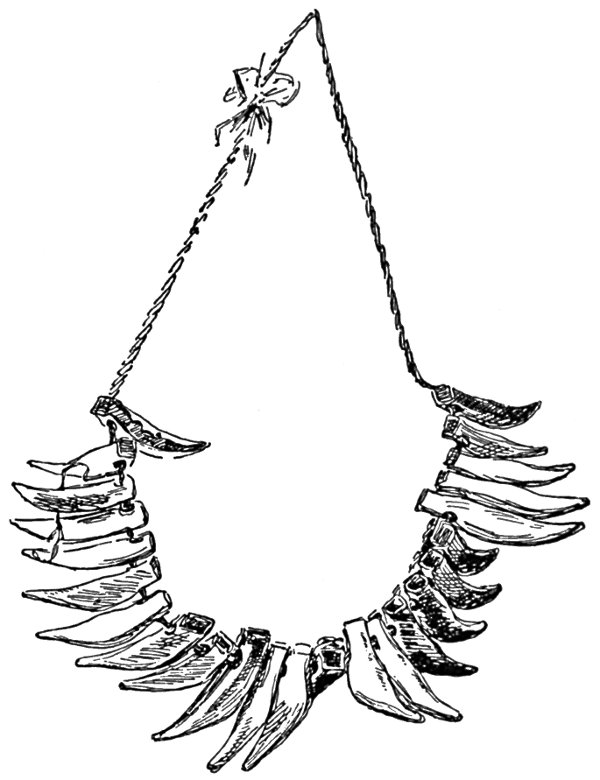
Record Ornament of Imitation Leopard Teeth
From Frobenius. Childhood of Man, p. 27
Another very early form was the
natural rock having some accidental resemblance
to bird or beast, or else formed
by very slight chipping of a natural
image, as in some cases in the Pyrenean
caves. Various American Indian tribes
used natural fossils or accidental images
in this way. The transition from a slight
chipping to sculpture is, of course, an
easy one.
Perhaps the simplest and most natural
transition from pictorial object to image
writing is suggested by the trophy records
of an African chief as described by Frobenius.
The actual record trophies of
leopard hunting—the leopard’s teeth—are
taken and worn in a necklace by the
chief and form a tribal record. The individual
making the killing has, however,
a wooden model of the tooth which he
wears as an individual trophy. This
very simple and natural proceeding has
in it the germ of picture writing,—is
indeed picture writing.
Among the more primitive forms of
picture writing are tattooing and body
painting. Tattooing is used among many
savage tribes to-day and all over the
world. This was known in the most ancient
times and is often practised to-day
especially by sailors and boys, sometimes
quite elaborately. Among the savage
tribes it was used for religious, political,
and economic purposes. One use was as
identification mark. This might be a
tribal mark or individual mark, and in
either case is very closely connected with
the totem idea. In either case it might
also be used, and was used, as a property
or ownership mark to which the tattoo
mark corresponded. This is perhaps
linked with the ancient Egyptian tattooing
through the tribal mark of the modern
Nubian.
The war paint of the American Indian
is as old as the Stone Age in the Mediterranean
and is made most curiously interesting
by a considerable number of so
called Pintadores still existent. These
Pintadores form the earliest known step
in the history of printing, for they consist
of stamps with which the paint could be
applied in various figures after the fashion
of the modern rubber stamp. These
figures, like the war paint of the American
Indians, probably had various symbolic
meanings according to the figures
and the colors used, and it is not beyond
the bounds of possibility that there were
libraries of printed books in this Stone
Age—if by any chance collections of
sample impressions from these stamps
were kept for any purpose. At any
event, when applied they formed what
some people would call a living library.
Certain tablets possibly used for a similar
purpose have been found also among the
North American Indians.
Body and face painting naturally preceded
tattooing—the latter being simply
a method of making the record permanent.
The methods may or may not
have arisen from the marks made by the
pressure of trophy necklaces, bracelets,
etc., on the skin, or from being etched by
the sun on the unprotected skin of light
complexioned tribes. However they may
have arisen, these two methods of skin
marking are among the very early forms
of record, were often used to record exploits
or events, and sometimes to record
an extraordinary number and variety of
matters. It seems also to be established
that these body pictures were sometimes
intended as copies of trophy necklaces or
other ornaments.
There are many ways beside skin marks
in which the idea of image making might
have suggested itself to primitive man,
inheriting as he perhaps did from an animal
ancestry a strong instinct for imitation—the
shadow, reflection in water,
actual fossils of animals, the etching of
sunburn, the silhouette of a tree or animal
against the horizon, natural stone
forms, tracks in clay, etc.—but in skin
marks, natural or artificial, we see the
transition process in actual operation.
Tupai Cupa’s Tattoo Marks, Showing A Group
of Various Records
From Parson’s Story of New Zealand, p. 16
The fact that savages, when they took
off their detachable ornaments to go to
war or for ritual dances and the like, put
on paint, suggests possibly that the painted
forms are images of the things removed.
Primitive picture writing on other materials
than human skin is found all over
the world. It may be drawn, painted,
engraved, chiseled, modeled, moulded,
woven or inlaid. The petroglyphs or aboriginal
rock carvings (more often engravings)
and the paintings are the most
typical kinds although perhaps not the
most common. Both of these kinds are
found all over the world; most famously
perhaps among the Australians, the Bushmen
and the North American Indians.
The use by the North American Indians
is said to have reached its highest development
among the Kiowa and the Dakota
tribes in their calendars. “These calendars
are painted on deer, antelope, and
buffalo hides, and constituted a chronology
of past years. The Dakota calendars
have a picture for each year ...
while that of the Kiowa has a summer
symbol and a winter symbol, with a picture
or device representing some noteworthy
event” (Hodge). It is said of the
petroglyphs that they “record personal
achievements and happenings more frequently
than tribal histories ... are
known often to be the records of the
visits of individuals to certain places,
signposts to indicate the presence of water
or the direction of a trail, to give warning
or to convey a message ... and
many of them ... [are] connected with
myths, rituals, and religious practices”
(Hodge). “Sometimes a man painted
his robe in accordance with a dream, or
pictured upon it a yearly record of his
own deeds or of the prominent events of
the tribe.” “The horses of warriors were
often painted to indicate the dreams of
the war experiences of their riders.”
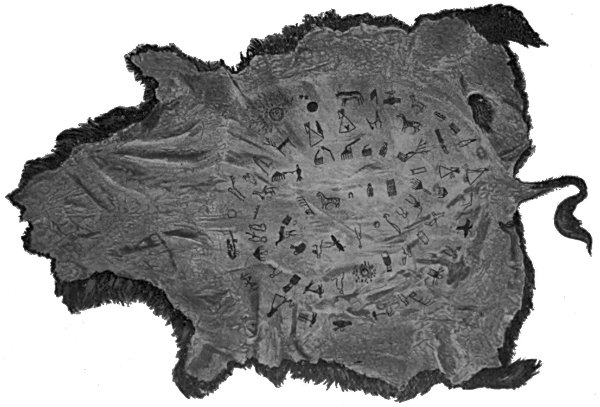
Picture Writing. Lone Dog’s Winter Count.
Series of Various Records
From Mallery (1882-3) pl. vi
In the matter of abbreviation it was in
image writing as in object writing. It begins
with whole object images and passes
through various stages of abbreviation
until it goes over from the pictorial to
the mnemonic stage.
In image writing this process has many
illustrations running back to the cave
drawings where the head or horns of an
ox or goat are given instead of the whole
animal. This convention was used over
the whole Mediterranean region and apparently
became the direct ancestor of the
Hebrew aleph, the Greek alpha, and our
modern English a. The letter a as now
used in the alphabet appears to be the end
of a long historical process of conventionalizing
by which user after user has tried
to simplify the strokes required more and
more or, as the modern complacent “inventors”
of the ancient principles which
they now call “efficiency” would say, “reduce
the motions required” until the
present form has been reached.
In image writing too is more clearly
seen the development of what may be
called sample-and-number abbreviation.
The earliest way of representing several
animals seems to have been the making
several like symbols—one for each.
Five oxen, e.g. are expressed by five
pictures. It is entirely natural that when
a man is writing the same picture several
times, one after another, and knows that
others will know it to be a repetition, the
process of conventionalizing, which goes
on so fast under ordinary circumstances,
should go even faster, until pictures four
and five become simple scrawls and in the
course of time the whole is reduced to
practically a single picture and four
straight lines. Here we have the individual
record and the sample record
combined.
True picture writing is not very common
on the ancient monuments and is
chiefly to be studied in the primitive writings
of uncivilized tribes such as the Bushmen
and the North American Indians.
There are, however, both in the Assyrian
and Egyptian hieroglyphics many traces
of the older pictures from which these are
derived and the idea of the picture writing
is seen in great fullness in the determinatives
of the Egyptian writing,
although it is likely that these are not so
much remains as restorations. They consist,
as is well known, of pictures which
suggest something of the meaning of the
word, e.g. all words related to writing
are followed by the pictures of the scribe’s
palette, with pen and ink moistener. This
suggests at once that the word has something
to do with writing. It is likely that
the attaching of these to phonetic signs
was the result of finding that there were
so many words which had the same
sounds.
A very simple example of picture writing
is given in Hoffman (p. 95) with its
explanation. A canoe with a torch in the
bow, three bucks and a doe, the sign for a
lake, and the picture of two wigwams tells
the story of a hunting expedition by
torchlight on the lake from which three
bucks and a doe were brought back to the
wigwam. A slightly more complex one
is given in Figure 3, which is the record
of a shaman’s curing of a sick man. A
more complex one, given on page 26, with
its explanation on pages 170-72, is the
mnemonic song of an Ojibway medicine
man.
One method of picture writing shows
an action by several successive stages of
the same act. This is most commonly a
picture of corresponding gesture signs.
The picture writing by successive pictures,
showing successive stages of a
story, is a favorite method in the modern
German humorous illustrated papers, and
has, of course, its perfect modern counterpart
in the cinematograph.
Any collection of wampum belts, birch
bark, calendar skins, blankets, or other
picture writing records, is of course a
picture library which has already begun
to take on the distinct character of the
modern library.
§ 17. Types of primitive libraries
Various illustrations of the different
kinds of primitive libraries, possible or
actual, have already been suggested.
These may be summarized as private record
collections and tribal record collections,
as pictorial, mnemonic, and mixed,
as object, image, and mixed, and as
priestly and secular. The matter may be
made perhaps a little more concrete by
considering two types as to which we do
not have to rely on historical allusion, but
of which we have concrete examples—votive
offering collections and libraries
for the dead. With votive offering collections
are, of course, to be associated
the medicine bag, amulets, magical charm
collections, and that whole class of primitive
records or symbolic objects which
center in the religious head of the tribe.
The libraries for the dead, consisting as
they do of objects buried with the deceased,
are essentially collections of personal
records corresponding with the
modern private library. Collections of
public records, not kept with the religious
collections, are well attested among primitive
people, and existed from very early
times in Egypt and Babylonia, but on the
whole the inference of anthropology
seems to be that up to the neighborhood
of the historical period the head of the
tribe was both priest and king, as the
Czar of Russia is both Emperor and head
of the orthodox church, and religious and
political collections one. The priest king
seems to have been the rule even in early
historical times, and temple and royal
archives one, differentiated only as the
numbers of the nation and the complexity
of the civilization grew. At all events,
we have abundant remains of temple collections
of symbolic objects or so-called
“votive offerings”, including much unmistakable
“writing” and we have also a considerable
number of examples of similar
objects buried with the dead, from very
various localities all over the world.
The objects gathered together at
shrines are commonly known as votive offerings,
but the actual uses and reasons
for their collection are much more various
than is suggested by the ordinary meaning
of the votive offering, while, as a
matter of fact, most of such objects are
not offerings at all, but only substitute
object image records of such offerings, or
even mere symbols for offerings. A good
type of this latter class is the Chinese
sacrifice which consists in writing prayers
on a piece of paper and burning the paper.
But there are thousands of illustrations in
actual collections of something very close
to this, throwing most interesting light on
the writing character of these collections.
The collections formed very soon after the
invention of phonetic handwriting in particular
give very clean-cut illustrations of
the meaning of many classes of these
temple deposits of symbolic and mnemonic
objects, and this in turn casts light
on the primitive object collections of the
shaman and the tribal story teller.
To begin with, a list of the objects
found in the Hopi North American Indian
shrines, as given by J. W. Fewkes,
will illustrate the fact of the varied contents
of aboriginal shrines: “The temporary
offerings in shrines are prayer
meal and pollen, sticks, clay effigies of
small animals, miniature bowls and vases
of water, small bows and arrows, small
dolls, turquoise, shells, and other objects.”
“Among the permanent objects not offerings
... human or animal images of
wood and stone, concretionary or botryoidal
stones, carved stone slabs, and fossil
shells” (Hodge).
The historical votive offering collections
of Greece, Crete, Egypt, and Babylonia
extend over long periods, and the
objects recovered from them include hundreds
of thousands of record objects.
These include, as in the case of the Hopi
shrines, a great many objects not intended
as offerings at all. The temple treasuries,
even in very early times, were used as a
sort of general safety deposit vault, the
protection consisting not only in the
watchfulness of the priest but the tabu, or
curse laid upon those who should even approach
the objects, and the general belief
that they were in fact under the protection
of the god who would punish theft.
Such objects might be taken again by the
owner, as is shown in the case of the
Greek temple treasuries, or they were
things held in trust by the priests for the
benefit of widows and orphans as was the
case of the Jewish temple. Moreover,
even the record objects were by no means
confined to records of the fact, the nature,
and the extent of the offerings made, although
a great portion of them were
precisely for this record purpose. Increasingly,
and at last very extensively, they
included records of events of war, hunting,
and in later times of the public games.
They were in the Greek temples very extensively
biographical or genealogical and
tended to be so progressively. Indeed
vast quantities of tablets “laid up” in the
temples had no connection with sacrifice
at all but were merely records deposited
as one might deposit family manuscripts
or present a printed autobiography to a
public library. The votive collection was
simply a public reference library as distinguished
from political archives or
school libraries for instruction or learning.
The more strictly votive records were
themselves of great variety. They include
object records, sample records,
models, pictures, symbol records, and
phonetic inscription records. But, whatever
the form, the underlying idea or
motive is the same, they are records of offerings
made, whether those offerings are
sacrifice or thank offerings. The treasury
of the Greek temple was sometimes a
separate building by itself filled with these
records. The Jewish temple had separate
treasuries for war trophies and for other
votive offerings. Primarily, of course,
these treasuries were in fact intended for
the actual objects—the tithe of the first
fruits, the tithe of the spoils taken in war,
and the animals intended for sacrifice,
but as these were intended for consumption,
the records took their place and in
later times increasingly images and even
verbal statements were used as offerings
in place of real objects, forming, so to
speak, a collection of fiction or perhaps
better, the actual records of real spiritual
acts performed, signifying petition, sacrifice,
thanksgiving, etc. of the worshiper.
The innumerable tables with record of
cattle in the great cattle pens of the
Babylonian temples, although perhaps not
to be described themselves as “votive offerings”,
actually correspond to the later
practice, where the votive offering is kept
as records of offerings, and correspond
very closely in the case of war trophies,
where it often happened that a part was
dedicated and the rest sold or melted down
and made into valuable objects which in
turn might, in case of need, be converted
into cash and have an image or some other
record substitute.
After the war trophies and perhaps before
them, the most significant class of offerings
was that of the first fruits which
ranged through the whole field of human
production from the fruit of mines, fields,
orchards, vineyards, hunting, fisheries,
flocks, up through the trades of fuller,
potter, baker, tanner, shipwright, wash-woman,
butcher, cook, basket-maker, shoemaker,
and so on up to professional men,
recorders and the first copy of literary
works. When possible the offering might
be and was originally in kind, but when
not, as in the case of the physician or the
recorder, it would be in the shape of
money or, more likely in the case of the
physician, an image in some valuable substance
of the particular operation or disease
for which fee was received (e.g. the
golden tumors which the Philistines sent
to the Jewish shrine). These were extremely
common as the free-will offerings
or vow payments among those who had
been healed. When money began to take
the place of barter the replacing of objects
by their money value with registry
of same in the books of the temple grew
with it and became the tithe-tax still familiar
in the English language and
English society.
An extremely interesting library aspect
of these (votive) collections is the actual
phonetically written books which were
laid up. These can be best illustrated
from the Greek collections of books dedicated,
but have their precise technical
equivalent in the books which Joshua,
Samuel, or Moses “laid up” before Jehovah,
and indeed the technical term is
precisely that for putting a book into a
library or a document into the archives.
The Greek collections included literary
works, prize poems, hymns to Dionysus,
Apollo, Asclepius, etc. These may have
been of a strictly votive character, and this
is true of many other works by Pindar,
Hesiod, Heraclitus, Aristomache, Aristotle,
Agathias, Alcaeus, and Solon which
may perhaps be first fruits. This might
also be true, of course, of the astronomy
of Eudoxus, the astronomical table of
Onopides, the calculations of Xenocrates
and the log book of Hanno. But these at
least point to very varied contents of these
“votive” libraries. These examples above
mentioned were on varied materials as
well, including at least lead, gold, marble,
and bronze, apparently, as well as papyrus
or leather. Some of the works were in
shorthand. While it is not easy to conceive
of literary works as first fruits in
the earlier period of the primitive writing
and for the reason that such forms are
themselves a later development, many of
the mnemonic objects preserved in primitive
collections certainly stand for prayers
and hymns as well as narrative records
and in the collections of sacred liturgical
objects these represented set liturgical
forms of words or dramatic procedures
which are books in quite a developed
sense.
A curiously interesting suggestion
which seems to throw light on the literary
meaning of votive objects is the statement
by Miss Harrison that the sacred tokens
of Zeus as god of the storeroom were
symbols, not statues, and probably sacred
tokens such as those carried in chests at
the sacred processions,—magic spells in
short, kept in a jar for the safeguarding
of the storeroom. The farther identification
of these with the ambrosia and with
Zeus himself seems to make rather clear
that many of the collections of sacred emblems
are verbal documents. The relation
of this to what was before said of the
keeping of books in jars is obvious, and
the fact is suggested that many of the so-called
collections of votive offerings are
of this character, that is, mnemonic objects,
perhaps actual collections of verbal
forms.
Libraries for the dead are most familiar
and most highly developed in the
Egyptian burial customs. From a very
early date various books, generally known
in their collected state now as chapters of
the Book of the Dead, were always buried
with the important dead. Another famous
example of this burial of phonetic
books with the dead is found in the so-called
Orphic or Petalian gold tablets,
found at various points from Asia Minor
to Italy. The most interesting class, however,
from our point of view is the large
quantities of quipus which have been
found in the Peruvian graves.
All these libraries should be clearly distinguished
from other collections of
buried books, such as those which the
Jews made of worn and mutilated books.
They are distinctly collections made for
the use of the dead. Some of them are
for use during the journey to the Elysian
fields, the garden of Aalu, or the happy
hunting grounds, some apparently rather
for use after reaching them. The Egyptian
books are rather clearly associated
with the idea of the amulets and the other
written charms, though on a higher plane.
The idea seems to have been that the deceased
should learn them by heart and recite
them at various points as passwords
for admission to the various gates or to
pass various defenders of paradise. The
Petalian tablets are precisely of the same
character. In the case of the quipus, and
of symbolic emblems generally, the analogy
is perhaps rather to be found in the
Egyptian models of tools and servants,
and the hunting weapons buried with the
North American Indians, also children’s
playthings everywhere, where the point
seems to be to supply the dead with their
customary instruments for use after they
have arrived in paradise.
Other objects of dress, ornament, etc.,
found in graves, strongly suggest the
similar collection during life, where clothing
and ornament is personal record of
events or achievements in a man’s life.
Probably not all grave collections include
the same elements, but it seems likely that
all three elements of personal record,
guides to paradise, and libraries for paradise,
are to be recognized at one point or
another.
The quipus form the clearest example,
and the long history of knot amulets suggests
that they may have been intended
primarily to play precisely the same part
that the various parts or chapters of the
Book of the Dead played. The equally
extensive use, however, of knots for records
or reminders, as in the mnemonic
fringes, allows the possibility of the individual
personal record, and there is, of
course, also the possibility that the graves
in which they were found were the graves
of tribal recorders or reciters who carried
with them the implements of their trade
in the same spirit that the hunting
weapons were carried, or, on the other
hand, in the spirit of the suicide of a
king’s servants that they might serve him
in the other world, and of the Ushabtiu
substitutes for this. These models of servants,
boats, war implements, and the like,
in graves seem to be precisely analogous
to the miniatures substituted for actual
objects in votive offerings.
Burial with the dead of a person’s favorite
belongings has also to be reckoned
with in interpreting these collections.
Sometimes all a man’s favorite possessions
were buried with him, and it not infrequently
happens in modern civilized
times that a person has a favorite ornament
or possession buried with him. It
was only yesterday that a man provided
for having his cremated body sunk in his
favorite yacht.
§ 18. Contents of primitive libraries
The various kinds of documents in the
several sorts of primitive writing found
in the different species of collections have
been indicated under the various headings.
It is worth while however to gather these
up together a little and especially in view
of the question of actual origin.
It has been noted that collections of
quipu, message sticks, fetishes, personal
ornaments, skin calendars, totems, votive
objects and other pictorial or mnemonic
records in temples, graves, medicine
tents, private wigwams, etc., include, in
pre-phonetic times, records of personal
exploits and events in personal history,
family histories, and tribal histories,
hymns, prayers, amulets, financial accounts,
and economic records of various
sorts, annual registers, contracts, astronomical
observations, etc.
All this has its bearing on the actual
origin of libraries. Messrs. Tedder and
Brown in their excellent article in the
latest edition of the Encyclopaedia Britannica
say that “the earliest use to which
the invention of inscribed or written signs
was put was probably to record important
religious and political transactions”.
Now as a matter of fact, the conscious
record of events and transactions selected
as important for the knowledge of posterity,
or even, what was probably a much
earlier matter, for evidence of contract or
practical memorandum, represents a
rather late stage in the evolution of record.
It is likely that there were many
record collections before this stage was
reached, trophy, votive, etc., object records
and economic records of various
sorts.
In point of fact as King remarks of the
earliest Sumerian records, a large quantity
of the earliest records are land deeds,
and any one who looks over the cuneiform
documents will be impressed with
the fact that an enormously large proportion
of the existing documents of the
early historical period are contracts or
lists of cattle or, as in the Cretan excavation,
labels, or lists of arrows and other
materials laid up in storehouses. Among
Egyptian documents too, the annals of the
Palermo stone, the earliest systematic annals
of Egypt, which incorporate earlier
documents from its own time (say 2700
B.C.) to six or seven centuries farther
back, are to a considerable extent filled
with memoranda of census lists of cattle
taken and other lists of possessions. It
has already been noticed that among the
commonest earliest uses of notch, knot
and pebble systems was use for the record
of cattle or other numerical lists of
possessions.
It would be jumping at conclusions to
say that the conventional sign attached
to or accompanying the pre-historic animal
paintings of the caves were numbers.
They may quite likely be ownership
marks. It is a curious fact, which has
recently been commented on, that these
animal paintings are of domestic animals
and if so the ownership marks themselves
would be pictures of the marks actually
branded upon the animals just as such
marks are still branded on cattle on the
plains and by New England farmers on
their sheep. The fact that the tendency
seems to be to regard the contents of these
caves as religious, and the use of the
caves as for religious purposes, suggests
an analogy with votive offerings. If the
marks are in fact numbers, the combination
of figure and number suggests at
once the innumerable lists of animals in
the Babylonian temple records. Ownership
marks themselves are, of course, not
records of events but economic records
and are very common before the use of
phonetic writing. One very large class of
these is the pottery mark which was first
applied apparently by the man who made
them for himself as an ownership mark
and then, as one became more skilled in
one thing and another and barter began,
it passed into the trade-mark of manufacturers
which has survived in the modern
trade-mark system.
It does not, of course, follow that the
earliest documents were not also religious
as well as business and political, or even
religious as distinguished from the political.
Actual evidence, so far as it goes,
seems to point to trophy records and
votive records,—and votive records of
first fruits or other useful or valuable objects
“laid up” are economic records, but
the parallel evidence as to priest king, the
evidence as to religious sanction for the
protection of objects, the hypothesis of
priestly guidance in the tribal meal for
fair apportionment of spoils, etc., point to
religious supervision of economic matters.
In the savage state the rule is that when
food is scanty the strong eat what they
want and the weak starve—the rule of
the wolf pack. The germ of all social
order is perhaps the rule that the weak
also shall share in limited food. Founded
possibly in selfishness—the will to keep
the weak alive for selfish reasons, it involves
at least power of individual self-control,
the considering of remoter ends
and a certain social-consciousness. The
right sharing of food supply requires a
strong hand under savage conditions and
every possible sanction of authority. It
was quite natural therefore that the common
meal “before God” which plays such
a large part in primitive custom should
grow up—and equally natural that it
should be the symbol of peace. The
priest, standing for God, divided the offering—no
doubt in the beginning the
whole food supply—and perhaps “kept”
the natural relics of the feast in the way
of skins and bones.
Provisionally therefore one may venture
the hypothesis that the actual beginnings
of record collections were economic
under religious direction,—and are to be
found in the remains of tribal feasts “before
God” although it may be fair to say
that the rudiments of the matter already
existed when the strong hand of the head
of the family or tribe insisted on a fair
distribution of food. Specht (p. 11)
speaks of the bones of sacrifices as “the
oldest approaches to a sort of writing”,
and of course, the bones on the family
plates, so to speak, were as truly records
of the parts assigned to them, so far as
they went (and if their portions had
bones) as the bones of sacrifices! But
then there is of course the farther question:
Did the first savage who denied
himself for the sake of one of the weak
not have the religious motive, and did not
the first man who forced a tribe of his
fellows to do the same, need to use the
religious sanction and invoke the fear of
God as well as of his own right arm?
And then, equally of course, there is the
farther question whether the first man
was a savage at all.
In the golden age before the mild and
carnivorous Abel, before even his fruitiverous
and murderous older brother, before
the Fall when all were still fruit
eaters and fruit eaters only, the tabu was—religious
prohibition and religious sanction.
And that tabu was on the apples
of Iduna, the fruit of the tree of knowledge
between good and evil, which springs
from the fountains of memory and reflection,—the
golden apples of strife which
some say give immortality, some death.
What is this tree whose fruit is tangible
knowledge, the food of the gods and
which was in the beginning with the first
man, but a library, and what did those
old philosophizers mean by what they set
down about the first man and the way
they put it? Did they mean that what is
food for one is poison for another or
simply that to break tabu spells death
whether it is body food tabu or mind
food tabu? Truth to tell the germ of
the library is as early as man’s mind—at
least.
Back to this point, the beginning of
man, we have actual literary “authority”
in the person of Specht at least, and
nearly back to this point we have good
archaeological sources for our collections
of written records. There is, however, no
authority in literature or in the sources,
so far as this lecturer knows, for carrying
conjecture back into the territory of the
pithecanthropos, who, however, must
have made and left similar involuntary
records of his gastronomic activities, but
who presumably never observed them or
appointed them for memorial purposes.
§ 19. The administration of primitive libraries
The question of where and by whom
and how books were kept and made ready
for users is not one that has been very
much discussed although the questions
who were the librarians and where were
the books kept has been more or less implied
in the discussions of temple versus
secular collections. Mr. Tedder’s dictum
that “these records would naturally be
preserved in sacred places, and accordingly
the earliest libraries of the world
were probably temples and the earliest librarians
priests” is modified and perhaps
at the same time confirmed by the history
of pre-phonetic libraries. It is true that
in primitive tribes the medicine man is
generally a keeper of records, but it is
true also that among the Mexican Indians
certainly, and pretty clearly among North
American Indian tribes and in many African
tribes, the shaman or medicine man is
not the only keeper of records. It is true
also that in the early Egyptian practice
the priests were the keepers of the books
whether it was in the temple, archives or
the palace archives, but even here it
seems to be the fact that there were military
records, department records, and local
administrative records in the different
nomes kept by scribes who were not
priests.
The keeping of records must in fact
have begun before there was any special
place, even the simplest hut or medicine
wigwam or cave, set apart for distinctively
religious purposes, although the
setting apart of such places is apparently
as old as the caves of the Stone Age.
With these qualifications, the history of
votive offerings tends to confirm the
statement that the earliest public or tribal
libraries were religious and the corresponding
librarians the priests.
In very early times, and in much later
times among primitive peoples, even the
art of writing itself was often kept as a
secret mystery in the custody of priests.
The name “hieroglyphics” points in this
same direction, and the temple collections
of sacred books, the so-called books of
Thoth and books of Hermes, point in the
same direction. In general, however, this
monopoly of letters seems rather to have
been a deliberate assumption by the
priests, as it is sometimes assumed by
savage royalty, rather than the original
situation. It applies, of course, rather to
newly devised kinds of symbols, such as
the vast number of systems of secret writing
which have been evolved in all ages,
than to the ordinary current record
methods. That some of the earliest libraries
were secret libraries, however, is
an interesting fact, and one which may
throw light on the mysterious collections
of shrines and portable collections of objects
in the liturgical processions in
Egypt.
The methods used by these priest librarians
for keeping and using the books
form in themselves an interesting and little
studied subject of very considerable
extent.
The different kinds of writing required
different sorts of receptacles. The book
chest or bookcase, from which has come
through the Greek the common word for
library in languages other than English,
was the most universal and natural way
of keeping almost every kind of tangible
record. The wooden chests and clay
chests of the earliest historical periods
must have extended well back into the
pre-phonetic period and have also been
found among primitive and semi-civilized
peoples. They can obviously be used for
quipus, message sticks, or almost any
portable document. The same is true of
the clay jar so often used in the earliest
historical period. In the case of wandering
tribes, however, less rigid or fragile
materials are certainly better, and the
book pouch was, therefore, in very early,
and probably much earlier use than either
boxes or jars. The skin pouch, like the
skin water jar, is naturally suggested and
easily made. This early form survives
in the medicine bag, the lawyer’s green
bag, and the schoolboy’s bag as well as in
mail pouches for post-office use.
The use of basketry work and perhaps
other textile work as bookcase also certainly
extended back into pre-phonetic
times and is represented in primitive
usage.
It is not to be supposed, of course, that
in these primitive times there were often
separate buildings, such as the later
Greek treasuries, or even separate rooms
as in the Egyptian temples, and the
archives at Boghaz Keuei and elsewhere,
although separate huts for these and especially
for “collections of liturgical objects”
would perhaps be almost the first
use for covered rooms, while sacrificing
was still conducted in the open air.
Something like a pouch or wallet must
have been used for the marked pebbles
of the Stone Age and for pebble counting
generally before the grooves and rods of
the abacus were invented.
The method of keeping and displaying
the books in the boxes, pouches, rooms or
buildings, varied of course according to
the nature of the document. In the modern
library there is a great difference
between the machinery necessary to keep
and display folded documents, rolled
documents, and ordinary bound books.
The pouch may have had compartments
like a modern purse. Basketry, clay and
wood cases did have compartments, one
for each roll, in quite early papyrus
days.
In some of the late Babylonian libraries
the clay tablets were evidently displayed
on shelves but they were more
commonly kept in clay boxes or jars, alabaster
boxes, and the like, after the general
fashion of the treasuries in earlier
times and until the quantity became great.
Twig records were tied together in
bundles, and the stringing together of
records was one of the earliest and most
extensively used methods. It may perhaps
be said that it was the typical method
of the earliest records. It is found in the
stringing together of trophy objects for
wearing on the person—necklaces, girdles,
and draped strings of various trophies.
It is found also early in the history of
the abacus where the perforated pebbles
or beads were strung on different rods
set in the ground, and it is of course
found in the developed abacus. The perforations
of tablets, bearing the year
marks, among the objects from the earliest
dynasties at Abydos, suggest a
stringing together of these annual records,
although it is of course possible that these
are labels and the perforations used to
attach them to boxes. The analogy with
annual records of primitive people, however,
suggests this stringing together.
What may be called classification of
these libraries is found very early. It
is reflected perhaps in the early distinction
between temple and palace libraries, and
more clearly in the primitive distinction
between shamans and secular recorders.
The putting of like kinds of works in
boxes together, medical works, etc., is
found as early as 2700 B.C. in Egypt and
quite early in Crete. The labels of Crete
point to a classification of objects if not
of object records.
When collections are small no cataloguing
is necessary excepting in the librarian’s
mind, and his first mnemonic aid
is classification, which is in fact a sort of
cataloguing and takes the place of all
other cataloguing. It is to be noted that
in the very earliest records the librarian
goes with the king or the investigating
committee when they go to look up the
records.
§ 20. The beginnings of library schools
The library school is commonly regarded
as, and is, in a sense, a product
of the last century. Library schools are,
therefore, still a new thing. It may not
seem so to you who had not been born
when some of us were lecturing at that
first American library school up at Columbia
University, but it is the fact that
the teachers of that school are still living
and teaching, and there were no schools
of library economy strictly speaking
when they began. The well fledged library
school as an avowed school and independent
unit is a product of this
generation.
Nevertheless library schools too have
had their beginnings. In the immediate
past schools or university courses of
palaeography or archival science have been
practically library schools. In European
countries, where the handling of documents
and manuscripts have been so much
the more difficult share of the problem
that library economy and all the rest has
been counted negligible and has in fact
been neglected, these were real library
schools, in that they were chiefly or wholly
intended for and used by those who were
intending to be librarians. They taught
in fact the things which were most expected
of the librarians, just as the modern
schools, in teaching almost exclusively
business and administrative methods,
teach the things which the moderns expect
of their librarians. They were and
are, therefore, very one-sided library
schools, lopsided on the science side, and
yet perhaps not more lopsided than our
own schools are on the side of library
economy.
But the beginnings of library schools
may be found farther back still in the
schools of the Scriptoria of the middle
ages, where librarians made as well as
kept their books, and in the temple schools
of Greece and Egypt, where men were
trained to all sorts of professions, including
the keeping of books. Such schools
are alleged in Babylonia as early as 3200
B.C., and more primitive still must be
counted the schools for the training in
memorizing of ancient India. That some
analogies to this training in the keeping
of books existed in the collections of mnemonic
books is not merely inferred in
general but found in the alleged training
of keepers of quipus in the use and publication
of these records. The same is
possibly true in some of the initiation
ceremonies of primitive tribes where the
young men are presumably taught the use
of message sticks, secret languages, and
the like. It may fairly be said that these
are remote in nature as well as in time,
and yet they are as truly the predecessors
of the library schools of to-day, as these
of to-day are of the library schools of
to-morrow, which are likely to differ very
considerably from those of to-day.
It does not take much of a prophet to
foresee a radical development in some of
our American library schools within a
very few years. When for example, the
Columbia Library school was starting,
manuscripts were so few in this country
that their science and economy was a
negligible element in instruction—and as
for archives, we had plenty of documents
but the very name archive, with what it
connotes, was foreign and almost unknown
in America. Now there are many
well recognized archives and some of our
collections of ancient manuscripts are
numbered by the thousands. Many of
you will probably live to see more than
one library school equipped with full departments
for instruction in palaeography
and archival science, with special curricula
for each distinguished from the general
course in library economy. Possibly
by that time there will also be departments
of cartography, engraving and
numismatics, each with its corps of instructors.
In these respects it was something
of a pity that the library school
went out of the university, but on the
whole it may be doubted if it would have
ever had the great expansion or ever have
done the great work that it has done for
popular education if it had stayed in the
university. In several very fundamental
respects certainly this New York Public
Library is a far better environment for
developing a university of librarianship
than any university of general studies.
§ 22. Bibliography
The best first source for a general idea
of primitive libraries is the readable and
well illustrated little book of Edward
Clodd called The story of the alphabet,
(N. Y., Appleton, 1912).
With this may be put the still briefer
first part of Dr. Fritz Specht’s Die schrift
(Berlin, 1909. 3rd ed.).
More extensive general treatments are
found in Berger’s Histoire (Paris, 1892),
and quite exhaustively in Wuttke’s Die
entstehung der schrift (Leipzig, 1872),
also in W. J. Hoffmann’s The beginnings
of writing (N. Y., 1895), a sketchy but
comprehensive survey.
For the definition of the library see
Graesse Schmidt and the other treatises
on library science, especially the older
ones.
For libraries of the gods see the various
works on comparative mythology under
the topics of the various writing gods,
Hermes, Thoth, Odin, etc., or better, since
the subject has not been very much worked
up, in the sources The Eddas, The Book
of the Dead, The Avesta and for the
Indian matters Muir’s Sanskrit texts.
In the matter of antediluvian libraries
see the references in Schmidt and
Richardson, but especially the sources
gathered as pseudepigraphic literature of
the Old Testament first by Fabricius but
now to be had in more modern editions.
For animal, plant and memory libraries
see the literature of so called “Comparative
psychology” given in admirable detail
annually in the Psychological index—looking
up the articles on inward speech
and writing as well as on memory.
For Preadamites see Winchell’s Preadamites
(Chicago, 1880), and the works
of M’Causland.
For prehistoric and borderland libraries
generally in the Mediterranean region
the various works of Mosso may be consulted,
especially the Dawn of Mediterranean
civilisation, ch. 2, pp. 11-43, “The
Origin of Writing,” and still better, Evans’
Scripta Minoa which is a classic.
For prehistoric western Europe, J.
Déchelette’s Manuel d’archéologie prehistorique
Celtique et Gallo-Romaine, v. 1.,
(Paris, 1908), is most comprehensive for
a first survey of a very extensive field.
In the matter of primitive tribes Frobenius’
Childhood of man (Philadelphia,
1909), although curiously sketchy and
aggravatingly brief, seems to be authoritative
enough, and certainly gives the layman
in these matters a good idea in short
space of the anthropological aspects of
the subject.
One of the very best sources easily
accessible to all for getting first clear impressions
as to the use for record by
primitive man of all the prephonetic methods
of record is F. W. Hodge, Handbook
of American Indians North of Mexico.
Smithsonian Institute, Bureau of American
Ethnology, Bulletin 30, Pt. 1 and 2.
59th Congress, 1st Session, House Documents
v. 61 and 62. Among the many
articles some of the best, but by no means
the only useful ones, are the following:
Adornment, Calumet, Color symbolism,
Dramatic representations, Engraving,
Featherwork, Fetish, Hairdressing, Knots,
Labrets, Mourning, Ornament, Painting,
Pictographs, Prayer sticks, Quillwork,
Scalping, Shrines, Sign language, Signals,
Tattooing, Totem poles, Wampum.
Add to this for the African tribes Miss
Kingsley’s West Africa and Dennett’s At
the back of the Black Man’s mind.
For the enormous literature on tattooing
see the list of hundreds of books and
articles in the catalogue of the Library of
the U. S. Surgeon General’s Office.
For the quipu an article by L. Leland
Locke on The ancient Quipu, a Peruvian
knot record is given in the American Anthropologist
v. 14, 1912, pp. 325-32. This
gives a modern point of view, has excellent
illustrations and its author promises
a bibliography of the extensive literature
immediately.
For message sticks there is a long chapter
with illustrations in A. W. Howitt,
The native tribes of South East Australia
(London, 1904, pp. 691-710).
An accessible first reference for pebble
records and the abacus is the chapter on
systems of numeration in W. W. R. Ball’s
History of mathematics (London, 1888),
pp. 114-19, also, and perhaps even better,
J. Gow’s A short history of Greek mathematics
(Cambridge, 1884), pp. 26-40.
Cf. also article on the abacus in the Pauly-Wissowa
Encyclopedia.
In the matter of the votive offerings W.
H. D. Rouse’s Greek Votive Offerings
(Cambridge, 1902), is a most suggestive
and readable, while detailed and scholarly
book.
On the Orphic tablets, see appendix to
Miss Harrison’s Prolegomena to the study
of Greek religion (Cambridge, 1903), pp.
660-74, and text passim,—the text being
one of the classics of modern comparative
religion.
INDEX
- A, 109.
- Aalu, 128.
- Abacus, 76, 98, 147, 148, 163.
- Abbreviation, 83, 84, 85, 109.
- Abbreviation of signs, 81.
- Abel, 42, 139.
- Abydos, 149.
- Accumulation of experience, 5.
- Actor, 67, 70.
- Adam, 26, 39-40, 41, 42, 43, 46, 47.
- Adamite, 25.
- Administration of primitive libraries, 142.
- Adornment, 162.
- Agathias, 125.
- Alcaeus, 125.
- Aleph, 56, 109.
- Alpha, 56, 109.
- Alphabetical printed words as ideograms, 114.
- Alphabetical writing, 61.
- Ambrosia, 127.
- Ampère, 98.
- Amulets, 93-94, 116, 128, 132.
- Animal libraries, 25, 160.
- Annual records, 149.
- Annual registers, 132.
- Antediluvian libraries, 25, 42, 160.
- Anthropology, 14, 117, 156-157.
- Apocryphal libraries, 33.
- Archaeology, 22.
- Archival science, 152.
- Archives, 18, 19, 125, 147, 154, 155.
- Aristomache, 125.
- Aristotle, 125, 156.
- Articulate speech, 61.
- Asclepius, 125.
- Assyrian, 111.
- Astrology, 28.
- Astronomical observations, 133.
- Australians, 107.
- Babylonia, 28, 117.
- Babylonian libraries, 44, 148.
- Babylonian temple records, 123, 135.
- Basketry, 147.
- Basketry work, 146.
- Baskets, 74, 75.
- Battle flags, 78.
- Beads, 97, 148.
- Berosus, 44, 47.
- Bibliography, 24.
- Bibliotheke, 15, 16.
- Bibliothèque, 16.
- Bidder, 98.
- Birch bark, 113.
- Bird tracks, 101, 102.
- Blankets, 113.
- Body painting, 104, 105, 106.
- Bones of sacrifices, 138.
- Book, 20.
- Book-jars, 127.
- Book keeping, 20, 142.
- Book of the Dead, 127, 130.
- Book-pouches, 146.
- Bookcase, 145, 146.
- Books, 38.
- Books of Hermes, 144.
- Books of Thoth, 144.
- Bookshop, 16.
- Borneo, 82.
- Bounty on scalps, 85.
- Boxes, 146, 147, 148, 149.
- Bracelets, 106.
- Brahma, 27, 29, 30.
- Brain, 65, 68.
- Brain paths, 65.
- Branding of cattle, 135.
- Building, 17.
- Bundles, 148.
- Buried books, 128.
- Bushmen, 107.
- Business documents, 18, 19.
- Business records, 15.
- Cain, 42, 43.
- Calendar skins, 113.
- Calendars, 108.
- Calumet, 162.
- Cañute, 99.
- Cardinal’s hat, 94.
- Cartography, 155.
- Cassianus, 45.
- Cataloguing, 149.
- Caves, 143.
- Celestial tablets, 28.
- Cell complex, 18.
- Characteristic part, 83.
- Cherubim, 43.
- Chests, 74, 75, 145.
- Child psychology, 10.
- Child-study, 54.
- Child teaching, 11.
- Children, 23.
- Children’s games, 23.
- Children’s playthings, 129.
- China, 93.
- Chroniclers, 68.
- Classification, primitive, 149.
- Claw necklaces, 85.
- Clay boxes, chests or jars, 19, 145, 146, 147, 148.
- Clay tablets, 32, 148.
- Clog Almanac, 95.
- Coadamite libraries, 25.
- Codexes, 19.
- Collections, 17.
- Collections of mnemonic books, 153.
- Collections of sacred emblems, 127.
- Collections of written records, 140.
- Color symbolism, 162.
- Columbia University, 151.
- Comparative library science, 22.
- Comparative mythology, 26.
- Comparative psychology, 26.
- Confucian books, 69.
- Contracts, 132, 133.
- Copies of necklaces, 106.
- Counting house, 19, 92.
- Creator gods, 27.
- Crete, 84.
- Cries, 10, 60.
- Custom, 22.
- Dances, 73, 74.
- Darius, 93.
- Deaf-mutes, 72.
- Definition of the library, 159.
- Delphis, 33.
- Department records, 143.
- Determinatives, 111.
- Development of ideas, 10.
- Dodona, 33.
- Dog, 35.
- Dramatic representations, 162.
- Draped strings, 148.
- Drum language, 99.
- Earliest librarians, 142.
- Earliest libraries, 142.
- Economic records, 132, 133.
- Eden, 43, 46.
- Education, 3.
- Egypt, 111, 117.
- Egyptian hieroglyphics, 115.
- Egyptian models of tools, 129.
- Egyptian mysteries, 74.
- Egyptian temples, 147.
- Egyptians, 51.
- Elysian fields, 128.
- Engraving, 155, 162.
- Enoch, 43.
- Eudoxus, 125.
- Eve, 46.
- Evolution, 9, 22.
- Evolution of language, 58.
- Face painting, 105.
- Family histories, primitive, 132.
- Featherwork, 86, 162.
- Fetish, 162.
- Fetish collections, 88.
- Fetish objects, 87.
- Fetishes, 89, 132.
- Field of library science, 3.
- Filipino head hunters, 82.
- Financial accounts, 132.
- Finger-print records, 102.
- First fruits, 123, 136.
- Folded documents, 19, 147.
- Folklore, 23.
- Footprints, 101.
- Foretelling, 13.
- Fossils, 103, 106.
- Fox, 34.
- Fox’s brush, 85.
- Genetic, 9.
- Germ of the library, 140.
- Gesture, 58.
- Gesture language, 35, 37, 59, 60, 61, 72, 99.
- Gesture records, 60.
- Gesture signs, 112.
- Gestures, 10, 34.
- Girdles, 148.
- Golden tumors, 124.
- Graves, 132.
- Greek mysteries, 74.
- Greek temple treasuries, 120.
- Hairdressing, 162.
- Ham, 42.
- Hand gesture, 59.
- Handwriting, 36.
- Hanno, 125.
- Haoma, 32.
- Happy hunting grounds, 128.
- Head of cattle, 83.
- Heap of pebbles, 97.
- Heidrun, 30.
- Heraclitus, 125.
- Hermes, 157.
- Hesiod, 125.
- Hieroglyphics, 57, 144.
- Historic libraries, 50.
- Historical method of teaching, 10.
- Homer, 70.
- Horns on altars, 84.
- Horns on men, 84.
- Horses, painted, 109.
- House of wisdom, 28.
- Hunting trophies, 81, 82, 83, 84.
- Hymns, 132.
- Identification mark, 104.
- Ideograms, 55, 99, 114.
- Ideographic records, 114.
- Iduna, 30, 139.
- Image collections, 55, 116.
- Image writing, 56, 103, 109.
- Image, 124.
- Imitation, 34.
- Indians, 72.
- Individual mark, 104.
- Initiation ceremonies, 153.
- Invention of handwriting, 58.
- Inward books, 66, 71.
- Inward handwriting, 66.
- Inward record, 72.
- Inward speech, 66.
- Jackdaw, 34.
- Jars, 32, 146.
- Jewish oral tradition, 70.
- Jewish temple, 120.
- Jewish temple treasuries, 122.
- Juno, 94.
- Keeper of records, 142, 143.
- Keepers of quipus, 153.
- Keepers of the books, 143.
- Kiowa, 108.
- Knife-hilts, 95.
- Knot amulets, 130.
- Knot books, 93.
- Knots, 162.
- Knots for records or reminders, 130.
- Knotted cord, 91.
- Knotted measuring line, 94.
- Koran, 27, 69.
- Kvaser, 30.
- Labels, 134, 149.
- Labrets, 87, 162.
- “Laid up”, 125, 136.
- Land deeds, 134.
- Language of the apes, 34.
- Latest book not always best, 6.
- Lawyer’s green bag, 146.
- Lecturers, 70.
- Leopard’s teeth, 103.
- Leopard’s tooth necklace, 86.
- Libraria, 15.
- Librarians, priests, 144.
- Libraries for paradise, 129.
- Libraries for the dead, 116, 117, 127.
- Libraries of the gods, 25, 27, 32, 160.
- Library, 8, 19.
- Library economy, 155.
- Library research, 156.
- Library school training, 1.
- Library schools, 3, 151.
- Library science, 4, 11.
- Lightning calculators, 98.
- List of arrows, 134.
- Lists of cattle, 134.
- Literary works, 19.
- Liturgical rites, 73.
- Living library, 105.
- Local administrative records, 143.
- Log line, 92.
- Magic spells, 127.
- Magical charm collections, 116.
- Mail pouches, 146.
- Manuscripts, 154.
- Marbles, 98.
- Marks, 106, 135.
- Mathematics, 102.
- Mead, 32.
- Meal “before God”, 137.
- Medical works, 149.
- Medicine bag, 86, 87, 89, 116, 146.
- Medicine man, 68, 142.
- Medicine sack, 89.
- Medicine temple, 92.
- Medicine tent, 92, 132.
- Medicine wigwam, 143.
- Memory, 62.
- Memory libraries, 36, 37, 53, 54, 55, 65.
- Mendelism, 7.
- Message sticks, 54, 91, 95, 132, 153, 146, 162.
- Metal, 19.
- Method, 22.
- Methodology, 24.
- Methods of research, 158.
- Methuselah, 46.
- Mexicans, 94.
- Military records, 143.
- Milk-stones, 101.
- Minerva, 157.
- Minstrels, 70.
- Mnemonic collections, 116.
- Mnemonic fringes, 93, 130.
- Mnemonic libraries, 53, 54, 91.
- Mnemonic objects, 90, 119, 126, 127.
- Mnemonic records, 132.
- Mnemonic writing, 53.
- Models, 121.
- Mongol libraries, 40.
- Monuments, 22.
- Moses, 43.
- Mourning, 162.
- Moving pictures, 100.
- Museums, 79.
- Mythologers, 32.
- Myths, 157.
- Natural image, 103.
- Natural method, 11.
- Natural object images, 101.
- Natural relics, 138.
- Natural stone forms, 107.
- Nautical knot, 94.
- Necklace, 103, 148.
- Nectar, 32.
- New York Public Library, 17.
- New York Public Library school, 3.
- Nick-stick, 95.
- Nisibis, 44.
- Noah, 26, 42, 43.
- North American Indians, 107, 111.
- Notch books, 91, 95.
- Notch records, 95.
- Object abbreviation, 82.
- Object collections, 116, 119.
- Object libraries, 53, 55.
- Object record collection, 88.
- Objects buried with the dead, 118.
- Odin, 27, 29, 30, 31.
- Odrörer, 31.
- Old Testament, 69.
- One book library, 17.
- Onopides, 125.
- Oracles, 33.
- Oral speech, 58.
- Oral verbal tradition, 69.
- Origin of libraries, 133.
- Ornament, 162.
- Ornament a personal record, 129.
- Orphic tablets, 128, 164.
- Ownership mark, 104.
- Painting, 162.
- Palaeography, 152, 154, 157.
- Palermo stone, 63, 134.
- Pantomime, 61, 72.
- Paper, 19.
- Papyrus, 148.
- Papyrus rolls, 32.
- Paradise, 129.
- Parrot, 34.
- Patriarchal libraries, 25.
- Patriarchs, 25.
- Peace, 137.
- Peas, 98.
- Pebble records, 91, 97, 98, 163.
- Pebbles, 147, 148.
- Pentateuch, 69.
- Personal adornment, 87, 132.
- Peruvians, 94.
- Petalian tablets, 128, 129.
- Petroglyphs, 57, 108.
- Philosophizers, 140.
- Phonetic records, 52-53, 64, 122.
- Phonetic signs, 112.
- Phonetic writing, 51, 115.
- Phonograms, 55, 99.
- Phonograph, 158.
- Phonographic records, 66.
- Photograph, 158.
- Pictographs, 99, 162.
- Pictorial collections, 116.
- Pictorial image record, 115.
- Pictorial object libraries, 76.
- Pictorial objects, 90, 103.
- Pictorial writing, 56.
- Picture book libraries, 53, 54, 100.
- Picture books, 100.
- Picture library, 113.
- Picture writing, 53, 76, 100, 103, 111, 112, 114, 115.
- Picture writing by successive pictures, 113.
- Pictures, 121.
- Pintadores, 105.
- Plants, 25, 34, 37.
- Playing of children, 98.
- Political archives, 121.
- Pottery marks, 101, 136.
- Pouch, 98, 146, 147.
- Prayer sticks, 162.
- Prayers, 132.
- Preadamite libraries, 25, 39, 40, 160.
- Predynastic libraries, 53.
- Prehistoric libraries, 50, 53, 161.
- Prehistoric period, 50.
- Prehistoric western Europe, 161.
- Prehuman libraries, 25.
- Prephonetic libraries, 53.
- Priest-king, 136.
- Priest librarians, 145.
- Priestly collections, 116.
- Primitive art, 14.
- Primitive libraries, 14, 116, 159.
- Primitive libraries, contents, 132.
- Primitive picture writing, 107.
- Primitive tribes, 161.
- Primitive writing, 132.
- Printed books in the Stone Age, 105.
- Private library, 117.
- Private record collections, 116.
- Prophecy, 12.
- Pseudepigraphic literature of the O. T., 160.
- Psychology of children, 24.
- Public documents, 18.
- Public records, 117.
- Pueblo Indians, 93.
- Purse, 147.
- Quillwork, 162.
- Quipus, 54, 76, 91, 92, 94, 128, 130, 132, 146, 163.
- Race history of man, 9.
- Rebus, 100.
- Receptacles, 145.
- Reciters, 70, 130.
- Record, 35, 60.
- Record by primitive man, 161-162.
- Record collections, 36, 138.
- Record keeping, 35, 54, 61.
- Record objects, 120.
- Records of cattle, 134.
- Reflection in water, 106.
- Registry, 19.
- Religious collections, 117.
- Research, 157, 158.
- Robes, painted, 109.
- Rock carvings, 101.
- Rolls, 19, 147.
- Safety deposit, ancient, 120.
- Sample record, 111.
- Scalp belt, 85.
- Scalping, 162.
- Scalps, 82.
- Schoolboy’s bag, 146.
- Schools for library science, 4.
- Schools in ancient India, 153.
- Schools in Babylonia, 153.
- School libraries, ancient, 121.
- Science, 3.
- Score, 95.
- Scribes, 143.
- Scriptoria, 153.
- Sculpture, 103.
- Seals, 101.
- Secret languages, 153.
- Secret libraries, 144.
- Secret writing, 144.
- Secular collections, 116.
- Secular recorders, 149.
- Seshait, 96, 157.
- Seth, 42, 43.
- Shadow, 106.
- Shaman, 119, 143, 149.
- Shelves, ancient, 148.
- Shepherd boys, 98.
- Ship’s figurehead, 101.
- Shrines, 119, 145, 162.
- Sign, 20.
- Sign language, 162.
- Signals, 162.
- Signposts, 108.
- Silhouette, 107.
- Single book library, 21.
- Single cell origins, 9.
- Single word book, 21.
- Sippara, 44.
- Skin calendars, 132.
- Skin marks, 106, 107.
- Solon, 45, 125.
- Soma, 30, 32.
- Sound language, 59.
- Sound records, 61.
- Spoils, 78.
- Stamps, 105.
- Stenography, 81.
- Stone, 19.
- Storeroom, 127.
- Story teller, 67.
- Stringing together of records, 148, 149.
- Study of beginnings, 5.
- Sumerian, 52.
- Sumerian hieroglyphics, 115.
- Sumerian records, 134.
- Sumerians, 51.
- Sunburn, 107.
- Symbol records, 121.
- Symbolic emblems, 129.
- Symbolic processions, 73.
- Tablets, 19, 105, 123.
- Tablets “laid up”, 121.
- Tablets of destiny, 28.
- Tablets of wisdom, 28.
- Tabu, 120, 139, 140.
- Tallies, 91, 95, 96.
- Talmud, 27.
- Tattooing, 104, 105, 162.
- Temple deposits, 119.
- Temple libraries, 142, 144, 149.
- Temple schools, 153.
- Temple treasuries, 120.
- Temples, 142.
- Thank offerings, 122.
- Thoth, 27, 29, 157.
- Tithe-tax, 124.
- Totem poles, 162.
- Totems, 104, 132.
- Tracking of criminals, 102.
- Tracks in clay, 107.
- Trade-mark, 136.
- Trailing, 102.
- Treasuries, 78, 122, 146.
- Tribal feasts, 138.
- Tribal libraries, 144.
- Tribal mark, 104.
- Tribal meal, 137.
- Tribal record collections, 116.
- Tribal recorders, 130.
- Tribal records, 68.
- Tribal story teller, 119.
- Trophy collections, 86.
- Trophy necklaces, 86, 98, 106.
- Trophy objects, 148.
- Trophy records, 103, 133, 136.
- Twig bundles, 98.
- Twig records, 96, 97, 148.
- Ulysses, 94.
- Universe, 8.
- University of librarianship, 155.
- Ushabtiu, 130.
- Vedas, 27, 29, 30, 69.
- Vellum, 19.
- Vishnu, 45.
- Votive collections, 121, 124, 132.
- Votive libraries, 125.
- Votive offerings, 116, 118, 123, 127, 135, 163.
- Wampum, 54, 96, 162.
- Wampum belts, 91, 113.
- War paint, 104, 105.
- War trophies, 81, 84, 123.
- Whole object records, 77, 82.
- Wigwams, 132.
- Wood, 19.
- Wood cases, 147.
- Wooden chests, 145.
- Wooden models, 103.
- Word, 20.
- Writing, 60.
- Writing ape, 36.
- Written tablets, 70.
- Xenocrates, 125.
- Zeus as god of the storeroom, 126, 127.
- Zodiac, 28.
Excepting clear outliers, variations in capitalisation and hyphenation have been retained.
Page 40, ‘preadamite’ changed to ‘Preadamite,’ “libraries are Preadamite survivals!”
Page 42, ‘Negro’ changed to ‘negro,’ “and negro contemporaries”
Page 93, ‘Egyptain’ changed to ‘Egyptian,’ “the ancient Egyptian hieroglyphics”
Facing page 102, full stop struck following ‘p. 27,’ “Childhood of Man, p. 27”
Page 139, ‘carniverous’ changed to ‘carnivorous,’ “mild and carnivorous Abel”
Page 161, punctuation and capitalisation changed for clarity from “the Dawn of Mediterranean civilisation. Ch. 2. pp. 11-43 The Origin of Writing and still better Evans, Scripta Minoa” to “the Dawn of Mediterranean civilisation, ch. 2, pp. 11-43, “The Origin of Writing,” and still better, Evans’ Scripta Minoa”
Page 164, title italicised, “Prolegomena to the study of Greek religion”
Index B, comma inserted after ‘also,’ “See also, Pouches.”
Index C, comma inserted after ‘146,’ “Clay boxes, chests or jars, 19, 145, 146, 147, 148.”
Index F, ‘Foot prints’ changed to ‘Footprints,’ “Footprints, 101.”
Index L, comma struck after ‘always,’ “Latest book not always best, 6.”
Index L, second ‘bag’ struck, “Lawyer’s green bag, 146.”