Centrifugal forces. At every new stage in the history of the American
settlement, we are afresh reminded that colonies
are planted by the uneasy. The discontent
that comes from poverty and financial reverse, that
which is born of political unrest, and that which
has no other cause than feverish thirst for novelty
and hazardous adventure, had each a share in impelling
Englishmen to emigrate. But in the seventeenth
century religion was the dominant concern—one
might almost say the dominant passion—of
the English race, and it supplied much the most
efficient motive to colonization. Not only did it
propel men to America, but it acted as a distributing
force on this side of the sea, producing secondary
colonies by expelling from a new plantation
the discontented and the persecuted to make fresh
breaks in the wilderness for new settlements. Connecticut
and Rhode Island were secondary plantings
of this kind. Religious differences also made
twain the Chesapeake region, the first home of the
English in America, one of the two rival colonies
being intolerantly Protestant, the other a home
for Catholic refugees.
Character of George Calvert. George Calvert, the first Baron Baltimore, who
projected the Maryland colony and left it to his
son to carry forward, belonged to the order of
men who are shrewd without being creative—men
of sagacity as differentiated from men of ideas.
The man in whose mind there is a ferment of original
ideas has theories to promulgate or expound.
Sagacity has small necessity for speech—its very
reticence gives an advantage in the conduct of
affairs. The parliamentary antagonist and political
rival who confronted Calvert was no other than
our old acquaintance Sir Edwin Sandys, of the
Virginia Company. Calvert and Sandys were
alike men of rare accomplishments, and both were
interested in schemes for colonization; otherwise
they were antipodal. Sandys was a statesman of
advanced ideas, creative, liberal, and original, fitted
to be the founder of representative government
in the English colonies. In that age of worn
and brittle institutions it was not deemed wholly
safe to suffer so robust a thinker as Sandys to be
always at large, and it was one of Calvert's most
difficult duties, as the king's secretary and chosen
intermediary, to explain to Parliament why its
leader was under restraint. Sandys, as we have
already said, was described as "right-handed to
every great employment"; when Calvert came
upon the scene, he was aptly characterized as "a
forward and knowing person in matters relating to
the state." The phrase denotes, perhaps, clever
adroitness within the limits of that mediocrity which
in those perilous times was a safeguard to the man
who ventured into politics. After having started
well at court, Sandys had fallen into irretrievable
disfavor by his resolute advocacy of the liberties
of his countrymen. The message to the Virginia
Company, already recited, "Choose the devil, but
not Sir Edwin Sandys," expressed the depth of the
king's antipathy. But if Sandys seemed to the
king a devil, Calvert became for him a convenient
angel. Notions about human rights and the liberty
of Parliament did not obstruct Calvert's career.
Not that he was a man to prove unfaithful to his
convictions, as did his bosom friend Wentworth,
or to suppress liberal opinions in order to smooth
an ascending pathway, as did his great contemporary
Bacon. Calvert played a far simpler part
and one less dishonorable. It was his fortune to
be a man of facile mind, naturally reverential
toward authority. The principles enunciated by
his sovereign and the measures by which those in
power sought to attain the end in view were pretty
sure to seem laudable or at least excusable to him.
Such a mind can not be called scrupulous, neither
is it consciously dishonest. The quality most
highly esteemed at the court of James was
fidelity, unswerving devotion to the interests of
the king and of one's friends. And this, the
dominant virtue of his time and of his class—this
honor of a courtier—Calvert possessed in a high
degree; it is a standard by which he has a right
to be judged. To a French ambassador he seemed
an honorable, sensible, courteous, well-intentioned
man, devoted to the interests of England, but without
consideration or influence.
Calvert's rise. Whatever his lack of influence in councils of
state, Calvert's fidelity, useful abilities, and many
accomplishments won the friendship of James, and
in that lavish reign when all the fairy stories came
true at a court which was "like a romance of
knight errantry," as the Spanish minister declared,
the favor of the king was sure to result in good
fortune to the favorite.
Note 1. From being secretary to
Burleigh, Calvert rose to be principal Secretary of
State, was knighted, and at last ennobled. Grants
of estates in Ireland and of great unexplored tracts
of territory in the wilderness of America, pensions,
sinecure offices, grants of money out of increased
customs fees, and presents from those who had
ends to serve at court, were the means by which
a successful courtier bettered his estate, and by
some or all of these Secretary Calvert thrived.
That he did thrive is proved by the great sum he
was able to lose in his futile attempt to plant a
colony in Newfoundland. It was believed that he
had accepted a share of the money dispensed lavishly
in presents and pensions to English courtiers
by Spain, but this Calvert denied, and one can believe
that a man of his fidelity to king and country
would be able to resist a temptation to which
others succumbed. Note 2.
The colony of Avalon. Calvert was very early interested in colonization.
He was a member of the Virginia Company
in 1609, and later one of the councilors for New
England. Cal S. P. America, pp. 25, 26, March 16, 1620. In 1620 he was one of a commission appointed
to settle the affairs of a Scotch company
for colonizing Newfoundland, and in the next year
he dispatched his first colony to the southeastern
peninsula of that island which he had bought from
Sir William Vaughan. In this latter year (1621) he
secured a grant of the whole vast island, but in
1622 he accepted a re-grant of the peninsula alone,
and this became his first proprietary colony. Captain
Whitbourne's pamphlet on Newfoundland was
just then circulating gratuitously by the aid of collections
made in the churches with the sanction of
royal authority. It described a Newfoundland of
Edenic fruitfulness. Even cool-headed statesmen
like Calvert appear to have been captivated by the
stories of this veteran seaman and weather-beaten
romancer. Calvert called his new province Avalon.
The name signifies the land of apples—that is, the
fruitful country. In old British mythology it was
the paradise of the blessed, the island in the western
seas to which King Arthur was translated in
the famous legend. This name of promise suited
the situation of the new island state, and fitted well
the enthusiastic tales of Whitbourne and the
groundless hopes of Calvert. The bleak Newfoundland
coast had already blossomed with fanciful
names; there was the Bay of Plesaunce and
the Bay of Flowers, Robin Hood's Bay and the
River of Bonaventure; there was the Harbor of
Formosa and the Harbor of Heartsease.
Note 3. Avalon,
the earthly paradise, was but the complement of these.
The charter of Avalon. Sir George Calvert probably drafted with his
own hand—the hand of an expert and accomplished
man of the court—the charter of April 7,
1623, that conferred on him an authority little
short of sovereignty over his new territory. This
masterpiece of dexterous charter-making afforded
a model for other proprietary charters, and Calvert
himself bettered it but little in the Maryland
charter of a later date. The ambiguous passages
in the Maryland charter, which have been accounted
evidence of a design to make way for the
toleration or even the possible dominance of Roman
Catholicism, appear already in the charter of
Avalon. Note 4. Was the colony of 1621 or its charter of
1623 intended to supply a refuge, if one should
be needed, for Englishmen of the Catholic faith?
The question is not easily answered. The primary
design of the Avalon colony was, no doubt, to
better the fortunes of Sir George Calvert and to
lift him and his successors into the authority and
dignity of counts-palatine in the New World. But
there can hardly be a doubt that, before the charter
of 1623 was granted, Secretary Calvert was
already a Catholic, secretly or latently, if not
overtly. His charter of Avalon naturally left open
a door for the toleration of the faith to which he
was already attached, or toward which he was
tending. Note 5.
Calvert's conversion. Calvert's conversion was almost inevitable. He
favored the project for the Spanish match, and he
was, like some other courtiers, under the influence
of Gondomar, a consummate master of intrigue.
He was bound by ties of friendship, and later by
the marriage of his son, to Lord Arundel of
Wardour, a Catholic, and the constitution of his
mind and all the habits of a lifetime made him a
lover of authority in church and state. Under favoring
circumstances such a man becomes a Roman
Catholic by gravitation and natural affinity.
There was a Catholic revival in England at this
time, especially among the courtiers and upper
classes. In 1623 there was a large influx to England
of priests and Jesuits. English Romanists
flocked to the vicinage of London, and resorted in
great numbers to the mass in the houses of foreign
ambassadors; and in many English country houses
the mass was openly celebrated in defiance of law. Petition in Rushworth, Part I, i, 141. Compare Neal,
Part II, c. ii.
The Commons, in alarm, adopted what James fitly
called "a stinging petition against the papists."
His resignation. Calvert had staked his hopes for himself and
for English Catholicism on the Spanish match.
This otherwise pliant courtier was intractable
where his religious convictions were concerned. 1624.
He scrupled to draw back at the bidding of
Charles and Buckingham, when drawing back involved
a violation of the treaty oath of the king
and council, the plunging of England into a Spanish
war, the sacrifice of the interests of the Catholic
church, and a fresh exposure of his co-religionists
in England to a harsh persecution. Calvert
was one of that party in the junta for Spanish affairs
which was unwilling to break a solemn treaty
in order to gratify the wounded vanity of Buckingham
and Charles, and he paid dearly for his
firmness. To bring about his resignation, his antagonists
diverted business from his office, thus
reducing his fees and subjecting his pride to mortification.
Under this treatment it was noted by a
letter writer of the time that Mr. Secretary Calvert
"droops and keeps out of the way." It was
reported that he was ill, and then that he had been
rebuked by the king and the prince, and it was
known that he wished to sell his office to some one
acceptable to Buckingham. Calvert's cleverness
as a courtier did not fail him in his fall. He succeeded
at the last in mollifying Buckingham, whose
consent he gained to the sale of the secretaryship.
After nearly a year of the prolonged agony of
holding office in disfavor, he resigned in February,
1625, receiving six thousand pounds for his office,
which was worth to the incumbent two thousand a
year. 1625. He was at the same time raised to the Irish
peerage as Baron Baltimore. He made his religious
scruples the ostensible reason for his resignation,
and he was already known to be "infinitely
addicted to the Catholic faith." He made no secret
of his proscribed religion; he exposed to visitors
the altar, chalice, and candlesticks in his best
room; and he catechised his children assiduously
in the doctrines of the ancient church. At the
accession of Charles he retired from the Privy
Council rather than take an oath offensive to his
conscience. Note 6.
Calvert deserts Newfoundland. During the period of his decline from court
favor Calvert's colony of Avalon probably suffered
from neglect. He now gave his new leisure to the
work of rescuing it. In 1627 he made a voyage
to Newfoundland, taking a company of Catholic
settlers and two priests. He went again in 1628.
From Newfoundland he wrote to one of the Jesuits
in England a letter of affection, declaring
his readiness to divide with him "the last bit"
he had in the world. In Avalon began the long
chapter of the troubles of the Baltimores with the
Puritan opposition. Besides his contentions with
Puritan settlers, who abhorred the mass as a Jewish
prophet did idolatry, he found it necessary to
fight with French privateers bent on plunder. Letters of Wynne, Daniel, and Hoskins, in Whitbourne's
second ed. By
the time the almost interminable Newfoundland
winter had begun, he discovered that Avalon was
not the earthly paradise it appeared in the writings
of pamphleteers and in the letters of his
own officeholders interested only in the continuance
of their salaries. Note 7. The icy Bay of Plesaunce
and the bleak Bay of Flowers mocked him with
their names of delight; of little avail was the fast-bound
River of Bonaventure to its unlucky lord,
or the Harbor of Heartsease to him who had sunk
a fortune of thirty thousand pounds in the fruitless
attempt to plant a settlement on a coast so cold.
Ill himself, and with half his company down with
scurvy, some of them dying, Baltimore turned his
thoughts toward Virginia, now, after all its trials,
prosperous under a genial sun.
Sails to Virginia. He knew the conditions of that colony and the
opportunities it afforded. A member of the Virginia
Company during nearly all the years of its
stormy existence, he had been made one of the
fifty-six councilors that took over its effects at its
demise, and he was one of the eight who constituted
the quorum, and who probably transacted
the business of this Council for Virginia. Rymer's Fœdera, tom. vii, iv, 147. Even
under the government of the Company there had
been precedents for the establishment of a "precinct"
within Virginia independent of the Jamestown
government. Such a plantation had been
that of Captain Martin and that proposed by Rich
and Argall, and a charter for such had been given
to the Leyden pilgrims. Baltimore wrote to ask
for a precinct, pleading the king's promise already
made that he might choose a part of Virginia.
Here he would still be the head of a little independent
state—a state in which the mass might
be said without molestation. Before another winter
set in he abandoned Avalon to fishermen and
such hardy folk, and took ship for the James
River, where he arrived in October, 1629.
Virginia antagonism. Baltimore's reception in Virginia was most inhospitable.
He had perhaps counted on his former
relation to the colony as a councilor to assure him
a welcome. But the Virginians of that time were
Sandys and Southampton men. They may have
remembered that Calvert had been Sandys's enemy
and political rival, and that he belonged to the
faction of Sir Thomas Smyth in the company.
The members of that faction had been the executioners
of the company when they could no longer
control it. Calvert was one of the later council,
which had tried to take away insidiously the privileges
granted to Virginians by their charter from
the Virginia Company. This attack on their liberties
they had stoutly resisted, even to cutting off a
piece of one of the ears of the clerk of their own
assembly for abetting it. Now a nobleman of the
detested faction, an advocate of absolute government
and a close friend of the king, had come
among them. Baltimore might easily expect to
secure the governorship of Virginia itself.
Note 8. Perhaps
it is hardly necessary to go even so far
afield for a motive. The prospect of a settlement
of Roman Catholics within the limits of the
colony was in itself enough to excite the opposition
of the Virginia churchmen. Baltimore's
party of Catholics was not the only one repelled
from Virginia about this time. Soon after Lord
Baltimore's visit, perhaps, or just before, the Virginians
refused permission to a company of Irish
Catholics to settle within their bounds. These appear
to have gone afterward to the island of St.
Christopher's, where again Protestant fellow-colonists
fell out with them about religion, so that they
were finally sent to settle the neighboring island of
Montserrat. Note 9.
Character of the early Virginians. The Virginians, after all their sufferings, were
now prosperous in a gross way, reaping large
profits from tobacco, and living in riotous profusion
after the manner of men beginning to emerge from
the hardships and perils of a pioneer condition into
sudden opulence. Leah and Rachel, and De Vries Voyages, passim. Their rude living did not at all
prevent the colonists from being fastidious about
their religion—it was the seventeenth century.
Most of the Virginia clergy at this period were as
reckless in life as the people, but the Protestantism
of the colony was incorruptible. Some of the rabble
even showed their piety by railing at the newly
arrived papist nobleman.
Expulsion of Baltimore. A weapon of defense against Baltimore was
ready to hand. Three years before his coming instructions
had been sent from England to Yeardley
to proffer the oath of supremacy "to all such as
come thither with an intention to plant and reside,
which, if any shall refuse, he is to be retorned or
shipped from thence home." This order may not
have been intended for so great a personage as a
nobleman of the Court. It may have been meant
only to head off humble Irishmen like those who
settled Montserrat, or it may have been merely a
fence against Separatists. But it served the turn
of the alarmed colonists. Pott and Mathews, Claiborne
and Roger Smyth, who led the opposition,
offered the oath to Baltimore. Baltimore had
sacrificed his place in the Privy Council rather
than take this oath so contrary to his conscience,
and he now again stood by his religious convictions,
and took ship for England as ordered by the Virginia
Council. He was disappointed and already
shaken in health. The members of the council, appalled
at their own boldness, perhaps, wrote to the
king in self-defense. There is still extant an old
manuscript record book of the seventeenth century
which contains the instructions to Yeardley. MS. Book of Instructions, Library of Congress, folio
136. Immediately
following, as if to put it under the shelter
of royal authority, is the report of the council,
without date or signature, that the oath had been
offered to Baltimore and refused.
Baltimore's seal. Baltimore's hardships during two voyages to
Newfoundland, and a winter in the rude abodes of
pioneers there, his illness during that winter, the
constant spectacle of sickness and death about him,
and the disappointment caused by his rude reception
in Virginia, were enough, one would think, to
have broken his resolution. He went back to England
"much decayed in his strength," as he confessed;
but, strangely enough, this accomplished
man of the world, whose career had been that of a
courtier, was far from living in ease and quietness
as his friends had expected him to do. He
was possessed of a passion for peopling the wilderness.
He had written to the king from America
that he was resolved to spend "the poore remaynder"
of his days in colony-planting, his "inclinations
carrying him naturally" to such work. To
what extent he was prompted by a desire to leave
to his heir the semi-sovereignty of a principality,
and how far he was carried by a naturally adventurous
temper hitherto latent, we have no
means of deciding; but one can hardly resist the
conclusion that a fervent religious zeal was the
underlying spring of a resolution so indomitable.
Like many another man of that time, Calvert was
lifted from worldliness to high endeavor by religious
enthusiasm. The king felt obliged to interpose
his authority; he forbade Baltimore's
risking his life in another voyage, but he granted
him a charter for a new palatinate on the north
side of the Potomac.
Death of the first Lord Baltimore. Lord Baltimore was doomed never to see the
desire of his eyes. He died on the 15th of April,
1632, before the charter had passed, leaving the
planting of Maryland to be carried forward by his
son and heir, Cecilius. The charter of Maryland
passed the seals on the 22d of the following June in
favor of Cecilius, the second Lord Baltimore.
The charter of Maryland. The Maryland charter was no doubt the work
of George Calvert's own hand. Its main provisions
are identical with those of Avalon; but it
put the proprietary in a still better position. He
held Avalon by knight's service, Maryland in free
and common soccage, and the holdings of Maryland
settlers would be under the proprietary, not
under the crown. In fact, the crown retained
practically no rights of value in Maryland beyond
the bare allegiance of the settlers. Larger privileges
of trade were conceded to Maryland than had
been given to Avalon. In one respect the liberties
of the future settlers were apparently better
guarded in the Maryland charter, for there is a
faint promise of a representative government in its
phraseology. But even this was not definitely
assured. In a single regard the charter of Maryland
appears less favorable to the Catholic religion
than its predecessors. Historic specialists
with a religious bias, doing their small best to
render the current of history turbid, have not failed
to convince themselves by means of the new
clause that Maryland was a Protestant colony.
The patronage and advowsons of all churches had
been conferred on the proprietary in the Avalon
charter, and a like concession is made in the Maryland
grant; but to this, in the Maryland charter, is
attached a sort of "lean-to"—a qualifying clause
that appears to limit the ecclesiastical organization
of the colony to Anglican forms. "Together with
license and power," runs the charter, "to build and
found Churches, Chapels and Oratories in convenient
and fit places within the premises, and to cause
them to be dedicated and consecrated according to
the ecclesiastical laws of our kingdom of England."
Note 10.
In 1632 the Baltimore family was openly Catholic.
The Puritans were raging against every indulgence
shown by the court to Romanists. The clamor of
the Catholic-baiters did not stop with a demand
that Romanists should be expelled from England. Rushworth, Part I, vol. i, 141, 1623.
The Commons had a few years earlier petitioned
the King that they be excluded from "all other
Your Highness's dominions." The founding of an
English colony that might make a home for English
and Irish Romanists was a more difficult project
in the reign of Charles than it had been in the
time of James when Avalon was granted. The
clause which allowed Baltimore to dedicate his
churches according to the ecclesiastical laws of
England excites admiration.
Note 11. It graciously permitted
an Anglican establishment in Maryland; it did
not oblige Baltimore to do anything at all, nor
did it, in fact, put any constraint whatever on his
actions in this regard. The impotent clause which
seemed to limit, but did not limit, the ecclesiastical
organization was breathlessly followed by one far
from impotent—a masterpiece of George Calvert's
skill. It gave to the proprietary the legal power
exercised from ancient times by the Bishops of
Durham as counts-palatine. The regalities of Durham
having been pared down by Henry VIII, the
charter somewhat furtively reached back after the
local absolutism of the middle ages by giving Baltimore
all the temporal power ever possessed by
any Bishop of Durham. Note 12. But if alarm should be
taken at the giving of powers so vast to a Roman
Catholic subject, there might be reassurance for
timid souls in a clause in imitation of older charters
than Calvert's, which stipulated that no interpretation
should be put upon the charter by which
God's holy and true Christian religion might be
prejudiced. Ambiguity spread from the charter
to some of the early Maryland laws, which wore
a Protestant or a Catholic face according to the
side from which they were approached.
Condition of English Catholics. When George Calvert projected his new southern
colony he had every reason to suppose that it
would be quickly supplied with settlers from the
discontented English and Irish Catholics. The
statute enacted in the third year of James, soon
after the Gunpowder Plot, put those who adhered
to the Roman communion in a precarious and
exasperating situation. For the first year that a
Catholic wholly neglected the sacraments of the
English church he must pay twenty pounds. This
was raised to forty the second year, and to sixty
for every year of conscientious abstention thereafter. An act for the better discovering and repressing of
popish recusants. Also, An act to prevent, etc., 3 Jac. I, chaps.
iv and v.
If he did not attend the parish church at all,
the luxury of a conscience cost him twenty pounds
a month, which, as money then went, was a large
sum. If he were a rich landholder, the king might
take the use or rentals of two thirds of his land
until he should conform. The oath of allegiance
by which he was to be tested was made ingeniously
offensive to a Catholic conscience. If a Romanist
should persuade a Protestant to accept his own
faith he was guilty of treason, as was also his convert.
The man who harbored a Roman Catholic
neglecting to attend the parish church was to be
fined ten pounds a month. Marriage by a Romish
priest invalidated accruing land tenures. The
Catholic was not suffered to send his children beyond
seas for an education, nor yet to keep a
schoolmaster of his own faith; he could not serve
as an executor; he might not have the charge of
any child; his house might be searched for Catholic
books; he was not allowed to keep weapons; and
when at last his vexed and troubled life was over,
his dead body might not be buried among the
graves of his forefathers in the parish churchyard.
Administration of the law. The administration of this law was attended by
many aggravations. The pursuivants took the
very cattle and household goods of the poor; from
the rich they exacted large payments, failing
which, they pounced on valuable plate and jewels,
which they seized under pretense that these were
articles of superstition or the concealed property
of Jesuits. Lingard, viii, 189, cites Rymer, xxii, 13; Hardwicke
Papers, 1446, and a private letter. It is said that James derived a revenue
of thirty-six thousand pounds a year from the fines
of lay Catholics. To the several Scotch favorites of
the king were assigned certain rich recusants from
whom they might squeeze whatever could be got
by the leverage of the law.
Influence of foreign policy. Very embarrassing to the foreign policy of
England was the severity of English laws against
Catholics, and Lord Treasurer Burleigh found it
needful to publish in Elizabeth's time, for circulation
in all the courts of Europe, a treatise on The
Execution of Justice in England and the Maintenance
of Public Order and Christian Peace; and
in the following reign James himself turned pamphleteer
and published an Apologie for the Oath
of Allegiance. 1583, reprinted 1688.
1609, sm. 4to, pp. 112. There were periods when pressure
from abroad softened the administration of the law.
But it was only irregularly and intermittently that
the Government could be brought to grant indulgences
that roused the pious wrath of Puritans
and reduced the revenue of the king and his
favorites. If Spain, and afterward France, made it
a condition precedent to a marriage treaty that the
penal laws against English recusants should be relaxed,
Parliament, resenting foreign dictation, demanded
of the king a renewal of the severities
against papists. Ellis Collection, first series, iii, 128. Twenty-four Catholics suffered
capitally in James's reign, before 1618; and when
in 1622 it was necessary to condone Catholicism in
order to conciliate Spain, it is said that four hundred
Jesuits and priests were set free on bail at one
time. Neal, ii, ch. ii. Rapin, 215, 2d ed. The number of Catholics, lay and cleric,
released in this year is put at four thousand, but
this may be an exaggeration.
Catholic emigration small. In 1627, and again in 1628, Lord Baltimore took
Catholics with him to Newfoundland and settled
priests there. The English court was just then
sailing on a Protestant tack, and England had allied
itself with the Huguenots of La Rochelle. Another
of the good works by which the government
of Charles and Buckingham was endeavoring to
prove its sanctification was the enforcement of the
penal statutes against Roman Catholics. It is
notable that Baltimore sailed with the first Catholic
emigrants to Avalon about the time of the setting
in of the movement toward Massachusetts which
swelled at length into the great Puritan exodus.
The five years of delay caused by the change from
Avalon to Maryland, and also perhaps by the exhaustion
of Baltimore's resources and his death,
was unfavorable to the project of a Catholic province.
The English government by 1634 had grown
more lenient toward Romanists, the co-religionists
of the queen. The work at which Laud kept
all hands busy just then was the suppression of
Puritanism, and thousands of Puritans were by this
time shaking the dust of England from their feet
and seeking a home in the western wilderness,
persuaded that the Church of England under Laud
had all sails set for Rome. Harl. Miscell., ii, 492, and following, where passages
from contemporary writers are quoted. This illusion regarding
the purposes of the archbishop and his party,
which alarmed the Puritans, heartened the Catholics,
who naturally preferred to stay at home where
a flood tide seemed to be setting toward Catholicism.
The small Catholic migration to Maryland
was not to be compared with that stream of Puritan
emigration that about this time poured into
New England twenty thousand people in a decade.
The fall of Laud and the rise of the Puritans to
power put a complete stop to the New England
migration, but it failed to quicken the Catholic
movement, for Maryland herself had become sadly
involved in the civil commotions of the time.
Baltimore's partners. Cecilius Calvert undoubtedly counted on a
large migration of Catholic recusants, and the
documents show that the Jesuit order in England
took great interest in the movement. The second
Lord Baltimore was joined by partners in the
financial risks of the venture, and though we meet
with more than one allusion to these adventurers
whose interest in the colony was apparently still
active twenty years after its beginning, they were
profoundly silent partners; their names are nowhere
recorded, and we are left to conjecture the
origin of their interest in Maryland.
Note 13.
The religious aim. "The first and most important design of the
Most Illustrious Baron, which ought also to be the
aim of the rest, who go in the same ship, is, not to
think so much of planting fruits and trees in a land
so fertile, as of sowing the seeds of religion and
piety." This was Lord Baltimore's authoritative
declaration, and because it varies in form from the
stock phrases so common at the time, it bears an
air of some sincerity, though it is diplomatically
ambiguous.
Efforts to obstruct the ships. Baltimore's opponents made great exertions
to prevent the departure of the Ark and the
Dove, which were to bear faithful Catholics
across the flood to a new world. A story was
started that these ships were carrying nuns to
Spain, and another tale that found believers was
that they had soldiers on board going to France to
serve against the English. It was told that Calvert's
men had abused the customs officers at
Gravesend, and sailed without cockets in contempt
of all authority, the people on board refusing the
oath of allegiance. The Ark was stopped and
brought back by order of the Privy Council, and
the oath of allegiance was given to a hundred and
twenty-eight passengers. Letters of Baltimore to Wentworth in Strafford papers,
passim. But the ships came to
again at the Isle of Wight, and when they got
away at last there were near three hundred passengers
on board, including Jesuit priests. Most of
the passengers were "laboring men"; how many
were Catholic and how many Protestant it is impossible
now to tell. That the leaders and the
gentry were, most of them, Catholics there is
every reason to believe. The passengers called
Protestants were rather non-Catholics, precisely
the kind of emigrants that would give the Jesuits
the converts of which they tell exultantly in their
letters. There was no Protestant minister on
board, nor was there the slightest provision for
Protestant worship, present or future.
Note 14.
Toleration. Toleration was the Baltimore policy from the
beginning. It was no doubt in the original plan of
George Calvert and his associates, whoever they
were. Note 15. The Provincial of the Society of Jesus privately
furnished Baltimore with arguments in defense
of this policy before the first colony sailed.
The founders of Maryland were men of affairs
shaping plan to opportunity, and the situation was
inexorable. Toleration and protection was all that
English Roman Catholics could hope to find in
traveling thus to the ends of the earth.
Toleration a policy. Cecilius gave positive instruction that on shipboard
acts of the Roman Catholic religion should
be performed with as much privacy as possible, so
as not to offend the Protestant passengers "whereby
any just complaint may hereafter be made by
them in Virginia or in England." There is no pretense
of theory here; all is based on the exigency
of the situation and sound policy. The policy was
George Calvert's, whose school was the court of
James, and whose whole career shows that he entertained
no advanced views of human liberty.
Had he held toleration as a theory of government,
his doctrine would have been more liberal than
that of Ralegh and Bacon and far in advance of
that of contemporary Puritan leaders. They quite
misunderstand the man who regard him as a progressive
thinker; he was a conservative opportunist.
Still less was Cecilius a man likely to act
on general principles.
Religious observance at sea. We have seen how religiously the Puritans
passed their time at sea in long daily expositions of
Scripture and other devotions, and that sometimes
even the watch was set with a psalm. Not less religious
were the Catholic pilgrims, and though the
form is strikingly different, the believing and zealous
age is the same. To make things safe, the
Jesuit fathers committed the principal parts of
the ship in some detail to the protection of God
in the first place, and then to that "of His Most
Holy Mother and of St. Ignatius and of all the
angels of Maryland." Relatio Itineris, p. 10. These angels to whom the
safety of Maryland was committed were kept busy
by special spiritual opponents. A dangerous storm
was raised on one occasion by all the "malignant
spirits of the tempest and all the evil genii of
Maryland." Note 16. But Father White circumvented this
combination of ordinary storm spirits with imps of
Protestant proclivities by setting forth to Christ
and the Blessed Virgin, while the storm was at its
worst, "that the purpose of this journey was to
glorify the Blood of our Redeemer in the salvation
of the Barbarians, and also to build up a kingdom
for the Saviour and to consecrate another
gift to the Immaculate Virgin his mother." Relatio Itineris, 16, 17. The
last clause apparently refers to Maryland, as if it
were named in honor of the Virgin. The representation
was effective; the good father had scarcely
ceased speaking when the storm began to abate.
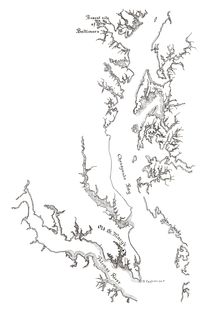
The arrival. The Puritans when using a geographical name
that began with the word "saint" scrupulously uncanonized
it by leaving off the prefix. But these
devout pilgrims of the Roman faith, when once the
saints and guardian angels of Maryland had piloted
them safe in spite of the malice of storm spirits
and evil genii into landlocked waters and the
bounds of Lord Baltimore's grant, proceeded to
sanctify the whole region by sprinkling it with the
names of saints and angels from Michael the archangel
downward. The ancient Indian designations
were marks of a heathenism they purposed to overthrow,
and they began by trying to get rid of the
whole "bead roll of unbaptized names." No convenient
island, creek, river, bay, or cape escaped
Christian baptism. On Annunciation Day, 1634,
they landed on Heron Island, in the Potomac, which
they named appropriately for St. Clement, who was
martyred by being thrown into the sea attached to
an anchor, and here the sacrifice of the mass was
celebrated, the worshipers reflecting that "never
before had this been done in this part of the world."
After the mass they took upon their shoulders a
great cross hewn out of a tree and advanced in
order to the place appointed, where the governor
and his assistants took part in its erection. The
Catholics of the party, seeing this symbol of the
faith erected in a new land, knelt upon the ground
and recited the litanies of the cross in a kind of religious
ecstasy. Here in another form was that
tender attachment to their faith that one finds
among the more devout Protestant exiles, and in
the nobler natures there was doubtless that element
of the heroic and the saintly often evolved in the
religious sufferings and activities of that day—a relief
to the pettiness of the debates and the irksomeness
of the bigotries of the age.
A Catholic colony. The colony had been named Maryland by King
Charles in honor of his wife Henrietta Maria; at
least there was assigned to the king responsibility
for a name that, like nearly everything else about
Maryland, was ambiguous. But the phrase Terra
Mariæ in the charter, though represented there to
be the equivalent of Maryland, was significant to a
devout Catholic of something better than a compliment
to a Catholic queen. Compare Clarke's Gladstone and Maryland Toleration. The Indian village
which with its gardens and cornfields had been
bought for the germinal settlement and capital,
took the name of St. Mary's, and the whole infant
colony is called the Colony of St. Maries, by
its own Legislative Assembly in 1638, as though by
Maryland were intended the land of Mary. Maryland Archives, i, 23. Notwithstanding
the manifest care of the second Lord
Baltimore to hold the missionaries within the limits
of worldly prudence, the zealous fathers lived and
labored in a spirit of other-worldliness. They
set themselves first of all to convert those sheep
without a shepherd, the Protestants of Maryland.
Some of these appear to have been men of reckless
and immoral lives, who were greatly bettered by
an acceptance of religious restraint. Those non-Catholics
who were ill, and those who found themselves
languishing and dying in the wilderness
without the consolations of their own religion,
were zealously visited and converted in extremis by
the Jesuits. The servants and mechanics employed
by or apprenticed to the missionaries were brought
under their constant influence and were readily
won. Nearly all the Protestants who arrived in
1638 were swiftly brought over to the faith of the
missionaries, and twelve converts were joyously
reckoned as fruits of the Jesuit labors in 1639.
There was more than one instance of the miraculous,
or at least of the marvelous, to help on this
work. One man of noble birth, who had by dissipation
brought himself to desperate straits, and
then sunk until he became at length a bond servant
in Maryland, embraced Catholicism. After the
death of this convert a very bright light was sometimes
seen burning about his place of burial, and
even those who were not Catholics were permitted
to see this wonder. Excerpta de Diversis Literis, etc., 56-60. The horrible punishments that
resulted from the Divine wrath against those who
scoffingly rejected the Catholic faith in Maryland
remind one of the equal calamities that befell those
who were unfaithful to Puritanism in New England.
Seventeenth-century Englishmen with sky-wide
differences in opinion were one in the traits
that belonged to their age. Father White was sure
that the destruction of Indians in Maryland was
specially ordered by God to provide an opening
"for His own everlasting law and light"; but not
more sure than were the Puritans that the cruel
plague which exterminated whole villages on the
Massachusetts coast was sent to open a way for the
planting of Calvinistic churches. Each division
of Christians in turn reduced the Almighty Creator
to the level of a special tutelary divinity, sometimes
to that of a rather vindictive genius of the
place.
In this work of propagandism the missionaries
did not forget the red men. Their labors among
the aborigines were fairly successful at first, then
interrupted by relapse and by war. Such is
the history of Indian missions. Much was made
of the solemn profession and baptism of an Indian
"king," at which the governor and other
distinguished men "honored by their presence the
Christian sacraments," the governor marching behind
the neophyte in the procession. Maryland
was in fact openly a Catholic colony until after
1640. Note 17.
Failure to make a Catholic state. But as a Catholic colony it was a failure. In
fear of the rising Puritan tempest in England, or
the violent opposition on several grounds of its
stronger neighbor Virginia, and of the mutinous
bigotry of its own Puritan settlers, who regarded
Baltimore's government as a "Babylon" to be
overthrown, it was never able to afford to Catholics
perfect security, much less was it able to
promise them domination. But the Catholics included
most of the rich and influential families, and
it was a Jesuit boast that they were superior to
other American settlers in breeding and urbanity.
As they had choice of the best land in the province,
the Catholic families remained during the whole
colonial period among the most prominent people
of Maryland. Note 18. There is also evidence that the
Catholics were numerically considerable in proportion
to the population, though the reports on the
subject are vague and conflicting. In 1641 they
were about one fourth of the whole. The ranks of
the early Catholic settlers, both of the rich and
poor, seem to have been recruited from Ireland
as well as from England, but the Maryland government
in Queen Anne's Protestant time passed
acts levying an import tax of twenty pounds on
each Irish Catholic servant, in order that the bond
servants and even the transported convicts in
Maryland should be orthodox Protestants.
Note 19.
Opposition to Maryland. George Calvert, the first Baron Baltimore,
molded the Maryland enterprise until the drafting
of the charter, and his spirit was felt in it after his
death. Cecilius, his son, was a man of a somewhat
different sort, and his traits became more apparent
as time went on. He was strongly supported at
court by Strafford, his father's most devoted and
obliged friend, and no doubt also by the queen,
who was godmother to Maryland. The opposition
to Maryland was probably embittered by the
hatred to Strafford and the jealousy of a Catholic
queen.
The second Lord Baltimore and Virginia. On his enemies in Virginia the younger Baltimore
took ample vengeance. He got one of the
queen's household appointed treasurer of the
colony, and the Virginians found themselves
obliged to pay the quitrents, which had been
neglected and apparently forgotten.
Note 20. Other officers
of the colony were nominated by Baltimore. Harvey,
the governor, hoping to collect money due
him from the royal treasury by Baltimore's assistance,
was his obsequious tool, to the bitter indignation
of the Virginians, who hated Baltimore not
only because he was a Romanist, but also because
he had divided the first colony and cut off the
northern Indian trade from Virginia. In consequence
of the quarrel between Harvey and the
Virginians over Maryland there ensued a revolution
in Virginia; Harvey was shipped to England
by the same bold men who had sent the first Lord
Baltimore packing. But Harvey was sent back
again by the king, and by this counter revolution
the colonial constitution of Virginia was modified
for the worse. It was altogether an exquisite revenge.
Baltimore seeks to control Virginia. Cecilius meditated even a bolder stroke. He
schemed through Windebank to have himself made
governor of Virginia, promising to wring out of it
eight thousand pounds more of revenue for the
king from some neglected sources. To achieve
this, he proposed a scheme by which Windebank
was to impose on the king's credulity. Secretary
Windebank may have recoiled from the part he
was to play; it is certain that Charles was not
persuaded to hand over Virginia bound hand and
foot into the power of the proprietary of the rival
colony. Note 21.
Cautious policy of Baltimore. Intolerance on the part of the authorities of
Maryland directed toward Protestants might have
brought a swift overthrow of the whole project.
The instructions given for the first voyage already
cited show throughout the need for extreme caution
in the face of extreme peril. It is required of
the governor and commissioners that "they be
very careful to preserve the peace amongst all the
passengers on shipboard, and that they suffer no
scandal nor offense to be given to any of the Protestants." Baltimore's instructions, 15 Nov., 1633, Calvert
Papers.
The rulers are to instruct the Catholics
to be silent "upon all occasions of discourse concerning
matter of religion," and those in authority
are to "treat the Protestants with as much mildness
and favor as justice will permit." These instructions
were to hold good after landing, and
in one notable case of religious dissension after
the arrival in Maryland, justice was meted out
against the Catholic offender in a way that showed
a disposition to observe this policy of conciliation
toward Protestants at the expense of some unfairness
toward Catholics. Very early a proclamation
was issued for the suppression of all religious disputes,
and Copley, the business administrator of
the Jesuits, thought they ought to be put down for
fear the writings should be sent to the governor
of Virginia.
Necessary ambiguity. The ambiguous charter of Maryland was a
necessary hypocrisy. The plan of toleration was
also inevitable, and it was carried no further than
necessity required, for in that age, when toleration
was odious, a liberal policy had also its perils.
The Act for Church Liberties of 1639 was a fine
example of the studied ambidexterity of the Maryland
government. It was enacted "that Holy
Church within this province shall have all her
rights, liberties, and immunities, safe, whole, and
inviolate in all things." Holy Church here is a
deliberate substitution for "the Church of England"
in a similar phrase of Magna Charta. Such
an act was worthy of Bunyan's Mr. Facing-both-ways.
Interpreted by judges holding office at the
will of a Catholic proprietary, it could have but
one meaning. For the outside world it might
bear another sense. It did all that could be done
in the circumstances for the Roman Catholic religion
and for Catholic ecclesiastics. Note 22.
Puritan settlers invited. In 1643, Parliament, dominated by Puritans,
could not let the distant Maryland province rest in
peace. It passed an ordinance making the Earl of
Warwick Governor in Chief and Lord High Admiral
of all the plantations in America. This act
contained covert allusions to papists, Spaniards,
and governors recently appointed by the king. Note 23.
Baltimore met the rising tempest in a way characteristic
of him. If he could settle a portion of
his province with Puritans they might serve to
shield him from the storm. Besides, the Catholic
emigration had not proved large, and his province
needed inhabitants. He wrote to a Captain Gibbons,
of Boston, sending him a commission under
the Maryland government, and offering "free liberty
of religion and all other privileges" to such
of the New England people as were willing to remove
to Maryland. Winthrop's Journal, ii, 148, 149. There were those in New
England in that day who longed for a more genial
climate, but to settle under the authority of a papist
was to them much like pitching a tent on the
confines of perdition.
Puritans from Virginia. Though Puritans could not be induced to move
from New England, it happened that the Puritans
living in Virginia were persecuted in this same
year by that stanch cavalier and retrograde churchman,
Sir William Berkeley, who wanted his parsons
to read prayers, but did not like preaching
ministers of any sort. 1643. He was new to his government,
and had brought over with him plenty of
hostility to the party that had affronted his royal
master in England. Virginia Puritans had no
choice but to suffer or depart, and Maryland was
convenient. They began soon after this to seek a
refuge under the protection of a proprietary who
was a papist and who practiced toleration—two
things almost equally hateful to the Puritans. Mr.
James, a Puritan minister, tarried in Maryland a
short time, as early as 1643; he was probably the
only Protestant minister that set foot on Maryland
soil before 1650. But the Puritan was never easy
unless he was uneasy, and he was sure to be uneasy
within when there was none to molest from
without. To take an oath of fidelity to a papist
was to him swearing fealty to antichrist; but so
desirous was Baltimore of Puritan settlers that
even the Maryland oath of fidelity was modified,
and a saving clause was inserted for the ease of
the Puritan conscience. The coming of Puritans
who were in sympathy with the Parliament in
England and who abhorred a tolerant papist, contributed
something to the multifarious turmoils of
the following years.
Maryland turmoils. What we know of the petty civil wars of Maryland
is tedious and perplexing. The broils before
1649 sprang from diverse sources, some of which
we know, others we may easily conjecture. There
was the old claim of Claiborne to jurisdiction over
Kent Island; there was a disposition on the part
of some of the Marylanders to relieve the tedium
of existence by taking a hand in the great struggle
against royal authority which was rending England;
there was the tendency common in frontier
communities to carry debates to a violent issue;
there was perhaps a natural proneness to insurrection
on the part of bond servants and men lately
out of service; and there was an innate hunger for
spoil of any sort in the seamen of that age and in
the rougher class on shore.
Note 24. But by 1648 the tempest
had passed for the time; order had been reestablished;
the Catholic and the Puritan were living
in peace like the lion and the lamb of Hebrew
prophecy; and the Catholic proprietary, always
promptly bending before the storm, had delegated
his authority to a Protestant governor who took
the Parliament side.
The Act of 1649. Before this epoch Maryland toleration had been
merely a practical fact. It had not been theoretically
stated; it had not been a matter of legislation
at all; its extent and limitations were unknown.
But now that this colonial home of Catholics was
to be a land of Protestants, and particularly of
Puritans, it was necessary to formulate the principle
of toleration, the more, that Baltimore's own
co-religionists were to be put under a Protestant
governor. Governor and high officers of state
were required to swear that they would molest on
account of religion no person professing to believe
in Jesus Christ, "and in particular no Roman Catholic."
By the mere march of events it had come
to pass that in the state founded by Catholics as a
cradle for the Roman Catholic religion, the Catholic
was now compelled to secure as best he could
the toleration of his religion at the hands of the
heretic. Part of Baltimore's plan for this new settlement
of affairs involved the sending over of a
code of perpetual laws to be adopted by the Assembly.
The proprietary gave orders that the governor
should not assent to any of these laws if all
were not passed; but the Assembly of Maryland
farmers was too cunning to be entrapped into passing
laws which it thought inconvenient and unjust.
A humble letter was sent from the members to
the lord proprietary complaining that they were
"illeterate" and "void of that Understanding
and Comprehension" necessary to the discussion
of such a code, and that in April they were too
busy with their "necessary employment in a
Crop" to give attention to it. They selected
certain acts out of the code which they passed,
among which was the famous Act of Toleration of
1649. That this was part of the code sent from
England there can be no doubt; the "illeterate"
colonists were not capable of framing it, and it
bears the character-mark of the Baltimore policy
throughout. Here is no philosophic theory of toleration,
no far-reaching conclusion like that of
Roger Williams, that the magistrate may not take
cognizance of merely religious offences. Williams
was a thinker, a doctrinary, too far in advance of
his age to be the successful organizer of a new
state. Baltimore, on the other hand, accepted a
practical toleration as an expedient—he may even
have come to believe in it as a theory by force of
his own situation. But he was not primarily a
thinker at all. Even here, where Baltimorean toleration
reaches high tide, no philosophic congruity
is sought. The Jew and the Unitarian who deny
the divinity of Christ are to be put to death.
Only so much toleration is granted as is needful
to the occasion. And even this toleration is not
put upon any other ground than public policy;
the forcing of conscience in religion "hath frequently
fallen out to be of dangerous consequence";
therefore this law is made "to preserve
mutual love and amity amongst the inhabitants."
The provisions against such offences as blasphemy
and Sabbath-breaking and religious disputes precede
those for toleration. Very politic is the arrangement
by which reviling of God is made a
capital offence, while reviling the Virgin Mary is
adroitly associated with speeches against the "holy
apostles or evangelists" as a sort of second-class
blasphemy, a finable offence.
Note 25.
Vicissitudes of toleration. And yet it was toleration, and the law was all
the more influential as an example, perhaps, because
it was only practical and quite incongruous.
It was eminently prudent and statesmanlike. That
it was not perpetually effective was the fault not
of Baltimore but of the times. Puritan ideas were
rampant. The government of the proprietary was
overthrown; the Jesuits fled to the inhospitable
Virginia, where they lived concealed in a low hut
like a cistern or a tomb, not lamenting their physical
privations so much as the lack of wine which
deprived them of the consolation of the sacrament.
The new government of Maryland, five years after
Baltimore's famous "act concerning Religion,"
passed a new act with the same title—an act
brusque and curt, a law with its boots and spurs
on. "That none profess and exercise the papist
religion" is its rude forbidding. The tables are
turned; it is no longer the nonresident Jew and
the hypothetical Unitarian who are excepted. But
the wheels rolled swiftly once more, and in three
years Cecilius, absolute lord and proprietary, was
again master of Maryland, and the beneficent act
of 1649 resumed its sway. It protected the Catholic
element, which, though always rich and influential,
came to be in latter colonial times but
about a twelfth of the population. Toleration also
served to make Maryland an early dwelling place
for abounding Quakers and others holding religious
views not relished in colonies less liberal.
Note 1, page 223. "Voto a Dios que la Corte d'Inglatierra es como un libro de
cavalleros andantes." Quoted by Chamberlain in Birch, i, 413.
In view of the swift mutations of fortune among courtiers, Dudley
Carleton the younger wrote on December 18, 1624, "He is happiest
who has least to do at court"—a truth which Calvert probably
had come to appreciate by that time.
Note 2, page 224. "The third man who was thought to gain by the Spaniard
was Secretary Calvert; and as he was the only secretary employed
in the Spanish match, so undoubtedly he did what good
offices he could therein for religion's sake, being infinitely addicted
to the Roman Catholic faith, having been converted thereunto
by Count Gondomar and Count Arundel.... Now this
man did protest to a friend of his own that he never got by the
Spaniards so much as a pair of pockets; which it should seem is
a usual gift among them, being excellently perfumed, and may
be valued at twenty nobles or ten pounds price." Goodman's
Court of King James, i, 376, 377.
Note 3, page 225. Whitbourne gives these names. Those who believe that Calvert
was already actuated by religious zeal, remind us that Glastonbury
(by a curious legendary confusion of names) was also
called Avalon, and that in the Christian legend Joseph of Arimathea
began at Glastonbury the planting of the Christian religion
in Britain. See Anderson's Church of England in the Colonies,
second edition, i, 325, 326. This interpretation of Calvert's intention
in naming his colony was early given. British Museum,
Sloane MSS. XXG. 3662, folio 24, date 1670. When Calvert's
first colony was sent out the Scotch settlement in Newfoundland
was of twelve years' standing, while the Bristol colony had
been seated there five years. Calvert's enterprise seems to have
been pushed with more energy and with a more liberal expenditure
than its predecessors. Compare Whitbourne passim with
the statement of Sir William Alexander in his Encouragement
to Colonies, 1624, p. 25.
Note 4, page 225. Among the papers at Landsdowne House which I was permitted
to examine by the kindness of Lord Edmund Fitzmaurice,
there is an unpublished work by James Abercromby, written in
1752. It discusses with acuteness the nature of the several
colonial governments. I shall refer to it hereafter under the
title of Abercromby's Examination, Landsdowne House, 47.
Abercromby was, so far as I know, the first to point out the apparently
intentional ambiguity of the passages in the Maryland
charter that have to do with religion.
Note 5, page 226. It is interesting that in 1622, the year preceding the division
of New England by lot, three shares were laid off and no more.
They were at the extreme north of the territory divided the next
year, and were assigned respectively to the Duke of Lenox, the
Earl of Arundel, and Sir George Calvert. A "grand patent"
was then in preparation for a colony on the coast of Maine to be
called Nova Albion. Calendar Colonial Documents, July 24,
1622. It seems probable, from the charter of Avalon, that Calvert
intended it to be a colony that should harbor Catholics, but
on the other hand the first settlers were chiefly Protestants, with
a clergyman of their own faith, and there seem to have been few
Romanists or none in Avalon until the arrival of a company with
the lord proprietary in 1627.
Note 6, page 228. Fuller's oft-quoted account of the circumstances of Calvert's
resignation, Worthies, Nuttall's edition, iii, 417, 418, gives probably
the commonly received story, and shows that the religious
motive was popularly accepted as the reason for his leaving
office. Archbishop Abbot was better informed though less
impartial. His letter is in the curious work entitled "The
Negotiations of Sir Thomas Roe in his Embassy to the Ottoman
Porte from the Year 1621 to 1628," etc., published in 1740.
Abbot says: "Mr. secretary Calvert hath never looked merily
since the prince his coming out of Spaine: it was thought hee
was muche interested in the Spanishe affaires: a course was
taken to ridde him of all imployments and negotiations. This
made him discontented; and, as the saying is, Desperatio facit
monachum, so hee apparently did turne papist, whiche hee now
professeth, this being the third time that hee hath bene to blame
that way. His Majesty to dismisse him, suffered him to resigne
his Secretaries place to Sir Albertus Moreton, who payed him
three thousand pounds for the same; and the kinge hath made
him baron of Baltimore in Ireland; so hee is withdrawn from vs,
and having bought a ship of 400 tuns, hee is going to New England,
or Newfoundlande, where hee hath a colony." Page 372.
The letters preserved among the state papers are the main
authority, especially those addressed to Sir Dudley Carleton, who
desired to buy Calvert's place. See, passim, the Calendar of
Domestic Papers for 1624 and 1625 to February 12th. The circumstantial
account given in the Salvetti correspondence, though
cited as authority by Mr. Gardiner, has never been printed, for
which reason it is here given in the original from the British
Museum Additional MSS. 27962 C.: "Il Signor Cavalier Calvert
primo Segretario et Consigliero di Stato, credendosi, doppo la
rottura de' trattati, che si haveva con Spagna, (che per comandamento
di sua Maestà haveva lui solo maneggiati,) d'essere eclipsato
nell' oppinione del Sigr. Principe et Signor Duca, et di non
essere più impiegato con quella confidenza, che solevano ricorse
pochi giorni sono dal Signor Duca di Buchingam per fargli intendere
la sua risolutione, la quale era, che vedendo di non potere
godere della buona grazia dell' Eccellenza sua nella medesima
forma che godeva avanti della sua andata in Spagna era risoluto
di rittrarsi dalla Corte, et di mettere in sua mano, come di presente
faceva, la sua carica, perchè ne disponasse ovonque le
piacesse con molte altre parole tutte piene di valore et magnanimita:
soggiugnendoli di più come dicono, che essendo risoluto
per l'avvenire di vivere et morire Cattolicamente, conosceva di
non poterlo fare nel servizio dove era senza gelosia dello stato et
pericolo del Parlamento. Il Signor Duca ancorche non amasse
questo Cavaliero, ne nessuno altro che ha hauto le mani nel parentado
di Spagna, con tutto ciò vedendo un atto cosi honorato,
gli rispose: che non potera negare che non gli fusse stato da
non so che tempo in qua nemico; ma che hora vedendo la franchezza
et nobiltà d'animo, col rispetto che gli haveva mostrato,
l'abracciava per amico, per mostrargliene gli effeti, sempre che
ne havesse occasione, con assicuratione de più che operrebbe
con sua Maesta gli fusse confermato le suoi pensioni, et di più
dato honorevole ricompensa per la sua carica di segretario. Et
che quanto alla sua religione egli l'havrebbe protetto quanto
fusse mai stato possibile," etc. Salvetti, Correspondence, iii,
February 6, 1624-'25.
The letter of the 28th February (O.S.) in the same volume
gives an account of the formal resignation to the king, and states
that the greater part of the money paid to Calvert was from his
successor, and that it was paid denari contanti, "cash down,"
and adds sympathetically that "this good lord will be able to
live easily and quietly" hereafter.
Note 7, page 229. Calvert attributes his deception to interested letters. The
principal motives to settle in Newfoundland may be seen by the
reader who has patience enough to thread his way through the
jumble of mythology, allegory, political economy of a certain
sort, verse in English and Latin, theology, satire, and an incredible
number of what-nots besides "for the generall and perpetuall
good of Great Britain," found in Vaughan's Golden Fleece, published
in 1626. The nearness of Newfoundland to Ireland and
the comparative cheapness of transportation thither, but especially
the well-established value of its fisheries and the market
they afforded for the produce of the colony, were the most plausible
reasons for settling a colony there. Probably there was a
lurking purpose to turn the shore fishery into a monopoly such
as was contemplated by projectors for the New England coast.
The fact was insisted upon that part of Newfoundland was
"equal in climate," or at least in latitude, to "Little Britain in
France," or Brittany. Then, too, Newfoundland is an island, and
Vaughan at least persuaded himself that "Ilanders should dwel
in Ilands." As some of the apostles were fishermen, "Newfoundland
the grand port of Fishing was alloted to Professors
of the Gospell." Golden Fleece, Part Third, pp. 5 and 6 and
passim.
Note 8, page 230. Lord Baltimore may have had the governorship of Virginia in
view. Cecilius, his son, sought to have himself made governor
in 1637. Colonial Papers, ix, 45, Record Office. See an earlier
communication on the same subject in Sainsbury, 246, under the
date of February 25, 1637. It is almost the only petition of the
second Lord Baltimore that was not granted. See also section
xvii of the present chapter, and note 21 below.
Note 9, page 231. I have ventured to conjecture so much on evidence not
complete. Father White, who was cordially entertained by the
Governor of St. Kitts in 1634, speaks of the people of Montserrat
as "pulsos ab anglis Virginiæ ob fidei Catholicæ professionem."
White's choice of words does not necessarily imply, I
suppose, an actual banishment from Virginia, but at least a refusal
of permission to come. Neither Edwards nor Oldmixon
mention this fact; but as White visited St. Kitts only two years
after the settlement at Montserrat, which was made immediately
from St. Kitts (according to Edwards) and was subject to the
same governor, his information was doubtless correct. There
seems to have been another project to plant Catholics in Virginia
about this time, unless, as is rather probable, we meet
the same plan in another form. Sir Pierce Crosby offered to
plant ten companies "of the Irish Regiment into a fruitful part
of America not yet inhabited." To make the proposal acceptable,
it was stated, somewhat diplomatically perhaps, that the major
part of the officers and many of the soldiers were Protestants.
Sainsbury's Calendar, p. 95, where the conjectural date is 1628.
Note 10, page 235. The translation quoted is that published by Cecilius Calvert
in the Relation of 1635. The original reads: "Unacum licencia
et facultate Ecclesias Capellas et Oratoria in locis infra premissa
congruis et idoneis Extruendi et fundandi eaque dedicari et sacrari
juxta leges Ecclesiasticas regni nostri Anglie facendas." Maryland
Archives.
Note 11, page 235. Sir Edward Northey, Attorney-General of England in the
following century, gave this decision: "As to the said clause in
the grant of the province of Maryland, I am of opinion the same
doth not give him power to do anything contrary to the ecclesiastical
laws of England." This is as ingeniously ambiguous as
the clause itself. The attorneys-general and solicitors-general
during the eighteenth century set themselves to the task of subordinating
colonial government to parliamentary authority by a
series of opinions in which they make rather than explain law.
In the present instance Northey was more modest than usual, for
he reaches a purely negative and impotent conclusion, which
Neill turns into a positive one in his text. Founders of Maryland,
99. There is a collection of opinions on colonial subjects
rendered by the attorneys and solicitors-general in the first half
of the eighteenth century, in a volume at Landsdowne House
which I have examined. This collection was made, or at least
furnished, for the use of Lord Shelburne. Before Northey's
opinion was given the English Parliament had assumed power to
override some provisions of the Maryland charter, as is pointed
out in Abercromby's Examination, MS. at Landsdowne House,
47. How slowly the Church of England grew in the colony may
be inferred from the statement made in 1677, that four clergymen
have plantations and settled "beings" of their own—a phrase
sufficiently obscure. Others were sustained by voluntary contributions.
Colonial Papers, No. 49, Record Office, folios 54, 55.
This is Baltimore's reply to the paper at folio 56, the order of
which is evidently reversed. The population of the province,
it is stated, was composed at that time chiefly of dissenters
of various sects, Catholics and Anglicans being the smallest
bodies.
Note 12, page 236. As early as 1752 it was remarked that the Maryland charter
contained "the most extensive power of any charter in British
America." Abercromby's Examination, MS., Landsdowne
House. In Collier's Ecclesiastical History of Great Britain, vol.
ix, is the writ of Edward III, A. D. 1327, by which the regalities
of the bishopric of Durham are confirmed after a trial in parliament.
Note 13, page 240. Cecilius, Lord Baltimore, wrote to Strafford, 10 January,
1633-'34, that he had sent "a hopeful colony into Maryland with
a fair and probable Expectation of Success, however without
Danger of any great prejudice unto myself, in Respect that many
others are joined with me in the Adventure"—that is, in the financial
risk. Strafford Papers, i, 179. Twenty years later Cromwell
writes to Bennet, Governor of Virginia, "We have therefore
at the request of Lord Baltimore and of divers other persons of
quality here who are engaged in great adventures in his interest,"
etc. Thurloe, i, 724. A tradition of this co-operation may have
remained in Maryland a century later, for in 1755 or 1756 there
was presented to the Lord Baltimore of that day, who was a
Protestant, a petition from Roman Catholic residents of Maryland
in which this assertion occurs: "The money and persons of
this persuasion contributed chiefly to the settling and peopling of
this colony." British Museum MS. 15,489.
Note 14, page 242. The statement of Father Henry More, in 1642, that "in leading
the colony to Maryland by far the greater number were heretics,"
is not conclusive, though it is relied on by General Bradley
T. Johnson and others. More was Provincial of the Jesuits in
England, and he is no doubt repeating loosely the information
contained in Father White's letter of the year before, which says,
"Whereas three parts of the people in four at least are heretics"—a
statement true, no doubt, in 1641, when the Kent Islanders
and newcomers were counted, but not true, probably, of the company
of 1634, as Bancroft seems to say.
Note 15, page 242. The original document is in the Stoneyhurst MSS., Anglia,
vol. iv. It is reprinted in full in General Bradley T. Johnson's
"The Foundation of Maryland." It tends to show that the emigration
of many recusants was confidently expected.
Note 16, page 243. "Nubes, terrificum in morem excresentes, terrori erant intuentibus
antequam discinderentur: et opinionem faciebant prodiisse
adversùm nos in aciem, omnes spiritus tempestatum maleficas,
et malos genios omnes Marylandiæ." Relatio Itineris, 15.
Note 17, page 247. See passim, Letters of Missionaries. A letter of Copley, the
Jesuit, to Lord Baltimore, in Calvert Papers, p. 165, implies the
possibility of Catholic incumbents of Maryland parishes. He is
complaining of the law of the Assembly of 1638 relating to glebe
land: "In euery Mannor 100 acres must be laid out for Gleabe
lande, if then the intention to bind them to be pastors who enjoy
it, we must either by retaining so much euen of our owne
land undertake the office of pastors or lesse euen in our owne
Mannor maintaine pastors, both which to us would be uery Inconuenient."
Note 18, page 248. Letters of Missionaries, p. 77. "The Catholics who live in
the colony are not inferior in piety to those who live in other
countries; but in urbanity of manners, according to the judgment
of those who have visited the other colonies, are considered
far superior to them." More than a hundred years later the
Catholics retained a superiority, according to Updike's Appendix
to McSparran, 1752: "The Catholics, having the start in point
of time of the after settlers, are also to this day ahead of them
in wealth and substance; by which means the first and best families
are for the most part still of the Roman communion," p. 492.
Note 19, page 248. The act passed in 1704 was renewed in 1715 and still in force
in 1749. I cite from Ogle's Account of Maryland, of the latter
date, a manuscript at Landsdowne House, numbered 45, folio
199. In No. 61 at Landsdowne House is a decision of the Attorney-General
in England in 1605 that Jesuits may be expelled
from Maryland by order of the queen if aliens, but not if they are
subjects. The various eighteenth-century enactments against
Catholics will be found in Bacon's Laws of Maryland, passim.
MS. 15,489, British Museum, cites some of these severe laws and
the proceedings taken under them. Strong petitions against
these measures were signed by Charles Carroll and others.
Note 20, page 249. Gabriel Hawley, Robert Evelin, and Jerome Hawley, appointed
to places in Virginia, appear to have been Catholics and partisans
of Baltimore. Aspinwall Papers, i, page 101, note.
Note 21, page 250. Baltimore's letter bears date February 25, 1637, and is in the
Record Office, Colonial Papers, xiv, No. 42. The memorial apparently
sent with it is No. 49 in the same volume. Baltimore
proposes to reward Windebank for his assistance, and he sets
down the very manner in which the secretary is to approach the
king with a diplomatic falsehood. Both the letter and memorial
are printed in Maryland Archives, Council Proceedings, pp.
41, 42.
Note 22, page 251. The act was one of those that for some reason of expediency
was never read a third time, but was condensed into what would
now be called an omnibus bill. The act is given in Bacon's
Laws, and is compared by Bozman with Magna Charta. Bozman
regards this law of 1639 as an attempt to establish the
Roman Catholic religion.
Note 23, page 252. A copy of the ordinance as printed separately at the time is
in the Lenox Library. It is reprinted in Churchill's Voyages,
viii, 776.
Note 24, page 254. It is extremely curious that, in the letters of one of the Jesuits
reporting the attack upon them in 1645, he should have used an
expressive word hitherto supposed to be very modern and American.
He says that the assault was made "by a party of 'rowdies'
or marauders." From the way in which the sentence is printed
in the Records of the Society of Jesus, iii, 387, I suppose that in
the original manuscript the English word "rowdies" is given
and explained by a Latin equivalent.
Note 25, page 256. Charles, the third Lord Baltimore, writes in defense of the
Maryland policy of toleration under date of March 26, 1678:
"That at the first planteing of this Provynce of my ffather—Albeit
he had an absolute Liberty given to him and his heires
to carry thither any Persons out of any the Dominions that belonged
to the Crown of England that should be found Wylling
to goe thither, yett when he comes to make use of this Liberty
He found very few who were inclyned to goe and seat themselves
in those parts But such as for some Reasons or other could not
Lyve with ease in other places, And of these a great parte were
such as could not conforme in all particulars to the severall Lawes
of England relateing to Religion. Many there were of this sort of
people who declared their Wyllingness to goe and Plant themselves
In this Provynce soe as they might have a generall toleračon
settled there by a Lawe by which all of all sorts that professed
Christianity in Generall might be at liberty to worship God in
such manner as was most agreeable with their respective Judgments
and Consciences without being Subject to any Penaltyes
whatever for their soe doing." Colonial Papers, vol. xlix, Record
Office. Compare Leah and Rachel, p. 23, where the author
also implies that the Act of Toleration was a concession to Puritan
demands.
Centrifugal forces in Massachusetts. The centrifugal force of religious differences
acted with disastrous results in Maryland, because
the Catholic party, which had always a controlling
negative there through the proprietary, was
in the minority. The Massachusetts people, on
the other hand, were fairly homogeneous in religious
opinion, and their government was admirably
compacted. In Massachusetts religious sentiment
was a powerful centripetal force. Magistrates
and ministers were nicely poised, and each order
relied upon the other to maintain existing conditions.
If the magistrates were perplexed or were
seriously opposed, the elders were called in to advise
or to lend a powerful ecclesiastical sanction to
the rulers. When any disturbance of church order
was threatened, the magistrates came to the front
and supported the clergy with the sharp smiting
of the secular arm. In the magistracy and in the
ranks of the clergy were men of unusual prudence
and ability. If the little Puritan commonwealth
seemed a frail canoe at first, it was navigated—considering
its smallness one might rather say it was
paddled—most expertly. But in Massachusetts, as
well as in Maryland, religious opinion was the main
source of disturbance. The all-pervading ferment
of the time could not be arrested, and more than
once it produced explosion. Now one and now
another prophet of novelty or prophet of retrogression
arose to be dealt with for religious errors;
there were divergences from the strait path of
Puritanism in the direction of a return to Church
of England usage, divergences in the direction of
extreme Separatism, in the direction of the ever-dreaded
"Anabaptism," in the direction of Arianism,
and of so-called Antinomianism. In the case
of the Antinomians, the new movement was able to
shelter itself under the authority of the younger
Vane, then governor, and for a while under the
apparent sanction of the powerful Cotton. But no
other religious disturbance was ever allowed to
gather head enough to become dangerous to the
peace and unity of the little state. Dislike as we may
the principles on which uniformity was enforced,
we must admire the forehanded statesmanship of
the Massachusetts leaders in strangling religious
disturbances at birth, as Pharaoh's midwives did
infant Hebrews.
Early life of Roger Williams. One of the most formidable of all those who
ventured to assail the compact phalanx presented
by the secular and religious authorities of Massachusetts
was Roger Williams. N. Eng. Hist., Gen. Reg., July, 1889. Williams was the
son of a merchant tailor of London. He manifested
in boyhood that quickness of apprehension
which made him successful in acquiring languages
later in life. Before he was fifteen the precocious
lad was employed in the Star Chamber in taking
notes of sermons and addresses in shorthand, and
his skill excited the surprise and admiration of Sir
Edward Coke. Coke had found time, in the midst
of a tempestuous public career and the arduous
private studies that brought him permanent renown,
to defend the legacy which founded the
new Sutton's Hospital, later known as the Charter-House
School. Indorsement of Mrs. Sadleir on Williams's letter,
transcript, Lenox Library; also in Narragansett Club, Pub. VI. Of this school he was one of the
governors, and he appointed young Roger Williams
to a scholarship there, Williams being the
second pupil that ever gained admission to that
nursery of famous men. His natural inclination
to industry in his studies was quickened by the
example and encouragement of Coke, who was wont
to say that he who would harrow what Roger Williams
had sown must rise early. From the Charter
House Williams went to Pembroke College, Cambridge.
He early manifested sincere piety and a
tendency to go to extremes in his Puritan scruples.
Even in his father's house he had begun to taste
the bitterness of persecution. His eager temper
transformed his convictions into downright passions;
his integrity was an aggressive force, and
there was a precipitation in his decisions and actions
that was trying to his friends.
Note 1. From an early
period he showed a conscience intolerant of prudent
compromises. Puritanism had contrived to
exist and to grow to formidable strength within
the church by means of such compromises. Hooker
and Cotton, two of the greatest luminaries of that
party and afterward the lights that lightened New
England, one day urged on the impetuous Williams
the propriety of temporarily conforming in the use
of the common prayer. By conceding so much to
the judgment of his revered elders, Williams would
have removed the only obstacle to his advancement,
for preferment was offered to the clever and
exemplary protégé of Coke in the universities, in
the city, in the country, and at court.
Note 2. But neither
interest nor example could sway the impractical
young minister. He took refuge, like other extreme
Puritans, in a private chaplaincy, and refused
all compromise, in order, as he afterward
declared, to keep his "soul undefiled in this
point and not to act with a doubting conscience."
Most men feel bound to obey conscience only
where it clearly commands or forbids; good men
may act on the balance of probabilities where there
is doubt; but this young man would not do anything
concerning which his moral judgment felt
the slightest halting. Here is the key to his whole
career; his strength lay in his aspiration for a soul
undefiled; his weakness, in that he was ever a victim
to the pampered conscience of an ultraist.
Property of some thousands of pounds, that might
have been his had he been willing to make oath in
the form required in chancery, he renounced to
his scruples. It certainly seemed rash in a young
man just setting out in life, with a young wife to
care for, to indulge in such extravagant luxury of
scruple.
Flight of Williams from England. Laud succeeded in hunting the non-conforming
Puritans from their lectureships and chaplaincies.
It became with Williams no longer a question of
refusing preferments on both hands with lavish
self-denial, but of escaping the harsh penalties reserved
for such as he by the Courts of High Commission
and the Star Chamber. There was nothing
left but to betake himself to New England for
safety. Williams's letter to Mrs. Sadleir, as above. He fled hurriedly across country on horseback,
feeling it "as bitter as death" that he dared
not even say farewell to his great patron Sir Edward
Coke, who detested schism.
Arrival in New England. Here, as in after life, the supreme hardship he
suffered was not mere exile, but that exile of the
spirit which an affectionate man feels when he is
excommunicate of those he loves. His escape by
sea was probably the more difficult because he was
unwilling to "swallow down" the oath exacted of
those who emigrated. But he succeeded in sailing
with his young wife, and in 1631 this undefiled soul,
this dauntless and troublesome extremist, landed in
New England. He was invited to become one of
the ministers of the Boston church.
Note 3. But Williams
was conscientiously a Separatist, and he refused to
enter into communion with the Boston congregation
because of its position with reference to the
church in England.
This protest by withdrawal of communion was
a fundamental principle of Separatism. It was not,
as it appears on the surface, a manifestation of uncharitableness
toward persons, but a solemn protest
by act in favor of a principle.
Note 4. Never was any
man more forgiving, long-suffering, and charitable
toward opponents than Williams, but never was a
man less inclined to yield a single jot in the direction
of compromise where his convictions were involved,
whatever might be the evils sure to result
from his refusal.
Williams at Salem. Williams repaired first to Salem, the north
pole of Puritanism, where the pioneer church of
Massachusetts had a more Separatist tone than
any other. In the phrase of the time, no other
churches in the world were so "pure" as the New
England churches, and Salem was accounted the
"purest" church in New England. Its surviving
minister, Skelton, and its principal layman, Endecott,
both tended to extreme Congregationalism;
but the General Court of the colony protested
against the selection of Williams to be one of the
ministers of the Salem church. Skelton's Separatist
tendencies, Endecott's impetuous radicalism,
and Salem's jealous rivalry with the younger town
of Boston, were already sources of anxiety to the
rulers. The addition of Williams to these explosive
forces was alarming. Williams's ecclesiastical
ideals were not those which the leaders of the
colony had devoted their lives and fortunes to establish.
Had this young radical been less conscientious,
less courageous, less engagingly good and
admirable, there would not have been so much
reason to fear him. A letter was written to Endecott
protesting against Williams's ordination, because
he had refused communion with the church
at Boston, and because he denied the power of the
magistrate to enforce duties of the first table—that
is, duties of religion. Winthrop's Journal, i, 63, 12th April, 1631. Here at the very outset of
his American life we find that Williams had already
embraced the broad principle that involved the
separation of church and state and the most complete
religious freedom, and had characteristically
pushed this principle to its logical result some
centuries in advance of the practice of his age.
Note 5.
The protest of the court prevented his ordination.
He yielded to the opposition and soon after removed
to Plymouth, where the people were Separatists,
modified by the conservative teachings of
John Robinson, somewhat modified also by the
responsibility of founding a new state, and perhaps
by association with Puritans of the neighboring
colony.
Williams at Plymouth. At Plymouth the young idealist "prophesied"
in his turn, but did not take office in the church,
which already had a pastor in Ralph Smith, the
Separatist, who had been suffered to come over in
a Massachusetts ship only on his giving a promise
not to preach in that jurisdiction without leave.
The congregation at Plymouth was poor, and
Roger Williams mainly supported himself by hard
toil "at the hoe and the oar"—that is, perhaps, in
farming and fishing. His body seems to have been
vigorous, and no physical fatigue abated anything
of his mental activity. The Pilgrims had passed
more than twelve years in Holland, and almost
every adult in Plymouth must have known Dutch.
Those of Roger Williams's own age, who were
children when they migrated to Leyden and men
when they left, probably spoke it as well as they
did their mother tongue. Maverick's Description of New England, 25. The Plymouth people,
indeed, were styled "mungrell Dutch" a quarter
of a century later. It is probable that Williams,
with his usual eagerness to acquire knowledge,
now added Dutch to his stock of languages; it is
certain that he afterward taught Dutch to John
Milton. But he was still more intent on learning
the language of the natives, that he might do them
good. He resolved not to accept office as pastor
or teacher, but to give himself to work among
the Indians. Williams to Winthrop, 1632. Perhaps his tendency to individualism
made this prospect pleasing to him. He may
have begun already to realize in a half-conscious
way that there was scant room in any organization
for such as he. The learning of the Indian language
was an arduous toil in more ways than one.
"God was pleased to give me a painful patient
spirit," wrote Williams long after, "to lodge with
them in their filthy, smoky holes to gain their
tongue." He afterward wrote an excellent treatise
on the dialect of the New England Indians.
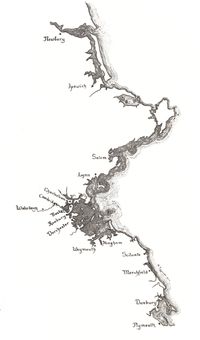
Writes against the royal patents. At Plymouth Williams spoke, as he had at
Salem, without restraint from any motive of expediency
or even of propriety. Separatist Plymouth,
whose days of advance were over, was a little disturbed
by his speech. In his own sweet, reckless
way he sometimes sharply rebuked even the revered
Bradford when he thought him at fault.
And in the interest of the aborigines and of justice
Williams laid before Governor Bradford a manuscript
treatise which argued that the king had no
right to give away, as he had assumed to do in his
grants and charters, the lands of the Indians merely
because he was a Christian and they heathen.
That it was right to wrong a man because he was
not orthodox in belief could find no place in the
thoughts of one whose conscience was wholly incapable
of sophistication. Bradford accepted candidly
the rebukes of Williams and loved him for
his "many precious parts." Bradford, 310. But as governor of a
feeble colony he was disturbed by Williams's
course. In spirituality, unselfish fearlessness, and
a bold pushing of Separatist principles to their
ultimate logical results, Roger Williams reminded
the Pilgrims of the amiable pastor of the Separatist
church in Amsterdam whose change step by step
to "Anabaptism," the great bugbear of theology
in that time, had been a tragedy and a scandal to
the Separatists of Leyden. Knowles's Life of Williams, 53. Elder Brewster feared
that Williams would run the same course. Williams
wished to return to Salem, where he might
still devote himself to the neighboring Indians, and
assist Skelton, now declining in health. Brewster
persuaded the Plymouth church to give him a
letter of dismissal. Williams returns to Salem. The leading Pilgrims felt
bound to send "some caution" to the Salem
church regarding the extreme tendencies of Williams.
On the other hand, some of the Plymouth
people were so captivated by his teachings and
his personal character that they removed with
him. This following of an approved minister was
common among Puritans; an acceptable preacher
was of as much value to a town as good meadows,
broad pastures, and pure water.
The town system. To understand the brief career of Williams at
Salem and its catastrophe, we must recall the
character of colonial life in Massachusetts at the
time. There were already sixteen settlements or
"towns" on the shores of Massachusetts Bay, with
an indefinite stretch of gloomy wilderness for background,
the dwelling place of countless savages
and wild beasts. The population of all the settlements
may have summed up five thousand people—enough
to have made one prosperous village.
The inhabitants of the various towns of the bay
were from different parts of England; their dress
and dialect were diverse, and their Puritanism was
of various complexions. The town system, at first
a reproduction on new soil of the township field
communes that had subsisted in parts of England
from ages beyond the fountain heads of tradition,
gave some play to local peculiarities and prejudices.
There is evidence that the central government
relieved itself from strain by means of this
rural borough system. The ancient town system
in turn appears to have taken on a new youth; it
was perhaps modified and developed by the local
diversity of the people, and it lent to Massachusetts,
at first, something of the elasticity of a federal
government. Note 6.
Life in the Massachusetts settlements. This community of scattered communes was
cut off from frequent intercourse with the world,
for the sea was far wider and more to be feared in
that day of small ships and imperfect navigation
than it is now. 1630 to 1640. The noise of the English controversies
in which the settlers had once borne a part
reached them at long intervals, like news from another
planet. But most of the time these lonesome
settlements had no interest greater than the petty
news and gossip of little forest hamlets. The visitor
who came afoot along Indian trails, or by
water, paddling in a canoe, to Boston on lecture
day, might bring some news of sickness, accident,
or death. Sometimes the traveling story was exciting,
as that wolves had slaughtered the cattle
at a certain place, while yet cattle were few and
precious. Or still more distressing intelligence
came that the ruling elder of the church at Watertown
had taken the High-church position that
Roman churches were Christian churches, or that
democratic views had been advanced by Eliot of
Roxbury. A new and far-fetched prophetical explanation
of a passage in the Book of Canticles,
and a tale of boatmen wrecked in some wintry
tempest, might divide the attention of the people.
Stories of boats capsized, of boatmen cast on islands
where there was neither shelter nor food, of boats
driven far to sea and heard of no more, were staples
of excitement in these half-aquatic towns; and
if the inmates of a doomed boat had been particularly
profane, these events were accounted edifying—divine
judgments on the ungodly. When the
governor wandered once and lost himself in the
forest, passing the night in a deserted wigwam,
there was a sensation of a half-public character.
That a snake and a mouse had engaged in a battle,
and that the puny mouse had triumphed at last,
was in one budget of traveling news that came to
Boston. To this event an ominous significance
was given by John Wilson, pastor of the Boston
church, maker of anagrams, solemn utterer of
rhyming prophecies which were sometimes fulfilled,
and general theological putterer. Wilson
made the snake represent the devil, according to
all sound precedents; the mouse was the feeble
church in the wilderness, to which God would
give the victory over Satan. Thus enhanced by
an instructive interpretation from the prophet and
seer of the colony, the story no doubt took up its
travels once more, and now with its hopeful exegesis
on its back. The Massachusetts mouse was
an auspicious creature; it is recorded by the governor,
and it was no doubt told along the coast,
that one got into a library and committed depredations
on a book of common prayer only, nibbling
every leaf of the liturgy, while it reverently spared
a Greek Testament and a Psalter in the same
covers.
In a petty state with a range of intellectual interests
so narrow, the conflict between Williams
and the General Court took place.
Self-consciousness of the Massachusetts community. It was a community that believed in its own
divine mission. It traced the existence of its settlements
to the very hand of God—the God who
led Israel out of Egypt. The New England colonists
never forgot that they were a chosen people.
Upon other American settlers—the Dutch
in New Netherland, the Virginia churchmen, the
newly landed Marylanders, with their admixture
of papists—they looked with condescension if not
with contempt, accounting them the Egyptians of
the New World. Note 7. The settlers on the Bay of
Massachusetts were certain that their providential
exodus was one of the capital events in human
history; that it had been predesigned from eternity
to plant here, in a virgin world, the only true
form of church government and to cherish a church
that should be a model to the Old World in turn,
and a kind of foreshadowing of the new heaven
and the new earth. Some dreamed that the second
coming of Christ would take place among the
rocky woodlands of New England. The theocratical
government was thought to be the one most
pleasing to God, and a solemn obligation was felt
to import into this new theocracy the harsh Oriental
intolerance which had marked that fierce
struggle in which the Jewish tribes finally shook
off image worship.
John Cotton, 1633. The apostle of theocracy who arrived soon
after Williams's return to Salem was John Cotton,
a Puritan leader in England, in whom devoutness
was combined with extreme discretion, a dominant
will with a diplomatic prudence and a temper never
ruffled. Cotton's ingenious refinements made him
a valuable apologist in an age of polemics, but they
often served to becloud his vision of truth and
right. He was prone to see himself as he posed, in
the character of a protagonist of truth. He gave
wise advice to the Massachusetts Puritans at their
departure from England. When, a few years
later, Laud's penetrating vigilance and relentless
thoroughness made even Cotton's well-balanced
course of mild non-conformity impossible, he fled
from his parish of Boston, in Lincolnshire, to London,
and escaped in 1633 with difficulty to the new
Boston in New England. As John Cotton had
been the shining candle of Puritanism in England,
his arrival in America was hailed with joy, and
from the time of his settlement in the little capital
his was the hand that shaped ecclesiastical institutions
in New England, and he did much also to
mold the yet plastic state.
Note 8. Though he usually
avoided the appearance of personal antagonism,
every formidable rival he had left Massachusetts
early. Williams, Hooker, Davenport, and Hugh
Peter all found homes beyond the bounds of the
colony. There can not be two queen bees in one
hive, nor can there well be more than one master
mind in the ecclesiastical order of a petty
theocratic state. It was the paradox of colonial
religious organization that the Episcopal colonies
had parishes almost independent of all supervision,
while the New England Congregationalists were,
from the arrival of Cotton, subject to the dominance
of ministers who virtually attained to the
authority of bishops.
Salem refractory. Salem, the oldest town of the commonwealth,
was the most ready to pursue an independent
course and it was attached to Williams, whose ability
attracted new settlers and who maintained a
position of independence toward Cotton and the
authorities at Boston. To subdue the refractory
Salem was no doubt one of the secondary purposes
of the proceedings against Williams. There seems
to have been no personal animosity toward Williams
himself; his amiable character and his never-doubted
sincerity were main obstacles to his punishment.
Collision inevitable. The return of Roger Williams to such a place
as Salem was naturally a matter of alarm to the
ministers and magistrates of Massachusetts. Collision
was not a matter of choice on either side.
The catastrophe was like one that comes from the
irresistible action of physical forces. In a colony
planted at great cost to maintain one chosen form
of worship and subordinating all the powers of
government to this purpose, a preacher who asserted
the necessity for a complete separation of
religion and government in the interest of soul liberty
had no place. His ideal was higher than the
prevailing one, but that age could not possibly rise
to it.
The book against the patent. Williams was yet only a private member of the
church in Salem, but in the illness of the pastor he
"exercised by way of prophecy"—that is, preached
without holding office. An alarming report was
soon in circulation that he had written a book
against the king's patent, the foundation of the
colonial authority. This treatise, we have said,
was written in Plymouth for the benefit of Governor
Bradford. Note 9. Like many of the manuscript
books that have come down to us, it appears to
have been a small quarto, and, if it resembled other
books of the sort, it was neatly stitched and perhaps
even bound by its author in the favorite pigskin
of the time. Williams sent his book promptly
to be examined. Some of the "most judicious
ministers much condemned Mr. Williams's error
and presumption," and an order was made that he
"should be convented at the next court." In the
charges no fault was found with the main thesis of
the book, that the king could not claim and give
away the lands of the Indians; but it was thought
that there were disloyal reflections cast upon both
James and Charles—at least those eager to condemn
construed the obscure and "implicative
phrases" of Williams in that sense—and these supposed
reflections were the subject of the charges.
Williams wrote a submissive letter, and offered his
book, or any part of it, to be burned after the manner
of that time. A month later, when the governor
and council met, the whole aspect of the
affair had changed. Cotton and Wilson, the teacher
and the pastor of the Boston church, certified, after
examination of Williams's quarto, that "they found
the matters not so evil as at first they seemed."
It was decided to let Williams off easily. There
are some things unexplained about the affair; the
eagerness of the "judicious ministers" and court
to condemn without due examination, the failure
even to specify the objectionable passages at last,
and the unwonted docility of Williams—all leave
one to infer that there was more in this transaction
than appears. Laud and his associates were moving
to have the Massachusetts charter vacated, and
it may have seemed imprudent for the magistrates
to found their authority on a base so liable to disappear.
If the charter had been successfully called
in, Williams's ground of the sufficiency of the
Indian title to lands might have proved useful as a
last resort. Williams asserted, long afterward, that
before his troubles began he had drafted a letter
addressed to the king, "not without the approbation
of some of the chiefs of New England," whose consciences
were also "tender on this point before
God." Reply to Cotton, 276, 277. This letter humbly acknowledged "the evil
of that part of the patent which relates" to the gift
of lands. Had the letter been sent to its destination
it would have cut a curious figure among the
worldly-minded state papers of the time.
An abstract principle. It is probable that most of the land of the colony
had been secured from the natives by purchase
or by treaty of some sort; at least the Indians
were content, and the little quarto had at that time
no practical bearing whatever, but that did not
matter to Williams. The more abstract a question
of right and wrong, the more he relished a
discussion of it. It was of a piece with his exquisite
Separatism, a mere standing up in the face
of heaven and earth for an abstract principle. His
purpose was not to right a specific and concrete
wrong, for there had been none, but to assert as a
broad principle of everlasting application that a
Christian king may not dispose of the land owned
by heathens merely because of his Christianity.
Williams was not a judge or a lawgiver; he was
a poet in morals, enamored of perfection, and keeping
his conscience purer than Galahad's.
The alarm. It was in the winter of 1633-'34 that the book
about the patent was called in question. Skelton,
pastor of Salem, died in the following August,
and the Salem people, in spite of an injunction
from the magistrates, made Williams their teacher
in his stead. 1634. The country was now full of alarm
at news from England that the charter was to be
revoked, that a general governor of New England
was to be appointed, and that a force was to be
sent to support his authority. Laud was put at
the head of a commission for the government of
the colonies in April, 1634. There could be no
doubt of the meaning of this measure. For more
than a year the alarm in Massachusetts continued.
The ministers were consulted regarding the lawfulness
of resistance to force. A platform was constructed
on the northeast side of Castle Island, and
a fortified house was proposed to defend the platform.
The trainbands were drilled, muskets,
"bandeleroes" or cartridge belts, and rests were
distributed to the several towns, and pikemen were
required to learn to use the cumbrous musket
of the time. Puritans in England, angry that
Laud, the new archbishop and old persecutor,
should stretch a long arm to America, sent powder
and cannon to their co-religionists, the object of
whose military vigilance could easily be covered
by dangers from the savages, from the French,
or from the Spaniards.
Debates not appeased. But these assiduous preparations, under the
supervision of a military commission which had
"power of life and limb," did not abate in the least
the discussion of questions of doctrine and casuistry.
Refinements of theology were quite as real
and substantial to the Puritan mind as trainbands
and fortifications. Sound doctrine and a scrupulous
observance of the "ordinances" conciliated
God; they were indeed more important elements
of public safety than drakes and demi-culverins.
Reform in dress. The General Court of September, 1634, undertook
to provide for the public safety in both respects. Mass. Records, 3d September, 1634.
Along with regulations and provisions of
a military nature, it set out to remove those flagrant
sins that had provoked the divine wrath.
The wearing of silver, gold, and rich laces, girdles,
and hatbands was forbidden; slashed clothes were
also abolished, "other than one slash in each sleeve
and another in the back"; ruffs and beaver hats,
which last were apparently a mark of dudishness,
were not to be allowed. Long hair and other
fashions "prejudicial to the general good" were
done away with in this hour of penitence. Compare Ward's Simple Cobbler, passim. Men
and women might wear out the clothes they had,
except their "immoderate great sleeves, slashed
apparel, immoderate great rayles, long wings,"
which were to go at once without reprieve or
ceremony. The use of tobacco, socially and in
public, or before strangers was made an offense.
If taken secretly or medicinally, the Court did not
take cognizance of it.
The fast-day sermon. Seeing that the millinery sins recounted in this
act had cried to Heaven, and that, beside the danger
from England, there was the desire of Hooker's
party to remove to the Connecticut, and a
dissension concerning the power of the Upper
House that threatened trouble, the Court appointed
the 18th of September a solemn fast-day,
hoping by repentance, prayer, and the penance
of hunger to avert the manifold disasters that
threatened them. 1634. Roger Williams was sure to
speak like a prophet on such an occasion. He did
not stop at slashed garments, great sleeves, and
headdresses with long wings; he preached on
eleven "public sins" that had provoked divine
wrath. We have no catalogue left us. The list
may have included some of those amusing scruples
that he held in common with other Puritans, or
some of those equally trivial personal scruples that
Williams cherished so fondly. But no sermon of
his on public sins could fail to contain a declaration
of his far-reaching and cherished principle of
religious freedom, including perhaps a round denunciation
of the petty inquisition into private
opinion which had been set up in Massachusetts.
The Sabbath law, the law obliging men to pay a
tax to support religious worship, the requirement
that all should attend religious worship under
penalty, and the enforcement of a religious oath
on irreligious and perhaps unwilling residents, the
assumption of the magistrate to regulate the orthodoxy
of a church under the advice of the ministers,
were points of Massachusetts law and administration
that he denounced at various times; and some
of them, if not all, were no doubt put in pillory in
this fast-day sermon in the early autumn of 1634.
Judged by modern standards, the sermon may
have had absurdities enough, but it was no doubt
a long way in advance of the General Court's
mewling about lace, and slashes, and long hair, and
other customs "prejudicial to the general good."
To this sermon, whatever it was, Williams afterward
attributed the beginning of the troubles that
led to his banishment.
Williams dealt with ecclesiastically. Winthrop, just but gentle, narrow-minded but
ever large-hearted, had been superseded in the
governorship by Dudley, open and zealous advocate
of religious intolerance. Dudley, who was
always hot-tempered, was for proceeding out of
hand with the bold "teacher" of the church in
Salem, but he felt bound to consult with the ministers
first, since Williams was an "elder," and even
among Puritans there was a sort of benefit of
clergy. Cotton had developed a complete system
of church-state organization hammered out of, or
at least supported by, Bible texts linked by ingenious
inferences, and from the time of Cotton's
arrival there was a strong effort to secure uniformity.
But Cotton was timid in action, and he
was nothing if not orderly and ecclesiastical. Williams
was an elder, entitled as such to be proceeded
with "in a church way" first. As leader
and spokesman of the clergy Cotton expressed his
charitable conviction that Williams's "violent
course did rather spring from scruple of conscience
than from a seditious principle." The
clergy proposed to try to convert him by argument,
not so much, perhaps, from hope of success
as from a conviction that this was the orderly and
scriptural rule.
Note 10. Dudley, impatient to snuff out
Williams at once, replied that they "were deceived
in him if they thought he would condescend
to learn of any of them." But the "elders"
now proceeded in the roundabout way prescribed
by Cotton's system ingeniously deduced from
Scripture. The individual church must deal with
its own member; the sister churches might remonstrate
with a church. Cotton and Wilson, for
example, could appeal to the Boston church to appeal
to the Salem church to appeal to Williams,
and in this order much of the correspondence
went on.
The governor's verse. It was, perhaps, when his desire to act promptly
against the Salem heretic was thus foiled by Cotton's
prudent and intricate orderliness in procedure
that Dudley relieved his emotions by what is happily
the only example of his verse that has survived:
Eliot's New England Biography, 156, 157.
Let men of God in courts and churches watch
O'er such as do a toleration hatch,
Lest that ill egg bring forth a cockatrice
To poison all with heresy and vice.
If men be left and otherwise combine,
My epitaph's I die no libertine.
The most substantial grievance of the rulers
against Williams was his opposition to "the oath."
In order to make sure of the loyalty of the residents
in this time of danger a new oath of fidelity
to be taken by residents had been promulgated.
Practical men are wont to put aside minor scruples
in time of danger. David eats the sacred shew-bread
when he is famishing: but Williams would
rather starve than mumble a crumb of it. He did
not believe in enforced oaths; they obliged the
wicked man to a religious act, and thus invaded
the soul's freedom. Cotton says that Williams's
scruples excited such an opposition to the oath
that the magistrates were not able to enforce it.
Note 11.
He thus unwittingly throws a strong light on the
weakness of the age, and extenuates the conduct
of Williams as well as that of the rulers. The age
was in love with scrupulosity, and Williams on this
side was the product of his time. In such an age
a scruple-maker of ability and originality like Williams
might be a source of danger.
Scruples small and great. During the year following Williams was several
times "convented" before the Court. He was
charged with having broken his promise not to
speak about the patent, with opposing the residents'
oath, with maintaining certain scruples in
opposition to the customs of the times, as that a
man should not return thanks after a meal, or call
on an unregenerate child to give thanks for his
food. These were not more trivial certainly than
half a hundred scruples then prevalent, but they
chanced to be unfashionable—a damning fault in a
scruple. The sense of proportion was feeble in religionists
of that day, and neither Williams nor his
opponents understood the comparative magnitude
of his greater contentions, and the triviality of
those petty scruples about which, like the whole
Puritan world, he was very busy. Religious freedom
and the obligation of grace after meat could
then be put into the same category. As years
went by, although the mind of Williams was never
disentangled from scrupulosity, he came to see
clearly what was the real battle of his life. No
better fortune can befall a great spirit than such a
clarification of vision. The extended works of
Williams's later life are written mainly to overthrow
the "bloody tenent of persecution." It was
this championship of soul liberty as the weightiest
matter of the law that lifted him above all others
who paid tithes of their little garden herbs.
Williams inflexible. Williams was certainly incorrigible. Richard
Brown, the ruling elder of the church at Watertown,
seems to have submitted to the remonstrance
of the magistrates against his too charitable judgment
of the Roman churches. Savage's Winthrop's Journal, i, 81. Eliot, of Roxbury,
afterward the Indian apostle, advanced peculiar
opinions also, but he was overborne and convinced. Mass. Rec., i, 135, 136.
Stoughton, who had denied that the "assistants"
of a corporation were scriptural magistrates, was
brought to book about this time, and he retracted.
Salem itself was forced to bend its stiff neck at
last. The town had been refused its land on
Marble Neck because of its ordination of Williams,
and having, under Williams's leadership, protested
in a letter to the churches against the injustice of
spiritual coercion by financial robbery, the deputies
of Salem were now summarily turned out of
the court. Endecott, with characteristic violence,
protested further against the double injustice to
Salem. Mass. Rec., i, 156, 157. Winthrop's Journal, i, 194. He was promptly put under arrest, and
this severity brought swift conviction to his mind,
so that he humbly apologized and submitted the
same day. The only bond of unity between the
rash Salem leader and Williams was a common
tendency to go to extremes. In spirit, the heroic,
long-suffering Williams, who rested in what he
called the "rockie strength" of his opinions in
spite of penalties and majorities, was far removed
from a leader who bent before the first blast, and
who became in later life the harshest persecutor
in the commonwealth.
Williams's trial. Williams remained the one resolute, stubborn,
incorrigible offender. Eliot, Stoughton, and Endecott,
and even Williams's fellow-elder, Sharpe, and
the whole church at Salem, might be argued into
conformity by the sharp dialectics of the clergy, or
bullied out of their convictions by the sharper logic
of the magistrates, but Roger Williams could not
be overborne. Individualist in his very nature, his
self-reliant spirit was able to face isolation or excommunication.
The great Hooker was set to dispute
with him. Hooker's refined arguments were
drawn out by inferences linked to inferences. He
proved to the satisfaction of everybody but the
culprit that it was not lawful for Williams, with his
opinions, to set food before his unregenerate child,
since he did not allow an irreligious child to go
through the form of giving thanks. But the wire-drawn
logic of Hooker, though Williams could not
always answer it, had no more influence with him
than the ingenious sophistications of the pious
Cotton; Williams constantly fell back upon the
"rockie strength" of his principles. On the 9th
of October, 1635, he was sentenced to banishment.
After the manner of that curious age, his banishment
was based on charges of great importance
mixed with charges utterly trivial. His denial of
the authority of the magistrate to regulate the
orthodoxy of the churches and the belief of individuals
is, however, made one of the cardinal
offenses in all the trustworthy accounts given at
the time. Note 12. With this were joined in the proceedings,
but not in the sentence, such things as the
denial of the propriety of grace after meat. All
the elders but one advised his banishment.
Williams banished. The magistrates, though deeply "incensed"
against him, probably felt at the last some reluctance
to banish such a man. Six weeks were accorded
him in which to leave. Note 13. Winthrop, who
was Williams's friend, and who seems to have been
loath to consent to his banishment, wrote to him to
"steer his course for Narragansett Bay," where
there was territory beyond the bounds of Massachusetts
and Plymouth. Note 14. The forest journeys or
boat voyages to Boston and back, the bitter controversies
there, and the uproar of indignation
which was produced in Salem by the news of the
verdict, the desertion of Williams by Endecott, convinced
by force, and by Sharpe, the ruling elder,
who had been also dealt with, the natural yielding
of the Salem church after a while to the pressure
from the General Court, and to the desire of the
townsmen to secure the lands at Marble Neck, put
a strain on Williams which, added to his necessary
toil in the field, broke his health and he fell ill.
The General Court probably also felt the recoil of
its act. When six weeks had expired consent
was given that Williams should remain during the
winter provided he would refrain from preaching.
But Williams was in Salem, and in Salem he was
the center of interest—just now he was the center
of explosion. It was impossible for the great Separatist
to be silent. A few faithful friends, come-outers
like himself, clave to him and repudiated as
he did communion with the church at Salem, which
could condone the offenses of the magistrates for
the sake of "these children's toys of land, meadows,
cattle, and government."
Note 15. These fellow-Separatists,
some of whom perhaps had removed from Plymouth
out of love for this unworldly saint, loved him
none the less for his courage and his sorrows.
They frequented his house on Sunday as he convalesced.
Indeed, the attachment to him was so
great that the "ordinances" which had been appointed
by the magistrates and enforced on Salem
as the price of the common land on Marble Neck,
were neglected and almost deserted.
Note 16. Williams
could not refrain from speech with this concourse
of visitors, and at length word came to Boston that
more than twenty persons had definitely adhered
to the opinions of their former teacher, unconvinced
by the argument of the rod of justice applied
to Endecott and Sharpe, or by the valuable
land on Marble Neck. These disciples proposed
to remove in the spring with Williams to the shores
of Narragansett Bay. This might meet the approval
of the sagacious and kindly Winthrop, who
had directed Williams's attention to that promising
place, and who foresaw perhaps the usefulness of
such a man in the dangerous Indian crisis now
threatening the colony. But to devotees of uniformity,
the prospect of a community on the very
border of the land of the saints tolerating all sorts
of opinionists was insufferable. When once the
civil government weights itself with spiritual considerations,
its whole equilibrium is disturbed.
Liberty and justice seem insignificant by the side
of the immensities. Savage's Winthrop, i, 209, 210. The magistrates, or a part of
them, were alarmed at the prospect of a settlement
of the followers of Williams at Narragansett Bay,
"whence the infection would easily spread into
these churches, the people being, many of them,
much taken with an apprehension of his godliness."
It was therefore agreed to send him to England
on a ship soon to sail.
Escape to the Indians. The hardships of such a voyage in midwinter
in his state of health might prove fatal, and his
arrival in England would almost certainly deliver
him into the hands of Laud. But what is justice
or mercy when the welfare of churches and the
rescue of imperiled souls is to be considered? A
warrant was dispatched ordering him to Boston
within a certain time. Probably knowing what
was in store for him, he protested that it would be
dangerous for him, in view of his health, to make
the journey, and some of the Salem people went to
Boston in his behalf, and, as was natural in the circumstances,
made exaggerated representations regarding
his physical condition. But the magistrates
had other information. They sent the valiant and
notorious Captain Underhill, in whom were mingled
about equally devoutness, military courage,
and incorrigible lewdness, to bring Williams by
sea in a shallop. Williams was probably informed
of their purpose, for, while Underhill in his little
craft was beating up to Salem in wintry seas on an
errand so congenial, expecting perhaps to come
upon his quarry unawares, Williams was fleeing
from one hamlet of bark wigwams to another.
Here among the barbarians he was sure of faithful
friends and secure concealment. Underhill found
on his arrival that the culprit had disappeared
three days before he got there, and nobody in
Salem, that could, would tell whither the fugitive
had gone.
Williams founds Providence. Meantime Williams was, to use his own figure
of speech, "steering his course" "in winter snow"
toward Narragansett Bay. "I was sorely tossed
for one fourteen weeks in a bitter winter season,"
he says, in his vivid and hyperbolic fashion of
speech, "not knowing what bed or bread did
mean." He began one settlement on the eastern
bank of the Seekonk River after getting land from
the Indians, but his old enemies the royal patents
now had their revenge. Winslow, governor of
Plymouth, a kind-hearted, politic man, the one born
diplomatist of New England, warned him that he
was within the bounds of Plymouth, and asked
him to remove to the other side of the water, because
they "were loath to displease the Bay." It
was not enough to drive a heretic from the bounds
of Massachusetts; the pragmatic Puritanism of the
time would have expelled him from the continent
had its arm been long enough. Williams had already
begun to build and to plant, but he removed
once more to the place which he named Providence.
He planted the germinal settlement of
the first state in the world that founded religious
liberty on the widest possible basis, reserving to
the law no cognizance whatever of religious beliefs
or conduct where the "civil peace" was not endangered.
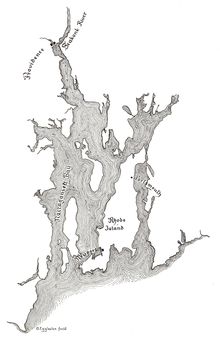
Williams's banishment an act of persecution. Local jealousy and sectarian prejudice have
done what they could to obscure the facts of the
trial and banishment of Williams. It has been argued
by more than one writer that it was not a
case of religious persecution at all, but the exclusion
of a man dangerous to the state. Cotton,
with characteristic verbal legerdemain, says that
Williams was "enlarged" rather than banished.
The case has even been pettifogged in our own
time by the assertion that the banishment was
only the action of a commercial company excluding
an uncongenial person from its territory. But
with what swift indignation would the Massachusetts
rulers of the days of Dudley and Haynes
have repudiated a plea which denied their magistracy!
They put so strong a pressure on Stoughton,
who said that the assistants were not magistrates,
that he made haste to renounce his pride
of authorship and to deliver his booklet to be officially
burned, nor did even this prevent his punishment.
The rulers of "the Bay" were generally
frank advocates of religious intolerance; they regarded
toleration as a door set open for the devil
to enter. Not only did they punish for unorthodox
expressions; they even assumed to inquire into
private beliefs.
Note 17. Williams was only one of scores
bidden to depart on account of opinion.
Intolerance as a virtue. The real and sufficient extenuation for the conduct
of the Massachusetts leaders is found in the
character and standards of the age. A few obscure
and contemned sectaries—Brownists, Anabaptists,
and despised Familists—in Holland and
England had spoken more or less clearly in favor
of religious liberty before the rise of Roger Williams,
but nobody of weight or respectable standing
in the whole world had befriended it.
Note 18. All the
great authorities in church and state, Catholic
and Protestant, prelatical and Puritan, agreed in
their detestation of it. Even Robinson, the moderate
pastor of the Leyden Pilgrims, ventured to
hold only to the "toleration of tolerable opinions."
This was the toleration found at Amsterdam and
in some other parts of the Low Countries. Even
this religious sufferance which did not amount to
liberty was sufficiently despicable in the eyes of
that intolerant age to bring upon the Dutch the
contempt of Christendom. It was a very qualified
and limited toleration, and one from which Catholics
and Arminians were excluded. It seems to
have been that practical amelioration of law which
is produced more effectually by commerce than by
learning or religion.
Note 19. Outside of some parts of the
Low Countries, and oddly enough of the Turkish
Empire, all the world worth counting decried toleration
as a great crime. It would have been wonderful
indeed if Massachusetts had been superior
to the age. "I dare aver," says Nathaniel Ward,
the New England lawyer-minister, "that God doth
no where in his word tolerate Christian States to
give tolerations to such adversaries of his Truth, if
they have power in their hands to suppress them." Simple Cobbler of Agawam, pp. 3 and 6.
To set up toleration was "to build a sconce against
the walls of heaven to batter God out of his chair,"
in Ward's opinion.
The casuistry of Cotton. This doctrine of intolerance was sanctioned by
many refinements of logic, such as Cotton's delicious
sophistry that if a man refused to be convinced
of the truth, he was sinning against conscience,
and therefore it was not against the liberty
of conscience to coerce him.
Note 20. Cotton's moral intuitions
were fairly suffocated by logic. He declared
that men should be compelled to attend religious
service, because it was "better to be hypocrites
than profane persons. Hypocrites give God part
of his due, the outward man, but the profane
person giveth God neither outward nor inward
man." Hutchinson Papers, 496. To reason thus is to put subtlety into the
cathedra of common sense, to bewilder vision by
legerdemain. Notwithstanding his natural gift for
devoutness and his almost immodest godliness,
Cotton was incapable of high sincerity. He would
not specifically advise Williams's banishment, but
having labored with him round a corner according
to his most approved ecclesiastical formula, he
said, "We have no more to say in his behalf, but
must sit down"; by which expression of passivity
he gave the signal to the "secular arm" to do its
worst, while he washed his hands in innocent self-complacency.
When one scrupulous magistrate
consulted him as to his obligation in Williams's
case, Cotton answered his hesitation by saying,
"You know they are so much incensed against his
course that it is not your voice nor the voice of
two or three more that can suspend the sentence."
Note 21.
By such shifty phrases he shirked responsibility
for the results of his own teaching. Of the temper
that stands alone for the right, Nature had given
him not a jot. Williams may be a little too severe,
but he has some truth when he describes Cotton
on this occasion as "swimming with the stream of
outward credit and profit," though nothing was
further from Cotton's conscious purpose than such
worldliness. Cotton's intolerance was not like that
of Dudley and Endecott, the offspring of an austere
temper; it was rather the outgrowth of his
logic and his reverence for authority. Controversie concerning Liberty of Conscience. He sheltered
himself behind the examples of Elizabeth and
James I, and took refuge in the shadow of Calvin,
whose burning of Servetus he cites as an example,
without any recoil of heart or conscience. But the
consideration of the character of the age forbids
us to condemn the conscientious men who put Williams
out of the Massachusetts theocracy as they
would have driven the devil out of the garden of
Eden. Character of Puritanism. When, however, it comes to judging the
age itself, and especially to judging the Puritanism
of the age, these false and harsh ideals are its sufficient
condemnation. Its government and its very
religion were barbarous; its Bible, except for mystical
and ecclesiastical uses, might as well have
closed with the story of the Hebrew judges and
the imprecatory Psalms. The Apocalypse of John,
grotesquely interpreted, was the one book of the
New Testament that received hearty consideration,
aside from those other New Testament passages
supposed to relate to a divinely appointed
ecclesiasticism. The humane pity of Jesus was unknown
not only to the laws, but to the sermons of
the time. Note 22. About the time of Williams's banishment
the lenity of John Winthrop was solemnly
rebuked by some of the clergy and rulers as a lax
imperiling of the safety of the gospel; and Winthrop,
overborne by authority, confessed, explained,
apologized, and promised amendment. Savage's Winthrop, i, 211-214.
The Puritans substituted an unformulated belief
in the infallibility of "godly" elders acting with
the magistrates for the ancient doctrine of an infallible
church.
Character of Williams. His scruples. In this less scrupulous but more serious age it
is easy to hold Williams up to ridicule. Never
was a noble and sweet-spirited man bedeviled by a
scrupulosity more trivial. New England Firebrand Quenched, 246. Cotton aptly dubbed
him "a haberdasher of small questions." His extant
letters are many of them vibrant with latent
heroism; there is manifest in them an exquisite
charity and a pathetic magnanimity, but in the
midst of it all the writer is unable to rid himself of
a swarm of scruples as pertinacious as the buzzing
mosquitoes in the primitive forest about him. In
dating his letters, where he ventures to date at all,
he never writes the ordinary name of the day of
the week or the name of the month, lest he should
be guilty of etymological heathenism. He often
avoids writing the year, and when he does insert
it he commits himself to the last two figures only
and adds a saving clause. Thus 1652 appears as
"52 (so called)," and other years are tagged with
the same doubting words, or with the Latin "ut
vulgo." What quarrel the tender conscience had
with the Christian era it is hard to guess. So, too,
he writes to Winthrop, who had taken part in his
banishment, letters full of reverential tenderness
and hearty friendship. But his conscience does
not allow him even to seem to hold ecclesiastical
fellowship with the man he honors as a ruler and
loves as a friend. Williams to Winthrop, 1637, Narr. Club, vi. Once at least he guards the point
directly by subscribing himself "Your worship's
faithful and affectionate in all civil bonds." It
would be sad to think of a great spirit so enthralled
by the scrupulosity of his time and his party if
these minute restrictions had been a source of annoyance
to him. But the cheerful observance of
little scruples seems rather to have taken the place
of a recreation in his life; they were to him perhaps
what bric-a-brac is to a collector, what a well-arranged
altar and candlesticks are to a ritualist.
Note 23.
Williams becomes a Seeker. Two fundamental notions supplied the motive
power of every ecclesiastical agitation of that age.
The notion of a succession of churchly order and
ordinance from the time of the apostles was the
mainspring of the High-church movement. Apostolic
primitivism was the aim of the Puritan and
still more the goal of the Separatist. One party
rejoiced in a belief that a mysterious apostolic virtue
had trickled down through generations of bishops
and priests to its own age; the other rejoiced
in the destruction of institutions that had grown
up in the ages and in getting back to the primitive
nakedness of the early Christian conventicle.
True to the law of his nature, Roger Williams
pushed this latter principle to its ultimate possibilities.
If we may believe the accounts, he and
his followers at Providence became Baptists that
they might receive the rite of baptism in its most
ancient Oriental form. But in an age when the
fountains of the great deep were utterly broken up
he could find no rest for the soles of his feet. It
was not enough that he should be troubled by
the Puritan spirit of apostolic primitivism; he had
now swung round to where this spirit joined hands
with its twin, the aspiration for apostolic succession.
He renounced his baptism because it was
without apostolic sanction, and announced himself
of that sect which was the last reduction of Separatism.
He became a Seeker. Note 24.
The Seekers. Here again is a probable influence from Holland.
The Seekers had appeared there long before.
Many Baptists had found that their search
for primitivism, if persisted in, carried them to this
negative result; for it seemed not enough to have
apostolic rites in apostolic form unless they were
sanctioned by the "gifts" of the apostolic time.
The Seekers appeared in England as early as 1617,
and during the religious turmoils of the Commonwealth
period the sect afforded a resting place for
many a weatherbeaten soul. As the miraculous
gifts were lost, the Seekers dared not preach, baptize,
or teach; they merely waited, and in their
mysticism they believed their waiting to be an
"upper room" to which Christ would come. It is
interesting to know that Williams, the most romantic
figure of the whole Puritan movement, at last
found a sort of relief from the austere externalism
and ceaseless dogmatism of his age by traveling
the road of literalism until he had passed out on
the other side into the region of devout and contented
uncertainty.
Moral elevation of Williams In all this Williams was the child of his age,
and sometimes more childish than his age. But
there were regions of thought and sentiment in
which he was wholly disentangled from the meshes
of his time, and that not because of intellectual superiority—for
he had no large philosophical views—but
by reason of elevation of spirit. Even the authority
of Moses could not prevent him from condemning
the harsh severity of the New England
capital laws. He had no sentimental delusions
about the character of the savages—he styles them
"wolves endued with men's brains"; but he constantly
pleads for a humane treatment of them.
All the bloody precedents of Joshua could not
make him look without repulsion on the slaughter
of women and children in the Pequot war, nor
could he tolerate dismemberment of the dead or
the selling of Indian captives into perpetual slavery.
From bigotry and resentment he was singularly
free. On many occasions he joyfully used his
ascendency over the natives to protect those who
kept in force against him a sentence of perpetual
banishment. And this ultra-Separatist, almost
alone of the men of his time, could use such words
of catholic charity as those in which he speaks of
"the people of God wheresoever scattered about
Babel's banks either in Rome or England."
Superior to the age. Of his incapacity for organization or administration
we shall have to speak hereafter. But his
spiritual intuitions, his moral insight, his genius
for justice, lent a curious modernness to many of
his convictions. In a generation of creed-builders
which detested schism he became an individualist.
Individualist in thought, altruist in spirit, secularist
in governmental theory, he was the herald of a
time yet more modern than this laggard age of
ours. If ever a soul saw a clear-shining inward
light not to be dimmed by prejudices or obscured
by the deft logic of a disputatious age, it was the
soul of Williams. In all the region of petty scrupulosity
the time-spirit had enthralled him; but in
the higher region of moral decision he was utterly
emancipated from it. His conclusions belong to
ages yet to come.
His prophetic character. This union of moral aspiration with a certain
disengagedness constitutes what we may call the
prophetic temperament. Bradford and Winthrop
were men of high aspiration, but of another class.
The reach of their spirits was restrained by practical
wisdom, which compelled them to take into
account the limits of the attainable. Not that they
consciously refused to follow their logic to its end,
but that, like other prudent men of affairs, they
were, without their own knowledge or consent,
turned aside by the logic of the impossible. Precisely
here the prophet departs from the reformer.
The prophet recks nothing of impossibility; he is
ravished with truth disembodied. From Elijah the
Tishbite to Socrates, from Socrates to the latest
and perhaps yet unrecognized voice of our own
time, the prophetic temperament has ever shown
an inability to enter into treaty with its environment.
In the seventeenth century there was no
place but the wilderness for such a John Baptist of
the distant future as Roger Williams. He did not
belong among the diplomatic builders of churches,
like Cotton, or the politic founders of states, like
Winthrop. He was but a babbler to his own time,
but the prophetic voice rings clear and far, and
ever clearer as the ages go on.
Note 1, page 268. Sir William Martin, an early friend of Williams, describes
him as passionate and precipitate, but with integrity and good
intentions. Hutchinson Papers, 106. See also, for example, the
two letters of Williams to Lady Barrington, in New England
Genealogical Register, July, 1889, pp. 316 and following.
Note 2, page 269. Letter to John Cotton the younger, 25th March, 1671. "He
knows what gains and preferments I have refused in universities,
city, country and court," etc. Williams's enthusiastic nature
gave a flush of color to his statement of ordinary fact, the general
correctness of which, however, there is never reason to doubt.
Note 3, page 270. Letter to John Cotton the younger, Narragansett Club Publications,
vi, 356. There is no account of this event elsewhere, but
the church records of that early date are imperfect, and there is
every reason to accept the circumstantial statement of Williams.
That he refused to enter into membership with the church is
confirmed by Winthrop's Journal, 12th April, 1631, and such refusal
must have had some such occasion.
Note 4, page 271. "We have often tried your patience, but could never conquer
it," were Winthrop's words to Williams, who gave to Massachusetts
lifelong service in return for its lifelong severity toward
him. The sentence is quoted in Williams's letter to the
younger Cotton, cited above, which is itself a fine example of
his magnanimity of spirit. Narragansett Club Publications, vi,
351-357.
Note 5, page 272. There is difference of opinion on this point, but certain words
of Williams himself seem to bear on it. After his retirement
from Salem to Plymouth he received a letter from Winthrop,
which appears to have intimated that no man under twenty-five
ought to be ordained. Williams explains in reply that he is
"nearer upwards of thirty than twenty-five," but avers, "I am
no elder in any church ... nor ever shall be, if the Lord please
to grant my desires that I may intend what I long after, the
natives souls." Williams's Letter, Narragansett Club Publications,
vi, 2. Of course, these words might have been written if
he had resigned the eldership before leaving Salem, but they
would have had much less pertinency.
Note 6, page 276. Mr. Straus, in his Life of Roger Williams, says aptly that
Massachusetts was under a government of congregations rather
than of towns, since only church members could vote. A fuller
discussion of the source and evolution of the town system is deferred
to a later volume of this series.
Note 7, page 278. David Pieterzen de Vries, in his Voyages, reports this feeling
of superiority as freely expressed at Hartford in 1639. There is a
quaint humor in what he says of it that is enhanced by the
naïve Dutch phrase in which it is set down: "Dit Volck gaven
haer uyt det sy Israëliten waren, ende dat wy aen onse colonie
Egyptenaren waren, end' Engelsen inde Vergienies waren mede
Egyptenaren," p. 151.
Note 8, page 279. "And such was the authority ... Mr. Cotton had in the
hearts of the people, that whatever he delivered in the pulpit was
soon put into an Order of Court, if of a civil, or set up as a practice
in the church, if of an ecclesiastical concernment." Hubbard,
History of Massachusetts, 182.
Note 9, page 281. Knowles's Life of Williams, 58, note, quotes from a letter of
Coddington's appended to Fox's reply to Williams, in which
Coddington, who was one of the magistrates that examined the
treatise, charges Williams with having "written a quarto against
the King's patent and authority."
Note 10, page 288. Cotton's Answer to Williams's Examination, 38. I have followed
Cotton implicitly here, but without feeling sure that his
memory can ever be depended on where his polemical feeling is
concerned. On the next page he is guilty of a flagrant but no
doubt unconscious suppression of an important fact. "It pleased
the Lord to open the hearts of the Church to assist us," etc., he
says, putting out of sight the sharp dealing by which the Salem
church was brought to ignominious subjection.
Note 11, page 289. Cotton's Answer to Williams, 29. Compare also Massachusetts
Records of 4th March, 1633, where a mercenary inducement
to take the oath is offered by making the regulations for recording
the lands of freemen apply also to the lands of "residents"
presumably not church members and ineligible to the franchise,
but only to the residents "that had taken or shall hereafter take
their oathes." Backus supposes that Williams saw some incidental
result from the oath that would be prejudicial to religious
freedom. This is to suppose that Williams needed a practical
consideration to stir him to action—it is to suppose that Williams
was not Williams. Practical men were afraid the independence
of Massachusetts would be lost; Roger Williams was
only afraid that Massachusetts would commit a public sin in
trying to escape the impending evil. A conscience undefiled
was his objective point in private and public life; safety, public
or private, was secondary.
Note 12, page 292. There has been much ingenious and rather uncandid effort by
Cotton first of all, and by other defenders of the General Court
since, to prove that Williams's views on toleration were not a
cause of his banishment. If those views had been the sole cause,
the decree would have been more comprehensible and defensible
in view of the opinions of the age. But the question about the
validity of the patent, the question of the protest written against
the course of the magistrates in blackmailing Salem into a refusal to
support him, the question of the freeman's oath, and, what seems
to have been deemed of capital importance, the question of grace
after meat, are all involved at one time or another. The formal
charges in what may be considered the beginning of the banishment
proceedings, the trial in July, as given by Winthrop, our
most trustworthy authority, are: 1. That the magistrates ought
not to punish for a religious offense—"the breach of the first
table"—except where it disturbed the civil peace. 2. That the
magistrate ought not to tender an oath to an unregenerate man.
3. That a man ought not to pray with an unregenerate person.
4. That thanks were not to be given after the sacrament and after
meat. Savage's Winthrop, i, 193, 194. In the final proceedings
in October, the letters growing out of the refusal to confirm to
Salem its outlying land entered into and embittered the controversy.
Winthrop, i, 204. The recorded verdict makes the
divulging "of dyvers newe and dangerous opinions against the
aucthoritie of the magistrate" the first offense, and the "letter of
defamacion" the second. Williams says that a magistrate, who
appears to have been Haynes, the governor, summed up his
offenses at the conclusion of the trial under four heads: 1. The
denial of the authority of the patent. 2. The denial of the lawfulness
of requiring a wicked person to take an oath or pray. 3.
The denial of the lawfulness of hearing the parish ministers in
England. 4. The doctrine "that the Civill Magistrates' power
extends only to the Bodies and Goods and outward State of
men." Against the evidence of Williams, Winthrop, and the
records, I can not attach any importance to the halting accounts
given years afterward, for controversial purposes, by Cotton, from
what he thought was his memory.
Note 13, page 292. "Whereas Mr. Roger Williams, one of the elders of the
church at Salem, hath broached and dyvulged dyvers newe and
dangerous opinions, against the aucthoritie of magistrates, as also
writt letters of defamacion both of the magistrates & Churches
here, & that before any conviccion, & yet maintaineth the same
without retraccion, it is therefore ordered that the said Mr. Williams
shall departe out of this jurisdiccion within sixe weekes now
nexte ensueing, which if hee neglect to performe it shall be lawfull
for the Gouernour & two of the magistrates to send him to
some place out of this jurisdiccion, not to returne any more without
license from the Court." Massachusetts Records, i, 161.
Note 14, page 293. Neal's History of New England, i, 143. "Sentence of banishment
being read against Mr. Williams, the whole town of
Salem was in an uproar; for such was the Popularity of the Man
and such the Compassion of the People ... that he would have
carried off the greatest part of the Inhabitants of the Town if the
Ministers of Boston had not interposed." Neal appears to derive
these facts, which wear a countenance of probability, from an
authority not now known.
Note 15, page 293. The phrase occurs in Williams's noble letter to Major Mason,
1st Massachusetts Historical Society Collections, i, 275 and following.
The magnanimity shown toward those opposed to him
in this letter is probably without a parallel in his age; it has few
in any age.
Note 16, page 294. "The increase of the concourse of people to him on the Lord's
days in private, to the neglect or deserting of publick Ordinances
and to the spreading of the Leaven of his corrupt imaginations,
provoked the Magistrates rather than to breed a winters Spirituale
plague in the Countrey, to put upon him a winter's journey
out of the Countrey." Master John Cotton's Answer to Master
Roger Williams, 57.
Note 17, page 297. The main original authorities on the banishment of Williams
are Winthrop's Journal and the Massachusetts Records of the
period. Some facts can be gathered from the writings of Williams,
whose autobiographical passages always have an air of truth
while they are sometimes vague and often flushed by his enthusiastic
temper. Cotton's memory is less to be trusted; some of
his statements are in conflict with better authorities. He no
doubt believed himself to be truthful, but his ingenious mind was
unable to be precise without unconscious sophistication. Hubbard
was of Presbyterian tendencies and totally opposed to all
forms of Separatism. He appears to have recorded every exaggerated
rumor cherished by Williams's antagonists to his discredit.
Neither in this nor in other matters can we rely much on
Hubbard's testimony. No critical student of history puts unquestioning
confidence in Cotton Mather. His strange mind could
never utter truth unvarnished. In a case like this, where family
pride, local feeling, and sectarian prejudice were all on one
side, and where he had a chance to embroider upon traditions
already two generations old, it is better to disregard the author
of the Magnalia entirely. Bentley's Historical Account of Salem,
in 1st Massachusetts Historical Society Collections, vi, is a paper
that excites admiration for its broadmindedness. It contains information
not elsewhere to be found, but it is impossible to tell
how far Bentley depended upon sources not now accessible and
how far he relied on ingenious inferences drawn from his large
knowledge of local history. The publications of the Narragansett
Club contain the whole controversy between Cotton and
Williams and all the letters of the latter now known to be extant.
I have in some cases referred to the originals, in others I
have used these careful reprints. Williams has been rather fortunate
in his biographers. Mr. Oscar S. Straus, approaching the
subject from a fresh standpoint, has produced the latest Life of
Williams, written in a judicial temper and evincing a rare sympathy
with its subject. The character of Williams has never been
better drawn than by Mr. Straus, pp. 231-233. The life by T.
D. Knowles is perhaps the best of the older biographies, Arnold's
History of Rhode Island contains a sketch of Williams,
and Elton's brief biography has a value of its own. Gammell's
Life in Sparks's Biography is generally fair. "As to Roger Williams,"
by the late Dr. Henry Martyn Dexter, is, what it pretends
to be, a partisan statement of the case against Williams. It
shows characteristic thoroughness of research, it clears up many
minor points, and is as erudite as it is one-sided.
Note 18, page 298. Baylie's Sermon before the House of Lords, on Errours and
Induration, accuses the Dutch of mere worldly policy in toleration.
Williams alludes to the charge, Bloudy Tenent yet more Bloudy,
p. 8. But the toleration of Holland may rather be traced to that
decay of bigotry and that widening of view which are beneficent
results of an extended trade. Williams in the Bloudy Tenent
yet more Bloudy, p. 10, complains of the exclusion of Catholics
and Arminians from toleration in the Netherlands. It would carry
us beyond the range of the present work to inquire how far the
toleration of Amsterdam was related to that "meridian glory"
which Antwerp reached as early as 1550 by making itself a place
of refuge for the persecuted of England, France, and Germany.
The Articles of Union, adopted at Utrecht in 1579, which have
been often called the Magna Charta of the Dutch, go to show
that political and commercial considerations counted in favor of
toleration, but they also show that some notion of the sacredness
of the free conscience had been adopted among the Dutch.
Article XIII of the Union provides that the states of Holland
and Zealand shall conduct their religious affairs as they think
good. More qualified arrangements are made for the other states,
as that they may restrict religious liberty as they shall find needful
for the repose and welfare of the country. But this significant
provision is added, that every man shall have freedom of private
belief without arrest or inquisition: "Midts dat een yder particulier
in syn Religie vry zal moghen blyven, ende dat men niemandt,
ter cause van de Religie, zal moghen achterhalen, ofte
ondersoecken." Pieter Paulus Verklaring der Unie van Utrecht,
i, 229, 230. Compare Van Meteren, Nederlandsche Historie etc.,
iii, 254, 255, and Hooft Nederlandsche Historie, etc., Book IX,
where the full text of Article XIII is given.
Note 19, page 298. Barclay, in his Inner Life of the Religious Societies of the
Commonwealth, p. 97, cites Peter John Zwisck, a Mennonite of
West Frisia, as the author, in 1609, of The Liberty of Religion, in
which he maintains that men are not to be converted by force.
In 1614 one Leonard Busher petitioned James I in favor of liberty
of conscience, and Barclay conjectures that he was a member of
that Separatist or General Baptist church returned from Holland,
of which Helwyss had been pastor. In 1615 this obscure and
proscribed congregation professed a great truth, yet hidden from
the wise and prudent, namely, that "earthly authority belonged
to earthly kings, but spiritual authority belonged to that one
Spiritual king who is king of kings." In more than one matter
Roger Williams showed himself attracted to the doctrines of the
Mennonites and their offshoot the English General Baptist body.
Whether directly through his reading of Dutch theological works
or indirectly through English followers of Dutch writers, Williams
probably derived his broadest principles, in germ at least, from
the Mennonites or Anabaptists of the gentler sort, as he did also
some of his minor scruples. For the connection between the
Mennonites of the Continent and the English cognate sects the
reader is referred to Barclay's Inner Life, a valuable work of
much research. See also the petition of the Brownists, 1641,
cited in Barclay, p. 476, from British Museum, E 34-178, tenth
pamphlet.
Note 20, page 299. Another delightful example of the far-fetchedness of Cotton's
logic is his justification of the sentence of banishment against
Williams by citing Proverbs xi, 26: "He that withholdeth corn,
the people shall curse him." This text, says Cotton, "I alledged
to prove that the people had much more cause to separate such
from amongst them (whether by Civill or church-censure) as doe
withhold or separate them from the Ordinances or the Ordinances
from them, which are the bread of life." Reply to Williams's Examination,
40. The reference in the text is to the same work, 37.
"Much lesse to persecute him with the Civill Sword till it may
appeare, even by just and full conviction, that he sinneth not out
of conscience but against the very light of his own conscience."
But in Cotton's practice those who labored with the heretic were
judges of how much argument constituted "just and full conviction."
This logic would have amply sheltered the Spanish Inquisition.
Note 21, page 300. Cotton's Answer to Williams's Examination, 38, 39. Cotton
confesses to having had further conversation of a nature unfavorable
to Williams, but he is able to deny that he counseled his
banishment. Even Cotton could hardly have prevented it, and
he confesses that he approved the sentence. The only interest
in the question is the exhibition of Cotton's habitual shrinking
from responsibility and his curious sinuosity of conscience.
Note 22, page 301. In an unpublished work by Mr. Lindsay Swift, of the Boston
Public Library, which I have been kindly permitted to read, and
which is a treatise on the election sermons mostly existing only
in manuscript, the author says: "The early discourses were full
of ecclesiasticism, a great deal of theology, some politics; ... but
of humanity, brotherly kindness, and what we understand by
Christianity in the human relations, I have been able to discern
very little."
Note 23, page 302. Many of Roger Williams's scruples were peculiar, but his
scrupulosity was not. Cotton takes pains to call pulpits "scaffolds,"
to show that they had no sacredness. The scruple about
the heathen names of days of the week was felt by many other
Puritans. It is evident in Winthrop, and it did not wholly disappear
from Puritan use until about the end of the seventeenth
century.
Note 24, page 303. Barclay, Inner Life, etc., 410, 411, cites Sebastian Franck's
Chronica of 1536, from which it appears that the Seekers in fact
if not in name existed about a century before Williams adopted
their views. "Some desire to allow Baptism and other ceremonies
to remain in abeyance till God gives another command—sends
out true laborers into the harvest.... Some others agree
with those who think the ceremonies since the death of the
Apostles, are equally departed, laid waste and fallen—that God
no longer heeds them, and also does not desire that they should
be longer kept, on which account they will never again be set up
but now are to proceed entirely in Spirit and in Truth and now in
an outward manner." The relation of Seekerism to Quakerism
is manifest. "To be a Seeker is to be of the best Sect next to a
finder," wrote Cromwell in 1646.
Importance of the Rhode Island colony. The removal of Roger Williams and his friends
was the beginning of dispersions from the mother
colony on Massachusetts Bay. The company that
settled Providence was too small in number at first
to be of great importance. The emigration of
Williams and his followers to the Narragansett
country was an example that may have turned the
scale with Hooker and his party in favor of a removal
to the Connecticut instead of to some place
in the Massachusetts wilderness. Williams certainly
prepared a harbor for most of the Hutchinsonians,
and pointed the way to Gortonists,
Baptists, Quakers, and all others of uneasy conscience.
Providence Plantation, and at times all
Rhode Island, fell into disorders inevitable in a
refuge for scruplers and enthusiasts established by
one whose energies were centrifugal and disintegrating.
But when at length it emerged from its
primordial chaos the community on Narragansett
Bay became of capital importance as an example
of the secularization of the state, and of the congruity
of the largest liberty in religion with civil
peace. The system which the more highly organized
and orderly commonwealths of Massachusetts
and Connecticut labored so diligently to establish—a
state propping and defending orthodoxy and
church uniformity—was early cast into the rubbish
heap of the ages. The principle on which the
heterogeneous colony of religious outcasts on Narragansett
Bay founded itself, was stone rejected
that has become the head of the corner.
The Connecticut migration. The emigration to the Connecticut River was
already incubating when Williams sat down with
his radical seceders in the Narragansett woods.
The Connecticut settlement was impelled by more
various and complicated motives than that of Williams,
and its origins are not so easy to disentangle.
But it, too, has an epic interest; one dominant personality
overtops all others in this second of venturesome
westward migrations into the wilderness.
Early life of Hooker. We can trace nothing of Hooker to his birthplace,
a little hamlet in Leicestershire, except that
the imagery of his discourses in after life sometimes
reflected the processes of husbandry he had
known in childhood. But that he passed through
Emmanuel College, Cambridge, while Chaderton
was master, is more significant, for Emmanuel was
the cradle of Puritan divines, the hatching-place of
Puritan crotchets, the college whose chapel stood
north and south that it might have no sacred east
end, a chapel in which "riming psalms" were sung
instead of the hymns, and where lessons different
from those appointed in the calendar were read.
Hooker was presented to the living of Chelmsford,
in Essex. Here his eloquence attracted wide
attention, and unhappily attracted at the same time
the notice of his diocesan Laud, then Bishop of
London, who drove the preacher from his pulpit.
Hooker engaged in teaching a school four miles
from Chelmsford, where Eliot, afterward the Indian
apostle, became his usher and disciple. But
Laud had marked him as one to be brought low. 1630.
He was cited before the Court of High Commission,
whose penalties he escaped by fleeing to Holland.
Thus early in his career Laud unwittingly
put in train events that resulted in the founding
of a second Puritan colony in New England.
Hooker's company. The persecution of Hooker made a great commotion
in Essex, dividing attention with the political
struggle between the king and the people about
tonnage and poundage. Walker's First Church in Hartford, 40.
Dudley's Letter to Countess of Lincoln, Young's Chron.
of Mass., 320. While Hooker was an
exile in Holland a company of people from Braintree
and other parts of Essex, near his old parish of
Chelmsford, emigrated to New England, chiefly,
one may suppose, for the sake of good gospel, since
they came hoping to tempt Hooker to become
their pastor. Mass. Records, 14 June, 1631, and 3 February, 1632.
This company settled at Newtown,
now Cambridge, which had been projected for a
fortified capital of the colony, that should be defensible
against Indians and out of reach if a sea
force should be sent from England to overthrow
the government. Holmes's Hist. Cambridge, 1st Mass. Hist. Coll., vii,
6-8. Newtown was palisaded and
otherwise improved at the expense of the whole
colony. Hooker's company were perhaps ordered
to settle there because no place was appropriate to
the great divine but the new metropolis.
Failure of Newtown as a metropolis. But a metropolis can not be made at will, as
many a new community has discovered. It had
been arranged that all the "assistants" or ruling
magistrates of Massachusetts should live within
the palisades of Newtown, but Winthrop, after the
frame of his house was erected, changed his mind
and took down the timbers, setting them up again
at Boston. Savage's Winthrop, i, 98, 99. 1632. This was the beginning of unhappiness
at Newtown, and the discontent had to do,
no doubt, with the rivalry between that place and
Boston. It is probable that there was a rise in the
value of Boston home lots about the time of the
removal of the governor's house. Trade runs in
the direction of the least resistance, and peninsular
Boston was destined by its situation to be the metropolis
of New England in spite of the forces that
worked for Salem and Newtown.
Wonder-working Providence, ch. xxviii. Newtown, or Cambridge, to call it by its later
name, was a long, narrow strip of land, "in forme
like a list cut off from the Broad-cloath" of Watertown
and Charlestown. Wood's N. E. Prospect, 1634. Young, 402. The village was compactly
built, as became an incipient metropolis, and
the houses were unusually good for a new country.
In one regard it was superior to Boston. No
wooden chimneys or thatched roofs were allowed
in it. To this town came Hooker, and if it had continued
to be the capital, Hooker and not Cotton
might have become the leading spirit of the colony. October, 1632.
But a capital at a place to which only small vessels
could come up, was not practical, and the
magistrates in the year before Hooker's arrival
decided by general consent that Boston was the
fittest place in the bay for public meetings.
Hooker's arrival, 1633. The hopes of Newtown were perhaps not
wholly extinct for some time after. The arrival
of Hooker must have been a great encouragement
to the people. But Boston was on the alert. That
town had neither forest nor meadow land. Hay,
timber, and firewood were brought to its wharf in
boats. Wood's N. E. Prospect. From the absence of wood and marsh came
some advantages—it was plagued with neither mosquitoes
nor rattlesnakes, and what cattle there were
on the bare peninsula were safe from wolves. Young, 397, 398. Not
to be behind in evangelical attractions it secured
Cotton to balance Newtown's Hooker, when both
arrived in the same ship. That Boston was now
recognized as the natural metropolis was shown in
the abortive movement to pay a part of Cotton's
stipend by a levy on the whole colony.
Discontent at Newtown. "Ground, wood, and medowe" were matters of
dispute between Newtown and its neighbors as
early as 1632, and the frequent references to questions
regarding the boundary of Newtown go to
show dissatisfaction in the discarded metropolis,
the number of whose people was out of proportion
to its resources. Mass. Rec., passim. Cattle were scarce in the colony.
Each head was worth about twenty-eight pounds,
the equivalent of several hundred dollars of money
in our time. Wonder-working Providence, ch. xxxiii. The Newtown people saw no prospect
of foreign trade, and found the plowable plains
of Cambridge dry and sandy. They had given
up trying to coax fortunes from the stony hill land
of the town with hand labor, and turned their attention
to the more profitable pursuit of cattle-raising.
They took unusual pains to protect their
valuable herd from the wolves by impaling a common
pasture. Compare Holmes's History of Cambridge, 1 Mass. Hist.
Coll., vii, pp. 1, 2. Natural meadow was the only resource
for hay in the English agriculture of the
seventeenth century, and the low grounds of Cambridge
yielded a poor grass. 2d Mass., vii, 127. Shrewd men in Newtown
already saw that as an agricultural colony
Massachusetts was destined to failure, and one
Pratt, a surgeon there, was called to account for
having written to England that the commonwealth
was "builded on rocks, sands, and salt marshes."
Cotton and Hooker. There is good authority for believing that a rivalry
between Hooker and Cotton had quite as much
to do with the discontent as straitened boundaries
and wiry marsh grass. Hooker was the greatest
debater, perhaps, in the ranks of the Puritans. His
theology was somewhat somber, his theory of
Christian experience of the most exigent type.
To be saved, according to Hooker, one must become
so passive as to be willing to be eternally
damned. Compare Walker's First Church of Hartford, 129-132. In other regards he was a Puritan of a
rather more primitive type than Cotton. He knew
no satisfactory evidence of a man's acceptance with
God but his good works. Cotton was less logical
but more attractive. His Puritanism grew in a garden
of spices. He delighted in allegorical interpretations
of the Canticles, his severe doctrines were
dulcified with sentiment, and his conception of the
inward Christian life was more joyous and mystical
and less legal and severe than Hooker's. He was
an adept in the windings of non-committal expression,
and his intellectual sinuosity was a resource
in debate or difficulty. Hooker, on the other hand,
had a downrightness not to be mistaken. With
an advantage in temperament and the additional
advantage of position in the commercial and political
center, it is not surprising that Cotton's
ideals eloquently and deftly presented soon dominated
the colony and that he became the Delphic
oracle whose utterances were awaited by the rulers
in emergencies.
Theological differences. Theological differences were early apparent in
the teachings of the two leaders. Trivial enough
to the modern mind are these questions concerning
works as an evidence of justification and concerning
active and passive faith in justification. Hooker
maintained all by himself that there was "a
saving preparation in a Christian soule before unyon
with Christ."
Note 1. The other ministers pretended
to understand what he meant by this, and at first
opposed him unanimously. No doubt, too, Hooker
and his disciples found some fault with the outer
form of the church as shaped by Cotton. Certain
it is that Hooker's theories of civil government
were more liberal and modern than Cotton's,
though like Cotton's they were hung upon texts of
Scripture. Hooker lacked Cotton's superfluity of
ingenuity; he had less imagination and less poetic
sentiment than Cotton, but his intellect was more
rugged, practical, and virile. He was not a man
to have visions of a political paradise; he did not
attempt to limit citizenship to church members
when he framed a constitution for the Connecticut
towns. Nor did he give so much power and privilege
to the magistrate as was given in Massachusetts.
Note 2.
He disapproved of Cotton's aristocratic theory
of the permanence of the magistrate's office, as
he did apparently of the negative vote of the upper
house and of the arbitrary decisions which the Massachusetts
magistrates assumed the right to make.
Attractions of Connecticut. One other potent motive there was. Stories of
the fertility of the "intervale" land on the Connecticut
River came by the mouth of every daring
adventurer who had sailed or tramped so far.
There one might find pasture for the priceless
cattle and hay to last the long winter through, and
in that valley one might cultivate plains of great
fertility.
Obstacles to removal. There were dangerous Pequots on the Connecticut,
it is true, and the Dutch had already
planted a trading house and laid claim to the territory.
The Plymouth people who traded there
were also claimants. And, more than all, leaving
Massachusetts in a time of danger from the machinations
of Laud would seem desertion. The government
of the Massachusetts Bay colony was
anomalous; it partook of the character of the commercial
company from which it sprang, yet it had
traits of a religious or at least a voluntary society.
It was the accepted opinion that those who had
taken the freeman's oath were "knit" together
"in one body," and that none of them ought to
leave the colony without permission. Hooker's
party gained the consent of a majority of the representative
members of the General Court, but not
of a majority of the assistants. Savage's Winthrop, i, 167, 168. This precipitated
a debate in the colony on the constitutional question
of the right of the assistants, or magistrates, to
form an upper house and veto a decision of the
chosen deputies of the towns.
Attempts to prevent removal. It is no part of our purpose to unravel the tangle
of ecclesiastical and civil politics in which the
proposed emigration had now become involved.
The Dorchester church and a part of that of Watertown
were ready to follow the lead of Hooker and
Newtown. Days of fasting and prayer were appointed
to prevent the removal of these "candlesticks,"
as the churches were called, out of their
places; but in spite of humiliations and of Cotton's
persuasive eloquence, which at one time almost
charmed away the discontent, the emigration set
in, stragglingly at first.
Explorers and pioneers. John Oldham, an adventurous man of a rather
lawless temper—one of those half-ruffians that are
most serviceable on an Indian frontier—had been
expelled from Plymouth. 1633. He was now a resident
of Watertown, one of the centers of discontent and
next neighbor to Newtown. He had gone with
three others on a trading expedition to the westward
overland. Walking along trails from one
Indian village to another they discovered a large
river, which they found to be the Fresh River of
the Dutch and the Connecticut of the Plymouth
traders. They probably brought back to Watertown
accounts that produced a fever for removal.
Oldham was not a man to stand on the manner of
his emigration. Waiting for nobody's consent, he
led out a small company from Watertown the next
year. These settled at what is now Wethersfield.
From Dorchester, which had no alewife fishery
with which to enrich its fields, settlers removed in
1634 to the Connecticut, where the soil did not
need to be "fished." In 1635 the number of emigrants
was larger, and there was much suffering
during the following winter and many of the cattle
perished.
Emigration by churches. But the unit of New England migration was the
church. No doubt the cohesiveness of the townships,
and of the churches which were the nuclei of
the towns, was re-enforced by provincial differences
between the several communities. 1636. In 1636 Hooker,
the real founder of Connecticut, and his congregation
of Essex people, sold their houses and meadows
and home lots and acre rights in the commonage
in Cambridge to a new congregation led
by Thomas Shepard. Note 3. From Newtown and from
Dorchester the churches emigrated bodily—pastors,
teachers, ruling elders, and deacons—carrying
their organization with them through the wilderness
like an ark of the covenant. New churches
were soon afterward formed in the places they
had left. Naturally, town government became the
principal feature of civil organization in states thus
planted by separate and coherent groups.
The new government. The Connecticut rulers acted at first as a government
subordinate to Massachusetts; but the settlements,
except that of people from Roxbury at
Springfield, were south of the line of the Massachusetts
colony, and it was not in the nature of
things that Hooker and Haynes should subordinate
themselves to Cotton and Winthrop. There was
indeed no little exasperation between the two colonies.
An independent constitution was adopted
in Connecticut, on principles which Hooker thought
he found in the first chapter of Deuteronomy, and
which were not exactly those that Cotton had managed
to deduce from Scripture in his Model of
Moses his Judicials. Conn. Hist. Soc. Coll., i, 20, 21. The Massachusetts people,
whose government aspired to dominate all New
England, seem to have been angered by Hooker's
secession and by his refusal to subordinate the new
state to their own. Massachusetts asserted its authority
over Springfield, which was within its limits,
and every effort possible was made to prevent
new emigrants who landed at Boston from going
to the west. Conn. Hist. Soc. Coll., i, 3, and ff. Even in England accounts adverse to
Connecticut were circulated. Hooker, the real
head of the new state, resented this in a letter of
great vigor and some passion.
Instability of a theocracy. In its early years Massachusetts had no rest.
Three profound disturbances—the expulsion of
Williams, the secession of Hooker and his followers,
and the Hutchinsonian convulsion—followed
one another in breathless succession, and a dangerous
Indian war ran its course at the same time.
That the early settlements were founded on
"rocks and sands and salt marshes" was not the
chief misfortune of the Bay colony. Its ecclesiastical
politics proved explosive, to the consternation
of its pious founders, who like other settlers
in Utopia had neglected to reckon with human
nature.
Severity of Puritanism. It has been the habit of modern writers on the
subject to dismiss the Hutchinsonian controversy
as a debate about meaningless propositions in an
incomprehensible jargon. Yet there was in it but
the action of well-known tendencies in human nature
which might almost have been predicted from
the antecedent circumstances. Puritanism had
wrapped itself in the haircloth of austerity, it took
grim delight in harsh forbiddings, and heaped up
whole decalogues of thou-shalt-nots. Nor did it
offer, as other intense religious movements have
done, the compensation of internal joys for the
gayety it repressed. Theoretically Calvinist, it was
practically an ascetic system of external duties and
abstentions, trampling on the human spirit without
ruth.
Reaction toward a subjective joyousness. But the heart will not be perpetually repressed;
kept from natural pleasures, it will seek supernatural
delights. Men were certain sooner or later to
soften the iron rigidity of Puritanism by cultivating
those subjective joys for which Calvinism provided
abundant materials. While preachers like Hooker
were scourging the soul into a self-abasement that
could approve its own damnation, and while ingenious
scribes were amassing additional burdens
of scruple for heavy-laden shoulders, there arose in
England a new school of Puritan pietists. These
shirked none of the requirements of the legalists,
but their spirits sought the sunnier nooks of Calvinism,
and they preached the joy of the elect and the
delight of a fully assured faith. Magnalia B. III, c. I, 32. Cotton, whose fair
complexion, brown hair, and ruddy countenance
attested a sanguine temperament, belonged by nature
to this new order. Compare Cotton's Fountain of Life, 35. He rejoiced that he had
received the "witness of the Spirit" on his wedding
day, and he delighted to draw out Scripture imagery
to a surprising tenuity in describing the
"covenant of marriage" and the intimacy of the
"covenant of salt" or of friendship between God
and the soul of the believer. Preachers of the
same sort brought relief to multitudes in various
towns of England. The people, tired of churchly
routine on the one hand and of legalism on the
other, thronged to hear such divines "filling the
doores and windows." It was the evangelicalism
of the following century sending up its shoots
prematurely into a frosty air. Note 4. The old-fashioned
Puritan had always conceived of religion as difficult
of attainment. It was a paradoxical system
wherein men were saved by the works they theoretically
abjured. Note 5. Conservative Puritans complained
of the preachers who spread a table of
"dainties," as though it were meritorious to sustain
the soul on a rugged diet of rough doctrine. Shepard's Memoirs in Young, 505. In
Thomas Shepard's Memoirs of his own Life we
may overhear "a godly company" of the time in
familiar "discourse about the wrath of God and the
terror of it, and how intolerable it was; which they
did present by fire, how intolerable the torment of
that was for a time; what, then, would eternity be?"
Cotton's revivalism. Cotton professed that he loved to sweeten his
mouth with a piece of Calvin before he went to
sleep. Winthrop's Journal, i, 144. His emotional rendering of Calvinistic doctrines
wrought strongly on the people of the new
Boston, and his advent was followed by widespread
religious excitement. More people were admitted
to the church in Boston in the earlier months of
Cotton's residence than to all the other churches in
the colony. Report of Record Com. ii, 5. Boston Town Records, 1635.
Hutchinson Papers, p. 88. Boston seems to have become religious
in a pervasive way, and in 1635 measures were
taken to prevent persons who were not likely to
unite with the church from settling in the town.
In this community, which had no intellectual interest
but religion, and from which ordinary diversions
were banished, there were sermons on
Sunday and religious lectures on week days and
ever-recurring meetings in private houses. The
religious pressure was raised to the danger point,
and an explosion of some sort was well-nigh inevitable.
Cotton's enthusiasms were modulated by
the soft stop of a naturally placid temper, but
when communicated to others they were more dangerous.
Mrs. Hutchinson's character. Mrs. Anne Hutchinson had been one of Cotton's
ardent disciples in old Boston. She crossed the
sea with her husband that she might sit under
his ministry in New England. She was a woman
cursed with a natural gift for leadership in an age
that had no place for such women. Wonder-working Providence, ch. lxii. "This Masterpiece
of Womens wit," the railing Captain Johnson
calls her, and certainly her answers before the Massachusetts
General Court go to show that she was
not inferior in cleverness to any of the magistrates
or ministers. Note 6. Winthrop, whose antipathy to her
was a passion, speaks of her "sober and profitable
carriage," and says that she was "very helpful in
the time of childbirth and other occasions of bodily
infirmities, and well furnished with means to those
purposes." Short Story, etc., p. 31. In the state of medical science at that
time such intelligent and voluntary ministration
from a "gentlewoman" must have been highly valued.
Almost alone of the religionists of her time
she translated her devotion into philanthropic exertion.
But a woman of her "nimble and active wit"
could not pass her life in bodily ministrations.
Power seeks expression, and her native eloquence
was sure to find opportunity. Cotton's The Way of the Churches Cleared, Part I, p.
51. Short Story, 31. Mrs. Hutchinson
made use of the usual gathering of gossips on the
occasion of childbirth to persuade the women to
that more intimate religious life of which she was
an advocate. It was the custom to hold devotion
at concert pitch by meetings at private houses for
men only; women might be edified by their husbands
at home. Mrs. Hutchinson ventured to open
a little meeting for women. Short Story, 34. This was highly approved
at first, and grew to unexpected dimensions;
fifty, and sometimes eighty, of the principal women
of the little town were present at her conferences.
Mrs. Hutchinson's doctrines. In these meetings she emphasized Cotton's favorite
doctrine of "a covenant of grace." Her sensitive
woman's nature no doubt had beat its wings
against the bars of legalism. Compare Whelewright's Sermon in Proc. Mass. Hist. Soc.,
1866, 265. Cotton's Sermon on the Churches Resurrection, 1642. She was not a philosopher,
but nothing could be more truly in accord
with the philosophy of character than her desire to
give to conduct a greater spontaneity. Cotton himself
preached in the same vein. In addition to the
Reformation, of which Puritans made so much, he
looked for something more which he called, in the
phrase of the Apocalypse, "the first resurrection."
Mrs. Hutchinson, who was less prudent and more
virile than Cotton, did not hesitate to describe
most of the ministers in the colony as halting under
a "covenant of works." Her doctrine was, at bottom,
an insurrection against the vexatious legalism
of Puritanism. She carried her rebellion so far
that she would not even admit that good works
were a necessary evidence of conversion. It was
the particular imbecility of the age that thought of
almost every sort must spin a cocoon of theological
phrases for itself. Spontaneity of religious
and moral action represented itself to Mrs. Hutchinson
and her followers as an indwelling of the
Holy Ghost in the believer and as a personal union
with Christ whom they identified with the "new
creature" of Paul. Such a hardening of metaphor
into dogma is one of the commonest phenomena
of religious thought.
Vane's arrival, 1635. Sir Henry Vane the younger, who had become
an ardent Puritan in spite of his father, landed in
Boston in October, 1635. He had already shown
those gifts which enabled him afterward to play a
considerable part in English history. His election as governor, 1636. His high
connections made him an interesting figure, and
though only about twenty-six years of age he was
chosen governor in May, 1636. Ardent by nature,
and yet in his youth when he "forsook the honors
and preferments of the court to enjoy the ordinances
of Christ in their purity," nothing was more
natural than that he should be captivated by the
seraphic Cotton and that he should easily adopt
the transcendental views of Mrs. Hutchinson.
Winthrop, the natural leader of the colony, having
given place in 1635 to Haynes, perhaps in order
that Hooker's party might be conciliated and the
Connecticut emigration avoided, was a second time
thrust aside that a high-born youth might be honored.
Winthrop was utterly opposed to Mrs.
Hutchinson, in whose teachings his apprehensive
spirit saw full-fledged Antinomianism, and, by inference,
potential anabaptism, blasphemy, and sedition.
The Hutchinsonians were partisans of Vane,
who adhered to their doctrine. The ministers other
than Cotton and Whelewright, stung by the imputation
that they were under "a covenant of works,"
rallied about Winthrop. Political cleavage and religious
division unfortunately coincided.
Arrogance of the Hutchinson party. Supported by the prestige of the young governor
and of some conspicuous citizens and inspired
by Cotton's metaphorical and mystical preaching,
which was interpreted with latitude, the enthusiasm
of the Hutchinsonians tended to become fanaticism.
We have to depend mainly on the prejudiced
account of their enemies, but there is little
reason to doubt that the advocates of "a covenant
of grace" assumed the airs of superiority usually
seen in those who have discovered a short cut to
perfection. The human spirit knows few greater
consolations than well-disguised self-righteousness.
The followers of Mrs. Hutchinson, if we may believe
the witnesses, sometimes showed their sanctity
by walking out of meeting when a preacher not
under "a covenant of grace" entered the pulpit.
They even interrupted the services with controversial
questions addressed to the minister. Wilson,
pastor of the Boston church, was condemned by
them as being under "a covenant of works," and
also incidentally criticised for his "thick utterance."
Nor can one find that Cotton interposed
his authority to protect his less gifted colleague.
It is quite conceivable that he looked with some
satisfaction on the progress of affairs in Boston. 1636.
The heavenly minded young governor who had
chosen to suffer reproach with the people of God
was his disciple. The brilliant woman who was
easily the leader of the town was the very apostle
of his doctrine. The superiority of his opinions
on a union with Christ that preceded active faith
as compared with those of Hooker and the lesser
divines was enthusiastically asserted by the great
majority of the Boston church, led by Mrs. Hutchinson.
Seeing so much zeal and sound doctrine he
may have felt that the first or spiritual resurrection
of which he was wont to prophesy from the Apocalypse,
had already begun in his own congregation,
and that among these enthusiasts were those who
had learned to "buy so as though they bought
not"—those who had been lifted into a crystalline
sphere where they had "the Moone under their
feet. Cotton's Churches Resurrection, p. 27. And if we have the Moone under our feete,
then wee are not eclipsed when the Moone is
Eclipsed." Thus did Cotton's imagination revel
in cosmical imagery.
Bitterness of the debate. The arrogance of the elect is hard to bear, and
it is not wonderful that the debate waxed hot.
The concentrated religiousness of a town that
sought to shut out unbelieving residents made the
dispute dangerous. In the rising tempest a ballast
of ungodly people might have been serviceable.
But in Boston there were few even of the indifferent
to be buffers in the religious collision. While
the covenant-of-grace people made themselves offensive,
their opponents,—Winthrop, the slighted
ex-governor, Wilson, the unpopular pastor, and the
ministers accused of being under a covenant of
works—resorted to the favorite weapons of polemics.
They hatched a brood of inferences from
the opinions Mrs. Hutchinson held, or was thought
to hold, and then made her responsible for the
ugly bantlings. They pretended to believe, and
no doubt did believe, that Mrs. Hutchinson's esoteric
teaching was worse than what she gave out.
They borrowed the names of ancient heresies, long
damned by common consent, to give odium to her
doctrine. That the new party should be called Antinomian
was plausible; the road they had chosen
for escape from Puritan legalism certainly lay in
that direction. But Antinomianism had suffered
from an imputation of immorality, and no such
tendency was apparent, unless by logical deduction,
in the doctrines taught in Boston. The hearers
of Mrs. Hutchinson were also accused of having
accepted the doctrines of the so-called Family
of Love which had of old been accused of many
detestable things, and was a common bugaboo of
theology at the time. The whole town of Boston
and the whole colony of Massachusetts was set in
commotion by the rude theological brawl. Overthrow of Vane, 1637. Such
was the state of combustion in Boston that it was
thought necessary by the opponents of Vane and
Mrs. Hutchinson to hold the court of elections at
the former capital, Newtown. The excitement at
this court was so great that the church members,
who only could vote, were on the point of laying
violent hands on one another in a contest growing
out of a question relating to the indwelling of the
Holy Ghost. Vane was defeated, and Winthrop
again made governor.
The Synod of 1637. A great synod of elders from all the New England
churches was assembled. All the way from
Ipswich and Newbury on the east and from the
Connecticut on the west the "teaching elders"
made their way by water or by land, at public expense,
that they might help the magistrates of Massachusetts
to decide on what they should compel
the churches to believe. Short Story of the Rise, Reign, etc., passim. For more than three
weeks the synod at Cambridge wrestled with the
most abstruse points of doctrine. Winthrop's Journal, i, 284, and following. The governor
frequently had to interpose to keep the peace;
sometimes he adjourned the assembly, to give time
for heats to cool. Cotton's Way of the Churches Cleared, passim. A long list of errors, most of
which were not held by anybody in particular,
were condemned. A nearly unanimous conclusion
on certain fine-spun doctrines was reached at length
by means of affirmations couched in language
vague or ambiguous. Cotton, who had been forced
after debate to recant one opinion and modify
others, assented to the inconclusive conclusions,
but with characteristic non-committalism he qualified
his assent and withheld his signature.
The persecution. The field was now cleared for the orderly persecution
of the dissentients. Whelewright, Mrs.
Hutchinson's brother-in-law, had been convicted of
sedition in the preceding March on account of an
imprudent sermon preached on a fast day. But his
sentence had been deferred from court to court, apparently
until after the synod. Mass. Rec., i, 207. At the November
court following the synod Whelewright was banished,
and those who had signed a rather vigorous
petition in his favor many long months before were
arraigned and banished or otherwise punished.
The banished included some of the most intelligent
and conspicuous residents. Not until this November
court had her opponents ventured to bring
Mrs. Hutchinson to trial. Whelewright, standing
by his hot-headed sermon, had just been sentenced;
the abler but more timid Cotton had already been
overborne and driven into a safe ambiguity by the
tremendous pressure of the great synod. Vane
had left the colony, and the time was ripe to finish
the work of extirpation. The elders were summoned
to be present and advise.
Mrs. Hutchinson's trial, 1637. During a two days' trial, conducted inquisitorially,
like an English Court of High Commission,
Cambridge presented the spectacle of a high-spirited
and gifted woman, at the worst but a victim
of enthusiasm, badgered by the court and by the
ministers, whose dominant order she had attacked. Hutchinson's Hist. of Mass. Bay, ii, appendix.
Cotton, with more than his usual courage, stood
her defender. The tough-fibered Hugh Peter, who
made himself conspicuous in several ways, took it
on him to rebuke Cotton for saying a word in defense
of the accused. Note 7. Endecott and Hugh Peter,
mates well matched, browbeat the witnesses who
appeared in Mrs. Hutchinson's behalf, and Dudley,
the conscientious advocate of persecution, was
rude and overbearing. Winthrop acted as chief
inquisitor, the narrow sincerity and superstition of
his nature obscuring the nobler qualities of the
man.
Mrs. Hutchinson defended herself adroitly at
first, refusing to be trapped into self-condemnation.
But her natural part was that of an outspoken agitator,
and her religious exaltation had been increased,
doubtless, by persecution, for combativeness
is a stimulant even to zeal. On the second
day she threw away "the fear of man," and declared
that she had an inward assurance of her deliverance,
adding that the General Court would
suffer disaster. For this prophesying she was
promptly condemned. Cotton had prophesied
notably on one occasion, Wilson, his colleague, was
given to rhyming prophecies, and Hooker had
made a solemn prediction while in Holland. In
this very year the plan of the Pequot campaign had
been radically changed in compliance with a revelation
vouchsafed to the chaplain, Stone. But these
were ministers, and never was the ministerial office
so reverenced as by the Puritans, who professed to
strip it of every outward attribute of priestliness.
Above all, for a woman to teach and to have
revelations was to stand the world on its head.
"We do not mean to discourse with those of your
sex," etc., said Winthrop severely to Mrs. Hutchinson
during the trial. Mrs. Hutchinson is excommunicated. She was sentenced to banishment,
but reprieved, that the church might deal
with her. On the persuasion of Cotton and others,
Mrs. Hutchinson wrote a recantation apologizing
for her assumption to have revelations, and retracting
certain opinions of which she had been accused.
But she added that she had never intended to
teach or to hold these opinions. Note 8. For this falsehood,
as it was deemed, she was summarily excommunicated.
Yet nothing seems more probable than
that her hyperbolic utterances under excitement
had not stood for dogmatic opinions. Rise, Reign, Ruine, etc., and Winthrop's Journal, i,
309, 310. Under Cotton's
fine-spun system of church government a
member could not be excommunicated except by
unanimous consent. Many of Mrs. Hutchinson's
friends were absent from the colony, others had
prudently changed sides or stayed away from the
meeting. But her sons ventured to speak in her
behalf. Cotton at once admonished them. The
effect of putting them under admonition was to disfranchise
them; it was one of Cotton's ingenuities
of the sanctuary. The sons out of the way, the
mother was cast out unanimously—a punishment
much dreaded among the Puritans, who believed
that what was thus bound on earth was bound in
heaven. It was a ban that forbade the faithful
even to eat with her. But the melancholy under
which Mrs. Hutchinson had suffered vanished at
once, and she said as she left the church assembly,
"Better to be cast out than to deny Christ."
Omens and auguries. Mrs. Hutchinson and most of her party settled
on Rhode Island, where they sheltered themselves
at first in caves dug in the ground. Here she
again attracted attention by the charm of her eloquent
teaching, and some came from afar to hear
the "she Gamaliel," as her opponents called her.
Such gifts in a woman, and in one who had been
excommunicated by the authority vested in the
church, could be accounted for only by attributing
her power to sorcery. Savage's Winthrop's Journal, i, 313, 316; ii, 11, and
Short Story of Rise and Reign of Antinomianism. Winthrop sets down the
evidence that she was a witch, which consisted in
her frequent association with Jane Hawkins, the
midwife, who sold oil of mandrakes to cure barrenness,
and who was known to be familiar with
the devil. At length "God stepped in," and by
his "casting voice" proved which side was right.
Mary Dyer, one of the women who followed Mrs.
Hutchinson, had given birth to a deformed stillborn
child. Winthrop, i, 316. This fact became known when Mrs.
Dyer left the church with the excommunicated
Mrs. Hutchinson. Winthrop had the monstrosity
exhumed after long burial had rendered its traits
difficult to distinguish. He examined it personally
with little result, but he published in England
incredible midwife's tales about it. God stepped
in once more, and Mrs. Hutchinson herself, after
she went to Rhode Island, suffered a maternal misfortune
of another kind. The wild reports that
were circulated regarding this event are not fit to
be printed even in a note; the first editor of Winthrop's
journal felt obliged to render the words
into Latin in order that scholars might read them
shamefacedly. Savage's Winthrop, i, 326. But Cotton, who was by this time
redeeming himself by a belated zeal against the
banished sectaries, repeated the impossible tale,
which was far worse than pathological, to men and
women, callow youths, young maidens, and innocent
children "in the open assembly at Boston on
a lecture day," explaining the divine intent to signalize
her error in denying inherent righteousness.
The governor, who was more cautious, wrote to
the physician and got a correct report, from which
the divine purpose was not so evident, and Cotton
made a retraction at the next lecture. We are
now peering into the abyss of seventeenth-century
credulity. Death of Mrs. Hutchinson. Here are a grave ruler and a divine
once eminent at the university, and now
renowned in England and in America, wallowing
in a squalid superstition in comparison with which
the divination of a Roman haruspex is dignified.
Having suffered the loss of her husband, and
hearing of efforts on the part of Massachusetts to
annex Rhode Island, Mrs. Hutchinson removed to
the Dutch colony of New Netherland with her
family. Note 9. Here she and all her household except
one child were massacred by the Indians. This
act of Providence was hailed as a final refutation
of her errors, the more striking that the place
where she suffered was not far removed from a
place called Hell Gate.
Results of ecclesiastical government. This famous controversy lets in much light upon
the character of the age and the nature of Puritanism.
It is one of many incidents that reveal the
impracticability of the religious Utopia attempted
in New England. The concentration of religious
people undoubtedly produced a community free
from the kind of disorders that are otherwise inseparable
from a pioneer state and that were found
abundantly in New Netherland, in Maryland, and in
Virginia and on the eastward fishing coast. "These
English live soberly," said a Dutch visitor to Hartford
in 1639, "drinking but three times at a meal,
and when a man drinks to drunkenness they tie
him to a post and whip him as they do thieves in
Holland." But while some of the good results to
be looked for in an exclusively Puritan community
were attained, it was at the cost of exaggerating
the tendency to debate and fanaticism and developing
the severity, the intolerance, and the meddlesome
petty tyranny that inheres in an ecclesiastical
system of government. During the lifetime of one
generation Massachusetts suffered all these, and it is
doubtful whether regularity of morals was not purchased
at too great a sacrifice of liberty, bodily and
spiritual, and of justice. Certainly the student of
history views with relief the gradual relaxation
that came after the English Restoration and the
disappearance from the scene of the latest survivors
of the first generation of New England leaders.
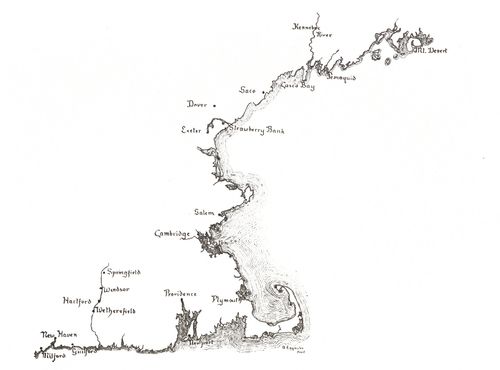
The New Haven colony. During the period of the greatest excitement
over the Hutchinson case John Davenport, a noted
Puritan minister of London, had been in Massachusetts.
Like many other emigrant divines of the
time he brought a migrant parish with him seeking
a place to settle. Davenport arrived in June,
1637, and took part against the Antinomians in
the synod. After examining every place offered
them in Massachusetts, he and his friends refused
all and resolved to plant a new colony. The people
were Londoners and bent on trade, and Massachusetts
had no suitable place for their settlement
left. The bitterness of the Hutchinson controversy
may have had influence in bringing them to
this decision, and the preparations of Laud to subject
and control Massachusetts perhaps had weight
in driving them to seek a remoter settlement.
Davenport had ideals of his own, and the earthly
paradise he sought to found was not quite Cotton's
nor was it Hooker's. He and his followers planted
the New Haven colony in 1638. In this little colony
church and state were more completely blended
than in Massachusetts. The government was by
church members only, to the discontent of other
residents, and in 1644 New Haven adopted the
laws of Moses in all their rigor. The colony was
united with Connecticut by royal charter at the
Restoration, after which the saints no longer sat
upon thrones judging the tribes of Israel.
Later English emigrations to New England. The emigration to New England from the
mother country was quickened by the troubles
that preceded the civil war. In 1638 it reached
its greatest height, having been augmented perhaps
by agricultural distress. Fourteen ships
bound for New England lay in the Thames at one
time in the spring of that year. There was alarm
at the great quantity of corn required for the
emigrants, lest there should not be enough left
in London to last till harvest. "Divers clothiers
of great trading" resolved to "go suddenly," in
which we may see, perhaps, evidence of bad times
in the commercial world. Some parishes it was
thought would be impoverished. Lord Maynard to Laud, 17 March, 1638, in Sainsbury. Laud was asked
to put a stop to the migration; but the archbishop
was busy trying to compel the Scots to use the
prayer book. Savage's Winthrop's Journal, i, 319, 320, 322. Most of the lords of the Council
were favorable to New England; the customs officers
purposely neglected to search for contraband
goods, and the ships, twenty in all, got away with
or without license, and brought three thousand
passengers to Boston. Rushworth, i, Part II, 409, 718. But the tide spent itself
about this time, and by 1640 emigration to the
New England colonies had entirely ceased. Josselyn's Rarities, 108. About
twenty-one thousand two hundred people had been
landed in all.
Cavalier emigration to Virginia. The swing of the political pendulum in England
that served to check the Puritan exodus gave impetus
to a new emigration to Virginia and Maryland.
During the ten years and more before 1640
few had gone to that region but bond servants.
There were in that year not quite eight thousand
people in Virginia. It is the point of time at which
the native Virginians began to rear a second generation
born on the soil. Petition to House of Lords, 15 Aug., 1648. Royal Hist.
MS., Com. Rept., vii, 45. The waning fortunes of
the king sent to the colony in the following years
a large cavalier emigration, and the average character
of the colonists was raised. Better ministers
held the Virginia parishes and better order was
observed in the courts. Sainsbury, 360. In 1648 four hundred
emigrants lay aboard ships bound for Virginia at
one time, and in 1651 sixteen hundred royalist prisoners
seem to have been sent in one detachment.
Prospective ascendency of the English colonies. By the middle of the seventeenth century the
English on the North American continent were in
a fair way to predominate all other Europeans.
From the rather lawless little fishing villages on
the coast of Maine to the rigorous Puritan communes
of the New Haven colony that stretched
westward to pre-empt, in advance of the Dutch,
land on the shores of Long Island Sound, the English
held New England. English settlers "seeking
larger accommodations" had crossed to Long Island
and were even pushing into the Dutch colony.
The whole Chesapeake region was securely English.
Already there were Virginians about to
break into the Carolina country lying wild between
Virginia and the Spanish colony in Florida. The
French and the Dutch and the Spaniards excelled
the English in far-reaching explorations and adventurous
fur-trading. But the English had proved
their superior aptitude for planting compact agricultural
communities. A sedentary and farming
population where the supply of land is not limited
reaches the highest rate of natural increase. At a
later time, Franklin estimated that the population
of the colonies doubled every twenty-five years
without including immigrants. The compactness
of English settlement and the prolific increase of
English people decided the fate of North America.
The rather thin shell of Dutch occupation was already,
by the middle of the seventeenth century,
feeling the pressure under stress of which it was
soon to give way. A century later collision with
the populous and ever-multiplying English settlements
brought about the collapse of the expanded
bubble of New France.
Note 1, page 321. There is a paper on this debate in the British Record Office
indorsed by Archbishop Laud, "Rec: Octob: 7. 1637," "Propositions
wch have devided Mr. Hooker & Mr. Cotton in Newe
England. 1. That a man may prove his justification by his works
of sanctification, as the first, best, and only cheife evidence of his
salvation. 2. Whither fayth be active or passive in justification.
3. Whither there be any saving preparation in a Christian soule
before his unyon with Christ. This latter is only Hooker's opinion,
the rest of the ministers do not concurr with him: Cotton and
the rest of the contrary opinion are against him and his party in
all." Colonial Papers, ix, 71. In the next paper in the same
volume, also indorsed by Laud, the controversy is more fully set
forth. Copies of both are in the Bancroft collection of the New
York Public Library. Laud indorsed these papers respectively
October 7 and 15, 1637. The Cambridge Synod, which met August
30th, had adjourned late in September, and the debates
which divided the two divines must have preceded it, and perhaps
preceded the migration of Hooker to Connecticut in 1636. When
Haynes was Governor of Massachusetts he had pronounced the
sentence of banishment against Williams. But some years later,
while Governor of Connecticut, he relented a little and wrote to
Williams: "I think, Mr. Williams, I must now confesse to you,
that the most wise God hath provided and cut out this part of
his world for a refuge and receptacle for all sorts of consciences.
I am now under a cloud, and my brother Hooker, with the bay, as
you have been, we have removed from them thus far, and yet they
are not satisfied." Quoted by Williams in a letter to Mason, 1st
Massachusetts Historical Collections, i, 280.
Note 2, page 322. The abstract of Hooker's sermon of May 31, 1638, as deciphered
and published by Dr. J. Hammond Trumbull, is in the
Collections of the Connecticut Historical Society, i, 20, 21, and
the Fundamental Laws of 1639 are in Hinman's Antiquities, 20,
and ff., and in Trumbull's Blue Laws, 51. Compare also the
remarkable letter of Hooker to Winthrop in Connecticut Historical
Society Collections, i, 3-15. Hooker objects strongly
to the right of arbitrary decisions by the magistrate: "I must
confess, I ever looked at it as a way which leads directly to
tyranny, and so to confusion, and must plainly profess, if it was
in my liberty, I would choose neither to live nor leave my posterity
under such government." This letter exhibits Hooker's intellect
to great advantage. One is inclined to rank him above
most of his New England contemporaries in clearness and breadth
of thought.
Note 3, page 325. The selling of half-developed homesteads to newcomers by
older settlers was of constant occurrence in all the colonies during
the colonial period. It was a notable practice on the frontiers
of Pennsylvania down to the Revolution, and perhaps later. Hubbard
thus describes what went on in every New England settlement:
"Thus the first planters in every township, having the
advantage of the first discovery of places, removed themselves
into new dwellings, thereby making room for others to succeed
them in their old." General History of New England, 155.
Note 4, page 328. The existence in England of a doctrine resembling that of the
followers of Cotton and Mrs. Hutchinson is implied in Welde's
preface to the Short Story of the Rise, Reign, and Ruine of Antinomianism.
"And this is the very reason that this kind of doctrine
takes so well here in London and other parts of the kingdome,
and that you see so many dance after this pipe, running
after such and such, crowding the Churches and filling the
doores and windowes."
Note 5, page 328. Giles Firmin's Review of Davis's Vindication, 1693, quotes
from a letter of Shepard of Cambridge, Massachusetts: "Preach
Humiliation, labor to possess Men with a Sence of Misery and
wrath to come. The Gospel Consolations and Grace which
some would have only disht out as the Dainties of the times and
set upon the Ministry's Table may possibly tickle and ravish
some and do some good to some which are Humbled and Converted
already. But if Axes and Wedges be not used withal to
hew and break this rough unhewn bold but professing age, I am
Confident the Work and Fruit ... will be but meer Hypocrisie."
Note 6, page 330. Notwithstanding his early imprudence during the partisan excitement
in Boston, Whelewright was a man of sound judgment,
and his testimony regarding his sister-in-law is the most important
we have. "She was a woman of good wit and not onely
so, ... but naturally of a good judgment too, as appeared in her
civill occasions; In spirituals indeed she gave her understanding
over into the power of suggestion and immediate dictates, by
reason of which she had many strange fancies, and erroneous
tenents possest her, especially during her confinement ... attended
by melancholy." Mercurius Americanus, p. 7.
Note 7, page 338. Hugh Peter, after his return to England, adopted the views
in favor of toleration beginning to prevail there. Nine years
after he had obtruded himself so eagerly to testify against Mrs.
Hutchinson, he was writing to New England earnest remonstrances
against persecution. 4 Massachusetts Historical Collections,
vi, where the letters are given.
Note 8, page 338. There were those who wished to give time for a second admonition
before excommunication, but they were overruled, probably
by Wilson. Winthrop, i, 310. It would, perhaps, have
been in better form to take the other and less eager course.
There is a Latin paper in the British Public Record Office, dated
3 March, 1635, which professes to give a brief and orderly digest
of the canons of government constituted and observed in the reformed
New England churches. I am unable to trace its authority.
From this I quote; "Qui pertinacitur consistorii admonitiones
rejecerit a cœna domini suspendatur. Si suspensus, post
iteratus admonitiones nulla pœnitentiæ signum dederit ad excomunicationem
procedat Ecclesia."
Note 9, page 341. It would be a waste of time to controvert the ingenious apologies
which have been written to prove that an inexorable necessity
compelled the banishment of the Antinomians. The Massachusetts
government was in its very nature and theory opposed to
religious toleration, as we may see by the reference of the case of
Gorton and his companions to the elders, and their verdict that
these men, not residents of the jurisdiction, ought to be put to
death for constructive blasphemy, a decision that the magistrates
by a majority vote would have put in execution if the
"deputies" or representative members of the assembly had not
dissented. Savage's Winthrop's Journal, ii, 177. The doctrine
of intolerance is ingeniously set forth in Cotton's "The Powring
Ovt of the Seven Vials, ... very fit and necessary for this Present
Age," published in 1642. Cotton compares Jesuits and heretics
to wolves, and says, "Is it not an acceptable service to the
whole Country to cut off the ravening Wolves?" The Puritans
of New England from their very circumstances were slower to
accept the doctrine of religious liberty than their coreligionists in
England.
Abbot, Abp., on Calvert's resignation,
259, n. 6.
Abercromby's Examination,
258, n. 4;
262, n. 11;
263, n. 12.
Aberdeen Burgh Records, no Sabbatarian legislation in,
140, n. 12;
quaint ordinance from,
140, n. 12.
Accidents, New England hung on a chain of slender,
176.
Act, for Church Liberties, 1639,
251;
265, n. 22;
for discovering popish recusants,
237, m.;
of Toleration, 1649,
255,
256;
act to prevent, etc.,
237, m.
Activity, intellectual, men excited to unwonted,
1.
Adam's needle and thread, garments woven of fiber of,
79;
efforts to cultivate,
80.
Admonition to the People of England,
115, m.
Advertisements for Planters of New England,
27, m.
Age of romance and adventure, an,
1,
20;
of colony beginnings,
92;
dramatic and poetic to its core,
100.
Agrarian and industrial disturbance aids the Puritan movement,
111.
Ainsworth wrote tractate on the Jewish ephod,
108.
Alexander, William, Encouragement to Colonies,
258, n. 3.
Alleghanies deemed almost impassable,
11.
Almond, an, for a Parrat,
116.
America excited the most lively curiosity,
2;
notion that it was an Asiatic peninsula,
3;
search for a route through, lasted one hundred and fourteen years,
8;
a Mediterranean Sea sought in the heart of,
11;
fact and fable about,
14;
excepted from the Deluge,
20;
treasure from flowing into Spanish coffers,
74;
Hakluyt spreading sails for, in every breeze,
76;
all one to European eyes,
169.
Amer. Antiqu. Soc. Trans.,
22, n. 4.
Amsterdam, Separatists migrated to,
148;
called a common harbor of all opinions,
164.
Anabaptism, divergencies in direction of, in Mass.,
267.
Anarchy and despotism the inevitable alternatives of communism,
26.
Anderson's Church of England in the Colonies,
258, n. 3.
Anderson's Commerce,
22, n. 5;
75, m.;
76, m.;
95, n. 3.
Anglican and Puritan party lines not sharply drawn at first,
110.
Anglican Church party, leaders at Zurich and Strasburg,
104;
held to the antique ritual,
106;
content with moderate reforms,
109;
must have a stately liturgy and holy days,
110;
becomes dogmatic,
113;
aided by Hooker's Ecclesiastical Polity,
122.
Anglican zeal founded a nation of dissenters,
91.
Animals, notions about American,
18;
too many kinds for Noah's ark,
20.
Animals for breeding, stock of,
48;
sold by Argall,
50.
Antinomianism, divergencies in direction of, in Mass.,
287;
found by Winthrop in Mrs. Hutchinson's teachings,
332.
Antinomians sheltered by Vane and Cotton,
267;
Davenport took part against, in the synod,
343;
banishment of the,
349, n. 9.
See also Hutchinson, Mrs. Anne, and Hutchinsonian Controversy.
Antwerp, a place of refuge for the persecuted,
312, n. 18.
Apocalypse of John, the, received hearty consideration from the New England Puritans,
301.
Apostolic primitivism, aim of the Puritan,
303;
goal of the Separatist,
303.
Apostolic succession asserted as essential,
113.
Archdale's Carolina,
171, m.
Archer, Gabriel, wounded by the Indians,
28;
hostile to Smith,
37;
character of,
64, n. 3;
a ringleader in disorders,
63, n. 3;
a paper on Virginia by,
96, n. 7.
Archery on Sunday prohibited,
127.
Arctic continent, an,
2.
Argall, Captain, the first Englishman to see the bison,
24, n. 10,
50;
sent to the Bermudas, went to the fishing-banks for food,
42;
to Mt. Desert for plunder,
47;
bad record and government,
50;
robbed Company and colonists,
50,
52;
fitted out a ship for piracy,
51;
charter procured for a new plantation to protect,
51,
68, n. 13;
escaped in nick of time,
52.
Argonauts of the New World set sail,
25.
Arianism, divergencies in direction of, in Massachusetts,
267.
Ark, The, and The Dove, efforts to prevent departure of,
241;
no Protestant minister or worship on board,
242.
Armada, the Spanish, patriotism aroused by the danger from,
121.
Armenian silk-raisers brought to Virginia,
78.
Arminian Nunnery,
93, m.
Arminianism spreads among the High-Church clergy,
133,
192.
Arminians and Calvinists, Laud attempts to suppress debate between,
194.
Arminians excluded from toleration in the Netherlands,
298,
312, n. 18.
Arnold's History of Rhode Island,
311, n. 17.
Articles of Union, the, provided for freedom of private belief,
312, n. 18.
Arundel, Lord, a friend of Sir George Calvert,
226;
territory assigned to,
259, n. 5.
Asher's History of West India Company,
177, m.
Asia, efforts to reach,
3.
Aspinwall Papers,
56, m.;
70, n. 15;
264, n. 20.
Aubrey's Survey of Wiltshire,
136, n. 5.
Augustine on the Sunday-Sabbath,
137, n. 8;
140, n. 13.
Austerfeld, a cradle of the Pilgrims,
149;
the stolid rustics of,
150;
the font at which Bradford was baptized,
151;
inhabitants at Bradford's birth a most ignorant people,
152.
Austerity in morals a Puritan characteristic,
119.
Auxiliary societies formed,
53.
Avalon, Calvert's province in Newfoundland called,
224,
258, n. 3;
charter of,
225,
234;
primary design of the colony,
225;
259, n. 5;
troubles of Baltimores and Puritans in,
228;
abandoned by Calvert,
230;
Catholic emigrants to,
239.
Bacon, Lord, objects to heretics settling a colony,
171.
Bacon's Lord, An Advertisement touching Controversies,
117, m.;
Advice to Villiers,
171, m.;
Certain Considerations,
162, m.;
Essay on Plantations,
27, m.;
Observation on a Libel,
163, m.;
Speech in reply to the Speaker,
25, m.
Bacon's Laws of Maryland,
264, n. 19;
265, n. 22.
Bacon, Nathaniel,
60, n. 1.
Bacon, Roger, on the Sunday question,
138, n. 8.
Baillie, Robert, on John Robinson,
156.
Baltimore, first Baron. See Calvert, George.
Baltimore, Letters to Wentworth,
241, m.
Baltimore, second Baron. See Calvert, Cecilius.
Bancroft, Richard, Bishop of London, theatrical adulation of King James,
161;
as primate persecutes the Puritans,
162;
stops emigration to Virginia,
168,
183, n. 2.
Baptist Church, the General, on earthly and spiritual authority,
312, n. 19.
Baptists, Williams and his followers become,
303.
Barclay's Inner Life,
146, m.;
186, n. 6;
312, n. 19;
314, n. 24.
Barlow's Svmme and Svbstance,
143, m.;
160, m.;
162, m.;
182, n. 1.
Barrow hanged at Tyburn,
148.
Barrowism a mean between Presbyterianism and Brownism,
148;
the model for the church at Scrooby,
154.
Bawtry, the station near Scrooby,
149,
150,
151.
Baylie, Robert, condemns the toleration of the Dutch,
164,
311, n. 18.
Baylie's Errours and Induration,
164, m.;
311, n. 18.
Bell, ringing of only one, to call people to church,
129;
of more than one a sin,
130.
Bentley's Description of Salem,
200, m.;
Historical Account of Salem,
311, n. 17.
Berkeley, Sir William, persecution of Puritans in Virginia by,
252.
Bermudas, Gates and Somers shipwrecked on the,
40;
birds and wild hogs at the,
41,
65, n. 6;
marvelous escape from the,
41,
65, n. 6.
Beste, George,
2, m.;
4;
on the New World,
21, n. 2.
Biard on Dale's severity to French prisoners,
66, n. 9.
Bible, reading the, as part of the service, reprehended by the extremists,
117.
Birch's Court of James I,
68, n. 10;
69, n. 14;
72, n. 19;
258, n. 1.
Bishoprics filled by Elizabeth,
143.
Bishops, effect of the hostility of the, to the Puritans,
112;
attacked by the Mar-Prelate tracts,
115;
reaction in favor of,
121;
had become Protestant to most people,
123.
Bison found near the Potomac,
50.
Blackstone, William, first settler at Boston,
190.
Blake's Annals of Dorchester,
219, n. 9.
Boston chosen as fittest place for public meetings,
319;
secured Cotton to balance Newton's Hooker,
319.
Boston church, Roger Williams refused to become a minister of,
270.
Boston Town Records,
329, m.
Boulton, a Separatist, recanted and hung himself,
157, n. 2.
Bowling in the streets the daily work at Jamestown,
44.
Bowls, Calvin playing at, on Sunday,
124;
Mar-Prelate berates the Bishop of London for playing,
128.
Bownd's, Dr., Sabbath of the Old and the New Testament,
124,
128;
views rapidly accepted,
129;
ultra-propositions exceeded,
130;
captivated the religious public,
130;
opposition to,
131;
new edition published,
132,
139, n. 10.
Bozman,
265, n. 22.
Bradford, William, a silk-weaver in Leyden,
169;
chosen governor at Plymouth,
179;
abolishes communism,
180;
of high aspiration restrained by practical wisdom,
306.
Bradford's Dialogue of 1593,
146, m.;
Plimoth Plantation,
145, m.;
153, m.;
154, m.;
155, m.;
158, n. 3;
165, m.;
166, m.;
175, m.;
184, n. 4;
186, n. 9;
274, m.
Brewster, William, at court,
152;
master of the post at Scrooby,
153;
secured ministers for neighboring parishes who were silenced,
153;
the host and ruling elder of the Scrooby church,
154;
useful career of,
155;
project of forming a new state,
167;
books owned by,
168.
Briefe Declaration, MS.,
27, m.;
40, m.;
43, m.;
44, m.;
45, m.;
46, m.;
47, m.;
66, n. 9.
Brieff Discourse of the Troubles begun at Frankfort,
135, n. 3.
Briggs, Henry, on the nearness of the Pacific,
10,
22, n. 6.
Bristol colony in Newfoundland,
258, n. 3.
British Museum, MS.,
42, m.;
44, m.
Broughton wrote a tractate on the Jewish ephod,
108.
Brown, Richard, submitted to remonstrance,
290.
Browne, John and Samuel, sent back to England by Endecott,
200.
Browne, Robert, leader of the Separatists,
145;
despised for recanting, died in prison,
146;
career lasted only four or five years,
147;
John Robinson's justification of,
157, n. 1;
authorities on,
157, n. 1;
158, n. 2.
Brownists. See Separatists.
Brown's Genesis of the United States,
94, n. 1;
183, n. 3.
Bruce's Economic History of Virginia,
95, n. 3.
Buckingham dominant at court,
193;
consents to sale of Calvert's secretaryship,
227.
Bull and bear baiting on Sunday,
129.
Bullein's Dialogue against the Fever Pestilence,
23, n. 8;
126.
Burgesses, House of, in Virginia,
55.
Burk's History of Virginia,
69, n. 13.
Burleigh, Lord Treasurer, treatise on Execution of Justice in England published by,
238.
Burns's Prel. Diss. to Woodrow,
159, m.;
160, m.
Busher, Leonard, petitioned James I for liberty of conscience,
312, n. 19.
Cabins at Jamestown,
29.
Cabot, John, discovers America,
3;
his ships retarded by codfish,
18;
Deane's voyages of,
21, n. 1;
Harrisse on,
21, n. 1.
Cabot, Sebastian, not a discoverer,
21, n. 1;
a doubtful authority,
24, n. 9.
Calendar of Colonial Documents,
70, n. 15;
96, n. 5;
259, n. 5.
Calendar of Domestic Papers,
259, n. 6.
Calendar of Domestic State Papers James I,
77, m.
Calendar of State Papers America,
224, m.
Caliban suggested by popular interest in savages,
17.
Calvert, Cecilius, second Lord Baltimore, son of George Calvert,
234;
expected large Catholic migration,
240;
religious aim of,
240;
partners in financial risks,
240,
263, n. 13;
policy of toleration,
242;
orders the Catholic service to be conducted privately on shipboard,
242;
a conservative opportunist,
243;
supported at court by Strafford,
249;
schemes against Virginia,
249,
264, n. 21;
seeks to be governor,
250;
offer to New England people,
252;
had Maryland oath of fidelity modified for Puritans,
253;
yielded office of governor to Protestant,
254;
again master of Maryland,
257.
Calvert, George, character of,
221;
his rise in power,
223;
denied being bribed by Spain,
223,
258, n. 1;
member of Virginia Company, 1609,
224,
229;
councilor for New England,
224;
establishes colony in Newfoundland,
224,
239;
his conversion to Catholicism,
226;
intractable,
225;
resigned secretaryship and made Baron Baltimore,
228,
259, n. 6;
in Newfoundland,
228,
229;
sails to Virginia,
229;
not received hospitably,
230;
refuses to take oath of supremacy, and leaves Virginia,
232;
religious enthusiasm,
233,
258, n. 3;
passion for planting colonies,
233;
death of,
233.
Calvert Papers,
250, m.;
264, n. 17.
Calvin, John, the dominant influence at Geneva,
104;
on the Sabbath,
124;
Cotton a follower of,
329.
Calvinism, materials for subjective joys provided by,
327.
Calvinistic churches, efforts to assimilate the Church of England to the,
112;
controversy adds another issue,
133;
doctrines popular,
328,
329,
347, n. 4.
Calvinists and Arminians, Laud's attempt to suppress debates between,
194.
Cambridge settled under the name of Newtown,
317.
Cambridge pledge, the, of Winthrop and others,
209.
Camden's Elements of New England,
177, m.
Canada, Brownists ask leave to settle in,
167.
Cannibalism at Jamestown,
39;
denied by Gates,
65, n. 5.
Cape Anne, failure of Dorchester Company's colony on,
189,
199.
Cape Cod shoals turn back the Mayflower,
177,
186, n. 7.
Carlisle's treatise,
75, m.
Cartwright, leader of the Presbyterians,
112,
136, n. 6.
Cartwright's Admonition to Parliament,
129, m.
Carver, John, chosen governor,
173,
184, n. 4.
Castle Island, platform constructed on,
284.
Catholic conscience, oath made offensive to the,
237.
Catholic migration, the,
220;
revival in England,
226;
settlers in Newfoundland,
228,
239;
Baltimore family openly,
228,
235;
migration to Maryland small,
240;
pilgrims very religious,
243,
244,
245;
tax on Catholic servants in Maryland,
248;
colony in Maryland until after 1640,
247;
at peace with Puritans in Maryland,
254;
element protected in Maryland,
257;
party in minority in Maryland,
266.
Catholicism condoned, to conciliate Spain,
238;
tide toward, in England,
240.
Catholics, Irish, not allowed to settle in Virginia,
231;
Baltimore's party of, repelled from Virginia,
231;
harsh laws in England against,
236,
237,
238;
enforcement of penal statutes against,
239;
co-religionists of queen,
239;
toleration and protection to English Catholics in Maryland,
242;
no perfect security for, in Maryland,
248;
rich and influential families of, in Maryland,
264, n. 18;
conciliation to Protestants at expense of fairness toward,
251;
papist religion forbidden,
257;
excluded from toleration in the Netherlands,
298,
312, n. 18.
Catlet, Colonel, reaches the Alleghanies,
11.
Cattle, scarce in Massachusetts colony,
320;
perished in Connecticut,
324.
Cavalier emigration to Virginia,
345.
Cedar timber exported,
45.
Ceremonies, observance of pompous,
101;
bitter debates about,
108;
ceased to be abhorrent,
123.
Certayne Qvestions concerning the high priest's ephod,
108, m.
Chapman, Jonson and Marston's Eastward, Ho!
23, n. 8.
Charles I, coronation robe of silk for, from Virginia,
78;
obliterated by Puritanism,
133.
Charles II wore silk raised in Virginia,
78.
Charter, the Great, granted by the Virginia Company,
55,
173,
206;
only information concerning,
70, n. 15.
Charter for a private plantation obtained by Warwick,
51,
68, n. 13.
Charter of New England, 1620,
173;
of the Massachusetts Company,
210,
218, n. 7;
of Avalon, April 7, 1623,
225;
for precinct in Virginia granted to Leyden pilgrims,
229;
for new palatinate on north side of the Potomac granted to Baltimore,
233;
of Maryland passed,
234;
terms of the,
234,
235,
236;
compared with those of Avalon,
234;
ambiguous,
251.
Charter-House School founded by legacy as Sutton's Hospital,
268;
attended by Roger Williams,
268.
Chesapeake Bay mapped by Captain John Smith,
36.
Chesapeake region securely English,
345.
Chimes not in accord with a severe Sabbath,
129.
Church, a "particular," Puritans desire to found,
197;
the unit of New England migration,
325.
Church at Jamestown enlarged,
42,
65, n. 7.
Church economy, each system of, claimed divine authority,
113.
Church, English, Laud sought to make Catholic,
193.
Church government, three periods of,
112,
136, n. 6;
questions of, fell into abeyance,
137, n. 6;
Barrowism, the form of, brought to New England,
148;
Puritans desire to make real their ideal of,
198;
Puritan passion for,
212.
Church of England repudiated as antichristian,
147;
divergencies in direction of, in Massachusetts,
267.
Church of the exiles at Frankfort, the factions in developed into two great parties,
105.
Church quarrels at Strasburg and Frankfort,
105;
reform, no hope of securing,
196,
197.
Churches of Massachusetts formed on model of Robinson's Independency,
213;
lack of uniformity in the early,
215;
borrowed discipline and form of government from Plymouth,
215.
Churchill's Voyages,
265, n. 23.
Churchmen, High, aggressive,
113.
Cities of refuge on the Continent,
104;
English churches organized in,
104.
Civet cat, Hariot thought, would prove profitable,
19.
Claiborne, claim of, to Kent Island,
253.
Clap's, Roger, Memoirs,
213, m.
Clarendon Papers,
67, n. 9.
Clarke's Gladstone and Maryland Toleration,
245, m.
Clergymen most active writers in favor of colonization,
91;
some preach sermons but stay away from public prayer,
143;
supported by magistrates in Massachusetts if church order was disturbed,
266;
men of unusual prudence in ranks of,
266.
Climate of Great Britain not favorable to raising products of the Mediterranean,
75.
Coddington's Letter,
308, n. 9.
Code of Lawes, Divine, Morall, and Martiall, by Sir Thomas Smyth,
70, n. 16;
132.
Codfish, multitude of, on coast of Newfoundland,
18.
Coxe, Sir Edward, defended legacy which founded Charter-House School,
268;
appointed Roger Williams to a scholarship,
268;
schism detested by,
270.
College proposed and endowed,
91.
Collier's Ecclesiastical History of Great Britain,
263, n. 12.
Colonial Constitution of Virginia modified for the worse,
249.
Colonial Papers,
68, n. 11;
71, n. 18;
262, n. 11;
264, n. 21;
265, n. 25;
346, n. 1.
Colonial proprietors,
70, n. 15.
Colonial Records of Virginia,
70, n. 15.
Colonies, secondary,
220.
Colonists, efforts of friends to succor, thwarted,
47;
loss of life among, in Virginia,
58.
Colonization, English, the fate of, settled by the experiments on the James River,
58;
promoted, to get rid of excess of population,
136, n. 5;
unwise management ruined many projects for,
178.
Colony, English, rise of the first,
1;
motives for founding,
73.
Colony government, primary and secondary forms of,
218, n. 7.
Colony of St. Maries,
245.
Colony-planters drawn from the ranks of the uneasy,
171,
220.
Colony-planting, Hakluyt's tireless advocacy of,
5;
John Smith on,
37;
spurred by three motives,
74;
kept alive by delusions,
74;
first principles of, not understood,
76;
an economic problem,
84;
the religious motive most successful in,
189,
220;
centrifugal forces in,
220,
266.
Commandment, the fourth, held to be partly moral, partly ceremonial,
138, n. 8;
140, n. 13;
Shepard holds it to be wholly moral,
140, n. 13.
Commerce with the Orient, the hope of, retarded settlement,
4.
Commissions, forged, to "press" maidens,
72, n. 19.
Commodities, sixteen staple, exhibited from Virginia,
49;
production of, the main hope of wealth for Virginia,
75,
97, n. 9.
Commons inclosed,
111,
135, n. 5.
Commons Journal,
71, n. 18.
Communion, withdrawal of, a fundamental principle of Separatism,
271.
Communism at Jamestown,
26,
42;
abolished,
56;
attempted at Plymouth,
169,
185, n. 4;
abolished by Bradford,
180;
evils of,
186, n. 9.
Compact, the, of the Pilgrims,
173,
183, n. 4;
185, n. 5.
Company's Chief Root of Differences, the,
52, m.;
authors of,
69, n. 13.
Congregationalism, rise of, in New England,
214.
Connecticut, a secondary colony,
220;
the migration to, has an epic interest,
316;
independent constitution adopted by,
325;
accounts adverse to, circulated in England,
326.
Connecticut Historical Society Collections,
326, m.;
347, n. 2.
Connecticut River, stories of the fertility of the intervale land on the,
322;
dangerous Pequots on the,
323;
soil did not need to be "fished,"
324.
Consciences, oppressed, places of refuge for, in the Low Countries,
163.
Conservative and radical, difference between constitutional,
109;
churchman limited his Protestantism,
109.
Constitutional government, starting point of, in the New World,
55.
Continent, an arctic and antarctic,
2;
crossed by Ingram in a year,
14.
Controversie concerning Liberty of Conscience,
300, m.
Conversion of the Indians, desired for the sake of trade,
16,
90,
216, n. 4;
orders for the,
42;
interest in, becomes secondary,
204,
209;
authorities on the,
216, n. 4;
by the Catholics,
247.
Convicts asked for by Dale,
47.
Cook's Historical View of Christianity,
138, n. 8.
Cooper, Dr., Bishop of Winchester, answered first Mar-Prelate tract,
116.
Copley, business administrator of Jesuits,
251,
264, n. 17.
Corn not planted at proper season,
44,
60, n. 2;
ground for, cleared,
48;
more raised by private than by public labor,
49.
Cotton, John, apparent sanction of Antinomianism by,
267;
one of the greatest luminaries of the Puritans and one of the lights of New England,
269;
apostle of theocracy, shaped ecclesiastical affairs in New England,
279,
308, n. 8;
his rivals left Massachusetts,
280;
virtually attained a bishop's authority,
280;
on Williams's book,
282;
complete system of church-state organization,
287;
verbal legerdemain on Williams's banishment,
297;
casuistry of,
299,
313, n. 20;
321;
attitude toward Williams's banishment,
299,
300,
313, n. 21;
source of his intolerance,
300;
belongs among the diplomatic builders of churches,
306;
uncandid and halting accounts of Williams's trial,
309,
310, n. 12;
311, n. 17;
curious sinuosity of conscience,
313, n. 21;
secured by Boston to balance Newtown's Hooker,
319;
rivalry with Hooker,
320;
Puritanism of, grew in a garden of spices,
321;
of a sanguine temperament,
328;
his advent followed by widespread religious excitement,
329;
theological differences between his teachings and those of Hooker,
346, n. 1;
Model of Moses his Judicials,
326;
opinions recanted and modified by,
336;
defends Mrs. Hutchinson,
337;
persuades her to recant,
339;
disfranchises her sons,
339;
belated zeal of, against the sectaries,
341;
wallows in superstition,
341.
Cotton planted,
29.
Cotton's Answer to Williams's Examination,
308, n. 10, 11;
310, n. 16;
313, n. 20, 21;
Fountain of Life,
328, m.;
Sermon on the Church's Resurrection,
331, m.;
334, m.;
Way of Congregational Churches,
157, n. 2;
219, n. 10;
330, m.;
336, m.
Council for New England grants a patent to the Massachusetts projectors,
199,
207.
Councilors of estate in Virginia,
55.
Counter-Blaste to Tobacco,
84, m.
Country, a barren, a great whet to industry,
177.
Courtier, the honor of a, possessed by Calvert,
223;
the happiest has least to do at court,
258, n. 1.
Courts of High Commission, penalties of,
270.
Covenant of grace vs. covenant of works,
331,
334,
335.
Cox, Richard, followers of, dispute with those of John Knox,
105.
Cox's Literature of the Sabbath Question,
127, m.;
138, n. 8;
139, n. 10.
Cradock, Mathew, Governor of the Massachusetts Company, proposes transfer of the government,
206,
208,
209;
resigned his governorship,
210;
denounced by Laud,
211;
letter to Endecott,
216, n. 4.
Credulity about America,
2,
20;
abyss of seventeenth century,
341.
Customs, low, advocated by Captain John Smith,
37.
Cyuile and Vncyuile Life,
134, n. 1.
Dainties, preachers who spread a table of, complained of,
328,
348, n. 5.
Dainty, Argall's voyage in the,
50.
Dale, Sir Thomas, sent to Virginia,
43;
tyranny of,
45-
47;
horrible cruelties of,
46;
services,
47;
theatrical return,
48,
68, n. 10;
glowing reports of the country,
49,
168;
cruelties of, proved,
66, n. 9;
his severity,
67, n. 9;
various authorities on,
67, n. 9.
Danvers, Sir John, interested in the Virginia Company,
54;
in power,
71, n. 17;
one of the fathers of representative government in America,
173.
Darien, Isthmus of,
6.
Davenport, John, took part in the synod,
343;
with his followers planted the New Haven colony,
343.
Days of the week, scruples about the heathen names of the,
302,
314, n. 23.
Days of fasting and prayer appointed,
324.
De Costa, in Mag. of Amer. Hist.,
23, n. 8.
De la Warr, Lady, plundered by Argall,
50.
De la Warr, Lord, sends expedition for gold,
13;
arrival of, regretted by the old settlers,
41;
governor at Jamestown,
41;
resides at the falls of the James,
43;
flight of, from the colony,
43;
nominally governor,
44;
ceremonious landing at Jamestown,
101;
escorted to church by gentlemen and guards,
102.
Deane, Charles, Voyages of Cabot,
21, n. 1;
misunderstood a statement by Bradford,
184, n. 4.
Debate, the Puritan,
108;
bitterness of the,
114;
new issues,
123;
advantage of new ground of, to the Puritan,
131.
Debates, theological, concerned with speculative dogmas,
108.
Declaration of Virginia,
95, n. 3.
Delft Haven, the parting at,
175.
Delusions in colony-planting,
74.
Deptford, gold-refining works at,
13.
De Rasieres's letter,
103, m.
Dermer, seeking the Pacific, is driven into Long Island Sound,
9.
Description of the Now-discovered river and Country of Virginia,
96, n. 7.
Desertion, Dale's punishment for,
46.
Devil worship, Indian, belief in,
16.
De Vries's Voyages, m.,
231.
Dexter, F. B., in Winsor's Narrative and Critical History,
155, m.
Dexter's H. M., Congregationalism,
147, m.;
157, n. 1;
185, n. 6;
"As to Roger Williams," as erudite as it is one-sided,
311, n. 17.
Discontent, numerous causes for,
111,
135, n. 5.
Discourse of the Old Virginia Company,
54, m.;
66, n. 9;
68, n. 11;
70, n. 16.
Discovery, the pinnace,
25.
Dispersions from the mother colony,
315.
Display, love of, in Elizabeth's time,
98;
greatness declared itself by,
100,
134, n. 2.
Dissension, outbreak of, among the English Protestant exiles,
104.
Dividends, Dale's aim to make the colony pay,
45.
D'Ogeron supplied buccaneers with wives,
71, n. 18.
Dogs as food,
8.
Domestic Correspondence, James I,
134, n. 1.
Dorchester Company, failure of colony of, on Cape Ann,
189,
199.
Dorchester, Mass., church covenant,
219, n. 9;
ready to follow the lead of Hooker,
323;
settlers remove from to Connecticut,
324;
church emigrated bodily,
325.
Drama, the age of the,
99.
Dress, inordinate display in,
134, n. 2;
laws to repress,
100;
excesses in, denounced,
120;
regulations against, in Massachusetts,
285.
Drunkenness, punishment for,
342.
Dudley, a zealous advocate of religious intolerance,
287;
impatient to snuff out Williams,
288;
verse by,
288;
rude and overbearing,
338.
Dudley to the Countess of Lincoln,
174,
317, m.
Durham, legal power of Bishops of, given to proprietor of Maryland,
236,
263, n. 12.
Dutch Government declined to assure the Pilgrims of protection against England,
173;
made tempting offers to the Independents,
176;
despised for showing toleration,
298,
311, n. 18;
laid claim to the Connecticut,
323;
occupation giving way,
346.
Duties, heavy, on tobacco,
85,
96, n. 8.
Dyer, Mary, misfortune of,
340.
East India Company's agents, cruelty of,
67, n. 9.
East Indies, desire for a short passage to the,
3,
4,
5,
12,
22, n. 5.
Eastward, Ho! the play of,
23.
Ecclesiastical Commission, the inquisitorial,
114.
Ecclesiastical extension desired by the English Church,
90;
organization of the Brownists dominant,
141;
politics explosive in Massachusetts,
326;
system of government, petty tyranny that inheres in,
342.
Economic success of the Virginia colony assured,
49;
adverse conditions more deadly than an ungenial climate,
78;
problems solved by homely means,
84.
Edwards, T., Antapologia,
217, n. 4.
Eliot, Sir John, confined in the Tower,
203.
Eliot, John, convinced of error,
290,
291;
usher and disciple of Hooker,
317.
Eliot's Biography,
201, m.;
288, m.
Elizabeth, Queen, jeweled dresses of,
98;
gorgeous progresses of,
99;
could not compel uniformity,
109;
threatens to unfrock a bishop,
110;
molded the church to her will,
112;
her policy of repression resulted in the civil war,
114;
greatest popularity in last years of her reign,
121.
Elizabethan age, the,
1;
prodigal of daring adventure,
20.
Ellis Letters, The,
182, n. 1.
Ellis collection, first series,
238, m.
Elton's brief biography of Roger Williams,
311, n. 17.
Emigrants sail for Virginia,
25;
bad character of the,
27,
59.
Emigration to New England quickened by troubles that preceded the civil war,
344;
reached greatest height in 1638,
344;
ceased entirely in 1640, 344;
to Virginia and Maryland, received impetus from check of Puritan exodus,
344,
345.
Emmanuel College, Cambridge, the cradle of Puritan divines,
316.
Endecott, John, leadership and character of,
200;
cut arm of cross from English colors,
201;
put Quakers to death,
202;
impetuous radicalism of,
271;
protested against the double injustice to Salem,
291;
arrested, apologized, and submitted,
291;
witnesses for Mrs. Hutchinson browbeaten by,
338.
England, danger from, feared in Massachusetts,
284,
285.
English, character of the, at the period of Elizabeth and James,
20;
sober living of,
342;
superior aptitude of, for planting agricultural communities,
346;
compactness of settlement and increase of, decided the fate of North America,
346.
English knowledge and notions of America,
1;
first protest against oppression,
56;
jealousy of Spain,
74,
94, n. 1;
ecclesiastics reproached by Roman Catholics,
90,
97, n. 11;
Church leaders not content while Spanish priests converted infidels,
90;
eminent clergy among the exiled,
104;
churches organized in cities of refuge,
104;
beginning of two parties in the Church,
107;
heads of the Church attacked by Mar-Prelate,
115;
laws against Catholics embarrass the foreign policy,
238;
rise of the first of the colonies,
1;
prospective ascendency of the colonies,
345.
English Protestantism. See Protestantism, English.
Ephod of Jewish high priest, discussion of material of,
108.
Epworth, the nest of Methodism,
150.
Esquimaux kidnapped by Frobisher,
17.
Eustachius and his document dropped from heaven,
138, n. 8.
Evans, Owen, accused of "pressing" maidens,
72, n. 19.
Evelyn's Diary,
18, m.;
134, n. 1.
Excerpta de Diversis Literis,
246, m.
Excommunication dreaded by the Puritans,
339.
Exiles, the English,
104;
return of,
107;
results of their squabbles,
107.
Exploration, American, the history of, a story of delusion and mistake,
3;
retarded settlement,
4.
Extravagance of Indian tales,
8.
Factions at Jamestown,
36,
64, n. 4.
Fairs and markets on Sundays,
138, n. 8.
Faith, devotion to,
245.
Families, the colony a camp of men without,
42;
a plantation can never flourish without,
57;
some, sent to Virginia with De la Warr,
65, n. 8.
Family of Love, Anne Hutchinson accused of accepting the doctrines of the,
335.
Famine at Jamestown,
38,
65, n. 5.
Fast day, a, appointed in Massachusetts,
286.
Ferrar, John, election of,
71, n. 17;
deputy governor,
91.
Ferrar, Nicholas, Jr., deputy governor of Virginia Company,
91;
established a religious community at Little Gidding,
92;
austere discipline of,
93;
mediæval enthusiasm of,
194.
Ferrar, Nicholas, Sr., courts of Virginia Company held at house of,
91;
gave money for educating infidels in Virginia,
91.
Ferrars, the, among the founders of liberal institutions in America,
173.
Firearms, sale of, to the savages,
191,
216, n. 1.
Firmin's, Giles, Review of Davis's Vindication,
348, n. 5.
Fisheries, American, importance of, foreseen, by Capt. John Smith,
37;
of Newfoundland,
261, n. 7.
Fishing on Sunday, ordinances against,
127.
Fishing seasons in the James River learned,
49.
Fleet, Henry, only survivor of Spelman's party,
22, n. 7.
Fleet's Journal,
23, n. 7.
Flemish Protestants favored independency,
158, n. 2.
Font, the stone, at which Bradford was baptized,
151.
Food, bad and insufficient,
45,
46.
Force, men not to be converted by,
312, n. 19.
Formalities, proper, never omitted,
41,
101;
at Plymouth,
102.
Founding of a state a secondary end,
73.
Fox, Luke, sails to the northwest,
10.
Franck's, Sebastian, Chronica,
314, n. 24.
Frankfort, disputes in the church at, produced great results,
105;
character of debates at,
105;
rapid changes produced by the,
106,
135, n. 3.
Freemen's oath extended to residents,
289,
308, n. 11;
opposed by Williams,
289,
309, n. 12.
Fresh River of the Dutch, the Connecticut,
324.
Frobisher's, Sir Martin, voyages,
2,
4, n. 1;
brilliant failure,
5;
attempt to plant a colony,
7;
finds "gold eure,"
13;
Voyages,
21, n. 1.
Fuller, Thomas, judgment of Captain John Smith,
63, n. 3.
Fuller's Church History,
103, m.;
131, m.;
157, n. 1;
160, m.;
Worthies,
259, n. 6.
Gainsborough, the hamlet of,
150.
Gammell's Life of Roger Williams,
311, n. 17.
Gardens, private, apportioned in Virginia,
48,
49,
68, n. 12.
Gates, Sir Thomas, wrecked on the Bermudas,
40;
abandoned the wreck of Jamestown,
41,
101;
sent to England for cattle,
41;
denied that human flesh was eaten,
65, n. 5;
installed governor in proper form,
101.
General Court of Massachusetts protested against selection of Williams as a minister of the Salem church,
271;
prevented his ordination,
272,
307, n. 5;
makes regulations for dress,
285;
appointed a fast day,
286;
promulgated a new resident's oath,
289;
"convented" Williams several times,
289;
forced Salem into submission,
291,
293;
tried and banished Williams,
292;
fearing his settlement at Narragansett Bay, agreed to send him to England,
294;
banished scores for their opinions,
297;
the real extenuation for the conduct of the,
297;
character of the age forbids condemnation of,
300.
Geneva, the city of refuge for the Puritans,
104;
differences between exiles at, and those at Zurich,
107.
Gibbons, Captain, of Boston, commission sent to,
252.
Gilbert, Sir Humphrey, on a northwest passage,
5;
attempt to plant a colony,
7.
Glass-blowers ran away to the Indians,
83.
Glass, window, not used in the colony,
65, n. 7.
Glass-works established near Jamestown,
83,
95, n. 5.
Glastonbury, also called Avalon,
258, n. 3.
Glover in Phil. Trans.,
11, m.
Godspeed, The,
25.
Gold and silver, exportation of, restrained by law,
75.
Gold, belief in finding, in North America,
12,
14,
22, n. 7;
75.
Gold-hunting,
7,
12;
in Virginia,
13,
23,
42.
Gold mines of the Hudson River,
23.
Gondomar's spies in the Virginia Company,
87;
influence over Calvert,
226,
258, n. 2.
Goodman's Court of King James,
258, n. 2.
Goodwin, Thomas, and others, Apologetical Narrative,
185, n. 6.
Gorges's Briefe Narration,
196, m.
Gowns and litanies, squabbles about,
107.
Gosnold, agitating for a new colony,
33;
failure of colony in Buzzard's Bay established by,
178.
Government, democratic, established by the Pilgrims before sailing,
185, n. 5;
three primary steps for, in America, due to Englishmen who did not cross the sea,
205.
Government, representative form of, established,
55,
89;
faint promise of, in Maryland charter,
234.
Governmental functions exercised by commercial corporations,
218, n. 8.
Grace after meat opposed by Williams,
289,
290,
292,
309, n. 12.
Greenham's, Richard, MS. on the Sabbath,
128.
Greenwood, leader of the Separatists, hanged at Tyburn,
148.
Grenville, Sir Richard, sent to Virginia by Ralegh,
21, n. 3.
Guiana or North America, Pilgrims choose between,
169.
Guicciardini on use of spices,
22, n. 5.
Guilds, dissolution of the,
111.
Haies in Hakluyt's Voyages,
5, m.
Hakluyt, Richard, a forerunner of colonization,
5;
belief of, in a passage to the Pacific,
6;
stories of gold,
12;
of mulberry trees,
76.
Hakluyt's Discourse on Western Planting,
6, m.;
94, n. 1;
97, n. 11;
Voyages,
2,
5, m.; 8, m.;
12, m.;
23, n. 8.
Hamor, Raphe, secretary under Dale, a signer of the Tragicall Relation,
66, n. 9;
True Discourse,
66, n. 9;
68, n. 12;
70, n. 16;
95, n. 3.
Hampton Court conference,
159;
authorities on the,
182, n. 1.
Hanbury's Memorials,
157, n. 1, n. 2;
158, n. 3.
Hancock, Thomas, the Luther of England,
125.
Hanging clemency,
46;
preferred to transportation to Virginia,
54;
and to the old tyranny,
56.
Hardwicke Papers,
238, m.
Hariot's Briefe and True Report,
80, m.
Harleian Miscellany,
240, m.
Harrington's Nugæ Antiquæ,
116, m.;
161, m.;
162, m.;
182, n. 1.
Harrisse's, Henry, John Cabot, the Discoverer of America,
21, n. 1.
Hartlib's Reformed Virginia Silkworm,
79.
Harvey, Sir John, sends expedition for gold,
13;
Governor of Virginia,
249;
quarreled with Virginians,
249;
counter-revolution,
249.
Hawkins, Jane, Mrs. Hutchinson an associate of,
340.
Hawkins, Sir John, lands luckless seamen in Mexico,
14.
Haynes, Governor of Massachusetts,
332;
pronounced sentence against Williams,
347, n. 1;
letter to Williams while Governor of Connecticut quoted,
347, n. 1.
Health to the Gentlemanly Profession of Servingmen,
134, n. 1.
Hearne's Langtoft's Chronicle,
93, m.
Hening's Statutes,
78, m.;
79, m.;
97, n. 9.
Henrietta Maria, Maryland named for,
245;
godmother to Maryland, jealous of Calvert,
249.
Henry, Prince, interested in Virginia colony,
43.
Henry, William Wirt, Address,
63, n. 3.
Hessey's Bampton Lectures,
139, n. 10.
Hind's Making of the England of Elizabeth,
135, n. 3.
Hinman's Antiquities,
347, n. 2.
Hogs, brood, of the colony eaten,
38;
wild, in the Bermudas,
41,
65, n. 6.
Holinshed's Chronicles,
22, n. 5.
Holland, the "mingle mangle of religions" in,
164.
Holmes's History of Cambridge,
318, m.;
320, m.
Home, Virginia for the first time a,
58.
Home-makers sent to Virginia,
57,
58.
Homesteads at Newtown sold to newcomers,
325,
347, n. 3.
Hooft, Nederlandsche Historie,
312, n. 18.
Hooker, Thomas, one of the greatest luminaries of the Puritans,
269;
desire of his party to move to Connecticut,
285,
315;
set to dispute with Williams,
292;
early life of,
316;
driven from his pulpit by Laud,
317;
fled to Holland,
317;
a company of his people settled at Newtown,
317;
arrival at Newtown,
319;
rivalry with Cotton,
320;
somber theology of,
320;
difference between his teachings and those of Cotton,
321,
346, n. 1;
theories of civil government more liberal than Cotton's,
322;
limited the power of the magistrate,
322,
347, n. 2;
the real founder of Connecticut,
325.
Hornbeck on John Robinson,
158, n. 3.
Horses eaten,
38.
Houses burned for firewood,
40.
Hubbard's History of Massachusetts,
308, n. 8;
History of New England,
207, m.;
215, m.;
347, n. 3;
testimony of, unreliable,
311, n. 17.
Hudson, Henry, influenced by Captain John Smith, seeks the South Sea,
9.
Hudson River gold,
23, n. 7.
Huguenots of La Rochelle, England allied with,
239.
Humming birds exported,
18.
Hundreds or plantations,
54,
55.
Hunt, Robert, first minister in Virginia,
90.
Hunter, Rev. Joseph, on Shakespeare's Tempest,
65, n. 6.
Hunter's Founders of New Plymouth,
150, m.;
152, m.;
155, m.;
170, m.
Hutchinson, Mrs. Anne, an ardent disciple of Cotton in old Boston,
329;
character of,
329,
330;
"masterpiece of womens wit,"
330;
meetings for women opened by,
330;
doctrines of,
331;
the very apostle of Cotton's doctrine,
333;
brought to trial by her opponents,
337;
adroit defense,
338;
condemned by the General Court,
338;
sentenced to banishment,
339;
recanted, but was excommunicated,
339,
348, n. 8;
her sons disfranchised,
339;
settled in Rhode Island with her party,
340;
accused of witchcraft by Winthrop,
340;
wild reports about,
340,
341;
massacred by Indians at New Netherland,
341.
Hutchinson on the Virginia Colony,
186, n. 8.
Hutchinson Papers,
215, m.;
299, m.;
307, m.;
329, n. 1.
Hutchinson party partisans of Vane,
332;
arrogance of the,
333;
Pastor Wilson condemned by,
333.
Hutchinson's History of Massachusetts Bay,
211, m.;
337, m.
Hutchinsonian controversy, the,
326,
327;
the debate waxed hot,
334.
Hypocrites better than profane persons,
299.
Idolatry, Puritanism a crusade against,
118.
Illusions of discoverers,
3,
75.
Inclosures, effects of,
135, n. 5;
for private not the publick good,
136, n. 5.
Independency, tendency toward,
112,
136, n. 6;
foreshadowed at Frankfort,
137, n. 6;
dated back to reign of Mary,
146;
favored by Flemish Protestants,
158, n. 2;
Robinsonian, the established religion in New England,
215.
Independents in early years of Elizabeth's reign,
158, n. 2.
Indian children, rewards to colonists for educating,
91.
Indian conjurers laid spell on the coast,
178.
Indian exhumed and eaten at Jamestown,
39.
Indians plot destruction of the colonists,
8;
curiosity regarding the,
15;
desire to convert,
16,
90;
kidnapped and exhibited,
17;
attack those first landing in Virginia,
28;
constant fear of attack from,
30;
supply food to Jamestown,
31,
Smith trades with,
34,
36;
devilish ingenuity in torturing,
38;
outrage the dead,
38,
64, n. 4;
slay gold hunters,
43;
no danger from, while Dale was in charge,
47;
taken to England by Dale,
49,
68, n. 10;
unnecessary cruelty to,
64, n. 4;
reverence for their sacred house,
64, n. 4;
endowed school established for,
83,
91;
schemes for educating obliterated,
92;
treachery of, emulated by the settlers,
92;
destruction of, in Maryland and in Massachusetts divinely ordered,
247;
right of the king to give away lands of, questioned,
274,
282,
283;
land secured from, by purchase,
283.
Industrial disturbance aids the Puritan movement,
111.
Infallibility of "godly" elders,
301.
Ingram, Davy, crosses the continent,
14;
statement,
14,
23, n. 8.
Injunctions by King Edward VI,
138, n. 9.
Interludes sometimes played in churches,
129.
Intolerance sanctioned by logic,
299.
Iron works established at Falling Creek,
83;
failure of,
96, n. 6.
Isthmus in latitude 40°, belief in an,
10.
James I framed code of laws and orders for the Virginia colony,
26;
Covnter-Blaste to Tobacco,
84;
obstinacy of,
87;
his accession raised the hopes of the Puritans,
159;
paradoxical qualities of,
160;
dialectic skill at Hampton Court conference,
160;
refutes the hapless Puritans,
161;
boasts that he had peppered the Puritans,
162,
182, n. 1;
results of his folly,
162;
would wink at but not publicly tolerate the Pilgrims,
170;
refused guarantee of toleration,
173;
friendship with George Calvert,
223;
revenue from fines of lay Catholics,
238;
Apologie for the Oath of Allegiance,
238.
James, Puritan minister in Maryland,
253.
James River discovered by the accident of a storm,
27;
settlement near the falls of the,
37.
James River experiments, the,
25;
their story the overture to the history of life in the United States,
58.
Jamestown, causes of suffering at,
13;
founded,
29;
at first a peninsula,
29;
abandoned,
41;
population in 1616,
49;
in 1889,
59, n. 1;
some drawings of,
60, n. 1.
Jamestown Company, the. See Virginia Company, The.
Jamestown emigrants instructed to explore rivers to the northwest,
9.
Jesuits flock to England,
226;
set free,
239;
interested in migration to Maryland,
240;
the provincial of the Society of Jesus favored toleration,
242;
religious observances of, at sea,
243;
conversion of non-Catholics in Maryland by,
246;
fled to Virginia,
257.
Jesus, the humane pity of, unknown to the laws and sermons of the time,
301,
313, n. 22.
Johnson, Bradley T., Foundation of Maryland,
263, n. 15.
Johnson, Edward, the bloodthirsty Massachusetts Puritan,
164;
his Wonder-working Providence,
318, m.;
320, m.;
330, m.
Johnson, Francis, voyage of, to America,
167;
pastor at Amsterdam,
168.
Johnston, Isaac, of Winthrop's company, death of,
212.
Jones, captain of The Mayflower, conduct of,
177;
identified with Jones of The Discovery,
186, n. 7.
Jones's, Rev. Hugh, Present State of Virginia,
183, n. 3.
Josselyn's Rarities,
344, m.
Judgment, present, not a binding law,
185, n. 6.
Judgments, divine, fear of,
198.
Kent Island, Claiborne's claim to,
254.
Knowles's Life of Williams,
274, m.;
308, n. 9;
the best of the older biographies,
311, n. 17.
Knox, John, followers of, dispute with the Coxans at Frankfort,
105;
not more a sabbatarian than Calvin,
124.
Labor, common-stock system of, at Jamestown,
26;
abolished by distribution of land,
56;
failure of, at Plymouth,
179;
evils of,
186, n. 9.
Labor, private, more productive than common-stock system,
49;
prohibited on Sundays,
127.
Laborers, twelve so-called, in the Virginia colony,
27.
Land, division of, in Virginia,
48,
49,
56,
68, n. 12.
Land grants, various, in Virginia, based on the Grand Charter,
56,
70, n. 15.
Lane, Ralph, governor of Ralegh's first colony,
7,
21, n. 3;
seeks gold and the South Sea,
8;
account in Hakluyt, iii,
8, m.;
hopes for his Roanoke colony,
74;
to Sydney and Walsingham,
74, m.
Latitude of
40°, belief of a westward passage in,
9,
10.
Laud, Archbishop, obliterated by Puritanism,
133;
one great service of, to the world,
193;
character of,
193;
fearless in peril,
195;
dubbed "the father of New England,"
196;
Letter to Selden,
196;
Abbott's account of Laud's rise,
216, n. 2;
fails to crush the Massachusetts Company,
211;
suppressing Puritanism,
239;
fall of,
240;
non-conforming Puritans hunted from lectureships and chaplaincies by,
270;
drove John Cotton to New England,
279;
moving to vacate the Massachusetts charter,
282;
made head of a commission to govern the colonies,
284;
drove Hooker from his pulpit at Chelmsford,
317;
preparations to control Massachusetts made by,
343;
asked to stop emigration to New England,
344;
tries to compel Scots to use prayer book,
344.
Laws, divine, moral, and martial, under which Dale oppressed Virginia,
45,
70, n. 16;
132.
Leah and Rachel,
79, m.;
265, n. 25.
Lederer, voyage of, from Virginia,
11, m.
Legislative body established by the Great Charter,
55.
Leland, John, Itinerary,
152, m.
Lenox, Duke of, territory assigned to,
259, n. 5.
Letters of complaint intercepted,
47.
Letters of Missionaries,
264, n. 17, n. 18.
Leyden, Scrooby exiles remove to,
166;
Pilgrims set out from,
174.
Liberty in religion congruous with civil peace,
315.
Lingard,
238, m.
Little Gidding, Ferrar's community at,
92;
devastated by the Puritans,
93.
Liturgy, a, purified of human tradition,
106;
omitted in many parishes,
142.
London Separatists,
147;
organize a church,
148;
miserably persecuted, some flee to Amsterdam,
148.
Long Island Sound, Dermer storm-driven into,
9.
Long Island, English settlers on,
345.
Lord's Prayer, repetition of the, thought dangerously liturgical,
117.
Lotteries of the Virginia Company,
69, n. 14;
abolished,
53,
70, n. 14.
Low Countries, toleration in the,
163;
condemned by Baylie,
164.
Luther, Martin, on the Sabbath,
124.
Machyn's Diary,
99, m.
Magellan's Strait,
2,
9.
Magistrates aided by clergy in Massachusetts,
266;
men of unusual ability,
266;
right of, to punish for a religious offense, denied by Williams,
272,
286;
or to regulate the orthodoxy of churches and the belief of individuals,
292,
309, n. 12;
310, n. 13.
Magna Charta, the, of America,
55.
Maids by the shipload sent to Jamestown,
57;
not coerced into going,
72, n. 19.
Maine, French driven out of,
50;
first English colony in,
189;
fishing villages of,
345.
Manchester, Duke of, papers,
71, n. 18;
174, m.;
184, n. 5.
Manuscript Book of Instructions,
71, n. 18;
72, n. 19;
80, m.;
96, n. 6;
97, n. 9;
232, m.
Manuscript Records, Virginia Company,
52, m.;
61, n. 3;
67, n. 9;
69, n. 13, 14;
70, n. 15;
71, n. 18;
72, n. 19;
81, m.;
82, m.;
95, n. 3;
97, n. 9, 10;
172, m.;
184, n. 4.
Mar-Prelate tracts, the,
114;
answers to the,
116;
effects of the reaction against,
121.
Marriage by a Roman priest invalidated accruing land tenures,
237.
Marsden's Early Puritans,
125.
Martial law under Dale,
45;
Smyth's code of,
70, n. 16;
132.
Martin, Sir William, on Roger Williams,
307, n. 1.
Martyr, Peter, Decade III,
24, n. 9.
Maryland, Baltimore's projected colony in,
236;
change to, from Avalon,
239;
small migration to,
240;
policy of toleration in,
242,
250,
265, n. 25;
committed to guardian angels,
243;
arrival of the Catholic pilgrims,
244;
ceremonies of the landing in,
244;
said to have been named by King Charles,
245;
called Colony of St. Maries,
245;
efforts to convert the Protestants in,
246;
openly a Catholic colony,
247,
264, n. 17;
import tax on Catholic servants and convicts,
248,
264, n. 19;
opposition to Maryland,
249;
Puritan settlers invited,
252;
civil wars of,
253,
254;
Act of Toleration passed,
255;
again a proprietary government under Calvert,
257;
disastrous results of religious differences in,
266.
Maryland Archives,
245, m.;
262, n. 10;
265, n. 21.
Maryland Assembly too cunning to be trapped by Baltimore,
255.
Maryland charter, ambiguity of the, designed,
225,
236,
251,
259, n. 4;
262, n. 11;
compared with charter of Avalon,
234;
provisions of,
235,
236;
extensive powers granted by,
236,
263, n. 12.
Mass celebrated in defiance of law,
226;
abhorred by the Puritans in Avalon,
228.
Massachusetts Bay, failure of commercial settlements on,
189;
patent to lands in, granted to the Massachusetts Company,
207.
Massachusetts charter, Laud's effort to vacate the,
282,
284.
Massachusetts colony, government under Endecott,
217, n. 7;
people homogenous in religious affairs,
266;
religious opinion, main source of disturbance in,
266,
267;
self-consciousness of the,
278;
preparations for resistance in,
284;
failure as an agricultural colony,
320;
three profound disturbances in,
326;
in commotion over the Hutchinson controversy,
335.
Massachusetts Company, rise of the,
199,
207;
first colony of, under John Endecott,
199,
207;
second company of emigrants,
203;
fear that the charter might be revoked,
208;
company and colony to be merged in one,
209;
transfers its government and charter to Massachusetts Bay,
210;
the commercial corporation becomes a colonial government,
211;
the colonists believed they were founding a new church,
212.
Massachusetts government, evolution of the,
207;
first court of, at Charlestown,
210;
later became representative,
211;
relieved from strain by the borough system,
276;
a government of congregations,
308, n. 6;
theocratical,
279;
religious intolerance of the,
297,
349, n. 9;
anomalous in character,
323;
angered by Hooker's secession,
326.
Massachusetts Historical Collections,
310, n. 15;
318, m.;
320, m.;
347, n. 1;
348, n. 7.
Massachusetts Records,
206, m.;
285, m.;
290, m.;
291, m.;
308, n. 11;
310, n. 13, 17;
317, m.;
320, m.;
337, m.
Massacre by the Indians put an end to all projects,
84,
92.
Masson's Life of Milton,
137, n. 6.
Mather's Magnalia,
152, m.;
154, m.;
217, n. 5;
328, m.;
authority to be disregarded,
311, n. 17.
Maverick, Samuel, on Noddle's Island,
190;
Description of New England,
273, m.
Maydstown laid off in Virginia,
72, n. 19.
Mayflower, conduct of the captain of the,
177.
Maynard to Laud,
344, m.
May-poles, opposition to,
118;
pole of St. Andrew Undershaft sawed up,
119;
law against May-poles,
119;
the frolics around charged with immorality,
120;
Morton's, at Merrymount,
190,
201.
Mediterranean Sea, a, looked for in the heart of America,
11.
Meeting, last all-night, in Pastor Robinson's house,
175.
Mennonites, Williams attracted to the doctrines of the,
312, n. 19;
derived his broadest principles from the,
313, n. 19.
Mercurius Americanus,
348, n. 6.
Merrymount, Morton's dangerous settlement at,
190,
201,
216, n. 1.
Metals, the precious, the only recognized riches,
75.
Mica mistaken for gold,
13,
30,
75.
Migration, the great, to New England,
196,
203.
Millinary Petition, the,
159.
Millinery sins, regulations against,
285.
Mills's British India,
67, n. 9.
Milton, John, learned Dutch from Roger Williams,
273.
Mines, Mexican, reports of wealth of, brought support to Ralegh's undertaking,
74.
Ministerial office never so reverenced as by Puritans,
338.
Ministers, two, over one church,
106;
might prophesy, but not a woman,
338.
Missionary impulse, first, in the English Church,
89,
94, n. 1.
Monatesseron, the earliest English,
93.
Montserrat, island of, settled by Catholics,
231,
232,
261, n. 9.
Months, scruples about the heathen names of the,
302.
Morals, austerity in,
119;
advance of, under Puritan influence,
121;
lack of sense of proportion is a trait of the age,
130;
regularity of, purchased at a great sacrifice,
342.
More, Father Henry,
263, n. 14.
Morton, Thomas, and his deviltry,
190,
201,
216, n. 1;
Memorial,
177, m.;
New English Canaan,
216, n. 1.
Motives for founding English colonies,
73;
commercial and sentimental,
86;
religious,
89,
189.
Mount Desert, Jesuit settlement at, plundered,
47,
50.
Mourt's Relation,
184, n. 4.
Mouse and snake, battle between,
277;
interpretation of, by Pastor John Wilson,
277.
Mouse nibbles a Book of Common Prayer,
278.
Movements, significant, usually cradled in rustic mangers,
146.
Mulberries first planted in England,
76;
law for promoting the raising of, in Virginia,
77;
repealed,
79.
Muskrat skins valued for their odor,
19.
Names, fanciful, of the Newfoundland coast,
225,
229.
Names, Indian, of places changed,
244.
Nansemond, settlement at,
37;
settlers driven from,
38.
Narragansett Bay recommended to Williams by Winthrop,
293;
proposal to remove to, alarmed the magistrates,
294;
colony on, founded on the true principle,
316.
Narragansett Club Publications,
135, n. 4;
268, m.;
307, n. 3, 4, 5;
311, n. 17.
Naval stores, Virginia expected to produce,
82;
efforts to procure, in Elizabeth's time,
95, n. 4.
Neal's History of New England,
310, n. 14;
History of the Puritans,
159, m.;
226, m.;
239, m.
Neill, E. D., on the social compact,
183, n. 4;
Founders of Maryland,
262, n. 11;
Virginia Company,
67, n. 9;
183, n. 2.
Netherlands, indirect interest of the, in the Virginia colony,
44.
New England, coast of, explored by Capt. John Smith,
37;
shaped in Old England by Puritanism,
133;
pioneers of, came from the Separatists,
141,
146;
existence of, hung on a chain of accidents,
176;
elements of,
177;
early attempts to colonize,
178;
early settlements in,
189;
great migration to,
196,
203;
capital laws of, condemned by Williams,
304.
New England charter of 1620,
173.
New England colonists deemed themselves a chosen people,
278;
accounted other colonists the Egyptians of the New World,
278,
308, n. 7;
held to an intolerant theocracy,
279;
dispersions of the,
315;
relief at disappearance of the last of the leaders,
342.
New England Firebrand Quenched,
301, m.
New England Historical Gen. Reg.,
267,
307, n. 1.
New England Puritanism more ultra than Bownd,
132,
140, n. 3.
New England traits due to special causes,
178.
Newfoundland, failure of colony at,
223,
224;
Capt. Whitbourne's pamphlet on,
224;
fanciful names in,
225;
not a paradise in winter,
229,
260, n. 7;
value of the fisheries,
261, n. 7.
New France bubble ready to collapse,
346.
New Haven, Davenport and his company planted colony at,
343;
colony united with Connecticut by royal charter at the Restoration,
343;
stretching westward,
345.
New Life of Virginea,
63, n. 3.
New Plymouth, Sandys's plans for the foundation of,
88.
Newport, Vice-Admiral, reporter of Virginia affairs,
44;
threatened with the gallows by Dale,
44;
warned against Archer,
64.
Newtown, Hooker's company settled at,
317;
intended for capital and palisaded,
318;
superior to Boston in one regard,
318;
discontent at,
318,
319,
320;
questions regarding boundary,
319;
cattle-raising at,
320;
the church at, emigrated bodily to Connecticut,
325;
court of elections held at,
335.
New World, mirages of the,
2;
discovered because it lay between Europe and the East Indies,
3;
grotesque and misleading glimpses of the,
20.
New York Colonial Documents,
6, m.,
43, m.
New York Hist. Soc. Coll.,
23, n. 7;
second series,
70, n. 15;
80, m.
Nichols's, Josias, Plea for the Innocent,
146, m.
Nonconformists, severe measures against,
122;
in the Church,
142.
North Carolina, coast of, called Wingandacon,
21, n. 3.
Northey, Sir Edward, decision on the Maryland charter,
262, n. 11.
Northwest passage, search for a,
4,
5,
9,
10.
Nova Albion,
259, n. 5.
Nova Brittania,
82, m.
Oath of allegiance,
241;
emigration oath refused by Williams,
270;
new oath for residents opposed by Williams,
289;
magistrates unable to enforce,
289.
Ogle's Account of Maryland,
264, n. 19.
Oil to be distilled from walnuts,
83.
Oldham, John, an adventurous man of lawless temper expelled from Plymouth,
324;
led a small company from Watertown,
324.
Opossum, the, described by Purchas,
18.
Opposition, Puritanism the party of,
110.
Original Records of Colony of Virginia,
78, m.
Overston, sermons preached in, by unlicensed men,
142.
Pacific Ocean, discovery of the,
3;
belief in a passage to the,
4,
6;
nearness to Florida,
6;
sought via the James River,
8;
in latitude 40°,
9,
10;
via the Delaware,
10;
proximity of, to Virginia,
10,
22, n. 6;
to North Carolina,
11.
Pagitt's Heresiography,
143, m.;
144, m.;
157, n. 1.
Palfrey's History of New England,
211, m.;
218, n. 8.
Palisades burned for firewood,
40.
Paradox, the, of colonial religious organization,
280.
Parkinson, Marmaduke, explorer,
10.
Parliamentary freedom, struggle for,
87.
Parties, the two great, of Protestantism, rise of,
106;
results,
107;
lines between, not sharply drawn at once,
110;
controversy between, grew more bitter,
114.
Party, a moderate, lamented the excesses of the extremists,
117.
Passage to the Pacific Ocean sought,
3,
4,
9,
10,
22, n. 5;
73,
74.
See also Northwest Passage and Pacific Ocean.
Patent, royal, validity of, questioned by Williams,
274,
281,
289,
308, n. 9;
309, n. 12.
Patience, the, pinnace, built wholly of wood,
41.
Paulus, Pieter, Verklaring der Unie van Utrecht,
312, n. 18.
Pearce, Mistress, "near twenty years" in Virginia,
71, n. 18.
Pearl fisheries in Virginia waters,
95, n. 3.
Peckard's Life of Ferrar,
65, n. 5;
87, m.;
93, m.;
account of,
97, n. 10;
100, m.
Peirce, John, received a grant from the Virginia Company,
184, n. 4.
Pequot war, Williams denounced slaughter of women and children in,
305;
plan of campaign changed through a revelation,
338.
Pequots dangerous on Connecticut River,
323.
Percy, George, on the arrival at Virginia,
28;
on the sufferings at Jamestown,
30;
increased the hostility of the Indians,
38,
64, n. 4;
inefficiency as governor,
44,
60, n. 2;
succeeded by Gates,
101.
Percy to Northumberland,
46, m.;
Trewe Relacyon,
40, m.;
60, n. 2;
64, n. 4;
65, n. 5.
Perfect Description of Virginia,
11, m.
Perfume to be extracted from the muskrat,
95, n. 3.
Persecution in Queen Mary's time,
103;
spirit of, pervaded every party,
113;
of the Separatists,
141;
begot Separatism,
154,
155;
new storm of,
163,
182, n. 1;
starts agitation for emigration to Virginia,
168,
183, n. 2.
Peter, Hugh, rebuked Cotton for defending Mrs. Hutchinson,
337;
browbeat Mrs. Hutchinson's witnesses,
338;
returned to England and favored toleration,
348, n. 7.
Petition to House of Lords,
345, m.
Pharisaism of the rigid Sabbath,
132.
Philosophical Transactions,
78, m.;
79, m.
Pilgrims brought Barrowism to New England,
148;
Scrooby and Austerfeld cradles of the,
149;
no tradition of, lingers at Scrooby,
150;
common country folk,
151;
flee to Amsterdam,
164;
theological agitations drive them to Leyden,
165;
danger of extinction,
166;
intermarriages with the Dutch,
167;
emigration to Virginia under consideration,
168,
182, n. 2;
questioned whether to be Dutch or English colonists,
169;
ask aid of Edwin Sandys, in securing religious liberty,
169;
receive two charters, a general order, and a liberal patent from the Virginia Company,
172;
their Compact under the general order,
173;
departure from Leyden,
174;
forced to land, select Plymouth,
177;
suffered for their ignorance of colony-planting,
178;
honor due,
186, n. 8;
"stepping stones to others,"
188;
slender success of, stimulated commercial settlements,
189;
the "large patent" granted to the, through influence of Sandys,
206;
influence on the Massachusetts colony,
212.
Piscataqua, settlement on the,
189.
Plaine Declaration of Barmudas,
65, n. 6.
Planting, the first, at Jamestown,
29.
Plants of every clime believed to grow in Virginia,
82.
Plays, performance of, on Sundays prohibited,
127.
Pledge signed at Cambridge by Winthrop's party,
209.
Plymouth, ceremony observed at,
103;
the landing at,
177;
horrors of Jamestown repeated at,
179;
the second step in the founding of a great nation,
181;
Roger Williams "prophesied" at,
272;
people styled "mungrell Dutch,"
273;
disturbed by Williams,
274;
gives him a letter of dismissal to Salem,
275.
Pocahontas,
33,
35,
37;
converted and wedded to Rolfe,
49;
taken to England,
49,
68, n. 10;
captured by Argall,
50;
dies leaving an infant son,
52.
Pocahontas story, the,
63, n. 3.
Pomp and display at the court of Elizabeth,
98;
imitation of, objected to by the Puritans,
100,
134, n. 2.
Popham, Captain George, attempt of, to colonize in Maine,
178.
Port Royal, map showing strait near,
8,
21, n. 4.
Pory's Report,
70, n. 15;
77, m.
Pots and Phettiplace, narrative,
35,
61, n. 2.
Powhatan releases Captain Smith,
33,
34,
35.
Precinct in Virginia asked for by Calvert,
229.
Presbyterianism developed under Cartwright,
112,
136, n. 6;
swept out by Whitgift,
122;
hoped for in New England,
213.
Price of commodities, rise of, promoted voyages,
22, n. 5.
Private interest, even a slave's patch of, put life into Virginia,
48.
Proceedings Mass. Hist. Soc., Wheelwright's sermon in,
331, m.
Proceedings of Virginia Assembly,
80, m.
Property, community of. See Communism; Labour.
Prophet, the, and the reformer,
306.
Proportion, lack of sense of, peculiar to zealots and polemics,
130.
Protestant colonists at St. Christopher's oppose Catholic fellow-colonists,
231;
no Protestant minister or worship on ships coming to Maryland,
242.
Protestant Nunnery, Ferrar's community at Little Gidding called the,
93.
Protestantism, English, rise of the two great parties of,
106,
107;
controversy grew more bitter,
114;
incorruptible in Virginia,
231.
Protestantism on the Continent nearly wrecked,
198.
Protestants, English, find refuge on the Continent,
104;
compromises at home, dissensions in exile,
104;
the ultra wing tended to democratic church government,
106;
return after death of Mary,
107;
their petty squabbles develop into bitter feuds and struggles,
107;
widespread results,
107;
Baltimore orders no scandal nor offense to be given to,
250;
his policy of conciliation toward, in Maryland,
251.
Protestants on the Continent become Roman Catholics,
198.
Providence Plantation founded by Williams,
296;
fell into inevitable disorders,
315;
an example of the largest liberty in religion congruous with civil peace,
315.
Provincetown Harbor, the Mayflower in,
177.
Public Records Office Colonial Papers,
54, m.
Pullein's Culture of Silk,
95, n. 2.
Punishments, various, inflicted by Dale,
46.
Purchas his Pilgrimes,
2,
12, m.;
18,
22, n. 6;
24, n. 9, n. 10;
28, m.;
29, m.;
30, m.;
64, n. 3;
65, n. 6;
69, n. 14;
80, m.;
95, n. 3;
96, n. 6;
97, n. 9;
102, m.
Purchas's stories of silver and gold,
12.
Puritan, the, never easy unless he was uneasy,
253.
Puritan community, cost of the good results attained in a,
342.
Puritan conscience, the, let loose against old superstitions,
119.
Puritan divines in high church positions,
143.
Puritan exodus, the great,
188,
239.
Puritan opinions condemned,
103.
Puritan pietists, a new school of,
327.
Puritanism, rise and development of,
98;
an outgrowth of the time,
103;
an effort to escape from formalism,
109;
gathered strength as the leading opposition,
111;
becomes dogmatic,
112;
evolutionary,
117;
importance of secondary development of,
120;
apparent decline of,
121;
begun with Elizabeth, seemed doomed to die with her,
122;
evolves new issues,
123,
137, n. 7;
opposed to Arminianism,
133;
set up the Commonwealth,
133;
threatened destruction of, at Leyden,
167;
under James I the party of opposition,
191;
conservative under Charles I,
192;
unamiable traits of, manifested in Endecott,
202;
course of events in England adverse to,
203;
suppression of, by Laud,
239;
divergencies from, in Massachusetts,
267;
existed and grew through prudent compromises,
268,
269;
Salem, north pole of,
271;
condemned by its false and harsh ideals,
300;
character of,
300,
301,
342;
an ascetic system of external duties and abstentions,
327.
Puritans, why so called,
106,
135, n. 4.
Puritans, English, contempt of the, for æsthetic considerations,
94;
reverence for Bible precepts,
109;
would have no surplices, no liturgy,
109;
banished the symbol with the dogma,
111;
importance of efforts toward the regulation of conduct,
120;
dubbed Martinists,
121;
differences forgotten in the conflict with the Episcopal party,
137, n. 6;
omitted the liturgy,
142;
present Millinary Petition to James I,
159;
at the Hampton Court conference,
160,
181, n. 1;
not eager to join Separatist settlers,
188;
a powerful party,
192;
motives for emigration,
197;
fear of divine judgments,
198;
barred from all public action,
203;
plan for a Puritan church in America,
204;
carried out through the Massachusetts Company,
212;
differences among the,
213;
exhilarating effect of freedom from constraints,
213;
raging against indulgence to Romanists,
235,
238;
believed the church under Laud would become Roman Catholic,
239;
dropped "saint" from geographical names,
244;
rise of, to power,
240;
dominant in Parliament,
252;
could not be induced to leave New England for Maryland,
252;
persecuted in Virginia, leave there for Maryland,
253;
at peace with Catholics in Maryland,
254;
their ideas rampant in Maryland,
257;
send munitions of war to New England,
284;
conceived of religion as difficult of attainment,
328.
Puritans of the Massachusetts colony not Separatists,
212;
pathetic farewell to the Church of England,
213;
persuaded to the Plymouth view of church government,
215;
leaving England,
239;
emigration to New England,
240.
Quakers put to death by Endecott,
202;
protected in Maryland,
257.
Raccoon, the, called a monkey,
19,
24, n. 10.
Radical and conservative, difference between, constitutional,
109.
Rain, results of Puritan and Indian prayers for,
16.
Ralegh, Sir Walter, sends explorers and colonists,
7;
History of the World,
21, n. 3;
distrusts Indian tales,
21, n. 3;
a lifelong opponent of Spain,
73.
Rapin,
239, m.
Rappahannocks, dress of the chief of the,
28.
Ratcliffe, enemy of Capt. John Smith,
37;
ambuscaded and tortured to death,
38,
64, n. 4;
follower of Archer,
64, n. 3;
cruel to the savages,
64, n. 4.
Ration, a day's, pitiful allowance for,
30,
46.
Records of Virginia Company destroyed,
54,
71, n. 17.
Recreations on Sunday, scruples regarding,
127;
forbidden by Dr. Bownd,
129.
Reformers, the, of the sixteenth century declared against a priesthood,
123;
and a Sabbath,
124.
Relatyon of the Discovery of our River,
29, m.
Religion, motive to colonization,
220.
Religious enthusiasts and the Anglican church,
144.
Religious ferments, leavening effects of,
121.
Religious freedom a cherished principle of Roger Williams,
286;
established at Providence,
296.
Religious liberty befriended by few, detested by Catholic and Protestant,
298.
Religious service, attendance at, should be compulsory,
299.
Report of Record Com.,
329, m.
Residents, new oath of fidelity for,
289;
successfully opposed by Williams,
289,
309, n. 12;
mercenary inducement offered to, to take the freeman's oath,
308, n. 11.
Retainers, brilliant trains of,
99.
Rhode Island, a secondary colony,
220;
importance of the,
315.
Rich, Lord. See Warwick, second Earl.
Rich's, Barnabee, Honestie of this Age,
96, n. 8.
Rites, resistance to, an article of faith,
103.
Ritual, a purified, preferred by the extreme Protestants,
106,
135, n. 3.
Ritual, the antique, desire to change as little as possible,
106,
135, n. 3.
Rivalry with Spain,
73.
Roanoke Island, first colony on,
7;
Lane's hopes for,
74.
Roanoke River, story of source of,
7.
Robert's Social History of the Southern Counties,
125, m.;
127, m.;
129, m.
Robinson hanged and quartered for extorting money from "pressed" maidens,
72, n. 19.
Robinson, John, joins the Separatists at Scrooby,
155;
character and influence of,
156,
158, n. 3;
leads the Scrooby church to Amsterdam,
164;
to Leyden,
165;
idea of forming a new state,
167;
prayer and last words at departure of the Pilgrims,
175,
185, n. 6;
advised union rather than division,
176;
farewell letter of,
185, n. 5;
liberality and breadth of view,
176,
185, n. 6;
held to "toleration of tolerable opinions,"
298.
Robinson's, John, Justification,
157, n. 1, n. 2;
219, n. 9.
Rogers, Thomas, opponent of Greenham and Bownd,
139, n. 11.
Rogers's Preface to Thirty-nine Articles,
122, m.;
139, n. 11;
143, m.
Rolfe, John, married Pocahontas,
68, n. 10;
planted first tobacco at Jamestown,
84.
Rolfe's Relation,
70, n. 16;
71, n. 17, n. 18.
Rosier's True Relation,
17, m.
"Rowdies" assault the Jesuits,
265, n. 24.
Royal Hist. MS. Comm.,
88, m.
Royal Hist. MS. Com. Rept.,
345, m.
Rushworth's Hist. Coll.,
216, n. 2, n. 3;
petition in,
226, m.;
235, m.;
344.
Rustics, the, of Scrooby and its neighborhood,
150,
151;
influence of Brewster on,
153;
of John Robinson,
157.
Rymer's Fœdera,
229, m.;
238, m.
Sabbath, the, as a holy day objected to by Luther and Calvin,
124;
rise of the Puritan,
124;
Sunday first so called in literature,
126;
passion for a stricter,
130;
doctrine of a Christian, resented,
131,
139, n. 11;
in Scotland,
132,
139, n. 12;
of deepest hue in New England,
132,
140, n. 13.
Sabbath-breakers, punishments threatened against,
138, n. 8.
Sabbath-keeping, early Puritan ideal of,
127;
pushed to its extreme,
130;
new zeal for, promoted morals,
131;
rigid, a mark of the faithful,
132.
Sadleir, Mrs., indorsement of, on Williams's letter to,
268, m.
Sainsbury's Calendar,
67, n. 9;
207, m.;
262, n. 9;
344, m.;
345, m.
Salem, north pole of Puritanism,
271;
protest of the General Court against Williams as minister at,
271;
attached to Williams and refractory toward the authorities at Boston,
280;
made Williams teacher,
284;
deputies turned out of court in punishment,
291;
indignation at Williams's banishment,
293.
Salem church, organization of the,
200.
Salisbury, the Dean of, attacked by Mar-Prelate,
115.
Salvetti, correspondence on Calvert's resignation,
260, n. 6.
Sampson, Thomas, letter to Calvin,
135, n. 3.
Sandy Beach, no trace of,
59.
Sandys, Edwin, Archbishop of York, letter of,
137, n. 7;
transferred manor place at Scrooby to his son Samuel,
153,
170.
Sandys, Sir Edwin, interested in the Virginia Company,
54;
approved Dale's course,
67, n. 9;
arrested,
69, n. 13;
89;
chosen governor of Virginia Company,
71, n. 17;
88,
170;
proposed sending maids to Virginia,
71, n. 18;
leader of the company,
87,
89,
170;
established representative government in Virginia,
88;
plans for foundation of New Plymouth,
88;
sketch of life of, in Brown's Genesis of the United States,
97, n. 10;
tried to secure toleration for the Leyden people,
170;
one of the fathers of representative government in America,
173;
charges against,
174,
184, n. 5;
parliamentary antagonist of Calvert,
221;
in disfavor at court,
222;
Virginians friendly to,
230.
Sandys, George, would seek the South Sea overland,
10,
11;
name appended to The Tragicall Relation,
66, n. 9;
in charge of manufacturing schemes,
83.
Sandys, Sir Samuel, owned manor place at Scrooby,
153,
170.
Sassafras root exported,
45,
68, n. 10;
68, n. 11.
Savage life eagerly observed by the English,
29.
Sawmills built in Virginia,
82.
Scharf's History of Maryland,
23, n. 7.
Schism esteemed the deadliest of sins,
142,
197.
Scotch settlement in Newfoundland,
224,
258, n. 3.
Scot's Magazine,
11, m.
Scrambler, Bishop of Peterborough, to Burghley,
142, m.
Scriptures, reverence for the letter of the,
144.
Scrooby, the cradle of the Pilgrims,
149;
a region noted for religious zeal,
150;
no tradition of the Pilgrims at,
150;
called "the meane townlet" by John Leland,
152;
owners of manor place at,
153;
the church at,
154,
155.
Seamen, threats of brutal,
177.
Seekers, the, a sect, the last reduction of Separatism,
303;
in New England, probably through influence from Holland,
303;
in England as early as 1617,
304;
"a Seeker of the best Sect next to a finder,"
314, n. 24.
Seekonk River, Williams removes from, to Providence,
296.
Semi-Separatists, the,
143.
Separatism and the Scrooby church,
141;
promoted by persecution,
144;
rise of,
146;
divergencies in direction of,
267;
protest by withdrawal of communion a fundamental principle of,
271.
Separatist, Roger Williams conscientiously a,
270.
Separatist tendencies of Skelton,
271.
Separatist tone of Pioneer church of Massachusetts at Salem,
271.
Separatists, number of the,
136, n. 6;
importance of the,
141;
the advance guard of Puritanism,
141;
regarded as criminals by the Puritans,
142;
causes of growth of the,
144;
idealists,
144;
rise of the,
146;
meetings of, in London,
147;
in Amsterdam,
148;
one vigorous society of, in the north,
149;
the Scrooby church of, organized,
154;
all-day meetings at Brewster's manor house,
155;
new persecution of the,
163;
the Scrooby church resolve to flee to Holland,
163,
164;
petition for leave to settle in Canada,
167;
classed with criminals by Bacon,
171;
held their opinions in a state of flux,
186, n. 6.
Servingman, the, not a menial,
134, n. 1.
Servingmen in livery,
99,
134, n. 1.
Settlements, sixteen, in Massachusetts,
275;
life in the settlements,
276.
Settlers emulate the treachery of the Indians,
92;
individual,
190.
Shakespeare's good fortune to live in a dramatic age,
99.
Shepard, Thomas, a new congregation led by,
325;
letter of, quoted,
348, n. 5;
Theses Sabbaticæ,
140, n. 13;
Memoirs in Young,
328, m.
Sheriffs had many liveried servants,
99,
134, n. 1.
Ship carpenters sent to the James River,
83.
Silk, craze for, in England,
76,
77,
169;
wearing of, prohibited in the colony,
78.
Silk culture attempted in England,
76;
in Virginia,
76,
77;
causes of failure,
77,
78;
renewed efforts for,
78,
79,
83;
authorities on these efforts,
95, n. 3.
Silk-grass craze, the,
79.
Silk manufacturing established in England,
77.
Silkworms' eggs, hatching, in one's pocket or bosom,
78,
95, n. 2.
Skelton, minister at Salem,
271;
extreme Congregationalism and Separatist tendencies of,
271;
death of,
283.
Sloane manuscripts, British Museum,
22, n. 4.
Smith, Captain John, a trustworthy topographer,
9,
34;
captured by Indians,
9;
views of geography of the continent,
22, n. 6;
becomes leader at Jamestown,
31,
36;
his character,
31,
32,
33;
story of his own life,
32,
33;
the Jonah and Ulysses of his time,
33;
explorations and narrative,
34,
35,
36;
overthrown,
36;
accused of design to wed Pocahontas,
37,
51;
later years,
37;
foresight of America's future,
37;
disabled by an accident,
37,
60, n. 2;
sent home under charges,
37,
60, n. 2;
accused of advising Indians to attack settlers at the Falls,
37,
60, n. 2;
a typical American pioneer,
38;
account of his writings,
61, n. 3;
commended by the Virginia Company,
61, n. 3;
given to romance in narration,
62, n. 3;
his practical writings and wise speeches,
62, n. 3;
examples of his exaggeration,
63, n. 3;
Thomas Fuller's judgment of,
63, n. 3;
authorities in the debates about,
63, n. 3;
refusal to share his power,
64, n. 4;
captured by the French,
178.
——, Generall Historie,
22, n. 6;
27, m.;
34, m.;
35,
36, m.;
61, n. 3;
66, n. 9;
95, n. 3.
——, New Life of Virginia,
27, m.
——, Oxford Tract,
34, m.;
35,
36, m.;
42, m.;
61, n. 3;
64, n. 3.
——, True Relation,
61, n. 3.
Smyth, John, the Separatist, migrated from Gainsborough,
150;
continually searching for truth,
186, n. 6.
Smyth, Sir Thomas, governor of Virginia Company,
70, n. 16;
resignation,
71, n. 17;
aroused the king's opposition to Sandys,
87;
resigned,
88;
sorrows of the colony under,
206;
faction of,
230;
defense,
67, n. 9.
Somers, Sir George, wrecked on the Bermudas,
40;
builds two vessels and takes provisions to Virginia,
41;
returns to the Bermudas,
41;
death of,
42;
Somers or Summer Islands named from,
65, n. 6.
South Sea delusion, the,
6,
7,
8;
an overland route to,
10;
behind the mountains,
75.
See also Pacific Ocean.
Southampton, Earl of, interested in the Virginia Company,
54;
threatened by the Warwick party,
69, n. 13;
really in power,
71, n. 17;
procures silkworm "seed,"
77;
elected governor of the company,
89;
imprisoned,
89;
one of the fathers of representative government in America,
173;
Virginians friendly to,
230.
Southwest passage, conjectures of a,
22, n. 5.
Spain, rivalry with, the motive for planting English colonies,
73;
England's jealousy toward,
74,
94, n. 1;
lavish of gifts to English courtiers,
223;
made England relax penal laws against English recusants,
238.
Spanish example, the influence of, on English projects,
73;
fishing-boats to be seized at Newfounde lande,
94, n. 1;
jealousy of Virginia,
94, n. 1.
Spanish match, the, favored by Calvert,
226,
227,
258, n. 2.
Speed's Prospect,
24, n. 10.
Spelman's Relation,
60, n. 2.
Spices, passion for, in Europe,
22, n. 5.
Spirit of the age, escape from the, difficult,
133.
Squirrels, flying,
18.
Standish, Captain Miles, escorts the governor to church on Sundays,
103.
Star-Chamber censures,
203,
216, n. 3;
Roger Williams as a lad employed by the,
268;
harsh penalties for Separatists,
270.
State church, notion of, not easily got rid of,
112.
St. Christopher's Island sought by Catholic refugees,
231.
Stephen, Sir, denounced May-poles as idols,
118;
wanted names of days of the week changed,
118.
Stith's History of Virginia,
51, m.;
182, n. 2.
Stoughton retracted,
290,
291;
pressure put on,
297.
Strachey's Historie of Travaile into Virginia,
24, n. 10;
36, m.;
59, n. 1;
64, n. 4;
65, n. 7;
95, n. 5;
97, n. 9;
102, m.;
True Reportory,
65, n. 6.
Strafford, friend of George Calvert and his son,
249.
Strafford Papers,
241, m.;
263, n. 13.
Strait, a, sought to the South Sea,
4,
6,
8,
9.
Strasburg and Zurich, cities of refuge for conservatives,
104.
Strasburg reformers attempt to reform church at Frankfort,
105.
Straus's Life of Roger Williams,
308, n. 6;
311, n. 17.
Stubbes's Philip, Anatomie of Abuses,
100, m.;
119,
127,
134, n. 2;
135, n. 5.
Succession, apostolic, of churchly order and ordinance the mainspring of high-churchism,
302.
Svmme and Svbstance. See Barlow.
Sumner, George, on John Robinson,
158, n. 3.
Sumptuary laws,
75.
Sunday had sanctity of a church feast before the Reformation,
125;
English reformers retained the Catholic,
125;
first called Sabbath in literature,
126;
scruples regarding recreations on,
127;
brutally cruel sports on the old English,
129;
strict observance of, carried to New England,
132;
in the middle ages,
138, n. 8;
legislation on, rare before the Reformation,
138, n. 8;
in time of Edward VI,
138, n. 9;
sabbatical character of, denied,
140, n. 13.
See also Sabbath.
Sunday fishing, juries inquire into,
125.
Sunday morning ceremony at Plymouth,
103.
Sunday-Sabbath, theory of a, not confined to the Puritans,
132;
Augustine on, in the fifth century,
137, n. 8;
140, n. 13.
Surplices begin to be used in Virginia,
183, n. 3.
Susan Constant, the ship,
25.
Sutton's Hospital founded by legacy, which Coke defended, later known as Charter-House School,
268.
Swift, Lindsay, on the early election sermons,
313, n. 22.
Symonds, Dr. William, editor of second part of Smith's Oxford Tract,
61, n. 3.
Synod, the, of 1637,
336,
346, n. 1.
Tales, extravagant, of the Indians,
7,
8;
Ralegh distrusts,
21, n. 3.
Taylor's Observations and Travel from London to Hamburg,
46, m.
Tempest, Shakespeare's,
17;
suggested by the wreck of Gates and Somers,
65, n. 6.
Tenant, the copy-hold, driven to distress,
111.
Tenantry, the suffering, Puritans make common cause with,
111,
135, n. 5.
Theater, passionate love of the,
99.
Theocracy, instability of a,
326.
Thomas Aquinas, St., on the fourth commandment,
138, n. 8.
Thurloe,
263, n. 13.
Timber sought in Virginia,
82.
Tobacco, profitable cultivation of, in Virginia,
49,
84;
exported,
68, n. 10, n. 11;
96, n. 7;
more profitable than silk-raising,
78;
culture of, forbidden,
81;
King James's Covnter-Blaste to,
84;
John Rolfe planted the first, at Jamestown,
84;
heavy duties on,
85,
96, n. 8;
seven thousand shops in London,
97, n. 8;
inferiority of Indian,
97, n. 9;
large profits from,
231;
public use of, forbidden in Massachusetts,
285.
Toleration, the Baltimore policy,
242,
263, n. 15;
principle of, formulated,
254;
Act of, passed in 1649,
255,
256,
257;
intolerable to the rulers of "the Bay,"
297;
limited and qualified at Amsterdam,
298;
decried as a great crime by all the world,
298;
a beneficent result of commerce,
298,
312, n. 18.
Tortures, legal, examples of,
46,
67, n. 9.
Town government, the principal feature of civil organization,
325.
Town system, the,
275.
Trade with the Indians by Captain John Smith,
34;
suspended after Smith's departure,
38;
renewed by Capt. Argall,
50.
Tragicall Relation,
40, m.;
56, m.;
66, n. 9;
68, n. 12.
Trainbands drilled,
284.
Travel, taste for books of,
2.
Treasure received by Spain from America influenced English colonial projects,
73;
wrought mischief to England,
94, n. 1.
True Declaration of the Estate of the Colony of Virginia,
40, m.;
56, m.;
65, n. 5, n. 8.
Trumbull's Blue Laws,
347, n. 2.
Tucker, Daniel, builds boat at Jamestown,
39.
Underhill, Captain, sent after Williams,
295.
Unicorn, reported find of the,
19,
24, n. 10.
Uniformity not possible,
109.
Upper House, dissension concerning power of the, in Massachusetts,
286.
Utopia, the religious, attempted in New England,
342.
Van der Donck's New Netherland,
23, n. 7.
Van Meteren, Nederlandsche Historic,
312, n. 18.
Vane, Sir Henry, the younger, favored the Antinomians,
267;
an ardent Puritan,
332;
arrives in Boston and is elected governor,
332;
a disciple of Cotton,
333;
defeat of,
336;
leaves the colony,
337.
Vaughan's Golden Fleece,
261, n. 7.
Vessel, the first Virginia, built by Captain Argall,
50.
Vestments objected to, in reign of Edward VI,
103;
bitter debates about,
108;
ceased to be abhorrent,
123.
Virginia Assembly petitions the king,
56;
proceedings of the first,
70, n. 15.
Virginia colony, the,
8;
emigrants set sail,
25;
code of laws and orders,
26;
character of the emigrants,
27;
arrival,
27;
first meetings with the Indians,
28;
the winter of misery,
29;
fear of attack from the Indians,
30;
food bought of the Indians,
31;
five hundred colonists arrive under Archer and Ratcliffe,
36;
settlements at Nansemond and the falls of the James River,
37;
famine of 1609-'10,
38;
only sixty survivors in June, 1610,
40;
arrival of Gates and Somers,
40;
Jamestown abandoned,
41;
arrival of De la Warr,
41;
De la Warr's government,
42;
flight of De la Warr,
43;
second lease of life,
43;
inefficient government of George Percy,
44;
martial law and slavery under Thomas Dale,
45;
ten men escape,
47;
Dale's services,
47;
private gardens allowed,
48;
tobacco cultivated,
49;
Argall's government and treachery,
50-
52;
the Great Charter, 1618,
55,
173;
joy at its receipt,
56;
feared re-establishment of the old tyranny,
56,
70, n. 16;
wives supplied,
57;
the first homes,
58;
whole number of colonists,
58;
four fifths perished,
59;
petition to the king,
65, n. 5;
began raising silkworms,
76;
the silk-grass craze in,
79;
glass and iron works established and failed in,
83;
planted tobacco,
84;
struck root and its life assured,
85;
gained impetus from the king's opposition,
89;
government of, passed to the Crown,
92;
reached its greatest prosperity,
186, n. 8;
inhospitable to Lord Baltimore,
230;
opposes Roman Catholics,
231,
261, n. 9;
reckless living of people and clergy,
231;
expulsion of Lord Baltimore from,
232;
new emigration to,
344;
second generation of native Virginians appears,
345;
better ministers in the parishes and order in the courts,
345.
Virginia colony, map of, by John White, 1586,
8,
21,
22.
Virginia Company, letter of, to Governor Wyatt quoted,
22, n. 5;
code of laws and orders for its colonists,
26;
swindled and robbed,
52;
fall of the lottery,
53;
revival of interest,
53;
records destroyed,
54;
change in conduct of affairs,
55;
cruelty of agents paralleled by those of the East India Company,
67, n. 9;
overthrow of the company,
70, n. 16;
dissolved in 1624,
85,
89,
92;
organized for trading,
86;
passed out of the control of traders,
87;
King James interferes with the election,
88;
grants two charters and a liberal patent to the Pilgrims,
172;
also leave to establish a provisional government,
173;
Lord Baltimore a member and councilor of,
224,
229,
230;
attempt to take away privileges granted to the colonists,
230.
Virginia Company's Manuscript Records. See Manuscript Records, Virginia Company.
Virginia Richly Valued,
79, m.;
95, n. 3.
Virginians obliged to pay quitrents in Maryland,
249.
Vries, David P. de, Voyages,
308, n. 7.
Waddington's Congregational History,
167, m.
Walker's First Church in Hartford,
317, m.;
321, m.
Ward's Simple Cobbler,
285, m.;
299, m.
Warwick, second Earl, intrigues to wreck the Virginia Company,
51,
68, n. 13;
protects Argall in his plundering,
52;
has Cavendish and others arrested,
69, n. 13;
loses influence in the company,
87;
made Governor in Chief and Lord High Admiral of all plantations in America,
252.
Waterhouse's Declaration of Virginia,
22, n. 6.
Watertown church, part of, ready to follow Hooker,
323;
one of the centres of discontent,
324.
Welde's Short Story of the Rise, Reign, and Ruine of Antinomianism,
330, m.;
336, m.;
339, m.;
340, m.;
347, n. 4.
Wentworth, friend of Calvert,
222.
West, insubordinate settlers under,
37,
60, n. 2;
Indians hostile to,
60, n. 2;
treacherous and cruel,
64, n. 4.
West India plants tried in Virginia,
82.
Weston Documents,
11, m.
Wethersfield, John Oldham and his company settled at,
324.
Weymouth kidnapped Maine Indians,
17.
Whale-fishing in Lake Ontario,
11.
Whelewright, brother-in-law of Mrs. Hutchinson,
336;
banished at November court following the synod,
337;
testimony regarding his sister-in-law,
348, n. 6.
Whelewright's sermon,
331, m.
Whincop charter not used,
184, n. 4;
186, n. 8.
Whiston, a place of Puritan assemblage,
142.
Whitaker, Alexander, praises Dale,
66, n. 9;
minister at Henrico,
168;
letters,
183, n. 3.
Whitaker's Good Newes from Virginia,
66, n. 9;
168.
Whitbourne, Captain, pamphlet on Newfoundland,
224,
258, n. 3;
letters of Wynne and others in,
229, m.
White, Father, Relatio Itineris,
243, m.;
244, m.;
263, n. 16;
on settlement of Montserrat,
261, n. 9;
263, n. 14, n. 16.
White, John, of Dorchester, an active colonizer,
189,
199,
203.
White, John, map of Virginia by, 1586,
8;
in Grenville Collection,
21, n. 4;
reproduced in the Century Magazine,
22, n. 4;
copy in Kohl Collection,
22, n. 4
White's, John, The Planter's Plea,
190, m.;
199, m.
Whitgift, Archbishop, efforts of, to suppress nonconformity,
122;
ordered Bownd's book called in,
132;
persecuted the Puritans at Scrooby,
153;
declared King James inspired,
161.
Whittingham, Dean of Durham, author of A Brieff Discourse,
135, n. 3;
on the Puritan side in Frankfort,
143.
Williams, Roger, in advance of his age,
256;
opposed the authorities in Massachusetts,
267;
early career of,
268;
refused preferments,
269,
307, n. 2;
flight of, to New England,
270;
refuses communion with the Boston church,
270,
307, n. 3;
opposed to compromise,
271,
307, n. 4;
his selection as minister at Salem opposed by the General Court,
271,
272;
removed to Plymouth,
272;
wrote a treatise on the dialect of the New England Indians,
273;
rebuked Bradford and wrote against the royal patents,
274,
281,
308, n. 9;
returned to Salem with some followers,
275;
his ideal too high for that age,
281;
preached without holding office,
281;
"convented at court,"
281;
charges against, based on his book, "not so evil as at first they seemed,"
282;
the broad principle laid down by,
283;
made teacher at Salem,
284;
fast-day sermon on eleven "public sins,"
286;
dealt with ecclesiastically,
287;
scruples against enforced oaths,
289;
new charges against,
289;
champion of soul liberty,
290;
incorrigible,
290,
291;
trial and banishment,
292,
309, n. 12;
310, n. 13, 14, 16;
authorities,
310, n. 17;
on account of illness permitted to remain during the winter,
293;
a few friends faithful to,
293,
294;
escape to the Indians,
295;
abandons settlement at Seekonk River and founds Providence,
296;
banishment of, an act of persecution,
297;
character of,
301,
307, n. 1;
a collector of scruples,
301,
302,
314, n. 23;
tenderness and friendship for Winthrop,
302;
became a Baptist and renounced his baptism,
303;
a Seeker,
303,
304;
his moral elevation of spirit,
304;
ascendency over the Indians,
305;
an individualist,
291,
305;
superior to his age and ours,
305;
his prophetic character,
306
a John Baptist of the distant future,
306;
enthusiastic nature of,
307, n. 2;
needed no practical consideration to stir him to action,
308, n. 11;
magnanimity without a parallel,
310, n. 15;
removal of Williams and his friends the beginning of dispersions from the colony,
315;
prepared a harbor for all of uneasy conscience,
315.
Williams's letter to Mrs. Sadleir,
268, m.;
270, m.;
letters to Winthrop,
273, m.;
302, m.;
307, n. 5;
Reply to Cotton,
283, m.;
letters to Lady Barrington,
307, n. 1;
letter to John Cotton, the younger,
307, n. 2, 3, 4;
letter to Major Mason,
310, n. 15;
Bloudy Tenent,
311, n. 18.
Wilson, John, interprets battle of mouse and snake,
277;
on Williams's book,
282;
condemned by the Hutchinsonians,
333;
given to rhyming prophecies,
338.
Windebank, schemes of Cecilius Calvert with,
250.
Wine, efforts to produce, in Great Britain,
76;
in Virginia,
81.
Wingandacon, Indian name of the coast of North Carolina,
21, n. 3.
Wingfield deposed from leadership,
31;
recognizes Smith's services,
36;
plot against the life of,
61, n. 2;
warned Newport against Archer,
64, n. 3.
Wingfield's Discourse,
64, n. 3.
Winslow, of Plymouth, warns Williams from Seekonk River,
296.
Winslow's Briefe Narration,
172, m.;
175, m.;
185, n. 6.
Winsor's, Justin, Elder Brewster,
155, m.;
169, m.
Winsor's Narrative and Critical History of America,
21, n. 1.
Winthrop, John, principal figure in the Puritan migration,
202;
character and influence of,
204;
made a justice of the peace,
204,
217, n. 5;
elected governor,
210,
217, n. 6;
objected to a government directed from England,
208;
superseded by Dudley,
287;
recommended Narragansett Bay to Williams,
293,
294;
lenity toward Williams rebuked,
301;
moved house, begun at Newtown, to Boston,
318;
antipathy to Mrs. Hutchinson,
330;
ministers rally around,
332;
again made governor,
336;
chief inquisitor at the trial of Mrs. Hutchinson,
338;
evidence to prove Mrs. Hutchinson a witch,
340,
341;
wallows in superstition,
341.
Winthrop's Journal (Savage's),
252, m.;
272, m.;
290, m.;
291, m.;
294, m.;
301, m.;
307, n. 3;
309, n. 12;
310, n. 17;
318, m.;
323, m.;
329, m.;
336, m.;
339, m.;
340, m.;
341, m.;
344, m.;
348, n. 8;
349, n. 9.
Winthrop's Life and Letters,
198, m.;
217, n. 4, 5, 6;
218, n. 8.
Winthrop's Reasons for New England,
198,
204,
217, n. 4.
Wives for the Virginia colonists,
57,
71, n. 18;
supplied to Louisiana and Canada,
72, n. 18.
Women, proposal to send, to Virginia,
71, n. 18;
in Gates's party,
71, n. 18;
first two in the colony,
71, n. 18.
Wood, beauty of the, of certain American trees,
65, n. 7.
Woodnoth's Short Collection,
70, n. 16;
87, m.;
account of,
97, n. 10.
Wood's New England's Prospect,
18, m.;
318, m.;
319, m.
Words had the force of blows,
110.
Wright's Elizabeth and her Times,
142, m.
Wyatt, Sir Francis, name appended to The Tragicall Relation,
66, n. 9;
opinion of, on a divided government,
207.
Wyckoff, on Silk Manufacture,
95, n. 3.
Yeardley, Sir George, arrival in Virginia,
71, n. 17;
knighted,
134, n. 1;
instructed to administer oath of supremacy,
232.
Yong, Thomas, in the Delaware,
10;
seeks a Mediterranean in America,
11.
Young's Chronicles of Massachusetts,
217, n. 4;
317, m.
Young's Chronicles of the Pilgrims,
158, n. 3;
167, m.;
184, n. 4.
Yucatan, meaning of,
21, n. 3.
Yucca, clothing made from the fiber of the,
79,
80;
a "commoditie of speciall hope and much use,"
80.
Zeal, passionate, often stupefies reason,
171.
Zurich and Strasburg cities of refuge for conservatives,
104;
differences between exiles at, and those of Geneva,
106,
107.
Zurich Letters,
135, n. 3.
Zwisck, Peter John, The Liberty of Religion,
312, n. 19.
Charles Alexander Nelson.
THE END.
WITH THE FATHERS. Studies in the History of
the United States. By John Bach McMaster, Professor of
American History in the University of Pennsylvania, author of
"The History of the People of the United States," etc. 8vo.
Cloth, $1.50.
"The book is of great practical value, as many of the essays throw a broad
light over living questions of the day. Prof. McMaster has a clear, simple
style that is delightful. His facts are gathered with great care, and admirably
interwoven to impress the subject under discussion upon the mind of the
reader."—Chicago Inter-Ocean.
"Prof. McMaster's essays possess in their diversity a breadth which covers
most of the topics which are current as well as historical, and each is so scholarly
in treatment and profound in judgment that the importance of their place
in the library of political history can not be gainsaid."—Washington Times.
"Such works as this serve to elucidate history and make more attractive a
study which an abstruse writer only makes perplexing. All through the studies
there is a note of intense patriotism and a conviction of the sound sense of the
American people which directs the government to a bright goal."—Chicago
Record.
"A wide field is here covered, and is covered in Prof. McMaster's own
inimitable and fascinating style.... Can not but have a marked value as a
work of reference upon several most important subjects."—Boston Daily
Advertiser.
"There is much that is interesting in this little book, and it is full of solid
chunks of political information."—Buffalo Commercial.
"Clear, penetrating, dispassionate, convincing. His language is what one
should expect from the Professor of American History in the University of
Pennsylvania. Prof. McMaster has proved before now that he can write history
with the breath of life in it, and the present volume is new proof."—Chicago
Tribune.
"Of great practical value.... Charming and instructive history."—New
Haven Leader.
"An interesting and most instructive volume."—Detroit Journal.
"At once commends itself to the taste and judgment of all historical readers.
His style charms the general reader with its open and frank ways, its courageous
form of statement, its sparkling, crisp narrative and description, and its close
and penetrating analysis of character and events."—Boston Courier.
THE STORY OF THE WEST SERIES.
Edited by Ripley Hitchcock.
"There is a vast extent of territory lying between the Missouri River and the Pacific
coast which has barely been skimmed over so far. That the conditions of life
therein are undergoing changes little short of marvelous will be understood when one
recalls the fact that the first white male child born in Kansas is still living there; and
Kansas is by no means one of the newer States. Revolutionary indeed has been the
upturning of the old condition of affairs, and little remains thereof, and less will remain
as each year goes by, until presently there will be only tradition of the Sioux
and Comanches, the cowboy life, the wild horse, and the antelope. Histories, many
of them, have been written about the Western country alluded to, but most if not
practically all by outsiders who knew not personally that life of kaleidoscopic allurement.
But ere it shall have vanished forever we are likely to have truthful, complete,
and charming portrayals of it produced by men who actually knew the life and have
the power to describe it."—Henry Edward Rood, in the Mail and Express.
NOW READY.
THE STORY OF THE INDIAN. By George Bird
Grinnell, author of "Pawnee Hero Stories," "Blackfoot
Lodge Tales," etc. 12mo. Cloth, $1.50.
"In every way worthy of an author who, as an authority upon the Western Indians,
is second to none. A book full of color, abounding in observation, and remarkable
in sustained interest, it is at the same time characterized by a grace of style
which is rarely to be looked for in such a work, and which adds not a little to the
charm of it"—London Daily Chronicle.
"Only an author qualified by personal experience could offer us a profitable study
of a race so alien from our own as is the Indian in thought, feeling, and culture. Only
long association with Indians can enable a white man measurably to comprehend
their thoughts and enter into their feelings. Such association has been Mr. Grinnell's."—New
York Sun.
THE STORY OF THE MINE. By Charles Howard
Shinn. Illustrated. 12mo. Cloth, $1.50.
The figures of the prospector and the miner are clearly outlined in the course
of the romantic story of that mine which more than any other embodies the
romance, the vicissitudes, the triumphs, the excitement, and the science of
mining life—the Great Comstock Lode. From the prospector, through development
and deep-mining, to the last of the stock gambling, the story is told in
a way that presents a singularly vivid and engrossing picture of a life which
has played so large a part in the development of the remoter West.
IN PREPARATION.
- The Story of the Trapper. By Gilbert Parker.
- The Story of the Cowboy. By E. Hough.
- The Story of the Soldier. By Captain J. McB. Stembel, U. S. A.
- The Story of the Explorer.
- The Story of the Railroad.
THE PRESIDENTS OF THE UNITED STATES,
1789-1894. By John Fiske, Carl Schurz, William E.
Russell, Daniel C. Gilman, William Walter Phelps,
Robert C. Winthrop, George Bancroft, John Hay, and
Others. Edited by General James Grant Wilson. With 23
Steel Portraits, facsimile Letters, and other Illustrations. 8vo.
Cloth, $3.50.
"A book which everyone should read over and over again.... We have carefully
run through it, and laid it down with the feeling that some such book ought to
find its way into every household."—New York Herald.
"A monumental volume, which no American who cares for the memory of the public
men of his country can afford to be without."—New York Mail and Express.
"Just the sort of book that the American who wishes to fix in his mind the varying
phases of his country's history as it is woven on the warp of the administrations
will find most useful. Everything is presented in a clear-cut way, and no pleasanter
excursions into history can be found than a study of 'The Presidents of the United
States.'"—Philadelphia Press.
"A valuable addition to both our biographical and historical literature, and meets
a want long recognized."—Boston Advertiser.
"So scholarly and entertaining a presidential biography has never before appeared
in this country.... It is bound to become the standard of its kind."—Binghamton
Herald.
"It is precisely the book which ought to have a very wide sale in this country—a
book which one needs to own rather than to read and lay aside. No common-school
library or collection of books for young readers should be without it."—The Churchman.
"General Wilson has performed a public service in presenting this volume to the
public in so attractive a shape. It is full of incentive to ambitious youth; it abounds
in encouragement to every patriotic heart."—Charleston News and Courier.
"There is an added value to this volume because of the fact that the story of the
life of each occupant of the White House was written by one who made a special study
of him and his times.... An admirable history for the young."—Chicago Times.
"Such a work as this can not fail to appeal to the pride of patriotic Americans."—Chicago
Dial.
"These names are in themselves sufficient to guarantee adequacy of treatment and
interest in the presentation, and it is safe to say that such succinct biographies of the
complete portrait gallery of our Presidents, written with such unquestioned ability,
have never before been published."—Hartford Courant.
"A book well worth owning, for reading and for reference.... A complete record
of the most important events in our history during the past one hundred and five
years."—The Outlook.
THE DAWN OF CIVILIZATION. (Egypt and
Chaldæa.) By Prof. G. Maspero. Edited by Rev. Prof. A.
H. Sayce. Translated by M. L. McClure. Revised and
brought up to date by the Author. With Map and over 470
Illustrations. Quarto. Cloth, $7.50.
"The most sumptuous and elaborate work which has yet appeared on this theme....
The book should be in every well-equipped Oriental library, as the most complete
work on the dawn of civilization. Its careful reading and studying will open a
world of thought to any diligent student, and very largely broaden and enlarge his
views of the grandeur, the stability, and the positive contributions of the civilization
of that early day to the life and culture of our own
times."—Chicago Standard.
"By all odds the best account of Egyptian and Assyrian theology, or more properly
speaking, theosophy, with which we are acquainted.... The book will arouse
many enthusiasms. Its solid learning will enchant the scholar—its brilliancy will
charm the general reader and tempt him into a region which he may have hesitated
to enter."—The Outlook.
"For a general comprehension of the dawn of civilization we know of no stronger
work."—New York Times.
"You no sooner open it at random than you discover that every paragraph is alluring
and instructive. You may not hope to read it through, even in a dozen sittings,
but you can not give a glance at any one of its pages without having your attention
specially challenged."—New York Herald.
"The most complete reconstruction of that ancient life which has yet appeared in
print. Maspero's great book will remain the standard work for a long time to come."—London Daily News.
LIFE IN ANCIENT EGYPT AND ASSYRIA. By
G. Maspero, late Director of Archæology in Egypt, and Member
of the Institute of France. Translated by Alice Morton.
With 188 Illustrations. 12mo. Cloth, $1.50.
"A lucid sketch, at once popular and learned, of daily life in Egypt at the time of
Rameses II, and of Assyria in that of Assurbanipal.... As an Orientalist, M. Maspero
stands in the front rank, and his learning is so well digested and so admirably
subdued to the service of popular exposition, that it nowhere overwhelms and always
interests the reader."—London Times.
"Only a writer who had distinguished himself as a student of Egyptian and Assyrian
antiquities could have produced this work, which has none of the features of a
modern book of travels in the East, but is an attempt to deal with ancient life as if
one had been a contemporary with the people whose civilization and social usages are
very largely restored."—Boston Herald.
"A most interesting and instructive book. Excellent and most impressive ideas
also of the architecture of the two countries and of the other rude but powerful art of
the Assyrians, are to be got from it."—Brooklyn Eagle.
"The ancient artists are copied with the utmost fidelity, and verify the narrative
so attractively presented."—Cincinnati Times-Star.
A HISTORY OF THE UNITED STATES NAVY,
from 1775 to 1894. By Edgar Stanton Maclay, A. M. With
Technical Revision by Lieut. Roy C. Smith, U. S. N. In two volumes.
With numerous Maps, Diagrams, and Illustrations. 8vo. Cloth,
$7.00.
"The field is comparatively new, and Mr. Maclay has brought to his task patience,
assiduity, and patriotism.... Maps and plans, and a great number of illustrations,
add value to the book, which is designed to be a permanent and useful contribution to
historical literature."—New York Observer.
"While the author has had the assistance of Lieut. Roy C. Smith, U. S. N., in
preparing those parts of his work which are necessarily technical, he has wisely refrained
from confusing the general reader by an undue parade of technicalities....
The narrative proceeds in a clear, concise, and vigorous style, which very materially
adds to the character of the work."—New York Journal of Commerce.
"The author writes as one who has digged deep before he began to write at all.
He thus appears as a master of his material. This book inspires immediate confidence
as well as interest."—New York Times.
"A most conscientious narrative, from which wise statesmen may learn much for
their guidance, and it certainly is one of absorbing interest."—New York Commercial
Advertiser.
"Mr. Maclay is specially qualified for the work he has undertaken. Nine years
has he devoted to the task. The result of his labors possesses not only readableness
but authority.... Mr. Maclay's story may be truthfully characterized as a thrilling
romance, which will interest every mind that is fed by tales of heroism, and will be read
with patriotic pride by every true American."—Chicago Evening Post.
"A more valuable and important work of history than this has not been issued from
the press for many a day. It is not only that this book tells a story never before told
(for Cooper's works never professed to tell the whole story of our navy, even down to
his own day), but that it is told with true historic sense, and with the finest critical acumen."—New
York Evangelist.
"A work which is destined to fill a noticeable gap in our national annals."—Philadelphia
Bulletin.
"No better excuse for this important work could be desired than that a navy with
such a brilliant career on the whole as has the American navy is without a full and continuous
record of its achievement.... The author has important new facts to tell,
and he tells them in a clear and graceful literary style."—Hartford Post.
"Mr. Maclay has deservedly won for himself an enviable place among our American
historians.... His researches have been exhaustive and his inquiries persistent,
and he has used his wealth of material with a proper appreciation of historical value."—Boston
Advertiser.
"Like the average young American, this author has an enthusiastic appreciation of
American valor on the high seas, and he reproduces graphic sketches of battle scenes
and incidents in a way to insure for his book a hearty welcome on the part of these
who keenly enjoy this sort of literature.... The illustrations of the old battle ships
and the conflicts at sea, made memorable as long as the history of the American
Republic shall live, add much to the attractiveness of this book.... Professor Maclay
has added a substantial work to historical American literature."—Philadelphia Telegraph.
"It fills a place which has almost escaped the attention of historians. Mr. Maclay's
work shows on every page the minute care with which he worked up his theme. His
style is precise and clear, and without any pretense of rhetorical embellishment."—New
York Tribune.
THE UNITED STATES OF AMERICA. A Study of
the American Commonwealth, its Natural Resources, People,
Industries, Manufactures, Commerce, and its Work in Literature,
Science, Education, and Self-Government. Edited by Nathaniel
S. Shaler, S. D., Professor of Geology in Harvard
University. In two volumes, royal 8vo. With Maps, and 150
full-page Illustrations. Cloth, $10.00.
In this work the publishers offer something which is not furnished by histories
or encyclopædias, namely, a succinct but comprehensive expert account
of our country at the present day. The very extent of America and American
industries renders it difficult to appreciate the true meaning of the United
States of America. In this work the American citizen can survey the land upon
which he lives, and the industrial, social, political, and other environments of
himself and his fellow-citizens. The best knowledge and the best efforts of
experts, editor, and publishers have gone to the preparation of a standard book
dedicated to the America of the present day; and the publishers believe that
these efforts will be appreciated by those who desire to inform themselves
regarding the America of the end of the century.
- Hon. William L. Wilson, Chairman of the Ways and Means Committee, Fifty-third
Congress.
- Hon. J. R. Soley, formerly Assistant Secretary of the Navy.
- Edward Atkinson, Ll. D., Ph. D.
- Col. T. A. Dodge, U. S. A.
- Col. George E. Waring, Jr.
- J. B. McMaster, Professor of History in the University of Pennsylvania.
- Charles Dudley Warner, LL. D.
- Major J. W. Powell, Director of the U. S. Geological Survey and the Bureau of
Ethnology.
- William T. Harris, LL. D., U. S. Commissioner of Education.
- Lyman Abbott, D. D.
- H. H. Bancroft, author of "Native Races of the Pacific Coast."
- Harry Pratt Judson, Head Dean of the Colleges, University of Chicago.
- Judge Thomas M. Cooley, formerly Chairman of the Interstate Commerce Commission.
- Charles Francis Adams.
- D. A. Sargent, M. D., Director of the Hemenway Gymnasium, Harvard University.
- Charles Horton Cooley.
- A. E. Kennelly, Assistant to Thomas A. Edison.
- D. C. Gilman, LL. D., President of Johns Hopkins University.
- H. G. Prout, Editor of the Railroad Gazette.
- F. D. Millet, formerly Vice-President of the National Academy of Design.
- F. W. Taussig, Professor of Political Economy in Harvard University.
- Henry van Brunt.
- H. P. Fairfield.
- Samuel W. Abbott, M. D., Secretary of the State Board of Health, Massachusetts.
- N. S. Shaler.
Sold only by subscription. Prospectus, giving detailed chapter titles and specimen
illustrations, mailed free on request.
New York: D. APPLETON & CO., 72 Fifth Avenue.
Transcriber's notes:
Obvious printer's errors have been corrected,
all other inconsistencies are as in the original. The author's spelling has been
maintained.
An entry in the index for the "Northwest passage" has been left out, being
unreadable.