PREFACE TO THE FIRST EDITION.
Having written the "Cottager's Guide for the Management of
his Bees, upon the Depriving System," which has been printed
under the direction of the Suffolk and Norfolk Apiarian Society,
for gratuitous distribution amongst the Cottagers, I am induced, at
the particular request of several Apiarian friends, to enlarge the
above little work, and to give in addition a description of Nutt's
newly invented Hive, and other practical remarks in Bee-knowledge,
resulting from nearly forty years close observation.
Should this little work be the means of inducing any person to
promote the culture of Bees amongst the Cottagers in his immediate
neighbourhood, upon the Depriving System, I shall be amply repaid
for the trouble it may have occasioned me; and the hope that
such will be the result, must be my apology for adding to the number
of books (perhaps already too numerous) upon this subject.
Reaumur in a letter to M. de la Bourdonaye, in 1757, says, "The
preservation and also the increase of Bees is an object of such interest
to Britanny, that the peasantry cannot be too much encouraged
to turn their attention to it." Surely this is equally applicable
to our own country at the present time, when the condition of the
labouring poor calls so loudly for relief.
I have little hesitation in saying, that Cottagers who are able to
keep from four to six Hives of Bees, may make from four to eight
pounds, yearly profit, after paying all expenses upon them. I paid
last year to one Cottager seven pounds, fifteen shillings, and to another
five pounds and one shilling for Bees and Honey.
The following anecdote has so much the appearance of truth in
it, and is so well suited to my present purpose, that I cannot refrain
from giving it.
A good old French Bishop in paying his annual visit to his Clergy,
was very much afflicted by the representations they made of their
extreme poverty, which, indeed, the appearance of their houses
and families corroborated. Whilst he was deploring the state of
things which had reduced them to this sad condition, he arrived at
the house of a Curate, who, living amongst a poorer set of parishioners
than any he had yet visited, would, he feared, be in still
more woful plight than the others; contrary however to his expectations,
he found appearances very much improved, every thing
about the house wore the aspect of comfort and plenty. The good
Bishop was amazed. "How is this, my friend?" said he, "you
are the first man that I have met with a cheerful face and a plentiful
board. Have you any income independent of your Curé?"
"Yes, Sir," said the Clergyman, "I have; my family would
starve on the pittance I receive from the poor people that I instruct,
come with me into the garden and I will show you the Stock that
yields me an excellent interest."
On going to the garden he showed the Bishop a large range of
Bee-hives.
"There is the Bank," he continued, "from which I draw my
annual dividend.—It never stops payment."
Ever after that memorable visit, when any of his Clergy complained
to the Bishop of poverty, he would say to them, "Keep
Bees! Keep Bees!"
In the words of an Apiarian friend, I solicit information from
every one who may have it in his power to transmit it to me, and
on the other hand, I profess my perfect readiness to impart whatever
knowledge I may possess in the management of an Apiary, to
any person who will favour me with the application; my aim is
general utility, and the establishment of a national advantage.
PREFACE TO THE SECOND EDITION.
Since the first appearance of this little Treatise I am most happy
in being able to state that Apiarian Science has in this neighbourhood
and in the adjoining Counties, made very considerable
advances, that the ridiculous notions, and foolish prejudices entertained
respecting Bees, are fast wearing away—that the Cottagers
are generally managing them upon the depriving system, making
them a real source of profit and of comfort, and that a number of
influential persons are making themselves acquainted with the practical
management of Bees, upon the simplest and most profitable
methods, for the sole purpose of setting an example, and for qualifying
themselves to give instructions in the management of them
to their poor neighbours. Nor is this spirit of well directed benevolence
confined to these Counties only, for at Oxford a Society is
just formed to promote an improved and more extensive system of
Bee management among the Cottagers by the diffusion of information
on the subject, and the loan of hives not the gift, their cost to
be repaid from the produce, and also to promote a more extensive
and scientific knowledge concerning the Natural History and cultivation
of Bees among the higher classes; the society I find is
flourishing, a piece of ground has been taken and laid out as an
experimental Bee-garden, there is already a very considerable
number of stocks of Bees placed in it in common straw, and experimental
hives. Subscribers pay half a guinea a year, and non-Subscribers
a shilling each visit This is an example worthy of
imitation.
I am just favoured with a letter from a Gentleman who has
recently visited the above establishment giving me a certain and
simple method of Autumnal union of weak stocks, which he there
witnessed, but it comes too late to be embodied in this treatise the
whole of that part being already in the press, still as I consider the
union of weak stocks important, and Gelieu's method which I have
given too troublesome for most persons, I will venture to give it in
this place. "The process" he says, "is merely fumigating the Bees
for which they have invented a tube much more simple than Nutt's
which they insert into the mouth of the hive; under the hive is
previously pushed either an empty one reversed, or a shallow box
with a wide rim, this receives the stupified Bees; cut out the combs
and remove all the remaining Bern from them that none be lost.
Now take a little sugared ale and sprinkle it over them just as they
are recovering, place upon them the hive to which they are to be
united, this hive requires no sprinkling nor any fumigation, the
Bees in the latter are soon attracted by we ale and go down into
the hollow containing the fumigated ones licking them over, the
whole are mixed and go up without the least disturbance, it is unnecessary
to take any trouble about the Queen," he adds "I was
assured that not a Bee would be lost" and he further says "upon
my return home I tested it with entire success on some of my neighbour's
Bees, it was the work of but a few minutes, and not the smallest
danger. I left the hive placed upon the other all night, and the
next morning every Bee had left the bottom one, more perfect quiet
I never saw. I think there were nearly two quarts of Bees fumigated."
Puff-ball is generally recommended being the safest, mild tobacco
answers very well, great caution, however, is required in its use, or
the Bees may be killed. Common fumigating bellows, or even a
tobacco-pipe may be used for this operation: After this discovery
it will be absurd not to unite weak stocks, or to destroy a single Bee
on taking up an old hive.
I have always considered the keeping of Bees and the advantages
arising from them to be the undoubted privilege of the Cottagers
and theirs alone, other persons may keep a few for amusement, or
to endeavour to learn something of their natural history, but all
should in my opinion be made subservient to the Cottagers' benefit.
The present season has been a most unpropitious one, especially
in this neighbourhood, perhaps the most so that I remember, but
I am disposed to think that this is not a favourable district for the
collection of honey. I have frequently compared the produce of
my own apiary with that of others at a distance, and this year
especially, with that of a friend upon the Essex bank of the Stour,
which I assisted in forming and have frequently visited, the quantity
of honey obtained from this is small, but it is five times as
much as that of any one in this neighbourhood consisting of the
same number of stocks.
I cannot close this preface without acknowledging the very flattering
manner in which my little treatise has been mentioned in
various publications, and my thanks to the many correspondents it
has obtained for me. The addition which I have been enabled to
make to it, will I trust be acceptable and useful.
I still solicit information from any who will give it me, and am
ready to impart it to all those who will ask it.
Bury Saint Edmund's,
Oct, 11th, 1838.
CHAPTER I.
Situation of an Apiary, and directions for placing the Hives.
I have no hesitation in saying, that a South
aspect is decidedly preferable to any other situation
for an Apiary. I have tried various aspects,
but the Bees in the South I have always found to
be the healthiest, and to collect the largest quantity
of honey. It is very important that the hives be
sheltered from the wind by trees or houses, and
that they are not placed in the vicinity of ponds
or large rivers, for high winds will dash them into
the water, where numbers will perish.
It was the opinion of the ancients, that Bees
in windy weather carried weights to prevent them
from being driven about by it. Virgil says,
"That with light pebbles, like a balanced boat,
Poised through the air on even pinions float."
Sotherby's Georgics.
This is now ascertained to be erroneous, and
is ascribed by Swammerdam and Reaumur, to
preceding observers having mistaken the Mason
Bee, for a Hive Bee; the former builds its nest
against a wall, with a composition of gravel and
its own saliva, and when freighted with the former
article, may easily have led a careless observer into
the erroneous opinion alluded to. The Abbe della
Rocca appears to have fallen into, and perpetuated,
the same error.
Though large ponds are very injurious, a small
stream is beneficial to them, which if they are not
supplied with, water must be given them, for it is
absolutely necessary, and enters, as much as honey
and farina, into the composition with which they
nourish the brood. The plan that I have for many
years adopted, is to fill an unglazed earthen pan,
eighteen inches by eight, four inches deep, and
square at the sides, with water, upon the surface
of which floats a very thin deal board perforated
with holes: in Spring and Summer, the Bees may
be seen coming in great numbers to drink, or
rather to carry water into their hives to mix with
the farina they collect so abundantly at this season
of the year for food for their young. In my
opinion, Dr. Bevan says very justly, that "the
Apiary should be near the residence of the proprietor,
as well for the purpose of rendering the
Bees tractable, and well acquainted with the
family, as for affording a good view of their general
proceedings."
I am a decided enemy to Bee houses of all kinds
for they are the means of causing the ruin of a
great number of hives, by affording a home to
their worst enemies, viz. mice, moths, spiders,
earwigs, and various other insects, thousands die
from imprisonment, and many hives are destroyed
by humidity. The method of placing several
hives upon the same bench is also very injurious,
it very much facilitates pilfering, and renders it
impossible to operate upon one hive, without
disturbing the others.
The hives should be placed upon separate
boards, supported by single pedestals four or five
inches in diameter, firmly placed in the ground,
and standing about fifteen inches from the surface,
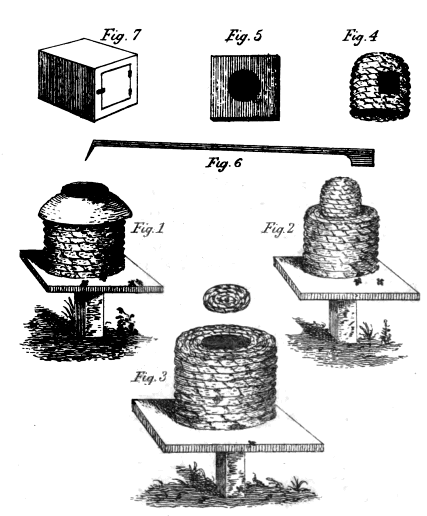
(see fig. 1. plate 1.); upon the top of this post
should be nailed firmly a board nine inches square,
upon which should be placed the board the hive
stands upon, but not nailed, the double boards
will be found very convenient for weighing or
removing the hives, without disturbing the
Bees.
On no account use clay or mortar as is usually
done to secure the hive to the board, the Bees of
themselves will do it more effectually;[1] clay or
mortar tends very much to decay the hives, and
to harbour moths and other insects; each hive
should be covered with a large milkpan, and be
well painted every year, for hives managed upon
the depriving system, are expected to stand from
fifteen to twenty years.
The hives should be placed about three feet
apart from each other, and in a right line, but
should the number be too great to allow of this
arrangement, and render two rows necessary,
they must not be less that fifteen feet asunder,
and those in the front row intersecting the line
formed by the hinder one.
The boards on which the hives are placed,
should be cleaned about four times in the year,
January, March, April and November, much time
and trouble will be saved the Bees thereby.
Plants which rise in height equal to or exceeding
the entrance of the hives, should not be
suffered to grow in their immediate vicinity, and
every facility should be removed by which the
enemies of the Bees can ascend into the hives.
Still, however, a few shrubs or standard roses
of four or five feet may with advantage be placed
eight or ten paces in front of the hives, for the
Bees to alight upon in their return home when
heavily laden with honey and pollen—it saves their
falling to the ground from the weight of their
load, which they frequently do, and in unfavourable
weather to rise no more—it was seeing them
rest in this manner that gave rise to the following
lines:—
Rest on that Rose's leaf awhile, thou little Busy Bee,
Thou hast winged thy way with thousands, the wand'ring, the free,
Unwearied with thy ceaseless toil in search for future store,
Thou'rt comeback to unlade thy sweets, then sally forth for more.
Thou'st been among the flow'rs of gold, their kiss is on thee yet,
And o'er thy richly powdered wings how many hues are met,
That tell of revelling at the founts of nectar's luscious tide,
Of honey-dews that rest upon each petal's glossy side.
Where hast thou been since the bright morn first saw thee on thy way
'Mong scented brier and glittering heath that woo'd thy lingering stay?
Hast thou no voice to tell us of the far off verdant scenes,
Of the rich limes thou lov'st so well and of the fresh'ning steams.
Away! away! once more thou'rt up and ev'r the leaf be still'd.
To its soft rest from the trembling that thy light form has thrill'd,
Thou'lt be again among thy loves, the fragrant, the bright,
All jealous of their hidden sweets, in murmuring delight.
I have always found the advantage of planting,
in the vicinity of my hives, a large quantity of
the common kinds of crocus, single blue hipatica,
heleborus niger, and tussilago petasites, all of
which flower very early and are rich in honey and
farina: salvia nemorosa, (of Dr. Smith) which flowers
very early in June and lasts all the summer, is in
an extraordinary manner sought after by the
Bees, and when room is not an object, twenty or
thirty square yards of it may be grown with advantage,
origanum humile, origanum rubescens,
(of Haworth) and mignonette may also be grown;
cultivation beyond this, exclusively for Bees, I
believe answers very little purpose.
Doctor Bevan says: "To those who, residing
in towns, may consider it indispensable to the
success of an Apiary, that it should be in the
immediate vicinity of good pasturage, and be
thereby deterred from benefiting and amusing
themselves by keeping Bees; it may be satisfactory
to learn that the Apiary of the celebrated
Bonner was situated in a garret, in the centre of
Glasgow, where it flourished for several years,
and furnished him with the means of making
many interesting and valuable observations which
he gave to the world about thirty years
ago."
My own experience also proves the truth of the
above statement, residing myself for four years in
the centre of a large town, in a house without a
garden, I kept two stocks of Bees in my study,
in glass, and four or five others in the improved
cottage hive upon the roof of my house, and I
am not aware that they have ever done better, or
afforded me a larger quantity of honey in any
other situation.
CHAPTER II.
Directions for purchasing Bees.
The best time to establish an Apiary is from
the middle of February to the middle of March,
the stocks will have passed in safety through the
winter, the combs are then empty of brood, light
of honey, and the removal safe and easy. Stocks
should be selected by a competent judge, as the
weight alone cannot be relied on, a swarm of the
preceding year should be selected, and one that
contains not less than twelve pounds of honey;
there are few commodities in which a person can
be so easily deceived as in a hive of Bees. I
would therefore recommend the young Apiarian
to take the opinion of some experienced person
before he makes his purchase, a hive of the preceding
year can only be known by a close inspection
of the combs, which but few persons have
courage to engage in; if the hive is not of the
preceding year its weight is no criterion of its
value, for an old hive always contains a large
quantity of the pollen or dust of flowers which
the Bees carry home on their legs, especially in
the Spring and Autumn, it is an essential ingredient
in the food with which they nourish their
young, but good for nothing else, indeed the Bees
will die of hunger upon the combs that are
filled with it:—"Yet," says Gelieu, "they lay
up useless hoards of it, which they go on augmenting
every year, and this is the only point on
which they can be accused of a want of that prudence
and foresight so admirable in every other
respect."
The Bees appear to be aware of the perishable
nature of this substance, for they never fill a cell
entirely with it, but leave room for a small quantity
of honey in each cell containing pollen,
before it is sealed up, by this means the air is
most effectually excluded, and the pollen preserved
for a considerable time; should, however,
the Bees be compelled to consume the honey
from those cells containing pollen, before they
can make use of it for their young, it moulds and
becomes of no value, and causes them great labour
to remove it. For when in this state, they have
no means of displacing it but by eating away the
cells in which it is contained, and conveying it
out of their hives in small pieces, about the size
of peas, hard and mouldy. I have seen the entrance
of old hives in the month of April almost
filled up with the pellets of mouldy farina. The
process is tedious, takes up much time, and the
ravages made by it upon the combs appear irreparable;
still in a short space of time, if the
weather be favourable, the combs are repaired, as
if no injury had befallen them, and filled with
honey or brood. It is a very heavy substance,
so that if weight be the only criterion, farina will
be purchased instead of honey, therefore in the
purchase of old stocks it will be necessary they
should weigh eight pounds more than swarms of
the preceding year; in the purchase of swarms
less experience is necessary, and by attending to
the following rules the young Apiarian will not
be imposed upon.
1st. That the swarm be purchased before the
14th of June, the longer before that time the
better.
2ndly. That it does not weigh less than three
pounds and a half. I have known some swarms
to weigh six pounds, but this is of rare occurrence.
It is very important to observe, that when a
swarm of Bees is purchased it must be removed
to the place in which it is to remain, upon the
evening of the day it swarmed, for should the
removal be delayed even till the next day, the
combs will in all probability be broken and the
stock destroyed.
I should recommend the purchaser to send his
own hive to the person of whom he intends
to buy a swarm, and to desire him not to put any
sticks across the interior of the hive, as is the
usual custom, for they cause much trouble to the
Bees in forming their combs, and render their
extraction almost impossible. The prosperity of
the hive will much (perhaps entirely) depend upon
its being finally placed upon the evening of the
day it swarmed.
CHAPTER III.
Materials of which Hives should be made, and the
improved Cottage Hive described.
Much has been said with respect to the materials
of which Hives should be made, and experience
has long determined, that straw and wood
are the best. Mr. Huish, to whom I am indebted
for some useful information in Apiarian science,
says, "Of all the materials which have been selected
for the formation of a Hive, I conceive no
one to be more eligible than straw." Gelieu, to
whom experience as an Apiarian I am disposed
to pay the greatest respect, and whose work containing
Practical Directions for the Management
and Preservation of Hives,[2] I would recommend
to every keeper of Bees, says, (when speaking of
wood and straw as materials proper for Hives)
"experience has shown me, that it is a matter of
indifference which are employed; except as to
price, according as either material may be more
or less abundant in different parts of the country."
I have for nine years possessed a Nutt's hive,
which is made of wood, (and which I shall have
occasion hereafter to mention,) without being
able to discover any difference in the health and
activity of the Bees; but the facility and economy
in the construction of straw hives, must always
be a recommendation, as it is in every article
connected with rural economy.
It has always been my practice to paint my
Hives, both wood and straw, at least once in the
year, and I would strongly recommend all persons
to do the same. April I think is the best time,
and if done after six o'clock in the evening, not
the least inconvenience will arise either to the
painter or to the Bees.
Having decided upon the materials of which
Hives should be made, their form is next to be
considered; for a straw hive, I would recommend
the following size, nine inches deep and twelve
in diameter, straight at the sides and flat at the
top, in shape like a half bushel measure, a hole
should be made in the top of four inches, and a
piece of straw large enough to cover it must be
fastened on with skewers, (see fig. 3, plate 1.) not
to fit in but to cover over, the diameter of the
piece of straw being at least two inches more than
that of the opening at the top of the hive, it will
be much easier taken off, and the combs of
swarms of a few weeks standing will not be injured
by its removal, which in favourable seasons
should always have a glass or small hive put upon
them, the early ones especially; an entrance of
two inches by one, must be cut in the bottom
of the hive, to which I affix a piece of copper of
about six inches by three, having a grove, to
admit two sliding copper plates, one perforated
and the other having a hole large enough to
allow but one Bee to come out at a time, (see
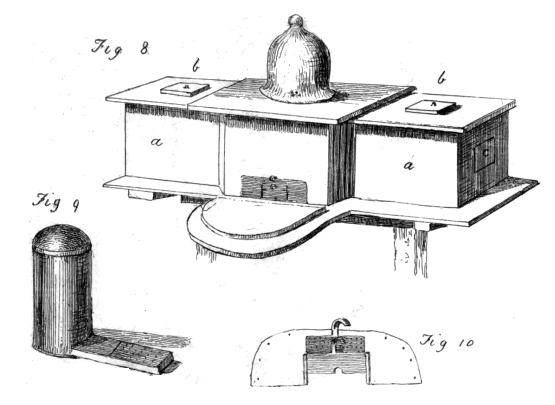
fig. 10, plate 2.)[3]
I have found great advantage
arising from this little apparatus. The finely perforated
slider is used to confine the Bees to their
hive when snow lies upon the ground, the reflection
of which, when the sun shines upon it, never
fails to induce them to leave their hives, and
falling upon it they perish, for a Bee becomes
torpid at a temperature of 32°. The slider with
one hole only, is useful both in Spring and
Autumn, preventing either robbers or wasps from
entering the hives, for three or four Bees will,
with the help of this slider, guard the entrance
more effectually that ten times the number without it.
Although I have recommended Bees to be confined
in their hives so long as snow remains upon
the ground, it would, however, be very prejudicial
to them if carried on beyond that time, for I
never saw Bees healthy and strong after being
shut up through the winter.
Gelieu says, "Bees have no real disease,
dysentery, about which so much noise has been
made, and for which so many remedies have
been prescribed, never attacks the Bees of a well-stocked
hive, that is left open at all seasons, but
those only that are too long and too closely confined.
They are always in good health as long
as they are at liberty, when they are warm enough
and have plenty of food. All their pretended
diseases are the result of cold, hunger, or the infection
produced by a too close and long confinement
during winter."
CHAPTER IV.
Method of placing the small Hive,[4] Box, or Glass upon
the Improved Cottage Hive, by which means fine Honey
may be obtained, without destroying the Bees.
At the end of April, or very early in the month
of May, take the moveable piece of straw, from
the top of the Improved Cottage Hive, (fig. 3.)
and place it upon the adapter, (fig. 5,) then put
the Box or small Hive (fig. 7, and 4) upon this
adapter and cover the whole with a milk-pan, to
defend them from wet. A glass may be used instead
of the small Hive or Box, with equal success,
providing it be covered with something that
will effectually exclude light; a cover of straw, is
perhaps, preferable to any other.
When the Bees are beginning to work in a
glass, a cold night generally obliges them to forsake
their newly made combs, sends them down
into the hive, and compels them to discontinue
their labours which are seldom resumed till the
middle of the next day; to prevent this delay I
would recommend the space between the glass
and its cover to be filled with fine tow or wool,
the temperature of the glass being thereby kept
up, and the Bees enabled to carry on their labours
without interruption.
Experience has proved that the milk-pan is the
best of all protections for a hive, provided it be
six inches in diameter larger than the hive itself.
When the Box is filled with honey and the
combs partially sealed, or when the Bees are seen
to cluster at the mouth of the Hive at nine or ten
o'clock in the morning, let no time be lost in
lifting up the Box, and placing between it and
the Stock-hive another Box with a hole in the
top; the adapter (fig. 5) will be found very useful
in this operation. It is necessary to use this
precaution at all times, but more especially in a
rainy season as a greater disposition amongst the
Bees to swarm then prevails. "Dry weather
makes plenty of honey, and moist, of swarms."[5]
However incorrect this position may at first sight
appear, the attentive observer will quickly become
convinced of its truth.
Since the publication of the first edition of this
little Treatise, many persons have said to me, "their
Bees would swarm, although the small hive had
been placed on as directed above, and sometimes
after they had commenced working in it," the
reason for which in my opinion is, that the second
small hive was not supplied soon enough, for the
like has never in a single instance occurred with
my own Bees. I have not had a swarm these
twenty years from any of the hives worked upon
the Depriving System, occasionally I have compelled
a hive to swarm, to fill up a vacancy in my
number, where the Queen has died, or some other
accident destroyed the stock.
The population of a hive increases rapidly in
April and May, and consequently the internal
temperature rises in proportion, a very high temperature
causes swarming, (Mr. Nutt says 130°)
although the Bees may have abundance of room—I
have frequently seen a glass lamp that has no
opening at the top, placed upon a hive, and the
result has been that the Bees swarmed before
they had filled it.—If both room and ventilation
are carefully attended to swarming may be prevented
altogether, and that the one may be as completely
under the control of the proprietor as the other, I
would recommend Mr. Taylor's Ventilator, which
I believe, to be a perfect one, for when properly
arranged it will reduce the temperature of a hive
at the swarming season, from ten to twenty degrees
in a few minutes—I would recommend its
insertion in the top of the small hive, box, or
glass, before it is placed upon the larger one.
"The Ventilator I use, says Mr. Taylor, (and I
have made them of various forms) consists of double
tubes, both resting on a flauch in the holes
prepared for them, the outer tube is of one inch
diameter and six inches long, with six half inch
holes dispersed over it.
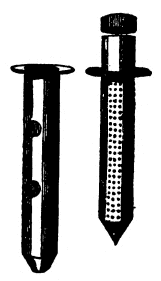
It is soon fixed down in its place by the Bees,
and so must remain, the inner tube is of perforated
zinc, with a[6] tin projecting top as a handle,
and a cap to put on or off this as required. The
Bees will stop up the inner tube where they can
get at it, when it may be turned round a little to
present a new surface. When wholly stopped, it
may be withdrawn from its place, and a clean
tube substituted. This may be done without the
least danger to the operator, but it should be
inserted carefully, to avoid crushing any Bees
that may have crept within the outer tube, an
exit to these is afforded by the hole at the bottom.
The substance with which Bees glue up all crevices
and attach their combs is called Propolis—a
resinous exudation from certain trees, of a
fragrant smell, and removable by the aid of hot
water.
In order occasionally to know the temperature
of any of the boxes, a thermometer made to fit
the ventilator may be inserted in it. This is
chiefly useful as a matter of precaution towards
the swarming season.
Some have thought it necessary to cut holes
in the floor-board, or have placed drawers underneath,
to aid the ventilation, but I have always
found the mouth of the hive sufficient for all
purposes."
All operations except joining swarms or stocks,
should be performed upon a fine day, about noon,
they may then be done with much less annoyance
to the Bees, as well as with less chance of
danger to the operator.
I have for some years past performed almost
all the operations required in this system without
the defence, even of gloves, but I would not recommend
any person to attempt it, until he has
had several years experience in the management
of Bees.
The being perfectly defended in every part
against their stings, gives that coolness and confidence
to the operator, upon which the happy
accomplishment of his intentions so much depends.
I cannot too strongly urge, that coolness
and confidence on the part of the operator are
essential qualifications, for anything approaching
to hurry irritates them beyond measure; indeed
whilst engaged with them the hand ought never
to be hastily removed from one position to another.
Dr. Bevan says, "quietness is the surest
protection against being stung."
The best defence is a mask of wire, very similar
to, but much finer than a fencing mask,
with a rim of tin made to fit the head, to which
a silk handkerchief is attached, a pair of thick
worsted gloves, and stockings or gaiters of the
same material; stout leather gloves are as good
protection as those of worsted, but leather, from
the closeness of its texture, will not allow the
Bees to withdraw their stings from it and the
consequence is, that many perish.
It is recommended to persons during their
operations on Bees, to carefully avoid breathing
upon, them, as nothing is more offensive, or more
irritating to them than the human breath; this
however, is partially obviated by closing the
mouth, and suffering the breath to pass gently
through the nose, by which means a full current
is not allowed to fall upon them.
CHAPTER V.
Proper time for taking away the Box and how to expel
the Bees from it.
When the Box is filled with honey and the
combs all sealed up, (which will generally be done
about the middle of June) it may be taken off, or
it may remain till the one placed beneath it is
also sealed up, which in all probability will be
completed by the first week in August.
Upon the very strong and populous hives, it
is necessary in some seasons to place even a third,
which must be removed with great caution, for
at this time of the year every stock should contain
at least twenty pounds of honey; should
however the stock have that quantity, it may be
safely removed and placed upon a weaker one, for
the combs not being all sealed, the honey therefore
is not saleable. The Box taken off, must be
lifted very gently at noon, upon a fine day, and
carried forty or fifty yards from the hive; place
it upon a board or table, raising it a little that
room may be given to the Bees to make their
escape, which they will do in a very short time.
Much difficulty appears to have arisen with
some persons in getting the Bees to leave the
Box when taken off, but in this as in all other
operations with Bees, gentleness is very important,
indeed it is the only means of accomplishing
the end desired, and as I have before said, "the
Box must be lifted very gently," and placed about
six inches from the ground, or table, upon bricks,
flower pots, or something of the kind. Shaking,
beating, or burning paper under it, as is sometimes
done, have all a contrary effect upon
the Bees, they are alarmed by it, and will not
leave the box perhaps for days, when these means
have been resorted to.
The box being thus placed, a loud humming
noise is first heard, and the Bees are then seen
to leave it within five or six minutes, (all except
a few stragglers), but should the Queen be in the
Box, (which very rarely happens) quite a different
appearance presents itself, no noise will be heard,
or a Bee scarcely seen to leave it, but the hive
from which it has been taken will in a very short
time appear in great confusion. Whenever this
occurs, the Box must be returned immediately,
and taken off again the next day.
When a hive or glass of honey is taken, it
ought not to be left till the Bees are all out of it,
for it is very likely to be attacked by robbers, thus
a great part of it will be carried away in a short
time, and what is left rendered unfit for sale, on
account of the cells being opened, from which the
honey will drain out upon the position of the hive
being changed.
Robbers may be known by their desire to enter
the hive or glass, the Bees belonging to it, being
separated from their Queen, fly home immediately
upon leaving it.
In taking off a box of honey it will be found
convenient to pass a very thin knife, or fine wire,
between the hives or boxes intended to be separated;
if that precaution be not taken, a piece of
comb frequently projects from the top of the one
left, or the bottom of that taken, which causes
much trouble to the operator: two adapters (fig. 5.)
placed between the boxes will be found very
convenient, for the knife or wire will only have to
be passed between them, and the danger of breaking
the combs will be obviated—they should be
made of mahogany, for it will allow of being
worked very thin, without the risk of warping.
To expel the bees from the box or hive when
taken off, Gelieu says, "Take a hive or box of
the same size, place it over the full one that is
turned upside down, bind them round with a
napkin, to intercept all passage to the bees, and
force them to ascend into the empty box, by
tapping gently on the full one. They soon go up
into the empty box, and when they are all housed,
replace them on the parent hive, whence they
were withdrawn; and if the season is favourable
and the honey abundant, they soon set to work
again."
Honey taken by this method is acknowledged
to be very superior in quality to that obtained by
the usual barbarous and unprofitable manner of
burning the Bees, which arises from the combs in
which it is deposited being new and perfectly
white, the early period at which it is collected,
and from its being unmixed with honey gathered
later in the season as well as from the Queen
very rarely ascending through the opening at the
top of the improved cottage hive, that neither
brood nor farina are found amongst it.
This honey sells readily at two shillings a
pound, whilst that obtained by burning the Bees,
is scarcely saleable at eightpence.
It is usual to obtain from every good stock
twenty or perhaps thirty pounds of honey annually.
I once obtained forty-five pounds, leaving the
stock rich in honey.
It is frequently asked what becomes of the Bees
managed on this system, if they are never suffered
to swarm nor are destroyed;—the hives will
never contain them? To which I would reply,
that it is well known to those who are conversant
in the care of Bees, that their numbers decrease
greatly in Autumn, not only by the destruction
of the drones, but also by the unavoidable deaths
of many of the working Bees, owing to the
thousand accidents they meet with in the fields,
and to age;[7] a much less space therefore is wanted
for them in the winter than was necessary in
the summer.
CHAPTER VI.
Method to be pursued in case a Swarm should leave the
Hive, after having commenced working in the Box.
This is a circumstance of very rare occurrence,
and more especially when the directions given in
the former chapter are strictly complied with;
however, should it happen, let the swarm be
hived in the usual manner into the improved Cottage
Hive, (see fig. 3.) as directed in Chapter XII,
when the Bees are settled, take off the moveable
piece of straw from the top of the hive, and place
upon it the box partially filled with honey and
Bees; cover the old hive with the piece of straw
belonging to it, and the milkpan, as no further
profit (except the cast or second swarm) will be
obtained till the next season; should the proprietor
be unwilling to increase his number of stocks,
the swarm may be returned immediately to its
parent hive; the process is very simple, and I
have always found it succeed—as soon as the
swarm is settled, turn the hive bottom upwards,
and if the Queen Bee does not make her appearance
in a few seconds, dash the Bees out upon a
cloth, or upon a gravel walk,[8] and with a wine
glass she may be easily captured, upon this being
accomplished, the Bees will immediately return
to their parent hive and resume their labours; she
may also very easily be taken during the departure
of a swarm, for she appears to leave the hive
reluctantly, and may be seen running backwards
and forwards upon the alighting-board before
she takes wing.
A second swarm generally leaves the hive about
nine days after the first, but the time may be
exactly ascertained by standing quietly beside the
hive after sunset, when the Queen may be distinctly
heard "to tun' in hir treble voic',"[9] which
is a certain indication that a second swarm will
leave the hive. Should two or three Queens be
heard one after the other, it will be on the following
day, if the weather be not very unfavourable,
(for the second and third swarms appear to have
less regard as to the weather than the first.) Should
the Queens continue to pipe after the departure
of the second swarm, a third will certainly follow
in a few days, but if one or two Queens be found
dead beneath the hive on the next morning, no
more swarms can be expected.
That the old Queen accompanies the first swarm
is established beyond a doubt; that many Queens
are bred in a hive, a number sometimes exceeding
thirty in one year, is also ascertained; and that
the Bees have the power of producing a Queen
from an egg deposited in the combs of the working
Bees, by treating it in a different manner to
those that are to become workers, has also been
satisfactorily proved, all that has been said beyond
this, regarding their natural history, must, I believe,
be considered principally conjecture.
It is, however, says a modern Author, "not
the least interesting part of the study of the
Bee, that this apparently insignificant insect
has hitherto baffled all the research and ingenuity
of man to discover the manner of its
propagation; analogy presents no guide to the
solution of this secret, and the result of every
anatomical experiment has tended rather to mystify
the subject, than to conduct us to the road
to truth," and Purchas, who I have before quoted
says, "God humbles us with ignorance in many
things, not only divine but natural and in common
use, in the nature of Bees how blind are we, notwithstanding
all our observations and labour in the
production and continuance of the Queen Bee, in
the generation of other Bees, and generally in the
forms of all things."
CHAPTER VII.
Method of uniting second and third Swarms.
Second and third Swarms, or Casts and Colts,
are seldom or ever able to collect a sufficient quantity
of honey, to support themselves through the
winter, and can only be preserved by much care
and expense, and most of them die after all without
bringing any profit. It is much better therefore
to unite them in the following manner:—when
two Casts or Colts come off upon the same
day hive them separately and leave them till an
hour and half after sunset, then spread a cloth
upon the ground, upon which by a smart and
sudden movement shake all the Bees out of one
of the hives, and immediately take the other and
place it gently over the Bees that are heaped together
upon the cloth, and they will instantly
ascend into it and join those, which, not having
been disturbed, are quiet in their new abode;
next morning before sunrise remove this newly
united hive to the place in which it is to remain;
this doubled population will work with double
success and in the most perfect harmony, and
generally become a strong stock from which much
profit may be derived.
Two Casts or weak Swarms may be joined in
the same manner, although one of them may have
swarmed some days or even weeks later than the
other, taking care however not to make the first
one enter the second, but the second the first,
a third and a fourth parcel of Bees may be joined
to them at different times till the stock becomes
strong.
It is almost impossible sufficiently to impress
upon the mind of every person who keeps Bees
the necessity of having his stocks all strong, for
weak stocks are very troublesome, very expensive,
and seldom, if ever, afford any profit.
Mr. Taylor says, "the stronger the colony at
the outset the better the Bees will work, and the
more prosperous it will become. I never knew a
weak one do well long, and a little extra expense
and trouble at first are amply rewarded by succeeding
years of prosperity and ultimate profit;"
and again, "thus strength in one year begets it
in succeeding ones, and this principle ought to
be borne in mind by those who imagine that the
deficient population of one season will be made
up in the next, and that the loss of Bees in the
winter is of secondary consequence, forgetting
how influential is their warmth to the earlier and
increased productive powers of the Queen, and
how important it is in the opening spring to be
able to spare from the home duties of the hive a
number of collectors, to add to the stores, which
would otherwise not keep pace with the cravings
of the rising generation."
It is a remarkable fact, that two weak stocks joined,
will collect double the quantity of honey, and
consume much less than two of the same age and
strength kept separately. Stocks must be joined
after sunset upon the day that one of them has
swarmed, or before sunrise the next morning, and
the doubled stock must be placed upon the stand
it previously occupied. Great care must be taken
not to shake the hive, nor must it be turned up,
the combs being new, and tender, will easily
break, and the stock by that means be destroyed.
CHAPTER VIII.
Manner of uniting Swarms and old stocks in Autumn.
For this very useful information I am indebted
to that excellent Apiarian, Gelieu; I have tried it
upon some of my own stocks, as well as upon
those of my friends, and have found it in every
instance fully to answer my expectations. Persons
possessing these instructions should not allow a
weak stock to remain through the winter.
The operation is performed very easily and
without danger: I have frequently accomplished it
without any protection whatever, and I will give
the method in the words of Gelieu—"When the
swarms have not been able to lay up a sufficient
provision during the fine weather, I weigh them
at the end of the season, and knowing the weight
of each empty hive, I can tell exactly the quantity
of honey they have in store. If they are three,
four, five or six pounds too light, I preserve them
and feed them in the manner I am about to detail.
When the swarms have only about one-third or
one half of the quantity of honey which would
suffice to feed them, I might keep them alive by
giving them as much more as they require. I
have frequently done so, but I have already remarked
that this plan costs too much honey,
and gives too much trouble: and, therefore, I
generally join them into one. For this purpose,
I leave the heaviest swarm untouched, and, in
the morning of a fine day in September, or the
beginning of October, I commence by blowing
a few whiffs of tobacco-smoke with my pipe in
at the door of the hive of the lightest swarm, to
disperse the sentinels; then turning up the hive,
and placing it on its top on the ground, I give it
a little more smoke, to prevent the Bees from
becoming irritated, and to force them to retire
within the combs—I proceed to cut out all the
combs in succession, beginning with the smallest,
sweeping the Bees with a feather off each piece
back into the hive; and then I place the combs,
one after another, into a large dish beside me,
keeping it, at the same time, carefully covered
over with a napkin, or small table cloth, to prevent
the Bees returning to their combs, or the
smell of the honey attracting others that may be
flying about. The last comb is the most difficult
to come at, being completely covered over with
Bees. I detach it, however, in the same way as
the others, but with greater precaution, sweeping
the Bees off very gently with the feather until
there is not one left on it. This operation, I perform
without gloves, or any other protection,
armed only with my pipe; and, for ten times that
I treat them after this fashion, I seldom receive
one sting, even when I act unassisted.
The combs being all removed, the swarm remains
as completely destitute of food as it was on
the day of its emigration, and I replace it on its
board in the same spot it occupied when full, and
leave it till the evening, by which time the Bees
will be clustered together like a new swarm.
During the whole of the day, which I shall suppose
to be fine, they occupy themselves with
great earnestness cleansing their house, and making
such a noise in removing the little fragments
of wax that have fallen on the board, that any
one who did not know it had been emptied,
would take it for the best and strongest of the
hives. Before night, when they are all quiet, I
throw a few whiffs of smoke in at the door of the
hive which I mean my deprived swarm to enter,
and which should be its next neighbour, on the
right hand or the left; then, turning it up and
resting it on the ground, I sprinkle it all over with
honey, especially between the combs where I perceive
the greatest number of Bees: five or six
table-spoonfuls generally suffice; at other times
three or four times as many are required. If too
little were given, the new comers might not be
well received; there might be some fighting;
and, by giving too much, we run the risk of
drowning them.—One should cease the sprinkling
when the Bees begin to climb up above the combs,
and shelter themselves on the sides of the hive,
this done, I replace the hive on its board, which
should jut out about seven or eight inches, raising
the hive up in the front with two little bits of
stick, so as to leave a division of an inch between
it and the boards to give free access to the Bees.
I also spread a table cloth upon the ground before
it, raising and fixing one end of it on the
boards by means of two bits of stick, that are
placed as a temporary support to the hive. I then
take the hive that was deprived of its combs in
the morning, and with one shake, throw the Bees
out of it upon the table-cloth, which they instantly
begin to ascend; while, by the help of a long
wooden spoon, I guide them to the door of the
one that is placed for their reception. A few
spoonfuls of the Bees raised and laid down at the
door of the hive will set the example, they enter
at once, and the others follow quickly flapping
their wings and sipping with delight the drops of
honey that come in their way, or officiously licking
and cleaning those first inhabitants that have
received the sprinkling, and with whom they
mingle and live henceforth on good terms, one
division of the new comers always cluster on the
front of the hive, which they enter during the
night without disturbance, much pleased to join
their companions.
Next morning, early, it is necessary to take
away the table-cloth and the bits of stick that
were placed to raise up the hive and facilitate the
entrance of the bees, and for some days the door
should be left open as wide as possible. The
hive should also be moved a little to the right or
left, that it may stand precisely in the centre
of the place they both occupied before the
union.
I have frequently united three swarms in the
same manner, and with the same success, taking
care only to empty in the morning those on
each side, and to make the bees enter the middle
one in the evening, after it has been sprinkled
with honey. In this case I do not remove the
one that unites the three swarms."
I have adhered strictly to these directions except
in "raising and fixing the table-cloth to the
board,"—making the bees ascend, I have always
found to be a slow process, but placing the hive
they are to join over them when heaped upon the
cloth, is much quicker and equally successful.
Old stocks that are rendered weak by swarming,
or by having too much honey taken from
them, may be united in the same manner, with
this difference only, that double the quantity of
honey should be used in sprinkling.
If a stock of Bees containing fifteen or twenty
pounds of honey in September, be carefully
managed during the winter, which consists in
narrowing the entrance to exclude robbers, carefully
covering the hive with a milk-pan, and
raising it from the board every month or six
weeks to clean it, no doubt can be entertained to
its affording a good box of honey.
CHAPTER IX.
Manner of feeding weak Stocks, and the time most
appropriate for this operation.
Autumn and Spring are the most proper seasons
for supplying weak stocks with food. Bees
ought never to be fed during the winter, as food
given at that time, not only causes disease, but
induces them to go out of their hives, when many
of them perish from cold.
Food should be administered only at night,
and the sooner after sunset the better; the vessel
in which it is given ought to be carefully removed
by sunrise the next morning, or robbers will be
attracted to the hive by the smell of the honey
and far more injury be sustained from them, than
the benefit arising to the Bees, from the food
given. In feeding, therefore, it will be necessary
to observe the greatest neatness. In Autumn,
Bees should be fed copiously, those hives containing
less than fifteen pounds of honey must be
made up to that weight by feeding; the most
effectual method I have been able to devise is to
excavate a board of four or five inches in thickness,
so as to allow a soup plate, or pewter dish
to fit into it without rising above its level; this
dish may be filled with honey, and covered with
pieces of paper to prevent the Bees from being
drowned, it may then be placed under the hive
at sunset, and a napkin tied round the bottom of
it, to prevent any of the Bees from making their
escape; in this manner three or four pounds of
honey may be given at one time, so that twice
feeding, it is supposed will be sufficient for any
hive, for if more than this quantity is wanted, the
stock must be joined to another as directed in
Chapter VIII. Should the honey be very thick,
a small quantity of warm water may be added to
it, in the proportion of half a pint to three pounds
of honey, observing to mix them well together.
If the honey be much candied it maybe placed
over a fire for a few minutes till it becomes liquid—another
plan of feeding is to prepare a rim of
straw, or a wooden hoop, the exact size of the hive,
and four inches deep, within which place the dish
of honey, and put the hive over it, making the
union secure with a napkin.
In the Spring, Bees should be fed sparingly,
three or four ounces of honey twice in the week,
will be found amply sufficient; the easiest method
of giving these small quantities is by a vessel
of tin, upon the same principle as a bird's fountain,
holding about a pound or a pound and half
(see fig. 9.) the projecting trough or mouth, must
be put in at the entrance of the hive, it is one
inch and three quarters wide, and three inches
and a half long, covered with a perforated tin:
this vessel being filled with honey, has only to be
placed in the hive at night, and removed in the
morning, the feeder itself effectually stopping up
the entrance of the hive.
Some persons feed their Bees at the top of the
hive, but it is much too tedious and sparing a
way, in my opinion for Autumn feeding, in the
Spring it does very well. This feeder is of wood
with a cover of glass, it has a hole through its
centre, corresponding with one at the top of the
hive, which enables the Bees to pass into it, and
take the honey—I believe it was invented by
Wildman.
CHAPTER XI.
Enemies of Bees and means of overcoming them.
Gelieu says, "that nothing is more prejudicial
to Bees than ignorant attention, their most
formidable enemies are, perhaps, their possessors,
who busy themselves to torment them, and
weaken and kill them by too much care. In
Winter, they hurt them by shutting them up,
and in Spring, the giving them a little honey is
not always attended to, neither is the guarding
them from moths, which, at that time, make the
greatest havoc, nor is the narrowing of the entrances
to prevent them being robbed. Some
people suffocate them in Autumn, that they may
possess themselves of their provisions; and others
take out the best of the honey, and often too
much of it, and so expose them to die of hunger.
"I therefore place, in the foremost rank of
their enemies, those of their possessors, who, by
their own ignorance and inexperience, hinder
them from prospering and multiplying."—To
all this I am sorry to say that I can bear testimony.
Amongst the enemies of Bees are enumerated,
ants, moths, birds, poultry, mice, wasps, and
spiders. Ants perhaps are their least dangerous
enemies, for though they cannot sting them, they
carry them to a distance.
Ants may be destroyed by pouring boiling
water into their nests, and the operation will be
greatly assisted by making holes into them with
a sharp stick, so as to allow the water to flow
readily to the bottom of them. Mr. Huish says,
"to preserve my Bees from these vermin, I always
fasten a piece of sheep's skin, with its wool
on round the bottom of the pedestal," it has been
said, that these insects dislike both garlick and
shalots and they will not harbour in the ground
in which these vegetables are grown.
Moths[10] are by far their most formidable and
dangerous enemies, great numbers of hives are
destroyed by them every year, it therefore requires
the utmost vigilance on the part of the Bee-keeper
to defend his favourites from these most powerful
assailants. It is in the caterpillar state that they
commit their ravages, and it is truly astonishing
to observe the rapidity with which they destroy a
hive, when they get established in it. It must be
observed that hives managed upon the Depriving
System, that are expected to stand for ten, fifteen
or even twenty years are much more subject to
the incursions of moths, than those which are
destroyed every year. The best method of preventing
their increase is the frequent cleansing of
the hive floors, for the female generally deposits
her eggs between the hive and the board on which
it stands, or in the dust that accumulates at the
bottom. Upon removing the hive the moths maybe
seen in the larva state upon the floor, and are
easily destroyed. Moths and spiders, says Dr.
Bevan, "should be watched and destroyed, in
an evening, as at that time the former are hovering
about, and the latter laying their snares."
He also recommends a frequent cleaning of the
hive floors.—Huish says, "the butterfly of the
moth that redoubtable enemy of the Bee, appears
in April, and continues until October. Destroy
them as much as possible; frighten not away the
bats which fly about the hives, as they devour a
great number of them." He says also, "I would
always advise an Apiarian to fix his attention
particularly on a hive, the Bees of which appear
to be in inaction, whilst the Bees of other hives
are in activity.—If this inaction continue for ten
days, or a fortnight, not a moment then should
be lost in examining the hive, and the ravages of
the moth will soon present themselves."
Amongst birds, that little marauder the blue
titmouse, (parus major of Linneus) stands the
foremost as their enemy, for, says Purchas, "she
will eat ten or twelve Bees at a time, and by and
by be ready for more; she feeds her young ones
also with them. She eats not the whole Bee, but
divides it in the middle, pulls out the bagge of
honey, litting drop the skinny outside, in the
spring she watches for them in the willow and
sallow trees, and takes them when they are at
their work." Destroy their nests in breeding time,
and shoot them in winter. Lapoutre, a French
Naturalist, assures us, "that he saw under a tree
in which there was a tom-tit's nest, a surprising
quantity of the scaly parts of Bees, which this bird
had dropped from its nest." Sparrows and swallows
have both an ill name, but I could never observe
any great hurt done by either of them. Poultry
will occasionally destroy Bees, for I once recollect
seeing a hen and her brood pay dearly for their
freedom with a hive, the chickens were all stung
to death, and the hen escaped only with her
life.
From mice, the surest safeguard is the single
pedestal (see fig. 1, 2 and 3).
The destruction of Queen Wasps in the Spring,
and wasps nests in the Summer, will prove the
best security against these formidable enemies:
Queen Wasps are seen in April and May, and are
very easily captured, every one which is then destroyed,
would probably have been the founder
of a nest, which may be computed at 30,000, at
least.
In Autumn, it is very common for Bees to rob
and plunder each other's hives the best remedy
for this evil, as well as to guard against wasps,
is to contract the entrances; to effect this object,
I would recommend a copper guard to be attached
to each hive; (see fig. 10, and page 18.) the
wooden one of Espenasse, as well as Huish's tin
guard, I have found very inconvenient, which induced
me to construct the one referred to. It is
made of thin copper and stitched to the hive with
copper wire, it has two sliders, one pierced with
a number of small holes, and the other having
one only, but large enough to allow the passage
of one Bee through it. The advantages of this,
above all other guards, arises from its not projecting
beyond the hive, the alighting board not
being encumbered by it, and the angles formed
by Huish's with the hive, so annoying to the Bees,
being avoided.
"In a word," says Purchas, "if you desire to
have your Bees thrive, and prosper, keep them
well from winds and wet, heat and cold, destroy
their enemies, and let them enjoy a sufficiency of
food gotten by their own industry; and if there
be a want in some, timely supply them, and doubt
not if, by God's blessing on your endeavours, the
increase and prosperity of your Bees."
CHAPTER XII.
Directions for Hiving Swarms.
Bees managed upon the Depriving System,
rarely swarm and are seldom found clustering at
the mouth of the hive, for every bright hour during
the honey season they seem to turn to profit,
when however Clustering or Swarming takes
place, it generally arises from the Box not having
been put on sufficiently early in the season, or for
the want of a second Box; if a swarm should
from these causes be compelled to leave the hive,
let it be put into a new improved Cottage Hive,
(see fig. 3.) in the usual manner.
I have always adopted the plan of placing my
swarms where they are to remain, within ten or
fifteen minutes after the time of their being hived,
and in this practice Gelieu agrees with me, for he
says, "most people who have Bees allow their
Swarms to remain till the evening in the place
where they have alighted, and do not move them
to the Apiary till after sunset, this method has
many inconveniences.
As soon as a swarm has congregated in the
new hive, and seems to be at ease in it, the most
industrious amongst the Bees fly off to the fields,
but with a great many precautions. They descend
the front of the hive, and turn to every side to
examine it thoroughly, then take flight, and make
some circles in the air in order to reconnoitre
their new abode, they do the same in returning.
If the Swarm has taken flight in the morning, the
same Bees make several excursions during the
day, and each time with less precaution, as becoming
familiarized with their dwelling, they are
less afraid of mistaking it, and thus, next morning,
supposing themselves in the same place, they
take wing without having observed where they
have spent the night, and surprised at their return
not to find the hive in the same place, they
fly about all day in search of it, until they perish
with fatigue and despair. Thus many hundreds
of the most industrious labourers are lost, and
this may be entirely avoided, if the Swarms be
removed as soon as the Bees are perceived coming
out—this sign alone is sufficient.
Sometimes I do not even wait till all the
Bees clustered in front or on the sides of the
Hive, are reunited to their companions in the
interior, as they are never long in being so;
and this plan has always fully succeeded with
me."
Experience has long since proved, that the
custom of beating warmingpans and the like, at the
time a swarm leaves the hive is perfectly useless,
as well as the ridiculous practice of dressing the
Hive, as it is called, by drenching it with beer,
honey, fennel, &c.; the former is considered by
persons of observation, actually to prevent the
Bees from alighting so soon as they would otherwise
do; and the latter frequently to compel them
to leave the hive. The best method is to watch
the Swarm in silence, and after it has once collected,
to lose no time in hiving it into a new,
clean and dry Hive. Much time and trouble may
be spared the Bees, if the loose straw be removed
from the interior of the hive, the best method of
effecting which, is to singe them off with a wax
taper, and afterwards to remove them with a hard
brush.
I have for many years past discontinued the
use of sticks across the interior of my Hives, for
they cause much unnecessary trouble to the Bees
in the construction of their combs; every facility
should be given to a fresh swarm in their labors,
for they have much to do, as Dr. Aikin has very
beautifully said for them in the
SONG OF THE BEES.
We watch for the light of the morn to break,
And colour the grey eastern sky
With its blended hues of saffron and lake,
Then we say to each other, "Awake, Awake!
For our winter's honey is all to make,
And our bread for a long supply."
Then off we hie to the hill and the dell,
To the field, the wild wood and bower;
In the columbine's horn we love to dwell;
To dip in the lily with snow-white bell,
To search the balm in its odorous cell,
The thyme and the rosemary flower.
We seek for the bloom of the eglantine,
The lime, painted thistle, and brier,
And follow the course of the wandering vine,
Whether it trail on the earth supine,
Or round the aspiring tree-top twine,
And reach for a stage still higher.
As each for the good of the whole is bent,
And stores up its treasures for all,
We hope for an evening with heart's content,
For the winter of life without lament
That summer is gone, with its hours mis-spent,
And the harvest is past recall.
And not only do sticks across the hive cause much
unnecessary trouble to the Bees in the construction
of their combs, but render their extraction
almost impossible; for in this System it becomes
necessary, after a Hive has stood seven or
eight years, to cut out part of its combs, which by
that time will have become very black, very thick
and the cells, from the number of Bees hatched in
them, (every one leaving a deposit) much contracted.
The times best suited for this operation
will be March and September; if performed in
March, two leaves of comb may be taken, if in
September, one only; it is a very simple process,
and easily accomplished with the aid of a little
tobacco smoke, and a knife (fig. 6.) which I will
hereafter describe.
Gelieu says, in 1814, "I have several Stocks
from twelve to twenty years old that are as prosperous
as the young ones, and one stock twenty-five years old."
I cannot say so much as this, but I do not in
the least doubt the truth of it; fifteen years is the
longest time that I have kept a stock, and the
reason of my losing it at the expiration of that
period was from the decay of the Hive, it being
badly made and not painted; its annual profit
was never less than forty, and some years, fifty
shillings.
I would recommend every person who keeps
Bees, to have a few well painted new hives always
by him, that each hive be weighed, and its weight
upon a ticket of lead fastened to it, the board also
upon which the hive stands should be weighed.
CHAPTER XIV.
Remedies proposed, as cures, for the Stings of Bees.
"The sooner the Sting is extracted," says Dr.
Bevan, "the less venom is ejected, and consequently
less inflammation induced. To alleviate
the irritation, numberless remedies have been proposed,
of the most opposite kind and uncertain
effect; as oil, vinegar, bruised parsley, burnet,
mallow, or the leaves of any succulent vegetable,
(renewed as soon as warm, and probably therefore,
operating by cold alone) honey, indigo dissolved in
water, &c., &c., the most effectual remedy appears
to be Aq. Ammon. or Spirits of Hartshorn, nor
is this surprising, when we consider that the
venom of the Bee is evidently Acid."
I have known both the pain and inflammation
greatly relieved by Laudanum; but for myself I
could never experience the slightest relief from
its application.
Its effects are very different in different persons
for whilst a single Sting will sometimes produce
alarming symptoms in one person another may
receive many without being inconvenienced either
by pain or swelling; this I am sorry to observe is
not my case, for a single sting causes me the most
acute pain, accompanied by violent swelling and
inflammation, which lasts two or three days; the
above remedies have proved totally ineffectual in
affording me the slightest relief, but I consider
myself very fortunate in having lately met with
almost a perfect cure, and it is as immediate as it
is effectual; I have much pleasure in communicating
it, for notwithstanding every precaution, persons
who are much amongst Bees occasionally meet
with a sting. The method I have of late adopted,
by which the pain is instantly removed, and both
the swelling and inflammation prevented, is to pull
out the sting as soon as possible, and take a piece
of iron and heat it in the fire, or for want of that,
take a live coal, (if of wood the better, because it
lasts longer) and hold it as near to the place as I
can possibly endure it, for five minutes; if from
this application a sensation of heart should be
occasioned, a little oil of Turpentine or Goulard
Cerate must be applied.
During the last three years I have used for myself
and those about me, who might chance to
meet with a sting, a still more effectual remedy
than the above, and as its application is more
simple it is certainly to be preferred. It consists
in applying the least possible quantity of Liquor
potassæ immediately upon removing the sting
either with a fine camel's hair pencil, a sharp pen,
or even with the point of a needle. The venom
of the Bee being an acid, this very powerful
alkali consequently neutralizes it, the pain is instantly
removed and neither swelling nor inflammation
follow. Should too large a quantity of
this alkali be used, (as from the hurry in which
it is usually sought after frequently happens) the
part should be plunged into cold water, or a scar
will be the consequence, which will last for some
days. I have found the quicker the application,
the more effectual the cure.
CHAPTER XVI.
Method of Dislodging Bees from Trees or Buildings,
and putting them into Hives.
It very rarely happens that Bees in Buildings
or in Trees survive the Winter, cold and humidity
usually kill them, but the comb and the little
honey remaining in it induces others to visit their
abode in the Spring, and which in all probability
will be followed by a Swarm from some neighbouring
Apiary in May or June, and on this
account Bees are said always to be there, a little
observation will prove the incorrectness of this
statement, and I believe the only criterion by
which it can be proved that Bees have actually
existed in such places through the Winter, is to see
them carrying in pellets of farina upon their legs
in March and the early part of April.
The most proper time for dislodging a Stock,
which from having fixed upon some warm and
dry abode, has lived through the Winter, is towards
the end of May or the beginning of June,
but a Swarm ought to be removed upon the day
of its arrival, or as soon afterwards as possible.
The only method that I can recommend at all
likely to succeed, and which I have found to
answer the purpose, is to lay the combs quite
bare, and then to cut them out one by one, sweeping
the Bees with a feather or the back of the
knife, from each piece of comb into an empty
hive.
Should the Queen not be observed during this
process, it will be advisable to take a leaf of Comb
that is filled with eggs or brood, and fasten within
side the hive intended for the Bees, that they may
be enabled to make a new one, should their original
Queen have been killed or lost during this
operation; for it is now proved beyond all doubt
that they have the power of doing this, provided
they have either eggs or brood in their hive.
The use of a little tobacco smoke throughout
this operation will be necessary, a cigar in the
mouth of each operator (for there must be two
persons, if not more, engaged in it) will be found
sufficient.
The Queen Bee may easily be distinguished by
a common observer, her wings are very short, not
extending beyond one half of her body, which is
much longer, and more pointed than that of the
working Bees, her legs are copper coloured, and
her body brown.
The combs being all removed and the Bees
swept off them into the hive, it must now be put
upon a board and placed exactly where the Bees
entered before they were disturbed, and, if possible,
it should remain in this situation till Autumn,
but its remaining for a week or two is absolutely
necessary; should there be many combs filled
with brood, three or four of them may be placed
in the hive, by putting some wooden pegs at the
top of it to keep them at proper distances, and
allowing them to rest upon the hive-board.
This, however, is a tedious operation and very
seldom pays for the trouble it occasions; for
stocks thus obtained are generally weak and require
feeding, or to be united to others to keep
them alive through the winter. It is therefore
more to the advantage of the proprietor to cause
the combs in trees or buildings, in which Bees
have died, to be destroyed, and the places effectually
stopped up with clay or mortar.
CHAPTER XVII.
Description of Nutt's newly invented Hive, for obtaining
Honey without destroying the Bees.
This Hive consists of three collateral Boxes,
(see fig. 8.) the centre one fourteen inches, and the
side ones ten and a half square inside measure,
depth eleven inches; the middle box has a number
of holes in the top three quarters of an inch in
diameter, bored in the circumference of a circle
six inches in diameter, with one in its centre,
over which a glass is placed. The side boxes (aa)
have each a hole of four inches square in the
centre of the top, into which is fitted a piece of
tin pierced with small holes, and in its centre a
hole of an inch in diameter, wherein is placed a
tube of tin of the same size, reaching nearly to
the bottom of the Box, and supported by a
shoulder resting upon the square tin, which is
also perforated. This square tin and cylinder
constitute the ventilator, the opening in the
Boxes is covered by a piece of wood, (bb) the
Boxes have each a glazed window (c). The
centre Box communicates with the side ones by a
grating cut in the wood and corresponding with
each other, this communication is cut off when
necessary by sliding tins.
The method that I have adopted for protecting
this Hive from wet, is to cover the glass with a
common straw hive, upon which a milk-pan is
placed, and each of the side boxes by two pieces
of board eleven inches by fifteen, put together so
as to form an angle of ninety degrees, resembling
the roof of a cottage. The whole should be made
of inch deal and well painted, the board upon
which the three boxes stand must be of two inch
deal and of one piece, except the alighting board,
which is nailed on, three strong pieces of two
inch deal will be necessary on the under side of
the board as braces to prevent its warping.
In this I have differed a little from Mr. Nutt,
because I think the solid board more substantial
and less likely to harbour insects, his being
hollow to allow the bees to escape at the time
of deprivation, when the communication between
the centre and the side boxes is cut off by means
of the sliding tins, for which I have made provision
by having an entrance at the back of each of
the side boxes, to which is attached a copper
slider, (fig. 10.) but without the entrance for a
single Bee.
The middle Box must be stocked in the usual
way, by hiving a swarm into it, and if the swarm
be not a large one, it will be better to put two
swarms into it as directed in Chapter VIII.
It will be necessary to have both the top and
side tins securely fastened to the centre box at
the time of hiving, and till after the union, when
they may be removed, thereby giving the bees the
full range of all the boxes as well as of the glass
upon the centre one, nothing further will be required
till the next Summer, except carefully
placing the roofs to defend the boxes from wet.—"Perhaps,"
says Mr. Taylor, "there is nothing
more prejudicial to Bees than the moisture they
engender during the Winter season, particularly
after frost, and in certain states of the atmosphere.
It accumulates on the top and sides of the pavilion,
moulding and rendering offensive the combs,
and producing disease. For this reason boxes
with flat roofs have been objected to. I have
tried different experiments to obviate this serious
evil, and have found nothing better than the
practice of condensing the vapour as much as
possible and conveying it away. This I have
done for several years by means of the bell-glasses.
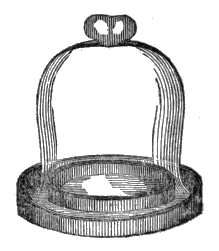
At the beginning of Winter I place over the
holes on the top of the pavilion, pieces of perforated
zinc, and on these I set the glasses, each
within a circular leaden or zinc trough, open in
the centre. As the exhalation rises from the
warmth below, it is condensed on the glass, and
received, often in considerable quantity, in the
troughs. An imperceptible current of air is thus
produced, of great advantage to the inmates; for
ventilation is as much wanted in winter as in
summer, and particularly when the population is
numerous. The holes at the top of the glasses
may be left open to assist this, for of two evils it
is better to have too much than too little air.
Nor, with good protection from weather, need the
effects of cold be apprehended; for the Bees, (if
not weak in numbers) will always of themselves
generate sufficient warmth, and a dry, cold season
is better withstood than a mild, moist one, particularly
after a good honey year."
This leaden or zinc trough of Mr. Taylor's exactly
resembles in form the feeder mentioned in
page 56.
In the following Summer, when the Bees are
working in the side boxes and the glass, the ventilation
must be particularly attended to, (for
upon this alone depends the success of the hive,)
and here I would especially recommend Mr.
Taylor's ventilator as given in page 25; a small
thermometer should be kept in one of the ventilating
tubes, and when it is observed above ninety
degrees of Fahrenheit, the covers (bb) must be
taken off, and should the temperature of the
boxes be found at, or above a hundred, the perforated
copper slides at the back of the side boxes,
must be used, for if it reaches to a hundred-and-thirty,
a Swarm in all probability will leave the
hive, which next to starvation is most fatal to this
mode of treatment. When either of the side
boxes or the glass upon the top of the centre one
is filled with honey and sealed up, introduce the
dividing tin; if the glass, remove it immediately
thirty or forty yards from the hive without changing
its position, leaving room at the bottom for
the Bees to escape, which they will very soon do,
but if either of the side boxes are to be taken
away, open the copper slider at the back of the
box, and in less than an hour from the time of
the dividing tin being introduced, the Bees will
have made their escape and joined the centre box,
it may then be removed, emptied and replaced,
or another may be substituted for it. All operations
must be performed upon a fine and bright
day. The entrance to the centre box should be
opened to its fullest extent, by removing both the
sliders from the first of April till the first of
September.
CHAPTER XVIII. — JANUARY. — FEBRUARY. — MARCH. — APRIL. — MAY. — JUNE. — JULY. — AUGUST. — SEPTEMBER. — OCTOBER. — NOVEMBER. — DECEMBER.
The Apiarian's Monthly Manual, or Hints for the
Management of Bees for every month in the year, upon
the Depriving System.
Should the cold be intense, no operation whatever
should be performed on the Bees that requires
the removal of the hives. If snow be on
the ground keep the perforated sliders (page 18.)
closely down that air may be admitted, but not a
Bee allowed to escape until it be thawed; but
immediately upon the disappearance of the snow
remove the slider, and give them full liberty. I
have known many stocks lost by not attending to
this precaution, and more especially after a long
confinement, do not suffer the snow to melt either
upon the covers or hive-boards, but brush it off
every day as it falls. Attend regularly to the
condenser (page 90.) which to boxes with flat
roofs is a very necessary and useful appendage.
Upon a mild day in this month let the floor
board of each hive be cleaned, and a little food
administered, should the stock of honey be very
low. See that the coverings be sound, and that
no moisture comes upon the top of the hives.
Should it be found that any of the hives have
perished, which will sometimes occur, and from
causes which cannot be exactly ascertained, let
them be immediately removed, and the honey
which they contain taken out, and reserved for
feeding those that may require it.
Clean the hive-boards again, and should any of
the stocks require feeding, supply them, attending
strictly to the directions given in Chap. IX. Towards
the end of this month place a vessel, containing
water, near the Bees, as directed in page 3.
This also will be found a good time to examine
the pedestals upon which the hives stand, for
after remaining some years in the ground they
are subject to decay at a few inches below its surface,
especially if regard was not paid to the quality
of the timber at the time of fixing them.
Clean the hive-boards for the last time, and
supply food, if required, as before directed. The
Wax-moth, that redoubtable enemy to Bees, appears
this month; they may be seen frequently
at twilight running upon the outside of the hives:
destroy them as much as possible, and, as Huish
says, "frighten not away the Bats that fly about
the hives, for they destroy numbers of them." A
full supply of small hives, boxes, glasses and
adapters should now be provided, old ones cleaned,
or new ones purchased. A few large hives also
should be ready, for if from inattention to giving
room and ventilation, a swarm should be compelled
to leave their hive, they will be wanted.
Weak hives are now very subject to an attack
from robbers, the best protection that can be afforded
them is the slider page 18, with the help
of which three or four Bees will guard the entrance
more effectually than many times that
number without it.
The time will now have arrived for supplying
each stock with a small hive or other receptacle
for honey, as directed in Chap. 4, and should the
season be a favorable one, the supply even of a
second may be found necessary before the end of
the month. Continue to destroy Queen wasps
and hornets, and to watch carefully for moths.
Should the bees of any hive appear inactive at
this time, or should they not be seen to carry in
pellets of farina whilst others are doing it, and
this inaction continue for eight or ten days, lose
no time in examining the hive, and should the
moths have begun their work of destruction, which
may be known by seeing the combs joined together
by their silken webs, cut away the combs
affected with a sharp knife, and the hive may,
perhaps, be saved.
Strict attention should now be paid to room
and ventilation, for, as has been said in page 24,
if both these be carefully observed, swarming may
be prevented altogether. Swarms may now be purchased
as directed in Chap. II. About the middle
of the month, in good seasons, small hives and
glasses may be taken off, full directions for which
may be found in Chap. V.
At the end of the month look for wasps'-nests
and destroy them; a very easy and effectual
method of doing it is to fill a common squib or
serpent case with a mixture of sulphur and gun-powder,
in equal parts, with a very small quantity
of nitre all finely powdered and rammed very
hard into the case, set fire to it by means of
touch-paper, and when in a state of ignition, stick
it into the hole of the nest and place your foot
upon it, when it ceases to burn let a person with
a spade turn out the nest; in this manner a great
number may be effectually destroyed in one night.
Small hives and glasses must now be taken off
as they are filled and sealed up, (and stored in
cool places, observing to keep them in the same
position as when standing upon the stocks,) and
their places supplied by empty ones. Go on destroying
wasps'-nests.
Continue to take off hives and glasses as they
are filled, but supply no fresh ones, the honey
season being now chiefly over.
Small hives remaining upon the stocks that are
only partially filled with honey may now be taken
off, providing the stock will not be too much impoverished
thereby; wherever the chance of this
presents itself leave them on through the winter,
or until they are emptied by the bees; those partially
filled hives taken from rich stocks may be
given to weak ones, now, or in the spring as required.
Robbers will at this time be carrying on
their depredations, and should a serious attack be
observed the sliders must be used as before directed.
Examine the coverings to the hives that they
be all sound, and that no rain be admitted through
them; the entrances may now be narrowed, if
Taylor's slider be used (page 18) the side with
three openings will be most proper for this season.
Clean the floor-boards of the hives, and see that
they stand firmly on their pedestals, contract the
entrance so that only one bee can come out at a
time, for at this season mice are likely to lodge
themselves in the hives.
The same attentions are necessary this month
as in the two preceding, but if the cold should
be intense the hives must not be removed.
FINIS.
Printed by T. C. Newby, Angel Hill, Bury.
Transcriber Note
Minor typos corrected.