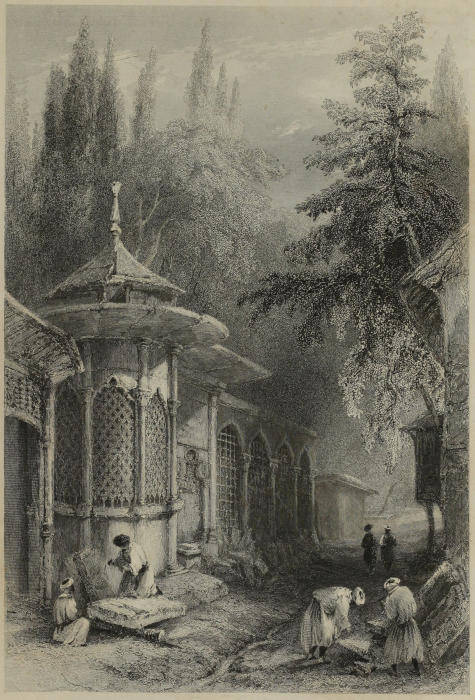
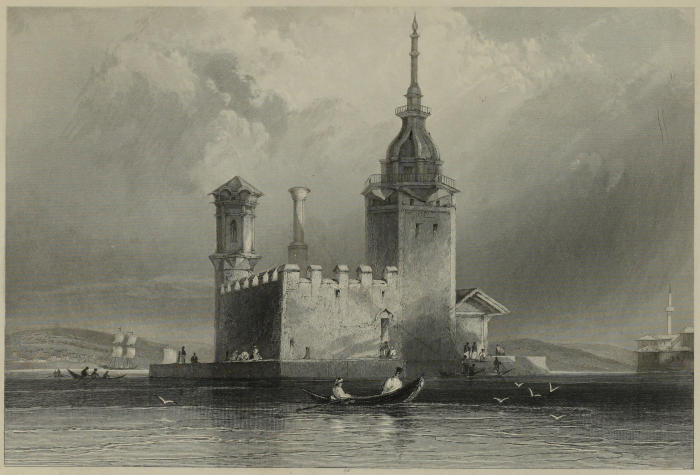
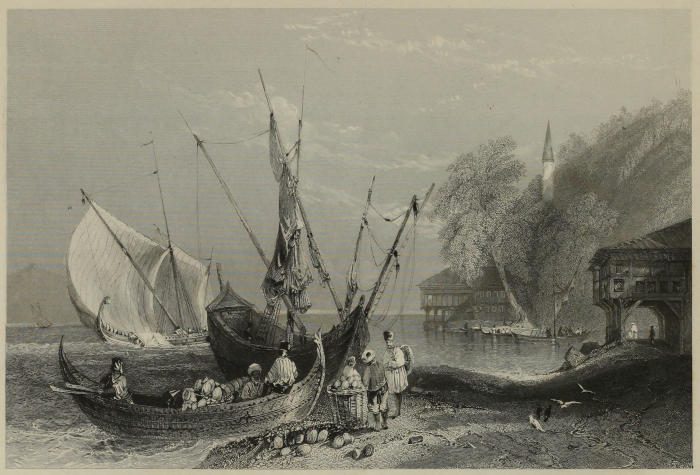
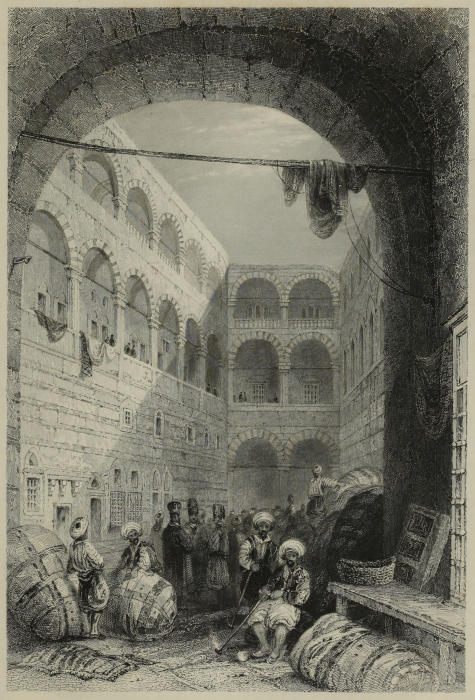
London. Published for the Proprietors, by Geo: Virtue, 26, Ivy Lane, 1840.
BY MISS PARDOE,
FROM DRAWINGS
BY WILLIAM H. BARTLETT.
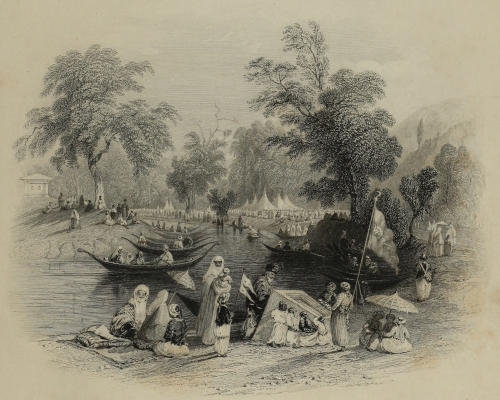
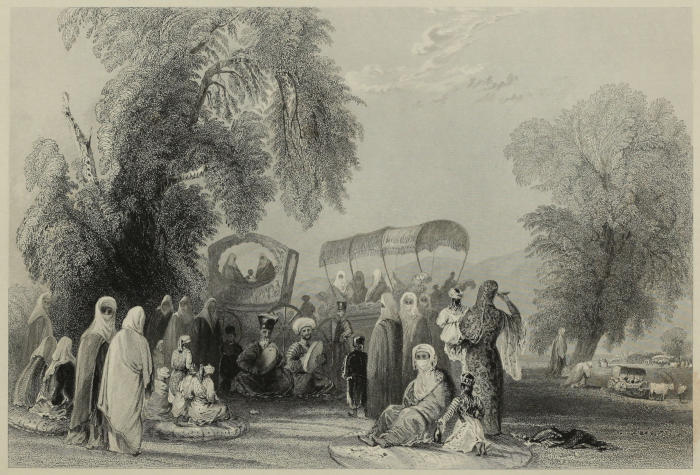
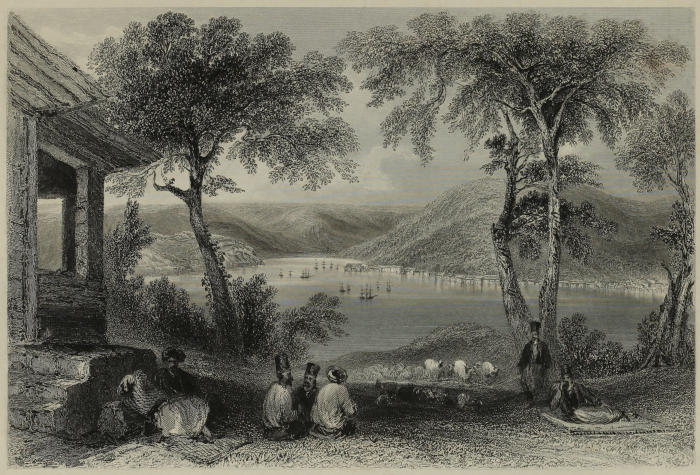
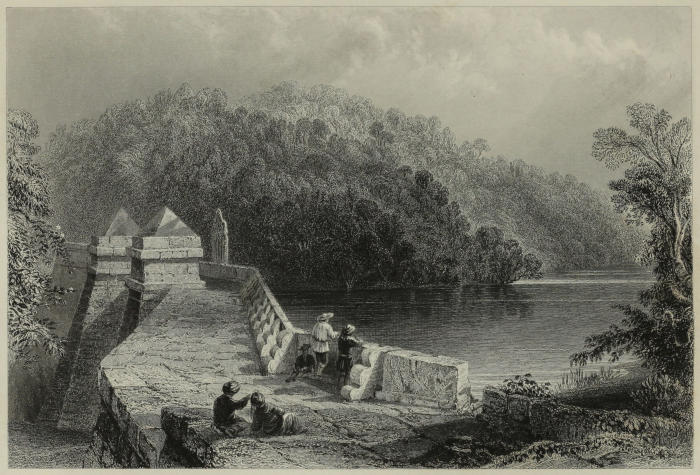
SCENE OF THE BARBYSES IN THE VALLEY OF SWEET WATERS.
W. H. Bartlett. H. Griffiths.
LONDON:
PUBLISHED FOR THE PROPRIETORS BY GEORGE VIRTUE, 26, IVY LANE
1839.
THE
BEAUTIES OF THE BOSPHORUS;
BY MISS PARDOE, Author of “The City of the Sultan,”
ILLUSTRATED IN A SERIES OF VIEWS OF CONSTANTINOPLE AND ITS ENVIRONS,
FROM ORIGINAL DRAWINGS BY W. H. BARTLETT.
“’Tis a grand sight, from off the ‘Giant’s Grave,’
To watch the progress of those rolling seas
Between the Bosphorus, as they lash and lave
Europe and Asia.”
Byron.
LONDON: PUBLISHED FOR THE PROPRIETORS, BY
GEORGE VIRTUE, 26, IVY LANE.
1838.
LONDON:
R. CLAY, PRINTER, BREAD-STREET-HILL.
TO
THE MOST EXCELLENT VIZIR MUSTAFA RÉCHID PASHA, MUSHIR, AND MINISTER OF FOREIGN AFFAIRS OF THE SUBLIME PORTE, DECORATED WITH THE NISHAM OF HONOUR
APPERTAINING TO HIS ELEVATED RANK.
KNIGHT GRAND CROSS OF THE LEGION OF HONOUR OF FRANCE,
OF THE ORDER OF LEOPOLD OF BELGIUM,
AND OF ISABELLE OF SPAIN,
&c. &c. &c. &c. This Volume is Inscribed, AS A TOKEN OF REGARD FOR HIS FRIENDSHIP,
AND OF ADMIRATION FOR HIS TALENTS,
BY THE AUTHOR.
“’Tis a grand sight, from off the ‘Giant’s Grave’,
To watch the progress of those rolling seas
Between the Bosphorus, as they lash and lave
Europe and Asia.”
Byron.
Every enjoyment of life has three distinct stages—anticipation—reality—and
reminiscence; and it is more difficult than it at first appears to be, to decide on
the comparative extent and value of each. Hope is the most extravagant and
imaginative; action, the most engrossing and tangible; and memory, the most
calm, and durable, and sober.
I feel this truth forcibly at a moment like the present, when, after having laid
aside the pen with which, upon the glorious shores of the Bosphorus, I recorded
the observations growing out of passing circumstances, and glowing with reality
and action, I am once more called upon mentally to retrace my steps. For
months before I visited the picturesque capital of Turkey, I had nourished
visions as bright and as impalpable as the rainbow. I anticipated I knew not
what—adventures as numerous and as romantic as those of the “Thousand and
One Nights;” and I dreamt dreams impossible of accomplishment; not caring to
inquire too curiously of my reason whether such things would be; but content to
inhabit my cloud-land castle, and to look down from the unstable edifice in all the
luxury growing out of my self-created images.
When I was subsequently dwelling in the “City of the Sultan,” and that reality
had succeeded to anticipation, much of the mist of romance, indeed, rolled away;
but the fair face of the landscape suffered little from its absence, for Constantinople
needs no aid from the imagination to make it one of the brightest gems
in the diadem of nature: its clear calm sky, its glittering sea, its amphitheatre of
thickly-peopled hills, its geographical position, its political importance, and,
above all, its surpassing novelty, tend to make every day and every hour in that
gorgeous scene, and under that sunny sky, a season of intense enjoyment; while
the varying character of the native population, constituted as it is of such anomalous
materials—the truthful Turk, the wily Greek, the stately Armenian, and the
timid Jew—coupled with the blended air of mystery and of magnificence which
pervades the whole locality, suffice to render the Turkish metropolis a sojourn
of unwearied and exciting delight: and when, favoured by circumstances which
seemed to shape themselves to my wishes in a manner to make me doubt whether
the spells of fairy-land were indeed all broken, I was enabled to penetrate to the
very centre of Turkish society, and to domesticate myself both with princes and
peasants, I found that the fallacies which had evaporated, would have been but a
sorry exchange for the reality that remained; and I gave the advantage to the
fact over the anticipation.
And now, once more, when the heat and the hurry of the expedition are over,
when the pride and the pageantry have passed away, and that I am preparing to
live over again that brief period of delight—conjured back, as by magic, in gazing
on the extraordinarily faithful and admirable sketches which lie upon my table
in “merrie England,” from the pencil of Mr. Bartlett,—I am tempted to believe
that my hour of real enjoyment has arrived; an hour which I may prolong or
multiply at my pleasure, by memories of scenes well known, and individuals
vividly remembered—of beauty and of luxury, of legend and of song. I look
back upon my residence at Constantinople and its environs as upon a bright
vision, which I am glad to have an opportunity of calling up once more, and
investing with tangibility: and thus I feel that I am now, perhaps, enjoying the
true and enduring privilege of the traveller, as I turn from one graphic sketch to
another, and recall the circumstances and incidents which have tended to impress
each spot upon my memory; while I am compelled to doubt if the romance of
anticipation, or the fatigue and risk of positive residence, indeed outweighed the
quiet memories which throng about me to-day, and people my cheerful apartment
with by-gone brilliant shapes, and scenes never to be forgotten.
The great charm of Constantinople to an European eye exists in the extreme
novelty, which is in itself a spell; for not only the whole locality, but all its
accessories, are so unlike what the traveller has left behind him in the West, that
every group is a study, and every incident a lesson; and he feels at once the
necessity of flinging from him a thousand factitious wants and narrow conventional
prejudices, and of looking calmly and dispassionately upon men and scenes
wholly dissimilar to those with which he had previously been acquainted.
Nor is even this all; for the march of expediency has been so rapid, and the
mania for reform so active during the reign of the present Sultan, that the most
extraordinary changes are constantly taking place, not only in the habits and
feelings of the people, but in the very aspect of their city. The beautiful remains
of Moorish architecture, so essentially Oriental in their character, are giving
place to European innovation; the heavy, drooping, convoluted roofs of the
fountains are disappearing, to make room for light iron railings; and the bright
frescoes and painted screens of the wooden palaces are superseded by columns of
sculptured marble; an anomaly sufficiently startling to convince the traveller
that it is only a first step towards the total extinction of that peculiar and fairy-like
species of architecture which renders the vicinity of the Bosphorus so unlike
every other locality, that it appears to be rather the embodyment of a “Midsummer
night’s dream,” than a mere earthly landscape.
If it be indeed desirable to
“Catch the living manners as they rise,”
it can be no less so to preserve a record of the past. There is a fine moral in
the representation of things that have passed away, if it be read aright. We
gaze on the pictured glories of Tyre and Sidon, of Nineveh and Carthage, and
the lesson is a salutary one. In after-years, in like manner, when the Constantinople
of to-day shall have become changed, (as it surely will,) into a mere
city of European palaces, and marts, and manufactories, it will be a reposing
place for the spirit to dwell upon the semblance of that which it once was, while
Turkey was yet (ostensibly at least,) an independent Empire, with a distinct faith,
and feeling, and principle of existence; ere the progress of events, political as
well as moral, swept away, with the unsparing besom of reform, the web which
the spider of antiquity had woven about “the palaces of the Caliphs.”
THE VALLEY OF THE SWEET WATERS.
“From its base emerged
A vital spring of water; which thence flow’d
In winding rills across the flow’ry glade,
At which the beasts of earth and fowl of air
Refreshed their palates, after dainty feed.”
Abington’sChaos.
Kyat-Khana, called by the Franks the “Valley of the Sweet Waters,” is a
lovely glen, nestled at the base of a chain of hills, and situated between Eyoub
and Hassa Kuï, the quarter of the Jews. It is entirely shut in on all sides; and
looks from the heights above, which are bleak and arid, like a huge emerald.
Through the thick grass of the valley, and under the shadow of its magnificent
trees, flows the Barbyses; a limpid, but inconsiderable stream, upon whose banks
rise two of the most fairy-like edifices that ever sheltered prince or peasant!
The larger building is a summer-palace, where the favourite wives of the Sultan
lounge away many of the long sunshiny days of the warm season in comparative
freedom; and exchange the closely-latticed apartments of the Imperial harem
for the shady groves and grassy paths of the palace gardens; dreaming through
the hot hours in gilded kiosques[1] on the river bank; or driving amid the tall
plane-trees in arabas,[2] bright with gilding, and drawn by cream-coloured oxen.
It must not be supposed, however, that, in addition to these enjoyments, the
fair Sultanas are even here permitted to look upon a world from which they are
elsewhere so jealously shut out; I have already enumerated all the privileges of
their summer residence. When the harem is about to remove to Kyat-Khana, a
military cordon is established along the whole range of the heights overlooking
the valley, and the public are entirely shut out from that portion of it which
immediately surrounds the palace. Occasional glimpses of the pretty prisoners
may, nevertheless, be obtained, as they glide along the Barbyses, in their
magnificent caïques,[3] closely veiled, and followed by other boats, filled with a
portion of the negro guard of the household.
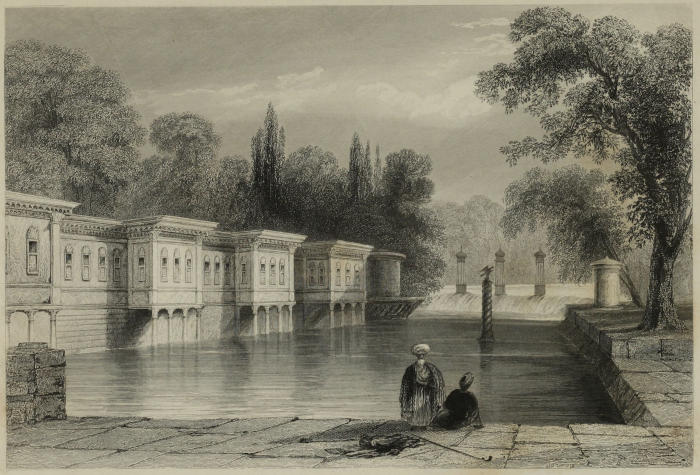
PALACE OF THE SWEET WATERS.
PALAIS DES EAUX DOUCES.DER PALAST DES SÜSSEN WASSERS.
W. H. Bartlett.
After a sketch by Miss Pardoe.W. Mossman.
London. Published for the Proprietors, by Geo: Virtue, 26, Ivy Lane, 1839.
The locality owes its name of Kyat-Khana, (literally signifying the House of
Paper,) to the fact that a paper manufactory was formed in the valley by a
renegade, named Ibrahim, in the year 1727, during the reign of Achmed III.
It was, however, abandoned, as well as a printing establishment instituted by
the same individual, in consequence of a refusal from the Ulema to permit the
printing of the Korān, which they declared to be too holy to be submitted to so
infidel a process; and the machinery and buildings were in a state of almost
equal dilapidation, when Sultan Selim, the uncle and predecessor of the present
sovereign, anxious to revive so useful an art among his people, gave up the palace
as a manufactory, and munificently encouraged the re-establishment of the fabric;
but he was fated to see this attempt fail, like many others which he made to
ameliorate the condition of his subjects, and which he ultimately expiated with
his life. All traces of the undertaking have now vanished from the valley, and
the palace has become once more an Imperial residence.
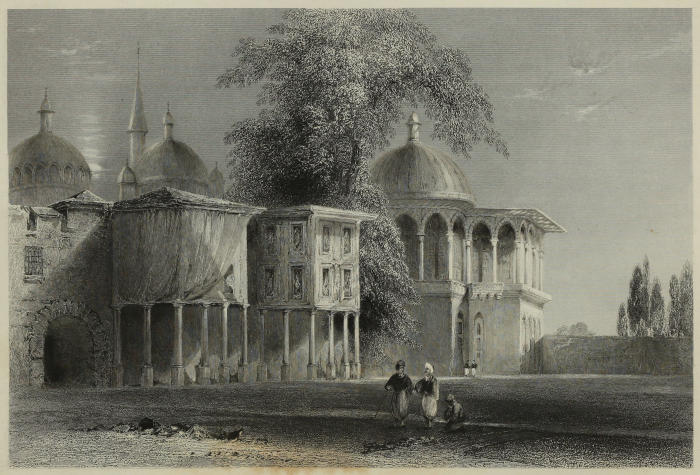
The smaller edifice to which allusion has been made, is a kiosque, also appertaining
to the Sultan, and occasionally occupied by the high officers of the
household: it stands on the very edge of the Barbyses, and the caïques glide
under the windows, or shoot along beneath the thick branches of the trees on the
opposite bank, with a velocity which, to the eye of a stranger, is perfectly surprising;
while the inmates of the kiosque smoke their chibouques in luxurious
indolence, fanned by the air of the river, and amused by the passing groupes.
The valley itself is delicious; the greensward is bright and rich, to a degree
unknown in any other environ of the city. In spring it is the grazing-ground
of the Imperial stud; and the beautiful Arabians are installed with great pomp,
picketted after the Eastern fashion, and superintended by parties of Bulgarians,
whose tents are pitched in the valley, and who never quit it under any pretence
until they are released from their charge. In summer it is the resort of all
ranks; who, on every Friday (the Turkish Sabbath,) resort thither, to enjoy what
none know better how to appreciate than the Orientals—a bright sky, a running
stream, flowers, leaves, and sunshine. Bullock-carriages, covered with gay-coloured
awnings of silken shag, fringed with gold; gilded arabas, drawn by swift
horses; and caïques, the number of whose elegantly-clad rowers denotes the rank
or wealth of their owners, pour forth their tenants every moment; while the
thick branches of the noble trees protect from the glare of the sun parties of
white-veiled women, who, squatted on their mats or carpets, and attended by
their slaves, sit for hours listening to the Wallachian and Bulgarian musicians,
who collect paras[4] and praises at a very trifling expense of melody; purchasing
the prettily and significantly arranged bouquets of the dark-eyed Bohemian
flower-girls; or watching the ungainly dances of the Sclavonians, who, with their
discordant bagpipes under their arms, perform evolutions which resemble the
saltatory attempts of half-educated bears. Here and there, a little apart from
the crowd, may be seen a party of Greeks, engaged in their graceful romaïka;
while groups of lovely children, and water-venders, and sweetmeat merchants,
wander up and down the greensward, and are greeted with smiles and welcome
on all sides. It is, in short, a spirit-stirring scene; and the poorer classes who
are unable to command a carriage, or a caïque, will cheerfully toil on foot from
the city, under a scorching sun, in order to secure their portion of the festival.
A great deal of public business is occasionally transacted at Kyat-Khana; and
then the sparkling Barbyses is alive with the gilded barges of the Pashas and
Beys, shooting over the ripple like meteors; the grandee himself being carefully
shielded from the sun by a red umbrella, held over him as he reclines on his
cushions at the bottom of the boat, quietly smoking his chibouque, by an
attendant, who is squatted on the raised stern of the arrow-like bark, immediately
behind him.
The valley of Kyat-Khana is a very favourite resort of the present Sultan, who
has expended considerable sums in beautifying the palace, and in ornamenting
the fountains and kiosques which appertain to it; but only a short time since
it was entirely abandoned for two years, owing to the death of a favourite
Odalisque, who expired suddenly, in the very zenith of her youth and beauty,
during a visit which she made here with her Imperial master; whose grief at her
loss was so intense, that he could not bear to inhabit the valley until time had
blunted his regret. A handsome head-stone, erected to her memory, lettered with
gold, and overshadowed by a weeping willow, stands upon a square platform,
beneath the windows of the saloon occupied by the Sultan; and the breeze, as it
sweeps through the flexile branches of the tree, almost carries them into the
apartment. Sultan Mahmoud, who is esteemed a very respectable poet for an
Emperor, is said, during his season of despair, to have written a pathetic ballad
in her honour; but, be that as it may, it is certain that she has been long forgotten
among the bevy of beauties who now tread the gilded chambers of the palace of
Kyat-Khana.
EYOUB.
“It is a goodly sight to see
What Heaven hath done for this delicious land!”
Byron.
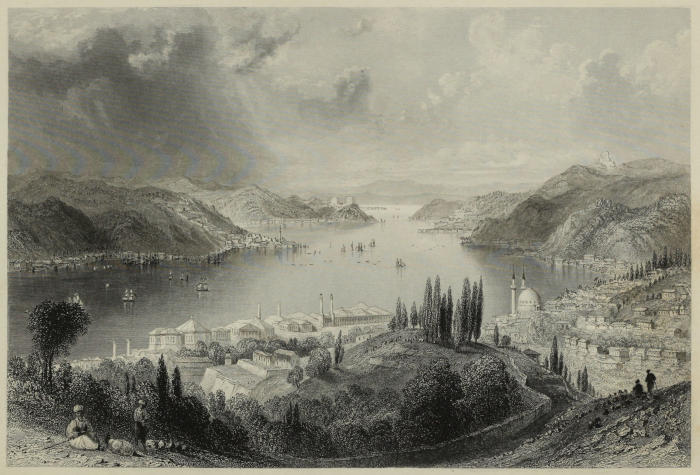
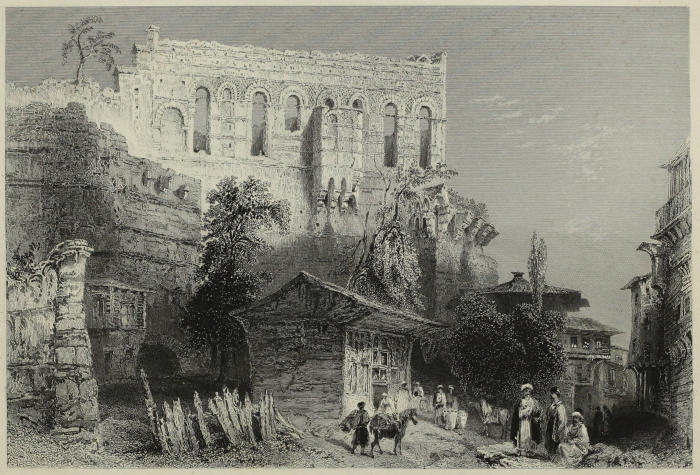
Eyoub, beautifully situated at the eastern extremity of the walls of Constantinople,
and stretching down to the very lip of the harbour, is the “holy of
holies” of the Turks. Its magnificent mosque and its picturesque cemetery are
equally historical; while its position, overlooking the whole extent of the Golden
Horn, and commanding a noble view far up the Bosphorus, is possibly unrivalled.
Smoothly-rounded hills, feathered with trees varying in character, but all rich in
beauty, form a background eminently scenic; the lofty maple and the leafy
plane-tree, the fan-like acacia and the rigid cypress, flourish side by side, and
overshadow a wilderness of graves; while the suburb itself, unusually well-built
and regular, circles a portion of the harbour with stately and pleasant dwellings.
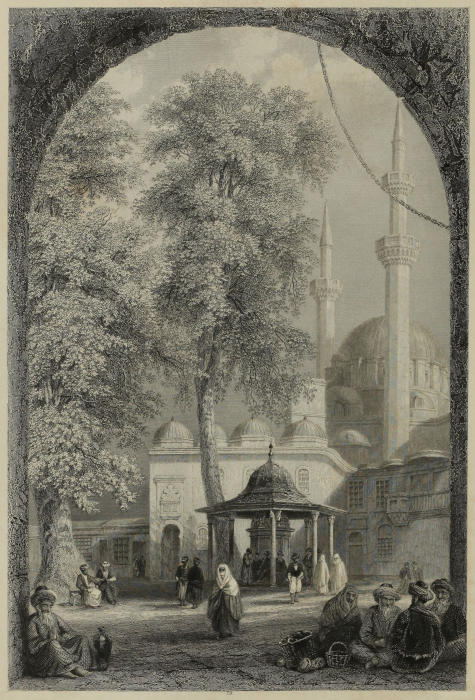
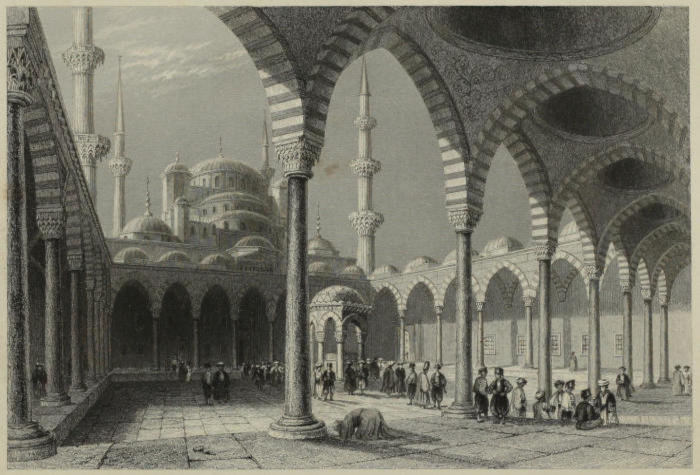
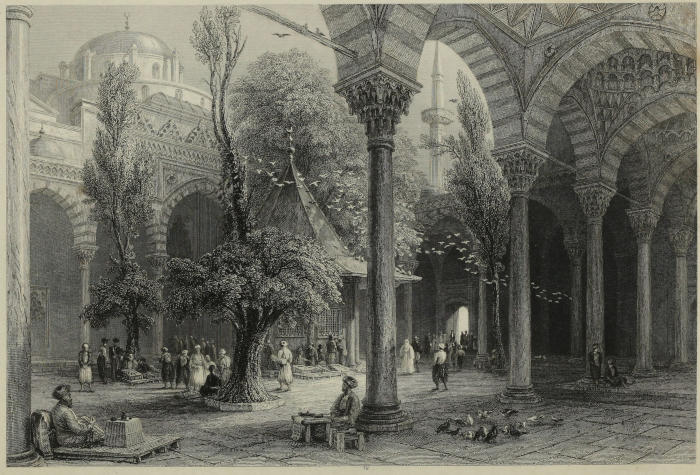
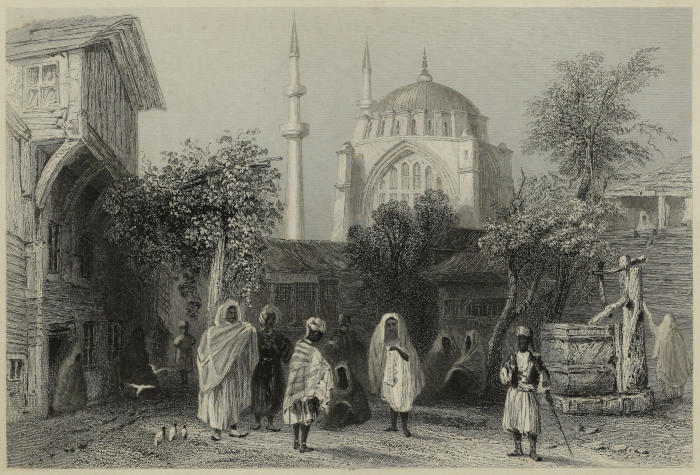
COURT OF THE MOSQUE OF EYOUB.
COUR DE LA MOSQUÉE D’EYOUB.DER HOF DER MOSCHEE ZU EYOUB.
W. H. Bartlett. J. Carter.
London. Published for the Proprietors, by Geo: Virtue, 26, Ivy Lane, 1840.
The mosque, built of the purest white marble, with a court gloriously shaded
by gigantic trees, and paved with the same material of which the edifice is
composed, is the most sacred of all the Constantinopolitan temples; for on this
spot tradition says that Abu Eyoub, the companion-in-arms of the Prophet, was
slain, during the siege of the Saracens in 668, a fact which was revealed in a
vision to Mahomet II. about 800 years afterwards; who, in commemoration of
the event, laid the foundation of the present mosque, which is one of the most
elegant in the capital; and is rendered still more holy in the eyes of the Turks,
from the circumstance that it is within these walls that every Sultan, on his
accession, is invested with the sword of sovereignty. No infidel foot is permitted,
under whatever pretence, to desecrate the mosque of Eyoub; and Christians are
rarely, and always reluctantly, admitted even to the court.
At Eyoub, on the very verge of the water, stands one of the summer palaces
built by the unfortunate Sultan Selim, and overlooking the lovely glen through
which the Barbyses flows calmly onward, to lose itself in the harbour. It is now
the property of the Sultana Asmè, the elder sister of the present Sultan.
“The decorations throughout are heavy, but of the greatest richness, and
perfectly oriental in their character. What was formerly the reception-room of
the ill-fated sovereign is entirely lined with gilding; the walls being niched and
overhung with stalactited cornices similar to those which decorate many of our
old cathedral tombs; and the weight of this elaborate ornament is relieved by a
ceiling of faint blue, sprinkled with silver stars.”[5]
The exterior of the building is in the Moorish taste, with a convoluted and
projecting roof; and the façade is of considerable extent.
Near this palace stands the great Fèz manufactory, where all the caps for the
court and the army are now made. It is a modern building, erected on the site
of one of the dilapidated kiosques of the Sultan, and is a very important and
ornamental feature in the landscape.
There is an anecdote connected with this establishment, which is sufficiently
characteristic and amusing to merit transcription; and it may be inserted
here for the benefit of the many, to whom it will be entirely novel. “The
manufactory was suggested and founded by Omer Lufti Effendi, in consequence
of the extremely high price paid by the Sultan to the Tunisians, with whom this
fabric originated, for the head-dress of his troops. Having induced a party of
Arabian workmen from Tunis to accompany him to Constantinople, he established
them in the old palace, which has since been replaced by the present noble
building; and under their direction the knitting and shaping of the caps acquired
some degree of perfection.
“But the dye was a secret beyond their art; and the Turkish government,
anxious to second the views of the energetic Omer Effendi, made a second
importation of Tunisians with no better success, although they were chosen from
among the most efficient workmen of their country. The caps, while they were
equal both in form and texture to those of Tunis, were dingy and ill-coloured;
and the Arabs declared that the failure of the dye was owing to the water in and
about Constantinople, which was unfavourable to the drugs employed.
“As a last hope, a trial was made at Smit, but with the same result; and the
attempt to localise the manufacture was about to be abandoned, when Omer
Effendi, suspecting the good faith of the Arabian workmen, disguised a clever
Angorian Armenian, named Avanis Aga, as a Turk, whom he placed as a labourer
in the dye-room. Being a good chemist and a shrewd observer, Avanis Aga,
affecting a simplicity that removed all suspicion, soon made himself master of the
secret which it so much imported his anxious patron to learn; and, abandoning
the ignoble besom that he had wielded, as the attendant of the Tunisian dyers,
immediately that he discovered the fraud, which, either in obedience to the secret
orders of their Regent, or from an excess of patriotism, they had been practising
ever since their arrival, he set himself to work in secret; and, with the water of
Smit, dyed two caps, which, having dried, he presented to Omer Effendi, who
was unable to distinguish them from those of Tunis.
“Delighted at the successful issue of his experiment, Omer Effendi summoned
the Arabs to his presence, and showed them the Fèz; when, instantly suspecting
the masquerade that had betrayed them, they simultaneously turned towards the
Armenian; and throwing their turbans on the ground, and tearing their hair,
they cried out, ‘Yaccoup! Yaccoup!’ (Jacob! Jacob!)
“The superintendent having dismissed them, after causing them to be liberally
remunerated for the time which they had spent at Constantinople, sent them
back to Tunis; while Avanis Aga, elected Head Dyer of the Imperial Manufactory
of Eyoub, now enjoys the high honour of deciding on the exact tint to be
worn by Mahmoud the Powerful, the ‘Light of the Sun,’ and ‘Shadow of the
Universe.’”[6]
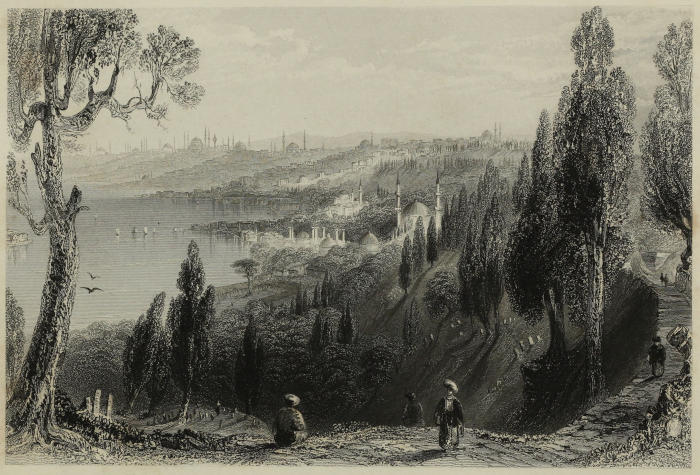
EYOUB.
W. H. Bartlett. Chas. Richardson.
London. Published for the Proprietors, by Geo: Virtue, 26, Ivy Lane, 1839.
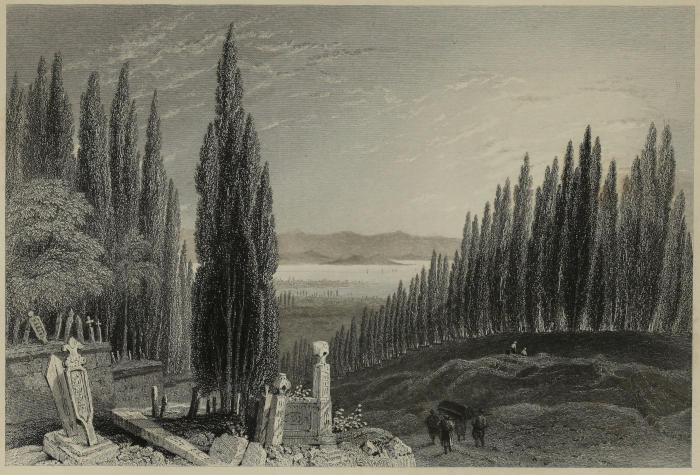
By far the most interesting feature of Eyoub is, however, its beautifully-situated
cemetery, occupying the slope of a thickly-wooded hill. After the
necropolis of Scutari, that of Eyoub is the most venerated by the Turks; and to
the stranger it is rendered peculiarly interesting by the fact, that it contains the
tombs of the “Tiger-Pasha,” Ali of Tepeleni, whose life, revolt, and death, form
a wild and thrilling romance; and those of his three sons, and his grandson; who,
in accordance with Eastern ideas of expediency, shared his punishment; and
whose trunkless heads now lie in the burial-ground of Eyoub, beside his own.
On a parapet wall directly facing the Selyvria gate, five oblong blocks of marble
of unequal height, and crowned with turbans, are ranged side by side in a conspicuous
situation. That which covers the head of the traitor himself is thus
inscribed:—“Here lies the head of the once celebrated Tepedelenly Ali Pasha,
Governor of the Sangiac of Yanina; who for more than fifty years pretended
to independence in Albania.” The others simply record the name and rank of
the respective victims, and terminate the inscription very naïvely with the words,
“who has been put to death by the cutting off of his head;” without attempting
to perpetuate any accusation of crime or misdemeanour; their unlucky relationship
to the rebel Pasha being accounted a sufficient treason.
When on a visit at the Fanar, or Greek quarter of the city, I had once a
momentary glimpse of the widow of this celebrated rebel. She was the daughter
of a Greek papas, or priest, of Yanina, of great beauty and some erudition, to
whom the Pasha was reported to have been passionately attached; though she
is accused (it is doubtful with what justice) of having stipulated to receive her
“thirty pieces of silver” for betraying him to the Government. Be this as it
may, it is certain that she possessed great influence over his mind; and that it
was entirely by her arguments and entreaties that he was dissuaded from the
desperate intention of blowing her, himself, and his treasures, up with gunpowder,
to prevent their falling into the hands of the Sultan; and that it was she who
negotiated the affair between Ali and Hourchid Pasha; while it is equally a fact,
that let her have made what compact she might, she received neither money nor
land from the Turkish Government after the execution of her husband, but was
turned over in a state of positive destitution to the custody of the Patriarch,
where she literally owed her daily comforts to the charity of the benevolent.
She was a voluntary prisoner in her apartment, from which she seldom emerged
save to attend some ceremony in the Patriarchal Church; and her time was said
to be generally passed in prayer.
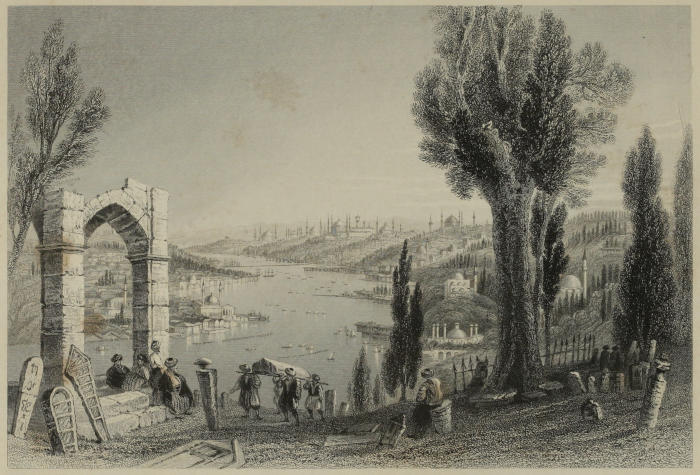
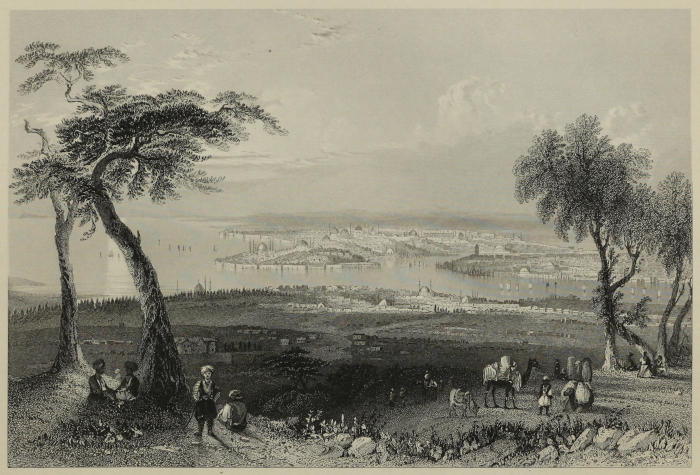
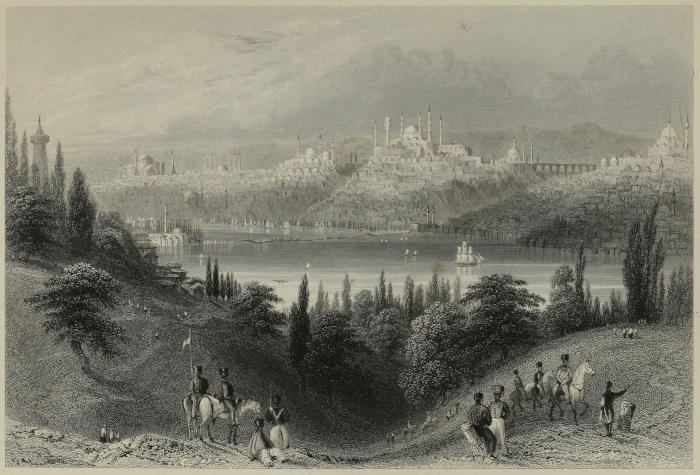
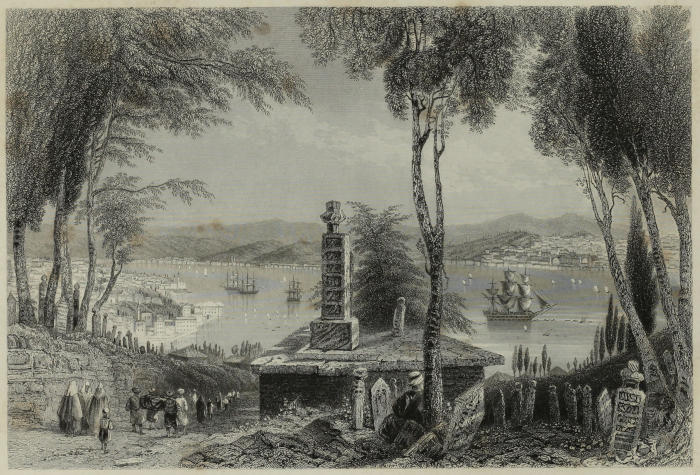
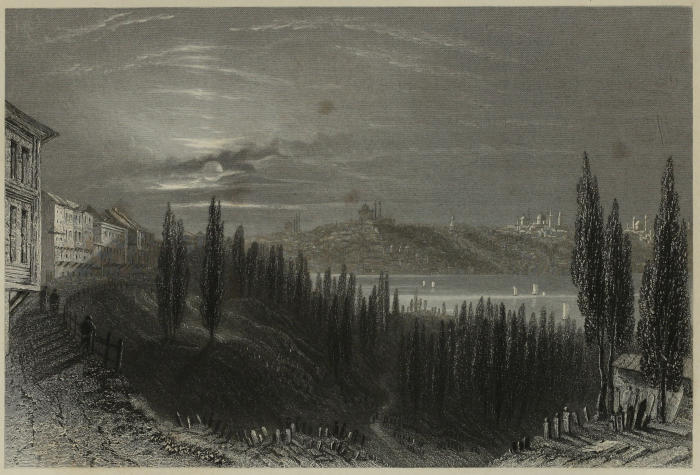
The view from the cemetery is strikingly fine; on the one hand the city,
throned on its seven hills, with a thousand stately domes gleaming in the sunshine,
and a thousand taper minarets glancing towards heaven, stretches along
the edge of the harbour, until the line is lost at the abrupt and palace-cumbered
point of the ancient Byzantium; beyond which may be descried the termination
of the Bosphorus, and the mountain-chain of Bulgurlhu, on the Thracian shore
of the channel.
On the other side of the land-locked harbour the gently-flowing Barbyses
glides, like a silver thread, through the valley of Kyat-Khana, to pay its
tribute to the wealth-freighted waters of the Golden Horn; and on the verge of a
small hamlet not above two furlongs from this calm stream, stands a small
mosque, half buried in trees, insignificant in appearance, and seldom remarked
by strangers; which is, however, too historically interesting to be passed over.
It is called the “Mosque of Blood,” and is painted a dull red from the base of
its walls to the summit of its single minaret. It is a desecrated temple, having
been forced during the last siege by a party of combatants, some of whom expired
beneath its roof, and thus brought the presence of death where, on religious principles,
it is never suffered to intrude; while in its immediate vicinity rises a bleak,
treeless, and desolate-looking eminence, occupied by the bones of all the True
Believers who perished during that memorable struggle, to the amount of some
thousands: their remains have been respected, but there is neither monument
nor inscription to perpetuate the memory of their good services.
Beyond this mosque, the out-buildings of the Imperial arsenal, the dry-dock
for the construction of shipping, the galleys, (which are under the immediate
control and authority of the High Admiral,) the powder magazines, and the
ruined palace of a former Capudan Pasha, occupy the shore as high as the suburb
of Kassim Pasha, where stands the Marine Barrack, a huge pile, chiefly remarkable
for the wretched taste of its tawdry fresco-painting, and its air of chilling
desolation; and near to it the new Tershana, or Admiralty, a bright, many-coloured,
highly-ornamented edifice, in the Russian taste; occupying the side of
a small creek, and overlooking a wooden pier. A wet-dock, handsomely enclosed
within solid and well-made walls, and entered through a noble pair of iron gates,
below Kassim Pasha, is succeeded by a height covered with cypresses, which leans
downward to the water, where it terminates in a steep flight of steps, partly
artificial and partly hewn in the rock, and designated the Meit-iskelli, or Ladder
of the Dead. This gloomy forest is the “Little Cemetery,” or lesser burial-ground
of Pera, the faubourg inhabited by the Franks; and the jetty at the foot
of the stair which has just been described, is principally used for the embarkation
of the bodies of deceased Turks, whom their friends are conveying for burial to
the Asian necropolis of Scutari.
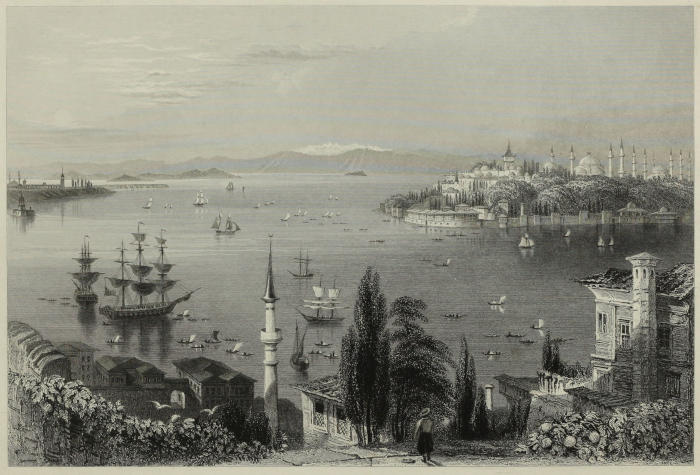
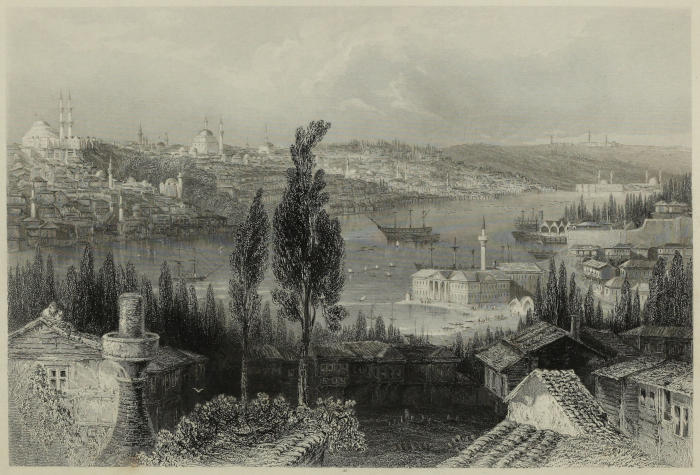
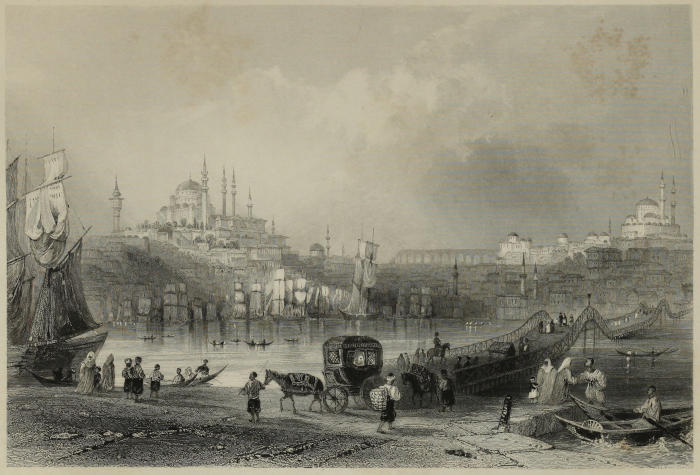
THE GOLDEN HORN, FROM THE CEMETERY OF EYOUB.
W. H. Bartlett. H. Adlard.
London. Published for the Proprietors, by Geo: Virtue, 26, Ivy Lane, 1839.
Immediately beyond this jetty, a floating bridge, stretching from the pier of
Galata (the quarter of the Frank merchants, dominated by the hill on which
Pera is built,) to the “Gate of the Garden,” near the Kiosque of Pearls, and
immediately under the walls of the Seraglio, shuts in the harbour; while the
line of shore in the distance, fringed with the houses and public buildings of
Top-hannè, gently recedes, until it disappears under the stately shadow of
Bulgurlhu.
TURKISH BATHS.
Here Beauty on her ’broidered cushion lies
With languid brow, and dreaming downcast eyes—
A rose o’ercharg’d with rain: beside the fair
A kneeling slave binds up the glossy hair;
Pours perfumed water o’er the drooping face,
And lends to loveliness another grace.
MS. Poem.
There is, perhaps, no luxury throughout the luxurious East more perfect,
or more complete, than the Baths. Those of the great and the wealthy in
Constantinople embody the idea of a scene in the “Thousand and One Nights”—they
are so bright and fairy-like in their magnificence—so light and gay with
painted glass, white marble, brocade, and embroidery.
Every bath, however small may be its dimensions, consists of three apartments;
the outer hall, in which the bathing-dress is arranged; the cooling-room,
a well-cushioned and comfortable space, moderately heated, and intended
for the temporary reception of the bathers before they venture to encounter
the pure free air of the exterior apartment; and the bath itself, where the
atmosphere is so laden with sulphuric vapour, that, for some seconds, the breath
is impeded, and the suffocating sensation which ensues is positively painful.
The Imperial Bath at the summer-palace of Beglier-Bey, is one of the most
elegant and costly in the city or its environs: and as it can only be seen by the
express permission of the Sultan himself, is well worthy of description. Passing
a crimson door, surmounted by a crescent-shaped cornice of rich gilding, the
visitor enters a small hall, in which stands a basin of fine white marble, occupied
by two swans, wrought in the same material, and appearing to sport in the
limpid water; which, escaping from this charming fountain, falls through concealed
pipes into the basins destined to supply the bathers. The cooling-room,
opening from this dim apartment, (where the light only penetrates after struggling
through stars and crescents of painted glass, inlaid in the marble roof like
clusters of jewels,) is hung with draperies of silk, richly embroidered; and the
large mirror which occupies the wall at the lower end of the divan, is set in a
frame-work of gold and enamel, surmounted by the Ottoman arms, skilfully
executed; while the divan itself, formed of gay-coloured satin, is wrought in
silks until it resembles a flower-bed; and the cushions which are scattered over
it are of the same beautiful and costly description. The bath is a vast hall, of
the most elegant proportions, lined, and roofed, and paved with marble. It is
lighted like the cooling-room, and surmounted by exquisitely-imagined fountains;
and gives back a long and subdued echo at every footfall which disturbs
its deep and dreamy silence.
This description will serve to convey an idea of the baths of the great, and
will give no exaggerated impression of their magnificence; the establishments
of the Pashas and Beys being all precisely similar in their arrangement, and
only varying in splendour with the resources of their owners. Here the fair
Zibas and Heyminès of the different palaces pass whole hours, folded in long
scarfs of muslin, worked and fringed with gold, their dark hair streaming over
their ivory shoulders; inhaling the sulphuric atmosphere, and enjoying the
luxurious languor which it creates; sipping sherbets made of the most delicate
conserves, or the finest fruits; and, not unfrequently, enjoying a slumber which
is nowhere deeper than amid the dense vapours of the bath-room.
But the public Hammām is altogether a different scene. No dreamy silence,
no thoughtful abstraction can be indulged in the far-stretching hall, where hundreds
congregate, and where the echoes of the many-domed roof heighten and
prolong every harsh sound into tenfold discordance. These establishments are
numerous in Constantinople, and fortunes, really colossal for that country, are
said to be made by them, although they pay a heavy tax to the government.
From eight in the morning they are open until sunset, men and women frequenting
them on alternate days; and the ladies seldom fail to avail themselves of the
whole of the time allowed, by spending it almost entirely in the Hammām.
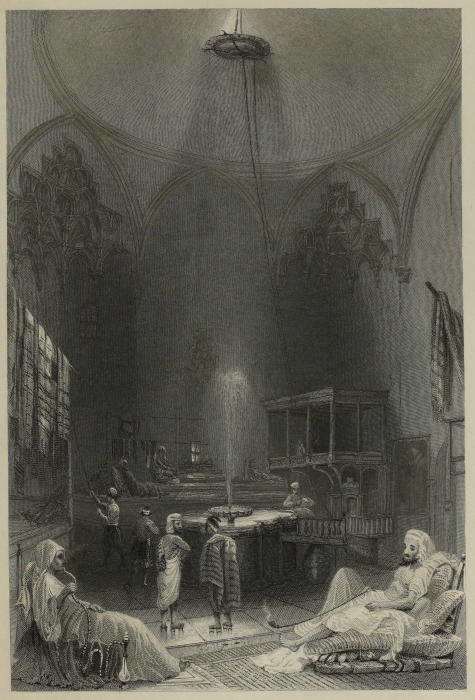
COOLING ROOM OF A HAMMĀM.
W. H. Bartlett. J. T. Willmore.
London. Published for the Proprietors, by Geo: Virtue, 26, Ivy Lane, 1839.
The bath is the very paradise of Eastern women. Here they assemble to
discuss every subject of interest and amusement, whether politics, scandal, or
news; to arrange marriages, and to prevent them; to ask and to offer advice;
to display their domestic supremacy, and to impart their domestic grievances;
but, above all, to enjoy the noise, the hurry, and the excitement, which form
so great a contrast to the calm and monotony of the harem.
On leaving the outer hall, the bather is supplied with a pair of wooden
pattens, raised several inches from the floor, which is so much heated in the
inner apartments, that, until the vapour has had time to operate upon the frame,
it is impossible to touch it with the naked foot. Thus provided—and among
the higher classes these pattens are objects of great cost and luxury, the band
by which they are secured across the instep being frequently inlaid with jewels—the
bather passes into the cooling-room, where a number of little channels, filled
with warm water, traverse the floor in every direction; which, while they add to
the heat, serve to diminish the oppression of the vapour that escapes at each
opening of the door of the bath itself; an extensive octagon hall, containing
eight fountains, and surrounded by small cabinets for those who do not choose
to avail themselves of the more public apartment.
We cannot, perhaps, do better than take a description of the extraordinary
scene presented by this locality from the pages of an eye-witness.
“For the first few moments I was bewildered; the heavy, dense, sulphureous
vapour that filled the place, and almost suffocated me—the wild shrill cries of
the slaves pealing through the reverberating domes of the bathing-halls, enough
to awaken the very marble with which they were lined—the subdued laughter
and whispered conversations of their mistresses, murmuring along in an under-current
of sound—the sight of nearly three hundred women, only partially dressed,
and that in fine linen so perfectly saturated with vapour that it revealed the
whole outline of the figure—the busy slaves passing and repassing, naked from
the waist upwards, and with their arms folded upon their bosoms, balancing on
their heads piles of fringed or embroidered napkins—groups of lovely girls,
laughing, chatting, and refreshing themselves with sweetmeats, sherbet, and
lemonade—parties of playful children, apparently quite indifferent to the dense
atmosphere which made me struggle for breath—and, to crown all, the sudden
bursting forth of a chorus of voices into one of the wildest and shrillest of
Turkish melodies, that was caught up and flung back by the echoes of the vast
hall, making a din worthy of a saturnalia of demons, all combined to form a
picture like the illusory semblance of a phantasmagoria, almost leaving me in
doubt whether that on which I looked were indeed reality, or the mere creation
of a distempered brain.”[7]
In this hall, amid the noise and hurry here described, those who frequent it
collect round the fountains, which are plentifully supplied with both hot and
cold water, each lady attended by one or more slaves; her hair is then combed
and saturated with water, poured over it from a basin of metal; and her limbs
are gently rubbed by a hand covered with a small glove, or rather bag, woven
of camel’s hair; after which, she changes her dripping garments for others that
await her near the door of the hall, and passes into the cooling-room. Here,
reclining on mats and carpets, the bathers sometimes lie for hours, with their
hair concealed beneath heavy napkins, and their whole persons wrapped closely
in long white scarfs, like winding-sheets. Were it not that they are flushed by
the action of the vapour, and for the ceaseless conversation which they maintain,
they would look like a party of corses prepared for burial.
When at length they venture into the outer hall, they at once spring upon
their sofas, where the attentive slaves fold them in warm cloths, and pour essence
upon their hair, which they twist loosely without attempting to dislodge the
wet, and then cover with handsome head-kerchiefs of embroidered muslin;
perfumed water is scattered over the face and hands, and the exhausted bather
sinks into a luxurious slumber beneath a coverlet of satin or of eider-down.
The centre of the floor, meanwhile, is like a fair; sweetmeat, sherbet, and
fruit-merchants, (old crones, who frequently have as many billet-doux as bowls
of yahourt[8] in their baskets,) parade up and down, hawking their wares.
Negresses pass to and fro with the dinners, or chibouques,[9] of their several
mistresses; secrets are whispered—confidences are made; and, altogether, the
scene is so strange, so new, and withal so attractive, that no European can fail
to be both interested and amused by a visit to a Turkish Hammām.
PALACE OF BESHIK-TASH.
“The European with the Asian shore
Sprinkled with palaces: the ocean-stream
Here and there studded with a seventy-four;
Sophia’s cupola with golden gleam:
The cypress groves: Olympus high and hoar.”
Byron.
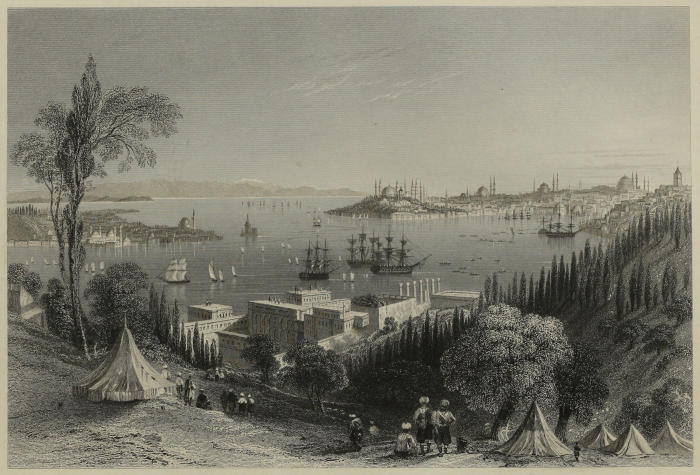
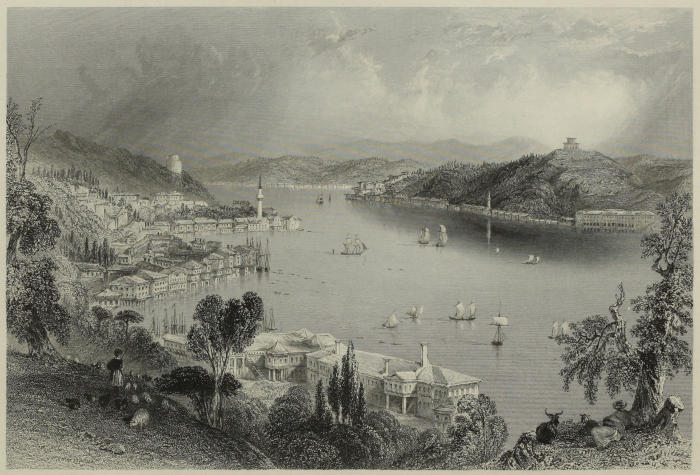
The new palace of Beshik-Tash, erected by the present Sultan, commands
a noble view of the Propontis; sweeps the Bosphorus through nearly its whole
length; looks towards Scutari, (the Asian jewel seated at the foot of the dark
mountain-chain of Bulgurlhu-Dagi;) affords a glimpse of the ancient Chalcedon;
and includes within the range of its magnificent prospect the snow-crowned summit
of Mount Olympus, flashing out in the distance through the clear blue of the
horizon like a huge pearl set in sapphires; the Seraï Bournou, whose imperial
walls enclose what was once a city; and the “Seven Hills” of glorious Stamboul.
The world can probably produce no similar panorama; and as the traveller
stands on the height above the palace gardens, and looks down upon the heavy
inelegant wooden edifice, protected on the seaward side by a stately colonnade
of white marble, he may well be pardoned should he indulge a regret that this
imperial residence should be so unworthy of its admirable and unequalled site.
SCENE FROM ABOVE THE NEW PALACE OF BESHIK-TASH.
W. H. Bartlett. R. Wallis.
London. Published for the Proprietors, by Geo: Virtue, 26, Ivy Lane, 1839.
During the youth of Sultan Mahmoud, he was induced to consult a celebrated
astrologer, who, among other predictions, foretold, that while he continued to
build palaces, he should be successful in all his undertakings. And it would
appear that he put the most perfect faith in the prophecy, for every pretty bay
in the Bosphorus has its kiosque; and the number of his residences in the
immediate vicinity of the capital, amounts to fifty-seven. The palace of Beshik-Tash
is the last and most extensive of the whole, but decidedly the least
picturesque and elegant. Its Armenian architect was not, however, selected
without due consideration on the part of the Sultan, who was won to decide
on the present plan by the assurance that it was thoroughly European; a fact
which could not be disputed, were the glittering and well-proportioned columns
that support the open peristyle swept away, when this huge pile, which has
cost upwards of a million sterling, would present precisely the appearance of
a manufactory.
There is an anecdote connected with the palace which is extremely characteristic
of its regal builder, and which may appropriately be introduced here.
While yet undecided unto whom he should confide the great work of its erection,
an architect (also an Armenian) was introduced to the Sultan by one of his
favourites, and was desired to be upon the spot destined for its site at a particular
hour, in order to judge of its capabilities, and to explain them to his imperial
master. Ere they entered upon the actual subject of their meeting, Mahmoud
stretched forth his arm towards the Seraï Bournou,[10] of which nothing could
be seen above the surrounding walls but the gleaming roofs, with here and there
a tall white minaret, or a stately dome, standing out from amid a forest of
cypress and maple-trees; and drily inquired what the stranger thought of the
palace of Amurath? The Armenian cautiously replied, that never having been
enabled to examine the nature of the building, he was totally inadequate to form
any judgment. “Let him have the opportunity;” said the Sultan to the Bey
by whom he had been introduced, “and to-morrow I will hear the result.”
The astonished raïah,[11] consequently, found himself in a few moments darting
over the ripple in the caïque of his patron; and, ere long, actually passing the
sacred threshold which it had hitherto been death to any infidel to tread.
Bewildered and, perhaps, misled by his astonishment, and dazzled by the gilding
and glitter of the celebrated Seraï—or, it may be, fearful of undervaluing by a
word an edifice which had so long been a world’s wonder—or, again, tutored
by his friend, the courtier—he declared, when he next stood in the presence
of the Sultan, that, in as far as his poor judgment served, earth held nothing to
compare with the palace of Amurath.
“Would you tell me that Europe boasts not its equal?” asked the Sultan
calmly.
“I have visited many of the cities of the west;” said the obsequious raïah,
“and I have seen nothing from the rising of the sun to its going down, so perfect
as the Seraï Bournou.”
“Chok chay—that is much!” smiled the Sultan; “then the Franks are liars
when they send me things like these, and tell me that they represent the palaces
of their Padishahs;”[12] and as he spoke he drew out a roll of paper which he
held in his hand, and displayed to the discomfited Armenian views of the different
imperial and royal edifices of Europe. “Have you ever seen any of these
Seraïs? and do they really not resemble the drawings now before me?”
“They do, may it please your highness; I have looked on many of them.”
“Then,” said the Sultan, “you are unsuited to the undertaking which I contemplate;
for none, save a rogue or a fool, could class that place, fitted only
for deeds of blood and mystery”—and he pointed once more towards the Seraï
Bournou; “that place, hidden beneath high walls, and amid dark trees, as
though it could not brave the light of day; with these light, laughing palaces,
open to the free air, and the pure sunshine of heaven. Such would I have my
own; and such it shall be:—we have therefore met for the last time.”
And the Armenian, having prostrated himself before the “Lord of the Three
Seas,” withdrew from the presence of his master to comfort himself as he might
under his disappointment and disgrace.
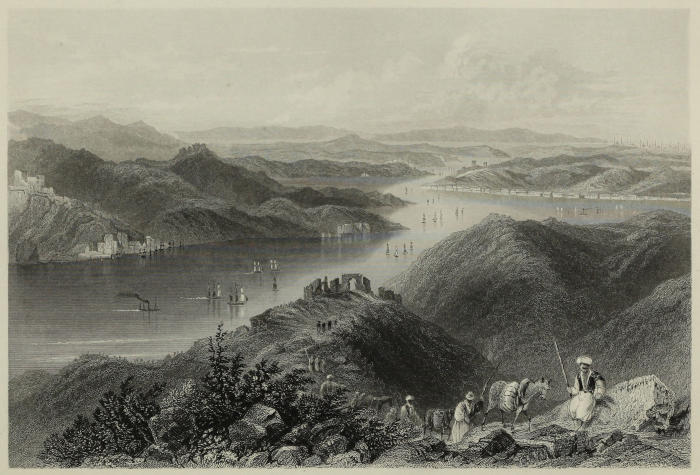
THE BOSPHORUS, FROM ABOVE BESHIK-TASH. (Looking North.)
LE BOSPHORE (NORD) VU DU HAUT DE BESHIK-TASH.DER BOSPHORUS NACH NORDEN HIN, GESEHN VON BESHIK-TASH HER.
W. H. Bartlett. J. Cousen.
London. Published for the Proprietors, by Geo: Virtue, 26, Ivy Lane, 1839.
The ground upon which the palace stands was formerly occupied by an elegant
kiosque, built by Sultan Selim—a glittering gaily-tinted pavilion, looking like
a huge tulip amid the cluster of cypresses in the centre of which it rose; and
a Tekiè or chapel of Turning Dervishes; whose community, undaunted by the
displeasure of the Sultan, persisted in the occupation of their dwelling, although
the walls of the new palace grew higher from day to day, until they fairly overtopped
the more modest roof of the holy building. To the frequent orders
which they received to vacate their Tekiè, they replied only that they were not
free to depart, as they guarded the ashes of a saint; whose tomb, surrounded
by a lattice-work of bright green, about half way up the height above the
channel, was indeed a conspicuous object from their windows. In this dilemma,
the Sultan applied to the Chèïk-Islam, or High Priest, to enforce their removal;
but he was again met by a steady refusal, the Chèïk-Islam pleading the danger
of such a precedent, and declining all interference. Sultan Mahmoud heard
him in silence, and did not again agitate the question until the chapel was fairly
built in, when he simply informed the chief Dervish of the precise day on which
he was to vacate the premises; or, in default of his so doing, the roof would be
pulled about the ears of his community. The holy man stood aghast, but there
was no alternative; and the brotherhood in a few hours took quiet possession
of a handsome house on the edge of the water, which had been made over to
them by the Sultan, on the death of the court jester, to whom it had previously
belonged.
The magnificent Turkish line-of-battle ships, when in harbour, are anchored
about mid-stream, in the immediate vicinity of Beshik-Tash; and nothing can
be finer than the effect of their stupendous brass guns when firing a salute.
The peal rattles along the hills, flung back at intervals by the walls of the
Seraglio, until it finally dies away in the distance, throwing a long musical
sound, like the hollow rumbling of a coming storm along the billows of the
Black Sea.
The gardens of the palace are extensive, but will require time to make them
worthy of description; at present, a great portion of the hill-side behind the
building is left in its original state, boasting for all ornament sweeps of fine
cypresses, and here and there a tuft of almond trees, a group of acacias, or a
majestic maple; while the white tents of the Bulgarian workmen employed
upon the walls, give to the scene the picturesque and cheerful appearance of a
summer encampment.
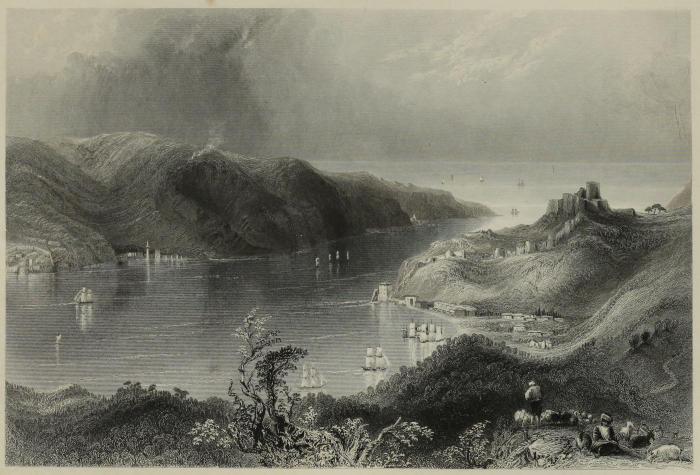
THE CASTLES OF EUROPE AND ASIA.
“Lo! dusky masses steal in dubious sight
Along the leaguered wall and bristling bank
Of the arm’d river.”
Byron.
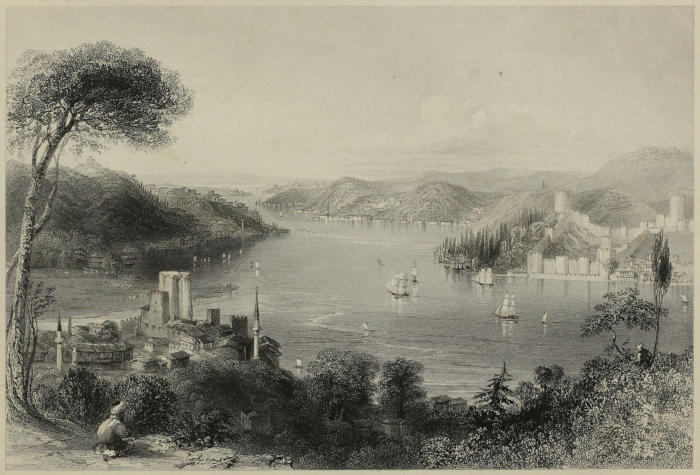
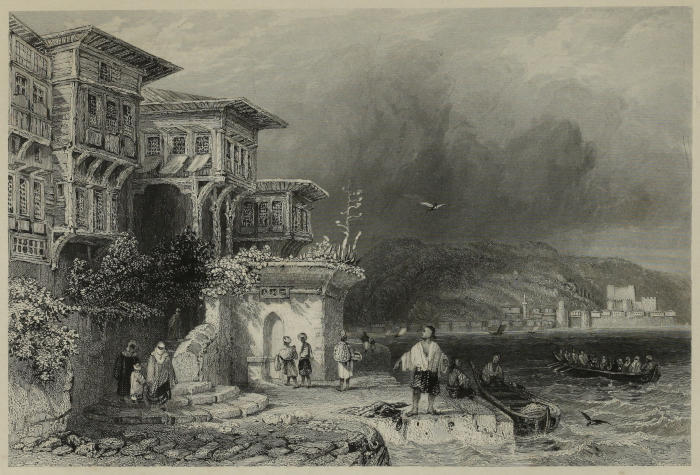
These fortresses stand on either shore of the Bosphorus, about half way up;
where the channel is unusually narrow, and was once traversed by the celebrated
bridge of Darius. The Anadoli Hissari, or Castle of Asia, was, during the reign
of the Janissaries, the prison of the Bostangis, or body-guard of the Sultan, who
were here immured or executed as the nature of their crimes dictated. It rises
on the lip of a pleasant rivulet which empties itself into the Bosphorus, and
washes the tree-fringed valley of the Asian Sweet Waters, called by the natives
Guiuk-Suy, or Chest-water, from the extreme purity of the spring.
THE CASTLES OF EUROPE AND ASIA.
W. H. Bartlett. G. K. Richardson.
London. Published for the Proprietors, by Geo: Virtue, 26, Ivy Lane, 1839.
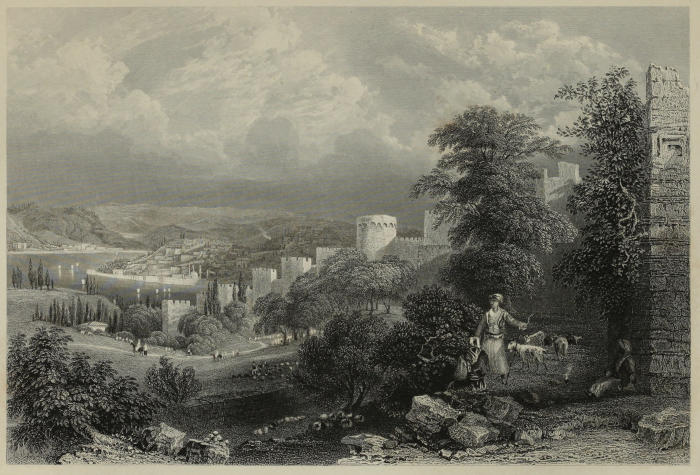
The Roumeli Hissari, or Castle of Europe, on the opposite shore, is of very
singular construction, the ground-plan forming the characters of the Prophet’s
name; by whom, tradition says that it was built in six days, by permission of
the Greek emperor, who, with more courtesy than policy, acceded to the desire
of Mahomet to possess a pied-à-terre on the European edge of the channel.
This fortress was the celebrated prison of the Janissaries; and the large gun yet
fills its embrasure on the lower rampart, which was fired on the execution of
every criminal, to announce to the Sultan that the guilty one had expiated his
crime. The strength of the Castle is much greater than its appearance from
the sea would indicate; and it is well supplied with water, and the means of
storing provisions. The Traitor’s Gate is the only seaward entrance to the
fortress; and through its low wide arch the bodies of the strangled Janissaries
were dragged by the heels, and flung into the Bosphorus. There are four principal
towers, one of which occasionally served as a state-prison for persons of
distinction; that immediately above it, is called the Tower of Blood, where the
Agas, or chiefs of the Janissaries, were put to death privately, and their bodies
conveyed to the Bosphorus through a tunnel excavated beneath the foundations
of the fortress; it being considered unsafe and impolitic to dishonour their remains
in the eyes of that formidable body, in the public manner in which the corses of
their less distinguished comrades were mutilated and insulted.
The Janissaries’ Tower is built upon the highest point of land within the
walls, and commands one of the finest views in the world; having on one hand
the whole stretch of the channel to the opening of the island-studded Propontis;
and on the other, the entrance of the Black Sea, with the “blue symplegades”
in the dim distance, looking as if they were indeed fulfilling the ancient superstition,
and wandering over the waters of the “storm-vexed Euxine.”
The instrument to which the fatal cord used in strangling the Janissaries
was attached, is an old Roman bow of extraordinary strength; and the place
of execution was a portion of the covered way that connects the towers throughout
the fortress; and it is painful to look from this place of death upon the
brightness and the beauty of nature, and to remember how many have so looked
for the last time! The blue, sun-lighted sky—the sparkling water—the fantastic
and changeful shadows cast by the broad leaves of the wild fig-trees upon the
earth—the song of the wild-birds from the underwood beneath the ramparts—all
seem to conspire in investing the world with a dearer charm, and in lending
to life a value which must enchance tenfold the bitterness of death.
The few houses built within the walls of the fortress are in good repair, and
are surrounded by pleasant gardens. Their tenants marry and intermarry continually,
not being permitted to form any alliance with families unconnected
with the Castle; and, altogether, the celebrated Roumeli Hissari, (a sealed book,
save in one recent instance, to all European travellers,) possesses a great moral
interest, as well as extreme picturesque beauty.
FOUNTAIN OF THE ASIAN SWEET WATERS.
“A glowing scene of water, leaves, and light,
And white-veil’d dames, and turban’d men are there;
And all around the earth and sea are bright
And beautiful in the sunshiny air;
Soft ripples dance upon the channel’s breast,
Light breezes sweep along the mountain’s crest,
And woman’s voice, and childhood’s laugh of glee,
Come blended on the ear harmoniously.”
MS. Poem.
The Valley of Guiuk-Suy, charmingly situated about midway of the
Bosphorus, and called by Europeans the Asian Sweet Waters, owes its charm
and its popularity (like the glen of Kyat-Khana, already described,) to the
circumstance of its being intersected by a pretty stream of fresh water, which,
after flowing along under the shadows of tall and leafy trees, finally mingles
its pigmy ripples with the swifter waves of the channel. The Anadoli Hissari,
or Castle of Asia, stands upon its margin, and painfully recalls the mind to the
darker and sterner realities of life; or the visitor to Guiuk-Suy might fancy
himself in Arcadia, so lovely is the locality.
On Fridays, (the Mahommedan Sabbath,) the valley is thronged with holiday-keeping
idlers; and here the Frank traveller may see more of the habits and
morale of the Turkish women than he can hope to do elsewhere; for here, being
on Asiatic ground, they appear to feel more at home, and less trammelled by
the restrictions of their creed than in any other environ of the capital; their
yashmacs are less scrupulously arranged, they are more accessible to strangers,
and they do the honours of their lovely valley with a gentle courtesy extremely
pleasing.
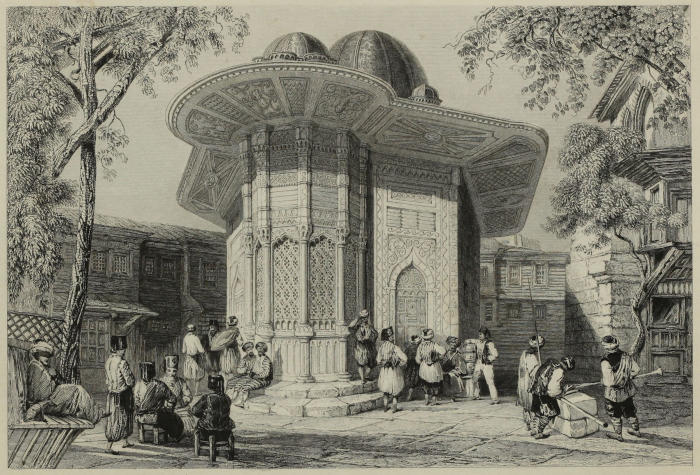
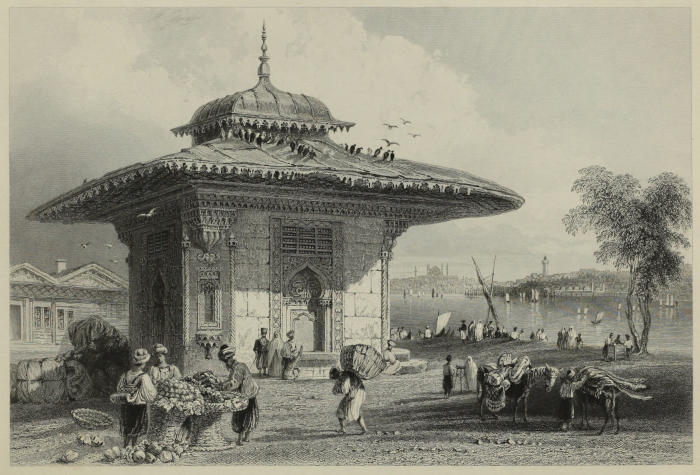
FOUNTAIN NEAR THE ASIAN VALLEY OF SWEET WATERS, ON THE BOSPHORUS.
W. H. Bartlett. H. Griffiths.
London. Published for the Proprietors, by Geo: Virtue, 26, Ivy Lane, 1839.
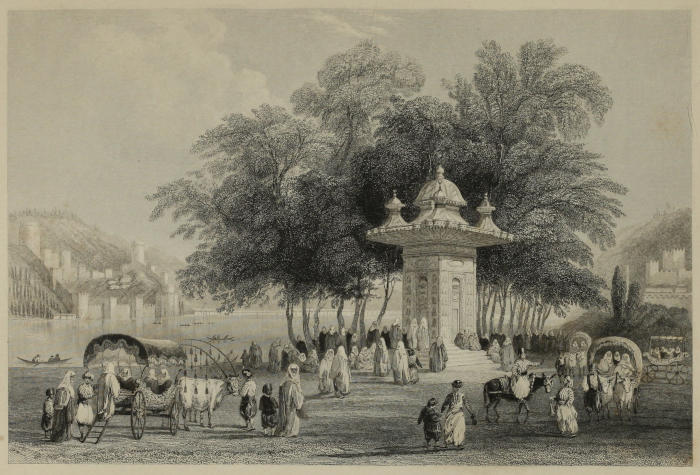
All ranks alike frequent this sweet and balmy spot. The Sultanas move
along in quiet stateliness over the greensward in their gilded arabas, drawn
by oxen glittering with foil, and covered with awnings of velvet, heavy with
gold embroidery and fringes; the light carriages of the Pashas’ harems roll
rapidly past, decorated with flashing draperies, the horses gaily caparisoned,
and the young beauties within pillowed on satins and velvets, and frequently
screened by shawls of immense value; while the wives of many of the Beys,
the Effendis, and the Emirs, leave their arabas, and seated on Persian carpets
under the leafy canopy of the superb maple-trees which abound in the valley,
amuse themselves for hours, the elder ladies with their pipes, and the younger
ones with their hand-mirrors; greetings innumerable take place on all sides;
and the itinerant confectioners and water-venders reap a rich harvest.
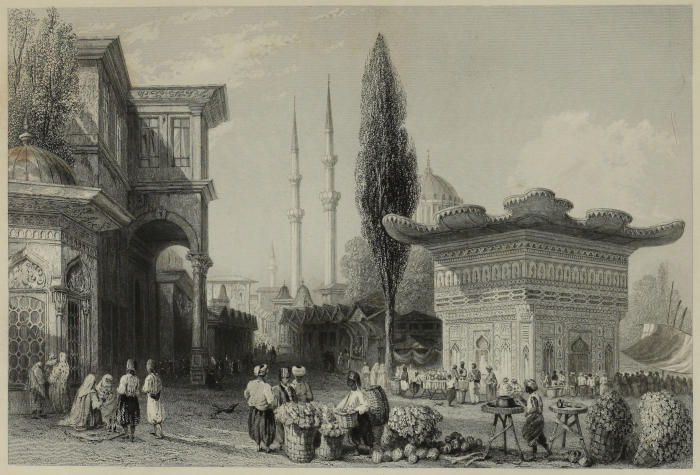
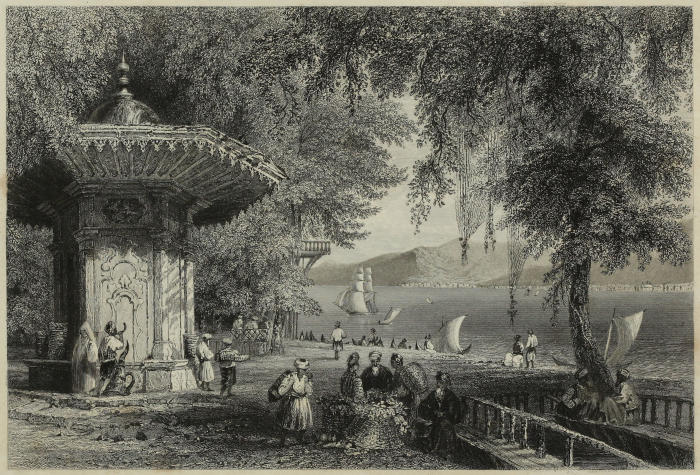
The Fountain of Guiuk-Suy stands in the midst of a double avenue of trees,
which fringe the border of the Bosphorus. It is built of delicate white marble,
is extremely elegant in design, and elaborately ornamented with arabesques.
The spot which it adorns is a point of reunion for the fair idlers of the valley,
when the evening breeze upon the channel renders this portion of the glen more
cool and delicious than that in which they pass the earlier hours of the day;
and is only separated from it by the stream already named, which is traversed
by a heavy wooden bridge.
The whole coup-d’œil is charming; slaves hurry hither and thither, carrying
water from the fountain to their respective mistresses, in covered crystal goblets,
or vases of wrought silver. Fruit-merchants pass and repass with amber-coloured
grapes and golden melons; Sclavonian musicians collect a crowd about
them, which disperses the next moment to throng round a gang of Bedouin
tumblers; serudjhes gallop over the soft grass in pursuit of their employers;
carriages come and go noiselessly along the turf at the beck of their fair occupants;
a fleet of caïques dance upon the ripple, ready to convey a portion of the
revellers to their homes on the European shore; and the beams of the bright
sun fall full on the turretted towers of the Castle of Europe, on the opposite
side of the channel, touching them with gold, and contrasting yet more powerfully
their long and graceful shadows upon the water.
AQUEDUCT NEAR PYRGO.
“Relic of nobler days, and noblest arts.”
Byron.
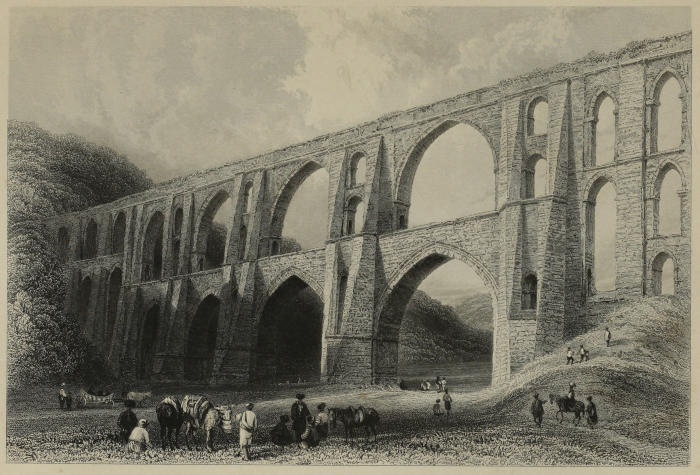
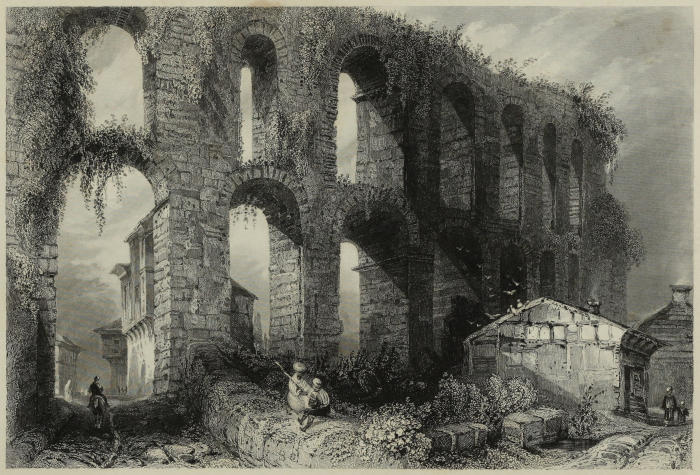
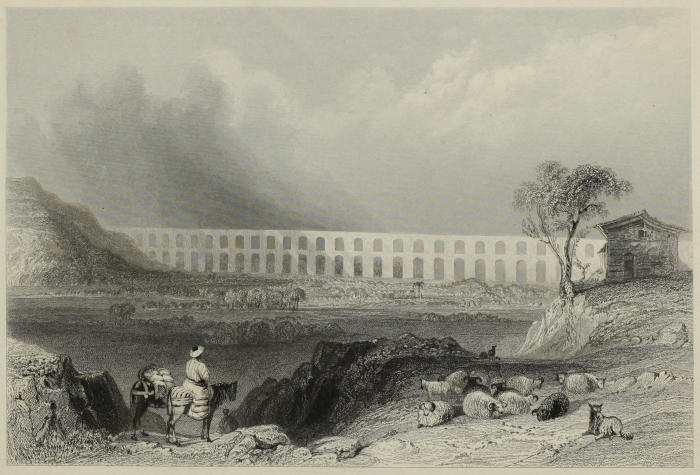
This fine remain of by-gone industry and taste is indifferently ascribed to
the Emperor Valens, and to Justinian; no positive record of its date or founder
being now in existence. It spans a lovely hill-embosomed valley near Pyrgo,
and is one of several aqueducts still in existence between the city of Constantinople,
and the beautiful, romantic, and Frank-peopled hamlet of Belgrade,
on the Black Sea.
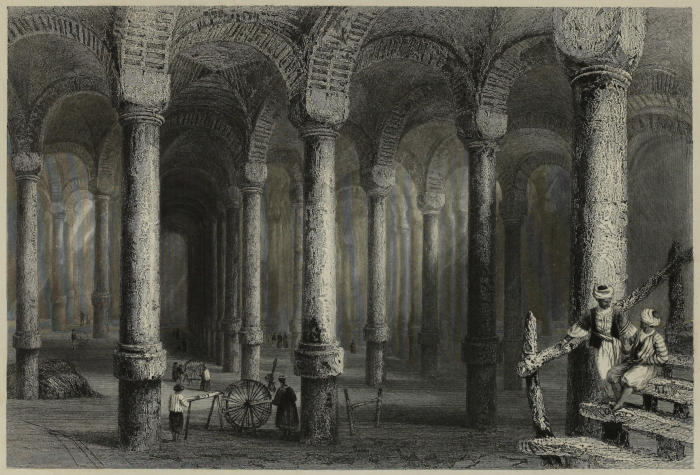
The necessity of an ample supply of water to a population of nearly eight
hundred thousand souls, and the frequency of drought in the capital, have led
to great care and some ingenuity in its conveyance to the cisterns and reservoirs
of the city from the numerous streams that fall from the mountains which fence
the Euxine, and the rivulets that irrigate the valleys among them. Every
rill, however apparently trifling, is arrested in its progress, when it descends from
a height into the lower lands; by which means the valleys become inundated,
and form deep and extensive lakes, whence the water is conveyed in tile pipes
along the mountains, to pour its volume into the aqueducts which span the
valleys, and give a noble character to the wild landscape. These artificial reservoirs
are called bendts, and were originally formed by the Greeks; and the
dams by which they are shut in are mounds, faced with marble, sculptured in
oriental devices and characters, which are extremely imposing, and even magnificent.
The Turks are, however, suffering the aqueducts of their predecessors to
fall slowly to decay; and have supplied their places by detached square hydraulic
pillars, sufficiently ingenious in their construction to merit description. A small
reservoir is on the summit of each; and tubes, similar to those laid along the
heights, pour the water into this tank on one side, and discharge it on the other.
Each pillar is six inches lower than that which preceded it; and thus a gradual
descent is produced along the tops of these suy-terrasi, or columns, from the
mountains to Stamboul; and as they are spread in considerable numbers over
the country, the supply is generally abundant, though it sometimes fails when
the season is unusually dry, as in the years 1822 and 1836.
AQUEDUCT OF THE EMPEROR VALENS, NEAR PYRGO.
W. H. Bartlett. R. Wallis.
London. Published for the Proprietors, by Geo: Virtue, 26, Ivy Lane, 1839.
At such periods, the terror of a people like the Osmanlis, who not only
connect ideas of comfort and convenience with the pure element, but to whom
it is essential in the offices of their religion, may be readily conceived; and not
the least affecting of its demonstrations is the appearance of a Dervish on the
crest of the Jouchi-Daghi, or Giant’s Mountain, whose duty it is to watch for,
and to announce to the thirsting city, the anxiously-awaited appearance of a
small, lowering, heavy cloud, hovering above the waves of Marmora, or the
Euxine—a certain indication of coming rain, which causes the Christian sojourner
in the East to revert at once to the Sacred Volume, whose holy truths are
constantly recalled to his memory in the land of the Infidel.
The artist seized a happy moment in which to transfer to his sketch-book
the Aqueduct of Pyrgo. The sunshine rested lovingly on the old grey stones
of the stupendous pile at one extremity, while the cool shadows of the mountain,
with its flowery mantle of cistus, caper-plants, and wild vines, were flung in
soft contrast over the other. A party of travellers, with their serudjhes,[13]
sumpter mules, and araba drawn by buffaloes, were about to halt for their
mid-day meal; and the sounds of human life and human laughter joyously
awoke the echoes of the arch-spanned valley.
Nature and art, the present and the past, were before him; and the result
has been not only a faithful, but a strikingly characteristic sketch.
THE MAUSOLEUM OF SOLYMAN “THE MAGNIFICENT.”
“A dome with convoluted roof, whose fold
Projected o’er a gate of polished stone;
A hoary tree, in stateliness grown old,
The germ of by-past ages, now unknown;
A wild vine wreathing round the regal gold
And azure of the tinted pane; a tone
Of sadness sighing through the lofty gloom
Of a tall cypress.”
MS. Poem.
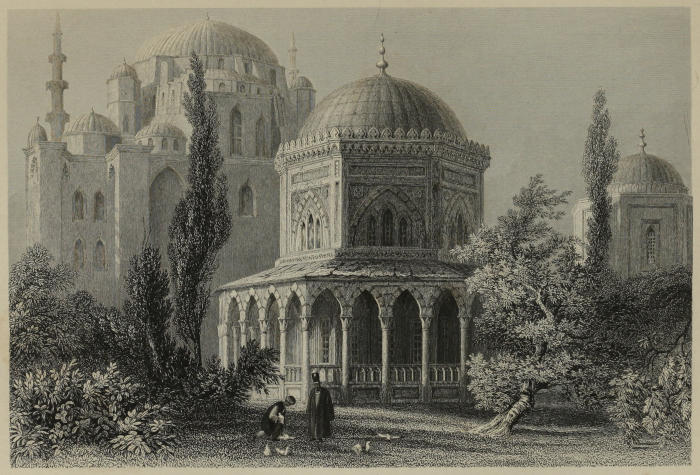
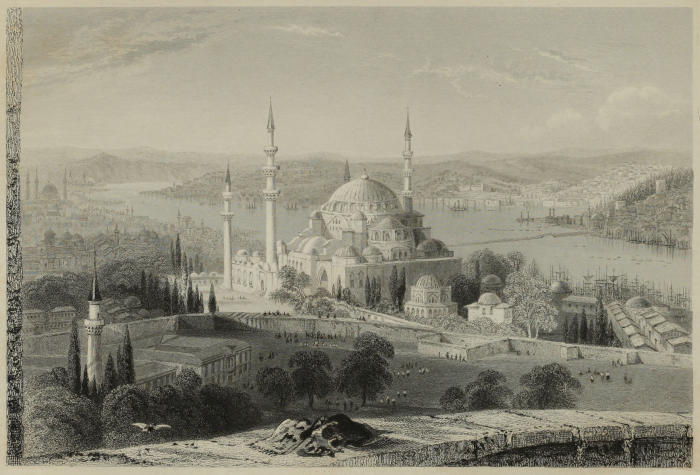
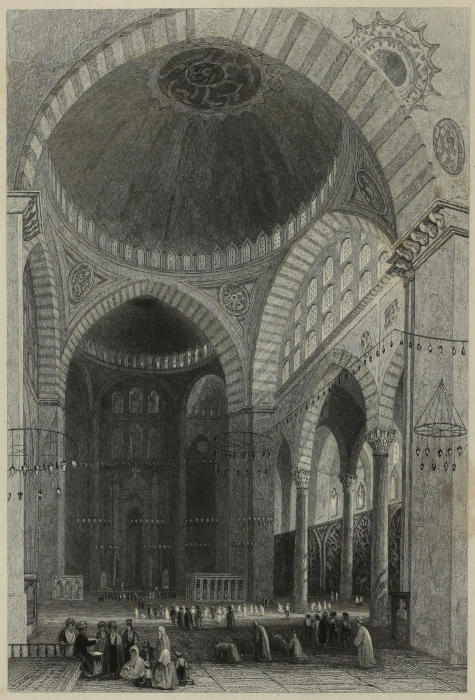
A beautiful covered way, leading from the outer court of Solimaniè, and
richly trellised with those luxuriant and leafy parasites so common in the East,
leads to the splendid tomb of Solyman; a light and elegant sexangular building
of white marble, overshadowed by one of those enormous plane-trees which defy
all calculation of their age, and seem each a mimic forest in themselves. Clusters
of the rare and beautiful purple lily, grow, as it were, out of the foundation
of the edifice, and intrude their imperial blossoms within the sculptured
screen that protects the arched colonnade by which it is surrounded. The
whole exterior of the tomb is graceful and attractive; and it looks rather like
a temple dedicated to cheerfulness, than a shrine for the ashes of the dead.
The sunshine struggles through the fresh green leaves of the giant-tree, and
falls flickeringly upon the marble steps, painting them with a thousand fantastic
figures; and the blue doves which nestle amid its branches fill the air with their
soft cooings, destroying the deep silence of the sacred spot. Altogether, the
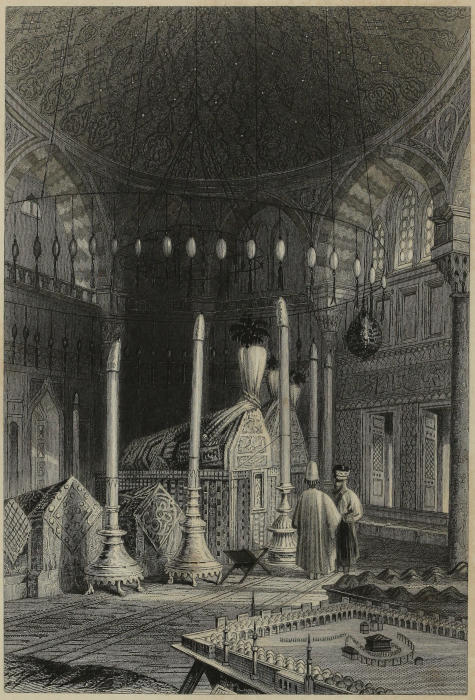
Mausoleum of the magnificent Solyman conveys no idea of death and the grave,
nor is it forced upon you even when you step across the threshold on to the
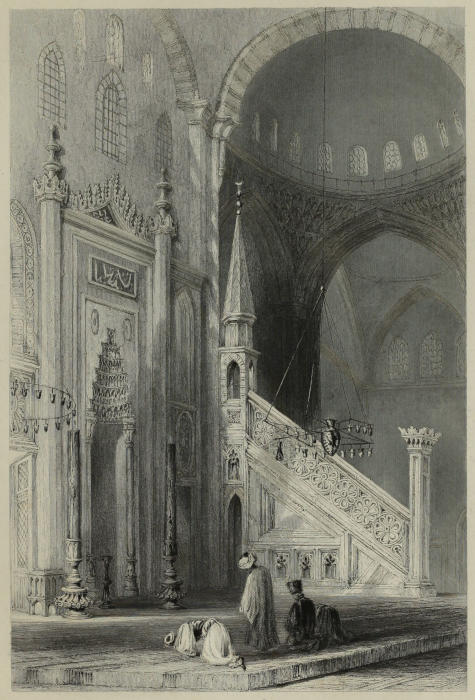
richly carpeted floor, and see before you the sarcophagi of the imperial founder
of the building, of his successor, of Sultan Akhmet, and of the two daughters
of Solyman. Those of the Sultan’s are surmounted by lofty and curiously
folded turbans of white muslin, decorated with aigrettes; while those of the
princesses are simply covered with shawls of green cashmere, much dilapidated
by time. On a stand near the entrance, rests an admirable model of the Mosque
at Mecca, and the Prophet’s tomb, with parties of pilgrims on their way to and
from the holy city; it is well executed, and bears an appearance of great
accuracy.
A few paces from the resting-place of Solyman is that of his favourite wife,
the far-famed and tiger-hearted Roxalana, who, in the feelings of the mother,
suffered those of the woman to be extinguished, and turned the holiest of virtues
into crime. She also rests under a dome of marble, and her sarcophagus is
overlaid with costly shawls. The same plane-tree darkens over the two tombs,
but the vermilion patches flung by the painted windows on the bier of the
inexorable Roxalana, seem like records of the innocent blood shed to feed her
ambition. Not satisfied with the proud distinction of having given birth to the
Sultan’s eldest son, and of seeing the bitter tears wept over his grave by Solyman,
who, to mark his grief for the untimely death of the ill-fated Mahomet, released
a number of slaves on the day of his burial, that they might ever look back with
veneration to his memory; the renegade Sultana, false alike to her God and to
her sex, excited the infatuated sovereign to murder Mustapha, another of his
sons by a rival beauty. Heavy accusations, laid by a reckless enemy, who possessed
the ear and perverted the judgment of Solyman, were all-sufficient to secure
the ruin of the young and high-hearted Mustapha; who, moreover, when
summoned to the presence of his imperial father, entertained no suspicion of
the treachery to which he was about to fall a victim.
MAUSOLEUM OF SOLYMAN THE MAGNIFICENT AND ROXALANA.
W. H. Bartlett. J. Carter.
London. Published for the Proprietors, by Geo: Virtue, 26, Ivy Lane, 1839.
INTERIOR OF THE MAUSOLEUM OF SULTAN SOLYMAN.
W. H. Bartlett. W. Radclyffe.
London. Published for the Proprietors, by Geo: Virtue, 26, Ivy Lane, 1839.
To render the tragedy more complete, Mustapha, when he received the summons
of the Sultan, was not alone; Zeangir, the son of Roxalana, to whom he
was tenderly attached, was beside him; who, when the message was communicated
to the prince, immediately determined on accompanying him to the camp of their
common parent. On their arrival at the imperial tent, Mustapha was disarmed;
and then first suspecting treachery, he advanced in silence beyond the line of
guards who were posted over the person of the Sultan, and had scarcely done so,
when four mutes sprang upon him, armed with the fatal bowstring; but life was
young and strong in the betrayed prince, and he burst from their hold, and flung
them from him with indignant pride, as he turned to alarm the troops, by whom
he was greatly beloved, and in whom he felt, even at that awful moment, that he
might depend. But no time was allowed him for the effort, for as he sought to
escape, Solyman himself appeared at the entrance of the tent; and one look of
rage, one gesture of vengeance, recalled the scattered senses of the mutes, who
once more seizing their victim, strangled him under the eyes of his infuriated
father, and then flung his quivering body on the carpet at his feet. It was the
work of a moment; and the paralyzed Zeangir beheld the brother whom he fondly
loved, and who had stood beside him in health and pride but a moment back,
a livid and distorted corpse, like an unnatural barrier suddenly raised by crime
between him and his father. From his wolf-hearted mother he had long shrank,
for his gentle nature quailed before the dark workings of her iron spirit; and
now two holy links were wrenched asunder which could never again be united—he
had no longer a parent; and his brave brother, the idol of the troops and of the
people, he was gone! Without a word, without a tear, the young prince cast
himself upon the corse of the murdered Mustapha; and when the officious
pity of some court parasite would have separated him from his dead brother,
he was unconscious of the attempt: he was not born for blood, and his heart
had burst upon the body of the victim! Once again Roxalana stood beside
a dead son; but there was no compunction in her eyes, as they rested on the
pale face of him whom her cruelty had murdered: there was no shadow over
them, as when the grief of earth seems to throw a veil over the decrees of Heaven.
They were bright with intense light—vivid with fearful brilliancy—they told a
tale of vengeance!
The arrow was shot by a sure hand! Solyman, enslaved by the personal
beauty, and cowed by the resistless passions of his wife, became the puppet of
her will; and the moon had not yet grown old, when Roxalana once more held
a death-warrant signed by the misguided Sultan. Mustapha had left behind
him a son, a fair boy who had scarcely numbered ten summers—brave, and
beautiful, and, until now, beloved. This was the new victim; but the implacable
Sultana, fierce as she was, knew all the intensity and watchfulness of a
mother’s love, and she felt that the vigilance of the new-made widow must be
eluded. The boy was, therefore, on some fair pretence dispatched to a kiosque
near Broussa, attended by a proper guard, and accompanied by his mother in
a covered litter. In the plain beyond Moudania, the litter broke down; and
the eunuch who was entrusted with the death-warrant, proposed to the little
prince that they should together gallop forward to the city, and send back
assistance. The gallant boy complied; and as he sprang from his horse at the
door of the kiosque, the executioner stopped him on the threshold, and extending
towards him the bowstring, intimated to him that such was the will of the
Sultan.
“God is great!” said the brave boy, “and the Sultan is his shadow upon
earth—I am ready.” And when she reached Broussa, the widow of Mustapha
found that she was childless!
YENI DJAMI.
“Lightly tread, ’tis hallowed ground.”
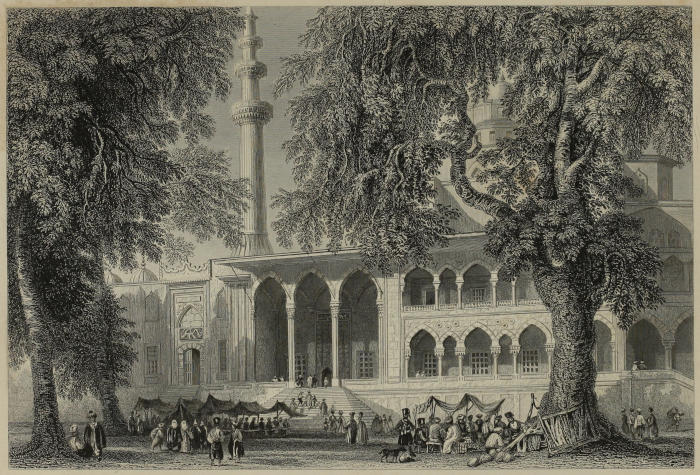
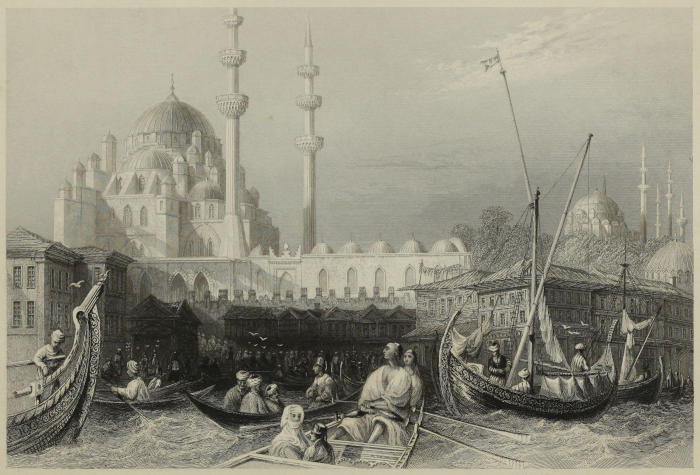
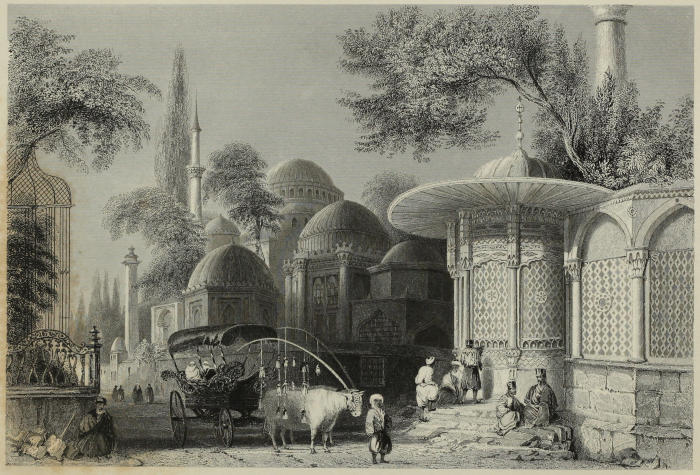
The beautiful mosque of Yeni Djami, known also as that of Sultana Validè,
was built by the mother of Mahomet IV., and is esteemed one of the most
magnificent in the capital. The minarets are peculiarly elegant, each being
encircled by no less than three galleries, of the most minute and thickly-perforated
sculpture, in the Saracenic taste. The portal is of ponderous size, and the brazen
gates are thickly studded with mother-of-pearl; three lofty arches enclose an
open peristyle, terraced in, and sufficiently spacious to contain more than a
hundred persons. The double range of exterior galleries, running along the
façade of the temple, are of fine and delicate workmanship, and the arches by
which they are formed, are chastely and beautifully designed. The principal dome
springs majestically from the centre of the spacious roof, and rests upon four lesser
ones, which appear to lift it to the clouds; while the tomb of the illustrious
founder nestles beneath the more lofty edifice, comparatively minute in size, but
equally elegant in construction.
YENI DJAMI, OR MOSQUE OF THE SULTANA VALIDÈ.
W. H. Bartlett. J. C. Varrall.
London. Published for the Proprietors, by Geo: Virtue, 26, Ivy Lane, 1838.
The mosque stands near the edge of the harbour, and its court stretches
down almost to the water. It is overshadowed by two of the most majestic
maple-trees in the city, whose gnarled and knotted trunks and fantastically
twisted branches bespeak them of a date coeval with that of the gleaming temple
which they so greatly embellish. Beneath their long cool shadows congregate
groups of idlers, attracted thither by the calm stillness and refreshing breezes;
and there they loiter for hours, erecting in the court their awnings of striped
cotton, and spreading their mats for the mid-day siesta; while the melon and
sherbet-venders ply their fragrant trade, and the perfumed vapour of the
Salonica tobacco exhales from many a chibouque.
The court of Yeni Djami generally presents the characteristic scene which I
have here described; and of the mosque itself, the Turks have a popular tradition,
that it was built from the produce of one of the Sultana-mother’s diamond-studded
slippers, piously disposed of for the purpose of its erection; a legend
which doubtlessly owes its origin to the probable fact of the expenses having
been defrayed from the bishmalik (or slipper-money) of the imperial lady—a
national grant to the female members of the reigning family, bearing some
analogy to the “privy purse” in England.
THE TCHARTCHI, OR BAZĀRS OF CONSTANTINOPLE.
“Richly furnished with plate and gold;
Basons and ewers,——
My hangings all of Tyrian tapestry:
In ivory coffers I have stuff’d my crowns;
In cypress chests my arras counterpanes,
Costly apparel, tents, and canopies,
Fine linen, Turkey cushions bost with pearl,
Valance of Venice gold in needle-work,
Pewter and brass——”
Shakspeare.
The Bazārs of Constantinople have ever been to home-staying Europeans as
a vision of the “Arabian Nights;” travellers have lost themselves in hyperbole
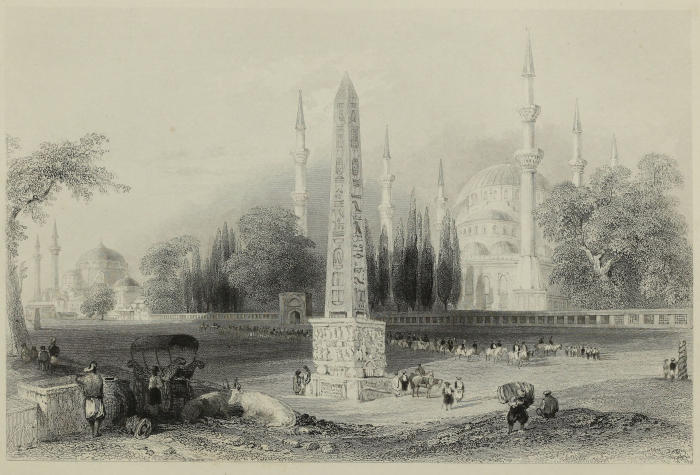
in their descriptions of them; and the antique glories of the Atmeidan, and even
the solemn grandeur of St. Sophia, do not subject the returned pilgrim to half
the questioning curiosity which is elicited by the great exchange of the City of
the Three Seas.
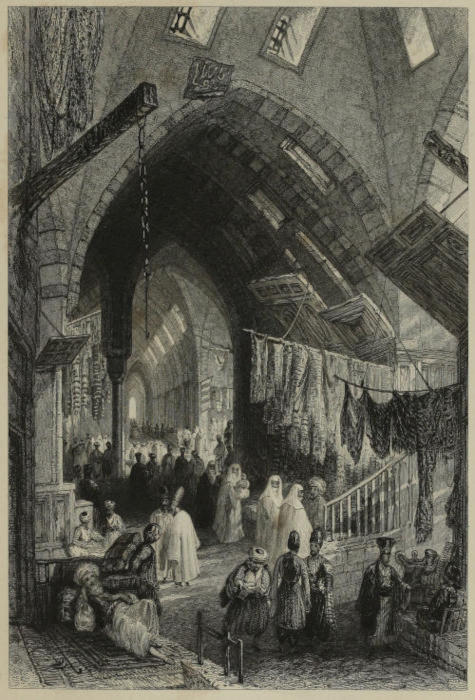
GREAT AVENUE IN THE TCHARTCHI.
GRANDE VUE DANS LE TCHARTCHI.GROSSE ALLEE IM TCHARTCHI.
W. H. Bartlett. H. Griffiths.
London. Published for the Proprietors, by Geo: Virtue, 26, Ivy Lane, 1839.
In by-past years, ere “the schoolmaster was abroad,” the chubby urchins
of half the remote villages in England believed that the dust of London was
gold-dust, and its pavements silver; and even now, in like manner, there are
many individuals to be found, who almost persist in believing that the Bazārs
of Stamboul are as sparkling and gorgeous as the enchanted garden of Aladdin;
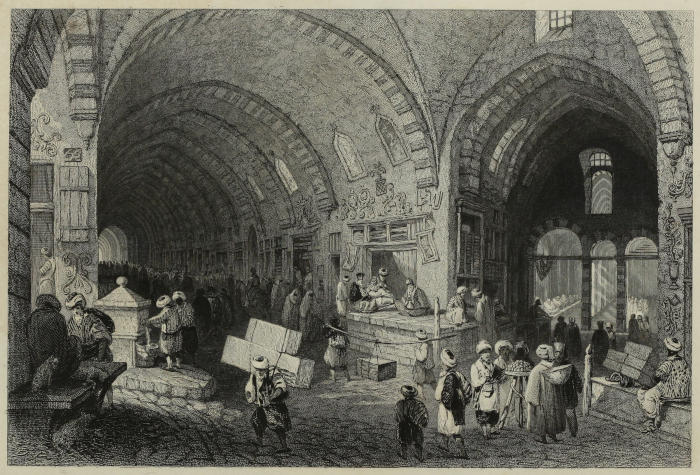
and yet nothing can be further from the fact. The interest of the Tcharchi
exists in its great extent, its peculiar arrangement, and the picturesque effects
constantly produced by the shifting groups who people it, and whose diversity
of costume, countenance, and national character, tends to arouse the admiration
and curiosity of every visitor. It must not be imagined that the bazārs of the
East are vast apartments filled with rows of trim counters, overstrewn with toys
and trinkets, and all the gaud and glitter which are the charm of such lounging-places
in London. There is no prettiness in the great commercial mart of the
Moslems; their Tcharchi is composed of a cluster of streets, of such extent and
number as to resemble a small covered town, the roof being supported by
arches of solid masonry. A narrow gallery, slightly fenced by a wooden rail,
occasionally connects these arches: and it is extraordinary to look down from
one of them upon the changeful and motley crowd below; nor is it, perhaps,
less singular to the stranger, when he has gained this giddy elevation, to find
himself surrounded by numbers of doves, whom his vicinity fails to disturb,
and who appear to be so habituated to human contact and human turmoil, and
to have suffered both so long with impunity, as to have become regardless alike
of the one and the other.
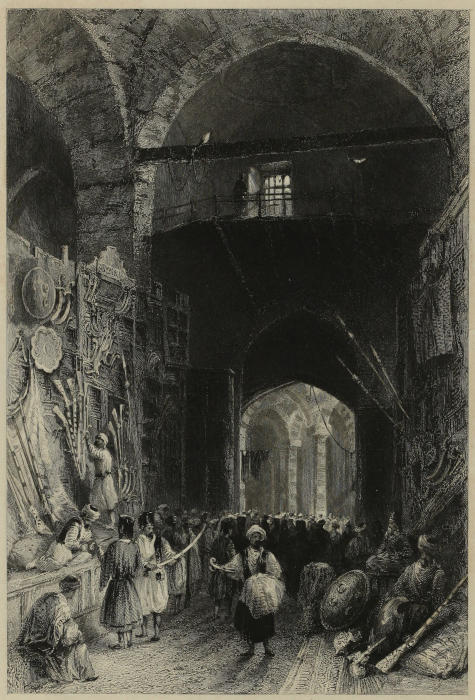
THE ARMOURY BAZĀR.
W. H. Bartlett. F. W. Topham.
London. Published for the Proprietors, by Geo: Virtue, 26, Ivy Lane, 1838.
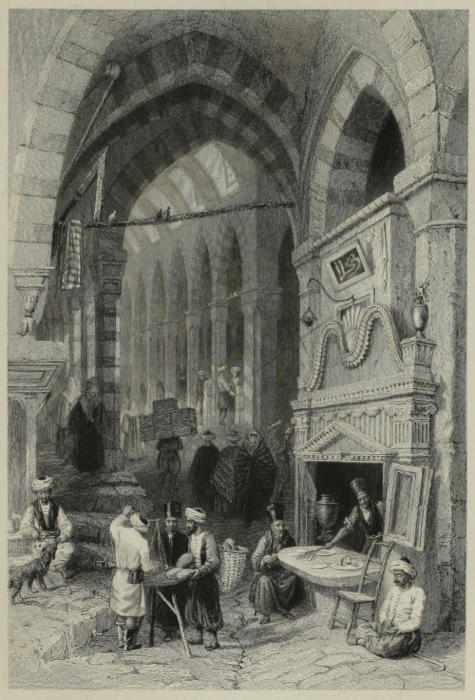
Every avenue of the bazār is appropriated to a particular branch of commerce;
thus, in the street known as the Bezenstein, the two ranges of counters
are occupied by jewellers, and are placed on a raised wooden platform, where
the merchants spread their carpets, and make their calculations on strips of a
strong yellowish paper, resembling parchment, that they rest against their knee;
while, without withdrawing the chibouque from their lips, they dip their reed
pen into an ink-bottle, nestled amid the folds of the shawl about their waist,
and thus gravely await their customers. Beyond the platform is a strong-room,
of which the door is made fast; for many of them contain some of the most
costly gems in the world, particularly pearls, turquoises, and brilliants; although
the dingy and ill-supplied glass-cases on the counters would lead a stranger to
imagine that nothing rare or curious was to be met with in the Bezenstein: but
let the keen and quick-sighted dealers (who are almost entirely Armenians) see
a prospect of securing a good customer, and the door of the inner apartment
once thrown back, the eye must be steady indeed that is not dazzled by the
mass of jewels which surround it. The
——“Plate and gold,
Basons and ewers”——
are there in abundance; drinking-cups, lipped with gems; tusbees, or rosaries,
where every bead is a jewel; clusters of diamonds in fanciful devices, for the
turbans of the young beauties of the harem; aigrettes for the caps of the nobles;
housings for the Arab steeds of the Pashas, stiff with pearls and gold rings,
chains, and stars;—it were idle, in short, to attempt a recapitulation of the
treasures of the Bezenstein.
The avenue of the money-changers is gloomy and uninviting, save to those
who can feel a pleasure in listening to the ring of the precious metals, which
goes on hour after hour, as the solemn-looking bankers pass heaps of coin, or
bars of unwrought gold, from scale to scale, to test their weight and quality.
This branch of commerce, also, is almost entirely monopolised by Armenians,
many of the principal men of that nation resident at Constantinople being sarafs,
or bankers to the different Pashas, and remarkable for their high principle and
honesty. There are few Turkish money-changers,—as the Osmanlis are not
naturally speculative in their commercial undertakings, and prefer a less uncertain
and anxious occupation,—and still fewer Greeks; I believe, simply from
the difficulty they find in obtaining clients. The great mass of Constantinopolitan
bankers are, consequently, Armenians and Jews, and many of the latter
are highly respectable and trustworthy; the interests of their employers being
further ensured from the known extent of their wealth, and the constant vigilance
which is exercised by the Turkish government over that degraded and
oppressed people.
One of the most interesting portions of the Tcharchi, is that known as the
Armoury Bazār, where, in five minutes, a person may, like the ghost of Hamlet’s
father, be—
“Armed from top to toe,”—
in the garb and with the weapons of almost every period and nation. The
walls on either side are lined with pieces of armour;—antique shields, from that
of the paladin to the more modern buckler of the crescent; horse-gear, embossed
and studded with shining metals; warlike ornaments, so ponderous that they
could, apparently, only have been wrought for giants; helmets of all forms and
sizes, many of them surmounted with devices which recall the best days of
chivalry; spears, as light as fairy-wands, and almost as glittering; suits of mail,
dimmed by the rust of centuries; the English musket, the American rifle, and
the Indian bow, hang side by side; while Damascus swords, Egyptian scymitars,
and Turkish handjars, are heaped together in picturesque confusion. Leopard
skins, saddle-worn and venerable, are there also; and resting against them may
frequently be seen the heavy match-lock, crusted with embossed silver in those
beautiful arabesques peculiar to the East.
The anxiety of the vendors to secure a Frank customer is quite ludicrous.
He is beckoned from one to the other with a gesticulation and earnestness against
which it is almost impossible to contend; a score of articles is exhibited in
succession, with a rapidity which prevents their being thoroughly examined;
and the plain dark steel of Khorassan gives place to the heavy and elaborate
Albanian pistol, and that in its turn to the Korān-inscribed Damascus sabre,
before the quality of either can be ascertained. Then, suddenly, as though
he doubted the taste of his customer for warlike weapons, the dealer thrusts
them all aside, and spreads before him a tempting display of delicate amber
mouth-pieces for the chibouque; under-coats from the costly looms of Persia;
hangings of Tyrian tapestry; and all his hoard of fanciful and expensive
luxuries. Others, too impatient to await their chance of wiling the wealthy
infidel from the stalls of their neighbours, employ one of their slaves to perambulate
the bazār, and to pass and repass before the Frank, carrying some
especially attractive object—such as a jewel-hilted pistol, or a buff coat
embroidered with gold with a skill and intricacy which cannot fail to attract
his eye.
All nations alike trade in this fascinating commerce; the Armenian spreads
his carpet beside that of the Turk; and the sallow Jew elbows the keen-eyed
and cunning Greek; here and there a Persian may be seen sitting restlessly
in the midst of his wares, his flexible and mobile features partially overshadowed
by his large white turban; while throngs of idlers block up the entrance of the
avenue, shoving, laughing, and vociferating, and waking a perpetual thunder
amid the echoes of the long building.
The Shoe bazār presents a most gay and novel appearance, from the circumstance
of its being customary—and, indeed, a law—in Constantinople for each
nation to be shod with its own particular colour. Thus the Turk wears a boot
and slipper of bright yellow morocco, the Armenian crimson, the Jew purple,
and the Greek black; and this fact, coupled with the utter disregard of the
Orientals to every thing like a fit, which enables the dealer to manufacture large
quantities with the certainty of a speedy sale, makes the street of the shoe-makers
like a bed of tulips. But the most beautiful feature of their trade is the velvet,
gold-embroidered, jewel-sprinkled slipper of the harem, worn by the fair Turks
on all occasions of festivity, and, indeed, by the higher classes on all occasions
within their dwellings; an article of expenditure so serious in a great Osmanli
family, as to have suggested the application of the term bishmalik, or slipper-money,
(to which I have already had occasion to allude,) to the grant of a considerable
annual income to the ladies of the imperial family.
A SCENE IN THE TCHARTCHI.
W. H. Bartlett. H. Griffiths.
London. Published for the Proprietors, by Geo: Virtue, 26, Ivy Lane, 1838.
Mingled among these slippers may also be seen a number of circular analies,
or hand-mirrors, with short handles, mounted in gold or silver embroidery, and
frequently enriched with seed pearls. These pretty toys are indispensable to
the Turkish ladies, as they are the companions, not only of their toilets but of
their voyages up and down the Bosphorus, where, reclining on their cushions,
they repair, as the swift caïque shoots along, the disarray which the sharp
sea-breezes create in the folds of their snowy veils and ample mantles.
But decidedly the most glittering street in the Tcharchi, is that appropriated
to the embroiderers; where silks, stiff with the most elaborate needle-work,
wrought in gold and silver threads; almost impalpable muslin, gay with clusters
of bright-coloured silken flowers; tobacco bags of cachemire, which appear to
have cost the maker years of labour; and costly scarfs from Persia, with golden
borders formed of verses from the Korān, or love-ballads from Hafiz, are to
be seen on all sides. All the embroidery wrought in Constantinople, with very
few exceptions, is the work of the Armenian women, who, secluded even more
strictly than the fair Turks within the recesses of the harem, emulate their
thrifty and pains-taking husbands in their untiring industry; but much of the
most costly, particularly that which is worked on cachemire, is imported
from Persia.
The Fruit Bazār stands close to the water’s edge, and abounds with dried
fruits of every description—figs and dates from Smyrna; raisins, plums, the
small sweet currant of Corinth, and every other variety capable of preservation;
the only inconsistency being the sale of cheese, and Russian butter, packed in
calf-skins, and most unpleasant in appearance, among the more attractive articles
already enumerated.
The Broussa silks occupy a very considerable street, as the produce of the
celebrated looms of that city is greatly esteemed by the Turks, both for pattern
and texture. The staple trade of the ancient capital of Bithynia being raw silk,
two-thirds of the houses are colonized by the “spinning-worm;” and the silk is
consequently used by the weavers with a profusion which renders the quality of
the manufacture so solid, that many individuals have been deluded into the
belief that it was mixed with cotton—a material which is to them much more
expensive and difficult of access. The colours are seldom bright; for the waters
about Broussa are so highly mineralized, as to dull the silk very materially in
the process of spinning; but it probably derives from the same circumstance
its unusual strength and durability. The workmen of the city are extremely
expert in interweaving gold and silver threads in the warp; and the silks so
woven are greatly esteemed in the harems. The plainer patterns are used by
both sexes indiscriminately; and nearly the whole costume of every respectable
Turk or Armenian is composed of Broussa silk. The demand is hence very
great, and the supply commensurate with it; and there are few busier localities
in the Tcharchi than this. A few Genoa velvets and European satins may be
found in the bales of the merchants; but as they are comparatively unsaleable,
the Frank lady who seeks them has no opportunity of being fastidious in her
selection.
The Confectionary Bazār is also extremely well worthy of a visit, for the
Orientals excel in all the delicate preparations of sugar and perfume which can
be produced. Preserved rose-leaves—a feast for the fairies—look as bright, as
soft, and almost as sweet, as though they had just been shaken to the earth by
a truant zephyr wandering in the gardens of Nishapor; gums, mixed with sugar,
perfumes, and the juices of fruits, are moulded into a hundred pretty shapes,
and may be purchased of as many different flavours; cakes of sherbet-paste,
casks of chalva, (a composition of flour, honey, and oil,) delicate sweetmeats from
Smyrna and Scio, and strings of sausages, hung in festoons, and filled with the
inspissated juice of grapes, mixed with walnuts or almonds, are among the most
popular articles of the sekeljhes,[14] if we except, indeed, the kaïmac, or clotted
cream, which is also sold in this bazār. The name kaïmac, signifying in the
Turkish language the excess of excellence, will give some idea of the estimation
in which this dainty is held by the natives; and, truly, it deserves the appellation
it has obtained, for there are few edibles in the luxurious East more delicate
than the kaïmac. The rush of customers to the counter on which it is freshly
set forth, is most amusing, and very unfavourable to the vendors of mahalabè,
another preparation of milk, forming a species of blancmange, which is eaten
with rosewater, and sugar, or honey. In the immediate neighbourhood of this
confectionary colony, the water-venders ply a busy trade, and constantly thread
among the crowd with their classically-formed vases, or jars of red clay, upon
their shoulders, and a wooden case strapped before them, containing large crystal
goblets, scrupulously clean and cool: their cry is harmonious and melancholy,
but they are brisk, civil, and industrious; and for about a farthing and a half
the pedestrian can always secure a refreshing draught.
KAÏMAC SHOP IN THE TCHARTCHI.
KAÏMAC BOUTIQUE DANS LE BAZĀR.DER KAUFLADEN KAÏMAC IN DEN TCHARTCHI.
W. H. Bartlett. J. Carter.
London. Published for the Proprietors, by Geo: Virtue, 26, Ivy Lane, 1839.
The lapidaries have also their distinct locality, where curious antique gems
may occasionally be purchased, but always at an exorbitant price, the merchants
having discovered the partiality of the Franks for that species of ornament; they
cut and engrave well, but the expense is greater than in Europe.
The Tobacco Bazār is a very important feature in the Tcharchi; the quantity
consumed yearly in the city being immense, and the qualities numerous. Those
most esteemed, however, are from Salonica and Latakia; the former by the
women, from its mildness and perfume, and by the more luxurious among the
men; and the latter by the lower classes, on account of its great strength.
Other varieties from the Crimea, Ormus, and many parts of the East, and also
from Hungary, are in abundance; and when it is remembered that in Constantinople
a visit is never paid, a bargain is never negociated, an hour is never
passed, without the eternal chibouque, there will be no necessity for the
assurance that this is the most bustling of all the bazārs. The narghilè, or
water-pipe, which is seldom used until after the mid-day meal, and which greatly
resembles the hookāh of Hindostan, is always filled with Shiraz tobacco, sprinkled
with rosewater, and frequently rendered still more odoriferous by having a
scented pastile placed on its summit, while the water through which the vapour
passes is impregnated with the perfume of some flower or spice.
The Spice Bazār is perhaps, however, the most perfectly oriental department
of the Tcharchi; for it is laden and groaning with all the costly condiments of
the Levant, in enormous quantities. There are pyramids of cloves, hillocks of
ginger, piles of cinnamon, bags of mace, and a combination of sweetness which
wafts the sense at once to the “spiced groves of Araby the Blest.”
The Porcelain Bazār is very beautiful; for within it are congregated every
species of ancient and modern China, from the pure, well-finished, fresh-looking
cup of Worcestershire manufacture, to the elegantly-formed but time-worn
vase, dug from some Athenian ruin. The mimic flowers of Dresden are beside
the productions of Sèvres; and the combinations of colour are extremely pretty.
Jars of artificial flowers, and or-molu, buhl, and alabaster clocks from Paris and
Geneva, abound; for the Turks are very partial to these ornaments, and scatter
them over every room in their houses; and, altogether, the Porcelain Bazār
is a very agreeable lounge.
In order to avoid the imputation of tediousness, we will conclude the chapter
with a description of the Shawl Bazār—a mart of luxury and expense which
is the terror of many an Eastern husband. The goods exposed are rather gaudy
than valuable, and consist principally of Scotch and French manufactures, both
of which are eagerly purchased by the middle and lower classes; these are hung
against the walls, or spread over the carpets of the dealers, in juxta-position with
Greek coiffures of gold-spotted muslin, scarfs of lama-gauze, and embroidered
bathing wrappers. But in the private store behind the merchant lie the most
precious shawls of Lahore and Thibet, gold stuffs from Bagdat, and all the more
costly articles of an oriental toilette. Many of the traders in this bazār are
Persians; and wo betide the unsuspecting Frank who falls into their clutches!
They have all the cunning of the Greek, the pertinacity of the Armenian, and
the roguery of the Jew, to which is superadded their own national fearlessness
of a lie, and proficiency in dissimulation. Does the worthy merchant show a
shawl for which he is aware that he would be well paid by a thousand piastres,
he will begin by demanding two, or even three thousand; and so long as he
believes that there is the slightest probability of effecting his purpose, he will
swear by the beard of his father, and the grave of his mother, that he is selling
it far beneath its value, because he sees something fortunate in the aspect of
his customer—or because he has dreamt a dream—or for some other equally
probable and rational reason; when, no sooner does he become convinced of
the impracticability of the cheat, than he unblushingly decreases his demand
by two or three hundred piastres at a time, until he has reduced it to a fair
amount.
The mania of the Greek ladies for cachemires is a national characteristic;
and as all the oriental females are both extravagant and fastidious on the subject
of shawls, this branch of commerce is very weighty; while the bazār is also
visited by the slaves, whose business it is in every great household to superintend
the wardrobes of the harem; and who barter, chaffer, and exchange, with a
knowledge of the comparative value of the articles quite equal to that of the
merchants themselves; and who bring hither all the cachemires requiring repair,
to a number of grave old Moslems, who are squatted upon their carpets—spectacle
on nose, and needle in hand—at the lower end of the street; and who perform
their task most skilfully, weaving in every thread of a corresponding colour to
the pattern of the shawl, and perplexing the eye to discover the fracture.
Such is the Tcharchi of Constantinople, where a week may be wholly and
not unprofitably spent, without ennui or weariness.
FOUNTAIN IN GALATA.
“’Tis a little thing
To give a cup of water; yet its draught
Of cool refreshment, drain’d by fever’d lips,
May give a shock of pleasure to the frame
More exquisite than when nectarean juice
Renews the life of joy in happiest hours.”
Ion.
The fountains of Constantinople and its environs are all more or less elegant;
and among the most beautiful, both as regards architecture and ornament,
may be classed the subject of the present sketch, which occupies the centre of
a small square, at the foot of the steep ascent leading up from the merchant-suburb
of Galata to the “Infidel Hill” of Pera.
FOUNTAIN IN GALATA.
W. H. Bartlett. H. Griffiths.
London. Published for the Proprietors, by Geo: Virtue, 26, Ivy Lane, 1838.
Its form is singularly graceful and well-proportioned; and as the hand of
innovation has not yet touched its massive and deeply-projecting cornice, it is
perhaps as correct a specimen of the pure Moorish style as any now existing in
the city. Four small domes compose the roof; and they are circled by a net-work
of dentated sculpture, which gives them a light and pretty appearance,
and relieves the eye as it glances upward from the face of the fountain, which
is beautifully and profusely painted in arabesques, as well as the wide and
undulating cornice at the base of the domes.
Five slender pillars of white marble divide the bayed front of the building
into four equal compartments, which are screened to about midway of its height
by a gilded lattice-work, behind whose protecting shadow stands a range of brass
vessels, occupying the lip of a reservoir containing a constant supply of cool
water for the use of the thirsty passenger; while on either side of this, the
principal face of the fountain, stretch two receding wings, where exterior basins,
fed with a flow of water which rarely fails in its volume, offer a constant and
abundant mean of comfort and cleanliness to the immediate neighbourhood.
Coffee-kiosques, sheltered from the summer heats by rude wooden terraces,
overshadowed by acacia-trees and wild vines, occupy a portion of the square;
and the quiet-loving Moslem smokes his chibouque in luxurious repose, under
the very shade of the fountain whence he draws his cool and healthful draught.
Here the khamals[15]
deposit the heavy bale, which has been slung upon two long
poles resting on their shoulders, being secure at once of rest and refreshment;
and recover their failing breath ere they venture on the steep ascent, whose
rugged paving doubles its difficulty. Here the lounging household servant,
a slave only in name, loiters away an idle half-hour, collecting or retailing the
gossip of the neighbourhood. Here the crouching Jew offers for sale his paltry
mouth-pieces of artificial amber or discoloured ivory; the first of these being
made from the dust of the gum, and the fragments of those which break under
the hands of the workmen—an accident so common with amber, as considerably
to enhance the price of the perfect article. Here, too, the wayfarer and the
idler alike linger willingly; and seated upon low wicker stools, not raised more
than a few inches from the ground, they form groups of picturesque comfort in
admirable keeping with the locality, as they smoke their chibouques, sip their
coffee, and drain deep draughts of the clear water of the fountain. The houses
which surround the square give a perfect idea of Turkish domestic architecture:
the projecting story above the ground-floor, supported by stout buttresses of
timber, and thickly set with latticed windows, is the harem of the establishment;
while the owner of the dwelling plies his trade or vends his wares below, squatted
on a wooden counter close beside the street, with his slippers lying near him,
his pipe between his lips, and his goods hung all round his shop.
Among the prettiest of these small trades is that of the sherbet[16]
and mohalibè[17]
merchants, whose tinkling fountains of metal, pouring forth streams of
lemonade and other cool drinks, are very inviting to the passer by; while the
large carefully-kept trays of white wood, with the blancmange covered by a fine
cloth moistened with rosewater, are scarcely less enticing. The shops of the
boudaka[18] venders are also very attractive, as the forms of most of the bowls
are extremely elegant, and the gilding and enamelling of many of the more costly
even curious. Near this fountain is situated the street of the pipe-stick makers,
a race of men who are sure of success in their calling, and who are comparatively
independent in their manner of doing business; and many a bargain is struck
between the itinerant dealer and these worthy perforators of cherry-sticks and
jasmin-wood, under the wild vines and acacias of the pretty fountain in the
square.
VIEW FROM MOUNT BULGURLHU.
’Tis hard to quit the East’s inspiring sky,
From citron groves and spicy gales to fly;
To look on Nature in her brightest dress,
Nor heave a sigh for her lost loveliness.
MS.
The scene which is spread out before the wanderer, as he stands upon the
dusky mountain of Bulgurlhu, with the town of Scutari immediately at his
feet, and the city of Constantinople mapped out in the distance in its frame of
clear and pellucid water, is one which throughout his after life, be it of what
duration it may, he can never cease to remember. He looks down into the
mysterious gardens of the Seraï Bournou, far over the glittering Propontis,
along the shores of the Bosphorus, into the Golden Horn, upon “St. Sophia’s
gleaming dome;” on the seven hills of the imperial city, the gloomy remains
of the Seven Towers, the ancient walls of Byzantium, the modern palaces of
the Sultans, the fair islands of the Sea of Marmora, and the far-off and snow-crested
Mount Olympus, lording it over the fertile plains of Broussa.
VIEW FROM MOUNT BULGURLHU.
W. H. Bartlett. R. Brandard.
London. Published for the Proprietors, by Geo: Virtue, 26, Ivy Lane, 1838.
It is well for those who wish to form a correct idea of such a scene as this,
that the pencil of the artist can call it up and place it palpably before them;
for mere words could never succeed in creating so bright a vision. Hours are
necessary to the traveller to enable him to appreciate all its glory; and it is
an additional enjoyment to pitch his tent among the wild thyme and olive-trees
of the mountain, and in the midst of the camels, which, after gaining the summit
of the height, repose there for a time in some shady spot, as they are on their
way into the interior, laden with merchandise from the bazārs of the capital.
As these animals are never seen on the European side of the channel, they give
a localizing effect to the picture, and the wanderer at once feels that he is
in Asia.
This is, perhaps, the most favourable point for contemplating Stamboul in
all its extent, and fully comprehending its extraordinary magnificence as a
whole; its singular outline, its ocean-girdle, where the blue waves seem to follow
lovingly whithersoever the sinuosities of the shores invite them; its thousand
domes, and its shaft-like minarets beckoning to the blue heavens, against which
they glitter like polished ivory; its forest-trees overshadowing the party-coloured
dwellings; its cypress groves stretching down to the water’s edge; and all the
blended beauties of the unrivalled locality.
The artist has indeed a rich field for his talent when he gazes around him
from Mount Bulgurlhu; but the traveller, although he may idly heap expletive
on expletive, until his praises swell into hyperbole, must ever fail in conveying
by mere verbal description, a correct impression of so bright, so varied, and so
beautiful a panorama.
TURKISH HOUSES ON THE BOSPHORUS.
“It was indeed a wide extensive building
Which opened on their view, and o’er the front
There seem’d to be besprent a deal of gilding,
And various hues, as in the Turkish wont—
A gaudy taste; for they are little skill’d in
The arts of which these lands were once the font:
Each villa on the Bosphorus looks a screen
New painted, or a pretty opera-scene.”
Byron.
However the description of the noble poet which heads the present chapter
may apply to many of the country residences on the channel, it cannot be denied
that to others it is entirely inapplicable; for there are only too great a number
which resemble nothing less than
“A screen new painted.”
The shores of the Bosphorus are a study—not only for their beauty, but
because, in the general aspect of the dwellings that fringe them, the traveller
may read a great moral lesson; for Turkey is a country where the population
do not fall back upon the past, where they are almost careless of the future, and
where the present is every thing. The Turk builds for himself, toils for himself,
intrigues for himself, as his father did before him; and leaves his children to
strive and to create in their turn with the “Inshallah!” of an earnest and unaffected
philosophy. Fortune, even in the West, is a fickle tenure; but in the
East, it is sometimes the mere ephemera of a day; and thus, as the Osmanli
rises in that favour which alone can lend it, he at once erects or purchases a
residence suited to his brightening prospects, gay with temporary ornament
and evanescent decoration, whose freshness may even thus chance to outlive
his prosperity. Should it do otherwise, he gladly renews the paint and the
gilding, and repairs the ravages of the weather, or the effects of accident; but
when, as is frequently the case, it outlasts his fortunes, he contents himself with
the faded and discoloured reliques of by-gone luxury, and satisfies himself by
making the dwelling habitable, and awaiting a more golden season to renew its
vanished glories.
TURKISH COUNTRY HOUSES, ON THE BOSPHORUS.
W. H. Bartlett. J. C. Bentley.
London. Published for the Proprietors, by Geo: Virtue, 26, Ivy Lane, 1838.
Thus, as the light caïque of the observer skims over the ripple, the circumstances
of almost every householder on the Bosphorus may be ascertained by
the appearance of his dwelling. The residence of the favourite and the courtier
is indeed a “wide extensive building,” over whose front is “besprent a deal
of gilding, and various hues.” The lattices of the harem are gaily painted, the
terraces are bright with flowers, the marble steps against which the blue ripple
chafes in the sunshine are thronged with attendants, and the caïque that awaits
its owner at their base is like a fairy bark, glittering with gold and crimson.
Arabesques adorn the walls, and pretty kiosques peep from among the leaves
of the tall trees of the extensive gardens; the perfume of flowers and the sounds
of music come blended along the water, and the very atmosphere breathes
prosperity.
The discarded Bey and the disgraced Minister boast dwellings as stately and
as proud, but the trace of change is over all. A heavy hand has fallen upon
the edifice, and the bright colours have faded beneath its pressure. Grass grows
upon the marble terraces; the wind finds its way into the apartments through
shivered glass and shattered lattices; and a certain parade of decay, which leaves
an impression of design upon the mind, is palpable throughout.
But the empty residence of the exile tells a far sadder tale. There all is real
and unstudied ruin; the grass and weeds are rank in the fissures of the pavement;
the hingeless shutters rattle in the wind; the mouldering roof no longer
excludes the rain, which forms a thousand discoloured currents through the
faded frescoes of the desolate and echoing apartments; doves build in the galleries,
and locusts are loud among the garden-branches; theirs is the only song
that awakens the deserted groves.
The houses of the Armenians and Greeks (the raïahs, or vassals of the Porte,)
are universally painted a dull red, or lead colour; the gayer tints in which the
Turks delight being prohibited to them, while the Jews are compelled to confine
themselves to black; and among the wealthier raïahs it is common to paint a
residence which is unusually spacious, in two distinct colours, to produce the
effect of its being separate dwellings.
Nothing can be more irregular, and consequently more picturesque, than the
style of building on the Bosphorus; for the Turks are such sincere lovers of
nature, that they invariably throw out a bay, or contract a wing, when by so
doing they can secure a fine view, or a pretty peep, not otherwise attainable;
and as these present themselves at every turn of the channel, the Turkish
country houses have much the appearance of buildings that have been put
together by fragments.
When it is remembered that these houses are backed by a chain of fertile
and richly-wooded hills, forming a succession of gardens and pleasure-grounds,
and are washed by the rapid current of the Bosphorus, it will be readily conceded
that they present a coup-d’œil probably unique; while the salubrity of
the air, the elasticity of the atmosphere, the constant movement upon the
channel—which may, without affectation, be denominated the high-way of the
capital—and the splendid scenery which they command on all sides, render them,
as summer residences, well worthy of the universal popularity which they enjoy.
In many instances the buildings are raised along the extreme edge of the shore,
and are unprotected, even by a terrace; and the upper stories generally projecting
beyond the basement, they hang over the water in a singular manner.
Nor do they always enjoy this privilege with impunity, as the channel is several
feet in depth under their very windows; and it not unfrequently happens, that
the wind failing when a vessel is beating on a “tack,” and the current impelling
it onward with a force which it is unable to resist, portions of the rigging
become entangled with the houses, bowsprits enter the windows of the saloons
and carry away the roof, and the most ridiculous accidents are the result. But
the inhabitants will not sacrifice a positive enjoyment to a probable evil; and
thus they build their water-palaces as daringly as though no intrusive bark ever
parted with its gleaming prow the bright waves over which they fling their long
dark shadows.
Not the least beauty of these singular residences consists in their hanging
terraces, frequently latticed in for the convenience of the harem, which make
the Bosphorus fragrant with the breath of flowers; and the little canals terminating
in arched entrances for the caïques of the establishment, which are thus
admitted to a large basin in the centre of the court-yard, where the fair inhabitants
may embark and disembark at their pleasure, without being subjected
to the profaning gaze of the passers-by.
The interior of these interesting dwellings is generally fitted up with much
taste, and always with a careful regard to cheerfulness. The walls are painted
in frescoes, with landscapes, fruits, or flowers; and the ceilings are always
beautifully ornamented. In short, they are as fanciful, and almost as frail,
as fairy-palaces.
MOSQUE OF SULTANA VALIDÈ, FROM THE PORT.
“Look on this picture, and on this;
A miniature resemblance.”
Shakspeare.
The handsome court of the Mosque of Yeni Djami has been already
described, but the whole effect of the edifice from the water is too striking to
be neglected by the artist.
The white and dazzling marble of which it is built, its slender and highly-ornamented
minarets, its stately portal, and solemn stillness, are brought out
in such fine relief against the dark and dingy buildings which cumber the port,
and which are loud with industry and contention—that while the mere traveller
involuntarily wishes to transport the gleaming temple to a more consistent locality,
the painter forgets the turmoil, the filth, and the uproar amid which he gazes
on it, in his anxiety to transfer to the pages of his sketch-book so beautiful
an object.
MOSQUE OF SULTANA VALIDÈ. (From the Port.)
W. H. Bartlett. W. Wallis.
London. Published for the Proprietors, by Geo: Virtue, 26, Ivy Lane, 1839.
The Mosque of the Sultana Validè stands almost on the edge of the port,
from which its court is only separated by the Balook, or Fish Bazār; and this
point being the ferry between Galata and Stamboul, is constantly thronged with
boats. And here it is that almost every Frank first lands in the “City of the
Faithful.” The scene is a singular one to the western traveller; and the noise
and bustle of the busy crowd are totally at variance with all his preconceived
ideas of the grave and turbaned easterns. The sharp shrill voice of the irritable
and loquacious Greek, the expostulatory vehemence of the angry Armenian,
the solemn intonations of the stately Turk, the hurried greetings of the merchants
passing to and from the bazārs, and the vociferous appeals of the rival boatmen
to the impatient passengers, swell on the air together; while the confusion on
the water emulates that on land.
Sharp and high-prowed Arab barks, taking in their lading, and exposing their
carved and gilded ornaments to the contact of the swift caïques that shoot along
among them, and the heavy clumsy-looking European boats constantly plying
between the shore and the vessels to which they belong; local functionaries
darting past on their errands of hidden import; the caïque of the idler, with its
crimson carpet, its comfortable cushions, and its drowsy caïquejhes, awaiting,
half asleep, the return of their lounging employer; the ferry-boat, with its
dingy gilding, and eager owner; the well-kept and graceful caïque of the princely
harem, glittering with ornament and bright with beauty, bearing the veiled
favourite and her muffled slaves to the other shore; the barge of the Minister,
shooting over the water with the speed of a wild bird, and flinging the silver
spray right and left like a shower of diamonds, as the sturdy rowers bend to their
toil;—or, perchance, in the distance, even the passing bark of the Padishah[19]
himself, on his way to the shady retreats of Kyat-Khana, moving along beneath
the sunshine, one bright mass of glittering gold. And high above all this
movement, and hurry, and human coil, towers the snowy temple of the unhappy
Sultana Validè: near it sleeps in peace its imperial founder in her splendid
mausoleum; and day by day the busy scene is renewed, the picturesque groupes
are variously repeated, and the deep blue Heaven smiles down on all alike; while
the clear surface of the port reflects at once the solemn Mosque, the quiet tomb,
and the flitting shadows of each chance caïque and its busy freight.
THE MOSQUE OF SULTAN ACHMET.
“The house of prayer profaned by words of strife—
The shrine of peace loud with unholy war—
The silent courts made vocal with the voice
Of human passion——”
The Mosque of Sultan Achmet, although less spacious than that of St. Sophia,
and less elegant in its details than Suleimaniè, is superior to both in exterior
effect. Its position is admirable; for the noble and well-shaded space in which
it stands occupies a side of the Atmeidan, or Place of Horses, one of the most
elevated portions of the city, and is only separated from the ancient race-course
of the Romans by a handsome wall of white marble, intersected with gilt railing.
THE ATMEIDAN, OR HIPPODROME.
L’ATMÉIDAN OU HIPPODROME.DIE REITBAHN ATMEIDAN.
W. H. Bartlett. C. K. Richardson.
London. Published for the Proprietors, by Geo: Virtue, 26, Ivy Lane, 1839.
A singular feature in this mosque, and one by which its beauty is much
enhanced, is the circumstance of its being the only temple in Constantinople
having six minarets; and the peculiarity is stated to have grown out of the
desire of its Imperial founder to possess a mosque in his capital rivalling that
at Mecca in this particular. The permission of the Mufti having been with
difficulty obtained, and the number of minarets at Mecca being increased to
seven, in consequence of its not being deemed expedient that any other mosque
should emulate that which is sanctified by the tomb of the Prophet, the temple
built by Sultan Achmet at once exceeded in beauty every other in Stamboul.
The arrangement of the minarets is effected in the most graceful manner; two
of them only being attached to the principal building, while the remainder cut
sharply and irregularly through the dense mass of foliage amid which the mosque
is buried. Their galleries of Saracenic architecture look like fringes of lace, and
their slender spires are touched with gold, and glitter in the sunshine; while the
extreme beauty of the ancient trees, which are coeval with the building, throw
out the dazzling whiteness of the whole pile, and their own sober depth of
shadow relieves the eye with its refreshing coolness.
At the upper end of the Atmeidan stands the monument of Constantine,
a square pillar, ninety feet in height, and indebted only to tradition for its name.
And tradition has been but a sorry godmother, for, in the nineteenth century,
she is unable to decide to which of the fourteen Emperors so called, it was really
dedicated. It may have been the founder of the Empire—the first and almost
the greatest of the whole; and then, indeed, it were worthy to exist for ever
as the memorial of a strong arm and a brave spirit; but to him succeeded twelve
other Constantines, supine and imbecile; mere cumberers of the earth, to whom
it could but serve as a finger pointing to heaven to beckon thence the scorn of the
angry gods upon his degenerate and dishonouring successors. It should have
been—but, alas! it cannot—a record of the last, who washed away the reproach
of the whole world upon his line, in the blood of a heroic heart—of that
Constantine Paleologus, who offered himself up on the ruins of an expiring
dynasty; the Imperial victim, who fell in the breach he had no longer strength
to defend, and left a glorious name and a crumbling city to the victorious arms
of the Infidels; the last and greatest of the Constantines, of whom no memorial
now exists, save in the pages of the historian, and the strains of the poet. Had
the column been indeed erected to his honour, the hand by which it was denuded
might well have withered at its work; for the brazen covering by which
the imperfect masonry was originally concealed has been torn away, and with
it every vestige of its ancient splendour and appropriation. The stones, now
laid bare to the unsparing touch of time, have every appearance of being carelessly
and inartificially piled together; and traces of the huge brazen nails that
formerly secured the outer surface, still remain to attest the Vandalism which no
regret can now repair. To a casual observer, it appears incredible that so slight
and imperfect a pile, so small in circumference and so great in height, should thus
long have maintained its equilibrium.
Near this column, and about midway of the Atmeidan, are seen the remains
of the Delphic Tripod—a relic rendered principally interesting by a tradition
in which the Turks have firm faith, and which affirms, that when by any accident
it shall be either destroyed or displaced, Constantinople will become once
more a Christian capital. They furthermore assert that the first brazen head
of the three serpents whose evolved bodies form the column, was lost in the
transfer of the trophy to Stamboul; that the second was stricken off by Sultan
Achmet, at a single blow of his scimetar, to prove the strength of his arm to
his assembled troops; and that the third disappeared, no one knew how nor
whither. It is certain that the fragment which now remains is headless, and,
were it not for this national legend, almost unworthy of notice.
At the extremity of the square stands a handsome Obelisk of red Egyptian
granite, raised upon a pedestal of white marble, coarsely embellished with the
victories of Theodosius, which blend but badly with the elaborate hieroglyphics
inscribed with such minute care immediately above them. The Obelisk is sixty
feet in height, and is in itself very beautiful; but its charm is considerably
weakened from its juxta-position with the architecture of another age and country.
But the Atmeidan has become in itself famous during the reign of the present
Sultan by its historical associations—associations which are far more interesting
than even the antiquarian treasures that it contains; for it was here that, during
the destruction of the Janissaries in 1823, that fated body made a vigorous
though ineffectual stand against the troops of their Imperial master. Thousands
are said to have fallen in this square alone by the weapons of the soldiery of the
Nizam Attick,[20] and the musketry to which they were exposed from the windows
of the neighbouring houses. Here, too, several of the ringleaders were captured,
and hanged by order of the Sultan, on a large plane-tree near the gate leading
into the outer court of the mosque, which has since been called by the Turks,
“the Tree of Groans.”
COURT OF THE MOSQUE OF SULTAN ACHMET.
W. H. Bartlett. S. Fisher.
London. Published for the Proprietors, by Geo: Virtue, 26, Ivy Lane, 1839.
The interior of Sultan Achmet is chiefly remarkable, architecturally, for
the immense size of the four columns which support the dome; for its
spacious and elegant galleries, roofed with mosaic; and for its lofty marble pulpit.
Its paramount claim to interest exists, however, in the fact, that it was within
these walls that the Sandjâk Sherif, or Sacred Standard of Mahomet was exposed,
after the refusal of the Janissaries to submit themselves to the will of the Sultan.
The Sandjâk Sherif had not been publicly exhibited in the capital for half
a century; and the idea was a most politic one, as all the enthusiasm and
fanaticism of the empire was sure to be enlisted under its folds. This standard,
so revered by all good Musselmauns, is believed to have been the nether garment
of Mahomet, and is the most solemn relic possessed by his disciples; and its
appearance rallied at once every devout Moslem in the ranks of the sovereign.
A procession was formed from the Imperial Treasury to the mosque of Sultan
Achmet; the Sultan, attended by all his court and household, was preceded by
the Ulema and Softas of the city, rehearsing verses from the Korān. Public criers
announced the exhibition of the holy standard throughout the capital, and the
excitement was beyond all precedent.
When the cortège reached the mosque, which they entered by the great gate
opposite the Atmeidan, the Chèïk-Islam mounted the steps of the pulpit, and
planted the Sandjâk Sherif there with holy reverence; and as he did so, the
Sultan pronounced an anathema against all those who refused to obey an authority
so supported.
These circumstances throw a halo around the mosque of the Sultan Achmet
which greatly enhances its actual beauty; and the traveller loiters willingly
amid its dim magnificence, calling up visions of the past which stamp an extraneous
value upon every detail of the edifice.
A curious and valuable collection of antique vases, of the most graceful designs
and beautiful workmanship, many of them inlaid with gems and mother-of-pearl,
are suspended throughout the mosque from transverse bars of iron; together
with the eggs of ostriches, emblems of dependence on Providence; ears of corn,
the symbols of plenty; and similar typical decorations.
But the glory of Sultan Achmet, as an edifice, is its inner, or cloistered court,
surrounded by graceful Saracenic columns, whose capitals resemble clusters of
stalactites, forming the base of arches of extraordinary beauty. In the centre
of the court, which is paved throughout with rich marble, a stately fountain,
surmounted by a handsome cupola, gives an aspect of refreshing coolness to the
enclosure. On the left hand of the gate of entrance is situated a balcony, upon
which opens one of the windows of the mosque, whence all firmans of public
interest are read aloud to the people; and, taken altogether, whether as a public
building, as a religious monument, or as the site of stirring incident, there is no
temple in Stamboul more worthy of attention than the Imperial Mosque of
Sultan Achmet.
THE COLUMN OF MARCIAN.
There Rome’s proud eagle, carved in living stone,
Is lifted to the skies, and forms the base
Of a still prouder statue, now unknown—
Which, when first raised to its imperial place,
Had thought to make futurity its own.
MS. Poem.
The Column of Marcian stands near the gate of Adrianople, in the garden
of a Turkish house; and is a fine remain of Roman splendour. The pedestal of
the pillar is ornamented with wreaths of oak-leaves; the shaft is eighty feet
in height; and on the richly carved Corinthian capital rests a block of marble
supporting a second capital, formed by four gigantic eagles, sustaining upon
their extended wings the base of a statue now entirely destroyed. The
name of the column would infer that the missing effigy was that of the
Emperor Marcian; but many of the Greeks cling to the tradition that it was
erected in honour of one of the heathen divinities, by whose statue it was surmounted:
and they ascribe it indifferently to Apollo, Mercury, and Mars. By
the Turks it is called Kestachi, and valued only as a stately feature in the
landscape; although the worthy Moslem in whose garden it stands, is evidently
much gratified by the admiration it elicits from strangers. A venerable olive-tree,
whose rude and knotted trunk is in a state of picturesque decay, leans
against the slender shaft; flowers bloom at its base; a cluster of dark cypresses,
looking, despite their great height, like mere pigmies beside this lofty monument
of human art, are in its immediate vicinity; while a small mosque, and a
modest mausoleum, peep out in the distance from among the leafy trees of
the enclosure.
COLUMN OF MARCIAN.
W. H. Bartlett. H. Adlard.
London. Published for the Proprietors, by Geo: Virtue, 26, Ivy Lane, 1838.
Occasionally, as the tourist meditates beside it, or the artist, seated near the
mouldering wall which separates it from the road, transfers its noble proportions
to his canvass or his sketch-book, the cheerful voices of women come on his ear
from the latticed casement of the dwelling by which it is immediately overlooked:
nor can he fail to feel that he is himself the subject of their harmless mirth;
his foreign and tasteless garb, his unturbaned head, his beardless chin—even
the very nature of his occupation, is food for laughter and for jest; while the
certainty of a present to old Akif, which is never refused by those who visit
his classic garden, adds, in no inconsiderable degree, to the gratification of his
harem, when the apparition of a wandering giaour comes to relieve the tedium
of their existence.
Old Akif himself is also a worthy subject for the easel of the artist; he seems
to have grown grey with the column, and to have withered with the olive-tree.
The innovations of late years have wrought no reform in the garb or manner
of Akif; he looks like an Asiatic Turk who had never gazed on the glories of
the “Golden City.” His turban is large and loosely folded; his tchalvar[21] are
of the widest dimensions; his open sleeves of the extremest length; his waist-shawl
is freighted with an ample tobacco-purse; and he leans upon his chibouque
with an air of sturdy and majestic independence finely demonstrative of his
proud and self-centered disposition. He does the honours of the monument
like one who is conscious that he is conferring a favour. He neither murmurs
at the heartless haste, nor at the tedious delay of his visitors; and he ultimately
receives the gratuity of his departing guests with all the quiet and unmoved
composure of a creditor tendering his hand for the payment of a well-won debt.
The venerable Akif is no antiquarian in spirit; to him stones are stones, and
inscriptions which do not treat of the Korān a mere waste of words; and as
the smoke from his chibouque curls slowly over his long white beard, many a
thought probably passes through his placid brain, not altogether flattering to
the earnest Frank who scrambles about the ruin, seeking for traces of a time
and people now passed away for ever.
SCUTARI.
“——the place of thousand tombs
That shine beneath, while dark above
The sad but living cypress glooms
And withers not, though branch and leaf
Are stamp’d with an eternal grief,
Like early unrequited love.”
Byron.
The first object connected with the city of Constantinople visible to the
voyager who approaches it from the Dardanelles, is the cypress canopy of the
great Cemetery of Scutari. Its dark mass of funereal foliage rests like a thundercloud
“no bigger than a man’s hand” against the clear blue sky for a time;
and then, as the vessel ploughs her way through the yielding waters, gradually
looms out larger and larger upon the horizon, until the mind begins to take in
some idea of its vast extent.
This extraordinary necropolis, perhaps the largest and most picturesque in
the world, stretches its cold and silent shadows over hill and valley, covering
upwards of three miles of country with the sable livery of death, and shutting
out the sun-light from unnumbered graves. The Moslem, when he breathes
his last, may truly be said to have sunk into “the quiet grave;” for his ashes
are never desecrated for the sake of the poor space which they fill up; no second
tenant ever crushes yet more deeply the remains of the original occupant of each
narrow tomb; and thus the burial-places yearly extend themselves in every
direction, and form a prominent feature in the Turkish landscape.
Nothing can be conceived more solemn than the effect of the deep and chilling
gloom of the Cemetery of Scutari, with its thousand intersecting paths dimly
perceptible in the noonday twilight; and its million head-stones leaning against
each other, as though to dispute every inch of the thrice-holy earth they
occupy.
CEMETERY OF SCUTARI.
W. H. Bartlett. J. T. Willmore.
London. Published for the Proprietors, by Geo: Virtue, 26, Ivy Lane, 1838.
As the Turks have a superstition, in which they place implicit faith, that ere
the end of the world the Mahommedans are to be expelled from Europe, they
universally covet a grave in this Asiatic wilderness of tombs, in order to preserve
their ashes from the contaminating contact of the giaour; and thus, year after
year, the cypress forest encroaches on the purple vineyard, and the golden cornfield;
the blossoming fruit-trees, and the graceful maize waving its long and
flexible leaves to the breeze, gradually disappear. The scythe of the reaper
and the knife of the vintager are no longer busy; for the harvest now preparing
where the husbandman once toiled, can be gathered in only on the Last Day!
It is the custom at every Turkish burial for the officiating Imaum, or priest,
to plant one cypress at the head and another at the foot of each grave; and
hence, although the greater number necessarily perish for want of air and space,
those which survive still stand sufficiently close to form a dense and gloomy
forest. In a few instances, open spaces have been left (similar to that selected
by the artist) in order to promote the entrance of the exterior air, and thus
prevent the danger of infection from the exhalations of the graves; but the
greater portion of the cemetery is one unbroken stretch of death-cumbered
gloom, where turbaned head-stones and lettered columns gleam out among the
dark boles of the cypresses like spectres of the past. Many a lesson may be learnt
within the silent precincts of this vast necropolis. The gilded tombs enclosed
within railings, and surmounted either by a rose-branch to designate the mistress,
or a turban to indicate the master of the family, surrounded by the same
emblems more minutely executed, are pompously inscribed with the names and
titles of some powerful and wealthy race, who lie apart, and moulder unmingled
with more common dust; though the depth of their slumber and the quiet of
their rest are enjoyed as fully by the tenants of the less aristocratic graves on
every side. The time-worn tablet, whose weight has pressed down the crumbling
soil beneath it until it has lost its hold, lies half buried among the rank grass
on one hand; while on the other, gilded and dazzling columns tell their tale of
death, undefaced by the foul weather-stains which have made their predecessors
recordless; and thus the work of years goes on—generation succeeds to generation
even in this city of the dead—there lie the departed of yesterday and
to-day, and there is “ample space and verge enough” for those who are to
follow to-morrow. But a darker consciousness even than this grows on the
wanderer who penetrates the depths of the still necropolis, as he pauses beside
a group of lofty and turban-crested columns, each rising from a small square
slab of stone—they tell of death, but the minute block of granite or marble at
their base does not indicate a grave, for there is not the space allowed, narrow as
are the limits needed, to lay the limbs of a human being decently and reverently
in the earth. The eye of the stranger has not deceived him; for each of those
small stones covers only the head of a victim to his own folly, or to the intrigues
of others, whose dishonoured trunk found a fouler resting-place—some baffled
politician, or betrayed traitor, or hated rival, cut off amid his dream of pride
and power, and denied even the grave which would have once more levelled him
with his kind. What a mockery are the elaborate turbans carved above each
dissevered head; minutely tracing forth in their form, and fold, and size, the
rank of the poor victim of whom a mere portion lies beneath, and serving as a
perpetual scoff—the more bitter, that it is wordless! but the graves of love are
there also, flower-strown, and tended by the gentle hand of regret and tenderness;
and it is a relief to turn to these, and to forget that any hand save That One
which holds the breath of a world within its palm, has helped to people the
cypress-canopied Cemetery.
Every Turkish burial-place has its local superstition, but that of Scutari is the
wildest and the most poetical of them all, and must not be passed over in silence.
The Bosphorus is haunted by clouds of birds, about the size of thrushes, and
of dark plumage save on the breast, where the feathers are of a pale blue; they
are said to be a species of alcedo, but as the Turks will not permit them to be
destroyed, and it would be dangerous for any Frank to fire on them, the ornithologist
has had no opportunity of determining the fact. These singular birds
are never seen either to feed or to alight; nor will they deviate from their
course even to admit the passage of a caïque, when, as occasionally occurs, they
are flying very low; they merely rise a few feet higher in some instances, and in
others suffer the boat to cleave its way through them without appearing to heed
the fact. They fly rapidly, and in perfect stillness, from the Black Sea to the
Propontis, where they instantly turn and wend their way back to the Euxine;
arrived there, they wheel again, and return to the Sea of Marmora; and thus,
from day-dawn till twilight, from day to day, and from month to month, they
come and go along the channel without any apparent end or aim—without an
instant’s repose, without food, and without the slightest deviation from their
course.
No instance of one of these singular birds having been picked up dead has
ever occurred; and so mysterious and unearthly are their habits, that they have
obtained the appellation of the “damned souls,” from a tradition, partially
believed, that they are the condemned spirits of the unholy ones, whose ashes
have found a resting-place in the great cemetery, but whose spiritual essence is
not permitted to mingle with the purer immortality of their less sinful neighbours.
This superstition is supposed to have arisen from the circumstance, that,
during a time of tempest, when the storm-wind will not permit the migratory
flight of the birds along the channel, they fly skrieking to the cypress forest of
the necropolis for shelter; and as these are the only periods at which they are
known to emit a sound, the credulous in such matters—and in the East they
are not few—have decided that their sharp thrilling cry is one of agony; and
that they are compelled, during the continuance of the elemental warfare, to
narrate to each other the catalogue of crime which has cut them off from the
repose of the grave, and condemned them to everlasting wandering over the
face of the waters!
FOUNTAIN AT SCUTARI.
W. H. Bartlett. R. Wallis.
London. Published for the Proprietors, by Geo: Virtue, 26, Ivy Lane, 1839.
But in describing the peculiarities of the great Asiatic Cemetery, the “Silver
City” of Scutari, to which it is so striking an appendage, must not be passed
over without notice. Its gleaming houses crowd the graceful point of land
which forms the termination of the mountain-chain that shuts in the Asian side
of the Bosphorus, and then falls back only to be bathed at its base by the wider
and wilder waves of the Sea of Marmora. Nothing can be imagined more
perfectly beautiful than the position of the town of Scutari, as it sweeps round
this graceful point, and throws the long shadows of its arrowy minarets far across
the ripple of the Bosphorus towards the European shore; and then, where the
rocky coast, at the base of which it is set like a pearl, recedes before the billows
of the Propontis, is itself overshaded by the majestic Bulgurlhu Daghi, dark and
frowning, and standing out amid the clear blue of heaven in stern defiance, a
mark for the storm and the tempest; while as the sun-light falls upon the shimmering
waters at its foot, towards which the hanging gardens of the principal
dwellings lovingly incline, clothing the rocky descent with fringes of changeful
embroidery, its graceful outlines are lengthened or widened in fairy circles as
the fitful breeze plays over the surface of the glittering sea. Clusters of houses
are framed in by luxuriant foliage; imperial kiosques, painted in rainbow tints,
give an air of midsummer gladness to its shores; verdure descends in rich masses
to the very lip of the two seas by which it is laved; and not an arrow’s flight
from its quay stands the “Maiden’s Tower,” a small and picturesque castle,
built upon so diminutive a rock that its foundations cover the whole surface,
and give to the edifice the appearance of floating upon the waves.
This little fortress, with its lofty tower and castellated walls, is also the subject
of a legend; and thus it runs:—A certain Sultan, whose name is now forgotten,
had a most fair daughter, the only child which had been vouchsafed to him by
the Prophet, and on whom his heart was anchored, as on his best hope. Beautiful
as a Houri, graceful as a Peri, and gay as the summer wind when it sweeps
over the rose-garden of Nishapor, the girl was growing into womanhood, when
the anxious father consulted a celebrated astronomer on her future destiny;
who, after having carefully turned over the party-coloured pages of the mysterious
volume of human fate, uttered the frightful prophecy, that, in her eighteenth
year, she was to become the prey of a serpent.
Horror-stricken at so dreadful a denunciation, the agonized Sultan caused
the erection of the Guz-couli, or Maiden’s Tower, wherein he immured his
lovely daughter; in order, by thus cutting her off from the very earth until the
fateful period should be overpast, to remove even the possibility of the threatened
calamity. “But,” pursues the legend, “who can war against his kismet?[22] Who
can control his felech?[23] What is written, is written; and the page of the
future had been read.” Death came to the princess in a case of fresh figs from
Smyrna, in which a small asp had been concealed; and she was found on her
eighteenth birth-day dead upon her sofa, with the fruit beside her; and the
reptile, like that which poisoned the crimson tide in the veins of the imperial
Cleopatra, lying gorged and loathsome upon her bosom!
The tale is a pretty one; but there is another tradition, which terminates
somewhat differently, and which clothes the serpent in the garb of a young
Persian prince, whose curiosity having been aroused by the marvellous whisperings
around him of the matchless beauty of the imprisoned fair-one, had
dared to row his caïque by night beneath the very walls of the Guz-couli; and
had contrived an interview with the captive, won her heart, and contrived by
means of a silken cord and a strong arm, to carry her off at the very crisis
of her fate! The reader can select his own version of the “eventful historie.”
The Fruit-market of Scutari touches on the shore; and in the midst stands
an ancient fountain, of simple but pleasing architecture. The volume of water
is very great, and its quality almost unrivalled; it descends from the dusky
mountain of Bulgurlhu; and from some superstition, which it would be difficult
to comprehend, the Turks never permit its supply to be appropriated by the
inhabitants of the European shore of the channel, even on occasions of the
greatest drought; and thus, in 1836, when water was frightfully scarce, and
was transported from the villages at the very mouth of the Black Sea to the
thirsting city, at immense cost both of time and money, the fountain of Scutari
was suffered to run to waste, and to pour the overflow of its tempting and
abundant streams into the Bosphorus.
The view from the market across the Channel is very beautiful; and the
locality in itself eminently characteristic and interesting. The profuse supply
of the most luscious and delicious fruits is amazing to an European eye, while
the prices at which they are sold are equally astonishing. The grapes and
melons of Scutari are renowned throughout the East; its figs almost rival those
of Smyrna; and there is no island throughout the Archipelago where the pomegranate
is richer or more juicy. Oranges, lemons, peaches, and the delicate
golden apple, which resembles that of the West only in form, also abound; and
with a handful of piastres, the amused Frank, determined on a harmless experiment,
may freight his caïque with an offering which would do no discredit
to Pomona herself.
MUSICIANS AT THE ASIAN SWEET WATERS.
We’re coming, we’re coming to gladden the throng,
With laughter and legend, with music and song;
Dark eyes gleaming round us; light tones on the air:
And the greetings of childhood to welcome us there;
A sun in the sky, and a breeze on the sea,
Oh! shew us the minstrels more happy than we!
MS. Poem.
A description has already been given of the Asian Valley of Sweet Waters;
of its majestic plane-trees, its laughing river, and its delicious greensward; of the
young beauties who throng its recesses, the Sultanas who grace its drives; and
the rosy children who make its echoes vocal. But its musicians are a race apart,
and the artist demands for them
“A separate mention and a guarded page.”
and in truth they are well worthy of it!
MUSICIANS AT THE ASIAN VALLEY OF SWEET WATERS.
W. H. Bartlett. R. Brandard.
London. Published for the Proprietors, by Geo: Virtue, 26, Ivy Lane, 1839.
Their minstrelsy is none of the sweetest; it requires not the ear of science to
detect their discords, nor the taste of the poet to smile at their absurdities; and
yet, it is impossible not to welcome them with smiles, for you know that joy and
laughter follow in their train: the calpac of the one, and the turban of the other,
alike covers a shrewd and a busy brain. How much may be told in a song, or
hinted in a stanza! Look at the group around them! The matron is there,
wary and watchful, remembering the years of her own youth, and the evils by
which she was then surrounded; and yet beguiled by the “cunning minstrelsie”
of the wandering bards into temporary forgetfulness of all save the charm of
their ready wit and simple seeming: the young beauty is beside her, veiled and
draped with jealous care, it is true, but with a heart as warm, and a fancy as
buoyant, as though yashmacs and lattices were unknown in the land of her
birth; her pale cheek flushes, and her pulses quicken as she listens; for to her
the songs of the pilgrim-bards tell a deeper and a dearer tale than to her placid
grand-dame; while the attentive children gather together in groupes, and gaze
and hearken in mute and wondering admiration. Many a wild legend do the
minstrels chaunt, in a slow, drawling, monotonous tone, which can add but little
to the charm of the subject-matter of their song; while an occasional rasp of
the grating tambourine, a rapid rattling of its silver bells, and the hollow sound
emitted by the small Arab drums which are their usual accompaniment, alone
serve to relieve the tedium of recitation. Pleasant, however, must be the lays
which they pour forth; for many of their fair auditors will remain unweariedly
for hours, listening and applauding with low-breathed “Mashallahs!” and
“Ajaibs!”[24] and without a single symptom of ennui.
Wallachian and Jewish musicians are common; and the extraordinary length
of time during which they will dwell upon a single note, with their heads thrown
back, their mouths open, and their eyes fixed, and then follow it up with a
whole sentence, rapidly and energetically uttered, is most singular. But these
oriental troubadours are not without their rivals in the admiration of the veiled
beauties who surround them; conjurors, improvvisatori, story-tellers, and
Bulgarian dancers, are there also, to seduce away a portion of their audience; while
the interruptions caused by fruit, sherbet, and water-venders, are incessant.
They are, however, the most popular of all; and a musician, whose talent is
known and acknowledged, seldom fails to pass a very profitable day at the Asian
Sweet Waters on every occasion of festival.
BEGLIER-BEY.
——“The coast
Lay at this period quiet as the sky,
The sands untumbled, the blue waves untoss’d,
And all was stillness, save the sea-bird’s cry,
And dolphin’s leap, and little billow cross’d
By some low rock or shelve that made it fret,
Against the boundary it scarcely wet.”
...
“Mother-of-pearl, and porphyry, and marble,
Vied with each other on this costly spot;
And singing birds without were heard to warble;
And the stain’d glass which lighted this fair grot
Varied each ray.”
Byron.
The Sultan’s summer-palace of Beglier-Bey, on the Asiatic shore, is the most
elegant object on the Bosphorus. It is an irregularly fronted and extensive
edifice, stretching along the lip of the channel, whose waves wash its long and
stately terraces of glittering marble, and sometimes penetrate into their latticed
and mysterious recesses. The building is of wood; and the harem presents a
line of gables perforated with long ranges of windows secured by most minute
screens of gilded wood: the Salemliek, containing the State apartments, the
private saloons of the Sultan, and the rooms occupied by the Imperial household,
is an octagonal pile, of which the pointed roof is surmounted by a crescent
supporting a star, whose richly gilded points flash in the sunshine like lambent
fire. The entire building is painted in white and pale gold; and it has rather
the appearance of a fairy-palace, called into existence by enchantment, than the
mere every-day work of human hands.
A marble gate, terminating the terrace in the direction of the city, admits the
visitor into a garden bright with flowers, and redolent of perfume; where fountains
for ever fling their delicate jets of water against the sky, with a soft and
soothing music well suited to the spot; and where birds of gorgeous plumage
wander at will, as rainbow-tinted as the blossoms amid which they sport. A line
of gilt lattices veils the seaward boundary of this delicious retreat; and, passing
beside these, an inlaid door of stately proportions gives admittance to the Hall of
Entrance.
THE SUMMER PALACE AT BEGLIER-BEY.
W. H. Bartlett. J. Cousen.
London. Published for the Proprietors, by Geo: Virtue, 26, Ivy Lane, 1838.
“The first glance of the interior is not imposing. The double staircase,
sweeping crescent-wise through the centre of the entrance, contracts its extent
so much as to give it the appearance of being insignificant in its proportions;
an effect which is, moreover, considerably heightened by the elaborated ornaments
of the carved and gilded balustrades and pillars. But such is far from
being the case in reality; as, from this outer apartment, with its flooring of
curious woods, arabesqued ceiling, and numerous casements, open no less than
eight spacious saloons, appropriated to the Imperial household.
“Above this suite are situated the State Apartments, which are gorgeous
with gilding, and richly furnished with every luxury peculiar alike to the East
and to the West. The Turkish divans of brocade and embroidered velvet are
relieved by sofas and lounges of European fashion—bijouterie from Geneva—porcelain
from Sèvres—marbles from Italy—gems from Pompeii—Persian
carpets—English hangings; and, in the principal saloons, six of the most magnificent,
if not actually the six most magnificent pier-glasses in the world: a
present to the Sultan from the Emperor of Russia, after the Treaty of Unkiar
Skelessi. Enclosed within a deep frame of silver gilt, bearing the united arms
of the two Empires, these costly glasses reflect in every direction the ornaments
of the apartment, and produce an effect almost magical; while the highly-ornamented
ceiling, richly wrought with delicate wreaths of flowers, and the bright-coloured
carpets covering the floor, combine to fling over the saloon an atmosphere
of light and gladness, which is increased by the dazzling glories of the parterre
spread out beneath the windows, with its flashing fountains, golden orangery,
and long line of gleaming lattices.
“The Reception-room is small, and remarkable only for the comfortably-cushioned
divan on which the Sultan receives his visitors; and the noble view
that it commands of the channel, from the Seraglio point to the Castle of Mahomet.
“The Banquetting Hall is entirely lined with inlaid woods of rare and beautiful
kinds, finely mosaiced; the ceiling and the floor being alike enriched with a deep
garland of grapes and vine leaves, flung over groups of pine-apples of exquisite
workmanship.
“Hence, a long gallery conducts to the private apartments of the Sultan; and
on every side are graceful fountains of white marble, whose flashing waters fall
with a musical monotony into their sculptured basins. In one, the stream trickles
from a plume of feathers, so delicately worked in alabaster that they almost
appear to bend beneath the weight of the sparkling drops that gem them: in
another, the water gushes forth, overflowing a lotus-flower, upon whose lip sports
a group of Cupids. The private apartments, which separate the harem from the
state wing of the palace, are the very embodiment of comfort: two of them are
lined with wicker-work, painted cream-colour—the prettiest possible idea, executed
in the best possible style.
“The harem is, of course, a sealed book; for, as the ladies of the Sultan’s
household have never been allowed to indulge their curiosity by a survey of that
portion of the palace appropriated to Mahmoud himself, it can scarcely be
expected that any intruder should be admitted beyond the jealously-barred door
forming their own boundary.”[25]
The Bath of this imperial residence has already been described in an earlier
portion of our work; and we have now only to notice the extensive and princely
gardens, which rise, terrace above terrace, to the very summit of the mountain
which overhangs the palace. Each terrace is under the charge of a foreign gardener,
and arranged according to the fashion of his own land; but the finest
portion of the grounds contains a noble sheet of water, called the Lake of the
Swans, whose entire surface is frequently thickly covered with these graceful
birds, of which the Sultan is so fond, that he sometimes passes hours in contemplating
them as they glide over the Stillwater; and, in the words of Wordsworth,
“Swim double—swan and shadow.”
Boats, gaily gilded and painted, are moored under the shadows of the magnolias,
willows, and other beautiful trees which form the frame-work of the lake; and
about fifty yards from the bank stands a pretty, fanciful edifice, called the Air
Bath,—an elegant retreat from the oppressive heats of summer; whose roof, and
walls, and floor, are alike formed of marble, wrought in marine devices; and
whose fountains, trickling down the walls, pour their waters over a succession of
ocean-shells, marine divinities, sea-weeds, and coral reefs; and keep up a constant
current of cool air, and murmur of sweet sound, perfectly charming. Inferior
apartments branch off on either side from this beautiful saloon, and altogether it
is as pretty a toy as ever exhausted fancy in its invention.
A gilded kiosque glitters amid the group of cypresses and plane-trees by which
the last height is crowned; and the artist has ably portrayed the magic beauty of
the scene which is mapped out beneath him as he stands beside the boundary-wall
of the palace garden. The undulating shores, belted with houses, and
sheltered by richly-wooded hills,—the castle-crowned rocks,—the gleaming sails
of the passing vessels upon the channel,—and, far away, the “storm-tossed
Euxine,” lashing its billows as if in scorn against the fortress-barriers that bristle
its shores—all combine to form a picture well calculated to arrest the eye of the
painter and the admiration of the tourist.
SAINT SOPHIA.
“Sophia’s cupola, with golden gleam.”
Byron.
The great object of every lion-hunting traveller in Turkey is to obtain ingress
to the mosques; and as this privilege is only accorded to great personages, and
to each European Ambassador once during his residence in Constantinople, many
are necessarily fated to disappointment. No golden key will unlock the mysterious
gates, nor lift aside the veil of the temple; and it is with a disgust and a
reluctance which they scarcely care to conceal, that the officiating priests condescend
to do the honours of the shrine, even when the Imperial firman leaves them
no alternative.
The court of St. Sophia, like that of every other mosque in the city, is paved
with marble, and shaded by magnificent plane-trees, whose far-spreading branches
and luxuriant foliage chequer the vast space with alternate patches of light and
shadow, which produce a fine effect; and collect in the vicinity of the holy edifice
groups of quiet-looking Moslems, who spread their carpets, and seat themselves
to smoke their chibouques, and watch the pious who pass into the temple from
sunrise to sunset.
An elegant fountain, with a projecting octagonal roof, whose marble basin is
screened by a covering of iron net-work from the pollution of the birds which
swarm upon the roof and amid the intricacies of the building, affords to the
Faithful the necessary opportunity of performing their preliminary ablutions ere
they enter the mosque; while in its immediate vicinity, amulet and scent merchants,
generally hadjis or pilgrims, with their green turbans and flowing beards,
spread their mats, and expose for sale all descriptions of chaplets, perfumes,
relics from Mecca, charms against the Evil Eye, amber and ivory mouth-pieces
for the chibouque, and dyes and toys for the harem.
As these pilgrim-merchants are generally gifted with a quiet facetiousness of
manner which never fails to amuse a Turk, they collect about them numbers of
idlers, whose picturesque costume and graceful attitudes form at every moment
studies for the painter: the tall Effendi, with his turban of cachemire and his
furred pelisse, stands beside the red-capped and blue-coated soldier; while,
squatted at their feet, pipe in hand, and passing the beads of his tusbee[26] listlessly
through his fingers as he intently follows the discourse which is going on around
him, may be seen the Emir in his green robe, proud of his descent from the
Prophet; and near him the Dervish, with his conical hat of grey felt; the
Santon, or saint, all filth and holiness; and occasionally a closely-muffled female,
her dark eyes flashing out between the folds of her snowy veil, her feet covered
with boots and slippers of yellow morocco, and her form shrouded in a heavy
cloak of dark-coloured cloth.
COURT AND FOUNTAIN OF ST. SOPHIA.
COUR ET FONTAINE DE STE SOPHIE.DER HOF UND DIE FONTAINE ZU ST. SOPHIE.
W. H. Bartlett. J. Redaway.
London. Published for the Proprietors, by Geo: Virtue, 26, Ivy Lane, 1839.
If a stranger approach to examine the wares of the hadji, it is curious to witness
the interest which every individual takes in the success of his trade. The lookers-on
will seize a chaplet of Arabian wood, rub it rapidly in their hands, and hold it
towards him, that he may inhale its perfume, expatiating all the time on its extreme
sweetness; while exclamations of “Guzel! peh guzel!—good! very good!”
form a perfect chorus: or they will smear their beards with dye to convince him
of its efficacy, if by these means they can induce the sale of any of the scattered
articles about them. Nor are they fastidious in their commercial notions, for
they stand quietly and encouragingly by, while the wily hadji cheats the unclean
giaour, without evincing any inclination to rescue the victim; and as he bears
away some treasure, for which he has probably paid about five times its value,
the worthy Moslems see him depart with an ejaculation of “Allah buyûk der—God
is great!” and then calmly resume the chibouque and the narration where
each had been interrupted.
From the court, a stately covered peristyle, similar to that of St. Peter’s at
Rome, whose ponderous granite columns are imbedded in the walls, conducts
to the body of the mosque; and here the visitor casts off his shoes, and puts on
the slippers of yellow morocco, which are alone permitted to press the floor of
the temple. This done, the great gates (which close upon a block of porphyry)
are thrown back, the curtain of tapestry is drawn aside, and in a moment the
eye is bewildered amid the space which is suddenly spread out before it.
The richly mosaiced floor of jasper, porphyry, verd-antique, and marble, is
covered with bright-coloured carpets; thousands of stained glass lamps are suspended
in complicated designs from transverse rods of iron which traverse the
body of the building in every direction; the Imperial closet, facing the pulpit, is
of finely and intricately-wrought marble, with a cornice that looks like petrified
point-lace; but it is the vastness of St. Sophia which for a time fills the
imagination and satisfies the fancy of the traveller; and it requires time to divest
him of the feeling of involuntary awe by which he is at first overwhelmed, ere
he can compel himself to any analysis of the detail around him. Gigantic pillars
encircle the dome, which is of a magnitude strikingly majestic; and a host of
antique treasures are collected together, each a gem in itself; but they are forced
into most incongruous contact. Columns of various proportions and architectural
orders,—some of Egyptian granite, others of porphyry, or scagliola, or precious
and rare marbles,—are to be seen on all sides; but the mind is confused by their
extraordinary juxta-position; and they lose half their beauty from their want of
arrangement. Eight majestic porphyry pillars from the Temple of Heliopolis
are contrasted with columns of verd-antique from that of Ephesus; the walls are
incrusted with marble, jasper, porphyry, and verd-antique, to about mid-height,
where a gallery, entirely surrounding the mosque, supported by plain pillars,
and floored with marble, affords accommodation for several hundred persons;
but the dome, which was formerly adorned with minute mosaics, was whitewashed
when the conquering Mahommedans converted the Christian church of
St. Sophia into a temple of Islamism; and the original richness of the design
is now only to be distinguished in spots where the plaister has fallen away;
while, as if to render the ruin more complete, the inferior Imaums attached
to the mosque make a trade of the fragments of mosaic, which they tear away
and dispose of to travellers, who thus thoughtlessly contribute towards the destruction
of a noble work of industry and art.
St. Sophia also boasts of two miraculous objects, which must not be passed
over in silence—the “Sweating Stone,” and the “Bishop’s Door.” The first
is a column, partially cased with iron, and having a deep cavity worn away
beneath the metal in one particular spot, where the visitor is directed to insert
his finger, and to test the humidity of the marble, which is said thus to have
resisted the contact of any merely human touch since the hand of the Prophet
rested upon it. It is, however, certain that the miracle sometimes fails.
The “Bishop’s Door” is situated on the northern side of the gallery, and is
veiled by a mass of masonry, on which are many traces of violence, the cement
being of so powerful a nature as to have resisted all attempts at its destruction.
The door-frame is of fine white marble, and quite perfect; and the legend runs,
that the united efforts of all the masons in Stamboul, are insufficient to force a
passage to the apartment, in which, protected by a powerful talisman, a Greek
Bishop, who was officiating at the altar when the Turks poured into the city
after the defeat of Constantine, sits in his full canonicals, perusing an open volume
of so holy a nature that Moslem eye must never look upon it; and this same
Bishop will, as both the Turks and Greeks firmly believe, on the day when
St. Sophia becomes again a Christian shrine, walk forth from his walled-up
chamber, and chaunt a solemn high mass at the great altar!
INTERIOR OF ST. SOPHIA’S.
W. H. Bartlett. J. Carter.
London. Published for the Proprietors, by Geo: Virtue, 26, Ivy Lane, 1839.
From this gallery the best view of the whole interior of the edifice is obtained;
as that which encircles the dome is at such an immense height from the ground,
that it reduces the dimensions of the building almost to insignificance, while
the eye takes in the vast proportions of the dome itself, and the mind is absorbed
by that single contemplation.[27] Clouds of blue doves occasionally wing their
way across the body of the mosque; and it is a singular and beautiful
fact, that they are the unmolested descendants of the birds which were found
there by the Turks when they first became the masters of St. Sophia; and
so holy are they in their eyes, that the destruction of one of them would
be attended with great danger to the aggressor.
From the lower gallery the whole extent of the mosque may be contemplated
in its silent and solemn grandeur. In the centre of the wide and uncumbered
space, the mighty dome rests on the capitals of a circle of gigantic and rudely-fashioned
columns; immediately beneath you are the pillars that support the
far-stretching gallery in which you stand; on one hand rises the marble pulpit,
with its noble flight of steps shut in by an elaborately sculptured door; and on
the other, the Imperial closet, with its delicate tracery and gilded lattices. Two
huge wax candles flank the mihrab, or arched recess at the eastern end of the
building, which are lighted every night, and last exactly twelve months; they are
about eighteen inches in circumference, and throw their light over the Korān of
the Chèïk-Islam, or High Priest, who occupies the mihrab during the hours of
worship. No private shrines, as in the Catholic churches—no stalls or pews,
as in our own places of worship—contract and cumber the body of the building;
and the effect of its extent is, consequently, much heightened. Altogether,
St. Sophia, despite all its incongruities, is decidedly an architectural wonder, and
well worthy of the admiration which has been lavished upon it for centuries.
THE OCMEIDAN.
“The tough bow yields before the sinewy arm;
And, swift as lightning, through the yielding air
The winged arrow whistles to the mark.”
The Ocmeidan, or Place of Arrows, is an extensive plain, situated behind
the village of Tatavola, called by the Greeks who inhabit it the hamlet of
St. Demetrius; and stretching along above the deep valley of this little Christian
colony, and beside the cemeteries of Pera.
The view which it commands, where it touches upon the harbour, is most
magnificent; the “Seven Hills” are all before it, with their galaxy of mosques
and palaces: two of them linked together by the hoary aqueduct of Valens, and
all gleaming in white marble, and overtopped by the dusky mountains of Asia
Minor. Beneath it spreads the Golden Horn, crowded with shipping, and
traversed by a light floating bridge, seeming to the eye as frail and unstable as
that of El Sirat; but which is crossed by the Faithful from the Golden City only to
arrive at the infidel dwellings of the Franks, instead of the houri-tenanted valleys
of Paradise; forming, meanwhile, an extremely pretty feature in the landscape.
A fringe of forest-trees descends to the very edge of the plain, which is full
of gentle undulations, and is rendered remarkable by being studded over at
irregular distances by columns of stone or marble, bearing inscriptions, and
not unfrequently lettered with gold. These columns, which have much the
appearance of funereal monuments, are simply records of the skill of the Imperial
Toxopholite who now sways the sceptre of the Ottoman empire, and whose
dexterity in the use of the “cloth-yard shaft” is presumed to be unequalled
throughout his dominions. Archery is a sport to which Sultan Mahmoud is
much attached; and he is said to boast that, during the last forty years of his
life, he has never suffered a week to pass in which he has not practised his
well-worn bow. His proficiency in the science may therefore be inferred:
though it is certain that none, save an Imperial arm, could ever have
“Sped the winged arrow”
to such a distance, as some of the columnar records, to which allusion has just
been made, appear to testify.
VIEW FROM THE OCMEIDAN.
W. H. Bartlett. H. Adlard.
London. Published for the Proprietors, by Geo: Virtue, 26, Ivy Lane, 1839.
Three hundred yards is, in one instance, cited as the space cleared by the
feathered messenger of the Caliph: the ground was measured, and the pillar was
raised, and the Sultan departed from the Ocmeidan, satisfied that no subject
throughout his empire could outdo “the shooting of that day;” nor was it
probable that any bowman could be found to controvert his opinion; and none,
it is said, knew this better than the page who had picked up the marvellous
arrow, and received two purses[28] when he restored it to his imperial master.
There is much etiquette observed in the archery parties of the Sultan. First
flies the arrow of Mahmoud himself, as he stands on the right of a line of Pashas
and Beys, who have been formally invited to partake of the sport; and immediately
off start half a dozen of the pages of the household to recover the missive,
and to mark the spot where it falls. These functionaries, who endeavour to
out-speed each other, and to secure the prize which, on the occasion of a longer
shot than usual, they are sure to receive from their sovereign, run with their
heads close to the earth, and generally contrive to pick up the arrow without
checking their speed, and to carry it on for some distance before they affect to
find it, when they proclaim their success with a shrill cry; and the measurement
of the ground takes place at once, where the shot is considered sufficiently
remarkable to warrant the ceremony.
The very “long bow,” which we have cited to have been drawn by the Sultan
on the happy occasion when the space over which his arrow had travelled was
declared to be three hundred yards, is said to have been the frolic of a sportive and
daring page, who, having gathered it up at a reasonable distance, ran on until
he had a vision of detection, when he stopped, unquestioned if not unsuspected,
and at once established the fame of his Imperial master as the first Toxopholite
in Europe.
When the Sultan has ascertained his success, each of his courtly companions
shoots in turn; but it is almost needless to remark, that their arrows always
fall short of the mark: while, despite the diplomatic frauds of time-serving
dependants, it is equally certain that there are few archers either so skilful or
so graceful as the Emperor of Turkey.
THE SERAÏ BOURNOU.
“A rich confusion form’d a disarray
In such sort, that the eye along it cast
Could hardly carry any thing away,
Object on object flashed so bright and fast:
A dazzling mass of gems, and gold, and glitter,
Magnificently mingled in a litter.”
Byron.
The celebrated Seraï Bournou, occupying the obtuse point of the triangle
on which Constantinople is built, boasts, as perhaps its greatest peculiarity,
that it was once in itself a city. The ancient Byzantium was founded in the
year A.C. 660, by a Lacedæmonian colony; and a portion of the original walls
are actually standing at this day, and still serve to separate the palace gardens
from the public street. The mouldering but solid masonry which now girdles
the Imperial residence of the Caliphs, once belted a city; and the groves and
alleys that are to-day scantily traversed by slaves, eunuchs, and women, were
in times of old thickly peopled with an active, busy, and enterprising population.
Byzantium, enriched by the first Constantine, and made the key-stone of a
new Empire, and the capital of a second Rome—Byzantium, where a hundred of
his august race feasted and governed in their turn, and which was ultimately
lost to Christendom by the last and bravest of the line—is now a mere Moslem
palace, where the echoes of the war-trumpet, and the neighing of the war-steed,
have been replaced by the twanging of the lute, and the voices of women; even
its ancient name is never heard, and its broad sun-lighted honours have been
exchanged for silence and mystery.
It is asserted by historians that the capital of Byzantium was formerly
enriched with columns and statues, and that monuments, now no longer
in existence, were profusely collected within its walls: be that as it may,
the only remnant of classic antiquity now remaining is a stately column
of marble, formed of huge blocks piled upon each other to the height of
ninety feet, and standing upon a raised square platform, or terrace, planted
with trees, in an outer court of the palace; and known as the Column of
Theodosius; though it is evident, in comparing this pillar with the descriptions
of antiquaries, that it cannot be the original monument called by that name;
nor, it is presumed, can its present position be that which it originally occupied
in the city. A venerable cypress, many feet higher than the column, screens it
on the seaward side, but the statue which once surmounted the capital is gone;
and one deep rent, almost separating the shaft throughout its whole thickness,
and evidently produced by the shock of one of those earthquakes to which
Constantinople was formerly so subject, attests its ancient origin; while its
graceful proportions, and the elaborately-defined acanthus of its capital, render
it one of the most interesting monuments now existing in the capital.
THE COLUMN OF THEODOSIUS.
COLONNE DE THÉODOSE.DIE SÄULE DES KAISERS THEODOSIUS.
W. H. Bartlett. J. Cousen.
London. Published for the Proprietors, by Geo: Virtue, 26, Ivy Lane, 1840.
The most striking feature of the Seraï Bournou in the present day is its
surpassing orientalism. Fountains, palaces, streets, and market-places—all the
public rendezvous of Stamboul have suffered change, save the mysterious dwelling
of the Caliphs. European innovations have crept with spirit-steps across the
land: tapestry hangings and jewelled toys are scattered over the summer-palace
of Asia; gaudy chintzes from the looms of Britain shut out the sun-light from
the gilt-latticed casements of the imperial kiosques; silks from the warehouses
of Genoa and Lyons cover the sofas of the regal pile at Beshik-Tash; but in
the hidden recesses of the palace of Amurath all is unchanged, as though the
genius of mutability had never waved his wand over the children of the Prophet.
Its effect from the sea of Marmora is as singular as it is beautiful. The wall
by which it is enclosed is separated from the water only by a narrow wharf or
terrace, pierced at intervals by a close lattice-work, through which the fair
tenants can look out upon the sun-lighted waves, and on to the fantastic islands
of the Propontis; in some places overgrown with the most luxurious parasites,
among which are conspicuous the rich dark leaves of the ivy, and the clustering
verdure of the gorgeous caper-plant, with its galaxy of blossoms; and in others,
surmounted by a light and graceful kiosque, now, however, tarnished by the weather,
and mouldering into disuse; for since the present Sultan girded himself with
the sword of sovereignty, and eschewed the mysterious exclusiveness of his predecessors,
the Seraï Bournou has ceased to be a chosen residence for the Ottoman
court. And even as the victorious Mahomet II. feelingly apostrophized the
denuded and desecrated palace of the last Constantine, when he entered as a conqueror
the august abode of his vanquished enemy, only to find it ravaged by
his own soldiery, may the silent Seraï be addressed to-day in the celebrated words
of a Persian poet:—“The spider has woven his web in the halls of the Cæsars,
and the owl has kept her unstartled watch on the towers of Afrasiab.”
Nothing can be seen from the water save a line of gilded kiosques, gracefully
clustered together on the extreme point of the land; the roofs and domes of a
few scattered buildings; and here and there a slender minaret pointing heavenward
from the midst of a dense forest of rich and stately trees, of which numbers
overhang the boundary walls, and throw their long cool shadows over the current
of the Propontis; whose depth is so great, even to the edge of the terrace, that
vessels of burthen pass close beside the Golden Gate, or seaward entrance to
the palace—a stately portal of marble, so richly overlaid with arabesques
of burnished gold, that it is scarcely possible to look upon it beneath a
mid-day sun.
Gliding round the point into the harbour, the voyager next comes upon
a pavilion nestled beneath the walls of the Seraï, and known as the waiting-room
of the Franks, where, in the previous reigns, the European Ambassadors were
detained on days of audience until it was the pleasure of the Sultan to admit
them within the sacred boundaries of the palace-grounds; and a few roods beyond
this pavilion is a low door, of which the bars are now thickly overgrown with
rust, and the bolts immovable from disuse, known as the Pasha’s Gate, through
whose ill-omened opening, tradition tells, that recreant or suspected nobles who
suffered the bowstring, were formerly cast into the deep waters of the harbour;
while romance, greedy of her own legend, asserts that hence were also burled
the degenerate beauties who chanced either to offend, to weary, or to disgust
the Sardanapalus of the hour, to the mercy of the
——“rolling waves, which hide
Already many a once love-beaten breast,
Deep in the caverns of the deadly tide.”
The one assertion is, however, probably as apocryphal as the other; for the
sluggish waters of the port must have been assuredly less inviting to the
ministers of death than the hurried current of Marmora, where, scarcely an
arrow’s flight from the Seraglio walls, it rushes towards the gulph of Nicodemia.
Be that as it may, however, the walls of the Seraï, terminating a short space
beyond this gate, where the court of Yeni Djami descends to the harbour, take
an upward direction, and are flanked at their extreme point as they traverse the
city, by a gaily-gilded kiosque, poised, as if by magic, upon one of the buttresses,
and entirely surrounded by lattice-work, which, while it conceals the interior
of the building, permits its tenants to command every object beneath them.
FOUNTAIN AND SQUARE OF ST. SOPHIA.
FOUNTAÍNE ET PLACE STE SOPHIE.DER SOPHIENPLATZ MIT SPRINGBRUNNEN.
W. H. Bartlett. T. Higham.
London. Published for the Proprietors, by Geo: Virtue, 26, Ivy Lane, 1839.
Directly opposite to this glittering pavilion, called the Kiosque of Justice,
is situated the magnificent portal which gives its name to the Turkish government—the
“Sublime Porte”—a stately and imposing gate of entrance to the
great public offices of the Empire. This noble and finely-proportioned structure,
perhaps one of the most striking in the world, is flanked by two deep niches,
containing slabs of marble, whereon are exposed the heads of such criminals
below the rank of Pashas, or enemies taken in battle or captured by stratagem,
as it is the pleasure of the monarch to reveal to the eyes of the people; and
the gilded kiosque, to which allusion has been made, owes its appellation to the
circumstance, that it is from thence that the Sultan ascertains the effect of the
exhibition upon the populace, and the fact that his orders have been executed
by the proper functionaries.
The principal and highest entrance to the Seraï Bournou occupies one side
of a square, of which the Mosque of St. Sophia encloses a second; while the
remainder is formed by lines of mean-looking houses and coffee-shops. A very
beautiful fountain, now fast falling to decay, stands in the centre of the space;
whence the water gushes forth in an ample volume, dancing and glittering in
the sun-light. It is a fine specimen of the ancient Moorish architecture, and is
surmounted by five domes—one occupying the centre of the pile, and richly
perforated with transparent chiselling; while four minor lateral cupolas form the
extremities of the roof, which is terminated by a deep overhanging cornice, highly
ornamented with a heavy cornice and a series of minute arabesques. Two broad
and steep steps of white marble lead to the building, which is, with the exception
of the Kilidge Ali Pasha Djiamini at Top-hannè, the finest structure of the
kind in the capital; and a group of sentinels and eunuchs loitering under the
lofty portal of the Seraglio gate, give a last touch of orientalism to the picture.
The first court of this celebrated Palace cannot fail to disappoint the highly-wrought
anticipations of the visitor, who imagines, when he has once succeeded
in passing the magic threshold so rarely trodden by any foot save those of the
monarch and his immediate court, that all the wonders of Eastern mystery and
magnificence are to burst on him at once; and his astonishment may be conceived,
when he finds himself standing in a spacious oblong enclosure, which is
rather an excrescence than an appendage to the palace; in which the only
striking object is one of the most enormous and beautiful maple-trees in the
world, looking like a forest growing from a single trunk, chequering an immense
space with light and shadow, and affording shelter to a perfect colony of beautiful
blue doves. On the right hand of the court are situated the infirmaries,
the wood-stores, and the bakehouses; on the left, the once elegant Greek
church of St. Irene, now converted into an arsenal; and on a line with this
desecrated edifice, the Mint, a handsome range of building, to which are attached
the dwellings of the Chekir-Encine, or Superintendent of the Public Works;
and the Tarafhannè, or Inspector of the same department.
Passing along beside a high wall, the visitor finds himself at the Orta Kapousi,
or Middle Gate, a place of death and doom, where rivers of blood are declared
to have been shed. This gate is flanked by two towers, forming a saillie; and
near it is the Djillāt Odossi, or executioner’s apartment, the temporary prison
of condemned Vèzirs, who, on their entrance to the Seraï, when they had fallen
under the suspicion and displeasure of the Sultan, were arrested on this spot
without previous warning; and hence the Turkish expression, “arrested between
the two doors.” In case of exile, their sentence was read to them on this spot,
and its fulfilment enforced by the officers of the Seraï; in that of death, it was
at once carried into effect by the tenant of the tower. Above the gate-way is a
range of iron spikes, on which the forfeited heads were exposed to blacken in the
sunshine; while on the wall immediately beneath, a yafta, or proclamation of the
crime which had drawn down the destruction of the culprit, was affixed to the
wall. These yaftas were written in large characters, on a scroll shaped like a
cone, and remained exposed so long as the weather spared them, unless the
bostanji of the guard could be bribed by the friends of the victim, when they
generally disappeared.
It was at the Orta Kapousi that the celebrated mortar of the Ulema is said to
have been formerly deposited, but no trace of it now remains; and a hope may
be indulged that this revolting instrument of torture never really had existence.
Indeed, every vision of death and suffering is swept from the mind as the
threshold of the Orta Kapousi is passed, and the pilgrim stands at the entrance of
the third court. The gate, fraught with images of doom as it is approached
from without, is all gaiety, gilding, and glitter, within. No sound of wail, no
voice of weeping is permitted to penetrate deeper into the dwelling of the Light
of the World, and Brother of the Sun! In the thickness of the wall is situated
a guard-room, where the eunuchs of the palace vary their monotonous and
imprisoned existence by bandying vapid pleasantries with the lounging and
listless soldiery; weapons both for use and ornament are hung upon the walls,
and a range of low sofas afford the means of rest and enjoyment to the guard.
The other face of the gate is screened by a rich projecting roof, all paint and
gilding, which advances at least five feet beyond the façade of the building, and
is supported by two lofty columns of white marble, whose shafts are wrought into
the semblance of palm-trees, and whose heavily carved capitals are surmounted
by square pillars overlaid with mosaic and gilded arabesques. The roof itself
is pointed, and crowned by a flashing crescent of gold; while underneath it is
divided into a lattice-work of gilt bars, traversing a ground of the brightest blue,
and looking like a sheet of turquoise.
THIRD COURT OF THE SERAÏ BOURNOU.
W. H. Bartlett. J. B. Allen.
London. Published for the Proprietors, by Geo: Virtue, 26, Ivy Lane, 1839.
FOURTH COURT OF THE SERAÏ BOURNOU.
QUATRIÈME COUR DU SÉRAI BOURNOUDER VIERTE HOF DES SERAI BOURNOU
W. H. Bartlett. S. Bradshaw.
London. Published for the Proprietors, by Geo: Virtue, 26, Ivy Lane, 1840.
The elaborately tesselated pavement beneath, apparently intended to represent
the reflection of the roof, is composed of curious stones, cemented together
with some preparation, which, in its present state, appears as though liquid
gold had been used to connect the different portions; and the effect of the
whole is so extraordinary, so sumptuous, and so totally unlike any thing that
can be seen in Europe, that it is presumed that any apology for this somewhat
prolix description will be deemed unnecessary; and the rather, that very few Franks
have yet penetrated into the mysteries of this stronghold of the Mahommedan
Emperors. The court into which this magnificent gate gives entrance, contains
the Throne-room and the Library. The former is the State Reception-room in
which Abdul Hamet Khan, the father of the present Sultan, received the
European ministers, and the Great Officers of the Empire on all occasions of
ceremony. It is a handsome building, surmounted by a dome, and approached
by a double flight of steps, having a fountain in the centre, and forming a terrace,
protected by an awning of crimson silk. The interior is simple in its arrangement,
and perfect in its proportions. The ceiling is heavy with arabesques, and
rich with gilding; and the shadows of the mighty maples and thickly-planted
cypresses which overhang it, tend to increase its beauty.
The Imperial Library occupies a range of kiosques in the Saracenic taste, with
open peristyles, whose columns support a row of arches of the most graceful
dimensions, and is said to possess treasures in manuscripts of untold value;
but the hour is not yet arrived when those treasures will be laid bare to the
research of the student, and the antiquary, the philosopher, and the man of
science. Meanwhile, the coup-d’œil is charming; and it is almost with regret
that the visitor finds himself hurried on to the fourth court, containing the
beautiful edifice sometimes called the Kiosque of Bagdat. Here it is asserted
that the jewels of the Constantines, and the treasures of all the preadamite
Sultans are secured; that the towers are vaulted, and that each is a mine of
wealth. Here also, it is said, that rebellious beauties have pined away a joyless
existence, when they have been bold enough to oppose the power of their
personal attractions to the despotic pleasure of a sensual master, who would not
destroy his own hope while there remained a prospect of subjecting their distaste
to his arbitrary will.
Beyond the fourth court is situated the “Garden of Delight,” in which
stand the gilded kiosques appropriated to the harem, and the young princes
of the Imperial house. Here, all is a confusion of glare and glitter; parterres,
only less gorgeous than the buildings which rise among them; and pavilions,
besprent with paint and gilding, looking as bright as the flowers which blossom
on every side. Clusters of roses, blooming in baskets of gilded wicker-work;
fountains, murmuring sweet music under the deep shadows of overhanging
boughs: and in every direction, the carefully-latticed and jealously-guarded
casements of the harem, which no infidel foot may tread with impunity.
None of the ladies belonging to the household of the present Sultan inhabit the
Seraï Bournou, save when he is himself an inmate of the palace; and the extensive
harem is now solely occupied by half a dozen octogenarian wives of the
Sultan Selim, whose age preserved them from the fate of the younger and more
beautiful portion of his establishment; who, in accordance with Eastern ideas of
expediency, were put to death on the accession of the present Sultan, lest they
should dishonour themselves by an alliance with a subject, after having formed
part of the household of the sovereign: but notwithstanding this fact, the harem
is sacred, and no prying eye nor intrusive foot is permitted to disturb the peaceful
repose of the worthy relicts of the unfortunate, misguided, and martyred
Selim.
TOP-HANNÈ.
“——Leave the sail still furl’d, and ply
The nearest oar that’s scatter’d by,
And midway to those rocks where sleep
The channel’d waters dark and deep,
Rest from your task.”
Byron.
Had the noble bard from whom the lines which head the chapter are derived,
written them as a guide to the traveller who first seeks to look on the suburb
of Top-hannè, situated between Galata and the valley of Dolma-Batchè, they
could not have been more judiciously framed; for, as the caïque heaves, unpropelled
for an instant by the oars of the rowers, midway between the rocky shore
of Asia and the pier of Top-hannè, the eye of taste is greeted by a scene of
surpassing beauty.
FOUNTAIN AND MARKET AT TOP-HANNÈ.
FONTAINE ET MARCHÉ DE TOP-HAUNE.DIE FONTAINE UND DER MARKT ZU TOP-HANNÈ.
W. H. Bartlett. H. Griffiths.
London. Published for the Proprietors, by Geo: Virtue, 26, Ivy Lane, 1839.
The Mosque of Sultan Mahmoud, with its slender minarets, dipped in gold
for a third of their height, and cinctured with galleries as light as petrified
cobwebs—its gilded gates, and noble flight of marble steps—is seen to the rear
of the Arsenal, where a long line of brass guns (whence salutes are fired on all
occasions of public rejoicing) are ranged along the head of the channel. The
cannon-foundry, which gives its name to the locality, terminates the battery at
one extremity; and above it, on the side of the hill, stand the remains of the
Galata Seraï, which having been grievously injured during the great fire of Pera,
from an Imperial palace, has now degenerated into a college for the pages of the
household. A handsome barrack bounds the suburb on the side next the
harbour, and the Top-hannè pier is the great landing-place for caïques plying
from Scutari, and the villages on the Bosphorus. But the especial boast of this
pretty spot is the fountain in the fruit-market, the celebrated Kilidge Ali Pasha
Djiamini, or Fountain of the Mosque of Ali Pasha, a French renegade, who built
the temple bearing his name, which stands on the western side of the square.
Rich as Constantinople avowedly is in fountains of various architecture, the
whole city cannot boast another of equal beauty and workmanship; its elaborate
arabesques are beyond praise, and when the sun-light touches them, almost look
like jewels. Its proportions are perfect; and it stands in the centre of an unencumbered
space, pouring out its dense volume of water into a capacious basin
of glittering marble, and producing an effect highly scenic. On one side rises
the mosque to which it belongs—a heavy pile, with thick and stunted minarets—a
memorial of the days when a Christian, after denying his God and forswearing
his faith, might still enjoy the confidence, and earn the honours of the Moslem;
days now gone for ever, and looked back upon with surprise by the Osmanli
themselves, who have learnt to feel that services based upon apostasy, and zeal
whose germ was falsehood, are alike hollow, worthless, and untenable. On the
other hand is situated the elegant Kiosque of Halil Pasha, with its lordly portal
and gold-latticed casements—an embodiment of the fairy-palaces of the Arabian
Tales; and all around and about are piled the luscious fruits of Europe and of
Asia. As this is the great market for the growers of Scutari, the islands of
Marmora, and all the Asiatic villages on the channel, the display may be imagined;
piles of perfumed melons are heaped beside pyramids of grapes, which
look as though they were carved in amber; delicate pasteks, green and glittering as
emeralds, are contrasted by golden pomegranates; pistachio-nuts, lemons, quinces,
oranges, and apples, are scattered in all directions; while the downy peach, and
the plum, blushing through its own bloom, tempt the touch of the wanderer at
every step. The Moslem merchant is there, gravely squatted upon his mat,
with his yellow slippers lying beside him, and his chibouque, charged with the
potent tobacco of Latakia between his lips, quietly awaiting a customer; while
the restless Greek is near him, now trilling a romaïka—now cursing, in the name
of his saints, the tardiness of the buyers—now mumbling a prayer to the
Panagia,[29]
as his fitful humour serves; while, here and there among the merchants,
wanders a bowed and bearded Jew, with shabby beniche[30] and cringing
gait, vending spurious opium, second-hand finery, and stale sweetmeats.
Altogether, the scene is singularly attractive; and the Frank traveller must
pay many visits to the Fruit-market of Top-hannè, and the beautiful Kilidge
Ali Pasha Djiamini, ere he wearies of so novel and so exciting a spectacle.
THE WALLS OF CONSTANTINOPLE.
Girdling a peopled world they stretch along—
A mighty grasp about a mightier space;
Where heroes strove in vain, and poet’s song
Hath shed around a glory and a grace.
Here the proud Crescent braved the holy Cross,
And reared its symbol on each saintly shrine;
And here, triumphant ’mid an Empire’s loss,
Thy proud heart ceased to beat—Imperial Constantine!
MS. Poem.
The walls of Constantinople are fraught with interesting memories. To the
historian they tell of the varying fortunes of a mighty empire; to the antiquary,
of the noblest days of Roman art; and to the soldier, of the bold and heroic
deeds of a race long gone, but living still in the page of tradition; while,
to the traveller and the man of taste, they offer scenes of picturesque beauty,
varying at every point of his pilgrimage; and presenting a succession of landscape-views
which defy alike the description of the tourist, and the pencil of the
painter.
The city of Constantinople occupies a triangular promontory above the
Propontis, and it has been strongly fortified on all sides, as well those which
are washed by the sea, as on that which is the base of the triangle, and connects
it with the main land. The walls extend twelve miles, sweeping from sea to sea,
running along the whole length of the harbour, restraining the billows of the
sea of Marmora, and terminating in the celebrated fortress of the Seven Towers.
They are every where ruinous, and in several places so utterly dilapidated as to
be wholly useless for the purposes of defence; their reparation being a herculean
project at present unmeditated by the Turks, and probably never to be accomplished.
At some points the foundation of the walls is formed by huge masses
of rock, a species of architecture still to be traced in a few of the most ancient
Grecian structures, and formerly termed Cyclopæan; and fabulously asserted
to be the work of giants, owing to the enormous size and weight of the stones
employed. In other spots, particularly on the side of Marmora, the masonry
commences regularly from the very edge of the water; and where the action of
the waves has displaced the original material, piles of broken shafts of the most
beautiful proportions, hewn into fragments, have, in endless instances, been
substituted to prevent the ingress of the water to the gardens and kiosques by
which the shore is fringed. The antiquarian treasures thus recklessly lavished
where baser material would have sufficed, are said to be beyond price; and
many a sculptured capital and graven stone may be detected as the caïques
slowly glide along over the glittering ripple, which render the traveller willing
to believe and to mourn over the fact. Permission has in several instances been
sought by strangers to remove some of these tempting reliques, but it has always
been coldly and resolutely denied.
THE CITY WALLS. (Descending to the Port.)
MURS DE LA VILLE.DIE FESTUNGSWERKE DER STADT.
W. H. Bartlett. J. C. Varrall.
London. Published for the Proprietors, by Geo: Virtue, 26, Ivy Lane, 1839.
The most ancient portion of the walls is necessarily that which enclosed the
ancient Byzantium, now known as the Seraglio Point, where the apex of the
triangle divides the Propontis from the port, and instead of being peopled by the
busy multitude of a city, is silent in the stateliness of its gilded palace and overhanging
groves. Portions of the original walls are still standing, and separate
the seraglio gardens from the adjacent streets; and even in their ruin they
retain traces of the strength and massiveness which have enabled them to exist
from the year 660 A.C.—at which period they were erected by the hands of the
Lacedæmonian colony who first peopled this magnificent spot—even to the nineteenth
century, as if in scorn of the frail and unstable works of later and less
laborious architects.
The wall which encircles the present city was built nine hundred and seventy-eight
years subsequently, by the Emperor Constantine, and frequently repaired
by Theodosius, and other sovereigns, who have each in succession left commemorative
inscriptions upon the masonry. Thus, on one spot is graven “Theodosius,
King, by the grace of Christ;” on another, “The illustrious Theodosius, the
great King, by the grace of Christ;” while numberless crosses, and the remains
of half-obliterated sentences, now beyond solution, are to be found in various
places.
Perhaps the most picturesque portion of the walls is that which stretches
from the cemetery of Eyoub along the road leading to Balouclé, or the “Church
of Fishes.” A dilapidated palace, known as the “Palace of Constantine,” (and
supposed to have belonged to the first of that name,) is among the most striking
objects in this quarter of the city; it appears to be coeval with the wall, and to
have mouldered under the same influences. The view which it commands is
extensive and magnificent; and its ruin has a regality about it which speaks
of Rome in her best days of pride and power. The walls are, in this direction,
unusually well preserved, and of great height, and no breach is perceptible for
a considerable distance, as this side of the city offered fewer facilities to an
invading army than many other points, and the defences have consequently been
subjected to no violence beyond that of the ever-gnawing and corroding tooth
of time. A dense coating of ivy clothes the whole hoary mass of masonry;
octagonal towers, draperied with the same rich parasite, rise at intervals like a
succession of feudal castles; and the moat at their base is rife with vegetation,
amid which the wild fig-tree with its broad fan-like leaf, the acacia with its
peach-like blossoms, and the weeping birch, waving its flexile branches to the
wind like the hair of a young beauty, are the most conspicuous.
Two of these octagonal towers flank the more lofty portion of the wall, and
several breaches are shortly afterwards discernible. Here the defences are tripled;
and a double moat, commencing at the Rodosto Gate, terminates only at the
entrance of the Seven Towers, on the Sea of Marmora. This triple wall is
considerably lower than that which stretches along from Eyoub; and as it
follows the undulations of the hills upon which the city is built, it necessarily
permits a great portion of the enclosure to be visible from without; and to this
circumstance may possibly be attributed the fact, that it was on this side that
Mahomet, encouraged by a sight of the fair capital which he coveted, was
induced to attempt its capture. The Top-Kapousi, or Gate of the Cannon,
remains as a memorial of his success; and it derives its name from the fact of
its being surmounted by several immense balls of marble, such as are used by
the Turks for the supply of their most ponderous pieces of ordnance, and which
were placed there by the triumphant Moslems to perpetuate the capture of the
devoted Christian city.
TOP-KAPOUSI, OR THE CANNONGATE.
TOP-KAPOUSI, VU LE CANNONGATE.TOP-KAPOUSI ODER DAS KANONEN THOR.
W. H. Bartlett. H. Griffiths.
London. Published for the Proprietors, by Geo: Virtue, 26, Ivy Lane, 1839.
Immediately in front of the Cannon Gate, but at a short distance from the
moat, rises an artificial mount called by the Turks, Maltèpè, on whose summit
the invading Prophet planted his standard, and whence he directed the attack.
The view from this height is magnificent, as the eye sweeps the whole of the
city, commands a vast extent of country, and loses itself among the far-stretching
waves of the sea of Marmora, glancing over the islands by which it is studded,
and the mountain-belt which partially hems it in. Here it was, near this stately
gate, and in one of the numerous breaches made in the city wall during this
unequal war, where more than two hundred thousand Turks besieged, both by
sea and land, a town defended only by eight thousand men at arms, and those depressed
by long sufferings, and pent up in this their last stronghold, without a hope
beyond their own arms and hearts, that the last Greek Emperor, the immortal
Constantine Paleologus, proved to the world the power and pride of individual
genius and heroism. Here it was that he fought, that he struggled—and that,
spurning an existence which would have outlived his cause, he nobly fell, offering
himself up as the last and proudest victim to his religion and his country. The
body of the brave Paleologus was found in a breach near the Top-Kapousi; he
had bought his freedom from Moslem thrall with his heart’s blood, and with him
perished a long line of Grecian Emperors. A dense vegetation now chokes
up the moat; and forest-trees, nourished by the rich soil, flourish on the very
spot; but while one Greek heart beats in a noble breast, and one Greek hand
can wield a worthy pen, the memory of the last of the Paleologi can need no
graven epitaph, nor can the heart of man devise for him a more fitting
mausoleum!
The next point of interest is the fortress known as that of the Seven Towers.
What a spell is in the very name, to all those who are either interested in, or conversant
with, Eastern history! What volumes of human power and of human
suffering does it not involve! Captives have sickened with despair—ambassadors
have sighed at delay within those walls of darkness and of crime—monarchs
have made a jest of foreign vengeance, and nobles have felt the weight
of native displeasure!
This extensive fortress originally consisted, as its name implies, of seven
principal towers, dominating a series of dungeons, courts, and guard-rooms,
whose secrets seldom transpired beyond the walls. A strong garrison, lofty
outworks, and jealously-barred cells, insured the safety (in so far as escape was
concerned) of the captives whom state policy or private hate consigned to this
formidable prison. Hecatombs of heads, sacrificed to one or the other of these
impulses, gave their name to a small enclosure now called the “Place of Heads,”
where they are said to have been piled upon each other until the mound was of
sufficient height to enable the executioners to command from its summit a wide
view of the sun-lighted Propontis; while a dark vault is shown, upon whose
brink the stranger stands with quailing heart, and looks down upon the “Well
of Blood,” whose ensanguined stream once overflowed its margin, and ran
reeking under the broad daylight over the marble pavement of the court beyond,
to pollute the pure waters of the sea of Marmora. Stone tunnels, into which
the writhing wretches who were doomed to this merciless death were forced by
the sharp scimitars and handjars[31] of their jailors, and there left to expire of
famine; and oubliettes, whose gnawing jaws opened to receive their victims only
to deliver them back mutilated and bleeding to the depths of the ocean-grave,
where their sufferings were destined to end for ever, are to be seen on all sides;
while the promenades provided for the prisoners within the guarded precincts
are overshadowed by the funereal cypress, as though fresher and brighter foliage
would there have been a mockery.
Not the least remarkable object pointed out to the stranger within the walls
of the Seven Towers is a dry well, celebrated as that into which Mustapha III.,
on some misunderstanding between the courts of the Sultan and the Czarina
Catherine, very unceremoniously caused her representative, the Count Obrescoff,
to be lowered, and left during several days, ere he entered upon his more legitimate
period of a captivity which endured three weary years; while racks, and
wheels, and other complicated instruments of torture, are scattered through the
fortress, as if to prove the ingenuity of mankind in inventions of pain and horror!
Four of the towers to which the stronghold is indebted for its appellation,
are now partially in ruin; and the gloomy walls no longer give back the stifled
echoes of moral suffering. From a state-prison for attainted Turks, the fortress
became the compulsatory abode of the Moscovite Ambassadors on all outbreakings
of discord between the Autocrats of Russia and Turkey; and still more
recently it has served as a plague-hospital for the Greeks, and thus exchanged
its experience of human torture for one which, although equally bitter, is
Heaven-inflicted, and not born of the malice or the tyranny of man. But,
although the record of blood is now filled up, and the dark volume of violence
sealed—it may be hoped, for ever—the entrance-gate of the Seven Towers is
still an object of dread and terror to the Turks; and it is difficult even for the
traveller to pass it by without a quickening pulse!
THE MOSQUE OF CHAZADE.
“And as the smoke condensed itself into a vapoury outline, and I saw a giant
form rise into the air, I found words, and spoke. ‘In the name of the Prophet,’ I
faultered out, ‘what art thou?’ And the shape answered in a shrill whistle, like
the east wind through the storm-stripped branches of the forest, and said, ‘Pass
on thy way, and impede me not: I guard the graves of the mighty.’ And I looked,
and lo! the vapour rested on the tombs of two of earth’s proudest; so I veiled my
eyes, and departed thence in trembling.”—The Gnome King.
The Mosque of Chazade (or Choabbas) is beautifully situated near the
Aqueduct of Valens, which spans the valley upon whose edge it stands. Like
all the other religious edifices of Constantinople, it is built in the form of a
Greek cross, and is ornamented throughout its interior with arabesques, and
sculptured marble. The trees which surround its court are ancient, and of
majestic growth; but its principal beauty exists in the very elegant fountain,
and the noble tombs which are attached to it. These buildings fringe the street
in which it stands, and form an architectural group unequalled for its perfect
orientalism throughout the city. The gilded lattices of the fountain, its domed
and graceful roof, and the shifting crowd ever collected about its marble steps,
contrast finely with the silent stateliness of the mosque itself, upon whose white
and glittering surface no trace of mere perishable ornament can be detected.
A cluster of domes, rising from amid a mass of foliage, where the broad-leafed
and far-stretching maple mingles its fresh bright greenness with the dark, rigid,
and eternal gloom of the cypress, marks the site of the mosque, and of the four
tombs by whose vicinage it is distinguished; the larger and taller cupola being
that of the temple, which, however, does not so greatly dominate the others as
to injure the harmony of their effect.
FOUNTAIN MOSQUE OF CHAZADE.
FONTAINE ET MOSQUÉE DE CHAZADE.DIE FONTAINE UND MOSCHEE.
W. H. Bartlett. R. Sands.
London. Published for the Proprietors, by Geo: Virtue, 26, Ivy Lane, 1839.
The most richly ornamented Mausoleum is that of the Sultana Chazade—which
name is supposed to be a corruption of Sheherazade, an appellation
bringing at once to memory the fair and wily Princess of tale-telling notoriety,
so dear to our youth; and admitting the possibility that the Imperial founder
of the mosque, and occupant of the mausoleum, were indeed the namesake of
the indefatigable bride of the fable-loving Sultan, the eye which rests upon her
tomb does not disturb the illusion which old associations have woven about the
fancy; for even had its tenant been the renowned daughter of the Vèzir herself,
she could not have found a fitter resting-place. The elegant tomb-house
is hexagonal, and the fluted dome is supported on eight light and graceful
columns, whose Saracenic capitals form a portion of the sculptured cornice
which surrounds the base of the cupola. The windows are of richly stained
glass; and the sarcophagus rests on a low platform in the centre of the marble
floor, in solitary state.
The other three tombs attached to the Mosque of Chazade, are those of three
Vèzirs; and, in two instances, their wives and sons lie beside them. A few scattered
graves, almost overgrown with the dense vegetation common to the country,
have been niched here and there in the recesses formed by the angles of the
buildings; and clouds of blue doves inhabit the eaves of the temple, and fill the
air with their low monotonous note, giving a solemnity to the spot congenial to its
use. They call to each other from the roofs of the tombs sadly and soothingly,
like sentinels passing the watchword of peace over the ashes of the dead, and
seem, in their earnest melancholy, to echo the answer of the Gnome King to
the pilgrim Hamet—“Pass on thy way, and impede me not: I guard the graves
of the mighty.”
SULEIMANIÈ.
“——Solyman, the glory of their line.”
Byron.
The Mosque of Solyman “the Magnificent,” called by the Turks Suleimaniè,
is esteemed the most elegant religious edifice in Constantinople. The splendid
windows of painted glass, which are said to be unequalled throughout the world,
were a spoil from the Persians, from whom they were wrested by Solyman to
decorate the temple of which he was the founder; and the effect of their
elaborately-blended rays on the marble walls of the mosque is strikingly fine
and impressive. The dome is supported by four slight and well-proportioned
pillars, and rests upon their delicate capitals so lightly, as to give a character to
the interior of this beautiful building quite distinct from that of every other
mosque in the city. But the four columns of porphyry which occupy the
angles of the edifice, are the boast of Suleimaniè. The rare relics of a pagan
temple, they are of the most exquisite symmetry and finish, and are supposed
to have originally served as pedestals to as many antique statues. Hanging
arches of that delicate Arabian architecture so little known in Europe, and so
justly prized by the Turks, relieve the base of the dome; and the cornice of
the platform on which the meuzzin performs his prostrations, and regulates the
devotions of the faithful during the service, is finely chiselled to represent a
wreath of lotus leaves. The pulpit is shaped like the blossom of the arum, and
being composed of fine white marble, has the effect of a gigantic flower petrified
into stone. The great entrance-gates of the edifice are very costly, being thickly
inlaid with devices of mother-of-pearl; and the marble floor is over-strown
with rich carpets.
MOSQUE OF SULEIMANIÈ FROM THE SERASKIER’S TOWER.
MOSQUÉE DE SULEIMANIÈ VUE DE LA TOUR DU SÉRASKIER.DIE MOSCHEE VON SULEIMANIÈ, VOM SCHLOSS DES SERASKIERS GESEHN.
W. H. Bartlett. H. Adlard.
London. Published for the Proprietors, by Geo: Virtue, 26, Ivy Lane, 1839.
INTERIOR OF THE MOSQUE SULEIMANIÈ.
INTERIEUR DE LA MOSQUÉE DE SULEIMANIÈ.DAS INNERE DER MOSCHEE ZU SULEIMANIÈ.
W. H. Bartlett. W. Radclyffe.
London. Published for the Proprietors, by Geo: Virtue, 26, Ivy Lane, 1839.
The entire roof of the building is highly ornamented, and sentences from
the Korān, beautifully written in the oriental character, are scattered over
the walls. The mihrab, or niche at the eastern extremity of the edifice, occupying
the position which, when the ground-plan of the Mahommedan temples
was borrowed from St. Sophia, was filled by the Christian altar, is also inscribed
with the names of the Deity and the Prophets. The immense wax candles
that flank the mihrab are lighted every night during the reading of the Korān
by the officiating Kiatib.[32] Those at the mosque of St. Sophia are eighteen
inches in circumference, and last for twelve months; and the waxen giants of
Suleimaniè, although considerably smaller, are still of enormous size; but as
these are merely supposed to light the holy page of the priest, the body of the
building is illuminated by thousands of small coloured lamps, suspended from
the roof in various devices, by slight rods of iron, and producing to an European
eye, a festal effect strangely incompatible with the sacred uses of the place.
But Suleimaniè possesses one peculiar feature, to which it is indebted for an
interest beyond all the other mosques of Constantinople, and one of so high and
honourable a character, that it is even more worthy of record than its pillars of
porphyry, or its “cunning work” in glass and marble; and it is of so distinctive
a nature that it must not be passed over in silence.
A richly-wrought gallery, extending along the whole northern face of the
edifice, is heaped with chests of sundry sizes, and of all descriptions, from the
rude trunk of cypress-wood, painted a dull green, and decorated with huge
groups of flowers, tawdrily and clumsily executed—the treasure-hoard of the
petty trader, or the roving tatar[33]—to the heavy iron-clamped strong box of the
exiled noble, or the wandering merchant: these are piled one on the other to
the very roof of the building, and each is carefully marked with some hieroglyphic
known only to its absent owner, and to its temporary guardians. Each
package, when received by the authorities at Suleimaniè, is described and
registered with the most scrupulous exactness; and when once it has been
deposited within the holy precincts of the mosque, it remains intact and inviolate,
whatever time may elapse, or whatever changes may ensue ere it is reclaimed
by its proper owner, either in the government, or the institutions of the Empire.
The sacredness of the trust is felt, acknowledged, and respected; and men of
every nation, and professors of every creed, are free to deposit their property
within the walls of Suleimaniè, secure of its restoration whenever they may see
fit to reclaim it.
THE MIHRAB OF THE MOSQUE OF SULEIMANIÈ.
LE MIHRAB, VU NICHE, DANS LA MOSQUÉE DE SULEIMANIÈ.DER MIHRAB DER MOSCHEE SULEIMANIÈ.
W. H. Bartlett. J. H. Le Keux.
London. Published for the Proprietors, by Geo: Virtue, 26, Ivy Lane, 1839.
It is said that the amount of treasure in gold, silver, jewels, and rich stuffs,
thus collected together, is immense; and that many of the chests have occupied
their place in the gallery for a century. But this fact does not operate against
their security—no seal is ever forced at Suleimaniè; and this great national
bank, for such it truly is, remains untouched and sacred throughout every
popular convulsion, and every intestine change. Here the Turkish government
exercises no despotism, exacts no avaniah,[34] levies no tax; and amid all its
reverses, and all its necessities, preserves an admirable integrity which is less
generally known than it deserves to be.
THE PORT OF CONSTANTINOPLE.
“Where’er we gaze, around, above, below,
What rainbow-tints, what magic charms are found!
Rock, river, forest, mountain—all abound,
And bluest skies that harmonize the whole.”
Byron.
There is no better point whence to obtain a view of the Port of Constantinople
than from the great cemetery of the “Infidel Hill” of Pera. The
harbour lies at your feet, crowded with shipping, moored in treble lines along
the shore, and filling every little creek and bay. The minaretted city cresting
the opposite height like a diadem, stretches along in all the splendour of its
mosques and palaces; terminated in one direction by the Eski-Seraï, glittering
among its cypresses and plane-trees, and enclosed within the picturesque
walls, which are washed by the blue waves of the Bosphorus and the Propontis,
to which the hoary trees that overhang them pay back their tribute of
shade and freshness; and on the other, by the historical suburb of Eyoub; while,
in the distance, the bright sea of Marmora dances in the light, bearing a thousand
gleaming sails upon its bosom, and its scattered islands heave up their fantastic
outline like marine monsters; the Thracian Olympus, and the mountain-chain
of which it is the monarch, form the frame-work of the picture; while
Scutari closes in upon the eye, sweeping gracefully along the edge of the
Propontis, until it grows into majesty as it nears the Bosphorus, and flings
over the waves of “the ocean-stream,” the stately shadow of Bulgurlhu Daghi.
THE PORT OF CONSTANTINOPLE.
PORT DE CONSTANTINOPLE.DER HAFEN VON CONSTANTINOPEL.
W. H. Bartlett. G. K. Richardson.
London. Published for the Proprietors, by Geo: Virtue, 26, Ivy Lane, 1839.
Innumerable caïques dart from shore to shore across the harbour, freighted with
veiled women, and men of many lands; and the shrill warning cry of the boatmen
as they shoot along, cutting through the water like wild-birds, continually
passing and repassing, and yet never coming in collision—the crowds of sea-fowl
sporting among the shipping, and diving under the oars of every boat—the light
bridge, flung like a fairy-wand across the port—all conspire to render the Golden
Horn one of the most picturesque scenes in the world; while above the bright
landscape and the glittering sea, spreads a sky of such intense and vivid blue,
as invests every object with a tint and a distinctness from which it derives a new
and a peculiar beauty.
The variety of costume, the constant succession of living groups, and the
rapid motion of the arrowy caïques, are altogether beyond the reach of description;
while the pencil of the artist can alone convey any distinct idea of the
numerous objects of interest and beauty which throng the shores. Close beside
the termination of the floating bridge, where it abuts on the Stamboul side of the
harbour, (at a gate-way known as “the Gate of the Garden,” owing to its vicinity
to the grounds of the ancient palace,) and close under the walls, stands a green
pavilion, in which former Sultans were accustomed to give audience to the
European Ambassadors; while immediately above it, erected on a buttress of
the wall itself, is a light-looking summer saloon, canopied with creeping plants,
called the Kiosque of Pearls, whence the sovereign can overlook the whole
extent of the port and the European shore. Not far from this pretty kiosque,
and level with the water’s edge, is a low iron door, through which the bodies
of those who were executed within the Seraglio are said to have been cast into
the sea at midnight, and committed to the current that sweeps rapidly round
the point; but it bears little appearance of having latterly been in request, as its
massy hinges are rusted, and immovable.
Stately trees, sweeping downward to the water—lofty minarets, shooting
gracefully towards heaven—crowds of shipping—groups of human beings,
varying alike in feature, language, and costume—lofty mountains, far-stretching
forests, and thickly-peopled hills—the junction of two seas—an unrivalled
landscape, and a cloudless sky, are among the many distinctive glories of the
Golden Horn.
ENTRANCE TO THE BLACK SEA.
“Then by the lightning’s blaze to mark
Some toiling tempest-shatter’d bark;
Her vain distress-guns hear:
And when a second sheet of light
Flash’d o’er the blackness of the night—
To see no vessel there!”
Coleridge.
The entrance to the Black Sea, as seen from the summit of the Jouchi-Daghi,
or Giant’s Mountain, (the spot selected by the artist,) is the grandest coup-d’œil
on the Bosphorus. As the line of shore terminates on either hand, the picturesque
and jagged rocks suddenly yield to a low and sandy stretch of coast;
and beyond are visible the “Blue Symplegades,” heaving up their dark and
irregular masses from the encircling waters of the Sea of Storms, which, stretching
far away on all sides, is ultimately blent with the horizon.
The ruins of two Genoese Castles crown the abrupt peaks of a portion of the
mountain-chain of which the Jouchi-Daghi is the monarch. One of them,
whose mouldering walls descend nearly to the lip of the channel, has its beautiful
legend of womanly high-heartedness; for a tale is there recorded of a
young fair girl, scarcely yet arrived at the first years of womanhood, the daughter
of the Governor, who defended the fortress for three entire days after the death
of her father, who fell mortally wounded by a poisoned arrow, as he was gallantly
meeting the enemy; and with a diminished and despairing garrison, boldly held
the castle until she was herself killed in its defence. Fable has now peopled
the gray old pile with supernatural visitants; but if the spirit of that high and
heroic girl still presides within the walls, their contact can scarcely be dreaded.
ENTRANCE TO THE BLACK SEA. (From the Giant’s Grave.)
ENTRÉE DE LA MER NOIRE, VUE DU TOMBEAU DU GÉANT.SCENERIE DES SCHWARZEN MEERES VON DER RIESENGRUFT HER.
W. H. Bartlett. S. Bradshaw.
London. Published for the Proprietors, by Geo: Virtue, 26, Ivy Lane, 1838.
THE BOSPHORUS. (Opposite the Genoese Castle)
LE BOSPHORE VU DU COTÉ OPPOSÉ AU CHATEAU GÉNOIS.DER BOSPHORUS, GEGENÜBER DEM GENUESISCHEN SCHLOSS.
W. H. Bartlett. E. Benjamin.
London. Published for the Proprietors, by Geo: Virtue, 26, Ivy Lane, 1839.
It is impossible to write of the Bosphorus without enthusiasm, for both its
historical and fabulous associations serve to deepen its actual beauty; while the
endless variety of its perspective keeps the eye and the mind continually on the
stretch, never cheating either the one or the other of the anticipated feast.
Could it be contemplated in its entire length, and swept from sea to sea by one
long gaze, much of its charm would necessarily be lost with its novelty; but
as it winds in graceful curves between its enchanting shores, it is like a chain of
cunningly wrought gold, of which, as it uncoils, every link appears more beautiful
than the last. The caïque of the traveller is one moment overshadowed by
the tall trees of the “Hill of the Thousand Nightingales,” and in the next
instant it is darting past a brightly-painted palace; now it is with some difficulty
urged forward against the eddying Sheitan Akindissi, or Devil’s Current, where
the mad waves leap to its high and pointed prow; and now, as by some sudden
spell, it is again gliding over a surface blue, and clear, and almost rippleless.
Valleys, gay in their eternal greenery, are succeeded by steep and wooded hills;
villages fringe the little bays, and villas crown the picturesque and fantastic
heights; a double line of fortresses stud the shores from the castle of Mahomet
to the entrance of the Black Sea; cemeteries, contrasting their white head-stones
with the dark foliage of the cypresses by which they are overshadowed, lean on
the hill-side, and stretch to the very edge of the channel; and between and among
these objects, pass, in perpetual movement, the gilded galleys of the Sultan, the
splendid barges of the ministers, the graceful caïques of the veiled beauties of the
city, ships of war, Arab barks, quaint in their form and covering, merchant-brigs,
and every description of small craft; now seeming, in the distance, to be plying
among the trees by which the channel is overhung, and anon shaking out their
white sails to meet the shifting wind, and bounding into the centre of the stream.
From the European side of the strait, immediately opposite the old Genoese
Castle, the coup-d’œil is, perhaps, even more beautiful than on that of Asia,
for the traveller commands from thence a scene of unparalleled variety, as
he looks towards Constantinople. Far away, on the extreme right, cluster the
domes and minarets of the hill-seated city, while the distant line is continued
by the shores of Asia Minor, dominated by Mount Olympus, and sweeping the
horizon until the eye is unable to follow them. At their base lies the sea of
Marmora, looking calm and sunny like some inland lake; while the foreground
of the picture is formed by the undulating banks and glorious channel of the
Bosphorus—castled rocks, laughing valleys, bays, where the busy caïques come
and go like aquatic birds over the ripple—and gay green woods, which change
both in form and in colour as the fresh breeze sweeps through their leafy depths.
Nor is it the least curious feature of the scene, that, as the boat of the wanderer
dances upon the channel-wave, his ear catches the gay sounds of laughter, or
the voices of his fellow-men, from both sides of the stream—alike from the shores
of Europe and of Asia—and he feels himself to be, for the moment, a connecting
link between two distinct portions of the earth!
From the time-worn ruins of the old Genoese Castle, the opposite shore is
full of scenic interest. A succession of small fortresses, niched into the débouches
of several of the low valleys at the base of the rocky chain, gleam out gay and
white against the dark background of the mountains, and pretty villages, and
overhanging groves, are mirrored in the blue waters of the channel.
Therapia and Buyukdèrè, (or the Great Bay,) however, deserve more especial
mention, being the favourite summer residences of the European Ambassadors,
and, consequently, the occasional focus of the Frank aristocracy. Both are
beautifully situated: Buyukdèrè stands boldly near the very junction of the two
seas, while Therapia is less exposed to the tempest-blasts of the “storm-vexed
Euxine,” by occupying a station higher up the channel. It is backed by a
richly-wooded hill, on which the houses of the upper town have, however, considerably
and very picturesquely encroached. And here the English and French
embassies, since the great fire of Pera, when the ambassadorial residences were
destroyed, have entirely established themselves, only occasionally visiting the
city; and hence the commerce of the place has become very respectable, and
the appearance of its inhabitants acquired no slight tinge of the restlessness and
business-like manner of their Frank visitors.
The lower town occupies the edge of a small bay, the point of land by which
it is terminated standing out abruptly into the channel, as if for the mere purpose
of effect, and a long terrace stretching away from its opposite face. On
this terrace stand the two ambassadorial residences; the “Palace” of the English
Legation being a small, half-ruinous, irregularly-gabled wooden building, without
“mark or likelihood,” and that of France, by comparison, a handsome and
spacious edifice, with a noble garden.
THERAPIA AND THE GIANT’S GRAVE.
THÉRAPIA ET LE TOMBEAU DES GÉANS.THERAPIA UND DIE RIESENGRUFT.
W. H. Bartlett. R. Wallis.
London. Published for the Proprietors, by Geo: Virtue, 26, Ivy Lane, 1839.
At Therapia the Sultan has both a summer-palace and a kiosque, each
touching upon the channel. The former is a plain unpretending pile, looking
extremely like a manufactory, scantily furnished, and but rarely visited by its
Imperial owner; but the grounds attached to it are most magnificent, and extend
over three leagues of land, the whole of which is enclosed by high walls. The
ornamental timber is of the rarest and finest description, and the entire face of
the height behind the palace is thickly and richly wooded, while fountains,
kiosques, and terraces, abound. These gardens are generally visited on horseback,
in consequence of their great extent; and nothing can be more delicious
on a sultry day, when the mountain-tops are steaming under the hot sunshine,
than to loiter among the groves, or along the majestic avenues of these lordly
grounds, with the leaves quivering above your head, and the long shadows lying
dark and cool upon your path. The kiosque is an octagonal, brightly-painted,
many-windowed retreat, commanding views on all sides of the Bosphorus and its
shores, and overshadowed by a couple of very fine maple-trees. Buyukdèrè is
altogether on a grander scale; backed by a noble meadow, gay and green, at
whose extremity is seen the stately aqueduct of Baghtchè-Keuï, it extends
gracefully along the lip of the shore at the base of a sloping ridge, (the terminus
of one of the branches of Mount Hæmus,) rich with vineyards and gardens. Its
houses are light and handsome, fringing the channel for a considerable distance,
and only parted from it by a stately terrace of immense length and breadth, the
favourite promenade of the inhabitants.
Nothing can be more beautiful than the view from Buyukdèrè on a summer
night, when the intense blue of the sky is reflected by the waves of the “ocean-stream,”
which take a fringe of pearl as they heave themselves gently against the
terrace, and then break away in light; while the moon, clear, and polished like
a silver shield, floods earth and sea with lustre, and the stars tremble brightly
about her, as though they were too glad for rest.
But the sublimity of a tempest from the same spot, as it rolls onward from
the Euxine to the Bosphorus, mocks at description. Fold upon fold, shade
upon shade, the dense vapour rolls along, wrapping itself about the hills, and
draping them in darkness; the distance becomes blotted out—space is no longer
a feature of the scene—and as the awe-inspiring storm-cloud spreads itself over
every object, the hoarse voice of the blast sweeps onward with it, deepening its
terrors; while, through the impenetrable gloom, in every lapse of the wind, the
ear is deafened by the wild dash of the angry billows, as they chafe against the
rocky barriers of the coast!
The nerves must be strong indeed which would not be shaken in such an
hour, when standing on the Jouchi-Daghi, amid three storm-tossed seas, and
under a sky freighted with terrors; a sail, perchance, labouring in the distance,
tempest-shattered, but toiling on for life, revealed only at intervals as the fierce
but transient lightning cuts like a fiery scymetar through the thick vapour, and
lost at last, none can tell how nor where, amid the shrill requiem of the
sea-birds.
Nor must the Giant’s Mountain itself be passed over in silence, claiming, as
it does, the notice of the traveller, not more by its stateliness of outline, than by
its romantic legend; both the one and the other being occasionally so enveloped
in clouds, that it is difficult to determine the exact features of either.
This noble height is, during the summer months, a favourite resort of the
Franks, who, fanned by the cool breezes from the Black Sea, and regaled by one
of the finest views in nature, give pic-nic parties and dances under the shade
of the trees, or in the neat wooden tenement appropriated to visitors, near the
Tekiè, or Convent, which occupies its summit. The Dervishes who inhabit this
mountain-hermitage derive no inconsiderable portion of their revenue from the
presents tendered by their guests, and willingly show to the stranger their small
but well-kept chapel, and the grave of their gigantic hero, who has given his
name to the spot; and with the most devout and solemn simplicity, the narrow
oblong enclosure, thickly planted with rose and jasmine-trees, called the “Giant’s
Grave,” is then pointed out by the simple recluses. It is about fifty feet in
length, guarded with the most religious care, lighted by a lamp which is constantly
kept burning in one of the alcoves, and rich in propitiatory offerings of
strips of cloth, and rags of every tint and texture.
The Musselmauns affirm that the “illustrious dead” was a Dervish, whose
sanctity equalled his stature; a belief which does him infinite honour, as he is
said to have seated himself on the summit of the mountain, while he bathed his
feet in the cool waters of Buyukdèrè. His mode of interment must, consequently,
have been similar to the planting of a flag-staff, as the grave is not too
long to admit the breadth of his shoulders; and this perpendicular burial can
alone account for its comparatively pigmy dimensions—unless, indeed, the
mountain is hallowed only by containing a mere fragment of his remains. His
history, and the epoch in which he flourished, are alike unknown; but as his
sanctity is undoubted, they are minor facts, unworthy of analysis.
BUYUKDÈRÈ. (From the Giant’s Grave.)
BUYUKDÈRÈ, VU DU TOMBEAU DU GÉANT.BUYUKDÈRÈ VOM RIESENGRABE HER.
W. H. Bartlett. S. Bradshaw.
London. Published for the Proprietors, by Geo: Virtue, 26, Ivy Lane, 1839.
Such is the Mahommedan tradition; that of the Christians, if quite as apocryphal,
is at least much more poetical.
Their legend saith, that the grave of the Jouchi-Daghi contains the bones
of a huge and ferocious giant, to whom the Symplegades were thralled vassals;
and who, from his station on the mountain-crest, watched the approach of every
vessel that ventured to brave the billows of the Euxine. It was at his beck that
the subject-islands wandered over the waters, and crushed between their rocky
sides all those unwary barks which, tempted by the vision of a new El Dorado
beyond the channel, sought to force the passage of the Bosphorus. It was
he also, who, fearful lest any daring vessel might escape through the rocky
barrier during his transient and infrequent slumber, created that swift and
dangerous reaction of the tide midway of the channel, well known as the
“Devil’s Current;” while he is likewise accused of devouring drowning mariners,
conjuring up tempests, and of having tinged the waters of the Black Sea by
performing his ablutions in its polluted bosom!
Such is the legend of the Jouchi-Daghi, and such the glorious scene spread
out beneath it.
THE PALACE OF BELISARIUS.
“To what base uses may we come at last!”
Shakspeare.
The ruin known by the name of the Palace of Belisarius, is situated at an angle
of the city walls; and, according to the authority of the learned Constantius, Archbishop
of Senaï, and Ex-Patriarch of Constantinople, (still in exile for his work
on the Antiquities of Byzantium,) it was one of the Imperial residences of the
first Constantine; and he asserts, that it owes its present designation to the fact
of its being placed in a quarter of the city called Balata, a corruption of Balati,
or the Gate of the Palace, which has gradually grown, from the hasty and
undigested impressions of Frank travellers, into the Palace of Belisarius. There
are the remains of a lofty and handsome gate-way, and the disposition of the
masonry is highly extolled by architects; but to the mere tourist, the ruined
Palace of Constantine, reft of its old-world associations, is possessed of little
interest; and that little is absolutely negatived by the price which he is compelled
to pay for a visit to its neighbourhood. To all oriental travellers it will
be sufficient to state that the building has been given up to the Jews as a
pauper-hospital, for them to understand at once that it is almost unapproachable,
being the head-quarters of filth, and the hotbed of pestilence, where every sense
is pained by scents and sights calculated to inspire dread and disgust.
PALACE OF BELISARIUS.
PALAIS DE BÉLISAIRE.DER PALLAST DES BELISARIUS.
W. H. Bartlett. F. W. Topham.
London. Published for the Proprietors, by Geo: Virtue, 26, Ivy Lane, 1839.
Masses of the fallen masonry cumber the foundations of the ruin, and every
niche is alive with its noisome tenant; here it is a sallow and fleshless crone,
whose lean and shrivelled hands can with difficulty disengage themselves from
the filthy rags which are wrapped about her, in order to stretch themselves supplicatingly
towards the stranger; while her cracked voice screams out in doggrel
Spanish a petition for relief, as servile as it is eager; there it is a reckless child,
with the marked features of its race, rolling naked under the hot sunshine,
and gambolling with the wretched and half-starved dogs of the miserable
colony. On one side the visitor is jostled by disease, and on the other persecuted
by importunity; while a number of wretched houses have grown up about
the ruin, whose dilapidated roofs, shattered lattices, and windows stuffed with
rags and grass to exclude the weather, are in melancholy keeping with their
inhabitants.
Under these circumstances it will readily be believed that a visit to the desecrated
palace of Constantine requires a painful effort on the part of an European
traveller, whose eyes are taxed with the contemplation and contact of the most
nauseous objects; and whose sympathies cannot fail to be excited by a congregated
misery which he must feel his utter incapacity to relieve. Nor can the
most determined antiquary hope to discover any relic of old to repay him
for even an hour’s sojourn within the ruin, when he remembers that it is thickly
tenanted by a horde of necessitous and keen-witted Hebrews, who are familiar
with every recess of the dilapidated edifice.
From afar off the crumbling pile is a noble and majestic object, but, like many
and more familiar things, it will not bear a nearer contact without losing all its
best attributes. Close beside it the common sewers of the city empty themselves
into the port; and, altogether, it may well be said, in the words of
Shakspeare—
“It is unsavoury, and smacks not with our humour.”
THE SERAGLIO POINT.
“Claudius:—Look forth—What see you?
“Benedict:—Every thing, and nothing!
Bright skies, clear waters, sunshine, snow, and flowers;
Islands, that seem as if in sport they laved
Their bosoms in the tide; and shores that smile
At their own beauty, mirrored in the glass
Of a blue, waveless sea; dwellings that rise
Upon the eye like party-coloured flowers;
And a warm sunshine, wantoning in sport
With the white veil of winter, cast about
A foot-defying mountain, round whose brow
The amorous clouds cling like a bridal garland.
And ever and anon there flits a sail
Over the surface of the waters, swift,
And graceful as the passage of a spirit,
Bound on some pure behest.”
Old Play.
The Seraglio Point has been so often described in this volume, that it is
merely necessary to introduce the present beautiful sketch, by explaining that
it is taken from a height, and, consequently, compresses and embraces a greater
number of objects than have yet been introduced into one view of this celebrated
spot. The Seraï Bournou is more fully revealed, with its clustering domes and
kiosques; St. Sophia lords it more majestically over the Seven Hills; and the
glimpse of the harbour is shut in by a portion of one of the quaintly-fashioned
houses so peculiar to the locality. In the distance rises Mount Olympus, pale
with its eternal snows; with one fantastic rock looming out of the blue waters
immediately beneath it, like a huge marine monster sleeping under the still
sunshine. To the left, still stretching along the same line of coast, cluster the
nest of islets, once known as the “Demon Islands,” and said to have been
haunted by a foul spirit; who, however, it may be presumed—
“Visits no more the glimpses of the moon,
Making night hideous;”
as three holy houses have been erected within their limits, and a royal lady
sheltered there safely for many days to elude a hated and infidel suitor; whence
these pleasant retreats have since been more invitingly christened the “Princess’
Islands;” and they are now a place of great resort with the holiday-loving
Greeks, during the summer months. On the extreme left lies Scutari, with its
noble and palace-like barrack and mosque, over which the rock-seated Guz-couli,
rising up amid the waters, seems to be standing sentinel; while the narrow
stretch of land, running in a direct line into the sea, is occupied by the poor
dingy little Greek town of Cadi Küi, which is built upon the site of the ancient
Chalcedon—called, in derision, the “City of the Blind,” in contempt for the
wretched taste and narrow policy of the Greeks, who founded it several years
before they took possession of the superior position occupied by the present
capital.
THE SERAGLIO POINT.
POINTE DU SERAIL.DAS ENDE DER SERAGLIO STRASSE.
W. H. Bartlett. R. Wallis.
London. Published for the Proprietors, by Geo: Virtue, 26, Ivy Lane, 1838.
Add to these several and enduring features of the scene, the constant passage
of hundreds of swift and arrow-like caïques, of fleets of merchantmen of all lands,
of the high-prowed and classical Arabian barks, and, occasionally, the stately
ships of war, with their blood-red flag glittering with a silver crescent, gracefully
making their way to their moorings off the palace of Beshik-Tash—and the
artist will readily be forgiven, though he should have multiplied his memories
of so glorious a spectacle.
YENIKEUIJ.
“Not a soul
But felt a fever of the mad, and play’d
Some tricks of desperation: all
Plung’d in the foaming brine—cry’d
Hell is empty,
And all the devils are here!”
Shakspeare.
There are few prettier villages on the Bosphorus than Yenikeuij, which is
situated on the European shore, within two miles of Therapia. The houses,
in numerous instances, overhang the sea; and the beating of the waves against
the narrow terraces, as the rapid current forces them onward, keeps up a constant
murmur, which, in the hot months, is extremely refreshing. The heights
above the hamlet are profusely wooded; and many wealthy Armenian Sarafs
and Greek merchants have their maisons de plaisance among them.
YENIKEUIJ ON THE BOSPHORUS.
YENIKEUIJ SUR LE BOSPHORE.YENIKEUIJ AM BOSPHORUS.
W. H. Bartlett. J. J. Hinchliffe.
London. Published for the Proprietors, by Geo: Virtue, 26, Ivy Lane, 1839.
The largest mansion in the village was built by the celebrated and unfortunate
Dooz Oglou, the great banker and diplomatist, and one of the most talented,
as well as the wealthiest Armenian in Turkey. When high in favour with the
Sultan, he purchased a small kiosque at Yenikeuï, and formed so great an
attachment to the locality, that he determined on erecting there a residence
worthy of his princely fortunes. This spacious palace—for, although, as is
common in the country, the building is almost entirely composed of wood, it
cannot be consistently called by any other name—presents a comparatively insignificant
façade to the water; but occupies the whole line from thence to the foot
of the height, and traverses the public street of the village by a covered bridge,
which is occupied by a wide gallery leading to the dining saloon.
To obtain sufficient space for the erection of this noble dwelling, and the
formation of the grounds about it, Dooz Oglou purchased no less than five and
thirty houses, for which he paid, in every instance, several hundred piastres
beyond the demand of their owner; and once established, he filled his spacious
apartments with costly furniture, and all the luxuries which unbounded wealth
and a fine taste could command. Alas! he was but gilding his own ruin, and
lavishing his resources upon a pile which was not even destined to be his monument.
This outlay awoke the cupidity of the Ottoman court, which was at that
period much more venal than it is at present, and his ostentation alarmed its
vanity; he was accused of usury, or treason, or both—for the nature of his crime
was never very clearly defined—his property was confiscated, and he was hanged
upon his own threshold, from a staple driven into the wood-work of the gate
opening upon the seaward terrace. The mansion at Yenikeuï was subsequently
presented by the Sultan to Nicholas Aristarchi, the present Logotheti,[35] by
whom it is inhabited during the summer.
Yenikeuï is also remarkable as being one of the three hamlets in which the
Greek “Festival of Fire,” instituted in commemoration of the second capture
of Constantinople by the Cæsars, is still permitted to be held. This singular
ceremony was formerly common in all the Greek villages, and even in that
quarter of the capital itself in which that nation reside; but the privilege of
promiscuous illumination has been withdrawn, owing to the great risk of conflagration
to which it subjected the city; and the festival is now held only at
Yenikeuï, Therapia, and Buyukdèrè.
Artificial islands, formed of hurdles, and heaped with inflammable matter,
are formed in the bay—caïques, saturated with bitumen, are moored off the
shore—and lines of bonfires are raised along the coast, linking the three hamlets
together—all of which are simultaneously ignited at a given signal, and the effect
is awfully grand and impressive. The dim outline of the Asian hills is suddenly
revealed, as by the touch of an enchanter’s wand, and seems to be traced in
gold; the ripple of the channel dances along like sparks of fire; while around,
and on every side, are to be seen groups of people in their holiday-dresses, seated
upon mats and carpets, enjoying the extraordinary spectacle.
But, perhaps, the most novel feature of the entertainment is presented by a
crowd of men, partially clad in white cotton, their shaven heads bare, and their arms
tossing wildly in the air; who, with shrieks and yells, which are sullenly thrown
back by the rocky heights above them, at one time feed the fires that are floating
in the bay, above their waists in water; and at others, joining hands, dance in a
fantastic circle round their flaming islands. Meanwhile, servants are flitting
here and there, holding paper lanterns, and guiding the different parties of
revellers to the houses of their respective friends; while the channel is alive
with caïques, each with a light at its prow, and freighted with mirth and music.
These wild sports continue for hours, until the fuel and the energies of the
assistants are alike exhausted, when the fires gradually die away; though the
pale light of morning not unfrequently breaks above many a homeward-bound
caïque, ere it is safely moored beside the terrace of its owner.
DOLMA-BATCHÈ, FROM THE GRAND CHAMPS DES MORTS.
“Fair the vernal mead,
Fair the high grove, the sea, the sun, the stars,
True impress each of their creating sire.”
Coleridge.
Dolma-Batchè, or the Valley of the Gourds, is a fair and fertile spot,
situated between Top-hannè and Beshik-Tash, and partially occupied by an
Imperial residence, seated on the lip of the channel, along which its gilded
terraces stretch for a considerable distance, and are succeeded by the Palace
itself, gay with paint and bright with gold, which, in turn, yields its place to
groves and kiosques overhanging the water; while its spacious gardens and
pleasure-grounds, jealously walled in for the use of the ladies of the Imperial
Harem, fill a large portion of the valley. Beyond these guarded precincts the
ground gradually rises, rich with vegetation; while clusters of fruit-trees
overshadow the gourds for which the spot is famous, and the bright patches of
Indian corn that are scattered on all sides.
DOLMA-BATCHÈ. (From the Necropolis of Pera.)
DOLMA-BATCHÈ (VU DU CIMETIÈRE DE PÉRA.)DOLMA-BATCHÈ (VOM LEICHENHOFE ZU PERA.)
W. H. Bartlett. E. Benjamin.
London. Published for the Proprietors, by Geo: Virtue, 26, Ivy Lane, 1839.
The spot chosen by the artist to give a glimpse of this lovely valley, is one
which is much frequented by the Turks: it is a height at the extremity of the
beautiful Necropolis of Pera, whence the land suddenly takes a downward slope,
and descends to the edge of the Bosphorus, covered with foliage; the almond-tree
mingling its bright sunny green with the dense hues of the cypress, and the
apple-blossom laughing out in its pure beauty beside the overshadowing and
majestic maple. The cemetery itself is very picturesque, occupying a portion
of this same slope, where it descends less abruptly to the sea; and then stretching
away like a dark fringe along the edge of the height for a considerable distance,
in the direction of Pera.
The Turks have a singular tradition attached to this burial-place, of which
mention must not be omitted. They believe that, on particular anniversaries,
sparks of fire exude from the graves, and lose themselves among the boughs of
the cypresses by which they are overshadowed; an idea so eminently poetical,
that it induces a disinclination to canvass its rationality.
A wooden kiosque occupies the crest of the hill immediately above the valley,
and is a favourite resort with all classes of people who can afford to enjoy an
hour’s leisure in the balmy season, and to indulge themselves in the contemplation
of one of the loveliest spots on the Bosphorus. The Cafejhi, by whom
it is tenanted, not only provides the everlasting coffee, and the eternal chibouque,
but also adds a low wicker stool for the accommodation of his visitor, which
enables him to select his own favourite spot beneath the sheltering branches
of the trees planted about the kiosque; and to feast his vision with the fair
scene, whose blended beauties can gain no single charm from mere verbal
description with which they have not already been embued by the pencil of
Mr. Bartlett.
A BENDT IN THE FOREST OF BELGRADE.
“A lovely spot, half sunshine, and half shade,
Where flickering boughs a shifting picture made;
And tranquil waters, ’mid the general hush,
Gazed on the sun until they stole his blush!”
The village of Belgrade, formerly called Beil-Gorod, (a word signifying, in
the Sclavonian language, White Fortress,) is situated at the termination of the
Great Bendt, or Reservoir, which forms the subject of the accompanying sketch.
Nothing can exceed in beauty the situation of this mountain-hamlet, nestled
in a green valley bright with turf and flowers, and traversed by a sparkling
stream, which, after winding gracefully for two or three miles through the plain,
finally empties itself into the Bendt.
The heights by which the valley is encompassed are a portion of the chain
of the Lower Balcan, and are, in this immediate neighbourhood, richly clothed
with stately forests of chestnut, maple, oak, and other noble timber; while the
glen itself is studded with groups of beech-trees, whose soft and fantastic outlines
cut gracefully against the sunny sky, and whose flexile and leafy branches
throw their long and refreshing shadows across the grass, and the dancing ripple
of the pigmy river.
A BENDT, in the Forest above Belgrade.
UN BENDT, DANS LA FORÉT PRÈS DU BELGRADE.EINE BIEGUNG IM WALDE OBERHALB BELGRAD.
W. H. Bartlett. R. Wallis.
London. Published for the Proprietors, by Geo: Virtue, 26, Ivy Lane, 1839.
But Belgrade, beautiful as it undoubtedly is, is nevertheless much changed
since the year 1717, when the talented Lady Mary Wortley Montagu, courting
its shades in the sultry month of June, thus wrote to the immortal bard of
Twickenham.
“The heats of Constantinople have driven me to this place, which perfectly
answers the description of the Elysian fields. I am in the middle of a wood,
consisting chiefly of fruit-trees, watered by a vast number of fountains famous
for the excellency of their water, and divided into many shady walks, upon short
grass, that seems to me artificial, but, I am assured, is the pure work of nature,
and within view of the Black Sea, from whence we perpetually enjoy the
refreshment of cool breezes, that make us insensible of the heat of the summer.
The village is only inhabited by the richest amongst the Christians, who meet
every night at a fountain, forty paces from my house, to sing and dance. The
beauty and dress of the women exactly resemble the ideas of the ancient nymphs,
as they are given us by the representations of the poets and painters.”[36]
When the fair and gifted Ambassadress sketched this beautiful picture of
the spot, she must have been, as she herself expresses it, “in the middle of a
wood;” for, until the summer of 1823, the Valley of Belgrade was rich in
chestnut, beech, oak, walnut, lime-trees, plantains, and every description of forest
timber; but, unfortunately for the lover of “the gay green wood,” the recesses
of Belgrade became at that period the retreat of parties of the scattered Janissaries,
who had escaped during the massacre; and who, carrying along with
them all the surviving rabble of the city who had espoused their cause, and
sided with them during the carnage, divided themselves between the forest of
Belgrade and the heights of Moudania; the more active passing over into Asia
Minor, and infesting the mountains as far as Broussa; and the less far-seeing,
concealing themselves in the dense woods bordering the Black Sea. Here the
wretched men subsisted for a time on fruits and herbs; but, despairing of
brighter fortune, they soon became desperate, and sallying forth upon every
chance traveller, in parties of eight or ten, as they had associated themselves,
they constantly robbed, and occasionally murdered, until the roads were considered
to be impassable. Various, and even strenuous efforts were made by
the government to capture or disperse them, but as they amounted to some
hundreds, they set at defiance both the soldiery and the police; and although
an occasional straggler was captured by the troops, summarily strangled, and
his body flung by the wayside for the purpose of terrifying his comrades into
submission, no effect was produced; until the Sultan, irritated and wearied by
their prolonged enormities, decided on setting fire to the forest, and thus
destroying their stronghold. This expedient was accordingly adopted; the
woods were ignited in several directions, and a military cordon established on the
heights, with strict orders to fire upon every individual who attempted to escape.
Could the mind have been freed from the consciousness that the fierce flames
were serving as the ministers of a painful and relentless death, the scene would
have been surpassingly magnificent!
The primeval forest which had stood tall and dark upon the earth in solemn
grandeur for centuries, challenging the antiquity of the hoary heights beyond,
and excluding from its mysterious depths the brightness of the stars; defying
the glorious day-beam which failed to penetrate its wild recesses, and concealing
amid its trackless wilderness a thousand things of life, became suddenly girdled
with fire—the tall trees shivered, crackled, swayed, leant towards each other
as the tongues of flame bound them in one apparently solid mass—stood out for
an instant, charred and leafless against the sky, as the scared ocean-wind
struggled for a brief interval with its rival element—and then fell with a crash
that woke the caverned echoes of Asia, while the leaping waves that chafed
against the bleak Symplegades, caught, the deep tint, and turned the sea to
gold; and the majestic aqueduct of Baghtchè-Keuï, above the valley, lost for a
time its snowy tint, and seemed to be formed of sculptured ore.
The ruin wrought bravely. Belgrade was girt with fire; the flames extended
for several square miles, and ere many hours elapsed, all was desolation; while,
(meet accompaniment for such a scene!) the constant report of musquetry was
blent with the shrieks of human agony, and the deep groan of human suffering
filled up the horrid diapason. Of all who had been sheltered by the forest of
Belgrade, it was believed that not one escaped with life. Most of the fugitives
fell beneath the bullets of the soldiery; while a few, strong and stern even in extremity,
disdained to fly merely to exchange a death of suffering for a prompter
end at the hands of their exulting victors; and thus they perished in their silent
fortitude, with the forest-trees amid which they had been so long hidden.
The Bendts, or Tanks, are of classic origin, having been formed by the Greek
Emperors when Byzantium became a second Rome, and the necessities of an
increasing population rendered it imperative on their rulers to secure to the
growing city a sure and sufficient supply of water. They were constructed with
considerable ingenuity, extreme care, and great cost; and their preservation
was anxiously insured by repeated edicts, several of which are still in the
Imperial Library of the Eski-Seraï, insisting strongly upon their immense
utility, regulating the planting of the trees by which they were to be surrounded,
and prohibiting, under pain of the Imperial displeasure, and a heavy fine, the
abstraction of water by any individual whomsoever; every such offender being
compelled, upon detection, to pay a pound of gold for each ounce weight
of water!
All the rills which trickle through the valley have been directed to one point,
and now unite in a stream of considerable volume, which flows between two
hills, and finally empties itself into the Great Bendt; while, in every instance
where a similar arrangement is feasible in this region of springs and moisture,
another of these mountain-reservoirs, smaller in size, but equally perfect in
construction, will repay the search of the traveller.
AQUEDUCT OF VALENS. (In the City.)
AQUEDUC DE VALENS.WASSERLEITUNG DES K. VALENS.
W. H. Bartlett. J. C. Bentley.
London. Published for the Proprietors, by Geo: Virtue, 26, Ivy Lane, 1839.
The Suy-Terrasi, by whose means the water is now conveyed on a summit
level, were described earlier in the work; and their effect, scattered for miles
over the face of the country, from the Black Sea to Pera, is extremely singular,
setting all the conjectures of the uninitiated at defiance. These were invented
at a later period by the Turks themselves, in order to avoid the enormous outlay
necessary to the erection of Aqueducts; but they were not allowed, nevertheless,
to supersede them altogether—a fact which must gratify every lover of the
picturesque, as he gazes on the majestic Aqueduct of Validè, which is flung
across the fair valley of Buyukdèrè, terminating the vista as seen from the
Bosphorus, and linking the heights with a range of snowy arches.
Another, of more vast, but, perhaps, less graceful proportions, and certainly
less happily situated, is that of Solyman, near Pyrgo, of which a sketch has been
already given. It dominates a valley one thousand six hundred feet in width,
is formed by a double range of fifty arches, and is of very imposing appearance,
and constructed with great solidity.
The Aqueduct of Valens is one of the most striking objects that meets the
eye of the stranger, as he gazes enraptured on the far-famed city of the Bosphorus.
Dark, and hoar, and massy, it links two of the seven hills, and spans
the peopled valley with a giant grasp; in strong contrast to the gaiety and
glitter of the marble mosques, and party-coloured houses. Festoons of the
graceful wild-vine, and the scented honeysuckle, drapery its mouldering masonry;
masses of the caper-plant, with its beautiful blossoms, conceal the ravages of
time; lichens trail among its arches; and a variety of stone plants, fed by the
moisture which is continually oozing through the interstices of the building,
flourish in picturesque luxuriance, and lend a glory to its decay. Historians
allude to several other Aqueducts, which they assert to have had existence in
Constantinople, but no trace now remains within the walls of the city of any,
save this; and its origin is thus curiously accounted for by a modern traveller.
“The Emperor, incensed at the conduct of the people of Chalcedon, who
had favoured the party of Procopius, ordered their walls to be pulled down.
Among the stones was found one with an oracular inscription, implying that
‘the walls of Chalcedon would bring a great supply of water to the city;’ and,
to complete the prophecy, Valens erected his Aqueduct with the materials.”[37]
It is impossible to calculate how often this venerable ruin must have overlooked
a scene of flame and terror; in 1836, the streets by which it is surrounded
were levelled by an extensive conflagration, that lit up the sky of midnight with
a wild and lurid gleam, and turned the ripple of the channel into liquid metal.
Every object within the harbour was as visible as at noonday, but wore a
spectral brightness never to be forgotten by those who witnessed the grand and
imposing spectacle; the dark hulls of the shipping seemed to float upon a sea
of molten lead, while the delicate tracery of the cordage appeared to be hanging
in links of gold from mast to mast. The dome of St. Sophia glowed like a
huge carbuncle; and the slender minarets stood out like silver wands from an
atmosphere of brass; while the rigid cypresses, whose dense foliage flung back
the unnatural brightness as if in mockery, loomed darkly on the eye like the
presiding forms of destroying demons overlooking their work of devastation.
Amid all this ruin, the Aqueduct of Valens remained unscathed. Some
portions of its leafy coronal, parched by the intense heat, hung on the morrow,
scorched and blighted; but the hoary remnant of by-gone centuries still soared
proudly above the prostrate city at its feet, and received as incense the smoke
of its destruction.
No single inscription can now be traced on any portion of the work; not a
lettered stone has ever repaid the search of the curious, or rewarded the labour
of the antiquary; and the tradition cited by Dr. Walsh is said to be the only
record of its date, or of its founder. To the picturesque traveller, the Aqueduct
of Valens will, however, require no historical interest to lend it value; as of all
the antiquities of Constantinople, none form so prominent a feature in the
landscape, or tend so greatly to contrast their classic and graceful shadowing
with the broad lights and vivid colouring of the remainder of the picture.
Many others exist without the city, but all more or less in a state of decay;
the Turks, by an unaccountable fatality, neglecting their aqueducts and cisterns,
while they are rigorously strict on the subject of the Bendts; planting the embankments;
and condemning to severe penalties, not only the “drawers of water,”
but also the “hewers of wood,” who may be rash enough to exercise their vocation
within the guarded precincts.
The cisterns of the city are, in many instances, merely immense tanks, or
wells, excavated beneath the houses, and intended to act as reservoirs for rainwater;
but these are far from being the most important; four vast subterraneans
being yet in existence, which were the work of the Greek Emperors, and which
were formerly supplied by aqueducts from the waters of the Bendts. One
of them, called by the Turks Ben-Veber-Direg, is supported by three hundred
and thirty-six pillars of rough marble; and is known as the “Thousand and
One,” because the separate blocks employed in forming the columns are said
to amount to that mystic number; but in the time of the Romans this cistern
enjoyed the appellation of the “Stranger’s Friend,” being a public reservoir,
of which every comer might claim his share. The tank was computed to contain
one million two hundred and thirty-seven thousand, nine hundred and thirty-nine
cubic feet of water, and to suffice for the consumption of the whole city
more than fifty days. It is now, however, perfectly dry, and filled with earth
to one-third the height of the columns; and is the damp and unwholesome resort
of a score or two of silk-twisters, who ply their rapid wheels beneath its hoary
and time-tinted arches. Tradition says that the water-courses were diverted
from this reservoir by order of the Emperor, who, when digging the foundations
of Saint Sophia, caused all the soil to be flung into the cistern, rather than
submit to the delay necessary to its transport beyond the walls of the city. The
channel worn in the stone by the water that once flowed into it, is distinguishable
on three different sides of the reservoir, which is lighted by narrow
grated windows, level with the street; and the loud clamours of the silk-twisters,
as they besiege the visitor for backschish, (Anglicè money,) prolonged by the
dull and distant echoes of the vaulted recesses, die away with a sound so hollow
and supernatural as to induce a momentary belief that no human being could
have given them utterance.
CISTERN OF BIN-VEBER-DIREG. (Or the Thousand and One.)
CITERNE DE BIN-VEBER-DIREG, OU LES MILLE ET UNE.DIE CISTERNE BIN-VEBER-DIREG, ODER DIE TAUSENDSTE UND EINE.
W. H. Bartlett. J. Carter.
London. Published for the Proprietors, by Geo: Virtue, 26, Ivy Lane, 1839.
A second and smaller tank, known only as the Boudroum, or Subterranean,
is situated in the same quarter of the city, not ten minutes’ walk from
Bin-Veber-Direg; and, although of lesser dimensions, is infinitely handsomer;
the columns being at least three times the circumference of those in the other
cisterns, uncovered to their base, and composed of a single block. Two only
of the pillars are imperfect, and the coup-d’œil from midway of the stone stair
which leads into the vault is most imposing. Here, not a sound breaks the deep
and dreary silence; for, although this reservoir is tenanted during the day like
the other, the squalid and miserable objects who frequent it, and who earn a
scanty and painful subsistence by spinning cotton, are too much enervated by
the clammy and unwholesome atmosphere of the place to have any strength to
lavish upon supplication; nor, indeed, to the humane traveller who may chance
to visit their gloomy work-room would supplication be necessary, for one glance
at their pallid and livid faces, and their bent and attenuated bodies, must be
more effective than any words, whatever were the tale of wretchedness those
words might tell.
But there yet remains one subterranean beneath the city streets which
has not been entirely diverted from its original purpose; the most vast and
impressive, the most dim and mysterious of all; and one which has defied
alike the power of time, and the curiosity of a newer and less glorious
generation—the far-spreading and extraordinary Hall of Waters, known by the
Turks as the Yèrè-Batan-Seraï, or Swallowed-up Palace. The roof of this
immense cistern is supported, like that of Bin-Veber-Direg, by marble columns,
distant about ten feet from each other, each formed from a single block,
with elaborately wrought capitals, and, in some instances, entirely covered
throughout the whole length of the shaft with sculptured ornaments in high
relief to the level of the water, which varies in depth according to the season,
from five to fifteen feet.
The spot whence the traveller looks through the gloomy arches of the Yèrè-Batan-Seraï,
is not a regularly constructed entrance to the vault, (nor is it known
if such an one really exists,) but an opening, formed by the failure of several
of the pillars, which, yielding to the superincumbent weight, have caused the
roof to fall in, and thus revealed the watery waste beneath. Nor does any boat
now offer the means of penetrating the wilderness of columns: so many accidents
having occurred through the rashness of strangers who could not be prevailed
upon to forego the gratification of their perilous curiosity, and their desire of
ascertaining the size of the subterranean—a fact hitherto undetermined—that
the little bark was removed; and the traveller is, consequently, fain to rest
satisfied with the view of this extraordinary structure which he commands from
the ruined aperture.
The artist has embodied in his drawing a melancholy incident, which took
place only a few years back, in this singular spot. He has shadowed forth the
adventure of a young, spirited, high-hearted Englishman, who, on his visit to
the vault, was so excited by the wild mystery of the place—its undefined limits,
its deep silence, its dim majesty, and the desire of being the first to discover its
extent, that he resolved to put forth alone in a small boat, which at that period
was moored beside one of the columns.
Vain were all the expostulations of the worthy old Effendi, in the garden of
whose house the accidental revelation of the Yèrè-Batan-Seraï had taken place;
vain were the examples of previous failure repeated to the reckless adventurer
by his anxious dragoman;[38] equally vain the threats of foul air, imaginary Afrits,
and visionary dangers, marshalled in long array before him;—when did an
Englishman ever yield to such arguments? He laughed at the terrors of his
companions, and declared his determination to explore the subterranean. What
was it but a cistern—the work of men’s hands? and would they weakly endeavour
to persuade him that he could not achieve his purpose? Opposition did but
render him the more resolved; and such was the power of his excited eloquence,
that he almost persuaded his hearers of the certainty of his success; he did all,
indeed, save engage them to become his partners in the attempt: and when they
had furnished him with the torches of bitumen which were to light him on his
way, and that he had gaily pushed off his little bark, laughing at the pusillanimity
of those who stood to witness his departure, until the echoes of his reckless
mirth rang through the dim arches, and died away in hollow mutterings deep
in the distance; they flung themselves down upon the earth on their soft mats,
and prepared their chibouques, with a strong faith in the success of his hardy
adventure.
YÈRÈ BATAN SERAÏ.
W. H. Bartlett. J. T. Willmore.
London. Published for the Proprietors, by Geo: Virtue, 26, Ivy Lane, 1839.
Gradually a crowd, to whom the bold attempt of the young Frank had been
whispered, stole one by one into the garden of the Effendi, and clustered about
the cistern. At times they fancied that they distinguished strange sounds
sweeping through the subterranean, and mingling with the fall of the large
drops which gathered on the vaulted roofs, grew into size and weight, and then
plashed heavily on the broad sheet of water beneath; at others, some one among
them, deceived by a sun-glint shimmering through the leaves of the noble trees
of the garden, and reflected in the still basin, proclaimed the return of the boat,
and the flashing of the torch; but the boat came not. Hours passed away, and
the watchers wearied at their post; expectation became weakened; hope waxed
fainter and fainter; the brief twilight softened for a short interval the face of
nature; and then down fell the darkness, glooming athwart the net-work of the
silvery stars that were woven over the deep blue of the tranquil heavens.
A low whisper grew audible among the awe-struck group: their watch had
endured long; it was now almost unavailing—the reckless Infidel had met his
fate! Each went to his home, and told the tale in his harem; and many a fair
cheek paled, and many a bright eye grew dim with tears that night, in the city
of the Moslem.
Morning came—bright, rosy, laughing morning—and all was fair, and gay,
and sunny, in that happy clime; and as the watchers resumed their station upon
the brink of the subterranean, each turned a long searching gaze into its depths:
but they looked in vain—the boat and its doomed freight never appeared again!
The brain grows dizzy as it attempts to follow in idea the mysterious progress
of the fated wanderer over those mysterious waters! Rapid was the splash of
his oar as the little bark bounded away; the torch-light flashed broadly upon
the gleaming columns of the vault, and were cast back from the marble far over
the rippleless sheet beneath; his reckless laughter made wild music until it was
lost in the distance, and that he could no longer distinguish the anxious group
whom he had left behind; and then—then—all was still, and dark, and solitary
about him! Above, dome succeeded dome; around, column rose beside column;
beneath, far as the eye could penetrate the gloom, the still, waveless water spread
itself out, to the right and to the left, before and behind—the same wild, stern,
chilling monotony reigned throughout the subterranean!
For a time, perchance, he rowed on in a straight line—his watery path could
thus be easily retraced—and still the vista lengthened as he went. Hours crept
slowly by, and his vigorous arm relaxed somewhat of its strength; and the
atmosphere grew dense, and engendered strange vapours, which pressed upon
his brain, and induced a languor that caused him to draw in his oars, and
ruminate for a while upon the scene around him. The torch had grown more
feeble in its effects, and the shadowy darkness of the vaulted aisles by which he
was encompassed on all sides pressed more closely upon him, and he strained
his eye-balls to look deeper into their black depths! His breathing, too,
became impeded; and the hand was less firm than its wont, which loosened the
kerchief about his neck: while in the act of doing so, he suffered the little boat
to swing round, and at once became conscious that he no longer recognised the
avenue by which he had entered the vault.
As the frightful truth flashed upon him, he again seized the oars with the
impulse of despair, and laboured until big drops of moisture rolled down his
clammy brow, and every nerve quivered; but what availed his toil? He knew
not in what direction he was advancing—whether he were indeed returning to
his friends, and to that world which he had so rashly abandoned; or only plunging
further into the mysterious subterranean.
Meanwhile, who can doubt that the fœtid and unwholesome atmosphere was
slowly and surely doing its work, and that the high heart sank gradually,
sickening beneath the horrors of this living death—the victim sitting motionless
for a time to ascertain whether the slightest under-current from some hidden
spring might not give a faint impetus to the boat, and thus afford a hope of
escape; and learning, as the still caïque lay like a log upon the water, that
there was no hope! And then the doomed one laughed—laughed long and
loudly, until the echoes of that unnatural mirth were cast back in mockery
upon the idiot who had given it voice; and ten thousand gibbering fiends seemed
to be coining it into foul and bitter words, and bandying them to and fro with
fierce and wanton industry! Then came clouds of dusky and unnatural forms,
woven out of the darkness, pressing upon each other to board the little boat,
and to overset it—and then he shrieked as the icy waters rose to his chin, and he
gasped for breath—when suddenly he was saved, he knew not how; and he lay
on the fresh greensward of a sweet meadow near his old ancestral home, with
his head on his mother’s lap, and a fair girl bending over him, and singing in a
low soft voice, to which his ear had been long familiar, a simple ballad, which
he had loved from his boyhood; and he listened long, until at length he dropped
asleep to that fond familiar music.
He awoke once more—awoke to madness and despair! He remembered all—all!
and his brain failed beneath the horrors of the retrospect! He was again
a maniac; and in his first fierce paroxysm, he dashed the still burning torch
into the hissing waters, and the darkness fell upon him—crushed him—pressed
upon his heart, and upon his throat—and who shall say how that wild tragedy
was terminated?
Other, but more prudent attempts have since been made, but, as yet, no
determined limits have been assigned to the Yèrè-Batan-Seraï; in three other
directions the roof has failed, but these have occurred in such distant quarters
of the city, that far from resolving to the curious the question of its extent,
they have only been enabled to arrive at the fact, that it stretches under a great
portion of Constantinople, and even beyond its walls; and that the same apparently
endless avenues of arches, multiplied, ad infinitum, on the right and left,
stretch in dim, mysterious, monotonous, and chilling silence beneath the crowded
streets of a busy capital—canopied by darkness, while all is light above—and
yawning like a vast sepulchre to receive the load of human life and human
treasure, which time must ultimately hurl in one huge ruin into its greedy
depths!
The Yèrè-Batan-Seraï is, without any exception, the noblest remain of Roman
intellect and industry in Constantinople.
MOSQUE OF SULTAN BAJAZET.
——“This enchanted ground,
And all its thousand turns disclose
Some fresher beauty varying round:
The haughtiest breast its wish might bound
Through life to dwell delighted here.”
Byron.
The Mosque of Sultan Bajazet is situated in the angle of a large open area,
known as the “Square of the Seraskier,” from the circumstance that his palace,
or rather its extensive court, forms another side of the enclosure; its large and
lofty projecting gate, elaborately wrought and fretted with gold, and surmounted
by a dome crowned with an immense gilded star, being, perhaps, the most
oriental feature of the scene.
The Mosque of Bajazet is built in the immediate neighbourhood of the
great Tcharchi, or Bazār, and hence the square is constantly thronged with
merchants, traders, and strangers, passing to and from this vast commercial
mart; while groups of khamals, or street-porters, lounge on every side with their
baskets, waiting to be hired by such visitors to the Tcharchi as chance to make
purchases. Numbers of Greek and Armenian mahalibè[39]
and yahourt[40] merchants
are also perpetually to be seen; the first with their dainty fare
temptingly set forth upon fine linen cloths, and protected from the sun by huge
white umbrellas, looking like gigantic mushrooms; and the others, wandering
from side to side, balancing the large wooden scales on which the small
basins of red clay, containing the yahourt, are arranged with extreme care and
cleanliness; while, at intervals, the water-venders cross the path, with their
classically-moulded earthen pitchers on their shoulders, and their capacious
goblets of crystal, carried on a narrow tray attached to the leathern girdle about
their waists; giving out, as they move along, the low, plaintive, and by no means
unmusical cry peculiar to their calling; and exerting a very successful rivalry
with the sherbetjhes, who plant their portable fountains under the cool shadows
of some lofty wall, and invite customers by the fairy chime of the metal bells
which the flow of the beverage keeps in perpetual play.
MOSQUE OF BAJAZET, WITH THE SERASKIER’S GATE.
MOSQUÉE DE BAJAZET AVEC LA PORTE DU SÉRASKIER.DIE MOSCHEE DES BAJAZET UND DER EINGANG ZUM SCHLOSS DES SERASKIERS.
W. H. Bartlett. H. Griffiths.
London. Published for the Proprietors, by Geo: Virtue, 26, Ivy Lane, 1839.
COURT OF THE MOSQUE OF BAJAZET.
COUR DE LA MOSQUÉE DE BAJAZET.DER HOF DER MOSCHEE BAJAZET.
W. H. Bartlett. T. Higham.
London. Published for the Proprietors, by Geo: Virtue, 26, Ivy Lane, 1840.
Occasionally, a detachment of the Seraskier’s guard pass into the square, and
after having demurely walked their horses from beneath the august kapousi,
or gate, suddenly break into a brisker pace as they speed on their errand,
scattering the lounging populace to the right and left, as their eager horses
bound from the stroke of the iron stirrup. And well may they hasten on their
way, for those errands frequently involve a question of life and death; all
criminals taken in flagrante delicto within the precincts of the city being first
committed to the prisons of the Seraskier, whence the tidings of their crime
and capture are transmitted to the Porte.
The portal of the Mosque is very beautiful, being elaborately wrought
in the Saracenic taste, with those receding dentated arches which look as though
they were formed by stalactites; and the battans of the gate itself being skilfully
inlaid with mother-of-pearl, in arabesques. Its exterior galleries are
also very gracefully designed, and the form and fashion of its two slender
minarets singularly pleasing.
The court of the Mosque is a favourite rendezvous with the merchants trading
in the Tcharchi, who frequently retire for a time from their shops to smoke a
chibouque beside the fountain, under the shadow of the maple-trees; or to complete
there a bargain more legitimately commenced in the great mart itself;
all commercial transactions of any extent being uniformly concluded over a
pipe, or broken off with the same ceremony. Nor may it be uninteresting to
remark, that, whenever a Turkish trader decides on retiring for an hour’s relaxation
from the labours of his calling, he does not trouble himself to place his
merchandise under lock and key, even in this extensive thoroughfare; but simply
letting fall a tapestry curtain above the platform on which he is accustomed to
sit and to display his wares, as a signal that he is away, he goes quietly to the
coffee-kiosque without one misgiving as to the safety of his property, which is
sacred during his absence; a trust in the public integrity which was never in any
instance known to be violated.
But the most remarkable object in the vicinity, is decidedly the Yanguen
Kiosque, or Fire-Tower, which occupies a portion of the palace court. It
is of immense height, of a circular form, and entirely surrounded almost
at its summit by windows, which command a view of every quarter of the
city; the apartment from which they open being the head-quarters of
the fire-guard, six of whom are constantly on duty day and night, relieving
each other every second hour like military sentinels. At sunset, in order
to counteract the feeling of weariness which grows upon the watchers as the
darkness gathers about them, the individual on duty wears a pair of wooden
slippers, with double heels, the lower of which beats against the floor by a spring
at every step of the wearer, keeping up a perpetual noise quite sufficient to assist
his efforts against sleep, although, when he resigns his watch, he throws himself
down upon his mat, and slumbers in happy heedlessness of the dissonance.
On the first appearance of a fire, the sentinel gives the alarm to a second
division of the guard, occupying the lower portion of the Tower; and having
indicated the quarter of the city in which the conflagration has burst forth, he
returns to his post, and leaves them to do their duty. This consists in summoning
the firemen, who are a bold and hardy band (less judiciously trained,
perhaps, than those of England, but yielding nothing to them in courage and
perseverance)—in informing the authorities of the misfortune, when every Pasha
within reach is compelled to repair to the spot, and to assist, by his counsels
and exertions, in repairing or subduing the evil—and in warning the inhabitants
of the city and suburbs of the impending catastrophe. This latter ceremony
is performed by traversing the streets, armed with a long staff shod with iron,
which is perpetually and violently struck against the rude pavement by the
fireman, who having thus “murdered sleep,” next shouts at the pitch of his
voice, “Yanguen var—There is a fire!” adding, an instant afterwards, “Scutari-a—Galata-a—Stamboul-da”—as
the case may be; thus indicating to his anxious
listeners the scene of terror, in order to enable those who have friends or property
in that neighbourhood to speed to their rescue.
In a city of wood like Constantinople, where, save only the Mosques, the
Khans, and the Tcharchi, there are very few buildings of stone, conflagrations are
of frequent and almost continual occurrence, and scarcely a night passes in which
the trembling Frank is not awakened by the hoarse cry of Yanguen var beneath
his window; casements are hastily flung up; heads are anxiously protruded; and
then there is a hurried tramp along the streets, as with swift step and labouring
breath those hurry by who fear to be involved in the catastrophe; while others
quietly return to court a renewal of the rest which has been so rudely broken,
thanking Allah, or the Panagia,[41] according to their several creeds, that their
turn is not yet come!
Such is the use of the Fire-Tower, which, moreover, affords to the lover of
nature an enjoyment probably unrivalled in the world, as from its immense
height it commands a series of views, so varied and so magnificent, as
almost to defy competition. Immediately beneath it lies the court of the
Palace, with the noble dwelling of the Seraskier, the long range of grated
prisons, and the green tents of the guard, forming a pigmy encampment;
the dome and minarets of the Mosque of Bajazet appear beyond the walls,
beside the clustering and far-reaching roofs of the Tcharchi; and this is, perhaps,
the only point from which the traveller can form a just estimate of the immense
extent of the far-famed Bazārs of Constantinople. But it is the distance—the
stretch of sea and shore, of isle and mountain, of lake and forest, of light and
shadow—the infinite variety, the surpassing majesty of nature in her brightest
and most beautiful of garbs, which make the pulses bound, and the brow burn,
as the traveller looks down and around him; awe-struck, spell-bound, and
silent, drinking in deep draughts of loveliness, and seeming to revel in a new
existence!
THE SEA OF MARMORA. (From the Seraskiers Tower.)
MER DE MARMORA, VUE DE LA TOUR DU SÉRASKIER.DAS MARMOR-MEER, (VOM SCHLOSS DES SERASKIER.)
W. H. Bartlett. R. Brandard.
London. Published for the Proprietors, by Geo: Virtue, 26, Ivy Lane, 1839.
On one side, the city of Constantinople is spread out beneath him like
a map; and he gazes on its thousand domes, and its five thousand minarets;
its majestic maples dwindled into bushes; and its dark cypresses
seeming like finger-posts indicating the scattered resting-places of the dead—upon
its busy khans, its crowded Tcharchi, its luxurious palaces, and its gloomy
prisons. The hand and mind of man are visible throughout, and human pride
swells high during the contemplation of human power; but let the gazer move a
few paces onward—only to the next window—and he will be instantly rebuked.
There stretches away the sea of Marmora—the sunny Propontis—with its rocky
islets, and its glittering waves, dancing beneath the bright blue sky; Mount
Olympus, stately with its crown of snow and its mantle of vapour, perceptible
on the verge of the horizon; and the glorious Bosphorus, winding between its
rich and peopled shores, guiding his vision onward to the Sea of Storms. Another
move, and the Golden Horn is before him; a thousand barks safely moored
within its land-locked limits, pouring forth the riches of other lands, or lading
with the treasures of this; the flag of many nations flying proudly at their masts,
and the voices of many lands swelling upon the breeze. When his eye is sated,
and his mind is satisfied with this spirit-stirring scene, a few feet onward he will
find a spot whence he may repose his excited vision on the dark and arid rocks
which enclose the lovely “Valley of the Sweet Waters;” the most delicious
spot of earth that ever was cinctured by a mountain-girdle; and lose himself in
fancy amid its woods and waters, the golden-latticed chambers of its summer-palace,
and the veiled beauties who inhabit them.
Such is a faint outline of the majestic and varied scenes to be enjoyed at the
expense of the fatigue attendant on mounting the three hundred and thirty steps
of the Yanguen Kiosque—a physical exertion which is forgotten at the first
glance from its dizzy height upon the fairy wonders of the surrounding objects;
the busy breathing city—the sweet still valley—the ocean-channel, linking two
quarters of the globe as with a silver string—and the wide sea, the unfathomable,
trackless, mysterious sea, bounding the vision, where it blends in one deep, rich,
purple tint, with the far horizon.
THE RIVEN TOWER, (NEAR THE TOP-KAPOUSI.)
“’Twas studded with old sturdy trees,
That bent not to the roughest breeze;
...
But these were few, and far between,
Set thick with shrubs more young and green,
Luxuriant with their annual leaves,
Ere strown by those autumnal eves
That nip the forest’s foliage dead,
Discolour’d with a lifeless red,
Which stands thereon like stiffen’d gore
Upon the slain when battle’s o’er.”
Byron.
This very remarkable object overhangs the fosse, or ditch, surrounding the
city, and is one of the two hundred and eighteen towers surmounting the walls.
It is a singular monument of the last siege, when it was stricken by one of the
marble balls used by the Turks in their heavy pieces of ordnance; which it is
supposed must have been partially spent ere it fell upon the tower, as although
its weight rove it to the very earth, cleaving through the solid masonry, and
forcing the two portions asunder, it failed to overthrow either; and there, after
the lapse of centuries, still stands, or rather leans, the ruin, nodding over the moat
like the remnant of some feudal castle, amid the wild fig-trees and luxuriant foliage
which now choak up the ditch, fill every rift and chasm of the mouldering walls,
and contend with the dense coating of ivy, lichens, and other creeping plants by
which they are clothed. This striking monument of the fall of the Greek
Empire stands near the Top-Kapousi, or “Gate of the Cannon,” and, consequently,
not far from the spot where fell the last and bravest of the Paleologi;
and beside it grows a splendid specimen of the Pistacia Terebinthus, of unusual
size, whose bright leaves and scarlet berries are perfectly magnificent during
the season.
RIVEN TOWER NEAR THE TOP-KAPOUSI.
TOUR CREVASSÉE PRÈS DE LA CIME KAPOUSI.TRÜMMER DES THURMS AN DER SPITZE DES KAPOUSI.
W. H. Bartlett. E. Benjamin.
London. Published for the Proprietors, by Geo: Virtue, 26, Ivy Lane, 1838.
Association is thus blent with natural beauty in wreathing about the Riven
Tower a distinct and powerful interest for the imagination; while the extraordinary
duration of the pile in so apparently insecure and threatening a state,
when, to the eye, it seems as though the next gust of wind heaving its ivied
drapery must inevitably prostrate it to the earth, cannot fail to attract the notice
of the curious in gravitation, from whose law it appears to be so singularly
exempt.
ISTENIA.
“——in famed Attica such lovely dales
Are rarely seen; nor can fair Tempè boast
A charm they know not; loved Parnassus fails,
Though classic ground and consecrated most,
To match some spots that lurk within this lowering coast.”
Byron.
The beautiful little village of Istenia, called by the Greeks Mirgheun, and
principally inhabited by that nation, is situated in one of the prettiest spots on
the Bosphorus; although the opposite shore is rocky, sterile, and fantastically
flung together; the edge of the water at the base of the dusky chain of hills,
being, however, fringed with houses, and gay with trees.
The Moorish fountain, which forms the subject of the accompanying sketch,
is of an extremely graceful character, and built of a marble whose whiteness is
almost dazzling. It occupies the termination of the main street of the village,
where it touches upon the channel; and is entirely overshadowed by the far-stretching
branches of a glorious maple-tree, which after spreading its gay green
canopy over the dome and richly-wrought roof of the fountain, finally mingles
its leafy honours with those of two other trees of the same description, beneath
whose shelter the cool wooden terraces of a couple of coffee-kiosques have
been erected.
ISTENIA, NEAR THERAPIA.
ISTENIA PRÈS DE THÉRAPIA.ISTENIA BEI THERAPIA.
W. H. Bartlett. J. Cousen.
London. Published for the Proprietors, by Geo: Virtue, 26, Ivy Lane, 1839.
Crowds of caïques dance on the heaving current within twenty paces of the
fountain; the transparent nets of the fishermen hang in festoons from the
branches; veiled women come and go with their earthen vessels in quest of the
pure water of the village spring; the gay sounds of the zebec ring out from the
coffee-kiosques; the channel-wind, as it sweeps along the ripple, awakens the
mysterious music of the leaves which overhang it; the white sails of the passing
vessels glimmer in the sun-light—the fruit-merchants heap up their luscious
stores in tempting profusion, ready to be conveyed in boats to the markets of
the city—and the whole scene is so cool, so shady, and so still, that it is not
wonderful that the nature-loving Orientals should have selected it as a village
site, even in a land abounding with pleasant glens, and nooks teeming with
loveliness.
The broad street, opening from the shore, climbs the hill behind it; its
irregularly-gabled and many-coloured houses finally terminating in vineyards
and olive-groves; while a mountain-stream, feeding the wheels of a mill, goes
dancing in the light, now fully visible, and now buried beneath the dense vegetation
upon its banks, until it throws itself into the Bosphorus. A very pretty,
well-kept, and rather extensive garden, belonging to Achmet Pasha, occupies
a portion of the height behind the village; and is succeeded by a small forest,
where groups of Turkish and Greek ladies are constantly to be seen during the
summer months, enjoying the dolce far niente so congenial to the climate;
forming gipsy-parties under the trees, or sauntering slowly along beneath the
dense shadows of the boughs, collecting the beautiful wild-flowers which abound
in that pleasant place.
Many of the Greek merchants have their summer residences at Mirgheun;
and there is, consequently, an air of cheerfulness imparted to the village by the
freshly-painted houses of these gentlemen, which adds much to its attraction;
while, in its immediate neighbourhood, the traveller will look upon the castle-fortress
of Mahomet, with the peaceful little cemetery of Isari sleeping at
its foot.
THE ARSENAL, (FROM PERA.)
The sunshine fell not on that place of graves,
But wantoned with the waves, and with the hills,
Blushed on the rose, and turned the leaves to gold:
While shadows stretched in darkness o’er the dead.
The spot whence the artist has obtained his view of the Turkish Arsenal
at Pieri Pasha, commands the harbour about midway, and, consequently, presents
it to the eye under an essentially different character from that of any of his
preceding sketches. The building itself terminates the long line of docks,
warehouses, rope-walks, and workshops, appertaining to the Imperial establishment,
which extends from Galata for a mile and a half along the lip of the water;
and which, in whatever point of view it is considered, must be admitted to be
highly creditable to the government. The wet docks are very ably constructed,
and are enclosed within high walls of stone, whence a pair of noble gates open
upon the harbour. The dry docks are also on a very magnificent scale, one of
them (constructed by a French engineer) being nearly three hundred and
fifty feet in length. The Tershana, or Admiralty, independently of its position,
standing as it does upon a point of land projecting into the harbour, is in itself
a very pleasing object; it is in the Russian taste, gaily and carefully painted,
and has a noble entrance. It commands from its different casements the whole
extent of the Golden Horn, which it sweeps from the village of Eyoub to the
entrance of the sea of Marmora and the Bosphorus; and an upper suite of
apartments have been richly fitted up for the occasional occupation of the Sultan,
who frequently amuses himself by watching the progress of the magnificent ships
built for his navy, and the business-like bustle of the workmen.
THE ARSENAL FROM PERA.
L’ARSENAL, VU DE PÉRA.DAS SEEARSENAL VON PERA HER.
W. H. Bartlett. S. Bradshaw.
London. Published for the Proprietors, by Geo: Virtue, 26, Ivy Lane, 1839.
The vessels which are constructed at Pieri Pasha are worthy of the Arsenal
from which they emanate, being finely built, and perfectly equipped. The
superintendent of the establishment is an American, in high favour with the
Sultan; who, in order to preserve the brigs and ships of the line, only suffers
them to cruise during the summer, and at the fall of each year causes them to
be anchored in the Bosphorus, where they produce a beautiful effect from
the shore.
Above the Admiralty stand the ruins of what was once the palace of the
Capudan Pasha, looking more like the remains of an aqueduct than of a dwelling;
and forming a long line of arches extremely picturesque in their effect.
Before it spreads the harbour, bounded by the seven hills of the Golden City,
and the wide and historical plain of Daoud Pasha; and beside it stands the
barrack of Kassim Pasha, whence the cemetery of Pera stretches away, built in
by houses, and covering every height and hollow, until it is bounded by the
streets of the infidel faubourg.
The little nook which lay at the artist’s feet, as he looked upon the scene that
I have endeavoured to describe, gives an admirable idea of this singular necropolis.
Every house, whose upper stories overhang the graves, is filled with
tenants, wholly unsaddened by their constant companionship with death; the
head-stones are closely clustered together, each group denoting the resting-place
of a family, and situated as near to the habitation of the surviving relatives as
circumstances will permit; while rigid cypresses deepen the gloom of the death-glen,
and parasitical plants trail along the walls, and wave their feathery
branches over the mouldering sods.
It was in this very corner of the far-spreading cemetery, that, in the year
1836, a Frank lady, residing in Pera, was one day attracted by a line of graves,
flung up on the border of a narrow pathway through the hollow; they had
evidently all been filled since sunrise, for there was that fresh, humid, clammy
look about the mould which it loses after four-and-twenty hours’ exposure to
the atmosphere; and the work was still going on as she reached the spot.
The idea of plague was instantly suggested; for, as her eye rapidly ran over the
nineteen graves already completed, and then fell upon the four others which
were in process of preparation, it was evident that some unusual cause must
have produced so fatal an effect, this obscure nook being so very minute a
portion of the burial-ground, as to receive seldom more than one new tenant
weekly. It had been one of her favourite haunts; for she loved its stillness, its
long deep shadows, and its almost unbroken solitude, coupled with the feeling
that she was within sight and hearing of her fellow-beings, although apparently
alone; and she was painfully startled by so unexpected an invasion of the
hallowed spot.
Plague was indeed naturally the first thought, and she shuddered sickeningly
as she uttered the inquiry: it was a relief to be negatively answered, though the
tale of the grave-digger was sad enough. He was consigning to the earth the
wretched fever-stricken victims who had been rescued from a life of slavery by
an Austrian brig, then anchored in the Golden Horn. They had been taken
by pirates in the Archipelago—youths, women, old men, and children! The
ocean-robber, grown daring and haughty by success, had attacked the Austrian,
and had been taken; but retribution came too late to the pirate to avail his
wretched prisoners. They had all perished miserably within a few hours of
each other, just as the minarets of Constantinople, cutting against the
horizon, gave them a blessed glimpse of home; and this dark, silent glen
had been selected as their resting-place—they could not have found one more
fitting!
THE TOWER OF GALATA.
’Twas night—and over sea and land there fell
The silver mantle of the midnight queen:
While dark and long the shadows stretched away
’Neath sighing cypresses and lofty towers.
The suburb of Galata occupies a portion of the base of the hill upon which
Pera is built, and is the focus of European commerce in Constantinople. Many
of its streets are of considerable width; and some of its houses, inhabited by the
principal Frank merchants, of even princely dimensions. A magnificent Armenian
schismatic church is conspicuous among its religious edifices, while the
constant traffic kept up with the shipping in the harbour fills its stores with men
of many nations, and its thoroughfares with the clamour of many tongues.
THE TOWER OF GALATA.
TOUR DE GALATA.DAS CASTELL ZU GALATA.
W. H. Bartlett. R. Wallis.
London. Published for the Proprietors, by Geo: Virtue, 26, Ivy Lane, 1839.
The name of the suburb is stated to be a corruption of γάλα, or milk, Galata
having originally been the milk-market of the Lower Empire. It subsequently
became the site of a Genoese town, that people having, during the period of the
Crusades, established themselves on this eligible spot for forwarding their commercial
undertakings; its situation between the Bosphorus and the Golden Horn
being eminently calculated for every species of maritime traffic. Here they
continued for some time, effecting an immense trade with every commercial
nation, until at length their increased and increasing prosperity excited the
jealousy of the Venetians, who, after engaging them in a quarrel, profited by
their own superior strength, and prostrated nearly the whole suburb. The
Genoese, beaten and unhoused, fled to Constantinople for shelter and protection;
where they were favourably received by Cantacuzene the Emperor, who supplied
them with means to rebuild their desolated dwellings, and even allowed them to
surround their town with a wall, protected by a wide ditch.
It is on this line of wall, now rapidly crumbling away into picturesque ruin,
and wholly worthless as a mean of defence, that the Tower of Galata is situated.
It was originally built to commemorate the fall of some of the principal Genoese
settlers, who died upon this spot in the defence of their lives and properties;
but having in process of time partially perished, and become not only useless,
but dangerous, the Turks renewed, or rather reconstructed it with great solidity,
to serve as a second Fire-Tower; for which service it is admirably calculated,
as it commands the shipping in the harbour, and all the European suburbs of
the city. A handsome gallery surrounds the “look-out house,” near its summit;
and as an object from the Marmora, on approaching the Golden Horn, it
is extremely striking.
Notwithstanding the dilapidated state of the walls, the gates which separate
Galata from Pera are still closed every night by the Turks, though a kind word
and a small coin to the guard will always suffice to open them for any tardy
passenger.
The coffee-kiosques are constantly crowded with Maltese, Genoese, Greek,
Ragusan, and Italian seamen, who are in want of ships, and who are hired by
merchant-vessels to supply the casualties in their own crews; and these lounging
and unregulated idlers are, perhaps, with the exception of the bazār near the
water’s edge, which is always dirty, unsavory, and thronged with the rabble
from the ferries—the most intolerable nuisances to the stranger that he has to
encounter in his wanderings about the city.
A novel feature in the Golden Horn, is the Floating-bridge by which it is
spanned, and which has been constructed within the last three years. It is flung
across the harbour from the ferry of Galata, and is a great and commodious mean
of communication with the opposite shore. Two rather lofty arches admit the
passage of small craft beneath the bridge, which is singularly elegant in its design;
and a small toll is exacted from each passenger, horse, or carriage, by which it
is traversed. Many are the individuals who still, however, prefer the more
uncertain and expensive mode of reaching the city through the medium of the
caïques which ply between the two shores; and these are principally to be found
among the women, who have a superstitious horror of all innovation, and who
cling to their old habits and their old associations with a perseverance worthy of
a better cause.
THE FLOATING BRIDGE.
LE PONT FLOTTANT.DIE SCHWIMMBRÜCKE.
W. H. Bartlett. J. C. Bentley.
London. Published for the Proprietors, by Geo: Virtue, 26, Ivy Lane, 1839.
The Teskari, or Custom-House, is also situated at Galata, where passengers
and merchandise are landed from the different vessels which are constantly
arriving in the harbour; and the extreme urbanity and politeness of the officers
of the establishment to travellers, has been a constant theme of admiration and
acknowledgment with all sojourners in the East.
When a group of strangers approach the Teskari, the only inquiry made, is,
whether they have brought out any merchandise for the purposes of traffic;
and a simple negative from the parties addressed suffices for the unimpeded
passage of the travellers to their resting-place.
Few are the weary and the wayworn who, at that moment, would wish
themselves at the Custom-house of London, or at one of the still more irritating
Douanes of France!
THE TCHERNBERLÈ TASCH.
“A tale of the times of old.”
Ossian.
The Tchernberlè Tasch, or Burnt Pillar, is a striking Roman remain, within
a short walk of the Seraskier’s Tower. It is a relic of the Temple of Apollo
at Rome, whence it was transported to Stamboul by Constantine, and placed
upon an hexagonal pedestal. It was surmounted by a fine statue of the god,
from the immortal chisel of Phidias, which the conqueror appropriated with more
ambition than modesty, and beneath which he caused to be inscribed, “The Justice
of the Sun to the Illustrious Constantine.” The destruction of this noble statue
is variously described by different writers. Genaro Esquilichi asserts that it
was overthrown by a thunderbolt; while the sententious Anna de Comnena
mentions its prostration by a strong southerly wind, during the reign of her
kinsman Alexius; and moreover declares that several persons were killed by its
fall. Other authors speak more vaguely, naming the storm-shock as a cause of
its partial destruction, and alluding to the second accident as having also tended
to its final demolition. The shaft of the pillar measures ninety feet in height;
it is circular, and girdled at regular distances with garlands of laurel and oak-leaves;
but its beauty is entirely gone, as it has suffered so severely from the
repeated conflagrations in its immediate vicinity, that it is cracked in every
direction, and merely kept together by a strong wirework, which has been
carefully woven about it.
THE TCHERNBERLÈ TASH, OR BURNT PILLAR.
LE TCHERNBERLÈ TASH, OU COLONNE BRÛLÉE.DER TCHERNBERLÈ TASH ODER GEBRANNTE PFEILER.
W. H. Bartlett. J. Carter.
London. Published for the Proprietors, by Geo: Virtue, 26, Ivy Lane, 1839.
The pedestal upon which it stands measures thirty feet at its base, and is
rendered interesting by the fact, that several portions of the Holy Cross were
built up within it, and that the space amid which it stood consequently became
a popular place of prayer, every mounted passenger reverently alighting from his
horse as he passed before it; but the Moslem, not recognising the divinity of the
relics enshrined within its solid masonry, nor the sanctity of the spot thus hallowed,
have surrounded the pillar on every side with mean and unsightly houses;
and it is only in one solitary direction that the anxious antiquary can obtain a
satisfactory view of this singular monument. The pedestal bears a Greek
inscription, now nearly obliterated, which has been translated thus:—
“O Christ, Master and Protector of the World, I dedicate to Thee this City,
subject to Thee; and the Sceptre and the Empire of Rome. Guard the City,
and protect it from all evil!”
THE FERRY AT SCUTARI.
“The tints of beauty, which the sun above
Spread, as though left as tokens of his love
For that fair clime which had for ages given
Earth’s loveliest pictures to his light from heaven.”
James Bird.
Scutari, the Chrysopolis of the Greeks, occupying the promontory opposite
Constantinople, won its ancient name from the circumstance that here, during
their European wanderings, the Persians deposited their treasures, and paid
their tribute. The Turks now call it Iskuidar, and entertain vast reverence for
its wide necropolis; while the handsome Kislas, or barrack, which dominates the
town, is an object of no less admiration to the Frank traveller.
VIEW FROM THE FERRY AT SCUTARI.
VUE PRISE DU DÉTROIT, À SCUTARIPROSPECT VON DER FÄHRE ZU SCUTARI
W. H. Bartlett. R. Wallis.
London. Published for the Proprietors, by Geo: Virtue, 26, Ivy Lane, 1839.
Its main street, leading from the ferry to this military establishment, is much
wider than any in Stamboul; lessening, however, from the plain upon which
the barracks are built, where it degenerates into a narrow, and somewhat
difficult road, continuing to the summit of the Bulgurlhu Daghi, a link of the
Bithynian chain, dominating the Euxine. At its base stretches away the
vast and sombre cemetery, of which mention has already been made; and
beside it extends a wide plain, known as the “Pilgrim’s Plain,” from its being
the starting point of the caravans assembling for Mecca. Here, on particular
occasions, tens of thousands of the pious congregate, clothing the plain with
tents and banners; and hence they start for the tomb of their Prophet;—the
Ihrām, or holy dress, is assumed;—and from that moment they are no longer
free to deprive any thing of life; indeed, to so extreme a pitch is this observance
carried, that the very vermin upon their persons remain unmolested: a
fact which accounts for the filthy and loathsome state of the santons and hadjis
who infest the city, and whom to touch is almost infection. The dignity of
hadji, however, is only conceded to those who have performed their pilgrimage;
and such have hitherto been objects of marked respect, though recent innovations
have greatly tended to diminish their consequence. Considerable inconvenience
is at times experienced from these “chartered libertines,” who, under the
guise of religion, drive a lucrative trade by making pilgrimages for more
wealthy individuals, who are glad, by paying a liberal sum to these itinerant
pietists to exempt themselves from an arduous, fatiguing, and hazardous journey;
and as the accommodating creed of the Korān permits this deputy-devotion,
there are swarms of vagabond-devotees ever ready to perform it for their more
wealthy compatriots; and on their return to Constantinople, when they have
received the wages of their venture, they infest the public thoroughfares with
filth, to parade their holiness; and at night occupy the most squalid khans,
or the ruined tombs, both of which are too often desecrated by their
debaucheries.
Let it not be inferred, however, that all the hadjis are of this description:
many of them leave their homes and their families full of pious ardour, and
genuine enthusiasm, looking towards Mecca as the Jew looks towards Jerusalem,
or the Christian towards eternity—full of hope, of faith, of long-suffering, and
of charity; ready to help and to uphold their fainting brother on the way, and
content to lay down their lives when the goal is won.
The start of a caravan is eminently picturesque and oriental; and as the
writer of these sketches never had the advantage of being witness to one of these
interesting ceremonies, it has been deemed desirable to give its description in the
words of a distinguished traveller.
“In the spring of the year the pilgrims from Constantinople and the vicinity
assemble on the large plain of Scutari; and, as it was a sight worth contemplating,
I crossed the Bosphorus with some friends to see it. The whole of
this extensive space seemed to be covered with a vast multitude, as if all the
inhabitants of the city were about to proceed on their pilgrimage. After some
time the wave of the multitude subsided, and they assumed a regular order.
First appeared the Emir Hadji, or Leader of the Pilgrims, carried in a litter,
or tartaravan, between stately mules, and accompanied by several others.
Then the crowd arranged themselves according to their several companies, or
corporations, each preceded by a banner, with some device to mark it, and
attended by a train of camels bearing cradles or litters, to accommodate and
carry on the sick who might faint by the way. They were accompanied by the
Imaum, or officiating minister, to perform the functions of his office to all that
needed, and crowds of antics, or jesters, who threw themselves into ridiculous
postures to amuse them. Some were of another cast. They seemed like
maniacs—they cried, and howled, and foamed at the mouth, and were supposed
to be under the influence of a demon, to be expelled only by this pilgrimage.
Then followed troops of armed horsemen, and, finally, droves of camels loaded
with provisions and furniture, and among them torches to enlighten their march
when they proceeded in the night.
“But the most remarkable object was the camel that bore the Mahmel, or
covering of the Prophet’s Tomb. This seems to be essential to all tombs of
his descendants, as those of the Sultans in their mausoleums at Constantinople
are covered with them. This for Mecca consisted of bales of velvet, embossed
with characters in gold, and containing sundry sentences from the Korān. The
camel which bore it was white, and was considered so sacred as never to be
employed for any other purpose, but exempt from all labour. He was adorned
with plumes of red feathers, had bells suspended from him, and was caparisoned
with rich housings. The people pressed eagerly to touch the holy animal, and
those who could not come near unbound their turbans, and cast one end of it
towards him, if haply any part of their dress might be sanctified by such contact.
Even the air through which he passed had valuable qualities communicated to
it. The multitude seemed to grasp it by handfuls, and thrust it into their
bosoms, or placed it on their bare heads under their turbans. I found it was the
general belief that this was the actual camel that bore Mahomet in his hegeira, or
flight; and so it was not without reason they attributed extraordinary properties
to the animal on whom Allah had conferred such a miraculous longevity.”[42]
The Imperial kiosque at Scutari is a lovely little edifice, built on the very
edge of the rock overhanging the Propontis, and commanding a glorious view
of Constantinople, the harbour, the European shore, and the sunny sea of
Marmora, frequently crowded with shipping, awaiting a favourable wind to cast
anchor in the Golden Horn. Its walls are painted in pale green; and its snow-white
jalousies give to it a cheerful holiday look, which the plain but beautiful
arrangements of its interior tend greatly to heighten. It is indeed as pretty a
toy as even Imperial caprice could engender, and holds its place worthily among
the fifty-seven residences of its illustrious owner.
CONSTANTINOPLE. (From Scutari.)
CONSTANTINOPLE, VUE DE SCUTARI.CONSTANTINOPEL, VON SCUTARI AUS GESEHN.
W. H. Bartlett. J. Cousen.
London. Published for the Proprietors, by Geo: Virtue, 26, Ivy Lane, 1839.
The barrack of Scutari, which is occupied by the Imperial Guard, is remarkable
even in Turkey, where these establishments are always princely both in their
extent and construction: it is a quadrangle, flanked with square towers, built in
three sections, gradually lessening, and each crested by a slight spire. The gate
of entrance is lofty, and elaborately wrought in iron, giving ingress to a noble
square or court, where twelve thousand men may be commodiously exercised;
and surrounded on three sides by an open gallery, screening the long ranges of
apartments above the basement of the building. The ground-floor is occupied
by workshops; the whole of the clothing, cartridges, and other equipments,
excepting arms, being manufactured within the precincts of the barrack, and
very creditably produced. The kitchens are vast, cleanly, and convenient,
and elaborately fitted with apparatus for steam, and the vessels used in cooking
scrupulously kept; while the vegetable store, where piles of every description
of herb and root necessary to the cooks are carefully housed, are floored, lined,
and roofed with marble; and copious basins of the same material, are supplied
with the purest and coolest water, from the fountain of the magnificent mosque
of Selim III., which stands immediately opposite to the principal gate of the
barrack.
The armouries, clothing-stores, and regimental schools, are all in the highest
order; and no disrule awakens the ready echoes of the extensive building.
Indeed, it would be difficult to find throughout the whole of Europe, a nobler
military establishment than that of the Turkish Imperial Guard at Scutari.
Hence, a somewhat steep descent sweeps downward to the ferry, which is
generally crowded with bales of merchandise, piles of fruit, laden donkeys,
lounging hadjis, and busy boatmen, clamorous for passengers; while the magnificent
views of Stamboul and its environs, which are commanded from the hanging
gardens of the principal residences overlooking the Sea of Marmora, are almost
beyond description.
Immediately before them runs the glittering current, sweeping the sunshiny
waves onward from the Bosphorus into the far-reaching Propontis; girdling with
liquid light the rocky foundations of the isle-seated Guz-Couli; and, finally,
mingling with the world of waters mapped out before it; while beyond rises the
long castellated wall of the ancient city of the Constantines, lost to the view at one
point amid a cluster of Imperial kiosques, and at the other, beneath the gloomy
shadows of the Yēaidhe—the mysterious prison of the Seven Towers—which link
the land and seaward sides of the external wall, forming an angle eminently
picturesque, from its startling contrast to every surrounding object. The original
design of the fortress, as has been elsewhere stated, can no longer be traced
beyond the walls, only four of the towers now remaining, the other three having
been prostrated by earthquakes, and suffered to moulder away unrenewed.
At intervals along the wall appear the latticed kiosques of the Imperial Seraï,
whence the incarcerated beauties of the harem look forth upon the bright scene
without; while above and about them rise the shadowy plane-trees, the leafy
beeches, lofty cypresses, feathery acacias, and other magnificent trees of the
palace gardens. Away, amid the heaving waves, lies the archipelago of islands
formerly called Demonesia, or the Demon Islands (since modified into the
Princess’ Islands,) lying about nine miles from Constantinople, within a short row
of the Asian coast. Of these, four are extremely fertile, and partially inhabited;
the nearest to Stamboul is Proté, so called from its situation, it being the first
approached from the Bosphorus. It is about three miles in extent; and is a
favourite resort with the Greeks of the Fanar, many of whom spend the summer
months in its pleasant valley, situated between two rather abrupt acclivities.
A small village is built on the east side of the island; and on one of the heights
stands a monastery, looming out cold and bare against the horizon, without a
tree to soften down its rigid outline,—a mark alike for the hot sunshine and the
laden storm-cloud.
The second of the group is known as “Platé,” from its being a dead flat;
though many of the Franks, disregarding the ancient Greek name, call it “Gull
Island,” from the immense number of those birds which are to be found there,
feeding on the clustering marine plants by which it is covered, and rearing their
young, undisturbed by the vicinity of a busy and crowded city.
ENTRANCE TO THE SEVEN TOWERS.
ENTRÉE DES SEPT-TOURS.EINGANG ZUM CASTELL DER SIEBEN THÜRME.
W. H. Bartlett. E. Benjamin.
London. Published for the Proprietors, by Geo: Virtue, 26, Ivy Lane, 1839.
The next island, Oxea, is the highest of the whole, and is surrounded by steep
and rugged precipices, which render it extremely picturesque from the water;
particularly on the eastern side, where the bend of the shore forms a fine bay,
beautifully framed in by tall and jagged rocks. On this island still exist some
very interesting and curious remains of the reservoirs which formerly supplied
the whole archipelago with water; fresh springs being rare on any of the other
islands. Two of them yet remain almost perfect, and the water which they
contain is clear and pure. The ruins of various edifices are also apparent in many
of the precipitous portions of the islands: walls of bricks made flat, and cemented
together with lime and powdered tiles, are to be found on all sides, and small
water-cisterns are numerous in every direction. The most remarkable vegetable
production of the island is the giant fennel, which here grows commonly twelve
feet in height, and almost assumes the importance of a forest tree, as it spreads
abroad the deep shadows of its feathery umbels.
The next island is that of Pitya. It is small, and boasts but slight remnants
of the abundance of pine wood with which it is stated to have been once covered;
possessing, moreover, no single object of interest to compensate for the loss;
while Antigone, the ancient Panormus, about a mile beyond, boasts its vineyards
and its villages, its monastery crowning an eminence which dominates the whole
island; and the presence of the learned and illustrious exile, Constantius, Archbishop
of Mount Sinai, and ex-Patriarch of Constantinople—a prelate renowned
alike for his virtues and his erudition, who was deposed and banished by the Turks
for his literary productions; not the least obnoxious among them being a Statistical
Account of the past and present State of Constantinople, printed at Venice in
1824, in modern Greek, for the use of his countrymen—a work during whose
compilation he had incurred considerable personal risk, disguising himself as a
dervish, in order to penetrate into their sanctuaries; and which had cost him not
only his liberty, but even great pecuniary embarrassment, his income in exile
being barely sufficient to secure to him the common comforts of life.
From Antigone the traveller proceeds to Chalki, perhaps the most interesting
islet of the group, from the fact that it abounds with spars, and that the remains
of mines are still perceptible, as well as piles of the waste flung from the shafts
centuries ago. At Chalki stands the monastery of the Trinity, probably so
named from the fact that it occupies one of the three headlands for which the
island is remarkable. It was once very extensive, but was nearly destroyed by
fire; the wing containing the chapel is, however, still perfect, and its porch is
an object of great curiosity to travellers, from the fact of its containing an extraordinary
and somewhat grotesque representation of the Last Day. On a second
height stands another convent, dedicated to the Virgin; and approached by a very
fine road, commanding glorious views of the surrounding landscape, and fringed
with arbutus, cistus, myrtle, and pine trees, among which the convent is
embosomed.
The first resident British Ambassador at the Ottoman Court retired to this
island in order to recruit his health, which had suffered from the climate, and
ultimately died here. His tomb is now destroyed, and the inscription-stone is
inserted sideways in the wall above the entrance-gate of the monastery, whence
it cannot be removed without an Imperial firman.
Four noble lines of cypress trees, sweeping downward to the shore, lead to a
splendid palace, formerly belonging to Prince Mavroyeni, who after serving in
the Turkish army against Russia, was decapitated by the Grand Vèzir for some
alleged offence; which proved, however, so inadequate in the eyes of the Sultan,
that he struck off the heads of the Vèzir and his son, and bestowed the palace
and gardens of the unhappy victim upon the family of Affendooli, whose representative
was executed at the commencement of the Greek revolution. The
house was sacked by the Turks, and then became for a time the summer residence
of the Austrian minister, Baron Ottenfels; but it is now a favourite resort
of the Sultan, who has caused it to be fitted up in the most costly manner; and
who occasionally, during his sojourn on the island, gives sumptuous balls in the
European style to the respectable Greek inhabitants and visitors.
Next comes Prinkipo, celebrated for the cruelties and subsequent exile of
Irene, the widow of Flavius Leo, who gave its name to the island, which is the
largest and most populous of the group. The town, seated on its eastern shore,
contains upwards of three hundred inhabitants; its circumference is about eight
miles, and the remains of a convent still exist, which was formerly tenanted by
a sisterhood of fifty nuns. A monastery in a state of dilapidation, dedicated to
the Transfiguration, and now occupied by a solitary monk, gray with age, stands
on the summit of one of the heights; while another, crowning the loftiest hill on
the island, and inscribed to St. George, is celebrated for its sanctity, and much
frequented by the Greeks.
The two remaining islands of Neandros and Antirovithi are mere rocks, wholly
uninhabited, and only occasionally visited for the purposes of sport, as they
abound with sea-fowl and rabbits.
On the verge of the horizon rises Mount Olympus, with its crown of
snow, and mantle of vapour; while far away stretches the rocky coast of Asia,
hemming in one of the noblest scenes of earth and water under the wide canopy
of heaven.
A TURKISH APARTMENT.
“The moveables were prodigally rich:
Sofas ’twas half a sin to sit upon,
So costly were they; carpets every stitch
Of workmanship so rare, that made you wish
You could glide o’er them like a golden fish.”
Byron.
Nothing can exceed the beautiful cleanliness of a Turkish harem, save its
order: not a grain of dust, nor a footmark, sullies the surface of the Indian
matting that covers the large halls whence the several apartments branch off in
every direction; while the furniture of the rooms themselves is always fresh, and
scrupulously arranged. The ceilings are elaborately ornamented; and in the
houses of the rich, where the apartments are of great size, a curtain of tapestry
is frequently used as a mean of reducing their extent. The windows are always
closely set together, and very numerous; and where the room chances to be
situated in an angle of the building, the three unconnected sides have very much
the appearance of a lantern.
A TURKISH APARTMENT IN THE FANAR.
L’APPARTEMENT TURC, DANS LE FANAR.EIN TÜRKISCHES ZIMMER IM FANAR.
W. H. Bartlett. E. Challis.
London. Published for the Proprietors, by Geo: Virtue, 26, Ivy Lane, 1839.
The interior chosen by the artist as the subject of his sketch is a fair specimen
of the higher order of domestic architecture, and belongs to a house once inhabited
by one of the Greek princes, which will account for the ample hearth,—an
accessory never found in an apartment originally designed by a Turk; in every
other respect it is precisely the description of room common to every handsome
harem.
At the lower end of each apartment are large closets for the reception of the
bedding (for none are appropriated exclusively as sleeping chambers), and the
slaves of the household no sooner ascertain that the visitor has risen, than half
a dozen of them commence removing every vestige of the couch, and depositing
within the closet the mattrasses of embroidered satin, the sheet of gauze, or
worked muslin, the half dozen pillows of brocaded silk, and the wadded coverlets,
rich with silver fringe, and gay with party-coloured needle-work, which have
formed the bed. A low sofa or divan runs round the other three sides of the
apartment, luxuriously supplied with cushions, and richly covered with cut velvet
or embroidered satin; and the floor is invariably spread with soft and handsome
carpets.
It is an amusing fact, that an idea of impropriety is attached by Europeans
who have never visited the East, to the very name of a harem; while it is not
less laughable, that they can never give a reason for the prejudice! How little
foundation exists for so unaccountable a fancy must be evident at once, when it
is stated that the harem, or women’s apartments, are held so sacred by the
Turks themselves, that they remain inviolate even in cases of popular disturbance,
or individual delinquency; the mob never suffering their violence to
betray them into an intrusion on the wives of their victims; and the search
after a fugitive ceasing the moment that the door of the harem separates him
from his pursuers.
It is also a fact, that although a Turk has an undoubted right to enter the
apartments of his wives at all hours, it is a privilege of which he rarely, if ever,
avails himself. One room in the harem is appropriated to the master of the
house, and therein he awaits the appearance of the individual with whom he
wishes to converse, and who is summoned to his presence by a slave. Should
he, on passing to this apartment, see slippers at the foot of the stairs (a token
that a female visitor is in the harem), he cannot, under any pretence whatever,
intrude himself into her presence; it is a liberty which every woman in the
empire would resent; and when guests are on a visit of some days, he sends
a slave forward to announce his approach, and thus gives them time and
opportunity to withdraw.
Every good harem has a commodious bath, and a garden gay with flowers
and fountains attached to it, where the women may wander at will among the
leaves and birds, or dream away the sultry hours in their pretty kiosques overhanging
the Bosphorus; where from behind the shade of their latticed casements
they can breathe the cool air from the water, and mark the arrowy speed of
the graceful caïques, as they fly along the channel.
The amusements of the harem are few and simple;—the bath is its greatest
luxury, the remainder of the day being spent in lounging on the divan, listening
to the music of the zebec, played by one of the slaves, and accompanied by the
voices of others; in the arrangement of the jewels worn upon the turban; in
playing with the birds whose gilded cages glitter upon the walls; in spoiling all
the children within reach; in eating sweetmeats, and drinking water; or amid
the cool shadows of the garden, hearkening to the fall of the fountains and the
whisperings
of the leaves, or listening to the wondrous tales of the Massaldjhe,[43]
ever a welcome guest in the harem, where her marvellous narrations are received
with a deep attention and a perfect faith eminently inspiring. Then there is the
namaz, or prayer, five times a day, never neglected by Turkish women; when
deeply veiled, as unworthy to appear before Allah with a bare brow, they spread
their prayer-carpet, and turning their faces Mecca-ward, they humbly and
earnestly perform their devotions. These are their home-occupations; but it is
a great fallacy to imagine that Turkish females are like birds in a cage, or
captives in a cell;—far from it; there is not a public festival, be it Turk,
Frank, Armenian, or Greek, where they are not to be seen in numbers, sitting
upon their carpets, or in their carriages, surrounded by slaves and attendants,
eager and delighted spectators of the revel. Then they have their gilded and
glittering caïques on the Bosphorus, where, protected by their veils, their ample
mantles, and their negro guard, they spend long hours in passing from house to
house, visiting their acquaintance, and gathering and dispensing the gossip of
the city.
All this may, and indeed must appear startling, to persons who have accustomed
themselves to believe that Turkish wives were morally manacled slaves.
There are, probably, no women so little trammelled in the world; so free to come
and to go unquestioned, provided that they are suitably attended; while it is
equally certain that they enjoy this privilege like innocent and happy children,
making their pleasures of the flowers and the sunshine; and revelling like the
birds and bees amid the summer brightness, profiting by the enjoyment of the
passing hour, and reckless or thoughtless of the future.
THE SLAVE-MARKET.
“Veritatis simplex oratio est.”
School Classics.
The fables which have been both written and painted on the subject of the
Yesèr Bazār, or Slave-Market of Constantinople, with a tenacity of error perfectly
extraordinary, have tended to excite in Europe a feeling of horror and
disgust, totally uncalled for by the aspect of the place itself. This is no arena for
controversy; nor has the writer of these sketches either wish or intention to
defend a traffic utterly revolting to every principle of our nature; but justice to
the Turkish nation calls for a contradiction of those absurd and indelicate episodes
with which the active and wonder-creating imaginations of certain writers and
artists have laboured to render the name of the Yesèr Bazār odious, not only
inferentially, but actually. A sentimental chapter is easily woven of the tears
and terror of a fair and fainting girl, torn from her home and her kindred, and
exposed to the gaze of a coarse and ribald crowd; a pretty picture may be
readily produced when the formal quadrangle of the market is relieved by groups
of beautiful Georgians or Circassians, habited in flowing draperies of white
muslin, and unveiled by the coarse hands of the dealer to gratify the whim of
every lounging passenger; but surely if the creators of these flimsy prettinesses
were to reflect for a moment that they are not only violating good taste in their
own persons, but moreover libelling a whole people, and distorting truth at the
same time, they would consent to sacrifice a sentence, or to dispense with an
effect, in order to be at once more decent, more veracious, and more just.
THE MOSQUE OF OSMANIÈ. (From the Slave-Market.)
MOSQUÉE D’OSMANIÈ, VUE DU MARCHÉ.DIE MOSCHEE OSMANIÈ, WIE SIE SICH ZEIGT VOM SCLAVENMARKTE.
W. H. Bartlett. H. Griffiths.
London. Published for the Proprietors, by Geo: Virtue, 26, Ivy Lane, 1839.
It is only those who look superficially at the East,—the travellers against time,
who make deduction serve for experience, and inference for fact,—who fall into
such gross errors as these; and Turkey is not a country to be described on inference
and deduction. Not one of those who have spread the fallacy which we
are now deprecating, ever witnessed the revolting spectacle born of their own
fancy. How does Dr. Walsh speak of the Yesèr Bazār? And we quote him,
not only because he was resident in Constantinople many years, looking deeply
and earnestly into its institutions, but because the whole tone and tendency of
his work must at once acquit him of any leaning to the Turkish people:—
“Here decorum is no further violated than in the act of sale. It consists of
a quadrangular building, with an open court in the middle. Round this are
raised platforms, on which black slaves sit; behind are latticed windows, lighting
apartments where the white and more costly women are shut up till they are
sold; and there is a certain decency and propriety observed in the purchase.”[44]
The wanton exposure, therefore, which has been represented as a concomitant
of the sale of slaves in the Yesèr Bazār, did not originate with the Turks; to
whom Dr. Walsh (certainly not their most lenient historian) thus concedes the
merit of “decency and propriety.”
We have been somewhat prolix on this point, because it is one which has been
deeply and painfully felt by many individuals of the calumniated nation; and
also because it is an useless and cruel misrepresentation of facts, of which common
justice demands the refutation. There is always a painful and a revolting
association connected with the idea of slavery, and an insurmountable disgust
excited by the spectacle of money given in exchange for human beings; but,
beyond this, (and assuredly this is enough!) there is nothing either to distress
or to disgust in the slave-market of Constantinople. No wanton cruelty, no idle
insult is permitted: the slaves, in many instances, select their own purchaser
from among the bidders; and they know that when once received into a Turkish
family, they become members of it in every sense of the word, and are almost
universally sure to rise in the world if they conduct themselves worthily. The
Circassians and Georgians are generally brought there by their parents at their
own request; preferring a youth of ease, and a future of probable luxury, to
labour in the fields, and the life of household drudgery, which must be their
lot if they continued in their own mountain-homes. These voluntary slaves
occupy the closed apartments, and are only seen by such individuals as are likely
to purchase them; care being taken to protect them against gratuitous annoyance,
and the gaze of the idlers who throng the court. The utmost order, decency, and
quiet prevail; and a military guard is stationed at the entrance to enforce them,
should the necessity for interference occur, which is, however, very rarely the case.
The Negro slaves squat in groups upon their mats all over the court; some
laughing, jesting, and devouring huge slices of pastek,[45] or clusters of purple
grapes; others sleeping; and some again looking anxious, or sulky, or sad,
according to their mood; but nothing takes place around them which can embitter
their position: the Turks never make either a sport or a jest of human suffering,
or human degradation; they have not yet discovered that it is witty to do so;
and accordingly they drive their odious bargain seriously and quietly, and lead
away the slaves whom they purchase without one act of wanton cruelty or
tyrannical assumption.
The Yesèr Bazār is situated in the immediate vicinity of the Tchernberlè
Tasch, or Burnt Pillar; and commands a view of the mosque of Osmaniè, or
“the Light of Osman;” a splendid temple of pure white marble, beautifully
covered with carpets of bright and rich colours, and having the Mihrab, or niche
at its eastern extremity, guarded by a gilded railing. Like almost every mosque
in the city, it is embosomed in fine maple-trees, which, springing from amid
the marble pavement of the court, spread their leafy branches far and wide,
and afford a sweet and refreshing resting-place for the eye, which has been
pained by immediate contact with the interior of the Slave-Market.
PETIT CHAMPS DES MORTS, PERA.
“Come, wander with me in the place of graves—
The tall trees wave a welcome, and the wind
Sighs like soft music through the clustered tombs.
Come, wander with me there, where thousands rest;
We shall not waken them—theirs is the sleep
Which, dreamless, knows no waking.”
There is certainly nothing which more impresses the mind or fills the
imagination of the traveller in Turkey, than the appearance and situation of the
burial-places. The sunniest spots, where all is gaiety and gladness, yet find
room for a grave, without being saddened by the partial occupancy of death.
The gardens of the great are open to the remains of those who have been dear to
them in life, and the lovely Acacia Gul-ibrasim, or “silk rose,” is often gathered
from the tomb of a dead beauty to adorn the hair of a living one; nor does the
soft wind which sighs through the branches of the pensile willow by which it is
overshadowed seem more sad, nor its cool shade less welcome to the survivor,
because they are the accessories to a grave.
In the grounds of the Sultan’s “Palace of the Sweet Waters” there is a tomb
of fair white marble, erected immediately beneath the windows of his own private
apartments, to the memory of one whom he had loved and lost—a beautiful
Odalisque, who died in the first bloom of her youth and favour—whom the
Imperial Poet immortalized in song—whom the man wept in the solitude of
his chamber—and whose head was laid low where he could at least see the fresh
turf spring about her tomb.
The Reis Effendi, an old gray man, in whom it might have been thought that
the weight of years and the cares of office must have worn out the sensibilities
which lead us to yearn after the departed, and to cling morbidly to the poor
remnant which is shrouded in the grave;—even he, surrounded by state intrigues,
each of which might have cost him both place and power; hastening to the
termination of his earthly pilgrimage, and accustomed to the sight of death for
long and weary years;—even he, when in the winter of his days he lost one
whom he deeply loved, suffered not the body to be borne away from him, but
raised the tomb in his garden, where, beneath the long shadows of the over-arching
trees, he could sit on the cold marble of the gilded sepulchre, and weep.
And yet it was but upon the grave of a young child that he shed these bitter and
frequent tears—the little son of a dead daughter, who had not yet seen seven
summers: but the boy had clung to him, had never learnt to bow before his
greatness, but had sat upon his knee, and made a plaything of his gray beard,
as he prattled to him in the language of the heart in which there is no guile:
and the hoary statesman loved the child—and lost him; and he felt bitterly that
he had not time enough left on earth to learn so to love another!
And there stood the little tomb in that shady garden, with its gilded turban,
and its fond record, where the grandsire could look upon it unobserved.
THE PETIT CHAMP-DES-MORTS, PERA.
LE PETIT CHAMP-DES-MORTS, VU DESSUS DE PÉRA.DER KLEINE TODTENACKER, OBERHALB PERA.
W. H. Bartlett. J. T. Willmore.
London. Published for the Proprietors, by Geo: Virtue, 26, Ivy Lane, 1839.
Is there a narrow nook at the corner of a street in the most crowded thoroughfares
of the city,—there you will find a head-stone and a grave. Like the ancient
Romans, from whom they probably imbibed the custom, the Turks form burial-places
by the way side; and, like them, they also inscribe upon their tombs the
most beautiful lessons of resignation and philosophy.
The Petit Champs, or lesser Necropolis of Pera, offers a singular spectacle:
it is entirely sacred to the Musselmauns, (who never suffer the ashes of their dead
to mingle with Infidel clay,) and fringes with its dark cypresses the crest and a
portion of the declivity of the hill which dominates the post: it is hemmed in
with houses, overlooked by a hundred casements, grazed by cattle, loud with
greetings and gossipry; and commands from its higher points extensive and
noble views of the harbour and the opposite shore. The ground is very undulating,
forming deep dells where the sunshine never penetrates, and then suddenly
and abruptly rising, as though to fling its funereal grove in contact with the blue
sky above it. There are footpaths among the trees, sunny glades gleaming out
from among the dark shadows, head-stones clustered against the grassy slopes,
and guard-houses with their portals thronged with lounging soldiers, arousing
the echoes of the death-forest by the clash of steel.
In the bottom of the valley, in the very midst of the cemetery, stands a small
octagonal building, from whose solitary chimney a dense white cloud of smoke
may generally be seen to emerge, wreathe itself for an instant about the nearest
cypresses, and finally lose itself in the atmosphere. This is the dead-house, to
which the body of every deceased Moslem destined for interment in this burial-place
is brought, in order that the last worldly duties may be performed—the
corse carefully washed, the beard shorn, the nails cut, and the limbs decently
composed; and this is a ceremony never omitted, ere what was so lately a True
Believer is laid to rest in the narrow grave.
On the verge of the cemetery, where it touches on the faubourg of Pera, the
rocky ground rises precipitately, forming a natural division between the habitations
of the dead and the living; but not a hand’s space has been left waste by
either. A narrow road along the side of the descent alone separates the houses
of the Perotes from the graves of the Moslem, which lean against the base of the
ridge. These houses have many of them terraces overlooking the cemetery,—gay
with flowers, loud with laughter, and bright with smiles: trees have been
planted before them; cafés, where the young and the idle congregate during the
summer evenings to enjoy their ices and cigars, awaken with their light revelry
the echoes of the death-place; and many a fond couple wander away amid the
graves, and sit hand in hand upon some lettered stone, to exchange their vows,
and to lay plans for the future on the very threshold of the past!
Some of the Turkish tombs are very elaborate and beautiful, particularly in
the solemn Necropolis of Scutari: there are none of the prettinesses of Père-la-Chaise
to be found amid its wide solitudes; and it is equally free from colossal
statues of statesmen, looking as though they had been transplanted from a
council-chamber or a cathedral, and appalling representations of grinning skeletons
and eyeless sculls; no fanciful calembourgs on roses and reine-marguerites
are graven into the eternal stone, which had been better enshrined in some
gilded volume:—all is stern, and still, and solemn: the fatuities of life have no
place in that city of the dead; its very atmosphere is unlike that which is
breathed elsewhere, for the clustering together of the cypresses diffuses a strong
aroma of resin, purifying the air, and counteracting the pernicious effects of such
a mass of perishing mortality as that which lies below; while its deep shadows,
and its occasional gleams of light falling upon the myriad head-stones scattered
around, are like glimpses of an unknown world.
Those head-stones themselves form a striking and peculiar feature of the scene;
they are extremely picturesque and various in design; and as the Musselmauns
never disturb the ashes of the dead, and never bury and re-bury on the same spot,
as is too commonly the case in the more narrow and confined grave-yards of
Europe, the time-worn, weather-stained, and leaning column, beneath which the
clammy human soil has failed, is seen in juxta-position with the brightly-gilded,
fresh-lettered pillar of yesterday, against which time has yet had no power, and
over which no storm-cloud has yet burst, standing turban-crowned and erect, telling
its tale of recent bereavement. At the base of many of these columns a small
reservoir for water is hollowed in the stone that marks the dimensions of the
grave, to slake the thirst of the wandering dogs and birds which may chance to pass
through the cemetery; while the sex of the dead may be at once distinguished
by the turban (varying in form according to the rank of the deceased, and faithfully
serving as the index to his social position) which marks the grave of the man, and
the sculptured rose-branch that indicates the resting-place of the female.
TOMB IN THE CEMETERY OF SCUTARI.
TOMBE DANS LA CIMETIÈRE DE SCUTARI.EIN GRABMAL AUF DEM KIRCHHOFE ZU SCUTARI.
W. H. Bartlett. W. F. Topham.
London. Published for the Proprietors, by Geo: Virtue, 26, Ivy Lane, 1839.
Nothing can be more marked than the contrast between the Turkish and the
Christian burial-grounds. The Greek cemetery at Pera is slovenly and ill kept;
the slabs covering the bodies are mutilated and defaced by wanton violence;
the trees, scantily distributed among them, are hacked and ragged; and were it
not that it is on three of its sides overlooked by houses, it would present the very
embodyment of desolation.
The Frank grave-yard is as obnoxious to good taste as that of the Greeks to
good feeling. There are Latin inscriptions, signifying nothing which can awaken
either sympathy or devotion; flourishes of French sentiment in prose and rhyme;
injunctions to pray for the souls of the departed, coupled with Italian elaborations
of eulogy and despair; concise English records of births, ages, deaths, and
diseases; and all the common-places of an ordinary grave-yard, without a single
object which can tend to deepen a solemn or a pious thought.
But the Armenian necropolis is well worthy the attention of the stranger.
It is a thickly-peopled spot, where the acacia-trees blossom in their scented
beauty, and shed their withered flowers, like a sweet pall dropped by the hand
of nature on the quiet graves. The Armenian tombs are peculiarly inscribed,
giving you a lesson, and reading you a homily as you wander among them. The
noble Armenian character is graven deeply into the stone; name and date are
duly set forth; but that which renders these slabs (for there is not an upright
head-stone in any Eastern cemetery, save those of the Turks and Jews) peculiarly
distinctive, is the singular custom observed by this people, of graving upon the
tomb an emblem of the profession or trade of the deceased.
Thus the priest is distinguished even beyond the grave by the mitre that
surmounts his name; the diamond-merchant by a group of ornaments; the
money-changer by a pair of scales; the florist by a knot of flowers: besides
many more ignoble hieroglyphics, such as the razor and basin of the barber, the
shears of the tailor, and so on; and when the calling is one which may have
been followed by either sex, a book, placed immediately above the appropriate
emblem, distinguishes the grave of the man.
Nor is this all; for the victims of a violent death have also their distinctive
mark; and more than one tomb in this extraordinary burial-place presents the
rude representation of a headless trunk, from whose severed throat the gushing
blood is spirting upwards like a fountain, while the head itself is pillowed on
the clasped hands!
Many of the more ancient of the tombs are very richly and intricately wrought;
and the shapes of several of these sarcophagi are eminently classical; but nearly
all the modern ones are mere oblong slabs, mounted in some cases upon circular
pedestals three or four inches in height, and perfectly simple in design. The
situation of the Armenian burial-place is superb; and it is generally occupied
by groups of people of that nation, seated upon the grave-stones, beneath the
cool shadows of the acacia-trees, talking and smoking, as though no symbol of
the dead were near.
Death has no gloom for the philosophical Orientals!
THE GUZ-COULI, OR MAIDEN’S TOWER.
A fairy-fortress, girdled by the sea,
Rock-seated, and alone; whose single tower
Was mirrored in the waves, and from whose heights
The eye glanced round on two fair cities, spread
Along still fairer shores.
MS.
The popular and poetical traditions attached to this sea-girdled edifice have
already been given, and its peculiar position has rendered it a very striking
object in several of the sketches of Mr. Bartlett; it is, indeed, so essentially
one of the “Beauties of the Bosphorus,” that it could not fail to create its own
interest, even were it without its peculiar record; but such is far from being the
case. The massaldjhes love to tell the tale of the fair and high-born girl, who
died, Cleopatra-like, from the bite of an adder, within its walls; the poets love
to sing the adventures of the Persian Prince who delivered the imprisoned
beauty on a night of storm, when there was no tell-tale moon to reveal the
enterprise to jealous guards and watchful eunuchs; and when the wild waves
of the Propontis were lashing themselves to foam against the rocky shores of
Asia, while the hoarse gusts which swept down from the Black Sea, driving
the current of the Bosphorus madly before them, swelled the midnight
diapason, and was sweeter than the voice of the bûlbûl of Nishapor in the ears
of the lovers.
THE GUZ-COULI, OR MAIDEN’S TOWER.
LE GUZ-COULI, OU TOUR DE DEMOISELLE.DER GUZ-COULI, ODER MÄDCHEN THURM.
W. H. Bartlett. R. Brandard.
London. Published for the Proprietors, by Geo: Virtue, 26, Ivy Lane, 1839.
But neither has the sober historian passed it by; and pretty and fanciful as
may be the fables which we have quoted, we are bound in our turn to treat the
subject more gravely; and to admit that the island-fortress owed its erection to a
more rational impulse than obedience to a wild dream, or the desire to counteract
a still wilder prophecy.
The Square Tower, now known as the Guz-Couli, was, it is stated, originally
built by the Emperor Manuel, for the purpose of communicating with the point
of coast occupied by the Seraï Bournou by means of an iron chain, which,
on the approach of an hostile fleet, was drawn across the whole mouth of the
strait, protecting both the harbour and the channel from the occupancy of the
intruders. No other trace of this ingenious expedient now remains, however,
and the historian is consequently as traditional as the poet; nor do the Turks
appear to be at all aware that the Guz-Couli was ever appropriated to such an
use—to them it is now a plague-hospital, and nothing more; while many
European travellers, full of old associations, combine the peculiar situation of
the castle with memories of Hero, Leander, and the Hellespont, and, confirmed
in their error by its modern appellation of Guz-Couli, without hesitation
christen it “Leander’s Tower.”
By whatever name it may be called, it is a very pleasing object from both
shores, and stands amid the waves like the guardian of the strait.
BEBEC, ON THE BOSPHORUS.
“Nor oft I’ve seen such sight, nor heard such song,
As woo’d the eye, and thrill’d the Bosphorus along.”
Byron.
This very pretty village, situated about midway of the Bosphorus, and
stretching for a considerable distance along the European shore, is chiefly
remarkable from the channel for its beautifully-shaded square, overarched by
forest-trees, of gigantic growth, and an Imperial Kiosque, formerly an object of
much mystery and dread, but which has now lost in romance as much as it has
gained in beauty; for having become a favourite retreat of the Sultan, it has
lately been gaily, and, indeed, tastefully painted.
The Kiosque of Bebec possesses an historical interest from the fact that it
was at one time the appointed rendezvous of those European ambassadors with
whom the Sultan wished to confer without the cognisance of the other Frank
ministers, or of the members of his own government. At that period it was
suffered to remain in a state of partial disrepair, in order that it might not
attract attention; and thither the envoy whose presence was desired quietly
proceeded in his barge, without state or ceremony of any description; and,
having landed, entered the building, and awaited the arrival of the Moslem
monarch; there, with closed jalousies, through which they could themselves
see every thing which passed along the channel without being visible to
any one, sat the Sultan and the minister weaving the intricate web of diplomacy;
and thence, when the conference was ended, they departed with the
same mystery and caution. Of the present Sultan, however, it may truly be
said that il a changé tout cela—he no longer gives audiences stealthily; and the
Kiosque of Bebec has, consequently, become a mere Imperial pied-à-terre for
an hour of relaxation.
BEBEC, ON THE BOSPHORUS.
BEBEC, SUR LE BOSPHORE.BEBEC AM BOSPHORUS.
W. H. Bartlett. R. Brandard.
London. Published for the Proprietors, by Geo: Virtue, 26, Ivy Lane, 1839.
Nor was this the only remarkable feature in the history of this summer-pavilion;
for it was once the chosen lounge of the famous, or rather celebrated
Ali Pasha of Tepeleni, whose tiger heart and bitter expiation have alike been
the theme of story and of song. In this Kiosque he is affirmed to have spent
some hours each day when he was Camaican to the Vèzir, ere he was removed
to his command at Yanina; and to have amused his idleness by studying the
“human face divine” as keenly, and far more cruelly, than Lavater; as he ever
carried his deductions to a pitch fatal to those on whom he speculated; for he had
no sooner suffered his eye to rest for a moment on some physiognomy which
displeased him, than a motion of his hand arrested the progress of the passing
boat; the obnoxious countenance was brought into immediate contact with that
of the ruthless dignitary, and the unhappy individual by whom it was owned was
sternly greeted with an assurance that he must be a rogue, and the son of
rogues, or that Allah the All-merciful! would never have cursed him with so
ill-looking a face, whereon were written characters of evil, which the Pasha
could read as though they had been inscribed by the pen of a khoja[46] upon a
skin of parchment; a man wearing such a countenance must necessarily be a
karadhan[47] of the vilest class, and all unfit to walk at large among the chosen
people of Mahomet; and such being the case, the miserable victim of ugliness
was forthwith consigned to the gallies to expiate his inferred crimes! Expostulation
was vain, for the Camaican was a sophist; and with cat-like cruelty he
was ever ready to sport a moment with the agonies of his victim, in order to
congratulate the trembling wretch who quailed before him, gasping out assurances
of his innocence of all offence, either against his faith or his neighbour,
that the opportunity was taken from him of perpetrating all the misdeeds which
were registered in his face, and from whose dark effects the Pasha had so
fortunately rescued the public: for there they were; and if yet to do, the greater
the blessing which had been vouchsafed to him in an interference that might
prevent them altogether. And upon these premises, or rather to satisfy this
caprice, it is seriously asserted that so many miserable and guiltless wretches
were sent to suffer and to die amid the filth, and squalor, and toil of the public
bagnio, that the Sultan found it necessary to interfere with the pursuit of his
minister, and to compel a discontinuance of the pastime.
It was possibly from a consciousness of his own great personal beauty that
Ali indulged in so inhuman a hatred towards those who were less physically
gifted; and that his taste for bringing his victim into immediate contact with
himself, grew out of the savage vanity of forcing upon him a sense of his own
ugliness. Be that as it may, he is described by those who knew him as one of
the mildest and most benevolent looking of men.
On the page of the poet the same record is inscribed; for thus “the Childe”
bears witness to the fidelity of the description at a later period of the Pasha’s
life:—
“In marble-paved pavilion, where a spring
Of living water from the centre rose,
Whose bubbling did a genial freshness fling,
And soft voluptuous couches breathed repose,
Ali reclined, a man of wars and woes;
Yet in his lineaments ye cannot trace,
While gentleness her milder radiance throws
Along that aged venerable face,
The deeds that lurk beneath, and stain him with disgrace.
“It is not that yon hoary lengthening beard
Ill suits the passions which belong to youth;
Love conquers age—so Hafiz hath averr’d,
So sings the Teian, and he sings in sooth—
But crimes that scorn the tender voice of ruth,
Beseeming all men ill, but most the man
In years, have mark’d him with a tiger’s tooth;
Blood follows blood, and through their mortal span,
In bloodier acts conclude those who with blood began.”
On the crest of the hill behind Bebec, there is an oak wood, in whose depths
is a small space covered with short fresh turf, without a single tree, where the
human voice awakens a multiplied echo so singular as to have become a source
of much amusement to its visitors. A horse, gallopped rapidly round the enclosure,
produces precisely the effect upon the ear of a distant charge of cavalry;
and a peal of laughter is so extraordinarily prolonged, as almost to turn wonder
into pain.
The village of Bebec is principally inhabited by Greeks.
A PUBLIC KHAN.
A place where merchants congregate—where wealth
Takes many forms—is bartered, bought, and sold;
Is earned by labour, flung away on chance,
Exchanged, computed, watched with eager eyes,
Weighed, balanced, won, and scattered o’er the globe.
MS.
The Khans, or Caravanseraïs of the East, are as purely oriental in their
character as the Mosques in whose immediate neighbourhood they are generally
situated, or the Bazārs which they supply with merchandise.
The Caravanseraï, or lodging of the caravan, is a large quadrangular court,
surrounded by stone buildings, solidly massed, and presenting much the appearance
of the inner cloisters of a monastery. The apartments on the basement
serve as counting-houses for the merchants, one only being reserved as a coffee-kiosque,
for the accommodation of the tenants of the Khan, which always has a fine
fountain in the centre of its paved court, and is closed two hours before midnight
by a pair of massive gates; beside one of which is the little hut of the Khanjhi,
who is answerable for all comers and goers after that time, until day-break;
a precaution rendered highly necessary by the immense value of the merchandise
which is frequently contained in these establishments.
The upper story of the building is faced by an open gallery, supported on
arches, which stretches round the entire square, and is reached by exterior
flights of stone steps, situated at two of its angles; and from this gallery open
the store-rooms of the merchants, which are generally filled with bags of raw
silk, European cottons, bales of rich stuffs, tobaccos, spices, arms—and, in short,
all the most precious articles of Eastern traffic.
It must not, however, be imagined that the articles here described are to be
found promiscuously in every Khan; on the contrary, the silk-merchants have
their own peculiar rendezvous; the hyperbolical Persians pile their gold and silver
stuffs apart; and the gebeli-dealers sort their various tobaccos in a caravanseraï of
their own; while the mere traveller, pilgrim, and dervish, take up their abode in
common in very inferior Khans, where heat, vermin, and filth are their certain
companions; and where the acquaintanceless European, driven to this resource
in towns where no hotels exist, is initiated into a thousand personal miseries,
of which he could previously have formed no idea.
A PUBLIC KHAN.
KHAN PUBLIC.EINE UNENTGELTLICHE HERBERGE.
W. H. Bartlett. J. C. Bentley.
London. Published for the Proprietors, by Geo: Virtue, 26, Ivy Lane, 1840.
The Khan of the silk-merchants at Broussa in Asia Minor is a very beautiful
establishment, with a noble gate-way, opening from the bazār of the city, finely
set in a frame-work of mosaiced porcelain; while its Caravanseraï for pilgrims is
wretched in the extreme. And the same distinction is visible in those of Constantinople
itself, where dervishes, santons, and other wayfarers, who can afford
to pay for their scanty lodging, and yet more scanty fare, leave behind them
traces of disorder and want of cleanliness, which are, indeed, almost enough to
challenge the skill of all the khanjhis of the city to obliterate.
Dr. Walsh, in the first volume of his “Residence in Constantinople,” gives an
account of his arrival in a Turkish hamlet, situated in a magnificent valley,
surrounded by the distant branches of Mount Rhodope, when on his way overland
to Stamboul from the Dardanelles—which, as it not only gives an admirable
picture of one of the inferior village Caravanseraïs of the East, but also illustrates
a virtue universally practised in Turkey, we shall extract entire:—
“The villages scattered about these mountains are inhabited by Turks,
Greeks, or Armenians; if by the former, a traveller is never admitted into a
house, but must lie in the stable with his horse, at a place called a Khan. This
is generally a very large edifice, like one of the great cow-houses in England,
filled with cattle of all kinds. At one end is a little enclosure, separated by a
low partition, just sufficiently high to prevent the cattle from walking over him,
but in other respects a continuation of the stable. That in which I now found
myself had the luxury of a bit of rugged straw mat, just large enough for me to
sit on; and I found myself lodged with about fifty buffaloes and camels. A
traveller gets nothing to eat but what he brings with him, and my stock of provisions
consisted of a grain of coffee in a paper in one waistcoat pocket, and a
little zacchari, or brown sugar, in the other. Hasan had a bag of tobacco. I had
eaten nothing from the first light in the morning, and I was as hungry as tired,
after a long day’s ride; but there I sat solitary, between three mud walls, on a
bit of dirty straw mat, with the more fortunate cattle crunching their provender
about me. Occasionally, a camel, or a buffalo, would put his neck across the
partition, and having looked at me with considerable curiosity, would then begin
to move his jaws just close to my face, as if to mock my hunger. Meantime,
Hasan sat cross-legged before me, smoking his pipe with the most imperturbable
gravity, quite reconciled to the state of inanity in which we were doomed to pass
the night. I several times gave him an imploring look, and put my finger in
my mouth, closing my teeth on it, that even a Turk might comprehend what I
wanted. Hasan slowly moved his head, and said, ‘Yoke,’ the first word I had
heard him utter. I hoped that yoke might have something to say to eggs, but
I was mistaken; yoke, I found, was Turkish for ‘nothing.’ I now made myself
about a thimbleful of coffee, in a little tin measure, which I found among some
embers in an earthen pot in the corner, and stretching myself out for the night,
I took Hasan’s pipe, and smoked myself into a doze.
“I know not how long I remained in this state, but when I opened my eyes,
I found by the light of a lamp stuck in the wall, the place crowded with Turks,
sitting round me cross-legged, three or four deep, all smoking and silently gazing
on me, waiting, apparently, until I should awake. I asked for Hasan, whom I
could not see; and one of them, rather a truculent-looking man, drew his hand
across his throat, and with a solemn countenance, motioned me to hold my peace.
‘Here then,’ said I to myself, ‘I am about to suffer the penalty of travelling
with a false firman;[48] my janissary has been punished in the summary way of
a Turk, and I must submit to whatever they please to do to myself; the Elchi
Bey[49] can’t protect a British subject in this remote place.’ While engaged in
these pleasant reflections, a joint-stool was brought in and set before me, and a
large metal tray laid on it, with a number of broad horn spoons, like shovels.
I had some vague notions of barbarian nations feeding people before they kill
them; and here was my last meal.
“The first course was a basin, the size of a cauldron, of pease-porridge, which
was soon dispatched by the company; the next was a seasoned substance, like
macaroni; and the last was a bowl of an acidulated liquor, the most grateful I
ever tasted. During the whole of the entertainment, not a sound was uttered,
nor was I ever asked to eat. But a man in a green turban, to mark his being
a descendant of Mahomet, and who seemed the master of the feast, had his eye
on me. When he saw me relaxing with my spoon, he said not a word; but he
nudged the man next him with his elbow, and he his neighbour, till it came round
to me; and in this way I was pressed to eat more. A large bunch of grapes
was fished up from the bottom of the last bowl, and held for a moment by the
Turk in the green turban; it was then passed on to me, without any one helping
himself, and laid on the tray before me; and it seemed a part of the ceremonial
of the entertainment. When every thing was removed, I was presented with a
cup of coffee, and a pipe; but having declined them, one of the company laid
the side of his head on his hand, intimating that I should go to sleep; I drew my
cloak over me as I was bid, and when I awoke in the morning, I found the
company still sitting round me, smoking as before I fell asleep. The horses
were now brought to the door, and my hosts departed as silently as they entered,
without asking remuneration, or seeming to expect even thanks. I afterwards
found that my friendly Turks were the voivode and principal men of the village,
who, being informed that I was a stranger and a Frank with a firman, had given
me an entertainment; and the man who drew his hand across his throat, had
intimated that Hasan had gone to get himself shaved and dressed for dinner.
There was something singular in their taciturn hospitality, but the kindness of a
Turk is divested of all pretension; it is rude, but cordial, whenever it is offered.”
At the town of Rodosto, the same writer says:—
“The Khans for travellers here are of a most enormous size, some of them,
apparently, as large as Westminster Hall, and resembling it in appearance; an
open edifice, with a high roof, supported on naked walls, unbroken by any object.
Some of them contain two or three hundred horses, or camels, which appear like
mice ranged round the floor below.”
But the khanjhis, or keepers of the Khan, must not themselves be passed over
without a word of mention. They are usually keen-witted, crafty, intelligent
men—the very focus of all the news and gossip of the city; chartered rascals,
moreover, who will cheat every one to his face who has any thing to lose, and
against whom every one is consequently on his guard; but who are at the same
time so true to the trust reposed in them, that the goods of the merchants, however
valuable, are never violated when once placed in the charge of the khanjhi,
who will die at his post rather than suffer even a suspicious eye to rest upon them.
There is a certain foppery about the khanjhi of a first-rate Caravanseraï; he
wears his turban with an air, carries his chibouque between the second and third
fingers of his right hand, and flourishes a tusbee in his left, as though it had
never any other employment than that of coquetting with the beads of the
chaplet; although his well-worn slippers, and the weather-stained folds of his
dress, tell a tale of more active and useful occupations.
The khanjhis are universally patient and good-humoured, and from living
constantly among strangers, are much less prejudiced in favour of their own
habits and manners than most of their countrymen; though they evidently
consider the mere visitors to the establishment as decided intruders, interfering
with the comfort and seclusion of their tenants, and trammelling them in their
business; and consequently receive the parting backschish[50] of the stranger with
a grim satisfaction wondrously amusing.
Altogether, could the wandering European make the acquaintance of a khanjhi
in every Eastern city that he visits, without being compelled to make that of the
Khan itself, he would enjoy a novel and interesting phase of society, totally
distinct from all that he had left behind him in the far west.
FORT BEIL-GOROD, ON THE BOSPHORUS.
“Where glide the Bosphor’s lovely waters,
All palace-lined from sea to sea.”
N. P. Willis.
The fortress of Beil-Gorod, which forms the subject of the accompanying
sketch, is situated immediately opposite to the Jouchi Dajhi, or Giant’s Grave.
It is in the most efficient state of any of the double line of forts bristling the
shores of the Bosphorus; and is frequently visited by Sultan Mahmoud, who,
during the summer months, occasionally spends whole days at Beil-Gorod,
whither he repairs in his gilded barge, attended by a train of Pashas and Beys
in their graceful caïques, sweeping along the channel like a flight of swans.
It is a singular and beautiful sight to watch the action of the rowers in the
larger boats, or galleys, pulling six or eight pairs of oars, as, clad in a uniform
dress composed of white silk shirts with loose open sleeves, cotton drawers of
extreme width, and small red caps scarcely covering the crown of their shaven
heads, they bend to the long sweep of the pliant oars with an action as symmetrical
as though it were produced by machinery, and increase their speed to the
utmost stretch, when two rival boats are striving for the lead,—while on every
occasional rencontre with each other on the same course, the foremost boat
makes it a point of honour not to lose its place; the rowers voluntarily exerting
their strength and skill in mimic regattas of perpetual recurrence. The caïques
themselves are beautiful; long and narrow, with high prows glittering with
gilding, and raised sterns, where the attendants sit behind their employers, who
occupy the bottom of the boat, which is always luxuriously carpetted and
cushioned, the build of the caïque not admitting of transverse seats, even did
the habits of the Osmanli favour them: and thus they skim along upon the
ripple like wild-birds; or bound over the “Devil’s current” with the assistance
of the yelik, or towing-rope, which is flung on board by persons who gain
a subsistence in assisting the labouring boats through the whirling eddies, where
the oars of the boatmen cannot avail. A small silver coin, its amount depending
on the liberality of the traveller, repays this service; and the Sheitan Akindessi
once passed, the oars are resumed, the yelik cast off, and the freed caïque again
shoots forward like an arrow.
FORT BEIL-GOROD. (On the Bosphorus)
FORT BEIL-GOROD SUR LE BOSPHORE.DAS FORT BEIL-GOROD AM BOSPHORUS.
W. H. Bartlett. J. Cousen.
London. Published for the Proprietors, by Geo: Virtue, 26, Ivy Lane, 1840.
There is probably no boat in the world so thoroughly elegant—the canoe of
the Indian, the gondola of the Venetian, even the antique classical-looking bark
of the Arab, beautiful as it is, must yield the palm to the fairy boats of the
Bosphorus.
The situation of Beil-Gorod is very fine, as it commands the entrance of the
Bosphorus from the Euxine; and every vessel bound from the “Sea of Storms”
to the Golden City necessarily passes before it, producing a constantly varied
panorama full of movement and interest. The Jouchi-Daghi frames in the
picture on one side, sobering its tints, and recalling the tradition of its former
occupant, who, if he did not actually “sit upon a rock, and bob for whales,”
was, according to the legend, quite able to have done so, had he wished it;
while in the other direction the “ocean-stream,” winding between its romantic
shores, stretches away far as the eye can reach, now lost behind some wooded
height, now seen again beyond it, until earth and water, bay and mountain,
become blent in one pure glittering purple, and are lost amid the horizon.
THE AQUEDUCT OF BAGHTCHÈ-KEUÏ.
Closed be the eye which coldly has beheld
The long-enduring monuments of eld,
Nor read upon their proud and hoar decay
A lesson to the vanity, which, based
Upon the empty follies of to-day,
Lets all the soul’s best feelings run to waste.
MS.
Allusion has already been made to this fine old aqueduct, which spans the
beautiful meadow above Buyukdèrè with its lofty arches. The view from it is
singularly lovely, and very extensive; valley and mountain, land and water,
waste and forest, are spread out on all sides in noble combination; while the deep
stillness of the spot gives a sublimity to the landscape which must be felt to be
understood.
AQUEDUCT OF BAGHTCHÈ-KEUÏ.
AQUEDUC DE LA BAGHTCHÈ-KEUÏ.DER WASSERLEITUNG DER BAGHTCHÈ-KEUÏ.
W. H. Bartlett. J. B. Allen.
London. Published for the Proprietors, by Geo: Virtue, 26, Ivy Lane, 1839.
There is a season called by the Turks Patlinjam Melktem, a time in autumn
remarkable for producing a particular species of gourd, when a north-east wind
invariably sets in, and the Black Sea, violently driven against the western shore,
sends forth a low and solemn moaning like the continuous voice of human agony.
The effect of this awful diapason from the aqueduct of Baghtchè-Keuï is
thrilling,—one long wail of woe fills the air—while the wild waves, hurled against
the rocks at the mouth of the Bosphorus, carry upon their crests the foaming
banner of destruction, warning from their vicinage the daring bark which would
essay the entrance of the Boghaz. At this period dense banks of fog are packed
against the rocks, and the whole line of coast presents one mass of heavy uniform
obscurity; rendering a passage, at all times sufficiently perilous, almost impossible:
the entrance is flanked by two bold and abrupt promontories, crowned
with light-houses, and known as the Phanaraki Points. A small village is
situated near each of these beacon-towers: and at no great distance stand two
of the channel-fortresses, strikingly defined against the dark green rocks on which
they are built.
VIEW THROUGH THE AQUEDUCT OF BAGHTCHÈ-KEUÏ.
POINT DE VUE À TRAVERS L’AQUEDUC DE BAGHTCHÈ-KEUÏ.AUSBLICK DURCH DIE WASSERLEITUNG BAGHTCHÈ-KEUÏ.
W. H. Bartlett. J. Redaway.
London. Published for the Proprietors, by Geo: Virtue, 26, Ivy Lane, 1839.
Between the two promontories, but considerably on the European side of the
Boghaz, stands one of the Symplegades; the other is at a considerable distance,
quite within the Euxine, and very close to the shore. Dr. Walsh, who visited
this latter, gives the following very graphic and interesting account of it:—
“We landed with some difficulty, the great swell rising nearly half way
up the rock, and threatening to throw our light skiff on the ledge of some
precipice. It stands about half a mile from the light-house point of the European
shore, just within the Black Sea. It consists of a rocky eminence, twenty or
thirty yards in height, and two or three hundred in circumference. On the
summit is a very beautiful circular pedestal of pure white marble and fine
sculpture. It is four feet three inches in height, and two feet seven inches in
diameter; round it is a rich festoon of flowers, supported on bulls’ heads, with
stars between the folds. It is of superior workmanship, and seems to have been
sculptured at an era when the arts were cultivated; but of its origin, date, or
name, there is nothing certain; even its shape is not agreed on. The Byzantine
historian, Dionysius, says the Romans erected a fane on this rock, and hence
it is called ‘the Altar.’ Whatever might have been its original destination,
it was latterly appropriated to another use; this is the opinion of Gillius, who
saw it in 1545. There stood upon it a Corinthian column, and the monument
obtained the name of ‘Pompey’s Pillar,’ by which it is sometimes known.
There was a vague tradition that he had erected it after his victory over
Mithridates, whose kingdom of Pontus was close beside, on the coast of Asia.
He named a city on the coast, built by that monarch, ‘Pompeiopolis;’[51] but there
is no historical record of erecting a column; and Pompey has lost the reputation
of this pillar, as well as of that at Alexandria, which it now appears was raised
to Dioclesian. When Tournefort visited the rock in 1700, he saw the pillar,
twelve feet in length, but it has now disappeared. On the summit of the
pedestal which remains, are four square apertures sunk into it, and they seem to
have been intended to fasten on the top some other object. There is now no
inscription, or trace of it, except some modern scribbling of travellers who have
visited the spot; the earliest I could find was dated 1623. This beautiful piece
of sculpture, on the summit of so remote and solitary a rock, is a very striking
object, and strongly contrasted with the rude wildness of every thing about it.
“The substance of which the rock is formed seems an extraordinary composition.
It is a kind of breccia, of various coloured lava, trap, basalt, and
limestone, intersected by veins of agate, or chalcedony, of considerable extent.
It seems, in fact, an agglomeration of heterogeneous substances, fused together
by the action of intense fire. But the colour most predominant is blue or dark
green, arising from the presence of some metallic oxide. This has conferred
upon the rocks their comparatively modern name: when they were no longer an
object of terror, and ceased to crush ships between them, they lost their first
appellation, and were called from their hue, Cyanean, a property which remains
to this day.”[52]
In a season of storm, such as we have endeavoured to describe, the ear of the
wanderer lingering at Baghtchè-Keuï is more thralled than the eye; for it is
only when the lightning shimmers for an instant on the foam-crested waves by
which the rocks are girdled, that the sublimity of the scene can be discerned,—when
the “vexed Symplegades” are battling with the billows, and the dark
coast casts back the watery charge with a moan of thunder, as though it mourned
over the devastation which might be borne onward upon the wild and reckless
storm-waves. The aqueduct should be visited at a more genial season, for its
wide sweep of prospect to be fully enjoyed.
The valley of Buyukdèrè is the largest glen on the European shore of the
channel, extending for five or six miles, and boasting its historical interest as
well as its picturesque beauty; for here it was, in a flower-laden meadow of
about a mile in width, that the doughty Godfrey de Bouillon encamped his
Crusaders in the year 1097, when they were on their way to the siege of Micæa,—a
reminiscence which is often renewed by the sight of Turkish tents on the
same spot; the meadow of Buyukdèrè being a favourite resort of the Sultan,
who in the summer months repairs thither to witness wrestling matches, the
exercise of the jereed, and other athletic games performed in the open air.
Near the centre of the valley stands a platanus of enormous size, which is considered
to be probably the largest in the world. It measures forty-seven yards
in circumference near the root, and it is asserted that its branches overshadow
a circular extent of upwards of four hundred feet. The enormous trunk is
divided into fourteen stems, the forks of several being now hidden by the soil
which has accumulated above them, while others are distant as much as seven
or eight feet from the earth. One has been broken off at an immense height,
and another is entirely hollow, apparently from fire, and is frequently used by
the goat-herds as a refuge during storms.
Perhaps no platanus ever sung by the ancients, honoured by the admiration
of an Emperor, haunted by the philosopher and the patriot, or nourished by the
Anacreontic libations of Roman revellers, deserved immortality more fully than
that of Buyukdèrè. A French naturalist has conjectured that it must have
existed more than two thousand years; yet still its gigantic branches spread far
and wide, garlanded with fair fresh leaves, and its sturdy boughs rebound from
the pressure of the tempest-wind which sweeps over them in its fury, with all
the firm free vigour of eternal youth: generations pass away—the infant rises
into the boy—the boy strengthens into the man—manhood withers into old age—and
the grave closes over the dead:—another race succeeds, and yet another,
and another; while the same tree lives on, hale, and green, and flourishing,
mocking at poor mortality, and weaving a new web of beauty with every
changing season. The triumph of man’s strength and of man’s ingenuity, the
stately aqueduct of Baghtchè-Keuï, still stands indeed, and has also endured
throughout its weary centuries; but like all man’s works it is perishable and
imperfect. The ponderous masonry is loosened and displaced—the surface of
the stone is corroded by the tooth of time, and the action of the atmosphere—lichens
and caper-plants have rooted themselves amid the interstices of the
building; and while the platanus bursts out into fresh youth with every coming
spring, each revolving year renders the human monument more weak and hoar
and writes upon its gigantic arches the characters of decay.
A COFFEE-KIOSQUE.
’Tis the resort of public men; the haunt
Of wealthy idlers; and the trysting-place
Of such as have no home to indicate.
A place where each may come and go at will,
Think his own thoughts, pursue his own affairs,
Or fling his ore of feeling and of sense
Into the common crucible.
MS.
Even as the English have their tavern, the French their restaurant, and the
Portuguese their estralagem, so have the Turks their Coffee-Kiosque—the
rendezvous alike of the idle and the exhausted—of the man of pleasure who
lives only for self-indulgence, and the man of business who reluctantly snatches
an hour of relaxation from the all-absorbing toils of commerce. What the
public baths are to the women of Turkey, the public coffee-houses are to their
lords—the head-quarters of gossipry, and news, and enjoyment—where every
passing event is canvassed, and weighed, and judged; and time is suffered to
slide by as carelessly as though it might one day be redeemed.
COFFEE-KIOSQUE, ON THE PORT.
CAFÉ SUR LE PORTDAS KAFFEEHAUS AM HAFEN.
W. H. Bartlett. H. Griffiths.
London. Published for the Proprietors, by Geo: Virtue, 26, Ivy Lane, 1839.
In the villages, the Coffee-Kiosques are erected in pleasant shady nooks, where
the maples shed a glory and a grace over the hamlet, (for these are never wanting
in a village on the Bosphorus;) and where, with the leaves above their heads,
canopied by the bright blue sky which peeps in among them as if to lend them
an added beauty, and the “ocean-stream” flowing at their feet, the placid and
nature-loving Moslems inhale the fragrance of the chibouque, and drain their
tiny cups of scented mocha. But in the city, few are the coffee-kiosques which
can boast better shade than that of the deeply-projecting roof of the building,
which, flung boldly forward several feet from the walls of the house itself, serves
to shelter the open terrace that stretches along each side of the edifice; and this
terrace, furnished with wide seats, on which the visitor can lounge at ease, forms
the nearest approach to out-of-door enjoyment compatible with their situation.
The Coffee-Kiosque chosen by the artist for his sketch, is that of Pieri Pasha,
near the Arsenal, and overlooking the harbour—a position eminently calculated
to render it popular. The moving panorama which it commands, is a perpetual
source of interest; and the breeze comes softly from the sea of Marmora, with
freshness and perfume on its wing.
The amusements provided, or rather customary, at these places of resort, are
numerous, but seldom commence before noon, the morning passing listlessly
away in the gossipry of which mention has already been made. They consist
principally of music, (the performers being usually young Jews,) improvisation,
matches at tric-trac, and an exhibition somewhat resembling a magic-lantern
in effect, though not in principle; the mover of the puppets occupying an
angle of the apartment screened off, and presenting a front covered with muslin
stretched over a frame, against which the puppets are pressed, to exhibit their
grotesque antics. Their performance is accompanied by the ceaseless recitative
of the exhibitor, who must be a decided humourist, if not a genuine wit, to
judge by the effect of his oration. The Turks are too well-bred, and too self-possessed,
to indulge in the boisterous laughter which is often elicited by a clever
mime in Europe; but the low quiet chuckle, and the hand passed slowly and
complacently over the beard, proclaim their thorough appreciation of the attempt
to amuse them: nor is the mountebank backward in deciding on the precise
moment in which the richest harvest may be reaped; for no sooner has he
secured the good-will of his audience by a burst of humour, and excited their
curiosity by a mystery, than forth he pops from his concealment with a little
metal basin in his hand to levy contributions; and this ceremony is repeated
several times during the evening.
The Improvvisatori generally accompany themselves on a rude sort of guitar,
which they twang most unmercifully, as they pour forth their lays of love, or
their tales of tradition, in a heavy, monotonous, sleep-inspiring drawl, never
seeming themselves to become inspired by their subject; while their hearers,
apparently quite insensible to the soporific medium through which the legends
are conveyed, frequently betray extreme emotion as they listen, grasping the
hilts of the handjars[53] in their girdles, setting their teeth firmly, clenching their
fingers rigidly upon their palms, and drawing their breath hard, as though their
respiration were impeded.
The Hebrew music already mentioned comprises several performers, and the
instruments are commonly a small Arab drum, two or three bad guitars, and a
tambourine; these are relieved by the voices of the younger boys, which are
generally very thin and shrill, and they sometimes accompany their songs with a
heavy languishing movement—a caricature of the graceful dance of the Harem.
That some of these establishments, however, not only emulate, but even
exceed in luxury and magnificence the most costly and fashionable European
“Clubs,” we have the evidence of Mr. St. John, (no mean authority on oriental
subjects,) who thus describes one visited by himself during a season of high
festival:—
“We now proceeded to the coffee-house of Kodjia Ben Lolo, near the great
Hammams,[54] the approaches to which were so crowded, that it was with much
difficulty we found our way in. This establishment, which is on a grand scale,
corresponds in a great measure with our ideas of Oriental splendour. Erected,
like a caravanseraï, about a spacious quadrangular court, it contains an infinite
number of magnificent rooms, paved with marble, and furnished with superb
divans of crimson velvet, bordered with gold fringe a foot deep. The windows
are glazed, if one may so speak, with large panes of gypsum,[55] gorgeously painted
in various colours; and in the midst of the principal apartment, an elegant
marble fountain, constantly playing, maintains an agreeable freshness in the air.
None but opulent Turks frequent this establishment, the expense of the entertainment
being considerable....
“Small brazen censers, placed on the summit of pyramidal flower-stands, and
constantly burning, filled the apartment with the perfume of sandal-wood,
benzoin, and wood of aloes, intermingled with the rich odours of Indian myrtle,
jasmine, and other rare or sweet plants.”[56]
In establishments, such as the one here described, the most rare and costly
coffee and tobacco is served to the guests, by the owner of the house; but in the
common run of Coffee-kiosques, each individual brings his own tobacco in a small
bag, which he carries amid the folds of the shawl that he wears about his waist,
or, should he have adopted the new costume, in his bosom. A brazier, full of
heated charcoal, stands in the apartment, and the stranger is no sooner seated,
and has filled his chibouque, (two almost simultaneous operations,) than the
cafèjhe seizes a small live coal in a pair of iron pincers, and deposits it on the
summit of the tobacco. When the customer has smoked a few long whiffs, he
calls for coffee, which is made over another and larger brazier, and handed to
him in its minute cup of porcelain, standing in a metal zarf;[57] and the few paras
which, on departing, are paid for the coffee, are considered a sufficient compensation
to the attentive cafèjhe for his house-room, his goblets of clear cool
water, and his exhausted charcoal, as well as for the article for which they
profess to pay.
There is a marked difference in the method of smoking pursued by the upper
class of Turks and that practised by the poorer orders. The wealthy and fastidious
Effendi fills the boudaka[58] of his chibouque with the mild and costly
tobacco of Salonica, which he inhales, until round the edges of the bowl a circle
of white ash is formed, which rises buoyantly from the superincumbent morsel
of heated charcoal, when he immediately empties the boudaka, and flings the
exhausted weed away, for its aroma has then perished, and the tobacco, to a
connoisseur, has become worthless; while the boatmen and mechanics smoke the
strong, coarse produce of Latakia, even to the last fragment. There are other
varieties of the “scented weed” imported from the Crimea, Ormus, Circassia,
and different parts of the East, but the two already quoted are by far the most
popular, and the most extensively consumed.
There were, formerly, establishments at Constantinople, called Teriarki
Tcharchi, or opium-houses, but these exist no longer; they were conducted
on the same principle as the Coffee-Kiosques; but in the Teriarki Tcharchi,
the comparatively innoxious use of tobacco was accompanied by that of
opium, which was handed from guest to guest, made up into pills. One of
them, no longer appropriated to its original purpose, but rapidly mouldering
to decay, may still be seen in the neighbourhood of the Mosque of Solimaniè.
It differs in nothing from a common coffee-house, save in its extent,
which is considerable; and the miserable victims to this singular vice, so painfully
described by the Baron de Tott, nearly a hundred years ago, are fortunately
no longer to be seen, as the use of opium is now considered disgraceful by the
Turks; and an individual addicted to its use, is regarded as that almost obsolete
animal, a sot, would be among ourselves.
The motive of such of the population as still adhere to this disgraceful practice
in private—a practice reprobated by the respectable portion of the
community, and formally forbidden by the government, is, as they express it, to
make kef; a phrase perfectly untranslatable, but which would seem to mean the
creation of a species of unnatural but pleasurable excitement, unconnected with
any physical exertion, as kef may be made where the person under the operation
of the drug lies quietly on his cushions, wrapped in a sort of drowsiness indicative
of no emotion whatever to the lookers-on; although it is asserted that there are
frequent cases where the effects of the kef would be well worthy the attention
of any oriental police-office.
The habit of opium-eating, is, however, rapidly declining among the Turks.
Denounced by the government, despised by the bulk of the population, and only
practised by the dissipated and the depraved, it will probably soon cease to exist
altogether; while the legitimate Coffee-Kiosque, quiet, orderly, and moderate,
is as essential a feature of the country as the Mosque, the Khan, or the
Tcharchi.
THE BOSPHORUS.
The chain is forged, the web is wrought,
Woven of memory and thought;
And to myself each link is set
Alike with fondness and regret.
Oh! could I only call to view
Each scene in its own fairy hue,
And the same brightness that it wore
For me, on Bosphor’s lovely shore,
The eye, in lingering o’er my line,
Would see the gilded minaret shine,
Trace the stern mountain’s lofty peak.
Bound onward with the swift caïque.
And count the thousand glories o’er
Of either palace-girdled shore;
Spell-bound by thy bright witcheries,
Fair city of the Triple seas!
MS.
Ere I take my leave of the reader, whom I have endeavoured, in conjunction
with Mr. Bartlett, to interest in one of the most glorious portions of the earth,
I cannot deny myself the gratification of once more addressing him in my own
proper person.
In the volume which is now nearly completed, space was not permitted to me
for mention of many things on which it would have been a pleasure to expatiate;
nor have I made an effort towards this self-indulgence. The work is a purely
descriptive one, and I have followed the talented artist wheresoever he has led
me, and have found him no inefficient guide. Together we have visited mosques,
wandered in burial-places, clombe mountains, and glided over the sun-lighted
Bosphorus: and there were times when such a pilgrimage would have been
deemed no trifling undertaking; but Steam has now annihilated both time and
space; and we can only hope that our pictorial and literary pictures may induce
the traveller on his summer trip to Palmyra, Balbek, or Jerusalem, not to
overlook in his haste the fair city of Byzantium.
ENVIRONS OF CONSTANTINOPLE; WITH THE THRACIAN BOSPHORUS.
Drawn & Engraved by W. Hughes.
London. Published for the Proprietors, by Geo: Virtue, 26, Ivy Lane, 1839.
Snatches of exquisite poetry have frequently been written on the subject of
the Bosphorus; from the days of Lady Mary Wortley Montague to our own,
every pilgrim-bard has wooed the glorious “ocean-stream” in song—every
traveller has freely offered to it the meed of his admiration; yet still I feel
convinced that those who know it only by verse and story cannot form a correct
or adequate idea of its peculiar beauties. The description of one tourist gives
a balloon view of the whole channel, sweeping it from the Euxine to the Sea of
Marmora, levelling mountains, prostrating forests, and making curved lines
straight; while an eminent French traveller and literateur, in an eloquent and
elegant burst of imaginative genius, setting fact at defiance, removes some of
the windings of the Strait, and enlarges the range of vision with true poetic
license, in order to present a more rich and animated tableau at a single
coup-d’œil, instead of distinguishing the series of points in keeping with the original.
This bold and energetic style of verbal painting may produce a powerful
picture, well calculated to impress the mind of the reader, but it by no means
does justice to its subject, for the surpassing beauty of the Bosphorus is its
exquisite variety. History and fable go hand in hand, walking over its waters,
and awakening pleasant memories of the past; but it needed not these additional
incitements to admiration, for nature has woven so powerful a spell about
its shores that the present scarcely asks the prestige of the past. The liveliest
creations of the fancy are not likely to be disappointed on the spot; and hence
there is no reason why even the most enthusiastic tourist should overcharge
the colouring, or aim at additional ornament in grouping the details.
The true charm of the Bosphorus, as I have already remarked, lies in its
endless variety of perspective: it is like a garland, woven by the hand of beauty,
of which each blossom is brighter than the last; not a rock, not a tree, not a
tower, could be displaced without injury to the whole. Rival castles, looking each
upon the other from the shores of Europe and of Asia, stand on the nearest
point of approach between the two coasts, and seem at one interval to close the
entrance of the channel; but, as the rapid caïque starts onward, they yield to
laughing groves, and painted palaces, and hamlets scattered along the lip of the
water, and mirrored in the waves; and the beautiful curve is lost only to be
succeeded by another, and another. At almost every boat’s length the vista
changes, and presents new combinations; inlets and glens at intervals peeping
out in their pleasant greenery, break the rigid outline of the rocks; valleys, such
as even Rasselas might have loved to dwell in, studded with trees to the very edge
of the current which their branches overhang, are sheltered by the woods on the
sloping sides of the adjacent heights—the cypress and pine retaining throughout
the year their deep perpetual green, and the brighter foliage ever shifting under
the breeze, and wearing new shapes and hues as it sweeps over them.
A range of populous villages, composed of party-coloured houses, intermingled
with trees and gardens, and handsome mansions backed by lofty hills, extends
for about twelve miles on either shore; the finest sites being occupied by the
palaces and kiosques of the court, either erected or embellished by the present
Sultan, with their bright façades and fanciful parapets glittering in the sun-light;
while numerous private villas are interspersed among them, always gaily and
fancifully painted when belonging to a Turk, and in sober grey or lead colour
when tenanted by an Armenian or a Greek, Christians not being permitted to
use any other colours on the exterior of their dwellings; while the houses of
the Jews are invariably black. These villas frequently have terraces, formed into
parterres and flower-beds, cut in the face of the precipitous rocks, and leading
by winding steps to the pretty kiosque, or pavilion, pitched like an eyrie on
the cliff above; others have gardens laid out along the banks of the channel,
whose rose-wreaths, suspended from the walls, almost drop into the current;
while their fading blossoms, scattering their loosened petals on the tide, freight
it as with a fleet of fairy barks!
One Imperial Kiosque, perched on the apex of a cone-like rock on the Asiatic
coast, about midway of the strait, is a very conspicuous object. From below
it appears as though it covered the whole summit of the height; not a tree breaks
its beautiful Grecian outline as it stands out in strong relief against the intense
blue of the sky, and it is very appropriately called the “Kiosque of the Sun.”
It has been said that travellers should never set foot in the city of Constantinople,
in order not to dispel by unsightly contacts in its mean and narrow streets
the glorious illusion of the spectacle from the waters. This assertion is hyper-fastidious,
and must have emanated from a mind totally unable to appreciate the
treasures to which those streets conduct. Should the Tchernberlè Tasch remain
unvisited because the unsavoury lanes in its vicinity are disagreeable to traverse?
Should the Palace of Belisarius be avoided because Jews burrow among the
ruins? Should the Mosques, the Khans, the Tcharchi, and the Seraï, continue
unexplored, because the wandering Sybarite cannot walk to them over rose-leaves?
Surely some sacrifice may well be made in order to insure a pilgrimage
round the old, ivy-clad, historical walls of Byzantium, or a glance into one of its
stately Mosques—some annoyance undergone to obtain an opportunity of studying
the national character, and judging of the national manners.
The most celebrated view in the environs is that from the Bulgurlhu Daghi,
behind Scutari, overlooking the Marmora, the city, the harbour, and the whole
line of coast in the direction of Asia Minor; but, by ascending some other peak
a few miles from the shore, the oblique and narrow strait of the Bosphorus may
be traced in all its windings, until diminished in appearance to a mere meadow
rivulet; while at each extremity of the horizon, seemingly linked together by
this silver chain, the Euxine and the Propontis spread their broad waters.
A ramble over the mountain-heights of the Asian coast is delicious: the pure
cool wind comes lovingly to your cheek, untainted by one touch of earth; and
the silence is unbroken, save by the shrill whistle of the shepherd, and the
responsive bark of his trusty dog; the call of the goat-herd to his truant flock;
the short keen stroke of the woodcutter; or, frequently, the rustle of a pheasant
springing from the copse beside you, rather startled than alarmed, and sailing
away in all his primitive glory and wildness, such as he is still found in his
native woods of the Phasis.
The Bosphorus wears the most animated appearance early in June, when the
trees are in full foliage, and every leaf is redolent of life, ere the heats have
withered the herbage, and when a light southerly wind is wafting hundreds of
vessels up the strait towards the Black Sea, the inner tiers almost touching the
houses with their spars; while all the caïques are plying busily between the city
and the villages on the channel, laughter is ringing out on the clear air, roses
blossoming along the banks, and the waters are buoyant with life and motion,
and adding to the magic of the landscape.
But to be seen in all its beauty, it should be looked upon by moonlight.
Then it is that the occupants of the spacious mansions which overhang its
waters enjoy to the fullest perfection the magnificence of the scene around
them. The glare of noonday reveals too fully the colours of the picture, and
the garish sun withers as it shines; while the deep, purple, star-encrusted sky,
the pure moonlight, and the holy quiet of evening, lend to it, on the contrary,
a mysterious indistinctness which doubles its attraction.
The inhabitants of the capital are conscious of this fact; and, during the
summer months, when they occupy their marine villas, one of their favourite
recreations is to seat themselves upon their seaward terraces to enjoy the passing
music of the caïques which skim over the ripple, freighted with amateur minstrels
gliding from house to house, and warbling their good-night at each, to the
accompaniment of a guitar; or in listening to the evening hymns of the seamen
on board the Italian and Greek vessels anchored in the strait; amused at
intervals by the rolling by of a huge shoal of porpoises on their way to the
harbour, (where they frequently abound,) gambolling in the moonlight, and
plunging among the waves with a sound like thunder; while, in the distance, loom
out the dark mountains of the Asian coast, casting their long dusky shadows far
across the water; and close beside them are the quivering summits of the tall
trees on the edge of the channel, sparkling like silver, and lending the last touch
of loveliness to a landscape, perhaps unparalleled in the world.
The Bay of Naples—the fairest and most picturesque points of the
Rhine—the approach to sea-seated Venice—the entrance of the Tagus—and
the noblest portions of the Danube, have each in turn been quoted as all-excelling,
and unsurpassable in natural beauty; but who that has anchored
in the Golden Horn, just where beyond the shadow of the Guz-Couli, his
eye could wander onward along the channel, will not at once yield the palm
to the “rolling seas between the Bosphorus?” Truly, the Bay of Naples boasts
its volcanic mountain, which in sublimity must stand unrivalled; but it has not
the freshness, the changefulness, the never-ending variety of the Golden Horn;
and it, moreover, wants the strait which renders the site of the Moslem city
unique in its character. The great German streams, noble and majestic as they
may be, are devoid of those lovely breaks and varied vistas which render the
Bosphorus so beautiful, and divest it of all tameness and monotony; grandeur
and softness vie with each other upon its banks; and it is, moreover, the swift
ocean-tide which flows between them, while the shores of the Danube and the
Rhine are laved only by the waters of one of its humble tributaries.
And now my pleasant task is ended. I have exhausted the artist’s portfolio,
and I have nothing left to do, save to take leave of the reader, who has wandered
with me in idea under the sunny skies of the fair East.
I have said little—almost nothing, of the inhabitants of the “City of the
Sultan;” not because I could not have said much, very much, which might have
gratified both them and myself, but because the nature of the present work did
not admit of my doing so; and it is only now, at the “eleventh hour,” that I
permit myself to remark, that the courtesy, kindness, and friendship, which I
universally experienced from the natives of the country, and the veneration which
I felt for their many virtues, tended greatly to endear to my heart “The Beauties
of the Bosphorus.”
CONCLUSION.
“——upon mine honour,
I free you from it. You are not to be taught
That you have many enemies, that know not
Why they are so, but, like to village curs,
Bark when their fellows do.”
King Henry VIII.
At this crisis, when both the political and transition state of Turkey render
it a subject of more than usual importance to all who are interested in
Oriental affairs, a work on the Bosphorus would be incomplete if wanting a
record of the most remarkable period of its modern history, during the presence
of the Russian expedition, which arrived upon its shores in February, 1833;
and this I am fortunately enabled to give through the kindness of a diplomatic
friend who was resident at Constantinople at the time, and who obligingly
furnished me with the very interesting details.
It was known that the Sultan had accepted the offer of Russian assistance, after
having in vain applied to France and England in the extremity to which he was
driven by Mehemet Ali. But the design had been decidedly disapproved of
in a grand council of his people and ministers, summoned to take it into consideration:—“Were
it the English, they might bid them welcome; but to invite
the Muscovite infidel, their bitter and hereditary foe, was inadmissible; they
would rather leave the event to Providence.” Not so judged the Sultan, who
had seen no reason to change his mind. The battle of Konia was his last cast,
and had been lost; he had no army left, and the people would not fight in his
cause; whilst Ibrahim, at the head of his victorious troops, had advanced to
within a fortnight’s march of the capital, and menaced the throne. The order
for relief from Russia had been despatched by the Envoy, under discretionary
authority from his Court, and never been recalled; a circumstance of which only
a few Europeans were aware, besides the parties to the arrangement. Various
rumours on the subject were afloat, and the public in anxious suspense, when
all doubt was ended by the intelligence that the Russian fleet had appeared in
sight. Hearing the news, numbers of persons crowded the windows of the
houses which commanded a view of the passage from the Black Sea, whence they
could discern one or two large ships already advanced within the channel, followed
by several others, looming in the distance. The blue cross in a white
field soon became visible, salutes were interchanged with the Turkish batteries,
and, in another hour, a Russian squadron of seven line-of-battle ships was
anchored at Buyukdèrè.
Never before had a naval force visited these waters since they owned the
sway of the Crescent, but what bore its emblem. A single frigate, or, occasionally,
a two-decker, conveying an Ambassador, was admitted as a favour—their
mission being regarded as a tribute to the sublime dignity of the Porte.
Even the English, the heroes of the sea, and countrymen of Nelson, had, under
Duckworth, ventured only in sight of the bristled walls of Stamboul, but not in
reach of their cannon; and the granite masses launched from the huge guns of
the Dardanelles, had taken revenge on their return for their audacity in forcing
an entrance. For nearly four centuries since its conquest from the Greeks, the
Imperial City of Islamism had not bowed to the dominion of strangers.
The Ghiaours, the fleet of the Muscov Ghiaours, arrived! It seemed incredible
to the astonished and bewildered Turks. They would not at first believe
the assurances of eye-witnesses of the fact; and numbers ascended the channel,
and gazed on the ships, before they were fully satisfied. “Ah! where are our
own that fought so manfully at Navarino?” some exclaimed. Others, “Why
did we not make a stand in defence of our Sultan and country, when we might
have squeezed like paste (as truly they could) the handful of infidels that crossed
the Balkans with Diebitch?” Mehemet Ali was also a favourite with the
populace, and they wished him success in order to keep out the Russians, with
hopes of better fortune under his command. A Turkish workman standing by
as their ships entered, cast one look at them, and then quietly resumed his
labour, with the ejaculation, “Zavali Mehemet Ali yeldizin caboul edemez;”
It was not your destiny, Mehemet Ali—your star would not permit.
An encampment was ordered for the Russian troops on the hills, on the
Asiatic side, above Unkiar Skelessi,[59] famous afterwards for the treaty concluded
there before their departure; but in the country, more noted for the delightful
valley of the same name to which it is the landing-place. Mouravieff, the commander-in-chief
of the army, was a bluff, uncouth Russian, who seemed indifferent
to intercourse with strangers, and concerned only with his military duties, taking
notice of no one but to give his orders and receive visitors of rank with a stiff,
formal salute. He scarce felt at ease, more than his soldiers, as to what part they
might have to act, and how the inhabitants would endure their presence. Strict
precautions were taken to keep the men within their lines, placed where not a
hut or human being was to be seen in their immediate neighbourhood; and the
ships in sight, not two miles distant, with which they could communicate. The
Turks, however, suppressed their indignation, submitting to circumstances which
they could not control, and considering that the strangers had come by the
authority of their Sultan. Their national character, at times furious and ungovernable
on sudden excitement, is tractable under command, and guided by
calm discretion when they have time for reflection; and there is, perhaps,
scarcely an instance of a people entertaining such a rooted animosity, and
restraining it so completely, when thus placed in contact with the objects
of their hate.
The heights soon exhibited a novel and picturesque appearance, dotted over
by the Russian encampment; and some regiments of Turkish guards, with
their circular and blue tents, according to national usage, shortly after took their
quarters a little below, in unwonted fraternity. The representatives of the other
great powers, anxious to see the Sultan’s new allies dismissed as quickly as
possible, made an arrangement in a few weeks to that effect. It was proposed
by the French Ambassador, supported by the Austrian, under the guarantee of
the former, that Mehemet Ali should accept the terms. Our minister, who was
only ad interim, of minor rank, and without instructions, also assisting in promoting
a settlement. The compact, however, was rejected by Mehemet Ali,
and disapproved of by the French government; and although the basis was far
more favourable to the Porte than that of the Convention of Kutaya afterwards
concluded, as Adana and Tarsus were reserved, and Syria only ceded to the
Egyptian chieftain, it was fortunate for the Sultan that the sailing of the expedition,
if ever seriously intended at the time, did not then take place. A few
days before that fixed for the purpose, news arrived of an event which caused its
indefinite postponement, and superseded all diplomatic combinations.
Smyrna, the second city in Turkey, with a population of 120,000 inhabitants,
had withdrawn from its allegiance to the Porte, and under circumstances, notwithstanding
the gravity of the change, perfectly ridiculous. Ibrahim’s detached
parties had already assumed the command of Magnesia, another city, thirty miles
distant; and from thence, three individuals, the bearers of a pretended letter, with
his sanction, presented themselves to the Governor of Smyrna, requiring him to
abdicate in favour of a successor appointed by their Chief. The Egyptian
General, who had agreed to an armistice until an answer should be received from
his father to the recent proposals, disavowed having sent the summons when called
on for an explanation. It had, however, been immediately obeyed by the
notables of Smyrna, who, when consulted on the occasion, judged submission to be
the most prudent course; and an intriguing personage of their own body, named
Buladauli, who contrived the plot, was, without a dissentient voice, installed in the
Government, like Sancho Panza in that of Barrataria. The customs and other
branches of the revenue, of which he took possession, showed afterwards by the
empty state of the money chests, deep traces of his ten days’ administration, for
it lasted no longer. As soon as the matter came to be understood, orders were
despatched by the Porte to the legitimate Governor to resume his functions. On
the firman to that effect being read, the foreign Consuls, who, without instruction,
had judiciously declined to acknowledge the intruder, again hoisted their flags,
his mock lordship decamped, and in the brief space mentioned, a second revolution
took place as tranquilly as the first. No violence or disorder occurred on
either occasion; and the principals in the contrivance having sought Ibrahim’s
protection, no other individual suffered, either at that time, or since, the slightest
molestation for having been its dupes. But the example must have been dangerous,
perhaps contagious, at the capital, on the first shock, had the Sultan
possessed no foreign support. It was at the option of England to have rendered
him the service he then received from another power; and we may regret to
this day that our Government did not seize the opportunity of securing the
lasting advantage to both countries to which it would have led.
Further reinforcements for the fleet and army next followed from Russia,
accompanied by Count Orloff, as Ambassador Extraordinary, and invested with
the supreme command by sea and land. Shortly before, in March, Lord Ponsonby
arrived to fill his post, and, with his political associate and colleague, Admiral
Roussin, the French Ambassador, saw with great dissatisfaction this increase of
strength, and appearance of a prolonged sojourn. It was remarked that the Russian
ships, in conveying the new troops to the camp, passed under their Excellencies’
windows at Therapia, making a sweep, as if for the purpose, before proceeding to
the opposite side. A corvette, armed en flute, with her decks crowded, and a band
playing, was particularly conspicuous in paying this compliment; one of the most
unwelcome serenades to which Lord Ponsonby, a thorough anti-Russian in politics,
had probably ever been treated.
From the first entrance of the squadron, there had been abundant firing of
salutes for distinguished visitors; and in mutual courtesy between the flags of
Russia and the Porte, every national anniversary receiving from both the like
honours. But now began the full roar of cannon, till scarce an hour elapsed but
the whole line of the channel re-echoed with the sound, and as much powder was
expended as might have sufficed to decide the fate of the empire in battle. When
the fine season set in, with calm, cloudless nights, the tones of the Russian sentinel’s
challenge, mellowed in traversing the water to the European shore, fell on the
ear in the stillness with an effect not easy to describe. Again, on the morrow,
recommenced the continuous discharge of artillery from the ships and forts, as the
Sultan, or other high personages, passed in state in their visits to the military
stations. The stirring news and discussions of the day more seriously occupied
the public mind amidst this joyous show of ceremony and cordiality between the
Porte and its allies, since it was yet uncertain how the event might terminate for
the country, and with whom the sovereignty would remain. From their warlike
attitude on the hills, where they were making additional entrenchments and depôts,
it appeared that the danger for which the Russians had been summoned was not
past, or that they were in no haste to depart. Suspicions were not wanting that
the temptation to keep possession was too strong for them to resist. But reserve
and distrust gradually gave way to more placid feelings and cheerful prospects; and
fêtes and spectacles assumed their wonted gaiety. Some of the foreign ministers,
who had hitherto declined visiting the camp, attended a grand review, where it
was announced that the Sultan was to be present; and the whole diplomatic corps,
invited by his special desire, came in full pomp to meet his Highness.
He was received with due honours on landing by Count Orloff, and after consulting
his pleasure, aides-de-camp were sent off at full gallop to form the troops
immediately under arms, till then remaining at ease near their posts. They were
placed under the Sultan’s command for the day, the General-in-chief acting as his
adjutant, and repeating the orders for the different manœuvres, after they had been
first submitted to his approbation. The Sultan, equipped in a splendid military
cloak, the collar ornamented with diamonds, a surtout, light pantaloons, boots, with
massive gold spurs, and a red fur cap, rode through the field on a noble Arab charger
with the ardour of an accomplished horseman, and the air of a soldier, attended
by Orloff and a numerous staff. All the expertness of Russian tactics was displayed,
and men and officers decked in their best attire; the soldiers, having
their mustachoes stiffened with grease, and their chests thickly padded. The
evolutions, performed with due precision, presented nothing remarkable, with
the exception of one manœuvre, in which two battalions crossed each other’s
ranks by companies, each file spreading a little for the purpose, and the first
battalion occupying the ground from which the former retired. A Russian officer,
standing by, observed, that this manœuvre, which the Turks did not comprehend,
had cost them dear in battle. It is, however, known in our army, and allows
any corps which may be weakened or harassed in action, or whose services might
be more effective at some other point, to be relieved by an almost instantaneous
change, scarce requiring any additional space, and in no degree deranging the
order of the line in bringing up the reserves.
The extent of the valley afforded more than ample room for the exercises, and
an immense concourse of spectators assembled, of both sexes and of every nation.
The whole scene was, from the circumstances, exciting, far beyond mere parade,
for the Russian force, stated to consist of fifteen thousand troops, appeared to
have been far overrated when their camp was emptied; and they had, moreover,
brought with them but a single troop of Cossack cavalry, and a very slender
train of light artillery.
At the close of the review the Sultan received the staff and the members of
the diplomacy in an adjoining kiosk, the same in which the treaty was afterwards
signed. His position was a trying one for a sovereign, as he stood in the
midst of a foreign soldiery, whom he might consider as his masters, having
accepted their protection against his own subjects. It was therefore expected
that he would appear somewhat subdued on the occasion,—not such, however,
was his bearing; and never did he acquit himself with more éclat. Count Orloff
was very remarkable during the ceremony of audience; a fearless soldier, of
massive stature, and renowned as one of the most powerful men living for muscular
strength, a noble and a courtier; and, still more, he was the generalissimo
and delegate of his Emperor, selected by him, and entrusted with unlimited
powers for this important service; but in the presence of Sultan Mahmoud he
seemed completely overcome by the commanding aspect of the Turkish sovereign;
and his looks and attitude, in tendering his homage, bespoke that sort
of submissiveness and awe which he might himself inspire in his own humblest
dependents. It is this imposing, lofty air, accompanied by extreme energy of
will, which has given to the Sultan the wonderful ascendant he possesses over
the minds of all who surround him. Those who have been accustomed to intercourse
with royalty, and contact with the most distinguished statesmen and geniuses
of their time, speak of the Moslem monarch as the most remarkable person they
have ever seen, beside whom every other individual sinks into insignificance. A
stranger meeting him incognito, would be struck by his appearance, as if denoting
a more than common dignity; and at times, the expression of his countenance
will cause an impression which none other could excite. His features are manly,
though not regular, his cheeks being angular and prominent, and his complexion
is flushed, when he is in exercise, as if from vigorous health. His person is a
little above the middle size, neither spare nor corpulent, well-proportioned
except in the legs, which are bent slightly inwards from the knee; and his
whole appearance much enhanced by a handsome jet beard, arranged and
preserved with special care. In minute attention to his person and dress he
resembles George IV.; but he is, both physically and mentally, more active than
that monarch. While flattered by the deference he inspires, and the observance
of the forms of devotedness paid to absolute sovereignty in the East, he assumes
no studious gestures, or affectation of majesty. Regality is stamped by nature
on his brow, animating every feature and every movement; and even on that
day, when surrounded by Russian bayonets, and his armies scattered in the
field by a vassal—his spirit remained unquenched—he was “every inch a king!”
Terms had, meanwhile, been made with Ibrahim, whose army was withdrawn
from Kutuya to Syria; and the Russians, who had only waited for the intelligence
of his having retired within his own boundary, quitted the country a few
weeks after the review. During their stay, they constantly remained twelve miles
distant from Constantinople, which was not even in sight from their position; and
the precautions taken in keeping the men to their quarters, and the placid temper
of the inhabitants, prevented any squabbles of the least consequence arising
between them. Their semi-barbarism was, however, constantly showing itself to
strangers, in some shape or other. On one occasion, during an inspection of
the troops, the Crown Prince of Bavaria, a tall slim youth, was presented to the
Sultan on the ground. As the concluding ceremony, a soldier of each regiment
advanced singly to his Imperial Highness, and gave the history of his corps,
recapitulating the actions in which it had acquired its honorary titles. No one
offered to explain; but the names of the places had almost all reference to campaigns
in Turkey or Persia, whence the Sultan could sufficiently understand the
drift of an address, not calculated to revive in his mind any agreeable
recollections. It appeared to me that the mortification was harsh and displaced,
if designed to gratify Russian pride; or very bad taste if it were mere
formality. The artificial step and starched attitude of the soldier in this piece of
acting were highly amusing and ludicrous; not a muscle of his boorish features
changed as he delivered his set speech; after which he presented arms, turned
round, and marched off with the same automaton strut. This rapidity was
more conspicuous in a single individual than when the men were seen en masse, and
proved how perfectly Russian discipline reduced them to mere living machines,
guided by an instinctive impulse to obedience, the character for which this army
is justly distinguished. So severe are the rules, and so rigidly are they observed,
that several of their sentinels perished at St. Petersburg, some years since, during
an inundation of the Neva, from remaining at their post till submerged, when
they could have saved themselves on the first rise of the waters, by a prompt
retreat, which they dared not attempt without receiving orders in the regular
routine.
One of the minor Perote Diplomatists, who had gone en grande tenue to the camp
at Unkiar Skelessi, had a soldier assigned to him, in compliment, as his attendant
in taking a survey. By this guide, who could only speak Russian, not a
word of which the other understood, he was led round their quarters, obliged to
listen to long unintelligible details, till his patience became exhausted, and he
made some significant signs of a desire to depart. But he was a prisoner; for
the soldier, who had received orders to show and to explain to his charge every thing
necessary, fulfilled his instructions to the letter, and detained him for hours, to
complete his office; not sparing an item from the titles of the colonels, and the
distinctions in the colours of each regiment or battalion, down to the calibre of
a howitzer, and the mess in their kettles, which was not of the most savoury
description, consisting of beans and other coarse vegetables, and sour crout,
eaten with black bread, with the addition of an allowance of fresh meat twice
a week. On this rude fare the men looked prim and hardy enough in their
limbs, but dingy in their complexion, and stunted in size.
One morning in the beginning of July, their tents were struck; ten thousand
troops, with their equipage, reimbarked, and their fleet advanced before evening
to the head of the Bosphorus. A single vessel was reserved for Count Orloff,
who followed the next day, having been occupied to the last in the settlement of
the secret treaty relating to the Dardanelles, which was signed on the 8th July,
1833. The Russians came to the Moslem nation as friends, and might have
left with the glory of generosity towards their ally, but for this act of rapacity,
which emulated the prowess of a bird of prey leaving the marks of its talons on
its victim. Orloff had well performed his mission in obtaining the consent of
the Porte to the contract, of which it is believed he carried the draft in his
pocket—giving to Russia the power she had not attempted to enforce, of
closing or opening the passage for ships of war at her pleasure. Such was the
General’s eagerness to arrive, under the apprehension that affairs might be
already so settled as to thwart his object, that he flew into a violent rage
with the captain of the ship for losing some hours’ way, by mistake, in making
the Bosphorus, and he is stated to have knocked him down on the quarter-deck.
Their naval officers, nettled at this story being made public, denied the concluding
circumstance, but admitted the remainder. Orloff had next a trial
of pride, as well as temper, to undergo, which he is not likely to have borne with
complacency. It happened that both himself and Lord Ponsonby waited on the
Sultan the same day for their introductory audience; and his Lordship learning
that Count Orloff, who had preceded him to the palace, was to be honoured with
the earliest reception, sent in a message that in such case he would quit the
country without delivering his credentials. They were of equal rank as ambassadors,
but the British envoy asserted his right of precedence from priority
of arrival at the capital, which regulates the etiquette, and carried his point,
leaving the Count to pass the time as he best might, till the ceremony of his own
presentation was ended.
The legitimate line of the Orloffs is extinct, and the name is now borne by
two natural nephews of the famous Prince Orloff, the favourite of Catherine,
and the leader in the conspiracy which deprived the Emperor Paul of his throne
and life. Count Alexis, who figured in the expedition, owes his honours and
favour to the zeal which he displayed in supporting the reigning Emperor at the
time of the insurrection at St. Petersburg, in December 1826, on his Majesty’s
accession to the throne. The brother of Alexis, who had unhappily connected
himself with the revolutionists, was said, by an English writer, to have obtained
a remission of the severer part of his sentence; but there is every reason to
believe that he continued up to that very period an exile in Siberia, to expiate
his crime. Such is the diversity of fortune, and the extreme of summary reward
and punishment among Russian nobles of the same family at the present day.
A stone, erected at the foot of their lines, near the sea, commemorates by a
simple inscription of dates in Turkish, the visit of the Muscovite forces to the
Bosphorus; no other vestiges of the event being now visible, save in the bare
and shorn aspect of the hills on which they were encamped; and, doubtlessly
many a longing on their part did that visit excite for their permanent establishment
in a land and climate, so superior to their own flat and icy regions.
[20] The attempt of the Sultan Selim to organize a regular army had nearly failed, from the fact of his having
named the troops Nizam Djedid, or the New Regulation, which the present Sultan changed to Nizam Attick,
or the Old Regulation, in order to appease the popular outcry against innovation; the first murmur being
silenced by a declaration that the force then forming was a revival of that instituted by Solyman I., an assurance
which at once reconciled the people to the change.
[27] The height of the mosque to the summit of the dome is one hundred and eighty-five French feet; the
dome itself, from the gallery to the leads, forty-seven; and its diameter fifty-four.