The Bāz-nāma-yi Nāṣirī--A Persian Treatise on Falconry
Whole book · 84 sections
TRANSCRIBER’S NOTE
This book includes many accented charactors. These will display using
Unicode combining diacriticals. Some examples of how these will appear
on this device:
ḥ and Ḥ (h and H with dot below) ā and Ā (a and A with macron above) G͟H (G and H with a combining macron below)
Due to a size difference with the default font for Arabic on some browsers, words in Farsi may appear to be larger than usual.
Footnote anchors are denoted by [number], and the footnotes have been
placed at the end of the chapter. Reference numbers to notes have been updated to continuous numbering.
Some minor changes to the text are noted at the end of the book.
THE BĀZ-NĀMA-YI NĀṢIRĪ A PERSIAN TREATISE ON FALCONRY
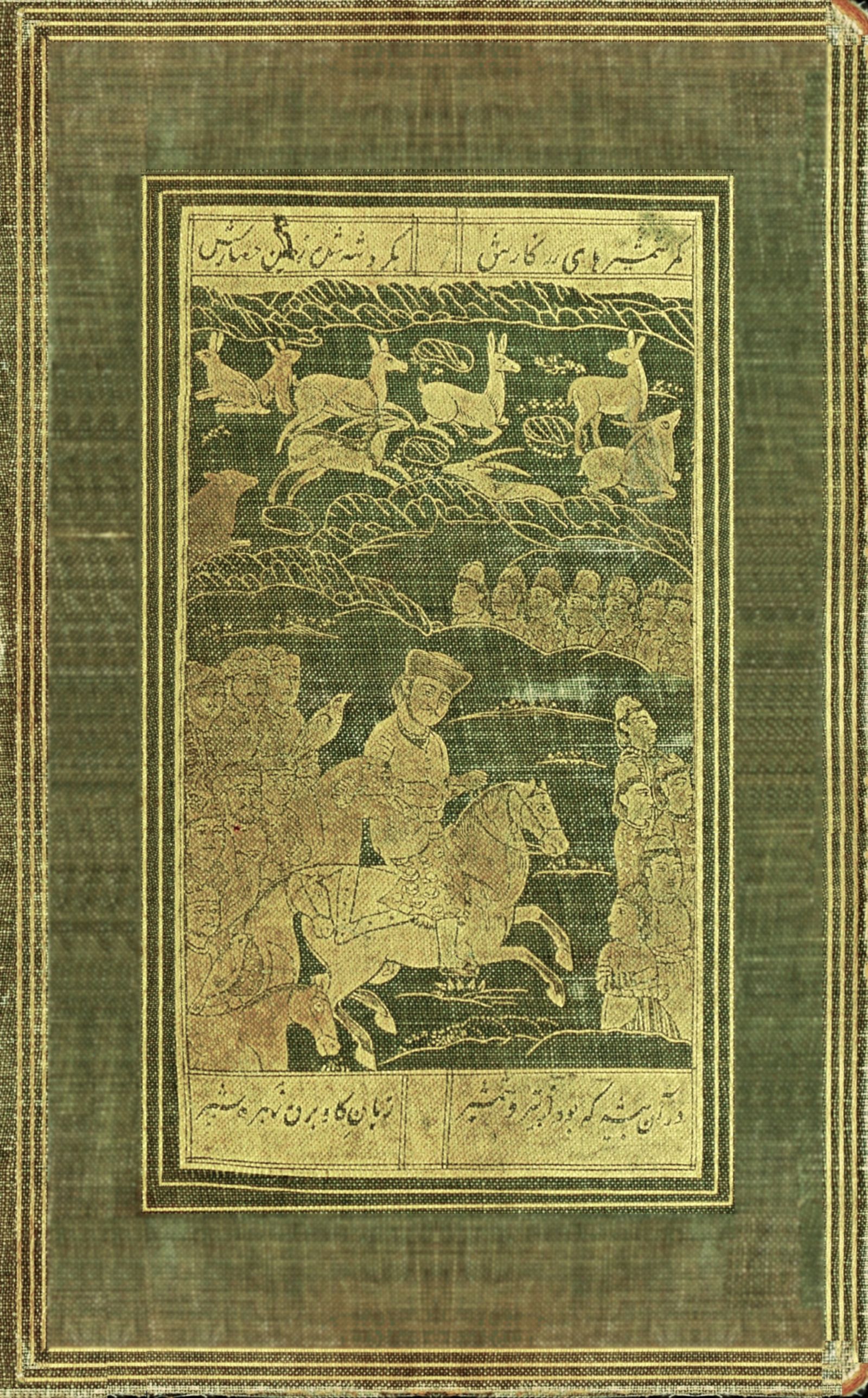
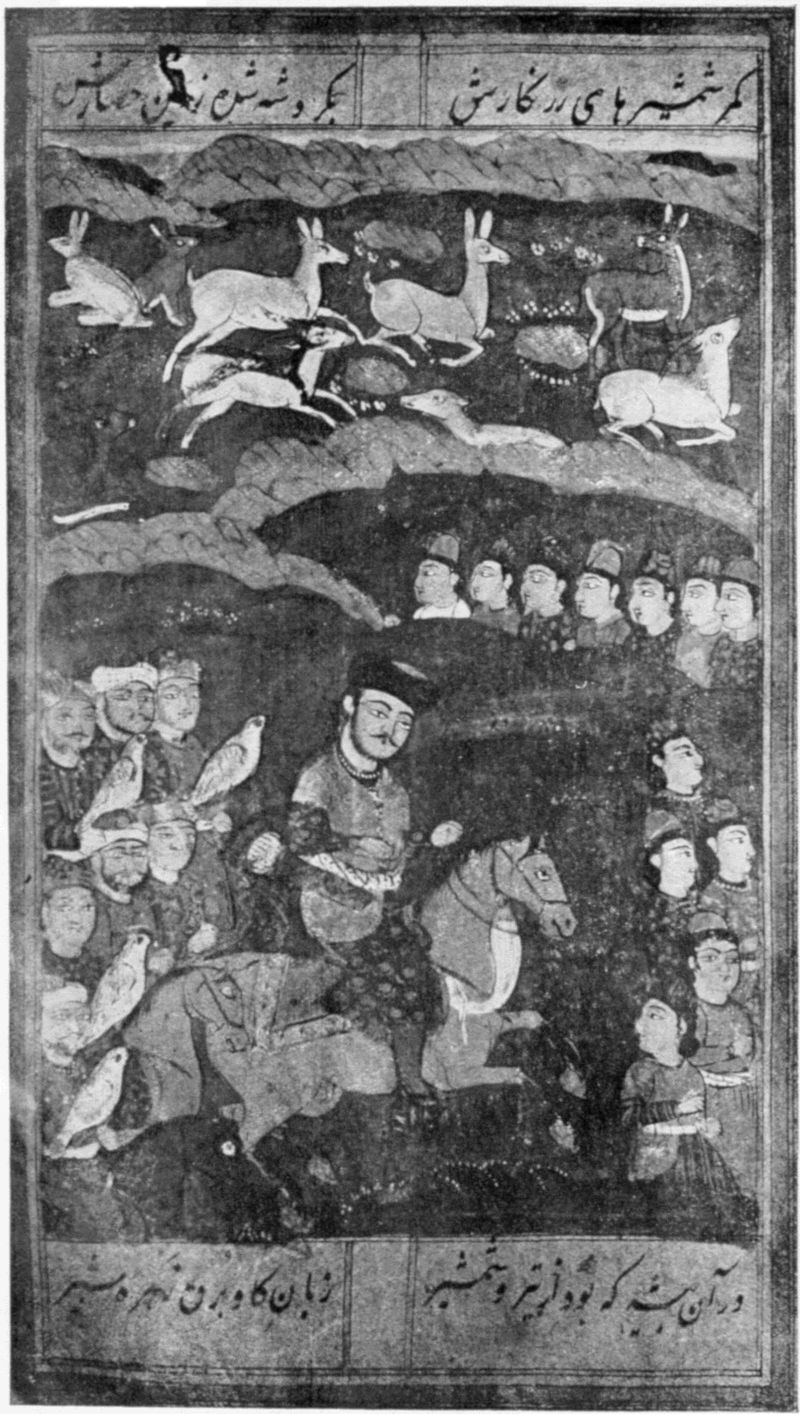
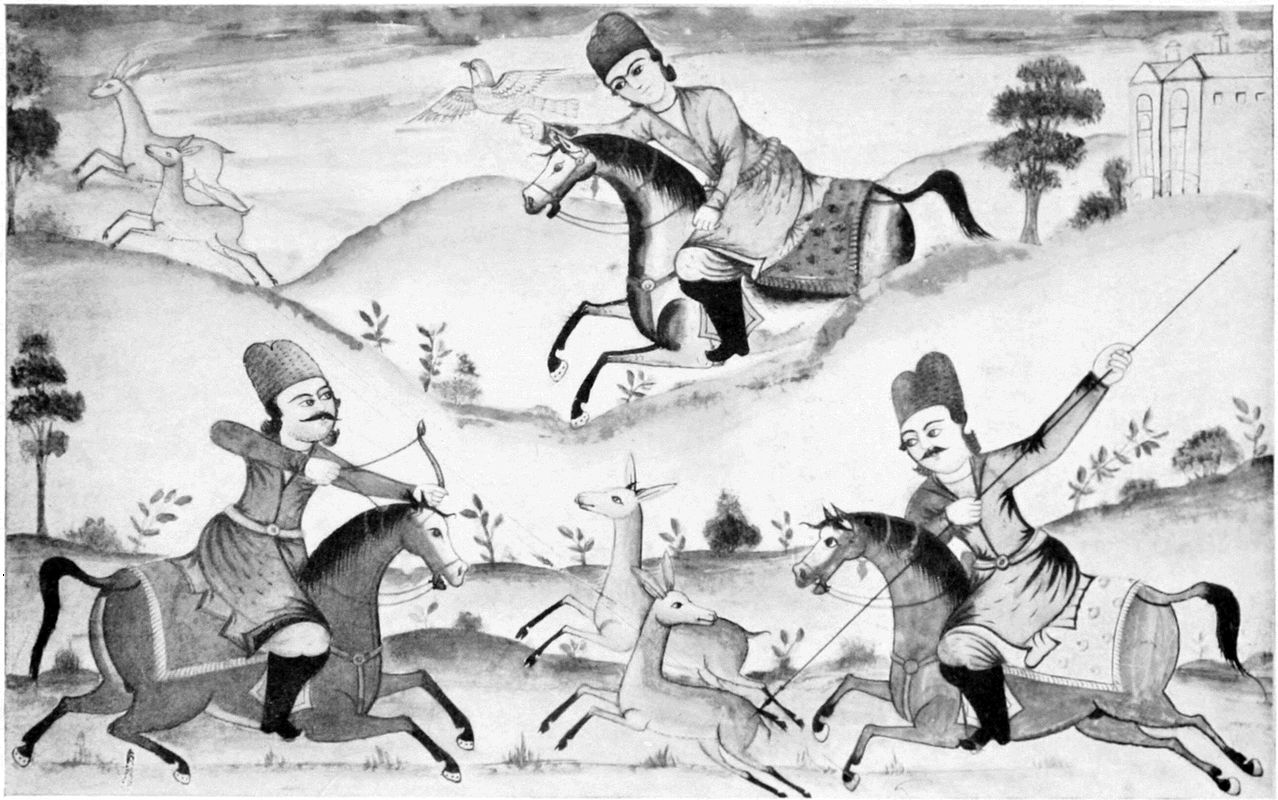
I HUNTING AND HAWKING SCENE
(FROM A PAINTING IN AN ANCIENT PERSIAN MS.)
THE
BĀZ-NĀMA-YI NĀṢIRĪ
A PERSIAN TREATISE ON FALCONRY
TRANSLATED BY
LIEUT.-COLONEL D. C. PHILLOTT
SECRETARY, BOARD OF EXAMINERS, CALCUTTA,
GENERAL SECRETARY AND PHILOLOGICAL SECRETARY, ASIATIC SOCIETY OF BENGAL,
FELLOW OF THE CALCUTTA UNIVERSITY, EDITOR OF THE PERSIAN
TEXT OF THE QAWĀNĪNu ’Ṣ-ṢAYYĀD
ETC. ETC.
LONDON
BERNARD QUARITCH
1908
[500 copies of this book have been printed]
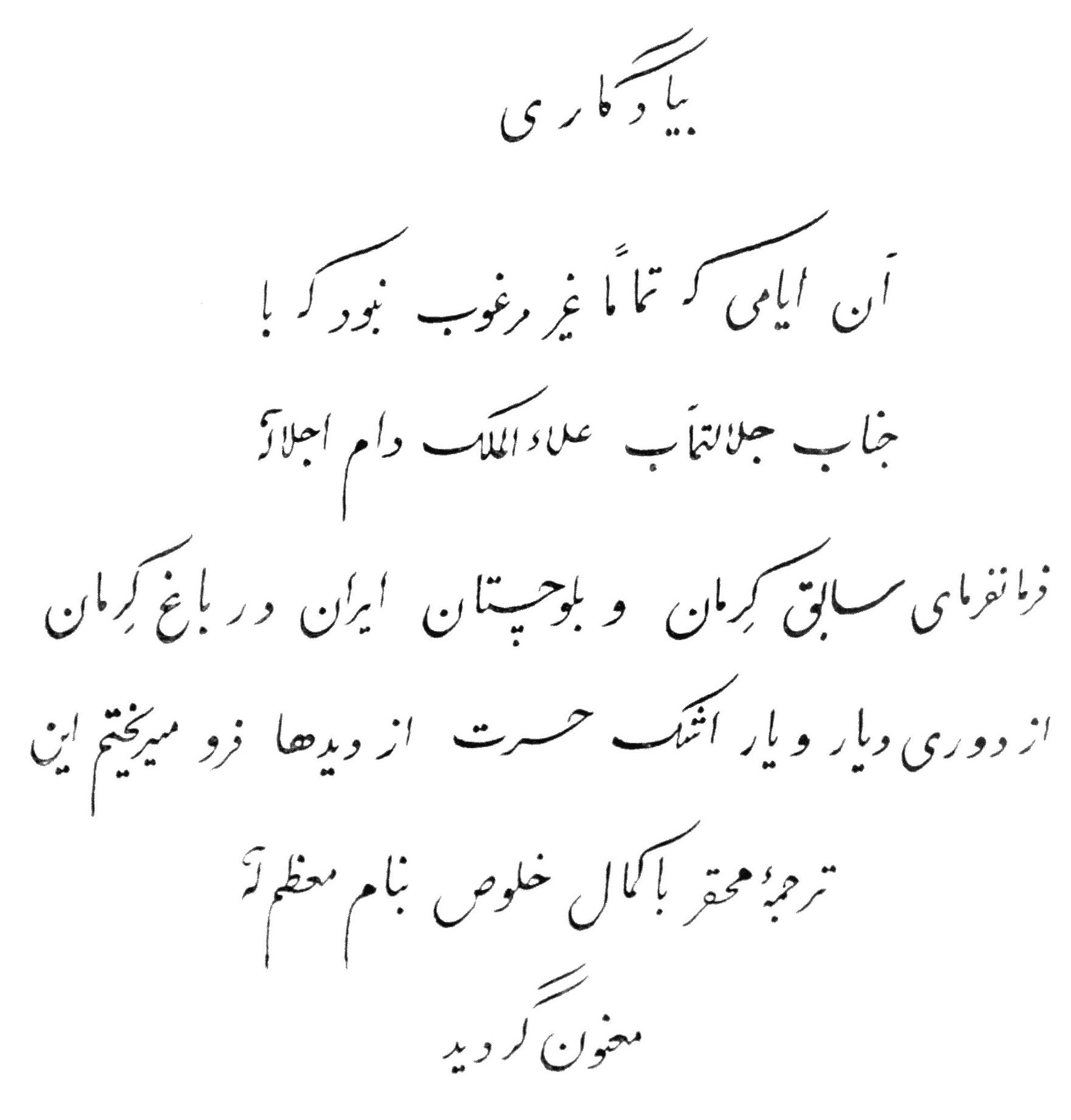
TO
HIS EXCELLENCY
THE ʿALAU ’L-MULK
formerly
Governor-General of Kirmān
and
Persian Baluchistan
THIS TRANSLATION IS AFFECTIONATELY DEDICATED
In Memory
of
Certain Days not Unpleasant when we Met in the BĀG͟H AND MINGLED OUR TEARS OVER OUR EXILE
TRANSLATOR’S INTRODUCTION — FOOTNOTES:
The author of this work was Ḥusāmu ’d-Dawlah Taymūr Mīrzā,
[1]
one of the nineteen sons of Ḥusayn ʿAlī Mīrzā,[1]Farmān-Farmā,
the Governor of the Province of Fārs, and one of the sons of
Fatḥ ʿAlī Shāh, Qājār.
On the death of Fatḥ ʿAlī Shāh, in A.H. 1250 (A.D. 1834),
general confusion prevailed: the claimants to the Crown were
many. The details of these claims and the actions of the various
aspirants to establish them are exceedingly complicated and
difficult to follow. The old Z̤illu’s-Sult̤ān first mounted the throne
at Teheran. His nephew the young Muḥammad Mīrzā was then
Governor of Tabrīz, and his troops had not been paid for some
time. However, receiving pecuniary support from the English
ambassador, and moral support from the Russian, he marched on
Teheran (putting out the eyes of a brother or two en route), and
was met by the army (hastily paid up to date, and even in advance),
of the Z̤illu’s-Sult̤ān. The moving spirit in Muḥammad Mīrzā’s army
appears to have been an Englishman named Lynch, who, nominally
in command of the artillery, virtually managed what cannot be better
described than as “the whole show.” The camp of the Z̤illu’s-Sult̤ān
awoke in the morning to discover that, during the night, their
General had gone over to the enemy; and that Mr. Lynch, having
pointed four big guns at their camp, was haranguing them from
his position, and exhorting them to go home. His arguments
appeared reasonable. Part of the Z̤illu’s-Sult̤ān’s army crossed
over to Mr. Lynch, and part returned home. “In a moment,
this fine army was disbanded, scattered like the stars of the Great
Bear, every man going to his own place.”
Muḥammad Mīrzā now entered Teheran without the slightest
opposition, and his uncle the Z̤illu’s-Sult̤ān, “in the greatest
despondency,” placed the crown on his head and handed him the
state jewels. Muḥammad Shāh (no longer Mīrzā) then proceeded to
despatch the Z̤illu’s-Sult̤ān and most of his uncles and brothers
to the dreaded fortress of Ardabīl.
Shayk͟h ʿAlī Mīrzā, Shayk͟hu ’l-Mulūk, “though he had none of
the requisites of sovereignty except a band of music,” was another
prince that made an even more feeble bid for the throne. He was
then Governor of Tūy Sarkān. Royal governors, in Persia, have
bands that play in the evening; but a morning band is a prerogative
of the Shāh. Shayk͟h ʿAlī Mīrzā ordered his band to play in the
morning as well as in the evening, and thought that by so doing he
had become Shāh. However, on receiving the unexpected news
that Muḥammad Shāh was in Teheran, he tendered his submission,
and was soon packed off to join the “caravan” at Ardabīl.
Ḥaydar Qulī Mīrzā, Ṣāḥib Ik͟htiyār, another royal prince, also
made a burlesque attempt to obtain sovereignty. His own
adherents split into two parties, quarrelled amongst themselves,
and then at a moment’s notice turned him out of the city of which
he was Governor. On his way to Isfahan he fell off his horse, and
was carried into that city in a prostrate condition. Once or twice,
after this, he flits across the page of history as a fugitive from the
wrath of Muḥammad Shāh.
It must not be supposed that all this time the Farmān-Farmā, the
father of our author and the eldest living son of the late Fatḥ ʿAlī
Shāh, was idle. He seems to have been popular in Fārs, for Shīrāz
was kind enough to offer him the crown of Persia. He induced his
brother the Shujāʿu ’s-Salt̤anah, the Governor of Kirmān, to have
coins struck in his name there, and also the K͟hut̤bah read in his name
at the Friday prayers. He further sat on a throne in Shīrāz. A few
days later, news of the arrival of Muḥammad Shāh in Teheran
and of the abdication of the Z̤illu ’s-Sult̤ān, reached him. The
Shujāʿu ’s-Salt̤anah, who had arrived at Shīrāz from Kirmān, was
then placed in command of an army, and under him were two of
the Farmān-Farmā’s sons, Najaf Qulī Mīrzā in command of the
Cavalry, and Riẓā Qulī Mīrzā in command of the Infantry. The
destination of the army appears to have been Isfahan, the inhabitants
of which, it was hoped, would declare for the Farmān-Farmā.
The season was winter. The second march was commenced in a
storm of snow and rain. The plains became a lake: the hill
passes were blocked by snow: men and horses died: guns sank
in the mud: property was lost. Rations, too, ran short, and
the country had lately been visited by locusts. Even proper
guides were wanting. But worst of all, one march from Isfahan,
Mr. Lynch was discovered blocking the way. In the night, three of
Mr. Lynch’s artillerymen “deserted” to the Shīrāz camp, and
tampered with its artillery. In the skirmish next morning, all the
artillery horses of the Shīrāz camp went bodily over to Mr. Lynch.
The remainder of the Shīrāz army scattered and disappeared, got
entangled in the mountains, and retraced its steps to find Mr. Lynch
with some artillery blocking one path, and a Mr. “Shir”—apparently
another Englishman—blocking another.
The Shīrāz Commander-in-Chief, with his two nephews, and
presumably a remnant of the army, eventually slunk back into
Shīrāz, in a miserable plight from hunger and exhaustion. A
grand Council was then held, and everybody talked, and the
Farmān-Farmā listened to all in turn. One thing seems quite
certain, no one did anything. Strange rumours now began to
reach Shīrāz of weird Turkish troops that spoke no Persian, and
were commanded by an ubiquitous Englishman. The merchants,
panic-stricken, fled with their property. The city people revolted,
and seized some towers; while the troops, of course, deserted to
the other side. A faithful eunuch then informed the Farmān-Farmā
that he had met some of the city people on their way to
seize the gates, and that a plan had been concocted for capturing
the Farmān-Farmā with all his relations, adding that the delay of
one minute meant the loss of everything. Still the Farmān-Farmā
shilly-shallied: still he maintained his attitude of keeping “one
foot in the stirrup and one on the ground,” giving ear, first to the
advice of his son to flee, and then to the advice of his brother the
Shujāʿu ’s-Salt̤anah to stay. The result was, that the two elder
princes were taken. The Farmān-Farmā was deported to Teheran,
where he was honourably treated but speedily died. The Shujāʿu
’s-Salt̤anah was carried to Teheran, deprived of his sight en route,
and then sent to enliven the family party at Ardabīl. The princes,
Najaf Qulī Mīrzā, Riẓā Qulī Mīrzā, Taymūr Mīrzā the author of
this Bāz-Nāma, with Nawāb Ḥājiya the mother of Najaf Qulī
Mīrzā, and three more princes, brothers or half-brothers, narrowly
effected their escape, and a month later reached Bag͟hdād in safety.
At that time relations between the English and Persian Courts
were extremely friendly. The eldest prince, Riẓā Qulī Mīrzā, with
his brothers Najaf Qulī Mīrzā, and Taymūr Mīrzā our author,
started for England to obtain the mediation of William IV., reaching
London viâ Damascus and Beyrout in the summer of 1836. Their
journey from Damascus to Beyrout was as feckless and mismanaged
as their expedition to Isfahan.
For four months the princes were a popular feature of London
Society, and during that time succeeded in losing their hearts
several times. Then, as they had obtained the object of their
journey, Lord Palmerston having arranged matters to their satisfaction,
they returned to Bag͟hdād and exile.
Najaf Qulī Mīrzā wrote an account in Persian of the events that
occurred on the death of their grandfather Fatḥ ʿAlī Shāh, and of
their own adventures in consequence, and he also kept a diary of
their tour to England and back.
Asʿad Yaʿqūb K͟hayyāt̤,[2] a Syrian Christian who had accompanied
the princes to Europe as Dragoman, secured this MS. in Bag͟hdād;
but on his journey back to Syria he was held up by Bedouins and
deprived of that portion of the MS. that treated of the actual flight
of the princes from Shīrāz and of the arrest of their father—the
illiterate Arabs mistaking these pages for the Holy Qurʾān. The
remainder of the journal was translated by him into English, and
under the title of a “Journal of a Residence in England and of a
Journey from and to Syria, of their Royal Highnesses Reeza Koolee
Meerza, Najaf Koolee Meerza, and Taymoor Meerza of Persia,” was
printed in London for private circulation only. The present tragi-comic
page of Persian history has been compiled, partly from this
narrative, and partly from Persian sources.
Some twenty-eight years after the bid for sovereignty, and
fourteen years after the death of their cousin Muḥammad Shāh, the
two princes Riẓā Qulī Mīrzā and Taymūr Mīrzā started from
Bag͟hdād to revisit their native land. Who knows what secret
hopes they cherished, what dreams they dreamt of royal favour?
In a few pathetic words, our author, in his Preface, informs us that,
at the second stage of their journey, the truth of the sacred text,
‘And ye know not in what land death shall overtake you,’ was
forcibly revealed to him: his brother suddenly sickened and died.
Taymūr Mīrzā was well received by Nāṣiru ’d-Dīn Shāh, whose
constant companion he became in all sporting expeditions. He died
in A.H. 1291 (A.D. 1874); I am told, in Teheran.
In Persia, and round Bag͟hdād, Taymūr Mīrzā’s name is still a
household word. “Ah,” exclaim the Persians when hawking is
mentioned, “if Taymūr Mīrzā were only here.”
His treatise on Falconry, of which the present book is a translation,
was composed in A.H. 1285 (A.D. 1868) and was originally
lithographed in Teheran. A second, and perhaps a third, edition
was lithographed in Bombay, a few pages on pigeons and game-fowl,
apparently written in India, being added as an Appendix.
The present translation has been made from a copy of the
original Teheran edition to which marginal notes have been added
by a former owner. For the versification I am indebted to the
assistance of poetical friends.
D. C. P.
[1]Mīrzā after (not before) a name signifies Prince.
[2] In his translation of the Journal he transliterates his name
Asaad Y. Kayat. K͟hayyāt̤ is a common family name amongst Syrian
Christians.
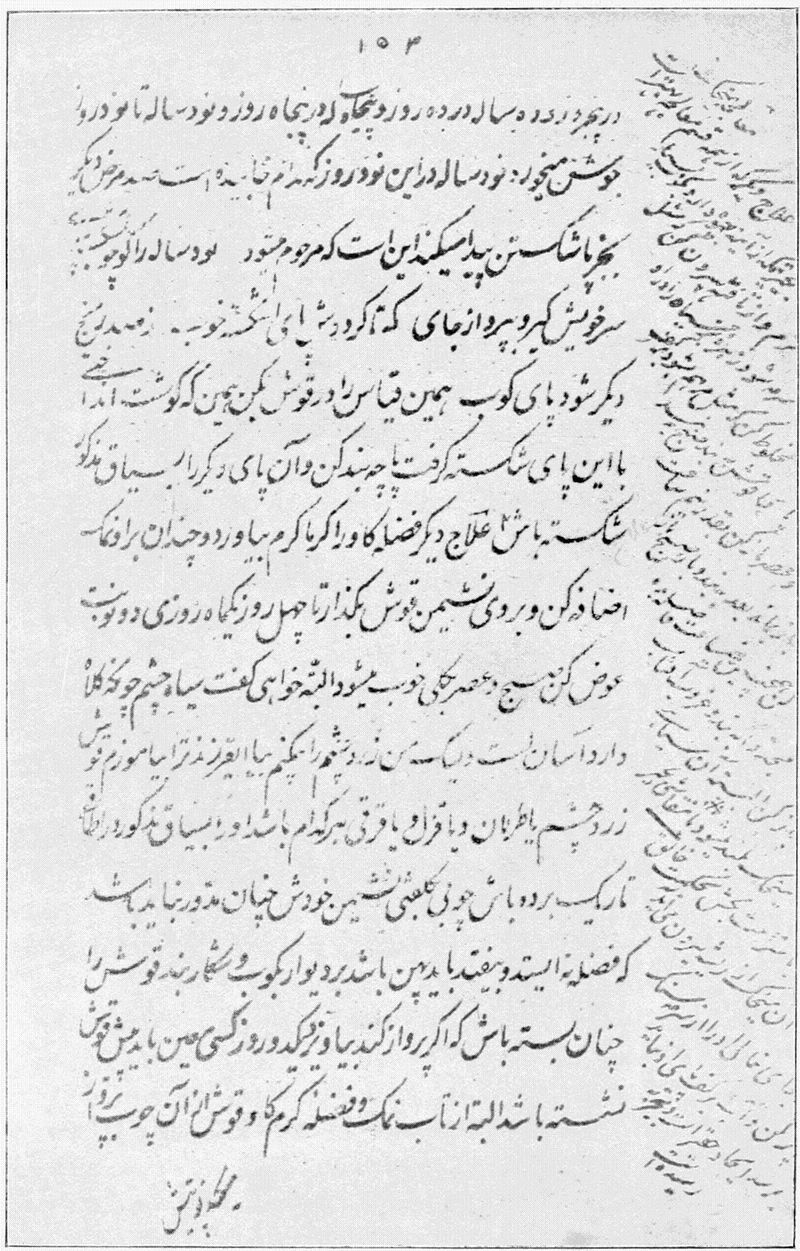
II FACSIMILE OF A PAGE OF THE TEHERAN LITHOGRAPHED EDITION
THE “BĀZ-NĀMA-YI NĀṢIRĪ” A TREATISE ON FALCONRY DEDICATED TO NĀṢIR U ’D-DĪN SHĀH OF PERSIA In the Name of God, the Merciful, the Compassionate — FOOTNOTES:
Let us embroider this Treatise on Falconry with the design of the
Praise of the All-Sufficient; and let us exalt our Pen by a votive
offering of praise to the Great Fashioner, in the path of whose
worship the wings of those falcon-like Pure Spirits of the Saints
are spread wide open,[3] like as the portals of His Mercy are opened
wide in the faces of those that truly love Him. Let us also praise the
matchless beauty and grandeur and perfection of that high-soaring
Bird,[4] the robe of whose being God adorned with this sacred verse:
“And was at the distance of two bow-strings, or even less.”[5]
We further extol the Family, the Humā[6] of whose noble spirit
soars aloft on the pinions of sure belief and true knowledge,
winging its way to the eyrie of union with the Eternal Phœnix:—
Falcons thrice four and twain,[7] that on the wing
Of Unity soar ever hovering
Round Caucasus (within whose rocky caves
Dwells the Sīmurg͟h); while ever on their graves
The clouds of God’s Grace every moment pour
Unnumbered blessings from His bounteous store.
Thus says this writer, His Royal Highness Prince Taymūr
Mīrzā,[8] son of the Blessed[9]Ḥusayn ʿAlī Mīrzā, Farmān-Farmā,[10]
and grandson of the Blessed[9] King Fatḥ ʿAlī Shāh, Qājār (whom
Allah has clothed in the Robes of Light):—At the beginning of
the reign of King Muḥammad Shāh (the Receiver of God’s
Pardon[11] and a Dweller in Paradise), in the year of the Flight 1250
(a thousand blessings and praises on Him that performed it[12]) I
with my brothers Riẓā Qulī Mīrzā[8],
Nāqibu ’l-Iyāla, and Najaf Qulī
Mīrzā, Wālī, both my elders, and Shāh-ruk͟h Mīrzā, and Iskandar
Mīrzā, younger than the writer, departed from the Province of
Fārs on a pilgrimage to the Sacred Karbalā[13]—best of blessings and
perfect benedictions on its silent[14] inmates! After a residence of
some months in that Celestial City, I, as God and Fate decreed,
with my brother Riẓā Qulī Mīrzā and Najaf Qulī Mīrzā took a
journey to Europe, returning to the Holy Places[15] after the space of
a year and a half. By the grace of God we spent the long space of
thirty years, in peace and freedom, in those Abodes of Peace,
visiting the Holy Shrines and hawking and hunting in their
environs.
When the throne of the Kingdom of Īrān—which God protect
from the changes and vicissitudes of Time—was adorned and
illuminated by the splendour of the auspicious accession of His
Majesty Shāh Nāṣiru ’d-Dīn, a Jamshīd in rank, the shade of
God’s Grace and His Blessing to men, the Divinely-aided, a King
and the son of Kings; and when the fame of the Justice and the
echo of the Clemency of this peerless Monarch spread and resounded
throughout the world, nay reached even to the high
oratories of Heaven’s Dome, I, your humble slave, with Riẓā Qulī
Mīrzā, left Bag͟hdād, the Abode of Peace,[16] in the year of the Flight
1279, on a pilgrimage to Holy Meshed, in order to kiss the sacred
shrine of the Eighth Imām,—the blessings of God Almighty on
him, his honoured forefathers, and his descendants the Leaders
of men!
In Kirmānshāh his pre-destined death overtook Riẓā Qulī
Mīrzā, in the Fort known as Ḥājī Karīm, one of the stages on our
journey; and in accordance with the passage, “All that breathes
shall taste of death,” he passed away, and the hidden mystery of,
“No living thing knoweth in what land it shall die” was
manifested to us.
When the bird of his spirit spread its wings and soared to the
eyrie of Rest we despatched his bier to the Holy City of Najaf[17]
(thousands of blessings on him that has sanctified it) where was his
dwelling-place and ancestral home, so that he might there be
buried with his fathers, while I, alone, with my burden of grief
continued on my way to the most Sacred City.[18]
When I was blessed by the pilgrimage to Haẓrat-i ʿAbdu
’l-ʿAz̤īm[19]—Peace and Honour be to him—the intense heat had
already set in, and His Majesty and his Court were moving to the
summer residence at Shimrānāt. Certain well-wishers of His
Majesty and of the State informed him of my circumstances.
Since the Creator of Existence, He who has made the heights and
the depths, has decreed for every low estate a high estate, and for
every grief a joy, and for every disgrace an honour, and for every
pain a cure, the Royal mind was inspired to appoint Dūst ʿAlī K͟hān,
the Minister of Public Works, to summon this attached slave to
the Presence. So, according to Royal Mandate, I drove with the
Minister in his carriage to Nayāvarān,[20] where the Royal Camp then
was. After a short wait in the shade of the tent we were honoured
by admittance to the sun-like Presence of the King—May our
souls be his sacrifice! Such kindness he showed and so wide did
he open the doors of his favour and kingly condescension, that
what I had heard was but a thousandth part of the reality—as it
were but a handful as a sample of an ass-load. I exclaimed:—
When the poor traveller’s glance on thee alight,
Thy beauty charms his vision with its sight.
No longer wishful through the world to roam,
His heart but seeks to find with thee a home.
He spoke on various topics and strung the pearls of kingly
words—and kings’ words are the kings of words—on the string of
discourse. I too, his slave, according to my mean ability, presented
my poor contribution to the conversation, which at last turned on
sport. The Shadow of God (may our souls be his sacrifice) is an
expert of experts in all sports, but especially in shooting. I have
never seen or heard of his equal in shooting, either on foot, or off
a galloping horse. For example, one day in the Kūh-i
Shahristānak, I and Mahdī Qulī K͟hān the G͟hulām bachcha-bāshī, and Āqā Kushī
K͟hān the gun-keeper, were sitting with him behind a stone—Muṣt̤afā Qulī K͟hān the Mīrshikār[21] with
several other rifles
having made a circuit to drive the herd of wild sheep within range
of the king’s rifle—when the herd suddenly turned aside and made
off. Five three-year old rams that had not scented the danger came
fearlessly on towards the stone behind which His Majesty and the rest
of us were crouching. His Majesty had with him a double-barrelled gun
for slugs, and three rifles. When the rams arrived within forty paces,
His Majesty fired the gun and brought down one with one barrel, and
a second with the second barrel. The three remaining rushed down the
hill. His Majesty seized the rifles with his auspicious hand, and by
the will of the One God brought down all three head one after the
other:—
Many other feats, too, like this I’ve seen, up till now, the year
1285[24] (of the Flight).
Sixty-four years of my life have now passed, all spent in hunting
and shooting. I have had no hobby but sport, no recreation but it.
This slave of the King’s Court, Taymūr, desired that like the ant
he should present his offering to the Court of the Solomon of the
Age,[25] that is, compose a treatise on Falconry and its branches,
and on the various species of hawks and their treatment in health
and disease.
Although the old Falconers have written treatises on this
subject, still in my humble opinion those old writers were by no
means experts in their science and should not be classed as masters
in their art. I, therefore, thought of myself writing on the subject
and leaving a memento for all lovers of the sport, whether
tyros or experts. When these are seated by a stream, refreshed
and rested after the morning’s sport, I hope they will recall the
writer in their prayers and pass over the shortcomings of his work.
I have honoured my book with the auspicious name of His
Majesty the King, and have named it the Bāz-Nāma-yi Nāṣirī and
have divided it into several bābs.[26]
[3]Tajnīs: a play upon the words bāz, “a goshawk,” and bāz, “open.”
[6]Humā, the Lammergeyer; vide Journal and Proceedings Asiatic
Society of Bengal, Vol. II, No. 10, 1906.
[7]i.e., the 14 Maʿṣūms, which are Muḥammad, Fāt̤imah, and his
descendants the 12 Imāms.
[8]Mīrzā after a name signifies Prince: Mīrzā before a name signifies
one whose mother is a Sayyida. But Mĭrzā (with short i) before a
name signifies a “clerk, writer, etc.”
[9]Marḥūm, “blessed” (usually only of Muslims by Muslims), signifies
“dead and pardoned by God,” i.e., “late.”
[10]Farmān-Farmā—a title, and also a Governor or Viceroy. Ḥusayn
ʿAlī Mīrzā, much lauded by the Poet Qā,ānī, was Governor of Fārs.
[13]ʿAtabāt-i ʿAlīyāt, the “Exalted Thresholds,” is a Shīʿah term for
the city of Kerbalā, the burial place of the martyrs Imām Ḥusayn, his
family and his followers; sometimes Najaf and Kāz̤imayn are included.
[25] The allusion is to some story of the ant presenting Solomon with
the leg of a locust.
[26] The book, however, contains only two numbered bābs; the first,
pages 1 to 26 (1st Edition) on “The species of Hunting-birds;” and the
second, the remaining 157 pages of the book on other subjects. The
2nd bāb, however, commences with: “On the black-eyed birds of prey
that have at various times of my life come into my possession and
which....”
Part I THE YELLOW-EYED BIRDS OF PREY — CHAPTER I ON THE SHORT-WINGED HAWKS USED IN FALCONRY — FOOTNOTES:
The Birds of Prey are divided into two great divisions, the
“Yellow-eyed” and the “Black-eyed,” these being again sub-divided
into numerous species.
We will first treat of the Yellow-eyed Division.
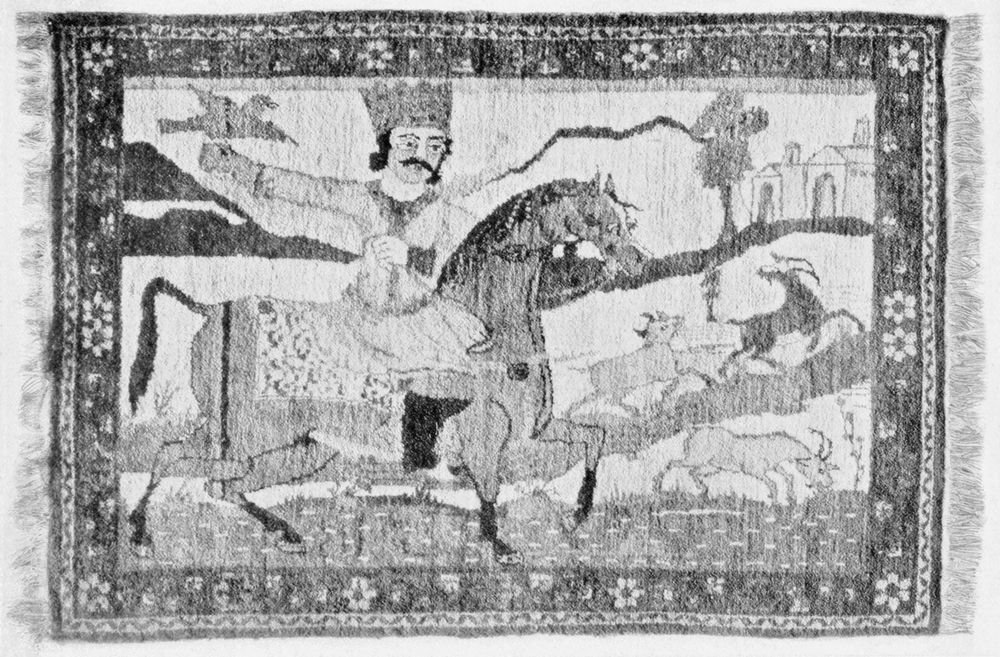
III PERSIAN CARPET DEPICTING HAWKING SCENE
T̤ug͟hral [Crested Goshawk?]—The first species worthy of
note is the T̤ug͟hral.[27] During my many wanderings I have
searched diligently for this species, but in vain, and am, therefore,
unable to describe it from personal knowledge. There is a current
tradition, that a single specimen was once brought to Persia from
China,[28] and presented as a curiosity to King Bahrām-i Gūr,[29] who
treasured it greatly and guarded it jealously. One sad day, when
the king was out hawking, the t̤ug͟hral suddenly took to “soaring”
and was quickly lost to the sight of the disconsolate monarch. His
retinue were soon scattered in every direction in search of the
missing hawk, and the king was left almost alone, being attended
by a few only of the royal favourites. Bahrām-i Gūr and his party
also took up the search; and wandering far and wide, at length
happened on a large and shady garden, where they alighted. The
bewildered owner of the garden advanced exclaiming:—
On being questioned about the lost hawk he replied, “What a
T̤ug͟hral may be, I know not, but not two hours since a hawk with
bells and a jewelled ‘halsband,’[31] took stand in a tree of this very
garden; but taking fright at my attempt to secure it, it flew off
and settled in that grove yonder.” Bahrām was overjoyed at this
clue, which enabled him to recover his lost favourite.[32]
From this reference to a “halsband” and bells, and to the
t̤ug͟hral’s habit of sitting on trees, the author concludes that this
unknown species belongs to the yellow-eyed division of the birds
of prey.
[27]T̤ug͟hral; a species frequently mentioned in old Persian MSS. on
falconry. It is probably the “Crested Goshawk” (Astur trivirgatus)
which is said to have been formerly trained in India. Jerdon, quoting
Layard, says it is trained in Ceylon. The T̤ug͟hral is confused by Indian
falconers with the Shāh-bāz, or “Royal Goshawk” which, according to
Jerdon, is the name given by native falconers of Southern India to the
Crested Hawk-Eagle (Limnætus cristatellus). The same author also
quotes Major Pearse as his informant that the Rufous-bellied Hawk-Eagle
(L. kienierii) is, “Very rarely procured from the N.W. Himalayas
and trained for hunting and is known as the Shāh-bāz.”
[28]Chīn; under this name are included Yarkand, Khutan, Mongolia,
Manchuria, etc.
[29]Bahrām was surnamed Gūr, from his passion for hunting the gūr
or wild ass. He belonged to the Sassanian dynasty of Persian kings
and his name frequently occurs in Persian poetry. The Greek Varanes
is said to be a corruption of Bahrām.
CHAPTER II THE GOSHAWKS — FOOTNOTES:
Three species.—[The author now describes three races of
goshawk, which he distinguishes by the names of Tīqūn; T̤arlān;
and Qizil:[33] each of these three he sub-divides into varieties, only
distinguishable from each other by slight differences in colouring,
in marking, or in size. The first-named species is the white
goshawk; the second is that variety or race of the common
goshawk that is caught after migration into Persia; while the
third is the local race that breeds in the country.
After hazarding a conjecture that the white goshawks[34] are not
a true species like the T̤arlān and Qizil, but are either albinos, or
else accidental varieties produced by the pairing, for one or more
generations, of two exceptionally light specimens of the common
goshawk, the author proceeds to describe a pure white variety of
the Tīqūn, which, he says, is known to the people of Turkistan by
the name of Kāfūrī.[35] He remarks that he has caught albino
specimens of the Saker Falcon, and has further observed albinos of
the Shāhīn, “piebald crow,”[36] peacock, sparrow, sparrow-hawk,
pin-tailed sand-grouse, chukor, hoopoe, English merlin, kākulī
lark, and common crane. As regards the Kāfūrī, he states his
opinion that it is the offspring of albino T̤arlāns that happen to
have paired for two generations. He continues:—]
White Goshawk orTīqūn-i kāfūrī.—The female of this variety
of Tīqūn is noted for its large size, the male on the contrary
for being extremely small. The head, neck, back, and breast are
totally devoid of markings, the plumage being white as driven
snow.[37] In the immature bird the eyes have only a slightly reddish
tinge, but after the first moult their hue generally deepens and
turns to a ruby-red.[38] The claws and beak, though frequently
white, are more often a light grey, while the cere is greenish.
E’en such the noble thorough-bred Tīqūn;
May God in mercy grant us such a boon!
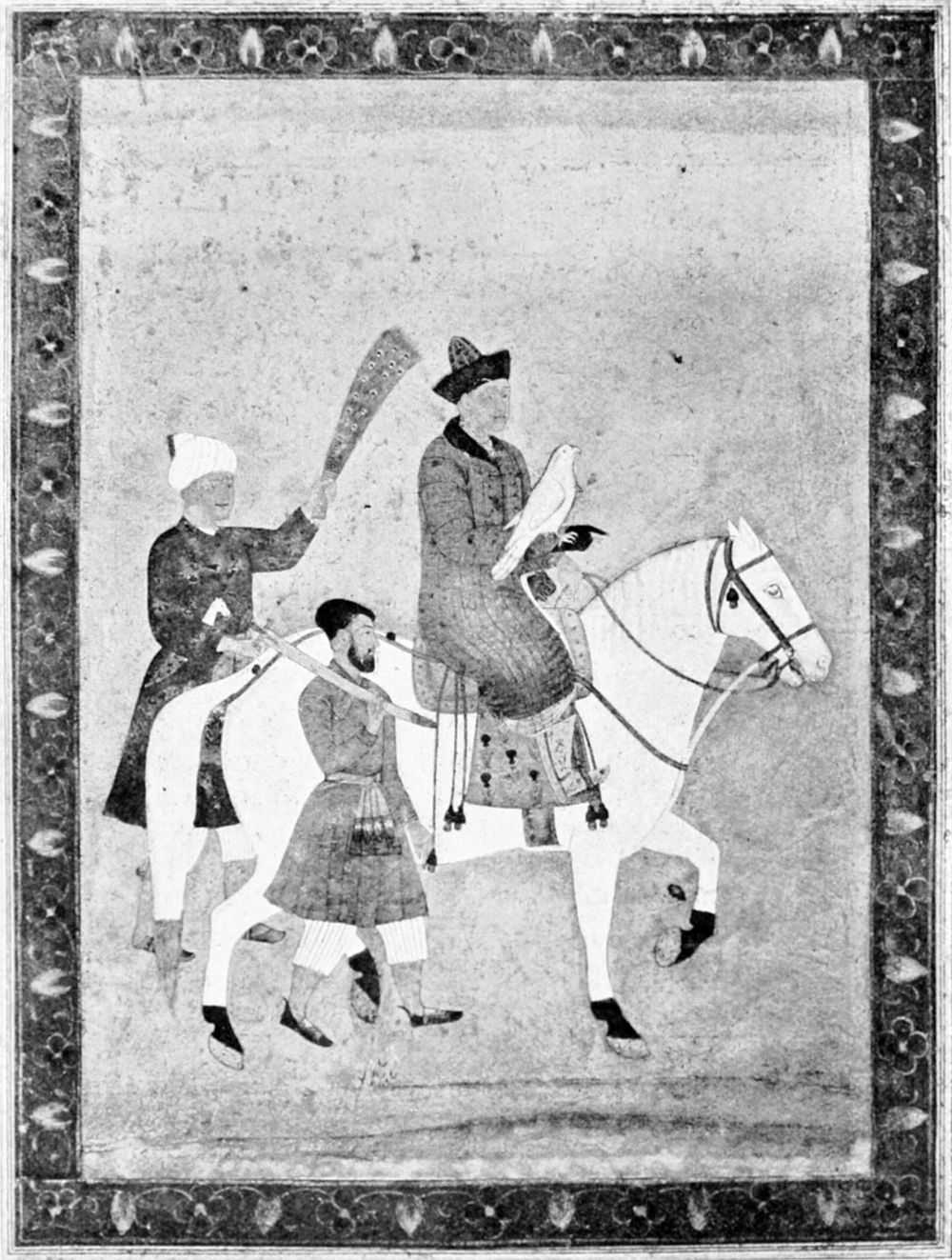
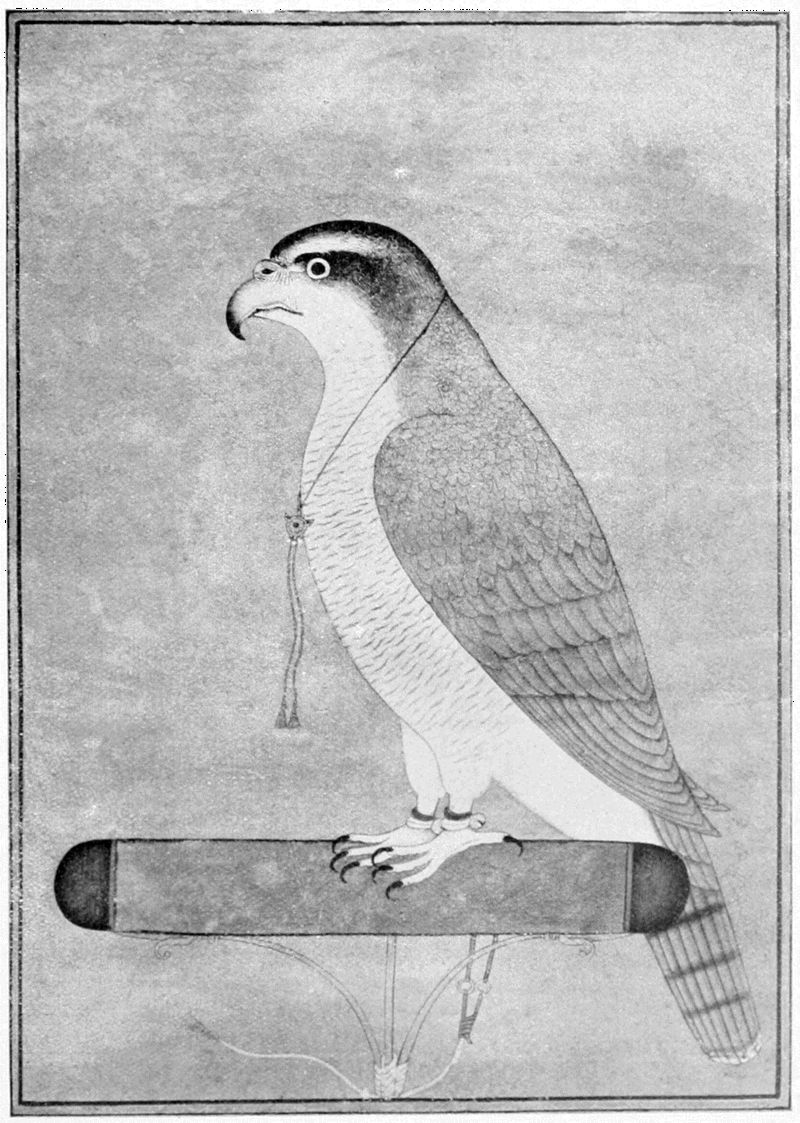
IV FROM AN OLD PERSIAN PAINTING, INDIAN, PROBABLY OF THE MUG͟HAL PERIOD
I remember having once seen a “cast”[39] of this variety—male
and female—in the possession of Fatḥ ʿAlī Shāh[40] (now
a resident of Paradise), both of which were exceptionally fine
performers in the field.
The people of Turkistan, who are highly skilled in the art
of training goshawks, call this variety lāziqī.[41]
It is commonly believed by falconers and bird-catchers, that
in the early spring, when the female goshawk is desirous of the
attentions of a male, she utters loud and plaintive cries, which
attract to her many species of birds. From these she selects a male
of a species different from herself,[42] and the result of this union
is a diversiform progeny. However, the kāfūrī or lāziqī variety
is the offspring of two white parents.
The following circumstance lends some colouring of truth to
this quaint belief:—
Some years ago a hawk of this species was brought from
Russia and presented as a curiosity to the late Shāh, who, in turn,
bestowed it on Ḥusayn ʿAlī Mīrzā,[43] Governor of the Province of
Fārs. The Governor (now in the abode of the Blessed) forwarded
it to me—the contemptible. It must have been a bird of four or
five moults, when it came into the possession of this slave. After
infinite pains I succeeded in taking with it one solitary chukor,[44]
and that, too, a bird harried and worn out by another hawk.
It had a very villainous and scurvy disposition. The plumage of
this hawk, an unusually large female, was peculiar, in that its
feathers were alternately snow-white and raven-black; the claws
and beak were of the colour of mother-of-pearl, and the eyes were
a reddish yellow. I feel confident her albino mother had mated with
a raven, and that this spurious half-caste was the result of the
union. There is some truth in the statements of the bird-catchers.
The above description is given, as it seems in some measure to
support the stories of the bird-catchers. Sure and certain knowledge,
however, rests with God.
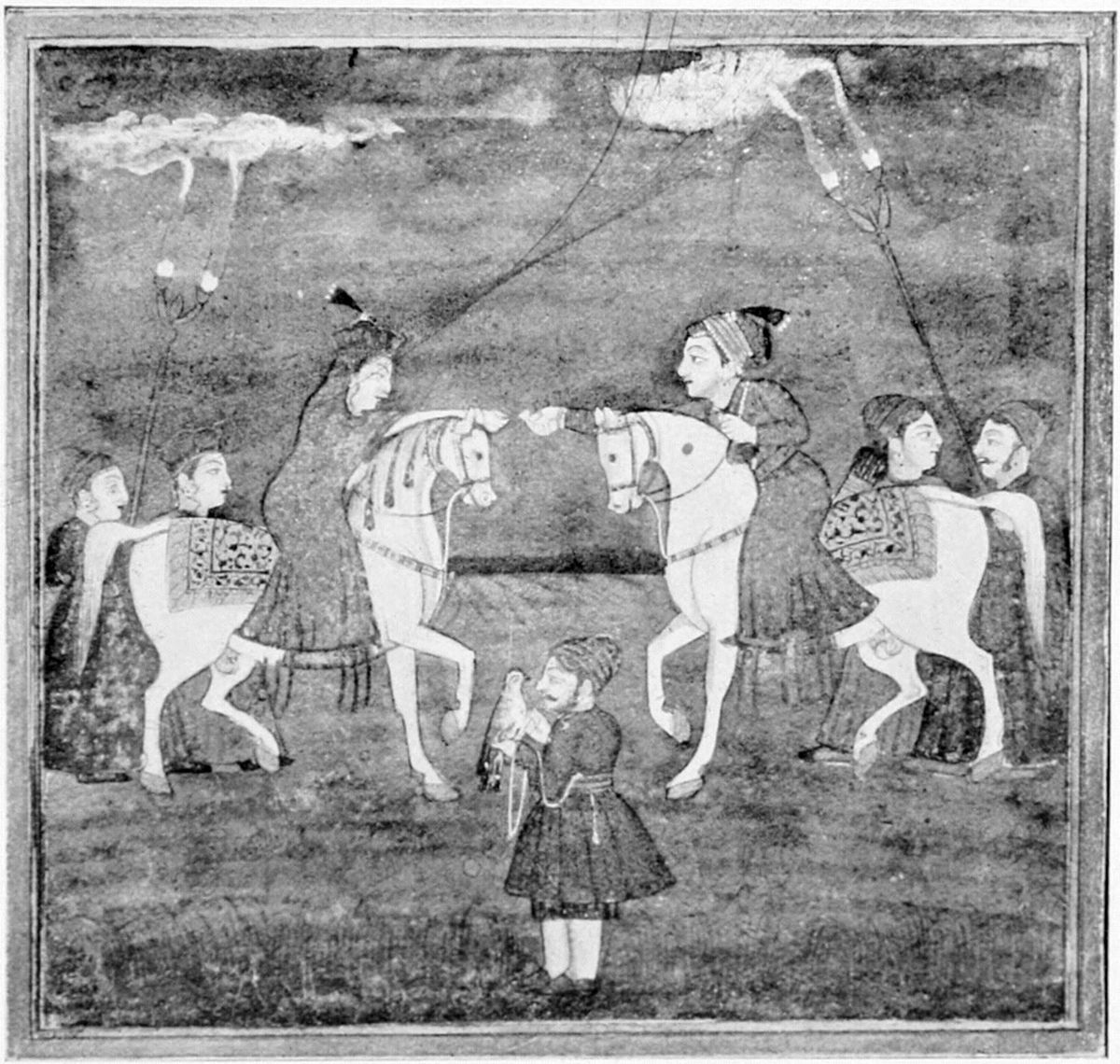
V FROM A PAINTING IN AN ANCIENT PERSIAN MS. WRITTEN IN INDIA
Goshawk (T̤arlān).—There are three varieties of T̤arlān, the
dark, the light, and the tawny. The last two are common, but
though tractable and easily reclaimed,[45] they are not good at large
quarry. The dark variety that has a reddish tinge, is universally
acknowledged to be the best, and I have myself taken with it
common crane and great bustard.[46] The colouring should be very
dark, with a tinge of red in it; though this variety may be sullen
and self-willed, it is also hardy and keen, and, once thoroughly
reclaimed, will be as docile and obedient as any falconer could
desire.
Local Race of Goshawk (Qizil).—The third species, the Qizil,[47]
breeds in Māzenderān,[48] and in many other parts of Persia, and
a fair number are captured in nets, each Autumn, together with the
T̤arlāns. Like the last-described species, this also contains three
varieties, the dark, the light, and the tawny. The dark variety
with the cheek-stripe[49] is the best, and the darker this marking—with
a tinge of red in it—the better the bird. With a “passage-bird”[50]
of this last variety, the author has himself taken common
cranes, great bustards, and “ravine-deer”[51] fawns. The difference
between the wild caught Qizil and the T̤arlān is in reality very
small. The latter has a somewhat finer presence, a more noble
disposition, and is rather faster in flight; also from its habit of
mounting higher and thus commanding a more extensive view,
it is better able to mark down or “put in”[52] its quarry. It is
for these reasons only that the T̤arlān has a higher value than
the Qizil.[53]
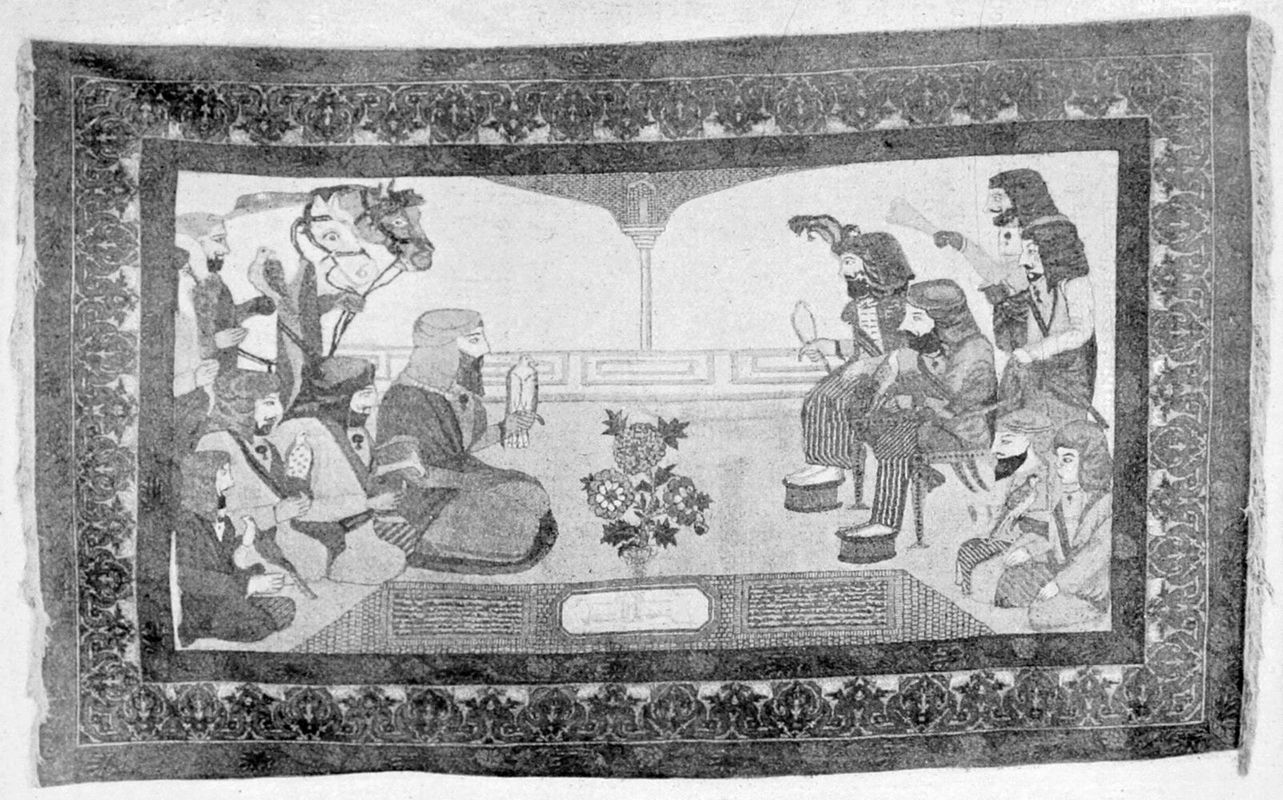
VI PERSIAN CARPET DEPICTING THE COURT OF A SIKH MAHĀRĀJĀ
Eyess ofQizil.—The eyess[54] of the Qizil is more courageous
than the “passage hawk,”[55] for it has the courage of inexperience.
Reared with fostering care from its nestling days, what recks it
of the frowns of Fortune? Untaught by Time, what knows it
of the spoiling Eagle’s might? Though the eyess may at first
excel the passage-hawk in courage, it is inferior to it in powers
of flight. With increased knowledge, comes decreased courage.
In a word, the nestling bears the same relation to the passage-hawk
that the town-bred man does to the desert tentman.
Passage and EyessQizilCOMPARED WITHT̤arlān.—Compared
with the eyess, the passage Qizil is the better, especially that
variety which has the reddish-black cheek-stripe.[56] Although
inferior in powers of flight to the T̤arlān, it is better at taking
large quarry, and in this quality, as well as in affection for its
master, it improves moult by moult. The T̤arlān, on the
contrary, with increasing age becomes a regular old soldier: it
wastes the day excusing itself and shirking its duty and saying:
“Oh! an eagle put me off that time;” or “Why! I didn’t see the
partridge;” or else, “How clumsily you cast me! You hurt my
back.” When the sun is near sinking, the cunning truant will
suddenly rouse itself, and by a grand effort kill in the finest
style. Well it knows that at that late hour, a full crop and no
more work must needs be the reward of its single exertion.
With hopes excited, its gulled master will rise early next day,
and start off to make a big bag. Alas for the fair promise of
last night!
Like yestere’en, to-day she fails to kill,
The truant bird, blaming her master’s skill.
The T̤arlān, however, brings luck to its owner. Besides it has
a nature sweet, and docile, and loyal, and true. Hence of the
T̤arlān it has been said:—
[31]Jalqū; “Halsband, lit. neck-band; a contrivance of soft twisted
silk, placed like a collar round the hawk’s neck and the end held in the
hand; ...”—Harting. The object of the halsband is to steady the
hawk and enable it to start collectedly when the falconer casts it at the
quarry. In the East it is considered an indispensable portion of the
equipment of every Sparrow-Hawk. It is also very frequently attached
to the Goshawk, but is not, however, used with the Shikra.
Zang “bell.”
[33] The T̤arlān and the Qizil are the same species; the latter is the
local race that breeds in Persia.
[34] In Blandford’s Zoology of Eastern Persia the author states his
opinion that the white goshawk is merely a variety of the common
goshawk.
[35]Kāfūrī; adj. from kāfūr, “camphor,” an emblem of whiteness.
[36]Kulāg͟h-i pīsa “the pied crow”; qil-i quiruq T. “the pin-tailed
sand-grouse”; hudhud “hoopoe”; kākulī, vide page 24, note 104, “a
species of crested lark”; durnā “common crane.”
[37] Jerdon mentions a pure white goshawk as being found in New
Holland, and states that Pallas notices a white goshawk from the
extreme north-east part of Asia. Some Afghan falconers call albinos
of any species taig͟hūn (tīqūn).
[38] In the adult shikra (wild caught), the iris is sometimes a deep red
and sometimes a bright yellow. In “eyess” shikras, even after the
moult, the iris is frequently almost colourless, the result perhaps of
confinement in dark native houses.
[39] “Cast of hawks, i.e., two; not necessarily a pair.”—Harting.
[41]Lāziqī T., is said to be the name of a white flower: this is said to
be the same as the gul-i rāziqī P., a kind of jasmine (the bel phul of the
Hindus).
[42] A similar belief is current in parts of England with regard to the
cuckoo, which, by some country people, is supposed to mate with the
wryneck or “cuckoo’s mate.”
[43] This Ḥusayn ʿAlī Mīrzā was apparently the father of the author.
[44] The chukor (Caccabis chukor) of India and kabk of Persia, with
its “joyous laughter,” enters largely into Oriental fable. On account
of its cheery cry, it is a favourite cage-bird with both Hindus and
Muslims. The male is also trained to fight. It is not an uncommon
sight to see a man strolling along the road with a chukor, or a grey
partridge, trotting behind him like a little fox terrier.
[45] “‘Reclaim,’ v. Fr. réclamer, to make a hawk tame, gentle, and
familiar.”—Harting.
[46]Mīsh-murg͟h, lit. “sheep-bird” (Otis tarda). In Albin’s Natural
History of Birds, it is stated that the goshawk used to be flown at geese
and cranes as well as at partridges and pheasants. In Hume’s Rough
Notes, there is an account by Mr. R. Thompson of hawking with the
goshawk in the forests of Gurhwal and the Terai, the quarry killed
being jungle fowl, kālij pheasants, hares, peacocks, ducks and teal. The
peacock knows well how to use its formidable feet and legs as weapons
of defence, and is a more dangerous quarry than even the common crane.
[48] Māzenderān, a hilly province on the south coast of the Caspian.
[49]Madāmiʿ Pl. Ar. The author explains this to mean “having black
under the eyes and under the chin.” Vide also note 200, page 50.
[50] “‘Passage-Hawk,’ a wild hawk caught upon the passage or migration.”—Harting.
[51]Āhū; the Persian gazelle (Gazella subgutterosa). Unlike its congener,
the Indian gazelle (the well-known chikāra or “ravine-deer” of
the Panjab), the female of this species is hornless. A full-grown Indian
gazelle weighs about thirty-six pounds, and stands a little over two feet
high at the shoulder. “It [the goshawk] takes not only partridges and
pheasants but also greater fowls as geese and cranes.”—Albin’s Nat.
Hist. of Birds.
[52] “‘Put in,’ to drive the quarry into covert.”—Harting.
[53] A Persian falconer informed me that the Qizil is smaller, slower,
and inferior in courage to the other races, and that it can readily be
distinguished while in the immature plumage, but not after the first
moult. I was shown a moulted qizil and a moulted bāz side by side;
except that the former was slightly smaller, there was no outward
difference between the two.
[54] “‘Eyess;’ a nestling or young hawk taken from the ‘eyrie’ or
nest; from the Fr. Niais....”—Harting.
[55]Vide page 8, note 50. Chapter V of Bert’s treatise is headed: “Of the
Eyas Hawke, [Goshawk] upon whom I can fasten no affection, for the
multitude of her follies and faults.” The following quaint derivation is
from the Boke of St. Albans:—“An hawke is called an Eyes of hir
Eyghen, for an hauke that is broght up under a Bussard or a Puttocke:
as mony be: hath Wateri Eghen. For Whan thay be disclosed and kepit
in ferme tyll thay be full summyd. ye shall knawe theym by theyr Wateri
Eyghen. And also hir looke Will not be so quycke as a Brawncheris is.
and so be cause the best knawlege is by the Eygh, they be calde Eyeses.”
“Now to speke of hawkys. first thay ben Egges. and afterwarde they
bene disclosed hawkys....”
[56]Siyāh-yashmāg͟hlī T.; yashmāg͟hlī T., is a black handkerchief worn
by women round the head. Perhaps in the text it means “black-headed.”
CHAPTER III THE SPARROW-HAWK — FOOTNOTES:
Much that has been written of the T̤arlān Goshawk is also applicable
to the Common Sparrow-hawk.[57] There are four varieties, the
light, the dark, the khaki, and the tawny. Of these four, the
khaki has the best heart. The eyes in this variety are small; and
the smaller the markings on the breast, the more the hawk will be
esteemed, for the more courageous it will prove: it is the opposite
of the Qizil.
Into the azure vault of Heaven, my hawk I flew,
Whispering to it a prayer, “Oh Bird of Mine be true;
Come back to me!” But my foolish heart did not discern
That a hawk mid-air, well on the wing, could not return.
O Fate, whose face is veiled to me!
Return my hawk—propitious be!
With the Sparrow-hawk, I have myself taken teal, chukor,
stone-plover,[58] black-bellied sand-grouse[59]
and short-eared owl.[60] Considering
its size, the Sparrow-hawk is the boldest as well as the most
powerful of all the short-winged hawks used in falconry.[61] I have
frequently seen sparrow-hawks (especially eyesses) “bate”[62] at hares,
but I could never muster up courage to let one go, to see the result.
Young Passage Sparrow-hawk.—Should a very good young
sparrow-hawk be brought to you about the time of year that the
Sun first enters into Virgo,[63] which is about the time the Sparrow-hawks
first arrive in the country, nurse her carefully, for she is
well worth keeping. At this time she will be a mere nestling,
scarcely in fact more than seven weeks old. Her bones will not be
properly set and her whole appearance will be spare and weakly.
Now, don’t be in a hurry to fly her, unless indeed you wish to spoil
her. If you destine her for large quarry, such as chukor, seesee,[64]
black-bellied sand-grouse, and the like, “man” her very carefully,
and let her take no fright at dogs or water, etc. Next train her to
come to the lure, or fist. When she will fly readily to the fist, kill
a small chicken under her daily,[65] and gorge her on it,—day by
day increasing the size of the chicken, till she will fly readily to it,
and seize it in your hand, the moment that you present it held
firmly by both its legs. Proud of the progress made by your
pupil, you may feel inclined to release your grasp of the chicken’s
legs, in order to allow her to kill it unaided; but on no account
must this fatal inclination be yielded to.
Now, after the hawk has been called to, and gorged on, two or
three chickens given in the hand, she must be entered to two or
three flying pigeons; the pigeons, with shortened wings, being
released before her, in such a manner that she may take them.
Each time she takes the pigeon, kill it cautiously, and let her take
her pleasure on it.
When she has taken a few pigeons in this manner, call her as
before to a live fowl held by the legs, but this time call her to it
from some distance. As soon as she comes and seizes it, which
she ought to without hesitation, kill it, and gorge her on it.
As soon as her training reaches this point, she should be
confined in a cupboard, some seven feet long by three and a half
broad. The cupboard, which should first be thoroughly swept and
cleaned, must be kept to such a pitch of darkness, that it will be
impossible for its occupant to distinguish the day from the night.
If much more light be admitted, the hawk, by bating against the
door or wall, will probably do herself some irremediable injury.
She should be fed every evening, three or four hours after dark, by
the light of a lamp, being taken on the fist for the purpose, and
allowed to eat her fill. Her principal food should be sparrows and
young pigeons, but in any case she must have constant change of
diet. When so gorged that she can eat no more, offer her water in a
cup, flicking the water with the finger to attract her attention to it.
If she drink, so much the better, let her drink her fill: but if she
evince no inclination to drink, remove the water and replace her in her
prison. This treatment must be continued for at least forty days.
After the expiration of forty days, reduce the quantity of
her food for four or five nights, and carry her by lamp light;
in fact treat her in every respect like a wild-caught hawk.
Evening by evening, the amount of carriage must be increased,
until she is thoroughly “manned,”[66] when she will be ready to
obey her master’s every behest.
The above method has certain special advantages. During
the rest in confinement, the hawk’s bones will become thoroughly
hard and set;[67] and from the high feeding during that forty
days, she will attain the growth and strength of a twelvemonth;
and her toes will be long and thick; and even large quarry,
such as chukor, pigeons, and black-bellied sand-grouse, will
stand a poor chance of breaking away from her clutches.
It is of course understood that, if destined for large quarry,
she must never have been flown at sparrows nor even given
any small bagged bird whole, from the day you first get her till
the present. She must be made to forget that there is such
a thing as small quarry in existence, or that any bird is fit
for food except partridge, and sand-grouse, or such large game.
Eyess Sparrow-hawk.—I will now instruct you in another
method of training the Sparrow-hawk, by which, in the field,
it will be no whit inferior to the goshawks of most falconers. In
the early Spring, get some trusty fowler to mark down a tree,
in which a pair of Sparrow-hawks are “timbering.”[68] A strict
watch must be kept on the nest, and the first time the parent
birds are observed carrying food to their young, the tree must
be scaled, and all the nestlings, except the largest female,
removed. The nest will contain from three to five nestlings.
The whole attention of the parent birds will now be bestowed
on the solitary occupant, which, by thriving apace, will fully repay
the care lavished on it. The nestling must be inspected by the
fowler almost daily, until the whole of the quill feathers of the
tail and wings are out.[69] Then four or five days before it is
ready to fly, he must “seel”[70] its eyes while it is still in the nest
and remove it, substituting for it, one of the nestlings originally
abducted. The nest will not then be forsaken: the parent birds
will rear the restored substitute, and will year after year build
in the same tree.
The nestling, its eyes “seeled,” must be conveyed carefully
home, and its education conducted in precisely the same manner
as already described. When taken up at the end of the forty
days of confinement, your friends will probably delight you by
mistaking her for a male goshawk,[71] so great will be her size.
What a goshawk will do, she will do.
The author has also adopted the above plan with nestlings
of the Shāhīn, the Saker and the Qizil Goshawk, with eminently
satisfactory results. He humbly begs leave to add that the idea
is an original one.
[57]Bāsha P.; qirg͟hī, qirqī, etc. T. (Accipiter nisus).
[58]Chāk͟hrūq, also called bachcha hubara, the common stone-plover
(Œdicnemus crepitans).
[59]Pterocles arenarius. The common Persian name is siyāh sīna or
“black breast.” The author, however, invariably gives it its Turki
name bāqir-qara or bāg͟hir qara, a word having the same signification.
The Pin-tailed Sand-grouse is called qil-i quiruq T.: it is the qat̤ā of
the Arabs.
[61] The late Sir Henry Lumsden (who used to hawk “ravine deer”
with charg͟hs in Hoti Mardan), told the translator in Scotland that he
had frequently seen wild sparrow-hawks kill wood-pigeons, and that he
had that very morning seen a sparrow-hawk knock over an old cock
pheasant on the lawn, which is was of course unable to hold. Hume, in
My Scrap Book (page 132), under the description of his “Dove Hawk”
expresses a doubt whether the “true nisus” would kill a bird as large
as a dove: vide note 72, page 15.
[62]T̤apīdan, “to bate.” “‘Bate, bating;’ fluttering or flying off the
fist.... Literally to beat the air with the wings, from the French
battre.”—Harting.
[64]Tīhū or tayhū; the desert or sand-partridge, called in the Panjab
sī-sī or sū-sū from its cry. It is not such a favourite cage-bird as the
black partridge or the chukor. It is not used for fighting: both sexes
are spurless. In Oudh the sparrow-hawk is flown at grey partridges
without the assistance of dogs.
[66] “‘Manning, manned’; making a hawk tame by accustoming
her to man’s presence.”—Harting.
[67]Mag͟hz-i ustuk͟hwān-ash siyāh mī-shavad, lit. “the marrow of her
bones becomes black.”
[68] “And we shall say that hawkys doon draw When they bere
tymbering to their nestes.”—Boke of St. Albans. [“To timber,” in
old English, is “to build a nest.”]
[69]Parhā-yi ḥalāl, lit. “lawful feathers.” There is a belief that until
the quills of the tail and wings are produced a bird is not ‘lawful’
for food.
[70] “To seel,” is to sew up the eyes: a thread is passed through the
centre of each lower eye-lid, near its edge; the two threads are then
knotted together on the top of the head, being drawn so tight that the
lower eye-lids cover and close the eyes. Wild birds so treated sit quite
still and do not injure themselves.
CHAPTER IV THE PĪQŪ [72] SPARROW-HAWK — FOOTNOTES:
ThePīqū (Shikra).—The next hawk to be described is the
Pīqū. There are two varieties. The first, or tawny variety, has
the markings on the breast large and distinct. The second, or
dark variety, has a reddish tinge running through the darker
colour of its plumage.
These hawks arrive in the country about the beginning of
September, some twenty days before the advent of the Sparrow-hawks.
Inferiority of EyessPīqū.—Unlike the Sparrow-hawk, the
eyess of the Pīqū is much inferior to the passage-hawk; the eyess,
from its craven spirit, being with difficulty entered to quarry.
For this reason it is little esteemed. The eyess of the Sparrow-hawk,
on the contrary, surpasses the passage-hawk.
Of the two varieties, the tawny is the better, surpassing, as
it does, the Sparrow-hawk in appearance, more especially so after
the first or second moult.
The dark variety, however, is sulky and runaway.
Though slower on the wing than the Sparrow-hawk, the tawny
variety can take with success any quarry that the former can.
In fact, from a working point of view, there is little to choose
between them. The Pīqū is, however, by far the hardier of the
two, enduring with indifference the extremes of heat and cold.
Flown in the hot weather from morning till night, it shows
no signs of distress, but rather seems to get brisker and brisker
after each successive flight: it is impervious to fatigue. It is
certainly quite ten times hardier than the Sparrow-hawk.
In affection for its master, it also surpasses the Sparrow-hawk,
but as before stated, it is slow on the wing, and to be flown with
success, requires to be thrown skilfully.[73] If unskilfully thrown,
the quarry will get a start, and the hawk will meet with nothing
but disappointment. The Pīqū must take its quarry right off or
not at all.
In appearance the Pīqū very nearly resembles the Sparrow-hawk,
but its feet are stouter, its “arms”[74] more powerful, and its
wings shorter: it has also a conspicuous dark line under the chin.
The larger this chin-line, the better the bird.[75]
[71]Jurra-bāz. A “tiercel” goshawk: vide page 25, note 107.
[72] The Pīqū is merely the common Shikra of India (Astur badius—Blan.).
In a wild state this hawk preys on lizards, small birds, rats,
mice, locusts, and occasionally doves. I have once or twice seen it
chase the common Indian ground squirrel round and round a tree,
hovering in the air close to the tree and making sudden darts to the
opposite side, the squirrel all the time keeping the trunk between it
and its pursuer and chattering shrilly. I once caught a “haggard”
shikra in a do-gaza, with a very large homing pigeon—a cock Antwerp—as
a bait. The net had been set up for an eagle. Vide note 61, page 12.
[73] The Shikra, held in the right hand protected by a pad or glove, the
breast lying in the palm of the hand held upwards, and the tail, legs,
and points of the wings coming out between the fore-finger and thumb,
is thrown at the quarry while the quarry is still on the ground, or else
the moment it rises. The Sparrow-hawk being a bird of swift flight is
carried on the fist in the usual manner, a “halsband” being used to steady
it. It must be a very poor and badly trained Sparrow-hawk that requires
to be thrown from the hand. The Sparrow-hawk, being a bird of
nervous disposition, is hooded only when carried by rail, or on other
necessary occasions: not so the Shikra.
[74] “‘Arms;’ the legs of a hawk from the thigh to the foot.”—Harting.
[75] The chin-stripe is not always present. The author describes its
eyes as “Chashm-ash qarīb bi-zāq ast.” The meaning of bi-zāq I am
unable to discover.
CHAPTER V THE SHIKRA — FOOTNOTES:
TheShikra[76] is said to be of stouter and finer appearance than
either the Pīqū or the Sparrow-hawk and to be trained in India to
take the pied crow.[77] It is rarely found in Persia. I have never
come across it. God alone knows the facts of the case.[78]
[76] The author, writing from hearsay, has imagined the Shikra (Astur
badius) to be a separate species from the Pīqū. In India, shikras are
flown, or rather cast, at partridges, quails, mainās, and common crows.
Vide also note to scavenger vulture.
[77]Kulāg͟h-i ablaq; the Royston crow, the common crow of Persia, is
a different species from the common crow of India. The Royston or
Hooked Crow is, for a falcon, a far easier quarry than the rook.
[78] Muhammadans frequently qualify their statements by some such
expression, the inference being that men are prone to err and that exact
knowledge lies with God alone. It is related of the Prophet that once,
on being asked how many legs his horse had, he dismounted, counted
with care, and then said, “Four.” Had he made a positive statement
from memory, the Almighty might have altered the number to two,
or to three, and so convicted him of error.
CHAPTER VI THE SERPENT EAGLE — FOOTNOTES:
We now come to the Serpent Eagle,[79] so well known to every fowler.
Should one be desired as a pet, it can either be captured by any of
the ordinary fowler’s devices, or else taken with a chark͟h trained
to eagles.[80] It must be fed principally on snakes, as it will not
thrive on any other food.
[79]Sanj. Perhaps the Common Serpent Eagle (Circaëtus gallicus).
The author in two lines of imperfect description—omitted in the translation—also
states that in size and appearance it so nearly resembles the
buzzard (sār), vide p. 32, note 133, that even an experienced falconer
might easily mistake the two. The author does not include this amongst
the ʿUqāb or Eagles, vide Chapter XII.
[80] For this poaching flight, vide pages 113-114.
CHAPTER VII THE EAGLE OWL — FOOTNOTES:
We now come to the owls, of which there are eight or nine species,
the most magnificent of them all being the Great Eagle Owl.[81]
Great Eagle Owl.—Nestlings of this species are frequently
taken by fowlers, reared by hand, and then trained[82] for the sport
of “owling.” When first taken from the nest, they must be well
and frequently fed, and be kept in as high condition as possible;
for if at all neglected at this age, the immature feathers become
“strangled” and fall out.
As soon as Autumn commences and the weather begins to cool,
i.e., as soon as the birds of prey and other birds have commenced
their in-migration from the hills and other summer-quarters, the
nestling owl is taken up, fitted with jesses,[83] carried on the fist,
sparely dieted, and “manned,” just like a young hawk in training.
When thoroughly “manned,” a stick is procured about twenty
inches long: to one end of this a circular piece of black horse-blanket,
or felt, is securely fastened. To this again a twist of
black goat-hair rope[84] is attached, so that by its means the owl’s
meat may be tied on to the black felt.
The fowler, in the morning, places the stick, garnished with
meat, about two paces from him on the ground. He then takes
the owl on his fist and shows it the meat on the stick. The owl
will leave the fowler’s fist and fly to the meat. It is allowed to eat
a little only of the meat, being taken up and flown at this lure a
second, and a third time. It is then permitted to make a light
meal and is removed.
In the late afternoon the lesson of the morning is repeated, the
distance from which the owl is flown being slightly increased.
The above training is continued daily, the distance being
increased step by step, till the owl will fly a good long way to the
garnished stick laid on the ground. When this stage of the owl’s
education is reached, the stick is no longer laid down, but, felt-side
upwards, is planted lightly in the ground, in such a manner that
the moment the owl settles on the felt to feed, the stick collapses.
If the stick is planted too firmly, it will not fall flat to the ground,
the result being that the owl remains suspended half way. As soon
as the owl will fly readily to the upright stick, from a distance of
five- or six-hundred paces,[85] its education may be considered complete.
Now, if accidents are to be avoided, the owl, during the whole
of its training, must have been fed on nothing but red meat, meat
without the vestige of a feather. If fed on pigeons or fowls, or
any kind of “feather,” it may learn the fatal vice of bird-killing,
a vice that will be fully appreciated by the fowler the first time
a fine falcon becomes entangled in his net; for seeing the falcon
struggling in the net, that dog-begotten owl will abandon the lure,
and fastening on to the captive, will by a single squeeze of its
deadly feet deprive her of life. Before the fowler can arrive, the
murder is done, and his regrets—of what avail are they?
In addition to the owl, the fowler must procure a fine silk net.
The silk thread from which it is made should be woven of six
or seven fibres and should be dyed to match the ground where
the net will eventually be set up. When in position, the net
should be invisible. In size it should be about ten feet long by
sixteen to eighteen feet broad.[86] A very long fine silk cord of the
same colour as the net is threaded through its top meshes, and the
net (erected much in the same manner as an ordinary du-gaza[87] for
catching sparrow-hawks), is supported in an upright position by
two very light poles[88] as long as the breadth of the net, and these
are placed under the cord, at fourteen to fifteen paces distance from
the ends of the net. The ends of the cord are made fast to
pegs driven into the ground at a good distance from the ends of
the net. The poles must be so erected that, at any slight shock to
the net, they will collapse suddenly.
The “luring-stick,” garnished with a shank of sheep or
goat securely tied to the black felt, is now erected exactly in
the centre of the net, and about five feet[89] from it. The net so
arranged is in position for use.
The fowler now takes the owl on his fist, shows it the garnished
“luring-stick,” and then turns about and walks off in the opposite
direction for a distance of five- or six-hundred paces: he then
halts, turns about again, and casting off the owl into the air, quickly
conceals himself.
The owl, in accordance with its previous training, flies straight
for the lure, and is soon closely mobbed by all the birds of the
neighbourhood. Do not leave your ambush; watch. If you are
near the hills, perhaps a goshawk, qizil or t̤arlān, or else a saker
falcon will come down and join the crowd. The owl, however,
having no other object but to reach its goal, ignores the clamouring
presence of its pursuers and continues on its straight course. The
first bird to buffet the owl, on its alighting on the lure, is a fast
prisoner in the net.
Let us suppose a noble saker falcon has thus fallen a victim to
your fowler toils. Leave your ambush, and, cautiously and gently,
I adjure thee by God, go and secure thy prisoner, treating her
with all honour and respect.
The eyes of a newly caught hawk should be “seeled” on the spot,
and if a fine needle and fine thread (not silk) be used for the purpose,
the falconer into whose hands the hawk eventually falls, will call
down blessings, not curses, on the operator’s head.
Nestling of Eagle-Owl Preferred.—For the above sport, the
nestling is preferred to the wild caught bird. Being ignorant and
inexperienced, and consequently more courageous, it treats eagles
and other unknown dangers, with contempt. The nestling has
also greater staying power.[90] The hours it should be flown are
from early morning till about eleven o’clock, and from three in the
afternoon till within half an hour of sunset. A hundred flights in
the day are not too much for a really good bird.[91]
Disadvantages of wild-caught Owl.—The wild-caught owl
soon gets done up, and after a few flights gets sulky and flies off
aimlessly and settles on the ground.
Arab Name for Eagle-Owl.—The Arabs call the Eagle-Owl
Fahdu ’l-Layl, or “Panther[92] of the Night.” What the Golden Eagle
is to the day, the Eagle-Owl is to the night. Hares and foxes fall
an easy prey to it.[93]
Riding Down Eagle-Owl.—Should you, by chance, when riding
out in the open country, put up an Eagle-Owl, set your horse into a
gallop and start in hot chase. If closely pressed, the owl will not
rise more than thrice; after that it may be easily captured.[94]
Treatment of newly caught Eagle-Owl.—It is not at all
necessary to “seel” the eyes of an owl captured in the above
manner. It should at once be placed on the fist and “carried”
like a short-winged hawk; if it declines to sit up, duck its head
under water three or four times in rapid succession. This will
soon bring it to its senses and send away its perversity: plunging
its head in cold water extinguishes the fire of pride in its heart
and makes it steady as a rock.[95]
[83]Pācha-band. “Jesses, the short narrow straps of leather fastened
round a hawk’s legs to hold her by.”—Harting. The jesses are never
removed from the hawk’s legs. In the East the jesses are frequently
made of woven silk or cotton, with small rings or “varvels” attached
to their ends: with the short-winged hawks, the use of leather jesses is
the exception. The “leash” is a long narrow thong (or in the East a
silk or cotton cord) that is attached to the end of the “jesses” by
means of a swivel, or otherwise, and is used for tying up a hawk to a
perch or block. Vide also page 78, note 315.
[84]Qātima, a word used by the E. Turks and
Kurds for a rope of goat hair. In India gut, or the sinews of cranes,
are used for binding lures, etc.
[86]Ẕiraʿ. “Three ẕiraʿ long, by five or six ẕiraʿ broad.” The Persian
ẕiraʿ is variously stated to be a measure of forty, and forty-two inches
in length.
[87]Du-gaza; a light, large-meshed net, six feet or more long, by four
and a half feet or more broad, and suspended between two light bamboos
or sticks, which are shod with iron spikes. This net is planted upright,
twenty yards or more away from a resting hawk, while a live bird is
pegged down in the centre of the net, a few feet from it, and on the side
opposite to the hawk. A certain amount of spare net is gathered
towards its centre and allowed to rest loose on the ground. The hawk
makes straight for the fluttering bait, through the invisible net; the
loose portion on the ground permits the net to “belly” like a sail, while
the shock given causes the light uprights to collapse inwards, thus
effectually enveloping the hawk.
[88] Presumably the length of these poles should be somewhat less than
the breadth of the net.
[89] “One and a half ẕiraʿ.” The old English name for hawk-catching
nets was “urines” or “uraynes.”
[91] It must not be supposed from this description that hawk-catching
is by any means an easy business. In India, in the course of two or
three weeks, the fowler may not catch more than three hawks worth
keeping, and that, too, at the season the birds are migrating into the
country.
[92] Apparently a slip on the author’s part. Fahd is properly the
cheeta or hunting-leopard and not the panther. In Persian the former
is called yūz and sometimes yūz-palang, while the latter is called
palang only.
[93] In Seebohm’s British Birds, it is stated that the eagle owl preys on
capercailzie and fawns, besides hares and other game.
[94] Partridges are caught in this manner by the Baluchis round
Dera Ghazi Khan. Vide also Shaw’s High Tartary, Yarkand and
Kashgar.
CHAPTER VIII OTHER SPECIES OF OWLS — FOOTNOTES:
[Short-eared Owl; Long-eared Owl.—The author now imperfectly
describes five or six species of owl, which the translator is
unable with any certainty to identify. The first species mentioned
by him is the Yāplāg͟h or Yāplāq, and this species he again divides
into two sub-species or races, viz., the “Desert or Plain Yāplāq,”
and the “Garden or Grove Yāplāq.” The colour of the latter is
said to be somewhat darker than that of the former. The first
species is probably the Short-eared Owl (Otus brachyotus); while
the second is probably either the Common Long-eared Owl (Otus
vulgaris), or the Tawny Wood-Owl. The author also states that
the former species, once it has successfully shifted from the first
stoop of the falcon and has begun to “tower,”[96] is an exceedingly
difficult quarry, and that only a passage Shāhīn or Peregrine is
equal to the flight, the Saker not being swift enough.[97] The latter
species of owl, he adds, is a poor performer and unable to “ring
up”[96] to any great distance without being overtaken and killed.
Indian Grass-Owl.—The Short-eared Owl is, however, an
easier quarry than the Indian Grass-Owl (Strix candida), which
in India is taken both with Sakers and Peregrines. If, however,
the Saker is not in high condition (in much higher condition
than it is usually kept by natives of India), both hawk and
quarry will soon be lost to view, ringing up, on a calm day
completely out of sight and almost perpendicularly into the sky.
In this species the iris is dark; it is therefore presumed that
neither it nor any nearly allied species can be included under
the name yāplāq.
Indian falconers, however, in the Panjab, have only one name
for both the Short-eared and the Grass-Owl.
Afghan falconers state that, in their country, the Short-eared
Owl is a common quarry for the Saker, as well as for the Peregrine.
The author continues:]—
Bride of the Well.—The next species of owl is smaller than
the Yāplāq, and is hornless. Its prevailing colour is a yellowish
white, something like that of the Tīqūn Goshawk. This species
is especially common in Baghdad and other sacred places.[98] It
is known to the Arabs by the name of the “Bride of the Well.”[99]
It preys principally on the pigeons of the “Sacred Precincts;”[100]
for that cuckoldy pimp, lacking regard and consideration, has settled
that the pigeons of the precincts[100] are its proper prey, so it hunts
them in the night-watches. In the Spring the attendants pull
out the young owls from their holes in the walls, or from the
interiors of the domes, and slay them. This species is smaller
than the Yāplāq.
Little Owl (Spotted owlet?).—[The author next mentions a
small owl that he styles Bāya-qūsh or Chug͟hd. In the Panjab,
the spotted owlet (Athene Brama) is known by the latter name.[101]
The author says of this species:]—It frequents old ruins. A young
shāhīn, intended for the flight of the stone-plover, should first
be given two or three pigeons from the hand, and then flown
at a wild chug͟hd or two. After that it may be entered to stone-plover.
The chug͟hd is useful for no other purpose but this.
“Bird of Night-melody”[102]
or “Bird of Testimony.”[103]—The next
species we come to is the “Bird of Night-melody,”[102] better known
under its popular name of “The Bird of Testimony.”[103] The male
of this beautifully marked little owlet is scarcely larger than
a lark.[104]
All the above species of owl are strictly nocturnal in their
habits.
Too whit, too whoo! The helpless owl,
In evening shades alone can prowl;
To find its food, to chase its prey,
’Tis helpless quite in light of day.
[95] The following description of owling is taken from Blaine’s Encyclopedia
of Rural Sports. It is stated there that any owl may be used,
but that the great horned owl is the usual bait:—“The owl, confined
between two wooden stands or rests, is taught to fly from one rest to
the other without touching the ground. Between the rests, a cord is
stretched, on which a ring plays, and to which another slacker cord is
attached by one end, the other being fastened to the jesses on the legs
of the owl, whose movements are thus confined to flying from one block
or rest to the other. To this change of posture he is accustomed by
presenting him with food on the opposite side to that on which he may
happen to be resting, until he becomes completely habituated to this
method of exercising himself. A saloon is now formed in the midst of
a copse, of boughs, in the centre of which a log or stand rests, and
without the saloon a similar one is placed about a hundred paces distant,
the intermediate space on which the owl is placed being cleared away.
It is necessary that the top and sides of this saloon should be covered
with boughs in such a manner that although the outside is distinctly
seen there is no opening that will admit any bird to enter with unfolded
wings. Nets are placed against the top and sides, leaving open that
part only opposite to the resting place of the owl. The fowler, now
concealing himself, keeps watch, and when he observes the owl lower
his head and turn it on one side, he becomes certain that some bird of
prey is in the air. The hawk, now marking the owl for his own, follows
him into his retreat; when, becoming hampered in the meshes of the
net, he is easily secured.” Vide also History of Fowling, by the Rev. H. A.
Macpherson: Edinburgh: David Douglas, 1896.
[96] “‘Tower;’ ‘ring up;’ to rise spirally to a height.”—Harting.
[97] The Indian grass-owl, Strix candida, though a much more difficult
quarry than the short-eared owl, can be successfully flown by a trained
saker, provided the latter is in high condition: a saker is not fit for this
flight unless she weighs at least 2 lbs. 4 oz., better 2 lbs. 6 oz.
[99]ʿArūs-i chāh; ʿarūs is the Arabic for “bride,” but chāh, “well,” is
Persian.
[100]Ḥarām: the sacred precincts round both Mecca and Medina are
known as ḥarām, and certain acts such as slaying game are forbidden
within the boundaries. Ḥarām is also a name for the women’s apartments.
The author by ḥarām probably means the sacred precincts of
Mecca, but from the context his meaning is not clear.
[101] In the Derajat this owlet, called there chhapākī, is a quarry for the
shikra, and also for the common and the red-headed merlin. Its blood
is supposed to be a cure for prickly heat, hence its local name. (Chhapākī
is a corruption of shapākī, “prickly heat”.) In some parts of India it
is used as a decoy for small birds.
[103]Murg͟h-i Ḥaqq.Ḥaqq means the “Truth” or “God.” This little
owl, which is probably the Persian owlet (Athene Persica), is reverenced
by Muhammadans: it clings to walls and cries “Ḥaqq, Ḥaqq,” after the
manner of the dervishes.
[104]Kākulī. Elsewhere the author states that the Arabs call this
lark quṃburah, which is an Arab name for the Crested Lark (Alauda
cristata).
CHAPTER IX THE HARRIERS — FOOTNOTES:
Harriers.—[The author next proceeds to describe what appear to
be two species of harriers. He says:]—
We now come to the Bayl-bāqilī, called by the Kurds,
Dasht-māla,[105] and by the Arabs, Abū-ḥikb. There are two species,
one yellow-eyed, and one dark-eyed.[106]
Yellow-eyed Species.—In the yellow-eyed species, the plumage
of the young bird is henna-coloured [chestnut brown], but after its
first moult, some white feathers make their appearance. After the
second or third moult, the plumage is very like that of the Tīqūn
Goshawk, the back turning a bluish grey and the breast becoming
white. The female is about the size of a small Qizil “tiercel.”[107]
Only a falconer could distinguish the adult female from a Tīqūn
tiercel. The “stalke” of this species is long and slender.
Dark-eyed Species.—In the dark-eyed species, there is no
material difference between the plumage of the young and the
adult bird. In the latter, however, the markings on the breast are
larger. The general colouring of the dark-eyed species is darker
than that of the yellow-eyed.
In habits, both species are similar; they haunt open plains,
preying on mice and sparrows, and occasionally on quails. They
are mean-spirited, ignoble birds, with poor and weakly frames.
Wager with the Shāh.—When in attendance on the Shāh
(may our souls be sacrificed for him!) I once made a bet with some
fellow sportsmen that I would catch a harrier[108] and train it to take
chukor. I made no idle boast. Praise be to God, I won my bet
and proved myself a man of my word, for I trained it and took a
chukor with it. The puissant King of Kings, who has surpassed
in renown even Jamshed and Cyrus, regarded me with extreme
condescension, and in just appreciation of my skill bestowed on me
lavish commendation and a rich robe of honour.
On a second occasion, in Baghdad, I laid a wager of a Nejd
mare with some sportsmen of that city, that within a space of fifty
days I would “reclaim”[109] one of these hawks and successfully fly it
at wild quarry. I flew it in the presence of my friends, and took
with it one black partridge,[110] one quail, and one rail.[111]
As previously stated, it is quite possible to train these hawks,
as indeed it is possible to train many other useless birds of prey:
even—
The Bird whose Soul Delights the night
With care and trouble you can train,
To use its senses, use its sight,
In flying quarry on the plain.
The harrier is an ill-tempered bird with no great powers of
flight. To train it is a matter of extreme difficulty, and the result
by no means repays the labour. However, give the devil his due:
it is very long-winded.
[105]Dasht-māla may be translated “desert-quarterer.” In the Panjab
this is the name of the Pale Harrier (Circus Swainsonii) and probably
also of Montague’s Harrier (Circus cineraceus).
[106] In the young of the Marsh Harrier, the iris is hazel. The iris of
the female of Montague’s Harrier is also said to be hazel.
[107] “‘Tiercel, Tercel, Tassel’ (Shakespeare) and ‘Tarsell’ (Bert), the
male of any species of hawk, the female being termed a falcon. The
tiercel is said by some to be so called from being about one-third smaller
in size than the falcon; by others it is derived from the old belief that
each nest contained three young birds, of which two were females and
the third and smallest a male. Note the familiar line in Romeo and
Juliet: ‘Oh! for a falconer’s voice to lure this tassel gentle back
again.’”—Harting.
[108] It is not clear which of the two species the author trained, but
apparently the “black-eyed.”
[109] “Reclaim;” Fr. réclamer, to make a hawk tame, gentle and
familiar.—Harting.
[110]Durrāj; the Common Francolin (F. vulgaris). It is a favourite
cage-bird in India, especially with the Muhammadans, who liken its call
to the words Subhān Teri Qudrat “Oh Lord! Thy Power” (i.e., who
can fathom it?). The practical Hindus say its call is, Chha ser kī
kacharī, “Twelve pounds of kacharī.”
[111]Yalva is a name incorrectly applied to several species of bird with
long beaks, as the woodcock and snipe, etc. I am told that in Teheran it
is applied to a rail.
CHAPTER X THE LAMMERGEYER OR BEARDED VULTURE — FOOTNOTES:
[The description of the Bearded Vulture[112] as given by the author is
sufficiently accurate for identification. He, however, adorns it with
“two horns or ears like those of the horned owls.” He then
continues:]—
The Lammergeyer is noted for its wondrous powers of flight.
It soars aloft, bearing with ease a bone as large as the bleached
thigh-bone of a donkey. This it drops on a rock, and then
descends to eat the shattered fragments.[113] The Poet has said
of it:—
Popular Superstition.—It is a popular superstition that any
one wilfully slaying a Lammergeyer will meet his death within
forty days. Once, when out hawking, I saw one of these fateful
birds seated on a stone a short distance from me. With me was
a servant, a sturdy villain fearing nothing. Gun in hand he
approached the Lammergeyer, bent on slaughter. Do all I could,
I failed to dissuade him. I told him the popular superstition,
but he laughed and said, “Oh! that’s an old woman’s story.”
Heedless of my advice he shot the Lammergeyer, and died himself
on the fortieth day. This is a fact: I myself was an eye-witness.
Was his death a mere coincidence, or is there truth in the vulgar
belief? God knows.
Taking a Lammergeyer with aChark͟h.—I was once hawking
in Sulaymānīya Shahrzūr[115]
and saw what I took to be an eagle,[116]
seated on a stone some little way off. I had with me a very
fine chark͟h[117] trained to eagles.[118]
To unhood and cast it off was
the work of a moment, and it was not till I had actually secured
the quarry, that I discovered it was no eagle but a Lammergeyer.
I recollected the fate of my servant, and hastily released it.
[By a play on the words humā and humāyūn, the author
here pays the Shāh a flowery and far-fetched compliment, difficult
to render in English. He pretends that the popular belief mentioned
in the first note on the previous page was certainly fulfilled
in his case, since the King of Kings had always distinguished
him by his especial friendship and bounty, and thus raised him
to the dignity of ordinary kingship. He adds:]—
Through the lucky shadow of the Humā’s wing
Am I thus highly honoured by the King.
Honoured of him, Lord of my fate I stand,
And rich as Korah, through his bounteous hand.
[112]Humā; the Lammergeyer, Bearded Vulture, or Ossifrage. Translators,
imagining the Humā to be a fabulous creature, have identified
it with the Phœnix. It was a popular Persian superstition that the
shadow of a Humā falling on a person’s head predicted his rise to
sovereignty. The adjective (and proper name) humāyūn, signifying
“august,” “fortunate,” and “royal,” is derived from this bird. In the
Panjab, the Lammergeyer, common as it is, seems to have no special
native name.
[113] It is well-known that the Lammergeyer does not confine itself to
dry bones. I once saw one shot in the Tochi valley over a dead fowl
laid out as a bait. When shot it was carrying off the fowl in its beak
and not in its feet. The most contradictory statements exist regarding
its habits. As it sweeps round the hill side, the fowls in the compounds
show no alarm and will let it pass within a very few yards of them. At
Kingri, in Baluchistan, I saw one stoop at a flock of chukor and sent a
sowar to the spot to see what had happened: the man returned with a
chukor, unbroken and still warm. Some years ago at Sheikh-budin, the
hill station near Dera Ismail Khan, I saw one stoop repeatedly at a
mārk͟hor kid, on a narrow ledge on the cliff-face below me. At each
stoop the plucky mother lowered her horns to the “charge,” and
effectually repulsed the attacks of the assailant. Whether the
Lammergeyer was really trying to brush the kid off the cliff, with intent
to feed on its mangled remains, or whether it was merely animated by
that spirit of mischief that enters into birds as well as beasts, I cannot
say. The Pathan shikārīs with me stated that they knew from
experience that the former was the case. A shot Lammergeyer shown
to a tame monkey will drive it into a paroxysm of terror. Can it be
that the latter recognizes in it a natural enemy, or does it mistake it for
an eagle?
[115] In Kurdistān, and a little over a hundred miles south of Lake
Urūmiah.
[116]ʿUqāb. The author uses this word as a generic term. By falconers
of certain parts of the Panjab the name is specially applied to the
Tawny Eagle.
[117] The author applies the name chark͟h only to nestlings of the
Saker Falcon: passage falcons he calls bālābān. In the Panjab, and
in Kabul, the species is termed respectively charg͟h and chark͟h, the word
bālābān being unknown except to a travelled few.
[118]Qara-qūsh. Any eagle, but specially the golden eagle. For a
description of this “flight” see pages 113-114.
CHAPTER XI THE OSPREY [119] — FOOTNOTES:
[The author gives only a very brief description of the Osprey and
its habits, mentioning the peculiar structure of its feet, and its
habit of hovering over water. He also mentions that like the
Shikra Sparrow-hawk (Pīg͟hū), and the Sangak, the iris is sometimes
dark and sometimes yellow.[120] He adds:]—
I once took one alive with a chark͟h and kept it in confinement
for some little time. It could not be induced to eat meat, refusing
all food except fish. It is with reference to the osprey that the
poet has said:—
“Thro’ the mercy of God and His tender care
The sea yields her fish to the fowl of the air.”
[119]Damirdizināq T. Another name is damir-qaynāg͟h T., from damir
T. “iron” and qaynāg͟h T. “claws” (nāk͟hūn P.). The author does
not include this amongst the ʿUqāb or Eagles. According to F. O.
Morris, the osprey in olden times was occasionally trained for falconry.
[120] In the only living specimen examined by me, the iris was light
brown, possibly a mark of nonage. In several standard works
consulted, the iris is stated to be yellow.
Part II THE DARK-EYED BIRDS OF PREY — CHAPTER XII THE EAGLES [121] AND BUZZARDS [122] — FOOTNOTES:
[The author commences this chapter with the statement that it
is his intention to describe those species of the black-eyed birds
of prey that have at different times come into his possession, or
that have been trained by him “according to their several
capabilities.” His descriptions of the eagles are too vague for
identification. All the eagles, he says, are migratory, with the
exception of the ʿUqāb-i māh-dum or “Moon-tailed eagle,”[123] which
he describes as follows:]—
ʿUqāb-i māh-dum, “The Moon-tailed Eagle.”—The whole of
the tail of this eagle is white, with the exception of the end, which
is black. The plumage of the breast, back, and head, is uniformly
dark, without markings of any description. Its powers of fasting
are extraordinary: it can endure seven or eight days without food
and yet be not one whit the worse. Migration, too, is not a necessity
for it. Even in the depth of Winter I have observed it high up
in the snows. It seldom descends into the plains. The fierce
rays of the sun and the bitter blasts of the snows are all one to its
proud, enduring nature. I have observed it in the hills, preying
on partridges, hares, and “lambs.”[124] It is the most daring and
powerful of all the eagles.
ʿUqāb-i kūchigān [White-tailed Sea Eagle?].—The next species
is the ʿUqāb-i kūchigān. In this species the whole of the tail
(which is rather short) is white. The wings are long, and the
flight is exceedingly swift. The plumage of the back and breast
is dark. The beak, which is large and powerful as a vulture’s, is
of the colour of amber. This eagle always hunts and feeds in
couples, preying chiefly on water-fowl; hence it is seldom found
far from water.
ʿUqāb-i ā,īna-lī [Imperial Eagle?].—In this eagle, which is
smaller than either of the preceding, the back, breast, claws and
beak are all uniformly dark; the colouring of the head is a dark
reddish brown. Fowlers have named it Ā,īna-lī[125] from the fact
of its having a few white feathers in its back.
Karlak.—This eagle equals the first-named species, i.e., the
Māh-dum, in size. The beak and claws are black and extraordinarily
powerful. The plumage is generally brown, and covered
with markings. The head and back are, however, one uniform
colour. In habits it resembles all the eagles.
Black Eagle.—Another species is black without markings, but
the colour of the head is slightly different from that of the body.
It is not a very noble species.
ʿUqāb-i zard (“Yellow Eagle.”)—Description. The plumage
of the back is very dark, with a tinge of yellow in it, while that
of the breast is tawny (yellow), and marked with longitudinal
black drops. The head and neck are very handsome, and
somewhat like a goshawk’s. This eagle, in the immature plumage,
is called the ʿUqāb-i sīna-bāzī.
Once, when in attendance on the Shāh, I trained a single
specimen of this species, and took a certain amount of quarry
with it.
Būq-k͟hura; The
“Frog-eater” [Spotted
Eagle?].—Another species of eagle is the ʿUqāb-i
qurbāqa-chī[126] (“Frog-eater”), called by the
people of Kurdistan Sulemāniya, Būq-k͟hura.[126]
The plumage of the head, neck, back, and breast is blackish yellow.
This eagle frequents marshes and reed beds, preying on wounded or dead
water-fowl. Failing
these, it contents itself with frogs, dead fish, or other stranded
material. It is from this habit of eating frogs that it has earned its
names of “Frog-eagle” and “Frog-eater.”
Dūbarār [A Hawk-Eagle?].—In habits the Dūbarār resembles
the eagles, but not in size, the male being scarcely larger than a
female goshawk.[127] This species always hunts in couples and is very
daring and bold by nature. In the immature bird, the plumage of
the back is a yellowish black, while that of the breast is a dark red
without spot or marking. After the moult, the plumage of the
breast assumes a deeper and brighter hue. The “pendant”[128]
feathers of the thigh hang down to the tarsus.
When in ʿArabistān,[129] I once took one with a chark͟h I had
trained to eagles. I succeeded in training it in the space of about
forty days and flew it successfully at black partridge, parah
malā,[130] hare, and common heron.[131] A friend of mine then took it
from me.
Large numbers of these eagles breed in the vicinity of
Hamadān.[132] I have trained nestlings, but never with success:
they are poor performers on the wing. The wild-caught bird is
superior in every way. Still I found this species swifter and
more tractable than any other kind of eagle.
TheSār (or Buzzard).—Another kind of eagle is the buzzard,[133] of
which there are two common species. In the first the general
colouring of the plumage is very dark without spot or marking:
the feet and cere are a deep orange yellow. The plumage of the
second is tawny. Both species are ill-conditioned and villainous
by nature. Their prey is rats, mice, frogs, lizards, and wounded
or sickly birds. When they dare, they rob their more weakly
neighbours. They are too mean-spirited for the purposes of
falconry.
[121]ʿUqāb Ar., or qara-qush T. The latter word properly means
“black bird of prey,” and is a term specially applied to the Golden
Eagle.
[126]ʿUqāb-i qurbāqa-chī; būq-k͟hura. Qurbāqa and bāqa are both
Turki names for a frog. Būq T. is “ordure,” and figuratively
anything filthy. The Spotted Eagle (Aquila nævia)
feeds largely on frogs.
[127] The length of the female goshawk is said to be 22 to 26 inches:
of the male 18 to 21 inches. There is in Persia a species of small eagle
or hawk-eagle that always hunts in pairs and that is known to Persians
by the name of Du-Barādarān or “The Two Brothers.” The Dūbarār of
the author is perhaps a corruption of Du-Barādarān. In the Ḥāyatu
’l-Ḥaywān, the Arab name of the latter is said to be Zumaj, a word that
occurs in old Arabic and Persian MSS. on falconry.
[128]Parhā-yi rān-ash tā pācha rīk͟hta. Possibly by this expression the
author means that the whole of the tarsus is feathered. “‘Pendant
Feathers,’ those behind the thighs of a hawk.”—Harting.
[129]ʿArabistān or K͟huzistān: its capital Shuster is about 130 miles
north of the head of the Persian Gulf.
[130]Parah malā (?); possibly for Parlā T., which is said to be the name
of a “black water-bird with a white beak.” The coot?
[131]Ḥaqar: variously spelt in old Persian MSS. on falconry awqār,
aqār and ʿuqār; latter correct.
[132]Hamadān: about 100 miles North-East of Kirmānshāh.
[133]Sār (for sā?): Apparently two species of large buzzard are so-called
by the author. This word must not be confused with sār the common
Persian word for starling. In Dr. Scully’s list of the Turkish names of
birds, sā is said to be the name applied to Buzzards, Harriers, and Kites.
CHAPTER XIII KITES AND HARRIERS — FOOTNOTES:
Kites [and Harriers].—There are three common
species of kites.[134] In the first, the two centre
tail-feathers, called by the Arabs ʿamūd,[135]
and by Persian and Turkish[136] falconers qāpāq,[137] are
shorter than the rest, the outer feathers being longer. The general
colouring of the plumage is a dirty brown with dark coloured drops
on the breast. The feet are small and the tarsi[138] short.
2nd Species [Marsh Harrier?].—The second species haunts
marshes and reedy pools in quest of frogs and rats. In this species
the tarsus is long[139] and unfeathered, and the feet are small, ill-looking,
and black. There is also a certain amount of white on
the head.
3rd Species.—In the third species the general colouring of the
plumage—with the exception of the head, which is reddish—is
very dark. In habits it resembles the two preceding.
All three species are cowardly and mean-spirited. A good
T̤arlān, trained to large quarry, will generally take them.[140]
Should the fork-tailed kite[141] see a sparrow-hawk or merlin with
a bird in its feet, it will fuss round it, doing its utmost to steal it
from the lucky possessor. If unsuccessful, it returns to its quest
of mice and garbage.
These above-described species are related to the eagles. Under
this head, too, I have even included the Carrion Vulture[142] and the
Scavenger Vulture.[143]
[134]Chīlāq T. The kite is rare in Persia. It is, however, fairly
common near Bushire.
[136] Turk. This word properly includes Turks, Tartars, and all who
claim their descent from Turk the son of Japhet. A large proportion of
the population of Persia is Turkish.
[137]Qāpāq, the “deck-feathers” of old English falconers. According to
the Boke of St. Albans the centre or uppermost tail-feather was
called the beme feder of the tayle, the flight-feathers being called the beme
federes of the wyng.
[138]Sāq, properly the shin or shank of a man, animal, or bird. Elsewhere
the author, with one other exception, uses the word qalam, “a pen,
etc.,” for “tarsus.”
[139] The Kites have short tarsi, the Harriers, long. In the adult
Harriers the iris is yellow, but in the immature birds, of several species
at any rate, the iris is brown. The iris of the common Pariah Kite
(Milvus govinda) is brown, while that of the “Common Kite” of
England (M. regalis) is said to be yellow.
CHAPTER XIV THE VULTURES — FOOTNOTES:
Vulture.—[The author now briefly describes a species of bare-necked
vulture that he calls Dāl, apparently the only species of
true vulture known to him. The description contains nothing of
interest. He continues:]—
Scavenger or Egyptian Vulture.—Before the first moult the
plumage of the Scavenger Vulture is dark, with a few small light-coloured
spots on the back and breast. The head is nude and
yellow. After the first moult, a certain number of white feathers
make their appearance. After the second, the bird becomes quite
white, with the exception of the ends of the flight-feathers, which
remain black.
The gut[144] of this vulture, which is at the end of the sternum,[145]
applied as a poultice, fresh and warm, for three consecutive days,
is a certain cure for scabbed eyes that water, and from which the
lashes have dropped off, or for fistulous sores that will yield to no
ointment. The poultices should not be removed for twelve hours:
it will then be noticed that numerous minute worms have been
drawn by them from the wound. At the third application, if it
please God, a cure will be effected. The author can testify to the
efficacy of this remedy.
Use as a “train.”—If it is intended to train a chark͟h to take
eagles, it should first be given the necessary “trains” by hand,
and then entered to wild quarry by being flown a few times at
young scavenger vultures in the dark immature plumage. As they
are slow on the wing and show no fight,[146] the young chark͟h can take
them with ease.
Though purely carrion feeders, the Vultures (as also the Raven
described in the next chapter) are generally included amongst the
Rapacious Birds: these huge birds, with beaks powerful enough to
tear open the skin of a dead camel or ass, are unable to catch and
kill even a helpless partridge.
[140] Haggard Sakers will generally fly at harriers, refusing to give up
the chase and so getting lost. A haggard peregrine I had killed a
harrier.
[143]Kachal charkas; the Egyptian Vulture: kachal means “scald-headed;”
charkas is corrupted form of karkas, a common term for a
vulture. The Egyptian vulture feeds largely on human ordure, a habit
that can be traced in the popular name given to it by soldiers in India.
[144]K͟hazīna, k͟hazāna, “the gut.” This word does not mean the
“crop.”
Raven.—The Raven,[147] though a carrion feeder, has just claims to be
considered a Bird of Prey. I recollect once seeing a raven in the
jungle seize a wild chukor; I eventually succeeded in releasing the
bird from its clutches.
It is a peculiarity of the Raven that if it is deprived of sight by
having its eyeballs pierced with a needle, it may, by confinement
in darkness for the space of twenty-four hours, be completely restored
to sight.
In ʿArabistān it is caught in traps and trained for fowling in
the same manner that the Kestril[148]
is trained in the Dashtistān[149] of
Fārs, and the eagle-owl in Kirmānshāh[150] and elsewhere.
[146] Some thirty odd years ago the shikra used to be trained in the
Kapurthala State to take the Egyptian Vulture. The young shikra was
entered by being fed on a live vulture with seeled eyes, meat being tied
on the back or head. The Egyptian Vulture is slow in taking flight,
and when on the ground will let a man approach to within a few feet of
it. The falconer, shikra in hand, has only to walk up to within a few
feet of the unsuspecting vulture while it is resting on the ground, throw
the shikra, and secure the quarry before it has even got so far as to
spread its wings for flight. It is probably this “flight” that is referred
to by old travellers who state that the shikra is flown at eagles. The
Egyptian Vulture is also a quarry easily taken by a trained lynx. The
lynx simply bounds quietly and quickly up to it, and springs as the
vulture prepares to spread its wings. Partridges and such quarry are,
however, scientifically stalked by it.
[147]Kulāg͟h-i siyāh-i quzqūn. I once saw a pair of ravens harassing
a wild hare by pulling tufts of hair and skin out of it. Had I not interfered
they would have killed it. Wild ravens in India will chase house-pigeons
and occasionally enter the dovecot and kill them.
CHAPTER XVI THE SHUNQĀR OR JERFALCON — FOOTNOTES:
Shunqār or Jerfalcon.—The Jerfalcon[151] is a species known to me
only by description. During the whole of my sporting career,
I have neither come across it myself, nor known a falconer to whom
it was more than a name.
Specimen brought from Russia.—In the year of the Flight 1284[152]
a strange falcon which I take to be a Shunqār was bought in Russia for
a great price, and presented as a curiosity to His Lofty and Imperial
Highness, the Shāh of Shāhs, the Shadow of God. Out of the
plenitude of his bounty and the immensity of his condescension,
His Most Noble and Exalted Majesty delivered it into the humble
keeping of his servant [i.e., the author], decreeing that it should
be trained to the flight of the Common Crane. The Royal Gift
was accepted by this slave, with due tokens of humility: he kissed
the falcon’s jesses and then placed it on his obedient head:—
I stood before the King as might a slave;
The Royal hand to me the falcon gave.
I placed it on my head in fashion meet
When I’d imprinted kisses on its feet.
Scanning the bird with a falconer’s eye, I saw that three flight-feathers
of each wing were old and unshed. It was evident it
had been taken up while still in the moult, so I had it replaced in
the mew[153] and fed on fresh birds, with frequent changes of diet.
Three months later it was taken up clean moulted, not a single old
feather remaining.
As it may interest falconers, I append a description of this particular
falcon.
Description.—In size it was about half as large again as a fine
female Saker Falcon.[154] The plumage of the back and head was a
brown ash colour, and each feather of the back and tail was marked
with two tiny white spots. From the back of the neck to the rump,
the plumage was ash-coloured, and covered with small yellowish-white
spots. The breast was white, each breast feather being
tipped with one small black spot and margined with black marks
interlacing each other like the links of a chain. The tarsi[155] were
robust and short; the feet small in proportion to its size, but stout
and powerful; the claws and beak black; the iris dark, and the
thighs[156] as thick as those of a male eagle.[157]
The wing in length was
something betwixt that of the long-winged and short-winged hawks,
longer than that of a qizil or t̤arlān, and shorter than that of a
shāhīn or a saker. The tail was broad and full of spots and markings.
Like the Qara-qūsh-i ā,īna-lī,[158] it had a few stiff white feathers in
the back, whether a mark of the species or merely a sign of old
age, I am unable to say. (White feathers do occasionally make
their appearance in aged sakers.) In weight it equalled nearly
three sakers.[159] From my experience of hawks I should say that,
when it reached me, it was in its tenth or twelfth moult. What its
immature plumage may have been like, I cannot even guess.
Teaching the Falcon to Know its Name.—After removing
this falcon from the mew,[160] I commenced her training with the
utmost care. I named her “Shunqār.” By feeding her through
the hood, calling her by name the while, she quickly learnt to
recognize her name and associate it with a good meal.[161]
When she had somewhat abated her high condition and had
begun to show a proper inclination for food, I attached a strong
“creance”[162] to her jesses and carried her out into the field to lure
her to a lure of crane’s wings. Unhooded by my falconer she
started with eagerness, but had hardly flown a few feet before she
subsided to the ground and attempted to finish the distance on foot.
I examined her carefully. Her feathers were perfect, and she
appeared sound in wind and limb. What could be the cause of her
extraordinary behaviour? Puzzled and perplexed, I buried my
head in the collar of reflection, determined to unravel the tangled
skein of the difficulty. Still, ransack my brains as I might, the clue
to the mystery eluded me. I then screwed up my courage, and
putting my trust in God, removed the “creance” from her feet, and
called her again. The result was much as before. I bit the finger
of astonishment, and by reason of the falcon’s great infirmity
became plunged in the abyss of despondency. Burying my head in
the collar of reflection my thoughts drifted to those animal-gardens
in Europe, where people buy strange beasts and birds for ridiculous
prices, and after turning them into a public show for a few years,
tire of them and put them up to public auction. It then dawned
on me that my falcon must have come from one of those very
gardens, and that, like a long-caged parrot, which, wild defied the
swiftness of the Sparrow-Hawk,[163] can now flutter no higher than
its own perch, it too from long imprisonment had grown stiff-jointed
and wing-tied.
Daily Exercise.—That the falcon might recover her lost powers
of flight, I set about exercising her daily. Morning and evening I
used to bear her to the top of a high mound[164] and cast her off, giving
her five flights at each exercise. On the sixteenth day, instead of,
as usual, merely flying down to the level, she went off some
distance and settled on a second mound. I decided this was
sufficient and commenced calling her to the lure, luring her at first
from high ground to a lower level.
“Trains.”—When her powers of flight were fully recovered I
gave her a certain number of “trains,” and gradually succeeded in
thoroughly entering her to common crane. At last one joyous day,
on the auspicious occasion of the Royal return from a pilgrimage to
Qum,[165] I unhooded her at a common crane near the caravan stage of
Pul-i Dallāk,[166] and in the Imperial presence of the Shāh—let our
souls be sacrificed for him! Right nobly the falcon acquitted
herself, “towering” up into the clouds, and striking a huge crane
down to the dust of the earth.
And on the spot Kāshānī’s spirit fled,
You might have said he ne’er was else than dead.
Disposition of the “Shunqār.”—Judging from my small
experience, I should say that the Shunqār Falcon has naturally a
docile and fearless disposition. At the moment I write (i.e., in the
year of the Flight, 1285),[167] the bird I have described has been in
my possession just two years. During this period she has twice
moulted. This year, I rejoice to say, she was “full summed”[168]
quite three months earlier than last.
Suffers from Heat.—Though kept on a damp bed of pebbles
and sand, in the Bāg͟h-i Raz-kanda, in the cool region of
Shimrānāt,[169] she yet feels the heat greatly, so that even in this
cool climate of Shimrān she has to be well supplied with ice and
snow, both of which she swallows freely.
Haggard Tiercel.—This year—it being the Spring of A.H.
1286—owing to the high fortune of His Majesty (sacrificed be our
souls for him!), and the kindly aid of Heaven, the royal trappers
have snared a “tiercel” of this species. It was caught in the
district of K͟hār and Varamīn,[170]
and is a fully moulted “haggard.”[171]
It is now, in the beginning of this Spring, something less than two
months since it first came into my hands; and I have now placed
it in the mew. I have taken with it both purple[172] and common
heron. This “tiercel” is a stout and heavy bird about as large as
a female saker. Its flight is lofty and swift; its nature noble and
generous. I have now set it down to moult and am anxious as to
the result.
Of the Shunqār it is fabled that when flown at a flock[173] of
cranes it does not act like ordinary falcons and single out and kill a
solitary individual; that its lofty and imperious nature permits it to
cease from slaughter only when every crane in the flock is a carcass
on the ground. Now this is a superlative falsehood. My shunqār,
like other hawks, kills only one. It has, indeed, chanced to me
that, when flying a passage saker at a flock of cranes, the
falcon, stooping from a height and dealing a crane a deadly blow,
has then shot upwards by its impetus, and finding itself close to a
second bird, has seized the unexpected opportunity, and “bound”[174]
to the second crane’s head and so added a second victim to the bag.
Once indeed I saw three cranes killed in this manner by a single
hawk. Such occurrences are, however, lucky accidents. No hawk
that I ever knew systematically acted in this manner.[175]
It is also commonly believed that the Shunqār is the
acknowledged sovereign of the hawk tribe, and that should one be
placed in the mew, every hawk will step down from its perch in
token of humble submission. This, too, is a falsehood, pure and
simple,—or else my young man is not a shunqār. At the moment I
write I have more than fifty hawks of various kinds in my mews,
but not one of them has ever left its perch, or honoured this
sovereign, or shown respect in any manner of way. What is
more, my fine gentleman the Shunqār stands very much in awe of
eagles. Of course I am assuming that this hawk is a “shunqār;”
equally of course I may be mistaken. All I know is that neither
have I, nor has the oldest falconer in Persia, ever seen a falcon like
it. The manner it stoops and recovers[176] is unequalled, either by
the Shahin or the Saker. I have several times flown it at common
crane with a good shāhīn[177] trained to this flight, and it has always
reached the quarry and bound to it before the latter came up.[178]
Every one says it is a shunqār. I say so, too. Of the “’tis” and
the “’tisn’t” of the case, God alone is the Judge.
[148]Vide chapter XXV, page 69 for method of training for fowling
purposes. I heard of the raven being thus trained and used as a “lure”
for charg͟hs, in Baghdad, Baṣrah, and Muhammara.
[149]Dashtistān of Fārs; a warm region fringing the west of the Persian
Gulf: Bushire is nearly the centre of its coast line.
[150]Kirmānshāh is a district about 250 miles north of Baṣrah (Bussora):
its capital is said to be locally called Kirmānshāhān.
[151]Shunqār. In old Persian MSS.
on falconry, this disputed name is undoubtedly applied to a Jerfalcon,
a species of which is said to exist in Northern Asia. The following is
a footnote from Falconry in the British Isles:—
“We have been informed by travellers that some few large white
falcons, which must be Greenland falcons, are caught annually on
their passing over the Caspian Sea and that they are highly prized by
the falconers of Syria and Persia.”
The late Sirdar Sher ʿAli Khan, the exiled Wālī of Kandahar,
told the translator that he kept shunqārs in
Afghanistan, and that he once had one that was pure white. Jerdon,
quoting Pallas, states that it is the Baschkir Tartar name of the
Jerfalcon. Also in Courteille’s Dictionnaire Turk-Oriental we find:—“Shūnqār,
faucon, proprement le gerfaut.” Dr. Scully, however, in his Turki
vocabulary of birds states that shunqār is the name
of Falco Hendersoni, and ītālgū of
its female. If the coloured illustration of F. Hendersoni (supposed by
its describer to be identical with the shunqār) that
was published in the account of the Government Mission to Yarkand be
a correct representation of the original, then no falconer, however
experienced, can discriminate between F. Hendersoni and many old
charg͟hs (F. Cherrug or F. Sacer) caught annually
in the Panjab. Further, the Turks of Persia call the charg͟h
Ītālgū, Aitalgu, etc.
[154] The average length of some living specimens of the female
immature saker measured by the translator was 22 inches. The average
weight of young passage sakers, caught in the Panjab in October, is
2 lbs. 5 oz. Haggards very seldom exceed 2 lbs. 10 oz. An exceptionally
fine charg͟h in the translator’s possession in 1892 weighed, when
in flying condition, 2 lbs. 13½ oz.; while a second bird received in April,
1897, weighed 3 lbs. when fattened up for the moult. Both these last
were young passage hawks. All weights were taken with the crop and
stomach empty.
[159] An unconscious exaggeration on the author’s part. A mounted
falconer, who will carry for six or seven hours at a stretch, without
complaint, a hawk that weighs 2½ lbs., will tire at the end of an hour if
this weight is exceeded by half a pound or even less. At such moments
it is difficult to avoid forming an exaggerated estimate of the burden.
[160] “‘Mew;’ the place where hawks are set down to moult.... Mew,
v. to moult, from the Fr. muer, to change the feathers.”—Harting.
[161]Vide Chapter on training the newly caught “passage” Saker
Falcon. Neither English nor Indian falconers attempt to make hawks
recognize their names. As, however, hawks are naturally very intelligent
and can easily be trained to come to any distinct call, there would
probably be no great difficulty in the matter. The idea seems novel.
[162] “‘Creance,’ s., Fr. créance, Lat. credentia, a long line attached to
the swivel, and used when ‘calling off’; flying a hawk as it were on
credit....”—Harting.
[163] For a straight short flight, Oriental falconers are generally agreed
that the Sparrow-Hawk is one of “the swiftest birds that fly.”
[164]Māhūr, prop. “up and down land” (whether sand hills or hard
ground).
[168] “A hawk is said to be ‘summed’ or ‘full summed’ when, after
moulting, she has got all her new feathers and is fit to be taken out of
the mew.”—Harting.
[169]Shimrānāt, a name given to the summer-quarters in the hills, near
Teheran.
[170]K͟hār is a plain in ʿIrāq-i ʿAjamī, some thirty miles east of Teheran
and separated from Varamīn by hills.
[171] “‘Haggard,’ a hawk that has been caught after assuming its adult
plumage, that is, after having moulted in a wild state.”—Harting.
[173] Under “the compaynys of beeftys and Fowlys” in the Boke of St.
Albans we learn that it is correct to speak of “an Herde of Cranys” or
of “swannys” but a “Gagle of Gees” or of “women.”
[174] “‘Bind,’ to fasten to the quarry in the air.”—Harting.
[175] It is, of course, not the habit of wild hawks to kill more than one
bird at a time. Major C. H. Fisher, commenting on this fact, writes
(p. 140): “Nevertheless I have seen it done more than once by a wild
falcon, and many times by my own trained birds—in the case of the
wild falcon from having at her first stoop struck down her prey too
close to a man; from over-keenness, I think, by the tame hawk.”
[176] In this quality of shooting up and preparing for a second stoop the
Saker excels the Peregrine. The stoop, however, of the Saker is not as
quick and sudden as the Peregrine’s.
CHAPTER XVII THE SHĀHĪN [179] — FOOTNOTES:
This species is very widely distributed. It is divided into three
varieties—namely, the dark, the light and the yellow.
VII INTERMEWED PEREGRINE
The best shāhīns are procured from three districts: from Urūm[180]
in Ottoman territory, from Ardabīl[181] in Persia, and from the hills of
Shammar[182] in Arabia on the road to the holy city of Mecca.
The Urūm shahin is particularly common in Sīvās,[183] which place
may be described as the “mine” of this variety. My private
opinion, however, is that this, the shahin of Urūm, is not a shahin
at all, but the young of the Peregrine; i.e., when snared it is a
“peregrine,” when taken from the nest a “shahin.” My reason
for forming this opinion is that I happened one Spring to be in
Sīvās and called on the Governor. At my request he gave me
a guide, who conducted me to a spot about two farsak͟h from the
city, where there was a shahin’s eyrie in the hill-side. I sat down
to observe it. My patience was soon rewarded by the appearance
of the parent birds, bringing food for their young. I observed the
birds closely, and discovered that they were not shahins but
peregrines. This strengthened my previous supposition that
confusion existed between the nestling and the passage hawk of
the same species.
On another occasion I met a
shikārchī[184]
in Sīvās, with a peregrine
on his fist. “What have you there,” I asked, “and what
does it kill?” His reply was, “This is a shahin, which I took
myself from the nest, and which I have trained to take eagles.”
I accompanied him to his house, where he showed me ten or fifteen
live eagles with clipped wings, which he kept loose near the house.
It appeared that they had all been taken with the falcon then on
his fist. I was seized with a desire to possess her, and offered
him a large price; but he declined to part with his treasure.
TheShāhīnOFJabal Shammar.—Although the shahin from the
mountains of Shammar is small, the female not exceeding in size
the male of the other two species, still it is swift, bold, and easily
entered to quarry, small or great. One eyrie, known by the name
Jarāza, is especially famous; eyesses obtained from it are better
and bolder than all others.
VIII YOUNG PEREGRINE (INDIAN HOOD)
Though the passage shahin has more pace and a better wind
than the eyess, it is far less tractable, for it has preyed for itself in
the jungle, and is filled with overweening pride of its powers of
flight. Say you have, with infinite pains, succeeded in training
one to large quarry, and have unhooded her at a common crane or
a heron, and that suddenly, beneath her, she spies a wild duck, or
a pigeon, or some other small quarry. What does she do? She
“checks,” forsaking the large quarry for the small, and fills you
with bitter disappointment. Now an eyess shahin will not act in
this scurvy manner.
Supposing a passage falcon, shahin or peregrine, comes into
your possession and you have no choice but to enter her to large
quarry, you should blind her in the left eye, for when her right eye
is on the quarry she has no spare eye to cast elsewhere, and her
whole attention is necessarily occupied with the quarry at which
she has been unhooded. This is in accordance with the saying of
the poet:—
I have successfully made the experiment and speak from experience.
Should you, however, wish to keep her for small quarry, on no
account blind her. For small quarry you will find her better than
the eyess: she will ring up better, especially after Royston
Crows[186] and those blackguardly yāplāq owls.[187]
As remarked previously, the passage shahin and the peregrine
are one and the same, with this difference, that the peregrine is
stronger and larger. The courage of the peregrine, too, is greater
than that of the passage shahin.
Rūmalī[188] eyess shahins are bolder than all others—especially the
dark variety.
[177] It must be recollected that the term shāhīn includes the peregrine.
[178] Good evidence, but not proof, since there is nothing to show that
the “shāhīn” was flying its fastest, or that the condition of both birds
was the same. Vide also note 236, page 56.
[179] Blanford (Eastern Persia, vol. II., page 103), writes:—“Persian
falconers distinguished three varieties of Shahin, the Stambulī,
Karabāghī and Fārsī, the first from Western Asia Minor, the second
from Circassia, Georgia and Armenia, and the third from Southern
Persia. The first has the darkest plumage, the last the lightest....
The Shahin is, however, not so much used in Persia as formerly; indeed,
I have never seen it out of the royal mews, except when brought to
Bushire, for sale to the Arabs of the opposite coast. The falcon
described by Marco Polo as found in the mountains of Paríz near
Karmán, can be no other than the Sháhín. The old traveller says, ‘In
the mountains of Paríz near Karmán are found the best falcons in the
world. They are inferior in size to the peregrine, red on the breast,
under the neck and between the thighs; their flight is so swift that no
bird can escape them’.”
Considerable confusion exists as to the term Shāhīn. Arab falconers
in the Persian Gulf and the Persians of Bushire call the female peregrine
shāhīna, and rarely baḥrīya. The Shayk͟hs of Baḥrayn Island procure
peregrines from Bushire. The shāhīn (but not the peregrine) seems to
be unknown in Baṣrah and Bag͟hdād. An Arabic MS. composed in the
tenth century says, “If you desire to possess a shāhīn, then procure
one of the peregrine (baḥrī) kind, especially if it be black-backed,
ugly-faced, narrow-bodied, short-tailed, large-headed, sunken-eyed,
piercing-eyed, large-beaked, deep-mouthed, short-backed, with long
flight-feathers, and wings far apart from the body.” The peregrine
(baḥrī) is unknown to the falconers of Kirman except by name. The
shāhīn, however, is not uncommon in the district. The translator, who
was for eighteen months in Kirman, found three nests of the shāhīn and
one of the charg͟h. The shāhīns of Pārīz are, however, no longer famous.
[181]Ardabīl is East of Tabrīz and almost on the Caspian. It is a
convict station.
[182]Shammar is a hilly district in Central Arabia.
[183]Sīvās. Is this the town in Asia Minor on the river Kizl Irmak
and south of Trebizond?
[184]Shikārchī is the Turkish equivalent of the Hindustani shikārī.
These words do not necessarily refer to professionals.
[185] In Persian, “to regard with the left eye” is an idiom for “to gaze
at with contempt; to regard as an enemy.”
[186]Kulāg͟h-i ablaq, lit. “the piebald crow,” is the Royston Crow or
a species exactly like it; it is common round Baghdad and in Persia.
(The English magpie is also common in Persia and may locally be so
named.)—Vide page 55, note 227.
[187]Yāplāg͟h-i pidar-sag, “the dog-fathered yāplāq,” is perhaps the
Indian grass-owl or a species like it. The Author also calls another
species, probably the Short-eared Owl, yāplāg͟h, but omits the epithet
“son of a dog” when mentioning it. The former is a difficult quarry,
the latter an easy one.—Vide note 2, page 23.
CHAPTER XVIII THE PEREGRINE ( BAḤRĪ ) — FOOTNOTES:
Baḥrī.—I have already stated my opinion that the Peregrine is
merely the Rūmalī Shāhīn caught after it has left the nest.
At any rate the best variety of peregrine is the yellowish,
almond[189]-coloured, variety.
I have trained peregrines[190] to gazelle. They are, however,
delicate[191] birds, as well as bold and daring: they dash themselves
impetuously against the gazelle’s horns and thus frequently injure
themselves fatally. This is the reason that falconers do not care
to train them to gazelle. Further, on account of the flightiness[192]
of their disposition they are not so very highly prized. When
choosing a peregrine, select one with large feet, short legs, and
long slender wings. Count the scales on the middle toe. Ordinarily
there are only seventeen or eighteen.[193] If you find a bird
with twenty-one, you have a treasure. A good peregrine should
have a fine full breast, a broad back, and toes that are long and
lean; and its body should be round and compact. An old master
has not without reason sung:—
[189]i.e., the colour of the skin of an almond. The yellow variety of
peregrine is avoided by Panjab falconers.
[190] The only Englishman who attempted gazelle hawking in India
was the late Sir Harry Lumsden who raised the Corps of Guides. He
told the translator that the Amir used to send him from Kabul, at the
beginning of the cold weather, trained hawks and greyhounds, as well
as falconers. In an article in the Badminton Magazine on Sir Harry
Lumsden’s gazelle hawks, there is an illustration of a peregrine striking
at a gazelle. This is an error. Sir Harry used only charg͟hs for gazelle.
[191] Delicate compared to the saker, the falcon most prized by Orientals.
In Baghdad (in 1900-01) the price of a peregrine had risen from three
to ten rupees, whereas a saker was said to be worth as much as seventy
rupees. In the Panjab, sakers range from Rs. 3 to Rs. 7. The Saker
is, by most Easterns, preferred to the Peregrine, as it is hardier and
can, to a certain extent, be fed on butcher’s meat, and still work well;
whereas it is impossible to keep a peregrine in first-class condition
without a constant supply of doves and pigeons, or birds whose flesh is
equally good. Further, in the desert, the crops are scanty, and in
consequence the houbara cannot always be marked down in their
feeding grounds, but have to be laboriously beaten for by a long line
of mounted men in open order; even a young saker will sit barefaced
on the rider’s fist without bating, but keeping a sharp look out for the
quarry, which, by running round the line or dodging through the
intervals, may escape the keen sight of the beaters, but not the keener
sight of the falcon.
[192] Hence the epithet yäwā applied to it and to the shahin, in the
Kapurthala State.
[193] That is there are, in the female peregrine, seventeen or eighteen
large scutæ (pūlak) that extend across the whole breadth of the toe.
These scutæ vary greatly in size, and their number is no guide to the
length of the toe: a hawk with a large number may have a short toe.
[194]Ṣaʿwa. I believe this is properly a wagtail, but the term is by
some Turks also applied to a species of sparrow. Miyān Mahmūd
Sāhibzāda, of Taunsa, a Muslim friend of mine, and a keen and successful
falconer of considerable experience, is of opinion that though a
goshawk should be long, it should have a short tail and a short tarsus.
As a matter of course the hawk should be heavy and well furnished,
the flesh being hard, not soft. “Never,” said this authority, “buy a
camel, a horse, or a goshawk, with a short neck. A long neck is a sign
of staying power and vigour.” The present Nawāb of Teri says that, in
his experience, goshawks with sharp clean claws are inferior to those
with worn and blunted nails, and this experience is confirmed by other
Panjab falconers. Blunt and worn nails probably indicate that a hawk
is keen and persevering; that after it “puts in” the partridge, it runs
round and round the cover on foot and does not give up the chase.
Indians, or rather Panjabis, object to light eyes in a goshawk. “...;
the worst you can say by an hawke for their shape is, that shee is a long
slender and beesome-tailed hawke.”—Bert. “In yor choice observe
when yo buy, a larg beake, a larg foote, a short train, an upright stande,
and all of a peece.”—Harting (quoting a MS. in the British Museum):
vide page ix, Introduction, Booke for Keping of Sparchawkes. In the
latter work the “Tokens of a Good Hawke” are: “Large: heade
slender: beake thick and greate like a parot: seare sayre: nares wyde:
stalke short and bygg: foote large, wyde, and full of strengeth: mail
thick: wynges large wt narow fethers: heye of fleshe and euer disposed
to feede egerly.”
[195] Many Panjab falconers assert that long charg͟hs are faster and stoop
in better style. They are certainly not inferior to the shorter birds.
CHAPTER XIX THE SAKER [196] FALCON ( F. Cherrug ) — FOOTNOTES:
[The author now mentions fourteen races and varieties of bālābān,[197]
each of which he distinguishes by some special epithet.
Kabīdī (?).—The first race or variety described is apparently
named kabīdī:[199]]—It has a white head, without any cheek-stripe
or dark mark under the eyes.[200] With this exception the colouration
is dark: the feathers of both the body and the tail[201] are
without spots. It is large in size and bold in nature, and good
for either crane[202] or gazelle, but, alas, it is scarce. In the whole
of my experience I have met with only one.
Bālābān-i Fārsī.—Next is the Bālābān-i Fārsī, or “Saker of
Fārs,” which is subdivided into the red and the white varieties.
Neither has cheek stripes. The back, from the neck to the
oil-bottle,[203] is covered with spots and markings, and the redder
these are in tint, the better the bird. The flight-feathers,[204] seven
in each wing, are also covered with spots. The feet are a very
light slate-colour. The darker and smaller the beak, tongue, and
nails, the better. The feet are lean, the tarsi short, the thighs
stout, the chest and back broad, the wings fine and pointed,
the eyes sunken, the eyebrows prominent; the neck is long,
the forehead broad, the “waist” small. If the hawk has all
these points, it is incomparable.
IX YOUNG PASSAGE SAKER (DARK VARIETY)
Bālābān-i Aḥmar-i Shām.—Next is the Bālābān-i aḥmar-i
Shām or the “Red Syrian Saker,” of which there are two varieties,
the red and the black. In a good bird of this race, the two
centre tail-feathers, called by the Arabs ʿamūd or “props,” and
by the Turks qāpāq,[205] as well as the two outer tail-feathers, one
on each side,[206] should be without spot or marking.
Bālābān-i Badrī.—The next race is called badrī.[207] It has a
white head and no cheek stripe. The general colouration is
reddish, and the back and breast are without markings. The
two centre tail-feathers are sometimes with spots and sometimes
without: if with spots the smaller and redder they are the better.
These four races or varieties are by the Arabs styled ḥurr ṣāfī.[208]
Badū-pasand (?).—[A variety of the Badrī has a name[209] that
cannot be deciphered with certainty.] This is a variety of the
Badrī, but the whole of the tail is white without the admixture
of any other colouring. It is uncommon, and though it belongs
to the class of ḥurr,[208] it is poor-spirited and not prized.
Jibālī.—The next race is the Mountain[210] (?) Saker. It has
a little black only, under the eye. It has on the back, two, four,
or six white spots, called by the Arabs Pleiades (Thurayyā).
The “prop” feathers have sometimes spots and sometimes none.
In any case it is not styled by the Arabs ḥurr ṣāfī, for the ḥurr
ṣāfī must not only be without cheek stripes, but must also have
certain other points.
The first four described are, however, all included in the ḥurr
ṣāfī. According to the idiom of Arab falconers, the ḥurr ṣāfī
must have the back “free from Pleiades,”[211] the “prop” feathers
“clear of marks,”[212] and the two outside feathers (one on each
side) “void of stain.”[213] Also it must have no cheek stripe, nor
black under the eyes. Should the hawk not have these points,
they class it as jibālī and not as ḥurr ṣāfī.
X YOUNG PASSAGE SAKER (DARK VARIETY)
Bālābān-i Lafīf.—Next is the bālābān-i lafīf,[214] and of this there
are three varieties, the yellowish, the dark, and the light. All
three have cheek-stripes or dark feathers under the eyes. As in
the case of the eyess chark͟h, if this race is taken from the nest
it is called in Turki aitālgī, in Arabic wacharī,[215] and in Persian
chark͟h. Should it have left the nest and be caught in a net,
it is called (in Persian) bālābān-i lafīf.
Now as for those four races described above as ḥurr ṣāfī,
I have in my many travels and constant inquiries never met
with any hawk-catcher or sportsman[216] who has taken a ḥurr ṣāfī
from the nest. No one even knows in what country, birds of this
race breed. All I know for certain is, that in the beginning of
Autumn they come to us from across the sea, from the direction of
Muscat and Baḥrayn.[217] God knows where they breed and whence
they travel. Those that I have seen in Persia, Turkey,[218] and
Europe[219] have all been lafīf and have all had cheek stripes.
The lafīf is to the ḥurr ṣāfī what the t̤arlān is to the qizil, or
what the Nejd[220] horse is to the Turkoman pony.[221] Moult after moult
the ḥurr ṣāfī becomes better, whereas the lafīf flies well for not
more than three seasons: after that it becomes cunning.[222] I have
at present two bālābān of the ḥurr ṣāfī race, one of sixteen and one
of seventeen moults; one is “Persian” and the other “Red
Syrian.”[223]
Both are still excellent at common crane.[224] Birds of
this race, while life lasts, year by year improve, for their nature is
noble.
The Bālābān-i Lafīf of Baghdad.—A variety of the Lafīf that
I have met with nowhere except in Baghdad, is called by Baghdad
falconers Wacharī.[225] In general colouring, it is dark with a tinge of
red on the head. The flight-feathers are dark in colour and long,
extending beyond the tail. It has small feet and the female is
about the same size as the tiercel of the eyess chark͟h.[226] It is very
swift, nearly as swift as the shāhīn. It takes the small piebald
crow,[227] black partridge,[228] and stone-plover, with ease. Some few
I have seen that would take houbara.
It has a great outward resemblance to the Hobby which is found
round Teheran.
[196]Ṣaqar (sometimes pronounced ṣagar or ṣag͟har) is one of the names
by which this falcon (F. Sacer of Jerdon and F. cherrug of Blanford) is
known to the Arabs. Possibly the word ṣaqar is by Arabs applied to
other falcons also.
[197] Considerable confusion exists with regard to the various names of
this falcon. By Indians this species is called charg͟h, by Afghans chark͟h.
By Persians the passage falcon is styled bālābān and the eyess chark͟h,
while by the Turks of Persia the passage falcon and the eyess are often
both called aitālgī. The Author, however, himself a Turk, states that
the nestling of a particular variety is by Turkish falconers distinguished
by the name aitālgī. In Lahore to Yarkand, a report on some of the
scientific results of the expedition to Yarkand in 1870, there is a coloured
figure of an old and not uncommon variety of the Saker, to which the
scientific name of Falco Hendersoni is appended; and it is stated that
Mr. Hume considered this falcon to be the Shunqār of Eastern falconers.
Apparently following up this idea, Scully, in his vocabulary of the
Turki names of birds, gives as the equivalent of the Turki aitalgū,
“the female of the ‘shunqār,’ Falco Hendersoni.” There is, however,
evidence to show that, in ancient times, Shunqār was a name given by
Indian falconers to a species of Jerfalcon, vide page 36, note 151. Modern
Indian falconers, proverbial for inaccuracy, have a habit of calling any
Saker (charg͟h) that is unusual in size and markings a “shunqār,”
and so, by exciting emulation, obtain a fictitious price from some
credulous native gentleman. Though seemingly only one species of
charg͟h visits the Panjab, individuals so vary in size, shape, markings,
and colouration, that it is at first sight difficult to believe that they are
of the same species. Amongst young birds some are whole-coloured,
others have some small white specks on the back, while others again
have white heads with spotted tails. In some varieties the tail spots
are barely visible; in others they are so white and numerous that the
spread tail appears to be nearly all white. Peculiarities may disappear
to a great extent in the first moult. The colouring of the “intermewed”[198]
falcon depends, to a great extent, on feeding and exposure. “Haggards”
vary, nearly, if not quite, as much as the immature hawks. A rare
variety is said, by Panjabī falconers and others, to have the tarsus
feathered “like certain breeds of pigeons.” In the Derajat this variety
is distinguished by the term pā-moz or “booted,” while in the Pindi
Gheb district it is considered a distinct species and called Sang-sang.
The evidence of the existence of this peculiar variety (which is also
supposed to be above the average in size) is detailed and corroborative.
Arab falconers of Baṣrah have described this variety to the translator,
and stated that it is known to them by the name of Shung͟hār. By the
name Sang-sang some species of falcon (probably a chark͟h) is known
to the Afghans. The Charg͟h breeds in Afghanistan, Persia, and elsewhere,
but not in India. Apparently more than one race visits India.
In the Panjab it is flown only at large quarry—kite, hare, houbara, and
occasionally at black ibis and common heron. In Baghdad it is said to
be flown at geese. Corballis, in Forty-five Years of Sport, says, “This
falcon is good at smaller game, such as grouse, partridges, etc.” Apparently
he is speaking of Syria. The Saker is too slow for sand-grouse
in ordinary circumstances.
[198] “‘Intermewed.’ A hawk that has been moulted in
confinement.”—Lascelles.
[200]Madmaʿ Ar. sing. “The place
where the tears collect in the sides of the eye”; the pl. madāmiʿ comprises the inner and outer angles of the
eyes, but is especially applied to the inner. Vide
note 49, page 8.
[201] In India a hawk with a tail without marks is called lagaṛ-dum, or
“tailed like the Lagar Falcon.”
[202] In Dresser’s Birds of Europe it is stated that Jerdon once took
a Sārus crane (Grus Antigone) with a Saker.
[206] These two feathers are apparently called by
the Arabs rudāfạ. This word is the plural of radīf
which literally signifies “to ride pillion.” In m. c.
it is the name given by Persians and Turks to the “Army Reserve.”
Vide also page 73, note 305.
[215] There is no letter ch in Arabic.
In ʿIrāq, however, k is sometimes pronounced ch.
Wakr (wachr) in Arabic is a nest, so “wachrī” might signify “nestling.” An Arab
gentleman in Baṣrah (a falconer) told me that the
white Saker with drops on the back is called Ḥurr
Ṣāfī; the same if of a reddish tinge Ḥurr Shāmī;
and that these races are supposed to come from “Persia” and “Syria.”
The dark Saker with drops on the back is, he said, called Wacharī
Jarūdī, and without drops Wacharī. The best for gazelle,
he stated, was the “Persian” and “Syrian.” The Baghdad Sakers are
preferred to those of Baṣrah. Sakers are caught in Bushire and taken
for sale to Baṣrah, where they fetch as much as seventy rupees. In
the Panjab their price varies from three to ten rupees, according to
locality and season.
[216]Shikārchī, a comprehensive
term; “sportsman, fisherman, bird-catcher, etc., etc.”
[217] The Sheikh of Baḥrayn keeps
many sakers and peregrines which are flown at houbara on the opposite
Persian Coast. The translator once travelled with the Sheikh’s two
sons in a B. I. boat: they had fifty or sixty falconers and as many
peregrines and sakers, all, with one exception, young and newly
trained.
[218] By Turkey, the Author probably means Asia
Minor.
The eyess chark͟h[229] is of four kinds. First there is the
variety that in the Spring[230] months breeds in the hills of
Persia and Turkey.[231]
Another is found in Nejd[232] in Turkish territory, where it lays
its eggs on the bare
ground, like the black-breasted sand-grouse,[233] and the houbara
bustard. This variety is called chark͟h-i māniʿī.[234]
Another kind nests in the hills and dry water-courses of Nejd.
From thence nestlings are obtained by the Arabs who style them
Ḥijāzī.[235]
All these kinds, if obtained from the nest, are chark͟h, and if snared after they have left the nest are
lafīf.
The chark͟h-i māniʿī is exceptionally good,
whether for gazelle, or common crane, or golden eagle: you can train
it to anything. I am able to state that it is faster even than the shāhīn, for I have often flown one at crane in company
with a shāhīn, and it has reached and “bound” to the
crane a long way ahead of it.[236]
The colouration of the māniʿī varies, but that
variety that has very red markings on the back, like a kestril,[237]
is the best. Of all the chark͟hs of the world
the māniʿī with red spots on the back is the
best. Although it is an eyess (chark͟h) and is
obtained from the nest, it is equal to any noble passage falcon (bālābān) of the ḥurr ṣāfī race. It
is to be obtained only from the Arabs of Unayza.[238]
In that waterless part of ʿArabistān its chief
prey is houbara and hare.[239]
[224] The common crane is, in the air, an easier
quarry than the heron. The struggle on the ground is, however, severe
and highly dangerous, as the crane uses its sharp claw with great
effect.
[226] Some Indian and Persian falconers I questioned
in Baghdad had never met with a falcon that answered this description.
The Lagaṛ falcon (F. Jugger) of
India—a desert falcon—does not answer to the description. Also it does
not appear to be found in Persia or Asia Minor.
[227]Kulāg͟h-i kūchak u ablaq,
presumably “the hooded crow,” common around Baghdad and in Persia. The
author probably styles it “small” as compared to the raven, which is
sometimes called by the same name. Vide page 46, note
186.
[229]Chark͟h is the eyess saker,
and bālābān the passage saker.
[230] There are four distinct seasons of the year,
in Persia. The Spring, unlike the Indian Spring, is long and cool.
The Saker falcon migrates from the Panjab much earlier than the
peregrine.
[232] Nejd, in central Arabia, directly west of
Baḥrayn Island.
[233]Bāqir-qara T. and Siyāh-sīnah P.: both words signify literally “black
breast.” The Arab gentleman mentioned in note 215, page 54, informed
me that in certain localities the saker nests on the bare ground. Vide also page 115, note 491. An Englishman told me that
he once, in Wales, found two peregrine’s eggs laid on the bare open
ground close to a cliff edge.
[234] Has māniʿī here the
signification of “difficult of access”?
[235]Ḥijāz, a province on the Red
Sea. It is not in Nejd.
[236] This is no sure test of swiftness, for a
peregrine flown with a large and powerful saker often flies “cunning.”
Vide note 178, page 42.
[237] I have known a saker that in the immature
plumage was white and covered with spots (such a saker is styled
in the Kapurthala State chītal charg͟h and is
there considered useless for anything except hare) assume this red
kestril-like plumage on its first moult.
[238]Unayza, name of a tribe and
of a place in West Nejd. The tribe is famous for a breed of horses,
larger and coarser than the Nejd breed. The name is said to be the
diminutive of either anza, a “she-goat” or of anaza, a “javelin.”
[239] All sakers in a wild state occasionally prey
on houbara. Trained haggards, but not young passage hawks, will as a
rule take hare without being entered by a “train.” Perhaps during the
nesting season, the parent birds are driven to killing hare. I have
seen a young passage hawk of mine, flying close to the ground, carry a
hare for two or three hundred yards. The hare, a fine hill specimen,
weighed 4½ lbs., while the saker weighed only 2 lbs. 4 oz. I have
seen an “intermewed” saker stoop at, and strike, a large hare on the
head, with such force that the hare never moved again. In Dresser’s
Birds of Europe it is stated on the authority of Colonel
Przevalsky that in Mongolia, in Winter, the chief food of the saker is
the Alpine hare.
CHAPTER XXI STRANGE ARAB DEVICES FOR CATCHING THE PASSAGE SAKER — FOOTNOTES:
The Arabs have two strange devices for catching the bālābān. It
chances sometimes that, while out hawking, a wild bālābān will
suddenly drop from the sky, and seize a flushed houbara. The
Arabs wait till the falcon has broken into the quarry and has
begun to eat. Then they go slowly towards the falcon, which,
unable to carry off the heavy quarry, perforce abandons it: the
falcon will retire to a distance of five- or six-hundred yards and
regard her quarry with eyes of regret. Two shikār-chīs go up to the
dead houbara and quickly and deftly dig a pit in the sand with their
sticks. One of them stealthily gets into this pit and is completely
covered with sand, his nose only being above ground. One arm is
extended, but concealed by a light sprinkling of sand. The dead
houbara is then placed on his open palm and the other men all
withdraw to a distance. After a short time, the bālābān, seeing the
coast clear, returns without suspicion to its prey. Poor thing, what
knows it of what is underground? Slowly it returns to its
quarry and re-settles on it. That cuckoldy pimp in his living
grave feels the falcon settle; then slowly, very slowly, under cover
of the houbara’s feathers his hand searches for his victim’s feet.
The hapless falcon, in dread of a robber eagle, eagerly busies itself
with pluming and eating: its whole attention is directed to its
food. Sooner or later some part of its foot or leg touches the
hidden hand, and the freedom of the noble bird is gone. The
dead man then comes to life and rises from his sandy grave.[240]
Another Device.—There is another
cunning device, which can be practised only during the season of the
terrible east wind of Baghdad—“We take refuge in God from it.”[241] This
wind blows with incessant severity for two to nine days at a time.
Day and night it rages, ceasing not for one minute. None dare venture
out in it; everything comes to a standstill. All sorts of wild birds,
fearing to be swept away far from their hunting and feeding grounds,
take refuge from the force of the wind by settling on the ground.
Perhaps some luckless sportsmen, when out hawking, get caught in this
wind, and by chance spy a bālābān seated on the sandy
gritty soil. One of the party will go directly up-wind of it, and
raising all the dust and sand[242] he can with his hands and feet, will
scatter it on the wind. Under cover of this cloud of dust, which is
carried by the wind on to the falcon, he quickly advances, stirring up
the while all the sand he can with his hands and feet. The falcon’s
eyes get filled with the sand: in vain it rubs them on its feathers:
the sand-storm continues, while the man behind it ceases not advancing
with rapidity. The falcon is first forced to close its eyes, but the
sand stops up its nostrils, and it soon has no choice but to seek
protection for its head under its wing. In this unsuspecting and
helpless attitude it is secured by hand.
Author captures a Vulture.—Once I
went on a pilgrimage
to Haẓrat-i Salmān-i Fārsī,[243] and intending
to kill two birds with one stone took with me four or five chark͟hs and bālābāns that were trained
to gazelle, and nine or ten mounted falconers. I started early in
the morning, and expected to secure during the day five or six
gazelles at least. We had gone about two farsak͟h[244]
when the east wind began to rise. It gradually increased in
force till about two hours before noon, by which time we had
reached the very “mine”[245] of gazelle. To the right and left of
us there was nothing but gazelle, but, on account of the wind, it
was impossible to fly the hawks. Soon the air became darkened, and
so strong was the wind that it could have borne aloft a thousand
thrones of Solomon.[246] We were nearly lifted off our horses to be
hurled far into the desert. There was nothing for it but to “mail”[247]
the chark͟hs and bālābāns and
carry them under our arms, or in the skirts of our robes. We
were now in ground that is called Ḥawr Saʿda[248]:
it is low-lying ground, void of dust or sand, for when the Tigris
overflows its banks in the Spring, the hollow retains water,
and grass and reeds spring up. This hollow was about two farsak͟h broad by six or seven long, and was a favourite
feeding-ground of gazelle. The well-known medicinal herb galingale[249] is produced here in
abundance; hence the name of Ḥawr Saʿda given to the
spot.
Well, as soon as we emerged from this ḥawr,
we lost sight of the Arch of Ctsesiphon and the dome of Haẓrat-i Sulaymān. Though we knew the ground thoroughly,
having hawked gazelle there hundreds of times, we completely lost our
bearings and wandered about aimlessly and perplexedly, we knew not
whither. At last we emerged on to the sandy desert, and realized that
we had left the shrine of Sulaymān on our left. Our
horses were unable to proceed, for their eyes and nostrils were soon
choked with sand.
Suddenly a huge carrion vulture[250] dropped to earth
and settled before us. I told my attendants to stop still while
I circumvented it by the Arab method. I made a circuit and got
up-wind of it, and assisted the wind in covering it with sand and
dust. At last I reached the vulture and saw that the poor thing
had tucked away its head, and was to all appearance asleep. I cast
myself on it and secured it, and saw that its eyes and nostrils
were so choked with sand that it could scarcely breathe. I made the
Ābdār[251] carry it till we reached the shrine. Not
having enough food for the hawks, I bought a fat young sucking-lamb,[252] and
killed it. The liver and heart were given to the vulture, which, when
the wind subsided, was duly released.
I could have captured gazelle by the same method had it not been
for their sense of smell.
[240] An Afghan acquaintance told the translator
that he had seen demoiselle cranes (k͟har-k͟hare)
caught in the following manner at Kabul. Small boys were buried
in the sand at intervals, their noses above ground and their arms
extended—the arms carefully covered with sand and shingle. The
unsuspecting cranes were then slowly driven towards the hidden
children. Sometimes two or three birds are caught in this manner.
The children are buried on the spot where the cranes rest at night.
In Chitral, goshawks are said to be caught by the following device:
The top of a bare hillock is selected, scooped out and roofed
over, the chamber thus made being sufficiently large to conceal
a man. The trapper enters the chamber from the side, and closes
the entrance. He then puts through a hole in the roof a live chukor fitted with jesses, and with a leash five or
six feet long. The hole in the roof is closed, and the partridge
flutters at the extent of its leash. When the goshawk appears, the
cries of the chukor warn the trapper. When the
goshawk seizes the partridge, it is slowly drawn towards the hole by
the trapper. The hawk, feeling resistance, only “binds” the tighter,
till it is suddenly seized by the legs from within the hut. The chief
places for catching goshawks near Chitral are said to be the Singūr forest; the Bakamak hill; the Makhtāmābād hill; and the Urgutch hill.
These are the four Mihtarī places, i.e., hawks
caught there are the property of the Mihtar.
[241] A common exclamation amongst Muslims; used in
time of danger, on hearing of an accident, and on seeing one afflicted
with a horrible disease such as leprosy.
[243]Salmān-i Fārsī was a Persian
of Abyssinian extraction. He was one of the “Companions of the
Prophet.” His tomb, on a bank of the Tigris, not far from Baghdad,
is close to the old ruined palace of Kisra, called by the Arabs Tāq-Kisrạ
“The arch of Cyrus.” Here, too, is the site of
Madāʿin or “The cities,” the capital of Persia at the
time of the Muslim conquest. Seven cities are said to have existed on
this site, T̤aysafūn or Ctsesiphon being one of them.
It was in the latter that the Tāq-Kisrạ existed,
built, according to some accounts, by Nūshīravān the Just.
[245] “Mine,” an Arab idiom for any place where the
game is found in abundance.
[246]ʿArsh-i Sulaymān. The winds
were subject to Solomon. His throne was placed on an immense carpet of
green silk, and his forces, men on the right, jinn on
the left, took their stand upon it, and the wind bore it aloft under
Solomon’s orders, while the army of birds formed a canopy above.
[247]Qapāncha kardan, “to mail”
a hawk, i.e., to wrap it up in a “sock” or cloth, so that it
is in a kind of strait-jacket. Even on foot it is impossible to carry
hawks in a strong desert wind.
[248]Ḥawr is low-lying
ground or dried marsh land that is full of grass and reeds. Saʿda is an adjective from the grass saʿd-i
kūfī mentioned later.
[249]Saʿd-i kūfī is a tall
sweet-smelling grass used in medicine. The scientific name is said to
be Cyperus Scariosus. The Hindi name is, I think, nāgar
moth.
This little falcon is
beyond all praise. There are three varieties, the dark, the light,
and the yellow, the first being the best. No Persian falconer has
yet found the nest of the merlin, nor is it known in what country it
breeds. All I know is that, about two months after the beginning of
Autumn, it is spread over the face of the land, and is then caught in
nets by the bird-catchers.
Like the bālābān there are three kinds, the
Ḥurr Ṣāfī, the Aḥmar Shāmī,[253]
and the Lafīf. The dark variety, which is the Lafīf and has cheek-stripes,[254] is better than the Ḥurr Ṣāfī. Unlike the Saker, this falcon is somewhat
forgetful by nature.
If you want to train a “cast”[255] of merlins
to fly larks,[256] train them quickly, luring them three
times or four times a day to a lure made of pigeons’ wings.[257]
Now get a live lark, and for three days,—after the merlin has been
made hot and excited by being called to the lure—tie the lark
to the end of a long stick, and fly the hawk at that, making it
stoop four or five times.[258] Then let the hawk take, and eat half
of the lark. Do this three times a day, flying it after it has
digested its meal.[259]
After the merlins are well entered to the lark at the
end of the stick,[260] go out into the open country. Show them,
by hand, a good lark, unruffled and strong on the wing; then let
it fly, casting off both merlins after it.[261] They will stoop at it
and take it. When they do, feed them up together. Do this for three or
four days.
Now go into the open country and fly them at a wild lark, choosing
some spot free from wells or gardens: for, if your hawk chases a lark into a well, it
will probably get destroyed; if it chases it into a garden, it will
not only lose the lark, but lose itself. You require a clear open
plain.
The quicker you train these little falcons the better, but with
other hawks the contrary holds good: in training the latter, use
deliberation.
Method of Snaring Larks.—I am certain
the reader has been saying to himself, “Where am I to get all these
live larks? Surely the author is wrong somewhere.” No, my friend, it
is you that are wrong. Now listen to me while I tell you how
to snare larks.
Get a long, light pole,[262] about eleven feet long, and bind to the end
of it, a horse-hair noose[263] (of white horse-hair for choice) made of a
single hair, and use white thread for the binding.[264] As soon as your merlin
is keen on the lure, go out into the open country with an assistant.
When you come across a lark, give the merlin to your assistant, and
then move aside ten or fifteen paces. Now, alongside of the lark, lure
the merlin to your fist. As soon as the lark spies the hawk, it will
crouch on the ground, its eyes glued on the hawk. Now hand over the
hawk to your assistant. Make him hold his hand high, and by lowering
it and raising it cause the hawk to extend and flutter its wings, so
that the attention of the lark may remain engrossed on it. Tell your
man to go to the left of the lark and to stand about ten paces from
it, making the hawk flutter all the time. Do you go to its right, and,
advancing very slowly, extend the pole, slip the horse-hair noose
on to the poor lark’s neck, and draw it to you, and—there is your
“train.” This device is the invention of your humble servant. It is
most successful in the Autumn and Winter months.
A lark, before a cast of merlins, gives a very pretty ringing
flight. In the Spring, however, and even on warm days in the Winter,[265] they
will not ring up.
A very good female merlin will take “chukor,” “seesee,”[266]
quail, woodcock,[267] and other small quarry.
Defect of Merlins.—Merlins are
inveterate “carriers,”[268] a great defect in their character, and
should therefore be flown as a “cast,” and not singly. Another
defect is that, if allowed to get very hungry, they begin to tear
their own feet; and if the falconer be inattentive, they will tear
away the flesh till they reach the shank bone.[269] Once they learn this
vice, the only remedy is to give them their freedom. The falconer
must therefore be careful to keep them always in high condition,
for otherwise they will not only not “ring up” well, but will also
contract the vice just mentioned.
A good, young, merlin may be kept and moulted, but just as is the
case of a young passage saker and an “intermewed”[270] one, an intermewed[271]
merlin will not ring up as well as a young passage hawk. The young
hawk is light in body, and ignorant as well; but after the moult
it becomes not only heavy, but cunning also, and will give up the
moment it sees that the lark it is chasing is very strong on the
wing. A “haggard” bālābān,[272] however, will, in the
hands of a skilful falconer, ring up better than a young passage bālābān.
There are two varieties of merlin. In one variety the immature and
mature plumage are, even after many moults, the same. In the other,
the plumage of the back, after the first moult, becomes blue-grey,
while the cere and legs become bright yellow like amber. I have never
been able to discriminate which kind it is that will remain the same,
and which kind will assume the blue plumage and yellow cere.
[262] In the Dera Ismail Khan district, in the
Panjab, the common desert lark called chandūr used to
be snared in this fashion, the wand used being a stalk of the grass
called kānā.
[264] The surface of the desert ground would be
whitish in colouration.
[265] Not clear whether the author means that it is
the larks or the hawks that will not ring up, or both.
[266]Kabk, the Red-legged
Partridge of India: tīhū, the Seesee of India.
[267]Yalva T., is a name of the
woodcock, but it is probably a name given also to some species of
rail. One Persian Turk tells me that it is called by the Persians k͟hurūsak, and “is of a reddish brown colour, has a long
bill, yellow legs, and frequents damp or marshy ground.”
[268] “‘Carry,’ v., to fly away with the
quarry.”—Harting.
[272] “Haggard,” a hawk that has moulted in a wild
condition. The author here calls this dāsh-t̤ūlak T.
“moulted outside.”
XI HOBBY WITH SEELED EYES
CHAPTER XXIII THE HOBBY [273] — FOOTNOTES:
The hobby resembles
the merlin somewhat, but is larger, darker in colouring, and
prettier in appearance. It has long broad wings, dark in colouring.
Its feet are small and yellow. In a wild state it kills larks and
such-like small quarry, hunting well, like the merlin, but it is
evil-natured and cowardly.[274] In the Shamīrānāt and in
Māzandarān[275] it nests in the gardens.[276]
Nestlings, however, are useless. The female is about the size of
a shahin tiercel. It can be trained, but with much trouble. You
can, however, train one easily to fly in company with a merlin, and
make it kill by means of the merlin’s assistance. More than this is
not to be expected of it.[277] If, as I say, you get a fine female passage
falcon, call it to the lure and fly it at “trains” and wild quarry, in
company with a merlin, but never bother yourself with an eyess.
[274] A hobby is too cowardly to be caught by a
common quail as a bait. I have frequently tried and failed, but on
substituting a sparrow have succeeded instantly. Lieut.-Colonel E.
Delmé Radcliffe in his pamphlet on Falconry states that the European
Hobby is sometimes trained in India and flown at the Hoopoe and the
male at the Diongo-Shrike or “King-crow.” I have, however, never met
with any Panjabī falconer who had heard of one being trained with
success.
[275] For Shamīrānāt, vide note 169, page 40. Mazenderan is a province on the
south coast of the Caspian.
[276] In the desert, the bag͟hs or
“gardens” are the only places where there are tall trees.
[277] The hobby is not trained in the Panjab. In
Albin’s Natural History of Birds (pub. 1738) it is stated
that “The Fowlers, to catch these Hawks, take a Lark and having
blinded her and fastened Lime-twigs to her legs, let her fly where
they see the Hobby is, which striking at the Lark is entangled with
the Lime-twigs.”
XII HOBBY WITH SEELED EYES
XIII HOBBY WITH SEELED EYES
CHAPTER XXIV THE SANGAK [278] — FOOTNOTES:
This “falcon”
closely resembles the Indian Sparrow-Hawk,[279] but the young bird
is smaller and darker in colouration. Also it has not the dark
stripe under the chin.[280] The only difference between the
two is that the Sangak is black-eyed while
the Pīqū is yellow-eyed.[281]
In the jungle it preys chiefly on locusts and frogs, but
occasionally kills a small wounded or diseased bird. It haunts
“gardens,” and, like the hobby, nests in trees. However, it is
a bird impotent and unvalued, except for its tail, which can
be used for “imping”[282] that of a pīqū.
The “intermewed” bird and the nestling are identical in plumage,
and cannot be distinguished from each other.
[280] Usually present in the young as well as in the
old shikra.
[281]Arzaq-chashm, properly
“blue-eyed.” Young shikras have sometimes bluish grey eyes.
[282] “Imp to” is to repair broken flight- or
tail-feathers by sewing in, “grafting,” etc.: for methods vide Badminton Library.
CHAPTER XXV THE KESTRIL [283] — FOOTNOTES:
There are two species
of kestril. One species is yellowish in colouration and is covered
with very pretty spots and markings; the other is yellowish but
without markings, whilst its claws are small and white.
The first species, the “black-clawed” kestril,[284] kills in a
wild state, sparrows,
quails, starlings[285] and such small quarry, but as it is
ill-tempered and slow of flight, falconers care little for it. It,
however, serves several purposes.
First: In Bushire and the desert tract of Fārs[286]
it is caught and trained as the Raven is trained by the Arabs.[287]
A raven is caught and so trained to “wait” on, that it will circle
above the head for half an hour. A fine cord about forty inches long
is fastened to its legs having at the end a bunch of feathers the
size of a sparrow. Thus prepared it is cast off to “wait on.” From
a distance it has the appearance of some bird of prey attempting
to seize a small bird, and this, arousing jealousy, attracts bālābāns and other birds of prey from a distance. Then,
on the arrival of, say, a bālābān with the other
birds, the raven settles, when the fowler lets fly a pigeon in front
of the bālābān. The latter fancies this is the quarry
the raven was chasing.[288] The moment it seizes the pigeon it is
snared. Bālābāns are also caught with kestrils
trained in this manner.[289]
Second: If you want to take passage sakers with an eyess saker
(chark͟h), catch one or two kestrils in a du-gaza or sparrow-hawk net,[290] “seel” their eyes
and fly them as “trains.” Next fly your eyess[291] at a wild bālābān: it will certainly not fail to take it.[292]
For an eyess saker that is being trained to take eagles and sakers,
kestrils and buzzards[293] are necessary “trains.”
When giving a buzzard as a “train” the hind claw must be firmly
bound back to the shank. Also for the first three or four times meat must be tied to its
back before it is shown to and released for the eyess. When the young
hawk takes the “train,” she should be fed on freshly-killed pigeon or
chicken flesh. It is not, however, necessary to tie back the hind claw
of a kestril, as it is too weak to inflict an injury.
Third: the tail, especially that of the moulted and mature bird, is
excellent for imping the broken tail-feathers of a sparrow-hawk.
Lesser Kestril.—As for the “White-clawed
[the Lesser] Kestril” the only useful thing about it is its tail,
which can be used for “imping.” In a wild state it preys on nothing
but locusts and lizards.
In the country of Syria, on the way to Constantinople, I have
observed this species nesting inside the rooms of houses, in
the niches in the walls, and on the ledges[294] in the rooms. No
one molests the birds. They fly in flocks[295] like pigeons. Whenever
you see kestrils flying in a flock you may feel assured that they are
the “white-clawed” species, for the black-clawed species never flies
in flocks.
Training Greyhound Pup by means of the
Common Kestril.—The Arabs of ʿUnayza and
Shammar,[296] as I have myself witnessed, rear the
nestling of the Common Kestril, and when it is “hard-penned,”[297]
lure it with a lump of meat. As soon as it will somewhat come to this
lure, they catch an antelope-rat or jerboa-rat, tie a cord to its
leg, and fly the kestril at it. They next tie a long cord of ten or
twelve ells in length to a rat’s leg, and then fly the kestril at it from a distance. After
that they break one leg of a jerboa, and let it go in front of a two
months’ old greyhound pup, and then cast off the kestril at it. The
rat is taken after a few stoops. Next a jerboa is loosed in front
of two greyhound pups three or four months old.[298] The pups start in
pursuit, and the kestril is then cast off. At one time the pups make
a dash, at another the kestril makes a stoop, till at last the rat is
taken.
After killing a few rats with broken legs, a sound rat is released,
a fine stick, four fingers’ breadth in length, having previously been
passed cross-ways through the ears. This stick hinders the rat from
taking refuge in a hole, for of course two-months-old pups cannot,
unaided, overtake and kill a kangaroo-rat in the open country. Well,
the rat is let go, and the kestril and the pups give chase. It is
exactly like hawking gazelle with a chark͟h. After
about thirty or forty stoops and dashes, the rat is taken.
The whole object of this play is to teach the pups, while growing
up, to recognize the chark͟h;[299] so that should a
hawk be flown at a herd of even a thousand gazelle, the hounds will
chase none but the one at which the hawk is stooping. In puppyhood
the hound has learnt that without the assistance of the kestril it
cannot overtake an antelope-rat, and hence it has learnt to watch
the hawk; and gradually it becomes so knowing, that instead of at
once starting in pursuit of the gazelle-herd when it is slipped,
it will fix its gaze skywards, and wait on the movements of the chark͟h.
[284]Dalīja-yi nāk͟hūn-siyāh,
the (“Black-clawed”) Common Kestril: dalīja-yi nāk͟hūn
safīd, the (“White-clawed”) Lesser Kestril. “Although the two
species (the Common Kestril and the Lesser Kestril) are so closely
allied, there can be no difficulty in discriminating the eggs, and
we found that the Arab boys knew the difference between the two
species at once, calling one the black-nailed and the other the
white-nailed ‘bashîk’.”—Rev. H. B. Tristram’s Ornithology of
Palestine; Ibis, 1859.
[288] Wild ravens in India not only chase
house-pigeons but will enter a dove-cot and kill them.
[289] For the use of a peregrine as a decoy vide Badminton Library volume, page 264.
[290] The best bait for a kestril is a
mole-cricket.
[291] Wild peregrines and sakers will occasionally
kill and eat kestrils and shikras. Trained hawks will
also do so. Under a lagar’s eyrie, in a cliff, I have
found the feathers of quite a number of kestrils. Major C. H. Fisher,
in his Reminiscences of a Falconer (page 59), mentions
that he once took a sparrow-hawk with a trained falcon.
[292] Presumably the birds would “crab,” and the
eyess being tame would not let go on the approach of the falconer.
More than once, had I had a butterfly net, I could have placed it over
a wild peregrine that was engrossed in a fight on the ground with a
trained hawk.
[294] Of the Eastern Red-Legged Falcon (Erythropus vespertinus of Jerdon, and E.
amurensis of Blanford), Jerdon writes:—“Although the adult male in
its mode of colouration resembles the kestrils, especially the lesser
kestril, yet the colours of the young bird and female approach more to
that of the Hobbies....”
“Fellowes says that it is very common in Asia Minor, building
its nests under the roofs and sometimes even in the interior of
houses.”
Jerdon also says that the claws are “fleshy.”
Dresser, in the Birds of Europe, writes:—“In many
Turkish villages (as, for instance, Turbali) the place swarms with
these hawks (F. Cenchris: Lesser Kestril).... Its eggs are
placed without any nest under the eaves on the clay walls of houses
and stables....”
[295] In Kirman, Persia, in the beginning of April,
1902, a flock of Lesser Kestrils roosted for some days in the trees in
the Consulate garden.
[296] Two hostile tribes that live in the Syrian
desert. They are noted for their breed of horses.
[298] “... When the pups [greyhound] are three or
four months old, their education commences. The boys drive out of
their holes the jerboa or the rat called “boualal” and set the pups
at them. The latter by degrees get excited, dash after them at full
speed, bark furiously at their holes, and only give up the pursuit
to begin another. At the age of five or six months they are assigned
a prey more difficult to catch—the hare....”—The Horses of the
Sahara and the Manners of the Desert, by E. Daumas. “McMaster
says of its agility [the Indian Jerboa-rat or Kangaroo-rat—Gerbillus
indicus]: ‘I have seen them when released from a trap baffle and
elude dogs in the most extraordinary manner by wonderful jumps
made over the backs, and apparently into the very teeth of their
pursuers’.”—Mammalia of India; Sterndale.
Amongst the
“black-eyed” birds of prey must be classed a small sparrow-like bird,
grey and black in colouring. In the Kurdish language it is called bāzūrī, and in Persian ālā güzkina.[300]
In size it is somewhat larger than a sparrow: the wings are
dark: the eyes have a dark line of antimony:[301] the claws and beak
are black, sharp, and powerful. When trained, it kills with ease
sparrows and the small tisks[302] found in the wheat and
barley, in Spring. It also comes well to the lure from a distance.
There are two species. One grey and black with the antimony
line under the eyes, and one yellowish. The former is
decidedly the better.[303]
[300] This is Turkish, not Persian. Persian Turks
call the shrike ālā güzina also. In Shaw’s Turki
Vocabulary (Appendix by Scully), Lanius Homeyeri,
the Grey Shrike, is said to be called ālā g͟hurālāi,
and Lanius arenarius, the Desert Shrike, boz̤ g͟hurālāi. The word ālā in Turki
means “variegated” or “spotted.” In Lahore to Yarkand
(page 182) the Brown Shrike, Lanius Cristatus, is
said to be called urulia in Turki.
[301]Surma kashīda; antimony is
applied by means of a needle to an Eastern’s eye, underneath the
lashes of the under lids, and to the outer corners of the eyes.
[302]Tisk may be the Short-toed or Social
Lark. In Shiraz, however, tisk is the name of a warbler like
a white-throat, called in Kirman turnusk, and also
barādar-i bulbul, “the nightingale’s brother.” Sisk and tirnisk are names that are
probably both applied to the same warbler.
[303] The Indian Grey Shrike (Lanius
lahtora), called in the Derajat laṭorā and mamālā, used to be trained in Dera Ismail Khan to catch
small birds. A smaller species called mamālī—probably
the Rufous-backed Shrike, the harwājī of Kashmir
(Lanius erythronotus)—does not appear to have been trained. Of the
former Jerdon writes:—“Mr. Philipps states that he has seen it capture
small birds; and that in the North-West, it is occasionally trained to
do so. He also relates that it is sometimes picketed to the ground,
closely attached to a starling, the neighbouring bushes, twigs, etc.,
being well smeared with bird-lime. All sorts of birds come to witness
the supposed fight and to separate the combatants, and many are
captured by the limed branches.”
CHAPTER XXVII MISCELLANEOUS NOTES — FOOTNOTES:
I have described to you the chief peculiarities
of the “Yellow-Eyed” and the “Black-Eyed” birds of prey. I will now
teach you a few matters that will make the masters of the Art of
Falconry approve of this poor slave of the Shāh—May our souls be his
sacrifice!
Term of Natural Life.—Know that the term
of natural life of the birds of prey is considerable. In captivity
they attain to twenty-five or thirty years at least—provided they
remain in the possession of one man, a skilful falconer, and are not
constantly changing hands. I myself kept a passage saker for twenty
moults, and although it was not as good as it had been, still it
continued to take quarry.
To distinguish the Age of a Hawk.—After
a hawk has passed its fourth or fifth year, none can tell its
age—except God and its owner. However, there are certain signs that
mark a hawk of ten or fifteen years. First; it is short-winged.[304]
Second; its feet and soles become full of wrinkles. Third; the two
outside feathers of the tail, one on each side, called by the Arabs
rudāfạ,[305] are shorter than the remainder, and
the older the hawk the shorter these rudāfạ.[305]
Impossibility of Snaring Long-winged Hawks by
Aid of a Lamp.—Never try to snare “black-eyed” hawks by aid
of a lamp, for as soon as they see the light they will fly off. The
“yellow-eyed,” however, with the exception of owls and birds that
hunt by night, can be snared by means of a lamp, as will be described
later.
Qualifications of a Falconer.—The first requisite in a
falconer is patience. The second; that he be a sportsman and have
a genuine love for his hawks, and fly them himself. Let him not
say:—“I will take
a lot of chukor; my master will reward me;” or,
“Such and such quarry is unlawful for food (ḥarām);
I won’t fly at it. What is the use of taking ravens and eagles?
I’ll hawk chukor and seesee,
and take them to my master; he’ll have them roasted, and will eat
them in front of the fire and will reward me.” This ass is an
ignoramus, and cares naught for hawks. Does he not know that if a
short-winged hawk is flown on level ground, and wedded to large
quarry such as ravens and duck and ruddy shieldrake and such-like,
that it will in the hills with the advantage of gravity fly at the
poor chukor all the better?[306] His object should not
be money and rewards. He must be fond of hawks and hawking; he must
know his business; he must be at heart a sportsman. The third; that
he be good-tempered, pleasant-spoken, and of a cheerful and cheery
countenance, so that the Good God may grant him his daily bread in
abundance, and the quarry may come to him of its own accord. Let him
be clean of hand, clean in person, and observant of the ordained
prayers, so that God, who knows all, may not send him and his hawk
home in the evening empty-handed. When mounting, the falconer should
repeat the “Four Qul” and the “Holy Verse,” which is
the “Verse of the Throne,”[307] and then exhale the breath on the person,
so that the Munificent God may shelter from evil, him and his
companions, guard his hawk from the persecutions of eagles, and send
him home at night with a full bag and a happy heart. These are the
requisites for a sportsman.
If He who made the game be
not forgot,
The best of sport will
ever be thy lot;
How can He be, in
granting sport, unkind
If thou hold
fast this fact within thy mind?
Fourth; if you lose your hawk and despair of its recovery,
then with earnest
sincerity repeat three times the Nād-i ʿAlī,[308] each
time exhaling the breath towards the direction you imagine the hawk
to be, and saying, “O God! by virtue of these words I adjure Thee
to restore to me my lost hawk.” There is no doubt but that you will
recover her instantly. This is my belief and my practice, and I have
now in my possession two or three passage sakers seventeen or eighteen
years of age. My son, these are my counsels: give ear to them, and
bear them in your mind, and you will experience no ill.
[304] These remarks are presumably meant to apply
only to hawks in captivity.
[305]Rudāfạ is the plural
of radīf. In the text, here and elsewhere, the
word is given as radāni, but as this is no
correct Arabic “form,” it is probably a copyist’s error for rudāfạ. Vide also note 206, page 52.
[306] The author frequently uses the phrase māya dāshtan to indicate the advantage a hawk has when
flying downwards from a height, as from the fist of a mounted man,
etc. Chukor in the hills, and, I think, pheasants
too, go down-hill when a hawk is after them. At any rate they are
beaten for and flown at down-hill, the falconer taking his stand
up-hill.
[307] For these four chapters and the “Verse of the
Throne,” vide page 108, note 454. The texts are first
repeated and the breath is then exhaled on the breast, shoulders, and
hands.
CHAPTER XXVIII METHOD OF SNARING A WILD GOSHAWK WITH THE AID OF A LAMP — FOOTNOTES:
Method of Snaring a Goshawk
with the Aid of a Lamp.—Should you happen to see a goshawk
(t̤arlān) settle on a tree towards sunset, keep a
careful watch on it from a distance till three or four hours after
dusk, and see that it is not disturbed. Then take a long light pole
of sufficient length to reach the hawk, and firmly bind to one end a
horse-hair noose; a span’s distance below the noose fasten a lighted wax-candle. Take this
pole and proceed alone towards the tree on which the goshawk is
sleeping, till within thirty yards of it. Now, with noiseless steps,
advance very slowly for ten yards; and then halt for seven or eight
minutes: next extinguish the candle and remain in the dark for two
or three minutes. Re-light the candle and advance ten yards more,
very very slowly; and then halt for some minutes: then extinguish the
candle and wait another two or three minutes in the dark. Re-light the
candle, and, holding it aloft, advance stealthily to the foot of the
tree.
Keep the lighted candle in front of the goshawk’s face. Now, my
son, pull yourself together and keep your eyes open; let hand and foot
be steady; don’t get flurried: think not you are after a goshawk. Say
to yourself: “It is a leaf of a tree, or a barn-door fowl.” Don’t let
your hand shake. This is the advice I give you: I cannot myself act up
to it, nor do I believe that any falconer can. Well, hold the light[309]
close to the goshawk’s breast. If she is asleep, head under wing,
gently, ever so gently, stroke her breast with the horse-hair noose
to awaken her, but have a care your nervous hand does not tremble
but keeps the pole well away from her breast, or else she is off.
Stroke her breast with the noose, ever so gently, till she withdraws
her head from under her wing. Then pass the noose on to her neck,
and pull her down to you.[310] On the spot, “seel” her eyes with blue[311]
thread, using a fine needle,[312] and “mail”[313] her tightly.
[308]Nād-i ʿAlī for the
Arabic Nādi ʿAlīyan (“call on ʿAlī”), a prayer to ʿAlī much used by
Shiahs: an amulet on which the following prayer is inscribed, is also
so-called:—
“Cry aloud to ʿAlī the
possessor of wonders!
From him thou
wilt find help from trouble!
He
quickly removes all grief and anxiety!
By the Mission of Muḥammad and his own sanctity!”
Colonel J. P. Hamilton, in his Reminiscences of an Old
Sportsman, writes: “The following superstitious ceremonies are
mentioned in a book on falconry, supposed to be in the time of Edward
the Confessor:—After a hawk has been ill and is sufficiently recovered
to pursue the game, the owner has this admonition given to him: On
the morrow tyde when thou goest out hawking, say, ‘In the name of the
Lord, the birds of heaven shall be beneath thy feet.’ Also if he be
hurt by the heron, say, ‘The lion of the tribe of Judah, the root of
David, has conquered. Hallelujah.’ And if he be bitte of any man, say,
‘He that the wicked man doth bind, the Lord at his coming shall set
free’.”
In the middle ages, at the festival of St. Hubert, “dogs and
falcons were brought into the church to receive the priest’s
benediction, to the sound of horn and trumpet:....”: vide Science and Literature in the Middle
Ages, by Paul Lacroix.
[309]Chirāg͟h in m. c. is often
incorrectly used in the sense of ‘light’ instead of ‘lamp.’
“A praty craft to take an
hawke that is brokyn owt of mew.
and
all maner of fowlys that syt in trees if a man wyll.
“Looke Where an hawke perchith for all nyght: in any maner place.
and softe and layserly clymbe to her With a sconce or a lanterne
that hath bot oon light. in yowre hande and let the light be towarde
the hawke so that she se not yowr face and ye may take hir by the
leggys or oder Wise as ye lyst. and in lyke Wise all other maner
fowle.”—Boke of St. Albans.
[311] That is with thread dyed with indigo: indigo
is good for wounds.
[312] Hawk-catchers are careless about the manner
they “seel” a hawk’s eyes: they generally use a coarse, large, needle
and not infrequently a thorn.
[313]Qapāncha kardan, “To mail” a
hawk: vide page 59, note 247.
XIV PERSIAN FALCONER WITH INTERMEWED GOSHAWK (FROM
A PHOTOGRAPH BY A PERSIAN)
CHAPTER XXIX TRAINING THE T̤ARLĀN OR PASSAGE GOSHAWK — FOOTNOTES:
After treating the
hawk as described at the end of the last chapter, keep her “mailed”[314] for
an hour or two, and furnish her with jesses, leash, and halsband.[315]
After two hours or so “un-mail” her, and carry her on the fist for
about an hour, gently stroking her breast and wings the while. Then
place her on her perch to rest.
Next morning at daybreak take her on the fist, and, as gently
as possible stroking her breast and back,[316] carry her till four
or five hours after sunrise. Use any device or trick you can to get
her to feed; scratch her feet between the digits to induce her to
eat. If she will eat, give her a small quantity of meat; but if she
won’t, let her remain hungry till the afternoon[317] and then try again:
if then she will eat, well and good; give her a full meal that she
may remember it, and learn to look to you for food. If she won’t eat,
on no account force meat down her throat, or this will become a habit
with her. Again in the evening take her on the fist, her eyes being
still seeled, and carry her for five or six hours,[318] stroking her and
scratching her feet to induce her to eat. If still she won’t eat, it
is of no consequence: set her down to rest for the night.
The next morning try her again in the same way: she will
probably feed. However, some goshawks will sulk for three days,
refusing all food. Don’t be alarmed if your hawk does so, for it
is of no consequence;[319] she will eat on the fourth day.
XV INTERMEWED GOSHAWK ON EASTERN PADDED PERCH (FROM A
PERSIAN PAINTING)
A soon as she has learnt to eat freely with seeled eyes, whether
on your fist or off it, slightly unseel them, i.e., loosen the
seeling thread so that
she may see a little out of the tops of her eyes,[320] and feed her well,
so. The next evening open her eyes a little more. The third evening
unseel her eyes completely, and sit near a lamp with your back to
the wall that none may pass to and fro behind
you. This evening she must be on your fist for four or five hours.
After that, carry her into a dark spot and place her on her perch to
rest.
Early next morning take her up, and sit, back to the wall, in some
quiet spot, where people can be seen at a distance. Near noon, feed
her up for the day, and then set her on a perch in a place where
people cannot pass to and fro, except at a distance. Two or three
hours before sunset, take her on the fist again and carry her till two
hours after nightfall, i.e., much less than on the previous
night.
In the morning take her up as before. To-day you must feed her
twice, giving her less in the morning and more in the evening.
During these few days you must on no account give her feathers or
casting, for she will, from fear, retain them in her stomach, and her
temperament will be upset.
On the sixth night you must carry her till midnight, stroking her
at frequent intervals. By this time she will have become perfectly
quiet. Then carry her to her perch, and set her down to rest.
Early next morning take her on the fist, and carry her in a place
where no one can pass behind you. Then take her to some quiet, private
spot, and place a live chicken or pigeon in her feet, and get her to
seize it. Then cut the chicken’s throat and give her a little to eat.
Try and induce her to step on to your fist, either from the ground or
from her perch.
During these few days that you are giving her live birds, feed
her while close to a hound,[321] so that she may get accustomed to the
presence of such dogs. Tie a long cord to the leash, and placing her
on an assistant’s fist induce her to fly a few paces to your fist.
Do not give her live pigeons and chickens every day or she will
learn to come to your fist only for the “pelt,”[322] and that is an
error. Call her rather
to plain meat so that, should you in the field not happen to have a
live bird about you, she will, the moment you raise your fist, come
readily to a meat-lure. There is no harm if you kill in her feet a
live bird, say every eight or ten days.
When she is thoroughly trained to the lure, i.e., when she
will without a “creance”[323] come with eagerness to your fist, starting
without hesitation from any spot where you may place her, cast her
on the ground and play with her so as to teach her to run round and
round you, so that when, in the field, she puts a quarry into a bush[324]
she may run round the bush just as you have taught her to run round
you, so that by this means the chukor she has “put in” may not
trick her by making off from the far edge of the bush. The object
of this instruction on the ground is to teach her to run round the
bush and block the quarry after she has “put it in,” and then to
rise and take up a commanding position on a tree[325] to watch the bush from
thence, so that the partridge escape her not.
The more familiar you make your hawk, and the keener you
make her on the lure,[326] the better. Now, if you have trained[327]
your hawk in less than forty days, you have hurried her training,
and “Hurry is of the Devil, but Deliberation is from God.”[328] Be
not overhasty or you will spoil her. Such and such a falconer is sure
to vaunt his skill, boasting that he has trained and flown his hawk
in fifteen days. He has erred and blundered: he is not a lover of a
hawk but a lover of the pot;[329] he is one who would not sacrifice
one partridge for
a hundred goshawks. As for you, your hawk must not be trained[330]
in less than forty days.[331]
When your hawk is trained, that is when she is perfect at the lure
and accustomed to hounds, horses, and mounted men, go, the day before
you intend flying her at wild quarry, into the open country and lure
her from a distance with a chicken two or three months old. As soon
as she comes, let her take it, and feed her up on it for the day,
giving her feathers and bones, that she may throw up her casting[332]
early the following morning.
Although it is the custom of many Ostringers[333] to give to a goshawk,
the day before she is to be flown, washed meat—that is
meat cut small, cast into luke-warm water and given with a lot of
water—still in my opinion the practice is wrong; for if a hawk
be alternately given washed meat one day and flown the next, and
habituated to this custom, the custom becomes second nature to her.
Now suppose your friends and acquaintances, together with their
falconers, some fifty persons in all, have settled to go for a ten
days’ hawking trip to a certain spot where there is an abundance of
chukor and other quarry, and have invited you to
join them, you ought, during these short ten days, to hawk every day.
However, your hawk will only give you five days’ sport, for you have
habituated her to fly on alternate days, after she has been “set;”[334]
she certainly will not now fly every day. Do not therefore teach
her this custom. Give her the day before you go hawking, not washed
meat but a chicken as I have said, for a chicken’s flesh has
little nourishment and will “set” her as though she had been given
washed meat. By giving her a chicken you will not accustom her to
washed meat; and when on that ten days’ outing you will not have to stay at home and
twiddle your thumbs.[335] Another objection to washed meat is that
your hawk gradually loses condition.
To resume. After luring your hawk from a distance and killing the
chicken under her and feeding her upon it, set her on the edge of
some water: she will perhaps drink and bathe,[336] and oil,[336] and
preen her feathers, and so be in fettle for to-morrow’s flight. One
hour before sunset take her on the fist.
(My son, never, never, go up to a new hawk without meat
in your hand.[337] Always approach a new, sitting hawk very,
very slowly, and sit down to one side of her. Do not look at the
hawk’s eyes, for a man’s eyes and face have a terrifying effect on
hawks, especially when the gazer’s head is crowned with a Turcoman
cap. Take meat in your hand and get her to jump from the perch to
your fist, and let her eat one or two beakfuls: then carry her away.
Falconer, listen: should you ever require to go to your hawk in the
dark to take her on the fist, having no light with you, talk to
yourself in a low tone the while; for she will recognize your voice
and not be scared).
In short take her on your fist an hour before sunset, and carry her
till an hour after dark. If you ride about with her on a quiet horse,
so much the better. After that set her down to rest for the night.
(There should be a light in your hawk’s room all night that she
may feel secure. It is a mistake to keep a goshawk in the dark, for
goshawks are ever fearful.)
Very early next morning take up your own hawk, and be afield before
the eagles have begun their daily questing.[338] You must not have
with you more than one dog, well-mannered and well-trained. Let your
hawk have a beakful or two[339] of meat to whet her appetite and make her keen. Now go
into a good spot, mark down a chukor that will
give a fairly easy flight,[340] and, saying “Oh God! my hope is in Thee,”
cast off your hawk. My son, though falconers and sportsmen do not
approve of this, yet I approve it: act as I instruct thee and thou
wilt experience no ill.
At any rate this hawk of yours has been perfected in every part of
her training. Perhaps, too, she is fast. If, as she leaves your fist,
she at once take the “chukor” in the air, on no account feed her up:
give her only the brain. When by this act of hers you have discovered
that she is fast, go and put up another “chukor.” If it rise close to
you, let it get away a little distance before you cast off your hawk
so that the partridge may not be taken, but be “put into” a bush. Now
go with a very little meat in your hand, and dismount near the bush.
Go very gently and take your hawk on your fist. Set on your dog[342]
and make it put up the partridge out of the bush. As soon as the
partridge rises, cast off your hawk. However she take it, whether at
once in the air, or at a distance before it can “put in,” go slowly
up to her and cut the “chukor’s” throat. If you want to fly your hawk
again next day, give her one thigh, the heart, and the liver together
with feathers as “casting.” If you don’t intend to fly her next day,
give her in addition one side of the breast.[343] While feeding her,
call the dog to your side that she may become accustomed to it.
If your hawk be a tiercel,[344] one thigh of the “chukor” with the head and
neck and their bones will be a sufficient feed.
Now let us suppose that you are out with your friends on that ten
days’ hawking expedition and that your hawk has daily killed five
or six partridges without misbehaving herself, and that you have
duly fed her up after the last flight, at the place she put in; do
not suppose that now, after she is thoroughly entered to quarry,[345] you
must necessarily during these ten days act so every day. Should you,
for instance, now prefer to stay at home one day, lure her from a
distance; but should you take the field, then at the last flight, when
she has taken her partridge, give her the head and brain to eat. On
the spot where she has killed or “put in,” place her on a stone and
go yourself a long way off, and then lure her to you and feed her up.
She has learnt how to kill partridges, and your present action is to
prevent her forgetting the lure.
Let us suppose that the first day your new goshawk takes the
partridge in the air you feed her up on it. Well, the next time you
go out hawking, she will, on the partridge rising, try her best;[346] if
she take it in the air, well and good, but if not, she will either
return to you or give up; she will not continue to chase the partridge
till she puts it in.[347] Many a good hawk have I seen spoilt like
this through the gross ignorance of the falconer. A hawk cannot
always take a partridge in the air: it should therefore learn to
follow and “put in.”[347]
Though I have warned you once, I warn you again; do not
go hawking chickens and house-pigeons,[348] for this is a mistake.
The goshawk falcon[349] is in every respect better than the
tiercel. I have proved this by experience. Many falconers say that
the tiercel is faster and more adroit, but these do not know that a
hundred tiercels cannot do what one “falcon”[349] does. It appears to
them that the tiercel is faster, because he is smaller and moves his
wings with greater rapidity. But the falcon is larger and longer,
and can, from the summits of high hills make a partridge “put in.” The tiercel
cannot do this; it gives up half way. There is no question but
that the falcon is a hundred degrees better than the tiercel,[350]
either for quarry as small as the Quail, or for quarry as large
as the Common Crane and the Great Bustard.[351]
My son, if you want to be counted by keepers of short-winged hawks
a past master in the art, and to reap a full enjoyment from the sport,
then train your goshawks,[352] sparrow-hawks, and shikras, etc., as I have
described.
You should try to finish your day’s hawking before noon, so that
you, your horse, your hawk, and your hound, may all rest till the
next day. Hawking prolonged into the afternoon[353] is bad, because eagles
and other birds of prey are then in search of their evening meal, and
they will come down on you even from afar off. Should you lose your
hawk in the afternoon, you have little time to search for her and
also reach your house before nightfall. Should you not lose her, but
manage to add a few more partridges to your bag, it is difficult to
know the proper amount of food to give: the Winter nights are long and
cold, and if you give her but a small feed she will lose condition;[354]
if through fear of the cold you give a full feed, she, tired though
she be, will not sleep; or if she sleep, she will not “put over”[355]
nor digest[356]
properly, and next day your friends will start off hawking before
your hawk has cast[357] or got her appetite. These are the reasons
I do not approve of hawking in the afternoon. If your friends force
you to go out hawking with them in the afternoon, feed up your hawk
after her first flight.
Do not overfly your hawk. She should fly no more than she can
fly with delight to herself. Two or three flights are sufficient,
and I consider it unlawful (ḥarām) to give her
more than five flights.[358] If she be flown only two or three
times, she will remain keen on her quarry.[359] This is the way
to treat all goshawks and sparrow-hawks. Know that all these
sporting-birds are naturally good, and the Wise God has created
them all for the pleasure and delight of man; but it rests with
the falconer to make or mar them. Except in two particulars, their
good or bad points are the result of training. First, the falconer,
however good, cannot make slow hawks fast, nor vice
versâ. Second, he cannot increase the courage of his hawk.
Now, although I have seen it stated in works on falconry[360]
that to increase a hawk’s courage you should feed her for three
days on pigeon’s
flesh steeped in wine,[361] when if she have previously taken only
partridges she will now take even cranes, yet this is not the case;
the statement is falsehood, pure and unalloyed, for I have tested
it: my hawk took no cranes—that was of minor importance—but what
she did do was to fall sick. It is God, not the falconer, that
bestows swiftness and courage. In these two matters the falconer is
powerless.
God gave the hawk her
courage and her speed,
Can’st thou
thyself increase what He Himself decreed?
For instance, if ten horses be trained for a race,[362] one
will win, and whenever you race them the same one will win—unless, of
course, some accident happen, or the horse is out of sorts. So, too,
with greyhounds and other animals. In short, courage and powers of
flight have nothing whatever to do with the falconer: for these the
Grace of God is necessary.
Now, first you must train your hawk to come eagerly to the fist
from any spot where your voice reaches her. Further, you must
not encourage her to become so bold and familiar with dogs that
she lay hands on them;[363] for it may happen that one day when
you have cast her at a partridge, a fox or a jackal crosses
her path: if she has acquired a habit of binding to dogs she
will fasten on to the fox or jackal, and so suffer instant
destruction. Neither
must you allow her to be too bold with small children, lest one
day, while you are absent, your small boy come to her on her
perch and she seize him, and none be there to hear his cries, and
so he be blinded or killed. Both these accidents have happened
frequently, i.e., a goshawk has killed a child, and a jackal
a goshawk. This evil habit seldom exists in passage hawks,[364]qizil, or t̤arlān; it is generally the
eyess qizil[365] that acts like this, and hence
falconers are not very fond of the eyess.[365] In short, your hawk
should stand somewhat in fear of all dogs except your own hound; it is
better for her to remain in fear of strange hounds that might injure
her, and of the dogs of the wandering tribes.[366]
Secondly, your hawk should make the partridge “put in” (or
take it just as it is going to “put in”),[367] and then after
circling round the covert two or three times take stand on the top
of the covert till you arrive, when she should leave her perch and
come to your fist. She should not fly off and leave the place where
the partridge “put in,” else by the time you have followed her and
recovered her, the partridge will have escaped.
Such is hawking with short-winged hawks in hilly country,
that is, hawking “chukor” and “seesee”[368]. As for hawking in
flat country, a goshawk will there take duck, geese, common cranes,[369]
great bustards, ravens, hubara, stone-plovers,[370] saker falcons,[371]
and even
imperial sand-grouse,[372] quail, [373] pin-tailed
sand-grouse,[372] and ruddy shieldrakes.[373] All this
quarry—(pheasants[374] and black partridges[375] are excepted)—she
can take at the first or second dash[376] only, otherwise she
will fail in doing so.
If you come across any of this quarry in open country and
desire to fly at it, then, if your hawk, by crouching and resting
its breast on your hand and becoming rigid,[377] shows that she has a
natural inclination for it,[378] be sure you take notice of the
direction of the wind. With your hawk’s breast towards the wind,[379]
gallop your horse towards the quarry. The horse must indeed move, but
you must so hold and keep your fist that your hawk does not open her
wings; for she must, while the quarry has still a foot on the ground,
quit your fist like a bullet; she will then take the quarry in the air
before it has got away ten yards. On no account cast your hawk off
with her back to the wind, for this is dangerous. First, by casting
her off back to the wind, her loins will be strained; and leaving
your fist uncollectedly, she will fail to reach the quarry, and your
falconer friends will jeer at you and at your action. Should you even
manage to cast her off so close that it is as though you are giving
the quarry into her hand, she and the quarry, when she “binds”[380]
to it, will fall to the ground (i.e., if the wind be at all
strong), and the quarry will, breaking away from her, not again
be overtaken. Should your hawk even bind so firmly that, on falling, the quarry does not
break away, still she will suffer for that folly, and will get injured
or fall sick. It is the habit of all birds of prey, when within the
distance of five or six spans of their quarry, to cease beating their
wings, in order to get ready to seize it. Now if you cast off your
hawk, breast to the wind, even though she cease to beat her wings for
the last three or four feet of her flight, still by the help of the
impetus gained by the cast, by your horse’s galloping, and by the
beating of her own wings, she will reach and “bind” to the quarry and
sportsmen will compliment you and commend your hawk. If, however, you
cast her off up-wind of the quarry, the moment when, according to
her nature, she ceases beating her wings on nearing the quarry, the
wind will strike her loins and overturn her; and she will therefore
fail to “bind.” Hence it is a law never to fly a hawk with her back
to the wind: to do so is botchery. When, however, hawking partridges
in the hills with a goshawk, or when hawking gazelles in the plains
with a saker, the rule allows of exceptions. In the former case
your hawk is cast off from a height, and with the aid of gravity[381]
follows the partridge till it “puts in;” in the hills, too, the
force of the wind is broken. In the latter case you have no choice
but to fly your chark͟h or bālābān
at gazelle from up-wind, for as soon as the falcon stoops and
the greyhound arrives, the gazelle has no choice but to put its
nose into the wind and to flee windwards.[382] If the wind is strong,
the falcon, flying against the wind, will probably not overtake it;
but if she does make sufficient headway to overtake it—which she may
do with great difficulty—she will, while stooping and recovering and
again rising high, lose ground and fall about a thousand paces behind.
In the meantime the greyhounds are too blown[383] to seize the gazelle.
For these reasons the gazelle must be flown at from up-wind;[384]
this will also be explained later, in the chapter on the Chark͟h.
These observations do not apply to hawking chukor
and seesee, for these “put in.” Still, it is better
to fly at even these, from up-wind, whether in the hills or in the
plains, for then the advantage is with the hawk.
When your hawk is thoroughly entered to chukor
and seesee,[385] and never fails you, you should fly her
in the plains at some of the quarry mentioned above; for flying a
hawk in the plains, after she has been thoroughly entered to chukor and seesee, has several special
advantages, though these are not commonly known to falconers. Many
falconers fancy that if you fly your hawk at large quarry in the
plains, thoroughly accustoming her to it, she will not thereafter
take chukor and seesee. This is
an error. Now a goshawk can only take duck and hubara and such-like
quarry of the plains, at the first or second dash: if not taken at
once such quarry will speedily outstrip the hawk. Therefore the hawk
must, on level open ground, fly her fastest and strive her utmost
at the beginning, and this habit soon becomes second nature. If a
man wrestle with a famed wrestler, thereafter novices and ordinary
people are to him as nothing.[386] So, too, it is with a hawk flown at large
quarry. Even at the commencement, partridges are a mere nothing to
her; but when, after acquiring the habit of swift flight by being
flown in the plains, she is again flown in the hills with the
additional advantage of gravity, her swiftness will astonish you; it
will truly be something to see. You must, of course, not weary her by
overflying, for by overflying you make her stale.[387] A second advantage
derived from flying her in the plains, is that she necessarily sees
a large number of buzzards, vultures, kites, eagles, and such-like
birds, and so, becoming speedily familiarized to them, ceases to be in
terror of them.
A third advantage is, that when she fails to take the quarry
and “falls at marke,”[388] she will, on your riding up, readily rise
and take stand on your fist, for goshawks have a natural dislike to
resting on a flat surface; they love to perch on trees, hillocks, or
rocks.
A fourth; your hawk learns to take every quarry at which she is
flown: should you fail to find partridges you need not return with an
empty bag, tired and cross; for you can fly her at hubara, ravens,
stone-plovers, etc., instead.
My son, teach your hawk the habits that I have described. Also accustom her
to drink freely;[389] accustom her after each meal to drink
a beakful or two. Always, about two hours after dark, offer her
water in a cup held close in front of her; try to induce her[390]
to take a few beakfuls, as by so doing she will digest easily.[391]
Accustom her to drinking at least two or three times a day, either
from a cup or from a stream. If she drink only one beakful, it is an
advantage, especially at night. Drinking keeps her in health.
Now my son, know that it is the pride and glory of a falconer to
train long-winged, not short-winged hawks; for the natural quarry
of the former is rats, black-breasted sand-grouse, pigeons, duck,
and small birds; but when falcons fall into the hands of a competent
falconer, they are required to take common cranes, geese, and
gazelles. If the falconer be not skilled, how can such quarry be taken
by the falcon? As for goshawks, their natural quarry in the hills is
partridges and pigeons, and in the hands of the falconer they do no
more than kill partridges: it is merely incumbent on the falconer to
familiarize them with horses, dogs and men, so that after “putting in”
they may take stand and not make off.
Now I, the slave of the Royal Court, was once in attendance on
His Majesty (may our souls be his sacrifice) in the hills of (——?)[392]
in Māzenderān. One day a flight of snow-cock[393]
rose suddenly in front of the August Presence of the King of Kings.
I had on my fist a female t̤arlān of two moults.
The moment the covey, consisting of twenty or thirty birds,[394]
rose, I cast off my hawk, and she promptly took one cock in the air.[395]
I hastily dismounted and gave her the brain only; I did not feed
her up. Meanwhile the “Qibla[396] of the Universe”
dismounted and became busy with his breakfast. I took the snow-cock
into the Presence: it was examined and I was complimented. I remounted
and rode on a short distance, when three more snow-cock rose in
front of me. I flew
the same hawk and took one,[397] and the Shāh had not finished breakfast
when I bore it into the Presence. He applauded me and bestowed on me
a shawl, for it is most unusual for a goshawk to succeed in taking
a snow-cock. A goshawk may indeed take one straight away, in the
air, just as it has risen,[398] but she cannot make one “put in,” for a
snow-cock will fly for miles.[399]
[314]Qapāncha kardan, “to mail” a
hawk: vide page 59, note 247.
[315]Pācha-band, “jesses.”
In the Derajat, Panjab, the term is restricted to cotton or silk
jesses, fitted with “varvels” (rings); vide page
18, note 83. Shikār-band “leash;” but in the Derajat
the thin leather thong that attaches the swivel to the jesses is so
called: vide page 18, note 83. For “halsband” vide page 3, note 31.
[316] Much stroking on the back is to be avoided, as
it removes the oil that makes the back feathers impervious to rain.
[317]ʿAsr, that is two and a half
hours before sunset; the time mid-way between noon and sunset.
[318] In countries under Muslim rule the watch is
set daily at sunset, which is 12 o’clock.
[319] If a newly caught goshawk tear off bits of
meat and cast them aside, she should be tried with a small bird
with the feathers on.
[322]T̤uʿma-yi zinda hama rūz
bi-dast-ash na-dihī tā pay-i kushta bi-dast-i tu bi-yāyad: I think
the meaning of the author has been rendered. Kushta,
the “pelt” or the dead quarry, especially when used as a lure.
[324]Buna, “bush,” is used by the
author for the quarry put into the bush. In Urdu Bāz
ne buna kiyā = “the goshawk has put in the quarry,” and Buna uṭhā,o = “beat out the quarry that has been put
in.” A bird has “put in” when it is forced to take refuge in a bush,
covert, etc., etc.
[325] “Note, use to call her from the grounde
furst, and that will make her fall at marke in the plaine felde
otherwyse she will to a tree.”—A Perfect Booke for Kepinge of
Sparhawkes: Edited by Harting. For “Fall at marke,”
vide p. 92, note 388.
For remarks on “taking stand,” vide “Notes on the
Falconidæ used in India in Falconry,” by Lieut.-Colonel E. Delmé
Radcliffe (pp. 20-1). Natives of the Panjab do not consider “taking
stand” a vice.
[331] Forty days: this is an axiom amongst Indian
falconers also, who usually try and make out that the “watching”
occupies forty days, and that they must therefore have extra
assistants, blankets, oil, etc., etc.
[332]T̤uʿmah, Ar. “meat, meal,
food, etc.;” this word is frequently used by the author for “casting,”
t̤uʿma andāk͟htan, P. “to cast.” A “casting” is fur,
feathers, etc., given to the hawk with its food.
[333]Shikār-chī-yi zard-chashm,
“Ostringer.” “An ostringer or austringer, etc., one who keeps
short-winged hawks, especially the Goshawk.”—Harting. In the
Boke of St. Albans the term is confined to those that
keep “Goshawkys or Tercellis,” while “Those that kepe Sperhawkys and
musketys ben called Speruiteris.”
[334]Ishtihā dādan, “to give an
appetite” is by the author always used for giving washed, or rather
wetted, meat.
[335]Ṣalavāt firistādan,
i.e., pass the time telling the beads while saying “Oh God,
bless Muḥammad and the family of Muḥammad.”
[336]Āb-bāzī kardan, “to bathe.”
Rug͟han-kashī kardan, “to oil the feathers.”
[337] This was the practice of a certain Panjab
falconer who had a great reputation for training goshawks. He never
went empty-handed to a goshawk to take her on the fist, even after she
was trained: he always took with him a bit of meat, about the
size of a pea, concealed in his palm.
[338] Eagles are late risers and do not leave their
roosting places till the sun has warmed the air, that is in the winter
not till after eight o’clock. Peregrines leave their roosts while it
is still dark.
[339]Ching, “beak,” but chang, “claw, talons, fingers, etc.”: ching
zadan, “to strike with the beak, peck, etc.”
[340]Kabk-i munāsib-ī; this is
I presume the author’s meaning. Munāsib, “fitting,
suitable,” often has the meaning, both in India and in Persia, of
“medium-sized, of average size.”
[341] At dawn the doors of Heaven are open and the
Angels descend to fix each man’s daily portion. Morning prayers are
accepted by God.
[349]Qūsh-i tavār. The female
of the goshawk used to be dignified by the title “falcon”: vide also page 25, note 107.
[350] The females of all species of hawks and
falcons are, I think, faster and better-winded than the males, though
the latter are probably more adroit.
[351]Tūīt̤ug͟hlī T. is explained
by the author in more than one marginal note as being the mīsh-murg͟h or “sheep-bird:” tuit̤uglī,
ta,īt̤uglī, dūīdāg͟h and t̤ūī are other forms of the word. (Persians that are
not sportsmen often call the Egyptian or White Scavenger Vulture mīsh-murg͟h.)
[354] A hawk in just proper condition, if underfed,
will, if the night be very cold, become thin in one night. In the
Indian Spring, when the nights are temperate, I have known a saker
falcon go up two ounces in weight in one night, from a slight
overfeed of hubara flesh.
[355] A good Indian falconer would carry his hawk
after dark till she had “put over” completely, first allowing her
an hour’s rest or more. “Carrying,” with its constant shifting of
position, not only causes a hawk to “put over” quicker, but induces
it to digest and empty the bowel: on the fist she will “mute” thrice
for every twice on the perch. After a hard day’s work, water should
be offered her at night, especially if she has been fed on the rich
flesh of the hubara: after a feed on hubara flesh, I have known some
sakers drink two or three times between nightfall and midnight. If a
hawk has been fed late and is to be flown early next day, it should
be taken on the fist before sunrise (a lamp being lit in the room)
and “carried,” the hawk being made to change its position frequently:
this induces it to “cast” earlier than it would otherwise do. When
hubara-hawking all day long in the desert for ten or fifteen
days at a stretch, my falconers would carry the hawks from 3 or 4 a.m.
till daybreak, and the hawks (peregrines or sakers) would be ready to
fly by 8 a.m. (A hawk “puts over” when it takes down any portion of
the meat from its crop into its stomach). “Putting over” quickly is
the sign of a good digestion.
[356]Ṣarf kardan is properly “to
eat,” but by it the author evidently means either to “put over,”
or “to digest,” I do not know which. Qūsh gūsht-ash
mī-shikanad P. and ʿat̤īn āpārir T. are the
ordinary expressions for “the hawk is ‘putting over’.”
[357]T̤uʿma andāk͟htan, “to
cast,” i.e., to throw up the casting in the morning. Vide page 82, note 332.
[358] It must be recollected that the quarry is
the chukor partridge which is usually found in the
hills, and five flights might represent a lot of work. With the
grey partridge of India five flights would be nothing for a good
goshawk.
[359] For Falcons—peregrines or sakers—five flights
at hubara are sufficient, two in the morning and three in the
afternoon: at heron or kite one flight.
[360]Bāz-Nāma: many of these
Persian MSS. exist both in Persia and India.
[361] The Boke of St. Albans gives the
following “Medecyne for an hawke that has lost here corage”:—“Take
Oyle of spayne and tempere it With clere Wine. and With the yolke of
an egge and put therein befe. and thereof geue to youre hawke. v.
morcellis. and then set hir in the sonne. and at euen fede hir With
an old hote coluer. and if ye fede hir thꝰ iii tymys that
hawke Was neuer so lusty nor so Joly before. as she Will be after and
come to hir owne corege” (page 26). In Bert’s Treatise of Hawks
and Hawking, 1619 (page 101 of Harting’s Edition; reprinted by
Quaritch) there is a somewhat similar receipt for a “Hawke that hath
lost her courage and ioyeth not, or is lowe in flesh.” For “turning
tayle” and “to bring stomake,” A Perfect Booke for Kepinge of
Sparhawkes or Goshawkes (written about 1575 and first printed
from the original MS. by J. E. Harting in 1886), says, “stepe her
meate in claret wyne and the yoke of an egg and nyp it drye and so
give it, and it will bring her stomake.”
[363] “I haue knowne some of them likewise that
would sooner catche a dogge in the field then a Partridge, and
although she had flown a Partridge very well to marke, and sat well,
yet so soone as a dog had but come in to the retroue, she would have
had him by the face.”—Bert, Chap. V.
[364] The translator’s experience is that passage
goshawks are particularly afraid of small children. Indian falconers
account for this by saying that the hawk mistakes children for its
jungle-enemies the monkeys.
[365]Qizil-i āshiyānī, “eyess
goshawk:” qizil is the local race that breeds in
Persia.
[366]T̤ūla is a hound, or
any sporting dog except a tāzī or greyhound: sag (gen. term), any ordinary pariah or other breed
of dog: sag-i īlātī, “a dog of the breed kept by
wandering tribes;” it is large and fierce. T̤ūla also
means “a pup.”
[367] The author probably means that the hawk should
chase till the partridge puts in; that if she is fast and taught to
take quarry quickly in the air, she will acquire the habit of only
doing so, and will consequently give up whenever she sees that the
quarry is fast enough to take her to a distance.
[375]Durrāj, the Francolin or
Black Partridge of India.
[376]Bi-yak sar du sar agar girift
fa-bi-hā: sar, “attack, stoop, etc.”
[377]Māt shudan, is “to be
astonished, perplexed; to become rigid from astonishment:” the author
applies this idiom more than once to the goshawk, apparently in the
last sense.
[378] Lieut.-Colonel E. Delmé Radcliffe states that
a goshawk he owned and sent to a friend afterwards killed grouse
on the Scottish moors. He also says that an exceptional goshawk
tiercel he once had took “storks, white-necked storks (M. episcopus),
bar-headed geese (A. indicus), sheldrakes (C. rutila), kestrels,
rollers (C. indica), white-eyed buzzards (Poliornis teesa), on one
occasion a merlin (L. chiquera), pigeons and other exceptional
quarry without number, and yet was in the constant habit of catching
partridges and small quarry;” (page 19).
[380] “To bind,” is to seize and hold on to the
quarry, especially in the air, while “to ruff” is to stoop at and
hit the quarry, making the feathers fly: vide Bibliotheca
Accipitraria, by Harting.
[396]Qibla is the point to which
Muslims turn in prayer. Applied to the Shāh it signifies that he is
one to whom all bear their requests.
CHAPTER XXX “RECLAIMING” [400] THE PASSAGE SAKER — FOOTNOTES:
Should a passage
falcon with “seeled”[401] eyes come into your possession the first
thing is to examine it carefully and classify it. Having decided on
the race to which the falcon belongs, fit her with some suitable
name such as Ṣult̤ān, Ẓarg͟hām, Fāris, Shabīb, Ḥabīb,
Maḥbūb, Shahāb, Badrān, etc.[402] Next fit her with an old hood that is soft
and easy, one that will not, by hurting her eyes, make her hood-shy.[403]
Let her eyes remain seeled under the hood for three days. Every
day when you feed her, call her name. On the third or fourth day,
i.e., as soon as she has learnt to feed freely, which she will
show by searching eagerly for food when you mention her name, unseel
her eyes about two hours to sunset, and then rehood her. Call her
name, and when she bends her hooded head in search of food, give her
a mouthful or two. Then stroke her on the breast, the thighs, and
the wings, and again remove the hood that she may see daylight, and
quickly replace it. Continue this treatment till half an hour before
sunset. Then set her
down and leave her till after the evening prayer.[404] Then again take her on
the fist and sit near the lamp, with your back to the wall, so that
none may come behind you and your hawk. Again call her name, and when
she lowers her head reward her with a mouthful. Stroke her as before.
Carry her thus for three or four hours. After that, set her on her
perch for the night, fastening the hood tight that she may not cast it
during the night.
XVI ARAB FALCONER WITH YOUNG SAKER ON PADDED AND SPIKED
PERCH
Early next morning, before sunrise, take the hawk on your
fist; sit with a
few friends near a lamp or a fire sipping your tea or coffee, and
perform your prayers. Every now and then remove the hood for about
five seconds, and then rehood. For about three days feed her under
the hood, calling her name. Now at early sunrise,[405] on the morning of the
third or fourth day, take just sufficient meat for one meal; well wet
your hawk under her wings,[406] wash her nostrils, letting a little water
enter them, and set her perch[407] in a quiet place in the sun where none can
disturb you, and seat yourself near on the ground. Now remove the hood
and handle her a little, stroking her breast, head, and neck; then
slowly carry your fist close to her perch and induce her to step on to
the perch of her own accord.[408] Hold the leash in your hand, and
occasionally draw it tight gently to induce her to “rouse.”[409]
She is sure, after one of these rousings, to commence oiling
her feathers.[410] When you see that she has carried her
beak to the oil-bottle[411] near her tail, preparatory to oiling her
feathers, you must sit absolutely still; do not pull the leash; keep a
guard even over the way you breathe, and let her oil her feathers to
her heart’s content.
If she oils her feathers very quickly and then rouses, it is a
sign she is well-manned.[412] If after oiling and rousing, she a second
time applies her beak to her oil-bottle, it is a sign that she is both
well-manned and well-plucked.
Let her remain on the perch a little longer while she preens[410]
and straightens[413] her
feathers and again rouses with vigour. Immediately she rouses, take in
your hand the meat you have ready, and calling her name, induce her to
step on to your fist, and reward her as before. Do this a third time,
but this time try and induce her to jump to your fist the length of
her leash or less. Then call her name and reward her by a good feed.
Now hood her and place her on the ground. Call her name and strike
on the ground with your hand, in front of her.[414] If she advances even
two finger breadths towards the sound, it is sufficient. Reward her
by letting her pull and eat two or three mouthfuls of meat, and while
she is eating pull off the hood and let her finish her meal and enjoy
herself. She will by this means learn that no one wishes to harm her,
and that being tame is not at all a bad thing. After feeding her take
a small piece of wool, or cotton-wool, and clean her nostrils.[415]
Then fasten the braces of the hood tight, and set her on her
perch in the shade.[416]
[401]Chashm-dūk͟hta, “with seeled
eyes”: vide page 14, note 70.
[402]Ẓarg͟hām is one of the many Arabic
words for a “lion”: Shabīb, “of brilliant youth”: Ḥabīb
and Maḥbūb, “loved” and “beloved”: Shahāb, “meteor”: Badrān, an old Persian word, seems to mean “wicked.” All
these names, however, are masculine.
[404] The time limit for the evening prayer expires
half an hour after sunset.
[405] The author is probably writing of October in
the vicinity of either Bushire or Baghdad.
[406] Presumably as in India, water would be blown
in a spray out of the mouth and with force, the falconer’s hand being
raised and lowered to make the falcon expand her wings and expose the
soft feathers underneath. The outer feathers are so arranged as to be
a protection against rain, and it is not easy to soak them.
[407] The perch would probably be of the Arab
pattern and consist of a pad on an iron spike; vide
page 95.
[408] Hawks, even those that have never yet been
unhooded since they were caught, know their own perches and have
preferences.
[409] “To rouse”; said of a hawk when she makes her
feathers stand on end and then shakes herself violently.
[410]Rūg͟han-kashī or rūg͟han-gīrī kardan, “to oil the feathers.” Par-k͟hūn or par-kashī kardan, “to preen and straighten
the feathers.”
[411]Mudhun, “oil-bottle,” called
in the Boke of St. Albans the “note” (nut?).
[412] “To man” a hawk is to make it tame and
accustomed to the presence of human beings.
[413]K͟hadang kardan, lit.
“to make straight like an arrow.” According to the Boke of St.
Albans a hawk “reformith” her feathers when she straightens
them without oiling them.
[414] In the Kapurthala State, sakers that were to
be entered to kite were trained in this manner. The hawk, excited by
being fed, was hooded and placed on the ground. Then, the lure being
banged on the ground, it was taught to snatch at it (in the dark), and
rewarded when it “bound” to the lure. The first live kite given as a
“train” was presented to it in this manner, i.e., the hooded
hawk was induced to “bind” to it as to the lure and was duly rewarded.
The hood was then removed and perhaps a little more meat presented
through the kite’s feathers. The kite was then forcibly removed and
thrown to the distance of one or two feet, and as soon as the hawk
bound to it, it was fed up on a fresh warm bird. The eyes of the kite
were seeled, its claws tied up, and a string was of course fastened to
its leg.
[415] A tame hawk’s nostrils get choked up with
blood and dust. Eastern falconers are generally particular about
keeping the nostrils clean. One of the advantages of “tiring” is
that it induces a flow of water that keeps the nostrils clean.
“‘Tiring,’ s., any tough piece (as the leg of a fowl with
little on it) given to a hawk when in training to pull at, in
order to prolong the meal and exercise the muscles of the back and
neck.”—Harting.
[416] The mid-day sun would be too powerful at that
time of the year.
CHAPTER XXXI ANECDOTES OF A BAGHDAD FALCONER — FOOTNOTES:
Anecdotes of a Baghdad
Falconer.—There is a well-known story of a famous falconer
of Baghdad, named Sayyid Adham. For a long time he
was blessed with no offspring, but at length the Lord of the World
bestowed on him one son. At the time of our story, the boy had arrived
at the age of two years, and had conceived a great affection and
fascination for a certain bālābān, the property of
his father.
A hawk-catcher[417] had captured a fine bālābān-i
aḥmar-i shāmī, a young passage falcon, and had carried
it as a “present”[418] to Dā,ūd, the Pasha of
Baghdad.
Sayyid Adham, the Grand Falconer,[419] was
summoned and the hawk made over to him with directions to train it to
gazelle. He took it to his home, named it “Meteor,” and unseeled its
eyes on the third day.
In the morning, he was seated at the edge of the sunshine,[420]
his new hawk preening her feathers, etc., in the manner I have just
described. He was, of course, watchful that his unmanned hawk should
not be suddenly scared; for you must know that, should a new hawk
be suddenly scared, it is difficult to efface from her memory[421]
the remembrance of the fright, and she is perhaps spoilt for
ever after. While the hawk was engaged in her preening, Sayyid Adham was suddenly horrified to see his small
two-year-old son toddling towards him. Quietly intervening himself
between the boy and the hawk he beckoned to the former to come to
him. As soon as the child came up to him, he deftly took his head
under his arm and kept it there till the hawk, having finished her
toilet, was fed and
rehooded. He released his son and found that the poor child had been
suffocated:—
To save his hawk from
starting in alarm
He seized the child
and thrust him ’neath his arm,
And
pressing tight and tighter in his dread,
He killed the boy by crushing up his head.
Though I myself never saw the Sayyid,[422] I
was well acquainted with his immediate descendants. In training bālābān to gazelle they had no equal, and were justly
proud of their skill. They used to pride themselves on the incident
narrated above as being a proof of their father’s devotion to
sport.
Bet with the Pasha.—It is also well
known that Sayyid Adham once laid a wager with the
Pasha of Baghdad that he would, within twelve days, fly at gazelle,
with success, a certain newly caught bālābān.
He did so; on the twelfth day, in the presence of the Pasha, the
bālābān took its first gazelle in noble style,
and the Sayyid his wager. Only a falconer knows
the difficulty of taking a wild gazelle with a passage falcon
within twelve days of its capture.[423]
Concerning these two matters God is the Knower[424]—but all the old men[425] of
Baghdad bore constant testimony to their truth.
[417]Ṣayyād, Ar., as comprehensive
a word as shikārchī; vide page 54,
note 216.
[418]Pīshkash, “present,” a polite
word for “sale.” The Pasha would give him a “present” in return. Such
is the etiquette.
[420]Bar-i āftāb, i.e., in
the shade (or half in the shade), but close to the sunshine.
[421] “... And thereby catch some sudden fear, which
at the first you ought to be careful to prevent, for it is hard to
work that out again which she is suffered to take at the first, and
most commonly she will be subject to it ever after, whether it be good
or evil.”—Latham.
CHAPTER XXXII TRAINING THE PASSAGE SAKER TO GAZELLE [426] — FOOTNOTES:
Training the Passage Saker
to Gazelle.—Procure the head of a freshly-killed gazelle.
Excite your hawk’s appetite by calling her name, and then remove
her hood that she may instantly jump from your fist to the head. Let
her tear off and eat two or three mouthfuls of flesh; then seize
the gazelle-head and agitate it, so that the excited and hungry
hawk may “bind” the tighter. After this let her feed a little. You
must practise her daily in this manner, twice or thrice by day, and
twice by night. Each morning set aside the exact amount of meat
that she should receive in the twenty-four hours, and feed her from
that, otherwise in the irregular feedings you will lose count of
the quantity she has eaten, and will in consequence overfeed her.
After making her play with the head, and after giving her to eat
the quantity fixed for her, remove her, and hood her, and carry
her off to the bazar.[427]
In the bazar sit in some spot with your hawk’s back to the wall,
so that nothing can come behind her. Now remove her hood that, by
viewing the varied throng of men and horses, she may rid her of her
natural fear. Nay, more than this; you must give your man a bit of
meat the size of a pea and let him, as he passes, hand it to her,
so that she may look with the eye of expectation at each passer-by
and say to herself, “Here comes some one with meat for me.” Now hood
her and “carry” her. Never for one moment let her be off the fist.[428]
The Old Masters have ruled that the falconer may, when seated on the
ground, place his hawk on the point of his knee,[429] but that with this
exception she must know no other perch than his fist. Great stress
have they laid on the observance of this rule: “Break it,” they have
said, “and let your hawk go wild.” Do thou act likewise, my son,
and keep thy hawk ever on thy fist. During the twenty-four hours,
she will indeed get four or five hours’ sleep.[430]
XVII YOUNG GAZELLE
An hour after nightfall, make her as before “play” with the
deer’s head. Do this by lamp light and while in the company of your
friends. Let her eat on the head a little meat, a quantity about the size of a filbert.
Then take her up and carry her. At one time unhood her and place her
on her perch in front of you; at another shake her jesses to arouse
her and induce her to “rouse,” and look about, and take notice. Now
after her preening, hood her and take her on the fist. Anon call her
name while she is hooded, and reward her response by a morsel of meat,
so that she may thus learn to connect her name with food. In short,
you must till four hours after nightfall, keep her on your fist or on
your knee, in a crowded room where people come and go continually.[431]
Just before you retire for the night take her up, carry her near a
lamp and make her play with the gazelle-head, agitating it well.
If the head has no meat on it, have a few small bits of other meat
ready, and place them on the gazelle’s eyes in such a manner that the
hawk may of her own accord pull out the meat and eat it. Hood her
while she is still “binding” to the head, and draw tight the braces[432]
of the hood, so that there is no possibility of the hood coming off
during the night; then remove her and replace her on her perch, and
leave her for the night. The remembrance of the gazelle-head and of
her food will remain in her mind, and keep her keen and excited for
another hour. She will not sleep at all, or if she does, it will not
be for more than two hours.
Rise at daybreak[433] and take her on your fist, for she
must not be allowed to even try to “cast”[434] while her hood is on,
and if she be hindered from casting she will fall sick. Hence trouble
yourself and relieve her.
To comfort friends,
discomfort do not dread:
Strive
that the good call blessings on thy head.
[The
author here cites some copy-book maxims on early rising: these are
not translated.] ... Lastly, by early rising you will be in the
field before the eagles are on their prowls.[435]
After she has “cast,” proceed to feed her on the head, and to
“carry” her in the bazaar, etc., etc., as on the previous day;
and continue this treatment till she is thoroughly trained to the
gazelle-head.
Now as soon as she thoroughly understands and is keen on
the gazelle’s head, procure a live fawn and bind firmly to
one of its hind[436] legs an iron ring; then take a fine strong
cord about twelve yards[437] long, pass one end through this
ring and tie it to the opposite foreleg.[436] Next, with fine cord,
bind between the fawn’s ears a lump of tough meat, one to two pounds[438] in
weight.
In the morning call your hawk first to the dead head as before,
agitating it well, etc., and hood her on the head. Now produce the
live fawn and make it lie down. Call your hawk by name and then remove
her hood. In accordance with her daily and nightly teaching she will
at once “bind” to the meat on the fawn’s head.[439] You must instruct your
assistant, who has hold of the fawn’s tether, to hold his hand high,
so that the fawn cannot toss or shake its head. Let your hawk tear a
mouthful or two of meat and then remove her. Let her fly and “bind” to
the meat on the fawn’s head a second time, and let her eat a little of
it. Then hood her and remove her, and handle her, etc. (You must so
feed her that she will be fit by the evening to be again flown at the
dead head and the live fawn.) Now carry her to the house and wash her
nostrils with a little luke-warm water. Remove her hood and let her
preen and rouse till evening.
In the evening repeat the morning’s lesson and do this for three days. On the second
and third day, however, after making the fawn lie down, you must get
your assistant to drag it slowly in this position on the ground. Then
while it is moving you must fly her at it, at the “crouching” fawn.
On the fourth day you must fly her at the fawn standing. First call
her, in the morning, to the dead head and play with it, etc., etc., as
on previous occasions. Now place the duly prepared fawn in a standing
position in front of you. Fly your hawk at it as before, but instruct
your assistant that the moment the hawk “binds” he must pull the cord
and cast the fawn. Repeat this lesson in the evening.
You must be careful during these lessons that you do not overfeed
your hawk and make her too fat. To avoid such an accident, you must,
each morning, weigh and put aside the exact quantity of meat she is to
be given during the day. As for the meat on the fawn’s head, it must
be so tough that your hawk can only, with difficulty and delay, tear
off and swallow a small mouthful: on no account must it be the tender
meat from the backbone.[440]
In short you must first fly your hawk three days in the manner
described, i.e., at the “crouching” gazelle, and then three
days at the standing gazelle. Next you must fly her three days at
the gazelle in motion, its head being still garnished with meat. The
moment the hawk “binds,” the cord must be pulled and the gazelle made
to fall. Fly her twice in the morning and twice in the evening.
Next, after this nine days’ training, you must instruct your
assistant to drive the deer in front of him at a quickened pace,
he himself running behind. When the gazelle is about twenty paces
distant, you must let go your hawk. As soon as the hawk reaches and
“binds,” your assistant must pull the cord and cast the gazelle as
before. Give the hawk a little meat, hood her, remove her, and then
fly her a second time from a rather longer distance; feed her on the
head, hood and remove her; but you must not give her so much meat that
she will not be fit to fly again in the evening. For three days you
must fly her at the driven fawn, in the manner just described; but
every day increase, by twenty paces, the distance from which she is
cast off at the fawn.
Now, during this twelve days’ training, you must gradually decrease
the size of the lump of meat that is bound on to the live fawn’s head,
so that at last no meat is visible, i.e., you must bind on the
fawn’s head only a small bit of dry hard meat the size of a filbert,
or a portion of the dried neck of a chicken.
You must next, taking the same poor fawn that you have been using
all along as a “train,”[441] go out into the open country. The tether
must be removed from the fawn’s leg, and the fawn must be in the
keeping of your falconer, who should be mounted, and at a distance
from you of say a hundred paces. First you must call your hawk to the
same old dead and dried gazelle-head, agitating it well as before.
While your hawk is “binding” to it in a state of hungry excitement,
rehood her. With you there must be a quiet and obedient greyhound. Now
order your mounted falconer to release the fawn with its head to
the wind, and to gallop after it. You, having meanwhile mounted,
must now unhood the hawk.
Now at this point there is an accident to be guarded against,
an accident that often happens at this stage of the training. A
plucky impetuous hawk, suddenly unhooded, may in her excitement bind
to the head of the horse[442] on which you are mounted; therefore
you must keep your eyes fixed on those of the falcon, and release
her only when you perceive that she has spied the fawn and
intends flying at it.[443]
As soon as the falcon has ten yards’ start of you, slip
the greyhound[444] after her. The falcon will arrive, stoop
at and bind to the
fawn’s head, and the greyhound will come up and pull down the fawn.
You must make in, secure the fawn’s legs, and cut its throat. Let
your falcon tear the eyes and tongue a little (for that small bit of
dried flesh on the head contains no reward), and then cut the fawn’s
throat and feed her up.[445] Give her only such a quantity of flesh
that at sunset she will still have in her crop[446] a quantity of meat the
size of a walnut. Hood your falcon and return home.
The dead gazelle should be tied under the belly of a horse,
and while riding home have the horse led in front of you. Twice,
on the way, remove the hawk’s hood that she may view the gazelle
and recognize that that was her quarry, and that from the flesh of
that quarry she was fed.[447]
When you reach home, with warm water cleanse your falcon’s nostrils
from blood, and wash off any blood stains from her feathers. Unhood
her and let her “rouse and preen.” After her preening, take her up,
hood her, and carry her till sunset. (You must now no longer call
her in the evening to the dead gazelle’s head as on former evenings,
for her training is near its completion.) Then set her down[448] and
let her rest till the morning.
Now, before dawn, take her up so that she may cast while
on your fist. Take a sīr[449] or less of good lamb
and wash it well in warm water until it becomes bloodless and white.
To-day the hawk need not be lured or called: she should be fed on her
perch. If your hawk is fat, give her at sunset, as a “casting,” a
little lamb’s wool well wetted: if lean, give her chicken feathers, or
a little of the skin and fur of a gazelle. To-night, too, let her rest
on her perch.
At dawn take her up, so that she may cast on your fist. About
an hour after dawn, go out into the open country, taking with
you a couple of quiet trusty greyhounds, as well as a brisk and
lively gazelle. As
before, call the hawk to the dead gazelle-head, agitating it as on
previous occasions, etc., etc. The live gazelle should be released at
a distance of five hundred paces, your assistant falconer galloping
after it as before. The hawk should next be unhooded and cast off,
and when she has flown about ten yards, the greyhounds should be
slipped. The hawk will reach the gazelle and make one or two stoops
before the greyhounds arrive and pull down the gazelle. You must
make in quickly and secure the hind legs of the gazelle, so that the
falcon, which will have bound to the gazelle-head, may blood herself
well on its head and eyes.[450] Then, cut the gazelle’s throat and feed the
hawk, giving her just so much food as will leave a quantity the size
of a walnut still in her crop[451] at sunset. Her nostrils, etc., must be
cleansed as before.
It is no longer necessary to keep the hawk hooded at night. Let her
sleep unhooded.
You must now carry the hawk till two hours after nightfall and
then set her down to rest.[452]
Take note of your hawk’s action when flown at these last two
gazelles. If she makes three or four stoops at the head before
binding, it is a sign that she has risen too much in condition: if she
makes no stoop, but binds immediately on reaching, it is a sign that
she is somewhat low in condition: if she makes one stoop only, or two
stoops, and then binds, she is in her proper condition. Now if she be
too fat, you must, by feeding her for two days on washed meat, lower
her condition. If she be too low, you must fly her for two more days
at a live gazelle, cast on the ground as on the first day, and as soon
as she binds, you must stealthily substitute a freshly-slaughtered
white lamb or white kid: or failing these a white chicken, placing the
flesh of the chicken’s breast over the gazelle’s head. Feed up your
hawk on the warm flesh. In two days she will regain her condition.
On the following day, again give washed meat[453] in the manner
described above. On the day after, fly her at a gazelle that is as
stout and brisk as a wild one. For this go into the open country as
before, and first call your hawk to the head of the dead gazelle,
agitating it as on previous occasions, etc., etc. This time the
gazelle must be freed at a distance of a thousand yards, and your
assistant must gallop after it. Cast off your hawk, and when she has
got a start of ten or fifteen yards, slip the greyhounds, and gallop.
Your hawk will make one or two stoops before the greyhounds arrive to
pull down the gazelle. Make in, cut the gazelle’s throat, feed the
hawk, and treat her in other respects as before.
On the day after this she must be keenly “set” by being given
well-washed meat. At sunset give her a casting of feathers. On the
following morning start from your house about two hours before dawn,
and let your hawk throw up her casting while you are on your way
to your destination. Repeating the four Qul and
the verse of the Throne,[454] breathe the sacred words over yourself and
over your hawk.
You must early that morning mark down a single half-tame gazelle.[455]
After marking it down, call your falcon to the dead gazelle-head and
agitate, etc., etc., as before. Then rehood her and go after the wild
gazelle. The nearer you get to it the better. Unhood the falcon, and
as soon as she spies the gazelle and shows an inclination to give
chase, cast her off and shortly after slip the greyhounds.
Most probably you are wondering why you should not first slip the
greyhounds and then cast off the falcon behind them. Now in this
thought you err, for your falcon is probably full of courage and eagerness, and her
training has so excited her that she might bind to a greyhound instead
of to the gazelle, and so be spoilt for ever. For this reason you must
first, when there is nothing ahead of her but the gazelle,
cast off your hawk; and if it please God, with the help of the hounds,
she will take it.
On no account must you, this first day, fly your hawk at two
gazelle in company. You must either fly her at a single gazelle or at
three together. Doubtless you wonder why you can cast her off at three
gazelle but not at two? Let me explain.
Two gazelle together will be either two fawns that have grown
up together after their dam has been destroyed by some accident,
or else a couple, male and female; or possibly they may be dam
and young; in any case domestic affection will prevent them
separating. Your hawk, being still raw and inexperienced,[456]
or rather quite ignorant,[457] will stoop, first at one and then at the
other, while the greyhounds, being trained and experienced, will chop
and change, always making for the gazelle at which the hawk stoops.
Your hounds, tired out, will fall behind and “get left,” and the
hawk, without their assistance being unable to take the deer, will
get lost. Should you happen to regain sight of her, you will find it
difficult to lure her; if successful in luring her, the labour of
twenty days will have been lost. However, a single gazelle by itself
is the same as the hand-train[458] that you have all along been training her
to, and this whether it be a male or a female. If there are three
gazelle together, your falcon will single out[459] one and stoop at it;
and as soon as she does so, the remaining two will make off together
in company, while the greyhounds will only follow the single remaining
gazelle at which your hawk is stooping. Now be warned and do as I tell
you.
Should the gazelle be taken, feed her up, etc., as on previous
occasions and return home. Should, however, any accident happen;
should your falcon get tired out and the greyhounds get “left,”
or should an eagle appear, then act as before; or if you have the
carcass of a gazelle with you, cast your falcon at its head and give her a very light
meal, together with a “casting” from the skin; feed her so that she
will “cast” early the following morning. If it please God she will not
fail next morning. Should she, however, be again unsuccessful, you
must feed her up well and let her rest for two or for three days.
On the third day, feed her on the head of a live gazelle, giving
her only a light meal. On the fourth day, fly her in the open country
at a single bright and active[460] gazelle, but so act that she cannot tell
that the gazelle is not a wild one. Kill the gazelle under her and act
as before.
The next day “set” her by giving her washed meat, and the day after
fly her at a wild gazelle. She certainly—please God—will not fail.
[423] Had the falcon been netted (and its eyes
seeled) some days before its twelve days’ education commenced, the
matter would have been much simpler. Even though a hawk be not carried
nor handled, the mere fact of having its eyes seeled has a quieting
effect. It learns to eat from the fist, becomes accustomed to human
voices, and loses a little of its high jungle condition.
[425]Kummalīn, “old men, elders,”
double Arabic plural of kāmil: inadmissible
in Arabic and incorrect in Persian: perhaps a misprint for akmalīn.
[426] H.H. the late Mir ʿAlī Murād
of Sindh used, at one time, to train lagaṛ falcons to
ravine deer, but with what success I cannot say. He afterwards, for
this flight, abandoned lagaṛs in favour of passage charg͟hs.
[428] In the East, hawks, even when fully trained,
are daily “carried” in the bazar. Keeping hawks unhooded on a block
is a western practice that does away with the necessity for a certain
amount of carriage. Most hawks, however, even “intermewed” hawks, are
the better for much “carriage.”
[429] In this Eastern attitude the hawk is nearly on
a level with, and is close to, the face of the falconer.
[431] In a Persian majlis, servants
would constantly be coming and going with pipes and sherbet and coffee
in the large bare room. In addition to friends and relations, there
would be all the servants of these friends and relations.
[432] The Persian, unlike the Indian, hood, is
opened and loosened by straps at the back.
[433] As the hawk was irregularly fed the previous
day she would probably “cast” late. As a rule sakers do not “cast” as
early as peregrines.
[434]Ṣafrā, Ar. “bile; the
‘casting’ of a hawk”: t̤aʿmah, lit.
“food,” also means “casting.” The Turkish for a “casting” is tuk-samik, i.e., tuk, “feather,”
and samik, “bone.” In a good Indian hood, the
beak aperture is so cut away that a hooded hawk can, with a little
difficulty, both eat and cast, but in the Persian hood a hawk cannot
open its beak sufficiently wide to give exit to the casting.
[435] In the cold weather, eagles are late risers: they do not leave their
resting spots till the sun is warm. A peregrine will leave its roosting
place before it is light.
[436]Pā or pāy
means any leg, but especially the hind leg. As the fore leg is here
called qalam (shank), it is concluded the author
means, by pā, “hind leg.”
[437]Dah zarʿ. The Persian zarʿ is about 40 inches.
[439] In a Persian manuscript written in India, it
is stated that a goat may be substituted for the fawn, and that the
head should be protected by a piece of leather with two holes for the
horns. Vide also chapter XXXIV (page 122).
[440]Gūsht-i pusht-i māza, P.;
this term occurs also in Arabic MSS. on falconry.
[441] The ordinary word for a “train” (bird or
beast) for a greyhound or falcon is bavlī or
bāvlī, in India bā,ūlī. The
present author also uses dast-par for a bird; and
for a gazelle given as a “train” maraj and dakl: the last two words are probably Arab terms; I am,
however, unable to trace them.
[442] A young saker the translator had, the first
time she was flown at hubara, left his fist and bound to the head of a
white pony about twenty yards off. The pony spun round and round, till
the rider, an assistant falconer, fell off from giddiness.
[443] A hawk, suddenly and hurriedly unhooded, will
leave the fist before she spies anything at all. The hood should be
removed quietly without flurry; and if the hawk be raw it is often as
well not to release her at her first “bate.” From the expression of
the hawk’s eye it is quite easy to see if she has spied the quarry
and means business. Even if she started for the galloping assistant
falconer, the saker would spy the fawn on the way and divert her
attention.
[444]i.e., of course a trained greyhound;
one that would follow the hawk.
[445] An unnecessary piece of cruelty. There is no
reason why the gazelle should not be instantly put out of pain.
[447]Sīr shudan, lit.
“satiated.” Eastern falconers, however, do not “gorge” their hawks.
The author by the term sīr shudan merely means to
give a hawk the regulation quantity.
[449]Sīr; one Tabriz man equals forty sīr; one sīr equals twenty mis̤qāl; and two
and a half mis̤qāl are about equal to an Indian
tolā. A Tabriz man is about 7½
lbs. The Indian ser is about 2 lbs., and there are
forty ser in the man. The term sīr is used only locally in Persia.
[452] By that time she would have “put over” the
whole of her food: nothing would remain in the crop. A hawk, if
carried, puts over more quickly than if resting on the perch. It is
an Indian saying that “When carried instead of two mutings it makes
three.” “Carrying” of course includes frequent unhooding and rehooding
and occasional turnings of the hand to induce the hawk to shift her
position.
[454]i.e., chapters 109, 112, 113 and 114
of the Qurān. They are very brief, not containing more than four or
five lines, and all commence with the word Qul “Say.”
These chapters are repeated at weddings by the bridegroom, after the
Qāẓī. Their efficacy is nearly equal to that of the
whole Qurān. The “Verse of the Throne” is the 256th verse of the 2nd
chapter: it commences “God, there is no God but He; the Living, the
Abiding; slumber taketh him not nor sleep. His throne reacheth over
the heavens and the earth.”—Vide also page 74.
Āya rā damīdan (dam karnā in
Urdu): the sacred texts are repeated and the breath is then exhaled on
the breast and hands, etc., or over a sick person.
[455]Yak dānā āhū-yi ārām-i tāk-ī.
Probably tākī is a slip for tak-ī,
“a single one.”
[456]Qashm, Ar., colloquially g͟hashīm, “inexperienced, helpless”: though in common
use in Baghdad, this word is not used in Persian.
CHAPTER XXXIII TRAINING THE EYESS SAKER TO EAGLES [461] — FOOTNOTES:
I will now, my
pupil, describe to you the method of training the nestling chark͟h[462] to eagles.[463]
In one point the nestling chark͟h excels the
rest of the black-eyed race: it can take eagles, the rest cannot.[464]
When you first take the eyess from the eyrie, feed her well, that
she may grow fat and stout and strong, and may, by taking her quarry
in style, exhibit all her pride and power.
Now when the constellation of Canopus rises,[465] take her up, hood her and carry her:
train her after the manner that falcons are always trained, until she
obeys the lure and comes to it readily from any spot where she may be
placed.
Now lower her condition a little: let her lose just a little
flesh. Procure a young Egyptian vulture[466] and bind some meat
on its back. Twice daily, in the cool of the morning and of the
evening, show it to her and then let it fly[467] in such a manner that
your hawk may take it. If you are unable to procure a young Egyptian
vulture, get a “black”[468] buzzard, or failing a black one a “yellow”
one, but in any case you must bind the hind claw[469] to the “tarsus.”[470]
Fly your hawk at this “train,” twice in the morning and twice
in the evening,[471] and feed her up on it.
Should you be able to procure a second “train” of any of the three
birds mentioned, then on the third day cut the throat of the first
“train.” Be careful, however, to conceal its head, for your hawk must
learn to bind only to the back. After killing the “train” and feeding
your hawk on the meat that is tied to its back, cut open the back, and
let your hawk eat a little of the exposed flesh.[472] She must not see
the flesh of any other part except the back. During these days that
you are entering your hawk to the “hand-train,”[473] as you increase the
distance at which you release the train, you must decrease the amount
of meat that is tied to its back, till at last no meat at all is left
and your hawk binds to the ungarnished back of the “train.”
The two[474]
uppermost flight-feathers in each wing of the birds
mentioned above—the feathers called yār māliq by the
Turks[474]—are
broad and large. Take these feathers, two on each side, and
placing them on top of each other bind the garnishing meat to
them, so that the meat will be conspicuous during flight.
After you have killed the train and fed the hawk, you must, by
giving her washed meat,[475] “set” her as previously described. Then go
out into the open country and find a young Egyptian vulture,
which in colouration resembles a young eagle, and fly your hawk at
it. She will surely take it.[476] Kill it and feed your hawk well.[477]
“Set” your hawk the next day; and the day after that, go out
and find a būq-k͟hura,[478] which has before
been described as the most ignoble of the eagles. Get close
to it, and so cast off your hawk that by the time the eagle
has risen from the ground, your chark͟h will
have reached it and bound to its back. With all haste make in
and secure the būq-k͟hura, and, killing a
dark-coloured chicken, present its flesh from underneath the wing
of the būq-k͟hura, and so feed your hawk; but feed her sparingly.
Release the būq-k͟hura[479] from the claws of the
chark͟h and keep it by you alive.
On the morrow when your hawk is hungry, go out into the open
country. Bind the hind claw of the būq-k͟hura to
its shank, and let it fly, giving it a long start. Then unhood[480] and
cast off your hawk.
She will certainly take it. Kill the būq-k͟hura and
feed the hawk.
Now again “set” your hawk and fly her at a wild būq-k͟hura,
feeding her up when she takes it. This you must do three or
four times.[481]
Of one thing you must be careful: during these seven or
eight days that you are flying your hawk and feeding her on
warm flesh, take care that she does not become fat and get
above herself.
After taking with her four or five būq-k͟hura,
fly her at one of the black eagles that have no spots or markings.[482] Next
fly her at a spotted ā,īna-lī eagle. After she has
taken one of the latter, you can fly her at any species you choose.
Should the eagle you are going to fly her at be of a large species
(such as the karlak, or the kūjīkān,
or the “moon-tailed eagle,” all three of which are the largest of the
eagle species), it can, by the cries and shouts of your horsemen,
be made so to lose its head as to become incapable of defending
itself.
Supposing, for instance, you spy an eagle seated on the
ground in a good open plain where there are neither small
water-courses nor hillocks[483]—a spot where you can gallop without
caution or delay—make the eagle face the wind[484] and gallop on to it,[485]
and placing your trust on Almighty God, cast off your chark͟h. The eagle will see the hawk making for it
but will not conceive the possibility of the hawk’s attacking it,
for, poor thing, it is ignorant of the trickery of man. Calmly
and leisurely it will spread its wings saying to itself, “This chark͟h, whose dog is it that it should approach me?”
If the eagle be a large strong female, it will certainly carry the
chark͟h for about a thousand[486] paces, but if a weak
tiercel it will not
drag it more than half that distance. You must gallop hard and keep
close up to or under the eagle, until it tires and settles on the
ground. It will then run, flapping and trailing its wings like a
hunted chicken that is tired out. You must all pursue it with shouts
and cries.
As soon as the eagle takes to running like a chicken, one
horseman must detach himself and intercept it in front. Now
when that son of a dog[487] sees that it cannot fly, that its path is
blocked in front, and that shouts and yells arise on all sides of it,
it will have no recollection of the chark͟h that has fastened on to its
back: from rage and bewilderment it will drive its talons into the
ground. Now, my pupil, on no account must you treat this son of a
dog like other quarry. Do not in your excitement cast yourself upon
it. On no account! on no account do so—unless you seek your
own destruction. As soon as the eagle has convulsively clutched
the ground, you must dismount in all haste, and approaching it
from behind firmly place your long boot on its back just between
the shoulders, and so render it defenceless. Then cautiously
advance your further hand from behind it and firmly grasp its
legs, keeping one leg on the eagle the while. Then cut its throat,
split open its breast, bring out the heart, and feed your hawk.
You must know that the flesh of eagles is greasy and indigestible,
so do not overfeed your hawk or she will fall ill.[488] You must not
imagine that an eagle’s flesh is the same as a pigeon’s; so feed her
lightly:—
If eagle’s flesh as pigeon’s ere appears
Then must you match the lion’s with the deer’s.
So when two eagle’s thighs have passed her beak,
Enough!—unless you her destruction seek.
The next time you go out, fly your hawk at any species of eagle
you like.
Now you must understand that although the hawk does,
temporarily, cripple the eagle, yet it is owing to the screams and
yells of the riding party that the eagle loses its wits and gets
taken. If you want to test this, fly your hawk at an eagle as
though you were flying a goshawk at a partridge, and ride slowly
and quietly after the quarry. Note how the eagle will with its
foot sweep the hawk off its back while exclaiming:—
“Thus does wise heaven grant sustenance to fools
That countless wise are filled thereat with wonder.”[489]
The awe and fear inspired by man is greater than that inspired
by any animal, and especially terrifying is the human voice. God
has given to all his creatures, birds, beasts, etc., a weapon of
defence for their safety, and man’s weapons are his voice and the
dread his presence inspires; every thing that creeps, or crawls,
or flies, even the lion, flees from the sound[490] and terror of man—how
much more so the eagle. The eagle is captured only by the artifice of
the falconer: for what sort of a dog is the chark͟h
to master the eagle?
The falconer by art and skill can show
That feeble chark͟hs can lay great eagles low.
Untrained, untried, how could a falcon fight—
Fight and prevail against an eagle’s might?
This sport with the chark͟h and eagle must be pursued in the
plains: in hilly country it is impossible.
Eyess Shahin and Eagles.—The eyess shahin is capable of
being trained to eagles, but as it is small and delicate, it is not
employed for this quarry.
[460]Ziring or zaring, i.e., not half-starved or crushed in
spirit.
[461] The Rev. H. B. Tristram writing on the
ornithology of North Africa (Ibis 1859) mentions “eagles,
kites and sand-grouse” as quarry flown at by the Arab Shaikhs.
[Elsewhere the same writer says that the Lanner and Barbary falcon
are flown at sand-grouse. No Indian falconer, however, has succeeded
with the latter quarry: it is too fast, and the hawk and quarry soon
disappear from view. The sand-grouse will not let the hawk get above
it when the hawk is “waiting on.” Mr. Tristram does not mention what
device or artifice the Arabs adopt.] The author of the Land and
the Book (W. M. Thomson, D.D.)
says of trained falcons, in chapter xxv, “they will even bring down
the largest eagle in the same way....”
[466]Kachal charkas (or karkas), lit. “the scald-headed vulture.” The
young of this species is brown and not white.
[467]Parānīdan, “to cause to fly.”
The author always uses this word for showing a train to a hawk and
then letting it fly. In the preliminary lesson or lessons, one or two
flight-feathers would probably be tied together to make the train fly
as slowly as possible, and a creance would be fastened to a leg. Vide note 414, page 97.
[471] After the first flight the hawk would be given
only a beakful or two of meat.
[472] From the back she would get little more than a
taste of warm blood.
[473]Dast-par. It must be
recollected that sakers are not easily spoilt by
being given numerous trains, as are peregrines.
[474] On page 168, chap. LII, it is stated that
there are three feathers in each wing so named, and that it
is the Kurds who call these feathers yār
māliq. Vide also chap. LX.
[476] The Egyptian vulture is frequently found
sitting on the ground and will let a horseman or footman approach
within a few feet. It rises slowly, and as it does not shift from
the stoop it is at once taken. It does not seem to have any means of
defence—except its odour.
[478] On page 31 the būq-k͟hura is
described as an eagle always found on marshes and reed beds. It eats
frogs, dead fish, etc., and occasionally a wounded duck.
[479] This should be done stealthily at the time
the chicken is substituted, or after the hawk has been re-hooded;
for the hawk must be induced to believe that it has eaten the quarry
it captured. With a thoroughly-made hawk no great stealth need be
observed.
[480]Rihā kardan, “to release.”
The author uses this word to signify setting free a train secretly
while the hawk is still hooded. Vide note 467, page
111.
[481] The “train” should not be allowed to get
ragged. It should each time be given a longer start. If it settles
on the ground, it should be allowed to look about it till it regains
heart and takes wing of its own accord. It is also well to go to a
different spot each time.
[482] Apparently the black eagle described on page
31.
[484]Sīna-yi qara-qūsh rā bi-bād
bi-dih, “give the eagle’s breast to the wind”; the author’s
meaning is not quite clear. Presumably the eagle would be sitting with
its breast to the wind.
[487]Pidar-sag, a common term of
abuse: used in much the same way that b——y is by Thomas Atkins.
[488]T̤uʿma-zada mī-shavad: does
this simply mean indigestion or does it mean that the hawk will cast
her gorge?
CHAPTER XXXIV EYESS SAKER AND GAZELLE [491] — FOOTNOTES:
The system of
training the nestling chark͟h[492] to gazelle
differs from that previously described for the passage saker.[493]
In the beginning of the Autumn you must, with your eyess, take
a large number of hubara bustard so that she may become adroit and
lose her rawness. As your hawk is a nestling and hence without
any experience whatever, you must, after getting her to kill one
or two domestic fowls, enter her by a train of a live hubara.[494]
You must first seel the hubara’s eyes, so that it may not puff
itself up and drive away the young hawk,[495] which might thereafter
conceive a permanent dread of this quarry. “Seel” the eyes of the
train and let it run[496] for about forty paces, and then cast off
your chark͟h. She will approach it stealthily[497] and
seize it. As soon as she seizes it, give her a small quantity of meat;
remove her and rehood her.
In the evening slightly loosen the thread with which
the hubara’s eyes are seeled, so that it can just see out of
the top of its eyes.[498] When the chark͟h flies
towards the hubara, the latter, spying her out of the tops of its
eyes, will puff itself out for the attack; but when the hawk arrives
close and drops to the ground, she will no longer be visible, and the
hubara will therefore not charge her. When the hawk seizes the hubara,
again give her a small quantity of meat.
On the next day unseel half of the hubara’s eyes, so that
at one time it may puff itself out ready for attack, and at another
lose sight of its enemy. Let the hubara get some distance, and then
unhood the hawk and let her go. As soon as she binds to the hubara,
cut its throat and feed up the hawk.
On the next day give another “train” of hubara, but this time with
unseeled eyes. Let it get a long distance off before you unhood your
hawk. Kill it, and feed up the hawk on its flesh.
Although it is no feat for a falconer to take hubara[499] (for
any inferior hawk will kill this quarry), still in the training of
the eyess saker that is destined for gazelle, it has a special place,
as will be mentioned later. This remark, however, does not apply to
the netted passage falcon,[500] which has killed hubara for itself in a
wild state.
From the wild falcon,[501] an hubara, however stout and strong,
cannot possibly escape[502]; for what is the flight of an hubara
compared to that of the wild saker? Until the wild saker overtakes the
hubara, she will never relinquish the chase.
XVIII YOUNG PASSAGE SAKER (LIGHT VARIETY) ON
HUBARA
If, however, you fly a trained passage falcon at an
hubara, it is quite a different matter; for the falcon will not be
in the same high
condition she was in when wild, and so, if the quarry breaks
away from her[503] and rises high, she will not be able to
overtake it quickly: neither will she be so thin that she will give
up all desire and hope of killing, and remain tamely seated on the
ground. She will certainly commence a stern-chase[504] and soon be lost
to view. God knows where she will overtake the hubara, whether
two farsak͟h off or three.[505] Now in the first place
you should not fly a passage saker at hubara.[506] If, however, you
must do so, tie together four of the flight-feathers of one wing
so that it shall fly clumsily, hugging the ground. The hubara will
certainly stand up to do battle and the hawk will also certainly
bind to it on the ground.[507] If the hubara takes to flight, the hawk will follow only
for a few yards, and seeing itself utterly outpaced will give up and
sit on the ground.
The nature of the eyess, however, is different. I have had many
that would take two or three eagles in a day, that would take crane
and gazelle, and were yet afraid of hubara. The reason of this was
that I omitted to seel the eyes of an hubara given as a “train”: the
hubara puffed itself up on seeing the chark͟h coming
towards it and got ready for the attack; the chark͟h
hesitated and sat on the ground; and the hubara seeing its hesitation
became like a spitting[508] cat, charged and put the chark͟h to flight. God the All-knowing, has bestowed
on the hubara as a weapon of defence a peculiar kind of “mutes;”[509] and
although these are nothing in reality yet they have a certain awe.
XIX YOUNG PASSAGE SAKER (DARK VARIETY) ON
HUBARA
When the timid lamb-natured
hubára’s enraged,
She becomes, in
attack, like a lion uncaged.
If an eyess chark͟h has once been frightened on the ground and
driven off by an hubara, nothing will ever induce her to take this
quarry on the ground. But a skilful falconer may cast off the chark͟h so expertly that she takes the quarry in the air
within a few yards’ distance.[510]
In short, as soon as your hawk is so thoroughly entered to hubara
that she will take six or seven in a day, you must go out and fly
her at as many hubara as you can, but do not feed her: even though
you fly her thirty times[511] with success, do not feed her. Go on
flying her till she is utterly disgusted and will not attempt even to
follow the quarry. As soon as you see this, bring up a gazelle fawn
with meat tied on its head, as previously described in the chapter on
training the passage saker. As soon as the chark͟h
binds to the gazelle’s head, kill a fowl or a white pigeon, and feed
her up so that she may learn the pleasure to be derived from taking a
gazelle.
You must proceed with the training of the eyess as you did with
the passage saker, but there are two or three points of difference.
First: if the passage hawk binds at the first or second entering, she
must be fed up; but the eyess must not be fed up, otherwise she will
contract a habit and will always have to be fed up. Second: if the
eyess follows the gazelle and works well but the greyhounds go wrong,
she will certainly, when worn out, sit down;[512] you must then and
there lure her and feed her up. Third: if the eyess works hard several
times but is disappointed, and so no longer follows gazelle with her
former zest, you must cure her as follows. Go and take two or three
hubara with her, one a day, and feed her up on them. On the third or
fourth day fly her at all the hubara you can without feeding her,
till she is worn out or disgusted. Then, as on the first day, fly her
at the gazelle’s head, feeding her up. After that let her rest for
a day or two. Next, take into the open country a gazelle fawn that
is quick and active, and secretly release it at a distance. After it
set a dog, or a young greyhound too slow to overtake it. When the
gazelle fawn gets to some distance, gallop after it and slip the
greyhounds as you do
when hawking wild gazelle,[513] and cast off the chark͟h.
When the gazelle is taken, feed up the hawk as before, that she may
learn the advantage to be derived from taking this quarry and return
to a liking for it. The object of entering a chark͟h
to hubara is as has been stated.
XX HUBARA SUNNING ITSELF
You may think to yourself, “I will fly my eyess at hare as
has been described for the passage hawk!”[514] Now, my pupil, on no
account must you do this; fly her not at hare, for this is error.
First, the nature of the passage hawk is noble, while the nature
of the eyess is ignoble. If, after the disappointment that your
eyess has experienced at gazelle, you fly her at hare with success,
you must of necessity feed her up; and as the gazelle and the hare
are both ground-game[515] and akin, your hawk will say to herself,
“Why should I not henceforth fly only the easier quarry? No stamped
bond have I given to the Court to wrestle[516] with that other kind
of jackass!”[517]
The hubara, on the contrary, is not ground-game,[518] nor has the eyess in
a wild state preyed on it as has the passage hawk. By taking one or
two hubara, the eyess recovers her keenness and pluck, but, on the
third or fourth day, when she is overflown at hubara and unrewarded,
she gets disgusted with that particular quarry; being then flown at
a gazelle’s head and rewarded, she re-transfers her attention to
that quarry, and by being afterwards given an easy bagged fawn, her
affection for the quarry is cemented.
The system of training the chark͟h and the bālābān to gazelle is this that has been described, and
it is the system of the falconers of Baghdad and of the Nomad Arabs,
who are masters of this particular sport. But the people of Turkistan
and Khurasan and Buzhnurd,[519] being unskilled, have a different system,
and that, too, for the eyess only; for they are quite unable to train
the passage saker to take even one gazelle.
Another System of Training the “Chark͟h” to Gazelle.—Their
system is this. First they dig a dry canal about three or four ells[520]
deep, and four hundred or five hundred paces long. At the end, a
recess or chamber is constructed, sufficiently large to contain a
gazelle that is brought and confined there. A rope is tied to the
gazelle’s leg, and the gazelle is, step by step, driven and beaten so
that it flees to take refuge in this chamber at the farther end. This
treatment is continued till the beginning of Autumn, when the people
commence giving “trains”[521] to their eyess sakers.
The gazelle’s head is protected from the hawk’s claws[522]
by a piece of leather that has two holes to admit the horns, and on
this leather the meat is securely fastened. The gazelle, released
in the canal at the required distance from the chamber according to
the progress the young hawk has made, is obliged to run straight and
take refuge in its accustomed retreat. If, during the run, the chark͟h
binds to the meat on its head, the rope is pulled and the chark͟h fed up on the “train’s” head. One gazelle
can act as a “train”[523] for twenty chark͟h.
As soon as these people have in this manner completed the training
and have killed the gazelle under the hawk, they, owing to their lack
of understanding, cast off four or five chark͟h at a
wild gazelle, and slip five or six greyhounds. God knows whether they
ever kill anything. If they do, it is not skill; if they do not, it is
utter bungling.
If the hawks take the quarry no credit is due;
Their failure we must as incompetence view.
If you look at the methods of sport of these Turks
In everything bungling and botchery lurks.
Now the system of the falconers of Bag͟hdād,
Chaʿb[524] and Muʿammara[525]
(in which places this ancient flight with the eyess or passage saker
was first “invented”) is wholly distinct and apart from that of the
Turkistānīs and K͟hurāsānīs; for the former, even at a herd of two
hundred gazelle, fly only a single bālābān succoured
by a couple of greyhounds[526]; but so well trained and intelligent are
the hounds that even if a thousand gazelles come in front of them,
they will seize only that one at which the hawk is stooping.
The skill of these latter people, however, is confined to
training chark͟h and bālābān to
gazelle, hubara, and hare, and they practise no other flight. Skill
is shown by practising every form of sport.[527]
[491] The late Sirdār Sher ʿAlī, the exiled
Wālī of Qandahar, told the translator that in
Afghanistan he used to fly eyess chark͟hs at gazelle,
and he considered those nestlings the best that were taken from nests
either on the ground or close to the ground. His theory was that
only bold birds dared to build close to the ground, and that their
nestlings were, from the egg, accustomed to the sight of jackals and
foxes.
[494] Passage sakers rarely, if ever, require to be
given a “train” for this quarry, as they kill it in a wild state.
[495]Bād kardan. An hubara will
not hesitate to attack a hawk on the ground, puffing itself up like
a turkey cock and striking forwards with its feet. Sometimes several
will combine in showing front to the enemy.
[496] The hubara will of course have a few
flight-feathers plucked out or tied, to prevent it flying. If many
feathers are plucked out it will not look formidable when it puffs
itself out. Vide note 499, page 117.
[499] Though the hubara is a large and powerful bird
the wild saker preys on it largely. The hubara is not a high-flying
bird, and its flesh is palatable. After killing one or two, the most
cowardly chark͟h becomes wedded to this quarry. When
giving a “train,” it is preferable, in some cases imperative, to give
a flying one. The saker, however, takes to the hubara with little or
no entering.
[502] The author means by open flight, for the
hubara frequently escapes by doubling and hiding. It will squat on a
perfectly open plain, the pursuing hawk alighting within five or six
feet of it utterly puzzled as to what has become of its quarry. On the
ground, an hubara does not at first seem afraid of a single saker or
peregrine.
[503]Agar hubara jilav-i ū shikast va
buland shud.
[504]Lābud hubara rā dar jilo
andāk͟hta ʿaqab mī-kunad.
[505] Sakers are passionately fond of the hubara
as a quarry: they will never relinquish a chase as long as there is
any chance of success: they will fly the hubara even when they are
not very hungry. The hubara, when put up with a hawk just behind it,
flies faster than is commonly supposed, especially in the Spring when
it is fat and in high condition. A passage saker intended for this
quarry should not, I think, weigh less than 2 lbs. 4 oz. and
should have been brought into hard condition by being exercised twice
daily at the lure; twenty-five stoops at each exercise are sufficient.
A wild saker seldom exceeds 2 lbs. 8 oz. in weight. A haggard of
the editor’s that weighed when caught 2 lbs. 9½ oz., when killing
hubara weighed 2 lbs. 6½ oz. (For kite 2 lbs. 3 oz. will be found a
sufficient, and generally a suitable weight. For hare a weight of 2
lbs. is sufficient. Beginners should note these weights and
so spare themselves much disappointment.)
[506] Only passage sakers are, in India, flown at
hubara. They are usually flown out of the hood, but in districts
full of ravines they are trained to “wait on.” The author, like most
natives of India also, seems to think that hubara can be killed
only on the ground. As already mentioned in the above note, to fly
houbara successfully sakers must be in high condition, i.e.,
they must be kept well exercised and well fed, a simple fact that
most Eastern falconers forget. I have seen Arab falconers stuffing
their newly caught sakers with suet and skin. In Arabia
Deserta by C. M. Doughty we read, “The Gate Arabs had robbed
more than a dozen young falcons.... Their diet was small desert
vermin, lizards, rats, insects ... on finding naught they maintain
them with a little dough; in the nomad life they pluck for them those
monstrous bluish blood-sucker ticks which cleave to the breasts of
their camels.” The translator once gave a school-boy a trained lagaṛ: when pocket-money and meat failed, the boy fed it
on boiled rice. Even after this treatment it flew and killed a wild
raven.
[507] Wild hawks seldom if ever kill on the ground.
They stoop at the hubara, knock it about and put it up. Many trained
hawks even will not, when in high condition, bind to an hubara on the
ground but stoop at it till the falconer flushes the quarry.
[508]Burrāq shuda.Burrāq is the long-haired “Persian” cat; gurba is the general term for a cat.
[509]Chalqūz or chalg͟hūz; excrement of birds only. “Mutes,” the
technical term for the droppings of hawks. When the hubara is feeding
on certain juicy crops, its excrement is thin and glutinous and has
an offensive odour. Though the excrement is ejected through fear, it
is a very effective weapon. A hawk that is smeared, is unable to fly
properly, possibly because the wind strikes cold through the damp
feathers. Some of the best hubara hawks, peregrines and sakers, always
bind to the wing, and so escape being buffeted or befouled.
[516]Du chār u du-lashma
bi-shavam: lashm P. = smooth-bodied: du-lashma shudan is properly to wrestle together without
either opponent getting a good grip.
[518]Az sink͟h-i charanda nīst: sink͟h in m. c. = qism.
[519]Buzhnurd, the capital of a
district of the same name, is about 180 miles from the river Atrek,
which flows into the south-east corner of the Caspian.
[520]Si chār yak zaraʿ (m.
c.) “about 3 or 4 ells”; zaraʿ (Pers. for Ar. zirāʿ) is the Persian ell of about 40 inches.
[521] —ki binā-yi marj u būlī kardan-i
chark͟hā-yi shān ast. The word būlī is also bolī, bawlī, bavlī
and bāvlī. Vide also note 523, page
123.
[523]Dakl u bolī, “train”; in
note 521 on page 122 marj u bolī. The author in a
marginal note (page 117 of the text) gives dast-par
as an equivalent for dakl. Dast-par
or “hand-flight” can, however, refer only to a bird. Bā,ūlī is, in India, a train given either to a hawk
or a greyhound, etc., etc.; it has a general application. Vide also page 141, note 614.
[524] The Chaʿb (properly Kaʿb) Arabs are a tribe inhabiting the southern portion
of K͟huzistān.
[525]Muʿammara: the writer must
mean Muḥammarah in K͟huzistān, 26 miles below Baṣrah: it is ruled by an Arab Sheikh.
[526]Tāzi-yi qūsh-shinās,
a greyhound trained to hunt in company with a hawk. ʿĀrif, “knowing, intelligent.”
[527] An ambiguous sentence in the original: it may
mean “flying at every kind of quarry.”
CHAPTER XXXV ANOTHER METHOD OF TRAINING THE EYESS AND PASSAGE SAKERS TO GAZELLE — FOOTNOTES:
Another method
of trainingChark͟hANDBālābānto Gazelle.—The people of the Fārs desert train the chark͟h and
bālābān to gazelle by another method. In the
early Autumn when the passage sakers are caught, they tame[528]
one and lure it with the gazelle’s head. When thoroughly
entered to this lure,[529] they tie it up in a dark place till
its bones get set and strong, and its marrow becomes black,[530]
and the bird itself fills out and grows stout and vigorous. Twenty
days before the Naw-rūz[531] they take it up,
and every morning and every evening lure it,[532] etc., with the
gazelle head. Now in the hot climate of this desert, young
gazelles are born from between ten to fifteen days before the Naw-rūz to ten to fifteen days after it. A “train”[533] of
a small fawn is given, and the hawk is then flown in the desert at
young fawns, which on account of their small size[534] are easily taken, and
she is so flown till the young fawns begin to go about with their
dams. After the bālābān has taken seven or eight
fawns, she will readily single out the young fawn from the dam.
When in this manner she has singled out and taken seven or eight[535] fawn
at foot, it is considered sufficient; the weather, too, has grown too
hot to go out into the country: the hawks are therefore of necessity
set down to moult.
After being taken up out of the moult, they are, next season,
given two or three “trains”[536] before being flown at a large wild
gazelle.
If the falconer has the patience, this last method is, for the
following reasons, the best. First; the hawk, when taken out of
the moult, having
not forgotten the six or seven fawns she killed in the Spring, will,
when flown in the Autumn, single out the smallest quarry. Second;
the long rest will have set and hardened her young bones so that
she will not be liable to get swollen feet.[537] Third; she will have
become domesticated, will have learnt wisdom, and will not be liable
to get lost.
Do not be in the least afraid that your hawk, having been
entered to fawns, will not tackle a horned buck[538] or a full-grown
gazelle. If she is keen, you can fly her at two or three bucks that
happen to be together without a female. These three bucks have not
been cast in one mould: one is certain to be rather smaller than
the others, and this one your hawk will single out. If you find a
single buck, let it be even as big as the foal of an ass, she
will tackle it all right. But if, one day, you fly her at an old buck,
and the hounds not arriving she wears herself out and gets jostled or
injured, you may rest assured that in the second moult she will not
tackle an old buck. She will still, however, take does, or
small young bucks that are only one or two years old.
A bālābān that has been trained by this last
method is certainly better than one trained by either of the preceding
methods.
[534] I know of two instances in India of a saker
trained to hare taking a very small fawn of a “black buck.”
[535] The author (vide next
paragraph but one) means seven or eight altogether.
[536]Bi-qānūn-i maẕkūr du si āhū
barā-yash mī-kushand.
CHAPTER XXXVI TRAINING THE “ SHĀHĪN ” [539] — FOOTNOTES:
Now, my son, let me
instruct thee in the training of the Shāhīn so that
thy falcon may in the field excel those of other sportsmen, and thou
thyself be acknowledged a master. First, thou must thyself be a shāhīn, and thy horse, too, must be like one.
Falconers have compared the Shāhīn to a rifle
bullet, and what an expert marksman expects from his weapon you must
expect from your falcon; she must not miss when cast at quarry within
her compass.
Now know that the nature of the Shāhīn
somewhat resembles that of the Goshawks; it does not require many
“hand-birds” and “trains.”[540] Amongst falcons[541] it is the hero.
Should a young[542]shāhīn come into
your possession, set her on a perch, and feed and fatten her[543] up
till the rising of Canopus.[544] Then slightly reduce her food for a day or
two, just enough to induce her to step off her perch on to your fist.
About half an hour after dark, fit her with a soft part-worn hood[545]
that cannot, by hurting her, make her hood-shy; for hood-shyness,
in a shāhīn, is a vice that can, by no manner
of means, be cured.[546] If the back of the hood be too tight, her
ears will be hurt, and she will develop the incurable disease of
“ear-ache.”
Every half hour or so, unhood her near the lamp, stroke her on the
head and breast, and then replace her on the perch. Then again take
her up and hood her, and continue doing this for three or four hours.
After that remove her hood and place her on her perch in the place
that she is accustomed to sleep in every night. Early next morning
take her up, hood her, and give her a small quantity of meat washed
in warm water, and then set her on her perch till mid-day. After
mid-day take her on the fist and carry her in the shade. At sun-down
give her a few pigeon’s or chicken’s feathers washed in warm water,
so that she may “cast” early and rid herself of glut and slime.[547]
As soon as she has lost some flesh, procure a lure made of the wings of a common
crane, and firmly bind a piece of meat on to it. If she jumps to
this from the falconer’s fist, even the length of her jesses, it is
sufficient.
It is not necessary to teach the shāhīn
or the eyess saker to recognize its name.[548] Especially is such
teaching improper in the case of the passage shāhīn;
for if you have taught the latter to know its name like a passage
saker, and should call her by it when she is hooded, she will make
her carrier impotent by tearing at his glove,[549] or by “bating,” or
hanging head downwards with her claws convulsively fixed in his glove.
It is sufficient to teach the shāhīn to come to the
luring cry of coo coo.[550]
XXI STONE-PLOVER
Now as soon as she is thoroughly trained to the lure of
crane’s wings,
i.e., as soon as she will come eagerly and unhesitatingly to
it from the falconer’s fist the moment that it is swung, you must, in
the following manner, give her one or two live chickens on the lure.
As soon as the hawk binds to the lure, insert the head and neck of the
chicken through the wings of the lure, and let the hawk grasp it in
her claws. Then, cut the chicken’s throat and feed up the hawk. Give
her several chickens in this manner, one in the morning and one in the
evening. In the morning, take care that your hawk eats no feathers
with her meat, but in the evening give her a “casting” of feathers.
Recollect, too, that the higher the condition in which you train and
enter a shāhīn the better.
The next step is to fly your shāhīn
at a blue rock[551] with eyes partially “seeled” so that it can
see out of the top only of the eyes. Go out into the open country;
show the pigeon to the hawk and then let it fly. When the pigeon has
got away a little distance, cast off your shāhīn
so that she may take the pigeon in the air. Cut the pigeon’s throat
and feed up the hawk, giving her sufficient food to last her for
twenty-four hours. Then carry her home, and with warm water wash
away any blood stains, and also carefully cleanse her nostrils from
congealed blood. Give her two or three pigeons in this manner.
You must now mark down a “little-owl”[552] somewhere in open
country where there are no wells near. Unhood your hawk and walk up
towards the owl. As soon as it is on the wing and your hawk shows an
inclination to give chase, let her go. If she takes the owl, feed
her up. If, however, the owl gets into a hole, quickly cast the
lure to your hawk and let her take it: on no account let her
settle on the ground, for settling on the ground is in a shāhīn an odious vice.
If the Shāhīn when settled on the ground
Be gorged with delicate and dainty fare
’Twere surely then beyond all reason’s
bound,
To hope she’ll take a quarry
in the air.
Hood the hawk on the lure and feed
her. Now go and pull the owl out of its hiding place and put it in
your falconer’s bag for the evening. In the evening—provided your
hawk has not been given too much food in the morning—mount your horse
and go out into the open plain, to a place where there are neither
holes nor wells. Unhood the shāhīn; let her see the
owl and then let the owl fly. When it has flown about twenty yards,
cast off the hawk. She is certain to take it. Kill the owl and feed
up the hawk. You must now fly and kill with her two or three of these
“little-owls.”
XXII HERON STRUCK DOWN BY PEREGRINE (PHOTO TAKEN JUST
BEFORE THE HERON TOUCHED THE GROUND)
The next thing to do is to fly her at a stone-plover.[553]
You must cast her off with her breast to the wind, and then cut off
the plover so that it squats on the ground.[554] If she takes it, feed
her up on other food, saving the plover alive for another day in case
of accident, for you
must not let your hawk’s success make you overconfident. If she fail
to take it, lure her and feed her.
If you have a made hawk, it is better to unhood her at the plover
first, to show the youngster the way.
Here let me give you a word of caution. Should your shāhīn fail to kill, on no account must you in luring
her back release the bagged plover as she comes towards you: do so
only twice and she will never after be really good at the lure; she
will contract a habit of “waiting on” in expectation of a live bird
being thrown out for her, and will ignore the dead lure; then, if you
have no live bird by you with which to lure her without delay, some
eagle will be attracted to the spot, and she will to a certainty be
lost.
Now a properly trained shāhīn should be obedient
to the dead lure; she should not require live “hand-birds”[555] to
call her down.
To resume; you must first take two or three stone-plover with her,
and then two or three hubara.[556] After that, three or four mallard,[557]
then a wild goose,[558] and then two or three common heron.[559]
Fly her at this quarry in the order mentioned, for a shāhīn improves by degrees[560] and does not require
to be entered to large quarry by “hand-trains.”[561] Should you, however,
be in a district where all this quarry is not to be found, you must
of necessity have recourse to “trains.” Next fly her at a raven.[562] If
she take it, give her only a little meat and save the raven alive. On
the morrow fly her at this raven from a good long distance: as soon as
she takes it, cut the raven’s throat and let her just taste the blood,
but feed her up on the flesh of a pigeon or of a chicken, for the
flesh of the raven is not a suitable food for hawks.
XXIII YOUNG PEREGRINE (ENGLISH BLOCK AND INDIAN
HOOD)
On the following day take your hawk and go to some spot where
only two or three half-tame undisturbed cranes[563] are accustomed to feed.
Get close up to them and cast off your hawk. If your shāhīn “bind” to the quarry, get in as quick as you can
and secure the crane’s wings;[564] cut its throat, rip open its breast, and
feed your hawk.
If the shāhīn bind to the head of the quarry but
let it go again after a slight struggle, call her to the lure and
quickly feed her up on the warm flesh of a pigeon or of a chicken,
and, on the morrow, she will not fail you.
If the shāhīn approach the crane close, but
neither strike it nor stoop at it, act in the same way, i.e.,
lure her and feed her on warm flesh; for amongst falconers it is
accepted as a fact that, if a shāhīn chase the quarry
at which she is unhooded, only for the length of her leash, and be
then quickly fed on warm palatable flesh, she will, on the
morrow, chase the same quarry for double that distance.
Fly her, I say, on the morrow, and if she again chases and again
fails, lure her and feed her up on warm flesh.
If you have patience and act as directed, she is certain, at the
third or fourth flight, to take the quarry.
Recollect that a shāhīn differs in disposition
from all other hawks; in disposition it is the most noble. An
eyess chark͟h on the contrary, if lured and
fed after she has turned tail, will, from the ignobleness[565]
of her nature, contract this habit of turning tail. Not so the shāhīn, for if she be rewarded on the lure
after a chase of ten yards, she will on the second day chase for fifty
yards; and will, on the third day, either take the quarry, or else
make such an earnest stoop that she may be considered to have taken
it.
If your shāhīn binds to the crane high up in
the air, seizing it by the head, and then, when nearing the earth,
unbinds and strikes it to the ground, you must be close up to render
assistance by seizing the crane to prevent it, if not disabled,
from escaping. You should, too, have with you an old made hawk, shāhīn or chark͟h, ready to fly at a
quarry that is perhaps only partially disabled; for it is the habit
of most shāhīns to unbind and altogether release the quarry before
touching the earth.[566] A second made hawk is therefore necessary
to secure the partially disabled quarry.
XXIV INTERMEWED PEREGRINES (FROM A PHOTOGRAPH BY
LIEUT.-COL. S. BIDDULPH)
Should your shāhīn be buffeted by the crane and in
consequence turn tail, you should fly her for a few days at crane just
at sunset. Should this expedient fail, try the following remedy:—
Call her to the lure of crane’s wings for a day or two (flying
her at no quarry), and kill for her under the lure some live bird.
After that mount your horse, go out into the open country and fly
her at a raven, an hubara, or a stone-plover, or, failing these
three, at a little-owl.[567] Take one of these three with her and feed
her on the warm flesh. Next evening fly her at a crane and she will not fail you, but will
return to her former excellence. For a shāhīn that
has been buffeted by a crane and therefore turns tail, there is no
medicine like a flight at a raven or a stone-plover. Don’t, my son,
think that you will remake her by flying her at a heron; for on the
contrary, you will, by so doing, mar her for crane. Often have I seen
a crane-hawk so spoilt.
You may argue that a heron closely resembles a crane in colour
and in shape, while a raven does not. Quite so—but a heron is,
compared to a crane, a small and feeble[568] quarry, one that
your hawk will easily take.[569] Flown at a heron she will say to herself,
“Hallo! there are two kinds of crane, one suitable and the other
unsuitable; the former is the game for me; no more of the latter.”
The raven and the stone-plover, however, have no resemblance to the
crane; a successful flight at either, duly rewarded by warm flesh,
strengthens a shāhīn’s courage.
If your shāhīn that slays the long-legged crane,
Fly at her prey, and haply fly in vain,
An your heart wish her to resume the
chase,
On raven or stone-plover
try her pace.
Then, when at length
at crane she may be cast,
You’ll
find this flight will far surpass the last.
But let her kill a heron—then goodbye!
For naught but easy quarry will she try:
She’ll say, “No strong tenacious crane
for me!
So long as easy crane like
this I see.”
Another remedy for a crane hawk that has turned tail is to fly
her several times with[571] a made hawk, giving the latter a goodish
start. When the “cast” has taken one or two cranes in this manner, reverse the
process, that is, cast off, first the hawk that turned tail and then a
little later the made hawk.
A shāhīn differs from other falcons.[572]
Don’t fancy you can give her ten flights in a day without spoiling
her. If you work her like this, she will become stale and will
be spoilt. One to three flights with a shāhīn
are permissible; more are unlawful.[573]
Good Hawking Districts.—Possibly
you are wondering to yourself what district will produce for
your shāhīn all this varied quarry. Let me tell
you that there is first Sulaymāniyah in Kurdistān;[574] next, the province of Bag͟hdād, which has within a radius of two or three
farsak͟h all the quarry you want; and lastly,
the district of Shīrāz. These are the only three
places I have ever come across in my life where all quarry suitable
for a shāhīn is to be found.[575]
“Waiting on.”—For “waiting-on”
flights, the peregrine[576] or the passage shahin[577] is better than
the eyess shahin.[578] If you train your shāhīn[579] to
“wait on” she will never take large quarry such as wild goose, common
crane, ruddy shieldrake, common heron, etc.; but she will, however,
show you excellent sport with small quarry. The beauty of the shāhīn lies in this, that when you gallop on to large
quarry, unhooding her at it, she is off your fist like a bullet, to
seize it. That his hawk should take unusual quarry that she does
not kill in her wild state is the pride of a falconer, and it is in
this he exhibits his skill. Pigeons, plover, duck and so on are, in
a hawk’s wild state, her natural prey; these she takes without the
falconer’s teaching.
[537]Mīk͟hak (vide chap. LVI), i.e., bruised and swollen soles
from stooping at the hard head of the antelope. A hawk may get swollen
feet from a variety of causes.
[542]Shāhīn-i yūrī.Yūrī or yawrī, E. Turkish, is the
young of any animal; but I think only before it has begun to fend for
itself.
[543] Orientals do not fly hawks at “hack.”
“‘Hack.’—A state of liberty in which young eyesses are kept for some
weeks to enable them to gain power of wing.”—Lascelles.
[544] In Teheran about 15th September. In Baghdad
about two days later.
[545] The hood used in Persia and in the regions
around Baṣrah and Bag͟hdād is quite
unlike the Indian hood. It is, in fact, little else than a bag of
soft leather with two straps at the back to tighten it. It is nearly
the same pattern as one depicted in Falconry in the British
Isles.
[546]Bad-kulāh, “hood-shy.” I
have heard of sakers being cured of “hood-shyness,” but real
hood-shyness is, I believe, a vice impossible to cure. Let a hawk sit
barefaced during the moult for six months, and two days after she is
taken up she will be as “hood-shy” as ever. A hawk is “hood-shy” that
has, owing to bad handling, conceived a terror or hatred for the hood,
and “bates” when it is shown to her.
[547]Ṣafrā, lit. “bile”
(one of the four humours of the body).
[548] Hawks quickly learn to associate any
particular and peculiar sound with food.
[549]Dast-kash, in modern Persian
“a glove,” is in India “an assistant falconer,” or one who “strokes
with the hand.”
[550] Eastern falconers use the voice freely in
training hawks. The luring cry throughout the East seems to be coo
coo. The translator remembers more than one old-fashioned Panjabī
falconer who prided himself on his “coo.”
[551]Kabūtar-i chāhī, lit.
“well-pigeon”: blue rocks in certain districts inhabit and breed in
old wells.
[552]Chug͟hd or bāya-qūsh, the species already mentioned in Chapter VIII
as inhabiting ruins and being useful for a preliminary flight for a shāhīn that is to be entered to stone-plover. Panjabī
falconers call the spotted owlet (Athene Brama)
chug͟hd. This species is not uncommon in Persia,
being often found in holes in garden walls. The flight is feeble and
slow, and it is easily taken by any hawk. The flesh is palatable to
hawks.
[553]Chāk͟hrūq, T. Lane, in a
note to Chapter xx, Vol. III, of his incomparable translation of
the Arabian Nights, says that the stone-plover or karawān is a favourite cage-bird with the Turks and
Egyptians.
[554]Pas dawr-i chāk͟hrūq bi-gīr tā
bi-k͟hwābad: the author’s meaning is not clear.
[563]Du si durnā-yi nazdīk-i ārām va
amīn.Durnā, P., or t̤urnā,
T., is the common crane; also called kulank or kulang—the “coolan” of Anglo-Indians.
[564] The common crane has a very sharp claw, which
it uses in defence. Even if the falconer make in at once, the hawk may
suffer a permanent injury before he arrives to her assistance.
[565]Dila va past-fit̤rat,
“ignoble”: dila, apparently here the diminutive of dil, “of small heart.”
[566] “Haggards” will often unbind to avoid the
concussion on striking the ground and then rebind. The translator
had a haggard saker trained to kite, which never failed to unbind;
he cannot, however, recollect a case of a young passage hawk,
peregrine or saker, unbinding either from heron or kite. The Persian
author is here writing either of the eyess or of the young shāhīn, captured some time before September.
[569] In Europe the heron was justly considered a
difficult quarry. Its powers of flight, however, have been greatly
over-rated. A heron, even “on the passage,”[570] is an easy
flight to a good passage hawk. But hawks, at any rate after
the first flight or two, fly at this quarry with great deliberation,
and stoop at it with some caution, for the heron when high up makes
half-hearted dabs with its beak at the hawk. An experienced hawk
generally knocks about the heron by stooping several times at the
shoulder or point of the wing. I have known a “haggard” break the
heron’s wing by a stoop. Some hawks bind to the heron’s feet sticking
out behind, and so drag it down close to earth, out of range of its
beak; they then close, on the ground.
[570] “On the passage,” i.e., on its regular
flight to or from its feeding ground.
[574]Kurdistān, in Turkey in Asia,
N.E. of Mesopotamia.
[575] The black ibis, a favourite quarry in India
for the peregrine, is not found in Persia, Baghdad, etc. Gulls are
found in the vicinity of Shiraz, notably in the open ground round the
“Tak͟ht-i Jamshīd” or Persepolis.
[579] By “shāhīn” here the author
presumably refers to the eyess.
CHAPTER XXXVII TRAINING THE PASSAGE SAKER TO COMMON HERON [580] — FOOTNOTES:
To train the bālābān to heron, she must first be trained, as already
described, to a lure[581] made of the wings of a common crane.
When she knows the lure well, get a live chicken and tie it by the
leg to the lure, with a string about twenty inches long. Lure the hawk
from a long distance, casting into the air, two or three times, the
lure garnished with the chicken, so that the hawk may come with force
and eagerness and seize the chicken. Cut the chicken’s throat and feed
up the hawk. Let her kill two or three fowls in this manner, so that
she may come with eagerness to the lure.
Now go out into the open country and find a night-heron,[582] get
close to it and cast off your hawk at it. * * *.[583]
If you find a night-heron on the edge of a small stream, cast off
your hawk, and should she take it, feed her up.[584] If, however, she
will not fly it, you must take one with a shahin or with a goshawk
and in the morning give it to her alive as a flying train: if she
will not take it, bind a little meat on its back. Fly her at this
same “train” again in the evening. When she will readily take the
“train,” you must fly her at one or two wild night-herons and at one
or two purple herons. * * *.[585]
Now procure a bagged common heron[586] and on its broad yār māliq[587] feathers tie a piece of meat very
firmly so that there is no possible chance of your hawk being
able to disengage it and go off with it. Hold the heron by one
wing, and get your assistant to stand some distance off with the
hawk. When the bālābān binds to the meat, let
her pull and eat a little: then remove her. You must now seel the
heron’s eyes so that it may not suddenly ring up[588]—better still, bind two
or three of its flight-feathers together so that it may run on the
ground and extend its wings.[589] As soon as the hawk takes the train feed
her up.
On the morrow, again tie meat on to the heron’s back, but unbind
the flight-feathers so that it may fly well. Release the heron,
and when it has flown ten or twelve paces unhood and cast off your
hawk. As soon as she takes it, give her only a little meat and fly
her again in the evening in the same way. Do this for several days,
gradually reducing the quantity of meat on the heron’s back.[590] As
soon as your hawk flies the heron in style, seizing it by the neck
without regarding the meat, cut the heron’s throat and feed her up.[591] Next
day procure a fresh heron but tie no meat on its back. Let it fly, and
when it has flown a good distance unhood and cast off your hawk. When she takes the
heron, feed her up. Withdraw the dead heron from her grasp and cast
it to a distance of ten or twelve yards that she may know that
that is her dead quarry;[592] then let her go and settle on it and
take two or three beakfuls. Again withdraw and cast the dead heron
to a little distance, but do not let the hawk go: let her “bate”
towards it once or twice and then hood her. Wash off any blood spots
and clean the “nares”.[593]
Now procure another heron, one strong of flight, that will
ring up. Get an assistant to mount some high place—a place about
a hundred ell high[594]—and release the heron. You must be mounted,
and, hawk on fist, take stand below this spot. Remove the hood of the
hawk and let her discover the heron above her. She will have to exert
herself to get above it, and if, after getting above it, she makes
two or three stoops at it[595] before binding, what better? Feed her
up.
Next day, go and find a wild heron in an easy and suitable
spot, but have with you as a “make-hawk”[596] a bālābān that is fully trained to this flight. First cast
off your young hawk. She will, of course, make four or five stoops at
the heron, but should the heron commence to “ring” and the hawk show
signs of slackening, then at once cast off the “make-hawk,” so that
the jealousy of the young hawk may be excited and they may together
take the quarry. Feed up the young hawk well, so that you
may give her washed meat[597] the day following.
As long as your hawk, while ringing up with the heron,
keeps beating[598] her wings quickly, it is a sign that she
is trying to get
above it; but the moment she ceases to beat, and begins to sail,[599]
she has given up. In this case, at once call her down to the lure of
crane’s wings, and as soon as she comes reward her by killing, under
the lure, either a chicken or a pigeon, feeding her up well; for in
the opinion of falconers this dropping from a height to the lure is
better than taking ten herons: she is now your property; up till now
she has been merely a loan.
Next day[600] go and find a heron in an easy place, and
first cast off your young hawk at it. As soon as she has made one or
two stoops, cast off the “make-hawk” (before the heron commences to
ring) so that they may stoop at it alternately and the two may take it
together.
On the following day feed her lightly;[601] and on the
day following that, again fly her at a heron. If she is in
her proper condition[602] and not too fat, and is also hungry,
it is impossible for her to fail, even if the heron ring up into
the Seventh Heaven[603]—unless, of course, an eagle interferes or
the heron drops into a broad stream that cannot be crossed. Should
either of these mishaps occur, lure her without delay, and feed her
well. In the latter case, you may consider she has taken this
heron: it is as though she had done so. On the morrow, please God, she
will not fail.
If your hawk has had a hard flight after a heron, she should be fed
up on it, and not flown a second time that day. If, however, she kills
very quickly and without exertion, there is no harm in giving her a
second flight.
If you want your saker to fly heron well, you should keep her for
this flight alone and not fly her at anything else.
A young passage saker in the first or immature plumage,[604] is
far better for this flight than the
“intermewed” hawk,[605] for, after the moult, a hawk becomes
heavy, and cannot ring up after a heron. For one or two moults a hawk
will indeed kill heron in a sort of fashion,[606] but after three or
four moults she is useless for this flight;[607] you must
procure a young bālābān[608] for it.
[580]Ḥuqār, corrup. of the Arabic
ʿuqār, which is possibly also the name of the white
egret. In some parts of Persia and in the Kapurthala State in the
Panjab, the common heron is called būtīmār. Sakers
are not as easily entered to heron as they are to hubara or to
hare.
[581]T̤alba, P., “a lure”: in
India dalba, corrup. of t̤alba. In
Baṣrah and Baghdad the lure is called baftara, but in
Kwet and Bahrain Island milwā,iḥ, root unknown.
[582]Vāq, “night-heron”; in some
parts of the Panjab wāqwāq; in the Kapurthala State
awānk.
[583] A short description by the Author, of the
night-heron, being unnecessary, is here omitted.
[584] Sakers as a rule do not fly this quarry unless
entered by trains. The flesh of the night-heron is not injurious to
sakers, vide page 137, note 591.
[585]Jarda, evidently the purple
heron. A few lines describing this species are omitted. The purple
heron on the wing looks nearly as large as the common heron. It is,
however, a feeble quarry; it is very slow in flight and is unable to
shift from a stoop. The flesh is not as coarse or fishy as that of the
common heron.
[586] A saker that kills purple heron will kill
common heron. In any case a saker that has killed night-heron will
take a train of the common heron without the back being
garnished with meat.
[588] It is very rarely indeed that a bagged heron
will attempt to ring up. If once taken by a hawk, it will generally,
when the hawk gets close to it, drop to the ground.
[589] It is always advisable to give “trains”
flying, especially to sakers. Sakers do not, however, require flying
trains of hubara.
[590] It is not necessary to tie meat on the
heron’s back even for a saker, and most certainly not necessary when
the hawk has already been flown at purple herons or night-herons.
However, sakers are not spoilt by being given many trains as
are peregrines: they do not easily become what Indians call
bā,ūlī-band or “train-bound.” No matter how or where a
train is given, hawks at once recognize that it is not an ordinary
wild bird.
[591] A saker (unlike a peregrine) should not
get a full feed of heron’s flesh, nor, generally speaking, of any
water-bird’s flesh. Some sakers after a full meal of duck or heron
will cast their gorge, sicken, and die. For some reason the flesh of
the night-heron and of the purple heron is not injurious—at least I
have never lost a saker by feeding one on the flesh of these birds.
When entering a hawk to a difficult quarry, it is always advisable to
kill at least one “train” under her, and to let her plume the feathers
a little and eat some of the flesh: pigeons’ flesh may then
be substituted. Vide page 188, note 789.
[595]Sar zadan, “to stoop”; in
some districts lagad zadan, lit. “to kick.” It
is very seldom that an experienced hawk will bind to a wild heron at
the first stoop. Herons in the air try to use their beaks, and hawks
prefer to knock about a heron first, by striking it on the point of
the shoulder, and then to seize an opportunity for closing. Once,
after binding to a heron in the air, as both birds were falling,
the heron seized a hawk of the translator’s by the wing and made it
scream.
[596]Bālābān-i ustād, “make-hawk,”
i.e., an old experienced hawk to lead and “make” the
youngster.
[597]Ishtihā dādan, lit.
“to give an appetite to”; by this expression the author always means
washed meat.
[598]Bāl-ash rā bar ham mī-zanad,
“to beat the wings.”
[599]Bāl-ash rā dar havā nigāh
mī-dārad, “to sail.”
[600] The author must mean the third day, as he
has said above that the hawk is to be given washed meat on the day
following. Vide note 597, page 138.
CHAPTER XXXVIII TRAINING THE PASSAGE SAKER TO COMMON CRANE — FOOTNOTES:
You must know that it
is the pride and glory of a falconer that his bālābān
should take common crane with dash and resolution, i.e., that
she should stoop quickly and bind soon, not letting the crane get away
any distance; then your mounted friends can watch the sport closely,
and applaud the exploits of both falcon and falconer.
There are, in hawking, only two forms of the sport that
can be shared by a crowd; firstly, crane-hawking with the bālābān, and secondly, heron-hawking with the bālābān: hundreds of sportsmen can together witness
and enjoy these two flights. In all other flights, whether
with long-winged or short-winged hawks,[609] the smaller the party
the better.
Though training a bālābān to common heron is
more tedious and troublesome than training it to any other quarry,[610]
still the trouble is repaid.
Now if you want to indulge in the sport properly, you must have
with you five or six active mounted men, two or three trained and keen
bālābāns, two or three keen shāhīns
and two chark͟hs trained to eagle; for hawk
makes hawk: if you want a “make-hawk” it is there, and if you
want a live train it is there, or if you want a dead crane it is
there. If you have not all this equipment yourself, you must join forces with some
sporting friend or friends, otherwise it will not be possible for you
to train your hawk to eagles.
Before entering your passage saker to common crane, you must
train her and fly her at common heron as already described.
On most days, too, when other hawks take crane, you must give
her one, in her feet,[611] to make her keen and plucky.
From the beginning of Autumn to the beginning of Spring, the
immature passage saker[612] is what the Arabs call “ignorant,”[613]i.e., it is “mad”: it will take a train[614] of anything that is
given it, except an eagle;—for in its wild state it has experienced
the tyranny of the eagle and has learnt its might.
Well, from the beginning of Autumn till ten days before the
Naw-rūz Festival, you must fly your “ignoramus”
at common heron. You must then get a live uninjured crane with
unshortened wings,[615] and tying meat on its back make it run
and flap its wings, and then fly your hawk at it. If she seizes the
crane by the head, it is a sign that she has a big heart and is
well-plucked, but if she binds to the meat she is only middling.
In either case, fly her thus, once in the morning, and once in the
evening.
The next day show her the crane and let it fly a little,[616] and
then fly your hawk at it: do this twice as on the previous day.
On the
third day, if the crane will fly, well and good; but if not, it must
be cast off a mound or from some high place—the meat as before being
bound on its back—so that the hawk may bind to it in the air, and
both birds come to the ground together. If you find that she binds
to the crane’s head and pays no attention to the meat, you should,
if possible, cut the crane’s throat, and feed up your “ignoramus”—it
being of course understood that you have plenty of bagged cranes
or the means of obtaining them. If, however, you have but this one
“train,” you must stealthily introduce under the crane’s wing a
blue-rock or any pigeon coloured like the crane, and feed the hawk on
it; or else introduce a chicken under the wing, and putting its head
into the hawk’s foot, so cut the throat that the hawk may not hear the
chicken’s cries.
On the following day fly the hawk at the crane from a longer
distance.
Now when you see that your hawk thoroughly recognizes a crane, and
will resolutely fly at any train first shown to it and then released
from the hand, you must proceed as follows:—
Get a crane, and as before tie meat on to its back. Cut its sharp
front claw—a claw as sharp and deadly as a hawk’s—and insert a string
through the nostrils; then bind the two mandibles together, so that
the crane may in no way frighten or injure the hawk, neither with
its feet nor with its beak. Now seel the eyes and drive it off ten
or twenty yards, and fly your hawk at it while it is on the move.
Continue this practice, increasing the distance, but lessening the
meat till no meat remains, and until your hawk, rising from your fist
without hesitation, will make straight for the crane, and after one or
two stoops bind to its head.
On the morrow, if you have a fresh crane that will fly, you should
unhood the hawk and fly her at that, after it is put on the wing; but,
if the crane will not fly, you must get an assistant to carry it to
a distance and there release it. He must then either lie flat on the
ground, or conceal himself behind some cover, so that he may be near
to render speedy assistance to the hawk by seizing the crane’s legs as
soon as the hawk binds to its head.
For a few days, too, you should release two cranes and three cranes
in company, so that your hawk may single out one.
If, in the district where you are, there are still cranes to
be found, i.e., if they have not yet migrated out of the
country, go out into the open country and take with you a make-hawk too, and somehow or other with the
latter take a crane. Then, as soon as possible, let this freshly
caught crane fly, and when it has flown about a hundred yards, unhood
and cast off your young hawk. She is sure to take the crane. Cut the
crane’s throat, and feed up the hawk, giving her the heart; give her,
too, some of the small neck feathers as a “casting.”
Next take your hawk out into the country, and if you happen to find
a solitary crane put your trust in God and fly her at it. If, however,
you find a flock of ten or twenty, on no account fly her; do not even
think of doing so. If you fail to find a solitary crane, you
must with your made hawks take a crane, and at once give it to your
young hawk as a flying “train”—as you did yesterday.
On the next day, again go out hawking, and if you find a solitary
crane, fly her at it. Have by you a “make-hawk,” but if your
falconer’s knowledge tells you that your young hawk is master of the
situation, do nothing: if, however, you see that the young hawk is
not flying with resolution, then without loss of time cast off the
“make-hawk” to her assistance. When the crane is taken, feed up the
young hawk on it.
If during this Spring she takes one or two cranes, return thanks
to God, and fly her at nothing else; set her down in the “mew”[617]
to moult[618] and act as will be explained later.
Leave her in the “mew” till all your hawks are moulted. When she
comes out of the moult, you must treat her again exactly as you did
when she was “ignorant.”[619] As soon as you have re-made her to the
lure, go and fly her at a common heron. If she takes it, nothing
can be better: feed her up. If she has no inclination for it, or if
she does not work well, give her a good active heron as a “train,”
releasing it at a distance. If to-day she takes the “train,” to-morrow
she will take a wild heron. After she has taken one or two common
herons, you must turn your attention to cranes.
Take a crane with your old “make-hawk,” show it to her and let
it fly, and then feed her up on it. Next, give her two more “trains” of common crane
released secretly: these should have meat tied on their backs. As soon
as she takes the “train” feed her up.
Now go out and find a half-tame[620] crane; stalk it, and
get as close as possible to it; then, placing your reliance on God,
fly your young hawk at it. The nearer you get to the crane the better.
As soon as your young hawk has got a short distance, cast off an old
“make-hawk” to her assistance. The first hawk will make a stoop or
two; the “make-hawk” will then arrive, and will keep the crane engaged
and overpowered till your mounted assistant, arriving in all haste,
secures it and prevents it doing an injury to the hawk. Feed up your
young hawk on the crane. She is now well on the road to being quite
made.
Should this tame crane take wing when you get close to it, on no
account be tempted to fly your hawk at it, for the crane may get away
a long distance before your hawk binds to it; and a second crane then
joining in the fray to assist its fellow, both birds may so buffet and
injure your hawk that she will be useless for further sport, or else
so frighten her that she will ignore the lure and be lost. In either
case the labour of two years will be lost.
Hawks,[621] whether long-winged or short-winged, are of
two kinds; those that the falconer must assist, and those that assist
the falconer. A hawk that is mettled, high-spirited, and valiant,
if given but one “train,” is made: such a hawk gives assistance
to the falconer. Another requires ten “trains” and bagged
birds; such a hawk demands assistance from the falconer.
Well, for five or six days you must fly your hawk secretly[622] as
described above.
Now listen attentively to what I am going to say. When you are stalking this solitary
half-tame crane—or it may be two cranes—should they become alert and
seem ready to take wing, hood your hawk and move off to a little
distance that they may settle down and again busy themselves with
grazing. Should they take wing and settle again, follow them up, or
else find others, one, or two, or three—not more. As soon as they
settle down to their walking about and picking up grain, unhood your
hawk even though the distance be somewhat more, and when your hawk
sights the crane, place your trust in God and cast her off. You must
judge the distance, and when your hawk is twenty or thirty yards
from the crane, you and all your mounted men[623] must suddenly burst
into a gallop, i.e., you must so time matters that just as the
crane is forced to take wing the hawk reaches it. At the first stoop
all three cranes are sure to fall and sit on the ground. You and
your falconers will then reach them and they will again rise. Your
hawk, however, will be in the air and will command all three. If you
see that your hawk is slack, then without hesitation cast off an old
“make-hawk” to her assistance.
Whate’er the aim I have
in view,
Whate’er the deed I try
to do,
Success, I’m certain, will
be mine
With Thee to help me, Lord
Divine!
Whether the young hawk takes the crane herself, or whether after a
few stoops the make-hawk arrives and first binds to the crane, matters
not in the least.
On no account must you this season, i.e., up to Spring, fly
your hawk at a large flock of crane, for the combination of cranes
is like that of no other living thing, and your hawk is only in her
second year.
In the opinion of the author, a young falcon in the first year is
better than an “intermewed” one of one moult,[624] for the young hawk[625]
is “ignorant” and “mad”; it will obey any order that is given her
and will fly any “train” that is shown to her. After one moult,
however, she has learnt a few falconer’s stratagems and is not easily deluded: if
she has not yet learnt all there is to know, she will have
done so by the time she is past her second moult.[626]
Now if you fly your valuable passage hawk (of one moult) at a
large flock of crane, say a flock consisting of thirty or forty,
more or less, she, being plucky and keen on this quarry, will single
out and “bind” to one. If you and your mounted companions are up in
time, all is well; but if not, the flock will so buffet and bang the
hawk that she may be completely cowed. If by nature high-spirited,
she will become cunning;[627] if not naturally plucky she will be spoilt
beyond re-making. If such an accident does happen, and your hawk
suffers, the remedy is to fly her, ten or fifteen times, with a good
make-hawk, and then, somehow or other, to manage to take with her
alone in the Spring two or three more cranes. However, there is a
great risk in flying a passage saker in the Spring[628] whether she be
a young hawk or whether an “intermewed”[629] one of one moult;
therefore be content with taking only two or three cranes. If one
day your passage falcon works hard in the heat[630] and fails to kill,
you will hardly succeed in recovering her: she will depart. For this
reason you must not be impatient but be satisfied with only two or
three cranes. When your hawk has so killed, feed her up well, place
your trust in God, and set her down to moult. After the second moult
she is your obedient bond-slave, and she has learnt, too, all there is
to know of her business.
When you take her out of this second moult, you must, by some means
or other, manage to take with her, first a common heron. Next you
must, with an old hawk, take a common crane, and on the spot give it
as a “train,” flying the hawk at it in such a way that she thinks it
is a wild one. Now, in this third season, your hawk is thoroughly and
completely trained.
To guard against accidents,[631] you should every
year keep a good young passage-saker and train her to the flight of
the common heron, so that should any accident happen to one of your
crane-hawks, you will have by you a youngster all ready for being
entered to crane. If you omit to take this precaution, you will
some year lose a whole season’s sport. Your “mews” should contain
hawks trained to various quarry, whether your hawks are sakers or shāhīns.
As soon as your passage saker singles out and binds to one crane,
out of a flock of say thirty or forty, all its companions will attack
her and release their comrade. If the hawk knows her business, she
will at once release the crane, and waiting on above the flock
will not lose sight of the particular crane to which she bound[632]
until you arrive on the spot and again put up the cranes. She will
then again stoop at her selected quarry, when again all the cranes
will attack her and release the captured bird. You must all gallop as
hard as you can; neither pit, nor well, nor stream must hinder you.
You must not draw rein till you are right in the midst of the fray,
when every sportsman should unhood and cast off his saker or peregrine
at the quarry that is nearest to him. I myself have often, out of a
flock of five, taken four; often, too, have we knocked over birds with
sticks and clubs. As for shooting them, that is quite easy.
There is no bird to equal the common crane in valour and a fine
sense of honour; when your bālābān takes one, if
there are a hundred others in the air, they will one and all drop from
the sky like a stooping shāhīn, attack your hawk, and
perhaps kill her: till they release their captured comrade they will
not again take the air. This is how it is that five, or six, or seven,
cranes out of a “herd” can be secured or killed. Ah! had a sovereign
but five thousand cavalry possessed of the valour and resolution of
the common crane, he could conquer the world.
Well, as I said, you and your men must gallop hard, not funking wells,
and streams, and holes.
You must know that there is no sport more difficult than that of
the saker and crane, but there is also none better; none, except
that of the lion with a buffalo, and the cheetah with a gazelle.[633] I
have hunted many a lion and seen trouble therefrom, for the sport is
inauspicious; for the lion is the King of Beasts, and His Highness the
Commander of the Faithful[634] (on whom be peace) is styled the Lion of
God. Hence the sport of the lion is baleful, and he that follows it
will certainly see no good; still it’s a fine sport; I have tried
it—but my advice to you is on no account to do so, else you will
regret it, for no benefit accrues therefrom.
[607] There is no reason why she should be useless.
I have had an intermewed saker of twelve or more moults that was still
a first-class hubara hawk, and intermewed peregrines of ten moults
that seldom failed to kill either heron or hubara.
[608]Bālābān-i fark͟h: fark͟h, pl. afrāk͟h, A., often means a
nestling, but also, as here, (a hawk) in the immature plumage.
[609]Lit. “black-eyed or yellow-eyed”; siyāh-chashm and zard-chashm.
[610] In India the common kite is considered the
most difficult quarry of all for the saker: only the saker is flown at
it. The kite is very rare in Persia, except near Bushire.
[611]Bāsh-qanāt dādan: bāsh, T., “head,” and qanat, T.,
“wing.” This consists in holding a live bagged bird in the hand and
getting the hawk to “bind” to it from the distance of a foot or so, or
getting the hooded hawk to bind to it and then unhooding her: the hawk
is of course rewarded either by a pigeon’s wing stealthily inserted
under the train’s wing, or the train is killed and the hawk allowed to
eat a little.
[614]Dakl u būlī. In a note the
author says dakl means dast-par,
but as he elsewhere, page 123, note 523, uses dakl for
“train” of a deer, this rendering appears inaccurate.
[615] The crane should not be dishevelled. In any
case hawks quickly recognize a “train.” I had a young peregrine that,
on taking its first wild heron, was badly injured by another hawk,
and in consequence refused even to look at a wild heron. It would,
however, always take bagged heron released in the jungle before the
hood was removed. It also took a bagged common crane.
[616] Probably one or two flight-feathers would have
to be tied together to impede its flight. The common crane has a sharp
and powerful claw that it can use with effect after the hawk binds.
This should be blunted. A hawk of the translator’s once had its wing
ripped up by a common crane.
[620]Amīn, “tame, quiet,”
probably means one that by feeding in crops near a village has come
to disregard the presence of men. From what he says later, the author
apparently intends the crane to be taken on the ground while feeding.
The hawk will recognize that it was not a bagged one.
[622]Salaf, a word explained by
the author in a marginal note to mean bi-duzda,
“secretly.” Apparently by this term the author means that a solitary
half-tame crane must be stalked when feeding and the hawk allowed to
bind to it on the ground.
[623] The whole party would probably be mounted: a
dismounted falconer would be the exception.
[628] Sakers leave India in February, i.e.,
much earlier than Peregrines, and the migrating instinct seems to be
more powerful. When the Spring stirs in their blood and the migration
restlessness is on them, they will sometimes when unhooded look up
skywards, and call. One sign of their becoming mast is
bobbing before rousing. Possibly, too, sakers nest earlier than other
falcons.
[632] A good saker flown at kite in cantonments will
single out and stick to one bird, even when the air is black with
kites. Indian falconers generally select a young female kite at which
to unhood the hawk. Whether, if the hawk were unhooded at an old bird,
she would not be tempted to abandon it for the feebler flight of a
young one, is a question.
CHAPTER XXXIX ON MANAGEMENT DURING THE MOULT — FOOTNOTES:
Now let me say a few
words concerning the management of hawks in the moult. The more hawks
of any kind are flown at quarry and the better they are protected
from the severity of heat and cold, the better and quicker will
they moult. Hawks moult cleaner and quicker in the hot regions of
Persia than in the cold.[635] Further you must pay the greatest attention
to the flesh you give them, not feeding them on one kind of meat only,
for if you do, they will certainly fall sick.
Now if you wish to moult your hawks in a hot region, such as
Baghdad, you must construct out of split-cane a “mew” of a size
proportionate to the number of your hawks, building it on the
river bank where the Shimāl[636] wind can
constantly be felt. In front of this house or room, enclose an
open space with a wall.[637] Inside the room, construct at a distance
of forty inches from the wall, as many hollow mud platforms
as you have hawks.[638] Fill in the top of the platforms with
sand and fine gravel, and spread the floor of the room also to the
depth of a span with sand and gravel. On the platforms intended for
short-winged hawks, spread leaves of willow, or wild mint, fresh
and green, or any other kind of greenery, so that the hawks may lie
down and rest on it. Next, in front of each platform, construct in
the ground a small bathing tank lined with red clay. Every morning
early, you must sprinkle the inside of the mew with water, and every
evening as soon as the sun has set, you must take out your hawks,
short-winged and long-winged, and “weather”[639] them in the open-air
enclosure that is in front of their room. In the outside enclosure,
too, there must be, dug out of the ground, small tanks, which should
be lined with clay. Doubtless you are saying to yourself, “Why
can’t I substitute a copper or an earthen basin?” Now, were you to
substitute a copper or an earthen basin, there would be a danger that
while splashing about in the water, the moulting hawk might strike
the half-grown wing- or tail-quills that are full of blood against
the hard substance of the basin, and that the injury might cause the
blood to dry up in the quills, which would thereby become “strangled,”
and would eventually drop out. Now with a tank of beaten clay and
sand there is no such danger. In short, every hawk in this outside
enclosure also, must have its own bathing-pool.
“Rangle.”—In front of each long-winged
hawk there should be a handful of pebbles ranging from a size
smaller than a pea to a size larger than a bean; for it is the
habit of all falcons[640] in the mew to swallow small stones on
most afternoons before they are fed, and to cast them up again with
a great deal of “bile.”[641] Should a hawk have stones in her
stomach when you feed her, she will retain the meat in her feet and wait
a little till she has cast up the stones. Not till then will she
feed.
Short-winged hawks do not eat
“Rangle.”—Goshawks and other short-winged hawks do not eat
stones in the moult.
During the moult you must feed your hawk twice a day, once
in the morning and once in the evening, letting her eat as much
as she pleases, so that she be gorged.[642]
If the “mew” be in a “cool-region,” every short-winged hawk, from a
common sparrow-hawk to a white goshawk, should have a room to itself,
proportionate to its size. A few air-holes should be made on the north
side. In this room, two or three perches of varying thickness should
be erected, and the perches themselves should not be turned
to a uniform thickness, so that the hawk may have a choice and select
a perch that suits its fancy at the time. A roomy bathing-pool must
also be constructed in the ground. Next, place in the room a piece
of matting [made of split cane] to the centre of which a cord is
attached. At first you must feed the hawk twice a day, till she is
fat. As soon as she is fat, the amount of her food must be a fixed
quantity, and this should be bound on to the centre of the matting and
left, so that she may feed when she feels inclined.
It is not advisable to keep falcons loose like this in a
room; in fact, it is injurious to do so.[643]
[633] It is not clear what the author means by “lion
with a buffalo.” The hunting leopard is trained in other countries
besides India to take antelope and gazelle.
[634] By this title the Shiʿahs
refer to ʿAlī. The writer was undoubtedly a Shiʿah. The Sunnis of the present day,
but not the Shiʿahs, style the Sultan of Turkey
“Commander of the Faithful.”
[635]Garm-sīr va sard-sīr,
“hot regions and cold.” Tabrīz, T̤ihrān
and parts of Iṣfahān
are sard-sīr. The city of Iṣfahān
and of Shīrāz are “middling.”
[636]Shimāl, “North,” is the name
given to the prevalent wind in Baghdad and in the Persian Gulf.
[637] The wall would naturally be of mud or of
sun-dried bricks and would cost little.
[638]Sakū is a “wooden bench, a
garden seat”; or as here a “mud platform.”
The author has not expressed himself at all clearly or else there
are omissions in the text. The passage might mean that the platforms
should be forty inches apart or be forty inches high.
[639] “Weathering” is placing hawks, usually
unhooded, in the open air on blocks. Eastern falconers do not
“weather” their hawks, as during the hawking season the hawks are on
their fists in the open air many hours.
[641]Ṣafrā, “yellow bile,” one of
the four humours of the body.
[642] In the plains of India, hawks during the moult
should not be so gorged, at least not during the four or five months
of hot weather. Hawks that are kept too fat will not moult properly.
Further they should be fed only once in the day, and that in the
morning. If gorged in the evening, their rest is affected, and they do
not get the benefit of the slight coolness of the night.
[643] I one year, in Kohat, India, tried moulting
a young (chūz) peregrine in a large outhouse, high
and roomy. The hawk did not moult at all, and frequently got so fat
and heavy that she was unable to fly up to her perch until her food
was reduced for a day or two. However, falconers in England recommend
keeping a moulting hawk loose in a loft.
CHAPTER XL REMEDIES FOR SLOW MOULTING — FOOTNOTES:
Moulting hawks are of
two kinds; the one “generous,” the other “miserly.” The “generous” are
those that moult quickly; the “miserly” those that positively refuse
to part with their feathers. Should you happen to have a hawk of the
latter description and wish to make it moult quickly, then:—
Receipt: procure a snake; hold its head and tail
together in one hand, and then chop off, with one blow, about four
fingers’ breadth of its extremities; skin it, and give your hawk
a little of its flesh.[644]Item: feed your hawk a
few days on the flesh of the hoopoe.[645]Item: give
your hawk daily, concealed in a thin slice of meat, one ant-lion
with three of the saliva-glands of sheep.[646]Item: dry
and grind up some hornets,[647] and for three alternate days sprinkle this
powder on your hawk’s meat. Item: reduce your hawk’s food for
three or four days, so that she may lose a little flesh. Grind[648] up
the skin of a snake, and twice a day give some of this to her with
her meat. She will quickly cast her feathers.[649]Item: dry,
in the shade, several saliva-glands taken from the necks of sheep.
Grind one before feeding and mix it with her meat. She will soon
cast her feathers. Item: during the space of six days,
feed her thrice on the flesh of a nine- or ten-day-old puppy. She
will quickly cast and renew her feathers. This receipt is specially beneficial in
the case of long-winged hawks, particularly so in the case of the
peregrine, which moults better than any other kind of hawk, for it
moults quite two months earlier than other hawks.[650]
[644] “Now I shall tell yow verray true medecynes
for to mewe an hawke hastyly that ye shall beleue for trowthe and ye
Will assay them. Ther be in Woddys or in hedgis Wormys calde edders
that ben Redde of nature. and he is calde vepa. and also ther be
snakys of the same kynde. and they be verri bitter. Take ii or iii of
them and smyte of their hedes and thendys of theyr taylis. Then take a
new erthen pot: that Was neuer used. and cut hem ito small gobettys *
* *.”—Boke of St. Albans.
[645]Hudhud, the “Bird of Solomon”
is the hoopoe, and not the lapwing as supposed by some translators of
the Qurān.
[646]G͟hadūd or qadūd; found in the neck of animals.
[647] According to the old-fashioned theory of
medicine, derived from the Greeks, hornets are “hot.” In India
wasp-grubs are cooked in butter with spices, and the butter is then
spread on the meat.
[648]i.e., grind by rubbing on a stone as
Indians do curry spices.
[649] During the Indian hot weather, a fat hawk will
sometimes start moulting, if merely reduced in condition.
CHAPTER XLI ON FEEDING ON JERBOAS DURING THE MOULT — FOOTNOTES:
You must know that
during the moult there is no food so good, for both short-winged and
long-winged hawks, as the flesh of the two-legged rat, called by the
Arabs jarbūʿ[651] (jerboa). In the absence of these rats
you must catch house-mice.[652]
Let your hawk eat her fill
of the antelope-rat,
For where is the
food that is better than that?
The flesh is particularly good about two or three months
before Autumn,[653] that is, when your hawks are half-moulted,
having three to four flight-feathers of each wing uncast. At this
season the jerboa is very fat, and hawks find its flesh palatable.
The properties of the jerboa’s flesh are:—First: it keeps your
hawks in perfect health; for, though the weather is hot, the flesh of
the jerboa is cold. Rip open the belly of one newly killed and put
your fingers inside; you will find that, unlike all other beasts and
birds, which, when newly killed, are hot inside, the jerboa is cold.
Second: every feather of your hawk that draws its nourishment from
the flesh of the jerboa will be strong and pliant, and will last till
the next moult without fear of breaking; for such feathers have the
pliability of a spring. I say this from experience; for I once saw a
gazelle, when the bālābān bound to its head, trip and
fall, and roll over and over with the hawk for twenty or thirty paces. The hawk’s wing-
and tail-feathers were badly bent and bruised.[654] However, I restored
them all with the help of warm water; not one was broken. Third: the
fur makes your hawk cast twice daily. (If you can feed your hawk twice
daily, morning and afternoon, on the jerboa with its fur, so much
the better; if not, feed her on this flesh once, in the afternoon).
Fourth: at the end of the moult there is a very fine and powdery bloom
on the feathers; it is as though a delicate powder had been sprinkled
on them. Fifth: it is an excellent tonic for a sick hawk, as, please
God, I will explain later on.
[650] This is not the experience of Indian
falconers. In a wild state peregrines moult late; doubtless the
duties of maternity retard moulting. I have twice caught healthy
haggard peregrine “falcons” at Christmas that still had an unshed
flight-feather.
[652]Mūsh-i k͟hānagī: mūsh is either a rat or a mouse; however, rats, except
field rats (jerboas, etc.) are not found in Persia. (Doubtless ship
rats are found in the ports.)
[653] The Persian Autumn is supposed to commence in
the end of September.
CHAPTER XLII ON FEELING THE PULSE, AND ON THE SIGNS OF HEALTH — FOOTNOTES:
My son, though life and
death are in the hands of the Creator, still the physician is for the
relief of the sick. Such remedies and treatments as I have by my own
experience proved beneficial, I will here set down, so that they may
remain on record.
Now, you must know that the pulse of birds lies in the second joint
of the wing, and that the heat and the moisture of their temperament
is known by holding the wing and feeling the pulse in it.
Know, that the pulse of a man in perfect health (that is a man
in whom the four humours are balanced, no one humour preponderating
over another), has seventy-five pulsations to the minute. If humidity
preponderate, it beats less; if heat, more. In birds of prey, however,
on account of their natural heat, the pulse beats from 135 to 140.[655] If
the bird be fevered, it beats more; but if humidity preponderate, then
less.
The signs of health in a short-winged hawk are these: she should
be bright and ever on the look-out for food, and never mournful
nor moping. The morning casting should be firm. When she mutes,
she should do so quickly, and the mutes should be cast clear away to a distance:[656]
the white of the mutes should be very white, with the dark portion
somewhat firmer. She should drink regularly, and should bathe.
After feeding, the stomach[657] should be quickly filled. When in the
evening you place the hawk on her perch,[658] she should not sleep
in the centre of it, but should move to one side to do so. A hawk
that does all this is in robust health; but if out of sorts these
conditions will not be found in her.
[654]Mānda, “bruised, crushed”; an
unusual expression.
[655] Later on, under “Hectic Fever or Phthisis,”
the author states that the pulse of a hawk in health is 120 to 130.
CHAPTER XLIII ON DISEASES OF THE HEAD AND EYES — FOOTNOTES:
It may happen that a
cataract form on your hawk’s eye. If so:—
Remedy: should it arise from humidity of temperament, feed
her for three days on larks and sparrows, giving her the feathers
so that she may cast in the morning. Should she not recover, then
brand her with log-wood[659] between the eye and the nostril on
both sides, making two small brands the size of a peppercorn.
Item: take a tamarisk stick and put one end in the fire.
Then take a piece of twisted cotton-wool and apply the oozing sap,
quite hot, to the cataract. Give her also one small dose of manna,[660]
so that she be “moved”[661] a few times. Item: remove the fine
film with scissors.
Should your hawk’s eye become white, so much so that the pupil is
covered, then, if the disease arises from excessive cold or from the
effects of snow, treat as follows. Remedy: steam with snow,[662]
and should this fail foment[663] with water. Should she not then be cured,
foment with curds.
Should the defect be due to cold and snow, it will be removed by these remedies,
but should it arise from a blow, then the cure is as follows.
Remedy: draw a stick of lunar caustic twice across the eye,
and she shall be whole. Should she not be whole, then procure a white
cock and slay it according to ordinance, and remove its gall. (You
must be in a state of ceremonial purity and must have performed the
fixed ablutions.) Then cast and “mail” your hawk, and stand facing
the Qibla.[664] With a pure heart and single faith,
doubting not that the whiteness will disappear from your hawk’s
eye, cry aloud, “O Holy God! Thou who canst melt the rocks of the
mountains, remove this whiteness from my hawk’s eye.
O Thou who makes the eye
both black and white
Change this
white spot; restore my hawk to sight.”
Saying this, squeeze the cock’s gall into your hawk’s afflicted
eye.
Should a cure not be effected the first time, repeat the remedy,
using the same observances but a fresh cock-gall.[665] Please God she will
recover, for this is a proved remedy.
[656] “Slice” said of a hawk, “When she mewteth a
good distance from her.”—Gentleman’s Recreation, ii,
63.
[662]Buk͟hūr bā barf kardan: snow
is placed in a basin and a red-hot stone or iron cast into it.
[663]Buk͟hūr bā āb dādan is either
to foment or to steam with hot water.
[664]Qibla, the direction of
prayer, that is, towards Mecca.
[665] The cock’s crow is, Ẕikr Ullah
Ẕikr Ullah, yā g͟hāfilīn! “Praise the Lord, Praise the Lord, oh ye
slothful!”
CHAPTER XLIV ON DISEASES OF THE MOUTH — FOOTNOTES:
Should your hawk’s[666]
mouth become ulcerated, or break out in an eruption so that
she is unable to eat,[667] then:—
Remedy: first bind a piece of cotton cloth on your
finger, which then
introduce into the hawk’s mouth, and rub the eruption till the blood
comes. Take sumac and gall-apple, pounded and mixed, and apply them
with the finger protected as before. You must insert your finger
right up to her throat, for the disease is sure to have spread thus
far. Item: treat in the same way, substituting syrup of
pomegranates. Then, for a few days, give her, when feeding, the bones
and feathers of the neck of the birds she eats, but of a size that she
can swallow them, only with difficulty. Should any excrescence remain
in her throat, it will be carried down by the bones, and next morning
the throat is again scraped and cleansed by the casting. Item:
make a twist of cotton cloth, three or four fingers’ breadth in
length. Grind barberries with their stones, and mix a little juice of
willow leaves, and apply this freely with the cloth, which must be
inserted as far as the crop.[668] Then withdraw the cloth, and if God pleases
that ailment will be removed.
Swollen Palate.—If your hawk’s palate
becomes swollen—and I have seen a hawk’s palate so swollen that she
could not close her beak—then:—Treatment: cast your hawk and
examine her mouth. If the swelling is red, brand it lengthways, in
two places, with a packing needle, so that pus[669] may form and she may
be cured. If the swelling is white and hard, it is an indication that
it is of long standing, although it may hitherto have escaped your
notice. You must make a long slit in the swelling and then remove
the congealed white substance from its inside. After that rub the
wound with black pepper, that it may not refill with matter. You
must further feed the hawk on the hot lights[670] of a hare, and let
her eat this flesh with the blood. Once a day wash out her mouth with
either sumac juice or pomegranate syrup.
[666]Qūsh: a term applied to any
large bird of prey, and especially to the goshawk.
[667] This disease is “the frounce i the mouth”
of old English falconers. It is said to resemble thrush in children
and to proceed from damp. The Boke of St. Albans tells
us that “The frounce commyth when a man fedith his hawke withe porke
or cattis flesh iiij days to geyder.” In India this disease, though
not uncommon amongst the short-winged hawks, does not seem to attack
the long-winged hawks. I have never seen or heard of any falcon
being afflicted with it. Bert, however (page 82, Harting’s edition),
says that the long-winged hawk is more susceptible to it than the
short-winged.
[669]Jarāḥat, “wound,” in m.c. is
“pus, or matter from an open wound”: mādda
is pus inside a swelling before it is opened.
[670]Jigar-i safīd, “white liver,”
i.e., “the lungs, the lights.”
CHAPTER XLV DISEASES OF THE NOSE
Should your hawk be
unable to “tire” with force, and should she draw her breath with
difficulty and her crop become filled with air, it is a sign that
the air passages of her nostrils are blocked. Treatment: for
one or two days, give her, as “tiring” and food, the tough thigh of
a fowl; for the exertion of pulling at this will induce a flow of
water from her nostrils. Should this fail, pound some sneeze-wort[671] very
fine, and put it in a fine reed; place one end of the reed on the
hawk’s nostril, and blow into the reed so that the powder enters the
nostril. After a few sneezes, there should be a flow of water from
the nostrils, and the ailment should disappear. Item: mix the
juice of coriander seed with the juice of a turnip-radish, and drop
this into her nostrils, and she will be cured. Item: with a
stick of log-wood, brand her skull from the base of the yellow cere of
her beak, upwards, for a length of three barley-corns: if the brand
be longer than three barley-corns, it will reach the brain-pan and be
injurious. This is a last resort; for, as the Arab proverb has it,
“The last of remedies is the cautery.”
CHAPTER XLVI ON DISEASES OF THE EAR — FOOTNOTES:
Should your hawk get a
swelling on the ear, which afterwards produces pus, the chances are
that she will become deaf: if this disease does nothing more, it will
at least render her useless for sport. This ailment is found in the
long-winged, rarely in the short-winged, hawks, for it arises from an
ill-fitting hood; that is to say, a hawk is fitted with a hood too
large for her, which she consequently casts repeatedly; the irritated
falconer then ties
a knot in the strap, and this knot, pressing on the ear,
results in a wound[672] which refuses to heal. For this there is no
cure.
I once had an excellent gazelle-saker that became afflicted with
this disease. In spite of this ailment, however, she used to take
daily, one, or two, or three gazelle. I treated her for two years
without effect, and she then died.
If the falconer detects the injury in its initial stage and applies
two leeches to the swelling, a cure may be effected. If
not, no further treatment will avail. You will now understand why I
cautioned you, in a previous chapter, against putting a new hood on a
newly caught falcon, or on a falcon just taken up from the moult. Let
the hood be soft and part-worn, and of a size that fits the head.
[671]Kundush, Ar., a sternutatory
plant, said to be identical with the nak-chhiknī of
the Hindus.
[672] It is difficult to see how the knot would
press on the ear. The hood used in Baghdad and in the ports of the
Persian Gulf is a soft leather bag with a strap, the eye-coverings
being slightly hardened and made to protrude. This pattern differs
essentially from the Indian patterns.
CHAPTER XLVII ON EPILEPSY — FOOTNOTES:
If your hawk have
epilepsy—and I have owned and seen many epileptic hawks—when you
fly her she will perhaps take the quarry, but just before you come
up to render her assistance, she will let go, fall on her back,
and utter strange cries in an unnatural voice; her wings and tail
will be agitated, and there will be a flow of water from her mouth.
Unless seized and “mailed,” she will not cease from her distressing
struggles. In half an hour, perhaps, she will recover.
I once had a passage-saker, a very fine heron-hawk, that
was so afflicted. One day in Qizil Rubāt̤[673] I
flew her at a heron and both birds went ringing up high. Suddenly
the fit attacked my hawk, and as though a bullet had struck her she
fell to earth, turning over and over. She never recovered from her
injuries.
Treatment: pound and mix together half a mis̤qāl[674] of sal-ammoniac and half a mis̤qāl of sugar-candy, and make into a small round
parcel like the little packages of sacred earth.[675] Have ready by your
side cold water, luke-warm water, a squab, and a chicken-poult,
for any delay or negligence is dangerous. In the morning, after
sunrise, cast your hawk; make ten or twenty holes with a needle in
the paper packet so that the contents may act quickly; put it down
the hawk’s throat, and then give her a few bits of meat the size
of a pea, to induce her to “put over,” so that the medicine may
reach the lower stomach;[676] then set her on her perch to rest. In half
an hour she will vomit. At the first vomit, it sometimes happens that
she casts up two or three dead white worms, but this is not always the
case. At the second or third vomiting, she will cast up the medicine
packet, and also a “purse”[677] of yellow fat. After she has cast up these
two things she will vomit no more. Now cast your hawk, and pour a good
deal of tepid water down her throat,[678] and release her.
Wait till she has twice muted and then again cast her, and this time
pour cold water down her throat. Then set her on her perch.
After she has muted once, cut the throat of the squab (or of the
poult), and let her eat half of—that is, one side of—the breast,[679]
but no feathers. If she is much out of sorts and won’t feed, pour
the warm blood down her throat as it issues from the cut throat,
and, chopping up the heart into bits, put them also down her throat;
then after a little, when she has recovered, give her some of the
breast. This treatment will cure her epilepsy. Item: brand[680]
her neck with a line, at the junction of the body, and vary her food every
day, so that she may become as fat and stout[681] as a hawk in the mew.
The disease will disappear. Item: get a sufficient quantity of
olive oil and a little manna. Slay a cockerel, pull off the skin of
the thigh whole, and fill the empty skin with the manna, the olive
oil, and some old and whitened droppings of a dog. Please God, this
will prove a perfect cure.
[673]Qizil Rubāt̤ is on the road
from Bag͟hdād to K͟hāniqān or K͟hānijīn, about seventy-three miles distant from the
former and seventeen from the latter: both places are in Turkish
territory.
[675]Basta-yi turbat is a small
amount of earth from Qarbalā, from the grave of Imām Ḥusayn: it is tied up in a little bit of cloth and
makes a packet about the size of a 12-bore bullet, or less.
[677]Kīsa, “purse”: the same word
is used by Panjab falconers.
[678] About three dessert-spoonfuls should be given.
After this, or similar physicing, an Indian falconer fills the hawk’s
crop with water by inserting a tube (usually the shank-bone of a crane
or heron, made smooth at the ends) into the crop, filling his own
mouth with water and letting it flow through the tube into the crop.
Peregrines and Shāhīns will usually drink of their
own accord.
[679]Yak sīna, the yak bag͟hal of Panjab falconers.
[680] Easterns have a passion for branding
things.
[681]Chāq u farbih.Chāq, T., means “stout, healthy, well,” and of a
stallion “ready to cover.”
CHAPTER XLVIII ON PALPITATION [682] — FOOTNOTES:
This disease is of
three kinds. One arises from smoke and dust and dirt. The symptoms
of all three are the same: if the hawk make the slightest exertion,
she draws her breath with difficulty, and her body is agitated from
the crop to the far end of the “keel bone.”[683] When she breathes,
her tail and the feathers under the tail[684] heave, and the wings
are carried loose and drooping.
Treatment: put the hawk in a dark room and keep her
quiet, and fatten her up as much as possible. Give her three
doses of castor oil,[685] on three alternate days, before feeding
her. Keep water in front of her, that she may bathe and drink. Feed
her daily on larks, with the bones and feathers, and on young pigeons.
(On no account feed
her on pigeons reared on millet, for millet is poison to hawks).
Fatten her up till the disease leaves her.
One variety of palpitation arises from moisture of temperament: the
hawk pants with the slightest exertion and there is a watery discharge
from the mouth, eyes, and nostrils, and she is continually wiping
her eyes on her shoulders to clean them; probably she is costive[686] as
well. Observe her when she mutes; if she mutes in small quantities
at a time, the soft feathers in the region of the vent getting
soiled with the mutes, it is a sign that her disease is complicated
by costiveness. Treatment: make her as fat as you can,
feeding her on good meats. Once, or twice, in the manner previously
described, give her oil and manna and the whitened droppings of a
dog. On alternate days, mix with her food either butter, or almond
oil. If she still mute in patches, then:—Treatment: take
oil of peach-kernels, with oil of filberts, and oil of blanched
almonds, and mix a quantity equal to a sunjad;[687]
then dip the cotton-wool end of the clyster-stick[688] in these three
oils, and by its means give her an enema twice a day, once in the
morning, once in the afternoon. Feed her, too, on young pigeons,
and on larks, and on the flesh of the wild boar and of eagles, and,
if it please God, she will recover. Item: get some sheep’s
wool, and removing all burrs, etc., etc. from it, tease it out like
carded cotton. Round about the middle or “waist” of this wool, tie
a piece of silk of two or three strands in thickness, and about
two spans in length. Wash the wool in warm water and bind a little
meat to one end of it. Holding the end of the silk, induce the hawk
to swallow the wool thus garnished with the meat. As soon as she
has swallowed it, show her other meat to excite her cupidity and
induce her to “put over” the wool now in her crop. As soon as you
have ascertained by touch,[689] that the wool has reached the lower stomach, pull the
silk and withdraw it, and it will bring up with it any impurity there
may be in the stomach.
If the hawk be a goshawk, or indeed any short-winged hawk,
substitute cotton-wool for the sheep’s wool.
If the cotton-wool, or the sheep’s wool, be washed in warm water,
or in the milk of a young girl or of a donkey, and then given to the
hawk soaked with the milk, so much the better.
The third form of palpitation is due to a blow, and those skilled
in Avian Pathology have named this, “Contusional and Incurable
Palpitation.” This disease is probably due to the ill-temper of your
falconer. Perhaps the weather has been cold and there has been snow[690]
about: the hawk, suffering from the cold, has bated[691]
incessantly till the ill-tempered falconer has, in his irritation,
buffeted her and boxed her, and then “mailed” her in the skirt of
his filthy coat. The result is that some ribs, or small bones,
have got broken or injured. Or it may be that the hawk was low in
condition and maddened by hunger, and in pursuit of her quarry dashed
herself against a stone, or against a branch, and so broke a rib.
Remedy: send for the falconer and show him the hawk; let
him have thirty or forty cuffs over the head;[692] kick him out of your
service and see that he does not get a place elsewhere, and set about
procuring a new hawk for yourself. For “Contusional Palpitation” there
is no treatment but this.
[682]K͟hafaqān, properly
“palpitation of the heart.” The disease described under this name
appears to be identical with the “Teyne” of the Boke of St.
Albans and with the “Pantas” of other writers. Markham
describes the latter as “A dangerous disease in hawks whereof few
escape that are afflicted therewith; it proceeds from the lungs being
as it were baked by excessive heat, that the hawk cannot draw her
breath and when drawn cannot emit it again; and you may judge of the
beginning of this evil by the hawk’s labouring much in the pannel,
moving her train often up and down at each motion of her pannel, and
many times she cannot mute nor slice off; if she does, she drops
it fast by her. The same distemper is also perceived by the hawk’s
frequent opening her clap and beak.”
[684]Dum-līza: I do not know
whether this is the “Pope’s nose,” or the feathers under the tail, the
“brayles or brayle federis” of the Boke of St. Albans.
[685]Rūg͟han-i karchak is in m.c.
“castor oil;” vide note 729, page 171.
[687]Sunjad or sinjid, a sort of red wild plum, oblong in shape like
the ʿunnab or jujube.
[688]Shāf or Shāfa is a stick with cotton-wool at the end; this is
dipped in oil and used as an enema for children.
[689] By feeling the stomach and bowel with the
fore-finger it is easy to tell whether the stomach is full or empty.
Indian falconers, who have a hawk on the fist for many hours every
day, can frequently tell by touch whether the hawk has “cast” or not.
The “casting” apparently forms only a short time before being ejected
and can be distinctly felt by an educated finger.
[690]Būrān, “a snow-storm,” a word
not in the dictionaries.
[692] The usual punishment would, in Persia, be the
bastinado. The author probably wrote in Baghdad where the bastinado is
not used.
CHAPTER XLIX THE SICKNESS CALLED KARAJ , [693] WHICH IS COSTIVENESS — FOOTNOTES:
The symptoms of this
disease are, that the soft feathers under the tail and round the vent
are soiled by the mutes; that when muting the hawk raises her tail
higher than usual, mutes with difficulty, and is unable to cast the
mutes clear to a distance.
Treatment: feed the hawk for some days on the flesh
of a cockerel,
sprinkling the flesh with the juice of the marsh-mallow;[694]
feed her thus twice a day. Further, anoint the vent with almond or
with olive oil. Item: vary her food, giving her pigeons and
sparrows, and the larks called by the Arabs quṃburah.
Apply the clyster-stick as already described, dipping the cotton-wool
in oil of peach kernels, apricot kernels, and almonds; administer it
before feeding her: give her also a pill of powdered sugar-candy[695]
mixed in a pat of cow’s butter the size of two filberts. She
will, please God, be cured. Keep water ever near her, that she
may drink her fill. Item: take oil of apricot kernels, and
powdered cummin seed,[696] a quantity equal to the size of a walnut.
Sprinkle the powdered cummin seed on the vent; then anoint the
vent and adjacent parts with the oil. Do this for three days in
succession, and she shall be whole. This is the practice of the
ancient falconers. Item: anoint her vent a few times with a
mixture of oil of jasmine, white wax, and pitch.[697]Item: take
marrow of the shin-bone of a goat and mix it with her food for a few
days. If the goat be an old female, so much the better.
[693] Apparently the “Stoone in the fundement” of
the Boke of St. Albans.
[694]K͟hat̤mī, the “Persian
Hollyhock,” and the “Marsh-Mallow.” It is the latter that is used in
medicine.
[695] Powdered sugar-candy is a simple and harmless
purge for hawks. About eighty grains’ weight is a suitable dose for a
female peregrine in good condition.
[696] There are two kinds of cummin seed, the
black and the white: the former is used in cooking, the latter in
medicine.
[697]Zift, “pitch,” and also a
kind of ointment said to be made of black damar.
CHAPTER L HECTIC FEVER OR PHTHISIS [698] — FOOTNOTES:
As mentioned in a
previous chapter, the pulse of a human being in sound health has
seventy-five beats to the minute, while a hawk in good health
has a pulse of a hundred-and-twenty or a hundred-and-thirty. The
pulse of all hawks is, however, not alike; for instance, as the shāhīn is faster and more powerful than any hawk,
short-winged or long-winged, so, too, it has a faster pulse.
If you are unable to feel the pulse of a hawk in the second joint
of her wing, or if after discovering it you find that its beating
is too rapid to be
counted, know that this is a symptom of hectic fever. Another symptom
is that both by day and by night, she puts her head under her wing at
unusual times. Another symptom is an inordinate appetite: she will
gorge till the meat appears in her throat, and even then tear at meat
and throw it away, there being no more room in her crop; but the more
good food she eats, the thinner she gets.
Another symptom is that she is unable to cross her wings, but lets
them droop one on each side of her tail, leaving her oil-gland and
loins uncovered. Another symptom is that she drinks and bathes more
than usual.
If the disease be not of long standing but has reached the first
or second stage only, it may admit of cure; but if it has reached the
third stage, you may set about procuring a new hawk for yourself, for
her case is hopeless.
Now this disease arises from both humidity of temperament, and from
heat: if from the former there will be a slight discharge from the
eyes and mouth. Treatment: feed her twice a day on pigeons,
larks, sparrows, black chickens, and pork. Item: give her
daily one white pepper corn;[699] and if you notice an improvement increase
the dose by degrees till you can give as many as five pepper corns.
Item: roughly crush some ginger and give her daily with her
food a small piece the size of a pea. Item: grind finely a
piece of cinnamon equal in size to a pea, and give it to her in her
food. If the disease arises from heat of temperament, change her perch
to another room and thus give her a change of air. Feed on jerboa
rats, land tortoises, and cockerels. Instead of water, give her to
drink the juice of ispaghul,[700] and sprinkle dried ispaghul seed on her
afternoon meal, giving her also feathers with her meat. When the heat
of her temperament abates, you will find that she will no longer
drink the ispaghul juice; you must therefore exert your falconer’s
skill and get her to take in the morning about two or three mis̤qāl[701] of the juice with her meat.
If, on account of the abatement of her heat, she will in no
wise touch ispaghul juice, you must resort to the device known
amongst falconers as chālma. Now this is chālma: sever the thigh of a cockerel close to its body
and draw back the skin to the knee-joint, reversing the skin in so
doing. Next sever the skin at the knee-joint, and bind up the end
firmly with silk. Into this bag put some ispaghul juice and also some
of the seed, to the amount of an acorn in quantity, such a quantity
in fact as the hawk can swallow with ease. While feeding your hawk,
carelessly introduce the loose spare end of the skin bag, and get
her to swallow it. If you cannot induce her to swallow it, you must
use force. Every morning you must give her the juice of ispaghul,
and every afternoon the dried seed; for this will cool her liver.
She will cast up the seed every morning with the casting of feathers
and bones. The quantity of ispaghul juice may be two or three mis̤qāl, but of the dried seed less than half a mis̤qāl so that she may find no difficulty in ejecting
it with the morning casting. Please God, she will recover.
Item: take juice of long cucumbers and juice of
small cucumbers,[702] and give it to her in the same way you
would give ispaghul juice. First put down her throat a quarter of
a mis̤qāl of manna; on the top of that administer
the cucumber juice. Wait till she has muted three or four times and
then feed her up for the day, giving her a moderate meal. Employ this
treatment on three “alternate” days.
With these drugs, dose her
thrice, on alternate days;
For that’s
what the book of Greek medicine says.
On no account should you give her manna after feeding her,
but she may be allowed to drink as much cucumber juice as she
pleases. Item: give her daily, if a female goshawk, one nuk͟hūd[703] of camphor, and if a male goshawk, half
that quantity: to a sparrow-hawk give a quantity proportionate to her
size. Fatten up the hawk as much as you can.
[699] “White pepper” is prepared by divesting the
ripe berry of its skin by maceration in water, after which it is
rubbed and finally bleached in the sun. It is occasionally bleached
still further by means of chlorine. It is twice as expensive as black
pepper, but is in little demand.—Dict. Econ. Prod., Vol.
VI, Pt. 1, p. 261.
[700]Isfarza or ispag͟hūl; said to be the seed of the pea-wort.
[702]K͟hiyār-i chambar, a
long variety of cucumber: k͟hiyār-i ābī, a small
variety.
[703] A nuk͟hūd is the
twenty-fourth part of a mis̤qāl and a mis̤qāl is equal to about three grains. Camphor has
a peculiar effect on hawks, producing intoxication, and later
convulsions, according to the dose and the condition of the hawk. Two
grains of fresh, strong camphor, given to a saker in fair condition
and on an empty stomach, will produce intoxication. A larger dose will
generally cause convulsions and possibly death.
CHAPTER LI ON CANKER OF THE FEATHERS [704] — FOOTNOTES:
This disease,
which is called qārishqa,[704] is commoner in Persia
than elsewhere. From what I have observed, it arises from taking a
moulting hawk out of the mew too soon, that is, while some of her
feathers are still in blood. The hawk bates, injuring a young quill,
and the blood dries up and putrifies; then the flesh near the root of
the quill gets infected, and soon a tiny kind of maggot, similar to
the “disease of parasites”[705] that sometimes infests man, is produced,
and it eats away the root. The following case, I think, corroborates
my opinion:—
I once had a very fine eyess-goshawk, brought to me from an eyrie
in Mazenderan, just about a month before Autumn. I noticed that one
of the two centre tail-feathers, called the qāpāq
feathers, was broken close to the flesh, too close to admit of
“imping.” I thought that as it was a young bird I might pull out
the feather without fear, and that it would speedily grow again.[706]
Accordingly with the utmost care I neatly removed the stump[707]
with pincers. On examining it, I found some hundreds of minute
insects the size of a poppy seed, wriggling about inside the quill. I
examined them under a magnifying glass; they looked just like lice,[708]
but were broader. It struck me that these were the cause of canker
in quill feathers. I closed the end of the quill and circulated it
for inspection amongst all my sporting friends and acquaintances.
These parasites, after attacking and eating one quill, work their way
under the flesh to the next, and so on. They have the same passion
for feathers that white-ants[709] have for wood. If you examine carefully,
with a glass, a feather that has broken off from a hawk afflicted
with this disease, you will find that it has a dead appearance;
it has not the water of life in it: the marks of erosion will also be apparent.
These insects are the cause of feather-rot, and naught else—but God
knows best.
Treatment: first give her three doses of manna on alternate
days, but give her no more manna than the quantity mentioned
previously. Then cast her, and pull out the small feathers from round
the diseased spot. If the flesh is black and swollen, it is a sign
that the injury arises from a blow. Treatment: apply a leech to
the injured spot and let it suck out the impure blood. Sprinkle salt
on the wound, or apply ice to staunch the bleeding. Item: rub
the injured spot with powdered stone or brick till the blood is near
flowing; then apply the fouling of a tobacco-pipe. After this keep her
loose in a room. Do this twice.
If, however, the spot be red, the disease is the second or
parasitic kind. The treatment in both cases is the same, with a
difference. Treatment: prick the red spot with a needle
and induce a flow of blood. Mix vinegar and ox-gall, and paint
it on the affected spot. Item: take carbonate of soda,[710]
blue-stone, sal-ammoniac, “yellow aloes,”[711] and long pepper,[712]
a grain[713] of each, and three black raisins: pound
and mix. Prick the injured spot with a needle, and wash with strong
vinegar. Then apply the powder and she will recover. This is the
practice of the ancient falconers. Item: when the feather
falls out, wait till a new one takes its place;[714] then before the stage
has arrived when it will fall out, pluck it out by force and do this
three times. The fourth time let the feather reach maturity. This,
too, is a receipt of the ancient falconers.
[704]Par-k͟hura or par-k͟huragī, P.; qārishqa appears to
be the Turkish name of the disease.
[705]Daʿu ´l-qaml,
lit. “disease of lice.” By this term the author probably refers
to some parasite other than the louse, i.e., other than the
common louse.
[706] Flight-feathers that are pulled out never grow
again; tail-feathers sometimes do; vide page
177, note 752.
[714] The author seems to have confused “false
moult” with “feather-canker,” but the two diseases are separate. In
“false moult” the hawk casts newly grown feathers, and, as it were,
recommences a second moult before she is out of the first, and so on.
This disease is well known to Indian falconers, but no case has come
under my direct notice. In “feather-canker,” or in one form of it, the
hawk moults well and clean, but when flying to the lure one of its
flight-feathers will make a whirring sound as though not set in the
wing at the proper angle. In a few days this feather will break off
at, or in, the flesh, and there will probably be a trace of blood. One
by one every flight-feather will break off in this manner. In the only
case I have seen, the hawk, a saker, had moulted perfectly and was
apparently in the best of health. The disease attacked both wings and
she lost every one of her flight-feathers.
CHAPTER LII LICE [715] — FOOTNOTES:
The symptoms of
lice are these: the feathers on the back of the neck stand erect,
and the hawk is ever scratching her head with her foot and picking
at her back and breast, with her beak: she is never at rest.
Treatment: get some quick-silver and “kill”[716] it with vinegar; then
apply it to a thread and cast the thread on the neck of the hawk, and
the lice will be destroyed.[717]Item: take tobacco-water and mix
therein a little salt, and apply the mixture to the back of the
neck and to the loins, and she shall be free. Item: there
is in Mazenderan a grass called kankarvāsh: pound
some of this very fine and mix therein a little wine, and apply to
the back of the neck and under the wings, and to every place where
you know the lice collect and hold their councils. Apply this and
the lice will instantly fall off. Item: place your hawk in
the sun, and as soon as she is warmed, the lice will collect on the
large broad feathers, three on each side, called by the Kurds yār māliq.[718] You can then remove the lice with
scissors. Item: take Armenian bole,[719] country tobacco-leaf
and good cigarette tobacco;[720] grind and mix. By means of a reed, blow
this powder on to and into the feathers. Then place the hawk in the
sun for a little, and the lice will disappear. Item: take some
carded cotton-wool and twist it into a roll as thick as your finger,
and at night cast it on your hawk’s neck and put her in a warm place.
All the lice will collect on the wool. In the morning snip off the
wool hastily and cast it away.
[717] Quick-silver is a well-known Indian remedy for
lice. Women mix oil with the quick-silver. Indian falconers mix saliva
with a little quick-silver in the palm of the hand, and then dab it on
at night on the back of the hawk’s neck, etc., and under the wings.
In the morning not a trace of the vermin will be found. Newly-trained
sakers are invariably troubled with lice, but if so treated after
they are “manned” (and will preen freely), they generally continue
free—unless infected by another hawk. Peregrines in health, that bathe
regularly, are rarely if ever troubled with lice.
[719]Gil-i Armanī, “Armenian
bole”; once celebrated as a European medicine; said to be identical
with the gerū of the Hindus.
[720]Tambākū, “tobacco-leaf”;
used for smoking in the water pipe: tutun is good
cigarette tobacco, from Syria.
CHAPTER LIII WORMS — FOOTNOTES:
If your hawk is ever
pulling out the feathers from her breast, and thighs, and stomach,
and has done so since she was young, and even after moulting has not
forsaken the practice, know that the habit has become second nature
to her, and is incurable. You must put up with this foulness in her,
and fly her as she is. Do not, however, let her ever get too hungry;
for in hunger she will pull out her feathers all the more. She is
like one who has contracted the habit of always toying with his beard
and moustache and pulling out the hairs: some men, too, I have seen
who have a habit of ever plucking out the hair from their chests, and
their armpits, and their pubes. Your hawk is like one of those and
cannot be cured.
If, however, she has newly acquired the habit, it is a symptom
of worms in the stomach.[721]Treatment: if a long-winged hawk,
give her sal-ammoniac and sugar-candy, as previously described; but
if a short-winged hawk give her, on alternate days, a few doses of
manna. Perhaps the worms will be got rid of by this simple purging.
Item: give her one nuk͟hūd of asafœtida,
and by degrees increase the amount daily till you have reached five
nuk͟hūd, so that she may void the worms either by
vomiting or by purging. Item: rub gall and tobacco-water on the
spots whence she plucks the feathers, and she will be cured:—
Give your hawk the
medicine bitter;
Then the good
result ascribe,
With a highly
sweetened temper,
To the drug she did
imbibe.
Item: pluck out all the feathers from the spot at which she
worries, till the bare flesh shows. Mix a little Armenian bole with
wine and old vinegar, and apply it. Fatten her up. Please God she
will be cured. I myself have proved this receipt.[722]
[722]Vide Latham’s The
Falcon’s Lure and Cure, Book I, Part II, Chap. xlii, for a
receipt: “To kill the ranckness and itching that sometimes will be in
Hawkes bloody feathers, which is the cause she pulls them forth in
that estate.” The disease referred to is not uncommon in cage birds
that are carelessly tended, but I have never met with it in trained
hawks in India.
CHAPTER LIV HEAT-STROKE [723] — FOOTNOTES:
If your hawk mope, and
the feathers of her head stand on end, and her mutes, too, be red as
though there were drops of blood in them, it is a sign that she is
suffering from heat-stroke. Treatment: mix a little saffron and
sugar-candy and give it to her at meals, concealed in a fold of meat:
the quantity of the dose depends on the size and the constitution of
the hawk. Feed her on cooling meats, such as cockerels, jerboa-rats,
and tortoises. With every meal give her cucumber juice with juice of
ispaghul (as previously mentioned under chālma[724]), so
that her liver may be cooled thereby.
Akmaja is a disease akin to
paralysis, palsy, and epilepsy, but is yet none of these three.
The hawk grows thin without any apparent cause, and her tail and
wings seem palsied. Sometimes this distressing symptom will so
overpower her that she will at one time fall on her face, at another
on her back, and be unable to sit on the fist. Sometimes, too, she
will cast her “gorge”.[725] As a rule this disease, which
generally occurs amongst short-winged hawks, is fatal. The cause
of it is stale meat[726] (mutton, she-goat, or hare, two or three
days old), given her by your ignorant falconer, who has afterwards
placed her in a damp room. Treatment: at once brand her with a
stick of log-wood, branding her four limbs with lines, and branding
also her oil-bottle, her forehead, and between her nostrils from
the direction of both eyes. Feed her on pigeons. Give her one nuk͟hūd of quinine:—
Quinine cures man in the
West and the East;
’Tis also good for
bird and beast.
Give her that amount of pigeon’s
flesh that will be digested[727] by two hours before sunset. In the
afternoon kill another pigeon and chop up one side of the breast
very fine, and mix with it the yolk of an egg, and give it to your
hawk. Item: pound a little cinnamon[728] and give it to her
in a fold of meat and on the top of her meal. Item: powder
a little ginger very fine, and give it to her as a first mouthful
in a fold of meat. Then let her tear at the breast of a pigeon,
applying to it, as she does so, a little wine. You must be specially
careful about feeding her twice a day and giving her just the right
quantity in the morning, so that she may be empty and keen by the
time of the afternoon meal. Item: give her in the morning
one mis̤qāl of castor-oil.[729] Feed her on minced
meat mixed with the yolk of an egg. If you observe any improvement,
then two days later give her a second dose of castor-oil. Item:
give her, before her food, one white peppercorn; and, if you observe
any improvement, gradually increase the peppercorns till you can give
as many as five. If she be not cured by this, repeat, “Verily to
God do we belong: Verily to Him do we return,”[730] and set about
procuring another hawk.
Who is there that can
Fate’s decree contest;
Who can
complain against Time’s ceaseless flight?
God in his wisdom does what He thinks best;
Will men presume to guide the Lord aright?
[725] “Gorge,” the crop and also the contents of the
crop.
[726]Gūsht-i du-si-rūza-mānda,
“meat two or three days old.” Tainted meat kills all trained
hawks, even lagaṛs and sakers.
[728] Such spices do indeed whet a hawk’s appetite,
but their continued use is very injurious.
[729]Rūg͟han-i karchak,
lit. “oil of cotton seed,” so-called from an idea that
castor-oil was obtained from this seed.
[730] A formula repeated by Muslims in times of
distress, especially at death.
CHAPTER LVI DISEASES OF THE FEET [731] THE “PINNE” [732] IN THE FEET — FOOTNOTES:
Know that this disease
is of two kinds, and that gazelle-hawks are peculiarly subject to it;
for a keen bālābān will stoop with force at the hard
head of the gazelle, thereby injuring her feet;[733] from the blow a small
vein in the sole of the foot gets torn or bruised, and the blood under
and on the surface becomes corrupt, and soon black spots appear in the
sole: one day the foot is well and one day bad, till the beginning of
Spring, when the trees put out new leaves; then the “pinne” too breaks
bounds and soon cripples the hawk completely.
The second kind also arises from a bruise: the spot swells, but
there is no discolouration, nor any sign of black spots. This kind
is called by the Arabs ḥafā,[734] and the cure of
ḥafā is easy. Treatment of the first form,
i.e., “mīk͟hak”: the sole is sure to be hot,
so make a dough of ispaghul seed and put it on a piece of blue[735]
cloth, and at nightfall bind it on your hawk’s feet. Watch her for
half an hour lest she tear it off before the ispaghul has dried
and adhered to the foot. In the morning rip up the cloth, and let
your hawk rest, having previously, by spreading cotton-wool seed,
prepared a place of rest for her. If she lie down, so much the better.
In two or three nights’ time the swelling will disappear, but the
discolouration will still remain. Continue the treatment nightly till
the ispaghul poultice comes away with that blackness adhering to it.
Item: thread a needle with ten or twelve horse-hairs, and
pass it in from the outside[736] of the foot and bring it out at the “blackness” in the
foot. Knot the horse-hairs in such a way that you can pull them
upwards and downwards. Two or three times daily, pull the hairs to
induce a flow of the foul matter. Do this for forty days, or for two
months, till the black core moves with the hairs. By the time the
upper knot will pass through the foot and come out at the under side
of it, she will be cured. Item: pierce the discolouration
in the sole with a needle, forcing in the needle for the distance
of two or three barley-corn lengths. Then stick to the eye of the
needle a bit of touch-wood,[737] the size of a filbert; set a light to
it and let it burn till it is consumed to ashes; then withdraw the
needle and anoint the place with oil of walnuts. In two or three
days’ time the blackness, together with the core which is the real
corn, will come away. Do nothing to the hole that will be left,
except anoint it. Item: if both feet are affected remove
the jess from the worse of the two, and break the tarsus bone.[738]
Keep the hawk in a dark room on a bed of cotton-seed, in depth
about four fingers’ breadth. The room must be so dark that the hawk
cannot distinguish night from day. Once a day anoint her leg with
clarified wax and mummy-oil.[739] It is not necessary to set or bind the leg.
If your hawk is young, say of one or two moults, her leg will set
in twenty days. If old, say of ten or fifteen moults, it will take
forty days. The younger the hawk the sooner will the leg set. In this
respect a hawk resembles man; for the broken bone of a five-year-old
child will join in five days, of a ten-year-old child in ten days,
of a fifty-year-old man in fifty days, and of a ninety-year-old in
ninety days. However, a man of ninety years will, during these ninety
days that he is laid up, contract so many other ailments that he will
die.
Should an old man break
a limb,
Leave him, take no care
of him,
Since before his bones
can mend
Further ills procure
his end.
The same rule applies to hawks,
too. Now, as soon as you see that when you throw the meat to your
hawk she grasps it with her broken leg, change the jess from the
sound to the unsound leg, and then break the former as you did the
latter. Item: (and the best remedy of all) take a broken piece
of a mercury-backed mirror, grind it very fine, and sift it through
taffeta, so that it is as fine as collyrium of antimony. Then mix
with it the gall of a black goat, and make it into the consistency of
an ointment. Bind this ointment on to the feet of your hawk in the
morning, removing it in the evening. After removing it, let her rest
for half an hour. Again bind on this poultice, removing it in the
morning. Again, after half an hour, bind on a fresh one and leave it
on till sunset. That blackness will by this time have been drawn out
and will protrude somewhat. Take hold of the blackness with tweezers
and gently pull it. By the dispensation of the Creator the corn
will come out by the root.[740] Fill the cavity left, with powdered
antimony, and see that the feet are kept quite dry. This cure was
invented by the writer and has been proved by experiment. Item:
take fresh hot cow-dung and add to it double the quantity of salt.[741]
Apply the mixture thickly to the perch, and renew twice a day,
morning and evening, for a month or forty days. She will be entirely
cured. Doubtless you will say that to keep a hooded falcon on such
a perch may be easy; but what about an unhooded yellow-eyed hawk?
This is my answer: take your hawk, t̤arlān, qizil, or sparrow-hawk—or whatever she may be—into
a dark room and drive into the wall, as a perch, a wooden peg
of proper thickness,[742] but not so round that the cow-dung will
not stand on it: the perch should be broad. The hawk should be so
tied to this perch that when she bates she will remain hanging. For
the first day or two she must be watched by your man, for the heat
of the cow-dung and salt will certainly make her “bate.” When she
“bates,” go not near her; let her “bate” till she is exhausted: then,
when she is quite still, and has ceased beating her wings, raise her and replace her on
the perch. Every time she “bates” act in this manner. After a little,
she will put up with the burning in her feet, finding it a lesser
evil than hanging head downwards. In two or three days her feet will
become numbed and she will no longer feel pain in them, and will
therefore cease to “bate.” You must put on such a quantity of cow-dung
that the hawk’s feet are buried in it. The fresher and warmer the
cow-dung, the more efficacious the effect and the speedier the cure.[743] You
should, in fact, tether a cow near the “mew” so as to have a fresh
supply of dung ever at hand.
Now as regards the second form of this disease, called
ḥafā, the symptoms are the same as in mīk͟hak, except that in ḥafā the
blackness is absent from the sole of the feet. Treatment:
bind on her feet, a few nights, powdered ispaghul seed as previously
described, and she shall be cured. Item: pound up a little
of the skin or rind of sweet pomegranate,[744] and add thereto a
little salt. Apply this a few times to the perch, in the manner
described, and the disease will disappear. Item: take acorns
and gall-apples and pound them together, add camel’s urine to
make a dough, and bind on to the feet a few times, and she will
be cured. Item: take camel’s urine and green ispaghul,[745] and
pound together; boil slightly; remove and place on the ground to cool.
When luke-warm, immerse the hawk’s feet for half an hour, and the
ill will be removed. Item: take her on the fist and carry her
every day, and lure her. The glove and “carriage”[746] will cure her better
than anything else.
If she’s ill, let the
falconer carry the hawk;
Both man and
bird will get good from the walk.
Item: keep her on a rough stone or rock, instead
of on a perch.[747]
I have myself tested these remedies for mīk͟hak
and ḥafā, and I have certainly found them
beneficial.
[731] “When yowre hawkes fete be swollyn she hath
the podagre.”—Boke of St. Albans. “Podager” is said to be
gout in the feet (from pod “a foot”), but the name
was probably applied to the initial stage of the “pinne in the feet”
of other writers.
[733] “Bating” on a hard perch during the moult when
the hawk is heavy, will also cause this disease. Also a hard perch
when the pressure always falls on the same spot, will produce it.
Hawks moulted on sand do not suffer from it.
[734]Ḥafā, Ar., is “the sole of
the foot of man or beast being chafed or worn down by travel.”
[735]i.e., dyed by indigo, which has
medicinal properties.
[737]Qū, and colloquially in
Turkish qāv, “touch wood.” Yābis
mis̤lu ’l-qāv, “dry as touch wood,” is a common Arab
saying in Baghdad.
[738]Qalam, the “stalke” of old
English falconers.
[739]Mūmiyā, “mummy,” is a name
in Eastern bazaars now applied to several forms of asphalte, mineral
pitch, Jew’s pitch, and maltha. Formerly the name was applied to
Egyptian mummy; and by the vulgar at the present day this mysterious
medicine is supposed to be the extract of negro-boy boiled in oil.
“Mummy-oil” is made by mixing equal parts of mummy and clarified
butter over the fire.
[740] Ordinary poultices or repeated fomentations
will produce the same result.
[741] An Indian remedy, whether good or ill, I
cannot say, is to keep the hawk on a lump of rock salt instead of on a
perch: vide page 175, note 747.
[742] In India a sparrow-hawk’s perch is usually a
wooden peg driven into the mud wall of the living-room.
[743] The translator tried this treatment with
success, but it was difficult to keep the tail-feathers from being
stained a green k͟hākī colour.
[744]Anār-i shīrīn, “sweet
pomegranate,” is a particular variety.
[745]Ispand-i sabz, “green (or
black) ispand,” is the variety used in medicine:
ispand-i zard or isfarza-yi zard,
“yellow ispand,” is used to keep off the evil-eye.
Ispand is, I am told by an authority, the seed of
Peganum Harmala, one of the rue family.
[747] In the Booke of Kepinge of
Sparhawkes, a cold stone is mentioned as a cure; vide also note 741, p. 174.
CHAPTER LVII ON PARALYSIS OF A TOE — FOOTNOTES:
Sometimes a hawk
loses all power in one of its toes and is quite unable to grasp its
food with it. Treatment: apply a leech. If this fail, brand
the toe lengthways with a needle, taking care that the tendon[748]
is not burnt. If these two remedies fail, waste no time in further
treatment, and “labour not at beating cold iron.” Many a hawk have I
seen with this disease, but seldom a cure. The long-winged hawks are
more liable to it than the short-winged. Perhaps the injury arises
from a strain, by the hawk grasping her food too tight and straining
or tearing a tendon. Now a severed tendon will not join. Should such
an accident happen to your hawk, God grant that it fall on one of
her small toes, for that is not so serious; but if it happen to one
of her “hunting talons”[749] she is ruined; she can do no good at
all.
CHAPTER LVIII FEATHERS PLUCKED OUT BY THE ROOT — FOOTNOTES:
Should anyone, out of
enmity to you, break the wing- or tail-feathers of your hawk, you must
match the broken feathers as far as possible with others, and “imp”[750]
them. First “imp” them with a needle; then, if they break again, imp
them by inserting a shaft[751] into the hollow quills. If they again break
off at the root, close to the flesh, you can do nothing more.
On no account must you pluck out the tail- or flight-feathers by
the root. Flight-feathers plucked out will never grow again; but
tail-feathers, though they will grow again, will be defective in two points.[752]
First, they will be weak and “withered,” and will probably break:
possibly, too, some will not grow at all. Second, during the moult,
the hawk will experience great difficulty in casting the re-grown
feathers, and you may be constrained to pull them out again, and so
on, year by year, your hawk being thus rendered foul and disfigured
for ever.
If, through personal enmity or by some accident from a gazelle
or a crane, it does so happen that a flight-feather gets plucked
out, then:—Treatment: take the feather that has been plucked
out and at once replace it in its socket,[753] and bind it
firmly with silk to that primary-covert[754] that impends it. You
must foul, with blood, the portion of the quill that goes into the
flesh, and see, too, that it is pressed home into its exact place.[755] You
must know that by Divine Agency every flight-feather has a short stout
feather as a “supporter,”[756] called by Arabs a “key.”[754]
Do not after this fly the hawk for two or three days, i.e.,
not till the feather has set; and do not remove the silk binding for
forty days. At the expiration of this period you can, if you like,
remove the silk, but it is not necessary to do so. Fly your hawk
regularly till the moulting season, but remove the silk before you set
her down to moult. She will cast this replanted feather before any
other, and the new one that will take its place will be smaller than
its fellow in the other wing. In the second moult, however, there will
be no difference.
Should the feathers that have been plucked out be lost, or should
several days elapse since the injury occurred, then:—Treatment:
put the hawk in a “sock,”[757] and wet the wing near the seat of
injury, so that the down[758] is soaked. Very carefully search out
the spot. The hole will have closed somewhat, and be too small to admit a full-sized
feather; you must, therefore, plant a corresponding feather of a
smaller size. Thus, if it is the second flight-feather of a female
goshawk that is plucked out, you must plant the second flight-feather
of a male; if of a male goshawk, then the corresponding feather of a
female sparrow-hawk; if of a female sparrow-hawk, then the feather
of a male sparrow-hawk, and so on. Well wet the down with luke-warm
water, and place the end of the “artificial” feather in your mouth
to soften it. When soaked, act as before, binding the feather to the
“key,” etc., etc.
The sooner after the accident the artificial feather is planted
the better, but the operation can be carried out with successful
results even three or four months after the accident, that is, any
time before the socket-hole has closed up and the feathers on each
side of it have fallen inwards and “blinded” it.[759] This operation was
invented by your humble servant, the writer.
Now the flight-feather of a hawk is to be compared to the tooth of
a man. If, owing to the chucking of a horse’s head, or to a fall, or
to other accident, a tooth gets knocked out of the head of a youth of
ten or twenty years, if the tooth be at once replaced in its socket
and bound to the teeth on each side of it, it will certainly take root
again, though it will remain somewhat weaker than its neighbours; and
will, on the approach of old age, when the powers decay and the teeth
loosen, be the first to come away. Should, however, the tooth of that
youth not be replaced, the teeth on either side will fall together
inwards and so obliterate the gap that none can tell that there is a
tooth missing. Hence the sooner you replace a plucked out feather the
better.
[750]Payvand kardan, “‘to imp’ a broken feather; to graft a
tree.”
[751]Lūla-payvand: I conclude this
is the author’s meaning.
[752] On a first of October I saw a young
passage-saker minus six of its tail-feathers: the clumsy hawk-catcher,
in his eagerness, had stepped on the tail. Forty days later these
tail-feathers were one-fourth part grown and the falcon was
also coming well to the lure. In Falconry in the British
Isles, by Freeman and Salvin, mention is made of a merlin’s
tail-feather, which had dropped out, growing again.
[753] The flight-feather of a female peregrine
penetrates the flesh for the distance of more than 1¼ inches.
[754]Miftāḥ, Ar., “a key, or any
instrument that opens a door.”
[755] The hole in the flesh closes up and is very
difficult to find.
[756]Pas-band; in chess, “a piece
that guards another.”
[759] In Forty-Five Years of Sport, by
J. H. Corballis, 1891, the author says that if a wing- or tail-feather
be accidentally pulled out, the hole should at once be plugged with
cotton-wool dipped in grease or honey to keep it open, and that if the
plug be kept in its place for a few days a new feather will probably
make its appearance. “If a feather should be plucked out, base and
all, it is advisable to put some solid grease into the place, to
keep it from closing up and preventing the new feather from growing
down.”—The Art and Practice of Falconry, by E. B.
Mitchell, page 161. Tail-feathers will grow again, but most falconers
are agreed that flight-feathers plucked out do not grow again. I
once tried the operation mentioned by our Persian author, but no new
feathers grew.
CHAPTER LIX OPERATION OF OPENING THE STOMACH. [760] — FOOTNOTES:
Obstruction due to a
“Casting.”—Now, my son, a casting of bone, or of feathers,
or of wool, or of cotton-wool, may get stuck in a hawk’s stomach[760]
at the end of the sternum,[761] and the hawk be unable to eject it upwards
or downwards. Symptoms: If you place your finger on the
stomach, you will be able to perceive a hard substance the size of
a large walnut, and this although you may have given no casting.[762]
The hawk will not be able to eat more meat than an amount equal
to one sparrow; she will try to, but there will be no room, and
gradually she will waste away till she dies. Treatment: in the
morning, before feeding, give her an emetic, such as the fouling of
a tobacco-pipe, or the juice of black raisins;[763] rub these on her
tongue and on the inside of her mouth. Watch her till she shows
signs of vomiting; then, as she works her neck from side to side
“to cast,” that obstruction will come up as far as the throat but
no farther. You must promptly grasp her by the throat, an assistant
holding her firmly by the legs, while with a probe or tweezers or
other instrument you somehow or other extract the obstruction, and
so cure her. For a few days after this, mix her meat with the yolk
of an egg, but beware of giving any feathers or bones or casting
of any kind. Item: Should she not vomit, or should she not
bring up the obstruction, then cut some mutton into small pieces and
cast it into warm water, and give her of that an amount equal to
a sparrow. Then, after a minute or so, give her a small amount of
sal-ammoniac and sugar-candy, in the manner previously explained,
and watch her. As soon as she begins to vomit, and the obstruction
appears, seize her and remove it as just explained above. Item:
if this expedient also fail, then cast her and tie her up firmly
in some quiet spot protected from wind and draughts. Have by you
ready a needle and silk, and yellow aloes powdered and mixed with
antimony. Have the hawk’s legs separated wide apart. Now, the hawk
being on her
back with her head away from you and raised, you will find at the
root of the thigh and at the end of the sternum a fine skin:[764]
pluck out the small feathers[765] from this, so as to lay bare the skin.
Then with a sharp pen-knife make a slit lengthways in the skin, two
fingers’ breadth in length. After the “skin,”[766] you will find a second
and a third “fine-skin,”[764] which also slit. Now, with the greatest
care, insert two fingers, and lift up and expose the guts to view.
Quickly and dexterously open the stomach, replace it in its proper
position, and after that sew up, one by one, the three “fine-skins”
and lastly the outer “skin.” On the outside wound, sprinkle the
powdered aloes and antimony, and then free the hawk and let her rest.
Feed her every day on the yolks of eggs: if she will not eat them,
pound a little meat, about half a sparrow in quantity, and mix it
with the yolks of two eggs[767] and give it to her in the morning, and
again at noon, and in the afternoon. If she eats this meat and “puts
it over,” again give her the yolks of two eggs with pounded meat. Feed
her thus for two days. On the third day give her minced meat with the
yolk of egg, and feed her thus for three days. Then for three days
more give her meat, cut up into bits the size of a filbert and mixed
with the yolk of an egg. During this period you must on no account let
her pull or tear at her food; for the exertion of pulling will burst
the stitches, either inside or out, and if the stitches of even one of
the skins gives way, she is destroyed. Anyone accustomed to caponize
cocks will have no difficulty in performing this operation: the two
operations are practically the same.
Obstruction due to a Blow.—There is
another form of this disease, which does not arise from a retained
“casting”: to cure this is an easier operation than that of cutting
out the “casting” as above. The symptoms are the same: the hawk, even
if a female goshawk, cannot eat more than one sparrow in quantity,
and has in its stomach a hard substance the size of a walnut. If you
give her her sparrow’s portion of meat with feathers, she will cast in
the morning but the hard substance will still remain present in the
intestine. This disease is generally found in long-winged hawks, since it generally results
from a kick in the guts from a gazelle, or from a buffet by a
goose’s wing (and a buffet from a goose’s wing is worse than a blow
from a club), or from an injury from the beak or claws of a crane,
or from such an ill-judged stoop at some quarry that the stomach
has come in violent contact with the ground.[768] The injury produces an
internal hemorrhage, and the blood gradually congeals and fills up the
stomach, and so reduces its capacity that it cannot contain its full
quantity. The congealed blood gradually becomes converted into a white
substance like cheese, day by day growing harder and pressing more on
the stomach, till at last the substance petrifies and the bird dies.
If the hawk is treated before “petrefaction” has set in, she can be
cured. Treatment: the operation is the same as in the previous
case; the cheese-like substance must be cut out and the stomach freed.
The hawk must be fed after the operation in the same way.
After these operations, you must on no account let your hawk
bathe till the scab[769] formed by the aloes and antimony drops
off of its own accord; for bathing before this may kill your hawk.
This is a rule that applies to every kind of wound, whether inflicted
by the claw of an eagle or by the foot of a deer. Should your hawk
be thirsty, you may, after five or six days have elapsed, offer her
water in a cup, letting her drink a few beakfuls, enough to allay her
thirst.
CHAPTER LX ON THE NUMBER OF FEATHERS IN THE WING AND TAIL — FOOTNOTES:
In all hawks, whether
long-winged or short, seven flight-feathers, by God’s creation,
show from under the coverts called yār-māliq,[770]
while in the tail there are in all twelve feathers. Very, very
rarely, indeed, are eight flight-feathers apparent under the yār-māliq; but occasionally fourteen or even sixteen
feathers occur in the tail. Birds with the latter number are in no way
better than birds with the normal twelve.
CHAPTER LXI COUNSELS AND ADMONITIONS [771] — FOOTNOTES:
My son, I will now
give thee sage counsel: do thou give ear to my advice and store it
up in thy mind; for so shalt thou find future salvation and present
success.
Monition the First. Be not a liar. Although it is said, and
commonly believed, that all sportsmen are liars, still do thou employ
no falsehood. Shayk͟h Saʿdī says:—
Second. Act not perfidiously with thy friends and
companions. Should the hawk of a rival “put in” its partridge and
“fall at mark,” and none see it but thee, conceal not the fact from
the enquiring owner; nay, more, go thyself and point out to him
the lost hawk, for perhaps some day he may be able to return the
favour.
Third. Steal not the hawk or hound of an acquaintance, for
theft is one of the vilest qualities in a man. Moreover thou wilt
live in dread lest the owner should come along and proclaim thee
dog-stealer and hawk-stealer. If thou findest a lost hawk, proclaim it
or return it to the owner,[773] so shalt thou lay up great merit for
thyself in the world to come, and also prove thy nobility of mind in
this. Just think of the enormity of ensnaring a lost hawk and bearing
it home, while the anxious and distressed owner wanders in the snow,
from peak to peak, calling her and searching for her—you in your snug
home the while.
As noble deeds are
recompensed in kind
So evil acts an
ill requital find.
Certainly the Almighty will not be pleased, and before many days
elapse, some retaliation[774] will overtake thee. My boy,
copulating with
the penis of others is poor sport: refrain or you’ll fall into evil
repute.
Fourth. Should an enemy loose a hawk and the hawk happen
to come into thy possession, take it thyself and return it to him;
for thy generous action will remove his enmity, and, should it not do
so, men will extol thee and revile him: if thou do not act thus, then
leave his hawk alone and make as though thou hadst not seen it, for
often have I seen an evil man quarrel with his comrades about a single
partridge, and the next day the lost hawk of a comrade having by
chance fallen into his evil clutches he has killed it and buried it.
Do thou avoid such practices, else neither in this world nor the next
wilt thou escape punishment.
“Rend’ring evil for evil is
easy to do;
If you’re manly do good
to the man that wrongs you.”
[773] In India it was lawful to trap a man’s pigeon
but not to keep his lost hawk. In India if a hawk is caught the
whole village knows it, and the news at once spreads for a radius of
thirty miles. I once lost a hawk in Dera Ghazi Khan which was caught
in Kapurthala, but the news of its capture soon reached me. Such
instances are common.
[774]Qiṣāṣ, “exact retaliation”;
an eye for an eye.
CHAPTER LXII ACCIDENTAL IMMERSION DURING WINTER — FOOTNOTES:
If your hawk, in
pursuit of a water-fowl, happen to fall into the water in the depth of
Winter, she will, if you do not apply remedies, certainly perish.[775]Treatment: if the hawk has taken the quarry, give her its
warm heart and liver. Then “mail” her, place her in the bosom of a
falconer and send him home. He should carry the hawk into the bath[776] or
into a warm room and there take her out of his bosom and “unmail”
her; and if she have digested the heart and liver he gave her, he
should give her a proper meal of warm chicken. Item: mail
the hawk and light a fire. Place the hawk in your waist-shawl, or
in the skirt of your cloak, or in a handkerchief, and hold her
some distance from the fire so that she may be gradually warmed through: feed her
as described above. Item: should you be in a spot where fuel
is unobtainable, “mail” your hawk, place her in your horse’s nosebag
and put the nosebag on the horse’s head. Then mount and ride hard for
home. The horse’s breath will give life to your hawk: it will save
her from death. Arrived home, feed her. Though by this expedient the
hawk’s feathers will get ruffled and perhaps broken, still this is a
lesser evil.
[775] During a Panjab winter, if a hawk falls into
water, even late in the evening, she will suffer no harm if fed up
on warm flesh—provided, of course, she is in proper flying condition
and not too thin. The cold in Persia, however, can be intense, while
in the open desert an icy, paralysing wind often springs up and blows
with such force that it is difficult to make headway against it.
[776]Ḥammām: even the villages
in Persia have “Turkish baths,” which are used by all. A Persian
gentleman usually has a private bath attached to his own house.
CHAPTER LXIII EXPEDIENT IF MEAT FAIL — FOOTNOTES:
Should you be caught
in the snow far from your stage and have no means of procuring food
for your hawks—a deadly cold wind springing up in your teeth, your
hawks will certainly perish, unless fed. Remedy: at once
dismount and bind the forearm of your horse. With the point of your
pen-knife open the vein;[777] hold a cup underneath so that the blood may
collect and congeal in it; then give this blood to your hawk that she
escape death.
[777] Blood is drawn from human beings in two
ways; either from between the shoulders by the process called ḥajāmat, “cupping;” or, the arm being bound above
the elbow, by opening the vein in the inside of the elbow, faṣd kardan. The latter operation is attended with some
danger.
CHAPTER LXIV RESTORATION AFTER DROWNING — FOOTNOTES:
Should your
hawk fall into a stream and be swept away,[778] and when recovered
be lifeless, the treatment, even though the hawk has been apparently
dead for half an hour, is as follows. Treatment: light a
fire and lay the hawk down by the side of it. Collect the hot ashes
under the wings and heap ashes on the back, and as soon as the ashes
cool, pile on other ashes, fresh and warm. The ashes must not be so hot as to burn
the feathers. In a short time, by God’s decree, the dead hawk will
come to life. This remedy is suitable for a man also, or, indeed, for
any beast that has been drowned. It is efficacious even up to half or
three quarters of an hour after insensibility. I have several times
successfully tried this remedy on man, beast, and bird.
When a man is half-drowned,
and with death is at strife,
Hot
ashes for him are the Water of Life.
[778] A hawk that falls into deep still
water can flap its way to shore—certainly for twenty or thirty
yards.
CHAPTER LXV SAGE ADVICE — FOOTNOTES:
Never forget the advice
I will now give you. First: borrow nothing from any man,
neither one penny nor a million; for if your request be granted, you
are under an eternal obligation and must ever carry out the orders of
him who hath obliged you.[779] Borrowing hawks, and dogs, and greyhounds,
which are instruments of the chase—bad though such borrowing be—does
not place you under a very great obligation, and further, should the
loan be refused, it is no great slight to you.
Second: Three things you should never lend to any friend
or sportsman; your own special horse, your own special gun, and your
own special hawk. Lending any one of these is like lending your wife;
therefore, my friend, lend none of these; for, if you do, the bands
of friendship will be changed for the bonds of enmity. Bestow things
freely, if you like, for giving is generosity.
Lend not at all, or else
when thou hast lent
Seek not again
from the recipient:
Of what they’ve
lent, they seek no restitution
Such
as be men of gen’rous constitution.
“Halsband” dangerous in Hilly or Wooded
Country.—
Third: before you go hawking in hilly or woody country,
remove the “halsband”[780] from your goshawk’s neck, and this for
two reasons: (1) the
“halsband” interferes with her foot-work when she puts in; she perhaps
gets her foot entangled in it, and the partridge or pheasant goes out
at the other side of the bush; (2) it often happens that a lost hawk
is found hanging dead from a branch, suspended by its “halsband.”
Hence in hilly and woody country the hawk should be freed from what is
there an encumbrance.
“Halsband” necessary in the Plains.—In
plains, however, a “halsband” is necessary to support the hawk
when she is cast off and to prevent a strain to her loins: for, in
the plains, you put your horse into a gallop that your hawk may
start from the fist with the force of a bullet,[781] and to this impetus
you add the force of your arm when casting her. However, when flying
at chukor and seesee in the hills,
the flight is down-hill, and the hawk has the advantage of gravity, so
it is unnecessary to use hand-force in casting her.
[779] This “placing a person under an obligation” is
a common Eastern idea. Indian falconers will press their perquisites
of old bells, jesses, and hoods, on their friends in order to “mount
an obligation on him.”
[781] Considerable skill is necessary to cast off a
short-winged hawk so as to really aid her. The difference that skilful
casting makes, in the amount of quarry taken, is astonishing.
CHAPTER LXVI CURE FOR THE VICE OF “SOARING” — FOOTNOTES:
Perhaps a goshawk or a
sparrow-hawk may come into your possession that is naturally addicted
to the vice of soaring;[782] that is, when you cast her at any quarry
she will either take it at once, or, failing to do so, will give up
and take to soaring and soon disappear from view. With such hawks
there are three courses to be pursued, all three of which I have
tested and proved.
First device.—Slightly brand the
oil-bottle or oil-gland, to produce inflammation. Then thread a needle
with two or three threads of silk, and wax them well to strengthen
them. At a distance of three fingers’ breadth below the hawk’s
oil-gland, insert the needle into the first tail-feather, and bring it
out at the twelfth;
draw it just so tight that when the tail is spread there will be not
more than an interval of a finger’s breadth between each two feathers.
When a hawk “soars,” she spreads out her whole tail. Now this silk
thread will prevent her spreading her tail to her heart’s content:
when she feels the unnatural constraint she will settle and give up
the attempt to soar.
Second device.—Cut off four
of her flight-feathers on one side on a level with the jarka[783] feathers, laying the severed feathers aside
in a safe place till wanted.[784] If the hawk is a sparrow-hawk, go and fly
her at quail: if a goshawk, take her into the field and fly her at
quarry from a height (giving her the help of gravity), so that she
may know that she has lost pace and is lop-sided. Fly her thus with
shortened wings for a few days. Certainly, for two or three days, she
will take no quarry. The next time she settles, call her from the
ground to your fist and feed her up, and give up all thoughts of the
quarry. Treat her like this for a few days. Now, when you see that,
on failing to take her quarry, she sits on the ground, after she has
done so once or twice, imp one of the cut feathers and again fly her.
Fly her for four days in succession, every day carefully imping,
with a fine needle, one feather. She will have quite forgotten her
inclination to “soar.”
You ask advice, then my
prescription try,
That she forget
this soaring in the sky.
Third device.—Pinch her in flesh
considerably. If the weather is cold, every now and then give her a
“snack” so that her stomach may not be empty and the cold may not cut
her and kill her. Fly her from a height with the help of gravity. If
she fails to take her quarry on account of her low condition, she
will not attempt to soar, but will sit down; then call her to the
fist and feed her up. Now gradually bring her back into her proper flying condition.[785]
She will have forgotten her vice of soaring.[786]
I once had a very fine young shikra sparrow-hawk
(pīqū), which showed much sport to me and my friends
at quail. However, whenever she failed to take her quarry, she used to
take to soaring. I cut off four of her flight-feathers, as described
above, and for a few days succeeded in taking quail with her merely
by the force of my throw,[787] until she quite gave up all thought of
soaring: when she failed to take the quarry she sat on the ground. I
then imped her four feathers, one by one, in four days. She continued
to fly right well, and never again attempted to soar. This device is
an invention of your humble servant.
Note of warning.—Should your goshawk,
when flown at chukor or seesee,
give up the pursuit half way and take to soaring, and should
another partridge rise[788] and the hawk then leave its soaring and
start in pursuit, either taking the partridge in the air or on its
putting it, on no account reward her: give her no food at all, for
if you do you will confirm her in the habit of soaring. Had not this
second partridge risen, your hawk would certainly have soared away out
of view.
It sometimes happens that a bālābān trained to
heron or crane gives up ringing after a heron, or gives up a flight
at a crane, and that a duck[789] or an hubara gets up under her and that
she comes down on
it and kills it. Go and lift up the hawk and her quarry, and if
there be water near, duck both of them well till the hawk lets go.
She will not do such a thing a second time.[790]
When once in Noah’s flood
her passions cool,
She ne’er again
will play the giddy fool.
[782]Dawr-chī, “a soarer,”
i.e., a hawk given to the vice of soaring. Dawr
kardan, “to soar; also to ring up.”
[783]Jarka: apparently the
“coverts,” but this is not the word used elsewhere by the author for
“coverts.”
[784] “... When he is at the height of his
familiarity, cut out of either wing three of his best flying feathers,
and put to his heeles a knocking paire of bels, and so traine him when
his want of power will hinder his desire to trauaile further, then
you may with ease follow him.”—Bert’s Treatise of Hawkes and
Hawking (page 77, Harting’s reprint).
[785] Such a course would be fatal with a peregrine,
for if a peregrine is trained and flown in low condition she will
certainly take to soaring when brought into high or proper condition.
Sakers, however, are not inclined to soar.
[786]Dawr kardan va parsa zadan. A
dervish or professional story-teller sends round the hat at the most
exciting point of his tale and this is called parsa zadan; hence any
going round.
[787]Shikras are slow, and in
India are always held in the hand and thrown like a ball. The hawk is
placed on the palm of the right hand and collected, its legs and tail
projecting between the thumb and fore-finger. A careful falconer uses
a small pad, as, from constant grasping, the feathers become soiled
and ragged.
[789] Trained sakers will chase duck; but do they
kill them in a wild state? A saker if gorged on the flesh of a
water-fowl will often vomit. A fine haggard saker of the translator’s
got violently sick from eating the flesh of the common heron; its
stomach was so upset by the flesh that it could digest no other meat,
and died. A small quantity, however, of heron’s flesh may do no harm.
This objection does not apply so much to the flesh of the purple heron
and of the night-heron. Vide note 591, p. 137.
[790] “But if you will have me grant that which
I cannot yeelde unto, that hauing flowne a Partridge to a house,
notwithstanding all these kinde courses taken with her, thee hath
caught a Hen, then let some one in the company, that can tell how to
doe it, make haste unto her, taking up both Hawke and Hen, and runne
to a pond or pit of water, (there is no dwelling house inhabited,
and where hens are, but you shall finde some water) and thereinto
ouer-head and taile wash them both together three or foure times....
It is not possible there should be a hawke so ill but by this
means she will be recouered.”—Bert’s Treatise of Hawkes and
Hawking (pages 54-55, Harting’s reprint). An Indian device
to disgust a hawk with a particular quarry is to rub asafœtida on
it. This is said to be effectual. It is, however, not always an easy
matter to break a hawk of a quarry at which she flies with zest. The
translator once had a young passage-saker trained to and flown only a
few times at kite. He took the quarry from her without rewarding her,
a dog frightened her, an old woman threw a blanket over her; in fact
she suffered every ill a kite-hawk can suffer after taking the quarry,
but she was not broken of the quarry.
CHAPTER LXVII ON BRANDING THE NOSTRILS BEFORE SETTING DOWN TO MOULT — FOOTNOTES:
Before setting down
long-winged hawks that have been flown at great quarry, it is
necessary to brand their nostrils, and this is especially necessary
in the case of gazelle- and crane-hawks; for the orifice of the nose
of a long-winged hawk is a pit, and when the throat of a gazelle is
cut and the hawk pulls at the spurting throat, her nostrils become
filled with blood, which congeals and stops the passage of her
breath; the blood cannot be completely removed by washing, for the
nostril is like a well. Take a packing needle and make it red-hot
and brand the “button”[791] in the centre of the nostril, and
with the point of the needle clean out the tube of the nostril
shaping it like a spout,[792] so that you may hereafter be able to rinse
out the nostril and remove the congealed blood.
For long-winged hawks flown at large quarry, especially for gazelle- and crane-hawks,
branding the tube of the nostril is essential. Perhaps you will say,
“Why has not the All-knowing God created hawks with noses ready
branded?” The reply is that in a wild state these hawks prey on small
quarry, such as pigeons and sand-grouse and larks, and, what is more,
at their own leisure they first plume the quarry and then eat it, so
that only their beaks get defiled by the blood and these are cleaned
on the ground after the meal. But the trained hawk is artificially
flown at gazelle and crane, and out of her hungry eagerness she buries
all her head in the throat of the quarry as soon as it is cut. Now the
main artery in a gazelle’s throat will send the blood spouting out for
ten paces’ distance, and so, too, with a crane.
[792]Mis̤l-i nāvdān durust kun;
meaning not clear.
CHAPTER LXVIII A HAWK NOT TO BE FED WHEN “BLOWN” — FOOTNOTES:
If your hawk has
worked hard and taken her quarry and you come up and see that she is
blown, that her beak is open and her wings are loose, on no account
feed her up, or you will make her ill; or else she will not fly
with zest for three or four days. Now the reason is this: from the
violence of her exertions the blood and fat in her body have become
mixed, and her quarry too, owing to its fear, has exerted its utmost
efforts to escape, and in this state you kill it and feed her on
it. Now Ḥāris̤ bin Kilda, one of the most noted
physicians in the time of the Lord of the Prophets[793] (God’s peace on
Him and his Family) said to Nūshīravān the Just,
“Eat not when thou art in a state of excitement”; and this maxim
appears to be applicable to all living things. Therefore cut the
quarry’s throat—letting your falcon see you do it—and hood her on
her quarry, and remove her. “Carry” her for at least half an hour[794] till
she has roused twice or thrice and her beak is closed, and she has
collected and crossed her wings, and regained her wind. Then remove
her hood close to her quarry and feed her upon it.
With goshawks, however, and with merlins, too, flown at larks, cut
the throat of the quarry and let the hawk “plume”[795] it thoroughly and then
eat. As a goshawk has no hood, you cannot treat her as just described
for a falcon.
The reason that hawks in a wild state keep in health is, that after
taking the quarry, they are forced to wait till they have “plumed” it
before eating it; for this is Nature’s law. Do thou likewise follow
Nature.
Since the revolving
skies, the changing moons,
The
daily sunshine, all are Nature’s boons,
Show her perfections, and her charms display,
Gaze carefully, my son, and learn her way.
Before you go out hawking, see, before you mount, that you have
with you various bird-catching apparatus, such as a sparrow-net, a
sparrow-hawk net, and a du-gaza; for out hawking
you will frequently come across a goshawk, or a sparrow-hawk, or a
saker; if you have the necessary apparatus and can prove your skill
by catching one of these, just see what pleasure it will give you.[796]
I once was flying a favourite passage-saker at a heron, and
the falcon had rung up into mid-heaven and was on the point of
taking the quarry, when suddenly an eagle[797] appeared and seized
my falcon in mid-air and slew her. I and my men galloped after the
brute to rescue the falcon, but she was dead. The bastard that had
made my liver into roast meat[798] went and settled on a rock, but I
had with me only a sparrow-hawk net, and with a sparrow-hawk
net it is not possible to catch an eagle; for an eagle will not
come to a sparrow-hawk net, or a sparrow-net[799]—or if it does
come, it carries it away. I suddenly spied a kestril perched on
a stone, and set up my sparrow-hawk du-gaza[799]
in front of it. The poor bird, through vain greed, fell into the
snare and into my clutches. I pulled a few hairs out of my horse’s tail and made four
or five strong nooses, and I skinned the sparrow.[800] I tied the feathers
into the kestril’s claws and concealed the nooses amongst the
feathers. I then half-seeled the kestril’s eyes and cast it into
the air, but the murderous eagle was not attracted; it ignored the
kestril. Suddenly a buzzard (sār) appeared, and,
stooping at the feathers in the kestril’s claws, got entangled in
the nooses. Both birds fell to the ground. I galloped and secured
the buzzard. Adding to the feathers, and strengthening the nooses, I
half-seeled the buzzard’s eyes and treated it as I had treated the
kestril. The buzzard rose in the air; the eagle saw it, and rose after
it to rob from it those tempting feathers; little it dreamt that the
hunter would be hunted. It rose and made a glorious stoop; then, its
fingers inside those nooses, it fell to earth along with the buzzard.
I murdered the murderer and rejoiced. So great was my exultation you
might almost have fancied my falcon had not been slain. Now, you see
you should always have with you complete apparatus for all kinds of
sport and fowling, even to fishing tackle, for each sport has its own
peculiar delight.
Should an eagle slay and devour your hawk before your eyes and
then clean its talons in the ground, and should you, having with
you a chark͟h trained to eagles, cast it at the
eagle and take it, and then execute various mutilating punishments[801] on
it—why, what delight can equal this?
[794] Two or three minutes’ rest is really
sufficient.
[795] “‘Plume,’ v., to pluck the feathers off
the quarry.”—Harting.
[796] There is a peculiar fascination about
Eastern devices for bird-catching; the methods are so quaint and so
successful, and the “quarry” is so varied.
[797] Eagles are slow in flight, but make up for
their slowness by dropping suddenly from a height.
[798]Kabāb, “meat cut in little
bits and roasted on a skewer,” is by a weird metaphor applied to a
heart torn by grief, or love.
[799] It is possible to catch eagles in an
ordinary du-gaza, for I have done so. A “sparrow-hawk
du-gaza,” however, is sometimes much smaller than
an ordinary du-gaza. I have caught hobbies in a
du-gaza about two spans high and about four long,
suspended on straws or thorns.
[800] Presumably a sparrow was the bait. For a
kestril, however, a mole-cricket is a surer bait.
[801]Nasaq is any mutilating (or
corporal) punishment, such as cutting off the nose and ears, etc.,
etc.
CHAPTER LXIX MISCELLANEOUS NOTES — FOOTNOTES:
If wheat be soaked
three times in the froth of a mast camel and then dried
and given to birds to eat, they will fall senseless. Also if beans
be boiled in rats-bane,[802] and then scattered in a spot where common
cranes, and wild geese, and crows, and choughs collect, those that eat thereof
will fall down in a swoon, and if left alone will become ḥarām.[803] When you take these birds, cut their
throats and at once rip open the stomach and cast away the contents,
so that the poison may not spread to the flesh.[804]
If you lose a hawk when out hawking and do not recover her till
the next day or a few days after, know that, whether she be a young
hawk of the year or a moulted[805] hawk, she will ever after be a trouble to
you, for her nature will have changed for the worse, especially if she
has preyed for herself while out. As for me, I would not keep
her; my friends may please themselves.
Perchance some night your hawk may wanton prove,
And leaving place and keeper seek to rove.
Moreover, oh! my friend, should vagrant prey
Fall to her beak as quarry while astray;
Think not, howe’er you worry, to retain
Your hawk, that she can ever fly again.
Beshrew the jade! I would not have her so,
Not as a gift, though friends might scarce say “No.”
This book, by the aid of the Munificent King, was finished on the
day of Wednesday, in the month of Zū ’l-Qaʿda the
Sacred, in the year 1285[807] of the Flight of the Prophet; and it
contains the Views and Experience of Taymūr Mīrzā,
son of Ḥusayn ʿAlī Mīrzā, and bearer of the title of
Governor of the Province of Fārs.
PRINTED FOR BERNARD QUARITCH, 11, GRAFTON STREET, LONDON, W.,
BY G. NORMAN AND SON, FLORAL STREET, COVENT GARDEN, LONDON, W.C.
[802]Marg-i mūsh, P., or sammu ’l-fār, Ar. (lit. “death to
mice”) is “white arsenic.”
[803]i.e., they will die of their own accord
and so be “unlawful” for food.
[804] “If you desire to take House doves,
Stock doves, Rooks, Choughs, or any
other Birds, then take Wheat, Barley, Fetches, Tares, or
other Grain, and boil them very well with good store of Nux Vomica,
in ordinary running water. When they are almost boiled, dry and
ready to burst, take them off the Fire and set them by till they be
thoroughly cold. Having so done scatter this grain in the Haunts of
those Birds you have a mind to take; and as soon as they have tasted
thereof, they will fall down in a dead sound, and shall
not be able to recover themselves in a good while. And as you take
these Great Land-fowl with this Drunken Device, so you shall take
the middle and smaller Sort of Birds, if you observe to boil with
what Food they delight in, a quantity of this Nux Vomica.” Further
on, the same writer says that “Lees of Wine,” can be substituted for
Nux Vomica, and also that the grain may be steeped in the “Juice of
Hemlock, adding thereto some Henbane seed or poppy seed, causing them
to be infused therein four or five days.” “How
to recover a fowl thus entranced:—If you would restore these
entranced Fowl to their former Health, take a quantity of Sallet-oyle,
according to the strength and Bigness of the Fowl and drop it down
the throat of the Fowl; then chafe the Head with a little strong
White-wine-vinegar, and the Fowl will presently recover and be as well
as ever.”—From the Gentleman’s Recreation, by Richard
Blome.
[805] By “moulted” (t̤ulakī) the author probably means “intermewed.”
[806]Mushtāqī, the author’s tak͟halluṣ or poetical nom de plume.
Illustrations in this eBook have been positioned between paragraphs
and outside quotations. In versions of this eBook that support
hyperlinks, the page references in the List of Illustrations lead to
the corresponding illustrations.
Illustrations without captions have had an alt-text description added,
this is denoted with parentheses.
Obvious typographical errors and punctuation errors have been
corrected after careful comparison with other occurrences within
the text and consultation of external sources.
Some hyphens in words have been silently removed, some added,
when a predominant preference was found in the original book.
Except for those changes noted below, all misspellings in the text,
and inconsistent or archaic usage, have been retained.
Pg 10: Added second “as” in “as well as in affection” Footnote 151: Replaced “Turk-Orientale” with “Turk-Oriental” Footnote 175: Removed duplicate “at” from “one bird at at a time” Footnote 180: Replaced “Ezerum” with “Erzerum” Pg 58: Replaced “skikār-chīs” with “shikār-chīs” Footnote 277: “Albion” corrected to “Albin” Pg 73: Replaced “short-winded” with “short-winged” Pg 80: Replaced “too” with “to” in “may pass too and fro” Pg 85: Added “is” in “for this a mistake” Pg 139: Replaced “that” with “than” in “better for this flight that the intermewed hawk” Pg 143: Replaced “made-hawk” with “make-hawk” Pg 147: Replaced “cammon crane” with “common crane” Footnote 750: Replaced “hardan” with “kardan”