The Allied troops in the Netherlands had begun
to concentrate as early as the 15th of March.
They were cantoned from Trèves and Coblentz to
Courtrai. But their commanders were away in
Vienna—both Wellington and Blucher. The
largest number that could be concentrated to
meet a sudden attack on Belgium in April was
80,000 men. Of these, 23,000 were Anglo-Hanoverian
troops, 30,000 were Prussians, 14,000
were Saxons, and the remainder Dutch-Belgians.
The spirit of discipline was almost wholly wanting
among the Saxons and Dutch-Belgians; the
greater part of them had, at one time or another,
served Napoleon, and were not to be trusted.
Kleist, commanding the Prussians on the Rhine,
had arranged with the Prince of Orange, who
commanded the troops in the Netherlands, that,
in the event of a French attack, they would retire
together on Tirlemont; thus leaving Brussels
exposed, and giving the enemy a firm footing in
Belgium.
By the 1st of April, Napoleon could have
mustered a force of 50,000 men on the frontier
near Charleroi. He could have marched direct
on Brussels (as the Prince of Orange and Kleist
had agreed to fall back). With Brussels in his
hands, he could have turned and repeated his
favourite strategy by falling upon the allied armies
in turn. Wellington was dreading such an attack.
But the project, although it may have entered
Napoleon’s thoughts, was never seriously contemplated
by him. His army, although rapidly being
raised, organised, and equipped in hundreds of
thousands of men, was not yet in a condition to
enter upon a prolonged campaign. He might
gain a slight temporary success with these 50,000
men; he might be reinforced by another 100,000
in the North; but, meantime, how should he
check the other great invading armies of the
Allies? For their preparations were forging
ahead. Barclay de Tolly was marching with
167,000 Russians in three columns through
Germany. Marshal Schwarzenberg, commanding
an Austrian army of 50,000 men, and the
Archduke Ferdinand, at the head of 40,000 men,
were hastening to reach the Rhine. One hundred
and twenty thousand men were being collected
in Lombardy, after Murat’s decisive overthrow.
Prince Wrede, commanding a Bavarian army
80,000 strong, was assembling his forces behind
the Upper Rhine. Truly a formidable array!
To strike a premature blow at Belgium with
50,000 men did not therefore commend itself to
Napoleon as a possible opening. By waiting, he
not only increased his army and reserve forces;
he made it appear that the war was being forced
upon him by the threatened invasion of France.
His apparent reluctance to open hostilities would
be a great point in his favour. Then, again, the
plans of the Allies would unfold themselves
presently, and he could strike at will.
While the Allies were planning and re-planning,
discussing and arguing their plans of
campaign, their brilliant adversary was growing
daily stronger. But the position was an intricate
one. A too-hasty invasion of France with ill-concentrated
forces would have brought about
a repetition of the 1814 campaign outside Paris.
There were to be no half-measures with Napoleon
this time.
Many plans were put forward by the Allied
generals; and after lengthy discussion, it was
finally decided to adopt a modified scheme
proposed by Schwarzenberg, which was to come
into operation towards the end of July. This
plan provided for the simultaneous invasion of
France by six armies. Wellington, with 92,000
British, Dutch-Belgians, Hanoverians, Nassauers
and Brunswickers, was to cross the frontier
between Beaumont and Maubeuge; Blucher,
with 116,000 Prussians, between Beaumont and
Givet; Barclay de Tolly, with 150,000 Russians,
viâ Saarlouis and Saarbruck; and Schwarzenberg,
with 205,000 men—Austrians, Wurtembergers
and Bavarians—by Basle; Frimont, with 50,000
Austrians and Piedmontese, was to advance on
Lyons from Lombardy, while Bianchi, at the
head of 25,000 Austrians, was to make for
Provence. The first four armies were to converge
on Paris, by Peronne, Laon, Nancy and
Langres respectively; and the two last were to
create a diversion in the South and support the
Royalists.
This was the final plan of the Allies; but
long before the date fixed for the first moves,
Napoleon was fully acquainted with their designs.
Newspaper reports and secret letters had kept
him informed throughout the preparations. He
tells us that he worked out two alternative plans
of campaign. His first idea was to concentrate
a force of 200,000 men outside Paris, and await
the approach of the Allied armies. He proposed
to gather the First, Second, Third, Fourth,
Fifth and Sixth Corps, the Imperial Guard, and
Grouchy’s Cavalry Reserve, round the Capital,
which would be garrisoned by 80,000 regular
troops, mobilised guards and sharpshooters,
strongly entrenched and governed by Davoût:
and to concentrate round Lyons Suchet’s army of
the Alps, 23,000 men, and Lecourbe’s Corps of
the Jura, 8,000 men. All the great fortresses were
strongly garrisoned; and Napoleon intended to
let the Allies advance until they were surrounded
with these powerful garrisons and faced by himself
with 200,000 men. The date fixed by the Allies
for the crossing of the frontier was 1st July. It
would take them three weeks to draw near
Paris. By that time the entrenchments round
the Capital would be completed. But the Allies,
operating on six different lines, would be obliged
to detach large forces to watch Suchet and
Lecourbe, and to mask the great strongholds in
their way. When they had approached Paris,
their great armies would have been thus reduced
to 400,000 men, far from their bases, and faced
by the greatest soldier of modern time. The
campaign of 1814 would be repeated, but
Napoleon would have 200,000 men at his back,
and a powerful entrenched camp at Paris. Thus
the Allies would in all probability be crushed
in detail; whether they would recover and overwhelm
Napoleon by sheer weight of numbers
seemed doubtful.
But to allow France to be over-run in the
meantime by the invaders would enrage the
Parisians; and Parisians had always to be
reckoned in any plan of Napoleon’s. A more
splendid scheme soon presented itself to him.
He had a great idea of the importance of
winning Brussels: and defensive warfare was unworthy
of his genius. He resolved to attack
before the Allies should be concentrated. By
the middle of June his available forces on the
Northern frontier would amount to 125,000 men.
“He would enter Belgium: he would beat
in turn, or separately, the English and the
Prussians; then, as soon as new reinforcements
had arrived from the depôts, he would effect a
junction with the 23,000 men under Rapp, and
would bear down upon the Austro-Russians.”1
Here was a plan after his own heart. To
establish himself once more at the head of the
nation he must win a glorious victory for France.
The minds of Frenchmen were peculiarly susceptible
to the inspiriting effects of military glory.
Therefore he would strike at Belgium: he would
separate Blucher from Wellington and beat each
army in turn. And here is revealed the nicety
of his calculations. He must attack and beat
either Wellington or Blucher before they could
join their forces.
“If he directed his line of operations against
Brussels through Ath, and debouched from Lille
or Condé against Wellington’s right, he would
merely drive the English army towards the
Prussian army, and two days later he would find
himself face to face with their united forces. If,
on the contrary, he marched against Blucher’s
left, through Givet and the valley of the Meuse,
in the same way he would still hasten the union
of the hostile forces by driving the Prussians to
the English. Inspired by one of his finest
strategical conceptions, the Emperor resolved to
break boldly into the very centre of the enemy’s
cantonments, at the very point where the English
and Prussians would probably concentrate. The
road from Charleroi to Brussels forming the line
of contact between the two armies, Napoleon,
passing through Beaumont and Phillippeville,
resolved, by this road, to fall like a thunderbolt
on his foe.”2
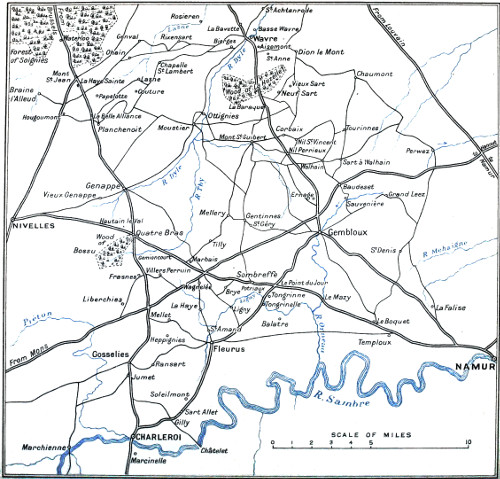
Wellington’s troops were scattered in cantonments
stretching over an arc from Oudenarde to
Quatre-Bras. The Second Corps, under Lord
Hill, formed the extreme right, and occupied
Ghent, Oudenarde, Ath and Leuze. The Corps
was 27,000 strong, of whom scarcely 7,000 were
British troops. The First Corps, under the
Prince of Orange, occupied Mons, Rouelx,
Soignies, Genappe, Seneffe, Frasnes, Braine-le-Comte,
and Enghien. This Corps was 30,000
strong, of whom only 6,300 were British. Its
left rested on Genappe, Quatre-Bras, and Frasnes,
and was in touch with the right of the First
Corps, of the Prussian army, under Zieten, whose
headquarters were at Charleroi. Wellington’s
Reserve, 25,500 men, was posted in the neighbourhood
of Brussels, under the Duke’s personal
command. The Cavalry, under Lord Uxbridge,
was comprised in seven brigades, British and
King’s German Legion; with one Hanoverian
brigade, five squadrons of Brunswick Cavalry,
and three brigades of Dutch-Belgian Cavalry.
The Brunswickers were stationed near Brussels;
the three Dutch-Belgian brigades were allotted
to the First Corps, and the remainder of the
cavalry were stationed at Ninove, Grammont,
and in the villages scattered along the Dender.
Wellington was expecting an attack by way
of Lille and Courtrai, and always regarded this
direction as Napoleon’s best move. For his army
was based on Ostend, Antwerp, and the sea;
hence, had Napoleon attacked by way of Mons,
he would have cut Wellington’s communications,
and forced him to evacuate Brussels. On the
other hand, he would have driven the English
army towards the Prussians.
Wellington’s dispositions were eminently suited
to rapid concentration on threatened points, while,
at the same time, they were sufficiently scattered
to make the subsistence of the troops possible.
He had selected Oudenarde, Ath, Enghien,
Soignies, Nivelles, and Quatre-Bras as points of
interior concentration; and in this way, by whichever
route Napoleon chose to attack, Wellington
could bring his Reserve to the threatened point,
and at the same time bring the remainder of his
forces into concentration, enabling him to throw
at least two-thirds of his whole force in front of
the enemy within twenty-four hours.
Blucher’s army, 116,000 strong, was divided
into four Corps. The First Corps, under Zieten,
had its headquarters at Charleroi; and its outposts
stretched from Bonne Espérance through
Lobbes, Thuin and Gerpinnes to Sossoye. Its
right was in touch with the left of the Prince
of Orange’s Corps of Wellington’s army. The
Second Corps, under Pirch I., had its headquarters
at Namur. Its Divisions were stationed in
Thorembey les Beguignes, Heron, Huy and
Hannut. Its outposts stretched from Sossoye
to Dinant. The Third Corps, under Thielemann,
whose headquarters were at Ciney, had its Divisions
stationed at Asserre, Ciney, Dinant and
Huy. Its outposts extended from Dinant
to Rochefort. The Fourth Corps, Bulow’s, had
its headquarters at Liège: its Divisions were
stationed at Warème, Hologne, Liers, Tongres
and Lootz.
Bluchers scheme of concentration enabled
him to collect his four Corps together at their
respective points of assembly—Fleurus, Namur,
Ciney and Liège, within twelve hours. If the
French crossed the Sambre at Charleroi, Blucher
intended to concentrate his army in front of
Sombreffe, on the Namur-Nivelles road, where he
would be within 8 miles of Quatre-Bras,
Wellington’s point of concentration under those
circumstances. If Napoleon moved along the
Meuse towards Namur, the First, Second and
Fourth Corps were to concentrate on Namur,
while Thielemann’s Corps, the Third, acting from
Ciney, would attack the enemy’s right flank. If,
again, Napoleon advanced on Ciney, Zieten,
Pirch I. and Thielemann were to concentrate
their Corps on Ciney, and the Fourth Corps was
to remain at Liège as a Reserve.
These were the dispositions of the Allies; but
they were not strategically in a sound position.
Wellington’s line of supply lay through Ostend
and Antwerp to the sea; Bluchers lay by Liège
and Maestricht to the Rhine. Therefore, in the
event of a disaster to either, or both, their lines of
retreat would carry them further apart. It was
this weakness on which Napoleon based his whole
plan. The Prussian army, being the nearer to
Napoleon, would be the first met with, and therefore
the first to concentrate. By a rapid crossing
of the Sambre at Charleroi, Napoleon would force
the First Corps back on Fleurus, where the
Prussian army was to concentrate, and throw
himself on the point of junction of the Allied
armies when concentrated; namely, the Quatre-Bras-Sombreffe
road. He knew that the
Prussians, by reason of their dispositions, would
be concentrated first, and he therefore hoped, by
possessing himself of the point of junction, to
beat their concentrated army before Wellington,
who, he decided, would be much slower in
assembling his troops, could come up to Quatre-Bras.
It was of vital importance to Napoleon to
beat the Prussian army, entirely and completely,
in its position at Sombreffe, before Wellington
could come to Blucher’s assistance. The retreat
of the Prussians on Wavre without such a decisive
defeat, would have upset the whole plan: for
Wellington would then have retired and united
with Blucher, either in front of Brussels or behind
it. But, if thoroughly beaten, the Prussians
would retreat on Liège: and only in this way
could Napoleon effectually separate the two armies
and crush them in turn. Such was Napoleon’s
argument. In conception, the plan was brilliant;
but its execution was unworthy of him.
Napoleon’s Grand army for the invasion of
Belgium was made up of the First, Second, Third,
Fourth and Sixth Corps d’Armée; four Corps of
Reserve Cavalry; and the Imperial Guard; a
total of 116,124 men. The First Corps, under
d’Erlon, consisted of the First, Second, Third, and
Fourth Infantry Divisions, and the First Light
Cavalry Division. In the early part of June, the
Corps was stationed at Lille. The Second Corps,
under Reille, consisted of the Fifth, Sixth, Seventh
and Eighth Infantry Divisions, and the Second
Light Cavalry Division. This Corps was
quartered at Valenciennes. The Third Corps,
Vandamme’s, comprised the Ninth, Tenth, and
Eleventh Infantry Divisions, and the Third Light
Cavalry Division, and was stationed at Mézières.
The Fourth Corps, Gérard’s, was composed of the
Twelfth, Thirteenth and Fourteenth Infantry Divisions,
and the Seventh Light Cavalry Division.
The Corps was stationed in Metz, Longwy, and
Thionville. The Sixth Corps, Lobau’s, was made
up of the Nineteenth, Twentieth, and Twenty-first
Infantry Divisions; it was stationed at Laon.
Grouchy commanded the four Corps of Reserve
cavalry; these First, Second, Third, and Fourth
Cavalry Corps were commanded by Pajol, Excelmans,
Kellermann, and Milhaud respectively;
they were mostly stationed between the river
Aisne and the frontier. The Imperial Guard
consisted of twelve regiments of infantry, two
regiments of heavy cavalry, three of light
cavalry, and thirteen batteries of artillery. The
Guard left Paris for Avesnes early in June. To
the First and Second Corps d’Armée were
attached six batteries; to the Third and Fourth,
five batteries; and to the Sixth, four batteries of
artillery.
This army was the best, in point of courage,
warlike spirit, and devotion to himself, that
Napoleon ever led. But the men were without
discipline, and distrusted their leaders. Napoleon’s
generals were not the best that had ever served
under him. Ney was a tried veteran, the “bravest
of the brave,” but he had just come over to
Napoleon from Louis XVIII. Grouchy had
never held an independent command. It is remarkable
that both Ney and Grouchy should
have failed Napoleon in this, his last, campaign;
but neither were fitted to the great trusts committed
to them. Napoleon himself was not the
same man who had beaten back the Allies a
year previously at Montmirail, Montereau, and
Champaubert, but he was still a master of
strategy and the strongest man of France.
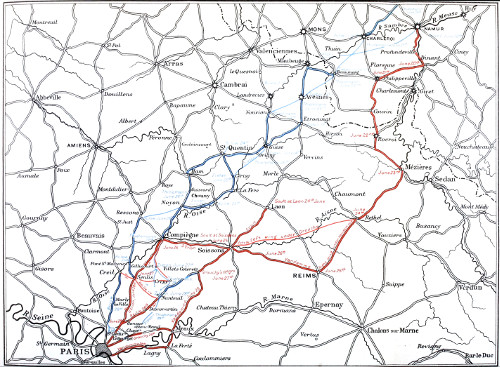
Napoleon began his concentration early in June.
He moved the First Corps from Lille to Avesnes;
the Second from Valenciennes to Maubeuge; the
Third from Mézières to Chimay; the Fourth from
Thionville to Rocroi; the Sixth from Laon
to Avesnes; and the Guard from Paris to
Avesnes.
The concentration was in full swing, with the
exception of Grouchy’s Reserve Cavalry, when
Napoleon left Paris on the night of 11th June.
Grouchy had not received his orders for concentration
from Soult, the Chief of the Staff,
who had neglected to send them until the 12th.
Here was an omission at the outset which might
well have had serious results. But Grouchy lost
no time in setting his Corps on their roads, and
by rapid marching he had all his cavalry beyond
Avesnes on the night of the 13th.
On the evening of the 14th Napoleon moved
his headquarters to Beaumont. The First Corps
was on the extreme left, between Maubeuge and
Solre-sur-Sambre; the Second Corps between
Solre-sur-Sambre and Leers; the Third and
Sixth Corps between Beaumont and the Sambre;
the Fourth Corps between Phillippeville and
Florenne; Grouchy’s Reserve Cavalry between
Beaumont and Phillippeville; the Imperial Guard
at Beaumont. This concentration was brilliantly
planned, and skilfully executed: worthy of
Napoleon’s best days.
The French army crossed the frontier early
in the morning of the 15th of June, in three
columns. The left column (d’Erlon’s and Reille’s
Corps) crossed by Thuin and Marchienne; the
centre column (Vandamme’s, Lobau’s Corps,
Imperial Guard, and Grouchy’s Reserve Cavalry),
at whose head was the Emperor himself, crossed
by Ham-sur-Heure, Jamioux, and Marcinelle;
the right column, Gérard’s Corps, by Florennes
and Gerpinnes. The front was covered by twelve
regiments of cavalry.
The arrangements for relieving the troops of
a fatiguing march by avoiding the crossing of
columns in front of each other, and for the
communication between each column, were
admirable. The baggage and ammunition waggons,
except those of the latter which were
required for immediate use, were kept 9 miles
in rear of the army. The advanced guards of
the different columns communicated constantly
with each other, so that no column should get
ahead of the others. A screen of scouts was
sent out in all directions to obtain every scrap
of information as to the enemy’s position, and
report direct to the Emperor. Everything was
to be done to ensure the rapid march of a well-concentrated
army on the point where it was
expected that the Prussians would be met with.
But three of the Corps commanders failed to
carry out their instructions. D’Erlon started
from his camp at half-past four instead of at
three o’clock, as ordered. Vandamme never knew
of the march of the army until Lobau’s Corps
pushed on his rear: the orders sent to him from
headquarters had not reached him, owing to an
accident to the officer sent by Soult. And
Gérard, who should have marched at three, did
not reach Florennes until 7 A.M. All this was
carelessness. Soult should have sent such
important orders in duplicate. It is interesting
to observe how these delays affected the subsequent
movements of the columns on the 15th.
But, first of all, the centre column shall be
followed, as being that led by the Emperor
himself. In the advance on Charleroi, Pajol’s
cavalry led the way. Zieten’s outposts were
everywhere driven in, and when Pajol entered
Charleroi at midday (the 15th) the Prussians
had withdrawn, and taken up a strong position
at Gilly, 2 miles north-east of Charleroi. The
centre column halted to await Vandamme’s
arrival; for Grouchy, who did not like the
appearance of the Prussian position, would not
attack until he had Excelmans’ Cavalry and
Vandamme’s Corps with him. Napoleon, impatient
at the delay, took command in person
at 5 P.M., and pushed home a vigorous attack;
and the Prussians retired at dusk to Fleurus.
Vandamme and the Cavalry bivouacked within
2 miles of the Prussians. The Guard bivouacked
between Gilly and Charleroi; Lobau’s
Corps south of the river, near Charleroi; and
Gérard’s Corps on the right, crossing the Sambre
at Châtelet, bivouacked on the road to Fleurus.
Napoleon thus had the Third, Fourth, and Sixth
Corps, the Imperial Guard, and Grouchy’s Cavalry
concentrated between Fleurus and Charleroi,
intending to attack the Prussians in strength
next day, either at Fleurus or at Sombreffe.
The Emperor passed the night at Charleroi.
Had it not been for Vandamme’s delay, and
had Grouchy attacked the Prussians at once at
Gilly, the latter could have pushed his enemy
as far as Sombreffe that night, which it was
Napoleon’s intention that he should have done.
But Vandamme’s slowness prevented Grouchy
from advancing further than Fleurus that evening.
On the Left, matters had not, by nightfall,
progressed as far as Napoleon wished. Reille,
in accordance with his instructions, had marched
with his Corps, the Second, from Leers at 3 A.M.,
and pushed on to Marchienne, everywhere driving
back the enemy’s outposts. He was then ordered
to march on Gosselies, where it was reported
that a body of Prussians were in position. He
therefore pushed on his troops along the Charleroi-Brussels
road; and finding Jumet occupied by
a Prussian rearguard, he drove out the enemy,
and reached Gosselies at about 5 P.M. Marshal
Ney now arrived on the scene, and, having just
come from the Emperor, from whom he received
his orders, took over the command of the Left
Wing. Ney pushed on to Frasnes with Piré’s
Cavalry and Bachelu’s Infantry Division: Girard’s
Division was sent to pursue the Prussians, who
had retreated from Gosselies towards Fleurus:
the remaining divisions of Reille’s Corps—Jerome’s
and Foy’s—stayed at Gosselies. Ney drove back
Saxe-Weimar’s Brigade from Frasnes at 6.30 P.M.;
the brigade retiring on Quatre-Bras. Lefebvre-Desnouette’s
Division of Light Cavalry of the
Guard had arrived with Ney, and was now
moved in support of his infantry at Frasnes.
Thus Ney, at 6.30 P.M., while there were still
nearly three hours of daylight left, had with
him two light cavalry divisions, and one infantry
division, at Frasnes. The distance to Quatre-Bras
was 2½ miles. In less than an hour he
could have reached the cross-roads and attacked
Saxe-Weimar’s Brigade. But he merely pushed
his cavalry forward, reconnoitred the position,
and then withdrew his men to Frasnes, himself
returning to Gosselies at about 8.30 P.M.
Now it has been fiercely contested that Ney
received verbal orders from Napoleon to occupy
Quatre-Bras on the night of the 15th. Whether
he did or did not is a point still undecided by
the authorities on the campaign, but it matters
little, for Napoleon, in his written orders to Ney
on the 16th, expressed his satisfaction with the
progress of the night before, and did not blame
Ney for his failure to occupy the cross-roads. As
a matter of fact, Saxe-Weimar made such a bold
show of resistance to the reconnaissance sent by
Ney, that the latter was entirely deceived as
to his enemy’s numbers: he believed that the
English were in great force there. Had Ney
attacked Quatre-Bras that night, he would have
driven back Saxe-Weimar’s Brigade of Nassauers,
the only troops in occupation, and seized the
most important point in the theatre of war. But,
viewing the question from what must have been
Ney’s own point of view, he was acting on sound
strategical principles by not pushing ahead too
far. He had only just arrived on the ground,
and was not acquainted with any of his Staff, or
his divisional generals, or even with the strength
of his troops. He believed that a strong English
force held Quatre-Bras, and that, by attacking,
he would be overwhelmed by the whole of
Wellington’s army; that Napoleon’s Left Wing
would be crushed. He therefore adopted more
cautious methods, and awaited the arrival of
d’Erlon’s Corps, and news of the progress of the
Centre and Right Wing.
Prince Bernard of Saxe-Weimar may be
credited with having saved the situation for the
Allies. Had he adhered rigidly to the principles
of strategy, he would have fallen back from
Quatre-Bras; but instead, his fine courage
prompted him to hold on until supports should
arrive, and his boldness triumphed over Ney’s
prudence. If Ney had seized Quatre-Bras that
night, and if the succeeding events had taken
place as they did take place, the battle of
Waterloo would never have been fought, for
Wellington could not have risked a battle
without hope of Prussian assistance. But there
were many little risks and chances which might
have changed the whole result of the campaign!
To return to d’Erlon. By starting an hour
and a half later than he was ordered to do, he
lost most valuable time; and throughout the
day he took no pains to make up for the delay,
although he actually received an order from
Soult, late in the afternoon, to the effect that
he was to join Reille at Gosselies that evening.
Instead of this, by nightfall his leading division,
Durutte’s, was at Jumet, 1½ miles in rear of
Gosselies, and his Headquarters at Marchienne,
6 miles in rear! Matters had not progressed
at all satisfactorily on the Left Wing.
Blucher had decided upon a concentration of
his whole army at Sombreffe, in the event of
Napoleon attacking by Charleroi. Therefore, on
the evening of the 14th, he ordered the Second,
Third, and Fourth Corps to concentrate on
Sombreffe, while the First Corps was to make a
stout resistance, and fall back slowly on Fleurus,
which Zieten was to hold, in order to gain time
for the concentration. These arrangements were
made without any definite agreement between
Wellington and Blucher, as to the Duke’s
movements under these circumstances. It was
understood that each should give the other all
the assistance in his power, in the event of a
French attack; but no formal undertaking for
definite action was entered into. Besides, Blucher,
when he ordered his concentration, believed that
Wellington’s troops were too scattered to allow
of their concentration within two days. He
could not therefore have expected much actual
support from Wellington. There was also the
possibility that Wellington himself was confronted
with a strong force.
In the concentration of the Prussian Corps,
another defect in the transmission and execution
of orders from Headquarters must be mentioned.
Gneisenau, the chief of Blucher’s Staff, sent
instructions to Bulow, commanding the Fourth
Corps, on the 14th, to the effect that he was so
to dispose his Corps that his troops might reach
Hannut in one march. The order was indefinite,
and contained no statement that Napoleon was
about to attack; there was no mention of the
disposition of the other Prussian Corps; no
mention of Blucher’s intentions, or of the general
situation. This was culpable negligence on the
part of the chief of the Staff. It was his
duty under the circumstances to transmit all
such important information to all the Corps
commanders; and because Bulow’s Corps was
some distance in rear, is no reason why such a
necessary step should have been omitted. The
result was a serious delay on the part of the
Fourth Corps. At midnight on the 14th, a second
despatch from Gneisenau was sent to Bulow,
ordering a concentration of his Corps on Hannut.
The first despatch reached Bulow at 5 A.M. on the
15th, when he was at Liège. The instructions
contained in it were at once acted upon, and
Bulow sent a report to this effect to Headquarters.
While these instructions were being carried out,
the second despatch arrived towards midday (on
the 15th). Its contents seemed to Bulow to be
impossible to act upon until the next day, for
most of his troops were by this time so far in
their movement that the new order could not
reach them in time to be carried out that night;
also there would be no quarters prepared for those
troops which were still within reach of the new
instructions. Furthermore, this second despatch
was also indefinite. It contained no positive order
that Bulow was to move his headquarters to
Hannut; it merely suggested that Hannut
appeared suitable. There was no mention of
the commencement of hostilities. Bulow therefore
decided to postpone the execution of this order
until the 16th, and he sent a report to this effect
to Blucher, promising to be in Hannut by noon
next day (16th). The officer sent with this
report reached Namur at 9 P.M., expecting to
find Blucher there, but he discovered that Headquarters
had been removed to Sombreffe. Meanwhile,
a third despatch was sent off at 11 A.M. on
the 15th from Namur, instructing Bulow to move
the Fourth Corps, after a rest at Hannut, on
Gembloux, starting at daybreak on the 16th.
The orderly carrying this message naturally went
to Hannut, where he expected to find Bulow.
At Hannut he found Gneisenau’s second despatch
lying unopened, awaiting Bulow’s arrival. He
then started off at all speed with both despatches
to Liège, where he arrived at daybreak on the
16th. But by this time Gneisenau’s instructions
were impracticable. Thus Bulow, through no
fault of his own, was prevented from reaching
the field of Ligny with his Corps, when his arrival
on the right flank of the French might have had
the same effect that the arrival of the Prussian
army had at the great battle two days later.
While the concentration of the Second and
Third Corps was rapidly progressing behind him,
Zieten was occupied with his retreat on Fleurus.
At half-past three in the morning of the 15th,
the Prussian picquets in front of Lobbes, a village
on the Sambre, were driven in by the advanced
guard of the French Left Column (this was the
head of Reille’s Corps advancing). An hour later,
the French opened with artillery on Maladrie,
a hamlet about a mile in front of Thuin. It was
this cannonade which was heard by the troops of
Steinmetz’s Division in Fontaine l’Evêque, and
even Zieten at Charleroi heard it. He therefore
lost no time in sending reports to both Blucher
and Wellington that fighting had actually
commenced. His report to Wellington gave
the Duke definite news that an attack on
Charleroi was imminent, but it did not induce
him to alter his plans in any way. For Wellington
was still apprehensive of an attack by way
of Mons, and he judged that his army was in the
best position to meet such an attack. He was
unwilling to engage himself in a move eastwards
while there was a chance of the French attacking
from the westwards. With such a belief, it is
clear that Wellington, by concentrating prematurely
at Quatre-Bras, which it was his intention
to do if Napoleon’s attack should eventually
be by the Charleroi-Brussels road, would merely
carry out the very move which his enemy would
wish. Therefore he awaited more definite news
of the French attack on Zieten.
But Zieten’s report to Blucher made the
Marshal more than ever assured of the wisdom
of concentrating at Sombreffe.
The retreat of Zieten’s Corps was very ably
carried out. The Prussians at Maladrie, after
maintaining a stubborn resistance, were finally
overpowered, but they retreated in good order on
Thuin. Here they joined a battalion of Westphalian
Landwehr, and resistance was made until
7 A.M., when, after suffering very heavy losses, the
Prussians fell back to Montigny. Here, again,
they joined two squadrons of Dragoons, who
covered the rest of their retreat to Marchienne.
But the French cavalry, under Pajol, pushed on
so vigorously, and the small retreating column
suffered such severe losses, that, upon arrival at
Marchienne, a mere skeleton was left. By this
time also the outposts at Lobbes had effected
their retreat on Marchienne. General Steinmetz,
commanding the First Division of Zieten’s Corps,
was now fully aware of the French attack. He
therefore sent a staff officer to warn Van Merlen,
who commanded the Dutch-Belgian outposts at
St. Symphorien between Binche and Mons, and
to inform him that he was falling back with his
Division upon Charleroi.
The manner in which the outposts fell back,
and the readiness with which reports as to the
enemy’s movements and those of the several
Prussian picquets and supports were passed from
one part of the retreating Division to the other,
and from the right of Zieten’s corps to the left
of Wellington’s army, are worthy of the closest
attention. The Prussian commanders thoroughly
understood the value of rapid and accurate
information, distributed to all parts of their
commands. The long Napoleonic wars had taught
them something of their profession.
Zieten’s management of his retreat marks him
as a very capable soldier. Towards 8 A.M. he
satisfied himself that the whole French army was
making for Charleroi. He therefore sent out the
following orders for retreat: the First Division
(Steinmetz’s) to retire by Courcelles to Gosselies,
and take up a position behind the village; the
Second Division to gain time for the retreat of
the First by defending the bridges over the
Sambre at Châtelet, Charleroi, and Marchienne;
it was then to fall back behind Gilly. The Third
and Fourth Divisions, with the cavalry and
artillery reserves, were to take up position at
Fleurus.
Meanwhile, Napoleon was pushing rapidly on
Charleroi with the Imperial Guard and Pajol’s
Cavalry Corps. The Prussian detachment holding
the bridge connecting Marcinelle and Charleroi
made a stout defence, but was soon overpowered,
and by noon the French had obtained possession
of the town. The Third and Fourth Divisions
of Zieten’s Corps were by this time well on the
road to Fleurus, but Steinmetz’s Division was in
great jeopardy. For the French were already
masters of the Sambre, even below Charleroi,
and the First Division was in danger of being
cut off from its retreat on Gosselies. Accordingly
Zieten, with great resolution, detached three
battalions of infantry from the Third Division,
and sent them to Colonel Lutzow, who was
holding Gosselies with a regiment of Lancers
from Roder’s Reserve Cavalry. Lutzow placed
one battalion in Gosselies, and took up a position
in reserve with the remainder. As soon as the
French had taken Charleroi, Napoleon ordered
Pajol to send a brigade of Light Cavalry towards
Gosselies, and to take the remainder of his Corps
towards Gilly. The Brigade actually reached
Jumet ahead of Steinmetz’s Division, which had
not yet crossed a small stream called the Piéton,
which ran between Fontaine l’Evêque and
Gosselies. But Colonel Lutzow went out with
his regiment of Lancers from Gosselies, met the
French Hussars, and drove them back with loss,
enabling Steinmetz to reach the village in
safety.
In the meantime reinforcements, consisting of
the advanced guard of Reille’s Corps, were being
pushed along the Gosselies road, with a view to
cutting off Steinmetz’s retreat, and separating
Zieten’s Corps from Wellington’s army. This
move of the French was very skilful, but Steinmetz,
perceiving that his position was one of
great danger, made a feint against the French
left flank, and, covering his retreat with a regiment
of Lancers and one of Hussars, withdrew to
Heppignies, a village half-way between Gosselies
and Fleurus. Had Steinmetz been caught and
surrounded at Gosselies, Blucher would have been
weaker by one Division in the great struggle at
Ligny next day; and he could ill afford to reduce
his numbers.
Ney, who had taken over the command of
the French Left Wing, and who was at this
time pushing on with Piré’s Cavalry and Bachelu’s
Infantry to Frasnes, sent Girard’s Division of
Reille’s Corps to pursue Steinmetz. Girard
occupied Ransart, and made an attack upon
Heppignies, but the Prussians drove him back,
and retired in good order to Fleurus, thus rejoining
the main body of their Corps, and effecting
their retreat in a very skilful manner.
In the Prussian centre, meanwhile, Pirch II.‘s
Second Division, which had been ordered to gain
time for the retreat of the First, retired to Gilly,
on the road to Fleurus, when the French entered
Charleroi. At Gilly the Prussians took up a
strong position and prepared to delay the French
advance as much as possible. Pirch’s line of
defence stretched from Soleilmont on his right,
to Châtelineau on his left; and a small stream
ran in his front at the foot of the ridge on
which his position stood. His left flank was
further strengthened by a detachment holding
the bridge over the Sambre at Châtelet. Cavalry
patrols watched the valley of the Sambre for the
approach of Gérard’s Corps, which was already
marching on Châtelet. Had Gerard marched
earlier from Phillippeville, he would have prevented,
by his occupation of Châtelet earlier in
the day, Pirch’s stand at Gilly.
Grouchy had orders to take Vandamme’s Corps
and Excelmans’ Cavalry, and pursue the Prussians
along the Charleroi-Fleurus road; but he was
deceived as to the strength of the enemy at
Gilly. Fearing to attack without further reinforcements,
he rode back to Napoleon for instructions.
This was at about 5 P.M. Napoleon,
fretting at the delay, which he regarded as
needless, himself rode out with four squadrons
of Cavalry of the Guard, and reconnoitred Pirch’s
position. He soon satisfied himself as to Pirch’s
real strength, and gave Grouchy orders to attack
at once. Accordingly, at 6 P.M., artillery fire
opened on the Prussians from two batteries;
three infantry columns from Vandamme’s Corps
were ordered to assault in front, and two cavalry
brigades to menace the Prussian flanks. Pirch
was preparing to reply to the French artillery
fire, when he received orders from Zieten to
retire on Fleurus viâ Lambusart. As soon as
he began to withdraw his battalions, the French
cavalry, under Letort, made a vigorous attack.
The Prussian infantry resisted stoutly, and a
regiment of dragoons, with great boldness, charged
the French squadrons with such effect that they
were for the moment checked, and the Prussians
were able to gain the cover of the wood of
Fleurus. A battalion of the Sixth Regiment of
the Line, by forming square repeatedly, bravely
kept the enemy’s cavalry at a distance, and
gained very valuable time for the retreat of the
rest of Pirch’s Division. In front of Lambusart,
where Pirch joined some battalions of the Third
Division and Roder’s Reserve Cavalry, a fresh
position was taken up, and a regiment of
Brandenburg Dragoons, sent by Zieten to support
Pirch II., did excellent service by charging the
French horsemen and checking their pursuit.
Towards eight o’clock three batteries of French
Horse Artillery, which accompanied the cavalry,
opened fire on Lambusart; but night was coming
on, and the attack died out very shortly afterwards.
Pirch II. then withdrew to Fleurus,
where he joined the remainder of Zieten’s
Divisions, and the whole Corps retreated to
Ligny. Steinmetz had reached Fleurus from
Heppignies at about 10 P.M.
Zieten’s retreat in the face of almost the whole
French army is worthy of close attention. His
men had been marching and fighting from three
o’clock in the morning until ten o’clock at night,
and had engaged the enemy in one or two very
sharp conflicts. The skilful manner in which
each Division was withdrawn without getting too
closely engaged with the enemy, and in which
the Divisions supported each other, is illustrative
of the best methods of war. That he was able
to concentrate his Corps at Fleurus with a loss of
only 1,200 men, after having checked the rapid
onset of the French, speaks very highly for Zieten’s
skill in generalship. The campaign of Waterloo
still affords useful lessons and examples to modern
students.
The Prussian Second Corps, under Pirch I.,
reached Sombreffe by ten o’clock at night; the
Third Corps passed the night at Namur; while
the Fourth Corps was still near Liège.
On Wellington’s side, Van Merlen, commanding
the outposts between Mons and Binche,
received the report from General Steinmetz at
8 A.M., to the effect that the French had attacked
and driven in his outposts, and that he was falling
back on Charleroi with his Division. Early in the
morning the troops of Perponcher’s Dutch-Belgian
Division, which was stationed at Hautain-le-Val,
Frasnes, and Villers Perruin, heard firing
from the direction of Charleroi. In the afternoon,
definite news reached them of the enemy’s attack
on Charleroi, and Perponcher at once assembled
his First Brigade (Bylandt’s) at Nivelles. A
picquet of the Second Nassau battalion was posted
in front of Frasnes to give warning of the French
advance. In the meantime, Prince Bernard of
Saxe Weimar, with his Brigade of Nassau troops,
belonging to Perponcher’s Division, on his own
initiative moved forward from Genappe to Frasnes,
reporting his action to the headquarters of his
division at Hautain-le-Val; and Perponcher
approved. When Ney advanced on Frasnes in
the evening, with Piré’s cavalry and Bachelu’s
infantry, Saxe Weimar, after making a determined
show of resistance, skilfully withdrew
behind Quatre-Bras, and Ney, as before-mentioned,
was quite deceived as to his actual
strength, and forebore to attack that night.
Zieten’s report to Wellington, sent off from
Charleroi at 5 A.M., reached the Duke’s headquarters
at Brussels at 9 A.M. Wellington did
not consider the news sufficiently definite to cause
him to make any immediate alteration in his
dispositions. But at three o’clock in the afternoon,
the Prince of Orange, coming from the
outposts near Mons, where he had seen Van
Merlen, and obtained information of the attack
on the Prussians and of their retreat, reported his
intelligence to the Duke. Wellington was now
satisfied of the true direction of the French attack,
but he sent orders to General Dornberg at Mons
to report at once any movement of the French in
that direction. He then ordered his troops to
concentrate at their respective headquarters. On
the left, Perponcher’s and Chassé’s Divisions were
to assemble at Nivelles; the Third British
Division (Alten’s) was to concentrate at Braine-le-Comte
and march on Nivelles in the night;
the First British Division (Cooke’s) was to
assemble at Enghien. In the centre, Clinton’s
Division (the Second British) was to collect at
Ath, and Colville’s (the Fourth British) at Grammont.
On the right, Steedman’s Division and
Anthing’s Brigade of Dutch-Belgians were to
march on Sotteghem. Uxbridge’s cavalry was
to assemble at Ninove, except Dornberg’s Brigade,
which was to march on Vilvorde; (still Wellington
had apprehensions for his right). The Reserve
was kept in readiness in and around Brussels;
with orders to be prepared to march at once.
Late that night (the 15th), towards ten o’clock,
news of Ney’s attack at Frasnes was received by
the Prince of Orange at Braine-le-Comte. The
latter forwarded the report to Wellington, adding
that Saxe Weimar had fallen back to Quatre-Bras,
and that the French advance had been checked
there. A despatch from Blucher at Namur also
reached Wellington about this time, and the Duke
decided to march his troops more to their left—i.e.
towards the Prussians. He therefore issued a
second batch of orders that night, directing
Cooke’s Division from Enghien to Braine-le-Comte;
Clinton’s and Colville’s Divisions from
Ath and Grammont to Enghien; and the cavalry
from Ninove to Enghien. The other dispositions
were to remain as they were.
At the close of the 15th, Napoleon’s position
promised success for his efforts next day. Blucher
had only Zieten’s Corps concentrated at Ligny;
Pirch’s Corps was still some miles back.
Wellington’s army was still far from Quatre-Bras.
Surely, if Napoleon advanced to the
attack of the Prussians at daybreak on the 16th,
he must, with his overwhelming forces, crush
half of Blucher’s army and force the remainder
to fall back on Liège? And Ney, if he attacked
with Reille’s and d’Erlon’s Corps (for the latter
might have pushed on during the night)—or
even with Reille’s Corps and Piré’s Cavalry—could
have driven back the English force at
Quatre-Bras, which, by daybreak on the 16th,
had only been reinforced by the remainder of
Perponcher’s Dutch-Belgian Division? Ney had
ridden to Charleroi in the night, and had had
an interview with Napoleon. He must, therefore,
have known the state of affairs in the centre
and on the right; he must have told Napoleon
how matters stood on his wing. Why did not
Napoleon order him to attack Quatre-Bras at
daybreak on the 16th? There is no satisfactory
answer. It is inconceivable that Napoleon, than
whom no general has ever been bolder and more
decisive in his moves or quicker to take action
at critical moments, should have neglected to
spend the night of the 15th in bringing up the
troops in rear—Lobau’s Corps, d’Erlon’s Corps,
Gérard’s Corps. What if the columns had
straggled out and become doubled in length?
Had Napoleon’s troops never made a greater
effort in his earlier campaigns? There is no
doubt existing that Napoleon, great warrior as
he was, let his opportunity slip on the night of
the 15th. His advanced troops were within
2 miles of Ligny, and 3 of the Quatre-Bras-Sombreffe
road. Was not this the very point
he had aimed at so carefully in his plan of
campaign? He was already almost master of
the line of junction of Wellington’s and Blucher’s
armies. He had, in fact, almost, but not quite,
attained the main objective of his scheme. It
was within his grasp on the night of the 15th.
How could Wellington prevent Ney from capturing
Quatre-Bras at daybreak on the 16th? And
how could Blucher save Ligny and Sombreffe, if
Napoleon chose to bring up his two Corps from
Charleroi and Châtelet, and attack at dawn
with these overwhelming numbers? Both these
attacks would have called for great efforts from
the French troops, who had been marching and
fighting since 3 A.M. on the 15th; but the attacks
would have been finished in three or four hours,
and then Napoleon could have thought of giving
rest to his tired infantry, while his cavalry
pursued the Prussians back towards Liège. A
day spent in resting and in concentrating, and
Napoleon could have turned to deal with
Wellington. The Napoleon of Jena and Austerlitz
would have won the campaign on the 15th.
But the delays of the 15th were insignificant
in comparison with those of the 16th. And
there were not only delays on the 16th, but
very serious mistakes—although of a kind without
which no war has ever been waged. It is not
our intention to criticise these mistakes so much
as to discuss their effects on the course of the
campaign, and to illustrate their grievous results.
Ney, on his return to Gosselies from his interview
with Napoleon, ordered Reille to move
Jerome’s and Foy’s Divisions, with his five
batteries of artillery, to Frasnes, whither he
himself went. Ney’s misgivings as to the wisdom
of attacking Quatre-Bras were not unfounded.
He feared a movement against his right flank
by a strong force of Prussians whom he believed
to be between Quatre-Bras and Ligny. He was
anxious for his left flank, in case some of
Wellington’s troops were moving against him
from the direction of Nivelles. He was ignorant
of the real strength in front of him at Quatre-Bras.
He had no staff officers whom he could
send out to gather information on these points.
He was unwilling to risk damaging Napoleon’s
plans by inviting defeat while so far in advance
of the centre column. He therefore waited for
d’Erlon’s Corps and Kellermann’s Corps of heavy
cavalry, which Napoleon had promised to send
him. He despatched orders to d’Erlon to bring
up the First Corps with the utmost speed to
Frasnes.
In the meantime, Wellington’s troops were
fast moving on Nivelles and Quatre-Bras. Lord
Uxbridge’s Cavalry and Clinton’s Division were
ordered to move on Braine-le-Comte, and Steedman’s
Division with Anthing’s Brigade from
Sotteghem to Enghien at daybreak. Picton’s
Division started from Brussels for Quatre-Bras
at 2 A.M. The Duke of Brunswick, with 5,000
Brunswick infantry, left at 3 A.M. At 3 A.M.
also Perponcher reached Quatre-Bras with his
First Brigade of Dutch-Belgians, under Bylandt.
The Prince of Orange arrived at Quatre-Bras at
6 A.M., reconnoitred Ney’s position, and pushed
Perponcher’s troops further forward. He gave
orders that as great a show of strength as possible
was to be made, but a close or premature engagement
with the enemy was to be avoided. Thus
at 7 A.M. the Prince had 9 battalions of Dutch-Belgian
troops, and 16 guns, holding Quatre-Bras;
Ney opposite, with Piré’s Division of
Lancers, Bachelu’s Division of Infantry, and
Lefebvre-Desnouette’s Cavalry of the Guard, in
all 9,700 men, and the remainder of Reille’s Corps
in support at Frasnes!
Wellington himself arrived at Quatre-Bras at
11 A.M., inspected the position, saw that the
French were not preparing an immediate attack,
and complimented the Prince of Orange on his
dispositions. He then rode off to the mill of
Bussy, where he met Blucher. It is not necessary
to go into the details of this interview. Suffice
it to say that Wellington agreed with Blucher
that he would come to the latter’s assistance at
Ligny, if he was not himself attacked.
At 11 A.M. Ney received from Napoleon a
letter giving him detailed instructions as to the
movements of the French army. The Emperor
told Ney that he intended attacking the Prussians
at Ligny, driving them back on Gembloux.
Ney was then to march on Brussels, and Napoleon,
marching by the Sombreffe-Quatre-Bras road
with his Imperial Guard, would support him.
Thus, according to the letter, Ney’s movements
were to wait upon Napoleon’s. This interpretation
was some cause of Ney’s delays on the 16th.
Soon after the receipt of Napoleon’s letter, Ney
received an order from Soult, chief of the Staff,
directing him to move the First and Second Corps,
and Kellermann’s Cavalry, on Quatre-Bras, drive
back the enemy, and reconnoitre as far as he could
towards Nivelles and Brussels; also to push a
division to Genappe, and another towards Marbais,
so as to open communication with Napoleon’s left
between Sombreffe and Quatre-Bras. Napoleon’s
intention was to reach Brussels by daybreak on
the 17th, having defeated the Prussians, and Ney
having defeated the English!
In accordance with this order, Ney sent
instructions to Reille and d’Erlon. These were
to the following effect:—The First, Second, and
Third Divisions of d’Erlon’s Corps were to
move to Frasnes; the Fourth Division of that
Corps, with Piré’s Cavalry, was to move to
Marbais; Kellermann’s Cavalry Corps to Frasnes
and Liberchies.
Just at this time, a message from Reille
reached Ney, stating that Girard (not Gérard,
who commanded the Fourth Corps) had sent in
a report that strong columns of Prussians were
moving along the Namur-Nivelles road, with heavy
masses behind them. (These were Pirch’s I.
troops deploying at St Amand and Ligny.)
Reille had seen Napoleon’s letter to Ney, and
read its contents, but he wrote to Ney that he
would wait the latter’s instructions, while he
prepared his troops for instant march. Another
order from Napoleon reached Ney at this moment.
It stated that the Marshal was to unite the First
and Second Corps with Kellermann’s Cavalry,
and drive the enemy from Quatre-Bras, thus
distinctly emphasising the previous order. The
Emperor, who thought that Ney would then
have an ample force to crush any troops which
could be in front of him, stated that Grouchy was
about to move on Sombreffe.
Girard’s report as to the Prussian columns on
the Namur road made Ney doubly anxious for
his position. He therefore again sent urgent
orders to Reille and d’Erlon to hasten up. At
2 P.M., in the belief that d’Erlon must be close
behind, he moved to the attack of the Anglo-Dutch
position with three infantry divisions
(Bachelu’s, Foy’s and Jerome’s, of Reille’s Corps)
and Piré’s Division of Light Cavalry, with
5 batteries—a strength of 18,000 men and 40
guns. Opposed to him were the 7,000 infantry
and 16 guns of the Prince of Orange.
It is not proposed to give an account of the
battle of Quatre-Bras. It has been shown what an
opportunity Ney had lost by not attacking earlier,
and what his reasons were for not doing so.
Picton’s Division and the Duke of Brunswick’s
Division arrived early in the afternoon, and
Wellington took over the command. These reinforcements,
to which were added towards the close
of the day, Alten’s Division, Cooke’s Division,
two more Brunswick battalions and a battery of
Brunswick artillery, gave Wellington a superiority
in numbers over Ney, who was only reinforced by
Kellermann’s Cavalry Corps during the battle.
D’Erlon’s Corps had, in the meantime, been
wandering between Ligny and Frasnes.
In its results the battle of Quatre-Bras was of
great importance to both sides. Although Ney
had not obtained possession of Quatre-Bras, and
had not defeated Wellington’s troops, nor driven
them back on Brussels, yet he had effectually
prevented Wellington joining with Blucher’s right.
He had not been guilty of disobeying orders, and
he himself did not feel confident of victory when
he attacked on the afternoon of the 16th. On the
other hand, Wellington had, by his masterly
defence, completely frustrated Ney’s object. He
was now in full possession of Quatre-Bras; he had
gained a brilliant victory, and his divisions were
still coming up from behind. Should he receive
news of a Prussian victory at Ligny, he was
prepared to attack Ney next morning, and, if
successful, to join Blucher’s right wing and fall
upon Napoleon’s left. If the Prussians were
defeated at Ligny, he was ready to fall back and
take up a position where Blucher could join him,
and together they would attack Napoleon’s combined
forces.
To turn to events upon the Prussian side,
Blucher’s decision to stand at Ligny was
determined by several strategical considerations.
Firstly, the position he chose communicated with
Wellington’s left by 6 miles of very good road,
along which co-operation on either hand could be
easily effected. Secondly, he guarded the communications
with Aix-la-Chapelle and the
Prussian States. Thirdly, if the Allies should
be defeated both at Quatre-Bras and at Ligny,
then two parallel lines of retreat, the one upon
Mont St Jean towards Brussels, and the other
upon Wavre towards Louvain, were available,
which would render possible a junction near the
forest of Soignies. Fourthly, if Napoleon had
advanced against Wellington by way of Mons,
the Prussians, by concentrating at Sombreffe,
could have marched to the Duke’s assistance,
leaving Zieten to watch Charleroi and the
neighbourhood. Fifthly, if Napoleon had
advanced on Namur, the Third Corps (Thielemann’s)
could have retreated as did Zieten’s, and
allowed time and protection for the First, Second,
and possibly the Fourth Corps, while Wellington
moved to join the Prussian right.
The situation of the Allied armies was not
exactly that of the Austrians and Sardinians in
Italy in 1796-97; there was the possibility of
striking at their point of junction and of beating
each army separately, but the short and excellent
line of communication between the points of
concentration of Wellington’s and Blucher’s
armies, namely, the Quatre-Bras-Sombreffe
road, afforded each army such easy and rapid
means of effecting a junction, although, in fact,
it was not actually used as a means of co-operation,
that there was a “moral” influence
in it which went a long way towards defeating
Napoleon’s object. This may sound somewhat
exaggerated; but what was it that made Ney
uneasy for his own right flank on the 15th-16th,
before he attacked? The report sent by Girard
that Prussian columns were on that road. What
was Napoleon’s fear during the battle of Ligny?
That Wellington would send a force from Quatre-Bras
to join Blucher’s right, along this road.
What was the chief advantage in Wellington’s
position at Quatre-Bras? This road again, which
afforded a means of joining the Prussians at
Ligny, had the occasion arisen. And in what
way was this road of use to Blucher at Sombreffe?
He could co-operate with Wellington if Napoleon
had attacked viâ Mons.
Blucher had decided to fight at Ligny, even
though he had little hope of the arrival of Bulow’s
Corps in time to join the battle. For he believed
that Napoleon’s forces were not superior to his
own in numbers; he had selected the position
previously, and had had it surveyed carefully;
he hoped that he would be able to hold his own
either until Bulow arrived, or until night put
an end to the fight. In the event of the Fourth
Corps reaching the field in time to take part,
the extra weight in numbers would decide in
Blucher’s favour, or else the Corps would attack
Napoleon’s right flank at a time when his troops
would be most fatigued. Or again, if night came
on, sufficient time would have been gained for
Bulow’s arrival to be made certain before daybreak
next day, when a successful attack on the
French might confidently be expected. In both
cases, any pressure on Wellington would be
relieved, so that the Anglo-Dutch Army might
combine with Blucher to overwhelm the whole
of Napoleon’s forces. Thus Blucher reasoned.
To refuse a battle would have meant a retreat
along his communications with the Rhine, and
Blucher was most unwilling to abandon his
chances of joining with Wellington.
The battle itself will not be described; but
d’Erlon’s wanderings towards the field and away
from it again, and the influence of these aimless
manœuvres on the struggle, may be discussed here.
At eight o’clock that morning (the 16th),
Napoleon had sent orders to Ney to detach one
Division of his force to Marbais, so as to support
the Emperor and attack in rear the Prussian right,
while the battle of Ligny was at its height. At
2 P.M., he had ordered Ney to attack and defeat
whatever force might be in front of him (he had
ascertained that Ney must be greatly superior
in numbers to the force that opposed him), and
then to move along the Namur road and fall on
Blucher’s rear. At 3.15 P.M. this order was
reiterated, and in the most emphatic manner was
Ney ordered to bring the whole of his forces to
bear on the Prussian right and rear. When,
therefore, at 5.30 P.M., Napoleon was preparing
his greatest blow at Blucher and getting in
readiness his Reserves to crush the Prussian
Centre at Ligny, the news that a strong column
of infantry, cavalry, and artillery was making for
Fleurus on the French left arrived, and it might
have been guessed that this was a part of Ney’s
forces, acting in accordance with the instructions
sent to the Marshal, but sadly in the wrong
direction. Instead of moving against the Prussian
right, this column was making for the left rear
of the French. Vandamme, who forwarded the
report to the Emperor, suspended his movements,
and Girard fell back with his Division, until the
uncertainty should be cleared up. For it was
possible, perhaps, that Wellington had overcome
Ney and was marching to assist Blucher; Ney
had sent no tidings during the day. Napoleon,
at first, believed that the force was the Division
despatched by Ney in accordance with the eight
o’clock order; but he reflected that the numbers
were too great for a Division, and that Ney had
been ordered to send the force by Marbais. Then,
when Vandamme’s suspicions were supported by
a second report, he became extremely uneasy;
he suspended his projected attack on the Prussian
centre: and sent off an officer of his staff to
ascertain the truth. At 7 P.M., nearly two hours
after the first appearance of the strange column,
the staff-officer returned, with the tidings that
d’Erlon’s whole Corps was at hand, and was
marching to join Napoleon’s left. On the receipt
of this news, the advance of the Imperial Guard
was renewed, and Girard’s Division resumed its
former position in line.
How d’Erlon had arrived in this position
may be explained with little difficulty. When
Napoleon’s aide-de-camp, Laurent, reached
Gosselies with the morning order, he found
that the First Corps was already marching
towards Quatre-Bras, and that d’Erlon himself
had gone forward to Frasnes. Laurent hastened
to find him, and on overtaking the columns of
the First Corps on his way, he took upon
himself the responsibility of changing their
direction towards St Amand. D’Erlon, on
learning what had been done, rode off at once
to join his Corps, sending word to Ney to
inform him what had happened. The road from
Frasnes towards St Amand lay through Villers-Perruin,
and it was this direction which brought
the column into such an unexpected position
towards the French rear. On reaching Villers-Perruin,
however, d’Erlon sent out a Light
Cavalry Brigade to his left, as a precautionary
measure. This Brigade encountered a Prussian
Brigade of Hussars and Lancers under Marwitz,
who withdrew slowly and in good order. Girard’s
Division, perceiving the Prussians retire, became
reassured, and moved forward to its original
position. But now, d’Erlon received from Ney
a most urgent and peremptory order to rejoin
him at once. D’Erlon, who acted under Ney’s
immediate orders, decided that it was his duty
to obey those orders; and since he had received
no definite instructions from the Emperor as to
how he should act when he had brought his
Corps on the field, he turned about and left the
ground. Thus he was too late in his return to
be of use to Ney at Quatre-Bras, and the
eccentric direction given to his columns, although
the natural outcome of his previous dispositions,
served to postpone Napoleon’s great attack with
his Guard for two hours; and, when the addition
of 20,000 men might have entirely overwhelmed
the Prussians, he calmly withdrew his men.
D’Erlon’s error was his inaction when he
arrived on the field, and not so much his diversion
from Ney’s orders. He must have known
that he could not return to Quatre-Bras in time
to be of any service; but that by following up
Marwitz, and falling on the rear of the Prussian
right wing, he would be most likely to render
the very greatest assistance to Napoleon. How
he could have failed to realise the importance
of his presence at such a juncture surpasses
all imagination. The very fact that Marwitz’s
Brigade had been able to present some show of
compactness before Jacquinot’s Cavalry might
have proved to him that there was still a stout
resistance to be expected on the part of the
Prussians. Again, we think Napoleon should
have sent instructions as to how d’Erlon should
act, by his aide-de-camp, in the event of the
strange column being French. Had d’Erlon
remained on the left wing to assist Ney, Quatre-Bras
might have been won by the French. Had
he realised the uselessness of a return march to
Ney when he was yet at hand to help Napoleon,
and thrown all his weight into the struggle at
Ligny, he would have been of the greatest use
in overwhelming the Prussians.
Such mistakes as these are unexpected, and
therefore happen, in war.