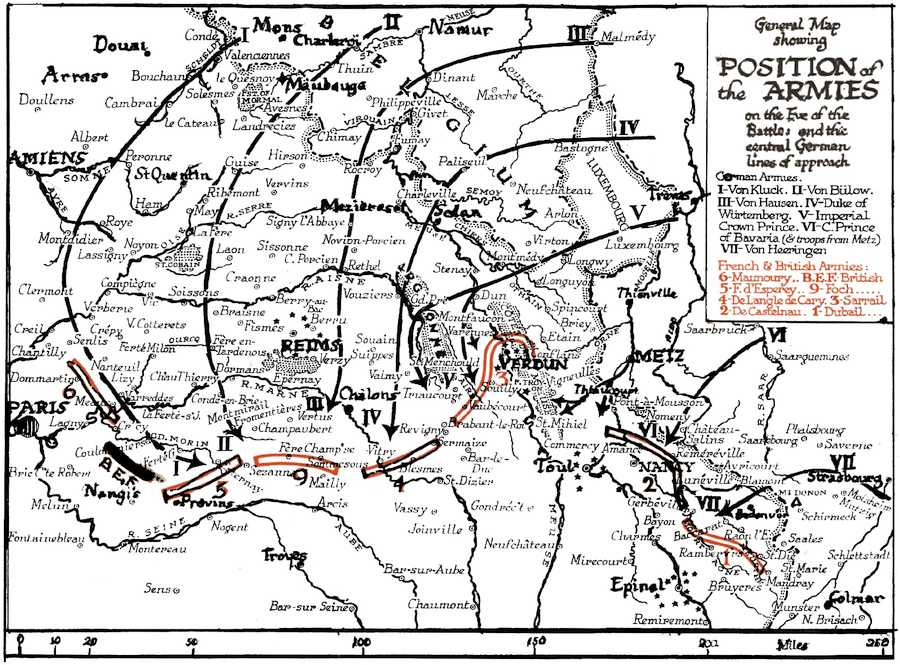
The unescapable dilemma of the Joffrean
strategy had developed into a second and
peremptory phase. In deciding to withdraw
from the Brie plateau and the Marne, rather than risk
his rear and communications for the chance of a victory
on the Seine, Kluck, or his superiors, had, doubtless,
chosen the lesser evil. The marching wing of the
invasion was crippled before the offensive of the Allies
had begun; but Gallieni’s precipitancy had brought
a premature arrest upon the 6th Army. Beside this
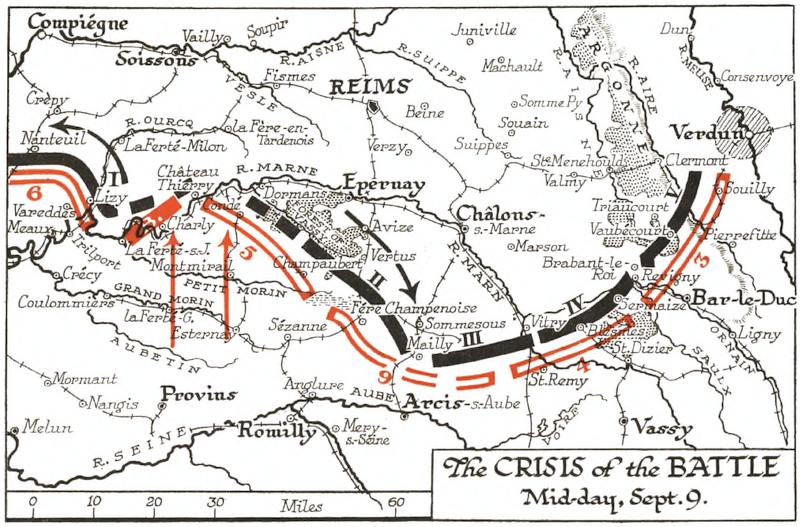
double check, we have now to witness a race between
two offensive movements—Bülow and Hausen pouring
south with the impetuosity of desperation, while,
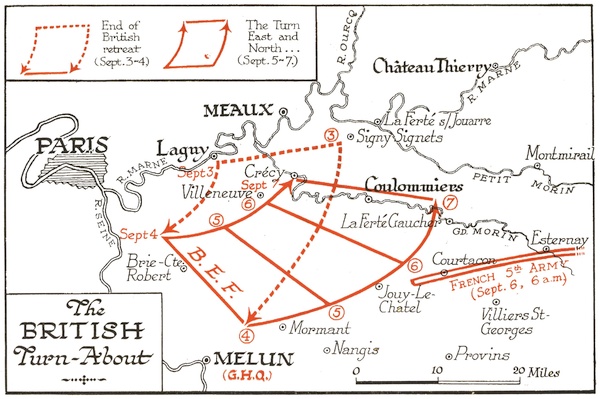
along their right, the British Force and the French 5th
Army struck north between the two western masses
of the enemy with the fresh energy of an immense
hope. Which will sooner effect a rupture?
Logically, there should be no doubt of the answer.
Kluck was mainly occupied with Maunoury; Bülow,
with Foch. Between them, there was no new army
to engage the eight corps of Sir John French and
Franchet d’Espérey. The cavalry and artillery
force of Marwitz and Richthofen, strong as it was,
could do no more than postpone the inevitable—always
provided that Maunoury and Foch could hold
out. Every day, the pull of Kluck to the north-west
and of Bülow to the south-east must become more
embarrassing. French writers have applied an
expressive phrase to the influence of this pull—“effet
de ventouse,” effect of suction—though hardly
appreciating its double direction. The maintenance
of a continuous battle-line is axiomatic in modern
military science. It follows from the size of the
masses in action, the difficulty, even with steam and
petrol transport, of moving them rapidly, and their
dependence upon long lines of supply. The soldier
bred upon Napoleonic annals may long for the opportunity
of free manœuvre; all the evolution of warfare
is against his dream. An army neither feeds nor
directs itself; it is supplied and directed as part of
a larger machine executing a predetermined plan.
Superiority of force is increased by concentration,
and achieves victory by envelopment of the enemy
as a whole, or his disintegration by the piercing of
gaps, a preliminary to retail envelopment or dispersal.
A course which loses the initial superiority and requires
a considerable change of plan is already a grave prejudice;
when to this is added a necessary expedient
leading to an extensive disturbance of the line, prudence
dictates that the offensive should be suspended until
the whole mass of attack has been reorganised in
view of the new circumstances. The German Command
dare not risk such a pause. It persisted; and the
penalty lengthened with every hour of its persistence.
The more Kluck stretched his right in order to cover
his communications by Compiègne and the Oise valley,
the wider became the void between his left and the
II Army, constantly moving in the opposite direction.
When French and d’Espérey found this void, a like
difficulty was presented to Bülow—to be enveloped
on the right, or to close up thither, leaving a breach
on his other flank, which the Saxon Army would be
unable to fill. Thus, Maunoury’s enterprise on the
Ourcq, though falling short of full success, produced
a series of voids, and, at length, a dislocation of the
whole German line, which was only saved from utter
disaster by a general retreat.
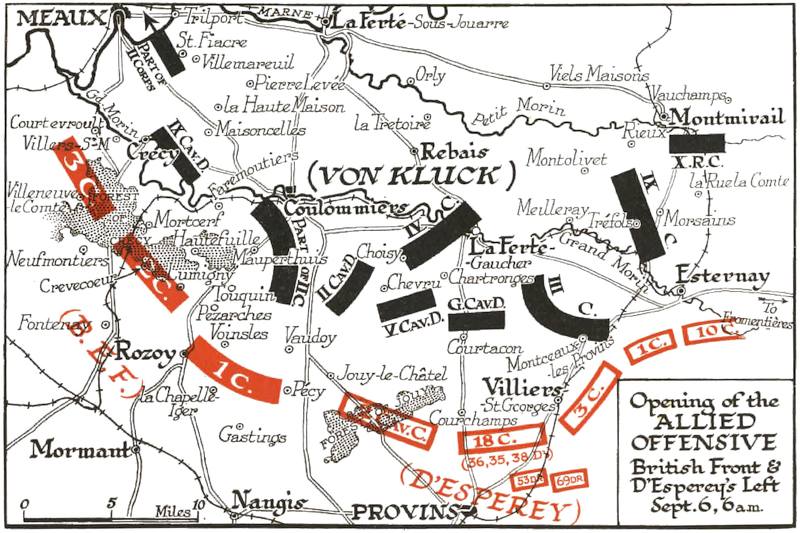
Opening of the ALLIED OFFENSIVE
British Front & D’Espérey’s Left
Sept. 6, 6 a.m.
General Franchet d’Espérey, who had been brigadier
in 1908, divisional commander in 1912, a gallant
and energetic officer now fifty-eight years of age, successful
with the 1st Corps at Dinant and St. Gerard
in Belgium, and in the important battle of Guise,
had, on September 3, succeeded Lanrezac at the head
of the largest of the French armies, the 5th. Its task—in
touch with Foch on the right, and with the British,
through Conneau’s cavalry corps, on the left—was to
press north toward Montmirail, against Kluck’s left
(III and IX Corps, and Richthofen’s cavalry divisions)
and the right wing of Bülow (VII Corps and X
Reserve Corps). In later stages of the war, the
junction of two armies often showed itself to be a
point of weakness to be aimed at. With four active
corps and three divisions of reserves in hand, d’Espérey
had, even before the German withdrawal began, a
considerable advantage—indicating Joffre’s intention
that it should be the second great arm of his offensive,
that which should make the chief frontal attack.
On the other hand, the enemy held strong positions
along the Grand Morin, and, behind this, along
the Vauchamps–Montmirail ridge of the Petit Morin.
During their retreat the Allies had used the opportunity
offered by the valleys of the Marne and its
tributaries for delaying actions; these streams were
now so many obstacles across their path. The first
French movement, on September 6, was powerfully
resisted. On the left, the cavalry occupied Courtacon.63
At the centre, the 18th and 3rd Corps co-operating
(prophetic combination—Maud’huy, Mangin, and
Petain!), the villages of Montceaux-les-Provins and
Courgivaux, on the highroad from Paris to Nancy,
which was, as it were, the base of the whole battlefield,
were taken by assault. On the right, the 1st Corps
was stopped throughout the forenoon before Chatillon-sur-Morin
by the X Reserve Corps. D’Espérey
detached a division, with artillery, to make a wide
detour and to fall, through the Wood of La Noue,
upon the German defences east of Esternay. Thus
threatened, the enemy gave way; and the market-town
of Esternay was occupied early on the following
morning. The 10th Corps continued the line toward
the north-east, after suffering rather heavy losses
beyond Sezanne.
On the morning of September 7, the air services
of the 5th Army reported the commencement of
Kluck’s retreat; and soon afterwards a corresponding
movement of Bülow’s right was discovered to be
going on behind a screen of cavalry and artillery,
supported by some infantry elements. D’Espérey
had no sooner ordered the piercing of this screen than
news was brought in of the critical position of the
neighbouring wing of Foch’s Army, the 42nd Division
and the 9th Corps, through which Bülow’s X and
Guard Corps were trying to break, from the St. Gond
Marshes toward Sezanne. He at once diverted his
20th Division to threaten the western flank of this
attack (which will be followed in the next section)
about Villeneuve-lès-Charleville. Meanwhile, rapid
progress was being made on the centre and left of the
5th Army. Between Esternay and Montmirail extend
the close-set parklands called the Forest of
Gault, with smaller woods outlying, a difficult country
in which many groups of hungry German stragglers
were picked up during the following days. Through
this district, the 1st Corps and the left of the 10th,
with General Valabrègue’s three divisions of reserves
behind, beat their way; while, farther west, in the
more open but broken fields between the Grand and
the Petit Morin, the 18th and the 3rd Corps made
six good miles, to the line Ferté Gaucher–Trefols.
More than a thousand prisoners were taken during
the day, with a few machine-guns and some abandoned
stores.
We have seen (pp. 124–5, 131) the British Expeditionary
Force at the beginning of a like novel and
exhilarating experience. Its five divisions, having
seized Coulommiers on the night of September 6, had
pressed on to the Petit Morin, and, from its junction
with the Marne eastward to La Trétoire, where obstinate
opposition was offered, had secured the crossings.
D’Espérey’s left wing thus found its task
lightened; and the 18th and 3rd Corps were ordered
to sweep aside the remaining German rearguards, and
to strike across the Petit Morin on either side of
Montmirail. September 8 was thus a day rather of
marching than fighting, except at Montmirail, on
whose horse-shoe ridge the enemy held out for some
hours.64 In the evening, General Hache entered the
picturesque town, and set up his quarters in the old
château where Bülow’s Staff had been housed on the
previous day. On the left, Maud’huy pushed the
18th Corps by Montolivet over the Petit Morin, and
after a sharp action took the village of Marchais-en-Brie.
On the right, the 1st Corps was checked at
Courbetaux and Bergères, the German VII Corps
having come into line; so that the 10th Corps, between
Soigny and Corfelix, had to turn north-westward
to its assistance. This was scarcely more than
an eddy in the general stream of fortune. The moral
effect of a happy manœuvre goes for much in the
result. The British and d’Espérey’s men forgot all
their sufferings and weariness in the spectacle of the
enemy yielding. British aviators reported Kluck’s
columns as in general retreat, certain roads being
much encumbered. Bülow had necessarily withdrawn
his right to maintain contact; his centre and
left must follow if the pressure were continued.
The hour of decision approached. During the morning
of Wednesday, September 9, Sir John French’s
2nd and 1st Corps crossed the Marne at Luzancy,
Sââcy, Nanteuil, Charly, and Nogent-l’Artaud. This
part of the valley was scarcely defended; and a
brigade of the 3rd Division had progressed 4 miles
beyond it by 9 a.m. Anxious news for the German
Staff. Unfortunately, our right was arrested until
afternoon by a threat of attack from Château-Thierry;
and, lower down the river about La Ferté, the 3rd
Corps, still represented only by the 4th Division and
the 19th Brigade, was stopped until evening before
the broken bridges and rifle-parapets on the northern
bank. Some guns then carried over near Changis
bombarded the German artillery positions beyond
the Ourcq, a notice to quit that had prompt effect.
Château-Thierry was left to the French 18th Corps,
which occupied the town that night. Meanwhile,
Smith-Dorrien and Haig entered the hilly country
about Bezu, Coupru, and Domptin, on the road from
Château-Thierry to Lizy-sur-Ourcq. Marwitz vainly
essayed to obstruct the northward movement. Beaten
in an action near Montreuil-aux-Lions, he informed
Kluck that he could do no more, and hurried back
to the line of the little river Clignon, about Bussiares
and Belleau, which were reached by 4 p.m. A little
later, British Aviators brought in word that the enemy
had evacuated the whole angle between the east
bank of the Ourcq and the Marne, and that, on the
other hand, the withdrawal of the German I Army
was creating a void beyond Château-Thierry: the
cavalry of Richthofen, sent thither by Bülow, was in the
same predicament as that of Marwitz farther west.
At daybreak on September 10, Pulteney’s Corps left
the Marne behind. Meeting no serious resistance,
the British crossed the Clignon valley, and by evening
occupied La Ferté-Milon, Neuilly-St. Front, and
Rocourt.
These were marching days for the 5th Army.
Conneau’s cavalry, reinforced by an infantry brigade
and extra batteries, passed the Marne at Azy on the
9th, and, harrying Bülow’s right flank, reached Oulchy-le-Château
next day. The 18th Corps, with the
reserve divisions in support, pushed on from Château-Thierry
toward Fère-en-Tardenois; and the 3rd
Corps, which had occupied Montigny, half-way
between Montmirail and the Marne, on the 9th, forced
the passage, under heavy fire from the hills at Jaulgonne,
on the 10th. The 1st Corps had a heavier
task. Having progressed as far as the Vauchamps
plateau, it was wheeled back to the south-east to help
the 10th Corps, which d’Espérey had transferred to
Foch’s Army of the centre, now in the gravest peril.
While the 6th Army, within sight of the Ourcq, was
suffering its great agony, while the “effect of suction”
was showing itself in the Anglo-French pursuit of
Kluck, very different were the first results at the centre
of the long crescent of the Allied front. Kluck was
saved by his quick resolution, together with Marwitz’s
able work in covering the rear. Bülow was in no such
imminent danger. His communications with the north
were at first perfectly safe. The situation of his
right wing, which must either fall back or lose contact
with the I Army, was awkward; but, doubtless,
Kluck’s success would soon re-establish it. The
circumstances indicated for the remainder of the II
Army and the neighbouring Saxon Corps an instant
attempt to break through the French centre, or at least
to cripple it, and, with it, all Joffre’s offensive plan.
The very strategic influence which helped the British
and d’Espérey, therefore, at first threw a terrible
burden upon Foch and the “detachment” which on
September 5 was renamed the “9th Army”; yet it
was by this same influence that, in the end, though by
the narrowest of margins, he also won through.
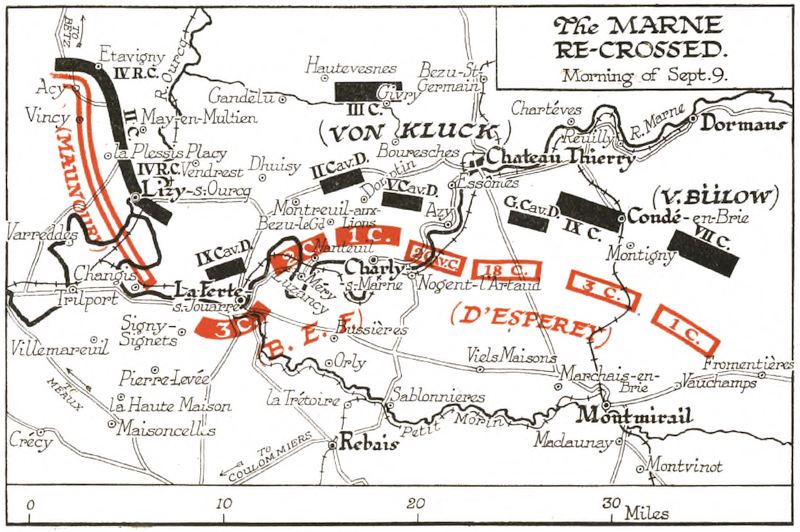
The MARNE RE-CROSSED.
Morning of Sept. 9.
The theatre of this struggle is the south-western
corner of the flat, niggardly expanse of La Champagne
Pouilleuse, lying between the depression called the
Marshes of St. Gond and the Sezanne–Sommesous
railway and highroad. It is very clearly bounded on
the west by the sharp edge of the Brie plateau; on the
east it is bordered by the Troyes–Châlons road and
railway. Sezanne on the west, and Fère Champènoise
at the centre, are considerable country towns;
the right is marked by the permanent camp of Mailly.
To the north of Sezanne, the hill of Mondemont,
immediately overlooking the marshes and the plain,
and the ravine of St. Prix, on the Epernay road, where
the Petit Morin issues from the marshes and breaks
into the plateau, are key positions. The Marshes of
St. Gond (so called after a seventh-century priory, of
which some ruins remain) witnessed several of the most
poignant episodes of Napoleon’s 1814 campaign “from
the Rhine to Fontainebleau.” They were then much
more extensive. Between the villages of Fromentières
and Champaubert, there survives the name, though
little else, of the “Bois du Desert,” where 3000
Russian grenadiers are said to have been slain or
captured by Marmont’s cuirassiers, while hundreds of
others were drowned. A month later, Blücher was
back from Laon attacking on the same ground; and
Marmont and Mortier were in full retreat along the
road to Fère Champènoise. Pachod’s national guards,
the “Marie Louises,” turned north to the marches of
St. Gond as to a refuge. The Russians and Prussians
surrounded them; and only a few of the French lads
escaped by the St. Prix road. To-day the marshes
are largely reclaimed and canalised; but this clay bed,
extending a dozen miles east and west, and averaging
more than a mile in breadth, fills easily under such a
rainstorm as fell upon the region on the evening of
September 9, 1914, and at all times it limits traffic to
the three or four good roads crossing it. The chief of
these, from Epernay to Sezanne and Fère Champènoise
respectively, pass the ends of the marshes at St. Prix
and Morains; the former is commanded by Mondemont;
the latter by Mont Août, near Broussy.
Was this “last barrier providentially set across the
route of the invasion”65 forgotten? Joffre’s earlier
plan did, indeed, involve the abandonment of all the
plain extending to the Aube; the decision to stand
on the line of the marshes was a consequence of
Gallieni’s initiative. Foch’s Army had been carried
beyond them in its retreat, but, fortunately, not far
beyond. On the morning of September 5, advance
columns of Bülow’s left had entered Baye; patrols had
reached the Petit Morin bridge at St. Prix, and the
north-centre of the marshes at Vert-la-Gravelle. A
little more dash, and the Germans would have possessed
themselves of all the commanding points. It
was about 10 a.m. that Foch received the Generalissimo’s
order closing the retreat: “The 9th Army
will cover the right of the 5th Army, holding the
southern passages of the Marshes of St. Gond, and
placing a part of its forces on the plateau north of
Sezanne.” Foch at once directed the appropriate
movements; and, by the evening of September 5, the
following positions were reached:
French Left.—Driven, back from St. Prix by forces
belonging to Bülow’s X Active and Reserve Corps,
the 42nd Division (General Grossetti) held the neighbouring
hills from Villeneuve-lès-Charleville and Soisy
to Mondemont.
Centre.—During the afternoon, Dubois advanced
the 9th Corps (Moroccan Division and 17th Division)
from Fère Champènoise to Broussy and Bannes, and
thence pushed two battalions over the marshes to
Toulon-la-Montagne, Vert-la-Gravelle, and Aulnizeux
in face of the Prussian Guard Corps, the main body of
which was at Vertus. The Blondlat Brigade of the
Moroccan Division attacked Congy, but failed, and fell
back on Mondemont. The 52nd Reserve Division was
in support about Connantre.
French Right.—The 11th Corps (General Eydoux)
rested on the east end of the marshes at Morains-le-Petit,
and from here stretched backward along the
course of the Champagne Somme to Sommesous, with
the 60th Reserve Division behind it. They had before
them the Saxon XII Active Corps and one of its
reserve divisions. At Sommesous, General de l’Espée’s
Cavalry Division covered a gap of about 12 miles
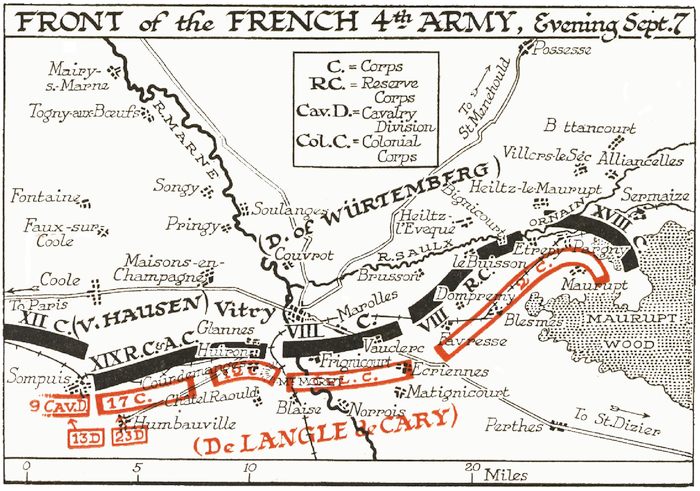
between Foch’s right and de Langle de Cary’s left at
Humbauville.
Thus, on the eve of the battle, the 9th Army,
inferior to the enemy in strength, especially in artillery,
presented to it an irregular convex front. Bülow was
at Esternay on the west; Hausen was approaching the
gap on its right flank; the centre was protruded
uneasily to and beyond the St. Gond Marshes. The
expectation of General Headquarters had, apparently,
been that the German onset would fall principally on
the right of the 5th Army. Foch was, therefore,
instructed to give aid in that direction by pushing his
left to the north-north-west, while the rest of his line
stood firm until the pressure was relieved. In the
event, these rôles were reversed: it was d’Espérey who
had to help Foch. The original dispositions, however,
had a certain effect upon the course of the battle. They
gave the 9th Army a pivot on the Sezanne plateau; and
the obstinacy with which this advantage was retained
seems to have diverted the German commanders, till
it was too late, from concentrating their force on the
other wing, the line of attack from which the French
had most to fear.
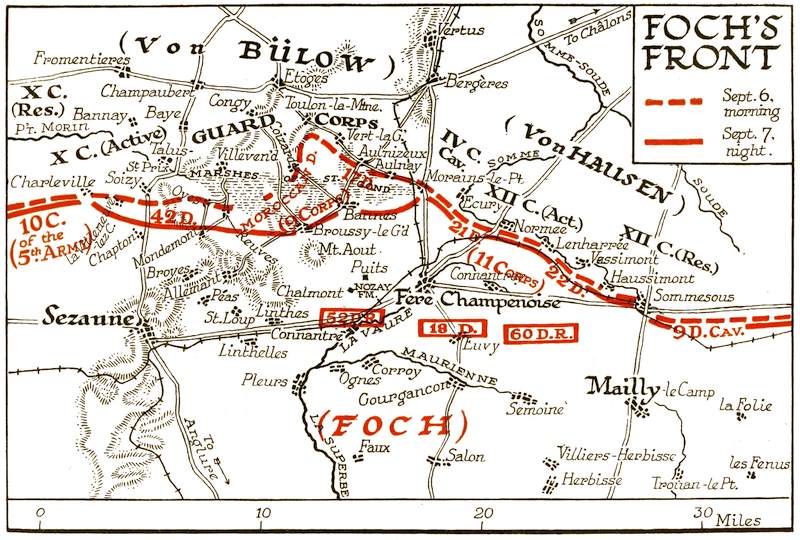
FOCH’S FRONT
Sept. 6, morning.
Sept. 7, night.
Foch was the offensive incarnate; but, on the morning
of September 6th, he could do no more than meet, and
that with indifferent success, Bülow’s attack upon his
left-centre. He was weakest where the enemy was
most strong: a large part of the French guns could
not reach the field for the beginning of the combat;
the 9th Corps, in particular, felt the lack of three groups
of artillery it had left in Lorraine. Failing this support,
the two battalions holding Toulon-la-Montagne were
quickly shelled out of their positions. In vain Dubois,
commanding the 9th Corps, ordered the Moroccan
Tirailleurs to march on Baye, and the 17th Division to
retake the two lost points. A crack regiment, the 77th,
crossed the marshes and entered Coizard village,
Major de Beaufort, cane in hand, on a big bay horse,
at its head, crying to his men, shaken by rifle fire from
the houses: “Forward, boys! Courage! It is for
France. Jeanne d’Arc is with us.” The 2nd and 3rd
battalions went on, and tried to climb Mount Toulon.
The fighting continued all day, ending in a painful
retreat to Mont Août through two miles of swampy
ground, in which the men plunged up to the waist
rather than risk the shell-ploughed causeway. The
Guard followed as far as Bannes, and the X Corps
occupied Le Mesnil Broussy and Broussy-le-Petit,
where the French batteries arrested them. Small
French detachments clung to Morains and Aulnay
through the day and night; otherwise, the north of
the marshes was lost. Against the left, Bülow was
less successful. The 42nd Division and the Moroccan
Division withstood repeated assaults of the X Corps
at Soisy-aux-Bois and on the edge of the St. Gond
Wood. The struggle, however, was most severe:
Villeneuve, occupied on the evening of September 5,
was lost at 8 a.m. on the 6th, recaptured an hour
later, lost again at noon, and recovered at night. On
the right, the 11th Corps had to evacuate Ecury and
Normée under heavy fire; Lenharrée and Sommesous
were partially in flames, but still resisted.
Unawed, in his quarters at Pleurs, Foch wrote the
following order for the morrow:—“The General
Commanding counts on all the troops of the 9th Army
exerting the greatest activity and the utmost energy
to extend and maintain beyond dispute the results
obtained over a hard-pressed and venturesome enemy.”
Many of the generals, lieutenants, and men may have
thought these last words too highly coloured. Foch
himself knew more of the real situation. He knew, as
did Bülow, how gravely the latter was prejudiced by
Kluck’s predicament. Already, the prospect had
arisen of the I German Army being gripped by the
closing vice of Maunoury and the British. Already,
d’Espérey’s great force was moving north along
Bülow’s flank toward Montmirail. Joffre’s masterstroke
was revealed. Was the victory that Berlin and
the armies counted as certain to slip away at the
eleventh hour? For the first time in a triumphant
generation, a German Army was in danger of defeat;
nay, all the armies were in danger. Astounding
change of fortune! The greycoat soldiery, dulling
their weariness in the loot of cottages and farms, the
subaltern officers, making free with the wine cellars of
old manor houses, did not know it; but such was the
fact. Their commanders were not the men easily to
take alarm; yet, at this moment, alarm must have
struck them.
The grand manœuvre of envelopment had failed.
The alternative plan remained: to smash the French
centre and roll up the lines on either side. On the
morning of September 7, this effort began with a fierce
onslaught across the ravine of the Petit Morin against
the Sezanne plateau from Mondemont to Villeneuve.
On Foch’s extreme left, nothing was gained. The
42nd Division was now receiving perceptible support
from the 10th Corps of the 5th Army, which during
the day, as we have seen, completed the clearance of
the Forest of Gault, to the west of Villeneuve. Toward
Mondemont, however, the X Active Corps made
some progress, throwing the defenders back to the
western borders of Soisy, again taking Villeneuve, and
reaching through the St. Gond Wood nearly to the
hamlet of Chapton. The bare crest called the Signal
du Poirier gave the German gunners an excellent
platform, with views over a large part of the French
lines. One of their chief targets was the château of
Mondemont, a two-story mansion, dating from the
sixteenth century, with pepper-pot corner towers,
enclosing a large square courtyard. General Humbert
had set up here his Staff quarters; but by noon the
bombardment had become so severe that he had to
leave it to advanced posts of the Moroccan Division,
first, however, insisting on taking a proper lunch in
the salle-à-manger with the trembling family. These
were sent to the rear, and Humbert moved to the
neighbouring château of Broyes. In a later stage of
the war, Humbert struck me rather as the thinker, a
quiet, keen intelligence, and a fine gentleman. At
this earlier time, one of the youngest generals in the
French Army, he appears rather as the man of spirited
action. Beaming with gay confidence, he abounded
in the gestes that the French soldier so loves. Once
several members of his escort were killed by a shell
exploding in their midst; like Grossetti, afterwards to
be known as “the Bull of the Yser,” danger only
stimulated him. “The Germans are bottled up,” he
said; “Mondemont is the cork. It must be held at
any price.” At 5 p.m., a combined attack, by parts
of the 42nd and Moroccan Divisions, with the 77th
regiment of the 9th Corps, was made with the object
of freeing the Mondemont position. Little ground
was gained, and the losses were very heavy; it was a
momentary relief, no more.
At length the German Command recognised that the
French defence was weakest toward and beyond Fère
Champènoise, and that a simultaneous attack by
both their wings, with most strength on the east, might
shatter it. First, however, the flank of the Guard
Corps along the marshes must be cleared. This preliminary
occupied the whole of September 7. On the
west, Oyes was taken during the morning in the
advance on Mondemont. On the east, the French
companies outlying at Morains and Aulnay had to
abandon these villages at 8 a.m., under threat of being
taken in reverse along the railway. Morains is only
four miles by highroad from Fère Champènoise; and
here the picked infantry of the Guard were striking at
the junction of the 9th and 11th Corps, with solid Saxon
regiments closing in upon the latter to the south-east.
Seeing their danger, Radiguet and Moussy concerted
a movement by which, during the afternoon, Aulnizeux
was taken and the German advance checked. In the
evening, at the third attempt, the enemy recovered
the village; and in the last hours of the night his
general offensive along the Sezanne and Fère roads
began. It will be convenient to follow first the western
arm of the attack.
At 3 a.m. on September 8, after a sharp cannonade,
the French machine-gunners on Mondemont Hill
observed spectral forms approaching in open order—these
were advanced parties belonging to the X
Corps, with some elements of the Guard. They were
easily repulsed; and, immediately afterwards, the much-thinned
ranks of the 42nd and Moroccan Divisions,
with the 77th regiment of the 9th Corps, were launched
anew towards St. Prix. Although Bülow had received
reinforcements, and had placed more batteries between
Congy and Baye, the Moroccans occupied Oyes and its
hill and the Signal du Poirier by 8 a.m., while the left
of the 42nd carried Soisy at the point of the bayonet.
Unfortunately, the debacle that was happening coincidentally
on Foch’s right put any exploitation of this
success out of the question. A fresh defensive front
had to be created south of the marshes, facing east;
the 77th regiment was recalled to St. Loup in the
middle of the afternoon for this purpose. The 42nd
Division seems to have been shaken by this removal of
a sorely-needed support; and Bülow, promptly
advised of it, ordered his columns forward once
more.
On an islet in the west end of the marshes, between
the villages of Villevenard and Oyes, stand a Renaissance
gateway and other remnants of the ancient
Priory of St. Gond, and in their midst the humble
dwelling of “the last hermit of St. Gond,” as M. le
Goffic calls him, the Abbé Millard, corresponding
member of the French Antiquarian and Archæological
Societies. A victim of dropsy, the Abbé was laid up
when the approach of the Germans was announced.
“So, then,” he calmly remarked, “I shall renew my
acquaintance with Attila.” His housekeeper, a typically
vigorous Frenchwoman, would have no such
morbid curiosity. “You have no parishioners but
the frogs, Monsieur le Curé; and they can take care
of themselves against your Attila. Come along”—and,
bundling some valuables into a wheelbarrow,
and giving Father Millard a stick, she carried him off
into safety. As they left, a body of Senegalese sharpshooters
came up, and began to build across the highway
an old-fashioned barricade of tree-trunks, carts,
and blocks of stone. “Some barbed wire and a
continuous trench, such as the Germans use, would
have been better,” remarks M. le Goffic; “but we remained
faithful to our old errors, and, nearly everywhere,
our men fought in the open or behind sheaves
and tree trunks.”
After hours of an ebb-and-flow of bayonet charges
and hand to hand combats, the French lost in succession
Broussy-le-Petit, Mesnil-Broussy, Reuves, and Oyes—all
the morning’s gain had vanished by nightfall.
With the Germans entrenched a mile away, and only a
single Zouave battalion in reserve, Humbert insisted
that Mondemont must be held; and his corps commander,
Dubois, desperately seeking to cover the void
on his right with the 77th Regiment, told the officers
that retreat was not to be thought of. Heavy rain
fell during the evening, obstructing the movements of
all the armies. On both sides, that night, the chiefs
knew that the issue was a matter of hours, of very
few hours. We saw in the first section of this chapter
that, on the evening of September 8, the left of the 5th
French Army had passed, and its centre reached, the
Petit Morin, while the 10th Corps immediately threatened
Bülow’s flank at Bannay, only 2 miles west of
Baye. The “effect of suction” was working wonderfully.
An order found during the day on a wounded
officer, directing that the regimental trains should be
drawn up facing north, showed the preoccupations of
the German Staff. If the Guard and the Saxons could
complete the rout of Foch’s right-centre, they might
yet win through; but there was no longer a
moment to spare, for Bülow had no force capable
of long withstanding d’Espérey’s north-eastward
thrust.
Against Foch’s left, Bülow played his last stake at
daybreak on September 9. A whole brigade, marching
from Oyes under cover of mist, brushed aside the
two battalions of sharpshooters, mounted Mondemont
hill, and seized the château and village, which were
rapidly provided with a garrison and machine-guns.
The 42nd Division was in course of withdrawal at
this time, its place being taken by the 51st Division
of the neighbouring army. Humbert still would not
take defeat: borrowing two battalions of chasseurs
from Grossetti, he sent them to the assault of the
promontory. They failed. At about 10.30 a.m.,
the 9th Corps lost Mont Août, the stronghold of Foch’s
centre, and fell back upon the lower hills between
Allemant and Linthes. If the whole left and centre
of the 9th Army were not to be swept, after its
right, into the plain, the last footing on the Sezanne
plateau must be held at any price. But how? Many
companies of the Moroccan Division had lost all their
officers and most of their men. The breakdown of
his right had driven Foch to an extreme expedient
which we will presently follow more closely—the
transfer thither of the 42nd Division; all Grossetti
could do for Humbert after his early morning failure,
therefore, was to lend him his artillery for a couple of
hours. From Dubois and his own corps, Humbert
was able again to borrow the 77th Regiment. After
a massed fire of preparation on the woods and slopes
around the château of Mondemont by nine batteries,
the hungry, haggard survivors of the 77th, divided
into two bodies under Colonels Lestoquoi and Eon,
approached the hill from the west and east, while four
companies gathered to the south of the château as a
storming force under Major de Beaufort.
We have already seen this only too chivalric officer
defying the prime conditions of modern warfare in
the capture of Coizard; here is a yet more pathetic
exhibition of the ancient style of heroism. It was 2.30
of a bright afternoon, the air oppressive with heat,
smoke, and dust. The commandant called a priest-soldier
from the ranks, and asked him to give supreme
absolution to the men who wished to receive it. They
knelt, and rose. The major, putting on his white
gloves, then gave the order to charge. Bugles sounded;
the men ran forward “in deep, close masses,”
shouting and singing. Many fell before reaching the
garden of the château. De Beaufort, standing for a
moment under a tree to consider the next step, was shot
dead. A few men got through a breach in the garden
wall, only to meet a rain of bullets from loopholes in
the house. A score of officers (including Captain de
Secondat-Montesquieu, a descendant of the great
French writer) were lost, with a third of the effectives.
At 3.30, Colonel Eon withdrew the remainder of the
storming party.
For a breathing space only. The château was, in fact,
besieged. Three field-guns were brought within 400
yards of it; and at 6 p.m. three companies advanced
upon the quadrangle of buildings, four others upon
the village, at the foot of the hill. Forty minutes
later, Colonel Lestoquoi led his last remaining
company forward, crying: “Come on, boys; another
tussle, and we are there.” This time, château, park,
farm, and churchyard, and finally the village, were
carried. “I hold the village and the château of
Mondemont,” Lestoquoi reported to General Humbert;
“I am installing myself for the night.”
The battle of Mondemont was over; one wild ebb-wave,
and the peace of nature’s fruitfulness fell for all
our time upon the riven fields, the multitude of graves,
the desolate marshes.
Far other and graver was the course of the eastern
arm of the German attack, after the loss of the marsh
villages by the French 9th Corps on September 7.
Dubois’ shaky line, along the south of the marshes,
was continued eastward by the 11th Corps (including,
now, the 18th Division) from near Morains to Normée,
and this by the 60th Reserve Division, thence to
Sommesous, and the 9th Cavalry Division, reaching
out to the left of de Langle’s Army (the 17th Corps).
These faced, respectively, the Prussian Guard Corps,
the Saxon XII Active Corps, and part of its reserve.
No great inequality, so far; but Bülow and Hausen
were bringing up reinforcements, and preparing a
terrible surprise. Throughout September 7, the
Saxons had been hammering at Eydoux’ front along
the Somme-Soude. Lenharrée, defended throughout
the afternoon and evening by only two companies,
became untenable during the night. All the officers
had fallen, Captain Henri de Saint Bon last of them,
crying to his Breton reservists of the 60th Division:
“Keep off! Do not get killed to save me.” On
entering the village, and seeing what had happened,
the Saxon commander ordered his men to march
before the French wounded, saying: “Salute! They
are brave fellows.” So began the darkest episode,
the nearest approach to a German victory, in the battle
of the Marne.
An hour before—at 3 a.m. on September 8—their
guns pushed forward under cover of darkness, the
general assault by Bülow’s and Hausen’s armies had
begun. It was well planned according to the information
of those commanders, and, considering how serious an
obstacle the marshes presented to their centre, remarkably
conducted. On the west, the resolution of the
defenders of Mondemont would have gone for nothing
without the increasing support of d’Espérey’s 10th
Corps. At the left-centre, the marshes gave Dubois
sufficient cover to enable him to wheel half his force
eastward. Beyond that, the conditions favoured the
enemy, for the only main roads converged upon Fère
Champènoise; and, if the French were driven back, a
dangerous block would inevitably be produced.
Against the extreme right, the Saxons were not in
great force; and, on that flank also, the neighbouring
French Army gave vital aid.
So, in the misty dawn of September 8, the greycoats,
picked Prussians and burly Saxons, swarmed forward,
seeming to renew themselves irresistibly. Foch,
talking to his Staff overnight, had exclaimed that such
desperation suggested the need of compensating for
ill fortune elsewhere; and now he opened a black day
with a characteristic phrase of stubborn cheer: “The
situation is excellent; I order you again vigorously
to take the offensive.” The situation excellent!
Foch would not use words of meaningless bravado;
he may have been thinking of d’Espérey knocking at
Bülow’s side door. At this hour (7 a.m.), he could
not yet know that the loss of Lenharrée had been
followed by the turning of two regiments of the 20th
Division, and two others of the 60th Reserve Division,
defending the passages of the Somme-Soude, and that
the lines on either side were crumpling up. So it was.
From a number of personal narratives, often contradictory
and exaggerated, we can draw an outline
of what occurred in the surprise of Fère Champènoise,
without pretending to determine exactly where, or by
what failing of exhausted men, the confusion originated.
Before Normée, outposts of the 11th Corps, scattered
by the sudden fierceness of the onslaught, left uncovered
the 35th Brigade (of the 18th Division), which
lay bivouacked in the woods. One regiment, the 32nd,
was surrounded, and only a half of its effectives, with a
few junior officers, escaped. The 34th Brigade, behind
it, had time to fall back without loss, through Connantre
to Oeuvy, along with the survivors of the 35th.
The remnants of the defenders of Lenharrée retreated
toward Connantre, firing steadily. As far as Fère
Champènoise, the chase ran fast along the four roads,
from Bannes, Morains, Ecury, and Normée. In the
little country town, crouched in a depression of the
hills, and so indefensible, an army chaplain66 was conducting
service in the parish church, at 9 a.m., when
bullets began to spatter on the walls, and the first cries
of flying men were heard above the noise of breaking
windows. At 10.30, the Prussian Guard entered the
town, drums and fifes playing. Presently, with bodies
of Saxons from Normée, they continued the pursuit,
which proceeded more slowly toward Connantre and
Oeuvy and the valley of the Maurienne. Here and
there, small French groups turned at bay, because they
could go no farther, or hoping to stem the retreat.
Thus, 200 men of the 66th and 32nd Regiments came to
a stand in one of the dwarf-pine woods south of Fère.
They had no officer among them; but a sergeant-major
named Guerre took them in hand, and disposed them
in four sections, “like the square at Waterloo,” he said.
One German attack was beaten off; but when a field-gun
came up, Guerre decided that the only hope was
to make a sortie. It cost the brave man his life.
About 30 of his fellows got away, including two privates,
Malveau and Bourgoin, who, after wandering in the
German lines, and being directed by a dying German
officer, brought the flag of the 32nd Regiment during
the evening to the commander of the 35th Brigade.
Perhaps it was because of the convergence of roads
upon Fère, noted above, that, whereas the original
breakdown occurred on Foch’s right, the pursuit
became concentrated upon his centre. The most
important consequence of this fact was that the German
Command never discovered the weakest part of the
French front, and the dislocated right was able to escape
from restraint and to re-form. The greater part of
the 60th Reserve Division, which had extended from
Vassimont and Haussimont to Sommesous, where
two regiments arrested the Saxon advance for two
hours, rallied early in the afternoon between Semoine
and Mailly. General de l’Espée’s cavalry, with some
infantry elements, held up a brigade of the Saxon
XII Corps south of Sompuis; and the neighbouring
army of de Langle effectively engaged the XIX Corps
between Humbauville and Courdemange.
Westward of the main stream of pursuit, the position
of Foch’s left was more delicate and critical. At
the extreme left, we have seen that, during the morning,
the 42nd Division recaptured Villeneuve and Soisy,
while the Moroccan Division reached St. Prix and the
Signal du Poirier. The 42nd held its gains throughout
the day; but the 9th Corps, shaken by frontal attack
across the marshes, and left with its flank in the air
by the breakdown of the 11th Corps, had no choice
but to withdraw its right, and suffered heavily ere it
could take up new positions. Coming on from Morains,
the Prussian Guard took the homesteads called Grosse
and Petit Fermes, on the way to Bannes, in reverse
by the east. Three French regiments were here thrown
into confusion, cavalry plunging into the batteries,
and fugitives obstructing the roads. The panic, however,
was soon over. At 7.30 a.m., the retreat sounded;
at 9 a.m., Moussy was reorganising the 17th Division
on the line Mont Août–Puits, with the 52nd Reserve
Division in support. Hither the faithful 77th Regiment
was called from Mondemont during the morning
to help form an angular front, across which the Germans
passed south in pursuit of the scattered elements of the
11th Corps. The headquarters of the 9th Army were
moved back from Pleurs to Plancy, on the Aube.
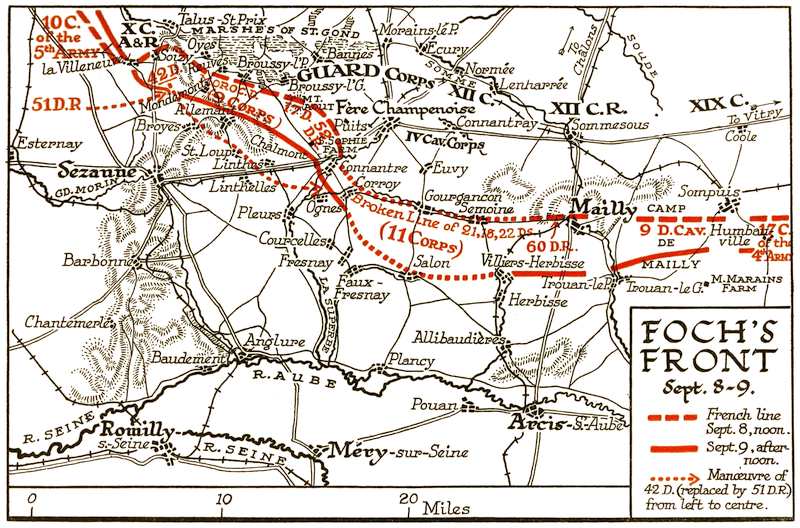
Thus, at noon on September 8, the shape of the vast
battle was markedly changed. D’Espérey was on the
Petit Morin near Montmirail, and his 10th Corps near
Corfelix. From the latter point, Foch’s left extended
south-east to Connantre. His centre, broken in to a
depth of ten miles, was floating indefinitely in the
valley of the Maurienne. The right, supported by
de Langle, giving no immediate anxiety, his first
problem, therefore, was to save the centre without
losing the solidity of the left. It is in such emergencies,
when a few hours even of loose and unsuccessful
resistance may turn the balance, that the virtues of a
race and the value of traditions and training in an army
reveal themselves. The breakdown before Fère
Champènoise did not degenerate into a rout. Eydoux
pulled the fragments of the 11th Corps together on the
line Corroy–Gourgancon–Semoine, and in the evening
delivered a counter-attack which gave him momentary
possession of the plateau of Oeuvy. Dubois aided this
reaction by striking at the west flank of the German
advance. Early in the afternoon, after a preparatory
fire by 15 batteries near Linthes, the 52nd Reserve
Division was thrown eastward toward Fère Champènoise.
This effort failed, as did another in the evening;
and Dubois had to withdraw slightly, first from
Puits to Ste. Sophie Farm, then to Chalmont, while the
Prussians held Connantre and Nozay Farm.
That evening, Foch conceived a manœuvre so
characteristic of the man, so evidently after his own
heart, that the facts of its execution have been hidden
under a mass of sparkling fable. “If, by whatever
mental vision,” the master had said in one of his
lectures, “we see a fissure in a dam of the defence, or a
point of insufficient resistance, and if we are able to join
to the regular and methodical action of the flood the
effect of a blow with a ram capable of breaking the
dam at a certain place, the equilibrium is destroyed,
the mass hurls itself through the breach, and overwhelms
all obstacles. Let us seek that place of weakness.
That is the battle of manœuvre. The defence,
overthrown at one point, collapses everywhere. The
barrier pierced, everything crumbles.” That it was
Foch, not Bülow, who had been on the defensive makes
no difference: Foch never thought of war in pure
defensive terms. Now he saw his opportunity.
There was no subtlety in the object. A rush which
fails to produce a complete breach opens a flank
plainly inviting attack; and the Staff at Plancy had
had its eyes fixed all day upon the new German flank,
6 miles long, from Mont Août to Corroy. Twice the
9th Corps had struck at it without success. The boldness
of Foch’s design lay, not in its objective, which
was evident, but in the means proposed for its execution.
The right of the 9th Corps could do no more;
its left, the Moroccan Division, had lost the south
bank of the marshes, and was hard put to it to hold
the hills around Mondemont. Nothing remained
but the 42nd Division, which, though greatly fatigued,
was in somewhat better posture about Soisy. Two
demands now competed in the mind of the French
commander. He regarded Mondemont as a key-position
to be defended at all costs; and the removal
of Grossetti, without compensation, would gravely
endanger it. But more than in any position he
believed in forcing a result by a well-directed blow
when the enemy offered the chance. D’Espérey’s
10th Corps, it is true, had before it the chance of
breaking across Bülow’s communications at St. Prix
and Baye; it had otherwise no pressing call to make
such a movement. Farther south, there were both need
and opportunity—the need of relieving the 9th and 11th
Corps, the opportunity of a decisive action. Grossetti,
then, must come to Linthes, and d’Espérey’s 51st
Division, in reserve of the 10th Corps, must take his
place west of Mondemont. D’Espérey’s loyalty in
agreeing to this arrangement cannot be too warmly
praised. The comradeship of arms, so influential a
factor in the victory of the Marne, was nowhere more
admirably illustrated.
But dawn on September 9 broke upon a situation
aggravated to the extreme, in which the projected
manœuvre might well seem a blunder of recklessness.
Bülow and Hausen had summoned their exhausted
men to undertake a last essay. On the French left,
Mondemont fell at 3 a.m. Two hours later, the Guard
and the two Saxon Corps burst upon the centre and
right with all their remaining force. Neither the 9th
nor the 11th Corps was in a condition to meet this
trial; but, in general, they faced it bravely. At
9 a.m., the 21st Division (11th Corps) could resist no
more, and fell back from Oeuvy to Hill 129, south of
Corroy, whence its commander, Radiguet, wrote to
Foch: “My troops could not hold out any longer
under a bombardment such as we have suffered for
the last two hours. They are in retreat all along the
line. It is the same with the 22nd Division. I am
going to try, with my artillery and what I can gather
of infantry, to rally on the plateau south of Corroy.
My regiments have fought admirably, but they have an
average of only four or five officers left.”
Foch replied from Plancy, at 10.15 a.m.: “The
42nd Division will arrive on the front Linthes–Pleurs.
Whatever be the position, more or less in retreat, of
the 11th Corps, we count on resuming the offensive
with the 42nd Division toward Connantre and Corroy,
an offensive in which the 9th Corps will have to take
part against the (German) right from Morains to
Fère Champènoise. The 42nd Division has been on
the way since 8.30, and will be ready to go into action
about midday. The 10th Corps has liberated it.
The 10th is at our disposition, and has orders to
support the Moroccan Division to prevent the enemy
penetrating to the west of the Marshes of St. Gond.”
On receiving similar instructions, Dubois sent two
squadrons of hussars to make a provisional link
between the 9th and 11th Corps, and intimated to
his divisional commanders not only that they must
stand firm, but that, in the classic phrase of Joffre,
“no failing will now be tolerated.”
Blind words, only to be justified on the lines of
Nogi’s apophthegm: “Victory is to him who can resist
for another quarter of an hour.” They were hardly
uttered when Mont Août, the north-eastern bastion of
Dubois’ line, stubbornly defended for five days, was
lost. Much of the artillery of the Prussian Guard
had been concentrated on this outlying watch-tower
of the Sezanne hills; and, in those early days of the
war, nerves were not so steeled that a position heavily
bombarded and definitely turned could be long held.
Of the two brigades of the 52nd Reserve Division, the
104th had been detached to Moussy’s 17th Division;
the 103rd remained under the command of General
Battesti. Of the former, the 5th battalion, 320th
Regiment, under Commandant Meau (known as an
author under the pseudonym “Jean Saint-Yves”) was
posted on the north slopes of Mont Août; two companies
of the 51st Chasseurs were on the east; and
Lt.-Col. (afterwards General) Clandor, with the 6th
battalion, was in the wood at the foot of the hill.
Meau, with wounded head bound in bloody bandages,
“like a Crimean veteran,” as a combatant says,
was keeping his men firm under a rain of light and
heavy shells commencing at about 9.30 a.m., and
Clandor was also determined to hold, when it suddenly
became known that the 103rd Brigade, on their
right, had received an order to retreat, apparently
given by Battesi in alarm at the extent of the enemy’s
advance.67 First in twos and threes, then in masses,
the reservists left the woods that cover the eastern
slopes of the hill, and hurried westward, groups of
horsemen galloping past them, and gun-teams plunging
through the meadows. The whole line was thus
shaken; and, shortly afterward, the two batteries
which had hitherto sustained the men on the crest
were silenced by German guns that had got round
behind Ste. Sophie Farm. At 11.45 a.m., Moussy
gave Meau and Clandor orders to fall back; but their
obstinacy had its reward—Mont Août was never
occupied by the enemy. The debris of Battesti’s
brigades were rallied during the early afternoon on
the hills of Allemant and Chalmont. A part of
Moussy’s Division was driven south, and, after a
gallant recoil at Ste. Sophie Farm, drew off to the
west.
What had become of Grossetti and the 42nd, the
last hope of the French centre? From Soisy to
Linthes is a march of only 12 miles, and they were to
have started at dawn—had started, Foch said, at
8.30 a.m. Exhaustion, hitches in the replacement by
the 51st, and the needs of Mondemont may explain the
harrowing delay. Messengers were sent out, without
result. Foch, fuming at Plancy, issued note upon
note to encourage his lieutenants. “Information
shows,” he wrote at noon, “that the German Army,
after having marched without rest since the beginning
of the campaign, has reached the extreme limit
of fatigue. Order no longer exists in their units;
regiments are mixed together; the Command is
confused. The vigorous offensive of our troops has
thrown surprise into the ranks of the enemy, who
thought we should not offer any further opposition.
It is of the highest importance to profit by these
circumstances. In the decisive hour when the honour
and safety of the French Fatherland are at stake,
officers and soldiers will draw from the energy of our
race the strength to stand firm till the moment when
the enemy will collapse, worn out. The disorder
prevailing among the German troops is a sign of our
coming victory; by continuing with all its force the
effort begun, our army is certain to stop the march
of the enemy and to drive him from our soil. But
every one must share the conviction that success will
fall to him who can endure longest.”
There were, in fact, disorders in the invading host.
All morning, Prussian and Saxon soldiery had been
making public revel in Fère Champènoise, breaking
open and pillaging houses and shops, drinking, dancing,
and singing in the streets. Nevertheless, the fighting
columns advanced steadily. At 1 p.m. the
Guard reached Nozay and Ste. Sophie Farms and
entered Connantre, and the Saxons Gourgancon.
Radiguet’s Division of the 11th Corps, after a brave
stand at Oeuvy, drifted before them, first to Fresnay,
then to Faux and Salon. Foch did not waver in his
intentions. “The 42nd Division is marching from
Broyes to Pleurs,” he wrote at 1 p.m. “It should face
east between Pleurs and Linthes, so as to attack
afterward in the direction of the trouée between Oeuvy
and Connantre. The attack will be supported on the
right by the 11th Corps, on the left by all available
elements of the 9th Corps, which will take for their
objective the road between Fère Champènoise and
Morains.” The meaning of the word trouée as here
used must not be mistaken. It presumably meant
the highroad to Fère Champènoise. There was no
such “gap” between the Prussian and Saxon forces
as some writers have imagined; and they were both,
at the time of this note, three miles or more south of
the line Oeuvy–Connantre.
Though the situation was not so simple as the
idea of a “gap” would suggest, Foch had accurately
gauged its character and the peculiar weakness of the
German advance. It has been noted that this was
at first inclined (partly by the lie of the roads) in a
south-westerly direction. One result was to relieve
the pressure on the French extreme right, where the
60th Reserve Division withdrew easily from Mailly
to Villiers-Herbisse, while de l’Espée’s cavalry received
strong support from the neighbouring army.
On their east flank, therefore, the Saxons had to move
with care. On their right, the Prussian Guard had
been attracted westward, and there checked, at 4 p.m.,
by an attack of portions of the 9th Corps. The Saxons
had progressed more easily, and had overrun the
Prussians by several miles, thus prolonging the flank
at which Foch intended to strike. There was no
“fissure” at this time, but rather an overlapping;
when, on the following day, a real gap opened between
Bülow’s and Hausen’s Armies (on the Epernay and
Châlons roads respectively), the retreat was too fast
for the French to take advantage of it.
Foch’s design was the classic combination of flank
and frontal attack. Grossetti was to drive east-north-east
from Linthes–Pleurs, beside the main road and
railway, toward Fère Champènoise, while, on his left,
Dubois gave what aid he could in the same direction,
and Eydoux came up from the south. It was to be the
same famous manœuvre that Maunoury and the
British had commenced three days before, without
immediate success, but from which the whole “effect
of suction,” with its momentous consequences, had
arisen. Thanks to those three days of heroic effort and
sacrifice, Foch’s success was instant and complete,
though it was not such as the fables have it.68 Indeed,
the enemy did not wait for the assault. He bolted.
A doubtful story goes that a German aviator observed
the approach of Grossetti’s columns, and gave Von
Bülow’s Staff timely warning. The truth appears to
be that the German retreat had been ordered between
3 and 5 p.m. At 6, under a red sunset, the 42nd
Division arrived, and, supported by three, later increased
to five, groups of artillery, moved slowly
forward from the line Linthes–Linthelles, to bivouac
near Pleurs.69 The 9th Corps alone came into touch
with the enemy; and a rearguard resistance was
enough to impede its hastily re-formed ranks. At
daybreak on the 10th, the 34th Brigade entered Fère
Champènoise, which had been evacuated the previous
evening, picking up 1500 stragglers; while the 42nd
Division was occupying Connantre, where 500 men of
the Grenadier Guards were made prisoner at the
château. As Grossetti’s columns crossed the hills in
the dawn-light, the air was poisonous with rotting
humanity, and spectral forms arose begging for a cup
of water. They were men wounded in the surprise of
the 8th who had lain in the open for nearly three days.
The front of the 9th Army was restored; and,
weary but exultant, it prepared to go forward to the
general victory. Whether, in the end, the movement
of the 42nd Division counted for anything in this
result, we can know, if ever, only when the German
archives are opened. The chief factor lay not in the
form of any particular manœuvre, but in the sheer
persistence of the French centre. Foch and his men
won by Nogi’s “quarter of an hour.”