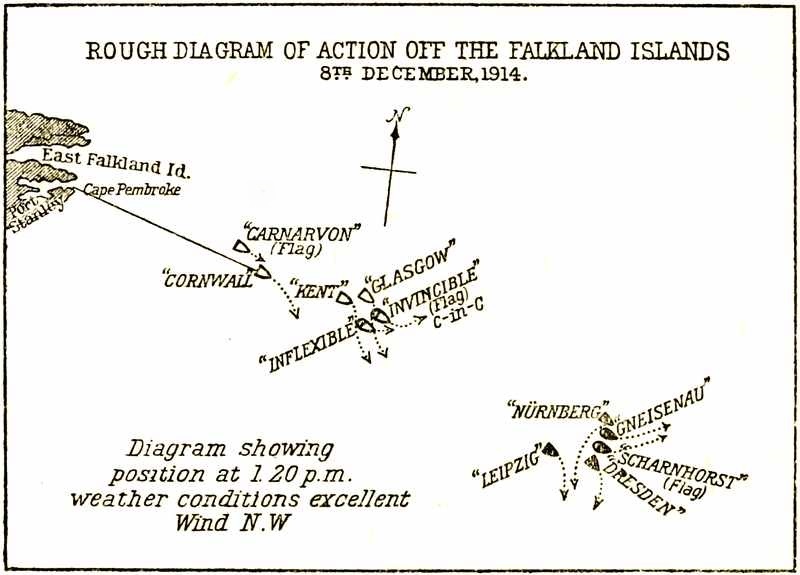
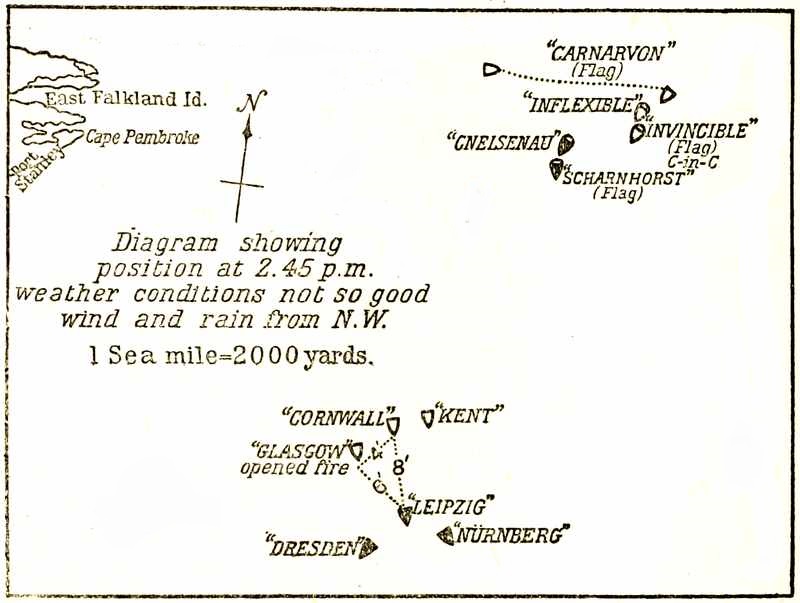
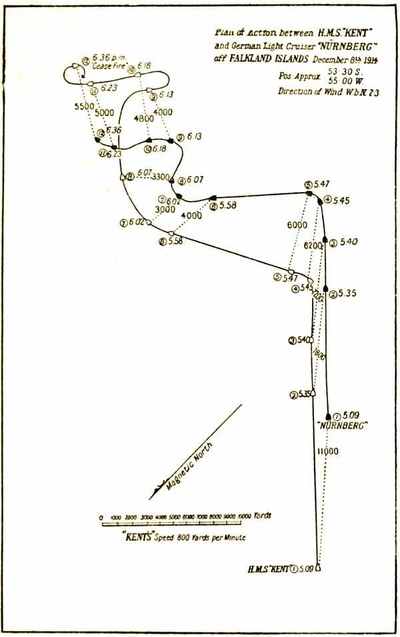
December 8th, 1914
Admiralty, 3rd March, 1915.
The following dispatch has been received from Vice-Admiral
Sir F. C. Doveton Sturdee, K.C.B., C.V.O., C.M.G., reporting
the action off the Falkland Islands on Tuesday, the 8th of
December, 1914:—
Invincible at Sea,
December 19th, 1914.
Sir,
I have the honour to forward a report on the action
which took place on 8th December, 1914, against a German
Squadron off the Falkland Islands.
I have the honour to be, Sir,
Your obedient Servant,
F. C. D. STURDEE,
Vice-Admiral, Commander-in-Chief.
The Secretary, Admiralty.
(A)—PRELIMINARY MOVEMENTS
The squadron, consisting of H.M. ships Invincible, flying
my flag, Flag Captain Percy T. H. Beamish; Inflexible,
Captain Richard F. Phillimore; Carnarvon, flying the flag
of Rear-Admiral Archibald P. Stoddart, Flag Captain Harry
L. d'E. Skipwith; Cornwall, Captain Walter M. Ellerton;
Kent, Captain John D. Allen; Glasgow, Captain John Luce;
Bristol, Captain Basil H. Fanshawe; and Macedonia, Captain
Bertram S. Evans; arrived at Port Stanley, Falkland
Islands, at 10.30 A.M. on Monday, the 7th December, 1914.
Coaling was commenced at once, in order that the ships
should be ready to resume the search for the enemy's squadron
the next evening, the 8th December.
At 8 A.M. on Tuesday, the 8th December, a signal was
received from the signal station on shore:
"A four-funnel and two-funnel man-of-war in
sight from Sapper Hill, steering northwards."
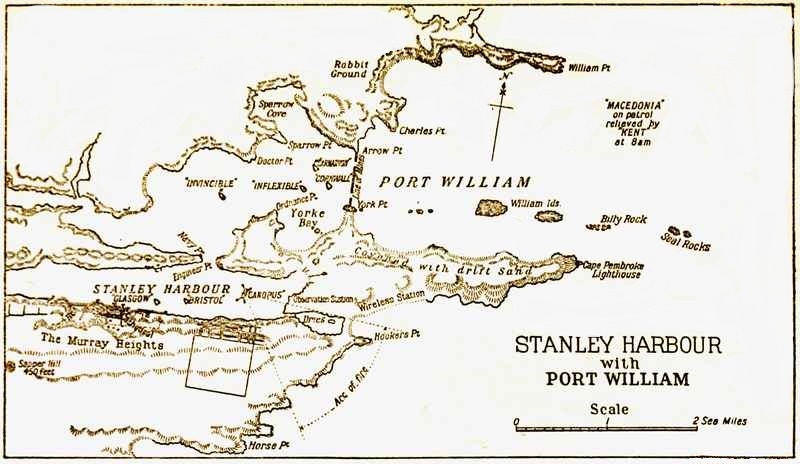
At this time, the positions of the various ships of the
squadron were as follows:
Macedonia—At anchor as look-out ship.
Kent (guard ship)—At anchor in Port William.
Invincible and Inflexible—In Port William.
Carnarvon—In Port William.
Cornwall—In Port William.
Glasgow—In Port Stanley.
Bristol—In Port Stanley.
The Kent was at once ordered to weigh, and a general
signal was made to raise steam for full speed.
At 8.20 A.M. the signal station reported another column
of smoke in sight to the southward, and at 8.45 A.M. the
Kent passed down the harbour and took up a station at
the entrance.
The Canopus, Captain Heathcoat S. Grant, reported at
8.47 A.M. that the first two ships were 8 miles off, and that
the smoke reported at 8.20 A.M. appeared to be the smoke
of two ships about 20 miles off.
At 8.50 A.M. the signal station reported a further column
of smoke in sight to the southward.
The Macedonia was ordered to weigh anchor on the inner
side of the other ships, and await orders.
At 9.20 A.M. the two leading ships of the enemy (Gneisenau
and Nürnberg), with guns trained on the wireless station,
came within range of the Canopus, who opened fire at them
across the low land at a range of 11,000 yards. The enemy
at once hoisted their colours and turned away. At this time
the masts and smoke of the enemy were visible from the
upper bridge of the Invincible at a range of approximately
17,000 yards across the low land to the south of Port William.
A few minutes later the two cruisers altered course to
port, as though to close the Kent at the entrance to the
harbour, but about this time it seems that the Invincible
and Inflexible were seen over the land, as the enemy at once
altered course and increased speed to join their consorts.
The Glasgow weighed and proceeded at 9.40 A.M. with
orders to join the Kent and observe the enemy's movements.
At 9.45 A.M. the squadron—less the Bristol—weighed,
and proceeded out of harbour in the following order: Carnarvon,
Inflexible, Invincible, and Cornwall. On passing Cape
Pembroke Light, the five ships of the enemy appeared clearly
in sight to the south-east, hull down. The visibility was at
its maximum, the sea was calm, with a bright sun, a clear
sky, and a light breeze from the north-west.
At 10.20 A.M. the signal for a general chase was made.
The battle-cruisers quickly passed ahead of the Carnarvon
and overtook the Kent. The Glasgow was ordered to keep
two miles from the Invincible, and the Inflexible was stationed
on the starboard quarter of the flagship. Speed was eased
to 20 knots at 11.15 A.M. to enable the other cruisers to
get into station.
At this time the enemy's funnels and bridges showed
just above the horizon.
Information was received from the Bristol at 11.27 A.M.
that three enemy ships had appeared off Port Pleasant,
probably colliers or transports. The Bristol was therefore
directed to take the Macedonia under his orders and destroy
transports.
The enemy were still maintaining their distance, and
I decided, at 12.20 P.M., to attack with the two battle-cruisers
and the Glasgow.
At 12.47 P.M. the signal to "Open fire and engage the
enemy" was made.
The Inflexible opened fire at 12.55 P.M. from her fore
turret at the right-hand ship of the enemy, a light cruiser;
a few minutes later the Invincible opened fire at the same
ship.
The deliberate fire from a range of 16,500 to 15,000 yards
at the right-hand light cruiser, who was dropping astern,
became too threatening, and when a shell fell close alongside
her at 1.20 P.M. she (the Leipzig) turned away, with the
Nürnberg and Dresden to the south-west. These light cruisers
were at once followed by the Kent, Glasgow, and Cornwall,
in accordance with my instructions.
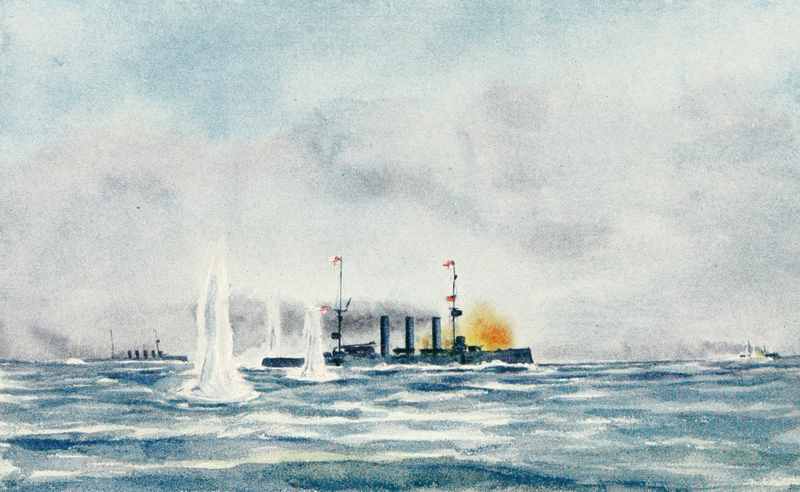
The action finally developed into three separate encounters,
besides the subsidiary one dealing with the threatened
landing.
(B)—ACTION WITH THE ARMOURED CRUISERS
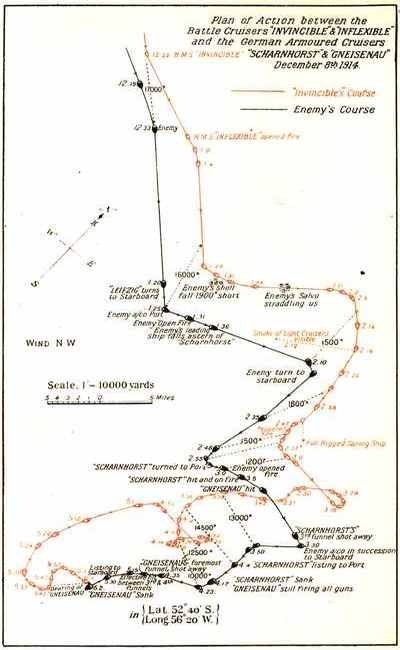
The fire of the battle-cruisers was directed on the Scharnhorst
and Gneisenau. The effect of this was quickly seen,
when at 1.25 P.M., with the Scharnhorst leading, they turned
about 7 points to port in succession into line-ahead and
opened fire at 1.30 P.M. Shortly afterwards speed was eased
to 24 knots, and the battle-cruisers were ordered to turn
together, bringing them into line-ahead, with the Invincible
leading.
The range was about 13,500 yards at the final turn, and
increased until, at 2 P.M., it had reached 16,450 yards.
The enemy then (2.10 P.M.) turned away about 10 points
to starboard and a second chase ensued, until, at 2.45 P.M.,
the battle-cruisers again opened fire; this caused the enemy,
at 2.53 P.M., to turn into line-ahead to port and open fire
at 2.55 P.M.
The Scharnhorst caught fire forward, but not seriously,
and her fire slackened perceptibly; the Gneisenau was badly
hit by the Inflexible.
At 3.30 P.M. the Scharnhorst led round about 10 points
to starboard; just previously her fire had slackened perceptibly,
and one shell had shot away her third funnel;
some guns were not firing, and it would appear that the
turn was dictated by a desire to bring her starboard guns
into action. The effect of the fire on the Scharnhorst became
more and more apparent in consequence of smoke from
fires, and also escaping steam; at times a shell would cause
a large hole to appear in her side, through which could be
seen a dull red glow of flame. At 4.4 P.M. the Scharnhorst,
whose flag remained flying to the last, suddenly listed heavily
to port, and within a minute it became clear that she was
a doomed ship; for the list increased very rapidly until
she lay on her beam ends, and at 4.17 P.M. she disappeared.
The Gneisenau passed on the far side of her late flagship,
and continued a determined but ineffectual effort to
fight the two battle-cruisers.
At 5.8 P.M. the forward funnel was knocked over and
remained resting against the second funnel. She was evidently
in serious straits, and her fire slackened very much.
At 5.15 P.M. one of the Gneisenau's shells struck the
Invincible; this was her last effective effort.
At 5.30 P.M. she turned towards the flagship with a heavy
list to starboard, and appeared stopped, with steam pouring
from her escape pipes and smoke from shell and fires rising
everywhere. About this time I ordered the signal "Cease
fire," but before it was hoisted the Gneisenau opened fire
again, and continued to fire from time to time with a single
gun.
At 5.40 P.M. the three ships closed in on the Gneisenau,
and at this time the flag flying at her fore truck was apparently
hauled down, but the flag at the peak continued flying.
At 5.50 P.M. "Cease fire" was made.
At 6 P.M. the Gneisenau heeled over very suddenly, showing
the men gathered on her decks and then walking on
her side as she lay for a minute on her beam ends before
sinking.
The prisoners of war from the Gneisenau report that, by
the time the ammunition was expended, some 600 men had
been killed and wounded. The surviving officers and men
were all ordered on deck and told to provide themselves
with hammocks and any articles that could support them
in the water.
When the ship capsized and sank there were probably
some 200 unwounded survivors in the water, but, owing to
the shock of the cold water, many were drowned within
sight of the boats and ship.
Every effort was made to save life as quickly as possible
both by boats and from the ships; life-buoys were thrown
and ropes lowered, but only a proportion could be rescued.
The Invincible alone rescued 108 men, 14 of whom were
found to be dead after being brought on board; these men
were buried at sea the following day with full military honours.
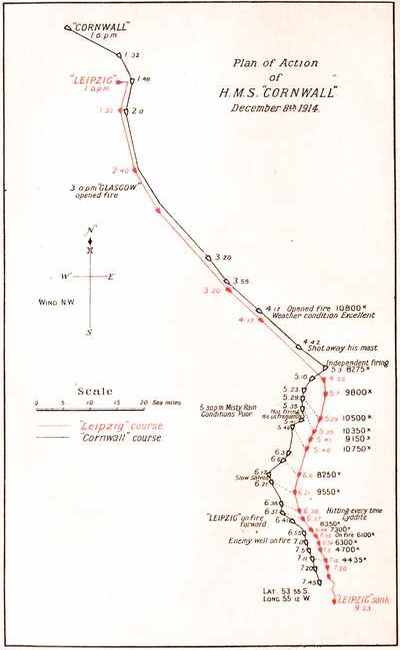
(C)—ACTION WITH THE LIGHT CRUISERS
At about 1 P.M., when the Scharnhorst and Gneisenau
turned to port to engage the Invincible and Inflexible, the
enemy's light cruisers turned to starboard to escape; the
Dresden was leading and the Nürnberg and Leipzig followed
on each quarter.
In accordance with my instructions, the Glasgow, Kent,
and Cornwall at once went in chase of these ships; the
Carnarvon, whose speed was insufficient to overtake them,
closed the battle-cruisers.
The Glasgow drew well ahead of the Cornwall and Kent,
and at 3 P.M. shots were exchanged with the Leipzig at
12,000 yards. The Glasgow's object was to endeavour to
outrange the Leipzig with her 6-inch guns and thus cause
her to alter coarse and give the Cornwall and Kent a chance
of coming into action.
At 4.17 P.M. the Cornwall opened fire, also on the Leipzig.
At 7.17 P.M. the Leipzig was on fire fore and aft, and the
Cornwall and Glasgow ceased fire.
The Leipzig turned over on her port side and disappeared
at 9 P.M. Seven officer and eleven men were saved.
At 3.36 P.M. the Cornwall ordered the Kent to engage
the Nürnberg, the nearest cruiser to her.
Owing to the excellent and strenuous efforts of the engine
room department, the Kent was able to get within range
of the Nürnberg at 5 P.M. At 6.35 P.M. the Nürnberg was
on fire forward and ceased firing. The Kent also ceased
firing and closed to 3,300 yards; as the colours were still
observed to be flying in the Nürnberg, the Kent opened
fire again. Fire was finally stopped five minutes later on
the colours being hauled down, and every preparation was
made to save life. The Nürnberg sank at 7.27 P.M., and
as she sank a group of men were waving a German ensign
attached to a staff. Twelve men were rescued, but only
seven survived.
The Kent had four killed and twelve wounded, mostly
caused by one shell.
During the time the three cruisers were engaged with
the Nürnberg and Leipzig, the Dresden, who was beyond
her consorts, effected her escape owing to her superior speed.
The Glasgow was the only cruiser with sufficient speed to
have had any chance of success. However, she was fully
employed in engaging the Leipzig for over an hour before
either the Cornwall or Kent could come up and get within
range. During this time the Dresden was able to increase
her distance and get out of sight.
The weather changed after 4 P.M., and the visibility was
much reduced; further, the sky was overcast and cloudy,
thus assisting the Dresden to get away unobserved.
(D)—ACTION WITH THE ENEMY'S TRANSPORTS
A report was received at 11.27 A.M. from H.M.S. Bristol
that three ships of the enemy, probably transports or colliers,
had appeared off Port Pleasant. The Bristol was ordered
to take the Macedonia under his orders and destroy the
transports.
H.M.S. Macedonia reports that only two ships, steamships
Baden and Santa Isabel, were present; both ships
were sunk after the removal of the crew.
I have pleasure in reporting that the officers and men
under my orders carried out their duties with admirable
efficiency and coolness, and great credit is due to the Engineer
Officers of all the ships, several of which exceeded their
normal full speed.
The names of the following are specially mentioned:
Officers
Commander Richard Herbert Denny Townsend, H.M.S. Invincible.
Commander Arthur Edward Frederick Bedford, H.M.S. Kent.
Lieutenant-Commander Wilfrid Arthur Thompson, H.M.S.
Glasgow.
Lieutenant-Commander Hubert Edward Danreuther, First and
Gunnery Lieutenant, H.M.S. Invincible.
Engineer-Commander George Edward Andrew, H.M.S. Kent.
Engineer-Commander Edward John Weeks, H.M.S. Invincible.
Paymaster Cyril Sheldon Johnson, H.M.S. Invincible.
Carpenter Thomas Andrew Walls, H.M.S. Invincible.
Carpenter William Henry Venning, H.M.S. Kent.
Carpenter George Henry Egford, H.M.S. Cornwall.
Petty Officers and Men
Ch. P.O. D. Leighton, O.N. 124238, Kent.
P.O., 2nd Cl., M. J. Walton (R.F.R., A1756), O.N. 118358, Kent.
Ldg. Smn. F. S. Martin, O.N. 233301, Invincible, Gnr's Mate,
Gunlayer, 1st Cl.
Sigmn. F. Glover, O.N. 225731, Cornwall.
Ch. E. R. Art., 2nd Cl., J. G. Hill, O.N. 269646, Cornwall.
Actg. Ch. E. R. Art., 2nd Cl., R. Snowdon, O.N. 270654, Inflexible.
E. R. Art., 1st Cl., G. H. F. McCarten, O.N. 270023, Invincible.
Stkr. P.O. G. S. Brewer, O.N. 150950, Kent.
Stkr. P.O. W. A. Townsend, O.N. 301650, Cornwall.
Stkr., 1st Cl., J. Smith, O.N. SS 111915, Cornwall.
Shpwrt., 1st Cl., A. N. E. England, O.N. 341971, Glasgow.
Shpwrt., 2nd Cl., A. C. H. Dymott, O.N. M. 8047, Kent.
Portsmouth R.F.R.B.-3307 Sergeant Charles Mayes, H.M.S.
Kent.
F. C. D. STURDEE.
BATTLE OF FALKLAND ISLANDS,
December 8th, 1914.
H.M.S. Invincible.
11th December, 1914.
Memorandum.
The following copy of a telegram received from the
Admiralty, and the reply thereto, are forwarded for information.
Both of these messages are to be read to the
whole Ship's Company on the Quarter Deck of H.M. Ships
under your command.
(Signed) F. C. D. Sturdee,
Vice-Admiral,
Commander-in-Chief.
The Rear-Admiral and Officers Commanding
H.M. Ships,
South Atlantic and South Pacific Squadron.
For Admiral, Invincible. (Date) 9.12.14
From Admiralty.
The following message has been received for you from
His Majesty:—
I heartily congratulate you and your officers and
men on your most opportune victory.
George R.I.
2. Our thanks are due to yourself and to officers
and men for the brilliant victory you have reported.
Reply to His Majesty:
Your Majesty's gracious message has been received with
pride and satisfaction by myself, the Rear-Admiral, Captains,
Officers, and Ship's Companies under my command.
We hope soon to have the privilege of completing our
mission by disposing of the remaining cruiser.
Commander-in-Chief, Invincible.
Reply to Their Lordships:
Admiralty congratulations not received till to-day.
Myself, officers and men desire to thank their Lordships
for the approbation of our efforts.
From C.-in-C. Home Fleets, H.M.S. Cyclops.
(Date) 10.12.14. 1.14 A.M.
With reference to your telegram 485[10] may I be permitted
to offer my sincere congratulations on the splendid success
attending your dispositions.
From Admiral, Marseillaise, Brest.
(Date) 10.12.14.
To Naval Attaché.
I beg to express to the Admiralty how fully I share their
joy at the brilliant revenge taken by the British Navy at
the Falklands.
F.N.A. Office.
From Petrograd.
To Vice-Admiral Sturdee, Admiralty, London.
(Date) 12.12.14. 3.0 A.M.
Please accept Heartiest Congratulations from the Russian
Navy for the Brilliant Action of your Squadron in fighting
the Enemy and sweeping out the oceans.
Vice-Admiral Roussie Nomer.
From C.-in-C. Home Fleets, H.M.S. Cyclops.
(Date) 11.12.14. 4.58 A.M.
Submit the hearty congratulation of the Grand Fleet
on his victory may be conveyed to Admiral Sturdee.
Messages exchanged between H.E. the Governor of the
Falkland Islands and C.-in-C. South Atlantic and Pacific:
Governor to Vice-Admiral:
11th December, 1914.
Warmest congratulations from self and Colony on your
Victory.
Vice-Admiral to Governor:
May I thank you and the Colony for myself, the R.A.,
Captains, Officers and men of the Squadron for your congratulations
on our success, which will not be complete
until Dresden is accounted for. We wish to convey our thanks
for the early warning of the approach of the enemy due
to the good lookout from Sapper's Hill.
We feel the honour that the Canopus and the Squadron
were in a position to prevent an old British Colony from
being insulted or injured in any way, and hope that the
enemy will have been taught a lesson not to repeat such
action against any other part of the British Empire.
This Memorandum is to be read to whole Ship's Company
on the Quarter Deck.
Invincible, at Port William,
11th December, 1914.
Memorandum.
The Commander-in-Chief wishes to congratulate all the
ships of the squadron on the success of their main encounter
with the enemy's squadron, and to thank the Rear-Admiral,
Captains, Officers and Men for their individual assistance
in attaining this great result. The zeal and steadiness under
fire of all hands were most noticeable.
2. The victory will not be complete until the remaining
cruiser is accounted for, and directly the squadron is coaled
a further organised search will be made.
3. One of the greatest merits of the action is the small
list of casualties due to the able handling of the ships by
their Captains, who utilised the power of the guns and the
speed of the ships to the best advantage. Further, the
effective fire at long range and the thorough organization
were very evident and enabled the action to be fought with
success against a foe who displayed splendid courage, determination
and efficiency.
4. The excellent way in which the Engine Room Departments
responded to a sudden and unexpected demand
reflects great credit on the officers and the whole engine
room complements—this demand was made at a time when
ships were coaling and making good defects during the few
hours the ships were in harbour.
5. The successful disposal of the two powerful cruisers,
two of the three light cruisers, and two colliers, will be of
great advantage to the Naval Strategy of the British Empire.
6. Therefore all concerned can feel that they have performed
a National Service on the 8th December, 1914, off
the Falkland Islands.
(Signed) F. C. D. Sturdee,
Vice-Admiral,
Commander-in-Chief.
The Rear-Admiral, Captains, Officers, and all concerned,
South Atlantic and South Pacific Squadron.
Lord Chamberlain's Office,
St. James's Palace, S.W.,
3rd March, 1915.
The King has been graciously pleased to give orders for
the following appointment to the Most Honourable Order
of the Bath in recognition of the services of the undermentioned
Officer mentioned in the foregoing dispatch:—
To be an Additional Member of the Military Division of the
Third Class or Companion:
Captain John Luce, Royal Navy.
Admiralty, S.W.,
3rd March, 1915.
The King has been graciously pleased to give orders for
the award of the Distinguished Service Cross to the undermentioned
officers in recognition of their services mentioned
in the foregoing dispatch:—
Carpenter Thomas Andrew Walls.
Carpenter William Henry Venning.
Carpenter George Henry Egford.
The following awards have also been made:—
To receive the Conspicuous Gallantry Medal:
Portsmouth R.F.R.B.-3307 Sergeant Charles Mayes, H.M.S.
Kent. A shell burst and ignited some cordite charges in the
casemate; a flash of flame went down the hoist into the ammunition
passage. Sergeant Mayes picked up a charge of cordite
and threw it away. He then got hold of a fire hose and flooded
the compartment, extinguishing the fire in some empty shell
bags which were burning. The extinction of this fire saved a
disaster which might have led to the loss of the ship.
To receive the Distinguished Service Medal:
Chf. P.O. D. Leighton, O.N. 124238.
P.O., 2nd Cl., M. J. Walton (R.F.R., A1756), O.N. 118358.
Ldg. Smn. F. S. Martin, O.N. 233301, Gnr's Mate, Gunlayer, 1st Cl.
Sigmn. F. Glover, O.N. 225731.
Chf. E.-R. Artr., 2nd Cl., J. G. Hill, O.N. 269646.
Actg. Chf. E.-R. Artr., 2nd Cl., R. Snowdon, O.N. 270654.
E.-R. Artr., 1st Cl., G. H. F. McCarten, O.N. 270023.
Stkr. P.O. G. S. Brewer, O.N. 150950.
Stkr. P.O. W. A. Townsend, O.N. 301650.
Stkr., 1st Cl., J. Smith, O.N. SS 111915.
Shpwrt., 1st Cl., A. N. E. England, O.N. 341971.
Shpwrt., 2nd Cl., A. C. H. Dymott, O.N. M. 8047.
The following officers subsequently received recognition:—
Vice-Admiral Sir F. C. Doveton Sturdee, K.C.B., C.V.O.,
C.M.G., was honoured with a Baronetcy of the United
Kingdom.
To be made Companions of the military division of the Bath:—
Captain John Luce (H.M.S. Glasgow).
Captain J. D. Allen (H.M.S. Kent).
Engineer-Commander E. J. Weeks was promoted to
Acting Engineer-Captain.
The 1st Lieutenants of the Invincible, Inflexible, Cornwall,
Kent, and Glasgow were all promoted to the rank of Commander
in the next batch of promotions on December 31st,
1914:—
Lieutenant-Commander J. Wolfe-Murray (Cornwall).
Lieutenant-Commander H. E. Danreuther (Invincible).
Lieutenant-Commander W. A. Thompson (Glasgow).
Lieutenant-Commander E. L. Wharton (Kent).
Lieutenant-Commander R. H. C. Verner (Inflexible).
Engineer Lieutenant-Commander J. F. Shaw, the senior
officer of his rank in the squadron, was promoted to Engineer
Commander.
The following is the complete revised casualty list of the
action off the Falkland Islands on December 8th, 1914:—
H.M.S. "GLASGOW"
Killed.—Martell, E. H., stoker petty officer, Po./310682.
Dangerously wounded.—Bridger, M. J. E., A.B., Po./J7095.
Severely wounded.—Ford, H. B. S., signalman, Po./J4597;
Major, P. E., shipwright 2nd class, Po./344489; Scotchmer,
A. D., A.B., Po./232275.
H.M.S. "INFLEXIBLE"
Killed.—Livingstone, N., A.B., (R.F.R., Ch./B3593), Ch./190790.
Slightly wounded.—Hasler, T., ord. seaman, Ch./J18032;
Mayes, A., seaman, R.N.R., 4754A; Spratt, G. F., A.B., Ch./237219.
H.M.S. "KENT"
Killed.—Kelly, S., pte., R.M.L.I. (R.F.R., A366), Po./3793;
Kind, W. J., pte., R.M.L.I., Po./15049; Titheridge, A. C., pte.,
R.M.L.I. (R.F.R., B1254), Po./11220; Wood, W., pte. R.M.L.I.,
Po./16920; Young, W., seaman, R.N.R., 2543C.
Died of wounds.—Duckett, G. A., officers' steward 1st cl.,
Po./L2428; Snow, G., pte., R.M.L.I., Po./16858; Spence, T.,
sergt., R.M.L.I. (R.F.R., A811), Po./5674.
Wounded.—Arnold, W. P., R.M.L.I. (R.F.R., B860),
Po./8302; Brewer, G. S., stoker petty officer (R.F.R., A3572),
Po./150950; Day, F. T., pte., R.M.L.I. (R.F.R., A1008),
Ch./6517; Lindsey, H., stoker 1st cl. (R.F.R., B3754), Po./SS101403;
Joy, E., lance-corporal R.M.L.I. (R.F.R., B659),
Po./10568; Pear, J., stoker 1st cl. (R.F.R., 4172), Po./SS102840;
Restall, J., stoker 1st cl. (R.F.R., B4055), Po./291073; Sheridan,
A. P., pte., R.M.L.I., Po./13708.