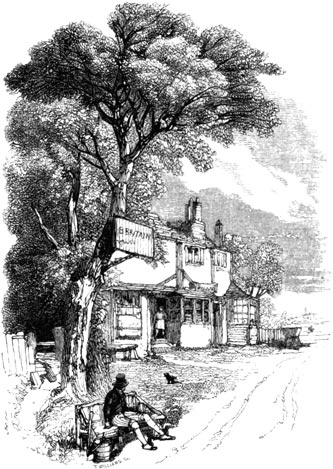
Snitchey and Craggs had a snug
little office on the old Battle Ground,
where they drove a snug little business,
and fought a great many small
pitched battles for a great many contending parties.
Though it could hardly be said of these conflicts that
they were running fights—for in truth they generally
proceeded at a snail’s pace—the part the Firm had in
them came so far within that general denomination,
that now they took a shot at this Plaintiff, and
now aimed a chop at that Defendant, now made a
heavy charge at an estate in Chancery, and now had
some light skirmishing among an irregular body of
small debtors, just as the occasion served, and the
enemy happened to present himself. The Gazette
was an important and profitable feature in some of
their fields, as well as in fields of greater renown; and
in most of the Actions wherein they shewed their
generalship, it was afterwards observed by the combatants
that they had had great difficulty in making
each other out, or in knowing with any degree of
distinctness what they were about, in consequence of
the vast amount of smoke by which they were surrounded.
The offices of Messrs. Snitchey and Craggs stood convenient
with an open door, down two smooth steps in
the market-place: so that any angry farmer inclining
towards hot water, might tumble into it at once.
Their special council-chamber and hall of conference
was an old back room up stairs, with a low dark
ceiling, which seemed to be knitting its brows gloomily
in the consideration of tangled points of law. It
was furnished with some high-backed leathern chairs,
garnished with great goggle-eyed brass nails, of which,
every here and there, two or three had fallen out;
or had been picked out, perhaps, by the wandering
thumbs and forefingers of bewildered clients. There
was a framed print of a great judge in it, every curl
in whose dreadful wig had made a man’s hair stand on
end. Bales of papers filled the dusty closets, shelves,
and tables; and round the wainscoat there were tiers
of boxes, padlocked and fireproof, with people’s names
painted outside, which anxious visitors felt themselves,
by a cruel enchantment, obliged to spell backwards
and forwards, and to make anagrams of, while they
sat, seeming to listen to Snitchey and Craggs, without
comprehending one word of what they said.
Snitchey and Craggs had each, in private life as in
professional existence, a partner of his own. Snitchey
and Craggs were the best friends in the world, and
had a real confidence in one another; but Mrs.
Snitchey, by a dispensation not uncommon in the
affairs of life, was, on principle, suspicious of Mr.
Craggs, and Mrs. Craggs was, on principle, suspicious
of Mr. Snitchey. “Your Snitcheys indeed,” the
latter lady would observe, sometimes, to Mr. Craggs;
using that imaginative plural as if in disparagement
of an objectionable pair of pantaloons, or other articles
not possessed of a singular number; “I don’t see
what you want with your Snitcheys, for my part.
You trust a great deal too much to your Snitcheys,
I think, and I hope you may never find my words
come true.” While Mrs. Snitchey would observe to
Mr. Snitchey, of Craggs, “that if ever he was led
away by man he was led away by that man; and that
if ever she read a double purpose in a mortal eye, she
read that purpose in Craggs’s eye.” Notwithstanding
this, however, they were all very good friends in
general: and Mrs. Snitchey and Mrs. Craggs maintained
a close bond of alliance against “the office,”
which they both considered a Blue chamber, and
common enemy, full of dangerous (because unknown)
machinations.
In this office, nevertheless, Snitchey and Craggs
made honey for their several hives. Here sometimes
they would linger, of a fine evening, at the window
of their council-chamber, overlooking the old battle-ground,
and wonder (but that was generally at assize
time, when much business had made them sentimental)
at the folly of mankind, who couldn’t always
be at peace with one another, and go to law comfortably.
Here days, and weeks, and months, and years,
passed over them; their calendar, the gradually diminishing
number of brass nails in the leathern chairs,
and the increasing bulk of papers on the tables.
Here nearly three years’ flight had thinned the one
and swelled the other, since the breakfast in the
orchard; when they sat together in consultation, at
night.
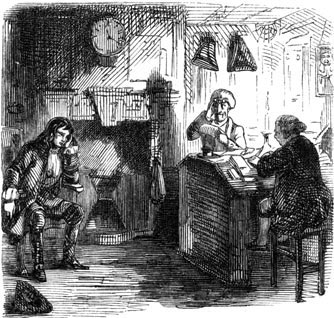





Not alone; but with a man of thirty, or about
that time of life, negligently dressed, and somewhat
haggard in the face, but well-made, well-attired, and
well-looking, who sat in the arm-chair of state, with
one hand in his breast, and the other in his dishevelled
hair, pondering moodily. Messrs. Snitchey and
Craggs sat opposite each other at a neighbouring
desk. One of the fire-proof boxes, unpadlocked and
opened, was upon it; a part
of its contents lay strewn upon the table,
and the rest was then in course of passing
through the hands of Mr. Snitchey,
who brought it to the candle, document
by document,
looked at every
paper singly, as he
produced
it, shook
his head, and handed it to Mr. Craggs, who looked it
over also, shook his head, and laid it down. Sometimes
they would stop, and shaking their heads in concert,
look towards the abstracted client; and the name on
the box being Michael Warden, Esquire, we may conclude
from these premises that the name and the box
were both his, and that the affairs of Michael Warden,
Esquire, were in a bad way.
“That’s all,” said Mr. Snitchey, turning up the
last paper. “Really there’s no other resource. No
other resource.”
“All lost, spent, wasted, pawned, borrowed and
sold, eh?” said the client, looking up.
“All,” returned Mr. Snitchey.
“Nothing else to be done, you say?”
“Nothing at all.”
The client bit his nails, and pondered again.
“And I am not even personally safe in England?
You hold to that; do you?”
“In no part of the United Kingdom of Great
Britain and Ireland,” replied Mr. Snitchey.
“A mere prodigal son with no father to go back to,
no swine to keep, and no husks to share with them?
Eh?” pursued the client, rocking one leg over the
other, and searching the ground with his eyes.
Mr. Snitchey coughed, as if to deprecate the being
supposed to participate in any figurative illustration
of a legal position. Mr. Craggs, as if to express
that it was a partnership view of the subject, also
coughed.
“Ruined at thirty!” said the client. “Humph!”
“Not ruined, Mr. Warden,” returned Snitchey.
“Not so bad as that. You have done a good deal
towards it, I must say, but you are not ruined. A
little nursing—”
“A little Devil,” said the client.
“Mr. Craggs,” said Snitchey, “will you oblige
me with a pinch of snuff? Thank you, Sir.”
As the imperturbable lawyer applied it to his nose,
with great apparent relish and a perfect absorption
of his attention in the proceeding, the client gradually
broke into a smile, and, looking up, said:
“You talk of nursing. How long nursing?”
“How long nursing?” repeated Snitchey, dusting
the snuff from his fingers, and making a slow
calculation in his mind. “For your involved estate,
Sir? In good hands? S. and C.’s, say? Six
or seven years.”
“To starve for six or seven years!” said the client
with a fretful laugh, and an impatient change of his
position.
“To starve for six or seven years, Mr. Warden,”
said Snitchey, “would be very uncommon indeed. You
might get another estate by shewing yourself, the
while. But we don’t think you could do it—speaking
for Self and Craggs—and consequently don’t
advise it.”
“What do you advise?”
“Nursing, I say,” repeated Snitchey. “Some
few years of nursing by Self and Craggs would bring
it round. But to enable us to make terms, and
hold terms, and you to keep terms, you must go
away, you must live abroad. As to starvation, we
could ensure you some hundreds a year to starve
upon, even in the beginning, I dare say, Mr.
Warden.”
“Hundreds,” said the client. “And I have
spent thousands!”
“That,” retorted Mr. Snitchey, putting the
papers slowly back into the cast-iron box, “there is
no doubt about. No doubt a—bout,” he repeated to
himself, as he thoughtfully pursued his occupation.
The lawyer very likely knew his man; at any
rate his dry, shrewd, whimsical manner, had a
favourable influence upon the client’s moody state,
and disposed him to be more free and unreserved.
Or perhaps the client knew his man; and had
elicited such encouragement as he had received,
to render some purpose he was about to disclose
the more defensible in appearance. Gradually raising
his head, he sat looking at his immovable
adviser with a smile, which presently broke into
a laugh.
“After all,” he said, “my iron-headed friend—”
Mr. Snitchey pointed out his partner. “Self and—excuse
me—Craggs.”
“I beg Mr. Craggs’s pardon,” said the client.
“After all, my iron-headed friends,” he leaned
forward in his chair, and dropped his voice a little,
“you don’t know half my ruin yet.”
Mr. Snitchey stopped and stared at him. Mr.
Craggs also stared.
“I am not only deep in debt,” said the client
“but I am deep in—”
“Not in love!” cried Snitchey.
“Yes!” said the client, falling back in his chair,
and surveying the Firm with his hands in his pockets.
“Deep in love.”
“And not with an heiress, Sir?” said Snitchey.
“Not with an heiress.”
“Nor a rich lady?”
“Nor a rich lady that I know of—except in beauty
and merit.”
“A single lady, I trust?” said Mr. Snitchey, with
great expression.
“Certainly.”
“It’s not one of Doctor Jeddler’s daughters?”
said Snitchey, suddenly squaring his elbows on his
knees, and advancing his face at least a yard.
“Yes!” returned the client.
“Not his younger daughter?” said Snitchey.
“Yes!” returned the client.
“Mr. Craggs,” said Snitchey, much relieved, “will
you oblige me with another pinch of snuff? Thank
you. I am happy to say it don’t signify, Mr. Warden;
she’s engaged, Sir, she’s bespoke. My partner can
corroborate me. We know the fact.”
“We know the fact,” repeated Craggs.
“Why, so do I perhaps,” returned the client
quietly. “What of that? Are you men of the
world, and did you never hear of a woman changing
her mind?”
“There certainly have been actions for breach,”
said Mr. Snitchey, “brought against both spinsters
and widows, but in the majority of cases—”
“Cases!” interposed the client, impatiently.
“Don’t talk to me of cases. The general precedent
is in a much larger volume than any of your law
books. Besides, do you think I have lived six weeks
in the Doctor’s house for nothing?”
“I think, Sir,” observed Mr. Snitchey, gravely
addressing himself to his partner, “that of all the
scrapes Mr. Warden’s horses have brought him into
at one time and another—and they have been pretty
numerous, and pretty expensive, as none know better
than himself and you and I—the worst scrape may
turn out to be, if he talks in this way, his having
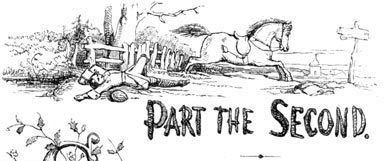
been ever left by one of them at the Doctor’s garden
wall, with three broken ribs, a snapped collar-bone, and
the Lord knows how many bruises. We didn’t think
so much of it, at the time when we knew he was
going on well under the Doctor’s hands and roof; but
it looks bad now, Sir. Bad! It looks very bad.
Doctor Jeddler too—our client, Mr. Craggs.”
“Mr. Alfred Heathfield too—a sort of client, Mr.
Snitchey,” said Craggs.
“Mr. Michael Warden too, a kind of client,” said
the careless visitor, “and no bad one either: having
played the fool for ten or twelve years. However
Mr. Michael Warden has sown his wild oats now;
there’s their crop, in that box; and means to repent
and be wise. And in proof of it, Mr. Michael
Warden means, if he can, to marry Marion, the
Doctor’s lovely daughter, and to carry her away with
him.”
“Really, Mr. Craggs,” Snitchey began.
“Really Mr. Snitchey, and Mr. Craggs, partners
both,” said the client, interrupting him; “you
know your duty to your clients, and you know
well enough, I am sure, that it is no part of it to
interfere in a mere love affair, which I am obliged to
confide to you. I am not going to carry the young
lady off, without her own consent. There’s nothing
illegal in it. I never was Mr. Heathfield’s bosom
friend. I violate no confidence of his. I love where
he loves, and I mean to win where he would win, if I
can.”
“He can’t, Mr. Craggs,” said Snitchey, evidently
anxious and discomfited. “He can’t do it, Sir.
She dotes on Mr. Alfred.”
“Does she?” returned the client.
“Mr. Craggs, she dotes on him, Sir,” persisted
Snitchey.
“I didn’t live six weeks, some few months ago, in
the Doctor’s house for nothing; and I doubted that
soon,” observed the client. “She would have doted
on him, if her sister could have brought it about; but
I watched them. Marion avoided his name, avoided
the subject: shrunk from the least allusion to it, with
evident distress.”
“Why should she, Mr. Craggs, you know? Why
should she, Sir?” inquired Snitchey.
“I don’t know why she should, though there are
many likely reasons,” said the client, smiling at the
attention and perplexity expressed in Mr. Snitchey’s
shining eye, and at his cautious way of carrying on
the conversation, and making himself informed upon
the subject; “but I know she does. She was very
young when she made the engagement—if it may be
called one, I am not even sure of that—and has
repented of it, perhaps. Perhaps—it seems a foppish
thing to say, but upon my soul I don’t mean it in
that light—she may have fallen in love with me, as I
have fallen in love with her.”
“He, he! Mr. Alfred, her old playfellow too, you
remember, Mr. Craggs,” said Snitchey, with a disconcerted
laugh; “knew her almost from a baby!”
“Which makes it the more probable that she may
be tired of his idea,” calmly pursued the client, “and
not indisposed to exchange it for the newer one of
another lover, who presents himself (or is presented
by his horse) under romantic circumstances; has the
not unfavorable reputation—with a country girl—of
having lived thoughtlessly and gaily, without doing
much harm to anybody; and who, for his youth and
figure, and so forth—this may seem foppish again,
but upon my soul I don’t mean it in that light—might
perhaps pass muster in a crowd with Mr.
Alfred himself.”
There was no gainsaying the last clause, certainly;
and Mr. Snitchey, glancing at him, thought so.
There was something naturally graceful and pleasant
in the very carelessness of his air. It seemed to
suggest, of his comely face and well-knit figure, that
they might be greatly better if he chose: and that,
once roused and made earnest (but he never had been
earnest yet), he could be full of fire and purpose. “A
dangerous sort of libertine,” thought the shrewd
lawyer, “to seem to catch the spark he wants from
a young lady’s eyes.”
“Now, observe, Snitchey,” he continued, rising
and taking him by the button, “and Craggs,” taking
him by the button also, and placing one partner on
either side of him, so that neither might evade him.
“I don’t ask you for any advice. You are right to
keep quite aloof from all parties in such a matter,
which is not one in which grave men like you could
interfere, on any side. I am briefly going to review
in half-a-dozen words, my position and intention, and
then I shall leave it to you to do the best for me, in
money matters, that you can: seeing, that, if I run
away with the Doctor’s beautiful daughter (as I hope
to do, and to become another man under her bright
influence), it will be, for the moment, more chargeable
than running away alone. But I shall soon make
all that up in an altered life.”
“I think it will be better not to hear this, Mr.
Craggs?” said Snitchey, looking at him across the
client.
“I think not,” said Craggs.—Both listening
attentively.
“Well! You needn’t hear it,” replied their client.
“I’ll mention it, however. I don’t mean to ask the
Doctor’s consent, because he wouldn’t give it me.
But I mean to do the Doctor no wrong or harm,
because (besides there being nothing serious in such
trifles, as he says) I hope to rescue his child, my
Marion, from what I see—I know—she dreads, and
contemplates with misery: that is, the return of this
old lover. If anything in the world is true, it is true
that she dreads his return. Nobody is injured so
far. I am so harried and worried here just now,
that I lead the life of a flying-fish; skulk about in the
dark, am shut out of my own house, and warned off
my own grounds: but that house, and those grounds,
and many an acre besides, will come back to me one
day, as you know and say; and Marion will probably
be richer—on your showing, who are never sanguine—ten
years hence as my wife, than as the wife of
Alfred Heathfield, whose return she dreads (remember
that), and in whom or in any man, my passion is
not surpassed. Who is injured yet? It is a fair
case throughout. My right is as good as his, if she
decide in my favor; and I will try my right by her
alone. You will like to know no more after this,
and I will tell you no more. Now you know my purpose,
and wants. When must I leave here?”
“In a week,” said Snitchey. “Mr. Craggs?—”
“In something less, I should say,” responded
Craggs.
“In a month,” said the client, after attentively
watching the two faces. “This day month. To-day
is Thursday. Succeed or fail, on this day month
I go.”
“It’s too long a delay,” said Snitchey; “much
too long. But let it be so. I thought he’d have
stipulated for three,” he murmured to himself. “Are
you going? Good night, Sir.”
“Good night!” returned the client, shaking hands
with the Firm. “You’ll live to see me making a good
use of riches yet. Henceforth, the star of my destiny
is, Marion!”
“Take care of the stairs, Sir,” replied Snitchey;
“for she don’t shine there. Good night!”
“Good night!”
So they both stood at the stair-head with a pair of
office-candles, watching him down; and when he had
gone away, stood looking at each other.
“What do you think of all this, Mr. Craggs?”
said Snitchey.
Mr. Craggs shook his head.
“It was our opinion, on the day when that release
was executed, that there was something curious in
the parting of that pair, I recollect,” said Snitchey.
“It was,” said Mr. Craggs.
“Perhaps he deceives himself altogether,” pursued
Mr. Snitchey, locking up the fireproof box, and
putting it away; “or if he don’t, a little bit of fickleness
and perfidy is not a miracle, Mr. Craggs. And
yet I thought that pretty face was very true. I
thought,” said Mr. Snitchey, putting on his great coat,
(for the weather was very cold), drawing on his gloves,
and snuffing out one candle, “that I had even seen
her character becoming stronger and more resolved of
late. More like her sister’s.”
“Mrs. Craggs was of the same opinion,” returned
Craggs.
“I’d really give a trifle to-night,” observed Mr.
Snitchey, who was a good-natured man, “if I could
believe that Mr. Warden was reckoning without his
host; but light-headed, capricious, and unballasted
as he is, he knows something of the world and its
people (he ought to, for he has bought what he does
know, dear enough); and I can’t quite think that. We
had better not interfere: we can do nothing, Mr.
Craggs, but keep quiet.”
“Nothing,” returned Craggs.
“Our friend the Doctor makes light of such things,”
said Mr. Snitchey, shaking his head. “I hope he
mayn’t stand in need of his philosophy. Our friend
Alfred talks of the battle of life,” he shook his head
again, “I hope he mayn’t be cut down early in the
day. Have you got your hat, Mr. Craggs? I am
going to put the other candle out.”
Mr Craggs replying in the affirmative, Mr. Snitchey
suited the action to the word, and they groped their
way out of the council-chamber: now as dark as the
subject, or the law in general.
My story passes to a quiet little study, where, on
that same night, the sisters and the hale old Doctor
sat by a cheerful fire-side. Grace was working at
her needle. Marion read aloud from a book before
her. The Doctor, in his dressing-gown and slippers,
with his feet spread out upon the warm rug, leaned
back in his easy chair, and listened to the book, and
looked upon his daughters.
They were very beautiful to look upon. Two better
faces for a fireside, never made a fireside bright and
sacred. Something of the difference between them
had been softened down in three years’ time; and
enthroned upon the clear brow of the younger sister,
looking through her eyes, and thrilling in her voice,
was the same earnest nature that her own motherless
youth had ripened in the elder sister long ago. But
she still appeared at once the lovelier and weaker of
the two; still seemed to rest her head upon her sister’s
breast, and put her trust in her, and look into her
eyes for counsel and reliance. Those loving eyes,
so calm, serene, and cheerful, as of old.
“‘And being in her own home,’” read Marion,
from the book; “‘her home made exquisitely dear by
these remembrances, she now began to know that the
great trial of her heart must soon come on, and could
not be delayed. Oh Home, our comforter and friend
when others fall away, to part with whom, at any step
between the cradle and the grave—’”
“Marion, my love!” said Grace.
“Why, Puss!” exclaimed her father, “what’s
the matter?”
She put her hand upon the hand her sister stretched
towards her, and read on; her voice still faltering
and trembling, though she made an effort to command
it when thus interrupted.
“‘To part with whom, at any step between the
cradle and the grave, is always sorrowful. Oh
Home, so true to us, so often slighted in return, be
lenient to them that turn away from thee, and do not
haunt their erring footsteps too reproachfully! Let
no kind looks, no well-remembered smiles, be seen
upon thy phantom face. Let no ray of affection,
welcome, gentleness, forbearance, cordiality, shine
from thy white head. Let no old loving word or tone
rise up in judgment against thy deserter; but if
thou canst look harshly and severely, do, in mercy to
the Penitent!’”
“Dear Marion, read no more to-night,” said Grace—for
she was weeping.
“I cannot,” she replied, and closed the book.
“The words seem all on fire!”
The Doctor was amused at this; and laughed as he
patted her on the head.
“What! overcome by a story-book!” said Doctor
Jeddler. “Print and paper! Well, well, it’s all
one. It’s as rational to make a serious matter of
print and paper as of anything else. But dry your
eyes, love, dry your eyes. I dare say the heroine
has got home again long ago, and made it up all
round—and if she hasn’t, a real home is only four
walls; and a fictitious one, mere rags and ink.
What’s the matter now?”
“It’s only me, Mister,” said Clemency, putting in
her head at the door.
“And what’s the matter with you?” said the
Doctor.
“Oh, bless you, nothing an’t the matter with me,”
returned Clemency—and truly too, to judge from her
well-soaped face, in which there gleamed as usual
the very soul of good humour, which, ungainly as she
was, made her quite engaging. Abrasions on the
elbows are not generally understood, it is true, to
range within that class of personal charms called
beauty-spots. But it is better, going through the
world, to have the arms chafed in that narrow
passage, than the temper: and Clemency’s was sound
and whole as any beauty’s in the land.
“Nothing an’t the matter with me,” said Clemency,
entering, “but—come a little closer, Mister.”
The Doctor, in some astonishment, complied with
this invitation.
“You said I wasn’t to give you one before them,
you know,” said Clemency.
A novice in the family might have supposed, from
her extraordinary ogling as she said it, as well as from
a singular rapture or ecstasy which pervaded her
elbows, as if she were embracing herself, that ‘one,’
in its most favorable interpretation, meant a chaste
salute. Indeed the Doctor himself seemed alarmed,
for the moment; but quickly regained his composure,
as Clemency, having had recourse to both her pockets—beginning
with the right one, going away to the
wrong one, and afterwards coming back to the right
one again—produced a letter from the Post-office.
“Britain was riding by on a errand,” she chuckled,
handing it to the Doctor, “and see the Mail come in,
and waited for it. There’s A. H. in the corner.
Mr. Alfred’s on his journey home, I bet. We shall
have a wedding in the house—there was two spoons
in my saucer this morning. Oh Luck, how slow he
opens it!”
All this she delivered, by way of soliloquy, gradually
rising higher and higher on tiptoe, in her impatience
to hear the news, and making a corkscrew of
her apron, and a bottle of her mouth. At last,
arriving at a climax of suspense, and seeing the
Doctor still engaged in the perusal of the letter, she
came down flat upon the soles of her feet again, and
cast her apron, as a veil, over her head, in a mute
despair, and inability to bear it any longer.
“Here! Girls!” cried the Doctor. “I can’t
help it: I never could keep a secret in my life. There
are not many secrets, indeed, worth being kept in
such a—well! never mind that. Alfred’s coming
home, my dears, directly.”
“Directly!” exclaimed Marion.
“What! The story-book is soon forgotten!” said
the Doctor, pinching her cheek. “I thought the news
would dry those tears. Yes. ‘Let it be a surprise,’
he says, here. But I can’t let it be a surprise.
He must have a welcome.”
“Directly!” repeated Marion.
“Why, perhaps not what your impatience calls
‘directly,’” returned the Doctor; “but pretty soon
too. Let us see. Let us see. To-day is Thursday,
is it not? Then he promises to be here, this day
month.”
“This day month!” repeated Marion, softly.
“A gay day and a holiday for us,” said the cheerful
voice of her sister Grace, kissing her in congratulation.
“Long looked forward to, dearest, and come at last.”
She answered with a smile; a mournful smile, but
full of sisterly affection: and as she looked in her
sister’s face, and listened to the quiet music of her
voice, picturing the happiness of this return, her own
face glowed with hope and joy.
And with a something else: a something shining
more and more through all the rest of its expression:
for which I have no name. It was not exultation,
triumph, proud enthusiasm. They are not so calmly
shown. It was not love and gratitude alone, though
love and gratitude were part of it. It emanated from
no sordid thought, for sordid thoughts do not light up
the brow, and hover on the lips, and move the spirit,
like a fluttered light, until the sympathetic figure
trembles.
Doctor Jeddler, in spite of his system of philosophy—which
he was continually contradicting and denying
in practice, but more famous philosophers have done
that—could not help having as much interest in the
return of his old ward and pupil, as if it had been a
serious event. So he sat himself down in his easy
chair again, stretched out his slippered feet once
more upon the rug, read the letter over and over a
great many times, and talked it over more times
still.
“Ah! The day was,” said the Doctor, looking at
the fire, “when you and he, Grace, used to trot about
arm-in-arm, in his holiday time, like a couple of
walking dolls. You remember?”
“I remember,” she answered, with her pleasant
laugh, and plying her needle busily.
“This day month, indeed!” mused the Doctor.
“That hardly seems a twelve-month ago. And
where was my little Marion then!”
“Never far from her sister,” said Marion, cheerily,
“however little. Grace was everything to me, even
when she was a young child herself.”
“True, Puss, true,” returned the Doctor. “She
was a staid little woman, was Grace, and a wise
housekeeper, and a busy, quiet, pleasant body; bearing
with our humours and anticipating our wishes,
and always ready to forget her own, even in those
times. I never knew you positive or obstinate,
Grace, my darling, even then, on any subject but
one.”
“I am afraid I have changed sadly for the worse,
since,” laughed Grace, still busy at her work.
“What was that one, father?”
“Alfred, of course,” said the Doctor. “Nothing
would serve you but you must be called Alfred’s wife;
so we called you Alfred’s wife; and you liked it better,
I believe (odd as it seems now), than being called a
Duchess, if we could have made you one.”
“Indeed!” said Grace, placidly.
“Why, don’t you remember?” inquired the
Doctor.
“I think I remember something of it,” she returned,
“but not much. It’s so long ago.” And as
she sat at work, she hummed the burden of an old
song, which the Doctor liked.
“Alfred will find a real wife soon,” she said,
breaking off; “and that will be a happy time indeed
for all of us. My three years’ trust is nearly at an
end, Marion. It has been a very easy one. I shall
tell Alfred, when I give you back to him, that you
have loved him dearly all the time, and that he has
never once needed my good services. May I tell him
so, love?”
“Tell him, dear Grace,” replied Marion, “that
there never was a trust so generously, nobly, stedfastly
discharged; and that I have loved you, all the
time, dearer and dearer every day; and oh! how
dearly now!”
“Nay,” said her cheerful sister, returning her
embrace, “I can scarcely tell him that; we will
leave my deserts to Alfred’s imagination. It will be
liberal enough, dear Marion; like your own.”
With that she resumed the work she had for a
moment laid down, when her sister spoke so fervently:
and with it the old song the Doctor liked to hear.
And the Doctor, still reposing in his easy chair, with
his slippered feet stretched out before him on the rug,
listened to the tune, and beat time on his knee with
Alfred’s letter, and looked at his two daughters, and
thought that among the many trifles of the trifling
world, these trifles were agreeable enough.
Clemency Newcome in the mean time, having
accomplished her mission and lingered in the room
until she had made herself a party to the news,
descended to the kitchen, where her coadjutor, Mr.
Britain, was regaling after supper, surrounded by such
a plentiful collection of bright pot-lids, well-scoured
saucepans, burnished dinner-covers, gleaming kettles,
and other tokens of her industrious habits, arranged
upon the walls and shelves, that he sat as in the
centre of a hall of mirrors. The majority did not
give forth very flattering portraits of him, certainly;
nor were they by any means unanimous in their
reflections; as some made him very long-faced, others
very broad-faced, some tolerably well-looking, others
vastly ill-looking, according to their several manners
of reflecting: which were as various, in respect of one
fact, as those of so many kinds of men. But they all
agreed that in the midst of them sat, quite at his
ease, an individual with a pipe in his mouth, and a
jug of beer at his elbow, who nodded condescendingly
to Clemency, when she stationed herself at the same
table.
“Well, Clemmy,” said Britain, “how are you by
this time, and what’s the news?”
Clemency told him the news, which he received
very graciously. A gracious change had come over
Benjamin from head to foot. He was much broader,
much redder, much more cheerful, and much jollier in
all respects. It seemed as if his face had been tied
up in a knot before, and was now untwisted and
smoothed out.
“There’ll be another job for Snitchey and Craggs,
I suppose,” he observed, puffing slowly at his pipe.
“More witnessing for you and me, perhaps, Clemmy!”
“Lor!” replied his fair companion, with her
favorite twist of her favorite joints. “I wish it was
me, Britain.”
“Wish what was you?”
“A going to be married,” said Clemency.
Benjamin took his pipe out of his mouth and
laughed heartily. “Yes! you’re a likely subject for
that!” he said. “Poor Clem!” Clemency for her
part laughed as heartily as he, and seemed as much
amused by the idea. “Yes,” she assented, “I’m a
likely subject for that; an’t I?”
“You’ll never be married, you know,” said Mr.
Britain, resuming his pipe.
“Don’t you think I ever shall though?” said Clemency,
in perfect good faith.
Mr. Britain shook his head. “Not a chance
of it!”
“Only think!” said Clemency. “Well!—I suppose
you mean to, Britain, one of these days; don’t
you?”
A question so abrupt, upon a subject so momentous,
required consideration. After blowing out a great
cloud of smoke, and looking at it with his head now
on this side and now on that, as if it were actually the
question, and he were surveying it in various aspects,
Mr. Britain replied that he wasn’t altogether clear
about it, but—ye-es—he thought he might come to
that at last.
“I wish her joy, whoever she may be!” cried
Clemency.
“Oh she’ll have that,” said Benjamin; “safe
enough.”
“But she wouldn’t have led quite such a joyful life
as she will lead, and wouldn’t have had quite such a
sociable sort of husband as she will have,” said Clemency,
spreading herself half over the table, and
staring retrospectively at the candle, “if it hadn’t
been for—not that I went to do it, for it was accidental,
I am sure—if it hadn’t been for me; now
would she, Britain?”
“Certainly not,” returned Mr. Britain, by this time
in that high state of appreciation of his pipe, when a
man can open his mouth but a very little way for
speaking purposes; and sitting luxuriously immovable
in his chair, can afford to turn only his eyes towards a
companion, and that very passively and gravely.
“Oh! I’m greatly beholden to you, you know, Clem.”
“Lor, how nice that is to think of!” said Clemency.
At the same time, bringing her thoughts as well
as her sight to bear upon the candle-grease, and
becoming abruptly reminiscent of its healing qualities
as a balsam, she anointed her left elbow with a
plentiful application of that remedy.
“You see I’ve made a good many investigations
of one sort and another in my time,” pursued Mr.
Britain, with the profundity of a sage; “having been
always of an inquiring turn of mind; and I’ve read
a good many books about the general Rights of things
and Wrongs of things, for I went into the literary
line myself, when I began life.”
“Did you though!” cried the admiring Clemency.
“Yes,” said Mr. Britain; “I was hid for the best
part of two years behind a bookstall, ready to fly out if
anybody pocketed a volume; and after that I was light
porter to a stay and mantua maker, in which capacity
I was employed to carry about, in oilskin baskets,
nothing but deceptions—which soured my spirits and
disturbed my confidence in human nature; and after
that, I heard a world of discussions in this house,
which soured my spirits fresh; and my opinion after
all is, that, as a safe and comfortable sweetener of the
same, and as a pleasant guide through life, there’s
nothing like a nutmeg-grater.”
Clemency was about to offer a suggestion, but he
stopped her by anticipating it.
“Com-bined,” he added gravely, “with a thimble.”
“Do as you wold, you know, and cetrer, eh!”
observed Clemency, folding her arms comfortably in
her delight at this avowal, and patting her elbows.
“Such a short cut, an’t it?”
“I’m not sure,” said Mr. Britain, “that it’s
what would be considered good philosophy. I’ve my
doubts about that: but it wears well, and saves a
quantity of snarling, which the genuine article don’t
always.”
“See how you used to go on once, yourself, you
know!” said Clemency.
“Ah!” said Mr. Britain. “But the most extraordinary
thing, Clemmy, is that I should live to be
brought round, through you. That’s the strange part
of it. Through you! Why, I suppose you haven’t
so much as half an idea in your head.”
Clemency, without taking the least offence, shook
it, and laughed, and hugged herself, and said, “No,
she didn’t suppose she had.”
“I’m pretty sure of it,” said Mr. Britain.
“Oh! I dare say you’re right,” said Clemency.
“I don’t pretend to none. I don’t want any.”
Benjamin took his pipe from his lips, and laughed
till the tears ran down his face. “What a natural
you are, Clemmy!” he said, shaking his head, with an
infinite relish of the joke, and wiping his eyes.
Clemency, without the smallest inclination to dispute
it, did the like, and laughed as heartily as he.
“But I can’t help liking you,” said Mr. Britain;
“you’re a regular good creature in your way; so
shake hands, Clem. Whatever happens, I’ll always
take notice of you, and be a friend to you.”
“Will you?” returned Clemency. “Well! that’s
very good of you.”
“Yes, yes,” said Mr. Britain, giving her his pipe
to knock the ashes out of; “I’ll stand by you.
Hark! That’s a curious noise!”
“Noise!” repeated Clemency.
“A footstep outside. Somebody dropping from
the wall, it sounded like,” said Britain. “Are they
all abed up-stairs?”
“Yes, all abed by this time,” she replied.
“Didn’t you hear anything?”
“No.”
They both listened, but heard nothing.
“I tell you what,” said Benjamin, taking down a
lantern. “I’ll have a look round before I go to bed
myself, for satisfaction’s sake. Undo the door while I
light this, Clemmy.”
Clemency complied briskly; but observed as she did
so, that he would only have his walk for his pains, that
it was all his fancy, and so forth. Mr. Britain said
‘very likely;’ but sallied out, nevertheless, armed with
the poker, and casting the light of the lantern far
and near in all directions.
“It’s as quiet as a churchyard,” said Clemency,
looking after him; “and almost as ghostly too!”
Glancing back into the kitchen, she cried fearfully,
as a light figure stole into her view, “What’s that!”
“Hush!” said Marion, in an agitated whisper.
“You have always loved me, have you not!”
“Loved you, child! You may be sure I have.”
“I am sure. And I may trust you, may I not?
There is no one else just now, in whom I can trust.”
“Yes,” said Clemency, with all her heart.
“There is some one out there,” pointing to the
door, “whom I must see, and speak with, to-night.
Michael Warden, for God’s sake retire! Not now!”
Clemency started with surprise and trouble as, following
the direction of the speaker’s eyes, she saw a
dark figure standing in the doorway.
“In another moment you may be discovered,”
said Marion. “Not now! Wait, if you can, in
some concealment. I will come, presently.”
He waved his hand to her, and was gone.
“Don’t go to bed. Wait here for me!” said
Marion, hurriedly. “I have been seeking to speak
to you for an hour past. Oh, be true to me!”
Eagerly seizing her bewildered hand, and pressing
it with both her own to her breast—an action more
expressive, in its passion of entreaty, than the most
eloquent appeal in words,—Marion withdrew; as the
light of the returning lantern flashed into the room.
“All still and peaceable. Nobody there. Fancy,
I suppose,” said Mr. Britain, as he locked and barred
the door. “One of the effects of having a lively
imagination. Halloa! Why, what’s the matter?”
Clemency, who could not conceal the effects of her
surprise and concern, was sitting in a chair: pale,
and trembling from head to foot.
“Matter!” she repeated, chafing her hands and
elbows, nervously, and looking anywhere but at him.
“That’s good in you, Britain, that is! After going
and frightening one out of one’s life with noises, and
lanterns, and I don’t know what all. Matter! Oh,
yes.”
“If you’re frightened out of your life by a lantern,
Clemmy,” said Mr. Britain, composedly blowing it
out and hanging it up again, “that apparition’s very
soon got rid of. But you’re as bold as brass in
general,” he said, stopping to observe her; “and
were, after the noise and the lantern too. What have
you taken into your head? Not an idea, eh?”
But as Clemency bade him good night very much
after her usual fashion, and began to bustle about
with a show of going to bed herself immediately,
Little Britain, after giving utterance to the original
remark that it was impossible to account for a woman’s
whims, bade her good night in return, and taking
up his candle strolled drowsily away to bed.
When all was quiet, Marion returned.
“Open the door,” she said; “and stand there
close beside me, while I speak to him, outside.”
Timid as her manner was, it still evinced a resolute
and settled purpose, such as Clemency could not
resist. She softly unbarred the door: but before
turning the key, looked round on the young creature
waiting to issue forth when she should open it.
The face was not averted or cast down, but looking
full upon her, in its pride of youth and beauty.
Some simple sense of the slightness of the barrier
that interposed itself between the happy home and
honoured love of the fair girl, and what might be the
desolation of that home, and shipwreck of its dearest
treasure, smote so keenly on the tender heart of
Clemency, and so filled it to overflowing with sorrow
and compassion, that, bursting into tears, she threw
her arms round Marion’s neck.
“It’s little that I know, my dear,” cried Clemency,
“very little; but I know that this should not be.
Think of what you do!”
“I have thought of it many times,” said Marion,
gently.
“Once more,” urged Clemency. “Till to-morrow.”
Marion shook her head.
“For Mr. Alfred’s sake,” said Clemency, with
homely earnestness. “Him that you used to love so
dearly, once!”
She hid her face, upon the instant, in her hands,
repeating “Once!” as if it rent her heart.
“Let me go out,” said Clemency, soothing her.
“I’ll tell him what you like. Don’t cross the door-step
to-night. I’m sure no good will come of it.
Oh, it was an unhappy day when Mr. Warden was ever
brought here! Think of your good father, darling:
of your sister.”
“I have,” said Marion, hastily raising her head.
“You don’t know what I do. You don’t know what
I do. I must speak to him. You are the best and
truest friend in all the world for what you have
said to me, but I must take
this step. Will you go
with me, Clemency,”
she kissed her on
her friendly face,
“or shall I go
alone?”
Sorrowing and wondering, Clemency turned the
key, and opened the door. Into the dark and doubtful
night that lay beyond the threshhold, Marion
passed quickly, holding by her hand.
In the dark night he joined her, and they spoke
together earnestly and long: and the hand that held
so fast by Clemency’s, now trembled, now turned
deadly cold, now clasped and closed on hers, in the
strong feeling of the speech it emphasized unconsciously.
When they returned, he followed to the door;
and pausing there a moment, seized the other hand,
and pressed it to his lips. Then stealthily withdrew.
The door was barred and locked again, and once
again she stood beneath her father’s roof. Not bowed
down by the secret that she brought there, though
so young; but with that same expression on her face,
for which I had no name before, and shining through
her tears.
Again she thanked and thanked her humble friend,
and trusted to her, as she said, with confidence, implicitly.
Her chamber safely reached, she fell upon
her knees; and with her secret weighing on her heart,
could pray!
Could rise up from her prayers, so tranquil and
serene, and bending over her fond sister in her
slumber, look upon her face and smile: though sadly:
murmuring as she kissed her forehead, how that
Grace had been a mother to her, ever, and she loved
her as a child!
Could draw the passive arm about her neck when
lying down to rest—it seemed to cling there, of its
own will, protectingly and tenderly even in sleep—and
breathe upon the parted lips, God bless her!
Could sink into a peaceful sleep, herself; but for one
dream, in which she cried out, in her innocent and
touching voice, that she was quite alone, and they had
all forgotten her.
A month soon passes, even at its tardiest pace.
The month appointed to elapse between that night
and the return, was quick of foot, and went by, like
a vapour.
The day arrived. A raging winter day, that shook
the old house, sometimes, as if it shivered in the blast.
A day to make home doubly home. To give the
chimney corner new delights. To shed a ruddier
glow upon the faces gathered round the hearth;
and draw each fireside group into a closer and
more social league, against the roaring elements
without. Such a wild winter day as best prepares
the way for shut-out night; for curtained rooms,
and cheerful looks; for music, laughter, dancing,
light, and jovial entertainment!
All these the Doctor had in store to welcome Alfred
back. They knew that he could not arrive till night;
and they would make the night air ring, he said, as
he approached. All his old friends should congregate
about him. He should not miss a face that he had
known and liked. No! They should every one be
there!
So, guests were bidden, and musicians were
engaged, and tables spread, and floors prepared for
active feet, and bountiful provision made, of every
hospitable kind. Because it was the Christmas season,
and his eyes were all unused to English holly, and its
sturdy green, the dancing room was garlanded and
hung with it; and the red berries gleamed an
English welcome to him, peeping from among the
leaves.
It was a busy day for all of them: a busier day for
none of them than Grace, who noiselessly presided
everywhere, and was the cheerful mind of all the preparations.
Many a time that day (as well as many
a time within the fleeting month preceding it), did
Clemency glance anxiously, and almost fearfully, at
Marion. She saw her paler, perhaps, than usual; but
there was a sweet composure on her face that made it
lovelier than ever.
At night when she was dressed, and wore upon her
head a wreath that Grace had proudly twined about
it—its mimic flowers were Alfred’s favorites, as Grace
remembered when she chose them—that old expression,
pensive, almost sorrowful, and yet so spiritual,
high, and stirring, sat again upon her brow, enhanced
a hundred fold.
“The next wreath I adjust on this fair head, will
be a marriage wreath,” said Grace; “or I am no true
prophet, dear.”
Her sister smiled, and held her in her arms.
“A moment, Grace. Don’t leave me yet. Are
you sure that I want nothing more?”
Her care was not for that. It was her sister’s
face she thought of, and her eyes were fixed upon it,
tenderly.
“My art,” said Grace, “can go no farther, dear
girl; nor your beauty. I never saw you look so
beautiful as now.”
“I never was so happy,” she returned.
“Aye, but there is greater happiness in store. In
such another home, as cheerful and as bright as this
looks now,” said Grace, “Alfred and his young wife
will soon be living.”
She smiled again. “It is a happy home, Grace,
in your fancy. I can see it in your eyes. I know it
will be happy, dear. How glad I am to know it.”
“Well,” cried the Doctor, bustling in. “Here we
are, all ready for Alfred, eh? He can’t be here until
pretty late—an hour or so before midnight—so
there’ll be plenty of time for making merry before he
comes. He’ll not find us with the ice unbroken.
Pile up the fire here, Britain! Let it shine upon the
holly till it winks again. It’s a world of nonsense,
Puss; true lovers and all the rest of it—all nonsense;
but we’ll be nonsensical with the rest of ’em, and
give our true lover a mad welcome. Upon my word!”
said the old Doctor, looking at his daughters proudly,
“I’m not clear to-night, among other absurdities, but
that I’m the father of two handsome girls.”
“All that one of them has ever done, or may do—may
do, dearest father—to cause you pain or grief,
forgive her,” said Marion: “forgive her now, when
her heart is full. Say that you forgive her. That
you will forgive her. That she shall always share
your love, and—,” and the rest was not said,
for her face was hidden on the old man’s shoulder.
“Tut, tut, tut,” said the Doctor, gently. “Forgive!
What have I to forgive? Heyday, if our true lovers
come back to flurry us like this, we must hold ’em at
a distance; we must send expresses out to stop ’em
short upon the road, and bring ’em on a mile or two
a day, until we’re properly prepared to meet ’em.
Kiss me, Puss. Forgive! Why, what a silly child
you are. If you had vexed and crossed me fifty times
a day, instead of not at all, I’d forgive you everything,
but such a supplication. Kiss me again, Puss.
There! Prospective and retrospective—a clear score
between us. Pile up the fire here! Would you
freeze the people on this bleak December night!
Let us be light, and warm, and merry, or I’ll not forgive
some of you!”
So gaily the old Doctor carried it! And the fire
was piled up, and the lights were bright, and company
arrived, and a murmuring of lively tongues began, and
already there was a pleasant air of cheerful excitement
stirring through all the house.
More and more company came flocking in. Bright
eyes sparkled upon Marion; smiling lips gave her joy
of his return; sage mothers fanned themselves, and
hoped she mightn’t be too youthful and inconstant for
the quiet round of home; impetuous fathers fell into
disgrace, for too much exaltation of her beauty;
daughters envied her; sons envied him; innumerable
pairs of lovers profited by the occasion; all were interested,
animated, and expectant.
Mr. and Mrs. Craggs came arm in arm, but Mrs.
Snitchey came alone. “Why, what’s become of him?”
inquired the Doctor.
The feather of a Bird of Paradise in Mrs. Snitchey’s
turban, trembled as if the bird of Paradise were alive
again, when she said that doubtless Mr. Craggs knew.
She was never told.
“That nasty office,” said Mrs. Craggs.
“I wish it was burnt down,” said Mrs. Snitchey.
“He’s—he’s—there’s a little matter of business
that keeps my partner rather late,” said Mr. Craggs,
looking uneasily about him.
“Oh—h! Business. Don’t tell me!” said Mrs.
Snitchey.
“We know what business means,” said Mrs.
Craggs.
But their not knowing what it meant, was perhaps
the reason why Mrs. Snitchey’s Bird of Paradise
feather quivered so portentously, and all the pendant
bits on Mrs. Craggs’s ear-rings shook like little bells.
“I wonder you could come away, Mr. Craggs,”
said his wife.
“Mr. Craggs is fortunate, I’m sure!” said Mrs.
Snitchey.
“That office so engrosses ’em,” said Mrs. Craggs.
“A person with an office has no business to be
married at all,” said Mrs. Snitchey.
Then Mrs. Snitchey said, within herself, that that
look of hers had pierced to Craggs’s soul, and he
knew it: and Mrs. Craggs observed, to Craggs, that
‘his Snitcheys’ were deceiving him behind his back,
and he would find it out when it was too late.
Still, Mr. Craggs, without much heeding these remarks,
looked uneasily about him until his eye rested
on Grace, to whom he immediately presented himself.
“Good evening, Ma’am,” said Craggs. “You look
charmingly. Your—Miss—your sister, Miss Marion,
is she——”
“Oh she’s quite well, Mr. Craggs.”
“Yes—I—is she here?” asked Craggs.
“Here! Don’t you see her yonder? Going to
dance?” said Grace.
Mr. Craggs put on his spectacles to see the better;
looked at her through them, for some time; coughed;
and put them, with an air of satisfaction, in their
sheath again, and in his pocket.
Now the music struck up, and the dance commenced.
The bright fire crackled and sparkled, rose
and fell, as though it joined the dance itself, in right
good fellowship. Sometimes it roared as if it would
make music too. Sometimes it flashed and beamed
as if it were the eye of the old room: it winked too,
sometimes, like a knowing patriarch, upon the youthful
whisperers in corners. Sometimes it sported with
the holly-boughs; and, shining on the leaves by fits
and starts, made them look as if they were in the cold
winter night again, and fluttering in the wind. Sometimes
its genial humour grew obstreperous, and passed
all bounds; and then it cast into the room, among
the twinkling feet, with a loud burst, a shower of
harmless little sparks, and in its exultation leaped
and bounded, like a mad thing, up the broad old
chimney.
Another dance was near its close, when Mr.
Snitchey touched his partner, who was looking on,
upon the arm.
Mr. Craggs started, as if his familiar had been a
spectre.
“Is he gone?” he asked.
“Hush! He has been with me,” said Snitchey,
“for three hours and more. He went over everything.
He looked into all our arrangements for him,
and was very particular indeed. He—Humph!”
The dance was finished. Marion passed close
before him, as he spoke. She did not observe him,
or his partner; but looked over her shoulder towards
her sister in the distance, as she slowly made her way
into the crowd, and passed out of their view.
“You see! All safe and well,” said Mr. Craggs.
“He didn’t recur to that subject, I suppose?”
“Not a word.”
“And is he really gone? Is he safe away?”
“He keeps to his word. He drops down the river
with the tide in that shell of a boat of his, and so
goes out to sea on this dark night—a dare-devil he
is—before the wind. There’s no such lonely road
anywhere else. That’s one thing. The tide flows,
he says, an hour before midnight about this time.
I’m glad it’s over.” Mr. Snitchey wiped his forehead,
which looked hot and anxious.
“What do you think,” said Mr. Craggs, “about—”
“Hush!” replied his cautious partner, looking
straight before him. “I understand you. Don’t
mention names, and don’t let us seem to be talking
secrets. I don’t know what to think; and to tell you
the truth, I don’t care now. It’s a great relief.
His self-love deceived him, I suppose. Perhaps the
young lady coquetted a little. The evidence would
seem to point that way. Alfred not arrived?”
“Not yet,” said Mr. Craggs. “Expected every
minute.”
“Good.” Mr. Snitchey wiped his forehead again.
“It’s a great relief. I haven’t been so nervous since
we’ve been in partnership. I intend to spend the
evening now, Mr. Craggs.”
Mrs. Craggs and Mrs. Snitchey joined them as he
announced this intention. The Bird of Paradise was
in a state of extreme vibration; and the little bells
were ringing quite audibly.
“It has been the theme of general comment, Mr.
Snitchey,” said Mrs. Snitchey. “I hope the office
is satisfied.”
“Satisfied with what, my dear?” asked Mr.
Snitchey.
“With the exposure of a defenceless woman to
ridicule and remark,” returned his wife. “That is
quite in the way of the office, that is.”
“I really, myself,” said Mrs. Craggs, “have
been so long accustomed to connect the office with
everything opposed to domesticity, that I am glad
to know it as the avowed enemy of my peace.
There is something honest in that, at all events.”
“My dear,” urged Mr. Craggs, “your good
opinion is invaluable, but I never avowed that the
office was the enemy of your peace.”
“No,” said Mrs. Craggs, ringing a perfect peal
upon the little bells. “Not you, indeed. You
wouldn’t be worthy of the office, if you had the
candor to.”
“As to my having been away to-night, my dear,”
said Mr. Snitchey, giving her his arm, “the deprivation
has been mine, I’m sure; but, as Mr. Craggs
knows—”
Mrs. Snitchey cut this reference very short by
hitching her husband to a distance, and asking him
to look at that man. To do her the favor to look at him.
“At which man, my dear?” said Mr. Snitchey.
“Your chosen companion; I’m no companion to
you Mr. Snitchey.”
“Yes, yes, you are, my dear,” he interposed.
“No no, I’m not,” said Mrs. Snitchey with a
majestic smile. “I know my station. Will you
look at your chosen companion, Mr. Snitchey; at
your referee; at the keeper of your secrets; at the
man you trust; at your other self, in short.”
The habitual association of Self with Craggs,
occasioned Mr. Snitchey to look in that direction.
“If you can look that man in the eye this night,”
said Mrs. Snitchey, “and not know that you are
deluded, practised upon: made the victim of his
arts, and bent down prostrate to his will, by some
unaccountable fascination which it is impossible to
explain, and against which no warning of mine is of
the least avail: all I can say is—I pity you!”
At the very same moment Mrs. Craggs was
oracular on the cross subject. Was it possible she
said, that Craggs could so blind himself to his
Snitcheys, as not to feel his true position. Did he
mean to say that he had seen his Snitcheys come
into that room, and didn’t plainly see that there was
reservation, cunning, treachery in the man? Would
he tell her that his very action, when he wiped his
forehead and looked so stealthily about him, didn’t
show that there was something weighing on the
conscience of his precious Snitcheys (if he had a
conscience), that wouldn’t bear the light. Did anybody
but his Snitcheys come to festive entertainments
like a burglar?—which, by the way, was
hardly a clear illustration of the case, as he had
walked in very mildly at the door. And would he still
assert to her at noon-day (it being nearly midnight),
that his Snitcheys were to be justified through
thick and thin, against all facts, and reason, and
experience?
Neither Snitchey nor Craggs openly attempted to
stem the current which had thus set in, but both
were content to be carried gently along it, until its
force abated; which happened at about the same
time as a general movement for a country dance;
when Mr. Snitchey proposed himself as a partner
to Mrs. Craggs, and Mr. Craggs gallantly offered
himself to Mrs. Snitchey; and after some such slight
evasions as “why don’t you ask somebody else?” and
“you’ll be glad, I know, if I decline,” and “I
wonder you can dance out of the office” (but this
jocosely now), each lady graciously accepted, and
took her place.
It was an old custom among them, indeed, to do
so, and to pair off, in like manner, at dinners and
suppers; for they were excellent friends, and on a
footing of easy familiarity. Perhaps the false
Craggs and the wicked Snitchey were a recognised
fiction with the two wives, as Doe and Roe, incessantly
running up and down bailiwicks, were with
the two husbands: or perhaps the ladies had instituted,
and taken upon themselves, these two shares
in the business, rather than be left out of it altogether.
But certain it is, that each wife went as
gravely and steadily to work in her vocation as her
husband did in his: and would have considered
it almost impossible for the Firm to maintain a
successful and respectable existence, without her
laudable exertions.
But now the Bird of Paradise was seen to flutter
down the middle; and the little bells began to
bounce and jingle in poussette; and the Doctor’s
rosy face spun round and round, like an expressive
pegtop highly varnished; and breathless Mr. Craggs
began to doubt already, whether country dancing
had been made “too easy,” like the rest of life;
and Mr. Snitchey, with his nimble cuts and
capers, footed it for Self, and Craggs, and half a
dozen more.
Now, too, the fire took fresh courage, favored by
the lively wind the dance awakened, and burnt clear
and high. It was the Genius of the room, and
present everywhere. It shone in people’s eyes, it
sparkled in the jewels on the snowy necks of girls,
it twinkled at their ears as if it whispered to them
slyly, it flashed about their waists, it flickered on the
ground and made it rosy for their feet, it bloomed upon
the ceiling that its glow might set off their bright
faces, and it kindled up a general illumination in
Mrs. Craggs’s little belfry.
Now, too, the lively air that fanned it, grew less
gentle as the music quickened and the dance proceeded
with new spirit; and a breeze arose that made the
leaves and berries dance upon the wall, as they had
often done upon the trees; and rustled in the room as
if an invisible company of fairies, treading in the footsteps
of the good substantial revellers, were whirling
after them. Now, too, no feature of the Doctor’s face
could be distinguished as he spun and spun; and now
there seemed a dozen Birds of Paradise in fitful flight;
and now there were a thousand little bells at work; and
now a fleet of flying skirts was ruffled by a little tempest;
when the music gave in, and the dance was over.
Hot and breathless as the Doctor was, it only made
him the more
impatient
for Alfred’s
coming.
“Anything been seen, Britain? Anything been
heard?”
“Too dark to see far, Sir. Too much noise inside
the house to hear.”
“That’s right! The gayer welcome for him.
How goes the time?”
“Just twelve, Sir. He can’t be long, Sir.”
“Stir up the fire, and throw another log upon it,”
said the Doctor. “Let him see his welcome blazing
out upon the night—good boy!—as he comes
along!”
He saw it—Yes! From the chaise he caught
the light, as he turned the corner by the old church.
He knew the room from which it shone. He saw
the wintry branches of the old trees between the light
and him. He knew that one of those trees rustled
musically in the summer time at the window of
Marion’s chamber.
The tears were in his eyes. His heart throbbed so
violently that he could hardly bear his happiness.
How often he had thought of this time—pictured it
under all circumstances—feared that it might never
come—yearned, and wearied for it—far away!
Again the light! Distinct and ruddy; kindled, he
knew, to give him welcome, and to speed him home.
He beckoned with his hand, and waved his hat, and
cheered out, loud, as if the light were they, and they
could see and hear him, as he dashed towards them
through the mud and mire, triumphantly.
“Stop!” He knew the Doctor, and understood
what he had done. He would not let it be a surprise
to them. But he could make it one, yet, by going
forward on foot. If the orchard gate were open, he
could enter there; if not, the wall was easily climbed,
as he knew of old; and he would be among them in
an instant.
He dismounted from the chaise, and telling the
driver—even that was not easy in his agitation—to
remain behind for a few minutes, and then to follow
slowly, ran on with exceeding swiftness, tried the
gate, scaled the wall, jumped down on the other side,
and stood panting in the old orchard.
There was a frosty rime upon the trees, which, in
the faint light of the clouded moon, hung upon the
smaller branches like dead garlands. Withered
leaves crackled and snapped beneath his feet, as
he crept softly on towards the house. The desolation
of a winter night sat brooding on the earth,
and in the sky. But the red light came cheerily
towards him from the windows: figures passed and
repassed there: and the hum and murmur of voices
greeted his ear, sweetly.
Listening for hers: attempting, as he crept on, to
detach it from the rest, and half-believing that he
heard it: he had nearly reached the door, when it
was abruptly opened, and a figure coming out encountered
his. It instantly recoiled with a half-suppressed
cry.
“Clemency,” he said, “don’t you know me?”
“Don’t come in,” she answered, pushing him back.
“Go away. Don’t ask me why. Don’t come in.”
“What is the matter?” he exclaimed.
“I don’t know. I—I am afraid to think. Go
back. Hark!”
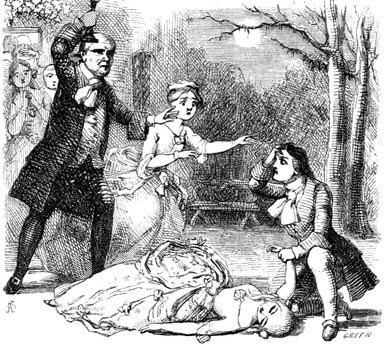
There was a sudden tumult in the house. She
put her hands upon her ears. A wild scream, such
as no hands could shut out, was heard; and Grace—distraction
in her looks and manner—rushed out at
the door.
“Grace!” He caught her in his arms. “What
is it! Is she dead!”
She disengaged herself, as if to recognise his face,
and fell down at his feet.
A crowd of figures came about them from the
house. Among them was her father, with a paper in
his hand.
“What is it!” cried Alfred, grasping his hair
with his hands, and looking in an agony from face
to face, as he bent upon his knee, beside the insensible
girl. “Will no one look at me? Will no one speak
to me? Does no one know me? Is there no voice
among you all, to tell me what it is!”
There was a murmur among them. “She is gone.”
“Gone!” he echoed.
“Fled, my dear Alfred!” said the Doctor, in a
broken voice, and with his hands before his face.
“Gone from her home and us. To-night! She writes
that she has made her innocent and blameless choice—entreats
that we will forgive her—prays that we
will not forget her—and is gone.”
“With whom? Where?”
He started up as if to follow in pursuit, but when
they gave way to let him pass, looked wildly round
upon them, staggered back, and sunk down in his
former attitude, clasping one of Grace’s cold hands
in his own.
There was a hurried running to and fro, confusion,
noise, disorder, and no purpose. Some proceeded to
disperse themselves about the roads, and some took
horse, and some got lights, and some conversed
together, urging that there was no trace or track to
follow. Some approached him kindly, with the view
of offering consolation; some admonished him that
Grace must be removed into the house, and he prevented
it. He never heard them, and he never moved.
The snow fell fast and thick. He looked up for
a moment in the air, and thought that those white
ashes strewn upon his hopes and misery, were suited
to them well. He looked round on the whitening
ground, and thought how Marion’s foot-prints would
be hushed and covered up, as soon as made, and
even that remembrance of her blotted out. But he
never felt the weather, and he never stirred.