I Gettysburg [1] — FOOTNOTES:
The Town.
Stripped of the glamour which has made its
every stick and stone an object of eager curiosity
or pious veneration, Gettysburg becomes a very
plain, matter-of-fact Pennsylvania town, of no particular
antiquity, with a very decided
Dutch flavor in the names and on the
tongues of its citizens, where no great man has
ever flourished, or anything had happened to
cause its own name to be noised abroad, until
one day in the eventful year 1863—the battle
year—fame was suddenly thrust upon it, as
one might say, not for a day, but for all time.
The dead who sleep in the National Cemetery[2]
here, or who lie in unknown graves about the
fields and woods, and counting many times more
than the living, help us to understand how much
greater was the battle of Gettysburg than the
town which has given it its name.
Gettysburg is the market town—or borough,
accurately speaking—of an exclusively farming
population, planted in one of the most productive
sections of the Keystone State. It is the seat of
justice of the county. It has a seminary and college
of the German Lutheran Church, which give
a certain tone and cast to its social life. In short,
Gettysburg seems in all things so entirely devoted
to the pursuits of peace, there is so little that is
suggestive of war and bloodshed, even if time had
not mostly effaced all traces of that gigantic struggle,[3]
that, coming as we do with one absorbing
idea in mind, we find it hard to reconcile the facts
of history with the facts as we find them.
The
Landscape.
There is another side to Gettysburg—a picturesque,
a captivating side. One looks around upon
the landscape with simple admiration. One's
highest praise comes from the feeling
of quiet satisfaction with which the
harmony of nature reveals the harmony of God.
You are among the subsiding swells that the
South Mountain has sent rippling off to the east.
So completely is the village hid away among
these green swells that neither spire nor steeple
is seen until, upon turning one of the numerous
low ridges by which the face of the country is so
cut up, you enter a valley, not deep, but well
defined by two opposite ranges of heights, and
Gettysburg lies gleaming in the declining sun
before you—a picture to be long remembered.
Its situation is charming. Here and there a
bald ridge or wooded hill, the name of which
you do not yet know, is pushed or bristles up
above the undulating prairie-land, but there is not
one really harsh feature in the landscape. In full
view off to the northwest, but softened by the
gauzy haze of a midsummer's afternoon, the
towering bulk of the South Mountain, vanguard
of the serried chain behind it, looms imposingly
up between Gettysburg and the Cumberland Valley,
still beyond, in the west, as landmark for all
the country round, as well as for the great battlefield
now spreading out its long leagues before
you; a monument more aged than the Pyramids,
which Napoleon, a supremely imaginative and
magnetic man himself, sought to invest with a
human quality in the minds of his veterans,
when he said to them, "Soldiers! from the
summits of yonder Pyramids forty ages behold
you." In short, the whole scene is one of such
quiet pastoral beauty, the village itself with its
circlet of fields and farms so free from every hint
of strife and carnage, that again and again we ask
ourselves if it can be true that one of the greatest
conflicts of modern times was lost and won here.
Yet this, and this alone, is what has caused
Gettysburg, the obscure country village, to be
inscribed on the same scroll with Blenheim, and
Waterloo, and Saratoga, as a decisive factor in the
history of the nations. Great deeds have lifted it
to monumental proportions. As Abraham Lincoln
so beautifully said when dedicating the
National Cemetery here, "The brave men, living
and dead, who struggled here have consecrated it
far above our power to add or detract. The
world will little note, nor long remember, what we
say here, but it can never forget what they did
here."
Those noble words ought to be the guiding inspiration
of every one who intends adding his own
feeble impressions of this great battle to what has
been said before.
Strategic
Importance.
Playing at
Blind-Man's-Buff.
The strategic importance that Gettysburg suddenly
assumed during Lee's invasion of
Pennsylvania, in July, 1863, first demands
a little of our attention. Yet it seems certain
that neither Meade nor Lee had thought of
it as a possible battle-ground until accident thrust
it upon them. At his first setting out on this
campaign Lee had not been able to say, with the
map before him, "I will fight a battle either in
this or that place," because he had marched not
toward, but away from, his adversary, and, so far
as can be known, without choosing beforehand a
position where Meade would have to come and
attack him. For his part, so long as Meade was
only following Lee about, the Union general cannot
be said to have had much voice in the matter.
It was Lee who was really directing Meade's
march. True enough, Meade did select a battlefield,
but not here, at Gettysburg; nor do we
know, nor would it be useful to inquire, whether
Lee could have been induced to fight just where
Meade wanted him to. As Lee fought at Gettysburg
only because he was struck, it is probably
beyond any man's power to say that if this had
not happened, as it did, Lee would have marched
on toward Baltimore, knowing that Meade's army
lay intrenched in his path. There is a
homely maxim running to the effect
that you can lead a horse to water,
but cannot make him drink. The two generals,
therefore, merely launched their columns out hit
or miss, like men playing at blind-man's-buff.
Gettysburg lies at the apex of a triangle of
which Harrisburg and Baltimore form the base
angles, at north and south—Harrisburg being
only thirty-six and Baltimore about fifty miles
distant. York and Carlisle also lie either on
or so near this triangle as to come within its
scope as a basis for military operations. Placed
at Gettysburg, an army threatened all of these
points.
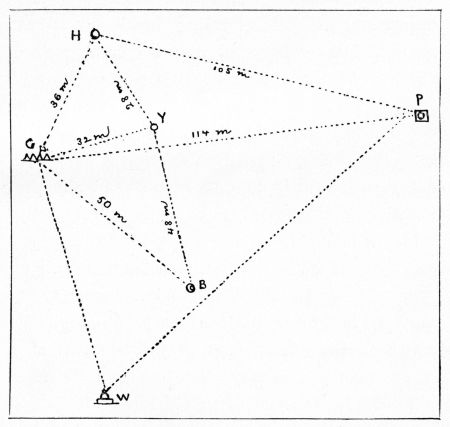
Diagram showing strategic value of Gettysburg. H., Harrisburg;
G., Gettysburg; P., Philadelphia; Y., York; B., Baltimore; W., Washington.
Topographical
Features.
Baltimore and
Taneytown
Roads.
Cemetery
Hill.
From a military point of view there are but two
features about Gettysburg on which the eye would
long rest. These are the two ridges, with a broad
valley between, heaved up at east and west and
running off south of the town. They
stand about a mile apart, though the
distance is sometimes less than that. As it nears
Gettysburg the easternmost ridge glides down, by
a gentle slope, into what may be called a plain,
in comparison with the upheavals around it,
although it is by no means a dead level. Yet
it is open because the ridges themselves have
stopped short here, forming headlands, so to
speak, above the lower swells. On coming down
off this ridge the descent is seen to be quite
easy—in fact, two roads ascend it by
so gradual a rise that the notion of its
being either high or steep is quite lost,
and you are ready to discard off-hand any preconceived
notion about its being a natural stronghold.
It is mostly on this slope that Gettysburg
is built, its houses extending well up
toward the brow, and its cemetery occupying
the brow itself. Hence, although the
centre of Gettysburg may be three-fourths of a
mile from the cemetery gate, the town site is in
fact but a lower swell of the historic ridge which
has since taken the name of its graveyard—Cemetery
Ridge.
Seminary
Ridge.
Across this valley, again, the western ridge,
which looks highest from the town, has what
Cemetery Hill has not, namely, a thin fringe of
trees skirting its entire crest, thus effectually
masking the view in that direction; and it is
further distinguished by the cupola of the Lutheran
Seminary,[4] seen rising above
trees at a point opposite the town, and
giving its name to this ridge—Seminary Ridge.
Both ranges of heights are quite level at the top,
and easily traversed; so also the slopes of both
are everywhere easy of ascent, the ground between
undulating, but nowhere, except far down
the valley, badly cut up by ravines or watercourses.
Indeed, better ground for a fair stand-up
fight it would be hard to find; for all between
the two ridges is so clear and open that neither
army could stir out toward its opponent without
being detected at once—the extreme southern
part of the valley excepted. In this respect I
take the liberty of observing that the actual state
of things proved very different from that conveyed
in some of the published accounts, wherein
Cemetery Ridge is represented as a sort of Gibraltar.
A very brief survey, however, suggests that an
army could be perfectly hid behind the trees of
Seminary Ridge, as well as better sheltered from
artillery fire, while one stretched out along the
bare and treeless summit of Cemetery Ridge
would be without such screen or protection.
The description must be a little farther pursued,
if the battle is to be at all intelligently
followed.
Enough for the two main ridges enclosing
Gettysburg and its valley. We come now to that
most striking feature of the landscape, notably on
the side of Cemetery Ridge, but more or less
characteristic of both sides of the valley. This is
the group of hills standing off from Cemetery
Ridge at either end, just as if, at some remote
time, this ridge had formed a continuous chain, the
summits of which had been cleanly shaved off at
the centre, leaving these isolated clusters to show
where the wasting forces had passed. From
different points of view we may see one or both
of them rising above the ridge like giant watch-towers
set at the extremities of some high embattled
wall.
Culp's Hill.
Rock Creek.
Let us first take the northernmost cluster,
formed of Wolf's, McAllister's, and Culp's hills.
It is seen to be thrown back behind
Cemetery Hill, to which Culp's Hill
alone is slenderly attached by a low ridge, so
making an elbow with it, or, in the military phrase,
a refused line. Between Culp's Hill and Wolf's
Hill flows Rock Creek, the shallow stream so
often mentioned in connection with the battle, its
course lying through a shaggy ravine.[5] The
ravine and stream of Rock Creek
threw Wolf's Hill somewhat out of
the true line of defence, but the merest novice in
military art sees at a glance why the possession of
Culp's Hill was all-essential to the security of
Cemetery Hill, since there is little use in shutting
the front door if the back door is to be left
standing open.
The Round
Tops.
The Devil's
Den.
The same is just as true of the southernmost
group, composed of Little and Great Round Tops,
two exceedingly picturesque summits, standing up
above the generally monotonous contours about
them in strong relief. They also were wooded
from base to summit, and they show,
even more distinctly than the first
group, where the crushing out or denuding forces
have been at work, in shelves or crevices of broken
ledge at the highest points, in ugly bowlders cropping
out on the slopes, in miry gullies
crawling at their feet, but most of all in
the deformed heap of ripped-up ledges, topped
with coppices and scattered trees, thrust out from
Little Round Top and known as the Devil's Den.[6]
When it is added that the way is open between
the two Round Tops to the rear of Cemetery
Ridge, the importance of holding them firmly becomes
self-evident; and inasmuch as the greatest
natural strength of this ridge lay at its extremities,
or flanks, so its weakness would result from a
neglect to occupy those flanks.
The Swale.
This line was assailable at one other point. As
it approaches Little Round Top the ridge sinks
away to the general level around it, or so as to
break its continuity, thus leaving a gap
more or less inviting the approach
of an enemy. The whole extent of this crooked
line, at which we have just glanced, is about two
and a half miles.
Emmettsburg
Road.
Down below, in the valley, there is another
swell of ground, hardly worth dignifying by the
name of ridge, yet assuming a certain importance,
nevertheless, first because it starts from
the town close under Cemetery Hill,
thence crossing the valley diagonally till it becomes
merged in Seminary Ridge, at a point
nearly opposite to the Round Tops, and next
because the Emmettsburg road runs on it. In
brief, its relation to the battle was this: it ran from
the Union right into the Confederate right, so
traversing the entire front of both armies. It had
an important part to play in the second day's
battle, as we shall soon see, for, though occupying
three days, Gettysburg was but a series of combats
in which neither army employed its whole force
at any one time.
II THE MARCH INTO PENNSYLVANIA — FOOTNOTES:
Lee in
Maryland.
It is in no way essential to relate in detail how
Lee's army, slipping away from ours on the
Rappahannock,[7] and after brushing out of its
path our troops posted in the Shenandoah
Valley, had been crossing the
Potomac into Maryland since the 21st of June,
by way of the Cumberland Valley, without firing
a shot.[8]
His Bold
Strategy.
A very unusual thing in war it is to see an
army which has just been acting strictly on the
defensive suddenly elude its adversary
for the purpose of carrying the war
into that enemy's country! It marks a new
epoch in the history of that war, and it supposes
wholly altered conditions. In this particular instance
Lee's moves were so bold as almost to
savor of contempt.
It is enough to know that Lee was now in
Pennsylvania, at the head of seventy thousand
men, before our army reached the Potomac in
pursuit of him, if following at a respectful distance
be called a pursuit.
State of
his Army.
At no period of the war, their own officers said,
had the Confederates been so well equipped, so
well clothed, so eager for a fight, or so
confident of success; and we may
add our own conclusions, that never before had
this army taken the field so strong in numbers, or
with such a powerful artillery.[9]
Superiority
as Marksmen.
The infantry were armed with Enfield rifles,
fresh from British workshops, and it is probable
that no equal number of men ever knew how to
use them better. Indeed, we consider it indisputable
that the Confederates greatly excelled the
Union soldiers as marksmen. Most of them were
accustomed to the use of firearms from
boyhood; in some sections they were
noted for their skill with the rifle. The
Confederates, therefore, were nearly always good
shots before they went into the army, while the
Union soldiers mostly had to acquire what skill
they could after going into the ranks. In the
South the habit of carrying arms was almost universal:
in the North it was not only unusual, but
unpopular as well as unlawful.
Superiority
in Cavalry.
Man for man, the Confederate cavalry was also
superior to the Union horse, because in one section
riding is a custom, in the other a
pastime rarely indulged in. Consequently,
it took months to teach a Union cavalryman
how to ride,—a costly experiment when your
adversary is already prepared,—whereas if there
is anything a Southerner piques himself upon, it
is his horsemanship.[10]
Cavalry
Advance.
Cumberland
Valley
raided.
Lee's cavalry had preceded the infantry by
nearly a week, reaching Chambersburg on the
16th, seizing horses and provisions for
the use of the army behind them, and
spreading consternation to the gates of Harrisburg
itself. Having loaded themselves with
plunder unopposed, they then fell back upon the
main army, thus leaving it in some doubt whether
this raid accomplished all it designed,
or was only the prelude to
something for which it was serving
as a mask.[11]
Ewell at Chambersburg.
Hood's
Soldiers.
All doubts were set at rest, however, when, on the
23d, Ewell's dust-begrimed infantry came tramping
into Chambersburg, regiment after regiment,
hour after hour, until the streets fairly swarmed
with them. Though the houses were
shut up, a few citizens were in the
streets, or looking out of their windows at the
passing show, as men might at the gathering
of a storm-cloud about to burst with destructive
fury upon them; and though the time was hardly
one for merriment, we are assured that some of
these lookers-on could not refrain from "pointing
and laughing at Hood's ragged Jacks" as they
marched along to the tune of "Dixie's Land."
"This division," remarks the partial narrator, "well
known for its fighting qualities, is composed of
Texans, Alabamians, and Arkansians,
and they certainly are a queer lot to
look at. They carry less than any other troops;
many of them have only got an old piece of
carpet or rug as baggage; many have discarded
their shoes in the mud; all are ragged and dirty,
but full of good-humor and confidence in themselves
and their general.[12] They answered the
numerous taunts of the Chambersburg ladies with
cheers and laughter." To the scowling citizens
the Confederates would call out from the ranks,
"Well, Yank, how far to Harrisburg? How far to
Baltimore? What's the charge at the Continental?"
or some such innocuous bits of irony as came
into heads turned, no doubt, at the thought of
standing unchallenged on Northern soil, where
nothing but themselves recalled war or its terrors,
or at sight of the many evidences of comfort and
thrift to which they themselves were strangers.
But we shall meet these exultant ragamuffins ere
long under far different circumstances.
This was Lee's corps of observation, destined
to do most of the hard marching and fighting
which usually falls to the lot of the cavalry, as it
was mostly composed of old, well-seasoned soldiers,
who had been accustomed, under the lead of Jackson,
to win their victories largely with their
legs. Part marched through the town, and went
into camp on the Carlisle road, part occupied
the pike leading toward Gettysburg; sentries were
posted in the streets, a military commandant
was appointed, and for the time being Chambersburg
fell wholly under rebel rule, which, so long as
it remained the army headquarters, we are bound
to say does not appear to have been more onerous
than circumstances would warrant.
Main Army
comes up.
Ewell's corps was followed, at one day's march,
by the main body, comprising Hill's and Longstreet's
corps, with whom marched Lee
himself, the man on whom all eyes,
North and South, were now turned.
Ewell to
Carlisle.
Early to
York.
As soon as the main body had come up Ewell
moved straight on toward Carlisle and Harrisburg
with two divisions, while his third turned
off to the east, toward York, with the
view of drawing attention away from the main
object by seeming to threaten Baltimore or Philadelphia.[13]
It was to strike the Susquehanna
at Columbia, and get possession
of the railway bridge there, as a means of passing
over to the north side of that river to Harrisburg.
Early
at Gettysburg.
This division (Early's) passed through Gettysburg
on the 26th,[14] reaching York the next day.
On the 28th his advance arrived at the Susquehanna
too late to save the railway bridge
from the flames.[15] On this same day
Ewell's advance encamped within four miles of
Harrisburg, where some skirmishing took place.
Region seized
by Lee.
Here, then, was Lee firmly installed within striking
distance of the capital of the great Keystone
State, and by no means at so great a distance
from Philadelphia or Washington as
not to make his presence felt in both
cities at once.
If he had not come prepared to fight every
soldier that the Federal government could bring
against him—to fight even against odds—what
was he doing here in the heart of Pennsylvania?
Spirit of his
Army.
The army which followed Lee into Pennsylvania
was brave and devoted—none more so. It
looked up to him with a species of adoration,
born of an abiding faith in his genius. Reasoning
from experience, the belief that
it would continue to beat the Union
army was not unfounded. At any rate, it was
universal. Thus led, and imbued with such a
spirit, no wonder the Confederate army considered
itself invincible.
Thus followed, Lee, or Uncle Robert, as he was
familiarly called by his soldiers, though no man
could be more aristocratic in his tastes or manners,
was accustomed to exact greater efforts from
them, both in marching and fighting, than the
Union generals ordinarily could from their better-fed,
better-clothed, and better-disciplined troops.
Lee's
Portrait.
A pen portrait of General Lee himself, as he
appeared at this time, seems necessary to the
historical completeness of this sketch. It is drawn
by a British colonel,[16] on leave with Lee's army,
where he found himself quite at home. He says:
"General Lee is, almost without exception,
the handsomest man of his age I
ever saw. He is fifty-six years old, tall, broad-shouldered,
very well made, well set up—a
thorough soldier in appearance; and his manners
are courteous and full of dignity. He generally
wears a well-worn long gray jacket, a high black
felt hat, and blue trousers tucked into his Wellington
boots. I never saw him carry arms, and
the only marks of military rank are the three stars
on his collar. He rides a handsome horse which
is extremely well groomed. He himself is very
neat in his dress and person, and in the most
arduous marches, as after the retreat from Gettysburg,
when everybody else looked and was extremely
dirty, he always looked smart and clean."
In an order commending the behavior of his
men while on the march, Lee called attention to
certain excesses which he declared his intention
of repressing in a summary manner.
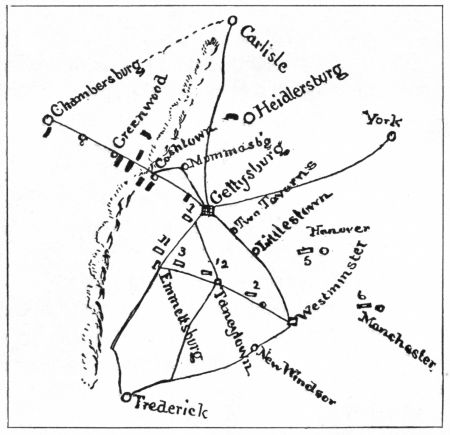
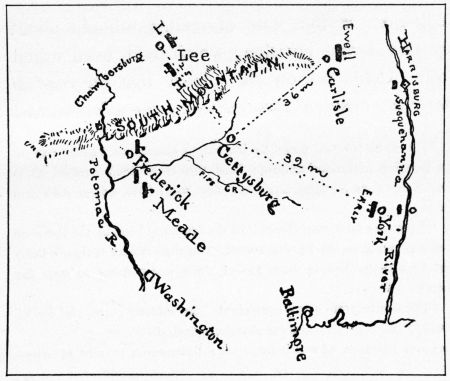
The region to which the Confederate operations
were now confined is indicated by the accompanying
map. It will be seen that Lee had not hesitated
to scatter his army considerably.
Leaving Ewell before Harrisburg, Early at
York, and Lee himself at Chambersburg, we will
look first at the state of feeling brought about
by this daring invasion, which had been urged
from Richmond on the theory that the road to
peace lay through Pennsylvania, via Washington.
III FIRST EFFECTS OF THE INVASION — FOOTNOTES:
Meantime, from before and behind the Confederate
columns, two streams flowed out of the
doomed valley: one to the north, an army of fugitives
hurrying their flocks, herds, and household
goods out of the enemy's reach; the other carrying
off to Virginia the plunder of towns and villages.
Harrisburg
alarmed.
As the swarm of fugitives made straight for
Harrisburg, it was but natural that the inpouring
of such panic-stricken throngs, all declaring that
the enemy was close behind them, should throw
that city into the wildest commotion,
which every hour tended to increase.
We will let an eye-witness describe the events of
a single day.
"The morning broke upon a populace all astir,
who had been called out of bed by the beat of
the alarming drum, the blast of the bugle, and
the clanging of bells. The streets were lively with
men, who were either returning from a night's
work on the fortifications or going over to relieve
those who were toiling there. As the sun rose
higher the excitement gathered head. All along
the streets were omnibuses, wagons, and wheelbarrows,
taking in trunks and valuables and rushing
them down to the dépôt to be shipped out of
rebel range. The stores, the female seminaries,
and almost every private residence were busy all
of the forenoon in swelling the mountain of freight
that lay at the dépôt. Every horse was impressed
into service and every porter groaned beneath his
burdens.
People desert
the City.
"The scene at the dépôts was indescribable, if
not disgraceful. A sweltering mass of humanity
thronged the platforms, all furious to
escape from the doomed city. At the
bridge and across the river the scene was equally
exciting. All through the day a steady stream of
people, on foot and in wagons, young and old,
black and white, was pouring across it from the
Cumberland Valley, bearing with them their household
goods and live-stock. Endless trains, laden
with flour, grain, and merchandise, hourly emerged
from the valley and thundered across the bridge
and through the city. Miles of retreating baggage-wagons,
filled with calves and sheep tied together,
and great, old-fashioned furnace-wagons
loaded with tons of trunks and boxes, defiled in
continuous procession down the 'pike and across
the river, raising a dust as far as the eye could
see."
Precautions
taken.
It may be added that the records of the State
and the money in the bank-vaults were also removed
to places of safety, and the construction
of defensive works was begun, as
much, perhaps, with the purpose of
allaying the popular excitement as from any hope
of holding the city against Lee, since Harrisburg
was in no condition either to stand a siege or
repel an assault at this time.
Militia
hurried to
Harrisburg.
The wave of invasion made itself felt even as
far as Pittsburg on the one side and Baltimore on
the other.[17] Governor Curtin promptly called on
the people of Pennsylvania to arm and repel the
invader. Yet neither the imminence of the danger
nor the stirring appeal of the executive of the
State could arouse them at first. In the emergency
the neighboring States were appealed to
for help. In response the militia of those States
were soon hastening toward the
threatened points[18] by every available
route; yet it was only too evident that
raw soldiers, no matter how zealous or patriotic,
would prove little hinderance to Lee's marching
where he would, or long dispute with his veterans
the possession of Harrisburg were it once seriously
attacked.
But where was the army of the Potomac all this
time—the army whose special task it was to stand
between this invader and his prey? Must unarmed
citizens be called upon to arise and defend their
homes when a hundred thousand veterans were in
the field?
Lee mystified.
His Cavalry
absent.
For more than a week Lee had thus been laying
waste a most rich and fertile section of
Pennsylvania at his leisure. Practically, indeed,
the whole State was in his grasp. Would Harrisburg
or Philadelphia be the first fruits of his
audacity? The prize was indeed tempting, the
way open. The only real impediment was the
Army of the Potomac, and Lee, too, was now
anxiously asking himself what had become of that
army.[19] He had foreseen that it must follow him
up; that every effort would be bent to compass
his destruction; and it was a foregone conclusion
that he must fight somewhere, if there was either
enterprise or courage left on the Union side. He
had even calculated on drawing the Union army
so far away from fortified places that
its defeat would ensure the fall of Baltimore
and Washington. But as regarding its
whereabouts at the present moment, Lee was
completely in the dark. In an evil hour he had
allowed the bulk of his cavalry to run off on a
wild-goose chase around the rear of the Federal
army, so that now, in his hour of need, though
without his knowing it, the whole Federal army
interposed to prevent its return.[20] It is quite true
that up to this time Stuart, who led this cavalry,
had given so many signal proofs of his
dexterity that Lee was perhaps justified
in inferring that if he heard nothing from Stuart,
it was because the Union army was still in Virginia.
And in that belief he was acting.
Among
Spies.
Moreover, instead of being among a population
eager to give him every scrap of information, Lee
was now among one where every man, woman,
and child was a spy on his own movements.
In the absence, then, of definite
knowledge touching the Union army, he decided
to march on Harrisburg with his whole force, and
issued orders accordingly.
Union Army
crosses the
Potomac.
When there was no longer a shadow of doubt
that Lee's whole army was on the march up the
Cumberland Valley, sweeping that valley clean as
it went, the Union army also crossed the Potomac,
on the 25th and 26th of June, and at
once began moving up east of South
Mountain, so as to discharge the double
duty laid upon it all along of keeping between the
enemy and Washington, while at the same time
feeling for him through the gaps of South Mountain
as it marched. For this task the Union
general kept his cavalry well in hand, instead of
letting it roam about at will in quest of adventures.
Hooker's
Plan.
This order of march threw the left wing out
as far as Boonsborough and Middletown, with
Buford's cavalry division watching the passes by
which the enemy would have to defile, should he
think of making an attack from that flank.[21] The
rest of the army was halted, for the moment,
around Frederick. The plan of operations, as
first fixed, did not lack in boldness or
originality. It was to follow Lee up
the Cumberland Valley with two corps, numbering
twenty thousand men, while the rest of the army
should continue its march toward the enemy on
the east side of South Mountain, but within supporting
distance. As this would be doing just
what Lee[22] had most reason to dread, it would
seem most in accordance with the rules of war.
At any rate, it initiated a vigorously aggressive
campaign.
At this critical moment the Union army was,
most unexpectedly, deprived of its head.
Hooker is
thwarted.
In its pursuit of Lee this army had been much
hampered by divided counsels, when, if ever
united counsels were imperatively called for, now
was the time. Worse still, it had too many commanders,
both civil and military. The President,
the Cabinet, the General-in-Chief (Halleck), and
even some others, in addition to the actual commander,
not to speak of the newspapers,
had all taken turns in advising or
suggesting what should, or what should not, be
done. United action, sincere and generous co-operation,
as between government and army, were
therefore unattainable here. The government did
not trust its general: the general respected the
generalship of the Cabinet most when it was
silent. Nobody in authority seemed willing to
grant Hooker what he asked for, let it be ever so
reasonable, or permit him to carry out his own
plans unobstructed, were they ever so promising
or brilliant. He could not get the fifteen or
twenty thousand soldiers who were then dawdling
about the camps at Baltimore, Washington, and
Alexandria. He was brusquely snubbed when he
asked for leave to break up the post at Harper's
Ferry, when by doing so ten thousand good
troops would have been freed to act against the
enemy's line of retreat.
Harmony being impossible, Lee seemed likely
to triumph through the dissensions of his enemies.
And leaves
the Army.
Mortified at finding himself thus distrusted and
overruled, Hooker threw up the command on the
27th, and on the 28th General Meade
succeeded him. So suddenly was the
change brought about, that when the officer bearing
the order awakened Meade out of a sound sleep at
midnight, he thought he was being put in arrest.
Spirit of the
Army.
It is asserted by those who had the best means
of knowing—indeed, it is difficult to see how it
could be otherwise—that the army had lost faith
in Hooker, and that the men were asking of each
other, "Are we going to have another
Chancellorsville?" Be that as it may,
there were few better soldiers in that army than
Meade; none, perhaps, so capable of uniting it
at this particular juncture, when unity was so all-important
and yet so lamentably deficient. This
was the third general the army had known within
six months, and the seventh since its formation.
It was truly the graveyard of generals; and each
of the disgraced commanders had his following.
If, under these conditions, the Army of the Potomac
could still maintain its efficiency unimpaired,
it must have been made of different stuff from
most armies.
It was not that the Union soldiers feared to
meet Lee's veterans. Lee might beat the generals,
but the soldiers—never! Yet it can hardly be
doubted that repeated defeat had more or less
unsettled their faith in their leaders, if not in
themselves; since even the gods themselves
struggle in vain against stupidity.[23]
General
Meade.
If the new appointment did not silence all
jealousies among the generals, or infuse great enthusiasm
into the rank and file,—and we are
bound to admit that Meade's was not a name to
conjure with,—it is difficult to see how
a better selection could have been
made, all things considered. In point of fact,
there was no one of commanding ability to
appoint; but every man in the army felt that
Meade would do his best, and that Meade at his
best would not fall far behind the best in the field.
Meade could not become the idol of his soldiers,
like Lee, because he was not gifted by nature with
that personal magnetism which attracts men without
their knowing why; but he could and did command
unhesitating obedience and respect.
Best-disciplined
Army.
In point of discipline, however, the Union army
was vastly the superior of its adversary, and that
counts for much; and in spite of some friction
here and there, like a well-oiled machine
the army was now again in
motion, with a cool head and steady hand to
guide it on. But as no machine is stronger than
its weakest part, it remained to be seen how this
one would bear the strain.
Thus a triumphant and advancing enemy was
being followed by a beaten and not over-confident
one, its wounds scarcely healed,[24] not much stronger
than its opponent, and led by a general new to his
place, against the greatest captain of the Confederacy.
How could the situation fail to impose caution
upon a general so fully and so recently impressed
with the consequences of taking a false
step? Meade's every move shows that from the
beginning this thought was uppermost in his mind.
With the effects of Lee's simple presence thus
laid before us, it is entirely safe to ask what should
have stopped this general from dictating his own
terms of peace, either in Philadelphia or Baltimore,
provided he could first beat the Union army in
Pennsylvania?
IV REYNOLDS — FOOTNOTES:
Meade's
Problem
The problem presented to Meade's mind, on
taking command, was this: What are the enemy's
plans, and where shall I strike him? He knew
that part of Lee's army was at Chambersburg,
part at Carlisle, and part
at York. Was it Lee's purpose to concentrate
his army upon the detachment at York or upon
that at Carlisle, or would he draw these two
detachments back into the Cumberland Valley,
there to play a merely defensive game? Should
the junction be at Carlisle, it would mean an
attack on Harrisburg: if at York, or at some
point between the main body and York, it
would indicate an advance in force toward Philadelphia,
Baltimore, or Washington. As all these
things were possible, all must be duly weighed
and guarded against. With a wily, brave, and
confident enemy before him, Meade did not
find himself on a bed of roses, truly; and he may
well be pardoned the remark attributed to him
when ordered to take the command, that he was
being led to execution.
Meade needed no soothsayer to tell him that if
Lee crossed the mountains, it would be because
he meant to fight his way toward his object
through every obstacle.
What was that object?
In answering this question the political considerations
must be first weighed. In short, the purpose—the
great purpose—of the invasion must
be penetrated. That being done, the military
problem would easily solve itself.
It was not to be supposed that Lee had invaded
Pennsylvania solely for the purpose of taking a
few small towns, or even a large one, like Harrisburg,
or of filling up his depleted magazines.
He was evidently after larger game. His ultimate
aim, clearly, was to capture Washington, as a
signal defeat of the Union army would easily
enable him to do. It would crown the campaign
brilliantly, would fulfil the hopes, and beyond
doubt or cavil ensure the triumph, of the Confederacy.
It is true that Meade's orders held him
down to a defence of the national capital first
and foremost; in no sense, then, was he the
master of his own acts: yet he showed none the
less sagacity, we think, in concluding that Lee
would presently be found on the east side of the
mountains, and in preparing to meet him there,
not astride the mountains as Hooker had proposed
doing, but with his whole army more within his
reach. Meade was prudent. He would err, if at
all, on that side; yet the result vindicated his
judgment sooner than was thought for.
This being settled, there still remained the
question of relieving Pennsylvania. The enemy's
presence there was an indignity keenly enough
felt on all sides, but to none was it such a home-thrust
as to the Pennsylvanians in the Union
army, at the head of whom was Meade himself.[25]
Meade's
Plans.
Though Hooker's plan promised excellent
results here, Meade was fearful lest Lee should
cross the Susquehanna, and take Harrisburg
before he could be stopped. To prevent this
the army must be pushed forward.
Meade, therefore, at once drew back
the left wing toward Frederick, thus giving up
that plan in favor of one which he himself had
formed; namely, of throwing the army out more
to the northeast, the better to cover Baltimore
from attack, should that be Lee's purpose, as
Meade more than suspected. Selecting Westminster,
therefore, as his base from this time
forth, and the line of Big Pipe Creek, a little to
the north of that place, as his battle-ground,
Meade now set most of the army in motion in
that direction, leaving Frederick to the protection
of a rear-guard.
Left Flank
Forward.
Right Flank
refused.
The army now marched with its left wing
thrown forward toward South Mountain, Buford's
cavalry toward Fairfield, to clear that flank, the
First and Eleventh Corps toward Emmettsburg,
the Third and Twelfth
toward Middleburg, the Fifth to Taneytown, the
Second to Uniontown, and the Sixth,
on the extreme right, to New Windsor.
Two other divisions of Union cavalry, Kilpatrick's
and Gregg's, marched one on the right flank,
the other in front, with orders to keep the front and
flanks of the army well scouted and protected.
It will be seen from this order of march that, in
proportion as they went forward, Buford's cavalry,
with the three infantry corps forming the left
wing, were approaching the enemy's main body at
Chambersburg. South Mountain was, therefore,
the wall behind which the two contending armies
were playing at hide-and-seek.[26]
Lee hears
Meade is
coming.
Lee had only just given orders for his whole
force to move on Harrisburg, when, late in the
night of the 28th, a scout brought news to him of
the Union army being across the Potomac,
and on the march toward South
Mountain.[27] This report could not fail
to throw the Confederate headquarters into a
fever of excitement, ignorant to that hour of that
army's being across the Potomac. The mystery
was cleared up at last. In a moment the plan of
campaign was changed.[28] Lee soon said to some
of the officers about him, "To-morrow, gentlemen,
we will not move to Harrisburg as we expected,
but will go over to Gettysburg and see what General
Meade is about."
March on
Gettysburg
begun.
By placing himself on the direct road to Baltimore,
Lee's purpose of first drawing the Union
army away from his line of retreat, and of then
assailing it on its own, stands fully revealed. The
previous orders were therefore countermanded on
the spot. Hill and Longstreet were ordered from
Chambersburg to Gettysburg,[29] Ewell
was called back from Carlisle, and
Early from York.
Faulty
Tactics.
If Meade had known Lee's whereabouts, it is
safe to assume that the Union army would have
been massed toward its left rather than
its right; and if Lee had been correctly
informed on his part, it is unlikely that he
would have risked throwing his columns out at
random against the Union army, as he was now
doing. Only the fatuity of the Union generals
saved Lee's vanguard on the 1st of July. Yet
he held the very important advantage of having
already begun the concentration of his army—an
easy thing for him to do, inasmuch as but one of
his three corps was separated from the others—before
Meade discovered by chance what was so
near proving his ruin. One day's march would
bring all three up within supporting distances,
two in position for giving battle.
Confederate
Positions
June 29th.
Heth's division of Hill's Corps got as far as
Cashtown, eight miles from Gettysburg, on the
29th; Rodes' division of Ewell's Corps was
coming down by the direct road from
Carlisle, east of South Mountain; Early's
division of this corps began its
march back from York to Gettysburg on the
morning of the 30th. These three divisions, or
one-third of Lee's whole army, therefore, formed
the enemy's vanguard which would first strike an
approaching force. But, as we have seen, the
whole army was in march behind it, and by the
next day well closed up on the advance.
Leaving them to pursue their march, which was
by no means hurried, let us, to borrow Lee's very
expressive phrase, "see what General Meade was
about."
Union
Positions
June 30th.
On the 29th all seven of the Union corps were
advancing northward like fingers spread apart, and
exactly in an inverse order from Lee's
three, which were converging on the
palm of the hand. On the 30th this
divergent order of march continued to conduct
the corps still farther apart, with the result also,
considering Gettysburg as the ultimate point of
concentration, that the bulk of the army was away
off to the right of Gettysburg.[30] Moreover, Meade's
efforts to get the army up to this position, or in
front of his chosen line of defence on Pipe Creek,
had covered the roads with stragglers, and compelled
at least one corps to halt for nearly a whole
day.[31]
Scattered
Condition
of the Army.
It was not until nightfall of the 30th, or forty-eight
hours after it was begun, that Meade knew
of the enemy's movement toward Gettysburg;
and even then he did not feel at all sure of having
detected the true point of concentration. Indeed,
his want of accurate information on this head
seems surprising. By that time his own army was
stretched out from Emmettsburg, on the northwest,
to Manchester at the east, thus putting
it out of Meade's power to concentrate
it at Gettysburg in one day. By endeavoring
to cover too much ground his army had
been dangerously scattered. Even without cavalry
Lee had fairly stolen a march on him. And it is
not improbable that Hooker might now have been
"shocked," in his turn.[32]
Union
Left Wing
in Advance.
Our present business is now wholly with the left
wing of the Union army,—its right being quite
out of reach—that is to say, with the
three infantry and one cavalry corps
commanded by that thorough soldier,
so beloved by the whole army, General Reynolds,
the actual chief of the First Corps.
Buford finds
the Enemy.
Buford had spent the 29th in scouring the passes
of South Mountain as far north as Monterey,
without getting sight of the enemy, however, until
he halted for the night at Fountaindale,
when he then perceived the camp-fires
of a numerous body of troops stretching along in
his front and lighting up the road toward Gettysburg.
Evidently they had just crossed South
Mountain from the valley.
He attacks.
To Buford this sight was indeed as a ray of light
in a dark place. No friendly force could be in
that quarter. He determined to know who and
what it was without loss of time. Before dawn his
troopers were again in the saddle.
They soon fell in with a strong column
of infantry moving toward Gettysburg on the
Fairfield (Hagerstown) road. After exchanging a
few shots, and having learned what he wanted to
know, Buford hastened back to Reynolds, at
Emmettsburg, with the news.
Reynolds immediately sent Buford back to
Gettysburg, in order, if possible, to head off
the enemy before he should reach that place, for
which he was evidently making. A courier was
also despatched to headquarters. This was the
first trustworthy intelligence of Lee's movement
to the east that Meade had thus far received.
Could the enemy be massing on his left? It
certainly looked like it. After this night there
was only one word on the tongues of all men
in that army—Gettysburg! Gettysburg!
Reynolds
marches up.
The First Corps, also marching for Gettysburg,
went into camp some five miles
short of that town; the Eleventh lay
at Emmettsburg; the Third at Taneytown. It
is with them alone that we shall have to deal in
what follows.
Pipe Creek.
We have already seen that Meade had not
designed advancing one step farther than might
be found effectual for turning Lee back from
overrunning the State. This was the first great
object to be attained. And this had now been
done. To avoid being struck from behind, Lee
had been forced to halt, face about, and look for
a place to fight in. When the enemy should
be fairly in motion southward, Meade meant
to take up the position along Pipe Creek, and
await an attack there. But he no
longer had the disposing of events.
In order to gain this position now, Reynolds
must have fallen back one or two marches; nor
could Meade know that Lee was then coming half
way to meet him; or that—strange confusion of
ideas!—Lee had promised his generals not to fight
a pitched battle except on ground of his own
choosing; certainly not on one his adversary
had chosen for him; least of all where defeat
would carry down with it the cause of the
Southern Confederacy itself.
Reynolds.
Reynolds, therefore, held the destinies of both
armies in his keeping on that memorable last
night of June. He now knew that any
further advance on his part would probably
result in bringing on a combat—a combat,
moreover, in which both armies might become involved,
for his military instinct truly foreshadowed
what was coming. There was still time to fall
back on the main army, to avoid an engagement.
But Reynolds was not that kind of general. He
was the man of all others to whom the whole
army had looked in the event of Hooker's incapacity
from any cause, as well as the first whom
the President had designed to replace him.
He now shared Meade's confidence to the fullest
extent. He was a soldier of the finest temper,
a Pennsylvanian, like Meade himself, neither
rash on the one hand, nor weighed down by
the feeling that he or his soldiers were overmatched
in any respect on the other. To him,
at least, Lee was no bugbear. Having come
there expressly to find the enemy, he was not
going to turn his back now that the enemy was
found. Reynolds was, therefore, emphatically the
man for the hour. He knew that Meade would
support him to the last man and the last cartridge.
He fall back? There was no such word in Reynolds'
vocabulary. His order was "Forward!"
So history has indissolubly linked together
the names of Reynolds and of Gettysburg, for
had he decided differently there would have been
no battle of Gettysburg.
Thus it was that all through the silent watches
of that moonlit summer's night the roads leading
to Gettysburg from north and south, from east
and west, were lighted up by a thousand camp-fires.
Without knowing it, the citizens of that
peaceful village were sleeping on a volcano.
V THE FIRST OF JULY — FOOTNOTES:
Buford.
Since early in the afternoon of June 30th, the
inhabitants of Gettysburg had seen pouring
through their village, taking position on the
heights that dominate it, and spreading
themselves out over all the roads
leading into it from the west and north, squadron
after squadron of horse, dusty and travel-stained,
but alert, vigilant, and full of ardor at the prospect
of coming to blows with the enemy at last.
This was a portion of that splendid cavalry
which, under the lead of Pleasonton, Buford,
Gregg, and Kilpatrick, at last disputed the
boasted superiority of Stuart's famous troopers.
At last the Union army had a cavalry force.
These men formed the van of that army which
was pursuing Lee by forced marches for the purpose
of bringing him to battle.
Oak
Ridge.
Willoughby
Run.
Forewarned that he must look for the enemy
to make his appearance on the Chambersburg and
Carlisle roads,[33] and feeling that there was warm
work ahead, Buford was keeping a good lookout
in both directions. To that end he had now
taken post on a commanding ridge
over which these roads passed first to
Seminary Ridge, and so back into Gettysburg.
First causing his troopers to dismount, he
formed them across the two roads in question in
skirmishing order, threw out his vedettes, planted
his horse-artillery, and with the little valley of
Willoughby Run before him, the
Seminary and Gettysburg behind him,
and the First Corps in bivouac only five miles
away toward Emmettsburg, this intrepid soldier
calmly awaited the coming of the storm, conscious
that if Gettysburg was to be defended at
all it must be from these heights.
A pretty little valley was this of Willoughby
Run, with its green banks and clear-flowing
waters, its tall woods and tangled shrubbery, so
soon to be torn and defaced by shot and shell,
so soon deformed by drifting smoke and the loud
cries of the combatants.
The night passed off quietly. Nevertheless,
some thirty thousand Confederates, of all arms,
were lying in camp within a radius of eight miles
from Gettysburg. Their vanguard had discovered
the presence of our cavalry,[34] and was waiting for
the morning only to brush it away.
Heth comes
down the
Pike.
Next morning Heth's division was marching
down the Chambersburg pike, looking for this
cavalry, when its advance fell in with Buford's
vedettes. While they halted to reconnoitre,
these vedettes came back with
the news that the enemy was advancing
in force, infantry and artillery filling the road
as far as could be seen. Warned that not a
moment was to be lost, Buford at once sent off
word to Reynolds, who, after ordering the First
Corps under arms, and sending back for the
Eleventh, himself set off at a gallop for Gettysburg,
followed only by his staff.
He drives
Buford.
Buford's bold front had thus caused the enemy
to come to a halt; but soon after nine, supposing
he had to do with cavalry alone, Heth deployed
his skirmishers across the pike, forming
his two leading brigades at each side
of it; these troops then pushed forward, and soon
the crack of a musket announced that the battle
of Gettysburg had begun.
Wadsworth
comes to
Buford's Aid.
After an hour's stubborn fighting, Buford was
being slowly but surely pushed back over the first
ridge, when a column of the Union infantry was
seen coming up the Emmettsburg road at the
double-quick. It was Wadsworth's division
arriving in the nick of time, as
the enemy's skirmishers, followed by
Archer's brigade, were, even then, in the act of
fording the run unopposed, and unless promptly
stopped would soon be in possession of the first
range of heights. It was really a neck-and-neck
race to see who would get there first.
Reynolds
forms the
Division.
Charge of the
Iron Brigade.
Reynolds
falls.
Reynolds was impatiently awaiting the arrival
of his troops, who were making across the fields
for the ridge he was so desirous of holding on the
run. It was plain as day that he had determined
to contest the enemy's possession of Gettysburg
here. Cutler's brigade was the first to arrive.
Hurrying this off to the right of the
pike, where it formed along the crest
of the ridge under a shower of balls,
Reynolds ordered the next, as it came up, to
charge on over the ridge in its front, and drive
Archer's men out of a wood that rose before him
crowning the crest and running down the opposite
slopes. It was done in the most gallant manner,
each regiment in turn breaking off from
the line of march to join in the charge
under the eye of Reynolds himself, who, heedless
of everything except the supreme importance of
securing the position, rode on after the leading
regiment into the fire where bullets were flying
thickest. Not only was the enemy driven out of
the wood, but back across the run, with the
loss of about half the brigade, including Archer
himself. At the very moment success
had crowned his first effort, Reynolds
fell dead with a bullet in his brain.[35]
Evil Consequences.
Nothing could have been more unfortunate at
this time. With Reynolds fell the whole inspiration
of the battle of Gettysburg, but, worst of all,
with his fall both the directing mind
and that unquestioned authority so essential
to bring the battle to a successful issue
vanished from the field. He had been struck
down too suddenly even to transmit his views to a
subordinate. Disaster was in the air.
Cutler is
driven.
This dearly bought success on the left was more
than offset by what was going on at the right,
where Davis' Confederate brigade, after getting
round Cutler's flank, was driving all
before it. Cutler had to fall back to
the Seminary Ridge in disorder.
Having so easily cleared this part of the line,
Davis' men next threw themselves astride the
ridge, and seeing nothing before them but Hall's
battery, which was then firing down the Chambersburg
pike, they came booming down upon
the guns, yelling like so many Comanche Indians.
Before the battery could be limbered up the
enemy were among the guns, shooting the cannoneers
and bayoneting the horses. It was
finally got off with the loss of one of the
pieces.[36]
This success put the enemy in possession of all
the Union line as far down as the pike, and
threatened that part just won with a like fate.
We had routed the enemy on the left, and been
routed on the right.
The Ridge
recovered.
Davis in
a Trap.
Fortunately, the Sixth Wisconsin had been
left in reserve near the Seminary a little earlier,
and it was now ordered to the rescue. Colonel
Dawes led his men up on the run. This regiment,
with two of Cutler's that had turned back on seeing
the diversion making in their favor,
drove the enemy back again, up the
ridge, to where it is crossed by a railroad cut,
some two hundred yards north of the pike. To
escape this attack most of them jumped down
into the cut; but as the banks are high and steep
and the outlet narrow, this was only getting out of
the frying-pan into the fire, since while one body
of pursuers was firing down into them
from above, still another had thrown itself
across the outlet and was raking the cut from
end to end. This proved more than even Davis'
Mississippians could stand, and though they
fought obstinately enough, all were either killed,
taken, or dispersed.
Heth
brought to
a Standstill.
Heth's two attacking brigades having thus been
practically used up after a fierce conflict, not with
cavalry alone, with whom they had expected to
have a little fun, but with infantry, in whom they
recognized their old antagonists of many a hard-fought
field, and who fought to-day with a determination
unusual even to them, Heth hesitated
about advancing to the attack again in the face of
such a check as he had just received, without
strong backing up; but sending word
of his encounter to Lee, he set about
forming the fragments of the two defeated
brigades on two fresh ones, where they
could be sheltered from the Union fire.
Yet Hill, his immediate chief, had told him
only the night before there was no objection in
the world to his going into Gettysburg the next
day.
This success also enabled Doubleday[37] to reform
his line in its old position. The troops on the
left had not been shaken, and Cutler's men were
now coming back to the front eager to wipe out
the disgrace of their defeat.
If the enemy's van had not been without cavalry
to clear its march, Heth must inevitably have got
into Gettysburg first. As it was, the unexpected
resistance he had met with made Heth cautious.
Lee's orders to his lieutenants were not to force
the fighting until the whole army should be up.
Pender was therefore forming behind Heth, the
artillery set at work, and all were impatiently looking
out for Rodes' appearance on the Carlisle (or
Mummasburg) road, before renewing the action.
Eleven
o'clock.
This proved a most fortunate respite to the
small Union force on Oak Ridge, as, in consequence
of it,—the state of things just pointed
out,—some hours elapsed before there was any
more fighting by the infantry, though the artillery
kept up its annoying fire. Meanwhile the two
remaining divisions of the First Corps
came on the ground. Robinson's was
left in reserve at the Seminary, with orders to
throw up some breastworks there; Doubleday's,
now Rowley's, went into line partly to the right
and partly to the left of the troops already there,
thus extending both flanks considerably; and
at the extreme left, which was held by Biddle's
brigade, two companies of the Twentieth New
York were even thrown out across the run, into
the Harman house and out-buildings, where they
did good service in keeping down the enemy's
skirmish fire.[38]
Rodes on
Union Flank.
Meantime, also, Pender's division had got into
line. When formed for the attack it considerably
outflanked the Union left. And a little later Rodes
was seen coming down the Mummasburg road,
or out quite beyond the right of the
First Corps. Clearly, the combat just
closed was child's play in comparison with what
was about to begin.
Oak Hill
seized.
These troops gave notice that they were shortly
coming into action by opening a sharp cannonade
from Oak Hill, the commanding eminence situated
just beyond and in fact forming
a continuation of Oak Ridge, where
the First Corps stood, though separated from it
somewhat.
This artillery fire from Oak Hill enfiladed the
Union position so completely that nothing was
left for the right but to fall back to Seminary
Ridge, so as to show a new front to this attack.
The centre and left, however, kept its former
position, with some rearrangement of the line
here and there, which had now become a very
crooked one.
Twenty odd thousand men were thus waiting
for the word to rush upon between ten and eleven
thousand.
Eleventh Corps
comes up.
Before the battle could be renewed, however,
the Eleventh Union Corps came up through
Gettysburg.[39] Howard, its actual head, was
now in chief command of the field, as next in
rank to Reynolds. He sent forward
Schurz's and Barlow's divisions of
this corps to confront Rodes, leaving Steinwehr's
in reserve on Cemetery Hill.
Howard calls
for Help.
Having preceded his corps to the field, Howard
had already notified Meade, too hastily by half,
that Reynolds was killed and the First Corps
routed—a report only half true, and calculated
to do much mischief, as it soon spread
throughout the entire army. He also
sent off an urgent request to Slocum, who was
halted in front of Two Taverns, not five miles off,
to come to his assistance with the Twelfth Corps.
Hancock
comes to the
Front.
Supposing the day lost from the tenor of
Howard's despatch, lacking perhaps the fullest
confidence in that general's ability and experience,
and thinking only of how he should save
what was left, Meade forthwith posted Hancock
off to Gettysburg, with full authority to take
command of all the troops he might
find there, decide whether Gettysburg
should be held or given up, and to
promptly report his decision, to the end that
proper steps might be taken to counteract this
disaster if yet possible.
Slocum and
Sickles.
Slocum would not stir from Two Taverns without
orders, though it is said the firing was distinctly
heard there, and he could have reached
Gettysburg in an hour and a half. A second and
still more urgent appeal decided that
commander, late in the afternoon, to
set his troops in motion. It was then too late.
Sickles, who might have been at Gettysburg
inside of three hours with the greater part of
his corps, appears to have lingered in a deplorable
state of indecision until between two and
three o'clock in the afternoon, before he could
make up his mind what to do. It was then too
late.[40]
By contrast we find Ewell promptly going to
Hill's assistance upon a simple request for such
coöperation, though Ewell was Hill's senior;
and we further find that his doing so proved
the turning-point of this very battle.
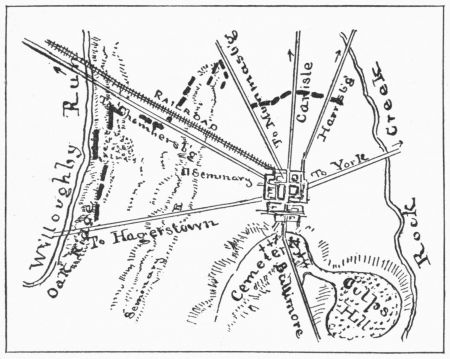
Union Positions, July 1, 3 P.M.
Was there a want of cordiality between the
Union commanders? Was it really culpable
negligence, or was there only incapacity?
While, therefore, one corps certainly, two
probably, might easily have got to the field in
season to take a decisive part in the battle, but
remained inactive, the Confederates were hurrying
every available man forward to the point
of danger. This was precisely where Reynolds'
fall proved supremely disastrous, and where an
opportunity to acquire a decisive superiority on
the field of battle was most unfortunately thrown
away for want of a head.[41]
New Union
Line.
The Union line, lengthened out by the arrival
of the Eleventh Corps, had now been carried in
a quarter circle around Gettysburg, or from the
Hagerstown road on the left to near
Rock Creek on the right, the Eleventh
Corps being deployed across the open fields
extending from the Mummasburg to the Harrisburg
road, with Barlow's division on the extreme
right. When this corps formed front in line of
battle, there was a gap of a quarter of a mile left
wide open between it and the First Corps.
Furthermore, it was drawn up on open ground
which, if not actually level, is freely overlooked
by all the surrounding heights.
That this corps was badly posted was demonstrated
after a very brief trial.
Rodes
attacks.
Having got into line facing southward, Rodes
began his advance against the right of the First
Corps and left of the Eleventh shortly before
three o'clock, supported by a tremendous
artillery fire from Oak Hill.
Our troops stood firm against this new onslaught.
It was only fairly under way, however, when
Heth and Pender joined in the attack.
The fighting now begun was on both sides of
the most determined character.
Bloody
Fighting.
On his side, Rodes was quick to take advantage
of the break existing between the two Union
corps, and promptly pushed his soldiers into it;
but they were not to get possession so easily,
for Doubleday now ordered up his last
division to stem the tide surging in
upon his uncovered flank. These troops gallantly
rushed into the breach, where a murderous contest
began at close quarters, with the result that,
failing to close up the gap, the division was finally
drawn around the point of the ridge, where the
Mummasburg road descends into the plain, so
forming a natural bastion from which the Union
soldiers now drove back their assailants with
great slaughter. Many of Iverson's brigade were
literally lying dead in their ranks after this repulse.
In front of Meredith, who still held the wood,
and Stone's "Bucktails," who lay at their right,
"no rebel crossed the run for one hour and
lived." Beyond them Biddle was still holding his
own at the left, though his ranks were fast thinning.
On both sides the losses were enormous.
In twenty-five minutes Heth had lost two thousand
seven hundred out of seven thousand men. This
division having been fought out, Pender's was
brought up, the artillery redoubled its fire, Rodes
pushed his five brigades forward again, and a general
advance of comparatively fresh troops was
begun all along the line.
But it was on the right that disaster first fell
with crushing force.
Early
strikes in.
Here Rodes' assault on the left of the Eleventh
Corps met stout resistance. But while the troops
here were fighting or shifting positions to repel
Rodes' rapid blows, Early's division was seen
advancing down the Harrisburg road
against the right, which it almost immediately
struck. Thus reinforced and connected,
not quite one-half of Lee's whole army was now
closing in around two-sevenths of the Union army.
Obstinate fighting now took place all along the
line. The First Corps held out some time longer
against repeated assaults, losing men fast, but also
inflicting terrible punishment upon their assailants,
Rodes alone losing two thousand five hundred
men before he could carry the positions before
him. The Confederate veterans, though not used
to praising their opponents, freely said that the
First Union Corps did the fiercest fighting on this
day of which they ever had any experience.
His Attack
is decisive.
But Early's attack on the right, though sternly
resisted by Barlow, proved the last straw in this
case. The right division being rolled back in disorder
by an assault made both in front and flank,
the left also gave way in its turn, and soon the
whole corps was in full retreat across
the fields to the town, which the exultant
enemy entered along with them, picking up a
great many prisoners on the way or in the streets,
notwithstanding a brigade of the reserve came
down from Cemetery Hill to check the pursuit.
All in
Retreat.
Union
Losses.
The Eleventh Corps being thus swept away, the
First fell back rather forsaken than defeated, a few
regiments on the left making a final stand at the
seminary to enable those on the right to shake off
their pursuers. But at last the winding
lines came down from Seminary Ridge
into the plain. Buford's cavalry again came to the
rescue in this part of the field, riding with drawn
sabres between pursuers and pursued, so that the
Confederates hastily formed some squares to repel
a charge, while the wreck of the Union line, disdaining
to run, doggedly fell back toward the
town, halting now and then to turn and fire a
parting volley or rally its stragglers round their
colors. It was not hard pushed except at the extreme
right, where some of Robinson's division
fell into the enemy's hands; nor did resistance
cease until its decimated battalions again closed
up their ranks on the brow of Cemetery Hill—noble
relic of one of the hardest-fought battles of
this war. Of the eight thousand two hundred
men who had gone into action in the morning,
five thousand seven hundred and fifty
had been left on the blood-dyed summit
of Oak Ridge, or in the enemy's hands. The
losses were frightful. In one brigade alone, one
thousand two hundred and three men had fallen.
In all, the losses more than equalled half the effective
strength.
The Eleventh Corps also lost heavily, though
mostly in prisoners. In both corps ten thousand
soldiers were missing at roll-call.
The Enemy
in Gettysburg.
Early's soldiers were now swarming about
Gettysburg in great spirits. Hays' brigade alone
entered the town, Avery going into a field on the
East, and the others out on the York road. Rodes
presently came up at the west, much disordered
from his pursuit of Robinson. These Confederates
then set about re-forming their shattered ranks,
under the fire of the Union artillery
from Cemetery Hill and of the sharp-shooters
posted in the houses along its slopes.
This fire became so galling that the enemy's
infantry were obliged to get under cover of the
nearest ridges or houses. In this way Ewell's
Corps came to be planted nearest the approaches
to Cemetery Hill.
Heth and
Pender.
Heth and Pender did not advance beyond Seminary
Ridge. They had had fighting enough for
one day.[42] Lee was also there examining the new
Union position through his glass. Notwithstanding
the general elation visible about him,
the victory did not seem quite complete
to Lee so long as the Federals still maintained
their defiant attitude at the Cemetery. There was
evidently more, and perhaps harder, work ahead.
There is no evading the plain, if unwelcome,
truth that this battle had been lost, and two corps
of the Union army nearly destroyed, for want of
a little more decision when decision was most
urgently called for, and a little more energy when
activity was all-important. The fate of most great
battles has been decided by an hour or two, more
or less. Two of indecision decided this one.
VI CEMETERY HILL — FOOTNOTES:
Lee wants to
push Things.
We have seen Lee arriving on the field his
troops had carried just as ours were streaming
over Cemetery Hill in his plain sight. Seeing
Ewell already established within gunshot
of this hill, Lee wished him to
push on after the fugitives, seize Cemetery Hill,
and so reap all the fruits of the victory just won.
Ewell hesitated, and the golden opportunity
slipped through Lee's fingers. At four o'clock
he would have met with little resistance: at six it
was different.
Hancock
arrives.
Finds Situation
gloomy.
By riding hard, Hancock[43] got to Gettysburg
soon after Lee did. The road leading from the
battlefield was thronged with fugitives,
wounded men, ammunition wagons, and
ambulances, all hurrying to the rear (the unmistakable
débris of a routed army), as Hancock
spurred up Cemetery Hill. His trained eye took
in the situation at a glance. Everywhere he saw
the gloom of defeat. A few disordered
battalions sullenly clung around
their colors, but the men seemed stunned and
disheartened, not so much by defeat as by the
palpable fact that they had been abandoned to
defeat for want of a scrap of paper, more or less.
Instead of cheers, set faces and haggard eyes
greeted Hancock as he rode along the diminished
ranks. He saw divisions reduced to brigades;
brigades to battalions; battalions to companies;
batteries to a single gun. One of Steinwehr's
brigades and some of his batteries, with a regiment
of the First Corps that had not been in
action,[44] was the only force remaining intact.
These guns were sending an occasional shot down
into the streets of Gettysburg; while more to the
left—cheering sight!—Buford's cavalry stood
drawn up before the heights steady as on parade,
first in the field and last out of it.
Hancock's animating presence gradually put
heart into the men. He saw just what ought
to be done, and instantly set about doing it.
Order is
restored.
First Reinforcements.
A swift and comprehensive view of the ground—and
his grasp of its capabilities was singularly just—seems
to have convinced Hancock that no better
place to fight in was likely to be found, even
should the enemy allow them the time
to concentrate in the rear, which was
become the all-important question just then. He
gave his orders rapidly, broken ranks were re-formed,
fugitives brought back to their colors,[45]
the tide of retreat stayed. As the last gun
was fired from Cemetery Hill, Stannard's Vermont
brigade[46] came marching up the Emmettsburg
road, and was at once put in line south
of the Cemetery, with pickets thrown
out in front. Though small, this reinforcement
was thrice welcome at a time when
it could not be known whether the enemy would
attack or not, and it had a good effect.
Culp's Hill.
Commands
Cemetery.
In riding up, Hancock had not failed to notice—indeed,
no one could—a wooded hill standing off at
some distance to the right of Cemetery Hill, from
which it was separated by a wide and
deep hollow, yet at the same time
joined by a ridge so low and narrow as to be
hardly seen when looking down from above.
This low, connecting ridge is several hundred
yards in extent, and, forming as if does a natural
parapet for infantry, was all that stood in the way
of pushing a force through between Cemetery
and Culp's Hill to the rear of the Union troops.
Of the two hills it is enough to say
that as Culp's Hill is much the higher,
whoever held Culp's Hill would also hold the key
to the Union position, as Hancock found it.
Ewell
sees it too.
But Hancock
seizes it.
The enemy had not been slow to perceive this
on his part, and while hesitating what to do Early
had pointed it out to Ewell, his chief, who fully
agreed with him that it should be seized as soon
as Johnson's fresh division got up.[47] But while
they were hesitating Hancock was
sending what was left of Wadsworth's
division, reinforced by the Seventh Indiana, with a
battery, to occupy Culp's Hill; so that when
Johnson's scouts went there after dark, instead of
finding the hill unoccupied and undefended, they
fell into the hands of Wadsworth's men. Meredith's
worn but undaunted brigade dropped into
position behind the narrow strip of ridge spoken
of, a sure guaranty that no enemy would break
through at that place. In this instance
Hancock's eagle glance and no less
prompt action undoubtedly saved the whole
position, since if Ewell had succeeded in establishing
himself on Culp's Hill, it would have
taken the whole Union army to drive him out.
Hancock
reports all
safe.
Considered merely as a rallying point for
broken troops, Cemetery Hill had now served its
purpose. Hancock could now say to Meade,
not that the position was the best they could have
taken for disputing the enemy's progress, but that
all was safe for the present, or equally
in train for the withdrawal of the
troops, should that be the decision.
In a word, he would not commit himself unreservedly
to a simple yes or no.[48]
Meade's
Decision.
It was now Meade's turn, and right nobly did
he rise to the crisis. Such as it was, Hancock's
report enabled him to come to a quick decision.
Instead of ordering a retreat, he instantly ordered
the corps to Gettysburg. From the
moment he became satisfied that there
was a fighting chance in front, Meade's conduct
was anything but that of a defeated or even timid
general; he seems never to have looked behind
him. Had he been so unalterably wedded to his
own chosen line of defence as some critics profess
to believe, it is difficult to see what stronger
excuse could have offered itself for falling back
than the defeat he had just suffered. And if he
had shrunk from the hazard of fighting so far
from his base before, how much more easily
could he have justified his refusal to do so after
the loss of ten thousand men, the sudden disruption
of his plans, with the increased sense of
responsibility all this involved! We think few
would deny that the bringing up of four-sevenths
of the army over distances varying from thirteen
to thirty-six miles must appear a far bolder act,
even to the unmilitary mind, than causing three-sevenths
to fall back some fifteen miles. Fortunately
Meade was one in spirit with his soldiers,
who with one voice demanded to be led against
the enemy. The shock of battle seems to have
aroused all the warrior's instinct within him.
Reynolds may have forced the fighting, Hancock
suggested, or even advised, but it was Meade, and
Meade alone, on whose deliberate judgment the
battle of Gettysburg was renewed, and who therefore
stands before history as its undoubted
sponsor.
Twelfth
Corps comes
up, 5 P.M.
To return to the now historic Cemetery Hill.
Here the right, reinforced by at least three thousand
fresh troops,[49] had been strongly occupied.
Everything appeared in surety on this side. But
all the way from the Taneytown Road to Little
Round Top there was not one solitary soldier or
gun except some cavalry pickets. By the time,
however, that Hancock had succeeded in bringing
order out of this chaos and courage out of despair,
the whole situation was changed by the arrival of
the Twelfth Corps from Two Taverns.
As it came up by the Baltimore pike
the leading division (Williams') turned
off to the right, feeling its way out in this direction
as far as Wolf's Hill and the Hanover road;
but on finding the enemy already installed on that
side, the division was massed for the night on the
Baltimore pike, so rendering secure our extreme
right at Culp's Hill. There was no longer anything
to apprehend on this side. We cannot
refrain from asking what would have been the
effect of the appearance of these troops on
Early's flank an hour or two earlier in the afternoon?
Geary at
Little
Round Top.
Fix this on
the Map.
Geary's division of this corps having kept
straight on up the pike to Cemetery Hill, Hancock
turned it off to the extreme left, partly to
make some show in that as yet unguarded quarter,
about which he felt by no means easy,
partly to hold control of the Emmettsburg
and Taneytown roads (see map),
by which more of the Union troops were marching
to the field. Stretching itself out in a thin
line as far as Little Round Top, and after sending
one regiment out on picket toward the Emmettsburg
road, and just to the right of the Devil's
Den, the division slept on its arms, in a position
destined to become celebrated, first on
account of Hancock's foresight in seizing
it, next by reason of its desertion by the general
intrusted with its defence.
Second
Corps
nearly up.
Hancock had the satisfaction of feeling that the
position was safe for the present when he rode
back to Taneytown, first to meet his own corps on
the road, and next to find that the whole army
had already been ordered up. Throwing
Gibbon an order to halt as he
passed, Hancock kept on to headquarters.
His work was done.
Union Line
at Dark.
Nothing but the importance which this critical
period of the battle has assumed to our own
mind could justify the giving of all these details
by which the gradual patching up and lengthening
out of the line, until it took the form it
subsequently held, and from a front of
a few hundred yards grew to be two miles long,
may be better followed.
Part
of Third
Corps up.
Find
Sherfy's
on Map.
Other Corps
where?
As regards the rest of the army, some part of
the Third Corps had now reached the ground by
the Emmettsburg road, though too
late to get into line; its pickets,
however, were thrown out on that
road as far to the left as a cross-road leading
down from Sherfy's house to Little
Round Top. The rest of this corps
would come up by this same road in
the morning. The Second Corps was halting for
the night three miles back, also in a position to
guard the left of the line. Nominally, therefore,
five of the seven corps were up at dark that night,
or at least near enough to go into
position by daybreak. The Fifth being
then at Hanover, twenty-four miles back, and the
Sixth, which was the strongest in the army, at
Manchester, thirty-five miles from Gettysburg, it
still became a question whether the whole Union
army could be assembled in season to overcome
Lee's superiority on the field.[50]
Chances
against
Meade.
Indeed, when Meade did finally order the whole
army to Gettysburg, the chances were
as ten to one against its getting up in
time to fight as a unit.
Would that portion of the Union forces found
on Cemetery Hill on the morning of the second
be beaten in detail, as the First and Eleventh had
been the day before?
Lee's Plan.
Longstreet
demurs.
This seems, in fact, to have been Lee's real purpose,
as he told Longstreet at five o'clock, when
they were looking over the ground together, that
if Meade's army was on the heights next day it
must be dislodged. Knowing that but two Union
corps had been engaged that day against him, Lee
seemed impressed with the idea that he could
beat Meade before the rest of his army
could arrive. Longstreet strongly opposed
making a direct attack, though without
shaking his chief's purpose. As Lee
now had his whole army well in hand,
one division only being absent,[51] he seemed little
disposed to begin a new series of combinations,
when, in his opinion, he had the Union army half
defeated, half scattered, and wholly at a disadvantage.
And we think he was right.
Chances
favor Lee.
We have seen that Lee's conclusions with respect
to the force before him were so nearly correct
as to justify his confidence in his own plans.
Ever since crossing South Mountain he had expected
a battle. It is true he found it forced
upon him sooner than he expected, yet his own
army had been the first to concentrate, his troops
had gained a partial victory by this
very means, and both general and soldiers
were eager to consummate it while the
chances were still so distinctly in their favor.
Even if Lee was somewhat swayed by a belief in
his own genius, as some of his critics have
suggested,—a belief which had so far carried him
from victory to victory,—we cannot blame him.
War is a game of chance, and Lee now saw that
chance had put his enemy in his power.
Ewell
says No.
Cemetery Hill
too Strong.
At the close of the day Lee therefore rode over
to see if Ewell could not open the battle by carrying
Cemetery Hill. Ewell bluntly declared it
to be an impossibility. The Union
troops, he said, would be at work
strengthening their already formidable positions
there all night, so that by morning they would be
found well-nigh impregnable. Culp's Hill had
been snatched from his grasp. The rugged
character of these heights, the impossibility of
using artillery to support an attack, the exposure
of the assaulting columns to the fire
of the Union batteries at short range,
were all forcibly dwelt upon and fully concurred
in by Ewell's lieutenants. In short, so many objections
appeared that, willing or unwilling, Lee
found himself forced to give over the design of
breaking through the Union line at this point and
taking the road to Baltimore.
Ewell says,
try the Left.
It was then suggested that the attack should
begin on the Union left, where, to all appearances,
the ridge was far more assailable or less strongly
occupied, because the Union troops
seemed massed more with the view of
repelling this projected assault toward their right.
Inasmuch as Ewell was really ignorant of what
force was in his front at that moment, his advice
to Lee may have sprung from a not unnatural
desire to see that part of the army which had not
been engaged do some of the work cut out for
him and his corps.
Be that as it may, Lee then and there proposed
giving up Gettysburg altogether, in order to draw
Ewell over toward his right, thus massing the
Confederate army in position to strike the Union
left, as well as materially shortening his own long
line.
What, give up
Gettysburg.
But to this proposal Ewell as strongly demurred
again. After losing over three thousand men in
taking it, he did not want to give up Gettysburg.
It involved a point of honor to which
Jackson's successor showed himself
keenly sensitive. His arrival had decided the day;
and at that moment he held the bulk of the Union
army before him, simply by remaining where he
was. If he moved off, that force would be freed
also. So where would be the gain of it?
"Well, then, if I attack from my right, Longstreet
will have to make the attack," said Lee at
last; adding a moment later, and as if the admission
came from him in spite of himself, "but he is
so slow."
Lee's
Dilemma.
Finding that Ewell was averse to making an
attack himself, averse to leaving Gettysburg; that
Hill was averse to putting his crippled corps forward
so soon again; and that Longstreet was
averse to fighting at all on that ground,—Lee may
well have thought, like Napoleon during the
Hundred Days, that his generals
were no longer what they had been.[52] There
was certainly more or less pulling at cross purposes
in the Confederate camp.
Meade did not reach the field until one in the
morning. It was then too early to see the ground
he was going to fight on.
It thus appears that Lee had well considered all
his plans for attacking before Meade could so
much as begin his dispositions for defence. And
this same unpreparedness, this fatality of having
always to follow your adversary's lead, had so far
distinguished every stage of this most unpromising
campaign.
In the mellow moonlight of a midsummer's
night, looking down into the unlighted streets of
Gettysburg, the tired soldiers dropped to rest
among the graves or in the fields wet with falling
dew, while their comrades were hurrying on over
the dusty roads that stretched out in long, weary
miles toward Gettysburg, as if life and death were
in their speed.
VII THE SECOND OF JULY — FOOTNOTES:
Deliberating.
With similar views each of the other's strength
or weakness, Meade and Lee seem to have arrived
at precisely the same idea. For instance, we have
Lee seriously thinking of giving up Gettysburg,
after hearing Ewell's objections
to attacking from this side; and we have
Meade first meditating a stroke against Lee from
this very quarter, until dissuaded from it by some
of his generals. Yet no sooner has Lee turned
his attention to the other flank, than, as if informed
of what was passing in his adversary's
mind, Meade sets about strengthening that flank
too. Wary and circumspect, each was feeling for
his adversary's weak point.
Little Round
Top deserted.
Union Line,
Morning.
With the first streak of day the hostile camps
were astir. Meade was riding along the ridge,
giving orders for posting his troops. All of the
Twelfth Corps (Geary's division having vacated the
position it had held during the night)
planted itself still more firmly on the
slopes of Culp's Hill, at the extreme right of the
line. Wadsworth's division of the First Corps
carried the line across the dip toward Cemetery
Hill, where the Eleventh Corps had stood since
the afternoon before. The Second Corps now fell
in along the ridge, at the left of the Eleventh, resting
its right on Ziegler's Grove, a little
clump of trees hardly worth the name,
growing out at the edge of the ridge, and where
it bulges out somewhat brokenly. Next to the
Second, the Third Corps lay massed behind the
ridge, awaiting orders; it now held the left. The
First was in reserve. The Fifth and Sixth were
nearing the ground, but the pace was telling on
the men.
Since this day's battle was to be fought mostly
on ground lying to the left (or south) of Hancock's
position, it may be well to glance at its
general features.
Left Flank
Features.
Emmettsburg
Road.
Baltimore
Turnpike.
Three roads leave Gettysburg by way of Cemetery
Hill, for Baltimore, Taneytown, and Emmettsburg,
respectively. Those going to Baltimore and
Emmettsburg part just as they begin to
mount the slope of Cemetery Hill, the
first keeping off to the left over the hill, past the
Cemetery, and down the opposite slope, or wholly
within the Union lines; the last bearing off to the
right, along the foot of the hill, or wholly outside
the Union lines, though at first within
musket range. All of the Union army,
now assembled, lay between these two roads except
that part posted at the east of the Cemetery
and along Culp's Hill. As for these troops, the
Baltimore pike passed close by their
rear, the line here taking such a sharp
backward sweep that the soldiers posted on Culp's
Hill actually turned their backs on those forming
the front line. While the Baltimore pike cut the
Union position in two, or nearly so, the Taneytown
road traversed it from end to end, thus
greatly facilitating the moving of troops or guns
from one part of the line to the other.
Though the Emmettsburg road closely hugged
the Cemetery Heights in going out of Gettysburg,
its general direction carried it farther and farther
off, in proportion as it went on its way; so that, although
actually starting from Cemetery Hill, this
road, in going two or three miles, eventually struck
across to Seminary Ridge, or from the Union right
to the enemy's right.[53] On the morning of the
second it therefore formed debatable ground belonging
to neither army, though offering a hazardous
way still to belated troops, because the enemy
had not yet occupied it. This Emmettsburg road
was destined to play an important part in the events
of this day.
Little Round
Top. See
Chap. I.
Big Round
Top.
Cavalry gone.
After keeping its high level for some distance,
Cemetery Ridge falls away for the space of several
hundred yards, to rise again by a gradual slope
to a rugged, bowlder-strewn, rather thinly wooded
hill, called Little Round Top, which
finely overlooks all that part of the field.
Thus, what Culp's Hill was to the right
Little Round Top was to the left of the Union
position—at once bulwark and warder. Still
beyond Little Round Top, out across a little
valley opening a passage between them, rose a
much loftier eminence, called Big
Round Top. Strangely enough, neither
of these commanding hills was occupied in the
morning; for though Geary's pickets lay out
before Little Round Top all night, they had been
called in at daybreak, when the division itself
marched off to rejoin its corps at Culp's Hill.[54]
Most unfortunately, too, the Union cavalry was
no longer there to watch the enemy's movements
in this quarter and promptly report them at headquarters,
as Meade himself had sent
off Buford to the rear of the army.[55]
In military phrase, the whole Union left was in
the air.
Up to nine in the morning, therefore, this part
of the field where Lee designed to strike his most
telling blow was anybody's position, so far as the
dispositions for its defence are concerned; but at
that hour Sickles[56] began deploying the Third
Corps toward Round Top. Presently two of his
brigades that had been left behind were seen
marching down the Emmettsburg road, under
fire from the enemy's skirmishers;[57] so giving
them sharp notice that this road was no longer
open.
Little Round Top, however, still remained
unoccupied, save by a handful of men belonging
to the Signal Corps of the army.
Dangerous
Marching.
The men of the Third Corps watched the march
of their comrades in breathless expectation of
hearing the enemy's cannon open upon them, or
of seeing some body of infantry suddenly pour
a withering volley into them from the
cover of the woods. But whether the
enemy were too much confounded by the very
audacity of the thing, or purposely refrained from
hostilities that might expose and frustrate their
own movements, now in progress under the mask
of these very woods, neither of these things
happened. These two lost brigades of Kearney's
Peninsula veterans simply closed up their ranks,
and strode steadily on between the two armies,
without quickening their pace. In vain Sickles
looked round him for some cavalry to escort them
into his lines. There was no longer a single sabre
on the ground.
Sherfy Place.
The Cross-road.
Those of Sickles' soldiers who had thrown
themselves down upon the grass behind the
stacks now breathed more freely at seeing their
comrades turn off from the main road, at a short
mile out, where the roofs of a farmhouse and
out-buildings glistened in the morning sun. This was the Sherfy place—a very paradise
in appearance to these fasting and
footsore soldiers, to whom its ripening fruits and
luxuriant golden wheat, tall and nearly ripe for
the sickle, seemed the incarnation of peace and
plenty. Many a wistful glance was cast at the
peach orchard, as these troops turned the corner
where it stood. The cross-road then came straight
down toward Little Round Top, so that in a
quarter of an hour more the marching
column heard the welcome orders to
"Halt!" "Stack arms!" "Rest!"
The Enemy
covet it.
If the comparison be not too far-fetched, this
Sherfy farm and the angle formed by these two
divergent roads were destined to be the La Haie
Sainte of this Waterloo. One word more is essential
to the description. The ground out there,
over which the cross-road passed on toward the
Union lines, swells handsomely up to
a rounded knoll that makes a very
pretty as well as noticeable object in the landscape.
The field-glasses of General Lee and of
his staff had already determined this knoll to be
a splendid position for their artillery.
That peach-orchard angle with the adjoining
knoll—in reality the highest point lying between
the two armies—was, for this reason, the first
object of the Confederates' attention on this day.
It was a stepping-stone toward Cemetery Ridge.
It was now in possession of Sickles' skirmishers,
posted there the night before, and already exchanging
shots with those of the enemy.[58]
The Swale
again.
Uneasy at seeing no enemy in front of him,
Sickles decided to push his skirmishers still farther
out. They accordingly went forward into the
woods of Seminary Ridge, where the enemy was
supposed to be. They had scarcely arrived there
when they fell in with some Confederates, by whom,
after a sharp encounter, they were driven back,
but not before they had seen heavy columns
moving off to gain the Union left under cover of
the woods. This information made Sickles still
more uneasy, impressed as he was with the belief
that an attack upon him was imminent, and that
he would have to receive it where the low ground
he then occupied[59] offered little chance for making
a successful defence. Little Round Top rose
on his left, his front stretched across the adjoining
hollow, the peach-orchard knoll loomed threateningly
before him in the distance, the skirmish fire
was growing hotter out there, his orders
were either vague or unsatisfactory,
and so Sickles, commanding a single corps
of the army, having convinced himself that the
line, as formed, was defective, determined in his
own mind to abandon it for one of his own choosing,
orders or no orders.
Longstreet
at Work.
This movement to the left, first detected by
Sickles' skirmishers, was Longstreet getting into
position for the attack that Lee had ordered.
When Longstreet's guns should be heard, Ewell
was to assault Culp's Hill and Cemetery
Hill; while Hill, in the centre, was to
follow up Longstreet's attack as it progressed from
right to left. In short, a simultaneous assault on
the two wings of Meade's army was to be connected
by a second and cumulative wave gathering
headway as it rolled on, until this billow of
fire and steel should engulf and sweep the whole
Union line out of existence.
By this plan of battle Lee expected to disconcert
any attempt to reinforce either flank, or
should Meade dare weaken his centre for that
purpose, Hill could then push in there, and cut
the Union army in twain.
Splendid conception! magnificent plan! none
the less because too complicated for the execution
of generals who either could not or would not
comprehend what was required of them. Consoling
thought, that not all the stupidity or blundering
was on the Union side!
Lee had pointed out the peach orchard to
Longstreet, with the injunction that it should be
seized first of all.
3.30 P.M.
Though he had received his orders at eleven
o'clock, it was not until after half-past three
that Longstreet was ready to open the battle.
Sluggish by nature, he was well described
by his chief as slow to act:
once in the thick of the fight, he rose with commanding
power as the peerless fighter of that army;
and in that part of the field where Longstreet
fought, the dead always lay thickest. The confidence
reposed in him by Lee is fully attested by
the fact of his having assigned the conduct of
the battles, both on the second and third, to
General Longstreet.
Sickles'
Idea.
We have seen how, after some hours of wavering,
Sickles had at length decided to choose a
new position for himself. Yesterday he had
not been able to convince himself that it would
be right to move his corps out of line, even that
he might go to the aid of his immediate chief
and when his doing so would have saved the day.
Restrained then by the strict letter of his orders,[60]
he had remained in a state of feverish uncertainty
for some hours, though at length concluding
to disobey them. To-day
when he was without real responsibility, being
now in the presence of the general commanding
the army, Sickles sets both orders and chief at
defiance. The acts of the two days are, however,
in striking accord. Sickles disobeys orders
in both instances.
The Third
Corps moves
out.
At about three o'clock the Union army saw
with astonishment, not unmixed with dismay,
the whole of the Third Corps moving out to
the front in magnificent order, not as troops go
into battle with skirmishers well advanced to the
front, but as confidently as if going to a review
with two grand armies for spectators. It was
indeed a gallant sight to see these
solid columns go forward, brigade after
brigade, battery following battery, as,
with flags fluttering in the breeze and bayonets
flashing in the sun, the two divisions of Humphreys
and Birney began deploying along the
Emmettsburg road in front and taking position
between the peach orchard and the Devil's Den
to their rear, thus putting an elbow in the
general line.
In vain we try to imagine one of Napoleon's
or Wellington's marshals taking it upon himself
to post his troops independently of his commander.
It now appears that General Sickles did
this regardless of whether he was thwarting the
plans of the general-in-chief or not, or whether
indeed by so doing he was overthrowing the whole
theory of delivering a strictly defensive battle.
Instead of allowing Meade his initiative, we find
Sickles actually compelling his superior to follow
his lead,[61] not under the stress of some sudden
emergency, but deliberately, defiantly. Not that
he had penetrated Lee's designs. By no means.
Had he done so we should be all the more
amazed at his hardihood in going out with his
ten thousand men to resist the onslaught of
twenty thousand or more.
But the whole corps was not enough to occupy
the ground selected. When the right division
(Humphreys') reached the road, it had left a
space of not less than three-fourths of a mile
between itself and the left of the Second Corps.
That flank was therefore in the air. The left
division (Birney's), or most of it, was formed
nearly at right angles with the first, showing a
front of three brigades facing south, and posted
in a line much broken by the natural features
of the ground, which grow more and more rugged
in proportion as Round Top is neared. Though
stronger, by reason of the natural defences, this
flank was a fourth of a mile from Round Top.
While this was going on out at the front, the
Sixth and last Union Corps (Sedgwick's) was
coming up behind the main position, worn down
with marching thirty-six miles almost without a
halt. The Fifth had already arrived, also with
its men greatly fatigued. The situation, therefore,
had so far improved, in that the enemy's
delays[62] had given time for the whole Union
army to assemble, though the two belated corps
were scarcely in fighting trim.
Scarcely had Birney's men time to look about
them when the booming of a single gun gave
notice that the long-expected battle had begun.
VIII THE SECOND OF JULY— Continued — FOOTNOTES:
Fighting
begins.
At this signal all the enemy's batteries opened
in succession, and for a space a storm of shot and
shell tore through Sickles' lines with crushing
effect. His own guns, posted partly in
the orchard, partly along the cross-road,
on the high knoll behind it,—that is to say,
in the very spot selected by Lee in advance for his
own,—began to lose both horses and men, nor were
the infantry able to shelter themselves from the
cross-fire of fifty-four pieces of artillery, some of
which were killing men at both sides of the angle
with the same shot.[63]
Not many minutes had elapsed before every
man on the ground, from general to private soldier,
felt that a wretched blunder had been committed
in thrusting them out there.
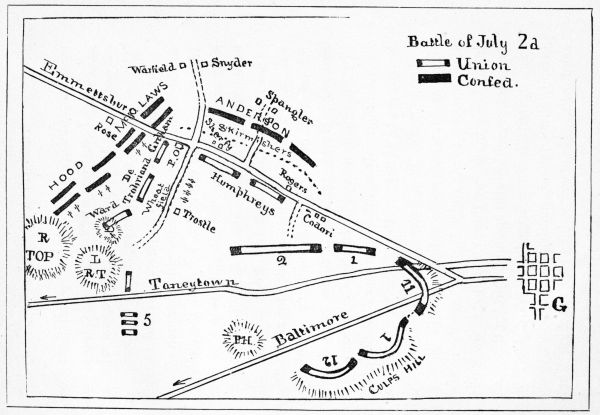
Explanation—R., Round Top; L. R. T., Little Round Top; D., Devil's Den; P. O., Peach Orchard; P. H.,
Power's Hill; G., Gettysburg.
See his Troops
described,
p. 26.
By and by the cannonade slackened. This was
sufficient notice to old soldiers that something
more was coming. Before its echoes had died away
Longstreet's first assaulting column, led
by Hood himself, came down with a
crash upon Birney, three lines deep.
The enemy was about to repeat his old tactics,
employed at Chancellorsville with so much effect,
of getting around the Union left and then rolling
it up endwise.[64] That his calculations in this case
were not quite accurate was soon made manifest.
Since noon Longstreet had been working his
way round through the woods toward Little
Round Top, making a wide circuit to avoid discovery.[65]
Having remonstrated in vain against
this movement, he was probably in no great hurry
to execute it. It was therefore four o'clock before
he was ready to begin. But if slow he was sure.
Longstreet's line crossed the Emmettsburg
road at an acute angle with it, Hood's division
stretching off to the right, McLaws' mostly to the
left. Longstreet was thus about to throw eight
brigades, or, by his own account, thirteen thousand
men, against the three brigades of Ward, De Trobriand,
and Graham, numbering about five thousand
men. Hood was to begin by attacking from
the wheat-field to the Devil's Den, McLaws to follow
him up from the wheat-field to the orchard. It was
not until they had got into line, however, that the
Confederates were undeceived about the Union
force before them. Until then they thought the
Union left stopped at the orchard.
At four o'clock the Union signal-station on
Little Round Top saw and reported these movements
to headquarters. The Confederate advance
began soon after four. By the first fire Hood
was wounded and had to leave the field almost
before his troops had fairly come into action.
Combat at
Devil's Den.
The first shock fell upon Ward's brigade, which
held the extreme left at the Devil's Den. Ward's
line would not reach to Little Round Top, so that
there was a wide space between him and this hill,
with not a man in it—a fact that Hood's men were
not slow either in perceiving or taking
advantage of. But, what was far worse,
it led to the discovery of the defenceless condition
of Little Round Top itself, and, quickly grasping
its commanding importance, the enemy instantly
sent one of his brigades to seize it.
The conflict thus established at this point,
which Sickles had so imprudently vacated, became
of supreme importance to the Union army,
while that about to begin at the peach orchard
degenerated into a struggle to save Sickles' corps
from annihilation.
Fortunately for Ward, the ground he held was
just the place for a protracted defence, provided
he should not be out-flanked. Weird and grisly,
it looked as if some huge excrescent mass of
earth, rocks, and trees had some time slid off the
flank of Little Round Top into the low ground
below, whence its own momentum had carried it
still farther on—a misshapen heap, deeply seamed
by rents and splits, thick-set with bowlders and
filled with holes and hiding-places, among which
Ward's men now found excellent cover.
The Danger
Point.
Ward was firmly planted on and around the
Devil's Den, with his sharp-shooters loading and
firing from behind the scattered bowlders, when
the enemy made their rush upon him, whooping
and yelling like so many fiends come to reoccupy
their own legitimate abode. Some
portion soon found themselves in the
unguarded hollow below. Seeing the enemy
crowding into it, Ward sent first one regiment
there, and then another, on the run. A combat
at close quarters ensued.
The regiments of Hood's division were now
either trying to scale Little Round Top, push
through the hollow, or capture the Devil's Den
with its guns. The left brigade, however, which
extended beyond the Den, was being very roughly
handled; the centre only had made progress, while
the right was engaged in a murderous conflict, to
be presently described. Hood's effort had, therefore,
exhausted itself, and his division had to halt
simply because it could advance no farther.
At the
Wheat-field.
McLaws now came to Hood's assistance. His
right brigade (Kershaw's) now struck De Trobriand's,
which stood next in line along the edge of
a wheat-field, back of and adjoining the Devil's
Den. De Trobriand had a little muddy
ravine in front of him, into which the
enemy boldly plunged. His men waited until
their assailants had got within twenty yards,
when they poured in such a close and deadly fire
that the gully was speedily vacated by all save
the dead and the dying. The attack here not
only completely failed, but three of Kershaw's
regiments were nearly destroyed while attacking
the peach orchard. This brigade fell back and
was rallied about the Rose house.
Semmes' brigade had followed close behind
Kershaw's, and now took its place. Its commander
speedily fell, mortally wounded. Barksdale
rushed upon Graham, followed by Wofford.
This onset brought the whole Confederate force
into action. The odds were as two to one.
That part of the enemy whom we left working
their way up the hollow to Little Round Top also
met with stubborn resistance, and as this was
more and more seen to be the critical point, the
enemy redoubled their efforts to force their way
through. Our soldiers who had gone into ambuscade
behind the bowlders there were being gradually
driven back from cover to cover, so yielding
up as they retired the approaches to Little Round
Top.
Devil's Den
taken.
Having gained this vantage-ground the Confederates
now made a second onset against Ward
and De Trobriand. This time it proved more
successful. After an hour's obstinate fighting,
Ward was driven out of his fastness,[66] De Trobriand
forced back across the wheat-field.
Sickles' left was thus completely
broken up, the fragments drifting backward in
search of some point of support.
Little Round
Top in Peril.
Little Round Top was about to fall into the
enemy's hands. Once in his possession, the
Union line on Cemetery Ridge would have to be
abandoned or swept to the winds. Fortunately
the turning-point had been reached before the
rebels could reap the reward of Ward's repulse.
Shortly before Hood's onset began,
General Warren, of the Engineers, had
seen from his signal-station on Little Round Top
the enemy's line advancing to the attack. In one
moment his experienced eye took in all the
danger. Ordering the signal officers to keep on
waving their flags, Warren first sent for and then
dashed off in search of assistance himself. Indeed,
not a moment was to be lost. By a fortunate
chance some troops were met moving out to reinforce
Sickles. Detaching a regiment, Warren
hurried it off to the threatened point. Meantime,
in response to his request, though without his
knowing it, Vincent's brigade was climbing the
rearmost slopes off Little Round Top, arriving just
in time to save the hill with the bayonet.[67]
A murderous hand-to-hand conflict now began
among the rocks and trees, with those of the
enemy who were trying to scale the slopes regardless
of death or wounds. Sometimes the assailants
were firing at each other from behind the
same bowlder; sometimes both fell at the same
instant. The strife was still unequal. A battery
was dragged to the summit;[68] three of the cannoneers
were shot in succession before the fourth succeeded
in firing off the piece. Another regiment
was brought up. The rebels fought as if determined
to take that hill or die: the Union soldiers
as if they had made up their minds to perish to
the last man in its defence. On both sides men
fell fast, the bravest first of all. Vincent was
killed outright, Weed mortally wounded, and only
a moment later Hazlett, who had so gallantly
scaled with his guns slopes seemingly inaccessible,
was struck down while in the act of stooping
over his commander's prostrate body. O'Rorke
was killed while encouraging his men. All the
superior officers were down. Never were rifles
wielded by such deadly marksmen as those
Texans of Hood's!
Little Round
Top saved.
Finding all their efforts to carry the hill by
storm useless, the rebels next made a rush up
through the little valley separating the two
Round Tops, with the view of taking the defenders
in the rear. The 20th Maine met this
assault. "Stand firm, men!" was the command.
As if maddened to desperation, the enemy flung
themselves upon the hardy backwoodsmen from
the Pine Tree State. Twice they were forced
backward over the crest, and twice they rallied
and drove their assailants back in their turn. But
the emergency had now been perceived and was
being provided for. Fresh troops
dashed over the hill to the aid of those
who were fighting. A final charge sent the
rebels reeling down into the hollow, and out of
it by the way they came, leaving five hundred
prisoners in the hands of the defenders, through
whose gallantry the danger, though perilously
imminent, had been averted.
McLaws
assaults.
Sickles
wounded.
Meantime the peach orchard was being furiously
attacked. Exposed here to a severe cross-fire,
the Union line crumbled away
at every discharge. The resistance was
stubborn, as might be expected from such good
soldiers as Graham's, but even they could not
long maintain such a disadvantageous position,
and though the attacking brigades were badly cut
up, the enemy broke through there after a bloody
contest. Barksdale swept on over the guns,
Wofford gathered up what he left behind. All
that men could do to stem the tide was done, and
all in vain. Graham was wounded and
taken prisoner, Sickles himself carried
off the field, shot through the leg. In less than
two hours Birney's line was clean gone.
As the infantry fell back from the orchard, the
artillery posted along the cross-road behind them
became, of course, the enemy's object. Many of
these guns had to be abandoned, some sacrificed in
the effort to delay the enemy's progress. Bigelow's
battery obeyed the order to fight to the last
with a constancy as worthy of lasting commemoration
as Perry's famous "Don't give up the ship!"
Though the position itself was scarcely worth
the sacrifice of a single soldier, it was felt that
Sickles' troops must be extricated at any cost;
and since a battle had been forced we must not
be the losers.
Efforts
to help
Sickles.
So after sending Vincent's brigade to Little
Round Top, the rest of Barnes' division went out
to help maintain the line where De
Trobriand had been fighting; and
Caldwell's division of the Second Corps
also went to Ward's assistance.
Repulsed from Little Round Top, the enemy fell
upon Caldwell. The struggle was brief but bitter.
Half a score of general and field officers went
down on the Union side. But Caldwell finally
succeeded in driving the enemy back across the
ravine from which Ward had been dislodged, and
two brigades of regulars firmly closed the gap
toward Little Round Top.
But the point of support at the orchard being
gone, all these troops were in turn driven back
after repeated charges and countercharges made
across the wheat-field had piled it with the slain of
both armies.
Anderson's Confederate division now advanced
to perform its share of the work cut out for it;
namely, of continuing the assault from right to
left.
Humphreys
driven off.
One side of the angle being swept away, being
violently assaulted both in front and flank, Humphreys
also had to fall back from the
Emmettsburg road to the main position,
or be cut off from it. Everything that had been
fighting on Sickles' new line was now going to
the rear in more or less confusion. The enemy
were now masters of the whole of that line, had
inflicted serious losses upon the Third and Fifth
Corps, and had taken some of Sickles' guns.
We had only Round Top to show for the terrible
struggle resulting from Sickles' advance.
Crumbs of
Comfort.
These disasters could not make our generals
give up beaten yet. Crawford's "Pennsylvania
Reserves," a splendid body of well-seasoned soldiers,
were now ordered to drive the victorious
enemy beyond the wheat-field. Seizing a color,
the general himself led the charging column
across this thrice-fought field, clearing
it in the most gallant manner. Two
brigades of the Sixth Corps followed this movement.
These prompt measures completely discouraged
all further efforts on the enemy's part
in this quarter. Longstreet withdrew his shattered
forces to the peach orchard. In these unavailing
assaults he had lost upwards of five thousand men.
Hood was wounded, Barksdale killed, and Semmes
mortally wounded.[69]
After this repulse, some of Doubleday's division
went out to the Emmettsburg road, capturing the
enemy's post at the Rogers house on that road.
It was now growing dark. Lee's brilliant plan
of consecutive attack from right to left had
dwindled to a series of isolated combats—a blow
here and a blow there, instead of those combined
and telling strokes he had designed giving all
along the Union line.[70]
Cemetery
Ridge
pierced.
In falling back upon Cemetery Ridge, which
was done in admirable order, Humphreys was
followed up by three of Hill's brigades, one of
which, Wright's, actually succeeded in reaching the
crest, and had even seized some of the
guns there, before troops could be
brought up to check it. The other
brigades having failed to support it, this one was
easily driven off, though its having pierced the
Union centre with so little opposition undoubtedly
led Lee to think the thing not so difficult, after all.
We think it was the controlling motive for his
attack on the third.
Culp's Hill
deserted.
And is
occupied.
One other conflict remains to be noticed. The
peril menacing his left had induced Meade to
nearly strip Culp's Hill of its defenders. All of
the Twelfth Corps, which, it will be remembered,
held Culp's Hill and its approaches, had been
hurried over to the left, except one brigade, thus
abandoning the rude but substantial breastworks
that these troops had raised with felled trees, earth,
or loose stones, against an attack. As
yet all seemed quiet on this side; but
when, shortly after sunset, Ewell's corps tardily
began the part assigned it by pouring out of the
woods in which it had lain concealed, to begin a
furious assault upon Culp's Hill, his men found
nothing before them except the undefended works
just spoken of on that part of the hill bordering
upon Rock Creek. Finding the door
standing open, as it were, they had
only to walk in and take possession.
The Danger
of it.
Trifling as it seems when relating it, this was by
far the most important, we might say the only
real, advantage gained by the enemy in all this
day's fighting, with its frightful losses in men and
material—and for this reason: The point seized
was within short musket-shot of the
Baltimore pike, and quite near that
part of it where the reserve Union artillery was
parked. This might be seized or stampeded.
More than this, the pike led first to Westminster,
where Meade had fixed his base of supplies before
moving up to Gettysburg, so making it from necessity
his line of retreat in case of a reverse to the
army. In short, this was one of those desperate
cases that admit only of desperate remedies;
either the Confederates must be driven out before
they could look about them, or the army must
retreat. Again, night undoubtedly saved the
Union army from a great disaster.
Farther to the left Greene's brigade met and
repulsed every assault made upon them. The
combat took place in the thick woods, already
darkened by the approach of night.
Cemetery
stormed.
While this was happening at Culp's Hill, the
rest of Early's Confederate division came on in
the early twilight to the assault of Cemetery Hill.
The day had worn itself out, the west only glowed
a sullen red upon the battlefield. Early's dusky
lines could scarce be made out except
by the flashes of musketry seen here
and there. One of his brigades struck the side
nearest Culp's Hill (the gap side), where the
Union infantry were kneeling behind stone walls,
waiting with guns cocked for them to get up
nearer; the other brigade, with a third in reserve,
marched on the right of the first. Thirty odd
guns flamed and thundered upon them from the
Cemetery. The hillside was lighted up by flashes
of musketry. It was one incessant blaze and
roar. The left brigade was mowed down in
swaths, and had to give way; but that on the
right forced its way through the ranks of the
infantry, swarmed up around the guns that were
dealing death among them, and began a hand-to-hand
fight with the artillery-men, in which men
were beaten to death with handspikes and rammers.
Enemy is
repulsed.
The Confederates enjoyed a short-lived triumph.
An ominous silence succeeded the struggle around
the guns. Word was passed that the
enemy was in our works. Orders were
given in whispers, for it was now too dark to
tell friend from foe. The steady tramp, tramp of
armed men was now heard approaching. Presently,
out of the darkness, a brigade of the Second
Corps rushed in with a cheer. Being joined by
other troops, all fell upon the exultant Confederates,
who, finding themselves left without
support, saved themselves as they could. As it
was, not half of them got back to their own
lines.
This ended the fighting for the day. Darkness
and exhaustion summoned the weary soldiers of
both armies to a much-needed rest. Thus far the
two days' fighting had proved indecisive. On the
left the enemy had taken a somewhat closer hold,
yet the Union position was everywhere practically
intact except at Culp's Hill.[71] It is true that both
armies were much weakened from loss of blood,
although their relative strength remained much as
before. Perhaps the Union army had suffered
most, because its reinforcements were thrown in
piecemeal, and badly cut up before they could
render effective assistance.
It now began to be understood that if the
Union army had not sustained a defeat, it was not
so much because of any natural strength of the
ground, since the Confederates had twice forced a
way to it, as because its form enabled troops to
concentrate upon the threatened point with great
rapidity. To lengthen it out, as Sickles had done,
was to throw away this advantage. He had
finally been forced to retake his natural position.
Herein, we think, lies the whole secret of
Meade's successful defence. The first of July was
an accident: the second, a blunder.
IX THE THIRD OF JULY — FOOTNOTES:
The events of the second seem to have impressed
the two generals quite differently. In
Lee the combative spirit rose even higher. To
Meade the result seemed, on the whole, discouraging.
The enemy held a strong vantage-ground
on his right; his line had been twice pierced.
Would he be better able to hold it now that the
army was weakened by the loss of eight to ten
thousand men?
Meade's
council.
At nightfall a council of war was called, and
the situation discussed. Meade desired to know
first the condition of the troops, and next the temper
of his officers. To this end they were separately
asked whether they favored a removal of the
army to some other position, or waiting
another attack where they now were.
The general voice was in favor of fighting it out
to the bitter end, and it was so determined.
A strong force of infantry and artillery was
therefore moved over to the right, in readiness to
expel the enemy there at break of day.
Lee not
beaten yet.
Deeming the result of the day's operations to
be on the whole favorable to him, Lee was equally
determined to fight to a finish. As Napoleon had
said before him, in a similar spirit of impulsive exultation,
when satisfied that Wellington
was awaiting his onslaught at Waterloo,
"I have them now, those English!" so Lee
now replied to all Longstreet's remonstrances by
shaking his clenched fist at Cemetery Hill, exclaiming
as he did so, "The enemy is there, and I
am going to strike him!"
Plan of
Attack.
He too, therefore, strongly reinforced his left at
Culp's Hill, with the view of having a heavy force
well in hand there, ready to strike in upon the
Union right and rear, while a formidable column
of wholly fresh troops, charging it in the centre,
should cut that in two, seize the Baltimore pike,
and with Ewell's help crush everything on that
side. In order to reap to the utmost the advantages
looked for as certain, Stuart's cavalry,
now back with the army, was sent
far round to the Union rear, with orders to strike
the Baltimore pike as soon as the retreat should
begin.
To guard against some such movement, or in
fact any demonstration towards its rear, the Union
cavalry was posted on this pike, a few miles back
of Cemetery Ridge. Still another cavalry force
was guarding the Union left, beyond Round Top.
These dispositions present, in brief, the preparations
both generals were making for the third
day's conflict.
Pickett to
lead it.
Lee had silenced Longstreet's objections by ordering
him to get ready Pickett's fresh division for
the decisive charge on Cemetery Ridge. These
soldiers, Virginians all, bitterly complained because
they were only the rear-guard of
that army which they were told was
driving the Yankees before them in utter rout.
Their charge was to be preceded and sustained by
turning every gun in the Confederate army upon
the point of attack.
With the first streak of day the struggle for the
possession of Culp's Hill began again. As both
sides had orders to attack, there was no delay in
commencing. Soon from every commanding spot
the Union batteries were sending their shot crashing
and tearing through the woods in which the
Confederates lay hid, smiting the forest with a
tempest of iron, throwing down branches, and
plowing up the earth in great furrows.[72] Stirred
up by this shower of missiles, Ewell's men poured
forth from the valley of Rock Creek, and rushed
up the hillside in front, to begin anew the sanguinary
struggle they had only ceased from on
the previous night. Here among the gray rocks
and aged oaks—the pleasure-ground, in fact, of
the people of Gettysburg—a contest raged for
hours, similar to that which Little Round Top
had witnessed on the previous afternoon.
One piece of hopeless heroism deserves commemoration
in all accounts of this battle. In the
height of the engagement an order was brought
for two regiments, the Second Massachusetts and
the Twenty-seventh Indiana, to charge across the
meadow stretching between Culp's Hill and McAllister's
Hill, on the other side of which the enemy
lay in the old intrenchments. To try to pass
that meadow was rushing to certain destruction.
"Are you sure that is the order?" was demanded
of the officer who brought it. "Positive,"
was the reply. "Up, men—fix bayonets—forward!"
was the ringing command. One regiment
reached the works, the other faltered midway
under the terrible fire. As many were lost
in falling back as in going forward. Only half
the men got back to the lines unhurt.
Culp's Hill
retaken.
After seven hours of this kind of fighting, the
assailants were finally driven beyond Rock Creek
again, leaving five hundred prisoners, besides their
dead and wounded, behind them. Again
an essential part of Lee's plan of attack
had signally failed, and once more the whole
Union line stretched unbroken from Culp's Hill
to Round Top.
But it was only eleven o'clock; and though the
battle had gone against him on this side, Lee
seems to have felt, like Desaix at Marengo, that
there was still time to gain another. Was it here
that Lee lost that moral equipoise which seems
born in really great commanders in moments of
supreme peril?
The Cannonade.
Be that as it may, the order was given for his
artillery to open. Longstreet had massed seventy-five
guns in one battery, Hill sixty-three, and
Ewell enough more to bring the number up to
one hundred and fifty in all. At precisely one
o'clock the signal guns were fired.
Before their echoes died away the
whole line of Confederate batteries was blazing
like a volcano. There seemed to be but one flash
and one report, and their simultaneous discharges,
pealing out deafening salvos, went rolling and
rolling on through the valleys, and echoing
among the hills, in one mighty volume of sound,
vying with the loudest thunder. It was sublimely
grand, sublimely terrifying. Without a
moment's warning, as if the heavens above had
opened and the earth below yawned beneath their
feet, the Union soldiers found themselves in the
midst of the pitiless storm. A tornado of shot
and shell burst upon Cemetery Hill, tearing
the air, rending the rocks, plowing up the
ground, and dealing death on all sides at
once.
This terrific cannonade, under which the solid
earth shook, the sky was darkened at noonday,
the valley filled with thick-rolling smoke, the air
with explosions and nameless rubbish, and which
seemed announcing the coming of the Last Day,
is thus described by an eye-witness:—
"The storm broke upon us so suddenly that
soldiers and officers who leaped, as it began, from
their tents, or from lazy siestas on the grass, were
stricken at their rising with mortal wounds, and
died, some with cigars between their lips, some
with pieces of food in their fingers, and one at
least—a pale young German from Pennsylvania—with
a miniature of his sister in his hands.
Horses fell shrieking out such awful cries as
Cooper told of, and writhing themselves about in
hopeless agony. The boards of fences, scattered
by explosions, flew in splinters through the air.
The earth, torn up in clouds, blinded the eyes of
hurrying men; and through the branches of the
trees and among the gravestones of the cemetery
a shower of destruction crashed ceaselessly. The
hill, which seemed alone devoted to this rain of
death, was clear in nearly all its unsheltered places
within five minutes after the fire began."
Eighty guns replied from the Union position
almost as soon, so that the very air between the
two armies was alive with flying missiles.[73] During
the cannonade the Union infantry were lying
down in open ranks behind the crest, taking it, for
the most part, with remarkable steadiness. As the
enemy's artillerists mostly overshot the ridge, the
ground behind was a place of even greater danger.
The little farmhouse standing on the Taneytown
road, occupied as army headquarters, was so
riddled that the general was compelled to seek a
safer spot. Even as far back as Culp's Hill,
where the Twelfth Corps were still facing their
assailants, the enemy's shot came plunging and
plowing through the ranks from behind, thus
killing men by a fire in the rear.
After this indescribable uproar had lasted upwards
of two hours, the Union batteries were
ordered to cease firing in order to husband their
ammunition for what every man in the army knew
was coming.
It was now three o'clock. The moment had
come for the supreme effort of all.
All the Union generals now set themselves to
work repairing the damages caused by the
cannonade—re-forming ranks, replacing dismantled
guns, rectifying positions, exhorting the men
to stand firm, and, in short, themselves offering
the highest examples of coolness and soldierly
conduct.
Union
Defences.
We had a first line of infantry posted along the
foot of the heights,—some behind stone walls,
when these followed the natural line of defence, as
they now and then did; some behind rocky inequalities
of the ground,—with artillery above and
behind it; and there was a second line
of infantry back of the crest. Although
Meade is said to have expected, and even told
some of his officers, that Lee's next blow would
fall on the Union centre, we detect no specific
preparation to meet it.
The Storming
Column.
The troops designated for the assault were
waiting only for the order to advance, Pickett's
splendid division on the right, Pettigrew's, lately
Heth's, on the left, with two brigades in support
of Pickett, two in support of Pettigrew, and still
another marching at some distance in the rear.
Though the equals of any in that army,
Heth's soldiers had been so much
shaken by their encounter with the First Corps
that they were far from showing the same ardor as
Pickett's men. All told, the assaulting force numbered
not less than fifteen thousand, and probably
more.[74]
Pickett was watching the effect of the artillery-fire
when a courier brought him word from the
batteries that if he was coming at all now was his
time, as the Union guns had slackened their
fire. After reading it himself, Pickett handed the
note to Longstreet at his side. "General, shall
I advance?" Pickett asked his chief. Mastered
by his emotions, Longstreet could only give a nod
of assent and turn away. "I shall lead my division
forward, sir," was the soldierly reply.
As the charging column passed through them
to the front, fifteen or eighteen guns followed
close behind in support.
Friend and foe alike have borne testimony to
the steadiness with which this gallant band met
the ordeal—by much the hardest that falls to the
soldier's lot—of having to endure a terrible fire
without the power of returning it. No sooner
had the long gray lines come within range than
the Union artillery opened upon it, right and left.
For a quarter of an hour the march was kept
up in the face of a storm of missiles. Cemetery
Hill was lighted up by the flashes. Little
Round Top struck in sharply. Smoke and flame
burst from the batteries along Cemetery Ridge.
Solid shot tore through the ranks; shells were
bursting under their feet, over their heads, in their
faces; men, or the fragments of men, were being
tossed in the air every moment, but, closing up
the gaps and leaving swaths of dead and dying
in their track, these men kept up their steady
march to the front, as if conscious that the eyes
of both armies were upon them. They had been
told that the enemy's artillery was silenced!
Pickett's
Advance.
As soon as they could do so without injury to
their own men, the Confederate guns began afresh,
so that again shells streamed through
the air and balls bounded over the plain
without intermission, dense smoke shutting out the
assailants from view.
Protected by the fire of this redoubtable artillery,
the column continued its deliberate march.
When within five hundred yards, or about to
cross the Emmettsburg road, it suddenly moved
off by the left flank a short distance, as if to
close up a break in the line or recover the true
point of attack—some say one and some say
the other. Be that as it may, Pickett's men first
received the fire of Stannard's Vermont brigade
while making this flank march, and again encountered
it on their flank after facing to the front for
the purpose of resuming their advance toward
the heights.
This must be considered, we think, as the turning-point
in the assault. Stannard's attack, made
at such close quarters, so shattered Pickett's right
brigade that this flank of the assaulting column
never reached the crest at all, but drifted more and
more to the rear, lost to all organization. Thus
was repeated that memorable manœuvre of the
Fifty-second Regiment against the Imperial Guard
at Waterloo, and with like results; for before the
close and deadly fire poured in upon them at
only a few rods' distance—a fire they were powerless
to return—Pickett's right was either shot to
pieces or crowded in upon the centre, so throwing
it into disorder and checking its momentum, while
the Green Mountain boys, aided now by other
troops, clung to their mutilated flank, following it
up step by step, and firing into it as fast as the
men could load.
Eight batteries were now pouring canister into
Pickett at point-blank range, carrying away whole
ranks of men at every discharge. Before him,
between two little clumps of trees, which Lee
himself had carefully pointed out and Pickett
was making such heroic efforts to reach, lay the
Second Union Corps. As the men of this corps
realized that the brunt of the charge was to fall
on them, they grew restive and anxious; but
Gibbon, curbing their impatience with voice and
gesture, quietly said, as he passed along the
ranks, "Hold your fire, boys—they are not near
enough yet."
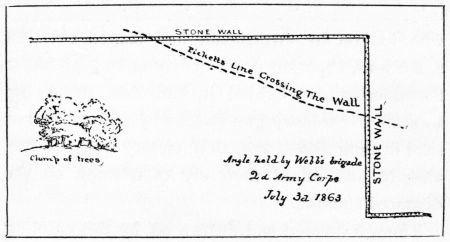
Point where Pickett's Charge was stopped.
The Final
Charge.
Pickett's first line had come within a hundred
and fifty yards when the order was given to fire.
It was followed by a terrible volley before which
that line went down like grass before the scythe.
When the smoke rolled away the charging lines
were seen inextricably mixed together, all order
lost—a frantic mob covered with blood and dirt,
with scarce a general officer left, but not in retreat.
On the contrary, with a rush and a roar, heard
above the din of cannon and musketry, the surging
mass came rolling and tumbling on, like waves
against a rocky shore, firing, screeching,
brandishing swords and battle-flags, one
moment swallowed up in smoke, the next emerging
a few paces nearer. Officers became separated
from their men; generals no longer led their own
brigades, but with uplifted swords rushed on to the
front, calling on their men to follow. One after
another they fall. Individual example and heroism
were the only things that could count here, and
neither was wanting. One thought and one purpose
seemed to animate them, and that was that
they must either conquer or die. Sublime heroism!
Sublime folly!
In this manner one portion of the Confederates
struck and overwhelmed the first Union line, driving
its defenders back upon the second. Here
they turned and faced their infuriated assailants,
who, led on by Armistead, had leaped the last
stone wall, shooting down or bayoneting all those
found crouching behind it, had then rushed up
to seize the solitary gun that had just fired its last
shot in their faces, and, as if victory was assured,
already had raised their cry of triumph on the
disputed summit.
The Repulse.
Though divided and thrown off by this entering
wedge, the Union soldiers, who now came swaying
up from right to left, soon seized it as in a
vise. For a few minutes an indescribable mêlée
raged here on half an acre of ground, at push of
bayonet, hand to hand, muzzle to muzzle, breast to
breast. Gradually the enclosing lines
surged forward. Armistead was shot
down by the side of the captured gun. The Confederates
turned to fly, but found the way barred to
them on every side. Imbedded by its own force,
the living wedge could not be withdrawn. They
surrendered in swarms, while those who dared the
dangers of again crossing that fatal plain, now
spread themselves out over it in every direction.
When it was all over with Pickett, the two supporting
brigades came up on the right, only to be
repulsed by a few volleys. Pettigrew had been
defeated almost before he could come to close
quarters, Pickett destroyed, Wilcox brushed away.
From his post of observation Longstreet had
watched the advance up the ridge. "I saw," he
says, "the crest of the hill lit up with a solid sheet
of flame. When the smoke cleared away the
division was gone. Nearly two-thirds lay dead on
the field, and the survivors were sullenly retreating
down the hill. Mortal man could not have stood
that fire."
Again the old story. An assaulting column has
been driven through an opposing line, it is true,
but with the loss of all organization, without a supporting
force to follow up the advantage it has
gained, it finds itself in a trap where it is in danger
of being sacrificed to the last man. Unable to
execute the simplest manœuvre, it is at the mercy
of any organized body brought against it. Lee
seemed to have forgotten Fredericksburg. Longstreet
did better at Chickamauga.
Cavalry
Battles.
Two cavalry battles belong to the complete
history of this remarkable day, though in no
way affecting the main result. In the first
Stuart attacked and was defeated. This was
cavalry against cavalry; and as Pickett's
front attack was repulsed, that in
the rear amounted to little in itself. In the
second Kilpatrick made a bold dash into Hood's
rear, about Round Top, with the view of throwing
the enemy into confusion, breaking up his
line there, and so facilitating an advance by the
Union forces in that quarter. This was cavalry
against infantry in position, and the ground
the worst possible for cavalry manœuvres. For
an hour the enemy had our troopers riding
round them with drawn sabres, receiving the fire
first of one regiment and then of another. No
advantage being taken of the diversion, the
cavalry was nearly cut to pieces.
X THE RETREAT — FOOTNOTES:
Gettysburg
evacuated.
Lee's New
Position.
Thrice had the sun gone down on that ensanguined
field, where one hundred and fifty
thousand men had striven for the mastery and
forty thousand sealed their devotion with their
blood. Exhausted by their efforts, the Confederates
thought only of making good their retreat.
Gettysburg was immediately evacuated
and both wings drawn back on the
main body, so that, as now re-formed and contracted,
Lee's army stretched from Oak Hill to
the peach orchard. Behind this line,
and under cover of its woods, he was
now getting ready to retreat.
Such plain indications could hardly be overlooked.[75]
A reconnoisance from the Union left
found the Confederates retiring. During the
night the Union troops went forward to the
battlefield of the 2d.
Lost
Chances.
Lee's lost opportunity on the 1st was as
nothing to Meade's on the 3d. It came when
the Confederates were in the confusion resulting
from their repulse. It was lost, however, because
the great captain was not there.
Meade was unequal to exacting a
supreme effort at this moment, either from his
army or himself. To let slip this opportunity
was to tempt fortune itself, and it never came
again.
Strange
Inaction.
But if from any of the many causes alleged,[76]
or all of them put together, the one chance out
of a thousand, for which all this marching and
fighting had been going on, had eluded Meade's
grasp, or if it be conceded that he found Lee's
new position so strong as to hold out no hope
of a successful assault, history will still demand
to know why this beaten army, short of ammunition,
encumbered with its wounded, its prisoners,
and its wagons, thirty to forty miles from the
Potomac, with a mountain defile to pass and a
wide river to cross, was suffered to
march off unmolested with all its immense
spoil, and not only to do that, but to remain
eleven days between Gettysburg and the
Potomac without being once seriously attacked.
Lee in a
Tight Place.
That Lee could not long remain on Seminary
Ridge, let his position be ever so strong, was a
self-evident proposition. He had exhausted his
means of attack, his army was cut
down by more than twenty thousand
men, his ammunition was nearly expended, nor
could it be replenished short of Virginia. His
means of defence were therefore extremely limited.
If it had been possible to detain Lee where
he was, even for a few days longer, his surrender
was a foregone conclusion without firing another
shot. But taking the situation as we find it,
we do not see how he could have been more
critically placed, if in the presence of an enterprising
opponent. Lee's attitude after the battle
savors far more of bravado than a desire to
be attacked. To block his retreat it would
have been necessary to seize the Monterey
Pass immediately after the battle.[77] Meade
had the shorter line. His cavalry would have
kept Lee at bay until the infantry could come
up. He should never have suffered Lee to put
South Mountain between them without making
an energetic effort to prevent it. As the Union
army remained immovable until this was done,
we have only to chronicle in brief the inglorious
ending of an otherwise glorious campaign.
Read over
Chap. I.
All the 4th the two armies lay in the positions
just now described. Lee's direct line of retreat
to the Potomac was by the Fairfield and Hagerstown
road, which crossed the mountain below
and behind him through the Monterey
defile. To withdraw his army and
trains by this one road was altogether impracticable.
The trains and wounded were therefore
started off during the afternoon of the 4th, in
a drenching rain, by the Chambersburg road,
under a strong escort of cavalry and artillery,
but no infantry.[78] When stretched out on the
road this train was seventeen miles long.
Lee's
Wounded.
Being ordered to push on to the Potomac without
halting, the sufferings of the wounded were
horrible beyond description. Travelling all night
and avoiding Chambersburg, this column
struck across the country to
Greencastle, and after fighting its way all day
against detachments of Union cavalry, finally got
to the Potomac at Williamsport, on the afternoon
of the 5th, with the loss of a few wagons. After
the escort had passed through Greencastle, the
citizens turned out and attacked the wagons in the
rear with axes, so disabling some and delaying
the rest.
When the wagon train got there, the Potomac
was found too high to be forded. The bridges
were gone, and the trains could not get across
that way.[79] So there Lee met his first check.
After giving his trains a twelve hours' start,
Lee put his army in motion for the Potomac by
way of Fairfield and Hagerstown, by daylight of
the 5th.
Lee's
Infantry
move off.
A Lame
Pursuit.
The road being unencumbered by trains,[80] the
Confederates were able to move with celerity and
silence. As soon as his departure was discovered,
the Fifth and Sixth Corps moved out
in pursuit. But it was then too late.
Lee had stolen a march on his pursuers.
An officer of this force says of its tardy
operations:—
"As we moved, a small rear-guard of the enemy
retreated. We followed it up to Fairfield, in a
gorge of the mountains. There we again waited
for them to go on. Then only one
brigade, with the cavalry, continued to
follow them, while the rest of the corps turned off
to the left, toward Boonsboro," to which point the
main body was now directing its march. Lee had
got the short road and left Meade the long
one.
Union Army
en Route.
Lee's army was thus safe back again in the
Cumberland Valley before Meade was ready to
pursue.[81] Having abandoned the idea of forcing
the Monterey Pass, and so following up and
harassing the enemy's rear, we have
just seen the infantry turning off to the
south, on the Gettysburg side of South Mountain,
as if to head off Lee from the Potomac by this
roundabout way, or, in short, by a march of fifty
miles to his thirty, and after giving him a start of
ten. This was to force the Union army to efforts
which had just proved so exhausting. Nothing
could exceed the impotence of this pursuit. In
reality, the march up to Gettysburg to find and
attack Lee was now being repeated. But fate,
not Meade, was so checking Lee at every point
that but for the weakness or delays of his adversary
the Confederate general could never have
saved his army as he did.
Lee brought
to a Halt.
Lee Escapes.
Even before Lee could reach Fairfield, General
French[82] had reoccupied Harper's Ferry, destroyed
the enemy's pontoon train at Williamsport and
Falling Waters, and captured the
guards. Finding his means of crossing
gone, nothing remained for Lee but to show a
bold front until they could be restored. And the
long détour the Union army was making left him
ample time in which to render his new position
between Hagerstown and Williamsport so strong
that when Meade[83] finally got his army up before
it he again hesitated to attack. The tables were
now fairly turned on him. His generals mostly
shared in this feeling of respectful fear. Stung
by the President's censure, Meade at last bestirred
himself. Again he was too late. How often
during this campaign have we been obliged to
repeat those ill-omened words! In the language
of the general-in-chief, Halleck:—
"Instead of attacking Lee in this position, with
the swollen waters of the Potomac in his rear,
without any means of crossing his artillery, and
when a defeat must have caused the
surrender of his entire army, he was
allowed time to construct a pontoon bridge with
lumber collected from canal-boats and the ruins of
wooden houses, and on the morning of the 14th
his army had crossed to the south side of the
river. His rear-guard, however, was attacked by
our cavalry and suffered considerable loss. Thus
ended the rebel campaign north of the Potomac,
from which important political and military results
had been expected. Our own loss in this short
campaign had been very severe; namely, 2,834
killed, 13,709 wounded, and 6,643 missing—in
all, 23,182. We captured 3 guns, 41 standards,
13,621 prisoners, 28,178 small-arms."
The Confederate losses, considering that they
were always the assailants, must have exceeded
these figures.[84] As it is well known that Pickett's
losses were suppressed by Lee's order, any
compilation must be necessarily incomplete.
Ten whole days thus elapsed from the time
Lee fell back defeated from Cemetery Ridge
until he recrossed the Potomac. He had brought
off his army, his plunder, with upward of four
thousand Union prisoners, by his opponent's leave,
as one might say. There is a saying that a British
army may be gleaned in a retreat, but not reaped.
So far, in this war, barren victories had been the
rule, and fruitful ones the rare exception.
We do not find much to say in praise of a
retreat that was nowhere seriously molested. It
has, we know, been lauded as a marvel of skill.
Lee's patience alone was severely tested. The
crossing of the Potomac was effected without
hinderance in the presence of Meade's whole army,
partly by the bridge at Falling Waters, partly by
the fords at Williamsport. True, the Union cavalry
did a great deal of hard riding and scouting;
but it, too, failed to destroy Lee's trains on the
6th, when it was in its power to have done so, and,
in all probability, compelled his surrender.
XI THINGS BY THE WAY
The battle of Gettysburg has often been called
the turning-point of the war between the States.
It was certainly the greatest of the many great
conflicts of that war—the greatest exhibition, we
will say, of stubborn fighting. There, if ever, it
was that Greek met Greek. During three sweltering
midsummer days, two numerous, well-appointed,
veteran armies, ably led and equally
nerved to their utmost efforts, fought for the
mastery with equal resolution and bravery. For
three days the result hung in suspense. Through
all those terrible days the battle constantly grew
in its proportions and intensity. From first to
last, until the last gun was fired, the hush of
expectancy fell upon the land. It was felt that
this battle must be decisive. On one side, at
least, was the determination to make it so. The
impoverished Confederacy was staking its fortunes
upon a last throw.
Yet this battle was singularly indecisive. On
the first day the Union forces suffered a serious
reverse; on the second they narrowly escaped a
defeat; but on the third the Confederates were so
signally repulsed that nothing was left them but
retreat. This they effected with boldness and
skill, in spite of the victors, in spite of the elements—in
fine, in spite of that fortune which
seemed to have turned against them from the
moment of their defeat.
Considered, then, only as a battle, Gettysburg
was a series of isolated combats, delivered without
unity and followed by no irremediable reverse to
the vanquished. In no military sense, therefore,
can it be called decisive. In a political sense it
was even less so, because Lee's army was neither
destroyed, nor were the resources of the Confederacy
fatally crippled. Rather was it a trial of
strength between two athletes, one of whom, after
throwing the other, tells him to get up and go
about his business—in short, a mere pounding
match.
Yet Gettysburg ought to have been the Waterloo
of the Confederacy. Then and there that
war should have ended. To say that the whole
country was aghast at Lee's escape would be only
the plainest expression of the popular feeling of
the day. Naturally enough one great chorus of
disappointment greeted its announcement. Was
this all? Had these two armies merely had a
wrestling match? Had Meade and Lee compared
their bruises, only to separate with the understanding
that they would fight again at some
future day when both felt stronger? Apparently
the war was no nearer its ending than
before. To the common understanding it did
seem "a most lame and impotent conclusion."
If the Confederates could not be crushed when
everything conspired against them, and in favor
of the Union army, when would they be?
That Lee extricated his army from its highly
dangerous position must no longer be attributed
to his superior generalship, we think, but to the
want of it on the Union side. It is vain to ask
why this or that thing was not done, since this
campaign is unique for its omissions. Meade at
Gettysburg was like a man who has been pushed
into a fight reluctantly, and who stops the moment
his adversary is down.
The history of this battle is largely that of the
two commanders and their subordinates. Things
done or left undone control the destinies of
nations as well as of individuals. The want of
cordiality among some of the Union generals was
an incident of importance.
In arresting Lee's triumphal march, Meade had
undoubtedly achieved all that the best-informed
persons would have asked of him when he took
the command, more perhaps than he allowed himself
to expect when the magnitude of the task
first unfolded itself to his troubled vision. His
measures are so expressive of this want of confidence
that any other conclusion seems inadmissible.
Very sanguine persons, indeed, said that
Lee ought never to return to Virginia except as a
prisoner of war. The bare notion of a successful
invasion by seventy thousand or eighty thousand
men, with one hundred thousand behind them
and the whole North before them, was scouted as
a piece of folly designed and put in execution
by madmen. If one hundred thousand were not
enough, were there not one hundred and fifty
thousand available? When Lee got to the Susquehanna
these demands were somewhat lowered.
They did not know, these unreflecting persons,
that what an army wants is not men, but a man—one
man.
So far this army had been a school in which
mediocrity had risen. The really great commander
had not yet forced his way to the front in
spite of cabals in or out of the army. There had
been a series of experiments—disastrous experiments.
No army had ever marched more bravely
to defeat or so seldom to victory. Few expected
victory now.
Yielding to an imperative order, Meade found
the Herculean task thrust upon him, with the fact
staring him in the face that a defeated general
meant a disgraced one.
But even then he did not find himself free to
handle his army as he thought proper, because in
Halleck he had always a tutor and critic who
from his easy-chair in Washington assumed to
supervise the acts of the commander in the field.
Upon a not over-confident general the effect was
especially pernicious. The war-cry at Washington
was, "Beat the enemy, but make no mistakes!"
This was constantly ringing in Meade's
ears. As Halleck was an excellent closet strategist,
some of his suggestions would have been
eminently proper and useful, could he have been
on the spot himself, but under existing conditions
they could serve only to make Meade still more
hesitating and timid. Handled in this way, no
army has ever achieved great results, and no army
ever will achieve them.
At the close of the Third Day's sanguinary
encounter with Lee, Meade had found himself
victorious. The fact that the fortune of war had
thus placed the initiative in his hands seems to
have become a source of embarrassment and perplexity;
from that moment his acts became
timid, halting, partial. When pressed to more
active measures he flew into a passion.
The fault, as we look at it, was not so much in
the commander as in the man. Meade the commander
could do no more than Meade the man.
He was no genius. He was only a brave, methodical,
and conscientious soldier, who, within his limitations,
had acted well his part. Under Grant he
made an excellent so-called second in command.
It has been said that in defending itself successfully,
the Union army had done all that could be
expected, under the circumstances. Must we then
admit that for Lee not to conquer was in itself a
victory? Unquestionably there was a prevalent,
a somewhat overshadowing, feeling that all the best
generalship was on the Confederate side.
By a sort of perversity of the human mind, a
certain class of critics is always found ready to
prove why a beaten general is the best general.
Nevertheless, Lee himself goes down in history
as a general who never won a decisive victory.
He was certainly lucky at Gettysburg. For a
time his great reputation silenced the voice of
criticism. His own subordinates are now accusing
him of making fatal mistakes. May it not be
equally true that Lee rashly undertook more at
Gettysburg than he was able to perform? He has
as good as admitted it. Carried away by a first
success, he committed the old mistake of underrating
his adversary. His victory of the first day
was due to no combinations of his own, because
he was then completely ignorant of where the
Federal army was. He supposed it at least twenty
miles off. His success of the second, again, arose
first out of an entire misconception on his part
as to the Union position, which was nowhere near
where he thought it was, and next from a piece of
recklessness on the part of one of the Union generals,
by which an inferior force was again opposed
to a superior one. On the third, he used means
wholly inadequate to the work in hand, yet of his
own planning; and on all three days, with the
field of battle under his eye, little or no manœuvring
for advantage of position, and plenty of time
to look about him in, he signally failed to secure
coöperation among his corps commanders. We
see no evidence here, we confess, of generalship.
Indeed, this inability to make himself obeyed indicates
a serious defect somewhere. Like another
great but also unfortunate captain, Lee might have
exclaimed in bitterness of spirit, "Incomprehensible
day! Concurrence of unheard-of fatalities!
Strange campaign when, in less than a week, I
three times saw assured victory escape from my
grasp! And yet all that skill could do was
done."
Gettysburg made no reputations on either side.
It may have destroyed some illusions in regard to
the invincibility of Confederate generals. Meade
succeeded because he was able to move troops to
threatened points more rapidly than his assailant,
but the battle was won more through the gallantry
of the soldiers than by the skill of their generals.
Victory restored to them their feeling of equality—their
morale. And that was no small thing.
Considered with reference to its political effect
upon the fortunes of the Confederacy, not to have
succeeded was even worse than not to have tried
at all, since it settled the question, once and for
all, of achieving independence on Northern soil.
Peace without submission was no longer possible,
because the end was no longer in doubt. It came
at last. And never in the history of the world, it
is believed, have the victors shown such magnanimity
to the vanquished.
THE END.
APPENDIX ARMY OF THE POTOMAC AS IT FOUGHT AT GETTYSBURG. — STAFF. — FIRST ARMY CORPS. — SECOND ARMY CORPS. — THIRD ARMY CORPS. — FIFTH ARMY CORPS. — SIXTH ARMY CORPS. — ELEVENTH ARMY CORPS. — TWELFTH ARMY CORPS. — CAVALRY CORPS. — HORSE ARTILLERY. — ARTILLERY RESERVE. — INDEX — Transcriber's note:
Major-Gen. George G. Meade, Commanding.
Major-Gen. Daniel Butterfield, Chief of Staff;
Brig.-Gen. M. R. Patrick, Provost Marshal-General;
Brig.-Gen. Seth Williams, Adjutant-General; Brig.-Gen.
Edmund Shriver, Inspector-General; Brig.-Gen.
Rufus Ingalls, Q. M. General; Brig.-Gen.
Gouverneur K. Warren, Chief of Engineers; Brig.-Gen.
Henry J. Hunt, Chief of Artillery; Col. Henry
F. Clarke, Chief Commissary; Major John Letterman,
Chief of Medical Department; Major D. W.
Flagler, Chief Ordnance Officer; Capt. L. B. Norton,
Chief Signal Officer.
Major-Gen. John F. Reynolds.
First Division.—Brig.-Gen. James S. Wadsworth.
First Brigade: Brig.-Gen. Solomon Meredith;
Second Brigade: Brig.-Gen. Lysander Cutler.
Second Division.—Brig.-Gen. John C. Robinson.
First Brigade: Brig.-Gen. Gabriel R. Paul; Second
Brigade: Brig.-Gen. Henry Baxter.
Third Division.—Maj.-Gen. Abner Doubleday.
First Brigade: Brig.-Gen. Thos. A. Rowley; Second
Brigade: Col. Roy Stone; Third Brigade:
Brig.-Gen. Geo. J. Stannard; Artillery Brigade:
Col. Chas. S. Wainwright.
Major-Gen. Winfield S. Hancock.
First Division.—Brig.-Gen. John C. Caldwell.
First Brigade: Col. Edwin E. Cross; Second
Brigade: Col. Patrick Kelly; Third Brigade:
Brig.-Gen. S. K. Zook; Fourth Brigade: Col.
John R. Brooke.
Second Division.—Brig.-Gen. John Gibbon.
First Brigade: Brig.-Gen. William Harrow; Second
Brigade: Brig.-Gen. Alex. S. Webb; Third
Brigade: Col. Norman J. Hall.
Third Division.—Brig.-Gen. Alexander Hays.
First Brigade: Col. Samuel S. Carroll; Second
Brigade: Col. Thomas A. Smyth; Third Brigade:
Col. Geo. L. Willard; Artillery Brigade: Capt. J.
G. Hazard.
Major-Gen. Daniel E. Sickles.
First Division.—Major-Gen. David B. Birney.
First Brigade: Brig.-Gen. C. K. Graham; Second
Brigade: Brig.-Gen. J. H. H. Ward; Third
Brigade: Col. Philip R. De Trobriand.
Second Division.—Brig.-Gen. Andrew A. Humphreys.
First Brigade: Brig.-Gen. Joseph B. Carr;
Second Brigade: Col. Wm. R. Brewster; Third
Brigade: Col. Geo. C. Burling; Artillery Brigade:
Capt. Geo. E. Randolph.
Major-Gen. George B. Sykes.
First Division.—Brig.-Gen. James Barnes.
First Brigade: Col. W. S. Tilton; Second Brigade:
Col. J. B. Sweitzer; Third Brigade: Col. Strong
Vincent.
Second Division.—Brig.-Gen. Romayn B. Ayres.
First Brigade: Col. Hannibal Day; Second
Brigade: Col. Sidney Burbank; Third Brigade:
Brig.-Gen. S. H. Webb.
Third Division.—Brig.-Gen. S. Wiley Crawford.
First Brigade: Col. Wm. McCandless; Second
Brigade: Col. Joseph W. Fisher; Artillery
Brigade: Capt. A. P. Martin.
Major-Gen. John Sedgwick.
First Division.—Brig.-Gen. H. G. Wright.
First Brigade: Brig.-Gen. A. T. A. Torbert; Second
Brigade: Brig.-Gen. J. J. Bartlett; Third
Brigade: Brig.-Gen. D. A. Russell.
Second Division.—Brig.-Gen. A. P. Howe. Second
Brigade: Col. L. A. Grant; Third Brigade:
Brig.-Gen. T. H. Neill.
Third Division.—Brig.-Gen. Frank Wheaton.
First Brigade: Brig.-Gen. Alex. Shaler; Second
Brigade: Col. H. L. Eustis; Third Brigade: Col.
David J. Nevin; Artillery Brigade: Col. C. H.
Tompkins.
Major-Gen. Oliver O. Howard.
First Division.—Brig.-Gen. Francis C. Barlow.
First Brigade: Col. Leopold von Gilsa; Second
Brigade: Brig.-Gen. Adelbert Ames.
Second Division.—Brig.-Gen. A. von Steinwehr.
First Brigade: Col. Chas. R. Coster; Second Brigade:
Col. Orlando Smith.
Third Division.—Major-Gen. Carl Shurz. First
Brigade: Brig.-Gen. A. von Schimmelpfennig;
Second Brigade: Col. Waldimir Kryzanowski;
Artillery Brigade: Maj. Thos. W. Osborn.
Major-Gen. Henry W. Slocum.
First Division.—Brig.-Gen. Alpheus S. Williams.
First Brigade: Col. Archibald L. McDougall;
Second Brigade: Brig.-Gen. Henry H.
Lockwood; Third Brigade: Col. Silas Colgrove.
Second Division.—Brig.-Gen. John W. Geary.
First Brigade: Col. Chas. Candy; Second Brigade:
Col. Geo. A. Cobham, Jr.; Third Brigade:
Brig.-Gen. Geo. S. Greene; Artillery Brigade:
Lieut. Edw. D. Muhlenberg.
Major-Gen. Alfred Pleasonton.
First Division.—Brig.-Gen. John Buford. First
Brigade: Col. Wm. Gamble; Second Brigade:
Col. Thos. C. Devin; Reserve Brigade: Brig.-Gen.
Wesley Merritt.
Second Division.—Brig.-Gen. D. McM. Gregg.
First Brigade: Col. J. B. McIntosh; Second Brigade:
Col. Pennock Huey; Third Brigade: Col.
J. I. Gregg.
Third Division.—Brig.-Gen. Judson Kilpatrick.
First Brigade: Brig.-Gen. Elon J. Farnsworth;
Second Brigade: Brig.-Gen. Geo. A. Custer.
First Brigade: Capt. John M. Robertson; Second
Brigade: Capt. John C. Tidball.
Brig.-Gen. R. O. Tyler.
First Regular Brigade: Capt. D. R. Ransom;
First Volunteer Brigade: Lieut.-Col. F. McGilvery;
Second Volunteer Brigade: Capt. E. D.
Taft; Third Volunteer Brigade: Capt. James F.
Huntington; Fourth Volunteer Brigade: Capt.
R. H. Fitzhugh.
- Army of the Potomac follows Lee, 39;
- order of march, 40;
- halts at Frederick, Md., 40;
- change of commanders, 40;
- dangerous meddling, 41;
- effect on the army, 42;
- its morale, 43, 44;
- its efficiency, note, 45;
- in march toward the enemy, 49;
- diverging while the enemy is concentrating, 52;
- hard marching, 53;
- is badly scattered, 53;
- left wing in a critical position, 54;
- how posted on June 30, 55;
- Buford's cavalry engaged at Gettysburg, 62;
- First Corps gets up to its support, 63;
- holds the ground till the Eleventh arrives, 68;
- both are defeated, 76; losses, 77;
- reasons for defeat, 77;
- ordered to Gettysburg, 85;
- Twelfth Corps gets up, 87;
- also part of Third, 89;
- other corps, 90;
- strength of the corps, note, 96;
- as posted July 2 on Cemetery Ridge, 98;
- Third Corps movements, 101, et seq.;
- how this corps was formed to resist Lee's attack, 109;
- whole of the army up at last, 109;
- the battle begins, 112;
- Sickles' whole line is driven in, 124;
- we hold Little Round Top, 121;
- portions of the Second and Fifth assist the Third;
- they have to fall back, 123;
- other troops compel Longstreet to desist, 125;
- dispositions for renewing the battle, 133, 134;
- Culp's Hill attacked, 135;
- Ewell driven out, 136;
- sustains a terrific cannonade, 137, 138, 139;
- lines as formed to resist charge of July 3, 140;
- the assault repulsed, 143, et seq.;
- remains inactive, 153;
- while Lee retreats, 154;
- marches in pursuit, 154;
- finds enemy in a strong position, 156; notes, 159;
- and Lee again slips away, 157;
- losses during the campaign, 157.
- Baltimore alarmed, note, 45.
- Baltimore Pike, cutting the Union lines, 99.
- Battlefield Memorial Association, note, 21.
- Buford's (John) cavalry operations on the left, 40;
- riding to Fairfield, 49;
- finds the enemy, 54;
- is ordered to hold Gettysburg, 55;
- posts himself on Oak Ridge, 61;
- fights till relieved, 63;
- is sent off to the rear, 101.
- Cavalry, battles of July 3d, 148;
- operations during Lee's retreat, notes, 158.
- Carlisle, Pa., occupied, 29;
- evacuated, 51.
- Cemetery Ridge, described, 15, 16;
- becomes a rallying-point, July 1, 77;
- situation afternoon of July 1, 82;
- Hancock renders it secure, 87;
- described more in detail, 98, et seq.;
- the enemy succeed in scaling it, July 2, 125, 128;
- but are repulsed, 129;
- its advantages for defence better availed of, 130.
- Chambersburg, Pa., occupied by Lee's cavalry, 25;
- becomes his headquarters, 27.
- Confederate Army, The, eludes ours, note, 32;
- and invades Pennsylvania, 23;
- its strength, 24;
- its composition, note, 32;
- points of superiority, 24, 25;
- its personnel, 26, 27;
- at Chambersburg, 26, 27;
- moves to York and Carlisle, 28;
- its spirit, 29;
- moves to concentrate, 52;
- its advance upon Gettysburg is disputed, 62;
- finally defeats the forces opposed to it, 69, et seq.;
- losses, note, 80;
- all but one division up night of July 1, 91;
- how formed, note, 110;
- the attack on Sickles, 115;
- Sickles defeated, 123;
- Longstreet's losses, 125;
- Cemetery Ridge reached by Hill's troops, 125;
- Ewell gains a foothold at Culp's Hill, 126;
- advantage to the Confederates, 127;
- position at close of the day, note, 131;
- Ewell expelled from Culp's Hill, 136;
- cannonades Union position, 137;
- final attack repulsed, 141, et seq.;
- evacuates Gettysburg, 150;
- getting ready to retreat, 150;
- retreat effected, 157;
- losses, note, 159.
- Culp's Hill, its relation to Cemetery Hill, 19;
- occupied by Union troops, 84;
- made secure, 87;
- enemy gain a lodgment at, 126;
- retaken, 136.
- Cumberland Valley, route of Lee's invasion, 23;
- exodus from, 34.
- Curtin, A. G., his efforts to meet the invasion, 36.
- Devil's Den, The, situation of, 20;
- surroundings, note, 22;
- struggle for its possession, 115, 116, 117;
- in the enemy's hands, note, 131.
- Early's (J. E.) operations around York, 28;
- as a blind, note, 33;
- recalled to Gettysburg, 52;
- his arrival decides the day, 73, 76;
- assaults Cemetery Hill, July 2, 128;
- but is forced out, 129.
- Emmettsburg Road, described, 21;
- picketed by Union troops, 88;
- its relation to the hostile armies, 99;
- becomes a point of direction for Longstreet's attack, 114.
- Ewell's Confederate corps at Chambersburg, 26;
- moves on to Carlisle and York, 28;
- moves to Gettysburg and decides the first of July, 69, et seq.;
- but hesitates to attack Cemetery Hill, 81.
- Frederick, Md., becomes the pivot for the Union army, 40.
- Gettysburg, described, 10, 11;
- its strategic value, 13, 14, 15, et seq.;
- its topography, 15, 16, et seq.;
- Cemetery Ridge, 16;
- Seminary Ridge, 17;
- commanding points, 19, 20;
- Cemetery Ridge as a defensive line, 20; notes 1, 2, and 3, p. 21;
- memorials of battle, note, 21;
- first appearance of Confederates in, 28; and note, 33;
- Lee's whole army marching to, 52;
- Union forces approaching, 55;
- how and where the battle began, see Chap. V., p. 60;
- in first day's conflict, 60, et seq.;
- occupied by Ewell, 78;
- evacuated, 150.
- Great Round Top, how situated, 19.
- Hancock, Winfield S., organizing victory from defeat, 81, 82, 83;
- orders Culp's Hill occupied, 84;
- his report to Meade, 85; note, 95;
- sends Geary's division to Little Round Top, 88.
- Harrisburg alarmed, 25;
- enemy near it, 29;
- the panic at, 34, et seq.;
- militia ordered to, 37;
- narrow escape of, 50.
- Heth's (Harry) Confederate division approaches Gettysburg first, 52;
- encounters Buford's cavalry, 62
- brings on battle of July 1, 63;
- sustains a check, 66;
- Pender, Rodes, and Early come to his aid, 69, 75;
- takes part in the famous charge of July 3, 140, 141.
- Hood, John B., marches into Chambersburg, 26, 27;
- attacks the Union left, July 2d, 114;
- is wounded, 115;
- his attack checked, 117;
- Union cavalry in his rear, 148.
- Hooker's (Joseph) plan of campaign, 40;
- objections to, note, 45;
- is superseded, 40.
- Howard, Oliver O., takes command at Gettysburg, 70;
- calls in vain for help, 70, 71.
- Lee, Robert E., his ascendancy over his troops, 29;
- portrait of, 30;
- wants his cavalry badly, 38;
- feels what it is to be in an enemy's country, 39;
- plans thwarted by Meade, 50;
- decides to cross South Mountain and give battle, 50; note, 59;
- orders all corps to Gettysburg, 51;
- steals a march on Meade, 53;
- at Gettysburg, 81;
- decides to attack, 91;
- Longstreet to turn Union left, 94;
- the plan in detail, 105, 106;
- determines to renew the battle, 133;
- reinforces Ewell, 133;
- orders Longstreet to assault Cemetery Ridge, 134;
- sends off his wounded, 153;
- follows with his army, 154;
- gets to the Potomac before he can be intercepted, 156;
- and crosses to Virginia safely, 157.
- Little Round Top, its position and appearance, 19; note, 22;
- Hancock causes its occupation, 88;
- is abandoned, 98;
- is about to fall into the enemy's hands, 115;
- troops brought up to it, 119, 120;
- conflict for its possession, 120, 121;
- Union troops remain masters, 121.
- Longstreet, James, opposes Lee's purpose, 91;
- is ordered to begin the attack of July 2, 105;
- gets into position, 106;
- as a fighter, 106, 107;
- method of attacking Sickles, 114, 115;
- is successful here, but halts before the main position, 125.
- Lutheran Church a hospital, 22.
- Lutheran Seminary, its situation, 17;
- Union troops make a stand there, 77.
- McLaws, (Lafayette) Confederate division attacks Sickles, July 2, 117.
- Meade, George G., takes command, 42;
- his qualifications, 43;
- divining Lee's intentions, 47, 48;
- discards Hooker's plan, 48;
- his own, 49;
- transfers his base to Westminster, 49;
- relieves Harrisburg and York, 51;
- his perplexities, 51;
- is outmanœuvred, 53;
- learns that Lee is moving to the east of South Mountain, 55;
- but holds his purpose of concentrating at Big Pipe Creek, 57;
- learns of the defeat at Gettysburg and sends Hancock there with full powers, 70;
- decides to fight at Gettysburg, 85;
- though the chances are against him, 90;
- gets to the field, 94;
- designs attacking Lee himself, 97;
- posting his troops, 98;
- depressed by the results of July 2 he calls a council of war which decides to fight it out, 132;
- sends troops to retake Culp's Hill, 133;
- starts his cavalry on reconnoisances, note, 158;
- his indecision, 151;
- follows Lee to the Potomac, 155.
- National Cemetery, Account of, note, 21.
- Oak Ridge, Buford's cavalry defends it, 62, 63;
- see Chap. V.
- Pennsylvania invaded, 23;
- first effects of, 34, et seq.
- Philadelphia during the invasion, note, 45.
- Pickett's (Geo. E.) Confederate division ordered to charge Cemetery Ridge, 134;
- it advances, 141;
- is cannonaded, 142
- but keeps on, 143;
- is attacked in flank, 143, 144;
- encounters a terrible musketry fire, 144;
- breaks through the Union line, 146; is destroyed, 147;
- his losses suppressed, 157.
- Pittsburgh, Defensive works at, note, 45.
- Reynolds, John F., commands Union left wing, 54;
- orders Buford to hold Gettysburg, 55;
- orders up his troops and hastens there himself, 62;
- is killed while posting his soldiers, 64;
- his fall a misfortune, 64, 73.
- Rock Creek, its position on the field, 19.
- Seminary Ridge described, 17.
- Sherfy's Peach Orchard, 89, 103, 104;
- is occupied by the Third Union Corps, 108;
- not strong enough to cover the ground, 109;
- note, 110;
- is attacked, 118;
- is carried, 122;
- note, 130.
- Sickles, Daniel E., 101;
- feels the enemy on his front, 104;
- finds him extending his right, 104;
- determines to move his corps out to the Peach Orchard, 105;
- his attitude toward the general commanding, 107, 108; notes, 111;
- is attacked, 112;
- wounded, 122.
- South Mountain assumes the first strategic importance, 39;
- masks Lee's movements, 50.
- Stuart's (J. E. B.) Confederate cavalry operations, note, 32;
- is cut off from Lee, 38.
- Swale, The, its situation, 20.
- Warren, Gouverneur K., sees the peril of Little Round Top and saves it, 119.
- Westminster, Pa., as base of the Union army, 49.
- Wheat-field, Combat at the, July 2, 117, 123.
- Willoughby Run, 61;
- see Chap. V.
- York, Pa., occupied by Confederates, 28;
- evacuated, 51.
Minor typographical and punctuation errors have been corrected without note. Irregularities and inconsistencies in the text have been retained as printed.
The cover for the eBook version of this book was created by the transcriber and is placed in the public domain.
Page 25, Footnote 10: A footnote anchor was missing and inserted here by the transcriber. "adversary is already prepared,—whereas if there
is anything a Southerner piques himself upon, it
is his horsemanship."[10]