 olland House stands upon rising ground, a little to the north of the
high-road which leads from Kensington to Hammersmith.[1] It is
interesting to all passers-by, as affording a correct idea of the
baronial mansions peculiar to the age of James I.; and, from its
vicinity to the metropolis, its examination is easy to thousands who
rarely obtain opportunities of viewing the “old houses,” with which are
associated the records and pictures of English hospitality as it existed
in the olden time. Although modern dwellings of all shapes and sizes
have grown up about it, the house retains so much of its primitive
character—its green meadows, sloping lanes, and umbrageous woods, in
which still sings the nightingale; with gables and chimneys bearing
tokens of a date two centuries back—that few traverse the highway
without a word of comment, and a sensation of pleasure, that neither
time nor caprice have yet operated to remove it from its place, or even
to impair its imposing and impressive features. It is almost alone in
its “old grandeur,” in a vicinity at one period crowded with ancient
houses; the baronial halls have, with this exception, that of Campden
House,[2] adjacent, and Kensington Palace, a comparatively recent
structure, been removed, to make way for “detached villas” and streets
of narrow dwellings; and there are many sad surmises that, ere long, the
park, and gardens, and venerable mansion, will be also displaced, to
supply building-ground for speculators in brick and mortar. This will be
a grievous outrage on taste, and a sore mortification to the antiquary,
and be another terrible inroad on the picturesque in a district which,
within living memory, was as primitive in character as if London had
been distant a hundred miles.
The approach to Holland House is by an avenue of venerable elms; the
entrance-gates are examples of wrought iron, remarkably elegant in
design and fine in execution. Within the demesne, small although it be,
all sense is lost of proximity to a great city: the close foliage
completely shuts out the view of surrounding houses, and the birds are
singing among the branches, as if enjoying the freedom of the forest.
Yet Holland House is now enclosed on all sides—north, south, east, and
west—by brick houses of all sorts and sizes, upon which it seems to
look down, from its elevated position, with supreme contempt for the
convenient “whimsies” of modern architects.
Before we conduct the reader about the grounds and into the mansion, it
will be well to give some history of the several personages through
whose hands they have passed. As we have shewn in a note, the manor,
during the reign of Elizabeth, became the property of Sir Walter Cope, a
knight who became high in favour with her successor, James I., and who
obtained, partly by grant and partly by purchase, considerable
possessions in and around Kensington. By him the house, subsequently
called “Holland House,” was built. His daughter, Isabella, having
married Sir Henry Rich, the second son of Robert Rich, first Earl of
Warwick, this Sir Robert inherited the estates in right of his wife; in
1622 he was created Baron Kensington; and in the 22d James I. was
elevated to the dignity of Earl of Holland, and installed a Knight of
the Garter. Having taken part with the king during the civil wars, he
was tried by the Parliament, condemned to death, and beheaded on the 9th
of March, 1649.[3] His lady was, however, permitted to return to Holland
House, where she brought up her family, and where she was succeeded by
her son, Robert, the second earl, who, in 1673, became also Earl of
Warwick, by the death of Charles, the fourth earl. He was succeeded by
his son, the third earl, who married Charlotte, only daughter of Sir
Thomas Middleton of Chirk Castle, Denbighshire, who survived, and
subsequently took for her second husband, in 1716, the renowned Joseph
Addison; “but,” writes Dr. Johnson, “Holland House, although a large
house, could not contain Mr. Addison, the Countess of Warwick, and one
guest—Peace:” they lived on ill terms, which probably hastened the
death of Addison; an event which took place in the mansion on the 17th
of June, 1719.[4] Edward Henry, the fourth Earl of Holland, dying
unmarried, his cousin, Edward, succeeded as fifth earl; but he dying
without issue, in 1759, his honours and titles became extinct; but the
family estates were inherited by William Edwardes, Esq., son of the
sister of Edward, the third earl, created Baron Kensington of the
kingdom of Ireland in 1776. Holland House came into the possession of
the family to whom it now belongs (the family of Fox), first about the
year 1762, when the Right Hon. Henry Fox, Secretary of State (soon
afterwards created Lord Holland), became a tenant of the mansion, which
he subsequently purchased, together with the manor, from Mr. Edwardes.
Here the first Lord Holland resided until his death in 1774, and was
succeeded by his son, Stephen, the second peer,[5] who died the year
following, and was succeeded by his son, Richard Vassal; during whose
long minority the house was let to the Earl of Roseberry and Mr.
Bearcroft. On his death in 1840, he was succeeded by the present peer,
Henry Edward Fox, the fourth Lord Holland.
During the lifetime of the late peer, Holland House obtained a certain
degree of fame as the occasional rendezvous of the wits of the age; and
the fêtes at which they were assembled furnished brilliant themes for
the exercise of poetical talent; but the records of genius there
fostered and encouraged are singularly few. The historian, the poet, the
artist, and the man of science, became guests in the mansion when they
had acquired fame, but those who were achieving greatness, and stood in
need of “patronage,” were not permitted to share its enjoyments and
advantages.
The grounds and gardens of Holland House have been skilfully and
tastefully laid out; the trees are remarkably fine, and give a character
of delicious solitude to the place, keeping away all thought of the vast
city, the distant hum of which is at all times audible; and, although
“prospects fresh and fair” are in a great degree shut out, imagination
may easily follow the steps of Addison into this calm retreat, and quote
the lines of Tickell on the poet’s death, as applicable to the present
day as they were to a century back:—
“Thou hill, whose brow the antique structures grace,
Rear’d by bold chiefs of Warwick’s noble race;
Why, scene so lov’d! where’er thy bower appears,
O’er my dim eyeballs glance the sudden tears?
How sweet were once thy prospects fresh and fair,
Thy sloping walks, and unpolluted air!
How sweet the gloom beneath thy aged trees,
Thy noontide shadow, and thy evening breeze;
His image thy forsaken bowers restore,
Thy walks and airy prospects charm no more.
No more the summer in thy glooms allay’d,
Thy evening breezes and thy noon-day shade!”
The prospect, however, notwithstanding the multiplicity of houses by
which the grounds are surrounded, is not all destroyed; vistas are here
and there formed between the trees, which command extensive views; and
garden-seats still exist, to wile the visitor into “shady places,” where
the hill of Harrow and other striking objects are seen in the distance,
while the surrounding shadow enhances the value of the bright scene
beyond:—
“For loftie trees, y’clad with summer’s pride,
Did spread so broad, that heaven’s light did hide,
Not pierceable with power of any starre;
And all within are paths and alleies wide,
With footinge worne, and leading inward farre.”
But judgment, tastefully exercised, has made many openings among those
thick woods; and those who wander among them enjoy the feelings of
entire solitude—a feeling augmented if the time be evening; for, as we
have intimated, although scarcely two miles distant from the heart of
London, here the nightingale
“Supplies the night with mournful strains,
And melancholy music fills the plains.”
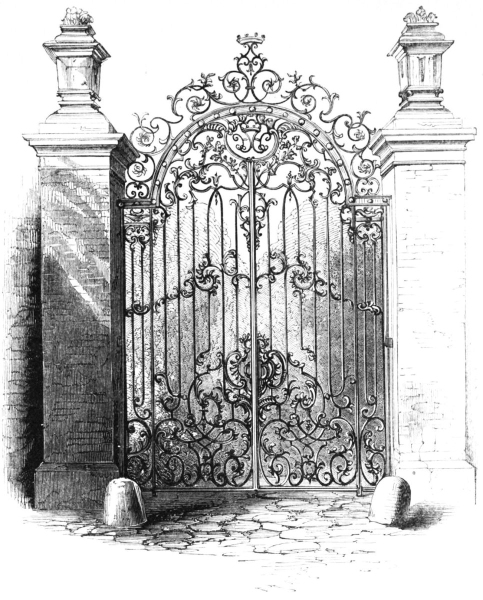
The beautiful gates which open upon the avenue that leads to the
principal entrance to the mansion are pictured in the appended woodcut;
they were brought from Belgium by the late Lord Holland, and placed in
their present position about twelve years ago; they are of wrought iron,
and are considerably impaired by time. Recently they have been
repainted, and picked out with gold; and they now make a gay appearance;
they are, however, of a much later date than the venerable structure,
with which they would be out of “keeping,” but that they are separated
from it by considerable space—a long avenue of ancient and finely grown
elm-trees, which shadow the broad path that conducts to the house. The
immediate entrance is between two piers of Portland stone, designed by
Inigo Jones, and “executed by Nicholas Stone in 1629, for which he was
paid 100l.;” they have no peculiar merit, but serve the purpose of
supporting “the arms of Rich quartering Bouldry, and impaling Cope.” The
pleasure-grounds are behind the house, “falling abruptly to the
north-east:” they were laid out by Mr. Hamilton in 1769. Scattered in
various parts are memorials to some of the personal friends of the late
Lord Holland: among others, the author of “The Pleasures of Memory” is
honoured by this poor couplet:—
“Here Rogers sat, and here for ever dwell
To me those pleasures that he sings so well.”
Some lines, scarcely better, have been appended by Henry Luttrell, Esq.;
but the genius of the place has essayed a flight no higher than that
which might grace a school-girl’s album. Nature has done more for the
domain than art; from various points, fine views are obtained of the
country that surrounds London; and although, of late years, they have
been sadly narrowed by “endless piles of brick,” when Tickell wrote his
lines on the death of Addison, no doubt they were “Fresh and Fair.”
Considerable alterations internally were made to the building by Inigo
Jones. The entrance-hall, the two staircases, and the parlour leading
out of the principal staircase, are the only parts of the mansion on the
ground-floor that still retain their original character. On the first
floor, beside the Gilt Room, is a noble long gallery, now the library,
and the late Lady Holland’s drawing-room or boudoir. All these rooms
preserve their ancient decorations, and are in the purest taste and the
most costly style of execution.
“The Gilt Room,” which forms the subject of the appended print, is
approached from the entrance-hall by a richly ornamented oak staircase.
From the style of the details it would appear that it was the work of
John Thorpe, and that the painted decorations were the produce of
Francis (or Francesco) Cleyn, a favourite artist of the time, who was
employed largely by the kings James I. and Charles I., from whom he
derived an annuity of 100l., settled on him during his natural life,
and which he enjoyed till the Civil War. The ceiling of the room was
originally painted by him in the same style as the other portions of the
apartment; being out of repair during the minority of his late lordship,
it was removed, and a plain one put up in its stead. In the view here
given, Mr. Richardson has supplied it from such fragments and sketches
as were obtainable several years ago.
Notwithstanding the loss of its painted ceiling, the room presents an
appearance of elaborate magnificence, and of unique
singularity—carrying us back at once to that luxurious period, the
early part of the reign of Charles I. The paintings, the figures over
the fireplaces, deserve great praise, although we cannot entirely
coincide with Horace Walpole, who declares (in his life of Cleyn) that
they are not unworthy of Parmigiano. The paintings—such as remain over
the fireplaces and soffites of the arches—certainly are masterly,
though the architect might discover a little of the “contract style”
about them. Cleyn was employed by Charles I., whose good taste led him
to patronise only the most eminent men in art. The painter was
denominated “Il famosissimo pittore Francesco Cleyn, miracolo del
secolo, e molto stimato del Re Carlo della Gran Britania.”[6]
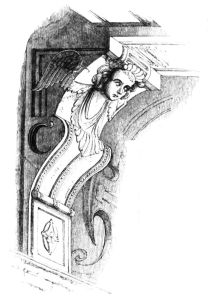
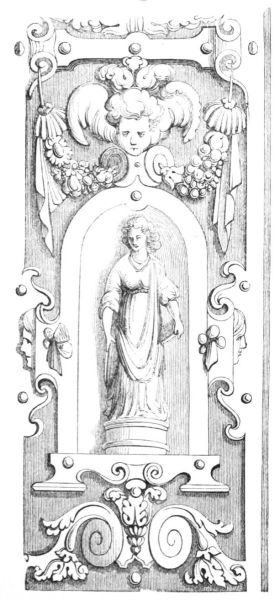
This cut represents some of Cleyn’s painting in the soffite of one of
the arches in the gilt-room; it is roughly painted—although in a free
and masterly style—in umber, on a white ground; the drapery, dress, and
hair of the figures, are gilt.
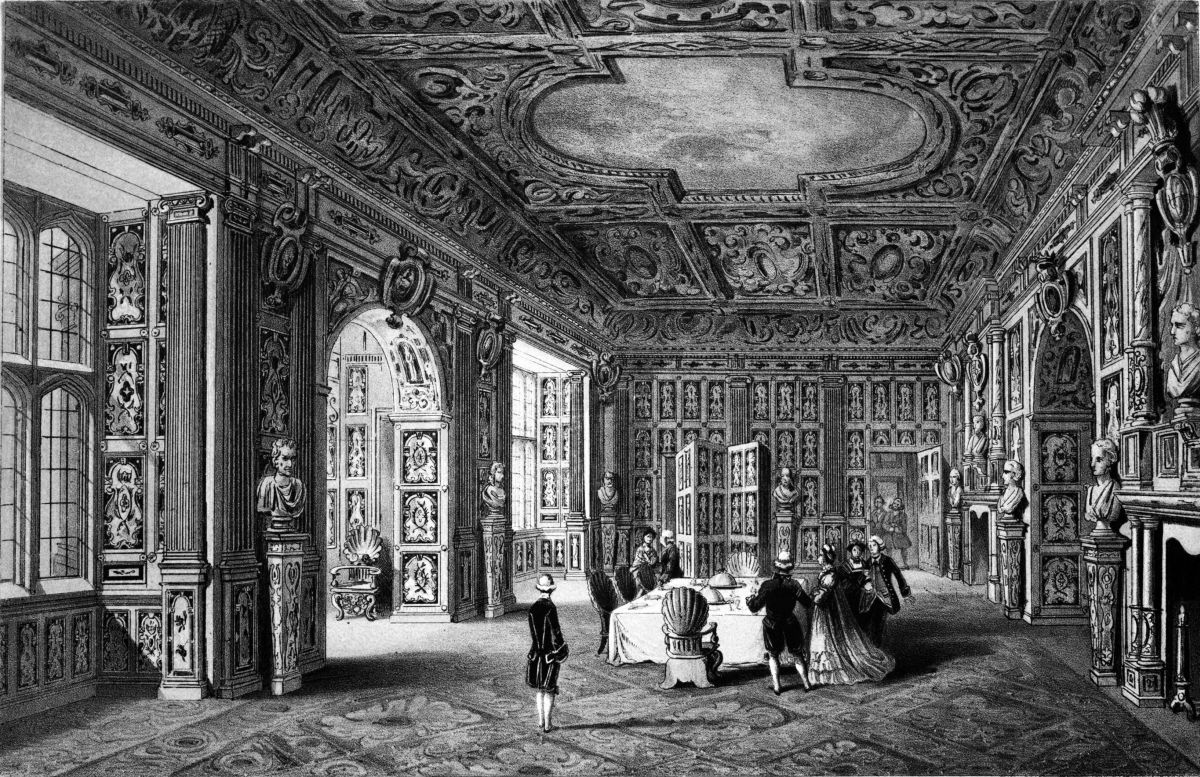
From a drawing by C. F. Richardson, F.S.A. Day & Son, Lithʳˢ to The Queen.
THE GILT ROOM, HOLLAND HOUSE.
The decorative panelling of the Gilt Room is continued round the four
sides, and in the large recess in the centre (immediately above the
entrance-porch); the interior of each panel has a small raised fillet,
about an eighth of an inch in thickness, forming an ornamental border:
this is gilt. In the centre of the panels are painted alternately
cross-crosslets and fleur-de-lis, charges in the arms of Cope and Rich;
they are surmounted by an earl’s coronet, with palm or oak branches, in
gold, shaded with bistre. The figures over the fireplaces have the flesh
painted, the rest is gold shaded; the lower columns of the fireplaces
are painted black, the upper being of Sienna marble: both have gilt
ornaments at the lower part of the shaft, and their caps and bases gilt:
for the rest, all the prominent mouldings, the flutes, caps, and bases
of the pilasters are gilt; the cima recta of the great entablature has a
painted leaf enrichment, with acorns between, the latter of which are
gilt. The groundwork of the whole is white. The busts in the room were
placed there by his late lordship: over the fireplaces are those of King
William the Fourth, and George the Fourth when Prince Regent. Arranged
on pedestals round the room are busts of the late Lord Holland, Francis
Duke of Bedford, Henry first Lord Holland, the late Duke of Sussex, John
Hookham Frere, the Duke of Cumberland (of Culloden), Napoleon, Henry the
Fourth of France, the Right Hon. Charles James Fox, by Nollekens, a
duplicate made for the Empress Catharine of Russia. In the bow-recess
are models of Henry Earl of Pembroke, and Thomas Winnington, Esq. The
painted shields in the corner of the room bear the arms of Rich of
Warwick, and Cope and Rich. Of the ancient furniture of the
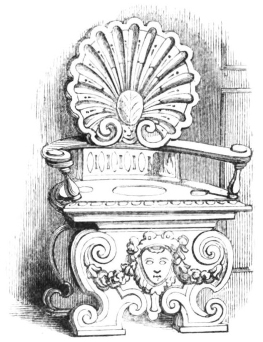
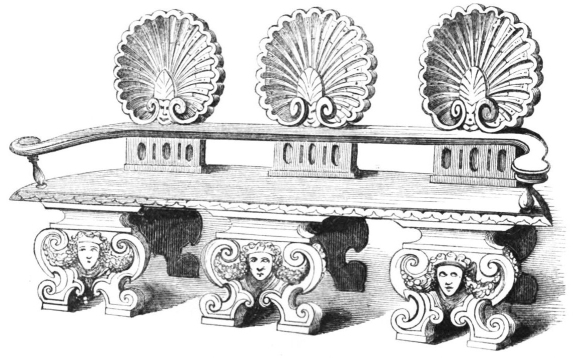
Gilt Room two chairs alone remain; these are mentioned by Horace Walpole
as being the work of Francesco Cleyn: they are painted white, and partly
gilt. A large bench, formed by three of these chairs placed together,
with one arm only at each end, was discovered by the artist some years
ago, in a lumber-place over the stable, where, probably, it still
remains. The Gilt Room, during the lifetime of his late lordship, was
used as the state dining-room: the state drawing-room, lined with silk,
and hung with paintings, led out of it by the door on the right—seen in
the print. Parallel to these rooms, at the back of the
building, is another line of drawing-rooms, modernised, but which
contain a valuable collection of paintings. Among them is a celebrated
one by Hogarth—the amateur performance, by children of the nobility, of
“The Beggar’s Opera.” This painting is very large: the whole of the
figures are portraits. Another painting by Hogarth is in the collection,
which has never been engraved. It is a view of the entrance to Ranelagh
Gardens, Chelsea. The collection contains a few very fine Sir Joshua’s.
Among them is his portrait of Joseph Baretti, well known from the
engraving. There are likewise a few first-rate pictures of the old
masters. The library contains a series of portraits of political and
literary friends of his late lordship; and, in the boudoir, are the
series of the late J. Stothard’s most exquisite compositions to
illustrate Moore’s poems. These drawings are very highly finished, and
are twice the size of the engravings which were made from them.
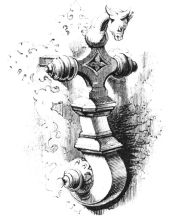
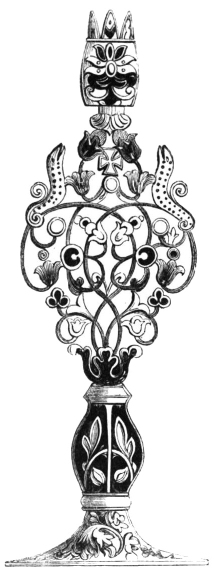
In “Lady Holland’s Boudoir,” among other curiosities, are two
candlesticks formerly belonging to Mary Queen of Scots; they are of
brass, each of eleven and a half inches in height. They are of French
manufacture; the sunk parts are filled up with an inlay of blue, green,
and white enamel, very similar to that done at Limoge. These
candlesticks are extremely elegant; one of them is represented in the
above woodcut.
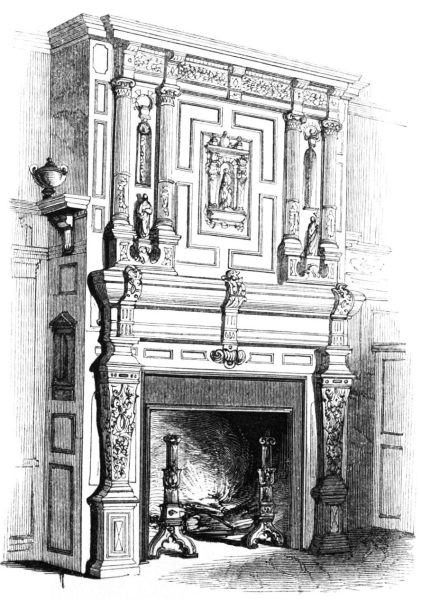
The accompanying woodcut represents the fireplace in “the ancient
parlour;” leaving the principal staircase in the ground floor; the door
on the left leads into this room. It is supposed to have been painted in
a similar style to the great chamber above-stairs. The fireplace in this
room is of the most excellent design and capital execution. A portion of
the framing of the room is shewn by the side of the fireplace: this is
likewise very elegant. One of the ancient windows of this apartment is
blocked up, and an ornamental arch placed in front of it by Inigo Jones.
It was in this room that plays were performed by the direction of the
first Lady Holland, when the theatres in London were shut up by the
Puritans: it is commonly called “The Theatre Room.”[7]
The other rooms will require but a brief notice. “The Journal Room” is
so named because a complete set of the journals of the Houses of Lords
and Commons are there preserved: it contains several portraits, among
which are three or four by Sir Joshua Reynolds. This is on the
ground-floor. Underneath the hall is the ancient kitchen, not long ago
fitted up as a servants’ hall. In the north-east wing is a large
apartment, formerly the chapel of the mansion: it has been disused for
half a century, having been converted into a bath-room.
The Libraries are spacious and “well stocked;” the principal, which
forms the west wing of the house, is styled the Long Gallery; it is, in
length, one hundred and two feet, and, in breadth, seventeen feet four
inches. According to Mr. Faulkner (“History of Kensington”), whose
account was written under the superintendence of the late Lord Holland,
in the year 1746, this fine apartment was entirely out of repair, and
even “unfloored:” it was, however, at that period completely restored,
and converted from its ancient use, as the gallery for exercise, into a
receptacle for books, of which it contains a rare selection. The first
Lord Holland had fitted it up for pictures; blocking up many of the
windows, and opening in lieu of them a large bow-window on the west
side. The “West Library” and the “East Library”—two rooms of moderate
extent—contain also several valuable folios—curious treasures of
antiquity. Mr. Faulkner enumerates some of the more remarkable of the
contents of the eastern library, which cannot fail to interest the
reader:—
“A curious copy of Camoens, to which the praises of Mr. De Souza,
the patriotic editor of the late splendid edition of that poet,
have given extraordinary celebrity. It is a copy of one of the
earliest editions, and Mr. De Souza alleges that it must have been
in the hands of the poet himself. At the bottom of the title-page
the following curious and melancholy testimony of his unfortunate
death is written in an old Spanish hand, which states that the
writer saw him die in an hospital at Lisbon, without even a blanket
to cover him.
“‘Que coza mas lastimosa que ver un tan grande ingenio mal
logrado! yo lo bi morir en un hospital en Lisboa, sin tener una
sauana con que cubrirse, despues de aver triunfado en la India
oriental, y de aver navigado 5500 leguas por mar: que auiso tan
grande para los que de noche y de dia se cançan estudiando sin
provecho, como la arana en urdir tellas para cazar moscas!’
“Specimens of all the types in the Vatican Library, printed in the
Propaganda press, A.D. 1640, on silk.
“The music of the ‘Olimpiade,’ an opera of Metastasio, well
authenticated to have been transcribed by J. J. Rousseau, when that
extraordinary man procured his livelihood by copies of this kind. The
hand-writing is so beautiful that it resembles copper-plate engraving.
“Four volumes of MS. Plays of Lope de Vega, the first containing three
plays in his own hand-writing, with the original license of the censor.
“The original copy, in MS., of the ‘Mogigata,’ a favourite play of the
celebrated Moratin, the first writer of Spanish comedy now living, but
who has been proscribed and exiled by Ferdinand the Seventh.
“There are several others of nearly equal interest, and among the MSS.
there are many curious autographs of Philip the Second, Prince Eugene,
Pontanus, Sannazarius, and others, and three original letters of
Petrarch.
“Also a voluminous MS. collection of the proceedings in Cortes, from the
earliest period, copied from the archives of the King of Spain. The
original correspondence of Don Pedro Ronquillo, the Spanish ambassador,
resident in London at the time of our Revolution; part in cypher, with
the translation by the side, with several others of equal value and
curiosity.”
The Long Gallery is ornamented with portraits of the Lenox, Digby, and
Fox families; Dryden and Addison; Sir C. H. Williams; Admiral Lestock;
Sir Robert Walpole; the Right Honourable Thomas Winnington; Cardinal
Fleury, by Rigaud; and Van Lintz, by himself. Scattered throughout the
apartments are King Charles II. and the Duchess of Portsmouth; Sir
Stephen Fox, by Sir Peter Lely; Henry, Lord Holland; Stephen, Lord
Holland, by Zoffany; the late Right Honourable C. J. Fox, when an
infant;—when a boy, in a group with Lady Susan Strangeways and Lady
Mary Lenox (by Sir Joshua Reynolds); and a fine picture of him in more
advanced life by the same artist. There are two busts, also, of him, by
Nollekens, one of which was taken not long before his death; and a
statue, seated in the entrance-hall.
We may not take leave of this fine old mansion without expressing a
fervent hope that the interesting work of two centuries may endure for
many centuries to come; that modern improvements—although they may
place the suburb of which it is the crowning gem in the centre of the
Metropolis—will not displace it to make room for petty structures of a
day, but that the tale of the Olden Time may be there told to our
descendants as it has been there told to our ancestors.
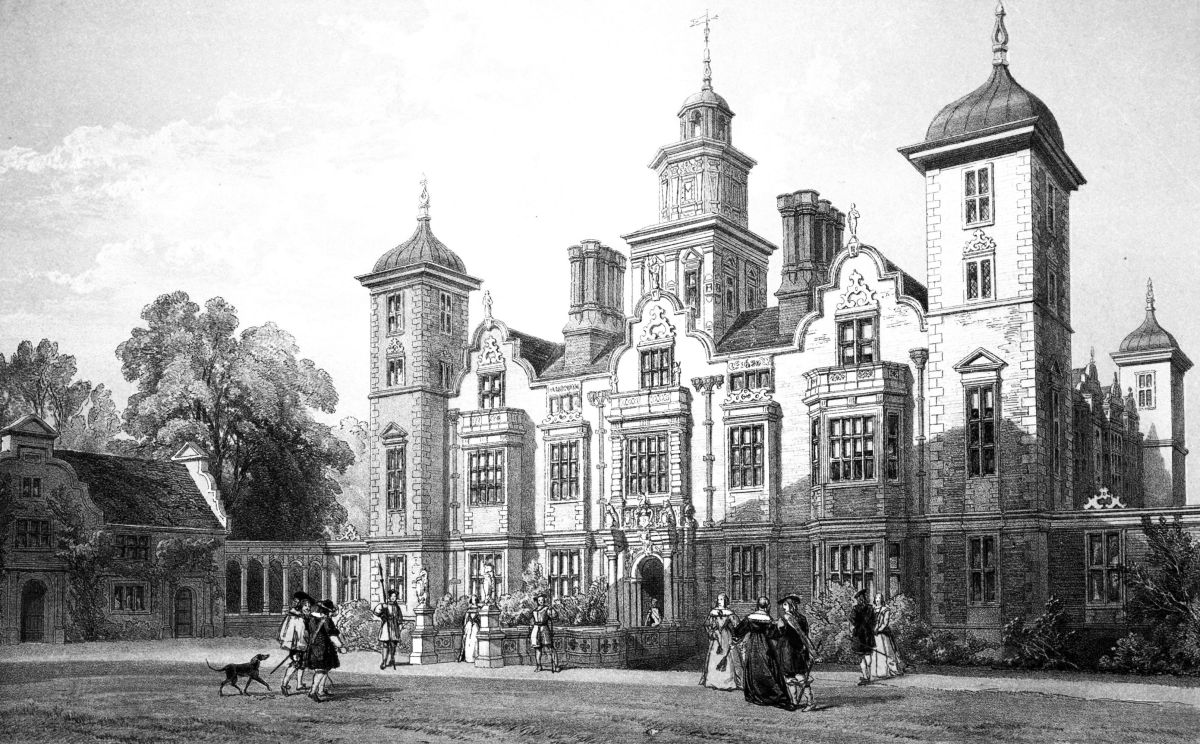
From a drawing by J. D. Harding Day & Son, Lithʳˢ. to The Queen.
BLICKLING HALL. NORFOLK.
From a drawing by J. D. Harding Day & Son, Lithʳˢ. to The Queen.
BLICKLING HALL. NORFOLK.