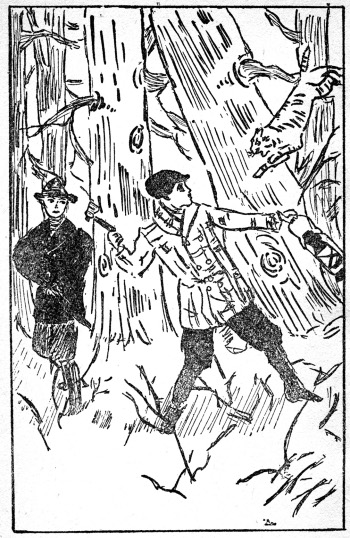
Once more it is my privilege to offer you a new
volume wherein I have endeavored to relate further
interesting adventures in which the members
of Stanhope Troop of Boy Scouts take part. Most
of my readers, I feel sure, remember Paul, Jud,
Bobolink, Jack and many of the other characters,
and will gladly greet them as old friends.
To such of you who may be making the acquaintance
of these manly young chaps for the first time
I can only say this. I trust your interest in their
various doings along the line of scoutcraft will be
strong enough to induce you to secure the previous
volumes in this series in order to learn at first hand
of the numerous achievements they have placed
to their credit.
The boys comprising the original Red Fox
Patrol won the beautiful banner they own in open
competition with other rival organizations. From
that day, now far in the past, Stanhope Troop has
been known as the Banner Boy Scouts. Its possession
.gn +1
has always served as an inspiration to Paul
and his many staunch comrades. Every time they
see its silken folds unfurled at the head of their
growing marching line they feel like renewing the
vows to which they so willingly subscribed on first
joining the organization.
Many of their number, too, are this day proudly
wearing on their chests the medals they have won
through study, observation, service, thrift, or acts
of heroism, such as saving human life at the risk
of their own.
I trust that all my many young readers will enjoy
the present volume fully as much as they did
those that have appeared before now. Hoping,
then, to meet you all again before a great while in
the pages of another book; and with best wishes
for every lad who aspires to climb the ladder of
leadership in his home troop, believe me,
Cordially yours, George A. Warren.
THE BANNER BOY SCOUTS SNOWBOUND
1
CHAPTER I — ON THE FROZEN BUSHKILL
“Watch Jack cut his name in the ice, fellows!”
“I wish I could do the fancy stunts on skates
he manages to pull off. It makes me green with
envy to watch Jack Stormways do that trick.”
“Oh, shucks! what’s the use of saying that, Wallace
Carberry, when everybody knows your strong
suit is long-distance skating? The fact is both the
Carberry twins are as much at home on the ice as
I am when I get my knees under the supper table.”
“That’s kind of you to throw bouquets my way,
Bobolink. But, boys, stop and think. Here it
is—only four days now to Christmas, and the
scouts haven’t made up their minds yet where to
spend the glorious holidays.”
“Y-y-yes, and b-b-by the same token, this year
we’re g-g-going to g-g-get a full three-weeks’ vacation
2
in the b-b-bargain, b-b-because they have
t-t-to overhaul the f-f-furnaces.”
“Hold on there, Bluff Shipley! If you keep on
falling all over yourself like that you’ll have to
take a whole week to rest up.”
“All the same,” remarked the boy who answered
to the odd name of Bobolink, “it’s high
time we scouts settled that important matter for
good.”
“The assistant scout-master, Paul Morrison,
has called a meeting at headquarters for to-night,
you understand, boys,” said the fancy skater, who
had just cut the name of Paul Morrison in the
smooth, new ice of the Bushkill river.
“We must arrange the programme then,” observed
Bobolink, “because it will take a couple of
days to get everything ready for the trip, no matter
where we go.”
“Huh!” grunted another skater, “I can certainly
see warm times ahead for the cook at your
house, Bobolink, provided you’ve still got that
ferocious appetite to satisfy.”
“Oh! well, Tom Betts,” laughed the other, “I
notice that you seldom take a back seat when the
grub is being passed around. As for me I’m proud
of my stowage ability. A good appetite is one
of the greatest blessings a growing boy can have.”
“Pity the poor father though,” chuckled Wallace
3
Carberry, “because he has to pay the freight.”
“Just to go back to the important subject,” said
Bluff Shipley, who could speak as clearly as any
one when not excited, “where do you think the
scouts will hike to for their Christmas holidays?”
“Well, now, a winter camp on Rattlesnake
Mountain wouldn’t be such a bad stunt,” suggested
Tom Betts, quickly.
“For my part,” remarked Bobolink, “I’d rather
like to visit Lake Tokala again, and see what
Cedar Island looks like in the grip of Jack Frost.
The skating on that sheet of water must be great.”
“We certainly did have a royal good time there
last summer,” admitted Jack, reflectively.
“All the same,” ventured Tom, “I think I know
one scout who couldn’t be coaxed or hired to camp
on Cedar Island again.”
“Meaning Curly Baxter,” Bobolink went on to
say scornfully, “who brazenly admits he believes
in ghosts, and couldn’t be convinced that the place
wasn’t haunted.”
“Curly won’t be the only fellow to back out,”
suggested Jack. “While we have a membership
of over thirty on the muster roll of Stanhope
Troop, it isn’t to be expected that more than half
of them will agree to make the outing with us.”
“Too much like hard work for some of the
boys,” asserted Tom.
4
“I know a number who say they’d like to be
with us, but their folks object to a winter camp,”
Wallace announced. “So if we muster a baker’s
dozen we can call ourselves lucky.”
“Of course it must be a real snow and ice hike
this time,” suggested Bluff.
“To be sure—and on skates at that!” cried
Wallace, enthusiastically.
“Oh! I hope there’s a chance to use our iceboats
too!” sighed Tom Betts, who late that fall
had built a new flier, and never seemed weary of
sounding the praises of his as yet untried “Speedaway.”
“Perhaps we may—who knows?” remarked
Jack, mysteriously.
The others, knowing that the speaker was the
nearest and dearest chum of Paul Morrison, assistant
scout-master of Stanhope Troop of Boy
Scouts, turned upon him eagerly on hearing this
suggestive remark.
“You know something about the plans, Jack!”
“Sure he does, and he ought to give us a hint
in the bargain!”
“Come, take pity on us, won’t you, Jack?”
But the object of all this pleading only shook
his head and smiled as he went on to say:
“I’m bound to secrecy, fellows, and you
wouldn’t have me break my word to our patrol
5
leader. Just hold your horses a little while longer
and you’ll hear everything. We’re going to talk
it over to-night and settle the matter once for all.
Now let’s drop the subject. Here’s a new wrinkle
I’m trying out.”
With that Jack started to spin around on his
skates, and fairly dazzled his mates with the wonderful
ability he displayed as a fancy skater.
While they are thus engaged a few words of
explanation may not come in amiss.
Stanhope Troop consisted of three full patrols,
with another almost completed. Though in the
flood tide of success at the time we make the
acquaintance of the boys in this volume there were
episodes in the past history of the troop to which
the older scouts often referred with mingled
emotions of pride and wonder.
The present status of the troop had not been
maintained without many struggles. Envious
rivals had tried to make the undertaking a failure,
while doubting parents had in many cases to be
shown that association with the scouts would be
a thing of unequalled advantage to their boys.
Those who have read the previous books of
this series have doubtless already formed a warm
attachment for the members of the Red Fox
Patrol and their friends, and will be greatly
pleased to follow their fortunes again. For the
6
benefit of those who are making their acquaintance
for the first time it may be stated that besides
Jack Stormways and the four boys who were with
him on the frozen Bushkill this December afternoon,
the roster of the Red Fox Patrol counted
three other names.
These were Paul Morrison, the leader, the
other Carberry twin, William by name, and a boy
whom they called “Nuthin,” possibly because his
name chanced to be Albert Cypher.
As hinted at in the remarks that flew between
the skaters circling around, many of the members
of the troop had spent a rollicking vacation
the previous summer while aboard a couple of
motor boats loaned to them by influential citizens
of their home town. The strange adventures that
had befallen the scouts on this cruise through
winding creeks and across several lakes have been
given in the pages of the volume preceding this
book, called “The Banner Boy Scouts Afloat; Or,
The Secret of Cedar Island.”
Ever since their return from that cruise the
boys had talked of little else; and upon learning
that the Christmas holidays would be lengthened
this season the desire to take another tour had
seized upon them.
After Jack so summarily shut down upon the
subject no one ventured to plead with him any
7
longer. All knew that he felt bound in honor to
keep any secret he had been entrusted with by the
assistant scout-master—for Paul often had to act
in place of Mr. Gordon, a young traveling salesman,
who could not be with the boys as much as
he would have liked.
Jack had just finished cutting the new figure,
and his admirers were starting to give vent to
their delight over his cleverness when suddenly
there came a strange roaring sound that thrilled
every one of them through and through. It was
as if the frozen river were breaking up in a spring
thaw. Some of the boys even suspected that there
was danger of being swallowed up in such a catastrophe,
and had started to skate in a frenzy of
alarm for the shore when the voice of Bobolink
arose above the clamor.
“Oh! look there, will you, fellows?” he shouted,
pointing a trembling finger up the river. “The old
ice-house has caved in, just as they feared it would.
See the ice cakes sliding everywhere! And I saw
men and girls near there just five minutes ago.
They may be caught under all that wreckage for
all we know! Jack, what shall we do about it?”
“Come on, every one of you!” roared Jack
Stormways, as he set off at full speed. “This
means work for the scouts! To the rescue, boys!
Hurry! hurry!”
8
CHAPTER II — WHEN THE OLD ICE-HOUSE FELL
Never before in the recollection of any Stanhope
boy had winter settled in so early as it had
this year. They seldom counted on having their
first skate on the new ice before Christmas, and
yet for two weeks now some of the most daring
had been tempting Providence by venturing on
the surface of the frozen Bushkill.
The ice company had built a new house the
preceding summer, though the old one was still
fairly well filled with a part of the previous season’s
great crop. Its sides had bulged out in a
suspicious manner, so that many had predicted
some sort of catastrophe, but somehow the old
building had weathered every gale, though it
leaned to the south sadly. The company apparently
hoped it would hold good until they had it
emptied during the next summer, when they intended
to build another new structure on the spot.
As the five boys started to skate at utmost
speed up the river they heard a medley of sounds.
9
A panic had evidently struck such boys and girls
as were skimming over the smooth ice in protected
bayous near the ice-houses. Instead of
hurrying to the assistance of those who may have
been caught in the fallen timbers of the wrecked
building they were for the most part fleeing from
the scene, some of them shrieking with terror.
Several men who had been employed near by
could be seen standing and staring. It looked as
though they hardly knew what to do.
If ever there was an occasion where sound
common sense and a readiness to grasp a situation
were needed it seemed to be just then. And, fortunately,
Jack Stormways was just the boy to meet
the conditions.
He sped up the river like an arrow from the
bow, followed by the four other scouts. The
frightened girls who witnessed their passage always
declared that never had they seen Stanhope
boys make faster speed, even in a race where a
valuable prize was held out as a lure to the victor.
As he bore down upon the scene of confusion
Jack took it all in. Those who were floundering
amidst the numerous heavy cakes of ice must engage
their attention without delay. He paid little
heed to the fortunate ones who were able to be
on their feet, since this fact alone proved that they
could not have been seriously injured.
10
Several, however, were not so fortunate, and
Jack’s heart seemed to be almost in his throat
when he saw that two of the skaters lay in the
midst of the scattered cakes of ice as though painfully
injured.
“This way, boys!” shouted the boy in the van
as they drew near the scene of the accident. “Bluff,
you and Wallace turn and head for that one yonder.
Bobolink, come with me—and Tom Betts.”
Five seconds later he was bending over a small
girl who lay there groaning and looking almost
as white as the snow upon the hills around Stanhope.
“It’s little Lucy Stackpole!” gasped Tom, as
he also arrived. “Chances are she was hit by one
of these big ice cakes when they flew around!”
Jack looked up.
“Yes, I’m afraid she’s been badly hurt, fellows.
It looks to me like a compound fracture of her
right leg. She ought to be taken home in a hurry.
See if you can round up a sled somewhere, and
we’ll put her on it.”
“Here’s Sandy Griggs and Lub Ketcham with
just the sort of big sled we need!” cried Tom
Betts, as he turned and beckoned to a couple of
stout lads who evidently belonged to one of the
other patrols, since they wore the customary campaign
hats of the scouts.
11
These boys had by now managed to recover
from their great alarm, and in response to the
summons came hurrying up, anxious to be of service,
as true scouts always are.
Jack, who had been speaking to the terrified
girl, trying to soothe her as best he could, proceeded
in a business-like fashion to accomplish the
duty he had in hand.
“Two of you help me lift Lucy on to the sled,”
he said. “We will have to fasten her in some
way so there’ll be no danger of her slipping. Then
Sandy and Lub will drag her to her home. On the
way try to get Doctor Morrison over the ’phone
so he can meet you there. The sooner this fracture
is attended to the better.”
“You could do it yourself, Jack, if it wasn’t so
bitter cold out here,” suggested Tom Betts,
proudly, for next to Paul Morrison himself, whose
father was the leading physician of Stanhope,
Jack was known to be well up in all matters connected
with first aid to the injured.
They lifted the suffering child tenderly, and
placed her on the comfortable sled. Both the newcomers
were only too willing to do all they could
to carry out the mission of mercy that had been
entrusted to their charge.
“We’ll get her home in short order, Jack, never
fear,” said Sandy Griggs, as he helped fasten an
12
extra piece of rope around the injured girl, so that
she might not slip off the sled.
“Yes, and have the doctor there in a jiffy, too,”
added Lub, who, while a clumsy chap, in his way
had a very tender heart and was as good as gold.
“Then get a move on you fellows,” advised
Jack. “And while speed is all very good, safety
comes first every time, remember.”
“Trust us, Jack!” came the ready and confident
reply, as the two scouts immediately began
to seek a passage among the far-flung ice-cakes
that had been so suddenly released from their
year’s confinement between the walls of the dilapidated
ice-house.
Only waiting to see them well off, Jack and
the other two once more turned toward the scene
of ruin.
“See, the boys have managed to get the other
girl on her feet!” exclaimed Bobolink, with a relieved
air; “so I reckon she must have been more
scared than hurt, for which I’m right glad. What
next, Jack? Say the word and we’ll back you to
the limit.”
“We must take a look around the wreck of the
ice-house,” replied the other, “though I hardly
believe any one could have been inside at the time
it fell.”
“Whew, I should surely hope not!” cried Tom;
13
“for the chances are ten to one he’d be crushed
as flat as a pancake before now, with all that
timber falling on him. I wouldn’t give a snap
of my fingers for his life, Jack.”
“Let’s hope then there’s no other victim,” said
Jack. “If there is none, it will let the ice company
off easier than they really deserve for allowing
so ramshackle a building to stand, overhanging
the river just where we like to do most of our
skating every winter.”
“Suppose we climb around the timbers and see
if we can hear any sound of groaning,” suggested
Bobolink, suiting the action to his words.
Several men from the other ice-house reached
the spot just then.
Jack turned to them as a measure of saving
time. If there were no men working in
the wrecked building at the time it fell there did
not seem any necessity for attempting to move any
of the twisted timbers that lay in such a confused
mass.
“Hello! Jan,” he called out as the panting laborers
arrived. “It was a big piece of luck that none
of you were inside the old ice-house when it collapsed
just now.”
The man whom he addressed looked blankly
at the boy. Jack could see that he was laboring
under renewed excitement.
14
“Look here! was there any one in the old building,
do you know, Jan?” he demanded.
“I ban see Maister Garrity go inside yoost afore
she smash down,” was the startling reply.
The boys stared at each other. Mr. Thomas
Garrity was a very rich and singular citizen of
Stanhope.
Finally Bobolink burst out with:
“Say, you know Mr. Garrity is one of the owners
of these ice-houses, fellows. I guess he must
have come up here to-day to see for himself if the
old building was as rickety as people said.”
“Huh! then I guess he found out all right,”
growled Tom Betts.
“Never mind that now,” said Jack, hastily.
“Mr. Garrity never had much use for the scouts,
but all the same he’s a human being. We’ve got
our duty cut out for us plainly enough.”
“Guess you mean we must clear away this trash
with the help of these men here, Jack,” suggested
Wallace, eagerly.
“Just what I had in mind,” confessed Jack.
“But before we start in let’s all listen and see if
we can hear anything like a groan.”
All of them stood in an expectant attitude,
straining their hearing to the utmost.
Presently the listeners plainly caught the sound
of a groan.
15
CHAPTER III — THE RESCUE
“Jack, he’s here under all this stuff!” called
out Bobolink, excitedly.
“Poor old chap,” said Wallace. “I wouldn’t
like to give much for his chance of getting out of
the scrape with his life.”
“And to think,” added Bluff, soberly, “that
after all the protestations made by the company
that the old house couldn’t fall, it trapped one of
the big owners when it smashed down. It’s mighty
queer, it strikes me.”
“Keep still again,” warned Jack. “I want to
call out and see if Mr. Garrity can hear me.”
“A bully good scheme, Jack!” asserted Bobolink.
“If we can locate him in that way it may
save us a heap of hard work dragging these timbers
around.”
Jack dropped flat on his face, and, placing his
mouth close to the wreckage where it seemed
worst, called aloud:
“Hello! Mr. Garrity, can you hear me?”
16
“Yes! Oh, yes!” came the faint response from
somewhere below.
“Are you badly hurt, sir?” continued the scout.
“I don’t know—I believe not, but a beam is
keeping tons and tons from falling on me. I am
pinned down here, and can hardly move. Hurry
and get some of these timbers off before they fall
and crush me!”
Every word came plainly to their ears now.
Evidently, Mr. Garrity, understanding that relief
was at hand, began to feel new courage. Jack
waited for no more.
“I reckon I’ve located him, boys,” he told the
others, “and now we’ve got to get busy.”
“Only tell us what to do, Jack,” urged Wallace,
“and there are plenty of willing hands here
for the work, what with these strong men and
the rest of the boys.”
Indeed, already newcomers were arriving, some
of them being people who had been passing along
the turnpike near by in wagons or sleighs at the
time the accident happened, and who hastened to
the spot in order to render what assistance they
could.
Jack seemed to know just how to go about the
work. If he had been in the house-wrecking business
for years he could hardly have improved upon
his system.
17
“We’ve got to be careful, you understand, fellows,”
he told the others as they labored strenuously
to remove the upper timbers from the pile,
“because that one timber he mentioned is the key
log of the jam. As long as it holds he’s safe from
being crushed. Here, don’t try that beam yet,
men. Take hold of the other one. And Bobolink
and Wallace, help me lift this section of shingles
from the roof!”
So Jack went on to give clear directions. He
did not intend that any new accident should be
laid at their door on account of too much haste.
Better that the man who was imprisoned under all
this wreckage should remain there a longer period
than that he lose his life through carelessness.
Jack believed in making thorough work of anything
he undertook; and this trait marked him as
a clever scout.
As others came to add to the number of willing
workers the business of delving into the wreck of
the ice-house proceeded in a satisfactory manner.
Once in a while Jack would call a temporary halt
while he got into communication with the unfortunate
man they were seeking to assist.
“He seems to be all right so far, fellows,” was
the cheering report he gave after this had happened
for the third time; “and I think we’ll be
able to reach him in a short time now.”
18
“As sure as you’re born we will, Jack!” announced
Bobolink, triumphantly; “for I can see
the big timber he said was acting as a buffer above
him. Hey! we’ve got to be extra careful now,
because one end of that beam is balanced ever so
delicately, and if it gets shoved off its anchorage—good-bye
to Mr. Garrity!”
“Yes,” came from below the wreckage, “be very
careful, please, for it’s just as you say.”
Jack was more than ever on the alert as the
work continued. He watched every move that
was made, and often warned those who strained
and labored to be more cautious.
“In five minutes or so we ought to be able to
get something under that loose end of the big timber,
Jack,” suggested Bobolink, presently.
“In less time than that,” he was told. “And
here’s the very prop to slip down through that
opening. I think I can reach it right now, if you
stop the work for a bit.”
He pushed the stout post carefully downward,
endeavoring to adjust it so that it was bound to
catch and hold the timber should the latter break
away from its frail support at that end. When
Bobolink saw him get up from his knees a minute
later he did not need to be told that Jack’s endeavor
had been a success, for the satisfied smile
on the other’s face told as much.
19
“Now let the good work go on with a rush!”
called out Jack. “Not so much danger now, because
I’ve put a crimp in that timber’s threat to
fall. It’s securely wedged. Everybody get busy.”
Jack led in the work himself, and the way they
removed the heavy beams, many of them splintered
or broken in the downward rush of the building,
was surely a sight worth seeing. At least
some of the town people who came up just then
felt they had good reason to be proud of the Banner
Boy Scouts, who on other notable occasions
had brought credit to the community.
“I can see him now!” exclaimed Bobolink; and
indeed, only a few more weighty fragments remained
to be lifted off before Jack would be able
to drop down into the cavity and assist the prisoner
at close quarters.
Five minutes later the workers managed to
release Mr. Garrity, and Jack helped him out of
his prison. The old gentleman looked considerably
the worse for his remarkable experience.
There was blood upon his cheek, and he kept caressing
one arm as though it pained him considerably.
Still his heart was filled with thanksgiving as
he stared around at the pile of torn timbers, and
considered what a marvelous escape his had been.
“Let me take a look at your arm, sir,” said
20
Jack, who feared that it had been broken, because
a beam had pinned the gentleman by his arm to the
ground.
Mr. Garrity, who up to that time had paid very
little attention to the Boy Scout movement that
had swept over that region of the eastern country
like wildfire, looked at the eager, boyish faces of
his rescuers. It could be seen that he was genuinely
affected on noticing that most of them wore
the badges that distinguish scouts the world over.
“I hope my wrist is not broken, though even
that would be a little price to pay for my temerity
in entering that shaky old building,” he ventured
to say as he allowed Jack to examine his arm.
“I’m glad to tell you, sir,” said the boy, quickly,
“that it is only a bad sprain. At the worst you
will be without the use of that hand for a month
or two.”
“Then I have great reason to be thankful,” declared
Mr. Garrity, solemnly. “Perhaps this may
be intended for a lesson to me. And, to begin
with, I want to say that I believe I owe my very
life to you boys. I can never forget it. Others,
of course, might have done all they could to dig
me out, but only a long-headed boy, like Jack
Stormways here, would have thought to keep that
timber from falling and crushing me just when
escape seemed certain.”
21
He went around shaking hands with each one
of the boys, of course using his left arm, since
the right was disabled for the time being. Jack
deftly made a sling out of a red bandana handkerchief,
which he fastened around the neck of
Mr. Garrity, and then gently placed the bruised
hand in this.
“Was any other person injured when the ice-house
collapsed?” asked Mr. Garrity, anxiously.
“A couple of girls were struck by some of the
big cakes flung far and wide,” explained Bobolink.
“Little Lucy Stackpole has a broken leg.
We sent her home on a sled, and the doctor will
soon be at her house, sir.”
“That is too bad!” declared the part owner of
the building, frowning. “I hoped that the brunt
of the accident had fallen on my shoulders alone.
Of course, the company will be liable for damages,
as well as the doctor’s bill; and I suppose we deserve
to be hit pretty hard to pay for our stupidity.
But I am glad it is no worse.”
“Excuse me, Mr. Garrity, but perhaps you had
better have that swelling wrist attended to as soon
as possible,” remarked Jack. “You have some
bruises, too, that are apt to be painful for several
days. There is a carriage on the road that might
be called on to take you home.”
“Thank you, Jack, I will do as you say,” replied
22
the one addressed. “But depend on it I mean to
meet you boys again, and that at a very early
date.”
“We’re going to be away somewhere on a midwinter
hike immediately after Christmas, sir,”
Bobolink thought it best to explain. Somehow
deep down in his heart he was already wondering
whether this remarkable rescue of Mr. Garrity
might not develop into some sort of connection
with their partly formed plans.
“Yes,” added Bluff, eagerly, suddenly possessed
by the same hope, “and it’s all going to be settled
to-night when we have our monthly meeting in
the big room under the church. We’d be pleased
to have you drop in and see us, sir. Lots of the
leading citizens of Stanhope have visited our
rooms from time to time, but I don’t remember
ever having seen you there, Mr. Garrity.”
“Thank you for the invitation, my lad,” said the
other, smiling grimly. “Perhaps I shall avail myself
of it, and I might possibly have something of
interest to communicate to you and your fellow
scouts,” and waving his hand to them he walked
away.
23
CHAPTER IV — A QUICK RETURN FOR SERVICES RENDERED
That night turned out clear and frosty. Winter
having set in so early seemed bent on keeping
up its unusual record. The snow on the ground
crackled underfoot in the fashion dear to the heart
of every boy who loves outdoor sports.
Overhead, the bright moon, pretty well advanced,
hung in space. It was clearly evident
that no one need think of carrying a lantern with
him to the meeting place on such a glorious night.
The Boy Scouts of Stanhope had been fortunate
enough to be given the use of a large room under
the church with the clock tower. On cold nights
this was always heated for them, so that they
found it a most comfortable place in which to
hold their animated meetings.
There was a large attendance on this occasion,
for while possibly few among the members of the
troop could take advantage of this midwinter trip
into the wilds, every boy was curious to know all
the details.
24
In this same spacious room there was fitted up
a gymnasium for the use of the boys one night a
week, and many of them availed themselves of the
privilege. As this was to be a regular business
meeting, however, the apparatus had been drawn
aside so as not to be in the way.
As the roster was being called it might be just
as well to give the full membership of the troop
so that the reader may be made acquainted with
the chosen comrades of Jack and Paul.
The Red Fox Patrol, which contained the “veterans”
of the organization, was made up of the
following members:
Paul Morrison; Jack Stormways; Bobolink, the
official bugler; Bluff Shipley, the drummer of the
troop; “Nuthin” Cypher; William Carberry; Wallace,
his twin brother; and Tom Betts. Paul, as
has been said, was patrol leader, and served also
as assistant scout-master when Mr. Gordon was
absent from town.
In the second division known as the Gray Fox
Patrol were the following:
Jud Elderkin, patrol leader; Joe Clausin, Andy
Flinn, Phil Towns, Horace Poole, Bob Tice, Curly
Baxter, and Cliff Jones.
The Black Fox Patrol had several absentees,
but when all were present they answered to their
names as below:
25
Frank Savage, leader; Billie Little, Nat Smith,
Sandy Griggs, “Old” Dan Tucker, “Red” Collins,
“Spider” Sexton, and last but not least in
volume of voice, “Gusty” Bellows.
A fourth patrol that was to be called the Silver
Fox was almost complete, lacking just three members;
and those who made up this were:
George Hurst, leader; “Lub” Ketcham, Barry
Nichols, Malcolm Steele and a new boy in town
by the name of Archie Fletcher.
Apparently, the only business of importance before
the meeting was in connection with the scheme
to take a midwinter outing, something that was
looked upon as unique in the annals of the association.
The usual order of the meeting was hurried
through, for every one felt anxious to hear what
sort of proposition the assistant scout-master intended
to spread before the meeting for approval.
“I move we suspend the rules for to-night, and
have an informal talk for a change!” said Bobolink,
when he had been recognized by the chair.
A buzz of voices announced that the idea was
favorably received by many of those present;
and, accordingly, the chairman, no other than Paul
himself, felt constrained to put the motion after
it had been duly seconded. He did so with a smile,
well knowing what Bobolink’s object was.
26
“You have all heard the motion that the rules
be suspended for the remainder of the evening,”
he went on to say, “so that we can have a heart-to-heart
talk on matters that concern us just now.
All in favor say aye!”
A rousing chorus of ayes followed.
“Contrary, no!” continued Paul, and as complete
silence followed he added hastily: “The
motion is carried, and the regular business meeting
will now stand adjourned until next month.”
“Now let’s hear what you’ve been hatching up
for us, Paul?” called out Bobolink.
“So say we all, Paul!” cried half a dozen eager
voices, and the boys left their seats to crowd
around their leader.
“I only hope it’s Rattlesnake Mountain we’re
headed for!” exclaimed Tom Betts, who had a
warm feeling in his boyish heart for that particular
section of country, where once upon a time the
troop had pitched camp, and had met with some
amusing and thrilling adventures, as described
in a previous volume, called “The Banner Boy
Scouts on a Tour.”
“On my part I wish it would turn out to be good
old Lake Tokala, where my heart has often been
centered as I think of the happy days we spent
there.”
It was, of course, Bobolink who gave utterance
27
to this sentiment. Perhaps there were others who
really echoed his desire, for they had certainly had
a glorious time of it when cruising in the motor
boats so kindly loaned to them.
Paul held up his hand for silence, and immediately
every voice became still. Discipline was enforced
at these meetings, for the noisy boys and
those inclined to play practical pranks had learned
long ago they would have to smother their feelings
at such times or be strongly repressed by the
chair.
“Listen,” said the leader, in his clear voice,
“you kindly asked me to try to plan a trip for the
holidays that would be of the greatest benefit to
us as an organization of scouts. I seriously considered
half a dozen plans, among them Rattlesnake
Mountain, and Cedar Island in Lake Tokala.
In fact, I was on the point of suggesting
that we take the last mentioned trip when something
came up that entirely changed my plan for
the outing.”
He stopped to see what effect his words were
having. Evidently, he had aroused the curiosity
of the assembled scouts to fever heat, for several
voices immediately called out:
“Hear! hear! please go on, Paul! We’re dying
to know what the game is!”
Paul smiled, as he went on to say:
28
“I guess you have all been so deeply interested
in what was going on to-night, that few of you
noticed that we have a friend present who slipped
into the room just as the roll call began. All of
you must know the gentleman, so it’s hardly necessary
for me to introduce Mr. Thomas Garrity to
you.”
Of course, every one turned quickly on hearing
this. A figure that had been seated in a dim corner
of the assembly room arose, and Bobolink
gasped with a delicious sense of pleasure when he
recognized the man whom he and his fellow scouts
had assisted that very afternoon.
“Please come forward, Mr. Garrity,” said Paul,
“and tell the boys what you suggested to me late
this afternoon. I’m sure they’d appreciate it more
coming directly from you than getting it secondhand.”
While a hum of eager anticipation arose all
around, Mr. Garrity made his way to the side of
the patrol leader and president of the meeting.
“I have no doubt,” he said, “that those of you
who were not present to-day when our old ice-house
fell and caught me in the ruins, have heard
all about the accident, so I need not refer to the
incident except to say that I shall never cease to
be grateful to the scouts for the clever way in
which they dug me out of the wreck.”
29
“Hear! hear!” several excited scouts shouted.
“I happened to learn that you were contemplating
a trip during the holidays, and when an
idea slipped into my mind I lost no time in calling
upon Paul Morrison, your efficient leader, in order
to interest him in my plan.”
“Hear! hear!”
“It happens that I own a forest cabin up in the
wilderness where I often go to rest myself and get
away from all excitement. It is in charge of a
faithful woodsman by the name of Tolly Tip.
You can reach it by skating a number of miles up
a stream that empties into Lake Tokala. The
hunting is said to be very good around there, and
you will find excellent pickerel fishing through the
ice in Lake Tokala. If you care to do me the
favor of accepting my offer, the services of my
man and the use of the cabin are at your disposal.
Even then I shall feel that this is only a beginning
of the deep interest I am taking in the scouts’ organization;
for I have had my eyes opened at
last in a wonderful manner.”
As Mr. Garrity sat down, rosy-red from the
exertion of speaking to a party of boys, Paul immediately
rapped for order, and put the question.
“All who are in favor of accepting this generous
offer say yes!” and every boy joined in the vociferous
shout that arose.
30
CHAPTER V — A STARTLING INTERRUPTION
“Mr. Garrity, your kind offer is accepted with
thanks,” announced Paul. “And as you suggested
to me, several of us will take great pleasure in
calling on you to-morrow to go into details and
to get full directions from you.”
“Then perhaps I may as well go home now,
boys,” said the old gentleman; “as my wrist is
paining me considerably. I only want to add that
this has been a red day in my calendar. The collapse
of the old ice-house is going to prove one of
those blessings that sometimes come to us in
disguise. I only regret that two little girls were
injured. As for myself, I am thoroughly pleased
it happened.”
“Before you leave us, sir,” said Bobolink,
boldly, “please let us show in some slight way how
much we appreciate your kind offer. Boys, three
cheers for Mr. Thomas Garrity, our latest convert,
and already one of our best friends!”
Possibly Bobolink’s method of expressing his
31
feelings might not ordinarily appeal to a man of
Mr. Garrity’s character, but just now the delighted
old gentleman was in no mood for fault finding.
As the boyish cheers rang through the room
there were actually tears in Mr. Garrity’s eyes.
Truly that had been a great day for him, and perhaps
it might prove a joyous occasion to many of
his poor tenants, some of whom had occasion to
look upon him as a just, though severe, landlord,
exacting his rent to the last penny.
After he had left the room the hum of voices
became furious. One would have been inclined to
suspect the presence of a great bee-hive in the near
vicinity.
“Paul, you know all about this woods cabin he
owns,” said Tom Betts, “so suppose you enlighten
the rest of us.”
“One thing tickles me about the venture!” exclaimed
Bobolink; “That is that we pass across
Lake Tokala in getting there. I’ve been hankering
to see that place in winter time for ever so
long.”
“Yes,” added Tom, eagerly, “that’s true. And
what’s to hinder some of us from using our iceboats
part of the way?”
“Nothing at all,” Paul assured him. “I went
into that with Mr. Garrity, and came to the conclusion
that it could be done. Of course, a whole
32
lot depends on how many of us can go on the
trip.”
“How many could sleep in his cabin do you
think, Paul?” demanded Jack.
“Yes. For one, I’d hate to have to bunk out
in the snow these cold nights,” said Bluff, shaking
his head seriously, for Bluff dearly liked the comforts
of a cheery fire inside stout walls of logs,
while the bitter wintry wind howled without, and
the snow drifted badly.
“He told me it was unusually large,” explained
Paul. “In fact, it has two big rooms and could
in a pinch accommodate ten fellows. Of course,
every boy would be compelled to tote his blankets
along with him, because Mr. Garrity never
dreamed he would have an army occupy his log
shanty.”
“The more I think of it the better it sounds!”
declared Jack.
“Then first of all we must try to find out just
who can go,” suggested Bobolink.
“What if there are too many to be accommodated
either on the iceboats we own or in the
cabin?” remarked Tom Betts, uneasily.
“Shucks! that ought to be easy,” suggested another.
“All we have to do is to pull straws, and
see who the lucky ten are.”
“Then let those who are positive they can go
33
step aside here,” Paul ordered; and at this there
was a shuffling of feet and considerable moving
about.
“Remember, you must be sure you can go,”
warned Paul. “Afterwards we’ll single out those
who believe they can get permission, but feel some
doubts. If there is room they will come in for
next choice.”
Several who had started forward held back at
this. Those who took their stand as the leader
requested consisted of Jack, Bobolink, Bluff, Tom
Betts, Jud Elderkin, Sandy Griggs, Phil Towns
and “Spider” Sexton.
“Counting myself in the list that makes nine for
certain,” Paul observed. It was noticed that Tom
Betts as well as Bobolink looked exceedingly relieved
on discovering that, after all, there need be
no drawing of lots.
“Now let those who have strong hopes of being
able to go stand up to be counted,” continued Paul.
“I’ll keep a list of the names, and the first who
comes to say he has received full permission will
be the one to make up the full count of ten members,
which is all the cabin can accommodate.”
The Carberry twins, as well as several others,
stood over in line to have their names taken down.
“If one of us can go, Paul,” explained Wallace
Carberry, “we’ll fix it up between us which it
34
shall be. But I’m sorry to say our folks don’t
take to this idea of a winter camp very strongly.”
“Same over at my house,” complained Bob
Tice. “Mother is afraid something terrible might
happen to us in such a hard spell of winter. As if
scouts couldn’t take care of themselves anywhere,
and under all conditions!”
There were many gloomy faces seen in the gathering,
showing that other boys knew their parents
did not look on the delightful scheme with favor.
Some of them could not accompany the party on
account of other plans which had been arranged
by their parents.
“If the ice stays as fine as it is now,” remarked
Tom Betts, “we can spin down the river on our
iceboats, and maybe make our way through that
old canal to Lake Tokala as well. But how about
the creek leading up to the cabin, Paul? Did you
ask Mr. Garrity about it?”
“Yes, I asked him everything I could think of,”
came the ready reply. “I’m sorry to say it will
be necessary to leave our iceboats somewhere on
the lake, for the creek winds around in such a
way, and is so narrow in places, that none of us
could work the boats up there.”
“But wouldn’t it be dangerous to leave them on
the lake so long?” asked Tom, anxiously. “I’ve
put in some pretty hard licks on my new craft,
35
and I’d sure hate to have any one steal it from
me.”
“Yes,” added Bobolink, quickly, “and we all
know that Lawson crowd have been showing themselves
as mean as dirt lately. We thought we had
got rid of our enemies some time ago, and here
this new lot of rivals seems bent on making life
miserable for all scouts. They are a tough crowd,
and pretend to look down on us as weaklings.
Hank Lawson is now playing the part of the bully
in Stanhope, you know.”
“I even considered that,” continued Paul, who
seldom omitted anything when laying plans. “Mr.
Garrity told me there was a man living on the
shore of Lake Tokala, who would look after our
iceboats for a consideration.”
“Bully for that!” exclaimed Tom, apparently
much relieved. “All the same I think it would be
as well for us to try to keep our camping place
a secret if it can be done. Let folks understand
that we’re going somewhere around Lake Tokala;
and perhaps the Lawson crowd will miss us.”
“That isn’t a bad idea,” Paul agreed, “and I’d
like every one to remember it. Of course, we feel
well able to look after ourselves, but that’s no
reason why we should openly invite Hank and his
cronies to come and bother us. Are you all agreed
to that part of the scheme?”
36
In turn every scout present answered in the
affirmative. Those who could not possibly accompany
the party took almost as much interest in
the affair as those intending to go; and there would
be heart burnings among the members of Stanhope
Troop from now on.
“How about the grub question, Paul?” demanded
Bobolink.
“Every fellow who is going will have to provide
a certain amount of food to be carried along with
his blanket, gun, clothes bag, and camera. All that
can be arranged when we meet to-morrow afternoon.
In the meantime, I’m going to appoint
Bobolink and Jack as a committee of two to spend
what money we can spare in purchasing certain
groceries such as coffee, sugar, hams, potatoes, and
other things to be listed later.”
Bobolink grinned happily on hearing that.
“See how pleased it makes him,” jeered Tom
Betts. “When you put Bobolink on the committee
that looks after the grub, Paul, you hit him close
to where he lives. One thing sure, we’ll have
plenty to eat along with us, for Bobolink never
underrates the eating capacity of himself or his
chums.”
“You can trust me for that,” remarked the one
referred to, “because I was really hungry once in
my life, and I’ve never gotten over the terrible
37
feeling. Yes, there is going to be a full dinner
pail in Camp Garrity, let me tell you!”
“Camp Garrity sounds good to me!” exclaimed
Sandy Griggs.
“Let it go down in the annals of Stanhope
Troop at that!” cried another scout.
“We could hardly call it by any other name,
after the owner has been so good as to place it
at our disposal,” said Paul, himself well pleased
at the idea.
Bobolink was about to say something more
when, without warning, there came a sudden crash
accompanied by the jingling of broken glass. One
of the windows fell in as though some hard object
had struck it. The startled scouts, looking up,
saw the arm and face of a boy thrust part way
through the aperture, showing that he must have
slipped and broken the window while trying to
spy upon the meeting.
38
CHAPTER VI — A GLOOMY PROSPECT FOR JUD
“It’s Jud Mabley!” exclaimed one of the scouts,
instantly recognizing the face of the unlucky youth
who had fallen part way through the window.
Jud was a boy of bad habits. He had applied
to the scouts for membership, but had not been
admitted on account of his unsavory reputation.
Smarting under this sting Jud had turned to Hank
Lawson and his crowd for sympathy, and was
known to be hand-in-glove with those young rowdies.
“He’s been spying on us, that’s what!” cried
Bobolink, indignantly.
“And learning our plans, like as not!” added
Tom Betts.
“He ought to be caught and ridden on a rail!”
exclaimed a third member of the troop, filled
with anger.
“I’d say duck him in the river after cutting
a hole in the ice!” called out another boy, furiously.
39
“Huh! first ketch your rabbit before you start
cookin’ him!” laughed Jud in a jeering fashion, as
he waved them a mocking adieu through the
broken window, and then vanished from view.
“After him, fellows!” shouted the impetuous
Bobolink, and there was a hasty rush for the door,
the boys snatching up their hats as they ran.
Paul was with the rest, not that he cared particularly
about catching the eavesdropper, but he
wanted to be on hand in case the rest of the scouts
overtook Jud; for Paul held the reputation of the
troop dear, and would not have the scouts sully
their honor by a mean act.
The boys poured out of the meeting-place in
a stream. The bright moon showed them a running
figure which they judged must of course be
Jud; so away they sprang in hot pursuit.
Somehow, it struck them that Jud was not running
as swiftly as might be expected, for he had
often proved himself a speedy contestant on the
cinder path. He seemed to wabble more or less,
and looked back over his shoulder many times.
Bobolink suspected there might be some sort of
trick connected with this action on the part of
the other, for Jud was known to be a schemer.
“Jack, he may be drawing us into a trap of
some sort, don’t you think?” he managed to gasp
as he ran at the side of the other.
40
Apparently Jack, too, had noticed the queer actions
of the fugitive. He had seen a mother
rabbit pretend to be lame when seeking to draw
enemies away from the place where her young
ones lay hidden; yes, and a partridge often did the
same thing, as he well knew.
“I was noticing that, Bobolink,” he told the
other, “but it strikes me Jud must have been hurt
somehow when he crashed through that window.”
“You mean he feels more or less weak, do
you?”
“Something like that,” came the reply.
“Well, we’re coming up on him like fun, anyway,
no matter what the cause may be!” Bobolink
declared, and then found it necessary to stop talking
if he wanted to keep in the van with several
of the swiftest runners among the scouts.
It was true that they were rapidly overtaking
Jud, who ran in a strange zigzag fashion like one
who was dizzy. He kept up until the leaders
among his pursuers came alongside; then he stopped
short, and, panting for breath, squared off,
striking viciously at them.
Jack and two other scouts closed in on him, regardless
of blows, and Jud was made a prisoner.
He ceased struggling when he found it could avail
him nothing, but glared at his captors as an Indian
warrior might have done.
41
“Huh! think you’re smart, don’t you, overhaulin’
me so easy,” he told them disdainfully.
“But if I hadn’t been knocked dizzy when I fell
you never would a got me. Now what’re you
meanin’ to do about it? Ain’t a feller got a right
to walk the public streets of this here town without
bein’ grabbed by a pack of cowards in soldier
suits, and treated rough-house way?”
“That doesn’t go with us, Jud Mabley,” said
Bobolink, indignantly. “You were playing the
spy on us, you know it, trying to listen to all we
were saying.”
“So as to tell that Lawson crowd, and get them
to start some mean trick on us in the bargain,”
added Tom Betts.
“O-ho! ain’t a feller a right to stop alongside of
a church to strike a match for his pipe?” jeered
the prisoner, defiantly. “How was I to know your
crowd was inside there? The streets are free to
any one, man, woman or boy, I take it.”
“How about the broken window, Jud?” demanded
Bobolink, triumphantly.
“Yes! did you smash that pane of glass when
you threw your match away, Jud,” asked another
boy, with a laugh.
“He was caught in the act, fellows,” asserted
Frank Savage, “and the next question with us is
what ought we to do to punish a sneak and a spy?”
42
“I said it before—ride him on a rail around
town so people can see how scouts stand up for
their own rights!” came a voice from the group
of excited boys.
“Oh! that would be letting him off too easy,”
Tom Betts affirmed. “’Twould serve him just
about right if we ducked him a few times in the
river.”
“All we need is an axe to cut a hole through the
ice,” another lad went on to say, showing that the
suggestion rather caught his fancy as the appropriate
thing to do—making the punishment fit the
crime, as it were.
“Keep it goin’,” sneered the defiant Jud, not
showing any signs of quailing under this bombardment.
“Try and think up a few more pleasant
things to do to me. If you reckon you c’n make
me show the white feather you’ve got another
guess comin’, I want you to know. I’m true
grit, I am!”
“You may be singing out of the other side of
your mouth, Jud Mabley, before we’re through
with you,” threatened Curly Baxter.
“Mebbe now you might think to get a hemp
rope and try hangin’ me,” laughed the prisoner in
an offensive manner. “That’s what they do to
spies, you know, in the army. Yes, and I know
of a beauty of a limb that stands straight out from
43
the body of the tree ’bout ten feet from the
ground. Shall I tell you where it lies?”
This sort of defiant talk was causing more of
the scouts to become angry. It seemed to them
like adding insult to injury. Here this fellow had
spied upon their meeting, possibly learned all
about the plans they were forming for the midwinter
holidays, and then finally had the misfortune
to fall and smash one of the window panes,
which would, of course, have to be made good by
the scouts, as they were under heavy obligations
to the trustees of the church for favors received.
“A mean fellow like you, Jud Mabley,” asserted
Joe Clausin, “deserves the worst sort of punishment
that could be managed. Why, it would about
serve you right if you got a lovely coat of tar and
feathers to-night.”
Jud seemed to shrink a little at hearing that.
“You wouldn’t dare try such a game as that,”
he told them, with a faint note of fear in his voice.
“Every one of you’d have to pay for it before the
law. Some things might pass, but that’s goin’ it
too strong. My dad’d have you locked up in the
town cooler if I came home lookin’ like a bird,
sure he would.”
Jud’s father was something of a local power in
politics, so that the boy’s boast was not without
more or less force. Some of the scouts may have
44
considered this; at any rate, one of them now
broke out with:
“A ducking ought to be a good enough punishment
for this chap, I should say; so, fellows, let’s
start in to give it to him.”
“I know where I can lay hands on an axe all
right, to chop a hole through the ice,” asserted
Bobolink, eagerly.
“Then we appoint you a committee of one to
supply the necessary tools for the joyous occasion,”
Red Collins cried out, gleefully falling in
with the scheme.
“Hold on, boys, don’t you think it would be
enough if Jud made an apology to us, and promised
not to breathe a word of what he chanced to
hear?”
It was Horace Poole who said this, for he often
proved to be the possessor of a tender heart and
a forgiving spirit. His mild proposition was
laughed down on the spot.
“Much he’d care what he promised us, if only
we let him go scot free,” jeered one scout. “I’ve
known him to give his solemn word before now,
and break it when he felt like it. I wouldn’t trust
him out of my sight. Promises count for nothing
with one of Jud Mabley’s stamp.”
“How about that, Jud?” demanded another
boy. “Would you agree to keep your lips buttoned
45
up, and not tell a word of what you have
heard?”
“I ain’t promisin’ nothin’, I want you to know,”
replied the prisoner, boldly; “so go on with your
funny business. You won’t ketch me squealing
worth a cent. Honest to goodness now I half
b’lieve it’s all a big bluff. Let’s see you do your
worst.”
“Drag him along to the river bank, fellows, and
I’ll join you there with the axe,” roared Bobolink,
now fully aroused by the obstinate manner of the
captive.
“Wait a bit, fellows.”
It was Jack Stormways who said this, and even
the impetuous Bobolink came to a halt.
“Go on Jack. What’s your plan?” demanded
one of the group.
“I was only going to remind you that in the absence
of Mr. Gordon, Paul is acting as scout-master,
and before you do anything that may reflect
upon the good name of Stanhope Troop you’d
better listen to what he’s got to say on the subject.”
46
CHAPTER VII — PAUL TAKES A CHANCE
These sensible words spoken by Jack Stormways
had an immediate effect upon the angry
scouts, some of whom realized that they had been
taking matters too much in their own hands. Paul
had remained silent all this while, waiting to see
just how far the hotheads would go.
“First of all,” he went on to say in that calm
tone which always carried conviction with it, “let’s
go back to the meeting-room, and take Jud along.
I have a reason for wanting you to do that, which
you shall hear right away.”
No one offered an objection, although doubtless
it was understood that Paul did not like such
radical measures as ducking the spy who had
fallen into their hands. They were by this time
fully accustomed to obeying orders given by a
superior officer, which is one of the best things
learned by scouts.
Jud, for some reason, did not attempt to hold
back when urged to accompany them, though for
47
that matter it would have availed him nothing to
have struggled and strained, for at least four
sturdy scouts had their grip on his person.
In this manner they retraced their steps. Fortunately
the last boy out had been careful enough
to close the door after making his hurried exit, so
that they found the room still warm and comfortable.
They crowded inside, and a number of them
frowned as they glanced toward the broken window,
through which a draught was blowing. They
hoped Paul would not be too easy with the rascal
who had been responsible for that smash.
“First of all,” the scout-master began as they
crowded around the spot where he and Jud stood,
the latter staring defiantly at the frowning scouts,
“I want to remark that it needn’t bother us very
much even if Jud tells all he may have heard us
saying. We shall always be at least two to one,
and can take care of ourselves if attacked. Those
fellows understand that, I guess.”
“We’ve proved it to them in the past times
without number, for a fact,” observed Jack, diplomatically.
“If they care to spend a week in the snow woods,
let them try it,” continued the other. “Good luck
to them, say I; and here’s hoping they may learn
some lessons there that will make them turn over
48
a new leaf. The forest is plenty big enough for
all who want to breathe the fresh air and have
a good time. But there’s another thing I had in
mind when I asked you to bring Jud back here.
Some of you may have noticed that he lets his
arm hang down in a queer way. Look closer at
his hand and you’ll discover the reason.”
Almost immediately several of the scouts cried
out.
“Why, there’s blood dripping from his fingers,
as sure as anything!”
“He must have cut his arm pretty bad when he
fell through that window!”
“Whew! I’d hate to have that slash. See how
the broken glass cut his coat sleeve—just as if
you’d taken a sharp knife and gashed it!”
“Take off your coat, Jud, please!” said Paul.
Had Paul used a less kindly voice or omitted
that last word in his request, the obstinate and
defiant Jud might have flatly declined to oblige
him. As it was he looked keenly at Paul, then
grinned, and with something of an effort started
to doff his coat, Jack assisting him in the effort.
Then the boys saw that his shirt sleeve was
stained red. Several of the weaker scouts uttered
low exclamations of concern, not being accustomed
to such sights; but the stouter hearted veterans
had seen too many cuts to wince now.
49
Paul gently but firmly rolled the shirt sleeve up
until the gash made by the broken glass was revealed.
It was a bad cut, and still bled quite
freely. No wonder Jud had run in such an unwonted
fashion. No person wounded as badly as
that could be expected to run with his customary
zeal, for the shock and the loss of blood was
sure to make him feel weak.
Jud stared at his injury now with what was
almost an expression of pride. When he saw some
of the scouts shrink back his lip curled with disdain.
“Get a tin basin and fill it with warm water back
in the other room, Jack!” said Paul, steadily.
“What’re you goin’ to do to me, Paul?” demanded
Jud, curiously, for he could not bring himself
to believe that any one who was his enemy
would stretch out a hand toward him save in anger
and violence.
“Oh! I’m only going to wash that cut so as to
take out any foreign matter that might poison you
if left there, and then bind it up the best way possible,”
remarked the young scout-master.
There was some low whispering among the
boys. Much as they marveled at such a way of
returning evil with good they could not take exception
to Paul’s action. Every one of them knew
deep down in his inmost heart that scout law
50
always insisted on treating a fallen enemy with
consideration, and even forgiving him many times
if he professed sorrow for his evil ways.
Jack came back presently. He not only bore
the basin of warm water but a towel as well. Jud
watched operations curiously. He was seeing what
was a strange thing according to his ideas. He
could not quite bring himself to believe that there
was not some cruel hoax hidden in this act of
apparent friendliness, and that accounted for the
way he kept his teeth tightly closed. He did not
wish to be taken unawares and forced to cry out.
Paul washed gently the ugly, jagged cut. Then,
taking out a little zinc box containing some soothing
and healing salve, which he always carried
with him, he used fully half of it upon the wound.
Afterwards he produced a small inch wide roll
of surgical linen, and began winding the tape
methodically around the injured arm of Jud Mabley.
Jack amused himself by watching the play
of emotions upon the hard face of Jud. Evidently,
he was beginning to comprehend the meaning
of Paul’s actions, though he could not understand
why any one should act so.
When the last of the tape had been used and
fastened with a small safety pin, Paul drew down
the shirt sleeve, buttoned it, and then helped Jud
on with his coat.
51
“Now you can go free when you take a notion,
Jud,” he told the other.
“Huh! then you ain’t meanin’ to gimme that
duckin’ after all?” remarked the other, with a
sneering look of triumph at Bobolink.
“You have to thank Paul for getting you off,”
asserted one scout, warmly. “Had it been left to
the rest of us you’d have been in soak long before
this.”
“For my part,” said Paul, “I feel that so far
as punishment goes Jud has got all that is coming
to him, for that arm will give him a lot of trouble
before it fully heals. I hope every time it pains
him he’ll remember that scouts as a rule are taught
to heap coals of fire on the heads of their enemies
when the chance comes, by showing them a favor.”
“But, Paul, you’re forgetting something,” urged
Tom Betts.
“That’s a fact, how about the broken window,
Paul?” cried Joe Clausin, with more or less indignation.
For while it might be very well to forgive
Jud his spying tricks some one would have to pay
for a new pane of glass in the basement window,
and it was hard luck if the burden fell on the
innocent parties, while the guilty one escaped scot
free.
It was noticed that Jud shut his lips tight together
as though making up his mind on the spot
52
to decline absolutely to pay a cent for what had
been a sheer accident, and which had already cost
him a severe wound.
“I haven’t forgotten that, fellows,” said Paul,
quietly. “Of course it’s only fair Jud should pay
the dollar it will cost to have a new pane put in
there to-morrow. I shall order Mr. Nickerson to
attend to it myself. And I shall also insist on
paying the bill out of my own pocket, unless Jud
here thinks it right and square to send me the
money some time to-morrow. That’s all I’ve got
to say, Jud. There’s the door, and no one will
put out a hand to stop you. I hope you won’t
have serious trouble with that arm of yours.”
Jud stared dumbly at the speaker as though
almost stunned. Perhaps he might have said
something under the spur of such strange emotions
as were chasing through his brain, but just then
Bobolink chanced to sneer. The sound acted on
Jud like magic, for he drew himself up, turned to
look boldly into the face of each and every boy
present, then thrust his right hand into his buttoned
coat and with head thrown back walked out
of the room, noisily closing the door after him.
Several of the scouts shook their heads.
“Pretty fine game you played with him, Paul,”
remarked George Hurst, “but it strikes me it was
like throwing pearls before swine. Jud has a hide
53
as thick as a rhinoceros and nothing can pierce it.
Kind words are thrown away with fellows of his
stripe, I’m afraid. A kick and a punch are all they
can understand.”
“Yes,” added Red Collins, “when you try the
soft pedal on them they think you’re only afraid.
I’m half sorry now you didn’t let us carry out
that ducking scheme. Jud deserved it right well,
for a fact.”
“It would have been cruel to drop him into ice
water with such a wound freshly made,” remarked
Jack. “Wait and see whether Paul’s plan was
worth the candle.”
“Mark my words,” commented Tom Betts,
“we’ll have lots of trouble with him yet.”
“Shucks! who cares?” laughed Bobolink, “it’s
all in the game, you know. There’s Paul getting
ready to go home, so let’s forget it till we meet
to-morrow.”
54
CHAPTER VIII — BOBOLINK AND THE STOREKEEPER
According to their agreement, Jack and Bobolink
met on a certain corner on the following
morning. Their purpose was to purchase the
staple articles of food that half a score of hungry
lads would require to see them through a couple
of weeks’ stay in the snow forest.
“It’s a lucky thing, too,” Bobolink remarked,
after the other had displayed the necessary funds
taken from his pocket, “that our treasury happens
to be fairly able to stand the strain just now.”
“Oh, well! except for that we’d have had to take
up subscriptions,” laughed Jack. “I know several
people who would willingly help us out. The
scouts of Stanhope have made good in the past,
and a host of good friends are ready to back
them.”
“Yes, and for that matter I guess Mr. Thomas
Garrity would have been only too glad to put his
hand deep down in his pocket,” suggested Bobolink.
55
“He’s an old widower, and with plenty of ready
cash, too,” commented the other boy. “But, after
all, it’s much better for us to stand our own expense
as long as we can.”
“Have you got the list that Paul promised to
make out with you, Jack? I’d like to take a
squint at it, if you don’t mind. There may be a
few things we could add to it.”
As Bobolink was looked on as something of an
authority in this line, Jack hastened to produce the
list, so they could run it over and exchange suggestions.
“Where shall we start in to buy the stuff?”
asked Bobolink, presently.
“Oh! I don’t know that it matters very much,”
replied his companion. “Mr. Briggs has had
some pretty fine hams in lately I heard at the
house this morning, and if he treats us half-way
decent we might do all our trading with him.”
“I never took much stock in old Levi Briggs,”
said Bobolink. “He hates boys for all that’s out.
I guess some of them do nag him more or less.
I saw that Lawson crowd giving him a peck of
trouble a week ago. He threatened to call the police
if they didn’t go away.”
“Well, we happen to be close to the Briggs’
store,” observed Jack, “so we might as well drop
in and see how he acts toward us.”
56
“Huh! speaking of the Lawson bunch, there
they are right now!” exclaimed Bobolink.
Loud jeering shouts close by told that Hank
and his cronies were engaged in their favorite
practice of having “fun.” This generally partook
of the nature of the old fable concerning boys
who were stoning frogs, which was “great fun for
the boys, but death to the frogs.”
“It’s a couple of ragged hoboes they’re nagging
now,” burst out Bobolink.
“The pair just came out of Briggs’ store,”
added Jack, “where I expect they met a cold reception
if they hoped to coax a bite to eat from
the old man.”
“Still, they couldn’t have done anything to Hank
and his crowd, so why should they be pushed off
the walk in that way?” Bobolink went on to say.
As a rule the boy had no use for tramps. He
looked on the vagrants as a nuisance and a menace
to the community. At the same time, no self-respecting
scout would think of casting the first
stone at a wandering hobo, though, if attacked,
he would always defend himself, and strike hard.
“The tramps don’t like the idea of engaging in
a fight with a pack of tough boys right here in
town,” remarked Jack, “because they know the
police would grab them first, no matter if they
were only defending themselves. That’s why they
57
don’t hit back, but only dodge the stones the boys
are flinging.”
“Oh! that’s a mean sort of game!” cried Bobolink,
as he saw the two tramps start to run wildly
away. “There! that shorter chap was hit in the
head with one of the rocks thrown after them. I
bet you it raised a fine lump. What a lot of cowards
those Lawsons are, to be sure.”
“Well, the row is all over now,” observed Jack.
“And as the tramps have disappeared around the
corner we don’t want to break into the game, so
come along to the store, and let’s see what we can
do there.”
Bobolink continued to shake his head pugnaciously
as he walked along the pavement. Hank
and his followers were laughing at a great rate
as they exchanged humorous remarks concerning
the recent “fight” which had been all one-sided.
“Believe me!” muttered Bobolink, “if a couple
more scouts had been along just now I’d have
taken a savage delight in pitching in and giving
that crowd the licking they deserved. Course a
tramp isn’t worth much, but then he’s human, and
I hate to see anybody bullied.”
“It wasn’t Hank’s business to chase the hoboes
out of town,” said Jack. “We have the police
force to manage such things. Fact is, I reckon
Hank’s bunch has done more to hurt the good
58
name of Stanhope than all the hoboes we ever had
come around here.”
“If I had my way, Jack, there’d be a public
woodpile, and every tramp caught coming to town
would have to work his passage. I bet there’d
be a sign on every cross-roads warning the brotherhood
to beware of Stanhope as they might of
the smallpox. But here’s Briggs’ store.”
As they entered the place they could see that
the proprietor was alone, his clerk being off on
the delivery wagon.
“Whew! he certainly looks pretty huffy this
morning,” muttered the observing Bobolink.
“Those tramps must have bothered him more or
less before he could get them to move on.”
“It might be he had some trouble with Hank
before we came up,” Jack suggested; but further
talk was prevented by the coming up of the storekeeper.
Mr. Briggs was a small man with white hair,
and keen, rat-like eyes. He possessed good business
abilities, and had managed to accumulate
a small fortune in the many years he purveyed to
the people of Stanhope.
Latterly, however, the little, old man had been
growing very nervous and irritable, perhaps with
the coming of age and its infirmities. He detested
boys, and since that feeling soon becomes mutual
59
there was open war between Mr. Briggs and many
of the juveniles of Stanhope.
Suspicious by nature, he always watched when
boys came into his store as though he weighed them
all in the same balance with Hank Lawson, and
considered that none of Stanhope’s rising generation
could be trusted out of sight.
Long ago he had taken to covering every apple
and sugar barrel with wire screens to prevent
pilfering. Neither Jack nor Bobolink had ever
had hot words with the storekeeper, but for all
that they felt that his manner was openly aggressive
at the time they entered the door.
“If you want to buy anything, boys,” said Mr.
Briggs curtly, “I’ll wait on you; but if you’ve only
come in here to stand around my store and get
warm I’ll have to ask you to move on. My time
is too valuable to waste just now.”
Jack laughed on hearing that.
“Oh! we mean business this morning, Mr.
Briggs,” he remarked pleasantly, while Bobolink
scowled, and muttered something under his
breath. “The fact is a party of us scouts are
planning to spend a couple of weeks up in the
snow woods,” continued Jack. “We have a list
here of some things we want to take along, and
will pay cash for them. We want them delivered
to-day at our meeting room under the church.”
60
“Let Mr. Briggs have the list, Jack,” suggested
Bobolink. “He can mark the prices he’ll let us
have the articles for. Of course, sir, we mean to
buy where we can get the best terms for cash.”
Bobolink knew the grasping nature of the old
storekeeper, and perhaps this was intended for a
little trap to trip him up. Mr. Briggs glanced over
the list and promptly did some figuring, after
which he handed the paper back.
“Seems to me your prices are pretty steep, sir!”
remarked Jack.
“I should say they were,” added Bobolink, with
a gleam in his eyes. “Why, you are two cents a
pound on hams above the other stores. Yes, and
even on coffee and rice you are asking more than
we can get the same article for somewhere else.”
“Those are my regular prices,” said the old
man, shortly. “If they are not satisfactory to you,
of course, you are at liberty to trade elsewhere. In
fact, I do not believe you meant to buy these goods
of me, but have only come in to annoy me as those
other good-for-nothing boys always do.”
“Indeed, you are mistaken, Mr. Briggs,” expostulated
Jack, who did not like to be falsely
accused when innocent. “We are starting out to
see where we can get our provisions at the most
reasonable rates. Some of the storekeepers are
only too glad to give the scouts a reduction.”
61
“Well, you’ll get nothing of the sort here, let
me tell you,” snapped the unreasonable old man.
“I can’t afford to do business at cost just to please
a lot of harum-scarum boys, who want to spend
days loafing in the woods when they ought to be
earning an honest penny at work.”
“Come on, Jack, let’s get out of here before
I say something I’ll be sorry for,” remarked Bobolink,
who was fiery red with suppressed anger.
“There’s the door, and your room will be better
appreciated than your company,” Mr. Briggs told
them. “And as for your trade, take it where you
please. Your people have left me for other stores
long ago, so why should I care?”
“Oh! that’s where the shoe pinches, is it?”
chuckled Bobolink; and after that he and Jack
left the place, to do their shopping in more congenial
quarters, while Mr. Briggs stood on his
doorsteps and glared angrily after them.
62
CHAPTER IX — “FIRE!”
“Saturday, eleven-thirty P.M., the night before
Christmas, and all’s well!”
It was Frank Savage who made this remark,
as with eight other scouts he trudged along, after
having left the house of the scout-master, Paul
Morrison. Frank had been the lucky one to be
counted among those who were going on the midwinter
tour, his parents having been coaxed into
giving their consent.
“And on Monday morning we make the start,
wind and weather permitting,” observed Bobolink,
with an eagerness he did not attempt to conceal.
“So far as we know everything is in complete
readiness,” said Bluff Shipley.
“Five iceboats are tugging at their halters,
anxious to be off,” laughed Jack. “And there’ll
be a lot of restless sleepers in certain Stanhope
homes I happen to know.”
“Huh! there always are just before Christmas,”
chuckled Tom Betts. “But this year we have a
63
double reason for lying awake and counting the
dragging minutes. Course you committee of two
looked after the grub supplies as you were directed?”
“We certainly did!” affirmed Bobolink, “and
came near getting into a row with old Briggs at
his store. He wanted to ask us top-notch prices
for everything, and when we kicked he acted so
ugly we packed out.”
“Just like the old curmudgeon,” declared Phil
Towns. “The last time I was in his place he kept
following me around as if he thought I meant to
steal him out of house and home. I just up and
told my folks I never wanted to trade with Mr.
Briggs again, and so they changed to the other
store.”
“Oh, well, he’s getting old and peevish,” said
Jack. “You see he lives a lonely life, and has a
narrow vision. Besides, some boys have given
him a lot of trouble, and he doesn’t know the difference
between decent fellows and scamps. We’d
better let him alone, and talk of something else.”
“I suppose all of you notice that it’s grown
cloudy late to-day,” suggested Spider Sexton.
“Oh! I hope that doesn’t mean a heavy snowfall
before we get started,” exclaimed Bluff. “If
a foot of snow comes down on us, good-bye to our
using the iceboats as we’ve been planning.”
64
“The weather reports at the post office say fair
and cold ahead for this section,” announced Jack
Stormways, at which there arose many faint
cheers.
“Good boy, Jack!” cried Bobolink, patting the
other’s back. “It was just like the thoughtful
fellow you are to go down and read the prospect
the weather sharps in Washington hold out for
us.”
“You must thank Paul for that, then,” admitted
the other, “for he told me about it. I rather expect
Paul had the laugh on the rest of us to-night,
boys.”
“Now you’re referring to that Jud Mabley business,
Jack,” said Phil Towne.
“Well, when Paul let him off so easy every one
of us believed he was wrong, and that the chances
were ten to one Paul would have to fork over the
dollar to pay for having that window pane put in,”
continued Jack. “But you heard what happened?”
“Yes, seems that the age of miracles hasn’t
passed yet,” admitted Bobolink. “I thought I was
dreaming when Paul told me that Jud’s little
brother came this morning with an envelope addressed
to him, and handed it in without a word.”
“And when Paul opened it,” continued Jack,
taking up the story in his turn, “he found a nice,
new dollar bill enclosed, with a scrap of paper on
65
which Jud had scrawled these words: ‘Never
would have paid only I couldn’t let you stand for
my accident, and after you treated me so white,
too. But this wipes it all out, remember. I’m
no crawler!’”
“It tickled Paul a whole lot, let me remark,”
Jud Elderkin explained. “I do half believe he
thinks he can see a rift in the cloud, and that some
of these days hopes to get a chance to drag Jud
Mabley out of that ugly crowd.”
“It would be just like Paul to lay plans that
way,” acknowledged Jack. “I know him like a
book, and believe me, he gets more pleasure out
of making his enemies feel cheap than the rest of
us would if we gave them a good licking.”
“Paul’s a sure-enough trump!” admitted Bluff.
“Do you know what he said when he was showing
that scrawl to us fellows? I was close enough to
get part of it, and I’m dead sure the words ‘entering
wedge’ formed the backbone of his remark.”
“Do we go, snow or sunshine, then?” asked
Bluff, as they came to a halt on a corner where
several of the boys had to leave the rest, as their
homes lay in different directions.
“That’s for Paul to decide,” Jack told him.
“But we know our leader well enough to feel sure
it’s got to be a fierce storm to make him call a trip
off, once all preparations have been made.”
66
“Oh! don’t borrow trouble,” sang out Bobolink.
“Everything is lovely, and the goose hangs
high. Just keep on remembering that to-morrow
will be Christmas, and all of us expect to find
something in our stockings, so to speak.”
“There’s one word of warning I ought to speak
before we separate,” said Jack, pretending to look
solemn as they stood under a corner street lamp.
“Now the chances are you’re referring to that
Lawson crowd again, Jack,” suggested Bobolink.
“This time it comes nearer home than the Lawsons,”
said Jack, seriously.
“Then for goodness sake tell us what you have
on your mind,” urged Tom Betts, impulsively.
“As the second in command in our patrol,” Jack
went on gravely, “since Paul failed to say anything
about it, I feel it my solemn duty to warn several
of our number to be extra careful how they gorge
at Christmas dinner to-morrow. Too much turkey
and plum pudding have stretched out many a brave
scout before now. If there are several vacancies
in our ranks Monday morning we’ll know what
to lay it all to. I beg of you to abstain, if you
want to feel fresh and hearty at the start.”
A general laugh greeted the warning, and
every one looked particularly at Bobolink, much
to his confusion.
“If the shoe fits, put it on, everybody,” Bobolink
67
remarked stoutly. “As for me, I’d already
made up my mind to be satisfied with one helping
all around. And when a Link says a thing he
always keeps his word.”
“Well,” remarked Phil Towns, wickedly, “we
hope that this time we won’t have to refer to our
chum as the ‘Missing Link,’ that’s all.”
That caused another mild eruption of boyish
laughter, and before Bobolink could make a caustic
reply a sudden loud metallic clang startled
them.
“Listen, it’s the fire alarm!” exclaimed Tom
Betts.
Again the sound came with startling distinctness.
Boylike, Jack and his friends forgot everything
else just then in this new excitement. Stanhope
had a volunteer fire department, like most small
towns in that section of the country. Stanhope
was proud of its fire laddies, who had, on numerous
previous occasions, proved their skill at fighting
the flames. Already loud shouts could be
heard in various quarters, as men threw up windows
and called to neighbors.
“Where can it be, do you think?” demanded
Jud Elderkin, as the group of lads stood ready for
flight, only waiting to catch some definite clue, so
that they might not start on a wild-goose chase.
68
“Seems to me I c’n see a flickering light over
yonder!” cried Spider Sexton, as he pointed toward
the heart of the town.
“You’re right, Spider!” echoed Tom Betts.
“That’s where the fire lies. See how it keeps on
getting brighter right along, showing that the blaze
has got a firm grip. Hey! wait for me, can’t you,
fellows?”
“Wait your granny!” shouted Bobolink over
his shoulder as he fled wildly down the street.
“Run for all your worth, old ice-wagon. Whoop!
here we come, Stanhope’s fire-fighters!”
There was excitement on every side of them
now. Doors opened to emit men hastily donning
rubber coats and firemen’s hats. Women and
children had commenced to scream at each other
across dividing fences. Dogs began to join in the
general confusion by barking madly. And above
all the increasing clamor, the brazen notes of the
fire bell continued to clang furiously.
The nine scouts, being already on the street at
the time the alarm was turned in, had a big advantage
over others, since they were dressed in the
beginning. As they ran on they were joined by
a number of men and women who had chanced to
be up at this late hour, possibly decorating Christmas
trees for the benefit of the children on the
coming morning.
69
CHAPTER X — THE ACCUSATION
“Can you guess where it is, Jack?” gasped
Frank Savage as he strove to keep alongside the
other while running to the fire.
Just then they reached a corner, and as they
dashed around it they came in plain sight of the
conflagration.
“It’s Briggs’ store, fellows!” shouted Frank
over his shoulder.
Ten seconds later all of them were on the spot
where already a little cluster of men and boys
were gathered, some of them near neighbors, others
having come up ahead of the scouts.
“Hey! what’s this I see?” Bobolink said to his
chum nearest him; “two of the Lawson crowd
here, dodging about and grinning as if they
thought it a picnic?”
“Look at old Briggs, will you?” cried Sandy
Griggs. “He’s dancing around like a chicken
after you’ve chopped its head off.”
“Did you ever see anybody so excited?” demanded
70
Bobolink. “Hold on! what’s that he’s
saying now about somebody setting his store afire
on purpose?”
“It’s a black scheme to get me out of competition!”
the little, old storekeeper was crying as he
wrung his hands wildly. “Somebody must have
known that my insurance ran out three weeks ago,
and for once I neglected to renew it! I shall be
ruined if it all goes! Why don’t some of you try
to save my property?”
“Boys, it seems that it’s up to us to get busy
and do something!” exclaimed Frank Savage, immediately.
“It comes hard to work for the old skinflint,”
declared Bobolink, “but I s’pose we’re bound to
forget everything but that some one’s stuff is in
danger, and that we belong to the scouts!”
“Come on then, everybody, and let’s sling
things around!” cried Jud Elderkin.
No matter how the fire started it was burning
fiercely, and promised to give the volunteer firemen
a good fight when they arrived, as they were
likely to do at any moment now. Indeed, loud
cries not far away, accompanied by the rush of
many heavily booted feet and the trampling of
horses’ hoofs announced that the engine, hook
and ladder, and chemical companies were close
at hand.
71
The nine scouts dashed straight at the store
front. The door stood conveniently open, though
they could only hazard a guess as to how it came
so—possibly when brought to the spot with the
first alarm of fire the owner had used his key to
gain an entrance.
Into the store tumbled the boys. The interior
was already pretty well filled with an acrid smoke
that made their eyes run; but through it they
could manage to see the barrels and boxes so well
remembered.
These some of the scouts started to get out as
best they could. Jack, realizing that in all probability
the rolls of cloth and silks on the shelves
would suffer worst from the water soon to be applied,
led several of his companions to that
quarter.
They were as busy as the proverbial beaver,
rushing goods outdoors where they could be taken
in hand by others, and placed in temporary security.
A couple of the local police force had by
this time reached the scene, and they could be
depended on to guard Mr. Briggs’ property as it
was gathered in the street.
The owner of the store seemed half beside
himself, rushing this way and that, and saying all
manner of bitter things. Even at that moment,
when the boys of Stanhope were making such
72
heroic efforts to save his property, he seemed to
entertain suspicions regarding them, for he often
called out vague threats as to what would happen
if they dared take anything belonging to him.
Now came the volunteer fire-fighters, with loud
hurrahs. There seemed no need of the ladders,
but the fire engine was quickly taken to the nearest
cistern and the suction pipe lowered. When
that reservoir was emptied others in the near vicinity
would be tapped, and if the water supply
held out the fire could possibly be gotten under
control.
That was likely to be the last time the citizens
of Stanhope would have to cope with a fire in their
midst, armed with such old-fashioned weapons. A
new waterworks system was being installed, and in
the course of a couple of weeks Stanhope hoped
to be supplied with an abundance of clear spring
water through the network of pipes laid under the
town streets during the preceding summer and
fall.
Mr. Forbes, the efficient foreman of the fire
company, was the right sort of man for the work.
He was one of the town blacksmiths, a fine citizen,
and highly respected by every one.
As his heavy voice roared out orders the men
under him trailed the hose out, the engine began
to work furiously, sending out black smoke from
73
its funnel, and the men who handled the chemical
engine brought it into play.
Even in that time, when dozens of things
pressed hard upon the foreman demanding his
attention, he found occasion to speak words of
encouragement to the busy scouts as they trooped
back and forth, carrying all sorts of bulky articles
out of the reach of the flames.
“Good boys, every one of you!” he called out
to them as Jack and Bobolink came staggering
along with their arms filled with bolts of Mr.
Briggs’ most cherished silks, “you’ve got the making
of prize firemen in you I can see. Don’t
overdo it, though, lads; and make way for the
men with the hose!”
By the time the first stream of water was turned
on the fire the flames were leaping upward, and
the entire back part of the store seemed to be
doomed. Being a frame building and very old it
had been like matchwood in the path of the flames.
“Now watch how they slam things down on
the old fire!” exclaimed Bobolink as he stood
aside unable to enter the store again since the
firemen had taken possession of the premises.
“The water will do more damage than the fire
ever had a chance to accomplish.”
“Wow! see them smash those windows in, will
you!” shouted Jud Elderkin, as a man with a fire
74
axe made a fresh opening in one side of the store
in order to put a second line of hose to work.
Everybody was calling out, and what with the
crackling of the hungry flames, the neighing of the
horses that had drawn the fire-engine to the spot,
the whooping of gangs of delighted boys, and a
lot of other miscellaneous sounds, Bedlam seemed
to have broken loose in Stanhope on this night before
Christmas.
“They’ve got the bulge on it already, seems
like,” announced Tom Betts.
“But even that doesn’t seem to give Mr. Briggs
much satisfaction,” remarked Frank. “There he
is running back and forth between the store and
the stack of goods we piled up in the street.”
“I reckon he is afraid the police will steal some
of the silks,” chuckled Bobolink.
“The fire is going down right fast now,” Tom
Betts affirmed. “What’s left of the Briggs’ store
may be saved. But Mr. Briggs is bound to lose a
heap, and it cuts the old man to the bone to let a
dollar slip away from him.”
“To think of such a smart business man allowing
his insurance policy to lapse, and to lie unrenewed
for a whole month!” exclaimed Bluff.
“Got tired paying premiums for so many years
and never having a fire,” explained Jack.
As the crowd stood there the last of the blaze
75
yielded to the efforts of the firemen. Most of the
building was saved, though the business was bound
to be crippled for some time, and Mr. Briggs’ loss
would run into the hundreds, perhaps thousands,
for all any one knew.
“Listen to him scolding the foreman of the fire
company, will you?” demanded Bobolink. “He
seems to think a whole hour elapsed after the
alarm before the boys got here. Why, it was
the quickest run on record, I should say.”
“Here they come this way,” observed Tom
Betts, “and the foreman is trying to convince Mr.
Briggs he is mistaken. He knows how excited
Mr. Briggs is, and excuses anything he may say.
Mr. Forbes is a big man in more ways than bulk.”
“Perhaps Mr. Briggs may want to scold us for
not getting more stuff out before the water was
turned on,” chuckled Bobolink.
“Don’t answer him back if he does,” Jack
warned them, “because we know he’s nearly out
of his mind just now.”
Still, even practical Jack was shocked when the
old storekeeper, coming face to face with the
group of scouts, suddenly pointed a trembling
finger at Bobolink and exclaimed in a vindictive
voice:
“I knew this fire was started in revenge, and
there’s the boy who did it!”
76
CHAPTER XI — FRIENDS OF THE SCOUTS
Everybody came crowding around at hearing
Mr. Briggs make such a startling accusation.
Bobolink seemed to have had his very breath taken
away, for all he could do was to stare helplessly
at the angry, little, old storekeeper. The magnitude
of the crime with which he was accused
stunned him.
Some of the other scouts managed to find their
tongues readily enough. Flushed with indignation
they proceeded to express their feelings as
boys might be expected to do under strong resentment.
“Well, I like that, now!” exclaimed Tom
Betts. “When Bobolink here has been working
like a beaver to save Mr. Briggs’ stuff from the
maw of the flames.”
“That was only meant to be a blind to hide the
truth!” cried Mr. Briggs. “After he set the fire
he must have become frightened at what he had
done, and tried to cover up his tracks. Oh! I
77
know what boys are capable of; but I’ll have the
law on this miscreant who tried to get revenge on
me this way, see if I don’t.”
“Shame on you, Mr. Briggs,” said a stout
woman close by. “And the boy nearly killing himself
to carry out big loads of your silks! It’s many
dollars he saved you, and little credit he’ll ever
get.”
“Don’t you know Bobolink has the best kind
of alibi, Mr. Briggs?” said Frank. “He was
over at Doctor Morrison’s house along with the
rest of us until just before the alarm sounded.
We were on our way home when the bell struck
first.”
“The doctor himself will tell you that, if you
ask him,” added Jack, indignant now because of
what had passed after all they had done for the
old man. “Mr. Forbes, I wish you would warn
him not to make such a reckless accusation again,
because he might have to prove it in court. Boys
have rights as well as storekeepers, he must know.”
“It’s just as you say, Jack, my lad,” asserted
the big foreman of the truck company, warmly.
“I stood all your abuse, Mr. Briggs, when it was
directed against myself, but I advise you to go
slow about charging any of these young chaps with
setting fire to your store. All of us have seen
how they worked trying to save your property,
78
sir. It is a poor return you are making for their
efforts.”
Others shared this opinion, and realizing that
he did not have a single friend in the crowd, Mr.
Briggs had the good sense to keep his further
suspicions to himself. But that he was still far
from convinced of Bobolink’s innocence could be
seen by the malevolent glances he shot toward the
boy from time to time, while the scouts stood and
watched the final work of the fire-fighters.
The last spark had been extinguished, and all
danger was past. Many of the townspeople began
to leave for their comfortable homes, because
it was bitterly cold at that hour of the night, with
a coating of snow on the ground.
Paul had come up during the excitement, but
somehow had failed to join the rest of the scouts
until later on. The other scouts thought that
doubtless he had found something to claim his attention
elsewhere; but he came up to them about
the time they were thinking of taking their departure.
His indignation was strong when he heard what
a foolish accusation the almost distracted storekeeper
had made against Bobolink. Still Paul
was a sensible lad, and he realized that Mr. Briggs
could hardly be held responsible for what he said
at such a time.
79
“Better forget all about it, Bobolink,” he told
the other, who was still fretting under the unmerited
charge. “Perhaps when he cools off and
realizes what a serious thing he has said, Mr.
Briggs will publicly take his words back, and will
thank you fellows in the bargain.”
“But how came it you were so slow in getting
to the fire, Paul?” asked Tom Betts; for, as a
rule, the patrol leader could be counted on to
arrive with the first.
Paul laughed at that.
“I knew you’d be wondering,” he said, and then
went on to explain. “For once I was caught in
a trap, and, much as I wanted to get out and run,
I just had to hold my horses for a spell. You see,
after you had gone father asked me to hold something
for him while he was attending to it, and I
couldn’t very well drop it until he was through.”
“Whew! it sure must have been something
pretty important to keep Paul Morrison from
running to a fire,” chuckled Frank.
“It was important,” came the ready reply. “In
fact, it was a man’s broken arm I was holding.
Ben Holliday was brought in just after you boys
left. He had fallen in some way and sustained
a compound fracture of his left arm. Neither of
the men who were along with him could be counted
on to assist, so father called on me to lend a hand.
80
And that’s why I was late at the Briggs’ store fire.”
“You missed a great sight, Paul, let me tell
you,” affirmed Bluff.
“Yes, and you missed hearing a friend of yours
called a fire-bug, too, in the bargain,” grunted
Bobolink. “And after I’d sweated and toiled like
fun to drag a lot of his old junk out of reach of
fire and flood! That’s what makes me sore. Now,
if I’d just stood around and laughed, like a lot
of the fellows did, it wouldn’t have been so bad.”
“Listen!” said Jud Elderkin, lowering his
voice, “when old Briggs got the notion that some
bad boy set his store on fire in a spirit of revenge,
maybe he wasn’t so far wrong after all.”
“Say, what are you hinting at now, Jud?”
gasped Bobolink, suspiciously. “You know as well
as anything I was along with the crowd every minute
of the time.”
“Sure I do, Bobolink,” asserted the other,
blandly. “I wasn’t referring to you at all when
I said that. There are others in the swim. You’re
not the only pebble on the beach, you understand.”
“Now I get you, Jud!” Tom Betts exclaimed.
“And let me say, I’ve been having little suspicions
of my own leading in that same direction.”
“We found Hank, Jud Mabley and Sim Jeffreys
on the spot when we got here, you all remember,
and they seemed tickled to death because it was the
81
Briggs’ place that was on fire,” continued Jud.
Even Paul and Jack seemed impressed, though
too cautious to accept the fact until there was more
proof. Already the foolishness of making an unsupported
accusation had been brought home to
them, and the scout-master felt that it was his duty
to warn Jud and Tom against talking too recklessly
of their suspicion.
“Better go slow about it, fellows, no matter
what you think,” he told them. “The law does
not recognize suspicion as counting for anything,
unless you have some sort of proof to back it up.
It may be those fellows are guilty, for they have
been going from bad to worse of late; but until
you can show evidence leading that way, button
up your lips.”
“Guess you’re right there, Paul,” admitted Jud.
“Some of us are apt to be too previous when we
get a notion in our heads. But Mr. Briggs is dead
sure it was no accident, whether the fire was
started by the Lawson crowd or some one else.”
“I heard him say he suspected that his safe had
been broken open,” declared Tom Betts just then,
“and that the fire might have been an after thought
meant to hide a robbery.”
“Whew! that’s going some, I must say, if that
Lawson gang has come down to burglary, as well
as arson,” observed Spider Sexton, seriously.
82
“You’ll have to get Jud Mabley away from
his cronies mighty quick then, Paul, if you hope
to pull him out of the fire,” commented Frank.
“Well, for one I’ve yet to be convinced that they
had anything to do with the fire,” Paul told them.
“But we know they’ve had trouble with Mr.
Briggs plenty of times,” urged another of the
scouts.
“And you must remember they were here when
we arrived, which looks suspicious,” added Bobolink.
“Appearances are often deceitful, Bobolink, as
you yourself know to your cost,” the scout-master
remarked. “If forced to explain their being on
the spot so early perhaps they could prove an alibi
as well as you. But come, since the fire is all over,
and it’s pretty shivery out here now, suppose we
get back home.”
No one offered any objection to this proposal.
Indeed, several of the scouts who had worked hard
enough to get into a perspiration, were moving
about uneasily as though afraid of taking cold.
When the boys left the scene the crowd had
thinned out very much, for the wintry night made
standing around unpleasant. Besides, most of
the people were disgusted with the actions of old
Mr. Briggs, and cared very little what his loss
might prove to be.
83
At the time the scouts turned away and headed
for another section of the town, the old storekeeper
was entering the still smoking building, desirous
of examining his safe to ascertain whether
it showed signs of having been tampered with.
Once again the boys stood on the corner ready
to separate into several factions as their homes
chanced to lie.
“There, the fire is out; that’s back-taps!” said
Tom Betts.
“You’re off your base, Tom,” Bluff disagreed,
“for that’s the town clock striking the hour of
midnight.”
“Sure enough,” agreed Tom, when four and five
had sounded.
They counted aloud until the whole twelve had
struck.
“That means it’s Sunday morning. Merry
Christmas, Paul, and the rest!” cried Frank.
“The same to you, and good-night, fellows!”
called out Paul, as with Jack he strode away.
84
CHAPTER XII — THE ICEBOAT SQUADRON
At exactly ten o’clock, on Monday morning,
December 26th, Bobolink sounded the “Assembly”
on his bugle. A great crowd had gathered on the
bank of the frozen Bushkill. For the most part
this was made up of boys and girls, but there were
in addition a few parents who wanted to see the
start of the scouts for their midwinter camp.
Up to this time their outings had taken place
in a more genial period of the year, and not a
few witnessed their departure with feelings of
uneasiness. This winter had already proved its
title to the stormiest known in a quarter of a century,
and at the last hour more than one parent
questioned the wisdom of allowing the boys to
take the bold tour.
However, there were no “recalls,” and as for
the ten lads themselves, to look at their eager
faces it could be seen that they entertained no
doubts regarding their ability to cope with whatever
situations arose.
85
The five iceboats were in line, and could be compared
with so many fleet race horses fretting to
make a speedy start. Each had various mysterious
packages fastened securely, leaving scanty room
for the pair of “trippers.”
“After all we’re going to have a fine day of it,”
remarked Tom Betts, as he gave a last look to the
running gear of his new ice craft, and impatiently
waited for Paul to give the word to be off.
“Luck seems to be with us in the start,” admitted
Bobolink, who was next in line. “I only hope it
won’t change and slap us too hard after we get
up there in the woods.”
“I heard this morning that the Lawson crowd
had started overland, with packs on their backs,”
Phil Towns stated.
“Oh! we’re bound to rub up against that lot before
we’re done with it,” prophesied Bobolink.
“But if they give us any trouble I miss my guess if
they won’t be sorry for it.”
“Scouts can take a heap,” said Tom, “but there
is a limit to their forbearance; and once they set
out to inflict proper punishment they know how
to rub it in good and hard.”
“Do you really believe there’s any truth in that
report we heard about Mr. Briggs’ safe being
found broken open and cleaned out?” asked Phil.
“There’s no question about it,” replied Bobolink.
86
“Though between you and me I don’t think
the robbers got much of a haul, for the old man
is too wise to keep much money around.”
“I heard that Hank Lawson and his crowd were
spending money pretty freely when they got ready
early this morning to start,” suggested Tom.
Jack, who had listened to all this talk, took occasion
to warn his fellow-scouts, just as Paul had
done on the other occasion.
“Better not say that again, Tom, because we
have no means of knowing how they got the
money. Some of them are often supplied with
larger amounts than seem to be good for them.
Unless you know positively, don’t start the snowball
rolling downhill, because it keeps on growing
larger every time some one tells the story.”
“All right, Jack,” remarked Tom, cheerfully;
“what you say goes. Besides, as we expect to be
away a couple of weeks there isn’t going to be
much chance to tell tales in Stanhope.”
They waited impatiently for the word to go.
Paul was making a last round in order to be sure
that nothing had been overlooked, for caution was
strongly developed in his character, as well as
boldness.
There were many long faces among the other
boys belonging to Stanhope Troop, for they would
have liked above all things to be able to accompany
87
their lucky comrades. The lure of the open
woods had a great attraction for them, and on
previous outings every one had enjoyed such
glorious times that now all felt as though they
were missing a grand treat.
At last Paul felt that nothing else remained to
be done, and that he could get his expedition under
way without any scruple. There were many skaters
on the river, but a clear passage down-stream
had been made for the start of the iceboat
squadron.
A few of the strongest skaters had gone on
ahead half an hour back, intending to accompany
the adventurous ten a portion of the way. They
hoped to reach the point where the old canal connected
the Bushkill river with the Radway, and
a long time back known as Jackson’s Creek.
Here they would await the coming of the fleet
iceboats, and lend what assistance was required
in making the passage of this crooked waterway.
When once again the bugle sounded the cheering
became more violent than ever, for it was
known that the moment of departure had arrived.
Tom Betts had been given the honor of being
the first in the procession. His fellow passenger
was Jack Stormways. As the new Speedaway shot
from its mooring place and started down the river
it seemed as though the old football days had
88
come again, such a roar arose from human lungs,
fish-horns, and every conceivable means for making
a racket.
A second craft quickly followed in the wake of
the leader, then a third, the two others trailing
after, until all of them were heading down-stream,
rapidly leaving Stanhope behind.
The cheering of the throng grew fainter as the
speedy craft glided over the ice, urged on by a fair
wind. There could be little doubt that the ten
scouts who were undertaking the expedition were
fully alive to the good fortune that had come their
way.
Tom Betts was acknowledged to be the most
skilful skipper, possibly barring Paul, along the
Bushkill. He seemed to know how to get the
best speed out of an iceboat, and at the same time
avoid serious accidents, such as are likely to follow
the reckless use of such frail craft.
It was thoughtful of Paul to let Tom lead the
procession, when by all rights, as the scout-master,
Paul might properly have assumed that position.
Tom must have been considering this fact, for as
he and Jack flew along, crouching under the big
new sail that was drawing splendidly, he called out
to his comrade:
“Let me tell you it was mighty white in Paul
to assign me to this berth, Jack, when by rights
89
everybody expected him to lead off. I appreciate
it, too, I want you to understand.”
“Oh! that’s just like Paul,” he was told. “He
always likes to make other fellows feel good. And
for a chap who unites so many rare qualities in his
make-up Paul is the most unassuming fellow I ever
knew. Why, you can see that he intentionally put
himself in last place, and picked out Spider Sexton’s
boat to go on, because he knew it was the
poorest of the lot.”
“But all the same the old Glider is doing her
prettiest to-day and keeping up with the procession
all right,” asserted Tom, glancing back.
“That’s because Paul’s serving as skipper,” asserted
Jack, proudly. “He could get speed out
of any old tub you ever saw. But then we’re
not trying to do any racing on this trip, you remember,
Tom.”
“Not much,” assented the other, quickly. “Paul
impressed it on us that to-day we must keep it in
mind that ‘safety first’ is to be our motto. Besides,
with all these bundles of grub and blankets
and clothes-bags strapped and roped to our boats
a fellow couldn’t do himself justice, I reckon.”
“No more he could, Tom. But we’re making
good time for all that, and it isn’t going to be long
before we pass Manchester, and reach the place
where that old abandoned canal creeps across two
90
miles of country, more or less, to the Radway.”
“I can see the fellows who skated down ahead
of us!” announced Tom, presently.
“Yes, they’re waiting to go through the canal
with us,” assented Jack. “Wallace Carberry said
they feared we might have a bad time of it getting
the iceboats over to the Radway, and he corralled
a few fellows with the idea of lending a hand.”
“They hate the worst kind to be left out of this
camping game,” remarked Tom, “and want to
see the last they can of us.”
A few minutes later and the skipper of the leading
iceboat brought his speedy craft to a halt close
to the shore, where several scouts awaited them.
The other four craft soon drew up near by, thus
finishing what they were pleased to call the “first
leg” of the novel cruise.
It was decided to work their way through the
winding creek the best way possible. In places it
would be found advisable to push the boats, while
now and then as an open stretch came along they
might take advantage of a favorable wind to do a
little sailing.
Two miles of this sort of thing would not be
so bad. As Bobolink sang out, the worst was yet
to come when they made the Radway, and had to
ascend against a head wind that would necessitate
skilful tacking to avoid an overturn.
91
CHAPTER XIII — ON THE WAY
“It all comes back to me again, when I see that
frozen mud bank over there, fellows,” called out
Frank Savage, after they had been pushing their
way along the rough canal for some time.
“How many times we did get stuck on just such
a mud bank,” laughed Paul. “I can shut my eyes
even now, and imagine I see some of us wading
alongside, and helping to get our motor boats out
of the pickle. I think Bobolink must dream of it
every once in a while, for he had more than his
share of the fun.”
“It was bully fun all right, say what you will!”
declared the boy mentioned, “though like a good
many other things that are past and gone, distance
lends enchantment to the view.”
“That’s right,” echoed Tom Betts, “you always
seem to forget the discomforts when you look
back to that kind of thing, and remember only the
jolly good times. I’ve come home from hunting
as tired as a dog, and vowed it would be a long
92
while before I ever allowed myself to be tempted
to go again. But, fellows, if a chum came along
the next day and asked me I’d fall to the bait.”
A chance to do a little sailing interrupted this
pleasant exchange of reminders. But it was for
a very short distance only that they were able to
take advantage of a favoring breeze; then the boys
found it necessary to push the boats again.
Some of them strapped on their skates and set
out to draw the laden iceboats as the most logical
way of making steady progress.
“What are two measly miles, when such a glorious
prospect looms up ahead of us?” cried Sandy.
“We ought to be at the old Radway by noon.”
“Yes,” added Bobolink, quickly. “And I heard
Paul saying just now that as we were in no great
hurry he meant to call a halt there for an hour
or more. We can start a fire and have a bully
little warm lunch, just to keep us from starving
between now and nightfall, when a regular dinner
will be in order.”
Of course, this set some of the boys to making
fun of Bobolink’s well known weakness. The accused
scout took it all as good natured joking.
Besides, who could get angry when engaged in such
a glorious outing as that upon which they were
now fully embarked? Certainly not the even-tempered
Bobolink.
93
From time to time the boys recognized various
spots where certain incidents had happened to
them when on their never-to-be-forgotten motor
boat cruise of the preceding summer.
It was well on towards noon when they finally
reached the place where the old connecting canal
joined the Radway river. It happened, fortunately
for the plans of the scouts, that both
streams were rather high at the setting in of winter,
which accounted for an abundance of ice along
the connecting link.
“Looky there, Paul. Could you find a better
place for a fire than in that cove back of the
point?” demanded Bobolink, evidently bent on
reminding the commander-in-chief of his promise.
“You’re right about that,” admitted Paul, “for
the trees and bushes on the point act as a wind
break. Head over that way, boys, and let’s make
a stop for refreshments.”
“Good for you, Paul!” cried Spider Sexton,
jubilantly. “I skipped the best part of my usual
feed this morning, I was so excited and afraid I
might get left; and I want to warn you all I’m as
empty right now as a drum. So cook enough for
an extra man or two when you’re about it.”
“Huh! you’ll take a hand in that job yourself,
Spider,” asserted Bobolink, pretending to look
very stern, though he knew there would be no lack
94
of volunteers for preparing that first camp meal.
Enthusiasm always runs high when boys first go
into the woods, but later on it gets to be an old
story, and some of the campers have to be drummed
into harness.
A fire was soon started, for every one of the
scouts knew all about the coaxing of a blaze, no
matter how damp the wood might seem. The
scouts had learned their lesson in woodcraft, and
took pride in excelling one another on occasion.
Then a bustling ensued as several cooks busied
themselves in frying ham, as well as some potatoes
that had already been boiled at home. When
several onions had been mixed with these, after
being first fried in a separate pan, the odors that
arose were exceedingly palatable to the hungry
groups that stood around awaiting the call to
lunch.
Coffee had been made in the two capacious tin
pots, for on such a bracing day as this they felt
they needed something to warm their systems.
Plenty of condensed milk had been brought along,
and a can of this was opened by puncturing the
top in two places. Thus, if not emptied at a sitting,
a can can be sealed up again, and kept over
for another occasion.
“As good a feed as I ever want to enjoy!” was
the way Bobolink bubbled over as he reached for
95
his second helping, meanwhile keeping a wary eye
on the boy who had warned them as to his enormous
capacity for food.
“It is mighty fine,” agreed Wallace Carberry,
“but somehow, fellows, it seems like a funeral
feast to me, because it’s the last time I’ll be able
to join you. Never felt so bad in my life before.
Shed a few tears for me once in a while, won’t
you?”
The others laughingly promised to accommodate
him. Truth to tell, most of them did feel
very sorry for Wallace and the other boys whose
parents had debarred them from all this pleasure
before them.
When the hour was up another start was made.
This time they headed up the erratic Radway.
The skaters still clung to them, bent on seeing all
they could of those whom they envied so much.
Progress was sometimes very tedious, because
the wind persisted in meeting them head on, and
it is not the easiest task in the world to force
an iceboat against a negative breeze. Tacking had
to be resorted to many times, and each mile they
gained was well won.
The boys enjoyed the exhilarating exercise, however,
and while there were a few minor accidents
nothing serious interfered with their progress.
It was two o’clock when they sighted Lake
96
Tokala ahead of them. Shouts of joy from those
in advance told the glad story to the toilers in the
rear. This quickened their pulses, and made them
all feel that the worst was now over.
When the broad reaches of the lake had been
gained they were able to make speed once more.
It was the best part of the entire trip—the run
across the wide lake. And how the sight of Cedar
Island brought back most vividly recollections of
the happy and exciting days spent there not many
months before!
Wallace and his three chums still held on. They
declared they were bound to stick like “leeches”
until they had seen the expedition safely across
the lake. What if night did overtake them before
they got back to the Bushkill again? There would
be a moon, and skating would be a pleasure under
such favorable conditions.
“Don’t see any signs of another wild man on
the island, do you, Jack?” asked Tom Betts, as
the Speedaway fairly flew past the oasis in the
field of ice that was crowned by a thick growth of
cedars, which had given the island its name.
“Nothing doing in that line, Tom,” replied the
other with a laugh. “Such an adventure happens
to ordinary fellows only once in a life-time. But
then something just as queer may be sprung on us
in the place we’re heading for.”
97
The crossing of Tokala Lake did not consume
a great deal of time, for the wind had shifted
just enough to make it favor them more or less
much of the way over.
“I c’n see smoke creeping up at the point Paul’s
heading for,” announced Tom Betts. “That must
come from the cabin we heard had been built here
since we had our outing on the lake.”
“We were told that it stood close to the mouth
of the creek which we have to ascend some miles,”
remarked Jack. “And this man is the one we
think to leave our boats in charge of while away
in the woods.”
“I only hope then that he’ll be a reliable
keeper,” observed Tom, seriously, “for it would
nearly break my heart if anything happened to
the Speedaway now. I’ve only tried her out a
few times, but she gives promise of beating anything
ever built in this section of the country. I
don’t believe I could duplicate her lines again if
I tried.”
“Don’t borrow trouble,” Jack told him. “We’ll
dismantle the boats all we can before we leave
them, and the chances are ten to one we’ll find
them O.K. when we come out of the woods two
weeks from now. But here we are at the place,
and the boys who mean to return home will have
to say good-bye.”
98
CHAPTER XIV — THE RING OF STEEL RUNNERS
As the little flotilla of ice yachts drew up close
to the shore, the sound of boyish laughter must
have been heard, for a man was seen approaching.
He came from the direction of the cabin which
they had sighted among the trees, and from the
mud and stone chimney of which smoke was ascending
straight into the air—a promise of continued
good weather.
The boys were climbing up the bank when he
reached them. So far as they could see he appeared
to be a rough but genial man, and Paul
believed they could easily trust him to take care
of the boats while away.
“I suppose you are Abe Turner, spoken of by
Mr. Garrity?” was the way Paul addressed the
man, holding out his hand in friendly greeting.
The other’s face relaxed into a smile. Evidently
he liked this manly looking young chap immediately,
as most people did, for Paul had a
peculiarly winning way about him.
99
“That’s my name, and I reckon now you must
be Paul,” said the other.
“Why, how did you know that?” demanded
Bobolink, in surprise.
“Oh! I had a letter from Mr. Thomas Garrity
telling me all about you boys, and ordering me to
do anything you might want. You see he owns
all the country around here, an’ I’m holding the
fort until spring, when there’s going to be some
big timber cutting done. We expect to get it to
market down the Radway.”
The scouts exchanged pleased looks.
“Bully for Mr. Thomas Garrity!” shouted Tom
Betts, “he’s all to the good, if his conversion to
liking boys did come late in life. He’s bound to
make up for all the lost time now. Three cheers,
fellows, for our good friend!”
They were given with a rousing will, and the
echoes must have alarmed some of the shy
denizens of the snow forest, for a fox was seen to
scurry across an open spot, and a bevy of crows
in some not far distant oak trees started to caw
and call.
“All we want you to do for us, Abe,” explained
Paul, “is to take good care of our five iceboats,
which we will have to leave with you.”
“And we might as well tell you in the beginning,”
added Bobolink, “that several tough chaps
100
from our town have come up here to spend some
time, just from learning of our plans.”
“Yes,” went on Tom Betts, the anxious one,
“and nothing would tickle that Hank Lawson and
his gang so much as to be able to sneak some of
our boats away, or, failing that, to smash them
into kindling wood with an axe.”
Abe nodded his shaggy head and smiled.
“I’ve heard some things about Hank Lawson,”
he observed. “But take it from me that if he
comes around my shanty trying any of his tricks
he’ll get a lesson he’ll never forget. I’ll see to it
that your boats are kept safe. I’ve two dogs off
hunting in the woods just now, but I’ll fasten ’em
nigh where you store the boats. I’m sorry for the
boy who gets within the grip of Towser’s teeth,
yes, or Clinch’s either.”
That was good news to Tom, who smiled as
though finally satisfied that there was really nothing
to be feared.
“Sorry to say we’ll have to be leaving you,
boys,” announced Wallace just then, as he started
to go the rounds with a mournful face, shaking
hands with each lucky scout whom he envied so
much.
“Hope you have the time of your lives,” called
out another of those who were debarred from
enjoying the outing.
101
These boys started away, looking back from
time to time as they crossed wide Lake Tokala.
Finally, with a last parting salute, they darted
into the mouth of the canal and were lost to view.
There was an immediate bustle, for time was
flitting, and much remained to be done. The five
owners of the iceboats proceeded to dismantle
them, which was not a tedious proceeding. The
masts were unstepped and hidden in a place by
themselves. The sails were taken into the cabin
of Abe, where they would be safe.
Meanwhile, the other boys had been engaged
in making up the various packs which from now
on must be shouldered by each member of the expedition.
Experience in such things allowed them
to accomplish more in a given time than novices
would have been able to do.
“Everything seems to be ready, Paul,” announced
Jack after a while, as they gathered
around, each boy striving to fix his individual pack
upon his back, and getting some other fellow to
adjust the straps.
Bobolink seemed to have half again as much as
any of the others, though this was really all his
own doing. Besides his usual share of the luggage
he had pots and pans and skillets sticking out
in all directions, so that he presented the appearance
of a traveling tinker.
102
“It’s a great pity, Bobolink,” said Tom Betts,
with a grin, as he surveyed his comrade after helping
the other load up, “that you were born about
seventy-five years too late.”
“Tell me why,” urged the other.
“Think what a peddler you would have made!
You’d have been a howling success hawking your
goods around the country.”
Of course they had all adjusted their skates
before taking up their packs; for bending down
would really have been next to a physical impossibility
after those weighty burdens had been assumed.
“Hope you have a right good time, boys,” said
Abe Turner in parting. “And don’t any of you
worry about these boats. When you come back
this way you’ll find everything slick and neat here.”
“Good for you, Abe,” cried Tom Betts. “And
make up your mind to it the Banner Boy Scouts
never forget their friends. You’re on the list,
Abe. Good-bye!”
They were off at last, and it was high time, for
the short December day was already getting well
along toward its close. Night would come almost
before they knew it, though they had no reason
to expect anything like darkness, with that moon
now much more than half full up there in the
heavens.
103
Some of the boys had noticed the mouth of
this creek when camping on Cedar Island the previous
summer. They had been so much occupied
with fishing, taking flashlight pictures of little wild
animals in their native haunts, and in solving certain
mysteries that came their way that none of
them had had time to explore the stream.
On this account then it would prove to be a
new bit of country for them, and this fact rather
pleased most of the boys, as they dearly loved
to prowl around in a section they had never visited
before.
Strung out in a straggling procession they skated
along. The creek was about as crooked as anything
could well be, a fact that influenced Bobolink
to shout out:
“In the absence of a better name, fellows, I
hereby christen this waterway Snake Creek; any
objections?”
“It deserves the name, all right,” commented
Spider Sexton, “for I never saw such a wiggly
stream in all my born days.”
“Seems as if we had already come all of five
miles, and nary a sign of a cabin ahead yet that
I can see,” observed Phil Towns, presently, for
Phil was really beginning to feel pretty well used
up, not being quite so sturdy as some others among
the ten scouts.
104
“That’s the joke,” laughed Paul; “and it’s on
me I guess more than any one else. I thought of
nearly a thousand things, seems to me, but forgot
to ask any one just how far it was up to the cabin
from the lake by way of this scrambling creek.”
“Why, I’m sure Mr. Garrity said something like
six miles!” exclaimed Jack.
“Yes, but that may have meant as the crow
flies, straightaway,” returned the scout-master.
“At the worst then, Paul,” Bobolink ventured
to say, “we can camp, and spend a night in the
open under the hemlocks. Veteran scouts have no
need to be afraid to tackle such a little game as
that, with plenty of grub and blankets along.”
“Hear! hear!” said Phil Towns. “And as the
sun has set already I for one wouldn’t care how
soon you decided to do that stunt.”
“Oh! we ought to be good for another hour
or so anyway, Phil,” Tom told him, at which the
other only grunted and struck manfully out again.
As evening closed in about them, the shadows
began to creep out of the heavy growth of timber
by which the skaters were surrounded.
“Look! look! a deer!” shrieked Sandy Griggs,
suddenly. Thrilled by the cry the others looked
ahead just in time to see a flitting form disappear
in the thick fringe of shrubbery that lined one
side of the creek.
105
CHAPTER XV — TOLLY TIP AND THE FOREST CABIN
“Oh! that’s too bad!” exclaimed Spider Sexton,
“I’ve been telling everybody we’d taste venison
of our own killing while off on this trip, and
there the first deer we’ve glimpsed gives us the
merry ha-ha!”
“Rotten luck!” grumbled Jud Elderkin. “And
me with a rifle gripped in my fist all the time.
But I only had a glimpse of a brown object disappearing
in the brush, and I never want to just
wound a deer so it will suffer. That’s why I
didn’t fire when I threw my gun up.”
“With me,” explained Jack Stormways, “it
happened that Bluff here was just in my way when
I had the chance to aim.”
“Well,” laughed Bobolink, “you might have
shot straight through his head, because it’s a
vacuum. I once heard a teacher tell him so when
he failed in his lessons every day for a week.”
“Oh! there’s bound to be plenty of deer where
you can see one so easily,” Paul told them, “so
106
cheer up. Unless I miss my guess we’ll have all
sorts of game to eat while up here in the snow
woods. Abe said it was a big season for fur and
feather this year.”
They kept plodding along and put more miles
behind them. The moon now had to be relied on
to afford them light, because the last of the sunset
glow had departed from the western heavens.
Phil was beginning to feel very tired, and feared
he would have to give up unless inside of another
mile or two they arrived at their intended destination.
Being a proud boy he detested showing any
signs of weakness, and clinched his teeth more
tightly together as he pressed on, keeping a little
behind the rest, so that no one should hear his
occasional groan.
All at once a glad cry broke out ahead, coming
from Sandy Griggs, who at the moment chanced
to be in the van.
“I reckon that’s a jolly big fire yonder, fellows,
unless I miss my guess!” he told them.
“It is a fire, sure thing,” agreed Bobolink.
“Tolly Tip has been looking for us, it seems,
and has built a roaring blaze out of doors to serve
as a guide to our faltering steps!” announced Jud,
pompously, although he could hardly have been
referring to himself, for his pace seemed to be just
as swift and bold as when he first set out.
107
“It’s less than half a mile away I should say,
even with this crooked stream to navigate,” announced
Bobolink, more to comfort Phil than
anything else.
“Keep going right along, and don’t bother about
me, I’m all right,” called the latter, cheerfully,
from the rear.
In a short time the scouts drew near what
proved to be a roaring fire built on the bank
of the creek. They could see a man moving about,
and he must have already heard their voices in
the near distance for he was shading his eyes with
his hand, and looking earnestly their way.
“Hello, Tolly Tip!” cried out the boisterous
Bobolink. “Here we come, right-side up with care!
How’s Mrs. Tip, and all the little Tips?”
This was only a boyish joke, for they had
already been told by Mr. Garrity that the keeper
of the hunting lodge was a jolly old bachelor.
But Bobolink must have his say regardless of
everything. They heard the trapper laugh as
though he immediately fell in with the spirit of
fun that these boys carried with them.
“He’s all right!” exclaimed Bobolink, on catching
that boisterous laugh. “Who’s all right?
Tolly Tip, the keeper of Deer Head Lodge, situated
in Garrity Camp! For he’s a jolly good
fellow, which none can deny!”
108
Amidst all this laughter and chatter the ten
scouts arrived at the spot where the welcoming
blaze awaited them, to receive a warm welcome
from the queer, old fellow who took care of Mr.
Garrity whenever the latter chose to hide away
from his business vexations up here in the woods.
The boys could see immediately that Tolly Tip
was about as queer as his name would indicate.
At the same time they believed they would like
him. His blue eyes twinkled with good humor,
and he had a droll Irish brogue that was bound to
add to the flavor of the stories they felt sure he
had on the end of his tongue.
“Sure, it’s delighted I am to say the lot av yees
this night,” he said as they came crowding around,
each wanting to shake his hand fiercely. “Mr. Garrity
towld me in the letther he was after sindin’
up with the tame that ye war a foine bunch av lads,
that would be afther kapin’ me awake all right.
And sure I do belave ’twill be so.”
“I hope we won’t bother you too much while
we’re here,” said Paul, understanding what an
energetic crowd he was piloting on this excursion.
“Ye couldn’t do the same if ye tried,” Tolly
Tip declared, heartily. “I have to be alone most
all the long winther, an’ it do be a great trate to
hav’ some lively lads visit me for a s’ason. Fetch
the packs along wid ye into the cabin. I want
109
to make ye sorry for carrying all this stuff wid
ye up here.”
His words mystified them until, having entered
the capacious cabin built of hewn logs, with the
chinks well filled with hard mortar, they were
shown a wagonload of groceries which Mr. Garrity
had actually taken secret pleasure in purchasing
without letting the boys know anything about
it.
A team had found its way across the miles of
intervening woods, and delivered this magnificent
present at the forest lodge. It was intended to
be a surprise to the boys, and Mr. Garrity certainly
overwhelmed them with his generosity.
Bobolink alone was seen to stand and gaze regretfully
at the small edition of a grocery store,
meanwhile shaking his head sorrowfully.
“What ails you, Bobolink?” demanded one of
his chums.
“It can’t be done, no matter how many meals
a day we try to make way with,” the other solemnly
announced. “I’ve been calculating, and
there’s enough stuff there to feed us a month.
Then, besides, think of what we toted along.
Shucks! why didn’t Nature make boys with India
rubber stomachs.”
“Some fellows I happen to know have already
been favored in that line,” hinted Tom Betts, maliciously;
110
“but as for the rest of us, we have to
get along with just the old-fashioned kind.”
“Cheer up, Bobolink,” laughed Paul; “what we
can’t devour we’ll be only too glad to leave to
our good friend Tolly Tip here. The chances
are he’ll know what to do with everything so none
of it will be wasted.”
“When a man who all his life has been as tightfisted
as Mr. Garrity does wake up,” said Phil
Towns, “he goes to the other extreme, and shames
a lot of people who’ve been calling themselves
charitable.”
“Oh! that’s because he has so much to make
up, I guess,” explained Jud.
While some of the boys started in to get a good
supper ready the others went around taking a look
at the cabin in the snowy woods that was to be
their home for the next twelve days.
It had been strongly built to resist the cold,
though as a rule the owner did not come up here
after the leaves were off the forest trees. A stove
in one room could be used to keep it as warm as
toast when foot-long lengths of wood were fed
to its capacious maw. The fire in the big open
hearth served to heat the other room, and over
this the cooking was also done.
Several bunks gave promise of snug sleeping
quarters. As these would accommodate only four
111
it was evident that lots must be cast to see who
the lucky quartette would prove to be.
“To-morrow,” said Paul, when speaking of this
lack of accommodations, “one of the very first
things we do will be to fix other bunks, because
every scout should have a decent place for his bed.
There’s plenty of room in here to make a regular
scout dormitory of it.”
“Fine!” commented Tom Betts; “and those
of us who draw the short straws can manage
somehow with our blankets on the floor for one
night, I guess.”
“We’ve all slept soundly on harder beds than
that, let me tell you,” asserted Bobolink, “and
for one I decline to draw a straw. Me for the
soft side of a plank to-night, you hear.”
The other boys knew that Bobolink, in his generosity,
really had in mind Phil and one or two
more of the boys, not quite so accustomed to
roughing it as others of the campers.
That supper, eaten under such novel surroundings,
would long be remembered; for while these
boys were old hands at camping, up to now they
had never spent any time in the open while Jack
Frost had his stamp on all nature, and the earth
was covered with snow.
It was, all things considered, one of the greatest
evenings in their lives.
112
CHAPTER XVI — THE FIRST NIGHT OUT
“Well, it’s started in to snow!”
Jud Elderkin made this surprising statement
after he had gone to the door to take a peep at
the weather.
“You must be fooling, Jud,” expostulated Tom,
“because when I looked out not more’n fifteen
minutes ago the moon was shining like everything.”
“All right, that may be, but she’s blanketed behind
the clouds right now, and the snow’s coming
down like fun,” asserted Jud.
“Seems that we didn’t get here any too soon,
then,” chuckled Bluff.
“Oh! a little snow wouldn’t have bothered us
any,” laughed Jack. “We’d never think of minding
a heavy fall at home, and why should we
worry now?”
“That’s a fact,” Bobolink went on to remark,
with a look of solid satisfaction on his beaming
face. “Plenty of wood under the shed near by,
113
and enough grub to feed an army. We’re all
right.”
After several of them had gone to verify Jud’s
statement, and had brought back positive evidence
in the shape of snowballs, the boys again clustered
around the jolly fire and continued to talk on various
subjects that chanced to interest them.
“I wonder now,” remarked Bobolink, finally,
“if Hank took Mr. Briggs’ money as well as set
fire to his store.”
As this was the first mention that had been
made concerning this subject Tolly Tip showed
considerable interest.
“Is it the ould storekeeper in Stanhope ye
mane?” he asked. “Because I did me tradin’ with
the same the short time I was in town, and sorry
a bargain did I ever sacure from Misther Briggs.”
“Plenty of other people are in the same boat
with you there, Tolly Tip,” Sandy told him with
a chuckle. “But his run of good luck has met with
a snag. Somebody set fire to his store, which was
partly burned down the other night.”
“Yes, and the worst part of it,” added Bobolink,
“was that Mr. Briggs accidentally, or on purpose,
let his insurance policy lapse, so that he can
get no damages on account of this fire.”
“And the last thing we heard before coming
away,” Phil Towns went on to say, “was that the
114
safe had been broken open and robbed. Poor
old Levi Briggs’ cup is full to overflowing I guess.
Everything seems to be coming his way in a
bunch.”
“I suspect that this Hank ye’re tillin’ me about
must be a wild harum-scarum broth av a boy
thin?” remarked the old woodsman, puffing at his
pipe contentedly.
“He is the toughest boy in town,” said Phil.
“And several others train with him who aim
to beat his record if they can,” Spider Sexton
hastened to add as his contribution.
“There’s absolutely nothing they wouldn’t try
if they thought they could get some fun or gain
out of it,” declared Jud emphatically.
“Do till!” exclaimed their host, shaking his
head dolefully as though he disliked knowing that
any boys could sink to such a low level.
“Why, only the other day,” said Bobolink,
“Jack and I saw the gang pick on a couple of
tramps who had just come out of Briggs’ store.
So far as we knew the hoboes hadn’t offered to
say a word to Hank and his crowd, but the fellows
ran them out of town with a shower of
stones. Didn’t they, Jack?”
“Yes. And we saw one tramp get a hard blow
on the head from a rock, in the bargain,” assented
Jack.
115
“Wow! but they were a mad pair, let me tell
you,” concluded Bobolink.
“By the same token,” observed Tolly Tip, “till
me av one of the tramps had on an ould blue army
coat wid rid linin’ to the same?”
Bobolink uttered an exclamation of surprise.
“Just what he did, I give you my word!” he
replied hastily.
“And was the other chap a long-legged hobo,
wid a face that made ye think av the sharp idge
av a hatchet?” the old trapper questioned.
“I reckon you must have seen the pair yourself,
Tolly Tip!” observed Bobolink. “Were you
in Stanhope, or did they happen to pass this
way?”
At that the taker of furs touched his cheek
just below his eye with the tip of his finger, and
smiled humorously.
“’Tis the black eye they were afther giving me
early this day, sure it was,” he explained. “Not
two miles away from here it happened, where the
road cuts through the woods like a knife blade.
I’d been out to look at a few traps set in that section
whin I kim on the spalpeens. We had words,
and the shorter chap wid the army coat ran, but
the other engaged me. Before he cut stick he managed
to lave the imprission av his fists on me
face, bad luck to the same.”
116
“I guess after all, Jack,” remarked Bobolink,
“they must be a couple of hard cases, and Hank
did the town a service when he chased them off.”
“It would be the first time on record then that
the Lawson crowd was of any benefit to the community,”
Jack commented; “but accidents will
happen, you know. They didn’t mean to do a
good turn, only have what they call fun.”
“So the shorter rascal didn’t have any fight in
him, it seems, Tolly Tip?” Bobolink observed, as
though the subject interested him considerably.
“Oh! as for that,” replied the trapper, “mebbe
he do be afther thinkin’ discretion was the better
part av valor. Ye say, he had one av his hands
wrapped up in a rag, and I suspect he must have
been hurt.”
“That’s interesting, at any rate!” declared
Bobolink. “When we saw him he had the use
of both hands. Something must have happened
after that. I wonder what.”
“You’re the greatest fellow to wonder I ever
knew,” laughed Sandy Griggs.
“Bobolink likes to grapple with mysteries,” said
Jud, “and from now on he’ll keep bothering his
head about that tramp’s injured hand, wanting
to know whether he cut himself with a broken
bottle, or burned his fingers when cooking his
coffee in an old tomato can over the campfire.”
117
“Let Bobolink alone, boys,” said Paul. “If he
chooses to amuse himself in that way what’s the
odds? Who knows but what he may surprise us
with a wonderful discovery some day.”
“Thank you, Paul,” the other remarked drily.
After that the subject was dropped. It did
not offer much of interest to the other scouts, but
Paul, glancing towards Bobolink several times,
could easily see that he was pondering over something.
After all, the snow did not last long. Before
they finally went to bed they found that the moon
had once more appeared through a rift in the
clouds, and not more than two inches of fresh
snow had covered the ground.
There was considerable skirmishing around
done when the boys commenced to make their final
preparations for spending the first night in their
winter camp. No one would think of taking Tolly
Tip’s bunk when he generously offered it, and so
straws were drawn for the remaining three, as
well as the cot upon which Mr. Garrity slept when
up at his Deer Head Lodge.
The fortunate ones turned out to be Paul, Bluff,
Frank and Bobolink, though the last mentioned
declared positively that he preferred sleeping on
the floor as a novelty, and insisted that Phil Towns
occupy his bunk.
118
They managed to make themselves comfortable
after a fashion, though the appearance of the
“dormitory” excited considerable laughter, with
the boys sprawled out in every direction.
All of the boys were up early, and they were
eager to take up the many plans they had laid out
for the day. Breakfast was the first thing on the
calendar; and while it was being prepared and
dispatched the tongues of that half score of boys
ran on like the water over the wheel of the old
mill, with a constant clatter.
There was no necessity for all of them to remain
at home to work on the new bunks, so Paul
picked out several to assist him in that work. The
others were at liberty to carry out such scout
activities as most appealed to their fancy. Some
planned to go off with the woodsman to see how
he managed with his steel traps, by means of
which, during the winter, he expected to lay by
quite a good-sized bundle of valuable fur. Then
there was wood to chop, pictures to be taken,
favorable places to be found for setting the camera
during a coming night so as to get a flashlight
view of a fox or a mink in the act of stealing the
bait, as well as numerous other pleasant duties and
diversions, all of which had been eagerly planned
for the preceding night as the boys sat before
the crackling fire.
119
CHAPTER XVII — “TIP-UPS” FOR PICKEREL
Tom Betts came up from the frozen creek.
“I don’t believe that little snow ought to keep
us from trying the scheme we laid out between us,
Jack,” he said, looking entreatingly at the other.
“Why, no, there wasn’t enough to hurt the
skating,” replied the other, readily, much to
Tom’s evident satisfaction.
“Bully for you, Jack!” he exclaimed. “There
was more or less wind blowing at the time, and
the snow was pretty dry, so it blew off the ice.
We can easily make the lake in an hour I reckon,
with daylight to help us. Besides, we know the
way by this time, you see.”
“All right!” called out Frank, who had been
detailed to assist Paul in the making of the extra
bunks out of some spare boards that lay near by,
having been brought into the woods for some purpose,
though never used.
“Remember, you two fishermen,” warned Paul,
“we’ll all have our mouths set for pickerel to-night,
120
so don’t dare disappoint us, or there will
be a riot in the camp.”
“We’ve just got to get those fish, Jack,” said
Tom, with mock solemnity, “even if we have to
go in ourselves after them. Our lives wouldn’t
be worth a pinch of salt in this crowd if they had
to go pickerelless to-night.”
“Oh! that’ll do! Be off with you!” roared Jud
Elderkin, making out to throw a frying-pan at
Tom’s head.
When at the lake talking to the man who had
agreed to look after their iceboats during their
absence, the boys had learned that there was fine
fishing through the ice to be had at this season
of the year.
Abe Turner had also informed them that
should they care to indulge in the sport at any
time, and should skate down to his cabin, he would
show them just how it was done. What was more
to the point, he had a store of live minnows in a
spring-hole that never froze up, even in the hardest
winter, he had been told.
This then was the object that drew the two
scouts, both of them exceedingly fond of fishing
in every way. None of the boys had ever fished
through the ice, it happened, though they knew
how it was done.
Accordingly, Tom and Jack set off down the
121
creek, their skate runners sending back that clear
ringing sound that is music in the ears of every
lad who loves the outdoor sports of winter.
Jack carried his gun along. Not that he had
any particular intention of hunting, for others
had taken that upon themselves as a part of the
day’s routine, but then a deer might happen to
cross their path, and such a chance if it came would
be too good to lose.
“You see,” commented Tom, after a mile or
so had been placed to their credit, “the snow isn’t
going to bother us the least bit. And I never
enjoyed skating any better than right now.”
“Same here,” Jack told him. “And we certainly
couldn’t find ourselves surrounded by a prettier
scene, with every twig covered with snow.”
“Listen!”
Both of them stopped when Tom called in this
fashion, and strained their ears to catch a repetition
of the sound Tom had heard.
“Oh! that’s only a fox barking,” said Jack.
“I’ve heard them do it many a time. You know
they belong to the dog family, just as the wolf
and jackal and hyena do. Tolly Tip has a couple
of fox pelts already, and he says they are very
numerous this year. Come on, let’s be moving
again.”
So they pursued their winding way down the
122
straggling creek, first turning to the right and
then to the left.
“It’s been just an hour since we left camp,”
remarked Jack at length, “and there you can catch
a glimpse of the lake through the trees yonder.”
Abe Turner was surprised as well as pleased
to find two of the boys at his door that morning.
“Didn’t expect us back so soon, did you, Abe?”
laughed Tom. “But in laying out the plans for
to-day we found that some of the boys were fish
hungry, so we decided to run down and take you
up on your proposition.”
“Nothing would please me better,” Abe told
them. “And it is about as good a day for ice
fishing as anybody’d want to set eyes on. I’ll go
right away and get my lines. Then we’ll pick up
a pail, and put some of my minnows in it.”
Before long they were out upon the ice of Lake
Tokala, Tom carrying an axe, Jack the various
lines and “tip-ups” that were to signal when a
fish had been hooked, and Abe with the live bait
in a tin bucket.
The day was not a bitterly cold one, and this
promised to make fishing agreeable work.
“On the big lakes where they do a heap of this
kind of work,” explained their guide as they went
toward Cedar Island, “the men build little shanties
out on the ice, where they can keep fairly warm.
123
You see sometimes the weather is terribly cold.
But a day like this makes it a pleasure to be out.”
Coming to a place where Abe knew from previous
experience that a good haul could be made,
the first hole was cut in the ice. As winter was
still young this did not prove to be a hard task.
Abe had marked a dozen places where these
holes were to be chopped, but the boys chose to
watch him set his first line. After the novelty had
worn off they would be ready to take a hand themselves.
There are many sorts of “tip-ups” used in this
species of sport, but Abe’s kind answered all purposes
and was very simple, being possibly the
original “tip-up.”
He would take a branch that had a certain kind
of fork as thick around as his little finger. In
cutting this he left two short “feet” and one long
one. To Tom’s mind it looked something like an
old-fashioned cannon, with the line securely tied
to the short projecting muzzle.
When the fish took hold this point was pulled
down, with the result that the longer “tail” shot
up into the air, the outstretched legs preventing
the fork from being drawn into the hole.
At the end of the long “tail” Abe had fastened
a small piece of red flannel. When a dozen lines
were out it often kept a man busy running this
124
way and that to attend to the numerous calls as
signaled by the upraised red flags.
“Now that we know just how it’s done,” said
Tom, after they had seen the bait fastened to the
hook and dropped into the lake, “we’ll get busy
cutting all those other holes. My turn next, Jack,
you remember. Watch my smoke.”
They had hardly finished the second hole before
they heard Abe laughing, and glancing toward
him discovered that he was holding up a two-pound,
struggling pickerel.
“First blood for Abe!” cried Tom. “But if
they keep on biting it’ll be our chance soon, Jack.
My stars! but that is a beaut, though. A dozen
like that would make the boys stare, I tell you.”
When Abe had arranged four lines he would
not hear of the boys cutting any more holes.
“I’ll dig out a couple to make an even half
dozen,” he told them. “And the way the pike are
biting to-day I reckon we’ll get a good mess.”
“All right, then,” agreed Tom, much relieved,
for he wanted to be pulling in the fish rather than
doing the drudgery. “I’ll look after these two
holes, Jack, and you skirmish around the others.
And by jinks! if I haven’t got one right now!”
“The same here,” shouted the equally excited
Jack. “Whew! how he does pull though! Must
be a whopper this time. I hope I don’t lose him!”
125
Fortune favored the ice fishermen, for both captives
were saved, and they proved to be even
larger than the first one taken.
So the fun went on. At times it slackened more
or less, only to begin again with new momentum.
The pile of fish on the ice, rapidly freezing, once
they were exposed to the air, increased until at
noon they had all they could think of carrying
home.
“The rest of the day we’ll take things easy, and
lay in a stock for Abe here,” suggested Tom; for
the guide had told them he meant to cure as many
of the fish as he could secure, since later on in the
winter they would be much more difficult to catch,
and it would be a long time until April came with
its break-up of the ice.
The boys certainly enjoyed every minute of
their stay at the lake. Jack was wise enough to
know that they had better start for camp about
three o’clock. It might not be quite so easy going
back, as they would be tired, and the wind was
against them.
They had skated for over half an hour, with
their heavy packs on their backs, when again Tom
called to his comrade to listen.
“And believe me it wasn’t a fox that time,
Jack!” he declared, “but, as sure as you live, it
sounded like somebody calling weakly for help!”
126
CHAPTER XVIII — THE HELPING HAND OF A SCOUT
When Jack, listening, caught the same sound,
he turned upon his companion with a serious expression
on his face.
“Let’s kick off our skates and hang our packs
up in the crotch of this tree, Tom,” he said.
“Then you expect to investigate, and find out
what it means, do you?”
“We’d feel pretty mean if we went on our way
like the Levite in the old story of the Good Samaritan,”
remarked Jack, busily disengaging his
bundle of fish which Abe had done up in a piece
of old bagging.
“I’m the last one to do such a thing,” asserted
Tom, “only I chanced to remember that there are
some tough boys up here somewhere—Hank and
his crowd—and I was wondering if this could be
a trick to get us to put our fingers in a trap.”
Jack chuckled, and held up his gun.
“We ought to be able to take care of ourselves
with this,” he told his chum.
127
“Right you are, Jack! So let’s be on the
jump. There! that sounded like a big groan,
didn’t it? Somebody’s in a peck of trouble.
Maybe a wood-chopper has had a tree fall on him
or cut his foot with his axe, and is bleeding badly.”
“Just what I had in mind,” remarked the other,
as they started into the shrubbery.
The groans continued; therefore, the two scouts
had no difficulty in going directly to the spot. In
a few minutes Tom clutched his chum’s sleeve and
pointed directly ahead.
“Ginger! it looks like Sim Jeffreys,” he whispered.
“No other,” added Jack.
“But what’s the matter with the fellow?” continued
Tom. “See how he keeps tugging away at
his right leg. I bet you he’s gone and got it caught
in a root, and can’t work it free. I’ve been through
just such an experience.”
“Be mighty careful, Jack,” urged the other, not
yet wholly convinced that the groans were really
genuine, for he knew how tricky Sim Jeffreys had
always been.
By this time the other had become aware of
their presence. He turned an agonized face toward
them, upon which broke a gleam of wild
128
hope. If Sim Jeffreys were playing a part then,
Jack thought, he must be a clever actor.
“Oh, say! ain’t I glad to see you boys,” he
called, holding both his hands out toward them.
“Come, help me get free from this pesky old trap
here!”
“Trap!” echoed Tom. “Just what do you mean
by that, Sim?”
“I ain’t tryin’ to fool you, boys. Sure I ain’t!”
exclaimed the other, anxiously. “Seems to me like
an old bear trap, though I never saw one before.
I was out with my gun, lookin’ for partridges,
when all of a sudden it jumped up and grabbed
me right by the leg.”
Neither of the boys could believe this strange
story until they had taken a look. Then they saw
that it was just as Sim had declared. The trap was
old and very rusty. Jack saw that it had lost
much of its former fierce grip, which was lucky
for poor Sim, for otherwise he might have had
his leg badly injured.
Still the jaws retained enough force to hold
the boy securely; though had Sim retained his
presence of mind, instead of tugging wildly to
break away, he might have found it possible to
bear down on the weakened springs and set himself
free.
Tom and Jack quickly did this service for the
129
other, who was profuse in his expressions of gratitude,
though neither of the scouts believed in his
sincerity, for Sim had a reputation for being slippery
and double-faced.
“Why, I might have frozen to death here to-night,”
he told them. “Even if I had lived till
to-morrow I’d have starved sure. The bears
would have got me too, or the wildcats.”
“Didn’t you call when you first got caught?”
asked Tom.
“I should say I did, till I could hardly whisper,
but nobody seemed to hear me shout,” came the
reply, as Sim rubbed his swollen and painful leg.
“Guess I’ll have to limp all the way back to the
hole in the rocks where the rest of the boys are
campin’.”
“How far away from here is it?” asked Jack,
wondering whether they ought to do anything
more for Sim or let him shift for himself.
“Oh, a mile and more, due west,” the boy told
them. “Where that hill starts up, see? We
haven’t got much grub along with us, b’cause, you
see, we depended on shooting heaps of game.
But so far I’ve knocked down only one bird.”
“Do you think you can make it, Sim?” persisted
Jack.
The fellow limped around a little before replying.
130
“I reckon I kin. Though I’ll be pretty sore to-morrow
like as not, after this silly thing grabbin’
me the way it did. I know my way home, boys,
never fear, and I’ll turn up there sooner or later.
Much obliged for your help.”
With that Sim started off as though eager to
get his hard work over with. And as there was
nothing more to be done, the two chums returned
to the creek, shouldered their heavy packs after
resuming their skates, and went on their way.
It was just about dusk when they made the cabin
on the bank of Snake Creek; and as the others
discovered their burdens a shout of joy went up.
“The country’s safe,” said Jud, “since you’ve
brought home a stack of fine pickerel. Let’s see
what they look like, fellows.”
At sight of the big fish the boys were loud in
their congratulations.
“Wouldn’t mind having a try at that fun myself
one of these days,” asserted Jud, enviously. “Paul,
jot it down that I’m to be your side partner when
you take a notion to go down to the lake.”
“Some of you get busy here fixing the fish, if
we mean to have them to-night,” remarked Jack,
who was too tired to think of doing it himself.
“Too late for that this evening. We’ve got
supper all ready for you. The fish will have to
keep till to-morrow,” announced Bobolink.
131
“What’s this I smell in the air?” demanded
Tom. “Don’t tell me you’ve bagged a deer
already?”
“Just what we have!” said Bobolink, his eyes
glistening so, that it required little effort to decide
who the lucky hunter was.
“Why, he wasn’t away from camp an hour,”
asserted Phil Towns, “when we heard him whooping,
and in he came with a young buck on his
back. I never thought Bobolink was strong
enough to tote that load a mile and more.”
“Huh! I’d have carried in an elephant if it had
dropped to my gun, I felt that good!” declared
the happy hunter.
“But all the adventures haven’t fallen to you
fellows who stayed here in camp or wandered
about in the adjacent woods,” announced Tom,
mysteriously.
“What else have you been doing besides catching
that dandy mess of fish?” asked the scout-master,
voicing the curiosity of the entire crowd.
“Say! did you shoot some game, too—a deer,
a wildcat, or maybe a big black bear?” demanded
Bobolink, eagerly.
“No, the gun was never fired,” continued Tom.
“But we’ve got a right to turn our badges over
for this day, because we performed a Good Samaritan
act.”
132
“Go on and tell us about it!” urged Sandy
Griggs.
“We heard groans, and weak calls for help,”
said Tom, unable to keep back his news any
longer, though he would have liked very much to
continue tantalizing the others, “and after we had
kicked off our skates and hung our packs in a tree,
we went over into the woods and found––”
“What?” roared several of the curious scouts
in unison.
“Who but our fellow townsman, Sim Jeffreys,
whining and groaning to beat the band,” continued
the narrator. “It seems that he had got caught
in a trap, and expected to be frozen to death to-night,
or starve there to-morrow.”
“A trap, did ye say?” asked Tolly Tip. And
Paul noticed a sudden look of enlightenment come
into his face.
“Tell us what sort of a trap, Tom?” urged
Bobolink.
“A regular bear trap!” replied the one addressed.
“Oh, come now! you’re trying to play some sort
of trick on us, fellows,” cried Spider Sexton.
“How ever would a real bear trap come there?”
“Ask Tolly Tip,” suggested Paul.
“That’s right, lads, I know all about that trap,”
admitted the old woodsman, as he grinned at
133
them. “I had an ole bear trap that had lost its
grip and wasn’t wuth much. I sot the same in the
woods, but nothin’ iver kim nigh it, and so I jest
forgets all about the same. But bless me sowl I
niver dramed it’d be afther grippin’ a lad by the
leg. All he had to do was to push down on the
springs, and he’d been loose.”
“I could see that plainly enough,” admitted
Jack. “The trouble was Sim fell into a panic as
soon as he found himself caught, and all he could
do was to squirm and pull and shout and groan.
It shows the foolishness of letting a thing scare
you out of your seven senses.”
“But do you mean to say there are real, live
bears around here, Tolly Tip?” demanded Bobolink,
his eyes nearly round with excitement.
“There’s one rogue av a bear that I’ve tried to
git for this two year, but by the same token he’s
been too smart for the likes av me.”
“That interests me a whole lot,” remarked
Paul; “and I mean to devote much of my spare
time to trying to shoot that same bear with my
camera in order to get a flashlight picture of him
in his native haunts!”
134
CHAPTER XIX — NEWS OF BIG GAME
“Faith and would ye mind tillin’ me how that
same might be done?” asked Tolly Tip, showing
considerable interest. “I niver knowed that ye
could shoot a bear with a shmall contraption like
that black box.”
Some of the boys snickered, but Paul frowned
on them.
“When we speak that way,” he went on to explain,
“we mean getting an object in the proper
focus, and then clicking the trigger of the camera.
We are really just taking a picture.”
“Oh! now I say what ye mane,” admitted the
woodsman; “but I niver owned a camera in all
me life, so I’m what ye’d call grane at it. Sure
’tis a harmless way av shootin’ anything I should
say.”
“But it gives a fellow just as much pleasure to
get a cracking good picture of a wild animal at
home as it does a hunter to kill,” Phil Towns
hastened to remark. Tolly Tip, however, shook
135
his head in the negative, as though to declare that
for the life of him he could not see it that way.
“If you can show me a place that the black bear
is using,” Paul continued, “I’ll fix my camera in
such a way that when Bruin pulls at a bait attached
to a cord he’ll ignite the flashlight cartridge,
and take his own photograph.”
At that the woodsman laughed aloud, so novel
did the scheme strike him.
“I’ll do that same and without delay, me lad,”
he declared. “I’ve got a notion this very minute
that I know where I might find my bear; and
after nightfall I’ll bait the ground wid some ould
combs av wild honey.”
“Wild honey did you say?” asked Jud, licking
his lips in anticipation, for if there was one thing
to eat in all the wide world Jud liked better than
another it was the sweets from the hive.
“Och! ’tis mesilf that has stacks av the same
laid away, and I promise ye all ye kin eat while ye
stay here,” the woodsman told them, at which Jud
executed a pigeon-wing to express his satisfaction.
“And did you gather it yourself around here,
Tolly Tip?” he inquired.
“Nawthin’ else,” acknowledged the old trapper.
“Ye say, whin Mister Garrity do be staying down
in town it’s small work I have to do; and to locate
a bee tree is a rale pleasure. Some time I’ll till
136
ye how we go about the thrick. Av course there’s
no use tryin’ it afther winter sets in, for the bees
stick in the hive.”
“And bears just dote on honey, do they, the
same as Jud here does?” asked Frank.
“A bear kin smell honey a mile away,” the
woodsman declared. “In fact, the very last time
I glimpsed the ould varmint we’ve been spakin’
about ’twas at the bee tree I’d chopped down. I
wint home to sacure some pails, and whin I got
back to the spot there the ould beast was a lickin’
up the stuff in big gobs. Sure I could have shot
him aisy enough, but I had made up me mind to
take him in a trap or not at all, so I lit him go.”
“So he got his share of the honey, did he?”
asked Jud.
“Oh! I lift him all I didn’t want, and set a trap
to nab him, but by me word he was too smart for
Tolly Tip.”
“Then I hope you salt the ground to-night,”
remarked Paul, “and that I can set my camera
to-morrow evening and see what comes of it.”
It was not long before they were sitting down
to the first real game supper of the excursion.
Everybody spoke of it as “Bobolink’s venison
treat,” and that individual’s boyish heart swelled
with pride from time to time until Spider Sexton
called out:
137
“Next thing you know we’ll have a real tragedy
hereabouts.”
“What do you mean?” demanded Phil Towns.
“Why,” explained Spider, “Bobolink keeps on
swelling out his chest like a pouter pigeon every
time somebody happens to mention his deer, and
I’m afraid he’ll burst with vanity soon.”
“And when the day’s doings are written up,”
Bluff put in, “be sure and put in that another of
our gallant band came within an ace of being terribly
bitten by a savage wild beast.”
“Please explain what it’s all about,” begged
Tom. “You see Jack and I were away pretty
much all day. You and Sandy went off with Tolly
Tip, didn’t you, to see how he managed his traps?
Was it then the terrible thing happened?”
“It was,” said Bluff, with a chuckle. “You see
Tolly Tip kept on explaining everything as we
went from trap to trap, and both of us learned
heaps this morning. Finally, we came to the
marsh and there a muskrat trap held a big, ferocious
animal by the hind leg.”
“You see,” Sandy broke in, as though anxious
to show off his knowledge of the art of trapping,
“as a rule the rat is drowned, which saves the skin
from being mangled. But this one stayed up on
the bank instead of jumping off when caught in
the trap. Now go on, Bluff.”
138
“Sandy accidentally got a mite too close to the
beast,” continued the other. “First thing I knew I
heard a snarl, and then Sandy jumped back, with
the teeth of the muskrat clinging to the elbow of
his coat sleeve. An inch further and our chum’d
have been badly bitten. It was a mighty narrow
escape, let me tell you.”
“Another thing that would interest you, Paul,”
Bluff went on to say, “was the beaver house we
saw in the pond the animals had made when they
built a dam across the creek, a mile above here.”
“Beavers around this section too!” exclaimed
Jud, as though it almost took his breath away.
“Only wan little colony,” explained Tolly Tip.
“I’d give something to get a picture of real,
live beavers, at their work,” Paul remarked.
“Thin ye’ll have till come up this way nixt
spring time, whin they do be friskin’ around like
young lambs,” the woodsman told him. “Jist now
they do be snug in their winter quarters, and ye’ll
not see a speck av thim. If it’s the house ye want
to take a picture av, the chance is yours any day
ye see fit.”
After supper was over Jack and Tom took a
look at the new bunks.
“A bully job, fellows!” declared the latter,
“and one that does you credit. Why, every one
of us is now fitted with a coffin. And I see we can
139
sleep without danger of rolling out, since you’ve
fixed a slat across the front of each bunk.”
“Taken as a whole,” Frank announced, “I think
the scouts have done pretty well for their first day
at Camp Garrity. Don’t you, fellows? Plenty of
fish and venison in the locker, all these bunks built,
lots of valuable information picked up, and last
but not least, coals of fire poured on the head of
the enemy.”
They sat around again and talked as the evening
advanced, for there was an endless list of
interesting things to be considered. Later Paul
accompanied the old woodsman on his walk
to the place where he believed the bear would pass.
Here they set out the honey comb that had been
carried along, to serve as an attractive bait.
“Ye understand,” explained Tolly Tip, as they
wended their way homeward again in the silvery
moonlight that made the scene look like fairyland,
“that once the ould rascal finds a trate like
that he’ll come a sniffin’ around ivery night for a
week av Sundays, hopin’ fortune wull be kind till
him ag’in.”
As the boys were very tired after such a strenuous
day, they did not sit up very late.
Every lad slept soundly on this, the second night
in camp. In fact, most of them knew not a single
thing five minutes after they lay down until the
140
odor of coffee brought them to their senses to find
that it was broad daylight, and that breakfast was
well under way.
Paul and Jud left the camp immediately after
breakfast intending to go to the place where
the honey comb had been left as bait. Tolly Tip,
before they went, explained further.
“Most times, ye say, bears go into their winter
quarters with the first hard cold spell, and hibernate
till spring comes. This s’ason it has been so
queer I don’t know but what the bear is still at
large, because I saw his tracks just the day before
ye arrived in camp.”
When the pair came back the others met them
with eager questions.
“How about it, Paul?”
“Any chance of getting that flashlight?”
“Did you find the honey gone?”
“See any tracks around?”
Paul held up his hand.
“I’ll tell you everything in a jiffy, fellows, if
you give me half a chance,” he said. “Yes, we
found that the honeycomb had been carried off;
and there in the snow were some pretty big tracks
left by Bruin, the bear!”
“Good!” exclaimed Frank Savage, “then he’ll
be back to-night. It’s already settled that you’ll
coax him to snap off his own picture.”
141
CHAPTER XX — AT THE BEAVER POND
The second day in camp promised to be very
nearly as full of action as that lively first one had
been. Every scout had half a dozen things he
wanted to do; so, acting on the advice of Paul,
each made out a list, and thus followed a regular
programme.
Jud, having learned that there were partridges
about, set off with his shotgun to see if he could
bag a few of the plump birds.
“Don’t forget there are ten of us here, Jud!”
called Spider Sexton, “and that each one of us
can get away with a bird.”
“Have a heart, can’t you?” remonstrated the
Nimrod, laughingly. “Cut it down to half all
around, and I might try to oblige you. Think of
me, staggering along under such a load of game
as that. Guess you never hefted a fat partridge,
Spider.”
“I admit that I never ate one, if that suits you,
Jud,” replied the other, frankly.
142
Paul on his part had told Tolly Tip he would
like to accompany him on his round of the traps
on that particular morning.
“Of course, I’ve got an object in view when I
say that,” he explained. “It is to take a look at
the beaver house you’ve been telling me about. I
want to take my camera along, and snap off a few
views of it. That will be better than nothing
when we tell the story.”
“Count me in on that trip, Paul,” said Spider
Sexton. “I always did want to see a regular
beaver colony, and learn how they make the dam
where their houses are built. I hope you don’t
object to my joining you?”
“Not a bit. Only too glad to have you for
company, Spider,” answered the scout-master.
“Only both of us are under Tolly Tip’s orders,
you understand. He has his rules when visiting
the traps, which we mustn’t break, as that might
ruin his chances of taking more pelts.”
“How can that be, Paul?” demanded the other.
“Oh! you’ll understand better as you go along,”
called out Bluff, who was close by and heard this
talk. “Sandy Griggs and I learned a heap yesterday
while helping him gather his harvest of
skins. And for one, I’ll never forget what he
explained to me, it was all so interesting.”
“The main thing is this,” Paul went on to say,
143
in order to relieve Spider’s intense curiosity to
some extent. “You must know all these wild animals
are gifted with a marvelous sense of smell,
and can readily detect the fact that a human being
has been near their haunts.”
“Why, I never thought about that before,
Paul,” admitted Spider; “but I can see how it
must be so. I’ve hunted with a good setter, and
know what a dog’s scent is.”
“Well, a mink or an otter or a fox is gifted
even more than the best dog you ever saw,” Paul
continued, “and on that account it’s always up to
the trapper to conceal the fact that a human being
has been around, because these animals seem to
know by instinct that man is their mortal enemy.”
“How does he do it then?” asked Spider.
“You’ll see by watching Tolly Tip,” the scout-master
told him. “Sometimes trappers set their
snares by means of a skiff, so as not to leave a
trace of their presence, for water carries no scent.
Then again they will wade to and from the place
where the trap is set.”
“But in the winter-time they couldn’t do that,
could they?” protested Spider.
“Of course not, and to overcome that obstacle
they sometimes use a scent that overpowers their
own, as well as serves to draw the animal to the
fatal trap.”
144
“Oh! I remember now seeing some such thing
advertised in a sporting magazine as worth its
weight in gold to all trappers. And the more I
hear about this the stronger my desire grows to
see into it. Are we going to start soon, Paul?”
“There’s Tolly Tip almost ready to move along,
so get your gun, and I’ll look after my camera,
Spider.”
At the time they left Camp Garrity it presented
quite a bustling picture. There was Bobolink lustily
swinging the axe and cutting some wood close
by the shed where a winter’s supply of fuel had
been piled up. Tom Betts was busying himself
cleaning some of the fish taken on the preceding
day. Jack was hanging out all the blankets on
several lines for an airing, as they still smelled
of camphor to a disagreeable extent. Several others
were moving to and fro engaged in various
duties.
As the two scouts trotted along at the heels
of the old woodsman they found many things to
chat about, for there was no need of keeping silent
at this early stage of the hike. Later on when in
the vicinity of the trap line it would be necessary
to bridle their tongues, or at least to talk in whispers,
for the wary little animals would be apt to
shun a neighborhood where they heard the sound
of human voices.
145
“One reason I wanted to come out this morning,”
explained Paul, “was that there seems to
be a feeling in the air that spells storm to me. If
we had a heavy fall of snow the beaver house
might be hidden from view.”
“What’s that you say, Paul—a storm, when the
sun’s shining as bright as ever it could? Have
you had a wireless from Washington?” demanded
Spider, grinning.
“Oh! I seem to feel it in my bones,” laughed
Paul. “Always did affect me that way, somehow
or other. And nine times out of ten my barometer
tells me truly. How about that, Tolly Tip? Is
this fine weather apt to last much longer?”
The guide seemed to be amused at what they
were saying.
“Sure and I’m tickled to death to hear ye say
that same, Paul,” he replied. “By the powers I’m
blissed wid the same kind av a barometer in me
bones. Yis, and the signs do be tilling me that
inside of forty-eight hours, mebbe a deal less nor
that, we’re due for a screecher. It has been
savin’ up a long while now, and whin she breaks
loose—howly smoke, but we’ll git it!”
“Meaning a big storm, eh, Tolly Tip?” asked
Spider, looking a bit incredulous.
“Take me worrd for the same, lads,” the woodsman
told them.
146
“Well, if your prediction comes true,” said
Spider, “I must try to find out how to know what
sort of weather is coming. I often watch the predictions
of the Weather Bureau tacked up at the
post office, but lots of times it’s away off the track.
Bobolink was saying only this morning that he
expected we’d skip all the bad weather on this
trip.”
At mention of Bobolink’s name, the trapper
chuckled.
“’Tis a quare chap that same Bobolink sames
to be,” he observed. “He says such amusin’ things
at times. Only this same mornin’ do ye know he
asks me whether I could till him if that short
tramp’s hand had been hurted by a cut or a burrn.
Just as if that mattered to us at all, at all.”
Paul did not say anything, but his eyebrows went
up as though a sudden thought had struck him.
Whatever was in his mind he kept to himself.
When they arrived at the marsh where Tolly
Tip had several of his traps set he told his companions
what he wanted them to do. Under
certain conditions they could approach with him
and witness the process of taking out the victim,
if fortune had been kind to the trapper. Afterwards
they would see how he reset the trap, and
then backed away, removing every possible evidence
of his presence.
147
Both scouts were deeply interested, though
Spider rather pitied the poor rats they took from
the cruel jaws of the Newhouse traps, and inwardly
decided that after all he would never
like to be a gatherer of pelts.
Later on Tolly Tip led them to the frozen creek,
where they picked up a splendid mink and an
otter as well. Shrewd and sly though these little
wearers of fur coats were, they had not been able
to withstand the temptation of the bait the trapper
had placed in their haunts, with the result that
they paid the penalty of their greed with their
lives.
Finally the trio reached the pond where the
beaver lived. It was, of course, ice covered, but
the conical mound in the middle interested the boys
very much. Paul took several pictures of it, with
his two companions standing in the foreground,
as positive evidence that the scouts had been on
the spot.
They also examined the strong dam which the
cunning animals had constructed across the creek,
so as to hold a certain depth of water. When the
boys saw the girth of the trees the sharp teeth of
the beavers had cut into lengths in order to form
the dam, the scouts were amazed.
“I’d give a lot to see them at work,” declared
Paul. “If I get half a chance, Tolly Tip, I’m
148
going to come up here next spring if you’ll send
me word when they’re on the job. It would be
well worth the trip on horseback from Stanhope.”
Upon arriving at the camp toward noon the
boys and their guide found everything running
smoothly, and a great deal accomplished. Jud had
not come back as yet, but several times distant
shots had been heard, and the boys were indulging
in high hopes of what Jud would bring back.
“You musn’t forget though,” Paul warned these
optimists, “that we’re not the only pebbles on the
beach. There are others in these woods, some
of them with guns, and no mean hunters at that.”
“Meaning the Lawson crowd,” remarked Bobolink.
“Your statement is quite true, for I’ve seen
Hank do some mighty fine shooting in times past.
He likes nothing so much as to wander around
day after day in the fall, with a gun in his hands,
just as old Rip Van Winkle used to do.”
“Yes,” remarked Jack, drily, “a gun in hand
has served as an excuse for a loaf in more ways
than getting the family bread.”
“Hey!” cried Bluff, “there comes Jud right
now. And look what he’s got, will you?”
149
CHAPTER XXI — SETTING THE FLASHLIGHT TRAP
“Jud’s holding up one measly rabbit, as sure
as anything!” exclaimed Bobolink, with a vein
of scorn in his voice, as became the lord of the
hunt, who on the preceding day had actually
brought down a young buck, and thus provided the
camp with a feast for supper.
“We’d soon starve to death if we had to depend
on poor old Jud for our grub!” remarked
Tom Betts, with a sad shake of his head.
“All that waste of ammunition, and just a lone
rabbit to show for it! They say successful hunters
must be born, not made!” Sandy Griggs went
on to say.
Other sarcastic remarks went the rounds, while
Jud just stood meekly, seeming to be very much
downcast.
“Are you all through?” he finally asked, looking
up with a grin. “Because before you condemn
me entirely as a poor stick of a hunter I want to
ask Bobolink here, and Spider Sexton to walk
150
over to that low oak tree you can see back yonder,
and fetch in what they find in the fork. I caved
on the home stretch and dropped my load there.”
“Good for you, Jud!” exclaimed Paul. “I suspected
something of the kind when I saw the soiled
condition of the game pockets in your hunting-coat,
and noticed that a partridge feather was
sticking to your hair. Skip along, you two, and
make amends for joshing Jud so.”
Of course Bobolink and Spider fairly ran, and
soon came back carrying seven plump partridges
between them, at sight of which a great cheer
arose. Like all fickle crowds, the boys now applauded
Jud just as strongly as they had previously
sought to poke fun at him.
“Oh! I don’t deserve much credit, boys,” he
told them. “These birds just tree after you scare
them up, and make easy shots. If they flew off
like bullets, as they do in some parts of the country,
that would be a bag worth boasting of. But
they’ll taste mighty fine, all the same, let me tell
you!”
During the afternoon the scouts found many
things to interest them. Tolly Tip, of course, had
to take care of the pelts he had secured that day,
and his manner of doing this interested some of
the boys considerably.
He had a great many thin boards of peculiar
151
pattern to which the skins were to be attached
after stretching, so that they would dry in this
shape.
“Most skins ye notice are cut open an’ cured
that way,” the old woodsman explained to his
audience, as he worked deftly with his knife; “but
some kinds are cased, bein’ taken off whole, and
turned inside out to dry.”
“I suppose you lay them near the fire, or out
in the sun, to cure,” remarked Tom Betts. “I
know that’s the way the Indians dry the pemmican
that they use in the winter for food.”
“Pelts are niver cured that way,” explained the
trapper, “because it’d make thim shrink. We
kape the stretcher boards wid the skins out in the
open air, but in the shade where the sun don’t
come. Whin they git to a certain stage it’s proper
to stack the same away in the cabin, kapin’ a wary
eye on ’em right along to prevint mould.”
All such things proved of considerable interest
to the scouts, most of whom had very little practical
knowledge along these lines. They were
eager to pick up useful information wherever it
could be found, and on that account asked numerous
questions, all of which Tolly Tip seemed delighted
to answer.
So another nightfall found them, with everything
moving along nicely.
152
“Guess your old barometer didn’t hit it far
wrong after all, Paul,” remarked Sandy Griggs,
about the time supper was nearly ready, and the
boys were going in and out of the cabin on different
errands.
“It has clouded up to be sure,” said the scout-master,
“and may snow at any time, though I hope
it will hold off until to-morrow. I mean to set my
camera trap to-night, you remember, with another
comb of wild bee honey for a bear lure.”
“I heard Tolly Tip saying a bit ago,” continued
Sandy, “that he didn’t believe the storm would
reach us for twelve hours or more. That would
give you plenty of time to get your chance with
old Bruin, who loves honey so.”
“Jud’s promised to go out with me and help
set the trap,” Paul remarked. “You know it’s a
walk of nearly a mile to the place, and these
snowy woods are pretty lonely after the dark sets
in.”
“If Jud backs out because he’s tired from his
tramp this morning, Paul, call on me, will you?”
“Bobolink said the same thing,” laughed the
scout-master, “so I’m sure not to be left in the
lurch. No need of more than one going with me
though, and I guess I can count on Jud. It’s hard
to tire him.”
“Wow! but those birds do smell good!” exclaimed
153
Sandy, as he sniffed the air. “And that
oven of Tolly Tip’s, in which he says he often
bakes bread, seems to do the work all right.
Looks to me like one of the kind you get with a
blue flame kerosene stove.”
“Just what it is,” Paul told him. “But it works
splendidly on a red coal fire, too. We’re going
to try some baking-powder biscuits to-morrow,
Bobolink says. He’s tickled over finding the oven
here.”
The partridges were done to a turn, and never
had those hungry boys sat down to a better feast
than several of their number had prepared for
them that night. The old woodsman complimented
Bobolink, who was the chief cook.
“I ralely thought I could cook,” Tolly Tip said,
“but ’tis mesilf as takes a back sate whin such a
connysure is around. And biscuits is it ye mane to
thry in the mornin’? I’ll make it a pint to hang
around long enough to take lissons, for I confiss
that up till now I niver did have much success with
thim things.”
Again some of the scouts had to warn Bobolink
that he was in jeopardy of his life if he allowed
his chest to swell up, as it seemed to be
doing under such compliments.
After that wonderful supper had been disposed
of, Paul busied himself with his camera, for he
154
had several things to fix before it would be ready
to serve as a trap to catch the picture of Bruin in
the act of stealing the honey bait.
Jud fondled his shotgun, having thoughtfully
replaced the bird shells with a couple of shells
containing buckshot that he had brought along in
the hope of getting a deer.
“No telling what we may run across when
trapsing through the woods with a lantern after
nightfall,” he explained to Phil Towns, who was
watching his operation with mild interest, not being
a hunter himself.
“What would you do if you came face to face
with the bear, or perhaps a panther?” asked Phil.
“Tolly Tip said he saw one of the big cats last
winter.”
“Well, now, that’s hardly a fair question,”
laughed Jud. “I’m too modest a fellow to go
around blowing my own horn; but the chances are
I wouldn’t run. And if both barrels of my gun
went off the plagued beast might stand in the way
of getting hurt. Figure that out if you can, Phil.”
After a little while Paul arose to his feet and
proceeded to light the lantern they had provided
for the outing.
“I’m ready if you are, Jud,” he remarked, and
shortly afterwards the two left the cabin, Tolly
Tip once more repeating the plain directions, so
155
that there need be no fear that the boys would
get lost in the snowy woods.
Paul was too wise a woodsman to be careless,
and he took Jud directly to the spot which the bear
had visited the preceding night.
“Don’t see anything of the creature around,
do you?” asked Jud, nervously handling his gun
as he spoke.
“Not a sign as yet,” replied Paul. “But the
chances are he’ll remember the treat he found here
last night, and come trotting along before many
hours. That’s what Tolly Tip told me, and he
ought to know.”
“Strikes me a bear is a pretty simple sort of an
animal after all,” chuckled Jud. “He must think
that honey rains down somehow, and never questions
but that he’ll find more where the first comb
lay. Tell me what to do, Paul, and I’ll be only
too glad to help you.”
The camera was presently fixed just where Paul
had decided on his previous visit would be the best
place. Long experience had taught the lad just
how to arrange it so that the animal of which he
wished to get a flashlight picture would be compelled
to approach along a certain avenue.
When it attempted to take the bait the cord
would be pulled, and the cartridge exploded, producing
the flash required to take the picture.
156
“There!” he said finally, after working for at
least fifteen minutes, “everything is arranged to
a dot, and we can start back home. If Mr. Bear
comes nosing around here to-night, and starts to
get that honeycomb, I reckon he’ll hand me over
something in return in the shape of a photograph.”
“Here’s hoping you’ll get the best picture ever,
Paul!” said Jud, earnestly, for he had been deeply
impressed with the clever manner in which the
photographer went about his duties.
They had gone almost a third of the way over
the back trail when a thrilling sound came to their
ears almost directly in the path they were following.
Both boys came to a sudden halt, and as
Jud started to raise his gun he exclaimed:
“Unless I miss my guess, Paul, that was one of
the bobcats Tolly Tip told us about.”
157
CHAPTER XXII — WAYLAID IN THE TIMBER
“Stand perfectly still, Jud,” cried Paul, hastily,
fearful that his impulsive companion might be
tempted to do something careless.
“But if he starts to jump at us I ought to try
to riddle him, Paul, don’t you think?” pleaded the
other, as he drew both hammers of his gun back.
Paul carried a camp hatchet, which he had
made use of to fashion the approach to the trap.
This he drew back menacingly, while gripping the
lantern in his left hand.
“Of course, you can, if it comes to a fight, Jud,”
he answered, “but the cat may not mean to attack
us after all. They’re most vicious when they have
young kits near by, and this isn’t the time of year
for that.”
“Huh! Tolly Tip told me there was an unusual
lot of these fellows around here this season, and
mighty bold at that,” Jud remarked, drily, as he
searched the vicinity for some sign of a creeping
form at which he could fire.
158
“Yes, I suppose the early coming of winter has
made them extra hungry,” admitted the scout-master;
“though there seems to be plenty of game
for them to catch in the way of rabbits, partridges
and gray squirrels.”
“Well, do we go on again, Paul, or are you
thinking of camping here for the rest of the
night?” demanded Jud, impatiently.
“Oh! we’ll keep moving toward the home
camp,” Jud was informed. “But watch out every
second of the time. That chap may be lying in
a crotch of a tree, meaning to drop down on us.”
A minute later, as they were moving slowly and
cautiously along, Jud gave utterance to a low hiss.
“I see the rascal, Paul!” he said excitedly.
“Wait a bit, Jud,” urged the other. “Don’t
shoot without being dead sure. A wounded bobcat
is nothing to be laughed at, and we may get
some beauty scratches before we can finish him.
Tell me where you’ve glimpsed the beast.”
“Look up to where I’m pointing with my gun,
Paul, and you can see two yellow balls shining like
phosphorus. Those are his eyes and if I aim right
between them I’m bound to finish him.”
Jud had hardly said this when there came a loud
hoot, and the sound of winnowing wings reached
them. At the same time the glowing, yellow spots
suddenly vanished.
159
“Wow! what do you think of that for a fake?”
growled Jud in disgust. “It was only an old owl
after all, staring down at us. But say, Paul! that
screech didn’t come from him let me tell you;
there’s a cat around here somewhere.”
As if to prove Jud spoke the truth there came
just then another vicious snarl.
“Holy smoke! Paul, did you hear that?” ejaculated
Jud, half turning. “Comes from behind us
now, and I really believe there must be a pair of
the creatures stalking us on the way home!”
“They usually hunt in couples,” affirmed Paul,
not showing any signs of alarm, though he clutched
the hatchet a little more firmly in his right hand,
and turned his head quickly from side to side, as
though desirous of covering all the territory possible.
“Would it pay us to move around in a half
circle, and let them keep the old path?” asked
Jud, who could stand for one wildcat, but drew the
line at a wholesale supply.
“I don’t believe it would make any difference,”
returned the scout-master. “If they’re bent on
giving us trouble any sign of weakness on our part
would only encourage them.”
“What shall we do then?”
“Move right along and pay attention to our
business,” replied Paul. “If we find that we’ve
160
got to fight, try to make sure of one cat when you
fire. The second rascal we may have to tackle
with hatchet and clubbed gun. Now walk ahead
of me, so the light won’t dazzle your eyes when I
swing the lantern.”
The two scouts moved along slowly, always on
the alert. Paul kept the light going back and
forth constantly, hoping that it might impress the
bold bobcats with a sense of caution. Most wild
animals are afraid of fire, and as a rule there is no
better protection for the pedestrian when passing
through the lonely woods than to have a blazing
torch in his hand, with lusty lungs to shout occasionally.
“Hold on!” exclaimed Jud, after a short time
had elapsed.
“What do you see now, another owl?” asked
Paul, trying to make light of the situation, though
truth to tell he felt a bit nervous.
“This isn’t any old owl, Paul,” asserted the boy
with the gun. “Besides the glaring eyes, I can see
his body on that limb we must pass under. Look
yourself and tell me if that isn’t his tail twitching
back and forth?”
“Just what it is, Jud. I’ve seen our tabby cat
do that when crouching to spring on a sparrow.
The beast is ready to jump as soon as we come
within range. Are you covering him, Jud?”
161
“Dead center. Trust me to damage his hide
for him. Shall I shoot?”
“Use only one barrel, mind, Jud. You may
need the other later on. Now, if you’re all ready,
let go!”
There was a loud bang as Jud pulled the trigger.
Mingled with the report was a shrill scream of
agony. Then something came flying through the
air from an entirely different quarter.
“Look out! The second cat!” yelled Paul, striking
savagely with his hatchet, which struck against
a flying body, and hurled it backward in a heap.
The furious wildcat instantly recovered, and
again assailed the two boys standing on the defensive.
Jud had clubbed his gun, for at such close
quarters he did not think he could shoot with any
degree of accuracy.
Indeed, for some little time that beast kept both
of them on the alert, and more than once sharp
claws came in contact with the tough khaki garments
worn by the scouts.
After a third furious onslaught which ended in
the cat’s being knocked over by a lucky stroke from
Jud’s gunstock, the animal seemed to conclude that
the combat was too unequal. That last blow must
have partly tamed its fiery spirit, for it jumped
back out of sight, though they could still hear its
savage snarling from some point near by.
162
Both lads were panting for breath. At the same
time they felt flushed with victory. It was not
every scout who could meet with such an adventure
as this when in the snowy forest, and come out of
it with credit.
“If he only lets me get a glimpse of his old
hide,” ventured Jud, grimly, “I’ll riddle it for him,
let me tell you! But say! I hope you don’t mean
to evacuate this gory battle-ground without taking
a look to see whether I dropped that other beast
or not?”
“Of course not, Jud! I’m a little curious myself
to see whether your aim was as good as you believe.
Let’s move over that way, always keeping
ready to repel boarders, remember. That second
cat may get his wind, and come for us again.”
“I hope he will, that’s what!” said Jud, whose
fighting blood was now up. “I dare him to tackle
us again. Nothing would please me better, Paul.”
A dozen paces took them to the vicinity of the
tree in which Jud had sighted the crouching beast
at which he had fired.
“Got him, all right, Paul!” he hastened to call
out, with a vein of triumph in his excited voice.
“He fell in a heap, and considering that there were
twelve buckshot in that shell, and every one hit
him, it isn’t to be wondered at.”
“A pretty big bobcat in the bargain, Jud, and
163
well worth boasting over. Look at his long claws,
and the sharp teeth back of those short lips. An
ugly customer let me tell you. I’m glad we didn’t
have him on our shoulders, that’s all.”
“I’m bound to drag the creature all the way to
the cabin, to show the boys,” announced the successful
marksman. “Now don’t say anything
against it, Paul. You see I’ll hold my gun under
my arm ready, and at the first sign of trouble I’ll
let go of the game and be ready to shoot.”
“That’s all right, Jud, you’re entitled to your
trophy, though the skin is pretty well riddled with
that big hole through it. Still, Tolly Tip may be
able to cure it so as to make a mat for your den
at home. Let’s be moving.”
They could still hear that low and ominous
growling and snarling. Sometimes it came from
one side, and then again switched around to the
other, as the angry cat tried to find an avenue that
would appear to be undefended.
Every step of the way home they felt they were
being watched by a pair of fiery eyes. Not for a
second did either of the boys dream of abating
their vigilance, for the sagacity of the wildcat
would enable him to know when to make the attack.
Indeed, several times Jud dropped his trailing
burden and half raised his gun, as he imagined he
164
detected a suspicious movement somewhere close
by. They proved to be false alarms, however,
and nothing occurred on the way home to disturb
them.
When not far from the cabin they heard loud
voices, and caught the flicker of several blazing
torches amidst the trees.
“It’s Tolly Tip and the boys,” announced Paul,
as soon as he caught the sounds and saw the moving
lights. “They must have heard the gunshot
and our shouts, and are coming this way to find
out what’s the trouble.”
A few minutes later they saw half a dozen hurrying
figures approaching, several carrying guns.
As the anxious ones discovered Paul and Jud they
sent out a series of whoops which the returning
scouts answered. And when those who had come
from the cabin saw the dead bobcat, as well as listened
to the story of the attack, they were loud in
their praises of the valor of the adventurous pair.
165
CHAPTER XXIII — THE BLIZZARD
“Whew! but it’s bitter cold this morning!”
shouted Sandy Griggs, as he opened the cabin
door and thrust his head out.
“Looks like a few flakes of snow shooting past,
in the bargain,” added Bobolink. “That means
that the long expected storm is upon us.”
Paul turned to Jack at hearing this, for both of
them were hurriedly dressing after crawling out
of their comfortable bunks.
“A little snow isn’t going to make us hedge on
that arrangement we made the last thing before
turning in, I hope, Jack?” he asked, smilingly.
“I should say not!” came the prompt reply.
“Besides, if it’s going to put a foot or two of the
feathery on the ground, it strikes me you’ve just
got to get that expensive camera of yours again.
I’m with you, Paul, right after breakfast.”
Tolly Tip was also in somewhat of a hurry,
wishing to make the round of his line of traps
before the storm fully set in.
166
So it came about that Paul and his closest chum,
after a cup of hot coffee and a meagre breakfast,
hurried away from the cabin.
“We can get another batch when we come back,
if they save any for us, you know,” the scout-master
remarked, as they opened the door and passed
out.
“Kape your bearin’s, lads,” called the old
woodsman. “If so be the storm comes along with
a boom it’ll puzzle ye to be sure av yer way. And
by the same token, to be adrift in thim woods with
a howler blowin’ for thray days isn’t any fun.”
When the scouts once got started they
found that the air was particularly keen. Both of
them were glad they had taken the precaution to
cover up their ears, and wear their warmest mittens.
“Something seems to tell me we’re in for a regular
blizzard this time,” Jack remarked as they
trudged manfully along, at times bowing their
heads to the bitter wind that seemed to cut like a
knife.
“I wouldn’t be a bit surprised if that turned
out to be true,” Paul contented himself with saying.
They did not exchange many words while
breasting the gale, for it was the part of wisdom
to keep their mouths closed as much as possible.
167
Paul had taken note of the way to the spot where
the camera trap had been set in the hope of catching
Bruin in the act of taking the sweet bait.
A number of times he turned around and looked
back. This was because he had accustomed himself
to viewing his surroundings at various angles,
which is a wise thing for a scout to do. Then
when he tries to retrace his steps he will not find
himself looking at a reverse picture that seems
unfamiliar in his eyes.
In the course of time the boys arrived at their
destination.
“Don’t see anything upset around here,” observed
Paul, with a shade of growing disappointment
in his voice; and then almost instantly adding
in excitement: “But the bait’s gone, all right—and
yes! the cartridge has been fired. Good
enough!”
“Here you can see faint signs of the tracks of
the bear under this new coating of snow!” declared
Jack, pointing down at his feet.
Paul, knowing that he would not go for his
camera until after broad daylight, had managed
to so arrange it, with a clever attachment of his
own construction, that an exposure was made just
at the second the cord firing the flashlight was
drawn taut.
It was a time exposure—the shutter remaining
168
open for a score of seconds before automatically
closing again. This was arranged so that pictures
could be taken on moonlight nights as well as dark
ones. He had tried it on several previous occasions,
and with very good results.
Brushing the accumulated snow from his camera,
he quickly had the precious article in his possession.
“Nothing else to keep us here, is there, Paul?”
asked Jud.
“No, and the sooner we strike a warm gait for
the cabin the better,” said the scout-master. “You
notice, if anything, that wind is getting sharper
right along, and the snow strikes you on the cheek
like shot pellets, stinging furiously. So far as
I’m concerned we can’t make the camp any too
soon.”
Nevertheless, it might have been noticed that
Paul did not hurry, in the sense that he forgot to
keep his wits about him. The warning given by
Tolly Tip was still fresh in his ears, and even
without it Paul would hardly have allowed himself
to become indiscreet or careless.
Jack, too, saw that they were following the exact
line they had taken in coming out. As a scout he
knew that the other did not get his bearings from
any marks on the ground, such as might easily be
obliterated by falling snow. Trees formed the
169
basis of Paul’s calculations. He particularly noticed
every peculiarly shaped tree or growth upon
the right side while going out, which would bring
them on his left in returning.
In this fashion the scout-master virtually blazed
a path as he went; for those trees gave him his
points just as well as though they represented so
many gashes made with a hatchet.
“I’m fairly wild to develop this film, and see
whether the bear paid for his treat with a good
picture,” Paul ventured to say when they were
about half way to the camp.
“Do you know what I was thinking about just
then?” asked Jack.
“Something that had to do with other fellows,
I’ll be bound,” replied the scout-master. “You
were looking mighty serious, and I’d wager a
cookey that you just remembered there were other
fellows up here to be caught in the blizzard besides
our crowd.”
Jack laughed at hearing this.
“You certainly seem to be a wizard, Paul, to
guess what was in my mind,” he told his chum.
“But it’s just as you say. Sim Jeffreys told us the
other day that they had come up with only a small
amount of food along. If they’ve stayed around
up to now they’re apt to find themselves in a pretty
bad pickle.”
170
“That’s a fact, Jack, if this storm keeps on for
several days, and the snow happens to block all
the paths out of the woods. Let’s hope they gave
it up, and went back home again. We haven’t
seen a thing of them since then, you remember.”
Jack shook his head.
“You know how pig-headed Hank Lawson
always is,” he told his chum. “Once he gets
started in a thing, he hates everlastingly to give
up. He came here to bother us, I feel sure, and
a little thing like a shortage of provisions wouldn’t
force him to call the game off.”
“Then it’s your opinion, is it, Jack, they’re still
in that hole among the rocks Sim spoke of?”
“Chances are three to one it’s that way,” quickly
replied Jack. “They have guns, and could get
some game that way, for they know how to hunt.
Then if it came to the worst perhaps Hank would
try to sneak around our cabin, hoping to find a
chance to steal some of our supplies.”
A short time later they sighted the cabin
through the now thickly falling snow, and both
boys felt very glad to be able to get under shelter.
Tolly Tip did not return until some hours had
passed. By that time the snow carried by a furious
wind that howled madly around the corners,
was sweeping past the windows of the cabin like
a cloud of dust.
171
Everybody was glad when the old woodsman arrived.
He flung several prizes down on the floor,
not having taken the time to detach the pelts.
“’Tis a screecher av a blizzard we’re after
havin’ drop in on us, by the same token,” he said,
with quivering lips, as he stretched out his hands
toward the cheerful blaze of the fire.
Being very eager to ascertain what measure of
success had fallen to him with regard to the bear
episode, Paul proceeded to develop the film.
When he rejoined the other boys in the front
room some time later he was holding up the developed
film, still dripping with water.
“The best flashlight I ever got, let me tell you!”
Paul exclaimed. At this there was a cheer and a
rush to see the film.
There was the bear, looking very much astonished
at the sudden brilliant illumination which
must have seemed like a flash of lightning to him.
All day long the storm howled, the snow drifted
and scurried around the cabin. Whenever the
boys went for wood they had to be very careful
lest they lose their way even in such a short distance,
for it was impossible to see five feet ahead.
When they went to bed that night the same conditions
held good, and every one felt that they were
in the grip of the greatest blizzard known for
ten years.
172
CHAPTER XXIV — THE DUTY OF THE SCOUT
When two days had passed and the storm still
raged, the scouts began to feel more anxious than
ever. The snow continued to sweep past the cabin
in blinding sheets. It was difficult to know whether
all this came from above, or if some was snatched
up from the ground and whirled about afresh.
In some places enormous drifts abounded, while
other more exposed spots had been actually swept
bare by the wind.
The scouts had not suffered in the least, save
mentally. The cabin proved to be fairly warm,
thanks to the great fire they kept going day and
night; and they certainly had no reason to fear for
any lack of provisions with which to satisfy their
ever present appetites.
Still, from time to time, murmurs could be
heard.
“One thing sure!” Sandy Griggs was saying toward
noon on this third day of the blizzard, “this
storm is going to upset a whole lot of our plans.”
173
“Knock ’em into a jiffy!” added Bluff.
“We’ll never be able to skate down the creek
to the lake, if it’s covered with two feet of snow,”
Sandy growled.
“Oh! for all we know,” laughed Paul, “this
wind has been a good friend to us, and may keep
the smooth ice clear of snow. We’d better not
cry until we know the milk has really been spilled.”
“But any way,” Bluff continued, bound to find
some cause for the gloomy feelings that clung like
a wet blanket, “we’ll never be able to run our iceboats
back home. Chances are we’ll have to drag
them most of the way.”
“All right, then,” Paul told him, “we’ll make
the best of a bad bargain. If you only look hard
enough, Bluff and Sandy, you’ll find the silver lining
to every cloud. And no matter how the storm
upsets some of our plans we ought to be thankful
we’ve got such a snug shelter, and plenty of good
things to eat—thanks to Mr. Garrity.”
“Yes, that’s what I just had in mind, Paul,”
spoke up Bobolink. “Now, you all needn’t begin
to grin at me when I say that. I was thinking
more about the fellows who may be shivering and
hungry, than of our own well-fed crowd.”
“Oh! The Lawsons!” exclaimed Bluff. “That’s
a fact. While we’re having such a royal time of it
here they may be up against it good and hard.”
174
Perhaps all of the boys had from time to time
allowed their thoughts to stray away, and mental
pictures of the Lawson crowd suffering from hunger
and cold intruded upon their minds. They forgot
whatever they chanced to be doing at that
moment, and came around Paul.
“In one way it would serve them right if they
did get a little rough experience,” observed Spider
Sexton, who perhaps had suffered more at the
hands of the Stanhope bully and his set than any
of the other scouts.
“Oh, that sort of remark hardly becomes you,
Spider,” Paul reminded him. “If you remember
some of the rules and regulations to which you
subscribed when joining the organization you’ll
find that scouts have no business to feel bitter
toward any one, especially when the fellows they
look on as enemies may be suffering.”
“Excuse me, Paul, I guess I spoke without thinking,”
said Spider, with due humility. “And to
prove it I’m going to suggest that we figure out
some way we might be of help to Hank and his
lot.”
“That’s more like it, Spider!” the scout-master
exclaimed, as though pleased. “None of us fancy
those fellows, because so far we’ve failed to make
any impression on them. Several times we’ve tried
to make an advance, but they jeered at us, and
175
seemed to think it was only fear on our part that
made us try to throw a bridge across the chasm
separating us. It’s going to be different if, as we
half believe, they’re in serious trouble.”
“But Paul, what could we do to help them?”
demanded Bluff.
“With this storm raging to beat the band,”
added Tom Betts, “it would be as much as our
lives were worth to venture out. Why, you can’t
see ten feet away; and we’d be going around in a
circle until the cold got us in the end.”
“Hold on, fellows, don’t jump at conclusions so
fast,” Paul warned them. “I’d be the last one to
advise going out into the woods with the storm
keeping up. But Tolly Tip told me the snow
stopped hours ago. What we see whirling around
is only swept by the wind, for it’s as dry as powder
you know. And even the wind seems to be dying
down now, and is blowing in spasms.”
“Paul, you’re right, as you nearly always are,”
Jack affirmed, after he had pressed his nose against
the cold glass of the little window. “And say!
will you believe me when I say that I can see a
small patch of blue sky up yonder—big enough
to make a Dutchmen’s pair of breeches?”
“Hurrah! that settles the old blizzard then!”
cried Sandy Griggs. “You all remember, don’t
you, the old saying, ‘between eleven and two it’ll
176
tell you what it’s going to do?’ I’ve seen it work
out lots of times.”
“Yes,” retorted Jud, “and fail as often in the
bargain. That’s one of the exploded signs. When
they come out right you believe in ’em, and when
they miss, why you just forget all about it, and go
on hoping. But in this case I reckon the old storm
must have blown itself about out, and we can look
for a week of cold, clear weather now.”
“We’ll wait until after lunch,” said Paul, in his
decided fashion that the boys knew so well; “then,
if things brighten up, we’ll see what we can do.
Those fellows must be suffering, more or less, and
it’s our duty to help them, no matter whether they
bother to thank us or not.”
“Scouts don’t want thanks when they do their
duty,” said Phil Towns, grandly. “But I suppose
you’ll hardly pick me out as one of the rescue
party, Paul?”
“I’d rather have the hardiest fellows along with
me, Phil,” replied the scout-master, kindly;
“though I’m glad to know you feel willing to serve.
It counts just as much to want to go, as to be allowed
to be one of the number.”
Bobolink especially showed great delight over
the possibility of their setting out to relieve the
enemy in distress. A dozen times he went to the
door and passed out, under the plea that they
177
might as well have plenty of wood in the cabin;
but on every occasion upon his return he would report
the progress of the clearing skies.
“Have the sun shining right away now, boys,”
he finally announced, with a beaming face. “And
the wind’s letting up, more or less. Times are
when you can see as far as a hundred feet. And
say! it’s a wonderful sight let me tell you.”
Noon came and they sat down to the lunch that
had been prepared for them, this time by Frank
and Spider, Bobolink having begged off. The sun
was shining in a dazzling way upon the white-coated
ground. It looked like fairyland the boys
declared, though but little of the snow had remained
on the oaks, beeches and other forest trees,
owing to the furious and persistent wind.
The hemlocks, however, were bending low with
the weight that pressed upon their branches. Some
of the smaller ones looked like snow pyramids,
and it was plain to be seen that during the remainder
of the winter most of this snow was bound
to hang on.
“If we only had a few pairs of snow-shoes like
Tolly Tip’s here,” suggested Bobolink, enthusiastically,
“we might skim along over ten-foot drifts,
and never bother about things.”
“Yes,” Jud told him, a bit sarcastically, “if we
knew just how to manage the bally things, we
178
might. But it isn’t so easy as you think. Most of
us would soon be taking headers, and finding ourselves
upside down. It’s a trick that has to be
learned; and some fellows never can get the hang,
I’ve been told.”
“Well, there’s no need of our talking about it,”
interposed Paul, “because there’s only one pair of
snow-shoes in the cabin, and all of us can’t wear
those. But Tolly Tip says we’re apt to find avenues
swept in the snow by the wind, where we can
walk for the most part on clear ground, with but
few drifts to wade through.”
“It may make a longer journey av the same,”
the old woodsman explained; “but if luck favors
us we’ll git there in due time, I belave, if so be ye
settle on goin’.”
Nothing could hold the scouts back, it seemed.
This idea of setting forth to succor an enemy in
distress had taken a firm hold upon their imaginations.
Besides, those days when they were shut up in
the storm-besieged cabin had been fearfully long
to their active spirits, and on this account, too, they
welcomed the chance to do something.
There could no longer be any doubt that the
storm had blown itself out, for the sky was rapidly
clearing. The air remained bitter cold, and
Paul advised those whom he selected to accompany
179
him to wrap themselves up with additional care,
for he did not wish to have them take the chance
of frosting their toes and their noses.
Those who were fortunate enough to be drafted
for the trip were Jack, Jud, Bobolink and Tom
Betts. Some of the others felt slighted, but tried
to be as cheerful over their disappointment as possible.
Of course, Tolly Tip was to accompany them,
for he would not have allowed the boys to set out
without his guidance, under such changed and
really hazardous conditions. A trained woodsman
would be necessary in order to insure the boys
against possible disaster in the storm-bound forest.
Well bundled up, and bearing packs on their
backs consisting in the main of provisions, the six
started off, followed by the cheers and good wishes
of their comrades, and were soon lost to view
amidst the white aisles of the forest.
180
CHAPTER XXV — AMONG THE SNOWDRIFTS
“This is hard work after all, let me own up!”
announced Jud Elderkin, after they had been pushing
on for nearly half an hour.
“To tell you the truth,” admitted Tom Betts,
“we’ve turned this way and that so often now I
don’t know whether we’re heading straight.”
“Trust Tolly Tip for that,” urged Paul. “And
besides, if you’d taken your bearings as you should
have done when starting, you could tell from the
position of the sun that right now we’re going
straight toward that far-off hill.”
“Good for ye, Paul!” commented the guide,
who was deeply interested in finding out just how
much woods lore these scouts had picked up during
their many camp experiences.
“Well, here’s where we’re up against it good
and hard,” observed Bobolink.
The clear space they had been following came
to an abrupt end, and before them lay a great
drift of snow, at least five or six feet deep.
181
“Do we try to flounder through this, or turn
around and try another way?” asked Jud, looking
as though, if the decision rested with him, he
would only too gladly attack the heap of snow.
Before deciding, Tolly Tip climbed into the
fork of a tree. From this point of vantage he
was able to see beyond the drift. He dropped
down presently with a grin on his face.
“It’s clear ag’in beyant the hape av snow; so
we’d better try to butt through the same,” he told
them. “Let me go first, and start a path. Whin
I play out one av the rist av ye may take the lead.
Come along, boys.”
The relief party plunged into the great drift
with merry shouts, being filled with the enthusiasm
of abounding youth. The big woodsman kept on
until even he began to tire of the work; or else
guessed that Jud was eager to take his place.
In time they had passed beyond the obstacle,
and again found themselves traversing a windswept
avenue that led in the general direction they
wished to go.
A short time afterwards Jud uttered a shout.
“Hold on a minute, fellows!” he called out.
“What ails you now, Jud—got a cramp in your
leg, or do you think it’s time we stopped for a bite
of lunch?” demanded Bobolink.
“Here’s the plain track of a deer,” answered
182
Jud, pointing down as he spoke. “And it was
made only a short time ago you can see, because
while the wind blows the snow some every little
while, it hasn’t filled the track.”
“That’s good scout logic, Jud,” affirmed Paul;
and even the old woodsman nodded his head as
though he liked to hear the boy think things out
so cleverly.
“Here it turns into this blind path,” continued
Jud, “which I’d like to wager ends before long
in a big drift. Like as not if we chose to follow,
we’d find Mr. Stag wallowing in the deepest kind
of snow, and making an easy mark.”
“Well, we can’t turn aside just now, to hunt a
poor deer that is having a hard enough time of
it keeping life in his body,” said Tom Betts, aggressively.
“No, we’ll let the poor beast have his chance
to get away,” said the scout-master. “We’ve
started out on a definite errand, and mustn’t allow
ourselves to be drawn aside. So put your best
foot forward again, Jud.”
Jud looked a little loth to give up the chance
to get the deer, a thing he had really set his mind
on. However, there would still be plenty of time
to accomplish this, and equal Bobolink’s feat,
whereby the other had been able to procure fresh
venison for the camp.
183
“How far along do you think we are, Tolly
Tip?” asked Tom Betts, after more time had
passed, and they began to feel the result of their
struggle.
“More’n half way there, I’d be sayin’,” the
other replied. “Though it do same as if the drifts
might be gittin’ heavier the closer we draw to the
hill. Av ye fale tired mebbe we’d better rist up
a bit.”
“What, me tired!” exclaimed Tom, disdainfully,
at the same time putting new life in his
movements. “Why, I’ve hardly begun to get
started so far. Huh! I’m good for all day at this
sort of work, I’m so fond of ploughing through
the snow.”
The forest seemed very solemn and silent.
Doubtless nearly all of the little woods folk found
themselves buried under the heavy fall of snow,
and it would take time for them to tunnel out.
“Listen to the crows cawing as they fly overhead,”
said Jud, presently.
“They’re gathering in a big flock over there
somewhere,” remarked Paul.
“They’re having what they call a crow caucus,”
explained Jack. “They do say that the birds
carry on in the queerest way, just as if they were
holding court to try one of their number that had
done something criminal.”
184
“More likely they’re getting together to figure
it out where they can find the next meal,” suggested
Bobolink, sensibly. “This snow must have
covered up pretty nearly everything. But at the
worst they can emigrate to the South—can get to
Virginia, where the climate isn’t so severe.”
As they pushed their way onward the boys
indulged in other discussions along such lines as
this. They were wideawake, and observed every
little thing that occurred around them, and as these
often pertained to the science of woodcraft which
they delighted to study, they found many opportunities
to give forth their opinions.
“We ought to be getting pretty near that old
hill, seems to me,” observed Tom, when another
hour had dragged by. Then he quickly added:
“Not that I care much, you know, only the sooner
we see if Hank and his cronies are in want the
better it’ll be.”
“There it is right now, dead ahead of us!” exclaimed
Jud, who had a pair of wonderfully keen
eyes.
Through an opening among the trees they could
all see the hill beyond, although it was so covered
with snow that its outlines seemed shadowy, and
it was little wonder none of them had noticed it
before.
“Not more’n a quarter of a mile off, I should
185
say,” declared Tom Betts, unable to hide fully the
sense of pleasure the discovery gave him.
“But all the same we’ll have a pretty tough
time making it,” remarked Jud. “It strikes me
the snow is deeper right here than in any place
yet, and the paths fewer in number.”
“How is that, Tolly Tip?” asked Bobolink.
“Ye say, the hill shunted off some av the wind,”
explained the other without any hesitation; “and
so the snow could drop to the ground without
bein’ blown about so wild like. ’Tis a fine blanket
lies ahead av us, and we’ll have to do some harrd
wadin’ to make our way through the same.”
“Hit her up!” cried Tom, valiantly. “Who
cares for such a little thing as snow piles?”
They floundered along as best they could. It
turned out to be anything but child’s play, and
tested their muscular abilities from time to time.
In vain they looked about them as they drew
near the hill; there was not a single trace of any
one moving around. Some of the scouts began to
feel very queerly as they stared furtively at the
snow covered elevation. It reminded them of a
white tomb, for somewhere underneath it they
feared the four boys from Stanhope might be buried,
too weak to dig their way out.
Tolly Tip led them on with unerring fidelity.
“How does it come, Tolly Tip,” asked the curious
186
Jud as they toiled onward, “that you remember
this hole in the rocks so well?”
“That’s an aisy question to answer,” replied the
other, with one of his smiles. “Sure ’twas some
years ago that I do be having a nate little ruction
with the only bear I iver kilt in this section. He
was a rouser in the bargain, I’d be after tillin’ ye.
I had crawled into the rift in the rocks to say
where it lid whin I found mesilf up aginst it.”
“Oh! in that case I can see that you would be
apt to remember the hole in the rocks always,”
commented Jud. “A fellow is apt to see that kind
of thing many a time in his dreams. So those
fellows happened on the old bear den, did they?”
“We’re clost up to the same now, I’m plazed
to till ye,” announced the guide. “If ye cast an
eye beyont ye’ll mebbe notice that spur av rock
that stands out like a ploughshare. Jist behind the
same we’ll strike the crack in the rocks, and like
as not find it filled to the brim wid the snow.”
When the five scouts and their guide stood
alongside the spur of rock, looking down into the
cavity now hidden by ten feet of snow, they were
somehow forced to turn uneasy faces toward one
another. It was deathly still there, and not a sign
could they see to indicate that under the shroud
of snow the four Stanhope boys might be imprisoned,
almost dead with cold and hunger.
187
CHAPTER XXVI — DUG OUT
The boys realized that they had heavy work
before them if they hoped to dig a way down
through that mass of snow and reach the cleft
in the rocks.
“Just mark out where we have to get busy,
Tolly Tip,” called out Bobolink, after they had
put aside their packs, and primed themselves for
work, “and see how we can dig.”
“I speak for first turn with the snow shovel!”
cried Jud. “It’ll bring a new set of muscles into
play, for one thing, and that means relief. I own
up that my legs feel pretty well tuckered out.”
The woodsman, however, chose to begin the
work himself. After taking his bearings carefully,
he began to dig the snow shovel deep down, and
cast the loosely packed stuff aside.
In order to reach the cleft in the rocks they
would have to cut a tunnel through possibly twenty
feet or more of snow.
So impatient was Jud to take a hand that he soon
188
begged the guide to let him have a turn at the
work. Tolly Tip prowled around, and some of
the boys wondered what he could be doing until
he came back presently with great news.
“’Tis smoke I do be after smellin’ beyant
there!” he told them.
“Smoke!” exclaimed Bobolink, staring up the
side of the white hill. “How can that be when
there isn’t the first sign of a fire?”
“You don’t catch on to the idea, Bobolink,” explained
Paul. “He means that those in the cave
must have some sort of fire going, and the smoke
finds its way out through some small crevices that
lie under a thin blanket of snow. Am I right
there, Tolly Tip?”
“Ye sure hit the nail on the head, Paul,” he was
told by the guide.
“Well, that’s good news,” admitted Bobolink,
with a look of relief on his face. “If they’ve got
enough wood to keep even a small fire going, they
won’t be found frozen to death anyhow.”
“And,” continued Jud, who had given the shovel
over to Jack, “it takes some days to really starve
a fellow, I understand. You see I’ve been reading
lately about the adventures of the Dr. Kane exploring
company up in the frozen Arctic regions.
When it got to the worst they staved off starvation
by making soup of their boots.”
189
“But you mustn’t forget,” interposed Bobolink,
“that their boots were made of skins, and not of
the tough leather we use these days. I’d like to
see Hank Lawson gnawing on one of his old hide
shoes, that’s what! It couldn’t be done, any way
you fix it.”
The hole grew by degrees, but very slowly. It
seemed as though tons and tons of snow must
have been swept over the crest of the hill, to settle
down in every cavity it could find.
“We’re getting there, all right!” declared Bobolink,
after he had taken his turn, and in turn
handed over the shovel to Paul.
“Oh! the Fourth of July is coming too, never
fear!” jeered Jud, who was in a grumbling mood.
“Why, Tolly Tip here says we’ve made good
progress already,” Tom Betts declared, merely to
combat the spirit manifested by Jud, “and that
we’ll soon be half-way through the pile. If it were
three times as big we’d get there in the end, because
this is a never-say-die bunch of scouts, you
bet!”
“Oh! I was only fooling,” chuckled Jud, feeling
ashamed of his grumbling. “Of course, we’ll manage
it, by hook or by crook. Show me the time
the Banner Boy Scouts ever failed, will you, when
they’d set their minds on doing anything worth
while? We’re bound to get there.”
190
The work went on. By turns the members of
the relief party applied themselves to the task of
cutting a way through the snow heap, and when
each had come up for the third time it became
apparent that they were near the end of their
labor, for signs of the rock began to appear.
Inspired by this fact they took on additional
energy, and the way the snow flew under the vigorous
attack of Jud was pretty good evidence that
he still believed in their ultimate success.
“Now watch my smoke!” remarked Tom Betts,
as he took the shovel in his turn and proceeded to
show them what he could do. “I’ve made up my
mind to keep everlastingly at it till I strike solid
rock. And I’ll do it, or burst the boiler.”
He had hardly spoken when they heard the
plunging metal shovel strike something that gave
out a positive “chink,” and somehow that sound
seemed to spell success.
“Guess you’ve gone and done it, Tom!” declared
Jud, with something like a touch of chagrin
in his voice, for Jud had been hoping he would
be the lucky one to show the first results.
There was no slackening of their ardor, and the
boys continued to shovel the snow out of the hole
at a prodigious rate until every one could easily
see the crevice in the rocks.
“Listen!” exclaimed Jud just then.
191
“Oh! what do you think you heard?” asked
Bobolink.
“I don’t know whether it was the shovel scraping
over the rock or a human groan,” Jud continued,
looking unusually serious.
They all listened, but could hear nothing except
the cold wind sighing through some of the trees
not far away.
“Let me finish the work for you, Tom,” suggested
Paul, seeing that Tom Betts was pretty well
exhausted from his labors.
“I guess I will, Paul, because I’m nearly tuckered
out,” admitted the persistent worker, as he
handed the implement over, and pushed back,
though still remaining in the hole.
Paul was not very long in clearing away the
last of the snow that clogged the entrance to the
old bears’ den. They could then mark the line
of the gaping hole that cleft the rock, and which
served as an antechamber to the cavity that lay
beyond.
“That does it, Paul,” said Jack, softly; though
just why he spoke half under his breath he could
not have explained if he had been asked, except
that, somehow, it seemed as though they were
very close to some sort of tragedy.
The shovel was put aside. It had done its part
of the work, and could rest. And everybody prepared
192
to follow Paul as he pushed after the guide
into the crevice leading to the cave.
The smell of wood smoke was now very strong,
and all of them could catch it.
So long as the entrapped boys had a fire there
was no fear that they would perish from the cold.
Moreover, down under the rocks and the snow the
atmosphere could hardly be anything as severe as
in the open. Indeed Paul had been in many caves
where the temperature remained about the same
day in and day out, through the whole year.
Coming from the bewildering and dazzling
snow fields it was little wonder that none of them
could see plainly at the moment they started into
the bears’ den. By degrees, as their eyes became
accustomed to the semi-darkness that held sway
below, they would be able to distinguish objects,
and make discoveries.
Stronger grew the pungent odor of smoke. It
was not unpleasant at all, and to some of the scouts
most welcome, bearing as it did a message of hope,
and the assurance that things had not yet come to
the last stretch.
Half turning as he groped his way onward, the
guide pointed to something ahead—at least Paul
who came next in line fancied that Tolly Tip was
trying to draw his attention to that quarter.
In turn he performed the same office for the
193
next boy, and thus the intelligence was passed
along the line, from hand to hand.
They could, by straining their eyes, discover
some half huddled figures just beyond. A faint
light showed where the dying fire lay; and even
as they looked one of the partly seen figures was
seen to stir, and after this they noticed that a little
flame had started up.
Paul believed that the very last stick of wood
was on the fire and nearing the end.
Bobolink could not help giving a low cry of
commiseration. The sound must have been heard
by those who were huddled around the miserable
fire, for they scrambled to their knees. As the
tiny blaze sprang up just then, it showed the scouts
the four Stanhope boys looking pinched and wan,
with their eyes staring the wonder they must have
felt at sight of the newcomers.
Hank was seen to jab his knuckles into his eyes
as though unable fully to believe what he beheld.
Then he held out both hands beseechingly toward
the newcomers. They would never be able to forget
the genuine pain contained in his voice as he
half groaned:
“Oh! have you come to save us? Give us somethin’
to eat, won’t you? We’re starvin’, starvin’,
I tell you!”
194
CHAPTER XXVII — “FIRST AID”
Possibly the case was not quite as bad as Hank
declared, but for all that those four lads were certainly
in a bad way.
Paul took charge of affairs at once, as became
the acting scout-master of the troop.
“It’s a good thing we thought to pick up some
wood as we came along,” he remarked. “Fetch
it in, boys, and get this fire going the first thing.
Then we’ll make a pot of coffee to begin with.”
“Coffee!” echoed the four late prisoners of the
cave. “Oh, my stars! why! we went and forgot
to bring any along with us. Coffee! that sounds
good to us!”
“That’s only a beginning,” said Bobolink, as he
came back with his arms filled with sticks, which
he began to lay upon the almost dead fire. “We’ve
got ham and biscuits, Boston baked beans, potatoes,
corn, grits, and lots of other things. Just
give us a little time to do some cooking, and you’ll
get all you can cram down.”
195
Paul knew the hungry boys would suffer all
sorts of tortures while waiting for the meal to be
cooked. On this account he saw that they were
given some crackers and cheese, to take the keen
edge of their voracious appetites off.
It was a strange spectacle in that hole amidst
the rocks, with the fire leaping up, Bobolink bending
over it doing the cooking with his customary
vim, the rest of the scouts gathered around, and
those four wretched fellows munching away for
dear life, as they sniffed the coffee beginning to
scent the air with its fragrance.
As soon as this was ready Paul poured out
some, added condensed milk, and handed the tin
cup to Hank.
He was really surprised to see the rough fellow
turn immediately and give it to Sid Jeffreys and
hear him say:
“I reckon you need it the wust, Sid; git the stuff
inside in a hurry.”
Then Paul remembered that Sid had recently
been injured. And somehow he began to understand
that even such a hardened case as Hank
Lawson, in whom no one seemed ready to place
any trust, might have a small, tender spot in his
heart. He could not be all bad, Paul decided.
Hank, however, did not refuse to accept the
second cup, and hastily drain it. Apparently, he
196
believed the leader should have first choice, and
meant to impress this fact upon his satellites.
What to do about the four boys had puzzled
Paul a little. To allow them to accompany him
and his chums back to Deer Head Lodge would
make the remainder of their outing a very disagreeable
affair. Besides, there was really no
room for any more guests under that hospitable
roof; and certainly Tolly Tip would not feel in
the humor to invite them.
So Paul had to figure it out in some other way.
While Hank and his three cronies were eating
savagely, Bobolink having finished preparing the
odd meal for them, Paul took occasion to sound
the one who occupied the position of chief.
“We’ve brought over enough grub to last you
four a week,” he started in to say, when Hank interrupted
him.
“We sure think you’re white this time, Paul
Morrison, an’ I ain’t a-goin’ to hold back in sayin’
so either, just ’cause we’ve been scrappin’ with
your crowd right along. Guess you know that we
come up here partly to bother you fellers. I’m
right glad we ain’t had a chance to play any tricks
on you up to now. An’ b’lieve me! it’s goin’ to
be a long time ’fore we’ll forgit this thing.”
Paul was, of course, well pleased to hear this.
He feared, however, that in a month from that
197
time Hank was apt to forget the obligations he
owed the scouts, and likely enough would commence
to annoy them again.
“The question that bothers me just now,” Paul
continued, “is what you ought to do. I don’t suppose
any of you care to stay up here much longer,
now that this blizzard has spoiled all of the fun
of camping out?”
“I’ve had about all I want of the game,” admitted
Jud Mabley, promptly.
“Count me in too,” added Sim Jeffreys. “I feel
pretty sick of the whole business, and we can’t get
back home any too soon to suit me.”
“Same here,” muttered Bud Phillips, who had
kept looking at Paul for some time in a furtive
way, as though he had something on his mind that
he was strongly tempted to communicate to the
scout leader.
“So you see that settles it,” grinned Hank.
“Even if I wanted to hang out here all the rest
o’ the holidays, three agin one is most too much.
We’d be havin’ all sorts o’ rows every day. Yep,
we’ll start fur home the fust chance we git.”
That pleased Paul, and was what he had hoped
to hear.
“Of course,” he went on to say to Hank, “it’s
a whole lot shorter cutting across country to Stanhope
than going around by way of Lake Tokala
198
and the old canal that leads from the Radway into
the Bushkill river; but you want to be mighty careful
of your compass points, or you might get lost.”
“Sure thing, Paul,” remarked the other, confidently;
“but that’s my long suit, you ought to
know. Never yet did git lost, an’ I reckon I ain’t
a-goin’ to do it now. I’ll lay it all out and make
the riffle, don’t you worry about that same.”
“We came over that way, you know,” interrupted
Jud Mabley, “and left blazes on the trees
in places where we thought we might take the
wrong trail goin’ back.”
“That was a wise thing to do,” said Paul, “and
shows that some of you ought to be in the scout
movement, for you’ve got it in you to make good.”
“Tried it once you ’member, Paul, but your
crowd didn’t want anything to do wi’ me, so I
cut it out,” grumbled Jud, though he could not help
looking pleased at being complimented on the
woodcraft of their crowd by such an authority as
the scout-master.
Paul turned from Jud and looked straight into
the face of the leader.
“Hank,” he said earnestly, “you know just as
well as I do that Jud was blackballed not because
we didn’t believe he had it in him to make an excellent
scout, but for another reason. Excuse me
if I’m blunt about it, but I mean it just as much
199
for your good as I did bringing this food all the
way over here to help you out. Every one of you
has it in him to make a good scout, if only he
would change certain ways he now has.”
Hank looked down at his feet, and remained
silent for a brief time, during which he doubtless
was having something of an inward fight.
“All right, Paul,” he suddenly remarked, looking
up again grimly. “I ain’t a-goin’ to git mad
’cause you speak so plain. If you fellers’d go to
all the trouble to fight your way over here, and
fetch us this food, I reckon as how I’ve been
readin’ you the wrong way.”
“You have, Hank! You certainly have!” affirmed
Bobolink, who was greatly interested in
this effort on the part of Paul to bring about a
change in the boys who had taken such malicious
delight in annoying the scouts whenever the opportunity
arose.
“Believe this, Hank,” said Paul earnestly; “if
you only chose to change your ways, none of you
would be blackballed the next time you tried to
join the organization. There’s no earthly reason
why all of you shouldn’t be accepted as candidates
if only you can subscribe to the iron-bound rules
we work under, and which every one of us has to
obey. Think it over, won’t you, boys? It might
pay you.”
200
“Reckon we will, Paul,” muttered Hank, though
he shook his head at the same time a little doubtfully,
as though deep down in his heart he feared
they could never overcome the feeling of prejudice
that had grown up against them in Stanhope.
“I wouldn’t be in too big a hurry to start back
home,” continued Paul, thinking he had already
said enough to fulfill his duty as a scout. “In another
day or so it’s likely to warm up a bit, and
you’ll find it more comfortable on the way.”
“Just what I was thinkin’ myself, Paul,” agreed
Hank. “We’ve got stacks of grub now, thanks
to you and your crowd, and we c’n git enough
wood in places, now you’ve opened our dooryard
fur us. Yep, we’ll hang out till it feels some
warmer, and then cut sticks fur home.”
“Here’s a rough map I made out that may be
useful to you, Hank,” continued the scout-master,
“if you happen to lose your blazed trail. Tolly
Tip helped me get it up, and as he’s been across
to Stanhope many times he ought to know every
foot of the way.”
“It might come in handy, an’ I’ll take the same
with thanks, Paul,” Hank observed, with all his
customary aggressive ways lacking. There is
nothing so well calculated to take the spirit out
of a boy as acute hunger.
When they had talked for some little time
201
longer, Paul decided that it was time for him and
his chums to start back to the cabin. Those afternoons
in late December were very short, and night
would be down upon them almost before they
knew it.
It was just then that Bud Phillips seemed to
have made up his mind to say something that had
been on the tip of his tongue ever since he realized
under what great obligations the scouts had
placed him and his partners.
“Seems like I oughtn’t to let you get away from
here, Paul, without tellin’ somethin’ that I reckon
might be interestin’ to you all,” he went on to say.
“All right, Bud, we’ll be glad to hear it,” the
scout-master observed, with a smile, “though for
the life of me I can’t guess what it’s all about.”
“Go ahead Bud, and dish it out!” urged Bobolink,
impatiently.
202
CHAPTER XXVIII — MORE STARTLING NEWS
Bud Phillips looked somewhat confused. Apparently,
he did not figure any too well in what he
felt it his duty to confess to Paul and his chums.
“I’m ashamed that I kept mum about it when
the old man accused some of you fellers of startin’
the fire, an’ gettin’ at his tight wad,” he went on
to say; and it can be easily understood that this
beginning gave Paul a start.
“Oh! it’s about that ugly business, is it?” the
scout-master remarked, frowning a little, for, naturally,
he instantly conceived the idea that Hank
and his three reckless cronies must have had a
hand in that outrage.
That Hank guessed what was flitting through
the other’s mind was plainly indicated by the haste
with which he cried out:
“Don’t git it in your head we had anything to
do with that fire, Paul, nor yet with tappin’ the
old man’s safe. I know we ain’t got any too good
reputations ’round Stanhope, but it’s to be hoped
203
we ain’t dropped so low as that. Skip along, Bud,
an’ tell what you saw.”
“Why, it’s this way,” continued the narrator,
eagerly. “I chanced to be Johnny-on-the-spot that
night, being ’mong the first to arrive when old
Briggs started to scream that his store was afire.
Never mind how it came that way. And Paul, I
saw two figures a-runnin’ away right when I came
up, runnin’ like they might be afraid o’ bein’ seen
an’ grabbed.”
“Were they close enough for you to notice who
they were?” asked Paul, taking a deep interest in
the narration, since he and his chums had been
accused of doing the deed in the presence of many
of Stanhope’s good people.
“Oh! I saw ’em lookin’ back as they hurried
away,” admitted Bud. “And, Paul, they were
those same two tramps we had the trouble with
that day. You remember we ran the pair out o’
town, bombardin’ ’em with rocks.”
Paul could plainly see the happening in his
memory, with the two hoboes turning when at a
safe distance to shake their fists at the boys. Evidently
their rough reception all around had caused
them to have a bitter feeling toward the citizens
of Stanhope, and they had come back later on to
have their revenge.
“Now that I think of it,” Paul went on to say,
204
“they had just come out of the store when you ran
afoul of the pair. The chances are that Mr.
Briggs treated them as sourly as he does all their
class, and they were furiously mad at him.”
“Yes,” added Bobolink, “and while in there they
must have noticed where he had his safe. Maybe
they saw him putting money in it.”
“I’m glad you told me this, Bud,” the scout-master
confessed, “because it goes part way to
clear up the mystery of that fire and robbery.”
“Bud was meanin’ to tell all about it when we
got back,” said Hank. “He kept still because he
heard Briggs accuse you scouts of the fire racket,
and Bud just then thought it too good a joke to
spoil. But we’ve been talkin’ it over, and come
to the conclusion we owed it to the community to
set ’em right.”
This sounded rather lofty, but Paul guessed
that there must be another reason back of the determination
to tell. These fellows had decided
that possibly suspicion might be directed toward
them, and, as they had had enough trouble already
without taking more on their shoulders, it would
be the part of wisdom to start the ball rolling in
the right quarter.
“Well, we must be going,” said Paul.
“Do you reckon on stayin’ out your time up
here?” queried Hank.
205
“We haven’t decided that yet,” replied the
scout-master; “but the chances are we shall conclude
to cut the trip short and get back home.
This heavy snow has spoiled a good many plans
we’d laid out; and we might be having a better
time of it with the rest of the fellows at home.
We’re going to talk it over and by to-morrow settle
on our plans.”
“Here’s where we get busy and start on the return
hike,” announced Tom Betts, just as cheerily
as though he were not already feeling the effects
of that stiff plunge through the deep snowdrifts,
and secretly faced the return trip with more or less
apprehension.
Hank and his followers came out of their den
to wave a hearty farewell after their late rescuers.
Just then all animosities had died in their hearts,
and they could look upon the scouts without the
least bitterness.
“Sounds all mighty fine, I must say,” remarked
Bobolink, as they pushed along, after losing sight
of the quartette standing at the foot of the snowy
hill, “but somehow I don’t seem to feel it’s going
to last. That Hank’s got it in him to be a tough
character, and it’d be next door to a miracle if he
ever changed his ways.”
“Do you think he will, Paul?” demanded Jud,
flatly.
206
“Ask me something easy,” laughed the scout-master.
“It all depends on Hank himself. If he
once took a notion to make a man of himself, I
believe he could do it no matter what happened.
He’s got the grit, but without the real desire that
isn’t going to count for much. Time alone will
tell.”
“Well, we’ve seen something like that happen
right in our town, you know,” Bobolink went on to
say, reflectively, as he trudged along close to the
heels of the one in front of him, for they were
going “Indian-file,” following the sinuous trail
made during their preceding trip.
“I was talking with the other Jud,” remarked
Jud Elderkin just then, “and he gave me a pointer
that might be worth something. I don’t know just
why he chose to confide it to me, instead of speaking
out, but he did.”
“Was it, too, about the fire and the robbery?”
asked Tom Betts.
“It amounted to the same thing, I should say,”
replied Jud, “because it was connected with the
hoboes.”
“Go on and tell us then,” urged Bobolink.
“He says they’re up in this part of the country,”
asserted the other.
“Wow! that begins to look as if we might be
running across the ugly pair after all!” exclaimed
207
Tom Betts, his face lighting up with eagerness.
“Now wouldn’t it be queer if we managed to capture
the yeggs and turn ’em over to the authorities?
Paul, how about that now?”
“Oh! you’re getting too far ahead of the game,
Tom,” he was told. “We must know a good deal
more about this business before we could decide
to take such desperate chances.”
“But if the opportunity came along, wouldn’t it
be our duty to cage the rascals?” the persistent
Tom demanded.
“Perhaps it might,” Paul told him. “But Jud,
did he explain to you how he came to know the
tramps were up here in the woods above Lake
Tokala?”
“Just what he did,” replied the other, promptly.
“It seems that Jud, while he was out hunting, had
a glimpse of one of the ugly pair the day before
this storm hit us. It gave him a chance to trail
the man in order to see what he was worth in that
line. And, Paul, he did his work so well that he
followed the fellow all the way to where the two
of them had put up.”
“And that was where, Jud?” demanded the
leader of the troop.
“There’s an old dilapidated cabin half-way
between here and the lake,” explained Jud.
“Maybe Tolly Tip knows about it.”
208
“Sure that I do!” responded the woodsman.
“’Twas used years ago by some charcoal burners,
but has been goin’ to decay this long time. Mebbe
now they’ve patched up the broken roof, and mane
to stay there awhile. It’s in a snug spot, and
mighty well protected from the wind in winters.”
“That’s the place,” Jud assured them. “The
hoboes are hanging out there, and seem to have
plenty to eat, so Jud Mabley told me. If we concluded
to take a look in at ’em on our way home
it could be done easy enough, I’d think.”
“We’ll talk it over,” decided Paul. “We must
remember that in all likelihood they’re a desperate
pair, and well armed. As a rule scouts have no
business to constitute themselves criminal catchers,
though in this case it’s a bit different.”
“Because we’ve been publicly accused by Mr.
Briggs of being the persons who set his old store
on fire, just in spite!” declared Bobolink, briskly
enough. “And say! wouldn’t it be a bully trick
if we could take those two tramps back with us,
having the goods on them? Then we’d say to Mr.
Briggs: ‘There you are, sir! These are the men
you want! And we’d trouble you to make your
apology just as public as your hasty accusation
was.’”
“Hurrah!” cried Tom Betts. “That’s the
ticket.”
209
But Paul was not to be hurried into giving a
decision. He wanted more time to consider matters,
and settle his plan of campaign. The other
scouts, however, found little reason to doubt that
in the end he would conclude to look favorably on
the bold proposition Jud had advanced.
Just as they had anticipated, the return journey
was not anywhere nearly so strenuous an undertaking
as the outward tramp had been. Even
where they had to cross great drifts a passage had
been broken for them, and the wind, not being
high, had failed to fill up the gaps thus far.
The rescue party arrived in the vicinity of the
cabin long before sundown, and could catch whiffs
of the wood smoke that blew their way, which
gave promise of the delightful warmth they would
find once inside the forest retreat.
210
211
CHAPTER XXIX — THE WILD DOG PACK
“Well! well! what under the sun’s been going
on here while we’ve been away?”
Bobolink burst out with this exclamation the
very minute he passed hastily in at the cabin door.
A jolly fire blazed on the hearth, and the interior
of the cabin was well lighted by the flames.
Paul, as well as all the other arrivals, stared.
And well they might, for Sandy Griggs and Bluff
were swathed in seemingly innumerable bandages.
They looked a bit sheepish too, even while grinning
amiably.
“Oh! ’tisn’t as bad as it seems, fellows!” sang
out Spider Sexton, cheerfully. “Phil thought it
best to wash every scratch with that stuff we keep
for such things, so as to avoid any danger of blood
poisoning. But shucks! they got off pretty easy,
let me tell you.”
“What happened?” demanded Jud Elderkin,
curiously. “Did they run across that old bear
after all, and get scratched or bitten?”
212
“Or was it the other bobcat that came around
to smell the pelt of his mate, and gave you something
of a tussle?” asked Bobolink.
“Both away off your base,” said Bluff, with a
fresh grin. “It was dogs, that’s all.”
“Dogs!” echoed Jud, unbelievingly. “You
must mean wolves, don’t you? They look a heap
like some kinds of mongrel dogs.”
“’Tis the lad as knows what he is talkin’ about,
I guess,” remarked Tolly Tip just then. “Sure,
for these many moons now there’s been a pack av
thim wild dogs a-runnin’ through the woods.
Many a night have I listened to the same bayin’
and yappin’ as they trailed after a deer.”
A flash of understanding came into Jud’s face.
“Oh! now I see what you mean,” he went on
to say. “Wild dogs they were, that for some reason
have abandoned their homes with people, and
gone back to the old free hunting ways of their
ancestors. I’ve heard about such things. But
say! how did it happen they tackled you two?”
Bluff and his guilty companion exchanged
looks, and as he scratched his head the former
went on to confess.
“Why, you see, it was this way,” he began.
“Sandy and I began to get awful tired of staying
indoors after you fellows went away. Three days
of it was just too much for our active natures to
213
stand. So we made up a plan to take a little walk
around, and see if we could run across any game.”
At that Sandy held up a couple of partridges.
“All we got, and all we saw,” he remarked,
“but they were enough to set that savage bunch
of wild dogs on us. Whew! but they were hungry
and reckless. But you go on and tell the story,
Bluff.”
“When we saw them heading our way,” continued
the other, “we thought they were just ordinary
dogs running loose. But as they came closer
both of us began to see that they were a savage
looking lot. In the lead was a big mastiff that
looked like a lion to us.”
“But you had your guns with you, didn’t you?”
asked Jud.
“That’s right, we did,” replied Bluff. “But
you see before we made up our minds the kiyi
crowd was dangerous they were nearly on us, yelping
and snapping like everything. That big chap
in the lead gave me a shiver just to look at him;
and there were three others coming full-tilt close
behind him.”
“We’ve since made up our minds,” again interrupted
Sandy, “that they must have scented our
birds, and were crazy to get them. Though even
if we’d thrown the partridges away I believe the
pack would have attacked us like so many tigers.”
214
“At the very last,” Bluff went on, “I knew we
ought to be doing something. So I yelled out to
Sandy who had the shotgun to pepper that big
mastiff before he could jump us, and that I’d take
care of the next creature.”
“Well, I tried to do it,” Sandy affirmed, “but
my first shot went wild, because Bluff here knocked
my elbow just when I pulled the trigger. But I
had better luck with the second barrel, for I
brought one of the other dogs down flat on his
back, kicking his last.”
“I’d shot a second creature meanwhile,” said
Bluff; “and then the other two were on us. Whew!
but we did have a warm session of it about that
time, let me tell you, fellows! It was at close
quarters, so I couldn’t use my gun again to shoot;
but we swung the weapons around our heads as
though they were clubs.”
“I made a lucky crack,” declared Sandy, “and
bowled the smaller cur over, but he was up like a
flash and at me again, scratching and biting like
a mad wolf. I never would have believed family
pets could go back to the wild state again like
that if I hadn’t seen it with my own eyes.”
“I suppose the big beast tackled you then, did
he, Bluff?” asked Jack.
“You just b-b-bet he did!” exclaimed the other,
excitedly. “And s-s-say, I had all I could do to
215
k-k-keep him from knocking me over in a h-h-heap.
Lots of t-t-times I cracked him with the b-b-butt
of my rifle, and staggered him, but he only c-came
at me again full tilt. Oh! but we had a g-g-glorious
time of it I tell you!”
“And how did it end?” queried Jud. “Since
we find you two here right-side-up-with-care we
must believe that in the final wind-up you got the
better of your canine enemies.”
“C-c-canine d-d-don’t seem to fit the c-c-crime
this time, Jud,” expostulated Bluff. “It sounds so
mild. Well, we lathered ’em right and left, and
took quite a number of s-s-scratches in return.
B-b-both of us were getting pretty well winded,
and I was b-b-beginning to be afraid of the outcome,
when all at once I remembered that I had
other b-b-bullets in my gun.”
“Wise old head, that of yours, Bluff,” commented
Jud, with a touch of satire in his voice.
“Better late than never I should say. Well, what
did you do then?”
“Next chance I got I managed to turn my gun
around and grip the stock,” and as he said this
Bluff reached over to pick up his repeating rifle to
exhibit the dents, as well as the half dried blood
spots on the walnut shoulder piece, all of which
went to prove the truth of his story as words
never could have done.
216
“That was the end of Mr. Mastiff then, eh?”
continued Jud.
“Oh, well! I hated to do it,” Bluff told them,
“for he was a beaut of a beast, so strong and
handsome; but then those shining teeth looked
pretty ugly to me, and he was wild to get them
at my throat, so there wasn’t really any choice.”
“I should say not!” declared Phil Towns, shuddering
at the picture Bluff was drawing of the
spirited encounter.
“So I shot him,” said Bluff, simply. “And at
that the remaining beast lit out as fast as he could,
because with the fall of the leader of the pack he
lost his grit. Course after that Sandy’n I couldn’t
think of hunting any longer. We figured that we
ought to get back home and have our cuts looked
after. And Paul, Phil has done a dandy job with
that potash stuff.”
“Glad to hear it,” said the scout-master, quickly,
“though I’ll take a look myself to make sure.
Scratches from carnivorous animals are very dangerous
on account of the poison that may cling to
their claws. It’s always best to be on the safe
side, and neutralize the danger.”
“And Paul,” continued Bluff, “will you accept
one of these fat birds from us?”
“Not much I will!” declared the other immediately.
“Why should I be favored over the rest
217
of the crowd? You and Sandy earned the right to
enjoy a feast, and we’ll see to it that you have it
to-morrow. Let them hang until then; game is
always better for lying a few days before being
eaten, you know.”
Of course, those who had remained at home
were curious to know whether the rescue expedition
had been successful or not.
“We needn’t ask if you found Hank and his
crowd,” declared Spider Sexton, wisely, “for as
scouts we are educated to observe things, and first
of all we notice that none of you has come back
with the pack he took away. That tells us the
story. But please go on and give the particulars,
Paul.”
“We managed to find them just when they had
their last stick on the fire,” the scout-master commenced
to relate. “We had to dig a way in to
them, for there was an enormous drift banked
up against their exit that they hadn’t even begun
to cut through.”
“How lucky you got there on time!” cried
Frank Savage. “Once more scouts have proved
themselves masters of circumstances. Bully for
Stanhope Troop! I bet you they were glad to
see you! Yes, and like as not told you they were
sorry for ever having done anything to annoy our
crowd.”
218
“You’ve hit it to a dot, Frank,” admitted Jud.
“Hank shows some signs of meaning to turn over
a new leaf, and Paul even believes there’s a hope;
but somehow the rest of us reckon its the old story
over again. Once they get on their own stamping
grounds, by degrees they’ll forget all we’ve done
for them, and be back at their old tricks again.
What’s bred in the bone can’t easily be beaten out
of the flesh, my father says.”
“But it does happen once in a while,” admonished
Paul; “so we’ll drop the subject for the
present. If Hank starts in to do the right thing,
though, remember that it’s our duty as scouts to
give him all the help we can. And now let’s
settle on the menu for supper, because we’re all
of us as hungry as wolves.”
While some of the boys were busying themselves
around the fire, Paul took a look at the
slight injuries of the two aspiring hunters, and
complimented the pleased Philip on the clever way
he had attended to their necessities.
219
CHAPTER XXX — A CHANGE OF PLANS
That night, as the lads sat before the fire,
those who had gone on the expedition of succor
had to tell further particulars, for the others were
curious to know about everything.
When they heard how Bud Phillips had seen the
two tramps running away from the vicinity of the
fire before hardly any one else was around, of
course Bluff and the four other scouts were fully
agreed that the mystery of the blaze had been as
good as explained.
“All the same,” Jud remarked, “unless we can
show some clinching evidence our theory won’t
hold water with a lot of people who always have
to be given solid proof. That brings up the
subject, we talked about on the way home—should
we pay a visit to that charcoal burners’ cabin, and
try to make prisoners of the yeggs?”
“Great scheme, I’d say!” burst out Frank Savage
without any hesitation.
“B-b-bully idea, let me tell you!” added Bluff.
220
“Whee!” exclaimed Sandy. “Nearly takes my
breath away just to hear you mention such a bold
thing; but I’m game to try it if the rest are.”
Paul smiled. Truth to tell he had discounted
all this, knowing what an impetuous lot his followers
were, and how prone to push aside all
thought of personal danger when tempted to perform
some act that might redound to their credit.
“Plenty of time yet to talk that over,” he told
them. “We needn’t decide too hastily, and will
let the subject rest for the present, though I don’t
mind saying that the chances are we’ll conclude to
do something along those lines when on our way
home.”
“Is the charcoal burners’ shack far away from
the creek, Tolly Tip?” questioned Bobolink,
anxiously.
“By the same token I do belave it lies not
more’n a quarrter av a mile off from the strame.
I c’n lade ye to the same with me eyes shut,” announced
the woodsman, evidently just as eager to
take part in the rounding up of the vagrants as
any of the enthusiastic scouts; for his eye was still
a little discolored from the blow he had received
in the fight with the desperate tramps.
As their time was limited, Paul knew that they
should plan carefully if they were to accomplish
all the things they were most desirous of carrying
221
through. On that account he had each one make
up his mind just what was dearest to him, and set
about accomplishing that one thing without any
unnecessary delay.
As for Paul himself, he most of all regretted
the fact that on account of the deep snowdrifts
and the bitter cold he would probably be unable
to get any more flashlight pictures.
“You see,” he explained to some of the others
when they were asking why he felt so disappointed,
“most of the smaller animals are buried out of
sight by the snow. Like the squirrels, they take
time by the forelock, and have laid in a supply of
food, enough to last over this severe spell, so none
of them will be anxious to show up in a hurry.”
“But I heard Tolly Tip giving you a real tip
about the sly mink along the bank of the creek.
How about it, Paul?” asked Jud.
“Well, that’s really my only chance,” admitted
the scout-master. “It seems that minks have a
perfect scorn for wintry weather around here,
Tolly says, and are on the job right along, no matter
how it storms. He knows of one big chap
who has a regular route over which he travels
nearly every night, going in and out of holes in
the banks as if going visiting.”
“I don’t believe you’ve ever had a good snapshot
of a live mink, have you, Paul?” inquired
222
Bluff, showing more or less interest, though still
somewhat stiff with the painful scratches he had
received on the previous day.
“I’ve always wanted to get such a flashlight,”
admitted Paul, “because the mink is said to be one
of the shyest of all small, fur-bearing animals,
even more so than Br’er Fox, and considerably
more timid than Br’er ’Coon.”
“You’ll have to set the trap to-night then, won’t
you?” asked Tom Betts.
“We’ve made all arrangements looking to such
a thing,” Tom was assured. “I’m glad that it
still stays clear and cold. We may only have a
couple more nights in Camp Garrity.”
“But it’s getting a little milder, don’t you
think?” inquired Bobolink.
“It’s a big improvement on yesterday, and I
imagine to-morrow will see a further change,” the
scout-master remarked.
“Then if those fellows in the cave mean to
strike out for home they’ll like as not find their
chance by to-morrow,” observed Jud. “Course
they’ve got enough grub to keep them for a week.
But it isn’t much fun staying cooped up in a cave,
and I reckon they’ve had enough of it. Sim and
Jud acted that way, not to mention Bud Phillips.”
“Before we make our start I’d like to take a
last turn over that way,” Paul observed, as though
223
he had been thinking the matter over. “I’d just
like to see if they did strike out across the timber.
Their trail would tell the story, and we’d know
what to expect.”
“I speak to go with you then,” flashed back
Jud, even as Bluff opened his mouth to give utterance
to the same desire.
“T-t-that’s what a fellow gets for being a stutterer,”
grumbled Bluff. “I meant to say just those
words, but Jud—hang the l-l-luck—was too speedy
for me. Huh!”
“Oh! as for that,” laughed Paul, “both of you
can go along if you care to.”
As the day dragged along the scouts busied
themselves in a dozen different ways according
to their liking. Some preferred to swing the axe
and chop wood, though doubtless if they had been
compelled to do this at home, loud and bitter
would have been their lamentations.
During the afternoon several went out for a
walk, carrying guns along so as to be prepared
for either game, or another pack of hungry wild
dogs, though Tolly Tip assured them that, so
far as he knew, there had existed only the one
pack, with that enormous mastiff as leader.
“If ye follow the directions I’ve been after
givin’ yees, it may be ye’ll come on a bevy av
pa’tridges,” the woodsman told them as they were
224
setting out. “For by the same token whin we’ve
had a heavy snowfall I’ve always been able to
knock down a lot av the birrds among the berry
bushes. ’Tis there they must go to git food or
be starved entirely. Good luck to ye, boys, an’
kape yer weather eye open so ye won’t git lost!”
“Remember,” added Paul, “if you do lose your
bearings stop right still and fire three shots in
rapid succession. Later on try it again, and we’ll
come to you. But with such clever woodsmen
along as Jack and Bobolink we don’t expect anything
of that kind to happen, of course.”
Paul himself went with the keeper of the woods
lodge to follow the frozen creek up to a certain
place where there were numerous holes in the
bank. Here Tolly Tip pointed out little footprints
made he said by the minks on the preceding
night.
“Av course,” the woodsman went on to say, “ye
do be knowin’ a hape better nor me jist where the
best place to set the trap might be. All I c’n do is
to show ye the p’int where the minks is most like
to travel to-night.”
“That is just what I want you to do!” exclaimed
Paul. “But you can help me out in fixing things,
so when the mink takes the bait and pulls the
string he’ll be sure to crouch directly in front of
my camera trap.”
225
Between them they eventually arranged matters,
and then the trapper removed all traces of their
presence possible, after which they returned to the
cabin.
“If the trap isn’t sprung to-night I’ll have another
try-out,” Paul affirmed, “for it may be a
long while before I’ll get another such chance to
snap off Mr. Sly Mink in his own preserves.”
“Oh! make your mind aisy on that score,” said
Tolly Tip, reassuringly. “I do be knowing the
ways av the crature so well I c’n promise ye there’ll
be no hitch. That bait I set is sure to fetch him
ivery time. I’ve sildom known it to fail.”
The afternoon came to an end, and the glow of
sunset filled the heavens over in the west. The
hunters came trooping in, much to the satisfaction
of some of the stay-at-homes, who were beginning
to fear something might have happened to them.
“We heard a whole lot of shots away off somewhere,”
asserted Phil Towns, “so show us what
you’ve got in the game pockets of your hunting
coats to make them bulge out that way.”
“I’ve got three fat partridges,” said Jack.
“Two for me—one in each pocket!” laughed
Bobolink.
Then Jack and Bobolink looked expectantly toward
Jud as though expecting him to make a still
better showing.
226
At that Jud began to unload, and before he
stopped he had laid six birds on the rough deal
table. At that there was much rejoicing.
“Just enough to go around!” exclaimed Sandy
Griggs. “I was beginning to be sorry Bluff and
I had gone and cooked our birds, but now it’s all
right. Here’s for a bully mess to-morrow.”
“We’ve certainly made a big hole in your partridge
supply since coming up here, Tolly Tip,”
announced Bobolink, proudly. “And there’s one
deer less, too.”
“Only one,” said Jud, regretfully; and Paul
knew he must be thinking of the stag responsible
for the tracks seen on that day when they were
on duty bent, and could not turn aside to do any
hunting.
“Well, to-morrow may be our last day here,”
remarked the scout-master, “so every one of you
had better wind up your affairs, to be ready to
start home.”
227
CHAPTER XXXI — GOOD-BYE TO DEER HEAD LODGE
“I think I’ll sleep a whole lot better to-night,”
announced Bobolink, as he gave a huge yawn, and
stretched his arms high above his head.
“What’s the reason?” demanded Jud, quickly.
“Are you happy because we’re going to break
camp so much sooner than we expected, owing to
everything being snowed under up here in the
woods?”
“Bobolink doesn’t get enough to eat, I reckon,”
suggested Tom Betts.
“If he doesn’t it’s his own fault then,” Jack
went on to say, “because he has more to do with
the cooking end of the game than any of us.”
“I guess I know what he means,” hinted Spider
Sexton, mysteriously.
“Then get a move on you, Spider, and enlighten
the rest of us,” coaxed Sandy, as he cuddled a bit
closer to the crackling fire, for the wind had arisen
again, and parts of the cabin were chilly, despite
the roaring blaze.
228
“Why, the fact of the matter is, Bobolink has
a new girl to take to barn dances and all that this
winter,” said Spider, boldly. “It’s that pretty
Rose Dexter belonging to the new family in town.
Oh! you needn’t grin at me that way, Bobolink.
I own up I was doing my best to cut in on you
there, but you seemed to have the inside track of
me and I quit. But she is a peach if ever there
was one!”
“Well, do you blame me then for feeling satisfied
when we talk of going home?” demanded the
accused scout. “All the same you’re all away off
in your guesses. I’m hoping to sleep soundly to-night
just because my mind is free from wondering
who set that incendiary fire and tapped Mr.
Briggs’ safe.”
“Oh! so that’s the reason, is it?” laughed Paul.
“I’ve been watching you more or less since we came
up here, and I wondered if you hadn’t been trying
to figure that mystery out. I’m glad for your
sake, as well as for some others’ sakes, that we’ve
been able to clear that thing up.”
“All I hope now is that on our way back home
we can stop off and pay the hoboes a little friendly
visit,” continued Bobolink.
“Same here,” Jud added, quickly. “Even if our
outing hasn’t been everything we hoped for, it
would even things up some if we could march into
229
Stanhope and hand the guilty men over to the
police.”
Indeed, Bobolink was not the only scout who
slept “like a rock” on that night. Most of the
boys were very tired after the exertions of the
day, and, besides, now that it had been decided
to return home, they really had a load removed
from their minds.
Of course, all of them could have enjoyed a
much longer stay at Deer Head Lodge had the
conditions been normal. That tremendous fall of
snow, something like two feet on the level, Paul
felt, had utterly prostrated many of their best
plans, and facing a protracted siege of it did not
offer a great deal of attraction.
With the coming of morning they were once
more astir, and were soon as busy as a hive of
bees. Each scout seemed intent on getting as much
done as possible while the day lasted.
Tolly Tip alone looked sober. The quaint and
honest fellow had taken a great liking to his
guests, and looked forward to their speedy departure
with something akin to dismay.
“Sure the rist av the winter will same a dreary
time with not a hearty young voice to give me
gratin’ av a mornin’,” he told Paul. “Indade, I
don’t know how I’m goin’ to stand for the same
at all, at all.”
230
“I’ll tell you this, Tolly Tip,” replied the scout
leader emphatically. “If we get off during the
Easter holidays some of us may take a run up
here to visit you again. And perhaps you’ll find
occasion to come to Stanhope in some business
dealings with Mr. Garrity. In that case you must
let us know. I’ll call a special meeting of the
scouts, and you’ll be our honored guest.”
The old woodsman was visibly affected by these
hearty words. He led a lonely life of it, although
until the coming of these merry boys it had not
seemed especially so. They had aroused long
buried memories of his own boyhood, and given
him a “new lease of life,” as he declared.
Nothing remarkable happened on this last day
in camp, though numerous things took place.
Paul saw to it that in the afternoon the boys got
everything ready to pack so there would be little
delay in the morning, and they could get an early
start if the weather conditions were at all favorable.
The weather remained good. The great storm
must have covered a considerable stretch of territory
east of the Mississippi and the Great Lakes
and cleared the atmosphere wonderfully, for again
the morning dawned without a threatening cloud
to give cause for anxiety.
There was considerable bustle inside the cabin
231
and out of it about that time. Packs were being
done up, though in much smaller compass than
when the boys arrived at the camp, since only
enough food was being taken along to serve for
a couple of meals.
All the rest they only too gladly bequeathed to
their genial host. Many were the silent resolves
on the part of the boys as to what they would
send up to Deer Head Lodge if ever the chance
arrived, tobacco for Tolly Tip’s pipe being of
course the main idea, since he seemed to lack nothing
else.
On Tolly Tip’s part, he forced each of the lads
to pack away a particular pelt which they were
to have made into some sort of small article, just
to remember the glorious outing in the snowy
woods by.
At last the time came to say good-bye to the
camp, and it was with unanimous agreement that
the scouts clustered in a bunch, swung their hats,
and gave three parting cheers for the lodge in the
wilderness.
Tolly Tip had laid out their course, and on the
way the main body halted while he and Paul
tramped over to the foot of the hill where the
cave among the rocks lay.
Paul was pleased to find the cave empty and the
ashes cold where the fire had burned, thus proving
232
that Hank and his three companions had started
overland for home on the previous day.
Once more joining the others, they continued
on their way.
“Next in line come our friends, the hobo yeggmen!”
remarked Jud, with a grim closing of his
lips.
“Listen,” said Paul, impressively, “for the last
time I want to caution you all to follow the directions
I’ve given. We must try to creep up on
that old shack, and find out what the tramps are
doing before we show our hand.”
“Well, what have scouts been learning woodcraft
for if they can’t do a bit of spy work?” asked
Jud, boldly. “All you have to do, Paul, is to pick
those you want to keep you company when you
make the grand creep; while the rest hang out
close by, ready to jump in at the signal and make
it unanimous.”
It might have been noticed, were one watching
closely, that Jud said this with a complacent
smile hovering about his lips. The reason was
easily guessed, because Jud really had no peer
among the members of Stanhope Troop of Boy
Scouts when it came to creeping up on game or
some pretended enemy.
He had often proved his superiority in this
respect, and could therefore take it for granted
233
that the scout-master would pick him out to accompany
him on an occasion like this.
“All right, Jud,” said Paul, smilingly, for he
understood very well how the other felt, “I’ll take
Jack with me, Bobolink, and Tom Betts as well—yes,
and you may come along too, I guess.”
Some of them snickered at this, while Jud glared
haughtily around and shrugged his shoulders, looking
aggrieved, until Paul took occasion to whisper
in his ear:
“That was meant for a joke you understand,
Jud. Of course, I couldn’t think of doing this
thing without your help.”
Later on Tolly Tip announced that they would
now leave the creek and head in the direction of
the abandoned charcoal burners’ shack. All the
scouts felt more or less of a thrill in anticipation
of what was to come.
“I only hope,” Jud was heard to mutter, aggressively,
“that they haven’t gone and skedaddled
since Bud Phillips saw ’em in the place. That’d
make me feel pretty sore, let me tell you!”
“Not much chance of that happening, Jud,”
Jack assured the grumbler, “unless by some accident
their supplies got low. And Bud said they
seemed to have enough on hand to last for weeks.
Everything’s going to turn out as we want it, make
up your mind to that.”
234
The old woodsman knew every rod of territory
around that section, and could have led his charges
in a bee-line to the shack except for the snowdrifts.
Of course, these caused more or less
meandering, but in the end they came to a place
where Tolly Tip raised a warning finger.
Every boy knew by that they must be close
upon the shack. Indeed, a whiff of wood smoke
floated their way just then, announcing that the
goal was at hand.
They moved on for a couple of minutes. Then
all could glimpse the dilapidated cabin amidst the
snow piles, with smoke oozing from its disabled
mud and slab chimney. Paul made a gesture that
they recognized, whereupon part of the company
came to a halt and hid, while the others crept on
with the leader.
235
CHAPTER XXXII — THE CAPTURE OF THE HOBO YEGGMEN
Long practice had made the scouts adepts at
this sort of work. They could creep up on an
unsuspecting sentry almost as cleverly as those
copper-colored natives of the American woods
whom all Boy Scouts copy when studying woodcraft.
Then again the piles of snow helped, as well
as hindered, them more or less. But except for
that column of blue wood smoke drifting lazily
upward over the cabin there was really no sign
of life about the place.
Paul, Tolly Tip and the others of the scouting
party soon reached the rear of the shack. They
could easily see where the two tramps had actually
worked to close up most of the chinks between the
logs, to keep the bitter cold air and the driving
snow out of their refuge.
Men of their sort would never think of staying
for a week or two amidst such barren surroundings
so long as there remained a warm county jail
236
ready to accommodate them with free lodging—that
is, unless they had a good reason for wanting
to avoid civilization.
Paul, believing that they had set that fire and
robbed Mr. Briggs’ safe, could understand just
why they remained here in seclusion. They doubtless
feared suspicion may have been pointed in
their direction, and that something of a search was
being indulged in looking to their ultimate capture.
As soon as they arrived close to the walls of
the shack the boys searched for some crevice
through which they might gain a view of the interior.
Several managed to dig peep-holes by detaching
the frozen mud that the tramps had plastered over
open chinks. They applied their eyes to such crevices,
and first of all discovered a blazing fire. Then
a movement on one side drew their attention to
the taller vagrant sitting quietly smoking his black
pipe as though quite contented with his lot of idleness,
so long as his wants were fairly well supplied.
It happened that the wind had gone down, and
there brooded over the snowy forest a deep silence.
This fact allowed the listeners without to
catch the sound of voices inside the hut, for one
of the tramps talked heavily, and the other had a
237
high-pitched voice that carried like a squeaking
fife.
What they were saying just then instantly riveted
the attention of the listeners, for as though
by some strange freak it had an intimate connection
with the object of the scouts’ coming to the
spot.
The shorter man seemed to have been doing
some work on his injured hand, for he was now
carefully wrapping a fresh rag around it. At the
same time he was grumbling because of the pain
his injury gave him.
“I never knowed how bad a burn was till now,
Billy,” was the burden of his complaint. “I’ve
been shot and hurted in every other way, but this
here’s the fust time I ever got licked by fire. It’s
a-goin’ to be the last time too, if I knows it.”
“Any fool had ought to know better’n to play
with fire,” the other told him between his teeth as
he sucked at his pipe. “I reckons that ye’d been
wuss hurt nor that if I hadn’t slapped a pail o’
water over ye, and put ye out. Gotter stand fur
it, Shorty, till the new skin comes along. A burn
is wuss nor a cut any day.”
“I on’y hopes as how it’s well afore we skip
outen this hole,” the sufferer went on to say, still
unappeased. “If we git in a tight hole I’d need
both my fins to do business with. A one-handed
238
man ain’t got much chance to slip away when the
cornfield cops make a raid.”
“They ain’t goin’ to bother us any! Make up
yer mind to that same, boy,” continued the tall
vagrant, complacently. “When the time comes,
an’ the weather lets up on us a bit, why, we’ll jest
flit outen this region by the back door. I’m only
mad as hops ’bout one thing.”
“Yep, an’ I know what it be, ’cause ye been
harpin’ on that subject right along, Billy. Yer
disapp’inted ’cause the old man didn’t have a bigger
haul in his cracked safe.”
“Well, that’s what ails me,” admitted the other
in a grumbling way. “We’d a been fixed fur a
year to come if only he’d had a good wad lyin’
low, ’stead of a measly bunch of the long green.”
“Better luck next time, Billy, say I,” continued
the shorter tramp, as he finished fastening the
soiled rag about his left hand and wrist.
It can be easily understood that Paul had heard
quite enough by this time. There was not the
slightest doubt in the world that Billy and his partner
had been guilty of setting fire to Mr. Briggs’
store, and had also broken open his ancient safe
to extract whatever amount of money happened
to be in it at the time.
Paul drew back and touched each one of his
companions in turn. They knew just what the
239
gesture he made signified. The time for action
had come, and they were thus invited to take part
with him in the holding up of the desperate pair.
That the tramps belonged to this class of wandering
criminals there could not be the least doubt
after hearing snatches of their conversation. This
affair of Mr. Briggs’ store was apparently but one
of many similar episodes in their careers.
The little party now proceeded to creep around
to the front of the shack. They knew, of course,
that the door had been repaired and that it was
also closed tightly, but Paul hardly believed they
would find any difficulty in pushing it open.
Arriving at the point that was to witness their
sudden attack, Paul marshaled his followers in
a compact mass. He meant to imitate in some degree
the flying wedge used upon the football field
with such good effect.
Tolly Tip was given the post of honor in the
van. This was done partly because of the fact
that he was a man, and the boys felt the tramps
would be likely to feel more respect for a company
of invaders led by a grown-up.
After the woodsman came Paul and Jud. Jack,
Bobolink and Tom Betts formed the base of the
triangle which was to push through the opening
with all possible speed, once the door had been
thrown open.
240
Even though they found it fastened by some sort
of bar or wooden pin, Paul had arranged in his
mind just how such fastenings could be broken
without trouble. He had noted quite a good-sized
log lying near by, used by the vagrants in their
seclusion to chop their firewood on. And Paul
had decided that this log would make an admirable
battering ram. The door was old and feeble, so
that one good slam would doubtless hurl it back,
and give them free ingress.
There was no need of all this display of energy,
however, for upon investigation Paul discovered
that he could easily move the door, once he got his
hand on the wooden latch.
He only waited to make sure that the others
were ready, and then fell back into his pre-arranged
place, leaving to Tolly Tip the honor of
opening the way.
When the woodsman felt a hand jab him in the
short ribs he recognized this as the signal from
Paul for which he had been waiting. He immediately
threw the door back with such violence that
it crashed to the floor, its weak hinges giving way
under the strain.
In through the opening the whole six of them
poured. The boys’ hunting guns were instantly
leveled in the direction of the astounded tramps,
who started to scramble to their feet, but, cowed
241
by the display of force, sank back again in dire
dismay.
“Hold up your arrms!” roared Tolly Tip, just
as he had been instructed to do by the scout-master.
Both hoboes made ludicrous haste to elevate
their hands as far as they could. In the excitement
of the moment, having only caught glimpses of
khaki uniforms, they imagined that a detachment
of the State militia had been called out to search
the woods for the firebugs guilty of trying to destroy
Mr. Briggs’ establishment in Stanhope.
By the time they realized that five of the invaders
were only boys it was too late to attempt anything
like defiance. Besides, those shotguns and
rifles, even when held in boyish hands, had just as
grim a look as though gripped by grown-up warriors.
“Jud, you’ve got the thongs I supplied!” called
out Paul, “so get busy, with Jack to help you, and
tie their hands behind them. Slip those mitts on
before you do it, because we’ve got a long way
to go, and it would be cruel to have their fingers
frost-bitten on the road to Stanhope.”
The men dared not offer any objections, though
they kept using strong language, much to the disgust
of some of the scouts.
“Paul, tell them that unless they close their
mouths and quit that swearing we’ll gag them
242
both,” said Jack, unable to endure it any longer.
“I was just about to say that when you took
the words out of my mouth!” declared the scout-master,
indignantly. “I’ve got a couple of gags
ready here, made for the occasion. If you know
when you’re well off, you fellows, keep still, and
accept your fate like men. You’re only going to
get what you deserve after all.”
“It was a bad day for you both when you struck
Stanhope,” said Jud, with one of his tantalizing
grins. “I only wish I knew the tramp signs, so I
could write a warning on every fence outside the
town so’s to keep other hobo yeggs away.”
Having accomplished the object of their mission
without any trouble they now went back to
join their comrades, who were anxiously waiting
for the signal Paul was to give in case their help
was needed. And great was the disappointment
of Bluff, Sandy, Frank, Spider and Phil when they
found that they had been left out of the game.
243
CHAPTER XXXIII — CONCLUSION
Once more striking the frozen creek the boys,
accompanied by Tolly Tip still, headed down the
stream, bent upon reaching Lake Tokala early in
the afternoon. The two prisoners were well
looked after, though there was little danger of
their giving any trouble.
Upon searching them the boys had found some
money and several small articles of more or less
value that they suspected had been taken from
the storekeeper’s safe at the time of the robbery.
These would perhaps assist materially to convict
“Billy” and “Shorty” when the time for their trial
came.
The men, stolid, after their kind, seemed to
have become reconciled to their fate. Nevertheless,
Paul did not mean to relax his vigilance in
the least degree. He knew very well that such
cunning characters would be ready to take advantage
of the least opportunity to break away.
In fact all of the scouts had resolved to be constantly
244
on the watch. They were in imagination
already receiving the hearty congratulations from
some of the leading townspeople for capturing the
guilty rogues, and did not mean to be cheated out
of their pleasure through careless handling of the
case.
“There’s the lake!” announced Jud Elderkin,
presently.
“Yes, and I can see smoke coming from the
cabin of Abe Turner!” Bobolink hastily added,
for he knew just where to look for the humble
domicile of the man Mr. Garrity had stationed at
the lake to make preliminary preparations for the
extensive logging operations he meant to start on
the following spring.
Abe heard their shouts and greeted them
warmly. Of course, he was interested on discovering
that they had captured the two tramps, and
admitted that there could be no reasonable doubt
of their guilt, once he heard the story, and saw
Shorty’s scorched hand.
But the boys did not mean to stay over night
at the lake. That would make their next day’s
journey too long, for they hoped to get into Stanhope
before the setting of another sun.
Tolly Tip said good-bye sorrowfully. He concluded
that he might as well stay with Abe that
night for company.
245
“’Tis harrd to say ye go away, lads,” the old
woodsman told them, as he wrung each scout’s
hand with a vim that made him wince. “Depind
on it, I’ll often think av ivery one av ye as the
days crape along. Here’s a good luck to the whole
bunch! And be sure to remimber me to Mr. Garrity.”
“We will, Tolly Tip, and here’s three cheers
for you!” cried Bobolink; and no doubt the vigorous
shouts that arose would ring pleasantly in
the ears of the old woodsman for many a day.
The boys managed to cross the lake and use
their iceboats in the bargain, for the violence of
the wind had kept most of the surface clear of
snow. It was a new experience to the two vagrants,
and one they hardly fancied; though the
boats they were placed on did not make any remarkable
time, the breeze being very light.
Once on the Radway river, the boys found it
necessary to drag the boats pretty much all the
way. They kept on, however, until the sun was
setting, and then concluded to camp for the night.
Paul knew that this would be the time when the
most danger would arise concerning the possible
escape of the prisoners. He was more than ever
determined that such a catastrophe should not
occur, even if he himself had to sit up and keep
watch all through the night.
246
The boys chose a very good spot for a camp, in
that there was an abundance of loose wood at
hand that could be used for fuel. Jud also suggested
that they build two fires, so that they would
have a certain amount of warmth on either side.
“That’s a good idea,” said Paul, falling in with
it immediately, for he saw how it would simplify
matters in connection with their prisoners.
He did not dare allow these men to have the
freedom of their arms, for there could be no telling
what they might not attempt in the desire to
gain their freedom. And with their hands tied
the lack of circulation might cause their extremities
to freeze unless looked after.
Supper was cooked, and things made as cheerful
as the conditions allowed. Indeed, most of
the boys thought that it was rather in the nature
of a novel experience to be forced to sleep amidst
the snow banks, and with only a scanty brush shelter
between themselves and the clear, cold sky.
Few of them secured much sleep, it may as well
be admitted. Paul himself was on the alert most
of the night. Dozens of times his head bobbed
up, and his suspicious eyes covered the cowering
forms of the two prisoners, who had been placed
where they would get the full benefit of the twin
fires.
Then again the fires needed frequent attention,
247
and Paul took it upon himself to see that they
did not die down too low; for the night was still
bitter cold. As an abundant supply of wood had
been gathered by willing hands it was not very
hard to toss a few armfuls on each fire from time
to time.
Morning came at last, and the scouts were up
with the break of day. The fires were again attended
to, and breakfast started, for the lads knew
they would have a hard day’s journey before them.
There was a strong possibility that they would
encounter some huge drifts which might block their
passage; and it was this that gave Paul the most
concern.
It was nearly eleven when they finally sighted
the place where the one-time canal merged its
waters with the Radway river, forming the connecting
link between that waterway and the home
stream.
“Looks like an old friend,” asserted Jud, when
they had turned off the wider stretch and started
to follow the canal.
“But see the snow piles ahead of us, will you?”
cried Bobolink in dismay. “We’re going to have
some jolly work climbing through those!”
“If you only look,” remarked Paul, “in most
cases you’ll find you’re able to go around the hills
that bar your way.”
248
It was very much as Paul said, for, as a rule,
they were able to find a passage around the huge
drifts. Still progress was very tedious, and when
the scouts finally reached the river the afternoon
was well along.
“Look! will you?” called out Sandy Griggs, exultantly.
“The dear old Bushkill is swept as clear
as a barn floor, and the ice is gilt-edged!”
“Why!” echoed Bobolink, equally pleased, “our
troubles have vanished just like smoke wreaths.
We can run all the way home with this nice breeze
that’s coming up the river as fair as anything.
Whoop! we’re in great luck, fellows!”
Stanhope was reached half an hour before sundown.
There were a good many people on the
ice, mostly boys and girls, and the coming of the
iceboat flotilla created something of a stir. This
was considerably augmented when it was learned
that the scouts who had gone off on a trip to the
snow woods had brought back two vagrants,
who were responsible for the fire and the robbery
that had recently occurred in the town.
Of course, the men were easily convicted with
so much evidence against them. Mr. Briggs publicly
declared that he was very sorry for saying
what he had in connection with the scouts, and
that from that time on they could count on him
as a friend of the organization.
249
Some of the boys believed they would never
again have the opportunity of engaging in such
interesting events as had come their way during
the midwinter outing. There were others, however,
who declared that such an enterprising group
of scouts would surely meet with new adventures
while pursuing the study of Nature’s mysteries.
That these latter were good prophets the reader
may learn from the succeeding volume of this
series.
At the very next meeting of the Banner Boy
Scouts Mr. Thomas Garrity was an honored guest,
and had the privilege of hearing an account read
that covered all the doings of the ten lads during
their midwinter outing.
At the conclusion of the meeting it was only
proper that a vote of thanks should be given to
their benefactor for his kindness. This was done
and was followed by three cheers that made Mr.
Garrity’s ears ring, and a smile of sympathy for
these boyish hearts linger on his lips.