After our attempt to evade the authorities we were
closely watched until we left Veles, the police, as is
their way, pretending to wait upon us only for our
convenience. When we departed two mounted gendarmes
accompanied us to the railway station, though
we needed no protection, and a careful sleuth, with
painful politeness, assisted us in taking tickets for
Uskub—an unnecessary courtesy—and went with us to
the train to see, he alleged, that we secured a comfortable
compartment. There was only one first-class
compartment in the train, and this was occupied by
a well-dressed officer whose trousers had been pressed
inside out. The Turkish gentleman stood not upon
ceremony, as does his admiring British contemporary
on such occasions; he introduced himself before we
had taken our seats, immediately inquired our life
history, and soon divulged what purported to be his.
He was no other than Hamdi Pasha, of Albanian
extraction, the youngest general in the Turkish army,
so he informed us, on his way to the Bulgarian border,
of which he was military inspector.
It was raining heavily when we arrived at Uskub;
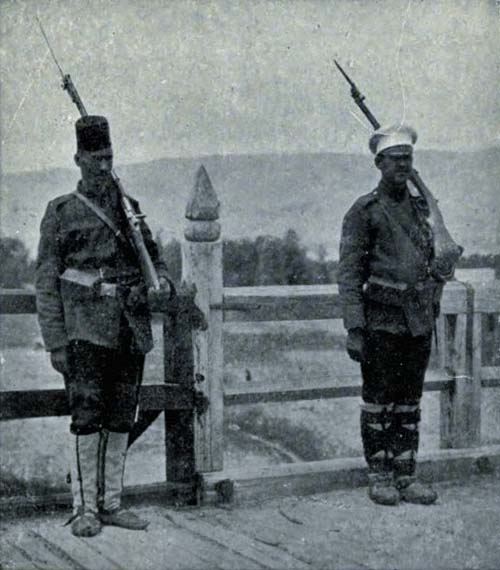
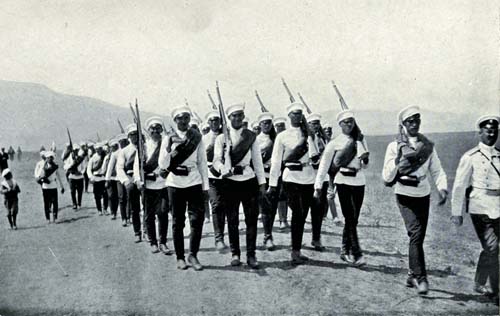
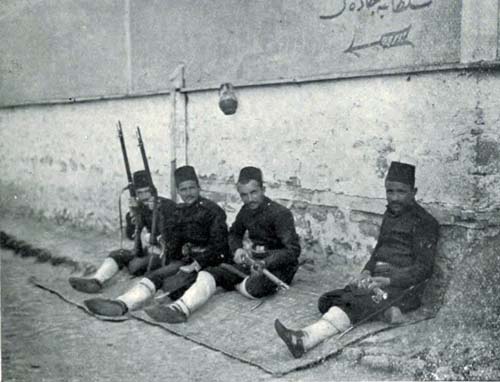
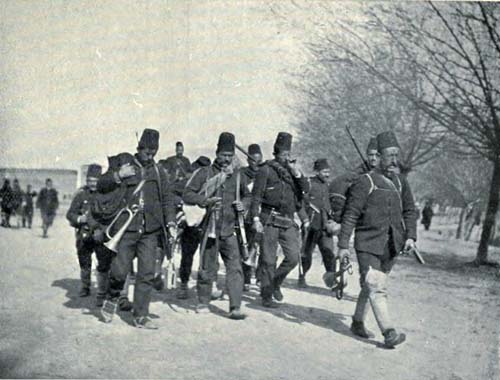
nevertheless, a picked company of Nizams (regulars)
was drawn up in honour of our travelling companion,
and presented arms as the train pulled in. The pasha
alighted, saluted, and, with us on either side of him,
sharing a great white umbrella, proceeded to the Hôtel
Turati. Then the bedraggled band struck up one
of several Sousa compositions which have been
Orientalised for the Ottoman army, and the company
marched away through the slush, doing the German
‘goose’ step, acquired from the Kaiser’s officers in the
Sultan’s service, which showy effort spattered the mud
on civil pedestrians on both sides of the narrow street.
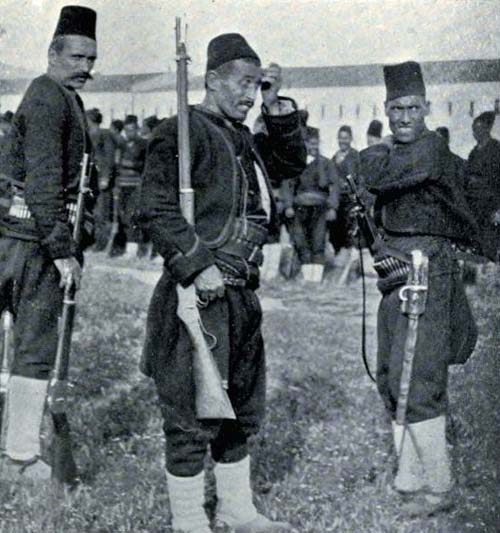
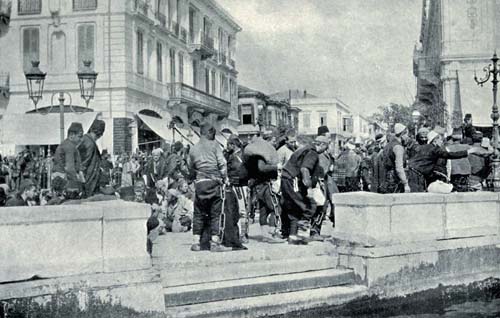
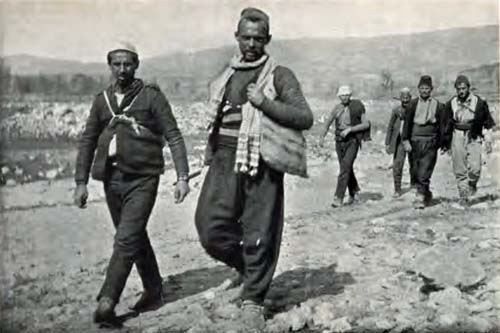
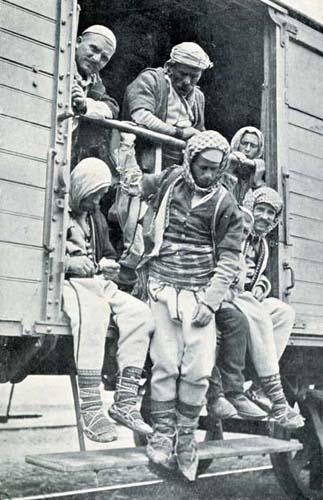
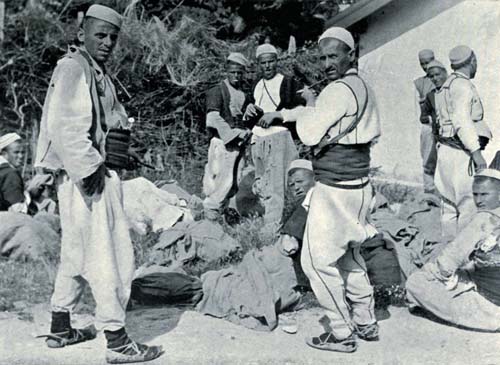
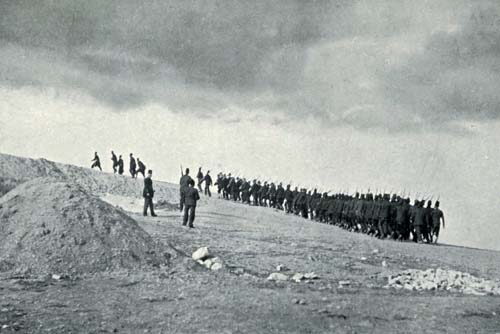
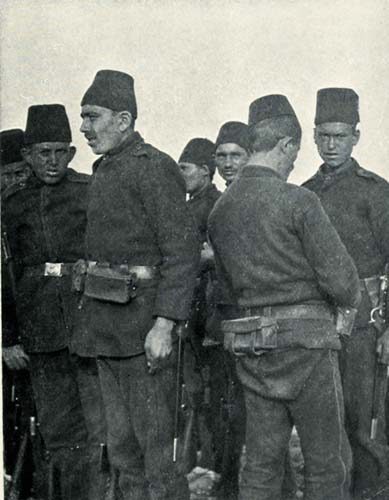
Behind the soldiers straggled several hundred
Albanians, raw Redifs (first reserves), who had come
up on our train in cattle-cars marked in bold letters,
in a language they knew not of, ‘8 Chevaux ou 48
Hommes.’ And behind the Arnauts trailed a score of
prisoners protesting violently at being driven to gaol
through the mire. These were Christians impregnated
with the sense of free men’s rights. They were attired
in ‘Francs,’ fezzes, and handcuffs—with the exception
of one, a priest, who wore only the manacles in common
with the others, apparently the conductors of a Bulgarian
gymnasium temporarily out of business.
Before the school teachers paraded a grinning gypsy
bearing on his back a bundle of old muskets.
‘See, see!’ said the pasha. ‘They were captured
in arms. There are the guns.’
‘8 CHEVAUX OU 48 HOMMES’: ALBANIAN RECRUITS.
But a foreign Consul, wise in the ways of the wily
Government, told us that this gypsy and his parcel of
rifles was the ostentatious advance guard of every
detachment of Bulgarian prisoners. The manœuvre
was designed to deceive those representatives of the
Powers and newspaper correspondents who were
particularly prying.
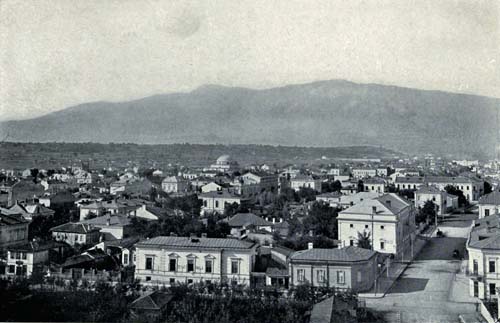
Uskub is a stern place with a breath of the mountains
upon it. It is but an eight hours’ journey from
Salonica, but, thanks to the restrictions of travel and
intercourse, wholly free of a Levantine atmosphere.
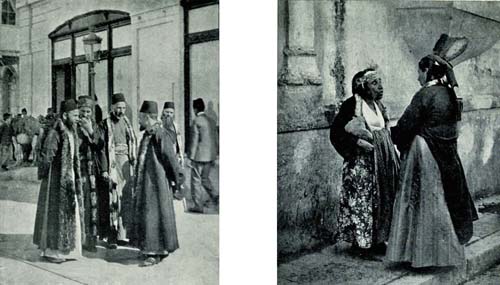
It is peopled principally by Arnauts—as the Turks
call the Albanians—and Slavs, both men of character,
though their morals are of a peculiar code. These
Albanians and Slavs are natural enemies, and of the
Slavs again there are Bulgarians and Servians, not
good friends. The Kossovo vilayet, of which Uskub
is the capital, has been described as a prolongation of
Albania, Servia, and Bulgaria. The provincial delimitations
of Turkey were undoubtedly designed with
a view to encompassing under the same administration
as many hostile elements as possible.
The differences between the Servians and the Bulgarians
of Macedonia are almost entirely a matter of
education. The two races have long since forgotten the
enmity of their ancient emperors, and in five centuries
of similar suffering under a mutual monarch they have
at heart but one desire. They have become assimilated
to an extent in these ages, and in some sections
it is difficult to determine one from the other. Their
language, here where the two races blend, can be
spoken of as one. They have duplicate religions,
similar ideas, identical customs. The peasants dress
alike, and only the partisans and propagandists are
distinguishable by their attire. A European cut of
clothes is worn by those who attend the Bulgarian
gymnasium, while a military jacket attests the adherents
of the rival school.
At one time, prior to 1878, the territorial ambition
of the Servians and that of the Bulgarians did not
clash. The Servians aspired to a confederation of all
Serbs, hoping for the annexation of Bosnia and Hertzegovina
and a union with Montenegro. But the
Treaty of Berlin gave a mandate to Austria-Hungary
to occupy two Turkish provinces peopled by Serbs,
thereby severing the two Serb States apparently for
all time. Servian nationalists were horrified at this
injustice, and frenzied attempts were made to undo
this act of the famous treaty. But all efforts were
unavailing against the power of the great neighbour,
and in desperate fear of being shut in from the sea
for ever, a petty, dwarfed State, the Servians turned
from the Adriatic and faced the Ægean, and sought to
acquire a right of way by that route to the world at
large.
Notwithstanding the fact that in Macedonia only
what is known as Old Servia—that section of Kossovo
between Uskub and Servia proper—is extensively
peopled by Serbs, Servian patriots laid claim to all
the Slav elements in the districts to the south, straight
away to the coast, arguing that the Bulgarians,
originally a Tartar people, had been assimilated by
the Slavs. The Servians spread their schools beyond
the territory rightly theirs, establishing gymnasiums
in Salonica and Monastir to compete with the Greeks
and Bulgarians in converting the population. But
below Old Servia, only purchased support of their
cause was forthcoming from the people, and nowhere
south of Uskub did the Servian campaign seriously
worry the two big propagandas.
This business of cornering communities is expensive,
and little Servia would hardly have been able
to cast her claims so far except with monetary aid
from one of the ‘interested Powers,’ and the support
of that Power’s agents in the distressed land. When
the Bulgarians began to show an independent spirit,
and diplomatic connections with Russia—which assumed
the form of a dictatorship on the part of the
boasted liberator—came to be severed for a term of
years, that ‘interested’ Power adopted Servia as its
ward, and is still at work disciplining the other little
country that dared to dispute its honesty of motive.
Russia among the Balkan States does a work similar
to that of the Sultan in Macedonia; she aids the weak
to rival the strong, fosters their jealousies, and maintains
a dominant influence on the distress she begets;
and, unlike the Sultan, she does this in the guise of
Christian sympathy.
In Uskub the Russian Consul, for ever attired in
military greatcoat and Muscovite cap, and always
accompanied by a brace of stalwart bodyguards
bristling with weapons, snubs the retiring little Bulgarian
agent, and on all occasions bestows his pretentious
patronage upon the Servian representative.
It was at Russian suggestion that the Servian schools
adopted a distinctive uniform, after the manner of
Russians in Finland and in other lands they have hoped
to Russify.
The Austro-Russian accord on Macedonian affairs
resembles a thieves’ alliance—without that saving
grace, however, the proverbial honour that exists
among thieves. For centuries these partners of the
present have been loitering around the gates of the
European estate of the Ottoman gentleman with the
many wives and the torture-chamber. One of these
interested neighbours has been in the habit of rushing
in to the rescue whenever a Christian cry escaped the
Bluebeard’s window—always attempting to get away
with something; the other, not so daring, but quite as
designing, waited without the walls and made his
burly rival return the booty or compensate him (the
other) under threat of the police. Three years ago
this worthy pair allied agreed to rob the house no
more, but planned to enter—and reform it!—and received
a mandate so to do from the European Powers.
But, in spite of the pretensions of these confederates,
neither has forsaken his pet policy, which is directly
opposed to that of the other. While the gallant
Russian is engaged advocating the cause of the Serbs,
his Austrian ally-in-reforms is diligently at work
advancing the interests of a rival race.
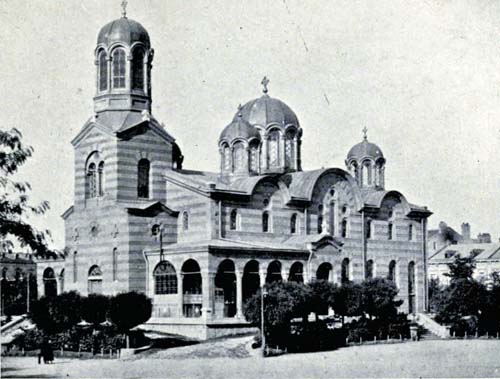
The Roman Catholic church at Uskub, a feature of
the Austrian propaganda, was decorated one dusty
summer day with garlands of mountain flowers and
many flags. A vast Mohamedan banner floated
from one side of the Christian belfry and an equally
large emblem of the Dual Monarchy from the other;
and strings of little flags, alternately Turkish and
Austro-Hungarian, streamed away from the tower to
the high mud walls about the churchyard. Over the
door, where only the Catholics who entered could see,
hung a large print of Francis Joseph much bemedalled,
and none was visible of Abdul Hamid.
It was the feast of Corpus Christi, and the Englishman
and I, attracted by the Albanians converging
upon the place from all directions, betook ourselves to
witness the celebration. The darkened church was
aglow with many candles around the crucified Christ,
and the fourteen ‘stations of the Cross,’ set like little
chapels about the churchyard, contained life-sized
pictures of the Saviour’s labour to the Crucifixion.
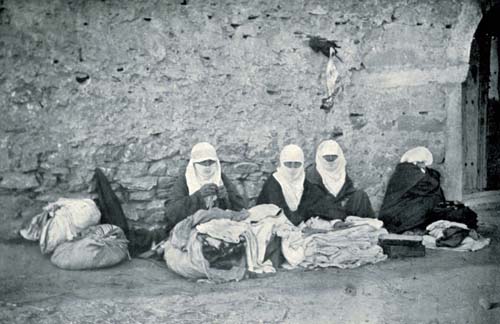
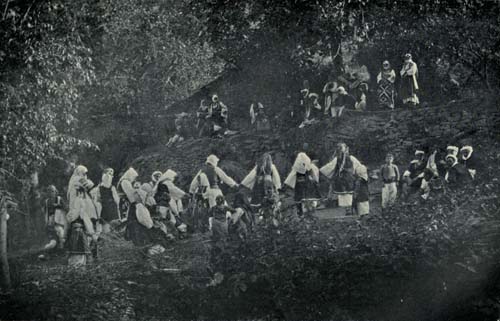
During the indoor service the Albanian women, veiled
like their Mohamedan sisters, occupied one side of
the church, and the men the other. In the pew of
honour sat the Austrian reformajis in full feather,
the brilliant uniform of Count de Salis, chief of the
gendarmerie contingent, relieved and glorified by a
Salonica frock-coat covering the venerable person
of the Christian Vali, who sat next. This decrepit
representative of the Sultan was playing a game
similar to that of the gaily garbed gendarmes. He
was selected by the Porte several years ago as a
co-governor with the Turkish Vali because of general
incapacity and indifference to affairs. His duties were
ostensibly to reform the province, but he was incapable
of performing them or he would not have received
the appointment. This day he was displaying the
Christian sympathy of his Sultanic master, just as
the Austrians flaunted their religious zeal before the
Catholic Albanians.
At the conclusion of the indoor service on Corpus
Christi day, priests and people left the church
chanting, each carrying a lighted candle, and made a
tour of the ‘stations,’ kneeling and praying a few
moments at each. Little flower-girls, dressed in gayest
shalvas, preceded the procession scattering rose-leaves.
Two proud Albanian boys swung the incense lamps,
and four others bore a panoply of silk over the heads
of the priests. First behind the priests came the
Count and the Christian Vali, and then followed the
Austrian Consul and other Austrian officers and the
people. The ordeal of kneeling in the grass was
trying to the trousers of the Count and painful to
the rheumatic limbs of the venerable Christian Vali,
whom the Count was required to assist to his feet on
each occasion.
It was a windy day, and the candles, borne gingerly
at arm’s length, sputtered, and spattered the gorgeous
uniform and the ample frock-coat. The delegates at
their divine duties, wore on their faces, I must say,
most unholy expressions, and at the conclusion of the
ceremony the poor old Christian with the fez presented
the appearance of having eaten his supper without
stuffing the end of a napkin in his collar. Religion
and politics make an unhappy mixture; they war
within one like custard and cucumbers.
The presence of two unsympathetic newspaper
correspondents, standing by at this ceremony, appeared
to annoy the official party, and for some time
after that ‘the two English correspondents’ (of whom
I was one) were severely snubbed by the Austrian
officers. An imaginary but effective barrier was
thrown across the middle of the dinner-table, dividing
the Englishmen and the Russians from the Austrians
and the Jews, mostly Vienna correspondents.
But there came a day when the latter, overwhelmed
by curiosity, were forced to fraternise again.
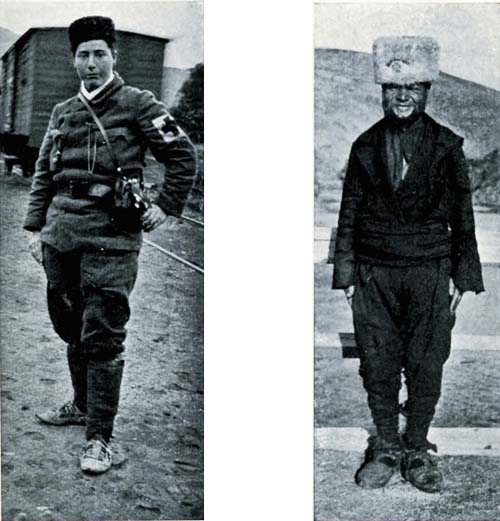
A strange female of daring demeanour, unheralded
and alone, appeared at the hotel. Her species had
never been seen before in Uskub. Her skirt was
shockingly short, and contained a hip-pocket, from
which the blued butt of a Colt’s 44 protruded. Her
hat was a duplicate of mine, and all her other garments
were more like a man’s than a woman’s. Fast
on her heels arrived the ubiquitous policeman with his
compliments and his veiled demands for information.
She possessed a teskeré, and gave it to him, but he
was not content with this, and would have her passport
with its big red seal.
‘Not much, my fine feller! You can have Abdul’s
rag all right, all right, but this here document belongs
to your auntie.’
The gentle police understood her not. Nicola, the
Albanian waiter, attempted to interpret. He spoke
a little French, but this was of no avail. The Turk
called in a miserable Christian (she must be Christian)
who spoke, besides Turkish and Albanian, Bulgarian,
Servian, Rumanian, and Greek, but not a word
of any kind had he in common with the curious
stranger.
‘Of what use are all my tongues!’ he exclaimed
piteously, as he was kicked out by the Turk. One of
the Russians offered his services. His accomplishments
comprised all the languages of Europe, including
English. No use. ‘The woman who speaks no
human language,’ he called her; and the name clung
to her.
Nicola saw that the fearful female belonged to
none of the known races, so when she appeared at
dinner he seated her with ‘the English.’ She recognised
me at once, and Austrians, Russians, Jews, and
the Englishman, who hailed from Yorkshire, seeing that
I was able to converse with the lady, at once made
use of me to present their compliments and make
gentle inquiries. The pragmatical Russian subsequently
developed his witticism, and dubbed me the
superhuman interpreter.
Between meals the unknown prowled the town
carrying a small black box with a covered eye, which
flapped at every native she met. Tziganes fled madly
down the roads, Albanian women took fright, covered
their faces and scurried into their houses, and even
the Turk of habitual immobility suffered a rude shock
to his equipoise.
Now, the potting of a peasant and the hold-up of a
native in the crowded streets are episodes which do
not disturb the tranquillity of Uskub, but the visit of
an apparition from Mars is an event which does not
take place every day. The stranger stalked through
the covered bazaar, putting the place in a panic for the
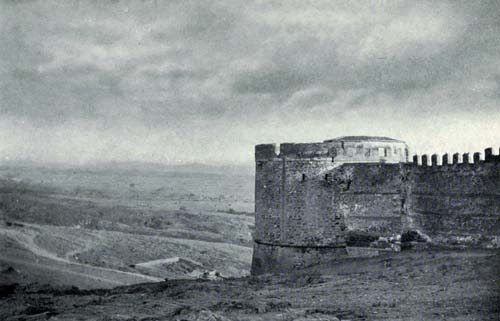
time being, and climbed the steep hill to the citadel,
where the army practised at range-shooting without
cartridges—an economy in ammunition. There
she marched boldly up in front of the line of soldiers
blinking at far-off targets through the sights of empty
guns, aimed the eye of her black box at them, and
snapped it. The triggers fell with a unison of clicks
never before accomplished on the rifle-range. An
officer of the garrison, who had been educated in Germany,
and was accustomed to strange sights, emerged
from the barracks at a pace Turks seldom acquire,
and established for ever his reputation for bravery by
ejecting the interloper. The artillery barracks was
next to receive the spook, who was caught in the act
of aiming her spell-box at the cannon. She was taken
into custody by the commander himself, the troops
refusing to obey orders, and detained until a fast rider
could find the Vali and learn from him whether this
were not an Austrian spy in disguise.
This was too much for the Turks; business was
already at a standstill, and the garrison completely
demoralised. The Vali ordered out his state coach
forthwith, and with four outriders in the shape of
trusty troopers unafraid of man or superman, made
his way to the British Consulate. The preliminary
compliments were cut unusually short, and in less than
ten minutes the governor of Kossovo got to business.
‘It will be shot, O exalted Consul,’ said the Vali,
‘if it roams at large another day. I have assigned
police to follow it for its protection, but I fear even
they will be powerless to preserve it. Can you not
persuade it to depart?’
The Consul tapped his head and rolled his eyes,
after the manner best understood of the Moslem, and
the Moslem heaved a comprehending sigh, expressed
his gratitude, and took his departure.
Next day all Uskub knew that it was mad, and
Moslem and Christian alike bowed low in holy reverence
as it passed.
‘Well,’ said my countrywoman, after she had
shaken hands with Russians, Jews, Austrians, and
English, coming last to me, ‘you can bet your sweet
life I ain’t sorry I hit on somebody in this benighted
land who can speak plain United States.’
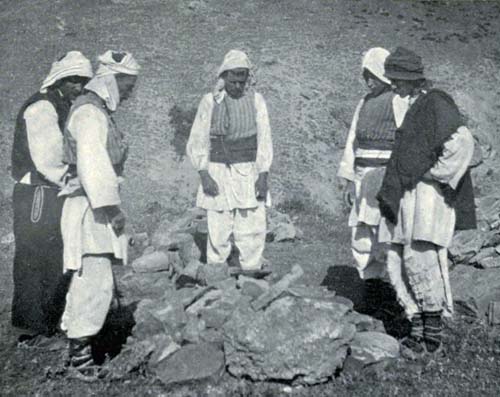
GRAVES OF DEAD COMMITTAJIS.
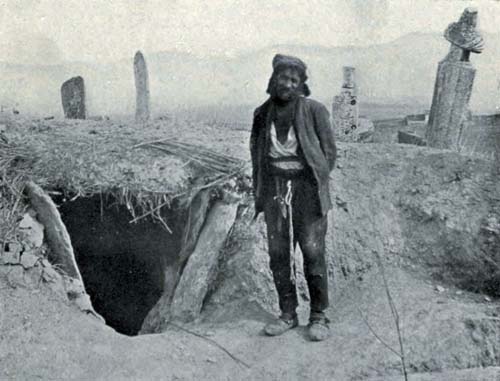
THE OLD TURKISH SEXTON WHO LIVED IN A GRAVE.
Uskub is ordinarily a quiet and sober town, and
well might it be; it is nestled in a valley of death.
Tombstones are always the prominent feature of a
Turkish town, but Uskub resembles an oasis in a
desert of dead. Acres of them in general disorder, a
few erect but mostly toppling or fallen, surround the
town and stretch long arms into it; they flank the
main road and dot the side streets, and far out into
the country lone deserted stones stand where no man’s
hand has been for ages. The sight is gruesome, and
one’s mind is wont to picture the many massacres
that have made this sea of silent slabs. But a large
proportion of the graves are those of Mohamedans,
and history records no general slaughter of them since
the battle of Kossovo, more than four centuries agone.
This is the explanation—Christians plant bones on
top of bones, but the six feet of earth allotted to the
dead Turk generally remains his until Judgment Day.
In many Turkish towns you will find streets turned
out of their natural course to leave the grave of a
Turk undisturbed.
The old sexton of a cemetery in Uskub, who lives
in a cave burrowed under the ground like the abodes
of those he watches, was in a terrible dilemma after
the American adventuress had snapped his photograph,
because she, a giaour, tramped back to the
road over the resting-place of believers.
On one side of the Hôtel Turati is a Turkish cemetery,
and not far behind it is a Christian burial-ground;
and almost daily a funeral procession passes the hotel
to one or the other of these burial-grounds. The
body of a Turk is borne on a litter on the shoulders
of his friends, each of them taking a turn for a few
minutes as pall-bearer. If the deceased was very
popular, and the distance from his home to the grave
very short, there is a continual commotion about the
corpse, friends giving place rapidly to one another as
the body is borne along.
The Christians do not carry their dead on their
shoulders, but they, also, convey the corpse on a litter
to lower it into a wooden coffin in the grave. Priests
precede the funeral parade on foot in full vestments,
chanting as they march, and the friends follow the
body, one carrying the coffin-lid.
A strange sacrifice for the dead takes place quarterly
in the Christian cemetery. The peasants gather from
far and near bringing cakes and pans of boiled wheat,
of the best they can afford, and place them on the
graves of the dead. Candles are stuck about the food
and tinsel paper cut in fine shreds arranged over it.
Priests pass from grave to grave praying with the
peasants for the souls of the departed, and sons of
the priests, who serve as acolytes, swing censers. At
the conclusion of the ceremony the sacrificial food is
distributed to the poor—or rather the poorer—and
lazy gypsies gather with many naked babies at the
borders of the cemetery.
Leaving the ceremony the foreigner is beset by these
beggars, especially the naked urchins. They follow
one to the gate of the hotel. One brat is too large to
go unclad, according to the requirements of decency
regarded by the Turks, so his mother’s apron is tied
around his waist. But he hopes to elicit a piastre
by cutting capers, one of which is a somersault. As
his arms and head go down the single garment
drops over them, and the high half of his anatomy is
exposed like the double-headed dolls in the Strand.
But we give them nothing. We have seen these
fellows count their day’s collection, and knowing the
day’s wages of a field labourer in Turkey to be infinitely
less, we give to the latter. The Tzigane maims
a brat, and by its begging the family is supported.
And it is the fool Christian who gives; it is a part of
his religion to pay by ‘charity’ the way of deceased
souls through the golden gates.
A round and ragged brown urchin who blacks boots
before the hotel and swallows the money he receives,
bettered his position one day through the favour
his funny face had found with the foreigners at the
hotel. On calling for the bootblack one morning
he appeared leading a blind beggar. But nobody
patronised him now, and the two departed jabbering
viciously. Next morning the brat was back again
with his blacking-box, shining boots and swallowing
small coins.
There is a Tzigane quarter in every large town in
Turkey, and it generally stands somewhere near the
circle of graveyards. It is always the most squalid
quarter, holes in old walls, shanties made of flattened
petroleum tins, caves in hillsides, serving the gypsies
as abodes. They are a filthy people, and a burden
to the community. They seldom till the soil, object
to work, and live for the most part by begging or
stealing. They stand alone in the world as a people
without a religion, and their primitive instincts lead
them to follow the natural bent of man to prey upon
others. They came into Europe on the heels of the
Turk, and remained in some of the countries from
which he has been compelled to recede. In one of
the Balkan States they are exempt from military
service, as they cannot be held to routine; in the
others they are generally assigned to duty in the
bands because of their talent for music.
Across the old stone bridge, on the road that
leads up to the citadel, are many curious booths. A
questionable character of doubtful race sits Turkish
fashion in one the size of a draper’s box, before him
a pot of writing fluid, several wooden pens, some slips
of common paper, and a pepper-box of sand, also a
constant cup of coffee, a tobacco-box, and a flint.
Natives pass up this hill to the market place behind
the old fort, and on market days the man of letters
is very busy. Christians do not patronise his talents,
for in every Christian community, thanks to the
propagandas, there are several peasants who can read
and write; but Mohamedans, faithful to the wishes of
the Padisha, abstain from the corruption of education,
and thereby make the letter-writer necessary.
A veiled lady presents a letter at the booth.
‘From whom?’ asks the sage of cipher.
‘Our husband,’ the veiled lady replies.
‘“Most beloved of my wives,”’ the flattering fellow
begins to read, ‘“I am well. I wish you are well.
The weather is well. The buffaloes are well....”’
Here the wise man studies the document closely, and
asks: ‘What is your husband’s name?’
‘Almoon, effendi.’
‘Ah, yes; Almoon.’
THE HORSE MARKET.
SWEARING TO A BARGAIN.
The woman pays two metaleeks.
A few weeks later the same woman appears with
another letter.
‘From whom is it?’ again the question.
‘Our husband,’ again the reply.
‘“Most beloved wife,”’ by way of variation,
‘“the weather is well. I am well. I wish you well.”
What did you say your husband’s name is?’
‘Almoon.’
‘Ah, yes; Almoon. Your husband’s writer does
not form his letters well.’
The woman pays two more metaleeks.
Some time later she returns again. The intelligent
man of letters recognises her this time, and employs
his trained memory.
‘“Most beloved of my wives,”’ he begins, ‘“I
hope you are well. I am——”’
‘Effendi,’ the woman interrupts, ‘this letter, I
think, is from my sister.’
‘Ah, you should have told me!’
Another hole in the wall, the keeper clinking coin—no
doubt as to his race, he deals in money. He
charges a piastre (twopence) for changing a lira, but
silver coins are bought by him at current value. In
Turkey a gold piece seems to have no fixed value;
but actually it is the price of silver that varies. In
Constantinople a pound Turkish is worth 103 piastres,
in Salonica only 101, but in Uskub it brings 105, and
in Monastir 107 or 108. Obviously the thing to do is
to buy silver coin in Monastir and sell it in Salonica.
Imagine getting twenty-three shillings in change for
a pound in Liverpool, twenty-two in Manchester, and
twenty in London!
Over the opening of a larger booth bunches of
blood-coloured skull-caps hang by long black or blue
tassels a foot or more in length, resembling at no
great distance the scalps and scalp-locks of Red
Indians. White Albanian caps and Turkish fezzes are
also on sale, and a row of heavy brass blocks, like
closed mouth of cannon, line the front of this formidable-looking
shop. These last are presses for fezzes,
which are put in shape for two metaleeks.
Lemonade booths, faced with rows of huge bottles
containing green, red, and yellow drinks—limes, blood
oranges, and lemons corking the respective bottles—and
other permanent shops line the hill road and
flank the covered bazaars. But the real fair is
held only once a week on the open space above,
where the Turkish garrison performs its silent target
practice.
Tuesday is the market day in Uskub, and the
scene behind the ancient fortress above the Vardar,
in view of the surrounding country for many miles, is
alone worth going to Turkey to see. The vast hilltop
is littered with native goods for sale or exchange, and
crowded with men and women in gay and gruesome
garbs. Albanian shepherds and their lean dogs mind
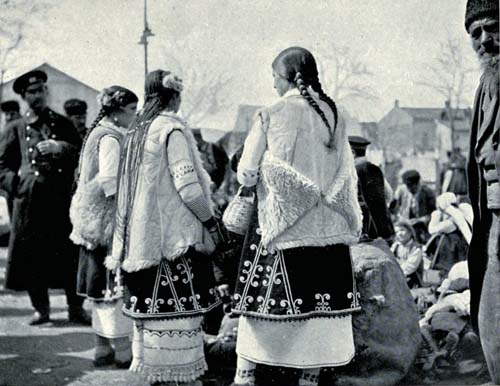
flocks of fat-tailed sheep, their spectral wives, in faded
ghost gowns, sit selling hand-worked waistcoats of
gaudy hue; Christian peasants who have come afoot
or on asses or driving primitive ox-carts, display all
sorts of country commodities, from new grain to ice (in
the summer time) from the white peaks in the distance;
Turks have a little rough lumber (there is not
much in Macedonia); and Turkish soldiers, among the
most ragged men in the concourse, dispose of horses,
old boots, hunks of bread, gathered—who knows how?
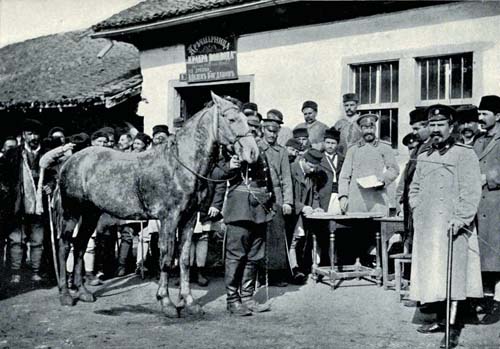
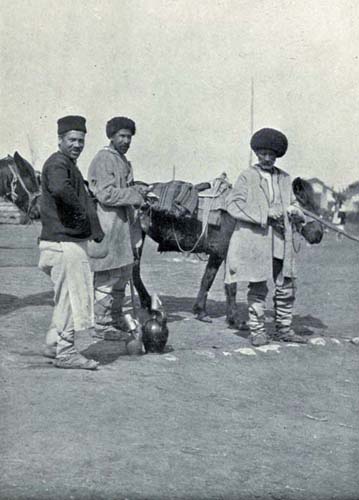
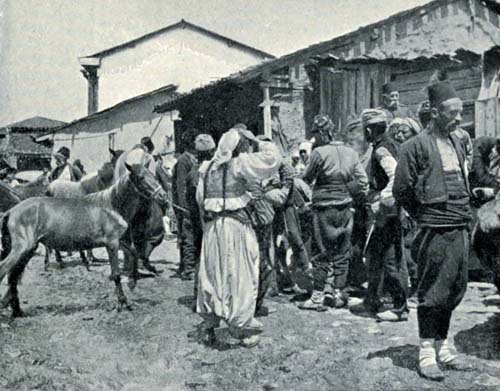
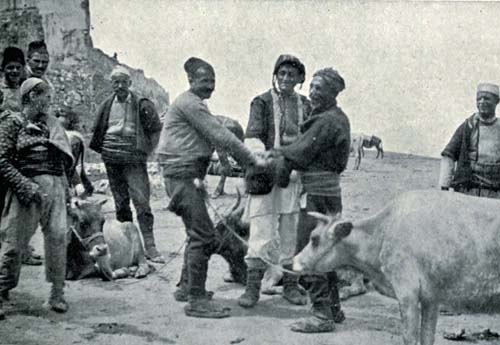
Tziganes are always on the horse market. A photograph
shows a bargain being made, a third man, a
Turk, swearing a Bulgarian and a gypsy to an exchange
of cows.
Our defeat at Istip had not been forgotten. Since
then we had awaited only a reasonable excuse for
taking a reasonable risk. One of the Austrians came
in with the account of a combat between a Servian
band and a Turkish regiment, which had taken place
two days before at a spot in the mountains above a
hamlet named Pschtinia, several hours’ ride towards
the Bulgarian border. This was justification for
breaking the Turks’ cordon about us. Our papers
had sent us many miles at heavy expense, and we
must have exclusive news. Better reading, to be
sure, is the cool, considered report of reports written
at headquarters, but the true correspondent always
prefers to date his stuff at the firing-line.
To assure ourselves that we were taking no unnecessary
risk, that there was no chance of securing
permission to seek the scene of this fight, we called
on the Governor-General, who had duped and deceived
us many times—no doubt to his quiet satisfaction,
though he was always too much of a gentleman to
display delight in our dilemma.
‘Ah,’ said Hussein Hilmi Pasha, as we sipped his
coffee, ‘you went to Istip, and were prevented from
visiting Garbintzi. I sent orders to turn you back.
As I have often told you, effendi, it is dangerous in
the interior; one cannot say where a “brigand”’—his
excellency meant a Bulgarian insurgent—‘may
be lurking to shoot the European. I have letters
from the chiefs threatening to kill a consul. As you
know, they hope to make trouble for us with the
Powers.’
‘But, excellency, you may give us an escort.’
‘Even with escort one is unsafe. They can fire
at you from a mountain side high up above. They
are fiends, these brigands; they do not care if they
are killed themselves.’
‘But we were permitted to cross a most lawless
section of the country, and were stopped only when
we sought to visit the scene of a fight. Surely, your
excellency, this is a mistaken policy on your part; we
must gather that there is something to hide from
correspondents.’ We had put down this argument
before.
‘There is nothing to hide. Come to me, and I
shall tell you the truth about all affairs. But I can
permit no more travelling in the interior.’
The same old story. We left the pasha’s presence
pretending disappointment. But his threat of Bulgarian
‘brigands’ did not disturb us, and we were
willing to take the chance of encountering Albanians.
We were going to Pschtinia. The game was not difficult;
it required simply coolness and courage and a
knowledge of the ways of the Turk. The Englishman
possessed sufficient of the first two requisites, and I
had dealt with the Ottoman authorities for more than
a year.
Late that evening we sent our dragoman for a
Turkish coachman, and hired him to be on hand the
following morning at nine o’clock, Turkish time, to
take us to Kalkandele, an Albanian town about the
same distance off as is Pschtinia, but in the opposite
direction. We knew the native coachman’s ways.
A jingle of many bells announced the arrival of
our carriage next morning at ten o’clock Turkish
(about 5.30), the hour at which we planned to leave.
The bells were for the purpose of warning other
vehicles coming the opposite way along steep roads,
but they would also have the effect of disturbing
sleeping guardhouses and apprising them of the fact
that we were bound on a country journey. The
danger of collision was the minor risk, and we ordered
the driver to relieve his ponies of their noisy necklaces.
The Turk protested, and commenced to
discuss the matter, but there was no time for argument.
Having got the bells safe under a seat, we
told him to drive to Pschtinia.
‘You hired me to go to Kalkandele.’
‘We have changed our minds.’
‘But I have told the police you were going to
Kalkandele.’
Exactly; and without doubt the first guardhouse
on the road to the west had instructions to turn us
back.
Our Turk soon learned that we were no meek
and native Christians, and rather than lose his job
altogether he obeyed our commands. We drove
quietly through the deserted streets, the ponies’ hoofs
pattering softly in the thick cushion of dust, the
lucky beads on their harness rattling, one wheel of
our shandrydan maintaining a rhythmic creak—but no
one speaking. Drowsy patrols who had fallen asleep
by the wayside looked up from the corners as we drove
by, but our Turk on the box served us as a passport.
Even the guardhouse at the far side of the Vardar
was content to let us pass at this sleepy hour, seeing
that our team was not equipped with country bells.
We passed under the barracks observed only by the
sentinel on the crest of the cliff, who blinked his
heavy eyes and stared stupidly down like a waking
owl, his head swinging a mechanical half-circle as we
came into view and passed out again. A mile and a
half through a million gravestones, stretching from the
crooked roadway on either side across the sweep of a
broad plateau—this was nerve-racking. We were in
full view from the citadel, the barracks, the Konak,
and several minarets—a black beetle crawling along a
crooked chalk line drawn through a never-weeded
prairie of white stone stalks and sheaves. We urged
the driver to lay on the lash and crawl quicker, and
we took turns in casting sly glances behind. But the
end of this drear graveyard came at last. We switched
sharply on a waggon trail to the left, and plunged
into the hills, in a stroke clipping dreamy Uskub from
the scene. We breathed freer; we were fairly started
on our journey long before the guardhouse on the
road to Kalkandele had given us up and reported our
failure to pass their way.
From time to time our driver became unruly,
slowing his pace and refusing to use his whip, protesting
that his horses would not last to Pschtinia
at the rate at which we were going. We promised to
let him give them a long rest at our destination, to
drive back to Uskub at his own pace, and to raise his
fee a mijidieh, all of which, with occasional promptings,
kept the horses to their fugitive gait. Our
rattle-trap dashed through the cornfields, terrified the
peasants in their harvesting, drew the shepherds’ dogs,
and scattered grazing sheep, rolled down the mountain
sides, making desperate swerves, and climbed up
empty, assisted by its passengers. We passed Albanians
and Bulgarians, who may have been brigands and
insurgents, and questions were asked our driver, but
he was out of temper and did not stop to reply. We
made Pschtinia at eleven—the wonder, only a trace
broke!—the Turk in a rage, and the sweat pouring
from his panting steeds.
We chuckled at the expense of Hilmi Pasha, and
drew visions of his wrath; he would permit us to see
no more of the interior for ourselves. We grew bold
here and planned to march on foot across Macedonia,
from Uskub east to Djuma-bala, and from there on
the Bulgarian border to Drama near the sea, a distance,
all told, of three hundred miles, and you shall
see whether we carried out this resolution.
The inhabitants of Pschtinia, many bandaged and
limping, gathered round us and kissed our hands,
thinking we were foreign Consuls come to inquire into
their grievances. After the fight the Turks had passed
through Pschtinia on their way back to barracks at
Koumanova, stopped and beaten the peasants for
having harboured the insurgents (which they protested
they had not), and carried off the headmen to
prison at the town. The old men insisted on showing
us the welts on their backs and bruises on their legs,
inflicted by the Turks with heavy sticks, and said
that the villagers worst mauled had been taken to
Koumanova to the doctor, and were now in the gaol
there.
When we had eaten of the eggs and brown bread,
and drunk of milk provided by different villagers, we
climbed to the battlefield with two guides who had
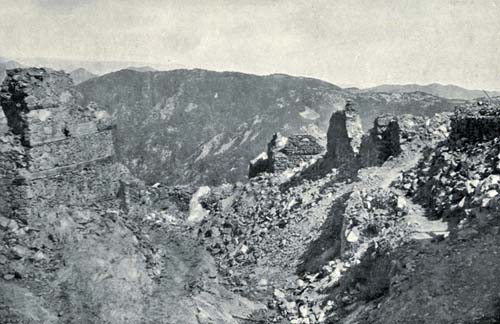
escaped mauling. It was a forlorn place for a last
stand against overwhelming odds—a vast gravel dome,
barren but for dwarfed yellow shrubs, and out of
sight of every human habitation, even the village it
sheltered. The band had been discovered some distance
to the north, and chased by an ever-increasing
pack of pursuers until driven to bay at this high
peak. The insurgents attempted evidently to reach
a forest on a neighbouring height, but the Turks cut
them off before they could reach it. Little piles of
stone a foot high, showing the haste with which they
had been thrown together, were still standing, behind
each a dark brown spot, a bloody rag or two, a scattering
of empty Mauser cartridge-cases. On the slope of
the dome we picked up Martini cases. ‘Turk,’ said
the peasants. That was evident. The calibre was
stamped in Turkish characters. Holes in the pink
earth, with bits of cast iron firmly embedded in the
rock, marked the places where the dynamite bombs
had struck at the last charge, when the soldiers
stormed the crest and the end of the insurgents was a
matter of seconds.
Some time after the soldiers had withdrawn, and
the dome was desolate again, a few peasants ventured
to the top. They found the bodies of twenty-four
Servians, battered and disfigured, and completely
stripped; the Turks had taken away their own dead.
Not so much of value as an old shoe remained on the
battlefield. The next day the strong outfits of the
insurgents, which had come from Belgrade, were sold
by the soldiers on the market place at Koumanova.
The peasants of Pschtinia rolled the bodies in coarse
striped buffalo blankets, carried them down to the
village, and buried them in the cemetery, the village
priest performing the burial service. A rough wooden
cross was raised over each grave. The villagers said
the soldiers came back to Pschtinia and tore the
crosses down; but they reared them again when the
Turks were gone.
‘Are you Servians?’ we asked the peasants.
‘Bulgarians, effendi.’
‘Then this band was an enemy to your party?’
‘But they were Christians.’
On descending to the village we found our Turk
already harnessing his team. He had been fed, and
so had his horses, and they were all in a more tractable
mood. The villagers, hale and halt, gathered
around our carriage as we prepared to start, and
poured forth their blessings on our Christian heads.
Several small boys brought us dirty little fried fish,
about two inches long, as a parting gift. We took the
fish, rewarding the young villagers, and, as we crossed
the stream, deposited the smoky carcases whence
they had been drawn wriggling an hour before.
Our driver took us home by a different route,
more direct, he said, with a great ‘something’ to see.
He had noted that the Englishman gave backsheesh,
and was wont to put us in his countrymen’s way.
He himself belonged to the world-fraternity of cab-men,
whose instincts vary nowhere, East or West;
but his cousin, to whom he took us, was a Turkish
peasant, a man who, when the spirit of war is without
his soul, is as true a gentleman as Occident or
Orient produces.
In crossing a trackless moor to the road that led
where our Turk would take us, we lost the road, and
for an hour wandered aimlessly till we met an armed
man with a woman who covered her face at sight of
us. The armed man asked the usual questions of our
Turk, and gave him directions.
It was five o’clock when we arrived at a great wall
of mud bricks, infinitely higher and better built than
those surrounding the average Macedonian dwelling,
but dilapidated and showing long want of care. The
walls enclosed a vast irregular area, and entirely
obscured the view within. We drove round wondering
and asking questions of our Turk, which he ignored
with a smile. Finally, we approached a high gate
designed after the fashion of that leading to the
Sublime Porte. Our driver stood up on the box and
began a hallooing, which burst like trumpet blasts on
the still surroundings. It was some time before a
far-off answer came over the walls. The call and the
reply were continued, the latter drawing gradually
nearer, and after some minutes a man spoke through
a keyhole not less than five inches high. Our Turk
descended from the carriage-box, was recognised by
him within, and told to wait until the key was fetched.
We then peered through the keyhole, and after a brief
interval spied the inmate returning from the house
toiling under the weight of an iron key of robust
diameter and a foot and a half long.
The huge oak gate was swung back, and we entered,
greeted with a dignified salaam and a shake of the
hand. There are no social classes among the Turks
across which the hand-shake is debarred. Deference
is shown superiors only in the salaam, a pasha
receiving a lower bow with an extra twist of the hand
than that given a bey, and a bey a lower dip of hand
and head than a bimbashee, a bimbashee than an
ordinary mortal effendi.
The Turk who welcomed us was the keeper, and,
with his wife, the only occupant of this vast estate,
the empty home of an exiled bey. The house was
shown to us by both the keeper and his wife, who,
though, of course, a Mohamedan woman, wore no
veil. The house was handsome for this part of the
country, but depleted even of furniture. The only
pictures on the walls were common paintings on the
plaster now cracked and falling. The harem, where
marble divans for five wives were built in nooks,
was filled with newly harvested grain. A bold
rooster, the only lord of the manor, cackled to half
a dozen happy hens and scattered the corn. We
helped the keeper eject the usurper and his feminine
following.
A bridge, resembling the Bridge of Sighs, led
out of the harem into the dwelling of the exiled
lord, bare like the other house. We climbed the
creaky, dust-covered stairs to a turret at the point of
the roof, which overlooked the surrounding walls
and afforded a view of the encircling mountains. A
brilliant southern sun was setting in an Oriental sky,
and a train of three buffalo teams, silhouetted in the
glow, crept along the sky-line.
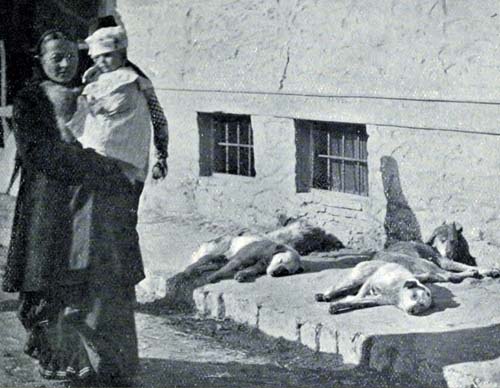
ALBANIAN WOMEN.
Late in the evening we passed through the long
cemetery and entered Uskub. Lights were out for
the night, and patrols paced the streets. We were
halted several times, but our driver’s Turkish rang true,
and we proceeded to the gates of Hôtel Turati, where,
after much knocking, Nicola roused from his slumbers
and removed the bars.