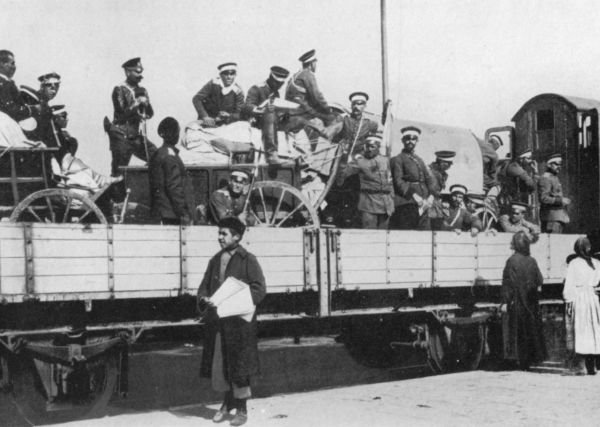
Being a war correspondent with the Bulgarian
army gave one far better opportunities of studying
Balkan scenery and natural characteristics than
war operations. After getting through to Staff
headquarters at Stara Zagora and to Mustapha
Pasha, which was about twelve miles from the
operations against Adrianople, I found myself
a kind of prisoner of the censor, and recall putting
my complaint into writing on November 7:
It is the dullest of posts, this, at the tail of an army
which is moving forward and doing brave deeds whilst
we are cooped up by the censor, thirsting for news, and
given an occasional bulletin which tells us just what it
is thought that we should be told. True, we are not
prisoners exactly. We may go out within a mile radius.
That is the rule which must be faithfully kept under
pain of being sent back to headquarters. Perhaps, now
and again, a desperate correspondent, thinking that it
would not be such a sad thing after all to be sent back
to headquarters, takes a generous view of what a mile
is. (Perhaps he has been used to Irish miles, which are
of the elastic kind; short when you pay a car fare, long,
very long, at other times.) But, supposing, with great
energy and at dread risk of being sent back to headquarters
a correspondent has walked one mile and one
yard; or his horse, which cannot read notices, has
unwittingly carried him on; and supposing that he has
made all kinds of brilliant observations, analysing a
speck of shining metal showing there, a puff of smoke
elsewhere, a flash, or a scar on the earth, still there remains
the censor. A courteous gentleman is the censor,
with a manner even deferential. He cuts off the head
of your news with the most malignant courtesy. "I
am sorry, my dear sir, but that refers to movements of
troops; it is forbidden. And that might be useful
to the enemy. Ah, that observation is excellent; but
it cannot go."
Afterwards, there remains in your mind an impression
of your wickedness in having troubled so amiable a
gentleman, and on your telegraph form nothing, just
nothing. Of course, if you like, you can pass along the
camp chatter, the stories brought in by Greeks anxious
to curry favour, the descriptions of the capture of
Constantinople by peasants whose first cousins were
staying at the Pera Hotel the day it happened. The
censor is too wise a gentleman to interfere with the
harmless amusement of sending that on. It does not
harm; it may entertain somebody.
So at the rear of the army, which is making the
Christian arm more respected than it has been for some
time in this Balkan Peninsula, we sit and growl. Those
of us who are convinced that we possess that supreme
capacity of a general "to see what is going on behind
the next hill" are particularly sad. There are so many
precious observations being wasted, theories which
cannot be expressed, sagacious "I told you so's" which
are smothered. We are at the rear of an army, and
endless trains of transport move on; and if we can by
chance catch the sound of a distant gun we are happy
for a day, since it suggests the real thing. Some of us
are optimists, and feel sure that we shall go forward
in a day or two; that we shall be allowed to see the
bombardment of Adrianople; if not that, then its
capture; if not that, then something. Others are
pessimists, and have gone home.
It is easy to understand the anxiety of the Bulgarians.
They are engaged in a big war. They know that some
of the Great Powers are watching its progress with something
more than interest and something less than
sympathy. It is their impression that they can beat
the Turks; but that afterwards they may have to meet
an attempt to neutralise their victory. So they are
anxious to mask every detail of their organisation.
Secrecy applies to the past as well as to the present and
the future. But it is very irritating; and one goes
home, or holds on in the hope that something better
will come after a time.
Meanwhile one may learn a little of the country and
its people—this country which has been riven by many
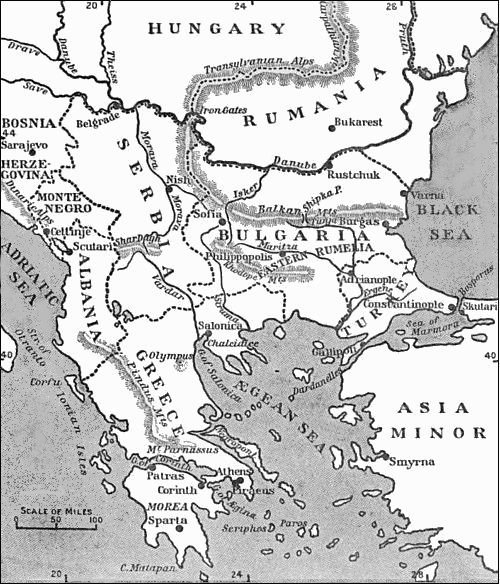
wars. The map—with its names in several languages—gives
indications of the wounds they inflicted. In
Bulgaria, too, it shows how determined is the nationality
of the people who have within a generation reasserted
their right to be a nation. They permit no Turkish
names to remain on their maps. Not only do the Arabic
characters go, but also the Turkish names. Eski
Sagrah, for example, gives place to the title it has on
the best English maps. "Sagrah" means in Turkish
a "dell," a place sheltered by a wood. "Eski" means
"old." The Bulgarian has changed that to Stara
Zagora, Bulgarian words with exactly the same significance.
He wishes to wipe away all traces of the defiling
hand of the Turk from his country, though tolerant of
his Turkish fellow-subjects.
Almost completely he succeeds, but not quite completely.
The Turkish sweetmeats, the Turkish coffee
keep their hold on the taste of the people, and away
from the towns, among the peasants who till rich fields
with wooden ploughs, there remain traces of the Eastern
disregard for time. But even in the country the people
are waking up to modern ideas, aroused in part by the
American "drummer" selling agricultural machinery.
But in his city of Sofia, "the little Paris," as he likes to
hear it called, and in his towns the Bulgarian has become
keen and bustling. He rather aspires to be thought
Parisian in manner. A "middle class" begins to grow
up. The Bulgarian prospers mightily as a trader, and
when he makes money he devotes his son to a profession,
to the staff of the army, the law, to public life. Also
the Bulgarian is keen to add manufacturing industries
to his agricultural resources, and there are cotton mills
and other factories springing up in different places. The
Bulgarian has a great faith in himself. Thinking over
what he has done within forty years, it is easy to share
that belief and to think of him one day with a great
seaport on the Mediterranean aspiring to a place in the
family council of Europe.
Afterwards, when by dint of hard begging,
hard travelling, hard living, and some hard
swearing, I had forced my way through to the
front, I concluded that with the exception of
Mustapha Pasha—where the Second Army had
failed at its task and was set to work on a dull
siege, and was consequently very bad-tempered—the
famous censorship of the Bulgarian Army
was not so vexatious to the correspondents as
to their editors. The censors were usually polite,
and tried to make a difficult position agreeable.
When the correspondents were despatched
it was thought that the Balkan States, needing
a "good Press," would be fairly kind. The
expectation was realised in the case of the
Montenegrins and the Greeks. The Serbians
allowed the correspondents to see nothing. The
Bulgarian idea was to allow nothing to be seen
and nothing to be despatched except the "Te
Deums." It was an aggravation of the Japanese
censorship, and if it is accepted as a model for
future combatant States the "war correspondent"
will become extinct. I am not disposed to claim
that an army in the field should carry on its
operations under the eyes of newspaper correspondents;
and there were special circumstances
in regard to the campaign of the Bulgarian
army (which was a desperate rush against a
big people of a little people operating with the
slenderest of resources) that made a severe
censorship absolutely necessary. But, that
allowed, there are still some points of criticism
justified.
One correspondent, and one only, was exempted
from censorship, and he was not at the front
but at Sofia. His special position as an informal
member of the Cabinet led to a concession which,
to a man of honour, was more of a responsibility
than a privilege. At the outset the Russian
and French correspondents were highly favoured,
and two English correspondents—who were
working jointly—were granted passes of credit
to all the armies. That privilege was afterwards
granted to me towards the end of the war. It
should have been granted to all or none. A
censorship which is harsh but has no favouritism
may be criticised, but it cannot be held suspect.
Throughout the campaign there was some
favouritism, the Russians having first place, the
French next, the English and Americans next,
the Italians, Germans, Austrians, and others
coming last. The differentiation between nations
was comprehensible enough, in view of the
political situation in Europe, but differentiations
between different papers of equal standing
of the same country cannot be defended. As
I ended the campaign one of the three favoured
English correspondents, I speak on this point
without bitterness. Indeed, I found no valid
grounds for abusing the censorship until just as
I was leaving Sofia, when I found that some of
my messages from Kirk Kilisse to the Morning
Post had been seriously (and, it would seem,
deliberately) mutilated after they had passed the
censor. They were of some importance as sent—one
the first account from the Bulgarian side
of the battle of Chatalja, the other a frank
statement of the position following that battle,
which I did not submit to the censor until after
close consultation with high authority, and which
was passed then with some modifications, and,
after being passed, was mutilated until it had
little or no meaning.
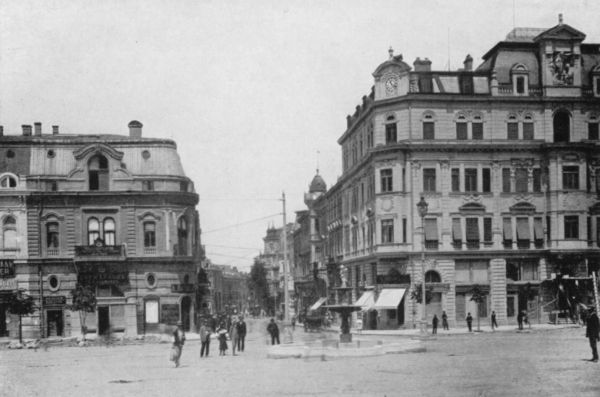
Exclusive News Agency
SOFIA
Commercial Road from Commercial Square
In lighter vein I may record some of the
humours of the censorship, mostly from Mustapha
Pasha, where the Second Army was held up and
everybody was in the worst of tempers. Mustapha
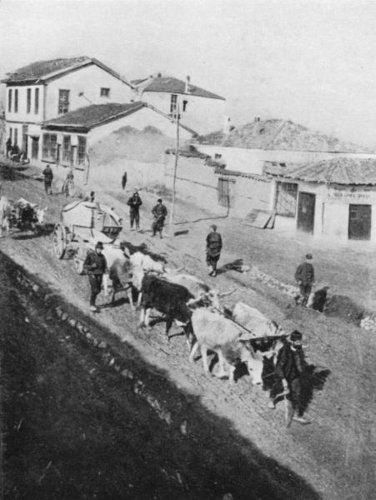
Pasha would not allow ox wagons to be
mentioned, would not allow photographs of
reservists to be sent forward because they were
not in full uniform, would not allow the fact
that Serbian troops were before Adrianople to
be recorded. Indeed, the censorship there was
full of strange prohibitions. Going down to
Mustapha Pasha I noticed aeroplane equipment.
The censor objected to that being recorded
then, though two days after the official bulletin
trumpeted the fact.
At Mustapha Pasha the custom was after the
war correspondent had written a despatch to
bring it to the censor, who held his court in a
room surrounded by a crowd of correspondents.
The censor insisted that the correspondent should
read the despatch aloud to him. Then the censor
read it over again aloud to him to make sure that
all heard. Thus we all learned how the other
man's imagination was working, and telegraphing
was reduced to a complete farce. Private letters
had to pass through the same ordeal, and one
correspondent, with a turn of humour, wrote an
imaginary private letter full of the most fervent
love messages, which was read out to a furiously
blushing censor and to a batch of journalists,
who at first did not see the joke and tried to look
as if they were not listening. I have described
the early days of Mustapha Pasha. Later, when
most of the men had gone away, conditions
improved.
The "second censorship"—the most disingenuous
and condemnable part of the Bulgarian
system—was applied with full force to Mustapha
Pasha. After correspondents, who were forbidden
to go a mile out of the town and forbidden to
talk with soldiers, had passed their pitiful little
messages through the censor, those messages were
not telegraphed, but posted on to the Staff headquarters
and then censored again, sometimes
stopped. Certes, the treasures of strategical
observation and vivid description thus lost were
not very great, but the whole proceeding was unfair
and underhand. The censor's seal once affixed
a message should go unchanged. Otherwise it
might be twisted into actual false information.
In almost all cases the individual censors were
gentlemen, and personally I never had trouble
with any of them; but the system was faulty
at the outset, inasmuch as it was not frank, and
was made worse when it became necessary to
change the plan of campaign and abandon the
idea of capturing Adrianople. Then the Press
correspondents who had been allowed down to
Mustapha Pasha in the expectation that after
two days they would be permitted to follow the
victorious army into Adrianople, had to be kept
in that town, and had to be prevented from knowing
anything of what was going on. The courageous
course would have been to have put them
under a definite embargo for a period. That
was not followed, and the same end was sought
by a series of irritating tricks and evasions.
The facts argue against the continuance of the
war correspondent. An army really can never
be sure of its victory until the battle is over. If
it allows the journalists to come forward to see
an expected victory and the victory does not
come, then awkward facts are necessarily disclosed,
and the moving back of those correspondents
is tantamount to a confession of a
movement of retreat. If I were a general in
the field I should allow no war correspondents
with the troops except reliable men, who would
agree to see the war out, to send no despatches
until the conclusion of an operation, and to observe
any interdiction which might be necessary then.
Under these circumstances there would be very
few correspondents, but there would be no deceit
and no ill-feeling.
The holding up of practically all private
telegraphic messages by the authorities at the
front was a real grievance. It was impossible
to communicate with one's office to get instructions.
One correspondent, arriving at Sofia at
the end of the campaign, found that he had been
recalled a full month before. The unnecessary
mystery about the locality of Staff headquarters
added to the difficulty of keeping in touch with
one's office.
The Bulgarian people made some "bad
friends" on the Press because of the censorship;
but the sore feeling was not always justifiable.
The worst that can be said is that the military
authorities did in rather a weak and disingenuous
way what they should have had the moral
courage to do in a firm way at the outset. The
Bulgarian enterprise against the Turks was so
audacious, the need of secrecy in regard to
equipment was so pressing, that there was no
place for the journalist. Under the circumstances
a nation with more experience of affairs and more
confidence in herself would have accredited no
correspondents. Bulgaria sought the same end
as that which would have served secrecy by
an evasive way. Englishmen, with centuries of
greatness to give moral courage, may not complain
too harshly when the circumstances of this
new-come nation are considered.
When the army of Press correspondents were
gathered, it was seen that there were several
Austrians and Roumanians, and these countries
were at the time threatening mobilisation
against the Balkan States. It was impossible
to expect that the Bulgarian forces should allow
Roumanian journalists and Austrian journalists
to see anything of their operations which might
be useful to Austria or Roumania in a future
campaign. Yet it would not have been proper
to have allowed correspondents other than the
Austrians and Roumanians to go to the front,
because that would perhaps have created a
diplomatic question, which would have increased
the tension. It certainly would have given
offence to Austria and to Roumania. It would
have been said that there was an idea that
war was intended against those nations; and
diplomacy was anxious to avoid giving expression
to any such idea. The military attachés
were in exactly the same position.
There were the Austrian attaché and the
Roumanian attaché, and their duty was to
report to their Governments all they could
find out that would be to the advantage of
the military forces of their Governments. The
Bulgarians naturally would not allow the
Roumanian nor the Austrian attaché to see anything
of what went on. The attachés were even
worse treated than the correspondents, because,
as the campaign developed, the Bulgarians got
to understand that some of us were trustworthy,
and we were given certain facilities for seeing.
But we were still without facilities for the despatch
of what we had seen. But the military attachés
were kept right in the rear all the time. They
were taken over the battle-fields after the battles
had been fought, so that they might see what
victories had been gained by the Bulgarians.
The Bulgarians were much strengthened in
their attitude towards the war correspondents
by the fact that they admitted receiving much
help in their operations from the news published
in London and in French newspapers from the
Turkish side. The Turkish army, when the period
of rout began, was in the position that it was able
to exercise little check on its war correspondents;
and the Bulgarians had everything which was
recorded as being done in the Turkish army
sent on to them. They said it was a great help
to them. I think the outlook for war correspondents
in the future is a gloomy one, and the
outlook for the military attaché also. In the
future, no army carrying on anything except
minor operations with savage nations, no army
whose interests might be vitally affected by information
leaking out, is likely to allow military
attachés or war correspondents to see anything
at all.
The Balkan War probably will close the book
of the war correspondent. It was in the wars of
the "Near East" that that book was first opened
in the modern sense. Some of the greatest
achievements of the craft were in the Crimean
War, the various Turco-Russian wars, and the
Greco-Turkish struggle. It is an incidental proof
of the popularity of the Balkan Peninsula as a
war theatre that the history of the profession
of the war correspondent would be a record
almost wholly of wars in the Near East.
Certainly if the "war correspondent" is to
survive he will need to be of a new type. I
came to that conclusion when I returned to Kirk
Kilisse from the Bulgarian lines at Chatalja,
and had amused myself in an odd hour with
burrowing among a great pile of newspapers in
the censor's office, and reading here and there
the war news from English, French, and Belgian
papers.
Dazed, dismayed, I recognised that I had
altogether mistaken the duties of a war correspondent.
For some six weeks I had been following
an army in breathless anxious chase of facts:
wheedling censors to get some few of those facts
into a telegraph office; learning then, perhaps,
that the custom at that particular telegraph
office was to forward telegrams to Sofia, a ten
days' journey, by bullock wagon and railway,
to give them time to mature. Now here, piping
hot, were the stories of the war. There was the
touching prose poem about King Ferdinand
following his troops to the front in a military
train, which was his temporary palace. One
part of the carriage, serving as his bed-chamber,
was taken up with a portrait of his mother, and
to that picture he looked ever for encouragement,
for advice, for praise. Had there been that day
a "Te Deum" for a great victory? He looked
at the picture and added, "Te Matrem."
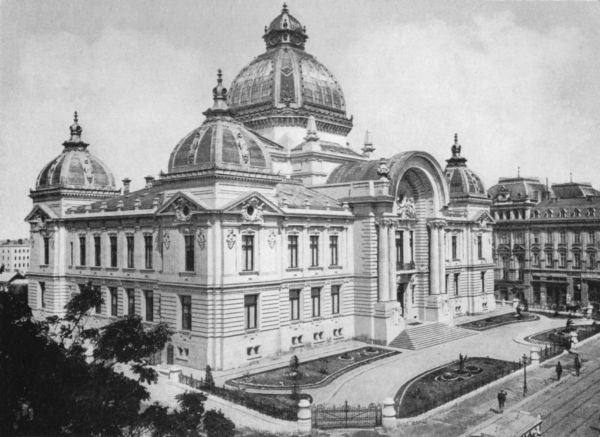
Exclusive News Agency
BUCHAREST
The Roumanian House of Representatives
It was a beautiful story, and why should any
one let loose a brutal bulldog of a fact and point
out that King Ferdinand during the campaign
lived in temporary palaces at Stara Zagora and
Kirk Kilisse, and when he travelled on a visit
to some point near the front it was usually by
motor-car?
In a paper of another nationality there was
a vivid story of the battle of Chatalja. This
story started the battle seven days too soon;
had the positions and the armies all wrong;
the result all wrong; and the picturesque details
were in harmony. But for the purposes of the
public it was a very good story of a battle. Those
men who, after great hardships, were enabled
to see the actual battle found that the poor
messages which the censor permitted them to
send took ten days or more in transmission to
London. Why have taken all the trouble and
expense of going to the front? Buda-Pest, on
the way there, is a lovely city; Bucharest also;
and charming Vienna was not at all too far away
if you had a good staff map and a lively military
imagination.
In yet another paper there was a vivid picture—scenery,
date, Greenwich time, and all to give
an air of artistic verisimilitude—of the signing
of the Peace armistice. The armistice had not
been signed at the time, was not signed for some
days after. But it would have been absurd to
have waited, since "our special correspondent"
had seen it all in advance, right down to the
embrace of the Turkish delegate and the Bulgarian
delegate, and knew that some of the conditions
were that the Turkish commissariat was to feed
the Bulgarian troops at Chatalja and the Bulgarian
commissariat the Turkish troops in Adrianople.
If his paper had waited for the truth that most
charming story would never have seen the
light.
So, in a little book I shall one day bring out
in the "Attractive Occupations" series on "How
to be a War Correspondent," I shall give this
general advice:
1. Before operations begin, visit the army
to which you are accredited, and take notes of
the general appearance of officers and men. Also
learn a few military phrases of their language.
Ascertain all possible particulars of a personal
character concerning the generals and chief
officers.
2. Return then to a base outside the country.
It must have good telegraph communication with
your newspaper. For the rest you may decide
its locality by the quality of the wine, or the
beer, or the cooking.
3. Secure a set of good maps of the scene of
operations. It will be handy also to have any
books which have been published describing
campaigns over the same terrain.
4. Keep in touch with the official bulletins
issued by the military authorities from the scene
of operations. But be on guard not to become
enslaved by them. If, for instance, you wait
for official notices of battles, you will be much
hampered in your picturesque work. Fight
battles when they ought to be fought and how
they ought to be fought. The story's the thing.
5. A little sprinkling of personal experience
is wise: for example, a bivouac on the battle-field,
toasting your bacon at a fire made of a broken-down
gun carriage with a bayonet taken from a
dead soldier. Mention the nationality of the
bacon. You cannot be too precise in details.
Ko-Ko's account of the execution of Nankipoo
is, in short, the model for the future war correspondent.
The other sort of war correspondent,
who patiently studied and recorded operations,
seems to be doomed. In the nature of things
it must be so. The more competent and the more
accurate he is, the greater the danger he is to
the army which he accompanies. His despatches,
published in his newspaper and telegraphed
promptly to the other side, give to them at a
cheap cost that information of what is going on
behind their enemy's screen of scouts which is
so vital to tactical, and sometimes to strategical,
dispositions. To try to obtain that information
an army pours out much blood and treasure;
to guard that information an army will consume
a full third of its energies in an elaborate system
of mystification. A modern army must either
banish the war correspondent altogether or subject
him to such restrictions of censorship as to veto
honest, accurate, and prompt criticism or record
of operations.
Some of the correspondents—one in particular—overcame
a secretive military system and a
harsh censorship by the use of a skilled imagination,
and of a friendly telegraph line outside the
area of censorship. At the Staff headquarters
at Stara Zagora during the early days of the
campaign, when we were all straining at the leash
to get to the front, waiting and fussing, he was
working, reconstructing the operations with maps
and a fine imagination, and never allowing his
paper to want for news. I think that he was
quite prepared to have taken pupils for his new
school of war correspondents. Often he would
come to me for a yarn—in halting French on
both sides—and would explain the campaign as
it was being carried on. One eloquent gesture
he habitually had—a sweeping motion which
brought his arms together as though they were
gathering up a bundle of spears, then the hands
would meet in an expressive squeeze. "It is
that," he said, "it is Napoleonic."
Probably the censor at this stage did not
interfere much with his activities, content enough
to allow fanciful descriptions of Napoleonic
strategy to go to the outer world. But, in my
experience, facts, if one ascertained something
independently, were not treated kindly.
"Why not?" I asked the censor vexedly
about one message he had stopped. "It is
true."
"Yes, that is the trouble," he said,—the
nearest approach to a joke I ever got out of a
Bulgarian, for they are a sober, God-fearing, and
humour-fearing race.
The idea of the Bulgarian censorship in regard
to the privileges and duties of the war correspondent
was further illustrated to me on another
occasion when a harmless map of a past phase
of the campaign was stopped.
"Then what am I to send?" I asked.
"There are the bulletins," he said.
"Yes, the bulletins which are just your bald
official account of week-old happenings which are
sent to every news agency in Europe before we
see them!"
"But you are a war correspondent. You
can add to them in your own language."
Remembering that conversation, I suspect
that at first the Bulgarian censorship did not
object to fairy tales passing over the wires, though
the way was blocked for exact observation. An
enterprising story-maker had not very serious
difficulties at the outset. Afterwards there was
a change, and even the writer of fairy stories
had to work outside the range of the censor.
The Mustapha Pasha censorship would not
allow ox wagons, reservists, or Serbians to be
mentioned, nor officers' names. The censorship
objected, too, for a long time to any mention of
the all-pervading mud which was the chief item
of interest in the town's life. Yet you might have
lost an army division in some of the puddles.
(But stop, I am lapsing into the picturesque ways
of the new school of correspondents. Actually
you could not have lost more than a regiment
in the largest mud puddle.)
Let the position be frankly faced that if one
is with an army in modern warfare, common
sense prohibits the authorities from allowing
you to see anything, and suggests the further
precautions of a strict censorship and a general
hold-up of wires until their military value (and
therefore their "news" value) has passed. If
your paper wants picturesque stories hot off the
grill it is much better not to be with the army
(which means in effect in the rear of the army),
but to write about its deeds from outside the
radius of the censorship.
Perhaps, though, your paper has old-fashioned
prejudices in favour of veracity, and will be
annoyed if your imagination leads you too palpably
astray? In that case do not venture to be a
war correspondent at all. If you do not invent,
you will send nothing of value. If you invent
you will be reprimanded.
Here is my personal record of "getting to the
front" and the net result of the trouble and the
expense. I went down to Mustapha Pasha with
the great body of war correspondents and soon
recognised that there was no hope of useful
work there. The attacking army was at a stand-still,
and a long, wearisome siege—its operations
strictly guarded from inspection—was in prospect.
I decided to get back to Staff headquarters (then
at Stara Zagora) and just managed to catch the
Staff before it moved on to Kirk Kilisse. By
threatening to return to London at once I got
a promise of leave to join the Third Army and to
"see some fighting."
The promise anticipated the actual granting
of leave by two days. It would be tedious to
record all the little and big difficulties that were
then encountered through the reluctance of the
military authorities to allow one to get transport
or help of any kind. But four days later I was
marching out of Mustapha Pasha on the way to
Kirk Kilisse by way of Adrianople, a bullock
wagon carrying my baggage, an interpreter
trundling my bicycle, I riding a small pony.
The interpreter was gloomy and disinclined to
face the hardships and dangers (mostly fancied)
of the journey. Beside the driver (a Macedonian)
marched a soldier with fixed bayonet. Persuasion
was necessary to force the driver to undertake
the journey and a friendly transport officer had,
with more or less legality, put at my command
this means of argument. A mile outside Mustapha
Pasha the soldier turned back and I was left to
coax my unwilling helpers on a four days' journey
across a war-stricken countryside, swept of all
supplies, infested with savage dogs (fortunately
well-fed by the harvest of the battle-fields),
liable to ravage by roving bands.
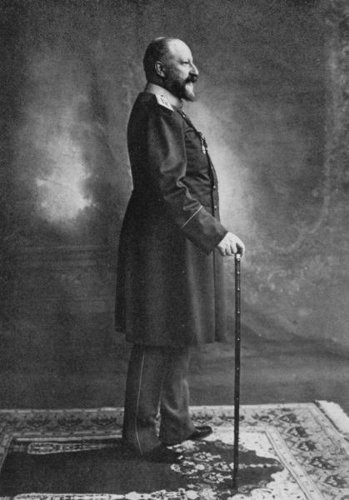
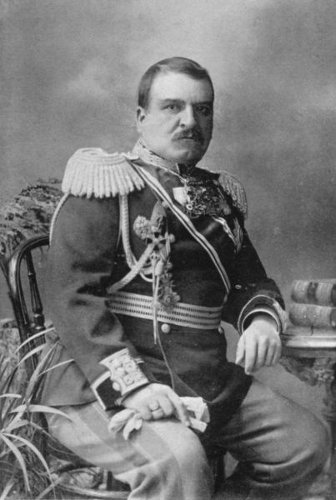
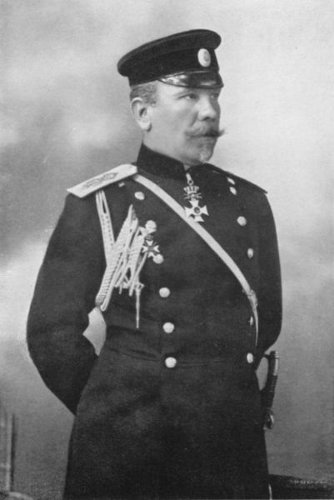 GENERAL SAVOFF
That night I gave the Macedonian driver
some jam and some meat to eke out his bread
and cheese.
"That is better than having a bayonet poked
into your inside," I said, by pantomime. He
understood, grinned, and gave no great trouble
thereafter, though he was always in a state
of pitiable funk when I left the wagon to
take a trip within the lines of the besieging
forces.
So to Kirk Kilisse. There I got to General
Savoff himself and won not only leave, but a
letter of aid to go down to the Third Army at
the lines of Chatalja. But by then what must
be the final battle of the war was imminent.
Every hour of delay was dangerous. To go by
cart meant a journey of several days. A military
train was available part of the way if I were
content to drop interpreter, horse, and baggage,
and travel with a soldier's load.
That decision was easy enough at the moment—though
I sometimes regretted it afterwards
when the only pair of riding breeches I had with
me gave out at the knees and I had to walk the
earth ragged—and by train I got to Chorlu.
There a friendly artillery officer helped me to get
a cart (springless) and two fast horses. He insisted
also on giving me a patrol, a single Bulgarian
soldier, with 200 rounds of ammunition, as
Bashi-Bazouks were ranging the country.
It was an unnecessary precaution, though the
presence of the soldier was comforting as we
entered Silviri at night, the outskirts of the town
deserted, the chattering of the driver's teeth
audible over the clamour of the cart, the gutted
houses ideal refuges for prowling bands. From
Silviri to Chatalja there was again no appearance
of Bashi-Bazouks. But thought of another
danger obtruded as we came near the lines and
encountered men from the Bulgarian army suffering
from the choleraic dysentery which had then
begun its ravages. To one dying soldier by the
roadside I gave brandy; and then had to leave
him with his mates, who were trying to get him
to a hospital. They were sorely puzzled by his
cries, his pitiful grimaces. Wounds they knew
and the pain of them they despised. They
could not comprehend this disease which took
away all the manhood of a stoic peasant and
made him weak in spirit as an ailing child.
From Chatalja, the right flank of the Bulgarian
position, I passed along the front to Ermenikioi
("the village of Armenians"), passing the night
at Arjenli, near the centre and the headquarters
of the ammunition park. That night at Arjenli
seemed to make a rough and sometimes perilous
journey, which had extended over seven days,
worth while. The Commander, an artillery
officer, welcomed me to a little mess which the
Bulgarian officers and non-commissioned officers
(six in all) had set up in a clean room of a village
house. We had dinner, "Turkish fashion,"
squatting round a dish of stewed goat and rice,
and then smoked excellent cigarettes through the
evening hours as we looked out on the Chatalja
lines.
Arjenli is perched on a high hill, to the west
of Ermenikioi. It gave a view of all the Chatalja
position—the range of hills stretching from the
Black Sea to the Sea of Marmora, along which
the Bulgarians were entrenched, and, beyond the
invisible valley, the second range which held the
Turkish defence. Over the Turkish lines, like
a standard, shone in the clear sky a crescent
moon, within its tip a bright star. It seemed
an omen, an omen of good to the Turks.
My Australian eye instinctively sought for the
Southern Cross ranged against it in the sky in
sign that the Christian standard held the Heavens
too. I sought in vain in those northern latitudes,
shivered a little and, as though arguing against
a superstitious thought, said to myself: "But
there is the Great Bear."
Now there had been "good copy" in the
journey. At Arjenli I happened to be the witness
of a vivid dramatic scene (more stirring than
any battle incident). It was a splendid incident,
showing the high courage and moral of these
peasant soldiers at an anxious time. To have
witnessed it, participated in it, was personal
reward sufficient for a week of toil and anxiety.
To my paper, too, the reader might say, it was of
some value, if properly told and given to the
London reader the next morning, the day before
the battle of Chatalja.
Yes. But it was the next afternoon before I
could get to a telegraph office within the Bulgarian
lines. Then the censor said any long message
was hopeless. I was allowed to send a bare
100 words. They reached London eight days
later, a week after the battle had been fought,
when London was interested no longer in anything
but the armistice negotiations. The reason
was that the single telegraph line was monopolised
for military business. My account of the
battle of Chatalja reached London a full fortnight
after the event, though I had the advantage
of the highest influence to expedite the
message.
Thus from a daily-newspaper point of view
all the expense, toil, danger were wasted.
Summing up, an accurate and prompt Press
service as war correspondent with the Bulgarian
army was impossible, because—
1. The Bulgarian authorities were keen that
correspondents should see nothing.
2. A rigid first censorship checked a full
record of what little was seen.
3. The first censorship being passed, despatches
often had still to pass a second censorship at
Staff headquarters, a third censorship at Sofia.
4. Despatches passing through Roumania
underwent another censorship there, and yet
another in Austria, possibly yet others in other
European countries.
5. In addition to these censorship delays the
Bulgarian authorities made newspaper messages
yield precedence to military messages, and at
the front this meant that Press messages were
sent on by mail (ox transport most of the
way) to the Staff headquarters or the capital.
6. In the meanwhile the imaginative accounts
written nearer Fleet Street had been published,
and the accurate news was "dead" from a point
of public interest.
Most of these conditions will rule over all
future wars. Therefore I conclude that the day
of the war correspondent—in the sense of a
truthful observer of a campaign—has gone, and
he died with the Balkan War. He can only
survive if newspapers are willing to incur the
very great expense of sending out war correspondents
not for the news, day by day, but for
what observation and criticism they could supply
after the campaign was over. To a daily newspaper
such matter is almost valueless, especially
as during the progress of the campaign the correspondents
of the "new" school would be at work
with their many inventions, raising the hair of
the public and the circulation of their journals
with bright feats of imagination.
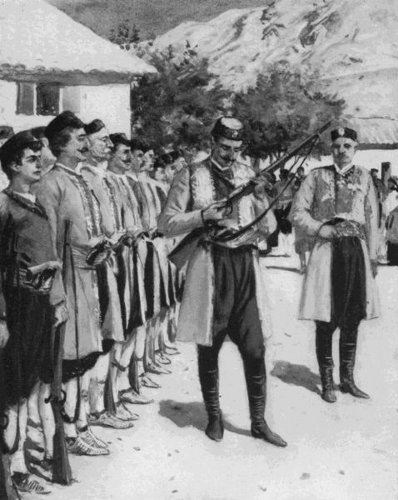
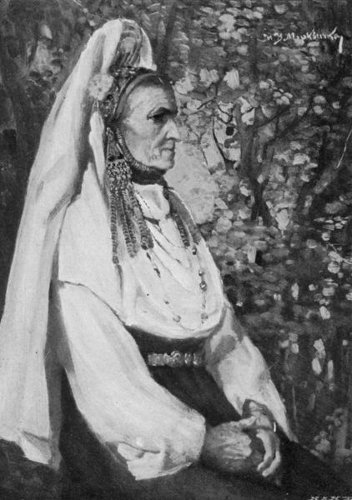
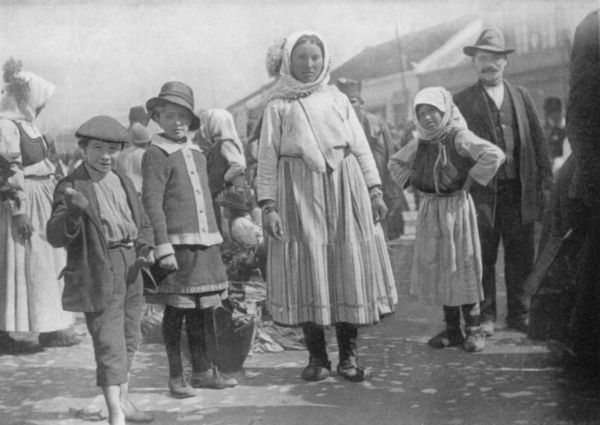
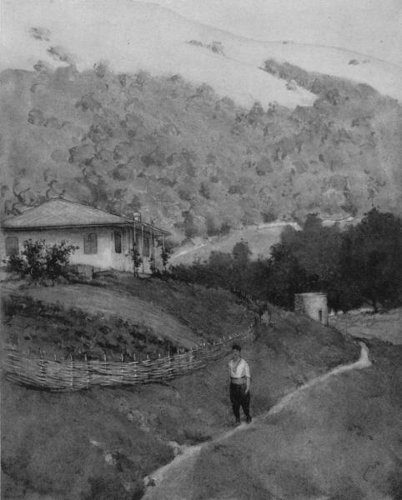
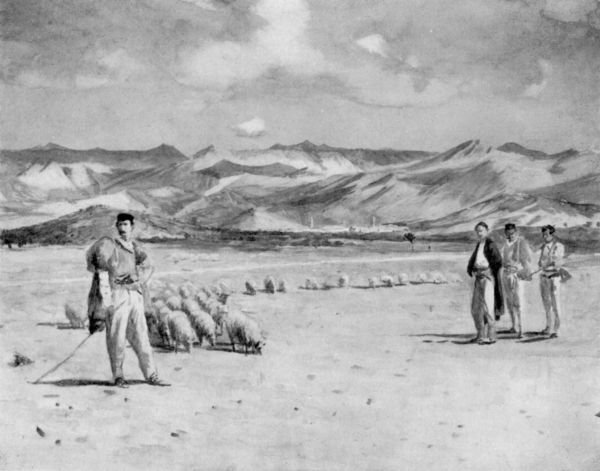
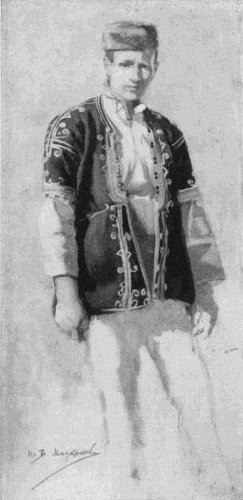 A BALKAN PEASANT