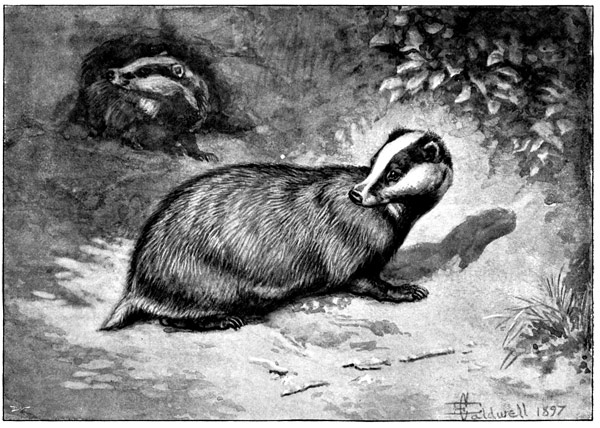
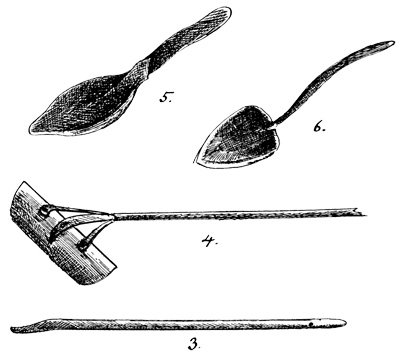
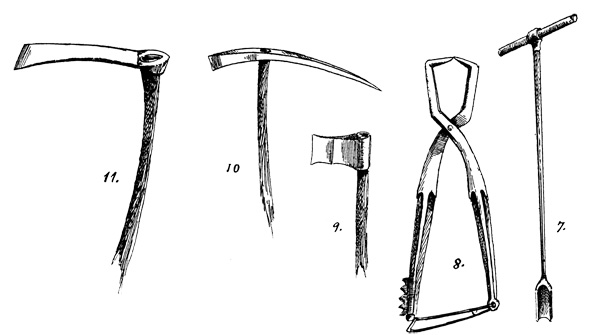
The badger (Meles taxus, or Ursus meles) is known under various
aliases, viz. the Brock (Danish Broc, Erse Broc, Welsh Brock), the
Pate, and the Grey. Of these the Brock is perhaps the commonest, and is
the name most used in the north of England. There is an expression
common in the north that would lead the ignorant to believe that a
badger perspires, or sweats, viz. "sweating like a brock." In Yorkshire
I often hear a man say, "Ah sweats like a brock," and the user of this
elegant metaphor innocently imagines he is perspiring like a badger. But
"brock" is the old north-country word for the insect known as
"cuckoo-spit" (Aphrophora spumaria), which covers itself in the larval
state with froth and foam (cf. Welsh broch, foam)—vide Atkinson's
Dictionary of the Cleveland Dialect. In parts of Cornwall and Wales
the word "Grey" may be in use, but I myself have only come across it in
books, more especially old ones. Though able to boast these several
titles, there is but one species known in Europe, and in general
appearance he is the same animal, though varying locally in size and
shade of colour. He has been classed as belonging to the bear tribe, but
the badger is really a single species and a sub-genus in itself. The
dentition of a badger is half tuberculous and half carnivorous, and in
this respect approaches the martens.
About few animals has there been more nonsense written in regard to
habits and anatomy, and for many of the popular notions concerning the
badger there is no foundation whatever. In the ancient books descriptive
of sport and wild animals we read that there were in England two kinds
of badger—the one as we know it, and the other a "pig-badger," with
cloven hoofs and other attributes of the porker. It is astonishing how
these old authors drew upon their imagination, and where they found
suggestions for their errors. In this case it may be they were misled by
the custom, which still continues, of distinguishing between the dog and
bitch, or male and female badger, by using the terms boar and sow; or it
may be the idea dawned whilst they ate their rasher from a badger ham!
There are altogether not more than five (or perhaps six) kinds of badger
known throughout the world, so far as I know.[1]
1. The European badger, known over almost the whole of Europe and Asia.
2. A larger species, confined to the high steppes of Eastern Siberia. 3.
The North American mistonusk, or chocaratouch (Meles labradorica or
hudsonius). 4. The Mexican badger, found south of latitude 35 degrees.
5. The Japanese badger. 6. The Indian badger (Meles indica) might be
added perhaps, though it has a pig's snout, long legs, and long tail.
Its native name is bhalloo-soor, i.e. the bear pig.
Nos. 3 and 4, the chocaratouch and Mexican, differ so distinctly from
the others in dentition, though in appearance similar to the European
species, that a new genus, Taxidea, has been established for their
reception.[2]
Popular error, and old writers, describe the badger as having his legs
shorter on one side than the other, and the latter, with philosophical
ingenuity, have discovered therein a wonderful provision of nature; for,
says Nicholas Cox, "He hath very sharp Teeth, and therefore is accounted
a deep-biting beast; his back is broad, and his legs are longer on the
right side than the left, and therefore he runneth best when he gets on
the side of an Hill or a Cart roadway." The same author also
states—"Her manner is to fight on her back, using thereby both her
Teeth and her Nails, and by blowing up her Skin after a strange and
wonderful manner she defendeth herself against any blow and teeth of
Dogs. Only a small stroke on her Nose will dispatch her presently. You
may thrash your heart weary on her back, which she values as a matter of
nothing." If such a provision in the matter of legs did exist, one can
realize the comfort of the uneven legs on a hill-side, but what gravels
us is the discomfort of the return journey! The rolling, shambling gait
that characterizes the badger is doubtless the origin of this absurd
theory, which might be equally applied to any other member of the bear
family. The European badger, as we find him in England, Wales, Scotland,
and Ireland, stands about ten to twelve inches from the ground, has a
long, stout body, with the belly near the earth. He has a coat so long
and dense, and legs so short, that he appears to travel very nearly
ventre à terre. The male is somewhat larger than the female, and
weighs more. The weight of a male is about 25 lbs., that of a female
about 22 lbs. When they are fat, or in grease in September, they will
scale more. Badgers have been known to weigh up to about 40 lbs.; the
largest I ever dug out and weighed was an old lean dog badger that
scaled over 35 lbs.
The head of the badger is wedge-shaped in general conformation, the back
of the head large, the cheek-bones well sprung, and the muzzle fine and
long. The nose or snout is black in colour, long and full; the eyes
small, black, or black-blue; and the ears small, round, close-set, and
neat. The strength of a badger's legs is most remarkable, and for his
size (the animal only weighs from 19 lbs. to 35 lbs.) he possesses a
most wonderful combination of bone and muscle. The legs are very short
and the joints large; the feet, like the legs, are nearly black, and are
large and long. The badger is a plantigrade, that is, when travelling he
puts down the whole of his foot, including the heel, flat on the ground.
His fore-feet are larger, longer, and better equipped for digging than
his hind, but all are armed with long, sharp claws, and it is prodigious
what he can effect with them. There is no mistaking his tracks—no
animal's footprint is in the least like his. His heel is large and wide;
this, and his four round, plump toes, leave an impression in sand, mud,
or snow that cannot be confounded with any other. If the mud is deep, or
there is snow on the ground, he also leaves the mark of his claws, but
as a rule these are not observable, as he puts his weight on the sole of
his foot—his tracks are usually almost in a line. The badger is cut out
for a miner. His wedge-shaped head is capable of forcing a passage
through sand and soft strata, whilst his armour-tipped diggers are
worked by machinery that rivals in power the steam navvy; and whilst his
fore-feet are going like an engine, throwing stones, bits of rock, sand,
clay, and all that he comes in contact with between his fore-legs (which
are set wide apart, leaving plenty of room under the chest), his
powerful hams are working his hind-legs and feet like little demons,
throwing back all that the fore-feet throw under his belly. And this is
not all. His powerful jaw and teeth will cut, break, and tear all roots
that obstruct his passage onwards, and it is most entertaining to see
him going through earth, shale, and stone with the rapidity and
sustained energy of a machine. No one who has not seen it would credit
what one of these animals can do. I have often been defeated by their
being able to penetrate more quickly than even a gang of men with
pick-axe, spade, shovels, and crowbar could follow. And it is safe to
say that as long as a terrier is not up to the badger, the badger is not
only advancing quicker than the men (if his earth is on a hill-side),
but has also, in nine cases out of ten, barricaded his retreat and
scored a victory. I have known a badger, left for awhile by the terrier,
bore his way straight up out to daylight and escape. The badger is
covered with a thick, long-haired coat, which with a loose skin of
extraordinary density and toughness forms a complete and effective
armour. The hair on his head is short and smooth, and the sharp, clean
black-and-white markings of his head give a very pretty and effective
appearance to it. The general appearance in colour of a badger is a sort
of silvery-grey, turning to black on the throat, breast, belly, and
legs. Inverting the usual colouring of other animals, which is generally
dark on the back, with lighter colouring on the belly and under the arms
and thighs, the badger is lighter on the back and black underneath. Not
only is this colouring peculiar to the badger, but his hair is unlike
that of any other creature known to me, being light at the root and
darker above.
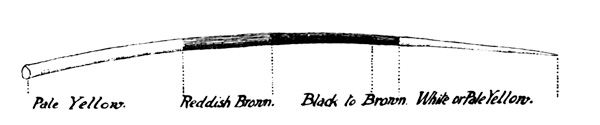 Fig. 2.
The colour of a badger alters with age. The little cubs, till they are
seven or eight months old, are a clean, bright, light silvery-grey; they
then become yellower in their coats, a colour which they keep sometimes
permanently, but which they generally change after two years for a suit
of darker, purer grey. The badger's tail is about five inches long,
covered with long, coarse, lighter-coloured hair than that on his body,
and is of a yellowish-brown colour.
The badger has another peculiar distinction that is somewhat mysterious,
viz. a pouch, the vent of which is close under the root of the tail, and
contains an oily fœtid matter which he has the power of emitting.
Different uses have been ascribed to this provision, such as that which
ferrets and polecats have. I have never noticed a badger use it as has
been suggested, as a mode of defence or annoyance, and am sure that this
is not its purpose. But there is no doubt the badger sucks and licks
this substance, whether by way of taking a tonic, a cooling draught, a
stimulant, or other physic I cannot say. I am, however, inclined to
believe, that from this source he is able to maintain his health and
support life during those periods of seclusion and total retirement in
his "earth" which have led naturalists to describe him as a hibernating
animal.
In this theory I am strengthened by a French author, Edmond Le Masson,
who writes—"The badger does not always give evidence of his presence in
his woody retreat.... There, should one go to see him, he may, from pure
idleness, remain shut up, it being easy for him to support himself
during the longest period of retirement by licking the secretion which
oozes from the pouch under his tail." The author goes on to give an
account which was sent to the French papers by M. Récopé, Garde Général
at Marly-le-Roi, of a badger that was shut in a culvert without any food
whatever for forty-five days, walled in on every side, and where no tree
root could penetrate. A gamekeeper, a noted trapper, had blocked the
exit, and tried in every way he could devise to trap him, from February
18, 1853, to April 4, and when at last he succumbed to a ruse of the
keeper's he was quite lively, and weighed nearly 19 lbs. It appears that
however carefully his traps were set in the mouth of the exit, the
badger came every night and rolled on them and struck them, as they will
do when they suspect any human infernal machine. That he will remain
for a week or two at a time without issuing from his "earth" is certain,
but the most casual observer will see badger tracks in the snow in the
severest weather, and I have never been able to find that there were no
tracks in the snow issuing from the "earths" in winter for more than a
week or two at a time. The badger is less active, eats less, goes fewer
and shorter journeys in winter, and has a hibernating tendency; but the
idea that the British species shuts himself up and takes to his bed
through the winter months, and never comes forth till spring, is a
fallacy.
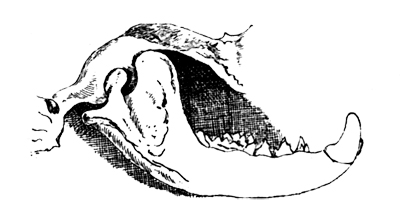 Fig. 3. Lower Jaw of Badger.
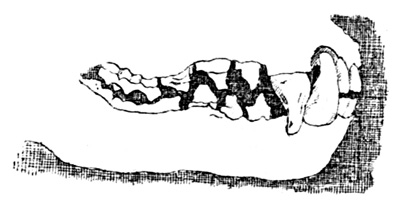 Fig. 4. Dovetailed Jaws.
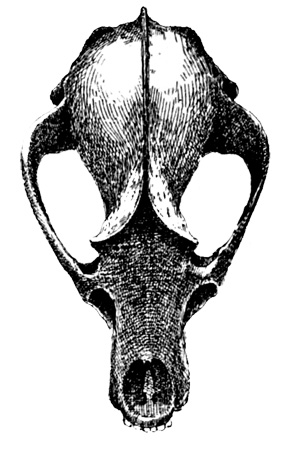 Fig. 5. Skull of Badger—front view.
Having attempted a slight description of the badger as far as his
exterior is concerned, I shall leave to "Dryasdust" the description and
nomenclature of the badger's interior economy, as well as the
enumeration, weights, and measurements of his bones and muscles. He
possesses, however, one or two structural peculiarities that deserve a
little attention. There is much similarity in the general conformation
of the badger's and bear's skull, but the protecting ridge on the head
is absent in the bear. What gives to the badger's jaw its proverbial and
terrific force? To witness its work is to know that its power of biting,
crushing, and holding must be the result of some peculiarly strong
mechanical as well as muscular construction. The examination of the
skull helps in the solution of the mystery. The conformation of the jaw
is strong, and the muscles attached to it powerful; but besides this he
has two distinguishing structural additions that give his jaws,
furnished with his formidable teeth, the strength and retentive power of
an iron vice. The first is that his lower jaws are locked into sockets
in the skull, and are thereby made—unlike those of all other animals I
know of—impossible of dislocation.[3] His head or skull, when stripped
of flesh and bare, still retains the lower jaws in such a way that they
cannot be displaced without fracturing the massive bones of the head or
jaw. The teeth of a badger require respectful attention. There are
eighteen teeth in the lower and sixteen in the upper jaw, in all
thirty-four. The four big molars, two above and two below, are large and
strong, the upper being much the larger and wider ones, the lower being
longer and fitting within the upper, as do all the lower teeth. The four
canines are large, thick, round, long and formidable, and are his chief
weapons. The lower canines dovetail when the jaws close with the upper,
but all the four points or ends turn outward and backward.
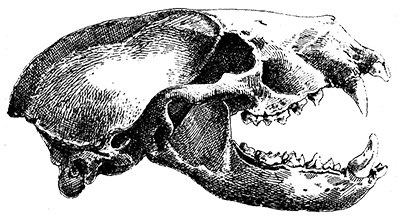 Fig. 6. Skull—side view.
The second peculiarity arises from a high ridge of bone, standing
straight up and running from the base of the skull to between the ears,
giving a firm hold to the ligaments and tendons, and an additional
leverage and length, which are again rendered more effective by passing
over the high cheek-bones as over a pulley before reaching the jaws.
There is a saying that "a badger never leaves go till he makes his teeth
meet," and there is a foundation of truth in it. The length of time he
will hold on to the limb of an enemy is certainly fearful, and the way
in which his thick strong canines go through the bone. On one occasion,
in Wales, a keeper residing near the place I was staying at thought he
saw the badger's tail at the end of a badger-digging, and laid hold of
it to draw him. He had made a terrible mistake, and had got hold of a
hind-foot. The badger held him by the wrist for ten minutes with his arm
stretched up the hole; when he let go his hold the hand was hanging by a
few shreds, and had, of course, to be amputated. I have always drawn a
badger when possible by the tail, as the use of the tongs is sometimes
difficult, especially in certain holes and at great depths, and there is
a liability for the tongs to give way, and then the badger charges in
your face or through your legs. I have seen a badger's teeth break and
fly off in chips from iron tongs, a sight and sound that is not
pleasant. To one who knows how to do it, drawing by the tail is a
simple, quiet, and effective way of "taking the brock."
A badger has the proverbial nine lives that John Chinaman attributes to
women and we to cats. You cannot kill a badger by a blow on the head,
the structure is so dense. His brain is so well protected by the ridges
of bone along his skull and over his eye-sockets, and by the strength
and projection of his cheek-bones, as to make him all but invulnerable
in that quarter. His skin is so thick and tough, and his coat so heavy
and coarse, that shot will scarcely penetrate it; but he has one place
as tender as a nigger's shins, and that is his nose, where, if he is
struck once, he is instantly dispatched. I was witness of a scene in
the hunting field with the Cleveland hounds during the mastership of the
late Mr. Henry Turner Newcomen, which, however disgusting, illustrated
the vitality of the badger. We thought we had run a fox to ground in a
drain. The terriers were sent for, one was put in to bolt him, but after
a quarter of an hour's attempt he came out, having given it up, with
severe marks of punishment. One that could be depended on was then
dispatched to ground, and digging operations commenced. As time went on
we thought from the sound that it could not be a fox, and presently
there was a charge down the drain, and a badger came bouncing and
floundering out among the crowd of bystanders, the terrier holding on to
him. The other terriers, barking furiously to join in the fray, excited
the hounds in an adjoining field; they broke out past the whips, and
nineteen couple were soon at the badger, who was entirely lost to view
in the struggling and worrying mass. But he was plying his jaws all the
time, as was evidenced by the howls of pain from the wounded hounds as
they withdrew from this unaccustomed entertainment. The whips and others
did their best to flog the hounds off, but this was not accomplished for
at least ten minutes. After much bloodshed, and when the last hound had
been choked off, the badger showed neither scratch nor wound, and looked
as fresh as possible. Mr. Newcomen ordered a whip to despatch him and
end the tragedy. The whip clubbed a weighted hunting-stock, striking him
several smashing blows on the head, and left him apparently dead. A
farmer having asked if he might have him to stuff, put him in a sack and
carried him off. A few days later I met the farmer, Mr. R. Brunton, of
Marton, and he told me that when he got home the badger was as lively as
ever, so he put him on a collar and chain and fastened him to a kennel.
The day following he thought, from the appearance of the badger, that he
was hurt about the head, and with some difficulty examined him, and
found that the lower jaw was injured. He thereupon got a revolver and
fired a shot into his ear, and then he assured me the badger only shook
his head. He was so taken aback that for a moment or two he thought of
giving up the attempt to kill him, but firing a second ball into him
behind the shoulder he put an end at once to the poor brute's
sufferings.
The badger, as I have said, is becoming very scarce in England, and is
decreasing in numbers in France and other countries as well. There are,
however, several English and Welsh counties where in woodlands he still
is to be found in considerable numbers, and some districts where they
are common enough. The badger is fairly plentiful in many parts of
Cornwall, Devon, Dorset, Somerset, Hants, and Gloucestershire, along the
Welsh border, and in Mid and South Wales. It is to be found also in
Sussex, Wilts, occasionally in Surrey and Kent, and here and there
through the Midland and home counties. It is becoming rare in the north
of England, but still lingers in the North Riding of Yorkshire, chiefly
in the districts of the hills and moors between Scarborough and York.
In Lincolnshire it is to be found in places; it is extinct in Durham,
and practically so in Northumberland, where within fifty years it was
common enough.
A Northumberland gamekeeper of my father's has told me he knew it in the
Kyloe Craggs and the Howick Woods, and remembered his father taking him
to see their dog tried at a badger near Belford. In none of these places
are they to be found now. In my own district of Cleveland they were in
1874 all but extinct. I remember as a boy two were caught in our
neighbourhood, one in Kildale and one at Ayton; but in 1874 I had three
young badgers sent me from Cornwall, dug out by one of my uncles, and
these I turned out in my father's coverts, and secured for them the
keeper's protection. Since then they have, with a few later
introductions, held their own, and a few years ago I knew of nine badger
"sets" in the vicinity, and some five on our own ground; but I regret
that the hands of neighbours are against them.
In Scotland the badger is now rare. In the north-eastern counties, where
till recently he was to be met with in every wild woodland and forest
district, he has entirely vanished. In Ross-shire and in the west he is
occasionally found in places where the wild cat and marten are making
their last stand against the keeper and his exterminating engine, the
steel trap. In Ireland the badger is still found in the Wild West. I
have come upon him in Connemara, near the Killery harbour, and have
heard of him in Kerry and other counties.
As to the distribution of the badger in Ireland I quote the following
interesting letters from the Field:—
"'Lepus Hibernicus' may be glad to know that the badger is still fairly
common in the neighbourhood of Clonmel. The country people, who know
them better under the name of 'earth-dogs,' in distinction to
'water-dogs,' or otters, not unfrequently catch them in one way or
another, and offer them for sale. Fortunately for the badger the demand
is extremely limited."—Badger (Clonmel). "Permit me to coincide with
'Lepus Hibernicus' respecting the plentifulness of the badger in
Ireland. Some years since I was on a large estate in Co. Clare, and
badgers were abundant on the domain and the adjoining property; I also
found them numerous in the wilds of Galway. I have found and killed them
in many parts of England and Wales, but have seen and trapped far more
in the west of Ireland."—J. J. M. "Your correspondent, 'Lepus
Hibernicus,' in the Field of November 5, mentions that badgers are by
no means uncommon in Ireland. I am in the west of Cornwall, and there
are any amount here, a great deal too plentiful to please me, as I am
sure they do a lot of harm to rabbits and game. I found the parts of a
fowl in a field, evidently killed by a badger, as there was a trail not
a foot away, and also a hole scratched, which could be the work of none
other than a badger. I had two very big ones brought to me alive last
week. They were caught by setting a noose of thin rope in their run. I
should like to know a good way to exterminate them, as, though I shoot
over a great deal of ground, I have never seen one out in daytime, but
their trail is everywhere."—H. J. W. "The badger is by no means rare in
the west of Clare, where I have trapped several."—A. H. G. "I beg to
inform 'Lepus Hibernicus' that badgers are by no means scarce in this
place."—A. R. Warren, Warren's Court, Lisarda, Cork. "The badger in
this part of the Co. Cork is certainly not rare—Owen, Sheehy, Coosane,
and Goulacullen mountains, with the adjoining ranges, afford shelter to
a goodly number. Farm hands occasionally capture unwary ones, and offer
them for sale as pets, or to test the mettle of the national terrier, or
to be converted into bacon. A badger's ham is often seen suspended from
the rafter of a farmer's kitchen."—J. Wagner (Dunmanway, Co. Cork).
The counties in which I have had most acquaintance with the badger have
been Radnorshire, Yorkshire, Herefordshire, Gloucestershire, and
Cornwall, but perhaps most of my experience has been gained in the
last-named county, as far as digging for him is concerned; whilst it is
at home in Cleveland that I have watched him for nearly twenty years,
and gained some knowledge of his mode of life and habits. I am not sure
whether there are not a few still left in the Cheviots and the districts
of the Upper Tyne and Tweed. Up till about 1850 they were to be found on
the Cleveland hills, or rather on their wooded sides and in the "gills."
The last place where I heard of them being hunted was in the ravine and
woods of Kilton.
A badger's earth or warren is properly and generally called a "set" or
"cete." They vary in respect of size, number of entrances, depth of
galleries, and choice of site almost as much as rabbit-holes. Sometimes
badgers will find sufficient room in rocks to make a home, and it is
extraordinary the excavations they occasionally make in apparently solid
rock. Usually, however, they select some softer material in which to
make their underground passages and chambers. They will choose a quiet
hillside away from man's habitation, amongst the whin bushes, or in the
woods near a stream or small runner of water. Such a "set," if long
established, will penetrate through earth, clay, and sub-soil, to some
stratum of shale, or sand, or loose rock. Some of the galleries and
chambers will be at a great distance from the surface, and some at an
enormous depth. When a new earth is made I have always found the badger
appropriate the holes of rabbits, and proceed to excavate, enlarge, and
open them out. This operation of opening a new earth takes place
constantly in the spring-time, great masses of material being thrown
out; but as often as not the new house is abandoned before completed,
and the subsequent labours of the family are devoted to repairing,
enlarging, and making new front or back doors to the old place. In
Cornwall I once tried my hand with my brother, some strong Cornishmen,
and a team of terriers, at a very innocent-looking badger "set" situated
in a level field. There were but three holes, and these not very far
apart. The farmer told us that there had been badgers there all his
life, and no one had ever been able to dig one out. This rather
stimulated us than otherwise, and we had in the course of a few hours
dug a trench some six feet deep, and were nearing the sounds of the
subterranean conflict, which had been sustained by the terriers, when
suddenly we found that we were above the sound, and we sank a shaft down
three feet from the bottom of our trench, to find galleries and chambers
in all directions. The battle had by this time moved, and we were in
despair at the prospect of following on the level with a depth of nine
feet of surface soil to be lifted in every direction we turned. I was
listening at the bottom of the trench, having penetrated to the third
storey of this underground barrack, when I distinctly heard the
"bump-bump" of the badger below me. My companions came down and listened
too, and there was not the slightest doubt that there was a fourth
storey and labyrinth of passages some three or four feet below us, and
for anything we knew another beyond. The day was far spent, the task was
impossible, and the rest of our time was devoted to getting the
terriers out, and making as good a retreat as we could before the
victorious enemy.
I should think this "set" was hundreds of years old, and some of the
passages, the farmer told us, were a hundred yards long! As a rule a
badger's hole descends rapidly at first, and then may branch into any
number of by-ways and subterranean galleries. Whichever route you
follow, however, you invariably come to a chamber or "oven," which is
generally a sort of vaulted hall, where four ways meet, and which is, or
has been, the living-room of the family at some previous time. Where
there is an old-established "set" it is difficult to drive the badgers
permanently away from it. They may leave it for a while from fancy, or
because of disturbance, but they will certainly return.
The badger and his wife have a regular spring cleaning after the winter
is over, and about March and April a cart-load of winter bedding,
rubbish, earth, and sweepings will be thrown in a few nights outside the
front door. There is generally the old bedding left in one or two of
the big chambers for the lady who is to be brought to bed in February,
March, or April; and there is another turn-out after this interesting
event has been accomplished. About the middle of June, in July and
August, and as late as October and November, an extraordinary amount of
fresh bedding will be taken in. On summer evenings I have watched the
badgers at work, but regret that I cannot substantiate the following
description:—"Badgers when they Earth, after by digging they have
entered a good depth, for the clearing of the Earth out, one
of them falleth on the back, and the other layeth Earth on the belly,
and so taking his hinder feet in the mouth draweth the Belly-laden
Badger out of the Hole or Cave; and having disburdened herself,
re-enters and doth the like till all be finished."
No, this is not how it is done, though it is a curious sight to see the
real thing. The badger will come out, take a look round, and sit awhile
close to the mouth of the hole. He will then shuffle about and get
further from the hole. You will watch him descend into some
bracken-covered hollow, and will see nothing more of him for awhile.
Then you will hear him gently pushing and shoving and grunting, and know
that he is very busy over something. He will reappear bumping along
backwards, a heap of bracken and of grass or old straw, left from a
pheasant feed, under his belly, and encircled by his arms and fore-feet.
He will continue this most undignified and curious mode of retrogression
to the earth, and will disappear tail first down his hole, still hugging
and tugging at his burden.
"It is very pleasant to behold them when they gather materials for their
Couch, as straw, leaves, moss, and such-like; for with their Feet and
their Head they will wrap as much together as a man will carry under his
arm, and will make shift to get into their Cells and Couches" (The
Gentleman's Recreation).
I have not seen a badger make more than two such excursions by daylight,
but have no doubt that after dark a considerable number of such
journeys may be accomplished. For weeks together, on any morning, you
may see the litter of bracken and grass strewing the way to his home and
down the various entrances.
And now let me again, with all possible respect, put some of our
scientific friends right. It is not often that an amateur can; but a man
who is not able to tell you everything, as these learned men do, about
every living creature, may from a country life and experience be able to
correct some errors in respect of one animal at least. M. Buffon, the
immortal and wonderful natural historian, tells us that the badger is a
solitary animal. This is the reverse of truth; he is less solitary than
the fox. He is fond of company; he is monogamous, and clings closely and
faithfully to his own wife. With badgers, as with the human race, the
sexes are not precisely equal in numbers, and often, from the force of
circumstances, a badger has to remain a celibate, but he is not a
bachelor by choice. He may become a widower, but in either case he will
travel far to seek a partner to share his shelter and his lot. It is not
altogether rare to find an old solitary dog badger, who has loved and
lost, or taken in late age to a hermit's cell; but he, as often as not,
when he has failed to secure the companionship of the gentler sex, has
found some other male to share his home, when they can live comfortably
en garçon.
Nor do the married pair shun the society of their kind. I have often
seen large badger "sets" almost as full of badgers as a warren is of
rabbits. One evening, near my house, I waited an hour of midge-plagued
time to watch the badgers come out from a small "set," and was rewarded
by seeing a procession of seven full-grown badgers emerge from a single
hole, and I had them all in full view for something like twenty minutes.
As this was in July they could hardly be one family. They were every one
more than a year old, and a badger's family is usually two in number,
sometimes three, and never more than four; and this last is exceedingly
rare in my experience. In no sense, therefore, is the badger solitary.
Indeed I have actually known myself several instances of a badger and
fox living in apparent amity in the same earth, whilst I hardly ever saw
a badger "earth" that was not either itself or the immediate vicinity
tenanted by rabbits. As to the consistency of any friendship that exists
between badgers and foxes and rabbits, I shall have more to say later
on. I have, however, taken a badger and rabbit out of the same hole
lying side by side. The badger is said to be the protector of the
rabbit. He does not altogether deserve this title, and the rabbit enjoys
the immunity in a badger's earth chiefly from the fact that the badger
cannot follow it in the smaller holes without digging, an effort which
in his estimation is, as a rule, not worth the candle.
Buffon dwells on the cleanliness of the badger. He certainly is not the
stinking animal he is accused of being. His house and himself are as a
rule bright and cleanly looking, and it is only when in confinement,
and deprived of the sanitary arrangements to which he is accustomed,
that he becomes offensive. Writers are not correct in saying that he
never deposits his dung in his earth, but as a rule he does not, and his
habit is to go some little distance from his home, dig a hole, and there
leave his excrement. He will use the same hole for a few days, and then
cover it up with earth and make a new one. There is a smell about a
badger "earth," but it is not disagreeable, and nothing like so rank and
strong as that of a fox's. He is, however, often troubled with lice and
ticks, so that it is desirable when your dogs have been to ground
carefully to wash them. But in this respect a badger is not worse than
sheep and goats, and with such a coat as he has it is no wonder that it
is sometimes tenanted. The same distinguished authority states that the
badger produces its young in summer, but I have never known this happen.
March is the usual month, and the rule is not earlier than February nor
later than April. A naturalist at Cambridge told me that he knew of a
badger bitch that was many months in confinement (I think he said
eighteen months), and gave birth to cubs—but I was not convinced of the
accuracy of his statement that she had never had access to one of her
kind. It is only fair to mention that Vyner, in his Notitia Venatica,
states that "It is a fact perhaps not generally known, nevertheless
curious, that badgers go twelve months with young. This fact I learned
from a neighbour of mine in Warwickshire, who some years ago dug out in
the spring a sow badger. She was confined in an outhouse for twelve
months, at about which period she produced one young one. During her
confinement it was impossible for her to have been visited by a male."
That an animal of this size should go with young for such a period is so
extraordinary, and so great an exception to the ordinary provisions of
nature, that the theory requires much greater support than mere hearsay
evidence. If it were a fact, or if it were the rule, the evidence to
support the theory of twelve months' gestation should be overwhelming,
considering the number of badgers that are in confinement. I have had
many in confinement for long periods, and have never known them to give
any evidence in support of this theory. I have kept a pair for a long
period, but, like many other wild animals in confinement, they never
bred. All sorts of theories exist as to the period of gestation in
badgers, but I think I shall be very near the mark when I say that they
go with young about nine weeks, and I conceive that the mistake made by
those who have thought that they go over a year is due to the fact,
which I have noticed, that a pair of badgers do not breed every year. I
cannot decide whether there is any precise rule, but am inclined to
think that they breed once every two years. There are so many accounts
of single badgers kept in confinement bringing forth young after a much
longer period of gestation that it appears possible that the female has
the power known to be possessed by the Roe-deer doe of postponing the
operation of parturition for a considerable time.
The badger is not by nature a ferocious animal, though the female will
repel with the greatest savagery any approach when she has young, but so
will a hen with chickens. The temperament of the badger is a gentle,
shrinking one. No animal prefers a more quiet life, loving a warm bed in
a dry dark corner of earth or rocks. He loves to sleep and meditate in
peace for the greater part of the twenty-four hours. He lies not far
within his entrance hall during the spring and summer, and on a hot day
he will sometimes come to the mouth of his hole. In the evening, in June
or July, he will come outside, sit looking into the wood or shuffle
round the bushes, stretch himself against the tree-stems, or have a
clumsy romp with his wife and little ones; and when the daylight dies he
will hurry off, rushing through the covert for his nightly ramble. In
the summer months he will travel as far as six miles from home, but he
is in bed again an hour before sunrise.
It is only at this time of the year that he can be hunted above ground.
This can be done with a few beagles or harriers on a moonlight night,
when, finding him in the open, they will give a merry chase and fine
cry, and a run of several miles without a check. If his earths are
stopped, and he finds no other refuge, he will be brought to bay. In
some districts I have known sacks put into the mouths of the most used
holes of a set, the open end of each sack having a running noose pegged
into the ground, thus providing an astonishing reception on his return
as he charges in, disturbed or pursued in his midnight ramble. By this
means he is taken alive and unhurt, being bagged and secured in his
attempt to enter. At other times of the year, when the days are short
and the nights longer, he comes out later in the evening, waits for a
moment at the mouth of his earth, takes a preliminary sniff round, and
then rushes off at the top speed into the covert.
The badger is easily domesticated if brought up by hand, and proves an
interesting and charming companion. I had at one time two that I could
do anything with, and which followed me so closely that they would bump
against my boots each step I took, and come and snuggle in under my coat
when I sat down. I was very much attached to them, but having to leave
for the London season, I came home after a prolonged absence to find
that they had reverted to their natural disposition, and had forgotten
him who had been a foster-parent to them. As I could not fondle them
without a pair of hedging-gloves on, and they no longer walked at my
heel, I made them a home in the woods, where the thought of their
happiness has helped me to bear my loss.
Many interesting stories are told of tame badgers. Here is one taken
from the Field: "A few months ago, a farmer in the Cotswolds unearthed
a badger and one youngster about two months old, which were sent to Mr.
Barry Burge, Northleach, who only kept the former a few weeks, when she
died. The orphan was petted very much by its owner. In a short time it
would follow Mr. Burge through the fields and streets, and answer to
the call like a dog. It is an amusing sight to see the badger along with
its master riding a bicycle. A short time ago Mr. Burge had a fox cub,
which he has succeeded in taming. This fox has taken a great fancy to an
Irish terrier, with which she plays continually. The badger, which is
now about seven months old, is loose about the house at times, but
generally spends most of its time in company with the fox, to which it
is greatly attached, all sleeping snugly together."—G. W. Duckett,
Northleach, R.S.O., Gloucestershire.
M. le Masson gives a pretty account of his tame badger, which, though it
loses much in translation, I give in English. "I brought up and kept for
more than two years a female badger, which died at last from obesity.
She had been taken from her mother when only eight days old and suckled
by a Normandy bitch, which had already reared me some wolf whelps.
'Grisette,' as she was named, was, like all her kind, omnivorous; meat,
beetles, fruits, certain kinds of vegetables, in fact, all and
everything was welcome to her healthy appetite. When out walking in the
country, where she always readily followed me, she would unearth rats,
moles, and young rabbits, which she could scent at the bottom of their
holes. In spite of her thorough domesticity, I never succeeded in
overcoming her antipathy to dogs, and more especially to cats, which she
chased most viciously did they dare to enter the kitchen where she
reigned as queen; and where, such was her sensitiveness to cold, she had
made her bed against the wall in the chimney corner. Here in winter,
buried in her furs, she slept curled up for whole days together. But
which of us is without a fault? A little greedy without being actually
voracious, sweet Grisette sometimes ventured on to the stone-work of the
cooking-stove, and from there was able to discover from which of the
saucepans was exhaled the most savoury odour, and never did she make a
mistake on that score!"
Du Fouilloux states in his Venerie:—"Je ay veu aux blereaux prendre
deuant moy les petis cochons de laict, lesquelz ilz tray-noient tout
vifz en leur terrier. C'est vne[**une?] chose certaine qu'ilz en sont
plus friandz que de toutes autres chairs: car si on passe vn[**un?]
carnage de porceau par dessus leurs terriers, ilz ne faudront iamais de
sorter pour y aller."
The badger is credited with a special love for pork. I have seen a
statement in an old volume of the Gentleman's Recreation, in which the
writer refers to the taste of the badger for pork. "They love
Hog's-flesh above any other; for take but a piece of Pork and train it
over a badger's Burrow, if he be within, you shall quickly see him
appear without."
Badgers are omnivorous. In their wild state their food is principally
roots and insects—they are especially fond of beetles and such
creatures as are to be found just below the surface of the ground, or
under the decaying dung of cattle. The natural history books say they
eat frogs. This may be true, but I have not observed it. I have tried
badgers in confinement with all sorts of insects and grubs, but I never
could get them to touch slugs or worms. They are carnivorous, and eat
mice, rats, voles, and moles. They will take a rabbit out of a trap,
turn it inside out, and eat all the meat, leaving the skin behind,
turned neatly with the fur inside. They are also fond of very young
rabbits, and will dig a shaft through several feet of solid earth direct
on to the nest. But when this has been stated, nearly all has been said
with regard to their propensity to damage in game coverts. I am
supported by other observers in this opinion; for instance, a recent
writer in the Field who says:—"In reply to E. T. D'Egmont's inquiry
about catching badgers, I have never found them do much harm to the
nests of winged game; but they are death on rabbits, and much resemble a
fox in finding a young one appetizing. Their skins would make good
waistcoats, but, apart from that, I would not destroy them upon any
property of my own, because they do so much more good than harm in
divers ways. We have a small property in my family, where foxes and
badgers lie up together in close proximity to a rabbit warren, upon the
inhabitants of which they feed. It is a spot practically unknown to the
outward gaze of man, as it is difficult of access; and I should fancy
that any one attempting to attack their stronghold would meet with a
stubborn resistance. Badgers mostly go seeking for food during the
night-time. Where they abound, one occasionally meets them walking
quietly along a path, with their snout low down, and occasionally giving
a kind of grunt like a mongoose. They are very fond of honey. A bag
pegged back over the entrance to their holes is a good way of catching
them."
They do not hunt for rabbits or game like a fox or cat, and though there
are undoubtedly instances of their taking partridge and pheasant eggs,
in my experience I have never known it done by those around me, nor from
other places where they have ample opportunity of doing so. I have known
a pheasant rear a young brood on an earth tenanted by badgers; but,
curiously enough, I have known a similar case on a fox's earth,
containing a vixen and cubs, and I cannot defend the general character
of a fox in regard to game. Still it may be taken that a badger, though
occasionally eating rabbits and rarely eggs, does not hunt for game,
ground or feathered, or do a hundredth part of the damage done by a fox
or a cat. There have always been more rabbits, hares, and pheasants in a
hollow near my house, where there is a large colony of badgers, than in
any other part of the coverts. The badger has a special weakness for
wild honey, and the grubs of wasps and humble bees. The wildest and most
unconciliatory badgers I have ever had in confinement would come out and
eat a wasp's nest, and they will hunt every bank and hedgerow in July
and August, routing out every wasp's and hornet's nest in the
country-side. A keeper told me that upon one occasion, when he was
walking along the covert edges in summer-time about nine o'clock in the
evening, his attention was arrested by a curious chapping, champing
noise, and looking over the fence he saw an old badger with his head in
a huge wasp's nest hanging in a bramble bush, and he was crunching up
and eating with the greatest gusto the wasps and grubs, quite undeterred
by the thousand angry insects that covered his head and body. In truth,
I must admit that while he is thus useful, he has been known to enter a
garden and upset the hives and purloin the honey, being as fond of it as
his larger cousins, the bears.
I must also bring another charge against him. Let me introduce this
painful subject by giving the following correspondence from the Field
newspaper:—
"Wilfred writes—'I shall be obliged if you will allow me to ask your
readers whether they have known old badgers to kill fox cubs. Last year
our M.F.H. gave a neighbouring keeper a litter of cubs. He put them into
a natural empty fox-earth, and kept them shut in until they had got
fairly on their feed, and were quite at home. When he opened the earth,
and allowed them to come out, they played about, and all went well for
two or three days, when he found one at a little distance from the mouth
of the earth dead, with its skull smashed in, and very much bitten
about the head and neck. He lost the lot in the same way in a few days.
He thought an old badger or fox killed his cubs. About this time I got
five cubs, and put them into an empty artificial fox-earth. All went
well with them for some time after they played out, when the keeper
reported finding one about twenty yards from the earth dead, and killed
after the same fashion as my neighbour's cubs, and I too lost mine. In
the same artificial earth I had a natural litter this season, and the
cubs played out well; but on the keeper telling me he did not think they
were there now, I went to examine the earth, found the foxes gone, and
the earth occupied by an old badger. I had a litter of fox cubs in the
deer park here, where I live, and all went well with them until ten days
ago, when one was picked up dead, killed in the same manner as those
last year, and another was found dead yesterday. I feel quite certain
myself that they were killed by an old badger or an old fox, for I am
sure if killed by dogs they would not smash the skull and neck. I shall
be glad if any one can enlighten me on this subject.'"
In reply to "Wilfred" there were several letters, among which were the
following:—
"Sir,—Undoubtedly; every one that they can get near, and more
especially hand-reared cubs that have not got the old foxes to
protect them. I was first told this by old Jem Hills, the
well-known huntsman of the Heythrop, in his latter years; and
subsequently I had positive proof of what he said. On one
occasion a man brought a fine half-grown cub to my house which
he had picked up dead in the road he came along. It was bitten
most severely through and behind the shoulder, and I at once
remarked to a friend that was with me, 'That is the work of a
badger.' On going down to an earth where I knew there was a
natural litter, we found tracks of a badger all about the place,
as if he had been hunting the cubs. Having at the time eight
cubs that I was hand-rearing in an artificial drain, I thought
it was high time to look after them, for though regularly fed,
I did not always watch to see whether they all came to feed.
However, I did so that evening, and only two came, and these
looked very wild and scared. I then searched the plantation, and
picked up four of my cubs killed quite recently, and bitten in
the same savage way. A few weeks after we killed a big boar
badger in the drain. Several years later, I was again rearing
some hand-bred cubs, and everything went well until they were a
good size, when one morning I found one of them killed,
evidently by a badger; and I eventually took four more of them,
and the others were all driven away. This badger beat me for
some little time, but I got him at last. Though old badgers and
foxes are often found in the same earth, more frequently when
one of the latter has been run to ground by hounds, yet, as a
rule, they give each other wide berths. If your correspondent
'Wilfred' wishes to save his cubs, let him kill every badger as
soon as possible."
"Sir,—Replying to 'Wilfred's' question, 'Do badgers kill fox
cubs?' I cannot say they do, because there are no badgers in
this district; but having at different times had young foxes
killed in the way he describes, namely, bitten in the head, I
can assure him that it is done by an old dog fox. Should he wish
for further information, I refer him to Mr. John Douglas, Royal
Hotel, Pudding Chare, Newcastle-on-Tyne, who will tell him of
the experience he gained when at Clumber, under the Duke of
Newcastle."
"Sir,—I may tell 'Wilfred' that I have never known old badgers
kill fox cubs, though I have studied the habits of both for
nearly forty years. No doubt an old vixen, with no cubs of her
own, killed his; the dog fox will not do this. Indeed, he will
cater for all the cubs of his own get, but a strange vixen is
very apt to kill any cubs which have no mother of their own. I
have known a terrier bitch kill a litter of foxhound puppies,
and one of my Irish terriers will kill puppies if she has the
chance. As to the 'natural' litter which 'Wilfred' found gone,
they had merely been shifted by the vixen; as soon as the cubs
get able to travel they are always shifted. Last year I had two
tame wild ducks sitting in a hedge. A badger passed regularly
within a yard of them every night, but they were undisturbed.
This year a fox took one of them just before it hatched. I was
sorry to read the other day in the Field an account of two old
and four cub badgers having been dug out in Gloucestershire.
There is surely no sport in this, and the badgers are destitute
of grease now, whereas at Michaelmas they are fat enough to
provide grease for all the rheumatic people in the parish. I
like to catch one with my terriers when the harvest moon shines.
Sometimes I get up in a convenient tree near the earth and watch
the badgers feeding on the crazy roots. How fond they are of the
wild bees' honey, and also of wasps' nests. Let me advise
'Wilfred' to read the exhaustive and interesting account given
in a letter to the Times (October 24, 1877), and quoted in
Cassell's Natural History, vol. ii. It thus concludes—'The
badgers and the foxes are not unfriendly, and last spring a
litter of cubs was brought forth very near the badgers; but
their mother removed them after they had grown familiar, as she
probably thought they were showing themselves more than was
prudent.' Mr. Ellis of Loughborough was the author of the
letter, and he had rare opportunities of studying the habits of
badgers."
I am loth to do it, but wishing to be an impartial historian, am
compelled to state that the badger is capable of vulpicide. As a rule he
can put up with an occasional lodger of the fox family, and live happily
with him, and from his superior qualities as an architect of
subterranean dwellings, he is on the whole an encourager of foxes. He
often gives up his spacious apartments to a vixen in the spring, and
submits to eviction. A fox will often take possession of a badger's
earth, new or old; and in order to persuade foxes to take to a
particular covert, no surer method can be pursued than to get badgers to
make earths when they are required. But even a badger's patience can be
exhausted, as the following history of my own experience will show. I
would premise, however, that I do not credit the oft-repeated story that
the fox gets rid of the badger by leaving his evacuations in the
badger's earth. Being the less and weaker animal, all a fox does is
allowed on sufferance. My suspicions of a badger's capability to wage
war on foxes were first aroused some years ago. The badgers had made a
fine double set of earths on the north side, of a hill in a neighbouring
larch wood, where no effort on my part to get foxes to breed and stay
had succeeded. No sooner, however, was a colony of badgers established
than foxes haunted the holes and covert. In a succession of years there
was as certain to be a litter of fox cubs in the badger earth as a
sunrise on the morrow.
What happened each spring was that the foxes and badgers frequented both
sets indiscriminately till about March. When the vixen lay in the
badgers abandoned the set of holes where she was, and restricted
themselves to the other set some twenty yards distant. Year after year
the fox cubs prospered and grew up, till one summer the keeper found a
fox cub in a field with his head bitten in two and terribly worried. I
did not know how to account for it. I watched the vixen and the other
cubs one evening to see that they were all right, and saw them, but
found they had left the earth and were in the covert. For two years all
went well and the foxes were unmolested, and then occurred something
that gave me a clue to the death of the cub three years before. Two
vixens lay in at the badgers' earth, and brought up their families of
seven and four respectively, till they were about one-third grown. There
were then to my knowledge at least four badgers and twelve foxes in
these two earths. On one or two occasions the stillness of the night was
broken by the veriest pandemonium at the earth, but still I did not
think much of it. At the end of the hunting season, at the end of April,
when the cubs were seven or eight weeks old, and a fortnight after the
hounds had been through the coverts, I found the largest and finest of
the vixens dead, and thought that, in spite of the earths being open,
she must have been chopped by the hounds. A post-mortem examination, as
well as the improbability of a vixen with cubs being out in the early
part of the day, convinced me that she had not been killed by hounds.
She seemed to have been badly bitten through the legs and thighs but not
on the body. From this time the other vixen and all the cubs left the
badgers' earths and remained in the covert. It was on this occasion that
an attempt to find out how many badgers there were in these earths was
rewarded by seeing seven full-grown badgers emerge from a single hole.
It was rough, no doubt, that the badgers should be invaded by two large
families of smelling foxes, and no doubt their patience had become
exhausted. Still I could not tolerate this kind of behaviour, and so I
had a dig at them, took two old ones out, and transported them to
Scotland. The following year there was peace and fox cubs again. The
year after, however, the vixen and her cubs took off into the covert
very early after another bit of Bank Holiday business, at a time of
night when all respectable people were quietly in bed. And yet all
through the year foxes are in the earth, and this spring, as heretofore,
a litter of cubs has been raised, but removed to another earth at a safe
distance from the badgers. I have never heard of badgers taking the
offensive against foxes; they will never molest a fox or vixen unless
their earth is invaded, and in my case if I had had no badgers in this
covert I should have had no foxes; and whilst it is annoying that the
fox cubs and vixen should be driven out, and perhaps occasionally
killed, the drawback is slight when it is considered that as long as
there are badgers there will be a litter of cubs, which nine times out
of ten will get safely off.
There are every now and then albino badgers reported, but I have never
seen one alive. I think, however, they are more subject to albinism than
most animals. I do not know of a case of melanism.
"White Badger at Overton, Hants.—While digging for badgers on April
30, we came across two dog badgers in the same earth, one of which was
quite white, the colour of a white ferret, with pink eyes.
Unfortunately, the terriers punished him so much he had to be destroyed.
I have helped to dig out a great many of these animals, but never saw
nor heard of a white one before."—T. P.