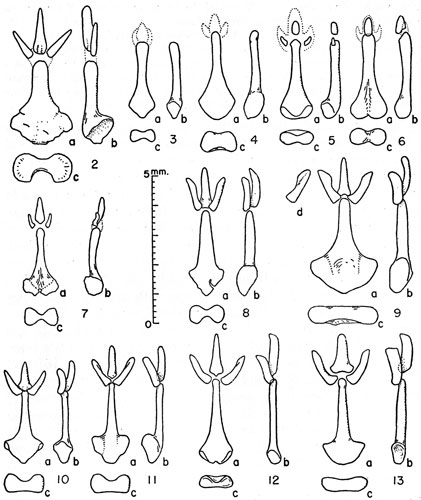
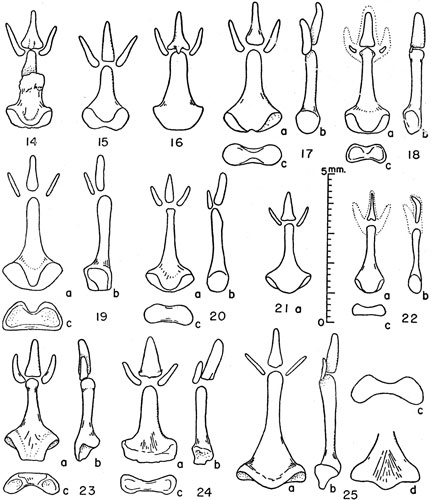
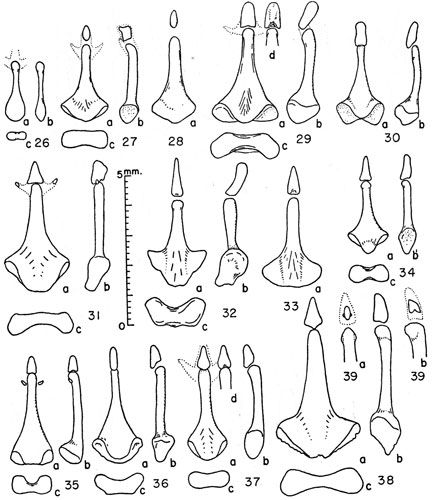
Figs. 3 and 4
Baculum: stalk elongate, greatest length (3.1 mm.) 2 1/5 to 2½
times greatest breadth, and 4½ times greatest depth; digitate
processes usually cartilaginous, occasionally lateral processes partly
ossified; basal tuberosities weakly to moderately developed, medially
confluent; posterior profile in dorsal view rounded with rounded
posterior apex or shallow notch; dorsal concavity in end-view shallower
and not so wide as ventral concavity; median constriction approximately
2/3 greatest depth; ventral part of base in end-view wider than dorsal
part; shaft straight or slightly curved; base of stalk placed dorsally
relative to axis of shaft; stalk spatulate, sometimes with distal
enlargement; at mid-point stalk wider than high; lateral profile in
dorsal view sloping gradually without abrupt curvature anterior to point
of greatest width.
The baculum of Dicrostonyx torquatus figured by Ognev
(1948:476) agrees with that of D. groenlandicus in shape of stalk,
and in lateral digitate processes that are small relative to size of
median process; but differs in more elongate, terminally enlarged, bulbar
shape of median process. None of my specimens showed ossification in the
lateral processes, observed by Hamilton (1946:381) in Dicrostonyx
rubricatus richardsoni [ = D. groenlandicus richardsoni]. In
all of my specimens the cartilaginous median process was larger than that
figured by Hamilton, or by Dearden (1958:542).
Specimens examined: Four from; Point Barrow, Alaska, 52524
(Barrow Village), 67264 (died in captivity); Brooks Range, Alaska, 50536
(Wahoo Lake, 69°08', 146°58'), 50539 (Porcupine Lake, 68°51'57",
146°29'50", 3140 ft.).
Fig. 2
Baculum: Stalk heavy, broad, greatest length (2.8 mm.) in mature
individuals (Fig. 2) as little as 11/3 times
greatest breadth, greatest length no less than 22/3 times greatest depth
of base; three ossified processes, median one from as long as to ½
longer than the lateral processes, and approximately
2/3 wider and twice as deep as lateral processes;
length of median process almost 3½ times its breadth,
approximately ½ length of stalk; basal fossae broadly confluent;
posterior profile in dorsal view evenly rounded; in end-view ventral
concavity deeper than dorsal concavity, constriction as little as
½ greatest depth in mature specimens; shaft straight, bluntly
rounded, or slightly decurved and laterally inflated terminally; lateral
profile in dorsal view a gradual slope from widest point of stalk
anteriorly onto shaft; in younger individuals stalk slenderer, otherwise
as described above.
Five specimens examined by me differ from one figured and described by
Hamilton (1946:379) in that stalk is better developed, larger relative to
size of processes, length of stalk in my specimen (Fig. 2) 2.8 as opposed
to 2.1 mm. in Hamilton's specimen; median process shorter, 1.5 as opposed
to 1.8 mm., proximal end rounded rather than concave, not partially
enclosing tip of shaft; proportion of and relative sizes of median and
lateral processes approximately same as in Hamilton's Lemmus
helvolus [= Lemmus trimucronatus helvolus].
A specimen figured by Dearden (1958:542) has a basally trilobed median
process.
The baculum of the Asiatic Lemmus lemmus figured by Ognev
(1948:413) agrees with my specimens in the ossification of three
processes, the relative sizes of these processes to each other and to the
stalk, the well-developed base of the stalk and heavy bluntly rounded
shaft; the baculum of Lemmus lemmus differs in greater
anterolateral extent of basal tuberosities, in proximal notch seemingly
separating these tuberosities, and in median process being slenderer.
Specimens examined: Five, of two subspecies; Lemmus
trimucronatus alascensis, Point Barrow, Alaska, numbers 50591, 50678,
50731, 50758; Lemmus trimucronatus subarcticus, Wahoo Lake,
69°08', 146°58', 2350 ft., Brooks Range, Alaska, 50948.
Figs. 5 and 6
Baculum: Stalk elongate, greatest length (2.7 to 2.8 mm.) 2
1/3 to 2½ times greatest breadth, 4 to 5
times greatest depth; three processes ossified or lateral processes
unossified, ossifications relatively small (in 78380, median ossification
less than ¼ as large as lateral ossifications although median
cartilaginous process is larger), length of median process
1/5 to 1/6 of length of
stalk, cartilaginous part of median process larger; posterior profile in
dorsal view convex throughout or bilobate; tuberosities moderately
developed, deflected dorsal to axis of shaft; in end-view medial
construction 3/5 greatest depth of tuberosities;
shaft tapered from point of greatest width, slightly inflated
terminally.
The specimen (KU 13716) figured by Hibbard and Rinker (1942:29) has
been restudied. It was first cleared and stained to soften the dry
cartilage binding the digital processes together and to differentiate
bone and cartilage. The lateral processes are small and cartilaginous
(Fig. 6) and seem intact. The differences between this specimen and
others examined by Hamilton (1946:381), Dearden (1958:542), and myself,
namely the relatively larger median ossification, the absence of
ossification in lateral processes, and the distinctly bilobate base and
larger size, may represent geographic differences, or individual
variation. The proportions of length, width, and depth of the stalk, and
the appearance in lateral view do not differ greatly from others examined
by Hamilton, by Dearden (1958:546), and by me.
Specimens examined: Five, representing four subspecies; S.
cooperi gossii, 6 mi. N Midway, Holt Co., Nebraska 78379, 78380;
S. cooperi relictus, 5 mi. N, 2 mi. W Parks, Dundy Co., Nebraska,
72601 (immature); S. cooperi saturatus, 3 mi. S Demotte, Jasper
Co., Indiana, 3-C-454, collection of W. B. Quay; S. cooperi
paludis, Meade County State Park, Kansas, 13716.
Fig. 11
Baculum: Stalk elongate, and proximally enlarged, greatest length (2.7
mm.) 2 times greatest breadth; less than 4 times greatest depth; three
well-developed ossified processes; length of stalk 21/3 times length of median process; median process
with basal (and ventral) protuberence and lateral lobes, arched in
dorsoventral plane; lateral processes as large as median process,
flattened distally, having ventromedial vane on distal half; basal
tuberosities of stalk well developed, medially confluent; posterior
profile in dorsal view trilobate or convex
throughout with rounded posterior apex; dorsal concavity well developed,
ventral surface but slightly concave, medial constriction of base as
little as ½ greatest depth; shaft straight, slender, at mid-point
of stalk but slightly wider than high; basal tuberosities largely dorsal
to axis of shaft in lateral view; lateral profile in dorsal view with an
abrupt curvature separating the gently sloping sides of the shaft from
the basal part at its greatest breadth.
The specimen of Clethrionomys rutilus figured by Ognev
(1950:120) is essentially like the North American specimens examined by
me in the relative sizes of the ossifications and the general shape of
the stalk.
Specimens examined: Four, of one subspecies; C. r.
dawsoni, west bank Gakona River, 1700 ft., 5 mi. NNE Gulkana, Alaska,
42865, 42866; SW end Dezadeash Lake, 2400 ft., Yukon Territory, 42910,
42921.
Fig. 10
Baculum: Stalk elongate, greatest length (2.8 mm.) 1¾ times
greatest breadth, and 3¾ times greatest depth; proximally
enlarged, greatest depth ½ greatest breadth; three well-developed
ossified processes; length of stalk 2 1/3 times
length of median process; median process arched in dorsoventral plane,
with basiventral protuberence or spine and lateral lobes; lateral
processes as large as median process, flattened distally, arched; basal
tuberosities of stalk well developed, medially confluent; posterior
profile in dorsal view trilobate or convex throughout with a rounded
posterior apex; dorsal concavity well developed, ventral surface but
slightly concave, or in some cases slightly convex; medial constriction
of base 3/5 greatest depth; shaft straight,
slender, at mid-point of stalk twice as wide as high; basal tuberosities
dorsally placed relative to axis of shaft; lateral profile in dorsal view
abruptly curved anterior to point of greatest width; slender stalk
distinct from angular enlarged base.
The most noticeable difference between the baculum of C.
rutilus and C. gapperi is size. The proportions of the four
ossifications are approximately the same. Ventral vanes on the lateral
processes are not developed in C. gapperi. C. gapperi and
C. rutilus are more nearly alike in their bacula than any other
two species of Clethrionomys examined. Clethrionomys
occidentalis, the other New World species, is also much like C.
gapperi and C. rutilus. The differences are of a magnitude
comparable to those between the bacula in subspecies of Microtus
montanus (Figs. 19-21) for example, or in subspecies of Lagurus
curtatus (Dearden, 1958:542).
Specimens examined: Nine, of two subspecies; Clethrionomys
gapperi athabascae, British Columbia, 42922 (Indian Creek, Mile Post
234 of Alaskan Highway), 64281 (West bank Racing River, 89 mi. W Muskwa),
64287 (North bank Tetsa River, 56 mi. W, 11 mi. S Muskwa), 64290 (44 mi.
W, 9 mi. S Muskwa), 64310 (32 mi. W, 2 mi. S Muskwa); Clethrionomys
gapperi galei, 31 mi. N Pinedale, Sublette Co., Wyoming, 42108; Grand
Mesa, Delta Co., Colorado, 60014 and 60015 (5½ mi. E, 12 mi. S
Collbran), 60022 (8 mi. E, 1/2 mi. S Skyway).
Fig. 12
Baculum: Stalk elongate, greatest length (2.8 mm.) 2½ times
greatest breadth, 6 times greatest depth; three well-developed ossified
processes; median process larger than lateral processes, ½ the
length of stalk, curved, basally
broad, ventrally keeled, trilobate posteriorly; lateral ossifications
large, flattened distally, curved; posterior profile of stalk posteriorly
slightly emarginate, thus bilobate in outline; in end-view dorsal
concavity deeper than ventral, constriction less than ½ greatest
depth, tuberosities confluent, visible in dorsal view at each side; shaft
slender, especially in depth, straight; at mid-point of stalk almost
twice as wide as deep, slight terminal inflation.
The general proportions of the stalk and the relatively large,
uniquely shaped processes, are characteristic of most specimens of the
genus Clethrionomys examined.
Specimen examined: C. occidentalis californicus, one
from Mary's Peak, Benton Co., Oregon, 30, F. W. Sturges' collection.
Fig. 13
Baculum: Stalk elongate, greatest length (2.9 mm.) twice the greatest
breadth in the specimen examined, flattened proximally, greatest length
almost 6 times greatest depth of base; three well-developed ossified
processes; median process arched in a dorsoventral plane, with basal
notch and lateral lobes; lateral processes as long as median process,
bowed in dorsal view, flattened distally, with ventromedial vane; basal
tuberosities of stalk weakly developed, medially confluent; posterior
profile in dorsal view evenly rounded; in end-view dorsal concavity
shallow in comparison to most species but deeper than ventral concavity,
constriction ¾ greatest depth; shaft straight, at mid-point
slightly wider than high, elongate, widest point of stalk less than
¼ of total length from proximal end, slight lateral inflation at
tip; lateral profile in dorsal view sloping at first abruptly and then
gradually from widest point of stalk anteriorly onto shaft.
The specimen of Clethrionomys glareolus figured by Ognev
(1950:31) in dorsal view as I interpret it, resembles my specimen in the
rounded base; in the elongate, distally inflated shaft; in the initially
abrupt slope of the lateral profile in dorsal view from the greatest
width of stalk anteriorly; and in the presence of three well ossified
processes. Ognev's specimen differs from mine in the median process being
more elongate relative to its width, and rounded proximally, lacking
lateral lobes and basal notch; in lateral processes being less curved; in
the greater terminal inflation of the shaft; and in the closer
approximation of the terminal processes to the shaft. The baculum of
Clethrionomys glareolus as described and figured by Didier
(1954:243-244) resembles my specimen in general proportions, but is more
pointed proximally and more curved in dorsoventral plane. Didier states
that the baculum is rather variable in form in this species, in different
regions, but that a large number of specimens must be examined to assess
the geographic nature of this variation.
Specimen examined: One from Zermatt, Valais, Switzerland,
67100.
Fig. 9
Baculum: Base of stalk broad but relatively flattened dorsoventrally,
greatest length (3.2 mm.) less than 1½ greatest width, 4 times
greatest depth; three well-developed ossified processes; median process
arched in dorsoventral plane, having basal notch and lateral lobes;
lateral processes as long as median process,
flattened distally, with ventromedial vane; basal tuberosities of stalk
weakly developed, medially confluent; posterior profile in dorsal view
convex with rounded posterior apex; dorsal surface of base almost flat,
ventral concavity broad and shallow; constriction ¾ greatest depth
(not including an unusual irregularity on the ventral surface of the
base); shaft straight, at mid-point of stalk distinctly wider than high,
slender at distal end, widest point of stalk almost
1/3 of total length from proximal end, tip of shaft
rounded; lateral profile in dorsal view gradually sloping from widest
point anteriorly onto shaft.
The specimen of Clethrionomys rufocanus figured by Ognev
(1950:97) resembles my specimen in the presence of three well ossified
processes. Ognev's specimen differs however in the lack of a proximal
notch on the median process, the lesser proportion of the stalk included
in the basal enlargement, the more posterior position of the point of
greatest width, and the presence of a concavity in the posterior profile
of the stalk in dorsal view. These differences in the stalk may be owing
to a difference in age (my specimen perhaps being older).
Specimen examined: One from 1 mi. NW Oho-ri, 6 M., Korea,
60438.
Figs. 7 and 8
Baculum: Stalk slender, greatest length (2.9 mm.) 2¼ to
2½ times greatest breadth, 4 times greatest depth; three
well-developed ossified processes, median one almost ½ length of
stalk, curved, broad basally and slightly larger in all dimensions than
either lateral process; lateral processes flattened distally, curved;
base of stalk well developed, basal tuberosities medially confluent or
separated by medial emargination, posterolateral faces flattened or
rough; emarginations in the four adults examined; posterior profile in
dorsal view bluntly pointed or flattened except for emargination
posterially, abruptly curved at point of greatest width; shaft arising
broadly from distal side of base of stalk; in end-view hour-glass shaped,
medial constriction pronounced, both dorsal and ventral concavities deep;
shaft having relatively straight but distally convergent sides; at
mid-point of stalk, 1 to 1½ times as wide as deep; tip bluntly
rounded, or slightly inflated.
The specimens from Quebec differ from the one from Wyoming in smaller
size, relatively smaller lateral digital processes, larger more medial
basal emargination, and slender shafts. The baculum of Phenacomys
intermedius differs much from that of Phenacomys longicaudus,
described by Hamilton (1946:381) and by Dearden (1958:547). Dearden
states that the three bacula examined by him of Phenacomys
longicaudus differ markedly from the specimen described by Hamilton.
It seems to me that in major features the resemblance is greater between
the specimens of Phenacomys longicaudus examined by these two
authors than between their specimens and specimens of other microtines,
including Phenacomys intermedius. Neither Hamilton nor Dearden
record the exact localities of capture, the collections in which the
specimens are deposited, or the catalogue numbers of specimens.
Consequently verification of identifications and observations is
difficult.
Specimens examined: Five, of two subspecies; P. intermedius
intermedius, 5.4 mi. S Moran, Teton Co., Wyoming, 3-C-309, collection
of W. B. Quay; P. intermedius celatus, four (including one
immature specimen) from Authiernord,
Abitibi-ouest Co., Quebec, specimens in collection of Bristol Foster
designated by numbers 2041-2044 of S. Anderson's field catalogue. Smith
and Foster (1957:107) were of the view that Phenacomys ungava
(including the above specimens from Quebec) may be specifically distinct
from Phenacomys intermedius.
Not figured
Baculum: In the single specimen examined, less mature than that
figured by Hamilton (1946:384), the digitate processes are cartilaginous,
the basal tuberosities are less well developed, and the shaft is
slenderer throughout. The cartilaginous processes are of the same
proportions as ossified processes in the figure mentioned. The shaft is
also convex ventrally in lateral profile. The view of the side here
considered to be anatomically the ventral side (adjacent to the urethra)
is labelled dorsal view in Hamilton's specimen.
Specimen examined: One, from Reserve, Brown Co., Kansas, 72405.
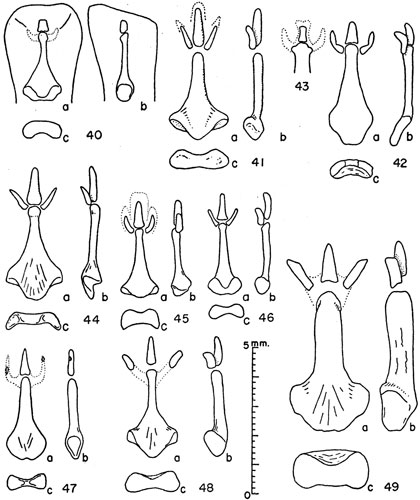
Figs. 42 and 43
Baculum: Stalk moderately elongate, greatest length (3.5 mm.)
21/3 times greatest breadth, spatulate, flattened
throughout, greatest thickness 1/3 millimeter;
three ossified processes; median process having three cornered base,
curved dorsally, wider than high, ¼ to 1/5
greatest length of stalk; each lateral process bent at middle, as long as
median process, compressed laterally; base of stalk curved dorsally,
tuberosities marginal, hence narrow, lateral excavations of tuberous
margin not confluent medially; in end-view ventral concavity broad, no
dorsal concavity, medial constriction but slightly less than greatest
thickness (not depth); shaft wider than high throughout, at mid-point
more than 3 times as wide as high; tip of shaft slightly inflated both
laterally and dorsoventrally; lateral profile gradually sloping
anteriorly from widest point of stalk.
Specimen number 65921 (Fig. 43) differs from number 65895 (Fig. 42)
described above. Terminus of shaft of number 65921 has lateral lobes from
which arise lateral cartilaginous processes; median terminal ossification
irregular in shape, smaller, imbedded in terminally bilobate cartilage.
In the spatulate flattened stalk these two specimens are much alike. An
immature specimen, number 65908, is smaller (length of stalk 2.6 mm.)
also flattened and spatulate, has the terminal processes cartilaginous,
the lateral processes bent medially, and proportions as in the adult.
The baculum shows no noteworthy resemblance to that of any other
species of North American Microtus; on the other hand the
differences between M. guatemalensis and some other species are no
greater than the differences between certain species included in the
subgenus Microtus. The baculum neither strengthens nor weakens the
case for subgeneric rank for M. (Herpetomys) guatemalensis.
Specimens examined: Three from Guatemala; 65895 (2 mi. S San
Juan Ixcoy), 65908, (3-1/2 mi. SW San Juan Ixcoy), 65921 (10 mi. E, 4 mi.
S Totonicapán).
Figs. 38 and 39
Baculum: Stalk broad, greatest length (3.7 to 4.3 mm.) 1½ times
greatest breadth, relatively flattened, greatest depth
1/3 greatest breadth; single median ossified
process, in smaller of two specimens this ossification incomplete and of
unusual shape (Fig. 39); length of stalk 4 times length of median
process; concavities of basal tuberosities medially confluent,
constriction less than ½ greatest depth; widest point of shaft
less than ¼ length of shaft from posteriormost point; shaft wider
than high except at distal end that is inflated dorsally and sometimes
laterally; both ventral and dorsal concavities of base of stalk broad and
moderately deep; posterior profile in dorsal view evenly rounded or
having marginal notch.
In the absence of ossified lateral processes my two specimens differ
from bacula of Microtus (Arvicola) terrestris figured by Didier
(1943:79, 1954:245, 247, 248) and by Ognev (1950:591). The median process
relative to the size of the shaft is smaller, and the shaft relative to
its length is wider in M. richardsoni than in M.
terrestris. The stalk of M. (Arvicola) amphibius figured by
Didier is like that of M. richardsoni in its greater breadth and
median notch on posterior border.
The relationship of the New World water rat, M. richardsoni, to
the Old World water rats (genus Arvicola of some European authors)
is uncertain. Miller (1896:66) placed all of them in the subgenus
Arvicola. Subsequent authors, stressing differences in the teeth,
have placed M. richardsoni in the subgenus Aulacomys of
Rhoads. Zimmerman (1955) has shown that teeth in some Arvicola
approach the more complex pattern of M. richardsoni. He argues
also that Arvicola is generically distinct from Microtus on
the grounds that the two groups have separate origins, Arvicola
having descended from the genus Mimomys and Microtus from
some other group of microtines. This argument also was advanced by Hinton
(1926:47-48). Pending further studies of the possible polyphyletic origin
of other subgenera of the genus Microtus, I refer both M.
richardsoni and M. terrestris to the subgenus Arvicola.
The evidence afforded by the bacula available is not conclusive as to
relations of Old World and New World water rats. No general agreement on
the number of species in this Palaearctic group has been reached, and
bacula of only three or four of the numerous Old World subspecies have
been figured. I have examined none.
Specimens examined: Two, from Wyoming; 42454 (31 mi. N
Pinedale, 8025 ft., Sublette Co.), 37903 (23-1/2 mi. S, 5 mi. W Lander,
8600 ft., Fremont Co.).
Fig. 45
Baculum: Stalk broad, greatest length (2.2 mm.) 1¾ times
greatest breadth, 3½ times greatest depth; three well-developed
ossified processes; median process 2/5 length of
stalk, rounded or tapered terminally, proximal end opposed to tip of
stalk and flattened obliquely; lateral processes
2/3 length of median process, deeper than wide,
curved; tuberosities of stalk well developed, confluent medially, visible
in dorsal view; in end-view dorsal concavity narrow, moderately
deep, rounded, ventral concavity wide, deep, flattened; base wider
ventrally than dorsally; shaft tapering more or less uniformly,
terminally inflated.
In the relative sizes, to each other and to the stalk, of the three
digitate ossifications M. oregoni resembles closely the Old World
representative of the same subgenus, M. (Chilotus) socialis, as
figured by Argyropulo (1933b:181). In M. oregoni the greatest
width of the baculum is more proximal on the stalk than in the M.
socialis figured by Argyropulo but closely resembles the baculum of
the M. socialis figured by Didier (1954:242). In possessing a
shallow emargination in the base of the stalk and in possessing a median
process that is smaller than the lateral processes, M. socialis,
as figured by Didier, differs from M. oregoni. The baculum figured
by Argyropulo (loc. cit.) of Sumeriomys colchicus
schidlovskii [ = Microtus (Chilotus) socialis schidlovskii
according to Ognev, 1950:392] differs from other Chilotus that
have been studied in having an unusually elongate median process and a
more distal placement of the widest part of the stalk.
Specimens examined: Three, of the subspecies M. oregoni
oregoni, from 5 mi. N Orick, Humboldt Co., California, 3-C-248,
collection of W. B. Quay; from Mary's Peak, Benton Co., Oregon, 66,
collection of F. W. Sturges; and from Sec. 3, T. 11S, R. 5W, Benton Co.,
Oregon, 79183.
Fig. 34
Baculum: Length of stalk (2.4 mm.) 1¾, times greatest breadth,
41/3 times greatest depth; median ossified process
well developed, more than 1/3 length of stalk,
higher than wide, slightly bowed, closely appressed to terminus of shaft;
basal tuberosities of stalk moderately developed, confluent medially,
posterior profile of medial apex rounded in dorsal view, lateral
indentations present, hence trilobate outline; in proximal end-view base
wider ventrally, ventral concavity broader than dorsal concavity but of
equal depth, medial constriction 2/3 greatest
depth; shaft slender in distal part, inflated terminally, and wider than
high at mid-point of stalk; lateral profile a smooth slope of gradually
decreasing curvature from point of greatest width to near distal end.
The baculum of this species figured by Ognev (1950:461) differs in
having lateral ossified processes, and a more rounded base of the stalk.
Resemblance to the New World Stenocranius is discussed below.
Specimen examined: One from "Eastern Europe," 8059.
Figs. 32 and 33
Baculum: Length of stalk (2.8 mm.) 1½ times greatest breadth,
3½ times greatest depth; median process ossified,
2/5 to 3/5 length of stalk,
laterally compressed, sometimes arched in dorsoventral plane; lateral
processes cartilaginous, slender; basal tuberosities well developed,
averaging less enlarged than shown in Figure 32, but more angular in
lateral outline than shown in Figure 33; tuberosities confluent
posteriorly; posterior profile smoothly rounded to trilobate, curvature
at point of greatest breadth usually acute; in proximal end-view base
wider dorsally, deep dorsal concavity, shallow ventral concavity, medial
constriction 3/5 of greatest depth; shaft slender
anteriorly, at mid-point of stalk
twice as wide as high, at tip higher than wide, laterally inflated;
lateral profile in most specimens abruptly curved anterior to point of
greatest breadth.
The single specimen of the Old World M. (Stenocranius) gregalis
examined resembles the New World M. (Stenocranius) miurus in the
angular lateral profile at the point of greatest breadth of the stalk,
slender shaft in comparison to broad base of stalk, and presence of a
single well-developed laterally compressed median process. The base of
the stalk in the baculum of M. gregalis is less well developed and
smaller than in the baculum of M. miurus.
Specimens examined: Nine, all of the subspecies Microtus
miurus muriei, from the Brooks Range, Alaska; 51077 (Lake Schrader,
145°09'50", 69°24'28", 2900 ft., Romanzof Mts.); 51151, 51152,
51154, 51164, 51166, 51169 (last 6 from Wahoo Lake, 69°08',
146°58', 2350 ft.); 51210, 51213 (last 2 from Porcupine Lake,
68°51'57", 146°29'50", 3140 ft.).
Fig. 47
Baculum: Greatest length of stalk (2.7 mm.) 2¼ times greatest
breadth, 4½ times greatest depth; three digitate processes,
lateral processes mostly cartilaginous in single adult examined; median
process well ossified, approximately 1/3 length of
stalk, basally notched, not arched, laterally compressed distally; base
of stalk broad and flat, basal tuberosities well developed, separate;
posterior profile in dorsal view rounded, convex except for medial notch
separating tuberosities; dorsal and ventral concavities deep, broad,
equal; medial constriction less than ½ greatest depth; in dorsal
view shaft tapering gradually from widest point, terminally rounded; at
mid-point of stalk almost twice as wide as high.
In the elongate, largely cartilaginous lateral processes of the
baculum, the specimen described above resembles M. longicaudus.
The size of the median process in comparison to the size of the stalk is
also the same. The lateral processes have larger ossifications and the
base of the stalk is more robust in M. longicaudus than in M.
nivalis.
The well ossified lateral processes and enlarged base of Didier's
(1954:240) specimen suggest that it is of a more mature individual than
the one described above. These specimens of M. nivalis, as well as
the specimens of M. longicaudus, exhibit dorso-ventral flattening
of the mid-part of the base of the stalk.
The baculum of a specimen from Switzerland is weakly developed, of
small size (shaft 2.0 mm. in length), slender, thin, spatulate, and
terminally inflated. Digital processes were not observed, perhaps owing
to excessive maceration in preparation. The general appearance of the
baculum is that of an immature individual, although the animal was not
small (165 mm. total length in preservative).
Specimens examined: Two Microtus nivalis nivalis;
Zermatt, Valais, Switzerland, 67105; Wetterstein, Germany, 65127.
Fig. 48
Baculum: Base of stalk well developed, greatest length (3 mm.)
1¾ times greatest breadth, 32/3 times
greatest depth; three ossified processes; base of median process rounded;
median process slightly curved in dorsoventral plane, in length almost
1/3 greatest length of stalk; ossifications in
lateral processes
variable in size, frequently widely separated from shaft by cartilage,
rarely as large as median ossification; basal tuberosities usually
well-developed, medially confluent; profile of base in dorsal view
trilobate or irregularly convex throughout; constriction ½
greatest depth; shaft relatively straight or slightly bowed ventrally or
dorsally, shaft at mid-point of stalk wider than high; tip of shaft
laterally inflated; widest point of stalk approximately ¼ length
of stalk from proximal end; lateral profile in dorsal view tapers
gradually onto shaft anteriorly from point of greatest width of stalk;
shaft variable, from slender terminally and nearly parallel sided (Fig.
48), to broad distally and tapered.
In many of the features that distinguish M. longicaudus (and
the closely related insular species M. coronarius) from other
North American Microtus, longicaudus resembles the Old
World species of the subgenus Chionomys (that is to say, M.
nivalis, M. gud, and M. roberti). These features are
medium size, long tail, grayish color, montane habitat, relatively short
molar tooth-row, moderate sized and unconstricted incisive foramen,
relatively decurved upper incisors, elongate nasals, relatively broad
interorbital region without well-developed median ridge, and similar
chromosomes (Matthey, 1955:178). For these reasons I am here referring
Microtus longicaudus to the subgenus Chionomys; previously
it has not been referred to that subgenus.
Specimens examined: Six, of three subspecies; Microtus
longicaudus littoralis, Sullivan Island, Alaska, 42972, 42969; M.
l. mordax, 3/4 mi. N, 2 mi. W Allenspark, 8400 ft., Boulder Co.,
Colorado, 50335, 76829; M. l. sierrae, Crane Flat, Mariposa Co.,
California, 50252, 50253.
Fig. 22
Baculum: In the single specimen examined, stalk small, greatest length
(2.3 mm.) 21/3 times greatest width, almost 6 times
greatest depth, flattened proximally; three well-developed digitate
processes, the median one ossified, the lateral processes cartilaginous;
median ossification laterally compressed and decurved at tip, bilobate at
base; basal tuberosities of stalk weakly developed, medially confluent;
posterior profile in dorsal view evenly rounded; ventral concavity deeper
and narrower than dorsal concavity, but both comparatively shallow;
medial constriction 2/3 greatest depth; shaft
straight, at mid-point twice as wide as deep; lateral profile tapering
from greatest width gradually to parallel sides of distal third of
stalk.
From the baculum of Microtus arvalis figured by Ognev
(1950:173), and from the baculum figured by Didier (1954:238) my specimen
differs in the absence of lateral ossifications in the digitate
processes, smaller and slenderer median ossification, and weaker base.
These differences in part may be owing to a difference in age, my
specimen being the less mature.
Specimen examined: One from Vidy, Switzerland, 67101.
Fig. 24
Baculum: In the one specimen examined, stalk broad, greatest length
(2.6 mm.) 1½ times greatest breadth, 3½ times greatest
depth; three digitate processes ossified; median process relatively
broad, in length more than ½ length of stalk, triangular in dorsal
view, with small spurs posterolaterally,
middorsal ridge posteriorly; lateral ossifications slightly curved,
slenderer, less than ½ depth and less than ½ transverse
thickness of median process; basal tuberosities well-developed, confluent
medially; in end-view base wider dorsally than ventrally, dorsal
concavity broader and more abruptly curved at mid-point than ventral
concavity; constriction ½ greatest depth; posterior profile in
dorsal view notched, setting off a posterior shelf; stalk including shaft
wider than deep throughout, at mid-point width twice depth; lateral
profile abruptly curved anterior to point of greatest width, sides of
shaft tapering gradually anteriorly to rounded uninflated tip.
The baculum of this insular species, placed in the "arvalis"
group by Ellerman (1941:595), resembles the baculum of both Microtus
agrestis and Microtus guentheri more than it resembles the
baculum of Microtus arvalis. Similarities in the chromosomes of
M. arvalis and M. orcadensis were noted by Matthey
(1953:254, 279), who was of the opinion that M. orcadensis is an
insular derivative of the arvalis-group.
Specimen examined: One from the Orkney Islands, 67106.
Fig. 23
Baculum: In the one specimen examined, stalk broad, greatest length
(2.9 mm.) 1½ times greatest breadth, 3½ times greatest
depth; three digitate processes ossified; median process slightly less
than ½ length of stalk, broad, dorsally curved; curved lateral
ossifications shorter and more slender than median ossification; basal
tuberosities well developed, angular, confluent across posterior border
of projecting shelf; in end-view tuberosities projecting ventrolaterally
from central shelf; dorsal surface at medial constriction flat, ventral
surface broadly and deeply concave; posterior profile in dorsal view
trilobate, central lobe formed by posteriorly flattened shelf, surface of
attachment visible only on lateral lobes; at mid-point stalk almost twice
as wide as deep, depth of shaft greater than width proximal to inflated
terminus.
Specimen examined: One from Palestine, 67104.
Fig. 25
Baculum: Stalk large, greatest length (3.8 mm.)
14/5 times greatest breadth, 4½ times
greatest depth; three digitate processes ossified; median ossification
almost 1/3 length of stalk; lateral ossifications
slender, smaller than median ossification; posterior profile of stalk in
dorsal view trilobate, basal tuberosities well developed, confluent
medially; in end-view dorsal concavity broader and deeper than ventral
concavity; medial constriction pronounced (less than ½ greatest
depth); lateral profile at widest point of stalk convex, becoming
abruptly concave as the flange of the basal tuberosities grades into the
shaft, then gradually converging to narrowest point
1/3 of length of stalk from the terminus; stalk
wider than deep in proximal 2/3, circular in cross
section in terminal 1/3, slight terminal
inflation.
A specimen figured by Ognev (1950:297) has the same general
proportions, slender lateral processes, and proximal placement of the
point of greatest breadth.
Specimens examined: Two from Chipo-ri, Korea, 60443, 63841.
Figs. 19, 20 and 21
Baculum: Stalk broad, greatest length (varying with subspecies from
2.3 to 3.1 mm.) 1½ to 1¾ times greatest breadth,
31/3 to 41/3 times greatest
depth; three ossified processes, median one largest, more than twice as
wide and as deep as shorter, slenderer, lateral processes; median process
laterally compressed distally except in one specimen in which moderately
inflated distally, proximally enlarged in some specimens (Fig. 21) and
1/3 to 2/5 length of stalk;
base broad, posterior profile in dorsal view evenly convex throughout, at
widest point of stalk abruptly incurved; basal tuberosities moderately to
strongly developed, medially confluent; in end-view base wider ventrally
than dorsally, dorsal concavity slightly to much deeper than the nearly
flattened ventral concavity; medial constriction
2/3 to 4/5 of greatest depth;
shaft relatively slender, at mid-point of stalk slightly wider than high
and ¼ as wide as base of stalk, terminally rounded or slightly
inflated; lateral profile in dorsal view a gradual curve from point of
greatest width anteriorly onto shaft.
The different subspecies figured show the essential characteristics of
the species, differing primarily in size.
Specimens examined: Fourteen, of three subspecies; Microtus
montanus amosus, ½ mi. E Soldier Summit, Wasatch Co., Utah,
62241; M. montanus fusus, La Manga Pass, Conejos Co., Colorado,
42164; 5 mi. N, 26 mi. W Saguache, 9500 ft., Saguache Co., Colorado,
42307, 42315; 5 mi. N, 27 mi. W Saguache, 9350 ft., Saguache Co.,
Colorado, 42308; 5 mi. N, 28 mi. W Saguache, 9325 ft., Saguache Co.,
Colorado, 42309; 5 mi. S, 24 mi. W Antonito, 9600 ft., Conejos Co.,
Colorado, 42327, 42330; Prater Canyon, Mesa Verde National Park,
Montezuma Co., Colorado, 69456, 69457, 69463; Microtus montanus
nanus, 2 mi. N, 2 mi. W Pocatello, Bannock Co., Idaho, 57470, 57472;
¼ mi. N, 2 mi. W Allenspark, 8400 ft., Boulder Co., Colorado,
50330.
Fig. 41
Baculum: Stalk broad, greatest length (3.0 mm.) 1½ times
greatest breadth, 4½ times greatest depth; three ossified
processes, median one largest, deeper and more than twice as wide as
curved, shorter, compressed lateral processes and more than
2/5 as long as stalk; base broad, in dorsal view
posterior profile trilobate, basal tuberosities visible; basal
tuberosities well developed, medially confluent; in end-view base wider
ventrally than dorsally, dorsal concavity deeper than ventral concavity;
medial constriction 3/5 of greatest depth; shaft
broad, at mid-point more than twice as wide as high and
1/3 as wide as base of stalk, terminally
rounded.
Specimens examined: Three, all M. t. townsendii; Fort
Lewis, Pierce Co., Washington, 57998, subadult; Sec. 33, T. 11S, R. 5W,
Benton Co., Oregon, 79186; Sec. 5, T. 12S, R. 4W, Benton Co., Oregon,
79188.
Fig. 44
Baculum: Stalk broad and flattened, greatest length (3.5 mm.)
12/3 to 2 times greatest width, 4 to 5½
times greatest depth; three ossified processes, median one largest,
lateral processes slender, relatively small; length of median process
3/8 length of stalk; median process decurved,
dorsoventrally flattened in
some specimens, widened at base; attachment of processes to shaft
displaced ventrally; base of stalk widened, posterior profile in dorsal
view usually trilobate, in a few cases rounded, median lobe forming
posterior shelf, lateral lobes dorsally raised and forming margins of
lateral tuberosities; in end-view thickness frequently more or less
uniform throughout central part, broad depression dorsally, ventral
concavity narrower and shallower (as figured); base, and occasionally
shaft, flattened, width at mid-point of stalk 2 to 3 times depth,
narrowest point posterior to terminal inflation of shaft in terminal
1/3 of shaft.
The baculum of M. oeconomus (Old World) figured by Ognev
(1950:257) resembles but exceeds that of M. oeconomus (New World)
in the relatively large median process and slender lateral processes, but
differs noticeably in the presence of a deep median notch in the base of
the stalk. A specimen from Hungary is intermediate between Ognev's
specimen and those from the New World in both size of median process and
size of lateral processes, and has an unnotched base resembling that in
Figure 44.
Specimens examined: Ten, of three subspecies; M. oeconomus
gilmorei, Umiat, Alaska, 51354, 51361, 51399, 51408; Lake Schrader,
Brooks Range, Alaska, 51422; M. o. macfarlani, 5 mi. NNE Gulkana,
Alaska, 43039, 43041; 20 mi. NE Anchorage, Alaska, 43044; Kelsall Lake,
British Columbia, 43048; M. o. mehelyi, Kisbalatan, Hungary,
75159.
Figs. 35 and 36
Baculum: Stalk attenuate, greatest breadth relatively near proximal
end; greatest length (3.1 to 3.4 mm.) more or less twice greatest
breadth, 4 to 5 times greatest depth; usually a single process ossified;
lateral processes relatively small, cartilaginous or (in three specimens,
63094, 69453, 68019) with small ossifications; median process relatively
small, sometimes appressed to tip of shaft, in length less than ¼
length of stalk; posterior profile in dorsal view rounded, flattened
posteriorly, or in some specimens trilobate with angular edges; in
end-view relative depths of dorsal and ventral concavities variable,
dorsal usually deeper than ventral; distal end of stalk frequently bowed
dorsally; shaft slender distally, sometimes slightly inflated terminally,
or (in one specimen, 63085) near tip small lateral projections that are
perhaps fused lateral ossifications; lateral profile in dorsal view a
gradual slope anteriorly from point of greatest width to slender tip.
Specimens examined: Thirteen, of four subspecies; Microtus
mexicanus mexicanus, Las Vigas, Veracruz, 30692; Nevada de Toluca,
México, 63101; Valle de Bravo, México, 63094; Microtus mexicanus
mogollonensis, Mt. Taylor, Valencia Co., New Mexico, 63298, 76830;
Park Well, Mesa Verde National Park, Montezuma Co., Colorado, 69448,
69453; Upper Nutria, McKinley Co., New Mexico, 69997, 70000; Microtus
mexicanus phaeus, Sierra Patamba, 9000 ft., Michoacán, 63085;
Microtus mexicanus subsimus, 2 mi. E Mesa de Tablas, Coahuila,
58916; 13 mi. E San Antonio de las Alazanas, Coahuila, 68019, 68021.
Fig. 37
Baculum: Stalk elongate, greatest length (3.0 mm.)
21/3 times greatest breadth, 4½ times
greatest depth; median process ossified, ¼ length of stalk,
basally broadened, flattened and shallowly grooved ventrally to fit tip
of shaft, to which the process is closely appressed; lateral processes
cartilaginous; ends
of stalk bowed upwardly; posterior profile of base of stalk rounded or
slightly trilobate if posterolateral concavities form in tuberosities;
moderate development of tuberosities, in end-view dorsal concavity
slightly deeper and narrower than ventral concavity, both comparatively
shallow, median constriction 4/5 greatest depth;
shaft curved, more or less terete at mid-point of stalk, terminally
inflated dorsally; lateral profile in dorsal view gradually curved from
point of greatest width anteriorly onto shaft.
Specimens examined: Two, of two subspecies; Microtus
californicus californicus, 1 mi. NE Berkeley, in Contra Costa Co.,
California, 76828; Microtus californicus mohavensis, ½ mi.
SE Victorville, San Bernardino Co., California, 63745.
Figs. 14, 15, 16 and 17
Baculum: Stalk heavy, broad, greatest length (2.2 to 3.0 mm.)
11/3 to 12/3 times greatest
breadth, up to 3¾ times greatest depth; three ossified processes,
median one largest, usually not twice so deep as lateral ossifications;
median process usually distinctly widened basally, in length
approximately ½ length of stalk; base broad, frequently angular
laterally and basally, sometimes bilobate; basal tuberosities well
developed, medially confluent; in end-view more or less uniformly
biconvex or ventral surface more flattened than dorsal surface, medial
constriction ½ to 2/3 greatest depth; shaft
relatively heavy, at mid-point stalk almost twice as wide as deep and
1/3 as wide as base of stalk; shaft terminally
rounded and sometimes slightly inflated; lateral profile in dorsal view
abruptly or gradually curved anterior to point of greatest width and then
gradually curved anteriorly.
Specimens examined averaged slightly smaller and were more variable
than those described by Hamilton (1946:382). The greater variation may be
in part geographic, as five subspecies are represented. Lateral processes
are the last to ossify. One specimen (75082) with well-ossified median
process lacks any lateral ossification. Four bacula of M.
pennsylvanicus (locality not specified) studied by Dearden (1958:547)
agree in general with the description above.
One specimen shows a break, perhaps resulting from injury, in the
shaft (Fig. 14). One specimen has a posteromedian spine on the median
digital ossification (Fig. 16). Comparison with M. agrestis is
included with the description of M. agrestis.
Specimens examined: Thirteen, of six subspecies; Microtus
pennsylvanicus alcorni, 20 mi. NE Anchorage, Alaska, 43043;
Microtus pennsylvanicus finitus, Laird, Yuma Co., Colorado, 68544;
Microtus pennsylvanicus modestus, 5 mi. N, 26 mi. W Saguache, 9500
ft., Saguache Co., Colorado, 42306; 3 mi. N, 16 mi. W Saguache, 8500 ft.,
Saguache Co., Colorado, 42416, 42417, 42418; 1 mi. S, 2 mi. E Eagle Nest,
8100 ft., Colfax Co., New Mexico, 42430, 42439; Microtus
pennsylvanicus pennsylvanicus, 2 mi. S, 3 mi. E Ft. Thompson, 1370
ft., Buffalo Co., South Dakota, 42379; Vermillion, Clay Co., South
Dakota, 37070; Microtus pennsylvanicus pullatus, 12 mi. S, 5 mi. E
Butte, Silver Bow Co., Montana, 57501, 57503; Microtus pennsylvanicus
uligocola, Muir Springs, 2 mi. N, 2½mi. W Ft. Morgan, Morgan
Co., Colorado, 75082.
Fig. 18
Baculum: Greatest length of stalk (2.9 mm.) twice greatest breadth,
4½ times greatest depth; stalk well developed, shaft not flattened
dorsoventrally; large median ossified process, minute lateral
ossifications in single specimen
examined; length of stalk 2½ times length of median ossification
which is higher than wide, slightly decurved, sagittate in dorsal view,
with three-cornered base; basal tuberosities of stalk moderately well
developed, medially joined; posterior profile in dorsal view evenly
rounded; ventral concavity broader than, but of comparable depth to,
dorsal concavity in end-view, base of stalk wider ventrally, constriction
¾ greatest depth; at mid-point of stalk shaft is but slightly
wider than high; pronounced terminal inflation of shaft; lateral profile
in dorsal view sloping abruptly from widest point of stalk anteriorly
onto stalk which then tapers more gradually to terminal inflation.
From the baculum of its New World counterpart, namely Microtus
pennsylvanicus, my specimen of Microtus agrestis and the
specimen figured by Didier (1954:239) differ in their minute lateral
processes, relatively larger median processes, and more elongate, less
dorsoventrally flattened shafts.
The specimen of M. agrestis figured by Ognev (1950:320), in
dorsal view has lateral concavities producing a somewhat trilobate
outline in the base of the stalk, and the lateral processes are well
developed; the median process is larger and bulbous, wider distally than
proximally. Without larger numbers of bacula of M. agrestis I am
unable to reconcile these differences. The differences between M.
agrestis and M. pennsylvanicus seem comparable to the
differences between some other species of Microtus.
Specimen examined: One, from Gryon, Switzerland, 67102.
Fig. 31
Baculum: Stalk broad, greatest length (3.2-4.0 mm.)
12/3 to 2 times greatest breadth, 2½ to 4
times greatest depth; median process ossified, relatively small, less
than 3/10 length of stalk; lateral processes
arising from subterminal part of stalk, cartilaginous or with small
ossifications; posterior profile in dorsal view broadly rounded or
slightly angular, widest point of stalk 1/6 to
¼ the length of stalk from base; basal tuberosities well developed
and medially confluent, in end-view dorsally convex, or at least less
deeply concave than ventrally; shaft straight, base bent ventrally or
more commonly dorsally; at mid-point of stalk wider than high, often
twice as wide as high; viewed from above, lateral profile from point of
greatest breadth to middle of shaft a gradual sigmoid curve; slight
terminal inflation of shaft.
Specimens examined: Forty-one, of three subspecies; Microtus
ochrogaster haydeni, Muir Springs, 2 mi. N, 2½ mi. W Ft.
Morgan, Morgan Co., Colorado, 74995, 74998, 74999, 75002; 1 mi. W Laird,
Yuma Co., Colorado, 57304, 76833; 2 mi. N, 2 mi. W Haigler, Dundy Co.,
Nebraska, 75016; 2 mi. S Franklin, Franklin Co., Nebraska, 75043, 75044;
Atwood, Rawlins Co., Kansas, 75020, 75023, 75025, 75027, 75028; 1 mi. N,
2 mi. E Oberlin, Decatur Co., Kansas, 75030, 75032, 75034, 75035, 75036;
1½ mi. N, ¼ mi. E Norton, Norton Co., Kansas, 68327; 1 mi.
SW Norton, Norton Co., Kansas, 75037; 2 mi. S, 1 mi. W Norton, Norton
Co., Kansas, 75038; M. ochrogaster ochrogaster, Rydal, Republic
Co., Kansas, 75047-75053, 75060, 75062, 75063, 75066, 75070, 75071,
75073; 1 mi. N, 1 mi. W Holton, Jackson Co., Kansas, 75077; 2 mi. W Court
House, Lawrence, Douglas Co., Kansas, 76832; Univ. Kansas Natural History
Reservation, Douglas Co., Kansas, 68536; M. ochrogaster taylori,
Meade County State Park, Kansas, 68539, 68542.
Figs. 27 and 28
Baculum: Stalk broad, greatest length (2.5 to 2.7 mm.)
12/3 times greatest breadth, 4 times greatest
depth; median process ossified, size small, 1/5
length of stalk, higher than wide, having small anterodorsal prominence
in both specimens examined; lateral processes cartilaginous, relatively
small, displaced posteriorly, attenuate; posterior margin in dorsal view
broadly rounded, or having blunt median apex, convex throughout; basal
tuberosities moderately well developed, medially confluent, barely
visible in dorsal view when mature; in end-view median constriction
4/5 greatest depth, ventral concavity deeper than
dorsal concavity, both comparatively shallow; stalk at mid-point
1½ times as wide as deep; shaft relatively slender, bowed dorsally
at tip, relatively straight otherwise; lateral profile in dorsal view a
gradual concave slope from point of greatest width anteriorly to distal
part of shaft.
Specimens examined: Two, from Douglas Co., Kansas, 76834 (2 mi.
N Baldwin), 68545 (1 mi. NE Pleasant Grove).
Fig. 40
Baculum: Stalk broad, greatest length (2.4 mm. in specimen examined)
1¾ times greatest breadth, 4 times greatest depth; median process
ossified, size small, less than ¼ length of stalk, wider than
high, terminally flattened; lateral processes cartilaginous, relatively
small, attenuate; posterior margin in dorsal view flattened, irregularly
curved with concavities medially and laterally; basal tuberosities well
developed, medially confluent; visible in dorsal view; in end-view median
constriction 2/3 greatest depth, ventral concavity
well-formed, no dorsal concavity; stalk at mid-point twice as wide as
deep; shaft relatively slender, bowed dorsally toward tip; in dorsal view
lateral profile a gradual concave slope from point of greatest width
anteriorly to distal part of shaft; tip of shaft enlarged.
The baculum of M. parvulus resembles that of M.
pinetorum more than it resembles the baculum of any other microtine
studied, differing primarily in smaller size.
Specimen examined: One, from 1 mi. W Micanopy, Alachua Co.,
Florida, Univ. Florida No. 1508.
Figs. 29 and 30
Baculum: Stalk broad, greatest length (2.6-3.2 mm.)
11/3 to 12/3 times greatest
breadth, 31/3 to 32/3 times
greatest depth; median process ossified, with ventral depression, process
¼ to 1/3 length of stalk, appressed to tip
of shaft, wider than high proximally, relatively broad terminally;
lateral processes cartilaginous, small, attenuate; posterior profile of
stalk in dorsal view broadly rounded, bilobate, or trilobate, median lobe
formed by posterior projection of dorsal shelf between enlarged lateral
tuberosities that form outer lobes, posterolateral faces of these
tuberosities visible in dorsal view of stalk; in end-view dorsal surface
slightly concave, ventral concavity broad and deep, median constriction
½ greatest depth; shaft flattened except tip that is more terete,
and bowed dorsally; at mid-point, stalk twice as wide as high; shaft
relatively slender terminally, narrower than median ossification.
The baculum of M. quasiater is the largest and has the best
developed base and median process of the three American species of the
subgenus Pitymys. The three species closely resemble each other in
basic form.
Specimens examined: Five, all from Veracruz; Teocelo, 4500 ft.,
30709, 30711; 4 km. N Tlapacoyán, 1700 ft., 24466; 5 km. N Jalapa, 4500
ft., 19869, 19878.
Fig. 26
The baculum of a single specimen (KU 67103) of M. fatioi from
Zermatt, Valais, Switzerland, was examined. The baculum is immature, as
evidenced by its small size, slender stalk and absence of ossified
processes, therefore no characterization is included.
The baculum of another Old World species of the subgenus
Pitymys, M. pyrenaicus from France, figured and described
by Didier (1954:242-243), differs from all New World Pitymys
examined in processing ossified lateral processes.
The status of Pitymys, as a genus or as a subgenus, is
uncertain. Hall and Cockrum (1953:448) considered the North American
Pitymys and Pedomys as subgenera of Microtus. They
did not state specifically the basis for this point of view, but mention
the fact that these two subgenera (Pitymys and Pedomys)
closely resemble each other cranially. These authors did not study nor
comment upon the status of the Old World Pitymys. It may be asked
whether the Old World and New World Pitymys have developed as
fossorial Microtus independently, or from an ancestor common to
both groups and not common to any other Microtus. Matthey
(1955:202) found 62 chromosomes (2N) in both the New World Pitymys
pinetorum and the Old World Pitymys duodecimcostatus. This
suggests, but does not prove, common ancestry.
Fig. 49
Baculum: Stalk massive, greatest length (4.7 mm.) 1¾ times
greatest breadth, 4 times greatest depth; ossification in digitate
processes variable; in one (KU 27123) of two specimens examined lateral
processes ossified and median process unossified, as in two specimens
examined by Hamilton (1946:379) from "southern Florida"; in my other
specimen (KU 27268) that is possibly more mature, median process ossified
although less deeply stained than lateral ossifications or stalk;
posterior profile in probable dorsal view roughly rounded; in end-view
probable dorsal concavity deep, ventral concavity broad but shallow, and
with center convex; median constriction 3/5
greatest depth; shaft heavy, least depth 2/3
greatest depth of base; stalk, at mid-point, slightly wider than deep and
more than 1/3 width of base; lateral profile in
dorsal view sharply incurved distal to point of greatest breadth, shaft
therefore relatively distinct from basal part of stalk; slight
subterminal constriction; tip less reduced in the two specimens examined
than in two figured by Hamilton. In preparation, the tissues that make it
possible to distinguish
with certainty the dorsal and ventral surfaces of the baculum were
removed in both specimens.
Specimens examined: Two, of the subspecies Neofiber alleni
alleni, 2 mi. S Gainesville, Alachua Co., Florida, 27268; 1 mi. E
Courtenay, Merritt Island, Brevard Co., Florida, 27123.
Fig. 46
Baculum: Stalk slender, greatest length (2.5 mm.) 2 to
22/3 times greatest breadth, 4 to 5 times greatest
depth; three ossified processes; median one more than
1/3 length of stalk, curved dorsally toward tip,
proximally flattened and having acute lateral angles in dorsal view,
wider than deep except in distal half; lateral processes smaller than
median one, slenderer, shorter, of approximately same depth, also curved
dorsally; base of stalk well developed, basal tuberosities medially
confluent, in part visible in dorsal view, in end-view wider ventrally
than dorsally, dorsal and ventral concavities of equal depth and both
wide, medial constriction ½ greatest depth; posterior profile in
dorsal view broadly bilobate; lateral profile with abrupt transition from
basal tuberosities to gradually converging, slightly curved sides of
shaft; shaft terminally inflated.
Dearden (1958:543) described and figured the bacula of six subspecies
of Lagurus curtatus and two Asiatic species, Lagurus
lagurus and Lagurus luteus. He examined at least 34 specimens
of L. curtatus and found geographic variation in size, breadth of
shaft distally, and proportions of digital ossifications to each other
and to the stalk. The description that I have given above pertains to
L. c. levidensis.
The baculum of the Asiatic Lagurus (Lagurus) lagurus figured by
Ognev (1950:554) agrees with that of Lagurus (Lemmiscus) curtatus,
described here, in the relatively elongate shaft and slender stalk, the
proportions of the processes, and the well-formed and moderately enlarged
base of the stalk. The bacula of three Lagurus lagurus examined by
Dearden (1958:545) were of older individuals than the specimen that Ognev
figures and differ from it and from bacula of Lagurus curtatus
(all subspecies) in the unusual, almost heart shaped, median process, and
in larger size. Lagurus luteus examined by Dearden (1958:545)
differs from both Lagurus lagurus and Lagurus curtatus in
lacking lateral digital ossifications and in having shorter median
digital ossifications and wider base of stalk.
Specimens examined: Seven Lagurus curtatus levidensis
from Wyoming; 9 mi. S Robertson, Uinta Co., 26045, 26053; 8 mi. S,
2½ mi. E Robertson, Uinta Co., 26049; Farson, Sweetwater Co.,
37906; 16 mi. S, 11 mi. W Waltman, Natrona Co., 42457; 32 mi. S, 22 mi. E
Rock Springs, 42465, 42466.
The following key to the bacula in some adult North American
Microtinae is intended to help point out some of the most important
differences. It should be noted that not all species can be keyed out on
the basis of the baculum. The most difficult group in this respect
includes the species of Microtus that have small or no ossified
lateral processes, especially species of the subgenera Pedomys and
Pitymys, and the two species Microtus californicus and
Microtus mexicanus of the subgenus Microtus. Another
complicating factor is the variability of bacula evident in some species
even in the small samples available.
It is to be expected that additional specimens will show variations not
yet observed.