(a. Bābur leaves Farghāna.)
In the month of Muḥarram, after leaving the Farghāna countryḤaidarābād
MS. Fol. 120.
intending to go to Khurāsān, I dismounted at Aīlāk-yīlāq,668 one
of the summer pastures of Ḥiṣār. In this camp I entered my
23rd year, and applied the razor to my face.669 Those who,
hoping in me, went with me into exile, were, small and great,
between 2 and 300; they were almost all on foot, had walking-staves
in their hands, brogues670 on their feet, and long coats671 on
their shoulders. So destitute were we that we had but two tents
(chādar) amongst us; my own used to be pitched for my mother,
and they set an ālāchūq at each stage for me to sit in.672
Though we had started with the intention of going into
Khurāsān, yet with things as they were673 something was hoped
for from the Ḥiṣār country and Khusrau Shāh’s retainers.
Every few days some-one would come in from the country or
a tribe or the (Mughūl) horde, whose words made it probable
that we had growing ground for hope. Just then Mullā Bābā
of Pashāghar came back, who had been our envoy to Khusrau
Shāh; from Khusrau Shāh he brought nothing likely to please,
but he did from the tribes and the horde.
Fol. 120b.Three or four marches beyond Aīlāk, when halt was made at a
place near Ḥiṣār called Khwāja ‘Imād, Muḥibb-‘alī, the Armourer,
came to me from Khusrau Shāh. Through Khusrau Shāh’s
territories I have twice happened to pass;674 renowned though he
was for kindness and liberality, he neither time showed me the
humanity he had shown to the meanest of men.
As we were hoping something from the country and the
tribes, we made delay at every stage. At this critical point
Sherīm T̤aghāī, than whom no man of mine was greater,
thought of leaving me because he was not keen to go into
Khurāsān. He had sent all his family off and stayed himself
unencumbered, when after the defeat at Sar-i-pul (906 AH.) I went
back to defend Samarkand; he was a bit of a coward and he did
this sort of thing several times over.
(b. Bābur joined by one of Khusrau Shāh’s kinsmen.)
After we reached Qabādīān, a younger brother of Khusrau
Shāh, Bāqī Chaghānīānī, whose holdings were Chaghānīān,675
Shahr-i-ṣafā and Tīrmīẕ, sent the khatīb676 of Qarshī to me to
express his good wishes and his desire for alliance, and, after we
had crossed the Amū at the Aūbāj-ferry, he came himself to
wait on me. By his wish we moved down the river to opposite
Tīrmīẕ, where, without fear [or, without going over himself],677 he
had their families678 and their goods brought across to join us.
This done, we set out together for Kāhmard and Bāmīān, then
held by his son679 Aḥmad-i-qāsim, the son of Khusrau Shāh’s
sister. Our plan was to leave the households (awī-aīl) safe in
Fort Ajar of the Kāhmard-valley and to take action whereverFol. 121.
action might seem well. At Aībak, Yār-‘alī Balāl,680 who had
fled from Khusrau Shāh, joined us with several braves; he had
been with me before, and had made good use of his sword
several times in my presence, but was parted from me in the
recent throneless times681 and had gone to Khusrau Shāh. He
represented to me that the Mughūls in Khusrau Shāh’s service
wished me well. Moreover, Qaṃbar-‘alī Beg, known also as
Qaṃbar-‘alī Silākh (Skinner), fled to me after we reached
the Zindān-valley.682
(c. Occurrences in Kākmard.)
We reached Kāhmard with three or four marches and
deposited our households and families in Ajar. While we
stayed there, Jahāngīr Mīrzā married (Aī Begīm) the daughter
of Sl. Maḥmūd Mīrzā and Khān-zāda Begīm, who had been
set aside for him during the lifetime of the Mīrzās.683
Meantime Bāqī Beg urged it upon me, again and again, that
two rulers in one country, or two chiefs in one army are a source
of faction and disorder—a foundation of dissension and ruin.
“For they have said, ‘Ten darwīshes can sleep under one blanket,
but two kings cannot find room in one clime.’
If a man of God eat half a loaf,
He gives the other to a darwīsh;
Let a king grip the rule of a clime,
He dreams of another to grip.”
684
Bāqī Beg urged further that Khusrau Shāah’s retainers and
followers would be coming in that day or the next to take
service with the Pādshāh (i.e. Bābur); that there were such
Fol. 121b.sedition-mongers with them as the sons of Ayūb Begchīk,
besides other who had been the stirrers and spurs to disloyalty
amongst their Mīrzās,685 and that if, at this point, Jahāngīr Mīrzā
were dismissed, on good and friendly terms, for Khurāsān, it
would remove a source of later repentance. Urge it as he would,
however, I did not accept his suggestion, because it is against
my nature to do an injury to my brethren, older or younger,686
or to any kinsman soever, even when something untoward has
happened. Though formerly between Jahāngīr Mīrzā and me,
resentments and recriminations had occurred about our rule
and retainers, yet there was nothing whatever then to arouse
anger against him; he had come out of that country
(i.e. Farghāna) with me and was behaving like a blood-relation
and a servant. But in the end it was just as Bāqī Beg
predicted;—those tempters to disloyalty, that is to say, Ayūb’s
Yūsuf and Ayūb’s Bihlūl, left me for Jahāngīr Mīrzā, took up
a hostile and mutinous position, parted him from me, and
conveyed him into Khurāsān.
(d. Co-operation invited against Shaibāq Khān.)
In those days came letters from Sl. Ḥusain Mīrzā, long and
far-fetched letters which are still in my possession and in that
Fol. 122.of others, written to Badī‘u’z-zamān Mīrzā, myself, Khusrau
Shāh and Ẕū’n-nūn Beg, all to the same purport, as follows:—“When
the three brothers, Sl. Maḥmūd Mīrzā, Sl. Aḥmad
Mīrzā, and Aūlūgh Beg Mīrzā, joined together and advanced
against me, I defended the bank of the Murgh-āb687 in such
a way that they retired without being able to effect anything.
Now if the Aūzbegs advance, I might myself guard the bank of
the Murgh-āb again; let Badī‘u’z-zamān Mīrzā leave men to
defend the forts of Balkh, Shibarghān, and Andikhūd while he
himself guards Girzawān, the Zang-valley, and the hill-country
thereabouts.” As he had heard of my being in those parts, he
wrote to me also, “Do you make fast Kāhmard, Ajar, and that
hill-tract; let Khusrau Shāh place trusty men in Ḥiṣār and
Qūndūz; let his younger brother Walī make fast Badakhshān
and the Khutlān hills; then the Aūzbeg will retire, able to do
nothing.”
These letters threw us into despair;—for why? Because at
that time there was in Tīmūr Beg’s territory (yūrt) no ruler so
great as Sl. Ḥusain Mīrzā, whether by his years, armed strength,
or dominions; it was to be expected, therefore, that envoys
would go, treading on each other’s heels, with clear and sharp
orders, such as, “Arrange for so many boats at the Tīrmīz,Fol. 122b.
Kilīf, and Kīrkī ferries,” “Get any quantity of bridge material
together,” and “Well watch the ferries above Tūqūz-aūlūm,”688
so that men whose spirit years of Aūzbeg oppression had
broken, might be cheered to hope again.689 But how could hope
live in tribe or horde when a great ruler like Sl. Ḥusain Mīrzā,
sitting in the place of Tīmūr Beg, spoke, not of marching forth
to meet the enemy, but only of defence against his attack?
When we had deposited in Ajar what had come with us of
hungry train (aj aūrūq) and household (awī-aīl), together with
the families of Bāqī Beg, his son, Muḥ. Qāsim, his soldiers
and his tribesmen, with all their goods, we moved out with
our men.
(e. Increase of Bābur’s following.)
One man after another came in from Khusrau Shāh’s
Mughūls and said, “We of the Mughūl horde, desiring the
royal welfare, have drawn off from T̤āīkhān (T̤ālīkān) towards
Ishkīmīsh and Fūlūl. Let the Pādshāh advance as fast as
possible, for the greater part of Khusrau Shāh’s force has
broken up and is ready to take service with him.” Just then
news arrived that Shaibāq Khān, after taking Andijān,690 was
getting to horse again against Ḥiṣār and Qūndūz. On hearing
Fol. 123.this, Khusrau Shāh, unable to stay in Qūndūz, marched out
with all the men he had, and took the road for Kābul. No
sooner had he left than his old servant, the able and trusted
Mullā Muḥammad Turkistānī made Qūndūz fast for Shaibāq
Khān.
Three or four thousand heads-of-houses in the Mughūl horde,
former dependants of Khusrau Shāh, brought their families and
joined us when, going by way of Sham-tū, we were near the
Qīzīl-sū.691
(f. Qaṃbar-‘alī, the Skinner, dismissed.)
Qaṃbar-‘alī Beg’s foolish talk has been mentioned several
times already; his manners were displeasing to Bāqī Beg; to
gratify Bāqī Beg, he was dismissed. Thereafter his son,
‘Abdu’l-shukūr, was in Jahāngīr Mīrzā’s service.
(g. Khusrau Shāh waits on Bābur.)
Khusrau Shāh was much upset when he heard that the
Mughūl horde had joined me; seeing nothing better to do
for himself, he sent his son-in-law, Ayūb’s Yaq‘ūb, to make
profession of well-wishing and submission to me, and respectfully
to represent that he would enter my service if I would
make terms and compact with him. His offer was accepted,
because Bāqī Chaghānīānī was a man of weight, and, however
steady in his favourable disposition to me, did not overlook his
brother’s side in this matter. Compact was made that Khusrau
Shāh’s life should be safe, and that whatever amount of his
goods he selected, should not be refused him. After giving
Yaq‘ūb leave to go, we marched down the Qīzīl-sū and dismounted
near to where it joins the water of Andar-āb.Fol. 123b.
Next day, one in the middle of the First Rabī‘ (end of
August, 1504 AD.), riding light, I crossed the Andar-āb water and
took my seat under a large plane-tree near Dūshī, and thither
came Khusrau Shāh, in pomp and splendour, with a great
company of men. According to rule and custom, he dismounted
some way off and then made his approach. Three times he
knelt when we saw one another, three times also on taking
leave; he knelt once when asking after my welfare, once again
when he offered his tribute, and he did the same with Jahāngīr
Mīrzā and with Mīrzā Khān (Wais). That sluggish old
mannikin who through so many years had just pleased himself,
lacking of sovereignty one thing only, namely, to read the
Khut̤ba in his own name, now knelt 25 or 26 times in
succession, and came and went till he was so wearied out that
he tottered forward. His many years of begship and authority
vanished from his view. When we had seen one another and
he had offered his gift, I desired him to be seated. We stayed
in that place for one or two garīs,692 exchanging tale and talk.
His conversation was vapid and empty, presumably because he
was a coward and false to his salt. Two things he said were
extraordinary for the time when, under his eyes, his trusty and
trusted retainers were becoming mine, and when his affairs had
reached the point that he, the sovereign-aping mannikin, had
had to come, willy-nilly, abased and unhonoured, to what sortFol. 124.
of an interview! One of the things he said was this:—When
condoled with for the desertion of his men, he replied, “Those
very servants have four times left me and returned.” The
other was said when I had asked him where his brother Walī
would cross the Amū and when he would arrive. “If he find
a ford, he will soon be here, but when waters rise, fords change;
the (Persian) proverb has it, ‘The waters have carried down
the fords.’” These words God brought to his tongue in that
hour of the flowing away of his own authority and following!
After sitting a garī or two, I mounted and rode back to camp,
he for his part returning to his halting-place. On that day his
begs, with their servants, great and small, good and bad, and
tribe after tribe began to desert him and come, with their
families, to me. Between the two Prayers of the next afternoon
not a man remained in his presence.
“Say,—O God! who possessest the kingdom! Thou givest it
to whom Thou wilt and Thou takest it from whom Thou wilt!
In Thy hand is good, for Thou art almighty.”693
Wonderful is His power! This man, once master of 20 or
30,000 retainers, once owning Sl. Maḥmūd’s dominions from
Qaḥlūgha,—known also as the Iron-gate,—to the range of
Fol. 124b.Hindū-kush, whose old mannikin of a tax-gatherer, Ḥasan
Barlās by name, had made us march, had made us halt, with
all the tax-gatherer’s roughness, from Aīlāk to Aūbāj,694 that
man He so abased and so bereft of power that, with no blow
struck, no sound made, he stood, without command over
servants, goods, or life, in the presence of a band of 200 or
300 men, defeated and destitute as we were.
In the evening of the day on which we had seen Khusrau
Shāh and gone back to camp, Mīrzā Khān came to my presence
and demanded vengeance on him for the blood of his brothers.695
Many of us were at one with him, for truly it is right, both by
Law and common justice, that such men should get their desserts,
but, as terms had been made, Khusrau Shāh was let go free.
An order was given that he should be allowed to take whatever
of his goods he could convey; accordingly he loaded up, on
three or four strings of mules and camels, all jewels, gold, silver,
and precious things he had, and took them with him.696 Sherīm
T̤aghāī was told off to escort him, who after setting Khusrau
Shāh on his road for Khurāsān, by way of Ghūrī and Dahānah,
was to go to Kāhmard and bring the families after us to Kābul.
(h. Bābur marches for Kābul.)
Marching from that camp for Kābul, we dismounted in
Khwāja Zaid.
On that day, Ḥamza Bī Mangfīt,697 at the head of Aūzbeg
raiders, was over-running round about Dūshī. Sayyid Qāsim,
the Lord of the Gate, and Aḥmad-i-qāsim Kohbur were sentFol. 125.
with several braves against him; they got up with him, beat
his Aūzbegs well, cut off and brought in a few heads.
In this camp all the armour (jība) of Khusrau Shāh’s
armoury was shared out. There may have been as many as
7 or 800 coats-of-mail (joshan) and horse accoutrements
(kūhah);698 these were the one thing he left behind; many
pieces of porcelain also fell into our hands, but, these excepted,
there was nothing worth looking at.
With four or five marches we reached Ghūr-bund, and there
dismounted in Ushtur-shahr. We got news there that Muqīm’s
chief beg, Sherak (var. Sherka) Arghūn, was lying along the Bārān,
having led an army out, not through hearing of me, but to hinder
‘Abdu’r-razzāq Mīrzā from passing along the Panjhīr-road, he
having fled from Kābul699 and being then amongst the Tarkalānī
Afghāns towards Lamghān. On hearing this we marched forward,
starting in the afternoon and pressing on through the dark till,
with the dawn, we surmounted the Hūpīān-pass.700
I had never seen Suhail;701 when I came out of the pass I saw
a star, bright and low. “May not that be Suhail?” said I. Said
they, “It is Suhail.” Bāqī Chaghānīānī recited this couplet;—702
“How far dost thou shine, O Suhail, and where dost thou rise?
A sign of good luck is thine eye to the man on whom it may light.”
The Sun was a spear’s-length high703 when we reached the foot
of the Sanjid (Jujube)-valley and dismounted. Our scouting
Fol. 125b.braves fell in with Sherak below the Qarā-bāgh,704 near Aīkarī-yār,
and straightway got to grips with him. After a little of
some sort of fighting, our men took the upper hand, hurried their
adversaries off, unhorsed 70-80 serviceable braves and brought
them in. We gave Sherak his life and he took service with us.
(i. Death of Walī of Khusrau.)
The various clans and tribes whom Khusrau Shāh, without
troubling himself about them, had left in Qūndūz, and also the
Mughūl horde, were in five or six bodies (būlāk). One of those
belonging to Badakhshān,—it was the Rūstā-hazāra,:—came, with
Sayyidīm ‘Alī darbān,705 across the Panjhīr-pass to this camp,
did me obeisance and took service with me. Another body
came under Ayūb’s Yūsuf and Ayūb’s Bihlūl; it also took
service with me. Another came from Khutlān, under Khusrau
Shāh’s younger brother, Walī; another, consisting of the
(Mughūl) tribesmen (aīmāq) who had been located in Yīlānchaq,
Nikdiri (?), and the Qūndūz country, came also. The last-named
two came by Andar-āb and Sar-i-āb,706 meaning to cross
by the Panjhīr-pass; at Sar-i-āb the tribesmen were ahead;
Walī came up behind; they held the road, fought and beat
him. He himself fled to the Aūzbegs,707 and Shaibāq Khān had
his head struck off in the Square (Chār-sū) of Samarkand; his
followers, beaten and plundered, came on with the tribesmen,
and like these, took service with me. With them came Sayyid
Fol. 126.Yūsuf Beg (the Grey-wolfer).
(j. Kābul gained.)
From that camp we marched to the Āq-sarāī meadow of the
Qarā-bāgh and there dismounted. Khusrau Shāh’s people were
well practised in oppression and violence; they tyrannized over
one after another till at last I had up one of Sayyidīm ‘Alī’s
good braves to my Gate708 and there beaten for forcibly taking
a jar of oil. There and then he just died under the blows; his
example kept the rest down.
We took counsel in that camp whether or not to go at once
against Kābul. Sayyid Yūsuf and some others thought that,
as winter was near, our first move should be into Lamghān,
from which place action could be taken as advantage offered.
Bāqī Beg and some others saw it good to move on Kābul at
once; this plan was adopted; we marched forward and dismounted
in Ābā-qūrūq.
My mother and the belongings left behind in Kāhmard
rejoined us at Ābā-qūrūq. They had been in great danger,
the particulars of which are these:—Sherīm T̤aghāī had gone
to set Khusrau Shāh on his way for Khurāsān, and this done,
was to fetch the families from Kāhmard. When he reached
Dahānah, he found he was not his own master; Khusrau Shāh
went on with him into Kāhmard, where was his sister’s son,
Aḥmad-i-qāsim. These two took up an altogether wrongFol. 126b.
position towards the families in Kāhmard. Hereupon a number
of Bāqī Beg’s Mughūls, who were with the families, arranged
secretly with Sherīm T̤aghāī to lay hands on Khusrau Shāh
and Aḥmad-i-qāsim. The two heard of it, fled along the
Kāhmard-valley on the Ajar side709 and made for Khurāsān.
To bring this about was really what Sherīm T̤aghāī and the
Mughūls wanted. Set free from their fear of Khusrau Shāh by
his flight, those in charge of the families got them out of Ajar,
but when they reached Kāhmard, the Sāqānchī (var. Asīqanchī)
tribe blocked the road, like an enemy, and plundered the
families of most of Bāqī Beg’s men.710 They made prisoner
Qul-i-bāyazīd’s little son, Tīzak; he came into Kābul three or
four years later. The plundered and unhappy families crossed
by the Qībchāq-pass, as we had done, and they rejoined us in
Ābā-qūrūq.
Leaving that camp we went, with one night’s halt, to the
Chālāk-meadow, and there dismounted. After counsel taken,
it was decided to lay siege to Kābul, and we marched forward.
With what men of the centre there were, I dismounted between
Ḥaidar Tāqī’s711 garden and the tomb of Qul-i-bāyazīd, the
Taster (bakāwal);712 Jahāngīr Mīrzā, with the men of the right,
Fol. 127.dismounted in my great Four-gardens (Chār-bāgh), Nāṣir
Mīrzā, with the left, in the meadow of Qūtlūq-qadam’s tomb.
People of ours went repeatedly to confer with Muqīm; they
sometimes brought excuses back, sometimes words making for
agreement. His tactics were the sequel of his dispatch, directly
after Sherak’s defeat, of a courier to his father and elder brother
(in Qandahār); he made delays because he was hoping in them.
One day our centre, right, and left were ordered to put on
their mail and their horses’ mail, to go close to the town, and
to display their equipment so as to strike terror on those within.
Jahāngīr Mīrzā and the right went straight forward by the
Kūcha-bāgh;713 I, with the centre, because there was water,
went along the side of Qūtlūq-qadam’s tomb to a mound
facing the rising-ground;714 the van collected above Qūtlūq-qadam’s
bridge,—at that time, however, there was no bridge.
When the braves, showing themselves off, galloped close up
to the Curriers'-gate,715 a few who had come out through it fled
in again without making any stand. A crowd of Kābulīs who
had come out to see the sight raised a great dust when they
ran away from the high slope of the glacis of the citadel
(i.e. Bālā-ḥiṣār). A number of pits had been dug up the rise
Fol. 127b.between the bridge and the gate, and hidden under sticks and
rubbish; Sl. Qulī Chūnāq and several others were thrown as
they galloped over them. A few braves of the right exchanged
sword-cuts with those who came out of the town, in amongst
the lanes and gardens, but as there was no order to engage,
having done so much, they retired.
Those in the fort becoming much perturbed, Muqīm made
offer through the begs, to submit and surrender the town. Bāqī
Beg his mediator, he came and waited on me, when all fear was
chased from his mind by our entire kindness and favour. It was
settled that next day he should march out with retainers and
following, goods and effects, and should make the town over to
us. Having in mind the good practice Khusrau Shāh’s retainers
had had in indiscipline and longhandedness, we appointed
Jahāngīr Mīrzā and Nāṣir Mīrzā with the great and household
begs, to escort Muqīm’s family out of Kābul716 and to bring out
Muqīm himself with his various dependants, goods and effects.
Camping-ground was assigned to him at Tīpa.717 When the
Mīrzās and the Begs went at dawn to the Gate, they saw much
mobbing and tumult of the common people, so they sent me a
man to say, “Unless you come yourself, there will be no holding
these people in.” In the end I got to horse, had two or three
persons shot, two or three cut in pieces, and so stamped the rising
down. Muqīm and his belongings then got out, safe and sound,Fol. 128.
and they betook themselves to Tīpa.
It was in the last ten days of the Second Rabī‘ (Oct. 1504 AD.)718
that without a fight, without an effort, by Almighty God’s bounty
and mercy, I obtained and made subject to me Kābul and Ghaznī
and their dependent districts.
DESCRIPTION OF KĀBUL719
The Kābul country is situated in the Fourth climate and
in the midst of cultivated lands.720 On the east it has the
Lamghānāt,721 Parashāwar (Pashāwar), Hash(t)-nagar and some
of the countries of Hindūstān. On the west it has the
mountain region in which are Karnūd (?) and Ghūr, now the
refuge and dwelling-places of the Hazāra and Nikdīrī (var.
Nikudārī) tribes. On the north, separated from it by the range
of Hindū-kush, it has the Qūndūz and Andar-āb countries.
On the south, it has Farmūl, Naghr (var. Naghz), Bannū and
Afghānistān.722
(a. Town and environs of Kābul.)
The Kābul district itself is of small extent, has its greatest
length from east to west, and is girt round by mountains. Its
walled-town connects with one of these, rather a low one known
as Shāh-of-Kābul because at some time a (Hindū) Shāh of
Kābul built a residence on its summit.723 Shāh-of-Kābul begins
at the Dūrrīn narrows and ends at those of Dih-i-yaq‘ūb724;
it may be 4 miles (2 shar‘ī) round; its skirt is covered with
gardens fertilized from a canal which was brought along the
hill-slope in the time of my paternal uncle, Aūlūgh Beg Mīrzā
by his guardian, Wais Atāka.725 The water of this canal comes
to an end in a retired corner, a quarter known as Kul-kīna726
where much debauchery has gone on. About this place itFol. 128b.
sometimes used to be said, in jesting parody of Khwāja Ḥāfiẓ727,—“Ah!
the happy, thoughtless time when, with our names in
ill-repute, we lived days of days at Kul-kīna!”
East of Shāh-of-Kabūl and south of the walled-town lies
a large pool728 about a 2 miles [shar‘ī] round. From the town
side of the mountain three smallish springs issue, two near Kul-kīna;
Khwāja Shamū’s729 tomb is at the head of one; Khwāja
Khiẓr’s Qadam-gāh730 at the head of another, and the third is at
a place known as Khwāja Raushānāī, over against Khwāja
‘Abdu’ṣ-ṣamad. On a detached rock of a spur of Shāh-of-Kābul,
known as ‘Uqābain,731 stands the citadel of Kābul with the great
walled-town at its north end, lying high in excellent air, and
overlooking the large pool already mentioned, and also three
meadows, namely, Siyāh-sang (Black-rock), Sūng-qūrghān
(Fort-back), and Chālāk (Highwayman?),—a most beautiful
outlook when the meadows are green. The north-wind does
not fail Kābul in the heats; people call it the Parwān-wind732;
it makes a delightful temperature in the windowed houses on
the northern part of the citadel. In praise of the citadel of
Kābul, Mullā Muḥammad T̤ālib Mu‘ammāī (the Riddler)733
Fol. 129.used to recite this couplet, composed on Badī‘u’z-zamān Mīrzā’s
name:—
Drink wine in the castle of Kābul and send the cup round without pause;
For Kābul is mountain, is river, is city, is lowland in one.
734
(b. Kābul as a trading-town.)
Just as ‘Arabs call every place outside ‘Arab (Arabia), ‘Ajam,
so Hindūstānīs call every place outside Hindūstān, Khurāsān.
There are two trade-marts on the land-route between Hindūstān
and Khurāsān; one is Kābul, the other, Qandahār. To Kābul
caravans come from Kāshghar,735 Farghāna,Turkistān, Samarkand,
Bukhārā, Balkh, Ḥiṣār and Badakhshān. To Qandahār they
come from Khurāsān. Kābul is an excellent trading-centre;
if merchants went to Khīta or to Rūm,736 they might make no
higher profit. Down to Kābul every year come 7, 8, or 10,000
horses and up to it, from Hindūstān, come every year caravans
of 10, 15 or 20,000 heads-of-houses, bringing slaves (barda), white
cloth, sugar-candy, refined and common sugars, and aromatic
roots. Many a trader is not content with a profit of 30 or 40
on 10.737 In Kābul can be had the products of Khurāsān, Rūm,
‘Irāq and Chīn (China); while it is Hindūstān’s own market.
(c. Products and climate of Kābul.)
In the country of Kābul, there are hot and cold districts close
to one another. In one day, a man may go out of the town of
Kābul to where snow never falls, or he may go, in two sidereal
Fol. 129b.hours, to where it never thaws, unless when the heats are such
that it cannot possibly lie.
Fruits of hot and cold climates are to be had in the districts
near the town. Amongst those of the cold climate, there are
had in the town the grape, pomegranate, apricot, apple, quince,
pear, peach, plum, sinjid, almond and walnut.738 I had cuttings
of the ālū-bālū739 brought there and planted; they grew and have
done well. Of fruits of the hot climate people bring into the
town;—from the Lamghānāt, the orange, citron, amlūk (diospyrus
lotus), and sugar-cane; this last I had had brought and planted
there;740—from Nijr-au (Nijr-water), they bring the jīl-ghūza,741
and, from the hill-tracts, much honey. Bee-hives are in use; it
is only from towards Ghaznī, that no honey comes.
The rhubarb742 of the Kābul district is good, its quinces and
plums very good, so too its badrang;743 it grows an excellent
grape, known as the water-grape.744 Kābul wines are heady,
those of the Khwāja Khāwand Sa‘īd hill-skirt being famous for
their strength; at this time however I can only repeat the praise
of others about them:—745
The flavour of the wine a drinker knows;
What chance have sober men to know it?
Kābul is not fertile in grain, a four or five-fold return is
reckoned good there; nor are its melons first-rate, but they are
not altogether bad when grown from Khurāsān seed.
It has a very pleasant climate; if the world has another so
pleasant, it is not known. Even in the heats, one cannot sleep
at night without a fur-coat.746 Although the snow in most places
lies deep in winter, the cold is not excessive; whereas in
Fol. 130.Samarkand and Tabrīz, both, like Kābul, noted for their pleasant
climate, the cold is extreme.
(d. Meadows of Kābul.)
There are good meadows on the four sides of Kābul. An
excellent one, Sūng-qūrghān, is some 4 miles (2 kuroh) to the
north-east; it has grass fit for horses and few mosquitos. To
the north-west is the Chālāk meadow, some 2 miles (1 shar‘ī)
away, a large one but in it mosquitos greatly trouble the horses.
On the west is the Dūrrīn, in fact there are two, Tīpa and Qūsh-nādir
(var. nāwar),—if two are counted here, there would be five
in all. Each of these is about 2 miles from the town; both are
small, have grass good for horses, and no mosquitos; Kābul has
no others so good. On the east is the Siyāh-sang meadow with
Qūtlūq-qadam’s tomb747 between it and the Currier’s-gate; it is
not worth much because, in the heats, it swarms with mosquitos.
Kamarī748 meadow adjoins it; counting this in, the meadows of
Kābul would be six, but they are always spoken of as four.
(e. Mountain-passes into Kābul.)
The country of Kābul is a fastness hard for a foreign foe to
make his way into.
The Hindū-kush mountains, which separate Kābul from Balkh,
Qūndūz and Badakhshān, are crossed by seven roads.749 Three
of these lead out of Panjhīr (Panj-sher), viz. Khawāk, the uppermost,
T̤ūl, the next lower, and Bāzārak.750 Of the passes on them,
the one on the T̤ūl road is the best, but the road itself is ratherFol. 130b.
the longest whence, seemingly, it is called T̤ūl. Bāzārak is the
most direct; like T̤ūl, it leads over into Sar-i-āb; as it passes
through Pārandī, local people call its main pass, the Pārandī.
Another road leads up through Parwān; it has seven minor
passes, known as Haft-bacha (Seven-younglings), between
Parwān and its main pass (Bāj-gāh). It is joined at its main
pass by two roads from Andar-āb, which go on to Parwān by
it. This is a road full of difficulties. Out of Ghūr-bund, again,
three roads lead over. The one next to Parwān, known as the
Yāngī-yūl pass (New-road), goes through Wālīān to Khinjan;
next above this is the Qīpchāq road, crossing to where the water
of Andar-āb meets the Sūrkh-āb (Qīzīl-sū); this also is an
excellent road; and the third leads over the Shibr-tū pass;751
those crossing by this in the heats take their way by Bāmīān
and Saighān, but those crossing by it in winter, go on by Āb-dara
(Water-valley).752 Shibr-tū excepted, all the Hindū-kush roads
are closed for three or four months in winter,753 because no road
through a valley-bottom is passable when the waters are high.
If any-one thinks to cross the Hindū-kush at that time, over the
mountains instead of through a valley-bottom, his journey is
hard indeed. The time to cross is during the three or four
autumn months when the snow is less and the waters are low.Fol. 131.
Whether on the mountains or in the valley-bottoms, Kāfir highwaymen
are not few.
The road from Kābul into Khurāsān passes through Qandahār;
it is quite level, without a pass.
Four roads lead into Kābul from the Hindūstān side; one by
rather a low pass through the Khaibar mountains, another by
way of Bangash, another by way of Naghr (var. Naghz),754 and
another through Farmūl;755 the passes being low also in the three
last-named. These roads are all reached from three ferries over
the Sind. Those who take the Nīl-āb756 ferry, come on through
the Lamghānāt.757 In winter, however, people ford the Sind-water
(at Hāru) above its junction with the Kābul-water,758 and
ford this also. In most of my expeditions into Hindūstān,
I crossed those fords, but this last time (932 AH.-1525 AD.),
when I came, defeated Sl. Ibrāhīm and conquered the country,
I crossed by boat at Nīl-āb. Except at the one place mentioned
above, the Sind-water can be crossed only by boat. Those again,
who cross at Dīn-kot759 go on through Bangash. Those crossing
at Chaupāra, if they take the Farmūl road, go on to Ghaznī,
or, if they go by the Dasht, go on to Qandahār.760
(f. Inhabitants of Kābul.)
There are many differing tribes in the Kābul country; in its
dales and plains are Turks and clansmen761 and ‘Arabs; in its
town and in many villages, Sārts; out in the districts and alsoFol. 131b.
in villages are the Pashāī, Parājī, Tājīk, Bīrkī and Afghān tribes.
In the western mountains are the Hazāra and Nikdīrī tribes,
some of whom speak the Mughūlī tongue. In the north-eastern
mountains are the places of the Kāfirs, such as Kitūr (Gawār?)
and Gibrik. To the south are the places of the Afghān tribes.
Eleven or twelve tongues are spoken in Kābul,—‘Arabī,
Persian, Turkī, Mughūlī, Hindī, Afghānī, Pashāī, Parājī, Gibrī,
Bīrkī and Lamghānī. If there be another country with so many
differing tribes and such a diversity of tongues, it is not known.
(e. Sub-divisions of the Kābul country.)
The [Kābul] country has fourteen tūmāns.762
Bajaur, Sawād and Hash-nagar may at one time have been
dependencies of Kābul, but they now have no resemblance to
cultivated countries (wilāyāt), some lying desolate because of
the Afghāns, others being now subject to them.
In the east of the country of Kābul is the Lamghānāt, 5 tūmāns
and 2 bulūks of cultivated lands.763 The largest of these is
Nīngnahār, sometimes written Nagarahār in the histories.764 Its
dārogha’s residence is in Adīnapūr,765 some 13 yīghāch east of
Kābul by a very bad and tiresome road, going in three or four
places over small hill-passes, and in three or four others, throughFol. 132.
narrows.766 So long as there was no cultivation along it, the
Khirilchī and other Afghān thieves used to make it their beat,
but it has become safe767 since I had it peopled at Qarā-tū,768 below
Qūrūq-sāī. The hot and cold climates are separated on this
road by the pass of Bādām-chashma (Almond-spring); on its
Kābul side snow falls, none at Qūrūq-sāī, towards the Lamghānāt.769
After descending this pass, another world comes into view, other
trees, other plants (or grasses), other animals, and other manners
and customs of men. Nīngnahār is nine torrents (tūqūz-rūd).770
It grows good crops of rice and corn, excellent and abundant
oranges, citrons and pomegranates. In 914 AH. (1508-9 AD.)
I laid out the Four-gardens, known as the Bāgh-i-wafā (Garden-of-fidelity),
on a rising-ground, facing south and having the
Sūrkh-rūd between it and Fort Adīnapūr.771 There oranges, citrons
and pomegranates grow in abundance. The year I defeated
Pahār Khān and took Lāhor and Dipālpūr,772 I had plantains
(bananas) brought and planted there; they did very well. The
year before I had had sugar-cane planted there; it also did well;
some of it was sent to Bukhārā and Badakhshān.773 The garden
lies high, has running-water close at hand, and a mild winter
Fol. 132b.climate. In the middle of it, a one-mill stream flows constantly
past the little hill on which are the four garden-plots. In the
south-west part of it there is a reservoir, 10 by 10,774 round which
are orange-trees and a few pomegranates, the whole encircled by
a trefoil-meadow. This is the best part of the garden, a most
beautiful sight when the oranges take colour. Truly that garden
is admirably situated!
The Safed-koh runs along the south of Nīngnahār, dividing it
from Bangash; no riding-road crosses it; nine torrents (tūqūz-rūd)
issue from it.775 It is called Safed-koh776 because its snow
never lessens; none falls in the lower parts of its valleys, a half-day’s
journey from the snow-line. Many places along it have
an excellent climate; its waters are cold and need no ice.
The Sūrkh-rūd flows along the south of Adīnapūr. The fort
stands on a height having a straight fall to the river of some
130 ft. (40-50 qārī) and isolated from the mountain behind it on
the north; it is very strongly placed. That mountain runs between
Nīngnahār and Lamghān777; on its head snow falls when it snowsFol. 133.
in Kābul, so Lamghānīs know when it has snowed in the town.
In going from Kābul into the Lamghānāt,778—if people come
by Qūrūq-sāī, one road goes on through the Dīrī-pass, crosses
the Bārān-water at Būlān, and so on into the Lamghānāt,—another
goes through Qarā-tū, below Qūrūq-sāī, crosses the
Bārān-water at Aūlūgh-nūr (Great-rock?), and goes into Lamghān
by the pass of Bād-i-pīch.779 If however people come by Nijr-aū,
they traverse Badr-aū (Tag-aū), and Qarā-nakariq (?), and go on
through the pass of Bād-i-pīch.
Although Nīngnahār is one of the five tūmāns of the Lamghān
tūmān the name Lamghānāt applies strictly only to the three
(mentioned below).
One of the three is the ‘Alī-shang tūmān, to the north of
which are fastness-mountains, connecting with Hindū-kush and
inhabited by Kāfirs only. What of Kāfiristān lies nearest to
‘Alī-shang, is Mīl out of which its torrent issues. The tomb of
Lord Lām,780 father of his Reverence the prophet Nuḥ (Noah),
is in this tūmān. In some histories he is called Lamak and
Lamakān. Some people are observed often to change kāf for
ghain (k for gh); it would seem to be on this account that the
country is called Lamghān.
The second is Alangār. The part of Kāfiristān nearest to it
is Gawār (Kawār), out of which its torrent issues (the Gau or
Kau). This torrent joins that of ‘Alī-shang and flows with it
Fol. 133b.into the Bārān-water, below Mandrāwar, which is the third tūmān
of the Lamghānāt.
Of the two bulūks of Lamghān one is the Nūr-valley.781 This
is a place (yīr) without a second782; its fort is on a beak (tūmshūq)
of rock in the mouth of the valley, and has a torrent on each
side; its rice is grown on steep terraces, and it can be traversed
by one road only.783 It has the orange, citron and other fruits of
hot climates in abundance, a few dates even. Trees cover the
banks of both the torrents below the fort; many are amlūk, the
fruit of which some Turks call qarā-yīmīsh;784 here they are
many, but none have been seen elsewhere. The valley grows
grapes also, all trained on trees.785 Its wines are those of
Lamghān that have reputation. Two sorts of grapes are grown,
the arah-tāshī and the sūhān-tāshī;786 the first are yellowish, the
second, full-red of fine colour. The first make the more cheering
wine, but it must be said that neither wine equals its reputation
for cheer. High up in one of its glens, apes (maimūn) are found,
none below. Those people (i.e. Nūrīs) used to keep swine but
they have given it up in our time.787
Another tūmān of Lamghān is Kūnār-with-Nūr-gal. It lies
somewhat out-of-the-way, remote from the Lamghānāt, with its
borders in amongst the Kāfir lands; on these accounts its people
give in tribute rather little of what they have. The Chaghān-sarāīFol. 134.
water enters it from the north-east, passes on into the bulūk
of Kāma, there joins the Bārān-water and with that flows east.
Mīr Sayyid ‘Alī Hamadānī,788—God’s mercy on him!—coming
here as he journeyed, died 2 miles (1 shar‘ī) above Kūnār. His
disciples carried his body to Khutlān. A shrine was erected at
the honoured place of his death, of which I made the circuit
when I came and took Chaghān-sarāī in 920 AH.789
The orange, citron and coriander790 abound in this tūmān.
Strong wines are brought down into it from Kāfiristān.
A strange thing is told there, one seeming impossible, but
one told to us again and again. All through the hill-country
above Multa-kundī, viz. in Kūnār, Nūr-gal, Bajaur, Sawād and
thereabouts, it is commonly said that when a woman dies and has
been laid on a bier, she, if she has not been an ill-doer, gives the
bearers such a shake when they lift the bier by its four sides,
that against their will and hindrance, her corpse falls to the
ground; but, if she has done ill, no movement occurs. This
was heard not only from Kūnārīs but, again and again, in Bajaur,
Fol. 134b.Sawād and the whole hill-tract. Ḥaidar-‘alī Bajaurī,—a sult̤ān
who governed Bajaur well,—when his mother died, did not weep,
or betake himself to lamentation, or put on black, but said, “Go!
lay her on the bier! if she move not, I will have her burned.”792
They laid her on the bier; the desired movement followed;
when he heard that this was so, he put on black and betook
himself to lamentation.
(Authors note to Multa-kundī.) As Multa-kundī is known the lower part
of the tūmān of Kūnār-with-Nūr-gal; what is below (i.e. on the river)
belongs to the valley of Nūr and to Atar.791
Another bulūk is Chaghān-sarāī,793 a single village with little
land, in the mouth of Kāfiristān; its people, though Muṣalmān,
mix with the Kāfirs and, consequently, follow their customs.794
A great torrent (the Kūnār) comes down to it from the north-east
from behind Bajaur, and a smaller one, called Pīch,
comes down out of Kāfiristān. Strong yellowish wines are had
there, not in any way resembling those of the Nūr-valley,
however. The village has no grapes or vineyards of its own;
its wines are all brought from up the Kāfiristān-water and from
Pīch-i-kāfiristānī.
The Pīch Kāfirs came to help the villagers when I took the
place. Wine is so commonly used there that every Kāfir has
his leathern wine-bag (khīg) at his neck, and drinks wine instead
of water.795
Kāma, again, though not a separate district but dependent on
Nīngnahār, is also called a bulūk.796Fol. 135.
Nijr-aū797 is another tūmān. It lies north of Kābul, in the
Kohistān, with mountains behind it inhabited solely by Kāfirs;
it is a quite sequestered place. It grows grapes and fruits in
abundance. Its people make much wine but, they boil it.
They fatten many fowls in winter, are wine-bibbers, do not pray,
have no scruples and are Kāfir-like.798
In the Nijr-aū mountains is an abundance of archa, jīlghūza,
bīlūt and khanjak.799 The first-named three do not grow above
Nigr-aū but they grow lower, and are amongst the trees of
Hindūstān. Jīlghūza-wood is all the lamp the people have; it
burns like a candle and is very remarkable. The flying-squirrel800
is found in these mountains, an animal larger than a bat and
having a curtain (parda), like a bat’s wing, between its arms and
legs. People often brought one in; it is said to fly, downward
from one tree to another, as far as a giz flies;801 I myself have
never seen one fly. Once we put one to a tree; it clambered
up directly and got away, but, when people went after it, it
spread its wings and came down, without hurt, as if it had flown.
Another of the curiosities of the Nijr-aū mountains is the lūkha
(var. lūja) bird, called also bū-qalamūn (chameleon) because,
between head and tail, it has four or five changing colours,
resplendent like a pigeon’s throat.802 It is about as large as the
kabg-i-darī and seems to be the kabg-i-darī of Hindūstān.803
People tell this wonderful thing about it:—When the birds, at
Fol. 135b.the on-set of winter, descend to the hill-skirts, if they come over
a vineyard, they can fly no further and are taken.804 There is
a kind of rat in Nijr-aū, known as the musk-rat, which smells of
musk; I however have never seen it.805
Panjhīr (Panj-sher) is another tūmān; it lies close to Kāfiristān,
along the Panjhīr road, and is the thoroughfare of Kāfir highwaymen
who also, being so near, take tax of it. They have gone
through it, killing a mass of persons, and doing very evil deeds,
since I came this last time and conquered Hindūstān (932 AH.-1526
AD.).806
Another is the tūmān of Ghūr-bund. In those countries they
call a kūtal (koh?) a bund;807 they go towards Ghūr by this pass
(kūtal); apparently it is for this reason that they have called (the
tūmān?) Ghūr-bund. The Hazāra hold the heads of its valleys.808
It has few villages and little revenue can be raised from it. There
are said to be mines of silver and lapis lazuli in its mountains.
Again, there are the villages on the skirts of the (Hindū-kush)
mountains,809 with Mīta-kacha and Parwān at their head, and
Dūr-nāma810 at their foot, 12 or 13 in all. They are fruit-bearing
villages, and they grow cheering wines, those of Khwāja Khāwand
Sa‘īd being reputed the strongest roundabouts. The villages all
lie on the foot-hills; some pay taxes but not all are taxable
because they lie so far back in the mountains.
Between the foot-hills and the Bārān-water are two detached
stretches of level land, one known as Kurrat-tāziyān,811 the other
as Dasht-i-shaikh (Shaikh’s-plain). As the green grass of the
millet812 grows well there, they are the resort of Turks andFol. 136.
(Mughūl) clans (aīmāq).
Tulips of many colours cover these foot-hills; I once counted
them up; it came out at 32 or 33 different sorts. We named
one the Rose-scented, because its perfume was a little like that
of the red rose; it grows by itself on Shaikh’s-plain, here and
nowhere else. The Hundred-leaved tulip is another; this grows,
also by itself, at the outlet of the Ghūr-bund narrows, on the
hill-skirt below Parwān. A low hill known as Khwāja Reg-i-rawān
(Khwāja-of-the-running-sand), divides the afore-named
two pieces of level land; it has, from top to foot, a strip of sand
from which people say the sound of nagarets and tambours
issues in the heats.813
Again, there are the villages depending on Kābul itself.
South-west from the town are great snow mountains814 where snow
falls on snow, and where few may be the years when, falling, it
does not light on last year’s snow. It is fetched, 12 miles
may-be, from these mountains, to cool the drinking water when
ice-houses in Kābul are empty. Like the Bāmiān mountains,
these are fastnesses. Out of them issue the Harmand (Halmand),
Sind, Dūghāba of Qūndūz, and Balkh-āb,815 so that in a single
day, a man might drink of the water of each of these four rivers.
It is on the skirt of one of these ranges (Pamghān) that most
of the villages dependent on Kābul lie.816 Masses of grapes ripen
in their vineyards and they grow every sort of fruit in abundance.
No-one of them equals Istālīf or Astarghach; these must be the
Fol. 136b.two which Aūlūgh Beg Mīrzā used to call his Khurāsān and
Samarkand. Pamghān is another of the best, not ranking in
fruit and grapes with those two others, but beyond comparison
with them in climate. The Pamghān mountains are a snowy
range. Few villages match Istālīf, with vineyards and fine
orchards on both sides of its great torrent, with waters needing
no ice, cold and, mostly, pure. Of its Great garden Aūlūgh
Beg Mīrzā had taken forcible possession; I took it over, after
paying its price to the owners. There is a pleasant halting-place
outside it, under great planes, green, shady and beautiful. A one-mill
stream, having trees on both banks, flows constantly through
the middle of the garden; formerly its course was zig-zag and
irregular; I had it made straight and orderly; so the place
became very beautiful. Between the village and the valley-bottom,
from 4 to 6 miles down the slope, is a spring, known as
Khwāja Sih-yārān (Three-friends), round which three sorts of tree
grow. A group of planes gives pleasant shade above it; holm-oak
Fol. 137.(quercus bīlūt) grows in masses on the slope at its sides,—these
two oaklands (bīlūtistān) excepted, no holm-oak grows in
the mountains of western Kābul,—and the Judas-tree (arghwān)817
is much cultivated in front of it, that is towards the level ground,—cultivated
there and nowhere else. People say the three
different sorts of tree were a gift made by three saints,818 whence
its name. I ordered that the spring should be enclosed in
mortared stone-work, 10 by 10, and that a symmetrical, right-angled
platform should be built on each of its sides, so as to
overlook the whole field of Judas-trees. If, the world over, there
is a place to match this when the arghwāns are in full bloom,
I do not know it. The yellow arghwān grows plentifully there
also, the red and the yellow flowering at the same time.819
In order to bring water to a large round seat which I had built
on the hillside and planted round with willows, I had a channel
dug across the slope from a half-mill stream, constantly flowing
in a valley to the south-west of Sih-yārān. The date of cutting
this channel was found in jūī-khūsh (kindly channel).820
Another of the tūmāns of Kābul is Luhūgur (mod. Logar).
Its one large village is Chīrkh from which were his Reverence
Maulānā Ya‘qūb and Mullā-zāda ‘Us̤mān.821 Khwāja AḥmadFol. 137b.
and Khwāja Yūnas were from Sajāwand, another of its villages.
Chīrkh has many gardens, but there are none in any other village
of Luhūgur. Its people are Aūghān-shāl, a term common in
Kābul, seeming to be a mispronouncement of Aūghān-sha‘ār.822
Again, there is the wilāyat, or, as some say, tūmān of Ghaznī,
said to have been823 the capital of Sabuk-tīgīn, Sl. Maḥmūd and
their descendants. Many write it Ghaznīn. It is said also to
have been the seat of government of Shihābu’d-dīn Ghūrī,824 styled
Mu‘iz̤z̤u’d-dīn in the T̤abaqāt-i-nāṣirī and also some of the
histories of Hind.
Ghaznī is known also as Zābulistān; it belongs to the Third
climate. Some hold that Qandahār is a part of it. It lies
14 yīghāch (south-) west of Kābul; those leaving it at dawn,
may reach Kābul between the Two Prayers (i.e. in the afternoon);
whereas the 13 yīghāch between Adīnapūr and Kābul can never
be done in one day, because of the difficulties of the road.
Ghaznī has little cultivated land. Its torrent, a four-mill or
five-mill stream may-be, makes the town habitable and fertilizes
four or five villages; three or four others are cultivated from
under-ground water-courses (kārez). Ghaznī grapes are better
than those of Kābul; its melons are more abundant; its apples
Fol. 138.are very good, and are carried to Hindūstān. Agriculture is
very laborious in Ghaznī because, whatever the quality of the soil,
it must be newly top-dressed every year; it gives a better return,
however, than Kābul. Ghaznī grows madder; the entire crop
goes to Hindūstān and yields excellent profit to the growers.
In the open-country of Ghaznī dwell Hazāra and Afghāns.
Compared with Kābul, it is always a cheap place. Its people
hold to the Ḥanafī faith, are good, orthodox Muṣalmāns, many
keep a three months’ fast,825 and their wives and children live
modestly secluded.
One of the eminent men of Ghaznī was Mullā ‘Abdu’r-raḥmān,
a learned man and always a learner (dars), a most orthodox,
pious and virtuous person; he left this world the same year as
Nāṣir Mīrzā (921 AH.-1515 AD.). Sl. Maḥmūd’s tomb is in the
suburb called Rauẓa,826 from which the best grapes come; there also
are the tombs of his descendants, Sl. Mas‘ūd and Sl. Ibrāhīm.
Ghaznī has many blessed tombs. The year827 I took Kābul and
Ghaznī, over-ran Kohāt, the plain of Bannū and lands of the
Afghāns, and went on to Ghaznī by way of Dūkī (Dūgī) and
Āb-istāda, people told me there was a tomb, in a village of
Ghaznī, which moved when a benediction on the Prophet was
Fol. 138b.pronounced over it. We went to see it. In the end I discovered
that the movement was a trick, presumably of the servants at
the tomb, who had put a sort of platform above it which moved
when pushed, so that, to those on it, the tomb seemed to move,
just as the shore does to those passing in a boat. I ordered the
scaffold destroyed and a dome built over the tomb; also I forbad
the servants, with threats, ever to bring about the movement again.
Ghaznī is a very humble place; strange indeed it is that rulers
in whose hands were Hindūstān and Khurāsānāt,828 should have
chosen it for their capital. In the Sult̤ān’s (Maḥmūd’s) time
there may have been three or four dams in the country; one he
made, some three yīghāch (18 m.?) up the Ghaznī-water to the
north; it was about 40-50 qārī (yards) high and some 300 long;
through it the stored waters were let out as required.829 It was
destroyed by ‘Alāu’u’d-dīn Jahān-soz Ghūrī when he conquered
the country (550 AH.-1152 AD.), burned and ruined the tombs
of several descendants of Sl. Maḥmūd, sacked and burned the
town, in short, left undone no tittle of murder and rapine. SinceFol. 139.
that time, the Sult̤ān’s dam has lain in ruins, but, through God’s
favour, there is hope that it may become of use again, by means
of the money which was sent, in Khwāja Kalān’s hand, in the year
Hindūstān was conquered (932 AH.-1526 AD.).830 The Sakhandam
is another, 2 or 3 yīghāch (12-18 m.), may-be, on the east
of the town; it has long been in ruins, indeed is past repair.
There is a dam in working order at Sar-i-dih (Village-head).
In books it is written that there is in Ghaznī a spring such
that, if dirt and foul matter be thrown into it, a tempest gets up
instantly, with a blizzard of rain and wind. It has been seen said
also in one of the histories that Sabuk-tīgīn, when besieged by
the Rāī (Jāī-pāl) of Hind, ordered dirt and foulness to be thrown
into the spring, by this aroused, in an instant, a tempest with
blizzard of rain and snow, and, by this device, drove off his foe.831
Though we made many enquiries, no intimation of the spring’s
existence was given us.
In these countries Ghaznī and Khwārizm are noted for cold,
in the same way that Sult̤ānīā and Tabrīz are in the two ‘Irāqs
and Aẕarbāījān.
Zurmut is another tūmān, some 12-13 yīghāch south of Kābul
and 7-8 south-east of Ghaznī.832 Its dārogha’s head-quarters are
Fol. 139b.in Gīrdīz; there most houses are three or four storeys high. It
does not want for strength, and gave Nāṣir Mīrzā trouble when
it went into hostility to him. Its people are Aūghān-shāl; they
grow corn but have neither vineyards nor orchards. The tomb
of Shaikh Muḥammad Muṣalmān is at a spring, high on the
skirt of a mountain, known as Barakistān, in the south of the
tūmān.
Farmūl is another tūmān,833 a humble place, growing not bad
apples which are carried into Hindūstān. Of Farmūl were the
Shaikh-zādas, descendants of Shaikh Muḥammad Muṣalmān, who
were so much in favour during the Afghān period in Hindūstān.
Bangash is another tūmān.834 All round about it are Afghān
highwaymen, such as the Khūgīānī, Khirilchī, Tūrī and Landar.
Lying out-of-the-way, as it does, its people do not pay taxes
willingly. There has been no time to bring it to obedience;
greater tasks have fallen to me,—the conquests of Qandahār,
Balkh, Badakhshān and Hindūstān! But, God willing! when
I get the chance, I most assuredly will take order with those
Bangash thieves.
One of the bulūks of Kābul is Ālā-sāī,835 4 to 6 miles
(2-3 shar‘ī) east of Nijr-aū. The direct road into it from
Nijr-aū leads, at a place called Kūra, through the quite small
pass which in that locality separates the hot and cold climates.
Through this pass the birds migrate at the change of the seasons,
and at those times many are taken by the people of Pīchghān,
one of the dependencies of Nijr-aū, in the following manner:—From
Fol. 140.distance to distance near the mouth of the pass, they make
hiding-places for the bird-catchers. They fasten one corner of
a net five or six yards away, and weight the lower side to the
ground with stones. Along the other side of the net, for half its
width, they fasten a stick some 3 to 4 yards long. The hidden
bird-catcher holds this stick and by it, when the birds approach,
lifts up the net to its full height. The birds then go into the net of
themselves. Sometimes so many are taken by this contrivance
that there is not time to cut their throats.836
Though the Ālā-sāī pomegranates are not first-rate, they have
local reputation because none are better there-abouts; they are
carried into Hindūstān. Grapes also do not grow badly, and
the wines of Ālā-sāī are better and stronger than those of
Nijr-aū.
Badr-aū (Tag-aū) is another bulūk; it runs with Ālā-sāī, grows
no fruit, and for cultivators has corn-growing Kāfirs.837
(f. Tribesmen of Kābul.)
Just as Turks and (Mughūl) clans (aīmāq) dwell in the open
country of Khurāsān and Samarkand, so in Kābul do the
Hazāra and Afghāns. Of the Hazāra, the most widely-scattered
are the Sult̤ān-mas‘ūdi Hazāra, of Afghāns, the Mahmand.
(g. Revenue of Kābul.)
The revenues of Kābul, whether from the cultivated lands
or from tolls (tamghā) or from dwellers in the open country,
amount to 8 laks of shāhrukhīs.838Fol. 140b.
(h. The mountain-tracts of Kābul.)
Where the mountains of Andar-āb, Khwāst,839 and the Badakh-shānāt
have conifers (archa), many springs and gentle slopes,
those of eastern Kābul have grass (aūt), grass like a beautiful
floor, on hill, slope and dale. For the most part it is būta-kāh
grass (aūt), very suitable for horses. In the Andijān country
they talk of būta-kāh, but why they do so was not known (to
me?); in Kābul it was heard-say to be because the grass comes
up in tufts (būta, būta).840 The alps of these mountains are like
those of Ḥiṣār, Khutlān, Farghāna, Samarkand and Mughūlistān,—all
these being alike in mountain and alp, though the
alps of Farghāna and Mughūlistān are beyond comparison with
the rest.
From all these the mountains of Nijr-aū, the Lamghānāt and
Sawād differ in having masses of cypresses,841 holm-oak, olive and
mastic (khanjak); their grass also is different,—it is dense, it is
tall, it is good neither for horse nor sheep. Although these
mountains are not so high as those already described, indeed
they look to be low, none-the-less, they are strongholds; what
to the eye is even slope, really is hard rock on which it is
impossible to ride. Many of the beasts and birds of Hindūstān
Fol. 141.are found amongst them, such as the parrot, mīna, peacock and
lūja (lūkha), the ape, nīl-gāu and hog-deer (kūta-pāī);842 some
found there are not found even in Hindūstān.
The mountains to the west of Kābul are also all of one sort,
those of the Zindān-valley, the Ṣūf-valley, Garzawān and Gharjistān
(Gharchastān).843 Their meadows are mostly in the dales;
they have not the same sweep of grass on slope and top as some
of those described have; nor have they masses of trees; they
have, however, grass suiting horses. On their flat tops, where
all the crops are grown, there is ground where a horse can gallop.
They have masses of kīyik.844 Their valley-bottoms are strongholds,
mostly precipitous and inaccessible from above. It is
remarkable that, whereas other mountains have their fastnesses
in their high places, these have theirs below.
Of one sort again are the mountains of Ghūr, Karnūd (var.
Kuzūd) and Hazāra; their meadows are in their dales; their
trees are few, not even the archa being there;845 their grass is fit
for horses and for the masses of sheep they keep. They differ
from those last described in this, their strong places are not below.
The mountains (south-east of Kābul) of Khwāja Ismā‘īl, Dasht,
Dūgī (Dūkī)846 and Afghānistān are all alike; all low, scant of
vegetation, short of water, treeless, ugly and good-for-nothing.
Their people take after them, just as has been said, Tīng būlmā-ghūnchaFol 141b.
tūsh būlmās.847 Likely enough the world has few mountains
so useless and disgusting.
(h. Fire-wood of Kabul.)
The snow-fall being so heavy in Kābul, it is fortunate that
excellent fire-wood is had near by. Given one day to fetch it,
wood can be had of the khanjak (mastic), bīlūt (holm-oak),
bādāmcha (small-almond) and qarqand.848 Of these khanjak wood
is the best; it burns with flame and nice smell, makes plenty of
hot ashes and does well even if sappy. Holm-oak is also first-rate
fire-wood, blazing less than mastic but, like it, making
a hot fire with plenty of hot ashes, and nice smell. It has the
peculiarity in burning that when its leafy branches are set alight,
they fire up with amazing sound, blazing and crackling from
bottom to top. It is good fun to burn it. The wood of the
small-almond is the most plentiful and commonly-used, but it
does not make a lasting fire. The qarqand is quite a low shrub,
thorny, and burning sappy or dry; it is the fuel of the Ghaznī
people.
(i. Fauna of Kābul.)
The cultivated lands of Kābul lie between mountains which
are like great dams849 to the flat valley-bottoms in which most
villages and peopled places are. On these mountains kīyik and
āhū850 are scarce. Across them, between its summer and winter
quarters, the dun sheep,851 the arqārghalcha, have their regular
track,852 to which braves go out with dogs and birds853 to take them.
Fol. 142.Towards Khūrd-kābul and the Sūrkh-rūd there is wild-ass, but
there are no white kīyik at all; Ghaznī has both and in few
other places are white kīyik found in such good condition.854
In the heats the fowling-grounds of Kābul are crowded. The
birds take their way along the Bārān-water. For why? It is
because the river has mountains along it, east and west, and a
great Hindū-kush pass in a line with it, by which the birds must
cross since there is no other near.855 They cannot cross when the
north wind blows, or if there is even a little cloud on Hindū-kush;
at such times they alight on the level lands of the Bārān-water
and are taken in great numbers by the local people. Towards the
end of winter, dense flocks of mallards (aūrdūq) reach the banks
of the Bārān in very good condition. Follow these the cranes and
herons,856 great birds, in large flocks and countless numbers.
(j. Bird-catching.)
Along the Bārān people take masses of cranes (tūrna) with
the cord; masses of aūqār, qarqara and qūt̤ān also.857 This
method of bird-catching is unique. They twist a cord as long
as the arrow’s858 flight, tie the arrow at one end and a bīldūrga859
at the other, and wind it up, from the arrow-end, on a piece of
wood, span-long and wrist-thick, right up to the bīldūrga. TheyFol. 142b.
then pull out the piece of wood, leaving just the hole it was in.
The bīldūrga being held fast in the hand, the arrow is shot off860
towards the coming flock. If the cord twists round a neck or
wing, it brings the bird down. On the Bārān everyone takes
birds in this way; it is difficult; it must be done on rainy nights,
because on such nights the birds do not alight, but fly continually
and fly low till dawn, in fear of ravening beasts of prey. Through
the night the flowing river is their road, its moving water showing
through the dark; then it is, while they come and go, up and down
the river, that the cord is shot. One night I shot it; it broke in
drawing in; both bird and cord were brought in to me next day.
By this device Bārān people catch the many herons from which they
take the turban-aigrettes sent from Kābul for sale in Khurāsān.
Of bird-catchers there is also the band of slave-fowlers, two or
three hundred households, whom some descendant of Tīmūr Beg
made migrate from near Multān to the Bārān.861 Bird-catchingFol. 143.
is their trade; they dig tanks, set decoy-birds862 on them, put a net
over the middle, and in this way take all sorts of birds. Not fowlers
only catch birds, but every dweller on the Bārān does it, whether
by shooting the cord, setting the springe, or in various other ways.
(k. Fishing.)
The fish of the Bārān migrate at the same seasons as birds.
At those times many are netted, and many are taken on wattles
(chīgh) fixed in the water. In autumn when the plant known
as wild-ass-tail863 has come to maturity, flowered and seeded,
people take 10-20 loads (of seed?) and 20-30 of green branches
(gūk-shībāk) to some head of water, break it up small and
cast it in. Then going into the water, they can at once pick up
drugged fish. At some convenient place lower down, in a hole
below a fall, they will have fixed before-hand a wattle of
finger-thick willow-withes, making it firm by piling stones on its
sides. The water goes rushing and dashing through the wattle,
but leaves on it any fish that may have come floating down.
This way of catching fish is practised in Gul-bahār, Parwān and
Istālīf.
Fol. 143b.Fish are had in winter in the Lamghānāt by this curious
device:—People dig a pit to the depth of a house, in the bed of
a stream, below a fall, line it with stones like a cooking-place,
and build up stones round it above, leaving one opening only,
under water. Except by this one opening, the fish have no
inlet or outlet, but the water finds its way through the stones.
This makes a sort of fish-pond from which, when wanted in
winter, fish can be taken, 30-40 together. Except at the opening,
left where convenient, the sides of the fish-pond are made fast
with rice-straw, kept in place by stones. A piece of wicker-work
is pulled into the said opening by its edges, gathered together,
and into this a second piece, (a tube,) is inserted, fitting it at the
mouth but reaching half-way into it only.864 The fish go through
the smaller piece into the larger one, out from which they cannot
get. The second narrows towards its inner mouth, its pointed
ends being drawn so close that the fish, once entered, cannot
Fol. 144.turn, but must go on, one by one, into the larger piece. Out of
that they cannot return because of the pointed ends of the inner,
narrow mouth. The wicker-work fixed and the rice-straw making
the pond fast, whatever fish are inside can be taken out;865 any
also which, trying to escape may have gone into the wicker-work,
are taken in it, because they have no way out. This method
of catching fish we have seen nowhere else.866
HISTORICAL NARRATIVE RESUMED.867
(a. Departure of Muqīm and allotment of lands.)
A few days after the taking of Kābul, Muqīm asked leave to
set off for Qandahār. As he had come out of the town on
terms and conditions, he was allowed to go to his father (Ẕu’n-nūn)
and his elder brother (Shāh Beg), with all his various
people, his goods and his valuables, safe and sound.
Directly he had gone, the Kābul-country was shared out to
the Mīrzās and the guest-begs.868 To Jahāngīr Mīrzā was given
Ghaznī with its dependencies and appurtenancies; to Nāṣir
Mīrzā, the Nīngnahār tūmān, Mandrāwar, Nūr-valley, Kūnār,
Nūr-gal (Rock-village?) and Chīghān-sarāī. To some of the
begs who had been with us in the guerilla-times and had come
to Kābul with us, were given villages, fief-fashion.869 WilāyatFol. 144b.
itself was not given at all.870 It was not only then that I looked
with more favour on guest-begs and stranger-begs than I did
on old servants and Andijānīs; this I have always done whenever
the Most High God has shown me His favour; yet it is
remarkable that, spite of this, people have blamed me constantly
as though I had favoured none but old servants and Andijānīs.
There is a proverb, (Turkī) “What will a foe not say? what
enters not into dream?” and (Persian) “A town-gate can be
shut, a foe’s mouth never.”
(b. A levy in grain.)
Many clans and hordes had come from Samarkand, Ḥiṣār
and Qūndūz into the Kābul-country. Kābul is a small country;
it is also of the sword, not of the pen;871 to take in money from
it for all these tribesmen was impossible. It therefore seemed
advisable to take in grain, provision for the families of these
clans so that their men could ride on forays with the army.
Accordingly it was decided to levy 30,000 ass-loads872 of grain
on Kābul, Ghaznī and their dependencies; we knew nothing
at that time about the harvests and incomings; the impost was
excessive, and under it the country suffered very grievously.
In those days I devised the Bāburī script.873
(c. Foray on the Hazāra.)
A large tribute in horses and sheep had been laid on the
Sult̤ān Mas‘ūdī Hazāras;874 word came a few days after collectors
Fol. 145.had gone to receive it, that the Hazāras were refractory and
would not give their goods. As these same tribesmen had
before that come down on the Ghaznī and Gīrdīz roads, we got
to horse, meaning to take them by surprise. Riding by the
Maidān-road, we crossed the Nirkh-pass875 by night and at the
Morning-prayer fell upon them near Jāl-tū (var. Chā-tū). The
incursion was not what was wished.876 We came back by the
Tunnel-rock (Sang-i-sūrākh); Jahāngīr Mīrzā (there?) took
leave for Ghaznī. On our reaching Kābul, Yār-i-ḥusain, son of
Daryā Khān, coming in from Bhīra, waited on me.877
(d. Bābur’s first start for Hindūstān.)
When, a few days later, the army had been mustered, persons
acquainted with the country were summoned and questioned
about its every side and quarter. Some advised a march to the
Plain (Dasht);878 some approved of Bangash; some wished to
go into Hindūstān. The discussion found settlement in a move
on Hindūstān.
It was in the month of Sha‘bān (910 AH.-Jan. 1505 AD.), the
Sun being in Aquarius, that we rode out of Kābul for Hindūstān.
We took the road by Bādām-chashma and Jagdālīk and reached
Adīnapūr in six marches. Till that time I had never seen
a hot country or the Hindūstān border-land. In Nīngnahār879
another world came to view,—other grasses, other trees, other
animals, other birds, and other manners and customs of clan and
horde. We were amazed, and truly there was ground for amaze.Fol. 145b.
Nāṣir Mīrzā, who had gone earlier to his district, waited on
me in Adīnapūr. We made some delay in Adīnapūr in order
to let the men from behind join us, also a contingent from the
clans which had come with us into Kābul and were wintering
in the Lamghānāt.880 All having joined us, we marched to below
Jūī-shāhī and dismounted at Qūsh-guṃbaz.881 There Nāṣir Mīrzā
asked for leave to stay behind, saying he would follow in a few
days after making some sort of provision for his dependants
and followers. Marching on from Qūsh-guṃbaz, when we dismounted
at Hot-spring (Garm-chashma), a head-man of the
Gāgīānī was brought in, a Fajjī882 presumably with his caravan.
We took him with us to point out the roads. Crossing Khaibar
in a march or two, we dismounted at Jām.883
Tales had been told us about Gūr-khattrī;884 it was said to be
a holy place of the Jogīs and Hindūs who come from long
distances to shave their heads and beards there. I rode out at
once from Jām to visit Bīgrām,885 saw its great tree,886 and all the
country round, but, much as we enquired about Gūr-khattrī,
our guide, one Malik Bū-sa‘īd Kamarī,887 would say nothing
Fol. 146.about it. When we were almost back in camp, however, he told
Khwāja Muḥammad-amīn that it was in Bīgrām and that he
had said nothing about it because of its confined cells and
narrow passages. The Khwāja, having there and then abused
him, repeated to us what he had said, but we could not go back
because the road was long and the day far spent.
(e. Move against Kohāt.)
Whether to cross the water of Sind, or where else to go, was
discussed in that camp.888 Bāqī Chaghānīānī represented that it
seemed we might go, without crossing the river and with one
night’s halt, to a place called Kohāt where were many rich
tribesmen; moreover he brought Kābulīs forward who represented
the matter just as he had done. We had never heard of
the place, but, as he, my man in great authority, saw it good to
go to Kohāt and had brought forward support of his recommendation,—this
being so! we broke up our plan of crossing
the Sind-water into Hindūstān, marched from Jām, forded the
Bāra-water, and dismounted not far from the pass (dābān)
through the Muḥammad-mountain (fajj). At the time the
Gāgīānī Afghāns were located in Parashawār but, in dread of
our army, had drawn off to the skirt-hills. One of their headmen,
coming into this camp, did me obeisance; we took him, as
well as the Fajjī, with us, so that, between them, they mightFol. 146b.
point out the roads. We left that camp at midnight, crossed
Muḥammad-fajj at day-rise889 and by breakfast-time descended
on Kohāt. Much cattle and buffalo fell to our men; many
Afghāns were taken but I had them all collected and set them
free. In the Kohāt houses corn was found without limit. Our
foragers raided as far as the Sind-river (daryā), rejoining us after
one night’s halt. As what Bāqī Chaghānīānī had led us to expect
did not come to hand, he grew rather ashamed of his scheme.
When our foragers were back and after two nights in Kohāt,
we took counsel together as to what would be our next good move,
and we decided to over-run the Afghāns of Bangash and the
Bannū neighbourhood, then to go back to Kābul, either through
Naghr (Bāghzān?), or by the Farmūl-road (Tochī-valley?).
In Kohāt, Daryā Khān’s son, Yār-i-ḥusain, who had waited
on me in Kābul made petition, saying, “If royal orders were
given me for the Dilazāk,890 the Yūsuf-zāī, and the Gāgīānī, these
would not go far from my orders if I called up the Pādshāh’s
swords on the other side of the water of Sind.”891 The farmān
he petitioned for being given, he was allowed to go from Kohāt.
(f. March to Thāl.)
Marching out of Kohāt, we took the Hangū-road for Bangash.Fol. 147.
Between Kohāt and Hangū that road runs through a valley shut
in on either hand by the mountains. When we entered this
valley, the Afghāns of Kohāt and thereabouts who were gathered
on both hill-skirts, raised their war-cry with great clamour. Our
then guide, Malik Bū-sa‘īd Kamarī was well-acquainted with
the Afghān locations; he represented that further on there was
a detached hill on our right, where, if the Afghāns came down
to it from the hill-skirt, we might surround and take them. God
brought it right! The Afghāns, on reaching the place, did come
down. We ordered one party of braves to seize the neck of
land between that hill and the mountains, others to move along
its sides, so that under attack made from all sides at once, the
Afghāns might be made to reach their doom. Against the allround
assault, they could not even fight; a hundred or two were
taken, some were brought in alive but of most, the heads only
were brought. We had been told that when Afghāns are powerless
to resist, they go before their foe with grass between their
teeth, this being as much as to say, “I am your cow.”892 Here
Fol. 147b.we saw this custom; Afghāns unable to make resistance, came
before us with grass between their teeth. Those our men had
brought in as prisoners were ordered to be beheaded and a pillar
of their heads was set up in our camp.893
Next day we marched forward and dismounted at Hangū,
where local Afghāns had made a sangur on a hill. I first heard
the word sangur after coming to Kābul where people describe
fortifying themselves on a hill as making a sangur. Our men
went straight up, broke into it and cut off a hundred or two of
insolent Afghān heads. There also a pillar of heads was set up.
From Hangū we marched, with one night’s halt, to Tīl (Thāl),894
below Bangash; there also our men went out and raided the
Afghāns near-by; some of them however turned back rather
lightly from a sangur.895
(g. Across country into Bannū.)
On leaving Tīl (Thāl) we went, without a road, right down
a steep descent, on through out-of-the-way narrows, halted one
night, and next day came down into Bannū,896 man, horse and
camel all worn out with fatigue and with most of the booty in
cattle left on the way. The frequented road must have been
a few miles to our right; the one we came by did not seem
a riding-road at all; it was understood to be called the GosfandliyārFol. 148.
(Sheep-road),—liyār being Afghānī for a road,—because
sometimes shepherds and herdsmen take their flocks and herds
by it through those narrows. Most of our men regarded our
being brought down by that left-hand road as an ill-design of
Malik Bū-sa‘īd Kamarī.897
(h. Bannū and the ‘Īsa-khail country.)
The Bannū lands lie, a dead level, immediately outside the
Bangash and Naghr hills, these being to their north. The
Bangash torrent (the Kūrām) comes down into Bannū and
fertilizes its lands. South(-east) of them are Chaupāra and the
water of Sind; to their east is Dīn-kot; (south-)west is the Plain
(Dasht), known also as Bāzār and Tāq.898 The Bannū lands are
cultivated by the Kurānī, Kīwī, Sūr, ‘Īsa-khail and Nīā-zāī of
the Afghān tribesmen.
After dismounting in Bannū, we heard that the tribesmen in
the Plain (Dasht) were for resisting and were entrenching
themselves on a hill to the north. A force headed by Jahāngīr
Mīrzā, went against what seemed to be the Kīwī sangur, took it
at once, made general slaughter, cut off and brought in many
heads. Much white cloth fell into (their) hands. In Bannū
also a pillar of heads was set up. After the sangur had been
taken, the Kīwī head-man, Shādī Khān, came to my presence,
with grass between his teeth, and did me obeisance. I pardoned
all the prisoners.
After we had over-run Kohāt, it had been decided that
Bangash and Bannū should be over-run, and return to KābulFol. 148b.
made through Naghr or through Farmūl. But when Bannū had
been over-run, persons knowing the country represented that the
Plain was close by, with its good roads and many people; so it
was settled to over-run the Plain and to return to Kābul
afterwards by way of Farmūl.899
Marching next day, we dismounted at an ‘Īsa-khail village on
that same water (the Kūrām) but, as the villagers had gone into
the Chaupāra hills on hearing of us, we left it and dismounted
on the skirt of Chaupāra. Our foragers went from there into
the hills, destroyed the ‘Īsa-khail sangur and came back with
sheep, herds and cloth. That night the ‘Īsa-khail made an
attack on us but, as good watch was kept all through these
operations, they could do nothing. So cautious were we that at
night our right and left, centre and van were just in the way
they had dismounted, each according to its place in battle, each
prepared for its own post, with men on foot all round the camp, at
an arrow’s distance from the tents. Every night the army was
posted in this way and every night three or four of my household
Fol. 149.made the rounds with torches, each in his turn. I for my part
made the round once each night. Those not at their posts had
their noses slit and were led round through the army. Jahāngīr
Mīrzā was the right wing, with Bāqī Chaghānīānī, Sherīm T̤aghāī,
Sayyid Ḥusain Akbar, and other begs. Mīrzā Khān was the
left wing, with ‘Abdu’r-razzāq Mīrzā, Qāsīm Beg and other begs.
In the centre there were no great begs, all were household-begs.
Sayyid Qāsim Lord-of-the-gate, was the van, with Bābā Aūghūlī,
Allāh-bīrdī (var. Allāh-qulī Purān), and some other begs. The
army was in six divisions, each of which had its day and night
on guard.
Marching from that hill-skirt, our faces set west, we dismounted
on a waterless plain (qūl) between Bannū and the Plain. The
soldiers got water here for themselves, their herds and so on, by
digging down, from one to one-and-a-half yards, into the dry
water-course, when water came. Not here only did this happen
for all the rivers of Hindūstān have the peculiarity that water is
safe to be found by digging down from one to one-and-a-half
yards in their beds. It is a wonderful provision of God that where,
except for the great rivers, there are no running-waters,900 water
should be so placed within reach in dry water-courses.
We left that dry channel next morning. Some of our men,
riding light, reached villages of the Plain in the afternoon, raided
a few, and brought back flocks, cloth and horses bred for trade.901
Pack-animals and camels and also the braves we had outdistanced,
kept coming into camp all through that night till dawn and on
till that morrow’s noon. During our stay there, the foragersFol. 149b.
brought in from villages in the Plain, masses of sheep and cattle,
and, from Afghān traders met on the roads, white cloths, aromatic
roots, sugars, tīpūchāqs, and horses bred for trade. Hindī (var.
Mindī) Mughūl unhorsed Khwāja Khiẓr Lūhānī, a well-known
and respected Afghān merchant, cutting off and bringing in his
head. Once when Sherīm T̤aghāī went in the rear of the foragers,
an Afghān faced him on the road and struck off his index-finger.
(i. Return made for Kābul.)
Two roads were heard of as leading from where we were to
Ghaznī; one was the Tunnel-rock (Sang-i-sūrākh) road, passing
Birk (Barak) and going on to Farmūl; the other was one along
the Gūmāl, which also comes out at Farmūl but without touching
Birk (Barak).902 As during our stay in the Plain rain had fallen
incessantly, the Gūmāl was so swollen that it would have been
difficult to cross at the ford we came to; moreover persons well-acquainted
with the roads, represented that going by the Gūmāl
road, this torrent must be crossed several times, that this was
always difficult when the waters were so high and that there was
always uncertainty on the Gūmāl road. Nothing was settled
then as to which of these two roads to take; I expected it to be
settled next day when, after the drum of departure had sounded,Fol. 150.
we talked it over as we went.903 It was the ‘Īd-i-fitr (March 7th
1505 AD.); while I was engaged in the ablutions due for the
breaking of the fast, Jahāngīr Mīrzā and the begs discussed the
question of the roads. Some-one said that if we were to turn
the bill904 of the Mehtar Sulaimān range, this lying between
the Plain and the Hill-country (desht u dūkī),905 we should get
a level road though it might make the difference of a few marches.
For this they decided and moved off; before my ablutions were
finished the whole army had taken the road and most of it was
across the Gūmāl. Not a man of us had ever seen the road;
no-one knew whether it was long or short; we started off just
on a rumoured word!
The Prayer of the ‘Id was made on the bank of the Gūmāl.
That year New-year’s Day906 fell close to the ‘Id-i-fitr, there being
only a few days between; on their approximation I composed
the following (Turkī) ode:—
Glad is the Bairām-moon for him who sees both the face of the Moon and the Moon-face of his friend;
Sad is the Bairām-moon for me, far away from thy face and from thee.
907
O Bābur! dream of your luck when your Feast is the meeting, your New-year the face;
For better than that could not be with a hundred New-years and Bairāms.
After crossing the Gūmāl torrent, we took our way along the
skirt of the hills, our faces set south. A mile or two further on,
Fol. 150b.some death-devoted Afghāns shewed themselves on the lower
edge of the hill-slope. Loose rein, off we went for them; most
of them fled but some made foolish stand on rocky-piles908 of the
foot-hills. One took post on a single rock seeming to have
a precipice on the further side of it, so that he had not even a way
of escape. Sl. Qulī Chūnāq (One-eared), all in his mail as he was,
got up, slashed at, and took him. This was one of Sl. Qulī’s
deeds done under my own eyes, which led to his favour and
promotion.909 At another pile of rock, when Qūtlūq-qadam
exchanged blows with an Afghān, they grappled and came down
together, a straight fall of 10 to 12 yards; in the end Qūtlūq-qadam
cut off and brought in his man’s head. Kūpūk Beg got
hand-on-collar with an Afghān at another hill; both rolled down
to the bottom; that head also was brought in. All Afghāns
taken prisoner were set free.
Marching south through the Plain, and closely skirting Mehtar
Sulaimān, we came, with three nights’ halt, to a small township,
called Bīlah, on the Sind-water and dependent on Multān.910 The
villagers crossed the water, mostly taking to their boats, but
some flung themselves in to cross. Some were seen standing on
an island in front of Bīlah. Most of our men, man and horse inFol. 151.
mail, plunged in and crossed to the island; some were carried
down, one being Qul-i-arūk (thin slave), one of my servants,
another the head tent-pitcher, another Jahāngīr Mīrzā’s servant,
Qāītmās Turkmān.911 Cloth and things of the baggage (partaldīk
nīma) fell to our men. The villagers all crossed by boat to the
further side of the river; once there, some of them, trusting to
the broad water, began to make play with their swords. Qul-i-bāyazīd,
the taster, one of our men who had crossed to the island,
stripped himself and his horse and, right in front of them,
plunged by himself into the river. The water on that side of
the island may have been twice or thrice as wide as on ours.
He swum his horse straight for them till, an arrow’s-flight away,
he came to a shallow where his weight must have been up-borne,
the water being as high as the saddle-flap. There he stayed for
as long as milk takes to boil; no-one supported him from
behind; he had not a chance of support. He made a dash at
them; they shot a few arrows at him but, this not checking him,
they took to flight. To swim such a river as the Sind, alone,
bare on a bare-backed horse, no-one behind him, and to chase
off a foe and occupy his ground, was a mightily bold deed! He
having driven the enemy off, other soldiers went over whoFol. 151b.
returned with cloth and droves of various sorts. Qul-i-bāyazīd
had already his place in my favour and kindness on account of
his good service, and of courage several times shewn; from the
cook’s office I had raised him to the royal taster’s; this time, as
will be told, I took up a position full of bounty, favour and
promotion,—in truth he was worthy of honour and advancement.
Two other marches were made down the Sind-water. Our
men, by perpetually gallopping off on raids, had knocked up
their horses; usually what they took, cattle mostly, was not
worth the gallop; sometimes indeed in the Plain there had been
sheep, sometimes one sort of cloth or other, but, the Plain left
behind, nothing was had but cattle. A mere servant would
bring in 3 or 400 head during our marches along the Sind-water,
but every march many more would be left on the road than
they brought in.
(j. The westward march.)
Having made three more marches912 close along the Sind, we
left it when we came opposite Pīr Kānū’s tomb.913 Going to the
tomb, we there dismounted. Some of our soldiers having injured
Fol. 152.several of those in attendance on it, I had them cut to pieces.
It is a tomb on the skirt of one of the Mehtar Sulaimān
mountains and held in much honour in Hindūstān.
Marching on from Pīr Kānū, we dismounted in the (Pawat)
pass; next again in the bed of a torrent in Dūkī.914 After we
left this camp there were brought in as many as 20 to 30
followers of a retainer of Shāh Beg, Fāẓil Kūkūldāsh, the
dārogha of Sīwī. They had been sent to reconnoitre us but, as
at that time, we were not on bad terms with Shāh Beg, we let
them go, with horse and arms. After one night’s halt, we
reached Chūtīālī, a village of Dūkī.
Although our men had constantly gallopped off to raid, both
before we reached the Sind-water and all along its bank, they
had not left horses behind, because there had been plenty of green
food and corn. When, however, we left the river and set our
faces for Pīr Kānū, not even green food was to be had; a little
land under green crop might be found every two or three
marches, but of horse-corn, none. So, beyond the camps
mentioned, there began the leaving of horses behind. After
passing Chūtīālī, my own felt-tent915 had to be left from want of
baggage-beasts. One night at that time, it rained so much, that
water stood knee-deep in my tent (chādār); I watched the night
out till dawn, uncomfortably sitting on a pile of blankets.
(k. Bāqī Chaghānīānī’s treachery.)
A few marches further on came Jahāngīr Mīrzā, saying, “IFol. 152b.
have a private word for you.” When we were in private, he
said, “Bāqī Chaghānīānī came and said to me, ‘You make the
Pādshāh cross the water of Sind with 7, 8, 10 persons, then
make yourself Pādshāh.’” Said I, “What others are heard of as
consulting with him?” Said he, “It was but a moment ago
Bāqī Beg spoke to me; I know no more.” Said I, “Find out
who the others are; likely enough Sayyid Ḥusain Akbar and
Sl. ‘Alī the page are in it, as well as Khusrau Shāh’s begs and
braves.” Here the Mīrzā really behaved very well and like
a blood-relation; what he now did was the counterpart of what
I had done in Kāhmard,916 in this same ill-fated mannikin’s other
scheme of treachery.917
On dismounting after the next march, I made Jahāngīr Mīrzā
lead a body of well-mounted men to raid the Aūghāns (Afghāns)
of that neighbourhood.
Many men’s horses were now left behind in each camping-ground,
the day coming when as many as 2 or 300 were left.
Braves of the first rank went on foot; Sayyid Maḥmūd
Aūghlāqchī, one of the best of the household-braves, left his
horses behind and walked. In this state as to horses we went
all the rest of the way to Ghaznī.
Three or four marches further on, Jahāngīr Mīrzā plunderedFol. 153.
some Afghāns and brought in a few sheep.
(l. The Āb-i-istāda.)
When, with a few more marches, we reached the Standing-water
(Āb-i-istāda) a wonderfully large sheet of water presented
itself to view; the level lands on its further side could not be
seen at all; its water seemed to join the sky; the higher land
and the mountains of that further side looked to hang between
Heaven and Earth, as in a mirage. The waters there gathered
are said to be those of the spring-rain floods of the Kattawāz-plain,
the Zurmut-valley, and the Qarā-bāgh meadow of the
Ghaznī-torrent,—floods of the spring-rains, and the over-plus918 of
the summer-rise of streams.
When within two miles of the Āb-i-istāda, we saw a wonderful
thing,—something as red as the rose of the dawn kept shewing
and vanishing between the sky and the water. It kept coming
and going. When we got quite close we learned that what
seemed the cause were flocks of geese,919 not 10,000, not 20,000
in a flock, but geese innumerable which, when the mass of birds
flapped their wings in flight, sometimes shewed red feathers,
sometimes not. Not only was this bird there in countless
numbers, but birds of every sort. Eggs lay in masses on the
shore. When two Afghāns, come there to collect eggs, saw us,
Fol. 153b.they went into the water half a kuroh (a mile). Some of our
men following, brought them back. As far as they went the
water was of one depth, up to a horse’s belly; it seemed not to
lie in a hollow, the country being flat.
We dismounted at the torrent coming down to the Āb-i-istāda
from the plain of Kattawāz. The several other times we have
passed it, we have found a dry channel with no water whatever,920
but this time, there was so much water, from the spring-rains,
that no ford could be found. The water was not very broad
but very deep. Horses and camels were made to swim it; some
of the baggage was hauled over with ropes. Having got across,
we went on through Old Nānī and Sar-i-dih to Ghaznī where
for a few days Jahāngīr Mīrzā was our host, setting food before
us and offering his tribute.
(m. Return to Kābul.)
That year most waters came down in flood. No ford was
found through the water of Dih-i-yaq‘ūb.921 For this reason we
went straight on to Kamarī, through the Sajāwand-pass. At
Kamarī I had a boat fashioned in a pool, brought and set on the
Dih-i-yaq‘ūb-water in front of Kamarī. In this all our people
were put over.
We reached Kābul in the month of Ẕū’l-ḥijja (May 1505 AD.).922
A few days earlier Sayyid Yūsuf Aūghlāqchī had gone to God’sFol. 154.
mercy through the pains of colic.
(n. Misconduct of Nāṣīr Mīrzā.)
It has been mentioned that at Qūsh-guṃbaz, Nāṣir Mīrzā
asked leave to stay behind, saying that he would follow in a few
days after taking something from his district for his retainers
and followers.923 But having left us, he sent a force against the
people of Nūr-valley, they having done something a little
refractory. The difficulty of moving in that valley owing to the
strong position of its fort and the rice-cultivation of its lands,
has already been described.924 The Mīrzā’s commander, Faẓlī, in
ground so impracticable and in that one-road tract, instead of
safe-guarding his men, scattered them to forage. Out came the
valesmen, drove the foragers off, made it impossible to the rest
to keep their ground, killed some, captured a mass of others
and of horses,—precisely what would happen to any army
chancing to be under such a person as Faẓlī! Whether because
of this affair, or whether from want of heart, the Mīrzā did not
follow us at all; he stayed behind.
Moreover Ayūb’s sons, Yūsuf and Bahlūl (Begchīk), more
seditious, silly and arrogant persons than whom there may not
exist,—to whom I had given, to Yūsuf Alangār, to Bahlūl ‘Alī-shang,
they like Nāṣir Mīrzā, were to have taken something fromFol. 154b.
their districts and to have come on with him, but, he not coming,
neither did they. All that winter they were the companions of
his cups and social pleasures. They also over-ran the Tarkalānī
Afghāns in it.925 With the on-coming heats, the Mīrzā made
march off the families of the clans, outside-tribes and hordes who
had wintered in Nīngnahār and the Lamghānāt, driving them like
sheep before him, with all their goods, as far as the Bārān-water.926
(o. Affairs of Badakhshān.)
While Nāṣir Mīrzā was in camp on the Bārān-water, he heard
that the Badakhshīs were united against the Aūzbegs and had
killed some of them.
Here are the particulars:—When Shaibāq Khān had given
Qūndūz to Qaṃbar Bī and gone himself to Khwārizm927; Qaṃbar
Bī, in order to conciliate the Badakhshīs, sent them a son of
Muḥammad-i-makhdūmī, Maḥmūd by name, but Mubārak Shāh,—whose
ancestors are heard of as begs of the Badakhshān
Shāhs,—having uplifted his own head, and cut off Maḥmūd’s and
those of some Aūzbegs, made himself fast in the fort once known
as Shāf-tiwār but re-named by him Qila‘-i-z̤afar. Moreover, in
Rustāq Muḥammad qūrchī, an armourer of Khusrau Shāh, then
occupying Khamalangān, slew Shaibāq Khān’s ṣadr and some
Aūzbegs and made that place fast. Zubair of Rāgh, again,
Fol. 155.whose forefathers also will have been begs of the Badakhshān
Shāhs, uprose in Rāgh.928 Jahāngīr Turkmān, again, a servant
of Khusrau Shāh’s Walī, collected some of the fugitive soldiers
and tribesmen Walī had left behind, and with them withdrew
into a fastness.929
Nāṣir Mīrzā, hearing these various items of news and spurred
on by the instigation of a few silly, short-sighted persons to
covet Badakhshān, marched along the Shibr-tū and Āb-dara
road, driving like sheep before him the families of the men who
had come into Kābul from the other side of the Amū.930
(p. Affairs of Khusrau Shāh.)
At the time Khusrau Shāh and Aḥmad-i-qāsim were in flight
from Ājar for Khurāsān,931 they meeting in with Badī‘u’z-zamān
Mīrzā and Ẕū’n-nūn Beg, all went on together to the presence of
Sl. Ḥusain Mīrzā in Herī. All had long been foes of his; all
had behaved unmannerly to him; what brands had they not set
on his heart! Yet all now went to him in their distress, and all
went through me. For it is not likely they would have seen
him if I had not made Khusrau Shāh helpless by parting him
from his following, and if I had not taken Kābul from Ẕū’n’nūn’s
son, Muqīm. Badī‘u’z-zamān Mīrzā himself was as dough in theFol. 155b.
hands of the rest; beyond their word he could not go. Sl. Ḥusain
Mīrzā took up a gracious attitude towards one and all, mentioned
no-one’s misdeeds, even made them gifts.
Shortly after their arrival Khusrau Shāh asked for leave to go
to his own country, saying, “If I go, I shall get it all into my
hands.” As he had reached Herī without equipment and without
resources, they finessed a little about his leave. He became
importunate. Muḥammad Barandūq retorted roundly on him
with, “When you had 30,000 men behind you and the whole
country in your hands, what did you effect against the Aūzbeg?
What will you do now with your 500 men and the Aūzbegs in
possession?” He added a little good advice in a few sensible
words, but all was in vain because the fated hour of Khusrau
Shāh’s death was near. Leave was at last given because of his
importunity; Khusrau Shāh with his 3 or 400 followers, went
straight into the borders of Dahānah. There as Nāṣir Mīrzā
had just gone across, these two met.
Now the Badakhshī chiefs had invited only the Mīrzā; they
had not invited Khusrau Shāh. Try as the Mīrzā did to persuade
Khusrau Shāh to go into the hill-country,932 the latter, quite
understanding the whole time, would not consent to go, his own
idea being that if he marched under the Mīrzā, he would get theFol. 156.
country into his own hands. In the end, unable to agree, each
of them, near Ishkīmīsh, arrayed his following, put on mail, drew
out to fight, and—departed. Nāṣir Mīrzā went on for Badakhshān;
Khusrau Shāh after collecting a disorderly rabble, good and bad
of some 1,000 persons, went, with the intention of laying siege
to Qūndūz, to Khwāja Chār-tāq, one or two yīghāch outside it.
(q. Death of Khusrau Shāh.)
At the time Shaibāq Khān, after overcoming Sult̤ān Aḥmad
Taṃbal and Andijān, made a move on Ḥiṣār, his Honour
Khusrau Shāh933 flung away his country (Qūndūz and Ḥiṣār)
without a blow struck, and saved himself. Thereupon Shaibāq
Khān went to Ḥiṣār in which were Sherīm the page and a few
good braves. They did not surrender Ḥiṣār, though their
honourable beg had flung his country away and gone off; they
made Ḥiṣār fast. The siege of Ḥiṣār Shaibāq Khān entrusted to
Ḥamza Sl. and Mahdī Sult̤ān,934 went to Qūndūz, gave Qūndūz to
his younger brother, Maḥmūd Sult̤ān and betook himself without
delay to Khwārizm against Chīn Ṣūfī. But as, before he reached
Samarkand on his way to Khwārizm, he heard of the death in
Qūndūz of his brother, Maḥmūd Sult̤ān, he gave that place to
Qaṃbar Bī of Marv.935
Qaṃbar Bī was in Qūndūz when Khusrau Shāh went against
it; he at once sent off galloppers to summon Ḥamza Sl. and the
Fol. 156b.others Shaibāq Khān had left behind. Ḥamza Sl. came himself
as far as the sarāī on the Amū bank where he put his sons and
begs in command of a force which went direct against Khusrau
Shāh. There was neither fight nor flight for that fat, little man;
Ḥamza Sult̤ān’s men unhorsed him, killed his sister’s son,
Aḥmad-i-qāsim, Sherīm the page and several good braves. Him
they took into Qūndūz, there struck his head off and from there
sent it to Shaibāq Khān in Khwārizm.936
(r. Conduct in Kābul of Khusrau Shāh’s retainers.)
Just as Khusrau Shāh had said they would do, his former
retainers and followers, no sooner than he marched against
Qūndūz, changed in their demeanour to me,937 most of them
marching off to near Khwāja-i-riwāj.938 The greater number of
the men in my service had been in his. The Mughūls behaved
well, taking up a position of adherence to me.939 On all this the
news of Khusrau Shāh’s death fell like water on fire; it put
his men out.
(a. Death of Qūtlūq-nigār Khānīm.)
In the month of Muḥarram my mother had fever. Blood
was let without effect and a Khurāsānī doctor, known as Sayyid
T̤abīb, in accordance with the Khurāsān practice, gave her
water-melon, but her time to die must have come, for on the
Fol. 157.Saturday after six days of illness, she went to God’s mercy.
On Sunday I and Qāsim Kūkūldāsh conveyed her to the
New-year’s Garden on the mountain-skirt941 where Aūlūgh Beg
Mīrzā had built a house, and there, with the permission of his
heirs,942 we committed her to the earth. While we were mourning
for her, people let me know about (the death of) my younger
Khān dādā Alacha Khān, and my grandmother Aīsān-daulat
Begīm.943 Close upon Khānīm’s Fortieth944 arrived from Khurāsān
Shāh Begīm the mother of the Khāns, together with my maternal-aunt
Mihr-nigār Khānīm, formerly of Sl. Aḥmad Mīrzā’s ḥaram,
and Muḥammad Ḥusain Kūrkān Dūghlāt.945 Lament broke out
afresh; the bitterness of these partings was extreme. When
the mourning-rites had been observed, food and victuals set out
for the poor and destitute, the Qorān recited, and prayers offered
for the departed souls, we steadied ourselves and all took heart
again.
(b. A futile start for Qandahār.)
When set free from these momentous duties, we got an army
to horse for Qandahār under the strong insistance of Bāqī
Chaghānīānī. At the start I went to Qūsh-nādir (var. nāwar)
where on dismounting I got fever. It was a strange sort of
illness for whenever with much trouble I had been awakened,
my eyes closed again in sleep. In four or five days I got
quite well.
(c. An earthquake.)
At that time there was a great earthquake946 such that most of
the ramparts of forts and the walls of gardens fell down; houses
were levelled to the ground in towns and villages and many
persons lay dead beneath them. Every house fell in Paghmān-village,Fol. 157b.
and 70 to 80 strong heads-of-houses lay dead under
their walls. Between Pagh-mān and Beg-tūt947 a piece of ground,
a good stone-throw948 wide may-be, slid down as far as an
arrow’s-flight; where it had slid springs appeared. On the
road between Istarghach and Maidān the ground was so broken
up for 6 to 8 yīghāch (36-48 m.) that in some places it rose as
high as an elephant, in others sank as deep; here and there
people were sucked in. When the Earth quaked, dust rose from
the tops of the mountains. Nūru’l-lāh the t̤ambourchī949 had
been playing before me; he had two instruments with him and
at the moment of the quake had both in his hands; so out of
his own control was he that the two knocked against each other.
Jahāngīr Mīrzā was in the porch of an upper-room at a house
built by Aūlūgh Beg Mīrzā in Tīpa; when the Earth quaked,
he let himself down and was not hurt, but the roof fell on
some-one with him in that upper-room, presumably one of his
own circle; that this person was not hurt in the least must have
been solely through God’s mercy. In Tīpa most of the houses
were levelled to the ground. The Earth quaked 33 times on
the first day, and for a month afterwards used to quake two or
three times in the 24 hours. The begs and soldiers having been
ordered to repair the breaches made in the towers and ramparts
Fol. 158.of the fort (Kābul), everything was made good again in 20 days
or a month by their industry and energy.
(d. Campaign against Qalāt-i-ghilzāī.)
Owing to my illness and to the earthquake, our plan of going
to Qandahār had fallen somewhat into the background. The
illness left behind and the fort repaired, it was taken up again.
We were undecided at the time we dismounted below Shniz950
whether to go to Qandahār, or to over-run the hills and plains.
Jahāngīr Mīrzā and the begs having assembled, counsel was
taken and the matter found settlement in a move on Qalāt. On
this move Jahāngīr Mīrzā and Bāqī Chaghānīānī insisted strongly.
At Tāzī951 there was word that Sher-i-‘alī the page with Kīchīk
Bāqī Diwāna and others had thoughts of desertion; all were
arrested; Sher-i-‘alī was put to death because he had given clear
signs of disloyalty and misdoing both while in my service and
not in mine, in this country and in that country.952 The others
were let go with loss of horse and arms.
On arriving at Qalāt we attacked at once and from all sides,
without our mail and without siege-appliances. As has been
mentioned in this History, Kīchīk Khwāja, the elder brother of
Khwāja Kalān, was a most daring brave; he had used his sword
Fol. 158b.in my presence several times; he now clambered up the south-west
tower of Qalāt, was pricked in the eye with a spear when
almost up, and died of the wound two or three days after the
place was taken. Here that Kīchīk Bāqī Dīwāna who had been
arrested when about to desert with Sher-i-‘alī the page, expiated
his baseness by being killed with a stone when he went under
the ramparts. One or two other men died also. Fighting of
this sort went on till the Afternoon Prayer when, just as our
men were worn-out with the struggle and labour, those in the
fort asked for peace and made surrender. Qalāt had been given
by Ẕū’n-nūn Arghūn to Muqīm, and in it now were Muqīm’s
retainers, Farrukh Arghūn and Qarā Bīlūt (Afghān). When
they came out with their swords and quivers hanging round
their necks, we forgave their offences.953 It was not my wish to
reduce this high family954 to great straits; for why? Because if
we did so when such a foe as the Aūzbeg was at our side, what
would be said by those of far and near, who saw and heard?
As the move on Qalāt had been made under the insistance of
Jahāngīr Mīrzā and Bāqī Chaghānīānī, it was now made over to
the Mīrzā’s charge. He would not accept it; Bāqī also could
give no good answer in the matter. So, after such a storming
and assaulting of Qalāt, its capture was useless.
We went back to Kābul after over-running the Afghāns of
Sawā-sang and Ālā-tāgh on the south of Qalāt.Fol. 159.
The night we dismounted at Kābul I went into the fort;
my tent and stable being in the Chār-bāgh, a Khirilchī thief
going into the garden, fetched out and took away a bay horse
of mine with its accoutrements, and my khachar.955
(e. Death of Bāqī Chaghānīānī.)
From the time Bāqī Chaghānīanī joined me on the Amū-bank,
no man of mine had had more trust and authority.956 If a word
were said, if an act were done, that word was his word, that act,
his act. Spite of this, he had not done me fitting service, nor
had he shewn me due civility. Quite the contrary! he had
done things bad and unmannerly. Mean he was, miserly and
malicious, ill-tongued, envious and cross-natured. So miserly
was he that although when he left Tīrmīẕ, with his family and
possessions, he may have owned 30 to 40,000 sheep, and
although those masses of sheep used to pass in front of us at
every camping-ground, he did not give a single one to our bare
braves, tortured as they were by the pangs of hunger; at last in
Kāh-mard, he gave 50!
Spite of acknowledging me for his chief (pādshāh), he had
nagarets beaten at his own Gate. He was sincere to none, had
regard for none. What revenue there is from Kābul (town)
comes from the t̤amghā957; the whole of this he had, together
Fol. 159b.with the dārogha-ship in Kābul and Panjhīr, the Gadai (var. Kidī)
Hazāra, and kūshlūk958 and control of the Gate.959 With all this
favour and finding, he was not in the least content; quite the
reverse! What medley of mischief he planned has been told;
we had taken not the smallest notice of any of it, nor had we
cast it in his face. He was always asking for leave, affecting
scruple at making the request. We used to acknowledge the
scruple and excuse ourselves from giving the leave. This
would put him down for a few days; then he would ask again.
He went too far with his affected scruple and his takings of
leave! Sick were we too of his conduct and his character. We
gave the leave; he repented asking for it and began to agitate
against it, but all in vain! He got written down and sent to
me, “His Highness made compact not to call me to account till
nine960 misdeeds had issued from me.” I answered with a reminder
of eleven successive faults and sent this to him through Mullā
Bābā of Pashāghar. He submitted and was allowed to go
towards Hindūstān, taking his family and possessions. A few
of his retainers escorted him through Khaibar and returned; he
joined Bāqī Gāgīānī’s caravan and crossed at Nīl-āb.
Daryā Khān’s son, Yār-i-ḥusain was then in Kacha-kot,961
having drawn into his service, on the warrant of the farmān
taken from me in Kohāt, a few Afghāns of the Dilazāk (var.
Dilah-zāk) and Yūsuf-zāī and also a few Jats and Gujūrs.962
With these he beat the roads, taking toll with might and main.
Hearing about Bāqī, he blocked the road, made the whole partyFol. 160.
prisoner, killed Bāqī and took his wife.
We ourselves had let Bāqī go without injuring him, but his
own misdeeds rose up against him; his own acts defeated him.
Leave thou to Fate the man who does thee wrong;
For Fate is an avenging servitor.
(f. Attack on the Turkmān Hazāras.)
That winter we just sat in the Chār-bāgh till snow had fallen
once or twice.
The Turkmān Hazāras, since we came into Kābul, had done
a variety of insolent things and had robbed on the roads. We
thought therefore of over-running them, went into the town to
Aūlūgh Beg Mīrzā’s house at the Būstān-sarāī, and thence rode
out in the month of Sha‘bān (Feb. 1506 AD.).
We raided a few Hazāras at Janglīk, at the mouth of the
Dara-i-khūsh (Happy-valley).963 Some were in a cave near the
valley-mouth, hiding perhaps. Shaikh Darwīsh Kūkūldāsh went
incautiously right (auq) up to the cave-mouth, was shot (aūqlāb)
in the nipple by a Hazāra inside and died there and then (aūq).964
(Author’s note on Shaikh Darwīsh.) He had been with me in the guerilla-times,
was Master-armourer (qūr-begī), drew a strong bow and shot a good shaft.
As most of the Turkmān Hazāras seemed to be wintering
inside the Dara-i-khūsh, we marched against them.
The valley is shut in,965 by a mile-long gully stretching inwards
from its mouth. The road engirdles the mountain, havingFol. 160b.
a straight fall of some 50 to 60 yards below it and above it
a precipice. Horsemen go along it in single-file. We passed
the gully and went on through the day till between the Two
Prayers (3 p.m.) without meeting a single person. Having spent
the night somewhere, we found a fat camel966 belonging to the
Hazāras, had it killed, made part of its flesh into kabābs967 and
cooked part in a ewer (aftāb). Such good camel-flesh had never
been tasted; some could not tell it from mutton.
Next day we marched on for the Hazāra winter-camp. At
the first watch (9 a.m.) a man came from ahead, saying that the
Hazāras had blocked a ford in front with branches, checked our
men and were fighting. That winter the snow lay very deep;
to move was difficult except on the road. The swampy meadows
(tuk-āb) along the stream were all frozen; the stream could only
be crossed from the road because of snow and ice. The Hazāras
had cut many branches, put them at the exit from the water and
were fighting in the valley-bottom with horse and foot or raining
Fol. 161.arrows down from either side.
Muḥammad ‘Alī Mubashshir968 Beg, one of our most daring
braves, newly promoted to the rank of beg and well worthy of
favour, went along the branch-blocked road without his mail,
was shot in the belly and instantly surrendered his life. As
we had gone forward in haste, most of us were not in mail.
Shaft after shaft flew by and fell; with each one Yūsuf’s Aḥmad
said anxiously, “Bare969 like this you go into it! I have seen
two arrows go close to your head!” Said I, “Don’t fear!
Many as good arrows as these have flown past my head!” So
much said, Qāsim Beg, his men in full accoutrement,970 found
a ford on our right and crossed. Before their charge the Hazāras
could make no stand; they fled, swiftly pursued and unhorsed
one after the other by those just up with them.
In guerdon for this feat Bangash was given to Qāsim Beg.
Ḥātim the armourer having been not bad in the affair, was
promoted to Shaikh Darwīsh’s office of qūr-begī. Bābā Qulī’s
Kīpik (sic) also went well forward in it, so we entrusted Muḥ.
‘Alī Mubashshir’s office to him.
Sl. Qulī Chūnāq (one-eared) started in pursuit of the Hazāras
but there was no getting out of the hollow because of the snow.
Fol. 161b.For my own part I just went with these braves.
Near the Hazāra winter-camp we found many sheep and
herds of horses. I myself collected as many as 4 to 500 sheep
and from 20 to 25 horses. Sl. Qulī Chūnāq and two or three of
my personal servants were with me. I have ridden in a raid
twice971; this was the first time; the other was when, coming in
from Khurāsān (912 AH.), we raided these same Turkmān
Hazāras. Our foragers brought in masses of sheep and horses.
The Hazāra wives and their little children had gone off up the
snowy slopes and stayed there; we were rather idle and it was
getting late in the day; so we turned back and dismounted in
their very dwellings. Deep indeed was the snow that winter!
Off the road it was up to a horse’s qāptāl,972 so deep that the
night-watch was in the saddle all through till shoot of dawn.
Going out of the valley, we spent the next night just inside
the mouth, in the Hazāra winter-quarters. Marching from there,
we dismounted at Janglīk. At Janglīk Yārak T̤aghāī and other
late-comers were ordered to take the Hazāras who had killed
Shaikh Darwīsh and who, luckless and death-doomed, seemed
still to be in the cave. Yārak T̤aghāī and his band by sending
smoke into the cave, took 70 to 80 Hazāras who mostly died by
the sword.
(g. Collection of the Nijr-aū tribute.)
On the way back from the Hazāra expedition we went to
the Āī-tūghdī neighbourhood below Bārān973 in order to collect
the revenue of Nijr-aū. Jahāngīr Mīrzā, come up from Ghaznī,Fol. 162.
waited on me there. At that time, on Ramẓān 13th (Feb. 7th)
such sciatic-pain attacked me that for 40 days some-one had
to turn me over from one side to the other.
Of the (seven) valleys of the Nijr-water the Pīchkān-valley,—and
of the villages in the Pīchkān-valley Ghain,—and of Ghain
its head-man Ḥusain Ghainī in particular, together with his elder
and younger brethren, were known and notorious for obstinacy
and daring. On this account a force was sent under Jahāngīr
Mīrzā, Qāsim Beg going too, which went to Sar-i-tūp (Hill-top),
stormed and took a sangur and made a few meet their doom.
Because of the sciatic pain, people made a sort of litter
for me in which they carried me along the bank of the Bārān
and into the town to the Būstān-sarāī. There I stayed for
a few days; before that trouble was over a boil came out on
my left cheek; this was lanced and for it I also took a purge.
When relieved, I went out into the Chār-bāgh.
(h. Misconduct of Jahāngīr Mīrzā.)
At the time Jahāngīr Mīrzā waited on me, Ayūb’s sons
Yūsuf and Buhlūl, who were in his service, had taken up a
strifeful and seditious attitude towards me; so the Mīrzā was
not found to be what he had been earlier. In a few days
he marched out of Tīpa in his mail,974 hurried back to Ghaznī,
there took Nānī, killed some of its people and plundered all.
Fol. 162b.After that he marched off with whatever men he had, through
the Hazāras,975 his face set for Bāmīān. God knows that nothing
had been done by me or my dependants to give him ground
for anger or reproach! What was heard of later on as perhaps
explaining his going off in the way he did, was this;—When
Qāsim Beg went with other begs, to give him honouring
meeting as he came up from Ghaznī, the Mīrzā threw a falcon
off at a quail. Just as the falcon, getting close, put out its
pounce to seize the quail, the quail dropped to the ground.
Hereupon shouts and cries, “Taken! is it taken?” Said
Qāsim Beg, “Who looses the foe in his grip?” Their
misunderstanding of this was their sole reason for going off, but
they backed themselves on one or two other worse and weaker
old cronish matters.976 After doing in Ghaznī what has been
mentioned, they drew off through the Hazāras to the Mughūl
clans.977 These clans at that time had left Nāṣir Mīrzā but had
not joined the Aūzbeg, and were in Yāī, Astar-āb and the
summer-pastures thereabouts.
(i. Sl. Ḥusain Mīrzā calls up help against Shaibāq Khān.)
Sl. Ḥusain Mīrzā, having resolved to repel Shaibāq Khān,
summoned all his sons; me too he summoned, sending to me
Sayyid Afẓal, son of Sayyid ‘Alī Khwāb-bīn (Seer-of-dreams).
It was right on several grounds for us to start for Khurāsān.
One ground was that when a great ruler, sitting, as Sl. Ḥusain
Mīrzā sat, in Tīmūr Beg’s place, had resolved to act againstFol. 163.
such a foe as Shaibāq Khān and had called up many men and
had summoned his sons and his begs, if there were some who
went on foot it was for us to go if on our heads! if some took
the bludgeon, we would take the stone! A second ground was
that, since Jahāngīr Mīrzā had gone to such lengths and had
behaved so badly,978 we had either to dispel his resentment or to
repel his attack.
(j. Chīn Ṣūfī’s death.)
This year Shaibāq Khān took Khwārizm after besieging Chīn
Sūfī in it for ten months. There had been a mass of fighting
during the siege; many were the bold deeds done by the
Khwārizmī braves; nothing soever did they leave undone. Again
and again their shooting was such that their arrows pierced
shield and cuirass, sometimes the two cuirasses.979 For ten
months they sustained that siege without hope in any quarter.
A few bare braves then lost heart, entered into talk with the
Aūzbeg and were in the act of letting him up into the fort
when Chīn Ṣūfī had the news and went to the spot. Just as
he was beating and forcing down the Aūzbegs, his own page,
in a discharge of arrows, shot him from behind. No man was
left to fight; the Aūzbegs took Khwārizm. God’s mercy on
Chīn Ṣūfī, who never for one moment ceased to stake his life
Fol. 163b.for his chief!980
Shaibāq Khān entrusted Khwārizm to Kūpuk (sic) Bī and
went back to Samarkand.
(k. Death of Sultān Ḥusain Mīrzā.)
Sl. Ḥusain Mīrzā having led his army out against Shaibāq
Khān as far as Bābā Ilāhī981 went to God’s mercy, in the month
of Ẕū’l-ḥijja (Ẕū’l-ḥijja 11th 911 AH.-May 5th 1506 AD.).
SULT̤ĀN ḤUSAIN MĪRZĀ AND HIS COURT.982
(a.) His birth and descent.
He was born in Herī (Harāt), in (Muḥarram) 842 (AH.-June-July,
1438 AD.) in Shāhrukh Mīrzā’s time983 and was the
son of Manṣūr Mīrzā, son of Bāī-qarā Mīrzā, son of ‘Umar
Shaikh Mīrzā, son of Amīr Tīmūr. Manṣūr Mīrzā and Bāī-qarā
Mīrzā never reigned.
His mother was Fīrūza Begīm, a (great-)grandchild (nabīra)
of Tīmūr Beg; through her he became a grandchild of Mīrān-shāh
also.984 He was of high birth on both sides, a ruler of royal
lineage.985 Of the marriage (of Manṣūr with Fīrūza) were born
two sons and two daughters, namely, Bāī-qarā Mīrzā and Sl.
Ḥusain Mīrzā, Ākā Begīm and another daughter, Badka Begīm
whom Aḥmad Khān took.986
Bāī-qarā Mīrzā was older than Sl. Ḥusain Mīrzā; he was
his younger brother’s retainer but used not to be present as
head of the Court;987 except in Court, he used to share his
brother’s divan (tūshak). He was given Balkh by his younger
brother and was its Commandant for several years. He had three
sons, Sl. Muḥammad Mīrzā, Sl. Wais Mīrzā and Sl. Iskandar
Mīrzā.988
Ākā Begīm was older than the Mīrzā; she was taken byFol. 164.
Sl. Aḥmad Mīrzā,989 a grandson (nabīra) of Mīrān-shāh; by him
she had a son (Muḥammad Sult̤ān Mīrzā), known as Kīchīk
(Little) Mīrzā, who at first was in his maternal-uncle’s service,
but later on gave up soldiering to occupy himself with letters.
He is said to have become very learned and also to have taste
in verse.990 Here is a Persian quatrain of his:—
For long on a life of devotion I plumed me,
As one of the band of the abstinent ranged me;
Where when Love came was devotion? denial?
By the mercy of God it is I have proved me!
This quatrain recalls one by the Mullā.991 Kīchīk Mīrzā made
the circuit of the ka‘ba towards the end of his life.
Badka (Badī‘u’l-jamāl) Begīm also was older992 than the Mīrzā.
She was given in the guerilla times to Aḥmad Khān of Ḥājī-tarkhān;993
by him she had two sons (Sl. Maḥmūd Khān and
Bahādur Sl.) who went to Herī and were in the Mīrzā’s service.
(b.) His appearance and habits.
He was slant-eyed (qīyik gūzlūq) and lion-bodied, being
slender from the waist downwards. Even when old and white-bearded,
he wore silken garments of fine red and green. He
used to wear either the black lambskin cap (būrk) or the
qālpāq,994 but on a Feast-day would sometimes set up a little
three-fold turban, wound broad and badly,995 stick a heron’s
plume in it and so go to Prayers.
When he first took Herī, he thought of reciting the names of
Fol. 164b.the Twelve Imāms in the khut̤ba,996 but ‘Alī-sher Beg and others
prevented it; thereafter all his important acts were done in
accordance with orthodox law. He could not perform the
Prayers on account of a trouble in the joints,997 and he kept no
fasts. He was lively and pleasant, rather immoderate in temper,
and with words that matched his temper. He shewed great
respect for the law in several weighty matters; he once
surrendered to the Avengers of blood a son of his own who had
killed a man, and had him taken to the Judgment-gate (Dāru’l-qaẓā).
He was abstinent for six or seven years after he took
the throne; later on he degraded himself to drink. During the
almost 40 years of his rule998 in Khurāsān, there may not have
been one single day on which he did not drink after the Mid-day
prayer; earlier than that however he did not drink. What
happened with his sons, the soldiers and the town was that
every-one pursued vice and pleasure to excess. Bold and daring
he was! Time and again he got to work with his own sword,
getting his own hand in wherever he arrayed to fight; no man
of Tīmūr Beg’s line has been known to match him in the slashing
of swords. He had a leaning to poetry and even put a dīwān
together, writing in Turkī with Ḥusainī for his pen-name.999
Many couplets in his dīwān are not bad; it is however in one
and the same metre throughout. Great ruler though he was,Fol. 165.
both by the length of his reign (yāsh) and the breadth of his
dominions, he yet, like little people kept fighting-rams, flew
pigeons and fought cocks.
(c.) His wars and encounters.1000
He swam the Gurgān-water1001 in his guerilla days and gave
a party of Aūzbegs a good beating.
Again,—with 60 men he fell on 3000 under Pay-master
Muḥammad ‘Alī, sent ahead by Sl. Abū-sa‘īd Mīrzā, and gave
them a downright good beating (868 AH.). This was his one
fine, out-standing feat-of-arms.1002
Again,—he fought and beat Sl. Maḥmūd Mīrzā near Astarābād
(865 AH.).1003
Again,—this also in Astarābād, he fought and beat Sa‘īdlīq
Sa‘īd, son of Ḥusain Turkmān (873 AH.?).
Again,—after taking the throne (of Herī in Ramẓān 873 AH.-March
1469 AD.), he fought and beat Yādgār-i-muḥammad Mīrzā
at Chanārān (874 AH.).1004
Again,—coming swiftly1005 from the Murgh-āb bridge-head (Sar-i-pul),
he fell suddenly on Yādgār-i-muḥammad Mīrzā where
he lay drunk in the Ravens'-garden (875 AH.), a victory which
kept all Khurāsān quiet.
Again,—he fought and beat Sl. Maḥmūd Mīrzā at Chīkmān-sarāī
in the neighbourhood of Andikhūd and Shibrghān (876 AH.).1006
Again,—he fell suddenly on Abā-bikr Mīrzā1007 after that Mīrzā,
joined by the Black-sheep Turkmāns, had come out of ‘Irāq,
beaten Aūlūgh Beg Mīrzā (Kābulī) in Takāna and Khimār
(var. Ḥimār), taken Kābul, left it because of turmoil in ‘Irāq,
crossed Khaibar, gone on to Khūsh-āb and Multān, on again to
Fol. 165b.Sīwī,1008 thence to Karmān and, unable to stay there, had entered
the Khurāsān country (884 AH.).1009
Again,—he defeated his son Badī‘u’z-zamān Mīrzā at Pul-i-chirāgh
(902 AH.); he also defeated his sons Abū’l-muḥsin
Mīrzā and Kūpuk (Round-shouldered) Mīrzā at Ḥalwā-spring
(904 AH.).1010
Again,—he went to Qūndūz, laid siege to it, could not take
it, and retired; he laid siege to Ḥiṣār, could not take that
either, and rose from before it (901 AH.); he went into Ẕū’n-nūn’s
country, was given Bast by its dārogha, did no more and retired
(903 AH.).1011 A ruler so great and so brave, after resolving royally
on these three movements, just retired with nothing done!
Again,—he fought his son Badī‘u’z-zamān Mīrzā in the
Nīshīn-meadow, who had come there with Ẕū’n-nūn’s son, Shāh
Beg (903 AH.). In that affair were these curious coincidences:—The
Mīrzā’s force will have been small, most of his men being
in Astarābād; on the very day of the fight, one force rejoined
him coming back from Astarābād, and Sl. Mas‘ūd Mīrzā arrived
to join Sl. Ḥusain Mīrzā after letting Bāī-sunghar Mīrzā take
Ḥiṣār, and Ḥaidar Mīrzā came back from reconnoitring Badī‘u’z-zamān
Mīrzā at Sabzawār.
(d.) His countries.
His country was Khurāsān, with Balkh to the east, Bistām
and Damghān to the west, Khwārizm to the north, QandahārFol. 166.
and Sīstān to the south. When he once had in his hands such
a town as Herī, his only affair, by day and by night, was with
comfort and pleasure; nor was there a man of his either who
did not take his ease. It followed of course that, as he no
longer tolerated the hardships and fatigue of conquest and
soldiering, his retainers and his territories dwindled instead of
increasing right down to the time of his departure.1012
(e.) His children.
Fourteen sons and eleven daughters were born to him.1013 The
oldest of all his children was Badī‘u’z-zamān Mīrzā; (Bega
Begīm) a daughter of Sl. Sanjar of Marv, was his mother.
Shāh-i-gharīb Mīrzā was another; he had a stoop (būkūrī);
though ill to the eye, he was of good character; though weak
of body, he was powerful of pen. He even put a dīwān together,
using Gharbatī (Lowliness) for his pen-name and writing both
Turkī and Persian verse. Here is a couplet of his:—
Seeing a peri-face as I passed, I became its fool;
Not knowing what was its name, where was its home.
For a time he was his father’s Governor in Herī. He died
before his father, leaving no child.
Muz̤affar-i-ḥusain Mīrzā was another; he was his father’s
favourite son, but though this favourite, had neither accomplishments
nor character. It was Sl. Ḥusain Mīrzā’s over-fondness
for this son that led his other sons into rebellion. The mother
of Shāh-i-gharīb Mīrzā and of Muz̤affar-i-ḥusain Mīrzā was
Fol. 166b.Khadīja Begīm, a former mistress of Sl. Abū-sa‘īd Mīrzā by
whom she had had a daughter also, known as Āq (Fair)
Begīm.
Two other sons were Abū’l-ḥusain Mīrzā and Kūpuk (var.
Kīpik) Mīrzā whose name was Muḥammad Muḥsin Mīrzā;
their mother was Lat̤īf-sult̤ān Āghācha.
Abū-turāb Mīrzā was another. From his early years he
had an excellent reputation. When the news of his father’s
increased illness1014 reached him and other news of other kinds
also, he fled with his younger brother Muḥammad-i-ḥusain
Mīrzā into ‘Irāq,1015 and there abandoned soldiering to lead the
darwish-life; nothing further has been heard about him.1016 His
son Sohrāb was in my service when I took Ḥiṣār after having
beaten the sult̤āns led by Ḥamza Sl. and Mahdī Sl. (917 AH.-1511
AD.); he was blind of one eye and of wretchedly bad
aspect; his disposition matched even his ill-looks. Owing to
some immoderate act (bī i‘tidāl), he could not stay with me, so
went off. For some of his immoderate doings, Nijm S̤ānī put
him to death near Astarābād.1017
Muḥammad-i-ḥusain Mīrzā was another. He must have been
shut up (bund) with Shāh Ismā‘īl at some place in ‘Irāq and
have become his disciple;1018 he became a rank heretic later on
and became this although his father and brethren, older and
younger, were all orthodox. He died in Astarābād, still on the
same wrong road, still with the same absurd opinions. A good
deal is heard about his courage and heroism, but no deed of his
stands out as worthy of record. He may have been poetically-disposed;
here is a couplet of his:—
Grimed with dust, from tracking what game dost thou come?
Steeped in sweat, from whose heart of flame dost thou come?
Farīdūn-i-ḥusain Mīrzā was another. He drew a very strongFol. 167.
bow and shot a first-rate shaft; people say his cross-bow
(kamān-i-guroha) may have been 40 bātmāns.1019 He himself was
very brave but he had no luck in war; he was beaten wherever
he fought. He and his younger brother Ibn-i-ḥusain Mīrzā
were defeated at Rabāt̤-i-dūzd (var. Dudūr) by Tīmūr Sl. and
‘Ubaid Sl. leading Shaibāq Khān’s advance (913 AH.?), but he
had done good things there.1020 In Dāmghān he and Muḥammad-i-zamān
Mīrzā1021 fell into the hands of Shaibāq Khān who, killing
neither, let both go free. Farīdūn-i-ḥusain Mīrzā went later on
to Qalāt1022 where Shāh Muḥammad Diwāna had made himself
fast; there when the Aūzbegs took the place, he was captured
and killed. The three sons last-named were by Mīnglī Bībī
Āghācha, Sl. Ḥusain Mīrzā’s Aūzbeg mistress.
Ḥaidar Mīrzā was another; his mother Payānda-sult̤ān Begīm
was a daughter of Sl. Abū-sa‘īd Mīrzā. Ḥaidar Mīrzā was
Governor of Balkh and Mashhad for some time during his father’s
life. For him his father, when besieging Ḥiṣār (901 AH.) took
(Bega Begīm) a daughter of Sl. Maḥmūd Mīrzā and Khān-zāda
Begīm; this done, he rose from before Ḥiṣār. One daughter
only1023 was born of that marriage; she was named Shād (Joy)
Begīm and given to ‘Ādil Sl.1024 when she came to Kābul later
on. Ḥaidar Mīrzā departed from the world in his father’s
Fol. 167b.life-time.
Muḥammad Ma‘ṣūm Mīrzā was another. He had Qandahār
given to him and, as was fitting with this, a daughter of
Aūlūgh Beg Mīrzā, (Bega Begīm), was set aside for him; when
she went to Herī (902 AH.), Sl. Ḥusain Mīrzā made a splendid
feast, setting up a great chār-t̤āq for it.1025 Though Qandahār
was given to Muḥ. Ma‘ṣūm Mīrzā, he had neither power nor
influence there, since, if black were done, or if white were done,
the act was Shāh Beg Arghūn’s. On this account the Mīrzā
left Qandahār and went into Khurāsān. He died before his
father.
Farrukh-i-ḥusain Mīrzā was another. Brief life was granted
to him; he bade farewell to the world before his younger brother
Ibrāhīm-i-ḥusain Mīrzā.
Ibrāhīm-i-ḥusain Mīrzā was another. They say his disposition
was not bad; he died before his father from bibbing and bibbing
Herī wines.
Ibn-i-ḥusain Mīrzā and Muḥ. Qāsim Mīrzā were others;1026
their story will follow. Pāpā Āghācha was the mother of the
five sons last-named.
Of all the Mīrzā’s daughters, Sult̤ānīm Begīm was the oldest.
She had no brother or sister of the full-blood. Her mother,
known as Chūlī (Desert) Begīm, was a daughter of one of the
Aẕāq begs. Sult̤ānīm Begīm had great acquaintance with words
(soz bīlūr aīdī); she was never at fault for a word. Her father
sent her out1027 to Sl. Wais Mīrzā, the middle son of his own elder
brother Bāī-qarā Mīrzā; she had a son and a daughter by him;
the daughter was sent out to Aīsān-qulī Sl. younger brother of
Yīlī-bārs of the Shabān sult̤āns;1028 the son is that Muḥammad
Sl. Mīrzā to whom I have given the Qanauj district.1029 At that
same date Sult̤ānīm Begīm, when on her way with her grandsonFol. 168.
from Kābul to Hindūstān, went to God’s mercy at Nīl-āb. Her
various people turned back, taking her bones; her grandson
came on.1030
Four daughters were by Payānda-sult̤ān Begīm. Āq Begīm,
the oldest, was sent out to Muḥammad Qāsim Arlāt, a grandson
of Bega Begīm the younger sister of Bābur Mīrzā;1031 there was one
daughter (bīr gīna qīz), known as Qarā-gūz (Dark-eyed) Begīm,
whom Nāṣir Mīrzā (Mīrān-shāhī) took. Kīchīk Begīm was the
second; for her Sl. Mas‘ūd Mīrzā had great desire but, try as he
would, Payānda-sult̤ān Begīm, having an aversion for him, would
not give her to him;1032 she sent Kīchīk Begīm out afterwards
to Mullā Khwāja of the line of Sayyid Ātā.1033 Her third and
fourth daughters Bega Begīm and Āghā Begīm, she gave to
Bābur Mīrzā and Murād Mīrzā the sons of her younger sister,
Rābī‘a-sult̤ān Begīm.1034
Two other daughters of the Mīrzā were by Mīnglī Bībī
Āghācha. They gave the elder one, Bairam-sult̤ān Begīm to
Sayyid ‘Abdu’l-lāh, one of the sayyids of Andikhūd who was
a grandson of Bāī-qarā Mīrzā1035 through a daughter. A son of
this marriage, Sayyid Barka1036 was in my service when Samarkand
was taken (917 AH.-1511 AD.); he went to Aūrganj later and
there made claim to rule; the Red-heads1037 killed him in Astarābād.
Mīnglī Bībī’s second daughter was Fāt̤ima-sult̤ān Begīm; her
they gave to Yādgār(-i-farrukh) Mīrzā of Tīmūr Beg’s line.1038
Three daughters1039 were by Pāpā Āghācha. Of these the
oldest, Sult̤ān-nizhād Begīm was made to go out to Iskandar
Mīrzā, youngest son of Sl. Ḥusain Mīrzā’s elder brother Bāī-qarā
Mīrzā. The second, (Sa‘ādat-bakht, known as) Begīm Sult̤ān,
Fol. 168b.was given to Sl. Mas‘ūd Mīrzā after his blinding.1040 By Sl. Mas‘ūd
Mīrzā she had one daughter and one son. The daughter was
brought up by Apāq Begīm of Sl. Ḥusain Mīrzā’s ḥaram; from
Herī she came to Kābul and was there given to Sayyid Mīrzā
Apāq.1041 (Sa‘ādat-bakht) Begīm Sult̤ān after the Aūzbeg killed
her husband, set out for the ka‘ba with her son.1042 News has just
come (circa 934 AH.) that they have been heard of as in Makka
and that the boy is becoming a bit of a great personage.1043 Pāpā
Āghācha’s third daughter was given to a sayyid of Andikhūd,
generally known as Sayyid Mīrzā.1044
Another of the Mīrzā’s daughters, ‘Āyisha-sult̤ān Begīm, was
by a mistress, Zubaida Āghācha the grand-daughter of Ḥusain-i-Shaikh
Tīmūr.1045 They gave her to Qāsim Sl. of the Shabān
sult̤āns; she had by him a son, named Qāsim-i-ḥusain Sl. who
came to serve me in Hindūstān, was in the Holy Battle with
Rānā Sangā, and was given Badāyūn.1046 When Qāsim Sl. died,
(his widow) ‘Āyisha-sult̤ān Begīm was taken by Būrān Sl. one
of his relations,1047 by whom she had a son, named ‘Abdu’l-lāh Sl.
now serving me and though young, not doing badly.
(f. His wives and concubines.)
The wife he first took was Bega Sult̤ān Begīm, a daughter of
Sl. Sanjar of Marv. She was the mother of Badī‘u’z-zamān
Mīrzā. She was very cross-tempered and made the Mīrzā endure
much wretchedness, until driven at last to despair, he set himself
Fol. 169.free by divorcing her. What was he to do? Right was with him.1048
A bad wife in a good man’s house
Makes this world already his hell.
1049
God preserve every Musalmān from this misfortune! Would
that not a single cross or ill-tempered wife were left in the world!
Chūlī Begīm was another; she was a daughter of the Aẕāq
begs and was the mother of Sult̤ānīm Begīm.
Shahr-bānū Begīm was another; she was Sl. Abū-sa‘īd Mīrzā’s
daughter, taken after Sl. Ḥusain Mīrzā took the throne (873 AH.).
When the Mīrzā’s other ladies got out of their litters and mounted
horses, at the battle of Chīkmān, Shahr-bānū Begīm, putting her
trust in her younger brother (Sl. Maḥmūd M.), did not leave her
litter, did not mount a horse;1050 people told the Mīrzā of this, so
he divorced her and took her younger sister Payānda-sult̤ān
Begīm. When the Aūzbegs took Khurāsān (913 AH.), Payānda-sult̤ān
Begīm went into ‘Irāq, and in ‘Irāq she died in great
misery.
Khadīja Begīm was another.1051 She had been a mistress of
Sl. Abū-sa‘īd Mīrzā and by him had had a daughter, Āq Begīm;
after his defeat (873 AH.-1468 AD.) she betook herself to Herī
where Sl. Ḥusain Mīrzā took her, made her a great favourite,
and promoted her to the rank of Begīm. Very dominant indeed
she became later on; she it was wrought Muḥ. Mūmin Mīrzā’s
death;1052 she in chief it was caused Sl. Ḥusain Mīrzā’s sons to
rebel against him. She took herself for a sensible woman but
was a silly chatterer, may also have been a heretic. Of her were
Fol. 169b.born Shāh-i-gharīb Mīrzā and Muz̤affar-i-ḥusain Mīrzā.
Apāq Begīm was another;1053 she had no children; that Pāpā
Āghācha the Mīrzā made such a favourite of was her foster-sister.
Being childless, Apāq Begīm brought up as her own the
children of Pāpā Āghācha. She nursed the Mīrzā admirably
when he was ill; none of his other wives could nurse as she did.
The year I came into Hindūstān (932 AH.)1054 she came into Kābul
from Herī and I shewed her all the honour and respect I could.
While I was besieging Chandīrī (934 AH.) news came that in
Kābul she had fulfilled God’s will.1055
One of the Mīrzā’s mistresses was Lat̤īf-sult̤ān Āghācha of the
Chār-shamba people1056; she became the mother of Abū’l-muḥsin
Mīrzā and Kūpuk (or Kīpik) Mīrzā (i.e. Muḥammad Muḥsin).
Another mistress was Mīnglī Bībī Āghācha,1057 an Aūzbeg and
one of Shahr-bānū Begīm’s various people. She became the
mother of Abū-turāb Mīrzā, Muḥammad-i-ḥusain Mīrzā, Farīdūn-i-ḥusain
Mīrzā and of two daughters.
Pāpā Āghācha, the foster-sister of Apāq Begīm was another
mistress. The Mīrzā saw her, looked on her with favour, took
her and, as has been mentioned, she became the mother of five
of his sons and four of his daughters.1058
Begī Sult̤ān Āghācha was another mistress; she had no child.
There were also many concubines and mistresses held in little
respect; those enumerated were the respected wives and
mistresses of Sl. Ḥusain Mīrzā.
Strange indeed it is that of the 14 sons born to a ruler so
great as Sl. Ḥusain Mīrzā, one governing too in such a town as
Herī, three only were born in legal marriage.1059 In him, in his
sons, and in his tribes and hordes vice and debauchery wereFol. 170.
extremely prevalent. What shews this point precisely is that of
the many sons born to his dynasty not a sign or trace was left
in seven or eight years, excepting only Muḥammad-i-zamān
Mīrzā.1060
(g. His amīrs.)
There was Muḥammad Barandūq Barlās, descending from
Chākū Barlās as follows,—Muḥammad Barandūq, son of ‘Alī,
son of Barandūq, son of Jahān-shāh, son of Chākū Barlās.1061 He
had been a beg of Bābur Mīrzā’s presence; later on Sl. Abū-sa‘īd
Mīrzā favoured him, gave him Kābul conjointly with Jahāngīr
Barlās, and made him Aūlūgh Beg Mīrzā’s guardian. After the
death of Sl. Abū-sa‘īd Mīrzā, Aūlūgh Beg Mīrzā formed designs
against the two Barlās; they got to know this, kept tight hold
of him, made the tribes and hordes march,1062 moved as for Qūndūz,
and when up on Hindū-kush, courteously compelled Aūlūgh Beg
Mīrzā to start back for Kābul, they themselves going on to
Sl. Ḥusain Mīrzā in Khurāsān, who, in his turn, shewed them
great favour. Muḥammad Barandūq was remarkably intelligent,
a very leaderlike man indeed! He was extravagantly fond of
a hawk; so much so, they say, that if a hawk of his had strayed
or had died, he would ask, taking the names of his sons on his
lips, what it would have mattered if such or such a son had died
or had broken his neck, rather than this or that bird had died
or had strayed.
Muz̤affar Barlās was another.1063 He had been with the Mīrzā
in the guerilla fighting and, for some cause unknown, had received
extreme favour. In such honour was he in those guerilla days
that the compact was for the Mīrzā to take four dāng (sixths)
Fol. 170b.of any country conquered, and for him to take two dāng.
A strange compact indeed! How could it be right to make
even a faithful servant a co-partner in rule? Not even a younger
brother or a son obtains such a pact; how then should a beg?1064
When the Mīrzā had possession of the throne, he repented the
compact, but his repentance was of no avail; that muddy-minded
mannikin, favoured so much already, made growing assumption
to rule. The Mīrzā acted without judgment; people say
Muz̤affar Barlās was poisoned in the end.1065 God knows the
truth!
‘Alī-sher Nawā’ī was another, the Mīrzā’s friend rather than
his beg. They had been learners together in childhood and even
then are said to have been close friends. It is not known for
what offence Sl. Abū-sa‘īd Mīrzā drove ‘Alī-sher Beg from Herī;
he then went to Samarkand where he was protected and
supported by Aḥmad Ḥājī Beg during the several years of his
stay.1066 He was noted for refinement of manner; people fancied
this due to the pride of high fortune but it may not have been
so, it may have been innate, since it was equally noticeable also
in Samarkand.1067 ‘Alī-sher Beg had no match. For as long as
verse has been written in the Turkī tongue, no-one has written
so much or so well as he. He wrote six books of poems
(mas̤nawī), five of them answering to the Quintet (Khamsah),1068
the sixth, entitled the Lisānu’t̤-t̤air (Tongue of the birds), was
in the same metre as the Mant̤iqu’t̤-t̤air (Speech of the birds).1069
He put together four dīwāns (collections) of odes, bearing the
names, Curiosities of Childhood, Marvels of Youth, Wonders of
Manhood and Advantages of Age.1070 There are good quatrains
of his also. Some others of his compositions rank below thoseFol. 171.
mentioned; amongst them is a collection of his letters, imitating
that of Maulānā ‘Abdu’r-raḥmān Jāmī and aiming at gathering
together every letter on any topic he had ever written to any
person. He wrote also the Mīzānu’l-aūzān (Measure of
measures) on prosody; it is very worthless; he has made
mistake in it about the metres of four out of twenty-four
quatrains, while about other measures he has made mistake such
as any-one who has given attention to prosody, will understand.
He put a Persian dīwān together also, Fānī (transitory) being
his pen-name for Persian verse.1071 Some couplets in it are not
bad but for the most part it is flat and poor. In music also he
composed good things (nīma), some excellent airs and preludes
(nakhsh u peshrau). No such patron and protector of men of
parts and accomplishments is known, nor has one such been
heard of as ever appearing. It was through his instruction and
support that Master (Ustād) Qul-i-muḥammad the lutanist,
Shaikhī the flautist, and Ḥusain the lutanist, famous performers
all, rose to eminence and renown. It was through his effort and
supervision that Master Bih-zād and Shāh Muz̤affar became so
distinguished in painting. Few are heard of as having helped
to lay the good foundation for future excellence he helped to lay.
He had neither son nor daughter, wife or family; he let the
world pass by, alone and unencumbered. At first he was Keeper
of the Seal; in middle-life he became a beg and for a time was
Commandant in Astarābād; later on he forsook soldiering. He
took nothing from the Mīrzā, on the contrary, he each year
Fol. 171b.offered considerable gifts. When the Mīrzā was returning from
the Astarābād campaign, ‘Alī-sher Beg went out to give him
meeting; they saw one another but before ‘Alī-sher Beg should
have risen to leave, his condition became such that he could not
rise. He was lifted up and carried away; the doctors could not
tell what was wrong; he went to God’s mercy next day,1072 one of
his own couplets suiting his case:—
I was felled by a stroke out of their ken and mine;
What, in such evils, can doctors avail?
Aḥmad the son of Tawakkal Barlās was another;1073 for a time
he held Qandahār.
Walī Beg was another; he was of Ḥājī Saifu’d-dīn Beg’s
line,1074 and had been one of the Mīrzā’s father’s (Manṣūr’s) great
begs.1075 Short life was granted to him after the Mīrzā took the
throne (973 AH.); he died directly afterwards. He was orthodox
and made the Prayers, was rough (turk) and sincere.
Ḥusain of Shaikh Tīmūr was another; he had been favoured and
raised to the rank of beg1076 by Bābur Mīrzā.
Nuyān Beg was another. He was a Sayyid of Tīrmīẕ on his
father’s side; on his mother’s he was related both to Sl. Abū-sa‘īd
Mīrzā and to Sl. Ḥusain Mīrzā.1077 Sl. Abū-sa‘īd Mīrzā had
favoured him; he was the beg honoured in Sl. Aḥmad Mīrzā’s
presence and he met with very great favour when he went to
Sl. Ḥusain Mīrzā’s. He was a bragging, easy-going, wine-bibbing,
jolly person. Through being in his father’s service,1078 Ḥasan of
Ya‘qūb used to be called also Nuyān’s Ḥasan.
Jahāngīr Barlās was another.1079 For a time he shared the
Kābul command with Muḥammad Barandūq Barlās, later onFol. 172.
went to Sl. Ḥusain Mīrzā’s presence and received very great
favour. His movements and poses (ḥarakāt u sakanāt) were
graceful and charming; he was also a man of pleasant temper.
As he knew the rules of hunting and hawking, in those matters
the Mīrzā gave him chief charge. He was a favourite of
Badī‘u’z-zamān Mīrzā and, bearing that Mīrzā’s friendliness in
mind, used to praise him.
Mīrzā Aḥmad of ‘Alī Farsī Barlās was another. Though he
wrote no verse, he knew what was poetry. He was a gay-hearted,
elegant person, one by himself.
‘Abdu’l-khalīq Beg was another. Fīrūz Shāh, Shāhrukh Mīrzā’s
greatly favoured beg, was his grandfather;1080 hence people called
him Fīrūz Shāh’s ‘Abdu’l-khalīq. He held Khwārizm for a time.
Ibrāhīm Dūldāī was another. He had good knowledge of
revenue matters and the conduct of public business; his work
was that of a second Muḥ. Barandūq.
Ẕū’n-nūn Arghūn was another.1081 He was a brave man, using
his sword well in Sl. Abū-sa‘īd Mīrzā’s presence and later on
getting his hand into the work whatever the fight. As to his
courage there was no question at all, but he was a bit of a fool.
After he left our (Mīrān-shāhī) Mīrzās to go to Sl. Ḥusain
Mīrzā, the Mīrzā gave him Ghūr and the Nikdīrīs. He did
Fol. 172b.excellent work in those parts with 70 to 80 men, with so few
beating masses and masses of Hazāras and Nikdīrīs; he had
not his match for keeping those tribes in order. After a while
Zamīn-dāwar was given to him. His son Shāh-i-shujā‘ Arghūn
used to move about with him and even in childhood used to
chop away with his sword. The Mīrzā favoured Shāh-i-shujā‘
and, somewhat against Ẕū’n-nūn Beg’s wishes, joined him with
his father in the government of Qandahār. Later on this father
and son made dissension between that father and that son,1082 and
stirred up much commotion. After I had overcome Khusrau
Shāh and parted his retainers from him, and after I had taken
Kābul from Ẕū’n-nūn Arghūn’s son Muqīm, Ẕū’n-nūn Beg and
Khusrau Shāh both went, in their helplessness, to see Sl. Ḥusain
Mīrzā. Ẕū’n-nūn Arghūn grew greater after the Mīrzā’s death
when they gave him the districts of the Herī Koh-dāman, such
as Aūba (Ubeh) and Chachcharān.1083 He was made Lord of
Badī‘u’z-zamān Mīrzā’s Gate1084 and Muḥammad Barandūq Barlās
Lord of Muz̤affar-i-ḥusain Mīrzā’s, when the two Mīrzās became
joint-rulers in Herī. Brave though he was, he was a little crazed
and shallow-pated; if he had not been so, would he have accepted
flattery as he did? would he have made himself so contemptible?
Here are the details of the matter:—While he was so dominant
and so trusted in Herī, a few shaikhs and mullās went to him
and said, “The Spheres are holding commerce with us; you are
to be styled Hizabru’l-lāh (Lion of God); you will overcome
the Aūzbeg.” Fully accepting this flattery, he put his fūt̤a
(bathing-cloth) round his neck1085 and gave thanks. Then, after
Shaibāq Khān, coming against the Mīrzās, had beaten them oneFol. 173.
by one near Bādghīs, Ẕū’n-nūn Arghūn met him face to face
near Qarā-rabāt̤ and, relying on that promise, stood up against
him with 100 to 150 men. A mass of Aūzbegs came up, overcame
them and hustled them off; he himself was taken and put
to death.1086 He was orthodox and no neglecter of the Prayers,
indeed made the extra ones. He was mad for chess; he played
it according to his own fancy and, if others play with one hand,
he played with both.1087 Avarice and stinginess ruled in his
character.
Darwīsh-i-‘alī Beg was another,1088 the younger full-brother of
‘Alī-sher Beg. He had the Balkh Command for a time and
there did good beg-like things, but he was a muddle-head and
somewhat wanting in merit. He was dismissed from the Balkh
Command because his muddle-headedness had hampered the
Mīrzā in his first campaign against Qūndūz and Ḥiṣār. He came
to my presence when I went to Qūndūz in 916 AH. (1510 AD.),
brutalized and stupefied, far from capable begship and out-side
peaceful home-life. Such favour as he had had, he appears to
have had for ‘Alī-sher Beg’s sake.
Mughūl Beg was another. He was Governor of Herī for
a time, later on was given Astarābād, and from there fled to
Ya‘qūb Beg in ‘Irāq. He was of amorous disposition1089 and an
incessant dicer.
Sayyid Badr (Full-moon) was another, a very strong man,
Fol. 173b.graceful in his movements and singularly well-mannered. He
danced wonderfully well, doing one dance quite unique and
seeming to be his own invention.1090 His whole service was with
the Mīrzā whose comrade he was in wine and social pleasure.
Islīm Barlās was another, a plain (turk) person who understood
hawking well and did some things to perfection. Drawing a bow
of 30 to 40 bātmāns strength,1091 he would make his shaft pass right
through the target (takhta). In the gallop from the head of the
qabaq-maidān,1092 he would loosen his bow, string it again, and
then hit the gourd (qabaq). He would tie his string-grip (zih-gīr)
to the one end of a string from 1 to 1-1/2 yards long, fasten the
other end to a tree, let his shaft fly, and shoot through the string-grip
while it revolved.1093 Many such remarkable feats he did. He
served the Mīrzā continuously and was at every social gathering.
Sl. Junaid Barlās was another;1094 in his latter days he went to
Sl. Aḥmad Mīrzā’s presence.1095 He is the father of the Sl. Junaid
Barlās on whom at the present time1096 the joint-government of
Jaunpūr depends.
Shaikh Abū-sa‘īd Khān Dar-miyān (In-between) was another.
It is not known whether he got the name of Dar-miyān because
he took a horse to the Mīrzā in the middle of a fight, or whether
because he put himself in between the Mīrzā and some-one
designing on his life.1097
Bih-būd Beg was another. He had served in the pages’ circle
(chuhra jīrgasī) during the guerilla times and gave suchFol. 174.
satisfaction by his service that the Mīrzā did him the favour of
putting his name on the stamp (tamghā) and the coin (sikka).1098
Shaikhīm Beg was another.1099 People used to call him
Shaikhīm Suhailī because Suhailī was his pen-name. He wrote
all sorts of verse, bringing in terrifying words and mental images.
Here is a couplet of his:—
In the anguish of my nights, the whirlpool of my sighs engulphs the firmament;
Like a dragon, the torrent of my tears swallows the quarters of the world.
Well-known it is that when he once recited that couplet in
Maulānā ‘Abdu’r-raḥmān Jāmī’s presence, the honoured Mullā
asked him whether he was reciting verse or frightening people.
He put a dīwān together; mas̤nawīs of his are also in
existence.
Muḥammad-i-walī Beg was another, the son of the Walī Beg
already mentioned. Latterly he became one of the Mīrzā’s
great begs but, great beg though he was, he never neglected his
service and used to recline (yāstānīb) day and night in the Gate.
Through doing this, his free meals and open table were always
set just outside the Gate. Quite certainly a man who was so
constantly in waiting, would receive the favour he received! It
is an evil noticeable today that effort must be made before the
man, dubbed Beg because he has five or six of the bald and blind
at his back, can be got into the Gate at all! Where this sort
of service is, it must be to their own misfortune! Muḥammad-i-walī
Beg’s public table and free meals were good; he kept his
servants neat and well-dressed and with his own hands gaveFol. 174b.
ample portion to the poor and destitute, but he was foul-mouthed
and evil-spoken. He and also Darwīsh-i-‘alī the librarian were
in my service when I took Samarkand in 917 AH. (Oct. 1511 AD.);
he was palsied then; his talk lacked salt; his former claim to
favour was gone. His assiduous waiting appears to have been
the cause of his promotion.
Bābā ‘Alī the Lord of the Gate was another. First, ‘Alī-sher
Beg showed him favour; next, because of his courage, the Mīrzā
took him into service, made him Lord of the Gate, and promoted
him to be a beg. One of his sons is serving me now (circa 934 AH.),
that Yūnas of ‘Alī who is a beg, a confidant, and of my household.
He will often be mentioned.1100
Badru’d-dīn (Full-moon of the Faith) was another. He had
been in the service of Sl. Abū-sa‘īd Mīrzā’s Chief Justice Mīrak
‘Abdu’r-raḥīm; it is said he was very nimble and sure-footed,
a man who could leap over seven horses at once. He and Bābā
‘Alī were close companions.
Ḥasan of ‘Alī Jalāīr was another. His original name was
Ḥusain Jalāīr but he came to be called ‘Alī’s Ḥasan.1101 His father
‘Alī Jalāīr must have been favoured and made a beg by Bābur
Mīrzā; no man was greater later on when Yādgār-i-muḥammad
M. took Herī. Ḥasan-i-‘alī was Sl. Ḥusain Mīrzā’s Qūsh-begī.1102 He
made T̤ufailī (Uninvited-guest) his pen-name; wrote good odes
and was the Master of this art in his day. He wrote odes on
my name when he came to my presence at the time I took
Samarkand in 917 AH. (1511 AD.). Impudent (bī bāk) and
Fol. 175.prodigal he was, a keeper of catamites, a constant dicer and
draught-player.
Khwāja ‘Abdu’l-lāh Marwārīd (Pearl)1103 was another; he was
at first Chief Justice but later on became one of the Mīrzā’s
favourite household-begs. He was full of accomplishments; on
the dulcimer he had no equal, and he invented the shake on
the dulcimer; he wrote in several scripts, most beautifully in the
ta‘līq; he composed admirable letters, wrote good verse, with
Bayānī for his pen-name, and was a pleasant companion.
Compared with his other accomplishments, his verse ranks low,
but he knew what was poetry. Vicious and shameless, he became
the captive of a sinful disease through his vicious excesses, outlived
his hands and feet, tasted the agonies of varied torture for
several years, and departed from the world under that affliction.1104
Sayyid Muḥammad-i-aūrūs was another; he was the son of
that Aūrūs (Russian?) Arghūn who, when Sl. Abū-sa‘īd Mīrzā
took the throne, was his beg in chief authority. At that time
there were excellent archer-braves; one of the most distinguished
was Sayyid Muḥammad-i-aūrūs. His bow strong, his shaft long,
he must have been a bold (yūrak) shot and a good one. He was
Commandant in Andikhūd for some time.
Mīr (Qaṃbar-i-)‘alī the Master of the Horse was another. He
it was who, by sending a man to Sl. Ḥusain Mīrzā, brought him
down on the defenceless Yādgār-i-muḥammad Mīrzā.
Sayyid Ḥasan Aūghlāqchī was another, a son of Sayyid
Aūghlāqchī and a younger brother of Sayyid Yūsuf Beg.1105 He
was the father of a capable and accomplished son, named Mīrzā
Farrukh. He had come to my presence before I took SamarkandFol. 175b.
in 917 AH. (1511 AD.). Though he had written little verse,
he wrote fairly; he understood the astrolabe and astronomy well,
was excellent company, his talk good too, but he was rather
a bad drinker (bad shrāb). He died in the fight at Ghaj-dawān.1106
Tīngrī-bīrdī the storekeeper (sāmānchī) was another; he was
a plain (turk), bold, sword-slashing brave. As has been said,
he charged out of the Gate of Balkh on Khusrau Shāh’s great
retainer Naz̤ar Bahādur and overcame him (903 AH.).
There were a few Turkmān braves also who were received
with great favour when they came to the Mīrzā’s presence. One
of the first to come was ‘Alī Khān Bāyandar.1107 Asad Beg and
Taham-tan (Strong-bodied) Beg were others, an elder and
younger brother these; Badī‘u’z-zamān Mīrzā took Taham-tan
Beg’s daughter and by her had Muḥammad-i-zamān Mīrzā.
Mīr ‘Umar Beg was another; later on he was in Badī‘u’z-zamān
Mīrzā’s service; he was a brave, plain, excellent person. His
son, Abū’l-fatḥ by name, came from ‘Irāq to my presence,
a very soft, unsteady and feeble person; such a son from such
a father!
Of those who came into Khurāsān after Shāh Ismā‘īl took
‘Irāq and Aẕarbāījān (circa 906 AH.-1500 AD.), one was ‘Abdu’l-bāqī
Mīrzā of Tīmūr Beg’s line. He was a Mīrān-shāhī1108 whose
ancestors will have gone long before into those parts, put thought
Fol. 176.of sovereignty out of their heads, served those ruling there, and
from them have received favour. That Tīmūr ‘Us̤mān who was
the great, trusted beg of Ya‘qūb Beg (White-sheep Turkmān)
and who had once even thought of sending against Khurāsān
the mass of men he had gathered to himself, must have been
this ‘Abdu’l-bāqī Mīrzā’s paternal-uncle. Sl. Ḥusain Mīrzā took
‘Abdu’l-bāqī Mīrzā at once into favour, making him a son-in-law
by giving him Sult̤ānīm Begīm, the mother of Muḥammad Sl.
Mīrzā.1109 Another late-comer was Murād Beg Bāyandarī.
(h. His Chief Justices (ṣadūr).)
One was Mīr Sar-i-barahna (Bare-head)1110; he was from
a village in Andijān and appears to have made claim to be
a sayyid (mutasayyid). He was a very agreeable companion,
pleasant of temper and speech. His were the judgment and
rulings that carried weight amongst men of letters and poets of
Khurāsān. He wasted his time by composing, in imitation of
the story of Amīr Ḥamza,1111 a work which is one long, far-fetched
lie, opposed to sense and nature.
Kamālu’d-dīn Ḥusain Gāzur-gāhī1112 was another. Though
not a Ṣūfī, he was mystical.1113 Such mystics as he will have
gathered in ‘Alī-sher Beg’s presence and there have gone into
their raptures and ecstacies. Kamālu’d-dīn will have been
better-born than most of them; his promotion will have been
due to his good birth, since he had no other merit to speak of.1114
A production of his exists, under the name Majālisu’l-‘ushshāq
(Assemblies of lovers), the authorship of which he ascribes (in
its preface) to Sl. Ḥusain Mīrzā.1115 It is mostly a lie and a tasteless
lie. He has written such irreverent things in it that someFol. 176b.
of them cast doubt upon his orthodoxy; for example, he
represents the Prophets,—Peace be on them,—and Saints as
subject to earthly passion, and gives to each a minion and
a mistress. Another and singularly absurd thing is that, although
in his preface he says, “This is Sl. Ḥusain Mīrzā’s own written
word and literary composition,” he, never-the-less, enters, in the
body of the book, “All by the sub-signed author”, at the head
of odes and verses well-known to be his own. It was his flattery
gave Ẕū’n-nūn Arghūn the title Lion of God.
(i. His wazīrs.)
One was Majdu’d-dīn Muḥammad, son of Khwāja Pīr Aḥmad
of Khwāf, the one man (yak-qalam) of Shāhrukh Mīrzā’s
Finance-office.1116 In Sl. Ḥusain Mīrzā’s Finance-office there was
not at first proper order or method; waste and extravagance
resulted; the peasant did not prosper, and the soldier was not
satisfied. Once while Majdu’d-dīn Muḥammad was still parwānchī1117
and styled Mīrak (Little Mīr), it became a matter of
importance to the Mīrzā to have some money; when he asked
the Finance-officials for it, they said none had been collected and
that there was none. Majdu’d-dīn Muḥammad must have heard
this and have smiled, for the Mīrzā asked him why he smiled;
privacy was made and he told Mīrzā what was in his mind.
Said he, “If the honoured Mīrzā will pledge himself to strengthen
Fol. 177.my hands by not opposing my orders, it shall so be before long
that the country shall prosper, the peasant be content, the soldier
well-off, and the Treasury full.” The Mīrzā for his part gave
the pledge desired, put Majdu’d-dīn Muḥammad in authority
throughout Khurāsān, and entrusted all public business to him.
He in his turn by using all possible diligence and effort, before
long had made soldier and peasant grateful and content, filled
the Treasury to abundance, and made the districts habitable
and cultivated. He did all this however in face of opposition
from the begs and men high in place, all being led by ‘Alī-sher
Beg, all out of temper with what Majdu’d-dīn Muḥammad had
effected. By their effort and evil suggestion he was arrested
and dismissed.1118 In succession to him Niz̤āmu’l-mulk of Khwāf
was made Dīwān but in a short time they got him arrested also,
and him they got put to death.1119 They then brought Khwāja
Afẓal out of ‘Irāq and made him Dīwān; he had just been
made a beg when I came to Kābul (910 AH.), and he also
impressed the Seal in Dīwān.
Khwāja ‘Atā1120 was another; although, unlike those already
mentioned, he was not in high office or Finance-minister (dīwān),
nothing was settled without his concurrence the whole Khura-sānāt
over. He was a pious, praying, upright (mutadaiyin)
person; he must have been diligent in business also.
(j. Others of the Court.)
Those enumerated were Sl. Ḥusain Mīrzā’s retainers and
followers.1121 His was a wonderful Age; in it Khurāsān, andFol. 177b.
Herī above all, was full of learned and matchless men. Whatever
the work a man took up, he aimed and aspired at bringing
that work to perfection. One such man was Maulānā ‘Abdu’r-raḥmān
Jāmī, who was unrivalled in his day for esoteric and
exoteric knowledge. Famous indeed are his poems! The
Mullā’s dignity it is out of my power to describe; it has occurred
to me merely to mention his honoured name and one atom of
his excellence, as a benediction and good omen for this part of
my humble book.
Shaikhu’l-islām Saifu’d-dīn Aḥmad was another. He was of
the line of that Mullā Sa‘du’d-dīn (Mas‘ūd) Taftazānī1122 whose
descendants from his time downwards have given the Shaikhu’l-islām
to Khurāsān. He was a very learned man, admirably
versed in the Arabian sciences1123 and the Traditions, most God-fearing
and orthodox. Himself a Shafi‘ī,1124 he was tolerant of all
the sects. People say he never once in 70 years omitted the
Congregational Prayer. He was martyred when Shāh Ismā‘īl
took Herī (916 AH.); there now remains no man of his
honoured line.1125
Maulānā Shaikh Ḥusain was another; he is mentioned here,
although his first appearance and his promotion were under
Sl. Abū-sa‘īd Mīrzā, because he was living still under Sl. ḤusainFol. 178.
Mīrzā. Being well-versed in the sciences of philosophy, logic
and rhetoric, he was able to find much meaning in a few words
and to bring it out opportunely in conversation. Being very
intimate and influential with Sl. Abū-sa‘īd Mīrzā, he took part
in all momentous affairs of the Mīrzā’s dominions; there was
no better muḥtasib1126; this will have been why he was so much
trusted. Because he had been an intimate of that Mīrzā, the
incomparable man was treated with insult in Sl. Ḥusain
Mīrzā’s time.
Mullā-zāda Mullā ‘Us̤mān was another. He was a native of
Chīrkh, in the Luhūgur tūmān of the tūmān of Kābul1127 and was
called the Born Mullā (Mullā-zāda) because in Aūlūgh Beg
Mīrzā’s time he used to give lessons when 14 years old. He went
to Herī on his way from Samarkand to make the circuit of the
ka‘ba, was there stopped, and made to remain by Sl. Ḥusain
Mīrzā. He was very learned, the most so of his time. People
say he was nearing the rank of Ijtihād1128 but he did not reach it.
It is said of him that he once asked, “How should a person
forget a thing heard?” A strong memory he must have had!
Mīr Jamālu’d-dīn the Traditionalist1129 was another. He had no
equal in Khurāsān for knowledge of the Muḥammadan Traditions.
He was advanced in years and is still alive (934 to 937 AH.).
Mīr Murtāẓ was another. He was well-versed in the sciences
Fol. 178b.of philosophy and metaphysics; he was called murtāẓ (ascetic)
because he fasted a great deal. He was madly fond of chess,
so much so that if he had met two players, he would hold one
by the skirt while he played his game out with the other, as
much as to say, “Don’t go!”
Mīr Mas‘ūd of Sherwān was another.1130
Mīr ‘Abdu’l-ghafūr of Lār was another. Disciple and pupil
both of Maulānā ‘Abdu’r-raḥmān Jāmī, he had read aloud most
of the Mullā’s poems (mas̤nawī) in his presence, and wrote
a plain exposition of the Nafaḥāt.1131 He had good acquaintance
with the exoteric sciences, and in the esoteric ones also was very
successful. He was a curiously casual and unceremonious
person; no person styled Mullā by any-one soever was debarred
from submitting a (Qorān) chapter to him for exposition; moreover
whatever the place in which he heard there was a darwīsh,
he had no rest till he had reached that darwīsh’s presence. He
was ill when I was in Khurāsān (912 AH.); I went to enquire
for him where he lay in the Mullā’s College,1132 after I had made
the circuit of the Mullā’s tomb. He died a few days later, of
that same illness.
Mīr ‘Atā’u’l-lāh of Mashhad was another.1133 He knew the
Arabian sciences well and also wrote a Persian treatise on rhyme.
That treatise is well-done but it has the defect that he brings
into it, as his examples, couplets of his own and, assuming themFol. 179.
to be correct, prefixes to each, “As must be observed in the
following couplet by your slave” (banda). Several rivals of his
find deserved comment in this treatise. He wrote another on
the curiosities of verse, entitled Badāi‘u’s-sanāi; a very well-written
treatise. He may have swerved from the Faith.
Qāẓī Ikhtiyār was another. He was an excellent Qāẓī and
wrote a treatise in Persian on Jurisprudence, an admirable
treatise; he also, in order to give elucidation (iqtibās), made
a collection of homonymous verses from the Qorān. He came
with Muḥammad-i-yūsuf to see me at the time I met the Mīrzās
on the Murgh-āb (912 AH.). Talk turning on the Bāburī script,1134
he asked me about it, letter by letter; I wrote it out, letter by
letter; he went through it, letter by letter, and having learned
its plan, wrote something in it there and then.
Mīr Muḥammad-i-yūsuf was another; he was a pupil of the
Shaikhu’l-islām1135 and afterwards was advanced to his place.
In some assemblies he, in others, Qāẓī Ikhtiyār took the
higher place. Towards the end of his life he was so infatuated
with soldiering and military command, that except of those two
tasks, what could be learned from his conversation? what known
from his pen? Though he failed in both, those two ambitions
ended by giving to the winds his goods and his life, his house
and his home. He may have been a Shī‘a.
(k. The Poets.)
Fol. 179b.The all-surpassing head of the poet-band was Maulānā
‘Abdu’r-raḥmān Jāmī. Others were Shaikhīm Suhailī and Ḥasan
of ‘Alī Jalāīr1136 whose names have been mentioned already as in
the circle of the Mīrzā’s begs and household.
Āṣafī was another,1137 he taking Āṣafī for his pen-name because
he was a wazīr’s son. His verse does not want for grace or
sentiment, but has no merit through passion and ecstacy. He
himself made the claim, “I have never packed up (būlmādī) my
odes to make the oasis (wādī) of a collection.”1138 This was
affectation, his younger brothers and his intimates having
collected his odes. He wrote little else but odes. He waited
on me when I went into Khurāsān (912 AH.).
Banā’i was another; he was a native of Herī and took such
a pen-name (Banā’i) on account of his father Ustād Muḥammad
Sabz-banā.1139 His odes have grace and ecstacy. One poem
(mas̤nawī) of his on the topic of fruits, is in the mutaqārib
measure;1140 it is random and not worked up. Another short
poem is in the khafīf measure, so also is a longer one finished
towards the end of his life. He will have known nothing of
music in his young days and ‘Alī-sher Beg seems to have taunted
him about it, so one winter when the Mīrzā, taking ‘Alī-sher Beg
with him, went to winter in Merv, Banā’i stayed behind in Herī
and so applied himself to study music that before the heats he
had composed several works. These he played and sang, airs
with variations, when the Mīrzā came back to Herī in the heats.Fol. 180.
All amazed, ‘Alī-sher Beg praised him. His musical compositions
are perfect; one was an air known as Nuh-rang (Nine modulations),
and having both the theme (tūkānash) and the variation
(yīla) on the note called rāst(?). Banā’i was ‘Alī-sher Beg’s
rival; it will have been on this account he was so much ill-treated.
When at last he could bear it no longer, he went into Aẕarbāījān
and ‘Irāq to the presence of Ya’qūb Beg; he did not remain however
in those parts after Ya‘qūb Beg’s death (896 AH.-1491 AD.)
but went back to Herī, just the same with his jokes and retorts.
Here is one of them:—‘Alī-sher at a chess-party in stretching
his leg touched Banā’i on the hinder-parts and said jestingly,
“It is the sad nuisance of Herī that a man can’t stretch his leg
without its touching a poet’s backside.” “Nor draw it up again,”
retorted Banā’i.1141 In the end the upshot of his jesting was that
he had to leave Herī again; he went then to Samarkand.1142
A great many good new things used to be made for ‘Alī-sher
Beg, so whenever any-one produced a novelty, he called it ‘Alī-sher’s
in order to give it credit and vogue.1143 Some things were
called after him in compliment e.g. because when he had ear-ache,
he wrapped his head up in one of the blue triangular kerchiefs
women tie over their heads in winter, that kerchief was called
‘Alī-sher’s comforter. Then again, Banā’i when he had decided
to leave Herī, ordered a quite new kind of pad for his ass andFol. 180b.
dubbed it ‘Alī-sher’s.
Maulānā Saifī of Bukhārā was another;1144 he was a Mullā
complete1145 who in proof of his mullā-ship used to give a list of
the books he had read. He put two dīwāns together, one being
for the use of tradesmen (ḥarfa-kar), and he also wrote many
fables. That he wrote no mas̤nawī is shewn by the following
quatrain:—
Though the mas̤nawī be the orthodox verse,
I know the ode has Divine command;
Five couplets that charm the heart
I know to outmatch the Two Quintets.
1146
A Persian prosody he wrote is at once brief and prolix, brief in
the sense of omitting things that should be included, and prolix in
the sense that plain and simple matters are detailed down to the
diacritical points, down even to their Arabic points.1147 He is said
to have been a great drinker, a bad drinker, and a mightily strong-fisted
man.
‘Abdu’l-lāh the mas̤nawī-writer was another.1148 He was from
Jām and was the Mullā’s sister’s son. Hātifī was his pen-name.
He wrote poems (mas̤nawī) in emulation of the Two Quintets,1149
and called them Haft-manẕar (Seven-faces) in imitation of the
Haft-paikar (Seven-faces). In emulation of the Sikandar-nāma
he composed the Tīmūr-nāma. His most renowned mas̤nawī is
Laila and Majnūn, but its reputation is greater than its charm.
Mīr Ḥusain the Enigmatist1150 was another. He seems to have
had no equal in making riddles, to have given his whole time to
it, and to have been a curiously humble, disconsolate (nā-murād)
Fol. 181.and harmless (bī-bad) person.
Mīr Muḥammad Badakhshī of Ishkīmīsh was another. As
Ishkīmīsh is not in Badakhshān, it is odd he should have made it
his pen-name. His verse does not rank with that of the poets
previously mentioned,1151 and though he wrote a treatise on riddles,
his riddles are not first-rate. He was a very pleasant companion;
he waited on me in Samarkand (917 AH.).
Yūsuf the wonderful (badī)1152 was another. He was from the
Farghāna country; his odes are said not to be bad.
Āhī was another, a good ode-writer, latterly in Ibn-i-ḥusain
Mīrzā’s service, and ṣāḥib-i-dīwān.1153
Muḥammad Ṣāliḥ was another.1154 His odes are tasty but better-flavoured
than correct. There is Turkī verse of his also, not
badly written. He went to Shaibāq Khān later on and found
complete favour. He wrote a Turkī poem (mas̤nawī), named
from Shaibāq Khān, in the raml masaddas majnūn measure, that is
to say the metre of the Subḥat.1155 It is feeble and flat; Muḥammad
Ṣāliḥ’s reader soon ceases to believe in him.1156 Here is one of his
good couplets:—
A fat man (Taṃbal) has gained the land of Farghāna,
Making Farghāna the house of the fat-man (Taṃbal-khāna).
Farghāna is known also as Taṃbal-khāna.1157 I do not know
whether the above couplet is found in the mas̤nawī mentioned.
Muḥammad Ṣāliḥ was a very wicked, tyrannical and heartless
person.1158
Maulānā Shāh Ḥusain Kāmī1159 was another. There are not-bad
verses of his; he wrote odes, and also seems to have put
a dīwān together.
Hilālī (New-moon) was another; he is still alive.1160 Correct and
graceful though his odes are, they make little impression. There
is a dīwān of his;1161 and there is also the poem (mas̤nawī) in the
Fol. 181b.khafīf measure, entitled Shāh and Darwīsh of which, fair though
many couplets are, the basis and purport are hollow and bad.
Ancient poets when writing of love and the lover, have represented
the lover as a man and the beloved as a woman; but Hilālī has
made the lover a darwīsh, the beloved a king, with the result
that the couplets containing the king’s acts and words, set him
forth as shameless and abominable. It is an extreme effrontery
in Hilālī that for a poem’s sake he should describe a young man
and that young man a king, as resembling the shameless and
immoral.1162 It is heard-said that Hilālī had a very retentive
memory, and that he had by heart 30 or 40,000 couplets, and the
greater part of the Two Quintets,—all most useful for the minutiae
of prosody and the art of verse.
Ahlī1163 was another; he was of the common people (‘āmī),
wrote verse not bad, even produced a dīwān.
(l. Artists.)
Of fine pen-men there were many; the one standing-out in
nakhsh ta‘līq was Sl. ‘Alī of Mashhad1164 who copied many books for
the Mīrzā and for ‘Alī-sher Beg, writing daily 30 couplets for
the first, 20 for the second.
Of the painters, one was Bih-zād.1165 His work was very dainty
but he did not draw beardless faces well; he used greatly to
lengthen the double chin (ghab-ghab); bearded faces he drew
admirably.
Shāh Muz̤affar was another; he painted dainty portraits,Fol. 182.
representing the hair very daintily.1166 Short life was granted
him; he left the world when on his upward way to fame.
Of musicians, as has been said, no-one played the dulcimer
so well as Khwāja ‘Abdu’l-lāh Marwārīd.
Qul-i-muḥammad the lutanist (‘aūdī) was another; he also
played the guitar (ghichak) beautifully and added three strings
to it. For many and good preludes (peshrau) he had not his
equal amongst composers or performers, but this is only true of
his preludes.
Shaikhī the flautist (nāyī) was another; it is said he played
also the lute and the guitar, and that he had played the flute
from his 12th or 13th year. He once produced a wonderful air
on the flute, at one of Badī‘u’z-zamān Mīrzā’s assemblies; Qul-i-muḥammad
could not reproduce it on the guitar, so declared
this a worthless instrument; Shaikhī Nāyī at once took the
guitar from Qul-i-muḥammad’s hands and played the air on it,
well and in perfect tune. They say he was so expert in music
that having once heard an air, he was able to say, “This or that
is the tune of so-and-so’s or so-and-so’s flute.”1167 He composed
few works; one or two airs are heard of.
Shāh Qulī the guitar-player was another; he was of ‘Irāq, came
into Khurāsān, practised playing, and succeeded. He composed
many airs, preludes and works (nakhsh, peshrau u aīshlār).
Ḥusain the lutanist was another; he composed and played
with taste; he would twist the strings of his lute into one and
play on that. His fault was affectation about playing. He
Fol. 182b.made a fuss once when Shaibāq Khān ordered him to play, and
not only played badly but on a worthless instrument he had
brought in place of his own. The Khān saw through him at
once and ordered him to be well beaten on the neck, there and
then. This was the one good action Shaibāq Khān did in the
world; it was well-done truly! a worse chastisement is the due
of such affected mannikins!
Ghulām-i-shādī (Slave of Festivity), the son of Shādī the
reciter, was another of the musicians. Though he performed,
he did it less well than those of the circle just described. There
are excellent themes (ṣūt) and beautiful airs (nakhsh) of his;
no-one in his day composed such airs and themes. In the end
Shaibāq Khān sent him to the Qāzān Khān, Muḥammad Amīn;
no further news has been heard of him.
Mīr Azū was another composer, not a performer; he produced
few works but those few were in good taste.
Banā’i was also a musical composer; there are excellent airs
and themes of his.
An unrivalled man was the wrestler Muḥammad Bū-sa‘īd;
he was foremost amongst the wrestlers, wrote verse too, composed
themes and airs, one excellent air of his being in chār-gāh
(four-time),—and he was pleasant company. It is extraordinary
that such accomplishments as his should be combined with
wrestling.1168
HISTORICAL NARRATIVE RESUMED.
(a. Burial of Sl. Ḥusain Mīrzā.)
At the time Sl. Ḥusain Mīrzā took his departure from the
world, there were present of the Mīrzās only Badī’u’z-zamān
Mīrzā and Muz̤affar-i-ḥusain Mīrzā. The latter had been his
father’s favourite son; his leading beg was Muḥammad Barandūq
Barlās; his mother Khadīja Begīm had been the Mīrzā’s most
influential wife; and to him the Mīrzā’s people had gathered.Fol. 183.
For these reasons Badī‘u’z-zamān Mīrzā had anxieties and
thought of not coming,1169 but Muz̤affar-i-ḥusain Mīrzā and Muḥammad
Barandūq Beg themselves rode out, dispelled his fears
and brought him in.
Sl. Ḥusain Mīrzā was carried into Herī and there buried in
his own College with royal rites and ceremonies.
(b. A dual succession.)
At this crisis Ẕū’n-nūn Beg was also present. He, Muḥ.
Barandūq Beg, the late Mīrzā’s begs and those of the two (young)
Mīrzās having assembled, decided to make the two Mīrzās
joint-rulers in Herī. Ẕū’n-nūn Beg was to have control in
Badī‘u’z-zamān Mīrzā’s Gate, Muḥ. Barandūq Beg, in Muz̤affar-i-ḥusain
Mīrzā’s. Shaikh ‘Alī T̤aghāī was to be dārogha in Herī
for the first, Yūsuf-i-‘alī for the second. Theirs was a strange
plan! Partnership in rule is a thing unheard of; against it
stand Shaikh Sa’dī’s words in the Gulistān:—“Ten darwishes
sleep under a blanket (gilīm); two kings find no room in
a clime” (aqlīm).1170
(a. Bābur starts to join Sl. Ḥusain Mīrzā.)
In the month of Muḥarram we set out by way of Ghūr-bund
Fol. 183b.and Shibr-tū to oppose the Aūzbeg.
As Jahāngīr Mīrzā had gone out of the country in some sort
of displeasure, we said, “There might come much mischief and
trouble if he drew the clans (aīmāq) to himself;” and “What
trouble might come of it!” and, “First let’s get the clans in
hand!” So said, we hurried forward, riding light and leaving
the baggage (aūrūq) at Ushtur-shahr in charge of Walī the
treasurer and Daulat-qadam of the scouts. That day we reached
Fort Ẓaḥāq; from there we crossed the pass of the Little-dome
(Guṃbazak-kūtal), trampled through Sāīghān, went over the
Dandān-shikan pass and dismounted in the meadow of Kāhmard.
From Kāhmard we sent Sayyid Afẓal the Seer-of-dreams
(Khwāb-bīn) and Sl. Muḥammad Dūldāī to Sl. Ḥusain Mīrzā
with a letter giving the particulars of our start from Kābul.1172
Jahāngīr Mīrzā must have lagged on the road, for when he
got opposite Bāmīān and went with 20 or 30 persons to visit it,
he saw near it the tents of our people left with the baggage.
Thinking we were there, he and his party hurried back to their
camp and, without an eye to anything, without regard for their
own people marching in the rear, made off for Yaka-aūlāng.1173
(b. Action of Shaibāq Khān.)
When Shaibāq Khān had laid siege to Balkh, in which was
Sl. Qul-i-nachāq,1174 he sent two or three sult̤āns with 3 or 4000
men to overrun Badakhshān. At the time Mubārak Shāh and
Zubair had again joined Nāṣir Mīrzā, spite of former resentments
and bickerings, and they all were lying at Shakdān, below KishmFol. 184.
and east of the Kishm-water. Moving through the night, one
body of Aūzbegs crossed that water at the top of the morning
and advanced on the Mīrzā; he at once drew off to rising-ground,
mustered his force, sounded trumpets, met and overcame them.
Behind the Aūzbegs was the Kishm-water in flood, many were
drowned in it, a mass of them died by arrow and sword, more
were made prisoner. Another body of Aūzbegs, sent against
Mubārak Shāh and Zubair where they lay, higher up the water
and nearer Kishm, made them retire to the rising-ground. Of this
the Mīrzā heard; when he had beaten off his own assailants, he
moved against theirs. So did the Kohistān begs, gathered with
horse and foot, still higher up the river. Unable to make stand
against this attack, the Aūzbegs fled, but of this body also a mass
died by sword, arrow, and water. In all some 1000 to 1500 may
have died. This was Nāṣir Mīrzā’s one good success; a man of
his brought us news about it while we were in the dale of Kāhmard.
(c. Bābur moves on into Khurāsān.)
While we were in Kāhmard, our army fetched corn from
Ghūrī and Dahāna. There too we had letters from SayyidFol. 184b.
Afẓal and Sl. Muḥammad Dūldāī whom we had sent into
Khurāsān; their news was of Sl. Ḥusain Mīrzā’s death.
This news notwithstanding, we set forward for Khurāsān;
though there were other grounds for doing this, what decided
us was anxious thought for the reputation of this (Tīmūrid)
dynasty. We went up the trough (aīchī) of the Ājar-valley, on
over Tūp and Mandaghān, crossed the Balkh-water and came
out on Ṣāf-hill. Hearing there that Aūzbegs were overrunning
Sān and Chār-yak,1175 we sent a force under Qāsim Beg against
them; he got up with them, beat them well, cut many heads
off, and returned.
We lay a few days in the meadow of Ṣāf-hill, waiting for
news of Jahāngīr Mīrzā and the clans (aīmāq) to whom persons
had been sent. We hunted once, those hills being very full of
wild sheep and goats (kiyīk). All the clans came in and waited
on me within a few days; it was to me they came; they had
not gone to Jahāngīr Mīrzā though he had sent men often
enough to them, once sending even ‘Imādu’d-dīn Mas‘ūd. He
himself was forced to come at last; he saw me at the foot of
the valley when I came down off Ṣāf-hill. Being anxious about
Khurāsān, we neither paid him attention nor took thought for
the clans, but went right on through Gurzwān, Almār, Qaiṣār,
Chīchīk-tū, and Fakhru’d-dīn’s-death (aūlūm) into the Bām-valley,
Fol. 185.one of the dependencies of Bādghīs.
The world being full of divisions,1176 things were being taken
from country and people with the long arm; we ourselves began
to take something, by laying an impost on the Turks and clans
of those parts, in two or three months taking perhaps 300 tūmāns
of kipkī.1177
(d. Coalition of the Khurāsān Mīrzās.)
A few days before our arrival (in Bām-valley?) some of the
Khurāsān light troops and of Ẕū’n-nūn Beg’s men had well
beaten Aūzbeg raiders in Pand-dih (Panj-dih?) and Marūchāq,
killing a mass of men.1178
Badī‘u’z-zamān Mīrzā and Muz̤affar-i-ḥusain Mīrzā with
Muḥammad Barandūq Barlās, Ẕū’n-nūn Arghūn and his son
Shāh Beg resolved to move on Shaibāq Khān, then besieging
Sl. Qul-i-nachāq (?) in Balkh. Accordingly they summoned all
Sl. Ḥusain Mīrzā’s sons, and got out of Herī to effect their
purpose. At Chihil-dukhtarān Abū’l-muḥsin M. joined them
from Marv; Ibn-i-ḥusain M. followed, coming up from Tūn and
Qāīn. Kūpuk (Kīpik) M. was in Mashhad; often though they
sent to him, he behaved unmanly, spoke senseless words, and did
not come. Between him and Muz̤affar Mīrzā, there was jealousy;
when Muz̤affar M. was made (joint-)ruler, he said, “How should
I go to his presence?” Through this disgusting jealousy he did
not come now, even at this crisis when all his brethren, older and
younger, were assembling in concord, resolute against such a foeFol. 185b.
as Shaibāq Khān. Kūpuk M. laid his own absence to rivalry,
but everybody else laid it to his cowardice. One word! In this
world acts such as his outlive the man; if a man have any share
of intelligence, why try to be ill-spoken of after death? if he
be ambitious, why not try so to act that, he gone, men will praise
him? In the honourable mention of their names, wise men find
a second life!
Envoys from the Mīrzās came to me also, Mūh. Barandūq
Barlās himself following them. As for me, what was to hinder
my going? It was for that very purpose I had travelled one or
two hundred yīghāch (500-600 miles)! I at once started with
Muḥ. Barandūq Beg for Murgh-āb1179 where the Mīrzās were lying.
(e. Bābur meets the Mīrzās.)
The meeting with the Mīrzās was on Monday the 8th of the
latter Jumāda (Oct. 26th 1506 AH.). Abū’l-muḥsin Mīrzā came
out a mile to meet me; we approached one another; on my side,
I dismounted, on his side, he; we advanced, saw one another
and remounted. Near the camp Muz̤affar Mīrzā and Ibn-i-ḥusain
Mīrzā met us; they, being younger than Abū’l-muḥsin Mīrzā
ought to have come out further than he to meet me.1180 Their
dilatoriness may not have been due to pride, but to heavinessFol. 186.
after wine; their negligence may have been no slight on me,
but due to their own social pleasures. On this Muz̤affar Mīrzā
laid stress;1181 we two saw one another without dismounting, so
did Ibn-i-ḥusain Mīrzā and I. We rode on together and, in an
amazing crowd and press, dismounted at Badī‘u’z-zamān Mīrzā’s
Gate. Such was the throng that some were lifted off the ground
for three or four steps together, while others, wishing for some
reason to get out, were carried, willy-nilly, four or five steps the
other way.
We reached Badī‘u’z-zamān Mīrzā’s Audience-tent. It had
been agreed that I, on entering, should bend the knee (yūkūnghāī)
once, that the Mīrzā should rise and advance to the edge of the
estrade,1182 and that we should see one another there. I went in,
bent the knee once, and was going right forward; the Mīrzā
rose rather languidly and advanced rather slowly; Qāsim Beg,
as he was my well-wisher and held my reputation as his own,
gave my girdle a tug; I understood, moved more slowly, and
so the meeting was on the appointed spot.
Four divans (tūshuk) had been placed in the tent. Always
in the Mīrzā’s tents one side was like a gate-way1183 and at the
edge of this gate-way he always sat. A divan was set there now
Fol. 186b.on which he and Muz̤affar Mīrzā sat together. Abū’l-muḥsin,
Mīrzā and I sat on another, set in the right-hand place of
honour (tūr). On another, to Badī‘u’z-zamān Mīrzā’s left, sat
Ibn-i-ḥusain Mīrzā with Qāsim Sl. Aūzbeg, a son-in-law of the
late Mīrzā and father of Qāsim-i-ḥusain Sult̤ān. To my right
and below my divan was one on which sat Jahāngīr Mīrzā and
‘Abdu’r-razzāq Mīrzā. To the left of Qāsim Sl. and Ibn-i-ḥusain
Mīrzā, but a good deal lower, were Muḥ. Barandūq Beg, Ẕū’n-nūn
Beg and Qāsim Beg.
Although this was not a social gathering, cooked viands were
brought in, drinkables1184 were set with the food, and near them
gold and silver cups. Our forefathers through a long space of
time, had respected the Chīngīz-tūrā (ordinance), doing nothing
opposed to it, whether in assembly or Court, in sittings-down
or risings-up. Though it has not Divine authority so that
a man obeys it of necessity, still good rules of conduct must be
obeyed by whom-soever they are left; just in the same way
that, if a forefather have done ill, his ill must be changed
for good.
After the meal I rode from the Mīrzā’s camp some 2 miles toFol. 187.
our own dismounting-place.
(f. Bābur claims due respect.)
At my second visit Badī‘u’z-zamān Mīrzā shewed me less
respect than at my first. I therefore had it said to Muḥ.
Barandūq Beg and to Ẕū’n-nūn Beg that, small though my age
was (aet. 24), my place of honour was large; that I had seated
myself twice on the throne of our forefathers in Samarkand by
blow straight-dealt; and that to be laggard in shewing me
respect was unreasonable, since it was for this (Tīmūrid) dynasty’s
sake I had thus fought and striven with that alien foe. This
said, and as it was reasonable, they admitted their mistake at
once and shewed the respect claimed.
(g. Bābur’s temperance.)
There was a wine-party (chāghīr-majlisī) once when I went
after the Mid-day Prayer to Badī‘u’z-zamān Mīrzā’s presence.
At that time I drank no wine. The party was altogether
elegant; every sort of relish to wine (gazak) was set out on the
napery, with brochettes of fowl and goose, and all sorts of
viands. The Mīrzā’s entertainments were much renowned;
truly was this one free from the pang of thirst (bī ghall), reposeful
and tranquil. I was at two or three of his wine-parties while
we were on the bank of the Murgh-āb; once it was known I did
not drink, no pressure to do so was put on me.
I went to one wine-party of Muz̤affar Mīrzā’s. Ḥusain of
‘Alī Jalāīr and Mīr Badr were both there, they being in his
service. When Mīr Badr had had enough (kaifīyat), he danced,Fol. 187b.
and danced well what seemed to be his own invention.
(h. Comments on the Mīrzās.)
Three months it took the Mīrzās to get out of Herī,
agree amongst themselves, collect troops, and reach Murgh-āb.
Meantime Sl. Qul-i-nachāq (?), reduced to extremity, had
surrendered Balkh to the Aūzbeg but that Aūzbeg, hearing of
our alliance against him, had hurried back to Samarkand. The
Mīrzās were good enough as company and in social matters,
in conversation and parties, but they were strangers to war,
strategy, equipment, bold fight and encounter.
(i. Winter plans.)
While we were on the Murgh-āb, news came that Ḥaq-naz̤īr
Chapā (var. Ḥiān) was over-running the neighbourhood of
Chīchīk-tū with 4 or 500 men. All the Mīrzās there present,
do what they would, could not manage to send a light troop
against those raiders! It is 10 yīghāch (50-55 m.) from
Murgh-āb to Chīchīk-tū. I asked the work; they, with a thought
for their own reputation, would not give it to me.
The year being almost at an end when Shaibāq Khān retired,
the Mīrzās decided to winter where it was convenient and to
reassemble next summer in order to repel their foe.
They pressed me to winter in Khurāsān, but this not one of
my well-wishers saw it good for me to do because, while Kābul
and Ghaznī were full of a turbulent and ill-conducted medley of
Fol. 188.people and hordes, Turks, Mughūls, clans and nomads (aīmāq u
aḥsham), Afghāns and Hazāra, the roads between us and that
not yet desirably subjected country of Kābul were, one, the
mountain-road, a month’s journey even without delay through
snow or other cause,—the other, the low-country road, a journey
of 40 or 50 days.
Consequently we excused ourselves to the Mīrzās, but they
would accept no excuse and, for all our pleas, only urged
the more. In the end Badī‘u’z-zamān Mīrzā, Abū’l-muḥsin
Mīrzā and Muz̤affar Mīrzā themselves rode to my tent and
urged me to stay the winter. It was impossible to refuse men
of such ruling position, come in person to press us to stay on.
Besides this, the whole habitable world has not such a town as
Herī had become under Sl. Ḥusain Mīrzā, whose orders and
efforts had increased its splendour and beauty as ten to one,
rather, as twenty to one. As I greatly wished to stay, I consented
to do so.
Abū’l-muḥsin M. went to Marv, his own district; Ibn-i-ḥusain
M. went to his, Tūn and Qāīn; Badī‘u’z-zamān M. and
Muz̤affar M. set off for Herī; I followed them a few days later,
taking the road by Chihil-dukhtarān and Tāsh-rabāt̤.1185
(j. Bābur visits the Begīms in Herī.)
All the Begīms, i.e. my paternal-aunt Pāyanda-sult̤ān Begīm,
Khadīja Begīm, Apāq Begīm, and my other paternal-aunt Begīms,
daughters of Sl. Abū-sa‘īd Mīrzā,1186 were gathered together, at the
time I went to see them, in Sl. Ḥusain Mīrzā’s College at hisFol. 188b.
Mausoleum. Having bent the knee with (yūkūnūb bīla) Pāyanda-sult̤ān
Begīm first of all, I had an interview with her; next, not
bending the knee,1187 I had an interview with Apāq Begīm; next,
having bent the knee with Khadīja Begīm, I had an interview
with her. After sitting there for some time during recitation of
the Qorān,1188 we went to the South College where Khadīja Begīm’s
tents had been set up and where food was placed before us.
After partaking of this, we went to Pāyanda-sult̤ān Begīm’s
tents and there spent the night.
The New-year’s Garden was given us first for a camping-ground;
there our camp was arranged; and there I spent the
night of the day following my visit to the Begīms, but as I did
not find it a convenient place, ‘Alī-sher Beg’s residence was
assigned to me, where I was as long as I stayed in Herī, every
few days shewing myself in Badī‘u’z-zamān Mīrzā’s presence in
the World-adorning Garden.
(k. The Mīrzās entertain Bābur in Herī.)
A few days after Muz̤affar Mīrzā had settled down in the
White-garden, he invited me to his quarters; Khadīja Begīm
was also there, and with me went Jahāngīr Mīrzā. When we
had eaten a meal in the Begīm’s presence,1189 Muz̤affar Mīrzā took
me to where there was a wine-party, in the T̤arab-khāna (Joy-house)
built by Bābur Mīrzā, a sweet little abode, a smallish,
two-storeyed house in the middle of a smallish garden. Great
pains have been taken with its upper storey; this has a retreat
(ḥujra) in each of its four corners, the space between each two
retreats being like a shāh-nīshīn1190; in between these retreats and
Fol. 189.shāh-nīshīns is one large room on all sides of which are pictures
which, although Bābur Mīrzā built the house, were commanded
by Abū-sa‘īd Mīrzā and depict his own wars and encounters.
Two divans had been set in the north shāh-nīshīn, facing each
other, and with their sides turned to the north. On one Muz̤affar
Mīrzā and I sat, on the other Sl. Mas‘ūd Mīrzā1191 and Jahāngīr
Mīrzā. We being guests, Muz̤affar Mīrzā gave me place above
himself. The social cups were filled, the cup-bearers ordered to
carry them to the guests; the guests drank down the mere wine
as if it were water-of-life; when it mounted to their heads, the
party waxed warm.
They thought to make me also drink and to draw me into
their own circle. Though up till then I had not committed the
sin of wine-drinking1192 and known the cheering sensation of
comfortable drunkenness, I was inclined to drink wine and my
heart was drawn to cross that stream (wāda). I had had no
inclination for wine in my childhood; I knew nothing of its
cheer and pleasure. If, as sometimes, my father pressed wine
on me, I excused myself; I did not commit the sin. After heFol. 189b.
died, Khwāja Qāẓī’s right guidance kept me guiltless; as at that
time I abstained from forbidden viands, what room was there
for the sin of wine? Later on when, with the young man’s
lusts and at the prompting of sensual passion, desire for wine
arose, there was no-one to press it on me, no-one indeed aware
of my leaning towards it; so that, inclined for it though my
heart was, it was difficult of myself to do such a thing, one
thitherto undone. It crossed my mind now, when the Mīrzās
were so pressing and when too we were in a town so refined as
Herī, “Where should I drink if not here? here where all the
chattels and utensils of luxury and comfort are gathered
and in use.” So saying to myself, I resolved to drink wine;
I determined to cross that stream; but it occurred to me that as
I had not taken wine in Badī‘u’z-zamān Mīrzā’s house or from
his hand, who was to me as an elder brother, things might find
way into his mind if I took wine in his younger brother’s house
and from his hand. Having so said to myself, I mentioned my
doubt and difficulty. Said they, “Both the excuse and the
obstacle are reasonable,” pressed me no more to drink then but
settled that when I was in company with both Mīrzās, I should
drink under the insistance of both.
Amongst the musicians present at this party were Ḥāfiẓ Ḥājī,Fol. 190.
Jalālu’d-dīn Maḥmūd the flautist, and Ghulām shādī’s younger
brother, Ghulām bacha the Jews'-harpist. Ḥāfiẓ Ḥājī sang well,
as Herī people sing, quietly, delicately, and in tune. With
Jahāngīr Mīrzā was a Samarkandī singer Mīr Jān whose
singing was always loud, harsh and out-of-tune. The Mīrzā,
having had enough, ordered him to sing; he did so, loudly,
harshly and without taste. Khurāsānīs have quite refined
manners; if, under this singing, one did stop his ears, the face
of another put question, not one could stop the singer, out of
consideration for the Mīrzā.
After the Evening Prayer we left the T̤arab-khāna for a new
house in Muz̤affar Mīrzā’s winter-quarters. There Yūsuf-i-‘alī
danced in the drunken time, and being, as he was, a master in music,
danced well. The party waxed very warm there. Muz̤affar Mīrzā
gave me a sword-belt, a lambskin surtout, and a grey tīpūchāq
(horse). Jānak recited in Turkī. Two slaves of the Mīrzā’s,
known as Big-moon and Little-moon, did offensive, drunken
tricks in the drunken time. The party was warm till night when
those assembled scattered, I, however, staying the night in that
house.
Qāsim Beg getting to hear that I had been pressed to drink
wine, sent some-one to Ẕū’n-nūn Beg with advice for him and
for Muz̤affar Mīrzā, given in very plain words; the result was
Fol. 190b.that the Mīrzās entirely ceased to press wine upon me.
Badī‘u’z-zamān Mīrzā, hearing that Muz̤affar M. had entertained
me, asked me to a party arranged in the Maqauwī-khāna of the
World-adorning Garden. He asked also some of my close
circle1193 and some of our braves. Those about me could never
drink (openly) on my own account; if they ever did drink,
they did it perhaps once in 40 days, with doorstrap fast and
under a hundred fears. Such as these were now invited; here
too they drank with a hundred precautions, sometimes calling
off my attention, sometimes making a screen of their hands,
notwithstanding that I had given them permission to follow
common custom, because this party was given by one standing
to me as a father or elder brother. People brought in weeping-willows....1194
At this party they set a roast goose before me but as I was
no carver or disjointer of birds, I left it alone. “Do you not
like it?” inquired the Mīrzā. Said I, “I am a poor carver.”
On this he at once disjointed the bird and set it again before
Fol. 191.me. In such matters he had no match. At the end of the
party he gave me an enamelled waist-dagger, a chār-qāb,1195 and
a tīpūchāq.
(l. Bābur sees the sights of Herī.)
Every day of the time I was in Herī I rode out to see a new
sight; my guide in these excursions was Yūsuf-i-‘alī Kūkūldāsh;
wherever we dismounted, he set food before me. Except Sl.
Ḥusain Mīrzā’s Almshouse, not one famous spot, maybe, was
left unseen in those 40 days.
I saw the Gāzur-gāh,1196 ‘Alī-sher’s Bāghcha (Little-garden),
the Paper-mortars,1197 Takht-astāna (Royal-residence), Pul-i-gāh,
Kahad-stān,1198 Naz̤ar-gāh-garden, Ni‘matābād (Pleasure-place),
Gāzur-gāh Avenue, Sl. Aḥmad Mīrzā’s Ḥaẕirat,1199 Takht-i-safar,1200
Takht-i-nawā’ī, Takht-i-barkar, Takht-i-Ḥājī Beg, Takht-i-Bahā’u’d-dīn
‘Umar, Takht-i-Shaikh Zainu’d-dīn, Maulānā ‘Abdu’r-raḥmān
Jāmī’s honoured shrine and tomb,1201 Namāz-gāh-i-mukhtār,1202
the Fish-pond,1203 Sāq-i-sulaimān,1204 Bulūrī (Crystal)
which originally may have been Abū’l-walīd,1205 Imām Fakhr,1206
Avenue-garden, Mīrzā’s Colleges and tomb, Guhār-shād Begīm’s
College, tomb,1207 and Congregational Mosque, the Ravens'-garden,
New-garden, Zubaida-garden,1208 Sl. Abū-sa‘īd Mīrzā’s White-house
Fol. 191b.outside the ‘Iraq-gate, Pūrān,1209 the Archer’s-seat, Chargh (hawk)-meadow,
Amīr Wāḥid,1210 Mālān-bridge,1211 Khwāja-tāq,1212 White-garden,
T̤arab-khāna, Bāgh-i-jahān-ārā, Kūshk,1213 Maqauwī-khāna,
Lily-house, Twelve-towers, the great tank to the north of Jahān-ārā
and the four dwellings on its four sides, the five Fort-gates,
viz. the Malik, ‘Irāq, Fīrūzābād, Khūsh1214 and Qībchāq Gates, Chārsū,
Shaikhu’l-islām’s College, Maliks’ Congregational Mosque,
Town-garden, Badī‘u’z-zamān Mīrzā’s College on the bank of
the Anjīl-canal, ‘Alī-sher Beg’s dwellings where we resided and
which people call Unsīya (Ease), his tomb and mosque which
they call Qudsīya (Holy), his College and Almshouse which
they call Khalāṣīya and Akhlāṣīya (Freedom and Sincerity),
his Hot-bath and Hospital which they call Ṣafā’īya and
Shafā’īya. All these I visited in that space of time.
(m. Bābur engages Ma‘ṣūma-sult̤ān in marriage.)
It must have been before those throneless times1215 that Ḥabība-sult̤ān
Begīm, the mother of Sl. Aḥmad Mīrzā’s youngest
daughter Ma‘ṣūma-sult̤ān Begīm, brought her daughter into Herī.
One day when I was visiting my Ākā, Ma‘ṣūma-sult̤ān Begīm
came there with her mother and at once felt arise in her a great
inclination towards me. Private messengers having been sent,
my Ākā and my Yīnkā, as I used to call Pāyanda-sult̤ān Begīm
Fol. 192.and Habība-sult̤ān Begīm, settled between them that the latter
should bring her daughter after me to Kābul.1216
(n. Bābur leaves Khurāsān.)
Very pressingly had Muḥ. Barandūq Beg and Ẕū’n-nūn Arghūn
said, “Winter here!” but they had given me no winter-quarters
nor had they made any winter-arrangements for me. Winter
came on; snow fell on the mountains between us and Kābul;
anxiety grew about Kābul; no winter-quarters were offered, no
arrangements made! As we could not speak out, of necessity
we left Herī!
On the pretext of finding winter-quarters, we got out of the
town on the 7th day of the month of Sha‘bān (Dec. 24th 1506 AD.),
and went to near Bādghīs. Such were our slowness and our
tarryings that the Ramẓān-moon was seen a few marches only
beyond the Langar of Mīr Ghiyās̤.1217 Of our braves who were
absent on various affairs, some joined us, some followed us into
Kābul 20 days or a month later, some stayed in Herī and took
service with the Mīrzās. One of these last was Sayyidīm ‘Alī
the gate-ward, who became Badī‘u’z-zamān Mīrzā’s retainer. To
no servant of Khusrau Shāh had I shewn so much favour as to
him; he had been given Ghaznī when Jahāngīr Mīrzā abandoned
it, and in it when he came away with the army, had left his
younger brother Dost-i-anjū (?) Shaikh. There were in truthFol. 192b.
no better men amongst Khusrau Shāh’s retainers than this man
Sayyidīm ‘Alī the gate-ward and Muḥibb-i-‘alī the armourer.
Sayyidīm was of excellent nature and manners, a bold swordsman,
a singularly competent and methodical man. His house was
never without company and assembly; he was greatly generous,
had wit and charm, a variety of talk and story, and was a sweet-natured,
good-humoured, ingenious, fun-loving person. His
fault was that he practised vice and pederasty. He may have
swerved from the Faith; may also have been a hypocrite in his
dealings; some of what seemed double-dealing people attributed
to his jokes, but, still, there must have been a something!1218
When Badī‘u’z-zamān Mīrzā had let Shaibāq Khān take Herī
and had gone to Shāh Beg (Arghūn), he had Sayyidīm ‘Alī
thrown into the Harmand because of his double-dealing words
spoken between the Mīrzā and Shāh Beg. Muḥibb-i-‘alī’s story
will come into the narrative of events hereafter to be written.
(o. A perilous mountain-journey.)
From the Langar of Mīr Ghiyās̤ we had ourselves guided past
the border-villages of Gharjistān to Chach-charān.1219 From the
almshouse to Gharjistān was an unbroken sheet of snow; it was
deeper further on; near Chach-charān itself it was above the
horses’ knees. Chach-charān depended on Ẕū’n-nūn Arghūn;
his retainer Mīr Jān-aīrdī was in it now; from him we took, on
payment, the whole of Ẕū’n-nūn Beg’s store of provisions.
A march or two further on, the snow was very deep, being above
Fol. 193.the stirrup, indeed in many places the horses’ feet did not touch
the ground.
We had consulted at the Langar of Mīr Ghiyās̤ which road to
take for return to Kābul; most of us agreed in saying, “It is
winter, the mountain-road is difficult and dangerous; the
Qandahār road, though a little longer, is safe and easy.” Qāsim
Beg said, “That road is long; you will go by this one.” As he
made much dispute, we took the mountain-road.
Our guide was a Pashāī named Pīr Sult̤ān (Old sultan?).
Whether it was through old age, whether from want of heart,
whether because of the deep snow, he lost the road and could
not guide us. As we were on this route under the insistance of
Qāsim Beg, he and his sons, for his name’s sake, dismounted,
trampled the snow down, found the road again and took the
lead. One day the snow was so deep and the way so uncertain
that we could not go on; there being no help for it, back we
turned, dismounted where there was fuel, picked out 60 or 70
good men and sent them down the valley in our tracks to fetch
any one soever of the Hazāra, wintering in the valley-bottom,
who might shew us the road. That place could not be left till
our men returned three or four days later. They brought no
Fol. 193b.guide; once more we sent Sult̤ān Pashāī ahead and, putting our
trust in God, again took the road by which we had come back
from where it was lost. Much misery and hardship were
endured in those few days, more than at any time of my life.
In that stress I composed the following opening couplet:—
Is there one cruel turn of Fortune’s wheel unseen of me?
Is there a pang, a grief my wounded heart has missed?
We went on for nearly a week, trampling down the snow and
not getting forward more than two or three miles a day. I was
one of the snow-stampers, with 10 or 15 of my household, Qāsim
Beg, his sons Tīngrī-bīrdī and Qaṃbar-i-‘alī and two or three of
their retainers. These mentioned used to go forward for 7 or 8
yards, stamping the snow down and at each step sinking to the
waist or the breast. After a few steps the leading man would
stand still, exhausted by the labour, and another would go
forward. By the time 10, 15, 20, men on foot had stamped the
snow down, it became so that a horse might be led over it.
A horse would be led, would sink to the stirrups, could do no
more than 10 or 12 steps, and would be drawn aside to let another
go on. After we, 10, 15, 20, men had stamped down the snow
and had led horses forward in this fashion, very serviceableFol. 194.
braves and men of renowned name would enter the beaten track,
hanging their heads. It was not a time to urge or compel! the
man with will and hardihood for such tasks does them by his
own request! Stamping the snow down in this way, we got
out of that afflicting place (ānjūkān yīr) in three or four days to
a cave known as the Khawāl-i-qūtī (Blessed-cave), below the
Zirrīn-pass.
That night the snow fell in such an amazing blizzard of cutting
wind that every man feared for his life. The storm had become
extremely violent by the time we reached the khawāl, as people
in those parts call a mountain-cave (ghar) or hollow (khāwāk).
We dismounted at its mouth. Deep snow! a one-man road!
and even on that stamped-down and trampled road, pitfalls for
horses! the days at their shortest! The first arrivals reached
the cave by daylight; others kept coming in from the Evening
Prayer till the Bed-time one; later than that people dismounted
wherever they happened to be; dawn shot with many still in
the saddle.
The cave seeming to be rather small, I took a shovel and
shovelled out a place near its mouth, the size of a sitting-mat
Fol. 194b.(takiya-namad), digging it out breast-high but even then not
reaching the ground. This made me a little shelter from the
wind when I sat right down in it. I did not go into the cave
though people kept saying, “Come inside,” because this was in
my mind, “Some of my men in snow and storm, I in the
comfort of a warm house! the whole horde (aūlūs) outside in
misery and pain, I inside sleeping at ease! That would be far
from a man’s act, quite another matter than comradeship!
Whatever hardship and wretchedness there is, I will face; what
strong men stand, I will stand; for, as the Persian proverb says,
to die with friends is a nuptial.” Till the Bed-time Prayer
I sat through that blizzard of snow and wind in the dug-out,
the snow-fall being such that my head, back, and ears were
overlaid four hands thick. The cold of that night affected my
ears. At the Bed-time Prayer some-one, looking more carefully
at the cave, shouted out, “It is a very roomy cave with place for
every-body.” On hearing this I shook off my roofing of snow
and, asking the braves near to come also, went inside. There
was room for 50 or 60! People brought out their rations, cold
meat, parched grain, whatever they had. From such cold and
tumult to a place so warm, cosy and quiet!1220
Next day the snow and wind having ceased, we made an
early start and we got to the pass by again stamping down
Fol. 195.a road in the snow. The proper road seems to make a détour
up the flank of the mountain and to go over higher up, by what
is understood to be called the Zirrīn-pass. Instead of taking
that road, we went straight up the valley-bottom (qūl).1221 It was
night before we reached the further side of the (Bakkak-)pass;
we spent the night there in the mouth of the valley, a night of
mighty cold, got through with great distress and suffering.
Many a man had his hands and feet frost-bitten; that night’s
cold took both Kīpa’s feet, both Sīūndūk Turkmān’s hands,
both Āhī’s feet. Early next morning we moved down the
valley; putting our trust in God, we went straight down, by bad
slopes and sudden falls, knowing and seeing it could not be the
right way. It was the Evening Prayer when we got out of
that valley. No long-memoried old man knew that any-one
had been heard of as crossing that pass with the snow so deep,
or indeed that it had ever entered the heart of man to cross it
at that time of year. Though for a few days we had suffered
greatly through the depth of the snow, yet its depth, in the end,
enabled us to reach our destination. For why? How otherwise
should we have traversed those pathless slopes and sudden falls?Fol. 195b.
All ill, all good in the count, is gain if looked at aright!
The Yaka-aūlāng people at once heard of our arrival and our
dismounting; followed, warm houses, fat sheep, grass and horse-corn,
water without stint, ample wood and dried dung for fires!
To escape from such snow and cold to such a village, to such
warm dwellings, was comfort those will understand who have
had our trials, relief known to those who have felt our hardships.
We tarried one day in Yaka-aūlāng, happy-of-heart and easy-of-mind;
marched 2 yīghāch (10-12 m.) next day and dismounted.
The day following was the Ramẓān Feast1222; we
went on through Bāmīān, crossed by Shibr-tū and dismounted
before reaching Janglīk.
(p. Second raid on the Turkmān Hazāras.)
The Turkmān Hazāras with their wives and little children
must have made their winter-quarters just upon our road1223; they
had no word about us; when we got in amongst their cattle-pens
and tents (alāchūq) two or three groups of these went to
ruin and plunder, the people themselves drawing off with their
little children and abandoning houses and goods. News wasFol. 196.
brought from ahead that, at a place where there were narrows,
a body of Hazāras was shooting arrows, holding up part of the
army, and letting no-one pass. We, hurrying on, arrived to
find no narrows at all; a few Hazāras were shooting from
a naze, standing in a body on the hill1224 like very good soldiers.1225
They saw the blackness of the foe;
Stood idle-handed and amazed;
I arriving, went swift that way,
Pressed on with shout, “Move on! move on!”
I wanted to hurry my men on,
To make them stand up to the foe.
With a “Hurry up!” to my men,
I went on to the front.
Not a man gave ear to my words.
I had no armour nor horse-mail nor arms,
I had but my arrows and quiver.
I went, the rest, maybe all of them, stood,
Stood still as if slain by the foe!
Your servant you take that you may have use
Of his arms, of his life, the whole time;
Not that the servant stand still
While the beg makes advance to the front;
Not that the servant take rest
While his beg is making the rounds.
From no such a servant will come
Speed, or use in your Gate, or zest for your food.
At last I charged forward myself,
Fol. 196b.Herding the foe up the hill;
Seeing me go, my men also moved,
Leaving their terrors behind.
With me they swift spread over the slope,
Moving on without heed to the shaft;
Sometimes on foot, mounted sometimes,
Boldly we ever moved on,
Still from the hill poured the shafts.
Our strength seen, the foe took to flight.
We got out on the hill; we drove the Hazāras,
Drove them like deer by valley and ridge;
We shot those wretches like deer;
We shared out the booty in goods and in sheep;
The Turkmān Hazāras’ kinsfolk we took;
We made captive their people of sorts (qarā);
We laid hands on their men of renown;
Their wives and their children we took.
I myself collected a few of the Hazāras’ sheep, gave them
into Yārak T̤aghāī’s charge, and went to the front. By ridge
and valley, driving horses and sheep before us, we went to
Tīmūr Beg’s Langar and there dismounted. Fourteen or fifteen
Hazāra thieves had fallen into our hands; I had thought of
having them put to death when we next dismounted, with
various torture, as a warning to all highwaymen and robbers,
but Qāsim Beg came across them on the road and, with mistimedFol. 197.
compassion, set them free.
To do good to the bad is one and the same
As the doing of ill to the good;
On brackish soil no spikenard grows,
Waste no seed of toil upon it.
1226
Out of compassion the rest of the prisoners were released also.
(j. Disloyalty in Kābul.)
News came while we were raiding the Turkmān Hazāras,
that Muḥammad Ḥusain Mīrzā Dūghlāt and Sl. Sanjar Barlās
had drawn over to themselves the Mughūls left in Kābul,
declared Mīrzā Khān (Wais) supreme (pādshāh), laid siege to
the fort and spread a report that Badī‘u’z-zamān Mīrzā and
Muz̤affar Mīrzā had sent me, a prisoner, to Fort Ikhtiyāru’d-dīn,
now known as Ālā-qūrghān.
In command of the Kābul-fort there had been left Mullā
Bābā of Pashāghar, Khalīfa, Muḥibb-i-‘alī the armourer, Aḥmad-i-yūsuf
and Aḥmad-i-qāsim. They did well, made the fort fast,
strengthened it, and kept watch.
(k. Bābur’s advance to Kābul.)
From Tīmūr Beg’s Langar we sent Qāsim Beg’s servant, Muḥ.
of Andijān, a Tūqbāī, to the Kābul begs, with written details
of our arrival and of the following arrangements:—“When we
are out of the Ghūr-bund narrows,1227 we will fall on them suddenly;
let our signal to you be the fire we will light directly we have
passed Minār-hill; do you in reply light one in the citadel, on
Fol. 197b.the old Kūshk (kiosk),” now the Treasury, “so that we may be
sure you know of our coming. We will come up from our side;
you come out from yours; neglect nothing your hands can find
to do!” This having been put into writing, Muḥammad
Andijānī was sent off.
Riding next dawn from the Langar, we dismounted over against
Ushtur-shahr. Early next morning we passed the Ghūr-bund
narrows, dismounted at Bridge-head, there watered and rested our
horses, and at the Mid-day Prayer set forward again. Till we
reached the tūtqāwal,1228 there was no snow, beyond that, the
further we went the deeper the snow. The cold between Ẕamma-yakhshī
and Minār was such as we had rarely felt in our lives.
We sent on Aḥmad the messenger (yāsāwal) and Qarā Aḥmad
yūrūnchī1229 to say to the begs, “Here we are at the time promised;
be ready! be bold! “After crossing Minār-hill1230 and dismounting
on its skirt, helpless with cold, we lit fires to warm ourselves.
It was not time to light the signal-fire; we just lit these because
we were helpless in that mighty cold. Near shoot of dawn we
rode on from Minār-hill; between it and Kābul the snow was up
to the horses’ knees and had hardened, so off the road to move
was difficult. Riding single-file the whole way, we got to Kābul
Fol. 198.in good time undiscovered.1231 Before we were at Bībī Māh-rūī
(Lady Moon-face), the blaze of fire on the citadel let us know
that the begs were looking out.
(l. Attack made on the rebels.)
On reaching Sayyid Qāsim’s bridge, Sherīm T̤aghāī and the
men of the right were sent towards Mullā Bābā’s bridge, while
we of the left and centre took the Bābā Lūlī road. Where Khalīfa’s
garden now is, there was then a smallish garden made by Aūlūgh
Beg Mīrzā for a Langar (almshouse); none of its trees or shrubs
were left but its enclosing wall was there. In this garden Mīrzā
Khān was seated, Muḥ. Ḥusain Mīrzā being in Aūlūgh Beg Mīrzā’s
great Bāgh-i-bihisht. I had gone as far along the lane of Mullā
Bābā’s garden as the burial-ground when four men met us who
had hurried forward into Mīrzā Khān’s quarters, been beaten,
and forced to turn back. One of the four was Sayyid Qāsim
Lord of the Gate, another was Qāsim Beg’s son Qaṃbar-i-‘alī,
another was Sher-qulī the scout, another was Sl. Aḥmad Mughūl
one of Sher-qulī’s band. These four, without a “God forbid!”
(taḥāshī) had gone right into Mīrzā Khān’s quarters; thereupon
he, hearing an uproar, had mounted and got away. Abū’l-ḥasan
the armourer’s younger brother even, Muḥ. Ḥusain by name,
had taken service with Mīrzā Khān; he had slashed at Sher-qulī,Fol. 198b.
one of those four, thrown him down, and was just striking his
head off, when Sher-qulī freed himself. Those four, tasters of
the sword, tasters of the arrow, wounded one and all, came
pelting back on us to the place mentioned.
Our horsemen, jammed in the narrow lane, were standing
still, unable to move forward or back. Said I to the braves
near, “Get off and force a road”. Off got Nāṣir’s Dost, Khwāja
Muḥammad ‘Alī the librarian, Bābā Sher-zād (Tiger-whelp),
Shāh Maḥmūd and others, pushed forward and at once cleared
the way. The enemy took to flight.
We had looked for the begs to come out from the Fort but
they could not come in time for the work; they only dropped
in, by ones and twos, after we had made the enemy scurry off.
Aḥmad-i-yūsuf had come from them before I went into the
Chār-bāgh where Mīrzā Khān had been; he went in with me,
but we both turned back when we saw the Mīrzā had gone off.
Coming in at the garden-gate was Dost of Sar-i-pul, a foot-soldier
I had promoted for his boldness to be Kotwāl and had left in
Kābul; he made straight for me, sword in hand. I had my
cuirass on but had not fastened the gharīcha1232 nor had I put onFol. 199.
my helm. Whether he did not recognize me because of change
wrought by cold and snow, or whether because of the flurry of
the fight, though I shouted “Hāī Dost! hāī Dost!” and though
Aḥmad-i-yūsuf also shouted, he, without a “God forbid!”
brought down his sword on my unprotected arm. Only by
God’s grace can it have been that not a hairbreadth of harm
was done to me.
If a sword shook the Earth from her place,
Not a vein would it cut till God wills.
It was through the virtue of a prayer I had repeated that the
Great God averted this danger and turned this evil aside. That
prayer was as follows:—
“O my God! Thou art my Creator; except Thee there is no God. On
Thee do I repose my trust; Thou art the Lord of the mighty throne. What
God wills comes to pass; and what he does not will comes not to pass; and
there is no power or strength but through the high and exalted God; and, of
a truth, in all things God is almighty; and verily He comprehends all things
by his knowledge, and has taken account of everything. O my Creator! as
I sincerely trust in Thee, do Thou seize by the forelock all evil proceeding
from within myself, and all evil coming from without, and all evil proceeding
from every man who can be the occasion of evil, and all such evil as can proceed
from any living thing, and remove them far from me; since, of a truth, Thou
art the Lord of the exalted throne!”1233
On leaving that garden we went to Muḥ. Ḥusain Mīrzā’s
quarters in the Bāgh-i-bihisht, but he had fled and gone off to
hide himself. Seven or eight men stood in a breach of the
Fol. 199b.garden-wall; I spurred at them; they could not stand; they
fled; I got up with them and cut at one with my sword; he
rolled over in such a way that I fancied his head was off, passed
on and went away; it seems he was Mīrzā Khān’s foster-brother,
Tūlik Kūkūldāsh and that my sword fell on his shoulder.
At the gate of Muḥ. Ḥusain Mīrzā’s quarters, a Mughūl
I recognized for one of my own servants, drew his bow and aimed
at my face from a place on the roof as near me as a gate-ward
stands to a Gate. People on all sides shouted, “Hāi! hāi! it is
the Pādshāh.” He changed his aim, shot off his arrow and ran
away. The affair was beyond the shooting of arrows! His
Mīrzā, his leaders, had run away or been taken; why was he
shooting?
There they brought Sl. Sanjar Barlās, led in by a rope round
his neck; he even, to whom I had given the Nīngnahār tūmān,
had had his part in the mutiny! Greatly agitated, he kept
crying out, “Hāi! what fault is in me?” Said I, “Can there
be one clearer than that you are higher than the purpose and
counsels of this crew?”1234 But as he was the sister’s son of my
Khān dādā’s mother, Shāh Begīm, I gave the order, “Do not
lead him with such dishonour; it is not death.”
On leaving that place, I sent Aḥmad-i-qasim Kohbur, one
of the begs of the Fort, with a few braves, in pursuit ofFol. 200.
Mīrzā Khān.
(m. Bābur’s dealings with disloyal women.)
When I left the Bāgh-i-bihisht, I went to visit Shāh Begīm
and (Mihr-nigār) Khānīm who had settled themselves in tents
by the side of the garden.
As townspeople and black-bludgeoners had raised a riot, and
were putting hands out to pillage property and to catch persons
in corners and outside places, I sent men, to beat the rabble off,
and had it herded right away.1235
Shāh Begīm and Khānīm were seated in one tent. I dismounted
at the usual distance, approached with my former
deference and courtesy, and had an interview with them. They
were extremely agitated, upset, and ashamed; could neither
excuse themselves reasonably1236 nor make the enquiries of affection.
I had not expected this (disloyalty) of them; it was not as
though that party, evil as was the position it had taken up,
consisted of persons who would not give ear to the words of
Shāh Begīm and Khānīm; Mīrzā Khān was the begīm’s grandson,
in her presence night and day; if she had not fallen in with
the affair, she could have kept him with her.
Twice over when fickle Fortune and discordant Fate had parted
Fol. 200b.me from throne and country, retainer and following, I, and my
mother with me, had taken refuge with them and had had no
kindness soever from them. At that time my younger brother
(i.e. cousin) Mīrzā Khān and his mother Sult̤ān-nigār Khānīm
held valuable cultivated districts; yet my mother and I,—to
leave all question of a district aside,—were not made possessors
of a single village or a few yoke of plough-oxen.1237 Was my
mother not Yūnas Khān’s daughter? was I not his grandson?
In my days of plenty I have given from my hand what matched
the blood-relationship and the position of whatsoever member
of that (Chaghatāī) dynasty chanced down upon me. For
example, when the honoured Shāh Begīm came to me, I gave
her Pamghān, one of the best places in Kābul, and failed in no
sort of filial duty and service towards her. Again, when Sl. Sa‘īd
Khān, Khān in Kāshghar, came [914 AH.] with five or six naked
followers on foot, I looked upon him as an honoured guest and
gave him Mandrāwar of the Lamghān tūmāns. Beyond this
also, when Shāh Ismā‘īl had killed Shaibāq Khān in Marv and
I crossed over to Qūndūz (916 AH.-1511 AD.), the Andijānīs,
some driving their (Aūzbeg) dāroghas out, some making their
places fast, turned their eyes to me and sent me a man; at that
time I trusted those old family servants to that same Sl. Sa‘īd
Khān, gave him a force, made him Khān and sped him forth.
Again, down to the present time (circa 934 AH.) I have not
looked upon any member of that family who has come to me,
in any other light than as a blood-relation. For example, there
Fol. 201.are now in my service Chīn-tīmūr Sult̤ān; Aīsān-tīmūr Sult̤ān,
Tūkhtā-būghā Sult̤ān, and Bābā Sult̤ān;1238 on one and all of
these I have looked with more favour than on blood-relations
of my own.
I do not write this in order to make complaint; I have
written the plain truth. I do not set these matters down in
order to make known my own deserts; I have set down exactly
what has happened. In this History I have held firmly to it
that the truth should be reached in every matter, and that every
act should be recorded precisely as it occurred. From this it
follows of necessity that I have set down of good and bad
whatever is known, concerning father and elder brother, kinsman
and stranger; of them all I have set down carefully the known
virtues and defects. Let the reader accept my excuse; let the
reader pass on from the place of severity!
(n. Letters of victory.)
Rising from that place and going to the Chār-bāgh where
Mīrzā Khān had been, we sent letters of victory to all the
countries, clans, and retainers. This done, I rode to the
citadel.
(o. Arrest of rebel leaders.)
Muḥammad Ḥusain Mīrzā in his terror having run away into
Khānīm’s bedding-room and got himself fastened up in a bundle
of bedding, we appointed Mīrīm Dīwān with other begs of the
fort, to take control in those dwellings, capture, and bring him
in. Mīrīm Dīwān said some plain rough words at Khānīm’sFol. 201b.
gate, by some means or other found the Mīrzā, and brought
him before me in the citadel. I rose at once to receive the
Mīrzā with my usual deference, not even shewing too harsh
a face. If I had had that Muḥ. Ḥusain M. cut in pieces, there
was the ground for it that he had had part in base and shameful
action, started and spurred on mutiny and treason. Death he
deserved with one after another of varied pain and torture, but
because there had come to be various connexion between us, his
very sons and daughters being by my own mother’s sister Khūb-nigār
Khānīm, I kept this just claim in mind, let him go free,
and permitted him to set out towards Khurāsān. The cowardly
ingrate then forgot altogether the good I did him by the gift of
his life; he blamed and slandered me to Shaibāq Khān. Little
time passed, however, before the Khān gave him his deserts by
death.
Leave thou to Fate the man who does thee wrong,
For Fate is an avenging servitor.
1239
Aḥmad-i-qāsim Kohbur and the party of braves sent in pursuit
of Mīrzā Khān, overtook him in the low hills of Qargha-yīlāq,
not able even to run away, without heart or force to stir a finger!
Fol. 202.They took him, and brought him to where I sat in the northeast
porch of the old Court-house. Said I to him, “Come! let’s
have a look at one another” (kūrūshālīng), but twice before he
could bend the knee and come forward, he fell down through
agitation. When we had looked at one another, I placed him
by my side to give him heart, and I drank first of the sherbet
brought in, in order to remove his fears.1240
As those who had joined him, soldiers, peasants, Mughūls and
Chaghatāīs,1241 were in suspense, we simply ordered him to remain
for a few days in his elder sister’s house; but a few days later
he was allowed to set out for Khurāsān1242 because those mentioned
above were somewhat uncertain and it did not seem well for
him to stay in Kābul.
(p. Excursion to Koh-dāman.)
After letting those two go, we made an excursion to Bārān,
Chāsh-tūpa, and the skirt of Gul-i-bahār.1243 More beautiful in
Spring than any part even of Kābul are the open-lands of Bārān,
the plain of Chāsh-tūpa, and the skirt of Gul-i-bahār. Many
sorts of tulip bloom there; when I had them counted once, it
came out at 34 different kinds as [has been said].1244 This couplet
has been written in praise of these places,—
Kābul in Spring is an Eden of verdure and blossom;
Matchless in Kābul the Spring of Gul-i-bahār and Bārān.
On this excursion I finished the ode,—
My heart, like the bud of the red, red rose,
Lies fold within fold aflame;Fol. 202b.
Would the breath of even a myriad Springs
Blow my heart’s bud to a rose?
In truth, few places are quite equal to these for spring-excursions,
for hawking (qūsh sālmāq) or bird-shooting (qūsh ātmāq), as has
been briefly mentioned in the praise and description of the
Kābul and Ghaznī country.
(q. Nāṣir Mīrzā expelled from Badakhshān.)
This year the begs of Badakhshān i.e. Muḥammad the
armourer, Mubārak Shāh, Zubair and Jahāngīr, grew angry and
mutinous because of the misconduct of Nāṣir Mīrzā and some
of those he cherished. Coming to an agreement together, they
drew out an army of horse and foot, arrayed it on the level lands
by the Kūkcha-water, and moved towards Yaftal and Rāgh, to
near Khamchān, by way of the lower hills. The Mīrzā and his
inexperienced begs, in their thoughtless and unobservant fashion,
came out to fight them just in those lower hills. The battle-field
was uneven ground; the Badakhshīs had a dense mass of men
on foot who stood firm under repeated charges by the Mīrzā’s
horse, and returned such attack that the horsemen fled, unable
to keep their ground. Having beaten the Mīrzā, the Badakhshīs
plundered his dependants and connexions.
Beaten and stripped bare, he and his close circle took the road
through Ishkīmīsh and Nārīn to Kīlā-gāhī, from there followed
the Qīzīl-sū up, got out on the Āb-dara road, crossed at Shibr-tū,
and so came to Kābul, he with 70 or 80 followers, worn-out,
naked and famished.
That was a marvellous sign of the Divine might! Two or
three years earlier the Mīrzā had left the Kābul country like a
Fol. 203.foe, driving tribes and hordes like sheep before him, reached
Badakhshān and made fast its forts and valley-strongholds.
With what fancy in his mind had he marched out?1245 Now he
was back, hanging the head of shame for those earlier misdeeds,
humbled and distraught about that breach with me!
My face shewed him no sort of displeasure; I made kind
enquiry about himself, and brought him out of his confusion.
(a. Raid on the Ghiljī Afghāns.)
We had ridden out of Kābul with the intention of over-running
the Ghiljī;1247 when we dismounted at Sar-i-dih news was brought
that a mass of Mahmands (Afghāns) was lying in Masht and
Sih-kāna one yīghāch (circa 5 m.) away from us.1248 Our begs and
braves agreed in saying, “The Mahmands must be over-run”,
but I said, “Would it be right to turn aside and raid our own
peasants instead of doing what we set out to do? It cannot be.”
Riding at night from Sar-i-dih, we crossed the plain of Kattawāz
in the dark, a quite black night, one level stretch of land, no
mountain or rising-ground in sight, no known road or track, not
a man able to lead us! In the end I took the lead. I had been
in those parts several times before; drawing inferences from
those times, I took the Pole-star on my right shoulder-blade1249
and, with some anxiety, moved on. God brought it right! We
went straight to the Qīāq-tū and the Aūlābā-tū torrent, that is
to say, straight for Khwāja Ismā‘īl Sirītī where the Ghiljīs were
lying, the road to which crosses the torrent named. Dismounting
near the torrent, we let ourselves and our horses sleep a little,Fol. 203b.
took breath, and bestirred ourselves at shoot of dawn. The Sun
was up before we got out of those low hills and valley-bottoms
to the plain on which the Ghiljī lay with a good yīghāch1250 of
road between them and us; once out on the plain we could
see their blackness, either their own or from the smoke of
their fires.
Whether bitten by their own whim,1251 or whether wanting to
hurry, the whole army streamed off at the gallop (chāpqūn
qūīdīlār); off galloped I after them and, by shooting an arrow
now at a man, now at a horse, checked them after a kuroh or
two (3 m.?). It is very difficult indeed to check 5 or 6000 braves
galloping loose-rein! God brought it right! They were checked!
When we had gone about one shar‘ī (2 m.) further, always with
the Afghān blackness in sight, the raid1252 was allowed. Masses
of sheep fell to us, more than in any other raid.
After we had dismounted and made the spoils turn back,1253 one
body of Afghāns after another came down into the plain, provoking
a fight. Some of the begs and of the household went against
one body and killed every man; Nāṣir Mīrzā did the same with
another, and a pillar of Afghān heads was set up. An arrow
pierced the foot of that foot-soldier Dost the Kotwāl who has
been mentioned already;1254 when we reached Kābul, he died.
Marching from Khwāja Ismā‘īl, we dismounted once more at
Aūlābā-tū. Some of the begs and of my own household were
ordered to go forward and carefully separate off the Fifth
(Khums) of the enemy’s spoils. By way of favour, we did not
Fol. 204.take the Fifth from Qāsim Beg and some others.1255 From what
was written down,1256 the Fifth came out at 16,000, that is to say,
this 16,000 was the fifth of 80,000 sheep; no question however
but that with those lost and those not asked for, a lak (100,000)
of sheep had been taken.
(b. A hunting-circle.)
Next day when we had ridden from that camp, a hunting-circle
was formed on the plain of Kattawāz where deer (kiyīk)1257 and
wild-ass are always plentiful and always fat. Masses went into
the ring; masses were killed. During the hunt I galloped after
a wild-ass, on getting near shot one arrow, shot another, but did
not bring it down, it only running more slowly for the two
wounds. Spurring forwards and getting into position1258 quite
close to it, I chopped at the nape of its neck behind the ears, and
cut through the wind-pipe; it stopped, turned over and died.
My sword cut well! The wild-ass was surprisingly fat. Its
rib may have been a little under one yard in length. Sherīm
T̤aghāī and other observers of kiyīk in Mughūlistān said with
surprise, “Even in Mughūlistān we have seen few kiyīk so fat!”
I shot another wild-ass; most of the wild-asses and deer brought
down in that hunt were fat, but not one of them was so fat as
the one I first killed.
Turning back from that raid, we went to Kābul and there
dismounted.
(c. Shaibāq Khān moves against Khurāsān.)
Shaibāq Khān had got an army to horse at the end of last
year, meaning to go from Samarkand against Khurāsān, hisFol. 204b.
march out being somewhat hastened by the coming to him of
a servant of that vile traitor to his salt, Shāh Manṣūr the Paymaster,
then in Andikhūd. When the Khān was approaching
Andikhūd, that vile wretch said, “I have sent a man to the
Aūzbeg,” relied on this, adorned himself, stuck up an aigrette on
his head, and went out, bearing gift and tribute. On this the
leaderless1259 Aūzbegs poured down on him from all sides, and
turned upside down (tart-part) the blockhead, his offering and
his people of all sorts.
(d. Irresolution of the Khurāsān Mīrzās.)
Badī‘u´z-zamān Mīrzā, Muz̤affar Mīrzā, Muḥ. Barandūq Barlās
and Ẕū´n-nūn Arghūn were all lying with their army in Bābā
Khākī,1260 not decided to fight, not settled to make (Herī) fort
fast, there they sat, confounded, vague, uncertain what to do.
Muḥammad Barandūq Barlās was a knowledgeable man; he
kept saying, “You let Muz̤affar Mīrzā and me make the fort
fast; let Badī‘u´z-zamān Mīrzā and Ẕū´n-nūn Beg go into the
mountains near Herī and gather in Sl. ‘Alī Arghūn from Sīstān
and Zamīn-dāwar, Shāh Beg and Muqīm from Qandahār with
all their armies, and let them collect also what there is of Nikdīrī
and Hazāra force; this done, let them make a swift and telling
move. The enemy would find it difficult to go into the
mountains, and could not come against the (Herī) fort because
Fol. 205.he would be afraid of the army outside.” He said well, his
plan was practical.
Brave though Ẕū´n-nūn Arghūn was, he was mean, a lover-of-goods,
far from businesslike or judicious, rather shallow-pated,
and a bit of a fool. As has been mentioned,1261 when that elder
and that younger brother became joint-rulers in Herī, he had
chief authority in Badī‘u´z-zamān Mīrzā’s presence. He was not
willing now for Muḥ. Barandūq Beg to remain inside Herī town;
being the lover-of-goods he was, he wanted to be there himself.
But he could not make this seem one and the same thing!1262 Is
there a better sign of his shallow-pate and craze than that he
degraded himself and became contemptible by accepting the
lies and flattery of rogues and sycophants? Here are the
particulars1263:—While he was so dominant and trusted in Herī,
certain Shaikhs and Mullās went to him and said, “The Spheres
are holding commerce with us; you are styled Hizabru´l-lāh
(Lion of God); you will overcome the Aūzbeg.” Believing
these words, he put his bathing-cloth round his neck and gave
thanks. It was through this he did not accept Muḥammad
Barandūq Beg’s sensible counsel, did not strengthen the works
(aīsh) of the fort, get ready fighting equipment, set scout or
rearward to warn of the foe’s approach, or plan out such method
of array that, should the foe appear, his men would fight with
ready heart.
(e. Shaibāq Khān takes Herī.)
Shaibāq Khān passed through Murgh-āb to near Sīr-kāī1264 inFol. 205b.
the month of Muḥarram (913 AH. May-June 1507 AD.). When
the Mīrzās heard of it, they were altogether upset, could not
act, collect troops, array those they had. Dreamers, they
moved through a dream!1265 Ẕū’n-nūn Arghūn, made glorious
by that flattery, went out to Qarā-rabāt̤, with 100 to 150 men,
to face 40,000 to 50,000 Aūzbegs: a mass of these coming up,
hustled his off, took him, killed him and cut off his head.1266
In Fort Ikhtiyāru’d-dīn, it is known as Ālā-qūrghān,1267 were
the Mīrzās’ mothers, elder and younger sisters, wives and
treasure. The Mīrzās reached the town at night, let their
horses rest till midnight, slept, and at dawn flung forth again.
They could not think about strengthening the fort; in the
respite and crack of time there was, they just ran away,1268 leaving
mother, sister, wife and little child to Aūzbeg captivity.
What there was of Sl. Ḥusain Mīrzā’s ḥaram, Pāyanda-sult̤ān
Begīm and Khadīja Begīm at the head of it, was inside
Ālā-qūrghān; there too were the ḥarams of Badī‘u’z-zamān
Mīrzā1269 and Muz̤affar Mīrzā with their little children, treasure, and
households (biyutāt). What was desirable for making the fort
fast had not been done; even braves to reinforce it had not
arrived. ‘Āshiq-i-muḥammad Arghūn, the younger brother of
Mazīd Beg, had fled from the army on foot and gone into it;
Fol. 206.in it was also Amīr ‘Umar Beg’s son ‘Alī Khān (Turkmān);
Shaikh ‘Abdu’l-lāh the taster was there; Mīrzā Beg Kāī-khusraūī
was there; and Mīrak Gūr (or Kūr) the Dīwān was there.
When Shaibāq Khān arrived two or three days later; the
Shaikhu’l-islām and notables went out to him with the keys of
the outer-fort. That same ‘Āshiq-i-muḥammad held Ālā-qūrghān
for 16 or 17 days; then a mine, run from the horse-market
outside, was fired and brought a tower down; the garrison
lost heart, could hold out no longer, so let the fort be taken.
(f. Shaibāq Khān in Herī.)
Shaibāq Khān, after taking Herī,1270 behaved badly not only to
the wives and children of its rulers but to every person soever.
For the sake of this five-days’ fleeting world, he earned himself
a bad name. His first improper act and deed in Herī was that,
for the sake of this rotten world (chirk dunyā), he caused
Khadīja Begīm various miseries, through letting the vile wretch
Pay-master Shāh Manṣūr get hold of her to loot. Then he let
‘Abdu’l-wahhāb Mughūl take to loot a person so saintly and so
revered as Shaikh Pūrān, and each one of Shaikh Pūrān’s children
be taken by a separate person. He let the band of poets be
seized by Mullā Banā’ī, a matter about which this verse is well-known
in Khurāsān:—
Except ‘Abdu’l-lāh the stupid fool (kīr-khar),
Not a poet to-day sees the colour of gold;
From the poets’ band Banā’ī would get gold,
Fol. 206b.All he will get is
kīr-khar.
1271
Directly he had possession of Herī, Shaibāq Khān married and
took Muz̤affar Mīrzā’s wife, Khān-zāda Khānīm, without regard
to the running-out of the legal term.1272 His own illiteracy not
forbidding, he instructed in the exposition of the Qoran, Qāẓī
Ikhtiyār and Muḥammad Mīr Yūsuf, two of the celebrated and
highly-skilled mullās of Herī; he took a pen and corrected the
hand-writing of Mullā Sl. ‘Alī of Mashhad and the drawing of
Bih-zād; and every few days, when he had composed some
tasteless couplet, he would have it read from the pulpit, hung in
the Chār-sū [Square], and for it accept the offerings of the
towns-people!1273 Spite of his early-rising, his not neglecting
the Five Prayers, and his fair knowledge of the art of reciting the
Qorān, there issued from him many an act and deed as absurd,
as impudent, and as heathenish as those just named.
(g. Death of two Mīrzās.)
Ten or fifteen days after he had possession of Herī, Shaibāq
Khān came from Kahd-stān1274 to Pul-i-sālār. From that place
he sent Tīmūr Sl. and ‘Ubaid Sl. with the army there present,
against Abū’l-muḥsin Mīrzā and Kūpuk (Kīpik) Mīrzā then
seated carelessly in Mashhad. The two Mīrzās had thought at
one time of making Qalāt1275 fast; at another, this after they had
had news of the approach of the Aūzbeg, they were for moving
on Shaibāq Khān himself, by forced marches and along a different
road,1276—which might have turned out an amazingly good idea!
But while they sit still there in Mashhad with nothing decided,
the Sult̤āns arrive by forced marches. The Mīrzās for their part
Fol. 207.array and go out; Abū’l-muḥsin Mīrzā is quickly overcome and
routed; Kūpuk Mīrzā charges his brother’s assailants with
somewhat few men; him too they carry off; both brothers are
dismounted and seated in one place; after an embrace (qūchūsh),
they kiss farewell; Abū’l-muḥsin shews some want of courage;
in Kūpuk Mirza it all makes no change at all. The heads of
both are sent to Shaibāq Khān in Pul-i-sālār.
(h. Bābur marches for Qandahār.)
In those days Shāh Beg and his younger brother Muḥammad
Muqīm, being afraid of Shaibāq Khān, sent one envoy after
another to me with dutiful letters (‘arz-dāsht), giving sign of
amity and good-wishes. Muqīm, in a letter of his own, explicitly
invited me. For us to look on at the Aūzbeg over-running the
whole country, was not seemly; and as by letters and envoys,
Shāh Beg and Muqīm had given me invitation, there remained
little doubt they would wait upon me.1277 When all begs and
counsellors had been consulted, the matter was left at this:—We
were to get an army to horse, join the Arghūn begs and decide
in accord and agreement with them, whether to move into
Khurāsān or elsewhere as might seem good.
(i. In Ghasnī and Qalāt-i-ghilzāī.)
Ḥabība-sult̤ān Begīm, my aunt (yīnkā) as I used to call her,
met us in Ghaznī, having come from Herī, according to arrangement,
in order to bring her daughter Maṣ‘ūma-sult̤ān Begīm.
Fol. 207b.With the honoured Begīm came Khusrau Kūkūldāsh, Sl. Qulī
Chūnāq (One-eared) and Gadāī Balāl who had returned to me
after flight from Herī, first to Ibn-i-ḥusain Mīrzā then to Abū’l-muḥsin
Mīrzā,1278 with neither of whom they could remain.
In Qalāt the army came upon a mass of Hindūstān traders,
come there to traffic and, as it seemed, unable to go on. The
general opinion about them was that people who, at a time of
such hostilities, are coming into an enemy’s country1279 must be
plundered. With this however I did not agree; said I, “What
is the traders’ offence? If we, looking to God’s pleasure, leave
such scrapings of gain aside, the Most High God will apportion
our reward. It is now just as it was a short time back when we
rode out to raid the Ghiljī; many of you then were of one mind
to raid the Mahmand Afghāns, their sheep and goods, their
wives and families, just because they were within five miles of
you! Then as now I did not agree with you. On the very
next day the Most High God apportioned you more sheep
belonging to Afghān enemies, than had ever before fallen to the
share of the army.” Something by way of peshkash (offering)
was taken from each trader when we dismounted on the other
side of Qalāt.
(j. Further march south.)
Beyond Qalāt two Mīrzās joined us, fleeing from Qandahār.
One was Mīrzā Khān (Wais) who had been allowed to go into
Khurāsān after his defeat at Kābul. The other was ‘Abdu’r-razzāqFol. 208.
Mīrzā who had stayed on in Khurāsān when I left.
With them came and waited on me the mother of Jahāngīr
Mīrzā’s son Pīr-i-muḥammad, a grandson of Pahār Mīrzā.1280
(k. Behaviour of the Arghūn chiefs.)
When we sent persons and letters to Shāh Beg and Muqīm,
saying, “Here we are at your word; a stranger-foe like the
Aūzbeg has taken Khurāsān; come! let us settle, in concert
and amity, what will be for the general good,” they returned
a rude and ill-mannered answer, going back from the dutiful
letters they had written and from the invitations they had given.
One of their incivilities was that Shāh Beg stamped his letter to
me in the middle of its reverse, where begs seal if writing to begs,
where indeed a great beg seals if writing to one of the lower
circle.1281 But for such ill-manners and his rude answers, his affair
would never have gone so far as it did, for, as they say,—
A strife-stirring word will accomplish the downfall of an ancient line.
By these their headstrong acts they gave to the winds house,
family, and the hoards of 30 to 40 years.
One day while we were near Shahr-i-ṣafā1282 a false alarm being
given in the very heart of the camp, the whole army was made
to arm and mount. At the time I was occupied with a bath
Fol. 208b.and purification; the begs were much flurried; I mounted when
I was ready; as the alarm was false, it died away after a time.
March by march we moved on to Guzar.1283 There we tried
again to discuss with the Arghūns but, paying no attention to
us, they maintained the same obstinate and perverse attitude.
Certain well-wishers who knew the local land and water, represented
to me, that the head of the torrents (rūdlār) which come
down to Qandahār, being towards Bābā Ḥasan Abdāl and
Khalishak,1284 a move ought to be made in that direction, in order
to cut off (yīqmāq) all those torrents.1285 Leaving the matter
there, we next day made our men put on their mail, arrayed in
right and left, and marched for Qandahār.
(l. Battle of Qandahār.)
Shāh Beg and Muqīm had seated themselves under an awning
which was set in front of the naze
of the Qandahār-hill where
I am now having a rock-residence cut out.1286 Muqīm’s men
pushed forward amongst the trees to rather near us. T̤ūfān
Arghūn had fled to us when we were near Shahr-i-ṣafā; he now
betook himself alone close up to the Arghūn array to where
one named ‘Ashaqu’l-lāh was advancing rather fast leading 7 or
8 men. Alone, T̤ūfān Arghūn faced him, slashed swords with him,
unhorsed him, cut off his head and brought it to me as we were
passing Sang-i-lakhshak;1287 an omen we accepted! Not thinking
it well to fight where we were, amongst suburbs and trees, we
went on along the skirt of the hill. Just as we had settled on
ground for the camp, in a meadow on the Qandahār side of theFol. 209.
torrent,1288 opposite Khalishak, and were dismounting, Sher Qulī
the scout hurried up and represented that the enemy was
arrayed to fight and on the move towards us.
As on our march from Qalāt the army had suffered much
from hunger and thirst, most of the soldiers on getting near
Khalishak scattered up and down for sheep and cattle, grain
and eatables. Without looking to collect them, we galloped
off. Our force may have been 2000 in all, but perhaps not
over 1000 were in the battle because those mentioned as scattering
up and down could not rejoin in time to fight.
Though our men were few I had them organized and posted
on a first-rate plan and method; I had never arrayed them
before by such a good one. For my immediate command
(khāṣa tābīn) I had selected braves from whose hands comes
work1289 and had inscribed them by tens and fifties, each ten and
each fifty under a leader who knew the post in the right or left
of the centre for his ten or his fifty, knew the work of each in
the battle, and was there on the observant watch; so that, after
mounting, the right and left, right and left hands, right and
left sides, charged right and left without the trouble of arraying
them or the need of a tawāchī.1290
Fol. 209b.(Author’s note on his terminology.) Although barānghār, aūng qūl, aūng
yān and aūng (right wing, right hand, right side and right) all have the same
meaning, I have applied them in different senses in order to vary terms and
mark distinctions. As, in the battle-array, the (Ar.) maimana and maisara
i.e. what people call (Turkī) barānghār and jawānghār (r. and l. wings) are
not included in the (Ar.) qalb, i.e. what people call (T.) ghūl (centre), so it is
in arraying the centre itself. Taking the array of the centre only, its (Ar.)
yamīn and yasār (r. and l.) are called (by me) aūng qūl and sūl qūl (r. and l.
hands). Again,—the (Ar.) khāṣa tābīn (royal troop) in the centre has its
yamīn and yasār which are called (by me) aūng yān and sūl yān (r. and l.
sides, T. yān). Again,—in the khāṣa tābīn there is the (T.) būī (nīng) tīkīnī
(close circle); its yamīn and yasār are called sūng and sūl. In the Turkī
tongue they call one single thing a būī,1291 but that is not the būī meant here;
what is meant here is close (yāqīn).
The right wing (barānghār) was Mīrzā Khān (Wais), Sherīm
T̤aghāī, Yārak T̤aghāī with his elder and younger brethren,
Chilma Mughūl, Ayūb Beg, Muḥammad Beg, Ibrāhīm Beg,
‘Alī Sayyid Mughūl with his Mughūls, Sl. Qulī chuhra,
Khudā-bakhsh and Abū’l-ḥasan with his elder and younger
brethren.
The left (jawānghār) was ‘Abdu’r-razzāq Mīrzā, Qāsim Beg,
Tīngrī-bīrdī, Qaṃbar-i-‘alī, Aḥmad Aīlchī-būghā, Ghūrī Barlās,
Sayyid Ḥusain Akbar, and Mīr Shāh Qūchin.
The advance (aīrāwal) was Nāṣir Mīrzā, Sayyid Qāsim Lord
of the Gate, Muḥibb-i-‘alī the armourer, Pāpā Aūghulī (Pāpā’s
son?), Allāh-wairan Turkmān, Sher Qulī Mughūl the scout
with his elder and younger brethren, and Muḥammad ‘Alī.
In the centre (ghūl), on my right hand, were Qāsim Kūkūldāsh,
Khusrau Kūkūldāsh, Sl. Muḥammad Dūldāī, Shāh Maḥmūd
the secretary, Qūl-i-bāyazīd the taster, and Kamāl the sherbet-serverFol. 210.
server; on my left were Khwāja Muḥammad ‘Alī, Nāṣir’s Dost,
Nāṣir’s Mīrīm, Bābā Sher-zād, Khān-qulī, Walī the treasurer,
Qūtlūq-qadam the scout, Maqsūd the water-bearer (sū-chī), and
Bābā Shaikh. Those in the centre were all of my household;
there were no great begs; not one of those enumerated had
reached the rank of beg. Those inscribed in this būī1292 were
Sher Beg, Ḥātim the Armoury-master, Kūpuk, Qulī Bābā,
Abū’l-ḥasan the armourer;—of the Mughūls, Aūrūs (Russian)
‘Alī Sayyid,1293 Darwīsh-i-‘alī Sayyid, Khūsh-kīldī, Chilma, Dost-kīldī,
Chilma Tāghchī, Dāmāchī, Mindī;—of the Turkmāns,
Manṣūr, Rustam-i-‘alī with his elder and younger brother, and
Shāh Nāz̤ir and Sīūndūk.
The enemy was in two divisions, one under Shāh Shujā’
Arghūn, known as Shāh Beg and hereafter to be written of
simply as Shāh Beg, the other under his younger brother
Muqīm.
Some estimated the dark mass of Arghūns1294 at 6 or 7000
men; no question whatever but that Shāh Beg’s own men in
mail were 4 or 5000. He faced our right, Muqīm with a force
smaller may-be than his brother’s, faced our left. Muqīm made
a mightily strong attack on our left, that is on Qāsim Beg from
whom two or three persons came before fighting began, to ask
for reinforcement; we however could not detach a man because
in front of us also the enemy was very strong. We made our
onset without any delay; the enemy fell suddenly on our van,Fol. 210b.
turned it back and rammed it on our centre. When we, after
a discharge of arrows, advanced, they, who also had been
shooting for a time, seemed likely to make a stand (tūkhtaghāndīk).
Some-one, shouting to his men, came forward towards
me, dismounted and was for adjusting his arrow, but he could do
nothing because we moved on without stay. He remounted
and rode off; it may have been Shāh Beg himself. During the
fight Pīrī Beg Turkmān and 4 or 5 of his brethren turned their
faces from the foe and, turban in hand,1295 came over to us.
(Author’s note on Pīrī Beg.) This Pīrī Beg was one of those Turkmāns
who came [into Herī] with the Turkmān Begs led by ‘Abdu’l-bāqī Mīrzā and
Murād Beg, after Shāh Ismā‘īl vanquished the Bāyandar sult̤āns and seized
the ‘Irāq countries.1296
Our right was the first to overcome the foe; it made him
hurry off. Its extreme point had gone pricking (sānjīlīb)1297 as
far as where I have now laid out a garden. Our left extended
as far as the great tree-tangled1298 irrigation-channels, a good way
below Bābā Ḥasan Abdāl. Muqīm was opposite it, its numbers
very small compared with his. God brought it right! Between it
and Muqīm were three or four of the tree-tangled water-channels
going on to Qandahār;1299 it held the crossing-place and allowed
no passage; small body though it was, it made splendid stand
Fol. 211.and kept its ground. Ḥalwāchī Tarkhān1300 slashed away in the
water with Tīngrī-bīrdī and Qaṃbar-i-‘alī. Qaṃbar-i-‘alī was
wounded; an arrow stuck in Qāsim Beg’s forehead; another
struck Ghūrī Barlās above the eyebrow and came out above his
cheek.1301
We meantime, after putting our adversary to flight, had
crossed those same channels towards the naze of Murghān-koh
(Birds'-hill). Some-one on a grey tīpūchāq was going backwards
and forwards irresolutely along the hill-skirt, while we
were getting across; I likened him to Shāh Beg; seemingly it
was he.
Our men having beaten their opponents, all went off to
pursue and unhorse them. Remained with me eleven to count,
‘Abdu’l-lāh the librarian being one. Muqīm was still keeping
his ground and fighting. Without a glance at the fewness of
our men, we had the nagarets sounded and, putting our trust in
God, moved with face set for Muqīm.
(Turkī) For few or for many God is full strength;
No man has might in His Court.
(Arabic) How often, God willing it, a small force has vanquished a large one!
Learning from the nagarets that we were approaching, Muqīm
forgot his fixed plan and took the road of flight. God brought
it right!
After putting our foe to flight, we moved for Qandahār and
dismounted in Farrukh-zād Beg’s Chār-bāgh, of which at this
time not a trace remains!
(m. Bābur enters Qandahār.)Fol. 211b.
Shāh Beg and Muqīm could not get into Qandahār when
they took to flight; Shāh Beg went towards Shāl and Mastūng
(Quetta), Muqīm towards Zamīn-dāwar. They left no-one able
to make the fort fast. Aḥmad ‘Alī Tarkhān was in it together
with other elder and younger brethren of Qulī Beg Arghūn
whose attachment and good-feeling for me were known. After
parley they asked protection for the families of their elder and
younger brethren; their request was granted and all mentioned
were encompassed with favour. They then opened the Māshūr-gate
of the town; with leaderless men in mind, no other was
opened. At that gate were posted Sherīm T̤aghāī and Yārīm Beg.
I went in with a few of the household, charged the leaderless
men and had two or three put to death by way of example.1302
(n. The spoils of Qandahār.)
I got to Muqīm’s treasury first, that being in the outer-fort;
‘Abdu’r-razzāq Mīrzā must have been quicker than I, for he was
just dismounting there when I arrived; I gave him a few things
from it. I put Dost-i-nāṣir Beg, Qul-i-bāyazīd the taster and,
of pay-masters, Muḥammad bakhshī in charge of it, then passed
on into the citadel and posted Khwāja Muḥammad ‘Alī, Shāh
Maḥmūd and, of the pay-masters, T̤aghāī Shāh bakhshī in
charge of Shāh Beg’s treasury.
Nāṣir’s Mīrīm and Maqṣūd the sherbet-server were sent to
keep the house of Ẕū’n-nūn’s Dīwān Mīr Jān for Nāṣir Mīrzā;
for Mīrzā Khān was kept Shaikh Abū-sa‘īd Tarkhānī’s; for
‘Abdu’r-razzāq Mīrzā ... ’s.1303
Fol. 212.Such masses of white money had never been seen in those
countries; no-one indeed was to be heard of who had seen so
much. That night, when we ourselves stayed in the citadel,
Shāh Beg’s slave Saṃbhal was captured and brought in.
Though he was then Shāh Beg’s intimate, he had not yet
received his later favour.1304 I had him given into someone’s
charge but as good watch was not kept, he was allowed to
escape. Next day I went back to my camp in Farrukh-zād
Beg’s Chār-bāgh.
I gave the Qandahār country to Nāṣir Mīrzā. After the
treasure had been got into order, loaded up and started off, he
took the loads of white tankas off a string of camels (i.e. 7 beasts)
at the citadel-treasury, and kept them. I did not demand them
back; I just gave them to him.
On leaving Qandahār, we dismounted in the Qūsh-khāna
meadow. After setting the army forward, I had gone for an
excursion, so I got into camp rather late. It was another camp!
not to be recognized! Excellent tīpūchāqs, strings and strings
of he-camels, she-camels, and mules, bearing saddle-bags (khurzīn)
of silken stuffs and cloth,—tents of scarlet (cloth) and
velvet, all sorts of awnings, every kind of work-shop, ass-load
after ass-load of chests! The goods of the elder and younger
(Arghūn) brethren had been kept in separate treasuries; out of
each had come chest upon chest, bale upon bale of stuffs and
clothes-in-wear (artmāq artmāq), sack upon sack of white tankas.
In aūtāgh and chādar (lattice-tent and pole-tent) was much
spoil for every man soever; many sheep also had been taken
but sheep were less cared about!
I made over to Qāsim Beg Muqīm’s retainers in Qalāt, underFol. 212b.
Qūj Arghūn and Tāju’d-dīn Maḥmūd, with their goods and
effects. Qāsim Beg was a knowing person; he saw it unadvisable
for us to stay long near Qandahār, so, by talking and
talking, worrying and worrying, he got us to march off. As has
been said, I had bestowed Qandahār on Nāṣir Mīrzā; he was
given leave to go there; we started for Kābul.
There had been no chance of portioning out the spoils while
we were near Qandahār; it was done at Qarā-bāgh where we
delayed two or three days. To count the coins being difficult,
they were apportioned by weighing them in scales. Begs of all
ranks, retainers and household (tābīn) loaded up ass-load after
ass-load of sacks full of white tankas, and took them away for
their own subsistence and the pay of their soldiers.
We went back to Kābul with masses of goods and treasure,
great honour and reputation.
(o. Bābur’s marriage with Ma‘ṣūma-sult̤ān.)
After this return to Kābul I concluded alliance (‘aqd qīldīm)
with Sl. Aḥmad Mīrzā’s daughter Ma‘ṣūma-sult̤ān Begīm whom
I had asked in marriage at Khurāsān, and had had brought
from there.
(p. Shaibāq Khān before Qandahār.)
A few days later a servant of Nāṣir Mīrzā brought the news
that Shaibāq Khān had come and laid siege to Qandahār.
That Muqīm had fled to Zamīn-dāwar has been said already;
from there he went on and saw Shaibāq Khān. From Shāh
Beg also one person after another had gone to Shaibāq Khān.
At the instigation and petition of these two, the Khān cameFol. 213.
swiftly down on Qandahār by the mountain road,1305 thinking to
find me there. This was the very thing that experienced person
Qāsim Beg had in his mind when he worried us into marching
off from near Qandahār.
(Persian) What a mirror shews to the young man,
A baked brick shews to the old one!
Shaibāq Khān arriving, besieged Nāṣir Mīrzā in Qandahār.
(q. Alarm in Kābul.)
When this news came, the begs were summoned for counsel.
The matters for discussion were these:—Strangers and ancient
foes, such as are Shaibāq Khān and the Aūzbegs, are in possession
of all the countries once held by Tīmūr Beg’s descendants;
even where Turks and Chaghatāīs1306 survive in corners and
border-lands, they have all joined the Aūzbeg, willingly or with
aversion; one remains, I myself, in Kābul, the foe mightily
strong, I very weak, with no means of making terms, no strength
to oppose; that, in the presence of such power and potency, we
had to think of some place for ourselves and, at this crisis and
in the crack of time there was, to put a wider space between us
and the strong foeman; that choice lay between Badakhshān
and Hindūstān and that decision must now be made.
Qāsim Beg and Sherīm T̤aghāī were agreed for Badakhshān;
(Author’s note on Badakhshān.) Those holding their heads up in
Badakhshān at this crisis were, of Badakhshīs, Mubārak Shāh and Zubair,
Jahāngīr Turkmān and Muḥammad the armourer. They had driven Nāṣir
Mīrzā out but had not joined the Aūzbeg.
Fol. 213b.I and several household-begs preferred going towards Hindūstān
and were for making a start to Lamghān.1307
(r. Movements of some Mīrzās.)
After taking Qandahār, I had bestowed Qalāt and the Turnūk
(Tarnak) country on ‘Abdu’r-razzāq Mīrzā and had left him in
Qalāt, but with the Aūzbeg besieging Qandahār, he could not
stay in Qalāt, so left it and came to Kābul. He arriving just
as we were marching out, was there left in charge.1308
There being in Badakhshān no ruler or ruler’s son, Mīrzā Khān
inclined to go in that direction, both because of his relationship
to Shāh Begīm1309 and with her approval. He was allowed to go and
the honoured Begīm herself started off with him. My honoured
maternal-aunt Mihr-nigār Khānīm also wished to go to Badakhshān,
notwithstanding that it was more seemly for her to be with
me, a blood-relation; but whatever objection was made, she was
not to be dissuaded; she also betook1310 herself to Badakhshān.
(s. Bābur’s second start for Hindūstān.)
Under our plan of going to Hindūstān, we marched out of
Kābul in the month of the first Jumāda (September 1507 AD.),
taking the road through Little Kābul and going down by
Sūrkh-rabāt̤ to Qūrūq-sāī.
The Afghāns belonging between Kābul and Lamghān (Ningnahār)
are thieves and abettors of thieves even in quiet times;
for just such a happening as this they had prayed in vain.
Said they, “He has abandoned Kābul”, and multiplied their
misdeeds by ten, changing their very merits for faults. To suchFol. 214.
lengths did things go that on the morning we marched from
Jagdālīk, the Afghāns located between it and Lamghān, such as
the Khiẓr-khail, Shimū-khail, Khirilchī and Khūgīanī, thought
of blocking the pass, arrayed on the mountain to the north, and
advancing with sound of tambour and flourish of sword, began
to shew themselves off. On our mounting I ordered our men
to move along the mountain-side, each man from where he had
dismounted;1311 off they set at the gallop up every ridge and
every valley of the saddle.1312 The Afghāns stood awhile, but
could not let even one arrow fly,1313 and betook themselves to
flight. While I was on the mountain during the pursuit, I shot
one in the hand as he was running back below me. That
arrow-stricken man and a few others were brought in; some
were put to death by impalement, as an example.
We dismounted over against the Adīnapūr-fort in the Nīngnahār
tūmān.
(t. A raid for winter stores.)
Up till then we had taken no thought where to camp, where
to go, where to stay; we had just marched up and down,
camping in fresh places, while waiting for news.1314 It was late
in the autumn; most lowlanders had carried in their rice.
People knowing the local land and water represented that
the Mīl Kāfirs up the water of the ‘Alīshang tūmān grow great
quantities of rice, so that we might be able to collect winter
supplies from them for the army. Accordingly we rode out of
the Nīngnahār dale (julga), crossed (the Bārān-water) at Sāīkal,
and went swiftly as far as the Pūr-amīn (easeful) valley.
Fol. 214b.There the soldiers took a mass of rice. The rice-fields were all
at the bottom of the hills. The people fled but some Kāfirs
went to their death. A few of our braves had been sent to
a look-out (sar-kūb)1315 on a naze of the Pūr-anīm valley; when
they were returning to us, the Kāfirs rushed from the hill above,
shooting at them. They overtook Qāsim Beg’s son-in-law
Pūrān, chopped at him with an axe, and were just taking him
when some of the braves went back, brought strength to bear,
drove them off and got Pūrān away. After one night spent in
the Kāfirs’ rice-fields, we returned to camp with a mass of provisions
collected.
(u. Marriage of Muqīm’s daughter.)
While we were near Mandrāwar in those days, an alliance
was concluded between Muqīm’s daughter Māh-chūchūk, now
married to Shāh Ḥasan Arghūn, and Qāsim Kūkūldāsh.1316
(v. Abandonment of the Hindūstān project.)
As it was not found desirable to go on into Hindūstān, I sent
Mullā Bābā of Pashāghar back to Kābul with a few braves.
Meantime I marched from near Mandrāwar to Atar and Shīwa
and lay there for a few days. From Atar I visited Kūnār and
Nūr-gal; from Kūnār I went back to camp on a raft; it was
the first time I had sat on one; it pleased me much, and the
raft came into common use thereafter.
(w. Shaibāq Khān retires from Qandahār.)
In those same days Mullā Bābā of Farkat came from Nāṣir
Mīrzā with news in detail that Shaibāq Khān, after taking the
outer-fort of Qandahār, had not been able to take the citadel
but had retired; also that the Mīrzā, on various accounts, had
left Qandahār and gone to Ghaznī.
Shaibāq Khān’s arrival before Qandahār, within a few daysFol. 215.
of our own departure, had taken the garrison by surprise, and
they had not been able to make fast the outer-fort. He ran
mines several times round about the citadel and made several
assaults. The place was about to be lost. At that anxious
time Khwāja Muḥ. Amīn, Khwāja Dost Khāwand, Muḥ. ‘Alī,
a foot-soldier, and Shāmī (Syrian?) let themselves down from the
walls and got away. Just as those in the citadel were about to
surrender in despair, Shaibāq Khān interposed words of peace
and uprose from before the place. Why he rose was this:—It
appears that before he went there, he had sent his ḥaram to
Nīrah-tū,1317 and that in Nīrah-tū some-one lifted up his head and
got command in the fort; the Khān therefore made a sort of
peace and retired from Qandahār.
(x. Bābur returns to Kābul.)
Mid-winter though it was we went back to Kābul by the
Bād-i-pīch road. I ordered the date of that transit and that
crossing of the pass to be cut on a stone above Bād-i-pīch;1318
Ḥāfiẓ Mīrak wrote the inscription, Ustād Shāh Muḥammad did
the cutting, not well though, through haste.
I bestowed Ghaznī on Nāṣir Mīrzā and gave ‘Abdu’r-razzāq
Mīrzā the Nīngnahār tūmān with Mandrāwar, Nūr-valley, Kūnār
and Nūr-gal.1319
(y. Bābur styles himself Pādshāh.)
Up to that date people had styled Tīmūr Beg’s descendants
Mīrzā, even when they were ruling; now I ordered that people
should style me Pādshāh.1320
(z. Birth of Bābur’s first son.)
At the end of this year, on Tuesday the 4th day of the month
of Ẕū’l-qa‘da (March 6th 1506 AD.), the Sun being in Pisces
Fol. 215b.(Ḥūt), Humāyūn was born in the citadel of Kābul. The date
of his birth was found by the poet Maulānā Masnadī in the
words Sult̤ān Humāyūn Khān,1321 and a minor poet of Kābul
found it in Shāh-i-fīrūs-qadr (Shāh of victorious might). A few
days later he received the name Humāyūn; when he was five
or six days old, I went out to the Chār-bāgh where was had
the feast of his nativity. All the begs, small and great, brought
gifts; such a mass of white tankas was heaped up as had never
been seen before. It was a first-rate feast!
This spring a body of Mahmand Afghāns was over-run near
Muqur.1323
(a. A Mughūl rebellion.)
A few days after our return from that raid, Qūj Beg, Faqīr-i-‘alī,
Karīm-dād and Bābā chuhra were thinking about
deserting, but their design becoming known, people were sent
who took them below Astarghach. As good-for-nothing words
of theirs had been reported to me, even during Jahāngīr M.’s
life-time,1324 I ordered that they should be put to death at the top
of the bāzār. They had been taken to the place; the ropes had
been fixed; and they were about to be hanged when Qāsim
Beg sent Khalīfa to me with an urgent entreaty that I would
pardon their offences. To please him I gave them their lives,
but I ordered them kept in custody.
What there was of Khusrau Shāh’s retainers from Ḥiṣār and
Qūndūz, together with the head-men of the Mughūls, Chilma,Fol. 216.
‘Alī Sayyid,1325 Sakma (?), Sher-qulī and Aīkū-sālam (?), and also
Khusrau Shāh’s favourite Chaghatāī retainers under Sl. ‘Alī
chuhra and Khudabakhsh, with also 2 or 3000 serviceable
Turkmān braves led by Sīūndūk and Shāh Naz̤ar,1326 the whole of
these, after consultation, took up a bad position towards me.
They were all seated in front of Khwāja Riwāj, from the Sūng-qūrghān
meadow to the Chālāk; ‘Abdu’r-razzāq Mīrzā, come
in from Nīng-nahār, being in Dih-i-afghān.1327
Earlier on Muḥibb-i-‘alī the armourer had told Khalīfa and
Mullā Bābā once or twice of their assemblies, and both had
given me a hint, but the thing seeming incredible, it had had no
attention. One night, towards the Bed-time Prayer, when I was
sitting in the Audience-hall of the Chār-bāgh, Mūsa Khwāja,
coming swiftly up with another man, said in my ear, “The
Mughūls are really rebelling! We do not know for certain
whether they have got ‘Abdu’r-razzāq M. to join them. They
have not settled to rise to-night.” I feigned disregard and a
little later went towards the ḥarams which at the time were in
the Yūrūnchqa-garden1328 and the Bāgh-i-khilwat, but after page,
servitor and messenger (yasāwal) had turned back on getting
Fol. 216b.near them, I went with the chief-slave towards the town, and
on along the ditch. I had gone as far as the Iron-gate when
Khwāja Muḥ. ‘Alī1329 met me, he coming by the bāzār road from
the opposite direction. He joined me ... of the porch
of the Hot-bath (ḥammām)....1330
TRANSLATOR’S NOTE ON 914 to 925 AH.—1508 to 1519 AD.
From several references made in the Bābur-nāma and from
a passage in Gul-badan’s Humāyūn-nāma (f. 15), it is inferrible
that Bābur was composing the annals of 914 AH. not long
before his last illness and death.1331
Before the diary of 925 AH. (1519 AD.) takes up the broken
thread of his autobiography, there is a lacuna of narrative
extending over nearly eleven years. The break was not
intended, several references in the Bābur-nāma shewing
Bābur’s purpose to describe events of the unchronicled years.1332
Mr. Erskine, in the Leyden and Erskine Memoirs, carried
Bābur’s biography through the major lacunæ, but without firsthand
help from the best sources, the Habību’s-siyar and Tārīkh-i-rashīdī.
He had not the help of the first even in his History
of India. M. de Courteille working as a translator only, made
no attempt to fill the gaps.
Bābur’s biography has yet to be completed; much time is
demanded by the task, not only in order to exhaust known
sources and seek others further afield, but to weigh and balance
the contradictory statements of writers deep-sundered in
sympathy and outlook. To strike such a balance is essential
when dealing with the events of 914 to 920 AH. because in those
years Bābur had part in an embittered conflict between Sunni
and Shī‘a. What I offer below, as a stop-gap, is a mere
summary of events, mainly based on material not used by
Mr. Erskine, with a few comments prompted by acquaintance
with Bāburiana.
Compared with what Bābur could have told of this most
interesting period of his life, the yield of the sources is scant,
a natural sequel from the fact that no one of them had his
biography for its main theme, still less had his own action in
crises of enforced ambiguity.
Of all known sources the best are Khwānd-amīr’s Ḥabību’s-siyar
and Ḥaidar Mīrzā Dūghlāt’s Tārīkh-i-rashīdī. The first
was finished nominally in 930 AH. (1524-5 AD.), seven years
therefore before Bābur’s death, but it received much addition of
matter concerning Bābur after its author went to Hindūstān in
934 AH. (f. 339). Its fourth part, a life of Shāh Ismā‘īl Ṣafawī
is especially valuable for the years of this lacuna. Ḥaidar’s
book was finished under Humāyūn in 953 AH. (1547 AD.), when
its author had reigned five years in Kashmīr. It is the most
valuable of all the sources for those interested in Bābur himself,
both because of Ḥaidar’s excellence as a biographer, and through
his close acquaintance with Bābur’s family. From his eleventh
to his thirteenth year he lived under Bābur’s protection, followed
this by 19 years service under Sa‘īd Khān, the cousin of both,
in Kāshghar, and after that Khān’s death, went to Bābur’s sons
Kāmrān and Humāyūn in Hindūstān.
A work issuing from a Sunnī Aūzbeg centre, Faẓl bin
Ruzbahān Isfahānī’s Sūlūku’l-mulūk, has a Preface of special
value, as shewing one view of what it writes of as the spread of
heresy in Māwarā’u’n-nahr through Bābur’s invasions. The
book itself is a Treatise on Musalmān Law, and was prepared
by order of ‘Ubaidu’l-lāh Khān Aūzbeg for his help in fulfilling
a vow he had made, before attacking Bābur in 918 AH., at the
shrine of Khwāja Aḥmad Yasawī [in Ḥaẓrat Turkistān], that,
if he were victorious, he would conform exactly with the divine
Law and uphold it in Māwarā’u’n-nahr (Rieu’s Pers. Cat. ii, 448).
The Tārīkh-i Ḥājī Muḥammad ‘Ārif Qandahārī appears,
from the frequent use Firishta made of it, to be a useful source,
both because its author was a native of Qandahār, a place much
occupying Bābur’s activities, and because he was a servant of
Bairām Khān-i-khānān, whose assassination under Akbar he
witnessed.1333 Unfortunately, though his life of Akbar survives
no copy is now known of the section of his General History
which deals with Bābur’s.
An early source is Yahya Kazwīnī’s Lubbu’t-tawārīkh, written
in 948 AH. (1541 AD.), but brief only in the Bābur period. It
issued from a Shī‘a source, being commanded by Shāh Ismā‘īl
Ṣafawī’s son Bahrām.
Another work issuing also from a Ṣafawī centre is Mīr
Sikandar’s Tārīkh-i-‘ālam-arāī, a history of Shāh ‘Abbas I, with
an introduction treating of his predecessors which was completed
in 1025 AH. (1616 AD.). Its interest lies in its outlook on
Bābur’s dealings with Shāh Ismā‘īl.
A later source, brief only, is Firishta’s Tārīkh-i-firishta,
finished under Jahāngīr in the first quarter of the 17th century.
Mr. Erskine makes frequent reference to Kh(w)āfī Khān’s
Tārīkh, a secondary authority however, written under Aurangzīb,
mainly based on Firishta’s work, and merely summarizing
Bābur’s period. References to detached incidents of the period
are found in Shaikh ‘Abdu’l-qādir’s Tārīkh-i-badāyūnī and Mīr
Ma‘ṣūm’s Tārīkh-i-sind.
914 AH.-MAY 2nd 1508 to APRIL 21st 1509 AD.
The mutiny, of which an account begins in the text, was
crushed by the victory of 500 loyalists over 3,000 rebels, one
factor of success being Bābur’s defeat in single combat of five
champions of his adversaries.1334 The disturbance was not of long
duration; Kābul was tranquil in Sha‘bān (November) when
Sl. Sa‘īd Khān Chaghatāī, then 21, arrived there seeking his
cousin’s protection, after defeat by his brother Manṣūr at Almātū,
escape from death, commanded by Shaibānī, in Farghāna,
a winter journey through Qarā-tīgīn to Mīrzā Khān in Qilā'-i-z̤afar,
refusal of an offer to put him in that feeble Mīrzā’s place,
and so on to Kābul, where he came a destitute fugitive and
enjoyed a freedom from care never known by him before
(f. 200b; T.R. p. 226). The year was fatal to his family and
to Ḥaidar’s; in it Shaibānī murdered Sl. Maḥmūd Khān and
his six sons, Muḥammad Ḥusain Mīrzā and other Dūghlāt
sult̤āns.
915 AH.-APRIL 21st 1509 to APRIL 11th 1510 AD.
In this year hostilities began between Shāh Ismā‘īl Ṣafawī
and Muḥ. Shaibānī Khān Aūzbeg, news of which must have
excited keen interest in Kābul.
In it occurred also what was in itself a minor matter of
a child’s safety, but became of historical importance, namely,
the beginning of personal acquaintance between Bābur and his
sympathetic biographer Ḥaidar Mīrzā Dūghlāt. Ḥaidar, like
Sa‘īd, came a fugitive to the protection of a kinsman; he was
then eleven, had been saved by servants from the death commanded
by Shaibānī, conveyed to Mīrzā Khān in Badakhshān,
thence sent for by Bābur to the greater security of Kābul (f. 11;
Index s.n.; T.R. p. 227).
916 AH.-APRIL 11th 1510 to MARCH 31st 1510 AD.
a. News of the battle of Merv.
Over half of this year passed quietly in Kābul; Ramẓān
(December) brought from Mīrzā Khān (Wāis) the stirring
news that Ismā‘īl had defeated Shaibānī near Merv.1335 “It
is not known,” wrote the Mīrzā, “whether Shāhī Beg Khān has
been killed or not. All the Aūzbegs have crossed the Amū.
Amīr Aūrūs, who was in Qūndūz, has fled. About 20,000
Mughūls, who left the Aūzbeg at Merv, have come to Qūndūz.
I have come there.” He then invited Bābur to join him and
with him to try for the recovery of their ancestral territories
(T.R. p. 237).
b. Bābur’s campaign in Transoxiana begun.
The Mīrzā’s letter was brought over passes blocked by snow;
Bābur, with all possible speed, took the one winter-route through
Āb-dara, kept the Ramẓān Feast in Bāmīān, and reached
Qūndūz in Shawwāl (Jan. 1511 AD.). Ḥaidar’s detail about the
Feast seems likely to have been recorded because he had read
Bābur’s own remark, made in Ramẓān 933 AH. (June 1527) that
up to that date, when he kept it in Sīkrī, he had not since his
eleventh year kept it twice in the same place (f. 330).
c. Mughūl affairs.
Outside Qūndūz lay the Mughūls mentioned by Mīrzā Khān
as come from Merv and so mentioned, presumably, as a possible
reinforcement. They had been servants of Bābur’s uncles
Maḥmūd and Aḥmad, and when Shaibānī defeated those Khāns
at Akhsī in 908 AH., had been compelled by him to migrate
into Khurāsān to places remote from Mughūlistān. Many of
them had served in Kāshghar; none had served a Tīmūrid
Mīrzā. Set free by Shaibānī’s death, they had come east,
a Khān-less 20,000 of armed and fully equipped men and they
were there, as Ḥaidar says, in their strength while of Chaghatāīs
there were not more than 5,000. They now, and with them the
Mughūls from Kābul, used the opportunity offering for return
to a more congenial location and leadership, by the presence in
Qūndūz of a legitimate Khāqān and the clearance in Andijān,
a threshold of Mughūlistān, of its Aūzbeg governors (f. 200b).
The chiefs of both bodies of Mughūls, Sherīm Taghāī at the
head of one, Ayūb Begchīk of the other, proffered the Mughūl
Khānship to Sa‘īd with offer to set Bābur aside, perhaps to kill
him. It is improbable that in making their offer they contemplated
locating themselves in the confined country of Kābul;
what they seem to have wished was what Bābur gave, Sa‘īd for
their Khāqān and permission to go north with him.
Sa‘īd, in words worth reading, rejected their offer to injure
Bābur, doing so on the grounds of right and gratitude, but, the
two men agreeing that it was now expedient for them to part,
asked to be sent to act for Bābur where their friendship could
be maintained for their common welfare. The matter was
settled by Bābur’s sending him into Andijān in response to an
urgent petition for help there just arrived from Ḥaidar’s uncle.
He “was made Khān” and started forth in the following year,
on Ṣafar 14th 917 AH. (May 13th 1511 AD.); with him went
most of the Mughūls but not all, since even of those from Merv,
Ayūb Begchīk and others are found mentioned on several later
occasions as being with Bābur.
Bābur’s phrase “I made him Khān” (f. 200b) recalls his
earlier mention of what seems to be the same appointment
(f. 10b), made by Abū-sa‘īd of Yūnas as Khān of the Mughūls;
in each case the meaning seems to be that the Tīmūrid Mīrzā
made the Chaghatāī Khān Khāqān of the Mughūls.
d. First attempt on Ḥiṣār.
After spending a short time in Qūndūz, Bābur moved for
Ḥiṣār in which were the Aūzbeg sult̤āns Mahdī and Ḥamza.
They came out into Wakhsh to meet him but, owing to an
imbroglio, there was no encounter and each side retired (T.R.
p. 238).
e. Intercourse between Bābur and Ismā‘īl Ṣafawī.
While Bābur was now in Qūndūz his sister Khān-zāda
arrived there, safe-returned under escort of the Shāh’s troops,
after the death in the battle of Merv of her successive husbands
Shaibānī and Sayyid Hādī, and with her came an envoy from
Ismā‘īl proffering friendship, civilities calculated to arouse a
hope of Persian help in Bābur. To acknowledge his courtesies,
Bābur sent Mīrzā Khān with thanks and gifts; Ḥaidar says
that the Mīrzā also conveyed protestations of good faith and
a request for military assistance. He was well received and his
request for help was granted; that it was granted under hard
conditions then stated later occurrences shew.
917 AH.-MARCH 31st 1511 to MARCH 19th 1512 AD.
a. Second attempt on Ḥiṣār.
In this year Bābur moved again on Ḥiṣār. He took post,
where once his forbear Tīmūr had wrought out success against
great odds, at the Pul-i-sangīn (Stone-bridge) on the Sūrkh-āb,
and lay there a month awaiting reinforcement. The Aūzbeg
sult̤āns faced him on the other side of the river, they too,
presumably, awaiting reinforcement. They moved when they
felt themselves strong enough to attack, whether by addition to
their own numbers, whether by learning that Bābur had not
largely increased his own. Concerning the second alternative
it is open to surmise that he hoped for larger reinforcement
than he obtained; he appears to have left Qūndūz before the
return of Mīrzā Khān from his embassy to Ismā‘īl, to have
expected Persian reinforcement with the Mīrzā, and at Pul-i-sangīn,
where the Mīrzā joined him in time to fight, to have
been strengthened by the Mīrzā’s own following, and few, if
any, foreign auxiliaries. These surmises are supported by what
Khwānd-amīr relates of the conditions [specified later] on which
the Shāh’s main contingent was despatched and by his shewing
that it did not start until after the Shāh had had news of the
battle at Pul-i-sangīn.
At the end of the month of waiting, the Aūzbegs one morning
swam the Sūrkh-āb below the bridge; in the afternoon of the
same day, Bābur retired to better ground amongst the mountain
fastnesses of a local Āb-dara. In the desperate encounter which
followed the Aūzbegs were utterly routed with great loss in
men; they were pursued to Darband-i-ahanīn (Iron-gate) on
the Ḥiṣār border, on their way to join a great force assembled
at Qarshī under Kūchūm Khān, Shaibānī’s successor as Aūzbeg
Khāqān. The battle is admirably described by Ḥaidar, who
was then a boy of 12 with keen eye watching his own first fight,
and that fight with foes who had made him the last male
survivor of his line. In the evening of the victory Mahdī,
Ḥamza and Ḥamza’s son Mamak were brought before Bābur
who, says Ḥaidar, did to them what they had done to the
Mughūl Khāqāns and Chaghatāī Sult̤āns, that is, he retaliated
in blood for the blood of many kinsmen.
b. Persian reinforcement.
After the battle Bābur went to near Ḥiṣār, was there joined
by many local tribesmen, and, some time later, by a large body
of Ismā‘īl’s troops under Aḥmad Beg Ṣafawī, ‘Alī Khān Istiljū
and Shāhrukh Sl. Afshār, Ismā‘īl’s seal-keeper. The following
particulars, given by Khwānd-amīr, about the despatch of this
contingent help to fix the order of occurrences, and throw light
on the price paid by Bābur for his auxiliaries. He announced
his victory over Mahdī and Ḥamza to the Shāh, and at the
same time promised that if he reconquered the rest of Transoxiana
by the Shāh’s help, he would read his name in the
khut̤ba, stamp it on coins together with those of the Twelve
Imāms, and work to destroy the power of the Aūzbegs. These
undertakings look like a response to a demand; such conditions
cannot have been proffered; their acceptance must have been
compelled. Khwānd-amīr says that when Ismā‘īl fully understood
the purport of Bābur’s letter, [by which would seem to be
meant, when he knew that his conditions of help were accepted,]
he despatched the troops under the three Commanders named
above.
The Persian chiefs advised a move direct on Bukhārā and
Samarkand; and with this Bābur’s councillors concurred, they
saying, according to Ḥaidar, that Bukhārā was then empty of
troops and full of fools. ‘Ubaid Khān had thrown himself into
Qarshī; it was settled not to attack him but to pass on and
encamp a stage beyond the town. This was done; then scout
followed scout, bringing news that he had come out of Qarshī
and was hurrying to Bukhārā, his own fief. Instant and swift
pursuit followed him up the 100 miles of caravan-road, into
Bukhārā, and on beyond, sweeping him and his garrison,
plundered as they fled, into the open land of Turkistān. Many
sult̤āns had collected in Samarkand, some no doubt being, like
Tīmūr its governor, fugitives escaped from Pul-i-sangīn. Dismayed
by Bābur’s second success, they scattered into Turkistān,
thus leaving him an open road.
c. Samarkand re-occupied and relations with Ismā‘īl Ṣafawī.
He must now have hoped to be able to dispense with his
dangerous colleagues, for he dismissed them when he reached
Bukhārā, with gifts and thanks for their services. It is Ḥaidar,
himself present, who fixes Bukhārā as the place of the dismissal
(T.R. p. 246).
From Bukhārā Bābur went to Samarkand. It was mid-Rajab
917 AH. (October 1511 AD.), some ten months after leaving
Kābul, and after 9 years of absence, that he re-entered the town,
itself gay with decoration for his welcome, amidst the acclaim of
its people.1336
Eight months were to prove his impotence to keep it against
the forces ranged against him,—Aūzbeg strength in arms compacted
by Sunnī zeal, Sunnī hatred of a Shī‘a’s suzerainty
intensified by dread lest that potent Shī‘a should resolve to
perpetuate his dominance. Both as a Sunnī and as one who
had not owned a suzerain, the position was unpleasant for Bābur.
That his alliance with Ismā‘īl was dangerous he will have known,
as also that his risks grew as Transoxiana was over-spread by
news of Ismā‘īl’s fanatical barbarism to pious and learned Sunnīs,
notably in Herī. He manifested desire for release both now
and later,—now when he not only dismissed his Persian helpers
but so behaved to the Shāh’s envoy Muḥammad Jān,—he was
Najm S̤ānī’s Lord of the Gate,—that the envoy felt neglect and
made report of Bābur as arrogant, in opposition, and unwilling
to fulfil his compact,—later when he eagerly attempted success
unaided against ‘Ubaid Khān, and was then worsted. It illustrates
the Shāh’s view of his suzerain relation to Bābur that on hearing
Muḥammad Jān’s report, he ordered Najm S̤ānī to bring the
offender to order.
Meantime the Shāh’s conditions seem to have been carried
out in Samarkand and Bābur’s subservience clearly shewn.1337 Of
this there are the indications,—that Bābur had promised and
was a man of his word; that Sunnī irritation against him waxed
and did not wane as it might have done without food to nourish
it; that Bābur knew himself impotent against the Aūzbegs
unless he had foreign aid, expected attack, knew it was preparing;
that he would hear of Muḥammad Jān’s report and of Najm
S̤ānī’s commission against himself. Honesty, policy and necessity
combined to enforce the fulfilment of his agreement. What
were the precise terms of that agreement beyond the two as to
the khut̤ba and the coins, it needs close study of the wording
of the sources to decide, lest metaphor be taken for fact. Great
passions,—ambition, religious fervour, sectarian bigotry and fear
confronted him. His problem was greater than that of Henry
of Navarre and of Napoleon in Egypt; they had but to seem
what secured their acceptance; he had to put on a guise that
brought him hate.
Khān-zāda was not the only member of Bābur’s family who
now rejoined him after marriage with an Aūzbeg. His half-sister
Yādgār-sult̤ān had fallen to the share of Ḥamza Sult̤ān’s
son ‘Abdu’l-lat̤īf in 908 AH. when Shaibānī defeated the Khāns
near Akhsī. Now that her half-brother had defeated her
husband’s family, she returned to her own people (f. 9).
918 AH.-MARCH 19th 1512 to MARCH 9th 1513 AD.
a. Return of the Aūzbegs.
Emboldened by the departure of the Persian troops, the
Aūzbegs, in the spring of the year, came out of Turkistān, their
main attack being directed on Tāshkīnt, then held for Bābur.1338
‘Ubaid Khān moved for Bukhārā. He had prefaced his march
by vowing that, if successful, he would thenceforth strictly
observe Musalmān Law. The vow was made in Ḥaẓrat Turkistān
at the shrine of Khwāja Aḥmad Yasawī, a saint revered in
Central Asia through many centuries; he had died about
1120 AD.; Tīmūr had made pilgrimage to his tomb, in 1397 AD.,
and then had founded the mosque still dominating the town,
still the pilgrim’s land-mark.1339 ‘Ubaid’s vow, like Bābur’s of
933 AH., was one of return to obedience. Both men took oath in
the Ghāzī’s mood, Bābur’s set against the Hindū whom he saw
as a heathen, ‘Ubaid’s set against Bābur whom he saw as a heretic.
b. Bābur’s defeat at Kul-i-malik.
In Ṣafar (April-May) ‘Ubaid moved swiftly down and attacked
the Bukhārā neighbourhood. Bābur went from Samarkand to
meet him. Several details of what followed, not given by
Ḥaidar and, in one particular, contradicting him, are given by
Khwānd-amīr. The statement in which the two historians
contradict one another is Ḥaidar’s that ‘Ubaid had 3000 men
only, Bābur 40,000. Several considerations give to Khwānd-amīr’s
opposed statement that Bābur’s force was small, the
semblance of being nearer the fact. Ḥaidar, it may be said, did
not go out on this campaign; he was ill in Samarkand and
continued ill there for some time; Khwānd-amīr’s details have
the well-informed air of things learned at first-hand, perhaps
from some-one in Hindūstān after 934 AH.
Matters which make against Bābur’s having a large effective
force at Kul-i-malik, and favour Khwānd-amīr’s statement about
the affair are these:—‘Ubaid must have formed some estimate
of what he had to meet, and he brought 3000 men. Where
could Bābur have obtained 40,000 men worth reckoning in
a fight? In several times of crisis his own immediate and ever-faithful
troop is put at 500; as his cause was now unpopular,
local accretions may have been few. Some Mughūls from Merv
and from Kābul were near Samarkand (T.R. pp. 263, 265);
most were with Sa‘īd in Andijān; but however many Mughūls
may have been in his neighbourhood, none could be counted on
as resolute for his success. If too, he had had more than a
small effective force, would he not have tried to hold Samarkand
with the remnant of defeat until Persian help arrived? All
things considered, there is ground for accepting Khwānd-amīr’s
statement that Bābur met ‘Ubaid with a small force.
Following his account therefore:—Bābur in his excess of
daring, marched to put the Aūzbeg down with a small force
only, against the advice of the prudent, of whom Muḥammad
Mazīd Tarkhān was one, who all said it was wrong to go out
unprepared and without reinforcement. Paying them no attention,
Bābur marched for Bukhārā, was rendered still more daring
by news had when he neared it, that the enemy had retired
some stages, and followed him up almost to his camp. ‘Ubaid was
in great force; many Aūzbegs perished but, in the end, they
were victors and Bābur was compelled to take refuge in Bukhārā.
The encounter took place near Kul-i-malik (King’s-lake) in
Ṣafar 918 AH. (April-May 1512 AD.).
c. Bābur leaves Samarkand.
It was not possible to maintain a footing in Samarkand;
Bābur therefore collected his family and train1340 and betook himself
to Ḥiṣār. There went with him on this expedition Māhīm
and her children Humāyūn, Mihr-jahān and Bārbūl,—the
motherless Ma‘ṣūma,—Gul-rukh with her son Kāmrān (Gulbadan
f. 7). I have not found any account of his route; Ḥaidar
gives no details about the journey; he did not travel with
Bābur, being still invalided in Samarkand. Perhaps the absence
of information is a sign that the Aūzbegs had not yet appeared
on the direct road for Ḥiṣār. A local tradition however would
make Bābur go round through Farghāna. He certainly might
have gone into Farghāna hoping to co-operate with Sa‘īd Khān;
Tāshkīnt was still holding out under Aḥmad-i-qāsim Kohbur
and it is clear that all activity in Bābur’s force had not been
quenched because during the Tāshkīnt siege, Dost Beg broke
through the enemy’s ranks and made his way into the town.
Sairām held out longer than Tāshkīnt. Of any such move by
Bābur into Andijān the only hint received is given by what may
be a mere legend.1341
d. Bābur in Ḥiṣār.
After experiencing such gains and such losses, Bābur was
still under 30 years of age.
The Aūzbegs, after his departure, re-occupied Bukhārā and
Samarkand without harm done to the towns-people, and a few
weeks later, in Jumāda I (July-August) followed him to Ḥiṣār.
Meantime he with Mīrzā Khān’s help, had so closed the streets
of the town by massive earth-works that the sult̤āns were convinced
its defenders were ready to spend the last drop of their
blood in holding it, and therefore retired without attack.1342 Some
sources give as their reason for retirement that Bābur had been
reinforced from Balkh; Bairām Beg, it is true, had sent a force
but one of 300 men only; so few cannot have alarmed except
as the harbinger of more. Greater precision as to dates would
shew whether they can have heard of Najm S̤ānī’s army
advancing by way of Balkh.
e. Qarshī and Ghaj-davān.
Meantime Najm S̤ānī, having with him some 11,000 men,
had started on his corrective mission against Bābur. When he
reached the Khurāsān frontier, he heard of the defeat at Kul-i-malik
and the flight to Ḥiṣār, gathered other troops from Harāt
and elsewhere, and advanced to Balkh. He stayed there for
20 days with Bairām Beg, perhaps occupied, in part, by communications
with the Shāh and Bābur. From the latter repeated
request for help is said to have come; help was given, some
sources say without the Shāh’s permission. A rendezvous was
fixed, Najm S̤ānī marched to Tīrmīẕ, there crossed the Amū
and in Rajab (Sep.-Oct.) encamped near the Darband-i-ahanīn.
On Bābur’s approach through the Chak-chaq pass, he paid him
the civility of going several miles out from his camp to give him
honouring reception.
Advancing thence for Bukhārā, the combined armies took
Khuzār and moved on to Qarshī. This town Bābur wished to
pass by, as it had been passed by on his previous march for
Bukhārā; each time perhaps he wished to spare its people,
formerly his subjects, whom he desired to rule again, and who
are reputed to have been mostly his fellow Turks. Najm S̤ānī
refused to pass on; he said Qarshī must be taken because it
was ‘Ubaidu’l-lāh Khān’s nest; in it was ‘Ubaid’s uncle Shaikhīm
Mīrzā; it was captured; the Aūzbeg garrison was put to the
sword and, spite of Bābur’s earnest entreaties, all the towns-people,
15,000 persons it is said, down to the “suckling and
decrepit”, were massacred. Amongst the victims was Banā’ī
who happened to be within it. This action roused the utmost
anger against Najm S̤ānī; it disgusted Bābur, not only through
its merciless slaughter but because it made clear the disregard
in which he was held by his magnificent fellow-general.
From murdered Qarshī Najm S̤ānī advanced for Bukhārā.
On getting within a few miles of it, he heard that an Aūzbeg
force was approaching under Tīmūr and Abū-sa‘īd, presumably
from Samarkand therefore. He sent Bairām Beg to attack them;
they drew off to the north and threw themselves into Ghaj-davān,
the combined armies following them. This move placed Najm
S̤ānī across the Zar-afshān, on the border of the desert with
which the Aūzbegs were familiar, and with ‘Ubaid on his flank
in Bukhārā.
As to what followed the sources vary; they are brief; they
differ less in statement of the same occurrence than in their
choice of details to record; as Mr. Erskine observes their varying
stories are not incompatible. Their widest difference is a statement
of time but the two periods named, one a few days, the
other four months, may not be meant to apply to the same
event. Four months the siege is said to have lasted; this could
not have been said if it had been a few days only. The siege
seems to have been of some duration.
At first there were minor engagements, ending with varying
success; provisions and provender became scarce; Najm S̤ānī’s
officers urged retirement, so too did Bābur. He would listen to
none of them. At length ‘Ubaid Khān rode out from Bukhārā
at the head of excellent troops; he joined the Ghaj-davān
garrison and the united Aūzbegs posted themselves in the
suburbs where walled lanes and gardens narrowed the field and
lessened Najm S̤ānī’s advantage in numbers. On Tuesday
Ramẓān 3rd (Nov. 12th)1343 a battle was fought in which his army
was routed and he himself slain.
f. Bābur and Yār-i-aḥmad Najm Sānī.
Some writers say that Najm S̤ānī’s men did not fight well;
it must be remembered that they may have been weakened by
privation and that they had wished to retire. Of Bābur it is
said that he, who was the reserve, did not fight at all; it is
difficult to see good cause why, under all the circumstances, he
should risk the loss of his men. It seems likely that Ḥaidar’s
strong language about this defeat would suit Bābur’s temper
also. “The victorious breezes of Islām overturned the banners
of the schismatics.... Most of them perished on the field;
the rents made by the sword at Qarshī were sewn up at Ghaj-davān
by the arrow-stitches of vengeance. Najm S̤ānī and all
the Turkmān amīrs were sent to hell.”
The belief that Bābur had failed Najm S̤ānī persisted at the
Persian Court, for his inaction was made a reproach to his son
Humāyūn in 951 AH. (1544 AD.), when Humāyūn was a refugee
with Ismā‘īl’s son T̤ahmāsp. Badāyūnī tells a story which, with
great inaccuracy of name and place, represents the view taken
at that time. The part of the anecdote pertinent here is that
Bābur on the eve of the battle at Ghaj-davān, shot an arrow
into the Aūzbeg camp which carried the following couplet,
expressive of his ill-will to the Shāh and perhaps also of his
rejection of the Shī‘a guise he himself had worn.
I made the Shāh’s Najm road-stuff for the Aūzbegs;
If fault has been mine, I have now cleansed the road.
1344
g. The Mughūls attack Bābur.
On his second return to Ḥiṣār Bābur was subjected to great
danger by a sudden attack made upon him by the Mughūls where
he lay at night in his camp outside the town. Firishta says, but
without particulars of their offence, that Bābur had reproached
them for their misconduct; the absence of detail connecting the
affair with the defeat just sustained, leads to the supposition
that their misdeeds were a part of the tyranny over the country-people
punished later by ‘Ubaidu’l-lāh Khān. Roused from his
sleep by the noise of his guards’ resistance to the Mughūl attack,
Bābur escaped with difficulty and without a single attendant1345
into the fort. The conspirators plundered his camp and withdrew
to Qarā-tīgīn. He was in no position to oppose them, left
a few men in Ḥiṣār and went to Mīrzā Khān in Qūndūz.
After he left, Ḥiṣār endured a desolating famine, a phenomenal
snowfall and the ravages of the Mughūls. ‘Ubaid Khān avenged
Bābur on the horde; hearing of their excesses, he encamped
outside the position they had taken up in Wakhsh defended by
river, hills and snow, waited till a road thawed, then fell upon
them and avenged the year’s misery they had inflicted on the
Ḥiṣārīs. Ḥaidar says of them that it was their villainy lost
Ḥiṣār to Bābur and gained it for the Aūzbeg.1346
These Mughūls had for chiefs men who when Sa‘īd went to
Andijān, elected to stay with Bābur. One of the three named
by Ḥaidar was Ayūb Begchīk. He repented his disloyalty;
when he lay dying some two years later (920 AH.) in Yāngī-ḥiṣār,
he told Sa‘īd Khān who visited him, that what was
“lacerating his bowels and killing him with remorse”, was his
faithlessness to Bābur in Ḥiṣār, the oath he had broken at the
instigation of those “hogs and bears”, the Mughūl chiefs
(T.R. p. 315).
In this year but before the Mughūl treachery to Bābur, Ḥaidar
left him, starting in Rajab (Sep.-Oct.) to Sa‘id in Andijān and
thus making a beginning of his 19 years spell of service.
919 AH.-MARCH 9th 1513 to FEB. 26th 1514 AD.
Bābur may have spent this year in Khishm (Ḥ.S. iii, 372).
During two or three months of it, he had one of the Shāh’s
retainers in his service, Khwāja Kamālu’d-dīn Maḥmūd, who
had fled from Ghaj-davān to Balkh, heard there that the Balkhīs
favoured an Aūzbeg chief whose coming was announced, and
therefore went to Bābur. In Jumāda 11 (August), hearing that
the Aūzbeg sultan had left Balkh, he returned there but was
not admitted because the Balkhīs feared reprisals for their
welcome to the Aūzbeg, a fear which may indicate that he had
taken some considerable reinforcement to Bābur. He went on
into Khurāsān and was there killed; Balkh was recaptured for
the Shāh by Deo Sult̤ān, a removal from Aūzbeg possession
which helps to explain how Bābur came to be there in 923 AH.
920 AH.—FEB. 26th 1514 to FEB. 15th 1515 AD.
Ḥaidar writes of Bābur as though he were in Qūndūz this
year (TR. p. 263), says that he suffered the greatest misery and
want, bore it with his accustomed courtesy and patience but, at
last, despairing of success in recovering Ḥiṣār, went back to
Kābul. Now it seems to be that he made the stay in Khwāst to
which he refers later (f. 241b) and during which his daughter
Gul-rang was born, as Gul-badan’s chronicle allows known.
It was at the end of the year, after the privation of winter
therefore, that he reached Kābul. When he re-occupied Samarkand
in 917 AH., he had given Kābul to his half-brother Nāṣir
Mīrzā; the Mīrzā received him now with warm welcome and
protestations of devotion and respect, spoke of having guarded
Kābul for him and asked permission to return to his own old fief
Ghaznī. His behaviour made a deep impression on Bābur; it
would be felt as a humane touch on the sore of failure.
921 AH.—FEB. 15th 1515 to FEB. 5th 1516 AD.
a. Rebellion of chiefs in Ghaznī.
Nāṣir Mīrzā died shortly after (dar hamān ayyām) his return
to Ghaznī. Disputes then arose amongst the various commanders
who were in Ghaznī; Sherīm T̤aghāī was one of them
and the main strength of the tumult was given by the Mughūls.
Many others were however involved in it, even such an old
servant as Bābā of Pashāghar taking part (f. 234b; T.R. p. 356).
Ḥaidar did not know precisely the cause of the dispute, or shew
why it should have turned against Bābur, since he attributes
it to possession taken by Satan of the brains of the chiefs and
a consequent access of vain-glory and wickedness. Possibly
some question of succession to Nāṣir arose. Dost Beg distinguished
himself in the regular battle which ensued; Qāsim
Beg’s son Qaṃbar-i-‘alī hurried down from Qūndūz and also did
his good part to win it for Bābur. Many of the rioters were
killed, others fled to Kāshghar. Sherīm T̤aghāī was one of the
latter; as Sa‘īd Khān gave him no welcome, he could not stay
there; he fell back on the much injured Bābur who, says
Ḥaidar, showed him his usual benevolence, turned his eyes from
his offences and looked only at his past services until he died
shortly afterwards (T.R. p. 357).1347
922 AH.—FEB. 5th 1516 to JAN. 24th 1517 AD.
This year may have been spent in and near Kābul in the
quiet promoted by the dispersion of the Mughūls.
In this year was born Bābur’s son Muḥammad known as
‘Askarī from his being born in camp. He was the son of
Gulrukh Begchīk and full-brother of Kāmrān.
923 AH.—JAN. 24th 1517 to JAN. 13th 1518 AD.
a. Bābur visits Balkh.
Khwānd-amīr is the authority for the little that is known of
Bābur’s action in this year (Ḥ.S. iii, 367 et seq.). It is connected
with the doings of Badī‘u’z-zamān Bāī-qarā’s son Muḥammad-i-zamān.
This Mīrzā had had great wanderings, during a part
of which Khwānd-amīr was with him. In 920 AH. he was in
Shāh Ismā‘īl’s service and in Balkh, but was not able to keep it.
Bābur invited him to Kābul,—the date of invitation will have
been later therefore than Bābur’s return there at the end of
920 AH. The Mīrzā was on his way but was dissuaded from
going into Kābul by Mahdī Khwāja and went instead into
Ghurjistān. Bābur was angered by his non-arrival and pursued
him in order to punish him but did not succeed in reaching
Ghurjistān and went back to Kābul by way of Fīrūz-koh and
Ghūr. The Mīrzā was captured eventually and sent to Kābul.
Bābur treated him with kindness, after a few months gave him
his daughter Ma‘ṣūma in marriage, and sent him to Balkh. He
appears to have been still in Balkh when Khwānd-amīr was
writing of the above occurrences in 929 AH. The marriage took
place either at the end of 923 or beginning of 924 AH. The
Mīrzā was then 21, Ma‘ṣūma 9; she almost certainly did not then
go to Balkh. At some time in 923 AH. Bābur is said by Khwānd-amīr
to have visited that town.1348
b. Attempt on Qandahār.
In this year Bābur marched for Qandahār but the move
ended peacefully, because a way was opened for gifts and terms
by an illness which befell him when he was near the town.
The Tārīkh-i-sind gives what purports to be Shāh Beg’s
explanation of Bābur’s repeated attempts on Qandahār. He
said these had been made and would be made because Bābur
had not forgiven Muqīm for taking Kābul 14 years earlier from
the Tīmūrid ‘Abdu’r-razzāq; that this had brought him to
Qandahār in 913 AH., this had made him then take away Māhchuchak,
Muqīm’s daughter; that there were now (923 AH.)
many unemployed Mīrzās in Kābul for whom posts could not
be found in regions where the Persians and Aūzbegs were
dominant; that an outlet for their ambitions and for Bābur’s
own would be sought against the weaker opponent he himself was.
Bābur’s decision to attack in this year is said to have been
taken while Shāh Beg was still a prisoner of Shāh Ismā‘īl in the
Harāt country; he must have been released meantime by the
admirable patience of his slave Saṃbhal.
924 AH.—JAN. 13th 1518 to JAN. 3rd 1519 AD.
In this year Shāh Beg’s son Shāh Ḥasan came to Bābur after
quarrel with his father. He stayed some two years, and during
that time was married to Khalīfa’s daughter Gul-barg (Rose-leaf).
His return to Qandahār will have taken place shortly
before Bābur’s campaign of 926 A.H. against it, a renewed effort
which resulted in possession on Shawwāl 13th 928 AH. (Sep. 6th
1522 AD.).1349
In this year began the campaign in the north-east territories
of Kābul, an account of which is carried on in the diary of
925 AH. It would seem that in the present year Chaghān-sarāī
was captured, and also the fortress at the head of the valley of
Bābā-qarā, belonging to Ḥaidar-i-‘alī Bajaurī (f. 216b).1350
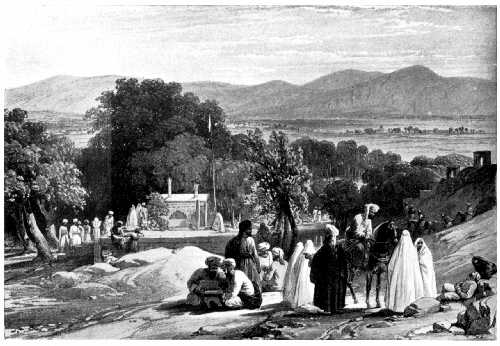
View from above Babur’s Grave and Shah-jahan’s Mosque.
925 AH.-JAN. 3rd to DEC. 23rd 1519 AD.1351
(a. Bābur takes the fort of Bajaur.)
(Jan. 3rd) On Monday1352 the first day of the month of
Muḥarram, there was a violent earthquake in the lower part of
the dale (julga) of Chandāwal,1353 which lasted nearly half an
astronomical hour.
(Jan. 4th) Marching at dawn from that camp with the
intention of attacking the fort of Bajaur,1354 we dismounted near
it and sent a trusty man of the Dilazāk1355 Afghāns to advise its
sult̤ān1356 and people to take up a position of service (qullūq) and
surrender the fort. Not accepting this counsel, that stupid and
ill-fated band sent back a wild answer, where-upon the army
was ordered to make ready mantelets, ladders and other
appliances for taking a fort. For this purpose a day’s (Jan. 5th)
halt was made on that same ground.
(Jan. 6th) On Thursday the 4th of Muḥarram, orders were
given that the army should put on mail, arm and get to horse;1357
that the left wing should move swiftly to the upper side of the
fort, cross the water at the water-entry,1358 and dismount on the
Fol. 217.north side of the fort; that the centre, not taking the way
across the water, should dismount in the rough, up-and-down
land to the north-west of the fort; and that the right should
dismount to the west of the lower gate. While the begs of the
left under Dost Beg were dismounting, after crossing the water,
a hundred to a hundred and fifty men on foot came out of the
fort, shooting arrows. The begs, shooting in their turn,
advanced till they had forced those men back to the foot of the
ramparts, Mullā ‘Abdu’l-malūk of Khwāst, like a madman,1359 going
up right under them on his horse. There and then the fort
would have been taken if the ladders and mantelets had been
ready, and if it had not been so late in the day. Mullā Tirik-i-‘alī1360
and a servant of Tīngrī-bīrdī crossed swords with the
enemy; each overcame his man, cut off and brought in his
head; for this each was promised a reward.
As the Bajaurīs had never before seen matchlocks (tufang)
they at first took no care about them, indeed they made fun
when they heard the report and answered it by unseemly
gestures. On that day1361 Ustād ‘Alī-qulī shot at and brought
down five men with his matchlock; Walī the Treasurer, for
his part, brought down two; other matchlockmen were also
very active in firing and did well, shooting through shield,
through cuirass, through kusarū,1362 and bringing down one man
after another. Perhaps 7, 8, or 10 Bajaurīs had fallen to the
matchlock-fire (ẓarb) before night. After that it so became
that not a head could be put out because of the fire. The orderFol. 217b.
was given, “It is night; let the army retire, and at dawn, if the
appliances are ready, let them swarm up into the fort.”
(Jan. 7th) At the first dawn of light (farẓ waqt) on Friday
the 5th of Muḥarram, orders were given that, when the battle-nagarets
had sounded, the army should advance, each man from
his place to his appointed post (yīrlīk yīrdīn) and should swarm
up. The left and centre advanced from their ground with
mantelets in place all along their lines, fixed their ladders, and
swarmed up them. The whole left hand of the centre, under
Khalīfa, Shāh Ḥasan Arghūn and Yūsuf’s Aḥmad, was ordered
to reinforce the left wing. Dost Beg’s men went forward to the
foot of the north-eastern tower of the fort, and busied themselves
in undermining and bringing it down. Ustād ‘Alī-qulī was
there also; he shot very well on that day with his matchlock, and
he twice fired off the firingī.1363 Walī the Treasurer also brought
down a man with his matchlock. Malik ‘Alī qut̤nī1364 was first
up a ladder of all the men from the left hand of the centre,
and there was busy with fight and blow. At the post of the
centre, Muḥ. ‘Alī Jang-jang1365 and his younger brother Nau-roz
got up, each by a different ladder, and made lance and sword to
touch. Bābā the waiting man (yasāwal), getting up by another
ladder, occupied himself in breaking down the fort-wall with his
Fol. 218.axe. Most of our braves went well forward, shooting off dense
flights of arrows and not letting the enemy put out a head;
others made themselves desperately busy in breaching and
pulling down the fort, caring naught for the enemy’s fight and
blow, giving no eye to his arrows and stones. By breakfast-time
Dost Beg’s men had undermined and breached the north-eastern
tower, got in and put the foe to flight. The men of the centre
got in up the ladders by the same time, but those (aūl) others
were first (awwal?) in.1366 By the favour and pleasure of the
High God, this strong and mighty fort was taken in two or
three astronomical hours! Matching the fort were the utter
struggle and effort of our braves; distinguish themselves they
did, and won the name and fame of heroes.
As the Bajaurīs were rebels and at enmity with the people
of Islām, and as, by reason of the heathenish and hostile customs
prevailing in their midst, the very name of Islām was rooted out
from their tribe, they were put to general massacre and their
wives and children were made captive. At a guess more than
3000 men went to their death; as the fight did not reach to the
eastern side of the fort, a few got away there.
The fort taken, we entered and inspected it. On the walls,
in houses, streets and alleys, the dead lay, in what numbers!
Comers and goers to and fro were passing over the bodies.
Fol. 218b.Returning from our inspection, we sat down in the Bajaur
sult̤ān’s residence. The country of Bajaur we bestowed on
Khwāja Kalān,1367 assigning a large number of braves to reinforce
him. At the Evening Prayer we went back to camp.
(b. Movements in Bajaur.)
(Jan. 8th) Marching at dawn (Muḥ. 6th), we dismounted by
the spring1368 of Bābā Qarā in the dale of Bajaur. At Khwāja
Kalān’s request the prisoners remaining were pardoned their
offences, reunited to their wives and children, and given leave to
go, but several sult̤āns and of the most stubborn were made to
reach their doom of death. Some heads of sult̤āns and of others
were sent to Kābul with the news of success; some also to
Badakhshān, Qūndūz and Balkh with the letters-of-victory.
Shāh Manṣūr Yūsuf-zāī,—he was with us as an envoy from
his tribe,—1369 was an eye-witness of the victory and general
massacre. We allowed him to leave after putting a coat (tūn)
on him and after writing orders with threats to the Yūsuf-zāī.
(Jan. 11th) With mind easy about the important affairs of
the Bajaur fort, we marched, on Tuesday the 9th of Muḥarram,
one kuroh (2 m.) down the dale of Bajaur and ordered that a
tower of heads should be set up on the rising-ground.
(Jan. 12th) On Wednesday the 10th of Muḥarram, we rode
out to visit the Bajaur fort. There was a wine-party in Khwāja
Kalān’s house,1370 several goat-skins of wine having been brought
down by Kāfirs neighbouring on Bajaur. All wine and fruit
Fol. 219.had in Bajaur comes from adjacent parts of Kāfiristān.
(Jan. 13th) We spent the night there and after inspecting the
towers and ramparts of the fort early in the morning (Muḥ. 11th),
I mounted and went back to camp.
(Jan. 14th) Marching at dawn (Muḥ. 12th), we dismounted on
the bank of the Khwāja Khiẓr torrent.1371
(Jan. 15th) Marching thence, we dismounted (Muḥ. 13th) on
the bank of the Chandāwal torrent. Here all those inscribed in
the Bajaur reinforcement, were ordered to leave.
(Jan. 16th) On Sunday the 14th of Muḥarram, a standard was
bestowed on Khwāja Kalān and leave given him for Bajaur.
A few days after I had let him go, the following little verse
having come into my head, it was written down and sent to
him:—1372
Not such the pact and bargain betwixt my friend and me,
At length the tooth of parting, unpacted grief for me!
Against caprice of Fortune, what weapons (chāra) arm the man?
At length by force of arms (ba jaur) my friend is snatched from me!
(Jan. 19th) On Wednesday the 17th of Muḥarram, Sl. ‘Alā’u’d-dīn
of Sawād, the rival (mu‘āriẓ) of Sl. Wais of Sawād,1373 came
and waited on me.
(Jan. 20th) On Thursday the 18th of the month, we hunted
the hill between Bajaur and Chandāwal.1374 There the būghū-marāl1375
have become quite black, except for the tail which is of
another colour; lower down, in Hindūstān, they seem to become
black all over.1376 Today a sārīq-qūsh1377 was taken; that was black
all over, its very eyes being black! Today an eagle (būrkūt)1378
took a deer (kīyīk).
Corn being somewhat scarce in the army, we went into the
Kahrāj-valley, and took some.Fol. 219b.
(Jan. 21st) On Friday (Muḥ. 19th) we marched for Sawād,
with the intention of attacking the Yūsuf-zāī Afghāns, and
dismounted in between1379 the water of Panj-kūra and the united
waters of Chandāwal and Bajaur. Shāh Manṣūr Yūsuf-zāī had
brought a few well-flavoured and quite intoxicating confections
(kamālī); making one of them into three, I ate one portion,
Gadāī T̤aghāī another, ‘Abdu’l-lāh the librarian another. It
produced remarkable intoxication; so much so that at the
Evening Prayer when the begs gathered for counsel, I was not
able to go out. A strange thing it was! If in these days1380
I ate the whole of such a confection, I doubt if it would produce
half as much intoxication.
(c. An impost laid on Kahrāj.)
(Jan. 22nd) Marching from that ground, (Muḥ. 20th), we
dismounted over against Kahrāj, at the mouth of the valleys of
Kahrāj and Peshgrām.1381 Snow fell ankle-deep while we were on
that ground; it would seem to be rare for snow to fall thereabouts,
for people were much surprised. In agreement with
Sl. Wais of Sawād there was laid on the Kahrāj people an
impost of 4000 ass-loads of rice for the use of the army, and he
himself was sent to collect it. Never before had those rude
mountaineers borne such a burden; they could not give (all)
the grain and were brought to ruin.
(cc. Raid on Panj-kūra.)
(Jan. 25th) On Tuesday the 23rd of Muḥarram an army was
Fol. 220.sent under Hindū Beg to raid Panj-kūra. Panj-kūra lies more
than half-way up the mountain;1382 to reach its villages a person
must go for nearly a kuroh (2 m.) through a pass. The people
had fled and got away; our men brought a few beasts of sorts,
and masses of corn from their houses.
(Jan. 26th) Next day (Muḥ. 24th) Qūj Beg was put at the
head of a force and sent out to raid.
(Jan. 27th) On Thursday the 25th of the month, we dismounted
at the village of Māndīsh, in the trough of the Kahrāj-valley, for
the purpose of getting corn for the army.
(d. Māhīm’s adoption of Dil-dār’s unborn child.)
(Jan. 28th) Several children born of Humāyūn’s mother had
not lived. Hind-āl was not yet born.1383 While we were in those
parts, came a letter from Māhīm in which she wrote, “Whether
it be a boy, whether it be a girl, is my luck and chance; give
it to me; I will declare it my child and will take charge of it.”
On Friday the 26th of the month, we being still on that ground,
Yūsuf-i-‘alī the stirrup-holder was sent off to Kābul with letters1384
bestowing Hind-āl, not yet born, on Māhīm.
(dd. Construction of a stone platform.)
While we were still on that same ground in the Māndīsh-country,
I had a platform made with stones (tāsh bīla) on
a height in the middle of the valley, so large that it held the
tents of the advance-camp. All the household and soldiers
carried the stones for it, one by one like ants.
(e. Bābur’s marriage with his Afghān wife, Bībī Mubāraka.)
In order to conciliate the Yūsuf-zāī horde, I had asked for
a daughter of one of my well-wishers, Malik Sulaimān Shāh’s
son Malik Shāh Manṣūr, at the time he came to me as envoyFol. 220b.
from the Yūsuf-zāī Afghāns.1385
While we were on this ground news came that his daughter1386
was on her way with the Yūsuf-zāī tribute. At the Evening
Prayer there was a wine-party to which Sl. ‘Alā’u’d-dīn (of
Sawād) was invited and at which he was given a seat and
special dress of honour (khilcat-i-khāṣa).
(Jan. 30th) On Sunday the 28th, we marched from that
valley. Shāh Manṣūr’s younger brother T̤āūs (Handsome)
Khān brought the above-mentioned daughter of his brother to
our ground after we had dismounted.
(f. Repopulation of the fort of Bajaur.)
For the convenience of having the Bī-sūt people in Bajaur-fort,1387
Yūsuf’i-‘alī the taster was sent from this camp to get them
on the march and take them to that fort. Also, written orders
were despatched to Kābul that the army there left should
join us.
(Feb. 4th) On Friday the 3rd of the month of Ṣafar, we dismounted
at the confluence of the waters of Bajaur and Panj-kūra.
(Feb. 6th) On Sunday the 5th of the month, we went from
that ground to Bajaur where there was a drinking-party in
Khwāja Kalān’s house.
(g. Expedition against the Afghān clans.)
(Feb. 8th) On Tuesday the 7th of the month the begs and
the Dilazāk Afghān headmen were summoned, and, after
consultation, matters were left at this:—“The year is at its end,1388
only a few days of the Fish are left; the plainsmen have carried
in all their corn; if we went now into Sawād, the army would
Fol. 221.dwindle through getting no corn. The thing to do is to march
along the Aṃbahar and Pānī-mānī road, cross the Sawād-water
above Hash-nagar, and surprise the Yūsuf-zāī and Muḥammadī
Afghāns who are located in the plain over against the Yūsuf-zāī
sangur of Māhūrā. Another year, coming earlier in the
harvest-time, the Afghāns of this place must be our first
thought.” So the matter was left.
(Feb. 9th) Next day, Wednesday, we bestowed horses and
robes on Sl. Wais and Sl. ‘Alā’u’u-dīn of Sawād, gave them leave
to go, marched off ourselves and dismounted over against Bajaur.
(Feb. 10th) We marched next day, leaving Shāh Manṣūr’s
daughter in Bajaur-fort until the return of the army. We dismounted
after passing Khwāja Khiẓr, and from that camp leave
was given to Khwāja Kalān; and the heavy baggage, the worn-out
horses and superfluous effects of the army were started off
into Lamghān by the Kūnār road.
(Feb. 11th) Next morning Khwāja Mīr-i-mīrān was put in
charge of the camel baggage-train and started off by the
Qūrghā-tū and Darwāza road, through the Qarā-kūpa-pass.
Riding light for the raid, we ourselves crossed the Aṃbahar-pass,
and yet another great pass, and dismounted at Pānī-mālī
nearer1389 the Afternoon Prayer. Aūghān-bīrdī was sent forward
with a few others to learn1390 how things were.
(Feb. 12th) The distance between us and the Afghāns being
short, we did not make an early start. Aūghān-bīrdī came
back at breakfast-time.1391 He had got the better of an Afghān
and had cut his head off, but had dropped it on the road. HeFol. 221b.
brought no news so sure as the heart asks (kūnkūl-tīladīk). Midday
come, we marched on, crossed the Sawād-water, and dismounted
nearer1392 the Afternoon Prayer. At the Bed-time Prayer,
we remounted and rode swiftly on.
(Feb. 13th) Rustam Turkmān had been sent scouting; when
the Sun was spear-high he brought word that the Afghāns had
heard about us and were shifting about, one body of them
making off by the mountain-road. On this we moved the faster,
sending raiders on ahead who killed a few, cut off their heads
and brought a band of prisoners, some cattle and flocks. The
Dilazāk Afghāns also cut off and brought in a few heads.
Turning back, we dismounted near Kātlāng and from there
sent a guide to meet the baggage-train under Khwāja Mīr-i-mīrān
and bring it to join us in Maqām.1393
(Feb. 14th) Marching on next day, we dismounted between
Kātlāng and Maqām. A man of Shāh Manṣūr’s arrived.
Khusrau Kūkūldāsh and Aḥmadī the secretary were sent with
a few more to meet the baggage-train.
(Feb. 15th) On Wednesday the 14th of the month, the
baggage-train rejoined us while we were dismounting at Maqām.
It will have been within the previous 30 or 40 years that
a heretic qalandar named Shahbāz perverted a body of Yūsuf-zāī
and another of Dilazāk. His tomb was on a free and
dominating height of the lower hill at the bill (tūmshūq) of theFol. 222.
Maqām mountain. Thought I, “What is there to recommend
the tomb of a heretic qalandar for a place in air so free?” and
ordered the tomb destroyed and levelled with the ground. The
place was so charming and open that we elected to sit there
some time and to eat a confection (ma’jūn).
(h. Bābur crosses the Indus for the first time.)
We had turned off from Bajaur with Bhīra in our thoughts.1394
Ever since we came into Kābul it had been in my mind to
move on Hindūstān, but this had not been done for a variety of
reasons. Nothing to count had fallen into the soldiers’ hands
during the three or four months we had been leading this army.
Now that Bhīra, the borderland of Hindūstān, was so near,
I thought a something might fall into our men’s hands if,
riding light, we went suddenly into it. To this thought I clung,
but some of my well-wishers, after we had raided the Afghāns
and dismounted at Maqām, set the matter in this way before
me:—“If we are to go into Hindūstān, it should be on a proper
basis; one part of the army stayed behind in Kābul; a body of
effective braves was left behind in Bajaur; a good part of this
army has gone into Lamghān because its horses were worn-out;
and the horses of those who have come this far, are so poor that
they have not a day’s hard riding in them.” Reasonable as
these considerations were, yet, having made the start, we paid no
Fol. 222b.attention to them but set off next day for the ford through the
water of Sind.1395 Mīr Muḥammad the raftsman and his elder
and younger brethren were sent with a few braves to examine
the Sind-river (daryā), above and below the ford.
(Feb. 16th) After starting off the camp for the river, I went
to hunt rhinoceros on the Sawātī side which place people call
also Karg-khāna (Rhino-home).1396 A few were discovered but
the jungle was dense and they did not come out of it. When
one with a calf came into the open and betook itself to flight,
many arrows were shot at it and it rushed into the near jungle;
the jungle was fired but that same rhino was not had. Another
calf was killed as it lay, scorched by the fire, writhing and
palpitating. Each person took a share of the spoil. After
leaving Sawātī, we wandered about a good deal; it was the
Bed-time Prayer when we got to camp.
Those sent to examine the ford came back after doing it.
(Feb. 17th) Next day, Thursday the 16th,1397 the horses and
baggage-camels crossed through the ford and the camp-bazar
and foot-soldiers were put over on rafts. Some Nīl-ābīs came
and saw me at the ford-head (guẕar-bāshī), bringing a horse
in mail and 300 shāhrukhīs as an offering. At the Mid-day
Prayer of this same day, when every-one had crossed the river,
we marched on; we went on until one watch of the night had
passed (circa 9 p.m.) when we dismounted near the water of
Kacha-kot.1398
(Feb. 18th) Marching on next day, we crossed the Kacha-kot-water;
noon returning, went through the Sangdakī-pass
and dismounted. While Sayyid Qāsim Lord of the Gate wasFol. 223.
in charge of the rear (chāghdāwal) he overcame a few Gujūrs
who had got up with the rear march, cut off and brought in 4 or
5 of their heads.
(Feb. 19th) Marching thence at dawn and crossing the Sūhān-water,
we dismounted at the Mid-day Prayer. Those behind
kept coming in till midnight; the march had been mightily
long, and, as many horses were weak and out-of-condition,
a great number were left on the road.
(i. The Salt-range.)
Fourteen miles (7 kos) north of Bhīra lies the mountain-range
written of in the Z̤afar-nāma and other books as the Koh-i-jūd.1399
I had not known why it was called this; I now knew. On it
dwell two tribes, descendants from one parent-source, one is
called Jūd, the other Janjūha. These two from of old have
been the rulers and lawful commanders of the peoples and
hordes (aūlūs) of the range and of the country between Bhīra
and Nīl-āb. Their rule is friendly and brotherly however; they
cannot take what their hearts might desire; the portion ancient
custom has fixed is given and taken, no less and no more. The
agreement is to give one shāhrukhī1400 for each yoke of oxen and
seven for headship in a household; there is also service in the
army. The Jūd and Janjūha both are divided into several
clans. The Koh-i-jūd runs for 14 miles along the Bhīra country,
taking off from those Kashmīr mountains that are one with
Fol. 223b.Hindū-kūsh, and it draws out to the south-west as far as the
foot of Dīn-kot on the Sind-river.1401 On one half of it are the
Jūd, the Janjūha on the other. People call it Koh-i-jūd through
connecting it with the Jūd tribe.1402 The principal headman gets
the title of Rāī; others, his younger brothers and sons, are
styled Malik. The Janjūha headmen are maternal uncles of
Langar Khan. The ruler of the people and horde near the
Sūhān-water was named Malik Hast. The name originally
was Asad but as Hindūstānīs sometimes drop a vowel e.g. they
say khabr for khabar (news), they had said Asd for Asad, and
this went on to Hast.
Langar Khān was sent off to Malik Hast at once when we
dismounted. He galloped off, made Malik Hast hopeful of our
favour and kindness, and at the Bed-time Prayer, returned with
him. Malik Hast brought an offering of a horse in mail and
waited on me. He may have been 22 or 23 years old.1403
The various flocks and herds belonging to the country-people
were close round our camp. As it was always in my heart to
possess Hindūstān, and as these several countries, Bhīra,
Khūsh-āb, Chīn-āb and Chīnīūt1404 had once been held by the
Turk, I pictured them as my own and was resolved to get them
into my hands, whether peacefully or by force. For these reasons
it being imperative to treat these hillmen well, this following
Fol. 224.order was given:—“Do no hurt or harm to the flocks and herds
of these people, nor even to their cotton-ends and broken
needles!”
(j. The Kalda-kahār lake.)
(Feb. 20th) Marching thence next day, we dismounted at the
Mid-day Prayer amongst fields of densely-growing corn in
Kalda-kahār.
Kalda-kahār is some 20 miles north of Bhīra, a level land shut
in1405 amongst the Jūd mountains. In the middle of it is a lake
some six miles round, the in-gatherings of rain from all sides.
On the north of this lake lies an excellent meadow; on the hill-skirt
to the west of it there is a spring1406 having its source in the
heights overlooking the lake. The place being suitable I have
made a garden there, called the Bāgh-i-ṣafā,1407 as will be told later;
it is a very charming place with good air.
(Feb. 21st) We rode from Kalda-kahār at dawn next day.
When we reached the top of the Hamtātū-pass a few local people
waited on me, bringing a humble gift. They were joined with
‘Abdu’r-raḥīm the chief-scribe (shaghāwal) and sent with him to
speak the Bhīra people fair and say, “The possession of this
country by a Turk has come down from of old; beware not to
bring ruin on its people by giving way to fear and anxiety; our
eye is on this land and on this people; raid and rapine shall
not be.”
We dismounted near the foot of the pass at breakfast-time,Fol. 224b.
and thence sent seven or eight men ahead, under Qurbān of
Chīrkh and ‘Abdu’l-malūk of Khwāst. Of those sent one Mīr
Muḥammad (a servant ?) of Mahdī Khwāja1408 brought in a man.
A few Afghān headmen, who had come meantime with offerings
and done obeisance, were joined with Langar Khān to go and
speak the Bhīra people fair.
After crossing the pass and getting out of the jungle, we arrayed
in right and left and centre, and moved forward for Bhīra. As
we got near it there came in, of the servants of Daulat Khān
Yūsuf-khail’s son ‘Alī Khān, Sīktū’s son Dīwa Hindū; with them
came several of the notables of Bhīra who brought a horse and
camel as an offering and did me obeisance. At the Mid-day
Prayer we dismounted on the east of Bhīra, on the bank of the
Bahat (Jehlam), in a sown-field, without hurt or harm being
allowed to touch the people of Bhīra.
(k. History of Bhīra.)
Tīmūr Beg had gone into Hindūstān; from the time he went
out again these several countries viz. Bhīra, Khūsh-āb, Chīn-āb
and Chīnīūt, had been held by his descendants and the dependants
and adherents of those descendants. After the death of Sl. Mas‘ūd
Mīrzā and his son ‘Alī Asghar Mīrzā, the sons of Mīr ‘Alī Beg
Fol. 225.viz. Bābā-i-kābulī, Daryā Khān and Apāq Khān, known later as
Ghāzī Khān, all of whom Sl. Mas‘ūd M. had cherished, through
their dominant position, got possession of Kābul, Zābul and the
afore-named countries and parganas of Hindūstān. In Sl. Abū-sa‘īd
Mīrzā’s time, Kābul and Zābul went from their hands, the
Hindūstān countries remaining. In 910 AH. (1504 AD.) the year
I first came into Kābul, the government of Bhīra, Khūsh-āb and
Chīn-āb depended on Sayyid ‘Alī Khān, son of Ghāzī Khān and
grandson of Mīr ‘Alī Beg, who read the khut̤ba for Sikandar son
of Buhlūl (Lūdī Afghān) and was subject to him. When I led
that army out (910 AH.) Sayyid ‘Alī Khān left Bhīra in terror,
crossed the Bahat-water, and seated himself in Sher-kot, one of
the villages of Bhīra. A few years later the Afghāns became
suspicious about him on my account; he, giving way to his own
fears and anxieties, made these countries over to the then governor
Fol. 225b.in Lāhūr, Daulat Khān, son of Tātār Khān Yūsuf-khail, who
gave them to his own eldest son ‘Alī Khān, and in ‘Alī Khān’s
possession they now were.
(Author’s note on Sl. Mas‘ūd Mīrzā.) He was the son of Sūyūrghatmīsh
Mīrzā, son of Shāhrukh Mīrzā, (son of Tīmūr), and was known as Sl. Mas‘ūd
Kābulī because the government and administration of Kābul and Zābul were
then dependent on him (deposed 843 AH.-1440 AD.)
(Author’s note to 910 AH.) That year, with the wish to enter Hindūstān,
Khaibar had been crossed and Parashāwūr (sic) had been reached, when Bāqī
Chaghānīānī insisted on a move against Lower Bangash i.e. Kohāt, a mass
of Afghāns were raided and scraped clean (qīrīb), the Bannū plain was raided
and plundered, and return was made through Dūkī (Dūgī).
(Author’s note on Daulat Khān Yūsuf-khail.) This Tātār Khān, the father
of Daulat Khān, was one of six or seven sardārs who, sallying out and
becoming dominant in Hindūstān, made Buhlūl Pādshāh. He held the
country north of the Satluj (sic) and Sahrind,1409 the revenues of which exceeded
3 krūrs.1410 On Tātār Khān’s death, Sl. Sikandar (Lūdī), as over-lord, took
those countries from Tātār Khān’s sons and gave Lāhūr only to Daulat Khān.
That happened a year or two before I came into the country of Kābul (910 AH.).
(l. Bābur’s journey resumed.)
(Feb. 22nd) Next morning foragers were sent to several
convenient places; on the same day I visited Bhīra; and on the
same day Sangur Khān Janjūha came, made offering of a horse,
and did me obeisance.
(Feb. 23rd) On Wednesday the 22nd of the month, the
headmen and chauderis1411 of Bhīra were summoned, a sum of
400,000 shāhrukhīs1412 was agreed on as the price of peace (māl-i-amān),
and collectors were appointed. We also made an
excursion, going in a boat and there eating a confection.
(Feb. 24th) Ḥaidar the standard-bearer had been sent to the
Bilūchīs located in Bhīra and Khūsh-āb; on Thursday morning
they made an offering of an almond-coloured tīpūchāq [horse],
and did obeisance. As it was represented to me that some of
the soldiery were behaving without sense and were laying-hands
on Bhīra people, persons were sent who caused some of thoseFol. 226.
senseless people to meet their death-doom, of others slit the
noses and so led them round the camp.
(Feb. 25th) On Friday came a dutiful letter from the Khūshābīs;
on this Shāh Shujā‘ Arghūn’s son Shāh Ḥasan was
appointed to go to Khūsh-āb.
(Feb. 26th) On Saturday the 25th of the month,1413 Shāh Ḥasan
was started for Khūsh-āb.
(Feb. 27th) On Sunday so much rain fell1414 that water covered
all the plain. A small brackish stream1415 flowing between Bhīra
and the gardens in which the army lay, had become like a great
river before the Mid-day Prayer; while at the ford near Bhīra
there was no footing for more than an arrow’s flight; people
crossing had to swim. In the afternoon I rode out to watch the
water coming down (kīrkān sū); the rain and storm were such
that on the way back there was some fear about getting in to
camp. I crossed that same water (kīrkān sū) with my horse
swimming. The army-people were much alarmed; most of them
abandoned tents and heavy baggage, shouldered armour, horse-mail
and arms, made their horses swim and crossed bareback.
Most streams flooded the plain.
(Feb. 28th) Next day boats were brought from the river
(Jehlam), and in these most of the army brought their tents and
baggage over. Towards mid-day, Qūj Beg’s men went 2 miles
up the water and there found a ford by which the rest crossed.
Fol. 226b.(March 1st) After a night spent in Bhīra-fort, Jahān-nūma
they call it, we marched early on the Tuesday morning out of
the worry of the rain-flood to the higher ground north of Bhīra.
As there was some delay about the moneys asked for and
agreed to (taqabbul), the country was divided into four districts
and the begs were ordered to try to make an end of the matter.
Khalīfa was appointed to one district, Qūj Beg to another,
Nāṣir’s Dost to another, Sayyid Qāsim and Muḥibb-i-‘alī to
another. Picturing as our own the countries once occupied by
the Turk, there was to be no over-running or plundering.
(m. Envoys sent to the court in Dihlī.)
(March 3rd) People were always saying, “It could do no harm
to send an envoy, for peace’ sake, to countries that once depended
on the Turk.” Accordingly on Thursday the 1st of Rabī‘u’l-awwal,
Mullā Murshid was appointed to go to Sl. Ibrāhīm who
through the death of his father Sl. Iskandar had attained to rule
in Hindūstān some 5 or 6 months earlier(?). I sent him a goshawk
(qārchīgha) and asked for the countries which from of old had
depended on the Turk. Mullā Murshid was given charge of
writings (khāt̤t̤lār) for Daulat Khān (Yūsuf-khail) and writings
for Sl. Ibrāhīm; matters were sent also by word-of-mouth; and
he was given leave to go. Far from sense and wisdom, shut off
from judgment and counsel must people in Hindūstān be, the
Afghāns above all; for they could not move and make stand
like a foe, nor did they know ways and rules of friendliness.Fol. 227.
Daulat Khān kept my man several days in Lāhūr without seeing
him himself or speeding him on to Sl. Ibrāhīm; and he came
back to Kābul a few months later without bringing a reply.
(n. Birth of Hind-āl.)
(March 4th) On Friday the 2nd of the month, the foot-soldiers
Shaibak and Darwesh-i-‘alī,—he is now a matchlockman,—bringing
dutiful letters from Kābul, brought news also of
Hind-āl’s birth. As the news came during the expedition into
Hindūstān, I took it as an omen, and gave the name Hind-āl
(Taking of Hind). Dutiful letters came also from Muḥammad-i-zamān
M. in Balkh, by the hand of Qaṃbar Beg.
(March 5th) Next morning when the Court rose, we rode out
for an excursion, entered a boat and there drank ‘araq.1416 The
people of the party were Khwāja Dost-khāwand, Khusrau, Mīrīm,
Mīrzā Qulī, Muḥammadī, Aḥmadī, Gadāī, Na‘man, Langar Khān,
Rauh-dam,1417 Qāsim-i-‘alī the opium-eater (tariyākī), Yūsuf-i-‘alī
and Tīngrī-qulī. Towards the head of the boat there was a tālār1418
on the flat top of which I sat with a few people, a few others
sitting below. There was a sitting-place also at the tail of the
boat; there Muḥammadī, Gadāī and Na‘man sat. ‘Araq was
drunk till the Other Prayer when, disgusted by its bad flavour,
by consent of those at the head of the boat, ma’jūn was preferred.
Fol. 227b.Those at the other end, knowing nothing about our ma’jūn drank
‘araq right through. At the Bed-time Prayer we rode from the
boat and got into camp late. Thinking I had been drinking
‘araq Muḥammadī and Gadāī had said to one another, “Let’s do
befitting service,” lifted a pitcher of ‘araq up to one another in
turn on their horses, and came in saying with wonderful joviality
and heartiness and speaking together, “Through this dark night
have we come carrying this pitcher in turns!” Later on when
they knew that the party was (now) meant to be otherwise and the
hilarity to differ, that is to say, that [there would be that] of the
ma’jūn band and that of the drinkers, they were much disturbed
because never does a ma’jūn party go well with a drinking-party.
Said I, “Don’t upset the party! Let those who wish to drink
‘araq, drink ‘araq; let those who wish to eat ma’jūn, eat ma’jūn.
Let no-one on either side make talk or allusion to the other.”
Some drank ‘araq, some ate ma’jūn, and for a time the party
went on quite politely. Bābā Jān the qabūz-player had not been
of our party (in the boat); we invited him when we reached the
tents. He asked to drink ‘araq. We invited Tardī Muḥammad
Qībchāq also and made him a comrade of the drinkers. A ma’jūn
party never goes well with an ‘araq or a wine-party; the drinkers
began to make wild talk and chatter from all sides, mostly in
allusion to ma’jūn and ma’jūnīs. Bābā Jān even, when drunk, said
many wild things. The drinkers soon made Tardī Khān mad-drunk,
by giving him one full bowl after another. Try as we did
Fol. 228.to keep things straight, nothing went well; there was much disgusting
uproar; the party became intolerable and was broken up.
(March 7th) On Monday the 5th of the month, the country
of Bhīra was given to Hindū Beg.
(March 8th) On Tuesday the Chīn-āb country was bestowed
on Ḥusain Aīkrak(?) and leave was given to him and the Chīn-āb
people to set out. At this time Sayyid ‘Alī Khān’s son Minūchihr
Khān, having let us know (his intention), came and waited on me.
He had started from Hindūstān by the upper road, had met in
with Tātār Khān Kakar;1419 Tātār Khān had not let him pass on,
but had kept him, made him a son-in-law by giving him his own
daughter, and had detained him for some time.
(o. The Kakars.)
In amongst the mountains of Nīl-āb and Bhīra which connect
with those of Kashmīr, there are, besides the Jūd and Janjūha
tribes, many Jats, Gujūrs, and others akin to them, seated in
villages everywhere on every rising-ground. These are governed
by headmen of the Kakar tribes, a headship like that over the
Jūd and Janjūha. At this time (925 AH.) the headmen of the
people of those hill-skirts were Tātār Kakar and Hātī Kakar,
two descendants of one forefather; being paternal-uncles’ sons.1420
Torrent-beds and ravines are their strongholds. Tātār’s place,
named Parhāla,1421 is a good deal below the snow-mountains;
Hātī’s country connects with the mountains and also he had
made Bābū Khān’s fief Kālanjar,1422 look towards himself. TātārFol. 228b.
Kakar had seen Daulat Khān (Yūsuf-khail) and looked to him
with complete obedience. Hātī had not seen Daulat Khān; his
attitude towards him was bad and turbulent. At the word of
the Hindūstān begs and in agreement with them, Tātār had so
posted himself as to blockade Hātī from a distance. Just when
we were in Bhīra, Hātī moved on pretext of hunting, fell unexpectedly
on Tātār, killed him, and took his country, his wives
and his having (būlghāni).1423
(p. Bābur’s journey resumed.)
Having ridden out at the Mid-day Prayer for an excursion,
we got on a boat and ‘araq was drunk. The people of the party
were Dost Beg, Mīrzā Qulī, Aḥmadī, Gadāī, Muḥammad ‘Alī
Jang-jang, ‘Asas,1424 and Aūghān-bīrdī Mughūl. The musicians
were Rauḥ-dam, Bābā Jān, Qāsim-i-‘alī, Yūsuf-i-‘alī, Tīngrī-qulī,
Abū’l-qāsim, Rāmẓān Lūlī. We drank in the boat till the Bed-time
Prayer; then getting off it, full of drink, we mounted, took
torches in our hands, and went to camp from the river’s bank,
leaning over from our horses on this side, leaning over from that,
at one loose-rein gallop! Very drunk I must have been for,
when they told me next day that we had galloped loose-rein
into camp, carrying torches, I could not recall it in the very least.
After reaching my quarters, I vomited a good deal.
(March 11th) On Friday we rode out on an excursion, crossed
the water (Jehlam) by boat and went about amongst the orchards
(bāghāt) of blossoming trees and the lands of the sugar-cultivation.
We saw the wheel with buckets, had water drawn, and asked
Fol. 229.particulars about getting it out; indeed we made them draw it
again and again. During this excursion a confection was preferred.
In returning we went on board a boat. A confection
(ma’jūn) was given also to Minūchihr Khān, such a one that, to
keep him standing, two people had to give him their arms. For
a time the boat remained at anchor in mid-stream; we then went
down-stream; after a while had it drawn up-stream again, slept
in it that night and went back to camp near dawn.
(March 12th) On Saturday the 10th of the first Rabī‘, the
Sun entered the Ram. Today we rode out before mid-day and
got into a boat where ‘araq was drunk. The people of the party
were Khwāja Dost-khāwand, Dost Beg, Mīrīm, Mīrzā Qulī,
Muḥammadī, Aḥmadī, Yūnas-i-‘alī, Muḥ. ‘Alī Jang-jang, Gadāī
T̤aghāī, Mīr Khurd (and ?) ‘Asas. The musicians were Rauḥdam,
Bābā Jān, Qāsim, Yūsuf-i-‘alī, Tīngrī-qulī and Ramẓān.
We got into a branch-water (shakh-i-āb), for some time went
down-stream, landed a good deal below Bhīra and on its opposite
bank, and went late into camp.
This same day Shāh Ḥasan returned from Khūsh-āb whither
he had been sent as envoy to demand the countries which from
of old had depended on the Turk; he had settled peaceably with
them and had in his hands a part of the money assessed on them.
The heats were near at hand. To reinforce Hindū Beg (in
Bhīra) were appointed Shāh Muḥammad Keeper of the Seal
and his younger brother Dost Beg Keeper of the Seal, together
with several suitable braves; an accepted (yārāsha) stipend
Fol. 229b.was fixed and settled in accordance with each man’s position.
Khūsh-āb was bestowed, with a standard, on Langar Khān, the
prime cause and mover of this expedition; we settled also that
he was to help Hindū Beg. We appointed also to help Hindū
Beg, the Turk and local soldiery of Bhīra, increasing the allowances
and pay of both. Amongst them was the afore-named
Minūchihr Khān whose name has been mentioned; there was
also Naz̤ar-i-‘alī Turk, one of Minūchihr Khān’s relations; there
were also Sangar Khān Janjūha and Malik Hast Janjūha.
(pp. Return for Kābul.)
(March 13th) Having settled the country in every way making
for hope of peace, we marched for Kābul from Bhīra on Sunday
the 11th of the first Rabī‘. We dismounted in Kaldah-kahār.
That day too it rained amazingly; people with rain-cloaks1425 were
in the same case as those who had none! The rear of the camp
kept coming in till the Bed-time Prayer.
(q. Action taken against Hātī Kakar.)
(March 14th) People acquainted with the honour and glory
(āb u tāb) of this land and government, especially the Janjūhas,
old foes of these Kakars, represented, “Hātī is the bad man
round-about; he it is robs on the roads; he it is brings men to
ruin; he ought either to be driven out from these parts, or to be
severely punished.” Agreeing with this, we left Khwāja Mīr-i-mīrān
and Nāṣir’s Mīrīm next day with the camp, parting from
them at big breakfast,1426 and moved on Hātī Kakar. As has been
said, he had killed Tātār a few days earlier, and having taken
possession of Parhāla, was in it now. Dismounting at the OtherFol. 230.
Prayer, we gave the horses corn; at the Bed-time Prayer we
rode on again, our guide being a Gujūr servant of Malik Hast,
named Sar-u-pā. We rode the night through and dismounted
at dawn, when Beg Muḥammad Mughūl was sent back to the
camp, and we remounted when it was growing light. At breakfast-time
(9 a.m.) we put our mail on and moved forward faster.
The blackness of Parhāla shewed itself from 2 miles off; the
gallop was then allowed (chāpqūn qūīūldī); the right went east
of Parhāla, Qūj Beg, who was also of the right, following as its
reserve; the men of the left and centre went straight for the
fort, Dost Beg being their rear-reserve.
Parhāla stands amongst ravines. It has two roads; one, by
which we came, leads to it from the south-east, goes along the
top of ravines and on either hand has hollows worn out by the
torrents. A mile from Parhāla this road, in four or five places
before it reaches the Gate, becomes a one-man road with a
ravine falling from its either side; there for more than an
arrow’s flight men must ride in single file. The other road
comes from the north-west; it gets up to Parhāla by the trough
of a valley and it also is a one-man road. There is no other
road on any side. Parhāla though without breast-work or
battlement, has no assailable place, its sides shooting perpendicularly
Fol. 230b.down for 7, 8, 10 yards.
When the van of our left, having passed the narrow place,
went in a body to the Gate, Hātī, with whom were 30 to 40 men
in armour, their horses in mail, and a mass of foot-soldiers,
forced his assailants to retire. Dost Beg led his reserve forward,
made a strong attack, dismounted a number of Hātī’s men, and
beat him. All the country-round, Hātī was celebrated for his
daring, but try as he did, he could effect nothing; he took to
flight; he could not make a stand in those narrow places; he
could not make the fort fast when he got back into it. His
assailants went in just behind him and ran on through the
ravine and narrows of the north-west side of the fort, but he
rode light and made his flight good. Here again, Dost Beg did
very well and recompense was added to renown.1427
Meantime I had gone into the fort and dismounted at Tātār
Kakar’s dwelling. Several men had joined in the attack for
whom to stay with me had been arranged; amongst them were
Amīn-i-muḥammad Tarkhān Argkūn and Qarācha.1428 For this
fault they were sent to meet the camp, without sar-u-pā, into
the wilds and open country with Sar-u-pā1429 for their guide, the
Gujūr mentioned already.
(March 16th) Next day we went out by the north-west ravine
and dismounted in a sown field. A few serviceable braves under
Wālī the treasurer were sent out to meet the camp.1430
(March 17th) Marching on Thursday the 15th, we dismounted
at Andarāba on the Sūhān, a fort said to have depended fromFol. 231.
of old on ancestors of Malik Hast. Hātī Kakar had killed
Malik Hast’s father and destroyed the fort; there it now lay in
ruins.
At the Bed-time Prayer of this same day, those left at Kalda-kahār
with the camp rejoined us.
(r. Submissions to Bābur.)
It must have been after Hātī overcame Tātār that he started
his kinsman Parbat to me with tribute and an accoutred horse.
Parbat did not light upon us but, meeting in with the camp we
had left behind, came on in the company of the train. With it
came also Langar Khān up from Bhīra on matters of business.
His affairs were put right and he, together with several local
people, was allowed to leave.
(March 18th) Marching on and crossing the Sūhān-water, we
dismounted on the rising-ground. Here Hātī’s kinsman (Parbat)
was robed in an honorary dress (khil‘at), given letters of
encouragement for Hātī, and despatched with a servant of
Muḥammad ‘Alī Jang-jang. Nīl-āb and the Qārlūq (Himalayan?)
Hazāra had been given to Humāyūn (aet. 12); some of his
servants under Bābā Dost and Halāhil came now for their
darogha-ship.1431
(March 19th) Marching early next morning, we dismounted
after riding 2 miles, went to view the camp from a height and
ordered that the camp-camels should be counted; it came out
at 570.Fol. 231b.
We had heard of the qualities of the saṃbhal plant1432; we saw
it on this ground; along this hill-skirt it grows sparsely, a plant
here, a plant there; it grows abundantly and to a large size
further along the skirt-hills of Hindūstān. It will be described
when an account is given of the animals and plants of
Hindūstān.1433
(March 20th) Marching from that camp at beat of drum (i.e.
one hour before day), we dismounted at breakfast-time (9 a.m.)
below the Sangdakī-pass, at mid-day marched on, crossed the
pass, crossed the torrent, and dismounted on the rising-ground.
(March 21st) Marching thence at midnight, we made an
excursion to the ford1434 we had crossed when on our way to Bhīra.
A great raft of grain had stuck in the mud of that same ford
and, do what its owners would, could not be made to move.
The corn was seized and shared out to those with us. Timely
indeed was that corn!
Near noon we were a little below the meeting of the waters
of Kābul and Sind, rather above old Nīl-āb; we dismounted
there between two waters.1435 From Nīl-āb six boats were brought,
and were apportioned to the right, left and centre, who busied
themselves energetically in crossing the river (Indus). We got
there on a Monday; they kept on crossing the water through
the night preceding Tuesday (March 22nd), through Tuesday
and up to Wednesday (March 23rd) and on Thursday (24th)
also a few crossed.
Hātl’s kinsman Parbat, he who from Andarāba was sent to
Fol. 232.Hātī with a servant of Muḥ. ‘Alī Jang-jang, came to the bank
of the river with Hātī’s offering of an accoutred horse. Nīlābīs
also came, brought an accoutred horse and did obeisance.
(s. Various postings.)
Muḥammad ‘Alī Jang-jang had wished to stay in Bhīra but
Bhīra being bestowed on Hindū Beg, he was given the countries
between it and the Sind-river, such as the Qārlūq Hazāra, Hātī,
Ghiyāṣ-wāl and Kīb (Kitib):—
Where one is who submits like a ra‘iyat, so treat him;
But him who submits not, strike, strip, crush and force to obey.
He also received a special head-wear in black velvet, a special
Qīlmāq corselet, and a standard. When Hātī’s kinsman was
given leave to go he took for Hātī a sword and head-to-foot
(bāsh-ayāq) with a royal letter of encouragement.
(March 24th) On Thursday at sunrise we marched from the
river’s bank. That day confection was eaten. While under its
influence1436 wonderful fields of flowers were enjoyed. In some
places sheets of yellow flowers bloomed in plots; in others sheets
of red (arghwānī) flowers in plots, in some red and yellow
bloomed together. We sat on a mound near the camp to enjoy
the sight. There were flowers on all sides of the mound, yellowFol. 232b.
here, red there, as if arranged regularly to form a sextuple. On
two sides there were fewer flowers but as far as the eye reached,
flowers were in bloom. In spring near Parashāwar the fields of
flowers are very beautiful indeed.
(March 25th) We marched from that ground at dawn. At
one place on the road a tiger came out and roared. On hearing
it, the horses, willy-nilly, flung off in terror, carrying their riders
in all directions, and dashing into ravines and hollows. The
tiger went again into the jungle. To bring it out, we ordered
a buffalo brought and put on the edge of the jungle. The tiger
again came out roaring. Arrows were shot at it from all sides1437;
I shot with the rest. Khalwī (var. Khalwā) a foot-soldier,
pricked it with a spear; it bit the spear and broke off the spearhead.
After tasting of those arrows, it went into the bushes
(būta) and stayed there. Bābā the waiting-man [yasāwal] went
with drawn sword close up to it; it sprang; he chopped at its
head; ‘Alī Sīstānī1438 chopped at its loins; it plunged into the
river and was killed right in the water. It was got out and
ordered to be skinned.
(March 26th) Marching on next day, we reached Bīgrām and
went to see Gūr-khattrī. This is a smallish abode, after the
fashion of a hermitage (ṣauma‘at), rather confined and dark.
After entering at the door and going down a few steps, one must
lie full length to get beyond. There is no getting in without
a lamp. All round near the building there is let lie an enormous
quantity of hair of the head and beard which men have shaved
off there. There are a great many retreats (ḥujra) near Gūr-khattrī
Fol. 233.like those of a rest-house or a college. In the year we
came into Kābul (910 AH.) and over-ran Kohāt, Bannū and the
plain, we made an excursion to Bīgrām, saw its great tree and
were consumed with regret at not seeing Gūr-khattrī, but it does
not seem a place to regret not-seeing.1439
On this same day an excellent hawk of mine went astray out
of Shaikhīm the head-falconer’s charge; it had taken many
cranes and storks and had moulted (tūlāb) two or three times.
So many things did it take that it made a fowler of a person so
little keen as I!
At this place were bestowed 100 mis̤qāls of silver, clothing
(tūnlūq), three bullocks and one buffalo, out of the offerings of
Hindūstān, on each of six persons, the chiefs of the Dilazāk
Afghāns under Malik Bū Khān and Malik Mūsa; to others, in
their degree, were given money, pieces of cloth, a bullock and
a buffalo.
(March 27th) When we dismounted at ‘Alī-masjid, a Dilazāk
Afghān of the Yaq‘ūb-khail, named Ma‘rūf, brought an offering
of 10 sheep, two ass-loads of rice and eight large cheeses.
(March 28th) Marching on from ‘Alī-masjid, we dismounted
at Yada-bīr; from Yada-bīr Jūī-shāhī was reached by the Midday
Prayer and we there dismounted. Today Dost Beg was
attacked by burning fever.
(March 29th) Marching from Jūī-shāhī at dawn, we ate our
mid-day meal in the Bāgh-i-wafā. At the Mid-day Prayer we
betook ourselves out of the garden, close to the Evening Prayer
forded the Siyāh-āb at Gandamak, satisfied our horses’ hunger
in a field of green corn, and rode on in a garī or two (24-48 min.).
After crossing the Sūrkh-āb, we dismounted at Kark and tookFol. 233b.
a sleep.
(March 30th) Riding before shoot of day from Kark, I went
with 5 or 6 others by the road taking off for Qarā-tū in order to
enjoy the sight of a garden there made. Khalīfa and Shāh
Ḥasan Beg and the rest went by the other road to await me at
Qūrūq-sāī.
When we reached Qarā-tū, Shāh Beg Arghūn’s commissary
(tawāchī) Qīzīl (Rufus) brought word that Shāh Beg had taken
Kāhān, plundered it and retired.
An order had been given that no-one soever should take news
of us ahead. We reached Kābul at the Mid-day Prayer, no
person in it knowing about us till we got to Qūtlūq-qadam’s
bridge. As Humāyūn and Kāmrān heard about us only after
that, there was not time to put them on horseback; they made
their pages carry them, came, and did obeisance between the
gates of the town and the citadel.1440 At the Other Prayer there
waited on me Qāsim Beg, the town Qāẓī, the retainers left in
Kābul and the notables of the place.
(April 2nd) At the Other Prayer of Friday the 1st of the
second Rabī‘ there was a wine-party at which a special head-to-foot
(bāsh-ayāq) was bestowed on Shāh Ḥasan.
(April 3rd) At dawn on Saturday we went on board a boat
and took our morning.1441 Nūr Beg, then not obedient (tā’īb),
played the lute at this gathering. At the Mid-day Prayer we
left the boat to visit the garden made between Kul-kīna1442 and
the mountain (Shāh-i-kābul). At the Evening Prayer we went
to the Violet-garden where there was drinking again. From
Kul-kīna I got in by the rampart and went into the citadel.
(u. Dost Beg’s death.)
(April 6th) On the night of Tuesday the 5th of the month,1443
Dost Beg, who on the road had had fever, went to God’s mercy.Fol. 234.
Sad and grieved enough we were! His bier and corpse were
carried to Ghaznī where they laid him in front of the gate of the
Sult̤ān’s garden (rauza).
Dost Beg had been a very good brave (yīkīt) and he was still
rising in rank as a beg. Before he was made a beg, he did
excellent things several times as one of the household. One
time was at Rabāt̤-i-zauraq,1444 one yīghāch from Andijān when
Sl. Aḥmad Taṃbal attacked me at night (908 AH.). I, with 10
to 15 men, by making a stand, had forced his gallopers back;
when we reached his centre, he made a stand with as many as
100 men; there were then three men with me, i.e. there were
four counting myself. Nāṣir’s Dost (i.e. Dost Beg) was one of
the three; another was Mīrzā Qulī Kūkūldāsh; Karīm-dād
Turkmān was the other. I was just in my jība1445; Taṃbal and
another were standing like gate-wards in front of his array;
I came face to face with Taṃbal, shot an arrow striking his
helm; shot another aiming at the attachment of his shield;1446
they shot one through my leg (būtūm); Taṃbal chopped at my
head. It was wonderful! The (under)-cap of my helm was on
my head; not a thread of it was cut, but on the head itself was
a very bad wound. Of other help came none; no-one was left
with me; of necessity I brought myself to gallop back. Dost
Beg had been a little in my rear; (Taṃbal) on leaving me alone,
chopped at him.1447
Fol. 234b.Again, when we were getting out of Akhsī [908 AH.],1448 Dost
Beg chopped away at Bāqī Ḥīz1449 who, although people called
him Ḥīz, was a mighty master of the sword. Dost Beg was one
of the eight left with me after we were out of Akhsī; he was the
third they unhorsed.
Again, after he had become a beg, when Sīūnjuk Khān
(Aūzbeg), arriving with the (Aūzbeg) sult̤āns before Tāshkīnt,
besieged Aḥmad-i-qāsim [Kohbur] in it [918 AH.],1450 Dost Beg
passed through them and entered the town. During the siege
he risked his honoured life splendidly, but Aḥmad-i-qāsim,
without a word to this honoured man,1451 flung out of the town and
got away. Dost Beg for his own part got the better of the Khān
and sult̤āns and made his way well out of Tāshkīnt.
Later on when Sherīm T̤aghāī, Mazīd and their adherents
were in rebellion,1452 he came swiftly up from Ghaznī with two or
three hundred men, met three or four hundred effective braves
sent out by those same Mughūls to meet him, unhorsed a mass
of them near Sherūkān(?), cut off and brought in a number of
heads.
Again, his men were first over the ramparts at the fort of
Bajaur (925 AH.). At Parhāla, again, he advanced, beat Hātī,
put him to flight, and won Parhāla.
After Dost Beg’s death, I bestowed his district on his younger
brother Nāṣir’s Mīrīm.1453
(v. Various incidents.)
(April 9th) On Friday the 8th of the second Rabī‘, the walled-town
was left for the Chār-bāgh.
(April 13th) On Tuesday the 12th there arrived in Kābul the
honoured Sult̤ānīm Begīm, Sl. Ḥusain Mīrzā’s eldest daughter,
the mother of Muḥammad Sult̤ān Mīrzā. During those throneless
times,1454 she had settled down in Khwārizm where Yīlī-pārsFol. 235.
Sult̤ān’s younger brother Aīsān-qulī Sl. took her daughter.
The Bāgh-i-khilwat was assigned her for her seat. When she
had settled down and I went to see her in that garden, out of
respect and courtesy to her, she being as my honoured elder
sister, I bent the knee. She also bent the knee. We both
advancing, saw one another mid-way. We always observed
the same ceremony afterwards.
(April 18th) On Sunday the 17th, that traitor to his salt,
Bābā Shaikh1455 was released from his long imprisonment, forgiven
his offences and given an honorary dress.
(w. Visit to the Koh-dāman.)
(April 20th) On Tuesday the 19th of the month, we rode out
at the return of noon for Khwāja Sih-yārān. This day I was
fasting. All astonished, Yūnas-i-‘alī and the rest said, “A
Tuesday! a journey! and a fast! This is amazing!” At Bīhzādī
we dismounted at the Qāẓī’s house. In the evening when
a stir was made for a social gathering, the Qāẓī set this before
me, “In my house such things never are; it is for the honoured
Pādshāh to command!” For his heart’s content, drink was left
out, though all the material for a party was ready.
(April 21st) On Wednesday we went to Khwāja Sih-yārān.
(April 22nd) On Thursday the 22nd of the month, we had
a large round seat made in the garden under construction on the
mountain-naze.1456
(April 23rd) On Friday we got on a raft from the bridge.
On our coming opposite the fowlers’ houses, they brought a dang
Fol. 235b.(or ding)1457 they had caught. I had never seen one before; it is
an odd-looking bird. It will come into the account of the birds
of Hindustan.1458
(April 24th) On Saturday the 23rd of the month cuttings
were planted, partly of plane, partly of tāl,1459 above the round
seat. At the Mid-day Prayer there was a wine-party at the place.
(April 25th) At dawn we took our morning on the new
seat. At noon we mounted and started for Kābul, reached
Khwāja Ḥasan quite drunk and slept awhile, rode on and by
midnight got to the Chār-bāgh. At Khwāja Ḥasan, ‘Abdu’l-lāh,
in his drunkenness, threw himself into water just as he was in his
tūn aūfrāghī.1460 He was frozen with cold and could not go on
with us when we mounted after a little of the night had passed.
He stayed on Qūtlūq Khwāja’s estate that night. Next day,
awakened to his past intemperance, he came on repentant. Said
I, “At once! will this sort of repentance answer or not? Would
to God you would repent now at once in such a way that you
would drink nowhere except at my parties!” He agreed to
this and kept the rule for a few months, but could not keep it
longer.
(x. Hindū Beg abandons Bhīra.)
(April 26th) On Monday the 25th came Hindū Beg. There
having been hope of peace, he had been left in those countries
with somewhat scant support. No sooner was our back turned
than a mass of Hindūstānīs and Afghāns gathered, disregarded
us and, not listening to our words, moved against Hindū Beg in
Bhīra. The local peoples also went over to the Afghāns. Hindū
Beg could make no stand in Bhīra, came to Khūsh-āb, came
through the Dīn-kot country, came to Nīl-āb, came on to Kābul.Fol. 236.
Sīktū’s son Dīwa Hindū and another Hindū had been brought
prisoner from Bhīra. Each now giving a considerable ransom,
they were released. Horses and head-to-foot dresses having
been given them, leave to go was granted.
(April 30th) On Friday the 29th of the month, burning fever
appeared in my body. I got myself let blood. I had fever with
sometimes two, sometimes three days between the attacks. In
no attack did it cease till there had been sweat after sweat.
After 10 or 12 days of illness, Mullā Khwāja gave me narcissus
mixed with wine; I drank it once or twice; even that did
no good.
(May 15th) On Sunday the 15th of the first Jumāda1461 Khwāja
Muḥammad ‘Alī came from Khwāst, bringing a saddled horse
as an offering and also taṣadduq money.1462 Muḥ. Sharīf the
astrologer and the Mīr-zādas of Khwāst came with him and
waited on me.
(May 16th) Next day, Monday, Mullā Kabīr came from
Kāshghar; he had gone round by Kāshghar on his way from
Andijān to Kābul.
(May 23rd) On Monday the 23rd of the month, Malik Shāh
Manṣūr Yūsuf-zāī arrived from Sawād with 6 or 7 Yūsuf-zāī
chiefs, and did obeisance.
(May 31st) On Monday the 1st of the second Jumāda, the
chiefs of the Yūsuf-zāī Afghāns led by Malik Shāh Manṣūr were
dressed in robes of honour (khil‘at). To Malik Shāh Manṣūr
was given a long silk coat and an under-coat (? jība) with its
buttons; to one of the other chiefs was given a coat with silk
sleeves, and to six others silk coats. To all leave to go was
granted. Agreement was made with them that they were not
Fol. 236b.to reckon as in the country of Sawād what was above Abuha (?),
that they should make all the peasants belonging to it go out
from amongst themselves, and also that the Afghān cultivators
of Bajaur and Sawād should cast into the revenue 6000 ass-loads
of rice.
(June 2nd) On Wednesday the 3rd, I drank jul-āb.1463
(June 5th) On Saturday the 6th, I drank a working-draught
(dārū-i-kār).
(June 7th) On Monday the 8th, arrived the wedding-gift for
the marriage of Qāsim Beg’s youngest son Ḥamza with Khalīfa’s
eldest daughter. It was of 1000 shāhrukhī; they offered also
a saddled horse.
(June 8th) On Tuesday Shāh Beg’s Shāh Ḥasan asked for
permission to go away for a wine-party. He carried off to his
house Khwāja Muḥ. ‘Alī and some of the household-begs. In
my presence were Yūnas-i-‘alī and Gadāī T̤aghāī. I was still
abstaining from wine. Said I, “Not at all in this way is it
(hech andāq būlmāī dūr) that I will sit sober and the party drink
wine, I stay sane, full of water, and that set (būlāk) of people get
drunk; come you and drink in my presence! I will amuse
myself a little by watching what intercourse between the sober
and the drunk is like.”1464 The party was held in a smallish tent
in which I sometimes sat, in the Plane-tree garden south-east
of the Picture-hall. Later on Ghiyāṣ the house-buffoon (kīdī)
arrived; several times for fun he was ordered kept out, but at
last he made a great disturbance and his buffooneries found him
a way in. We invited Tardī Muḥammad Qībchāq also and
Mullā kitāb-dār (librarian). The following quatrain, written
impromptu, was sent to Shāh Ḥasan and those gathered in his
Fol. 237.house:—
In your beautiful flower-bed of banquetting friends,
Our fashion it is not to be;
If there be ease (ḥuzūr) in that gathering of yours,
Thank God! there is here no un-ease [
bī ḥuzūr].
1465
It was sent by Ibrāhīm chuhra. Between the two Prayers (i.e.
afternoon) the party broke up drunk.
I used to go about in a litter while I was ill. The wine-mixture
was drunk on several of the earlier days, then, as it did no good
I left it off, but I drank it again at the end of my convalescence,
at a party had under an apple-tree on the south-west side of the
Tālār-garden.
(June 11th) On Friday the 12th came Aḥmad Beg and Sl.
Muḥammad Dūldāī who had been left to help in Bajaur.
(June 16th) On Wednesday the 17th of the month, Tīngrī-bīrdī
and other braves gave a party in Ḥaidar Tāqi’s garden;
I also went and there drank. We rose from it at the Bed-time
Prayer when a move was made to the great tent where again
there was drinking.
(June 23rd) On Thursday the 25th of the month, Mullā
Maḥmūd was appointed to read extracts from the Qorān1466 in
my presence.
(June 28th) On Tuesday the last day of the month, Abū’l-muslim
Kūkūldāsh arrived as envoy from Shāh Shujā‘ Arghūn
bringing a tīpūchāq. After bargain made about swimming
the reservoir in the Plane-tree garden, Yūsuf-i-‘alī the stirrup-holder
swam round it today 100 times and received a gift of
a head-to-foot (dress), a saddled horse and some money.
(July 6th) On Wednesday the 8th of Rajab, I went to Shāh
Ḥasan’s house and drank there; most of the household and ofFol. 237b.
the begs were present.
(July 9th) On Saturday the 11th, there was drinking on the
terrace-roof of the pigeon-house between the Afternoon and
Evening Prayers. Rather late a few horsemen were observed,
going from Dih-i-afghān towards the town. It was made out
to be Darwīsh-i-muḥammad Sārbān, on his way to me as the
envoy of Mīrzā Khān (Wais). We shouted to him from the roof,
“Drop the envoy’s forms and ceremonies! Come! come without
formality!” He came and sat down in the company. He was
then obedient and did not drink. Drinking went on till the end
of the evening. Next day he came into the Court Session with
due form and ceremony, and presented Mīrzā Khān’s gifts.
(y. Various incidents.)
Last year1467 with 100 efforts, much promise and threats, we had
got the clans to march into Kābul from the other side (of Hindū-kush).
Kābul is a confined country, not easily giving summer
and winter quarters to the various flocks and herds of the Turks
and (Mughūl?) clans. If the dwellers in the wilds follow their
own hearts, they do not wish for Kābul! They now waited
(khidmat qīlīb) on Qāsim Beg and made him their mediator
with me for permission to re-cross to that other side. He tried
very hard, so in the end, they were allowed to cross over to the
Qūndūz and Bāghlān side.
Ḥāfiz̤ the news-writer’s elder brother had come from Samarkand;
when I now gave him leave to return, I sent my Dīwān
by him to Pūlād Sult̤ān.1468 On the back of it I wrote the following
Fol. 238.verse:—
O breeze! if thou enter that cypress’ chamber (ḥarīm)
Remind her of me, my heart reft by absence;
She yearns not for Bābur; he fosters a hope
That her heart of steel God one day may melt.
1469
(July 15th) On Friday the 17th of the month, Shaikh Mazīd
Kūkūldāsh waited on me from Muḥammad-i-zamān Mīrzā,
bringing taṣadduq tribute and a horse.1470 Today Shāh Beg’s
envoy Abū’l-muslim Kūkūldāsh was robed in an honorary dress
and given leave to go. Today also leave was given for their
own districts of Khwāst and Andar-āb to Khwāja Muḥammad
‘Alī and Tīngrī-bīrdī.
(July 21st) On Thursday the 23rd came Muḥ. ‘Alī Jang-jang
who had been left in charge of the countries near Kacha-kot
and the Qārlūq. With him came one of Hātī’s people and
Mīrzā-i-malū-i-qārlūq’s son Shāh Ḥasan. Today Mullā ‘Alī-jān
waited on me, returned from fetching his wife from Samarkand.
(z. The ‘Abdu’r-raḥman Afghāns and Rustam-maidān.)
(July 27th) The ‘Abdu’r-raḥman Afghāns on the Gīrdīz border
were satisfactory neither in their tribute nor their behaviour;
they were hurtful also to the caravans which came and went.
On Wednesday the 29th of Rajab we rode out to over-run them.
We dismounted and ate food near Tang-i-waghchān,1471 and rode
on again at the Mid-day Prayer. In the night we lost the road
and got much bewildered in the ups and downs of the land to
the south-east of Pātakh-i-āb-i-shakna.1472 After a time we lit onFol. 238b.
a road and by it crossed the Chashma-i-tūra1473 pass.
(July 28th) At the first prayer (farẓ-waqt) we got out from
the valley-bottom adjacent1474 to the level land, and the raid was
allowed. One detachment galloped towards the Kar-māsh1475
mountain, south-east of Gīrdīz, the left-hand of the centre led
by Khusrau, Mīrzā Qulī and Sayyid ‘Alī in their rear. Most of
the army galloped up the dale to the east of Gīrdīz, having in
their rear men under Sayyid Qāsim Lord of the Gate, Mīr Shāh
Qūchīn, Qayyām (Aūrdū-shāh Beg?), Hindū Beg, Qūtlūq-qadam
and Ḥusain [Ḥasan?]. Most of the army having gone up the
dale, I followed at some distance. The dalesmen must have
been a good way up; those who went after them wore their
horses out and nothing to make up for this fell into their hands.
Some Afghāns on foot, some 40 or 50 of them, having appeared
on the plain, the rear-reserve went towards them. A courier
was sent to me and I hastened on at once. Before I got up
with them, Ḥusain Ḥāsan, all alone, foolishly and thoughtlessly,
put his horse at those Afghāns, got in amongst them and began
to lay on with his sword. They shot his horse, thus made him
fall, slashed at him as he was getting up, flung him down, knifed
him from all sides and cut him to pieces, while the other braves
looked on, standing still and reaching him no helping hand!
On hearing news of it, I hurried still faster forward, and sent
some of the household and braves galloping loose-rein ahead
Fol. 239.under Gadāī T̤aghāī, Payānda-i-muḥammad Qīplān, Abū’l-ḥasan
the armourer and Mūmin Ātāka. Mūmin Ātāka was the first
of them to bring an Afghān down; he speared one, cut off his
head and brought it in. Abū’l-ḥasan the armourer, without
mail as he was, went admirably forward, stopped in front of the
Afghāns, laid his horse at them, chopped at one, got him down,
cut off and brought in his head. Known though both were for
bravelike deeds done earlier, their action in this affair added to
their fame. Every one of those 40 or 50 Afghāns, falling to
the arrow, falling to the sword, was cut in pieces. After making
a clean sweep of them, we dismounted in a field of growing corn
and ordered a tower of their heads to be set up. As we went
along the road I said, with anger and scorn, to the begs who
had been with Ḥusain, “You! what men! there you stood on
quite flat ground, and looked on while a few Afghāns on foot
overcame such a brave in the way they did! Your rank and
station must be taken from you; you must lose pargana and
country; your beards must be shaved off and you must be
exhibited in towns; for there shall be punishment assuredly for
him who looks on while such a brave is beaten by such a foe
Fol. 239b.on dead-level land, and reaches out no hand to help!” The
troop which went to Kar-māsh brought back sheep and other
spoil. One of them was Bābā Qashqa1476 Mughūl; an Afghān
had made at him with a sword; he had stood still to adjust an
arrow, shot it off and brought his man down.
(July 29th) Next day at dawn we marched for Kābul. Pay-aster
Muḥammad, ‘Abdu’l-‘azīz Master of the Horse, and Mīr
Khūrd the taster were ordered to stop at Chashma-tūra, and
get pheasants from the people there.
As I had never been along the Rustam-maidān road,1477 I went
with a few men to see it. Rustam-plain (maidān) lies amongst
mountains and towards their head is not a very charming place.
The dale spreads rather broad between its two ranges. To the
south, on the skirt of the rising-ground is a smallish spring,
having very large poplars near it. There are many trees also,
but not so large, at the source on the way out of Rustam-maidān
for Gīrdīz. This is a narrower dale, but still there is a plot of
green meadow below the smaller trees mentioned, and the little
dale is charming. From the summit of the range, looking south,
the Karmāsh and Bangash mountains are seen at one’s feet; and
beyond the Karmāsh show pile upon pile of the rain-clouds of
Hindūstān. Towards those other lands where no rain falls, notFol. 240.
a cloud is seen.
We reached Hūnī at the Mid-day Prayer and there dismounted.
(July 30th) Dismounting next day at Muḥammad Āghā’s
village,1478 we perpetrated (irtqāb) a ma’jūn. There we had a drug
thrown into water for the fish; a few were taken.1479
(July 31st) On Sunday the 3rd of Sha‘bān, we reached Kābul.
(August 2nd) On Tuesday the 5th of the month, Darwīsh-i-muḥammad
Faẓlī and Khusrau’s servants were summoned and,
after enquiry made into what short-comings of theirs there may
have been when Ḥusain was overcome, they were deprived of
place and rank. At the Mid-day Prayer there was a wine-party
under a plane-tree, at which an honorary dress was given to
Bābā Qashqa Mughūl.
(August 5th) On Friday the 8th Kīpa returned from the
presence of Mīrzā Khān.
(aa. Excursion to the Koh-dāman.)
(August 11th) On Thursday at the Other Prayer, I mounted for
an excursion to the Koh-dāman, Bārān and Khwāja Sih-yārān.1480
At the Bed-time Prayer, we dismounted at Māmā Khātūn.1481
(August 12th) Next day we dismounted at Istālīf; a confection
was eaten on that day.
(August 13th) On Saturday there was a wine-party at
Istālīf.
(August 14th) Riding at dawn from Istālīf, we crossed the
space between it and the Sinjid-valley. Near Khwāja Sih-yārān
a great snake was killed as thick, it may be, as the fore-arm and
as long as a qūlāch.1482 From its inside came out a slenderer snake,
that seemed to have been just swallowed, every part of it being
Fol. 240b.whole; it may have been a little shorter than the larger one.
From inside this slenderer snake came out a little mouse; it too
was whole, broken nowhere.1483
On reaching Khwāja Sih-yārān there was a wine-party. Today
orders were written and despatched by Kīch-kīna the
night-watch (tūnqt̤ār) to the begs on that side (i.e. north of
Hindū-kush), giving them a rendezvous and saying, “An army
is being got to horse, take thought, and come to the rendezvous
fixed.”
(August 15th) We rode out at dawn and ate a confection. At
the infall of the Parwān-water many fish were taken in the
local way of casting a fish-drug into the water.1484 Mīr Shāh Beg
set food and water (āsh u āb) before us; we then rode on to
Gul-bahār. At a wine-party held after the Evening Prayer,
Darwīsh-i-muḥammad (Sārbān) was present. Though a young
man and a soldier, he had not yet committed the sin (irtqāb) of
wine, but was in obedience (tā’ib). Qūtlūq Khwāja Kūkūldāsh
had long before abandoned soldiering to become a darwīsh;
moreover he was very old, his very beard was quite white;
nevertheless he took his share of wine at these parties. Said
I to Darwīsh-i-muḥammad, “Qūtlūq Khwāja’s beard shames
you! He, a darwīsh and an old man, always drinks wine;
you, a soldier, a young man, your beard quite black, never
drink! What does it mean?” My custom being not to press
wine on a non-drinker, with so much said, it all passed off as
a joke; he was not pressed to drink.
(August 16th) At dawn we made our morning (ṣubāḥī ṣubūḥī
qīldūk).
(August 17th) Riding on Wednesday from Gul-i-bahār, weFol. 241.
dismounted in Abūn-village1485, ate food, remounted, went to
a summer-house in the orchards (bāghāt-i-kham) and there dismounted.
There was a wine-party after the Mid-day Prayer.
(August 18th) Riding on next day, we made the circuit of
Khwāja Khāwand Sa‘īd’s tomb, went to China-fort and there
got on a raft. Just where the Panjhīr-water comes in, the raft
struck the naze of a hill and began to sink. Rauḥ-dam, Tīngrī-qulī
and Mīr Muḥammad the raftsman were thrown into the
water by the shock; Rauḥ-dam and Tīngrī-qulī were got on
the raft again; a China cup and a spoon and a t̤ambour went
into the water. Lower down, the raft struck again opposite the
Sang-i-barīda (the cut-stone), either on a branch in mid-stream
or on a stake stuck in as a stop-water (qāqghān qāzūq). Right
over on his back went Shāh Beg’s Shāh Ḥasan, clutching at
Mīrzā Qulī Kūkūldāsh and making him fall too. Darwīsh-i-muḥammad
Sārbān was also thrown into the water. Mīrzā
Qulī went over in his own fashion! Just when he fell, he was
cutting a melon which he had in his hand; as he went over, he
stuck his knife into the mat of the raft. He swam in his tūn
aūfrāghī1486 and got out of the water without coming on the raft
again. Leaving it that night, we slept at raftsmen’s houses.
Darwīsh-i-muḥammad Sārbān presented me with a seven-coloured
cup exactly like the one lost in the water.
(August 19th) On Friday we rode away from the river’s
bank and dismounted below Aīndīkī on the skirt of Koh-i-bacha
where, with our own hands, we gathered plenty of tooth-picks.1487Fol. 241b.
Passing on, food was eaten at the houses of the Khwāja Khiẓr
people. We rode on and at the Mid-day Prayer, dismounted
in a village of Qūtlūq Khwāja’s fief in Lamghān where he made
ready a hasty meal (mā ḥaẓirī); after partaking of this, we
mounted and went to Kābul.
(bb. Various incidents.)
(August 22nd) On Monday the 25th, a special honorary
dress and a saddled horse were bestowed on Darwīsh-i-muḥammad
Sārbān and he was made to kneel as a retainer
(naukar).
(August 24th) For 4 or 5 months I had not had my head
shaved; on Wednesday the 27th, I had it done. Today there
was a wine-party.
(August 26th) On Friday the 29th, Mīr Khūrd was made to
kneel as Hind-āl’s guardian.1488 He made an offering of 1000
shāhrukhīs (circa £50).
(August 31st) On Wednesday the 5th of Ramẓān, a dutiful
letter was brought by Tūlik Kūkūldāsh’s servant Barlās Jūkī(?).
Aūzbeg raiders had gone into those parts (Badakhshān); Tūlik
had gone out, fought and beaten them. Barlās Jūkī brought
one live Aūzbeg and one head.
(Sep. 2nd) In the night of Saturday the 8th, we broke our
fast1489 in Qāsim Beg’s house; he led out a saddled horse for me.
(Sep. 3rd) On Sunday night the fast was broken in Khalīfa’s
house; he offered me a saddled horse.
(Sep. 4th) Next day came Khwāja Muḥ. ‘Alī and Jān-i-nāṣir
who had been summoned from their districts for the good of
the army.1490
(Sep. 7th) On Wednesday the 12th, Kāmrān’s maternal uncle
Fol. 242.Sl. ‘Alī Mīrzā arrived.1491 As has been mentioned,1492 he had gone
to Kāshghar in the year I came from Khwāst into Kābul.
(cc. A Yūsuf-zāī campaign.)
(Sep. 8th) We rode out on Thursday the 13th of the month
of Ramẓān, resolved and determined to check and ward off the
Yūsuf-zāī, and we dismounted in the meadow on the Dih-i-yaq‘ūb
side of Kābul. When we were mounting, the equerry
Bābā Jān led forward a rather good-for-nothing horse; in my
anger I struck him in the face a blow which dislocated my fist
below the ring-finger.1493 The pain was not much at the time,
but was rather bad when we reached our encampment-ground.
For some time I suffered a good deal and could not write. It
got well at last.
To this same assembly-ground were brought letters and
presents (bīlāk) from my maternal-aunt Daulat-sult̤ān Khānīm1494
in Kāshghar, by her foster-brother Daulat-i-muḥammad. On the
same day Bū Khān and Mūsa, chiefs of the Dilazāk, came,
bringing tribute, and did obeisance.
(Sep. 11th) On Sunday the 16th Qūj Beg came.
(Sep. 14th) Marching on Wednesday the 19th we passed
through Būt-khāk and, as usual, dismounted on the Būt-khāk
water.1495
As Qūj Beg’s districts, Bāmīān, Kāh-mard and Ghūrī, are
close to the Aūzbeg, he was excused from going with this army
and given leave to return to them from this ground. I bestowed
on him a turban twisted for myself, and also a head-to-foot
(bāsh-ayāq).
(Sep. 16th) On Friday the 21st, we dismounted at Badām-chashma.Fol. 242b.
(Sep. 17th) Next day we dismounted on the Bārīk-āb, I reaching
the camp after a visit to Qarā-tū. On this ground honey was
obtained from a tree.
(Sep. 20th) We went on march by march till Wednesday
the 26th, and dismounted in the Bāgh-i-wafā.
(Sep. 21st) Thursday we just stayed in the garden.
(Sep. 22nd) On Friday we marched out and dismounted
beyond Sult̤ānpūr. Today Shāh Mīr Ḥusain came from his
country. Today came also Dilazāk chiefs under Bū Khān and
Mūsa. My plan had been to put down the Yūsuf-zāī in Sawād,
but these chiefs set forth to me that there was a large horde
(aūlūs) in Hash-naghar and that much corn was to be had there.
They were very urgent for us to go to Hash-naghar. After
consultation the matter was left in this way:—As it is said there
is much corn in Hash-naghar, the Afghāns there shall be overrun;
the forts of Hash-naghar and Parashāwar shall be put into
order; part of the corn shall be stored in them and they be left
in charge of Shāh Mīr Ḥusain and a body of braves. To suit
Shāh Mīr Ḥusain’s convenience in this, he was given 15 days
leave, with a rendezvous named for him to come to after going
to his country and preparing his equipment.
(Sep. 23rd) Marching on next day, we reached Jūī-shāhī
and there dismounted. On this ground Tīngrī-bīrdī and
Sl. Muḥammad Dūldāī overtook us. Today came also Ḥamza
from Qūndūz.1496
(Sep. 25th) On Sunday the last day of the month (Ramẓān),
we marched from Jūī-shāhī and dismounted at Qīrīq-arīq (forty-conduits),
Fol. 243.I going by raft, with a special few. The new
moon of the Feast was seen at that station.1497 People had
brought a few beast-loads of wine from Nūr-valley;1498 after the
Evening Prayer there was a wine-party, those present being
Muḥibb-i-‘alī the armourer, Khwāja Muḥ. ‘Alī the librarian,
Shāh Beg’s Shāh Ḥasan, Sl. Muḥ. Dūldāī and Darwīsh-i-muḥ.
Sārbān, then obedient (tā’ib). From my childhood up it had
been my rule not to press wine on a non-drinker; Darwīsh-i-muḥammad
was at every party and no pressure was put on him
(by me), but Khwāja Muḥ. ‘Alī left him no choice; he pressed
him and pressed him till he made him drink.
(Sep. 26th) On Monday we marched with the dawn of the
Feast-day,1499 eating a confection on the road to dispel crop-sickness.
While under its composing influence (nāklīk), we were brought
a colocynth-apple (khunt̤ul). Darwīsh-i-muḥammad had never
seen one; said I, “It is a melon of Hindūstān,” sliced it and
gave him a piece. He bit into it at once; it was night before
the bitter taste went out of his mouth. At Garm-chashma we
dismounted on rising-ground where cold meat was being set
out for us when Langar Khān arrived to wait on me after being
for a time at his own place (Koh-i-jūd). He brought an offering
of a horse and a few confections. Passing on, we dismounted
at Yada-bīr, at the Other Prayer got on a raft there, went for
as much as two miles on it, then left it.
(Sep. 27th) Riding on next morning, we dismounted below
the Khaibar-pass. Today arrived Sl. Bāyazīd, come up by theFol. 243b.
Bāra-road after hearing of us; he set forth that the Afrīdī
Afghāns were seated in Bāra with their goods and families and
that they had grown a mass of corn which was still standing
(lit. on foot). Our plan being for the Yūsuf-zāī Afghāns of
Hash-naghar, we paid him no attention. At the Mid-day Prayer
there was a wine-party in Khwāja Muḥammad ‘Alī’s tent.
During the party details about our coming in this direction were
written and sent off by the hand of a sult̤ān of Tīrah to Khwāja
Kalān in Bajaur. I wrote this couplet on the margin of the
letter (farmān):—
Say sweetly o breeze, to that beautiful fawn,
Thou hast given my head to the hills and the wild.
1500
(Sep. 28th) Marching on at dawn across the pass, we got
through the Khaibar-narrows and dismounted at ‘Alī-masjid.
At the Mid-day Prayer we rode on, leaving the baggage behind,
reached the Kābul-water at the second watch (midnight) and
there slept awhile.
(Sep. 29th) A ford1501 was found at daylight; we had forded
the water (sū-dīn kīchīldī), when news came from our scout that
the Afghāns had heard of us and were in flight. We went on,
passed through the Sawād-water and dismounted amongst the
Afghān corn-fields. Not a half, not a fourth indeed of the
promised corn was had. The plan of fitting-up Hash-naghar,
made under the hope of getting corn here, came to nothing.Fol. 244.
The Dilazāk Afghāns, who had urged it on us, were ashamed.
We next dismounted after fording the water of Sawād to its
Kābul side.
(Sep. 30th) Marching next morning from the Sawād-water, we
crossed the Kābul-water and dismounted. The Begs admitted
to counsel were summoned and a consultation having been had,
the matter was left at this:—that the Afrīdī Afghāns spoken of
by Sl. Bāyazīd should be over-run, Pūrshāwūr-fort be fitted up
on the strength of their goods and corn, and some-one left there
in charge.
At this station Hindū Beg Qūchīn and the Mīr-zādas of
Khwāst overtook us. Today ma’jūn was eaten, the party being
Darwesh-i-muḥammad Sārbān, Muḥammad Kūkūldāsh, Gadāī
T̤aghāī and ‘Asas; later on we invited Shāh Ḥasan also. After
food had been placed before us, we went on a raft, at the Other
Prayer. We called Langar Khān Nīa-zāī on also. At the
Evening Prayer we got off the raft and went to camp.
(Oct. 1st) Marching at dawn, in accordance with the arrangement
made on the Kābul-water, we passed Jām and dismounted
at the outfall of the ‘Alī-masjid water.1502
(dd. Badakhshān affairs.)
Sl. ‘Alī (T̤aghāī’s servant ?) Abū’l-hāshim overtaking us, said,
“On the night of ‘Arafa,1503 I was in Jūī-shāhī with a person from
Badakhshān; he told me that Sl. Sa‘īd Khān had come with
designs on Badakhshān, so I came on from Jūī-shāhī along the
Jām-rūd, to give the news to the Pādshāh.” On this the begs
were summoned and advice was taken. In consequence of this
Fol. 244b.news, it seemed inadvisable to victual the fort (Pūrshāwūr), and
we started back intending to go to Badakhshān.1504 Langar Khān
was appointed to help Muḥ. ‘Alī Jang-jang; he was given an
honorary dress and allowed to go.
That night a wine-party was held in Khwāja Muḥ. ‘Alī’s tent.
We marched on next day, crossed Khaibar and dismounted
below the pass.
(ee. The Khiẓr-khail Afghāns.)
(Oct. 3rd) Many improper things the Khiẓr-khail had done!
When the army went to and fro, they used to shoot at the
laggards and at those dismounted apart, in order to get their
horses. It seemed lawful therefore and right to punish them.
With this plan we marched from below the pass at daybreak,
ate our mid-day meal in Dih-i-ghulāmān (Basaul),1505 and after
feeding our horses, rode on again at the Mid-day Prayer.
Muḥ. Ḥusain the armourer was made to gallop off to Kābul
with orders to keep prisoner all Khiẓr-khailīs there, and to
submit to me an account of their possessions; also, to write
a detailed account of whatever news there was from Badakhshān
and to send a man off with it quickly from Kābul to me.
That night we moved on till the second watch (midnight),
got a little beyond Sult̤ānpūr, there slept awhile, then rode on
again. The Khiẓr-khail were understood to have their seat
from Bahār (Vihāra?) and Mīch-grām to Karā-sū (sic). Arriving
before dawn, (Oct. 4th) the raid was allowed. Most of the goods
of the Khiẓr-khailīs and their small children fell into the army’s
hands; a few tribesmen, being near the mountains, drew off toFol. 245.
them and were left.
(Oct. 5th) We dismounted next day at Qīlaghū where
pheasants were taken on our ground. Today the baggage came
up from the rear and was unloaded here. Owing to this punitive
raid, the Wazīrī Afghāns who never had given in their tribute
well, brought 300 sheep.
(Oct. 9th) I had written nothing since my hand was dislocated;
here I wrote a little, on Sunday the 14th of the month.1506
(Oct. 10th) Next day came Afghān chiefs leading the Khirilchī
[and] Samū-khail. The Dilazāk Afghāns entreated pardon for
them; we gave it and set the captured free, fixed their tribute
at 4000 sheep, gave coats (tūn) to their chiefs, appointed and
sent out collectors.
(Oct. 13th) These matters settled, we marched on Thursday
the 18th, and dismounted at Bahār (Vihāra?) and Mīch-grām.
(Oct. 14th) Next day I went to the Bāgh-i-wafā. Those were
the days of the garden’s beauty; its lawns were one sheet of
trefoil; its pomegranate-trees yellowed to autumn splendour,1507
their fruit full red; fruit on the orange-trees green and glad
(khurram), countless oranges but not yet as yellow as our hearts
desired! The pomegranates were excellent, not equal, however,
to the best ones of Wilāyat.1508 The one excellent and blessed
content we have had from the Bāgh-i-wafā was had at this time.
Fol. 245b.We were there three or four days; during the time the whole
camp had pomegranates in abundance.
(Oct. 17th) We marched from the garden on Monday. I stayed
in it till the first watch (9 a.m.) and gave away oranges; I bestowed
the fruit of two trees on Shāh Ḥasan; to several begs I gave the
fruit of one tree each; to some gave one tree for two persons.
As we were thinking of visiting Lamghān in the winter, I ordered
that they should reserve (qūrūghlāīlār) at least 20 of the trees
growing round the reservoir. That day we dismounted at
Gandamak.
(Oct. 18th) Next day we dismounted at Jagdālīk. Near the
Evening Prayer there was a wine-party at which most of the
household were present. After a time Qāsim Beg’s sister’s son
Gadāī bihjat1509 used very disturbing words and, being drunk, slid
down on the cushion by my side, so Gadāī T̤aghāī picked him
up and carried him out from the party.
(Oct. 19th) Marching next day from that ground, I made an
excursion up the valley-bottom of the Bārīk-āb towards Qūrūq-sāī.
A few purslain trees were in the utmost autumn beauty.
On dismounting, seasonable1510 food was set out. The vintage
was the cause! wine was drunk! A sheep was ordered brought
from the road and made into kabābs (brochettes). We amused
ourselves by setting fire to branches of holm-oak.1511
Mullā ‘Abdu’l-malik dīwāna1512 having begged to take the news
of our coming into Kābul, was sent ahead. To this place came
Ḥasan Nabīra from Mīrzā Khān’s presence; he must have come
after letting me know [his intention of coming].1513 There wasFol. 246.
drinking till the Sun’s decline; we then rode off. People in our
party had become very drunk, Sayyid Qāsim so much so, that
two of his servants mounted him and got him into camp with
difficulty. Muḥ. Bāqir’s Dost was so drunk that people, headed
by Amīn-i-muḥammad Tarkhān and Mastī chuhra, could not get
him on his horse; even when they poured water on his head,
nothing was effected. At that moment a body of Afghāns
appeared. Amīn-i-muḥammad, who had had enough himself,
had this idea, “Rather than leave him here, as he is, to be taken,
let us cut his head off and carry it with us.” At last after 100
efforts, they mounted him and brought him with them. We
reached Kābul at midnight.
(ff. Incidents in Kābul.)
In Court next morning Qulī Beg waited on me. He had
been to Sl. Sa’īd Khān’s presence in Kāshghar as my envoy.
To him as envoy to me had been added Bīshka Mīrzā Itārchī1514
who brought me gifts of the goods of that country.
(Oct. 25th) On Wednesday the 1st of Ẕū’l-qa‘da, I went by
myself to Qābil’s tomb1515 and there took my morning. The
people of the party came later by ones and twos. When the
Sun waxed hot, we went to the Violet-garden and drank there,
by the side of the reservoir. Mid-day coming on, we slept. At
the Mid-day Prayer we drank again. At this mid-day party
I gave wine to Tīngrī-qulī Beg and to Mahndī (?) to whom at
any earlier party, wine had not been given. At the Bed-timeFol. 246b.
Prayer, I went to the Hot-bath where I stayed the night.
(Oct. 26th) On Thursday honorary dresses were bestowed on
the Hindūstānī traders, headed by Yaḥya Nūḥānī, and they
were allowed to go.
(Oct. 28th) On Saturday the 4th, a dress and gifts were
bestowed on Bīshka Mīrzā, who had come from Kāshghar, and
he was given leave to go.
(Oct. 29th) On Sunday there was a party in the little Picture-hall
over the (Chār-bāgh) gate; small retreat though it is,
16 persons were present.
(gg. Excursion to the Koh-dāman.)
(Oct. 30th) Today we went to Istālīf to see the harvest (khizān).
Today was done the sin (? irtikāb qīlīb aīdī) of ma’jūn. Much
rain fell; most of the begs and the household came into my tent,
outside the Bāgh-i-kalān.
(Oct. 31st) Next day there was a wine-party in the same
garden, lasting till night.
(November 1st) At dawn we took our morning (ṣubāḥī ṣubūḥī
qīldūk) and got drunk, took a sleep, and at the Mid-day Prayer
rode from Istālīf. On the road a confection was eaten. We
reached Bih-zādī at the Other Prayer. The harvest-crops were
very beautiful; while we were viewing them those disposed
for wine began to agitate about it. The harvest-colour was
extremely beautiful; wine was drunk, though ma’jūn had been
eaten, sitting under autumnal trees. The party lasted till the
Bed-time Prayer. Khalīfa’s Mullā Maḥmūd arriving, we had
him summoned to join the party. ‘Abdu’l-lāh was very drunk
Fol. 247.indeed; a word affecting Khalīfa (t̤arfidīn) being said, ‘Abdu’l-lāh
forgot Mullā Maḥmūd and recited this line:—
Regard whom thou wilt, he suffers from the same wound.
1516
Mullā Maḥmūd was sober; he blamed ‘Abdu’l-lāh for repeating
that line in jest; ‘Abdu’l-lāh came to his senses, was troubled in
mind, and after this talked and chatted very sweetly.
Our excursion to view the harvest was over; we dismounted,
close to the Evening Prayer, in the Chār-bāgh.
(Nov. 12th) On Friday the 16th, after eating a confection
with a few special people in the Violet-garden, we went on
a boat. Humāyūn and Kāmrān were with us later; Humāyūn
made a very good shot at a duck.
(hh. A Bohemian episode.)
(Nov. 14th) On Saturday the 18th, I rode out of the Chār-bāgh
at midnight, sent night-watch and groom back, crossed Mullā
Bābā’s bridge, got out by the Dīūrīn-narrows, round by the
bāzārs and kārez of Qūsh-nādur (var.), along the back of the
Bear-house (khirs-khāna), and near sunrise reached Tardī Beg
Khāk-sār’s1517 kārez. He ran out quickly on hearing of me. His
shortness (qālāshlīghī) was known; I had taken 100 shāhrukhīs
(£5) with me; I gave him these and told him to get wine and
other things ready as I had a fancy for a private and unrestrained
party. He went for wine towards Bih-zādī1518; I sent my horse
by his slave to the valley-bottom and sat down on the slope
behind the kārez. At the first watch (9 a.m.) Tardī Beg broughtFol. 247b.
a pitcher of wine which we drank by turns. After him came
Muḥammad-i-qāsim Barlās and Shāh-zāda who had got to know
of his fetching the wine, and had followed him, their minds
quite empty of any thought about me. We invited them to the
party. Said Tardī Beg, “Hul-hul Anīga wishes to drink wine
with you.” Said I, “For my part, I never saw a woman drink
wine; invite her.” We also invited Shāhī a qalandar, and one
of the kārez-men who played the rebeck. There was drinking
till the Evening Prayer on the rising-ground behind the kārez;
we then went into Tardī Beg’s house and drank by lamp-light
almost till the Bed-time Prayer. The party was quite free and
unpretending. I lay down, the others went to another house
and drank there till beat of drum (midnight). Hul-hul Anīga
came in and made me much disturbance; I got rid of her at last
by flinging myself down as if drunk. It was in my mind to put
people off their guard, and ride off alone to Astar-ghach, but it
did not come off because they got to know. In the end, I rode
away at beat of drum, after letting Tardī Beg and Shāh-zāda
know. We three mounted and made for Astar-ghach.
(Nov. 15th) We reached Khwāja Ḥasan below Istālīf by the
first prayer (farẓ waqt); dismounted for a while, ate a confection,
Fol. 248.and went to view the harvest. When the Sun was up, we
dismounted at a garden in Istālīf and ate grapes. We slept
at Khwāja Shahāb, a dependency of Astar-ghach. Ātā, the
Master of the Horse, must have had a house somewhere near,
for before we were awake he had brought food and a pitcher of
wine. The vintage was very fine. After drinking a few cups,
we rode on. We next dismounted in a garden beautiful with
autumn; there a party was held at which Khwāja Muḥammad
Amīn joined us. Drinking went on till the Bed-time Prayer.
During that day and night ‘Abdu’l-lāh, ‘Asas, Nūr Beg and
Yūsuf-i-‘alī all arrived from Kābul.
(Nov. 16th) After food at dawn, we rode out and visited the
Bāgh-i-pādshāhī below Astar-ghach. One young apple-tree in
it had turned an admirable autumn-colour; on each branch were
left 5 or 6 leaves in regular array; it was such that no painter
trying to depict it could have equalled. After riding from
Astar-ghach we ate at Khwāja Ḥasan, and reached Bih-zādī at
the Evening Prayer. There we drank in the house of Khwāja
Muḥ. Amīn’s servant Imām-i-muḥammad.
(Nov. 17th) Next day, Tuesday, we went into the Chār-bāgh
of Kābul.
(Nov. 18th) On Thursday the 23rd, having marched (kūchūb),
the fort was entered.
(Nov. 19th) On Friday Muḥammad ‘Alī (son of ?) Ḥaidar
the stirrup-holder brought, as an offering, a tūīgūn1519 he had
caught.
(Nov. 20th) On Saturday the 25th, there was a party in the
Plane-tree garden from which I rose and mounted at the Bed-time
Prayer. Sayyid Qāsim being in shame at past occurrences,1520
we dismounted at his house and drank a few cups.
Fol. 248b.(Nov. 24th) On Thursday the 1st of Ẕū’l-ḥijja, Tāju’d-dīn
Maḥmūd, come from Qandahār, waited on me.
(Dec. 12th) On Monday the 19th, Muḥ. ‘Alī Jang-jang came
from Nīl-āb.
(Dec. 13th) On Tuesday the ... of the month, Sangar Khān
Janjūha, come from Bhīra, waited on me.
(Dec. 16th) On Friday the 23rd, I finished (copying?) the odes
and couplets selected according to their measure from ‘Alī-sher
Beg’s four Dīwāns.1521
(Dec. 20th) On Tuesday the 27th there was a social-gathering
in the citadel, at which it was ordered that if any-one went out
from it drunk, that person should not be invited to a party again.
(Dec. 23rd) On Friday the 30th of Ẕū’l-ḥijja it was ridden
out with the intention of making an excursion to Lamghān.
926 AH.-DEC. 23rd 1519 to DEC. 12th 1520 AD.1522
(a. Excursion to the Koh-dāman and Kohistān.)
(Dec. 23rd) On Saturday Muḥarram 1st Khwāja Sih-yārān
was reached. A wine-party was had on the bank of the conduit,
where this comes out on the hill.1523
(Dec. 24th) Riding on next morning (2nd), we visited the
moving sands (reg-i-rawān). A party was held in Sayyid
Qāsim’s Bulbul’s house.1524
(Dec. 25th) Riding on from there, we ate a confection (ma’jūn),
went further and dismounted at Bilkir (?).
(Dec. 26th) At dawn (4th) we made our morning [ṣubāḥī
ṣubūḥī qīldūk], although there might be drinking at night. We
rode on at the Mid-day Prayer, dismounted at Dūr-nāma1525 and
there had a wine party.
(Dec. 27th) We took our morning early. Ḥaq-dād, the
headman of Dūr-namā made me an offering (pesh-kash) of his
garden.
(Dec. 28th) Riding thence on Thursday (6th), we dismounted
at the villages of the Tājiks in Nijr-aū.
(Dec. 29th) On Friday (7th) we hunted the hill between Forty-ploughs
(Chihil-qulba) and the water of Bārān; many deer fell.
Fol. 249.I had not shot an arrow since my hand was hurt; now, with an
easy1526 bow, I shot a deer in the shoulder, the arrow going in to
half up the feather. Returning from hunting, we went on at
the Other Prayer in Nijr-aū.
(Dec. 30th) Next day (Saturday 8th) the tribute of the
Nijr-aū people was fixed at 60 gold mis̤qāls.1527
(Jan. 1st) On Monday (10th) we rode on intending to visit
Lamghān.1528 I had expected Humāyūn to go with us, but as he
inclined to stay behind, leave was given him from Kūra-pass.
We went on and dismounted in Badr-aū (Tag-aū).
(b. Excursions in Lamghān.)
(Jan. ...) Riding on, we dismounted at Aūlūgh-nūr.1529 The
fishermen there took fish at one draught1530 from the water of
Bārān. At the Other Prayer (afternoon) there was drinking on
the raft; and there was drinking in a tent after we left the raft
at the Evening Prayer.
Ḥaidar the standard-bearer had been sent from Dāwar1531 to
the Kāfirs; several Kāfir headmen came now to the foot of
Bād-i-pīch (pass), brought a few goat-skins of wine, and did
obeisance. In descending that pass a surprising number of
...1532 was seen.
(Jan. ...) Next day getting on a raft, we ate a confection,
got off below Būlān and went to camp. There were two rafts.
(Jan. 5th) Marching on Friday (14th), we dismounted below
Mandrāwar on the hill-skirt. There was a late wine-party.
(Jan. 6th) On Saturday (15th), we passed through the Darūta
narrows by raft, got off a little above Jahān-namā’ī (Jalālābād)
and went to the Bāgh-i-wafā in front of Adīnapūr. When we
were leaving the raft the governor of Nīngnahār Qayyām Aūrdū
Shāh came and did obeisance. Langar Khān Nīā-zāī,—he hadFol. 249b.
been in Nīl-āb for a time,—waited upon me on the road. We
dismounted in the Bāgh-i-wafā; its oranges had yellowed
beautifully; its spring-bloom was well-advanced, and it was very
charming. We stayed in it five or six days.
As it was my wish and inclination (jū dagh-dagha)to return
to obedience (tā’ib) in my 40th year, I was drinking to excess
now that less than a year was left.
(Jan. 7th) On Sunday the 16th, having made my morning
(ṣubūḥī) and became sober. Mullā Yārak played an air he had
composed in five-time and in the five-line measure (makhammas),
while I chose to eat a confection (ma’jūn). He had composed
an excellent air. I had not occupied myself with such things
for some time; a wish to compose came over me now, so
I composed an air in four-time, as will be mentioned in time.1533
(Jan. 10th) On Wednesday (19th) it was said for fun, while
we were making our morning (ṣubūḥī), “Let whoever speaks
like a Sārt (i.e. in Persian) drink a cup.” Through this many
drank. At sunnat-waqt1534 again, when we were sitting under the
willows in the middle of the meadow, it was said, “Let whoever
speaks like a Turk, drink a cup!” Through this also numbers
drank. After the sun got up, we drank under the orange-trees
on the reservoir-bank.
(Jan. 11th) Next day (20th) we got on a raft from Darūta;
got off again below Jūī-shāhī and went to Atar.
(Jan....) We rode from there to visit Nūr-valley, went as
far as Sūsān (lily)-village, then turned back and dismounted
in Amla.
Fol. 250.(Jan. 14th) As Khwāja Kalān had brought Bajaur into good
order, and as he was a friend of mine, I had sent for him and
had made Bajaur over to Shāh Mīr Ḥusain’s charge. On
Saturday the 22nd of the month (Muḥarram), Shāh Mīr Ḥusain
was given leave to go. That day in Amla we drank.
(Jan. 15th) It rained (yāmghūr yāghdūrūb) next day (23rd).
When we reached Kula-grām in Kūnār1535 where Malik ‘Alī’s
house is, we dismounted at his middle son’s house, overlooking
an orange-orchard. We did not go into the orchard because of
the rain but just drank where we were. The rain was very
heavy. I taught Mullā ‘Alī Khān a t̤alisman I knew; he wrote
it on four pieces of paper and hung them on four sides; as he
did it, the rain stopped and the air began to clear.
(Jan. 16th) At dawn (24th) we got on a raft; on another
several braves went. People in Bajaur, Sawād, Kūnār and
thereabouts make a beer (bīr būza)1536 the ferment of which is
a thing they call kīm.1537 This kīm they make of the roots of
herbs and several simples, shaped like a loaf, dried and kept by
them. Some sorts of beer are surprisingly exhilarating, but
bitter and distasteful. We had thought of drinking beer but,
because of its bitter taste, preferred a confection. ‘Asas, Ḥasan
Aīkirik,1538 and Mastī, on the other raft, were ordered to drink
some; they did so and became quite drunk. Ḥasan Aīkirik
set up a disgusting disturbance; ‘Asas, very drunk, did suchFol. 250b.
unpleasant things that we were most uncomfortable (ba tang).
I thought of having them put off on the far side of the water,
but some of the others begged them off.
I had sent for Khwāja Kalān at this time and had bestowed
Bajaur on Shāh Mīr Ḥusain. For why? Khwāja Kalān was
a friend; his stay in Bajaur had been long; moreover the Bajaur
appointment appeared an easy one.
At the ford of the Kūnār-water Shāh Mīr Ḥusain met me on
his way to Bajaur. I sent for him and said a few trenchant
words, gave him some special armour, and let him go.
Opposite Nūr-gal (Rock-village) an old man begged from
those on the rafts; every-one gave him something, coat (tūn),
turban, bathing-cloth and so on, so he took a good deal away.
At a bad place in mid-stream the raft struck with a great
shock; there was much alarm; it did not sink but Mīr Muḥammad
the raftsman was thrown into the water. We were near Atar
that night.
(Jan. 17th) On Tuesday (25th) we reached Mandrāwar.1539
Qūtlūq-qadam and his father had arranged a party inside the
fort; though the place had no charm, a few cups were drunk
there to please them. We went to camp at the Other Prayer.
(Jan. 18th) On Wednesday (26th) an excursion was made to
Kind-kir1540 spring. Kind-kir is a dependent village of the
Mandrāwar tūmān, the one and only village of the Lamghānāt
Fol. 251.where dates are grown. It lies rather high on the mountain-skirt,
its date lands on its east side. At one edge of the date
lands is the spring, in a place aside (yān yīr). Six or seven
yards below the spring-head people have heaped up stones to
make a shelter1541 for bathing and by so-doing have raised the
water in the reservoir high enough for it to pour over the heads
of the bathers. The water is very soft; it is felt a little cold in
wintry days but is pleasant if one stays in it.
(Jan. 19th) On Thursday (27th) Sher Khān Tarkalānī got us
to dismount at his house and there gave us a feast (ẓiyāfat).
Having ridden on at the Mid-day Prayer, fish were taken out of
the fish-ponds of which particulars have been given.1542
(Jan. 20th) On Friday (28th) we dismounted near Khwāja
Mīr-i-mīrān’s village. A party was held there at the Evening
Prayer.
(Jan. 21st) On Saturday (29th) we hunted the hill between
‘Alī-shang and Alangār. One hunting-circle having been made
on the ‘Alī-shang side, another on the Alangār, the deer were
driven down off the hill and many were killed. Returning from
hunting, we dismounted in a garden belonging to the Maliks of
Alangār and there had a party.
Half of one of my front-teeth had broken off, the other half
remaining; this half broke off today while I was eating food.
(Jan. 22nd) At dawn (Ṣafar 1st) we rode out and had a fishing-net
cast, at mid-day went into ‘Alī-shang and drank in a garden.
(Jan. 23rd) Next day (Ṣafar 2nd) Ḥamza Khān, Malik of
‘Alī-shang was made over to the avengers-of-blood1543 for his evil
deeds in shedding innocent blood, and retaliation was made.
(Jan. 24th) On Tuesday, after reading a chapter of the QorānFol. 251b.
(wird), we turned for Kābul by the Yān-būlāgh road. At the
Other Prayer, we passed the [Bārān]-water from Aūlūgh-nūr
(Great-rock); reached Qarā-tū by the Evening Prayer, there
gave our horses corn and had a hasty meal prepared, rode on
again as soon as they had finished their barley.1544
TRANSLATOR’S NOTE ON 926 to 932 AH.-1520 to 1525 AD.
Bābur’s diary breaks off here for five years and ten months.1545
His activities during the unrecorded period may well have left
no time in which to keep one up, for in it he went thrice to
Qandahār, thrice into India, once to Badakhshān, once to Balkh;
twice at least he punished refractory tribesmen; he received
embassies from Hindūstān, and must have had much to oversee
in muster and equipment for his numerous expeditions. Over
and above this, he produced the Mubīn, a Turkī poem of 2000
lines.
That the gap in his autobiography is not intentional several
passages in his writings show;1546 he meant to fill it; there is no
evidence that he ever did so; the reasonable explanation of his
failure is that he died before he had reached this part of his book.
The events of these unrecorded years are less interesting than
those of the preceding gap, inasmuch as their drama of human
passion is simpler; it is one mainly of cross-currents of ambition,
nothing in it matching the maelstrom of sectarian hate, tribal
antipathy, and racial struggle which engulphed Bābur’s fortunes
beyond the Oxus.
None-the-less the period has its distinctive mark, the biographical
one set by his personality as his long-sustained effort
works out towards rule in Hindūstān. He becomes felt; his
surroundings bend to his purpose; his composite following
accepts his goal; he gains the southern key of Kābul and
Hindūstān and presses the Arghūns out from his rear; in the
Panj-āb he becomes a power; the Rājpūt Rānā of Chitor proffers
him alliance against Ibrāhīm; and his intervention is sought in
those warrings of the Afghāns which were the matrix of his own
success.
a. Dramatis personæ.
The following men played principal parts in the events of the
unchronicled years:—
Bābur in Kābul, Badakhshān and Balkh,1547 his earlier following
purged of Mughūl rebellion, and augmented by the various
Mīrzās-in-exile in whose need of employment Shāh Beg saw
Bābur’s need of wider territory.1548
Sult̤ān Ibrāhīm Lūdī who had succeeded after his father
Sikandar’s death (Sunday Ẕū’l-qa‘da 7th 923 AH.-Nov. 21st
1517 AD.)1549, was now embroiled in civil war, and hated for his
tyranny and cruelty.
Shāh Ismā‘īl Ṣafawī, ruling down to Rajab 19th 930 AH.
(May 24th 1524 AD.) and then succeeded by his son T̤ahmāsp
aet. 10.
Kūchūm (Kūchkūnjī) Khān, Khāqān of the Aūzbegs, Shaibānī’s
successor, now in possession of Transoxiana.
Sult̤ān Sa‘īd Khān Chaghatāī, with head-quarters in Kāshghar,
a ruler amongst the Mughūls but not their Khāqān, the supreme
Khānship being his elder brother Manṣūr’s.
Shāh Shujā’ Beg Arghūn, who, during the period, at various
times held Qandahār, Shāl, Mustang, Sīwīstān, and part of
Sind. He died in 930 AH. (1524 AD.) and was succeeded by his
son Ḥasan who read the khut̤ba for Bābur.
Khān Mīrzā Mīrānshāhī, who held Badakhshān from Bābur,
with head-quarters in Qūndūz; he died in 927 AH. (1520 AD.)
and was succeeded in his appointment by Humāyūn aet. 13.
Muḥammad-i-zamān Bāī-qarā who held Balkh perhaps direct
from Bābur, perhaps from Ismā‘īl through Bābur.
‘Alā’u’d-dīn ‘Ālam Khān Lūdī, brother of the late Sult̤ān
Sikandar Lūdī and now desiring to supersede his nephew
Ibrāhīm.
Daulat Khān Yūsuf-khail (as Bābur uniformly describes him),
or Lūdī (as other writers do), holding Lāhor for Ibrāhīm Lūdī
at the beginning of the period.
SOURCES FOR THE EVENTS OF THIS GAP
A complete history of the events the Bābur-nāma leaves
unrecorded has yet to be written. The best existing one,
whether Oriental or European, is Erskine’s History of India,
but this does not exhaust the sources—notably not using the
Ḥabību’s-siyar—and could be revised here and there with
advantage.
Most of the sources enumerated as useful for filling the
previous gap are so here; to them must be added, for the
affairs of Qandahār, Khwānd-amīr’s Ḥabību’s-siyar. This Mīr
Ma‘ṣūm’s Tārīkh-i-sind supplements usefully, but its brevity and
its discrepant dates make it demand adjustment; in some details
it is expanded by Sayyid Jamāl’s Tarkhān- or Arghūn-nāma.
For the affairs of Hindūstān the main sources are enumerated
in Elliot and Dowson’s History of India and in Nassau Lees’
Materials for the history of India. Doubtless all will be
exhausted for the coming Cambridge History of India.
926 AH.-DEC. 23rd 1519 to DEC. 12th 1520 AD.
The question of which were Bābur’s “Five expeditions” into
Hindūstān has been often discussed; it is useful therefore to
establish the dates of those known as made. I have entered
one as made in this year for the following reasons;—it broke
short because Shāh Beg made incursion into Bābur’s territories,
and that incursion was followed by a siege of Qandahār which
several matters mentioned below show to have taken place in
926 AH.
a. Expedition into Hindūstān.
The march out from Kābul may have been as soon as muster
and equipment allowed after the return from Lamghān chronicled
in the diary. It was made through Bajaur where refractory
tribesmen were brought to order. The Indus will have been
forded at the usual place where, until the last one of 932 AH.
(1525 AD.), all expeditions crossed on the outward march. Bhīra
was traversed in which were Bābur’s own Commanders, and
advance was made, beyond lands yet occupied, to Sīālkot,
72 miles north of Lāhor and in the Rechna dū-āb. It was
occupied without resistance; and a further move made to what the
MSS. call Sayyidpūr; this attempted defence, was taken by
assault and put to the sword. No place named Sayyidpūr is
given in the Gazetteer of India, but the Āyīn-i-akbarī mentions
a Sidhpūr which from its neighbourhood to Sīālkot may be what
Bābur took.
Nothing indicates an intention in Bābur to join battle with
Ibrāhīm at this time; Lāhor may have been his objective, after
he had made a demonstration in force to strengthen his footing
in Bhīra. Whatever he may have planned to do beyond
Sidhpūr(?) was frustrated by the news which took him back to
Kābul and thence to Qandahār, that an incursion into his
territory had been made by Shāh Beg.
b. Shāh Shujā‘ Beg’s position.
Shāh Beg was now holding Qandahār, Shāl, Mustang and
Sīwīstān.1550 He knew that he held Qandahār by uncertain
tenure, in face of its desirability for Bābur and his own lesser
power. His ground was further weakened by its usefulness for
operations on Harāt and the presence with Bābur of Bāī-qarā
refugees, ready to seize a chance, if offered by Ismā‘īl’s waning
fortunes, for recovery of their former seat. Knowing his weakness,
he for several years had been pushing his way out into
Sind by way of the Bolān-pass.
His relations with Bābur were ostensibly good; he had sent
him envoys twice last year, the first time to announce a success
at Kāhān had in the end of 924 AH. (Nov. 1519 AD.). His son
Ḥasan however, with whom he was unreconciled, had been for
more than a year in Bābur’s company,—a matter not unlikely to
stir under-currents of unfriendliness on either side.
His relations with Shāh Ismā‘īl were deferential, in appearance
even vassal-like, as is shewn by Khwānd-amīr’s account of his
appeal for intervention against Bābur to the Shāh’s officers
in Harāt. Whether he read the khut̤ba for any suzerain is
doubtful; his son Ḥasan, it may be said, read it later on for
Bābur.
c. The impelling cause of this siege of Qandahār.
Precisely what Shāh Beg did to bring Bābur back from the
Panj-āb and down upon Qandahār is not found mentioned by
any source. It seems likely to have been an affair of subordinates
instigated by or for him. Its immediate agents may have been
the Nīkdīrī (Nūkdīrī) and Hazāra tribes Bābur punished on his
way south. Their location was the western border-land; they
may have descended on the Great North Road or have raided
for food in that famine year. It seems certain that Shāh Beg
made no serious attempt on Kābul; he was too much occupied
in Sind to allow him to do so. Some unused source may throw
light on the matter incidentally; the offence may have been
small in itself and yet sufficient to determine Bābur to remove
risk from his rear.1551
d. Qandahār.
The Qandahār of Bābur’s sieges was difficult of capture; he
had not taken it in 913 AH. (f. 208b) by siege or assault, but by
default after one day’s fight in the open. The strength of its
position can be judged from the following account of its ruins
as they were seen in 1879 AD., the military details of which
supplement Bellew’s description quoted in Appendix J.
The fortifications are of great extent with a treble line of
bastioned walls and a high citadel in the centre. The place is
in complete ruin and its locality now useful only as a grazing
ground.... “The town is in three parts, each on a separate
eminence, and capable of mutual defence. The mountain had
been covered with towers united by curtains, and the one on the
culminating point may be called impregnable. It commanded
the citadel which stood lower down on the second eminence, and
this in turn commanded the town which was on a table-land
elevated above the plain. The triple walls surrounding the city
were at a considerable distance from it. After exploring the
citadel and ruins, we mounted by the gorge to the summit of
the hill with the impregnable fort. In this gorge are the ruins
of two tanks, some 80 feet square, all destroyed, with the pillars
fallen; the work is pukka in brick and chunām (cement) and
each tank had been domed in; they would have held about
400,000 gallons each.” (Le Messurier’s Kandahar in 1879 AD.
pp. 223, 245.)
e. Bābur’s sieges of Qandahār.
The term of five years is found associated with Bābur’s sieges
of Qandahār, sometimes suggesting a single attempt of five years’
duration. This it is easy to show incorrect; its root may be
Mīr Ma‘ṣūm’s erroneous chronology.
The day on which the keys of Qandahār were made over to
Bābur is known, from the famous inscription which commemorates
the event (Appendix J), as Shawwāl 13th 928 AH.
Working backwards from this, it is known that in 927 AH. terms
of surrender were made and that Bābur went back to Kābul;
he is besieging it in 926 AH.—the year under description; his
annals of 925 AH. are complete and contain no siege; the year
924 AH. appears to have had no siege, Shāh Beg was on the
Indus and his son was for at least part of it with Bābur; 923 AH.
was a year of intended siege, frustrated by Bābur’s own illness;
of any siege in 922 AH. there is as yet no record known. So
that it is certain there was no unremitted beleaguerment through
five years.
f. The siege of 926 AH. (1520 AD.).
When Bābur sat down to lay regular siege to Qandahār, with
mining and battering of the walls,1552 famine was desolating the
country round. The garrison was reduced to great distress;
“pestilence,” ever an ally of Qandahār, broke out within the
walls, spread to Bābur’s camp, and in the month of Tīr (June)
led him to return to Kābul.
In the succeeding months of respite, Shāh Beg pushed on in
Sind and his former slave, now commander, Mehtar Saṃbhal
revictualled the town.
927 AH.—DEC. 12th 1520 to DEC. 1st 1521 AD.
a. The manuscript sources.
Two accounts of the sieges of Qandahār in this and next year
are available, one in Khwānd-amīr’s Ḥabību’s-siyar, the other in
Ma‘ṣūm Bhakkarī’s Tārīkh-i-sind. As they have important
differences, it is necessary to consider the opportunities of their
authors for information.
Khwānd-amīr finished his history in 1524-29 AD. His account
of these affairs of Qandahār is contemporary; he was in close
touch with several of the actors in them and may have been in
Harāt through their course; one of his patrons, Amīr Ghiyās̤u’d-dīn,
was put to death in this year in Harāt because of suspicion
that he was an ally of Bābur; his nephew, another Ghiyās̤u’d-dīn
was in Qandahār, the bearer next year of its keys to Bābur;
moreover he was with Bābur himself a few years later in
Hindūstān.
Mīr Ma‘ṣūm wrote in 1600 AD. 70 to 75 years after Khwānd-amīr.
Of these sieges he tells what may have been traditional
and mentions no manuscript authorities. Blochmann’s biography
of him (Āyīn-i-akbarī p. 514) shews his ample opportunity of
learning orally what had happened in the Arghūn invasion of
Sind, but does not mention the opportunity for hearing traditions
about Qandahār which his term of office there allowed him.
During that term it was that he added an inscription, commemorative
of Akbar’s dominion, to Bābur’s own at Chihil-zīna,
which records the date of the capture of Qandahār (928 AH.-1522
AD.).
b. The Ḥabību’s-siyar account (lith. ed. iii, part 4, p. 97).
Khwānd-amīr’s contemporary narrative allows Ma‘ṣūm’s to
dovetail into it as to some matters, but contradicts it in the
important ones of date, and mode of surrender by Shāh Beg to
Bābur. It states that Bābur was resolved in 926 AH. (1520 AD.)
to uproot Shāh Shujā‘ Beg from Qandahār, led an army against
the place, and “opened the Gates of war”. It gives no account
of the siege of 926 AH. but passes on to the occurrences of
927 AH. (1521 AD.) when Shāh Beg, unable to meet Bābur in
the field, shut himself up in the town and strengthened the
defences. Bābur put his utmost pressure on the besieged, “often
riding his piebald horse close to the moat and urging his men
to fiery onset.” The garrison resisted manfully, breaching the
“life-fortresses” of the Kābulīs with sword, arrow, spear and
death-dealing stone, but Bābur’s heroes were most often victorious,
and drove their assailants back through the Gates.
c. Death of Khān Mīrzā reported to Bābur.
Meantime, continues Khwānd-amīr, Khān Mīrzā had died in
Badakhshān; the news was brought to Bābur and caused him
great grief; he appointed Humāyūn to succeed the Mīrzā while
he himself prosecuted the siege of Qandahār and the conquest
of the Garm-sīr.1553
d. Negociations with Bābur.
The Governor of Harāt at this time was Shāh Ismā‘īl’s son
T̤ahmāsp, between six and seven years old. His guardian Amīr
Khān took chief part in the diplomatic intervention with Bābur,
but associated with him was Amīr Ghiyās̤u’d-dīn—the patron of
Khwānd-amīr already mentioned—until put to death as an ally
of Bābur. The discussion had with Bābur reveals a complexity
of motives demanding attention. Nominally undertaken though
intervention was on behalf of Shāh Beg, and certainly so at his
request, the Persian officers seem to have been less anxious on
his account than for their own position in Khurāsān, their master’s
position at the time being weakened by ill-success against the
Sult̤ān of Rūm. To Bābur, Shāh Beg is written of as though he
were an insubordinate vassal whom Bābur was reducing to order
for the Shāh, but when Amīr Khān heard that Shāh Beg was
hard pressed, he was much distressed because he feared a victorious
Bābur might move on Khurāsān. Nothing indicates however
that Bābur had Khurāsān in his thoughts; Hindūstān was his
objective, and Qandahār a help on the way; but as Amīr Khān
had this fear about him, a probable ground for it is provided by
the presence with Bābur of Bāī-qarā exiles whose ambition it
must have been to recover their former seat. Whether for Harāt,
Kābul, or Hindūstān, Qandahār was strength. Another matter
not fitting the avowed purpose of the diplomatic intervention is
the death of Ghiyās̤u’d-dīn because an ally of Bābur; this makes
Amīr Khān seem to count Bābur as Ismā‘īl’s enemy.
Shāh Beg’s requests for intervention began in 926 AH. (1520 AD.),
as also did the remonstrance of the Persian officers with Bābur;
his couriers followed one another with entreaty that the Amīrs
would contrive for Bābur to retire, with promise of obeisance
and of yearly tribute. The Amīrs set forth to Bābur that though
Shāh Shujā‘ Beg had offended and had been deserving of wrath
and chastisement, yet, as he was penitent and had promised
loyalty and tribute, it was now proper for Bābur to raise the siege
(of 926 AH.) and go back to Kābul. To this Bābur answered
that Shāh Beg’s promise was a vain thing, on which no reliance
could be placed; please God!, said he, he himself would take
Qandahār and send Shāh Beg a prisoner to Harāt; and that
he should be ready then to give the keys of the town and the
possession of the Garm-sīr to any-one appointed to receive them.
This correspondence suits an assumption that Bābur acted for
Shāh Ismā‘īl, a diplomatic assumption merely, the verbal veil,
on one side, for anxiety lest Bābur or those with him should
attack Harāt,—on the other, for Bābur’s resolve to hold Qandahār
himself.
Amīr Khān was not satisfied with Bābur’s answer, but had his
attention distracted by another matter, presumably ‘Ubaidu’l-lāh
Khān’s attack on Harāt in the spring of the year (March-April
1521 AD.). Negociations appear to have been resumed later,
since Khwānd-amīr claims it as their result that Bābur left
Qandahār this year.
e. The Tārīkh-i-sind account.
Mīr Ma‘ṣūm is very brief; he says that in this year (his
922 AH.), Bābur went down to Qandahār before the year’s tribute
in grain had been collected, destroyed the standing crops, encompassed
the town, and reduced it to extremity; that Shāh Beg,
wearied under reiterated attack and pre-occupied by operations
in Sind, proposed terms, and that these were made with stipulation
for the town to be his during one year more and then to be given
over to Bābur. These terms settled, Bābur went to Kābul, Shāh
Beg to Sīwī.
The Arghūn families were removed to Shāl and Sīwī, so that
the year’s delay may have been an accommodation allowed for
this purpose.
f. Concerning dates.
There is much discrepancy between the dates of the two
historians. Khwānd-amīr’s agree with the few fixed ones of the
period and with the course of events; several of Ma‘ṣūm’s, on
the contrary, are seriatim five (lunar) years earlier. For instance,
events Khwānd-amīr places under 927 AH. Ma‘ṣūm places under
922 AH. Again, while Ma‘ṣūm correctly gives 913 AH. (1507 AD.)
as the year of Bābur’s first capture of Qandahār, he sets up a
discrepant series later, from the success Shāh Beg had at Kāhān;
this he allots to 921 AH. (1515 AD.) whereas Bābur received news
of it (f. 233b) in the beginning of 925 AH. (1519 AD.). Again,
Ma‘ṣūm makes Shāh Ḥasan go to Bābur in 921 AH. and stay
two years; but Ḥasan spent the whole of 925 AH. with Bābur
and is not mentioned as having left before the second month of
926 AH. Again, Ma‘ṣūm makes Shāh Beg surrender the keys
of Qandahār in 923 AH. (1517 AD.), but 928 AH. (1522 AD.) is
shewn by Khwānd-amīr’s dates and narrative, and is inscribed
at Chihil-zīna.1554
928 AH.-DEC. 1st 1521 to NOV. 20th 1522 AD.
a. Bābur visits Badakhshān.
Either early in this year or late in the previous one, Bābur and
Māhīm went to visit Humāyūn in his government, probably
to Faizābād, and stayed with him what Gul-badan calls
a few days.
b. Expedition to Qandahār.
This year saw the end of the duel for possession of Qandahār.
Khwānd-amīr’s account of its surrender differs widely from
Ma‘ṣūm’s. It claims that Bābur’s retirement in 927 AH. was due
to the remonstrances from Harāt, and that Shāh Beg, worn out
by the siege, relied on the arrangement the Amīrs had made
with Bābur and went to Sīwī, leaving one ‘Abdu’l-bāqī in charge
of the place. This man, says Khwānd-amīr, drew the line of
obliteration over his duty to his master, sent to Bābur, brought
him down to Qandahār, and gave him the keys of the town—by
the hand of Khwānd-amīr’s nephew Ghiyās̤u’d-dīn, specifies
the Tarkhān-nāma. In this year messengers had come and
gone between Bābur and Harāt; two men employed by Amīr
Khān are mentioned by name; of them the last had not returned
to Harāt when a courier of Bābur’s, bringing a tributary gift,
announced there that the town was in his master’s hands.
Khwānd-amīr thus fixes the year 928 AH. as that in which the
town passed into Bābur’s hands; this date is confirmed by the
one inscribed in the monument of victory at Chihil-zīna which
Bābur ordered excavated on the naze of the limestone ridge
behind the town. The date there given is Shawwāl 13th 928 AH.
(Sep. 6th 1522 AD.).
Ma‘ṣūm’s account, dated 923 AH. (1517 AD.), is of the briefest:—Shāh
Beg fulfilled his promise, much to Bābur’s approval, by
sending him the keys of the town and royal residence.
Although Khwānd-amīr’s account has good claim to be
accepted, it must be admitted that several circumstances can be
taken to show that Shāh Beg had abandoned Qandahār, e.g. the
removal of the families after Bābur’s retirement last year, and
his own absence in a remote part of Sind this year.
c. The year of Shāh Beg’s death.
Of several variant years assigned for the death of Shāh Beg
in the sources, two only need consideration.1555 There is consensus
of opinion about the month and close agreement about the day,
Sha‘bān 22nd or 23rd. Ma‘ṣūm gives a chronogram, Shahr-Sha‘bān,
(month of Sha‘bān) which yields 928, but he does not
mention where he obtained it, nor does anything in his narrative
shew what has fixed the day of the month.
Two objections to 928 are patent: (1) the doubt engendered
by Ma‘ṣūm’s earlier ante-dating; (2) that if 928 be right, Shāh
Beg was already dead over two months when Qandahār was
surrendered. This he might have been according to Khwānd-amīr’s
narrative, but if he died on Sha‘bān 22nd 928 (July 26th
1522), there was time for the news to have reached Qandahār,
and to have gone on to Harāt before the surrender. Shāh Beg’s
death at that time could not have failed to be associated in
Khwānd-amīr’s narrative with the fate of Qandahār; it might
have pleaded some excuse with him for ‘Abdu’l-bāqī, who might
even have had orders from Shāh Ḥasan to make the town over
to Bābur whose suzerainty he had acknowledged at once on
succession by reading the khut̤ba in his name. Khwānd-amīr
however does not mention what would have been a salient point
in the events of the siege; his silence cannot but weigh against
the 928 AH.
The year 930 AH. is given by Niz̤āmu’d-dīn Aḥmad’s T̤abaqāt-i-akbarī
(lith. ed. p. 637), and this year has been adopted by
Erskine, Beale, and Ney Elias, perhaps by others. Some light
on the matter may be obtained incidentally as the sources are
examined for a complete history of India, perhaps coming from
the affairs of Multān, which was attacked by Shāh Ḥasan after
communication with Bābur.
d. Bābur’s literary work in 928 AH. and earlier.
1. The Mubīn. This year, as is known from a chronogram
within the work, Bābur wrote the Turkī poem of 2000 lines to
which Abū’l-faẓl and Badāyūnī give the name Mubīn (The
Exposition), but of which the true title is said by the Nafā’isu’l-ma‘āsir
to be Dar fiqa mubaiyan (The Law expounded). Sprenger
found it called also Fiqa-i-bāburī (Bābur’s Law). It is a versified
and highly orthodox treatise on Muḥammadan Law, written for
the instruction of Kāmrān. A Commentary on it, called also
Mubīn, was written by Shaikh Zain. Bābur quotes from it
(f. 351b) when writing of linear measures. Berézine found and
published a large portion of it as part of his Chrestomathie Turque
(Kazan 1857); the same fragment may be what was published
by Ilminsky. Teufel remarks that the MS. used by Berézine may
have descended direct from one sent by Bābur to a distinguished
legist of Transoxiana, because the last words of Berézine’s imprint
are Bābur’s Begleitschreiben (envoi); he adds the expectation
that the legist’s name might be learned. Perhaps this recipient
was the Khwāja Kalān, son of Khwāja Yaḥya, a Samarkandī to
whom Bābur sent a copy of his Memoirs on March 7th 1520
(935 AH. f. 363).1556
2. The Bābur-nāma diary of 925-6 AH. (1519-20 AD.). This
is almost contemporary with the Mubīn and is the earliest part
of the Bābur-nāma writings now known. It was written about
a decade earlier than the narrative of 899 to 914 AH. (1494 to
1507 AD.), carries later annotations, and has now the character
of a draft awaiting revision.
3. A Dīwān (Collection of poems). By dovetailing a few
fragments of information, it becomes clear that by 925 AH.
(1519 AD.) Bābur had made a Collection of poetical compositions
distinct from the Rāmpūr Dīwān; it is what he sent to Pūlād
Sult̤an in 925 AH. (f. 238). Its date excludes the greater part
of the Rāmpūr one. It may have contained those verses to
which my husband drew attention in the Asiatic Quarterly
Review of 1911, as quoted in the Abūshqa; and it may have
contained, in agreement with its earlier date, the verses Bābur
quotes as written in his earlier years. None of the quatrains
found in the Abūshqa and there attributed to “Bābur Mīrzā”,
are in the Rāmpūr Dīwān; nor are several of those early ones
of the Bābur-nāma. So that the Dīwān sent to Pūlād Sult̤ān
may be the source from which the Abūshqa drew its examples.
On first examining these verses, doubt arose as to whether
they were really by Bābur Mīrānshāhī; or whether they were
by “Bābur Mīrzā” Shāhrukhī. Fortunately my husband lighted
on one of them quoted in the Sanglakh and there attributed to
Bābur Pādshāh. The Abūshqa quatrains are used as examples
in de Courteille’s Dictionary, but without an author’s name; they
can be traced there through my husband’s articles.1557
929 AH.—NOV. 20th 1522 to NOV. 10th 1523 AD.
a. Affairs of Hindūstān.
The centre of interest in Bābur’s affairs now moves from
Qandahār to a Hindūstān torn by faction, of which faction one
result was an appeal made at this time to Bābur by Daulat Khān
Lūdī (Yūsuf-khail) and ‘Alāu’d-dīn ‘Ālam Khān Lūdī for help
against Ibrāhīm.1558
The following details are taken mostly from Aḥmad Yādgār’s
Tārīkh-i-salāt̤īn-i-afāghana1559:—Daulat Khān had been summoned
to Ibrāhīm’s presence; he had been afraid to go and had sent
his son Dilāwar in his place; his disobedience angering Ibrāhīm,
Dilāwar had a bad reception and was shewn a ghastly exhibit
of disobedient commanders. Fearing a like fate for himself, he
made escape and hastened to report matters to his father in
Lāhor. His information strengthening Daulat Khān’s previous
apprehensions, decided the latter to proffer allegiance to Bābur
and to ask his help against Ibrāhīm. Apparently ‘Ālam Khān’s
interests were a part of this request. Accordingly Dilāwar
(or Apāq) Khān went to Kābul, charged with his father’s
message, and with intent to make known to Bābur Ibrāhīm’s
evil disposition, his cruelty and tyranny, with their fruit of
discontent amongst his Commanders and soldiery.
b. Reception of Dilāwar Khān in Kābul.
Wedding festivities were in progress1560 when Dilāwar Khān
reached Kābul. He presented himself, at the Chār-bāgh may
be inferred, and had word taken to Bābur that an Afghān was
at his Gate with a petition. When admitted, he demeaned
himself as a suppliant and proceeded to set forth the distress of
Hindūstān. Bābur asked why he, whose family had so long
eaten the salt of the Lūdīs, had so suddenly deserted them for
himself. Dilāwar answered that his family through 40 years had
upheld the Lūdī throne, but that Ibrāhīm maltreated Sikandar’s
amīrs, had killed 25 of them without cause, some by hanging
some burned alive, and that there was no hope of safety in him.
Therefore, he said, he had been sent by many amīrs to Bābur
whom they were ready to obey and for whose coming they were
on the anxious watch.
c. Bābur asks a sign.
At the dawn of the day following the feast, Bābur prayed in
the garden for a sign of victory in Hindūstān, asking that it
should be a gift to himself of mango or betel, fruits of that land.
It so happened that Daulat Khān had sent him, as a present,
half-ripened mangoes preserved in honey; when these were set
before him, he accepted them as the sign, and from that time
forth, says the chronicler, made preparation for a move on
Hindūstān.
d. ‘Ālam Khān.
Although ‘Ālam Khān seems to have had some amount of
support for his attempt against his nephew, events show he had
none valid for his purpose. That he had not Daulat Khān’s,
later occurrences make clear. Moreover he seems not to have
been a man to win adherence or to be accepted as a trustworthy
and sensible leader.1561 Dates are uncertain in the absence of
Bābur’s narrative, but it may have been in this year that ‘Ālam
Khān went in person to Kābul and there was promised help
against Ibrāhīm.
e. Birth of Gul-badan.
Either in this year or the next was born Dil-dār’s third
daughter Gul-badan, the later author of an Humāyūn-nāma
written at her nephew Akbar’s command in order to provide
information for the Akbar-nāma.
930 AH.—NOV. 10th 1523 to OCT. 29th 1524 AD.
a. Bābur’s fourth expedition to Hindūstān.
This expedition differs from all earlier ones by its co-operation
with Afghān malcontents against Ibrāhīm Lūdī, and by having
for its declared purpose direct attack on him through reinforcement
of ‘Ālam Khān.
Exactly when the start from Kābul was made is not found
stated; the route taken after fording the Indus, was by the
sub-montane road through the Kakar country; the Jīhlam and
Chīn-āb were crossed and a move was made to within 10 miles
of Lāhor.
Lāhor was Daulat Khān’s head-quarters but he was not in it
now; he had fled for refuge to a colony of Bilūchīs, perhaps
towards Multān, on the approach against him of an army of
Ibrāhīm’s under Bihār Khān Lūdī. A battle ensued between
Bābur and Bihār Khān; the latter was defeated with great
slaughter; Bābur’s troops followed his fugitive men into Lāhor,
plundered the town and burned some of the bāzārs.
Four days were spent near Lāhor, then move south was made
to Dībālpūr which was stormed, plundered and put to the sword.
The date of this capture is known from an incidental remark of
Bābur about chronograms (f. 325), to be mid-Rabī‘u’l-awwal
930 AH. (circa Jan. 22nd 1524 AD.).1562 From Dībālpūr a start was
made for Sihrind but before this could be reached news arrived
which dictated return to Lāhor.
b. The cause of return.
Daulat Khān’s action is the obvious cause of the retirement.
He and his sons had not joined Bābur until the latter was
at Dībālpūr; he was not restored to his former place in charge
of the important Lāhor, but was given Jalandhar and Sult̤ānpūr,
a town of his own foundation. This angered him extremely
but he seems to have concealed his feelings for the time and to
have given Bābur counsel as if he were content. His son Dilāwar,
however, represented to Bābur that his father’s advice was
treacherous; it concerned a move to Multān, from which place
Daulat Khān may have come up to Dībālpūr and connected
with which at this time, something is recorded of co-operation
by Bābur and Shāh Ḥasan Arghūn. But the incident is not
yet found clearly described by a source. Dilāwar Khān told
Bābur that his father’s object was to divide and thus weaken
the invading force, and as this would have been the result of
taking Daulat Khān’s advice, Bābur arrested him and Apāq on
suspicion of treacherous intent. They were soon released, and
Sult̤ānpūr was given them, but they fled to the hills, there to
await a chance to swoop on the Panj-āb. Daulat Khān’s
hostility and his non-fulfilment of his engagement with Bābur
placing danger in the rear of an eastward advance, the Panj-āb
was garrisoned by Bābur’s own followers and he himself went
back to Kābul.
It is evident from what followed that Daulat Khān commanded
much strength in the Panj-āb; evident also that something
counselled delay in the attack on Ibrāhīm, perhaps closer cohesion
in favour of ‘Ālam Khān, certainly removal of the menace of
Daulat Khān in the rear; there may have been news already
of the approach of the Aūzbegs on Balkh which took Bābur
next year across Hindū-kush.
c. The Panj-āb garrison.
The expedition had extended Bābur’s command considerably,
notably by obtaining possession of Lāhor. He now posted in
it Mīr ‘Abdu’l-‘azīz his Master of the Horse; in Dībālpūr he
posted, with ‘Ālam Khān, Bābā Qashqa Mughūl; in Sīālkot,
Khusrau Kūkūldāsh, in Kalanūr, Muḥammad ‘Alī Tājik.
d. Two deaths.
This year, on Rajab 19th (May 23rd) died Ismā‘īl Ṣafawī at
the age of 38, broken by defeat from Sult̤ān Salīm of Rūm.1563
He was succeeded by his son T̤ahmāsp, a child of ten.
This year may be that of the death of Shāh Shujā‘ Arghūn,1564
on Sha‘bān 22nd (July 18th), the last grief of his burden being
the death of his foster-brother Fāẓil concerning which, as well
as Shāh Beg’s own death, Mīr Ma‘ṣūm’s account is worthy of
full reproduction. Shāh Beg was succeeded in Sind by his son
Ḥasan, who read the khut̤ba for Bābur and drew closer links
with Bābur’s circle by marrying, either this year or the next,
Khalīfa’s daughter Gul-barg, with whom betrothal had been
made during Ḥasan’s visit to Bābur in Kābul. Moreover
Khalīfa’s son Muḥibb-i-‘alī married Nāhīd the daughter of Qāsim
Kūkūldāsh and Māh-chūchūk Arghūn (f. 214b). These alliances
were made, says Ma‘ṣūm, to strengthen Ḥasan’s position at
Bābur’s Court.
e. A garden detail.
In this year and presumably on his return from the Panj-āb,
Bābur, as he himself chronicles (f. 132), had plantains (bananas)
brought from Hindūstān for the Bāgh-i-wafā at Adīnapūr.
931 AH.—OCT. 29th 1524 to OCT. 18th 1525 AD.
a. Daulat Khān.
Daulat Khān’s power in the Panj-āb is shewn by what he
effected after dispossessed of Lāhor. On Bābur’s return to Kābul,
he came down from the hills with a small body of his immediate
followers, seized his son Dilāwar, took Sult̤ānpūr, gathered a large
force and defeated ‘Ālam Khān in Dībālpūr. He detached 5000
men against Sīālkot but Bābur’s begs of Lāhor attacked and
overcame them. Ibrāhīm sent an army to reconquer the Panj-āb;
Daulat Khān, profiting by its dissensions and discontents, won
over a part to himself and saw the rest break up.
b. ‘Ālam Khān.
From his reverse at Dībālpūr, ‘Ālam Khān fled straight to
Kābul. The further help he asked was promised under the
condition that while he should take Ibrāhīm’s place on the throne
of Dihlī, Bābur in full suzerainty should hold Lāhor and all to
the west of it. This arranged, ‘Ālam Khān was furnished with
a body of troops, given a royal letter to the Lāhor begs ordering
them to assist him, and started off, Bābur promising to follow
swiftly.
‘Ālam Khān’s subsequent proceedings are told by Bābur in
the annals of 932 AH. (1525 AD.) at the time he received details
about them (f. 255b).
c. Bābur called to Balkh.
All we have yet found about this affair is what Bābur says in
explanation of his failure to follow ‘Ālam Khān as promised
(f. 256), namely, that he had to go to Balkh because all the
Aūzbeg Sult̤āns and Khāns had laid siege to it. Light on the
affair may come from some Persian or Aūzbeg chronicle; Bābur’s
arrival raised the siege; and risk must have been removed, for
Bābur returned to Kābul in time to set out for his fifth and last
expedition to Hindūstān on the first day of the second month
of next year (932 AH. 1525). A considerable body of troops
was in Badakhshān with Humāyūn; their non-arrival next year
delaying his father’s progress, brought blame on himself.
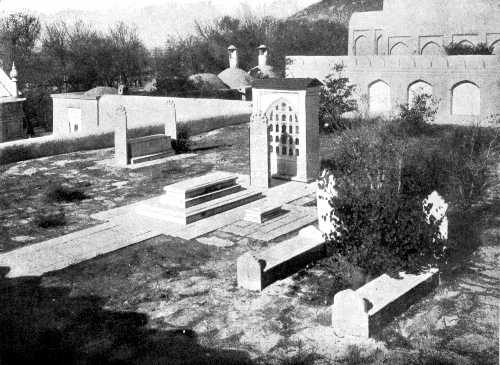
Babur’s Grave.
To face p. 445.
THE MEMOIRS OF BĀBUR