As the honest efforts of poor Daph
were crowned with success, she found
herself abundantly able to provide for
the physical wants of her master’s
children. Three years of toil had
rolled quickly away. Charlie had passed
his fourth birth-day, and become a
strong-willed, sturdy boy, while the
slender figure of the fair Louise had
grown and rounded, and the Rose had
learned to bloom on the cheek of Captain
Jones’s “Water-lily.”
Daph looked at her little ones with
affectionate pride, and watched over
them with the most tender care. She
encouraged them to play in the small
garden in the rear of their humble
home, but in the street they were
never seen. The garments she fashioned
for them were neat and tidy, and the
snowy aprons they always wore, were
monuments of her skill as a laundress;
but she was conscious of a something
in their external appearance, which
was not as it should be. About the
manners of her charge, Daph was still
more troubled. “Why you eat so,
Miss Lou?” she would sometimes say.
“How shall I eat, Daffy?” the child
would reply. “Well, I jus don’t
know,” poor Daph would answer,
“but dere’s somewhat bout de way
you childen do be, at de table, dat
Daph don’t jus know how to spress it.”
More serious troubles than these by
degrees came upon Daph, in her
management. Charlie, though an affectionate,
generous child, was hot-tempered
and wilful, and when he resisted
Daph’s authority, or raised his
little hand to give an angry blow, the
poor creature knew not what to do.
In these scenes she generally triumphed,
by the look of real distress which
clouded her usually pleasant face, and
brought Charlie, repentant to her
arms.
With Louise, Daph had another
difficulty. The child was usually gentle
and submissive, but she seemed to
pine for other companions, and a home
different from that which Daph was
able to provide for her.
The early lessons of piety which
Louise had learned at her mother’s
knee, had faded from her mind. Daph
could remind the little girl to say her
simple prayer at morning and evening,
but she could not talk to her of the
loving Saviour, or recount the wonders
of the Gospel she had never read.
The little book, with the golden
clasps, Daph had cherished with the
utmost care. She knew it contained
the secret which could bring peace and
order to her little home, but its treasures
she, in her ignorance, could not
unlock.
Once she had ventured to ask Mrs.
Ray to read a little to her from it, but
she met with a short negative, and a
cold, averted look.
Mary was almost as ignorant of letters
as Daph herself. So the poor
negro kept the precious book unopened,
and awaited God’s time for
leading her from darkness unto light.
That the children of her dear mistress
would be allowed to grow up,
ignorant of the knowledge that belonged
to their station, and strangers
to the Bible their mother had loved,
Daph would not allow herself to believe.
“It will come, I’se sure!”
Daph would say to herself; “de great
Lord can make it right!” and thus she
stifled her anxious forebodings, and
strove to do the duty of the present
hour.
Mrs. Ray’s temper was not quite as
trying as when Daph first made her
acquaintance. The kindness of the
honest negro, and her cheerful acceptance
of the trials of her lot, had their
influence under that humble roof, and
won respect and affection, even from
Mrs. Ray. The sunshine of Charlie’s
happy, roguish face, had cheered the
lonely widow, and Louise had exerted
on her a softening, refining influence.
Mrs. Ray was improved, but not thoroughly
changed.
Little Mary had many harsh words
yet to hear, but time had abated the
poignancy of the mother’s grief for
her lost darling, and made her somewhat
more alive to the virtues of her
hard-working, quiet, little girl.
During the three years that had passed,
since they had dwelt under the
same roof, sickness, at various times,
had made the little household seem
like one family, and the habit of helping
each other had daily drawn them
nearer.
Mary’s demure face was lighted up
with wonder as she said to Daph, one
day, “There’s a gentleman at the
door, asking if mother still lives here,
and if you are at home.”
“Is it a tall, tall gentleman, that
looks grand-like and magnificent?”
said Daph, earnestly, as the thought of
her master at once rose to her mind.
“Not exactly,” said Mary, and, as
she spoke, Mrs. Ray opened the door,
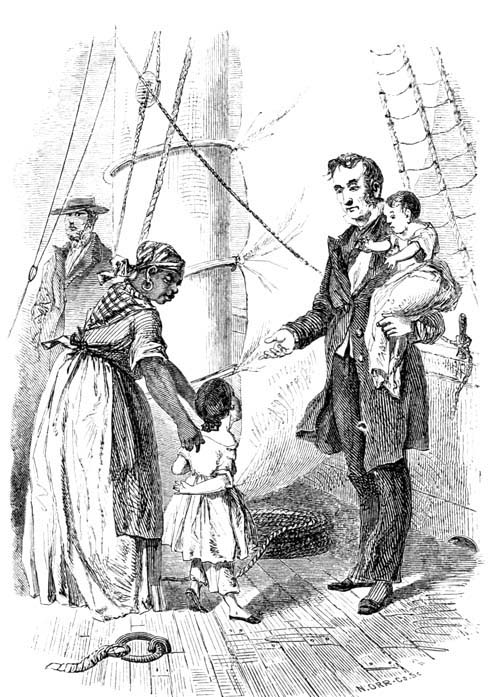
and ushered in Captain Jones.
Although her first feeling was disappointment,
Daph shed tears of joy
as she clasped the hand of the honest
captain; her tears, however, brightened
into smiles as she saw the approving
look the captain bestowed on her pets,
as he caught them in his arms.
Charlie struggled and fought to be
free, shouting, “I like you, sir, but
you need not squeeze me so, and rub
me with your rough whiskers.”
Charlie got another hug for an answer,
while Louise said, “Who is it,
Daph? It cannot be my father!”
“No! no! darling!” said the captain,
quickly, and he dashed the tears
from his eyes, and was sobered in an
instant.
Mrs. Ray looked on with astonishment
and curiosity, at the cordial
meeting between her old acquaintance
and her lodgers.
Captain Jones had known Mrs. Ray
slightly in her better days, and he now
turned to her, and inquired kindly
after her welfare. As usual, she had
a series of grievances to relate, but
she forbore speaking slightingly of
Mary, who had modestly retired into
the background. The little girl was
somewhat astonished when the captain
came towards her, and gave her a
hearty greeting, as the child of his old
mess-mate, and seemed to think her
well worth speaking to, though “only
a girl.”
The whole party sat down together,
and time passed rapidly on, while the
captain sat, with the children in his
arms, and heard Daph’s account of her
various trials and adventures since they
parted. Mrs. Ray listened with eager
curiosity, but she could gather little
from Daph’s words that she did not
already know.
At length, Captain Jones said, with
a great effort, “Daph, I have something
to say to you, which is not fit for
the children’s ears,” and he gave at
the same time an expressive glance towards
Mrs. Ray.
The widow seized Mary by the hand,
and flounced indignantly out of the
room, saying, “I am sure we have too
much to do to stay here, where we are
not wanted. No good comes of secrets,
that ever I heard of!”
“Come children, come with Mary,”
said the girl, apparently unconscious
of her mother’s indignant manner.
The children followed somewhat reluctantly,
and Daph and the captain
were left alone together. Since the
moment of her landing, Daph had had
no one to whom she might speak of
the dark fears for her master and mistress,
that at times preyed upon her;
to her own strange departure she had
never alluded. She had met questionings
with dignified silence, and had
patiently endured insinuations, which,
but for her clear conscience, would
have driven her to frenzy. Now, she
felt that she was to hear some important
news, and her trembling knees
refused to support her. Anxious and
agitated, she sank on her low bench,
and fixed her eyes eagerly on the captain.
“Daph,” he began, “there was
horrible truth in your words that
night, when you pleaded so earnestly
on board the Martha Jane! I thank
God that I did not turn a deaf ear to
you then! Daph, you have saved
your master’s children from a bloody
death, and you will be rewarded, as
there is a Father in Heaven!”
The captain paused, and Daph bent
anxiously forward, exclaiming, “My
dear missus? master?”
Captain Jones could not speak. He
drew his hand significantly across his
throat, and then pointed solemnly upwards.
Daph understood his meaning but
too well. She had hoped on, determinately;
but now the hour of awful
certainty had come, and she could not
bear it. She gave one loud scream,
and fell senseless on the floor. The
wild yell that burst from the anguished
heart of the negro, rang through the
house, and Mrs. Ray and Mary were
at the door in a moment, followed by
the terrified children. Little Louise
dropped down beside Daph, and began
to cry piteously, while Charlie flew at
Captain Jones like a young lion, and
loudly exclaiming, “The naughty man
has killed dear Daffy, and I’ll punish
him.”
While Mrs. Ray and her daughter
were making every effort to recall poor
Daph to consciousness, Charlie continued
his attack upon the captain,
with sturdy foot, clenched hand, and
sharp teeth, until the honest sailor was
actually obliged to protect himself, by
putting the child forcibly from the
room, and firmly locking the door.
Perfectly infuriated, Charlie flew into
the street, screaming, “They’ve killed
my Daffy! The wicked! wicked man.”
Several persons gathered round the
enraged child, and a young physician,
who was passing, stopped, to find out
the cause of the disturbance. Charlie’s
words, “She lies dead there! The
wicked man has killed her,” caught the
attention of Dr. Bates, and he eagerly
asked, “Where, where, child?”
Charlie pointed towards the house,
and the doctor entered, without ceremony,
Charlie closely following him.
His loud knock was answered by Captain
Jones, whose cautious manner of
unlocking the door seemed, to the
young physician, a most suspicious circumstance.
Charlie no sooner caught sight of his
enemy than he leaped furiously upon
him. The strong sailor received him
in his muscular arms, and there held
him, a most unwilling prisoner, while
he watched the proceedings going on
about poor Daph, and rendered assistance
where he could.
Dr. Bates ordered her clothes to be
instantly loosened, and then commanded
Mrs. Ray to lay her flat on the
floor, while he proceeded to apply his
lancet to her arm.
While this process was going on, the
clock on a neighboring steeple struck
twelve. Captain Jones looked hastily
at his great silver watch, and saw that
it was indeed midday, and he had not
a moment to spare, as the Martha Jane
was by this time quite ready to set sail,
and only waiting for her captain.
He hurriedly placed a little parcel on
the mantel-piece, and with one long,
sorrowful look at poor Daph, and a
hasty farewell to Mrs. Ray and the
children, he left the house.
It was long before Daph returned to
consciousness, and when her eyes once
more opened they were wild with fever
and anguish. She declared, however,
that she was quite well, and would
have no one about her; she longed to
be alone, to struggle with her great
sorrow. The children would not leave
her, but it was in vain they tried their
little expressions of tenderness, and
begged her look once more like their
“own dear Daffy.”
The sight of the unconscious orphans
redoubled the grief of the poor negro,
and she burst into a flood of tears.
The poor children, overcome at this
unwonted sight, sank down beside her,
and mingled their tears with hers.
Mrs. Ray and the young doctor
were sorely puzzled by the strange
scenes they had witnessed. They had
both seen the rich chains about Daph’s
neck, which had been disclosed while
she was unconscious, and not a little
wonder was excited by the sight of
that expensive jewelry in such a place.
Dr. Bates had not failed to observe the
refined appearance of the fair Louise
and the noble bearing of little Charlie,
contrasting as they did so strangely,
with the plainness of their humble
home, and the unmistakable African
face of the woman, of whom they
seemed so fond.
The wild agitation of Daph, the
disappearance of the sun-browned
stranger, the necklaces, the children,
all tended to fill the mind of Dr. Bates
with dark suspicion. He lingered
about Daph as long as he could make
any excuse for doing so, and when he
reluctantly turned from the room, he
did not leave the house without thoroughly
questioning Mrs. Ray as to
what she knew of her lodgers. Mrs.
Ray had but little to tell, excepting,
that they had been commended to her,
three years before, by the same tall
sailor, whose appearance that day had
created such a commotion. Of Captain
Jones she could only say, that he had
been a mess-mate of her husband,
years before, and had always been
reckoned an honest, kind-hearted man.
The questions put by Dr. Bates
roused all the curiosity of Mrs. Ray,
and revived the suspicions, with regard
to Daph, which had been much in her
mind during the early days of their
acquaintance. Such thoughts had long
since been banished, by the honest,
upright life of the kind-hearted, industrious
negro, but now they rose with
new strength.
She recalled the richly embroidered
dresses in which the children sometimes
appeared, the first summer after
their arrival, and she dwelt on the reluctance
which Daph always exhibited
to answering any questions as to her
past life, or the circumstances attending
her departure from her southern
home.
These remembrances and suspicions
she detailed to the willing ear of Dr.
Bates, who was satisfied that he was
on the eve of unraveling some tangled
web of iniquity, and with slow and
thoughtful steps he walked away from
the humble home, so wrapped in mystery.
Once more left to herself, Mrs. Ray
felt ashamed of having doubted poor
Daph, and was half inclined to go to
her, and frankly own the misgivings
the late occurrences had excited; but
the thought of those strange circumstances
again set her curiously at work,
and all right feeling was soon lost, in
an eager anxiety to find out the dark
secret, which hung like a cloud over
the poor negro.