He sailed his little paper boats,
And when the folk thought scorn of that,
He spudded up the waiting worm
And yearned towards the master’s hat.
Hotch-potch Verses.
The Babe went off to dress for dinner
much relieved in mind. Now that it was
over he confessed to himself that he had
been quite certain that Feltham had
cheated, but that he should own up to it,
was fine, and the Babe who considered
himself totally devoid of anything which
could possibly be construed into moral
courage, respected him for it. He also
registered a vow that never to the crack
of doom—which cracked three days afterwards—would
he play unlimited Marmara
again, and told himself that he was not
cut out for the sort of thing that he had
just been through, and that he was glad
it was over. He went round at once to
tell Broxton and Anstruther what had
happened, and after that shook the whole
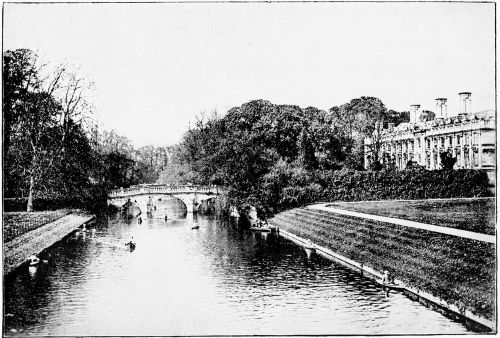
CLARE COLLEGE AND BRIDGE.
affair from his mind, as a puppy shakes
itself after being in the water.
He was, naturally, late for dinner, and
Mr. Stewart who knew the value of soup
and also the habits of the Babe, had not
waited. When he did appear, he was, of
course, perfectly unabashed, and took the
bottom of the table with unassuming grace.
“The psychology of punctuality,” he
remarked, “is a most interesting study.
Some day I mean to study it, and I
shall write a little monograph on the
subject uniform with those which Sherlock
Holmes wrote on tobacco ash and
the tails of cart horses. I think there
must be a punctuality bacillus, something
like a death-watch, always ticking,
and if there isn’t one, I shall invent it.
It doesn’t take to me. I am too healthy.”
“My dear Babe,” said the Stewart,
“you have disappointed me. I always
hoped that you were the one person I
have been looking for so long, who has
never been punctual; But you have
been punctual to my knowledge twice,
once on an occasion in the Long——”
“When was that?” interrupted the
Babe. “I don’t believe it.”
“On a memorable occasion. At lunch
in your own rooms.”
The Babe caught Reggie’s eye, and
looked away.
“Oh, yes.”
“And as Clytemnestra, you always
killed Agamemnon with ruthless punctuality.
I was always hoping to hear him
scream during the next Chorus but one.”
“I did the screaming for him,” said the
Babe complacently, “except on the first
night. He could only scream like an
empty syphon.”
“There is nothing more tragic or blood-curdling
than the scream of an empty
syphon,” said Stewart. “It shrieks to
you, like a banshee of all the whisky and
soda you have drunk. The only thing
that could shriek worse would be an empty
whisky bottle, and that can’t shriek at all.
If he really could scream like that, you
robbed him of a chance of greatness by
screaming for him, although you screamed
very well.”
“There are syphons and syphons,” said
the Babe, “he screamed like an empty
but undervitalised one, which had never
really been full.”
“Babe, if you talk about undervitalised
syphons during fish,” said Reggie, “you
will drive us all mad, before the end of
dinner.”
“Going mad,” said Mr. Stewart, “is an
effort of will. I could go mad in a minute
if I wished, and the Babe certainly
determined to go mad when he was yet a
boy. No offence meant, Babe. I can confidently
state that during the three years
I have known him, he has never for a
moment seemed to be really sane.”
“I was perfectly sane when I settled
to go in for the tripos,” said the Babe.
“You never settled to do anything of
the kind. You think you did and it
is one of your wildest delusions.”
“Secondly I was sane,” said the Babe,
“when I—”
“No you weren’t,” put in Reggie.
“Reggie, don’t be like Longridge.
But you are quite right. I wasn’t sane
then, though I thought I was for the moment.”
“Longridge is better, though he still
has a large piece of sticking plaster over
his nose,” said Mr. Stewart. “He came to
see me to-day. He insisted on arguing
with me in spite of my expostulations.
When he talks, I always want to cover
him up, as one covers up a chirping
canary.”
“I wish you would do it some day.
With a piece of green baize you know,
and a hole in it where the handle of the
cage comes out.”
“He would continue to make confused
noises within,” said Reggie.
“He always makes confused noises,”
said Mr. Stewart wearily. “Confused,
ingenious, noises. Babe, tell me if that
champagne is drinkable.”
The Babe drank off his glass.
“Obviously,” he said. “But it’s no
use asking me: all champagne seems to
me delicious. I drink Miller’s cheapest
for choice.”
A small withered don who was sitting
next the Babe, and had not previously
spoken, here looked up.
“A nice, dry, light wine,” he said.
The Babe started violently, and if he
had not just emptied his glass of champagne,
he would certainly have spilled it.
He explained afterwards that he really
had forgotten that anyone was occupying
the chair on the right.
This curious old gentlemen, one of the
few surviving specimens of this particular
type of elderly don had the classical name
of Moffat, and Mr. Stewart at once introduced
him to the Babe, a ceremony which
had escaped his memory before, and Mr.
Moffat who had been shivering on the
brink of conversation all dinner, decided
to plunge in.
“I saw your performance of the Agamemnon
last week,” he said.
“I hope you enjoyed it,” said the Babe
politely.
“The stage is not what it was in me
young days,” said Mr. Moffat.
The Babe looked interested and waited
for further criticisms, but the old gentleman
returned to his dinner without offering
any. His face looked as if it was
made of cast iron, painted with Aspinall’s
buff-coloured enamel.
There was a short silence, and Mr.
Stewart, looking up, saw that the Babe
was fighting like a man against an inward
convulsion of laughter. His face changed
from pink to red, and a vein stood out on
his usually unwrinkled brow. Stewart
knew that when the Babe had a fit of the
giggles it was, so to speak, no laughing
matter, and he made things worse by asking
Mr. Moffat how his sister was. At
this point the Babe left the room with a
rapid, uneven step, and he was heard to
plunge violently into the dishes outside.
Stewart had been particularly unfortunate
in his choice of a subject, because what
had started the Babe off, was the very
thought that Mr. Moffat’s sister was no
doubt the original Miss Moffat, and he had
been rashly indulging in wild conjectures as
to what would happen if he said suddenly:
“I believe your sister doesn’t like
spiders.”
Mr. Moffat had resumed the subject
of the Greek play when the Babe returned—he
seemed not to have noticed his ill-mannered
exit—and was finding fault with
the chorus, particularly with the leader,
who, in the person of Reggie, was sitting
opposite him. Of this, however, he had
not the slightest idea.
“I call them a dowdy crew,” he said.
“They were dressed like old baize doors.
Not me idea of a chorus at all. But it
was all very creditable, very creditable
indeed, and we have to thank me young
friend here for a very fine performance of
Clytemnestra. Why, me sister”—here
the Babe gasped for a moment like a
drowning man, but recovered himself
bravely—“me sister came down next
morning at breakfast, and said she’d
hardly been able to sleep a wink, hardly
a wink, for thinking of Clytemnestra.”
The Babe made a violent effort and
checked himself.
“I’m so sorry,” he said, with his most
engaging manner. “I hope you will
apologise to her for me.”
“Not at all, not at all,” said Mr. Moffat.
“It’s me own opinion she slept far more
than she knew. But she was always nervous,”—the
Babe bit his tongue—“easily
upset. A very good pheasant, Mr. Stewart,
a very good pheasant. Thank ye,
yes, a glass of champagne. A glass of
wine with you, heh, heh, Clytemnestra.”
Mr. Moffat, as the Babe allowed afterwards,
was a very pleasant old gentleman.
When dinner was over and he had settled
himself into an arm-chair by the fire,
smoking one of Stewart’s strongest cigars,
he told several stories about the old generation
of dons whom he had known.
“There was an old fellow of King’s”
he was saying, “in me undergraduate
days, who must have been eighty, and
never a night had he spent out of Cambridge
since he came up as an undergraduate.
An infidel old lot he was.
Many a time I’ve seen him in the evening,
when the worms were come out on
the grass plot, hobbling about and trying
to kill them with the point of his
stick. He used to talk to them and make
faces at them and say, ‘Ah, damn you.
You haven’t got me yet.’ A queer lot
they all were, not the worms I mean, heh,
heh, but the old dons. There were two
others who had been great mathematicians
in their time, and they used to spend
their evenings together doing, what do
you think? Making paper boats, sir,
which they went and sailed on the Cam
next day. They would start them from
the King’s bridge, and sail them down
to the willow at the other end of the
lawn. And such quarrels as they had
over which had won! One of them one
morning, his name was Jenkinson, if I’m
not mistaken, an old Yorkshireman, got
so heated over it,—for he said the other
boat had fouled his, as if they were racing
for a cup,—that he went for the other
man, by gad, sir, he went for him, and
tried to push him into the river. But the
other—his name was Keggs—was too
quick for him, and stepped out of the
way, and head over ears into the river
went Jenkinson himself, being unable to
stop himself, sir, by reason of the impetus
he had got up. The river isn’t over deep,
there, as you know, perhaps two feet deep,
and he stood up as soon as he could find
his feet and bawled out: ‘Ah misdoot
ye’ve drooned me, Keggs.’”
The Babe was delighted.
“Do tell me some more,” he said, when
Mr. Moffat had finished laughing himself,
which he did in a silent, internal manner.
“Ah, some of those old fellows did
things not quite fit for boys to hear about.
Maxima reverentia, eh, Mr. Stewart? But
there was an Irishman, a fellow of Clare
too, in my time. I might tell you about
him; he used to live in the rooms above
the gate. He had a quarrel with the
Master, and as often as the Master went
in and out of the gate, egad, the old chap
would try to spit on his head. If the
Master was out to dinner, he would wait
up, sitting in his window till he came
back, be it eleven o’clock or twelve, or
later than that. At last the Master had
to put up an umbrella when he walked
under the gate of his own college and
then the old fellow would shout out,
‘Come, out o’ that, ye ould divil, and
let me get at ye.’ A disreputable old
crew they were!—Ah well, it’s half-past
ten. Eleven’s me bedtime, and I must
be going. Good-night to you Mr. Stewart,
and many thanks for your kind hospitality.
And good-night to you, sir,” he
said turning to the Babe; “I heard them
shout ‘Clytemnestra, good old Clytemnestra,’
after you all down the street. And
you deserved an ovation, sir, you richly
deserved an ovation, and I’m glad you
got it.”
After Mr. Moffat’s departure, they settled
down again, and Stewart remarked:
“You’ve made a conquest, Babe. But
you behaved abominably during dinner.”
“I couldn’t help it. I could think of
nothing but Miss Moffat. On the top
of that you enquired about his sister. I
ask you, what was I to do?”
“You needn’t have danced in the dishes
outside,” said Reggie.
“I only danced in the soup, and we’d
finished with the soup. And there’s a
soupçon of it on my—”
“Shut up.”
“Pumps,” continued the Babe. “May
I have some whisky? Thanks. For
what I’m going to receive. What a
funny undergraduate Moffat must have
been.”
“I believe he was born like that,” said
Stewart. “I know when I came up, ten
years ago, he was just the same. That’s
the best of getting old early: you don’t
change any more.”
“That’s one for you, Babe,” remarked
Reggie.
“The Babe is the imperishable child,”
said Stewart.
“You called me a man of the world
the other day,” said the Babe in self-defence.
“I think not.”
“You did really. However, we’ll pass
it over.”
“By the way, Babe, you are corrupting
the youth of the college. Two men
went into their lodgings last night at ten
minutes past two. It transpired that they
had been playing cards with you.”
“Well, it is true that I was playing
cards last night. But they could have
gone away earlier if they had wished.”
“Your fascinations were probably too
strong,” said Reggie.
“Now you’re being personal, and possibly
sarcastic,” said the Babe with dignity.
“I must go to bed. I was late last
night.”
“The night is yet young, Babe,” said
Stewart.
“So am I. But if I don’t go, I shall
continue to drink whisky and soda, and
smoke.”
“You are welcome. How is the tripos
work progressing?”
“Oh, it’s getting on,” said the Babe,
hopefully. “A little at a time, you know,
but often. I’m not one of those people
who can work five hours at a stretch.”
“I suppose not. Is it to be a second
or a third?”
“I believe there are three classes in
the tripos,” said the Babe stiffly. “You
have only mentioned two. Well, yes,
perhaps one of your small cigarettes
would not hurt me. But I must go at
eleven, because I am sapping. Oh, isn’t
that the Shop Girl on the table? There
are some awfully good songs in it. May
I go and get my banjo?”
“Do. I got it expressly for you to
sing.”
The Babe slept his usual eight and a
half hours that night. He did not awake
till 10.30.