Everything goes by comparison. If I were unacquainted
with England, America, France, Germany
and Italy, I might share the delusion cherished
by most Australian people—that your women
are beautiful. But, having seen the rose, how can
I be content with the dandelion?
In accepting the praise of Miss Lily Brayton,
your women should remember that this popular
actress had a royal time in Australia, and probably
was not unmindful of the possibilities of a
return visit. No, I am not a disgruntled actress
who has found Australian audiences unappreciative
of my talent. I am merely a much-travelled
woman blessed—or cursed—with the faculty of
being able to see things as they really are. When
I say that the women to be seen in the streets of
Sydney, Melbourne, Adelaide and Hobart are unattractive,
I am merely stating the truth as it
appeals to me.
Someone with a surprising lack of humour—or
an extra large share of it—once wrote of the stately
carriage of Australia's matrons and daughters. In
my travels in this country the number of women
encountered who knew how to walk might be counted
on the fingers of one hand. I have seen more grace
among the factory girls of Poplar, among the midinettes
of the Latin Quarter, and among petticoated
toughs of the Bowery, than it has been my fortune
to meet in Pitt-street or on the Melbourne Block.
Australian women don't walk. Those who don't
waddle with an unnatural movement of the hips,
like a drake expressing his satisfaction with an
extra fat frog, affect a ridiculous mincing gait that
resembles nothing so much as the painful perambulation
of a youngster who takes off his boots on a
hard, pebbly road for the first time.
The best figure I have seen in Australia was
that of a young girl of about 18. She was beautifully
moulded, with a bust to inspire a poet, and
hips of exquisite roundness. Generally speaking,
Melbourne women are more favoured in this respect
than their Sydney sisters. Here, due possibly
to surf-bathing—the bust development is abnormal,
while the hips have a flat, board-like appearance.
One Sydney woman with rounded hips was introduced
to me at tea at the Australia. She was so
well formed that I couldn't resist the temptation of
testing her genuineness with a hatpin. I don't say
that she was padded—I only assert that she took
half an inch of steel without flinching!
The best complexions in the Commonwealth are
seen at Hobart and Toowoomba—in fact, there
seems to be no really pretty skins at any other
places. Your women paint and powder too much.
The spectacle of young girls of 17 and 18 with
rouged cheeks and carmine lips is an absurdity in
a country that believes that its women are beautiful.
The new short skirt about to be tried in Paris
will never become popular—Australian legs could
not be held up to ridicule in that way. It is noteworthy
that while in other countries the girl with
a pretty ankle and a shapely calf is not unconscious
of her charms, the Australian woman is
always careful to adjust her skirt on seating herself
in tram or train. Why? Because she regards it
as immodest to show her legs? The display on the
surf beaches disposes of that idea. The answer is
found in the fact that, generally speaking, Australian
legs are better hidden from view. They are
either thick and stocky at the ankles, with a heap
of ill-formed flesh above, or are thin almost to the
vanishing point. One misses the beautifully-rounded
ankles and the graceful tapering calves that peep
from beneath petticoats in Bond-street, the Avenue
de l'Opera, and Fifth-avenue.
I was amused while at the Hotel Australia one
afternoon last week to notice that one "lady,"
who had evidently studied my first article in the
Sydney "Sun," was endeavouring to prove that
local legs are worth viewing. Her dress had been
carefully adjusted so as to provide a generous display
of stocking reaching nearly to the knee. Like
so many people in a young country, where the
polish and refinement that comes from association
with countries in which culture is a much more
highly-prized asset, is lacking, she failed to recognise
the border line that separates easy naturalness
from sheer vulgarity. A woman who pulls up her
dress deliberately in order to show her legs is pitifully
immodest. The woman who, with malice
aforethought, shows her legs is vulgar, and the
woman who takes all sorts of trouble to hide them
is a prude, but the woman who allows them to be
viewed, if the position in which she is seated permits
their display, is unaffected and natural. In
the society in which I moved in England, France
and America, both the women and the men are
frankly natural. Here there is, on the one hand, a
restraint that is ludicrous, and, on the other hand,
a familiarity that is indelicate.
Mr. Norman Lindsay—whose clever work I admired
long before I came to this supersensitive Commonwealth—has
done me a service in subscribing
himself as the man who has seen more of the
Australian girl than any of his envious countrymen.
If his knowledge is so extensive, and he is the true
artist that we all believe him to be, it follows that
his drawing must reflect the local type. And what
do we find—the grace and beauty over which so
many of your frenzied correspondents have rhapsodised?
Not on your life. The Norman Lindsay
girl is hardly a girl at all. With the calves of a
footballer and the upper limbs of a Sandow, she is
a fearful and wonderful example of the female form
divine. The faces of Mr. Lindsay's women remind
me more than anything else of the religious
pictures of my youth, designed to represent the torments
of hell, and to frighten people into the narrow
way. Your foremost black-and-whiter admires
the beauty of strength. Well, a draught horse
with whiskers half way up its legs is a beautiful
thing to draw a heavy load of turnips or road metal,
but no one would think of comparing its ungainly
proportions with the symmetrical form of the thoroughbred
racer. If Australia is trying to breed a
race of Amazons, well and good—you are getting
along very nicely. But if you are anxious to match
your girls with the comelier women of other countries—you
have a perfectly clean palette, as my old
friend Charles Dana Gibson would put it.
People who read their history closely are familiar
with the evolutionary phases through which most
young countries pass. Here is first the halting,
apologetic stage, represented in the case of Australia
by its early-day subservience to England and
everything English. Nothing could be any good
that was not imported. The next stage was reached
when you began to produce a handful of clever men
and women, whose success in science, music, art,
and sport laid the foundations of a belief that gradually
developed into arrogant big-headedness. If
Australia could produce a Brennan, a Melba, a
Mackennal, a Trumper, an Arnst, and a Gray, why
should there be any limit to the fertility of its
genius-breeding soil? The idea tickled your vanity,
and you allowed it to grow recklessly. People who
came from other countries saw your weakness, recognised
it as an inevitable phase in your progress
towards national sobriety and staidness, and said
nice things about you. It made the visitors' stay
more pleasant, and, as you will in time grow out
of your folly, it helped rather than impeded your
development.
Have you ever noticed a puppy let off the
chain after being tied up for a long time? He
will jump and frisk as though jumping and
frisking were the things he was born for, and
every time you pat him he bounds a little
higher. By-and-bye he begins to feel tired, his
tail-wagging becomes less vigorous, and eventually
he sits down quietly and wonders why he was
silly enough to exert himself so needlessly. He
notices, too, that the other dog who watched him
with amused tolerance isn't quite such a mongrel
as he seemed to be when he gambolled round him;
in fact, on closer inspection, he is recognised
as being bigger and possessing a shinier coat
than his chastened observer. The puppy has
learned wisdom. But that pawing and prancing
and hind leg foolishness were a necessary part of
his education, and every human caress helped
him along.
Australia is not yet through the cavorting stage,
but it will grow out of it in time, just as
other countries have done. If I were an altruist
instead of an impartial observer, whose tongue and
pen are always guided by clear vision and
ripened judgment, I would, I suppose, have helped
on the evolutionary process by feeding your
vanity with the tablespoonsful doses administered
by other visitors. I know I have made myself
very unpopular because I wrote the truth as it
appealed to me, but we all can't take liberties with
our consciences, even to please the women of Australia.
I have been in this country for several months,
so that I have had plenty of opportunity of judging
the external excellencies of my self-confident
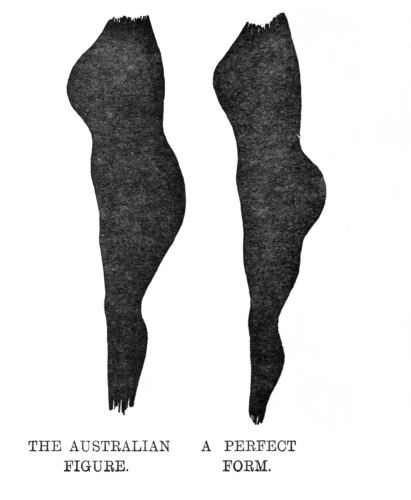
southern sisters. The diagrams which I have prepared
may help my critics to understand what a
perfect figure should look like. The outline of
the average Australian woman is shown alongside
that of my friend, Miss Maimie Valdervant, of
Fifth-avenue, New York. The colonial imperfections
are easily distinguishable—the pouter-pigeon
breast, the low, flat hips, and the thick, stocky
ankles. Miss Valdervant is a beautifully moulded
girl, but her shapeliness is not unique. At a weekend
party on the Adirondacks at least 10 of the
22 girls present were equally comely. Well do I
remember the late Stanford White saying, when
someone remarked upon his display of Phidias-chiselled
womanhood, that it was nothing unusual.
At the Grand Prix meeting at Longchamps Count
Pielliet's party was similarly noteworthy; the same
thing might be said of the late Viscount Avonmore's
famous gathering of 1907, in which I shared with
Lady Marjorie Warshane the honor of being the
finest figured woman on the lawn.
Who is Valerie Desmond, that she should dare
criticise the myriad Venuses of Australia? What
does she know of beauty? He who drives fat
oxen should himself be fat, and similarly she who
writes of the feminine form should have some
pretensions to shapeliness herself. I append my
measurements for the benefit of my numerous
critics:—
| Height | 5 ft. 5 in. |
| Weight | 10 st. 3½ lb. |
| Neck | 14 in. |
| Bust | 38¾ in. |
| Waist | 25 in. |
| Hips | 41 in. |
| Calf | 14½ in. |
| Ankle | 7 in. |
The fact that I was asked by the late Sir Edward
Poynter to sit for one of his classical studies
indicates what a famous artist thought of these
proportions.
The reference by one visiting actress who attacked
me in the paper to Miss Annette Kellermann's
perfection of figure amused me. Everyone in
America, if not in Australia, knows how much of
her popularity is due to beauty and how much to
her press agent. Your clever and jolly water nymph
is anything but well balanced. Her legs are—or
were when I last saw them—much too thin for her
superb bust. It is just the reverse with Miss
Pansy Montague (La Milo). The upper half of
her spoils an otherwise beautiful figure. The
genius of Cruikshank—an Australian of whom, in
his own particular line, his country has reason to
be proud—makes amends for this deficiency. He
was able to convince the English public that La
Milo was one of the most beautiful women living,
and the habit of admiring her became general. I
remember drawing Mr. W.T. Stead's attention to
her comparatively puny bust, but so completely had
Cruikshank gulled him that he wouldn't hear a
word against her.
It is not difficult to understand why Australian
women should regard themselves as beautiful.
You know the Papuan natives who stain their teeth
with betel nut think white molars hideous. When
any country sets up its own style of beauty it takes
a good while to convince it that any other style can
be beautiful, let alone to force the admission that
the local gods are false. So few Australians have
travelled that a restricted horizon is natural. I
don't say that your women have anything to be
ashamed of in having abnormal busts, flat hips,
and thick ankles, but when they arrogate to themselves
the right to set up a standard for the world
I really must protest.