In order to qualify as meteorologist competent to
confer with aviators, it seemed desirable to become
personally acquainted with some of the conditions
that confronted them. As a matter of professional
acquirement therefore, I was glad to accept an invitation
to go aloft after the necessary official arrangements
had been made with Washington.
This trip was in line with the previous endeavors
of applying practical meteorology to the science of
flight and appropriately extended the work which was
begun in San Diego with Chanute and the sea-gulls
fifteen years before.
Object of Flight.—I wished to put myself in the
student’s place and learn at first hand the practical
facts he demanded from weather observations and
to acquaint myself with everything possible that
might be of value to an aviator. There were two
definite things of which I desired knowledge: first,
to determine the height of the upward trend of the
sea-breeze over Point Loma which causes the mysterious
“woolly” of a score of years’ acquaintance
from a yachting standpoint; second, to observe the
extent, form, and composition of the velo cloud
which is the characteristic sun-cover of California.
Preparations for the Ascent.—Aviator Instructor
Oscar Brindley (the 1915 winner of the Curtiss
trophy), in military tractor No. 50, was assigned
as pilot. It may be stated here that the accepted
definition of aviator is a pilot of a flying-machine
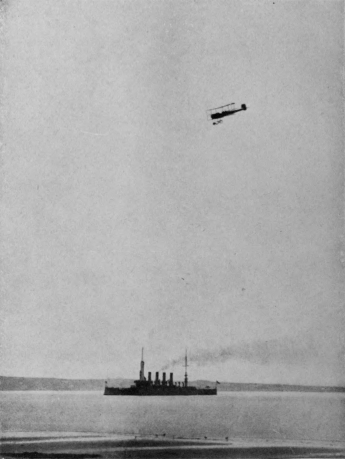
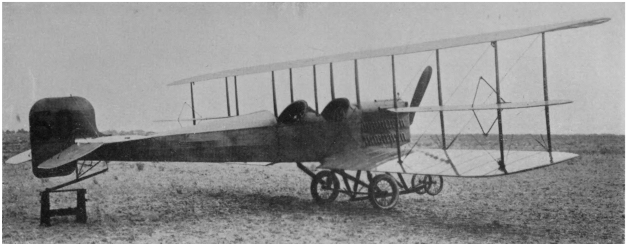
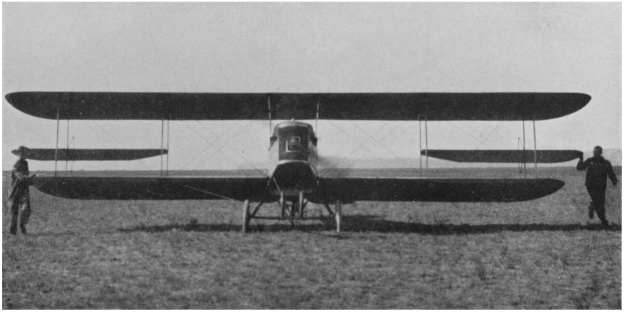
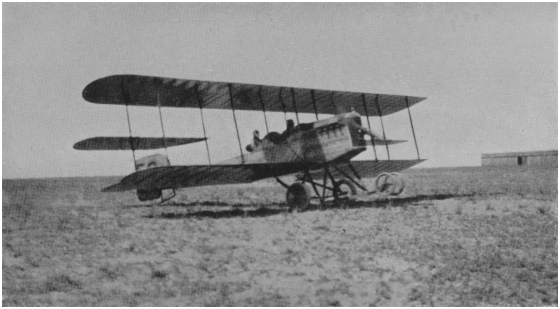
heavier than air. The airplane used in my first
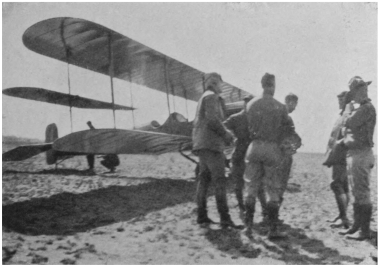
flight (see Fig. 13) was made in Los Angeles and is
the present standard army model. This tractor has
an 80-horsepower engine and 8-foot propeller. It is
21 feet long, has a wing-spread of 38 feet, supporting
area 364 square feet, and a flying radius, with two
persons, of 300 miles. The maximum altitude attained
with this model at San Diego was 13,000 feet.
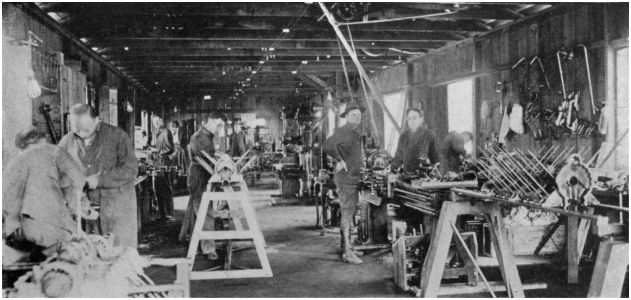
Before being placed in service the machines are
thoroughly gone over at the repair shop (see Fig. 22),
and the motors are run at full speed for twenty-four
hours, after which they are taken down and subjected
to scrutiny for possible defects. All of the struts,
guys, and wires are closely examined; the boltheads
are all drilled, wired, and soldered so that no amount
of vibration will loosen them. Regardless of the
length of the flight, each machine, before going up
again, is given a rigid inspection and not until the
mechanicians have tested every part is it pronounced
ready.
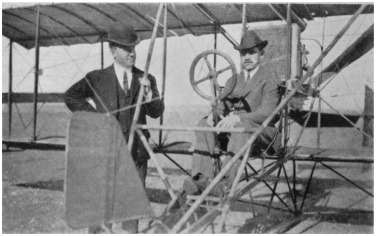
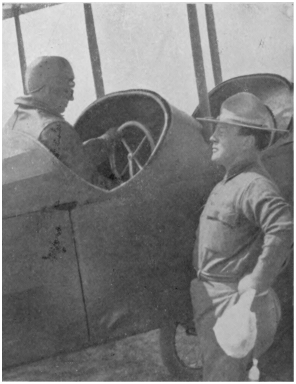
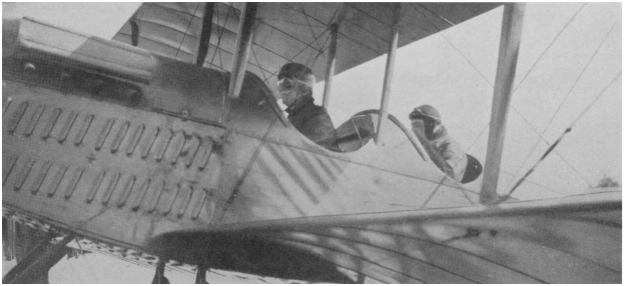
Not being prepared with a regulation aviation
suit, I was loaned a leather jacket by one officer, face-goggles
and safety helmet by others. I then took
my place in the observer’s seat forward and was
strapped into it with the safety belt (see Fig. 12). I
was cautioned to let my body give way as the waist-controls
were moved from side to side and not pay
any attention to the steering rudder wheel which
had a way of mysteriously revolving, advancing and
receding.
In cranking an airplane, a certain formula is
always gone through. The mechanician at the propeller
calls out, “Close!” The aviator closes the
switch and repeats the word. This short-circuits the
ignition apparatus so that no spark occurs in the
cylinders. The propeller is turned in order to introduce
explosive mixtures into the cylinders. When
ready to start the mechanician says “Open!” The
aviator opens the switch and repeats the word. The
charges in the cylinders then fire when the propeller
is turned.
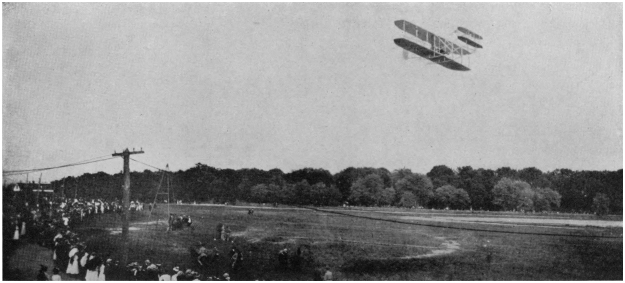
After the engine starts, the machine is “trimmed”
by helpers and jockeyed for a favorable “take-off”
into the air. (See Figs. 14, 15.) This model of airplane
climbs on a gradient 1 to 7; its minimum speed
is 41 miles per hour. In other words, if the speed is
less than 41 miles per hour the machine will not fly
horizontally.
The Ascent.—The tractor was headed into a 30-mile
northwesterly wind so that the “take-off” was
quick and easy; there were only a few seconds spent
rolling over the field, when the airplane left the
ground and I felt the never to be forgotten cushioning
feeling of the air. For ten seconds there was experienced
a decidedly weakening nervous chill, which
occurred to me once before when making a high dive
from a spring-board. It was the sort of physiological
disturbance that can only be counteracted by immediately
pulling one’s self together saying, “Well,
here goes nothing!” The momentary depression was
immediately followed by a corresponding elation of
feeling which strange to say did not leave me during
the trip and is always associated with thoughts of
the journey. There was no dizziness, although I am
peculiarly susceptible to the least change in balance.
The earth did not recede as we progressed steadily
upward; we seemed part of the earth, but not of it.
Although the airplane reached an altitude of 3,000
feet in a comparatively few minutes, the barometer
falling from 30.0 to 27.0 inches, the decreased bodily
pressure was not at all noticeable.H
Next to the supporting quality of the atmosphere
I had noticed the 70-mile blast of air as the airplane
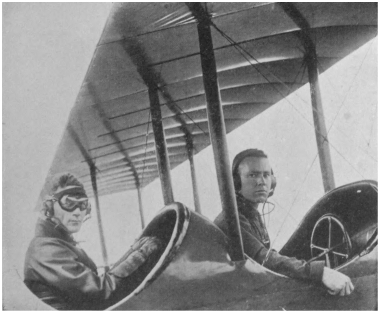
pushed its way steadily onward and upward. Naturally,
the exhaust of the motor in addition to the roar
of the wind made conversation impossible. Some
airplanes have telephone communication between
observer and pilot. (See Fig. 9.) During one flight
in a machine not so equipped, the passenger noticed
the breaking of some apparatus. Knowing that it
was impossible to make himself heard he hastily
scribbled the word “Accident!” on a bit of card,
whereupon the pilot shut off his engine and glided
to earth.
Two-thousand Feet above Point Loma.—Carrying
out my suggestion as to investigating the “woolly,”
the pilot drove the machine straight for Point Loma
and those unseen aërial breakers. Suddenly there
were two distinct “wallops” and I felt the fuselage
beneath me respond as if struck by a stuffed club.
There was evidently first a surge then a drop, and it
was the descending current of air that deprived the
airplane of the supporting medium, hence the shock.
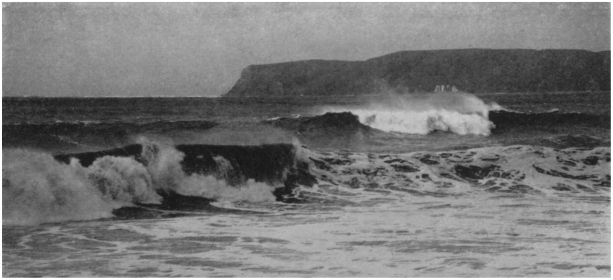
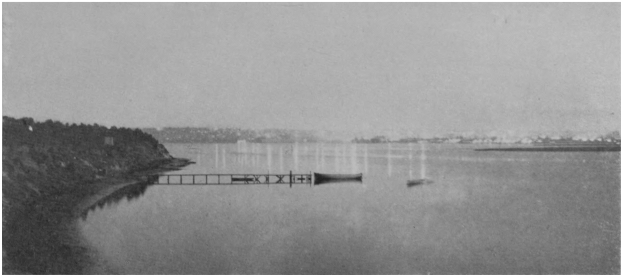
Point Loma itself, from this altitude, and seen
directly from above, looked very like a barracuda’s
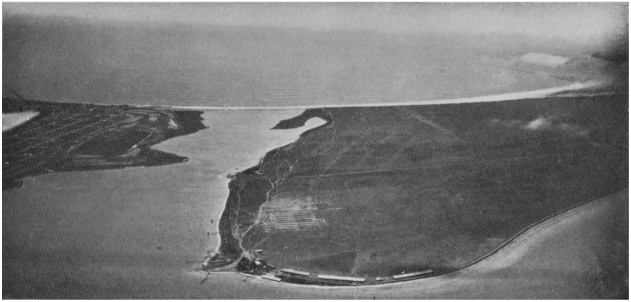
backbone—long, low, and ugly. Although this peninsula
(see Fig. 21) is less than 500 feet high it so
effectively deflects the prevailing northwesterly wind
that the upward surge has been noticed by aviators
at an altitude of 4,000 feet. It is no wonder then
that these descending winds, called “woollies” (from
their churning the water into isolated masses which
look like tufts of wool), are dreaded alike by yachtsmen
and birdmen. They have been known to carry
away topsails from too closely venturing schooners
and student aviators always give the vicinity of
Point Loma a wide berth.
No Winds Aloft.—We had not changed our direction
since leaving the ground, but after passing over
Point Loma the airplane was put sharply on a port
course. I had been expecting this and must confess,
somewhat dreaded it, innocently thinking that a
30-mile wind added to our 70-mile rate of speed
would “heel” the craft to an uncomfortable angle
when the course was changed from northwesterly to
southerly. What was my astonishment to find that
the putting about was unaccompanied by any of
the nautical motions such as tilting or canting. Theoretically
one may be ever so well grounded in physical
laws but it seems to take actual experience to bring
their truth home to us. Of course there can be no
wind in the air; when we entered the air it was
moving 30 miles an hour in relation to the earth
but as soon as we were free from the earth the velocity
of the wind had no effect on our flight. No
matter how strong the gale, so far as it concerned
the airplane, if the wind be steady no difficulty is
experienced; the aviator is concerned only by wind-shifts.
The Velo Cloud Seen from Above.—In kindergarten
days I remember that one of the first questions I asked
was “Are clouds smoke?” And this early query was
really first answered in the air. Fog on a mountain
top may be cloud, but somehow cloud free from close
proximity to the earth seems different.
The machine was put through the cloud blanket
much as a horse takes a hurdle; it seemed unlike
fog and more of a palpable substance. As we emerged,
the sun was shining on it like a silvery sea with
gently undulating surfaces and it looked for all the
world as supportable as layers of cotton-wool. Many
times have cloud-banks from mountain tops been
observed, yet the upper side of the velo cloud from
a flying-machine looked very different. The cloud
was only four or five hundred feet thick and extended
inland a few miles in irregular outline. The seaward
edges of the velo cloud were not ragged, and apparently
paralleled the coast for 10 or 15 miles.
Such was the exhilaration and confidence the air
gave that I can understand how parachute jumpers
confidently step off into space, for to them the air
is a supporting medium no more terrible than a
transparent sea to a good swimmer. I believe that
the record parachute drop was made in 1916 by
Colonel Maitland, of the English Royal Flying
Corps, who descended in a parachute 10,000 feet
from an airplane. Fifteen minutes was occupied in
the descent.
Ease of Vision at 3,500 Feet Altitude.—At this
altitude the ease of vision is most remarkable. At
this height, with perpendicular vision, the eye is
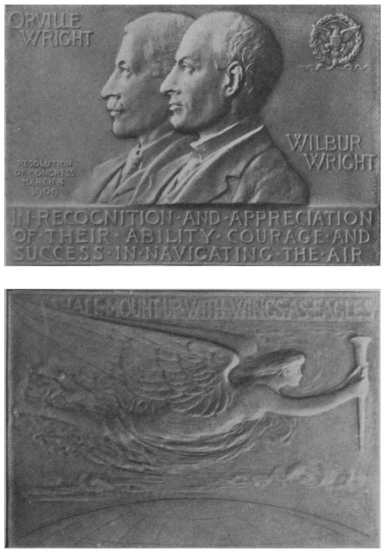
possessed of wonderful powers. In those “solitudes
august with stars” men not only “mount up with
wings as eagles” but are given the eagle’s unobstructed
vision. Birds have been credited with much
too keen vision. From this height of several thousand
feet every object stood out with remarkable distinctness.
Automobiles racing along the El Cajon boulevard
to Lakeside were readily picked up with the
unaided eye although 20 miles away. Looking down
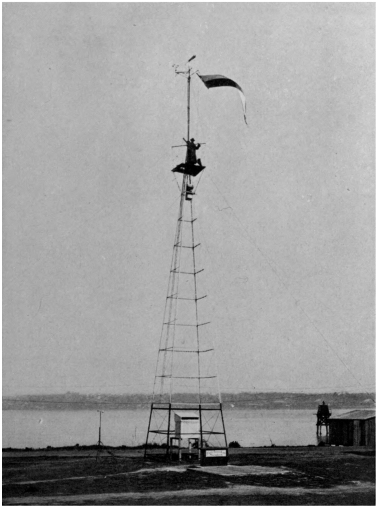
over the aviation field the long compass mark and
the wind-direction pennant (Figs. 19 and 20) were
easily distinguished. The bay and ocean, however,
gave the most remarkable revelation, for the bottom
of the bay and the shallow ocean shore were plainly
discernible. The absence of water as well as air
refraction explains why submarines cannot hide
from an airplane: one of the army aviators told me
that a submarine cannot ordinarily sink so low that
it cannot be seen from an airplane.
Color of Landing-ground Important.—Owing to
the absorption and reflection of sunlight, there is a
distinct variation in the character of otherwise similar
landing-ground. A field, dark from recent plowing
(or burning), will heat the air over it faster than will
a field of stubble, hence over the former field there
will be the greater air disturbance, and this will
affect the ease of landing. Air is heated by contact
and convection. One of the aviators said that recently
he was descending, and had all but reached
the ground when a localized convectional current
hurled his machine upward some distance but immediately
afterward deposited him on the ground
without damage.
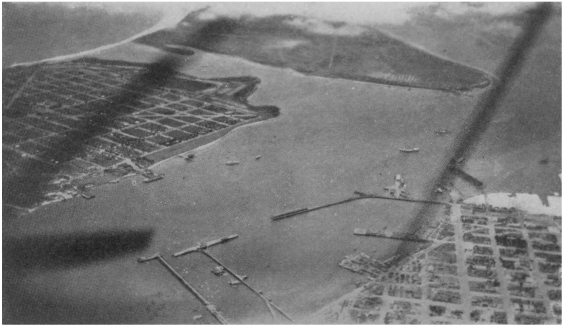
Spiraling Down 3,000 Feet.—Speeding ever in wide
circles the course lay southeast over the upper part
of San Diego Bay. The city of San Diego presented
the usual checkerboard appearance (Fig. 16), and
even at this altitude it would seem easy to drop an
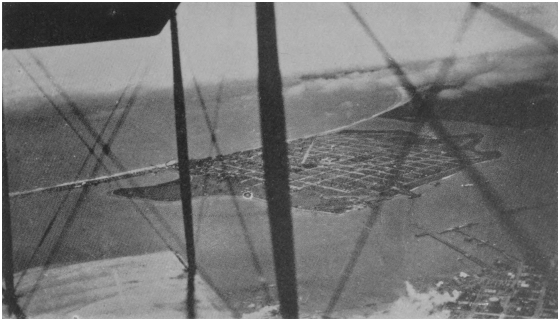
orange at almost any point. The velo cloud was
lifting and we could see the gradual disappearance
as it melted rather than drifted from North Island.
(See Fig. 17.)
The gliding descent was made from an altitude of
2,500 feet, starting above San Diego. As the aviation
school was approached, we could see a number of
machines in the air, three below and two above us,
circling about like hawks. And, like soaring birds,
these machines had their air-lanes, designated
courses and levels being devoted to the different
classes of machines. The landing was made without
incident and the hour’s flight was ended.
Outline of Meteorological Work at the Aviation
School.—At the close of the lecture detail, the attention
of the student aviators was called to the importance
of their having as thorough knowledge as possible
of the fundamentals of meteorology. The application
of these fundamentals to the analysis of air
conditions met with in their daily flights was shown
to be essential. Investigations as to varying wind
direction were taken up by one of the staff instructors
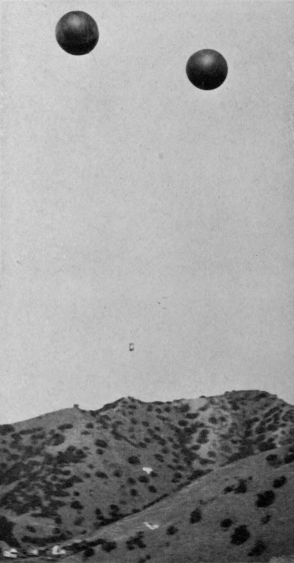
by the use of small parachutes to be dropped at
different altitudes. (See Fig. 8.) Through the
coöperation of the local official in charge of the San
Diego Weather Bureau station, duplicate signal
sheets were available from which the student officers
made their local weather maps. From these maps
and their own flights, they could arrive at some relationship
between the actual and the theoretical 3,000-
and 10,000-foot level maps prepared from the Bigelow
formula, as used by the Bureau. Lectures were
given on temperature and its distribution; winds,
moisture, and clouds were also made part of the
course, one of the papers of the BureauI being reprinted
by the aviation school by permission of the
Chief of the Bureau and used as a textbook. The
Weather Bureau furnished the station with a standard
set of meteorological instruments so that the
student officers could become perfectly familiar
with the regular equipment at the Weather Bureau
stations.
Extending the Usefulness of the Bureau to the
Aviators.—Practical utilization by the aviators of
this district of the information possessed by the
Bureau has received considerable impetus during the
past six months. During the cross-country flights
of April and May, 1916, the Los Angeles station was
directed by the Chief of Bureau to furnish weather
and flight conditions between San Diego and Los
Angeles. With the aid of the general weather-map
data from the regular stations, and special observations
of wind, weather, and fog conditions on the
immediate coast near Los Angeles, and on Mount
Wilson, it was possible to issue satisfactory forecasts
of flying conditions. The eye-observations of fog-heights
as determined by the Weather Bureau coöperative
station at the Mount Wilson Solar Observatory
were especially valuable. From this mountain
(6,000 feet elevation) it is possible on a good day
to see the whole length of the coast from Point Firmin,
San Pedro harbor to Point Loma, San Diego
Bay. Knowing different levels, the observer at
Mount Wilson was able to give actual thickness and
extent of the fog-belt and its past twenty-four-hour
history.