7
CHAPTER I
THE LAND OF DREAMS
“I don’t believe anything could be more
lovely than this,” exclaimed Mollie
Thurston, leaning back in a wicker chair
on the piazza of one of the largest hotels at
Palm Beach.
“Right you are!” replied her friend, Ruth
Stuart, as she gazed across the still blue waters
of Lake Worth dotted with pleasure boats. “I
can’t decide whether I should like to ride in
the automobile, or sail, or just sit in the cocoanut
grove and listen to the music. Life seems
so easy under a blue sky like this, and there
are so many things to do that it is hard to make
a choice.”
“What do people usually do at this hour?”
Grace Carter asked. “A woman I talked with
on the train told me there was a programme of
amusements for every hour at Palm Beach.”
8
“Well, my dear, you have only to gaze about
you and see for yourself. It is now high noon,”
answered Ruth, consulting her watch.
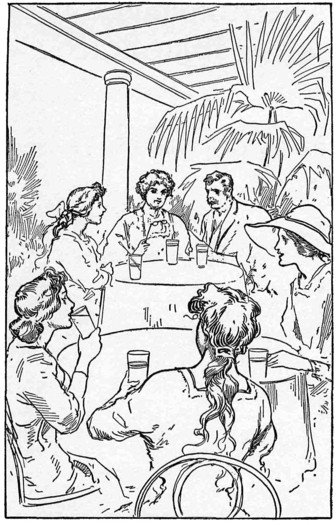
Grace glanced quickly about her. All along
the broad piazza, and under awnings on the
lawn, a gay company of men, women and young
people were sipping delicious iced fruit drinks
in tall, thin glasses.
“It is undoubtedly the witching hour for pineapple
lemonades,” said Ruth. “And we must
be in the fashion immediately. Papa,” she
called to her father, who was immersed in the
pages of a New York newspaper several days
old, “you are not doing your duty by us. We
are getting awfully thirsty.”
Mr. Stuart, clad in white, and looking the
picture of comfort, smiled lazily over his paper
at his daughter. “Order what you like, my
dear. Am I not always at the command of the
‘Automobile Girls’? What do you wish, little
lady?” he asked, turning to Barbara Thurston,
who had been lost in a day-dream and had heard
nothing of the conversation.
“I haven’t any wish,” responded Barbara.
“I am too happy to be troubled with wishes.”
“Then suppose I wish for you, Bab?” suggested
Ruth. “Go back to your own sweet
dreams. I’ll wake you when the wish comes
true.”
9
Presently the four girls were sipping their
fruit lemonades like the rest of the world at
Palm Beach. On the breeze the sound of music
was wafted to them from a morning concert in
the distance.
“Where is Aunt Sallie?” Ruth suddenly
asked, again interrupting her father’s reading.
“This place has bewitched me so that I have
forgotten even my beloved aunt. This is the
land of dreams, I do believe. We are all spirits
from some happy world.”
“Here comes your spirit aunt,” returned Mr.
Stuart, smiling. “She has evidently been
spirited away by some other friendly spirits.”
The girls laughed as they saw the substantial
figure of Miss Sallie Stuart strolling down
the piazza. She was walking between two
other persons, one a tall, middle-aged man with
dark hair slightly tinged with gray, the other
a young woman. They were all three talking
animatedly.
“Girls, look!” exclaimed Ruth, in suppressed
excitement. “Aunt Sallie is with that Maud
Warren. You remember we met her at Lenox,
Bab, and she tried to ride you down in the
famous race. Delightful creature—to keep
away from.” Ruth gave a contemptuous sniff,
then added. “That nice looking man must be
her father.”
10
“She looks as haughty as ever, and then some
more,” said Mollie aggressively.
The girls giggled softly, then straightened
their faces for the trio was almost upon them,
and it was not safe to indulge in further conversation.
After seeing that his charges were supplied
with lemonade, Mr. Stuart had returned to his
paper.
“Robert,” broke in Miss Sallie’s dignified
voice, “this is Mr. Warren and his daughter
Miss Warren. They——”
But at the first word Mr. Stuart had risen
and the two men were enthusiastically shaking
hands.
“Why, Warren,” exclaimed Mr. Stuart, “I
had no idea that you were in this part of the
world. The last time I saw you, you were
ranching out in Idaho.”
“Quite true,” replied Mr. Warren, smiling,
“but that was ten years ago. A great many
things have happened since then.” He sighed
and looked out over the blue lake. “Mrs. Warren
died the next year,” he said slowly. “Maud
and I are alone.”
“I am deeply sorry to hear of your great
loss,” sympathized Mr. Stuart and his fine face
saddened. He too had known that loss.
Turning to Maud who had been exchanging
11
rather distant greetings with the four girls, he
said pleasantly. “So this is Maud. She was
a little girl in short dresses when last I saw
her. How these children do grow up.”
Maud smiled frigidly and for the fraction of
a second allowed her hand to touch that of Mr.
Stuart. “One must grow up some time, you
know,” she murmured.
“I should like to stay eighteen forever,” exclaimed
Ruth, with enthusiasm.
“Would you indeed?” remarked Maud Warren,
raising her eyebrows. “How odd!”
There was a brief silence. The four girls
stared straight ahead and tried to control their
desire to laugh. During their stay at Lenox
the year before the circumstances of which having
been fully told in the “Automobile Girls
in the Berkshires,” they had not been impressed
with Maud Warren, on account of her
disagreeable and overbearing manner. But the
blasé air that she now affected, was in their
candid eyes extremely ridiculous, and her remark
to Ruth had filled them all with unseemly
mirth.
Maud Warren, however, serenely unconscious
of what was passing through their minds, sank
into a wicker chair, and deliberately turning
her back upon the “Automobile Girls,” began
a conversation with Miss Sallie.
12
The “Automobile Girls” dated their organization
back to almost two years before, when
Barbara Thurston had bravely stopped a runaway
team of horses driven by Ruth Stuart, a
rich western girl, summering in Kingsbridge,
the home town of the Thurstons.
A warm friendship had sprung up between
Ruth Stuart, Barbara and Mollie Thurston,
that resulted in a journey to Newport in Ruth’s
red motor car, familiarly known as Mr. A. Bubble.
Grace Carter, a Kingsbridge girl, had been
asked to complete the quartette of adventurous
damsels, while Miss Sallie Stuart, Ruth’s aunt
had gone along as chaperon.
After a series of remarkable events their
trip ended with the capture of a society
“cracksman,” known to the police as the “Boy
Raffles.” The “Automobile Girls” then returned
to Kingsbridge, where several weeks
later, Mr. A. Bubble once more bore them away
to the heart of the Berkshires. There they
spent a delightful month, in a little log cabin,
roughing it. In “The Automobile Girls in the
Berkshires,” the story of the little Indian
“ghost” that haunted “Lost Man’s Trail,” and
who afterwards turned out to be an Indian
princess is charmingly related.
After a winter of hard study, the “Automobile
Girls” were again reunited, and in “The
13
Automobile Girls Along the Hudson,” their
journey through the beautiful Sleepy Hollow
Country is narrated. The eventful weeks spent
in the ancestral home of Major Ten Eyck, an
old friend of Miss Sallie Stuart’s, ending with
their brave fight to save the beautiful old house
from destruction by forest fires, made the “Automobile
Girls” stand out as true heroines.
The best work since their initial adventure,
however, had been done in Chicago, and the
record of it, set down in “The Automobile
Girls at Chicago,” was not yet three months
old. While on a holiday visit to Ruth, at her
Chicago home, they had been the guests of the
Presbys, relatives of the Stuarts, at their country
place “Treasureholme.” Owing to imprudent
speculation in wheat, both Mr. Stuart and
Mr. Presby had become heavily involved and
were facing financial ruin. Through the efforts
of Barbara Thurston, aided by the other “Automobile
Girls” the rich treasure, buried by
one of the ancestors, was discovered in time to
save the Presby estate.
Before leaving Chicago, Mr. Stuart had promised
his daughter and her friends a sojourn at
Palm Beach during the month of March. Now
the “Automobile Girls” had actually arrived
in the “Land of Flowers” eager for any pleasure
that sunny Florida might yield them.
14
The four young girls were unusually quiet as
they sat idly looking out over the water. Maud
Warren’s arrival had cast a chill over them.
It had been an enchanted land, Barbara reflected
rather resentfully, now the enchantment
was broken.
Ruth sat covertly taking stock of Miss Warren’s
elaborate white lace gown and wondering
why young girls ever insisted on aping so called
“society” fashions. While Mollie and Grace
speculated as to how long a call the Warrens
were going to make.
Maud, totally oblivious that she had been
weighed in the balance by four stern young
judges, and found wanting, languidly conversed
with Miss Stuart, in her most grown-up manner.
“Have you met the De Lancey Smythes, Miss
Stuart?” she drawled. “They are too utterly
charming. Mrs. De Lancey Smythe belongs to
an old, old Southern family. She is a widow,
with one daughter, Marian, a most delightful
young woman. It was only through them that
I was persuaded to come here.”
“Indeed,” replied Miss Sallie. “We arrived
yesterday. Therefore we have met no one, as
yet.”
“Of course not,” agreed Maud. “You really
must meet them!”
15
“I should be pleased to meet any friends of
yours, Miss Warren,” replied Miss Stuart
courteously.
“By the way, Stuart,” said Mr. Warren,
“what do you say to a sail in my launch, this
afternoon? I should like to entertain some one
besides the De Lancey Smythes. They are too
fine for me. I am just a plain blunt man, and
can’t stand too many extra frills. Maud, see
to it that you don’t invite them. I absolutely
refuse to be bothered with them, to-day.”
Maud flushed hotly at her father’s contemptuous
allusion to the De Lancey Smythes. But
restraining her feelings she turned to Miss Stuart
with a forced attempt at graciousness.
“Won’t you come for a sail? It will be awfully
good of you.”
“We should be delighted, I am sure,” replied
Mr. Stuart, looking gravely at Maud. He then
turned a compassionate gaze toward his friend,
Mr. Warren. “That is, I mean we shall go
with you, provided my sister has made no other
plans.”
“Are you sure your launch won’t pitch, Mr.
Warren?” inquired Miss Stuart.
“I am perfectly certain, Miss Stuart,” replied
the millionaire. “The lake is like a mill
pond to-day. There is not a ripple on it.”
While they had been making their plans for
16
the afternoon, a man had been leaning idly
against the railing of the piazza. He now
strolled quietly away, without having appeared
to notice any one of them, or to have overheard
any of their conversation.
But Barbara had observed him. She had an
unquenchable curiosity concerning faces. And
this man appeared indefinably interesting.
Was it the foreign cut of his dark suit, conspicuous
among the crowds of white ones worn
by most of the men at Palm Beach? Or was it
his strong, clean-shaven face with its rather
heavy bull-dog jaw, its square chin, and keen
gray eyes, a little too narrow for Bab’s taste?
Bab did not know, then. But she took in the
man’s whole expression, and the adverse opinion
she silently formed, at that time, she never
had occasion to change.
As the party was about to separate for
luncheon two women appeared in a nearby doorway
and stood looking up and down the piazza.
“Oh, there are dear Marian and her mother!”
cried Maud, hurrying over to greet her friends.
“Dear Mrs. De Lancey Smythe,” exclaimed
Maud, with a defiant look toward her father,
“I do so want you to go out with us in our
launch this afternoon. Won’t you let me introduce
some new friends to you, who are going
to sail with us?”
17
Mr. Warren turned red. A look of disappointment,
verging on anger crept into his good-natured
brown eyes as his daughter deliberately
defied him.
The De Lancey Smythes glanced toward the
Stuart party, with bored indifference.
Mrs. De Lancey Smythe made some low-voiced
remark to Maud who nodded her head
slightly. Whereupon mother and daughter
moved toward Miss Stuart with an air of
haughty condescension.
Mrs. De Lancey Smythe might have been
anywhere from thirty-five to forty-five. She
was tall, well-proportioned and a decided
brunette. At a glance one would have decided
her to be very handsome, but close observers
would have noted a hard expression about
the eyes and mouth that completely destroyed
the effect of beauty. As for her daughter,
Marian, she was a small, slender insignificant
young woman who seemed entirely overshadowed
by her mother’s personality.
Both mother and daughter were dressed perhaps
a shade too elaborately for good taste,
and there was something about them that immediately
aroused a sense of vague disapproval
in the minds of the Stuart party.
“Maud is always so thoughtful of her
friends,” murmured Mrs. De Lancey Smythe,
18
turning to Miss Sallie with well simulated appreciation.
“She knows how fond we are of
sailing.”
Miss Sallie looked sharply at the speaker.
The De Lancey Smythes were evidently unaware
of Mr. Warren’s animosity toward them.
She was about to frame some polite excuse for
not going on the launch, hoping to thus nip in
the bud the proposed sail, when suddenly meeting
Mr. Warren’s eyes, she saw an expression
of entreaty in them that made her hesitate.
“I hope you and your ‘Automobile Girls’ will
not disappoint me,” he said pleadingly.
“Thank you,” responded Miss Stuart. “We
shall be pleased to go.”
With a formal bow to Mrs. De Lancey Smythe
and her daughter, Miss Sallie marshaled her
little force and left the piazza.
“Very charming people,” remarked Mrs. De
Lancey Smythe, to Maud Warren, after they
had disappeared. But there was an unpleasant
light in her eyes, and a certain tightening
of her lips that showed resentment at the manner
of her reception by the Stuart party.
“We shall be obliged to play our cards very
carefully,” she warned Marian, when in the
privacy of their own apartment. “That Miss
Stuart seems already inclined to be hostile. As
for those girls——”
19
“I think they’re the nicest looking girls I’ve
seen for a long time. Ever so much nicer than
Maud Warren,” exclaimed Marian.
“Hold your tongue,” commanded her mother
angrily. “Don’t let me hear any more remarks
of that kind, or you’ll have cause to regret
them.”
Marian relapsed into sulky silence. She
knew her mother only too well. Nevertheless
she made up her mind to try honestly to make
a good impression upon the first girls with
whom she had ever wished to be friends.
Mr. Stuart and Mr. Warren did not at once
follow their respective charges in to luncheon,
but sat down on a wide settee in one corner of
the piazza for a long talk. One topic of conversation
followed another, until at last Mr.
Warren lowered his voice and said:
“Stuart, I am going to ask a favor of you
because I need your help more than I can say.
You see,” he went on, his face flushing painfully
with embarrassment, “I have tried to give
my daughter the proper sort of care. I have
certainly spared no money in the effort. But
what can money, alone, do for a motherless
girl?” His voice choked a little. “Perhaps
I should have married again, if only on Maud’s
account. But I tell you, Bob, I couldn’t. My
wife’s memory is still too dear to me. No
20
other woman has ever interested me.” He
paused a moment, then looked away, while Mr.
Stuart patted his shoulder sympathetically.
“And now,” went on poor Mr. Warren,
shaking his head sadly, “my girl has fallen in
with a lot of society people who are doing her
more harm than good—for instance, these people
you have just seen are among the number.
You wonder, perhaps, why I don’t like the De
Lancey Smythes. No one can deny that they
make a good appearance but there’s something
about the mother that I distrust. She’s not
genuine, and although she tries to conceal it
she’s not well-bred. Maud won’t believe it, and
can’t be made to see it. But I can. Now I believe,
if she goes about with your four nice,
wholesome girls and a fine woman like Miss Stuart,
she’ll open her eyes a trifle. And I want
to ask you, old man, to stand by me and help
me out. Ask your girls to help me save my
girl from her own foolishness and the influence
of just such people as these De Lancey Smythes.
Will you help me Stuart, for ‘auld lang syne’?”
“Why of course I will, Tom,” replied good-natured
Mr. Stuart warmly, grasping Mr. Warren’s
hand. “I’ll tell my sister, Sallie, too.
She’ll know just what to do with Maud.”
“But you understand, Bob, we shall be
obliged to go at this business tactfully,”
21
protested poor Mr. Warren. “I am afraid my
daughter is a difficult proposition at times, poor
child. But she’ll come through all right. She
is only nineteen. There’s a lot of time yet.”
“Oh, Sallie will manage. Trust Maud to her,
my friend. And now, let’s go in to luncheon,”
returned Mr. Stuart.
At luncheon, Mr. Stuart repeated his conversation
with Mr. Warren to Miss Sallie and the
“Automobile Girls.”
“I am afraid Maud will be exceedingly difficult
to manage,” Miss Sallie demurred. “She
is a law unto herself. As for those De Lancey
Smythes, I shall endeavor to find out something
about their social position.” Miss Sallie
looked about her with the air of a duchess.
“But, since you have given your promise to
your friend, we will do what we can for Maud.”
The girls also promised their aid. And so,
for the time being, the matter was settled.
CHAPTER II
A WEST INDIAN SQUALL
By half past two that afternoon Mr. Warren’s
launch with its party of pleasure
seekers was well under way.
The “Automobile Girls” had gathered in
22
one end, and were enthusiastically commenting
on the beauty of the scenery. Miss Sallie had
been conscientiously trying to cultivate Maud
Warren, and rather than antagonize her in the
beginning had exerted herself to be agreeable
to the De Lancey Smythes. Mrs. De Lancey
Smythe, however, had other views afoot than
the cultivation of Miss Sallie, and had immediately
engaged in conversation with Mr. Stuart.
Hardly had the launch put out from shore, before
she beckoned him to one side of the little
deck, and complacently kept him there until
Ruth, far from pleased with this turn of affairs,
called to her father to join them. But
Mrs. De Lancey Smythe proved equal to the occasion,
for rising gracefully, she calmly strolled
by Mr. Stuart’s side to the end of the launch
where the four girls were seated. Here they
were joined by Miss Sallie, who had been watching
the manœuvres of the other woman with
well-veiled contempt, and the conversation became
general.
“Do you know many people here, Mrs.
Smythe?” asked Miss Sallie, turning to the
other woman.
“Only a few,” replied Mrs. De Lancey
Smythe indifferently. “Most of the people I
know have been abroad all winter. Many of
my dearest friends are among the peerage. Two
23
people I know well, arrived to-day, however.
The young Count de Sonde and his friend, Monsieur
Duval.”
She pronounced the two names with a faultless
accent that was not lost upon the practised
ears of Ruth, who had spoken French fluently
since she was a child and had had a French
nursery governess for years. Whatever were
her shortcomings, Mrs. De Lancey Smythe could
at least speak French.
“A real count!” exclaimed Mollie. “How interesting!”
“Oh, we know lots of titled people,” Marian
interposed. “There were two countesses and
a marquis at our hotel in Newport last summer.”
“Isn’t all this lovely?” cried Barbara. She
was not interested in counts and titles. She
was keenly alive to the beauty of the scenery
about them. “I can’t decide which out-blues
the other, the lake or the sky.”
“But aren’t there a great many clouds in the
sky?” questioned Ruth. “See how they have
piled up over there? Do you suppose, by any
chance, that we shall have rain? We were told
that it never rained down here. It simply isn’t
tolerated.”
The launch was now running far out from
the shore, which was lined with pretty villas,
24
set here and there in the midst of cocoanut
palms and oleander trees. Following the boat’s
path of rippling waves came another launch
much smaller than Mr. Warren’s. It was
manned by two men who had apparently not
observed them. The men were deep in earnest
conversation.
“Oh, Marian, there is the Count de Sonde
with his friend!” exclaimed her mother. “How
fortunate that we should run across them, just
now.”
“Which one is the count?” asked Maud Warren.
She had taken very little interest in anything
before. “I hope he is not the older
man.”
“No; he is the slender, dark-haired one,” returned
Mrs. Smythe. “He is dressed in white.”
In the meantime Mr. Stuart had changed his
seat. He had come to Palm Beach to enjoy his
four “Automobile Girls.” No fascinating
widow should swerve him from his original
plans. Like most hard-working successful men
he loved a holiday like a schoolboy and resented
deeply any interference with his pleasure.
“Are my girls having a good time?” he
queried, smiling into four charming faces.
“Yes, indeed!” exclaimed four voices in
chorus.
“We thought the scenery beautiful in the
25
Berkshires and along the Hudson river, Mr.
Stuart. But this is the most beautiful of all!”
cried Mollie, clasping her small hands ecstatically.
“Do you suppose people ever really work
here?” inquired Grace. “It is like fairy land.
Everything happens by magic.”
“You are right, Grace. This is a land of
pleasure,” returned Mr. Stuart. “The only
people who work are the employés in the hotels
and the servants in the cottages.”
“Palm Beach is dedicated to pleasure,” explained
Ruth, “because it was by accident that
it came to be here at all. So it can just as well
be spared for an earthly paradise.”
“Why is Palm Beach an accident?” queried
Mollie.
“Years ago this was just a wild, desolate
coast,” Ruth went on. “Even now the wilderness
is only a mile away. There was a wreck
out there, somewhere, on the other side of the
peninsula,” she pointed toward the ocean. “A
ship was loaded with cocoanuts, which were
washed ashore. By and by the cocoanuts
sprouted and grew into tall palm trees. So
this barren shore was transformed into one of
the most beautiful palm groves in the world.”
Mr. Stuart pinched his daughter’s cheek.
“You’ve been stealing a march on us, Mistress
26
Ruth,” he said. “You have been reading a
guide book.”
Just then a shadow clouded the brilliant sunshine.
The engineer of the launch glanced up
uneasily.
“You don’t think it is going to rain, do you?”
asked Mr. Warren.
“It would be a very unusual thing if it did,
sir,” replied the man, without committing himself.
A fresh wind had come up, bearing with it
the fragrance of many flowers. It seemed to
have blown over miles of lily beds and orange
groves. Barbara closed her eyes as she
breathed in the warm, scented air. “How easy
to forget all responsibilities, in an enchanted
place like this!” she thought. “How easy just
to drift along.”
“Papa, do tell the man to turn back,” said
Maud in a voice that broke unpleasantly into
Bab’s reflections. “It’s getting a little chilly.
And besides, we must have tea this afternoon
in the cocoanut grove.”
“Very well, my dear,” replied her father,
turning to give his order to the engineer.
The launch swung around. Immediately the
whole party spied another boat bobbing helplessly
on the water. One of the men in it was
leaning over examining the machinery of the
27
frail craft. The other one, in white, stood at
the side of the boat, scanning the water.
No other launches were in sight. The many
pleasure boats which had dotted the lake with
flecks of white, only a few minutes before, had
now put in to shore. A black cloud had spread
itself over the whole sky, casting a dark and
ominous shadow over the lake.
As all the world knows—at least the part of
the world which lives on pleasure waters—a
strict etiquette prevails among these small
boats. One boat always helps another in distress.
The engineer of Mr. Warren’s launch did not
wait for orders. He turned at once toward the
drifting craft.
“Is your engine broken?” he asked, as the
boats touched sides.
The young man in white was the Count de
Sonde himself. He looked decidedly relieved
at the appearance of the rescuers. He removed
his Panama hat with a flourish and bowed
low to the women. The other man answered the
boatman.
“We are quite helpless, you see,” the count
ejaculated, shrugging his shoulders and raising
his eyebrows at the same time. “My friend
can do nothing.”
In the meantime the friend had arisen from
28
the engine. He was examining the boatload of
people with guarded interest.
“How do you do, Count? How are you, Monsieur
Duval?” called Mrs. De Lancey Smythe.
It was not a time for conventional introductions.
The boatman made a line fast from the
small craft to the larger one. He meant to tow
the smaller launch toward home.
But Mrs. De Lancey Smythe persisted. Mr.
Warren and his friends must meet the Count
de Sonde and Monsieur Duval.
Suddenly the heavens were shaken by a terrific
clap of thunder.
Mrs. Smythe gave a little scream. “I am
always frightened during a storm,” she
averred. “Mr. Stuart, would it be too much to
ask you to assist me into the cabin?”
Miss Sallie glanced rather contemptuously at
the other woman, and wondered if her fright
were real. Mr. Stuart rose and courteously assisted
Mrs. De Lancey Smythe into the tiny
cabin, just as a driving sheet of rain bore down
upon them.
The “Automobile Girls” crouched in the centre
of the boat. Maud and Marian followed
Mrs. Smythe.
“Make for the nearest boathouse!” called Mr.
Warren to his engineer. “We can’t get back to
the hotel in such a storm as this.”
29
The storm now burst in all its West Indian
fury. The waters were churned into foam.
The wind whistled and roared. The two small
boats tossed about on the water like chips.
“We are just in time!” exclaimed Mr. Warren,
as they at last reached the boathouse. “In
another five minutes I believe we should have
been swamped.” He helped the women from
the boat to the pier.
“What an escape!” gasped Mrs. Smythe.
“Marian, my darling, are you all right?”
“Perfectly, Mama,” replied her daughter
rather scornfully. It was plain to the four
“Automobile Girls” that Marian did not entirely
approve of her mother’s display of fear,
and the tone in which she had answered told
its own story.
The little company sought the shelter of the
boathouse. The two foreigners went with them.
In one of the men, Bab recognized the stranger
she had noticed that morning on the hotel
piazza. Mrs. De Lancey Smythe introduced
him as Monsieur Duval.
“We were very lucky to have met you, sir,”
Mr. Duval said to Mr. Stuart. Bab noticed
that he spoke very good English, with only a
slight foreign accent. “I am afraid our boat
would have sunk if you had not come to our
rescue.”
30
Mr. Stuart bowed politely, but coldly. He
was wondering if his girls and Miss Sallie
would have bad colds from their wetting. They
were standing apart from the others, laughing
at their plight.
The young Count de Sonde had joined Marian
and her mother, as soon as he entered the boathouse,
but Maud was with them. It was upon
Maud that the count immediately bestowed his
attention. He smiled upon her, until Maud’s
foolish head began to flutter. Just think of
capturing the attentions of a real count so
quickly! Mr. Warren saw his daughter’s delight
and frowned slightly. Maud must not get
any foolish ideas about foreigners in her head.
He would put an end to that nonsense. He was
about to stride over and take charge of affairs
when a man servant in plain livery appeared
on the path near the boathouse door. He had
come from the pretty villa, which was only a
hundred yards back from the boathouse, set in
a thick grove of palms. The man carried a
large bundle of wraps and umbrellas. He
paused respectfully when he reached the steps
leading to the pavilion.
“My lady would be glad if you would seek
shelter from the storm in her house,” he said
in broken English to Mr. Warren.
It was great fun to scamper through the
31
pouring rain to the pretty villa. The foreign
coats and capes kept everyone dry. Now that
they were on land Mr. Warren’s boat party had
begun to regard their adventure somewhat
lightly.
Once on the porch of the villa they were
ushered into a large, low-ceilinged room at one
end of which a fire of pine knots was burning
brightly. The room was empty. The newcomers
clustered about the blaze to dry their
soaked shoes.
The room held very little furniture. Yet it
appeared to Bab as one of the most beautiful
rooms she had ever seen. A grand piano stood
at one end, and a few graceful wicker chairs
were scattered about the apartment. The room
had an indescribable look of elegance. Was it
the bare highly polished floor, with only the
Persian rug to break its shining surface? Or
was it the enormous bunch of daffodils in a cut
glass bowl on the table that lent the place its
charm? Bab did not know. On the mantelpiece
between two tall brass candle-sticks stood
a beautiful marble bust. Barbara afterwards
learned that it was known as “The Head of an
Unknown Lady.”
A handsome leather writing-case lay open on
the table. It displayed on the inner side a large
crest picked out in dull gold. The firelight
32
shone on the gold outlines and threw them into
dull relief.
Bab saw the Frenchman, Monsieur Duval,
walk over to this table. He examined the crest
intently for a moment, then turned away.
At this instant two women came in through
the open door. The one, who was quite old,
supported herself with a gold-headed mahogany
cane. The other was young and very beautiful.
The older woman was rather terrifying in
aspect. She had a hooked nose and her bright,
beady little eyes regarded the company with a
look of amused tolerance.
The younger woman came forward to meet
her unknown guests without the slightest embarrassment
or affectation. The “Automobile
Girls” held their breath. Surely she was the
most exquisite creature they had ever beheld.
CHAPTER III
THE FAIR UNKNOWN
“I am afraid you must be very cold and
wet,” the young woman said, in a clear
sweet voice, with an accent that the girls
had never heard before. She was graceful
with an elegance of manner that to imaginative
Bab seemed almost regal.
33
Mr. Stuart went forward. “It is most kind
and hospitable of you to take us in like this,”
he declared. “We would certainly have been
very uncomfortable if we had stayed in the boathouse
for such a length of time. We are deeply
grateful to you.”
“Do sit down,” the young woman answered.
“And won’t you have some tea? It may warm
you.” She pressed an electric bell in the wall.
A man servant appeared, and she gave him her
orders in German.
The “Automobile Girls” clustered together
in the window seat. Their unknown hostess
sank into a low chair near them. Miss Sallie
and Mrs. De Lancey Smythe were left to the
mercy of the old lady with the beaked nose.
Maud and the count withdrew to one corner of
the room, where they chatted softly, the latter
bent on displaying all his powers of fascination.
“Are these your four daughters?” asked the
young mistress of the villa, turning to Mr. Stuart,
after a friendly glance at the “Automobile
Girls.”
“No,” Mr. Stuart replied, laughing and shaking
his head. “I am sorry to say I can boast
of only one daughter. The three other girls
are her friends. But they are all my girls. At
least I call them my ‘Automobile Girls’!”
“Ah,” replied the young woman apparently
34
puzzled. “How is it that you call them the
‘Automobile Girls’? Do young girls run motor
cars in your country? Their independence is
quite wonderful, I think.”
“Ruth is our chauffeur,” explained Bab, who
was looking closely at the beautiful face of her
hostess. The latter’s dark brown hair was arranged
in a braid and wound about her head
like a coronet but it broke into little soft curls
around her face. She had a small straight nose
and the curve of her red lips was perfect. The
coutour of her face was oval and her large dark
eyes were touched with an undefinable sadness.
She was tall and slender, and she wore a plain,
white woolen frock that emphasized the lines
of her graceful figure. The simplicity of her
costume was not marred by a single ornament.
Even her long, slender fingers were bare of
rings.
She turned to pretty Mollie, taking one of
her small hands in her own cool fingers. “Do
these little hands also run a motor car?” the
hostess asked.
Mollie looked long into the beautiful face.
Somehow its hidden sadness touched her. Mollie’s
blue eyes filled with tears. She felt
strangely timid.
“Why, you must not be afraid of me, dear
one,” said the young woman. She gazed into
35
Mollie’s blue eyes appealingly, and softly
pressed her hand. “I’m a girl like yourself,
only I am much older. But I love younger girls
very dearly. You must let me be your friend.”
To the amazement of the other girls this exquisite
stranger bent over and kissed Mollie on
the lips.
“I should be very happy to have you for my
friend,” returned Mollie, a smile quivering
through her tears. “And I wasn’t the least bit
frightened. I think perhaps it was the storm
that made me so silly. Bab sometimes calls me
a cry baby.”
“Which one of you is Bab? And what a
pretty name that is!” exclaimed the young
hostess.
Barbara stepped forward with a friendly
smile. Mr. Stuart then presented Grace and
Ruth.
But still their new friend did not reveal her
identity.
She was a foreigner. There was no doubt of
that. She had spoken in German to her servant.
Perhaps she was German? She confessed
that this was her first visit to America.
The climate of New York had driven her south.
Yet she did not mention her name or her country.
Presently the man servant returned to the
36
room carrying a tea service. He was followed
by a comely German maid, who carried a tray
laden with buttered toast and a large dish of
German cookies.
The man lit the candles and a lamp covered
with a yellow shade.
A soft, mellow glow pervaded the beautiful
room. There was a pleasant silence and all
eyes were turned to their lovely young hostess,
whose slender white hands busied themselves
with the tea things.
“A friendly cup of tea on a day like this,
makes the whole world kin,” she said, smiling
brightly at her guests. “It banishes sad
thoughts and one grows cheerful, even though
the weather behaves itself so badly.”
“We have a proverb,” laughed Ruth, “that
says ‘it’s an ill wind that blows no one good.’
We should really thank the weather for misbehaving.”
“Ah, that is broad flattery,” cried their
hostess with a silvery laugh. “But oh so
charming.”
“Do you not find it dull staying at an out-of-the-way
place like this?” broke in Mrs. De Lancey
Smythe, looking about her with a patronizing
air. “I am quite sure I have never seen
you at the Beach.”
The “Automobile Girls” exchanged lightning
37
glances. Mrs. Smythe’s abrupt remark jarred
upon them, and simultaneously it occurred to
them that she was distinctly underbred.
Marian’s face flushed, and she bit her lip.
“I think this quiet place must be enchanting,”
she said almost defiantly. “I hate hotels.”
“Really, Marian,” said her mother coldly.
“Your opinion has not been solicited.”
“They’re going to quarrel,” thought Barbara.
“How disagreeable that woman is. She
is so snippy, and calculating and deceitful. I
rather like Marian, though.”
But their hostess averted any domestic altercation
by saying sweetly. “I am indeed a
stranger, here, but I came for rest and quiet,
therefore I have little desire to frequent the
Beach or its hotels.”
“Quite true,” responded Mrs. De Lancey
Smythe, and hastily turning her attention to
the imposing looking old woman with the gold
headed cane she said, “You are German, I
presume.”
“Why German?” replied the old lady, observing
her questioner with a dangerous glitter
in her small black eyes.
Mrs. De Lancey Smythe showed signs of confusion.
“I thought you were Germans because you
spoke German to your servant,” she said,
38
trying to look haughty and thus carry off what
promised to be an unpleasant situation.
“Ah, yes,” returned her antagonist. “But
does it follow that one is of the same country
as one’s servants? We have also employed
both French and English maids.”
Mrs. De Lancey Smythe did not deem it wise
to continue the conversation. She therefore
turned her attention to Mr. Duval who had been
listening to the conversation with a curious smile
on his clever face.
Miss Sallie was delighted with the strange
old woman. Her abruptness was amusing.
Miss Stuart began discussing a number of current
topics with her in an impersonal, well-bred
manner, neither woman showing the slightest
curiosity about the other’s personal affairs.
“Count de Sonde!” called Mrs. De Lancey
Smythe suddenly.
There was an immediate lull in the conversation.
The young mistress of the villa stared at the
“Automobile Girls.” Her face turned pale.
She leaned back in her chair. “Count de
Sonde!” she whispered to herself.
Mollie was at her new friend’s side in an instant.
“I am afraid you are ill,” she suggested.
“Can I do anything for you?”
“No, no, dear child,” replied the other. “It
39
was only a momentary faintness. But did I
not hear some one call the Count de Sonde?
Is he here?”
“Oh, yes,” returned Mollie politely. “He is
that young man in white, who is now talking
with Mrs. De Lancey Smythe.”
Her hostess turned quickly. She looked a
long time at the young count. “Who is the
other man near him?” she next asked.
Mollie was again her informant. “He is a
Mr. Duval,” she explained. “He and the Count
de Sonde are at the same hotel together.”
At this moment, Maud Warren, who had
noted her father’s displeased look, decided to
join the “Automobile Girls,” who were grouped
around their hostess.
“Do you know,” she said with an air of triumph,
“the Count de Sonde has invited Papa
and me and the De Lancey Smythes to visit him
at his chateau in France next summer?”
The tea-cup of their hostess crashed to the
floor. It broke into small pieces.
“Don’t trouble to pick up the pieces,” she
protested to Mr. Stuart. “Johann will do it.
I am very careless. So you expect to visit
France next summer?” she continued, turning
her attention to Maud.
“Yes, Papa and I shall go,” Maud replied.
“It would be quite novel to visit a chateau.”
40
“Delightful. But where is the chateau of the
De Sonde family?” inquired the other young
woman.
Maud hesitated. “I am not sure that I
know,” she replied. “I believe the count said
it was in Brittany. The count’s family is one
of the oldest in France.”
“I have not yet had the pleasure of meeting
the count,” suggested Maud’s hostess. “Perhaps
you will present him to me.”
In a few moments the young count was leaning
gracefully against the mantelpiece. He
was talking with the beautiful stranger, whose
name was still withheld from her visitors. A
little later Monsieur Duval joined them.
“Oh, yes, I hasten to assure you, it is quite,
quite old,” the count explained. He was talking
of his family in Brittany.
“How far back does your family go?” went
on his unknown questioner.
The count cleared his throat and choked over
his fresh cup of tea.
“My friend’s family goes back to the eleventh
century,” answered Duval quietly. The count
was still coughing violently.
“And you are the last of your line?” continued
his hostess. She was addressing the
count. “It is a pity for such an illustrious race
to die out. I suppose you will marry?”
41
She looked at the young man with such grave
sweetness that he smiled uneasily and shifted
his gaze.
“I hope to marry some day, Mademoiselle,”
he mumbled.
“You have some very old families in
Germany also, have you not?” inquired Monsieur
Duval, looking searchingly at the young
woman.
Did she pause a moment before she answered?
Bab and Ruth both thought so.
“In what European country are there not
old families, Monsieur?” she replied courteously.
“In Italy the old families trace their
lineage to the gods of mythology. But I am
interested in a young country like this America.”
“Then you should go to Chicago, if you wish
to see a really American city,” cried Ruth. “Of
course, Aunt Sallie and Father and I think our
Chicago is greater than New York, because it
is our home.”
“De Lancey Hall, in Virginia, is my family
home,” drawled Mrs. De Lancey Smythe, with
a little insolent air of pride. “The De Lanceys
were a titled French family before they came
to this country.”
“How very interesting!” exclaimed the
youthful hostess, in an enigmatic tone. “Do
42
people drop their titles in this great free country
of yours? It is much better, I think. Titles
mean but little anywhere.” She ended her
words with a little, serious frown.
“The best heritage that I can lay claim to is
that of being an American,” exclaimed Ruth,
with enthusiasm. “America for the Americans!
Three cheers for the red, white and
blue!”
“You are a true patriot. Is it not so?”
laughed the hostess, patting Ruth’s shoulder.
“Your great free country is so wonderful. Its
liberty is boundless.” She sighed, and for a
moment seemed wrapped in thought. Then
turning to Mr. Stuart and Mr. Warren asked
if they would have more tea.
“No thank you,” replied Mr. Stuart. “In
fact I believe we had better begin to think about
getting back to our hotel. The rain has stopped,
and we need trespass upon your hospitality no
further.”
“It has been a pleasure to meet you and
your ‘Automobile Girls,’” the young woman
replied. Then she added very softly so that
Mr. Stuart and Mollie who stood with her hand
clasped in that of the stranger, alone, heard:
“Won’t you bring them to see me in the near
future?”
“Oh how lovely!” breathed Mollie.
43
“We shall be very happy, indeed to come,”
Mr. Stuart replied.
“I thank you for your charming hospitality,
Mademoiselle,” broke in the suave tones of Mr.
Duval, who with the count at his heels had
stepped unnoticed to the young woman’s side.
“Am I presumptuous in venturing to ask if it
is your pleasure that we should know to whom
we are indebted?”
“Ah to be sure. I have been what you call,
very stupid,” laughed the unknown. “Pray
pardon me.” Gliding over to the side of the
stern old woman, she took her hand. “Permit
me to present my very dear friend, Madame de
Villiers. I am the Countess Sophia von Stolberg.”
“Girls!” exclaimed Ruth, who lay curled
up on the foot of her bed in a pale
blue silk kimono. “I feel like offering
a libation to the Storm King to-night for
sending us that squall.”
“Why?” inquired Grace, who was not gifted
with an Oriental imagination.
“Because, if there had been no storm, there
44
would have been no Countess Sophia,” replied
her friend.
“She is hard to understand, but she is so
beautiful, so gentle and so noble,” observed
Barbara.
“And she kissed me!” cried Mollie.
“As, yes, Mollie darling, she had a fearful
crush on you,” laughed Ruth. “We are already
green with jealousy. It’s those golden baby curls
of yours that do the business, I suppose. First,
it was the lovely Mrs. Cartwright you won from
us at Newport. Now your cerulean eyes have
hypnotized the Countess Sophia. What shall
we do to her, girls?”
“Destroy her beauty!” cried Barbara. “Cut
off her curls and give her two black eyes.”
The three girls pounced on Mollie. There
was a real tom-boy romp which ended in a burst
of joyous laughter. For Miss Sallie’s familiar
rap-tap was heard on the door. Her voice was
raised in mild protest:
“Children, remember that this is a hotel.”
The girls subsided.
“Do you suppose it would be good form to call
on the countess to-morrow, when we met her
only this afternoon?” asked Ruth, as soon as
she had regained her breath.
“It would be rather rushing things,” answered
Barbara.
45
“If you will be good, and promise not to lay
violent hands on me again, I will tell you something,”
Mollie volunteered.
“We promise,” cried three voices in unison.
“The countess is going to ask us to luncheon
to-morrow. She whispered it to me just before
we left her villa this afternoon.”
“Oh, joy!” exclaimed Ruth. “Do you mean
that she intends to invite the entire party—the
De Lancey Smythes and all that aggregation?”
“No,” Mollie declared, answering Ruth’s
previous question. “The countess intends to
invite only Miss Sallie, Mr. Stuart and the ‘Automobile
Girls.’”
“But what are we to do about Maud Warren?”
queried Ruth. “Father has promised
Mr. Warren we would help him out with Maud.
Here we are already trying to shake her off. If
we are going to see a great deal of the countess,
how shall we manage? I am sure the stern old
dowager would never endure Maud’s grown up
manner for a moment. And Maud won’t give
up those De Lancey Smythes.”
“I think it would be a good idea to take the
Countess Sophia into our confidence, if we have
an opportunity,” suggested Barbara. “It
would not be a betrayal of trust. Because what
we wish to accomplish is to persuade Maud
Warren to see the difference between really
46
well-bred people like the countess and those
who pretend to be. I think the Smythes are
pretenders, the mother at least. She seems to
be continually on the alert. I watched her yesterday,
and that high and mighty air that she
assumes is a cloak to hide her real character.
It seems to me that she and that Duval man
have some sort of secret understanding. I
think——” Barbara paused.
“Well, Sherlock, what do you think?” queried
Ruth impertinently. “And when you unearth
her family skeleton may I go along and play
Doctor Watson?”
“How ridiculous you are, Ruth,” returned
Barbara, laughing. “I suppose I deserve to be
teased. I’m always suspecting people’s motives.
But really I do believe that that Mrs.
Smythe has a hurtful influence over Maud. Mr.
Warren doesn’t like to have Maud with her,
either. You heard the way he spoke this morning.”
“Yes,” exclaimed Ruth. “We also heard
Miss Maud defy him. She is dreadfully spoiled,
and we shall be obliged to handle her very carefully.
If she even suspects we are trying to
reform her, she will shun our beneficial society
as she would the plague.”
“I believe I could bear that misfortune,”
sighed Mollie.
47
But Barbara was serious. “I am truly sorry
for Maud Warren,” she declared. “I think she
is just like a blind person. She can’t see anything
that is good and true. She thinks of nothing
but money, titles and sham society. I don’t
see how we can do her any good.”
“Well, her father thinks we can,” Grace
added. “He told me on our way back from the
launch party, that he hoped we would be friends
with Maud, for she needed the companionship
of sensible girls. He said that he hoped she
would take more interest in outdoor sports, and
drop some of the newfangled society ideas she
has adopted.”
“I’ll tell you a secret,” said Barbara slowly.
“I think that Maud was impressed with the
Count de Sonde, or rather his title.”
“And the count seemed to be equally impressed
with Maud,” interposed Ruth. “I believe
he is one of those foreigners with no
money, and plenty of title that one reads about
in the Sunday papers.”
“Some of them don’t have even the title,”
said Mollie with a worldly air that contrasted
oddly with her baby face. “They are just waiters
who pretend that they are real counts.”
“Hear, hear,” cried Ruth, “Mollie the
worldly wise is holding forth!”
“Well, you needn’t make fun of me, Ruth,”
48
said Mollie stoutly. “It’s all true. I read about
one last week who married a rich American
girl. She fell in love with his title. After she
had married him she found out that his name
was Jean, something or other, that he had been
a waiter, and was wanted by the police for
forgery. Just think girls how dreadfully she
must have felt!”
“I should say so,” averred Grace, who always
championed Mollie’s cause.
“What’s your opinion of the Count de Sonde,
Barbara?” asked Ruth.
“He didn’t impress me favorably,” replied
Bab. “He’s too artificial, and too conceited.
He reminds me of a comic opera Frenchman.
He looks as though he were ready to run about
on his toes and shrug his shoulders at the slightest
pretext.”
“That exactly describes him,” Ruth agreed.
“I imagine him trilling a silly French song:
“‘Bonjour, mesdames! bonjour, messieurs!
Je suis le Comte de Sonde!’”
Ruth bowed low, first to Mollie and then to
Grace. She shrugged her dainty shoulders in
a perfect imitation of the count.
“But what about Monsieur Duval?” queried
Mollie.
49
“He’s the backbone of the little count,” said
Barbara. “He’s the brains and strength of the
company. If there is any little game to be
played at Palm Beach—look out for Mr. Duval!”
“But do you suppose they really have a game
to play?” persisted Ruth.
Bab shook her head. “I don’t know. I suppose
I am only joking,” she answered. “But
did you notice how often Mr. Duval came to the
count’s rescue? He helped him out of a number
of tight places. Of course it is ridiculous
to suppose those men have any scheme afoot.
They are certainly not thieves, like Harry Townsend
at Newport. I wonder what they are
after?”
“Oh, nothing, Bab. You are too mysterious,”
protested Mollie. “I thought we were talking
about Maud Warren and how we could best
make friends with her.”
“Girls, let’s enter into a solemn compact,”
Ruth suggested, lowering her voice to a whisper
in order to persuade the other girls to listen.
“What kind of compact, child?” Bab demanded.
“A compact to do our best for Maud Warren,”
said conscientious Ruth. “I tell you,
girls, it won’t be easy, for Maud isn’t our kind.
50
And you know how we like to keep together and
don’t care much for any outside girl. I know
we shall have to make a good many sacrifices.
But Maud must not run around with the
Smythes and that little French count all the
time. Let’s make a compact to do our best for
Maud. Come, join hands.”
The four girls clasped hands. They could not
foresee into what difficulties this compact
would lead them.
Tap! tap! Miss Sallie knocked again at the
door.
“Go to bed at once; it is very late,” she ordered.
Ruth dreamed that night that the four girls
were sitting in a circle with the Countess Sophia
von Stolberg. They had hold of one another’s
hands. They were repeating their vow
about Maud. Suddenly they were interrupted.
Monsieur Duval appeared in their midst. The
Countess Sophia saw the Frenchman. She gave
a cry of terror and fainted.
Ruth awakened with a start. The night was
still. The moon shone brightly through the
open windows and the air was filled with the
perfume of magnolia blossoms.
“I wonder what the Countess Sophia’s history
is?” thought Ruth sleepily, as she dropped
into slumber once more.
51
At her villa, looking across the moonlit lake,
the beautiful young countess was at that moment
writing a letter. It was a long letter,
penned in close fine handwriting. When she had
finished she slipped the letter into an envelope,
which she addressed carefully to “M. Le Comte
Frederic de Sonde.”
CHAPTER V
THE DAUGHTER OF MRS. DE LANCEY SMYTHE
Breakfast was hardly over next morning
before a note on thin foreign paper
was handed to Miss Sallie Stuart. She
read it aloud: it asked for the pleasure of their
company at luncheon. It was signed “Sophia
von Stolberg.” The messenger would wait for
the answer. Mr. Stuart was included in the invitation.
“There’s only one answer to that note,”
laughed Mr. Stuart, scanning the four eager
faces of the “Automobile Girls.” “Shall I
translate your expressions into a single word?
It is ‘yes,’ my hearties.”
“Did you think they would fail to accept?”
teased Miss Sallie. “Look at the foolish young
things! They have all fallen in love with the
countess at first sight, and can hardly wait for
52
one o’clock to arrive. But I will send our acceptance
at once, so as not to keep the man waiting.”
Miss Stuart hurried off to the writing
room of the hotel.
So the girls were alone when they were joined
on the piazza by Mrs. De Lancey Smythe and
Marian.
“Good morning, my dears,” said Mrs. De
Lancey Smythe, with an attempt at affability.
“Isn’t it delightful after the storm?”
“Very,” answered Ruth, rather shortly.
“Have you seen dear Maud and her father
this morning?” pursued Mrs. Smythe, ignoring
Ruth’s lack of cordiality.
“No,” replied Ruth. “Have you?”
“I saw them a few minutes ago, and they were
engaged in a family discussion,” replied the
older woman. “Such discussions are most disagreeable
to me. Marian and I never have
them. For some stupid reason, Mr. Warren is
opposed to his daughter’s receiving attentions
from the Count de Sonde. I have assured him
that I know the count well. He belongs to an
old and illustrious family. But tell me, what is
your opinion of the Countess Sophia von Stolberg?
Do you think she is an impostor?”
“An impostor!” exclaimed Ruth indignantly.
“I think she is simply perfect. I never met any
one in my life who impressed me so much.”
53
“Beware, my dear, that your feelings do not
run away with you,” warned Mrs. De Lancey
Smythe with asperity. “I have heard rumors,
since I saw you last night. There are suspicious
circumstances connected with this countess.
She may very possibly be an impostor.”
“Who told you such a dreadful falsehood?”
demanded Ruth. She was almost choking with
anger. But Barbara had joined her. Bab’s
firm fingers on Ruth’s arm warned her to be
careful.
“The man who told me is in a position to
know the truth. He is a clever man of the
world, a foreigner himself,” replied Mrs.
Smythe triumphantly.
“I am afraid I cannot credit his story,” replied
Ruth, with more composure. “I cannot
forget that we accepted the countess’s hospitality
yesterday and we are to have the pleasure
of accepting more of it to-day. My father and
Aunt Sallie, and we four girls, are to have
luncheon with the Countess von Stolberg and
Madame de Villiers.”
Ruth drew Barbara’s arm through hers. They
moved away from Mrs. De Lancey Smythe.
But Mrs. De Lancey Smythe had said her say
and left a sting, and she smiled maliciously as
the two girls walked away.
“I can’t endure that woman, Barbara,”
54
exclaimed Ruth. “I’ll lose my head completely
if she attacks our beautiful countess again.”
“She is too disagreeable to notice,” answered
Bab vehemently. “Here comes Maud Warren.
Shall we ask her to take a walk with us along
the Beach?”
“I suppose so,” assented Ruth, whose enthusiasm
had somewhat cooled over night. “I
don’t want her. But we ought to be polite.”
The two girls greeted Maud Warren cordially.
There was a discontented line across that
young woman’s brow, and an angry look in her
pale blue eyes.
“I am looking for the count,” she declared
defiantly.
The girls instinctively knew that Maud was
disobeying her father. Mr. Warren had just
finished lecturing Maud and had commanded
that she cut the count’s acquaintance.
“I saw the count a few minutes ago. He was
starting off with his friend for a walk,” explained
Bab gently. “Won’t you take a stroll
on the beach with us, Maud? It is such a perfect
morning.”
“Oh, do come, Maud,” begged Ruth, with a
charming, cordial smile. Ruth’s sweet nature
was again asserting itself.
“Yes, do,” cried Mollie and Grace, who had
just joined the little group of girls.
55
Maud’s face softened. “You are awfully
nice,” she said. Maud was a little taken aback
by so much friendliness. She had been spoiled
all her life, and had never had real friends
among young girls. People had thought her
disagreeable and overbearing, and she had held
herself aloof, displaying a degree of hauteur
that admitted of no friendship.
“Let’s get our hats and go immediately. It
will soon be time to go in bathing,” suggested
Bab. Barbara never missed a swim if she
could help it.
“All right, old water dog,” Ruth agreed.
“Meet us on the piazza looking toward the
ocean, Maud. We will be back in ten minutes.”
The girls were back on the piazza at the appointed
time. Maud was there. But with her
were Marian De Lancey Smythe, and the Count
de Sonde.
“What a nuisance!” exclaimed Ruth under
her breath. But there was nothing to be done;
therefore the girls decided to accept this undesired
addition to their number with the best
possible grace.
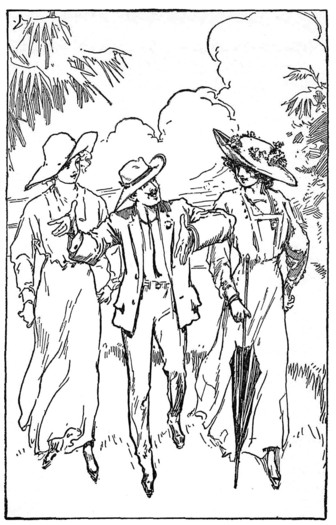
The entire party started down the avenue of
palms toward the ocean.
The “Automobile Girls” were thrilled with
the beauty of the great stretch of blue water.
Marian De Lancey Smythe, too, had a soul
56
stirring within her. It had been choked by the
false principles and ostentations that her
mother had taught her. But Marian was not
a stupid girl. Her wits had been sharpened
by years of managing and deceit. She had the
sense to see the difference between herself and
the four sweet, unaffected “Automobile Girls,”
and she knew the difference was in their favor.
Under her fashionable exterior a really simple
heart beat in Marian’s bosom, and she was
filled with a wild desire to shake off her mother’s
despotic rule, and for once let her real self come
to the surface. As she strolled moodily along
beside Barbara she reflected bitterly that while
others had been given all, she had received
nothing.
She contrasted the hand to mouth existence
that she and her mother led with the full, cheerful
life of the “Automobile Girls,” and a wave
of shame swept over her at the deceptions and
subterfuges that were second nature to her
mother, which she felt reasonably certain that
no really honest person would practise. Her
life was a sham and a mockery, and behind it
was the ever present fear that her mother would
some day overstep all bounds, and do something
to bring the crushing weight of the law
down upon them. There were so many things
that Marian did not understand. Her mother
57
never said more about her affairs than was absolutely
necessary. She only knew that they
were always poor, always struggling to appear
to be that which they were not. She had been
commanded to dissemble, to lie, to do without
a murmur, whatever her mother asked of her,
and her better self sometimes rose in a revolt
against her mother, that was almost hatred.
As she walked gloomily along wrapped in her
own bitter reflections, she sighed deeply. Bab
who was walking with her glanced quickly at
Marian, then with one of her swift impulses,
she put out her hand and clasped that of the
other girl.
“Are you unhappy, Marian?” she asked.
“No,” replied Marian. But her emotions got
the better of her and she choked back her sobs
with an angry gulp. Then feeling the pressure
of Bab’s sympathetic hand she said
brokenly, “I mean, yes. At least, I don’t know
exactly what is the matter with me. I think
I am homesick—homesick for the things I have
never had, and never expect to have.”
“I’m sorry,” said Bab, still holding Marian’s
hand, yet looking away, so she should not see
Marian’s rebellious tears. “But why do you
think you won’t have the things you want? If
you keep on wishing for a thing the wish is sure
to come true some day.”
58
Marian’s set face softened at these words.
“Do you really think that?” she asked. “Do
you suppose that things will ever be any different
for me? Oh, if you only knew how I hate
all this miserable pretense.”
“Why, Marian!” exclaimed Bab. “What is
the matter? I had no idea you were so unhappy.”
“Of course you hadn’t,” replied Marian.
“Because I never dare let any one know my real
feelings. I never have hated my life as I do
since I have known you girls. You are just
girls. That’s the beauty of it, and you have
folks who love you and want you to stay girls
and not ape grown up people all the time. I’d
like to wear my hair in one braid, and run and
romp and have a good time generally. Look at
me. I look as though I were twenty-two at
least, and I’m only seventeen. I have to wear
my hair on top of my head and pretend to be
something remarkable when I want to be just
a plain every day girl. It’s intolerable. I won’t
stand it any longer. I don’t see why I was ever
born.”
“Poor Marian,” soothed Bab. “Don’t feel
so badly. It will all come right some day. Let
me be your friend. I believe I understand just
how you feel. Perhaps your mother may——”
“Don’t speak of my mother!” ejaculated the
59
girl passionately. “Sometimes I hate her. Do
you know, Barbara, I often wonder if she is
really my mother. Away back in my mind
there is the memory of another face. I don’t
know whether I have only dreamed it, or where
it came from, but I like to think of that sweet
face as belonging to my mother.”
Bab looked at Marian in a rather startled
way. What a strange girl she was, to be sure.
Suppose Mrs. De Lancey Smythe were not her
mother. Suppose that Marian had been stolen
when a baby. Bab’s active brain immediately
began to spin a web of circumstances about
Marian Smythe.
“Marian,” she began. But she never finished
for just then a piercing cry rang out.
Nursemaids with children began running
along the sands. Another nurse had run out
into the water. She was wildly waving her arms
and pointing to a small object well out on the
waves. Barbara saw it for just an instant.
Then it disappeared. She and Marian both
recognized what it was. A child’s curly head
had risen to the surface of the water, and then
had sunk out of sight.
Quick as a flash Barbara kicked off her white
canvas pumps and threw hat and linen coat on
the ground.
Extending her hands before her, she ran out
60
into the water. Marian ran blindly after her.
The Count de Sonde was the only man near
that part of the beach. He was behaving in a
most remarkable manner. Entirely forgetful of
the blood of scores of noble ancestors that ran
in his veins, he had taken to his heels and his
small figure was seen flying up the beach away
from the water.
However, Bab was not thinking of aid. She
made straight for the little head, which rose for
the second time above the waves.
When Barbara reached the spot where she
had last seen the child’s head she dived beneath
the surface of the water.
Marian thought that Barbara, too, had lost
her life. She began wringing her hands and
calling for help. In her excitement she had
waded to her neck in the water and was clinging
to the life rope. She did not know how to
swim, but she had a wild idea that she ought to
follow in Barbara’s lead, and now she clung to
the rope and anxiously watched Barbara’s
movements. Bab in the meantime, had dived
into deep water and was groping blindly for
the little figure. At last she seized the child by
the arm and with lungs bursting rose to the
top of the water, when suddenly she was struck
a fearful and unlooked for blow. She had not
reckoned with the life line and with the little
61
fellow in her arms had come in violent contact
with it. She reeled and would have gone under
but a hand grasped her firmly by the arm and
pulled her from under the treacherous rope.
She had just sense enough to hand the child
over to Marian Smythe and seize the rope herself.
Then she filled her exhausted lungs with
the fresh air.
On the shore Grace and Mollie were running
up and down the sands imploring some one to
save Bab. Ruth wished to rush out into the
water. But she knew she could not reach the
two exhausted girls.
As for the Count de Sonde, he was nowhere
to be seen, while Maud Warren stood on the
shore helplessly wringing her hands.
In a short time the beach was crowded with
people. Marian and Bab had brought the little
boy in to his nurse. The hotel physician
soon took the nurse and the baby both away,
and the crowd followed them.
Bab flung herself down in the warm sand.
Mollie, Ruth and Grace hung over her anxiously.
“I’ll just rest here a moment,” Bab said
faintly. “I want to get my breath. But do see
to Marian. She is a brave girl. She saved my
life. I struck against the life rope, and would
have gone under with the little boy had she not
caught my arm and held me up.”
62
“You dear, dear girl,” said Mollie with a half
sob. “How splendid of you!”
Then the three girls surrounded Marian and
hugged her until they were almost as wet as she
was.
“I didn’t do anything remarkable,” she
averred, almost shyly. “I went into the water
after Barbara before I realized what I was
doing. I just had to catch hold of her arm, because
I saw that she was going under. You
girls are perfectly sweet to me and I am happier
to-day than I’ve ever been before.”
“Marian,” called the cold tones of her
mother. “Go up to the hotel at once and change
your clothing. Your appearance is disgraceful.”
Mrs. De Lancey Smythe stalked majestically
over to the little group, frowning her displeasure.
“Whatever possessed you and Miss
Thurston to rush madly into the water after a
child you never saw before?” she said to
Marian, whose happy face had darkened at her
mother’s first word. “Really, Marian, dear,
you are at times past understanding.”
“Mrs. Smythe,” said Barbara coldly. “We
could never have been so heartless as to stand
on the shore and wait for some one else to rescue
that little child. I felt it my duty to make
some effort and I am sure that Marian did.”
63
“Really, Miss Thurston,” retorted Mrs.
Smythe, “I addressed my remark to Marian.”
“Yes,” said Bab, her eyes flashing, “but you
included me in it, therefore I felt justified in
answering it.”
For a moment there was a tense silence. Bab
stood looking composedly into the angry eyes
of Mrs. De Lancey Smythe. Then Ruth said,
with superb indifference. “Oh, come on, girls,
don’t waste your whole morning, here. Bab,
you’ll catch cold. Hurry right up to the hotel
with Marian. Good-bye, Marian, we’ll see you
later.”
Utterly ignoring Mrs. Smythe, Ruth turned
on her heel and accompanied by Grace and
Mollie continued the stroll along the beach.
“My I’d hate to meet Mrs. De Lancey Smythe
alone on a dark night,” remarked Mollie, with
a giggle. “Didn’t she look ready to scratch
Bab’s eyes out, though.”
“She found her match in Mistress Barbara,”
observed Grace. “She can’t intimidate our
Bab.”
Bab hurried along the beach toward the hotel
full of sympathy for the luckless Marian, and
vowing within herself to be a true friend to the
girl who had been cheated of her girlhood.
64
CHAPTER VI
THE COUNTESS SOPHIA
To be at luncheon with a real countess?
What bliss!
Not one of the “Automobile Girls”
doubted, for an instant, the genuineness of the
Countess Sophia von Stolberg. Mrs. De Lancey
Smythe’s calumnies carried no weight with the
“Automobile Girls.”
To-day the countess was more gentle, more
beautiful than she had seemed at first. And
there was less formality in her manner.
Mollie, who sat at her left at the luncheon
table, quite lost the feeling of awe that had
taken possession of her the afternoon before.
Opposite the countess, at the other end of
the table, sat the formidable Madame de Villiers,
the old lady with the hooked nose and the
bird-like eyes. She, too, seemed to feel more
amiable, for she watched her young guests with
an amused smile.
“Do you know what I believe Madame de
Villiers was thinking all the time we were at
luncheon?” Ruth asked her friends, when they
were discussing their visit the following day.
“The amused look on her face seemed to say:
65
‘This is just another of the countess’s pranks,
asking these strangers to luncheon. But if they
amuse her—why not!’”
Madame de Villiers, however, found Miss Sallie
Stuart much to her liking. Perhaps this was
because Miss Sallie was not in the least afraid
of her, nor inclined to shrink from her, as so
many people did.
The story of the morning’s adventure had
been told. The countess leaned admiringly over
the great bunch of yellow daffodils in the centre
of the table and smiled at Bab. Barbara’s
brown curls were still damp from their recent
wetting. “Were there no men on that part of
the beach when the baby was drowning? Why
did you have to risk your life in that way?” the
countess asked.
“There were no men near,” Ruth replied.
“You see, it was very early in the morning.
Only the nurse girls and children were abroad.”
“There was one man present!” exclaimed
Mollie, with a spark of anger in her usually
gentle blue eyes. “But he was a coward and
ran away.”
“The Count de Sonde! Oh, yes,” continued
Ruth, “I had forgotten him.”
The countess look startled.
“The Count de Sonde!” she repeated in a
puzzled fashion. “He refused to help? He ran
66
away?” An expression of incredulity crossed
her face.
“He most certainly did run,” Mollie declared
firmly. “I almost fell on my knees to beg him
to save Bab. But he did not even take time to
refuse me. He simply ran away, so as to live to
fight another day, I suppose.”
“The Count de Sonde!” the young countess
returned. “Ah, yes, he is the young Frenchman
who was here yesterday. Then he is not
a friend of yours?”
“Certainly not, Countess Sophia,” explained
Mr. Stuart. “The young man is only a chance
acquaintance, whom my friend Mr. Warren
rescued from a difficulty yesterday.”
“I, also, am but a chance acquaintance,”
smiled the young countess.
“Only you were the rescuer, and he was the
rescued!” exclaimed Mollie quickly, looking
fondly at her pretty hostess, who pressed her
hand under the table.
“We are not in the least interested in the
count,” Ruth remarked bluntly. “We are civil
to him because we are trying to help some one.”
The countess looked puzzled.
Mr. Stuart laughed. “My dear Countess,”
he explained, “the ‘Automobile Girls’ are not
exactly Knights of the Round Table, but they
have a kind of league of their own. I think
67
they have formed a sort of Helping Hand Society.
They have a pretty good theory that
there is no reason why boys should enjoy all
the adventures and thrilling experiences. If
there is anything to be done, why, do it! Isn’t
that the motto, girls? I think the countess
would be amazed if she knew what you have
been through in the way of adventure. Now,
they have undertaken to look after a misguided
maiden. And I think they are rather piling on
the horrors in her case.”
“Now, Father, you’ve no right to tease,” protested
Ruth. “You are the very person who
made us promise to stand by Maud Warren
through thick and thin.”
“So I did,” agreed Mr. Stuart. “But I had
no romantic notions that Maud was to be protected
from the Count de Sonde. I only consented
to have you persuade Maud from certain
undesirable associates by showing her how
much more desirable you are. Now, I plainly
see the object of your protective association has
changed.”
“Now, Father, you are teasing,” exclaimed
his daughter.
“How can you accuse me of any such thing?”
replied Mr. Stuart, his eyes twinkling.
“He always teases,” Ruth explained to the
countess and Madame de Villiers. “It’s
68
second nature to him. He can’t help it. But putting
aside all jesting, I am going to speak very
plainly about several things. I am sorry to be
obliged to backbite, but really and truly we
don’t like Mrs. De Lancey Smythe. She is the
most disagreeable person we know, and we are
going to try gradually to wean Maud Warren
from her. Maud thinks that she is wonderful
and a great society leader, but I think if one
made careful inquiry into the matter, one would
find her name among those missing from the
social world.”
“Ruth, my dear,” expostulated Miss Stuart.
“You are entirely too impetuous!”
“Do allow her to go on, Miss Stuart,” begged
Madame de Villiers. “She is one after my own
heart. It is refreshing to find some one who is
not afraid to speak plainly.”
“Well,” continued Ruth, highly elated at receiving
the approbation of the stern old woman.
“We are going to checkmate Mrs. D. L. S. at
her own game. She is trying to throw Maud
in line with her own schemes. Enter the ‘Automobile
Girls.’ Exit the enemy. The first
battle was fought on the beach this morning,
and the situation was strongly defended to the
last word by General Barbara Thurston.”
“What do you mean, Ruth?” interrupted her
father gravely.
69
Then Ruth launched forth with the account
of Mrs. De Lancey Smythe’s rudeness to Bab
and Bab’s reply. “Marian is all right,” concluded
Ruth, “but her mother is an entirely
different proposition.”
“So it would seem,” murmured the countess
thoughtfully. “But suppose the count is really
an eligible person, and has fallen in love, in
earnest with Miss Warren, and suppose that
Miss Warren truly loves him, what then? Would
Mr. Warren still be opposed to the marriage?”
“I don’t know,” replied Ruth doubtfully.
“But you see Maud is a girl, and Mr. Warren
feels that she is too young to know her own
mind. He is afraid that the count’s title has
dazzled her, and he does not like foreigners. He
thinks we may be able to disabuse Maud of
some of her sentimental ideas. Last night we
four girls organized a secret society for the
suppression of fortune hunters, and we thought
perhaps you might help us——”
“Ruth, my dear child!” protested Miss Sallie
greatly shocked.
But old Madame de Villiers’ eyes gleamed
with amusement.
“Indeed, I shall be most happy to become a
member of your secret society,” rejoined the
countess. “How exciting! It must be a real
secret society, if we are to be serious. Let me
70
see? We should arrange signals and plan a
campaign. If I am right, Miss Maud Warren
needs to be treated very delicately and carefully,
or she is likely to rebel. Is this not so?”
“That is just what we agreed last night,”
Ruth confessed.
“But how are we going to prove that Count de
Sonde is a fortune-hunter?” argued Mollie.
“For all we know, he may be immensely rich
as well as illustrious.”
“Oh, we shall have to prove that the count is
not really in love with Mademoiselle Warren,”
answered the countess, pinching Mollie’s cheek.
She was entering into their little game with a
curious zest.
“Or you might prove that he is not a count,”
interposed Madame de Villiers, with an inscrutable
expression on her grim old face.
“Do you believe that he is an impostor,
Madame de Villiers?” inquired Miss Sallie.
For a brief instant the countess’s eyes met
those of Madame de Villiers.
The old lady shrugged her shoulders and
lifted her eyebrows in answer to Miss Sallie’s
question: “The world is so full of impostors,
and Europe so full of counts,” she said.
The countess blushed hotly. There was an
awkward silence.
Miss Sallie was sorry she had spoken. But
71
why should such an idle question cause annoyance?
The young count was surely a stranger
to her two hostesses. There was nothing to indicate
that the young man was in earnest about
Maud Warren. He had simply paid her casual
attentions for the past few days.
“Shall you and I become members of this
secret society, Madame de Villiers?” inquired
Miss Stuart, to divert the conversation. “I
suppose we had better be content with the posts
of confidential agents. Because I assure you
there is no limit to what this society may do.”
“And I should prefer to be scout, guardsman,
or messenger,” agreed Mr. Stuart. “I,
too, shrink from being an active member of such
a vigorous organization.”
“Then let us leave these faithless people behind,
girls,” proposed the young countess.
“Let us run away to the old boathouse and plan
our campaign. We are not sure that we may
safely confide to you our secret signals, our
hand clasps and our code,” she protested to
the older people.
Madame de Villiers now led the way into the
drawing room.
But the young countess ran lightly out of the
house, followed by her four girl guests. “We’ll
arrange our secrets while our elders take their
coffee on the balcony,” she suggested.
72
When the countess and the “Automobile
Girls” had disappeared, Madame de Villiers
smiled a little apologetically at Miss Stuart and
her brother. “The countess is only a girl herself,”
she explained. “Of course, she is several
years older than your girls. Yet, in many
ways, she is still simply a child.”
“She is very beautiful and charming,” replied
Miss Sallie cordially. “You see how she
has fascinated our girls.”
“So she does everyone,” replied Madame de
Villiers, shaking her head somewhat sadly.
In the meantime the five conspirators were
absorbed in devising their signals. They were
only joking, of course. Yet, somehow, the
young countess entered so seriously into their
make-believe that the girls almost forgot they
were not in earnest. One thing they conscientiously
agreed upon—Maud Warren was to be
constantly invited to share their pleasures with,
or without, her objectionable friends.
“Must the Count de Sonde be permitted always
to come along with us and Maud?” Grace
queried. She had been taking little part in the
conversation, for she had been industriously
writing down a list of signals for their new organization.
“We must have him, if Maud won’t come
without him,” replied Ruth. “Maud must be
73
won over to our side by flattering attentions.
Suppose we start out being friends with her, by
having another luncheon at our hotel. Will
you come, Countess?”
The countess shook her head gently. “I am
sorry,” she replied a little soberly. “I—” she
hesitated a moment. “I fear you will think
me rude. But I have made it a rule never to
appear at the hotels. I will do anything else.
Suppose we give a picnic? Is not that what
you call it in English?”
“A picnic would be delightful,” agreed Ruth
politely. But she could not help wondering why
the countess was not willing “to appear,” as
she expressed it, at the hotels.
“The signals are ready!” cried Grace.
“There are two handshakes. The one which denotes
danger is like this: Press the forefinger
of one hand into the palm of the other person’s
hand when you shake hands.”
“That is very clever!” exclaimed the countess.
She clasped Mollie’s little hand. “Now,
Mademoiselle Mollie, when you feel my finger
press your palm like this, you will know that
I am greatly in need of your help.”
“A white ribbon bow worn on the left
shoulder, means that a secret meeting must be
called at once!” Grace declaimed.
“And a blue ribbon bow, worn instead of a
74
white one, proclaims: ‘I have important information
to communicate,’” added the Countess
Sophia. “But I should have a special signal
by which to summon you. Let me see. I
must be able to signal you from a distance. If
I fasten a red flag to one of these posts in the
day time you must know that I want to see you
very much.”
“But what about a night signal?” asked
Grace, who was taking the signals very seriously.
The countess laughed. “If ever you should
happen to see a bright light shining in the tower
of my villa, come to me at once. I shall be in
great danger. Now, is not that exciting?” she
cried, clasping her hands and smiling at the little
company.
At this moment there came a sound of oars
dipping in the water. A boat glided from
under the pavilion, which was built out over the
water. The boat must have been hugging the
shore until it reached the boathouse. Then it
made for the open water. In the boat was one
man. And immediately the countess and the
four “Automobile Girls” recognized him. He
was the Frenchman, Monsier Duval!
“I wonder if he has been eavesdropping?”
asked Ruth indignantly.
“Oh well, he has heard nothing but
75
make-believe,” the countess replied lightly, as she led
her guests back to the villa.
CHAPTER VII
TEA IN THE COCOANUT GROVE
Their beloved red automobile, companion
in so many adventures and faithful
friend in time of need, did not accompany
the “Automobile Girls” to Palm
Beach. But Mr. Stuart engaged another larger
motor car with a chauffeur to run it, as soon as
he arrived at the famous southern resort. He
preferred Ruth to have a chauffeur at her command
in case she needed him.
There was room in the new automobile for
ten persons, and Mr. Stuart, Miss Sallie, the
four “Automobile Girls,” the Countess Sophia
and Madame de Villiers seated themselves in
its cavernous depths. Then the car spun out
along the famous Shell Road, lined on each side
with the tall, delicate yucca plants. A fragrant
southern breeze fanned the faces of the happy
party. The sunlight was dazzling, the sky a
deep blue. All about were masses of tropical
vegetation that glittered in the sunshine.
“This place is truly heavenly,” exclaimed
the Countess Sophia von Stolberg. She leaned
76
back in the automobile and closed her eyes.
“How could one help being happy, surrounded
by all this beauty? I am indeed very happy to-day.
Are you not happy, Cousine?” she murmured,
taking Madame de Villiers’s hand and
looking at her with a tender, loving expression.
The older woman’s stern face softened.
“Very happy, my dear,” she declared. “This
is not a place to remember one’s troubles.”
The countess’s face clouded at the word
“troubles.” She began to say something in
German, but checked herself. She was far too
well-bred to speak any language but English
before her new friends.
“Yes; this is a small sized heaven,” agreed
Bab. “A kind of oasis in a desert, for over
there are the Everglades.”
“And what are the Everglades?” inquired
the countess.
“The guide-book says they are trackless
jungle,” explained Bab. “They are full of wild
animals; wild cats, and panthers, and deer.
They have poisonous snakes in them, too.
Very few white men ever venture in the Everglades,
but the Indians have trails through
them. They often kill deer in the jungle and
sell them at the hotel.”
“It would not be pleasant to be lost in such
a place,” suggested Mollie. She was thinking
77
of her own experience when she was lost in the
forest in the Berkshire Hills.
“And it would not be easy to find you in the
Everglades either, little sister,” rejoined Bab.
“So please beware! Never go into the Everglades
alone.”
“Oh, don’t worry,” laughed Mollie. “Being
lost once was enough for me.”
“If you ever do disappear, Mademoiselle
Mollie, the secret society will never rest until
it finds you. We must be very faithful to each
other, dear fellow members?” laughed the
countess.
“I am sure we agree to that,” declared Ruth.
Walking along the road ahead of them, Barbara
espied two figures.
“Do you know,” she demanded, “I believe
those two people just in front of us are Maud
Warren and her count.”
It really was Maud loitering along the road
accompanied by the count.
“Stop our car, Robert,” ordered Miss Sallie.
Maud explained that her motor car had
broken down some distance up the road. She
and the count had decided to walk on. They
hoped to be picked up by friends.
“Do you mean you were out motoring alone
with the Count de Sonde?” inquired Miss Stuart
severely.
78
“Why not?” answered Maud, looking insolently
at Miss Sallie.
“Ah it is in this free America that one needs
no chaperons,” said Madame de Villiers innocently,
but with a gleam of mischief in her eyes.
Maud made no reply. Two angry spots
glowed in her cheeks.
The countess now made up her mind to intercede.
She did not wish Maud to fly into a rage.
“I have had a visit from your friends, the
‘Automobile Girls’, Miss Warren,” she said
graciously. “Perhaps you will join them when
they come to see me again.”
Maud favored the countess with a chilly stare.
Could it be that Mrs. De Lancey Smythe had
been whispering tales about the countess in
Maud’s ears? And had this stupid girl believed
what she had heard? Ruth felt her heart
thump with the embarrassment of the situation.
What was Maud going to say? Strangely
enough Madame de Villiers’ face held the same
look of fear that Ruth’s did. Why should
Madame de Villiers look frightened instead of
angry?
But Maud never uttered the insult her lips
were trying to frame. Spoiled and undisciplined
child that she was, when she turned her
sneering face toward the countess the words
suddenly failed her. For the first time Maud
79
felt that money, after all, counted for little.
There was something about this plainly dressed
woman that suddenly made her feel mean and
ashamed. Maud looked deep into the countess’s
beautiful eyes, then answered with unaccustomed
meekness. “Thank you so much. I
should like to come to see you.”
In the meantime naughty Mollie was taking
a slight revenge upon the count.
“You are quite athletic, are you not?” she
asked him innocently, her baby blue eyes fastened
on his.
“I, athletic?” exclaimed the little count in
surprise. “Not very, Mademoiselle. Why do
you ask?”
“Because you run so well,” Mollie answered,
with a far-away look.
“You refer to this morning, I perceive,
Mademoiselle,” expostulated the count. “I do
not swim; therefore I ran for help. But there
was no danger. Your sister was never in deep
water. Yet it was a most effective scene.
Doubtless the young lady will enjoy being a
heroine.”
Mollie flushed. “Barbara would have been
in danger if Marian had not helped to pull her
and the child out of the water. And, by the
way, Marian does not swim either.”
“Ah, Mademoiselle Marian? I saw her
80
later,” laughed the count. “How droll was
her appearance and that of your sister also.”
Mollie heartily disgusted with the little count
turned her back on him.
“Get into the motor car, both of you,” ordered
Miss Sallie firmly.
A few minutes later their automobile reached
the entrance to the cocoanut grove.
“Papa, let us stop here and have tea?” asked
Ruth.
“A good idea, Ruth,” agreed Mr. Stuart, giving
the chauffeur the order.
“I am very sorry,” interrupted the countess.
“But I fear I cannot stop this afternoon.”
“Oh, please do, Countess!” urged Ruth and
her friends. Even Maud’s voice was heard to
join in the general chorus.
The countess hesitated. She looked at Madame
de Villiers with questioning eyes. It was
evident that the young countess also yearned
for the pleasure of drinking tea under the
cocoanut trees. Madame de Villiers shrugged
her shoulders. She said something softly, so
that no one else could hear. The countess
dropped her white chiffon veil down over her
face.
“After all, I cannot resist your invitation,
Mr. Stuart,” the young woman agreed. “But
may I ask you not to stay long?”
81
Presently Mr. Stuart’s party was seated
around a large, rustic table in the beautiful
cocoanut grove. Hundreds of other people,
clad in white and light clothes, were seated
at other tables. In the distance a band played.
During the intermissions the listeners could
hear the twittering and singing of multitudes
of birds, which also sojourn for the winter at
Palm Beach.
The countess was the object of many glances
from the people near her, although she had not
lifted the heavy chiffon veil from her face. She
was a woman of rarely beautiful presence.
There was something regal in the set of her
small head on her graceful shoulders. Her
gown and hat were extremely plain and she
wore no jewels; but an atmosphere surrounded
the lovely countess like an aura of sunlight,
Ruth thought. She was very gentle and sweet,
though there was something about her that suggested
she could be equally stern if the situation
required it. Ruth hoped never to incur
her displeasure.
When tea was served the countess was obliged
to throw back her veil.
Madame de Villiers looked at her disapprovingly.
Then the old woman cast hurried glances
about her, but was apparently satisfied.
As for the young countess, she took in a deep
82
breath of the warm, soft air laden with the scent
of the orange blossoms. She let her eyes
wander over the grove and smiled as a burst of
music floated across to her.
“I am fascinated, enchanted!” she exclaimed.
“Mr. Stuart, I thank you for the pleasure of
this afternoon.”
There was always a slight formality in the
young countess’s manner which kept people at
a distance.
“Do not thank me, Countess,” protested Mr.
Stuart. “You and Madame de Villiers are conferring
an honor upon us.”
“Madame de Villiers and I are two lonely
women,” continued the countess. “We have
not seen the beauties of this place, except from
our piazza. How exquisite this grove is!
Truly, it is like paradise.”
Again the young woman’s gaze swept the tea
garden. Suddenly her face turned white. She
bit her lips, and sat as if turned to stone. Her
eyes were fastened on a group of three men at
a nearby table. Madame de Villiers had not
noticed them. The men had not yet noticed
the Stuart’s guests.
The countess dropped her veil quickly. Ruth
and Mollie, sitting on each side of the countess,
were the only members of the party who felt
that something had happened, and they were
83
wise enough to be absolutely silent. Only the
girls’ eyes followed the direction of the countess’s.
They, too, saw the three men, one of
whom they recognized as Mr. Duval. The other
two were strangers, foreign-looking men with
waxed mustaches and light hair.
All at once Mollie felt her hand seized convulsively
under cover of the table. But the little
girl was not prepared for the special mark
of confidence that the countess was now to bestow
on her. As Mollie held the countess’s
hand in her own, she felt a tap, tap in the centre
of her palm. Like a flash Mollie remembered.
The countess had given her the danger
signal they had agreed upon the day before.
Mollie looked quickly over at Maud Warren.
She presumed the signal indicated that there
was something the matter with Maud. But
Maud was sitting quietly between Barbara and
Grace Carter.
Then what could the countess mean? Could
she be jesting? Mollie did not think so.
Through the meshes of her white veil the face
of the countess looked out very white and
grave.
Mollie’s heart was beating fast. What could
she say? What must she do? Of one thing
she now felt sure. The beautiful Countess
Sophia von Stolberg was threatened with
84
trouble. She should have all the aid that the
“Automobile Girls” could give.
“I understand,” Mollie now whispered back
to her in a low voice. “What shall I do?”
“I must leave the tea garden at once,” replied
the countess quietly. “But I do not wish
to be observed. Madame de Villiers must go
with me, but I do not wish the party to break
up. That would make us conspicuous.”
“Ruth and I will go with you. Don’t be worried;
we will go quietly. Wait, I must speak to
her.”
“Ruth,” Mollie spoke softly to her friend.
“The countess wishes to go home without disturbing
any one else. Shall we slip out with
her, and see her home?”
“Why, of course,” answered Ruth politely,
although she was somewhat mystified.
They were about to arise quietly from the
table when they were interrupted. A waiter
handed a note to Mr. Stuart. Mr. Stuart read it.
His face turned very red.
Now, if there was one thing in particular that
Robert Stuart loathed it was an anonymous letter.
The message he had just received was not
signed, and it read:
“Beware of the countess. She is an impostor.”
Mr. Stuart crushed the paper in his hand.
85
“Mr. Stuart,” said the low voice of the countess,
just at this moment, “forgive my leaving
so soon. But I must go at once. Mollie and
Ruth are coming with me.” As the countess
rose from her chair she glanced hastily at the
three men at the table near them. These men
had also risen. But they were not looking at
the countess.
The young woman started hurriedly toward
the gate. Madame de Villiers quickly followed
her. So did Ruth, Mollie and Mr. Stuart.
“Please wait here until we come back for
you,” Ruth said to her aunt.
Monsieur Duval had now crossed the space
intervening between the two tables. He had
seated himself next to Miss Sallie. The other two
foreigners were moving toward the gate.
Ruth hurried on. She gave her order to the
chauffeur. The man was soon cranking up the
machine. The four women had taken their
seats in the motor car. At this moment one of
the strangers approached Mr. Stuart. The
other took off his hat and bowed low to the
countess. He spoke to her in German, but her
reply was given in English. It was very plain.
“I do not know you,” she said.
The man spoke again. This time his manner
was insolent. Madame de Villiers’s face grew
dark with rage.
86
“Hurry!” called Ruth to her chauffeur. Mr.
Stuart sprang into the automobile.
The machine sped on leaving the two strangers
standing alone in the road.
“Do not worry, Cousine,” the countess murmured
in the course of their ride. “The man
who spoke to me made a mistake. You will
frighten our friends if you are so angry.”
Madame de Villiers said nothing. But there
was fire in her small shining black eyes. Her
beaked nose looked as though it might peck at
the next offender.
Mr. Stuart and the two girls left the countess
and her companion at their villa. The two
women were now composed. Indeed, the countess
made Ruth and Mollie promise that the “Automobile
Girls” would come to see her again
the next day.
Mollie and Ruth could not help puzzling over
the countess as they rode back to the cocoanut
grove. Mr. Stuart kept his own counsel.
“I am certain there is some mystery about
the countess,” Ruth avowed. “But, whatever
the mystery is, the ‘Automobile Girls’ are on
her side!”
87
CHAPTER VIII
THE WARNING
In the meantime Mr. Duval was making himself
exceedingly entertaining to Miss Sallie,
Grace and Barbara in the tea garden.
Maud and the Count de Sonde had withdrawn
to a seat near the music, and were engrossed in
a tête–à–tête.
Mr. Duval had traveled widely. He told his
little audience about Chinese and Japanese tea
gardens. He told tales of many lands and gave
accounts of numerous adventures in which he
had participated.
Barbara and Grace listened fascinated. They
hardly knew how the time passed. At last Mr.
Stuart came back with Ruth and Mollie. Mr.
Warren and Mrs. De Lancey Smythe had joined
them, without Marian. Mr. Warren was looking
for Maud. But Bab wondered how poor
Marian had weathered the storm that must have
broken when Mrs. De Lancey Smythe returned
to the hotel that morning.
“Where is Marian?” Ruth asked the widow
abruptly, looking her straight in the eyes.
Mrs. De Lancey Smythe’s eyes dropped before
Ruth’s clear gaze. She twirled her
88
parasol, looked annoyed then said frigidly: “Marian
has a headache this afternoon.”
“I trust the wetting she got this morning had
nothing to do with it.”
“Marian is an impulsive and reckless girl,”
snapped her mother. “She is entirely too fond
of disregarding all conventions.”
“Has any one seen my daughter?” Mr.
Warren’s deep voice was now heard above the
hum of conversation. Mrs. De Lancey Smythe
joined him and together they strolled over toward
Maud and the count. Mrs. De Lancey
Smythe seized this opportunity to say a few
words in favor of the Count de Sonde, for it
was evident that Mr. Warren had taken a violent
dislike to the young man. Had some one
persuaded the widow to make this appeal, or
was she genuinely attracted by the young
French nobleman?
Mr. Stuart found himself agreeably surprised
by Monsieur Duval. When the sun began
to sink, and the tea drinkers prepared to
return to their hotel, Mr. Duval occupied a seat
in the Stuart automobile. Moreover, when he
said good-bye on the hotel veranda, he carried
with him two invitations. One was to dine with
the Stuart party that very evening, the other,
to go with them the next day on a picnic.
No sooner was Bab out of the automobile
89
than she determined to run up to Marian’s
room. She knew the widow had not yet returned.
Bab found the number of Marian’s
room from the hotel clerk. Then she got in the
elevator and went up to the top floor of the
hotel.
She knocked at a door in the middle of a long
narrow passage, and a faint voice said: “Come
in.”
Bab entered a small bed room situated under
the eaves of the hotel roof. There were three
trunks in the tiny chamber which overlooked a
court yard. The room was very close and hot.
Marian was on the bed. She had cried herself
to sleep. At Bab’s knock she opened her heavy
eyes.
“Why, Barbara!” she exclaimed. “It is awfully
good of you to come up to see me, but
Mama would have three fits if she knew you
had seen this room. I am glad you have come,
because I have something special to tell you.
I——” Poor Marian hesitated and stopped.
Barbara looked at her with questioning eyes.
“I am afraid it is dreadfully disloyal of me
to say another word.” Marian pressed her
hands to her temples. “And I haven’t anything
really definite to tell you. But, oh Barbara,
I have a suspicion that something may
happen soon! Will you remember that I had
90
nothing to do with it, and that I mean to prevent
it if I can?”
Barbara, completely mystified, hardly knew
what to reply.
“Do you mean to warn me, Marian?” she
asked her new friend. “Do you mean that
something is going to happen that may concern
us?”
“No; not exactly,” Marian answered. Then
she made an impetuous movement. “Please
don’t question me,” she begged. “There is a
reason why I dare not answer your questions.
Forget what I have said, if you can. But for
goodness’ sake, don’t mention to Mama that I
have talked with you. I sometimes wonder
what will become of us. Things can’t go on
much longer. There is sure to be a grand
crash. But please go, now, Barbara, Mama
might come in and she would be very angry to
find you here. I will see you to-night.”
Barbara did not meet Mrs. De Lancey
Smythe as she left Marian’s room, but she did
run across her in the evening. The widow was
hurrying through a side corridor in the hotel.
She was wrapped in a long dark cloak, and appeared
to be trying to leave the hotel by stealth.
Bab drew back into one end of the corridor until
the widow had disappeared, then she walked
slowly out on the piazza. Marian’s warning
91
was ringing in her ears. What was it that
Marian had feared might happen, and why did
her mother leave the hotel in that stealthy
mysterious manner?
On the piazza Bab found her own friends enjoying
the beauty of the night. Maud and the
Count de Sonde were talking just outside the
group.
“Do you know what I heard to-day?” remarked
Mr. Stuart. “I understand that there
is a swindler abroad at Palm Beach. A woman
at that.”
“You don’t mean it,” exclaimed Miss Sallie.
“How dreadful!”
“It seems,” continued Mr. Stuart, “that
the detectives have been on the watch for her
for some time, but so far she has been too clever
for them. However, they have traced her to
the Beach, but among the hundreds of tourists
they have lost their clue. They do not despair
of finding her yet, and a strict watch is being
kept. She may be apprehended at any moment.”
“Well, let’s hope she doesn’t attempt to
swindle us,” commented Ruth. “By the way
where is Monsieur Duval? He disappeared
mysteriously the moment dinner was over.”
“He had an engagement, and begged to be excused,”
replied Mr. Stuart. “He said he would
return in a little while.”
92
“Speaking of angels,” remarked Mollie,
“here he comes now.”
“Yes, and he’s towing along our pet aversion
Mrs. D. L. Smythe,” said Grace.
Bab looked toward the approaching pair.
Monsier Duval and Mrs. De Lancey Smythe
not yet aware that they were under the observation
of the Stuart party, were deeply engaged
in conversation.
Barbara, watching closely, saw the Frenchman
glance up, then he quickly dropped his
eyes, and an expression of cautious cunning
flitted over his face. His lips moved, the
widow gave a half frightened look, then her expression
of absorption changed to one of
languid indifference. As the two neared the
steps, from their demeanor, one would have concluded
them to be mere acquaintances.
What was the meaning of it all? Barbara
wondered. And what secret understanding was
there between those two people? Bab’s observant
eye noted that Monsieur Duval carried
over one arm the heavy cloak in which she had
seen the widow wrapped a short time before.
Had Mrs. De Lancey Smythe gone to meet the
Frenchman, and, if so why did she not do so
openly? Suppose Mrs. De Lancey Smythe were
an impostor, with a game to play. Suppose
Mr. Duval were—Barbara sighed impatiently.
93
She was letting her imagination run riot. She
resolved to dismiss the whole tiresome business
from her mind, and enjoy herself.
At that moment Maud Warren came languidly
forward, the little count at her heels. “Miss
Stuart,” she announced, “I have persuaded
Papa to let me give a masked ball before we go
back to New York. There are a number of
smart people here at Palm Beach, and I want the
count to see one of our American balls. We
shall wear our masks until midnight, and then
have a cotillon afterwards.”
“That will be delightful, Maud!” replied
Ruth. “And that reminds me. Father and I
have never arranged about our picnic to-morrow.
Don’t you think it would be fun to motor
over to the big ostrich farm and have our
luncheon there under the trees?”
“Very delightful,” agreed Maud. “Don’t
you think so, Count?”
“I shall be charmed,” replied the little count,
with an exaggerated bow.
“But we shan’t,” whispered Mollie, naughtily
to Barbara, under cover of general conversation.
“In order to cure, we must endure,” returned
Bab in an undertone. Whereupon the sisters
both chuckled softly.
At this juncture Marian appeared at the end
94
of the piazza, and came slowly toward the
group. Her eyes still showed traces of tears,
and she looked ill and wretched.
Mr. Stuart greeted Marian kindly, and immediately
invited her to Ruth’s picnic. And
the invitation, of course, had to include Marian’s
mother. “I am sorry you have been ill,”
he said courteously, interrupting his conversation
with Mr. Duval.
Monsieur Duval’s eyes rested curiously on
Marian. His look searched her face. “Perhaps
the climate of Palm Beach does not agree
with your health,” he suggested. “You do not
like it here?”
“It is not a question of what I like or dislike,
Mr. Duval,” said Marian curtly.
“But what do you prefer?” persisted the
Frenchman with a shade of interest in his manner.
“To mind my own affairs,” returned Marian
coldly, turning her back on Monsieur Duval.
95
CHAPTER IX
A CASE OF MISTAKEN IDENTITY
Early the next afternoon the picnickers
sallied forth in two automobiles,
going first to the villa for the Countess
Sophia and Madame de Villiers, then the
two cars sped along the country road in the direction
of the ostrich farm. Marian, Mollie,
Mrs. De Lancey Smythe, Miss Stuart, Barbara,
Maud and the Count de Sonde were in the foremost
car, while the remainder of the party occupied
the car first rented by Mr. Stuart, with
Ruth as chauffeur.
“Why don’t you start a song?” called Ruth
over her shoulder. “Grace, sing something.
Sing ‘My Old Kentucky Home.’”
Grace sang the plaintive old melody in her
sweet, high soprano voice.
The Countess Sophia was enchanted. “What
a charming song!” she declared. “What an
exquisite melody. I have not heard it before.
Is it not one of your old southern songs?”
“Won’t you sing, Countess?” begged Mr.
Stuart.
The countess shook her head and smiled. “I
do not care to sing alone,” she avowed. “But
96
I am sure Monsieur Duval has the throat of a
singer. Will you not sing a song of your country,
Monsieur?”
“If you will sing a song of your land in return,”
answered the Frenchman quickly. Could
it be that he, too, was curious to discover to a
certainty the Countess Sophia von Stolberg’s
nationality?
The countess dropped her eyes under Mr. Duval’s
steady gaze.
“I do not sing without an accompaniment,
Monsieur,” she said briefly.
Madame de Villiers looked annoyed. Grace
and Ruth wondered why the countess should
be so secretive. She spoke French, German
and English almost equally well. On her library
table Ruth had discovered a number of Italian
books.
Monsieur Duval did not press his request.
The Frenchman had very polished manners. Instead
in a full baritone voice he sang the
“Marseillaise.” His audience was profoundly
stirred. “You are a patriot, Mr. Duval,” Mr.
Stuart remarked.
Monsieur Duval’s expression changed. But
he said nothing. It was impossible to translate
his peculiar look.
“Do sing for us, Countess,” begged Grace
later. “I know you have a wonderful voice.”
97
“Remember, you are to give us a song of
your country,” Mr. Duval persisted.
The countess made no reply to him. But in
a voice clear as a bell she sang:
“Thou art like unto a flower.”
“But that is an English song,” expostulated
Mr. Duval when the countess had finished.
“Yes, but it was written first by a German
poet: Du bist wie eine blume,” sang the countess,
this time in German. “Shall I try it in
French and Italian for you? The little song
has been translated into every tongue.”
It was evident to her listeners that the
Countess Sophia von Stolberg was proficient in
half a dozen languages.
Grace thought she caught a glimpse of concealed
amusement on Madame de Villiers’s face.
But the stately old woman said nothing.
The motor party had now arrived at the
ostrich farm. Mollie, the countess and Bab ran
on ahead. Ruth slipped her arm through Maud
Warren’s. The count joined them, but Ruth
did not withdraw her arm. Maud did not seem
to mind Ruth’s “playing gooseberry.” Maud
was really becoming fond of the “Automobile
Girls.” It was plain, however, that the Count
de Sonde had eyes only for Maud.
98
The Count de Sonde, who wore high heeled
shoes to make him look taller, walked with
the two girls. He talked constantly, using his
hands and shoulders to emphasize his remarks.
“You see, Mademoiselle Maud,” he explained.
“My parents died when I was a mere infant.
Most of my life I have spent in Paris. I do not
often go to the Chateau de Sonde. But I love
dearly the home of my ancestors.”
“How much land have you around your castle,
Count?” asked Ruth.
The count looked annoyed at the question.
“It is a very large estate,” he answered
vaguely.
But Ruth was determined to secure definite
information. “Is your chateau on a hill or in a
valley?” she next inquired.
The count shrugged his shoulders. “It is on
the side of a mountain, overlooking a valley,”
he declared.
The picnic party had now arrived in front of
the cages containing the ostriches. The great
birds were strolling about in fine disdain.
But Ruth’s mind dwelt on the Chateau de
Sonde. She was frankly curious about it.
“Have you ever visited the Count de Sonde at
his chateau, Mr. Duval?” inquired Ruth, who
happened to be standing next the Frenchman.
101
“A number of times, Miss Stuart,” answered
Monsieur Duval. “The count and I are old
friends.”
“Is it built on a mountain or in a valley?”
queried Ruth. She did not know herself exactly
why she repeated her question.
“The Chateau de Sonde nestles in the heart
of a valley,” was Monsieur Duval’s prompt answer.
He caught Ruth’s eyes fixed on him with an
expression of wonder. But it was Ruth, not
Monsieur Duval, who blushed furiously. The
man’s eyes were gray and inscrutable. “Why
do you ask, Mademoiselle?” he inquired.
“I don’t know,” Ruth answered lamely.
The man frightened her. He seemed so brilliant,
so traveled, so strong, so dangerous. And
yet, he had just told Ruth a lie. Why should
he pretend he had visited at the Chateau de
Sonde?
“Come, everybody; it is time for luncheon,”
called Mr. Stuart an hour later, when his
guests had finished their survey of the ostrich
cages.
The “Automobile Girls” opened their immense
lunch basket, which the chauffeur had
set under the trees. The Countess Sophia insisted
on helping the girls. She was all radiant
smiles and gayety. She hummed a song to
herself full of delicious, bird-like trills, in a
102
voice that had been wonderfully trained. In
every way the countess showed what pleasure
she felt in the picnic. So much so that she was
easily the central figure of the party.
Finally the entire company seated themselves
in a circle on the ground, Maud Warren and
her father with flushed faces. They had evidently
been having a private altercation about
the Count de Sonde. The count however looked
serenely unconscious of the fact.
A sense of tranquility and cheerfulness soon
stole over every one. The day was enchanting.
The chicken and nut sandwiches and other eatables
tasted unusually good, and the party did
full justice to the tempting luncheon the Stuarts
had provided.
All the guests laughed and talked at the same
time. Suddenly the countess began to sing
again in a low voice: “Knowest thou the land?”
from “Mignon.”
The others listened with delight.
Down the avenue a vehicle was heard approaching.
There was a cloud of dust enveloping
it. It was impossible for the picnic party
to distinguish the occupants of the carriage.
The countess’s back was turned toward the
equipage. She did not look around. Mollie
and Ruth were glad that she did not turn, for
they recognized the two foreigners who had
103
frightened the young Countess Sophia in the tea
garden the afternoon before.
The men drove up to a palm tree near the
spot where Mr. Stuart’s guests were eating.
They hitched their horse. Then they walked
deliberately over to the picnickers. Without a
word one of the men reached down. He touched
the Countess Sophia von Stolberg on the arm.
Undoubtedly he was German. His face
looked threatening and his manner was insulting.
His companion waited near him. The
Countess Sophia shuddered as the stranger
touched her. She trembled and turned pale like
a frightened child.
“Madame,” said the German, “you are
wanted by the police. We have been sent to
arrest you.”
Mrs. De Lancey Smythe gave a hysterical
laugh of triumph.
But the young countess quickly recovered her
self-control.
“You have made a mistake,” she returned
quietly, to the man, whose hand still rested on
her arm. “What have I done to be arrested?
You have no right to annoy me.”
“You are the notorious swindler wanted by
the police of two continents,” accused the
German. “I am here to take you back to
France where you are wanted.”
104
Madame de Villiers now arose. She lifted her
great mahogany cane, her face dark with anger.
“You will regret this day’s work,” she announced.
“Be gone!”
But she had hardly finished her speech, before
Mr. Stuart was on his feet. He seized the
intruder by the collar, and before the man could
more than raise his hand from the Countess
Sophia’s arm, he was hurled several feet away,
landing in a heap on the ground.
“You foreign idiot,” cried Mr. Stuart, forgetting
his women guests in his anger. “How
dare you come here and create a disturbance
among my friends. You are without a warrant
or a policeman. The Countess Sophia von Stolberg
is our friend. You shall pay dearly for
your insolence. Leave this place without a second’s
delay or I shall lay violent hands on you.”
The two strangers did not dare defy Mr. Stuart.
Mr. Warren had also risen and hurried
to his friend’s aid and the two Americans looked
thoroughly capable of enforcing their commands.
The foreigners went back to their carriage.
After a slight delay they drove off, still muttering
veiled threats.
When they had disappeared down the avenue,
Countess Sophia gave Mr. Stuart her hand.
105
“I thank you, Monsieur,” she said. “Madame
de Villiers and I are alone. It is good to have
a protector. I do not know why those men attempted
to arrest me without a warrant. I assure
you they had not just cause. I believe they
were sent by an enemy.”
“Perhaps, Countess,” replied Mr. Stuart,
“those two men think you are some one else.
I know there is a notorious swindler at large at
Palm Beach. It is probably a case of mistaken
identity.”
The Countess Sophia made no answer. Barbara,
who was watching her closely, saw a look
of unmistakable fear leap into her dark eyes
at the mention of the word “swindler.” Bab
glanced quickly about her and encountered the
eyes of Monsieur Duval. In them was an expression
of cruel triumph that made Bab feel
certain that he was in some way responsible for
the late unpleasant scene.
CHAPTER X
THE SECRET SIGNALS
Ruth was stretched out on a steamer rug
on the warm sands, lazily looking out
over the blue waters.
Barbara was disporting herself in the waves
106
like a water sprite who had dared to show herself
among mortals. Many of the bathers
stopped to watch with admiration the figure
of the young girl plunging gracefully through
the waves.
But Ruth was not watching Barbara. She
was thinking deeply.
Why had the Countess Sophia von Stolberg
refused to prosecute the two foreigners who had
deliberately insulted her?
Immediately after their return from the picnic
Mr. Stuart had written the young countess
a note. He suggested that he have the two
strangers put out of their hotel, even driven
away from Palm Beach. But the countess’s
reply had been polite, but firm. No; she did not
wish to prosecute her annoyers. The men had
simply made a mistake. There would be less
notoriety if she let the matter drop.
Mr. Stuart was not satisfied. He assured the
countess that he and Mr. Warren had sufficient
influence to have the two men sent away without
the least publicity attending their dismissal.
Still the decision of the countess remained unchanged.
She graciously thanked Mr. Stuart
for his kindness, but she really preferred to let
the whole matter drop.
There was nothing more to be said.
Ruth now observed these same two men.
107
They were seated not far from her, watching
Barbara with stolid admiration. So far as
Ruth knew they had not repeated their attempt
to arrest the countess. But they had not confessed
their error, nor offered to apologize
either to Mr. Stuart or to the countess.
The story that there was a notorious woman
swindler at large at Palm Beach was now common
gossip.
“It is absurd to suspect the countess,” Ruth
thought as she reviewed the recent disagreeable
incident. “If the scandal goes any further I
shall side with her, no matter what may be the
consequences.” Ruth ended her reverie by
making this last statement aloud. But she was
sorry a second later.
A voice spoke at her elbow. “Do you think,
Mademoiselle Ruth,” it inquired, “that suspicion
of a certain person will reach a point where
you will be required to take sides?”
Ruth started. She had been in a brown study,
and was embarrassed and annoyed at having
been caught speaking aloud.
The voice belonged to Monsieur Duval. He
had come dripping from his swim in the ocean,
and had laid himself in the sand directly behind
Ruth without her noticing him.
“To what suspicion do you refer, Mr. Duval?”
Ruth asked haughtily. She knew this
108
clever Frenchman could read her mind like an
open book. But she did not intend to confess
that her remark had referred to the young
countess.
Monsieur Duval smiled. “I am afraid I listened
at the door of your thoughts,” he said.
“I think I can guess with whom you intend to
take sides. But I promise not to betray your
secret. I am sorry I overheard your last remark.
Yet I do not see why you think the
Countess Sophia may be accused of being this
notorious woman criminal. It is true she allows
herself to be persecuted without reason.
She will not appear at this, or any other hotel,
and keeps herself as much in seclusion as possible.
Also she will not tell us the country of
her birth, nor does she refer to any friends,
but——” Monsieur Duval stopped.
Ruth was indignant at the array of evidence
that this Monsieur Duval was able to present
against the young countess. She flushed guiltily,
but wisely refrained from answering the
Frenchman.
Mr. Duval was obliged to continue the conversation.
“Do you wish to help your friend?” he asked
Ruth quietly.
“Of course,” Ruth replied warmly.
The Frenchman leaned over. “Then watch
109
everything, but say nothing. And, above all
things, do not have a too accurate memory.”
Ruth was about to make an angry retort,
when Mr. Duval skilfully changed the subject
of their conversation. He praised Bab’s wonderful
diving. It reminded him of Neapolitan
boys he had seen diving for pennies. Mr. Duval
next told Ruth of a walking trip he had
once made through southern Italy. She listened
very much against her will to the entertaining
Frenchman and it was with distinct relief
that she saw Miss Sallie approaching them,
dressed in an imported lavender linen and carrying
a parasol and a book.
Maud and her count appeared from the opposite
direction. They also came forward to join
Ruth and Monsieur Duval. Bab ran up the
beach, shaking the drops of water from her blue
bathing suit, her wet curls sparkling in the sun.
Mr. Duval did not wish to remain with so
large a party. His words had been for Ruth’s
ears alone. As Miss Stuart approached he
bowed ironically to Ruth and strolled away.
“How glad I am that we are not in the cold,
sleet and blizzards of Chicago, child,” Miss
Stuart remarked, bringing Ruth back to earth
again. “The Countess Sophia was right in saying
our American climate in the north is unbearable
in the winter time. I never felt so
110
well in my life as I do in this delightful
place.”
“Aunt Sallie,” asked Ruth thoughtfully, ignoring
the weather, and going back to the idea
that was uppermost in her mind. “Do you
think the Countess Sophia could be in need of
money?”
“How can I tell, child?” replied Miss Sallie.
“The countess dresses plainly, but her gowns
are in excellent taste. They are made by
a modiste in Vienna, who, I happen to know, is
one of the most expensive in Europe. On the
other hand Madame de Villiers and the countess
live very quietly. They keep only two servants.
But the countess has the air of a woman of
wealth and culture.”
“Are we going to dine with the countess to-morrow
night?” asked Ruth impetuously.
“Certainly, child,” Miss Sallie replied, her
serenity undisturbed. “It is true your father
may not have returned from his fishing trip,
but there is no reason why we should not go
without him.”
Ruth closed her eyes. Could it be possible
that they might be invited to eat food paid for
by money gained dishonestly? Surely Monsieur
Duval could not have spoken the truth!
“Here comes that Mrs. De Lancey Smythe,”
remarked Miss Sallie with sudden energy. “I
111
do wish that woman would keep away from
us.”
“Aunt Sallie,” said Ruth, “what do you dislike
most about Mrs. De Lancey Smythe?”
“Don’t ask me, my dear,” returned Miss Stuart
rather impatiently. “Everything I should
say. I must confess that the very sight of her
irritates me.”
“There is something peculiar about her, at
any rate,” said Ruth, “I have seen her face
grow hard as rock and look positively wicked
when she thought no one was noticing her.
Marian is afraid of her, too.”
“Nonsense, Ruth,” replied Miss Sallie severely.
“You and Barbara let your imaginations
have too free rein. I don’t approve of
the woman and dislike her intensely, but I am
not going to make her out an ogre.”
“She is, though,” persisted Ruth. “That’s
why you don’t like her, only you don’t know
it yourself. Some day you’ll see I am right.
Oh, here come Mollie and Grace. What’s new,
chilluns?” and springing to her feet Ruth called
to Bab then hurried toward the approaching
girls.
Mollie and Grace had been out in a boat all
morning with some new friends they had made
at the hotel. As Ruth walked toward them she
noticed that Mollie’s cheeks were very red, and
112
that she wore a look of suppressed excitement.
Grace seemed almost equally agitated. Before
she could reach them, however, she was hailed
by a crowd of young people who were strolling
on the beach, and she and Bab were obliged to
stop and hold conversation.
Mollie felt that it was imperative to summon
Bab and Ruth. How could she manage without
being observed? A sudden thought came
to her. Putting her hand back to her curls she
hastily untied the ribbon that bound them. The
ribbon was blue. In an instant Mollie twisted
it into a bow knot and pinned it on her left
shoulder. Would Barbara and Ruth remember
what the secret signal meant?
Mollie need not have wondered. Hastily
separating themselves from the crowd of talkers
Bab and Ruth sped up the beach to join Mollie
and Grace.
“What is it, Mollie?” cried Bab out of breath.
“I remember the blue ribbon. It was to signify:
‘I have important news to communicate!’
What has happened?”
“As we passed the countess’s villa on the
launch, this morning,” Mollie whispered mysteriously,
“we saw a red flag tied to one of the
posts of her pavilion. The countess wishes to
see us on important business!”
113
CHAPTER XI
WHEELS WITHIN WHEELS
“Shall we go to the countess at once,
Ruth?” asked Barbara.
Ruth hesitated. “The chauffeur has
gone away for the day,” she replied. “And
we have no one to take us by boat to the villa.”
Mollie’s blue eyes filled with tears. She had
feared that Ruth suspected their lovely countess.
Now she was sure of it. How absurd for
Ruth to suggest they could not use the automobile
because her chauffeur was away. The
“Automobile Girls” had traveled for days at
a time, with Ruth as her own chauffeur, while
the trip to the countess’s villa represented only
a few miles.
“How can you be so cruel, Ruth?” Mollie
cried. “You just don’t want to go to the countess’s
aid because you have listened to tales
about her from that horrid Mrs. Smythe.”
“I haven’t listened to Mrs. Smythe, Mollie,”
Ruth answered soothingly. “But I have been
thinking. You can’t deny that there is a good
deal of mystery surrounding the Countess Sophia.
There are many things that it seems to
me she might explain. I don’t wish to be
114
hateful, and of course I can drive our car over to
the countess’s, though I have never taken out
such a big car alone before. Come; let’s get
ready.”
Barbara hesitated. “Mollie,” she protested,
“I don’t think it is right for us to make Ruth
take us to see the countess, if she would rather
not go.”
Mollie bit her lips. “Ruth Stuart,” she said,
“you talk about the countess explaining things.
What have you ever asked her to explain? If
there is anything you want to know about her,
ask her to tell you. It is not fair to keep silent,
and still not to trust her.”
Ruth had a sudden conviction that she would
as soon approach the Queen of England to inquire
into her private affairs as to ask questions
of the Countess Sophia von Stolberg.
“Well, Mollie, I will say this much,” Ruth
conceded. “I never doubt our countess when
I am with her. She is so beautiful and sweet
that I forget to be suspicious. But, when I am
away from her, I have just wondered a little,
that’s all! Now, don’t be cross, Barbara,
but come with me. I am going to get out the
automobile. Grace, will you and Mollie explain
to Aunt Sallie where we are going?”
“I’ll tell you what, Ruth,” Bab suggested.
“Let us make up our minds not to suspect the
115
countess because of any gossip we hear. There
seems to be a great deal of talking going on,
but nobody makes any definite charges. The
countess has been delightful to us. I am afraid
I am on her side as much as Mollie. The
countess, right or wrong, but still the countess!”
“Loyal Bab!” cried Ruth, patting Barbara’s
hand. “See, I cast all my suspicions away!”
Ruth waved her other hand. “The cause of
the countess is my cause also. I shall fight for
her, through thick and thin.” Ruth looked as
though she meant what she said.
The “Automobile Girls” were soon on their
way to the countess’s pretty villa. Mollie still
held herself apart from the other three girls.
She felt that no one of them had risen to the
defence of her adored countess with the ardor
she expected.
Ruth was running the car slowly. It was only
a few miles to the villa. Ruth was a cautious
chauffeur, and was not in the habit of managing
so large an automobile.
As her car moved quietly and steadily toward
its destination, another small automobile
dashed past it. Ruth glanced about quickly.
The man who drove the small car was exceeding
the speed limit. He was alone. He wore a long
dust coat with the collar turned up to
116
his ears; he had a cap pulled low over his face,
and he wore an immense pair of green goggles.
But Ruth’s quick eyes recognized him. Her
three companions paid little attention to the
man.
“Bab,” said Ruth, at almost the same instant
that the small car swept by them, “it is
Monsieur Duval who is driving that car!”
“Well,” replied Bab, “what of it? I did not
know Mr. Duval was a motorist. But I am not
surprised, for he seems to know almost everything.”
“Bab, I think he is on his way to see the
Countess Sophia von Stolberg,” Ruth announced
with conviction.
“He does not know the countess, does he?”
Grace inquired. “I think he was introduced
to her only through us.”
“I don’t know what Monsieur Duval knows
and what he doesn’t know,” explained Ruth.
“But I should like to find out. Anyhow, I am
going to beat him to the countess’s house. If
she has something important to tell us, Monsieur
Duval shall not keep us from hearing it.”
Ruth put on full speed and started her car in
pursuit of the flying automobile in front of her.
In a few seconds she drew near the automobile.
The little car was on the right side of the road
and making its best speed. Ruth sounded her
117
horn. She swerved her great car to the left in
order to pass the smaller one.
Bab uttered a cry of terror. Mollie and
Grace both screamed. Ruth’s face turned
white, but she had no time to scream.
The small motor car just in front of her immense
automobile turned like a flash. It swept
across the road immediately in the path of
Ruth’s on-coming car, and not more than a few
paces ahead of her.
It was either a mad piece of foolishness on
the part of the chauffeur, or a magnificent dare.
At the moment Ruth did not stop to wonder
whether the man ahead of her had deliberately
risked his life and theirs in order to accomplish
some purpose. All her ability as a driver was
needed to meet the situation.
Ruth’s hands never left the steering wheel
of her car. In less than a half second, she put
on the full stop brake. With a terrific wrench
her great automobile settled back. It stopped
just one foot this side of the car that had crossed
their path.
Ruth was white with anger. She saw, a moment
later, that the driver ahead of her had
accomplished his design. For no sooner had
Ruth’s car stopped, than the other motorist
forged ahead. Ruth resumed the chase, but
she was obliged to be careful. She dared not
118
risk the lives of her friends by driving too close
to the other car. The man ahead might repeat
his trick. Ruth could not be sure that she could
always stop her motor in so brief a space of
time and distance.
So the smaller of the two automobiles arrived
first at the countess’s villa.
The Countess Sophia von Stolberg evidently
expecting a visit from the “Automobile Girls,”
sat at her piano in her drawing-room, playing
one of Chopin’s nocturnes. At the sound
of the automobile outside on the avenue the
countess left her music and ran out on her
veranda to meet her young visitors. But instead
of the four girls a heavy, well-built man
in a long dust coat and goggles approached the
countess. The countess did not recognize him
at once. A suave voice soon enlightened her.
“Madame,” it said. “I have come to see you
on an important matter of business. I must see
you alone.”
“What business can you have with me, Monsieur
Duval?” asked the young countess coldly.
But her voice trembled slightly.
“I bring you news of a friend,” declared Mr.
Duval quietly.
“I have no friends whom you could know,
Monsieur,” answered the Countess Sophia.
“No?” her visitor replied, shrugging his
119
shoulders and speaking in a light bantering tone.
“Shall I inform you, then, and your young
friends, whom I now see approaching?”
Ruth’s motor car was now in plain sight. The
four girls rushed forward to join the countess.
At the same moment the tap-tap of a stick
was heard inside the house. Madame de Villiers
appeared, followed by Johann with a tray
of lemonade.
The countess spoke quickly. “No, no, you
must say nothing to me, now. I cannot listen
to you. Please go away.”
Bab noticed that the countess was trembling
when she took her hand.
Monsieur Duval bowed courteously to Ruth.
“Mademoiselle,” he declared, “I owe you an
apology. I fear I am but a poor chauffeur.
My car swerved in front of yours on the road.
It was unpardonable. I offer you many thanks
for your skill. You saved us from a bad
smash-up.”
Ruth colored. Hot words rose to her lips.
But she feared to say too much. She looked
at Mr. Duval gravely. “I think, Mr. Duval,”
she remarked, as suavely as the Frenchman
could have spoken, “it will be wise for you not
to run a motor car unless you learn how to
handle it better. You are right. We were exposed
to great danger from your carelessness.”
120
Madame de Villiers now gazed sternly at
Monsieur Duval. “Have I the pleasure of
your acquaintance?” she inquired coldly, turning
her lorgnette on the Frenchman.
Monsieur Duval lost some of his self-assurance
in the presence of this beak-nosed old
lady. “I met you at Mr. Stuart’s picnic,
Madame,” he explained. “Good-bye, ladies.”
Monsieur Duval bowed low. Then he turned
to the countess. “I will deliver my news to
you, Countess Sophia, whenever you are pleased
to hear it.” A moment later the Frenchman
disappeared. But on his way back to his hotel
he smiled. “If life were not a lottery it would
be too stupid to endure. Yet this is the first
time in my career that a group of young girls
have tried to beat me at my own game.”
When the Frenchman had finally gone the
countess turned to Mollie, and kissed her. Then
she looked affectionately at Bab, Grace and
Ruth.
“You saw my signal, didn’t you?” she asked,
smiling. “What an energetic society to come
to me in such a hurry! I really have something
to tell you. It is something serious. Yet
I must ask you to trust me, if I tell you only
part of a story. I cannot tell you all. As it
is much too beautiful to stay indoors, suppose
we go to my pavilion down by the water.”
121
On the way to the boathouse, Ruth stopped
to embrace Mollie. “Mollie, darling, forgive
me!” she whispered. “I promise you never
to doubt our lovely countess again. She is perfect.”
When the Countess Sophia and the four “Automobile
Girls” were safely in the boathouse,
the young hostess sighed. “I am sorry to talk
about disagreeable things to-day,” she murmured.
“You cannot understand what a pleasure
it is to me to know four such charming
young girls. I have had so few companions in
my life. Indeed I have been lonely, always.”
The “Automobile Girls” were silent. They
hardly knew what to reply.
“I must try to tell you why I sent for you,”
the countess went on. “I want to warn
you——”
“About the Count de Sonde?” cried Mollie,
who had never gotten over her first prejudice.
“Yes,” replied the countess slowly. “I think
I promised to help you save your girl friend
Maud Warren. I am afraid she and the count
are more interested in each other than you girls
imagine.” The countess faltered and looked
fearfully about her. “You must not let Miss
Warren marry the Count de Sonde,” she murmured.
“You must stop such a wedding at all
hazards. The Count de Sonde is——”
122
“Is what?” asked Barbara.
The countess shook her head. Again she
blushed painfully. “I cannot tell you now,”
explained the countess. “But I know this. If
Miss Warren marries the Count de Sonde she
will regret it all her life.”
“But how can we prevent Maud’s marrying
the count if she wishes to do so?” queried
practical Bab. “Unless you can tell us something
definite against the count, we cannot go
to Mr. Warren or Maud. Mr. Warren has already
forbidden Maud to have anything to do
with the Count de Sonde, but Maud continually
disobeys her father.”
“I am sorry,” said the young countess hesitatingly.
“I wish I dared tell you more. But
I can explain nothing. Only I warn you to be
careful.”
“Need we to fear the Frenchman, Monsieur
Duval?” Ruth asked thoughtfully.
The countess was silent for a moment. Then
she said slowly, “You must fear him most of
all!”
123
CHAPTER XII
MAUD REFUSES TO BE RESCUED
When the “Automobile Girls” chaperoned
by Miss Sallie, descended to the
hotel ball room that evening, where
a hop was in progress, the orchestra was playing
the “Blue Danube” and Maud and the
Count de Sonde were waltzing together. The
spectators seated along the wall smiled in spite
of themselves for the count’s style of dancing
was far from graceful. His idea of waltzing
consisted in whirling his partner round and
round, and as Maud was at least four inches
taller than the count and very thin, the effect
was indescribably ridiculous.
“How absurd the count looks!” Bab exclaimed
to Ruth. “Just look at those high
heels and that strutting walk! Do you suppose
Maud Warren can really care for him?”
“No; I don’t think she cares for him at all,”
Ruth returned. “It is the lure of his title that
has fascinated Maud. The title, ‘Count de
Sonde’ is like music in her ears.”
“Do you think Mr. Warren would disinherit
Maud, if she married the count?” asked Bab.
Ruth shook her head. “Mr. Warren gave
124
Maud half a million dollars in her own name
a year ago,” Ruth explained. “So, you see,
she is an heiress already. Besides, Mr. Warren
would never forsake Maud. He simply
adores her. I think he went off on that fishing
trip with father just to keep from seeing Maud
carry on. He thinks Aunt Sallie may be able
to influence her while he is gone. But do look
at Miss Sarah Stuart, Bab!”
Miss Sallie swept down the ball-room floor
in a handsome black satin and jet evening gown,
with Mrs. De Lancey Smythe in her wake.
There was the fire of battle in Miss Stuart’s
eye. On the widow’s cheeks burned two flaming
signals of wrath.
“Maud Warren was left in my care by her
father, Mrs. Smythe,” declared Miss Sallie.
“In Mr. Warren’s absence I forbid Maud’s
going about unchaperoned with the Count de
Sonde.”
“Miss Warren is not a child, Miss Stuart,”
replied Mrs. De Lancey Smythe angrily. “If
she chooses to go about with the count I hardly
see how you can prevent it. The Count de
Sonde is a noble, trustworthy young man.”
“Miss Warren shall not go with him against
my wishes,” replied Miss Stuart quietly, “and
I fail to see how the matter can possibly interest
you.”
125
Mrs. De Lancey Smythe’s voice trembled
with rage. “You appear to be excessively
strict with Miss Warren, Miss Stuart,” she returned,
“yet you allow your niece and her
friends to associate, every day, with a woman
who is entirely unknown to you, a woman about
whom this entire hotel is talking.”
“Whom do you mean?” Miss Sallie demanded.
She was exceedingly angry.
“Mean?” Mrs. De Lancey Smythe laughed
mockingly. “I mean this so called Countess
Sophia von Stolberg. She is no more a countess
than I am. She is a fugitive and a swindler.
She will be arrested as soon as there is
sufficient evidence against her.”
The “Automobile Girls” had moved up close
to Miss Sallie. They waited to hear what she
would say in regard to the countess.
“I do not believe the countess to be an impostor.
She is our friend,” replied Miss Stuart.
“I think we need have no further conversation.
Miss Warren will do as I request.”
Without answering the other woman moved
away with flashing eyes and set lips, leaving
Miss Sallie in triumphant possession of the situation.
In a few moments Maud Warren came over
to where Miss Sallie and the “Automobile
Girls” were still standing.
126
“Maud, won’t you come up to our room to-night
after the dance?” Ruth urged. “We
thought it would be jolly to make some fudge
in a chafing dish.”
“Can you cook?” laughed Maud. “How
funny! It is awfully good of you to ask me to
join you, but I have another engagement for
this evening.”
“Maud,” said Miss Sallie firmly, “your
father left you in my charge. I cannot permit
you to keep an engagement with the Count de
Sonde.”
Maud was speechless with astonishment. No
one had ever forbidden her to do anything in
her life. Her father had always tried persuasion
and argument. Ruth’s eyes twinkled as
she saw the effect Miss Sallie’s firmness had
upon Maud. Greatly to her surprise Maud
Warren answered quite meekly: “Very well,
Miss Stuart. I will not see him if you do not
wish it.”
The “Automobile Girls” breathed a sigh of
relief. They had feared another battle between
Miss Sallie and Maud.
“This is jolly!” exclaimed Maud Warren,
an hour later. The five girls were in Ruth’s
sitting-room. They were eating delicious
squares of warm chocolate fudge.
“I am glad you are enjoying yourself,”
127
replied Ruth. “We would be glad to see you
often, but you always seem to be busy.”
Maud tried to look unconscious. “It’s the
count’s fault. The poor fellow has a dreadful
crush on me,” she sighed.
“Do you care for him?” asked Barbara
bluntly.
Maud simpered. “I really don’t know,” she
replied. “I think the Count de Sonde has a
beautiful soul. He tells me I have a remarkable
mind—such sympathy, such understanding!”
Ruth choked over a piece of fudge. The
other girls seemed to regard her accident as a
tremendous joke. Maud was entirely unconscious
that she had anything to do with their
merriment.
“Then you really like the count very much!”
exclaimed Mollie, opening her pretty blue eyes
so wide that Maud was amused.
“You dear little innocent thing!” returned
Miss Warren. “Of course I think the count
a very interesting man. I don’t deny he has
taken my fancy. But as for being in love with
him—well, that is another thing.”
“Do you really know anything about the
count, Maud?” asked Ruth. “Your father
doesn’t approve of him, and don’t you think he
knows best?”
128
“Oh, father never approves of any of my
friends,” complained Maud Warren impatiently.
“But Mrs. De Lancey Smythe is on
my side. She likes the count.”
“But do you know much about Mrs. De Lancey
Smythe?” Ruth went on.
Maud was nettled. “Mrs. De Lancey Smythe
is a Virginian, and belongs to an old southern
family,” she returned.
The “Automobile Girls” looked uncomfortable.
It was Ruth who finally spoke.
“I hope you won’t be angry, Maud. It is
only because we like you that I am going to tell
you something you ought to know. Some one
told me to warn you to be careful.”
“Careful about what?” cried Maud, though
her flushed face betrayed the answer she
expected.
“The Count de Sonde,” replied Ruth.
“But what have you heard against him?” demanded
Maud indignantly.
It was Ruth’s turn to flush. What had she
heard? If only the countess had been a little
less vague in her accusations against the count.
“I am afraid I don’t know anything very
definite to tell you,” Ruth confessed, in an
embarrassed tone. “Yet we have heard rumors
about the count. Foreign noblemen are often
fortune-hunters, you know.”
129
“My dear Ruth, the Count de Sonde is not
in need of money,” protested Maud. “He is
very wealthy. Only the other day he showed
me a letter from his lawyer. It spoke of two
hundred thousand francs. It is true the letter
was written in French. But the count translated
it for me. And then, of course, I know a
little French myself.”
“Oh, well,” sighed Ruth, “perhaps we have
no right to suspect him. But, Maud, I beg of
you to go slowly. You may be mistaken in the
count. Think how you would regret it if you
were to marry him and find afterwards that he
had deceived you.”
“Marry the count!” Maud’s tones expressed
great astonishment, then she gave a satisfied
laugh. “Don’t worry about my affairs. The
count is a real nobleman,” she declared.
A knock sounded at the door, and a bellboy
handed Ruth a note. It was addressed to Miss
Warren. Ruth gave it to her. Maud opened
it. A gratified smile overspread her face, then
turning to the “Automobile Girls” she said:
“Will you please excuse me, girls, I want to go
up to my room for a little while. I will be back
in a few minutes.”
The girls ate their fudge in silence for a
time. Maud did not return.
“I wonder if Maud is coming back?”
130
remarked Barbara, after a little. “Somehow, I
am sorry for Maud. It must be dangerous to
be so rich and so silly at the same time.”
“I am afraid Maud is hopeless,” Ruth contended.
“I don’t believe it is going to do the
slightest good for us to warn her against the
count. I wonder if we could manage to save
her in any other way?”
Miss Sallie came into the room. “Where is
Maud Warren?” she demanded immediately.
The “Automobile Girls” could only explain
Maud had gone to her room.
Miss Sallie rang the bell, and sent a maid to
inquire for Maud.
The answer came back a few moments later.
“Miss Warren had left the hotel for the evening
with several friends.”
Miss Stuart said nothing. But the “Automobile
Girls” knew Miss Sallie would never
forgive Maud Warren for her disobedience.
The four girls were almost ready to say good
night, when another light tap sounded at their
door.
The girls lowered their voices. Perhaps
Maud had lost heart, and had returned to them
after all.
Barbara went to the door. It was Marian
De Lancey Smythe who had knocked. She
wished to speak with Bab for a moment.
131
Five minutes later Barbara returned to her
friends, looking considerably mystified.
“Now, Barbara Thurston, what did Marian
Smythe have to say to you?” demanded Mollie.
“It is not fair, your having secrets with her
from the rest of us.”
“Oh, Marian asked me if we were going to
the countess’s to dinner to-morrow night,” Bab
replied.
“What a strange question!” exclaimed Grace
Carter. “I don’t see why she should care
where we go to dinner.”
“Perhaps she had some plan or other on
hand herself that she wanted us to take part
in,” suggested Mollie.
Bab was silent.
“By the way,” exclaimed Ruth, “did you
know I received a letter to-day from darling
Olive Prescott? She and Jack have arrived in
Paris, and have set up housekeeping in the dearest
little flat in the Rue de Varennes. They
live on the top floor, and Jack has the front
room for his studio. Of course Olive declares
Jack is the best husband in the world. He is
painting Olive’s portrait for the Paris Salon,
and working desperately hard so as to have it
finished by April. Come, let’s go to bed.”
Just as Barbara was dropping off to sleep
Ruth gave her a little shake.
132
“Tell me Barbara Thurston, what Marian De
Lancey Smythe said to you in the hall!”
“I told you, child,” murmured Bab hesitatingly.
“Honor bright, did you tell us everything,
Bab Thurston?”
“No-o-o, not everything,” admitted Bab.
“This is exactly what Marian said: ‘Barbara
are you going to dine with the countess to-morrow
night?’ ‘Yes,’ I replied. Then she said:
‘You had better not go. But if you do go, come
home early, and don’t ask me the reason, why.”
“We’ll go, sure as fate!” exclaimed Ruth.
“No matter what Marian says.”
CHAPTER XIII
A SURPRISE PARTY
It had been a long day of uninterrupted
pleasure for the “Automobile Girls”—one
of those sparkling, brilliant days that
seem to belong peculiarly to Florida in the early
spring.
All morning the girls had cruised around the
lake in a launch. Later in the day they had
bathed in the salt water of the Atlantic. After
luncheon they had played several sets of tennis;
and, later Miss Sallie had taken them to
133
the cocoanut grove to drink lemonade and listen
to the music.
Miss Sallie had not spoken either to Maud
Warren or to Mrs. De Lancey Smythe since the
evening before. The two women had carefully
avoided Miss Stuart. Once inside the cocoanut
grove Bab’s sharp eyes soon discovered Maud,
Mrs. Smythe and Marian seated at a table concealed
by an enormous cluster of palms. They
were deep in conversation. Mrs. Smythe was
pouring wholesale flattery into Maud’s ears to
which the foolish girl was listening eagerly.
Marian espied Barbara and came over to
greet Miss Sallie and the “Automobile Girls.”
She knew nothing of her mother’s difficulty with
Miss Sallie.
“Marian,” whispered Bab, as her new friend
sat down next to her, “why did you wish to
know whether we were going to the countess’s
to dinner to-night?”
“Why do you ask?” said Marian, looking a
little frightened.
“Why it sounded to me as though you must
have a reason for what you said,” argued Bab.
“Were you trying to warn me about anything?
Or, is it simply that you do not like the countess?”
“I think the countess is very fascinating,”
was Marian’s only reply.
134
“Won’t you even tell me why you told us to
come home early if we did go?” persisted Barbara.
Marian gave a forced laugh. “Oh, I was only
giving you a little good advice about sitting up
late. But just the same, I’m a very wise person
and you had better take my advice.”
“What are you two girls whispering about?”
asked Ruth gayly. “Never have secrets from
your little friends. It hurts their feelings,
dreadfully.”
“We aren’t having secrets,” responded Barbara.
“That is not exactly. I’m only trying
to persuade Marian to tell me something. But
she’s a regular Sphinx.”
“Which would you rather be, a Sphinx or a
chatterbox?” inquired Marian. “And if you
would, why would you, and if thus, why, therefore
and whereupon?”
“Fine!” exclaimed Ruth. “I never dreamed
you could reel off nonsense like that, Marian.”
Marian laughed then rising said, “I suppose
I shall have to go back to Mama. I only came
over for a minute.” Her eyes again met Barbara’s,
and she shook her head slightly, then
nodding good-bye to the girls she crossed over
to where her mother was still conversing with
Maud.
“Why did she shake her head at you, Bab?”
135
“She says again that we must come home
early from the villa, to-night, but she won’t tell
me why,” replied Bab. “She evidently knows
something that we don’t. She was even more
mysterious to-day than she was last night. Do
you think we had better go?”
“Go! Of course we will,” cried Ruth. “I
don’t believe Marian has anything very serious
on her mind.”
“Really, children,” interposed Miss Sallie in
an annoyed tone, “if you begin to conjure up
mystery over so simple a matter as a dinner invitation
I shall feel obliged to keep you all at
home. One would think I was chaperoning a
party of young sleuths, instead of four normal
girls out for a holiday.”
This remark was received with discreet silence,
on the part of the four girls, and whatever
their thoughts on Marian’s warning were
they sternly repressed uttering them aloud during
the remainder of the time spent in the grove.
At eight o’clock that night Miss Sallie and
the “Automobile Girls” were seated about the
countess’s table with only their hostess and her
chaperon. There were no other guests at dinner.
“How delightful not to be bored by stupid
men!” exclaimed the countess, smiling at her
136
circle of guests. “And what a charming picture
the young girls make, Madame de Villiers,
do they not? There is not a black coat in our
midst to mar the effect of our pretty light
frocks. Let me see, Miss Stuart wears violet,
dear Madame, gray. And the ‘Automobile
Girls’ might represent the four seasons. Ruth,
you may be Spring, in your pale green silk
frock; little Mollie will have to play Summer
in her corn colored gown; Bab’s scarlet frock
makes me think of October; and Grace is our
Snow Maiden in her white frock.”
The countess wore a beautiful gown of white
messaline. Her exquisite face was radiant with
child-like pleasure. During the dinner the
room rang with her gay laughter. She had
never seemed so young, so gracious, and so innocent
as she appeared to the “Automobile
Girls” that night.
At each plate the countess herself had placed
a small bunch of freesias, whose delicate perfume
filled the room.
“They are my favorite flowers,” the hostess
explained gently, “because they remind me of
my beloved Italy.”
At the close of dinner a bowl of bon-bons
was passed around the table. There was a
good deal of noise and confusion. The girls
popped the crackers, drew out the mottoes and
137
read them, and decorated themselves with the
fancy paper caps. They were too absorbed in
their own pleasure to think, or hear, or see,
anything that might have been taking place outside
the dining-room. Madame de Villiers, a
military cap on her gray hair, looked as fierce
and terrifying as a seasoned warrior.
Dinner over, the countess led the way into
her drawing-room, where the laughter and gayety
continued. Madame de Villiers played brilliantly
on the piano. The young people danced
until they were exhausted. Suddenly the young
countess caught her train up over her arm, and
ran out into the centre of the floor. At a nod
from her, Madame de Villiers began to play
the wild, passionate music of the Russian
Mazurka. Then the countess danced. Again
and again she went through the intricate and
dramatic figures. Her audience was spellbound.
No one noted the flight of time.
Finally Bab whispered to Ruth: “Don’t you
think we had better go upstairs for our wraps?
It is growing late.” The two girls slipped
quietly away without a word.
Ascending the stairs to the countess’s sleeping
room they gathered their arms full of evening
coats and scarfs. On a little balcony just
outside the window of the sleeping room
crouched the figure of a man. His keen eyes
138
watched Bab and Ruth intently as they made
ready to leave the room and join their friends
downstairs, entirely unconscious of the figure
hiding so near to them.
On the first landing of the stairs, Bab
stopped. Ruth was ahead.
“Go on, Ruth,” Barbara called down to her.
“I have left my handkerchief on the dressing
table. I will be with you in a minute.”
Bab ran quickly back to the room she had just
left. Her soft satin slippers made no sound
on the floor. It was almost impossible to hear
her approach.
Bab paused at the half-open door of the bedchamber
in horrified surprise. Inside the room
that she and Ruth had just left a man bent over
the countess’s desk. Her Russian leather writing-case
was wide open. The man was running
through her papers with a practised hand.
Bab could have turned and run downstairs
again. The intruder would never have heard
her. But, although Barbara shook with fear
for a moment, she placed her wraps softly on
the floor and stepped noiselessly back into the
room. The man was still unaware of her presence.
Bab’s eyes roved about the room in
search of a weapon. Her hand resting for an instant
on the dressing table, came in touch with
something metallic and cold. It was a silver
139
shoe horn, but Barbara gripped it eagerly, then
she fastened her gaze upon the intruder. He
was an old man with a shock of gray hair and
a thick beard, that partially concealed the outline
of his face. His lips were drawn back until
his teeth showed and in his bent attitude he
reminded Bab of a gigantic ape. Under the concentration
of her gaze the strange apparition
looked up and saw her as she stood unflinching,
watching with alert eyes his slightest movement.
Without uttering a sound the man began to
move slowly toward her, his fierce eyes never
for a moment leaving her face.
“What are you doing here?” Bab demanded
bravely. “You are a thief!”
Instead of running away from him the girl
started toward the man. As she did so she
raised the shoe horn and pointed it at him. Had
the light in the room not been turned low he
must have discovered the trick. As it was the
faint light, glinting on the polished metal gave
it the appearance of a revolver. The ape-like
figure began backing slowly toward the balcony.
At the window he paused, as if debating
whether he dared take the chance of leaping
upon her. Bab settled the question for him
by making a threatening move with the supposed
weapon. The thief whirled, sprang out
on the balcony and dropped to the ground.
140
Barbara ran to the window. She saw that he
had disappeared, then the room began to whirl
about her. She thought she was going to faint,
for she felt her strength rapidly leaving her.
With a great effort she threw off the weakness
that was overcoming her and looked out
across the lawn.
During the early part of the evening a large
motor boat cruiser, after having put her owner
ashore at Palm Beach had dropped down and
come to anchor for the night hard by the boathouse
belonging to the villa occupied by Countess
Sophia. Lights were twinkling from the
port holes of the boat and her anchor light
swayed listlessly at the stern. There were no
other signs of life aboard the boat on the bow
of which one at close range might have made
out the word “Restless” in raised gold letters.
Barbara wondered if their terrible visitor had
come from the boat lying there quietly on the
moonlit waters.
Just then the buzz of excited voices was
borne to her ears. She heard the Countess Sophia’s
clear tones, then an excited little scream,
mingled with the deep voice of Madame de Villiers
raised in angry expostulation.
Still gripping her shoe horn Bab raced down
the stairs, and parted the portières that hung
between the drawing room and hall.
141
What she saw was like the tableau from a
melodrama. Crowded close to the piano stood
the Countess Sophia, while directly in front of
her stood Madame de Villiers, thoroughly enraged
and brandishing her gold-headed cane at
two men who seemed about to seize the young
countess. Clustered in a frightened group at
one side of the room stood Miss Stuart, Mollie
and Grace. Ruth was nowhere to be seen.
One of the men made a sudden stealthy
move toward the countess.
“Stand back,” commanded Madame de Villiers.
Just then Ruth’s clear tones were heard outside
the villa. “They’re in that room! Oh,
hurry please!”
There was a sound of running feet and into
the room darted two young men clad in white
yachting clothes, and wearing officers’ caps.
“We’re just in time,” called one of the newcomers.
“This is something in our line of
sport. Stand aside, girls. We’ll soon have
these fellows on the run.”
With this he grasped one of the men by the
collar and dragging him to the open hall door,
picked him up and threw him off the veranda
onto the drive where he landed with a thud.
A moment later his companion had disposed of
the other offender in like manner.
142
“Watch them, Joe,” ordered the taller of the
two yachtsmen. “If they try to enter the house
again, call me. I guess we can give them all
they’re looking for. I’m going inside to see if
there are any more rascals who need attention.”
“Oh you brave boys!” exclaimed Madame de
Villiers as the young man entered the drawing-room
where the women were huddled together
talking excitedly.
“I think the credit belongs to the young
woman who had the presence of mind to go for
help,” smiled the youth, bowing to Ruth.
“I had to do something!” exclaimed Ruth.
“I saw your boat early in the evening, and when
those two men came in here and began threatening
the countess I felt that the only thing
to do was to see if some one on the yacht would
help us.”
“Did you see the other man?” asked Barbara
anxiously. “He was old and white-haired
and looked exactly like an ape. He was upstairs
on the balcony, while I was in the countess’s
room getting our wraps. Then I forgot
my handkerchief. When I went back for it he
was in the room. I frightened him away with
a shoe horn. He thought it was a revolver. He
dropped to the ground from the balcony and
ran towards the yacht. I thought perhaps he
belonged on the boat.”
143
“Not with us,” declared the yachtsman.
“Allow me to introduce myself. I am Captain
Tom Halstead and my friend out there on the
veranda, is Joseph Dawson, engineer of the
motor yacht ‘Restless’ which lies at anchor
just off the shore. We belong to the ‘Motor
Boat Club’ boys, but I doubt if you have ever
heard of us before.”
Although Tom Halstead and Joe Dawson
were strangers to the “Automobile Girls” they
are well known to the majority of our readers.
Born and brought up on the Maine coast the
ocean was their play ground from early boyhood
and their fondness for the sea led them
to later perfect themselves in the handling of
motor boats. These two youths with a number
of other sturdy young men comprised the
famous club of young yacht skippers and engineers,
organized by a Boston broker and headed
by Halstead as fleet captain, with Dawson as
fleet engineer.
The reason for the appearance of the yacht
“Restless” at this particular place and time is
set forth in “The Motor Boat Club in Florida,”
the fifth volume of the “Motor Boat
Club Series.” That the two young men had
responded instantly to Ruth’s call for help was
in itself the best proof of the manliness and
courage of the “Motor Boat” boys.
144
The countess who in the meantime had recovered
from the first shock of the recent disturbance
now presented Miss Stuart, Madame
de Villiers and the “Automobile Girls” to Tom
Halstead. A moment later Joe Dawson entered
the room, and more introductions followed.
“Well, they’ve gone,” declared Dawson.
“They picked themselves up very slowly and
painfully and fairly slunk down the drive. I
don’t imagine they will trouble you again to-night.
However we’d better appoint ourselves
as special watchmen about the grounds until
morning. I do not wish to seem inquisitive but
was the motive of these rascals common robbery?”
“The men did not wish money,” replied the
countess slowly. “They wished to steal a certain
paper I have in my possession in order to
destroy it. That is why the old man was
searching my writing case. But he did not find
the paper, for I carry it about my person. Forgive
me for being so mysterious, and believe
that my reason for secrecy is one of grave importance.”
“There is nothing to forgive, Madam,” replied
Captain Halstead courteously. “We are
only too glad to have been of service to you and
beg that you will continue to accept our services
at least until to-morrow. Then I would advise
145
you to procure a special officer to remain at
the villa in case you should be annoyed further
by these villains.”
“Thank you,” exclaimed the countess, with
evident agitation. “I hardly think we shall be
troubled again. I do not wish an officer to come
here.”
“We must return to the hotel, Countess,”
said Miss Stuart. “It is growing late and my
brother will become uneasy about us.”
This time the women were assisted with their
cloaks by the “Motor Boat” boys and no startling
interruption occurred. Ruth ran down the
drive a little ahead of the party to where her
automobile stood. Then she uttered a sudden
cry of dismay. All four tires had been cut.
“Oh the rascals!” she exclaimed. “How
dared they do such a contemptible thing?
We’ll have to go back to the villa and telephone
for another car. Father will be so worried!”
An indignant babble of feminine voices ensued
broken by the deeper tones of the two
young men as the party turned to go back to
the villa.
Just then a familiar sound was borne to their
ears. It was the chug! chug! of a rapidly approaching
automobile. A moment later the car
rolled up the drive. “It’s Father!” Ruth exclaimed.
“Oh, I’m so glad.”
146
“What seems to be the trouble, Sallie?”
queried Mr. Stuart, springing from the car.
“It’s after midnight. I grew worried when
you didn’t return to the hotel at eleven, so decided
I had better come out after you. I rather
think we exceeded the speed limit too,” he
laughed, turning to the chauffeur.
Then Ruth burst forth with an excited account
of the night’s adventure. Mr. Stuart
looked grave. “I shall send you an officer in
the morning, Countess,” he said.
“These are the two young men who came so
gallantly to our rescue, Mr. Stuart,” said the
countess, turning to the “Motor Boat” boys
who stood modestly in the background.
Mr. Stuart shook hands with both young men,
thanking them for their prompt response to
the call for help. “We should be pleased to
have you dine with us to-morrow evening,” he
said.
“Thank you,” responded the young captain,
“but we shall weigh anchor in the morning.”
After bidding farewell to the two young men
and good night to Madame de Villiers and the
Countess Sophia, the “Automobile Girls” and
Miss Sallie stepped into the car in which Mr.
Stuart had driven to the villa.
“I’ll send a man out to put that other car in
shape to-morrow,” he said to Ruth as they sped
147
down the drive. “But, hereafter when this
valiant band, known as the ‘Automobile Girls’
pays a visit to the Countess Sophia I shall insist
upon accompanying them whether or not I
am invited.”
CHAPTER XIV
THE PLOT THICKENS
Maud Warren apologized to Miss Sallie.
Mr. Warren had been greatly
displeased when he heard of his
daughter’s disobedience, and had reprimanded
her in such severe terms, that she anxiously endeavored
to conciliate Miss Stuart at the earliest
opportunity. Miss Sallie, however received
her effusive apology very coldly, and it was
some time before Maud felt in the least comfortable
in her society.
One evening soon after the eventful dinner
with the countess, the “Automobile Girls”
started out for a moonlight stroll accompanied
by Miss Stuart, Mr. Stuart, Mr. Warren and
Maud. Just as they were leaving the hotel
Marian Smythe appeared on the veranda and
was asked to join them.
“Where have you been keeping yourself,
Marian?” asked Ruth.
148
Marian flushed.
“I’ve been very busy,” she said hastily.
Then as if anxious to change the subject:
“Have you been to the countess’s villa lately?”
“No,” replied Ruth quickly. “Not since the
dinner there. Have you heard anything about
her?”
“No,” answered Marian shortly, and relapsed
into moody silence.
As they strolled leisurely along Barbara who
had been walking ahead with Miss Stuart,
dropped behind with Marian.
“I want to ask you something, Marian,” she
began.
“Little girls should never ask questions,”
said Marian lightly, but Barbara felt that her
apparent unconcern was forced.
“Have you heard about what happened at
the villa the night we dined there?” persisted
Bab.
“I have heard something about it,” admitted
Marian, in a low voice. “It was an attempt
to rob the countess, was it not?”
“You could hardly call it robbery,” replied
Barbara. “The men took nothing. But they
acted in a very mysterious manner, and there
was one perfectly hideous old man who was a
real burglar for I caught him going through the
things in the countess’s sleeping room, when I
149
went up stairs after our wraps. I drove him
from the room.”
“How did you ever do it, Bab?” asked
Marian. There was an expression of absolute
terror in her eyes.
“You’ll laugh when I tell you,” replied Bab.
“I drove him away with a shoe horn.”
“A shoe horn?” repeated Marian questioningly.
“I don’t understand.”
“He thought from the way I held it that I
had a revolver in my hand,” explained Barbara.
“You see it was silver and as the light
in the room was turned low it looked like polished
steel. At any rate it answered the purpose.”
“You are very brave, Bab,” said Marian admiringly.
“Considering the man with whom
you had to deal you showed wonderful courage.”
“What do you mean, Marian, by ‘the man
with whom I had to deal’? Who is that frightful
old man?” asked Barbara, looking searchingly
at the other girl. “Why did you warn
us not to dine with the countess? Did you know
what was to happen? You must tell me,
Marian, for I must know. If the countess or
any of us is in danger it is your duty to tell
me. Can’t you trust me with your secret,
Marian?”
150
Marian shook her head. Her lip quivered,
and her eyes filled with tears.
Barbara waited patiently for her to regain
her self-control.
“Bab,” she said in a choked voice. “I can’t
answer your questions. I dare not. I am a miserable
victim of circumstances, and all I can say
is that your danger is in being friendly with
the countess. She has an enemy who will stop
at nothing to gain his own end, and he will
crush you, too, if you stand in his way.”
“Tell me, Marian,” said Bab eagerly. “Do
you know anything about the countess?”
“Very little,” was the reply, “and that little
I may not tell. But this I promise you, that no
matter what may be the consequences to myself,
I will warn you in time should any special
danger threaten you girls or her. That is, if I
have the slightest opportunity to do so.”
Marian stretched out her hand and Bab
clasped it. “Thank you, dear Marian,” she
said. “I know you will keep your word.”
After an hour’s stroll the party repaired to
the hotel veranda, where ices and cakes were
served to them. Every one, with the exception
of Maud Warren, was in high good humor.
Even Marian emerged from the gloom that had
enveloped her earlier in the evening, laughing
and talking merrily with the “Automobile
151
Girls.” Maud, however was in a distinctly rebellious
state of mind. During their walk they
had encountered the Count de Sonde and Monsieur
Duval, and although Mr. Stuart and Mr.
Warren had exchanged polite civilities with the
two Frenchmen, they had not invited them to
join the party. While Maud, still smarting inwardly
from her father’s recent sharp censure,
had not dared to brave Mr. Warren’s certain
anger by doing so. Her only means of retaliation
lay in sulking, and this she did in the most
approved fashion, refusing to take part in the
conversation, and answering in monosyllables
when addressed. Ruth and Barbara vainly
tried to charm away her sulks by paying her
special attention, but she merely curled her lip
scornfully, and left the veranda soon after on
plea of headache. Mr. Warren sighed heavily
as he looked after her retreating figure, but
made no comment. Yet his friends knew instinctively
what was passing in his mind, and
the “Automobile Girls” solemnly vowed each
in her own heart to watch over Maud and save
her if possible from the schemes of fortune-hunting
nobility.
“Is there anything more perfect than this
Florida moonlight!” asked Ruth, during a lull
in the conversation, as she leaned back in her
chair and gazed with half closed eyes at the
152
silvery tropical world before her. “Positively,
I could sit out here all night!”
“It looks as though we were in a fair way
to do so,” replied her father, glancing at his
watch. “Half-past eleven. Time all children
were in bed.”
“Really, Robert, I had no idea it was so late,”
said Miss Sallie, stifling a yawn. “I believe I
am sleepy. Come, girls, it is time for us to
retire.”
“Oh, Aunt Sallie!” exclaimed Ruth. “How
can you be so cruel?”
“‘I must be cruel to be kind,’” quoted Miss
Stuart. “If I allow you to moon out here until
unseasonable hours, you will never get
started on your picnic to-morrow, at seasonable
ones.”
“She speaks the truth,” said Ruth dramatically,
“I will arise and hie me to the hay, for
come what may, I swear that I will picnic with
the rosy morn.”
“I thought you were going to picnic with
us,” said Grace flippantly.
“So I am,” replied Ruth calmly. “That
statement was mere poetical license.”
“First find your poet,” said Bab slyly.
Whereupon there was a chorus of giggles at
Ruth’s expense, in which she good-naturedly
joined.
153
“I’m really more tired than I thought I was,”
she yawned, a few moments later as she sat
curled up in a big chair in the room adjoining
Miss Stuart’s which she and Barbara occupied.
“I’m tired and sleepy, too,” responded Barbara.
“It’s almost midnight. We’ll never
get up early to-morrow morning. Oh, dear!”
she exclaimed a second later, “I’ve left my
pink scarf down on the veranda. It’s hanging
over the back of the chair I sat in. I’ll go
down this minute and get it, before any one has
had time to see it or take it away.”
Suiting the action to the word Bab hurried
out of the room, and along the corridor. She
did not stop for an elevator but ran lightly
down the two flights of stairs and out to the
veranda. It was but the work of a moment to
secure her scarf, which hung over the back of
the chair, just as she had left it. The veranda
was deserted except for a group of three people
who stood at the far end in the shadow.
Their backs were toward Bab and they were
talking earnestly in low voices. Barbara stood
petrified with astonishment, scarcely able to believe
the evidence of her own eyes, for the
group consisted of Monsieur Duval, Mrs. De
Lancey Smythe and—enveloped in the pale blue
broadcloth cloak Bab had often seen her wear
was the Countess Sophia.
154
CHAPTER XV
CAUGHT NAPPING
The following morning Barbara awoke
with the feeling of one who has experienced
a disagreeable dream. Was it a
trick of her imagination, or had she really seen
their beautiful young countess deep in conversation
with Monsieur Duval and Mrs. De Lancey Smythe?
True Bab had not seen her face,
but her height, and carriage—the blue cloak—were
unmistakable.
On her return to their room Bab had not
mentioned her unpleasant discovery to Ruth.
She could not bear to voice any actual charge
against the Countess Sophia. “Perhaps it will
all be explained yet,” she told herself, and with
a wisdom far beyond her years, she resolved to
be silent, at least for the present, about what
she had seen.
When the launch which Mr. Stuart had chartered,
with its freight of picnickers, had put out
from shore and headed for the villa, where they
were to pick up the countess and Madame de
Villiers, Barbara had loyally decided to let not
even the evidence of her own eyes sway her
into condemning the countess unheard.
155
On their arrival at the villa they found the
countess and Madame de Villiers ready and
waiting for them, and the sailing party was
soon comfortably seated in the roomy launch.
Madame de Villiers occupied a wicker chair
opposite Miss Sallie, while the young countess
and the “Automobile Girls” had stretched a
steamer rug over the roof of the small cabin,
and lay upon it in picturesque attitudes under
their sunshades.
There was a churning of the propeller, a
shrill toot from the whistle, and the launch
glided out over the water as smoothly as a
canoe rides down stream.
“We’re off!” cried Mr. Stuart joyously.
“I believe you are just a great boy still, Robert,”
smiled Miss Sallie indulgently.
The day’s excursion had been arranged by
Mr. Stuart. He was an enthusiastic fisherman,
and on his return from the fishing expedition
with Mr. Warren he at once began to plan a
similar excursion for the “Automobile Girls,”
extending his invitation to the countess and
Madame de Villiers.
It was an ideal day for a picnic. The sun
shone brilliantly down on Palm Beach, making
it look like an enchanted land. The bathers
were out in full force. A little farther up the
beach countless flower-trimmed hats and
156
many-hued parasols made gorgeous blots of color
along the white sands. Overhead the sky was
an intense blue, and the water reflected the blueness
in its depths.
“You can never understand how happy this
makes me,” declared the countess, bestowing
an enchanting smile upon the little company.
“Mr. Stuart, we thank you for the many pleasures
you have given Cousine and me. Someday
I hope I may be able to do something for
you.”
“Wait until the picnic is over before you
thank me, Countess,” replied her host. “The
fishing may bore you, especially if the fish don’t
bite.”
“Ah, well,” laughed the countess, “I could
fish patiently all day, under a sky like this without
complaining, if I were to catch nothing but
a minnow.”
Mr. Stuart’s fishing party had made an early
start. They were to land some miles up the
coast, where those who were not of a mind to
fish could make themselves comfortable on
shore.
The journey was not a short one. It was
well past eleven o’clock when they landed on a
hard shell beach, broken here and there by
patches of marsh grass.
“You are especially privileged to be allowed
157
to set foot on these shores,” Mr. Stuart assured
his guests, as he handed them out of the
launch. “The location of this place has been
kept a secret; otherwise it would be overrun
with tourists and excursionists.”
“Is it so beautiful?” Ruth inquired.
“Wait until you see it!” was Mr. Stuart’s
reply.
The beach sloped upward so as to form a wall
that completely hid the land behind it from
view.
Ruth and Barbara ran on ahead.
“Oh, Father,” cried Ruth excitedly. “This
is a surprise!”
The two girls were looking down into a beautiful
little dell. It was like a tiny oasis, with
a sand wall on one side of it, and a mass of
palmettoes, oak trees and cocoanut palms encircling
it on the other three sides. The ground
was carpeted thickly with violets. Yellow jasmine
and elder flowers gleamed through the
foliage. The branches of the oak trees were
draped with gray Spanish moss, which made
quite a sombre background for the gay tropical
scene.
“This is to be your drawing-room and dining-room,
Madame,” declared Mr. Stuart, as he
helped Madame de Villiers over the sandy hillock.
“You may do whatever you like here.
158
You may pull the violets, or walk on them.
There are no park rules.”
“Was there ever such a place in the world!”
exclaimed Countess Sophia. “I shall not leave
it until we sail for home. The most wonderful
of sea trout could not lure me from this enchanting
spot.”
“We shall stay here, too,” agreed Mollie and
Grace. “I would rather gather violets than
catch gold fish,” Mollie assured Mr. Stuart.
The wicker chairs were brought from the
launch, so that Madame de Villiers and Aunt
Sallie could be comfortable in their sylvan retreat.
Ruth and Barbara went off with Mr.
Stuart on the quest for fish, while the young
countess, Mollie and Grace gathered wild flowers
and made wreaths of the sweet-smelling yellow
jasmine.
Grace ran with her crown of wild jasmine
and placed it on Miss Sallie’s soft white hair.
The countess placed her wreath on Madame de
Villiers’s head.
“Oh, happy day, Oh, day so dear!”
sang Countess Sophia as she stuck one of the
beautiful yellow flowers into her dark hair and
danced with Mollie over the sands.
It was a happy day indeed—one that the
159
little party would never forget! Mysteries and
unanswered questions were banished. Even
Bab forgot for the time being all disquieting
thoughts. The lovely young countess, with her
eyes full of an appealing tenderness, had driven
away all ugly suspicion.
Several hours later the fishing party returned.
“See what we’ve got!” Ruth exclaimed
proudly, as she ran up the sand hill flourishing
a string of speckled sea trout.
“Miss am sho a lucky fisherman,” agreed the
old colored man in whose boat Mr. Stuart and
the two girls had been fishing.
“But where are your fish, Barbara?” Grace
inquired.
Mr. Stuart laughed. “Bab is the unluckiest
fisherman that ever threw out a line,” he explained.
“Shall I tell them, Bab?”
Barbara flushed. “Oh, go ahead,” she consented.
“Well,” Mr. Stuart continued, “Miss Barbara
Thurston caught a tarpon a yard long this
morning.”
“Where is it?” cried the waiting audience.
“Back in the sea, whence it came, and it nearly
took Mistress Bab along with it,” Mr. Stuart
answered. “When Barbara caught her tarpon,
she began reeling in her line as fast as she
160
could. But the tarpon was too heavy for it,
and the line broke. Then Bab prepared to dive
into the ocean after her fish.”
“I was so excited I forgot I did not have
on my bathing suit,” Bab explained. “I
thought, if I could just dive down into the
water, I could catch my tarpon, and then Mr.
Stuart could pull us both back into the boat.”
“Reckless, Barbara!” cried Miss Stuart.
“What will you do next!”
“Don’t scold, Aunt Sallie,” Ruth begged.
“It was too funny, and Father and I caught hold
of Bab’s skirts before she jumped. Then old
Jim, the colored man, got the fish. So we had
a good look at him without Bab’s drowning herself.
But when we found that the catch was a
tarpon, and not good to eat, Father flung it back
in the water.”
While Mr. Stuart and the girls were talking,
Jim and the engineer from the launch built a
fire. They were soon at work frying the fish
for luncheon.
Nobody noticed that a small naphtha launch
had been creeping cautiously along the coast.
It was sheltered from view by the bank of sand.
And it managed to hide itself in a little inlet
about a quarter of a mile away from Mr. Stuart’s
larger boat.
After a hearty luncheon no one had much to
161
say. The “Automobile Girls” were unusually
silent. Finally they confessed to being dreadfully
sleepy. There is something in the soft
air of Florida that compels drowsiness. Miss
Sallie and Madame de Villiers nodded in their
chairs. Mr. Stuart, the countess and the four
girls stretched themselves on the warm sand.
Jim slept under the lea of his small fishing boat,
and the engineer of the launch went to sleep
on the sand not far from the water’s edge.
For nearly an hour the entire party slumbered.
All at once Mr. Stuart awoke with a
feeling that something had happened. He
rubbed his eyes, then counted the girls and his
guests. Miss Sallie was safe under the shadow
of her parasol, which had been fixed over her
head. Madame de Villiers sat nodding in her
chair.
The afternoon shadows had begun to
lengthen; a fresh breeze was stirring the leaves
of the palm trees. But, except for the occasional
call of a mocking bird, not a sound could
be heard.
Mr. Stuart waited. Did he not hear a faint
noise coming from the direction of his launch.
“The engineer has probably gone aboard!”
Mr. Stuart thought.
“It is high time we were leaving for home,”
said he to himself.
162
But as he stepped to the edge of the embankment
he saw his engineer still lying on the
ground sleeping soundly.
A small boat like a black speck disappeared
around a curve in the shore.
“What on earth does that mean?” cried Mr.
Stuart. Leaping over the sandy wall he ran toward
his engineer. Mr. Stuart shook him
gently. The man opened his eyes drowsily,
yawned then raising himself to a sitting position,
looked stupidly about.
“A strange boat has just put out from here,”
said Mr. Stuart quietly. “We had better go
out to the launch and see if all is well.”
The engineer rose to his feet, and still stupid
from his heavy sleep, followed Mr. Stuart to
the dinghy. The sound of voices aroused old
Jim who clambered to his feet blinking rapidly.
Mr. Stuart and the engineer pushed off toward
the launch, each feeling that he was about
to come upon something irregular. Their
premonitions proved wholly correct. The engine
room of the pretty craft was a total wreck.
The machinery had been taken apart so deftly,
it seemed as though an engineer alone could
have accomplished it, while the most important
parts of the engine were missing.
“Whose work is this?” ejaculated Mr. Stuart,
clenching his fists in impotent rage. Suddenly
163
it dawned upon him what the wrecking of his
launch meant. He was on an uninhabited shore
with seven women, his engineer, and colored
servant, with no prospect of getting away that
night.
He felt in his pockets. A pen-knife was his
only tool or weapon.
Mr. Stuart rowed back to shore to break the
disagreeable news to the members of his party.
But the sleepers were awake on his return.
They had seen Mr. Stuart row hurriedly out to
the launch with the engineer, and surmised instantly
that something had happened.
“Oh, dear, oh, dear!” wailed the countess,
when Mr. Stuart had explained their plight.
“Must I always bring ill-luck to you?”
“Nonsense!” expostulated Mr. Stuart. “How
could the wrecking of our engine have any connection
with you, Countess?”
Old Jim who still stood blinking and stretching
now began to vaguely grasp the situation.
“’Scuse me ladies,” he mumbled. “I spects
I’se jest been nappin’ a little. I ain’t been
’zactly asleep.”
The “Automobile Girls” laughed, in spite of
the difficulties which confronted them.
“Oh no, you haven’t been asleep,” Mr. Stuart
assured him, “but that nap of yours was a
close imitation of the real thing.”
164
Jim grinned sheepishly and hung his woolly
head. “I ’low nothin’ bad ain’t happened, suh.”
“Something bad certainly has happened. In
fact about as bad as it well could be, Jim,”
declared Mr. Stuart. “Some wretch has tampered
with the engine of our launch and left us
high and dry on this lonely shore. We must
do something and that something quickly. It’s
getting late, and we don’t want to spend the
night here, lovely as the place is. Where’s the
nearest house or village?”
“Lor’, suh,” exclaimed old Jim. “This am a
lonesome spot. There ain’t no village no
wheres round heah!”
“But where is the nearest house, then?” demanded
Mr. Stuart.
The darkey scratched his head reflectively.
“Ole Miss Thorne might take you in, Massa.
Her place am about two miles from here. She’s
my old missis. I live thar. I jest comes down
here and helps fishin’ parties to land and takes
them out in my boat in the daytime. Nights I
sleeps at my old missis’s place. She comes of
a fine family she do. But she’s a little teched in
the head, suh.”
“All right, Jim; show us the way to the house.
But how are we to find a horse and wagon? My
sister and Madame de Villiers will not care to
walk that distance.”
165
“I got an old horse and wagon hitched near
here, Massa,” Jim returned. “I come over in
it this morning.”
Mr. Stuart finally installed Miss Sallie, Madame
de Villiers, and the young countess in the
bottom of Jim’s old wagon. He also stored
their lunch baskets away under the seats. Food
might be precious before they found their way
back to their hotel.
Then Jim started his patient old horse, while
Mr. Stuart and the “Automobile Girls” followed
the wagon which led the way along a narrow
road through the heart of the jungle.
But before leaving the deserted shore, Mr.
Stuart went back to the launch. He tacked a
note on the outside of the cabin. The note explained
the accident to their engine. It also
stated that Mr. Stuart and his party had gone
to seek refuge at the home of a Miss Thorne, two
miles back from the shore.
Mr. Stuart did not believe the wrecker would
return to the boat. He had accomplished his
evil purpose. But Mr. Stuart did hope that
another launch might visit the coast either that
evening or in the early morning. Therefore he
requested that any one who discovered his letter
would come to Miss Thorne’s home for his
party.
166
CHAPTER XVI
WELCOME AND UNWELCOME GUESTS
The sun was just sinking when Mr. Stuart’s
weary cavalcade stopped in front
of a great iron gate. The gate was covered
with rust and hung loose on its hinges. It
opened into a splendid avenue of cypress trees.
As far as the eye could see on each side of the
road, ran overgrown hedges of the Rose of
Sharon. The bushes were in full bloom and the
masses of white blossoms gleamed in the gathering
shadows like lines of new fallen snow.
“How beautiful!” exclaimed the four “Automobile
Girls” in chorus.
Mr. Stuart looked anxiously up the lonely
avenue as his party stumbled along the rough
road and peered cautiously into the hedge first
on one side then on the other. It would have
been easy for an army to hide itself in the cover
of the thicket, which hemmed them in on all
sides in an impenetrable wall of green.
“I feel extremely uneasy, Robert,” declared
Miss Sallie, her face pale under the stress of the
day’s experiences.
Old Madame de Villiers smiled and shrugged
her shoulders. “I have no fear for myself,”
167
she said. “My husband is a soldier. I have
followed him through two great wars. What
comes must come. It is all in the day’s business.
But the countess, she is different. She
is in my charge; nothing must happen to her.
I assure you, Mr. Stuart, it is of the utmost importance
that the Countess Sophia be protected.”
Miss Sallie held her head very high. Madame
de Villiers was their guest, so Miss Stuart
would say nothing. But why should Madame
de Villiers think the safety of the Countess Sophia
of more importance than that of the
four “Automobile Girls?” Miss Sarah Stuart
had other ideas. She was equally determined
that no harm should overtake any one of her
charges.
The narrow avenue finally broadened into a
lawn overgrown with flowers and vines. Back
of it stood an old house that had once been a
fine colonial mansion. The house seemed to
frown on the intruders, who had come to destroy
its sacred quiet.
“I should think anybody might be ‘teched’ in
the head, who lived alone in a queer place like
this,” whispered Ruth to Bab, as the two girls
stood with their arms about each other, staring
ahead of them.
“Will you see Miss Thorne first, Jim, and
168
explain our plight to her?” Mr. Stuart asked
the old colored man. “Or do you think it would
be better to have me make matters clear?”
“I’ll do the ’splainin’, Massa,” returned old
Jim. “My missis will allus listen to me. I
done tole you she wasn’t jes’ like other folks.”
“Is your mistress insane, Jim?” inquired
Miss Sallie anxiously.
“No-o, ma’am,” returned the old man.
“Miss Thorne she ain’t crazy. She’s puffectly
quiet, suh, and she’s all right on every subject
’cept one. I hates to tell you what that thing
is.”
“Out with it, Jim. What is the lady’s peculiarity?”
“She imagines, suh, that her fambly is still
with her, her own ma and pa, and young massa,
and her sister Missy Lucy. Missy Rose ain’t
never been married.”
“Where is her family, Jim?” Ruth asked.
“They lies yonder in the buryin’ ground,
Missy,” replied the old darkey, pointing toward
a clearing some distance from the house, where
a few white stones gleamed in the twilight.
Miss Sallie shuddered. Grace and Mollie
huddled close to her, while Ruth and Bab gave
each other’s hands re-assuring pressures.
“Do you look after this Miss Thorne?” Mr.
Stuart inquired further.
169
“Yes, suh; me and my wife Chloe looks after
her. Chloe cooks and I works about the place
when I’se not down to the beach with my boat.
But my missus ain’t so poor. She’s got enough
to git along with. I jest likes to earn a little
extra.”
By this time Jim had climbed down from his
shaky old wagon. He now opened the front
door.
“Walk right in,” he said hospitably, making
a low bow. “I’ll go find Miss Rose.”
Mr. Stuart’s party entered a wide hall that
seemed shrouded in impenetrable gloom. On
the walls hung rows of family portraits. The
place was inexpressibly dismal. The “Automobile
Girls” kept close to Mr. Stuart. In silence
they waited for the appearance of the
mistress of the house.
Two candles flickered in the dark hallway.
Out of the gloom emerged an old lady, followed
by her two servants, who were bearing the
lights. She was small and very fragile. She
wore a gray silk gown of an old fashioned cut.
Her dress was ornamented with a bertha and
cuffs of Duchess lace.
The old lady advanced and held out her small
hand. “I am pleased to offer you shelter,”
she declared to Mr. Stuart. “Jim has explained
your predicament to me. We shall be only
170
too happy to have you stay with us for the
night.”
At the word “we,” the “Automobile Girls”
exchanged frightened glances. Their hostess
was alone. But that one word “we” explained
the situation. Did she mean that all the ghosts
of her past still waited in the house to welcome
unexpected visitors?
“It has been many years since we have had
guests in our home,” continued Miss Thorne.
“But I think we have rooms enough to accommodate
you.”
Chloe conducted Miss Sallie, Madame de Villiers,
the Countess Sophia and the four “Automobile
Girls” into a great parlor. The room
was furnished with old fashioned elegance.
Candles burned on the high mantel shelves. But
the dim lights could not dispel the shadow of
desolation that pervaded the great room.
A few minutes later Miss Thorne entered the
room. “You must tell me your names,” she
inquired sociably. “I wish to run upstairs and
tell Mama about you. Poor Mama is an invalid
or she would come down to see you.”
Then calling Chloe to her, she said in a loud
whisper:
“Notify Miss Lucy and Master Tom at once.
Papa can wait. He is busy in the library.”
An uncanny silence followed Miss Thorne’s
171
speech. Every one of the seven women looked
unhappy and Mr. Stuart tried vainly to conceal
a sense of uneasiness. But Chloe quietly beckoned
the party from the room.
“I’ll jes’ show the ladies upstairs,” she explained
gently and her mistress made no objection.
Miss Sallie would on no account sleep alone
in such a dismal house. She shared a large
chamber with Ruth and Bab. The countess
asked to spend the night with Mollie and Grace,
and Madame de Villiers, who was afraid of
nothing, had a room to herself. Mr. Stuart
went up to the third floor.
“Let us talk and laugh and try to be cheerful,
girls,” proposed the countess. “This poor
old soul is quite harmless, I believe, and she
seems very sad. Perhaps we may be able to
cheer her a little.”
“All right, my lovely countess,” replied Mollie.
“Ghosts or no ghosts, we will do our best.
But don’t count on me for much merriment.
I’m a dreadful coward.” Mollie looked over
her shoulder with a shudder.
The countess and Grace laughed, but quickly
their laugh died.
The sound of weird music floated up through
the dark hall. Their hostess, Miss Thorne, was
playing the tall harp that stood in the parlor.
172
“Goodness!” cried Miss Sallie, “what will
that poor soul do next? I should not be in the
least surprised if the entire departed family
were given places at supper to-night.” Which
was exactly what happened. Four empty chairs
were left at the table.
“Miss Thorne,” said Mr. Stuart, when they
were all seated, “could you not be persuaded
to visit the outer world? It would give my sister
and me much pleasure if you would spend
a few days with us at Palm Beach.”
A spark of pleasure lit up the hostess’s faded
eyes for an instant. Then she shook her head
sadly.
“You are most kind, sir, but I am much
needed at home. Lucy, my sister, is quite delicate,
you see. And Mama is an invalid.”
Miss Sallie touched her brother’s foot under
the table, as a signal to keep away from dangerous
topics. But what topic was not dangerous?
“How charmingly you play the harp, Miss
Thorne,” ventured the countess, when they had
somewhat recovered themselves.
“Ah,” exclaimed the poor woman, smiling
archly, “you must praise the right person, my
dear. It was my sister Lucy who was playing.”
Miss Sallie dropped her fork with a loud
173
clatter, while Mollie slipped her hand into the countess’s
and the other three girls linked their feet
under the table, girl fashion.
Jim, who, in an old black coat, was waiting
on the table, smiled grimly and mumbled to
himself.
“But, young ladies,” cried Miss Thorne,
“you are not eating.”
As a matter of fact the supper was delicious;
biscuits as light as snow flakes, broiled sea
trout, potatoes roasted in their jackets and preserves
in delicate cut glass bowls. But who
could enjoy a banquet under such conditions?
The two candles seemed to accentuate the blackness
of the shadows which gathered at the edges
of the room. The guests tried to laugh and
talk, but gradually gloomy silence settled upon
them. Miss Thorne appeared to have forgotten
where she was and Mr. Stuart observing the
uneasiness of the whole party remarked that
as they had had a long day it would be well to
retire early.
As they were about to rise from the table a
sudden exclamation from the countess who sat
at the lower end of the table caused all eyes
to turn toward her in startled inquiry. She was
staring at the open window in fascinated terror,
unable for the moment to do anything save point
to the opening which was swathed in shadows.
174
“A horrible old man!” she at last managed
to articulate. “I saw him looking in at us!”
“What old man?” demanded Mr. Stuart.
“He was white haired and looked like a great
ape,” she gasped.
“Why that’s the man whom I drove out of
your room the other night, Countess,” exclaimed
Bab. “What can his object be in following
you?”
“Come, my man,” commanded Mr. Stuart,
turning to the engineer who sat beside him,
“and you too, Jim, we’ll search the grounds.
I believe that this formidable old man can tell
us something about the wrecking of the engine.
Let’s get after him at once!”
Old Jim lost no time in procuring lanterns,
and a thorough search of the grounds was made.
The women meantime remained in the dining
room, but now that the first effects of their
fright had worn off, they prepared to give their
fearsome intruder a warm reception should he
again show himself. Madame de Villiers
moved her chair to one side of the open window,
her heavy cane in both hands, ready for instant
use. While Barbara took up her station at the
other side grasping firmly the heavy silver teapot
that had been in the Thorne family for generations.
Ruth guarded the door at one end,
brandishing ferociously a heavy carving knife
175
she had appropriated from a set on the old
fashioned side-board, while Mollie, bravely, held
the fort, at the other door with the fork. The
countess half laughing, half shuddering, clung
to a heavy cut glass water bottle, while Miss
Sallie had prepared to meet the enemy with a
huge bottle of cayenne pepper, which she had
taken from the old-fashioned silver castor.
177
“There is nothing like being prepared,” said
Ruth with a hysterical laugh, after ten minutes
had passed, and the enemy had not shown himself.
“I’m going to get a chair and be comfortable.”
Mollie followed suit, and the watchers
sat valiantly alert, as the minutes dragged
by.
Miss Thorne chattered voluably to and about
her family, paying very little attention to her
strangely-behaved guests, while Chloe, the old
servant, huddled in one corner, her eyes rolling
with fright at every sound she heard.
At last the welcome sound of men’s voices
was heard and Mr. Stuart, followed by the engineer
and old Jim, entered at Mollie’s door.
“What kind of desperado organization is
this?” he exclaimed, laughing in spite of himself
at the ludicrous appearance this feminine vigilant
committee made.
“It’s war to the knife,” cried Ruth.
“And the fork, too, I should say,” laughed
178
her father, “also the teapot, and—what on earth
are you cherishing so fondly, Sallie?”
“Cayenne pepper,” responded Miss Sallie,
“and I consider myself well armed, at that.”
“I should rather think so,” agreed her
brother. “However you are all safe in laying
down your arms, for we have searched diligently,
and can find no trace of the intruder.
He evidently heard the countess and made a
quick get away. You must pardon us, Madam,
for stirring up your quiet home in this manner,”
he said, bowing to Miss Thorne. “I trust we
shall meet with no further disagreeable adventures.”
“You have not disturbed either Lucy or me
in the least,” declared the demented old woman
graciously. “As for Papa and Mama they
dearly love to have visitors.” She smiled
sweetly and at once began a one-sided conversation
with her departed parents.
“Do take us away from her,” whispered Ruth
to her father. “She has been addressing the
shades of her family ever since you left us, and
it’s getting on our nerves.”
“With your kind permission, Miss Thorne,
we shall retire,” said Mr. Stuart, and the seven
tired women gladly followed him through the
shadowy hall and up the wide stairs, to their
respective sleeping rooms.
179
CHAPTER XVII
THE MIDNIGHT INTRUDER
Once in their rooms the drooping spirits
of the picnickers revived, somewhat. It
was a fine night, the air warm and
fragrant. The windows of the sleeping rooms
were wide open and the moonlight streamed
across the floor, filling the whole place with its
soft radiance.
“Oh look!” cried Grace, going over to the
open window. “What a darling balcony! I
believe the other rooms all open out on it too.
Good-bye,” she called to Mollie and the countess,
as she stepped nimbly over the sill. “I’m
going to make a call.”
Grace had hardly disappeared, before the
countess went quickly to the door, closed it, then
came back to Mollie, her finger on her lip.
Drawing Mollie over to one corner of the room,
where they could not be observed from the outside,
the countess whispered. “Mademoiselle
Mollie, I believe you love me and trust me, even
more than do your friends, and because of this
I am going to ask you to do me a very great
favor.”
Mollie’s blue eyes looked lovingly up into the
180
dark eyes of the countess. So fervent was her
feeling of adoration for this fascinating
stranger that she was prepared to grant any
favor that lay within her power. “I should
dearly love to help you in any way I can,” she
said earnestly. “You make me very, very
happy.”
The countess kissed her.
“Dear child,” she continued, “the thing I am
going to ask seems simple enough, but some day
you will understand how much it means to me.
Wait a moment,” she added almost under her
breath. “There is some one whom I hold in
such dread that, even in this desolate and far-away
place, he or his confederate might be
listening.”
She looked about her cautiously, then went
to the window and anxiously scanned the balcony.
It was quite empty. Her eyes searched
the long avenue leading to the grove that looked
like a huge black spot in the moonlight. Then
she returned to Mollie and said softly,
“I am not afraid of ghosts, and neither are
you, Mollie, I am sure, because there are no
such things; but this place fills me with foreboding.
It is so lonesome, so utterly dismal.
What was that? I thought I heard a noise below.
Did you hear anything?”
“Perhaps it was Jim closing up for the
181
night,” replied Mollie, pressing close to the
countess for comfort. “But what was the favor?
I will do anything for you.”
“This is it,” answered the countess, her
voice again dropping to a whisper. “Will you,
for a few days, carry a paper for me? It is a
very dangerous paper, dangerous, that is, because
some one else wishes it, but it is a very
valuable one to me because I may need it, and if
you will keep it safely hidden until I do need it,
you will not only be doing me a service but
Mademoiselle Warren also.”
Mollie looked puzzled. The countess’s words
were shrouded in mystery.
“Does it concern the Count de Sonde, too?”
she asked breathlessly.
“Yes,” replied the countess; “it concerns
him very intimately. Will you do this for me,
little Mollie? I know now that the paper is not
safe either in my house or on me. It would be
quite safe with you, however. Even my enemy
would never think of that, and, if anything
should happen to me, you may produce the
paper at once. Give it to Mr. Stuart. He will
know what should be done.”
The countess took from her dress a square,
flat chamois bag which fastened with a clasp
and evidently contained a document of some
sort.
182
“Fasten it into your dress with this pin,”
she said, “and keep the pin as a memento of
our friendship.”
And the pin, as Mollie saw later, was no ordinary
affair, but a broad gold band on which
was a beautifully enameled coat of arms.
“Is this another secret session?” cried Ruth’s
voice gayly from the window.
The two conspirators started nervously.
“Come into our room,” Ruth continued.
“Papa has sent up the luncheon hamper. There
are still some sandwiches and fruit left; likewise
a box of candy. We were too frightened
to have appetites at supper, but I think a little
food, now, will cheer us mightily.”
“This looks quite like a boarding-school
spread,” exclaimed Miss Sallie as they gathered
around the feast. “But it is really a good
idea. I feel that this little midnight luncheon
might help me keep up my courage until I get
to sleep.”
“What a jolly little feast,” cried the Countess
Sophia. “I am quite beginning to take
heart again after that fearful ordeal below. I
had a feeling all the time that the chairs were
not really empty.”
“Goodness me!” cried Grace, “do change the
subject, or we shall be afraid to go to bed at
all.”
183
“And I move that we take to our couches
at once,” said Ruth, “while we have the courage
to do so. Madame de Villiers, are you not
afraid to sleep alone?”
“Not in the least, my dear. I am not afraid
of the most courageous ghost that ever walked.
I believe I will retire at once. I am very tired.”
Taking one of the candles which stood in a
row on the mantel, making a cheerful illumination,
the stately old woman bade them good
night, and the tapping of her stick resounded
through the empty hall.
Soon after Grace, Mollie and the countess
stepped through the window, and down the balcony
to their room.
“You’d better close your shutters,” called
Grace over her shoulder. “We’re going to.”
“And lose all this glorious moonlight?”
asked Ruth. “Never. This balcony is too high
from the ground for any one to climb up, easily,
and besides, old Jim is going to be on guard
to-night. Aunt Sallie thinks we had better try
to make ourselves comfortable without doing
much undressing. Even if we don’t sleep very
well to-night, we can make up for it when we
get back to the hotel.” With these words Ruth
blew out the candles and five minutes later, their
shoes and outer clothing removed, she and Barbara
and Miss Sallie were fast asleep.
184
Grace and Mollie, however, struggled vainly
with the heavy wooden shutters, but try as they
might they could not succeed in closing them
tightly. After some subdued laughter and many
exclamations they abandoned their task in disgust,
and blowing out their candles prepared
themselves for sleep.
At midnight Ruth awoke with a start. She
had a distinct sensation that some one had been
looking into her face. But the room was still
flooded with moonlight, and she could see
plainly that, except for her sleeping companions,
no one was there. She turned over and
closed her eyes again, but the sudden waking
had driven sleep away.
Was that a noise?
Ruth held her breath and listened. There
was not a sound except the regular breathing of
Miss Sallie.
Ruth lay with every nerve strained to catch
the lightest footfall. In a moment it came again,
very faint but still distinct. Something—some
one—moved somewhere.
She sat up in bed and touched Barbara
lightly on the cheek.
Barbara opened her eyes slowly then sat up.
Ruth pointed to the next room. The two girls
listened intently. Again there was the sound,
a soft, a very soft footfall on a creaking board.
185
Cautiously the two girls climbed from the bed
and crept over to the door between the two
rooms. On a small bed at the far side of the
room lay the countess, sleeping soundly. Grace
and Mollie also were fast asleep in the other
bed. Suddenly Ruth gripped Bab’s arm. The
eyes of both girls were riveted on the old fashioned
dressing table in one corner of the room.
Before it stood the same terrible old man that
Bab had seen at the villa. He was examining
minutely every thing on the dresser. Next he
turned his attention to the girls’ walking suits
which hung over the backs of the chairs. He
searched the pockets of the coats, the linings,
and even the hems of the skirts.
“He is certainly looking for a paper,” Barbara
thought, as she watched him make his
systematic search, “and he certainly has something
to do with the countess’s affairs.”
Barbara’s mind reverted to the group she
had seen on the hotel veranda, the night before.
What was the explanation of it all? Was the
countess really an impostor and why, when she
evidently feared Monsieur Duval and ignored
Mrs. De Lancey Smythe, did she hold interviews
late at night with them? She had distinctly
refused the “Automobile Girls’” invitations
to the hotel, yet she had not refused to
meet others there. And what part could this
186
ferocious looking old man possibly have in the
drama?
All this passed rapidly through Bab’s mind
as with her hand clasped tightly in Ruth’s the
two girls watched the intruder with bated
breath. To Bab there was something strangely
familiar about him, his movements suggested
some one she had seen before, yet she could find
no place in her memory for him.
Failing to find what he desired, the old man
again turned toward the countess a look of indescribable
menace on his face. He took a step
toward her then—a sudden burst of weird music
floated up from the gloomy drawing room.
With a smothered exclamation the intruder
whirled and making for the window swung himself
over the ledge. Ruth clutched Barbara for
support. She was trembling with fear.
“Don’t be frightened, dear,” soothed Bab
bravely. “That isn’t ghost music. It’s only
Miss Thorne playing the harp. It’s an unearthly
hour for music, but she couldn’t have
begun to play at a more opportune moment,
either. I believe that frightful old man thought
it was ghost music. Just listen to it. It’s
enough to give any one the creeps.”
The demented old woman played on in a wailing
minor key, and presently footsteps were
heard coming down the hall. By this time
187
Mollie, Grace and the countess were wide awake
and seeing Bab and Ruth in their room demanded
to know what had happened. A moment
later Madame de Villiers and Miss Sallie,
both fully dressed, entered the room.
“No more sleep for me to-night,” announced
Miss Stuart firmly. “I feel that the sooner
morning comes and we get out of this house the
better pleased I shall be.”
At that instant a melancholy strain like the
wail of a lost soul rose from down stairs. Then
all was silent.
“I begin to believe it is the departed spirit
of her sister Lucy that executed that last passage,”
shuddered the countess. “Come, my
dears let us finish dressing. It will soon be
morning and then surely some way will be provided
for us to go back to Palm Beach.”
“Shall we tell her?” whispered Ruth to Bab.
“We’d better,” nodded Bab. “Then she will
be constantly on her guard.”
“Listen, everyone,” commanded Ruth. “We
are going to tell you something but you mustn’t
feel frightened. We think the countess should
know it at once. You tell them about it, Bab.”
Bab obediently began a recital of what had
transpired after she and Ruth had been so suddenly
wakened. The others listened in consternation
to her story. The countess who
188
turned very pale while Bab was speaking, looked
appealingly at Madame de Villiers. The stern
old woman was apparently much agitated. “He
shall not harm the Countess Sophia,” she muttered,
forgetful of those about her. “I will
protect her even from him.”
“Aunt Sallie, shall I call Father?” asked Ruth
a few moments later. The seven women were
seated about the room in silent dejection.
“No, Ruth,” responded her aunt. “We will
not waken him. A man that can sleep through
a concert such as we were favored with deserves
to be left in peace. It is after four
o’clock now. I think we’ll let him sleep until
six, at least. Then after breakfast, perhaps, he
will be able to devise some means by which we
may return to the hotel.”
It was a very tired and sleepy band of picnickers
that gathered around the Thorne breakfast
table that morning, and breakfast was not
over when the honk of an automobile horn was
heard and a large touring car rolled up the
avenue.
“Hurrah!” shouted Ruth. “It’s Mr. Warren.
Oh, but I’m glad to see him.”
It was indeed Mr. Warren, who, when the
party did not return that night, had taken the
fastest launch he could find and made for the
picnic ground. He had discovered the note, as
189
Mr. Stuart had hoped, had returned to the hotel
where the history of Thorne house and its mistress
was not unknown and had come for them
himself after a few hours sleep.
“I should be happy and honored if you would
all come again,” said Miss Thorne as she waved
adieu to her guests from the front piazza, while
Jim and Chloe bobbed and bowed and chuckled
over the generous present they had each received
from Mr. Stuart.
As the automobile rolled down the avenue
they caught a last glimpse of the mistress of
Thorne House still waving her handkerchief, and
in every heart was a feeling of tender sympathy
for the little old woman whose present was so
irrevocably linked to the past.
CHAPTER XVIII
THE WATER FÊTE
“Roll along, roll along,
O’er the waters so blue,
We’re afloat, we’re afloat
In our birch bark canoe,”
sang Grace’s high sweet voice as their boat
bobbed gayly up and down with the little rippling
waves of the lake.
“That is a pretty song, my dear child,”
190
exclaimed Miss Sallie Stuart, from a cushioned
seat in the stern of the boat, “but you should
substitute ‘naphtha launch’ for canoe. Nothing
would induce me to ride in one.”
“The Count de Sonde is going to be at the
fête in a canoe,” observed Maud Warren in
the tone of one imparting a piece of valuable
information. “He asked me to go with him, but
Papa was unreasonable, as usual.”
“In a canoe with that little foreigner!” cried
Miss Sallie in amazement. “Does he know how
to paddle?”
“The count is an expert boatman,” replied
Maud stiffly. She had mixed sensations of
fear and dislike for Miss Sallie, although fear
was the stronger sentiment of the two.
“I imagine his swimming and his canoeing
are about alike,” said Ruth aside to Barbara;
“just paddling in shallow water.”
The “Automobile Girls” were busily engaged
in decorating their launch for the Venetian
Fête, which was to take place that evening.
The lake dotted with numbers of boats
looked like an immense flower bed. Hundreds
of craft of every land were anchored near the
shore, each filled with gay parties of young
people who were stringing up rows of Japanese
lanterns, bunting and flags.
“There’s not a boat on the lake that can
191
compare with ours,” cried Mollie proudly, as she
tacked the end of a festoon of small banners to
the awning-pole, while Barbara gave a finishing
touch by crossing the silk flags of the “Automobile
Girls” on the bow.
“If only the lanterns don’t catch fire this
evening,” said Miss Sallie.
“What a pessimist you are, Auntie, dearest!”
exclaimed Ruth. “We can easily pitch them in
the water if they do, and still be very handsome
with our banners and things.”
“Here comes the count,” cried Maud, who
had ignored the conversation of the others and
was busily scanning the multitudes of boats in
search of her admirer.
Her friends politely controlled a desire to
laugh when they saw the count presently emerge
from the boats along the shore in a small canoe
that was decorated with one lantern hung from
a bamboo stick in the bow, while the French flag
waved triumphantly from the stern. The count,
in white flannels, was working laboriously with
the paddle. His little mustache twitched in an
agony of exertion and occasionally he paused to
wipe the perspiration from his brow.
“The count is quite an athlete, isn’t he,
Maud?” asked Mollie wickedly. “I should think
he might lead the parade to-night.”
But Maud was not listening. Her whole
192
attention was concentrated on the canoe, which
was making straight for the launch.
“Here I am, Count,” she cried, waving her
handkerchief to the young Frenchman, who, as
soon as he espied the boat full of girls, had begun
to paddle with a grand flourish, at the same
time casting melting glances in the direction of
Maud. But he had not calculated on the distance
between the canoe and the launch, and a
final, fancy stroke with the paddle, sent the frail
little boat scurrying over the water.
It collided with the larger boat, and in an instant
turned turtle, dragging the flag of the
French ignominiously into the depths while the
discomfited son of France, clung to the side of
his boat, and wildly called for help.
At first the girls were speechless with
laughter and the last of the De Sondes received
neither sympathy nor aid. Even Maud joined
in the merriment, while the enraged nobleman
sputtered angrily in French and denounced
America and everything in it as fit only for pigs.
Presently Barbara wiped the tears from her
eyes and threw out a life preserver to the unfortunate
man.
“There, Count,” she called, “you can’t sink
as long as you hold on to that. We’ll see if we
can’t right your boat, and you can paddle back
to shore.”
193
“I’m sorry we can’t offer you the hospitality
of our boat,” said Miss Sallie, “but we are anchored,
you see, and the engineer is ashore. Besides,
I am afraid your wet clothing would spoil
our decorations.”
The count, however, was too enraged to remember
any English. He shook his fist at the
upturned canoe and poured forth a perfect torrent
of maledictions against it.
Just then a passing launch paused and gave
the needed assistance, taking the count on board
and towing the canoe to shore. As the little
boat was righted an envelope that had evidently
fallen from the count’s pocket, floated past them
in the current.
“You dropped something,” called Barbara,
but the launch had already started for shore
and the count did not hear her. Using the crook
of her parasol Ruth tried to fish it out. As she
drew it to the side of the boat it sank out of
sight but not before she had read the inscription
on it, written in an angular foreign-looking
handwriting: “To Madame La Comtesse Sophia
von Stolberg.”
Barbara, too, saw it, and so did Mollie, whose
face flushed crimson with the memory of what
her beloved countess had said to her that night
on the balcony of Thorne House. At that very
moment, pinned inside of Mollie’s white silk
194
blouse, was the dangerous paper which “concerned
the count very intimately.”
Was it about that mysterious document that
he was now writing to the countess?
For the first time Mollie felt the shadow of
a doubt cross her mind. It was only a tiny
speck of a doubt, but it left its impression, try
as she would to shake it off.
Ruth and Barbara exchanged glances, but
said nothing. They had seen enough to know
that some sort of correspondence was being secretly
carried on between the Countess von
Stolberg and the Count de Sonde. If Maud
were to marry the count she would deeply regret
it, the Countess Sophia had said.
Strangely enough, this speech came back to
each of the three girls at the same moment.
Ruth felt that perhaps they had rushed too
quickly into an intimacy with the countess. For
the first time Mollie was inclined to be a little
suspicious. While Barbara who had even more
evidence against the Countess Sophia tried
vainly to fit together the pieces of this most mysterious
puzzle.
“Well, fair and beautiful ladies, are you quite
ready for a sail on the Grand Canal? Have you
your wraps and bonnets? Is Grace’s guitar on
hand?” called Mr. Stuart that evening, after
195
dinner, rapping on three doors one after the
other.
“In a minute!” called a chorus of voices from
the three rooms, while Mr. Stuart put on a look
of resigned patience and waited for the girls
to appear. At length, tired of waiting, he
strolled toward the elevator when Marian De
Lancey Smythe hurried along the corridor.
She averted her face when she saw Mr. Stuart,
for Marian had sedulously kept out of sight for
a number of days, and they had wondered not a
little at it.
“Why, Miss Marian,” called the kind-hearted
man, who had always felt an interest in the
strange young girl, “aren’t you going to see the
water fête to-night?”
“I’m afraid not, Mr. Stuart,” she replied,
her lips trembling a little, partly from loneliness
and partly because people were not often
kind to her. “Mama is going with Mr. Duval
and some friends, but I didn’t care to go with
them.”
“Very well, Miss Marian; you must go with
us, then. Get your wraps and meet us on the
piazza.”
And ten minutes later, her eyes alight with
pleasure, Marian made one of the party of girls
who presently found themselves floating in the
long procession of illuminated boats on the lake.
196
All the hotels had emptied themselves upon
the lake front, and hundreds of boats had already
filled and were forming in line for the
water. The moon would not be up until very
late, but the place was aglow with Japanese lanterns,
which decorated the launches and rowboats
and hung in festoons along the boat landings.
The girls had hardly got their lanterns lit
when there was a burst of music, and the procession
began to wind its sinuous way about the
lake.
“The fireworks will begin in a moment,
girls,” said Mr. Warren, “and then you will be
a part of a wonderful spectacle to those on
shore.”
Certainly the Stuart boat was one of the most
picturesque of all the craft that floated in the
parade. The glow of the lanterns made a soft
illumination about the four young girls, each of
whom wore a long broadcloth cape, a final gift
from Mr. Stuart before leaving Chicago. Barbara’s
was her favorite dark red, Ruth’s was
pink, Mollie’s her own particular blue and
Grace’s a delicate lavender.
“Daughter,” continued Mr. Warren, turning
to Maud who in an elaborate white silk evening
wrap, was leaning languidly back in her seat,
“aren’t you feeling well to-night?”
197
“Oh, perfectly well, Papa,” replied Maud,
resting her chin on her hand and looking out
across the fleet of boats moving slowly along
the shore. “But spectacles of this sort are so
childish and tiresome, I think. They do bore
me—oh, there’s the count,” she cried, interrupting
herself.
Her father looked so grieved and annoyed
that Mr. Stuart’s heart was filled with compassion
for his old friend.
“See what a good time the other girls are
having,” went on Mr. Warren, in a pleading
tone. “Look how jolly they are in their bright
capes. I wish you would get one, daughter.
These grown-up things make you look so much
older than you really are.”
He pressed the girl’s hand but she drew away
with a petulant expression.
“Please don’t, Papa. You know how I detest
public demonstrations.”
“Oh-h-h!” cried the others.
A sky rocket had exploded and thousands of
stars hung for an instant suspended in mid-air.
Then an entire artillery of Roman candles
seemed to be let loose at once. There was a
blare of trumpets, a grand burst of music and
the gorgeous water pageant was outlined against
the sky like an illuminated picture.
Other boats began dropping out of line after
198
the music had stopped, and Mr. Stuart ordered
the engineer to run farther out into the lake
where the illumination could be seen to better
advantage. Grace struck a chord on her guitar
and began to sing: “’Tis night on Venice
waters,” when Marian, to the surprise of the
others, suddenly joined in with a sweet contralto
voice.
“Why, Marian, I never dreamed you could
sing like that,” exclaimed Ruth, when the song
was done.
Marian blushed, but said nothing. She had
hardly spoken during the whole evening.
The air was full of music that night and the
sound of laughter and singing floated across the
lake from scores of other boats. The strains of
the “Marseillaise” came to them from a launch
that Maud had been watching for some time.
“I know whose voice that is,” said Barbara.
“It’s Monsieur Duval’s.”
“It is, I think,” replied Ruth, “although the
boat is too far away for us to see him plainly.”
Marian drew a scarf over her head and
crouched down in her seat.
“Could she be afraid of her own mother?”
wondered Barbara, for Mrs. De Lancey Smythe
was easily recognized as one of the occupants
of the boat. The count, who was playing on a
tinkling little mandolin, sat beside her. As the
199
boat drew nearer they noticed another figure
wrapped in a long blue broadcloth cape. It was
that of a woman, sitting with her back to them.
A scarf concealed her head and face.
“Barbara,” whispered Ruth, “are we dreaming
or is it the Countess Sophia?”
Barbara strained her eyes to distinguish the
figure. Mollie and Grace also had seen the
familiar wrap and poor little Mollie’s face
burned with something very like mortification.
The boat skimmed lightly over the water and
in a moment only the lantern at its bow could
be seen swinging in the blackness.
“It looks like the countess,” whispered Barbara
briefly in reply. “Marian,” she said,
turning to the other girl who had closed her eyes
as though she wished to shut out the sight of
the other boat, “we just saw your mother go
past with Monsieur Duval and the count, and
we thought—we were almost certain we recognized
the other person in the boat. Did you notice
who it was?”
Marian opened her eyes and looked straight
into Barbara’s.
“I am sorry, Barbara,” she said sadly, “but
I can’t answer that question to-night.”
200
CHAPTER XIX
RED DOMINOS
The water fête a thing of the past, the
Warrens’ domino ball became the excitement
of the hour.
The “Automobile Girls” were talking over their
costumes when there came a rap on their door.
Grace responded, to find the corridor empty;
but at her feet lay a sealed envelope addressed
to Barbara, who hastily tore it open and read
aloud the enclosed note.
“Maud and the Count have planned to elope during the
domino ball. At midnight Maud and her chaperon will steal
out of the side entrance of the hotel. The chaperon will wear
a black domino, but will remain in her room until ten minutes
before midnight, when she will go to the veranda, meet Maud,
and the two will go to the east entrance of the hotel grounds,
where they will be met by the count with an automobile. They
will go to the village and be married there. Arrangements
have been made and the license secured. Maud will wear a red
silk domino and a black mask. Just over her heart will be a
small black silk heart the size of the one enclosed. I promised
to warn you should anything serious arise, and have done so
at great personal risk. Stop the elopement if you can without
outside aid. Some day I will explain why.
“M. S.”
“‘M. S.’ Marian Smythe. She is a good
scout, girls,” said Ruth. “But I didn’t think
that Maud would go so far as this.”
201
“This pattern for the heart—I imagine that
Marian is suggesting that we all wear dominos
exactly like Maud’s. But why?” put in Barbara.
“We’ll take that step in the dark, for Father
is waiting now to telegraph for the silk to make
our dominos, and discuss details later.”
“I did want a pink domino,” sighed Mollie.
“But you’re right, Ruth; and the count will be
a dizzy man before we’re through with him!”
“Won’t the count be suspicious on seeing five
Mauds and change his plans?” asked Grace.
“He’ll not see five Mauds. There will be a
big crowd at the ball, and four of the Mauds
will carefully keep out of one another’s way,”
explained Ruth.
It was after the girls had gone to bed that
night that the full answer came to Ruth, so she
aroused Barbara to tell her of the plan.
“I have it, Bab! We’ll switch couples on
the count! I’m sorry, but you’ll have to take
the risk, for you’re the only one tall enough to
represent Maud. I’m sure that Mrs. De Lancey
Smythe is to be the chaperon on the occasion,
and if we can persuade Aunt Sallie—and I
think we can—to take her place, our Count de
Sonde will find himself with the wrong pair on
his hands—and, oh, Bab, shan’t we have fun
seeing the count rage!”
202
It was a brief statement of the plan, but Barbara
understood.
“Maud will not be easy to fool, and what if
the count gets the right pair?”
“Just before the hour set, one of us will get a
note to Mrs. Smythe changing the place of
meeting. There—at the new place—Maud and
her chaperon will wait in vain for her count,
who will be eloping with the wrong couple.”
“It leaves many loopholes for failure, but I
can think of no better way; so I’m for it if your
Aunt Sallie consents.”
“Monsieur Duval is the unknown X of the
problem,” stated Ruth slowly, “but that’s one
of the many chances we’ll have to take.”
At last it was the night of the ball.
“How lovely!”
One of the five red dominos paused on the
threshold of the ball room, almost breathless
with admiration. Glowing lights, exotic decorations,
swaying, brilliantly clad figures moving
to perfect dance music, made indeed an entrancing
scene.
“Yes, lovely, but lovelier outside. Shall we
go into the garden?” whispered a voice in the
ear of the little red domino.
“Not yet,” she responded, and sped away
among the dancers.
“Mademoiselle,” whispered a voice that
203
made the blood of a second red domino tingle,
“is it all arranged?”
“Yes,” she answered under her breath.
“You won’t fail us?” whispered the other.
“No,” she replied quietly, but there was a
threat in his tone that boded evil. Then this
red domino slipped away in the crowd.
Meanwhile, a third red domino was peering
from behind a screen of palms when she felt
her arm seized and, turning, encountered the
angry little mask that had been pursuing red
dominos until his brain reeled.
“Mademoiselle,” he hissed, “you are cruel!
Why do you avoid me so?”
“Ah, Count, can’t you wait so short a time?”
and the third red domino was lost in the crowd.
The fourth red domino had been amusing herself
like a wilful butterfly on a summer’s day.
But it was getting late, and she paused at length
to look about her. As she passed a grotto in
the garden, formed by palms and orange trees,
she heard the low chatter of voices speaking
French. A vine-covered trellis screened her
from view. One of the voices she recognized as
Monsieur Duval’s. She heard him say:
“In three quarters of an hour we shall start.
The maid tells me the officer is asleep. She
saw to that. The young one is on the veranda
with the older one, and they never retire until
204
after midnight. We must have that paper to-night,
even though we use violence.” The
fourth red domino did not wait for more.
“I must find Father,” she told herself.
“How shall I ever get him in time? They’re
talking of the countess, and Monsieur Duval intends
to go to the villa!”
But what of the fifth red domino, the hostess
of the great ball?
Time had hung rather heavily on her hands.
No one recognized her, and, not being a graceful
dancer, she was somewhat neglected.
At about half-past eleven Barbara concluded
that she had better deliver the
letter to Mrs. De Lancey Smythe. Summoning
a bellboy, she went to the woman’s
room. On the way she showed the boy a dollar
bill.
“This will be yours,” she said, “if you do
exactly as I tell you. If, when you deliver this
note, the recipient should ask who gave it to
you, say ‘some one in a domino,’ then come
away quickly. Do you understand?”
205
“Yes, ma’am,” replied the boy, his eyes on
the dollar bill.
In a few minutes the room was reached. Mrs.
De Lancey Smythe, in a black silk domino and
mask, responded to the knock on the door.
“Now,” whispered Barbara, who kept out
of sight, and the boy delivered the note which
read:
“Meet me at the Casino gate. Same time.
Have found it necessary to change meeting
place.”
“Who gave you this, boy?”
“Some one in a domino,” he replied, turning
away.
“Wait! What did the person say?”
“Just ‘take this note to room 601 and give it
to the lady there.’”
“It’s from the count,” and, satisfied, she reentered
the room.
Meanwhile, Ruth, forgetting Maud Warren,
searched frantically for her father. In and out
of corridors, smoking and supper rooms, ball
room, verandas, and garden she hurried. The
recollection of Maud returned, however, when
over the hum of talk and laughter the strains
of the “Marseillaise” floated out.
“In honor of De Sonde,” thought Ruth contemptuously.
Some one began to sing, and the place soon
206
rang with the notes of the stirring French song.
People began throwing confetti, and the air was
flecked with the bright-colored stuff. It was
midnight.
No one noticed two red dominos, each accompanied
by one in black, steal from different
doors of the hotel and disappear in the
dark.
Ruth finally found her father standing in a
doorway, talking to a little red domino.
“Father! I overheard Mr. Duval and some
accomplices planning to rob the countess of a
valuable paper to-night! Do send help at
once!”
“Paper! Oh, Mr. Stuart, it must be the one
the countess entrusted to me,” and Mollie
pulled from her bosom a chamois bag.
Mr. Stuart took a paper from the bag and
glanced through it. Only a few minutes later
he and four officers were speeding toward the
villa of the countess.
Meanwhile, Miss Stuart and Barbara had
been assisted into an automobile waiting at the
east entrance. As they neared the station Barbara
became nervous. Was the chauffeur a
confederate of the plotters or had he been hired
to make the run knowing nothing of the details?
Before the car had come to a full stop the
count leaped out and turned to help his
207
companions alight. Barbara leaned forward and
said sharply to the chauffeur:
“Return at once to the hotel without the
gentleman. Ask no questions. You will be answerable
to Mr. Stuart for any treachery.”
The car disappeared in the darkness, leaving
the count dancing and gesticulating in anger.
When Mr. Stuart and the officers entered the
drawing room of the countess’s villa they saw
the old man who had before menaced the two
women standing threateningly in front of them.
Behind him was another man, evidently ready
to respond to any command of the old man.
“The paper you seek is not here, Monsieur,”
said the countess proudly.
“I say it is here! Give it to me at once!”
“Officers, this is your man! Take him!”
shouted Mr. Stuart.
Two of the officers seized and handcuffed the
second man, but the old man with surprising
agility leaped from the room, and the officers
could find not the slightest trace of him.
“Ah, Mr. Stuart,” said the countess, “I do
not know what chance brought you to my rescue,
but help was greatly needed and I am grateful.”
“Ruth overheard a talk this evening and sent
us here to see if we could serve you. The plot
was instigated by Monsieur Duval.”
208
“That old man was Monsieur Duval himself.
He is a very dangerous enemy to have.”
“That I already know, Countess. After we
learned of your danger, Mollie gave me the
paper you had put in her care. It was hardly
prudent to give such a document to a young girl.
I think we are entitled to an explanation.”
“Ah, please not to-night, Monsieur! But
may I ask you to bring Miss Stuart and the girls
here to-morrow afternoon? Then I shall be
glad to tell you my story.”
“Very well,” replied Mr. Stuart stiffly, displeased
at the countess’ lack of frankness.
On Mr. Stuart’s return to the hotel the girls
overwhelmed him with questions and called
eagerly for a glimpse of the mysterious paper.
Mr. Stuart unfolded the document. It was
signed by the Prefect of Police of Paris and
stamped with the official seal. Two photographs
were pasted to the sheet and under each
was a description of the man.
“The count and Monsieur Duval!” gasped
Ruth.
From the paper the girls learned that Duval
was a French criminal who had served several
terms in prison, but who was usually clever
enough to escape detection. His real name was
Jacques Dupin. The “count,” whose name was
Latour, was merely a tool of Dupin’s.
209
“This says,” cried Ruth excitedly, scanning
the paper, “that Dupin can assume any disguise
he wishes. He is a linguist and a trained
actor and is known as Gentilhomme Jacques, or
Gentleman Jack. He plays only for big
stakes.”
“How did the countess become involved in
this, Mr. Stuart?” asked Barbara, and at the
question Mollie’s pretty face clouded.
“The countess has asked us to the villa to-morrow
afternoon to offer an explanation,” replied
Mr. Stuart shortly.
At noon the next day Ruth rushed up to her
companions with exciting news.
“Girls, the count, or Latour, was arrested
this morning when about to board a train and
has confessed that he had plotted to marry
Maud, obtain control of her fortune, and then
desert her! Duval was the brains of the plot.
Mrs. Smythe was helping them, and, listen girls,
she’s been arrested as a professional swindler!”
“Oh, poor Marian!” exclaimed Mollie sympathetically,
to be echoed by the others. But
just at that moment Marian came up to them,
her face radiant.
“Oh, girls, such news! Mrs. Smythe accused
me last night of spoiling her plans, and in her
anger she let out that she’s not my mother! My
mother, who died when I was a baby, was her
210
neighbor. Some money was left me and Mrs.
Smythe was made my guardian. She used the
money, of course, and kept the truth from me.
My name is Marian Dale. I’m poor, but I’m
free for the first time in my life, and I’ll work!”
Mr. Stuart had come up and heard the last
part of the tale; so he now broke in:
“You are not friendless, my girl. You must
stay here as my guest with my other girls for
a while, then we’ll discuss your future.”
“You are kind, Mr. Stuart. But I can’t be a
burden. I must find work at once. But, oh,
I’m grateful to you!” and her eyes were misty.
“I must turn my other girls on you, I see.”
Maud Warren was a changed girl when she
realized the danger her headstrong conduct had
placed her in. Her father, feeling that a real
reformation had begun, asked Marian Dale to
come to them as Maud’s companion and encourage
her in a saner view of life. This appealed
to Maud, and the two girls became close friends,
much to the happiness of both.
That afternoon when the “Automobile Girls”
arrived at the countess’s villa they were introduced
to the Baron von Lichtenberg, who, the
countess told them, bore a message from her
father.
To the girls’ amazement and fluttered delight,
the countess was in reality the Princess Sophia
211
Adele von Nichtenstern. The princess wished
to marry the Count de Sonde; and when her
father insisted that she marry instead a noble
of advanced years for reasons of state, she fled
to America under the protection of her cousin
and second mother, the Baroness von Lichtenberg,
whom the girls knew as Madame de
Villiers.
“But since then, my friends, my father has
met the Count de Sonde and he has also learned
how greatly the man for whom he intended me
has persecuted me, so he has given his consent
to my marriage with the count. You can imagine
my consternation when I met the false
Count de Sonde and learned that he was trying
to marry your friend Maud. I then sent to
Paris and learned the identity of these two men.
I wish to tell you, too, that both Monsieur Duval
and my other persecutors have been using my
maid, and that on several occasions she has
taken my clothes and impersonated me.
“Mr. Stuart, I did wrong to involve the
pretty Mollie in my affairs; but my father had
not then forgiven me and I feared to have him
learn at that time of my whereabouts. Will
you forgive me?”
The princess was to start for home almost immediately
under the protection of the Baron
and Baroness von Lichtenberg, but before
212
leaving Florida she exacted a promise from each of
the “Automobile Girls” and from Maud Warren
as well that they would visit her when she
should become the wife of the Count de Sonde.
After the princess had left Palm Beach a
package was handed to Miss Stuart. In it was
a gift for each of the Automobile Girls. Mollie
received a handsome bracelet beautifully ornamented
and set with jewels. Inside was inscribed
“S von N.—F. de S.”
“Oh,” cried Mollie, “the count gave her this!
How she must have loved it, and she gave it to
me!”
Barbara’s gift was a gold filigree star of exquisite
workmanship; Ruth’s a splendid oriental
scarf embroidered in gold and silver threads,
and Grace’s a beautiful gold chain.
The “Automobile Girls” spent two more gay
and happy weeks at Palm Beach, then turned
their faces northward once more, each going to
her own home.
It was not until the next winter that they
were together again, and what befell them then
is told in the sixth and last volume of “The
Automobile Girls Series” under the title,
“The Automobile Girls at Washington; Or,
Checkmating the Plots of Foreign Spies.”
THE END