“Well, girls,” exclaimed Ruth, next
morning at the breakfast table,
“here we are ready for adventures.
But they will have to be early morning or late
evening ones. It’s already too hot to breathe.”
“For my part,” observed Miss Sallie, “the
only adventure I am seeking is to sit on the
shady side of the piazza, in a wicker chair, and
read the morning paper.”
“But, Miss Sallie, even that might turn into
something,” said romantic Mollie.
“Yes, indeed,” pursued Ruth, “you know the
way mamma met papa was by staying at home
instead of going to a ball.”
“Why, Ruth!” cried Miss Sallie.
“But it’s quite true, dear Aunt Sallie.
Mamma was visiting at a house party in the
South, somewhere, and she had a headache and
stayed home from a ball, and was sitting in the
library. Papa came a-calling on one of the
26
others, and was ushered into the library, by
mistake, and introduced himself to mamma—and
she forgot her headache and he forgot he
was due to catch a train to New York at nine
o’clock. It was simply a case of love at first
sight.”
“My dear, I am not looking for any such romantic
adventures,” said Miss Sallie, bridling.
“Your father was an intimate friend of the
family at whose house your mother was stopping.
It was perfectly natural they should
have met, if not that evening, at least another
one. I always said your mother showed extreme
good sense in staying away from a party
and nursing her headache. Not many others
would have done the same.” Miss Stuart gave
her niece a meaning look, while the four girls
suppressed their smiles and exchanged telegraphic
glances of amusement.
Not long before Ruth had “doctored” herself
up with headache medicine, and had gone
to a dance against her aunt’s advice. As a result
she had been obliged to leave before the
evening was over, more on account of the medicine
than the headache, Miss Sallie had believed.
“Dearest little auntie, you have a touch of
sun this morning, haven’t you?” asked Ruth,
leaning over and patting her aunt’s soft cheek;
while Miss Stuart, who was indeed feeling the
27
general oppressiveness of the weather, melted
at once into a good humor and smiled at her
niece tenderly.
Two persons were rather curiously watching
this little scene from behind the shelter of the
morning papers. One of them, a very handsome
elderly man, seated at a table by the window,
had started perceptibly when the party entered
the room; and from that moment, he had
hardly eaten a bite of breakfast. He was occupied
in examining not the fair young girls but
Miss Sallie herself, who was entirely unconscious
of being the object of such scouting.
The other individual was quite different in
appearance. He was dressed in black leather
from head to foot, and a motor cap and glasses
lay beside him on the table. His evident interest
in the conversation of the girls was impersonal,
perhaps the curiosity of a foreigner in a
strange country. There was some admiration
in his eyes as they rested on pretty Mollie’s
golden curls and fresh smiling face; but his
manner was perfectly respectful and he was
careful to conceal his glances by the newspaper.
“That man is rather good-looking in a foreign
sort of way,” whispered Mollie.
“Too much blacky face and shiny eye, to suit
my taste,” replied Bab. “He looks like a pirate,
or a smuggler, in that black leather suit.”
28
“Dear me, you are severe, Bab,” observed
Ruth. “If he were not so young, I should take
him for an opera singer on a vacation. He
would do nicely dressed as a cavalier.”
“Be careful, my dears; you are talking much
too loudly,” admonished Miss Sallie, for the
young foreigner had evidently overheard the
conversation, and had turned his face away to
conceal an expression of amusement.
“I vote we adjourn to the porch,” said Ruth,
“until we decide where we are going this morning.
Come on, auntie, dear. There may be a
rocking chair adventure waiting for you on that
shady piazza. I saw a white haired gentleman
giving you many glances of admiration, this
morning, around the corner of his newspaper.
Did you notice it, girls?”
“I did,” replied Grace, somewhat hesitatingly,
for she was just a little fearful about entering
into these teasing humors with Ruth.
“Don’t be silly, Ruth,” said Miss Sallie.
But she glanced quickly over her shoulder,
nevertheless, as she led the little procession from
the dining room, her lavender muslin draperies
floating in the breeze. She stopped in the office
and bought a newspaper, then proceeded to the
shady piazza, where she seated herself in a rocking
chair and unfolded the paper.
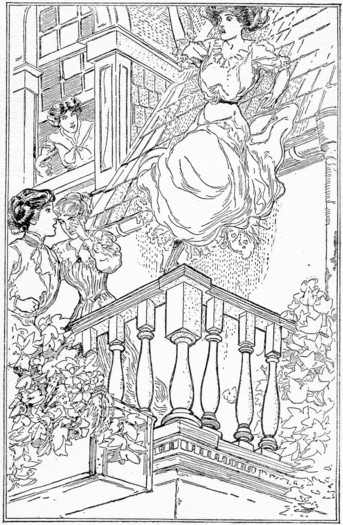
The girls leaned over the railing and looked
29
down into the street, while Ruth expounded her
views on their morning’s ride.
“Suppose we have a lunch fixed up,” she was
saying, “and spend the morning at Sleepy
Hollow? It’s lovelier than anything you ever
imagined, just what Washington Irving says of
it, a place to dream in and see visions.”
A charming tenor voice floated out from an
upper window, singing a song in some foreign
language.
The girls looked at each other and laughed.
“He did hear us, and he is an opera singer,”
whispered Grace.
“I knew it,” came Miss Sallie’s voice from
the depths of the paper.
“Knew what?” demanded the four girls
somewhat guiltily, as the singing continued.
“Knew that we would all be cremated if we
came into these dreadful wild regions,” replied
Miss Sallie, as she gazed tragically down the
shaded street lined with beautiful old homes.
“But, Miss Sallie,” interposed Barbara in
soothing tones, “the fires are up in the Catskills
and the Adirondacks, aren’t they? It is
only when the wind blows in this direction that
we get the smoke from them. Even New York
gets it, then; and certainly there is no danger
of New York burning up from the forest fires.”
“Very well, my dears, if we do run into one
30
of those shocking conflagrations, you may just
recall my words to you this morning.”
The girls all laughed, and there is nothing
prettier than the sound of the light-hearted
laughter of young girls; at least so thought the
tall, military-looking man they had seen at
breakfast. He had strolled out on the piazza,
and was walking straight toward Miss Sallie
with an air of determination that was unmistakable
even to the stately lady in lavender.
A few feet from her chair he paused as if a
sudden thought had arrested him, and the two
looked straight into each other’s faces for the
space of half a minute. The girls were fairly
dumb with amazement as they watched the little
drama. Miss Sallie’s face had flushed and
paled before it resumed its natural peachy tone.
They could not see the face of the stranger
whose back was turned to them.
“Is it possible,” asked Miss Sallie after a moment,
in a strange voice, “that this is John Ten
Eyck?”
She had risen from her chair, in her excitement,
and the newspapers had fallen on the floor
with her lavender silk reticule, her fan and
smelling salts, her lace-edged handkerchief and
spectacle case, all in a confused mass.
“You have not forgotten me, Sallie?” the
man demanded, almost dramatically. “I am
31
John Ten Eyck, grown old and gray. I never
dreamed that any of my old friends would recognize
me after all these years. But are these
your girls, Sallie?” he asked, turning with a
courtly air to the four young women.
“No, indeed, John,” replied Miss Sallie,
rather stiffly, “I have never married. This is
my niece, Ruth Stuart, my only brother’s
child.” And she proceeded to introduce the
others in turn. “Ruth, my child, this is Major
John Ten Eyck, an old friend of mine, whom
I have not seen for many years. I suppose you
have lived in foreign lands for so long you have
completely lost sight of your American friends.”
“It has been a great many years,” answered
Major Ten Eyck, after he had taken each girl
by the hand and had looked into her face with
such gentleness and charm of manner as to win
them all completely. “It’s been thirty years,
has it not, Sallie?”
“Don’t ask me such a question, John Ten
Eyck! I’m sure I have no desire to be reminded
of how old we are growing. Do you
know, you are actually getting fat and bald;
and here I am with hair as white as snow.”
“But your face is as young as ever, Sallie,”
declared the gallant major.
“Isn’t it, Major Ten Eyck?” exclaimed Ruth,
who had found her voice at last. “She is just
32
as pretty as she was thirty years ago, I am
certain. Papa says she is, at any rate.”
“So she is, my dear,” agreed the old man as
he gazed with undisguised admiration into Miss
Sallie’s smiling face.
“Do sit down,” said Miss Sallie, slightly confused,
“and tell us where you have been, and
what you have been doing these last three decades.”
“It would take too long, I fear,” replied the
major, looking at his watch. “I am looking for
my two nephews this morning.”
“You mean Martin’s sons, I suppose?” asked
Miss Sallie.
“Yes, they are coming down to stay with me
at my old place, back yonder in the hills. They
are bringing one or two friends with them, and
we shall motor over this afternoon if the
weather permits. But tell me, what are you
doing here? Spending the summer? Don’t
you find it a little dull, young ladies?”
“Oh, we are just on a motor trip, too,” replied
Ruth. “We are birds of passage, and stop
only as long as it pleases us.”
“And have you no men along, to look after
you and protect you from highwaymen, or mend
the tires when they are punctured?”
“My dear Major,” replied Miss Sallie, “you
have been away from America for so long that
33
you are old-fashioned. Do you think these athletic
young women need a man to protect them?
I assure you that the world has been changing
while you have been burying yourself in Russia
and Japan. Ruth, here, is as good a
chauffeur as could be found, and Barbara
Thurston can protect herself and us into the
bargain. She rides horseback like a man.”
Barbara blushed at the memory of the stolen
horseback ride on the way to Newport. “Grace
and Mollie are a little bit more old-fashioned,
perhaps, and I am as helpless as ever. But two
are quite enough. They have got us out of
every scrape so far, the two of them.”
The girls all laughed.
Only Barbara, who was leaning on the railing
facing the window, saw a figure move behind
the curtain, which had stood so still she had not
noticed it before.
“Since you are off on a sort of wild goose
chase for amusement,” began the major (here
the figure that was slipping away paused again),
“couldn’t you confer a great honor and pleasure
on an old man by making him a visit?”
“Oh!” cried the girls, breathless with delight,
remembering the automobile full of youths that
would shortly appear.
“Now, Miss Sallie, you see they all want to
come,” continued the major. “Don’t, I beg of
34
you, destroy their pleasure and my happiness
by declining this request of my old age.”
“Oh, do say yes, Aunt Sallie!” cried Ruth.
And still Miss Sallie hesitated. She had a
curious smile on her face as she looked out over
the hills and meadows beyond.
“It’s an interesting old place, Sallie,” continued
the major. “It was built by my Dutch
ancestors, a charming old house that has
been added to from time to time. I would
like to see it full of young faces once more.
What do you say, Sallie? Won’t you make us
all happy? The boys and me, and the girls, too?
For I can see by their faces they are eager to
come.”
“How far is it from here, John,” asked Miss
Sallie, doubtfully. “Is it anywhere near those
dreadful forest fires?”
“It is fifteen miles back in the country, and
I have heard no rumor of any fires in that vicinity
lately. The boys and I are leaving this
afternoon. We will see that everything is ship-shape,
and you and the girls could follow to-morrow.
I have an excellent housekeeper. She
and her husband were a young couple when I
went away, and they have lived at the place ever
since. I am certain she can make you comfortable.
I will give Miss Ruth explicit directions
about the route. It is a fairly good road for
35
motoring. We have a fine place for dancing
there, young ladies. There’s a famous floor in
what, in my grandmother’s time, we used to call
the red drawing-room. There are dozens of
places for picnics, pretty valleys and creeks that
I explored and knew intimately in my youth. I
have some good horses in my stables, Miss Barbara,
if you have a fancy for riding,” he continued,
turning to Barbara with such grace of
manner that she blushed for pleasure.
Looking from one eager face to another, and
finally into the major’s kindly gray eyes, Miss
Sallie melted into acquiescence and the party
was made up forthwith.
The major then pointed out to Ruth and Barbara
the street they were to take, which would
lead to the road to his old home. He drew a
map on a piece of paper, so that they could make
no mistake.
“When you come to the crossroads,” he
added, as a parting caution, “take the one with
the bridge, which you can see beyond. The
other road is roundabout and full of ruts besides.”
Just then the horn of an automobile was
heard, as a large touring car containing four
young men and a deal of baggage, drew up in
front of the hotel. At the same time, Barbara,
who was still facing the window, saw the figure
36
on the other side of the curtain steal quietly
away.
Major Ten Eyck went forward to meet the
newcomers, and he and his two nephews had a
little earnest conversation together for a few
moments. The young men looked up, saw Miss
Sallie and the girls, and all four caps came off
simultaneously.
“Please don’t go yet,” called the major, as
Miss Stuart rose to leave. “I want to introduce
the boys first.”
Stephen and Martin Ten Eyck were handsome,
sturdy youths, with clear cut features.
The two visitors were far different in type; one,
Alfred Marsdale, a young English friend, who
was spending the summer with the Ten Eycks,
and the other, Jimmie Butler, who seemed to
have come from nowhere in particular but to
have been everywhere.
“And now come along, boys,” urged the
major, after he had given the young people a
chance to talk a few minutes. “These ladies
want their ride, I know, and we must be off for
the hall before it gets too hot for endurance.”
With a last caution to Ruth about the proper
road to Ten Eyck Hall, and a reminder to Miss
Stuart not to break her promise, the major
ushered his boys into the hotel office, while “The
Automobile Girls” went up to their rooms.
37
“Isn’t this perfectly jolly, girls?” called
Ruth from the mirror as she pinned on her hat.
“De-lighted!” exclaimed Barbara and Mollie,
joining the others.
“And listen, girlies, dear! Did you scent a
romance?” whispered Ruth.
“It certainly looked very much like one,” replied
Barbara.
“They were engaged once,” continued Ruth,
“but they had some sort of lovers’ quarrel.
The poor major tried to make it up, but Aunt
Sallie wouldn’t forgive him, and he went away
and never came back, except for flying trips on
business. Until to-day she has never seen or
heard from him.”
“But she must have cared some, because she
didn’t marry anyone else,” observed Mollie reflectively.
“I wonder what he did,” pondered Grace.
“Flirted with another girl,” answered Ruth.
“Papa has often told me about it. Aunt Sallie
had another lover, at the same time, who was
very rich. She kept the two of them dangling
on, and it was because she went driving with the
other lover that Major Ten Eyck paid devoted
attention to some other girl, one night at a ball.
So they quarreled and separated.”
“Poor old major!” sighed tender-hearted
Mollie.
38
“But she did have her rocking chair adventure
after all,” laughed Barbara, as they started
downstairs in obedience to Miss Sallie’s tap a
few moments before.
The lovely vistas of valley and river, with intersecting
hills, were softened into dream pictures
by a transparent curtain of mist, which
hid the parched look of the foliage from the
long drought.
The five automobilists sped along over
smooth roads between splendid estates. Most
of the great houses were screened by stretches
of thickly wooded parks, and each park was
guarded by a lodge, after the English fashion.
But there were plenty of charming old houses
in full view of the passerby—rambling, comfortable
homes set down on smooth lawns.
“How beautiful all this is!” sighed Mollie, as
she leaned back in her seat and gazed down the
long avenue of trees.
“Yes,” called Ruth over her shoulder. “I
took the longest way to the church, because this
road is so pretty.”
“Here’s the lane to Sleepy Hollow,” cried
the ever-watchful Barbara, and the automobile
turned into a country road that appeared to
lead off into low-lying hills beyond.
“What is that cloud of dust behind us,” demanded
Miss Sallie, looking back.
39
“It’s a man on a motor cycle,” replied
Grace. “He is turning in here, too, but he is
slowing up. I suppose he doesn’t want to give
us a dusting. Rather nice of him, isn’t it?”
“Fancy a motor cycle and a headless horseman
riding in the same lane,” observed Ruth.
“Well, if it came to a race,” replied Barbara,
“I think I would take the motor cycle. They
do go like the wind.”
“And the noise of them is so terrifying,”
went on Ruth, “that the poor headless horseman
would probably have been scared back to
death again.”
Presently the girls came to a steep declivity in
the land that seemed to dip and rise with equal
suddenness.
“Is this the Hollow?” asked Mollie a little
awed.
“This land is full of hollows, my dear,” answered
Miss Sallie, who did not like uneven
traveling. “We have been through several already,
and, with that hobgoblin on an infernal
machine coming after us, and all these dense
forests packing us in on every side, and nothing
but a lonesome churchyard in front of us, it
seems to me we should have brought along some
better protectors than two slips of girls.”
Here Miss Sallie paused in order to regain
breath.
40
“I declare,” exclaimed Ruth, “I don’t know
which one of these roads leads to the churchyard.
Of course we can explore both of them,
but we don’t want to miss seeing the old church,
and we certainly don’t want to miss lunch. It
will be so cheerful picnicking in a graveyard.”
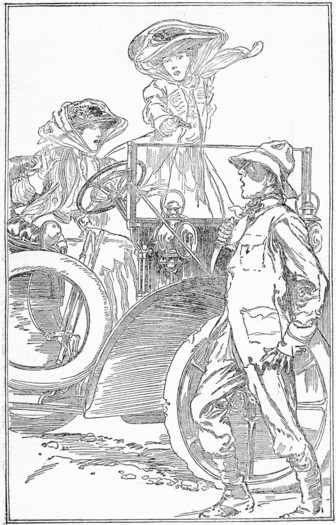
The automobile stopped and the motor cycle,
catching up with them just then, stopped also.
The rider put his foot down to steady himself,
and removing his black leather cap and glasses,
bowed courteously to Miss Stuart.
“Is Madame looking for the ancient church?”
he asked, in very excellent English with just a
touch of accent.
The five women remembered, at once, that
this was the stranger whom they had lately seen
at breakfast. From closer quarters they saw
that he was good-looking, not with the kind of
looks they were accustomed to admire, but still
undeniably handsome. His features had rather
a haughty turn to them, and his black eyes had
a melancholy look; but even the heavy leather
suit he wore could not hide the graceful slenderness
of his figure.
“Yes; we were looking for the church,” replied
Miss Sallie in a somewhat mollified tone,
considering she had just called him a hobgoblin
on an infernal machine. “Will you be good
41
enough to tell us which one of these roads we
must take?”
“If you will follow me,” answered the
stranger, “I also am going there. You will
pardon me if I go in front? If you will wait
a moment I will get somewhat ahead, so that
madame and the other ladies will not be dusted.”
“I must say he is rather a polite young man,”
admitted Miss Sallie, “if he is somewhat rapid
in his movements.”
“He is curiously good-looking,” reflected
Ruth. “Not exactly our kind, I should say;
but, after all, he may be just foreign and different.
Just because he is not an American type
doesn’t keep him from being nice.”
All the time the foliage was getting more impenetrable.
Tall trees reared themselves on
either side of the road, seeming vanguards of
the forests behind them. A cool, woodsy breeze
touched their cheeks softly, and Barbara closed
her eyes for a moment that she might feel the
enchantment of the place.
“How many Dutch burghers and their wives
must have driven up this same grassy road,”
she was thinking to herself. “How many
wedding parties and funeral trains, too, for here
is their graveyard. No wonder a traveler
imagined he saw ghosts on this lonely road, with
nothing but a cemetery and an old church to
42
cheer him on his way. And here is our auto
running in the very same ruts their funny old
carriages and rockaways must have made, and
this stranger in front of us on something queerer
still. I wonder if ghosts of the future will ride
in phantom autos or on motor cycles. What a
fearful sight! A headless man on an infernal
machine——”
Her reflections were interrupted by the turning
around of the automobile. Ruth had evidently
decided to go back by the way they had
come. Opening her eyes she saw before her a
quaint and charming old church set in the midst
of a rambling graveyard.
There also stood the black cyclist, like a gruesome
sentinel among the tombs. He lifted his
cap as they drew up, and, after hesitating a moment,
came forward to open the door and help
Miss Sallie alight.
“Permit me, Madam,” he said, with such
grace of demeanor that the lady thanked him
almost with effusion. Grace and Mollie were
assisted as if they had been princesses of
the blood, as they described it later, while the
other two girls leaped to the ground before he
had time to make any overtures in their direction.
There was rather an awkward pause, for a
moment, as the stranger, with uncovered head,
43
stood aside to let them pass. The silence was
not broken and Miss Stuart chose to let it remain
so.
“One cannot be too careful,” she had always
said, “of chance acquaintances, especially men.”
However, she was predisposed in favor of the
cyclist, whose manners were exceptional.
The girls were strolling about among the
graves, examining the stones with their quaint
epitaphs, while the stranger leaned against a
tree and lit a cigarette.
Miss Stuart, with her lorgnette, was making
a survey of the church.
“From the account of the supper party at the
Van Tassels’ in Sleepy Hollow,” said Ruth,
“the early Dutch must have just about eaten
themselves to death. Do you remember all the
food there was piled on the table at the famous
quilting party? Every kind of cake known to
man, to begin with; or rather, Washington
Irving began with cakes. Roast fowls and turkeys,
hams and sausages, puddings and pies and
the humming tea-urn in the midst of it.”
“I don’t think the women had such big appetites
as the men,” observed Mollie. “At least
Katrina Van Tassel is described as being very
dainty, and I can’t imagine a pretty young girl
working straight through such a bill of fare,
and yet looking quite the same ever after.”
44
“But remember that they took lots of exercise,”
put in Barbara, “of a kind we know nothing
about. All the Dutch girls were taught to
scrub and polish and clean.”
“What were we doing when Ruth and
Miss Sallie and Mr. Stuart arrived, Bab, I’d
like to know?” interrupted Mollie indignantly.
“Weren’t we rubbing the parlor furniture and
polishing the floor?”
“Yes,” returned Barbara, “but you could put
our entire house down in the parlor of one of
those old Dutch farm houses, and still have
room and to spare.”
“And think of all the copper kettles they had
to keep polished,” added Grace.
“And the spinning they had to do,” said Ruth.
“And the cooking and butter making,” continued
Bab. “Yes, Mistress Mollie, I think
there’s some excuse for sausages and all the
rest. And I am sure I could have forgiven
Katrina if she ate everything in sight.”
“Ah, well,” replied Mollie, “no doubt she was
fat at thirty!”