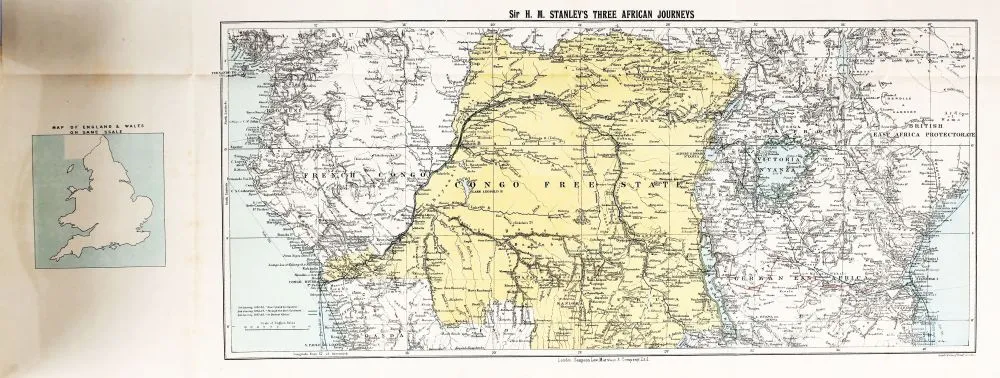
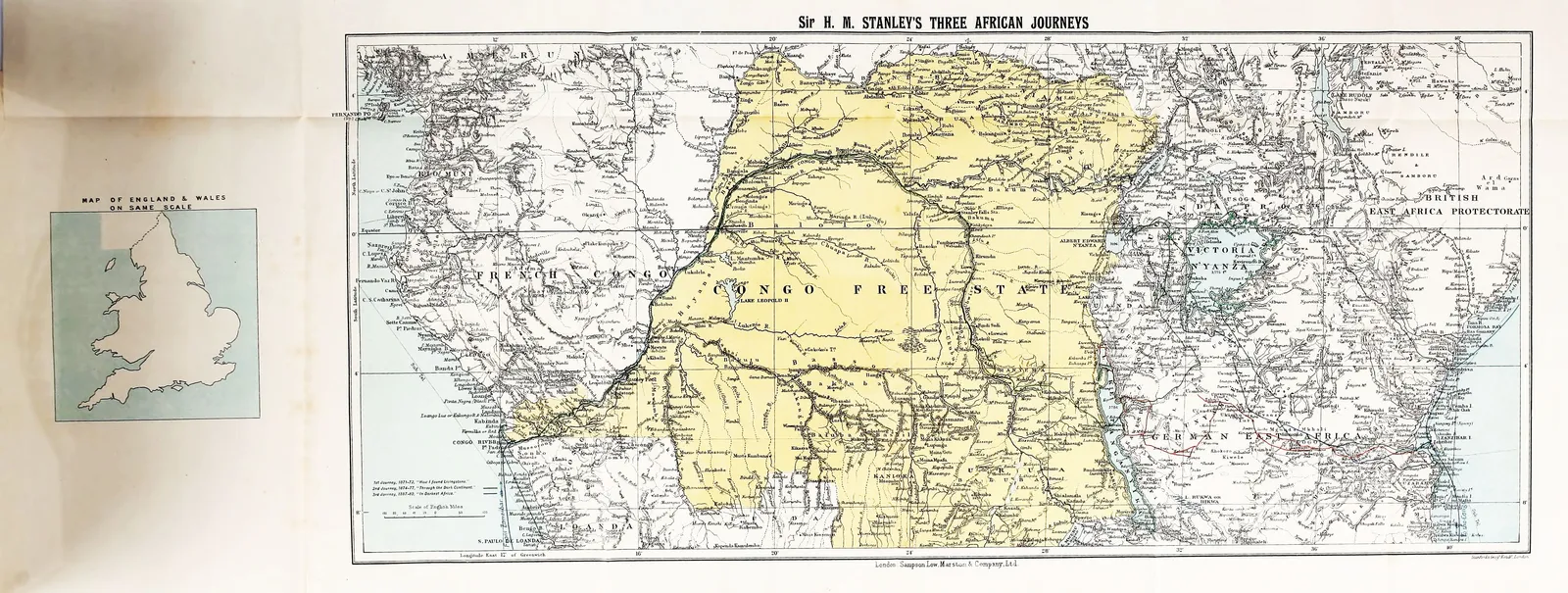
UP to this point Stanley has told his own story. The chapter which
follows is almost wholly a weaving together of material which he left.
That material consists, first, of an occasional and very brief diary,
which he kept from 1862; then, at irregular intervals through many
years, entries in a fuller journal, and occasional comments and
retrospects in his note-books, during the last peaceful years of life.
He was discharged from Harper’s Ferry, June 22, 1862. Then he seems to
have turned his hand to one resource and another, to support himself; we
find him ‘harvesting in Maryland,’ and, later, on an oyster-schooner,
getting upon his feet, and out of the whirlpool of war into which he had
naturally been drawn by mere propinquity, so to speak; now his heart
turned with longing to his own kin, and the belated affection which he
trusted he might find.
November, 1862. I arrived, in the ship ‘E. Sherman,’ at Liverpool. I was
very poor, in bad health, and my clothes were shabby. I made my way to
Denbigh, to my mother’s house. With what pride I knocked at the door,
buoyed up by a hope of being able to show what manliness I had acquired,
not unwilling, perhaps, to magnify what I meant to become; though what
I was, the excellence of my present position, was not so obvious to
myself! Like a bride arraying herself in her best for her lover, I had
arranged my story to please one who would, at last, I hoped, prove an
affectionate mother! But I found no affection, and I never again sought
for, or expected, what I discovered had never existed.
I was told that ‘I was a disgrace to them in the eyes of their
neighbours, and they desired me to leave as speedily as possible.’
This experience sank so deep, and, together with the life in earlier
years, had so marked an effect on Stanley’s character, that it seemed
best to give it to the reader just as he noted it down as he mused over
his life, near its close. When fame and prosperity came to him, he was
just to the claims of blood, and gave practical help; but the tenderness
which lay deep in his nature, and the repeated and hopeless rebuffs it
encountered, produced, in the reaction, an habitual, strong
self-suppression. The tenderness was there, through all the stirring
years of action and achievement; but it was guarded against such shocks
as had earlier wounded it, by an habitual reserve, and an austere
self-command.
He returned to America, and, with a sort of rebound towards the world of
vigorous action, threw himself, for a time, into the life of the sea.
The motive, apparently, was partly as a ready means of livelihood, and
partly a relish for adventure; and adventure he certainly found. Through
1863, and the early months of 1864, he was in one ship and another, in
the merchant service; sailing to the West Indies, Spain, and Italy.
He condenses a ship-wreck into a two-line entry: ‘Wrecked off Barcelona.
Crew lost, in the night. Stripped naked, and swam to shore. Barrack of
Carbineers ... demanded my papers!’
The end of 1863 finds him in Brooklyn, New York, where we have another
brief chronicle:—
Boarding with Judge X——. Judge drunk; tried to kill his wife with
hatchet; attempted three times.—I held him down all night. Next
morning, exhausted; lighted cigar in parlour; wife came down—insulted
and raved at me for smoking in her house!
In August, 1864, he enlisted in the United States Navy, on the receiving
ship ‘North Carolina,’ and was then assigned to the ‘Minnesota,’ and
afterwards to the ‘Moses H. Stuyvesant,’ where he served in the capacity
of ship’s writer. Nothing shows that he was impelled by any special
motive of sympathy with the national cause. It has been told how he went
into the Confederate service, as a boy naturally goes, carried along
with the crowd. At this later time he may have caught something of the
enthusiasm for the Union that filled the community about him; or, very
probably, he may have gone on a fighting ship simply as more exciting to
his adventurous spirit than a peaceful merchantman. In any case, he
embarked on what proved to be the beginning of his true occupation and
career, as the observer and reporter of stirring events; later, he was
to play his part as a maker of events.
There is nothing to show just how or why he became a newspaper
correspondent, but we know the where; and no ambitious reporter could
ask a better chance for his first story than Stanley had when he
witnessed the first and second attacks of the Federal forces on Fort
Fisher, North Carolina. Those attacks are part of the history of the
great war; how, in December, 1864, General Butler assailed the port from
the sea, the explosion under its walls of a vessel charged with powder
being a performance as dramatic as many of Butler’s military exploits;
how, a year later, a carefully-planned expedition under General Terry,
attacked the fort; how, after a two days’ bombardment by the fleet, two
thousand sailors and marines were landed, under instructions to ‘board
the fort in a seaman-like manner’; how they were repelled by a murderous
fire, while a force of soldiers assaulting from another side drove the
defenders back, in a series of hand-to-hand contests, till the fort was
won.
On both those occasions, it fell to Stanley to watch the fight, to tell
the story of it in his own lucid and vigorous style, and to have his
letters welcomed by the newspapers, and given to the world.
Three months later, in April, 1865, the war was ended, and Stanley left
the Navy. Then, for a twelve-month, his diary gives only such glimpses
of him as an occasional name of a place with date. ‘St. Joseph,
Missouri,—across the Plains,—Indians,—Salt Lake City,—Denver,—Black
Hawk,—Omaha.’ Apparently through this time, he was impelled by an
overflowing youthful energy, and an innate love of novelty and
adventure.
In his later years, he told how, in his early days, his exuberant vigour
was such, that when a horse stood across his path his impulse was, not
to go round, but to jump over it! And he had a keen relish for the
sights and novelties, the many-coloured life of the West. So he went
light-heartedly on his way,—
‘For to admire and for to see,
For to behold the world so wide.’
Through this period he seems to have done more or less newspaper
correspondence, and to have tended towards that as a profession. Here
belongs an episode which is told in one of the autobiographic fragments;
the reckless frolic of boys recounted with the sobriety of age.
Being connected with the press, my acquaintance was sought by some
theatrical people in Omaha; at which, being young and foolish, I was
much gratified. After a benefit performance, which I was principally the
means of getting up for them, I supped with them, and for the first
time, I drank so much wine that I tasted the joys and miseries of
intoxication. My impression will not be forgotten, for though the
faculty of self-restraint was helpless, the brain was not so clouded
that I did not know what I was about. I was conscious of an
irrepressible hilarity, which provoked me to fling decorum to the winds,
and of being overwhelmingly affectionate to my boon companions.
The women of the party appeared more beautiful than houris, especially
one for whom I felt ecstatic tenderness. When we had supped and drank
and exhausted our best stories, about two o’clock in the morning we
agreed to separate, the ladies to their own homes, but we men to a
frolic, or lark, in the open. The effect of wine was at its highest. We
sallied out, singing, ‘We won’t go home till morning.’ I was soon
conscious that my tread was different, that the sidewalk reminded me of
the deck of a ship in a gale, the lamp-posts were not perpendicular, and
leaned perilously over, which made me babble about the singular
waywardness and want of uprightness in houses and lamp-posts and awning
columns, and the curious elasticity of the usually firm earth. I wished
to halt and meditate about this sudden change of things in general.
Scraps of marine songs about the ‘briny ocean,’ ‘brave sailor boys,’ and
‘good ships be on her waters,’ were suggested to me by the rocking
ground, and burst in fluent song from my lips; a noisier set than we
became, it is scarcely possible to imagine.
I wonder now we were not shot at, for the Omaha people were not very
remarkable for forbearance when angered, and a charge of small shot
would have been no more than we each of us well deserved. But someone
suggested that vengeful men were after us, and that was enough to send
us scampering, each to his home, at four o’clock in the morning. I
reached my place without accident, and without meeting a single
constable; and, plunging into bed, I fell into a deep sleep. My first
waking made me aware of a racking headache, and a deep conviction that I
had behaved disgracefully.
I was enriched, however, by an experience that has lasted all my life,
for I then vowed that this should be the last time I would have to
condemn myself for a scandalous act of the kind. ‘What an egregious fool
I have been! Hang N—— and all his gang!’ was my thought for many a day.
Like David Copperfield’s first supper-party, one such lesson was enough
for a man who was to do a man’s part; he never again fell under Circe’s
spell. But the hunger for robust exploit was there, and he had found a
companion of kindred tastes. With W. H. Cook, in May, 1866, he started
for Denver. ‘We bought some planking and tools, and, in a few hours,
constructed a flat-bottomed boat. Having furnished it with provisions
and arms against the Indians, towards evening we floated down the Platte
River. After twice up-setting, and many adventures and narrow escapes,
we reached the Missouri River.’ From Omaha they travelled to Boston,
where in July, 1866, they took a sailing-ship for Smyrna.
They had planned to go far into Asia. The precise nature of their plan
is not recounted; but there is little doubt that Stanley was acting
partly as a newspaper-correspondent. What was the base of supplies, or
how ambitious were their hopes, is not told; but they went on their own
resources, and were well provided with money. Stanley seems from the
first to have commanded good prices for his newspaper work, and he notes
that he early took warning from the extravagance and dissipation which
brought many a bright young fellow in the profession to grief.
‘I practiced a rigid economy, punished my appetites, and, little by
little, the sums acquired through this abstinence began to impart a
sense of security, and gave an independence to my bearing which, however
I might strive to conceal it, betrayed that I was delivered from the
dependent state.’ Thus, presumably, he had saved the sinews of war for
this expedition. The opening stage, from the approach to the Asian
shore, was crowded with interest. Stanley records with enthusiasm the
appeal of classic and biblical association, the strangeness and
fascination of Oriental scenery, the aspects of country and people. On
leaving Smyrna, they plunged into the interior. It was his first draught
of the wonder-world of the Orient, and he drank eagerly.
But a speedy change fell on the travellers. First, the American lad whom
they had brought with them as an attendant, out of sheer mischief set a
fire ablaze, which spread, and threatened wide destruction, bringing
upon them a crowd of infuriated villagers, whom they had great
difficulty in appeasing. Then, when they had penetrated into wilder
regions, they fell in with a treacherous guide, who brought upon them a
horde of Turkomans. They were severely beaten, and robbed of all their
money,—twelve hundred dollars,—their letter of credit, and all their
personal equipment; then dragged to a village, and arraigned as
malefactors; then hustled from place to place for five days, with
indignity and abuse, to escape imminent death only by the intervention
of a benevolent old man.
The semi-civilized prison to which they were at last consigned proved a
haven of refuge, for there appeared on the scene a Mr. Peloso, Agent of
the Imperial Ottoman Bank at Constantinople, who bestirred himself in
the friendliest manner on their behalf. Setting the facts of the case
before the Turkish Governor, he completely turned the tables on the
ruffianly accusers by getting them put in prison to await their trial,
while Stanley and his companions moved on their way to Constantinople.
There, again, they received most effective friendship at the hands of
Mr. Edward Joy Morris, the American Minister, and Mr. J. H. Goodenow,
the American Consul-general. Warm hospitality was shewn them; Mr. Morris
advanced £150 for their needs, their assailants were tried, found
guilty, and punished; ultimately the Turkish Government made good the
money stolen.
That was the end of the Stanley-Cook exploration of Asia. The explorer’s
first quest had met a staggering set-back. But, ‘repulse is interpreted
according to the man’s nature,’ as Morley puts it; ‘one of the
differences between the first-rate man and the fifth-rate lies in the
vigour with which the first-rate man recovers from this reaction, and
crushes it down, and again flings himself once more upon the breach.’
INDIAN WARS OF THE WEST.—ABYSSINIAN CAMPAIGN, ETC.
STANLEY writes: ‘My first entry into journalistic life as a selected
“special” was at St. Louis after my return from Asia Minor. Hitherto, I
had only been an attaché, or supernumerary, as it were, whose
communications had been accepted and most handsomely rewarded, when, as
during the two bombardments of Fort Fisher, they described events of
great public interest. I was now instructed to “write-up” North-western
Missouri, and Kansas, and Nebraska. In 1867, I was delegated to join
General Hancock’s expedition against the Kiowas and Comanches, and, soon
after the termination of a bloodless campaign, was asked to accompany
the Peace Commission to the Indians.’
These two expeditions he reported in a series of letters to the
‘Missouri Democrat,’ which, in 1895, he made into the first of two
volumes, ‘My Early Travels and Adventures.’ It is the graphic story of a
significant and momentous contact of civilization with savagery. Two
years after the close of the Civil War, the tide of settlers was swiftly
advancing over the great prairies of the West. The Union Pacific
Railroad was being pushed forward at the rate of four miles a day. The
Powder River military road was being constructed to Montana, and forts
erected along its line, through the best and most reliable
hunting-grounds of the Sioux, and without their consent. The Indians
throughout a wide region were thrown into a ferment, and there were
outbreaks against the white settlers. In March, a force was sent out
under General Hancock, which Stanley accompanied, with the general
expectation of severe fighting. But General Hancock soon imparted to
Stanley his views and purposes, which were to feel the temper of the
Indians, to see who were guilty, and who were not; to learn which tribes
were friendly-disposed; to separate them from the tribes bent on war; to
make treaties wherever practicable; and to post more troops on certain
roads.
In a march of four hundred and fifty miles, he practically accomplished
this plan. The hostile Sioux and Cheyennes were detached from their
allies, the Kiowas, Arapahoes, and Comanches; and when the hostiles
stole away from the conference, and began outrages on the settlers, they
were punished by the destruction of their villages. But after Hancock’s
return, the plains still seethed with menace and occasional outbreaks,
and a general Indian war seemed imminent.
In July, Congress met the emergency by the appointment and despatch of a
Peace Commission. At its head was General Sherman, with a group of
distinguished officers, two chief Indian Commissioners, and Senator
Henderson, of Missouri. Sherman, after some very effective speeches to
the Indians, left the further work to the other Peace Commissioners, who
travelled far and wide over the Plains, for two thousand miles. They met
the principal tribes in council, and made a series of treaties, which,
with the distribution of presents, and the general view impressed upon
the Indians in addresses, frank, friendly, and truthful, brought about a
general pacification.
In Stanley’s picturesque story of all this, perhaps the most striking
feature is the speeches of the Indian chiefs as they set forth the
feelings and wishes of their people. Said old Santanta; ‘I love the land
and the buffalo, and will not part with them. I don’t want any of those
medicine houses built in the country; I want the papooses brought up
exactly as I am. I have word that you intend to settle us on a
Reservation near the mountains. I don’t want to settle there. I love to
roam over the wide prairie, and, when I do it, I feel free and happy;
but, when we settle down, we grow pale and die.’
‘Few,’ writes Stanley, ‘can read the speeches of the Indian chiefs
without feeling deep sympathy for them; they move us by their pathos and
mournful dignity. But they were asking the impossible. The half of a
continent could not be kept as a buffalo pasture and hunting-ground.’
Reviewing the situation many years later, he pronounces that the decline
and disappearance of the Indians has been primarily due, not to the
wrongs by the whites, but to their innate savagery, their mutual
slaughter, the ravages of disease, stimulated by unsanitary conditions;
and, especially, the increased destructiveness of their inter-tribal
wars, after they had obtained fire-arms from the whites. His account of
the complaints laid before the Commissioners shows that there were real
and many wrongs on the part of the whites. To one story of a wanton
murder, and the comment, ‘Those things I tell you to show you that the
pale-faces have done wrong as well as the Indians,’ that stout old
veteran of the Plains, General Harney, replied: ‘That’s so, the Indians
are a great deal better than we are.’ But of the broad purpose of the
Government, and the spirit in which the Commission acted, Stanley
writes: ‘These letters describe the great efforts made by the United
States Government to save the unfortunate Indians from the consequences
of their own rash acts. The speeches of General Hancock and General
Sherman and the Peace Commissioners faithfully reflect the sentiments of
the most cultivated Americans towards them, and are genuine exhortations
to the Indians to stand aside from the overwhelming wave of white
humanity which is resistlessly rolling towards the Pacific, and to take
refuge on the Reservations, where they will be fed, clothed, protected,
and educated in the arts of industry and Christian and civilised
principles.’ The replies of the Indian chiefs no less faithfully reflect
their proud contempt of danger, and betray, in many instances, a
consciousness of the sad destiny awaiting them.
In all this, Stanley was unconsciously acquiring a preliminary lesson in
dealing with savage races. The tone in which Sherman, Henderson, and
Commissioner Taylor, spoke to the Indians, now as to warriors, now as to
children, gave hints which, later, Stanley put to good use. And the
experience of the Indians suggests a parallel with that of the Congo
natives as each met the whites. The wise and generous purposes of men
like Sherman and Taylor, as afterwards of Stanley, were woefully impeded
in their execution by the less fine temper of their subordinates.
And now, from the West, Stanley goes to the East. The point of departure
is given in the Journal.
January 1st, 1868. Last year was mainly spent by me in the western
Territories, as a special correspondent of the ‘Missouri Democrat,’ and
a contributor to several journals, such as the ‘New York Herald,’
‘Tribune,’ ‘Times,’ ‘Chicago Republican,’ ‘Cincinnati Commercial,’ and
others. From the ‘Democrat’ I received fifteen dollars per week, and
expenses of travel; but, by my contributions to the other journals, I
have been able to make on an average ninety dollars per week, as my
correspondence was of public interest, being the records of the various
expeditions against the warlike Indians of the plains. By economy and
hard work, though now and then foolishly impulsive, I have been able to
save three thousand dollars, that is, six hundred pounds. Hearing of the
British expedition to Abyssinia, and as the Indian troubles have ceased,
I ventured at the beginning of December last to throw up my engagement
with the ‘Democrat,’ proceeded to Cincinnati and Chicago, and collected
my dues, which were promptly paid to me; and in two cases, especially
the ‘Chicago Republican,’ most handsomely.
I then came over to New York, and the ‘Tribune’ and ‘Times’ likewise
paid me well. John Russell Young, the Editor of the New York ‘Tribune,’
was pleased to be very complimentary, and said he was sorry he knew of
nothing else in which he could avail himself of the services of ‘such
an indefatigable correspondent.’ Bowing my thanks, I left the
‘Tribune,’ and proceeded to the ‘Herald’ office; by a spasm of courage,
I asked for Mr. Bennett. By good luck, my card attracted his attention,
and I was invited to his presence. I found myself before a tall,
fierce-eyed, and imperious-looking young man, who said, ‘Oh, you are the
correspondent who has been following Hancock and Sherman lately. Well, I
must say your letters and telegrams have kept us very well informed. I
wish I could offer you something permanent, for we want active men like
you.’
‘You are very kind to say so, and I am emboldened to ask you if I could
not offer myself to you for the Abyssinian expedition.’
‘I do not think this Abyssinian expedition is of sufficient interest to
Americans, but on what terms would you go?’
‘Either as a special at a moderate salary, or by letter. Of course, if
you pay me by the letter, I should reserve the liberty to write
occasional letters to other papers.’
‘We do not like to share our news that way; but we would be willing to
pay well for exclusive intelligence. Have you ever been abroad before?’
‘Oh, yes. I have travelled in the East, and been to Europe several
times.’
‘Well, how would you like to do this on trial? Pay your own expenses to
Abyssinia, and if your letters are up to the standard, and your
intelligence is early and exclusive, you shall be well paid by the
letter, or at the rate by which we engage our European specials, and you
will be placed on the permanent list.’
‘Very well, Sir. I am at your service, any way you like.’
‘When do you intend to start?’
‘On the 22nd, by the steamer “Hecla.”’
‘That is the day after to-morrow. Well, consider it arranged. Just wait
a moment while I write to our agent in London.’
In a few minutes he had placed in my hands a letter to ‘Colonel Finlay
Anderson, Agent of the “New York Herald,” The Queen’s Hotel, St.
Martin’s Le Grand, London’; and thus I became what had been an object of
my ambition, a regular, I hope, correspondent of the ‘New York Herald.’
On the 22nd, in the morning, I received letters of introduction from
Generals Grant and Sherman, which I telegraphed for, and they probably
will be of some assistance among the military officers on the English
expedition. A few hours later, the mail steamer left. I had taken a
draft on London for three hundred pounds, and had left the remainder in
the bank.
The letters to the ‘New York Herald,’ narrating the Abyssinian campaign,
were afterwards elaborated into permanent form, the last half of
Stanley’s book, ‘Coomassie and Magdala.’ The campaign has become a
chapter of history; the detention of Consul Cameron by the tyrannical
King Theodore, of Abyssinia, continued for years; the imprisonment and
abuse of other officers and missionaries, to the number of sixty; the
fruitless negotiations for their release; the despatch from India of a
little army of English and Punjabis, under Sir Robert Napier, afterwards
Lord Napier, of Magdala; the marching columns of six thousand men, with
as many more to hold the sea-coast, and the line of communication; the
slow advance for months through country growing more wild and
mountainous, up to a height of ten thousand feet; Napier’s patient
diplomacy with chiefs and tribes already chafing against Theodore’s
cruelties; the arrival before the stronghold; the sudden impetuous
charge of the King’s force; the quick repulse of men armed with spears
and match-locks before troops handling rocket-guns, Sniders, and
Enfields; the surrender of the captives, and their appearance among
their deliverers; the spectacle of three hundred bodies of
lately-massacred prisoners; the next day’s assault and capture of the
town; Theodore shot by his own hand; the return to the coast: all this
Stanley shared and told.
His telling, in its final form,[11] has for setting an account of
antecedent events, the early success and valour of Theodore, his
degeneracy, the queer interchange of courtesies and mutual puzzlements
between Downing Street and Magdala, and the organisation of the rescue
force. These historical prefaces were characteristic of Stanley’s books;
the story of what he saw had an illuminating background of what had gone
before, worked out by assiduous study. The record of the campaign is
told with plentiful illustration of grand and novel landscape, of
barbaric ways, of traits in his companions. There is a pervading tone of
high spirits and abounding vitality. At first looked at a little
askance, as an American, by the other correspondents, he soon got on
very good terms with them. ‘Their mess,’ he writes, ‘was the most
sociable in the army, as well as the most loveable and good-tempered’;
and he names the London correspondents, individually, as his personal
friends. Lord Napier was courteous, and gave him the same privileges as
his English colleagues. With the officers, too, he got on well. There
is occasional humorous mention in the book, and more fully in the
Journal, of a certain captain whose tent he shared for a while, and whom
he names ‘Smelfungus,’ after Sterne; he might have been dubbed ‘Tartarin
de Tarascon,’ for he was a braggadocio, sportsman, and warrior, whose
romances first puzzled, and then amused, Stanley, until he learned that
a severe wound, and a sun-stroke, had produced these obscurations in a
sensible and gallant fellow.
As a correspondent he scored a marked success, for which he had good
fortune, as well as his own pains, to thank. On his way out, he had made
private arrangements with the chief of the telegraph office, at Suez,
about transmitting his despatches. ‘My telegrams,’ he notes in the
Journal, ‘are to be addressed to him, and he will undertake that there
shall be no delay in sending them to London, for which services I am to
pay handsomely if, on my return, I hear that there had been no delay.’
This foresight was peculiarly characteristic of Stanley. On the return
march, he could not get permission to send an advance courier with his
despatches; these had to go in the same bag which carried the official
and the other press bulletins. In the Red Sea, the steamer stuck aground
for four days; and, under the broiling heat, an exchange of chaff
between a colonel and captain generated wrath and a prospective duel;
Stanley’s mediation was accepted; reconciliation, champagne, and—Suez
at last; but only to face five days of quarantine! Stanley manages to
get a long despatch ashore, to his friend in the telegraph office. It is
before all the others, and is hurried off; then the cable between
Alexandria and Malta breaks, and for weeks not another word can pass!
Stanley’s despatch brings to London the only news of Theodore’s
overthrow. Surprise, incredulity, denunciations of the ‘Herald’ and its
‘imposture,’—then conviction, and acceptance! Stanley had won his place
in the world’s front rank of correspondents! He notes in his Journal,
‘Alexandria, June 28th, 1868. I am now a permanent employee of the
“Herald,” and must keep a sharp look-out that my second “coup” shall be
as much of a success as the first. I wonder where I shall be sent to
next.’
He was sent to examine the Suez Canal, which he found giving promise of
completion within a year. Then, on to Crete, to describe the
insurrection; and here he found no startling public news, but met with a
personal experience which may be given in full.
The Island of Syra, Greece, August 20th, 1868. Christo Evangelides seems
desirous of cultivating my acquaintance. He has volunteered to be my
conductor through Hermopolis. As he speaks English, and is a genial
soul, and my happiness is to investigate, I have cordially accepted his
services. He first took me on a visit of call to Mrs. Julia Ward Howe,
of Boston, and then to the Greek seminary, where I saw some young
Greeks with features not unworthy of the praise commonly ascribed to
Greek beauty. On the way to the Square, Evangelides, observing my
favourable impressions, took advantage of my frank admiration and
suggested that I should marry a Greek girl. Up to this moment it never
had entered my mind that it must be some day my fate to select a wife.
Rapidly my mind revolved this question. To marry requires means, larger
means than I have. My twelve hundred pounds would soon be spent; and on
four hundred pounds a year, and that depending on the will of one man,
it would be rash to venture with an extravagant woman. Yet the
suggestion was delicious from other points of view. A wife! My wife! How
grand the proprietorship of a fair woman appeared! To be loved with
heart and soul above all else, for ever united in thought and sympathy
with a fair and virtuous being, whose very touch gave strength and
courage and confidence! Oh dear! how my warm imagination glows at the
strange idea!
Evangelides meanwhile observes me, and cunningly touches the colours of
my lively fancy, becomes eloquent upon Greek beauty, the virtues, and
the constant affections of Greek women. ‘But, how is it possible for a
wanderer like myself to have the opportunity of meeting such a creature
as you describe? I have no resting-place, and no home; I am here to-day,
and off to-morrow. It is not likely that a man can become so infatuated
with a woman at a glance, or that she would follow a stranger to the
church, and risk her happiness at a nod. Why will you distract a poor
fellow with your raptures upon the joy of marriage?’ And much else, with
breathless haste, I retorted.
I looked at Evangelides and saw his age to be great, beard white as
snow, though his face was unwrinkled. Swiftly, I tried to dive beneath
that fair exterior, and, somehow, I compared him to a Homer, or some
other great classic, who loved to be the cicerone of youth, and took no
note of his own years. The charm of Hellas fell upon me, and I yielded a
patient hearing to the fervid words, and all discretion fled, despite
inward admonitions to beware of rashness.
He said he would be my proxy, and would choose a damsel worthy of every
praise for beauty and for character. Like one who hoped and yet
doubted, believed and yet suspected, I said: ‘Very well, if you can show
me such a girl as you describe, I will use my best judgement, and tell
you later what I think of her.’ And so it was agreed.
In the evening I walked in the Square with Evangelides, who suddenly
asked me what I thought of his own daughter, Calliope. Though sorely
tempted to laugh, I did not, but said gravely that I thought she was too
old for me. The fact is, Calliope is not a beauty; and though she is
only nineteen according to her father, yet she is not one to thaw my
reserve.
August 21st. This morning Evangelides proposed his daughter in sober,
serious earnest, and it required, in order not to offend, very guarded
language to dispel any such strange illusion. Upon my soul, this is
getting amusing! It is scarcely credible that a father would be so
indifferent to his daughter’s happiness as to cast her upon the first
stranger he meets. What is there in me that urges him to choose me for a
son-in-law? Though he claims to be a rich man, I do not think he has
sufficient hundreds to induce me to entertain the offer. My liberty is
more precious than any conceivable amount of gold.
August 22nd. Rode out during the morning into the country beyond
Hermopolis, and crossed the mountains to the village of Analion. I was
delighted with all I saw, the evidences of rural industry, the manifest
signs of continuous and thoughtful care of property, the necessity for
strictest economy, and unceasing toil, to make both ends meet, the
beauty of the stainless sky, and the wide view of dark blue sea, which
lay before me on every side. If it was calculated on the part of
Evangelides, he could scarcely have done anything better than propose
this ride; for what I saw during the ride, by recalling all I had read
of Greece, made Greek things particularly dear to me. When I returned to
the town, I quite understood Byron’s passion for Hellas.
In the evening Evangelides walked with me on a visit to a family which
lived on another side of the Square. We were received by a very
respectable old gentleman in sober black, and a stout lady who, in
appearance, dress, and surroundings, showed that she studied comfort.
Evangelides seemed to be on good terms with them, and they all bandied
small change of gossip in a delightfully frank and easy manner.
Presently, into the sitting-room glided a young lady who came as near as
possible to the realisation of the ideal which my fancy had portrayed,
after the visions of marriage had been excited by Evangelides’s
frolicsome talk. She, after a formal introduction, subsided on a couch,
demure, and wrapped in virgin modesty.
Her name was Virginia, and well it befitted her. Where had I seen her
face, or whom did she recall? My memory fled over scores of faces and
pictures, and instantly I bethought me of the Empress Eugénie when she
was the Countess Montijo. A marvellous likeness in profile and style!
She is about sixteen, and, if she can speak English, who knows?
Simultaneously with the drift of my thoughts, Evangelides in the easiest
manner led the conversation with the seniors to marriage of young
people. He was so pointed that I became uneasy. My face began to burn as
I felt the allusions getting personal. Jove! what a direct people these
Greeks are! Not a particle of reserve! No shilly-shallying, or beating
about the bush, but, ‘I say, is your daughter ripe for marriage? If so,
here is a fine young fellow quite ready.’
Evangelides was nearly as plain as this. Then the mother turned to me,
and asked, ‘Are you married?’
‘Heaven forbid!’ said I.
‘Why?’ she said, smiling, with proud consciousness of superior knowledge
on her face. ‘Is marriage so dreadful?’
‘I am sure I don’t know, but I have not thought of the subject.’
‘Oh, well, I hope you will think of it now; there are many fair women in
Greece; and Greek women make the best wives.’
‘I am quite ready to believe you, and if I met a young Greek lady who
thought as much of me as I of her, I might be tempted to sacrifice my
independence,’ I answered, more with a view to avoid an awkward silence
than with a desire to keep up such a terribly personal conversation with
strangers.
‘I am sure,’ said the lady, ‘if you look around, you will find a young
lady after your heart.’
I bowed, but my face was aflame.
With astonishing effrontery Evangelides maintained the pointed
conversation until I saw my own uneasiness reflected in Virginia’s
face, who grew alternately crimson and pale. Both colours agreed with
her, and I pitied her distress, and frowned on Evangelides, who,
however, was incorrigible. Then I began to ask myself, was this really
Greek custom, or was it merely a frantic zeal on Evangelides’s part? Was
this the Sirens’ Isle, wherein the famed Ulysses was so bewitched, or
was the atmosphere of the Cyclades fatal to bachelorhood? It would never
do to tell in detail all I thought, or give all my self-questionings;
but, ever and anon in my speculations, I stole a glance at Virginia’s
face, and each glance started other queries. ‘Is this to be a farcical
adventure, or shall it be serious’? I felt that only the mute maiden
could answer such a question. Susceptible and romantic I know I am, but
it requires more than a pretty face to rouse passionate love.
We rose to go, each protesting that we had passed a pleasant evening.
The lady of the house promises, half-seriously, to find a nice wife for
me. ‘Do,’ say I, ‘and I will be eternally grateful. Good-bye, Miss
Virginia.’
‘Good-bye,’ she says timidly, blushing painfully.
I note she has a French accent. I find she only knows a few words of
English, but she is fluent in French. Here then comes another obstacle.
I could make no love in French, without exploding at my own ignorance of
it. But there is no doubt that, so far as beauty goes, Virginia is
sufficient.
September 9th. After a short absence, I have returned. Evangelides
welcomed me effusively. Passed the evening with Virginia’s family. There
were two brothers of Virginia’s, fine young fellows, present, and a
sister. It was clear that my letter had been a subject of family
discussion, for every eye was marked by a more discerning glance than
would have been noticeable otherwise. Even on the little girl’s face I
read, ‘I wonder if he will suit me as a brother-in-law.’ I wished I
could say to her, ‘So far as you and Virginia are concerned, I do not
think you will have cause for regret.’ On the whole, the ordeal was not
unsatisfactory. I was conscious that Virginia was favourable. No
decision has been arrived at yet, but I feel that where there are so
many heads in council, father, mother, brothers, relatives, friends, and
Evangelides, there must be a deal to debate.
September 10th. A friend of the family came into my room this
afternoon, and was, in features, voice, and conduct, infectiously
congratulatory. He told me that the marriage was as good as concluded,
that I had only to name the day. I gasped, and with good reason. Here
was an event which I had always considered as sacred, mysterious,
requiring peculiar influences and circumstances to bring within range of
possibilities, so imminent, that it depended only on my own wish.
Incredulous, I asked, ‘But are you certain?’
‘As certain as I am alive. I have only just left them, and came
expressly to enquire your wishes in the matter.’
Feeling that retreat was as undesirable as it would be offensive, I
replied, ‘Then, of course, as my business admits of no delay, I should
like the marriage to take place next Sunday.’
‘All right,’ he said, ‘next Sunday will suit us perfectly.’ And he left
me quivering, almost, and certainly agitated.
In the evening I visited the house. I was allowed to see Virginia, and,
in a short time, whatever misgivings I may have had as to the wisdom of
my act were banished by the touch of her hand, and the trust visible in
her eyes. There was no doubt as to her ultimate responsiveness to the
height and depth of love. As yet, naturally, there was no love; but it
was budding, and, if allowed to expand, there would be no flaw in the
bloom. If I know myself at all, I think that my condition was much the
same. All that I knew of her I admired; and, if she were as constant in
goodness as she was beautiful, there would be no reason to regret having
been so precipitate.
From these rapid reflections I was recalled by the mother’s remarks,
which in a short time satisfied me that the marriage was not so
positively determined upon as I had been led to believe that afternoon.
As she went on I perceived it was not settled at all. The same fear I
had felt, of committing an imprudence, was swaying her. She said that I
was quite a stranger, of whose antecedents everyone in Syra was quite
ignorant, and she was therefore obliged to ask me to have patience until
all reasonable assurances had been given that I was what I represented
myself to be.
The wisdom of this act I could not but applaud. The mother was just and
prudent, and my respect for her increased. Still, it was tantalising.
My decision to marry, though so quickly arrived at, cost me a struggle
and some grief. My independence I valued greatly. Freedom was so
precious to me. To be able to wander where I liked, at a moment’s
thought, with only a portmanteau to look after, I should not have
bartered for a fortune. But now, after looking into the face of such a
sweet girl as Virginia, and seeing her readiness to be my companion, for
better, or for worse, and believing that she would not hinder my
movements, the disagreeability of being wedded had been removed, and I
had been brought to look upon the event as rather desirable.
‘Well, so be it,’ I said; ‘though I am sorry, and perhaps you may be
sorry, but I cannot deny that you are just and wise.’
September 11th. I gave a dinner to the family at the Hôtel d’Amérique.
Virginia was present, lovelier than ever. It is well that I go away
shortly, for I feel that she is a treasure; and my admiration, if
encouraged, would soon be converted into love, and if once I love, I am
lost! However, the possibility of losing her serves to restrain me.
September 12th. Dined with Virginia’s family. I had the honour of being
seated near her. We exchanged regards, but we both felt more than we
spoke. We are convinced that we could be happy together, if it is our
destiny to be united. Toasts were drunk, etc., etc. Afterwards, Virginia
exhibited her proficiency on the piano, and sang French and Greek
sentimental songs. She is an accomplished musician, beautiful and
amiable. She is in every way worthy.
September 13th. Left Syra for Smyrna by the ‘Menzaleh.’ Virginia was
quite affectionate, and, though I am outwardly calm, my regrets are
keener at parting than I expected. However, what must be, must be.
September 26th. Received answer from London that I am to go to
Barcelona, viâ Marseilles, and wire for instructions on reaching France.
September 27th. Wrote a letter to Evangelides and Virginia’s mother,
that they must not expect my return to Syra unless they all came to a
positive decision, and expressly invited me, as it would be an obvious
inconvenience, and likely to be resented at headquarters.
SO the fair Greek disappears; and Stanley, free and heart-whole, is
whirled away again by the ‘Herald’s’ swift and changing summons: to
Athens, to witness a Royal Baptism, and describe the temples and ruins,
with which he was enraptured; to Smyrna, Rhodes, Beyrout, and
Alexandria; thence to Spain, where great events seemed impending. But he
has barely interviewed General Prim, when he is ordered to London; there
the ‘Herald’s’ agent, Colonel Finlay Anderson, gives him a surprising
commission.
It is vaguely reported that Dr. Livingstone is on his way homeward from
Africa. On the chance of meeting him, and getting the first
intelligence, Stanley is to go to Aden, and use his discretion as to
going to Zanzibar. It looks like a wild-goose chase, but his, ‘not to
make reply; his, not to reason why’; and he is off to Aden, which he
reaches November 21, 1868. Not a word can he learn of Livingstone. He
writes enquiries to Consul Webb at Zanzibar, and, in the wretched and
sun-scorched little town, sets himself to wait; but not in idleness. He
works the Magdala campaign into book-form, designing in some indefinite
future to publish it. (It came out five years later.) Then he falls upon
‘a pile of good books which my interesting visit to Greece and Asia
Minor induced me to purchase—Josephus, Herodotus, Plutarch, Derby’s
“Iliad,” Dryden’s “Virgil,” some few select classics of Bohn’s Library,
Wilkinson’s and Lane’s books on “Egypt,” hand-books to Greece, the
Levant, and India, Kilpert’s maps of Asia Minor, etc. Worse heat, worse
dust, and still no word of Livingstone!’
New Year’s Day, 1869. Many people have greeted me, and expressed their
wish that it should be a happy one, and that I should see many more such
days. They were no doubt sincere, but what avail their wishes, and what
is happiness? What a curious custom it is, to take this day, above all
others, to speak of happiness, when inwardly each must think in his soul
that it admonishes him of the lapse of time, and what enormous arrears
there still remain to make up the sum of his happiness!
As for me, I know not what I lack to make me happy. I have health,
youth, and a free spirit; but, what to-morrow may bring forth, I cannot
tell. Therefore, take care to keep that health. The knowledge that every
moment makes me older, the fluctuations to which the spirit is subject,
hour by hour, for ever remind me that happiness is not to be secured in
this world, except for brief periods; and, for a houseless, friendless
fellow like myself, those periods when we cast off all thought which
tends to vex the mind cannot, by any possibility, be frequent. But, if
to be happy is to be without sorrow, fear, anxiety, doubt, I have been
happy; and, if I could find an island in mid-ocean, remote from the
presence or reach of man, with a few necessaries sufficient to sustain
life, I might be happy yet; for then I could forget what reminds me of
unhappiness, and, when death came, I should accept it as a long sleep
and rest.
But, as this wish of mine cannot be gratified, I turn to what many will
do to-day; meditate; think with regret of all the things left undone
that ought to have been done; of words said that ought not to have been
uttered; of vile thoughts that stained the mind; and resolve, with God’s
help, to be better, nobler, purer. May Heaven assist all who wish the
same, and fill their hearts with goodness!
January 7th, 1869. Six days of this New Year are already gone, and one
of the resolutions which I made on the first day I have been compelled
to break. I had mentally resolved to smoke no more, from a belief that
it was a vice, and that it was my duty to suppress it. For six days I
strove against the hankering, though the desire surged up strongly.
To-day I have yielded to it, as the effort to suppress it absorbed too
much of my time, and now I promise myself that I shall be moderate, in
order to soothe the resentment of my monitor.
Still no news of Livingstone, and scant hope of any! Stanley critically
examines Aden; notes its unfortified condition, its importance when once
the Suez Canal is finished; and sketches its future possibilities as a
great distributing centre, and the case of a cheap railway into the
heart of Arabia.
After ten weeks at Aden, February 1st, ‘I am relieved, at last!’ And so
he turns his back on Livingstone, who is still deep in the wilds of
Africa. As he mixes with civilised men in his travels, he is sometimes
struck by their triviality, sometimes by their malicious gossip.
February 9th, 1869. At Alexandria. Dined with G. D. and his wife. Among
the guests was one named J——. This young man is a frequent diner here,
and the gossips of Alexandria tell strange things. Truly the English,
with all their Christianity, and morals, and good taste, and all that
sort of thing, are to be dreaded for their propensity to gossip, for it
is always malicious and vile. Oh, how I should like to discover my
island, and be free of them!
Apropos of this, it reminds me of my journey to Suez last November. Two
handsome young fellows, perhaps a year or so younger than myself, were
fellow-passengers in the same coupé. They were inexperienced and shy. I
was neither the one, nor, with the pride of age, was I the other. I had
provided myself with a basket of oranges and a capacious cooler. They
had not; and when we came abreast of the dazzling sands, and to the
warm, smothering mirage, and the fine sand came flying stinging hot
against the face, they were obliged to unbutton and mop their faces, and
they looked exceedingly uncomfortable. Then it was that I conquered my
reserve, and spoke, and offered oranges, water, sandwiches, etc.
Their shyness vanished, they ate and laughed and enjoyed themselves, and
I with them. The pipes and cigars came next, and, being entertainer, as
it were, I did my best for the sake of good fellowship, and I talked of
Goshen, Pithom,[12] and Rameses, Moses’ Wells, and what not. We came at
last to Suez, and, being known at the hotel, I was at once served with a
room. While I was washing, I heard voices. I looked up; my room was
separated from the next by an eight-foot partition. In the next room
were my young friends of the journey, and they were speaking of me! Old
is the saying that ‘listeners hear no good of themselves’; but, had I
been a leper or a pariah, I could not have been more foully and
slanderously abused.
This is the third time within fourteen months that I have known
Englishmen, who, after being polite to my face, had slandered me behind
my back. Yes, this soulless gossip is to be dreaded! I have learned that
if they entertain me with gossip about someone else, they are likely
enough to convey to somebody else similar tales about me.
In the enforced leisure of a Mediterranean trip comes a piece of
self-observation.
February 20th, 1869. At sea, under a divine heaven! There is a period
which marks the transition from boy to man, when the boy discards his
errors and his awkwardness, and puts on the man’s mask, and adopts his
ways. The duration of the period depends upon circumstances, and not
upon any defined time. With me, it lasted some months; and, though I
feel in ideas more manly than when I left the States, I am often
reminded that I am still a boy in many things. In impulse I am boy-like,
but in reflection a man; and then I condemn the boy-like action, and
make a new resolve. How many of these resolutions will be required
before they are capable of restraining, not only the impulse, but the
desire, when every action will be the outcome of deliberation? I am
still a boy when I obey my first thought; the man takes that thought and
views it from many sides before action. I have not come to that yet; but
after many a struggle I hope to succeed. ‘Days should speak, and a
multitude of years should teach wisdom.’
It is well for me that I am not so rich as the young man I met at Cairo
who has money enough to indulge every caprice. I thank Heaven for it,
for if he be half as hot-blooded and impulsive as I am, surely his life
will be short; but necessity has ordained that my strength and youth
should be directed by others, and in a different sphere; and the more
tasks I receive, the happier is my life. I want work, close, absorbing,
and congenial work, only so that there will be no time for regrets, and
vain desires, and morbid thoughts. In the interval, books come handy. I
have picked up Helvetius and Zimmerman, in Alexandria, and, though there
is much wisdom in them, they are ill-suited to young men with a craze
for action.
And now he is back at headquarters in London, and gets his orders for
Spain; and there he spends six months, March to September, 1869,
describing various scenes of the revolution, and the general aspect of
the country, in a graphic record. These letters are among the best of
his descriptive writings. The Spanish scenery and people; the stirring
events; the barricades and street-fighting; the leaders and the typical
characters; the large issues at stake—all make a great and varied
theme.
On arriving in Spain, Stanley commenced studying Spanish, with such
success, that, by June, he was able to make a speech in Spanish, and
became occasional correspondent to a Spanish newspaper.
The insurrection of September, 1868, which drove Isabella from the
Throne, led to a provisional Government under a Regency, General Prim
acting as Minister of War.
On June 15, 1869, Stanley was present in the Plaza de Los Cortes when
the Constitution was read to twenty thousand people, who roared their
‘vivas.’
Stanley was in the prime of his powers, and these powers were not, as
afterwards in Africa, taxed by heavy responsibilities, and ceaseless
executive work, but given solely to a faithful and vivid chronicle of
what he saw. ‘I went to Spain,’ he wrote, ‘the young man going to take
possession of the boy’s heritage, those dear dreams of wild romance,
stolen from school-hours.’
When a Carlist rising threatened, hundreds of miles away, Stanley
immediately hastened off to the scene. On one occasion, he hurried from
Madrid in search of the rebellious Carlists, who were said to have risen
at Santa Cruz de Campescu. ‘As soon as I reached the old town of
Vittoria, I took my seat in the diligence for Santa Cruz de Campescu;
our road lay westward towards the Atlantic through the valley of Zadora.
If you have read Napier’s “Battles of the Peninsula,” you can well
imagine how interesting each spot, each foot of ground, was to me. This
valley was a battle-field, where the armed legions of Portugal, Spain,
and England, matched themselves against Joseph Buonaparte’s French
Army.’
At Santa Cruz, Stanley found the insurrectionists had fled to the
mountains, leaving forty prisoners; he returned to Madrid, to join
General Sickles and his suite, on a visit to the Palace of La Granja,
called the ‘Cloud Palace of the King of Spain.’
He hears in Madrid, one evening, that several battalions and regiments
had been despatched towards Saragossa. ‘Naturally I wanted to know what
was going on there. What did the departure of all these troops to
Saragossa mean? So one hour later, at 8.30 P.M., I took the train, and
arrived at Saragossa the next morning at 6 A.M.’
And here Stanley witnessed a rising of the people, ‘proud and
passionate, the Berber and Moorish blood coursing through their veins.’
They resisted the order to give up Arms. ‘Then, with their bayonets,
they prise up the granite blocks, and, with the swiftness of magic,
erect a barricade, formidable, wide, a granite and cobblestone
fortification, breast-high. One, two, three, four, and five, aye, ten
barricades are thrown up, almost as fast as tongue can count them. ‘My
eye,’ says Stanley, ‘finds enough to note; impossible to note the whole,
for there are a hundred things and a thousand things taking place. Carts
are thrown on the summit of the barricades; cabs caught unawares are
launched on high, sofas and bureaux and the strangest kind of
obstructions are piled above all.’
Stanley himself was on a balcony, not within the barricade, but half a
block outside. He saw a battery of mounted trained Artillery halt five
hundred yards from where he stood. He watched them dismount the guns and
prepare for action; and was present at the bursting and rending of
shells and the ceaseless firing of musketry from the barricades.
‘As the bullets flattened themselves with a dull thud against the
balcony where I stood, I sought the shelter of the roof, and behind a
friendly cornice, I observed the desperate fighting.’
Though the firing had been incessant for an hour, little damage had been
done to the barricade. The soldiers, advancing at short range, were shot
down; again the Artillery thundered, and, when the smoke dispersed,
Stanley saw the soldiers had approached nearer. ‘The scene was one of
desperation against courage allied with a certain cold enthusiasm; as
fast as one soldier fell, another took his place. I witnessed personal
instances of ferocity and courage which made me hold my breath. To
me—who was, I really believe, the sole disinterested witness of that
terrible battle—they appeared like characters suddenly called out to
perform in some awful tragedy; and, so fascinated was I by the strange
and dreadful spectacle, I could not look away.’
Night fell, and the bugles sounded retreat; the soldiers had lost heart
after three hours’ persistent fighting, with nothing gained. The dead
lay piled at the barricades. Stanley remained on the roof until he was
chilled and exhausted; he had been awake thirty-nine hours. ‘I retired
for a couple of hours’ rest, completely fatigued, yet with the
determination to be up before daylight; and, by five in the morning, I
was at my post of observation on the roof.’
Stanley graphically described the scene behind the barricade, before the
battle recommenced. Fresh troops now arrived, former failure was to be
avenged. Again they hurl themselves on the barricades; ‘but they are
thrust back by protruding bayonets, they are beaten down by clubbed
muskets, they are laid low by hundreds of deadly bullets, which are
poured on them; but, with fearless audacity, the Regulars climb over
their own dead and wounded, and throw themselves over the barricades
into the smoke of battle, to be hewed to death for their temerity.’
This completed the fourth defeat the Government troops experienced, and
in the greatest disorder they ran towards the Corso; while the ‘Vivas’
to the Republic were deafening. ‘The Artillery re-open fire with grape,
shell, and solid shot, and once more the old city of Saragossa quivers
to its foundations. Another battalion has been added, and nearly six
hundred men are found before the breast-works.’
The rear ranks were impelled electrically forward, and bodily heaved
over the front ranks, quite into the barricades; others crowded on, a
multitude bounded over, as if swept on by a hurricane, and the first
barricade was taken, the insurgents threw down their arms, fell down on
their knees, and cried for ‘quarter.’ Thus was Saragossa quelled and a
thousand prisoners taken. ‘The valour and heroism of the insurgents,
will, I fancy, have been chronicled solely by me, because the Government
won the day, as they were bound to do.’
Stanley now hastened to Valencia, ‘from whence came reports of fierce
cannonading; it was not in my nature to sit with folded arms, and let an
important event, like that, pass without personal investigation.’
He was told he could not go, the trains did not run, miles of railway
had been destroyed. ‘Can I telegraph?—No—Why?—No telegrams are
allowed to pass by order of the Minister of War.—Heigh-ho! to Alicante,
then!—Thence by sea to Valencia. I’ll circumnavigate Spain! but I
shall get to Valencia! I exclude all words like “fail,” “can’t,” from
my vocabulary.’
Stanley had great difficulty, and many adventures, before he got, by
sea, into Valencia, and found himself amid the roar of guns and the whiz
of bullets.
He wandered from street to street, always confronted by soldiers with
fixed bayonets, until, at last, he saw a chance of getting into an
hotel; but he had to run the gauntlet of twenty feet of murderous
firing. Officers remonstrated against the folly. ‘But twenty feet! Count
three and jump! I jumped, took one peep at the barricade in my mid-air
flight, and was in the hotel portico, safe, with a chorus of “bravos” in
my rear, and a welcome in front.’
But how can I give samples of Stanley’s vivid word-painting; it is like
snipping off a corner of a great historical picture. The foregoing
passages, however, will suffice to show how Stanley’s whole being
throbbed with energy, and with the desire to excel.
Sometimes he rides all night, in order to reach betimes a remote place,
where fighting is reported; he watches the stirring scenes all day, and
reports his observations before taking rest.
Extracts from one or two private letters are given here. One was written
to a friend who pressed him to take a holiday.
Madrid, June 27, 1869.
You know my peculiar position, you know who, what, and where I am; you
know that I am not master of my own actions, that I am at the beck and
call of a chief whose will is imperious law. The slightest inattention
to business, the slightest forgetfulness of duty, the slightest
laggardness, is punished severely; that is, you are sent about your
business. But I do not mean to be sent about my business. I do not mean
to be discharged from my position. I mean by attention to my business,
by self-denial, by indefatigable energy, to become, by this very
business, my own master, and that of others. Hitherto, so well have I
performed my duty, surpassing all my contemporaries, that the greatest
confidence is placed in me.
I have carte blanche at the bankers’; I can go to any part of Spain I
please, that I think best; I can employ a man in my absence. This I have
done in the short space of eighteen months, when others have languished
on at their business for fifteen years, and got no higher than the step
where they entered upon duty. How have I done this? By intense
application to duty, by self-denial, which means I have denied myself
all pleasures, so that I might do my duty thoroughly, and exceed it.
Such has been my ambition. I am fulfilling it. Pleasure cannot blind me,
it cannot lead me astray from the path I have chalked out. I am so much
my own master, that I am master over my own passions. It is also my
interest to do my duty well. It is my interest not to throw up my
position. My whole life hangs upon it—my future would be almost blank,
if I threw up my place. You do not—cannot suppose that I have accepted
this position merely for money. I can make plenty of money anywhere—it
is that my future promotion to distinction hangs upon it. Even now, if I
applied for it, I could get a consulship, but I do not want a
consulship—I look further up, beyond a consulship.
My whole future is risked. Stern duty commands me to stay. It is only by
railway celerity that I can live. Away from work, my conscience accuses
me of forgetting duty, of wasting time, of forgetting my God. I cannot
help that feeling. It makes me feel as though the world were sliding
from under my feet. Even if I had a month’s holiday, I could not take
it; I would be restless, dissatisfied, gloomy, morose. To the —— with a
vacation! I don’t want it.
I have nothing to fall back upon but energy, and much hopefulness. But
so long as my life lasts, I feel myself so much master of my own future,
that I can well understand Cæsar’s saying to the sailors, ‘Nay, be not
afraid, for you carry Cæsar and his fortunes!’ I could say the same: ‘My
body carries Stanley and his fortunes.’ With God’s help, I shall
succeed!
A telegram called him to Paris, to meet Mr. Bennett in person; and
there, October 16, 1869, he received a commission of startling
proportions. He was to search for Livingstone in earnest,—not for an
interview, but to discover, and, if necessary, extricate him, wherever
he might be in the heart of Africa. But this was to be only the climax
of a series of preliminary expeditions. Briefly, these consisted of a
report of the opening of the Suez Canal; some observations of Upper
Egypt, and Baker’s expedition; the underground explorations in
Jerusalem; Syrian politics; Turkish politics at Stamboul; archæological
explorations in the Crimea; politics and progress in the Caucasus;
projects of Russia in that region; Trans-Caspian affairs; Persian
politics, geography, and present conditions; a glance at India; and,
finally,—a search for Livingstone in Equatorial Africa!
Into this many-branched search for knowledge Stanley now threw himself.
He carried out the whole programme, up to its last article, within the
next twelve-month, with as much thoroughness as circumstances permitted
in each case. The record, as put into final shape twenty-five years
later, makes a book of 400 pages, the second volume of ‘My Early Travels
and Adventures.’ It is impossible even to epitomise briefly here the
crowded and stirring narrative. The observer saw the brilliant pageant
of the great flotilla moving for the first time in history from the
Mediterranean Sea, through the Suez Canal, to the Indian Ocean.
Stanley was present at the ceremony of blessing the Suez Canal. On the
following day, the 17th November, 1869, he was to see ‘a new route to
commerce opened.’ The Empress Eugénie, the Emperor of Austria, the Crown
Prince of Prussia, and many notabilities had arrived.
‘A beautiful morning ushered in the greatest drama ever witnessed or
enacted in Egypt. It is the greatest and last, so far, of all the
magnificent periods which Egypt has witnessed.’
At eight o’clock in the morning, the Empress’s yacht led the procession
through the Canal, and Stanley followed, in the steamer ‘Europe.’
He next went up the Nile, to Upper Egypt, as one of a party of seventy
invited guests of the Khedive; ‘twenty-three days of most exquisite
pleasure, unmarred by a single adverse incident.’
The next part of his programme was to visit Jerusalem, where he saw the
unearthing of her antique grandeurs, sixty feet underground.
Stanley proceeded thence to Constantinople, where he wrote a long letter
for the ‘New York Herald,’ on the Crimea; and here he met, once more,
his kind friend, the American Minister, Mr. Joy Morris, who presented
him with a beautiful Winchester rifle, and gave him letters of
introduction to General Ignatieff, General Stoletoff, and various
Governors and Ministers in Persia.
Stanley now travelled through the Caucasus, where he found unexpected
civilisation. He rated highly the advantages which Russia’s
much-censured conquest of the Caucasus had brought in its train: warring
tribes brought to peace, feuds and mutual slaughter stopped, local
religions and customs respected, and an end put to barbarism and
feudality, ‘which terms are almost synonymous, as witness the mountain
towers and fortresses, once the terror of the country, now silent and
crumbling.’
Tiflis affords as much amusement and comfort as any second-rate town or
city in Europe. From his Journal are here given one or two passages, to
illustrate how Stanley observed and judged the individuals of his own
race and civilisation.
February 5th, 1870. Reached the Dardanelles at noon. One of my
fellow-voyagers is the Rev. Dr. Harman, of Maryland, an elderly and
large man, who is a marvel of theological erudition, a mixture of
Jonathan Edwards and the Vicar of Wakefield. Most of the morning we had
passed classic ground, and, as he is a Greek scholar of some repute, his
delight was so infectious that we soon became warm friends. He also has
been to Jerusalem, Damascus, and Ephesus, and many other places of
biblical and classical interest; and, in a short time, with a face
shining with enthusiasm, he communicated to me many of his impressions
and thoughts upon what he had seen, as my sympathy was so evident. St.
Paul is his favourite; the Seven Churches of Asia, and the inwardness of
the Revelations, are topics dear to him; and, perceiving that I was a
good listener, the dear old gentleman simply ‘let himself go,’ uttering
deep and weighty things with a warmth that was unexpected.
His exact words I have already forgotten; but the picture that he made,
as he sat clad in sober black on his deck-chair, the skirts of his
frock-coat touching the deck, his spectacled eyes thoughtfully fixed on
the distant horizon, while his lips expressed the learned lore he had
gathered from reading and reflection, will be ineffaceable. If I were
rich enough, this is the type of man whom I should choose for my mentor,
until the unfixedness of youth had become set in a firm mould. On two
points only was he inclined to be severe. His Presbyterianism could not
endure the Pope; and, had he the power, he would like to drive the
Padishah and his Turks far away into inner Asia, where they belonged.
Otherwise, he is one of the largest-hearted Christians I have ever met.
Many-sided in his sensitiveness to the attractions and charms of life,
there were some aspects against which he was proof. At Odessa he fell in
with highly congenial English society, and, at the close of his visit,
he touches on one aspect that repelled, and one that attracted him; the
twofold attitude is not unrelated to the state of mind the final
sentence portrays.
March 6th. The Carnival was a novel sight to me. It is the first I have
ever seen, and I thank my stars that it is not my fate to see many more
such. The mad jollity and abandon wherein both sexes seemed agreed to
think of nothing but their youth and opportunities, positively abashed
me! To decline being drawn within the whirl of dissipation, and to
discountenance fair gauzy nymphs who insidiously tempt one to relax
austere virtue, is not easy; but the shame of it, more than any
morality, prevented me from availing myself of the licence.
At the Cathedral I heard the most glorious vocal music it has ever been
my lot to hear. There was one voice—a priest’s—that rang like a
clarion through the building, so flawless in its rich tones that every
heart, I should fancy, was filled with admiration; and when the choir
joined in the anthem, and filled the entire concave with their burst of
harmony, and the organ rolled its streams of tremulous sound in unison,
I became weak as a child, with pure rapture and unstrung nerve! That
half-hour in the Cathedral is unforgettable. Whether it is due to the
air of Odessa, the perfect health I enjoyed, the warm hospitality I
received, or what, I am inclined to think that for once I have known a
brief period of ideal pleasure, unmarred by a single hour of
unhappiness.
Stanley now travelled along the Russian, Persian, and Turkestan coasts,
observing the people and noting manners, customs, and events. Towards
the end of May, 1870, he reached Teheran; his description of the Palaces
and Bazaars, the Shah and his people, are wonderful reading. From
Teheran he rode to Ispahan.
My friends among the English colony at Teheran gave me several wise
admonitions, among which were, that I was never to travel during the day
on account of the heat, but to start just at sunset, by which I might
make two stations before I halted; I was also to look out for myself, as
there were numerous brigands on the road, who would not scruple to strip
me of everything I possessed.
I followed their advice for the first few stages; but, as the rocks
retain the heat, I think the discomfort of night-travel is greater than
that of day. Besides, the drowsiness was overpowering, and I was
constantly in danger of falling from my horse. The landscape had no
interest; the mountains appeared but shapeless masses, and the plains
were vague and oppressively silent. I reached the salt desert of Persia,
after a ride over country which steadily became more sterile and
waterless.
The fervour of that tract was intense. My thermometer indicated 129°
Fahr. Yet this terrible tract, with its fervid glow and its expanse of
pale yellow sand almost at white heat, was far more bearable by day than
a night ride through it would have been—for, though I could distinguish
nothing but a quivering vapour, the strange forms of the mirage were
more agreeable than the monotonous darkness.
Then follows a graphic picture of Ispahan, where he spent a week, and
then onwards, ever onwards, riding through oven heat.
At Kûmishah, I invited myself to pass the night in the telegraph
station, for there was nobody at home.
When evening came, I made my bed on the house-top, whence I had a good
view of the town and of the myriad of mud towers, of acres of
tomb-stones, and lion sphynxes. And there I dropped to sleep with the
clear heaven for my canopy.
At Yezdikhast I had to spend the day; there were no horses, but, at 4
A.M., the relay arrived and away I sped, to the ruins of Pasargadæ.
Inclining a little towards the right, I came to a group of low and
greyish hills, on the most southward of which I caught a glimpse of a
whitish stone wall. Riding up to it, I found it to be a marble platform,
or, rather, a marble wall, which encased the hill.
The natives call it Solomon’s Throne, and on it once stood the Castle of
Pasargadæ. To commemorate the overthrow of the Babylonian Empire, Cyrus
the Great, in the year 557 B.C., caused to be erected on it a fort, or
castle, containing a Holy Place, whither he went to worship, and where
his successors were wont to be inaugurated as Kings of Persia.
From Pasargadæ Stanley rides to Persepolis, and here he lingers amid the
ruins, for he loves to dream of and reconstruct the mighty Past.
I slept in the first portal of Persepolis, all night. The only food I
could get was wafer bread and plenty of milk.
Early the next morning, July 1st, Stanley rode away, after cutting his
name deep on the Temple. Away, away to Shiraz, where he visits the
graves of Saadi, Hafiz, and one of the many graves given to Bathsheba!
At last Stanley reaches Bushire, where he took steamer and entered the
Persian Gulf; he visits Bunder-Abbas, and then continues his journey to
Muscat, Arabia; thence to Kurrachi, arriving at Bombay, on August 1,
1870, his long programme carried through, up to the verge of its last
supreme undertaking, the search for Livingstone. First, he brings his
story up to date, for the ‘Herald,’ writing seventeen long letters about
the Caucasus and Persian experiences; then he plunges deep into books on
African Geography, ‘for I feel very ignorant about most things
concerning Africa.’
And here on the verge of the great venture, we may see how he reviewed
and estimated the long preparatory stage, reckoning it not as a
twelve-month, but as six years, when he looked back on it, toward the
end.
As may be imagined, these six years formed a most important period of my
life; I had seen about fifteen fair battles with the military service,
and three naval bombardments. Twice I had been shipwrecked, and I had
been spectator of mighty events; I had seen many sovereign-monarchs,
princes, ministers, and generals; I had explored many large cities, and
rubbed against thousands of men of vast nations; and, having been
compelled to write of what I had seen in a daily paper, it can be
understood how invaluable such a career and such a training, with its
compulsory lessons, was to me, preparing me for the great work which
awaited me. To this training I owed increasing powers of observation,
and judgment; the long railway journeys taught me, while watching and
meditating upon the characters I met, how to observe most keenly and
guide myself; by which I was enabled, I think, to achieve a certain
mastery of those infirmities which, I was only too conscious, had
cropped up since I had entered the Army [i.e., during the Civil War].
And now, at last,—for Africa and Livingstone! Zanzibar is to be his
starting-point; there is no direct communication from Bombay; so he must
creep and zig-zag, by irregular sailing-ship. He starts, October 12,
1870, in the barque ‘Polly,’ a six weeks’ voyage to Mauritius. Off
again, in the brigantine ‘Romp’; and, in seventeen days, to St. Anne’s
Island, Seychelles group. Thence, in the little brigantine whaler,
‘Falcon,’ to creep along for nineteen days more.
Still at sea, light breezes every day. Oh! how I suffer from ennui! Oh,
torment of an impatient soul! What is the use of a sailing-boat in the
tropics? My back aches with pain, my mind becomes old, and all because
of these dispiriting calms.
December 31st, 1870. Eighty days from Bombay, and Zanzibar, at last!
But to find what? No letters from Bennett, nor his agent; so, of course,
no money. No news of Livingstone since his departure, years before; and
of him, then, this cheerful gossip:—
‘—— gave me a very bad opinion of Livingstone; he says that he is hard
to get along with, is cross and narrow-minded; that Livingstone ought to
come home, and allow a younger man to take his place; that he takes no
notes nor keeps his Journal methodically; and that he would run away, if
he heard any traveller was going to him.’
This was the man, to find whom Stanley is to plunge into an unknown
tropical Continent; he, who in all his travellings has had either a
beaten road, or guides who knew the country; who has no experience with
Africans, nor in organising and leading an expedition; who can find
funds for his search only from a friendly loan of Captain F. R. Webb,
and who is thrown on his own resources, almost as if he were entering a
new world! But—forward!
IN his book, ‘How I Found Livingstone,’ Stanley has told that story at
length. What here follows is arranged from material hitherto
unpublished, and is designed to give the main thread of events, to
supply some fuller illustration of his intercourse with Livingstone, and
his final estimate of him, and, especially, both in this, and in his
later explorations, to show from his private Journal something of the
workings of his own heart and mind, in the solitude of Africa.
Though fifteen months had elapsed since I had received my commission, no
news of Livingstone had been heard by any mortal at Zanzibar. According
to one, he was dead; and, according to another, he was lost; while still
another hazarded the conviction that he had attached himself to an
African princess, and had, in fact, settled down. There was no letter
for me from Mr. Bennett, confirming his verbal order to go and search
for the traveller; and no one at Zanzibar was prepared to advance
thousands of dollars to one whom nobody knew; in my pocket I had about
eighty dollars in gold left, after my fifteen months’ journey!
Many people since have professed to disbelieve that I discovered the
lost traveller in Africa! Had they known the circumstances of my arrival
at Zanzibar, they would have had greater reason for their unbelief than
they had. To me it looked for a time as though it would be an
impossibility for me even to put foot on the mainland, though it was
only twenty-five miles off. But, thanks to Captain Webb, the American
consul, I succeeded in raising a sum of money amply sufficient, for the
time being, for my purpose.
The ‘sinews of war’ having been obtained, the formation of the
expedition was proceeded with. On the 21st of March, 1871, it stood a
compact little force of three whites, thirty-one armed freemen of
Zanzibar, as escort, one hundred and fifty-three porters, and
twenty-seven pack-animals, for a transport corps, besides two
riding-horses, on the outskirts of the coast-town of Bagamoyo; equipped
with every needful article for a long journey that the experience of
many Arabs had suggested, and that my own ideas of necessaries for
comfort or convenience, in illness or health, had provided. Its very
composition betrayed its character. There was nothing aggressive in it.
Its many bales of cloth, and loads of beads and wire, with its assorted
packages of provisions and medicine, indicated a peaceful caravan about
to penetrate among African tribes accustomed to barter and chaffer;
while its few guns showed a sufficient defensive power against bands of
native banditti, though offensive measures were utterly out of the
question.
I passed my apprenticeship in African travel while traversing the
maritime region—a bitter school—amid rank jungles, fetid swamps, and
fly-infested grass-lands, during which I encountered nothing that
appeared to favour my journey. My pack and riding-animals died, my
porters deserted, sickness of a very grievous nature thinned my numbers;
but, despite the severe loss I sustained, I struggled through my
troubles.
Into the narrative of external events is here inserted what he recorded
of an interior experience at this time.
In the matter of religion, I doubt whether I had much improved (during
the preceding years of trial and adventure). Had this stirring life
amongst exciting events continued, it is probable that I should have
drifted further away from the thoughts of religion.
Years of indifference and excitement have an unconscious hardening
power, and I might have lapsed altogether; but my training in the world
of politics, of selfish hustling, of fierce competition, stopped in
time; for, on commencing the work of my life, my first journey into
Africa, I came face to face with Nature, and Nature was the means,
through my complete isolation, of recalling me to what I had lost by
long contact with the world.
I had taken with me my Bible, and the American consul had given me, to
pack up bottles of medicine with, a great many ‘New York Heralds,’ and
other American newspapers. Strange connection! But yet strangest of all
was the change wrought in me by the reading of the Bible and these
newspapers in melancholy Africa.
My sicknesses were frequent, and, during my first attacks of African
fever, I took up the Bible to while away the tedious, feverish hours in
bed. Though incapacitated from the march, my temperature being
constantly at 105° Fahr., it did not prevent me from reading, when not
light-headed. I read Job, and then the Psalms; and when I recovered and
was once more in marching state, I occupied my mind in camp in glancing
at the newspaper intelligence; and then, somehow or another, my views
towards newspapers were entirely recast; not as regards my own
profession, which I still esteemed very highly, perhaps too highly, but
as to the use and abuse of newspapers.
Solitude taught me many things, and showed newspapers in quite a new
light. There were several subjects treated in a manner that wild nature
seemed to scorn. It appeared to me that the reading of anything in the
newspapers, except that for which they were intended, namely news, was a
waste of time; and deteriorative of native force, and worth, and
personality. The Bible, however, with its noble and simple language, I
continued to read with a higher and truer understanding than I had ever
before conceived. Its powerful verses had a different meaning, a more
penetrative influence, in the silence of the wilds. I came to feel a
strange glow while absorbed in its pages, and a charm peculiarly
appropriate to the deep melancholy of African scenery.
When I laid down the book, the mind commenced to feed upon what memory
suggested. Then rose the ghosts of bygone yearnings, haunting every
cranny of the brain with numbers of baffled hopes and unfulfilled
aspirations. Here was I, only a poor journalist, with no friends, and
yet possessed by a feeling of power to achieve! How could it ever be?
Then verses of Scripture rang iteratingly through my mind as applicable
to my own being, sometimes full of promise, often of solemn warning.
Alone in my tent, unseen of men, my mind laboured and worked upon
itself, and nothing was so soothing and sustaining as when I remembered
the long-neglected comfort and support of lonely childhood and boyhood.
I flung myself on my knees, and poured out my soul utterly in secret
prayer to Him from whom I had been so long estranged, to Him who had led
me here mysteriously into Africa, there to reveal Himself, and His will.
I became then inspired with fresh desire to serve Him to the utmost,
that same desire which in early days in New Orleans filled me each
morning, and sent me joyfully skipping to my work.
As seen in my loneliness, there was this difference between the Bible
and the newspapers. The one reminded me that, apart from God, my life
was but a bubble of air, and it bade me remember my Creator; the other
fostered arrogance and worldliness. When that vast upheaved sky, and
mighty circumference of tree-clad earth, or sere downland, marked so
emphatically my personal littleness, I felt often so subdued that my
black followers might have discerned, had they been capable of
reflection, that Africa was changing me.
It may be taken for granted that some of the newspaper issues which I
took up, one after another, when examined under this new light, were
uncommonly poor specimens of journalism. Though all contained some facts
appertaining to the progress of the world’s affairs, in which every
intelligent man ought to be concerned, these were so few and meagre that
they were overwhelmed by the vast space devoted to stupid personalities,
which were either offensively flattering or carpingly derogatory; and
there came columns of crime records, and mere gutter-matter.
It was during these days I learned that, as teeth were given to chew our
bread, and taste to direct our sense of its quality, so knowledge and
experience were capable of directing the judgment; and from that period
to this, I have never allowed another to govern my decisions upon the
character of any person, or to pervert my own ideas as to the rights and
wrongs of a matter. I find, if one wishes to be other than a mere
number, he must learn to exercise his own discretion. I have practised
these rules ever since, and I remember my delight when I first found
that this method had so trained and expanded my judgment that my views
upon things affecting other people, or affairs in which I had no
personal concern, were in harmony with those expressed by the best
leading journals.
A multitude of records of African travel have been read by me during
twenty-four years; but I do not remember to have come across anything
which would reveal the inward transition, in the traveller’s own
feelings, from those which move him among his own kindred, to those he
feels when he discovers himself to be a solitary white man in the new
world of savage Africa, and all the pageantry of civilisation, its
blessings, its protection, its politics, its energy and power,—all have
become a mere memory. I was but a few days in the wilderness, on the
other side of the Kingani River, when it dawned upon me with a most
sobering effect. The sable native regarded me with as much curiosity as
I should have regarded a stranger from Mars. He saw that I was outwardly
human, but his desire to know whether my faculties and usages were human
as well was very evident, and until it was gratified by the putting of
my hand into his and speaking to him, his doubt was manifest.
My mission to find Livingstone was very simple, and was a clear and
definite aim. All I had to do was to free my mind from all else, and
relieve it of every earthly desire but the finding of the man whom I was
sent to seek. To think of self, friends, banking-account,
life-insurance, or any worldly interest but the one sole purpose of
reaching the spot where Livingstone might happen to rest, could only
tend to weaken resolution. Intense application to my task assisted me to
forget all I had left behind, and all that might lie ahead in the
future.
In some ways, it produced a delightful tranquillity which was foreign to
me while in Europe. To be indifferent to the obituaries the papers may
publish to-morrow, that never even a thought should glance across the
mind of law-courts, jails, tombstones; not to care what may disturb a
Parliament, or a Congress, or the state of the Funds, or the nerves
excited about earthquakes, floods, wars, and other national evils, is a
felicity few educated men in Britain know; and it compensated me in a
great measure for the distress from heat, meagreness of diet, malaria,
and other ills, to which I became subject soon after entering Africa.
Every day added something to my experience. I saw that exciting
adventures could not happen so often as I had anticipated, that the
fevers in Africa were less frequent than in some parts of the
Mississippi Valley, that game was not visible on every acre, and that
the ambushed savage was rare. There were quite as many bright pictures
to be met with as there were dark. Troubles taught patience, and with
the exercise of patience came greater self-control and experience. My
ideas respecting my Zanzibari and Unyamwezi followers were modified
after a few weeks’ observation and trials of them. Certain vices and
follies, which clung to their uneducated natures, were the source of
great trouble; though there were brave virtues in most of them, which
atoned for much that appeared incorrigible.
Wellington is reported to have said that he never knew a good-tempered
man in India; and Sydney Smith thought that sweetness of temper was
impossible in a very cold or a very hot climate. With such authorities
it is somewhat bold, perhaps, to disagree; but after experiences of
Livingstone, Pocock, Swinburne, Surgeon Parke, and other white men, one
must not take these remarks too literally. As for my black followers, no
quality was so conspicuous and unvarying as good-temper; and I think
that, since I had more occasion to praise my black followers than blame
them, even I must surely take credit for being more often good-tempered
than bad; and besides, I felt great compassion for them. How often the
verse in the Psalms recurred to me: ‘Like as a father pitieth his own
children’!
It was on my first expedition that I felt I was ripening. Hitherto, my
faculties had been too busy in receiving impressions; but, like the
young corn which greedily absorbs the rain and cool dews, and, on
approaching maturity, begins to yellow under summer suns, so I began to
feel the benefit of the myriad impressions, and I grew to govern myself
with more circumspection.
On the 8th May, 1871, we began to ascend the Usagara range, and, in
eight marches, we arrived on the verge of the dry, rolling, and mostly
wooded plateau, which continues, almost without change, for nearly six
hundred miles westward. We soon after entered Ugogo, inhabited by a
bumptious, full-chested, square-shouldered people, who exact heavy
tribute from all caravans. Nine marches took us through their country;
and, when we finally shook the dust of its red soil off our feet, we
were rich in the experience of native manners and arrogance, but
considerably poorer in means.
Beyond Ugogo undulated the Land of the Moon, or Unyamwezi, inhabited by
a turbulent and combative race, who are as ready to work for those who
can afford to pay as they are ready to fight those they consider unduly
aggressive. Towards the middle of this land, we came to a colony of Arab
settlers and traders. Some of these had built excellent and spacious
houses of sun-dried brick, and cultivated extensive gardens. The Arabs
located here were great travellers. Every region round about the colony
had been diligently searched by them for ivory. If Livingstone was
anywhere within reach, some of these people ought surely to have known.
But, although I questioned eagerly all whom I became acquainted with, no
one could give me definite information of the missing man.
I was preparing to leave the Arab colony in Unyanyembe when war broke
out between the settlers and a native chief, named Mirambo, and a series
of sanguinary contests followed. In the hope that, by adding my force to
that of the Arabs, a route west might be opened, I, foolishly enough,
joined them. I did not succeed in my enterprise, however, and a
disastrous retreat followed. The country became more and more disturbed;
bandits infested every road leading from the colony; cruel massacres,
destruction of villages, raids by predatory Watuta, were daily reported
to me; until it seemed to me that there was neither means for advance
nor retreat left.
As my expedition had become thoroughly disorganized during my flight
with the Arabs from the fatal campaign against Mirambo, I turned my
attention to form another, which, whether I should continue my search
for the lost traveller, or abandon it, and turn my face homeward, would
be equally necessary; and, as during such an unquiet period it would be
a task requiring much time and patience, I meanwhile consulted my
charts, and the best informed natives, as to the possibility of evading
the hostile bands of Mirambo by taking a circuitous route round the
disturbed territory.
Finally, on the 20th of September, 1871, I set out from the Arab
settlement at Kwihara to resume the journey so long interrupted. I had
been detained three months at Unyanyembe by an event totally
unlooked-for when the expedition left the sea. Almost every day of this
interval had witnessed trouble. Some troubles had attained the magnitude
of public and private calamities. Many Arab friends had been massacred;
many of my own people either had been slain in battle or had perished
from disease. Over forty had deserted. One of my white companions was
dead; the other had become a mere burden. All the transport animals but
two had died; days of illness from fever had alternated with days of
apparent good health. My joys had been few indeed, but my miseries many;
yet this day, the third expedition that I had organised, through great
good fortune numbered nearly sixty picked men, almost all of whom were
well armed, and loaded with every necessary that was portable, bound to
demonstrate if somewhere in the wild western lands the lost traveller
lived, or was dead.
The conclusion I had arrived at was, that, though Mirambo and his hordes
effectually closed the usual road to Lake Tanganyika, a flank march
might be made, sufficiently distant from the disturbed territory and
sufficiently long to enable me to strike west, and make another attempt
to reach the Arab colony on Lake Tanganyika. I calculated that from two
hundred to three hundred miles extra marching would enable me to reach
Ujiji safely.
Agreeably to this determination, for twenty-two days we travelled in a
south-westerly direction, during which I estimated we had performed a
journey of two hundred and forty miles. At a place called Mpokwa,
Mirambo’s capital lying due north ten days distant, I turned westward,
and after thirty-five miles, gradually turned a little to the westward
of north. At the 105th mile of this northerly journey we came to the
ferry of the Malagarazi River, Mirambo being, at that point, eight days’
march direct east of us, from whence I took a north-westerly course,
straight for the port of the Arab colony on the great Lake. With the
exception of a mutiny among my own people, which was soon forcibly
crushed, and considerable suffering from famine, I had met with no
adventures which detained me, or interrupted my rapid advance on the
Lake. At the river just mentioned, however, a rumour reached me, by a
native caravan, of a white man having reached Ujiji from Manyuema, a
country situated a few hundred miles west of the lake, which startled us
all greatly. The caravan did not stay long. The ferriage of the river is
always exciting. The people were natives of West Tanganyika. The
evidence, such as it was,—brief, and given in a language few of my
people could understand,—was conclusive that the stranger was elderly,
grey-bearded, white, and that he was a man wearing clothes somewhat of
the pattern of those I wore; that he had been at Ujiji before, but had
been years absent in the western country; and that he had only arrived
either the same day they had left Ujiji with their caravan, or the day
before.
To my mind, startling as it was to me, it appeared that he could be no
other than Livingstone. True, Sir Samuel Baker was known to be in
Central Africa in the neighbourhood of the Nile lakes—but he was not
grey-bearded; a traveller might have arrived from the West Coast,—he
might be a Portuguese, a German, or a Frenchman,—but then none of these
had ever been heard of in the neighbourhood of Ujiji. Therefore, as fast
as doubts arose as to his personality, arguments were as quickly found
to dissipate them. Quickened by the hope that was inspired in my mind by
this vague rumour, I crossed the Malagarazi River, and soon after
entered the country of the factious and warlike Wahha.
A series of misfortunes commenced at the first village we came to in
Uhha. I was summoned to halt, and to pay such a tribute as would have
beggared me had I yielded. To reduce it, however, was a severe task and
strain on my patience. I had received no previous warning that I should
be subjected to such extortionate demands, which made the matter worse.
The inevitable can always be endured, if due notice is given; but the
suddenness of a mishap or an evil rouses the combative instincts in man.
Before paying, or even submitting to the thought of payment, my power of
resistance was carefully weighed, but I became inclined to moderation
upon being assured by all concerned that this would be the only instance
of what must be endured unless we chose to fight. After long hours of
haggling over the amount, I paid my forfeit, and was permitted to
proceed.
The next day I was again halted, and summoned to pay. The present demand
was for two bales of cloth. This led to half-formed resolutions to
resist to the death, then anxious conjectures as to what would be the
end of this rapacity. The manner of the Wahha was confident and
supercilious. This could only arise from the knowledge that, whether
their demands were agreeable or not to the white man, the refusal to pay
could but result in gain to them. After hours of attempts to reduce the
sum total, I submitted to pay one bale and a quarter. Again I was
assured this would be the last.
The next day I rose at dawn to resume the march; but, four hours later,
we were halted again, and forfeited another half-bale, notwithstanding
the most protracted and patient haggling on my part. And for the third
time I was assured we were safe from further demands. The natives and my
own people combined to comfort me with this assurance. I heard, however,
shortly after, that Uhha extended for two long marches yet, further
west. Knowing this, I declined to believe them, and began to form plans
to escape from Uhha.
I purchased four days’ rations as a provision for the wilderness, and at
midnight I roused the caravan. Having noiselessly packed the goods, the
people silently stole away from the sleeping village in small groups,
and the guides were directed, as soon as we should be a little distance
off, to abandon the road and march to the southward over the grassy
plain. After eighteen hours’ marching through an unpeopled wilderness,
we were safe beyond Uhha and the power of any chief to exact tribute, or
to lay down the arbitrary law, ‘Fight, or pay.’ A small stream now
crossed was the boundary line between hateful Uhha and peaceful
Ukaranga.
That evening we slept at a chief’s village in Ukaranga, with only one
more march of six hours, it was said, intervening between us and the
Arab settlement of Ujiji, in which native rumour located an old,
grey-bearded, white man, who had but newly arrived from a distant
western country. It was now two hundred and thirty-five days since I had
left the Indian Ocean, and fifty days since I had departed from
Unyanyembe.
At cock-crow of the eventful day,[13] the day that was to end all doubt,
we strengthened ourselves with a substantial meal, and, as the sun rose
in the east, we turned our backs to it, and the caravan was soon in full
swing on the march. We were in a hilly country, thickly-wooded, towering
trees nodding their heads far above, tall bush filling darkly the shade,
the road winding like a serpent, narrow and sinuous, the hollows all
musical with the murmur of living waters and their sibilant echoes, the
air cool and fragrant with the smell of strange flowers and sweet gums.
Then, my mind lightened with pleasant presentiments, and conscience
complaisantly approving what I had done hitherto, you can imagine the
vigour of our pace in that cool and charming twilight of the forest
shades!
About eight o’clock we were climbing the side of a steep and wooded
hill, and we presently stood on the very crest of it, and on the
furthest edge looked out into a realm of light—wherein I saw, as in a
painted picture, a vast lake in the distance below, with its face
luminous as a mirror, set in a frame of dimly-blue mountains. On the
further side they seemed to be of appalling height. On the hither side
they rose from low hills lining the shore, in advancing lines, separated
by valleys, until they terminated at the base of that tall mountain-brow
whereon I stood, looking down from my proud height, with glad eyes and
exultant feelings, upon the whole prospect.
On our admiring people, who pressed eagerly forward to gaze upon the
scene, contentment diffused itself immediately, inspiring a boisterous
good-humour; for it meant a crowning rest from their daily round of
miles, and a holiday from the bearing of burdens, certainly an agreeable
change from the early reveillé, and hard fare of the road.
With thoughts still gladder, if possible, than ever, the caravan was
urged down the descent. The lake grew larger into view, and smiled a
broad welcome to us, until we lost sight of it in the valley below. For
hours I strode nervously on, tearing through the cane-brakes of the
valleys, brushing past the bush on the hill-slopes and crests, flinging
gay remarks to the wondering villagers, who looked on the almost flying
column in mute surprise, until near noon, when, having crossed the last
valley and climbed up to the summit of the last hill, lo! Lake
Tanganyika was distant from us but half a mile!
Before such a scene I must halt once more. To me, a lover of the sea,
its rolling waves, its surge and its moan, the grand lake recalls my
long-forgotten love! I look enraptured upon the magnificent expanse of
fresh water, and the white-tipped billows of the inland sea. I see the
sun and the clear white sky reflected a million million times upon the
dancing waves. I hear the sounding surge on the pebbled shore, I see its
crispy edge curling over, and creeping up the land, to return again to
the watery hollows below. I see canoes, far away from the shore, lazily
rocking on the undulating face of the lake, and at once the sight
appeals to the memories of my men who had long ago handled the net and
the paddle. Hard by the lake shore, embowered in palms, on this hot
noon, the village of Ujiji broods drowsily. No living thing can be seen
moving to break the stilly aspect of the outer lines of the town and its
deep shades. The green-swarded hill on which I stood descended in a
gentle slope to the town. The path was seen, of an ochreous-brown,
curving down the face of the hill until it entered under the trees into
the town.
I rested awhile, breathless from my exertions; and, as the stragglers
were many, I halted to re-unite and re-form for an imposing entry.
Meantime, my people improved their personal appearance; they clothed
themselves in clean dresses, and snowy cloths were folded round their
heads. When the laggards had all been gathered, the guns were loaded to
rouse up the sleeping town. It is an immemorial custom, for a caravan
creeps not up into a friendly town like a thief. Our braves knew the
custom well; they therefore volleyed and thundered their salutes as they
went marching down the hill slowly, and with much self-contained
dignity.
Presently, there is a tumultuous stir visible on the outer edge of the
town. Groups of men in white dresses, with arms in their hands, burst
from the shades, and seem to hesitate a moment, as if in doubt; they
then come rushing up to meet us, pursued by hundreds of people, who
shout joyfully, while yet afar, their noisy welcomes.
The foremost, who come on bounding up, cry out: ‘Why, we took you for
Mirambo and his bandits, when we heard the booming of the guns. It is an
age since a caravan has come to Ujiji. Which way did you come? Ah! you
have got a white man with you! Is this his caravan?’
Being told it was a white man’s caravan by the guides in front, the
boisterous multitude pressed up to me, greeted me with salaams, and
bowed their salutes. Hundreds of them jostled and trod on one another’s
heels as they each strove to catch a look at the master of the caravan;
and I was about asking one of the nearest to me whether it was true that
there was a white man in Ujiji, who was just come from the countries
west of the Lake, when a tall black man, in long white shirt, burst
impulsively through the crowd on my right, and bending low, said,—
‘Good-morning, sir,’ in clear, intelligent English.
‘Hello!’ I said, ‘who in the mischief are you?’
‘I am Susi, sir, the servant of Dr. Livingstone.’
‘What! is Dr. Livingstone here in this town?’
‘Yes, sir.’
‘But, are you sure; sure that it is Dr. Livingstone?’
‘Why, I leave him just now, sir.’
Before I could express my wonder, a similarly-dressed man elbowed his
way briskly to me, and said,—
‘Good-morning, sir.’
‘Are you also a servant of Dr. Livingstone?’ I asked.
‘Yes, sir.’
‘And what is your name?’
‘It is Chuma.’
‘Oh! the friend of Wekotani, from the Nassick School?’
‘Yes, sir.’
‘Well, now that we have met, one of you had better run ahead, and tell
the Doctor of my coming.’
The same idea striking Susi’s mind, he undertook in his impulsive manner
to inform the Doctor, and I saw him racing headlong, with his white
dress streaming behind him like a wind-whipped pennant.
The column continued on its way, beset on either flank by a
vehemently-enthusiastic and noisily-rejoicing mob, which bawled a
jangling chorus of ‘Yambos’ to every mother’s son of us, and maintained
an inharmonious orchestral music of drums and horns. I was indebted for
this loud ovation to the cheerful relief the people felt that we were
not Mirambo’s bandits, and to their joy at the happy rupture of the long
silence that had perforce existed between the two trading colonies of
Unyanyembe and Ujiji, and because we brought news which concerned every
householder and freeman of this lake port.
After a few minutes we came to a halt. The guides in the van had reached
the market-place, which was the central point of interest. For there the
great Arabs, chiefs, and respectabilities of Ujiji, had gathered in a
group to await events; thither also they had brought with them the
venerable European traveller who was at that time resting among them.
The caravan pressed up to them, divided itself into two lines on either
side of the road, and, as it did so, disclosed to me the prominent
figure of an elderly white man clad in a red flannel blouse, grey
trousers, and a blue cloth, gold-banded cap.
Up to this moment my mind had verged upon non-belief in his existence,
and now a nagging doubt intruded itself into my mind that this white man
could not be the object of my quest, or if he were, he would somehow
contrive to disappear before my eyes would be satisfied with a view of
him.
Consequently, though the expedition was organized for this supreme
moment, and every movement of it had been confidently ordered with the
view of discovering him, yet when the moment of discovery came, and the
man himself stood revealed before me, this constantly recurring doubt
contributed not a little to make me unprepared for it. ‘It may not be
Livingstone after all,’ doubt suggested. If this is he, what shall I say
to him? My imagination had not taken this question into consideration
before. All around me was the immense crowd, hushed and expectant, and
wondering how the scene would develop itself.
Under all these circumstances I could do no more than exercise some
restraint and reserve, so I walked up to him, and, doffing my helmet,
bowed and said in an inquiring tone,—
‘Dr. Livingstone, I presume?’
Smiling cordially, he lifted his cap, and answered briefly, ‘Yes.’
This ending all scepticism on my part, my face betrayed the earnestness
of my satisfaction as I extended my hand and added,—
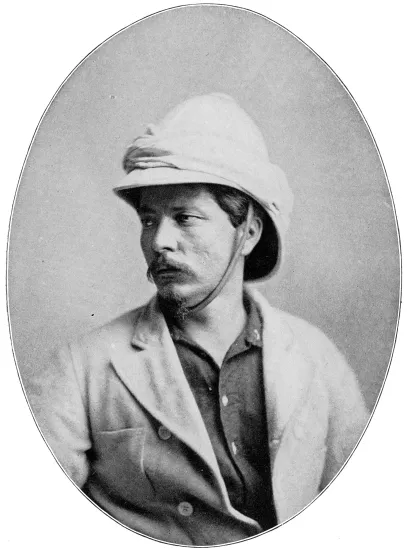 HENRY M. STANLEY, 1872
‘I thank God, Doctor, that I have been permitted to see you.’[14]
In the warm grasp he gave my hand, and the heartiness of his voice, I
felt that he also was sincere and earnest as he replied,—
‘I feel most thankful that I am here to welcome you.’
The principal Arabs now advanced, and I was presented by the Doctor to
Sayed bin Majid, a relative of the Prince of Zanzibar; to Mahommed bin
Sali, the Governor of Ujiji; to Abed bin Suliman, a rich merchant; to
Mahommed bin Gharib, a constant good friend; and to many other notable
friends and neighbours.
Then, remarking that the sun was very hot, the Doctor led the way to the
verandah of his house, which was close by and fronted the market-place.
The vast crowd moved with us.
After the Arab chiefs had been told the latest news of the war of their
friends with Mirambo, with salaams, greetings, and warm hand-shakings,
and comforting words to their old friend David (Livingstone), they
retired from the verandah, and a large portion of the crowd followed
them.
Then Livingstone caught sight of my people still standing in the hot
sunshine by their packs, and extending his hand, said to me,—
‘I am afraid I have been very remiss, too. Let me ask you now to share
my house with me. It is not a very fine house, but it is rain-proof and
cool, and there are enough spare rooms to lodge you and your goods.
Indeed, one room is far too large for my use.’
I expressed my gratification at his kind offer in suitable terms, and
accordingly gave directions to the chiefs of the caravan about the
storing of the goods and the purchase of rations; and Livingstone
charged his three servants, Susi, Chuma, and Hamoyda, to assist them.
Relieved thus happily and comfortably from all further trouble about my
men, I introduced the subject of breakfast, and asked permission of the
Doctor to give a few directions to my cook.
The Doctor became all at once anxious on that score. Was my cook a good
one? Could he prepare a really satisfactory breakfast? If not, he had a
gem of a female cook—and here he laughed, and continued, ‘She is the
oddest, most eccentric woman I have ever seen. She is quite a character,
but I must give her due credit for her skill in cooking. She is
exceedingly faithful, clean, and deft at all sorts of cooking fit for a
toothless old man like myself. But, perhaps, the two combined would be
still better able to satisfy you?’
Halima, a stout, buxom woman of thirty, was brought at once to our
presence, grinning, but evidently nervous and shy. She was not
uninteresting by any means, and as she opened her capacious mouth, two
complete and perfect rows of teeth were revealed.
‘Halima,’ began Livingstone, in kind, grave tones, ‘my young brother has
travelled far, and is hungry. Do you think you and Ferajji, his cook,
can manage to give us something nice to eat? What have you?’
‘I can have some dampers, and kid kabobs, and tea or coffee ready
immediately, master, if you like; and by sending to the market for
something, we can do better.’
‘Well, Halima, we will leave it to you and Ferajji; only do your best,
for this is a great day for us all in Ujiji.’
‘Yes, master. Sure to do that.’
I now thought of Livingstone’s letters, and calling Kaif-Halek, the
bearer of them, I delivered into the Doctor’s hands a long-delayed
letter-bag that I had discovered at Unyanyembe, the cover of which was
dated November 1st, 1870.
A gleam of joy lighted up his face, but he made no remark, as he stepped
on to the verandah and resumed his seat. Resting the letter-bag on his
knees, he presently, after a minute’s abstraction in thought, lifted his
face to me and said, ‘Now sit down by my side, and tell me the news.’
‘But what about your letters, Doctor? You will find the news, I dare
say, in them. I am sure you must be impatient to read your letters after
such a long silence.’
‘Ah!’ he replied, with a sigh, ‘I have waited years for letters; and the
lesson of patience I have well learned!—I can surely wait a few hours
longer! I would rather hear the general news, so pray tell me how the
old world outside of Africa is getting along.’
Consenting, I sat down, and began to give a résumé of the exciting
events that had transpired since he had disappeared in Africa, in March,
1866.
When I had ended the story of triumphs and reverses which had taken
place between 1866 and 1871, my tent-boys advanced to spread a crimson
table-cloth, and arrange the dishes and smoking platters heaped up
profusely with hot dampers, white rice, maize porridge, kid kabobs,
fricasseed chicken, and stewed goat-meat. There were also a number of
things giving variety to the meal, such as honey from Ukawendi, forest
plums, and wild-fruit jam, besides sweet milk and clabber, and then a
silver tea-pot full of ‘best tea,’ and beautiful china cups and saucers
to drink it from. Before we could commence this already magnificent
breakfast, the servants of Sayed bin Majid, Mohammed bin Sali, and Muini
Kheri brought three great trays loaded with cakes, curries, hashes, and
stews, and three separate hillocks of white rice, and we looked at one
another with a smile of wonder at this Ujiji banquet.
We drew near to it, and the Doctor uttered the grace: ‘For what we are
going to receive, make us, O Lord, sincerely thankful.’
I need not linger over a description of Livingstone. All this may be
found in books, in mine among the number; but I will note some other
discoveries relating to him which I made, which may not be found in
books. At various times I have remarked that the question most
frequently given to me has been: ‘Why did not Livingstone return of his
own accord when he found his energies waning, age creeping on him and
fettering him in its strong bonds, his means so reduced that he was
unable to accomplish anything, even if youth could have been restored to
him?’
Briefly, I will answer that his return to home and kindred was prevented
by an over-scrupulous fidelity to a promise that he had made to his
friend Sir R. Murchison—that he would set the matter of that watershed
north of the Tanganyika at rest. But, strive as he might, misfortune
dogged him; dauntlessly he urged his steps forward over the high
plateaus between Nyasa and Tanganyika, but, steadily, evil, in various
disguises, haunted him. First, his transport animals died, his Indian
escort malingered, and halted, faint-hearted, on the road, until they
were dismissed; then his Johanna escort played the same trick and
deserted him, after which his porters under various pretences absconded;
the natives took advantage of his weakness, and tyrannised over him at
every opportunity. A canoe capsized on Lake Bangweolo, which accident
deprived him of his medicine-chest; then, malarial diseases, finding the
body now vulnerable and open to attack, assailed him, poisoned his
blood, and ravished his strength. Malignant ulcers flourished on the
muscles of his limbs, dysentery robbed him of the vital constituent of
his body. Still, after a time, he rose from his sick-bed, and pressed on
unfalteringly.
The watershed, when he reached it, grew to be a tougher problem than he
had conceived it to be. On the northern slope, a countless multitude of
streams poured northward, into an enormously wide valley. At its lowest
depression, they were met by others, rushing to meet them from the north
and east. United, they formed a river of such volume and current that he
paused in wonder. So remote from all known rivers—Nile, Niger,
Congo—and yet so large! Heedless of his beggared state, forgetful of
his past miseries, unconscious of his weakness, his fidelity to his
promise drives him on with the zeal of an honourable fanatic. He must
fulfil his promise, or die in the attempt!
We, lapped as we are in luxury, feeding on the daintiest diet, affecting
an epicurean cynicism, with the noble virtues of our youth and earlier
life blunted from too close contact with animal pleasures, can only
smile contemptuously, compassionating these morbid ideas of honour! This
man, however, verging upon old age, is so beset by these severely rigid
scruples of his that he must go on.
He traces that voluminous river until it enters a shallow lake called
Bangweolo, which spreads out on either hand beyond sight, like a sea. He
attempts to navigate it; his intention is frustrated by a calamity—the
last of his medicines are lost, his instruments are damaged. He
determines to go by land, reaches Cazembe, and by the natives he is told
of other lakes and rivers without end, all trending northward. He
directs his steps north and west to gather the clues to the riverine
labyrinth, until he is, perforce, halted by utter exhaustion of his
means. He meets an Arab, begs a loan for mere subsistence; and, on that
account, must needs march whither the Arab goes.
Hearing of a caravan bound coastward, he writes a letter to Zanzibar in
1867, and directs that goods should be sent to him at Ujiji; and,
bidding his soul possess itself with patience, he wanders with the Arab
merchant for a whole year, and, in 1869, arrives at Ujiji. There is
nothing there for him; but a draft on Zanzibar suffices to purchase, at
an extortionate charge, a few bags of beads and a few bales of cloth,
with which he proposes to march due west to strike that great river
discovered two years before so far south. This is loyalty to a friend
with a vengeance!
The friend to whom he had given his promise, had he but known to what
desperate straits the old man was reduced, would long ago have absolved
him. Livingstone was now in his fifty-seventh year, toothless, ill-clad,
a constant victim to disease, meagre and gaunt from famine: but
Livingstone’s word was not a thing to be obliterated by
forgetfulness—he had made it his creed, and resolved to be true to it.
Well, this insatiable zeal for his word demands that he proceed due
west, to find this river. He travels until within a hundred miles of it,
when he is stricken down by African ulcers of a peculiarly virulent
type, which confine him to his bed for months. During this forced rest,
his few followers become utterly demoralised; they refuse to stay with a
man who seems bent on self-destruction, and so blind, they say, that he
will not see he is marching to his doom. The ninth month brings
relief—his body is cured, a small re-enforcement of men appear before
him, in answer to the letter he had sent in 1867.
The new men inform him they have only come to convey him back to the
coast. He repudiates the insinuation their words convey with indignant
warmth. He buys their submission by liberal largesse, and resumes his
interrupted journey westward. In a few days, he arrives at the banks of
the Lualaba, which is now two thousand yards wide, deep, and flowing
strong still northward, at a point thirteen hundred miles from its
source. The natives as well as the Arab traders unite in the statement
that, as far as their acquaintance with it is, its course is northward.
The problem becomes more and more difficult, and its resolution is ever
elusive. His instruments make it only two thousand feet above the
sea—the Nile, six hundred miles northward, is also two thousand feet!
How can this river be the Nile, then? Yet its course is northward and
Nileward,—has been northward and Nileward ever since it left Bangweolo
Lake, seven hundred miles south of where he stands,—and, for many
weeks’ travel along its banks, all reports prove that it continues its
northerly flow.
To settle this exasperating puzzle, he endeavours to purchase canoes for
its navigation; but his men become rebellious and frantic in their
opposition, and Livingstone finds that every attempt he makes is
thwarted. While hesitating what to do, he receives a letter, which
informs him that another caravan has arrived for him at Ujiji. He
resolves to journey back to Lake Tanganyika, and dismiss these obstinate
and mutinous followers of his; and, with new men, carefully chosen,
return to this interesting field, and explore it until he discovers the
bourn of that immense river.
He arrives at Ujiji about the 1st of November, 1871, only to find that
his caravan has been disbanded, and the goods sold by its chief; in
other words, that his present state is worse than ever!
He is now in his fifty-ninth year, far away from the scene of his
premeditated labours; the sea, where he might have rest and relief from
these continually-repeating misfortunes, though only nine hundred miles
off, is as inaccessible as the moon to him, because Mirambo and his
bandits are carrying on a ravaging and desolating war throughout all the
region east of Ujiji. The Arabs of the colony have no comfort to impart
to him, for they, too, feel the doom of isolation impending over them.
Over and over again, they have despatched scouts eastward, and each time
these have returned with the authentic news that all routes to the sea
are closed by sanguinary brigandage. Not knowing how long this period
may last, the Arabs practise the strictest economy; they have neither
cloth nor bead currency to lend, however large may be the interest
offered for the loan. But, as the position of the old man has become
desperate, and he and his few followers may die of starvation, if no
relief be given, Sayed bin Majid and Mohammed bin Gharib advance a few
dozen cloths to him, which, with miserly economy, may suffice to
purchase food for a month.
And then? Ah! then the prospect will be blank indeed! However, ‘Thy will
be done. Elijah was fed by a raven; a mere dove brought hope to Noah;
unto the hungering Christ, angels ministered. To God, the All-bountiful,
all things are possible!’
To keep his mind from brooding over the hopeless prospect, he turns to
his Journal, occupies himself with writing down at large, and with
method, the brief jottings of his lengthy journeys, that nothing may be
obscure of his history in the African wilds to those who may hereafter
act as the executors and administrators of his literary estate. When
fatigued by his constrained position on the clay floor in that
east-facing verandah, he would lift his heavy Journal from his lap, and,
with hand to chin, sit for hours in his brooding moods, thinking, ever
thinking—mind ever revolving the prayer, ‘How long, O Lord, must Thy
servant bear all this?’
At noon, on the tenth day after his arrival at Ujiji from the
west,—while he was in one of these brooding fits on the
verandah,—looking up to the edge of that mountain-plateau, whence we, a
few hours before, had gazed in rapture on the Tanganyika, several
volleys of musketry suddenly startled him and his drowsy neighbours. The
town was wakened from its siesta by the alarming sound of firing. The
inhabitants hurriedly issued out of their homes somewhat frightened,
asking one another if it were Mirambo and his bandits. The general
suspicion that the strangers could be no other than the ubiquitous
African chief and his wild men caused all to lay their hands on their
arms and prepare for the conflict. The boldest, creeping cautiously out
of the town, see a caravan descending slowly towards Ujiji, bearing the
Zanzibar and American flags in front, and rush back shouting out the
news that the strangers are friends from Zanzibar.
In a few minutes the news becomes more definite: people say that it is a
white man’s caravan. Looking out upon the market-place from his
verandah, Livingstone is, from the first, aware of the excitement which
the sudden firing is causing; but if it be Mirambo, as all suspect it
to be, it does not matter much to him, for he is above the miserable
fear of death; violent as it may be, it will be but a happy release from
the afflictions of life. Soon, however, men cried out to him, ‘Joy, old
master, it is a white man’s caravan; it may belong to a friend of
thine.’ This Livingstone contemptuously declines to believe. It is then
that Susi appears, rushing up to me with his impulsive ‘Good-morning.’
None knew better than Susi what a change in the circumstances of his old
master and himself the arrival of an English-speaking white man
foreshadowed. With even more energy of movement he returned to
Livingstone, crying, ‘It is true, sir, it is a white man, he speaks
English; and he has got an American flag with him.’ More than ever
perplexed by this news, he asks, ‘But are you sure of what you say? Have
you seen him?’
At this moment the Arab chiefs came in a group to him, and said, ‘Come,
arise, friend David. Let us go and meet this white stranger. He may be a
relative of thine. Please God, he is sure to be a friend. The praise be
to God for His goodness!’
They had barely reached the centre of the market-place, when the head of
the caravan appeared, and a few seconds later the two white
men—Livingstone and myself—met, as already described.
Our meeting took place on the 10th November, 1871. It found him reduced
to the lowest ebb in fortune by his endless quest of the solution to the
problem of that mighty river Lualaba, which, at a distance of three
hundred miles from Lake Tanganyika, flowed parallel with the lake,
northward. In body, he was, as he himself expressed it, ‘a mere ruckle
of bones.’
The effect of the meeting was a rapid restoration to health; he was also
placed above want, for he had now stores in abundance sufficient to have
kept him in comfort in Ujiji for years, or to equip an expedition
capable of solving within a few months even that tough problem of the
Lualaba. There was only one thing wanting to complete the old man’s
happiness—that was an obedient and tractable escort. Could I have
furnished this to him there and then, no doubt Livingstone would have
been alive to-day,[15] because, after a few days’ rest at Ujiji, we
should have parted—he to return to the Lualaba, and trace the river,
perhaps, down to the sea, or until he found sufficient proofs that it
was the Congo, which would be about seven hundred miles north-west of
Nyangwe; I journeying to the East Coast.
As my people, however, had only been engaged for two years, no bribe
would have been sufficient to have made them tractable for a greater
period. But, inasmuch as Livingstone would not relinquish his unfinished
task, and no men of the kind he needed were procurable at Ujiji, it was
necessary that he should return with me to Unyanyembe, and rest there
until I could provide him with the force he needed. To this, the last of
many propositions made to him, he agreed. After exploring together the
north end of Lake Tanganyika, and disproving the theory that the Lake
had any connection with the Albert Nyanza, we set out from Ujiji, on the
27th December, 1871, and arrived at Unyanyembe on the 18th February,
1872.
January 3, 1872. Had some modest sport among some zebras, and secured a
quantity of meat, which will be useful. Livingstone, this afternoon, got
upon his favourite topics, the Zambesi Mission, the Portuguese and Arab
slave-trade, and these subjects invariably bring him to relate incidents
about what he has witnessed of African nature and aptitudes. I conclude,
from the importance he attaches to these, that he is more interested in
ethnology than in topographical geography. Though the Nile problem and
the central line of drainage are frequently on his lips, they are second
to the humanities observed on his wanderings, which, whether at the
morning coffee, tiffin, or dinner, occupy him throughout the meal.
The Manyuema women must have attracted him by their beauty, from which I
gather that they must be superior to the average female native. He
speaks of their large eyes, their intelligent looks, and pretty,
expressive, arch ways. Then he refers to the customs at Cazembe’s Court,
and the kindness received from the women there.
In a little while, I am listening to the atrocities of Tagamoyo, the
half-caste Arab, who surrounded a Manyuema market, and, with his
long-shirted followers, fired most murderous volleys on the natives as
they were innocently chaffering about their wares. Then there is real
passion in his language, and I fancy from the angry glitter in his eyes
that, were it in his power, Tagamoyo and his gang should have a quick
taste of the terror he has inspired among the simple peoples of
Manyuema. He is truly pathetic when he describes the poor enchained
slaves, and the unhappy beings whose necks he has seen galled by the
tree-forks, lumbering and tottering along the paths, watched by the
steady, cruel eyes of their drivers, etc., etc.
The topics change so abruptly that I find it almost impossible to
remember a tithe of them; and they refer to things about which I know so
little that it will be hard to make a summary of what I am told at each
meal. One cannot always have his note-book handy, for we drop upon a
subject so suddenly, and often, in my interest, I forget what I ought to
do. I must trust largely to the fact that I am becoming steeped in
Livingstonian ideas upon everything that is African, from pity for the
big-stomached picaninny, clinging to the waist-strings of its mother, to
the missionary bishop, and the great explorers, Burton, Speke, and
Baker.
He is a strong man in every way, with an individual tenacity of
character. His memory is retentive. How he can remember Whittier’s
poems, couplets out of which I hear frequently, as well as from
Longfellow, I cannot make out. I do not think he has any of these books
with him. But he recites them as though he had read them yesterday.
March 3. Livingstone reverted again to his charges against the
missionaries on the Zambesi, and some of his naval officers on the
expedition.
I have had some intrusive suspicions, thoughts that he was not of such
an angelic temper as I believed him to be during my first month with
him; but, for the last month, I have been driving them steadily from my
mind, or perhaps to be fair, he by his conversations, by his prayers,
his actions, and a more careful weighing and a wider knowledge of all
the circumstances, assists me to extinguish them. Livingstone, with all
his frankness, does not unfold himself at once; and what he leaves
untold may be just as vital to a righteous understanding of these
disputes as what he has said. Some reparation I owe him for having been
on the verge of prejudice before I even saw him. I expected, and was
prepared, to meet a crusty misanthrope, and I was on my guard that the
first offence should not come from me; but I met a sweet opposite, and,
by leaps and bounds, my admiration grew in consequence. When, however,
he reiterated his complaints against this man and the other, I felt the
faintest fear that his strong nature was opposed to forgiveness, and
that he was not so perfect as at the first blush of friendship I thought
him. I grew shy of the recurrent theme, lest I should find my fear
confirmed. Had I left him at Ujiji, I should have lost the chance of
viewing him on the march, and obtaining that more detailed knowledge I
have, by which I am able to put myself into his place, and, feeling
something of his feelings, to understand the position better.
It was an ungrateful task to have to reproach the missionaries for their
over-zeal against the slave-traders, though he quite shared their hatred
of the trade, and all connected with it; but to be himself charged, as
he was, with having been the cause of their militant behaviour, to be
blamed for their neglect of their special duties, and for their follies,
by the very men whom he has assisted and advised, was too much.
But, in thinking that it was rather a weakness to dwell on these bitter
memories, I forgot that he was speaking to me, who had reminded him of
his experiences, and who pestered him with questions about this year and
another, upon this topic and that; and I thought that it was not fair to
retaliate with inward accusations that he was making too much of these
things, when it was my own fault. Then I thought of his loneliness, and
that to speak of African geography to a man who was himself in Africa,
was not only not entertaining, but unnecessary; and that to refuse to
speak of personal events would, from the nature of a man, be imputed to
him as reserve, and, perhaps, something worse. These things I revolved,
caused by observations on his daily method of life, his pious habits, in
the boat, the tent, and the house.
At Kwikuru, just before the day we got our letters from Europe, I went
to the cook Ulimengo, who was acting in Ferajji’s place; and, being
half-mad with the huge doses of quinine I had taken, and distressingly
weak, I sharply scolded him for not cleaning his coffee-pots, and said
that I tasted the verdigris in every article of food, and I violently
asked if he meant to poison us. I showed him the kettles and the pots,
and the loathsome green on the rims. He turned to me with astounding
insolence, and sneeringly asked if I was any better than the ‘big
master,’ and said that what was good for him was good for me—the
‘little master.’
I clouted him at once, not only for his insolent question, but because I
recognised a disposition to fight. Ulimengo stood up and laid hold of
me. On freeing myself, I searched for some handy instrument; but, at
this juncture, Livingstone came out of the tent, and cried out to
Ulimengo, ‘Poli-poli-hapo’ [Gently there]! What is the matter, Mr.
Stanley?’ Almost breathless between passion and quinine, I spluttered
out my explanations. Then, lifting his right hand with the curved
forefinger, he said, ‘I will settle this.’ I stood quieted; but, what
with unsatisfied rage and shameful weakness, the tears rolled down as
copiously as when a child.
I heard him say, ‘Now, Ulimengo, you are a big fool: a big, thick-headed
fellow. I believe you are a very wicked man. Your head is full of lying
ideas. Understand me now, and open your ears. I am a Mgeni [guest] and
only a Mgeni, and have nothing to do with this caravan. Everything in
the camp is my friend’s. The food I eat, the clothes on my back, the
shirt I wear, all are his. All the bales and beads are his. What you put
in that belly of yours comes from him, not from me. He pays your wages.
The tent and the bed-clothes belong to him. He came only to help me, as
you would help your brother or your father. I am only the “big master”
because I am older; but when we march, or stop, must be as he likes,
not me. Try and get all that into that thick skull of yours, Ulimengo.
Don’t you see that he is very ill, you rascal? Now, go and ask his
pardon, Go on.’
And Ulimengo said he was very sorry, and wanted to kiss my feet; but I
would not let him.
Then Livingstone took me by the arm to the tent, saying, ‘Come now, you
must not mind him. He is only a half-savage, and does not know any
better. He is probably a Banyan slave. Why should you care what he says?
They are all alike, unfeeling and hard!’
Little by little, I softened down; and, before night, I had shaken hands
with Ulimengo. It is the memory of several small events, which, though
not worth recounting singly, muster in evidence and strike a lasting
impression.
‘You bad fellow. You very wicked fellow. You blockhead. You fool of a
man,’ were the strongest terms he employed, where others would have
clubbed, or clouted, or banned, and blasted. His manner was that of a
cool, wise, old man, who felt offended, and looked grave.
March 4, Sunday. Service at 9 A.M. Referring to his address to his men,
after the Sunday service was over, he asked me what conclusions I had
come to in regard to the African’s power of receiving the gospel?
‘Well, really, to tell you the truth, I have not thought much of it. The
Africans appear to me very dense, and I suppose it will take some time
before any headway will be made. It is a slow affair, I think,
altogether. You do not seem to me to go about it in the right way—I do
not mean you personally, but missionaries. I cannot see how one or two
men can hope to make an impression on the minds of so many millions,
when all around them is the whole world continuing in its own humdrum
fashion, absorbed in its avocations, and utterly regardless of the tiny
village, or obscure district, where the missionaries preach the gospel.’
‘How would you go about it?’ he asked.
‘I would certainly have more than one or two missionaries. I would have
a thousand, scattered not all over the continent, but among some great
tribe or cluster of tribes, organised systematically, one or two for
each village, so that though the outskirts of the tribe or area where
the gospel was at work might be disturbed somewhat by the evil example
of those outside, all within the area might be safely and
uninterruptedly progressing. Then, with the pupils who would be turned
out from each village, there would be new forces to start elsewhere
outside the area.’
‘In a way, that is just my opinion; but someone must begin the work.
Christ was the beginner of the Christianity that is now spread over a
large part of the world, then came the Twelve Apostles, and then the
Disciples. I feel, sometimes, as if I were the beginner for attacking
Central Africa, and that others will shortly come; and, after those,
there will come the thousand workers that you speak of. It is very dark
and dreary, but the promise is, “Commit thy way to the Lord, trust in
Him, and He shall bring it to pass.” I may fall by the way, being
unworthy to see the dawning. I thought I had seen it when the Zambezi
mission came out, but the darkness has settled again, darker than ever.
It will come, though, it must come, and I do not despair of the day,
one bit. The earth, that is the whole earth, shall be filled with the
knowledge of the Lord, as the waters cover the sea.
‘Loneliness is a terrible thing, especially when I think of my children.
I have lost a great deal of happiness, I know, by these wanderings. It
is as if I had been born to exile; but it is God’s doing, and He will do
what seemeth good in His own eyes. But when my children and home are not
in my mind, I feel as though appointed to this work and no other. I am
away from the perpetual hurry of civilisation, and I think I see far and
clear into what is to come; and then I seem to understand why I was led
away, here and there, and crossed and baffled over and over again, to
wear out my years and strength. Why was it but to be a witness of the
full horror of this slave-trade, which, in the language of Burns, is
sending these pitiless half-castes
“Like bloodhounds from the slip,
With woe and murder o’er the land!”
‘My business is to publish what I see, to rouse up those who have the
power to stop it, once and for all. That is the beginning; but, in the
end, they will also send proper teachers of the gospel, some here, and
some there, and what you think ought to be done will be done in the
Lord’s good time.
“See, yonder, poor, o’er-laboured wight,
So abject, mean, and vile!
Who begs a brother of the earth
To give him leave to toil!”
I have often quoted those lines of Burns to myself, on my travels in
Manyuema, when I saw the trembling natives just on the run, when they
suspected that we were Arabs about to take them from their homes and
compel them to carry their stolen ivory. Oh, well, there is a good God
above who takes note of these things, and will, at the proper moment,
see that justice will be measured out to these monsters.’
March 13, 1872. This is the last day of my stay with dear old
Livingstone; the last night we shall be together is present, and I
cannot evade the morrow. I feel as though I should like to rebel against
the necessity of departure. The minutes beat fast, and grow into hours.
Our door to-night is closed, and we both think our own thoughts. What
his are, I know not—mine are sad. My days seem to have been spent far
too happily, for, now that the last day is almost gone, I bitterly
regret the approach of the parting hour. I now forget the successive
fevers, and their agonies, and the semi-madness into which they often
plunged me. The regret I feel now is greater than any pains I have
endured. But I cannot resist the sure advance of time, which is flying
to-night far too fast. What must be, must be! I have often parted with
friends before, and remember how I lingered and wished to put it off,
but the inevitable was not to be prevented. Fate came, and, at the
appointed hour, stood between us. To-night I feel the same aching pain,
but in a greater degree; and the farewell I fear may be for ever. For
ever? and ‘For ever’ echo the reverberations of a woeful whisper!
I have received the thanks that he had repressed all these months in the
secrecy of his heart, uttered with no mincing phrases, but poured out,
as it were, at the last moment, until I was so affected that I sobbed,
as one only can in uncommon grief. The hour of night and the
crisis,—and oh! as some dreadful doubts suggested the eternal
parting,—his sudden outburst of gratitude, with that kind of praise
that steals into one and touches the softer parts of the ever-veiled
nature,—all had their influence; and, for a time, I was as a sensitive
child of eight or so, and yielded to such bursts of tears that only such
a scene as this could have forced.
I think it only needed this softening to secure me as his obedient and
devoted servitor in the future, should there ever be an occasion where I
could prove my zeal.
On the 14th March, my expedition left Unyanyembe, he accompanying me for
a few miles. We reached the slope of a ridge overlooking the valley, in
the middle of which our house where we had lived together looked very
small in the distance. I then turned to him and said,—
‘My dear Doctor, you must go no further. You have come far enough. See,
our house is a good distance now, and the sun is very hot. Let me beg of
you to turn back.’
‘Well,’ he replied, ‘I will say this to you: you have done what few men
could do. And for what you have done for me, I am most grateful. God
guide you safe home and bless you, my friend!’
‘And may God bring you safe back to us all, my dear friend! Farewell!’
‘Farewell!’ he repeated.
We wrung each other’s hands, our faces flushed with emotion, tears
rushing up, and blinding the eyes. We turned resolutely away from each
other; but his faithful followers, by rushing up to give their parting
words, protracted the painful scene.
‘Good-bye, all! Good-bye, Doctor, dear friend!’
‘Good-bye!’
At the moment of parting, the old man’s noble face slightly paled, which
I knew to be from suppressed emotion, while, when I looked into his
eyes, I saw there a kind of warning, to look well at him as a friend
looks for the last time; but the effort well-nigh unmanned me,—a little
longer, and I should have utterly collapsed. We both, however, preferred
dry eyes, and outward calm.
From the crest of the ridge I turned to take a last long look at him, to
impress his form on my mind; then, waving a last parting signal, we
descended the opposite slope on the home road.
On the fifty-fourth day after leaving Dr. Livingstone, I arrived at
Zanzibar. Two weeks later, that is on the 20th May, fifty-seven men,
chosen people of good character, sailed from Zanzibar for the mainland,
as the expeditionary force which was to accompany Livingstone for a
period of two years for the completion of his task of exploration. They
arrived at Unyanyembe on the 11th August, 1872, having been eighty-two
days on the road.
Fourteen days later, Livingstone, amply equipped and furnished with men,
means, medicines, and instruments, and a small herd of cattle, set out
for the scene of his explorations. Eight months later, the heroic life
came to its heroic end.
From an unpublished Memorial to Livingstone by Stanley, the following
passages are taken.
He preached no sermon, by word of mouth, while I was in company with
him; but each day of my companionship with him witnessed a sermon acted.
The Divine instructions, given of old on the Sacred Mount, were closely
followed, day by day, whether he rested in the jungle-camp, or bided in
the traders’ town, or savage hamlet. Lowly of spirit, meek in speech,
merciful of heart, pure in mind, and peaceful in act, suspected by the
Arabs to be an informer, and therefore calumniated, often offended at
evils committed by his own servants, but ever forgiving, often robbed
and thwarted, yet bearing no ill-will, cursed by the marauders, yet
physicking their infirmities, most despitefully used, yet praying daily
for all manner and condition of men! Narrow, indeed, was the way of
eternal life that he elected to follow, and few are those who choose it.
Though friends became indifferent to his fate, associates neglectful,
and his servants mocked and betrayed him, though suitable substance was
denied to him, and though the rain descended in torrents on him in his
wanderings, and the tropic tempests beat him sore, and sickened him with
their rigours, he toiled on, and laboured ever in the Divine service he
had chosen, unyielding and unresting, for the Christian man’s faith was
firm that ‘all would come right at last.’
Had my soul been of brass, and my heart of spelter, the powers of my
head had surely compelled me to recognise, with due honour, the Spirit
of Goodness which manifested itself in him. Had there been anything of
the Pharisee or the hypocrite in him, or had I but traced a grain of
meanness or guile in him, I had surely turned away a sceptic. But my
every-day study of him, during health or sickness, deepened my reverence
and increased my esteem. He was, in short, consistently noble, upright,
pious, and manly, all the days of my companionship with him.
He professed to be a Liberal Presbyterian. Presbyterianism I have heard
of, and have read much about it; but Liberal Presbyterianism,—whence is
it? What special country throughout the British Isles is its birthplace?
Are there any more disciples of that particular creed, or was
Livingstone the last? Read by the light of this good man’s conduct and
single-mindedness, its tenets would seem to be a compound of religious
and practical precepts.
‘Whatever thy right hand findeth to do, do it with all thy might.’
‘By the sweat of thy brow thou shalt eat bread.’
‘For every idle word thou shalt be held accountable.’
‘Thou shalt worship the Lord thy God, and Him only shalt thou serve.’
‘Thou shalt not kill.’
‘Swear not at all.’
‘Be not slothful in business, but be fervent in spirit, and serve the
Lord.’
‘Mind not high things, but condescend to men of low estate.’
‘Live peaceably with all men.’
‘We count those happy who endure.’
‘Remember them that are in bonds, and them which suffer adversity.’
‘Watch thou, in all things; endure afflictions; do the work of an
evangelist; make full proof of thy ministry.’
‘Whatsoever ye do, do it heartily.’
‘Set your affections on things above, not on things of the earth.’
‘Be kind to one another, tender-hearted, and forgiving.’
‘Preach the gospel in the regions beyond you, and boast not in another
man’s line, of things made ready to your hand.’
I never discovered that there was any printed code of religious laws or
moral precepts issued by his church, wherein these were specially
alluded to; but it grew evident during our acquaintance that he erred
not against any of them. Greater might he could not have shown in this
interminable exploration set him by Sir Roderick Murchison, because the
work performed by him was beyond all proportion to his means and
physical strength. What bread he ate was insufficient for his bodily
nourishment, after the appalling fatigues of a march in a tropical land.
His conversation was serious, his demeanour grave and earnest. Morn and
eve he worshipped, and, at the end of every march, he thanked the Lord
for His watchful Providence. On Sundays he conducted Divine Service, and
praised the glory of the Creator, the True God, to his dark followers.
His hand was
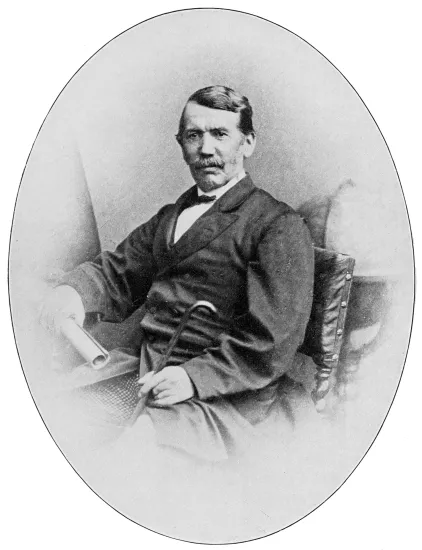 DOCTOR LIVINGSTONE
clear of the stain of blood-guiltiness. Profanity was an abomination to
him. He was not indolent either in his Master’s service, or in the cause
to which he was sacrificing himself. His life was an evidence that he
served God with all his heart.
Nothing in the scale of humanity can be conceived lower than the tribes
of Manyuema with whom he daily conversed as a friend. Regardless of such
honours as his country generally pays to exceeding merit, he continued
his journeyings, bearing messages of peace wherever he went; and when he
rested, chief and peasant among the long-neglected tribes ministered to
his limited wants. Contented with performing his duty according as he
was enabled to, such happiness as can be derived from righteous doings,
pure thoughts, and a clear conscience, was undoubtedly his. His earnest
labours for the sake of those in bonds, and the unhappy people who were
a prey to the Arab kidnapper and land pirate, few will forget. The
number of his appeals, the constant recurrence to the dismal topic, and
the long lines of his travels, may be accepted as proofs of his
heartiness and industry.
He was the first to penetrate to those lands in the Chambezi and the
Lualaba valleys; his was the first voice heard speaking in the hamlets
of Eastern Sunda of the beauties of the Christian religion; and he was
the first preacher who dared denounce the red-handed Arab for his
wickedly aggressive acts. In regions beyond ken of the most learned
geographers of Europe, he imitated the humility of the Founder of his
religion, and spoke in fervent strains of the Heavenly message of peace
and good-will.
Should I ever return to the scenes that we knew together, my mind would
instantaneously revert to the good man whom I shall never see more. Be
it a rock he sat upon, a tree upon which he rested, ground that he
walked upon, or a house that he dwelt in, my first thought would
naturally be that it was associated with him. But my belief is that they
would flush my mind with the goodness and nobleness of his expression,
appealing to me, though so silently, to remember, and consider, and
strive.
I remember well when I gazed at Ujiji, five years later, from the same
hill as where I had announced the coming of my caravan: I had not been
thinking much of him until that moment, when, all at once, above the
palm grove of Ujiji, and the long broad stretch of blue water of the
lake beyond, loomed the form of Livingstone, in the well-remembered
blue-grey coat of his marching costume, and the blue naval cap,
gold-banded, regarding me with eyes so trustful, and face so grave and
sad.
It is the expression of him that so follows and clings to me, and,
indeed, is ever present when I think of him, though it is difficult to
communicate to others the expression that I first studied and that most
attracted me. There was an earnest gravity in it; life long ago shorn of
much of its beauty—I may say of all its vulgar beauty and coarser
pleasures, a mind long abstracted from petty discontents, by preference
feeding on itself, almost glorifying in itself as all-sufficient to
produce content; therefore a composure settled, calm, and trustful.
Even my presence was impotent to break him from his habit of
abstraction. I might have taken a book to read, and was silent. If I
looked up a few minutes later, I discovered him deeply involved in his
own meditations, right forefinger bent, timing his thoughts, his eyes
gazing far away into indefinite distance, brows puckered closely—face
set, and resolute, now and then lips moving, silently framing words.
‘What can he be thinking about?’ I used to wonder, and once I ventured
to break the silence with,—
‘A penny for your thoughts, Doctor.’
‘They are not worth it, my young friend, and let me suggest that, if I
had any, possibly, I should wish to keep them!’
After which I invariably let him alone when in this mood. Sometimes
these thoughts were humorous, and, his face wearing a smile, he would
impart the reason with some comic story or adventure.
I have met few so quickly responsive to gaiety and the lighter moods,
none who was more sociable, genial, tolerant, and humorous. You must
think of him as a contented soul, who had yielded himself with an entire
and loving submission, and who laboured to the best of his means and
ability, awakening to the toil of the day, and resigning himself,
without the least misgiving, to the rest of the night; believing that
the effect of his self-renunciation would not be altogether barren.
If you can comprehend such a character, you will understand
Livingstone’s motive principle.
IT is not unadvisedly that the last chapter has been devoted almost as
much to Livingstone as to Stanley. The main story of Stanley’s quest he
has told effectively elsewhere;[16] and in his interior life, which is
the central theme of the present book, his intercourse with Livingstone
was no small factor. The way he knew and loved Livingstone reveals
Stanley. But to give the whole story of those sixteen months its true
perspective, the reader should either turn to the full narrative, or
should, at least, give some little play to his own imagination.
The few lines given to the contest with Mirambo represent months of
struggle with a bandit-chief, and with slippery allies.
The three-line mention of the joint exploration of Lake Tanganyika
stands for four weeks of adventurous voyaging, geographical discovery,
and encounters with hostile or thievish natives. Through the whole
period Stanley carried an immense and varied responsibility. He was not
only commander, and chief of staff, but the whole staff. The discipline,
commissariat, and medical care, of a force often numbering two hundred
and more, all fell on him. For his followers he had to take the part of
doctor, and occasionally of nurse, sometimes including the most menial
offices. Often he was prostrated by fever, and once, before finding
Livingstone, he lay unconscious for a week.
Problems of war and diplomacy confronted him. Shall he pay tribute, or
resist? Shall he join forces with the friendly tribes, and fight the
fierce and powerful Mirambo who blocks the way to Ujiji? He fights, and
his allies fail him at the pinch; so then he resorts to a long flanking
march through unknown country, and literally circumvents his foes. So,
for over a year, every faculty is kept at the highest tension.
Along with the developing effect of the experience, comes the solitary
communing with Nature, which brings a spiritual exaltation. Then follows
the companionship with Livingstone, a man of heroic and ideal traits,
uniquely educated by the African wilds; these two learn to know each
other by the searching test of hourly companionship, amid savages,
perils, perplexities, days of adventure, nights of intimate converse;
Stanley’s deepest feelings finding worthy object and full response in
the man he had rescued, and suggestions of spiritual and material
resources in the unknown continent, destined to germinate and bear
fruit;—all this his first African exploration brought to Stanley.
His return to civilisation was not altogether a genial home-coming. In a
way, he had been more at home in Africa than he found himself in
England. There his companionship had been with Nature, with Livingstone,
with his own spirit; the difficulties and dangers confronting him had
been a challenge to which his full powers made response; and ‘the free
hand,’ so dear to a strong man, had been his. Now he was plunged into a
highly-artificial society; its trappings and paraphernalia, its formal
dinners, and ceremonies, were distasteful to him; above all, he was
thrust into a prominence which brought far more pain than pleasure.
A flood of importunate, or inquisitive, letters from strangers poured in
on him; he notes that in one morning he has received twenty-eight.
Relatives and acquaintances of his early years became suddenly
affectionate and acquisitive; greedy claims were made on his purse,
which he would not wholly reject. Worst of all, with the acclamations of
the public which greeted him, were mingled expressions of doubt or
disbelief, innuendoes, sneers! Men, and journals, of high standing, were
among the sceptics.
Sir Henry Rawlinson, President of the Royal Geographical Society, wrote
to the ‘Times’ that it was not true that Stanley had discovered
Livingstone, but that Livingstone had discovered Stanley! The silly quip
had currency long after Sir Henry Rawlinson had changed his tone, and
the Society had passed a vote of thanks to Stanley. The ‘Standard,’ in
oracular tones, called for the sifting of the discoverer’s story by
experts; it ‘could not resist some suspicions and misgivings’; it found
‘something inexplicable and mysterious’ in the business! There were
those who publicly questioned the authenticity of letters which, at
Stanley’s suggestion, Livingstone had written to the ‘Herald.’
Geographical pundits mixed their theoretic speculations with slighting
personal remarks. Perhaps no great and eminent body of scholars escapes
a touch of the Mutual-Admiration Society; there are shibboleths of
nationality, of social class, of clan and coterie; and when an outsider
steps on the stage, there is solemn wrinkling of official foreheads, and
lifting of distinguished eyebrows. So from the ‘Royal Geographical’ some
chill whiffs blew towards this ‘American,’ who brought strange tidings
from Africa. To Stanley, sensitive, high-strung, conscious of hard work,
loyally done and faithfully reported, not hungry for fame, but
solicitous of trust and confidence, all this was intensely bitter.
There was a field-day at Brighton at the meeting of the Geographical
Section of the British Association, under the presidency of Mr. (now,
Sir) Francis Galton. Stanley was the central figure of the occasion. He
spoke to an audience of three thousand, with a group of great
geographers, and Eminences of high degree, including the ex-Emperor and
Empress of the French. The ‘Telegraph’s’ report describes him as
speaking with entire self-possession, with composure, with a natural and
effective oratory, and ‘with the evident purpose to speak his mind to
everybody, without the slightest deference, or hesitation.’
But, in his Journal, he records that his stage-fright was so extreme he
could only begin after three trials. At the request of the ‘Royal
Geographical,’ he had prepared a brief paper, dealing only with the
exploration of the north end of Lake Tanganyika. But, unexpectedly, he
was called on to give some account of his whole expedition.
He told his story, and read his paper. A general discussion followed,
turning mainly on certain geographical questions; and, at the end,
Stanley was called on for some final words, and ‘winged words’ they
were, of passionate ardour and directness. On some of the geographical
opinions, there was criticism; and a special attack was made on the
theory to which Livingstone inclined, that the river Lualaba was the
source of the Nile. Stanley had grave doubts of that theory, which he
was destined ultimately to disperse; but, for Livingstone’s sake, he
wanted it treated at least with respect.
In the discussion there were allusions to himself, perhaps tactless
rather than intentional; as when Mr. (now, Sir) Francis Galton remarked
that they were not met to listen to sensational stories, but to serious
facts! Whether malicious, or only maladroit, such allusions were
weighted by what had gone before in the Press.
Stanley summed up with a fervent eulogy of Livingstone, and a biting
comparison of the arm-chair geographer, waking from his nap, to
dogmatise about the Nile, with the gallant old man seeking the reality
for years, amid savage and elemental foes.
One cannot doubt that his own essential veracity and manliness stamped
themselves on the minds of his audience; and, in truth, the great
preponderance of intelligent opinion seems to have been, from the first,
wholly in his favour. The ‘Times,’ the ‘Daily News,’ the ‘Daily
Telegraph,’ and ‘Punch,’ were among his champions. Livingstone’s own
family gratefully acknowledged his really immense services, and
confirmed beyond question the genuineness of Livingstone’s letters
brought home by Stanley, so confounding those who had charged him with
forgery. Lord Granville, at the Foreign Office, handed him, on the
Queen’s behalf, a note of congratulation, and a gold snuff-box set with
diamonds; and, in a word, the world at large accepted him, then and
thenceforward, as a true man and a hero.
But Stanley suffered so keenly and so long, not only at the time, but
afterwards, from the misrepresentation and calumny he encountered, that
a word more should be given to the subject. The hostility had various
sources. In America, the ‘New York Herald,’ always an aggressive,
self-assertive, and successful newspaper, had plenty of journalistic
foes.
A former employee of Stanley’s, whose behaviour had caused serious
trouble, and brought proper punishment on him, gained the ear of a
prominent editor, who gave circulation to the grossest falsehoods. In
later years, other subordinates, whom Stanley’s just and necessary
discipline had offended, became his persistent calumniators. The wild
scenes of his explorations, and the stimulus their wonders gave to the
imagination, acted sometimes like a tropical swamp, whence springs fetid
and poisonous vegetation. Stories of cruelty and horror seemed to
germinate spontaneously. Stanley himself laid stress on the propensity
in average human nature to noxious gossip, and the pandering to this
taste by a part of the Press.
It is to be remembered, too, that the circumstances of his early life
heightened his sensitiveness to gossiping curiosity and crude
misrepresentation. And, finally, he had in his nature much of the woman,
the Ewigweibliche; he craved fame far less than love and confidence.
Renown, as it came, he accepted, not with indifference,—he was too
human for that,—but with tempered satisfaction. He met praise in the
fine phrase Morley quotes from Gladstone, ‘as one meets a cooling
breeze, enjoyed, but not detained.’ The pain which slander brought he
turned to account, setting it as a lesson to himself not to misjudge
others. His thoughts upon his own experience may be sufficiently shewn
by an extract from one of his Note-books.
The vulgar, even hideous, nonsense, the number and variety of untruths
published about me, from this time forth taught me, from pure sympathy,
reflection, and conviction, to modify my judgment about others.
When anyone is about to become an object of popular, i. e., newspaper
censure, I have been taught to see how the scavenger-beetles of the
Press contrive to pick up an infinitesimal grain of fact, like the
African mud-rolling beetle, until it becomes so monstrously exaggerated
that it is absolutely a mass of filth.
The pity of it is that most of the writers forget for whom they write.
We are not all club-loungers, or drawing-room gossips; nor are we all
infected with the prevailing madness of believing everything we see in
the newspapers. We do not all belong to that large herd of unthinking
souls who say, ‘Surely, where there is so much smoke, there must be a
fire’; those stupid souls who never knew that, as likely as not, the
fire was harmless enough, and that the alarming cloud of smoke was owing
to the reporter’s briarwood!
Therefore I say, the instant I perceive, whether in the Press, or in
Society, a charge levelled at some person, countryman, or foreigner, I
put on the brake of reason, to prevent my being swept along by the
general rage for scandal and abuse, and hold myself unconscious of the
charge until it is justified by conviction.
All the actions of my life, and I may say all my thoughts, since 1872,
have been strongly coloured by the storm of abuse and the wholly
unjustifiable reports circulated about me then. So numerous were my
enemies, that my friends became dumb, and I had to resort to silence, as
a protection against outrage.
It is the one good extracted from my persecution that, ever since, I
have been able to restrain myself from undertaking to pass sentence on
another whom I do not know. No man who addresses himself to me is
permitted to launch judgment out in that rash, impetuous newspaper way,
without being made to reflect that he knew less about the matter than he
had assumed he did.
This change in me was not immediate. The vice of reckless, unthinking
utterance was not to be suddenly extirpated. Often, as I opened my mouth
in obedience to the impulse, I was arrested by the self-accusation, ‘Ah!
there you go, silly and uncharitable as ever!’ It was slow unlearning,
but the old habit was at last supplanted by the new.
Stanley bore himself in the spirit of the words which F. W. H. Myers[17]
applies to Wordsworth:—
‘He who thus is arrogantly censured should remember both the dignity and
the frailty of man, ... and go on his way with no bitter broodings, but
yet ... “with a melancholy in the soul, a sinking inward into ourselves
from thought to thought, a steady remonstrance, and a high resolve.”’
In the months following his return to England, alternating with
indignant protests against misrepresentation, his Journal records many
public and private hospitalities, and meetings with eminent and
interesting people, on some of whom he makes shrewd and appreciative
comment. One portraiture cannot be omitted,—his impressions of Queen
Victoria. The first occasion on which he was received by Her Majesty was
at Dunrobin Castle, when he visited the Duke of Sutherland, in company
with Sir Henry Rawlinson, who did his best to make amends for his early
doubts.
Monday, 10th September, 1872. About noon, we had got ready for our
reception by the Queen. Sir Henry had been careful in instructing me
how to behave in the Presence, that I had to kneel and kiss hands, and,
above all, I was not to talk, or write, about what I should see or hear.
I almost laughed in his face when he charged me with the last, for I
doubt whether the Queen’s daughter would be less apt for gossip about
such things than I. As for kneeling, I was pleased to forget it. We
stood for a while in a gay salon, and presently Her Majesty, followed by
Princess Beatrice, entered. We all bowed most profoundly, and the Queen
advancing, Sir Henry introduced me in a short sentence. I regarded her
with many feelings, first as the greatest lady in the land, the mistress
of a great Empire, the head of brave soldiers and sailors whom I had
seen in various lands and seas, the central figure to which Englishmen
everywhere looked with eyes of love and reverence; and, lastly, as that
mysterious personage whom I had always heard spoken of, ever since I
could understand anything, as ‘The Queen.’ And poor, blind Sir Henry,
to think that I would venture to speak or write about this lady, whom in
my heart of hearts, next to God, I worshipped! Besides, only of late,
she has honoured me with a memorial, which is the more priceless that it
was given when so few believed me.
The word ‘Majesty’ does not rightly describe her bearing. I have often
seen more majestic creatures, but there was an atmosphere of conscious
potency about her which would have marked her in any assemblage, even
without the trappings of Royalty. The word ‘Royal’ aptly describes
another characteristic which clung to her. Short in stature as she is,
and not majestic, the very carriage of her person bespeaks the fact of
her being aware of her own inviolability and unapproachableness. It was
far from being haughty, and yet it was commanding, and serenely proud.
The conversation, which was principally about Livingstone and Africa,
though it did not last more than ten minutes, gave me abundant matter to
think about, from having had such good opportunities to look into her
eyes, and absorb as it were my impressions, such as they were.
What I admired most was the sense of power the eyes revealed, and a
quiet, but unmistakeable, kindly condescension; and an inimitable
calmness and self-possession. I was glad to have seen her, not only for
the honour, and all that, but also, I think, because I have carried
something away to muse over at leisure. I am richer in the understanding
of power and dominion, sitting enthroned on human features.
He began in England his career as a public lecturer, and in pursuance of
it went, in November, 1872, to America. He was received with high
honours by the public, and with great cordiality by his old friends; was
given a warm welcome by ‘the boys,’ the sub-editors of the ‘Herald,’ and
was banqueted by the Union League Club, and the St. Andrew’s Society,
etc., etc. Then he spent several months in travelling and lecturing.
Returning to England, before the clear summons came to his next great
exploration, he once more, as correspondent of the ‘Herald,’ accompanied
and reported the British campaign against the Ashantees, in 1873-74.
That warlike and savage people, under King Coffee, had been harrying the
Fantees, who had lately come under the British Protectorate, as
occupying the ‘hinterland’ of Elmina on the Gold Coast, which England
had taken over from the Dutch.
At intervals for half a century there had been harassing and futile
collisions with the Ashantees, and it was now determined to strike hard.
‘In 1823, Sir Charles McCarthy and six hundred gallant fellows perished
before the furious onset of the Ashantees, and that brave soldier’s
skull, gold-rimmed and highly venerated, was said still to be at
Coomassie, used as a drinking-cup by King Coffee.
‘In 1863-64, the English suffered severe loss. Couran marched to the
Prah, eighty miles from here, and marched back again, being obliged to
bury or destroy his cannon, and hurriedly retreat to the Cape Coast.’
Stanley gave permanent form to his record in the first half of his book,
‘Coomassie and Magdala’ (1874). This campaign on the West Coast, under
Sir Garnet Wolseley, was like, and yet unlike, the Abyssinian expedition
on the East Coast, under Sir Robert Napier. The march inland was only
one hundred and forty miles, but, instead of the grand and lofty
mountains of Abyssinia, the British soldiers and sailors had to cut
their way through unbroken jungle. Stanley’s book is the spirited story
of a well-conducted expedition, told with a firm grasp of the historical
and political situation, with graphic sketches of the English officers,
some of an heroic type, and with descriptions of a repulsive type of
savagery.
Writing of the march, Stanley says:—
What languishing heaviness of soul fills a man, as he, a mere mite in
comparison, travels through the lofty and fearful forest aisle. If
alone, there is an almost palpable silence, and his own heart-pulsations
seem noisy. A night darkness envelops him, and, from above, but the
faintest gleams of daylight can be seen. A brooding melancholy seems to
rest on the face of nature, and the traveller, be he ever so prosaic, is
filled with a vague indefinable sense of foreboding.
The enemy lay hiding in wait, in the middle of a thorny jungle, so dense
in some places that one wonders how naked men can risk their unprotected
bodies. This vast jungle literally chokes the earth with its density and
luxuriance. It admits every kind of shrub, plant, and flower, into a
close companionship, where they intermingle each other’s luxuriant
stalks, where they twine and twine each other’s long slender arms about
one another, and defy the utmost power of the sun to penetrate the leafy
tangle they have reared ten and fifteen feet above the dank earth. This
is the bush into which the Ashantee warriors creep on all fours, and lie
in wait in the gloomy recesses for the enemy. It was in such localities
Sir Garnet found the Ashantees, and where he suffered such loss in his
Staff and officers. Until the sonorous sounds of Danish musketry[18]
suddenly awoke the echoes, few of us suspected the foe so near; until
they betrayed their presence, the English might have searched in vain
for the hidden enemy. Secure as they were in their unapproachable
coverts, our volleys, which their loud-mouthed challenge evoked,
searched many a sinister-looking bush, and in a couple of hours
effectually silenced their fire.
The fighting, when it came, was stubborn. King Theodore’s warriors had
shewn no such mettle as did the Ashantees, who, for five continuous
days, waged fierce fight. On the first day, with the 42nd Highlanders,
the Black Watch, bearing the brunt, and the whole force engaged, the
battle of Amoaful was won; then three days of straggling fighting;
finally, on the fifth day, with the Rifle Brigade taking its turn at the
post of honour, and Lord Gifford’s Scouts always in front, the decisive
battle of Ordahsu was won, and Coomassie was taken. In the Capital were
found ghastly relics of wholesale slaughters, incidents of
fetish-worship, which far outdid the horrors of King Theodore’s court.
We are unable to realise, or are liable to forget, what Africa was
before the advent of Explorers and Expeditions. The Fall of Coomassie,
though attended with great loss of life, put an end to indescribable
horrors and atrocities.
Stanley writes:—
Each village had placed its human sacrifice in the middle of the path,
for the purpose of affrighting the conquerors. The sacrifice was of
either sex, sometimes a young man, sometimes a woman. The head, severed
from the body, was turned to meet the advancing army, the body was
evenly laid out with the feet towards Coomassie. This meant, no doubt,
‘Regard this face, white man, ye whose feet are hurrying on to our
capital, and learn the fate awaiting you.’
Coomassie is a town insulated by a deadly swamp. A thick jungly
forest—so dense that the sun seldom pierced the foliage; so sickly that
the strongest fell victims to the malaria it cherished—surrounded it to
a depth of about one hundred and forty miles seaward, and one hundred
miles to the north; many hundred miles east and west.
Through this forest and swamp, unrelieved by any novelty or a single
pretty landscape, the British Army had to march one hundred and forty
miles, leaving numbers stricken down by fever and dysentery—the
terrible allies of the Ashantee King with his one hundred thousand
warriors.
Stanley, speaking of Coomassie, writes:—
The grove, which was but a continuation of the tall forest we had
travelled through, penetrated as far as the great market-place. A narrow
foot-path led into this grove, where the foul smells became suffocating.
After some thirty paces we arrived before the dreadful scene, but it was
almost impossible to stop longer than to take a general view of the
great Golgotha. We saw some thirty or forty decapitated bodies in the
last stages of corruption, and countless skulls, which lay piled in
heaps, and scattered over a wide extent. The stoutest heart and the most
stoical mind might have been appalled.
At the rate of a thousand victims a year, it would be no exaggeration to
say, that over one hundred and twenty thousand people must have been
slain for ‘custom,’ since Ashantee became a kingdom.
Lord Wolseley wrote: ‘Their capital was a charnel-house; their religion
a combination of cruelty and treachery; their policy the natural outcome
of their religion.’
Terms of submission were imposed on King Coffee, and the force returned
to the coast.
Stanley writes of Lord Wolseley:—
He has done his best, and his best has been a mixture of untiring energy
and determination; youthful ardour, toned down by the sense of his grave
responsibilities, excellent good-nature, which nothing seems to damp;
excessive amiability, by which we are all benefitted; wise forethought,
which, assisted by his devotion to work, proves that the trust reposed
in him by the British Government will not be betrayed.
Stanley occasionally criticises with freedom, both the Government, for
not taking a larger view of the whole situation, and Sir Garnet
Wolseley, for a somewhat hasty settlement of the business, after the
fighting was over.
Stanley’s political foresight and desire for the promotion of
civilisation and commerce, even in such a benighted part of West Africa,
is well exemplified by the following passage:—
If we are wise, we will deprive our present enemy of their king, attach
to ourselves these brave and formidable warriors, and through them open
the whole of Central Africa to trade and commerce and the beneficent
influences of civilisation. The Romans would have been delighted at such
an opportunity of extending their power, for the benefit of themselves
and the world at large.
Nothing in Stanley’s book indicates that he took any personal share in
the fighting. But in Lord Wolseley’s ‘Story of a Soldier’s Life,’ volume
ii, p. 342, occurs this passage: ‘Not twenty yards off were several
newspaper correspondents. One was Mr. Winwood Reid, a very cool and
daring man, who had gone forward with the fighting-line. Of the others,
one soon attracted my attention by his remarkable coolness. It was Sir
Henry Stanley, the famous traveller. A thoroughly good man, no noise, no
danger ruffled his nerve, and he looked as cool and self-possessed as if
he had been at target practice. Time after time, as I turned in his
direction, I saw him go down to a kneeling position to steady his rifle,
as he plied the most daring of the enemy with a never-failing aim. It is
nearly thirty years ago, and I can still see before me the close-shut
lips, and determined expression of his manly face, which, when he looked
in my direction, told plainly I had near me an Englishman in plain
clothes, whom no danger could appall. Had I felt inclined to run away,
the cool, unflinching manliness of that face would have given me fresh
courage. I had been previously somewhat prejudiced against him, but all
such feelings were slain and buried at Amoaful. Ever since, I have been
proud to reckon him amongst the bravest of my brave comrades; and I hope
he may not be offended if I add him amongst my best friends also.’
It was on his way home from the Ashantee War that the tidings met
Stanley, which he accepted and acted upon as a summons to his real
life’s work.
25th February, 1874. Arrived at the Island of St. Vincent, per
‘Dromedary,’ I was shocked to hear, on getting ashore, of the death of
Livingstone at Ilala, near Lake Bangweolo, on May 4th, 1873. His body is
on its way to England, on board the ‘Malwa,’[19] from Aden. Dear
Livingstone! another sacrifice to Africa! His mission, however, must not
be allowed to cease; others must go forward and fill the gap. ‘Close up,
boys! close up! Death must find us everywhere.’
May I be selected to succeed him in opening up Africa to the shining
light of Christianity! My methods, however, will not be Livingstone’s.
Each man has his own way. His, I think, had its defects, though the old
man, personally, has been almost Christ-like for goodness, patience, and
self-sacrifice. The selfish and wooden-headed world requires mastering,
as well as loving charity; for man is a composite of the spiritual and
earthly. May Livingstone’s God be with me, as He was with Livingstone in
all his loneliness. May God direct me as He wills. I can only vow to be
obedient, and not to slacken.
In a camp in the heart of Africa, not far from Lake Bangweolo, David
Livingstone, the traveller-evangelist, lay dead. His followers,
numbering about three-score negroes of Zanzibar, deliberated upon their
future movements. To return to the coast ruled by their Sultan, without
their great white master, would provoke grave suspicion. They resolved
to prepare the remains so as to be fit for transportation across a
breadth of tropical region which extended to the Indian Ocean, fifteen
hundred miles. After many weary months of travel, they arrived at the
sea-coast with the body. In charge of two of the faithful band, it was
placed on board a homeward-bound steamer, to be finally deposited[20] in
a vault in Westminster Abbey.
At the same period when the steamer coasted along the shores of Eastern
Africa, I was returning to England along the coast of Western Africa,
from the Ashantee campaign.
At St. Vincent, on February 25th, 1874, cable news of the death of
Livingstone, substantiated beyond doubt, was put into my hands.
‘At Lake Bangweolo the death occurred,’ said the cablegram. Just one
thousand miles south of Nyangwe! The great river remains, then, a
mystery still, for poor Livingstone’s work is unfinished!
Fatal Africa! One after another, travellers drop away. It is such a huge
continent, and each of its secrets is environed by so many
difficulties,—the torrid heat, the miasma exhaled from the soil, the
noisome vapours enveloping every path, the giant cane-grass suffocating
the wayfarer, the rabid fury of the native guarding every entry and
exit, the unspeakable misery of the life within the wild continent, the
utter absence of every comfort, the bitterness which each day heaps upon
the poor white man’s head, in that land of blackness, the sombrous
solemnity pervading every feature of it, and the little—too
little—promise of success which one feels on entering it.
But, never mind, I will try it! Indeed, I have a spur to goad me on. My
tale of the discovery of Livingstone has been doubted. What I have
already endured in that accursed Africa amounts to nothing, in men’s
estimation. Here, then, is an opportunity for me to prove my veracity,
and the genuineness of my narrative!
Let me see: Livingstone died in endeavouring to solve the problem of the
Lualaba River. John Hanning Speke died by a gun-shot wound during a
discussion as to whether Lake Victoria was one lake, as he maintained it
to be; or whether, as asserted by Captain Burton, James McQueen, and
other theorists, it consisted of a cluster of lakes.
Lake Tanganyika, being a sweet-water lake, must naturally possess an
outlet somewhere. It has not been circumnavigated and is therefore
unexplored. I will settle that problem also.
Then I may be able to throw some light on Lake Albert. Sir Samuel Baker
voyaged along some sixty miles of its north-eastern shore, but he said
it was illimitable to the south-west. To know the extent of that lake
would be worth some trouble. Surely, if I can resolve any of these,
which such travellers as Dr. Livingstone, Captains Burton, Speke, and
Grant, and Sir Samuel Baker left unsettled, people must needs believe
that I discovered Livingstone!
A little while after the burial[21] of Livingstone at Westminster, I
strolled over to the office of the ‘Daily Telegraph,’ and pointed out to
the proprietors how much remained shrouded in mystery in Dark Africa.
The proprietor asked, ‘But do you think you can settle all these
interesting geographical problems?’
‘Nay, Mr. Lawson,[22] that is not a fair question. I mean to say I can
do my level best, that nothing on my part shall be lacking to make a
systematic exploration which shall embrace all the regions containing
these secrets; but Africa includes so many dangers from man, beast, and
climate, that it would be the height of immeasurable conceit to say I
shall be successful. My promise that I will endeavour to be even with
my word, must be accepted by you as sufficient.’
‘Well, well! I will cable over to Bennett of the New York “Herald,” and
ask if he is willing to join in this expedition of yours.’
Deep under the Atlantic, the question was flashed. Gordon Bennett tore
open the telegram in New York City, and, after a moment’s thought,
snatched a blank form and wrote, ‘Yes! Bennett.’
This was the answer put into my hand the same day at 135, Fleet Street.
You may imagine my feelings, as I read the simple monosyllable which was
my commission: bales, packages, boxes, trunks, bills, letters, flowing
in a continuous stream; the writing, telegraphing, and nervous hurry and
flurry of each day’s work, until we sailed! Follow me in thought to the
deck of the steam-ferry across the English Channel; fancy that you hear
my plucky fisher-boys from the Medway,[23] saying to the white cliffs of
Dover, ‘Good-bye, dear England! and if for ever, then for ever good-bye,
O England!’ Think of us a few weeks later, arrived at Zanzibar, where we
make our final preparations for the long journey we are about to make.
Zanzibar is an island, as I suppose you know, situate three hundred and
sixty-nine miles south of the Equator, and about twenty miles from the
eastern mainland.
Its ruler is Prince Barghash, son of Sayed. His subjects are very mixed,
and represent the rasping and guttural Arab, the soft-tongued and
languid Balooch, the fiery-eyed and black-bearded Omanee, the
flowing-locked and tall-hatted Persian, the lithe, slim-waisted Somali,
and at least a hundred specimens of the African tribes.
It was in the bazaars and shops of the principal city that we bought the
cottons, the various beads, the coils of brass wire, the tools, cordage,
ammunition, and guns. It was in a house at Zanzibar that we rolled these
cloths into seventy-pound bales, sacked the beads in similar weights,
packed the wire, and boxed the ammunition and tools. Meantime we
enlisted three hundred and fifty-six chosen fellows. They left their
porter-work, gossiping in the bazaar, the care of their fields and
gardens without the town, to become sworn followers of the
Anglo-American expedition, to carry its loads at so much per month, in
any direction on the mainland I should wish; to stand by the master in
times of trouble, to die with him, if necessary. I also, on my part,
swore to treat them kindly; to medicate them, if sick or bilious; to
judge honestly and impartially between man and man in their little camp
squabbles; to prevent ill-treatment of the weak by the strong; to be a
father and a mother, brother and sister, to each; and to resist, to the
utmost of my ability, any murderous natives who, encouraged by the
general forbearance of the white man, would feel disposed to do them
harm.
We call upon the One, and Compassionate, and Just God, to witness our
mutual pledges.
On the 11th of November, 1874, we sail away from our friends, who are
gathered on the beach at sunset, to witness our departure. The evening
breeze sweeps us across the Zangian Channel. The shadows of the night
fall over the mainland and the silent sea, as we glide on to the destiny
that may be awaiting us in the Dark Continent.
The next morning we debarked, and, a few days later, took the native
path which led to the west. I will not trouble you with a description of
the journeys made each day. That native path, only a foot wide, leading
westward, presently entered a jungle, then traversed a plain, on which
the sun shone dazzling, and pitilessly hot. We came to a river: it
swarmed with hippopotami and crocodiles. On the western bank the road
began again; it pierced a scrubby forest, ascended the face of a rising
land, dipped down again into a plain; it then curved over a wooded hill,
tracks of game becoming numerous; and so on it went, over plain, hill,
valley, through forest and jungle, cultivated fields of manioc, maize,
and millet, traversing several countries, such as Udoe, Uruguru,
Useguhha, Usagara. By the time we had gone through Ugogo, we were rich
in experience of African troubles, native arrogance, and unbridled
temper.
But, as yet, we had suffered no signal misfortune. A few of our men had
deserted, one or two bales had been lost. On leaving Ugogo, we turned
north-westward, and entered an enormous bush-field. No charts could aid
me to lay out the route, no man with me had ever been in this region,
guides proved faithless as soon as they were engaged. I always
endeavoured to secure three days’ provisions, at least, before venturing
anywhere unknown to the guides. But three days passed away, and the
bush-field spread out on either side, silent and immense. We had
followed the compass course north-west, staggering on blindly under our
heavy loads, hoping, hourly, that we should see something in the shape
of game, or signs of cultivation. The fourth day passed; our provisions
were exhausted, and we began to be anxious. We had already travelled
eighty miles through the straggling jungle. The fifth day we took the
road at sunrise and travelled briskly on, myself leading the way,
compass in hand, my white assistants, the brothers Pocock and Barker,
with a dozen select men, as rear-guard. You may rest assured that my
eyes travelled around and in front, unceasingly, in search of game. At
noon, we halted at a small pond, and drank its filthy nitrous water.
About two, we started again through the wilderness of thorny bush and
rank-smelling acacia; the fifth day ended with nothing but our hopes to
feed upon. The sixth, seventh, and eighth days passed in like manner,
hoping, ever hoping! Five people perished from absolute starvation
during the eighth day. On the ninth, we came to a small village; but
there was not a grain to be bought for money, or obtained through fear,
or love, of us. We obtained news, however, that there was a large
village a long day’s journey off, north-westerly. I despatched forty of
the stoutest men with cloth and beads to purchase provisions. Though
pinched with hunger they reached the place at night, and the next day
the gallant fellows returned with eight hundred pounds of grain.
Meantime, those that remained had wandered about in search of game, and
had found the putrid carcase of an elephant, and two lion whelps, which
they brought to me. Finding that the pain of hunger was becoming
intolerable, we emptied a sheet-iron trunk, filled it three-quarters
with water, into which we put ten pounds of oatmeal, four pounds of
lentil flour, four pounds of tapioca, half a pound of salt, out of which
we made a gruel. Each man and woman within an hour was served with a
cupful of gruel. This was a great drain on our medical stores, when we
might say only a twentieth part of the journey had been performed; but
the expedition was saved.
The effect of that terrible jungle experience was felt for many a day
afterwards. Four more died within two days, over a score were on the
sick list, consequently, the riding asses were loaded with bales, and
all of us whites were obliged to walk.
Twenty-eight miles under a hot sun prostrated one of the brothers
Pocock. To carry him in a hammock, we had to throw some loads into the
bush, to relieve the heavily-burdened caravan. In this condition we
entered Ituru—a land of naked people, whose hills drain into a marsh,
whence issue the southernmost waters of the Nile.[24]
A presentiment of evil depressed all of us, as the long column of
wearied and sick people entered Ituru. My people hurried their women
away out of sight, the boys drove the herds away from our foreground in
order that, if the looming trouble ruptured, the cattle might not be
hurt. By dint of diplomatic suavity, we postponed the conflict for many
days. We gave presents freely, the slightest service was royally
rewarded. Though our hearts were heavy at the gloomy prescience of our
minds, we smiled engagingly; but I could see that it was of no use.
However, it deferred the evil. Finally, Edward Pocock died; we buried
him in the midst of our fenced camp, and the poor fisher-boy lay at rest
for ever.
Four days later, we arrived at the village of Vinyata. We had been ten
days in the land of Ituru, and, as yet, the black cloud had not lifted,
nor had it burst. But, as we entered Vinyata, a sick man suffering from
asthma lingered behind, unknown to the rear-guard. The fell savages
pounced on him, hacked him to little pieces, and scattered them along
the road. It was the evening of the 21st of January, 1875. The
muster-roll as usual was read. We discovered his absence, sent a body of
men back along the road; they found his remains, and came back bearing
bloody evidences of the murder.
‘Well, what can I do, my friends?’
‘But, master, if we don’t avenge his death, we shall have to mourn for
a few more, shortly. These savages need a lesson. For ten days we have
borne it, expecting every minute just what has happened.’
‘It is I who suffer most. Don’t you see the sick are so numerous that we
can scarcely move? Now, you talk of my giving a lesson to these people.
I did not come to Africa to give such lessons. No, my friends, we must
bear it; not only this, but perhaps a few more, if we are not careful.’
We fenced the camp around with bush, set a guard, and rested. Up to this
day twenty men had died, eighty-nine had deserted; there were two
hundred and forty-seven left, out of whom thirty were on the sick-list.
Ituru was populous, and the people warlike; two hundred and seventeen
indifferent fighters against a nation could do nothing. We could only
forbear.
We halted the next day, and took advantage of it to purchase the favour
of the natives. At night we thought we had succeeded. But the next day
two brothers went out into the bush to collect fuel: one was speared to
death, the other rushed into camp, a lance quivering in his arm, his
body gashed with the flying weapons, his face streaming with blood from
the blow of a whirling knobstick. We were horrified. He cried out, ‘It
is war, the savages are coming through the bush all round the camp!’
‘There, master!’ said the chief men, as they rushed up to assist the
wounded man, ‘What said we? We are in for it, sure enough, this time!’
‘Keep silence,’ I said. ‘Even for this, I will not fight. You know not
what you say. Two lives are lost; but that is small loss compared with
the loss of a hundred, or even fifty. You cannot fight a tribe like this
without paying a heavy forfeit of life. I cannot afford to lose you. We
have a thousand tribes to go through yet, and you talk of war now. Be
patient, men, this will blow over.’
‘Never!’ cried the men.
While I was arguing for peace, the camp was being gradually surrounded.
As the savages came into view, I sent men to talk with them. It
staggered the natives. They seemed to ask one another, ‘Have they not
yet received cause enough to fight?’ But as it took two sides to fight,
and one was unwilling, it was influencing them; and the matter might
have ended, had not a fresh force, remarkable for its bellicose
activity, appeared upon the scene.
‘Master, you had better prepare; there is no peace with these people.’
I gave the order to distribute twenty rounds of cartridges per man, and
enjoined on all to retire quietly to their several places in the camp.
My interpreters still held on talking soothingly, while I watched,
meanwhile, to note the slightest event.
Presently, the murderous band from the bush south of our camp appeared,
and again the clamour for war rose loudly on our ears.
I disposed two companies of fifty each on either side of the gate, to
resist the rush. There was a hostile movement, the interpreters came
flying back, the savages shot a cloud of arrows. On all sides rose
bodies of savages. A determined rush was made for the gate of the camp.
A minute later, firing began, and the companies moved forward briskly,
firing as they went. Then every axe-man was marched out, to cut the
bush, and fortify the camp. The savages were driven back for an hour,
and a recall was sounded. No enemy being in sight, we occupied ourselves
in making the camp impregnable, constructed four towers, twenty feet
high, to command all sides, and, filling them with marksmen, waited
events.
The day, and the night, passed quietly. Our camp was unassailable. I had
only lost two men so far. At nine o’clock, the enemy reappeared in good
order, re-enforced in numbers, for the adjoining districts had responded
to the war-cries we had heard pealing the day before. They advanced
confidently, probably two thousand strong. The marksmen in the towers
opened deliberately on them, and two companies were marched out of camp,
and deployed. A deadly fire was kept up for a few minutes, before which
the enemy fell back. A rush was made upon them, the natives fled.
I called back my people, and then formed out of these companies five
detachments of twenties, each under a chosen man. Instructions were
given to drive the natives back rapidly, as far as possible, a company
of fifty to follow, and secure cattle, grain, fowls, and food. Those
remaining behind cleared the bush further, so that we might have an open
view two hundred yards all around. Until late in the afternoon the
fighting was kept up, messengers keeping me in contact with my people.
At 4 P.M., the enemy having collected on the summit of a hill several
miles away, my men retired upon our camp. Our losses amounted to
twenty-two killed, and three wounded. My effective force now numbered
two hundred and eight. The camp was full of cattle, goats, fowls, milk,
and grain. I could stand a siege for months, if necessary.
The third morning came. We waited within the camp; but, at 9 A.M., the
natives advanced as before, more numerous than ever. Despite the losses
they had experienced, they must have been heartened by what we had
suffered. This explains their pertinacity. If we lost twenty each day,
ten days would end us all. It was thus they argued. I, on the other
hand, to prevent this constant drain, was resolved to finish the war on
this day. Accordingly, when they appeared, we advanced upon them with
one hundred and fifty rifles; and, leaving only fifty in the camp,
delivered several volleys, and pursued them from village to village,
setting fire to each as soon as captured. In close order, we made the
circuit of the entire district of Vinyata, until we arrived at the
stronghold of the tribe, on the summit of the hill. We halted a short
time to breathe, and then assailed it by a rush. The enemy fled
precipitately, and we returned to camp, having lost but two killed
throughout the arduous day.
There only remained for me to re-arrange the caravan. January, 1875, had
been a disastrous month to us! Altogether, nine had perished from hunger
in the wilderness of Uveriveri; in Ituru, twenty-six had been speared in
battle; five had died by disease, the consequence of the misery of the
period; on my hands I had four wounded, and twenty-five feeble wretches
scarcely able to walk. I had thus lost a fourth of my effective force,
with nearly seven thousand miles of a journey still before me!
Suppressing my grief as much as possible, I set about reducing the
baggage, and burnt every possible superfluous article. I clung to my
boat and every stick of it, though sorely tempted. The boat required
thirty of the strongest men for its carriage. Personal baggage,
luxuries, books, cloth, beads, wire, extra tents, were freely
sacrificed.
At day-break, on the 26th of January, we departed, every riding ass, and
all chiefs and supernumeraries, being employed as porters. We entered a
forest, and emerged from it three days later, in the friendly and
hospitable land of Usukuma. Our booty in bullocks and goats sufficed to
enlist over a hundred fresh carriers. After a halt, to recover from our
wounds and fatigues, I turned northward through a gracious land, whence
issued the smell of cattle and sweet grass, a land abounding with milk
and plenty, where we enjoyed perfect immunity from trouble of any kind.
Each day saw us winding up and down its grassy vales and gentle hills,
escorted by hundreds of amiable natives. Everywhere we were received
with a smiling welcome by the villagers, who saw us departing with
regret. ‘Come yet again,’ said they; ‘come, always assured of welcome.’
With scarcely one drawback to our pleasure, we arrived on the shores of
the Victoria Nyanza, on the one hundred and fourth day from the sea,
after a journey of seven hundred and twenty miles.
Sixteen years and seven months previous to our arrival at the lake,
Captain Speke had viewed it from a point just twelve miles west of my
camp. Reflecting on the vast expanse of water before him, Speke said, ‘I
no longer felt any doubt that the lake at my feet gave birth to that
interesting river, the source of which has been the subject of so much
speculation, and the object of so many explorers.’ This bold hypothesis
was warmly disputed by many, principally by his fellow-explorer, Captain
Burton. This led to Speke making a second expedition, with Captain Grant
for a companion, during which he saw a great deal of its western, and
half of its northern shores, from prominent points as he travelled
overland. Captain Burton and his brother theorists declined to be
satisfied; consequently, it was interesting to know, by actual survey,
what was the character of this Victoria Nyanza. Was it really one lake,
or a cluster of shallow lakes or marshes?
I had thought there could be no better way of settling, once and for
ever, the vexed question, than by the circumnavigation of the lake, or
lakes. For that purpose I had brought with me from England, in
sections, a cedar boat, forty feet long, and six feet beam.
Of course, all my people knew the object of the boat, but when I asked
for volunteers to man it for the voyage, they all assumed a look of
wonder, as though the matter had dawned on their minds for the first
time!
‘Where are the brave fellows who are to be my companions?’ I asked.
There was a dead silence; the men gazed at one another and stupidly
scratched their hips.
‘You know, I cannot go alone!’
Their eyes travelled over one another’s faces; they had suddenly become
blank-faced mutes.
‘You see the beautiful boat, made in England, safe as a ship, swift as a
sea-bird. We shall stow plenty of chop; we will lie lazily down on the
thwarts; the winds will bear us gaily along. Let my braves step out;
those men who will dare accompany their master round this sea.’
Up, and down, their eyes traversed each other’s forms, and, finally,
became fixed on their feet.
‘Come, come; this will not do. Will you join me?’
‘Ah, master, I cannot row. I am a land-lubber. My back is as strong as a
camel’s. There is no one like me for the road; but the sea!—Uh! uh! the
water is only fit for fishes, and I am a son of the firm earth!’
‘Will you join me, my boy?’
‘Dear master, you know I am your slave, and you are my prince; but,
master, look at the great waves!—Boo! boo! all the time!—Please,
master, excuse me this time. I will never do it again.’
‘Will you go with me, to live a pleasant month on the sea?’
‘Ha! ha! good master, you are joking! Who? I? I, who am the son of
Abdallah, who was the son of Nasib! Surely, my master, my hamal’s back
was made to carry loads! I am a donkey for that, but you cannot make a
sailor of a donkey!’
‘Will you come with me? I have had my eye on you for a long time?’
‘Where to, master?’ he asked innocently.
‘Why, round this sea, of course, in my boat!’
‘Ah, sir, put your hand on my breast. You feel the thumping of the
heart. A mere look at the sea always sends it bounding that way. Pray
don’t kill me, master, that sea would be my grave!’
‘So! you are donkeys, eh? camels? land-lubbers? hamals only, eh? Well,
we will try another plan! Here, you sir, I like you, a fine, handsome,
light weight! Step into that boat; and you, you look like a born sailor,
follow him; and you—heavens! what a back and muscles! You shall try
them on the oars! And you, a very lion in the fight at Ituru! I love
lions, and you shall roar with me to the wild waves of the Nyanza! And
you, the springing antelope, ha! ha! you shall spring with me over the
foaming surge!’ I selected eleven. ‘Oh, you young fellows, I will make
sailors of you, never fear! Get ready, we must be off within an hour.’
We set sail on the 8th of March. The sky was gloomy. The lake reflected
its gloom, and was of the colour of ashy-grey. The shores were stern and
rugged. My crew sighed dolorously, and rowed like men bound to certain
death, often casting wistful looks at me, as though I shared their
doubts, and would order a return, and confess that the preparations were
only an elaborate joke. Five miles beyond our port we halted for the
night at a fishing-village. A native—shock-headed, ugly, loutish, and
ungainly in movement—agreed, for a consideration, to accompany us as
pilot and interpreter of lake dialects. The next day, steering eastward,
we sailed at early dawn. At 11 A.M., a gale blew, and the lake became
wild beyond description. We scudded before the tempest, while it sang in
our ears and deafened us with its tumult. The waves hissed as we tore
along; leaping seas churned white, racing with us and clashing their
tops with loud, engulfing sounds. The crew collapsed, and crouched with
staring eyes into the bottom of the boat, and expected each upward
heave, and sudden fall into the troughs, to be the end of the wild
venture; but the boat, though almost drowned by the spray and foam,
dashed gaily along, until, about three o’clock, we swept round to the
lee of an island, and floated into a baylet, still as a pond. We coasted
around the indented shores of Speke Gulf, and touched at Ukerewe, where
our guide had many friends, who told us, for the exceeding comfort of my
crew, that it would take years to sail around their sea; and who, at
that time, would be left alive to tell the tale? On its shores dwelt a
people with long tails; there was a tribe which trained big dogs for
purposes of war; there were people, also, who preferred to feed on human
beings, rather than on cattle or goats. My young sailors were
exceedingly credulous. Our mop-headed guide and pilot grunted his
terror, and sought every opportunity to escape the doom which we were
hurrying to meet.
From Ukerewe we sailed by the picturesque shores of Wye; thence along
the coast of populous Ururi, whence the fishermen, hailed by us as we
glided by, bawled out to us that we should be eight years on the voyage.
We were frequently chased by hippopotami; crocodiles suddenly rose
alongside, and floated for a moment side by side, as though to take the
measure of our boat’s length. As we sailed by the coast of Irirui, large
herds of cattle were seen browsing on green herbage; the natives of
Utiri fell into convulsions of laughter as they looked on the novel
method of rowing adopted by us. When we hoisted the sail, they ceased
mocking us and ran away in terror. Then we laughed at them!
Beyond Utiri loomed the dark mountainous mass of Ugeyeya; to the west of
it, grim and lofty, frowned the island of Uguigo. Grey rocky islets
studded the coast. By swelling and uneven lines of hills, gentle slopes
all agreen with young grass, on which many herds and flocks
industriously fed, past many a dark headland, and cliffy walls of rock,
and lovely bays, edged by verdure and forest, and cosy lake-ports, the
boat sailed day after day, some curious adventure marking each day’s
voyage, until the boat’s head was turned westward.
While close to the shore of Ugamba, a war-canoe manned by forty paddlers
drew near to us. When within fifty yards, most of them dropped their
paddles and flourished tufted lances and shields. We sat still; they
wheeled round us, defyingly shaking their spears; they edged nearer, and
ranged their canoe alongside. Lamb-like, we gazed on them; they bullied
us, and laid their hands on everything within reach. We smiled placidly,
for resentment we had none. We even permitted them to handle our persons
freely. Tired with that, they seized their slings and tried to terrify
us with the whiz of the stones, which flew by our heads dangerously
near. They then chanted a war-song, and one, cheered by the sound,
became bolder, and whirled a rock at my head. I fired a revolver into
the water, and the warriors at once sprang into the lake and dived, as
though in search of the bullet. Not finding it, I suppose, they swam
away, and left the fine canoe in our hands!
We were delighted, of course, at the fun; we begged them to come back.
After much coaxing, they returned and got into their canoe. We
spoke—oh, so blandly!—to them. They were respectful, but laughed as
they thought of the boom, boom, boom, of the pistol. They gave me a
bunch of bananas, and we mutually admired one another. At last we
parted.
Another gale visited us at Usuguru, blowing as though from above. Its
force seemed to compress the water; repelled by the weightier element,
it brushed its face into millions of tiny ripples. Suddenly, the
temperature fell 20°; hailstones as large as filberts pelted us; and,
for fully ten minutes, we cowered under the icy shower. Then such
tropical torrents of rain poured, that every utensil was employed to
bale the boat to prevent foundering. The deluge lasted for hours, but
near night we uncovered, baled the boat dry, and crept for refuge,
through the twilight, into a wild arbour on an island, there to sleep.
A few days later, we coasted by the island of Wavuma. Five piratical
craft came up, and we behaving, as we always did, in that lackadaisical,
so fatally-encouraging manner, they became rude, insolent, and, finally,
belligerent. Of course, it resulted in a violent rupture; there was an
explosion, one of their canoes sank, and then we had peace, and sailed
away. We were on the Equator now. We cut across the Napoleon Channel,
through which the superfluous waters of the lake flow. At the northern
end they abruptly fall about eight feet, and then rush northward as the
Victoria Nile.
On the western side of the channel is Uganda, dominated by a prince,
entitled Kabaka, or Emperor. He is supreme over about three millions of
people, not quite so degraded or barbarous as those we had hitherto
viewed. He soon heard of the presence of my boat on the lake, and
despatched a flotilla to meet me. Strangely enough, the Emperor’s mother
had dreamed the night before that she had seen a boat sailing, sailing,
like a fish-eagle, over the Nyanza. In the stern of the boat was a white
man gazing wistfully towards Uganda.
The dream of the Imperial lady is no sooner told, than a breathless
messenger appears at the palace gate and informs the astonished Court
that he had seen a boat, with white wings like those of the fish-eagle,
skimming along the shores, and at the after-end of the boat there was a
white man, scrutinizing the land!
Such a man as this, who sends visions to warn an Empress of his
approach, must needs be great! Let worthy preparations be made at once,
and send a flotilla to greet him!
Hence, the commodore of the flotilla, on meeting with me, uses words
which astonish me by their courtly sound; and, following in the wake of
the canoes, we sail towards Usavara, where, I am told, the Emperor of
Uganda awaits me.
We see thousands of people arranging themselves in order, as we come in
view of the immense camp. The crews in the canoes fire volleys of
musketry, which are answered by volleys from shore. Kettle and
bass-drums thunder out a welcome, flags and banners are waved, and the
people vent a great shout.
The boat’s keel grided on the beach; I leapt out, to meet several
deeply-bowing officials; they escorted me to a young man standing under
an enormous crimson flag, and clad like an Arab gentleman, the Katekiro,
or Prime Minister, Ah. I bowed profoundly; he imitated the bow, but
added to it a courteous wave of the hand. Then the courtiers came
forward and greeted me in the Zanzibar language. ‘A welcome, a thousand
welcomes to the Kabaka’s guest!’ was cried on all sides.
I was escorted to my quarters. Hosts of questions were fired off at me,
about my health, journey, Zanzibar, Europe and its nations, the oceans,
and the heavens, the sun, moon, and stars, angels, demons, doctors and
priests, and craftsmen in general. I answered to the best of my power,
and, in one hour and ten minutes, it was declared unanimously that I had
passed!
In the afternoon, after receiving a present of fourteen oxen, sixteen
goats and sheep, a hundred bunches of bananas, three dozen fowls, four
jars of milk, four baskets of sweet potatoes, a basket of rice, twenty
fresh eggs, and ten pots full of banana wine,—which you must admit was
an imperial gift for a boat’s crew and one white man,—and after I had
bathed and brushed, I was introduced to the foremost man of Equatorial
Africa. Preceded by pages in white cotton robes, I was ushered into the
Imperial Presence through a multitude of chiefs, ranked in kneeling or
seated lines, drummers, guards, executioners, and pages.
The tall, clean-faced, and large-lustrous-eyed Mtesa rose, advanced, and
shook hands. I was invited to be seated; and then there followed a
mutual inspection. We talked about many things, principally about Europe
and Heaven. The inhabitants of the latter place he was very anxious
about, and was specially interested in the nature of angels. Ideas of
those celestial spirits, picked up from the Bible, Paradise Lost,
Michael Angelo, and Gustave Doré, enabled me to describe them in bright
and warm colours. Led away by my enthusiasm, I may have exaggerated
somewhat! However, I was rewarded with earnest attention, and, I do
believe, implicit faith!
Every day while I stayed, the ‘barzah’ was kept up with ceremony. One
afternoon Mtesa said, ‘Stamlee, I want you to show my women how white
men can shoot.’ (There were about nine hundred of them.)
We adjourned the barzah, and proceeded to the lake shore. The ladies
formed a crescent line, Mtesa in the midst, and amused themselves by
criticising my personal appearance—not unfavourably, I hope! It was,
‘Stamlee is this,’ and ‘Stamlee is that,’ from nine hundred pairs of
lips. There was at first a buzz, then it grew into a rippling murmur;
hundreds of lips covered and uncovered, alternately, dazzling white
teeth; the Equatorial stars were not half so brilliant as the beautiful
and lustrous jet-black eyes that reflected the merriness of the hearts.
An admiral with a fleet of canoes searched for a crocodile, at which I
might take aim. They discovered a small specimen, sleeping on a rock at
the distance of a hundred yards.
To represent all the sons of Japhet was a great responsibility; but I am
happy to say that my good luck did not desert me. The head of the young
reptile was nearly severed from the body by a three-ounce ball, and this
feat was accepted as a conclusive and undeniable proof that all white
men were dead shots!
In person, Mtesa is slender and tall, probably six feet one inch in
height. He has very intelligent and agreeable features, which remind me
of some of the faces of the great stone images at Thebes, and of the
statues in the Museum at Cairo. He has the same fulness of lips, but
their grossness is relieved by the general expression of amiability,
blended with dignity, that pervades his face, and the large, lustrous,
lambent eyes that lend it a strange beauty, and are typical of the race
from which I believe him to have sprung. His face is of a wonderfully
smooth surface.
When not engaged in council, he throws off, unreservedly, the bearing
that distinguishes him when on the throne, and gives rein to his humour,
indulging in hearty peals of laughter. He seems to be interested in the
discussion of the manners and customs of European courts, and to be
enamoured of hearing of the wonders of civilisation. He is ambitious to
imitate, as much as lies in his power, the ways of the European. When
any piece of information is given him, he takes upon himself the task of
translating it to his wives and chiefs, though many of the latter
understand the language of the East Coast as well as he does himself.
Though at this period I only stayed with him about twelve days, as I was
anxious about my camp at Kagehyi, yet the interest I conceived for the
Emperor and his people at this early stage was very great. He himself
was probably the main cause of this. The facility with which he
comprehended what was alluded to in conversation, the eagerness of his
manner, the enthusiasm he displayed when the wonders of civilisation
were broached to him, tempted me to introduce the subject of
Christianity, and I delayed my departure from Uganda much longer than
prudence counselled, to impress the first rudimentary lessons on his
mind.
I did not attempt to confuse him with any particular doctrine, nor did I
broach abtruse theological subjects, which I knew would only perplex
him. The simple story of the Creation as related by Moses, the
revelation of God’s power to the Israelites, their delivery from the
Egyptians, the wonderful miracles He wrought in behalf of the children
of Abraham, the appearance of prophets at various times foretelling the
coming of Christ; the humble birth of the Messiah, His wonderful life,
woeful death, and the triumphant resurrection,—were themes so
captivating to the intelligent pagan, that little public business was
transacted, and the seat of justice was converted into an alcove where
only the religious and moral law was discussed.
But I must leave my friend Mtesa, and his wonderful court, and the
imperial capital, Rubaga, for other scenes.
Ten days after we left the genial court, I came upon the scene of a
tragedy, which was commented upon in Parliament. We were coasting the
eastern side of a large island, looking for a port where we could put in
to purchase provisions. We had already been thirty-six hours without
food, and though the people on the neighbouring main were churlish, I
hoped the islanders would be more amenable to reason and kindly largesse
of cloth. Herds of cattle grazed on the summit and slopes of the island
hills; plantations of bananas, here and there, indicated abundance. As
we rowed along the shore, a few figures emerged from the shades of the
frondent groves. They saw us rowing, and raised the war-cry in
long-drawn, melodious notes. It drew numbers out of the villages; they
were seen gathering from summit, hollow, and slope. Besides the fierce
shouting, their manner was not reassuring. But hungry as we were, and
not knowing whither to turn to obtain supplies, this manifest hostility
we thought would moderate after a closer acquaintance.
We pulled gently round a point to a baylet. The natives followed our
movements, poising their spears, stringing their bows, picking out the
best rocks for their slings. Observing them persistent in hostile
preparations, we ceased rowing about fifty yards from the shore. The
interpreter with the mop head was requested to speak to the natives. You
can imagine how he pleaded, hunger inspiring his eloquence! The poised
spears were lowered, the ready rocks were dropped, and they invited us
by signs with open palms to advance without fear. We were thirteen
souls, including myself; they between three and four hundred. Prudence
advised retreat, hunger impelled us on; the islanders also invited us.
Wisdom is a thing of exceedingly slow growth; had we been wise, we
should have listened to the counsels of prudence.
‘It is almost always the case, master,’ said Safeni, the coxswain.
‘These savages cry out and threaten, and talk big; but, you will see,
these people will become fast friends with us. Besides, if we leave here
without food, where shall we get any?’ At the same time, without waiting
for orders, four men nearest the bow dipped their oars into the water,
and gently moved the boat nearer.
Seeing the boat advance, the natives urged us to be without fear. They
smiled, entered the water up to their hips, held out inviting hands.
They called us ‘brothers,’ ‘friends,’ ‘good fellows.’ This conquered our
reluctance; the crew shot the boat towards the natives; their hands
closed on her firmly; they ran with her to the shore; as many as could
lay hold assisted, and dragged her high and dry about twenty yards from
the lake.
Then ensued a scene of rampant wildness and hideous ferocity of action
beyond description. The boat was surrounded by a forest of spears, over
fifty bows were bent nearly double, with levelled arrows, over two
hundred swart demons contended as to who should deliver the first blow.
When this outbreak first took place, I had sprung up to kill and be
killed, a revolver in each hand; but, as I rose to my feet, the utter
hopelessness of our situation was revealed to me—a couple of
mitrailleuses only could have quenched their ferocious fury. We resigned
ourselves to the tempest of shrieking rage with apparent indifference.
This demeanour was not without its effect; the delirious fury subsided.
Our interpreter spoke, our coxswain pleaded with excellent pantomime,
and, with Kiganda words, explained; but the arrival of fifty newcomers
kindled anew the tumult; it increased to the perilous verge of murder.
The coxswain was pushed headlong into the boat; Kirango’s head received
a sounding thwack from a lance-staff; a club came down heartily on the
back of my mop-headed guide. I grinned fiendishly, I fear, because they
deserved it for urging me to such a hell.
I had presently to grin another way, for a gang paid their attentions to
me. They mistook my hair for a wig, and attempted to pull it off. They
gave it a wrench until the scalp tingled. Unresisting, I submitted to
their abuse. But, though I was silent, I thought a great deal, and
blessed them in my heart.
After a little while they seized our oars—our legs, as they called
them. The boat would lie helpless in their power, they thought. The
natives took position on a small eminence about two hundred yards away,
to hold a palaver. It was a slow affair. They lunched and drank wine. At
3 P.M., drums were beaten for muster. A long line of natives appeared in
war costume. All had smeared their faces with black and white pigments.
The most dull-witted amongst us knew what it portended!
A tall young fellow came bounding down the hill and pounced upon our
Kiganda drum. It was only a curio we had picked up; we let them have it.
Before going away he said, ‘If you are men, prepare to fight.’
‘Good,’ I said; ‘the sentence is given, suspense is over. Boys,’ I said,
‘if I try to save you, will you give me absolute submission, unwavering
obedience?—no arguing or reasoning, but prompt, unhesitating
compliance?’
‘Yes, we will; we swear!’
‘Do you think you can push this boat into the water?’
‘Yes.’
‘Just as she is, with all her goods in her, before those men can reach
us?’
‘Yes, certainly.’
‘Stand by, then. Range yourselves on both sides of the boat, carelessly.
Each of you find out exactly where you shall lay hold. I will load my
guns. Safeni, take these cloths on your arm, walk up towards the men on
the hill; open out the cloths one by one, you know, as though you were
admiring the pattern. But keep your ears open. When I call out to you,
throw the cloths away and fly to us, or your death will lie on your own
head! Do you understand?’
‘Perfectly, master.’
‘Then go.’
Meantime, I loaded my guns, my elephant-rifle, double-barrelled
shot-gun, Winchester repeater, and two or three Sniders belonging to the
men.
‘Lay hold firmly, boys; break the boat rather than stop. It is life or
death.’
Safeni was about fifty yards off; the natives’ eyes were fastened on
him, wondering why he came.
‘Now, boys, ready?’
‘Ready! please God, master!’
‘Push! push, Saramba, Kirango! Push, you villain, Baraka.’
‘Aye, aye, sir! push it is.’
The boat moved, the crew drove her sternward, her keel ploughing through
the gravel, and crunching through the stony beach. We were nearing the
lake.
‘Hurrah, boys! Push, you scoundrels! Ha! the natives see you! They are
coming! Safeni! Safeni! Safeni! Push, boys, the natives are on you!’
Safeni heard, and came racing towards us. The boat glided into the
water, and carried the crew with her far out with the impetus with which
she was launched. ‘Swim away with her, boys, don’t stop!’
Alas for Safeni!
A tall native who bounds over the ground like a springbok, poises his
spear for a cast. The balanced spear was about to fly—I could not lose
my man—I fired. The bullet perforated him, and flew through a second
man.
‘Jump, Safeni, head first into the lake!’ The bowmen came to the lake,
and drew their bows; the Winchester repeater dropped them steadily. The
arrows pierced the boat and mast, and quivered in the stern behind me.
One only drew blood from me. When we had got one hundred yards from the
shore, the arrows were harmless. I lifted a man into the boat, he
assisted the rest. We stopped for Safeni, and drew him safely in.
The natives manned four canoes. My crew were told to tear the
bottom-boards of the boat up for paddles. The canoes advancing fiercely
on us, we desisted from paddling. I loaded my elephant-rifle with
explosive bullets, and when the foremost canoe was about eighty yards
off, took deliberate aim at a spot in it between wind and water. The
shell struck, and tore a large fragment from the brittle wood. The canoe
sank. Another canoe soon after met the same fate; the others returned.
We were saved!
After being seventy-six hours without food, we reached Refuge Island. We
shot some ducks, and discovered some wild fruit. Delicious evening,—how
we enjoyed it! The next day we made new oars; and, finally, after
fifty-seven days’ absence from our camp, relieved our anxious people.
‘But where is Barker?’ I asked Frank Pocock.
‘He died twelve days ago, sir, and lies there,’ pointing to a new mound
of earth near the landing-place.
I must pass briefly over many months, replete with adventures, sorrow,
suffering, perils by flood and field. Within a few weeks, the King of
Ukerewe having furnished me with canoes, I transported the expedition
across the lake from its south-eastern to its north-western extremity,
with a view to explore Lake Albert. In passing by the pirate island of
Bumbireh, the natives again challenged us to pass by them without their
permission; and as that permission would not be given, I attacked the
island, capturing the King and two of the principal chiefs, and passed
on to Uganda.
Before I could obtain any assistance from Mtesa, I had to visit him once
again. Being at war with the Wavuma, he detained me several months.
The good work I had commenced was resumed. I translated for him
sufficient out of the Bible to form an abridged sacred history, wherein
the Gospel of St. Luke was given entire.
When my work of translation was complete, Mtesa mustered all his
principal chiefs and officers, and after a long discourse, in which he
explained his state of mind prior to my arrival, he said:—
‘Now I want you, my chiefs and soldiers, to tell me what we shall do.
Shall we believe in Jesus, or in Mohammed?’
One chief said, ‘Let us take that which is the best.’ The Prime
Minister, with a doubtful manner, replied, ‘We know not which is the
best. The Arabs say their book is the best, while the white man claims
that his book is the best. How can we know which speaks the truth?’ The
courtly steward of the palace said, ‘When Mtesa became a son of Islam,
he taught me, and I became one. If my master says he taught me wrong,
now, having more knowledge, he can teach me right.’
Mtesa then proceeded to unfold his reasons for his belief that the white
man’s book must be the true book, basing them principally upon the
difference of conduct he had observed between the Arabs and the whites.
The comparisons he so eloquently drew for them were in all points so
favourable to the whites, that the chiefs unanimously gave their promise
to accept the Christians’ Bible, and to conform, as they were taught, to
the Christian religion.
To establish them in the new faith which they had embraced, it only
rested with me to release Darlington, my young assistant-translator,
from my service, that he might keep the words of the Holy Book green in
their hearts, until the arrival of a Christian mission from England.
Seldom was an appeal of this nature so promptly acceded to, as Mtesa’s
appeal that pastors and teachers should be sent to his country; for
£14,000 was subscribed in a short time for the equipment of a Missionary
expedition, under the auspices of the Church Missionary Society. Three
months before we reached the Atlantic Ocean, the missionaries for Uganda
arrived at Zanzibar, the island we had left nineteen months
previously.[25]
On the conclusion of peace, Mtesa gave me two thousand three hundred men
for an escort. With these we travelled west from the north-west corner
of Lake Victoria and discovered the giant mountain Gordon Bennett, in
the country of Gambaragara, and halted near Lake Muta-Nzige. But as the
Wanyoro gathered in such numbers as to make it impossible to resist
them, we retreated back to Lake Victoria. We then bade adieu to the
Waganda, and travelled south until we came to Lake Tanganyika. We
launched our boat on that lake, and, circumnavigating it, discovered
that there was only a periodical outlet to it. It is, at this present
time, steadily flowing out by the Lukuga River, westward to the Lualaba,
until, at some other period of drought, the Tanganyika shall again be
reduced, and the Lukuga bed be filled with vegetation.
Thus, by the circumnavigation of the two lakes, two of the geographical
problems I had undertaken to solve were settled. The Victoria Nyanza I
found to be one lake, covering a superficial area of 21,500 square
miles. The Tanganyika had no connection with the Albert Nyanza; and, at
present, it had no outlet. Should it continue to rise, as there was
sufficient evidence to prove that for at least thirty years it had been
steadily doing, its surplus waters would be discharged by the Lukuga
River into the Lualaba.
There now remained the grandest task of all, in attempting to settle
which Livingstone had sacrificed himself. Is the Lualaba, which he had
traced along a course of nearly thirteen hundred miles, the Nile, the
Niger, or the Congo? He himself believed it to be the Nile, though a
suspicion would sometimes intrude itself that it was the Congo. But he
resisted the idea. ‘Anything for the Nile,’ he said, ‘but I will not be
made black man’s meat for the Congo!’
I crossed Lake Tanganyika with my expedition, lifted once more my
gallant boat on our shoulders, and after a march of nearly two hundred
and twenty miles arrived at the superb river on the banks of which
Livingstone had died.
Where I first sighted it, the Lualaba was fourteen hundred yards wide—a
noble breadth, pale grey in colour, winding slowly from south and by
east. In the centre rose two or three small islets, green with the
foliage of trees and the verdure of sedge. It was my duty to follow it
to the ocean, whatever might hap during the venture.
We pressed on along the river to the Arab colony of Mwana-Mamba, the
chief of which was Tippu-Tib, a rich Arab, who possessed hundreds of
armed slaves. He had given considerable assistance to Cameron. A heavy
fee, I thought, would bribe him to escort me some distance, until the
seductions of Nyangwe would be left far behind.
‘I suppose, Tippu-Tib, you would have no objections to help me, for a
good sum?’
‘I don’t know about that,’ he said, with a smile; ‘I have not many men
with me now. Many are at Imbarri, others are trading in Manyuema.’
‘How many men have you?’
‘Perhaps three hundred,—say two hundred and fifty.’
‘They are enough.’
‘Yes, added to your people, but not enough to return alone after you
would leave me, through such a country as lies beyond Nyangwe.’
‘But, my friend, think how it would be with me, with half a continent
before me.’
‘Ah, well, if you white people are fools enough to throw away your
lives, that is no reason why Arabs should! We travel little by little,
to get ivory and slaves, and are years about it. It is now nine years
since I left Zanzibar.’
After a while, he called a man named Abed, son of Friday, who had
penetrated further than any man, westward and northward.
‘Speak, Abed; tell us what you know of this river.’
‘Yes, I know all about the river. Praise be to God!’
‘In which direction does it flow, my friend?’
‘It flows north.’
‘And then?’
‘It flows north.’
‘And then?’
‘Still north. I tell you, sir, it flows north, and north, and north, and
there is no end to it. I think it reaches the Salt Sea; at least, my
friends say that it must.’
‘Well, point out in which direction this Salt Sea is.’
‘God only knows.’
‘What kind of a country is it to the north, along the river?’
‘Monstrous bad! There are fearfully large boa-constrictors, in the
forest of Uregga, suspended by their tails, waiting to gobble up
travellers and stray animals. The ants in that forest are not to be
despised. You cannot travel without being covered by them, and they
sting like wasps. There are leopards in countless numbers. Every native
wears a leopard-skin cap. Gorillas haunt the woods in legions, and woe
befall the man or woman they meet; they run and fasten their fangs in
the hands, and bite off the fingers one by one, and spit them out one
after another. The people are man-eaters. It is nothing but constant
fighting. A party of three hundred guns started for Uregga; only sixty
returned. If we go by river, there are falls after falls. Ah, sir, the
country is bad, and we have given up trying to trade in that direction.’
But, despite the terrible news of Abed, the son of Friday, Tippu-Tib
was not averse to earning a decent fee. Pending his definite acceptance
of a proffered sum of a thousand pounds, I consulted my remaining
companion, Frank Pocock.
While my little ebon page Mabruki poured out the evening’s coffee, I
described the difficulty we were in. I said, ‘These Arabs have told such
frightful tales about the lands north of here, that unless Tippu-Tib
accepts my offer, the expedition will be broken up, for our men are
demoralized through fear of cannibals and pythons, leopards and
gorillas, and all sorts of horrible things. Canoes we cannot get; both
Livingstone and Cameron failed. Now, what do you say, Frank, shall we go
south to Lake Lincoln, Lake Kamalondo, Lake Bemba, and down to the
Zambezi?’
‘Ah, that’s a fine trip, sir.’
‘Or shall we explore north-east of here until we strike the Muta Nzige,
then strike across to Uganda, and back to Zanzibar?’
‘Ah, that would be a fine job, sir, if we could do it.’
‘Or shall we follow this great river, which for all these thousands of
years has been flowing northward through hundreds, possibly thousands of
miles, of which no one has ever heard a word? Fancy, by and by, after
building or buying canoes, floating down the river, day by day, to the
Nile, or to some vast lake in the far north, or to the Congo and the
Atlantic Ocean! Think of steamers from the mouth of the Congo to Lake
Bemba!’
‘I say, sir, let us toss up, best two out of three to decide it!’
‘Toss away, Frank; here is a rupee. Heads for the north and the Lualaba;
tails for the south and Katanga.’
Frank, with beaming face, tossed the coin high up. It showed tails!
He tossed again, and tails won six times running! But despite the omen
of the coin, and the long and short straws, I resolved to cling to the
north and to the Lualaba.
Frank replied, ‘Sir, have no fear of me! I shall stand by you. The last
words of my dear old father were, “Stick by your master,” and there is
my hand, sir; you shall never have cause to doubt me.’ And poor Frank
kept his word like a true man.
Tippu-Tib eventually agreed, and signed a contract, and I gave him a
promissory note for one thousand pounds.
On the 5th of November, 1876, a force of about seven hundred people,
consisting of Tippu-Tib’s slaves and my expedition, departed from the
town of Nyangwe and entered the dismal forest-land north. A straight
line from this point to the Atlantic Ocean would measure one thousand
and seventy miles; another to the Indian Ocean would measure only nine
hundred and twenty miles; we had not reached the centre of the continent
by seventy-five miles.
Outside the woods blazed a blinding sunshine; underneath that immense
and everlasting roof-foliage were a solemn twilight and the humid warmth
of a Turkish bath. The trees shed continual showers of tropic dew. Down
the boles and branches, massive creepers and slender vegetable cords,
the warm moisture trickled and fell in great globes. The wet earth
exhaled the moisture back in vapour, which, touching the cold, damp
foliage overhung high above our heads, became distilled into showers. As
we struggled on through the mud, the perspiration exuded from every
pore. Our clothes were soon wet and heavy, with sweat and the fine
vapoury rain. Every few minutes we crossed ditches filled with water,
overhung by depths of leafage. Our usual orderly line was therefore soon
broken; the column was miles in length. Every man required room to
sprawl, and crawl, and scramble as he best could, and every fibre and
muscle was required for that purpose.
Sometimes prostrate forest-giants barred the road with a mountain of
twigs and branches. The pioneers had to carve a passage through for the
caravan and the boat sections. If I was so fortunate as to gain the
summit of a hill, I inhaled long draughts of the pure air, and looked
out over a sea of foliage stretching to all points of the compass. I had
certainly seen forests before, but all others, compared to this, were
mere faggots. It appalled the stoutest heart; it disgusted me with its
slush and reek, its gloom and monotony.
For ten days we endured it; then the Arabs declared they could go no
further. As they were obstinate in this determination, I had recourse to
another arrangement. I promised them five hundred pounds if they would
escort us twenty marches only. It was accepted. I proposed to strike
for the river. On our way to it, we came to a village, whose sole street
was adorned with one hundred and eighty-six skulls, laid in two parallel
lines. The natives declared them to be the skulls of gorillas, but
Professor Huxley, to whom I showed specimens, pronounced them to be
human.
Seventeen days from Nyangwe, we saw again the great river. Remembering
the toil of the forest-march, and viewing the stately breadth and calm
flow of the mighty stream, I here resolved to launch my boat for the
last time.
While we screwed the sections together, a small canoe, with two Bagenya
fishermen, appeared in front of our camp by the river.
‘Brothers!’ we hailed them, ‘we wish to cross the river. Bring your
canoes and ferry us across. We will pay you well with cowries and bright
beads.’
‘Who are you?’
‘We are from Nyangwe.’
‘Ah! you are Wasambye!’
‘No, we have a white man as chief.’
‘If he fills my canoe with shells, I will go and tell my people you wish
to go over.’
‘We will give you ten shells for the passage of every man.’
‘We want a thousand for each man.’
‘That is too much; come, we will give you twenty shells for every man.’
‘Not for ten thousand, my brother. We do not want you to cross the
river. Go back, Wasambye; you are bad. Wasambye are bad, bad, bad!’
They departed, singing the wildest, weirdest note I ever heard. I
subsequently discovered it to be a kind of savage-telegraphy, which I
came to dread, as it always preceded trouble.
About noon, the boat was launched for her final work. When we rowed
across the river, the mere sight of her long oars, striking the water
with uniform movement, alarmed the unsophisticated aborigines. They
yielded at last, and the double caravan was transported to the left
bank. We passed our first night in the Wenya land in quietness; but, in
the morning, the natives had disappeared. Placing thirty-six of the
people in the boat, we floated down the river with the current, close to
the left bank, along which the land-party marched. But the river bore us
down much faster than the land-party was able to proceed. The two
divisions lost touch of one another for three days.
Nothing could be more pacific than the solitary boat gliding down on the
face of the stream, without a movement of oar or paddle; but its
appearance, nevertheless, was hailed by the weird war-cries of the
Wenya. The villages below heard the notes, shivered with terror, and
echoed the warning cry ‘to beware of strangers afloat.’
We came to the confluence of the Ruiki with the Lualaba. I formed a camp
at the point to await our friends. I rowed up the Ruiki to search for
them. Returning two hours later, I found the camp was being attacked by
hosts of savages.
On the third day the land-column appeared, weary, haggard, sick, and
low-spirited. Nevertheless, nothing was to be gained by a halt. We were
in search of friendly savages, if such could be found, where we might
rest. But, as day after day passed on, we found the natives increasing
rather than abating in wild rancour, and unreasonable hate of strangers.
At every curve and bend they ‘telephoned’ along the river the warning
signals; the forests on either bank flung hither and thither the strange
echoes; their huge wooden drums sounded the muster for fierce
resistance; reed arrows, tipped with poison, were shot at us from the
jungle as we glided by. To add to our distress, the small-pox attacked
the caravan, and old and young victims of the pest were flung daily into
the river. What a terrible land! Both banks, shrouded in tall, primeval
forests, were filled with invisible, savage enemies; out of every bush
glared eyes flaming with hate; in the stream lurked the crocodiles to
feed upon the unfortunates; the air seemed impregnated with the seeds of
death!
On the 18th of December, our miseries culminated in a grand effort of
the savages to annihilate us. The cannibals had manned the topmost
branches of the trees above the village of Vinya Njara; they lay like
pards crouching amidst the garden-plants, or coiled like pythons in
clumps of sugar-cane. Maddened by wounds, we became deadly in our aim;
the rifle seldom failed. But, while we skirmished in the woods, the
opposite bank of the river belched flotillas, which recalled us to the
front, and the river-bank. For three days, with scarcely any rest, the
desperate fighting lasted. Finally, Tippu-Tib appeared. His men cleared
the woods; and by night I led a party across the river, and captured
thirty-six canoes belonging to those who had annoyed us on the right
bank. Then peace was made. I purchased twenty-three canoes, and
surrendered the others.
Beyond Vinya Njara, the Arabs would not proceed, and I did not need
them. We were far enough from Nyangwe. Its seductive life could no
longer tempt my people. Accordingly, we prepared to part.
I embarked my followers in the canoes and boat. Tippu-Tib ranged his
people along the bank. His Wanyamuezi chanted the mournful farewell. We
surrendered ourselves to the strong flood, which bore us along to
whatever Fate reserved in store for us.
Dense woods covered both banks and islands. Though populous settlements
met our eyes frequently, our intercourse with the aborigines was of a
fitfully fierce character. With an audacity sprung from ignorance, and
cannibal greed, they attacked us with ever fresh relays. A few weak
villages allowed our flotilla to glide by unmolested, but the majority
despatched their bravest warriors, who assailed us with blind fury.
Important tributaries, such as the Uruidi, the Loweva, the Leopold, and
the Lufu, opened wide gaps in the dark banks, and lazy creeks oozed from
amid low flats and swamps.
Armies of parrots screamed overhead as they flew across the river;
aquatic birds whirred by us to less disturbed districts; legions of
monkeys sported in the branchy depths; howling baboons alarmed the
solitudes; crocodiles haunted the sandy points and islets; herds of
hippopotami grunted thunderously at our approach; elephants bathed their
sides by the margin of the river; there was unceasing vibration from
millions of insects throughout the livelong day. The sky was an azure
dome, out of which the sun shone large and warm; the river was calm, and
broad, and brown. While we floated past the wilderness, we were cheered
by its calm and restful aspect, but the haunts of the wild men became
positively hateful.
Such were my experiences until I arrived at what is now known as the
Stanley Falls. The savages gathered about us on the river, and lined the
shore to witness the catastrophe, but I faced the left bank, drove the
natives away, and landed. For twenty-two days I toiled to get past the
seven cataracts—my left flank attacked by the ruthless and untiring
natives, my right protected by the boiling and raging flood. On the 28th
of January, my boats were safe below the Falls.
I was just twenty miles north of the Equator. Since I first sighted the
mysterious Lualaba, I had only made about sixty miles of westing in a
journey of nearly four hundred miles. Therefore its course had been
mainly northward and Nileward, almost parallel with the trend of the
Tanganyika.
I myself was still in doubt as to what river-system it belonged to. But
below the Falls, the Lualaba, nearly a mile wide, curved northwest. ‘Ha!
it is the Niger, or the Congo,’ I said. I had not much time to
speculate, however. Every hour was replete with incidents. The varied
animal life on the shores, the effervescing face of the turbid flood,
the subtle rising and sinking of the greedy crocodile, the rampant
plunge and trumpet snort of the hippos, the unearthly, flesh-curdling
cry of the relentless cannibal—had it not been for these, which gave
tone to our life, there was every disposition to brood, and dream, and
glide on insensibly to eternal forgetfulness. Looked I ahead, I viewed
the stern river streaming away—far away into a tremulous, vaporous
ocean. If you followed that broad band of living waters, quick and alert
as the senses might be at first, you soon became conscious that you were
subsiding into drowsiness as the eyes rested on the trembling vapours
exhaled by river and forest, which covered the distance as with silver
gauze; then the unknown lands loomed up in the imagination, with most
fantastic features, the fancy roamed through pleasing medleys,—
‘And balmy dreams calmed all our pains,
And softly hushed our woes.’
But see! we have arrived at the confluence of the Lualaba with a river
which rivals it in breadth. Down the latter, a frantic host of feathered
warriors urge a fleet of monstrous canoes. They lift their voices in a
vengeful chorus, the dense forest repeats it, until it flies pealing
from bank to bank. The war-horns are blown with deafening blasts, the
great drums boom out a sound which fills our ears and deafens our sense
of hearing. For a moment, we are aghast at the terrific view! The
instinct of most of our party is to fly. Fly from that infuriate rush!
Impossible! The rifles of our boat are directed against the fugitives.
They are bidden to return, to form a line, to drop anchor. The shields
which have been our booty from many a fight are lifted to bulwark the
non-combatants, the women and the children; and every rifleman takes
aim, waiting for the word. It is ‘neck or nothing’! I have no time to
pray, or take sentimental looks around, or to breathe a savage farewell
to the savage world!
There are fifty-four canoes. The foremost is a Leviathan among native
craft. It has eighty paddlers, standing in two rows, with spears poised
for stabbing, their paddles knobbed with ivory, and the blades carved.
There are eight steersmen at the stern, a group of prime young warriors
at the bow, capering gleefully, with shield and spear; every arm is
ringed with broad ivory bracelets, their heads gay with parrot-feathers.
The Leviathan bears down on us with racing speed, its consorts on either
flank spurting up the water into foam, and shooting up jets with their
sharp prows; a thrilling chant from two thousand throats rises louder
and louder on our hearing.
Presently, the poised spears are launched, and a second later my rifles
respond with a ripping, crackling explosion, and the dark bodies of the
canoes and paddlers rush past us. For a short time, the savages are
paralyzed; but they soon recover. They find there is death in those
flaming tubes in the hands of the strangers, and, with possibly greater
energy than they advanced, they retreat, the pursued becoming the
pursuers in hot chase.
My blood is up. It is a murderous world, and I have begun to hate the
filthy, vulturous shoals who inhabit it. I pursue them up-stream, up to
their villages; I skirmish in their streets, drive them pell-mell into
the woods beyond, and level their ivory temples; with frantic haste I
fire the huts, and end the scene by towing the canoes into mid-stream
and setting them adrift!
Now, suspecting everything with the semblance of man, like hard-pressed
stags, wearied with fighting, our nerves had become unstrung. We were
still only in the middle of the continent, and yet we were being weeded
out of existence, day by day, by twos and threes. The hour of utter
exhaustion was near, when we should lie down like lambs, and offer our
throats to the cannibal butchers.
But relief and rest were near. The last great affluent had expanded the
breadth of the Lualaba to four miles. A series of islands were formed in
mid-river, lengthy and narrow, lapping one another; and between each
series there were broad channels. I sheered off the mainland, entered
these channels, and was shut out from view.
‘Allah,’ as I cried out to my despairing people, ‘has provided these
liquid solitudes for us. Bismillah, men, and forward.’
But, every two or three days, the channels, flowing diagonally, floated
us in view of the wild men of the mainland. With drumming and
horn-blowing, these ruthless people came on, ignoring the fact that
their intended victims might hold their lives dear, might fight
strenuously for their existence. The silly charms and absurd fetishes
inspired the credulous natives with a belief in their invulnerability.
They advanced with a bearing which, by implication, I understood to
mean, ‘It is useless to struggle, you know. You cannot evade the fate in
store for you! Ha, ha; meat, meat, we shall have meat to-day!’ and they
dashed forward with the blind fury of crocodiles in sight of their prey,
and the ferocious valour of savages who believe themselves invincible.
What then? Why, I answered them with the energy of despair, and tore
through them with blazing rifles, leaving them wondering and lamenting.
I sought the mid-channel again, and wandered on with the current,
flanked by untenanted islets, which were buried in tropical shade by
clustered palms and the vivid leafage of paradise. Ostracised by savage
humanity, the wilds embraced us, and gave us peace and rest. In the
voiceless depths of the watery wilderness we encountered neither
treachery nor guile. Therefore we clung to them as long as we could, and
floated down, down, hundreds of miles.
The river curved westward, then south-westward. Ah, straight for the
mouth of the Congo! It widened daily; the channels became numerous.
Sometimes in crossing from one to another there was an open view of
water from side to side. It might have been a sea for all we knew,
excepting that there was a current, and the islands glided by us.
After forty days, I saw hills; the river contracted, gathered its
channels one by one, until at last we floated down a united and powerful
river, banked by mountains. Four days later we emerged out of this on a
circular expanse. The white cliffs of Albion were duplicated by white
sand-cliffs on our right, at the entrance, capped by grassy downs.
Cheered at the sight, Frank Pocock cried out, ‘Why, here are the cliffs
of Dover, and this singular expanse we shall call Stanley Pool!’
The stretch of uninterrupted navigation I had just descended measured
one thousand and seventy statute miles. At the lower end of Stanley
Pool, the river contracted again, and presently launched itself down a
terraced steep, in a series of furious rapids.
Resolved to cling to the river, we dragged our canoes by land past the
rapids, lowered them again into the river, paddled down a few miles with
great rock-precipices on either hand. We encountered another rapid, and
again we drew our canoes overland. It grew to be a protracted and fatal
task. At Kalulu Falls six of my men were drowned. Accidents occurred
almost every day. Casualties became frequent. Twice myself and crew were
precipitated down the rapids. Frank Pocock, unwarned by the almost
every-day calamity, insisted that his crew should shoot the Massassa
Falls. The whirlpool below sucked all down to the soundless depths, out
of which Frank and two young Zanzibaris never emerged alive.
But still resolute to persevere, I continued the desperate task, and
toiled on and on, now in danger of cataracts, then besieged by famine,
until, on the 31st of July, I arrived at a point on the Lower Congo,
last seen by Captain Tuckey, an English Naval officer, in 1816. I knew
then, beyond dispute of the most captious critic, that the Lualaba,
whose mystery had wooed Livingstone to his death, was no other than the
‘lucid, long-winding Zaire,’ as sung by Camoens, or the mighty Congo.
Now, farewell, brave boat! seven thousand miles, up and down broad
Africa, thou hast accompanied me! For over five thousand miles thou hast
been my home! Now lift her up tenderly, boys, so tenderly, and let her
rest!
Wayworn and feeble, we began our overland march, through a miserable
country inhabited by a sordid people. They would not sell me food,
unless for gin, they said. Gin! and from me! ‘Why, men, two and a half
years ago I left the Indian Sea, and can I have gin? Give us food that
we may live, or beware of hungry men!’ They gave us refuse of their
huts, some pea-nuts, and stunted bananas. We tottered on our way to the
Atlantic, a scattered column of long and lean bodies, dysentery, ulcers,
and scurvy, fast absorbing the remnant of life left by famine.
I despatched couriers ahead. Two days from Boma, they returned with
abundance. We revived, and, staggering, arrived at Boma on the 9th of
August, 1877, and an international gathering of European merchants met
me, and, smiling a warm welcome, told me kindly that I ‘had done right
well.’
Three days later, I gazed upon the Atlantic Ocean, and I saw the
puissant river flowing into the bosom of that boundless, endless sea.
But, grateful as I felt to Him who had enabled me to pierce the Dark
Continent from east to west, my heart was charged with grief, and my
eyes with tears, at the thought of the many comrades and friends I had
lost.
The unparalleled fidelity of my people to me demanded that I should
return them to their homes. Accordingly, I accompanied them round the
Cape of Good Hope to Zanzibar, where, in good time, we arrived, to the
great joy of their friends and relatives, when father embraced son, and
brother brother, and mothers their daughters, and kinsmen hailed as
heroes the men who had crossed the continent.
Only the inevitable limitations of space prevent a citation from the
fuller account of this expedition in Stanley’s book, ‘Through the Dark
Continent,’ of some passages illustrating the loyal and tender relations
between him and his black followers. Nothing in the story exceeds in
human interest the final scene, his conveying of his surviving force,
from the mouth of the Congo, around the Cape, to their homes in
Zanzibar, so removing their depression arising from the fear that,
having found again his own people, he may leave them; their gladness at
the re-assurance he gives; the arrival at
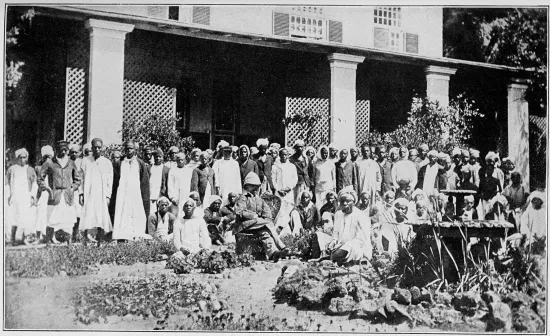 HENRY M. STANLEY AND HIS MEN AT ZANZIBAR, 1877
Zanzibar, after three weeks’ voyage; the astonishment and delight of the
reunion with relatives and friends; the sorrowful parting with their
master. When he went on board the steamer to sail for Europe, a
deputation of the best followed him on board, to offer their help in
reaching his home, if he needed it, and to declare that they would start
for no new adventure on the continent until they heard that he had
safely reached his own land.
The second pay-day was devoted to hearing the claims for wages due to
the faithful dead. Poor, faithful souls! With an ardour and a fidelity
unexpected, and an immeasurable confidence, they had followed me to the
very death! True, negro nature had often asserted itself; but it was,
after all, but human nature. They had never boasted that they were
heroes, but they exhibited truly heroic stuff while coping with the
varied terrors of the hitherto untrodden, and apparently endless, wilds
of broad Africa.
They were sweet and sad moments, those of parting. What a long, long and
true friendship was here sundered! Through what strange vicissitudes of
life had they not followed me! What wild and varied scenes had we not
seen together! What a noble fidelity these untutored souls had
exhibited! The chiefs were those who had followed me to Ujiji in 1871:
they had been witnesses of the joy of Livingstone at the sight of me;
they were the men to whom I entrusted the safe-guard of Livingstone on
his last and fatal journey; who had mourned by his corpse at Muilla, and
borne the illustrious dead to the Indian Ocean.
In a flood of sudden recollection, all the stormy period, here ended,
rushed in upon my mind; the whole panorama of danger and tempest through
which these gallant fellows had so staunchly stood by me—these gallant
fellows now parting from me! Rapidly, as in some apocalyptic trance,
every vision, every scene of strife with Man and Nature, through which
these poor men and women had borne me company, and solaced me by the
simple sympathy of common suffering, came hurrying across my memory; for
each face before me was associated with some adventure, or some peril;
reminded me of some triumph, or of some loss.
What a wild, weird retrospect it was, that mind’s flash over the
troubled past! So like a troublous dream!
And for years and years to come, in many homes in Zanzibar, there will
be told the great story of our journey, and the actors in it will be
heroes among their kith and kin. For me, too, they are heroes, these
poor ignorant children of Africa; for, from the first deadly struggle in
savage Ituru, to the last struggling rush into Embomma, they had rallied
to my voice like veterans; and in the hour of need they had never failed
me. And thus, aided by their willing hands and by their loyal hearts,
the expedition had been successful, and the three great problems of the
Dark Continent’s geography had been fairly solved. Laus Deo.
THE first work, exploration, was done. Now for the harder task,
civilisation. That was henceforth the main purpose and passion of
Stanley’s life. For him, the quest of wider knowledge meant a stage
towards the betterment of mankind. He had laid open a tract comparable
in extent and resources to the basin of the Amazon, or the Mississippi.
What his vision saw, what his supreme effort was given to, was the
transformation of its millions of people from barbarism, oppressed by
all the ills of ignorance, superstition, and cruelty, into happy and
virtuous men and women. His aim was as pure and high as Livingstone’s.
But, as a means, he looked not alone to the efforts of isolated
missionaries, but to the influx of great tides of beneficent activities.
He sought to pour the civilisation of Europe into the barbarism of
Africa, and the prime force to which he looked was the natural,
legitimate desire for gain, by ways of traffic; the African and the
European both eager for the exchanges which should be for the good of
both. With this, he counted on the scientific curiosity, and the
philanthropic zeal, of the civilised world to assist the work.
The curse of interior Africa had been its isolation. Its only contact
with the outer world had been through the ferocious slave-trade, carried
on by Europeans on its western shore through four centuries, until
suppressed under English leadership, but still maintained by Arabs,
working wholesale ruin from the east.
A natural channel, and an invitation to legitimate and wholesome
commerce, was the vast waterway of the Upper Congo, which Stanley had
just discovered. The obstacle which had prevented its employment was a
strip of two hundred miles next the sea, where a succession of cataracts
and rapids, through rough and sterile hills, made navigation impossible.
This strip must be pierced, first by a wagon-road, later by a railroad.
Its human obstacles, principally the rapacious African traders, or
‘middle-men,’ shrewd, greedy, and jealous of the white man’s intrusion,
must be propitiated. Then, from mouth to source of the river, stations
must be established as centres of trade and of friendly intercourse.
That was Stanley’s plan; and for fit and adequate support he looked
first to the English people and the English Government.
Before he touched English soil, on his return at the end of 1877, his
letters in the ‘Telegraph’ had hinted at the vast and inviting political
possibilities which the new country offered to England.
With scarcely a breathing-space, he threw himself into the work of
persuading, preaching, imploring, the ruling powers in English Commerce
and in public affairs to seize this grand opportunity.
He spoke in all the commercial centres, especially in Manchester and
Liverpool, setting forth the immense advantages to trade of such an
enterprise. He had audience with such public men as would listen, or
seem to listen. But the Government and the people of England turned a
deaf ear.
Stanley was, by some, called ‘Quixotic’; by others, an ‘adventurer,’ or
‘a buccaneer.’ Others professed to be shocked, and said he put Commerce
before Religion!! So he received no help or encouragement from Britain.
But, in Belgium, King Leopold was already keenly interested in African
possibilities. In the summer of 1877, he had convened a company of
geographers and scientific men, who had organised the ‘International
African Association’ for exploration, and, perhaps, something further.
Their first essays were mostly on the eastern coast.
On Stanley’s return, at the end of 1877, he was met at Marseilles by
messengers of King Leopold, to urge him to come to Brussels for a
conference, and for the initiation of further African enterprise.
He excused himself on the plea of physical exhaustion and unfitness for
further undertakings. But he had other reasons, in his strong preference
for England as his supporting power. After half a year of ill-success in
that quarter, in August, he met King Leopold’s Commissioners in Paris.
In the discussion there, the vague purpose to do something scientific or
commercial in the basin of the Congo crystallised into Stanley’s plan as
given above. There was close study, analysis, and detail; the papers
were transmitted to the King, and Stanley kept in touch with the
project. But again he urged upon England that she should take the lead;
and, again, in vain.
Thereupon, he accepted an invitation to the Royal Palace at Brussels in
November, and there met ‘various persons of more or less note in the
commercial and monetary world, from England, Germany, France, Belgium,
and Holland.’ An organisation was made, under the name, ‘Comité d’Étude
du Haut Congo’ (which afterward became practically identified with the
‘International’). Plans were adopted on a modest scale; the sum of
twenty thousand pounds was subscribed for immediate use; and Stanley was
put in charge of the work. Colonel Strauch, of the Belgian Army, was
chosen President of the Society; and he, and his associates, selected
Stanley’s European assistants, and acted as his base of supplies during
the five and a half years—January, 1879, to June, 1884—which he spent
in the work.
The story of that work is told at large in Stanley’s book, ‘The Congo,
and the Founding of its Free State.’ Less full of adventure and wonder
than his preceding and following works, it is rich in material for
whoever studies the relations, actual and possible, between civilised
and savage men. The merest outline of it is given here, with quotations
chosen mainly to illustrate the character of its leader. For the nucleus
of his working force, he went back to Zanzibar, and chose seventy men,
forty of whom had before gone with him through Africa, and who, as a
body, now served him with a like fidelity and devotion. He took them
around the continent, by Suez and Gibraltar, and reached the mouth of
the Congo in August, 1879.
August 15, 1879. Arrived off the mouth of the Congo. Two years have
passed since I was here before, after my descent of the great River, in
1877. Now, having been the first to explore it, I am to be the first who
shall prove its utility to the world. I now debark my seventy Zanzibaris
and Somalis for the purpose of beginning to civilise the Congo Basin.
With a force recruited up to two hundred and ten negroes, and fourteen
Europeans, and with four tiny steamers, he set out for the mastery of
the river. A few miles’ steaming away from the trading establishments at
the mouth, up to the head of navigation, and the first station, Vivi, is
planted; wooden huts brought from England are set up, and wagon-roads
are made. Then, a Labour of Hercules, transport must be found for
steamers and goods through a long stretch of rugged hills. After
exploration, the route must be chosen; then the stubborn, dogged labour
of road-building, over mountains and along precipices; the Chief, hammer
and drill in hand, showing his men how to use their tools; endless
marching and hauling; and, at last, a whole year’s work (1880) is done;
forward and backward, they had travelled two thousand five hundred and
thirty-two miles, and, as a result, they had won a practicable way of
fifty-two miles—‘not a holiday affair,’ this! Strenuous toil, a diet of
beans, goat’s meat, and sodden bananas; the muggy atmosphere of the
Congo Cañon, with fierce heat from the rocks, and bleak winds through
the gorges! Six European and twenty-two native lives, and thirteen
whites invalided and retired, were part of the price.
Now, a second station, Isangila, is built; here, as at Vivi, a treaty is
made with the natives, and land for the station fairly bought.
Next, we have eighty-eight miles of waterway, and, then, another station
at Manyanga. Here came a plague of fever, and the force was further
weakened by garrisons left for the three stations. Stanley was
desperately ill; after ten days’ fight with the fever, the end seemed at
hand; he prescribed for himself sixty grains of quinine, and a few
minims of hydrobromic acid, in an ounce of Madeira wine; under this
overpowering dose his senses reeled; he summoned his European comrades
for a farewell, while Death loomed before him, and a vision of a lonely
grave. Grasping the hand of his faithful Albert, he struggled long and
vainly to speak the words of a parting charge; and when, at last, he
uttered an intelligible sentence,—that success brought a rush of
relief, and he cried, ‘I am saved!’ Then came unconsciousness for
twenty-four hours; and, afterwards, just life enough to feel hungry; and
thus he reached convalescence and recovery.
A push of eight days further, to Stanley Pool, where begins the
uninterrupted navigation of the Upper Congo. Here he finds that M. de
Brazza, in the pay of France, though aided by funds from the Comité
International of Belgium, having heard of Stanley’s doings, has raced
across from the sea, and bargained with the natives for a great strip on
the north bank of the river. So, for this region, Stanley secured the
south bank. At last, greatly to his encouragement and help, came a
re-enforcement of the good Zanzibaris.
Early in 1882, he planted a fine station, named Leopoldville, in honour
of the monarch whom Stanley heartily admired, and relied on. On this
settlement, when he had finished it to his mind, Stanley looked with
special pride and complacency: the block-house, impregnable against fire
or musketry; the broad-streeted village for his natives; their gardens
of young bananas and vegetables; the plentiful water and fuel; the
smooth promenade, where he imagined his Europeans strolling on Sundays,
to survey the noble prospect of river, cataract, forests, and mountain.
Stanley, however, saw more than met the eye. He dwelt on the possible
future of that magnificent country, with its well-watered soil, now
neglected, but richer than any in the whole Mississippi Valley. ‘It is
like looking at the intelligent face of a promising child: though we
find nought in it but innocence, we fondly imagine that we see the germs
of a future great genius,—perhaps a legislator, a savant, warrior, or a
poet.’
Soon after, a violent fever so disabled him that he was obliged to
return to Europe, in 1882. He made his report to the Comité de
l’Association Internationale du Congo, which had assumed the authority
and duties of the Comité d’Étude. He showed them that he had
accomplished all, and more than all, his original commission aimed at,
and urged them to complete the work by building a railroad along the
lower river, extending the chain of stations, and obtaining concessions
of authority from the chiefs along the whole course of the Congo.
To all this the Committee assented, but they were urgent that Stanley
should return to take charge. He consented, in spite of impaired health,
and started back, after only six weeks in Europe; making condition only,
and that with all the persuasiveness at his command, that they should
send him able assistants, instead of the irresponsible, flighty-headed
youngsters on whom he had been obliged so largely to rely. He dreaded
what they might have done, or undone, in his absence. His fears were
justified; his journey up the river lay through a mournful succession of
neglected and blighted stations; and Leopoldville, of which he had hoped
so much, was a grass-grown hungry waste! He did his best to repair the
mischief,
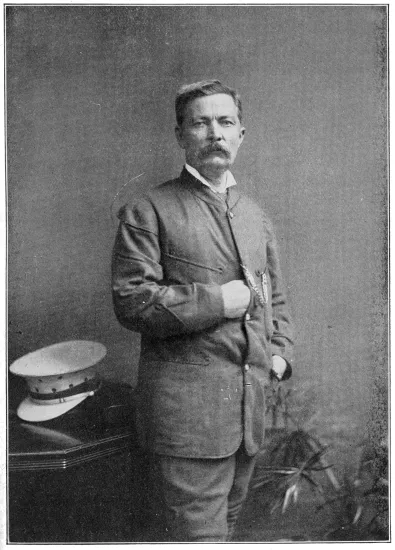 HENRY M. STANLEY 1882
and pushed on up the river, the one dominating idea being to establish a
succession of stations for a thousand miles along the Upper Congo, as
far as Stanley Falls.
Briefly, his route from the ocean covered 110 miles of steaming; then a
land march of 235 miles to Stanley Pool, whence the Upper Congo gives
clear navigation, for 1070 miles, to Stanley Falls. Numerous tributaries
multiply the navigable waterways to about 6000 miles. The district thus
watered Stanley estimated as a square of 757 miles either way, a
superficies of 57,400 square miles, nearly the dimensions of the future
Free State. He found the Lower Congo region unproductive, yielding at
first only ground-nuts, palm-oil, and feed-cake for cattle, and, further
up-stream, some production of rubber, gum-copal, and ivory. But the
Upper Congo was rich in valuable forests and in fertile soil; woods for
building, for furniture, and dyes; gums, ivory of elephant and
hippopotamus; india-rubber, coffee, gum-copal, and much besides. All
this potentiality of ‘wealth, beyond the dreams of avarice,’ could only
be actualised through the perfection of communication: already Stanley
was eagerly planning for a railway that should link the Upper Congo with
the sea.
Now, for a year and a half, his principal care was to negotiate treaties
with the chiefs, which should give political jurisdiction over the
territory. Throughout the enterprise, amiable relations with the natives
were most successfully cultivated; friction was overcome by patience and
tact; firmness, combined with gentleness, in almost every instance
averted actual strife. The chiefs were willing enough to cede their
political sovereignty, receiving in each case some substantial
recompense; foreign intrusion was barred; and the private rights and
property of the natives were respected.
Over four hundred chiefs were thus dealt with, and so the foundations of
the Free State were established. On his journey up the river he was
constantly meeting tribes who were his old acquaintances of six years
before. Old friends they could scarcely be called, but new friends
they readily became. A halo of wonder hung round his first advent; the
curiosity born of that memory was heightened by the marvel of the
steamboats; the offer of barter was always welcome, and the bales of
cloth, the brass rods, the trinkets,—first as a present, then in
trade,—were the beginnings of familiar intercourse. Stanley’s
diplomacies, his peace-makings between hostile tribes, his winning of
good-will and enforcement of respect, make a story that should be
studied in his full narrative.
The summer of 1884 found the work of founding the State virtually
finished, and Stanley nearly finished, too. There had been difficulties
of all kinds, in which almost the entire responsibility had rested on
his shoulders, and he had reached the limit of his strength; could he
but hand over his work to a fit successor! He writes:—
There was a man at that time in retreat, near Mount Carmel. If he but
emerged from his seclusion, he had all the elements in him of the man
that was needed: indefatigable industry; that magnetism which commands
affection, obedience, and perfect trust; that power of reconciling men,
no matter of what colour, to their duties; that cheerful promise that in
him lay security and peace; that loving solicitude which betokens the
kindly chief. That man was General Gordon. For six months I waited his
coming; finally, letters came announcing his departure for the Soudan;
and, soon after, arrived Lieutenant-colonel Sir Francis de Winton, of
the Royal Artillery, in his place.
General Gordon had arranged to take the Governorship of the Lower Congo,
under Stanley, who was to govern the Upper Congo; and, together, they
were to destroy the slave-trade at its roots. General Gordon wrote a
letter to Stanley in which he said that he should be happy to serve
under him, and work according to Stanley’s ideas. When Sir Francis de
Winton went out, Stanley transferred to him the Government of the Congo,
and returned to England.
This same year, 1884, saw the recognition of the new State by the
civilised powers. England’s contribution was mainly indirect. She had
previously made a treaty with Portugal, allowing her a strip of African
coast, as the result of which she could now have excluded everyone else
from the Congo. Manchester, Liverpool, and Glasgow, through their
Chambers of Commerce, had remonstrated in vain.
The United States, meanwhile, had been the first to recognise the new
State of the Congo. Spurred by General Sandford, formerly Minister to
Belgium, who appealed, on the one hand, to American interest in
Livingstone and Stanley, and, on the other hand, to commercial
possibilities, the American Senate, on April 10, 1884, authorised
President Arthur to recognise the International African Association as a
governing power on the Congo River. This action, says Stanley, was the
birth to new life of the Association.
In view of the menace to the world’s trade by the Anglo-Portuguese
treaty, Bismarck’s strong personality now came to the front, somewhat
prompted by King Leopold. Stanley admired the straightforward vigor of
the German as much as he admired the philanthropy of the Belgian rule.
Bismarck summoned a Conference at Berlin, to which the leading European
powers sent delegates. There were also delegates from the United States,
and with these Stanley was present as their ‘technical adviser,’ and,
naturally, had a good hearing.
The Conference was mainly interested to secure the commercial freedom of
the Niger and the Congo. It gave definite recognition to the Congo Free
State. It did map-making with a free hand, marking out European
dominions in Africa, with especial profit to France and Portugal,
through the adroitness of the French Ambassador, says Stanley, and with
the concurrence of Prince Bismarck. Also, quite incidentally, so to
speak, the Conference proceeded to lay down the formalities by which a
European power was to establish itself on virgin African soil, which
consisted, virtually, in putting up a sign-board ‘to whom it may
concern.’ By this simple process, and with no trouble of exploration,
purchase, or settlement, Bismarck then calmly proceeded to appropriate a
large slice of Eastern Africa, which had been opened up by the British.
The future course of African affairs, including the vesting of the Congo
sovereignty in King Leopold, has no place in this story. In this whole
chapter of Stanley’s work, perhaps the most significant feature, as to
his character, and, also, as a lesson in the art of civilisation, is his
manner of dealing with the natives. As a concrete instance may be given
the story of Ngalyema and the fetish.
Ngalyema, chief of Stanley Pool district, had demanded and received four
thousand five hundred dollars’ worth of cotton, silk, and velvet goods
for granting me the privilege of establishing a station in a wilderness
of a place at the commencement of up-river navigation. Owing to this, I
had advanced with my wagons to within ten miles of the Pool. I had
toiled at this work the best part of two years, and whenever I cast a
retrospective glance at what the task had cost me, I felt that it was no
joke, and such that no money would bribe me to do over again. Such a
long time had elapsed since Ngalyema had received his supplies, that he
affected to forget that he had received any; and, as I still continued
to advance towards him after the warnings of his messengers, he
collected a band of doughty warriors, painted their bodies with diagonal
stripes of ochre, soot, chalk, and yellow, and issued fiercely to meet
me.
Meantime, the true owners of the soil had enlightened me respecting
Ngalyema’s antecedents. He was only an enterprising native trader in
ivory and slaves, who had fled from the north bank; but, though he had
obtained so much money from me by pretences, I was not so indignant at
this as at the audacity with which he chose to forget the transaction,
and the impudent demand for another supply which underlay this.
Ngalyema, having failed to draw any promise by sending messengers,
thought he could extort it by appearing with a warlike company.
Meantime, duly warned, I had prepared a surprise for him.
I had hung a great Chinese gong conspicuously near the principal tent.
Ngalyema’s curiosity would be roused. All my men were hidden, some in
the steamboat on top of the wagon, and in its shadow was a cool place
where the warriors would gladly rest after a ten-mile march; other of my
men lay still as death under tarpaulins, under bundles of grass, and in
the bush round about the camp. By the time the drum-taps and horns
announced Ngalyema’s arrival, the camp seemed abandoned except by myself
and a few small boys. I was indolently seated in a chair, reading a
book, and appeared too lazy to notice anyone; but, suddenly looking up,
and seeing my ‘brother Ngalyema,’ and his warriors, scowlingly regarding
me, I sprang up, and seized his hands, and affectionately bade him
welcome, in the name of sacred fraternity, and offered him my own chair.
He was strangely cold, and apparently disgruntled, and said:—
‘Has not my brother forgotten his road? What does he mean by coming to
this country?’
‘Nay, it is Ngalyema who has forgotten the blood-bond which exists
between us. It is Ngalyema who has forgotten the mountains of goods
which I paid him. What words are these of my brother?’
‘Be warned, Rock-Breaker. Go back before it is too late. My elders and
people all cry out against allowing the white man to come into our
country. Therefore, go back before it be too late. Go back, I say, the
way you came.’
Speech and counter-speech followed. Ngalyema had exhausted his
arguments; but it was not easy to break faith and be uncivil, without
plausible excuse. His eyes were reaching round seeking to discover an
excuse to fight, when they rested on the round, burnished face of the
Chinese gong.
‘What is that?’ he said.
‘Ah, that—that is a fetish.’
‘A fetish! A fetish for what?’
‘It is a war-fetish, Ngalyema. The slightest sound of that would fill
this empty camp with hundreds of angry warriors; they would drop from
above, they would spring up from the ground, from the forest about, from
everywhere.’
‘Sho! Tell that story to the old women, and not to a chief like
Ngalyema. My boy tells me it is a kind of a bell. Strike it and let me
hear it.’
‘Oh, Ngalyema, my brother, the consequences would be too dreadful! Do
not think of such a thing!’
‘Strike it, I say.’
‘Well, to oblige my dear brother Ngalyema, I will.’
And I struck hard and fast, and the clangorous roll rang out like
thunder in the stillness. Only for a few seconds, however, for a tempest
of human voices was heard bursting into frightful discords, and from
above, right upon the heads of the astonished warriors, leaped yelling
men; and from the tents, the huts, the forest round about, they came by
sixes, dozens, and scores, yelling like madmen, and seemingly animated
with uncontrollable rage. The painted warriors became panic-stricken;
they flung their guns and powder-kegs away, forgot their chief, and all
thoughts of loyalty, and fled on the instant, fear lifting their heels
high in the air; or, tugging at their eyeballs, and kneading the senses
confusedly, they saw, heard, and suspected nothing, save that the limbo
of fetishes had suddenly broken loose!
But Ngalyema and his son did not fly. They caught the tails of my coat,
and we began to dance from side to side, a loving triplet, myself being
foremost, to ward off the blow savagely aimed at my ‘brothers,’ and
cheerfully crying out, ‘Hold fast to me, my brothers. I will defend you
to the last drop of my blood. Come one, come all,’ etc.
Presently the order was given, ‘Fall in!’ and quickly the leaping forms
became rigid, and the men stood in two long lines in beautiful order,
with eyes front, as though ‘at attention.’ Then Ngalyema relaxed his
hold of my coat-tails, and crept from behind, breathing more freely;
and, lifting his hand to his mouth, exclaimed, in genuine surprise ‘Eh,
Mamma! where did all these people come from?’
‘Ah, Ngalyema, did I not tell you that thing was a powerful fetish? Let
me strike it again, and show you what else it can do.’
‘No! no! no!’ he shrieked. ‘I have seen enough!’
The day ended peacefully. I was invited to hasten on to Stanley Pool.
The natives engaged themselves by the score to assist me in hauling the
wagons. My progress was thenceforward steady and uninterrupted, and in
due time the wagons and goods-columns arrived at their destination.
But this was only one incident in what may be called the ‘education of
Ngalyema.’ Seldom has teacher had a more unpromising pupil. He was a
braggart, a liar, greedy, capricious, abjectly superstitious,
mischief-making. Stanley’s diary shows how he handled him during three
months of neighbourhood. For instance, Ngalyema begged certain articles
as presents; Stanley coupled the gift with the stipulation that his
followers were not to bring their arms into the camp. The promise was
persistently broken; finally, at the head of his armed warriors,
Ngalyema was suddenly confronted by Stanley’s rifle, and fell at his
feet, in abject panic, to be soothed, petted, and brought into a healthy
state of mind. ‘I am bound to teach this intractable “brother” of mine,’
is the comment in the diary.
Again and again he makes trouble; and, always, he is met by the same
firm, gentle hand. Slowly he improves, and at last is allowed once more
to make ‘blood-brotherhood,’ with crossing of arms, incisions, and
solemn pronouncement by the great fetish-man of the tribe, in token of
renewed fraternity and fidelity. Ngalyema might fairly be pronounced a
reformed character, and the friendship between him and Stanley became
life-long.
Some of you may, perhaps, wonder at the quiet inoffensiveness of the
natives, who, on a former expedition, had worried my soul by their
ferocity and wanton attacks, night and day; but a very simple
explanation of it may be found in Livingstone’s Last Journals, dated
28th October, 1870. He says: ‘Muini Mukata, who has travelled further
than most Arabs, said to me, “If a man goes with a good-natured, civil
tongue, he may pass through the worst people in Africa unharmed.” This
is true, but time also is required; one must not run through a country,
but give the people time to become acquainted with you, and let their
worst fears subside.’
Now, on the expedition across Africa I had no time to give, either to
myself or to them. The river bore my heavy canoes downward; my goods
would never have endured the dawdling required by this system of
teaching every tribe I met who I was. To save myself and my men from
certain starvation, I had to rush on and on, right through. But on this
expedition, the very necessity of making roads to haul my enormous
six-ton wagons gave time for my reputation to travel ahead of me. My
name, purpose, and liberal rewards for native help, naturally
exaggerated, prepared a welcome for me, and transformed my enemies of
the old time into workmen, friendly allies, strong porters, and firm
friends. I was greatly forbearing also; but, when a fight was
inevitable, through open violence, it was sharp and decisive.
Consequently, the natives rapidly learned that though everything was to
be gained by friendship with me, wars brought nothing but ruin.
So it was that he went among these fierce savages as a messenger of good
tidings, and they welcomed him. He put his superiority over them to use
in making bridges across the gulf between their minds and his. He
studied not only their languages, but their ceremonials, and adapted
himself to their forms of justice and ways of settling disputes, as in
the rite of blood-brotherhood. He brought them not only personal
good-will and kind treatment, but the practical advantages of
civilisation.
Everywhere he found eagerness to trade, and the possibility of
commercial interchange that should be profitable to both sides. Many of
them accepted training in labour, and recruited his road-making force.
In his treaties with the chiefs, he did not hesitate to purchase full
political sovereignty, usually in exchange for goods; for such
sovereignty was worthless or harmful to these tribes, compared with the
beneficent rule of a superior intelligence. But neither in the formal
treaties, nor in the actual practice, was there the least trace of
spoliation of land and goods which was practised later, when Stanley had
left the Congo. ‘It is agreed,’ says one of his typical treaties, ‘that
the term “cession of territory” does not mean the purchase of the soil
by the Association, but the purchase of the suzerainty by the
Association.’
Stanley’s whole treatment of the natives was as simple in its principle
as the Golden Rule; it was applied with infinite skill and patience; and
in a spirit of heartiest human good-will, dashed, often, with boyish
humour that went home to the savage heart. He tells with gusto of the
welcome given to frolicking races, and the gambols indulged in by his
good Danish follower, Albert:—
The dark faces light up with friendly gleams, and a budding of good-will
may perhaps date from this trivial scene. To such an impressionable
being as an African native, the self-involved European, with his frigid,
imperious manner, pallid white face, and dead, lustreless eyes, is a
sealed book.
The most tragic pages in the history relate his coming upon a series of
villages just ravaged by a ferocious slave-raid of the Arabs, and
afterwards finding a herd of the wretched captives chained and guarded.
It is a terrible picture. Over a hundred villages had been devastated,
and the five thousand carried away as slaves stood for six times as many
slain, or dying by the way-side.[26] The hot impulse rose to strike a
blow for their liberation; but it would have been hopeless and useless.
On his return journey, Stanley borrowed from the slave-traders several
of their number as his companions down the river, to give them an
object-lesson as to the impending check on their excursions. To
extirpate this slave-trade was among the prime objects of his
enterprise, and whatever else failed, this succeeded.
The furthest point he then reached was Stanley Falls, where he planted
his station in charge of a solitary white man, the plucky little Scotch
engineer, Binnie. Stanley, on his return down the river, reflects on the
influences he has planted to extend his work.
We had sown seeds of good-will at every place we had touched, and each
tribe would spread diffusively the report of the value and beauty of our
labours. Pure benevolence contains within itself grateful virtues. Over
natural people nothing has greater charm or such expansible power; its
influence grows without effort; its subtlety exercises itself on all who
come within hearing of it. Coming in such innocent guise, it offends
not; there is nought in it to provoke resentment. Provided patience and
good temper guides the chief of Stanley Falls station, by the period of
the return of the steamers, the influence of the seedling just planted
there will have been extended from tribe to tribe far inland, and amid
the persecuted fugitives from the slave-traders.
Among the brightest pages of the story are the occasional returns to
some station where a faithful and efficient subordinate, left in charge,
has made the wilderness to blossom as a rose. Such is the picture of
Equatorville, to which he returned, after a hundred days’ absence, to
find that the good-will and zeal of two young Army lieutenants had
transformed the station from a jungle of waterless scrub; had built and
furnished a commodious, tasteful, ‘hotel’; had drawn up a code of laws
for the moral government of the station, and the amelioration of the
wild Bakuti; and planned sanitary improvements worthy of a competent
Board of Public Works.
But too frequent is the opposite story; the subordinates’ indolence,
neglect, perhaps desertion; and the decadence of the station. The
painful element in the story, and ominous of future consequences, is the
failures among the men sent out from Europe as his assistants. There
were many and honourable exceptions, and these he praises warmly in the
book.[27] Such were the Scotch engineer, Binnie, who so stoutly held his
solitary post at Stanley Falls; the efficient and fine-spirited Danish
sailor, Albert Christopherson; the Scandinavian seaman, Captain
Anderson, with his genius for inspiring everyone near him to work; the
Englishman, A. B. Swinburne, with a genius for gardening and
home-making, and for winning the affection of both whites and blacks;
the Italian mechanician, François Flamini, who charmed the steam-engines
into docility. But the book tells often of the failures, and the private
note-books detail the story more plainly, and tell, too, something of
his difficulties with his native helpers.
All the officers, before I sent them to their posts, were instructed by
me, orally and in writing, in the very minutiæ of their duties,
especially in the mode of conduct to be adopted towards the natives.
The ridiculous inadequacy of our force as opposed to the native
population required that each officer should be more prudent than brave,
more tactful than zealous. Such conduct invariably made the native
pleasantly disposed to us. If some characters among them presumed to
think that forbearance sprang from cowardice, and were inclined to be
aggressive, the same prudence which they had practised previously would
teach them how to deal with such.
It was mainly impressed on the officers that they were to hold their
posts more by wit than by force, for the latter was out of the question,
except after forethought, and in combination with headquarters. This was
due to the fact that the young officers were as ignorant of diplomacy as
children. Their instincts were to be disciplinary and dictatorial. The
cutting tone of command is offensive to savages, and terrifying to them
as individuals.
Captain D. exceeded his instructions in assuming the responsibility of
provoking the Arabs at Stanley Falls. He studied only his own fighting
instincts, and British resentment against the slaver. At an early period
he was too brusque; this repelled confidence and roused resentment.
While he was expected to represent civil law of the most paternal
character, he regarded the thirty Houssas soldiers under his command as
qualifying him for the rôle of a military dictator; and as soon as he
appeared in that character, the Arabs became unanimous in asserting
their independence. Before a man with thirty soldiers can adopt such a
tone, he surely ought to have been prepared for the consequences. But he
seems to have done nothing except challenge the Arabs. He knew he had so
many rounds of ammunition, but his ammunition was damp, and he was not
aware of it.[28]
I know that many of my Officers were inclined to regard me as ‘hard.’ I
may now and then have deserved that character, but then it was only when
nought but hardness availed. When I meet chronic stupidity, laziness,
and utter indifference to duty, expostulation ceases, and coercion or
hardness begins.
His associates had been the principal cause of the exhibition of this
quality, and with some of them he had been very unfortunate.
To describe Bracconier’s case, for example, would fill a good-sized
book. Others were equally impenetrable to reason and persuasion.
Intuitively, I felt that Braconnier, though polite and agreeable, was
not to be entrusted with any practical work. His education and character
had utterly unfitted him for work of any kind. He was asked to
superintend a little road-making. He sought a nice, shady place, and
fell asleep; and his men, of course, while they admired him for his easy
disposition, did what was most agreeable to them, and dawdled over their
work, by which we lost two days. When myself incapacitated by a sudden
stroke of fever, I requested him to supervise the descent of the
boiler-wagon down a hill; not ten minutes later the boiler and wagon
were smashed, and he was brought to me, half-dead from his injuries! He
was appointed chief of Leopoldville, but, in four months, the place
resembled a ruin. Grass encroached everywhere, the houses were falling
to pieces, the gardens choked with weeds, the steamers were lying
corroding in the port, the natives were estranged, and he and his men
were reduced to a state of siege.
He allowed a young Austrian lieutenant and six Zanzibaris to enter a
small unsuitable canoe and attempt to ascend the Congo. Within fifteen
minutes of their departure, they were all drowned!
There is always another side to these accusations, and those inclined to
believe Bracconier’s ridiculous charge of my ‘hardness’ should try,
first, how they would like to endure three years of indolence and
incapacity, before they finally dismissed the fellow; let those who
criticised me ascertain whether this man distinguished himself in other
fields and other missions; though I have no doubt that in a Brussels
drawing-room he would be found to be an agreeable companion; but not in
Africa, where work has to be done, and progress made.
Then, as regards the coloured people, good as the majority of Zanzibaris
were, some of them were indescribably, and for me most unfortunately,
dense. One man, who from his personal appearance might have been judged
to be among the most intelligent, was, after thirty months’ experience
with his musket, unable to understand how it was to be loaded! He never
could remember whether he ought to drop the powder, or the bullet, into
the musket first! Another time he was sent with a man to transport a
company of men over a river to camp. After waiting an hour, I strode to
the bank of the river and found them paddling in opposite directions,
each blaming the other for his stupidity, and, being in a passion of
excitement, unable to hear the advice of the men across the river, who
were bawling out to them how to manage their canoe.
Another man was so ludicrously stupid that he generally was saved from
punishment because his mistakes were so absurd. We were one day floating
down the Congo, and, it being near camping time, I bade him, as he
happened to be bowman on the occasion, to stand by and seize the grass
on the bank to arrest the boat, when I should call out. In a little
while we came to a fit place, and I cried, ‘Hold hard,
Kirango!’—‘Please God, Master,’ he replied, and forthwith sprang on
shore and seized the grass with both hands, while we, of course, were
rapidly swept down-river, leaving him alone and solitary on the bank!
The boat’s crew roared at the ridiculous sight; but, nevertheless, his
stupidity cost the tired men a hard pull to ascend again, for not every
place was available for a camp. He it was, also, who, on an occasion
when we required the branch of a species of arbutus which overhung the
river to be cut away, to allow the canoes to be brought nearer to the
bank for safety, actually went astride of the branch, and chopped away
until he fell into the water with the branch, and lost our axe. He had
seated himself on the outer end of the branch!
The coloured men accepted the reproaches they deserved with such
good-nature that, however stupid they were, I could not help forgiving
and forgetting. But it was not so with the officers. Their
amour-propre was so much offended that, if I ventured on a rebuke, it
was remembered with so much bitterness, that an officer who was
continually erring was also constantly in a resentful mood. I could not
discharge a man for a blunder, or even a few blunders; but, if
disobeying and making unfortunate mistakes was his chronic state, and he
always resented instruction, it can easily be imagined that life with
such a one was not pleasant. There were periods when careless acts
resulted fatally to others; or when great vexation, or pecuniary loss,
went on for months consecutively; until I really became afraid to ask
any officer to undertake any duty.
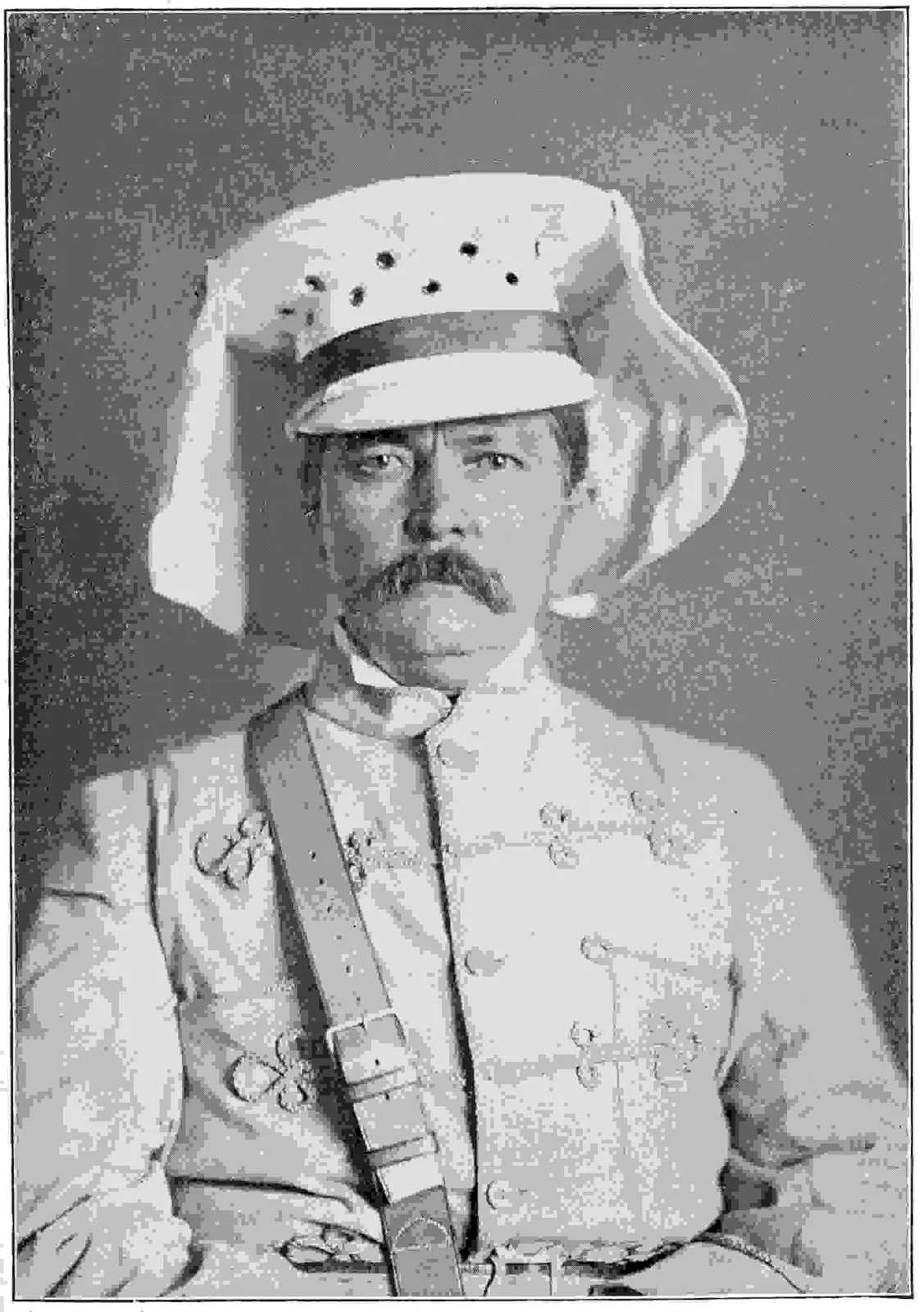 HENRY M. STANLEY, 1885
Who would suppose that out of five intelligent Belgian officers bidding
a sixth bon voyage not one could perceive by the size of the canoe,
the number of people in it, and the manner the departing friend was
standing in the little cockle-shell, that the voyage must end
disastrously? and yet not one had the least suspicion that the young man
was going to his doom, and about to take six fellows with him! Who would
have imagined that those five horror-struck gentlemen would have
permitted two of their companions to venture upon attempting the same
hazardous voyage the very next day? And yet they did, without so much as
a protest; and, though the two unhappy voyagers saved their lives by
springing on shore, their boat and all their effects were swept over a
cataract.
Not long after, another of these officers, who belonged to a boat-club
on a Belgian river, thought he would establish one of his own on the
Upper Congo. As a first step he purchased an elegant canoe, paying
heavily for it. He attached a keel-piece to it, made a mast and a sail,
and one day he went sailing smoothly towards the middle of the river
where it was four miles wide. Presently, having got beyond view of his
station, the wind died away, and he was carried down by the mighty
flood. He began to cry out for aid, as he had forgotten his paddles; but
his cries could not be heard, he was alone on the wide waters! Towards
midnight, his men, getting anxious, set out in search of him, and, after
many hours, found him nearly distracted with terror, and brought him to
camp, vowing he would never again trust himself alone on the Congo!
A short time after this, another officer and a French missionary were
devoured by cannibals, with eleven Zanzibaris who accompanied them. The
details of the story went to prove that, in this case again, the
military officer proved his inaptitude to learn, though in other ways
the young man was exemplary. Still, the disposition to blunder seemed so
prevalent that he who was responsible for the good management of their
affairs might well be pardoned, if, in his anxiety for the welfare of
those under him, he should exact obedience in a more peremptory tone
than formerly.
Another officer had his station burned twice, with all the property
stored in it. He was relieved of his charge, and appointed to an
honourable mission; but, after setting out, he suddenly decided to
abandon his people; leaving them to find their own way, whilst he
slipped off to the coast, ‘to buy a pair of boots,’ as he said. No one
could have appeared more astonished than he was when, after the third
glaring offence, he was told that he was no longer needed.
Another officer was supplied with a small company of choice men, and I
instructed him to build a station with a friendly tribe, which had
desired it for the opening of trade. Within a few days he began shooting
promiscuously at the natives with a revolver; and, on one of his men
expostulating with him, he turned the weapon upon his faithful servant
and shot him in the head; upon which, the remainder of the men flung
themselves upon him, and, having disarmed him, carried him, bound hand
and foot, to me. The officer was escorted to the coast; I charged him
with being a dangerous lunatic, though no one would have supposed, from
his appearance and language, that he was thus afflicted.
I could go on with pages of these extraordinary misadventures, all of
which I had to endure with some of the officers who were sent out to me.
I but cite these few instances, taken at random, to prove that there is
another view to be taken when the responsible head of an expedition, or
enterprise of this kind, is charged with being ‘hard.’ One is not likely
to be hard with persons who perform their duties; but it is difficult to
be mild, or amiable, with people who are absolutely incapable, and who
will not listen to admonition without bristling with resentment.
The only power I possessed with officers of this kind was that of
dismissal, which I forbore to use too frequently because, in doing so, I
punished the Association. It was only in extreme cases that the power
was exercised. In Europe, of course, there would be no necessity for
many words or sore feelings; but in Africa, I could not lose eighty
pounds for a solitary evidence of incapacity. I practised forbearance, I
tried to instruct, to expostulate, to admonish,—once, twice, thrice; I
made every effort to teach and train; but, at last, when nothing
availed, I was forced to have recourse to dismissal. Being of an open
temper and frank disposition, and always willing to hear what my
officers or men had to say, though as a leader of men I could not
hob-nob with my officers, they ought to have found no difficulty in
understanding me. The black man certainly was never at a loss to do so.
No man is free from imperfections; but when one is genially disposed,
and evinces good-will, a man who fastens upon one imperfection, and
constantly harps upon that, shows his own narrow-mindedness and
incapacity.
I have had no friend on any expedition, no one who could possibly be my
companion, on an equal footing, except while with Livingstone.
How could any young men, fresh from their school-rooms, look with my
eyes upon any person or thing within notice? A mathematician might as
well expect sympathy from an infant busy at the alphabet, as the
much-travelled may expect to find responsive feelings in youths fresh
from home or college. How can he who has witnessed many wars hope to be
understood by one whose most shocking sight has been a nose-bleed?
I was still in that fierce period of life when a man feels himself
sufficient for himself, when he abounds in self-confidence, glories in a
blazing defiance of danger and obstacles, is most proud and masterful,
and least disposed to be angelic.
It is strange that no novelist, to my knowledge, has alluded to this
strong virility of purpose which, at a certain stage, is all-powerful in
men’s characters.
Though altogether solitary, I was never less conscious of solitude;
though as liable to be prostrated by fever as the youngest, I was never
more indifferent to its sharpest attacks, or less concerned for its
results. My only comfort was my work. To it I ever turned as to a
friend. It occupied my days, and I dwelt fondly on it at night. I rose
in the morning, welcoming the dawn, only because it assisted me to my
labour; and only those who regarded it from a similar temperament could
I consider as my friends. Though this may be poorly expressed,
neverthless, those who can comprehend what I mean will understand the
main grounds.
The founding of the Congo Free State was the greatest single enterprise
of Stanley’s life. Perhaps nothing else so called out and displayed his
essential qualities. Its ultimate fruit cannot be so clearly measured as
the search for Livingstone, or the first exploration of the Congo. Of
those enterprises he was himself the Alpha and the Omega; each was a
task for a single man, and the achievement was measured by the man’s
personality. But the founding of the Free State was a multiple task,
involving a host of workers. He had not made the selection of his
helpers, except the rank and file, and the rank and file did not fail
him. It was his lieutenants, selected by others, among whom the perilous
defect was found. Further, his undertaking, in its essential nature,
involved dangers which it was doubtless well he did not wholly foresee,
for they might have daunted even his spirit.
He broke down the wall between a savage and a civilised people, and the
tides rushed together, as at the piercing of Suez. On either side were
both lifting and lowering forces. The faults and weakness of the savage
were plain to see; his merit and his promise not so easy of discernment.
But the ‘civilised’ influences, too, were extremely mixed. There was the
infectious energy of the able trader, and his material contributions;
there were the distinctly missionary workers; and there were sentiments
of humanity and justice, often obscured or perplexed, but, when
educated, powerful to compel Governments to ways of righteousness. With
these higher powers mingled blind and selfish lust of gain; the
degeneracy of philanthropy in its partnership with profit; the selfish
feuds of race and nationality, each for itself, alone; lastly, the easy,
deadly contempt of the white man for the ‘nigger.’ To cast a prosperous
horoscope for the evolution of the African race, one must hold strongly
to the higher power we call Providence.
The instrument of that power was the man who brought Europe and America
into touch with Darkest Africa. His example and his ideal shine like a
star above the continent he opened to the world’s knowledge. When the
observant savages watched him, as the rough ground of Vivi was subdued;
when, later, they saw him, as the fifty-mile roadway was bridging the
hills and chasms, and with drill and hammer he taught and led his
followers, they gave him the name Bula Matari, ‘Breaker of Rocks.’ By
hit, or by wit, they struck his central quality—concentrated energy,
victoriously battling with the hardest that earth could offer, all to
make earth goodly and accessible to man. A Maker of Roads, a Breaker of
Rocks, was he all his life long—Bula Matari!
MY fifth expedition was due to the overwhelming catastrophe which
occurred at Khartoum, on January 26th, 1885. On that date the heroic
defender of the city, General Charles George Gordon, of Chinese and
African fame, and his Egyptian garrison were massacred, the population
reduced to slavery, and all the vast Soudan submerged by barbarism. The
only Egyptian force in the Soudan which escaped from the disaster was
that which, led by Emin Pasha, had sought refuge among the savage tribes
in the neighbourhood of Wadelai on the left bank of the Nile, about 25°
north of the Albert Nyanza. Fearing that he would be unable to offer
continued resistance, Emin began writing letters to the Egyptian
Government, Mr. Mackay, the Missionary, the Anti-slavery Society, and
Sir John Kirk, imploring assistance before he should be overwhelmed.
Through the influence of Sir William Mackinnon, a relief-fund was
collected in this country, Egypt promised an equal sum, and the Emin
Relief Expedition was the consequence. When men hear a person crying out
for help, few stay to ascertain whether he merits it; but they forthwith
proceed to render what assistance is needed. It was rather harrowing to
read, day by day, in the British Press that one of Gordon’s officers, at
the head of a little army, was in danger of perishing and sharing the
remorseless fate which had overtaken the self-sacrificing chief and his
garrison at Khartoum. It is to Dr. R. W. Felkin, of Edinburgh, who, as a
casual traveller, had enjoyed Emin’s hospitality between July and
September, 1879, that I am indebted for that beautiful and inspiring
picture of a Governor at bay in the far Soudan, defying the victorious
Mahdists, and fighting bravely, inch by inch, for the land which he had
been appointed to rule by General Gordon.
This Governor was described by him as a tall, military figure, of severe
aspect, of rigid morals, inflexible will, scientific attainments—and
his name was Emin. The picture became impressed on our imaginations.
The ‘Mackinnon Clan,’ as we fondly termed Sir William Mackinnon and his
personal friends, were among the foremost to come forward. They offered
to give ten thousand pounds if the Egyptian Government would advance a
similar amount. The proposal received Egypt’s prompt assent, and as the
British Press and people strongly sympathised with the movement, the
Government, also, cordially favoured it.
My old friend Sir William had asked me, before he had appealed to his
friends, if, in the event of a fund being raised, I would lead the
expedition. I replied that I would do so gratuitously; or, if the Relief
Committee preferred another leader, as was very probable, I would put my
name down for Five hundred pounds. Without waiting the issue of his
appeal to his friends, I sailed for America to commence a
lecturing-tour. Thirteen days after my arrival in America, I was
recalled by cable; and on Christmas Eve, 1886, I was back in England.
Forthwith came appeals to me from the brave and adventurous and young,
that I would be pleased to associate them with me in the enterprise of
relief. They vowed strictest fidelity, obedience to any terms, and
utmost devotion; and from among the host of applicants, Major Barttelot,
of the 7th Fusiliers, Mr. Jameson, a rich young civilian, Lieutenant
Stairs, of the Royal Engineers, Captain Nelson, of Methuen’s Horse,
Surgeon Parke, of the Army Medical Department, Mr. Jephson, and two or
three others, were enrolled as members of the expedition to relieve Emin
Pasha, Governor of Equatoria. Had our means only been equal to our
opportunities, we might have emptied the barracks, the colleges, the
public schools,—I might almost say the nurseries,—so great was the
number of applications to join in the adventurous quest!
The route resolved upon was that from Zanzibar westward, viâ the south
end of Lake Victoria, through Karagwe and Ankori and South-west Unyoro,
to Lake Albert; but, about thirteen days before we sailed, the King of
the Belgians, through his generous offers of assistance, induced us to
change our plans. The advantages of the Congo route were about five
hundred miles shorter land-journey, and less opportunities for desertion
of the porters, who are quite unable to withstand the temptation of
deserting. It also quieted the fears of the French and Germans that,
behind this professedly humanitarian quest, we might have annexation
projects.
A native force was recruited in Zanzibar, and the expedition travelled
by sea to the mouth of the Congo, and went up the river, arriving March
21, 1887, at Stanley Pool. As far as that everything prospered. We had
started from England with the good wishes of all concerned; and even the
French Press, with one accord, were, for once, cordial and wished us
bon voyage. But, on reaching the Pool, the steam flotilla was found to
be only capable of carrying four-fifths of the expedition.
Fourteen hundred miles from the Atlantic, we reached the limit of Congo
navigation, and found camp at Yambuya, a large village, situated on the
edge of an unknown territory which extended as far as the Albert Nyanza.
A steamer was at once sent down-river to bring the remainder of the
force and stores left behind.
It should be remembered, that the last news from Emin was an urgent
appeal for help. The last solemn injunction to us was to hurry forward,
lest we be too late. Hitherto, we had been dependent on the fortunes of
the sea, the skill of ship captains, and safe navigation by ocean and
river. German and French jealousies had been dissipated; between our
professional deserters and their island, Zanzibar, was half a continent,
and much of it unknown. Now was the time, if ever, to prove that our
zeal had not cooled. Six weeks, probably two months, would pass before
the entire force could be collected at Yambuya. If Emin was in such
desperate straits as he had described, his total ruin might be effected
in that time, and the disaster would be attributed to that delay—just
as Gordon’s death had been attributed to Sir Charles Wilson’s delay at
Metemmeh. To avoid that charge, I had no option but to form an Advance
Column, whose duty would be to represent the steady progress of the
expedition towards its goal, while a second Column, under five
experienced officers, would convey after us, a few weeks later, the
reserve stores and baggage. If Tippu-Tib was faithful to his promise to
supply the second Column with six hundred carriers, the work of the
reserve Column would be comparatively easy. If the Arab chief was
faithless, then the officers were to do the best they could with their
own men; to follow after me, in that case, was obviously their best
course.
On the thirteenth day after arrival at Yambuya, the advance, consisting
of five Europeans and three hundred and eighty-four natives, entered the
great Equatorial Forest. The unknown country which lay between Yambuya
and the Albert Nyanza, on whose shores we hoped to meet the
‘beleaguered’ Governor, was five hundred and forty geographical miles in
length, by about three hundred and thirty in width. We were absolutely
ignorant of the character of any portion embraced within this area. The
advance force was divided into four Companies, commanded by Stairs,
Nelson, Jephson, and Parke. The pioneers consisted of select men who
were to use the bill-hook, cutlass, and axe, for clearing a passage
through the entangling underwood, without which it would have been
impossible to advance at all. They had also to resist attack from the
front, to scout, to search for fords, or to bridge the deeper creeks.
The daily routine began about six o’clock. After roll-calls, the
pioneers filed out, followed, after a little headway had been gained, by
each Company in succession. At this hour the Forest would be buried in a
cheerless twilight, the morning mist making every tree shadowy and
indistinct. After hacking, hewing, and tunnelling, and creeping slowly
for five hours, we would halt for refreshment. At one o’clock, the
journey would be resumed; and about four, we would prepare our camp for
the night.
Soon after sunset the thick darkness would cover the limitless world of
trees around; but, within our circle of green huts and sheds, a cheery
light would shine from a hundred campfires. By nine o’clock the men,
overcome by fatigue, would be asleep; silence ensued, broken only by
sputtering fire-logs, flights of night-jars, hoarse notes from great
bats, croakings of frogs, cricket-cheeps, falling of trees or branches,
a shriek from some prowling chimpanzee, a howl from a peevish monkey,
and the continual gasping cry of the lemur. But during many nights, we
would sit shivering under ceaseless torrents of rain, watching the forky
flames of the lightning, and listening to the stunning and repeated
roars of the thunder-cannonade, as it rolled through the woody vaults.
During the first month not a man fell away from his duty; the behaviour
of both officers and men was noble and faultless. Regularly as
clock-work, each morning they took to the road, and paced as fast as the
entanglements and obstacles of underwood, swamp, and oozy creeks
allowed. Each day the Forest presented the same unbroken continuity of
patriarchal woods, the same ghostly twilight at morning, the same dismal
shade at noon. Foliage, from forty to a hundred feet thick, above us, a
chaos of undergrowth around us, soft black humus, and dark soil, rich as
compost, under our feet.
At intervals of ten, fifteen, or twenty miles, we came across small
clearings, but their wild owners had fled, or stood skulking on our
flanks unseen. As no possible chance of intercourse was offered to us,
we helped ourselves to their manioc, plucked the bananas, and passed on.
At the end of the first month, there came a change. Our men had
gradually lost their splendid courage. The hard work and scanty fare
were exhausting. The absence of sunshine, and other gloomy environments,
were morally depressing. Physically and morally, they had deteriorated;
and a long rest was imperatively needed. But we could find no settlement
that could assure the necessary provisions. Now that the blood was
impoverished, too, the smallest abrasion from a thorn, a puncture from a
mosquito, or a skewer in the path, developed rapidly into a devouring
ulcer. The sick-list grew alarmingly large, and our boats and canoes
were crowded with sufferers.
We, finally, entered upon a region that had been dispeopled and cruelly
wasted by the Manyuema raiders, and it became a matter of life and death
to get quickly through and beyond it. But, already famished and outworn,
in body and spirit, by past struggles, our men were unable, and too
dejected, to travel rapidly; and the tedious lagging involved still more
penalties. Had they known how comparatively short was the distance that
lay between them and supplies, they no doubt would have made heroic
efforts to push on.
Then starvation commenced to claim its victims, and to strew the track
with the dying and dead; and this quailed the stoutest hearts.
Ever before us rose the same solemn and foodless Forest, the same jungle
to impede and thwart our progress with ooze, frequently a cubit deep,
the soil often as treacherous as ice to the barefooted carrier,
creek-beds strewn with sharp-edged oyster-shells, streams choked with
snags, chilling mist and icy rain, thunder-clatter and sleepless nights,
and a score of other horrors. To add to our desperate state, several of
our followers who had not sickened, lost heart, became mad with hunger
and wild forebodings, tossed the baggage into the bush, and fled from
us, as from a pest.
Although, when on the verge of hopelessness, our scouts would sometimes
discover a plantation, whereat we could obtain a supply of plantains,
past affliction taught them no prudence. They devoured their food
without a thought of the want of the next day; and, in a few hours, the
slow agony of hunger would be renewed.
Even the white man does not endure hunger patiently. It is a thing he
never forgives. The loss of one meal obliterates the memories of a
hundred feasts. When hunger begins to gnaw at his stomach, the nature of
the animal comes out, as a tortoise-head, projected from the shell,
discloses the animal within. Despite education and breeding, the white
man is seldom more than twenty-four hours ahead of his black brother,
and barely one hundred hours in advance of the cannibal; and ten
thousand years hence he will be just the same. He will never be so
civilised as to be independent of his stomach; so it must be understood
that we also exhibited our weakness during that trying period; but,
supported by little trifles of food, more prudent in economizing it,
subjected to less physical strain, we forced ourselves to preserve the
austerity and dignity of superiors.
On the hundred and thirty-seventh day from Yambuya we reached the first
native settlement that had been untouched by the accursed raiders to
whom we owed our miseries. It abounded with Indian corn, beans,
vegetables, bananas, and plantains, upon which the famished survivors
flung themselves, regardless of consequences. Our prolonged fast was at
an end, but during the last seventy days of it I had lost one hundred
and eighty men, through death and desertion. The place was called
Ibwiri, since known as Fort Bodo; as our sufferings had been so intense,
we halted here, and feasted for thirteen days.
The recuperation was rapid, strength had returned during the feasting,
and there rose a general demand that we should continue the journey, in
order that we might delight our eyes by the grass-land of which we now
began to hear the first rumours. On the twelfth day after quitting
Ibwiri, we emerged from the sombre twilight of the Forest into the
unclouded light of a tropic sky. A feeling of exultation immediately
possessed me, as if I had been released from Purgatory, to disport
myself in the meads of Heaven. The very air was greedily sniffed.
The first smell of it that came to my open nostrils seemed as if, in the
direction of the wind, there somewhere lay a great dairy and cattle-pen;
and, almost at once, I sighted startled game, in close consult on the
knolls and mounds, stamping and snorting in the first energy of alarm.
The first view of the green rolling plain was as of a grassy Eden, which
had been newly fashioned with a beautiful shapeliness, with a new sun,
and a brand-new sky of intense blue. It transfigured every face in an
instant, and the homeliest features were lit up by sincere emotions of
gratitude, as though some dream of bliss had been realised. By one
impulse we started to run; our exhilarated blood seemed foaming
champagne, and sent us leaping over the soft sward; and the limbs, which
had previously strained heavily through the forest thickets, danced as
freely as those of bounding kids!
On the 13th December, one hundred and sixty-nine days from Yambuya, the
expedition stood on the edge of the grassy plateau and looked down upon
the Albert Nyanza, whose waters, as reported by Emin, were constantly
navigated by his steamers, the ‘Khedive’ and ‘Nyanza.’
After sufficiently enjoying the prospect, we commenced the steep descent
of two thousand seven hundred feet, to the lake, and, early next
morning, reached the shore which had been our goal. On inquiring from
the natives as to the whereabouts of the ‘white man with the
smoke-boat,’ they declared most positively that they had not seen any
white man or steamer since Colonel Mason’s visit, ten years before.
Our position was a cruel one. The Foreign Office had furnished me with
copies of all Emin’s letters, and from their tone, character, and
numbers of statements, I had formed, what probably every one else had,
an opinion of a Military Governor, who, with two steamers and steel
boats, had been in the habit of visiting the various lake ports.
I asked again and again if a white man had been seen, and I received an
answer always in the negative. I had left my steel boat at Ipoto,
because of our depleted numbers. No food was obtainable on the alkalised
plains bordering the lake. The native canoes were only suitable for
inshore fishing and calm weather; and there was not a tree visible out
of which a sizeable canoe could be made!
After consulting with the officers, I found that they also were
surprised at the inexplicable absence of news of Emin, and a great many
guesses wide of the truth, as it appeared later, were made. But no
amount of guessing would feed two hundred hungry men, stranded on a
naked lake shore. I therefore resolved, after three days’ halt, to
retrace our steps to Ibwiri, and there erect a small fort for the
protection of the ammunition, and as a resting-place for my sick; after
which we could return once more to the lake, and, launching my boat on
its waters, sail in search of the missing Pasha.
Agreeably to this resolution, I turned my back on the lake on the 16th
December, 1887, and, twenty-one days later, arrived at Ibwiri, the site
of Fort Bodo. Without loss of time, I commenced building our fort.
Meanwhile Lieutenant Stairs was sent, with a detachment, to collect the
sick at Ipoto, under Surgeon Parke and Captain Nelson. On his return, he
was sent with an escort of twenty carriers, who were to hunt for Major
Barttelot’s Column, which I expected was following us, and to collect
all convalescents at Ugarrowas, below Ipoto.[29]
After the construction of the fort, its command was entrusted to Captain
Nelson, and, accompanied by Jephson and Parke, I departed, a second
time, to the Nyanza; but on this occasion I carried my steel boat, in
sections.
One day’s distance from the lake I heard that there was a packet
awaiting me at Kavalli, from a white man called by the natives
‘Malleju,’ or the ‘bearded man,’ who, of course, was Emin Pasha. The
packet contained a letter addressed to me by name, which showed, like
the letter of November to Dr. Felkin, that he knew all about the objects
of the expedition. It was dated March 25th, 1888,—it was now April
18th. Native rumour, according to Emin’s letter, had stated that white
men were at the south end of the lake, and he had embarked on one of his
steamers to ascertain if the report were true. It was an extraordinary
thing, that, after expecting us on the 15th December, he had required
one hundred days to make up his mind to visit the south end of the lake!
Unless we chose to wait inactively for Emin to pay Kavalli a second
visit, it was necessary to send the boat in search of him. Accordingly,
Mr. Jephson, with a picked crew, was charged with this mission.
Towards sunset of the fifth day after his departure, those looking
northward up the lake discovered a column of smoke. It rose from the
funnel of the steamer ‘Khedive.’ At dusk she dropped anchor nearly
abreast of our camp, and in a few moments our whale-boat, steered by
Jephson, brought Emin Pasha, Captain Casati, and several Egyptian
officers ashore. As may be imagined, our people were almost beside
themselves with delight, because the object of our strenuous quest was
at last amongst them.
We agreed to pitch our camps side by side. Emin and his guard of
Soudanese to the right, and we to the left, on the edge of the lake.
For several days we luxuriated in our well-earned rest and good cheer. I
was in a state of joyous ebullience; I acquiesced with all suggestions.
Few men could have acted the part of hospitable and pleasant host so
well as Emin. I quite understood now how Dr. Felkin had appreciated this
side of Emin’s character. He was cordial in manner, well-read, had seen
much, and appeared to be most likeable.
Then also my anxieties respecting provisions for the people were at an
end, for Emin had provided abundance of grain, and, as the main object
of the expedition was now within view of being achieved, my feelings all
round were those of unalloyed pleasure. Many a time afterwards, I
looked back upon this period as upon a delightful holiday.
Until the 25th of May, our respective camps were close together; and we
daily met and chatted about various things, during which, naturally, the
topic as to whether he would stay in Equatoria, or accompany me to the
coast, came up for discussion frequently. But, from the beginning to the
end of our meetings, I was only conscious that I was profoundly ignorant
of his intentions. On some days, after a friendly dinner the night
previous, he held out hopes that he might accompany me; but the day
following he would say, ‘No, if my people go, I go; if they stay, I
stay.’ For ten days I assented to this; but it became impressed on my
mind, that he had a personal objection to going to Egypt, from a fear
that he might be shelved, and his life would become wasted in a Cairene
or Stamboul coffee-house. The ideal Governor whom I had imagined, had
been altogether replaced by a man who had other views than those of his
Government. What those views were, I could never gather definitely, for,
as has been observed, the impression of one day was displaced by that of
the next; and his real opinions, upon any topic save an abstract
question, were too transient to base a conclusion upon.
Altogether, I spent twenty-five days with Emin. I then retraced my steps
to Fort Bodo. After carefully provisioning one hundred and seven men,
and serving out twenty-five days’ rations to each man, I commenced the
search for the Rear-Column on the 16th June.
I have often been asked how I dared to face that terrible and hungry
Forest alone, after such awful experiences. If I suggested admonitions
of duty and conscience as being sufficient motives, I seldom failed to
notice a furtive shrug. But, really, I fail to see what else could have
been done. The Rear-Column was as much a part of the expedition as the
Advance, and had there been only twenty blacks, it would have been as
much my duty to seek them as to find what had become of two hundred and
sixty Zanzibaris, with five white officers. As for sending any of my own
officers to perform such an important mission, well, there is a saying
which I believe in thoroughly, ‘If you want a thing done, you must do
it yourself.’ Besides these motives, I was too nervously anxious about
the long-absent Column, which had been instructed to follow us, and the
suspense was intolerable.
It was also, principally, this nervous anxiety about these missing
people that drove me through the Great Forest at such a rate, that what
had taken us one hundred and twenty-nine days was now performed in
sixty-two days. On August 17, 1888, the eighty-third day since quitting
the Pasha, on Lake Albert, I came in view of the village of Banalya,
ninety miles east of Yambuya.
Presently,[30] white dresses were seen, and quickly taking up my
field-glass, I discovered a red flag hoisted. A suspicion of the truth
crept into my mind. A light puff of wind unrolled the flag for an
instant, and the white crescent and star was revealed. I sprang to my
feet and cried out, ‘The Major, boys! Pull away bravely!’ A vociferous
shouting and hurrahing followed, and every canoe shot forward at racing
speed.
About two hundred yards from the village we stopped paddling, and as I
saw a great number of strangers on the shore, I asked, ‘Whose men are
you?’—‘We are Stanley’s men,’ was the answer, delivered in mainland
Swahili. But assured by this, and still more so as I recognised a
European near the gate, we paddled ashore. The European on a nearer view
turned out to be William Bonny, who had been engaged as doctor’s
assistant to the expedition.
Pressing his hand, I said,—
‘Well, Bonny, how are you? Where is the Major? Sick, I suppose?’
‘The Major is dead, sir.’
‘Dead? Good God! How dead? Fever?’
‘No, sir, he was shot.’
‘By whom?’
‘By the Manyuema—Tippu-Tib’s people.’
‘Good heavens! Well, where is Jameson?’
‘At Stanley Falls.’
‘What is he doing there, in the name of goodness?’
‘He went to obtain more carriers.’
‘Well, where are the others?’
‘Gone home invalided, some months ago.’
These queries, rapidly put and answered as we stood by the gate at the
water-side, prepared me to hear as deplorable a story as could be
rendered of one of the most remarkable series of derangements that an
organized body of men could possibly be plunged into.
If I were to record all that I saw at Banalya, in its deep intensity of
unqualified misery, it would be like stripping the bandages off a vast
sloughing ulcer, striated with bleeding arteries, to the public gaze,
with no earthly purpose than to shock and disgust.
I put question after question to Bonny, to each of which I received only
such answers as swelled the long list of misfortunes he gave me. The
Column had met nothing but disaster.
The bald outline of Mr. Bonny’s story was that Tippu-Tib had broken
faith with me, and that the officers had kept on delaying to start after
me, as agreed between Barttelot and myself. The Arab had fed them
continually with false hopes of his coming; finally, after seven visits
which Barttelot had paid him at Stanley Falls, and in the tenth month,
he had brought to Yambuya four hundred men and boy carriers, and a more
undisciplined and cantankerous rabble could not have been found in
Africa. The Column had then departed, and been able to march ninety
miles and reach Banalya, when, on July 19th,—or twenty-eight days
before my arrival,—Barttelot left his house at dawn to stop some
disorderly noises, and, a few minutes later, he was shot through the
heart by a Manyuema head-man. Thus, on my arrival, Mr. Bonny was the
only white man remaining. Out of two hundred and sixty coloured men who
had originally formed the Column, only one hundred and two were alive,
and forty-two of them were even then dying from the effects of eating
poisonous manioc.
In a few days, I had re-organised a force of over five hundred men; and,
hastily removing from Banalya, as from a pest-house, finished my
preparations on an island in the Aruwimi, a few miles above. When all
was ready, I started on my way to Fort Bodo, conveying all these people
as best I could. The sick folk and the goods, I had carried in canoes,
while the main body marched along my old track, parallel to the river,
and kept time to the progress of the water-party. The people were now
familiar with the route, and were no longer the funeral procession which
had slowly dragged itself through the shades of the Forest, the year
before. They knew that they were homeward-bound, and, fascinated by
memories of the pastoral plains, and unencumbered with loads, they
marched in high spirits.
About a month’s march from Fort Bodo, I cast off the canoes and struck
overland by a shorter way. Presently, I entered the land inhabited by
pigmies. This race of dwarfs has dwelt in this section of the country
since the remotest times, before history. The tallest male discovered by
me did not exceed four feet, six inches; the average specimen was about
four feet, two inches, in height, while many a child-bearing pigmy-woman
did not exceed three feet high.
In the more easterly parts of the Forest there are several tribes of
this primeval race of man. They range from the Ihuru River to the Awamba
forest at the base of Ruwenzori. I found two distinct types; one a very
degraded specimen, with ferrety eyes, close-set, and an excessive
prognathy of jaw, more nearly approaching what one might call a cousin
of the simian than was supposed to be possible, yet thoroughly human;
the other was a very handsome type, with frank, open, innocent
countenances, very prepossessing. I had considerable experience of
both.[31] They were wonderfully quick with their weapons, and wounded to
death several of my followers. The custom in the Forest is to shoot at
sight, and their craft, quick sight, correct aim, and general
expertness, added to the fatal character of the poison of their arrows,
made them no despicable antagonists. The larger natives of the Forest,
who form the clearings and plant immense groves of plantains, purchase
their favour by submitting to their depredations.
I have seen some beautiful figures among the little people, as perfect
from the knees upward as a sculptor would desire, but the lower limbs
are almost invariably weak and badly-shaped.
They are quick and intelligent, capable of deep affection and gratitude;
and those whom we trained showed remarkable industry and patience. One
old woman, four feet, two inches in height,—possibly the ugliest little
mortal that was ever in my camp,—exhibited a most wonderful endurance.
She seemed to be always loaded like a camel, as she followed the caravan
from camp to camp, and I often had to reduce a load that threatened to
bury her under her hamper. Cooking-pots, stools, porridge-paddles,
kettles, bananas, yams, flour, native rope, a treasure of ironware,
cloth, what-not, everything was placed in her hamper, as if her strength
was without limit. Towards the latter part of her acquaintance, I was
able to make her smile, but it had been terribly hard work, as she was
such an inveterate scold. By her action she seemed to say: ‘You may beat
me to pulp, you may load me until you smother me with your rubbish, you
may work my fingers to the bone, you may starve me, but, thank Goodness,
I can still scold, and scold I will, until I drop!’
I had a pigmy boy of eighteen, who worked with a zeal that I did not
think possible to find out of civilisation. Time was too precious to him
to waste in talk. On the march, he stoutly held his place near the van;
and, on reaching camp, he literally rushed to collect fuel and make his
master’s fire. His mind seemed ever concentrated on his work. When I
once stopped him to ask his name, his face seemed to say, ‘Please don’t
stop me. I must finish my task’; and I never heard his voice while he
was with me, though he was not dumb.
Another of my pigmy followers was a young woman, of whom I could
honestly say that she was virtuous and modest, though nude. It was of no
use for any stalwart young Zanzibari to be casting lover’s eyes at her.
She resolved that she had duties to perform, and she did them without
deigning to notice the love-sick swains of our camp. Her master’s tea or
coffee was far too important to be neglected. His tent required her
vigilant watchfulness, her master’s comforts were unspeakably precious
in her eyes, and the picture of the half-naked pigmy-girl, abjuring
frivolities, and rendering due fidelity, and simple devotedness,
because it was her nature to, will remain long in my mind as one of many
pleasantnesses to be remembered.
I have often been asked whether I did not think the pigmies to be a
degenerate stock of ordinary humanity. In my opinion, tribes and nations
are subject to the same influences as families. If confined strictly to
itself, even a nation must, in time, deteriorate.
Asia and Africa contain several isolated fragments of what were once
powerful nations, and yet more numerous relics of once populous tribes.
It is not difficult to judge of the effect on a race of three thousand
years’ isolation, intermarriage, and a precarious diet of fungi, wild
fruit, lean fibrous meat of animals, and dried insects. The utter
absence of sunshine, the want of gluten and saccharine bodies in their
food, scarcely tend to promote increase of stature, or strength of limb;
and, as it is said, ‘where there is no progress, there must be decay,’ I
suppose that some deterioration must have occurred since the existence
of the pigmies became known, as the result of their ancestors having
captured the five Nassamonian explorers twenty-six centuries ago, as
described by the Father of History. On every map since Hekateus’s time,
500 years B.C., they have been located in the region of the Mountains of
the Moon.
On the 20th of December, 1888, we burst out of the Great Forest, on the
edge of the plantations of Fort Bodo; and, by 9 o’clock, the volleys of
the rifles woke up the garrison at the fort to the fact that, after one
hundred and eighty-eight days’ absence, we had returned. What a
difference there was between the admirable station, with its model
farm-like appearance, and Banalya! But there was one mystery yet
remaining. The Pasha and Jephson had promised to visit Fort Bodo within
two months after my departure, say about the middle of August; it was
now past the middle of December, and nothing had been heard of them. But
the cure of all doubt, grief, misery, and mystery is action; and
therefore I could not remain passive at Fort Bodo. I allowed myself
three days’ rest only, and then set out for Lake Albert for the third
time.
On the 17th of January, 1889, when only one day’s march from the Albert
Lake, a packet of letters was placed in my hands. They were from Emin
Pasha and Mr. Jephson. There was a long account from Jephson, stating
that he and the Pasha were prisoners to the revolted troops of the
province since the 18th August, the very day after we had discovered the
foundered Rear-Column at Banalya! There were some expressions in poor
Mr. Jephson’s letters which put a very relief-less aspect on his case.
‘If I don’t see you again, commend me to my friends!’ The Pasha, also,
seemed to think that nothing could be worse than the outlook, for he
specially recommended his child to my care. Now, reading such words, a
month after they were written, was not very assuring. However, I picked
up a crumb of comfort in the fact that Mr. Jephson said he could come to
me if he were informed of my arrival, which I decided was the best thing
for him to do. Accordingly, an imperative message was sent to him, not
to debate, but to act; and, like a faithful and obedient officer, he
stepped into a canoe, and came.
After shaking hands, and congratulating him upon his narrow escape from
being a footman to the Emperor of the Soudan, I said, ‘Well, Jephson,
speak. Is the Pasha decided by this what to do now?’
‘To tell you the truth, I know no more what the Pasha intends doing now
than I did nine months ago.’
‘What, after nine months’ intercourse with him?’
‘Quite so,—not a bit.’
It was not long before the mystery that had struck me the year before
was cleared up. The Pasha had been deceived by the fair-spoken,
obsequious Egyptian and Soudanese officers; and, through his
good-natured optimism, we, also, had been deceived. They had revolted
three times, and had refused to obey any order he had given them. This
was the fourth and final revolt. As early as 1879, Gessi Pasha had drawn
General Gordon’s attention to the state of affairs in Equatoria, and had
reported that, immediately the communication with Khartoum had been
suspended by the closing of the Upper Nile by the Sudd, the
indiscipline had been such as to cause anxiety. In 1886, Emin Pasha had
fled from the 1st Battalion, and, until his imprudent resolve to take
Mr. Jephson among the rebels, had held no communication with them. The
2nd Battalion, also, only performed just such service as pleased them
when he condescended to use coaxing, while the Irregulars, of course,
would follow the majority of the Regulars. This much was clear from the
narrative, written and oral, of Mr. Jephson.
I resolved to try once more, and ascertain what measures agreeable to
him I should take. Did he wish an armed rescue, or was it possible for
him to do anything, such as seizing a steamer and following Jephson, or
marching out of Tunguru, where he was a prisoner, to meet me outside of
the fort? or had he quite made up his mind to remain a prisoner at
Tunguru, until the rebels would dispose of him? Anyway, and every way,
if he could only express a definite wish, we vowed we should help him to
the uttermost. I wrote to him a ceremoniously-polite letter to that
effect, for I was warned that the Pasha was extremely sensitive.
While my letter was on the lake being conveyed to Tunguru, matters were
settled in quite an inconceivable fashion at Tunguru station. The rebel
officers had sent a deputation to the Pasha to ask his pardon, and to
offer to re-instate him in his Governorship. The pardon was readily
given, but he declined yet awhile to accept the Governorship. They asked
him if he would be good enough to accompany them to pay me a visit, and
introduce them to me. The Pasha consented, embarked on board the
steamer, the refugees likewise crowded on board the ‘Khedive’ and
‘Nyanza,’ and, on the 13th February, the two steamers approached our
camp; two days later, the Pasha and rebel officers entered our camp.
According to the Pasha, the Mahdist invasion, the capture of four
stations, and the massacre of many of their numbers, had cowed the
rebels, and they were now truly penitent for their insane conduct to
him; and every soul was willing to depart, out of the Equatorial
Province, at least, if not to Egypt. The officers now only came to beg
for time to assemble their families. Agreeably to the Pasha’s request, a
reasonable time was granted, and they departed. The Governor thought
that twenty days would be sufficient; we granted a month. At the end of
thirty days the Pasha requested another extension; we allowed fourteen
days more. Finally, at the end of forty-four days, not one officer of
the rebel party having made his appearance, we broke camp, and
commenced our journey homeward with five hundred and seventy refugees,
consisting of a few Egyptian officers, clerks, and their families; but,
on the second day, an illness prostrated me, which permitted them
twenty-eight days more, and yet, after seventy-two days’ halt, only one
person had availed himself of my offer.
On the seventy-third day since my meeting with the rebel officers, four
soldiers brought a message stating that the rebels had formed themselves
into two parties, under Fadle Mulla Bey, and Selim Bey, and the party of
the first-named had seized all the ammunition from the other party, and
had fled to Makraka. Selim Bey, unable to muster resolution to follow
us, preferred to remain to curse Fadle Mulla Bey and his folly; and what
the end of these misguided and unprincipled men may be, no person knows,
outside of that unhappy region!
On the 8th May I resumed the march[32] for the Indian Ocean. The fifth
day’s march brought us to the edge of highlands, whence we looked down
into a deep valley, two thousand six hundred feet below us. In width, it
varied from six to twenty miles. To the north, we could see a bit of the
south end of Lake Albert. Southward, seventy miles off, was another
lake, to which I have given the name of Albert Edward; and the surplus
waters of the southernmost lake meandered through this valley down into
the northernmost, or Albert Lake.
Opposite to the place whence I looked upon the Semliki Valley, rose an
enormous range of mountains, whose summits and slopes, for about three
thousand feet, were covered with perpetual snow. As the snow-line near
the Equator is found at a little over fifteen thousand feet, I may then
safely estimate the height of these mountains to be between eighteen
thousand and nineteen thousand feet above the level of the sea. The
singular thing about these mountains is that so many white
travellers—Sir Samuel and Lady Baker, Gessi Pasha, Mason Bey, Emin
Pasha, and Captain Casati—should have been within observing distance
and never had an opportunity to view them.
There were also a thousand of our expedition who were for seventy-two
days, or thereabouts, within easy visual distance of the phenomenon, but
not one man saw it until suddenly it issued out from the obscurity, its
great peaks islanded in an atmosphere of beautiful translucence. And,
for three days in succession, the wonderful mountains stood aloft in
glorious majesty, with an indefinable depth of opaline sky above,
beyond, and around them, the marvel of the curious and delighted
multitude! For three days I saw them, spell-bound and wondering.
The natives generally called them the Ruwenzori Mountains. Scheabeddin,
an Arab geographer, writing about Anno Domini 1400, says, ‘In the midst
of the Isle of Mogreb, which is Africa, are the deserts of the Negroes,
which separate the country of the Negroes from that of Berbers. In this
isle is also the source of that great river which has not its equal upon
the earth. It comes from the Mountains of the Moon, which lie beyond the
Equator. Many sources come from these mountains, and unite in a great
lake. From this lake comes the Nile, the greatest, and most beautiful of
the rivers of all the earth.’ This is only one of the many early
authorities which I have quoted in my book, ‘Darkest Africa,’ to prove
that the Ruwenzori range forms the long-lost Mountains of the Moon.[33]
Still another discovery was that of the Albert Edward Nyanza—called in
ancient times the Sea of Darkness, whose waters were said to be sweeter
than honey, and more fragrant than musk. I cannot endorse this Oriental
estimation of their excellence; to many, the waters of the muddy
Missouri would be preferable!
Quitting the head-waters of the Nile, I ascended some three thousand
feet into a higher altitude, and began a journey over a rich pastoral
land, which extends to the south end of the Victoria Nyanza. In
consideration of having driven Kabba Rega’s raiders from the shores of
the Albert Edward, and freed the salt lakes from their presence, I
received hearty ovations and free rations from the various kings along a
march of five hundred miles.
At the south end of Lake Victoria, I found reserve stores, which had
been deposited there eighteen months before, awaiting us. Then, greatly
strengthened by a good rest and food, on the 16th September I left that
lake, having discovered an extension to it of six thousand square miles.
Four days from the sea, two American newspaper-correspondents arrived at
my camp. One of them, a representative of the ‘New York Herald,’
delivered to me a supply of clothes, and other very necessary articles,
besides a judicious supply of good wine, which cheered us greatly. A
little later, we met a large caravan sent by Sir William Mackinnon,
freighted with provisions and clothes for our people.
On the morning of the 4th December, 1889, Emin Pasha, Captain Casati,
and myself were escorted by Major Wissmann to Bagamoyo, the port
opposite Zanzibar; and, in the afternoon, the porters of the expedition
filed in, to lay their weary burdens of sick and moaning
fellow-creatures down for the last time. Our journey of six thousand and
thirty-two miles from the Western Ocean to the Indian Sea was now at an
end.
That night the German Imperial Commissary gave a banquet to thirty-four
persons, consisting of our travellers, German, British, and Italian
civil and military officers, and after a style that even New York could
scarcely excel. The utmost cordiality prevailed, and laudatory and
grateful speeches were delivered, and not the least graceful and
finished was that of the Pasha. But within ten minutes afterwards, while
the guests were most animated, the Pasha wandered away from the
banqueting-hall out into the balcony; and, presently, in some
unaccountable manner, fell over the low wall into the street, some
eighteen feet below. Had not a zinc shed, five feet below the balcony
which shaded the sidewalk, broken the fall, the accident would no doubt
have been fatal. As it was, he received severe contusions, and a sharp
concussion of the base of the brain. A German officer had him conveyed
to the hospital, while three doctors hastened to his assistance. In
less than a month he was sufficiently recovered to begin arranging his
entomological collections.
Up to the time of his fall, it had been a pleasant enough intercourse
since leaving Mtsora, in the middle of June. There had been no grievance
or dispute between him and any of our party. The most kindly messages
were interchanged daily; presents and choice gifts were exchanged; in
fact, our intercourse was thoroughly fraternal. But his fall suddenly
put a barrier in some strange way between us. If the British
Consul-general expressed a desire to pay a visit to him, some excuse of
a relapse was given. If I wished to go over to Bagamoyo, his condition
immediately became critical. Surgeon Parke, who attended to him for the
first three weeks, found that things were not so pleasant for him as
formerly. If I sent my black boy, Sali, to him with a note of
condolence, and some suggestion, the boy was told he would be hanged if
he went to the hospital again! To our officers, Dr. Parke and Mr.
Jephson, he freely complained of the German officers. My friendly note,
asking him to have some regard to his reputation, was at once shown by
him to Major Wissmann. It was curious, too, how the Pasha, who thought
at Equatoria that his people were so dear to him that he professed
himself ready to sacrifice his future for them, dropped his dear people
from his mind, and told them with a brutal frankness that he had nothing
further to do with them. The muster and pay-roll of the rescued
Egyptians was, therefore, not sent to Egypt; and the poor fellows waited
months for the many years’ pay due to them, inasmuch as no one knew
anything of the accounts.
Finally, in March, the secret was out: the Pasha had engaged himself to
the Germans on the 5th of February; and then it transpired that all
these strange and wholly unnecessary acts were with a view to cut
himself adrift from all connection with his old friends and employers,
before committing himself to a new employment!
However benevolent and considerate Emin’s English friends may have been
disposed to be towards him, they were not above being affronted at their
kind offices being rejected so churlishly, and from the offended tone
which the Press now assumed, may be gathered the nature of my own
feelings when I first became acquainted with his uncertain disposition,
and his capricious and eccentric nature. But, in its furious
disappointment, a large portion of the Press was unable to discriminate
between Emin and me. Day after day it lavished the foulest accusations
and the most violent abuse against me. It was stated by the newspapers
that I had captured Emin by force; that I had been tyrannical and
overbearing; that the ‘Rescue,’ always printed with quotation-marks, had
been a farce; that I had destroyed the ‘civilised edifice’ which Emin
had so laboriously built, etc., etc.; and some even hinted that it was I
who had pushed Emin over the balcony-wall. But why proceed?
As has been seen, Emin came to my camp of his own will; I had treated
him with almost superhuman patience; my appearance at Kavalli was the
means of saving his life; as for the ‘civilised edifice,’ Heaven save
the mark! Emin’s departure from that region broke up organised
slave-bands, which, since Gordon’s death, had, under the mask of
government, committed as much devastation, robbery, and slave-raiding,
as even the Manyuema had been guilty of.
Before many months had passed, the Germans in their turn began to be
enlightened as to the true character of their eccentric countryman; and
the German Commissioner, who had toiled so hard to secure Emin from the
British, affected to be seriously pained and aggrieved by his pranks.
After a few weeks’ work, establishing three military stations, he
appears to have become involved in a most unfortunate incident. The
story goes that he came across a large caravan belonging to four Arabs,
whose goods he wished to purchase at his own price. The traders were
reluctant to forfeit their hopes of gain, which had induced the venture,
and declined Emin’s terms; whereupon, it is alleged, a charge of
slave-trading was trumped up against them, their goods were seized, and
they themselves were drowned in Lake Victoria.
News of this had no sooner reached the coast, than the Commissioner,
after communicating with Berlin, received orders to recall him. Before
this order could reach him, Emin had thrown up his appointment, taken
German soldiers, in Government employ, and entered British territory
with the idea of accomplishing some project hostile to English
interests. With this view he continued his journey to Kavalli, where he
met his old rebellious officers from the Equatorial Province. They were
implored to enlist under his banner; but, with the exception of a few
slaves, who soon after deserted him, the rebels turned a deaf ear to his
appeals.
Baffled by what he called their ‘ingratitude and perverseness,’ he
headed West, dismissed his only white companion, and soon after plunged
into the Great Forest, where he came across an old acquaintance,
Ismaili, who, in 1887, had almost made an end of Nelson and Parke. This
man he succeeded in securing as guide towards the Congo. Four days’
march from Kibongi, above Stanley Falls, Emin had the ill-luck to meet
Said-bin-Abed, a kinsman of one of the Arabs alleged to have been
drowned in the Lake. The Arab turned upon his slave Ismaili, and
upbraided him savagely for guiding such an enemy into the Arab country,
and ordered Ismaili immediately to kill him; whereupon Emin was seized,
thrown upon the ground, and, while his assistants held him fast by the
arms and legs, Ismaili drew his sword, and smote his head off. What a
strange, eventful history, for this commonplace epoch of ours!
The unselfish joy which caused each man, black and white, to raise that
shout of exultation when we first beheld Lake Albert, and knew that the
goal was won, and that the long train of sad memories had been left
behind, deserved that I should have been able to pay Emin Pasha the
uttermost honour; but it was simply—impossible.
I console myself, however, that through this mission, I have been
supplied with a store of remarkable reminiscences; that I have explored
the heart of the great, primeval Forest; that I have had unique
experiences with its pigmies and cannibals; that I have discovered the
long-lost, snowy Mountains of the Moon, the sources of the Albertine
Nile, also Lake Albert Edward, besides an important extension of the
Victoria Nyanza; and that finally, through my instrumentality, four
European Governments (British, French, German, and Portuguese) have been
induced to agree what their several spheres of influence shall be in the
future, in the Dark Continent, with a view to exercising their
beneficent powers for its redemption from the state of darkness and woe
in which it has too long remained.
In England there arose bitter controversies over stories of misdoings by
some of the Rear-Column. There is no occasion to re-open these
controversies; but Stanley in a letter, cabled from America to the
‘Times,’ dealt with the imputations that cruelty to the natives was an
ordinary incident of English advance in Africa, and this expression of
his sentiments deserves permanent record.
To the Editor of the ‘Times.’
Sir:—Now that the storm of controversy as to the rear-guard of the Emin
Relief Expedition has somewhat cleared away, and, as an appendix, if I
may so call it, to my letter of December 3, I will ask you to allow me a
few more words, final words, on my part, as I hope, and dealing mainly
with the most serious aspect of the affair—the impression produced upon
other nations by the disclosure of certain acts done by Englishmen in
Africa.
It is hardly yet time for me to express the sorrow I truly feel at the
pain these inevitable disclosures have brought upon men and women
innocent of any fault; but no one is likely to question the earnestness
of my regret at a result so directly counter to the wishes close to my
heart. As it is, this is an opportunity given to competing nations to
cast a slur upon British enterprise in Africa. Beyond and above any
personal question whatever stands the honour of the English name. I
wish, therefore, to say, with whatever weight my long experience may
give my words, that I believe that conduct such as that above alluded to
is entirely unusual and exceptional among Englishmen engaged in
pioneering work in Africa.
I believe no nation has surpassed the English in tone, temper, and
principle, in dealing with the Negro races; on the other hand, there
have been many English explorers, from my revered master, David
Livingstone, down to my own comrades in the Advance Guard of this last
expedition, who have united, in quite a singular degree, gentleness with
valour.
For myself, I lay no claim to any exceptional fineness of nature; but I
say, beginning life as a rough, ill-educated, impatient man, I have
found my schooling in these very African experiences which are now said
by some to be in themselves detrimental to European character. I have
learnt by actual stress of imminent danger, in the first place, that
self-control is more indispensable than gunpowder, and, in the second
place, that persistent self-control under the provocation of African
travel is impossible without real, heartfelt sympathy for the natives
with whom one has to deal. If one regards these natives as mere brutes,
then the annoyances that their follies and vices inflict are indeed
intolerable.
In order to rule them, and to keep one’s life amongst them, it is
needful resolutely to regard them as children, who require, indeed,
different methods of rule from English or American citizens, but who
must be ruled in precisely the same spirit, with the same absence of
caprice and anger, the same essential respect to our fellow-men.
In proof of the fact that British explorers, as a whole, have learnt
these lessons, I would point simply to the actual state of British
influence in Africa. That influence, believe me, could neither have been
acquired, nor maintained, by physical force alone.
So long as Englishmen in Africa continue in the future the conduct which
has, on the whole, distinguished them in the past, I fear for them no
rivalry in the great work of tropical civilisation, a work which cannot
be successfully carried out in the commercial, and, still less in the
military, spirit alone.
It is only by shewing ourselves superior to the savages, not only in the
power of inflicting death, but in the whole manner of regarding life,
that we can attain that control over them which, in their present stage,
is necessary to their own welfare, even more than to ours.
Africa is inhabited not by timid Hindoos, or puny Australian aborigines,
but by millions of robust, courageous men. It is no cant or
sentimentalism, it is an obvious dictate of ordinary prudence, to say
that, if we are to hold these men in such control as shall make Africa
equal to any continent in serviceableness to mankind at large, it is by
moral superiority, first of all, that control must be won, and must be
maintained, as far as any white man can hope to maintain it.
Yours truly,
Henry Morton Stanley.
Washington, Dec. 8th, 1890.
In judging of human achievement, we may take Browning’s view,
‘Life’s just the stuff
To test the soul on.’
Never was there an experience which more displayed and developed the
grandest qualities of manhood, than did this march through Darkest
Africa, in chief, lieutenants, and followers.
The outward results should not be under-estimated, and the net outcome
is well given in a letter of Sir George Grey, written three years
afterwards, when he was fresh from reading, not Stanley’s story, but
Parke’s.
Auckland, February 24th, 1892.
My dear Stanley,
I have been reading the Journal of your surgeon, Mr. Parke. From it I
understood for the first time what you had accomplished. I had looked at
the whole expedition more as a matter of exploration than anything else,
and thought that scant justice had been done you. Now, I regard what you
accomplished as an heroic feat.
Let me put it to you from my point of view. Great Britain, in pursuit of
a great object, had, through the proper authorities, sent an officer to
rule a great province. He was accompanied by an Egyptian force, acting
under his orders, that is, under those of British authorities; and the
forces and civil officers were accompanied by wives, children, servants,
and followers of every kind. They formed an offshoot from Khartoum, but
very remote from it.
Disturbances arose in the country, Khartoum and its dependencies were
cut off from intercourse with the external world. Great Britain
determined to rescue her officers, and undertook to do so by the only
route used by civilised man, that is, by the line of communication which
led from the northward. She failed; Gordon fell; the attempt was
abandoned. Emin Pasha, his provinces, his forces, his civil servants,
and adherents, with all their women and children, were abandoned to
their fate; but held out. Emin Pasha naturally strove to communicate
with Europe, imploring to be extricated from his difficulties. His
strong appeals roused sympathy, and shame at his abandonment.
It was determined to rescue him. How was this to be done? The only route
by which this could be done was by reaching him from the southward. But
what a task was this—an almost hopeless one!
What a journey from the East Coast, or West Coast, before one could turn
northward and reach him! What difficult regions, in many parts unknown,
to traverse! What wilds and forests to traverse! What barbarous tribes
to confront! By what means were the requisite arms, ammunition, and
supplies, to be carried, which would enable Emin to continue to hold his
own, if he chose to remain; or enable you all to force, if necessary,
your way to some port where you could embark?
Undaunted by these evident difficulties, you undertook this task. After
truly severe exertions, you reach him. He joins you, emerges from his
difficulties with all his followers. You have saved, at great
sacrifices, portions of the arms and ammunition on which the safety of
all depends. You now find that nearly a thousand human beings,
men, women, and children, are committed to your care. These you are to
conduct by a long perilous route to a port, where they embark for Egypt.
The whole native population along a great part of the route is hostile,
or alarmed at this great body of armed men and their families invading
their territories. They can little understand that they are returning to
their homes. If so, why do they not return by the same way by which they
left them? Naturally they view with suspicion and alarm this worn,
diseased multitude, which they are often ill able to supply with
sufficient food to save them from starvation.
Yet this body of human beings you have to supply with rations, with
arms, with medicines; without horses or carriages of any kind, the sick
and wounded had to be moved; little children and famishing mothers had
to be got along somehow; through long and exhausting marches, water had
to be found, wild beasts kept off, who, notwithstanding all precautions,
carried off several little ones in the night. You had quarrels and
animosities to compose, discipline to preserve amongst men of various
races and languages, and a multitude of other cases to meet; yet you
were in ill-health yourself, worn by great toils in previous years, and
in an unhealthy climate, which rendered men fretful, sullen, and
careless of life. Nevertheless, you accomplished your task, and led your
people—but a residue of them, indeed—to a port of safety, without
reward and without promotion, or recognition from your country.
I have thought over all history, but I cannot call to mind a greater
task than you have performed. It is not an exploration, alone, you have
accomplished; it is also a great military movement, by which those who
were in the British service were rescued from a position of great peril.
Most truly yours,
George Grey.[34]
The foregoing pages are compiled partly from unpublished papers of
Stanley’s, and partly from his private Journals. Some further passages
may here be given from private note-books, written in his leisure. The
writing was evidently prompted by an impulse of self-defence; partly,
with regard to Emin, whose real name was Edouard Schnitzer, and, partly,
as the result of strictures on his own character as a commander, in the
published Journals of some of his lieutenants. The perspective of events
changes rapidly with time, and Emin has so fallen into the background of
history, that it seems unnecessary to cite the many instances of his
baffling behaviour and egregious weaknesses through his devious career.
STANLEY ON THE PERSONNEL AND TRIALS OF THE EXPEDITION
As to his lieutenants, the limitations of space forbid a full quotation
of Stanley’s frank and dramatic account of the difficulties in the early
part of the march. There was a sharp difference before leaving the
Congo. The Zanzibaris preferred formal complaint against two officers,
for beating them, and taking away their food; the officers, each in
turn, being summoned to the scene, made a hot defence, in such language
and manner that Stanley dismissed them from the expedition on the spot.
One of their brother officers interceded, and was told that the
lieutenants’ disrespect was evidently the culmination of secret
disaffection and grumbling. Stanley said to them:—
‘Never a sailing-ship sailed from a port but some of the crew have taken
the first opportunity to “try it on” with the captain. In every group,
or band, of men, it appears to be a rule that there must be a struggle
for mastery, and an attempt to take the leader’s measure, before they
can settle down to their proper position. I hope you who remain will
understand that there can be only one chief in command in this
expedition, and I am that chief, and in all matters of duty I expect
implicit obedience and respect.’
Thus Stanley addressed his officers; the two who had offended made manly
apologies, which were accepted, and they were restored to their places.
With the handshake of reconciliation the incident terminated, so far as
Stanley was concerned. But what he calls ‘stupid personalities,’ in
certain published Diaries, moved him to write out his own full and
private statement of this, and some later fictions, which there seems no
occasion now to reproduce. But we are indebted to it for some
portraitures, as well as for an exposition of the social and individual
experiences, generated in the African wilds, which may well be given
here.
For one so young, Stairs’s abilities and sterling sense were remarkable;
and, in military pliancy at the word of command, he was a born soldier.
This is a merit which is inestimable in a tropical country, where duty
has to be done. A leader in a climate like that of Africa, cannot
sugar-coat his orders, and a certain directness of speech must be
expected; under such fretting conditions as we were in, it was a source
of joy to feel that in Stairs I had a man, who, when a thing had to be
done, could face about, and proceed to do it, as effectively as I could
do it in person. In the way of duty he was without reproach.
Surgeon Parke’s temper was the best-fitted for Africa. With his
unsophisticated simplicity, and amusing naïveté, it was impossible to
bear a grudge against him. Outside of his profession, he was not so
experienced as Stairs. When placed in charge of a company, his
muster-book soon fell into confusion; but by the erasures, and
re-arrangements, it was evident that he did his best. Such men may
blunder over and over again, and receive absolution. He possessed a fund
of genuine wit and humour; and the innocent pleasure he showed when he
brought smiles to our faces, endeared him to me. This childlike naïveté,
which distinguished him in Africa, as in London society, had a great
deal to do with the affectionateness with which everyone regarded him.
But he was super-excellent among the sick and suffering; then his every
action became precise, firm, and masterful. There was no shade of doubt
on his face, not a quiver of his nerves; his eyes grew luminous with his
concentrated mind. Few people at home know what an African ulcer is
like. It grows as large as the biggest mushroom; it destroys the flesh,
discloses the arteries and sinews, and having penetrated to the bone,
consumes it, and then eats its way round the limb. The sight is awful,
the stench is horrible; yet Parke washed and dressed from twenty to
fifty of such hideous sores daily, and never winced. The young man’s
heart was of pure gold. At such times, I could take off my cap, out of
pure reverence to his heroism, skill, and enduring patience. When Stairs
was wounded with a poisoned arrow, he deliberately sucked it, though,
had the poison been fresh, it might have been a highly dangerous
proceeding. All the whites passed through his hands; and, if they do not
owe their lives to him, they owed him a great debt of gratitude for
relief, ease, and encouragement, as well as incomparable nursing.
Personally, I was twice attacked by gastritis, and how he managed to
create out of nothing, as it were, palatable food for an inflamed
stomach, for such prolonged periods, and to maintain his tenderness of
interest in his fractious patient, was a constant marvel to me. When
consciousness returned to me, out of many delirious fits, his presence
seemed to lighten that sense of approaching calamity that often pressed
on me. Could the wounded and sick Zanzibaris have spoken their opinion
of him, they would have said, ‘He was not a man, but an angel’; for the
attributes he showed to the suffering were so unusually noble and
exquisitely tender, that poor, wayward human nature wore, for once, a
divine aspect to them.
And Jephson, so honourable, and high-minded: though of a vehement
character at first, one of his intelligence and heart is not long in
adapting himself to circumstances. He developed quickly, taking the
rough work of a pioneer with the indifference of a veteran. He was
endowed with a greater stock of physical energy than any of the others,
and exhibited most remarkable endurance. At first, I feared that he was
inclined to be too rough on his company; but this was before he mastered
the colloquial expressions, which, with old travellers, serve the same
purpose as the stick.
When a young Englishman, replete with animal vigour, and braced for
serious work, has to lead a hundred or so raw natives, who cannot
understand a word he says, a good deal of ungentle hustling must be
expected; but, as soon as he is able to express himself in the
vernacular, both commander and natives soon lose that morbid
fault-finding to which they were formerly disposed, and the stick
becomes a mere badge of authority. Chaff, or a little mild malice,
spiced with humour, is often more powerful than the rod with Africans.
By the time we issued from the forest, Jephson had become a most
valuable officer, with his strong, brave, and resolute nature, capable
for any work. If I were to sum up the character of Jephson in one word,
I should say it was one of fine manliness, and courage.
Nelson, also, was a fine fellow, with whom I do not remember to have had
a single misunderstanding. Considering that we were a thousand and
thirty days together in Africa, and in the gloomiest part of it, for
most of that time, it appears to me wonderful that we ‘pulled together’
so well.
India is a very old land, and provides countless aids to comfort, which
are a great balm for trouble. Yet, as the Congo climate is more trying
than that of India, and is quite barren of the ‘comforts’ which are
supposed to sweeten an Englishman’s temper, it ought not to be expected
that five Englishmen should have been able to pierce through darkest
Africa without a tiff or two.
As the preceding chapter[35] records all the misunderstandings that
occurred between us, I felt justified on reaching the sea in saying,
‘Well done’ to each of them. Not even a saint is proof against a
congested liver, and a miserable diet of horse-food and animal
provender; and, yet, during their severe experiences of the Forest, the
officers were in better temper than when, ascending the Congo, they
enjoyed regular meals. The toughest human patience may be stretched to
breaking when fever is rioting in the veins, when the head is filled
with hot blood, and the poor victim of malaria is ready to sink with his
burden of responsibilities, when black servants take advantage of their
master’s helplessness, and a thoughtless companion chooses that
inopportune moment to air his grievances, or provoke a discussion. When
one is recovering from a fever, his senses racked, his ears in a tumult
with quinine, his loins aching with inflamed vitals, it is too much to
expect a sufferer, at this stage, to smile like a full-fed dreamer at
home.
One of my precautions against these intermittent periods of gloom and
bitterness, when the temper is tindery, was to mess separately. Years
ago, the unwisdom of being too much together had been forcibly impressed
on me; I discovered that my remarks formed too much ‘copy’ for
note-books, and that my friends were in the habit of indiscriminately
setting down every word, too often in a perverted sense, and continually
taking snap-shots at me, without the usual formula of the photographer,
‘Look pleasant, please!’ On the Congo, it is too hot to stand on an
open-air pedestal for long! One must be in ‘undress,’ occasionally;
and during such times he is not supposed to be posing for the benefit of
Fleet Street! Then, upon the strength of table acquaintance, I found
that the young men were apt to become overweening, familiar, and
oblivious of etiquette and discipline. From that date, I took to living
alone, by which my judgment of my subordinates was in no danger of being
biassed by their convivial discourse; and I was preserved from the
contempt which too often proceeds from familiarity.
No doubt, I was debarred by this isolation from much that was
entertaining and innocent, as well as deprived of that instruction,
which simple youngsters of the jolly, and silly, age are prone to impart
to their seniors; but that was my loss, not theirs. On the other hand,
my opinions of them were not likely to be tinctured by malicious gossip,
which is generally outspoken at a dining-table, or in a camp; and I
certainly discountenanced grumblers and cavillers. On an African
expedition, there often arises a necessity for sudden orders, which must
be followed by prompt obedience, and the stern voice and peremptory
manner at such times are apt to jar on the nerves of a subaltern, whose
jokes were lately received with laughter, unless he be one whose temper
is controlled by his judgment.
When a young white officer quits England for the first time, to lead
blacks, he has got to learn and unlearn a great deal. All that he knows
is his mother-tongue, and the arts of reading, writing, and criticising.
In Africa, he finds himself face to face with a new people, of different
manners and customs, with whom he cannot exchange a word. He can do
nothing for himself; there is no service that he can do with his arms;
he cannot even cook his food, or set up his tent, or carry his bed. He
has to depend on the black men for everything; but if he has a patient
temper and self-control, he can take instruction from those who know the
natives, and in many little ways he can make himself useful. If he is
fault-finding, proud, and touchy, it will be months before he is worth
his salt. In these early days he must undeceive himself as to his
merits, and learn that, if he is humoured and petted more than the
blacks, it is not because of his white skin, but because of his childish
helplessness, and in the hope that when his eighteen months’
apprenticeship is over, he will begin to show that his keep was to some
purpose.
We must have white men in Africa; but the raw white is as great a
nuisance there during the first year, as a military recruit who never
saw a gun till he enlisted. In the second year, he begins to mend;
during the third year, if his nature permits it, he has developed into a
superior man, whose intelligence may be of transcendent utility for
directing masses of inferior men.
I speak from a wide experience of white men whom I have had under me in
Africa. One cannot be always expostulating with them, or courting their
affection, and soothing their amour-propre; but their excessive
susceptibility, while their bodies are being harrowed by the stern
process of acclimatization, requires great forbearance. It took the
officers some months to learn that, when they stood at the head of their
companies, and I repeated for the benefit of the natives in their own
language the orders already given to them in English, I was not speaking
about themselves! By and by, as they picked up a word or two of the
native language, they became less suspicious, and were able to
distinguish between directness of speech and an affront. I, of course,
knew that their followers, whom they had regarded as merely ‘naked
niggers,’ were faithful, willing, hard-working creatures, who only
wanted fair treatment and good food to make them loveable.
At this early period my officers were possessed with the notion that my
manner was ‘hard’ because I had not many compliments for them. That is a
kind of pap which we may offer women and boys, but it is not necessary
for soldiers and men, unless it is deserved. It is true that, in the
Forest, their demeanour was heroic; but I preferred to wait until we
were out of it, before telling them my opinion, just as wages are paid
after the work is finished, and an epitaph is best written at the close
of life. Besides, I thought they were superior natures, and required
none of that encouragement, which the more childish blacks almost daily
received.
In thinking of my own conduct I am at a disadvantage, as there is no
likelihood that I should appear to others as I appeared to myself. I may
have been in the habit of giving unmeasured offence each day by my
exclusiveness; but I was simply carrying out what African experience had
taught me was best. My companions had more to learn from me than I had
to learn from them.
For the first eighteen months they messed together; but during the
latter half of the journey, they also lived apart, experience having
taught them the same lesson as I had learned.
To some, my solitary life might present a cheerless aspect. But it was
not so in reality. The physical exercise of the day induced a pleasant
sense of fatigue, and my endless occupations were too absorbing and
interesting to allow room for baser thoughts. There was a strange
poverty about our existence, which could not well be matched anywhere.
The climate gave warmth, and so we needed no fuel save for cooking. Our
clothing could only be called presentable among naked people! There was
water in abundance and to spare, but soap was priceless. Our food
consisted of maize meal and bananas, but an English beggar would have
disdained to touch it. Our salt was nothing better than pulverised mud.
I was not likely to suffer from colds, catarrh, and pneumonia; but the
ague with its differing intensities was always with me. My bedding
consisted of a rubber sheet and rug over a pile of leaves or grass. I
possessed certain rights of manhood, but only so long as I had the nerve
to cause them to be respected. My literature was limited to the Bible,
Shakespeare, and a few choice authors, but my mind was not wrung by
envy, scandal, disparagement, and unfairness; and my own thoughts and
hopes were a perpetual solace.
It is difficult for anyone who has not undergone experiences similar to
ours to understand the amount of self-control each had to exercise, for
fifteen hours every day, amid such surroundings as ours. The contest
between human dispositions, tempers, prejudices, habits, natures, and
the necessity for self-command, were very disturbing. The extremest
forms of repulsiveness were around us, and dogged us day by day; the
everlasting shade was a continued sermon upon decay and mortality; it
reeked with the effluvia as of a grave; insects pursued our every
movement, with their worries of stings and bites, which frequently
ended, because of our anaemic condition, in pimples, sores, and ulcers.
Nelson was crippled with twenty-two obstinate ulcers, Jephson’s legs
will always bear the blue scars of many a terrible ulcer; and I was
seldom free from nausea.
It would be impossible within a limited space to enumerate the
annoyances caused by the presence of hundreds of diseased individuals
with whom we travelled. Something or other ailed them by scores, daily.
Animate and inanimate nature seemed arrayed against us, to test our
qualities to the utmost. For my protection against despair and madness,
I had to resort to self-forgetfulness; to the interest which my task
brought; to the content which I felt that every ounce of energy, and
every atom of self had been already given to my duty, and that, no
matter what followed, nothing more could be extracted from me. I had my
reward in knowing that my comrades were all the time conscious that I
did my best, and that I was bound to them by a common sympathy and aims.
This encouraged me to give myself up to all neighbourly offices, and was
morally fortifying.
The anxieties of providing for the morrow lay heavy on me; for, in the
savagest part of Africa, which, unknown to us, had been devastated by
Manyuema hordes, we were not sure of being able to obtain anything that
was eatable. Then again, the follies and imprudences of my black men
were a constant source of anxiety to me, for raw levies of black men are
not wiser than raw levies of white men; it requires a calamity to teach
both how to live. Not a day passed but the people received instruction,
but in an hour it was forgotten. If all had been prudent with their
food, we should not have suffered so heavily; but the mutinous hunger of
the moment obliterated every thought of the morrow’s wants. How
extremely foolish men can be, was exemplified by the series of losses
attending ten months of camp-life at Yambuya.[36]
The Advance Column consisted of picked men, sound in health. In a month,
however, many had been crippled by skewers in the path, placed there by
the aborigines; these perforated their naked feet, some suffering from
abrasions, or accidental cuts; others had their feet gashed by the sharp
edges of oyster-shells as they waded through the creeks; the effect of
rain, dew, damp, fatigue, and scant food, all combined to impoverish the
blood and render them more liable to disease. The negligence and
heedlessness of some of the men was astonishing: they lost their
equipment, rifles, tools, and clothing, as though they were so many
somnambulists, and not accountable beings. The officers were unceasing
in their exertions, but it would have required an officer for every ten
men, and each officer well-fed and in perfect health, to have overseered
them properly. The history of the journey proves what stratagems and
arts we resorted to each day to check the frightful demoralisation. It
was in the aid and assistance given to me at this trying period that my
officers so greatly distinguished themselves.
I have frequently been asked as to whether I never despaired during the
time when the men were dropping away so fast, and death by starvation
seemed so imminent. No, I did not despair; but, as I was not wholly free
from morbid thoughts, I may be said to have been on the edge of it, for
quite two months. ‘How will all this end?’ was a question that I was
compelled to ask myself over and over again; and then my mind would
speculate upon our slim chances, and proceed to trace elaborately the
process of ruin and death. ‘So many have died to-day, it will be the
turn of a few more to-morrow, and a few others the next day, and so on.
We shall continue moving on, searching for berries, fungi, wild beans,
and edible roots, while the scouts strike far inland to right and left;
but, by and by, if we fail to find substantial food, even the scouts
must cease their search and will presently pass away. Then the white
men, no longer supplied by the share of their pickings, which the brave
fellows laid at their tent-doors, must begin the quest of food for
themselves; and each will ask, as he picks a berry here and a mushroom
there, how it will all end, and when. And while he repeats this dumb
self-questioning, little side-shows of familiar scenes will be glanced
at. One moment, a friend’s face, pink and contented, will loom before
him; or a well-known house, or a street astir with busy life, or a
church with its congregation, or a theatre and its bright-faced
audience; a tea-table will be remembered, or a drawing-room animate with
beauty and happiness,—at least something, out of the full life beyond
the distant sea. After a while, exhausted nature will compel him to seek
a leafy alcove where he may rest, and where many a vision will come to
him of things that have been, until a profound darkness will settle on
his senses. Before he is cold, a ‘scout’ will come, then two, then a
score, and, finally, myriads of fierce yellow-bodied scavengers, their
heads clad in shining horn-mail; and, in a few days, there will only
remain a flat layer of rags, at one end of which will be a glistening,
white skull. Upon this will fall leaves and twigs, and a rain of powder
from the bores in the red wood above, and the tornado will wrench a
branch down and shower more leaves, and the gusty blasts will sweep fine
humus over it, and there that curious compost begun of the earthly in me
will lie to all eternity’!
As I thought of this end, the chief feeling, I think, was one of pity
that so much unselfish effort should finish in a heap of nothingness. I
should not venture to say that my comrades shared in such thoughts. I
could see that they were anxious, and that they would prefer a good loaf
of bread to the best sermon; but their faces betrayed no melancholy
gravity such as follows morbid speculations. Probably, the four brave
young hearts together managed to be more cheerful than I, who was
solitary; and thus they were able to cheat their minds out of any
disposition to brood.
While, however, one part of my nature dwelt upon stern possibilities,
and analysed with painful minuteness the sensations of those who daily
perished from hunger, another part of me was excessively defiant, active
in invention, fertile in expedients, to extricate the expedition from
its impending fate, and was often, for no known reason, exhilarant with
prescience of ultimate triumph. One half of me felt quite ready to seek
a recess in the woods, when the time would come; the other half was
aggressive, and obstinately bent upon not yielding, and unceasingly
alert, day and night, in seeking methods to rescue us all. There was no
doubt that the time had come to pray and submit, but I still felt
rebellious, and determined to try every stratagem to gain food for my
people.
The darkest night, however, is followed by dawn; and, by dint of
pressing on, we emerged once more, after two months of awful trials,
into a land of plenty; but before we could say a final farewell to
those Equatorial woods much more had to be endured. Jephson had to
retrace his steps, to convey succour to Nelson, who had been left to
guard a camp of dying men; and I know not which to admire most, the
splendid energy with which Jephson hastened to the help of his poor
comrade, along a track strewn with the ghastly relics of humanity, or
the strong and patient endurance of Nelson, who, for weeks, was
condemned to sit alone amid the dying (at ‘Starvation Camp’).
Then came the turn of Parke and Nelson together, to struggle for months
against the worrying band of Manyuema, whose fitful tempers and greed
would have made a saint rebel; and Stairs had to return two hundred
miles, and escort, all unaided, a long line of convalescents through a
country where one hundred and eighty of their fellows had left their
bones. This was a feat second to none for the exhibition of the highest
qualities that a man can possess.
The true story of those four would make a noble odyssey. While learning
the alphabet of African travel, they were open to criticism, as all men
must be when they begin a strange work. They winced at a word, and were
offended by a glance, and, like restive colts, untried in harness, they
lashed and kicked furiously at me and everyone else, at first; but when
these men who had been lessoned repeatedly by affliction, and plied so
often with distresses, finished their epical experiences of the Great
Forest, and issued into the spacious daylight, I certainly was proud of
them; for their worth and mettle had been well tried, their sinews were
perfectly strong, their hearts beat as one, and their discipline was
complete. Each had been compelled to leave behind something that had
gathered, in the artificial life of England, over his true self, and he
now walked free, and unencumbered, high-hearted, with the stamp of true
manhood on him.
Nor was the change less conspicuous in our dark followers. The long
marching line was now alive with cheerfulness. Even if one stood aside
on a hummock to observe the falling and rising heads, one could see what
a lively vigour animated the pace, and how they rose to the toes in
their strides. The smallest signal was obeyed by hundreds with a
pleasant and beautiful willingness. At the word ‘Halt!’ they came to a
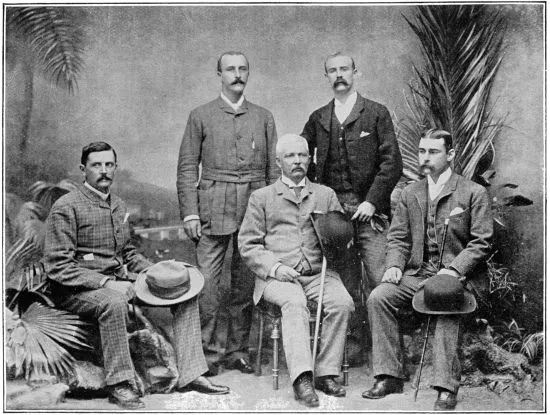 HENRY M. STANLEY AND HIS OFFICERS, 1890
dead stop on the instant. At ‘Stack loads!’ each dropped his burden in
order; at the morning call of ‘Safari!’ there was no skulking; at the
midnight alarm, they leapt, as one man, to arms.
We began now to re-date our time. What happened in the Forest was an
old, old story, not to be remembered; it was like the story of toddling
childhood; it is what happened after the Forest days that they loved
to be reminded of! ‘Ah! master,’ they would say, ‘why recall the time
when we were “wayingo” (fools, or raw youths)?’
What singular merits we saw in one another now! We could even venture
upon a joke, and no one thought of being sullen. We could laugh at a
man, and he would not be displeased! Each had set his life upon a cast,
stood bravely the hazard of the die, and triumphed! All were at peace,
one with another, and a feeling of brotherhood possessed us, which
endured throughout the happy aftertime between the Forest and the sea.
THE close of the story of Stanley’s African explorations may fitly be
followed by a survey of the net result. Such an estimate is given in a
paper by Mr. Sidney Low, in the ‘Cornhill Magazine,’ for July, 1904,
together with a sketch of Stanley’s personality, at once so just and so
sympathetic that the entire article, with only slight omissions, is here
given a place.
‘The map of Africa is a monument to Stanley, aere perennius.[37] There
lie before me various atlases, published during the past sixty years,
which is less than the span of Stanley’s lifetime. I turn to a
magnificently proportioned volume, bearing the date of 1849, when John
Rowlands was a boy at school at Denbigh. In this atlas, the African
Continent is exhibited, for about a third of its area, as a mighty
blank. The coast is well-defined, and the northern part, as far as ten
degrees from the Equator, is pretty freely sprinkled with familiar
names. We have Lake Tchad, Bornu, Darfur, Wadi-el-Bagharmi, Sennaar,
Kordofan, and Khartoum, and so on. But at the southern line of “the
Soudan, or Nigritia,” knowledge suddenly ceases; and we enter upon the
void that extends, right through and across Africa, down to the Tropic
of Capricorn. “Unexplored” is printed, in bold letters, that stride over
fifteen hundred miles of country, from the tropical circle to well
beyond the Equator! The great lakes are marked only by a vague blob,
somewhere in the interior, west of the Zanzibar territory. The estuary
of the “Congo, or Zaire” is shown, and a few miles of the river inland.
After that we are directed, by uncertain dots, along the supposed course
of the stream northward, to where it is imagined to take its rise in the
Montes Lunae, for which the map-maker can do no better for us than to
refer, in brackets, to “Ptolemy” and “Abulfeda Edrisi.”
‘I pass to another atlas, dated 1871. Here there is considerable
progress, especially as regards the eastern side of the Continent. The
White Nile and the Bahr-el-Ghazal have been traced almost to their
sources. The Zambesi is known, and the Victoria Falls are marked. Lakes
Victoria Nyanza and Nyassa appear with solid boundaries. Tanganyika,
however, is still uncertain, the Albert Nyanza with its broken lines
testifies to the doubts of the geographer, and the Albert Edward does
not appear at all; and beyond the line of the lakes, and north of the
tenth degree of south latitude, the blank of the interior is still as
conspicuous, and almost as unrelieved, as it was two-and-twenty years
earlier.
‘By 1882, there is a great change. The name of Stanley has begun to be
written indelibly upon the surface of the Continent. The vague truncated
“Congo, or Zaire” is the “Livingstone River,” flowing in its bold
horseshoe through the heart of the formerly unexplored region, with
“Stanley Falls” just before the river takes its first great spring
westward, and “Stanley Pool” a thousand miles lower down, where, after a
long southerly course, the mighty stream makes its final plunge to the
sea. Tributary rivers, hills, lakes, villages, tribal appellations, dot
the waste. Uganda is marked, and Urua, and Unyanyembe.
‘If we pass on to the present day, and look at any good recent map, the
desert seems to have become—as, indeed, it is—quite populous. There is
no stretch of unknown, and apparently unoccupied land, except in the
Sahara, and between Somaliland and the White Nile. All the rest is
neatly divided off, and most of it tinted with appropriate national
colours; the British, red; the French, purple; the German, brown; the
Portuguese, green. In the map I am looking at there is, right in the
middle, a big irregular square or polygon, which is painted yellow. It
is twelve hundred miles from north to south, a thousand from east to
west. It is scored by the winding black lines of rivers,—not the Congo
only, but the Aruwimi, the Lualaba, the Sankalla, the Ubangi. It is the
Congo Free State, one of the recognised political units of the world,
with its area of 800,000 square miles, and its population computed at
fifteen millions. The great hollow spaces have been filled in. The Dark
Continent is, geographically at any rate, dark no longer. The secret of
the centuries has been solved!
‘Geographical science has still its unfulfilled tasks to finish; but
there can never again be another Stanley! He is the last of the
discoverers, unless, indeed, we shall have to reserve the title for his
friend and younger disciple, Sven Hedin. No other man, until the records
of our civilisation perish, can lay bare a vast unknown tract of the
earth’s surface, for none such is left. The North Pole and the South
Pole, it is true, are still inviolate; but we know enough to be aware
how little those regions can offer to the brave adventurers who strive
to pierce their mysteries. There is no Polar continent, nor open
Antarctic Sea, only a dreary waste of lifeless ice, and unchanging snow.
But the habitable and inhabited globe is mapped and charted; and none of
the explorers, who laboured at the work during the past fifty years, did
so much towards the consummation as Stanley. Many others helped to fill
in the blank in the atlas of 1849, which has become the network of names
in the atlas of 1904.
‘A famous company of strong men gave the best of their energies to the
opening of Africa during the nineteenth century. They were missionaries,
like Moffat and Livingstone; scientific inquirers, like Barth, Rohlfs,
Du Chaillu, Teleki, and Thomson; adventurous explorers, like Speke,
Grant, Burton, Cameron, and Selous; and soldiers, statesmen, and
organisers, such as Gordon, Rhodes, Samuel Baker, Emin Pasha, Johnston,
Lugard, and Taubman Goldie—but there is no need to go through the list.
Their discoveries were made often with a more slender equipment and
scantier resources; as administrators, one or two at least could be
counted his equals. But those of the distinguished band, who still
survive, would freely acknowledge that it was Stanley who put the crown
and coping-stone on the edifice of African exploration, and so completed
the task, begun twenty-four centuries ago with the voyage of King
Necho’s Phœnician captains, and the Periplus of Hanno.
‘It was Stanley who gathered up the threads, brought together the loose
ends, and united the discoveries of his predecessors into one coherent
and connected whole. He linked the results of Livingstone’s explorations
with those of Speke, and Grant, and Burton, and so enabled the great
lacustrine and riverine system of Equatorial Africa to become
intelligible. Without him, the work of his most illustrious predecessors
might still have remained only a collection of splendid fragments.
Stanley exhibited their true relation to one another, and showed what
they meant. He is the great—we may say the final—systematiser of
African geography, and his achievements in this respect can neither be
superseded nor surpassed, if only because the opportunity exists no
longer.
‘As a fact, Stanley not only completed, but he also corrected, the chief
of all Livingstone’s discoveries. The missionary traveller was steadily
convinced that the Nile took its rise in Lake Tanganyika; or, rather,
that it passed right through that inland sea. Stanley, when he had found
the Doctor, and restored the weary old man’s spirit and confidence,
induced him to join in an exploration trip round the north end of
Tanganyika, which proved that there was no river flowing out of the
lake, and therefore that no connection was possible with the Nile
system. But Livingstone still believed that he was on the track of the
great Egyptian stream. He persisted in regarding his Lualaba as one of
the feeders of the Nile, and he was in search of the three fountains of
Herodotus, in the neighbourhood of Lake Bangweolo, when he made his last
journey. It was reserved for Stanley to clear up the mystery of the
Lualaba, and to identify it with the mighty watercourse which, after
crossing the Equator, empties itself, not into the Mediterranean, but
into the South Atlantic.
‘Stanley regarded himself, and rightly, as the geographical legatee and
executor of Livingstone. From the Scottish missionary, during those four
months spent in his company in the autumn of 1871, the young adventurer
acquired the passion for exploration and the determination to clear up
the unsolved enigmas of the Dark Continent. Before that, he does not
seem to have been especially captivated by the geographical and
scientific side of travel. He liked visiting strange countries, because
he was a shrewd observer, with a lively journalistic style, which could
be profitably employed in describing people and places. But the finding
of Livingstone made Stanley an explorer; and his own nature made him, in
a sense, a missionary, though not quite of the Livingstone kind. He was
a man who was happiest when he had a mission to accomplish, some great
work entrusted to him which had to be got through, despite of
difficulties and dangers; and when the famous traveller laid down his
tired bones in the wilderness, Stanley felt that it was decreed for him
to carry on the work. So he has said himself in the opening passage of
the book in which he described the voyage down the Congo. When he
returned to England in 1874, after the Ashanti War, it was to learn that
Livingstone was dead:—
‘“The effect which this news had upon me, after the first shock had
passed away, was to fire me with a resolution to complete his work, to
be, if God willed it, the next martyr to geographical science, or, if my
life was to be spared, to clear up not only the secrets of the great
river throughout its course, but also all that remained still
problematic and incomplete of the discoveries of Burton and Speke, and
Speke and Grant.
‘“The solemn day of the burial of the body of my great friend arrived. I
was one of the pall-bearers in Westminster Abbey, and when I had seen
the coffin lowered into the grave, and had heard the first handful of
earth thrown over it, I walked away sorrowing over the fall of David
Livingstone.”
‘There must have been some among those present at the Memorial Service
in Westminster Abbey, on May 17, 1904, who recalled these simply
impressive words, and they may have wondered why the great Englishman
who uttered them was not to lie with the great dead of England at
Livingstone’s side.
‘It is not merely on geographical science that Stanley has left a
permanent impress, so that, while civilised records last, his name can
no more be forgotten than those of Columbus and the Cabots, of Hudson
and Bartolomeo Diaz. His life has had a lasting effect upon the course
of international politics. The partitioning of Africa, and its definite
division into formal areas of administration or influence, might have
been delayed for many decades but for his sudden and startling
revelation of the interior of the Continent. He initiated,
unconsciously, no doubt, and involuntarily, the “scramble for Africa” in
which Germany, France, Great Britain, Italy, Belgium, and Portugal have
taken part. The opening up of the Congo region, by his two great
expeditions of 1874 and 1879, precipitated a result which may have been
ultimately inevitable, but would perhaps have been long delayed without
his quickening touch. The political map of Africa, as it now appears,
and is likely to appear for many generations to come, was not the work
of Stanley; but without Stanley it would not have assumed its present
shape. His place is among those who have set the landmarks of nations
and moulded their destinies.
‘When you conversed with him, at least in his later years, you easily
discovered that he had a firm grasp of the general sequence of European
and Oriental history, and a considerable insight into modern
ethnological and archæological learning. He had formed independent and
original ideas of his own on these subjects; and when he talked, as he
sometimes would, of the Sabæans and the Phœnicians, and the early Arab
voyagers, you saw that, to the rapid observation of the man of action,
he had added much of the systematising and deductive faculty of the
scholar. He possessed the instinct of arrangement, which is the
foundation of all true scholarship, and perhaps of all great practical
achievement as well.
‘His intellectual power was, I think, seldom appreciated at its true
value. Its full measure is not given in his books, in spite of their
vigorous style, their dramatic method of narration, and their brilliant
pictorial passages; but nearly everything he wrote was in the nature of
rather hurried journalism, the main object of which was to explain what
had happened, or to describe what had been seen. Not in these graphic
volumes, but in the achievements which gave rise to them, is Stanley’s
mental capacity made manifest. He was not only a born commander, prompt,
daring, undaunted, irresistible, but also a great administrator, a great
practical thinker. He thought out his problems with slow, thorough
patience, examined every aspect of them, and considered all the possible
alternatives, so that when the time came for action he knew what to do,
and had no need to hesitate. His fiery, sudden deeds were more often the
result of a long process of thought than of a rapid inspiration. The New
York correspondent of the “Times,” who knew him well, tells an
illustrative story:—
‘“He and his whole party had embarked on Lake Tanganyika, knowing that
the banks were peopled, some with friendly, some with hostile tribes.
His canoes moved on at a respectful distance from the nearest shore.
Sometimes the friendly people came off to sell their boat-loads of
vegetables and fruit. “But suppose they were not friendly,” said Stanley
to himself, “then, what?” So one day there approached a fleet of canoes,
with all the usual signs of friendly commerce. They were piled high with
bananas. “I thought” (said Stanley) “they had a large supply, and the
boats were deep in the water; still, there was nothing that looked
really suspicious. There were just men enough to paddle the canoes; no
more. I let them come close, but I kept my eye on them, and my hand on
the trigger of my elephant gun. They were but a few yards off when I saw
a heap of bananas stir. I fired instantly, and instantly the water was
black with hundreds of armed black men who had been hidden beneath the
banana-heaps. I do not think many of them got ashore. If I had stopped
to think, they would have been aboard us, and it is we who should not
have got ashore. But I had done my thinking before they came near.”
‘Similarly he spoke of Gordon’s end. “If,” he said, “I had been sent to
get the Khartoum garrison away, I should have thought of that and
nothing else; I should have calculated the chances, made out exactly
what resistance I would have to encounter, and how it could be overcome,
and laid all my plans with the single object of accomplishing my
purpose.” I believe, though he did not say so, that he thought the
retreat could have been effected, or the town held, till the Relief
Column arrived, if proper measures had been taken, and the one definite
aim had been kept steadily in view all the time. That was his principle
of action. When he had an object to fulfil, a commission to carry out,
he could think of nothing else till the work was done. Difficulties,
toil, hardships, sacrifices of all kinds, of time, of men, of money,
were only incidents in the journey that led to a goal, to be reached if
human endeavour could gain it. “No honour,” he wrote, “no reward,
however great, can be equal to the subtle satisfaction that a man feels
when he can point to his work and say: ‘See, now, the task I promised
you to perform with all loyalty and honesty, with might and main, to the
utmost of my ability is, to-day, finished.’” This was the prime article
in Stanley’s confession of faith—to do the work to which he had set his
hand, and in doing it, like Tennyson’s Ulysses,—
“To strive, to seek, to find, and not to yield.”
‘Both aspects of his character, the practical and the intellectual, were
revealed in the two great expeditions of 1874 and 1879. The crossing of
Africa, which began in the first year, was a marvellous performance in
every way. Its results were immense, for it was the true opening of the
Equatorial region, and added more to geographical knowledge than any
enterprise of the kind in the nineteenth century, or perhaps in any
century. Great conquerors at the head of an army—an Alexander, or a
Genghis Khan—may have done as much; but no single individual
revolutionised so large a tract of the earth’s surface, with only a
handful of armed men and a slender column of camp-followers and
attendants. Wonderful, indeed, was the tour of the great lakes, the
circumnavigation of the Victoria Nyanza, the conversion of King Mtesa of
Uganda, the unveiling of the fertile, semi-civilised country, islanded
for centuries in the ocean of African barbarism, which is now a British
Protectorate, linked up with Charing Cross by rail and steamer. But the
toilsome journey up from the East Coast was nothing to that which
followed, when the party left Uganda and turned their faces to the
Congo, resolved to follow the great river down to the sea. His gifts of
leadership were at their highest in this memorable march, from the time
that he left Nyangwe, in November, 1876, to his arrival at Boma, near
the Congo estuary, in August, 1877. He had to be everything by turn in
this space of ten eventful months—strategist, tactician, geographer,
medical superintendent, trader, and diplomatist. There were
impracticable native chiefs to be conciliated, the devious designs of
that formidable Arab potentate, Tippu-Tib, to be penetrated and
countered, inexorably hostile savages to be beaten off by hard
fighting. The expedition arrived at Boma, a remnant of toil-worn men,
weakened by disease, and very nearly at the point of starvation.
Stanley’s white companions had perished, and his native contingent had
suffered heavily; but the allotted task was accomplished, and the silent
pledge, registered by Livingstone’s grave, had been fulfilled.
‘It was this famous journey—the most remarkable, if judged by its
results, in the whole history of African travel—which placed Stanley’s
reputation as a leader and discoverer on the highest pinnacle. It was
not an unassailed reputation. Much was said about his high-handed
methods, and many good people in England, those
“Good people, who sit still in easy chairs,
And damn the general world for standing up,”
chose to regard him as a sort of filibuster. They contrasted his methods
with those of some of his predecessors and contemporaries, who had
contrived to spend years in Africa without fighting and bloodshed; but
they did not allow for the difference in the conditions. Most of the
other travellers had been the sport of circumstances. They had wandered
from place to place, turned from their course, again and again, by
hostile tribes and churlish chiefs. They found out a great deal, but
not, as a rule, that which they came to find. Their discoveries were
largely accidental; even Livingstone was constantly deflected from his
route, and was unable to pursue to its conclusion the plan of tracing
the central watershed which he had set before himself. Stanley had a
perfectly definite purpose, which he determined to carry out; and he
succeeded. His scheme involved passing through an immense region,
inhabited by a comparatively numerous population, of a higher type than
those encountered nearer the coast, more energetic and more warlike. As
a rule, he made his way among them by bargain and negotiation; but,
sometimes, he had to fight or to turn back; and he accepted the sterner
alternative. If he had refused to do so, he could not have reached his
goal. The expedition might still have added enormously to the sum of
scientific knowledge, but in the achievement of its ultimate and
clearly-conceived object it would have been a failure. Stanley did not
mean that it should fail; he was always ready to sacrifice himself, and
when necessary he was prepared, as great men who do great deeds must be,
to sacrifice others. But there was never the smallest justification for
representing him as a ruthless, iron-handed kind of privateer on land,
who used the scourge and the bullet with callous recklessness. There was
nothing reckless about Stanley, except, at times, his speech. In action,
he was swift and bold, but not careless.
‘To inflict superfluous suffering, to shoot and slay without thinking of
the consequences—this was utterly alien to his systematic,
calculating methods. He would do it, if there seemed no other means of
gaining the end, as a general would order a column to destruction to
save his army and win a victory. But he was essentially a humane man,
masterful and domineering, and yet, au fond, gentle and kindly,
particularly to the weak and suffering. Opposition stiffened the
obstinate will to resistance; he was not a safe person to thwart, even
in small matters. He remembered a benefit, and he did not forget an
injury. It was said that he was unforgiving, and, perhaps, there was
something in the charge. In his intense, self-contained nature wounds
rankled long; and he had little of that talent for oblivion which is so
easily developed among comfortable people, whose emotions and
experiences have never been poignant enough to disturb their peace of
mind.
‘One who knew Stanley well, and studied him with an eye at once
penetrating and friendly, believed that through life he bore the
characteristic traces of his Cymric origin. He had the Welsh peasant’s
quickness of temper, his warmth of affection, his resentfulness when
wronged, his pugnacity, and his code of ethics, ultimately derived from
John Calvin. Welsh Protestantism is based on a conscientious study of
the biblical text. Stanley carried his Bible with him through life, and
he read it constantly; but I should imagine that he was less affected by
the New Testament than by the prophetic and historical books of the
Hebraic scriptures. He believed profoundly in the Divine ordering of the
world; but he was equally assured that the Lord’s Will was not fulfilled
by mystical dreams, or by weak acquiescence in any wrong-doing that
could be evaded by energetic action. With Carlyle, he held that strength
is based on righteousness, and that the strong should inherit the earth;
and saw no reason why there should be any undue delay in claiming the
inheritance. “The White Man’s Burden” could not be shirked, and should,
on the contrary, be promptly and cheerfully shouldered.
‘“It is useless” (he wrote, having in view the American Indians) “to
blame the white race for moving across the continent in a
constantly-increasing tide. If we proceed in that manner, we shall
presently find ourselves blaming Columbus for discovering America, and
the Pilgrim Fathers for landing on Plymouth Rock! The whites have done
no more than follow the law of their nature and being.”
‘He had his own idea about prayer. A man, he thought, ought to lay his
supplications before the Throne of the Universe; and he attached great
value to prayers for deliverance from danger and distress. But the
answer was not to be expected by way of a miracle. The true response is
in the effect on the suppliant himself, in the vigour and confidence it
gives to his spirit, and the mental exaltation and clearness it
produces. That was Stanley’s opinion; and he had no great respect for
the martyrs, who yielded to their fate with prayer, when they might have
averted it by action.
‘The crossing of Africa was Stanley’s premier achievement as a leader of
men. The founding of the Congo State revealed him as a great
administrator and organiser. It was a wonderful piece of management, a
triumph of energy, resource, and hard work. Here it was that Stanley
earned the title which, I think, gave him more satisfaction than the
belated G. C. B., conferred on him towards the end of his life. The
natives called him “Bula Matari,” which, being interpreted, means “the
Breaker of Rocks”—an appellation bestowed upon him by the brown-skinned
villagers as they watched the sturdy explorer toiling, bare-armed, under
the fierce African sun, with axe or hammer in hand, showing his
labourers, by example and precept, how to make the road from Vivi to
Isangela, which bridged the cataracts of the Lower Congo, and opened the
way to the upper reaches of the river.
‘The founding of the Congo State can be compared with the achievements
of the two other great enterprises of our own time, which have converted
vast tracts of primitive African savagery into organised states under
civilised administration. But Stanley’s task was heavier than that of
the pioneers of Rhodesia, and the creators of Nigeria. The sphere of his
operations was longer; the native populations were more numerous and
more utterly untouched by external influences other than those of the
Arab slave-raiders; the climatic and physical obstacles were more
severe; he had foreign opposition to contend with from without, and many
difficulties with the pedantry, the obstinacy, and the greed of some of
the officials sent out to him by his employers. Yet in the short space
of five years the work was done! The Congo was policed, surveyed, placed
under control. A chain of stations was drawn along its banks; systematic
relations had been established with the more powerful native potentates;
an elaborate political and commercial organisation had been established;
the transport difficulties had been overcome, and the whole region
thrown open to trade under the complicated and careful regulations which
Stanley had devised. It was no fault of Stanley’s if the work has been
badly carried on by his successors, and if the Congo State, under a
régime of Belgian officials, not always carefully selected, has not, so
far, fulfilled the promise of its inception. So long as Stanley was in
Africa, no disaster occurred; there was no plundering of the natives,
and no savage reprisals. If he had been permitted to remain a few years
longer, the advance of the Congo State might have been more rapid,
particularly if he could have been seconded by subordinates with a
higher inherited capacity for ruling inferior races than Belgians could
be expected to possess. It was a cause of regret to him, I believe, that
England did not take a larger share in this international enterprise.
‘But England for long ignored or belittled the work that Stanley did. It
was not till public opinion, throughout the Anglo-Saxon and Latin world,
had acclaimed him a hero, that the governing element recognised
something of his greatness; and, to the very last, its recognition was
guarded and grudging. One might have supposed that his services would
have been enlisted for the Empire in 1884, when he came back from the
Congo. He was in the prime of life, he was full of vigour, he had proved
his capacity as a leader, a ruler, and a governor, who had few living
equals. One thinks that employment worthy of his powers should have been
pressed upon him. But the country which left Burton to eat out his fiery
heart in a second-rate consulship, and never seemed to know what to do
with Gordon, could not find a suitable post for Stanley! I do not
imagine he sought anything of the kind; but it seems strange that it was
not offered, and on such terms that he would have found it difficult to
refuse.
‘If he had been entrusted with some worthy imperial commission, he might
have been saved from the fifth, and least fortunate, of his journeys
into the interior of Africa. Nothing that Stanley ever did spoke more
loudly for his courage, his resourcefulness, and his heroic endurance,
than the expedition for the Relief of Emin Pasha. None but a man of his
iron resolution could have carried through those awful marches and
counter-marches in the tropical forest, and along the banks of the
Aruwimi. But the suffering and privations were incurred for an
inadequate object, and a cause not clearly understood. Many lives were
lost, many brave men, white and black, perished tragically, to effect
the rescue of a person who, it appeared, would, on the whole, have
preferred not to be rescued!
‘The journey from the Ocean to the Nile, and from the Nile to the East
Coast, added much to geographical knowledge, and was the complement of
Stanley’s previous discoveries. But the cost was heavy, and the leader
himself emerged with his health seriously impaired by the tremendous
strain of those dark months. Most of his younger companions preceded him
to the grave. Stanley survived Nelson, Stairs, and Parke, as well as
Barttelot and Jameson; but the traces of the journey were upon him to
the end, and no doubt they shortened his days.
‘Those days—that is to say, the fourteen years that were left to him
after he returned to England in the spring of 1890—were, however, full
of activity, and, one may hope, of content. No other great task of
exploration and administration was tendered; and perhaps, if offered, it
could not have been accepted. But Stanley found plenty of occupation. He
wrote, he lectured, and he assisted the King of the Belgians with advice
on the affairs of his Dependency. He was in Parliament for five years,
and he took some part in the discussion of African questions. More than
all, he was married, most happily and fortunately married, and watched
over, and ministered to, with tactful and tender solicitude.
‘The evening of that storm-tossed and strenuous life was calm and
peaceful. Those who knew him only in these closing years saw him, I
suppose, at his best, with something of the former nervous,
self-assertive, vitality replaced by a mellow and matured wisdom.
Whether there was much more than an external contrast between the
Stanley of the earlier and him of the later period, I am unable to say;
but one may suggest that the change was in the nature of a development.
‘Does any man’s character really alter, after the formative season of
youth is over? Traits, half-hidden, or seldom-revealed in the fierce
stress of active conflict and labour, may come to the surface when the
battling days are done. I cannot think that the serene sagacity, the
gentleness, and the magnanimity, which one noted in Stanley in his last
decade, could have been merely the fruit of leisure and domestic
happiness. No doubt the strands were always in his nature, though
perhaps not easily detected by the casual eye, so long as “the wrestling
thews that throw the world” had to be kept in constant exercise.
‘In manner and appearance, and in other respects, he was the absolute
antithesis of the type he sometimes represented to the general
imagination. Short of stature, lean, and wiry, with a brown face, a
strong chin, a square, Napoleonic head, and noticeable eyes,—round,
lion-like eyes, watchful and kindly, that yet glowed with a hidden
fire,—he was a striking and attractive personality; but there was
nothing in him to recall the iron-handed, swash-buckling, melodramatic
adventurer, such as the pioneers of new countries are often supposed to
be. The bravest of the brave, a very Ney or Murat among travellers, one
knew that he was; but his courage, one could see, was not of the
unthinking, inconsequent variety, that would court danger for its own
sake, without regard to life and suffering. What struck one most was
that “high seriousness,” which often belongs to men who have played a
great part in great events, and have been long in close contact with the
sterner reality of things. His temperament was intense rather than
passionate, in spite of the outbursts of quick anger, which marked him,
in his fighting period, when he was crossed or wronged. Much, far too
much, was made of his “indiscretions” of language—as if strong men are
not always indiscreet! It is only the weaklings who make no mistakes,
who are for ever decorous and prudent.
‘Much the same may be said of his early quarrel with the Royal
Geographical Society. He did not find it easy to forgive that
distinguished body, when it signified its desire to make amends for the
coldness with which it had first treated him, and for the ungenerous
aspersions, which some of its members had cast upon his fame. They gave
him a dinner, and made flattering speeches about the man who had
succeeded. It was thought to be ungracious of Stanley that he would not
make up the quarrel, until he had vindicated his own part of it by a
bitter recital of his grievances. But men who feel intensely, who have
suffered deeply under unmerited injuries, and who have Stanley’s defiant
sense of justice, are not always so tactful and polite as the social
amenities require.
‘As it was, the “indiscretions” for some years left a certain mark upon
Stanley’s reputation, and gave an easy handle to the cavillers and the
hypercritical, and to the whole tribe of the purists, who are shocked
because revolutions are not made with rose-water, or continents
conquered in kid gloves. Even after his triumph was acknowledged, after
he had been honoured by princes, and had won his way to the tardy
recognition of the Royal Geographical Society, there were “superior
persons” to repeat that he was egotistical and inhuman.
‘To his friends, both charges must have seemed absurd. Of personal
egotism, of mere vanity, he had singularly little. It needed a very
obtuse observer to miss seeing that he was by nature simple,
affectionate, and modest, with a wealth of kindness and generosity under
his mantle of reserve. He had a sympathetic feeling for the helpless,
and the unfortunate—for animals, for the poor, and for the children of
all races. On the march from Ruwenzori, distressed mothers of Emin’s
motley contingent would bring their babies to Stanley’s own tent,
knowing that “Bula Matari” would have halted the caravan sooner than
needlessly sacrifice one of these quaint brown scraps of humanity. He
would tell the story himself; and afterwards, perhaps, he would describe
how he made up the connubial differences of some jangling couple of
half-clad aboriginals!
‘His full and varied experiences were not easy to extract from him, for
he disliked being “drawn,” and preferred to talk on those larger,
impersonal questions of politics, history, ethnology, and economics, in
which he never ceased to be interested. But his friends were sometimes
allowed to be entranced by some strange and stirring episode of African
adventure, told with fine dramatic power, and relieved by touches of
quiet humour. He was not a witty talker, but he had a fund of that
amused tolerance which comes of comprehending, and condoning, the
weaknesses of human nature. It is a trait which goes far to explain his
success in dealing with native races.
‘In the House of Commons he was not much at home. The atmosphere of the
place, physical and intellectual, disagreed with him. The close air and
the late hours did not suit his health. “I am a man,” he once said to
the present writer, “who cannot stand waste.” The Commons’ House of
Parliament, with its desultory, irregular ways, its dawdling methods,
and its interminable outpourings of verbose oratory, must have seemed to
him a gigantic apparatus for frittering away energy and time. He was
glad to escape from St. Stephen’s to the Surrey country home, in which
he found much of the happiness of his later years. Here he drained, and
trenched, and built, and planted; doing everything with the same careful
prevision, and economical adaptation of means to ends, which he had
exhibited in greater enterprises. To go the round of his improvements
with him was to gain some insight into the practical side of his
character.
‘It was not the only, nor perhaps the highest, side. There was another,
not revealed to the world at large, or to many persons, and the time has
scarcely come to dwell upon it. But those who caught glimpses into a
temple somewhat jealously veiled and guarded, did not find it hard to
understand why it was that Stanley had never failed to meet with
devoted service and loyal attachment, through all the vicissitudes of
the brilliant and adventurous career which has left its mark scored deep
upon the history of our planet.
‘Sidney Low.’
A further testimony to the importance of Stanley’s discoveries was given
by Sir William Garstin, G. C. M. G., in a paper read on December 15,
1908, before the Royal Geographical Society, on the occasion of the
Fiftieth Anniversary of the discovery of the Source of the White Nile by
Captain John Speke.
‘I now come,’ said Sir William Garstin, ‘to what is, perhaps, the most
striking personality of all in the roll of the discoverers of the Nile,
that of Henry Stanley.
‘Stanley on his second expedition, starting for the interior, on
November 17, 1874, circumnavigated Lake Victoria, and corrected the
errors of Speke’s map as to its shape and area.
‘He visited the Nile outlet, and proved that the Nyanza was a single
sheet of water, and not, as Burton had asserted, a series of small,
separate lakes.
‘On arriving at Mtesa’s capital, Stanley’s acute mind quickly grasped
the possibilities of Uganda as a centre for missionary enterprise. He
realised that, if he could succeed in interesting Great Britain in such
a project, a most important departure would have been made in the
direction of introducing European civilisation into Central Africa.
‘First came his appeal by letter, followed later by Stanley himself,
whose eloquence aroused enthusiasm in the English public. A great
meeting held in Exeter Hall, resulted in funds being raised, and the
first party of English missionaries started for Uganda in the spring of
1876.
‘This, although not at the time realised, was in reality the first step
towards the introduction of British rule in Equatorial Africa.
‘Stanley’s last voyage, and in some respects, his greatest expedition,
was undertaken for the relief of Emin Pasha, at that time cut off from
communication with the outer world. The Relief Expedition started in
1887, under Stanley’s leadership. This time Stanley started from the
Congo, and, travelling up that river, struck eastward into the Great
Forest, which, covering many thousands of square miles, stretches across
a portion of the Semliki Valley and up the western flank of Ruwenzori.
‘On emerging from the Forest, Stanley reached the Valley of the Semliki,
and, in May, 1888, he discovered the mountain chain of Ruwenzori.
‘This discovery alone would have sufficed to have made his third journey
famous. It was not all, however. After his meeting with Emin, he
followed the Semliki Valley to the point where this river issues from
the Albert Edward Nyanza.
‘Stanley was the first traveller to trace its course, and to prove that
it connects two lakes and, consequently, forms a portion of the Nile
system.
‘When skirting the north end of Lake Albert Edward, he recognised that
he had really discovered this lake in his previous journey, although at
the time unaware of this fact.
‘Stanley has thus cleared up the last remaining mystery with respect to
the Nile sources.
‘It is impossible to exaggerate the importance of Stanley’s work. The
main facts regarding the sources of the Nile were finally revealed by
him, and nothing was left for future explorers but to fill in the
details. This was a magnificent achievement for one man to have
compassed, and Stanley must always stand out as having done more than
any other to clear up, and to correct, the errors in the geography of
the Nile basin. Stanley not only completed thoroughly the work left
unfinished by other explorers, but added largely to it by his own
remarkable discoveries. To him also it was due that the first English
Mission was despatched to Uganda.
‘Stanley’s glowing accounts of the fertility of the land of the Baganda
encouraged British commercial enterprise, and originated the formation
of the East African Chartered Company. As we now know, the inevitable
sequence was the English occupation of the country.’
As to Stanley’s African work, one or two features may here be specially
noted. His master-passion was that, not of the discoverer, but of the
civiliser. He had his own methods, but he was sympathetic and helpful
toward other methods, and sometimes adopted them. To King Mtesa and his
people, he took the part of a Christian missionary with rare efficiency.
When the time for his departure came, Mtesa heard it with dismay, and
asked: ‘What is the use, then, of your coming to Uganda to disturb our
minds, if, as soon as we are convinced that what you have said has right
and reason in it, you go away before we are fully instructed?’
Stanley answered that every man has his own business and calling, that
his business was that of a pioneer and not of a religious teacher, but
if the king wanted real instructors, he would write to England and ask
for them. The king said, ‘Then write, Stamlee’ (the native pronunciation
of the name), ‘and say to the white people that I am like a child
sitting in darkness, and cannot see until I am taught the right way.’
Thereupon followed the appeal to England, the prompt response, the
planting of the mission, and the heroic story of the Uganda church
triumphing over persecution and martyrdom. When Stanley wrote the story
for the ‘Cornhill Magazine,’ January, 1901, the Uganda people had built
for themselves three hundred and seventy-two churches, with nearly
100,000 communicants, who were not fair-weather Christians. A week or
two after Stanley’s death, the great cathedral of Uganda was solemnly
consecrated, and opened for service.
Among these people whom Stanley visited, while taking Emin’s refugees to
safety in 1889, was the illustrious missionary A. M. Mackay, who had
previously written, ‘For a time the old gods of the land had to give way
to the creed of Arabia, as the king saw something in that more likely to
add prestige to his court than the charm-filled horns of the magic men,
and frantic dance of the foretellers of fortune. Then came Stanley. Let
his enemies scoff as they will, it is a fact indisputable that with his
visit there commenced the dawn of a new era in the annals of the court
of Uganda. The people themselves date from Stanley’s day the
commencement of leniency and law, in place of the previous reign of
bloodshed and terror. “Since Stanley came,” they say, “the king no more
slaughters innocent people as he did before; he no more disowns and
disinherits in a moment an old and powerful chief, and sets up a puppet
of his own, who was before only a slave.” Compared with the former daily
changes and cruelties, as the natives describe them, one cannot but feel
thankful to God for the mighty change.’
After the visit, Mackay writes:—
‘I must say that I much enjoyed Mr. Stanley’s company during the short
stay here. He is a man of an iron will and sound judgment; and, besides,
is most patient with the natives. He never allows any one of his
followers to oppress, or even insult, a native. If he has had
occasionally to use force in order to effect a passage, I am certain
that he only resorted to arms when all other means failed.’
Stanley recognised and appreciated in Mackay a spirit akin to
Livingstone. He judged that he had dangerously overtaxed his strength,
and urged him to go away with him and secure a rest. But Mackay would
not leave his post, and within half a year he succumbed to disease.[38]
Did space permit, a chapter might well be given to Stanley’s labours for
African civilisation by means of addresses to the English people, and
his efforts, by lectures and personal interviews, to move the Government
and the community to meet the successive calls for action. Had England
responded to his appeal to take over the Congo region, the leadership,
which was left to the Belgian sovereign, would have devolved on the
British nation, and history would have had a different course.
After the founding of the Congo Free State, Stanley went over the length
and breadth of England to address meetings, urging the English people to
build the Congo Railway. But again the deaf ear was turned to him.
Now, the wealth to shareholders in that railway is prodigious. He also
did his utmost to spur and persuade a laggard and indifferent Government
to plant and foster English civilisation in East Africa. He wanted not
mere political control, but the efficient repression of the slave-trade,
the advancement of material improvements, and especially the
construction of railways to destroy the isolation which was ruinous to
the interior. One lecture, entitled ‘Uganda; a plea against its
Evacuation,’ is a masterpiece of large-minded wisdom, and true
statesmanship. He spoke repeatedly before Anti-slavery Societies on the
practical means of attaining the great end. His influence with King
Leopold was always used to hasten and complete the extirpation of the
Arab slave-trade. From that curse Equatorial Africa was freed, and in
its deliverance Stanley was the leader.
Stanley constantly urged the vital importance of thoroughly training
Medical Officers and Medical Missionaries in the knowledge of Tropical
diseases, and the necessity of the proper medical equipment of
expeditions and stations, and the considerate medical treatment of
natives, as well as white men, for economic reasons, as well as on
humanitarian grounds.
From his own terrible experiences Stanley realised to the full the
barrier which Malaria and other dread Tropical diseases imposed against
the progress of civilisation and commercial enterprise in Africa; and he
followed with keen interest and hopefulness the discoveries of Sir
Patrick Manson, and Major Ross, proving the mosquito to be the host and
carrier of the malarial parasite, and also the successful devices of
these scientists for checking and reducing the death-toll from this
scourge.
He particularly applauded the great, far-seeing, Colonial Secretary,
Joseph Chamberlain, for his practical measures, by which he had done
more than any other Statesman to render the Tropical regions of the
Empire habitable and healthy.
Stanley’s last public appearance was at a dinner to Dr. Andrew Balfour,
on his appointment as Director of the Wellcome Tropical Research
Laboratories, Gordon Memorial College, Khartoum, and, in the course of a
very moving speech on the development of Africa since his first
expedition, Stanley said that, at one time, he thought the Equatorial
regions possible for the habitation of natives only, except in limited
highlands; but now, thanks to the work of the London and Liverpool
Schools of Tropical Medicine, and these Research Laboratories in the
heart of Africa, the deadly plagues that harassed mankind were being
conquered, and the whole of that Dark Continent might yet become a white
man’s land.
One other trait of his African work may be mentioned. In a pecuniary
sense, it was absolutely disinterested. He would never take the
slightest personal advantage of the commercial opportunities incident to
the opening of the new countries, on the Congo, or in Uganda. I desire
to emphasise the fact that such property as he had came almost entirely
from his books and his lectures. He gave his assistance to the
establishment of the British East African Company because he believed in
its influence for good, but he declined any pecuniary interest.
When the Congo Railway stock was paying very high dividends, he was
asked why he did not take some of it, and he answered that ‘he would
not have even the appearance of personal profit out of Africa.’ When
princes and potentates made advantageous offers to him, they were
quietly put aside. Once an English magnate in Africa, who had
aggrandised England and enriched himself, asked playfully, ‘Why don’t
you take some of the “corner lots” in Africa?’ Stanley put the
question by, and afterwards said: ‘That way may be very well for him,
but, for myself, I prefer my way.’
When the retention of Uganda was under discussion, Lord Salisbury said
publicly: ‘It is natural that Mr. Stanley should favour the retention,
for we all know that he has interests in Africa.’ Stanley took the
earliest occasion to say publicly; ‘It is true, but not in the sordid
sense in which the imputation has been made; my whole interest there is
for Africa herself, and for humanity.’
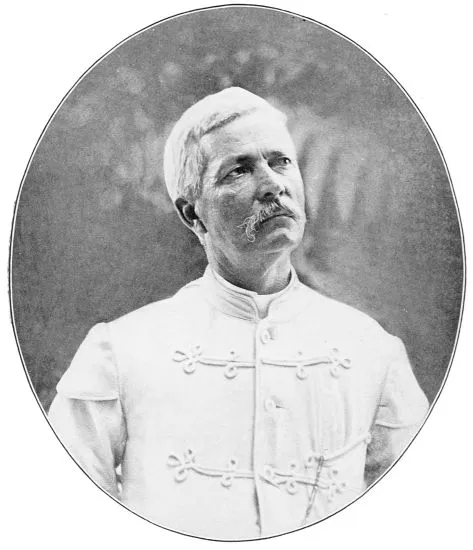 HENRY M. STANLEY, 1890, ON HIS RETURN FROM AFRICA
There was a charm attached to the Great Forest that was only revealed to
me after it had dropped beyond the horizon. I had found that a certain
amount of determination was necessary to enter it.
The longer I hesitated, the blacker grew its towering walls, and its
aspect more sinister. My imagination began to eat into my will and
consume my resolution. But when all the virtue in me rose in hot
indignation against such pusillanimity. I left the pleasant day, and we
entered as into a tomb, I found it difficult to accustom myself to its
gloom and its pallid solitude. I could find no comfort for the inner
man, or solace for the spirit. It became impressed on me that it was
wholly unfit for gregarious man, who loves to see something that
appertains to humanity in his surroundings. A man can look into the face
of the Sun and call him Father, the Moon can be compared to a mistress,
the Stars to souls of the dear departed, and the Sky to our Heavenly
Home; but when man is sunk in the depths of a cold tomb, how can he
sing, or feel glad?
After I had got well out of it, however, and had been warmed through and
through by the glowing sun, and was near being roasted by it, so that
the skyey dome reminded me of a burning hot oven, and the more
robustious savages of the open country pestered us with their darts, and
hemmed us round about, day and night, then it dawned upon my mind that,
in my haste, I had been too severe in my condemnation of the Forest. I
began to regret its cool shade, its abundant streams, its solitude, and
the large acquaintance I made with our own ever-friendly selves, with
whom there was never any quarrelling, and not a trace of insincere
affection.
I was reminded of this very forcibly when I descended from the Suez
train, and entered Cairo. My pampered habits of solitary musing were
outraged, my dreaming temper was shocked, my air-castles were ruthlessly
demolished, and my illusions were rudely dispelled. The fashionables of
Cairo, in staring at me every time I came out to take the air, made me
uncommonly shy; they made me feel as if something was radically wrong
about me, and I was too disconcerted to pair with any of them, all at
once. They had been sunning without interruption in the full blaze of
social life, and I was too fresh from my three years’ meditations in the
wilds.
If any of the hundreds I met chanced to think kindly of me at this
period, it was certainly not because of any merit of my own, but because
of their innate benevolence and ample considerateness. I am inclined to
think, however, that I made more enemies than friends, for it could
scarcely be otherwise with an irreflective world. To have escaped their
censure, I ought to have worn a parchment band on my forehead, bearing
the inscription: ‘Ladies and gentlemen, I have been in Darkest Africa
for three continuous years, living among savages, and I fear something
of their spirit clings to me; so I pray you have mercy.’
Indeed, no African traveller ought to be judged during the first year of
his return. He is too full of his own reflections; he is too utterly
natural; he must speak the truth, if he dies for it; his opinions are
too much his own. Then, again, his vitals are wholly disorganised. He
may appear plump enough, but the plumpness is simply the effect of
unhealthy digestion; his stomach, after three years’ famishing, is
contracted, and the successive feasts to which he is invited speedily
become his bane. His nerves are not uniformly strung, and his mind harks
back to the strange scenes he has just left, and cannot be on the
instant focussed upon that which interests Society. To expect such a man
to act like the unconscious man of the world, is as foolish as to expect
a fashionable Londoner to win the confidence of naked Africans. We must
give both time to recover themselves, or we shall be unjust.
To avoid the lounging critics that sat in judgment upon me at
Shepheard’s Hotel, I sought a retired spot, the Villa Victoria,
surrounded by a garden, where, being out of sight, I might be out of
mind. There was also an infectious sickness prevailing that season in
London, and my friends thought it better that I should wait warmer
weather. I reached Cairo in the middle of January, 1890, and, until the
beginning of February, I toyed with my pen. I could not, immediately,
dash off two consecutive sentences that were readable. A thousand scenes
floated promiscuously through my head, but, when one came to my
pen-point, it was a farrago of nonsense, incoherent, yet confusedly
intense. Then the slightest message from the outside world led me
astray, like a rambling butterfly. What to say first, and how to say it,
was as disturbing as a pathless forest would be to a man who had never
stirred from Whitechapel. My thoughts massed themselves into a huge
organ like that at the Crystal Palace, from which a master-hand could
evoke Handel’s ‘Messiah,’ or Wagner’s ‘Walküre,’ but which to me would
only give deep discords.
The days went by, and I feared I should have to relegate my book to the
uncertain future. At last I started on the ‘Forest’ chapter, the writing
of which relieved me of the acuter feeling. Then I began the ‘March from
Yambuya’; and, presently, I warmed to the work, flung off page after
page, and never halted until I had reached ‘The Albert.’ The stronger
emotions being thus relieved, I essayed the beginning, and found by the
after-reading that I was not over-fantastic, and had got into the swing
of narrative. I continued writing from ten to fifty pages of manuscript
during a day, from six in the morning until midnight; and, having
re-written the former chapters with more method, was able on the
eighty-fifth day to write ‘Finis’ to the record of the journey.
I think the title of it was a happy one—‘In Darkest Africa, or the
Quest, Rescue, and Retreat of Emin Pasha.’ It was the choice out of more
than fifty taking titles on the same subject, but none of them was so
aptly descriptive of the theme. Since then, some dozen or so book-titles
have been founded on it, such as ‘Darkest England,’ ‘Darkest London,’
‘Darkest New York,’ ‘Darkest Russia,’ etc., etc. It was the custom for
Germans, Anglo-Germans, Philo-Germans, etc., etc., for some three or
four years later, to print the word ‘Rescue’ with quotation marks,
which signified, of course, ‘so-called’; but if the word is not
absolutely truthful, I know not what is true.
Emin was rescued from being either sold to the Mahdists, or killed by
Fadle Mullah, or perishing through some stupid act of his own; and, so
long as he was in the British camp, he was safe. The very day he was
kissed by his countrymen, he was doomed to fall, and he nearly cracked
his poor head. When they placed power in his hands, they sent him to his
death.
Though not secure from interruptions at the Villa Victoria, I could, at
aleast, make my selection of the visitors who called. Might I have been
as safe from the telegraph and mails, I should have been fairly
comfortable; but my telegrams were numerous, and letters arrived
sometimes by the hundred. The mere reading of the correspondence
entailed a vast loss of time, the replies to them still more, and
occupied the best efforts of three persons. What with a tedious sitting
for my portrait, visits, interviews, dining-out, telegraphic and postal
correspondence, calls of friends, instructions to the artist for the
book, and revisions of my MS., it appears to me wonderful that I was
able to endure the strain of writing half a million of words, and all
else; but, thank Goodness! by the middle of April, the book was out of
my hands, and I was alive and free.
From Cairo, I proceeded to Cannes, to consult with Sir William Mackinnon
about East Africa, and explain about German aggressiveness in that
region. Thence I moved to Paris; and, not many days later, I was in
Brussels, where I was received with a tremendous demonstration of
military and civilian honours. All the way to the royal palace, where I
was to be lodged, the streets were lined with troops, and behind these
was the populace shouting their ‘vivas!’ It appeared to me that a great
change had come over Belgian public opinion about the value of the
Congo. Before I departed for Africa, the Belgian journals were not in
favour of Africa. But now, all was changed, and the King was recognised
as ‘the great benefactor of the nation.’ While I was the guest of His
Majesty, state, municipal, and geographical receptions followed fast
upon one another; and at each of the assemblages I was impressed with
the enthusiasm of the nation for the grand African domain secured to it
by the munificence of their royal statesman and sovereign. Besides gold
and silver medals from Brussels and Antwerp, the King graciously
conferred on me the Grand Cross of the Order of Leopold, and the Grand
Cross of the Congo.
Every morning, however, between 10.30 and 12, the King led me into his
private room, to discuss questions of absorbing interest to both of us.
Since 1878, I had repeatedly endeavoured to impress on His Majesty the
necessity of the railway, for the connection of the Lower with the Upper
Congo, without which it was impossible to hope that the splendid
sacrifices he proposed to make, or had made, would ever bear fruit. In
1885-86, I had been one of the principal agents in the promotion of an
English Company for the construction of the Royal Congo Railway; but my
efforts were in vain. Now, however, the King expressed his assurance
that the time was ripe for the Belgian nation to construct the line, and
he was pleased to say that it was my success which had produced this
feeling, and that the welcome extended to me was a proof of it. I would
have been better pleased if His Majesty had expressed his determination
to economise in other directions, and devote his energies to the
railway.
The next subject was the suppression of the slave-trade in the Congo. I
proposed that troops should be pushed up the Congo, and that posts
should be established at the mouths of the Aruwimi and Lumami, and that
the garrisons should be increased month by month, until about two
thousand troops had been collected, when an onward movement should be
made against Stanley Falls, and the Arab power be summarily broken.
As this would be a signal of resolute action against all the Arabs above
the Falls, about thirty steel boats should be provided, to enable the
war to be carried up the Lualaba; for there would be no peace for the
State, until every slaver in the Congo State had been extirpated or
disarmed. I explained the project in great detail, and urged it
vehemently, as after the treachery of Tippu-Tib in the Forest region, it
was useless to hope that any other method would prevail. His Majesty
promised cordial assent to the plan, and promised that the orders should
be issued at once for the building of the boats.
The next subject debated was the better delimitation of the Congo State
to the east. I proposed that instead of the vague and uncertain line of
East longitude 30, the boundary between British territory and the Congo
State should be the centre of the Albert Edward Nyanza and the course of
the Semliki River, by which the parting of tribes would be avoided. The
benefits to both England and the State would be that, while the whole of
the snowy range of Ruwenzori, intact, would belong to England, the Congo
State would be extended to the Albert Nyanza. In size, the exchanged
territories would be about equal in area. His Majesty appeared pleased
with the idea, and expressed his willingness to negotiate the exchange
of territories with the East African Company.
The King introduced the third subject himself, by expressing his desire
to know what point was the best to occupy as a central post along the
Northern frontier between France and the Congo State. I unhesitatingly
pointed out the confluence of the Mbornu with the Welle-Mubangi, but
that to supply such a distant station would require a large number of
steel whale-boats, such as Forrest & Son, of London, had made for me.
Then he wished to know how the North-eastern frontier could be defended.
I replied that a clever officer would find no difficulty in establishing
himself within easy reach of Makraka, and holding out inducements to the
former Makraka soldiers of Emin, many of whom would be glad of a refuge
against the Mahdists. At these private receptions His Majesty is
accustomed to sit with his back to the window, on one side of a large
marble-topped table, while his visitor sits on the other side. The table
is well furnished with writing-paper, ink, pens, and pencils. Three
years and a quarter had passed since I was in the room, where I had been
fifty times before, probably; nothing had changed except ourselves. The
King’s beautiful brown beard had, in the interval, become grey from ear
to ear; while my hair, which had been iron-grey, was now as white as
Snowdon in winter.
I made a smiling reference to the changes Time had wrought in us since
we had first met in June, 1878, and discussed the possibilities of
introducing civilisation on the Congo.
The King began by saying that my visit to Brussels was sure to be
followed by great results. He was very certain of being able to get the
Congo Railway started now; for the Belgian people were thoroughly roused
up, and were even enthusiastic. He said my letters from Africa and my
present visit had caused this change. My description of the Forest had
fired their imagination; and the people seemed to be about as eager to
begin the railway as they were previously backward, indifferent, even
hostile. The railway shares had been nearly all taken up, etc., etc.
‘Now, Mr. Stanley,’ said he, ‘you have put me under still further
obligations, by pointing out how slave-raiding can be stopped; you have
also suggested how we could transform slave-raiders into policemen,
which is a splendid idea; and, finally, you have indicated how we are to
protect our frontiers and make use of Emin’s troops, as soldiers in the
service of the State.’
We now discussed the value of the country between the Congo and Lake
Albert. He listened to what I said with the close attention of one who
was receiving an account of a great estate that had just fallen to him,
of which, previously, he had but a vague knowledge.
I said that from the mouth of the Aruwimi to within fifty miles of Lake
Albert, the whole country, from 4° S., to about 3° N., was one dense
tropical forest, and that its area was about equal to France and Spain
put together.
‘Does the Forest produce anything that is marketable in Europe?’
‘Well, Sire, I suppose that when elephants have been exterminated in all
other parts of Africa, there will still be some found in that Forest, so
that the State will always be able to count upon some quantity of ivory,
especially if the State has kindly set aside a reservation for them to
retreat to, and forbidden the indiscriminate slaughter of these animals.
Such a reservation will also be useful for the pigmies and other wild
creatures of the forest. But the principal value of the Forest consists
in the practically inexhaustible supply of valuable and useful timber
which it will yield. You have a great source of revenue in this immense
store of giant trees, when the Congo Railway enables timber merchants to
build their saw-mills on the banks of the many tributaries and creeks
which pierce it. The cotton-wood, though comparatively soft, will be
adapted for cargo barges, because it is as unsinkable as cork, and will
be useful for transporting down the Congo the mahogany, teak,
greenheart, and the hard red and yellow woods.
‘I think the timber-yards at Stanley Pool will be a sight to see, some
few years hence. Then, for local purposes, the Forest will be valuable
for furnishing materials for building all the houses in the Congo
Valley, and for making wooden tram-lines across the portages of the many
rivers. The Concessionaires will also find the rubber produce of the
forest highly profitable. Almost every branchy tree has a rubber
parasite clinging to it; as we carved our way through the Forest our
clothes were spoiled by the rain of juice which fell on us. As there are
so many rivers and creeks in the Forest, accessible by boats, and as
along the Congo itself, for some hundreds of miles, the woods come down
and overhang the water, a well-organised company will be able to collect
several tons, annually, of rubber. When rubber is, even now, two
shillings per pound,[39] you can estimate what the value of this product
alone will be, when the industry has been properly developed.
‘With every advance into the Forest, the gummy exudations will also be
no mean gain. Every land-slip along the rivers discloses a quantity of
precious fossil-gum, which floats down the streams in large cakes.
Experience will teach the Concessionaires when and how to hunt for this
valuable article of commerce. I am inclined to think, in fact, that the
Great Forest will prove as lucrative to the State as any other section,
however fertile the soil and rich its produce.
‘No one can travel up the Congo without being struck by the need of the
saw-mill, and how numerous and urgent are the uses of sawn timber for
the various stations which are being erected everywhere.
‘If you had saw-mills established now on the Aruwimi, they could not
produce planking fast enough to satisfy all demands, and what a help for
the railway hard-wood sleepers would be!’
I was then questioned as to the tribes of the Forest, and had to explain
that as the experiences of these unsophisticated aborigines with
strangers had been most cruel, it would not do to be too sanguine about
their ability to supply labour at first demand. ‘But,’ I said, ‘I came
across no tribe, excepting the pigmies, which, after two years’
acquaintance with the white man, could not be brought to a right sense
of the value of their muscle. If a station were built in any part of the
Forest, the tribe in its neighbourhood might be induced by patient and
fair treatment to become serviceable in a short time; but the other
tribes would remain as aloof as ever, until they had the same
opportunities of intimately knowing the white strangers. As the Forest
is so dense, and so many miles of untrodden woods separate the tribes,
it will be a long time before all the people will be tamed fit for
employment. Good roads through the Forest, gentle treatment of the
natives employed, and fair wages to them, will tend to hasten the white
man’s good influence; for rumour spreads rapidly; in a mysterious way
good, as well as evil, news travels; and every month will show a
perceptible increase in the numbers of those natives desirous of
associating themselves with the white strangers.’
When the King asked me about the people of the grass-lands near the
lakes, he was much interested at hearing, how, from enemies, formidable
by their numbers and courage, they had become my allies, carriers,
servants, and most faithful messengers. His Majesty was much impressed
by this, and I told him how I had been affected by their amiability and
good service; to any one listening to the warm praise I gave the
Mazamboni and Kavallis, I might have appeared to exaggerate their good
qualities; but His Majesty is so generous-minded that he could
appreciate the frank way in which they had confessed their error in
treating us as enemies, and the ready way in which they had atoned for
it.
I showed the King that the grass-lands were not so distant from the
Congo as my painful and long journey through the Forest had made them
appear. ‘Without any great cost it will be possible for the State to
send expeditions to Lake Albert from the Congo within ten days. For,
when saw-mills have been established at Yambuya, a wooden tram-line,
topped by light steel bars, may be laid very easily along the Aruwimi,
over which a small engine, drawing five trucks, could travel five miles
an hour, or sixty miles a day. But before this tram-line will be
possible, the railway to Stanley Pool must be finished, by which the
resources of civilisation, saw-mills, tools, engines, boats, provisions,
will be brought thirteen hundred miles nearer the lakes than they are
now.’
After this, we adjourned to lunch, etc., etc.
A few weeks later, the King came over to London; and, after a talk with
Lord Salisbury and the principal Directors of the East African Company,
whereby the boundaries between their respective territories were agreed
to be the Albert, and Albert Edward, and the course of the river
Semliki, from the centre of the southern shore of the Albert Edward to
the northern head of the Tanganyika Lake, a strip of ten miles in width
was secured to Great Britain for free transit,[40] with all powers of
jurisdiction. Sir William Mackinnon and myself were the signatories duly
empowered.[41] In my opinion, the advantages of this Treaty were on the
side of the British, as there was now a free broad line of
communications between Cape Town and British Equatoria, while my own
secret hopes of the future of the Ruwenzori range were more likely to be
gratified by its acquisition by the English, because, once the railway
reached within a reasonable distance of the Snowy Mountains, a certain
beautiful plateau—commanding a view of the snow-peaks, the plain of
Usongora, the Lake Albert Edward, and the Semliki Valley—must become
the site of the future Simla of Africa. On the other hand, the King was
pleased with the extension of his territory to the Albert Nyanza, though
the advantages are more sentimental than real. The narrow pasture-land
between the Great Forest and the lake may become inhabited by whites, in
which case the ninety-mile length of the Nyanza may be utilized for
steamboat communication between the two ends of it.
As Monsieur Vankherchoven, King Leopold’s agent, was by this time well
on his way to the confluence of the headwaters of the Wellé-Mubangi, the
conclusion of this Treaty necessitated a slight change in his
instructions.
On arriving in England, April 26, 1890, I was met by a large number of
friends at Dover, who escorted me on a special train to London. At
Victoria Station a large crowd was assembled, who greeted me most
warmly. The Baroness Burdett-Coutts and Mr. Burdett-Coutts had done me
the honour of meeting me with their carriage, and in brief time I found
myself in comfortable rooms at De Vere Gardens, which had been engaged
and prepared for me by Sir Francis and Lady De Winton.
For the next three or four weeks, proof-reading and revising, banquets,
preparing lectures, etc., absorbed far more time than was good for my
health. Two of the most notable Receptions were by the Royal
Geographical Society and the Emin Relief Committee; the first, at the
Albert Hall, was by far the grandest Assembly I ever saw. About ten
thousand people were present; Royalty, the Peerage, and all classes of
Society were well represented. While Sir Mountstuart Grant-Duff, the
President, was speaking, my eyes lighted on many a noble senator, chief
of science, and prince in literature, whose presence made me realise the
supreme honour accorded to me.
At the house of my dear wife-to-be, I met the ex-Premier, the Right
Honourable Mr. W. E. Gladstone, who had come for a chat and a cup of
tea, and to be instructed—as I had been duly warned—about one or two
matters connected with the slave-trade. I had looked forward to the
meeting with great interest, believing—deluded fool that I was!—that a
great politician cares to be instructed about anything but the art of
catching votes. I had brought with me the latest political map of East
Africa, and, when the time had come, I spread it out conveniently on the
table before the great man, at whose speaking face I gazed with the eyes
of an African. ‘Mr. Gladstone,’ said I, intending to be brief and to the
point, as he was an old man, ‘this is Mombasa, the chief port of British
East Africa. It is an old city. It is mentioned in the Lusiads, and, no
doubt, has been visited by the Phœnicians. It is most remarkable for its
twin harbours, in which the whole British Navy might lie safely, and—’
‘Pardon me’ said Mr. Gladstone, ‘did you say it was a harbour?’
‘Yes, sir,’ said I, ‘so large that a thousand vessels could be easily
berthed in it.’
‘Oh, who made the harbour?’ he asked, bending his imposing glance at me.
‘It is a natural harbour,’ I answered.
‘You mean a port, or roadstead?’
‘It is a port, certainly, but it is also a harbour, that, by
straightening the bluffs, you—’
‘But pardon me, a harbour is an artificial construction.’
‘Excuse me, sir, a dock is an artificial construction, but a harbour may
be both artificial and natural, and—’
‘Well, I never heard the word applied in that sense,’ And he continued,
citing Malta and Alexandria, and so on.
This discussion occupied so much time that, fearing I should lose my
opportunity of speaking about the slave-trade, I seized the first pause,
and skipping about the region between Mombasa and Uganda, I landed him
on the shores of the Nyanza, and begged him to look at the spacious
inland sea, surrounded by populous countries, and I traced the circling
lands. When I came to Ruwenzori, his eye caught a glimpse of two
isolated peaks.
‘Excuse me one minute,’ said he; ‘what are those two mountains called?’
‘Those, sir,’ I answered, ‘are the Gordon Bennett and the Mackinnon
peaks.’
‘Who called them by those absurd names?’ he asked, with the corrugation
of a frown on his brow.
‘I called them, sir.’
‘By what right?’ he asked.
‘By the right of first discovery, and those two gentlemen were the
patrons of the expedition.’
‘How can you say that, when Herodotus spoke of them twenty-six hundred
years ago, and called them Crophi and Mophi? It is intolerable that
classic names like those should be displaced by modern names, and—’
‘I humbly beg your pardon, Mr. Gladstone, but Crophi and Mophi, if they
ever existed at all, were situated over a thousand miles to the
northward. Herodotus simply wrote from hearsay, and—’
‘Oh, I can’t stand that.’
‘Well, Mr. Gladstone,’ said I, ‘will you assist me in this project of a
railway to Uganda, for the suppression of the slave-trade, if I can
arrange that Crophi and Mophi shall be substituted in place of Gordon
Bennett and Mackinnon?’
‘Oh, that will not do; that is flat bribery and corruption’; and,
smiling, he rose to his feet, buttoning his coat lest his virtue might
yield to the temptation.
‘Alas!’ said I to myself, ‘when England is ruled by old men and
children! My slave-trade discourse must be deferred, I see.’
Turning now to the extraordinary charges made against me, on my return
to Europe, that I deliberately employed slaves on my expedition, I would
point out that every traveller, before setting out on his journey, took
all precautions to avoid doing this. Each of my followers was obliged to
prove that he was free—by personal declaration and two
witnesses—before he could be enrolled. Four months’ advance wages were
paid to the men before they left Zanzibar, and, on their return, their
full wages were delivered into their own hands. No doubt many who had
been slaves had managed to get into the expedition, as I found to my
cost, when well away in the interior; but, since they had been able to
earn their own living, their slavery had been merely nominal, and all
their earnings were their own to do what they liked with, and their
owners never saw them except when, at the end of Ramadan, they called to
pay their respects. To all intents and purposes, they were as much
freemen as the free-born, inasmuch as they were relieved from all
obligation to their masters.
To proceed on the lines that, because they were not free-born they must
be slaves, one would have to clear out the Seedy-boy stokers from the
British fleet in the Indian Ocean, and all the mail, passenger, and
freight steamers which ship them at Aden and Bombay, Calcutta,
Singapore, and Yokohama. All the British consulates on the East
Coast—Zanzibar, Madagascar, etc.—would have to be charged with
conniving at the slave-trade, as also all the British merchants in those
places, because they employed house-servants, door and horse-boys, who
were nominally slaves.
White men are not in the habit of proceeding to an Arab slave-owner, and
agreeing with him as to the employment of his slaves. I employed English
agents at Zanzibar to engage my people, and every precaution was taken
that no one was enlisted who could not swear he was an Ingwaria, or
freeman. I was only four days in Zanzibar, but, before these men were
accepted, they had to re-swear their declarations before the British
Consul-general that they were free.
The accusations made against me that I employed slaves were, therefore,
most disgraceful. History will be compelled to acknowledge that I have
some right to claim credit in the acts which have followed, one upon
another, so rapidly of late, and which have tended to make slave-raiding
impossible, and to reduce slave-trading to sly and secret exchanges of
human chattels in isolated districts in the interior.
The book ‘In Darkest Africa’ was published in June by my usual
publishers, Messrs. Sampson, Son & Co., and the Messrs. Scribners of New
York brought it out in America. It was translated into French, German,
Italian, Spanish, and Dutch, and in English it has had a sale of about
one hundred and fifty thousand.
The month of May was mainly passed by me in stirring up the Chambers of
Commerce and the Geographical Societies to unite in pressing upon the
British Government the necessity of more vigorous action to prevent East
Africa being wholly absorbed by Germany; and, on coming southward from
Scotland, where I had been speaking, the news reached me that Lord
Salisbury had secured for Great Britain, Zanzibar and the northern half
of East Africa, but singularly curtailed of the extensive piece of
pasture-land west of Kilimanjaro. This odd cutting off is due to a
Permanent Official in the Foreign Office, whose hand can be traced in
that oblique line running from the northern base of the Devil’s Mountain
to S. Lat. 10, on Lake Victoria. Had that gentleman been a member of an
African expedition, he would never have had recourse to an oblique line
when a straight line would have done better. However, while it remains a
signal instance of his weakness, it is no less a remarkable proof of
German magnanimity! For, though the Germans were fully aware that the
official was one of the most squeezable creatures in office, they
declined to extend the line to the Equator! Kilimanjaro, therefore, was
handed over to Germany, ‘because the German Emperor was so interested
in the flora and fauna of that district!’ That, at any rate, was the
reason given for the request!
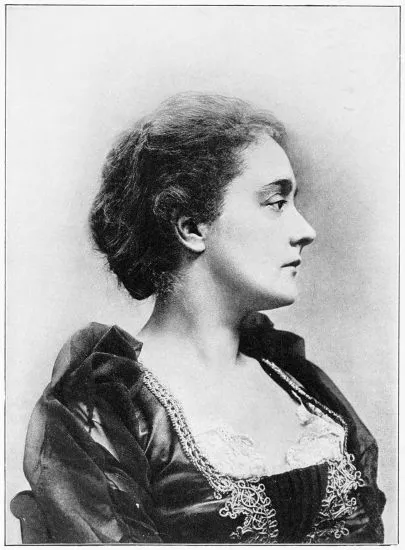 DOROTHY STANLEY
ON Saturday, July 12, 1890, I was married to Stanley, at Westminster
Abbey. He was very ill at the time, with gastritis and malaria, but his
powerful will enabled him to go through with the ceremony.
We went straight to Melchet Court, lent to us for our honeymoon by
Louisa, Lady Ashburton. Stanley’s officer, Surgeon Parke, accompanied
us, and together we nursed Stanley back to health.
Stanley’s Journal contains the following passage:—
Saturday, 12th July, 1890.
Being very sick from a severe attack of gastritis, which came on last
Thursday evening, I was too weak to experience anything save a calm
delight at the fact that I was married, and that now I shall have a
chance to rest. I feel as unimpressed as if I were a child taking its
first view of the world, or as I did when, half-dead at Manyanga in
1881, I thought I had done with the world; it is all so very unreal.
During my long bachelorhood, I have often wished that I had but one tiny
child to love; but now, unexpectedly as it seems to me, I possess a
wife; my own wife,—Dorothy Stanley now, Dorothy Tennant this
morning,—daughter of the late Charles Tennant of Cadoxton Lodge, Vale
of Neath, Glamorgan, and of 2, Richmond Terrace, Whitehall, London.
On the 8th August, after nearly a month at Melchet, we went to Maloja in
the Engadine, where we spent a few quiet, happy weeks. Sir Richard
Burton and his wife were there. Stanley had last seen him in 1886.
Had a visit from Sir Richard F. Burton, one of the discoverers of Lake
Tanganyika. He seems much broken in health. Lady Burton, who copies
Mary, Queen of Scotland, in her dress, was with him. In the evening, we
met again. I proposed he should write his reminiscences. He said he
could not do so, because he should have to write of so many people. ‘Be
charitable to them, and write only of their best qualities,’ I
said.—‘I don’t care a fig for charity; if I write at all, I must write
truthfully, all I know,’ he replied.
He is now engaged in writing a book called ‘Anthropology of Men and
Women,’ a title, he said, that does not describe its contents, but will
suffice to induce me to read it. What a grand man! One of the real great
ones of England he might have been, if he had not been cursed with
cynicism. I have no idea to what his Anthropology refers, but I would
lay great odds that it is only another means of relieving himself of a
surcharge of spleen against the section of humanity who have excited his
envy, dislike, or scorn. If he had a broad mind, he would curb these
tendencies, and thus allow men to see more clearly his grander
qualities.
From Maloja, we went to the Lake of Como, visited Milan, and spent a
night at Captain Camperio’s delightful house, ‘La Santa,’ near Monza.
Stanley thus describes it:—
Camperio and Casati, the African travellers, were at the station to
greet us. After twenty minutes’ drive from Monza we reached Camperio’s
place; it was formerly a convent, and has been in possession of the
family two hundred years. Captain Camperio has been the devoted friend
and patron of Casati for many years, and was the cause of his going to
Africa. It appears that Casati, far from being a champion of Emin, is
now resentful towards him, because Emin, as usual with him, has been
neglectful of his friend’s susceptibilities. Casati has done very well
with his Book.
Captain Camperio and his delightful family were soon fast friends with
us. A few years later he died, and so La Santa became only a happy
memory. We now turned homeward, going first to Geneva, then to Paris,
and, finally, on the 3rd October, 1890, to Ostend, where we stayed at
Hôtel Fontaine, as guests of the King. We dined at the Châlet Royal, and
the next day Stanley took a long walk with the King. Thus we spent four
days, Stanley walking daily with His Majesty. We dined every evening at
the Châlet Royal. On the 8th, we left Ostend. State-cabins were given to
us, and a Royal lunch served.
We now returned to London, and, on October 22nd, Stanley received his D.
C. L., at Durham; on the 23rd, we went to Cambridge, where he received
the LL. D., from the University. In June, Stanley had been made D. C.
L., by Oxford, and, soon after, LL. D., by Edinburgh. The University of
Halle had bestowed its Degree of Doctor of Philosophy in 1879.[42]
On the 29th October, we sailed for America. Stanley had undertaken a
lecture tour, under the management of Major Pond. It was a tremendous
experience; the welcome we received everywhere, and the kindness shown
to us, were something very wonderful.
We remained over a week in New York, where Stanley lectured, and then we
visited all the great Eastern cities.
Stanley, in his Journal, writes:—
The untidiness and disorder of the streets of New York strike me as
being terrible for so rich a city, and such an energetic population. The
streets are cut up by rails in a disgraceful fashion. The noise of
bells, and wheels, and horses’ hoofs, dins the ears. Telegraph-posts,
with numberless wires, obstruct the view, and suggest tall wire-fences;
furlongs of posters meet the eye everywhere, and elevated railroads
choke the view of the sky. The man who invented the hideous ‘Elevated’
deserves to be expelled from civilisation, and the people who permitted
themselves to be thus tortured have certainly curious tastes. If they
were of my mind, they would pull these structures down, and compel the
shareholders to build it in such a manner that, while it might be more
useful and safe, it would not be such an eyesore, nor so suggestive of
insolence and tyranny on one side, and of slavish submission on the
people’s side.
The view from our hotel-window shows me the street ploughed-up, square
blocks of granite lying as far as the eye can see, besides planking,
boarding, piles of earth, and stacks of bricks. I counted one hundred
and seventy-four lines of wire in the air, rows of mast-like
telegraph-poles, untrimmed and unpainted, in the centre of the American
Metropolis! What taste!
We now travelled over the States and Canada, in a special Pullman-car,
which had been named ‘Henry M. Stanley.’ It was palatial, for we had our
own kitchen and cook, a dining-car, which, at night was converted into a
dormitory, a drawing-room with piano, three state-bedrooms, and a
bath-room.
After visiting all the Eastern cities, and Canada, we returned to New
York. On Sunday, the 25th January, 1891, we dined with Cyrus Field (who
laid the first Atlantic Cable), at 123, Gramercy Park, and met General
W. T. Sherman, David Dudley Field, Charles A. Dana, and others.
On the 31st, Stanley went to a Banquet given by the Press Club. The
following is the entry in his Journal:—
Was dined by the Press Club. General Sherman was present, with a
rubicund complexion, and in an exceedingly amiable mood. He and I
exchanged pleasant compliments to each other in our after-dinner
speeches.
On the 14th February, at Chicago, Stanley wrote in his Journal:—
The sad news reached us to-day of the death of General W. T. Sherman,
the Leader of the Great March through Georgia, and the last of the
Immortal Three—Grant, Sheridan, Sherman. His last public appearance was
at the Press Club Banquet to me in New York. At the time of his death he
was the most popular man in New York, and well deserved the popularity.
In his speech at the Press Club, I recognised an oratorical power few
men not knowing him would have suspected. He had the bearing of one who
could impress, also those easy gestures which fix the impression, and
the pathos which charms the ear, and affects the feelings. When we
remember what he was, and that we saw in him the last of that splendid
trio who, by their native worth, proved themselves possessors of that
old American patriotism of Revolutionary days, not genius, but fine
military talents, directed by moderating single-mindedness to one common
and dear object,—when we consider this, the effect of General Sherman’s
presence may be better understood than described.
Los Angeles, California, 21st March. A Fresno newspaper, in commenting
on my personal appearance, said that I was only five feet, three inches,
and quoted Cæsar and Napoleon as examples of what small men are capable
of. The Los Angeles ‘Herald’ informed its readers this morning, that I
am six feet, four inches! The truth is, I am five feet, five and a half
inches in my socks.
Sunday, 20th March, 1891. Reached New Orleans after thirty-two years’
absence. I left it in 1859, and return to it in 1891. I drove with D. to
the French Market, down Tchapitoulas St., St. Andrew’s St.,
Annunciation St., Charles Avenue, to St. Charles Hotel. Took a walk with
D. to Tchapitoulas St., then to the Levee; gazed across the full view,
and pointed to ‘Algiers’ opposite, where I had often sported.
Monday, 30th March. Rose at six-thirty and went with D. to French
Market, to treat her to what I have often boasted of, ‘a cup of the best
coffee in the world.’ The recipe appears to be two pounds of Java Coffee
to one and a half gallons of water. Monsieur L. Morel owned the
coffee-stand. He came from France in 1847. Very likely I must have drunk
coffee, many a time, as a boy, at his stand!
We walked home by Charles Street, well known to me. New Orleans changes
but slowly.
From New Orleans we visited Chattanooga. Went to the top of Lookout
Mountain. People are very kind and attentive to us wherever we go, but I
wish the lectures were over; I am very weary.
On Saturday, April 4th, we visited Nashville. Stanley’s entry is simply
‘Dear old Nashville!’
This tour was very exhausting. The constant travelling, lecturing, and
social demands made upon us, taxed Stanley’s strength severely. By
nature shy and retiring, he shrank from ovations, and wished, above all
things, to pass unnoticed. This letter written to me from our private
car when I was in Colorado, where he joined me a few days later, will
give an idea of his feelings:—
I spend most of my time in my own little cabin, writing or reading,
enduring the breaks on my privacy because they are a necessity, each
time invoking more patience, and beseeching Time to hurry on its lagging
movement that I might once more taste of absolute freedom. Meanwhile,
what pleasure I obtain is principally in reading, unless I come to a
little town, and can slip, unobserved, out-of-doors for a walk. I often
laugh at the ridiculous aspect of my feelings, as I am compelled to
become shifty and cunning, to evade the eager citizens’ advances. I feel
like Cain, hurrying away with his uneasy conscience after despatching
Abel, or a felonious cashier departing with his plunder! When I finally
succeed in getting off without attracting anyone, you would be amused
could you peep in underneath my waistcoat and observe the sudden lifting
of the feelings, just like the sudden lighting of a waste of angry sea
by the full sun, warm, bland, and full of promise. Then away I go
against the keen, cold wind, but the feelings are rejoicing, laughing,
babbling of fun and enjoyment; and the undertone of the great harmony is
Freedom! I am free! Block after block is passed without a glance,
until I get to the quieter parts, and then I straighten out, take a long
breath, expressing by the act the indescribable relief I have of being
away from the talking man, with his wayward moods, and exceeding
sensitiveness.
I sometimes think with a shiver of what I shall have to endure in
London: just because a person sends a polite invitation to dinner, or
tea, or reception, one must note it down as a binding engagement for
that evening or afternoon. One must not forget it; one must think of it,
and cut out that period of existence from his short life, to eat and
drink at the express hour! This is not freedom! To be free is to have no
cares at all, no thought of the next hour, or the next day, or the next
month; to be as we were at Melchet,—early breakfast, walk out, sit on
chair or bench, walk in, or walk out, as though irresponsible beings.
How I did enjoy Melchet! Afterwards came busy, exacting life,
preparation for lectures, etc. All Europe and America were not so
pleasant as lovely, dreamy Melchet.
There are butterflies and bees in the world; the butterflies like to
play amid the flowers, I am content to belong to the bee class. The bees
do not envy the butterflies, do not think at all about them, and that is
the same with me. I might stand it for a week, perhaps a month; but the
utter waste of life would begin to present itself, until, at last, my
mind would conceive an accusing phantom, composed of lost days and
weeks, with their hosts of lost opportunities ever reproaching me for my
devotion to the inane and profitless. Ah, no, I must be doing
something; no matter what it appears to others, if to me it satisfies
the craving for doing or learning, that is enough.
On April 15, 1891, we sailed for Liverpool. Stanley ends the Journal of
our American tour with the words:—
The greatest part of America is unequalled for its adaptability for the
service of man, and her people are doing the utmost they can to utilize
its productiveness. They have every right to be grateful for their land,
and I think they are both grateful and proud of it.
The American farmer, of whom but little mention is made, is one of the
finest natures in existence. Milton’s description of Adam, ‘the great
Sire of all,’ a little altered, would befit the typical American farmer.
I never see one but I feel inclined to say to him, ‘Good and honest man,
all blessings attend thee!’ His life is without reproach, his soul
without fear, he has faith in God, he is affectionate, serene in
demeanour; there is confidence in his gait, and he understands and loves
the kindly earth. The typical American merchant is a sober and solid
man, shrewd and practical, a pillar of the Commonwealth, and daringly
enterprising on occasion.
We now returned to London, and from there Stanley went on a lecturing
tour over England and Scotland. I did not accompany him throughout, but
joined him at different places, so that I possess some delightful
letters written to me when we were apart. In one he writes:—
Rest! Ah, my dear! we both need it—I more than you. Absolute stillness,
somewhere in remote and inaccessible places, in an island, or in the
air, only certain articles of food and comfort being indispensable. Then
let me wake to strains of music, and I think I should rise to life
again! Until then, existence is mere prolonged endurance.
Stanley all his life had a passion for reading, when he could not be
‘doing.’ He delighted in reading Cæsar, Thucydides, Xenophon, Polybius,
and lighter books also did not come amiss. From Cheltenham, he wrote:—
I have begun again on Thucydides. Gladstone’s ‘Gleanings’ are ended.
They are all good. Strange! how I detect the church-going, God-fearing,
conscientious Christian, in almost every paragraph. Julian Corbett’s
‘Drake’ is fair; I am glad I read it, and refreshed myself with what I
knew before of the famous sailor.
From the Bell Hotel, Gloucester, he wrote, June 3, 1891:—
I had a long walk into the country, which is simply buried under bushy
green of grass and leaves.
I saw the largest river in England yesterday: it appears to be a little
wider than what I could hop over with a pole in my best days. It was a
dirty, rusty-coloured stream, but the meadows were fat. The country
seems to perspire under its covering of leafy verdure. I always loved
the English country, and my secret attachment for it seemed to me well
confirmed to-day, as I thrilled with admiration and affection for all I
saw.
June 4th. Took a walk along the heights of Clifton! What a picture of
the Severn Gorge—woods, cliffs, villas, good roads, rosy-cheeked
children, romping school-boys, fond mamas, and a score of other
things—one can get from the Suspension Bridge!
His next letter was from Clifton:—
You press me to accept the invitation to preside at the Eisteddfod. I
feel that we, the people of Wales generally, and I, are not in such
close sympathy as to enable me to say anything sufficiently pleasing to
their ears. How could it be otherwise? The Eisteddfod, as I understand
it, is for the purpose of exciting interest in the Welsh nationality and
language. My travels in the various continents have ill-prepared me for
sympathising with such a cause. If I were to speak truly my mind, I
should recommend Welshmen to turn their attention to a closer study of
the English language, literature, and characteristics, for it is only by
that training that they can hope to compete with their English brothers
for glory, honour, and prosperity. There is no harm in understanding the
Welsh language, but they should be told by sensible men that every hour
they devote to it, occupies time that might be better employed in
furthering their own particular interests. But who will dare tell men,
so devoted to their own people and country as the Welsh, the real truth?
I am not the man! There is no object to be gained save the good of the
Welsh people themselves, who, unfortunately, fail to see it in that
light, and would accordingly resent whatever was said to them. I am so
ignorant of the blessings attending these local studies, that my
speech would be barren and halting. If I could only feel a portion of
what the fervid Welshman feels, I might carry through the day a bearing
as though I enjoyed it all, but I fear I shall hang my head in
self-abasement.
Now if it were a British community that met to celebrate British
glories, what themes and subjects! But how can I shout for Cambria? What
is Cambria, alone? What has she done, what hope for her, separate
and distinct from her big sister Britannia, or rather Anglia? United,
they are great; but divided, neither is aught. Now do you understand to
what a hard shift I am put? I shall be hooted out of the country,
because my stubborn tongue cannot frame agreeable fictions!
June 16, 1891, he wrote to me:—
You ought to have been with me at Carnarvon, simply to be amazed at the
excitement in North Wales, along the line, as I stepped from the train;
the people, hard-featured, homely creatures, rushed up, the crowd being
enormous. Yesterday I had a striking explanation of why and wherefore
the woman in the Scriptures kissed the hem of the Master’s garment: as I
moved through the crowd, I felt hands touch my coat, then, getting
bolder, they rubbed me on the back, stroked my hair, and, finally,
thumped me hard, until I felt that the honours were getting so weighty I
should die if they continued long. Verily, there were but few thumps
between me and death! A flash of fierceness stole over me for a second,
and I turned to the crowd; but they all smiled so broadly that, poor,
dear, mad creatures, I forgave them, or, at least, resolved to submit.
Well! until 11.45 P.M., from 5 P.M., I was either talking at the pitch
of my voice to six thousand people, or being wrung by the hand by
highly-strung, excited people. Were it not for the prayer, ‘God bless
you, Stanley! God prosper your work, Stanley! The Lord be praised for
you, my man!’ I could have done anything but feel grateful, the strain
on my nerves was so exhausting. But I need prayers, and their blessings
were precious.
The streets were full; eight excursion trains had brought the country
folk; they blocked the way of the carriage, coming in, and going out.
Dear sons of toil and their sisters, the grand stout-hearted mothers who
bore them, and the grey-haired sires! My heart went out to them; for,
underneath all, I felt a considerable admiration for them—indeed, I
always had. I feel what all this means, just as I know what is passing
in the African’s heart, when I suddenly make him rich, instead of
hurting him. There is a look, as of a lifting-up of the soul into the
eyes, which explains as fully as words.
June 20th, 1891. I have nine more lectures to deliver, and then, God and
man willing, I shall cast me down for rest.
I have just begun to read Walter Scott’s ‘Journal.’ I like it immensely.
The Life of Houghton is dull; his own letters are the best in it, but
there is no observation, or judgment upon things; merely a series of
letters upon town-talk; what he did, seldom, however, what he thought.
Where you see his thought, it is worth reading twice.
It is a great relief at last to be able to ‘speak my mind,’ not to be
chilled and have to shrink back. Between mother and child, you know
the confidence and trust that exist; I never knew it; and now, by
extreme favour of Providence, the last few years of my life shall be
given to know this thoroughly. Towards you I begin trustfully to exhibit
my thoughts and feelings; as one, unaccustomed to the security of a
bank, places his hard-earned money in the care of a stranger, professing
belief in its security, yet inwardly doubting, so I shyly revealed this
and that, until now, when I give up all, undoubting, perfect in
confidence.
June 29th. To-morrow, a lecture at Canterbury will finish my present
course. And then I shall be at large to look at everything on earth with
different eyes. Think of the novel liberty of lying in bed as long as I
please, to take coffee in bed, the morning cigar and bath, without an
inward monitor nagging persistently and urging to duty! By the way,
apropos of that word, M. said yesterday she disliked the word ‘duty.’ I
wonder if she has been reading Jeremy Bentham, who wrote to the same
effect.
Duty, though an imperious, is a very necessary master; but I shall be
very glad to pass a few weeks, at least, owing no duty but that which I
shall owe to your pleasure and mine.
Canterbury, July 1st, 8.30 A.M. I have risen thus early to celebrate my
emancipation from the thraldom imposed upon me by lecture agents and my
own moral weakness, to write to you.
I have seen the time when I could have written gloriously about this
singular old town; I love it no less now than I did years ago when I
first saw it, but I am much busier with various things now than then.
The old Fountain Hotel is a typical English inn. I heard a little bit of
vocal music from the Cathedral choir, and very much admired it. What a
fine old Cathedral it is! But oh! how the religion that built it has
faded! The worship of the Almighty Creator of Heaven and Earth, who, we
were taught in our youth, sat in the Heaven of Heavens, has been so
superseded by that degrading worship of gold and Society!
Apropos of this, I picked up at a book-stall yesterday a little brochure
called ‘Cæsar’s Column,’ a tale of the twentieth century, by Ignatius
Donnelly. I read it through. It pretends to be a series of letters from
a man named Gabriel, a visitor to New York from the State of Uganda,
Central Africa. They are directed to one Heinreich, a resident of the
village of Stanley! He describes the marvellous inventions of the age,
especially the air-demons, which are air-warships loaded with bombs,
charged with poisonous fumes, which, dropped from above in the streets,
destroy a quarter of a million soldiers. The armed force of the State
thus disposed of, the canaille proceed to exterminate the devotees of
Society and the cold, selfish civilisation, or rather that methodical
system founded upon spoliation and oppression of the poor which the
wealthy have initiated by huge trusts, etc., wherein there is no thought
of mercy, justice, or sweet charity.
The end of all is destruction and utter extermination of the wealthy
classes over Europe and America, and the quick upheaval of everything
resembling Order and Law by the Anarchist clan, and the two continents
relapse, fast enough, into barbarism, in consequence. It is a powerful
story—impossible, of course; but some of its readers will rise from
reading it, thoughtful, and a small seedling of good may, or ought, to
come from it.
At last, Stanley’s holiday came, and we went to Switzerland at the end
of July. The fine mountain air, the beauty of the scenery, long walks,
peace and quiet, gave Stanley what he so needed—physical and mental
rest. Of an evening, we read aloud, retiring very early, as Stanley had
the African habit of rising at six.
I persuaded Stanley sometimes to play at cards, but he never much cared
to do so; he not only thought cards a great waste of time, but he also
thought playing for money discreditable; he wanted all the time he
could get for reading, or planning something he meant to do, or write.
He was, in fact, an inveterate worker.
We were returning to England at the end of August, when Stanley, in a
damp mountain-meadow at Mürren, slipped and broke his left ankle. He
suffered a good deal, the injury bringing on malaria; but the bone
united without shortening the leg, and, in time, the lameness
disappeared. This accident prevented his presiding at the Eisteddfod.
On the 2nd October, Stanley went to Ostend, by invitation of the King of
the Belgians. Mr. Mounteney Jephson accompanied him. Stanley wrote to
me:—
The King does not look greyer than I remember him during the last two
years. He tells me he will be fifty-seven next April, and that he feels
the approach of age, one sign of which is loss of memory. He cannot
remember names. I told him that that fact did not strike me as
suggestive of age, since the longer we lived the more names we had to
remember, and there was a limit to one’s power of remembering.
Stanley then wrote at length his conversation with the King; but I will
not give it here.
After dinner, we adjourn to the King’s private room to smoke. Baron
Goffinet takes charge of Jephson, and shows him the Casino. The King
tells me he walks twenty-five kilometres every day: his daily life
begins at 5.30 A.M., when he takes a cup of tea; he breakfasts at 8.30.
All his letters for his Ministers are written by himself between 6 A.M.
and breakfast, and, at 10 o’clock, they are sent to the Ministers. He
says he has been twenty-six years in active service.
After dinner, the King cautiously approached and sounded me on the
possibility of my resuming my duties on the Congo.
I pointed to my broken leg, for I am still very lame.
‘Oh,’ he said, ‘not now, but when you return from Australia, sound in
health and limb.’
‘We shall see, Your Majesty,’ I said.
‘I have a big task on hand for you, when you are ready,’ were his last
words.
In October, 1891, we left England for a visit to Australia, New Zealand,
and Tasmania, travelling viâ Brindisi, some twelve miles from which our
train came into collision with a goods train. Stanley thus describes the
accident:—
At 3.45 P.M., we were rattling along at forty miles an hour, when the
train jostled dangerously at the northern end of a siding. D. and I cast
enquiring glances at each other, but, finding we were not derailed,
resumed our composure. A second later there was an explosion like that
of a rocket, and, the next second, there was a jar and a slight shock.
‘Lift up your feet,’ I cried to D.; and, at the words, my window burst
into a shower of finely-powdered glass, which fell over me, and we stood
stock-still. Rising on my crutch, I looked through the broken window and
discovered four freight trucks, crumpled up into a pitiful wreck, just
ahead of us, within about fifty yards of a levelled wall, and I then saw
that our engine and van were lying on their side. Our escape was a
narrow one, for our coupé compartment came next to the van. Fortunately,
there was no loss of life.
I regret that space does not allow me to quote Stanley’s descriptions of
persons and places during his half-year in Australia. I give one or two
personal passages from his Journal.
Auckland, December 30th. Sir George Grey called on us in the afternoon,
and took us out to show us the Public Library. There we saw valuable old
Missals, with wonderful paintings of scroll-work and impossible leafage.
In another room, he showed us private letters from Livingstone, received
by him when Governor of Cape Colony. There were also some from Speke.
Livingstone’s letters are marked ‘Private.’ He must have recognised a
kind of cousinship in Sir George, to have delivered himself so frankly.
He wrote strongly and earnestly to one whom he rightly supposed would
understand him.
Sir George, a traveller himself, and likewise a strong man, would
appreciate him. It did me good to see his handwriting, and also to see
letters of Speke.
I doubt whether Speke will ever be thoroughly known to the world, though
there was much that was great and good in him; but Speke, unfortunately,
could not express himself.
It was a keen pleasure to read these old letters, which breathed of
work, loyalty of soul, human duties, imperial objects, and moral
obligations, and then to look up at the face of the venerable statesman
to whom they were addressed, and trace the benevolence, breadth of
mind, and intelligence which elicited the spontaneous, free expression
of their hopes from these travellers and pioneers. It is so elevating to
see a man who is not tainted with meanness and pettiness, with whom one
can talk as to a Father-confessor, without fear of being misunderstood,
and without risk of finding it in the newspapers of the next day.
Sir George has a grand, quiet face, and a pair of round blue eyes
beaming with kindness, and the light of wisdom. There are others like
him in the world, no doubt, but it is only by a rare chance we meet
them. Should I be asked what gave me the most pleasure in life, I would
answer that it was the meeting with wise and good elders, who, while
retaining a vivid interest in the affairs of life, could, from their
height of knowledge and experience, approve what I had done, and bid me
strive on, undaunted, undismayed.
I here give a letter from Sir George Grey, written a month later:
Auckland, 29th Jan., 1892.
My dear Stanley,—This is the 52nd Anniversary of New Zealand, a public
holiday.
I am left in perfect tranquillity, with full time for calm reflection,
for all are gone on some party of pleasure. I have occupied my morning
in following your sufferings and trials as recorded in Parke’s
‘Experiences in Equatorial Africa.’ After reading, with the greatest
pleasure, pages 512, 513, and 514, these have set me reflecting upon
what you have done for the Empire by your services, and what has been
the reward given publicly to you by the authorities of that
Empire—well, neglect!
I am inclined to think it is best that the matter should stand thus.
All of danger, sorrow, suffering, trial of every kind that man could
endure, you have undergone.
From all of these you have emerged unshaken, triumphant, every
difficulty overcome, reverenced by those who served under you, Africa
opened to the world, the unknown made manifest to all. So to have
suffered, so to have succeeded, must have done much to form a truly
great character, the remembrance of which will go down to posterity.
Yet one thing was wanting to render the great drama in which you have
been the great actor complete. Could the man who had done all this, and
supported such various trials, bear that—perhaps hardest of all—cold
neglect, and the absence of national recognition and national reward for
what he had accomplished? From this trial, as from all the others you
have undergone, you have come out a conqueror—calm, unmoved, and
uncomplaining. Your own character has been improved by this new trial,
which will add an interest to your history in future times; and I sit
here, not lamenting that you move amongst your fellow-men untitled,
undecorated, but with a feeling that all has taken place for the best.
I had wished to write to you on several points. I was much struck by a
statement in Parke’s journal, that at one point it only took fifteen
minutes to walk from the headwaters of the Nile to those of the
Congo.[43] This distance could hardly be shown upon a small map, and
probably caused an error in the old maps, or in verbal descriptions from
which the old maps were made.
But I shall weary you with this long letter. I hope we shall meet again
before long, but I fear some time may elapse before I can start for
England. I feel that I owe duties to New Zealand, Australia, and the
Cape, and, until I have at least partially fulfilled them, I hesitate to
indulge my longing once more to revisit my early home, and my many
relatives.
Will you give my regards to Mrs. Stanley, and tell her that the
interesting photograph of yourself which you were good enough to send me
has been handsomely framed and adorns the Public Library.
Yours truly,
G. Grey.
February 12th, Tasmania. A curious thing happened this morning. I am
obliged to rise at an early hour on account of habits contracted during
more than twenty years of African travel, and to avail myself of the
silent hours of the morning to procure an exercise-walk for the sake of
health. At 5.30 I was shaving, and somehow my thoughts ran persistently
on what Colonel J. A. Grant (the companion of Speke) said to me in the
Jerusalem Chamber at Westminster, on my marriage day, July 12th, 1890.
Said he, ‘I must take this opportunity to say a long good-bye, for,
after to-day, I don’t suppose you will care to come to my symposium and
talk about Africa.’—‘Why?’ I asked.—‘Oh! well, you are married now,
and marriage often parts the best of male friends.’—‘Oh, come!’ I
replied, ‘I can’t see how my marriage will affect our friendship; I will
make it a point to disprove what you say.’ Then Grant and I were
separated. ‘And it is quite true,’ I reflected; ‘we have not met since,
somehow. But I will make it a point to visit Grant the first evening
after I reach London.’ And I shook my razor at the figure in the mirror,
to confirm the mental vow. A short time afterwards, I went down; the
hotel was not yet opened. As I put my hand on the knob of the door to
open it, the morning paper was thrust underneath the door by the
newspaper-boy outside. Anxious to read the cablegrams from London, I
seized the paper, and the first news to catch my attention was,—‘Death
of Colonel J. A. Grant, the Nile Explorer.’ What an odd coincidence!
This is the second time in my experience that a person thousands of
miles away from me has been suddenly suggested to me a few moments
preceding an announcement of this kind. From the day I parted with
Grant, till this morning, his words had not once recurred to my mind.
On the other occasion, the message came as an apparition. I was in the
centre of some hundreds of men,[44] and the vision of a woman lying on
her bed, dying, appeared to me suddenly. I heard her voice plainly,
every item of furniture in the room was visible to me; in fact, I had as
vivid a picture of the room, and all within it, as though I stood there
in broad daylight. The vision, clear as it was, passed away, and I awoke
to the reality of things around me. I was bewildered to find that no one
had witnessed any abstraction on my part, though one was so close, that
he touched me. Yet, in spirit, I had been six thousand miles away, and
saw my own figure at the bedside of the dying woman; months after, when
I had actually arrived in Europe, I was told that she had died a few
hours later.
SOON after our marriage, I thought of Parliament for Stanley. It seemed
to me that one so full of energy, with such administrative power and
political foresight, would find in the House of Commons an outlet for
his pent-up energy. I also felt he needed men’s society. We had no
country home then, and to be shut up in a London house was certainly no
life for Stanley; also, at the back of my mind was the haunting fear of
his returning to the Congo. I thought that, once in Parliament, he would
be safely anchored.
At first, he would not hear of it, but his friend, Mr. Alexander
Bruce,[45] of Edinburgh, joined me in persuading Stanley to become
Liberal-Unionist candidate for North Lambeth. We went into the battle
just ten days before the polling day. We were quite ignorant of
electioneering, and I must say we had a dreadful ten days of it. Stanley
wrote in his Journal, Monday, 20th June, 1892:—
‘Have consented to contest the constituency of North Lambeth against
Alderman Coldwells, Radical. I accepted because D. is so eager for me to
be employed, lest I fly away again to Africa.’
On the 29th, Stanley held a great meeting at Hawkeston Hall, Lambeth,
but he was howled down by an organised rabble imported for the purpose!
The leader of these rowdies, stationed in the Gallery, from time to time
waved a folded newspaper, which was the signal for fresh interruptions,
and an incredible din. The platform was stormed, and we had to withdraw;
when we tried to get into our brougham and drive away, the roughs held
on to the door of the carriage and tore it off. Stanley was greatly
disgusted: African savages, he thought, would have behaved better. He
was not sorry to be beaten, though the majority against him was only one
hundred and thirty.
But I persuaded him to remain the Liberal-Unionist candidate. He thought
the election would not come for some years, and faint-heartedly
consented, on condition that he would never be expected to call
personally on voters—never visit from ‘house-to-house.’ He consented to
speak at working-men’s clubs and meetings, but ‘never will I degrade
myself by asking a man for his vote,’ and no man can boast that Stanley
ever did so.
I shall remember those meetings to my life’s end. No one present could
ever forget them. They took place at the local ‘Constitutional Club’—in
the York Road, Lambeth—and in various school-rooms. Here Stanley for
some years, as Candidate, and then as Member, spoke on the great
questions of the day.
He spoke to them of Empire, of Commerce, of what the Uganda railway
could do—that railway which the Liberals had so hotly objected to
constructing! He showed them what Home-Rule in Ireland really meant. He
explained to them the Egyptian position; every subject he made clear. He
did not harangue working-men on their wrongs, nor on their rights, but
he spoke to them of their DUTY, and why they should give of their best
and highest. He told them about our colonies, how they were made, not by
loafers, but by men eager to carve out their own fortunes; and he told
them what manner of man was required there now. He spoke with the
greatest earnestness and simplicity, rising at times into a fiery
eloquence which stirred the heart. I hardly ever failed to accompany him
to those meetings.
Stanley took infinite trouble with these speeches, as with everything
else he did. He wrote them out carefully, so as to impress the subject
on his memory; but he did not read, nor repeat them by rote.
These lectures and addresses taught me a great deal, and further
revealed to me the splendid power of Stanley.
I used to wish he had greater and better-educated audiences; but he
never considered any such efforts too much trouble, if the humblest and
poorest listened intelligently. I here give his first address to the
Electors of North Lambeth, in 1892.
Gentlemen, I venture to offer myself as your representative in
Parliament, in place of your esteemed Member who has just resigned.
The circumstances under which I place my services at your disposal, if
somewhat unusual, are, I hope, such as may dispose you, at least, to
believe in my earnest desire to serve you, and in serving you to serve
my country.
Gentlemen, my one mastering desire is for the maintenance, the spread,
the dignity, the usefulness of the British Empire. I believe that we
Englishmen are working out the greatest destiny which any race has ever
fulfilled, but we must go on,—or we shall go back. There must be firm
and steady guidance in Downing Street, there must be an invincible fleet
upon the seas, if trade is to expand, and emigrants to spread and
settle, and the name of England still to be reverenced in every quarter
of the globe. From which of the two great English parties—I ask
myself, and I ask you—may we expect the firmest, the steadiest
guidance, the most unflinching effort to maintain our naval strength?
The whole colonial and foreign policy of England under the last two
administrations prompts to no doubtful reply. I have followed that
policy, not as a partisan, but as a man deeply, vitally, concerned; a
man who, at least, has based his opinions upon practical and personal
conversance with great and difficult affairs. I say, unhesitatingly,
that I believe that the continuance of Lord Salisbury’s firm, temperate,
wise foreign policy is worth to England millions of money, and again,
far more important than money, though harder to measure in national
power, national usefulness, and national honour.
First of all the merits of Lord Salisbury’s Government, in my eyes,
comes the enormous strengthening of the navy. Gentlemen, that is the
essential thing. In this island, in this great city alone, is a treasure
of life and wealth such as no nation ever had to guard before. It is no
small achievement to have insured that wealth, those lives, by seventy
new ships of war, while at the same time lightening taxation, and
remitting especially those burdens which the poorest felt the most.
Gentlemen, I am, as you know, a man of the people. Whatever I have
achieved in life has been achieved by my own hard work, with no help
from privilege, or favour of any kind. My strongest sympathies are with
the working-classes. And had the conflict of parties now been, as it
once was, a conflict between a few aristocrats and many workers, between
privilege and popular rights, I should have ranged myself, assuredly, on
the workers’ side. But I now see no such conflict. I see both sides
following the people’s mandate, honestly endeavouring to better the
condition of the masses, and I see the Unionist party actually effecting
those reforms of which Radicals are too often content to talk. Most of
all do I see this in Ireland,—looking with a fresh eye, and with no
party prepossessions, upon the Irish affairs, I cannot but perceive that
while others may have declaimed eloquently, Mr. Balfour has governed
wisely; that while others propose to throw all into the melting-pot, in
the hope of some magical change which no one can define, Mr. Balfour and
his colleagues are successfully employing all these methods,—steady
and gentle rule, development of natural resources, administrative
foresight and skill, which have, in times past, welded divided countries
into unity, and lifted distressed and troubled communities into
prosperity and peace.
I sympathise with all that the present Government has well done and
wisely planned for the bettering of the lot of the people; to all such
measures I will give the best thought that I can command. Yet I cannot
but feel that the destiny of the English working-classes depends in the
last resort on measures, on enterprises, of a larger scope. In the
highlands of Africa, which skilful diplomacy has secured for England,
those lands to which the Mombasa Railway will be the first practicable
road, there is room and to spare for some twenty millions of happy and
prosperous people. There is no need for the poorest among us to covet
his neighbour’s wealth, while nature still offers such immense, such
inexhaustible boons. Only let England be united at home, wise abroad,
and no man can assign a limit to the stability of our Empire, or to the
prosperity of her sons.
In conclusion, the preservation of peace, with jealous care of the
dignity and honour of the Empire, the wonderful economies effected
during the past six years, the readiness to reform judiciously where
reform was necessary, as manifested by Lord Salisbury’s Government, are
worthy of our best sympathies; and if you will do me the honour to
return me to Parliament, I promise to be active and faithful in the
discharge of my duties to my constituency.
I am,
Yours sincerely,
Henry M. Stanley.
2, Richmond Terrace, Whitehall, London,
June 21st, 1892.
After our defeat in 1892, I received the following letter from Sir
George Grey, who was still in Auckland, New Zealand:—
October, 1893.
My dear Mrs. Stanley,—I am only just recovered from a long and serious
illness, and can as yet hardly hold my pen, but I am so ashamed of not
having written to you, that I am determined to make an effort to do so,
and to ask for your forgiveness. I was seriously sorry at Stanley
losing his election, although we should have been on different sides in
politics; but his profound judgment and knowledge of African affairs
would have been of the greatest service in Parliament, and would, I
believe, have prevented the Government from committing many errors. But
the fact is, that Stanley’s services to the empire have been too great
and too unusual, and I ought to have known he would have to undergo
many trials; perhaps he is lucky in having escaped being put in chains,
as Columbus was! Men of this kind have no business to act in the unusual
manner they generally do, throwing their contemporaries in the
shade—this is never forgiven!
However, these truly great men can bear misfortunes in whatever guise
they come, like heroes, and thus add greater lustre to their ultimate
renown, and will make their history much more wonderful reading. Those
who climb to heights must expect to meet with toils and many trials.
Give my regards to Stanley, who, tried in so many, and such vast toils
and dangers, whilst working for his fellow-men, will not falter now.
Truly yours,
G. Grey.
In January, 1893, Stanley wrote to me at Cambridge, where I was spending
a week:—
Having announced my intention of standing again as Candidate for N.
Lambeth, I propose doing so, of course, for your sake; but after my
experience in North Lambeth you must not expect any enthusiasm, any of
that perseverant energy, which I may have shewn elsewhere, and which I
could still show in an honourable sphere.
But this political work involves lying, back-biting, morally-damaging
your opponent in the eyes of the voters, giving and receiving wordy
abuse, which reminds me of English village squabbles; and I cannot find
the courage either to open my lips against my opponent, or to put myself
in a position to receive from him and his mindless myrmidons that filthy
abuse they are only too eager to give. That so many members of
Parliament can do so, smiling, only shows difference of training as well
as difference of character between us. I do not respect them less for
the capacity of being indifferent to the vileness, but rather feel
admiration that they can do something which I cannot do. If I were once
in the House, possibly I should not feel so thin-skinned, and at the
next fight, I should probably be able to face it better; but, not being
in the House, and, finding the House moated around by the cess-pool of
slander and calumny, I detest the prospect of wading in for so doubtful
a satisfaction.
You remember that meeting in Lambeth. Well! I have been through some
stiff scenes in my life, but I never fell so low in my own estimation as
I fell that day; to stand there being slighted, insulted by venomous
tongues every second, and yet to feel how hopeless, nay impossible,
retort was! and to realise that I had voluntarily put myself in a
position to be bespattered with as much foul reproaches as those
ignorant fools chose to fling!
I will, nevertheless, stand again, but my forbearance must not be tested
too far. I declare my strict resolve never to ask for a vote, never to
do any silly personal canvassing in high streets or by-streets, never to
address open-air meetings, cart or wagon work, or to put myself in any
position where I can be baited like a bull in the ring. The honour of M.
P. is not worth it.
If it is not possible to represent North Lambeth without putting my
dignity under the Juggernaut of Demos, let Demos find someone else. I
will visit committees, and would be pleased to receive them anywhere; I
will speak at clubs and committee-rooms, or any halls, and pay the
expenses, etc., but that is all. But this shall be my final effort. If I
am beaten, I hope it will be by an overwhelming majority, which will for
ever prove my incapacity as a candidate.
Six or seven years ago I was a different man altogether, but this last
expedition has sapped my delight in the rude enjoyments of life, though
never at any time could I have looked upon electioneering as enjoyable.
The whole business seems to me degrading. I refuse to promise to the
people that which I think harmful to the nation. I object to the abject
attitude of politicians towards constituents. If I stand, it is as their
leader, not their slave. I shall go to Parliament simply to work for
some good end, and not for personal objects.
I now realised that since usage and custom demand that the Parliamentary
candidate shall call on the voters, and that Stanley positively, and I
think rightly, refused to do so, we were in danger of losing the
Constituency.
I realised that whichever way the working-man means to vote, he likes to
feel he has something you want, something he can give. He likes even to
refuse you, and oblige you to listen to his views and his principles.
So, if you do not choose to go and kow-tow before him, he puts you down
as ‘no good,’ or, at any rate, ‘not my sort.’ After our defeat,
therefore, in 1892, I resolved to ‘nurse’ North Lambeth, since that is
the accepted term, and to do so in my own way.
It was hard work, undoubtedly, but very interesting and instructive; I
had some unforgettable experiences, and on the whole I was very kindly
and pleasantly received.
1893.—February 21st. General Beauregard died last night at New Orleans.
He was my old General at the Battle of Shiloh, 1862. I remember, even
now, how enthusiastic my fellow-soldiers were about him, and I, being
but an inconsiderate boy, caught the fever of admiration and raved.
Thank Heaven there were no reporters to record a boy’s ravings! This is
not to say that he was not worthy of the soldiers’ respect. But his
achievements were not those of a military genius, and genius alone
deserves such unmeasured praise as we gave him.
The Civil War only developed two first-rank men, and those were Grant
and Lee, but in the second rank there were many who might possibly, with
opportunities, have rivalled the first two. I believe if it were put to
the vote of the military class as to which was the greater of the two
greatest captains of the war, the vote would be cast for Robert E. Lee.
Nevertheless, there was something in Grant which, though not so showy as
the strategy and dash of Lee, makes me cast my vote for Grant.
March 10th. Mrs. Annie Ingham died this day on the Congo, aged
thirty-seven. She was the wife of Charles E. Ingham, ex-lifeguardsman,
and missionary, mentioned in ‘Darkest Africa.’ She was a sweet, good
woman. She is now safe in that heavenly home she laboured so hard to
deserve. Such women as this one are the very salt of our race.
June 12th. Went to hear Lord Salisbury’s speech at the Surrey Theatre.
He just misses being an orator. Nature has given him a personality; a
voice, education, experience, observation, and rank, have all
contributed elements to the forming of an orator, and yet he lacks two
things—imagination and fire. With those two qualities which he lacks,
how he would have swayed that audience, how he would have straightened
himself, and with the power of eye and voice, and the right word, he
would have lifted everyone to a pitch of enthusiasm such as is almost
unknown in England.
June 22nd, Thursday. My dear old friend Sir William Mackinnon, Bart.,
died this morning at 9.45, after a long illness contracted on his yacht
‘Cornelia,’ as the result of a cold, and deep depression of spirits
created by a sense that his labours, great expenditure, and exercise of
influence over his friends on behalf of British East Africa, were not
appreciated as they deserved by Lord Rosebery and his colleagues in the
Government. A lack of appreciation is indeed a mild term for the callous
indifference shown by the Rosebery Government.
Sir William had for years (since 1878) been feeling his way towards this
great achievement. By dint of generosity, long continued, he finally won
the confidence of successive Sultans of Zanzibar, especially Syyed
Barghash, and when once that confidence was established, he gradually
developed his projects, by which he, as well as the Sultan, might
greatly profit. Being already rich enough for gratifying his very simple
wants, he wished to lead his friend the Sultan into the path of
profitable enterprise. He was ably seconded by Sir John Kirk and Fred
Holmwood, the Consul-general; and, though it was tedious work, he
finally succeeded.
I claim to have assisted him considerably during my stay in 1887, and it
was according to my advice that Barghash finally consented to sign the
Concession, and Mackinnon hurried on the negotiation. A few weeks after
I left, the Concession was signed, and Mackinnon’s way to form a
Company, and obtain a Charter from the British Government, was clear.
Sir William subscribed fifty thousand pounds to the capital, and raised
the remainder from among his own friends, for no friend of Mackinnon
could possibly resist a request from him.
The object of the Company was mainly commercial, and, left alone by
politicians, Mackinnon was the man to make it remunerative. But after
the advent of Germany into the African field, with Bismarck at the helm,
and the principles declared at the Berlin Conference behind them, it
became necessary, in order to prevent collisions between Mackinnon’s
Company and the Germans, to give the East African Company a political
status; hence, with the utmost good-will and promises of support, the
Charter was given to it by the British Government, and the Company
thereby incurred tremendous responsibilities.
Egged on, urged on, advised, spurred, encouraged by Her Majesty’s
Government, the Company had first of all quickly to gain other
Concessions, for the Sultan’s only covered the maritime region; and this
meant the despatch of a series of costly expeditions into the interior,
over a region that embraced hundreds of thousands of square miles; and
as this region was almost unexplored, these expeditions meant the
employment of some thousands of armed and equipped natives, led by
English officers. Between 1887 and 1890, some thousands of pounds were
squandered in these costly enterprises, and the capital that rightly was
called for the development of the commerce of the maritime region, and
would surely have been remunerative, was thus wasted on purely political
work; which the national exchequer should have paid for.
In 1890, the Mackinnon Company entered Uganda, and, on account of the
territories turned over to it by me, the government of the Company
extended from Mombasa to the Albert Edward Nyanza, and North to the
White Nile, and South of 1°S. The Company bravely and patriotically held
on, however, and sustained the enormous expense of maintaining the
communications open between Uganda and the sea; but it soon became
evident to Mackinnon, who was always so hopeful and cheerful, that the
responsibilities were becoming too great for his Company.
The transport of goods to Uganda to sustain the force required to occupy
it, was very costly. Every ton cost three hundred pounds to carry to
Uganda; that is, it required forty men to carry a ton, and as the
distance was three months’ travel from the coast, and little less than
three months to return, and each man received one pound per month, two
hundred and forty pounds was required for the pay of these forty men for
six months, exclusive of their rations. The force in Uganda, the various
garrisons maintained along the route, would naturally consume several
hundred tons of goods each year, and every additional act of pressure
from the Government increased this consumption and expense.
It is thus easily seen how, when the Government, always extravagant when
they manage things themselves, dipped their hands into the coffers of a
private Company, bankruptcy could not be far off. Though Mackinnon,
through patriotism, held on much longer than his friends deemed prudent,
he at last informed the Rosebery Government that the Company intended to
abandon Uganda and the interior, and confine themselves to their own
proper business, namely commerce, unless they were assisted by a
subsidy.
I happened to be in Mackinnon’s room at The Burlington a few minutes
after he had sent the Foreign Office messenger with his answer to Lord
Rosebery’s question, what was the least sum the Company would accept per
annum for five years to undertake, or rather to continue, the
administration of Uganda, and I was told that Mackinnon’s answer was
fifty thousand pounds.
I remember when I heard the amount that I thought the matter was all
over, for Rosebery, with Harcourt supervising the treasury, would never
have the courage to allow such a sum. Why had he not asked for half that
amount, twenty-five thousand pounds? ‘But even fifty thousand pounds is
insufficient,’ cried Mackinnon. ‘Certainly, after the style in which you
have been administering during the last eighteen months; but it is clear
by the nature of Rosebery’s question, that “administering Uganda” means
simply its occupation, and keeping things quiet in order to prevent its
being abandoned to Germany, or reverting to the barbarous methods of
Mwanga. Rosebery wants to stand well with the country, and at the same
time to pacify Harcourt. And twenty-five thousand pounds a year he could
easily persuade Harcourt to grant.’
We were still engaged in discussing this subject when the F. O.
messenger returned with another letter. Mackinnon’s hand trembled as he
opened it, and when he had fully understood the letter, it was only by a
great effort he was able to suppress his emotions. The letter contained
but a few lines, to the effect that the sum demanded was impossible, and
that there was no more to be said on the matter.
From that day my dear old friend became less cheerful; he was too great
a soul to lay bare his feelings, but those who knew him were at no loss
to find that the kind old face masked a good deal of inward suffering;
had one questioned me about him, I should have said, ‘I believe that as
Mackinnon, since he made his fortune and was childless, devoted his
ripest and wisest years and the greater part of his fortune to this
idea, which, like the King of the Belgians, he had of making an African
State valuable to his Government and people, he was struck to the heart
by Rosebery’s curt refusal to consider his offer and his determination
to displace the Company by the Government. Had Rosebery said he was
willing to allow twenty-five thousand pounds, Mackinnon would have
accepted it rather than the world should say he had failed. East Africa
had become Mackinnon’s love, his pride, and the one important object of
life. Mackinnon’s soul was noble, his mind above all pettiness. His life
was now bereft of its object, and the mainspring of effort had been
removed, and so he visibly declined, and death came in kindness.
Sunday, 25th June. Called at the Burlington Hotel, and viewed the body.
I found the Marquis of Lorne there, and both of us were much affected at
seeing the small, still body on the bed. Was this the end of so many
aspirations and struggles! I am glad I knew him, for he was in some
things a model character, great of soul, though small of body. Too
generous at times, and parsimonious where I would have been almost
lavish; and yet I loved him for the very faults which I saw, because,
without them, he would not have been just my dear Mackinnon, whose
presence, somehow, was always a joy to me.
Tuesday, at 10 A.M., I left for Balinakill, Argyleshire, to attend the
funeral of my friend Mackinnon. Arrived Wednesday. We walked from his
house, after a simple service in the dining-room, which had witnessed
such hospitable feasts, and kindly-hearted gatherings. The coffin was
borne on the shoulders of relays of the Clachan villagers. In the parish
grave-yard was an open grave, as for a peasant, into which the sumptuous
oak coffin, enclosing a leaden one, was lowered. Two bundles of hay were
spread over the coffin, and then the earth was shovelled in, and in a
short time all that was mortal of a dearly-loved man lay beneath a
common mound.
July 5th. Attended a Garden-party at Marlborough House. I generally
dislike these mobs of people; but I met several interesting characters
here, and, of course, the Prince and Princess of Wales were, as usual,
charming.
July 13th. Glanced over Burton’s Life—it is written by his wife. It is
very interesting, but the real Burton is not to be found in this book;
that is, as he was to a keen observer of his character and actions.
During the autumn, I received the following letters from Stanley:
Cromer, October 17th, 1893. Yesterday was a most enjoyable day for me. I
feel its effects in an all-round completeness of health.
At 8.50 A.M., I was off by slow train, creeping, creeping west, within
view of the sea for some time, then turning round a great horseshoe
curve to east, as though the railway projectors had thought it necessary
to show all that was really beautiful in these parts before taking the
traveller towards the mouth of the Yare.
As I have been immensely pleased with the views so gained, I am
grateful. All this part of East Anglia is wholly new to me, and not yet
having you to talk to, my inward comments upon what I saw were more
exclamatory than otherwise.
The beauty of this country is like the beauty of a fair Puritan; it is
modest, and wholesome; no flashiness, nor regality, no proud uplift of
majesty, no flaunting of wealth, or suggestion of worldliness; but quiet
English homesteads, and little church-loving villages, tidy copses,
lowly vales, and sweet, modest hills, breathed over by the sea-air,
which the lungs inhale with grateful gasps.
By half-past eleven we rolled into Yarmouth, and, with only an umbrella
in hand, I made my way to the sea, by a street which has some very nice
houses of the modern Surrey-villa type. This was the reverse of what I
had expected to see. Presently, I was on the parade, a straight two
miles, flanked on one side by a long line of sea-side houses, and on the
other by a broad, sandy strand, smoothly sloping to a greenish sea.
Three or four piers running out from the drive caused me to think that
the place must be crowded in the season. I can imagine the fine expanse
of sands populous with children, nurses, and parents; music, in the air,
from the band-stands, and a brisk circulation of human beings from all
parts around; the famous Yarmouth yawls, doing a good business with the
ambitious youths, who wish to boast of having sailed on the sea, when
they return from their holidays; the seats comfortably filled with those
who wish to fill the eye with the sights of the sea, and the ear with
the sound of artificial music, blended with the countless whispers of
the waves!
I strode down this parade, debating many things in my mind. I went past
a military or naval hospital, a battery of old-fashioned,
muzzle-loaders, which I fancy are not of much use except as means of
drilling volunteers; then I came to a tall monument to Nelson—at a
point of land given up to rubbish and net-drying, when I found that I
had been travelling parallel with the Yare, and was now at its mouth. I
crossed this point, and on coming to the river, walked up along the
interesting quay. I was well rewarded, for as picturesque a sight as can
be found in any sea-side town, in any country, met me.
The river is narrow, not quite the width of the Maritime Canal of Suez,
I should say, but every inch of it seems serviceable to commerce. The
useful stream is crowded with coast shipping, trawlers, luggers, small
steamers, and inland barges, which lie mainly in a long line alongside
this quay. It did my heart good to see the deep-bellied, strong,
substantial vessels of the fisher-class, and still more entertainment I
obtained in viewing the types of men who handled the fish, and the salt.
The seed of the old vikings and Anglian invaders of Britain were all
round me, as fond of the sea as their brave old ancestors!
I saw some splendid specimens of manhood among them, who were, I am
certain, as proud of their avocation as the Rothschilds can be of
banking. It was far better than going to a theatre to watch the healthy
fellows swinging up their crates of salted herrings—the gusto of
hoisting, hand-over-hand—the breezy, hearty lightsomeness of
action—the faces as truly reflecting the gladness of the heart as the
summer sea obeys the summer air.
I turned away deeply gratified by the sight, and sure that these fellows
thought little of Home-Rule and other disturbing questions.
On reaching a bridge across the Yare, I found myself in ‘Hall quay’ with
the Cromwell House, Star, Crown, and Anchor, and other old-fashioned
houses. Then I turned into one of the rows, as the narrow alley-like
streets are called, taking brief glances at the cheap wares for
sale—boots, shod with iron, the nails recalling memories of early
farm-life; mufflers of past days; ‘two-penny-ha’-penny’ wares in
general, suitable for the slim purses of poor holiday-makers.
Then, after a long tour, I struck into a street running towards the sea,
where the quieter people love to brood and dream away their summer.
Finally, I came to the ‘Queen’s,’ ordered my lunch, and afterwards took
train to Norwich. As I was not yet too tired for sight-seeing, I drove
to the Cathedral. It is like a long Parish-church within. The gateways
are grim-looking objects, similar to many I have seen elsewhere, but
quite ancient and venerable. The Cloisters, however, are grand, over one
hundred and fifty feet square, and as good as we saw in Italy, to my
mind. The Close has a remarkably ecclesiastical privacy and
respectability about it, but had not enough greenery, green sward or
foliage, to be perfect. Thence I wandered to the Castle, about which I
had read so much in a lately-published romance.
What one sees is only a modern representation of the fine old keep,
around which the writer had woven his story, and I suppose it is
faithful to the original, without; but through the windows one sees a
glass roof, and then it is evident that the building is only a shell,
got up as for a Chicago Exhibition.
The mound on which it stands, and the deep, dry ditch around, are
sufficiently ancient. As I walked around the Castle, old Norwich looked
enchanting. I cannot tell whether the town is worth looking at, but I
have seldom seen one which appeared to promise so much. The worst of
these old towns is that their hotels are always so depressing. If the
Grand Hotel of Cromer was at Yarmouth, it would totally change the
character of the town, and so would a similar one for Norwich. On the
Continent, they have just as interesting old towns to show the visitor,
but they have also good hotels. Yarmouth beach is equal to that of
Cromer, but the hotels are deadly-dull places.
Well, after a good three hours’ walk, I took the train for Cromer. It
was a happy thought of mine coming here. I love to look at the sea, and
hear the windows rattle, and the soughing of the waves; and between me
and these delights, nothing human intervenes. For the sight of the sea
is better than the sight of any human face just now. Whenever the nerves
quiver with unrest, depend upon it, the ocean and the songs of the wind
are more soothing than anything else; so when you arrive you will find
me purified, and renovated somewhat, by this ogling with quiet nature.
Cromer, October, 1893. How I do begrudge the time spent on trifles,
interminable waste of time, and prodigal waste of precious life as
though our hours were exhaustless. When I think of it! Ah, but no more!
That way madness lies! Oh! I am delighted with this Norfolk air, and
this hotel, this rest, the tranquillizing effect—the deep inhalations,
the pure God-blest air—the wonderful repose of the sea! When you join
me here, how we shall enjoy ourselves!
Yesterday, while on my afternoon walk, I felt such a gust of joy, such a
rapturous up-springing of joy to my very finger-tips, that I was all
amazement at its suddenness. What was the cause? Only three miles of
deserted sand-beach, a wide, illimitable sea, rolling from the east.
Roll after roll of white-topped surge sounding on the shore, deep,
solemn, continuous, as driven by a breeze, which penetrated into the
farthest recesses of the lungs, and made them ache with fulness, and
whipped the blood into a glow! Presently, I respond to the influence; I
condescend to stoop, and whisk the round pebbles on the glorious floor
of sand, smooth as asphalt. I burst out into song. Fancy! Years and
years ago, I think I sang. The spirits were in an ecstasy, for the music
of the waves, and the keen, salt wind, laden with scent of the sea, the
absolute solitude, the immensity of my domain, caused me to sing for
joy!
I knew there was something of my real old self, the lees, as it were, in
me still;—but, such is civilised man, he enters a groove, and exit
there is none, until solitariness discovers the boy, lying hidden under
a thick husk of civilised custom! This solitude is so glorious, we must
try and secure it for three months out of each year. Yes, this is
glorious! No Africa for me, if I can get such solitude in England!!
There is a fox-terrier here, the duplicate of my old Randy in Africa,
smooth-haired, the white like cream, the black on him deep sable, simply
beautiful, a gentleman all over, understands every word, automatically
obsequious; lies down with a thump, rises with a spring, makes faces
like an actor! Say ‘Rats!’—he wants to tear the room to pieces, he is
sure he sees what is only in your own imagination! Why, his very tail is
eloquent! I seem to understand every inclination or perpendicular of it!
This dog is the embodiment of alertness and intelligence. The pity of it
is, he is not for sale; no money would buy him. I would give twenty
pounds for him, I should so like you to realise what a perfect dog can
be!
Your patience may make something of our dog in time, but his nature is
not gentle to begin with. This dog, as I said, is a gentleman—yet
while gentle to friends, bold as a lion to all vermin—human and other.
He attracted my attention three days ago, as he was outside the
hotel-door, beseeching to come in. He saw me take a step as though to go
on my way, his eyes became more limpid, he whined; had he spoken
English, I could not have understood him better!
November 15th, 1893. I left Manchester yesterday at noon, and arrived in
London at 5 P.M., and found a mild kind of November fog and damp, cold
weather here. After an anchorite’s dinner, with a bottle of Apollinaris,
I drove off to the Smoking-concert at the Lambeth. The programme
consists of comic songs, ballads, and recitations, as usual; just when
the smoke was amounting to asphyxiation, I was asked to ‘say a few
words.’ I saw that my audience was more than usually mixed, very boyish
young fellows, young girls, and many, not-very-intellectual-looking, men
and women. The subjects chosen by me were the Matabele War, and the
present Coal-war or Strike. In order to make the Matabele War
comprehensible to the majority, I had to use the vernacular freely, and
describe the state of things in South Africa, just as I would to a camp
of soldiers.
In doing this, I made use of the illustration of an Englishman, living
in a rented house, being interfered with in his domestic government by
a burly landlord, who insisted on coming into his house at all hours of
the day, and clubbing his servants; and who, on the pretence of
searching for his lost dog and cat, in his tenant’s house, marched away
with the Englishman’s dog and other trifles. You who know the
Englishman, I went on, when in his house, after he has paid his rent and
all just debts; you can best tell what his conduct would be! It strikes
me, I said, that the average man would undoubtedly ‘boot’ the landlord,
and land him in the street pretty quickly. Well, just what the
Englishman in Lambeth would do, Cecil Rhodes did in South Africa with
Lobengula. He paid his rent regularly, one thousand two hundred pounds a
year or so, besides many hundreds of rifles, and ammunition to match,
and other gifts, for the right to manage Mashonaland as he saw fit. Now
in the concession to Rhodes, Lobengula had reserved no rights to meddle
in the territory. Therefore, when, under the plea that his cattle had
been stolen by Rhodes’s servants, or subjects, the Mashonas, Lobengula
marched into Rhodes’s territory and slaughtered the Mashonas and took
the white man’s cattle, besides creating a general scare among the
outlying farmers, and the isolated miners,—Jameson, who was acting as
Rhodes’s steward, sent the sub-agent Lendy upon the tracks of the
high-handed Matabele,—hence the war.
This little exposition took amazingly, and there was not one dissentient
voice.
About the Coal-war I was equally frank, and said, in conclusion, that,
if I had any money to spare at the present time, it would not be given
to men who were determined to be sulky, and who, to spite the
coal-owners, preferred to starve, but to those poor, striving people,
who, though they had nothing to do with the dispute between miners and
coal-owners, had to bear the same misery which the miners were supposed
to suffer from, and who were obliged to pinch and economise in food, in
order not to be without coals. This drew a tremendous burst of cheers,
and ‘Aye, aye, that is true.’
Some very bad cigars and black coffee were thrust upon me, and I had to
take a cigar, and a teaspoonful of the coffee; neither, you may rest
assured, did me any good!
Yesterday, I read W. T. Stead’s last brochure, ‘2 and 2 make 4.’—I
think it is very good. Stead aims to be the ‘universal provider’ for
such people as cannot so well provide for themselves. He is full of
ideas, and I marvel how he manages to find time to write as he does; he
has mortgaged his life for the benefit of the many sheep in London, who
look to him as to a shepherd.
The ‘Daily Paper,’ of which I have a specimen, may be made very useful;
and I hope he will succeed with it; but it does not touch the needs of
the aristocratic, learned, and the upper-middle class. Some day, I hope
some other type of Stead will think of them, and bring out a
high-class journal which shall provide the best and truest news,
affecting all political, commercial, monetary, manufacturing, and
industrial questions at home and abroad; not forgetting the very best
books published, not only in England, but in Europe, and America, and
from which ‘Sport’ of all kinds will be banished.
It ought to be printed on good paper, and decent type; the editorials
should be short; the paper should not be larger than the ‘Spectator,’
and the pages should be cut. I quite agree with Stead that it is about
time we should get rid of the big sheets, and the paper-cutter.
Wherefore I wish Stead all success, and that, some day, one may arise
who will serve the higher intelligences in the country, with that same
zeal, brightness, and inventiveness, which Stead devotes to the masses.
Now I have faithfully said my say, and send you hearty greetings.
November 17th, 1893. I have been to Bedford, and am back. My inviter and
entertainer was Mr. A. Talbot, a Master of the Grammar School at
Bedford. This school was founded in 1552, by Sir William Harper, a Lord
Mayor of London, who endowed it with land which, at the time, brought
only one hundred and sixty pounds a year, but which has since grown to
be sixteen thousand pounds a year. A new Grammar School was completed
three years ago, at a cost of thirty thousand pounds, and is a
magnificent structure of red brick with stone facings. Its Hall is
superb, between forty and fifty feet high, and about one hundred feet,
by forty feet. It was in this Hall I lectured to a very crowded
audience.
The new lecture on ‘Emin’ was received in perfect silence until I
finished, when the applause was long and most hearty. But, to my
astonishment, after all my pains to prune it down, it lasted one hour
and fifty minutes in delivery. As I drew near the catastrophe, you could
have heard a pin drop—and I really felt emotional, and was conscious
that every soul sympathised with me when I came to the meeting of the
avenger of blood and his victim, Emin.[46]
Strange! I read in a telegram in the ‘Standard,’ which came to the house
before I left, that Said-bin-Abed, the avenger, had been caught by the
Belgian officers at Kirundu (which I know well), was condemned to death,
and shot. Thus retribution overtook him, too!
Few in this country know that I am the prime cause of this advance of
the Belgians against the Arab slave-raiders. Indeed, people little
realise how I have practically destroyed this terrible slave-trade, by
cutting it down at its very roots. I have also been as fatal to
Tippu-Tib, Rashid, his nephew, who captured Stanley Falls from Captain
Deane, Tippu-Tib’s son, Muini Mubala, and, lastly, Said-bin-Abed,—the
son of my old host, ‘Tanganyika,’ as Abed-bin-Salim was called—as if I
had led the avengers myself, which I was very much solicited to do.
It has all been part of the policy I chalked out for myself in Africa,
and urged repeatedly on the King of the Belgians, at every interview I
have had with him, with one paramount object in view,—the destruction
of the slave-traffic.
At this very time, we have a great scheme which must not be disclosed,
no! not even to you, yet! but which you may rest assured is for the
ultimate benefit of that dark humanity in the Lualaba region.
Of course, military men, especially continentals, are rather more severe
than I should have been; for, if I had caught Said-bin-Abed, I should
have sent him to Belgium, even though he murdered Emin, or had murdered
a friend. But the suppression of the Arabs had to be; and my prophecy to
Charles Allen, of the Anti-slavery cause, that I made to him in June,
1890, has come to pass. I said that ‘in the next five years, I should
have done more for the Anti-slavery cause than all the Anti-slavery
Societies in Europe could have done,’ and it is done, in the complete
conquest of those receivers and raiders, who have been so often
mentioned in my lectures!
The king did not wish to proceed to extremes, but I drove home every
argument I could think of, each time I met him, or wrote, to prove that
it was essential. ‘Yet,’ I said, ‘at the first sign of submission,
remember mercy; but exercise it only when they have laid down their
arms.’ When the Belgians have reached Tanganyika Lake, and either drive
the surviving Arabs across the lake, or into unconditional submission,
the work may be considered over. The death of so many of my officers and
men will then have been amply avenged; and an era of peace for the poor,
persecuted natives will begin.
Mr. Phillpots, the Headmaster, I forgot to say, introduced me very
nicely indeed by touching on the six journeys I have made to Africa,
leaving me to speak upon the seventh. After the lecture, Mr. Phillpots,
and all the Masters, supped at Mr. Talbot’s, and I was in such a vein,
that I kept them all up until it was a little after 1 A.M. I was
horrified! and, soon after the departure of the guests, I jumped into
bed, and was fast asleep within a few minutes.
I am at the Second Volume of Lowell, and time flies by so rapidly that I
will not be able to read Lugard’s book for a few days yet.
The First Volume of Lowell’s Letters gives us a pretty clear idea of the
man. I see in him the type of a literary character, whose nature I have
often been made acquainted with in the past, though not in quite so
cultured a form as in Lowell.
But, with all his culture, learning, and poetry, and though he is so
kind-hearted, loving, sympathetic, ready to oblige, he is what I should
call in England, ‘provincial,’ in every feeling. Though I never saw
Lowell face to face, I feel as if I could make a presentment of every
characteristic lineament, his walk, gesture, bearing, the smile on his
face, the genial bluish-grey eye, even to his inches.
These Letters, however, only reveal the generous temper, humour, moods,
and his fond weaknesses. We should know more about his inward thoughts,
his best views of men, and matters political, literary, social, etc.,
etc., to get a complete knowledge of him. These letters only refer to
Lowell and his immediate acquaintances, and there are very few things
in them that a reader would care to hear twice. I could scarcely point
to a dozen sentences, all told, that compel a pause.
How different this is from what one could show in Ruskin, the prose poet
of England, or in Carlyle; or in Boswell’s Johnson, or in De Quincey,
even! Yet, I admit, it is unfair to judge Lowell by his Letters only,
and that we should examine his prose and poetry before deciding. Twice,
only, was I thrilled, just a little, and then from sympathy with the
bereaved husband and father.
Had Lowell kept a journal like Sir Walter Scott, I feel the world would
have had something worth reading. Sometimes I appear to look, as through
a window, into the heart of the writer and his correspondent. There is
something too frequent, also, in the phrase, ‘I do not care what you
think of my books, but I want you to like me!’ I do not wish to pursue
this theme, for fear you will get the impression that I do not like
Lowell; but I do heartily like him; and, again, I think his journal
would have been infinitely better.[47]
November 20th, 1893. This year has been fatal to my friends: Mackinnon,
Parke, and now my best friend, Alexander Low Bruce.[48] He was one of
the staunchest, wisest, trustiest men I ever knew. This England has some
other men as worthy, as sensible, as good, as he, but it is not likely
it will be my good fortune to meet again a man of this kind to whom I
could expose all that is in my breast with full reliance on his sympathy
and his honour. I always felt that Bruce was like a dear brother to me.
November 29th. This is the severest blow I have yet received. Bruce was
more of my own age than either Mackinnon, or Parke, and it is perhaps
owing in a measure to that fact, that his views of men and affairs were
more congenial, or more in harmony with my own.
Mackinnon belonged to an older generation, and was the centre of many
interests in which I had no concern. Parke again was of a younger
generation, and with all his sweet, simple nature I found it difficult
to maintain that level of ideas which belonged to his age. But, with
Bruce, it was wholly different. His judgment was formed, and he was in
the free exercise of his developed faculties. He was originally of a
stronger fibre than either Mackinnon or Parke, i. e., from the
common-sense point of view. He might not have the bold, business
audacity of Mackinnon, nor his keen foresight for investments, but his
level-headedness was more marked. One felt that Bruce’s judgment could
be trusted, not only in business matters, but in every concern included
in practical life.
He was not a literary man, but truly imperial, and highly intelligent,
endowed with such large sympathies, that nothing appertaining to British
interests was too great or too small for him. In politics, he was simply
indefatigable in behalf of the Union. Formerly a Liberal like myself,
Gladstone’s sudden ‘volte-face’ was too much for him, which proves him
to be more attached to principles than to whims.
The amount of correspondence entailed on him by the influence he
exercised in South Scotland was something extraordinary; his bill for
postage must have been unusual. His industry was incredible. His labours
did not fray that kindly temper of his in the least, nor diminish the
hearty, friendly glance of his eyes. I know no man living among my
acquaintances who took life with such a delightful sense of enjoyment,
and appeared so uniformly contented. Considering his remarkably
penetrative discernment of character, this was the more to be wondered
at. I really envied him for this. He could look into the face of a
declared opponent, and, though I watched, I could not detect the
slightest wavering of that honest, clear, straight look of kindness
which was a recognised characteristic of Bruce. I could not do it: when
I love, I love; and when I disagree, I cannot hide it!
I should say, though I do not pretend to that intimate knowledge of his
boyhood that a relative or school-mate might have, his life must have
been a happy one. It is nearly twenty years since I first knew him, and,
during that time, there has been a steady growth of affection and esteem
for him. I could have been contented on a desert island with Bruce,
because contact with him made one feel stronger and nobler. Well, my
dear, knowing and loving Bruce as you know I did, you can appreciate my
present feelings.
These repeated blows make me less and less regardful of worldliness in
every form. Indeed, I have done with the world, though there are a
number of little things that I should do before quite surrendering
myself to the inevitable. I wonder, indeed, that I am still here,—I,
who, during thirty-five years, have been subjected to the evils of
almost every climate, racked by over three hundred fevers, dosed with an
inconceivable quantity of medicine, shaken through every nerve by awful
experiences, yet here I am! and Bruce, and Parke, and Mackinnon, are
gone; I write this to-day as sound, apparently, as when I started on my
wanderings; but then a week hence, where shall I be?
November 27th, 1893.
My dear D.,—I finished Volume Two of Lowell’s Letters yesterday. My
former opinion needs slight modification, or rather expansion; it was
incomplete, as any opinion of an unfinished career must be.
But, now that the career is ended, and the Life is closed, I am at
liberty to amplify what I would willingly have said, at once, of any
promising man who had continued in consistent goodness, that the
expectations formed have been fulfilled. Soon after beginning the Second
Volume the attention is not so often arrested by signs of youthful
vanity. He has no sooner passed middle age, than one’s love for the
writer grows more and more complete. He is a ‘littérateur’ above all
things, to the last; but you also observe his growth from letter to
letter into a noble-hearted, affectionate, upright old man.
He is not free, to the closing letter, of the Lowellian imperfections;
but these do not detract from the esteem which I find to be increasing
for him; like the weaknesses of some of one’s personal friends, I rather
like Lowell the better for them, for they lighten one’s mood of severe
respect towards him. After dipping into one or two specimens of poetry
which the book contains, his letters do not reveal him wholly, in my
opinion. There is one to ‘Phœbe’ which deeply moved me, and I feel
convinced there must be gems of thought among his poetical productions.
As I closed the books, Lowell’s image, though I never saw him, came
vividly before me as he sat in Elmwood library, listening to the leafy
swirl without, the strange sounds made by winds in his ample chimney,
and the shrill calls, ‘wee-wee,’ of the mice behind the white
wainscoting!
May his covering of earth lie lightly, and his soul be in perfect
communion with his loved dead!
December 12th, 1893. Sir Charles and Lady Euan-Smith, Mr. E. L. Berkley,
of Zanzibar, and Mr. H. Babington Smith lunched with us.
January 1st, 1894. Sir Samuel White Baker died yesterday. Some years ago
I had the photographs of the four greatest travellers of the period,
Livingstone, Burton, Speke, and Baker, enlarged, and framed them all
together. They are all dead now, Baker being the last to go!
Each was grand in his own way: Livingstone, as a missionary explorer,
and the first of the four to begin the work of making known the
unexplored heart of Africa, and he was deservedly the most famous;
Burton, as a restless wanderer in foreign lands, and a remarkable and
indefatigable writer; Speke, the hunter-explorer, with strong
geographical instincts, was second to Livingstone for his explorations;
Baker, as a hunter, carried his hunting into unknown parts, and
distinguished himself by his discovery of the Albert Nyanza, and by his
adventures.
The Prince of Wales became interested in him, and through the influence
of the Prince, he was appointed Egyptian pro-consul of the Upper Nile
regions at a munificent salary. Baker was not an explorer in the sense
that Livingstone and Speke were, and, consequently, beyond the discovery
of the existence of the Albert Lake, he did little to make the Upper
Nile region known. The record of his five years’ rather violent
administration of Equatoria is given in his book called ‘Ismailia’; and
it will be seen there that he left the region surrounding Ismailia
almost as unknown, after his term of service was over, as when he
reached it to begin his duties as Administrator.
Apart from this, however, he was a fine fellow—physically strong,
masterful, and sensible; as a brave hunter, he was unmatched; as a
writer of travels, he was a great success. He was a typical Conservative
Englishman; he knew by intuition what Englishmen like to hear of their
countrymen’s doings, which, added to his artistic style of writing,
charmed his readers.
Another thing to his credit, be it said by me, who know whereof I am
speaking, he was too great in mind, and too dignified in character, to
belong to any geographical clique, and join in the partisan warfare
which raged in Savile Row between 1860-80. He rather took the opposite
way, and did not disdain to speak a good word for any explorer who
happened to be an object of attack at the time.
November 28th. The death of another friend is to-day announced. This
time it is Charles Edward Ingham, ex-guardsman and missionary, whom I
employed, in 1887, for my transport service. He is reported as having
been killed by an elephant. It is not long ago I recorded in these pages
the death of his good and beautiful wife. This devoted couple were
wonderful for their piety, and their devotion to the negroes of the
Congo.
Early in 1894, Stanley caught cold, and had a succession of malarial
attacks. Change of air was advised, and he went to the Isle of Wight,
where I joined him a few days later. I here give extracts from his
letter.
Shanklin, March 15th, 1894. I came here from Fresh-water, because that
place did not agree with me, and because the accommodation provided was
wretched, and the rooms ill-ventilated. I wonder how many people died in
the room I occupied? I fancied their spirits sailing about from corner
to corner, trying to get out into the air, and at night settling around
my head, disturbing my sleep in consequence! I have been reading
Vasari’s ‘Machiavelli,’ and, I am thankful to say, he has removed the
disagreeable impression I had conceived of his principles from a book I
read about him twenty-five years ago; or, perhaps my more mature age has
enabled me to understand him better.
Vasari gives one chapter of comments, from various writers, on him; but
the one that comes nearest the right judgment on him is Bacon, who said
that gratitude was due to him, and to those like him, who study that
which men do, instead of that which they ought to do. In fact,
Machiavelli has written about contemporaneous Italy just as we speak
privately, but dare not talk openly, of our political world.
When we described Gladstone, before his retirement, we called him by the
euphonious term of the ‘old Parliamentary hand.’ What did we mean by
that, we who are his opponents? We meant it in this strictly
Machiavellian sense. This would once have shocked me, just as many of
the Florentine’s critics, especially Frederick the Great, affected to
be; yet Frederick, and Napoleon, and almost every eminent English
politician, except Balfour, were, and are, Machiavellian, and are bound
to be!
The following passage is taken from the Journal:—
October 29th, 1894. D. and I left London for Dolaucothy, Llanwrda, S.
Wales, to spend three days with Sir James and Lady Hills-Johnes.[49]
Lord Roberts and his daughter Eileen were there. Sir James is a
delightful host, a most kind, straightforward soldier. He is a V. C.,
because of dashing exploits in India. He has been Governor of Cabul.
Lord Roberts, Sir James, and myself were photographed by Lady
Hills-Johnes. When the photograph came out, it was seen that we were all
three of the same height, with a sort of brother-like resemblance.
Sir James is a very winning character, for he takes one’s good-will and
affection by storm. His heart is white and clean. As for Lady
Hills-Johnes, her rare gifts of intellect and sympathy penetrate the
heart, like welcome warmth.
I have been more talkative in this house than I have been in any house I
can remember, except Newstead Abbey, where one was stimulated by that
exceptional, most loveable being, Mrs. Webb.
I happened to be full of speech, and the Hills-Johnes had the gift of
knowing how to make me talk. So, what with full freedom of speech,
friendly faces, and genuine sympathy, I was very happy, and I fear I
shall leave here with a reputation for loquacity. When I leave, I shall
cork up again, and be my reserved self!
November 7th, Wednesday. Went to the Queen’s Hall to hear Lord Salisbury
speak. Again I was struck by the want of the proper spirit which makes
the orator. His appearance, especially his head, large brow, and
sonorous voice, his diction, all befit the orator; but the kindling
animation, that fire which warms an audience, is absent. The listener
must needs follow a sage like the Marquis, with interest; but what an
event it would be in the memory of those who haunt political gatherings
of this kind, if, suddenly, he dropped his apparent listlessness, and
were to speak like a man of genuine feeling, to feeling men! It would be
a sight to see the effect on the warm-hearted audience!
Christmas, 1894, we spent on the Riviera, and here Stanley wrote part of
his Autobiography, which he had commenced the year before.
Monte Carlo. Have written a few pages of my Autobiography, but these
spasmodic touches are naturally detrimental to style.
IN June, 1895, Parliament was dissolved, and active electioneering
commenced. On Monday, July 15, 1895, Stanley was elected M. P. for North
Lambeth, with a majority of four hundred and five. Stanley had held many
meetings, and I had worked very hard, so that when it came to
polling-day, we were both extremely tired. At this contest, the Radical
Press distinguished itself by virulent and abusive attacks. One leading
Liberal journal, on the eve of the Election, wrote that ‘Mr. Stanley’s
course through Africa had been like that of a red-hot poker drawn across
a blanket,’ and that ‘he nightly slept on a pillow steeped in blood!!’ I
felt too nervous and unstrung to be present at the counting of votes. I
therefore decided to remain at the little Club in the York Road,
Lambeth, there to await Stanley. I crept upstairs, to a dark and empty
attic, for I knew that between eleven and twelve o’clock I should see
the signal: a red flash against the night sky, if we had won; a blue
light, if our opponent, the Radical candidate, were returned.
As I knelt by the low window, looking out on the confused mass of roofs
and chimneys, hardly distinguishable against the dark sky, I thought
passionately of how I had worked and striven for this day; that because
Stanley had consented to stand again, I had vowed (if it were possible,
by personal effort, to help towards it) that he should be returned! I
felt how great he was, and I prayed that he might not be defeated, and
that I might thereby keep him from returning to Africa.
The hours passed slowly. The roar of London, as of a great loom, sounded
in my ears, with the pounding of my arteries; and still my eyes were
steadily fixed westward, where, about a half a mile away, the votes were
being counted; and I kept thinking of Stanley. Suddenly, the sky flushed
pink over the roofs; to the west, a rosy fog seemed gently to rise, and
creep over the sky; and, soon, a distant, tumultuous roar came rolling
like an incoming tide, and I went down to meet my Stanley!
When I reached the crudely-lighted Club-room, and stood by the door, the
shout of multitudes was overwhelming. Men, in black masses, were surging
up the street. They poured in, Stanley in their midst, looking white and
very stern. He was seized, and swung up like a feather, on men’s
shoulders, and carried to a table at the further end of the Hall. As he
passed me, I caught his hand; it was so cold, it seemed to freeze mine!
He was called upon for a speech. ‘Speak to us, Stanley,’ was shouted.
Stanley merely drew himself up, and, with a steady look, very
characteristic, said quietly, ‘Gentlemen, I thank you, and now,
good-night!’ In a few minutes, he and I were stepping into a hansom cab
in a back street. During the drive we did not speak. In the hall of our
home, I thought he would say something about the victory, but he only
smiled at me, and said, ‘I think we both need rest; and now for a
pipe.’ We both, as Stanley said, needed rest; I was tired out, and left
London for the Engadine, whilst Stanley remained for the Opening of
Parliament. He promised to keep a Journal of his first impressions of
the House of Commons, and sent the pages to me day by day. I here give
extracts from that ‘Journal of one week in the House of Commons.’
August 12th, 1895. The architect of the House must have been very
deficient in sense of proportion, it seems to me. I think, of all the
Parliament Houses I ever saw, I am obliged to confess that any of the
State Houses in America would offer superior accommodation to the
Members. Where are the desks for the Members, the comfortable,
independent chairs, the conveniences for making notes, and keeping
papers? In contrast to what my mind recalls of other Chambers, this
House is singularly unfurnished. Money has been lavished on walls and
carved galleries, but nothing has been spent on conveniences. Then,
again, the arrangements: the two Parties, opposed in feeling and
principle, have here to confront one another, and present their sides to
the Speaker, instead of their faces. Surely we ought to find something
more congenial to look at than sour-looking opponents!
At ten minutes to two, I was back in the House. It was now crowded,
every seat was occupied, Cross-benches, and under the Gallery, as well
as both doorways. Then the House hushed, and in came an officer from the
Lords, in old-fashioned costume of black, and a wig, gingerly carrying a
gilded rod. He walked trippingly along the floor of the House to our
table, at which sat three old-fashioned and be-gowned officers, and
delivered a message in a not very clear voice. Whereupon the centre
officer stood up, and advanced from behind the table towards him, the
one with the gilded rod tripping mincingly backward. When they were both
near the door, G. J. Goschen and a few other leaders strode after him;
then, from either side of the House, Members poured and formed
procession, until there were probably three hundred in it.
We marched through the passage in twos and threes, passing two great
Halls crowded with visitors, many of whom were ladies. We halted at the
Bar of the Lords. Then I knew we were in the ‘gilded chamber,’ which has
been so often spoken about lately. This was my first view of it, and I
looked about me curiously. To call it a ‘gilded chamber’ is a simple
exaggeration. There was not enough gilding for it to merit that term. It
was nearly empty, there being about sixteen Peers in their seats. Four
scarlet-gowned, cock-hatted gentlemen sat in front of the Throne, and
some twenty ladies occupied the settees on the right.
As soon as our ‘Commons’ officer, whom we had followed, had entered, the
Clerk of the Lords, standing between him and the scarlet-gowned four,
commenced reading from an elaborately-engraved parchment. He was well
into his subject before I could get near enough to the Bar to hear his
voice. I could not distinguish any word he said, but when he concluded,
the Lord Chancellor—I suppose it was he—read in a much clearer voice
some message to the effect that we could proceed to elect a Speaker.
When he concluded, he and his three friends took off their hats; at
which we retired, betaking ourselves to our own House through the long
passage by which we had left.
I met many friends, but I have not been able to exchange twelve sensible
words with any of them except Mr. Charles Darling, Q. C., M. P.,[50] and
Colonel Denny, M. P. All the rest appear to be in a perfect fever. They
no sooner grasp your hand and pour out congratulations than they turn
away to another person, and, during their glib greetings, keep looking
away to someone else.
I searched the faces on the Radical benches to see if I recognised John
Burns and James J. O’Kelly. I would not be sure of O’Kelly, because he
is so different from the slim young man I knew in Madrid in
1873—twenty-three years ago.
It is too early yet to say whether I shall like the House or not. If
there is much behaviour like that of Dr. Tanner in it, I shall not; but
it is ominous to me that the man can be permitted to behave so badly.
William Allen, the Northumbrian, was a prominent figure among the
Radicals, with his American felt hat, and loud grey suit. He is
certainly a massive fellow; and I am half-inclined to think that he is
rather vain, under all that Radical affectation of unkemptness. If true,
it is a pity; for he must have a good heart, and plenty of good sense.
I have written this out on the spur of the moment, while all is fresh in
my mind. Mayhap I will send you more of the hasty diary, the day after
to-morrow.
Second day, 14th Parliament of Her Majesty’s reign.
August 13th. I walked down to the House at 11 A.M. Members were just
beginning to arrive. Secured my seat, this time on an upper bench,
behind our leaders, that I might be away from the neighbourhood of that
ill-mannered Dr. Tanner, and not vis-à-vis to the scowling Radicals.
I strode through the passages to the big ante-hall, where I found the
Members had begun to gather. One came to me with level eyes, and was
about to indulge in an ejaculation, when I said, ‘I almost think I know
you by your look. You can’t be O’Kelly?’ He softened, and answered
‘Yes,’—upon which, of course, I expressed my surprise that this stout
figure could be the slim young man I knew in Madrid, twenty-three years
ago. At that time he had just been released from a Cuban prison, and had
been sent to Spain by the Cuban authorities. Sickles, the American
Minister, obtained his release on parole. Now, here he stood,
transformed into an elderly legislator! I gently chaffed him that,
knowing I had been in London so many years, he had never sought my
acquaintance. ‘Tell me, honestly,’ I said, ‘was it not because you had
become such an important public man?’ It confused him a little, but
O’Kelly and I were always pretty direct with each other.
Just near me was the worthy Kimber, of Wandsworth. I turned to him, and
said, ‘Now come, have some tenderness for a stranger, and tell me
something of someone. May we not sit together for this one time, and let
me hear from you, who is who?’
‘By all means, come,’ he said, gaily; and, as it was drawing near noon,
we entered the House, and we took our seats near old Sir John Mowbray. I
was fairly placed for observation, and sufficiently distant from the
Radicals.
‘Who is that gentleman opposite to me, next to John Ellis, second in
support of Speaker Gully yesterday?’—‘That is Farquharson, of
Aberdeen. That light-haired young man is Allen, of Newcastle. The
gentleman on the upper bench is Sir E. Gourley, of Sunderland; and the
one opposite, on the other bench, is Herbert Gladstone.’ But it is
unnecessary to go further, you will understand his method. He pointed
out quite two-score of people, with some distinctive remark about each.
It was two or three minutes past twelve. A hush fell on the House, the
doors were thrown open, and in walked Black Rod, Captain Butler,
straight to the Bar, but daintily, as though he were treading
consecrated ground. He delivered his message to the Speaker, who sat
bareheaded, out of courtesy to the stranger. Black Rod having backed a
certain number of paces, the Speaker, William Court Gully, rose, stepped
down to the floor, and marched resolutely forward. Members poured out in
greater number than yesterday, as though to protect our gallant leader
during the perils he was to encounter with the awful Lords. I looked up
and down the procession, and, really, I think that not only the Speaker
but the nation might have been proud of us. We made such a show! Of
course, the halls were crowded with sight-seers.
By the time the Speaker was at the Bar, Kimber and I had got into the
Gallery of the Peers’ Chamber, and I now looked down upon the scene. The
four big-wigs in scarlet and cocked hats were before the Throne. They
looked so still that they reminded me of ‘Kintu and his white-headed
Elders.’[51] The Peers’ House was much emptier even than yesterday; I
counted five Peers only. The Speaker, backed by the faithful Commons,
demanded freedom of debate, free exercise of their ancient privileges,
access to Her Majesty’s presence on occasion, etc., and when he had
ended, the Lord Chancellor, immoveable as yesterday, read out that Her
Majesty graciously approved his election as Speaker, and was pleased to
grant that her faithful Commons should enjoy, etc., etc., etc.
It was over! Back we strode to our House, policemen bareheaded now. Our
Speaker was full Speaker, if you please, and the First Commoner in the
realm. We reached our House, the Speaker disappeared, and, when we had
taken our seats again, he presently burst upon the scene. We all rose to
our feet bareheaded. He was now in full heavy wig and robes. He had a
statelier pace. Irving could not have done it better on the Stage.
He rose to his chair, ampler, nobler, and sat down heavily; we all
subsided, putting on our hats. Up rose the Speaker, and informed us that
he had presented our petition to the Throne, and had been graciously
received, and all the Commons’ privileges had been confirmed. He took
the opportunity, he said, while on his feet, of thanking us once more
for the honour we had done him. He had not gone far with his speech
before he said ‘I graciously,’ and then corrected himself, one or two
Members near me grunting, ‘Humph.’ What will not nervousness make
unhappy fellows say! He meant to say, ‘I sincerely’!
We were now to prepare to take the Oath. He took it first, Sir Reginald
Palgrave delivering it to him. He signed his name on the roll, after
which the book was brought to the table, on which were five New
Testaments, and five cards on which were these words:—
‘I —— do solemnly swear to bear faithful and true allegiance to Her
Majesty, Queen Victoria, her heirs and successors according to law. So
help me God.’
Balfour, Goschen, Harcourt, Fowler, and another, stood up at the table,
held the book up, repeated the oath, kissed the Testament, and each went
to subscribe his name on the roll. What an Autograph-book, after all
have signed it!
Another five Ministers came, took the Oath, and departed; another five,
and then the Privy Councillors, and after them the ordinary Members. And
now that stupid English habit of rushing occurred, just as they do
everywhere, and on every occasion, at Queen’s levées, at
railway-stations, and steamer-gangways. An Englishman is a gregarious
animal. He must rush, and crowd, and jostle, looking as stupidly-amiable
as he can, but, nevertheless, very much bent on getting somewhere, along
with the crowd. The table could not be seen for the fifty or more who
formed a solid mass. I waited until 1.15 P.M. I then went; the mass was
much reduced, but I was driven to the table with force. I looked behind.
It was O’Kelly. ‘Keep on,’ he said; ‘I follow the leader.’ ‘All right, I
will pass the Testament to you next.’ Two begged for it—Colonel
Saunderson was one—but I was firm. ‘Very sorry, Colonel, I have
promised.’
I repeated the Oath, kissed the Testament, and handed the book to
O’Kelly, hoping he will be honest with his Oath, and ‘bear faithful and
true allegiance,’ etc.!
I signed my name in the book,—‘Henry M. Stanley, North Lambeth,’—was
introduced to Mr. Speaker, who knows how to smile, and nod, and shake
hands graciously,—passed through, and met the doorkeeper, who said,
‘Mr. Stanley, I presume?’ ‘Yes.’ ‘Ah, I thought I recognised you. I
heard you lecture once at Kensington,’ etc., etc.
I was shown the way, got out into the street, took a hansom, and drove
to Mr. (now, Sir Henry) Lucy’s, at Ashley Gardens, for lunch, where we
had an extremely pleasant party. Parted at 3.30, and I travelled home,
where I looked over a pile of Blue-books, and wrote this long entry of
the second day of Parliamentary life!
The 15th inst. was the beginning of work. I was at Prayers for the first
time. Canon Farrar officiated. There was a short exhortation, when we
turned our faces to the wall and repeated the Lord’s Prayer after him;
after which, we had three short prayers, and the ‘Grace,’ and it was
over. I noticed the Members joined heartily on our side in the Lord’s
Prayer. It is at such times that Englishmen appear best to me. They
yield themselves unreservedly to the customs of their forefathers, in
utter defiance of the blatant atheism of the age. The ceremony was
sweetly simple, yet it moved me; and, in my heart, I honoured every
Member the more for it. I thought of Solomon’s beautiful Prayer for
Understanding, and the object of these supplications was for assistance
in the right doing of the legislative work before the House.
The Speaker has grown sensibly, in my estimation, since the first day
when he sat in the ranks, on the Radical benches. Then he appeared a
clever, legal-looking member, of somewhat high colour, a veritable
‘Pleydell’ (Scott’s ‘Guy Mannering’). Though I have seen him in his
process of transformation into the First Commoner, I was not quite
prepared for this increased respect. I suppose the form and ceremony
attending his coming and going, the ready obedience and respect of every
Member and official, have somewhat to do with my conversion. I feel as
if we were going to be proud of him.
The seconder of the Address was our friend Robertson, of Hackney, who
was in Court dress. He spoke well, but wandered discursively into
matters that seemed to have no application to the Address. He referred
slightly, by innuendo, to me, as being in the House, with a large
knowledge of Africa. Dr. Tanner, contravening the usage of the House,
cried out, ‘That is Stanley!’
After Robertson, up rose Sir William Harcourt in a ponderous way,
extremely old-fashioned and histrionic. I used, in my boyhood, to fancy
this style was very grand; but, with more mature intelligence, I cannot
say I admire it. It is so markedly stage-like, that I feel a resentful
contempt for it. All the time I thought how much better his speech would
sound if he left off that ponderous manner, and was more natural. He, no
doubt, has the gift of speech; but the style is superfluous. It is slow
and heavy, reminding one of the heavy gentlemen of a past age on the
boards, playing The Justice; and, naturally, chaff came in freely; for
it all seemed part of the comedy. Balfour called it ‘easy badinage,’ but
that is his polite way.
I find that the art of speaking has not been cultivated. Each speaker,
so far, has shewn that he possesses matter abundantly—words flow
easily, which make readable speeches; but while I did not expect, where
it was not needed, any oratorical vehemence or action, I did expect what
I might call ‘the oratorical deportment,’ such as would fit the
subject-matter. The speakers have words and intonations that ought, with
improved manner, to elevate them in the mind of the listener. Their
hands fidget about books and papers, their bodies sway in contrary
attitude to the sentiment. I attribute this to want of composure, born
of nervousness. Yet such veteran speakers by this time ought to be above
being flurried by a sympathetic House.
Balfour came next, with a long speech, which was undoubtedly a relief.
Sir Charles Dilke jumped up after Balfour, and he seemed to me to come
nearer to what I had been expecting to see. His voice is showy, but not
so sweet as Balfour’s. His manner is cool, composed, and more
appropriate to the spirit of debate, as I conceive it. There is an
absence of all affectation, so that he is vastly preferable to Harcourt.
It is a cultivated style; he seems to be sure of his facts, there is no
deprecation, neither is there haughtiness. He is professionally
courteous, and holds himself best of all. With the sweet voice of
Balfour, his own composure and self-possession, I think Dilke would have
been superior to all.
Mr. Seton-Karr was also excellent. Matter, style, bearing, most
becoming; no hesitancy, doubt, or awkwardness, visible. Good-tempered,
too. His subject was not such as to call for exertion of power; but he
was decidedly agreeable.
Up rose Mr. Haldane, and gave us a lecture, extremely bantering in tone.
His whole pose was so different from all his predecessors! The solemn
ponderousness, and affected respect for the House, of Harcourt; the
deprecating manner of Balfour; the professional gravity of Dilke, were
so opposite to the gage-throwing style of Haldane. He is a combatant,
and only bides his chance.
John Redmond followed, with a plain, matter-of-fact, but good speech. He
does not aim at making impressions, but to deliver himself of a duty.
John Dillon was next. He, also, has a thin voice, and speaks well; but,
while it would be impossible for him to excite excessive admiration, he
wins our respect and friendly tolerance. There is no arrogance; but he
impresses one as well-meaning, though blindly devoted to meaner glories
for his country, and wholly unconscious of the grander glories that he
might obtain for Ireland, if he had good sense.
After Dillon, followed Gerald Balfour, with his brother Arthur’s voice
and manner. He wins our regard for him personally, and we feel sure as
he goes on that the speaker has a lofty idea of his duty, and that he
will do it, too, though he die for it. There is not a single phrase that
expresses anything of the kind; but the air is unmistakeable: neither
bludgeons, nor knives, nor pistols held to his head would make him budge
from the performance of duty! It is a noble pair of brothers—Arthur and
he! We are all proud of them! They are fine personalities, ‘out and
out!’
The impossible Dr. Tanner, however, found that he could make objections
to them. I was quite thirty-five feet away from him, and yet I heard him
call him—Gerald—‘the Baby.’ ‘Baby doesn’t know. Oh, they are only
snobs,’ etc., etc.
There were sixty gentlemen on our side who heard Tanner, but all they
said was ‘Order! Order!’ This, to me, is a wonderful instance of the
courtesy to be found in the House. Sixty big, strapping gentlemen can
sit still, and hear their chiefs insulted, and called ‘snobs,’ and only
call ‘Order! Order!’
‘Tay-Pay’ followed, which, if it had not been for the brogue, would have
been equal to the best speech of the House. He might have been Curran,
Shiel, O’Connell, and Burke combined, but the ‘brogue’ would have
reduced his oratory to third-rate. Nevertheless, in the construction,
copiousness, command of words, and easy, composed bearing, he deserves
to rank with Dilke. But the sibilancy of his words distracts the ear,
and that is a pity. He can be animated, though, and at the right time.
He made good play with Gerald Balfour’s expression of an ‘unchanging,
and an inflexible, opposition to Home-Rule.’ I have always cared for
‘Tay-Pay.’
At midnight, we rose and left the House. Before I had finished my pipe,
and a chapter of Grote, it was 1 A.M. At 6 A.M. of the 17th, punctually,
I was up again, made my own tea, and, at 7 A.M., I was at my desk
writing this rapid sketch for my wife!
August 20th. Yesterday was one of the most wearying days I have
experienced since leaving Africa. To secure a seat at all, one has to
visit the House at an early hour to write his name, and then one had to
be on hand for Prayers. The sitting began at 3 P.M., and ended this
morning at 2.20—eleven hours and forty minutes! We voted seven times,
which occupied over three hours. We listened to the most dreary twaddle
which it has ever been my lot to hear! Tim Healy was up from his seat
oftener than any two men, and appeared to be maliciously bent on tiring
us all out. He reminds me, when he speaks, of a gentle little zebra,
trying to ‘moo.’ His round glasses, and the vast concave between his
cheek-bones and eyebrows, give him this peculiar resemblance. When he
turned to us, and said, ‘I look across at the boasted Majority, and I
cannot say I regard it with awe,’ his likeness to a little zebra-cow was
impressed on me by the way he brought out the words. It was a perfect,
gentle ‘moo,’ in tone.
I have now learned to know all the most prominent among the Irish
Members by sight. There is a marked difference in type between them and
our Members. The Celtic, or Iberian, type affords such striking
contrasts to the blonde, high-coloured Anglo-Saxon. There is the
melancholy-looking John Dillon, who resembles a tall Italian or
Spaniard; there is the sanguine Dalziell, like one of the Carlists of my
youthful days; there is the quaint-faced Pickersgill, with the raven
hair; ‘Tay-Pay,’ with hair dark as night, who, despite his London
training, is still only a black-haired Celt; and many more singular
types, strongly individualistic. While, on our side, Sir William
Houldsworth best represents the florid-faced gentlemen who form the
sturdy, long-suffering Majority.
The Obstructive tactics, about which I heard so much in the past, have
been pursued for three days now, most skilfully. Like an unsophisticated
new Member, I have sat watching curiously, speaker after speaker rising
to his feet on the Opposition side, wondering why they showed so much
greater energy than our people, and expecting to be rewarded with a
great speech; but so far I have waited in vain. It dawned upon me, after
a while, that they were all acting after a devised plan. There was
absolutely nothing worth listening to in anything any one of them said,
but it served admirably to waste time, and to exasperate, or, rather,
fatigue one.
Towards midnight, the patience of the Government seemed worn out, and
from that hour, until 2.20 A.M., we were kept marching to the lobbies,
and being counted. Each count occupies from twenty minutes to half an
hour. We went through the performance four times in succession, and our
majorities were double the total number of the minority.
I was so tired, when I came home, that I felt as if I had undergone a
long march. The close air of the House I feel is most deleterious to
health, for the atmosphere of the small chamber after the confinement of
about three hundred and fifty Members for eleven hours, must needs be
vitiated.
We are herded in the lobbies like so many sheep in a fold; and, among my
wonders, has been that such a number of eminent men could consent
voluntarily to such a servitude, in which I cannot help seeing a great
deal of degradation.
The criminal waste of precious time, devotion to antique customs, the
silent endurance of evils, which, by a word, could be swept away, have
afforded me much matter of wonder. There are Irish M. P.’s who must
feel amply rewarded, in knowing that, through sheer excess of impudence
only, they can condemn so many hundreds of their betters to bend
servilely to their behests! At many of the divisions, I have been almost
smothered by Hicks-Beach, the Marquis of Lorne, Austin Chamberlain,
Arthur Balfour, Tom Ellis, Arnold-Forster, Henry Chaplin, George Curzon,
Lord Compton, Sydney Gedge, Lord Dalkeith, Coningsby Disraeli, and
scores of great land-owners and others; temperature in the nineties.
While, on the other side of our cage, stood Tim Healy in the cool hall,
smiling inwardly at this servility on the part of so many noble and
worthy men!
But, if I pity this dumb helplessness of our great Majority, and marvel
at its meek submissiveness to the wholly unnecessary, I pity still more
that solitary figure in the Speaker’s Chair, who has been sitting, and
standing, from 3 P.M. to 2.20 A.M. One said to me, ‘What won’t six
thousand pounds a year do?’ Well, I swear that I am above it, if the
reward was double; because I should not survive it long, and hence would
derive no benefit from the big pay. I pity him from my heart, and I hope
sincerely that his constitution is strong enough to bear it. No mortal
can sit eleven hours, on a rich diet, and long survive.
August 23rd. The vote in connection with the Foreign Office, on the
21st, formed a legitimate excuse for my rising to deliver a few remarks,
in answer to Sir Charles Dilke. I see those remarks are called my Maiden
Speech, but as I made no preparation—as I really did not suspect there
would be any occasion for interposing in the debate—I do not think they
deserve to be called a speech.
Sir Charles, in that professional manner I have already alluded to,
began with drawing attention to Armenia and China, and, as though he was
again about to set out on a tour through Greater Britain, soon entered
upon the question of the evacuation of Egypt; and, then airily winging
his way across the dark continent, lighted on West Africa and its
affairs, dipped into the liquor traffic; then suddenly flew towards
Uganda, and, after a short rest, continued his flight to Zanzibar and
Pemba.
As an exhibition of the personal interest he took in matters abroad, in
little-known countries, no fault could be found with his discursive
flights; that is, if the Committee were sitting for the purpose of
judging his proficiency and knowledge. But, as the House takes no
interest in any one’s personal qualifications, his speech was, I
thought, superfluous.
It is not easy, however, to reply in the House, all at once. Half a
score of Members are on the ‘qui-vive’ to discharge upon the submissive
body their opinions. I perceive as each would-be speaker rises to
attract the Chairman’s attention that his thoughts are abundant; but,
when he is permitted to speak, the thoughts do not flow so smoothly out
of his lips as they may have coursed through his mind! If he is a new
Member, he is a pitiable object at such a time. Even the old Members are
not always happy.
Well, after Sir Charles Dilke sat down, our friend James Bryce rose,
who, I must admit, speaks fluently, as well he might, with his great
experience as a Lecturer, Member, and Minister. I do not think he is at
all nervous; at least, I should not judge him to be so from his manner.
After him, rose Mr. McKenna to ask about Siam. I had made a little move,
but I was too late, having not quite concluded in my own mind that I
ought to speak.
When he finished, Commander Bethell had the floor. These old Members
shoot to their feet with a sudden spring, like Jack-in-the-Box. He spoke
upon Egypt and the new countries of Central Africa like one desirous of
obtaining information upon matters which puzzled him.
Parker Smith, sitting beside me, was on his feet in an instant; but what
he said seemed to me rather an indistinct echo of what his brother C. S.
Smith (formerly Consul at Zanzibar) thinks of Zanzibar slavery.
I rose, a trifle after he finished; but the veteran, ‘Tommy’ Bowles, was
ahead of me, and what he said was fatal to the repose, and
concentration, of mind necessary for a speech. He speaks excellently,
and delivers good, solid matter. My surprise at his power, and my
interest in what he said, was so great, that I could not continue the
silent evolution of thought in which I should have engaged, had he been
less interesting and informing; and here I ought to say, that I do not
join with some in their dislike of him. He is not a man to be despised.
As a public speaker, he comes very near in ability to Chamberlain, who
is, without doubt, the best debater in the House. Given the fitting
subject, suited to his manner, Mr. Bowles would certainly prove that my
opinion of him as a Parliamentary debater is correct. He is quite cool,
uses good language, and handles his arguments with skill. Then, again,
there is no oddity or awkwardness of bearing, to neutralize the effect
of his words. As I supposed he was drawing to a close, I resolutely
collected my straying thoughts, and excluded what he was saying out of
my mind; and, as he was sitting down, I stood up, and Mr. Lowther called
out ‘Mr. Stanley’ in a firm, clear voice.
It is not a pleasant feeling to look down from the third row upon an
intelligent and critical Opposition, who, you feel, are going to pay
more attention to the manner than the matter of your speech. The
reporters and editorial Members, in remarking upon how I spoke, gave
free rein to their fancies. ‘Tay-Pay,’ as you must have seen in the pink
‘Sun’ I sent you, has excelled all the rest in his imaginative
description of my deportment. You will wonder, perhaps, when I say that
the picture of me, which he gives, is far from representing my
inwardness. All my fellow-members have a remarkable gift of easy
verbosity. There is a small kernel of fact in almost every sentence they
deliver, but it is often indistinguishable, through the vast verbiage.
The veriest trifle of commonplace fact is folded round and round with
tissue after tissue of superfluity. If a Member wished to say that he
had seen a rat, he seems to be unable to declare the fact nakedly, but
must hedge it about with so many deprecatory words that you are apt to
lose sight of the substance. He says: ‘I venture to say, with the
permission of the House, that unless my visual organs deceive me, and
the House will bear me out when I say that my powers of ocular
perception are not of the most inferior kind, that,’ etc., etc.
To nervous people, this verbiage serves as a shelter, until they can
catch the idea they are groping for. I wanted some such shelter badly,
for it requires a strong effort to marshal out your ideas and facts, so
that there shall be no awkward break in the speech. Gladstone used to
shelter to excess; he circumvented, to a weary length; and often
required more than one sentence before he could muster courage to
approach the fact.
Well! I have not got the art! First, I have not the patience; and, then,
again, I disdain the use of the art, on principle. I want to say what I
have to say, right out, and be done with it,—which does not tend to
elegance.
Considering these, my Parliamentary imperfections, my facts rolled out
without being over-detached. Some say I spoke rapidly. They are wrong. I
spoke at the ordinary rate of public speech, and distinctly. By the
kindness of the House, I was made to feel that I was not saying anything
foolish or silly. That was the main point, and inspired me with just
enough confidence to prevent an ignominious breakdown. I sat down with
the feelings of one who had made a deep dive, and came up just in time
to relieve the straining lungs. Members all said that I had done well. I
was congratulated right and left. Well, honestly, I did not know whether
I was doing well or ill! I had a few sentiments to utter, and I felt
relieved that they were not botched.
In the afternoon, Parker Smith got up, and remarked that, in what I
said, I had been ‘trading on my reputation.’ Fancy a young fellow,
sitting next to you, getting up and saying such a thing,—and he a
veteran Parliamentarian! I chose my time, and got up to say that I was
wholly unaware of having uttered a word calling for such a remark; and I
begged the honourable gentleman not to make any more such!
Yesterday, however, I did not make a brilliant figure. Ashmead-Bartlett,
a truly busy bee, asked a question in regard to the hanging of Stokes,
an English trader in East Africa. I, not wishing that the House should
express too great an indignation, got up a question which, while it did
justice to poor Stokes’s merits, showed how rash and misguided he had
been in consorting with Kibonge, the murderer of Emin Pasha, and
supplying him with arms. But the question was too long, and the Speaker
checked me when I was near the end of it.
I have not been clear of a headache all this week. The atmosphere in the
House, during this great heat, is simply poisonous. I do not wonder,
now, at the pasty, House-of-Commons complexion; four hundred people
breathing for ten or eleven hours the air of one room must vitiate it.
Then my late hours, 2 and 3 A.M., simply torture me. One night, I was
relieved by Labouchere pairing with me; and so got home by midnight, and
slept six hours. On all other nights, I have not been able to obtain
more than four hours’ sleep.
Yesterday, I paired with Labouchere, for the rest of the Session from
to-night; so I shall lie in bed all day to-morrow, to rest; and, after
finishing some private work, shall depart on my holiday.
Thus ends this Journal of Stanley’s first week in Parliament.
January 1st, 1896. We have begun the New Year badly! The hurricane blast
I predicted has burst out in the form of a denunciatory message from
President Cleveland upon the subject of the Venezuela claims. Though it
was very unstatesmanlike of Cleveland to word his message with such
violence, we have given some provocation.
Time after time have various Secretaries of State written, urging us to
come to some agreement with the Venezuelan Government, and offered their
friendly arbitration, or mediation, as it was not conducive to good-will
between us and the Americans, to have such long-standing grievances
acting as an irritant between the Americans and the English people.
Secretary Bayard’s letter of appeal ought to have moved us to instant
action, on account of its undoubtedly friendly sentiments, written with
such earnestness and kindly feeling. The turning of a deaf ear to such a
letter as this no doubt made the Americans believe that nothing but a
thunder-clap, such as Cleveland has given, would rouse us to consider
the matter seriously.
The English papers have been quite taken aback by it; and, here and
there, some fools are talking of resistance! One man, who holds a high
office in the State, talked to me last night of the manner we should
fight the Americans! Poor old soul, he did not expect the contempt with
which I extinguished his martial ardour. Why! if Venezuela and Guiana
were both wiped out of the map, America and England would suffer from it
far less than from recent speculative dishonesty. In addition to this
shock from America, we are considerably disturbed by the Armenian
atrocities, and what action we might be urged to take in behalf of the
oppressed Armenians. The Radicals are very bellicose, and would applaud
Lord Salisbury if he sent a fleet up the Dardanelles. To-day, we have
news that Dr. Jameson has invaded the Transvaal, with a small force
between four hundred and six hundred strong! The details are meagre, but
the impression is that he is alone in this wild escapade. A ‘Sun’
interviewer has asked me my opinion in the matter, and I have said
frankly that it is our duty to drive him back quicker than he went in.
It is not so very long ago that I entertained both Jameson and Rhodes
here. I never suspected that either of them would have been concerned in
such a harum-scarum act as this!
July 7th, Tuesday. Dined with Mr. and Mrs. Yates Thompson. The Jameson
Raid was very much discussed; and I found myself, in this instance,
quite in accord with the Radicals whom I met there.
July 9th. Dined with Lord James of Hereford. I was surprised at his
saying that there were extenuating circumstances for Jameson’s act, but
it is evident that his legal acumen is awry. Under no circumstances
would we profit by this Raid, however successful it might have been.
Stanley greatly rejoiced at the arrival of our little boy, Denzil, and
bought picture-books for him, and toys suited to a child of four! In
1896, during a long and serious illness, what best pleased Stanley was
to have the baby placed beside him on the bed. One day, when the child
was there, Stanley looked up at me and said, ‘Ah, it is worth while now
... to get well!’
It was these frequent attacks of gastralgia, or gastritis, complicated
by malaria, which made me so dread his returning to Africa. After our
marriage, I felt no security. He himself thought he would have to go
back to the Congo, for a time, ‘to put things right.’ But I knew that he
ought never to return there.
Stanley was constantly being attacked by fever and these internal pains,
which came without any warning, and with such intensity, that breathing
was impeded. The first attack was in the Forest of Central Africa, and
he describes his illness in ‘Darkest Africa,’ an illness attributable,
possibly, to the poor diet, and, afterwards, to starvation.
Two days before our marriage he was taken ill, in the same way, an
illness that lasted many weeks.
During Stanley’s malaria attacks, the shivering preceding the hot stage
was so violent that the bed he lay on would shake, and the glasses on
the table vibrate and ring. I might come in from a walk, and, not seeing
Stanley in his library, run upstairs to his room, and find him in bed,
covered with blankets, quilts, even great-coats; with chattering teeth,
and hurried speech, he would bid me get hot-water bottles to pack round
him. Then, when the cold fit had passed, and the heat had reached its
maximum, he would speak to me re-assuringly, and tell me not to fear,
that all would be well; that it was only ‘Africa in me,’ and I must get
the quinine ready. The terrible sweating over, he would take twenty to
twenty-five grains of quinine, and ... wait! So I came to know exactly
what to do; but I vowed, in my heart, that he should never return to the
country which had taken so much of his splendid vitality; for Stanley
had had three attacks of hæmaturic fever, in Africa, and more severe
malaria fevers than he could number.
In June, 1896, we arranged to visit Spain, as he wanted to show me
Madrid, Toledo, etc., etc.; but, in the train, four hours before we got
to Madrid, he was seized with one of these mysterious gastric attacks,
and when we arrived, soon after midnight, he was hardly conscious, from
extreme pain.
I could not speak Spanish, and knew no one in Madrid. We went to the
principal hotel, on the Puerta del Sol; and there I waited till morning,
when a clever Austrian doctor came to my assistance, but there seemed
little we could do. Day by day, Stanley grew weaker; and, at last, in
desperation, I decided, ill as he was, to get him back to England. By
the time we reached Paris, Stanley was rather better, and, for two days,
he was free from the pain and intermittent fever. But it was only a
short lull, for the spasms returned, with redoubled violence, and it was
with the greatest difficulty that I succeeded in getting him back to our
home in London.
There, I nursed him for three months, until he gradually recovered. Thus
he would enjoy spaces of perfect health, with intervals of the old
trouble. I think Stanley feared nothing in the world as he feared those
first ominous stabs of pain; but when the spasms were steadily
recurrent, and no doctor could give him any relief, Stanley accepted the
pain and weakness, silently and stoically. Here, for instance, is an
entry in his Journal, in 1897:—
Pain has commenced—unable to take even milk without sickness; am
resigned for a long illness—it is now inevitable; shall not be able to
attend Parliament again this Session.
I knew by the sound of his voice, when he called me in the middle of the
night, that the pain had come; sometimes it left quite suddenly, and we
looked at each other, I, pale with fear, lest it should return. In 1897,
the attack recorded above did not last, as he had feared, but, in 1898,
at Cauterets, in the Pyrenees, he was again taken ill. He writes in his
Journal, August 15th:—
Felt the first severe symptoms of a recurring attack. Have had two
attacks of fever, and now have steady pain since Sunday night, but rose
to-day.
August 17th, Luchon. On arriving, went to bed at once, for my pains
threatened to become unbearable.
September 11. Biarritz. All I know of Luchon is what I have gained
during two short walks in the intervals of illness. On arriving here, I
went straight to bed.
October 1st.—Left Biarritz for Paris; have been in bed the whole time.
October 10th.—Have been ill all the time in Paris; returned to London
after the dreadful holidays.
When we returned to London, I felt very near despair, the starvation
diet Stanley was kept on, had now reduced him to such a state of
weakness he could not sit up in bed. Skilful massage, however, and an
immediate, generous diet, restored Stanley, as by magic, to perfect
health. I return now to the Journal for 1896.
December 21st, 1896. Brighton. Warmest greetings to darling little
Denzil, our own cherub! Possibly, I think too much of him. If I were not
busy with work and other things, I should undoubtedly dwell too much on
him, for, as I take my constitutional, I really am scarce conscious that
I am in Brighton. For, look where I may, his beautiful features,
lightened up with a sunny smile, come before my eyes all the time! I see
him in your arms, and I marvel greatly at my great happiness in
possessing you two! Believe it or not, as you like, but my heart is full
of thankfulness that I have been so blessed.
Denzil is now inseparable from you—and you from him.—Together, you
complete the once vague figure of what I wished; and now the secret of
my inward thoughts is realised, a pre-natal vision, embodied in actual
existence.
Now take up Denzil, look full into his angelic face, and deep down into
those eyes so blue, as if two little orbs formed out of the bluest
heaven were there, and bless him with your clean soul, untainted by any
other thought than that which wishes him the best God can give him. At
present, he is of such as are the beings of God’s heaven, purity
itself.—May he grow to noble manhood and serve God zealously!
Stanley left Southampton on October 9, 1897, per Union steamer ‘Norman,’
for South Africa, to assist in the opening of the Bulawayo Railway, by
invitation of the citizens of Bulawayo.
October 13th, 1897, on Board. There are several wee things in arms on
board, and I shake hands with them all in turns, every morning, as my
‘devoir’ to our Denzil. The white frocks remind me of him. A baby
cries,—there is a child at home, with just such a voice, sometimes; and
then he trots into memory’s view, looks up brightly, and is gone. I can
get a hundred views of him in a minute; it is, in fact, a mental
kinematograph, and thus I see him continually floating in and out of my
recollection. You are, alternately, recalled. My last thoughts on going
to sleep are of you. I mutter a prayer; commit you to God, take another
glance at the little baby-face, and am asleep.
S. S. Norman, October 25th, 1897. Ah—my dear! a little baby, nine
months old, was buried yesterday morning at eight—she died from
meningitis! She was perfectly well, until long after we passed Cape
Verd. I had often encountered the father carrying his little girl, and
dancing her gently up and down in his arms. He was a picture of
happiness. Then the baby pined and sickened; for two days there was
great anxiety; the third day there was but little hope left, and, in the
night, the child died. The next morning the little body was consigned to
the everlasting deep!
After visiting Rhodesia, Stanley took a short tour, through the Orange
Free State, the Transvaal, and Natal. I can only give brief selections
from his letters to me, giving, however, in full, his letter describing
Krüger, which, for discernment of character, and political foresight, is
certainly most remarkable, having been written to me two years before
the war.
Johannesburg, November 20th, 1897. Dined at the Club, where I learnt
several lessons. In Bulawayo, Englishmen had rather an exalted feeling,
as of men who had suddenly been made rich, and whose prospects were
delightful. In Johannesburg, the feeling is different. I find them
subdued, querulous, and recriminatory. They blame everybody but
themselves. They recapitulate their failures to obtain justice, the
indifference of the English colonial policy. They tell instances of Boer
oppression, corruption, tyranny, and hypocrisy, with grinding teeth, and
do not forget to allude to the mistakes of Jameson, the tactlessness,
folly, and unhappy consequences of the Raid; but they are silent as
regards their own conduct, and seem to think they are as hardly dealt
with by the British Government, as by Krüger and his handful of
oligarchs.
I wish I could repeat, word for word, what I have been told in very
eloquent language; but, as I could not take my note-book out at the
dinner-table, I can only say that I have been much impressed with all I
have heard, and feel genuine sympathy for them, which makes me reluctant
to wound them; but, the truth is, there are too many leaders, and each
leader pulls a contrary way to his fellows; consequently, they have no
concrete, well-considered policy. I quite agree with them that our
Government is to blame for allowing the Convention to be broken so
repeatedly; and that their action is not what that of the Germans would
have been, for instance, had they so many subjects maltreated, and
desired their Treaty rights.
But, though I would speak strongly of the weakness of England, I think
that the Uitlanders are also to blame in not acting in concert, upon a
well-arranged plan, compelling Krüger to come out of his shell, and
force things quicker to an issue between England and the Transvaal.
I am assuming, of course, that the Johannesburgers feel all that they
say, about oppression, tyranny, their feeling of desperation, etc.,
etc.; but all their pitiful tales of distresses endured, injuries
inflicted on persons of property, audacious breaches of the Convention,
and so on, will not induce England to wake up to her duty, nor move the
Government to action. A Government, even that like the
Salisbury-Chamberlain, at present in power, must have strong excuses to
sanction an undertaking that may cost millions of money, and thousands
of lives. It will certainly be no child’s play to use compulsion on a
man like Krüger. They would rather endure much than go to war; and yet,
if the Uitlanders let the Unionists go out of office, without convincing
them that they ought no longer to endure this state of things, they must
try other things than mere telegraphic reports to the newspapers.
At the dinner-table, I told them all very frankly my opinion on the
matter; and said, ‘I was reminded of the words, “It is expedient that
one man should die for many.”’ ‘That is to say,’ I explained, ‘English
people cannot be moved by these reports of breaches of the Convention.
You must convince them that the sense of your injuries is so great you
are willing to brave death rather than bear with what you consider
intolerable.’ ‘But how can we do anything?’ they asked. ‘We are not
allowed arms; not even a pistol is allowed to come to the Transvaal.’
‘You do not want arms of any kind,’ I said. ‘I have seen enough to know
that you could not do much with arms. You do not even want a pen-knife,
as a weapon of offence. You simply want to prove to England your
grievances are real, and your patience exhausted. Let England see that
you dare to resist this iniquitous rule under which you suffer; and that
you are defying the powers that be, risking liberty and property; and
her opinion will be swiftly changed. Let every instance wherein you
think you are wronged—which you can prove is against the Convention—be
marked by resistance, not active, but passive. You called the Convention
just now the charter of your rights: on the strength of these rights,
let your resistance be based. The Boer officials will demand why such
conduct; you will calmly say. They will pooh-pooh, and threaten you; you
will refuse compliance. They will use compulsion of a kind; they will
imprison or expel you. There will be ten, twenty, forty, a hundred
examples of this punishment. The Uitlanders should continue the same
resolute attitude of resistance, yielding not a jot.
‘The Boers will soon perceive that this is serious; rather than expel a
whole population, they must either come to terms, or try what violence
can do. If the latter, some of you must become martyrs to your sense of
what is right. Those martyrs will buy the freedom of the others, for
England will be calling to arms. We all know that England ought to have
acted as became her on the first breach of the Convention; but she
resorted to discussion, and in discussion, at length, she has been
beaten. Time, and time again, has the Convention been broken; and the
answers England gave to all of them, are—a pile of Blue-books! The
Boers can go on at that game for ever. The Boer head has become very
big. The self-esteem of Krüger has grown intolerably large, to reduce
which will require something more than reason. But you know, whether
with an individual or a nation, how hard it is to suddenly change from
courteous argument to the deadly arbitrament of force. Something is
wanted to rouse the passions to that pitch. I know of nothing that will
do it quicker than an act of violence by the Boers. When the Boers
resort to violence, it will be all up with them. If I know anything of
the English character, the first act of violence will not be committed
by them,’ etc., etc.
Colonel Saunderson, who was a fellow-guest, agreed with all I said.
As we walked to the Grand Central Hotel, it was the Colonel’s opinion
that the Uitlanders were not of that stuff from which martyrs are made.
I agree, but, ‘even worms will turn.’
November 23rd, 1897. Took train for Pretoria. I had a letter of
introduction to Mr. Marks, of Lewis & Marks, who took me to a kind of
bachelor house he keeps.
November 24th. Mr. Marks took me to President Krüger’s house at 5.30
A.M. It is an unusually early time to visit, but the old man is an early
riser, and is at his best in the morning.
He was sitting on the stoep, with two old Members of the Rand, taking
his coffee, before leaving on an electioneering journey. When Marks told
him of my desire for an interview, he motioned my conductor to take me
to the reception saloon, which opened out on the stoep. A grandson of
Krüger’s showed me a chair. It happened to be directly in front of a
full-length portrait of the President, so I was forced to look with
wonder at the bad painting, and libellous likeness of the man I had come
to see.
Presently Krüger came in, and seated himself under his portrait. Now, as
he was the man who held the destinies of South Africa in his hand, I
regarded him with interest, in order to divine what the future would be,
from what I could gather of his character, by studying his features,
gestures, and talk. In the past, I have often made fair guesses at the
real man. As reporter, special correspondent in several campaigns, and
in various cities, and as traveller over five continents, I have had
opportunities enough; I found, when in the presence of African chiefs of
whose language I was ignorant, that, long before the interpreter had
spoken, I had rightly guessed what the chiefs had said, and I could
often correct the interpreter. When two civilized men meet, both being
strangers, absolutely independent, unconcerned, uninterested in each
other further than mere civility requires, the little points that
betray character, mood, or temper are not seen; and the disposition of
human nature in general is to put the most civil construction possible
upon one’s fellow-creatures and their ways.
While the morning greetings were being interchanged, and my eyes kept
glancing from Krüger’s face to that of the portrait, the real man
appeared loveable, compared with the portrait. His features, though
terribly plain and worn, were amiable and human; and, if I had gone away
after this, I would have carried with me the ordinary impression, which
I have seen countless times in newspapers, that Krüger was not a bad
kind of man; a little obstinate, perhaps, but, on the whole,
well-meaning, and so on. But, in order to get a glimpse of the possible
future of the relations between him and the Uitlanders, I began to
praise Johannesburg, its growth, and the enterprise of the people, and I
asked Mr. Krüger whether or not things were settling down more
peacefully now. This was the beginning of an interview which, while it
lasted, revealed Krüger, the man, sufficiently to me; so that if he were
an African chief, and I had dealings with him, it would have taught me
exactly what to do, and how to provide against every eventuality.
In short, I soon saw that he was a choleric and passionate old man,
uncommonly obstinate, determined within himself that his view was the
right one, and that no peaceful issue could be expected, unless his
demands were complied with, and most implicit trust given to his word.
Now, if the welfare of my expedition were at stake, and I thought my
force was equal to his, or enough to enable me to inflict severe
punishment upon him should he attempt to carry out his passionate words,
I should not have parted from him without some better guarantee than
trust in his mere word; and, if the guarantee would not be given, I
should have gone away with the feeling that the old man meant mischief,
and that it was incumbent on me to take every precaution against him.
Mr. Krüger’s manner changed immediately I had mentioned Johannesburg and
its people. His voice and its varying intonations, every line in his
face, betrayed the strongest resentment; and, when I suggested that the
smallest concessions to their demands would modify that attitude of
hostility to him which angered him, he became the incarnation of fury,
and his right hand went up and down like a sledge-hammer, and from his
eyes, small and dull as they were, flashed forth the most implacable
resolve that surrender must be on their side, not his!
When an old man like this,—he is seventy-four,—who, for the last
sixteen years, at least, has had his own way, and been looked up to by
Boer and Uitlander, as the ‘man of the situation,’—when he has made up
his mind upon having something, it is not likely that any other course
than his own can he believe to be the right one. When we think of what
has happened these last sixteen years—his visits to London, his
negotiations in Pretoria and London concerning the Convention, the way
everyone, Englishman and Boer, has yielded to him, the adulation paid to
him for his success, one cannot wonder that he believes that in this
matter of the Uitlander’s rights, as in the things that went before,
his methods, his style, and his way are the best and safest!
This has begotten in him an arrogance so large that, before he can be
made sensible that he is wrong, his fierce pride must be humbled; his
head has grown so big with this vain belief in his prowess in battle.
His victories over Gladstone, Lord Salisbury, and others of the same
calibre, the implicit trust of the Boers in him, and in his
unconquerability, have been such, that, I am convinced, there is no room
in that brain for one grain of common-sense to be injected into it.
His whole behaviour seems to say very clearly to the observer, ‘What do
I care for your Chamberlain, with his Milners and Greenes? They shall
yield to me first. I don’t care a snap of the finger for them; let them
do their worst; better men than they have tried and failed, and they
will fail too.’ The unmitigated contempt for people who try conciliation
has only to be seen in Krüger, for one to know that the old man is an
impossible creature; and that he is only made implacable and fierce by
beseeching and conciliating.
A recollection of the telegram asking ‘How is Mrs. Krüger?’ almost made
me laugh aloud, in Krüger’s presence. Such a telegram, to this kind
of man!! Why! if a strong man, armed, and covered with impenetrable
armour, were to suddenly rise in Krüger’s sight, and boldly advance, and
seize him by the scruff of the neck, and shake him, until a little of
that wind of vanity, that has so inflated him, escaped, he would not
have long to wait before Krüger would be amenable to reason and decent
conversation! But the fellow must find himself faced by force!
An exchange of opinions is now impossible, as he flies directly into a
passion at the mere suggestion that a different kind of treatment to the
Uitlanders would secure to him the Presidency for life, and remove all
fear of friction. For it is something connected with his own
self-interest, probably a fear that the votes of the Uitlanders would
upset him from the Chair he fills, drive him out of the house he
occupies, diminish his importance and his affluent income,—all this is
at the bottom of his extreme irascibility and stormy impatience when the
Uitlanders are mentioned.
The interview did not last twenty-five minutes, but I had seen enough,
and heard more than enough, to convince me that this was an extreme
case, which only force could remedy.
You ask me to describe Krüger minutely. Well, he is very like his
photographs; I should know him among ten thousand in the street; but to
see and talk with him reveals scores of little things no photographs can
give. You have seen lots of stout-bodied old Parisian concierges; and I
dare say you have seen them in their seedy black clothes, when going out
on a visit; put a little top-hat on one of them, give him stooping
shoulders, with a heavy, lumbering, biggish body, and you will know
Krüger at once! Well! let him sit vis-à-vis to you; put much obstinacy
into a face that is unusually large, with an inch of forehead and two
small eyes; let the figure sink in his chair, with an attitude of
determination in every line, and give him a big briarwood pipe, which is
held in his left hand, and there you have him!
Aged statesmen are liable, at a certain age, to develop symptoms of the
refractoriness and arbitrariness of disposition which eventually makes
them unsuitable for the requirements of the country, and impossible to
their colleagues in the Cabinet. Well, ‘that’s what’s the matter’ with
Krüger! He is quite past reasoning with. Neither Mr. Chamberlain, nor
Sir Alfred Milner, nor Mr. Greene, will ever succeed with him; and I
don’t know any three men who so deserve to succeed as they. They are all
capital fellows, brilliant, able, and deserving. Mr. Chamberlain has a
deal of perseverance and convictions of his own; but, ten minutes’ talk
with Krüger would give him the knowledge, at first-hand, that one should
have to be able to deal effectively with a political opponent; and, as
Sir Alfred Milner has not seen Krüger either, these two able men are
really dealing haphazard with the President.
What amazes me is the extraordinary hopefulness of the men I meet. Many
residents here have seen and known Krüger intimately; and yet, no sooner
has one project for getting their rights been baffled, than they have
some new scheme afoot. They have tried everything but the right thing,
and will continue to do so. If Englishmen on the spot hardly realise the
Boer cunning and determination, how impossible it is for the Englishman
at home to do so!
Well! much talk with all kinds of South Africans and my talk with Krüger
has opened my eyes to the perplexities of the situation. I heartily pity
the Colonial Secretary, and I foresee that the Transvaal will continue
to disturb his Office. The Boers of the Cape, the Boers of the Orange
Free State, and the Boers of the Transvaal, will combine, if any
inconsiderate step is taken by the Colonial Office.
What, then, is to be done? Keep still and be patient! Nothing more; for
these people of South Africa, English and all, are exasperatingly
contentious. The longer we are quiet, the more irascible they will get
with each other; our cues must be obtained from South Africa, and if the
Johannesburgers want us to help them, they must be braver, more united,
and more convinced of the inutility of their unaided efforts; nay, were
every Englishman and Afrikander in South Africa united, they could not
alone, unaided, stand against the Boers.
Krüger will plod on his vindictive way, and he must, in time, wear out
the Johannesburgers’ patience. They will do something to rouse the Boer
temper; there will be some attack by the Boers,—confiscation of
property, of territory. We shall be asked if we are indifferent to our
countrymen’s distress, and so ... the cup will be full, and the time
will have come. That is the only way I see whereby the Transvaal is to
be saved from King Krüger.
Mind you, this is Krüger’s fourth term of office that he is seeking.
Twenty years! Rule for so long a time makes for Despotism; and, in an
old man of his unbending nature, it makes for an accumulation of
mistakes, caused by temper, arrogance, and conceit; it makes for the
usual political calamity which precedes the salvation of a country or
nation.
Marks and I left the house, and while Krüger hastened to get ready for
his electioneering journey, I was being shewn the way to the Pretoria
Club, where I was cordially received, and inducted into the opinions of
other residents of the Boer capital.
I have met no one who can give me what I should call an intelligent idea
of the outcome of this tension between the Boers and British. They all
confine themselves to commonplace things and ideas. Krüger, Reitz,
Joubert, whom I have seen to-day, are concerned only with what they
want, and must have. Leyds, Kotze, Marks, are all afraid to engage in a
discussion of any kind, and are really the most unlikely people to do
so. The Club people, not knowing who may be listening, do not care to
talk, and drop into monosyllables when politics are broached, though,
with officious zeal, they allowed me to see, that, in their opinion, the
Transvaal was ever so much better in many respects than England. Marks
is a broker, who looks after certain interests of the President.
The population dwelling in the hollow below the dominating heights
around, which are bristling with cannon, I presume have no thoughts
worth anything, and are filled with content every time they look up at
those defiant forts above their city.
I went to see Conyngham Greene, the English Political Resident here. He
has a very nice house, situated in charming surroundings of green lawns
and flowering shrubberies, and he is himself very agreeable and
pleasant. He is too young to have any profound view into the meaning of
things. I dare say he does his duty efficiently, which is to report, day
after day, upon the state of affairs, as he believes it to be; but,
though this may be satisfactory to his chief, the High Commissioner, Sir
Alfred Milner, Mr. Greene’s opinions appear to be far from being decided
one way or the other. My impression is, that he thinks the present
tension is not likely to last long, that it is a mere phase, consequent
upon the sore feelings caused by the Jameson Raid; and, in short, that,
though Krüger appears somewhat unappeasable and unrelenting, at present,
he is sure to come round, by and by. It is so like what I have heard in
England and at the Cape. ‘Yes, Krüger is terribly obstinate, but he is a
dear old fellow, you know, all the same; and he will be all right, give
him time.’
But that is not my opinion. Krüger is not that sort of man at all! He
must meet his master, and be overcome.
The week before I arrived at the Cape, that is to say, only a few weeks
ago, Sir Alfred Milner made a speech in Cape Colony, wherein he is
reported to have said that it was all ‘humbug and nonsense for anyone to
say that reconciliation was impossible, and that to expect good feeling
between the two races was hopeless.’ It may be supposed that he was only
re-echoing what Mr. Conyngham Greene had written in his reports.
Mr. Chamberlain has spoken in the same spirit, in the House of Commons,
because of Sir Alfred Milner’s views as conveyed to him in despatches. I
feel positive that if Sir Alfred Milner and Mr. Chamberlain were to see
Krüger, face to face, they would drop that sanguine, optimistic tone,
and quickly and resolutely prepare for a storm.
Despite all the wish that Chamberlain, Milner, and Greene may be right,
the good-will I feel to all three of them, and the belief in their
abilities, an inner voice tells me that they are all three wrong, that
the Johannesburgers who share their views are living in a fool’s
paradise. Krüger will never, no never, give way to anything that is no
harder than mere words! The man must be made to bow that inflexible
spirit to a temper that is more hardened, a spirit that is more
unyielding, and a force capable of carving its way, undeviatingly, to
its object. Whence that force will come, it is impossible to say. I feel
very much afraid that it will not come from England. England is losing
her great characteristics, she is becoming too effeminate and soft from
long inactivity, long enfeeblement of purpose, brought about by
indolence and ease, distrust of her own powers, and shaken nerves. It is
at such times that nations listen to false prophets, cranks, faddists,
and weak sentimentalists.
It will take time, anyhow, to convince England that she ought to do
anything; it will take her still longer to provide the means for doing
her duty effectively; it will take longer still to understand the nature
and bigness of the task which it is her bounden duty to undertake, and
so be in a position to say with the necessary firmness of voice to
Krüger, that he must come to terms, immediately!
People in England, for some reason, cannot be induced to believe in the
reality of the Johannesburg grievances; they profess to regard them as a
community of Jewish speculators in mines; and even the failure to assist
Jameson in the Raid, etc., etc., has, unfortunately, rather deepened
disbelief in their complaints, which they please to consider as nothing
more than the usual methods resorted to by Stock-Exchange speculators to
advertise their wares, and alarm investors, so that for their own ends
they may make a ‘grand coup!’ But both Jew and Christian now are of the
same mind as to the hopelessness of their condition, unless Krüger can
be made to conform to the terms of the Convention of 1884.
Of course, it is possible that England may be roused to action sooner
than expected, by some act of the Uitlanders. I believe that if the
English people were to hear that the Uitlanders in their desperate state
had resolved upon braving Krüger and his Boers to the death, and would
show the necessary courage to bear martyrdom, conviction would come
quicker to English minds than from years of futile despatch-writing. If
the Uitlanders thus braved him, I feel sure that Krüger would deal with
them in the harshest and most summary way, and, in doing so, he would be
simply setting every instrument at work required to open the eyes and
ears of Englishmen to his obdurate, implacable, and cruel nature; and,
once they were convinced of this, Krüger’s downfall would not be far
off.
Now, of course, after the insight I have gained into the heart of the
question, I confess I am not free from feeling a large contempt for my
countrymen for being so slow-witted and deaf to the cries of the
Uitlanders; and, yet, as I write this, I cannot see why I should feel
such contempt for them, for certainly my own sympathies were but
sluggish when first I accepted this opportunity of coming to South
Africa. To speak the truth, they were not so keen as to wish England
might go to war with the Transvaal. But now I see things in a different
light, and I shall carry away with me from the Transvaal, a firm
conviction that the English people have been systematically misled about
Krüger and his Boers. Gladstonianism, and that gushing, teary tone
adopted by the sentimental Peace-at-any-price section of our nation, are
solely responsible for the persecutions and insults to which our people
have been subject, since 1884, in the Transvaal. If it should come to
fighting, there will be much killing done, and this will be entirely
due to sentimentalists at home.
The self-interest of men, who would be self-seekers even under the heel
of the tyrant, has also largely contributed to mislead the people.
Cowardice actuates those who would coax Krüger out of his sulks, and
prefer to fawn on him instead of resenting his cruel treatment of his
fellow-countrymen. They profess to believe in the piety of the Boers,
and their love of peace; they dwell on Krüger’s attachment to the Bible,
and believe him to be a ‘dear, good old fellow,’ likely at any time to
amaze the world by generous and just conduct.
Within a few hours, I believe I could carve a fair likeness of Krüger
out of a piece of tough wood, because no Michael Angelo is needed to do
justice to his rugged features and ungainly form, and I would be willing
to guarantee that justice to the English would be sooner given by that
wooden image than it will be by Mr. Krüger; on that I pin my faith in my
perception of what is Krüger’s true character.
Were either Russia, or Germany, in our position towards South Africa,
things could not have come to this pass. Certainly the American
Government would not have remained so long blind, not only to duty, but
to the ordinary dictates of common-sense, as we have been.
A respectable third of the nation, I fancy, feel very much as I do upon
the South African question; another third may be said to prefer letting
Krüger do just what he pleases, on the ground that no South African
question can be of sufficient importance to risk the danger of giving
offence to the stubborn old fellow; and, if the question were put to
them, point-blank, as to whether we should try and compel Krüger to
abide by the terms of the Convention, or fight him, I feel sure they
would say let South Africa go, rather than fight!
The remaining third comprises the nobodies, the people of the street,
the mob, people who have no opinion on any subject except their own
immediate and individual interest, who follow the Peace Party to-day,
because the other Party, the Party for Compulsion, have not condescended
to explain to them why they should do otherwise. Now, should it happen
that the people of Johannesburg, either after my advice, or after their
own methods, take a resolute front and dare to defy the tyrant, the
Party for Compulsion would then have a text to preach upon; the
ever-varying third might be influenced to side with it, and the
Government might then find it the proper thing to declare war.
I believe, therefore, it may come to war. But, as war is a serious
thing, even with such a small state as the Transvaal, (and who knows
whether the Orange Free State may not join them?) I would not
precipitately engage in it. I would prefer to give Krüger a good excuse
to descend from that lofty and unalterable decision not to give way to
anybody or anything. I would send a Peace Commission of half a dozen of
the noblest, wisest, and most moderate men we have got, who could
discuss all matters between the Dutch and ourselves, who would know when
to yield on questions that do not affect the supremacy of England, or
touch on her vital interests,—men who could be firm with courtesy.
This method, of course, is only to set ourselves right with the world,
which is rather bitter against England just now, and give ourselves time
to prepare, in case of the failure of the Peace Commission.
A few millions spent on equipping a complete Army Corps, ready to set
out at an instant’s notice, and another ready to support it, might
morally effect a change in Krüger’s disposition.
He is, I believe, ready on his side for any contingency, or thinks he
is; otherwise, why those armed forts at Pretoria, and at Johannesburg,
those ninety thousand Mauser rifles, and those batteries of artillery?
Why, in fact, this attitude of irreconcileability on his part, were it
not that he has been preparing for war?
My dear, I could go on for hours on this subject. I could tell you how I
almost foresee war in this peaceful-looking country. The wise
politicians at home would no doubt say, ‘Ah, Stanley is all very well as
an explorer, but in politics, statesmanship, etc., he is altogether out
of his element.’ But I can read men, and the signs of what shall come
are written on Krüger’s face. My business through life has been to
foresee, and if possible avert calamity ... but enough is enough!
Time flies, and the day of departure from this land will soon arrive,
and every day that passes brings me nearer to you and that dear,
blessed, little child of ours, whom the gods sent to cheer our hungry
hearts. My whole soul is in my pen as I write. God bless you and keep
you both!
November 26th, 1897. In my hurry to go to bed last night, I omitted to
say anything about my impressions of Ladysmith, the Aldershot of Africa.
It was but a short view I had of Ladysmith, but it was sufficient to
make me exclaim to my fellow-passengers that the officer who selected
that spot for a military camp ought to be shot! Anyone who looks at the
map of Natal may see that it would scarcely do to make a permanent
military station too far in that point of land that penetrates between
the Transvaal and the Orange Free State, unless it was resolved that the
defences should be elaborate, and the provisions ample enough for a year
at least.
Dreading what might some day be a trap for a British force, the military
authorities have chosen a basin-like hollow, south of, and near, a river
called the Tugela. When we came round a bend from Newcastle, the white
tents of the English soldiers were seen, away down in the hollow, some
hundreds of feet below us.
With Majuba ever on one’s mind, with Krüger and his Boers so defiant and
bold in their stubbornness, I cannot imagine what possesses the
commander to undertake the responsibility of pretending to defend a
camp, utterly indefensible according to my notions.
Of course, an officer, in time of peace, may camp anywhere in a loyal
colony like Natal, on the condition that it is only temporary; but the
danger of such a camp as this is, that stores of all kinds soon become
enormously valuable as they gather day after day, and their removal is
very serious work. Even if a camp be but temporary, I am of the opinion
that it should be the best site in the vicinity and the easiest
defensible, were it only to keep alive that alertness and discipline
which is necessary in war; but this Ladysmith lies at the mercy of a
band of raiders, and if a body of Englishmen can be found in time of
peace raiding into a country at peace with us, it is not beyond
possibility that a body of Boers may try some day to imitate us, when we
least expect it.
London, Thursday, May 19th, 1898. Presided at Sir Alfred Lyall’s
lecture, on ‘Chartered Companies and Colonization,’ before the Society
of Arts.
I have always a feeling, when observing an audience in England, that the
people who appear to be listening are engaged upon their own particular
thoughts. I have sometimes said to myself, ‘Life with such people is not
an earnest affair. They have come, out of sheer amiability, or to tide
over an idle hour. They mechanically smile, and do not mind languidly
applauding when someone warns them it is time to do so.’
In my remarks at the close of Sir Alfred Lyall’s lecture, I took the
opportunity of comparing the French doings at the end of the eighteenth
century with those at the end of the nineteenth century, and predicted
that when the French appeared on the White Nile, England would have to
speak in no uncertain voice to France, or all our toils and expense,
since 1882, in Egypt and the Soudan, would have to be considered wasted.
My earnest words roused our friends a little; then Lord Brassey, a
typical Gladstonite, thinking I might lead them over to France,
instanter, poured cold water upon the heat and said, ‘You know it is
only Mr. Stanley’s way; he is always combative!’
Poor, dear old England! How she is bothered with sentimentalists and
cranks! South Africa is almost lost, because no Englishman in office
dares to say ‘Stop! That is England’s.’ Yet, if Krüger eventually
succeeds, our sea route to India, Australia, and the Isles of the Indian
Ocean, will soon be closed.
If the French establish themselves on the White Nile, they will ally
themselves with the Abyssinians, and soon find a way of re-arming the
Mahdists; and it would not be long then before we should be driven out
of Egypt, and clean away from the Suez Canal. Well, and then?
But what is the use? A cold water speech from Lord Brassey quenches, or
appears to, any little patriotic ardour that our Society Englishmen
confess to having felt. If these people were to be consulted, they would
vote for making England as small as she was in the pre-Alfred days, on
condition they were not to be agitated.
November 1st, 1898. Am gradually gaining strength after the illness
which began in the South of France, August 15th.
The long weeks in bed have given me abundant time for thought, and I
have decided that the time has come for me to seek my long-desired rest.
It has become clearer to me, each day, that I am too old to change my
open-air habits for the asphyxiating atmosphere of the House of Commons.
Consequent upon this Parliamentary life are the various petty businesses
of the Constituency I represent; and a wearying correspondence with
hundreds of people I am unacquainted with, but who insist on receiving
replies. This correspondence, alone, entails a good three-hours’ work
each day. The demands of the Constituents consume, on an average,
another two hours. The House opens at 3 P.M., and business continues to
any hour between midnight and 3 A.M. It is therefore impossible to
obtain air or exercise.
Long ago the House of Commons had lost its charm for me. It does not
approach my conception of it. Its business is conducted in a
shilly-shally manner, which makes one groan at the waste of life. It is
said to begin at 3 P.M. Prayers are over at 3.10, but for the following
twenty minutes we twiddle our fingers; and then commence Questions,
which last over an hour. These questions are mainly from the Irish
Party, and of no earthly interest to anyone except themselves; but even
if they were, the Answers might be printed just as the Questions are;
that would save an hour for the business of debate. A Member soon learns
how wearying is debate. Out of six hundred and seventy members, some
twenty of them have taken it upon themselves, with the encouragement and
permission of the Speaker, to debate on every matter connected with the
Empire, and after we have heard their voices some fifty times, however
interesting their subjects may be, it naturally becomes very monotonous.
Chamberlain, however, is always interesting, because there is a method
with him to get to his subject at once, and to deal with it in a lucid,
straightforward manner, and have done with it. This is what we all feel,
and therefore he is never tedious. Also, every speech Chamberlain
delivers is different, and his manner varies; sometimes it is quite
exciting, a mere steady look, suggestive of we know not what, gives the
cue; sometimes it is only a false alarm; but often we have intense
moments, when every word penetrates, and rouses general enlivenment.
Others on the Front Benches are not very interesting in speech or
matter, excepting, occasionally, on army or naval questions.
I could name a dozen others who are too often allowed to afflict us on
the Unionist side, but the speakers on the Opposition side are permitted
even greater loquacity, and they really are terrible bores. Outside the
House they are mostly all good fellows, but in the House they have no
sense of proportion, and one and all take themselves too seriously. Some
of them, I wish, could be sent to the Clock-Tower, where they could
wrangle with Big Ben to their hearts’ content. Others would be more
esteemed if they were fettered to their seats and had their own lips
locked, while a few are so bad that they should be sealed tight during
the Session. At any rate, it is clearly no place for me.
The House was very full, four hundred and thirteen Members voted; and,
of course, the war with the Transvaal was in every mind, and on every
lip. All are agreed that Krüger’s Ultimatum has been specially fortunate
for the Government; for it has been easy to discover that, but for this
hot-headed outburst of the Transvaal Government, the general distaste
for violent and strong measures would have severely strained the loyalty
of the Government’s supporters, so much so, I think, that I doubt
whether the majority would have been so great as to encourage the
Government to formulate the demands which the necessity of the case
required.
While listening to the remarks I heard on all sides of me in the
Smoking-room, it appeared to me that the saying that ‘those whom the
gods wish to destroy, they first make mad,’ was never so true as in this
curious lapse of a Government that, suddenly, and for a trifle, throws
all restraint aside, and becomes possessed of the most reckless fury. In
his secret heart no Member, but thinks, after his own fashion, that it
has been due to an interposition of Providence, Fate, Destiny, call it
what name you like. I gather so much from the many ways the Members
express their astonishment at Krüger throwing down the gauntlet, ending
the discussion, and plunging into war.
It has been a long duel between the Colonial Office and Krügerism;
successive Secretaries of State, since 1881, have tried their best to
get the vantage over the old Dutchman, and have either failed miserably,
or have just been able to save their faces; but Chamberlain, after four
years of ups and downs, at one time almost in disgrace, being most
unfairly suspected of abetting the Raid, and always verging on failure,
comes out of the duel with flying colours, through the intractable old
Dutchman tiring of the long, wordy contest.
The Irish have not been so violent as we expected they intended to be.
We heard of a wish to be suspended; but, on the whole, they have been
tame: though Willie Redmond did not spare Chamberlain.
Campbell-Bannerman spoke with two voices; in the first half of his
speech he talked like an English patriot, in the latter half he seemed
to have reminded himself that he was the Leader of the Opposition, and
showed ill-nature. Harcourt spoke this afternoon, long but without much
force. In fact, the strings of the Opposition have been rendered inutile
by Krüger’s Ultimatum to England, and the Boer invasion. The fact that
we are at war checks everybody, and disarms them.
July 26th, 1900. To-day has been my last sitting in Parliament, for I
have paired for the remainder of the Session, and Dissolution is very
probable in September or October.
I would not stand again for much!
I have never been quite free, after I understood the Parliamentary
machine, from a feeling that it degraded me somewhat to be in
Parliament.
I have, as a Member, less influence than the man in the street. On
questions concerning Africa, Dilke, or some other wholly unacquainted
with Africa, would be called upon to speak before me. I have far less
influence than any writer in a daily newspaper; for he can make his
living presence in the world felt, and, possibly, have some influence
for good: whereas I, in common with other respectable fellows, are like
dumb dogs. Yet I have, nay we all have, had to pay heavily for the
hustling we get in the House. The mention of our names in the Press
draws upon us scores of begging letters, and impertinent door-to-door
beggars, who, sometimes, by sheer impudence, effect an entrance into our
houses. The correspondence postage alone is a heavy tax, and would make
a handsome provision for a large family during the year. The expenses
incident to Parliamentary candidature and Parliamentary life are very
heavy, and, in my opinion, it is disgraceful that a Member should be
called upon to subscribe to every church, chapel, sport, bazaar, sale,
etc., in his Constituency. But, while I do not grieve so much for the
stupid expense, I do begrudge the items which remind me of the annoying
begging and the insolent importunity, that impressed me with the
worthlessness of the honour of being a Parliamentary representative.
Then, when I think of the uselessness of the expense, the labour of
replying to the daily correspondence, the time wasted in it all, the
late hours, the deadly air, the gradual deterioration of health, I
wonder that anyone in his sober senses should consent to bother himself
about a Parliamentary machine controlled as is this of ours. Any
illusions that I may have had, illusions that I could serve the Empire,
advance Africa’s interests, benefit this country, were quickly
dispelled. The Speaker’s eye could not be caught; he would call on
some glib talker, who really knew very little of his subject; and, in
this respect, also, I felt there was some degradation for me, sitting
there, to listen to such futilities.
Individually, I repeat, the Members are the best of good fellows in the
Smoking-room; but Parliamentary procedure needs revising, and less
opportunity should be given to those who talk only for talking’s sake.
Anyhow, I am glad at the prospect of retiring, and being quit of it all.
IN the autumn of 1898, Stanley decided to look for a house in the
country. We had lived, since our marriage, at 2, Richmond Terrace,
Whitehall, close to the Houses of Parliament and Westminster Abbey; but
though we were near the Thames and St. James’s Park, Stanley naturally
felt the need of a more open-air life. We therefore decided to have a
country retreat, as well as the home in town. In his Journal, November
1, 1898, he writes:—
To live at all, I must have open air, and to enjoy the open air, I must
move briskly. I but wait to have a little more strength, when I can
begin the search for a suitable house, with some land attached. It has
long been my wish, and the mere thought of having come to a decision,
that it is imperative to possess such a thing, before it is too late,
tends towards the improvement of my health.
Whatever Stanley undertook was thoroughly done. He collected lists of
most of the House and Estate-agents, cut out the advertisements of
places likely to suit, sorted them according to localities, and then
went to work visiting them systematically. In his Journal he writes:—
Between November 15th and 30th, I have seen twenty places, in Kent,
Buckinghamshire, Berkshire, and Sussex, but found nothing suitable.
In the photographs and descriptions furnished me by the House-agents,
several of them looked quite inviting; but often a mere glance was
sufficient to turn me away disgusted. There was not a house which might
be said to possess one decent-sized room; those D. saw, she utterly
condemned.
December 16th. I have now visited fifty-seven places! Some few I
reserved for a second visit with D. At last, I took her to see Furze
Hill, Pirbright, Surrey, and, at the first glance, she said it was
delightful, and could be made ideal. The more we examined it, the more
we liked it; but there was much to improve and renovate. Therefore, as
the place pleased me and my wife and her mother, I entered into serious
negotiations for the purchase, and by Christmas, I had secured the
refusal of it; but as it was let, possession was deferred to the 10th of
June, 1899.
Furze Hill is not more than thirty miles from London, but it is in wild
and lovely country, wild and lovely because kept so, by the War
Department, for manœuvring grounds. The country around mostly consists
of great stretches of furze and heather, which are golden and purple in
summer, and rough pine woods. No one can buy land here, or build; and
Furze Hill is planted in this beautiful wilderness, just a house,
gardens, a few fields, a wood, and a quiet lake, fed by a little stream.
Furze Hill now became a great pleasure and occupation. The purchase of
furniture occupied us all the spring and summer of 1899. Stanley’s
system and order was shewn in the smallest details. He kept lists and
plans, with exact measurements of every room, passage, and cupboard.
On June 10th, he notes in his Journal:—
I have concluded the purchase and become the owner of Furze Hill;
building operations have already begun for the purpose of adding a new
wing to the house.
Stanley also commenced installing an electric lighting plant, and a very
complete fire-engine. From the lake, which I called ‘Stanley Pool,’[52]
he pumped water to fill great tanks, the engine which drove the dynamo
driving both pump and fire engine. On September 4th, he notes, ‘went
with D. to our House at Furze Hill. Slept for the first time at our
country home.’ He now took an ever-increasing delight in the place. He
planned walks, threw bridges across streams, planted trees, built a
little farm from his own designs, after reading every recent book on
farm-building, and in a very short time transformed the place.
Everything Stanley planned and executed was to last, to be strong, and
permanent. He replaced the wooden window-frames by stone; the fences
were of the strongest and best description; even the ends of the gate
and fence-posts, he had dipped in pitch, and not merely in tar, that the
portion in the ground might resist decay. It was his pride and his joy
that all should be well done. And so, at last, peace and enjoyment came
to Stanley, and he was quietly happy, till the last great trial came.
Those who knew him there, will never forget the Stanley who revealed
himself in that happy intimacy, those strolls through the woods and
fields, those talks on the lawn, when we sat round the tea-table and
listened to Stanley, till the dusk fell softly; those wonderful
evenings, by the library fire, when he told us stories of Africa with
such vivid force, that I never heard him without a racing heart, and
quickened breath! No one who ever heard Stanley ‘tell a story’ could
possibly forget it! Only the other day, Richard Harding Davis wrote to
me, ‘Never shall I forget one late afternoon when Stanley, in the
gathering darkness, told us the story of Gordon!’
Stanley, however, was not always to be drawn; sometimes, therefore, I
resorted to subterfuge, that I might lure him on. I would begin his
stories all wrong, make many mistakes on purpose, knowing his love of
accuracy, till he could bear it no longer, and, brushing my halting
words aside, he would plunge in, and swing along with the splendid
narrative to the end.
We were very happy now! Building, planting, sowing, reaping. We called
Furze Hill the ‘Bride,’ and we competed in decking her, and making her
gifts. Stanley gave the Bride a fine Broadwood piano, and a billiard
table. I gave her a new orchard. Stanley gave her a bathing-house and
canoes. I gave her roses.
One day Stanley told me that a case full of books had just arrived,
which we could unpack together in the evening. The case was opened, and
I greatly rejoiced at the prospect of book-shelves crammed with
thrilling novels, and stories of adventure. Stanley carefully removed
the layers of packing-paper, and then commenced handing out ...
translations of the Classics, Euripides, Xenophon again, Thucydides,
Polybius, Herodotus, Cæsar, Homer; piles of books on architecture, on
landscape gardening, on house decoration; books on ancient ships, on
modern ship-building. ‘Not a book for me!’ I exclaimed dismally. Next
week, another case arrived, and this time all the standard fiction, and
many new books, were ranged on shelves awaiting them.
Stanley’s appetite for work in one shape or another was insatiable, and
the trouble he took was always a surprise, even to me. Nothing he
undertook was done in a half-and-half way. I have now the sheets upon
sheets of plans he drew, of the little farm at Furze Hill, every
measurement carefully made to scale, and the cost of each item,
recorded, on the margin.
And so he was happy, for his joy lay in the doing.
In this year, 1899, Stanley was created G. C. B.
How little any, but his few intimate friends, knew of Stanley! Others
might guess, but they could not realise what of tenderness, gentleness,
and emotion, lay behind that, seemingly, impenetrable reserve.
As an instance of the curious ignorance existing regarding the real
Stanley, I will tell an anecdote, both laughable and pathetic.
A short time after my marriage, I went to tea with a dear old friend.
After talking of many things, my friend suddenly put her hand
impressively on mine and said, ‘Would you mind my asking you a question,
for, somehow, I cannot help feeling—well—just a little troubled? It
may, in some mysterious way, have been deemed expedient; but why—oh,
why—did your husband order a little black baby to be flung into the
Congo!’ The dear good lady had tears in her eyes, as she adjured me to
explain! Indignation at first made me draw away from her, but then the
ridiculous absurdity of her story struck me so forcibly, I began to
laugh, and the more I laughed, the more pained and bewildered was my
friend. ‘You believed that story?’ I asked. ‘You could believe it?’
‘Well,’ she replied, ‘I was told it, as a fact.’
When I repeated it to Stanley, he smiled and threw out his hand. ‘There,
you see now why I am silent and reserved.... Would you have me reply to
such a charge?’ And then he told me the story of the little black baby
in Central Africa.
As the expedition advanced, we generally found villages abandoned,
scouts having warned the natives of our approach. The villagers, of
course, were not very far off, and, as soon as the expedition had
passed, they stole back to their huts and plantations. On one occasion,
so great had been their haste, a black baby of a few months old was left
on the ground, forgotten.
They brought the little thing to me; it was just a gobbet of fat, with
large, innocent eyes. Holding the baby, I turned to my officers and said
in chaff, ‘Well, boys, what shall we do with it?’ ‘Oh! sir,’ one wag
cried, with a merry twinkle in his eye, ‘throw it into the Congo!’
Whereupon they all took up the chorus, ‘Throw it, throw it, throw it
into the Congo!’ We were all in high boyish spirits that day!
I should rather have liked to take the baby on with me, and would have
done so, had I thought it was abandoned; but I felt sure the mother was
not far off, and might, even then, be watching us, with beating heart,
from behind a tree. So I ordered a fire to be kindled, as the infant was
small and chilly, and I had a sort of cradle-nest scooped out of the
earth, beside the fire, so that the little creature could be warm,
sheltered, and in no danger of rolling in. I lined the concavity with
cotton-cloth, as a gift to the mother; and when we left that encampment,
the baby was sleeping as snugly as if with its mother beside it, and I
left them a good notion for cradles!
Many children were born during the march of the Emin Relief Expedition;
at one time there were over forty babies in camp! The African mothers
well knew that their little ones’ safety lay with ‘Bwana Kuba,’ the
‘Great Master.’
When the expedition emerged from the Great Forest, a report got about
that the expedition was shortly to encounter a tribe of cannibals. That
night Stanley retired to rest early, and soon fell asleep, for he was
very exhausted. In the middle of the night, he was wakened by a vague
plaint, the cry, as he thought, of some wild animal. The wail was taken
up by others, and soon the air was filled by cat-like miaouls. Greatly
puzzled, Stanley sat up, and then he heard slappings and howlings.
Thereupon, he arose and strode out, to find forty or so infants,
carefully rolled up, and laid round his tent by the anxious mothers!
Bula Matari, they said to themselves, would never allow the dreadful
cannibals to eat their little ones, so they agreed together that the
night-nursery must be as close as possible to the Great Master’s tent!
This, however, was forbidden in future, as it made rest impossible.
Now that I am writing of the period of repose and enjoyment which was a
kind of Indian summer in Stanley’s life, it may be in place to make a
comment on his Introduction to the Autobiography. It was the beginning
of a work which was broken off and laid aside many years before his
death, so that it never received the stamp of his deliberate and final
approval before being given to the world.
The crowning thought of the Introduction may be regarded as the key-note
of his character: “I was not sent into the world to be happy nor to
search for happiness. I was sent for a special work.”
But the note of melancholy which runs through the Introduction is to be
taken as the expression of a transient mood, and not as a characteristic
and habitual trait. Such a passing cloud was not unnatural in a man with
great capacity for emotion, and an extraordinary range of experience;
and who possessed, as Mr. Sidney Low has reminded us, the Cymric
temperament, with its alternations of vivid lights and deep shadows.
I have delayed making any remark on the element of higher and various
happiness in his life. I have delayed it until this point in the story,
that the reader might view it, not as my own special pleading, but in
the light of his self-revelation as scattered through the many pages of
this record. They show, with a fulness which needs no recapitulation
here, how the cruelties of his youth, as well as the hardships and
misconstructions of his later years, had as their counterpoise the noble
joys of manly action, in its heroic and victorious phases; the
alternations of such rest as only toilers know; the ministrations of
natural grandeur and beauty, of literature, of congenial society; the
pure delights of friendship and of love.
One passage in the Introduction may sound to the reader, as yet
unacquainted with the man, like a cry de profundis: “Look ... at any
walk of life, and answer the question, as to your own soul, Where shall
I find Love?”
Later, he has told us something of where he did find it. He found it in
the heart of Africa and of David Livingstone. He found it in his company
of Zanzibaris, who, after following him through all the terrors of the
Dark Continent, offered to leave their newly-recovered home to escort
him in safety to his far-distant home. He found it in such comrades as
Mackinnon, Parke, Jephson, and especially Bruce (pages 459-60), of whom
he exclaims, “I could have been contented on a desert island with
Bruce”; in such men as Sir George Grey, and a few others; and in the
sanctuary of his home.
Against the sharp incessant blows which early and long rained on a heart
hungry for love, he learned to shield himself by an armour which might
easily be mistaken for natural hardness; and that armour was toughened
under the discipline of the endless work, and grew yet firmer as he
braced himself against the slanders of ignorance and malignity. As his
Introduction tells us, he grew fastidious in his affections, and few
were those he found worthy of full intimacy.
But, at the touch of a congenial nature, the barriers dissolved. He knew
in its fulness the joys of the idealist and the lover. And he knew, too,
the homely and tranquil pleasures which serve best for “human nature’s
daily food.” For in his daily life Stanley was really very happy, in a
quiet and quite simple way. He was never gloomy or morose, but
exceedingly cheerful when he was well. On the approach of illness he was
very silent, and then—I knew!
He was extraordinarily modest, and, in a crowd of people enthusiastic
about him, felt like running away. He loved quiet hospitality to a few
friends, with Denzil and me to back him; then he was a happy boy. To the
very end he found real joy in “the doing.” He did not look beyond home
for happiness; Denzil, Furze Hill, his books, his writing, planning
“improvements,” filled his cup of happiness—happiness which he had not
sought for in life, but accepted simply and thankfully when it came to
him.
THE year 1903 found Stanley very busy making further improvements,
building, and planting. The house at Furze Hill, in 1900, had
practically been rebuilt by him; every year he added something, and all
was done in his own way, perfectly and thoroughly; even the builders
learnt from him. After Stanley’s death, the builder asked to see me. ‘I
came that I might tell you how much I owe to Sir Henry; even in my own
line he taught me, he made me more thorough, more conscientious. Would
you have any objection to my calling my house after his African name?’
In November, 1902, Stanley began drawing plans for enlarging the hall,
drawing-room, and other rooms. He made careful measured drawings, to
scale. The hall was enlarged for a billiard table and upraised seats. We
could neither of us play, but he said, ‘I want those who come to stay
here, to enjoy themselves.’
The nursery was to have a terraced balcony, built over the hall, and all
this was done through the winter months, Stanley constantly there to
superintend. When the building was finished, he alone saw to the
decorating and furnishing, as it was all to be a surprise for me.
In March, 1903, Stanley first complained of momentary attacks of
giddiness; it made me rather uneasy, so I accompanied him everywhere.
Just before Easter, we were walking near the Athenæum Club, when he
swayed and caught my arm. My anxiety, though still vague, oppressed me,
and I was very unwilling to let him go alone to Furze Hill; but he
insisted, as he said there were yet a few ‘finishing touches to put,’
before we came down for Easter.
Great was my relief when we were summoned to Furze Hill; everything was
ready at last!
And there he stood at the entrance to welcome us! He looked so noble and
radiant! He took me round, and showed me the new rooms, the fresh
decorations and furnishings, all chosen by himself; but—beautiful as
everything seemed—it was just Stanley, he who had conceived and carried
out all this for my enjoyment, it was Stanley himself I was all the time
admiring.
He had thought of everything, even ‘fancy trifles,’ as he called the
delicate vases, and enamelled jars on the mantelpieces and brackets.
There was a new marble mantelpiece in the drawing-room, decorated with
sculptured cupids, ‘because we both love babies,’ he said. Stanley had
even replenished the store-room, fitted it up as for an expedition, or
to stand a siege. There were great canisters of rice, tapioca, flour
enough for a garrison, soap, cheese, groceries of all kinds, everything
we could possibly require, and each jar and tin was neatly ticketed in
his handwriting, besides careful lists, written in a store-book, so that
I might know, at a glance, the goodly contents of the room.
Those fifteen days were wonderfully happy, and the light shining in
Stanley’s eyes gave me deep inward peace; but it was short-lived, for,
on April the 15th, the giddiness returned; and in the night of the 17th,
the blow fell, and the joy that had been, could never come again.
Stanley awakened me by a cry, and I found he was without speech, his
face drawn, and his body paralysed on the left side.
No sooner had the doctors withdrawn, that first terrible morning, than
he made me understand that he wished to be propped up in bed. Now,
absolute quiet had been strictly enjoined, as Stanley was only partially
conscious, but he always expected to be obeyed, and to have thwarted him
at such a time would, I feared, only have agitated him. I therefore
raised and supported him, and then he made me understand that he must
shave! I fetched his razors, brush, soap, and water; I prepared the
lather, which he applied himself with trembling hand, the only hand he
could use; and then with eyes blood-shot, his noble face drawn, his mind
dazed, but his will still indomitable, Stanley commenced shaving. I held
his cheek and chin for him; he tried to see himself in the mirror I
held, but his eyes could not focus, nevertheless he succeeded in shaving
clean!
Some days after, when he had recovered complete consciousness and
speech, I found he had no recollection of having shaved. I give this
account as a typical instance of Stanley’s self-control and resolution.
He had often told me that, on his various expeditions, he had made it a
rule, always to shave carefully. In the Great Forest, in ‘Starvation
Camp,’ on the mornings of battle, he had never neglected this custom,
however great the difficulty; he told me he had often shaved with cold
water, or with blunt razors: but ‘I always presented as decent an
appearance as possible, both for self-discipline and for self-respect,
and it was also necessary as chief to do so.’
Months passed; spring, summer, autumn, Stanley lay there, steadfast,
calm, uncomplaining; never, by word or sigh, did he express grief or
regret. He submitted grandly, and never seemed to me greater, or more
courageous, than throughout that last year of utter helplessness and
deprivation.
Stanley, the very embodiment of proud independence, was as weak and
helpless as a little child!
But I had him still. I felt that nothing in the whole world signified
since I had him still; and as I looked at his grand head lying on the
pillows, I felt I could be happy in a new and more supreme way, if only
I need not give him up.
Soon, I learnt to lift him, with someone just to support his feet; but
it was I, and I alone, who held him; at times, I had a sort of illusion
that I was holding him back from Death! Coleridge wrote to his friend T.
Poole, ‘I have a sort of sensation, as if, while I was present, none
could die whom I intensely loved.’
And so, although the careless confidence of joy was gone, I had the
holy, deep exaltation arising from the feeling that he was there, with
me.
He got somewhat better as time passed, and spent the greater part of the
day on the lawn, in an invalid-chair. His friend, Henry Wellcome, came
every week to sit with him, thus breaking the monotony of the unchanging
days. By September, Stanley commenced to stand, and to walk a few steps,
supported; speech had returned, but close attention quickly wearied him,
and fatigue followed any attempt at physical or mental effort.
He would say, that as the stroke had fallen so suddenly, he hoped it
might as suddenly be lifted: ‘I shall get the message, it may come in
the night, in the twinkling of an eye, and then, lo! I shall walk.’
The message came. It came in the final liberation, in the freeing from
this mechanism of earth; and Stanley waited, grandly calm, never
assuming a cheerfulness he could not feel, his deeply-ingrained
truthfulness made that impossible; but he kept a lofty attitude of
submission, he was ever a commander, a leader of men, Bula Matari, the
Rock-Breaker, who had every courage, even to this last.
In the late autumn of 1903, we returned to London, and there had some
months of not unhappy reprieve. I read aloud to him, and we sat together
in great peace. We did not talk of the life to come, nor of religion;
Stanley had lived his religion, and disliked conjectural talk of the
future life; he believed in a life everlasting, but if ever I spoke of
it, he dismissed the subject, saying, ‘Ah! now you go beyond me.’
At Easter in 1904, Stanley wished to return to Furze Hill, so we went
there towards the end of March. The change did him good, he was hopeful,
believing himself better; but on the 17th of April, the very anniversary
of his first attack, he was smitten again, this time by pleurisy, and
suffered very much. He now became most anxious to return to London, and,
on the 27th, was taken by ambulance-carriage to town.
As the pleurisy subsided, he revived; and one day he said to me, ‘I
shall soon walk now, it is all passing from me.’ I think he really meant
he might recover, I do not think he was speaking of his approaching
death; but, after a pause, he said, ‘Where will you put me?’ Then,
seeing that I did not understand, he added, ‘When I am—gone?’
I said, ‘Stanley, I want to be near you; but they will put your body in
Westminster Abbey.’
He smiled lovingly at me, and replied, ‘Yes, where we were married; they
will put me beside Livingstone’; then, after a pause, he added, ‘because
it is right to do so!’
A few days later, he put out his hand to me and said, ‘Good-bye, dear, I
am going very soon, I have—done!’
On May the 3rd, Stanley became lethargic; but he roused himself at
times. Our little boy came in and gently kissed Stanley’s hand; this
wakened him, and, as he stroked Denzil’s cheek, the child said, ‘Father,
are you happy?’—‘Always, when I see you, dear,’ he replied.
Mr. Wellcome came daily; once Stanley roused himself to talk to him of
his dear officer, Mounteney Jephson, who was very ill at the time.
The struggle of life and death commenced on the 5th of May, and lasted
long, so great was Stanley’s energy and vitality. Day followed night,
night followed day, and he lay still,—sometimes quite conscious, but
most of the time in a deep dream.
On the last night, the night of Monday, the 9th of May, his mind
wandered. He said, ‘I have done—all—my work—I
have—circumnavigated’—Then, later, with passionate longing, he cried,
‘Oh! I want to be free!—I want to go—into the woods—to be free!’
Towards dawn, he turned his noble head to me, and, looking up at me,
said, ‘I want—I want—to go home.’
At three A.M., he moved his hand on to mine, looking at me quite
consciously, and gave me his last message: ‘Good-night, dear; go to bed,
darling.’
As four o’clock sounded from Big Ben, Stanley opened his eyes and said,
‘What is that?’ I told him it was four o’clock striking. ‘Four o’clock?’
he repeated slowly; ‘how strange! So that is Time! Strange!’ A little
later, seeing that he was sinking, I brought stimulant to his lips, but
he put up his hand gently, and repelled the cup, saying, ‘Enough.’
Then, as six o’clock rang out, Stanley left me, and was admitted into
the nearer Presence of God.
On Tuesday, May 17th, Stanley’s body was carried to Westminster Abbey.
The coffin lay before the altar where we were married, and the Funeral
Service was read, after which Henry Morton Stanley, that Man of Men, was
buried in the village churchyard of Pirbright, Surrey.
But history will remember that it was the Rev. Joseph Armitage Robinson,
Dean of Westminster, who refused to allow Stanley to be buried in
Westminster Abbey!
Now, however, I am able to quote Sir George Grey’s words, and say:—
‘I am inclined to think it is best that the matter should stand thus.
Yet one thing was wanting to render the great drama complete; would the
man who had done all this, and supported such various trials, be
subjected to cold neglect for what he had accomplished? And I sit here,
not lamenting, but with a feeling that all has taken place for the best,
and that this absence of national recognition will only add an interest
to Stanley’s history in future years.’
‘He is gone who seem’d so great.—
Gone; but nothing can bereave him
Of the force he made his own
Being here, and we believe him
Something far advanced in State,
And that he wears a truer crown
Than any wreath that man can weave him.’
I wished to find some great monolith, to mark Stanley’s grave; a block
of granite, fashioned by the ages, and coloured by time.
Dartmoor was searched for me, by Mr. Edwards of the Art Memorial
Company; he visited Moreton, Chagford Gidleigh, Wallabrook, Teigncombe,
Castor, Hemstone, Thornworthy, etc., etc.; and, amid thousands of
stones, none fulfilled all my requirements. The river stones were too
round, those on the moor were too irregular, or too massive.
Owners of moorland farms, and tenants, took the keenest interest in the
search; and, at last, a great granite monolith was discovered on
Frenchbeer farm; its length was twelve feet, the width four feet.
The owner and tenant gave their consent to its removal, only stipulating
that a brass-plate should be fixed to a smaller stone, stating that from
that spot was removed the stone which now stands at the head of
Stanley’s grave. The smaller stones which form the boundary of the
enclosure were found quite near.
The following short account of this great headstone to Stanley’s grave
was printed at the time:—
‘These moorland stones are for the great part recumbent. The few which
stand to-day were raised as memorials to chieftains; others form
circles, huts, and avenues, and remain to us the silent witnesses of a
race, of whose history we know so little. Whatever their past history
may be, it seems fitting that one should be raised in our time to this
great African leader. It has now a definite work to do, and for ages yet
to come, will bear the name of that great son to whom the wilds of
Dartmoor were as nothing, compared with that vast continent which he
opened up, and whose name will live, not
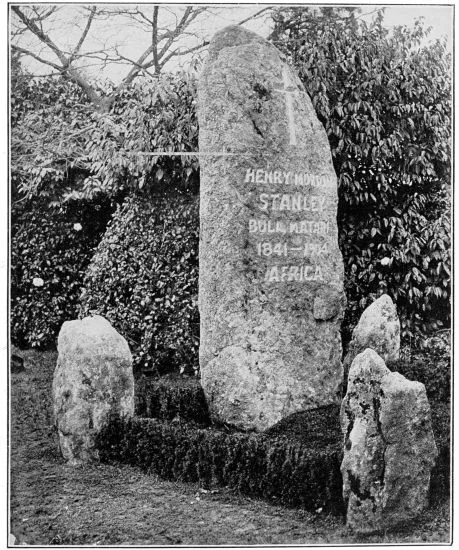 IN THE VILLAGE CHURCHYARD, PIRBRIGHT
by this memorial, but as one of the great Pioneers of Christianity,
Civilization, and Hope to that dark land of Africa.’
After much labour, the great stone, weighing six tons, was transported
to Pirbright churchyard, where it now stands, imperishable as the name,
cut deep into its face.
I desired to record simply his name, ‘Henry Morton Stanley,’ and beneath
it, his great African name, ‘Bula Matari.’ For epitaph, the single word
‘Africa,’ and above all, the Emblem and Assurance of Life Everlasting,
the Cross of Christ.
ON RELIGION
CIVIL law is not sufficient by itself for mankind. It is for the
protection of men from abuse, and for the punishment of offenders; but
religion teaches just intercourse, unselfishness, self-denial, virtue,
just dealing, love of our fellow-creatures, compassion, kindness,
forbearance, patience, fortitude, lofty indifference to death by
spiritual exaltation. While atheists and heathens would regard only
their own self-advantage, opposing craft to an opponent’s detriment, a
religious man would be persuaded that he could not do so without a sense
of wrong-doing, and would strive to act so as to ensure his own good
opinion and those of other conscientious, just-minded fellow-men.
Religion is my invisible shield against moral evil, against the
corruption of the mind, against the defilement of the soul. As there are
specifics for the preserving of cleanliness of the body, so is religion
for the preservation of the mind; and it protects the intelligence from
becoming encrusted writh layer upon layer of sin.
Religion is an invaluable curb on that inner nature of man, which
longest remains barbarous and uncivilised.
I am not animated by the hope of a heavenly reward, such as has been
promised. It is my reason which tells me that I owe a duty to God as my
Maker, and that is, not to offend Him. The Bible tells me, through its
writers, of certain instructions and certain Laws that those who desire
to please Him should follow and obey. Many of these Laws and
instructions appeal to my own sense as being His due; and therefore I
shall conform to them as closely as my nature will permit. When I
perceive that they are too hard for nature, I will pray for His divine
help to withstand the temptations of nature; for more power of
restraint; for more docile submission to His will; for more
understanding to comprehend what is pleasing to Him, for more
gentleness; for moral strength to combat that which my sense assures me
is evil, and unworthy of one endowed with such attributes as belong to
me, I will keep ever striving to perform acts pleasing to Him, while I
have the power, leaving it to Him to judge whether my endeavours to
abstain from evil, and perform that which was right, have been according
to the intelligence and moral power He entrusted me with. Meantime, I
must keep myself open to conviction, so that whenever it shall be my
good fortune to light upon that which will clearly inform me as to the
exact way to serve and please God, it will be possible for me to
conform; and I must by no means offend Him by negligence in doing that
which I know ought to be done.
ON THE INFLUENCE OF RELIGION
To relate a little of the instances in my life wherein I have been
grateful for the delicate monitions of an inner voice, recalling me, as
it were, to ‘my true self,’ it would be difficult for me to do their
importance justice. I, for one, must not, dare not, say that prayers are
inefficacious. Where I have been earnest, I have been answered.
What have these earnest prayers consisted of, mainly?
I have repeated the Lord’s Prayer a countless number of times; but, I
must confess, my thoughts have often wandered from the purport of the
words. But when I have prayed for light to guide my followers wisely
through perils which beset them, a ray of light has come upon the
perplexed mind, and a clear road to deliverance has been pointed out.
In the conduct of the various expeditions into Africa, prayer for
patience, which bespoke more than an ordinary desire for patience, has
enabled me to view my savage opponents in a humorous light; sometimes,
with infinite compassion for their madness; sometimes, with a belief
that it would be a pity to punish too severely; and, sometimes, with
that contempt which I would bestow upon a pariah dog. Patience has been
granted to me, and I have left them storming madly. Without the prayer
for it, I doubt that I could have endured the flourish of the spears
when they were but half-a-dozen paces off.
When my own people have wilfully misbehaved, after repeated warnings, I
have prayed for that patience which would enable me to regard their
crimes with mercy, and that my memory of their gross wickedness should
be dulled; and, after the prayer, it has appeared to me that their
crimes had lost the atrocity that I had previously detected in them.
When oft-repeated instances of the efficacy of prayer were remembered, I
have marvelled at the mysterious subtleness with which the answer has
been delivered.
‘Lord God, give me my people, and let me lead them in safety to their
homes; then do Thou with me as Thou wilt,’ was my prayer the night
preceding the day the remnant of the Rear-Column was found. True, they
were there, they had not moved since July 17th; but I did not know it.
‘Give my people back to me, O Lord. Remember that we are Thy creatures,
though our erring nature causes us to forget Thee. Visit not our
offences upon our heads, Gracious God!’ And thus that night was passed
in prayer, until the tired body could pray no more. But the next dawn, a
few minutes after the march had begun, my people were restored to me,
with food sufficient to save the perishing souls at the camp.
On all my expeditions, prayer made me stronger, morally and mentally,
than any of my non-praying companions. It did not blind my eyes, or dull
my mind, or close my ears; but, on the contrary, it gave me confidence.
It did more: it gave me joy, and pride, in my work, and lifted me
hopefully over the one thousand five hundred miles of Forest tracks,
eager to face the day’s perils and fatigues. You may know when prayer is
answered, by that glow of content which fills one who has flung his
cause before God, as he rises to his feet. It is the first reward of the
righteous act, the act that ought to have been done. When my
anticipations were not realised to their fulness, what remained was
better than nought; and what is man, that he should quarrel with the
Inevitable?
ON PRAYER
I have evidence, satisfactory to myself, that prayers are granted. By
prayer, the road sought for has become visible, and the danger
immediately lessened, not once or twice or thrice, but repeatedly,
until the cold, unbelieving heart was impressed.
This much I have derived from many a personal experience.
I have forgotten my prayers; my sensibilities have been so deadened by
the sordid scenes around me that my soul was not aroused to feel that
there was a refuge for distress. Worldly thoughts absorbed my attention;
I became a veritable pagan, ever ready, on occasion, to sneer and
express utter disbelief. Finally, I have drawn near a danger, and, in
its immediate presence, I have understood its character better; every
faculty is then brought to bear upon and around it, and a sense of utter
hopelessness takes possession of my mind. There is no cowardice, no
thought of retreat; rescue or no rescue, I must face it.
At first, I believe that it will be possible to confront it, go through
with it, emerge from it safely. What is wanting, but light? Next, I am
reminded that such a scene occurred before, and that prayer relieved me.
Ah! but I have so long refrained from prayer, can I believe that, now,
prayer would be answered? I have forfeited the right to be heard. Have I
not joined the scoffers, and smiled in contempt at such puerile ideas,
and said, ‘Prayers were well enough when we were children, but not now,
when I have lived so long without the sign of a miracle’? And
yet—prayer has saved me.
Civilised society rejoices in the protection afforded to it by strong
armed law. Those in whom faith in God is strong feel the same sense of
security in the deepest wilds. An invisible, Good Influence surrounds
them, to Whom they may appeal in distress, an Influence which inspires
noble thoughts, comfort in grief, and resolution when weakened by
misfortune. I imperfectly understand this myself, but I have faith and
believe. I know that, when I have called, I have been answered,
strengthened, and assisted. I am prone to forgetfulness, and to much
pride; but I cannot forget that, when an accusing thought entered my
soul like a sword, I became penitent and responded. Subduing my
unbelief, I prayed, and obtained a soothing grace which restored to me a
confidence and cheerfulness which was of benefit to myself and others.
ON RELIGIOUS EDUCATION
The white man’s child has a more fertile nature than the savage. The two
natures differ as much as the fat-soiled garden near the Metropolis
differs from the soil of the grassy plains in Africa, the only manure of
which has been the ash of scorched grass. The cultivated garden will
grow anything almost to perfection; the African prairie will grow but a
poor crop of hardy maize or millet. Religion acts as a moral gardener,
to weed out, or suppress, evil tendencies, which, like weeds and
nettles, would shoot up spontaneously in the wonderful compost of the
garden, if unwatched. The surroundings of the child’s mind resemble the
fertilising constituents of that garden soil.
The demands, by-laws, necessities, of a feverish, yet idle, Society,
serve to evolve an abortive man, without truth, honesty, usefulness, or
enthusiasm. He has no physical strength, or mental vigour; serious in
nothing, not even in the pursuit of variety or frivolity, not a word he
utters can be believed, by himself or anybody else; for, simplest words
have lost their common meaning, and simplest acts are not to be
described by any phrase required by veracity. Religion inspires the
moral training requisite to crush these noxious fungi of civilised life.
The savage is licensed to kill, to defend his misdeed by simple lying,
to steal, in order to supply his daily wants. The white child kills
character with his tongue, he robs wholesale where the savage robs by
grains.
ON SIR EDWIN ARNOLD’S ‘LIGHT OF THE WORLD’
After reading a few hundred lines of Edwin Arnold’s new poem,[53] ‘The
Light of the World,’ I perceived that he had not hit the right chord. It
is ‘The Light of Asia,’ in a feeble, vapid style; or, to put it more
correctly, it is a Buddhist trying to sing the glories of the
Christian’s Lord. His soul is not in his song, though there are
beautiful passages in it; but it is the tone of an unbeliever. Alas for
this! What a poem he could have written, had he but believed in the
Saviour of the world!
MIND AND SOUL
My own mind, I know, has been derived from God. Its capacity, in this
existence, is measurable. I feel that, up to a certain point, it could
expand, but, beyond that, is madness. It can descend to a certain point
below normal; below that would be ruin. Being measurable, it is just
suited to my limited nature. It is marvellously expansible; it can also
descend to that pin-point and faint glimmer of reason at zero which
guides the brute. The Intangible, Invisible, yet Almighty Intellect
conceived, by knowing, the beginnings of the spacious universe and its
countless myriad of things; the brutes cannot comprehend this, but, to
me, has been given just enough mind to be impressed by the vast and
solemn fact of this immeasurable knowledge. As my mind governs me, and
all that belongs to me, in the same manner I conceive that every
movement of the universe and its myriad of constituents is subject to
some Divine Mind. This Divine Mind is the power of a Personal Spirit
which is God, Who has endowed humanity with the necessary, though
limited, portion of His own subtle and all-powerful intelligence.
All my instincts warn me that this is so; but that, so long as it is
imprisoned by this earthly matter, it cannot give itself that freedom.
When freed from it, my spirit will bound to its source.
A contracted, insect-mind, it is often. Fancy it groping with its
tentacles, stretched almost to snapping, far into yet further spaces;
then, suddenly contracting into apparent mindlessness, at the buzz of a
fly, the bite of an insect, the pang of small nerve! With aspirations
after a seat in the Heaven of Heavens, yet, more often, content to
wallow in the mud—thereby proving its relationship to the noblest and
the meanest! Without that portion of Divinity it could not imagine its
obligation to the Creator, nor be conscious of its affinity with the
brutes.
ON THE FEAR OF DEATH
The weakness of our number against the overpowering force of savages[54]
forbade resistance. Against such a multitude, what hope had we? The
imminence of death brought with it a strange composure. I did not fear
it as I imagined I should; a fortitude to bear anything came to me, and
I could actually smile contemptuously at the former craven fear of its
pain and the sudden rupture of life.
ON ILLUSIONS
Though many illusions are of a character we should gladly cherish, yet
the sooner we lose some of them, the sooner we gain the power of seeing
clearly into things. The one who possesses least has the best chance of
becoming wise. The man who travels, and reflects, loses illusions faster
than he who stays at home. There are nevertheless some illusions, which,
when lost, he bitterly regrets.
To-day, I can feel comfortably at home in almost any country; and can
fully appreciate the truth of Shakespeare’s words, that ‘To a wise man,
all places that the eye of Heaven visits are ports and happy havens.’
Yet I sympathise still with that belief of my youth, that Wales, being
my native-land, possessed for me superior charms to any other.
Had I seen no other wondrous lands, met no other men and women with whom
I could sympathise, it is probable that I should have retained the
belief that Wales was the finest country in the world, and the Welsh
people the best. I used to believe the Bishop was the holiest man
living; the Rev. Mr. Smalley, of Cwm, the biggest man; Sam Ellis, of
Llanbach, the strongest man; Hicks Owen, the finest preacher; my cousin
Moses, the most scholarly; the Vale of Clwyd, the prettiest; Liverpool,
the biggest and most populous town; and the Welsh people, the superior
of any in the whole world.
Without any effort of mine, or anybody else’s, to disabuse me of these
illusions, I have seen hundreds just as holy as the Bishop, bigger men
than the Cwm rector, stronger men than Sam Ellis, better preachers than
Hicks Owen, men more scholarly than Moses Owen, prettier scenery than
the Clwyd, richer and more populous towns than Liverpool, and more
advanced people than the Welsh!
THE TRAINING OF YOUNG MEN, AND EDUCATION
When I was young, a religious and moral training was considered
necessary, as well as an intellectual education, for the improvement of
youth; but, since the banishment[55] of the Bible from the schools, it
has been deemed wise to pay attention to the training of the intellect
alone, while the natural disposition of youth has caused attention to be
paid to athletics.
With a few choice natures this might be sufficient, but I observe that
the generality of young men have not that respect for moral obligations
it would be desirable to foster. The youth whose word is unimpeachable,
whose courage is based on a thorough comprehension of his duty, called
moral, whose spirit bends before its dictates, yet is capable of being
inspired by honour, and swayed by discipline, is far more useful,
valuable, and trustworthy than an athlete with all the intellectual
attainments of a Senior Wrangler; but an athlete combining such moral
and intellectual gifts would inspire love and admiration wherever he
went.
When our sons are steady, reliable, and honest, as well as scholars and
athletes, this nation will top the list of nations, as there are no
excellences superior to these obtainable, and these will lead the world
for ages yet. The Presbyterianism of Cromwell did much; but we can beat
that, if we aim for the best. The three M’s are all that we
need—Morals, Mind, and Muscles. These must be cultivated, if we wish to
be immortal—we are in danger of paying attention to Mind and Muscle
only.
ON EDUCATION
Schools turn out men efficient enough in reading, writing, ciphering,
and deportment; they then go forth to face the world, and they find
their school education is the smallest part of what they have in future
to learn. They are fit for no profession or employment.
The average school-boy and college man cannot understand business,
cannot build or make anything, cannot command men; only after long and
laborious practice can he be entrusted to do rightly any of these
things. Three-fourths of those who came to Africa were qualified only in
the accomplishments of the school-boy. They were unpractised in
authority, untrustworthy as to obedience, ignorant of self-command; they
had apparently never sounded their own virtues or capacities; they
appeared surprised and incapable when called upon to think for
themselves. The public schools and colleges do not teach young men to
think.
ON LEARNING
Learning, by which is commonly understood the results of assimilation of
varied and long years of reading, reflection, and observation, is the
capital of intellect, and is an honoured thing. It is composed of
literary acquisitions subjected to mental analysis. It certainly
contributes to the elevation of man to a lofty sphere; and yet, after
all, I am inclined to think that great as a literary man may be from the
store of intellectual treasures he may have acquired, he gets an undue
proportion of the world’s admiration. The master-minds of a nation are
many and various. The great statesman, the great administrator, the
great inventor, the great man of science, the multitude of nameless, but
bold and resolute, pioneers, those, for instance, who made Australasia;
our great missionaries, those brave, patient souls who, in distant
lands, devote their lives to kindling the fires of Christianity in
savage breasts; the missionaries at home, who are unweariedly exhorting
and encouraging the poor and despairing, exciting the young and heroic
virtue of these, and many more, who go to make the leaders of a
civilised nation,—we hear little of these, compared with what we are
told of men who write books. But the stones which go to make the
palatial edifice have been laid by many hands. Why does most of the
honour go to the writer of books?
ON REAL RECREATION
‘Joy’s Soul lies in the doing,
And the Rapture of pursuing,
Is the prize.’
Even rest is found in occupation, and striving. It is labour which kills
discontent, and idle repose which slays content; for it creates a myriad
of ills, and a nausea of life, it brings congestion to the organs of the
body, and muddles the clear spring of intelligence. The heart is heated
by our impatience, while the soul is deflected from its vigorous course
by excess of shameful ease. Joy’s Soul lies in the doing! The truth
which lies in this verse explains that which has caused many a
personality to become illustrious. It is an old subject in poetry.
Shakespeare, Milton, Wordsworth, Longfellow, and many more have rung the
changes, or expressed the idea, in verse.
Milton, though troubled with blindness and domestic misery, was happy in
the lofty scenes conjured up by his poetic imagination, and therefore he
could have said, ‘Joy’s Soul lies in the doing, And the Rapture of
pursuing is the prize.’
Livingstone was happy in the consciousness that he was engaged in a
noble work, and the joy in the grand consequences that would follow.
This self-imposed mission banished remembrance of the advance of age,
and made him oblivious of the horrors of his position. What supported
Gordon during the siege of Khartoum, but this inward joy in his mission
which his nature idealised and glorified? Coleridge says:—
‘Joy, Lady! is the spirit and the power
Which wedding Nature to us gives in dower.’
ON REVIEWS AND REVIEWERS
The Reviews of my books have sometimes been too one-sided, whether for,
or against, me. The Reviewer is either fulsome, or he is a bitter
savage, striking stupidly because of blind hate. A Review in the ‘New
York Tribune,’ for instance, or the ‘New York Independent,’ the American
‘Sun,’ the ‘Times,’ ‘Morning Post,’ or ‘Daily Telegraph,’ is, however,
the disinterested outcome of study, and is really instructive and worth
reading.
It was owing to repeated attacks of the Public and Press that I lost the
elastic hope of my youth, the hope, and belief, that toil, generosity,
devotion to duty, righteous doing, would receive recognition at the
hands of my fellow-creatures who had been more happily born, more
fortunately endowed, more honoured by circumstances and fate than I. It
required much control of natural waywardness to reform the shattered
aspirations. For it seemed as though the years of patient watchfulness,
the long periods of frugality, the painstaking self-teaching in lessons
of manliness, had ended disastrously in failure.
For what was my reward? Resolute devotion to a certain ideal of duty,
framed after much self-exhortation to uprightness of conduct, and
righteous dealing with my fellow-creatures, had terminated in my being
proclaimed to all the world first as a forger, and then as a buccaneer,
an adventurer, a fraud, and an impostor! It seemed to reverse all order
and sequence, to reverse all I had been taught to expect. Was this what
awaited a man who had given up his life for his country and for Africa?
He who initiates change must be prepared for opposition; the
strong-willed is bound to be hated. But the object need not be
sacrificed for this. A man shall not swerve from his path because of the
barking of dogs.
Spears in Africa were hurtful things, and so was the calumny of the
Press here; but I went on and did my work, the work I was sent into the
world to do.
ON READING THE NEWSPAPERS
That which has to be resisted in reading newspapers is the tendency to
become too vehement about many things with which really I have no
concern. I am excited to scorn and pity, enraged by narratives of petty
events of no earthly concern to me, or any friend of mine. I am roused
to indignation by ridiculous partisanship, by loose opinions, hastily
formed without knowledge of the facts. Columns of the papers are given
up to crime, to records of murder, and unctuous leaders on them. Many
newspapers are absolutely wanting in patriotism. A week of such reading
makes me generally indulgent to moral lapses, inclines me to weak
sentimentalism, and causes me to relax in the higher duty I owe to God,
my neighbour, and myself; in short, many days must elapse before I can
look with my own eyes, weigh with my own mind, and be myself again. In
Africa, where I am free of newspapers, the mind has scope in which to
revolve, virtuously content. Civilisation never looks more lovely than
when surrounded by barbarism; and yet, strange to say, barbarism never
looks so inviting to me as when I am surrounded by civilisation.
RETURNING TO ENGLAND
When returning to Britain from the Continent, I am not struck by the
great superiority of that land over France, Italy, Belgium, and Germany;
in some things it is decidedly inferior, as in the more substantial
structure, and more pleasing appearance, of the homes abroad: they are
bigger, loftier, cleaner, and handsomer, the public buildings more
imposing.
France and Italy shine with whiteness, Britain appears in a
half-cleaned-up state, after being drenched with soot; its sky seems
more threatening, and though the leafage and grass in the fields are
pleasantly green, the stems and twigs are exceedingly black. The white
cottages, with red tiles, of France, are more beautiful than the dingy
brick and dark slate of England.
The generous union of hearts and hands, loving brotherhood, equality of
one sturdy farmer with another, are better exemplified by the open,
cultivated fields of Europe, than by the miserable, useless hedges,
which, by their crooked lines marking the small properties, tell me
which one is poor, which better-off, which rich. Then I hate the waste
of good land, and while the island is but small, thousands of square
miles are absorbed by the briar and hawthorn-topped dykes, and their
muddy ditches, which might be utilised in extending fields to grow corn
for man, and grass for cattle.
Then, on reaching London, compare the sad-looking streets, which you
look down upon from the lofty railway, with the bright Paris you left in
the morning. You may compare the one to a weeping widow, the other to a
gay bride; or to a slatternly fishwoman and to a neat grisette. These
thoughts tend to make one humble-minded, and admit that, after all you
have heard about the superiority of England, Frenchmen, Swiss, Germans,
Italians, and Belgians have nothing to deplore at being born in their
own lands, whatever some Englishmen may profess to feel for them; but
that, rather, we Englishmen ought to grieve that things are so awry with
our climate that we have so much to envy our neighbours. However, when
we descend from the train, and we mix with our countrymen, and hear
their pleasing accents of English, are received with politeness by
friends, Custom-house officials, and cabmen, a secret feeling of
pleasure takes possession of us, and we rejoice that our native language
is English, and that we belong to the big, broad-chested race round
about us.
FORTY YEARS AGO
It is the same nation; it is the same Queen; the present Ministers are
twin brothers to those who governed then. In the pulpits and the schools
the same preachers and teachers preach and teach. One might say that no
change has taken place in forty years. It is certainly the same nation,
but nevertheless the people of to-day are different from the people of
forty years ago.
The captains of ships and officers of the army, the school-masters at
the schools, and the governors of gaols, have abandoned the birch and
the ‘cat.’ Instead of applying black marks on the bodies of their
victims with smiles of content, they put black marks in a book opposite
their names—and the curious punishment seems to have good effect, in
many cases.
A great change has also been effected in the Provinces. Forty years ago,
they were years behind the Metropolis, Liverpool and Manchester were
only ‘country cousins’ to London, and the people of the country were
very far behind Liverpool and Manchester; whereas now, a fashion coming
out to-day in London will be out, to-morrow, in every village, almost,
in Britain.
Of course, the railway, the telegraph, and the Universal Providers are
the causes of this universal transmission of metropolitan ideas and
tastes. This is desirable in a great measure, because it has a
stimulating and quickening tendency on ‘provincialism,’ and militates
against ‘stodginess.’ If we could only be sure that no matter vitiating
the moral fibre of the nation also ran along the arteries of the land
from its heart, we should have cause for congratulation; but, if the
extremities of the land absorb the impurities of the Metropolis, the
strong moral fibre of the nation will soon be destroyed.
There are things characteristic of the masses in towns, and other things
which are, or were, characteristic of the country. But now the hot
impulse of the city mobs has an appreciable effect on those in the
provinces, erstwhile sturdier and more deliberate. If we were always
sure that the impulse was good and beneficial, there would be nothing to
regret. The frivolities of an aggregate of humanity such as London
presents are inseparable from the many millions of people gathered
within its walls; but they are out of place under the blue sky, and in
the peaceful, green fields of the country. The smoke of the city, and
the roar of the traffic, obscure the heavens, and affect the nerves,
until we almost forget the God Who rules, and our religious duties.
Outside of London, the smiling fields, and, skywards, the rolling clouds
and the shining sun, make us aware that there is a Presence we had
almost forgotten.
SOCIALISM
Socialism is a return to primitive conditions. Where it is in force in
Africa, on the Congo, especially, we see that their condition is more
despicable than in East Africa.
On the Congo, people are afraid to get richer than their neighbours.
They would be objects of suspicion; some day the tribe would doom them,
and they would be burnt. Property in common has often been tried in
America: e. g., the original Virginian settlers, the Pilgrims in
Massachusetts, the Shakers, and others; but they have had to abandon the
project. Merely by preventing the spoliation of their fellows, and
giving each man freedom to develop his powers, we have done a prodigious
good in Africa.
Man must be protected from his fellow-man’s greed, as well as from his
anger. Individuals require to be protected from the rapacity of
communities.
LOAFERS
If men who take such pride in cheating their fellows, by doing as little
work as possible, were, only for a change, to glory in doing more and
better than was expected of them, what a difference, I have often
thought, it would make in the feeling between employers and employees!
THE CRY OF ‘WALES FOR THE WELSH’
During my residence in Wales every English man or woman I saw has left
in my memory an amiable reminder. The Bishop was an Englishman. Captain
Thomas, the paternal, fair-minded, hospitable Guardian, was English. Her
Majesty’s Inspector, learned, polite, benevolent, was English.
Brynbella’s lessee, generous and kindly, was English. A chance visitor,
a lady, who came to sketch in the neighbourhood, sitting on a camp-stool
at an easel, was English. I shall never forget her. She painted small
water-colours, and gave us all cakes, oranges, and apples, also
sixpences to the bigger boys and twopences to the lesser!
The best books, the beautiful stories, the novelettes, our geographies,
spelling-books, histories, and school-readers, our Prayer-books and
Bibles, were English. Yet the Welsh hated the English, and the reason
for it I have never been able to discover, even to this day.
We also detested the Paddys of the Square, because they were ragged,
dirty, and quarrelsome, foul of speech, and noisy.
We saw a few French, at least we were told they were French: they were
too much despised to be hated. They belonged to that people who were
beaten at Crécy, Agincourt, Blenheim, and Waterloo.
I should therefore be false to myself if I stooped to say that the Welsh
are the first people under the sun, and that Wales is the most beautiful
country in the world.
But, I am quite willing to admit that the Welsh are as good as any, and
that they might surpass the majority of people if they tried, and that
Wales contains within its limited area as beautiful scenes as any. The
result of my observations is that in Nature the large part of humanity
is on a pretty even plane, but that some respectable portion of it,
thank Goodness! has risen to a higher altitude, owing to the advantages
of civilisation. But there is a higher altitude still, which can only be
reached by those nations who leave off brooding among traditions, and
grasp firmly and gratefully the benefits offered to them by the progress
of the age, and follow the precepts of the seers.
‘Wales for the Welsh’ is as senseless as ‘Ireland for the Irish.’ A
common flag waves over these happy islands, uniting all in a brotherhood
sealed by blood. Over what continents has it not streamed aloft? Who can
count the victories inscribed on it?
ON STARTING ON AN EXPEDITION
Take an honest, open-eyed view of your surroundings, with as much faith
as possible in the God above you, Who knows your heart better than you
know it yourself; and consider that you cannot perish unless it is His
will. But a man need not let his soul be oppressed by fears, religious,
or otherwise, so long as his motives are righteous, his endeavours
honest. Let him see also that his actions are just, and his mind free
from sordid or selfish passions; and that his whole aim is to be
workmanlike and duteous. Thus he is as fit for Heaven as for the world.
Then, bidding a glad farewell to the follies and vanities of civilised
cities, step out with trustful hearts, souls open as the day, to meet
whatever good or evil may be in store for us, perceiving, by many
insignificant signs around, that whatever heavenly protection may be
vouchsafed to us, it would soon be null and void unless we are watchful,
alert, and wise, and unless we learn to do the proper thing at the right
moment—for to this end was our intellect and education given us.
Pious missionaries, even while engaged in worship, have been massacred
at the altar. The white skin of the baptised European avails nothing
against the arrow. Holy amulets and crosses are no protection against
the spear. Faith, without awakened faculties and sharp exercise of them,
is no shield at all against lawless violence!
WRITTEN IN AFRICA, IN 1876, IN A NOTE-BOOK
One of the first sweet and novel pleasures a man experiences in the
wilds of Africa, is the almost perfect independence; the next thing is
the indifference to all things earthly outside his camp; and that, let
people talk as they may, is one of the most exquisite, soul-lulling
pleasures a mortal can enjoy. These two almost balance the pains
inflicted by the climate. In Europe, care ages a man soon enough; and it
is well known that it was ‘care which killed the cat’! In Africa, the
harassing, wearisome cares of the European are unknown. It is the fever
which ages one. Such care as visits explorers is nothing to the trials
of civilisation. In Africa, it is only a healthful exercise of the mind,
without some little portion of which, it were really not worth while
living.
The other enjoyment is the freedom and independence of mind, which
elevates one’s thoughts to purer, higher atmospheres. It is not
repressed by fear, nor depressed by ridicule and insults. It is not
weighed down by sordid thoughts, or petty interests, but now preens
itself, and soars free and unrestrained; which liberty, to a vivid mind,
imperceptibly changes the whole man after a while.
No luxury in civilisation can be equal to the relief from the tyranny of
custom. The wilds of a great city are better than the excruciating
tyranny of a small village. The heart of Africa is infinitely preferable
to the heart of the world’s greatest city. If the way to it was smooth
and safe, millions would fly to it. But London is better than Paris, and
Paris is better than Berlin, and Berlin is better than St. Petersburg.
The West invited thousands from the East of America to be relieved of
the grasp of tyrannous custom. The Australians breathe freer after
leaving England, and get bigger in body and larger in nature.
I do not remember while here in Africa to have been possessed of many
ignoble thoughts; but I do remember, very well, to have had, often and
often, very lofty ideas concerning the regeneration, civilisation, and
redemption of Africa, and the benefiting of England through her trade
and commerce; besides other possible and impossible objects. ‘If one had
only the means, such and such things would be possible of realisation’!
I am continually thinking thus, and I do not doubt they formed
principally the dream-life in which Livingstone passed almost all his
leisure hours.
Another enduring pleasure is that which is derived from exploration of
new, unvisited, and undescribed regions; for, daily, it forms part of my
enjoyment, especially while on the march. Each eminence is eagerly
climbed in the hope of viewing new prospects, each forest is traversed
with a strong idea prevailing that at the other end some grand feature
of nature may be revealed; the morrow’s journey is longed for, in the
hope that something new may be discovered. Then there are the strange
and amusing scenes of camp-life in a savage land; the visits of the
natives, whose peculiar customs or dress, and whose remarks on
strangers, seldom fail to be entertaining; and, best of all, there is
the strong internal satisfaction one feels at the end of each day’s
labours, and the proud thought that something new has been obtained for
general information, and that good will come of it. Lastly, there is the
pleasure of hunting the large, noble game of Africa; that truest of
sports, where you hunt for food and of necessity; to track the
elephant, rhinoceros, buffalo, the eland, and other magnificent animals
of the antelope species.
It is a keen, delightful feeling which animates the mind of the African
hunter, as he leaves his camp full of people, and plunges into the
unexplored solitudes, accompanied by only one or two men, in search of
game, ignorant of the adventures which lie before him; but with swift
pulse, braced nerves, and elated heart, he is ready to try his luck
against even the most formidable. The success of the hunt enhances his
pleasure, and, on his return to camp, he meets his people, who are all
agape with admiration of his prowess, and profuse in thanks for the gift
of animal food.
If the traveller’s mind is so happily constituted that, in the pursuit
of duty, he can also command enjoyment in its pursuit, each day brings
its round of single, happy pleasures, often out-balancing the drawbacks
of travel in savage Africa.
‘For such, the rivers dash their foaming tides,
The mountain swells, the dale subsides;
E’en thriftless furze detains their wandering sight,
And the rough, barren rocks grow pregnant with delight.’
If he is a true lover of wild Nature, where can he view her under so
many aspects as in the centre of Africa? Where is she so shy, so
retired, mysterious, fantastic, and savage as in Africa? Where are her
charms so strong, her moods so strange, as in Africa?
One time she appears so stale, flat, and tedious, that the very memory
of the scene sickens and disgusts; another time she covers her prospects
with such a mysterious veil, that I suffered from protracted fits of
melancholy, and depression of spirits, to such a degree I was glad to
turn to meditations on the words of the fourteenth chapter of Job. It is
when Africa presents vast desolate wastes, without grandeur, beauty, or
sublimity, when even animated life appears quite extinct, then it is
that the traveller from long contemplating such scenes is liable to
become seriously afflicted with sullen, savage humour, as though in
accordance with what he beholds.
At another time, Nature in Africa exposes a fair, fresh face to the
light of heaven, a very queen in glory, whose grassy dress exhibits its
shimmers as it is gently blown by the breeze; soft, swelling hills, and
hollows all green with luxuriant leafage; wild flowers and blooming
shrubs perfume the air, and beautiful outlines of hills grace the
extensive prospect. Oh! at such times I forgot all my toils and
privations, I seemed re-created; the mere view around me would send
fresh vigour through my nerves.
In her grand and sublime moods, Nature often appears in Africa, her
crown, wreathed in verdure, lifted sheer up to the white clouds, the
flanks of her hills descending to the verge of her mighty lakes, vast
and impenetrable forests spreading for unending miles. These are the
traveller’s reward; therefore his life in this little-known continent
need not be intolerable; it is not merely a life of toil and danger;
though constant travel may be fatiguing, thirst oppressive, heat a
drawback, and the ever-recurring fever a great evil, he may also find
much that is pleasant. If he is fortunate in his travels, he will not
regret having undertaken his journey, but will always look back upon it,
as I do, as a pleasant period of a useful life; for it will have
considerably enlightened and matured him, and renewed his love for his
own race, his own land, and the institutions of his country, thus
preparing him for the cultivation and enjoyment of more perfect
happiness at home.
AFTER ONE OF HIS EXPEDITIONS
Stanley writes: ‘When a man returns home and finds for the moment
nothing to struggle against, the vast resolve, which has sustained him
through a long and difficult enterprise, dies away, burning as it sinks
in the heart; and thus the greatest successes are often accompanied by a
peculiar melancholy.’
ON THE GOVERNMENT OF THE CONGO
1896. The King of the Belgians has often desired me to go back to the
Congo; but to go back, would be to see mistakes consummated, to be
tortured daily by seeing the effects of an erring and ignorant policy. I
would be tempted to re-constitute a great part of the governmental
machine, and this would be to disturb a moral malaria injurious to the
re-organiser. We have become used to call vast, deep layers of filth,
‘Augean stables’: what shall we call years of stupid government,
mischievous encroachment on the executive, years of unnecessary,
unqualified officers, years of cumbersome administration, years of
neglect at every station, years of confusion and waste in every office?
These evils have become habitual, and to remove them would entail much
worry and dislike, to hear of them would set my nerves on edge, and
cause illness.
ON THE VALUE OF THE CONGO AND BRITISH EAST AFRICA
English legislators imagine they exhibit their wisdom by challenging
travellers to describe the value of the countries to which they seek to
draw attention. Hasty and preliminary exploration of the topographers
cannot be expected to discover all the resources of a country. For sixty
years the English were in possession of South Africa before either
diamonds or gold were found. Nay, England herself was thought by the
Romans to produce nothing but sloes! New Zealand was supposed to be
destitute of anything but timber. Australia has been frequently
contemptuously alluded to.
The Congo possesses splendid inland navigation, abundance of copper,
nitre, gold, palm oil, nuts, copal, rubber, ivory, fibre for rope and
paper, excellent grasses for matting, nets, and fishing-lines, timber
for furniture and ship-building. All this could have belonged to Great
Britain, but was refused. Alas!
The Duke of Wellington replied to the New Zealand Association, in 1838,
that Great Britain had sufficient colonies, even though New Zealand
might become a jewel in England’s colonial crown!
ON GENERAL GORDON. 1892
I have often wondered at Gordon; in his place I should have acted
differently.
It was optional with Gordon to live or die; he preferred to die; I
should have lived, if only to get the better of the Mahdi.
With joy of striving, and fierce delight of thwarting, I should have
dogged and harassed the Mahdi, like Nemesis, until I had him down.
I maintain that to live is harder and nobler than to die; to bear life’s
burdens, suffer its sorrows, endure its agonies, is the greater heroism.
The relief of Khartoum, that is to say, removing the garrison and those
anxious to leave, was at first, comparatively speaking, an easy task. I
should have commenced by rendering my position impregnable, by building
triple fortifications inside Khartoum, abutting on the Nile, with
boats and steamers ever ready. No Mahdist should have got at me or my
garrison! I should then have commanded all those civilians desirous of
submitting to the Mahdi to leave Khartoum; people do not realise how
ready, nay eager, they were to do so. Gordon said to an interviewer,
before starting, ‘The moment it is known we have given up the game,
every man will be only too eager to go over to the Mahdi; all men
worship the Rising Sun.’
But I should never have stuck to Khartoum, I would have departed with my
garrison to safer lands by the Upper White Nile. It would not have been
difficult to get to Berber, if Gordon had started without delay, in
fact, as soon as he had fortified himself at Khartoum. My withdrawal
would have been to attack the better, ‘leaving go of the leg, to fly at
the throat’; but if, for some reason, I had decided to stay, my
fortified citadel would have held the Mahdists at bay till help came.
There would have been no danger of starvation, as I should have turned
all undesirables out. Then, as a last resource, there was the Nile.
My one idea would have been to carry out what I had undertaken to do,
without any outside help. If I had gone to Khartoum to rescue the
garrison, the garrison would have been rescued! When Gordon started,
this is what he undertook to do; there was no thought, or question, of
sending a rescue expedition. It was failure all round—Gordon failed
first, then Gladstone and the Government.
But I have refrained from all public expression of opinion, because it
is not permitted in England to criticise Gordon; and, besides, he was a
true hero, and he died nobly. That silences one: nevertheless, I hold
that Gordon need not have died!
Large shall his name be writ, with that strong line,
Of heroes, martyrs, soldiers, saints, who gave
Their lives to chart the waste, and free the slave,
In the dim Continent where his beacons shine.
Rightly they call him Breaker of the Path,
Who was no cloistered spirit, remote and sage,
But a swift swordsman of our wrestling age,
Warm in his love, and sudden in his wrath.
How many a weary league beneath the Sun
The tireless foot had traced, that lies so still.
Now sinks the craftsman’s hand, the sovereign will;
Now sleeps the unsleeping brain, the day’s work done.
Muffle the drums and let the death-notes roll,
One of the mightier dead is with us here;
Honour the vanward’s Chief, the Pioneer,
Do fitting reverence to a warrior soul.
But far away his monument shall be,
In the wide lands he opened to the light,
By the dark Forest of the tropic night,
And his great River winding to the Sea.
Sidney Low.
May 13, 1904.
How I Found Livingstone. With maps and illustrations. New York: Charles
Scribner’s Sons.
My Kalulu: Prince, King, and Slave. Illustrated. New York: Charles
Scribner’s Sons.
Coomassie and Magdala: the British Campaign in Africa. New York: Harper
and Brothers.
Through the Dark Continent. Illustrated. 2 vols. New York: Harper and
Brothers.
The Congo and the Founding of its Free State. 2 vols. With maps and
Illustrations. New York: Harper and Brothers.
In Darkest Africa: the Quest, Rescue, and Retreat of Emin, Governor of
Equatoria. With maps and illustrations. 2 vols. New York: Charles
Scribner’s Sons.
My Dark Companions and their Strange Stories. Illustrated. New York:
Charles Scribner’s Sons.
Slavery and the Slave Trade in Africa. Illustrated. New York: Harper and
Brothers.
My Early Travels and Adventures in America and Asia. With portraits. 2
vols. New York: Charles Scribner’s Sons.
Through South Africa: a Visit to Rhodesia, the Transvaal, Cape Colony,
and Natal. With maps and illustrations. New York: Charles Scribner’s
Sons.
⁂ All the above works were published in England by Messrs. Sampson Low,
Marston & Co.
A,
B,
C,
D,
E,
F,
G,
H,
I,
J,
K,
L,
M,
N,
O,
P,
R,
S,
T,
U,
V,
W,
Y,
Z
Abruzzi, Duke of the, ascends the Mountains of the Moon, 371.
Abyssinian expedition, 227-230.
Aden, Stanley at, 237, 238.
Africa, the Abyssinian expedition, 227-230;
the finding of Livingstone, 251-284;
Coomassie, 285-295 ;
Stanley’s expedition through, 296-332;
founding the Congo State, 333-352;
the rescue of Emin, 353-391;
a review of Stanley’s work in, 392-408;
maps of, 392, 393;
South, 482-500;
on starting on an expedition into, 533;
on the pleasure of travelling in, 533-536;
on returning from an expedition in, 536.
Ague, 155, 156.
Albert Edward Nyanza, the, 370, 371.
Albert Nyanza, the, 359.
Allen, William, 468.
Altschul, Mr., 151-161.
America, Stanley’s first visit to, 81-215;
later visits to, 220-227, 291, 425-428.
Anderson, Captain, 345.
Anderson, Colonel Finlay, 228, 237.
Arkansas, population of, 156;
spirit prevailing in, 156, 157.
Arnold, Sir Edwin, thoughts on his Light of the World, 522.
Ashantees, the, 291-295.
Ashburton, Lady, 423.
Ashmead-Bartlett, Mr., 480.
Auckland, Stanley visits, 435, 436.
Australia, Stanley visits, 434, 435.
Autobiography, Stanley begins, 465.
Baker, Mr., the American, 215.
Baker, Sir Samuel White, death of, 462;
Stanley’s estimate of, 462, 463.
Balfour, Dr. Andrew, 407.
Balfour, Arthur, 473, 474.
Balfour, Gerald, 474.
Barker, Frederick, 298, 300, 317.
Barttelot, Major, 354, 360, 364.
Beauregard, General P. G. T., 185, 187 n., 445.
Bedford, Grammar School at, 456.
Belgium, in Africa. See Leopold.
Belmont, battle of, 175.
Bennett, J. G., Stanley’s first interview with, 228;
commissions Stanley to search for Livingstone, 245;
agrees to join in sending Stanley to explore Africa, 298.
Bethell, Commander, 478.
Bible, the, the elder Mr. Stanley’s views of, 136;
Stanley reads, in the wilds of Africa, 252-255.
Binnie, Mr., engineer, 344, 345.
Bismarck summons a conference on the Congo State, 338, 339.
Bonny, William, 363, 364.
Books, Stanley’s, in America, 97, 127;
later read by Stanley, 237, 240, 429, 432, 433, 458, 459, 463, 475, 508.
Bowles, ‘Tommy,’ 478, 479.
Braconnier, 346, 347.
Brassey, Lord, 501.
Brazza, M. de, 336.
Bruce, A. L., urges Stanley to become a candidate for Parliament, 439;
death of, 459;
Stanley’s affection for, 459, 460.
Bryce, James, 478.
Brynford, 41.
Buell, General D. C., on the battle of Shiloh, 203 n.
Burdett-Coutts, the Baroness and Mr., 418.
Burgevine, General, 166.
Burton, Sir Richard F., 423, 424.
Campbell-Bannerman, 504.
Camperio, Captain, 424.
Canterbury, 432, 433.
Carnarvon, Stanley’s reception at, 431.
Carnival, the, at Odessa, 247.
Casati, 424.
Caucasus, Stanley in the, 245.
Cave City, in camp at, 179-185.
Chamberlain, the Rt. Hon. Joseph, on
the slave-trade in Africa, 344 n.;
as a debater, 479;
on South Africa, 495;
as a speaker, 503.
Christopherson, Albert, 345.
Civil War in America, events preceding, 161-166;
Stanley’s part in, 167-221;
why men enlisted for, 168;
Northern view of cause of, 202.
Cleveland, President, his Venezuelan message, 482.
Clwyd, Vale of, 51.
Coleman, Mr., 159.
Columbus, Ohio, the Gibraltar of the Mississippi, 175.
Congo, the, traced by Stanley, 318-330;
opened up, 333-352.
Congo and the Founding of its Free State, 334.
Congo State, founding the, 333-352, 399, 400;
recognised by the civilised powers, 338;
Stanley on the government of, 537;
Stanley on the value of, 537.
Cook, W. H., 222-224.
Coomassie, 229, 292, 293.
Crete, 230.
Cromer, 453.
Cronin, Mr., 151-153.
Cypress Grove, 151-166.
Dalziell, Mr., 476.
Darkest Africa, In, 411, 422.
Davis, Richard Harding, 508.
Death, thoughts on the fear of, 523, 524.
Degrees conferred on Stanley, 424, 425.
Denbigh, 219.
Denbigh Castle, 4-8.
‘Dido,’ the captain of the, 114.
Dilke, Sir Charles, 473, 474, 477.
Dillon, John, 474, 476.
Dixie Greys, the, 165, 166.
Donnelly, Ignatius, Cæsar’s Column, 433.
Douglas, Camp, 205-214.
East African Company, 446-449.
East Anglia, 450.
Education, thoughts on, 524-526.
Eisteddfod, the, 14, 16, 430, 434.
Ellison, Mr., 106, 112.
Emin Pasha, calls for help, 353;
as described by Dr. Felkin, 354;
discovered, 361;
Stanley’s impression of, 362;
a prisoner, 368;
deceived by his officers, 368;
goes with Stanley to the coast, 370-372;
has a fall from a balcony, 372;
engages himself to the Germans, 373, 374;
death of, 375.
England, and Coomassie, 285-295;
backwardness of, in founding the Congo State, 333, 334, 338, 406;
belittles Stanley’s work, 400;
in East Africa, 422;
and South Africa, 487-500;
thoughts on returning to, 529;
changes in, in forty years, 530, 531.
Evangelides, Christo, 230-236.
Felkin, Dr. R. W., his picture of Emin, 353, 354.
Fetish, the, and Ngalyema, 339-342.
Ffynnon Beuno, 42-47, 51-55.
Fisher, Fort, Stanley writes account of attack on, 220, 221.
Flamini, François, 345.
Foraging, in the American Civil War, 180.
Francis, James, 12-16, 32-34.
Furze Hill, 506-514.
Galton, Sir Francis, 286, 287.
Garstin, Sir William, on the importance of Stanley’s discoveries, 404, 405.
Genealogy, 3.
Generalship, American, fault of, 178.
Germany, in East Africa, 422.
Ghost stories, 8, 9.
Gladstone, W. E., Stanley’s interview with, 419-421;
as a speaker, 479, 480.
Goff, Mr., 65.
Gordon, General, Stanley’s view of character of, 338, 527;
massacre of, 353;
Stanley on death of, 396, 397, 538, 539.
Goree, Dr. and Dan, 160, 162, 165, 169, 170, 180.
Grant, Colonel J. A., death of, 437, 438.
Grant, U. S., on the battle of Shiloh, 203;
Stanley’s opinion of, 445.
Greene, Conyngham, 494.
Grey, Sir George, letter of, on the Emin Relief Expedition, 378, 379;
events of his life, 379;
entertains Stanley at Auckland, 435;
Stanley’s opinion of, 436;
letter of, to Stanley, 436, 437;
letter of, to Mrs. Stanley on Stanley’s defeat in the Parliament election, 442, 443;
on place of Stanley’s burial, 515, 516.
Gully, William Court, 469-472.
Haldane, Mr., 474.
Hancock, General, expedition of, against the Kiowas and Comanches, 225-227.
Happiness, thoughts on, 237, 238.
Harcourt, Sir William, 473.
Hardinge, Captain David, 67.
Harman, Rev. Dr., 246.
Harry, boy on board the ‘Windermere,’ 70-72, 78, 79, 82-84.
Hawthorn, Colonel A. T., 168.
Healy, Tim, 475, 477.
Heaton, Dick (Alice), 107-111.
Henderson, Senator, 226, 227.
Hills-Johnes, Sir James and Lady, hosts to Stanley, 464.
Hindman, General T. C., 203, 204.
Holywell, John, 28.
Houldsworth, Sir William, 476.
House of Commons, Stanley becomes candidate for, but is defeated, 439;
becomes a second time candidate, and is elected, 439-445, 466;
Stanley’s impressions of, 467-481, 501-505.
Hubbard, Mr., 158, 161.
Illusions, thoughts on, 524.
Indians, American, the, 225-227.
Ingham, Major, Stanley’s meeting with, 142;
takes Stanley home with him, 146;
life on his plantation, 146-150.
Ingham, Mrs. Annie, death of, 445.
Ingham, C. E., death of, 463.
International African Association, 334-338.
Isangila, 335.
James, Lord, of Hereford, 483.
Jameson, Dr., his invasion of the Transvaal, 482, 483.
Jameson, Mr., 354.
Jephson, Mounteney, joins Stanley’s expedition for the rescue of Emin, 354;
sent by Stanley to search for Emin, 360, 361;
a prisoner, 368;
Stanley’s characterisation of, 382;
sufferings of, 387;
carries succour to Nelson, 390;
accompanies Stanley to Ostend, 434;
Stanley in last sickness talks of, 515.
Jerusalem, Stanley at, 245.
Johnston, General A. S., 185, 199.
Journalism, Stanley’s career in, 220-250, 291-295.
Kennicy, Mr., 89, 91, 101, 102.
Khartoum, massacre of Gordon’s forces at, 353;
how Stanley would have acted at, 538.
Kimber, Mr., 469, 470.
Kitchen, J. D., 101-106, 121.
Krüger, President, Stanley’s description of, 489-499;
his ultimatum, 503, 504.
Kûmishah, 248.
Ladysmith, Stanley on its position as a camp, 499, 500.
Learning, thoughts on, 526.
Lee, Mr., nephew of General Lee, 165, 169.
Lee, General Robert E., Stanley’s opinion of, 445.
Leopold, King, of Belgium, interested in the opening up of Africa, 334, 338;
discusses African affairs with Stanley, 412-417;
concludes treaty with English Government, 418;
Stanley the guest of, at Ostend, 424;
invites Stanley to Ostend, 434.
Leopoldville, 336.
Liverpool, Stanley’s life at, 56-68.
Livingstone, Stanley goes to Aden to meet, 237;
Stanley is commissioned to search for, 245;
reported character of, 250;
Stanley in search of, 251-263;
found, 263-267;
why he did not return of his own accord, 267-272;
leaves Ujiji, 273;
character of, 273-278, 281-284, 527;
Stanley’s parting from, 279, 280;
death of, 280;
feelings of Stanley at news of his death, 295, 296;
letters of, to Sir George Grey, 435.
Llys, the, 40.
Loafers, thoughts on, 531.
Long Hart, 72.
Low, Sidney, his article on Stanley’s African explorations, 392-404;
poem of, on Stanley, 540.
Lowell, J. R., Letters of, 458, 459, 461.
Lualaba, the, 318-330. See Congo.
Lyall, Sir Alfred, Stanley presides at lecture of, 501.
Lyons, Colonel, 168.
Machiavelli, 463, 464.
Mackay, A. M., 406.
Mackinnon, Sir William, patronises the Emin Relief Expedition, 354;
and the
East African Company, 446-449;
death and funeral of, 446, 449;
remarks on, 459, 460.
Malone, Tom, 169, 180.
Mason, Penny, 165, 169.
Manyanga, 335.
Marks, Mr., 489, 494.
Matabele War, 454, 455.
McKenna, Mr., 478.
Melchet Court, 423, 428.
Milligan, Colonel James A., 205.
Milner, Sir Alfred, on South Africa, 495.
Milton, John, 526.
Mind and soul, thoughts on, 522, 523.
Mirambo, 257, 258.
Mississippi River, 115-117, 125.
Moon, Mountains of the, 371.
Morris, Edward Joy, 223, 245.
Morris, Maria, aunt of Stanley, 55, 57, 62-68.
Morris, Tom, uncle of Stanley, 58-68.
Mose, boyhood friend of Stanley, 34-40.
Mtesa, 311-313, 317, 318, 405.
Murchison, Sir Roderick, 267, 282.
My Early Travels and Adventures, 225, 245.
Myers, F. W. H., quoted, 289.
Napier, Sir Robert, 229.
National School at Brynford, 44, 47-51.
Nelson, mate on board the ‘Windermere,’ 70, 75, 76, 80.
Nelson, Captain, 354, 383, 387, 390.
New Orleans, Stanley’s life at, 81-125;
later visit to, 426, 427.
New York, Stanley’s impressions of, 425.
New York Herald, Stanley becomes correspondent of, 228-230.
New Zealand, Stanley visits, 434-437.
Newspapers, Stanley reads, in the wilds of Africa, 252-255;
the scavenger-beetles of, 288;
thoughts on reading the, 528.
Ngalyema and the fetish, 339-342.
Nile, the, Stanley’s discoveries regarding the sources of, 301, 371, 405.
North-Welsh, the, 52.
Norwich, 452.
Odessa, Stanley at, 247.
O’Kelly, James J., 468, 469, 471, 472.
Owen, Hicks, 18.
Owen, Mary, aunt of Stanley, 42-57, 207, 208.
Owen, Moses, 41-51.
Parke, Surgeon, joins the expedition for the rescue of Emin, 354;
on the march, 360, 373;
his journal of the expedition, 378, 436, 437;
Stanley’s opinion of, 381, 382, 390;
accompanies Stanley to Melchet Court, 423;
death of, 459, 460.
Parker, Henry, 187, 188, 193.
Parkinson, John, 58.
Parkinson, Mary, 58.
Parliament. See House of Commons.
Parry, Moses, grandfather of Stanley, 6-8.
Pasargadæ, ruins of, 248.
Peace Commission to the Indians, 225-227.
Persepolis, 249.
Phillpots, Mr., 458.
Pickersgill, Mr., 476.
Pigmies, 365-367.
Platte River, 222.
Pocock, Francis and Edward, 298, 300, 301, 321, 329.
Portugal, in Africa, 338.
Prayer, thoughts on the efficacy of, 519-521.
Price, Dick, 10.
Price, Richard and Jenny, 8-10.
Price, Sarah, 8-10.
Provincialism, 155.
Rawlinson, Sir Henry, 286, 289.
Reading, Mr. Stanley the elder instructs Stanley in, 127.
Recreation, real, thoughts on, 526, 527.
Redmond, John, 474.
Religion, thoughts on, 518-520.
Religious convictions, of Stanley when a boy, 23-28;
of the elder Mr. Stanley, 133-137.
Religious education, thoughts on, 522.
Reviews and reviewers, thoughts on, 527, 528.
Rhodes, Cecil, 455.
Rhuddlan Eisteddfod, 14, 16.
Richardson, Mr., 89-121.
Roberts, Lord, 464.
Roberts, Willie, 22, 23.
Robertson, Mr., 472, 473.
Robinson, Rev. Joseph A., refuses to allow Stanley to be buried in Westminster Abbey, 515.
Rowlands, John, Stanley’s real name. See Stanley, Henry Morton.
Rowlands, John, Stanley’s grandfather, 38-40.
Runciman, Mr., 525 n.
Ruwenzori Mountains. See Moon, Mountains of the.
St. Asaph Union Workhouse, 10-34.
St. Louis, 115, 116.
Salisbury, Lord, accuses Stanley of having interests in Africa, 408;
as an orator, 445, 446, 465.
Sandford, General, 338.
Saragossa, fighting at, 241-243.
Saunderson, Colonel, 489.
Scheabeddin, quoted, 371.
Schnitzer, Edouard. See Emin Pasha.
Seton-Karr, Mr., 474.
Sherman, General W. T., 226, 227, 426.
Shiloh, 186-204.
Shipman, Mr., 205, 206, 212, 213.
Short, Bishop Vowler, 17, 30.
Slate, James M., 169, 180, 204.
Slave-trade in Africa, 344, 407, 413, 419-422, 457.
Smalley, Mr., 17.
Smith, Parker, 478, 480.
Smith, Captain S. G., 165, 168, 188, 189.
Socialism, thoughts on, 531.
Soldiering, 167-215.
Solomon’s Throne, 248.
Soul and mind, thoughts on, 522, 523.
Spain, Stanley in, 240-244.
Speake, James, 89, 102-105, 121.
Speake, Mrs., 105, 106.
Speke, Mr., 435, 462.
Stairs, Lieutenant, 354, 360, 381, 390.
Stanley, Denzil, Stanley’s son, 483, 485, 486.
Stanley, Henry Morton, his progenitors, 3, 4;
dawn of consciousness, 4;
earliest recollections, 4-7;
his grandfather, 7, 8;
at the Prices’, 8-10;
taken to the Workhouse, 10;
his first flogging, 13, 14;
his second memorable whipping, 14, 15;
life at the school, 16-22;
his feelings at the death of Willie Roberts, 22, 23;
his religious convictions, 23-28;
his meeting with his mother, 28, 29;
the most advanced pupil, 30;
his personal appearance, 30;
acts as deputy over the school, 31;
his struggle with Francis and flight from the Workhouse, 32-34;
adventures after leaving the Workhouse, 35-37;
visits Denbigh and learns of his relatives, 37-40;
calls on his grandfather, John Rowlands, 40;
engaged as pupil-teacher, 41;
visits his aunt, Mary Owen, 42-47;
at the National School at Brynford, 47-51;
returns to Ffynnon Beuno, 51;
life at Ffynnon Beuno, 51-55;
leaves Ffynnon Beuno, 55;
sadness at departure, 56;
arrival at Liverpool, 56-59;
visits Mr. Winter, 60;
employed at a haberdasher’s, 62;
about the docks, 64;
employed at a butcher’s, 65;
ships as cabin-boy, 67;
sails for New Orleans, 68;
on board the ‘Windermere,’ 69-81.
Arrival at New Orleans, 81;
first night in New Orleans, 82-84;
leaves the ‘Windermere,’ 84, 85;
seeks work in New Orleans, 86-89;
first meeting with Mr. Stanley the elder, 87-90;
taken on trial, 89;
in his new position, 90-93;
permanently engaged, 93;
his new feeling of independence, 94-96;
his affection for New Orleans, 96;
on the moral courage to say ‘No,’ 96;
books read at this period, 97, 98;
takes breakfast with Mr. Stanley, 98-100;
his acquaintance with the Stanleys, 100, 101;
his salary increased, 101;
his discovery of a theft in the business house, 102-104;
Mr. Stanley’s gift of books to, 105;
watches the body of Mr. Speake, 105, 106;
adventure with Dick (Alice) Heaton, 107-111;
discharged from Ellison and McMillan’s, 106;
his account of the death of Mrs. Stanley, 111-113;
attends the captain of the ‘Dido,’ 114;
leaves New Orleans, 115;
goes to St. Louis, 115;
returns to New Orleans, 116-118;
taken under the charge of Mr. Stanley and given his name, 118-125;
travels with Mr. Stanley, 125;
his mental acquisitiveness and memory, 126;
his judgement a thing of growth, 126;
studies and reads with Mr. Stanley, 127;
profits by the moral instruction of Mr.
Stanley, 128-133, 137-139;
the religious views taught him by Mr. Stanley, 133-137;
further education at the hands of Mr. Stanley, 140;
his personal appearance, 140;
his last parting with Mr. Stanley, 142-145;
receives a letter from Mr. Stanley, 145, 146;
on Major Ingham’s plantation, 146-150;
at Mr. Waring’s, 150;
walks to the Arkansas River, 150, 151;
at Mr. Altschul’s store, 151-161;
learns of the death of Mr. Stanley, 161;
hears of events preceding the Civil War, 161-166.
Enlists, 166;
his enlistment a blunder, 167;
his mess, 169;
on the march, 171-175;
witnesses the battle of Belmont, 175;
campaigning, 175-179;
in camp at Cave City, 179;
foraging, 179-185;
transferred to Corinth, 185;
at the battle of Shiloh, 186-203;
made a prisoner, 200;
taken to the rear, 200-203;
prisoner of war, 205-214;
vision of Aunt Mary, 207, 208;
enrolled in the U. S. Service, 214;
has the prison disease and is discharged, 214, 219;
events following his discharge, 214, 215, 219.
Arrives at Liverpool, 219;
visits his mother’s house and his reception, 219;
returns to America and joins the merchant service, 220;
enlists in United States Navy and is ship’s writer, 220;
writes account of attack on Fort Fisher, 220, 221;
wanders about America, 221;
“Press” and “Stage,” 221, 222;
floats down the Platte River, 222;
goes to Asia (Stanley-Cook exploration), 223, 224;
joins General Hancock’s expedition against the Indians, and accompanies the Peace Commission to the Indians as correspondent, 225-227;
his earnings, 227;
becomes correspondent of the New York Herald, 228;
reports the Abyssinian expedition, 229, 230;
goes to Crete, 230;
the Virginia episode at Island of Syra, 230-236;
his further travels, 237;
goes to Aden to meet Livingstone, 237;
his thoughts on happiness, 237, 238;
on slanderous gossip, 239;
on change from boy to man, 240;
in Spain, 240-244;
his application to duty, 243, 244.
Is commissioned by Mr. Bennett to search for Livingstone, 245;
at the opening of the Suez Canal, 245;
in Egypt, at Jerusalem, at Constantinople, and in the Caucasus, 245, 246;
on Rev. Dr. Harman, 246;
sees the Carnival at Odessa, 247;
in the East, 247-249;
arrives at Zanzibar, 250;
starts from Zanzibar in search of Livingstone, 251, 252;
reads Bible and newspapers in wilds of Africa, 252-255;
his feeling of tranquillity when in Africa, 255;
his ideas on being good-tempered in Africa, 256;
in Ugogo, 256;
in Unyanyembe, 257, 258;
hears of a grey-bearded man, 259;
pays heavy tribute to the natives, 259, 260;
sees Lake Tanganyika, 261, 262;
arrives at Ujiji, 262;
finds Livingstone, 263-267;
tells why Livingstone did not return of his own accord, 267-272;
leaves Ujiji, 273;
his observations on Livingstone’s character, 273-278, 281-284;
his parting from Livingstone, 279, 280;
his return home, 286.
Speaks before societies, 286, 287;
hostility to, 286-289;
received by Queen Victoria, 289-291;
lectures in England and America, 291;
accompanies campaign against the Ashantees, 291-295;
on Lord Wolseley, 294;
Lord Wolseley on, 294;
feelings at news of death of Livingstone, 295, 296;
conception of plan to explore Africa, 295-298.
Makes preparations in Zanzibar, 298, 299;
proceeds inland, 299-301;
his camp attacked, 302-304;
arrives at the Victoria Nyanza, 305;
circumnavigates the Victoria Nyanza and Lake Tanganyika, 305-319;
traces the Lualaba (Congo), 318-330;
aims to introduce civilisation into Africa, 333, 334;
his work of opening up the Congo, 335-339;
and Ngalyema, 339-342;
his manner of dealing with the natives, 342-346;
and his subordinates, 344-351;
his answer to those who regarded him as ‘hard,’ 346-351;
his virility of purpose, 351;
called ‘Breaker of Rocks,’ 352.
Undertakes to lead the Emin Relief Expedition, 354;
starts on the expedition, 355;
forms Advance Column, 355, 356;
on the march, 356-359;
reaches the Albert Nyanza, 359;
constructs a
fort at Ibwiri, 360;
discovers Emin, 361;
his impression of Emin, 362;
goes in search of the Rear-Column, 362;
his discovery of the Rear-Column, 363, 364;
returns to Fort Bodo, 364-367;
returns to the Albert Nyanza, 367;
commences homeward journey, 370;
discovers the Albert Edward Nyanza, 370, 371;
sees the Mountains of the Moon, 371;
reaches the Indian Ocean, 372;
enlightened as to the true character of Emin, 373, 374;
results of his expedition, 375;
his letter on the conduct of Englishmen in Africa, 376, 377;
Sir George Grey’s letter on his work on the Relief Expedition, 378, 379.
Expects implicit obedience from his subordinates, 380;
his descriptions of his subordinates, 381-383;
lives alone while in Africa, 383, 384, 386;
on the white man in Africa, 384, 385;
accused of being ‘hard,’ 385;
his manner of life while in Africa, 386-388;
his thoughts while in Africa, 388, 389;
Low’s estimate of his work in Africa, 392-404;
on his intellectual power, 396, 397;
a leader of men, 397;
on the criticisms of his methods, 398;
his character, 399, 402, 403;
his religious beliefs, 399;
as an administrator and organiser, 399, 400;
effects on his health of the Emin Expedition, 401;
in the last fourteen years of his life, 401, 402;
his personal appearance, 402;
Sir William Garstin’s estimate of the importance of his discoveries, 404, 405;
his master-passion, that of a civiliser, not of a discoverer, 405-407;
had no pecuniary interest in Africa, 407, 408.
On the charm of the Great Forest, 409;
his return to civilisation, 409, 410;
writes his book, In Darkest Africa, 411, 412;
goes to Brussels and is received by the King of Belgium, 412;
Grand Crosses conferred on him, 412;
discusses African affairs with the King of Belgium, 413-417;
arrives in England, 418;
his reception in England, 419;
his interview with Gladstone, 419-421;
his refutation of the charge that he used slaves, 421, 422;
In Darkest Africa published, 422;
stirs up societies to see that Germany does not absorb too much of East Africa, 422;
married, 423;
meets Sir Richard F. Burton in the Engadine, 423;
meets Camperio and Casati, 424;
the guest of King Leopold at Ostend, 424;
given degrees, 424, 425;
visits America on a lecturing tour, 425;
travels over the United States and Canada, 425-428;
dines at the Press Club, New York, 426;
newspaper comments on his personal appearance, 426;
visits New Orleans, 426, 427;
feels lack of freedom, 427, 428;
returns to England, 428;
lectures in England, 429;
longs for rest, 429, 432;
his reading, 429;
on the Welsh language, 430;
his reception at Carnarvon, 431;
on Canterbury, 432, 433;
visits Switzerland, 433;
breaks his ankle, 434;
visits King Leopold at Ostend, 434;
his visit to Australia, etc., 434-438;
letter to, from Sir George Grey, 436, 437.
Consents to become candidate for Parliament, 439;
defeated, 439;
his speeches on second candidacy, 440-442;
his disgust at electioneering methods, 443, 444;
on Beauregard, Lee, and Grant, 445;
on Mackinnon and the East African Company, 446-449;
on East Anglia and Yarmouth, 450-452;
on Norwich, 452;
his enjoyment of solitude by the sea, 453;
on the Matabele War, 454, 455;
on a coal-strike, 455;
on W. T. Stead, 455, 456;
on the destruction of the slave-trade in Africa, 457, 458;
on Lowell’s Letters, 458, 459, 461;
on A. L. Bruce, 459, 460;
on Sir S. W. Baker, 462, 463;
goes to the Isle of Wight, 463;
at the Hills-Johnes’, 464;
begins his Autobiography, 465;
elected to Parliament, 466, 467;
first impressions of the House, 467-472;
impressions of the speakers, 472-476;
on obstructive tactics, 476, 477;
gives his maiden speech, 478-480;
on the Venezuelan affair, 482;
his love for his son, 483, 485, 486;
frequently ill from malaria and gastritis, 483-485.
Leaves for South Africa, 485;
his views on South African affairs, 486-489;
his description of Krüger, 489-499;
feels contempt for England for not acting
with more decision in South Africa, 469-499;
on Ladysmith as a camp, 499, 500;
presides at Lyall’s lecture, 501;
views of England’s lack of decisiveness, 501;
disgusted with the Parliamentary methods, 502, 504, 505;
on the speakers, 503;
on South African affairs, 503, 504;
has little influence in Parliament, 504, 505;
leaves Parliament, 505;
looks for a house in the country, 506;
buys Furze Hill, 506, 507;
life at Furze Hill, 507, 508;
created G. C. B., 508;
how he was misunderstood, 508, 509;
his story of the little black baby, 509;
other baby stories, 510, 511;
his repairs at Furze Hill, 512, 513;
sickness and last days, 513-515;
death, 515;
buried at Pirbright, Surrey, 515;
his headstone, 516-517.
Thoughts on religion, 518, 519;
on the influence of religion, 519, 520;
on prayer, 520, 521;
on religious education, 522;
on Arnold’s Light of the World, 522;
on mind and soul, 522, 523;
on the fear of death, 523, 524;
on illusions, 524;
on the training of young men, and education, 524-526;
on learning, 526;
on real recreation, 526, 527;
on reviews and reviewers, 527, 528;
on reading the newspapers, 528;
on returning to England, 529; on the
England of forty years ago, 530, 531;
on socialism, 531; on loafers, 531;
on the cry of ‘Wales for the Welsh,’ 531, 532;
on starting on an expedition, 533;
on the pleasures of travelling in Africa, 533-536;
on returning from an expedition, 536;
on the government of the Congo, 537;
on the value of the Congo and British East Africa, 537;
on General Gordon, 538, 539.
Poem of Sidney Low on, 540.
Stanley, Lady, her marriage to Stanley, 423;
urges Stanley to become candidate for Parliament, 439;
letter to, from Sir George Grey, on Stanley’s defeat for election to Parliament, 442, 443;
‘nurses’ North Lambeth, 445;
watches for signal of Stanley’s election to Parliament, 466, 467;
during the last days of Stanley, 512-517.
Stanley, Mr., of New Orleans, Stanley’s first meeting with, 87-90;
Stanley visits, 98-101;
visits Stanley, 104;
his gift of books to Stanley, 105;
Stanley’s affection for, 118;
charges himself with Stanley’s future, and gives Stanley his name, 118-125;
Stanley travels with, 125;
teaches Stanley how to read, 127;
gives moral instruction to Stanley, 128-133, 137-139;
his religious views, 133-137;
the further education he gives Stanley, 140;
is adventure with a thief, 141;
his last parting with Stanley, 142-144;
sends a letter to Stanley, 145, 146;
death of, 161.
Stanley, Mrs., of New Orleans, 99-101, 111-113.
Stanley-Cook exploration in Asia, 223, 224.
Stanley Falls, 326.
Stanley Pool, 329, 336.
Stead, W. T., 455, 456.
Story, Newton, 156, 165, 169, 170, 180, 193.
Suez Canal, opening of, 245.
Swinburne, A. B., 345.
Syra, Island of, 230-236.
Talbot, A., 456, 458.
Tanganyika, Lake, 261, 262, 318, 319.
Tanner, Dr., 468, 469, 473-475.
Tasmania, Stanley visits, 434, 437, 438.
‘Tay-Pay,’ 475, 476.
Taylor, Commissioner, 227.
Teheran, 247.
Tennant, Dorothy, married to Stanley, 423.
See Stanley, Lady.
Theodore, King, 229, 230.
Thomas, Captain Leigh, 17.
Tiflis, 246.
Tippu-Tib, 319-325, 364.
Tomasson, 169, 180, 184.
Tremeirchion, 42, 51.
Uganda, 309-313, 405.
Uganda Mission, 318.
Uhha, 259, 260.
Ujiji, 262.
Valencia, Stanley at, 243.
Vasari, his Machiavelli, 463.
Venezuela, and President Cleveland’s message, 482.
Victoria, Queen, receives Stanley, 289-291.
Victoria Nyanza, the, 305-317, 319.
Vivi, 335.
Waldron, Mr., 151, 153.
‘Wales for the Welsh,’ on the cry of, 531, 532.
Waring, Mr., 150.
Washita River, 146.
Waters, Mr., 71, 77, 79, 80.
Webb, Mrs., 464.
Wellcome, Henry, 514, 515.
Welsh language, Stanley’s views of, 430.
Wilkes, W. H., 206.
Williams, Mrs., 92.
‘Windermere,’ the, 67-81.
Winter, Mr. and Mrs., 60, 61.
Winton, Sir Francis de, 338, 419.
Wolseley, Lord, on Coomassie, 293;
on Stanley, 294.
Workhouse, St. Asaph Union, 10-34.
Worsfold, Basil, on Sir George Grey, 379.
Yarmouth, 450-452.
Zanzibar, 250, 251, 280, 298.
A New Three-and-Sixpenny Edition of Works
BY THE LATE
Sir H. M. Stanley, G.C.B.
IN DARKEST AFRICA.
Being the Official Publication recording the Quest, Rescue, and Retreat
of Emin, Governor of Equatoria. The illustrations, numbering over 150,
have all been made from Sir Henry Stanley’s own Notes, Sketches, and
Photographs, and are by the hands of the best English and French
draughtsmen, amongst whom are Mr. Sydney P. Hall, M. Montbard, M. Reau,
Mr. Forrestier, and others. The engraving is by the competent hands of
Mr. J. D. Cooper and M. Barbant (of Paris). New Edition, 3s. 6d.,
cloth gilt.
Full of incident and excitement; the story of one of the most unique
adventures on record.
UNIFORM WITH ABOVE.
HOW I FOUND LIVINGSTONE.
Including Four Months’ Residence with Dr. Livingstone. With Map and
Illustrations. Crown 8vo. cloth. New Edition, 3s. 6d., cloth gilt.
“It is incomparably more lively than most books of African travel. The
reader may follow him with unflagging interest from his start to his
return, and will be disposed to part with him on excellent
terms.”—Saturday Review.
THROUGH THE DARK CONTINENT.
From the Indian to the Atlantic Ocean. With Maps and Illustrations.
Price, 6s.
“Every page contains the record of some strange adventure, or the note
of some valuable observation.... We lay down the book with a feeling of
admiration for the courage of the explorer, and of respect for his
powers of observation and great industry.”—Pall Mall Gazette.
MY KALULU.
Crown 8vo. cloth, 3s. 6d.
“This book is extraordinarily fascinating, and will be read by everyone,
man or boy, with breathless interest from cover to cover. It is quite
remarkable that a man of action like Stanley should be able to write so
well. ‘My Kalulu’ is a romance based upon knowledge acquired by Stanley
during his search for Dr. Livingstone in 1871-2.”—Penny Illustrated
Paper.
COOMASSIE AND MAGDALA.
The Story of the Campaign in Africa, 1873-4, and The Story of the
Abyssinia Campaign of 1866-7. With Maps and Illustrations. New Edition.
Crown 8vo. 3s. 6d.
LONDON:
SAMPSON LOW, MARSTON & CO., LIMITED,
100, SOUTHWARK STREET, S.E.
Typographical errors corrected by the etext transcriber:
apprenticesip is over=> apprenticeship is over {pg 385}
had been devasted=> had been devastated {pg 387}
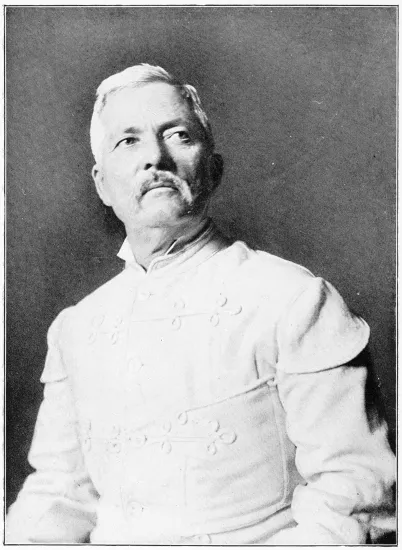
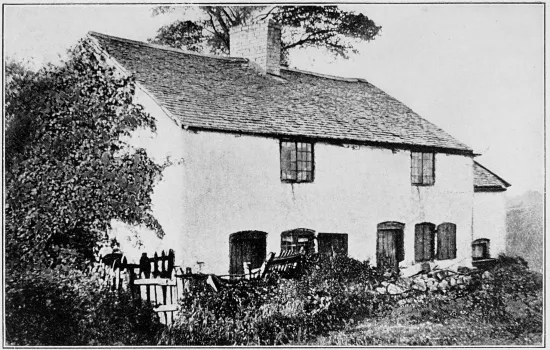
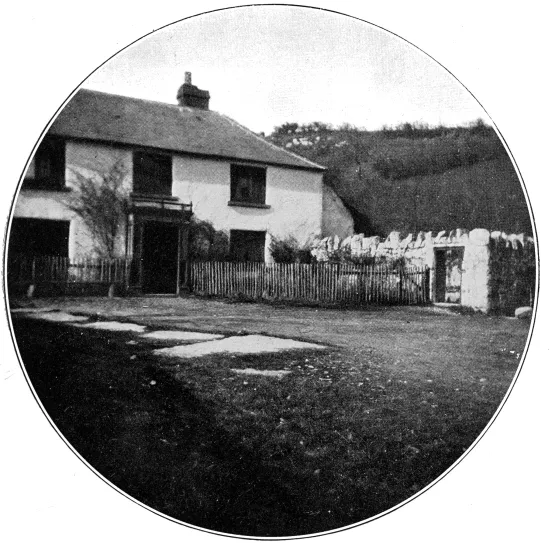
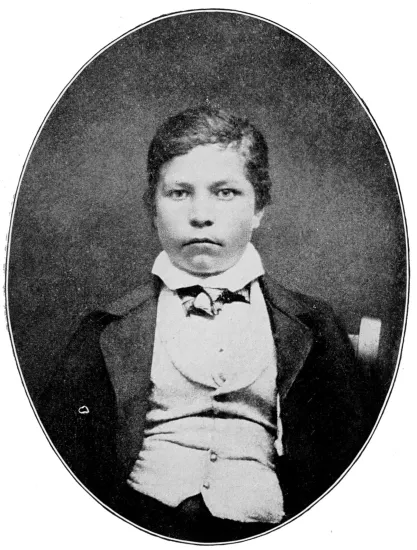
 MEMPHIS, TENN.,’ and looked up.